Spring Sale: Get 1 Year, Save 58%

“He wasn’t struggling”: Jennifer Aniston texted Matthew Perry the morning of his death

Jennifer Aniston has opened up about the recent and sudden loss of her close friend Matthew Perry. The "Friends" star reflected on Perry's life, telling Variety that he "wasn't struggling" before his untimely death on Oct. 28. When she was asked how she would like the world to remember Perry, she shared: "As he said he’d love to be remembered. He was happy. He was healthy. He had quit smoking. He was getting in shape."

"He was happy — that’s all I know. I was literally texting with him that morning, funny Matty. He was not in pain. He wasn’t struggling. He was happy," Aniston said, emphasizing that "I want people to know he was really healthy, and getting healthy. He was on a pursuit. He worked so hard. He really was dealt a tough one."

Ultimately, the actress said "I miss him dearly. We all do. Boy, he made us laugh really hard." And that the tributes to Perry from around the world are "so beautiful. I hope he can know that he was loved in a way he never thought he was."

According to the Los Angeles County Medical Examiner’s Office, Perry's cause of death was inconclusive and there is a pending toxicology report. He was found in his LA home unresponsive in a hot tub in an apparent drowning. The actor was 54.

Forcing Kate Cox to travel out of state for an abortion is cruel, and shows exceptions don’t work

During pregnancy, a woman is truly never in the clear in terms of her safety and her baby’s safety. Complications can arise at any time, and depend on a variety of factors. For low-risk pregnancies, the 20-week mark can be a big milestone marked by a routine anatomy scan. 

The ultrasound that occurs between 18 and 20 weeks of pregnancy gives expecting parents a very detailed glimpse into their growing fetus. It also gives a doctor an opportunity to look for 11 rare conditions which could be life-threatening to mom, the baby, or both — like the genetic disorder trisomy 18. While the technician can’t say anything during the scan, as their job is to take detailed sonograms for a doctor to review, the time period between the scan and results can be an anxious one.

For many women, they’ll receive a call that the scan looked great. Coupled with previous genetic testing, they’ll breathe a sigh of relief and try to enjoy the last half of their pregnancy. But not everyone, like a Texas woman named Kate Cox, is so lucky. Instead, they’ll receive nightmarish news, perhaps confirming their baby has a fatal fetal anomaly, and the best course of action is to terminate the pregnancy. A heartbreaking and unfathomable turn of events that comes with a lot of grief and devastation after being pregnant for nearly five months.

For Cox, this hellscape scenario started a few weeks earlier than 20 weeks thanks to a screening test that first showed that she was at an increased risk for trisomy 18. This put her on track to have more tests, more ultrasounds, only to end up 20 weeks pregnant and now in the middle of a public battle for access to an abortion.

Only 50 percent of fetuses with trisomy 18 who are carried to term will be born alive. From there, the average survival rate for live births varies between 2 days and 2 weeks. As Cox wrote in an editorial published in The Dallas Morning News, “it isn’t a matter of if I will have to say goodbye to her, but when.”

“It isn’t a matter of if I will have to say goodbye to her, but when.”

Up to 95 percent of infants born alive with trisomy 18 die during their first year of life. Despite her attempts to be optimistic, even thinking maybe her unborn daughter “will have a really nice life in a wheelchair,” more ultrasounds have only brought more bad news. “There are issues with her spine, heart, brain and limb development, among other conditions,” she said. 

While Cox wanted to terminate the pregnancy, a decision doctors told her she could make, they also told her their “hands” were “tied” under Texas’ abortion ban. Under Texas law, if a doctor is convicted of performing an illegal abortion they can face a $100,000 fine and up to 99 years in prison. Technically, Texas makes an exception for abortions when a pregnancy or the life of a woman is seriously threatened, but as I’ve previously reported for Salon, experts have long doubted such exceptions would work as intended — as we’re seeing play out in Texas at the moment. And it will play out, again and again, as we also witnessed this week when AP News reported today that a Kentucky pregnant woman has filed a lawsuit demanding the right to an abortion. Her embryo "no longer has cardiac activity," AP reported, quoting her attorneys Tuesday.

In response, Cox and her husband sought a court order to block Texas’ abortion bans from applying in her case to grant her access to an abortion in Texas. Last Thursday, their request was granted. But then Texas Attorney General Ken Paxton sought an emergency stay from the state Supreme Court, pausing the lower court’s approval. As a result, on Monday, it was announced that Cox would be traveling out of state to get an abortion. Later, the Texas Supreme Court ruled against the lower court's order, denying the request. Being forced to go to such lengths is the definition of cruelty.


Want more health and science stories in your inbox? Subscribe to Salon's weekly newsletter Lab Notes.


The word "cruel" originates from the Latin word crudelis, which is defined as "hardhearted, bloodthirsty, unmerciful and inhuman." And it’s exactly what can be used to describe denying a pregnant mother of two an abortion for a fetus with a genetic disorder who will have low chances of surviving. “I do not want to continue the pain and suffering that has plagued this pregnancy or continue to put my body or my mental health through the risks of continuing this pregnancy,” Cox said. “I do not want my baby to arrive in this world only to watch her suffer.”

“What is being accomplished by forcing women to carry these babies to term other than ensuring that these children are as aware of and sensitive to their pain as possible?”

As Cox has said herself, she was so excited to learn she was pregnant with her third child. She wants to grow her family. But due to circumstances out of her control, she has become the one in 2,500 pregnancies to face the diagnosis. An abortion, Cox said, was something she never imagined she’d “want or need.” She never saw herself being in the situation she is in right now: 20 weeks pregnant with a baby that very likely won’t survive, and a pregnancy that could jeopardize her own health and future pregnancies. Carrying a pregnancy with trisomy 18 to term is associated with increased risks of gestational diabetes, preterm delivery and cesarean section.

There will be a choir of anti-choice advocates trying to justify Cox carrying the fetus to term, to pray for a miracle. They will trivialize how much it can cost, emotionally and financially, to travel out of state to get her wishes fulfilled. As Allison Chang, who also had a fetus with a trisomy 18 diagnosis, wrote for STAT News, “What is being accomplished by forcing women to carry these babies to term other than ensuring that these children are as aware of and sensitive to their pain as possible?”

As any parent knows, leaving your children to travel out of town is never easy, especially on a whim. Chances are high that Cox is going to have to go through this procedure alone. Of course, Cox will also be seen as one of the lucky ones who has the resources to even travel of out state to terminate her pregnancy, which not all women have.

We need your help to stay independent

What these narratives refuse to acknowledge again and again is the pain of the mother carrying the fetus. The pain of forcing her to seek permission for an abortion while she grieves the loss of hope for another child. The pain she faces as she has to weigh risking her own health for an unborn fetus, and the chances of being there for her children who are alive right now. The pain of forcing her into a situation that could keep her from having another child in the future. And finally, the pain of being dragged into the spotlight over a private medical procedure that ideally should only be between her and her doctor.

Anti-choice advocates say they’re defending life. But really, they’re failing to prioritize and value women’s lives, many of whom are already mothers with children. Instead, they’re adding to women’s pain in a culture that’s obsessed with minimizing and ignoring it. 

“I’m trying to do what is best for my baby daughter and myself and my family, but we are suffering because of the laws in Texas,” Cox said. “I need to end my pregnancy now so that I have the best chance for my health, for parenting my children, and for a future pregnancy.”

Why acclaimed actor Willem Dafoe wears so many faces: “I really am in it for the adventure”

For an actor who's appeared in blockbuster franchises and earned decades of critical acclaim (He just earned his fourth Golden Globe nomination), Willem Dafoe remains something of an industry anomaly. He's starred in controversial features like "The Last Temptation of Christ" and "Antichrist;" he's been an animated fish in "Finding Nemo," a motel manager in "The Florida Project" and Vincent Van Gogh in "At Eternity's Gate." And now, in "Poor Things" – Yorgos Lanthimos' follow-up to "The Favourite" – he's an inquisitive Victorian physician whose young charge, Bella (Emma Stone), is also his latest experiment.

"Performing is still kind of mysterious to me," Dafoe told me during a recent "Salon Talks" interview, "and I never tire of it. It's always different." During our conversation, Dafoe reflected on how he's managed to avoid being typecast after all this time, why he's not interested in going behind the camera, the movies his fans most want to talk to him about and his unique trajectory. "I don't have this master plan or I don't have specific career aspirations," he said. "I've just kind of bumped along and gone from project to project, and always looking for good people, and doing stuff that turned me on."

You can watch my full interview with Dafoe here, or read the transcript of our conversation below.

The following interview has been lightly edited for length and clarity.

Talk to me about this movie and your unique, Dr. Frankenstein-like character.

You meet me in my house. It's a Victorian period. I'm a scientist, I'm a doctor, and I'm scarred. We find out later that my father has experimented on me. He was also a scientist, a doctor. I deal in cadavers and such things for my work. I received this cadaver, and there's a child. This woman is pregnant. She's suicided, and I think this is a great opportunity, being a man of science, "Why don't I put the baby's brain in this woman's body?" That's where we start, basically.

The accent you do is more Scottish.

Yes. That choice comes from the novel. I think he's written as Scottish, and the writer is Scottish. I think he puts a lot of himself in this character called Godwin Baxter, and sometimes she [Bella] calls him “God.” He's her creator. For a long time he holds onto her. He falls in love with her. It's a paternal kind of relationship, but it's more than that. Then he realizes he has to let her go at some point, out into the world.

The setup provides you with this woman that's, in her body, a grown woman. She's got this brain that learns very quick and it's not conditioned by social conventions. She goes out in the world and kind of is a truth-teller, and is an innocent because she hasn't experienced the world. She's also very wise because she doesn't have all these accepted truths that are not true. That's the fun of the movie, because you see her poke holes in all these things that we take as accepted truths and just accept in terms of our identity, in terms of our conformity. We see ourselves in that. It's nice to follow her through this journey where she's really realizing herself.

You work with directors who work so far outside the box, who really are pushing convention and doing really interesting things. Was it the book that drew you to it? Was it the director? Was it the story? Was it the cast?

I've always liked his [Yorgos Lanthimos'] movies, and it was simple; they came to me. Emma was involved very early in this project – Yorgos invited her into it very early, – so she has a big hand in the project. They called me up and they basically told me what the story is. Both of them I like a great deal, and I liked the general pitch they gave me. So I said, "I'm in."

I read recently from Variety that Mark Ruffalo said that during the making of the film, he was very concerned that he might be replaced by another actor, and you fed right into that. What did you do, Willem? 

Listen, Mark is sweet. He also performs his insecurity sometimes. It's kind of half real and half fake, half to get reassurance and half just kind of self-deprecating humor. So this goes on, and I think, "We've got to put a stop to this." He kept on saying, "I saw Oscar Isaac around here. He could do my role." He plays this insecurity, which is all part of his character in the end, but I mean personally plays it. So one day I brought Oscar in, and Oscar made it as if he was called in to replace him, to give him a little fright. It's a nasty little prank, but we're still friends.

This film in some ways hearkens visually back to some classic horror films, to "Frankenstein," to "Metropolis." When you were growing up, what movies were you were watching and saying, "I want to do something like that"?

"You've got to be able to let things go in order to really be free, and make something that isn't something that you already know."

When I was a kid, I was more fixated on the theater. I wasn't the guy that was in the house watching movies. But I grew up in the Midwest. My parents had eight kids, and they both were workaholics, and occasionally they'd go to Chicago, the big city, and have a romantic weekend. When they were there they'd buy these little 8 mm films that were shorts from features like “Frankenstein” and all these horror movies, and I used to play them obsessively. So those were really the first movies I saw. 

We had a little projector, and I used to play them and play them backwards. Those were probably the first movies I saw. Maybe that's in there somewhere, but I was a cinephile much more later in life and much more attracted to film later. My identity was really as a theater director for many years.

As one of the founding members of the Wooster Group, you are so rooted in that identity and that part of theater history. Then when I look at your film career, you have directors who you've worked with again and again, and again like Wes Anderson, like Abel Ferrara, like Lars von Trier. That to me speaks to someone who understands repertory.

Yes. First of all, it's obvious. You have a shorthand. If you have a good time working with them, there's trust there. They know you. You know them. You can serve them better. They can set you up better. Also there's something beautiful, and this does come from the theater very much, of being part of the fabric of a whole body of work, and to see these different characters go through the different films. There's a pleasure to that. I think there's a pleasure for the audience and there's a pleasure for the actor. You get an extra spin on it because sometimes you can use them iconographically because you can position them in relationship to previous films.

I think of the work you've done in Wes Anderson films, for example.

Yeah. You're playing with an image, which I don't normally do. But in the context of a body of work, it's fun to do that.

As someone who comes from that theater background who has that repertory experience, who likes that dynamic, it's interesting to me that you rarely seem to be interested in going behind the camera. Is that something that's still on your bucket list of things to do, or are you you in your lane, you like where you are?

No, I'm in my lane. Performing is still kind of mysterious to me, and I never tire of it. It's always different. I don't want that kind of responsibility. I try to think what turns me on, and it's usually attaching myself to someone who has a vision. And then my job, my pleasure, is trying to embody that vision. It's not necessarily mine, but I come to it. Part of my work is trying to make flesh what they're describing to me, or once they've made a world to inhabit that world. I think that's for me, that's the way I get the most pleasure and I'm the most engaged. 

"I've never been like a Hollywood guy, but I've never not been a Hollywood guy."

When I have an idea and I want to express it, it often completes itself in a funny way. I don't want to say it's self-serving, but I'm not into interpreting something that I know and crafting something to tell people that is my experience. I want to have the experience, and I want to have the experience and have it be hopefully honest enough and full enough that people can have it with me by watching me. In that way, I don't worry so much about what it means or where we're going. So much of performing, it's about commitment, and being present, and receiving what's around you. I look at you now — it's about being receptive, and also being flexible and tolerant, and all those things can only happen if you make a trick: You sort of do it for someone else, because if you do it for yourself, I think you rush to result and you're also less free.

So I hope it doesn't sound like I'm flattering myself by saying, "Well, I do it for the other people. I don't do it for myself," because that's not it. Ultimately, I do it for myself because that's how I function best. When you say, "Walk across the room," and I do it, and I find pleasure in that action. I find my way to that. If I say, "What do I do now?" it's a different process, "Oh, maybe I'll walk across the room." I immediately start to craft something and I'm not thrown into the not knowing like you would be when you do it for someone else.

The way that you do it though, Willem, the characters that you inhabit, you have played detectives, and monsters, and a fish. How do you avoid being typecast? You could be monsters forever.

Look, I've tried not to be typecast because I just like to have different challenges. I don't like to sell anything. Some people do it beautifully, they create a persona and then they create stories that they can go deeper and they can express that persona. It's one way of making something. But I like to try to bend myself to the situation because I really am in it for the adventure, in it for the experience. I'm a little bit like a child that way, but what makes me not a child is I'm serious about it and I'm very disciplined. The act of trying to give yourself to the bigger picture is a very adult thing. And that's what's going to sustain you. 

Because I try very just naturally to mix up different projects, different sizes of projects, working with new directors, working with directors that have been around for a while, your films get seen differently, how they get distributed. Some movies I've made are very underseen. Some movies I've made are seen widely. So you are always developing and being seen in different ways so you don't get something reflected back to you that puts you in one lane. So hopefully, at least in theory, you are setting yourself up to be seen in different ways and then different opportunities come.

What's a movie that you've done that you wish more people had seen?

Oh, there's many. There's many. Maybe I'm a crybaby, but you make a movie and you like it, you feel like it's not seen enough. I make a lot of small movies because I like the small team. I like the flexibility. Sometimes the people with the most radical visions and most interesting ways of working aren't seen as commercially viable, so they're working with smaller budgets, quicker shoots, that kind of thing. Those movies, sometimes.

I've worked with Abel Ferrara, for example. I know people that say, "Oh, Abel Ferrara, 'Bad Lieutenant.'" That's a beautiful film, or it's an interesting film. It is an important film. But he's done so much work since then, and some I've been involved in. And because of distribution, he lives in Europe now and he's quite well regarded in Europe, but here I find constantly that those films are under-distributed.

You also live at least part of the time in Europe. Angelina Jolie did an interview earlier this week where she said she doesn't want to be in Hollywood anymore because Hollywood is an unhealthy place. Having that space away from Hollywood at least part of the time in your life, how does that change your perspective to the work that you seek out and the work that you do?

I've never been like a Hollywood guy, but I've never not been a Hollywood guy. I've lived there while I've been working on movies. I've never lived there, because for many years I was working with the theater company downtown called the Wooster Group, for 27 years. Now that's 20 years ago now. 

"The act of trying to give yourself to the bigger picture is a very adult thing."

I belonged to the community of each individual film, and of course I'm a part of that film community because I've been working for a little while. But I understand what she says about being unhealthy, but she was in the belly of the beast a lot of the time. Now she's branching out and directing more. I imagine it's liberating for her to be out of that lane, as you say, that she's been put in a very prominent way. I don't have that same kind of problem. I don't have the kind of celebrity she has, and I've never lived in L.A. So socially, the environment that I'm in is different. 

I've always traveled a lot because even with the Wooster Group, we used to sometimes tour four or five months a year. So ever since I've been about 22 years old, I've spent a lot of the year outside of the United States. I love it when I'm here, but I also love to travel, and I go where the work is.

You've been in so many cult films, movies that people hold so close to their hearts that maybe weren't big when they first came out. I want to know when people come up to you and they're starstruck, what is it? Is it “Boondock Saints”? Is it “American Psycho”? What is it?

It depends on the person, obviously. Like “Boondock Saints,” for a certain, particularly male, of a certain age, that was probably a teenager or a young man maybe. If they were of age, let's say a little after that because it had no release, but it became a cult movie. Those are “Boondock Saints" fans.  But out of that demographic, I don't think people are that aware of the movie, so it's very particular. 

Sometimes I say when people come up to me and they want to talk about a movie, I can sometimes tell what part of my filmography they're familiar with and probably what part of my filmography they don't know it all, which is cool. Maybe it's a thing of vanity or something, but I like the fact that I have different audiences. 

I always felt like this with the theater, that the theater people didn't know about my film career and the film people didn't know about my theater career, if you call it a career. That does a thing where that keeps you flexible because then you don't, getting back to doing different kinds of work and all that, you don't see yourself as one thing. You see yourself as this moving thing, and you're more conscious of the illusion of creating a persona, or a way of working, or what you think you're good at, or what you think you're bad at. That's all up for grabs because you keep on getting different things reflected back to you, so that's nothing I've designed. It's something that's happened naturally because I think always in the projects you choose, it's partly you seeking them and you receiving what's coming towards you, but it's also what's being offered to you. 

I don't have this master plan or I don't have these specific career aspirations. I've just kind of bumped along and gone from project to project, and always looking for good people, and doing stuff that turned me on. Usually with a minimum of worrying about where they fit in the overall because I've been doing it long enough that I think if it's good work, it's good work. No matter what happens to it, if you know why you're doing it, you give it your best try. Nobody tries to make a bad movie. And then you let it go, and I think you have to have that. You've got to be able to let things go in order to really be free and make something that isn't something that you already know. You can surprise yourself a little bit more if you don't have pressure to know where you're going or what you're doing. And that's probably why I'm not a director.

"Poor Things" is currently in theaters.

Judge shreds Rudy Giuliani’s plans to spread the Big Lie on the stand: “Perjuring himself”

A federal judge admonished Rudy Giuliani on Tuesday for saying he planned to testify that false voting fraud allegations he made against two former, Fulton County election workers are true, the Atlanta-Journal Constitution reported.

U.S. District Judge Beryll Howell already ruled that the former New York mayor's claims against Ruby Freeman and Shaye Moss are false and found him liable for defamation last summer. But after the first day of a trial determining what Giuliani would pay in damages, he repeated unsubstantiated claims of a stolen election to reporters outside the courthouse and told them he planned to testify that they were true.

Attorneys for Freeman and Moss asked the judge to bar Giuliani from making those statements in court, and on Tuesday, Howell noted that Giuliani had already agreed in court that his allegations were false. Howell also directed his attorney, Joseph Sibley, to urge Giuliani against testifying unless he wishes to face further liability and sanctions.

“Given all the Georgia official investigations showing those were false statements, at worst he’s perjuring himself to play to some other audience, the audience for his social media outlets,” Howell said. The judge further pressed Sibley to explain Giuliani's change in opinion, asking if he was just playing for the media in his remarks. Sibley responded that he was unsure, but speculated the case has taken a toll on the almost 80-year-old attorney. 

Tuesday's exchange came during the trial for Freeman and Moss' defamation lawsuit against Giuliani, a former personal lawyer for Donald Trump. The election workers testified on Tuesday that they endured death threats and harassment as a result of Giuliani, Trump and others accusing them of double-counting ballots in the 2020 election among other illegal acts, allegations investigators with the FBI, GBI and the secretary of state debunked.  

“This wasn’t what this interview was going to be about”: Ron Johnson flails under pressure from CNN

Sen. Ron Johnson, R-Wis., during a recent appearance on CNN, pushed back on an allegation that Wisconsin Republicans falsely claimed to be electors for Donald Trump in the 2020 presidential election with his own claim: Democrats have done the same thing "repeatedly in all kinds of states."

"The Source" host Kaitlan Collins was discussing a recently settled lawsuit against ten members of the GOP in Johnson's state who fraudulently stated that the former president had won the election. The suit was prepared by the Institute for Constitutional Advocacy and Protection and the pro-democracy group Law Forward, which sought $200,000 in damages from each individual. No fine was handed down, but each Republican elector conceded that President Joe Biden was the true winner of Wisconsin in 2020 and also agreed to not serve as an elector in the 2024 race or any other in which Trump is a candidate. 

As the Daily Beast noted, Republican Senate Majority Leader Devin LeMahieu, Wis., stated that he would not, however, rescind his appointment of sanctioned elector Bob Spindell to the state's nonpartisan election commission. When asked if he supported Spindell's resignation, Johnson was vehement in his support for the fake elector.

“No," Johnson plainly stated. "Again, there was an active court case. There were all kinds of irregularities in Wisconsin in the 2020 election. In order to make sure that the case just wasn’t determined to be moot, they had to have an ultimate slate of electors, just like Democrats have done repeatedly in all kinds of different states,” he said. “There is nothing untoward about what they did. There is nothing illegal about what they did. They are just an alternate slate of electors.”

We need your help to stay independent

Johnson then argued that Democrats have used the courts “to harass these poor individuals," adding that the ten implicated Republicans “did nothing different than what many Democrats have done in many states.” 

“They certainly did, Senator,” the CNN host shot back. “There were multiple slates of fake electors, including in your home state. They’re acknowledging that they were playing a role in trying to improperly overturn the election. That’s what they said.”

When Johnson pressed his claim further, Collins asked for examples of which states Democrats had declared themselves electors in. "I’m not prepared to give you the exact states,” he stammered. "But it’s happened repeatedly. It has happened repeatedly. Just go check the books.”

“Which books?” Collins asked.

 “There have been alternate slates of electors by Democrat electors in our history," Johnson asserted. "Again, you didn’t—this wasn’t what this interview was going to be about,” he griped. “I’ll come and I’ll provide you the information, but I’m absolutely certain about that."

A top Johnson aide tried to get a bogus slate of pro-Trump electors to then-Vice President Mike Pence on Jan. 6. Pence's aide refused the offer.

The hidden death toll of flooding in Bangladesh sends a grim signal about climate and health

In the summer of 2022, one of the worst monsoons on record turned swaths of Bangladesh, a low-lying country in South Asia, into huge, muddy lakes. When the brunt of the flooding finally eased, at least 141 people had died and millions of others throughout the region had been injured, impoverished, or displaced. The sheer scale of the destruction made 2022 an outlier year, but data from the past few decades signals that the historic monsoon was part of a larger trend: Climate change is making South Asia’s rainy season more intense and inconsistent. Unusually fierce floods have plagued the region earlier in the year and more often than they used to — a pattern that research shows will continue, and worsen, as the planet warms in the years ahead. 

A study published last week shows Bangladesh’s intensifying monsoons come with a staggering death toll, both in the immediate aftermath of the flooding itself and, more significantly, in the months that follow. The true scale of the toll has not been fully captured by local officials, aid organizations, or the international research community. 

The same is likely true for other parts of the world that experience recurrent climate disasters. “In the climate and health field, we often evaluate the health effects of specific acute events, because it’s easier to account for all the other potential factors that could be confounding the association,” said Lara Schwarz, an epidemiologist at University of California, San Diego, who was not involved in the study. But a focus on the short-term obscures the larger picture. “Most climate events don’t occur only once and are likely to harm vulnerable populations over and over, through years, decades, and generations,” she said. 

In the new study, researchers from the University of California in San Diego and in San Francisco found that flooding contributed to the deaths of 152,753 infants — defined as children 11 months and younger — in Bangladesh in the three decades between 1988 and 2017. The researchers used health surveys conducted by the United States Agency for International Development to collect data on more than 150,000 births over the course of the 30 years. They compared that data against high-resolution maps of major floods over that time span and found a stark difference in mortality risk: There were 5.3 more infant deaths per 1,000 births in flood-prone areas than in non-flood-prone areas. The authors extrapolated from this finding to estimate how many infant deaths, overall, were attributable to flooding in Bangladesh over the time period they studied. 

“The increased risk of infant mortality suggests that populations living in a flood-prone region may also be at higher risk of other adverse health problems."

Infants are an especially vulnerable subset of the population, and changes in infant health can reflect the prevalence of health issues in the wider population. “Death is the most severe health outcome,” said Schwarz. “The increased risk of infant mortality suggests that populations living in a flood-prone region may also be at higher risk of other adverse health problems such as improper nutrition, water-borne diseases, and poor mental health.”

The majority of the deaths were likely linked to three flooding-related conditions. The first, diarrheal disease, often spreads when flooding overwhelms local sanitation infrastructure and causes drinking-water supplies to be contaminated. Cholera, one of the most common and deadliest water-borne bacterial diseases, is a particular concern in poor countries where sanitation infrastructure is underdeveloped.

Flooding also contributes to outbreaks of mosquito-borne diseases like dengue, because standing water creates ample breeding ground for mosquitoes. Finally, flooding turns agricultural fields into bogs and can lead to massive crop losses, which contribute to existing food insecurity in Bangladesh. Babies are extremely vulnerable to hunger. The Lancet, a leading medical journal that publishes an annual analysis of the impacts of climate change on human health around the world, has identified bacterial and vector-borne diseases and malnutrition as top areas of concern. 

Drownings and other injuries from the flooding also led to a small percentage of the deaths, the study’s authors told Grist. All of the health-related risks posed by flooding, from the first drowning to the last case of dengue, were exacerbated by socioeconomic factors like food security, family income, vaccination history, access to medical care, and the condition of local infrastructure such as sewage systems and drinking-water treatment facilities.

The authors of the study told Grist that their results indicate that the risks of environmental health hazards are shifting as climate change worsens. Government health agencies and researchers often collect information on the immediate public health impacts of a single extreme weather event. But, because a warmer world also means a world plagued by more frequent and intense disasters, communities are being affected by extreme weather repeatedly. The long-term, cumulative health consequences of events that occur on a yearly or sometimes even more frequent basis are not well understood by the scientific community. And as such, the world has a flawed understanding of the true human cost of extreme weather.

“We need to understand this kind of long-term impact in the context of climate change, because communities are going to be repeatedly and systematically exposed to these hazards,” said Tarik Benmahria, an environmental health researcher at University of California, San Diego, and one of three authors of the Bangladesh study. “These types of issues used to be exceptional by definition,” he added. “They’re not anymore.”

The method used by the researchers to determine the burden of flooding on communities in Bangladesh over multiple years, Schwarz said, “has the potential to be applied to evaluate the long-term effects of other climate exposures.” Extreme heat, hurricanes, and drought, to name a few of the environmental disasters being exacerbated by climate change, can also have compounding health effects that occur weeks, months, even years after the event takes place. If future research pinpoints how and when these effects occur, it could potentially save lives. “The approach is very relevant to other areas of the world that are vulnerable to recurrent climate hazards,” Schwarz said.

This article originally appeared in Grist at https://grist.org/health/the-hidden-death-toll-of-flooding-in-bangladesh-sends-a-grim-signal-about-climate-and-health/.

Grist is a nonprofit, independent media organization dedicated to telling stories of climate solutions and a just future. Learn more at Grist.org

Gingerbread is a delicious yet ancient staple of the holiday season — with many health benefits

No confectionery symbolizes the holidays quite like gingerbread. While most of us associate gingerbread with edible houses and spiced loaves of cake-like bread, it's also increasingly appearing as flavoring in novelty drinks and Christmas cocktails.

Gingerbread may be considered an indulgent treat if you're only considering the calorie content. But it's Christmas, and indulging in a treat or two can be a fun and healthy part of life — especially when this classic biscuit includes many nutrients that may benefit your health.

Gingerbread is believed to have originated in its earliest form in 2400BC ancient Greece. Surprisingly, this recipe didn't contain any ginger at all — and was actually a honey cake.

But the version of gingerbread we know and love today didn't start to take shape until the 11th century when Crusaders returned from their travels in the Middle East with ginger in hand. Ginger was first cultivated in ancient China, where it was commonly used as a medical treatment.

This led to the cooks of nobility in Europe to begin experimenting with ginger in their cooking. As ginger and other spices became more affordable to the masses in the mid-1600s, gingerbread caught on.

The original term "gingerbread" referred to preserved ginger, which was developed into a confection made with honey and spices. Later, the term was used to refer to the French confectionery pain d'epices (spice bread) and the German Lebkuchen or Pfefferkuchen (pepperbread or pepper cake).

But the gingerbread house, which is now a staple of modern Christmas traditions, is believed to have been invented in 18th-century Germany, thanks to the fairy tale Hansel and Gretel by the Brothers Grimm. The practice then spread to England at some point during the 19th century.

Queen Elizabeth I is credited with creating the first gingerbread men. She would delight visiting dignitaries with gingerbread figures baked into their likeness.

Despite its ancient origins, baking gingerbread during the holiday season remains a celebrated tradition in many parts of the world.

For example, in Sweden, designing and building gingerbread houses is traditional during the Christmas season and symbolizes holiday spirits, family bonding and Swedish heritage.

Bergen, in Norway, is said to have the largest gingerbread town in the world. Every year since 1991, local businesses and thousands of volunteers help to make the "pepperkakebyen" (gingerbread town).

Poland is also famous for its gingerbread cookies — so famous they even have a gingerbread museum. These biscuits come in various shapes and varieties and have been a tradition in the city of Torun since the 14th century.

Several towns and villages in the UK are associated with gingerbread — including Gasmere, Whitby, Preston and Ormskirk.         

Gingerbread was incredibly popular in the north of England thanks to the gingerbread ladies of Ormskirk, who began making it as early as 1732. It was so popular, in fact, that King Edward VII would have the royal train stop at Ormskirk on the way to Balmoral to stock up on gingerbread.


Surprising benefits

Gingerbread is enjoyed in many countries. But while each place may have its own take on the confection, the one thing that remains consistent is the spices they include — the key ingredient being ginger.

Ginger has a long history of use in various forms of traditional and alternative medicine. Research shows it may aid in digestion, reduce nausea and help fight the common cold and flu.

It's also believed ginger may support weight management, help manage arthritis and may also alleviate menstrual symptoms.

Molasses is another ingredient sometimes found in gingerbread. It's made by refining sugarcane or sugar beet juice. Molasses is naturally rich in antioxidants, iron, calcium, magnesium, potassium, phosphorous and vitamin B6. All of these important vitamins and minerals may help relieve constipation, treat anaemia and support bone and hair health.  

Cinnamon is another key ingredient of gingerbread. It's a particularly versatile spice with significant health benefits. It has antimicrobial properties and is also rich in antioxidants — natural molecules that may help protect against diseases such as type 2 diabetes. Cinnamon may also help lower inflammation and can be a useful anti-ageing ingredient for the skin.

Research has also shown that it may improve dental hygiene, reduce cholesterol and lower blood pressure.

Similarly, nutmeg — another common ingredient in gingerbread — is associated with reduced inflammation and may benefit heart health.

While, of course, gingerbread also contains ingredients that aren't good for your health if you eat too much of it (such as sugar), at least you can feel a little less guilty if you indulge in a gingerbread biscuit this holiday season as it contains some beneficial ingredients.

But for those who feel they need to watch their diet, there are ways you can make gingerbread healthier.

For example, use almond flour instead of regular flour. This gives a boost of protein, which may make you feel fuller and help stop over-eating. Almond flour is also a great gluten-free option.

You can also swap butter with coconut oil or olive oil, which may have less of an effect on cholesterol levels compared to butter.  

Adding nuts, seeds and raisins to decorate can also be an easy way to add nutrients (such as vitamin E, magnesium and selenium) and fiber.

Hazel Flight, Programme Lead Nutrition and Health, Edge Hill University

This article is republished from The Conversation under a Creative Commons license. Read the original article.

12 foreign actors playing Americans in this year’s best TV shows and movies

As awards season is in full swing, some of the top nominations highlight the work of actors from overseas who've made a splash by playing American this year.

This is by no means a new trend. After all, "Gone With the Wind" Southern belle Scarlett O'Hara was played by British actor Vivien Leigh in 1939. But it is always fun to note which actors have embedded themselves so deeply in their characters that the public may not be aware of their actual origins or accents. Notable foreign actors like Daniel Kaluuya in "Get Out," Daniel Day-Lewis in "Lincoln" and Christian Bale in "American Psycho" all played quintessential American roles. Kaluuya's portrayal of a Black American man embodied the nuances of the country's systemic racism thanks to Jordan Peele's sharp writing and directing. Day-Lewis literally played one of the most influential American presidents, Abraham Lincoln during the Civil War. As for Bale, if Patrick Bateman isn't peak American, I don't know what is.

Even the government noted how foreign actors are ditching countries like the U.K. for Hollywood gigs. In 2013, Homeland Security reported a 500% increase in the number of visa petitions approved for British actors and directors seeking work in the U.S.  

The stars of this year's best-performing films "Barbie" and "Oppenheimer" are played by foreign actors. Let's take a look at who else put on an accent to play all-American onscreen.

01
Emily Blunt, "Oppenheimer"
OppenheimerChristopher Denham, Seth Neddermeyer, Emily Blunt, Gustaf Skarsgård, and Josh Peck in "Oppenheimer" (Universal Pictures)
Emily Blunt starred in one of the most talked about films of the year, Christopher Nolan's epic "Oppenheimer." The British actress plays Katherine "Kitty" Oppenheimer, the wife of J. Robert Oppenheimer, who built the atomic bomb dropped on Hiroshima and Nagasaki, Japan during World War II.
 
In "Oppenheimer," Blunt portrays a very emotionally embattled woman who is said to suffer from alcoholism and mental illness. But Blunt plays her with sympathy and strength, supporting Oppenheimer through it all. Blunt's scene defending Oppenheimer in front of government officials is a standout in the movie. 
 
The actress was born and raised in the U.K. and has played a wide range of American roles like Emily the assistant in "The Devil Wears Prada" and the lead heroine in "The Quiet Place" series directed by her American husband John Krasinski.
02
Sam Claflin, “Daisy Jones & the Six”
Daisy Jones & the SixSam Claflin in “Daisy Jones & the Six” (Amazon Studios)
In the Prime Video series "Daisy Jones & the Six," Brit Sam Claflin plays '70s-era American rocker Billy Dunne. Based on the book of the same name by Taylor Jenkins Reid, the series chronicles the journey, fame and eventual burnout of the band The Six with the talented but deeply troubled Billy as frontman. The story was inspired by the trajectory of America's biggest rock band Fleetwood Mac.
 
You may know Claflin for his role as Finnick Odair in "The Hunger Games" series. The actor was born and raised in the U.K. and went to school at the London Academy of Music and Dramatic Art and soon thereafter began his acting career.
03
Jacob Elordi, "Priscilla"
PriscillaJacob Elordi in "Priscilla" (A24)
This "Europhia" heartthrob is one of the few mainstream Australians in the awards conversation. Not only does he star in Emerald Fennell's "Saltburn," but he also plays the king of rock and roll, Elvis Presley in Sofia Coppola's "Priscilla." The film portrays the fraught relationship between Elvis and his young wife Priscilla. Elordi's Elvis is a surprisingly vicious but charming version of the rockstar. 
 
Elordi is used to acting with an American accent. He's best known for playing Nate Jacobs in the HBO hit "Euphoria" and starring in the crowd-pleasing "The Kissing Booth" series on Netflix.
 
The actor grew up in Australia and went to St. Joseph's Nudgee College where he studied acting. 
04
Matthew Macfadyen, “Succession”
Matthew Macfadyen in "Succesion" (Graeme Hunter/HBO)
Matthew Macfadyen's flat midwestern delivery is so good as Tom Wambsgans in "Succession" that you kind of forget he also played the quintessentially British Mr. Darcy in "Pride & Prejudice." The actor keeps you on your toes as you watch Tom try to snake his way into the Roy family media empire even though he is clearly an outsider, regardless of his marriage to one of the potential heirs, Shiv Roy (Sarah Snook). 
 
Born and raised in the U.K. Macfadyen attended the Royal Academy of Dramatic Art at 17.
05
Helen Mirren, "1923"
1923Helen Mirren as Cara in "1923." (Emerson Miller/Paramount+)
The esteemed Dame Helen Mirren is an acting legend. She has an Oscar, BAFTA, Tony and an Olivier plus many other accolades for playing roles like Queen Elizabeth.
 
But in "1923," a Western drama and the prequel to breakout drama "Yellowstone," Mirren plays American Cara Dutton, one-half of the power couple and the wife of Jacob Dutton (Harrison Ford). Cara is a cutthroat matriarch in bloody Prohibition-era Montana.
 
The actress was born and raised in the U.K. but comes from a long line of Russian aristocrats. Her decades-long career began when she attended the New College of Speech and Drama in London. At 18, she joined the National Youth Theatre.
06
Carey Mulligan, "Maestro"
MaestroCarey Mulligan as Felicia Montealegre in "Maestro." (Jason McDonald/Netflix)

British actress Carey Mulligan plays Leonard Bernstein's American wife Felicia Montealegre Bernstein, who was born to an American mining executive and a Costa Rican mother.


The biopic "Maestro" focuses on the relationship between Leonard and his wife. When they first meet, Felicia is an aspiring actress and goes on to have a successful career. The pair begin dating and then get married. But the relationship becomes complicated when Leonard's affairs with men come to light. Mulligan was nominated for a best actress Golden Globe for the role.


Otherwise, Mulligan is known for playing another American in Emerald Fennell's "Promising Young Woman."


07
Cillian Murphy, "Oppenheimer"
OppenheimerCillian Murphy in "Oppenheimer" (Universal Pictures)
Irish actor Cillian Murphy is perhaps best known for his portrayal of Tommy Shelby in the gang drama "Peaky Blinders." But in this summer's blockbuster hit "Oppenheimer," Murphy's star has gotten brighter. In his lead role in a Christopher Nolan film, he plays the bright quantum American physicist J. Robert Oppenheimer, who would later join the Manhattan Project to create the atomic bomb. Murphy plays Oppenheimer in all the phases of adulthood, and it's both fascinating and troubling to see the way he embraces inventing the weapon that takes hundreds of thousands of Japanese lives.
 
Murphy has been nominated for best actor at the Golden Globes for his performance. The actor has also starred in "Batman Begins," "Inception" and "Dunkirk." 
08
David Oyelowo, “Lawmen: Bass Reeves”
Lawmen Bass ReevesDavid Oyelowo as Bass Reeves in "Lawmen: Bass Reeves" (Lauren Smith/Paramount+)
British-Nigerian actor David Oyelowo is best known for his portrayal of another American, Martin Luther King Jr. in "Selma." The film was nominated for best picture at the Oscars in 2015. Oyelowo is now on television screens in the show "Lawmen: Bass Reeves." In the Western drama, he plays the titular character Bass Reeves, one of the first Black U.S. Marshals. It is also another foray into the Taylor Sheridan "Yellowstone" universe. Oyelowo earned himself a best actor in a limited series nomination at the Golden Globes for the role.
 
09
Bella Ramsey, "The Last of Us"
The Last of UsBella Ramsey in "The Last of Us" (Liane Hentscher/HBO)
Known for their small but mighty standout role as Lady Lyanna Mormont in "Game of Thrones," Bella Ramsey is the youngest foreign actor on the list. They were nominated for a Golden Globe for best actress in a television drama for their role as Ellie in HBO's adaptation of the video game "The Last of Us." Ellie is a young, spunky rebellious kid who befriends Pedro Pascal's Joel as they travel through a dystopian America decayed by a rapidly spreading fungus that turns people into zombies. They are the most delightful part of the harrowing show.
 
Ramsey is only 20 and has been acting since they were four. They finished their education online as they worked in sets in America and in the U.K.
10
Margot Robbie, "Barbie"


BarbieMargot Robbie as Barbie in "Barbie" (Courtesy of Warner Bros. Pictures)
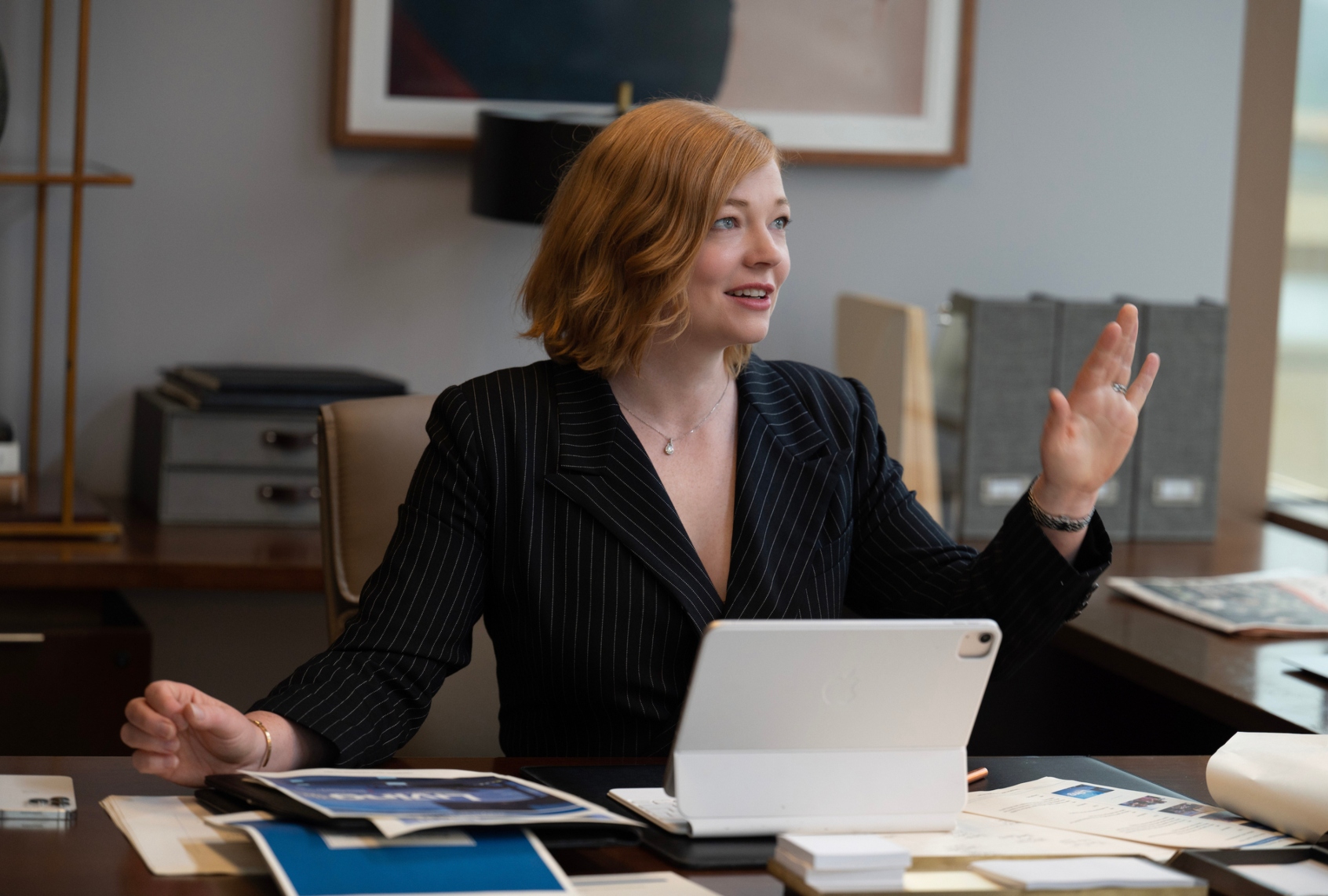
In one of the best performances of the year, Margot Robbie ditches the Aussie accent for a perfectly stereotypical American "Barbie" one. The actress is best known for playing comic book antihero Harley Quinn seen in "The Suicide Squad" movies. But in "Barbie" she trades her bat for heels. The Greta Gerwig-directed fantasy comedy stars Robbie as a Barbie forced to enter the real world to correct her human failings.
 
Robbie was born and raised in Australia and studied drama at college. But her career really took off in America for her role in "The Wolf of Wall Street." 
11
Sarah Snook, “Succession”
Sarah Snook in "Succession" (Photograph by David Russell/HBO)
Another Australian, Sarah Snook made a name for herself for her portrayal of Shiv Roy, one of the potential heirs to the American media empire Waystar on HBO's prestige TV drama "Succession."  Up against corporate misogyny and her ambition, Shiv often falters, but Snook never does. She has been nominated for best actress in a drama at the Golden Globes this year.
 
The actress was born and raised in Australia and was trained as an actress at Sydney's National Institute of Dramatic Art.
12
Juno Temple, “Fargo”
FargoJuno Temple as Dorothy "Dot" Lyon in "Fargo" (Frank W. Ockenfels III/FX)
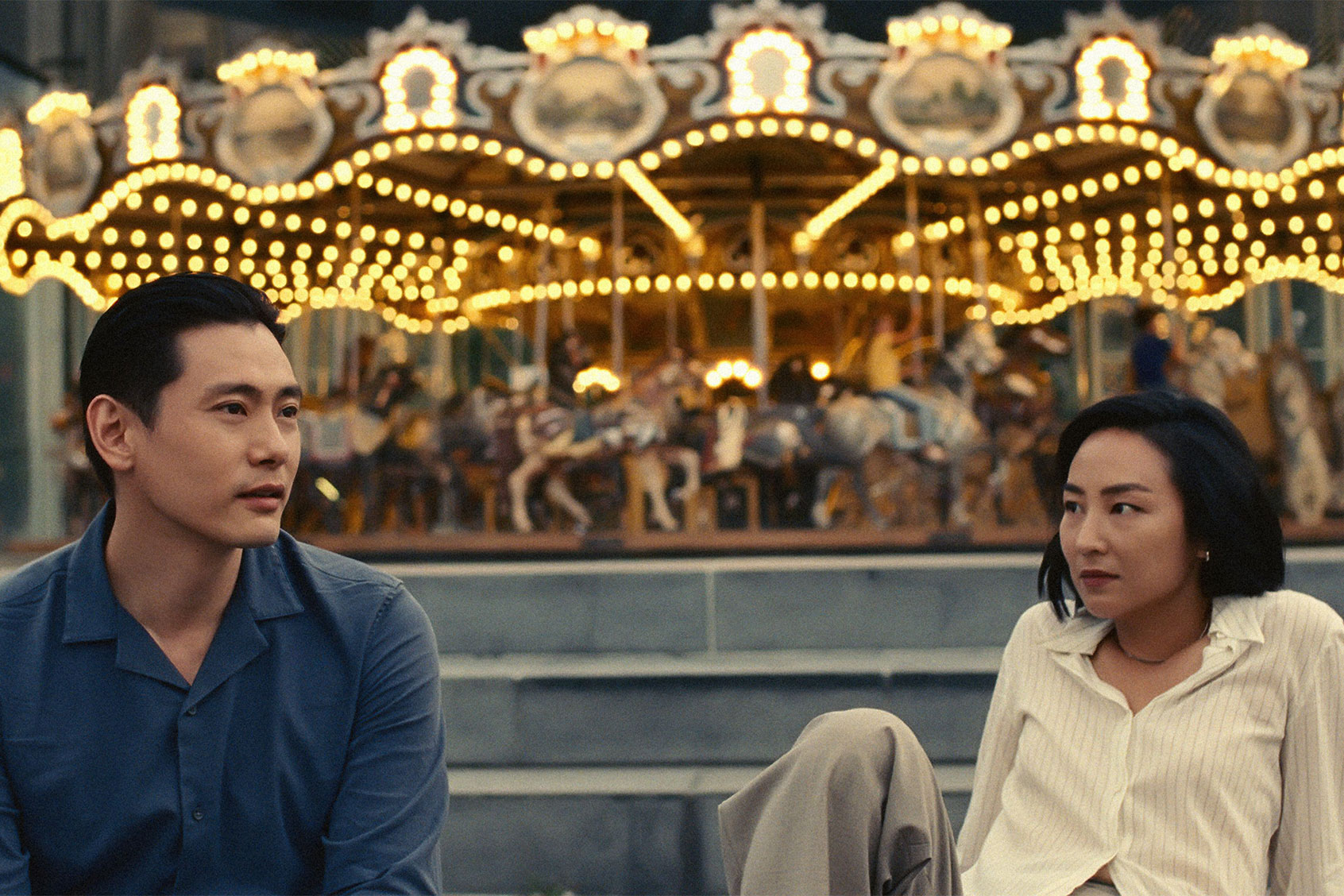
Finishing out a successful run as the fan-favorite Keely on "Ted Lasso," Juno Temple's currently stars in FX anthology series "Fargo." In the show's fifth season, the British actress plays a Midwest housewife named Dorothy "Dot" Lyon. According to FX, Dot is "tenacious to almost a delusional fault, never giving up no matter how impossible the circumstances. Ultimately, she’s a mama bear with a lion’s heart."
 
The actress was born and raised in the U.K. and went to King's College. But she had a very early start in the British entertainment industry, starring as a child actress in the late '90s. Her father Julien Temple, a British filmmaker, cast her in his film, "Pandaemonium."


“Barbie,” Oppie and . . . Mario?: Why the Golden Globes mean even less than before

Break out the reggaeton air horn and fire a few pew-pew-pews! into the air from your finger guns, because the Golden Globes are back, baby!

What? You thought we were done with all that? Silly . . . no, only NBC is finished with it. Hollywood may have defenestrated the Hollywood Foreign Press Association’s influence over the second most important awards show in film – TV, not so much – but nobody’s giving up a chance to get litty for the cameras in the Beverly Hilton’s International Ballroom.

2023 has been a tough year for all, but think of the actors sidelined by the SAG-AFTRA strike – think of them! For four months they could not promote their movies and flex their fashion muscle. Imagine the pent-up sequin energy that will be released on that red carpet next month.

CBS must be, along with hoping the public is excited enough to defy declining viewership trends for this telecast and awards shows in general. Among those who follow what’s happening in the industry the 2024 Globes has a curiosity factor attached to it, being the first to not be produced by the HFPA.   

After a 2021 Los Angeles Times report dove into that organization’s racist exclusion of Black members along with numerous ethical lapses and evidence of financial mismanagement, NBC dropped the 2022 telecast like a bad boyfriend. In 2023 it welcomed it back to see what would happen. Host Jerrod Carmichael opened the evening with, "I'll tell you why I'm here: I'm here 'cause I'm Black.”

Guess who wasn’t there? Interested people watching at home. The 2023 broadcast drew an audience of around 6.3 million, a new low after the record low set by the 2021 mid-pandemic telecast, which came in 68% lower than 2020’s viewership.

But the 2024 Globes has two curiosity factors it didn’t before. One is the dominance of Barbenheimer, manifesting in “Barbie” and “Oppenheimerleading the film categories in total nominations and “Succession” dominating TV with nine, as announced on Monday. The second, relatedly, may be seeing whether creative vision holds a higher standing than audience popularity.

Imagine the pent-up sequin energy that will be released on that red carpet next month.

“Barbie” and “Oppenheimer” drew the public out of their homes and into theaters over the summer, potentially elevating the public’s interest in watching to see if they take home top awards on Sunday, Jan. 7. Both are up for best motion picture in their respective categories – “Barbie” in musical or comedy, and “Oppenheimer” in drama, with Margot Robbie in the running for best musical or comedy actress and Cillian Murphy up for best drama actor.

Film nominations have more of an impact on Oscar season than TV nods, although the tie enjoyed by “Only Murders in the Building,” “The Bear” and “The Crown,” which each landed five noms, is certainly nice.

Martin Scorsese’s latest opus, “Killers of the Flower Moon” is up for best motion picture drama alongside “Anatomy of a Fall,” “Maestro,” “Oppenheimer,” “Past Lives” and “The Zone of Interest.” This may be some comfort to him. He also has fine company in the best director race with Bradley Cooper (“Maestro”), Greta Gerwig (“Barbie”), Yorgos Lanthimos (“Poor Things”), Nolan, and Celine Song (“Past Lives”).

The top comedy film category is similarly typical with “Air” joined by “American Fiction,” “The Holdovers,” “May December” and “Poor Things.”  

Past LivesPast Lives (A24)This year’s TV selections reflect a respectable crossover between critical assessment and popularity, contradicting the prevailing past tendency for the HFPA to reward either new shows, i.e. the ones voters were most likely to have heard of, or the ones that, for instance, flew them to Paris. (“Emily in Paris,” we’re looking at you.)

Settling in beside “Succession” in the battle for top drama are “The Crown,” “The Diplomat,” “The Last of Us,” “The Morning Show,” and, owing to the Harrison Ford-Helen Mirren-Taylor Sheridan of it all, “1923.” The comedy entries are more gratifying, with “Abbott Elementary,” “Barry,” “Jury Duty” and repeat nominee “Ted Lasso” joining “Only Murders” and “The Bear,” which is not a comedy.  

Even so, the Globes’ relevance as a determinant of artistic excellence has always been questionable and remains so even now. Perhaps especially now.

The 81st annual Golden Globe Awards will be first produced by Dick Clark Productions and Eldridge Industries, the private equity firm that joined DCP in acquiring the HFPA’s assets in June, transforming the HFPA into a for-profit endeavor. Eldridge is owned by billionaire investor Todd Boehly, a part owner of the LA Dodgers and DraftKings, a major investor in A24, and . . . well, hello . . . has a stake in the Beverly Hilton (where the Globes are held).

Dick Clark Productions, meanwhile, is owned by Penske Media Corporation, which also owns every major Hollywood trade including Variety, IndieWire, Rolling Stone, Deadline and The Hollywood Reporter, along with a slice of Vox Media as of February.

No levelheaded person should expect these entities to inject legitimacy into this black hole of self-congratulation. Under the new owners, Globe voters are also employees receiving $75,000 a year to screen TV and film submissions along with maintaining the HFPA website and other busywork.

We need your help to stay independent

Those series and movie submissions are part of an awards campaign process that involves mounting expansive ads and scoring coverage placement in the aforementioned trade publications. Stars and producers also participate in For Your Consideration appearances and roundtables featured in online and print editions of those outlets.

Realistically, the average person doesn’t care about potential conflicts of interest, and notions of ethical sanctity only come up as punchlines when it comes to the Globes. For the people who bother to watch, the Globes offers a little post-holiday glitz to break up the winter blues, along with the chance to see celebrities give network censors a workout on (slightly time-delayed) live TV.

The Globes still project some reputational sheen as a bellwether for the Oscars race, or it used to, which lends additional dubiousness to its new categories introduced for the 2024 show.

The "best cinematic and box office achievement" category makes its first appearance this year, acknowledging the vox populi as a determinant of defining good moviemaking. Similar logic gave us “The Flash Enters The Speed Force” from the “Justice League” Snyder cut prominent placement in the 2022 Oscars.

What role does popularity, exemplified here in terms of product ubiquity, play in determining merit?

One can only imagine what Scorsese makes of seeing Christopher Nolan’s “Oppenheimer” placed on the same level as “The Super Mario Bros. Movie,” “John Wick: Chapter 4” or his personal cancer, a Marvel flick, i.e. “Guardians of the Galaxy Vol. 3.”

Out of all that category’s nominees, Greta Gerwig’s “Barbie” is an aesthetic wonder, and one most likely to have been seen by regular people. If it wins, its victory could be attributed to that, or the fact that it was Warner Bros.’ highest-grossing global release in its 100-year existence. Either way, it leads one to question how this reconfigured awards body assigns value to art.

The Super Mario Bros. MovieMario (voiced by Chris Pratt) and Luigi (Charlie Day) in "The Super Mario Bros. Movie" (Nintendo / Universal Pictures)“Barbie” adapts one of the best-loved toys in history to the screen, the same as “The Super Mario Bros. Movie.” Out of all the best cinematic and box office achievement nominees, only “John Wick” is derived from a vision that originated as a movie. Quality-wise, it was also one of the franchise’s least satisfying entries. So what role does popularity, exemplified here in terms of product ubiquity, play in determining merit?
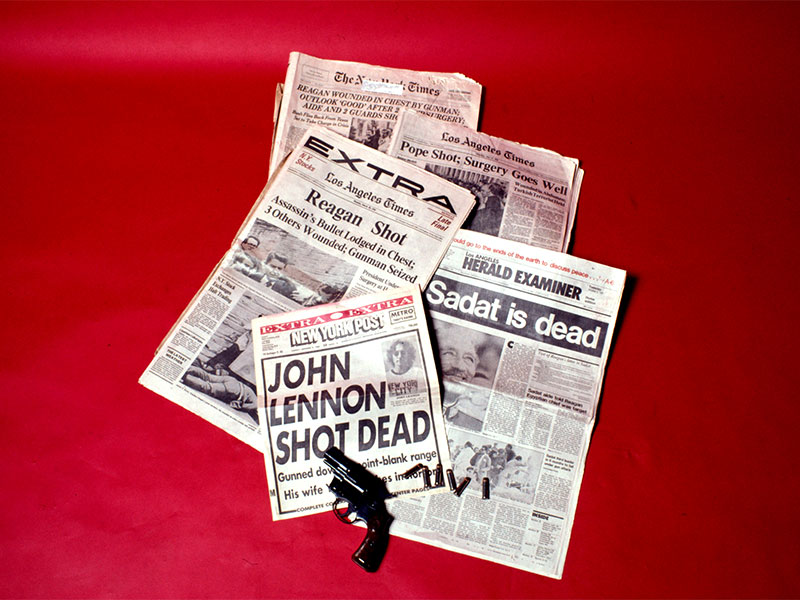
Similar questions might be asked concerning the other new category: best performance in stand-up comedy on television. If TV has grown into a massive field, so has stand-up comedy’s presence on the small screen. Globes voters and other awards juries also used to treat TV like the industry’s stepchild. It has since become the favored medium among actors. Even Globe-nominee and perennial movie presence Nicolas Cage (up for his work in “Dream Scenario”) wants to work there.

Now voters take TV seriously. From what we can tell of this category’s nominees, all of them headliners, stand-up comedy is where Globes voters seem content to be lazy. Does former Globes host Ricky Gervais deserve a nomination for “Armageddon”? Debatable (but not really . . . no).


Want a daily wrap-up of all the news and commentary Salon has to offer? Subscribe to our morning newsletter, Crash Course.


Trevor Noah’s latest, “Where Was I,” has yet to hit Netflix; it could be outstanding. Chris Rock’s “Selective Outrage” was mainly noteworthy for being streamed live and including his long-awaited response to being slapped by Will Smith onstage at the 2022 Oscars. Amy Schumer’s “Emergency Contact,” Sarah Silverman’s “Someone You Love” and Wanda Sykes’ "I'm an Entertainer" were all fine.

Stand-up comedy has exploded on streaming, granting exposure to riotously funny relative unknowns, some of whom cranked out sets hilarious enough to hurt. They are not in this group.

But then, maybe it’s not even an honor to just be nominated here, indicated by the fact that the production is struggling to find an emcee. CNN reports that Rock, Globe nominee Ali Wong (up for her performance in “Beef”) and “SmartLess” podcast collaborators Will Arnett, Sean Hayes and Jason Bateman all turned down invitations to host.

The Globes have gone host-free before, which they may do again this time; a celebrity-filled roster of guests and presenters doesn’t guarantee the audience will come with it. The telecast has always had those factors going for it, and that didn’t stop the public’s interest from plummeting. The Golden Globes’ new custodians probably won’t solve its lingering problem with mainstream relevancy. Never mind – it's the movies that were meant for us. This party never was.

The 81st annual Golden Globe Awards airs live at at 5 p.m. PT/8 p.m. ET. on Sunday, Jan. 7, 2024, on CBS and streams on Paramount+.


Jack Smith wants to use Trump’s Twitter account and phone data to track his steps on Jan. 6

Special counsel Jack Smith has obtained Donald Trump's cell phone data from his time in the White House and plans to use it as prosecutorial evidence as part of the former president's election subversion trial in D.C., a Monday filing shows. 

In the court filing, Smith stated that he intends to present the expert witness who pulled and copied the data from Trump's phone and a phone from an unidentified MAGA ally. As noted in the filing, Smith's team anticipates that the expert will observe to jurors how they "extracted and processed data from the White House cell phones used by the defendant and one other individual (Individual 1); (2) reviewed and analyzed data on the defendant’s phone and on Individual 1’s phone, including analyzing images found on the phones and websites visited; (3) determined the usage of these phones throughout the post-election period, including on and around January 6, 2021; and (4) specifically identified the periods of time during which the defendant’s phone was unlocked and the Twitter application was open on January 6."

We need your help to stay independent

As Politico noted, the extent of access Smith had to the ex-president's phone has yet to be discerned; however, the data could prove pivotal in revealing certain key information from around the time of Jan 6, when the deadly Capitol insurrection took place. Chiefly, the data could show Trump's social media activity, as well as who had access to his personal accounts and devices. 

The filing also stated Smith also plans to call two other experts to the witness stand to share critical information relevant to Trump's phone data. Expert 1 will discuss location data, as "they plotted the location history data for Google accounts and devices associated with individuals who moved, on January 6, 2021, from an area at or near the Ellipse to an area encompassing the United States Capitol building." Their testimony will "describe and explain the resulting graphical representations of that data, and it will aid the jury in understanding the movements of individuals toward the Capitol area during and after the defendant’s speech at the Ellipse."

Expert 2 will likely testify about "the process of determining device location; the collection and use of location history data by Google, LLC; and location history data produced in response to a search warrant and included in the graphical representation prepared by Expert 1," the filing states, adding that "they will aid the jury in understanding the movements of individuals toward the Capitol area during and after the defendant’s speech at the Ellipse."

In January, Smith's team of prosecutors secured a search warrant for Trump's X/Twitter account, asking the company to keep the information secret from the former president. Trump was suspended from Twitter in the days following the Capitol insurrection. Though his account has since been reinstated, he seemingly no longer uses the platform, electing to post instead from his TruthSocial platform.

The 7 most disturbing moments from Apple TV’s “John Lennon: Murder Without a Trial”

John Lennon’s influence was bigger than words could ever describe, so much so that his death shook the world to its core.

The esteemed member of The Beatles, who is also hailed as one of the greatest music legends of all time, was shot and killed in front of his New York City residence in December 1980. What followed was public uproar as fans mourned the loss and inquired why anybody would be compelled to kill Lennon in the first place.

Lennon’s assailant was identified as Mark David Chapman, who was infatuated with Lennon but also, resented him due to Lennon's religious stance (specifically his highly publicized 1966 remark about the Beatles being “more popular than Jesus”). Chapman ultimately pleaded guilty and was sentenced to a prison term of 20 years to life.

The high-profile murder along with its aftermath are all explored in the AppleTV+ docuseries “John Lennon: Murder Without a Trial.” Over the course of three episodes, the series spotlights several key figures who witnessed Lennon’s assassination — including investigators, police officers and those who came in contact with him moments after he was shot — along with Lennon’s closest acquaintances. There’s also archival footage and recordings of Chapman, which have never been publicly released.

Here are the seven most shocking moments from the series:

01
Lennon’s doorman recalls the terrifying moments after Lennon was shot
Newspaper headlines Reagan Sadat Lennon shot shootingHeadlines from New York Times, Los Angeles Times, Los Angeles Herald Examiner and the New York Post showing headlines of famous people being shot and killed March 18, 1989. (Photo by Paul Harris/Getty Images)
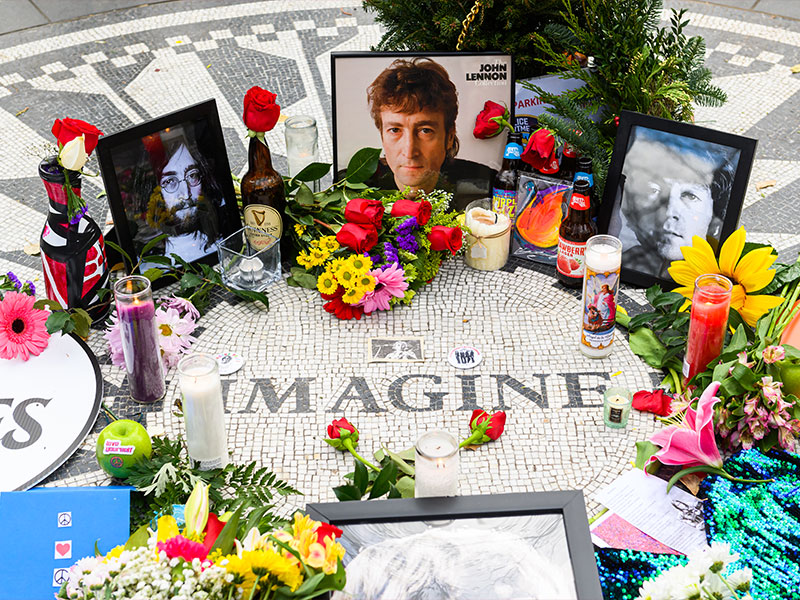
Jay Hastings — a former doorman at the Dakota, the New York City apartment building that Lennon called home during his final days — recalled what happened moments after Lennon was shot five times by Mark David Chapman on Dec. 8, 1980.


“He goes, ‘I’m shot,' had blood coming out of his mouth already and just collapsed on the floor,” Hastings said. “I half-rolled him to his back and took his glasses off, put 'em’ on the desk. And Yoko was screaming, you know, ‘Get an ambulance, get an ambulance, get an ambulance!’”


In an exclusive interview with People, Hastings said he approached Chapman when he learned the assailant was still outside and unarmed. He noticed Chapman “facing the wall, doing something . . . He was reading a book.” The book was later revealed to be "Catcher in the Rye."


When the police arrived, they initially thought Hastings was the killer: “I looked a little crazy, I already had blood on my hands, I just had my shirt on, my white shirt with no tie.” Chapman was later identified as the culprit. He was arrested and ultimately sentenced to 20-years-to-life for shooting Lennon.

02
Hospital workers said “Imagine” played while Lennon lay on his deathbed
John Lennon memorialFlowers and candles are left on the "Imagine" memorial in honor of John Lennon on the 40th anniversary of his death at Strawberry Fields in Central Park on December 08, 2020 in New York City. (Noam Galai/Getty Images)
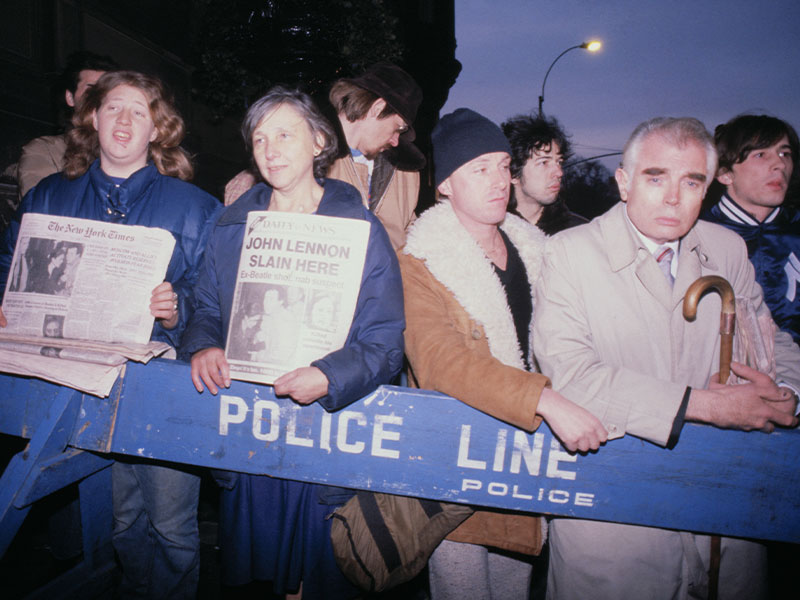
Lennon was rushed to Roosevelt Hospital, known today as Mount Sinai West, where hospital workers spent 45 minutes trying to find “some flicker of life” before announcing Lennon’s death.


“You could’ve heard a pin drop,” Barbara Kammerer, a nurse present at the scene, said. “You still want to do more, but now you know you stop and there’s nothing to say really, unfortunately. It’s just very, very quiet.”


Kammerer’s co-worker, emergency room nurse Deartra Soto, said that Lennon’s greatest hit song managed to find him during his final moments of life: “When [doctors] called [the time of death], and it was over, and we walked out of that room, the Muzak was playing ‘Imagine.’”


“That was everybody’s ‘Oh s**t’ moment,” Kammerer said.

03
There was much public speculation surrounding Mark David Chapman
Grieving John Lennon fansDistraught fans of ex-Beatle John Lennon gather outside his apartment building, late December 8, after he was gunned down. (Getty images/Bettmann)
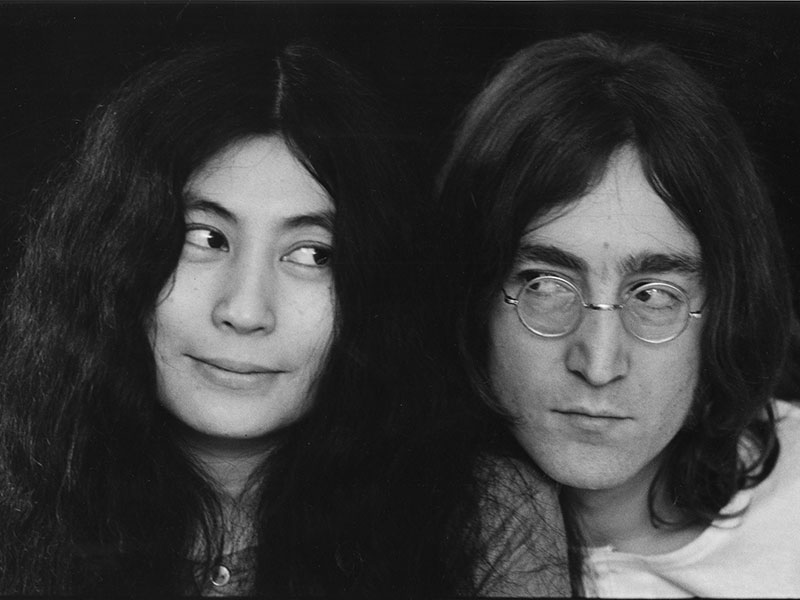
News reports identified Chapman as a 25-year-old Beatles fan who was obsessed with Lennon's lifestyle and public persona. Chapman was described as “an unemployed security guard from Honolulu,” “a freelance photographer from Honolulu,” and a former housekeeper and printer at the Castle Memorial Hospital.


Police discovered that Chapman had been staying at the Sheraton Hotel the night before Lennon’s murder. In his hotel room, Chapman laid out several items, including pictures and certain personal possessions, on his dresser. The items included his passport, an 8-track tape of the music of Todd Rundgren, a Bible open to “The Gospel According to John,” a small “Wizard of Oz” poster and a letter from a former YMC supervisor at Fort Chaffee (where Chapman had worked with Vietnamese refugees).


At this point, some investigators believed Lennon’s murder was premeditated. The items, along with their display and careful placement, proved Chapman had both planned the killing and anticipated the police investigation.


Chapman was eventually taken to Bellevue Hospital Prison Ward for psychiatric evaluation. He was greeted by Assistant Commissioner of Correction Ed Hershey, who recalled Chapman’s “normal” looks and calm demeanor.


“He almost looked at peace,” Hershey recalled. “Boy, he did not portray any emotion at all.”

04
Yoko Ono allegedly asked one of Lennon’s family friends to look into conspiracy theories
Yoko Ono; John LennonJapanese-born artist and musician Yoko Ono and British musican and artist John Lennon (1940 – 1980), December 1968. (Susan Wood/Getty Images)
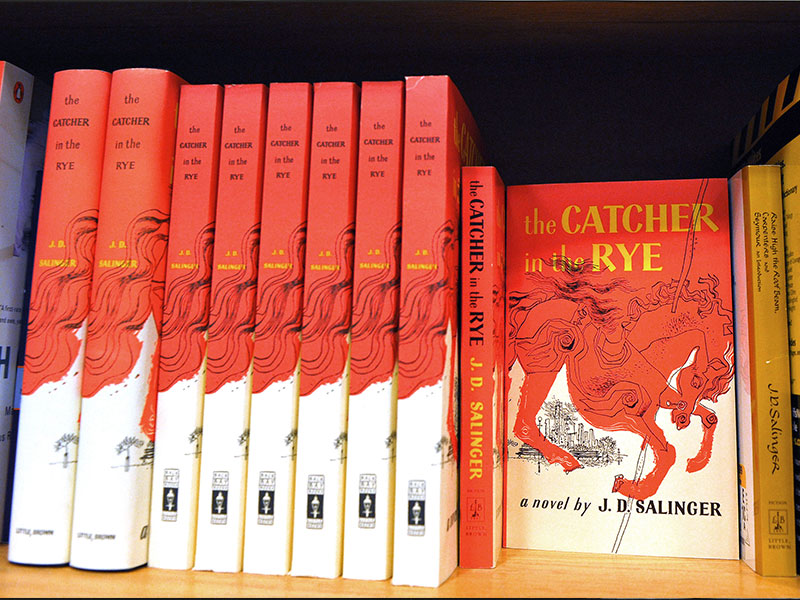
“I’ve never expressed this before. One of the things that Yoko asked me was to look into the various theories, the conspiracy theories after John’s murder,” confessed Elliot Mintz, a family friend of Lennon’s.


Because Lennon was incredibly outspoken about his stance against Richard Nixon and the Vietnam War, some fans believed hidden political forces were to blame for Lennon’s death. FBI files revealed that Lennon was considered a political threat by the Nixon administration. At one point, both Ono and Lennon were convinced that their Dakota residence was bugged.

05
Chapman said he wished to model his life after Holden Caulfield
The Catcher in the RyeCopies of "The Catcher in the Rye" by author J.D. Salinger at a bookstore in Washington, DC. (MANDEL NGAN/AFP via Getty Images)
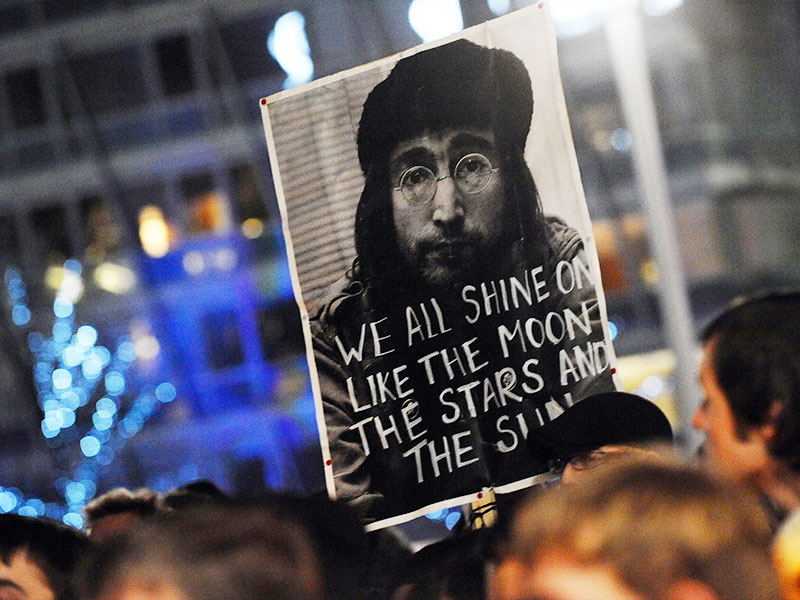
In preparation for trial, Chapman’s legal team frequently visited him in prison to build his defense. Each conversation was recorded but never shared publicly. 


In one such conversation (played for the very first time in the documentary), Chapman revealed that he thought “I would turn into somebody if I killed somebody.


“You know the book ‘The Catcher in the Rye’? I had that book on me, you know? I thought that I would turn into the character of the book . . . Holden Caulfield,” Chapman is heard telling his attorney David Suggs.

06
Chapman confessed to killing Lennon while under hypnosis
John Lennon vigilPeople take part in a candle lit vigil in Liverpool, north-west England on December 8, 2010 to mark the 30th anniversary of the death of former Beatles singer John Lennon. (PAUL ELLIS/AFP via Getty Images)
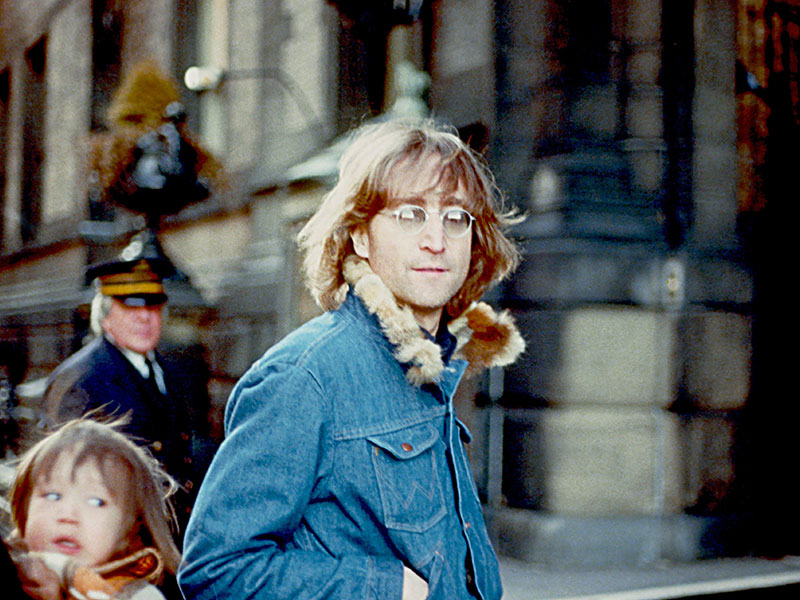
Chapman's new lawyer Jonathan Marks instructed him to enter a plea of not guilty by reason of insanity. But while under hypnosis, Chapman claimed he shot Lennon because the artist was “a phony.”


When asked to recount Lennon’s murder, Chapman said he saw a black limo pull up to the Dakota while sitting on the curb. He first saw Ono, then Lennon.


“I see a struggle,” Chapman said. “Part of me didn’t want to do it. Part of me did. I had a voice in my head, saying, ‘Do it! Do it! Do it!’” He then walked over to Lennon and began firing: “Took the gun out of my pocket and aimed at him and just fired away, all five shots. It felt like it was not me but it was me.”


In the tape recording of the hypnosis session, Chapman explained that the reason why he targeted Lennon was because of his signature catchphrase: “All you need is love.”


“All you need is love and $250 million. He was the biggest, phoniest bastard that ever lived,” Chapman said. “I wasn’t about to let the world endure 10 more years of his menagerie of bulls**t.”


In addition to Lennon, Chapman thought about killing other major public figures, including David Bowie, Johnny Carson, Paul McCartney, Ronald Reagan and Elizabeth Taylor.

07
Lennon’s finals words were “I’m shot”
John LennonFormer Beatle John Lennon poses for a photo with his wife Yoko Ono and son Sean Lennon in 1977 in New York City, New York. (Vinnie Zuffante/Getty Images)

Hours before Lennon was shot, he and Ono were finishing their album “Double Fantasy.” Lennon also spoke with RKO radio producer Laurie Kaye, telling her, “I consider my work won’t be finished until I am dead and buried. And I hope that’s a long, long time . . .”


After Lennon was shot, his final words were simply, “I’m shot.” Richard Peterson, a taxi driver who was present at the scene of the crime, said he momentarily thought he was being filmed for a movie. But that was far from the truth:  


“I thought they were making a movie. But I didn’t see no lights or cameras or anything,” Peterson said. “So, I realized, ‘Hey, this ain’t no movie.’”

"John Lennon: Murder Without A Trial" is currently available for streaming on Apple TV+. Watch a trailer for it below, via YouTube:


The thumb-twiddler caucus toys with funding while Ukraine fights for its very existence

You have to wonder what it would take to get House and Senate Republicans to get off their collective duffs and walk across their respective cloak rooms to smell the proverbial coffee. City after city after city in Ukraine has been leveled by Russian artillery and rockets.  The port of Mariupol is a shell of its former self.  Large areas of Kharkiv, Ukraine’s second-largest city, are in rubble.  Bakhmut doesn’t exist anymore.  There isn’t a square mile of Ukraine from Kharkiv in the north through Dnipro and Zaporizhzhia, all the way to Kherson on the coast of the Black Sea that hasn’t been severely damaged if not utterly destroyed by Russia’s war of aggression.

Wait.  Let’s stop right there.  I’ve been writing words like these for nearly two years about the war in Ukraine, and they accurately convey what has happened in the war.  So do Ukraine’s numbers of the dead and wounded, both military and civilian.  But sitting here in Northeast Pennsylvania, or more to the point, in a limestone and marble building in Washington, D.C., there is no way to adequately conceive of the horror Russia has wrought in the country that stands between it and Europe. 

We in the United States don’t have cities that have had to be rebuilt or great expanses of cemeteries in which are buried the civilian dead of wars.

From 1939 to 1945, Nazi Germany wreaked havoc through Europe all the way to the outskirts of Leningrad and Moscow.  When I lived in Germany in the 1950’s and took trips with my parents through Germany and France and Italy, you could still see the damage done in World War II.  Churches from the 13th and 14th centuries in small towns lay in ruins with maybe a single stone wall still standing.  City after city still had not finished cleaning up the rubble from bombings and artillery shelling.  I still have images in my mind of old women in long dresses with headscarves stacking bricks along the sides of blown-up streets in Stuttgart as we drove through on our way to visit friends stationed at an army post in Baumholder.   

We need your help to stay independent

Today, having seen the damage wrought by World War II in Western Europe as a boy, it’s hard for me to transfer those images through 65 years to Ukraine, but there they are:  new photographs and videos of similar destruction only a thousand or so miles from the destroyed cities I saw in the 1950s.  We founded the United Nations in 1945 and NATO in 1949 in an attempt by nations that gathered together to try to ensure that the horrors the world had just been through did not happen again.  There was a hope years ago that we wouldn’t have wars if they could be adequately described and remembered. But here we are, looking at our televisions and phone and computer screens at the tragic images all over again. 

All this because one man, Vladimir Putin, went to bed one night and woke up the next morning and said he wanted to invade Ukraine and make it part of Russia.  It didn’t matter to him how much damage such an invasion would wreak, how many lives it would take, just like it didn’t matter to Hitler what it would cost for him to remake Europe in his own image. 

We in the United States don’t have cities that have had to be rebuilt or great expanses of cemeteries in which are buried the civilian dead of wars. Maybe that is why it’s all so abstract for us. On a continent thousands of miles away from the war that happened in Europe 80 years ago or even the war that is happening in Ukraine right now, today, this minute, it’s someone else’s history, it’s someone else’s problem.

That appears to be the attitude of the Republican Party.  Here is a political party that for decades stood for the defense of our nation and the defense of liberty around the world, and now under the thumb of a so-called leader who is now fully showing his totalitarian nature, many Republicans in the House and the Senate have decided all that is in the past.  Ukraine is Europe’s problem.  Aides and advisers to Donald Trump have already begun to talk about withdrawing from NATO if he is elected. The Heritage Foundation is hosting a meeting between Republicans on Capitol Hill and advisors to Hungary’s Viktor Orban, a close Putin ally, as Ukraine’s President Volodymyr Zelenskyy heads to the White House to make a last-ditch plea for funding before year's end. 

If Putin believes Ukraine is not a sovereign nation but a part of Ukraine, well, that’s Ukraine’s problem, not ours, say some Republicans led by Donald Trump and the Heritage Foundation. They express admiration for Putin and the way he runs things in Russia. They say, he knows how to get things done. Donald Trump wants to be like him.  He is telling us if he is elected, he will be a dictator on “day one” so he can build his wall, apparently by fiat, and “drill drill drill,” even in national monuments and parks.

Republicans are falling in line behind Trump.  That’s what’s going on with the refusal by Republicans to fund the war in Ukraine unless Democrats go along with changes in policies on the border that would effectively build the wall Trump failed to build, not with concrete and steel, but with draconian immigration laws.

Republicans and their putative leader profess to be unconcerned by what would happen if Ukraine runs out of money and artillery shells and rockets and anti-missile batteries that defend Kyiv and other cities.  They are unmoved by the scenes of destruction caused by Russian shelling and rockets.  They are unmoved by the scenes of mass graves in Bucha and Izium and the reports of the Russian murders that filled them with bodies of dead civilians.

Let me tell you what is happening in Ukraine while the Republican thumb-twiddler caucus turns its head and votes the way Donald Trump tells them to vote.  All along the 600-mile front line, Ukrainian soldiers are being killed by Russian artillery, rockets and drone strikes every day.  They launch attacks across muddy fields from makeshift bunkers where they defend themselves from Russian shelling.  They have no heat. All around them lie the ruins of whatever city they’re defending, all the way from the Russian border to the Black Sea. In Dnipro, where some of the heaviest fighting is going on, it’s freezing, in the low 30’s at night, mid 30’s during the day.  It will be 35 on Tuesday and 36 on Wednesday.  It will warm up to 47 degrees Fahrenheit on Thursday and rain all that day and part of Friday, making fields and forests even more difficult to move through, slowing resupply convoys, even preventing drone overflights of Russian positions by Ukrainian forces that need the surveillance and intelligence the drones provide.


Want a daily wrap-up of all the news and commentary Salon has to offer? Subscribe to our morning newsletter, Crash Course.


Conditions for soldiers on the front lines are miserable in the extreme, and conditions in Ukrainian cities are not much better.  Russian attacks on energy infrastructure have caused blackouts and no heat in Kyiv and Kharkiv and other large population centers.  Trucks filled with dead and wounded soldiers keep coming from the front lines.  The wounded need medical care, and the dead need to be buried. 

In Washington, D.C., it will be in the high 40s and mid-’50s this week, perfect weather for members of the House and Senate to call an Uber and take a ride into Georgetown to dine at their favorite restaurant on veal scallopini or sushi or fresh-caught Chilean sea bass, a favorite at high end restaurants right now.  Tomorrow, they can hold press conferences in the Rotunda of the Capitol and speak defiantly about how they are standing fast against President Biden’s demand for help with funding Ukraine’s war against Russian aggression.  A few of them have even talked about a “war on our southern border” that must be funded before they will approve funds for the real war in Ukraine.

There is no war on our southern border, nor are there problems on our northern border, which some Republican members of Congress have also cited as one of their excuses for not funding Ukraine.  Next, we’ll be hearing about the “threat from Canada” in the ignorant babble from Republicans on Capitol Hill and the few Republican candidates left on the hustings nibbling like ducks at the crumbs from Trump’s table.

This is a time of disgrace for the United States of America, that we are sitting here on a continent thousands of miles away from the war fought by Ukraine to defend its democracy and its existence from Russia and the threat it will pose to the rest of Europe if Ukraine does not prevail in its war against Russian aggression.

Putin won’t stop with Ukraine.  He’s already got allies in Belarus and Hungary, and Russia is funding right-wing political movements in other European states as we speak.  But that’s okay with Republicans who plan on electing Trump as president, and he will pull all U.S. funding for NATO and all U.S. troops out of Europe, so they can push for tax cuts based on all our savings from our abject failure to be the leading defender of democracies around the world.

Ask any Republican planning to vote for Trump in 2024, and they’ll tell you:  Who needs to defend democracy at home and abroad when they’ve put a man who grins approvingly as he uses the word “dictator” in a sentence talking about himself?

An Iowa fight over a Satanic display reminds us: Republicans believe “free speech” is only for them

It's become a holiday tradition, especially in the red states. Every year, in response to overtly Christian displays put up in government buildings, the Satanic Temple petitions to set up a display honoring Lucifer in state capitols. They usually succeed. See, the Supreme Court long ago created a loophole in the First Amendment to allow religious displays, by arguing that as long as every group gets to have one, it doesn't violate the "no establishment of religion" clause. By putting up altars to Satan next to the annual nativity scenes, the Satanic Temple makes their point about the silliness of this loophole.

More important, however, is the trolling part. Every year, Christian conservatives discover the Satanic display and have a loud, public temper tantrum about it. In this, Satanists prove their point: Conservatives claim to respect religious plurality, but it's a lie. The overt religious iconography on government property was always about promoting the Christian nationalist view that theirs is the only "real" American religion. 

It's hardened into a ritual because both sides get something out of it. The fundamentalists get a chance to freak out and use this as evidence for their lurid conspiracy theories claiming demonic forces are out to get them. The Satanists and their fans get a chance to remind everyone that Republicans are hypocrites who never really believed all that "free speech" talk. This year, the annual rite is playing out in Iowa, where the Satanists have antagonized the Christians with a goat's head wreath in the Des Moines capitol building. 

The story has more national resonance than usual, however. It's happening in the shadow cast by a much darker, more dangerous bad faith debate over free speech: The fight over alleged anti-semitism on campus. 


Want more Amanda Marcotte on politics? Subscribe to her newsletter Standing Room Only.


In their twin quest to divide-and-conquer the left and deflect from Donald Trump's responsibility for unleashing a torrent of bigotry across the U.S., House Republicans decided to host one of their many disingenuous spectacles disguised as "hearings" last week. Three presidents of elite universities — Harvard, M.I.T, and the University of Pennsylvania — were summoned to discuss anti-semitism on campus in the wake of Israel's war on Gaza. In a clip that went viral, these three were unable to state plainly under questioning from Rep. Elise Stefanik, R-N.Y., that students would be expelled if they called for genocide of Jews. 

The trick worked as intended, causing the anti-MAGA coalition to tear at each other with arguments over whether these presidents were in the right on free speech grounds, whether the threat of anti-semitism from campus is overblown, and  why the voices of teenaged college students are treated as emblematic of the entire left. As Michelle Goldberg of the New York Times wrote, "you can see the trap Stefanik laid." 

But while people get into often-incomprehensible arguments over the finer points of defining "genocide" and "free speech," what is getting lost is the most important issue: Republicans are a bunch of lying hypocrites. It's this message the Satanic Temple is trying to remind us all of with their holiday display. The MAGA right has been wailing for years about the alleged threats to free speech from hazily defined social pressures like "wokeness" and "cancel culture," but when it comes to opinions they don't like, they don't hesitate to call for the blunt force of censorship.  

As many people pointed out, Republicans have defended genocidal and violent rhetoric for years now under the guise of "free speech." Trump's unsubtle calls for violence against his perceived enemies have led to an attempted murder of the husband of Rep. Nancy Pelosi, D.-Calif., threats against government employees and even private citizens, and, of course, the insurrection of January 6, 2021. Dehumanizing rhetoric against Black Lives Matter protesters and "great replacement" theory have led to mass murder, shootings, and conservatives crashing cars into protests. But when liberals call for social media companies to curb the ugly rhetoric using their legal powers to self-regulate, a chorus of right wing whining about "cancel culture" erupts. We do not need to litigate how real the threat of campus anti-semitism is, in order to see how Republians use tensions over hate speech and the First Amendment to advance their "free speech for me, but not for thee" agenda 

The Satanic altar at Iowa's state capitol showcases the same GOP bad faith, but at least with some levity. As atheists and other religious minorities have long argued, the reason Republicans want nativity scenes and other such religious symbols up on government grounds is obvious: To signal that the U.S. is a Christian nation, not a secular one. But Republicans can't admit that out loud, so instead they play word games with concepts like "free speech" and "freedom of religion." 

The reaction to the Satanic altar in Iowa shows the emptiness of GOP rhetoric about "free speech." State Rep. Brad Sherman is on the warpath, insisting it's "a tortured and twisted interpretation of law that affords Satan, who is universally understood to be the enemy of God, religious expression equal to God in an institution of government that depends upon God for continued blessings."


Want more Amanda Marcotte on politics? Subscribe to her newsletter Standing Room Only.


To be fair, other Republican leaders in the state understand the law and that if they want to keep using government property for Christian proselytizing, they have to tolerate the presence of other religious expression, including that which is Satanic. But their MAGA-drunk constituents clearly do not agree. When state Rep. Jon Dunwell released a statement explaining that the state must "either allow all displays or none," and advising the "primary response required is prayer" instead of censorship, he was raked over the coals by his fellow Republicans in mentions. 

"To give quarter to the enemies of God is pathetic and contemptible," complained one woman. "God placed you in a position of authority for such a time as this," griped a man. Others quoted Bible verses at him that appear to call for literal murder of unbelievers or insisted that a true Christian believes the Bible trumps the constitution. Same thing happened across social media. Wherever the story about the Satanic altar appeared, the comments are completely dominated by Republican voters wailing about how the government needs to censor this, that the purpose of government is to uphold Christianity, and that the Founding Fathers supposedly agreed with them. 

Some are explicitly using this to call for Christian nationalism:

This kind of thing is why it's so gross to see Republicans cynically exploit fears of anti-semitism to promote their culture war narratives about "campus leftism" and "political correctness." The Satanic Temple's trolling exposes the bare truth, which is the GOP is rapidly becoming a Christian nationalist party full of people who want to find a way to use government power to marginalize and silence non-Christians, or who are even those who are just critical of conservative Christianity. Right now, feigned concern for Jewish people gives cover to this "free speech for me, censorship for thee" mentality. But, one would be a fool to see all this outrage over the Satanic Temple's little joke and not conclude that these folks aren't going to be satisfied with only kicking out Satanists. This is about limiting who gets rights to free speech and religious liberty to conservative Christians. 

“We sometimes have to hear speech we hate”: Legal experts on the campus crisis

University of Pennsylvania president Liz Magill was forced to resign over the weekend amid widespread backlash resulting from her testimony on Capitol Hill last week in a congressional hearing on campus antisemitism. That has hardly put the issue to rest. The viral video of questioning by Rep. Elise Stefanik, a New York Republican, and the resulting furor that led to Magill's ouster, have ignited discussions about exactly how much educational institutions can or should restrict free speech.

Magill, who had led the Ivy League school for less than two years, stepped down on Saturday. The chair of Penn's board of trustees, Scott Bok, announced the decision in a letter and also submitted his own resignation. Magill was forced out after struggling to give a clear answer to a question, during a House education committee hearing, on whether calls for genocide against Jewish people would violate Penn’s code of conduct.

"One down, two to go," Stefanik posted on X, an apparent reference to Harvard president Claudine Gay and MIT president Sally Kornbluth, who also testified at the hearing.

After Magill's comments, six members of Congress from Pennsylvania sent a letter to the school's board of trustees calling for her resignation. Ross Stevens, a hedge fund manager and major Penn donor, threatened to withdraw a $100 million gift to the university. 

There has been considerable division of opinion about Magill's resignation and its consequences, not all of it along predictable partisan lines. While many people, including many Democrats, have agreed that she could no longer lead a major university, others see this incident as a setback for free speech, warning about the potential threat to academic freedom and open debate. Many such concerns revolve around the impact of external influence from donors and politicians shaping campus codes of conduct and discourse.

Protecting speech that “falls short of misconduct” is “particularly important” in situations where “critical social and political discussions” take place, Alex Morey, an attorney at the Foundation for Individual Rights and Expression, told Salon. That's even true, or especially true, she said, when such discussions involve rhetoric that ideological opponents find “very offensive and hateful.”

“We cannot shut down one side,” Morey continued. Even when free speech is likely to be upsetting or distressing to many people, "that doesn't mean we should empower the government or college administrators to decide which side is right. That's what any First Amendment analysis is about at its core.”

The legal requirements are somewhat different for different kinds of educational institutions, Morey explained. Public universities are required by the First Amendment to respect free expression on campus, while private institutions like Penn, Harvard or MIT have committed to similar principles and are generally required to honor those promises under a contract law theory. 

Such promises are “critical” to a university's mission of “truth-seeking and knowledge building,” Morey added, which requires an environment where a variety of viewpoints can be “raised, debated and discussed."

Frederick Schauer, a free speech scholar at the University of Virginia School of Law, elaborated on Morey's point that major private colleges and universities, including Ivy League schools like Penn, have voluntarily chosen to adhere to First Amendment principles although they are not legally required to. But he's not sure that's the right standard. 

The First Amendment is clearly understood to protect the free speech rights of neo-Nazis, the Ku Klux Klan, protesters who advocate violence against the LGBTQ community and “many other despicable people saying despicable things,” Schauer said. Given that, he suggests, colleges and universities “should consider” how much of the First Amendment they want to “take on board.”

“If there are things that we wouldn’t and shouldn’t permit in a seminar of 16 students, is a college campus more like a seminar or more like a public park?” Schauer asked. “There are arguments both ways, but it is certainly not obvious that all of the constraints that are properly applied to government should be applied to non-governmental colleges and universities.”

While the ambiguous answers offered on Capitol Hill by Magill, Gay and Kornbluth clearly distressed many people, Schauer says they weren't entirely wrong: Whether and when expressing sympathy with a morally loathsome act like genocide is “legally proscribable” does indeed vary with context, in his view. Under some circumstances such comments might represent a threat, but only if directed at particular people. The legal definition of “proscribable incitement,” Schauer said, is “very, very narrow.” While “advocating genocide against a group as a general proposition is morally despicable," it is also "legally protected under the First Amendment."

“True threats,” Morey explained, are statements where the speaker makes a “serious expression” of an intent to commit an unlawful act of violence. Discriminatory harassment is “unwanted speech” directed at a specific student or group that is “so severe, pervasive and objectively offensive” that it denies the student or victim access to an educational opportunity or benefit. 

“If there are things that we wouldn’t and shouldn’t permit in a seminar of 16 students, is a college campus more like a seminar or more like a public park? There are arguments both ways."

Those categories of speech can reasonably be restricted, Morey said, but “broad calls for Palestinian liberation on an American college campus" are unlikely to clear those bars. Similarly, student protesters chanting slogans like "Intifada" or "From the river to the sea" is "almost always" going to be interpreted as protected speech, she said, "even though some interpret those as calls for genocide against one side or another." 

She continued: "Our democracy prizes the widest open discussion on these important political issues. There is no ban on calls for genocide. … Plenty of people think statements like ‘Women deserve bodily autonomy’ is a call for genocide against the unborn, or that saying ‘There are two genders’ is a call for trans genocide, or that an IDF officer defending the war in Gaza is calling for Palestinian genocide.”

The First Amendment protects a far wider range of speech than most people realize, “for good and important reasons” that benefit everyone on all sides of the current debate, whether they're pro-Israel or pro-Palestinian or hold other views, Morey added.


Want a daily wrap-up of all the news and commentary Salon has to offer? Subscribe to our morning newsletter, Crash Course.


On Friday, more than 70 members of Congress from both parties signed a letter calling for the resignation of Gay and Kornbluth, who both had similar struggles to Magill's in answering Stefanik's questions about the schools' code of conduct.

Stefanik called Magill's resignation "the bare minimum" of consequences and promised that universities “can anticipate a robust and comprehensive Congressional investigation of all facets of their institutions' negligent perpetration of antisemitism.”

Schauer suggested that much of the criticism directed at the three college presidents is about “public relations more than about law,” and about how “we should condemn that which we might nevertheless protect."

Lee Kovarsky, a University of Texas law professor, told Salon that it's time for a “reckoning” about what he called the “differential treatment of Jewish vulnerability” on university campuses. But that's a “complex conversation,” he continued, one that involves different kinds of problems at different institutions.  

“We need to address that problem without locking down the rights to speech and expression of other groups. It should be possible to do both of those things at once," Kovarsky said, while expressing "grave doubts" that the current scenario is likely to lead to that outcome. 

“What happens on campus doesn't stay on campus. If students learn democratic norms like free expression and due process, they'll bring those skills to our society. If they learn authoritarianism — ceding their rights to those in power, censorship, suppression, fear — they'll bring that to us, too."

Even if people approve of Magill's resignation, or support the potential ousters of Gay and Kornbluth, they should be “wary of a world of donor-influenced speech policies,” Kovarsky added. While a college or university's donors are significant stakeholders and possess a "categorical right" to decide the use of their funds, he said, their involvement should not extend to an "outsized influence on speech codes."

The national controversy over Stefanik's antisemitism hearing has been “fascinating” and “upsetting” for campus speech advocates because of the “hypocrisy on display,” Morey said. These college presidents have suggested that they follow speech-protective university policies at all times, she said, when “nothing could be further from the truth.” 

Elite institutions have frequently limited various forms of campus speech, Morey continued, which are often “way less inflammatory” than the proposed example of calling for Jewish genocide. Leaders like Gay and Magill have invoked the First Amendment inconsistently, she said, to protect forms of speech they perceive as popular among certain segments of the campus community.

Free speech policies and norms can "only benefit" campuses when they're applied "neutrally," Morey said. “What happens on campus doesn't stay on campus. That's the whole point. If students learn democratic norms like free expression and due process," or learn "the benefits of talking across lines of difference and giving people the benefit of the doubt … they'll bring those skills to our society when they graduate. If they learn authoritarianism — ceding their rights to those in power, censorship, suppression, othering, fear — they'll bring that to us, too."

“We sometimes have to hear speech we hate, because the alternative is turning the power to decide over to whoever's in power at the time.”

Our ongoing fertility crisis is leading to a future where only the rich can reproduce

With all of the depressing news in the world, many people are justifiably afraid that humanity is careening toward extinction. A 2021 poll of 10,000 young people aged 16 to 25 found that 56% believed humanity is "doomed" due to climate change. Even if climate change doesn't take us out, there are the existential threats posed by war with nuclear explosives or other weapons of mass destruction, a lurking specter thanks to global conflicts spanning from Israel to Ukraine.

These are bleak subjects to contemplate, but few are more relevant — and by discussing them, we at least make it theoretically possible to solve the underlying problems.

But what if it is humanity's steep decline came not from the usual suspects, like climate change or apocalyptic AI, but by something more basic? What if our patriarchal society is brought to its knees by universal impotence?

That may be where exactly we are headed. According to numerous metrics, humanity is in the midst of a fertility crisis. In April, the World Health Organization released a report revealing that roughly 1 in 6 people attempting to conceive today experience fertility issues. In the United States roughly 9% of men and 11% of women have fertility issues, according to the United States National Institutes of Health.

Yet with current technology, it's unlikely that humanity will go extinct from this alone. Instead, I believe our species faces a future in which only the rich will be able to reproduce.

That statement may seem overly dramatic, but the evidence seems to be taking us down this path. As environmental and reproductive epidemiologist Dr. Shanna Swan reported in her 2021 book "Count Down: How Our Modern World Is Threatening Sperm Counts, Altering Male and Female Reproductive Development, and Imperiling the Future of the Human Race," the average human sperm count has roughly halved, plummeting from 99 million per milliliter to 47 million per milliliter between 1973 and 2011. Swan is not alone in reaching this conclusion. Hagai Levine, professor of epidemiology at the Hebrew University of Jerusalem, found that sperm counts fell an average of 1.2% every year between 1973 to 2018, from 104 to 49 million/ml. As of 2000, the rate of decline increased to more than 2.6% for every year.

What's causing this trend? It's most likely environmental pollution, especially endocrine disruptors, or chemicals that can interfere with the proper functioning of our hormones.

In her book, Swan focused on the endocrine disruptors widely used in plastics. There is no realistic way that we will ever remove all of these endocrine disruptors from our environment, at least not any time soon. If this downward trend in fertility continues, and once our average sperm count reaches less than 15 million per milliliter, the only people able to reproduce will be those who can afford expensive medical technology like in vitro fertilization (IVF), which makes it possible to do so. (Levine places the threshold sperm count number at 40 million per milliliter.)

In her book — which I consider a must read for anyone who wants to understand humanity's (likely) impending extinction — Dr. Swan examined phthalates, bisphenols and other plastic pollutants. As Swan told Salon in 2021, if these chemicals interfere with male fetal development at the "delicately programmed time" during which they develop their reproductive system, the eventual adult will suffer with issues like inadequate sperm count. Plastic items containing these chemicals are literally everywhere: From medical tubing and automobile parts to beverage containers and vinyl flooring, from the packaging containing our products to the fish we eat from the ocean (thanks, microplastics).


Want more health and science stories in your inbox? Subscribe to Salon's weekly newsletter Lab Notes.


If these chemicals interfere with male fetal development at the "delicately programmed time" during which they grow their reproductive system, the eventual adult will suffer with issues like inadequate sperm count.

Women are not spared from endocrine disruptors either. An August study in the journal Frontiers in Physiology found that microplastics and nanoplastics seem to have a harmful effect on the reproductive systems of females in multiple other species, not just humans, though the authors cautioned it was too early to make firm conclusions.

But chemicals from plastics are not alone in disrupting our endocrine system. They are only one ingredient in a toxic stew that is literally hitting us in our collective gonads. According to a recent study in the journal Environmental Health Perspectives, common chemicals in pesticides like organophosphates and N-methyl carbamates are linked to plummeting sperm counts. Just as Swan reached her conclusion after analyzing decades of research on global sperm counts and plastics-based endocrine disruptors, the authors of the study compared sperm counts of men who work in agriculture (and are thus more exposed to pesticides) with the sperm of men with less exposure. Yet no man is totally unexposed to these chemicals; they are ubiquitous in the pesticides which cover any food we grow from the ground. (Pesticides have also been linked to fertility issues in women as well as ovarian disorders, stillbirths, premature births and development abnormalities.)

Humanity's fertility is similarly screwed, so to speak, because of so-called "forever chemicals," or per- and polyfluoroalkyl substances (PFAS). A 2022 study in the journal Environmental Health Perspectives found that mothers exposed to a mixture of seven common PFAS produced male offspring who had less sperm and/or unhealthy sperm. Speaking with Salon by email at the time, lead author Dr. Sandra Søgaard Tøttenborg of the University of Copenhagen emphasized that the study had only proved a link, not causation. Even so, it determined that there is "a statistically significant association between exposure to a mixture of PFAS in early pregnancy and lower sperm concentration and total sperm count and higher proportion of non-progressive and immotile sperm."

A group of researchers from Mount Sinai Hospital found PFAS also have a detrimental impact on female fertility, as detailed in a paper in the journal Science of the Total Environment.

“PFAS can disrupt our reproductive hormones and have been linked with delayed puberty onset and increased risks for endometriosis and polycystic ovary syndrome in few previous studies. What our study adds is that PFAS may also decrease fertility in women who are generally healthy and are naturally trying to conceive,” senior author Damaskini Valvi, an assistant professor of environmental medicine and public health at Icahn Mount Sinai and a nationally recognized expert on the dangers of PFAS, said in a statement. “We also know that PFAS exposure begins in utero and transfers from the mother to the fetus, as many PFAS have been detected in cord blood, the placenta, and breast milk. Preventing exposure to PFAS is therefore essential to protect women’s health as well as the health of their children.”

We need your help to stay independent

Like pesticides and plastics, there is simply no getting away from PFAS. They are in fast food wrappers and receipt paper, non-stick cookware and water-resistant fabrics, microwave popcorn bags and cosmetics. So what can humanity do to address this impending sperm count crisis?

Ideally, we would completely stop using products that contain endocrine disruptors. This means radically overhauling how we grow our food and manufacture consumer products, a self-imposed economic revolution that requires more concerted willpower than our species has demonstrated up to this point. Therefore the only alternative is to make it possible for us to reproduce even with sperm count lower than 15 million per milliliter. The good news is that we have the technology to make that possible through IVF. The bad news is that the technology is not provided universally, much in the way that education and health care are largely inaccessible in the United States.

That is why I hope to start the conversation now by saying that if IVF and other assisted reproductive technologies are not universally accessible, then only the rich will be able to breed in the future. It is a future we can avoid, but it has to start with an honest conversation about the technology we use today.

An earlier version of this article originally appeared in Salon's Lab Notes, a weekly newsletter from our Science & Health team.

Higher education must help protect democracy

There is a clear and present danger to American democracy: Donald Trump’s populist authoritarianism. This is no secret, and yet many in higher education would prefer not to talk about it. Instead, we find ourselves wondering if elite school presidents should resign. 

It is not a matter of supporting a political party or issue. We in higher ed must stand up for the values that make free inquiry and teaching possible. We must defeat a movement that has already promised to seize control of how we study, conduct research, and teach. This is no time to seek refuge in doctrines of neutrality. Such doctrines led to the kind of flaccid, lawyerly responses we heard from Ivy League presidents testifying in front of Congress last week. “That depends,” is not an answer you want from someone whose job it is to protect students confronted with calls for their annihilation. 

Disengagement, not protest, is the norm.

Recently there has been a spate of articles about whether leaders in higher ed should speak out about atrocities or war crimes that, however distant, are having an impact on campuses. Some college presidents may be relieved to be told that they should stick to their core responsibilities (raising money) and avoid controversy. The abysmal performance of the presidents at a Congressional hearing will certainly encourage other leaders to keep their heads down.

While commentators rail against high education’s efforts at inclusion and the cultivation of so-called woke ideologies, students are increasingly choosing to focus their studies in fields more quantitative than value-laden. Disengagement, not protest, is the norm. Even some humanists urge their colleagues to stick to disinterested scholarship and preserve the “contemplative mood.” According to the author of an ill-timed recent NYT op-ed, this will somehow make those in the Humanities especially “irresistible.” 

We must resist this kind of intellectual isolationism – from presidents and from their institutions generally. 

We must refuse the privileges of “internal exile” in the face of tyranny and reject the ironic stance of professors who imagine that tenure is enough protection – at least for them. 

Why worry so much about another Trump presidency, some say, when we already survived one? Democrats, they argue, aren’t so great either.  Evasiveness comes easy. 

But Trump has put his cards on the table, making his positions known even more clearly than he did in 2016. Back then I wrote: “You don’t need a fascistic theory of government to use the inflammatory tactics of fascism. It is clear enough: given his rhetoric and behavior, Donald Trump’s election would undermine the foundations of the republic and cause fundamental harm to the country.” That’s exactly what Trump did, and the election denialism of 2020 and the failed coup of January 6 2021 are precursors of what’s in store for us if he prevails in the coming year.

It is foolhardy and immoral to imagine that we in the academy will be fine if we just keep to our scholarship. Whom do we think Trump has in mind when he attacks (however nonsensically) the communists, Marxists, fascists and radical left thugs that live like vermin within the confines of our country”? “Vermin” was a favorite trope of Hitler’s, and the vermin Trump has in mind no doubt includes us in higher ed.    

We need your help to stay independent

Colleges and universities have long claimed that promoting civic participation and liberal learning through engagement in the public sphere is central to their mission. Professors and administrators often find themselves in disagreement, but there has been wide support for the idea that schools should help students develop civic preparedness, the ability to work across differences for the public good. 

Four years ago, Wesleyan University joined with other colleges and universities in Engage 2020, a project highlighting ways in which students develop the skills of citizenship. E2020 was centered on three principles:

  1. Developing civic preparedness is a core element of the mission of American higher education.
  2. Participating in American political life helps students learn from a diversity of ideas and people while developing skills for lifelong, active citizenship.
  3. Empowering students and teachers to engage with the complex issues facing the country are crucial facets of higher education’s contributions to the common good.

More than three hundred schools from across the country were part of the E2020 network, from small colleges to large research universities. Although many of our plans for public activities were derailed by the COVID pandemic, we were able to motivate students to take up the challenge of democracy during an important election year.  

The urgency of this work has only grown, and now we’re calling for schools to double down on student democratic participation in 2024. We hear talk almost every day about the threats to our democracy – not just that one’s preferred candidate might lose but that the electoral system and the civic culture in which it is embedded is at profound risk. In order to do our part to shore up democracy and combat the rampant cynicism about elections, we must seize this moment to galvanize learning through political participation. By defending democracy, we will deepen learning; by deepening learning we will defend democracy. Both will make our educational institutions more effective, and this will create a virtuous circle of civic preparedness for the country as a whole.


Want a daily wrap-up of all the news and commentary Salon has to offer? Subscribe to our morning newsletter, Crash Course.


Many schools already belong to organizations like Campus Compact and All-In Campus Democracy Challenge that encourage voting; many already are focused on promoting free speech and civil dialogue on their campuses, like the Institute for Citizens and Scholars and Interfaith America. Such work strengthens civic culture, but schools now need to do even more. Those affiliated with E2020 are well positioned to collect best practices that can inspire students in the coming months to work on campaigns, or to organize in the public sphere around specific issues. Call it Democracy 2024.  As Danielle Allen has noted, “Any stable democracy must have a supermajority of citizens who are willing to invest time, talent and treasure in the healthy operation of the system itself, and that supermajority will necessarily span ideological divisions. The supermajority has to work together on democracy renovation to ensure that we have a stable system for contesting matters of substantive policy.” Colleges and universities have a responsibility to help build that supermajority and to help make it as inclusive as possible. D2024 can be a start. 

The inflammatory Donald Trump has promised to destroy the “healthy operation of the system itself.” We have been duly warned that he means it by people from across the political spectrum. Republican Liz Cheney has cautioned that we are “sleepwalking into dictatorship,” and Robert Kagan, usually called a neo-conservative, has sounded a similar alarm in The Washington Post. In an entire Atlantic issue devoted to warnings about a second Trump presidency, liberal David Frum writes that “for democracy to continue … the democratic system itself must be the supreme commitment of all major participants.” Now, he notes, we are “careening toward breakdown.” And Princeton political theorist Jan-Werner Müller reminds us in The Guardian that if Trump wins, he will take it that the people “have decided in favor of revenge and destruction.”

We in higher education should not be focused on poor presidential answers to a MAGA warrior’s questions. This amounts to fiddling (however irresistibly) when flames threaten to engulf the republic. We must affirm the core principles of civic education and take specific actions to defend democracy while it is still possible to do so. When the Kalven Report counseled schools to stay neutral in 1967 (rather than support civil rights or criticize the Vietnam War), even its cautious authors made an exception for moments when “the society, or segments of it, threaten the very mission of the university and its values of free inquiry.” This is such a moment. Whatever party or candidates one supports, colleges and universities must defend democracy to defend their very mission, to defend their values of free inquiry and teaching. At this time that means calling out the dangers of tyranny while inspiring democratic practices among young people (through efforts like D2024) so that we can defend our country from the incendiary forces now gathering around Donald Trump.

“Last Week Tonight”: John Oliver blasts “bigot” Mike Johnson’s treatment of Jan. 6 footage

John Oliver thinks it’s “ridiculous” that House Speaker Mike Johnson is adamant about blurring the faces of Jan. 6 participants as more footage from inside the Capitol will be publicly released soon. 

During a press conference last Tuesday, of the Jan. 6 footage, Johnson said, “We have to blur some faces of persons who participated in the events of that day because we don’t want them to be retaliated against and to be charged by the DOJ.”

“These people were part of an armed insurrection and also, there was merch! It wasn’t exactly a secret!,” the “Last Week Tonight” host noted during a recent episode. Oliver added that Johnson is “heavily implicated” in Jan. 6, namely by Trump’s former chief strategist Steve Bannon, who described Johnson as “one of the intellectual architects of pushing back on the stolen election.”  

Oliver also shared a clip of ABC reporter Rachel Scott questioning Johnson’s efforts to overturn the 2020 election, much to the dismay of his far-right colleagues. In the clip, Lauren Boebert and Virginia Foxx can be heard booing Scott and yelling “shut up” repeatedly.

“I hate to be that guy, but ‘Boo, shut up’ is not no,” Oliver joked.

Oliver eventually closed the episode on a bleak note: “It's too late. He's already speaker. For all of the fear of a second Trump term, it's worth remembering our current speaker of the House is an anti-LGBT bigot, who believes in more accountability for his son's search engine history than he does for the people who tried to overthrow the government.”

Republicans in Congress are getting advice from Viktor Orbán’s office about Ukraine: report

Some members of the Republican Party are meeting with associates of Hungary's conservative minister, Viktor Orbán, in Washington D.C. this week to discuss terminating U.S. aid to Ukraine. Starting on Monday, the Guardian reported, a two-day event hosted by right-wing organization Heritage Foundation will commence, melding GOP-ers with members of the Hungarian Institute of International Affairs and staff from the Hungarian embassy.

Far-right Republicans have tried to stymie aid to Ukraine over the last several months, in stark contrast to the staunch bipartisan support seen when Russia launched its attack on Ukraine in February of 2022. These legislators have sought to use the Russo-Ukraine war as a means of enacting other political goals — chiefly, they've demanded more stringent immigration policy and protections along the U.S.-Mexico border. On Wednesday, the GOP blocked an emergency spending bill meant to funnel financial aid to Ukraine, even though President Joe Biden said he would be willing to offer "significant compromises" related to the border. “Make no mistake: Today’s vote’s going to be long remembered, and history is going to judge harshly those who turned their backs on freedom’s cause,” Biden said from the White House on Wednesday, not long before the vote took place. 

Orbán, an authoritarian leader and close ally of Russian President Vladimir Putin, has emphasized a number of far-right values during his tenure. In particular, he has taken aim at the teaching of gender ideology, tried to bribe Hungarian women to have more children, and adopted an extreme stance against immigration. Orbán has also condemned the financial backing of Ukraine. "Orbán is confident that the Ukraine aid will not pass in Congress. That is why he is trying to block assistance from the EU as well," a source close to the Hungarian embassy said. On December 3, Orbán argued that Ukraine's European Union membership should be stripped from the European Council's agenda. The Hungarian leader took to X to double down on his assertion, writing, “It is clear that the proposal of the European Commission on Ukraine’s EU accession is unfounded and poorly prepared.”

We need your help to stay independent

The Heritage Foundation has likewise been critical of aid to Ukraine. The Guardian noted how last year, the executive director of its lobbying operation, Jessica Anderson, released a statement under the headline: “Ukraine Aid Package Puts America Last.” And over the summer Heritage’s vice-president, Victoria Coates wrote on social media, “It’s time to end the blank, undated checks for Ukraine.” Heritage’s president, Kevin Roberts, lauded Orbán after a meeting in November of 2022, writing on X/Twitter: “One thing is clear from visiting Hungary and from being involved in current policy and cultural debates in America: the world needs a movement that fights for Truth, for tradition, for families, and for the average person.”


Want a daily wrap-up of all the news and commentary Salon has to offer? Subscribe to our morning newsletter, Crash Course.


The conservative think tank has spearheaded Project 2025, a plan to be prepared with a spate of red, MAGA replacements for the "Deep State" traitors Trump plans to oust once he assumes the presidency. Peter Dans, the director of the 2025 Presidential Transition Project said, "We need to flood the zone with conservatives. This is a clarion call to come to Washington. People need to lay down their tools, and step aside from their professional life and say, ‘This is my lifetime moment to serve.’”

The Guardian cited senior fellow at the American Enterprise Institute in D.C., Dalibor Rohac, regarding the recent political alignment between Hungary and some members of the American right. Rohac said, "The Hungarian embassy in DC has been very active lately, trying to repair ties with the Republicans and strengthen them where it’s appropriate."

“It is also not surprising that Heritage is the venue of these talks because they are different from other think tanks in DC; they are more partisan, and their funding model heavily overlaps with the Trump base.”

Electric eel zaps do more than just stun — they can alter the DNA of their victims, study suggests

When scientists attempt to transfer genetic material into an organism, they often use an electric field, a technique called "electroporation," that makes cell walls more permeable. This sophisticated form of genetic engineering is thought to be something restricted to laboratory equipment, not nature. Yet a recent study published in the journal PeerJ reveals that electric eels — which produce an electric organ discharge (EOD) that can reach up to 860 volts — may be able to transfer genetic material through their infamous jolts.

Researchers from Nagoya University and Kyoto University in Japan learned this by placing zebrafish larvae in the same tank as electric eels, then dousing the tank in DNA that codes for a green fluorescent protein. Afterward the scientists fed a goldfish to an electric eel, prompting it to emit pulses of up to 185 volts in the tank. (Don't worry, the fish were given anesthesia.) Within a day, some of the zebrafish larvae began to glow, indicating that the electric eel's pulses had indeed caused the fluorescent gene to be transferred into the zebrafish larvae. The fluorescence lingered for three days to a week.

While this study raises tantalizing questions, it leaves many of them unanswered. The implication of this experiment is that electric eels could directly cause gene transfers that increase biodiversity or create new species. Yet as the authors admit in the study, "this investigation represents the initial exploration of the uncharted impact of electric eel EOD, but it does not directly establish its significance within the natural environment." The researchers add that further research will be required, with corresponding author Atsuo Iida from Nagoya University telling New Scientist that he plans follow-up studies on EOD and gene transfer with smaller organisms like plankton and bacteria.

How cinnamon, nutmeg and ginger became the scents of the holidays, far from their tropical origins

Regardless of how you celebrate end-of-year holidays, food is probably central to your winter festivities. And a trio of spices — cinnamon, nutmeg and ginger — feature in many dishes and drinks and are an unmistakable part of the scent profile we associate with the holiday season.

As a plant scientist, I was curious to know how these spices, grown in the tropics, became so closely associated with the Northern Hemisphere's winter holidays. Just as cranberries' fall harvest makes them a natural choice for Thanksgiving, I thought that perhaps the seasonality of spice harvest had something to do with their use during the winter months.

However, this doesn't appear to be the case. When it comes to growing spices, producers are playing the long game.


Spices are prized commodities that have fueled global trade, exploration and conquest for centuries.


Growing holiday spices

Take ginger, which features in both sweet and savory recipes in many cuisines worldwide. Ginger roots take between eight and 10 months to fully mature. The plants can be harvested at any time of year if they are mature and haven't been exposed to cold or wind.  

That timing is important because harvesting ginger means uprooting the whole plant to get to the rhizomes growing underground. Rhizomes function like underground stems, storing nutrients for the plant to help it survive the winter. Once cold weather signals to the plant to dip into its underground supply of nutrients, the quality of the harvested ginger will decline significantly.

Nutmeg comes from grinding seeds of the Myristica fragrans tree, an evergreen that's native to Indonesia. The trees start flowering in their sixth year, but peak production comes when they are closer to 20 years old.

Workers harvest fruit from the trees, which typically grow to heights of 10 to 30 feet (3 to 10 meters), using long poles to knock the fruits down. For spice production, the fruits then are dried in the sun.

Nutmeg comes from grinding the inner seed kernels; its sister spice, mace, comes from grinding the tissue that envelopes the seeds. Since this plant yields two spices, the long wait for the trees to mature is worthwhile for producers.

Cinnamon is made from the bark of two trees: Cinnamomum verum for cinnamon sticks and Cinnamomum cassia for ground cinnamon. The two types have different textures and flavor profiles, but both are made from the outermost layer of the trees' bark. Production typically starts after a tree is 2 years old.

Peeling bark from cinnamon tree branches is easiest after heavy rainfalls, which soften the bark, so harvests typically happen after monsoon seasons. The same effect can be achieved outside of monsoon season by soaking branches in buckets of water.


What makes a spice 'warm'?

Cinnamon, ginger and nutmeg all are widely described as "warm" spices, which probably has less to do with where they come from and more with how they affect our bodies.

In the same way that mint can "taste" cold due to its menthol content, cinnamon's warm taste is attributed to a compound called cinnamaldehyde, which gives the spice its distinctive taste and smell. This chemical tricks our nervous system when we eat it by triggering the same pathway that perceives warmth, much as capsaicin in peppers triggers feelings of pain.

Cinnamaldehyde also helps decrease blood glucose levels, so enjoying some cinnamon tea after a big Christmas dinner can help stop your blood sugar from spiking. Cinnamon has been used for thousands of years in traditional medicine across Asia for its antibacterial properties and as a digestive aid.

Christopher Columbus' first voyage west across the Atlantic sought to find a direct route to Asia to purchase cinnamon and other spices directly where they were grown.

Indeed, the spice trade can be seen as a microcosm for the story of globalization, with all of its associated benefits and harms.


Spicing up our health and digestive systems

Ginger and nutmeg don't trick our nervous systems into feeling warm, but they both contain a myriad of compounds that aid in digestion and can fend off viral and bacterial infections. Ginger is an excellent anti-nausea agent because of a compound called gingerol, which increases gut mobility. This means food doesn't linger in the gut as long, which cuts down on gas production and keeps us from feeling bloated and sick.

Ginger was first used for food purposes in the Middle Ages as a way of masking the taste of preserved meats, which were mainly consumed in the winter months surrounding holidays. Unlike most spices, it can be used for cooking in many forms — fresh, dried and ground, candied or pickled. Each version offers a different level of ginger's signature bite.


Gingerbread, which typically is flavored with multiple spices including ground ginger, has existed in various forms for centuries.


Like cinnamon, nutmeg is another anti-diabetic. It has been shown to both decrease blood glucose levels and increase serum insulin. Insulin helps regulate how sugars are stored in our bodies by moving glucose out of our bloodstream and into cells, where it can be accessed later when we need an energy boost. So cinnamon can help ensure that all those holiday baked goods are put to use energetically, whether that's right now or later.

Nutmeg seeds produce many natural compounds, some of which have the potential to fight pathogenic bacteria. During the 1600s, doctors believed nutmeg could be effective at warding off the bubonic plague and many people wore it tied around their necks. This belief likely came from nutmeg's insecticidal qualities, which would have helped keep fleas carrying the plague off people sporting a nutmeg necklace.  

The sights and sounds of the winter holidays are distinctive, but nothing is as all-encompassing and nostalgic as the smells and tastes. Understanding how we have evolved traditions surrounding food, and the science behind those foods, can help us further appreciate their role in the season of celebrations.

Serina DeSalvio, Ph.D. Candidate in Genetics and Genomics, Texas A&M University

This article is republished from The Conversation under a Creative Commons license. Read the original article.

“Barbenheimer” dominates the Golden Globes with 17 total nominations

Following their epic showdown in the box office this summer, Warner Bros’ “Barbie” and Universal’s “Oppenheimer” will be facing off against each other again at the Golden Globes on Jan. 7.

“Barbie” currently leads the race with nine Golden Globes nominations. The film, helmed by Greta Gerwig, secured three nominations in the original song category for “Dance the Night Away,” “I’m Just Ken” and “What Was I Made For?” It also picked up nominations for best musical/comedy, best actress musical comedy (Margot Robbie), best male supporting role (Ryan Gosling), best screenplay (Gerwig and Noah Baumbach), best director (Gerwig) and best cinematic and box office achievement, a new category at the upcoming awards. 

“Oppenheimer” trails behind with eight nominations: best feature drama, best director (Christopher Nolan), best screenplay (Nolan), best actor in a drama (Cillian Murphy), best supporting actor (Robert Downey Jr), best supporting actress (Emily Blunt), best original score (Ludwig Goransson) and best cinematic and box office achievement.

The films — collectively known as “Barbenheimer” for their simultaneous theatrical release in July — face additional competition from Martin Scorsese’s “Killers of the Flower Moon” and Yorgos Lanthimos’ “Poor Things,” which each earned seven nods. 

As for television, “Succession” leads the way with nine total nominations. “The Bear” and “Only Murders in the Building” follow, each with five nominations.

Special counsel Jack Smith petitions Supreme Court to immediately decide on Trump’s immunity

Special Counsel Jack Smith asked the Supreme Court on Monday to immediately decide if former president Donald Trump has absolute immunity from prosecution for his efforts to overturn the 2020 election.

 "This case presents a fundamental question at the heart of our democracy: whether a former President is absolutely immune from federal prosecution for crimes committed while in office," Smith wrote in the court filing, NBC News reports, adding that it was "of imperative public importance" that the high court decide on the question so that the former president's federal trial, currently slated for March, could progress as quickly as possible. 

On Dec. 7, presiding U.S. District Court Judge Tanya Chutkan denied Trump's motion to dismiss his indictment in the federal election interference case, which cited presidential immunity and constitutional grounds. Trump appealed the decision and asked for the case to be paused in the interim. Smith is seeking an expedited decision from the Supreme Court to avoid the appeals process, asking the court to order Trump to respond by Dec. 18 and then act immediately on his request.

This circumstance does have legal precedence, Smith noted, referencing the 1974 U.S. v. Nixon case, in which the court ruled in an expedited manner that President Richard Nixon had to turn over tape recordings sought during the Watergate scandal investigation. Nixon resigned shortly after the ruling.

A Washington, D.C. grand jury indicted Trump on four charges, including conspiracy to defraud the U.S. and obstruction, in August. He's also facing 13 counts in a parallel but separate criminal case in Georgia, where the Atlanta-area district attorney accuses him of conspiring to subvert the election in the state. The former president has pleaded not guilty in both cases and maintains he committed no wrongdoing.

Trump backtracked on testifying to avoid a perjury trap like in past cases: Forbes reporter

Former president Donald Trump won't testify in his own defense at his New York civil fraud trial, in a last-minute reversal announced Sunday. 

"I will not be testifying on Monday," Trump wrote in an all-caps statement posted on his social-media platform, Truth Social. “I have already testified to everything & have nothing more to say other than this is a complete & total election interference (Biden campaign!) witch hunt, that will do nothing but keep businesses out of New York” he added, while also spouting off claims the New York Attorney General Letitia James's case was illegitimate. "I have very successfully & conclusively testified" in James's "rigged trial against me," the ex-president added.

James is seeking $250 million in damages after accusing Trump and his family of grossly overvaluing his New York properties as a means of securing more advantageous loans and insurance deals. 

"Whether or not Trump testifies again tomorrow, we have already proven that he committed years of financial fraud and unjustly enriched himself and his family. No matter how much he tries to distract from reality, the facts don’t lie,” the AG said of Trump's decision to not take the witness stand. Trump lawyer Alina Habba observed on Thursday that she had advised the former president to not testify as he would have been doing so under a gag order imposed by New York Supreme Court Judge Arthur Engoron. 

“He still wants to take the stand even though my advice is at this point you should never take the stand with a gag order. But he is so firmly against what is happening in this court,” Habba said. “President Trump has already testified,” noted MAGA attorney Chris Kise said in a statement Sunday.

But Forbes editor Dan Alexander has a different theory on Trump's sudden absence, drawing from his past reporting on Trump's previous trials.


Study: Some comfort foods may actually impair your body’s response to stress

While comfort foods — like macaroni and cheese, cinnamon rolls, chicken parm and fast foods — may intrinsically make you feel better or at least slightly boost your mood, that may not exactly be the case for your body. As Rachel Hall writes in The Guardian, "researchers have found that [eating comfort foods] can reduce blood flow to the brain and cause poorer vascular function — which in turn can have a negative effect on mental health and cognitive function, and increase the risks of heart disease." It's recommended to instead snack on fruits and vegetables during especially difficult, stressful or trying times, as unexciting as that might sound.

The study looked at "healthy, young adults" who were given two butter croissants for breakfast and then assigned a mental math challenge which increased in speed as the questions progressed. The researchers found that consuming fatty foods when mentally stressed reduced vascular function by 1.74%. Previous studies have shown that a 1% reduction in vascular function leads to a 13% increase in cardiovascular disease risk. "The experiment was designed to simulate everyday stress that we might have to deal with at work or at home," said the study’s first author, Rosalind Baynham of the University of Birmingham.

The good news? While fruits and vegetables still reign supreme, cocoa was included in the list of foods (especially those high in polyphenols), which are good to eat when stressed or upset due to how they can "prevent the impairment in vascular function."

The research was published in the journal Frontiers in Nutrition and Nutrients.