Spring Sale: Get 1 Year, Save 58%

Community fridges don’t just fight hunger. They’re also a climate solution

Dan Zauderer and his in-laws had eaten plenty of pizza one evening in early October and they still had seven slices left. What to do? “Well, we could just chuck it,” Zauderer thought. Instead, he and his fiancée wrapped the slices in plastic wrap, slapped labels on them with the date and walked the leftovers a little more than a block down the road to a refrigerator standing along 92nd Avenue in New York City’s Upper East Side.

That fridge is one among many “community fridges” across the country that volunteers stock with free food — prepared meals, leftovers and you name it. Zauderer had helped set a network up in New York City during the pandemic as a way to reduce waste and fight hunger. The idea came about when he was a middle school teacher looking to provide short-term help to students whose families couldn’t afford food. He stationed the first fridge in the Bronx in September 2020. That one, the Mott Haven Fridge, was hugely popular and it motivated Zauderer to expand. Since then, he has helped plug in seven more fridges in the Bronx and Manhattan, including the one where he dropped off his leftover pizza. 

“It just blossomed into way more than I ever could have expected,” said Zauderer, who now works full-time at Grassroots Grocery, a food-distribution nonprofit he co-founded in New York. 

It’s not just Zauderer’s project that has blossomed. Community fridges first cropped up a decade ago in a few isolated spots around the globe, then spread across the United States right after the pandemic started in 2020, when supply chains were crumbling, food prices were rising and families across the country were struggling to find meals. At the time, the fridges were viewed as a creative response to an urgent need. But when the pandemic subsided, it became clear that the refrigerators — sometimes called freedgesfriendly fridges and love fridges — were more than a fad. Today, nonprofits and mutual aid groups are overseeing hundreds of fridges that bolster access to food in cities from Miami to Anchorage, Alaska.

“There’s no solution to our climate problem that doesn’t also address food waste,” said Emily Broad Leib, director of the Harvard Food Law and Policy Clinic. 

There are many ways to keep food out of landfills and on dinner tables. Companies are developing apps to connect people with donated goods and food banks have been around for decades. Experts say raising awareness and changing policy around things like expiration dates on food packaging, which can be arbitrary, would help, too. But fridges are especially effective when other solutions fall short. Though food banks are great for storing large amounts of shelf-stable items like canned vegetables, they’re not well-equipped to handle food that doesn’t last as long and turns up in small amounts— a pizza slice here, a sandwich there. Those remnants make up much of the country’s food waste, about 40% and that’s where community fridges excel. “These are just a really elegant solution to that,” Broad Leib said. 

The fridges also offer a degree of anonymity for those in need that’s hard to find at more traditional food distribution centers, like food pantries. People don’t have to sign up or prove their eligibility to use them. “The whole point is dignified, anonymous access,” Zauderer said. “We’re not the arbiters of how much to take.”

In Chicago, an artist named Eric Von Haynes co-founded a fridge network called The Love Fridge in 2020. Today, he helps oversee more than 20 love fridges, each decorated with eye-popping colors and phrases like “Free food for all!” According to Von Haynes, the fridges are filled, cleaned and maintained by hundreds of volunteers. He estimates that thousands of pounds of food move through them each month. 

One concern that researchers have with projects that repurpose food is that they require additional resources, like transportation and electricity. “Rescuing [food] still comes at a cost,” said Kathryn Bender, a professor and food waste researcher at the University of Delaware.

But community fridges are about as low-key and energy efficient as solutions get. Zauderer didn’t burn any fossil fuels to walk his pizza to the fridge near his apartment. And the Love Fridge, which acquires only used refrigerators, powers two of them with solar panels — a vision that Von Haynes has for more to come. 

Even a fridge that draws electricity from a coal-powered grid uses less energy each day than a single cell phone, said Dawn King, who researches food waste and policy at Brown University. “Is it worth using greenhouse gas emissions to plug in a refrigerator so people can eat food that otherwise would have gotten wasted? Hell yes it is.”

Other challenges include navigating concerns about rotten or unwanted food, making sure fridges are working properly, especially during increasingly hot summers and keeping them stocked. Ernst Bertone Oehninger, who helped set up what may have been the first “freedge” in the U.S. in 2014 in Davis, California, has learned that some items don’t belong in them.

“Think about a half-eaten burger. That’s a no-go,” said Oehninger. “But this is very rare. Most people bring good leftovers.” Like Zauderer’s pizza.

A fridge in Austin, Texas, once went missing. It had been “borrowed” by someone who wanted to keep beers cold for an event at South by Southwest, according to Kellie Stiewert, an organizer at the ATX Free Fridge project. But such shenanigans are rare. That the fridges can be placed with a property owner’s permission just about anywhere — in front of a taqueria, a person’s home, an office building — is what makes the concept “beautiful,” Stiewert said.

Organizers say keeping the fridges full is one of the toughest tasks. People sometimes gather to pick up items within minutes of a fridge getting stocked. “When I first get volunteers to do food distro with me, I’m always waiting for them to recognize how fast the food goes,” Von Haynes said. “It’s really hard to explain to people.” 

As for Zauderer’s pizza slices: “They definitely weren’t there the next day.” 

“The Morning Show” boss explains ending coup, hints what’s next and asks, “What is women’s power?”

If this season of "The Morning Show" made the UBA network look like an ecologically devastating forest fire, that means Charlotte Stoudt did the job she was brought in to do as its new showrunner. Stoudt, a veteran of "House of Cards" and "Homeland," is accustomed to burning story in service of one overarching, provocative theme. With the third season of "The Morning Show," Stoudt transforms the network news drama originally inspired by  #MeToo and the pandemic in its opening seasons into a broader canvas to make a statement "about women's agency and autonomy, and all the things that challenge that," she explained to Salon. 

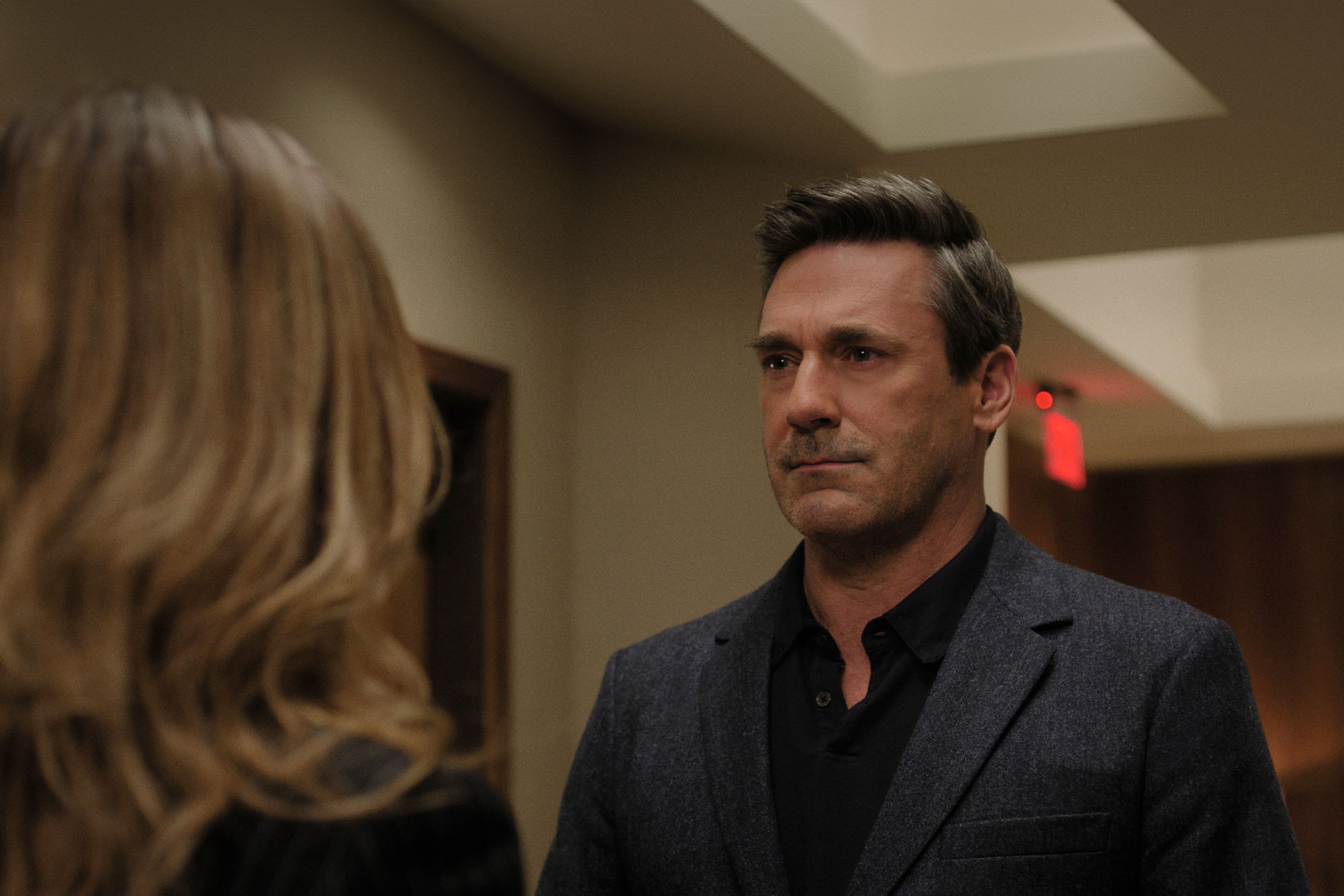
Those challenges culminate in a season finale that hints at the potential reset for UBA — and the show itself. At the end of a season spent wooing the legacy media network's board and courting Greta Lee’s news president Stella Bak to take over for constantly embattled CEO Cory Ellison (Billy Crudup), Jon Hamm's billionaire Paul Marks is perched on the edge of acquiring the network. But Paul can only win dirty. 

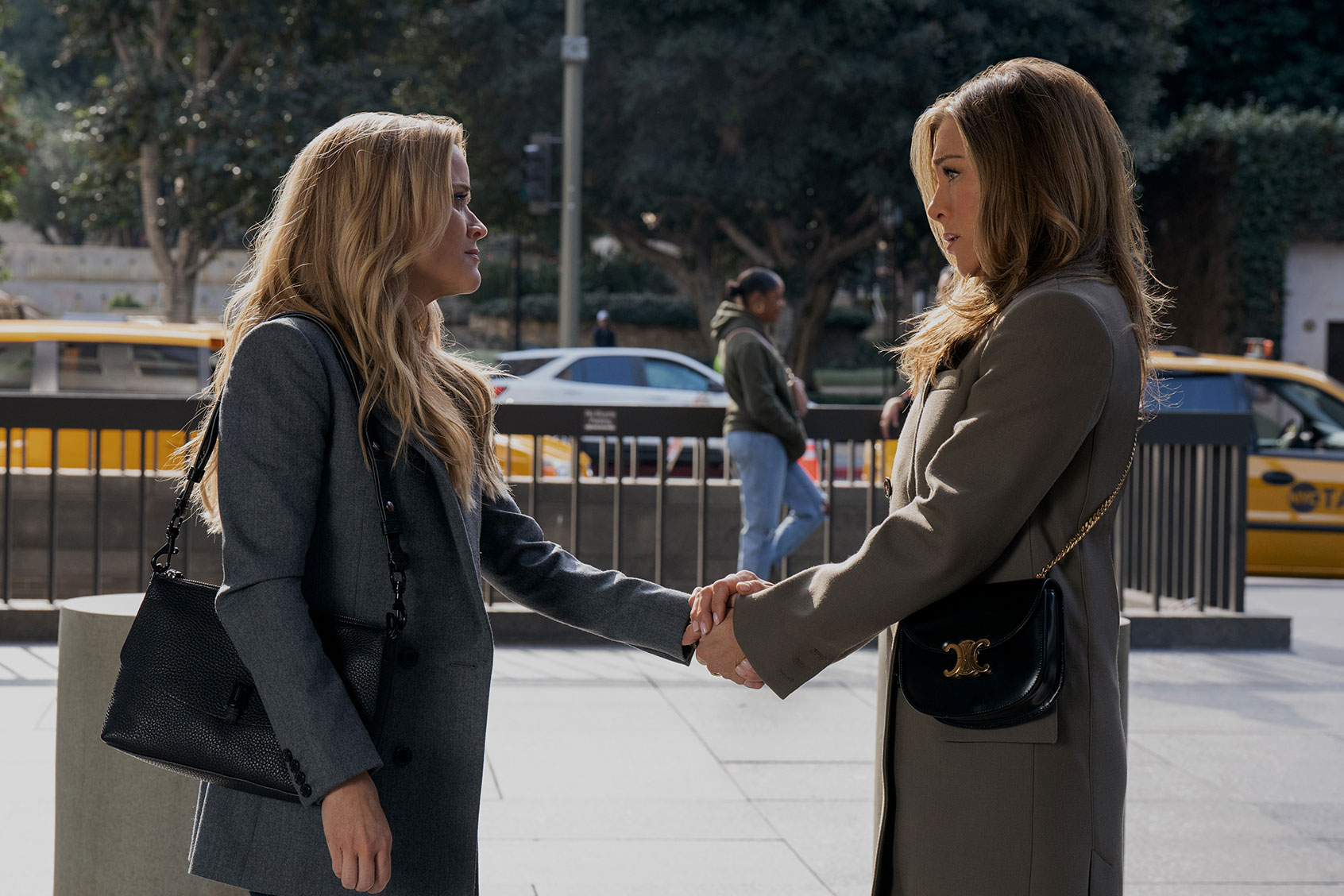
In that respect, he has plenty in common with all the company's top players. Just when Cory thinks he can outmaneuver Paul, the Hyperion founder leaks dubious photos of Cory with Bradley at the hotel where they both resided in past seasons. Alex Levy (Jennifer Aniston) aligns herself with Paul professionally and romantically, envisioning an opportunity to run a new media venture instead of waiting for a seat at UBA's table that Cory will never give her. Bradley Jackson's (Reese Witherspoon) supersonic rise to evening news anchor is undone by secrets Cory helped keep, including incriminating footage showing her brother Hal (Joe Tippett) beating up a Capitol Hill cop during the Jan. 6 insurrection attempt. With her relationships in a shambles, she shocks everyone by quitting at the top of the evening news broadcast.

Paul, being a tech genius, surfaces all their dirt to secure power. To silence Bradley's investigative report exposing secrets concerning fatal flaws in his space travel program, he surveils her — along with Alex, who fell under his spell long enough to drop her guard. Paul isn't the cause of all of UBA's problems, but from the moment his courtship with the company began he threw the place off-kilter by initiating the hack that exposed everyone's filthy laundry.

But he doesn't fully account for Alex's stubborn loyalty to UBA, Bradley and her sense of self-preservation. At the board meeting, Alex pulls a coup, proposing a "merger of equals" with a fellow legacy network that's also struggling — and follows that with a coup de grace, bringing Paul face-to-face with a Hyperion employee and one of Stella's old friends, Kate (Natalie Morales), who is ready to turn whistleblower.

With Bradley out of the network, and on her way to talk to the FBI, and Alex's future looking bright but uncertain, where does "The Morning Show" go from here? We recently asked Stoudt about that as well as walking with her through the season's most significant developments, in a wide-ranging chat conducted over Zoom.

This interview transcript has been edited for length and clarity.

You tackled a lot of current event topics this season: there's the pandemic flashback, Roe v. Wade, and through Christina we see systemic racism reflected through the UBA newsroom. There’s Bradley's connection to Jan. 6, and then on top of all that, Paul Marks. Explain to me how you wrestled all of this into shape. And at the end of the day, what did you see as the joining point for all of these forces?

I went off the DNA of the show, honestly. . . . It's an incredible show because to me, it's like a box that will hold anything if you just take the right way in. So all of these questions of systemic racism, minority rule —which could be the outsized power of billionaires, or the Supreme Court overturning Roe — they're all related to the question of women's power in the world and especially control over their bodies. 

You know, you can be in Texas, and there's a straight white guy sending a rocket up. Meanwhile, there are women in a certain area of Texas who are simply going to be unable to make choices about their reproductive health care. Those things have to stand in tension with each other. So the thing that pulls everything together is the same thing that Seasons 1 and 2 are about which is really, what is women's power? How do they give it away? How are they complicit with patriarchy? Is there any way to actually change patriarchy or just punch a hole in it? Like, is it even possible? That's how everything seems like a big disparate season, but it really is all addressing the same question.

Let’s talk about Paul. What did you want to capture in his character?

I think there were a few things. Emotionally, the most important thing for me was I wanted Alex to fall in love. This woman has gone through a near-death experience at the end of Season 2. She's kind of reclaimed herself as a journalist as we see very briefly in Episode 305, in the flashback.

I'm always reminded of when Elizabeth Taylor got very sick in “Cleopatra” and almost died — she actually did die on an operating table, I think — she woke up and said, “I am going for what I want. I am never going to censor or question myself again.” And that eventually ended up being, you know, Richard Burton and taking on braver roles. So I really say this is like an inspiration for me with Alex, that she was going to make some choices that she would have never made before.

And I think finally meeting someone who isn't afraid of her power, and her strength . . . she was ready to meet someone like that. Because everyone on some level is always trying to manage Alex. And what there's someone out there who is like, “Be as big as you are, I'm good with that.” 

"The absolute core of the show is Alex and Bradley and that love story, and how they keep trying to keep each other honest and call each other out."

But I also wanted to talk about just the outsize influence of billionaires and the whole sense of minority rule, and how one person can have such an extreme influence over so many other people when they were not elected to any kind of office. And I was very much thinking of, you know, Elon Musk being in between the States and Russia, and Ukraine with his satellites. Like, he wakes up one day and says, “You know what? I'm not giving you these free satellites anymore.” And that's a crazy idea that could shape geopolitics. So I'm kind of fascinated by these people who are just able to do that like they have a magic wand. 

The Morning ShowJon Hamm on "The Morning Show" (Apple TV+)You're talking about character motivations which, on that level, I see it. I'll also admit, that there's something that annoyed me about Alex and Paul's relationship as a journalist, which is that whenever journalists see a fictional journalist on TV sleeping with a source or sleeping with their boss, it just kind of makes our heads explode
But there's also the whole idea of, as you say, flirtation with power that Alex has with Paul. We're so used to, with billionaires, this split between the public trusting them and not trusting them that almost immediately, I thought “Oh, this will be a one-season relationship. So how would you weigh those issues when you have a relationship between these characters where one of them is bound by a certain code of professional ethics and the other comes from a specific ground of people who are known for unethical practices?

I think Alex knows he's not a Boy Scout. And she's not a Girl Scout. You know, she's done a lot of things so I think she initially thought, “This person has a couple of dents, but I can work with that.” And it's interesting what you say about the journalist’s code, and I very much respect that.

But say Paul hadn't surveilled Bradley and Alex did do go off with him and start a business. Maybe it would have been just fine. But she sort of went into it understanding that “I'm crossing the line. And I know it's going to be problematic, but this is what I want right now.” But I think the show tries to say that's her choice.

Bradley's situation represents what you're talking about in terms of women and agency because this is a person who sees an opportunity to catapult into one of the biggest positions in all of news, and happens to be covering up something really terrible. And then in the end, you don't often see a comeuppance like hers — that of someone who's deciding to take control of the situation.

Yeah. I was very certain that the truthteller should stumble this year and should step over a line in some way. And because she is the most divided character on the show— she does seem to mirror the country's divides, certainly the height of that divide — putting her at the center of Jan. 6 was just sitting there. So we went for it.

But I think the other kind of deeper thing for her, as you know, she's carrying this burden of having turned in her father, and Hal is always reminding her that blew up the family. So I think she's sort of breaking the family cycle to go to the FBI and take responsibility. Apart from the politics, it's really just a person trying to reconcile those broken parts of themselves in some way.

We need your help to stay independent

It's interesting to have this take place in a network newsroom, because I think, and this is going back to the #MeToo angle, one aspect of that is as soon as there's some sort of wrongdoing that doesn't come with criminal charges with any famous person, there is a tendency – more often with men, I should point out – for the public to ask, “OK, how soon can they come back?” 

Was placing the enormity of this burden on Bradley intentional, just in terms of knowing that you're getting into a fourth season? Because, you know, Alex’s is kind of a moral slip whereas the other could come with charges.

"How do different women seek power? What are the kinds of bargains that different women make? And I think we need to answer that question."

Exactly. I mean, we were thinking about Jan. 6 long before the renewal. You know, the “Homeland” credo was always, “Tell the best story, burn it down, and then figure out what you did afterward. And how do you come back from it?” That's kind of how I thought about it, honestly. And yes, it presents some challenges, but also, what's there to explore and is there a way back and there's an external complication, but that's also how she feels about herself for having committed that sin in the first place. What was that addiction that led her to cross the line, and can she do good work without getting addicted again to the prestige and that platform of the evening news?

The Morning ShowReese Witherspoon and Jennifer Aniston on "The Morning Show" (Apple TV+)The finale sets up this idea of a merger, presented by someone who wants a seat at the table, and who has the best idea in the room to essentially give a better option than selling out to someone who's going to strip the company for parts. 

Those are decisions that much of the news industry is facing, and while this is not really a cliffhanger, it ends the season by placing you in a direction for the next. What inspired that, I wouldn't call it a twist, but a turn at least for Alex and for UBA?

Well, maybe it's the thought of, can community save us? Can collaboration save us? And what if we didn't play capitalism's zero-sum game? What if we tried to do it a different way, a more collaborative way? Obviously, that's easier said than done. It's going to be painful, as most mergers are. And will everyone survive, as Mia asks? They're not going to be two morning shows or two evening anchors. Like, what happens? You're playing a different game of musical chairs, but can you actually make things a little better? Isn't it worth trying? Which is I think, kind of a thing we all have to ask ourselves at work — can we make it a little better?

Taking a community angle and a collaboration angle when it comes to a major corporate merger is a very optimistic way of looking at this.

I know, and I think Alex has been around the block. She knows how complicated it is. But she also knows that maybe the right way to play this is to just take Paul off the chessboard, and at least stall for time to keep the place from going under. But you're right. I mean, no one is naive about how difficult the path forward is. But at least maybe it's a path. It's better than nothing. And that may be where we are in the world right now.


Want a daily wrap-up of all the news and commentary Salon has to offer? Subscribe to our morning newsletter, Crash Course.


This is a story that's centered and begins with Bradley and Alex, but it has grown, especially this season, to bring forward other characters: Stella, Mia (played by Karen Pittman), Chris (Nicole Beharie), and Cory certainly. And I'm wondering if you visualize more expansion in those characters’ directions as the show goes forward. Or is it by necessity still going to remain anchored around Alex and Bradley?

Yeah, I mean, I think the absolute core of the show is Alex and Bradley and that love story, and how they keep trying to keep each other honest and call each other out. And I think that's always going to be there. But I think the great thing about the show is, there is room to expand these other stories. And I think we crave them. I mean, one, these actors are just so tremendous, and all these stories, comment on the other ones, you know, what I mean? Just the sense of, how do different women seek power? What are the kinds of bargains that different women make? And I think we need to answer that question. We need to see a lot of different women. It's as simple as that. Is it possible to sort of live according to my beliefs but still play on the sort of biggest chess board? I think that's a question most professional women ask themselves. And all those questions are answered so differently. 

Until now, “The Morning Show” mainly tackled domestic issues, just in terms of what's going on in American society. The pandemic was global, but the show handled it from a perspective of what it was like to be in New York at that time. Right now, of course, we have major international issues transpiring with two wars that Americans are watching from afar. And I'm wondering if that might hit home next season, or are you thinking that, given the focus on women and the issues we’re facing, you may want to keep the news stories that “The Morning Show” handles on the domestic front?

I think you've been listening in on the writers' room. I think there might be an attraction just some international stories there, yeah.

All episodes of "The Morning Show" are streaming on Apple TV+.

Why fossil fuel companies can’t leave resources stranded

Even as climate advocates call for eliminating fossil fuels, companies continue to launch major production plans. Earlier this year, for example, President Joe Biden’s administration approved the $8 billion Willow project on Alaska’s North Slope, which is expected to yield some 600 million barrels of oil over three decades. And last month, ExxonMobil announced a nearly $60 billion deal to acquire the oil producer Pioneer Natural Resources, which would allow it to more than double its production in the Permian Basin to 1.3 million barrels of oil and gas a day.

Hundreds of fossil fuel extraction projects now planned or already in production constitute so-called carbon bombs that hold the potential to emit more than a billion tons of carbon dioxide over their lifetimes, one analysis found. If these projects go forward, the researchers concluded, their emissions would be twice the limit that would keep global temperature increase to 1.5 degrees Celsius (2.7 degrees Fahrenheit). The United Nations Paris Agreement, ratified in 2015, seeks to hold the average global temperature increase to well below 2 C above preindustrial levels to minimize climate impacts, and advocates a 1.5 C increase as a major goal to avoid the most severe impacts.

Fossil fuel companies’ production levels render such temperature goals all but impossible to achieve. A report from the United Nations Environment Program and other groups concluded that in 2030, oil and gas production would total more than twice the amount projected to increase global temperatures by 1.5 C. By 2040, production would be almost three times that amount. Another study found that 40 percent of developed fossil fuel reserves must be left in the ground to give a 50-50 chance of staying below 1.5 C.

A critical component of climate advocates’ plans to limit oil and gas production is leaving in the ground, or stranding, large percentages of existing fossil fuel reserves. In 2015, A University College London study found that limiting heating to 2 C would require stranding a third of oil reserves, almost half of gas reserves, and more than 80 percent of coal reserves. In a 2021 update, a similar analysis found that meeting the Paris Agreement’s 1.5 C target would mean leaving in the ground nearly 60 percent of oil and gas and 90 percent of coal reserves by 2050.

However, these scenarios minimize or ignore the profound legal, political, and economic obstacles to such stranded assets.

Resource stranding would be a political disaster for any government, given the potential skyrocketing energy prices and enormous investor losses that would result.

For one thing, because such strandings would damage corporations, company directors who approved them would be left open to personal lawsuits for breaching their corporate fiduciary duty. Such duty legally requires directors to act in the best interest of the company.

Stranding resources could also be thwarted by legal claims from investors seeking compensation under international treaties. Countries offer such treaties to encourage foreign investment, and if they are violated, those investors can demand arbitration. An analysis by researchers at Boston University estimated that such arbitration could lead to government liabilities of up to $340 billion for oil and gas projects worldwide. Risks would be even greater if coal mining and fossil fuel infrastructure were included.

One group found that aggressive energy policies to limit warming to 2 C would mean that $1.4 trillion in existing projects would lose their value. The researchers traced the risk of ownership of more than 40,000 oil and gas assets. Private investors would suffer the most through their pension funds and investments, the study found.

Such stranded assets would be a political disaster for any government, given the potential skyrocketing energy prices and enormous investor losses that would result. Witness how quickly and dramatically the Biden administration responded to the recent rise in gasoline prices by selling oil from the U.S. oil reserve to keep the price low.

Finally, advocates of resource stranding ignore the fact that fossil fuels are inseparably fundamental to the functioning of the world economy, and deep reductions in carbon emissions under current policies is not a realistic possibility.

Certainly, fossil fuel companies have resorted to underhanded tactics to undermine climate solutions. And certainly, they have made very large profits. However, to make significant progress toward those solutions, climate advocates must stop simplistically demonizing those companies and develop realistic strategies to overcome the legal and economic hurdles discussed here.

The strategies would include light-speed development of a renewable energy infrastructure, especially power grids that can support a massive increase in renewable production. They would include policies to produce huge growth in energy efficiency — an unfortunately unsexy solution compared to megascale wind turbines and vast solar arrays. And they would include aggressive campaigning to support politicians willing to advocate for the hellishly difficult policies — such as ending fossil fuel subsidies and levying a carbon tax — needed to meet the climate crisis.

Dennis Meredith is the author of “The Climate Pandemic: How Climate Disruption Threatens Human Survival.”

This article was originally published on Undark. Read the original article.

NY AG confronts Ivanka with “devastating series of documents” on witness stand

Ivanka Trump took to the witness stand Wednesday morning in the New York civil fraud trial that's threatening to bar her father and brothers from conducting business in the state, adopting a more cooperative and polite demeanor in her testimony than her family members did, according to The Messenger and MSNBC legal analyst Lisa Rubin. The outlet noted that Ivanka Trump did not appear as inclined to distance herself from the relevant business dealings as her brothers and father did when they testified.

When asked about her role in the Trump Organization, where she served as executive vice president alongside her brothers, she placed herself at the center of key properties' transactions, testifying that she spent "an enormous amount of time shepherding" their development. "The import of her testimony today isn't so much what she remembers. Spoiler alert: Like her brothers, it's not a whole lot. And the documents that she's been show this morning don't really refresh her memory about her involvement," Rubin reported, noting that Ivanka was "unfailingly polite."

But, Rubin explained, evidence introduced as Ivanka Trump testified showed that Donald Trump and his daughter met with Deutsche Bank's Rosemary Vrablic in 2011 and struck a deal. The terms required Donald Trump, in exchange for very low interest rates, to sign a personal guarantee that he'd cover all principal, annual and operating income, and attest that he had a minimum net worth of $2.5 billion. That requirement, as Ivanka Trump and a Trump Organization exec acknowledged in an email exchange, posed a problem. "Nonetheless, Donald Trump told Deutsche Bank not only did he have $2.5 billion in his net worth exclusive of his brand, he had over $4 billion," Rubin said. "And so this has been kind of a devastating series of documents for the Trump Organization and the AG's case against them."

Trump goes on “mostly untrue” Truth Social rant during Ivanka’s “potentially damning” testimony

It's clear why the "Trumps wanted to keep Ivanka away" from testifying at the New York fraud trial, according to former Manhattan prosecutor and MSNBC legal analyst Jordan Rubin. Though Ivanka Trump's testimony on Wednesday was calmer than those of former President Donald Trump and his sons Don Jr. and Eric, the questioning showed why New York Attorney General Letitia James "fought to put her on" the stand, he wrote.

Though Ivanka Trump repeatedly said she could not remember certain details when presented with documents related to the Trump Organization's loans, "the government may nonetheless be using her testimony to tell a devastating story about the family business, including through an email in which Ivanka wrote that terms offered by Deutsche Bank’s private wealth management group were as good as it gets," Rubin wrote.

Rubin also highlighted a "mostly untrue or misleading" post Trump published on Truth Social during Ivanka's "potentially damning testimony implicating the family business." Trump wrote: “No Victims, No Defaults, Conservative Financial Statements, 100% Disclaimer Clause, Corrupt A.G., Trump Hating Judge = NO CASE!!!” But Rubin pointed out that, among other things, the law at issue "does not require a victim."

How a new FDA warning revealed my beloved Mountain Dew is actually “healthier” than we all thought

I have an unvarnished, immense affinity for Mountain Dew. No matter if it’s accompanying chicken parm, a Thanksgiving or Christmas meal or a tuna sandwich, a crisp, effervescent, subtly tart glass is the perfect complement. My brother and I have both been utterly entranced by the siren song of Mountain Dew for over a decade (enough so that I mention it in my professional bio). 

My pals have had a running joke for years that my general culinary proclivities lean rather hifalutin, except for Mountain Dew, which could be considered a glaring anomaly. The beverage — which, as reported by Ian Douglass at Mel Magazine,  borrows its name from a common term for Appalachian moonshine — tends to be culturally derided as lowbrow or gamer fuel

But to all the Dew haters out there, I ask: Did you happen to see the FDA’s recent warning about brominated vegetable oil, or BVO? Because if you did, you might realize Mountain Dew is actually healthier than we all thought. 

Well, at least by a little.

So, first and foremost, what on earth is BVO? Brominated vegetable oil "is a vegetable oil that has been modified with bromine, a natural element that can be used as an alternative to chlorine in swimming pools and historically was used as a sedative," as Teddy Amenabar and Kelyn Soong write for The Washington Post.

We need your help to stay independent

While it's been used as a food additive since the 1920s, especially in recent years to keep added citrus flavors from separating from the liquid, BVO definitely doesn't seem like something you willfully want to consume, especially if you're a big-time soda drinker and consume a bunch per day. However, as of last week, the FDA has "proposed to revoke the regulation authorizing the use of brominated vegetable oil (BVO) in food" because it “is no longer considered safe" according to studies done in collaboration with the National Institute of Health. 

Interestingly enough, the agency actually determined in 1970 that BVO was no longer “Generally Recognized As Safe” (GRAS) and began overseeing it under their food additive regulations, but has taken 53 years to take this next formal step. 

This is despite the fact that, as Ayana Archie at NPR writes, a 1976 study of the consumption of brominated sesame and soybean oils by pigs “found their hearts, livers, kidneys and testicles had been damaged.” 


Want more great food writing and recipes? Subscribe to Salon Food's newsletter, The Bite.


“The FDA said Thursday it is considering reversing its approval of brominated vegetable oil, or BVO, in beverages following a recent study in rats that found the ingredient could cause damage to the thyroid,” Archie reported. 

However, fellow DewHeads can rest easy. While Gabe Huari writes for USA Today that there are currently citrus-flavored sodas that still include BVO in their formulas or recipes — including Sun Drop soda, as well as the Food Lion and Great Value brand sodas — PepsiCo, Mountain Dew’s parent company, pulled BVO from their beverages’ formulas. For Lifehacker, Beth Skwarecki reports that "Pepsi and Coca-Cola both said in 2014 they would no longer use BVO in their drinks,” and according to a 2020 USA Today fact-check by Ian Richardson, the companies did just that. 

Per Kate Gibson at CBSNews, though, a spokesperson for Keurig Dr. Pepper, which owns Sun Drop, sent an email stating "we have been actively reformulating Sun Drop to no longer include this ingredient and will remain compliant with all state and national regulations." 

California, along with the EU and Japan, has already banned the use of BVO as a food additive, so it will be interesting to see if the FDA’s proposal for a national ban takes hold. If the ban does go through, it wouldn't be until 2025 “at the earliest,” as per Skwarecki.

That would be a great development for national health, one worth celebrating with a toast. Perhaps with a chilly glass of Mountain Dew? 

“This isn’t the end”: Top Ohio Republican vows effort to undo abortion amendment backed by voters

After a majority of Ohio voters on Tuesday passed Issues 1 and 2 enshrining abortion rights in the state constitution and legalizing recreational marijuana usage, respectively, Republicans in the state are vowing to pushback on the measures in upcoming elections. "This isn't the end," Ohio Senate President Matt Huffman said in a statement, per Ohio Statehouse Bureau Chief Karen Kasler. "It is really just the beginning of a revolving door of ballot campaigns to repeal or replace Issue 1." Huffman had previously predicted that another abortion-related ballot issue would likely follow if Issue 1 passed, Kasler noted

"I remain steadfastly committed to protecting life, and that commitment is unwavering," Ohio House Speaker Jason Stephen reportedly said in a statement. "The legislature has multiple paths that we will explore to continue to protect innocent life. This is not the end of the conversation.” Unofficial results show that just under 57 percent of voters supported both Issue 1 and Issue 2, a state law allowing adults 21 and older to buy, possess and grow marijuana. Both take effect in 30 days, but because Issue 2 is an initiated statute, Ohio lawmakers can change it easily, according to The Columbus Dispatch.

"I can't believe in 2023 we're actually talking about elected officials not respecting the will of the voters and not respecting the outcome of an election," Tom Haren, a spokesman for the Coalition to Regulate Marijuana Like Alcohol, told the Dispatch. "I expect, I think that every single voter in Ohio has a right to expect, that elected officials will implement and respect the will of voters."

“Americans don’t like the rape and incest thing”: Fox & Friends wrestle with election failure

The hosts of "Fox & Friends" were seemingly "surprised" to see the slew of abortion rights victories that emerged out of Tuesday's elections. Virginia Gov. Glenn Youngkin suffered a major blow, with Democrats winning full control of the state legislature and effectively quashing a proposed 15-week abortion ban, a result host Ainsley Earhardt said she didn't see coming. Host Brian Kilmeade acknowledged Kentucky Attorney General Daniel Cameron's difficulty in handling questions about reproductive rights. Democrat Andy Beshear defeated Cameron to remain governor of the state.

“In Kentucky, they were running an ad with a 12-year-old girl saying I got pregnant from incest, and Daniel Cameron would make me have the baby,” Kilmeade said. “The Cameron camp never answered that ad. There was another one with the DA saying a nine-year-old, same situation, Daniel Cameron, would make me go through with it, and he had no answer for it.”

“You gotta talk directly to the people; you gotta give and take on some issues," proposed co-host Lawrence Jones during a discussion about polling differences between abortion and other hot-button issues. “It looks like a majority of Americans don’t like the rape and incest thing,” he added. “Donald Trump got a lot of pushback from the Republican base that he wasn’t strong enough even though he helped overturn Roe v. Wade with his appointment of judges. But it looks like he’s in the majority when it comes to American voters, and he’s not getting a ding when it comes to the national polling.”

“Stranger Things” to “All the Light We Cannot See”: Shawn Levy doesn’t need a “signature aesthetic”

Shawn Levy is a producer, writer, actor, and director. You know his work, including the "Night at the Museum" movies, "Stranger Things," "Free Guy," "The Adam Project" and so much more. He'll soon be reuniting with Ryan Reynolds for the latest installment of the "Deadpool" series and directing a "Star Wars" film, but first, his latest project is the Netflix adaptation of the bestselling, Pulitzer-winning "All the Light We Cannot See."

On this episode of "Salon Talks," Levy discusses translating the beloved novel into a limited series, conducting a nationwide casting search for a blind actress to play the lead and his approach to directing such a varied body of work. "I've always known that I'm never going to be one of these filmmakers whose work has a signature aesthetic," he said. "I'm not Wes Anderson, I'm not Baz Luhrman. Certain directors, their movies always look like their movies. I take my aesthetics and my style from the tone of the story."

You can watch my full "Salon Talks" interview with Levy here, or read the full transcript of our conversation below to find out why he's drawn to stories of hope, and what he learned from working with Taylor Swift.

The following interview has been lightly edited for length and clarity.

Let's start with “All the Light We Cannot See.” This was a passion project for you.

You read the book as well, I know, and I read the book as a reader. I didn't read it looking for a film or television show that might be made out of it. I read it, and by the time I came back to work having read it on some new year vacation, I was crestfallen to find out that the rights were already unavailable and that people were trying to adapt it into a feature film. 

I kind of licked my disappointment wounds and instructed everyone that I work with, I have a production company called 21 Laps, and I said, "Let's just keep our ear to the ground." Sure enough, several years later, maybe three years later, we heard that they had been unable to basically condense this epic sweeping story into a two-hour movie, and the rights were reverting to the novelist Anthony Doerr. 

My producing partner Dan Levine and I got on the phone with Tony and basically started with the pitch that let's not try to shrink the story. Let's do justice to the story, and let's use the limited series as a form that is effectively long form cinematic storytelling. That was the beginning of this process, and we are off to the races.

In that adapting it and being true to it is the casting. This casting, that central character of Marie, the two actresses that you cast wrote, especially the older Marie, was really centrally important. It's centrally important to the story, and it was important to the production that you get the right person. Tell me about the search for her. 

"Let's not try to shrink the story. Let's do justice to the story."

I decided in pre-production that if it were possible to find someone who was low vision or legally blind to play a character who is blind, that it would not only be the right thing to do, but be the better thing to do, better by virtue of being more authentic. We put out a global casting search because the truth is that finding a girl and a young woman who are blind, who are represented by acting agents — there's very, very few. We needed to just reach people wherever they were. We got hundreds of auditions, people who had filmed things on their cell phones or had a relative do so. 

In the midst of these hundreds of auditions, I came across this one by this young woman named Aria Mia Loberti, who was a Fulbright scholar, was a PhD candidate in rhetoric who had not only never acted before, had never auditioned before, but there was something fierce and intelligent and luminous about her that multiple callbacks and conversations revealed to be powerful. Even though she literally at that point did not know what she was doing having never acted before, I saw, or at least I bet on the fact that she had the innate jewels that I could work with, and indeed she was the bet that paid off.

It's a stunning performance, and knowing that it's a debut performance makes it all the more.

It's interesting watching the show, I've had some people say it took me a while to even understand or believe that she was blind, and I think part of that is because for a hundred years of cinema and X number of decades of television, we have always seen blindness represented by sighted actors who use a certain kind of toolkit of tropes. The way they feel their environments, the way they feel other people's faces, many of which are just wrong. So every day, Aria and I would talk about the scene and she would educate me. She would frankly illuminate, pun intended, for me, the cliches of representation. I was pretty committed to going against those, resisting them, rejecting them, is a better word. The result is a performance that is indeed the real thing.

When you are working on an adaptation of something that is as loved, won a Pulitzer Prize and is an international bestseller, there's got to be a different kind of sensitivity to that material. Working with the writers, working with the actors, how did you come together to create this singular vision knowing that of course it's going to diverge. Of course, it's also going to be different, and it's not going to necessarily be the book that everybody carries in their heads.

The truth is, nothing can manifest what's in our heads because the book in your head is different from the book in my head. Recognizing that, frankly, I am immensely lucky that Anthony Doerr, the novelist, from the get-go said to myself and to Steven Knight, the writer who wrote all of the episodes – his background is “Peaky Blinders” – “Guys, I recognize this is a different format. I'm going to trust you in navigating and adapting to your format because I created this in mine.” 

A lot of it was trusting our own instincts as fans of the book, to not mess with the stuff that to me felt sacrosanct. Those include major traits like the themes, the father-daughter story, the kind of cross-cutting of a German young boy and a French young girl. The model of the town that Daniel makes for his daughter, the fact that these two characters are destined to meet if only to spend an hour together eating a can of peaches towards the end of the war.

Some of it was untouchable, some of it felt like there was a way to dramatize the story in a way that would be different from the novel. Hopefully where we have diverged is successful and all feeds towards the most important thing, which is the epic sweep of the story, but also the intimacy of the storytelling.

That is a recurring motif that I see in everything that you do. You are kind of known as this family-friendly, light and bouncy kind of a director, and yet I always see so much depth and so much heart and humanity in the work that you do. I read an interview that you did almost 10 years ago, where you said, “Everything comes back to family for me.” Why is that the key component? This was before “Stranger Things” when you said that.

"I've always known that I'm never going to be one of these filmmakers whose work has a signature aesthetic."

Well, what's so interesting, I had never connected the dots across my films and shows. It was oddly Darren Aronofsky who said to me at some event, he's like, “So what's with you and dads and forgiveness of fathers and connections and family?” And I was like, “What are you talking about, man? I make movies about museums coming to life and robots punching each other.” But it was Darren who pointed out that there's certain themes I do keep returning to, and it made me more conscious of it. 

I guess certainly it's become maybe even more overt in my later work. Certainly “Adam Project,” certainly “All the Light we Cannot See” where my own childhood, I grew up in Montreal. My parents were divorced by the time I was three. My mom struggled with alcoholism and depression, and so family was fraught. I wanted to build in my adult life a family that was solid and enriching, and I wanted to create work that maybe put out an aspirational theme about what family can be and how redemptive those connections can be. It's not always based in our experience where we create from. It's sometimes based in what we dream of being that informs our creative work. And I guess for me, it was largely the latter.

Particularly watching “All the Light We Cannot See,” it is so different because it is so cinematic. I'm curious about who you used as maybe touchpoints or references. 

The first one I'll mention is probably the most obvious. Certainly I did a rewatch on “Private Ryan.” I got to know Steven a little bit because he produced my movie “Real Steel” and so his work has always been inspiring, but frankly, so has the work of Peter Weir who did “Dead Poets” and “Gallipoli” and “Fearless” and “Master and Commander.” 

I've always known that I'm never going to be one of these filmmakers whose work has a signature aesthetic. I'm not Wes Anderson, I'm not Baz Luhrman. Certain directors, their movies always look like their movies. I take my aesthetics and my style from the tone of the story, so “Free Guy” is poppy and primary and video game inspired, whereas “All the Light We Cannot See” is frankly more inspired by photography of the '30s and '40s, the way that light has a certain softness to it, the way that certainly in the history of French design and French aesthetics, you see a collision of pattern and color, but all with the patina of age, of a history.

My production designer, Simon Elliott and my cinematographer Tobais Schliessler, one of whom is British, the other of whom is German, we really looked at the aesthetics of the time more than we looked at films representing that time. What I love about the job is that every story requires different stimuli. You take your inspiration from different places. On “All the Light,” to find an aesthetic that was more lyrical and often more muted, more with that patina of history, that was very inspiring to me.

I want to come back to “Stranger Things” because there are different directors. There's a consistency of tone, but then everyone has their own stamp on it. The episode, “Dear Billy,” I mean, it was a watershed moment. 

I appreciate that. I just told a friend, I'm like, people ask me what was my favorite movie? What's the movie you're going to be remembered for? Guess what? Up there is “Dear Billy.” That's a one-hour episode of TV, but indeed, it became not only culturally so sticky, but it was so creatively inspiring. 

But again, I read the Duffer Brothers script and it told me what it wanted to be. It told me it wanted to be epic, and it wanted to have imagery that felt iconic. I tried to read the words. Sometimes I write the words, sometimes I rewrite the words, but the words tell me the visuals, and The Duffers, one of their many genius traits is their screenwriting is so clear to me in its visual suggestions.

It's epic, it's iconic. It has one of the biggest needle drops in pop culture history with “Running Up That Hill.” But it's also this very small interior story about grief, and I think that's a big part of what hits so hard.

That's really interesting because when I think back to “Dear Billy,” the two scenes that were clearly going to be the pillars of that episode. Yes, it's Max in the Mindscape and then running away from Vecna towards a vision of her friends. But it's also that monologue at Billy's grave. That monologue we knew for months, and again, it was deferred. The filming was deferred because the pandemic shut us down. 

I always knew that one couldn't land without the other. Her desperation to get out of the Mindscape is as powerful as it is because of the grief and the self-loathing that the great side monologue expresses. For finale movements, for climax in storytelling to work, the building blocks along the way need to work. In “All the Light We Cannot See,” for instance, the father-daughter love story in episode one is necessary to pay off the hope that Marie clings to for her father's return. All of the storytelling building blocks, they're critical to the payoff.

Right. You can't just get to point Z before you do all that other work. Also in that episode of "Stranger Things," so much of it hinges on that beautiful performance by Sadie Sink. You've also worked with her under the direction of Taylor Swift. I want to ask about what it was like working with Taylor Swift because like you, she's someone who has a lot of different plates spinning, who is not just known for one thing, who is not just one kind of artist. You are not just one kind of artist. When you're working with someone like a Taylor Swift or you're working with someone who has all this kind of multidisciplinary career, what do you learn from how they do it and watching how they're balancing it all?

Taylor is so multifaceted in her creativity, and I find that she's one in a long line of collaborators. My cameo in the “All Too Well” video, it would be an overstatement to call it a collaboration. I showed up and did what Taylor Swift told me. Very simple gig. But if you look at my films, I constantly collaborate with people who are more than one thing. Started early on two movies with Steve Martin: writer, performer. Three movies with Ben Stiller: writer, producer, director, performer. Then two movies with Tina Fey: writer, producer, performer. Most recently Ryan Reynolds: writer, producer, performer. 

"I showed up and did what Taylor Swift told me."

I guess I like people who are creatively voracious, and that tends to mean you're not going to only do one genre. You're not going to tell only one kind of story, and you might not only do one kind of creative endeavor. That's always been my aspiration. It's how I've ended up becoming as much of a producer as I'm a director, and certainly on the last “Deadpool” movie, being one of the writers with Ryan, it's all scratching itches that never go away, and those itches are, I guess, just a yearning for creative experiences that feel new and challenging.

I want to ask you one last thing, which is about Ryan Reynolds and about “Deadpool.” Now, as we know, everything has come to a halt. This is now your third collaboration with Ryan Reynolds. Everything is now shut down. The impact of that on hundreds of people who you work with. How are you and he and everyone else involved in “Deadpool” dealing with this unique challenge?

Ryan and I are fortunate in that our careers have given us, I mean, we're losing our minds creatively stifled, but we're not losing our homes. We're not needing, as some of our crew members on “Deadpool” and “Stranger Things” have had to do, to become Uber drivers or food delivery drivers. The impact of this strike is brutal, and it's brutal, not just on the guild members who are on strike, but the ecosystem of our industry, many of whom don't have a fallback gig. 

As the weeks and now months have dragged on, boy, the fallout is really upsetting, really painful to a lot of families. I pray still because I'm an inherent optimist, that by the time people watch our conversation, that we will have come to a fair and equitable resolution to this strike, and that our industry, certainly that “Deadpool 3” is back to filming because we paused halfway through, but that our industry at large is back to work.

I feel like we're going for the wrap-up, but I do want to add that the [All The Light We Cannot See] is a work of fiction. It's based on a beloved book set in World War II, but boy, these themes of somehow in the midst of dark times and we find ourselves living yet again in truly dark times, in the midst of that darkness to somehow tenaciously believe in the light that we cannot see, I know we're all praying for that light right now.

GOP called out for censuring Rashida Tlaib while Republicans spew “genocidal rhetoric” about Gaza

The House on Tuesday voted to censure Rep. Rashida Tlaib, D-Mich., over remarks she made regarding the war between Israel and Hamas. Tlaib, the only Palestinian American in Congress, drew criticism for a statement she made after Hamas' deadly attack on Oct 7.

"I grieve the Palestinian and Israeli lives lost yesterday, today, and every day," Tlaib wrote a day after the attack. "I am determined as ever to fight for a just future where everyone can live in peace, without fear and with true freedom, equal rights, and human dignity. The path to that future must include lifting the blockade, ending the occupation, and dismantling the apartheid system that creates the suffocating, dehumanizing conditions that can lead to resistance. The failure to recognize the violent reality of living under siege, occupation, and apartheid makes no one safer. No person, no child anywhere should have to suffer or live in fear of violence. We cannot ignore the humanity in each other. As long as our country provides billions in unconditional funding to support the apartheid government, this heartbreaking cycle of violence will continue.”

Proposed by Rep. Rich McCormick, R-Ga. the resolution to censure Tlaib accused her of having "defended" terrorist organizations and underscored her alignment with the pro-Palestine phrase, "from the river to the sea," calling it "a genocidal call to violence to destroy the state of Israel and its people to replace it with a Palestinian state extending from the Jordan River to the Mediterranean Sea.” As noted by the New York Times, the slogan has been dubbed antisemitic by the Anti-Defamation League and is widely understood to be advocating for the erasure of Israel as a country. 

Twenty-two Democrats sided with GOP lawmakers in approving the censure, which passed by a vote of 234 to 188. "The Democratic support for reprimanding one of their own reflected an increasingly intense division in the party over the Israel-Hamas war," wrote Kayla Guo of the New York Times. "While many Democrats are staunchly supportive of Israel, there is mounting pressure from the progressive left to call for a cease-fire and focus on the suffering of the Palestinian people in the face of ballooning civilian deaths and a worsening humanitarian crisis in Gaza. Ms. Tlaib has been by far the most vocal member of Congress to do so."

“I can’t believe I have to say this, but Palestinian people are not disposable,” Tlaib said from the House floor during a discussion of the measure, becoming emotional as she called for a cease-fire and affirmed that her frustration is aimed at the Israeli government and not its people. “The cries of the Palestinian and Israeli children sound no different to me. You can try to censure me, but you can’t silence their voices."

The decision to censure Tlaib exposed deep divides both within the Democratic Party and along party lines. Last week, GOP firebrand Rep. Marjorie Taylor-Green, R-Ga., proposed a separate censure of Tlaib, calling her out for "antisemitic activity," sympathizing with terrorists, and leading an insurrection at the United States Capitol. The House struck down Greene's proposal, which she reintroduced after amending it.

House Minority Leader Hakeem Jeffries, D-N.Y., said in a statement before the vote was held that “slogans that are widely understood as calling for the complete destruction of Israel — such as ‘from the river to the sea’ — does not advance progress toward a two-state solution. Instead, it unacceptably risks further polarization, division and incitement to violence.”

Rep. Brad Schneider, D-Ill. claimed that Rep. Tlaib was “trying to gaslight the world and give cover” to individuals using the “from the river to the sea” phrase. 

“I will always defend the right to free speech,” Schneider said in a statement. “Tlaib has the right to say whatever she wants. But it cannot go unanswered.”

Rep. Ayanna Pressley, D-Mass., asserted that the censure was “blatantly Islamophobic, anti-democratic and an utter waste of time," and created by Republicans “obsessed with policing progressive women of color.” 

“It’s not our job to censure somebody because we don’t agree with them,” said Rep. Ken Buck, R-Colo., who opposed the censure proposal. "Let the Ethics Committee look at it. Let others look at it, but I will not be voting for a motion to censure unless it’s very serious conduct.”

Tlaib's censure has sparked significant discourse, drawing comparisons to instances in which Republican lawmakers made comments that were not met with similar outcry. 

Rep. Ilhan Omar, D-Minn., condemned Rep. Max Miller, R-Ohio, for telling Fox News that Palestine was going to be "eviscerated" and "turned into a parking lot." Omar last week reposted a video of Miller's recent interview, in which he was denouncing Tlaib's hoisting of a Palestinian flag outside her office. “I don’t even want to call it the Palestinian flag because they’re not a state, they’re a territory, that’s about to probably get eviscerated and go away here shortly, as we’re going to turn that into a parking lot,” Miller said.

“For once, can people say they condemn calls to completely wipe out Palestinians?" Omar wrote in her repost of the clip. "It shouldn’t be hard to condemn genocidal rhetoric.”

Omar singled out Miller's remarks again on the House floor during the debate over Tlaib's censure, calling it "glaring hypocrisy."

We need your help to stay independent

Rep. Brian Mast, R-Fla., in his efforts to see humanitarian aid being sent to Gaza curbed, referred to Palestinian civilians as Nazis, HuffPost reported. Speaking on the House floor last week about his bill, the Hamas International Financing Prevention Act, Mast said, “I think when we look at this, as a whole, I would encourage the other side to not so lightly throw around the idea of innocent Palestinian civilians, as is frequently said."

“I don’t think we would so lightly throw around the term ‘innocent Nazi civilians’ during World War II.” 

IfNotNow, a Jewish American organization focused on ending U.S. support for the Israeli government, tweeted that “Every member of Congress should be condemning this vile rhetoric & taking action," in response to Mast's comments adding that "It’s dangerous, wrong, and a craven attempt to justify more bombings & more killings.


Want a daily wrap-up of all the news and commentary Salon has to offer? Subscribe to our morning newsletter, Crash Course.


“Racist and bigoted comments like this are why 6-year-old Palestinian-American Wadea Al Fayoume was murdered by being stabbed 26 times. Disgusting and disgraceful,” tweeted Rep. Maxwell Frost, D-Fla., referring to the slaying of the Illinois child, which some have labeled a hate crime.

Sen. Lindsey Graham, R-S.C., faced backlash after a Fox News appearance last month in which he seemingly advocated for violence toward Palestine, saying that Israel should "level the place."

"We are in a religious war here, I am with Israel," Graham said. "Whatever the hell you have to do to defend yourselves; level the place."

Approximately a week after Hamas' surprise attack claimed the lives of hundreds of Israeli civilians, Rep. Tom Cotton, R-Ark., tweeted, "As far as I'm concerned, Israel can bounce the rubble in Gaza. Anything that happens in Gaza is the responsibility of Hamas."

As The Arkansas Times noted, "bounce the rubble" is a reference to a quote from Winston Churchill during the Cold War, in which he said, "If you go on with this nuclear arms race, all you are going to do is make the rubble bounce.”

"It is not lost on anyone how many offensive, violent, and racist things people regularly hear members of Congress say, yet virtually the only one that gets censured for her political speech also happens to be the only Palestinian American," Rep. Alexandria Ocasio-Cortez, D-N.Y., tweeted on Wednesday. "It does not reflect well. At all."

Rep. Jamie Raskin, D-Md., accused the House GOP of "cancel culture."

"This resolution is about one thing and one thing only: the punishment of speech,” Raskin said. “We don’t punish people for their political ideas, no matter how wrongheaded or offensive we think they are. The punishment of political viewpoints will mean members will be censured just for being in the minority rather than in the majority,”

Adrian Monk returns in “Mr. Monk’s Last Case: A Monk Movie”: Watch the trailer

During the early months of the pandemic, many fans of Adrian Monk wondered how the quirky sleuth would fare in lockdown. Would his fear of germs actually work in his favor this time? Or would his phobias prove to be more debilitating than ever before?

Thankfully, that mystery will soon be solved because Monk is finally making his return in an upcoming movie on Peacock.  “Mr. Monk's Last Case: A Monk Movie”  is a sequel film to the hit Emmy Award-winning series “Monk” that ran on USA Network from 2002-2009. Tony Shalhoub will reprise his titular role as the famed detective alongside several familiar faces from the show’s original cast.

Set more than a decade after the happenings in “Monk,” the movie features Monk solving “one last, very personal case involving his beloved stepdaughter Molly, a journalist preparing for her wedding,” according to the official synopsis. Monk is no longer a homicide detective for the San Francisco Police Department, but he’s working as a private police homicide consultant. His obsessive–compulsive disorder and numerous phobias are also at all time highs. Despite it all, Monk’s still got a knack for solving even the toughest of problems, thus proving just how talented he is. 

Of course, we also see Monk partake in some comedic shenanigans and even go bungee jumping — an attempt at facing his fear of heights.

“Mr. Monk's Last Case: A Monk Movie” is slated to premiere Dec. 8 on Peacock. Watch the trailer for the movie below, via YouTube:

“Sad!”: Trump flails in late-night Truth Social rant ahead of Ivanka’s testimony in fraud trial

Former President Donald Trump railed against his civil fraud trial early Wednesday ahead of his daughter's scheduled testimony, taking aim at New York Supreme Court Justice Arthur Engoron and New York Attorney General Letitia James, in a midnight social media post. Ivanka Trump's highly anticipated testimony follows her father's second stint on the witness stand Monday and her brothers, Eric and Don Jr.'s, testimonies last week.  

"Tomorrow my wonderful and beautiful daughter, Ivanka, is going to the Lower Manhattan Courthouse, at the direction of Letitia Peekaboo James, the Corrupt and Racist New York State Attorney General, who has allowed Murder and Violent Crime in New York to flourish, and a Trump Hating, out of control Clubhouse appointed Judge, Arthur Engoron, who viciously ruled against me before the trial even started, wouldn’t even consider a Jury, and said that Mar-a-Lago, in Palm Beach, Florida, is worth $18,000,000 when, in fact, it is worth 50 to 100 times that amount," Trump wrote on Truth Social. Engoron found Trump liable for fraud in a partial summary judgement the week before the trial began. His ruling cited a 2011 appraisal that valued Mar-a-Lago at minimum at $18,000,000, and he revealed at trial that Trump's attorney's did not request a jury

"Other properties likewise," Trump continued. "Based on this information, which is so ridiculous, he said that I was a Fraud, when in fact it is Letitia James and the Judge who are Fraudulent for setting such LOW VALUATIONS in order to undermine and discredit my Financial Statements, thereby making me look bad – Election Interference! Now they are trying to bring Ivanka into the case, despite the Court of Appeals ruling that she cannot be charged. Sad!"

NY AG calls out Ivanka ahead of testimony: “She will attempt to distance herself from the company”

New York Attorney General Letitia James, who brought the civil fraud case against former President Donald Trump, predicted that Ivanka Trump will try to "distance" herself from her father's business during her Wednesday testimony, but argued she is "inextricably tied" to the Trump Organization," The Messenger reports. "She will attempt today to distance herself from the company, but unfortunately facts will reveal that in fact she was very much involved," James told reporters outside the courthouse Wednesday morning. James accused Ivanka Trump of benefitting "personally" from the inflation "scheme" in her Wednesday remarks. "You cannot hide from the truth," James said.

Donald Trump, along with the Trump Organization and some of its executives are accused of exaggerating property and business values to secure better loan terms and make deals. He's denied any wrongdoing in the case and has written it off as politically-motivated. Ivanka Trump, alongside brothers Eric and Donald Jr., was a defendant in the lawsuit, but an appellate court ruled earlier this year that the accusations against her be dismissed. "There's no way that she walks out of this trial further distanced from the controversies surrounding her father," Dan Alexander, author of 'White House, Inc: How Donald Trump Turned the Presidency Into a Business', told BBC News. "It's going to be an uncomfortable place for her, and I don't think that reputationally, it's the direction that she wants to go."

Republicans desperately need the distraction of a GOP presidential debate

After days of panic and hand-wringing over presidential polls that show President Joe Biden possibly narrowly losing to Donald Trump a year from now, last night Democrats were given a reprieve from their doleful mood as the off-year elections delivered victories across the country. With the exception of the Mississippi governorship (which no one seriously thought could be won by a Democrat), they swept all the big bellwether elections, from flipping the Virginia House of Delegates and holding the state Senate (pushing Gov. Glenn Youngkin off the short list of GOP Great Whitebread Hopes), winning the important abortion rights referendum in blood red Ohio and re-electing the Democratic governor of Kentucky. There were dozens of other races including state Supreme Court victories and school board seats that were either held or flipped by the Democrats. It was a good night.

But, as is their wont, the Democrats will no doubt revert to their bleak frame of mind as soon as they see another presidential poll or two that shows the race is close. MSNBC's Chris Hayes described this phenomenon perfectly:

I have a theory that Americans are so sour and despondent not so much because of the economy but because our politics seem to be so messed up. The right has been brainwashed into believing that our elections are all rigged and Democrats are trying to destroy them personally. Democrats see the likes of Donald Trump, currently a defendant in four felony trials, and kooks like Rep. Marjorie Taylor Greene, R-Ga., running the Republican Party and it makes them feel like they're in a nightmare from which they can't awaken. Republicans are cheered up at the thought of Trump wreaking revenge on their hated enemies and Democrats are briefly mollified by winning elections but it all feels so futile. On some level, Republicans know they aren't really winning and Democrats know that the country is inches away from an authoritarian takeover by evil clowns. So, of course, 76% of the population thinks the country is going in the wrong direction!

If you want to see a perfect demonstration of our broken politics, tune in tonight to the third Republican presidential debate where the remaining five candidates who made the cut will pretend that it matters. The front runner, Donald Trump, will not be attending this one just as he didn't attend the first two, something no leading candidate would have ever done in the past. It's rudely dismissive of the voters, the party and the people running against him. Chalk this up to yet more boorish behavior from him — which only seems to make his followers love him more.

Instead, Trump is counterprogramming the debate with a big rally in Hialeah, Florida, a 95% Latino community where he has a following. A GOP strategist told NBC News that he's doing it because "a portion of the Republican electorate likes to hear that their candidates are popular with minorities." Naturally, he's doing it just 15 miles away from the venue where his sad-sack rivals will be debating.

Republicans are cheered up at the thought of Trump wreaking revenge on their hated enemies and Democrats are briefly mollified by winning elections but it all feels so futile.

At this point, it is a foregone conclusion that unless something cataclysmic happens, Donald Trump is going to be the Republican nominee. In another time a president who was under indictment for trying to overturn the electoral college and inciting an insurrection, not to mention stealing classified documents and storing them in the toilet at his beach club, could be expected to drop out of the race. His rivals know he's not going to do that so the main purpose of those who are at least polling in double digits occasionally are jockeying for second place just in case he keels over.

The race for number two, meanwhile, seems to have finally been sorted out and has come down to Florida Gov. Ron DeSantis and former S. Carolina Gov. Nikki Haley. A few months ago everyone assumed that DeSantis would be nipping at Trump's heels by now but it hasn't worked out that way. His campaign has been disastrous and in some polls, he's been overtaken by Haley. He managed to pick up the endorsement of Iowa Gov. Kim Reynolds this week, which infuriated Trump. He snapped, writing on Truth Social that Reynolds “apparently has begun her retirement tour early as she clearly does not have any ambition for higher office." He continued: "Two extremely disloyal people getting together is, however, a very beautiful thing to watch. They can now remain loyal to each other because nobody else wants them!!!” Desantis, for his part, has taken a few potshots at Trump in recent days but it will be surprising if he really goes after him in the debate. After all, a new poll shows him 39 points behind Trump in his own state of Florida. Sad!

Nikki Haley, his main competition for the silver medal for swimming upstream, seems to be on the rise. There are some polls showing her overtaking DeSantis in Iowa and New Hampshire where she is dominating the "lane" for Republicans who don't like Trump. It's actually not much more than a narrow bike path but for the tiny portion of GOP voters who don't want to vote for Trump in the primary but will almost certainly vote for him in the general, Haley is their choice. Any thought she might end up being Trump's running mate flew out the window when he started calling her "Birdbrain," but again, if she snags that coveted second place, there's a chance that she could end up with the nomination if Trump accidentally inhales too much extra-hold Aquanet one morning and has to drop out.

We need your help to stay independent

The remaining three, Vivek Ramaswamy, former New Jersey Gov. Chris Christie, and South Carolina Sen. Tim Scott will do whatever it takes to get some attention since that's the only reason they're there. The brief Ramaswamy surge has dissipated precipitously now that people have seen that while he is flamboyantly obnoxious, usually a selling point with the MAGA crowd, he doesn't make them feel good about enjoying it. That's Trump's special talent and nobody does it like he does.

Scott is just a cipher at this point who had some big donors backing him and has gotten nowhere. Although it's still expected that Trump would rather choose an attractive woman as his running mate, there is still a chance he could fit the bill. He's been cautious not to offend the former president but has not demonstrated any willingness to adopt the obsequious sycophancy Trump has come to expect in his VP.

And then there's Christie, who whiffed in the first two debates after promising to tear into Trump. It's unclear what he expects to get out of any of this but a repeat of his performance last weekend at a gathering in Florida at which he was booed lustily by the audience as he tried to tell them that Trump is a liar and a crook. It would certainly be entertaining for the whole country to see.

I'm not sure anyone besides political nerds are interested in anything these people have to say. It's pathetic that they are even bothering with such a useless ritual. It just shows why Democrats are anxious and depressed despite constantly winning elections. The more they win the higher the stakes become in the next one as the Republican Party sinks further and further into a cult of personality. 

“Trying to scare women”: Fox News struggles to cope after brutal election night for GOP

Abortion rights on Tuesday helped fuel a series of Democratic election victories in key states after the Supreme Court overturned Roe v. Wade last year.

Democrats placed abortion rights at the center of their campaigns and spent tens of millions highlighting Republican support for abortion bans in the off-year election and picked up major wins in those elections.

Kentucky Gov. Andy Beshear, who criticized his Trump-endorsed Republican opponent Daniel Cameron’s anti-abortion views, won re-election. Democrats won control of both chambers of the Virginia state legislature after Republican Gov. Glenn Youngkin and GOP candidates pushed for new abortion limits. Democrat Dan McCaffery won a seat on the Pennsylvania Supreme Court, preserving the Democrats’ 5-2 majority, in a race that also focused heavily on abortion rights.

Voters in Ohio also overwhelmingly approved a Democratic-backed ballot measure establishing a right to abortion in the State Constitution.

Meanwhile, anti-abortion Democrat Brandon Presley underperformed in Mississippi’s gubernatorial election, losing to incumbent Republican Tate Reeves.

Conservatives on Fox News struggled to cope with the abortion-related losses.

“If we’re really gonna honest about this – and I consider myself pro-life, but I understand that’s not where the country is – I would say first trimester, 15 weeks seems to be where the country is,” host Sean Hannity said Tuesday night while discussing the Ohio results. “And these issues will be decided by the states.”

Hannity pointed to earlier abortion-related losses in other states, calling it an “indication that the women in America, suburban moms, want it probably legal and rare and probably earlier than at the point of viability.”

Fellow Fox News host and former Trump press secretary Kayleigh McEnany lamented the “losing streak in the pro-life movement.”

“Every ballot initiative has been lost post-Dobbs for the pro-life movement,” she said. “As a party, Sean, we must, we must not just be a pro-baby party. That’s a great thing. We must be a pro-mother party. We need a national strategy… to help vulnerable women because the results of next year’s election could be determined by that.”

We need your help to stay independent

McEnany urged the House of Representatives to pass legislation for “men to pay women child support from the moment of conception, legislation to make the child tax credit apply to the unborn, legislation for women to have access to the supplemental food and nutrition program up to two years after childbirth.”

“These are things that could be done today that will make a difference!” she added. “But until we own this issue as a party, we will lose again, and again, and again.”

Fox contributor Charlie Hurt, who also appeared on the segment, said the Supreme Court ruling had put the GOP in an “awkward” position.

“This is what happens when you go for 50 years [after] an unelected group of Supreme Court justices take this vitally important issue out of voters’ hands and rule by fiat in Washington,” he said, despite decades of GOP efforts to have Roe v. Wade overturned.


Want a daily wrap-up of all the news and commentary Salon has to offer? Subscribe to our morning newsletter, Crash Course.


“Thankfully we get it returned to the states and returned to voters—it’s a difficult issue, and we’re working through it,” he said. “It’s going to be difficult and it’s going to be awkward. Everybody has got to try to find their voice on it.”

Hannity then accused Democrats of “trying to scare women into thinking Republicans don’t want abortion legal under any circumstances.”

Over on Newsmax, former Sen. Rick Santorum, R-Pa., lamented that the Democratic base is “more ginned up to go out and vote generally than Republicans” and bemoaned voters’ ability to directly vote on issues that affect them like the Ohio initiative.

“We’ve seen this now for the last several years, and so a base election, they — Democrats — outspend, and you put very sexy things like abortion and marijuana on the ballot, and a lot of young people come out and vote. It was a secret sauce for disaster in Ohio,” he said. “I don’t know what they were thinking, but that’s why I thank goodness that most of the states in this country don’t allow you to put everything on the ballot because pure democracies are not the way to run a country.”

Is blue light actually harmful to your sleep? Why the science isn’t so clear on this popular belief

For anyone who cares about their so-called "sleep hygiene" — essentially good, deep, restful sleep — it has become conventional wisdom that blue light will wreck it. Blue light is often the wavelength of light produced by electronic devices like televisions, smart phones and computers. You know, the obsidian slabs we stare into at all hours of the day, even long after the sun has set. But is blue light actually bad for you?

In 2021 the journal BMC Public Health published a comprehensive review of the existing scientific research on blue light and sleep, concluding that there was at least some link between electronics use and shortened sleep spans for children between the ages of six and fifteen. That same study determined that 13-to-15-year-olds struggle with insomnia and unsatisfying sleep when they are exposed to social media and screen time before sleeping. A 2018 study from the Journal of American College Health also linked late-night texting in college students with a plethora of sleep-related problems.

"Contrary to common beliefs, it is yellow rather than blue colors that have the strongest effect on the mammalian circadian system."

As such, it would seem to be close to an open-and-shut case: If you want a healthy night's sleep, stay away from electronic devices in the period before you go to bed. Right?

Yet even that BMC Public Health study acknowledged that there needs to be a lot more research on how blue light actually impacts sleep quality. Moreover, there are other studies that complicate the narrative about blue light and sleep. Even though it is tempting to offer a definitive answer as to whether blue light exposure damages a person's sleep, this may be one of those issues where the verdict is still out.

Take a 2019 study published in the journal Current Biology. Scientists exposed mice to lights that had different hues but were equal in brightness and found that yellow light did more damage to their sleep than blue light. In fact, it seemed that light which the mice associated with warmer weather tricked their bodies into thinking it was still daytime — cooler blue light, which is more similar to nighttime, did not have that effect.

"Contrary to common beliefs, it is yellow rather than blue colors that have the strongest effect on the mammalian circadian system," the authors explained. "This relationship aligns with natural shifts in the color of ambient illumination, detectable during twilight by mammals with di- and tri-chromatic visual systems."

Indeed, instead of being a hinderance to proper health, there is research suggesting blue light exposure might actually be good for you. In a 2022 systematic review published in the journal Frontiers in Physiology, scientists denounced the "bad reputation" that blue light has developed when it comes to sleep hygiene. After analyzing the existing body of research regarding blue light and sleep quality in athletes, they found that half found tiredness was decreased after blue light exposure; one-fifth found sleep quality had decreased; and one-third had found sleep duration had decreased. Slightly less than half found that blue light exposure made it harder for people to fall asleep once they started trying, while half found that overall sleep efficacy had decreased.


Want more health and science stories in your inbox? Subscribe to Salon's weekly newsletter Lab Notes.


"Blue light might also have negative effects such as the decrease in sleep quality and sleep duration."

Yet there was more news: "More than one half of the studies found cognitive performance to be increased," the researchers wrote. "Slightly more than two thirds found alertness to be increased and reaction time to be decreased. Slightly less than half of the studies found wellbeing to be increased."

In other words, they concluded that "blue light exposure can positively affect cognitive performance, alertness and reaction time. This might benefit sports reliant on team-work and decision-making and may help prevent injury." At the same time, they acknowledged that the existing research indicates "blue light might also have negative effects such as the decrease in sleep quality and sleep duration, which might worsen an athlete’s physical and cognitive performance and recovery." Overall they argued that further studies are needed.

Nonetheless, this remains a difficult question to answer, with often contradicting results. In a study published earlier this year by The Journal of Biological and Medical Rhythm Research, researchers who reduced the amount of blue light emitted from mobile phone screens late at night would improve the sleep quality of medical students between the ages of 20 and 22. Like one group of the studies covered by the 2022 systematic review, the latest research wound up reaching a dire conclusion about blue light and sleep quality.

We need your help to stay independent

"The study has shown that a reduction of blue light emission from LED backlight screens of mobile phones during the night leads to improved subjective quality of sleep in students, as well as improvement in daytime functioning and going to sleep," the authors concluded.

Given the ambivalent nature of the research, perhaps the most scientifically sound approach to the problem of blue light exposure and sleep is to look at one of the original papers to illuminate the subject. Published in 1993 by the journal Sleep, it found that bright blue light in the evening can delay the timing of a person's biological clock, but that this light would have to be much brighter than that produced by common electronic device screens. Certainly it stands to reason that before one goes to sleep, it would be beneficial to limit exposure to bright lights of all kinds. It also would not hurt to in general reduce one's physical and intellectual stimulation, such as the kind produced by electronic devices regardless of whether blue light is a factor.

Yet at the same time, it may not necessary to beat yourself up for poor sleep hygiene if you decide to binge watch Netflix on a work night, either. There are also other ways of improving your sleep, from avoiding alcohol to taking naps during the day.

Voters aren’t fooled by Republican lies on abortion — and Democrats are benefiting at the ballot box

If you want to understand why Donald Trump has a near-inevitable lock the 2024 GOP presidential nomination, despite his unsubtle longing to end democracy, look no further than the issue of abortion rights. Republicans really want childbirth to be mandatory but the strong majority of voters disagree. It's one of many reasons right wing voters and GOP leaders cling to Trump harder as he vows revenge on all those who stopped his fascist coup. 

But Republicans aren't quite powerful enough, yet, to ban abortion without ever having to answer to the voters over it. Ever since the Supreme Court overturned Roe v. Wade last year, voters have repeatedly expressed their outrage at the polls. Not only do people turn out to back ballot initiatives to protect abortion rights, Democrats who run on the right to choose have been overperforming at the polls. It's one reason some observers feel that, despite President Joe Biden's poor poll numbers now, he has a good chance of winning in 2024. 

In response, Republicans haven't backed off their anti-choice views. Instead, the've tried to bamboozle the voters into thinking that Republicans aren't as radical as they really are. Republicans have played word games, hoping that by rebranding with terms like "pro-baby" or bullying journalists into using the "limits" instead of "bans," they could somehow trick people into not noticing their rights are being stripped.

Tuesday's election showed voters are not fooled.

Overall, the election was a solid reminder that voters may be confused on issues from the economy to labor rights, but on one thing, they are quite clear: They do not like abortion bans. And they keep making that view known at the polls. 

In Ohio, the anti-choice cheating was egregious to a level that would be comical, if it weren't for the "trying to force child rape victims to give birth" part. When reproductive rights activists successfully petitioned to include a ballot intiative to protect abortion rights in the November election earlier this year, Republicans reacted by holding a pre-emptive August election to make it harder for ballot initiatives to become law. When that off-year mid-summer effort failed, Republicans launched a broad campaign of flat-out lying about the ballot initiative.

It started with the language on the ballot itself. The amendment voters were asked to consider Tuesday enshired into the state's constitution the "right to make and carry out one’s own reproductive decisions" while allowing that "abortion may be prohibited after fetal viability." Despite this, the extremely anti-choice Ohio state secretary, Frank LaRosa, forced language onto the ballot falsely claiming the amendment would "always allow an unborn child to be aborted at any stage of pregnancy, regardless of viability." Gov. Mike DeWine, another Republican, repeated the lie in an ad. Having gotten away with putting a lie directly onto the ballot, Republicans felt free to lie about the amendment in every other way. They falsely claimed it would end the state's parental notification law. Ohio Republican Senate candidate Bernie Moreno falsely declared it would allow a rapist to "force" his victim to get an abortion. (The opposite is true — the amendment prevents rapists from forcing childbirth on victims.) And in a real stretch, Republicans ran ads with the outrageous lie that the amendment encourages "sex-changes for kids." 

Most Americans, including a not-small chunk of Republicans, have come around to taking a dim view of the sex negativity that fuels the anti-choice movement.

It's not mysterious why Republicans felt the need to lie. Polling showed 58% of Ohioans supporting enshrining reproductive rights into the state constitution ahead of Tuesday's vote. The only chance for anti-choice forces to win was to confuse the voters about what, exactly, they're even voting on. But voters were not fooled. Despite every effort by Republicans to lie, confuse and distract the public, people turned out and they supported abortion rights. As a result, Ohio became the first red state to enshrine such protections for reproductive rights in the constitution. 

We need your help to stay independent

In Kentucky, Republicans successfully forced an abortion ban after Dobbs v. Jackson Women's Health that only 12% of voters approve of. 

Despite the fact that he can't do much as governor to fix the situation, incumbent Democrat Andy Beshear campaigned strongly on the abortion issue, using it to paint his Republican opponent, Daniel Cameron, as a far-right extremist. Cameron, the state's attorney general, defended the abortion ban in court. One ad singled out how the ban forces rape victims to give birth. 

Beshear was a popular governor for many reasons, including fond memories of how he handled the pandemic. But still, it's a minor miracle that he won the deep-red state, one of the few Democrats in modern history to win multiple elections in the South. He won so handily that the election was called by Dave Wasserman of the Cook Report a mere 23 minutes after the last polls closed. 

As many feminists have pointed out, this suggests that the abortion issue isn't just about the pragmatic concerns people have about the health and safety of those who can get pregnant in their lives. It's a stand-in for a larger set of concerns about the threats to democracy and the power that a fundamentalist minority is trying to seize over the lives of ordinary people. Kentucky is very Republican. Being "liberal" is still deeply stigmatized. But voters clearly still like having one Democrat in place to keep a check on the dark urges of the Republicans they feel pressured, for tribalistic reasons, to keep voting for. 


Want more Amanda Marcotte on politics? Subscribe to her newsletter Standing Room Only.


In Virginia, the abortion issue was a live one going into Tuesday, as a Republican takeover of the state legislature will likely lead straight to the Republican governor, Glenn Youngkin, banning abortion in the last remaining free state in the South. Recognizing that this is a losing issue for Republicans, Youngkin has gone around making empty promises of a "compromise" of banning abortion after 15 weeks. He also talks around the issue using garbled language meant to confuse people. 

As this language about "progress" on abortion bans suggests, however, there's good reason to think Youngkin has no plans to keep the ban at 15 weeks. He refuses to say he would veto bans that are even more draconian than that. It's a bit of subterfuge that lets him have it both ways: Play a "moderate" while reserving the right to sign the same near-total abortion ban that passes pretty much every state legislature where Republicans gain control.

With abortion rights a controlling issue on Election Day, Virginia Democrats were able to command full control of the general assembly by flipping the House of Delegates and holding the majority they’ve had in the Senate since 2020. 

Of course, an October poll from the Washington Post showed 60% of Virginia voters rated abortion as "very important" this year, and pro-choice people were more likely than anti-choice people to say that. 

Meanwhile, Democrats in Mississippi seemed stuck in the idea that they need to pander to the religious right by running an anti-abortion gubernatorial candidate. But Brandon Presley got face-stomped at the polls. For those who listen to feminists, this was entirely predictable. In 2011, many years before Roe was overturned, Mississippi voted down a ballot initiative to ban abortion with a healthy 58% majority. 

As feminist writer Jessica Valenti explained in her newsletter, support for abortion rights has been steadily rising since the Supreme Court's Dobbs decision. The drumbeat of horror stories about the effects of abortion bans means "Americans are starting to understand that pregnancy is too complicated to legislate." 

I'd argue that it goes deeper than that. Abortion stands in for a growing American consensus that fundamentalist Christian views on sexuality are extreme and weird, and certainly should not be imposed on normal people by legal fiat. There's a reason late night talk show hosts mocked the new GOP Speaker of the House for having an app on his phone letting his teenage son police his porn usage. Most Americans, including a not-small chunk of Republicans, have come around to taking a dim view of the sex negativity that fuels the anti-choice movement. As long as the GOP clings to Victorian views on human sexuality, they are going to pay a price at the ballot box. 

The 2024 election one year out: Don’t wait to panic about the polls

The 2024 presidential election is one year away. As it stands now, tens of millions of Americans appear prepared to forsake their own democracy. A series of public opinion polls show that Donald Trump is tied with or leading President Joe Biden nationally. A new poll from the New York Times-Siena is especially dire for Democrats as it finds Trump is now ahead in key battleground states.

Early polls have been met with the usual qualifiers by many in the pundit class.

The elections are one year away and it is too early to make predictions.

Early polls are often wrong and anything can happen.

There is no need to panic because the American people are fundamentally decent and would not do something so crazy as putting Trump, a person who could soon be a convicted felon, back in office.

The American people have a year left to decide what type of people they are going to be on Election Day 2024.

Such soothsaying is of little comfort, however, to those who can see the reality of the country’s worsening democracy crisis and the deep cultural and institutional failings that have created it. Moreover, the “it is going to be okay because how can it not?” narrative from the hope-peddlers and professional centrists is no protection for already marginalized communities who will have their rights and freedoms taken away by a second Trump regime. So, yes, given that the 2024 election is a de facto referendum on the future of democracy in this country (and the world), the American people should in fact be very afraid. The question is now, what to do about it?

Writing at the Bulwark, Charlie Sykes sounds the alarm and then reflects on what to do going forward in response to the emergency:

And right now, the threat of a MAGA restoration is the heart attack. It is the immediate, red-light-flashing, firebell-in-the-night crisis of the moment.

So, this would be a good time to put away the wish-casting and the indulgence in denial, contempt, and partisan myopia, because the stakes are simply too high. I suspect you know what I’m talking about….

If you are expecting Republicans to suddenly become Democrats — or conservative swing voters to embrace the progressive agenda — then you are stalking unicorns.

Centrist swing voters are unlikely to jump from one tribalism to another. Any campaign to defeat Trump will have to include voters who are willing to cross the lines to vote for the alternative, but don’t expect them to swallow the whole enchilada.

This brings us back to the fragile anti-Trump coalition.

Even though the last few years have tended to paper over the incongruities and conflicts in a group that ranges from AOC to Liz Cheney (!), recent events remind us that it is not held together by ideological agreement. The splits over Israel and Hamas have exposed deep fissures in the coalition, and those may widen.

So, this is a critical time to refocus on what matters.

This coalition needs to be held together by a shared alarm over the danger of a Trumpian restoration. Nothing else matters.

We are not the crazy ones. We are the ragged, thin line that is the last best hope of holding back the insanity.

So be afraid. But don’t despair.

The choice that the American people will make between President Biden and Donald Trump is a very clear one – that in more normal times and in a healthy society would be very easy to make. President Biden believes in democracy and the American project. Donald Trump and American neofascism are monstrous. In a conversation here at Salon, David Rothkopf makes the juxtaposition very clear:

They're just not comparable. Joe Biden is a good man, a dedicated and effective public servant who's trying to do a good job, who believes in our institutions, who believes in our values, who believes in alliances, who believes people are fundamentally good, and who is the kind of person that Donald Trump thinks is a sucker. Donald Trump is a bad man; he is all about himself. He doesn't care. He has no moral code whatsoever. He doesn't believe in the rule of law. He doesn't believe in the Constitution. He doesn't believe in American values…

We need your help to stay independent

Trump, the second time around, is a dictator in waiting. As detailed in a much-discussed article at The Washington Post, his plans are not secret. They have been publicly announced and detailed and are actively being put in place so that on Trump’s first day in office he can begin to systematically destroy American democracy and civil society.  These plans include invoking the Insurrection Act, i.e. martial law, and putting political “enemies” in prison (or worse). Trump’s regime also has plans to invoke the Alien Enemies Act to deport immigrants who are "criminals" and others deemed to be “enemies of the state”. The Alien Enemies Act was last used to put Japanese Americans in concentration camps. Trump and his inner circle and followers have a demonstrated attraction to that particular type of cruelty.

In a second Trump term, the First Amendment will be severely limited, if not de facto nullified, as part of a broader assault on constitutionally guaranteed rights and freedoms. White Christianity will become the country’s de facto state-sponsored religion.

Trump has promised to pardon his Jan. 6 terrorists who assaulted the Capitol as part of his coup attempt. These men and women will become the core of his personal shock troops and paramilitary force, the street thugs and enforcers for the regime. Contrary to what many among the news media and political class would like to believe – even after seven years of experience to the contrary — Trump's followers have not been tricked or bamboozled or somehow manipulated into voting for him and the Republican fascists. If Trump wins another term, he will be empowered in his assaults on democracy, freedom, and the rule of law.

As I watch Trump and the MAGA movement’s enduring power and how they are stalking the White House – in so many ways this all feels like the year before the 2016 election.

Trump’s MAGA people and the other Republican voters may lack a specific and highly sophisticated understanding of politics and public policy, but they do, however, know how Trumpism — with its fake populism and fake patriotism — makes them feel. Hatred and rage are intoxicating. Such emotions and energies can all be cathartic and liberating and yes, even fun – until it destroys those who wield it. This makes sense given that fascism in its very forms is not really an ideology but is closer to being an imaginary and a vessel for feelings, emotions, and a sense of recreating and renewing the self (and the nation) by being part of a great destructive movement. On this, Tom Nichols writes at The Atlantic:

Trump has told his voters that he is their vengeance; in reality, he is mostly a vessel for people around him to satisfy their thirst for power and status. But Trump also relies on millions of voters who love his tough talk, and who likely would have no problem with the idea of jailing prominent Americans for their political views, especially after years of being schooled by the right-wing media to identify Trump’s enemies as their own.

But other American voters—even those who despise Trump—can’t seem to unite long enough to face the authoritarian danger taking shape right in front of them.

Beyond politics and policy, at its core, the American people’s choice between President Biden and Donald Trump is a test of their individual and collective character. Tens of millions of Americans are prepared to willfully fail this test by voting for Trump.

One of the main reasons that the country’s responsible political class and mainstream news media have been so impotent in their attempts to stop Trump and the Republican fascists and larger white right is because of a failure, if not outright aversion, to using the correct moral language to describe the existential danger such forces represent to the country. As I watch Trump and the MAGA movement’s enduring power and how they are stalking the White House – in so many ways this all feels like the year before the 2016 election, when the impending disaster was obvious to those of us who chose to see clearly and were not stuck in a state of denial — I keep thinking back, in particular, to my 2017 conversation with philosopher Susan Neiman here at Salon:

In one sense the answer is easy. Yes, I certainly think Donald Trump is evil.  The question is indeed how to describe the ways in which he is evil, for he seems to be one of those rare human beings who has no sense of morality whatsoever. That, you might say, is itself a measure of evil: the simple absence of a moral compass, the inability to value anything except power. In his entire life, Donald Trump has never revealed that he even understands any other values — compassion, justice, love, curiosity about others and the world around him. He seems driven by the urge to dominate and lacks the ability to grasp that others might be moved by different goals….

In the end, what matters in determining evil is not the state of one’s soul, but the effects our actions have on the world we live in — which is why having good intentions but not significantly acting on them is never enough. And here it is just unquestionable that what Donald Trump has done is evil….

More than seven years of the Trumpocene have only confirmed Neiman’s wisdom and warnings. Fortunately, there are a few leading voices in the pro-democracy movement who are not afraid to use the correct moral language to describe Trump.

At the Stop Trump Summit that was recently held in New York, actor Robert De Niro (who co-stars in Martin Scorsese’s new film “Killers of the Flower Moon”, which itself is a profound exploration of the banality of evil as manifest through white supremacy, greed, and genocidal violence against Native American people) told the following truth:

I’ve spent a lot of time studying bad men. I’ve examined their characteristics, their mannerisms, the utter banality of their cruelty. Yet there’s something different about Donald Trump. When I look at him, I don’t see a bad man. Truly. I see an evil one….

This guy tries to be [a gangster], but he can’t quite pull it off … he’s a wannabe tough guy with no morals or ethics. No sense of right or wrong. No regard for anyone but himself – not the people he was supposed to lead and protect, not the people he does business with, not the people who follow him, blindly and loyally, not even the people who consider themselves his friends. He has contempt for all of them….

We must take the danger of Donald Trump very seriously. Remember how we were jolted by crisis in early 2020, as a virus swept the world. We lived with Donald Trump’s bombastic behaviour every day on the national stage, and we suffered as we saw our neighbours piling up in body bags. The man who was supposed to protect this country put it in peril, because of his recklessness and impulsiveness. It was like an abusive father ruling the family by fear and violent behaviour.

The fact that Donald Trump leads President Biden in the polls, controls the Republican Party and is growing in power because and not despite his criminality, embrace of violence, and promises to be a dictator, are all a reminder that evil in its many forms is compelling for those broken people who surrender to it.

The American people have a year left to decide what type of people they are going to be on Election Day 2024 and going forward. Neutrality in the face of evil is not an option, despite how far too many people have tried throughout history to convince themselves otherwise.

Autism advocate Temple Grandin explains why we need education tailored for autistic minds

In her 2022 book "Visual Thinkers: The Hidden Gifts of People Who Think In Pictures, Patterns and Abstractions," animal behavior scientist and autism rights advocate Temple Grandin described how there are different types of intelligence. Some people are gifted mechanically, Grandin pointed out; others at mathematics and abstract thinking; still others at the arts; and so on. Even though society often defines "intelligence" through the narrow prisms of test scores and other quantifiable metrics, Grandin points out that someone can be highly intelligent as a writer while struggling as a welder — and vice versa.

"I think one of the reasons why they push algebra is the people who do that are more verbal and more mathematical."

Perhaps the most important part of "Visual Thinkers," however — which is reinforced in her new book for young adults, "Different Kinds of Minds: A Guide To Your Brain" — is the way Grandin deconstructs the different types of autistic minds. Specifically, Grandin identified visual thinkers, musical/mathematical thinkers and verbal/logic thinkers. From there, she argues that our education system needs to be better tailored to help autistic individuals in all three categories realize their fullest potential.

After all, it is not just each autistic person who benefits when the education system best serves them; society as a whole is better off when visual thinkers like engineers can repair our crumbling infrastructure, the musical/mathematical thinkers who compose our hit songs or the verbal/logical thinkers who write articles (like myself).

It was easy for me, as an autistic reader perusing Grandin's book, to see its potential value for autistic teenagers. When I was growing up, I struggled to find the language to explain concepts that I had already grasped through painful experience: That one can easily read three novels but struggle to read a room, or that the same aptitudes that allowed me to get straight As in algebra did not automatically carry over to geometry. (Grandin, for her part, had the exact opposite experience learning mathematics.)

If I had been able to read "Different Kinds of Minds" as an autistic teenager, it would have been an invaluable resource as I navigated the world and tried to find my ideal career. I also would have recommended it to neurotypicals everywhere whenever they needed a lesson about autism.

This interview has been edited for length and clarity.

The thing I find most intriguing about your book are your ideas about education reform, so I would like to start with the section of your book called "Why Are We Bad at Math?" You say "We're teaching the wrong math and we're teaching it the wrong way." Can you elaborate on what you mean by that? 

Well, where I have a real problem is with algebra. It's abstract. I am an object visualizer who thinks completely in pictures and then you have the mathematical mind, the visual-spatial that thinks in patterns. And since that book got printed, I was talking to some mathematician people and learning that when they look at algebra, it's almost like looking at a musical score because it's all patterns.

"I think one of the reasons why they push algebra is the people who do that are more verbal and more mathematical."

But I'm a complete visual thinker and it just doesn't make any sense to me. And one of my big concerns is, I'm worried about object visualizers like me being screened out. When I was out working on the equipment and designing things, I worked with brilliant mechanical people that had high school graduates that were inventing all kinds of mechanical equipment. And most of them could not do algebra. And what had enabled them to get into a career was having shop class.

But I'm worried today these kids are getting screened out, and we need their skills for things like keeping the water systems running and keeping electric power systems running. They see it rather than calculate it. Everything I think about is a picture. So when I visualize a problem, like for example wires falling off an electric tower, I can see how the wind could make it wear out. 

But you're saying that our current way of teaching math doesn't cater to children like that.

Well, there are ways used to teach it, but you see for my kind of thinker, you have to get it back to something completely practical. For example, pi times the radius squared, find the area of a circle to calculate pressures on hydraulic cylinders. Now I see the piece of equipment like an excavator digging on a construction site, and I see the hydraulic cylinders. See nothing is abstract. It's thinking in pictures. So I memorized that formula to figure out, well, if I have this much hydraulic pressure, it's going to exert this much force on the cylinder. That is math that's being used for something very specific, that I can see. 


Want more health and science stories in your inbox? Subscribe to Salon's weekly newsletter Lab Notes.


That makes sense. So that brings me to the section of your book where you talk about "the testing trap." And it sounds like in a different way, it's a manifestation of the same problem where we oversimplify the way certain minds work. Would you agree with that?

I did horrible on the tests. I failed at SAT math. Failed it. I still can't do algebra. But I think one of the reasons why they push algebra is the people who do that are more verbal and more mathematical. And they're thinking you need algebra to think logically. That's not how I think. In fact, one school where I did a book signing for "Visual Thinking," you might say the adult version of the book, I talked to a principal who didn't even know that visual thinking like my kind of thinking even existed. That's real worrisome.

You talk about where ideas come from and how different scientists generate their innovations through different methods. What are your thoughts about how we can help young people — neurodivergent or otherwise — achieve their most potential in the education system?

"We need the people that have the autistic minds."

Well, let's not do things that screen them out. I've written, what would happen to Michelangelo today? What would happen to Thomas Edison or Steve Jobs? We've got kids right now, they can't graduate from high school in California if they can't pass the algebra test. I'm not suggesting getting rid of math. I'm suggesting let them take geometry, which I never had a chance to take. Or statistics. Or maybe accounting, or maybe practical business math. In other words, substitute something else for the algebra. I'm not totally saying give up math.


Want more health and science stories in your inbox? Subscribe to Salon's weekly newsletter Lab Notes.


There was a section of your book that especially stood out: "When I talk to autism groups, I like to share one of my favorite scientific papers by J.E. Reser, which looks at the ways that different animals think and interact. Some animals are more social. Others are loners." You then go into detail about lions, chimpanzees, wolves, hyenas: "So, if leopards or tigers were people, would they be diagnosed with autism on account of their antisocial behavior? Are they defective? Do leopards have a disorder? In the animal kingdom, we don't apply these labels. I don't think we should apply them to describe humans either." I thought that was a great insight.

Basically, I don't consider leopards and panthers as being defective. You see autism in its mildest forms is just a personality variant because leopards are, panthers are definitely not defective. It's a personality variant. A brain can be more social or the brain can be more emotional. There is a paper about this, it's called "Solitary Mammals as a Model for Autism." And there's genetic crossover, behavioral crossover. We need the people that have the autistic minds.

Another section of your book you describes helicopter parents and the problems that can come when parents try too hard to control their children's activities. I was wondering if you could elaborate specifically on how that can be a problem for neurodivergent children. 

What I'm seeing today, a really big problem is, I'll see an autistic individual do really well in school. Maybe be honors in high school. But this child, this teenager's never gone shopping by themselves. They don't have a bank account. They don't know how to order food in restaurants. They're just not learning basic skills because Mom does everything for them. And they've got to learn basic skills like shopping.

This is coming up over and over again. They don't know how to go into a store and talk to the store staff. And I've had two of them come up to me in the airport. I can tell you they shopped by the time I got done with them. Now the store was right there across the hall. But I handed one girl, she was 12 years old, a $5 bill. And I said, go in that shop and buy something. It was right across the hall. We were sitting in the gate waiting for a flight. We could see the store. She went in, bought a drink and brought me back the change. It was the first time she'd ever shopped. 

Really?

Yes. And this is coming up all the time. I'm also seeing really bad situations. I just heard about one, just a couple of months ago, a college student graduated Magna cum Laude — super, super good. But she couldn't make it in the workplace because she'd never learned any working skills when she was younger. I have granddads to come up to me and grandmoms come up to me and they explain how they had a paper route when they were 11. So I'm recommending substitutes for paper routes such as walking the next door neighbor's dog. You got to walk your own dog, but you also got to walk Mr. Jones's dog every morning at 6:30 in the morning. And because that's doing a job for somebody outside the family, I've got to find paper routes substitutes. 

We need your help to stay independent

What would you say were the more encouraging experiences you've had in terms of helping neurodivergent children in education? 

I've had ones that where I helped them do their first things. I've had parents come to me and say, "Well, we followed your advice and we and our teenager's got a job and loving it." That makes me really happy. I just had a parents of a six-year-old text me and I just got off the phone with them and they followed some of my advice. Got their daughter doing a lot of things and they said she's doing just great. That makes me really happy. See, my mind doesn't think in generalities. I'm thinking one specific thing at a time.

Having tattoos is associated with double the odds of being arrested and incarcerated, study finds

Women and men who have permanent tattoos are more likely to be arrested, convicted and incarcerated, according to a study published in the journal Deviant Behavior. In the study, the authors were curious to explore the idea that there’s a stigma against tattoos — especially how that translates to the likelihood of being wrung through the criminal justice system. To find answers, the authors of the study analyzed data from the National Longitudinal Study of Adolescent to Adult Health, which includes data about arrests and tattoos from a large cohort of U.S. middle and high school students and their caregivers.

When comparing arrests, convictions and incarceration from those with tattoos to those without, the authors found that men with tattoos were over 2.5 times more likely to be arrested, 1.8 times more likely to be convicted and twice as likely to be incarcerated. Women with tattoos were 1.75 times more likely to be arrested, 1.68 times more likely to be convicted and 1.9 times more likely to be incarcerated compared to women without tattoos. 

“The results revealed that, for males and females, having a permanent tattoo was associated with an increased risk of being arrested, convicted and incarcerated even after controlling for the effects of self-reported crime and delinquency, levels of self-control, exposure to delinquent peers and key demographic factors,” the study authors concluded. “Taken together, these results suggest that having a permanent tattoo may have a labeling effect that is used to process persons through the criminal justice system.”


On “The Simpsons,” Homer will no longer strangle Bart

"The Simpsons" is retiring its 34-year-long gag of Homer choking his son Bart.

In the third episode this season, Homer and his wife Marge pay their new neighbor, Thayer a visit. During the scene, Thayer notes how firm Homer's handshake was, and Homer replies “See, Marge, strangling the boy paid off. Just kidding,” he said, “I don’t do that anymore. Times have changed.”

The recurring gag typically begins with Homer, the family patriarch, yelling, "Why you little. . ." and then violently choking Bart. The last time Homer strangled his son was in Season 31, which aired between 2019 and 2020. In the later seasons of the show, Homer strangles Bart less and less because of public criticism about the violence.

But even before the show opted to phase out the joke, it's been a topic of conversation in the show too. An episode with former NBA star Kareem Abdul Jabbar gives Homer a taste of his own medicine, strangling him to show him what it feels like before inviting other characters to do it to him too. Homer then realizes he can't bring himself to assault his son any longer. 

This isn't the first time the long-running cartoon has had to reassess some of its problematic jokes and characters in a more modern lens. The Indian-American character Apu drew criticism for its portrayal of negative racial stereotypes. The voice actor Hank Azaria apologized and stepped down from the role in 2020.

On “Friends,” Matthew Perry nixed the Chandler cheating on Monica story

The iconic Monica (Courteney Cox) and Chandler could've been a lot like Ross (David Schwimmer) and Rachel (Jennifer Aniston) if the late Matthew Perry hadn't put a stop to a cheating storyline in "Friends."

A one-episode "Friends" guest actor, Lisa Cash, shared with TMZ that she almost played a woman whom Chandler was written to have an affair with but before anything could be filmed, Perry had convinced the show's writers to entirely axe the storyline because "the audience will never forgive him for cheating on Monica."

Cash recalled the two-part season finale "The One In Vegas," where Chandler and Monica argued about her having lunch with her longtime ex-boyfriend Richard (Tom Selleck). She said that originally Chandler ordered room service, and Cash was a hotel worker who would deliver his food: "We end up talking and laughing and connecting, and Chandler ends up cheating on Monica with my character."

She said that both Perry and herself had rehearsed the scene but "the day before we were shooting in front of a live audience, I was told that [Perry] went to the writers and said the audience will never forgive him for cheating on Monica, which, he was probably right. That would have changed possibly the course of the show and of his character."

In the episode, after their fight, Chandler and Monica end up planning to elope in a Las Vegas chapel but they quickly change their plans when they see the drunk and eternally messy Ross and Rachel beat them to the altar. 


Meatless Monday: The first 20 years

You’ve likely noticed that the idea of eating less meat (and better meat) is catching on — or at least getting more attention. The health benefits of reducing meat consumption are well documented, and it’s been proposed that even moderate dietary changes, widely adopted, could have a massive environmental impact. Some surveys have shown that around 35 percent of U.S. adults are “actively trying to cut back” on meat, with another 15 to 20 percent considering it.

If it feels like we’re reaching a cultural inflection point, that’s because activists, scholars and scientists have been working for a long time to get us here.

This fall marks the 20th anniversary of Meatless Monday, FoodPrint’s sister organization and one of the first and most successful initiatives of its kind. According to a 2021 survey, 38 percent of adults in the U.S. were familiar with its message: There are measurable benefits from eating plant-based just one day a week. Maybe you’ve made this a personal routine; maybe you’ve seen it in action at your school or office cafeteria; maybe you’ve even worked on implementing a program in your community. If Meatless Monday was your first introduction to the broader meat-reduction movement, you’re not alone.

FoodPrint takes a look at the past, present and future of the groundbreaking campaign.

A small change becomes a big idea

Before it was a household name, Meatless Monday was the creative plan of one man: Sid Lerner. A successful advertising executive during the golden age of Madison Avenue, Lerner became inspired in his retirement years — when he began dealing with high cholesterol and blood pressure — to turn his attention to combating diet-related diseases. Following a recommendation made by the Surgeon General and the American Heart Association, he resolved to get the U.S. to eat just 15 percent less meat. Lerner partnered with Bob Lawrence, founding director of the Johns Hopkins Center for a Livable Future, and Meatless Monday was born.

Much about the idea was novel, but the model for meat-reduction was not. Lerner, born in 1930, remembered the “meatless days” of his youth during World War II, when a combination of rationing and government messaging — fewer trucks carrying meat, more trucks for munitions — led to a significant decrease in consumption, much like a similar national campaign during World War I. But what would it take to spin an austerity measure into an inspiring movement? Or as Lerner put it in a 2010 interview with NPR: “How do you make moderation sexy, fun and doable without being a nag or a nanny?”

Of course, what Lerner was uniquely positioned to add was the magic of advertising. “We have to put a new face, mentality and drive behind public health communications and promotions,” he explained to the Syracuse Post-Standard. Lerner developed a catchy guiding principle, “Once a week, cut out meat.” The Monday thing wasn’t just alliteration, either, but was instead built on research: Considered the beginning of the week in the U.S., Monday is the day people are thinking most about making healthier choices. (Of course, the alliteration doesn’t hurt.)

From cafeterias to climate change

In addition to educating individuals, associate director Joy Lehman explains, “Meatless Monday could also be leveraged and easily implemented by partners anywhere food is served.” Since launching in 2003, Meatless Monday has been adopted on the institutional level by municipalities, corporate offices, hospital systems and school districts. The first big backer was Baltimore City Public Schools, which instituted Meatless Monday system-wide in 2009 — with similar decisions following from school districts in Boston, Detroit, Oakland, New York and many other cities.

As operations grew, so did support from national media (Oprah’s a fan), chefs (Wolfgang Puck and Marcus Samuelsson have helped out) and celebrities, including Paul McCartney, who started the U.K. campaign, Meat Free Monday, in 2009. The idea has since expanded across the globe, with chapters in Brazil, Hungary, Ghana, Indonesia and China, among many others. “We work as a global network,” says Lehman; “There are so many cultural and cuisine differences that it really makes sense for the campaign to be led locally.” Partner organizations have been built in more than 40 countries across six continents.

The messaging about the impacts of meat consumption has also expanded over the years. “The original focus was on public health,” says Lehman, and it remains a major tenet. But in the last two decades, the environmental toll of meat production, especially beefpork and chicken — greenhouse gas emissions, conversion of forest to pastureland, water extraction, pollution that threatens communities and ecosystems — has only become more urgent. Sixty-five percent of the U.S. agrees that citizens should do more to address climate change, and Meatless Monday reports that, between 2012 and 2021, the percentage of people cutting back on meat for environmental reasons has increased.

“Especially around younger audiences,” Lehman says, there is an “interest in and acceptance of the fact that food production has a significant climate impact.” For a new generation of consumers, many of whom are younger than Meatless Monday itself, the role of agriculture in the climate crisis may be their first reason to get on board.

Expanding the meatless message

Meatless Monday has continued to has continued to branch out into new realms: a cookbook with blogger Jenn Sebestyen; a new “spokes-veggie” in the form of Lil Broc; partnerships with chefs and influencers. In 2021, the organization announced a lineup of Culinary Ambassadors, including “The Modern Tiffin” author Priyanka Naik. “As a plant-based chef working to inspire others to enjoy meatless meals, I’m so grateful to Meatless Monday,” says Naik. “Younger generations want to make a difference, and increasingly are going plant-based for their health and the planet. The simple concept of Meatless Monday gives them an easy, fresh way to do it.”

A major focus for the future is continuing to make it as easy as possible to get involved — especially for young people. “You see a lot of students that are very interested and want to take climate action,” Lehman says. “We create ready-to-use campaign materials in an effort to support the large base of youth that are very familiar and accustomed to eating meatless, and want to bring Meatless Monday to their communities and schools.” Part of that, she explains, is creating tools for the people (school administrators, food service workers, sourcing managers) who implement Meatless Monday at the institutional level. The organization has also partnered with global youth networks like the Slow Food Youth Network and the World Food Forum.

Lehman underscores that, even though Meatless Monday has reached millions around the world, individuals still have the power to bring the movement to life in their communities — whether they’re a student reaching out to start their own program at school or are involved in operations for a hospital or city government. “Since we are open source, anything on our website is available for free for anyone to use,” she says. “The power of one person cannot be overemphasized.”

Attorney: Trump’s court theatrics for his MAGA base are “not wise from a legal perspective”

Donald Trump’s testimony in his New York civil fraud trial may have convinced his lawyers to avoid having him testify again as the former president devoted a majority of his time attacking the New York attorney general who brought the case and the judge overseeing the trial.

For four hours, the ex-president tested the patience of Justice Arthur Engoron, repeatedly dragging out his answers and spending his time on the stand engaging in a heated back-and-forth with the judge. At times, Engoron even told Trump’s lawyer Chris Kise to “control your client” and threatened to have Trump removed as a witness. 

“The judge was clearly frustrated with his unwillingness to answer the question posed, and instructed him multiple times to answer the question,” Gregory Germain, Syracuse University law professor, told Salon.

Trump's rhetoric occasionally even resembled his speeches on the campaign trail with his language attacking Attorney General Letitia James, who brought the $250 million civil fraud case against Trump, his adult sons and officers in the Trump Organization. 

“He called me a fraud and he didn’t know anything about me…It's a terrible thing you’ve done. You know nothing about me,” Trump said during his testimony. “You believe this political hack back there, and this is unfortunate."

James' lawsuit accuses Trump of grossly and fraudulently inflating the value of the holdings for decades to get better terms for loans and insurance policies. The attorney general’s office is seeking to bar him from doing business in the state. 

While Engoron has already ruled Trump and his co-defendants were liable for fraud, the attorney general’s office said they will rest their case after Ivanka Trump’s testimony on Wednesday, according to CNN

“Trump generally believes that speaking helps his cause,” trial attorney Bernard Alexander told Salon. “It might not be wise from a legal perspective, but the receptiveness of Trump’s true audience defies logic."

Trump at one point during his testimony even acknowledged influencing the valuation of several of his properties – a key issue that lies at the center of the case against him.

But despite his admission, Engoron would have found that Trump influenced the valuations, Germain said. There was “plenty of evidence” that Trump told his employees that the valuations were too low and that they needed to find a way to increase the valuations, and he signed off on the statements, he added.

“So his admissions add nothing to the compelling evidence of his involvement in overstating his net worth,” Germain said. 

We need your help to stay independent

Executives within the Trump Organization, including Trump's two eldest sons who provided testimony last week, have mostly sought to distance themselves from the financial statements and have blamed the accounting firm responsible for creating them.

Trump's primary defense revolves around the assertion that his financial statements featured “very, very powerful” disclaimers making them unsuitable for use by financial institutions or insurance companies, Politico reported. This is a stance he has maintained since the beginning of the trial and also repeated during his testimony.

“While Trump's testimony certainly did not help his legal case, it may have helped his political case in the eyes of his supporters,” Germain said. “Indeed, Trump's claim that the attorney general's case is politically motivated resonates with people who do not even support Trump. Many observers recognize how extraordinary it is for an attorney general to charge a developer with misleading sophisticated lenders and insurance companies with unverifiable self-serving opinions regarding the value of his properties.”


Want a daily wrap-up of all the news and commentary Salon has to offer? Subscribe to our morning newsletter, Crash Course.


The attorney general's evidence that the sophisticated lenders and insurance companies reasonably relied on Trump's false valuation opinions, and were harmed by them, “is very weak,” Germain argued.  

The attorney general's key witness, Michael McCarty from Deutsche Bank, testified that he knew the values in Trump's statements were overstated, though he couldn't “quantify the extent of the inflation,” he said. 

“While I have no doubt that Trump greatly inflated his net worth, I am very doubtful that a fraud charge will hold up on appeal without strong evidence of justifiable reliance,” Germain said. “The unusual nature of the charges, and the weakness of the showing of justifiable reliance and harm, support Trump's claims that he is being unfairly targeted for political reasons. The polls are showing that the politically-charged case is backfiring in the eyes of the public.”