Spring Sale: Get 1 Year, Save 58%

“Problematic” use of opioid settlement money opposed by coalition of public health organizations

After years of litigation against pharmaceutical companies and manufacturers, money is starting to be distributed to communities affected by the opioid overdose crisis following reached settlements. But a coalition of more than 130 public health groups claims the way in which some states are using the funds is “problematic.”

“Secured through the suffering of people who use drugs and their loved ones, these funds should be used to help individuals directly impacted by the failed ‘War on Drugs,'” according to a brief from 133 public health organizations, including the Drug Policy Alliance and AIDS United. “Sadly, in many places, people are not seeing opioid settlement dollars put toward things that would actually improve their lives.” 

The settlements, which some estimate will amount to at least $50 billion distributed over the next 18 years, require recipients to dedicate at least 85% of funds to “abate the opioid epidemic.” Some communities in Rhode Island and Michigan, for example, are using the money to fund an overdose prevention center and a program designed to keep families together. But one program in Louisiana is allocating 20% of funds to sheriffs, while a county in Wyoming will use $750,000 for a new police cruiser and another in New York is using some of their funds to pay for overtime expenses for law enforcement personnel conducting narcotics investigations.

Public health groups say these funds should instead be prioritized for harm reduction, housing and local community organizations that address the “collateral consequences of drug war policies.” Coalitions of addiction medicine specialists and other research organizations have also published guidance on how to spend the funds, recommending prioritization of harm reduction. Christine Minhee, a lawyer who runs the Opioid Settlement Tracker, told The New York Times it is clear that “between the lines” of the settlements local politics will be in charge of enforcing the settlement agreements rather than the court.

“This means that the task of enforcing the spirit of the agreement — making sure that settlements are spent in ways that maximize lives saved — is left to the rest of us,” she said.

Britney Spears and husband separate after only 14 months

Britney Spears and Sam Asghari have un-tied the knot after a brief marriage that began in June 2022. The news of the split first broke via TMZ on Wednesday, citing intel from sources close to the couple pointing towards cheating allegations as being the cause. The information was later confirmed by NBC News, which received the statement, “They’re separated and it’s best for Britney,” in a text from their own source. 

As of now, the story circulating is that a nasty argument ensued after Asghari “confronted Britney over rumors she stepped out on him,” but that’s yet to be confirmed by either of them at this time. Per the outlet’s reporting, Spears does have a prenup and remains in the home they shared while Asghari has relocated elsewhere. 

In November 2021, a Los Angeles judge ended a 13-year conservatorship that began for Spears in 2008 and was overseen by her father, Jamie Spears, who alleged that the pop star was unfit to care for herself or manage her own finances. Since that time, she’s celebrated her hard-won freedom via videos of herself dancing alone in her home — many of which have led to fans wondering if she’s in further need of help of some sort. These videos are being referenced by “fans” on social media following the news of her split, with one person writing to X, “Seriously now, how does Britney have time to cheat? She’s constantly dancing on Instagram or rolling naked on the beach.” Her last post to Instagram, made on Tuesday, gives no hint of her marital woes, devoting two paragraphs to her opinions on polka dots. 

Is “The Blind Side” a lie? Michael Oher’s claims of an adoption that never happened, explained

The 2007 hit “The Blind Slide” is perceived as an uplifting feel-good movie starring one of Hollywood’s loveable, favorite Oscar winners Sandra Bullock. As the cultural tide has shifted over the years, the film has been mired in controversy. Recently there have been concerning allegations uncovered behind the story that inspired the Oscar-nominated film, which was loosely based on the life of Michael Oher, his adoption story and his eventual career highs as he was drafted into the NFL. 

But the real-life story may not be as shiny as “The Blind Slide” portrayed it to be. Oher, now 37, filed a lawsuit earlier this week detailing allegations that he was never legally adopted by Sean and Leigh Anne Tuohy (whom Bullock portrayed in the film). He alleged that the Tuohys deceived him and profited from his fictionalized life story depicted in “The Blind Slide.”

What is Oher’s story? Why is “The Blind Side” so controversial? And what is each side alleging? Salon breaks it all down:

Who is Michael Oher?

Oher is a retired NFL star, who was drafted for the Baltimore Ravens in 2009. He eventually played for the Tennessee Titans and Carolina Panthers. While he played for the Ravens, he won Super Bowl 47 and appeared in Super Bowl 50 as part of the Panthers’ starting lineup. 

Not only is he a Super Bowl champion, but he was one of the subjects in the book by Michael Lewis “The Blind Side: Evolution of a Game.” The book eventually turned into the Oscar-nominated movie “The Blind Slide.”

Oher’s early life was filled with adversity because his mother struggled with addiction and his father was entangled in the justice system. During his adolescence, Oher bounced from foster homes to periods of homelessness. Due to his circumstances, he struggled to be in a stable home life but in his teens, he was dedicated to athletics: track, basketball and of course football. He eventually was admitted to a private high school in Tennessee where he met the Tuohys, the parents of his classmates. They took him in and allegedly became his legal guardians.

Since his retirement from football, Oher has written three books, and his most recent memoir “When Your Back’s Against the Wall: Fame, Football, and Lessons Learned through a Lifetime of Adversity” was released Aug. 8.

Why is “The Blind Side” significant?

The film nominated for best picture tells a dramatized version of Oher’s life which stars Bullock and Tim McGraw as the Tuohys. Bullock won the best actress Oscar for her portrayal of Leigh Anne. The film depicts Michael Oher (played by Quinton Aaron) as a simple, gentle giant type with a low IQ and no athletic skills — very much unlike his real-life counterpart. Michael is admitted to a private school where he is then scouted by the coach to play for their football team. Leigh Anne Tuohy notices that Michael is homeless, takes him and then begins to train and teach him how to be a football player. “The Blind Side” earned praise, awards and also has the distinction of becoming the highest-grossing football film and sports drama of all time at the domestic box office.

Despite its critical acclaim and popularity, “The Blind Side” has also been decried as a white savior film, which relies on the racist narrative of a white character being the catalyst to help a person/people of color be able to achieve anything significant. In this case, it’s a rich Southern woman who transforms a poor, homeless Black teen into a superstar professional football player. The film is presented as a feel-good, underdog sports drama but its critics say that the film serves as a vessel for how whiteness benefits from Black pain and struggle.

Since the lawsuit sent tidal waves across the industry, Bullock has yet to make a statement. But her co-star and Oher’s film counterpart, actor Quinton Aaron defended calls for Bullock’s Oscar to be given back in an interview with The New York Post.

What are the allegations against the Tuohys?

His story may have been the inspiration for “The Blind Slide,” but Oher is now alleging that the Tuohys who supposedly adopted him when he was a high school student, never did and conspired against him to make business deals in his name. He also claims that the Tuohys used the conservatorship to strike a deal that paid their two children $225,000 for the film plus 2.5% of the film’s proceeds, which would mean they made millions of dollars in royalties from “The Blind Side.” The film made more than $300 million, which Oher alleges he received nothing for a story “that would not have existed without him.”

The claim also states that Oher only recently found out about the alleged conservatorship this year: “Michael Oher discovered this lie to his chagrin and embarrassment in February of 2023, when he learned that the Conservatorship to which he consented on the basis that doing so would make him a member of the Tuohy family, in fact provided him no familial relationship with the Tuohys.”

The Tuohys still call Oher their adopted son and continue to use Oher’s connection to them as a way to promote their foundation and Leigh Anne’s work as an author and motivational speaker.

We need your help to stay independent

How have the Tuohys responded to the lawsuit?

Sean Tuohy initially told the Daily Memphian that he was stunned by Oher’s allegations and said the Tuohys “didn’t make any money off the movie,” only a share of proceeds from Michael Lewis’ book, which was the foundation for the film.

During a press conference on Wednesday, the Tuhoys said they intend to end the conservatorship that Oher has accused them of exploiting.

Lewis, a childhood friend of the Tuhoys and the writer of “The Blind Side: Evolution of a Game” defended the couple in an interview with The Washington Post. He said only Hollywood profited off the film but those involved in the book and people the film was based on did not profit significantly despite the film’s success.

“Michael Oher should join the writers strike. It’s outrageous how Hollywood accounting works, but the money is not in the Tuohys’ pockets,” Lewis said.

In a statement to People Magazine, the Tuohys’ attorney claimed that Oher threatened the family, “saying that he would plant a negative story about them in the press unless they paid him $15 million,” before he filed the bombshell lawsuit accusing them of lying about his adoption while making millions off of his name and story.

The Tuohys’ attorney also claims Oher’s lawsuit is “a cynical attempt to drum up attention in the middle of his latest book tour.”

Oher’s camp responded to the statement, saying they stand by Oher’s lawsuit: “We believe that justice will be served in the courtroom, and we hope to get there quickly.”


Campaign fundraiser for Santos indicted for allegedly impersonating aide to Kevin McCarthy

Samuel Miele — a former campaign fundraiser for Rep. George Santos — was indicted in New York and charged with four counts of wire fraud and one count of aggravated identity theft for allegedly impersonating a top aide to House Speaker Kevin McCarthy. 

According to CNBC, Miele “is accused of pretending to be McCarthy’s aide in order to get campaign donations for Santos from more than a dozen potential contributors, while also enriching himself via 15% commissions on each donation.” Per their reporting, he allegedly made this subterfuge known to Santos in September of 2022 via a letter in which he admitted to faking his identity to “a big donor,” adding that he was “high risk, high reward in everything I do.”

His lawyer, Kevin Marino, issued a quote to the outlet saying, “Mr. Miele is not guilty of these charges,” and that he “looks forward to complete vindication at trial as soon as possible.” Miele pleaded not guilty during his arraignment and was released on $150,000 bail. This comes only a few months after Santos himself was charged for wire fraud, money laundering, theft of public funds and making false statements. 

Bradley Cooper accused of “Jewface” for donning prosthetic nose in Leonard Bernstein drama “Maestro”

After Netflix released the first trailer for Bradley Cooper’s “Maestro,” many critics took issue with Cooper wearing a prosthetic nose to portray Jewish composer and conductor Leonard Bernstein, accusing the actor of performing in “Jewface.” The upcoming musical biopic — which Cooper co-wrote, produced and directed — chronicles Bernstein’s 25-year marriage to Felicia Montealegre (Carey Mulligan).

“Hollywood cast Bradley Cooper — a non Jew — to play Jewish legend Leonard Bernstein and stuck a disgusting exaggerated ‘Jew nose’ on him,” said StopAntisemitism, an organization aimed at countering antisemitism, in a post on X (formerly known as Twitter). Other social media users echoed similar sentiments, slamming Cooper for promoting stereotypical and inauthentic portrayals of Jewish people.

In the wake of the outcry, Bernstein’s children defended Cooper’s decision to “use makeup to amplify his resemblance” to their late father. “Bradley Cooper included the three of us along every step of his amazing journey as he made his film about our father,” wrote Jamie, Alexander and Nina Bernstein in an online statement. “We were touched to the core to witness the depth of his commitment, his loving embrace of our father’s music, and the sheer open-hearted joy he brought to his exploration.”

They continued, “It breaks our hearts to see any misrepresentations or misunderstandings of his efforts. It happens to be true that Leonard Bernstein had a nice, big nose. Bradley chose to use makeup to amplify his resemblance, and we’re perfectly fine with that. We’re also certain that our dad would have been fine with it as well.”

Expert: Supreme Court could bail out Trump in Fulton — and leave co-defendants “holding the bag”

Though the Fulton County case against former President Donald Trump may be “pardon-proof,” the Supreme Court could potentially intervene if he wins the 2024 presidential election.

Trump or any other potential Republican president would not be able to issue pardons because it is a state matter and Georgia’s constitution prevents the state’s governor from issuing pardons in the case. Only a state pardon board can issue pardons, and requests can only be made five years after a sentence is served.

But while the case is pardon-proof, the Supreme Court “may well hold a sitting president is immune from trial” or a conviction if he wins the election, New York University Law Prof. Ryan Goodman wrote on X, formerly Twitter. The result would be “18 co-defendants left holding the bag” while Trump would be immune for four years if he is elected, he wrote.

“Another reason for co-defendants to flip,” he added.

Goodman explained that the Republican-packed Supreme Court could codify the Justice Department’s longstanding position that sitting presidents are immune from prosecution. Though legal scholars have argued that the DOJ position is “wrong,” it is “difficult to know how SCOTUS would rule,” he wrote.

Trump may also seek to remove the case to federal court, which would allow him access to a more favorable jury pool and could increase his chances of drawing a federal judge that he appointed. Former White House chief of staff Mark Meadows, who was charged alongside Trump for racketeering and other alleged crimes, became the first defendant to try and move his case to federal court in Atlanta on Tuesday. 

Meadows’ attorneys cited a law that allows federal officers to remove a case from a state court to a federal court as long as they’re acting “under color” of their office. Meadows’ legal team in a 14-page filing argued that their client had the right to change venues because the alleged criminal conduct “all occurred during his tenure and as part of his service as chief of staff.”

Trump’s lawyers could ultimately argue a similar defense, suggesting that the ex-president was ensuring the integrity and fairness of the federal election process as part of his role as president of the United States.

“It’s going to come down to what a judge thinks…” Eric Segall, the Kathy & Lawrence Ashe Professor of Law at Georgia State University, told Salon. Trump could claim “he was the president of the United States and that the election was fraudulent” and “to have been doing his job in making sure the election results were certified in a way that is fair, legal and constitutional,” he explained.

Even though it’s clear Trump wasn’t acting in his duties as president, but instead a candidate for the president of the United States, his lawyers could still claim that the former president was acting “under color” of his office, Segall added. 

We need your help to stay independent

Trump may be able to meet those conditions, Atlanta defense attorney Andrew Fleischman told The Atlanta Journal-Constitution.

“The former president is going to claim that he was trying to enforce some sort of federal law” when he pressured Georgia officials to overturn his election loss, Fleischman told the newspaper. “And then the only question is: Is it colorable?”

As part of the process, Trump’s lawyers would have to file a motion of removal in federal court, which would likely be appealed in the 11th U.S. Circuit Court of Appeals in Atlanta. Then, that court’s decision could be appealed to the U.S. Supreme Court.


Want a daily wrap-up of all the news and commentary Salon has to offer? Subscribe to our morning newsletter, Crash Course.


Another aspect of the argument that experts raise is whether Trump would even qualify as a “federal officer.”

“It’s unlikely that Trump will be able to get the case moved to federal court,” Neama Rahmani, former federal prosecutor and president of Los Angeles-based West Coast Trial Lawyers, told Salon. “Criminal removals are rare and usually only happen when the defendant is a federal officer and is acting in his or her official capacity. However, the Supreme Court has ruled that campaigning is not an official act so this likely won’t work for Trump.”

Trump attempted to move his case from New York state court to federal court after he was charged with falsifying business records to cover up an affair with adult film star Stormy Daniels. But U.S. District Judge Alvin Hellerstein denied his request.

Even if Trump is able to remove his case to federal court, he would still face state charges that are pardon-proof and Fulton District Attorney Fani Willis would likely remain the prosecutor in the case. 

“Even if this is removed to federal court, DA Willis and her team could be sworn in as special US [attorneys] so they could continue to prosecute,” explained Atlanta Journal-Constitution reporter Tamar Hallerman. “It would still be a case looking at state, not federal law. So presidential pardons still would not apply. The biggest difference would be the jury pool, which would presumably be more conservative… Would also get a federal judge.” Another difference would be that there is no cameras in the courtroom, she wrote. “Fulton Superior Court, depending on the judge, allows cameras.”

Running on empty: Female athletes’ health and performance at risk from not eating enough

For athletes and highly physically active individuals, a well-planned and executed nutrition and exercise training regimen are critical to maximizing training and pursuing peak performance.

Many people are aware that habitually consuming more calories than is expended can lead to weight gain. It also increases the risk of developing obesity and other metabolic health concerns such as Type 2 diabetes.

However, female athletes and highly active women are at an increased risk of quite the opposite problem; that is, not eating enough.

When energy intake is reduced by too much for too long, or not increased to match the demands of their training, the consequences for exercise performance, muscles and health can potentially be severe.


Low energy availability

Food provides our bodies with energy to carry out basic bodily processes, such as regulating metabolism and promoting cell repair and growth from exercise training.

When the energy consumed from food becomes insufficient to meet the demands of high physical activity levels in athletes, a state of imbalance occurs called low energy availability. Low energy availability is the underlying cause of the sporting phenomenon known as relative energy deficiency in sport (RED-S).

RED-S refers to a syndrome where several physiological functions outside the context of exercise are impaired. These include metabolic rate, menstrual function and bone health.

While it varies considerably between sports, it is estimated that 25 to 60 per cent of athletic women, consciously or unconsciously, may be in a state of low energy availability.

There are a whole host of reasons why one may be in a state of low energy availability. Mental health issues such as an eating disorder, a desire to achieve a particular body image due to social media pressures, or taking part in weight-sensitive or aesthetic sporting events such as combat sports or gymnastics all increase the risk of low energy availability.

However, it can be extremely difficult to establish the true prevalence of low energy availability or RED-S for several reasons: The symptoms can be subtle, we often rely on self-reported assessments and athletes may wish to hide its presence for sociocultural reasons. There is also no widely established biomarker to screen for RED-S.


Health and performance concerns

In an energy crisis, the body will prepare for a period of starvation — entering “survival mode” — by trying to preserve as much energy as possible by reducing the most energy-consuming processes.

Low energy availability can disrupt hormones and metabolism in as little as five days. If this persists, long-term energy deprivation can lead to more severe health issues such as menstrual cycle irregularities, impaired bone health and increased risk of injury.

We are a team of muscle physiologists — from Canada and Denmark — who study nutrition and female physiology. We recently conducted a study to understand how low energy availability impacts the muscles and metabolism of female athletes.

We put 30 young, healthy female athletes through an intense exercise training program designed to increase muscle mass and strength and improve cardiovascular fitness. At the same time, and with their prior informed consent, we controlled their dietary intake and reduced the energy they consumed to around half of what is considered optimal.

In this study, we showed that reducing the energy available for the body for just 10 days impairs the muscle-building response during intense exercise training. It also led to a rapid loss of lean mass, reduced resting metabolic rate (the number of calories burned at rest) and altered thyroid hormones.

We know that protein intake is essential to maximize gains in muscle mass with exercise training. One may think that if the women involved in the study were exercising intensely and consuming enough protein, they would be protected against muscle loss during this energy crisis.

Unfortunately, this was not the case. The negative consequences of low energy availability occurred despite consuming protein at about 2.2 grams per kilogram of lean body mass per day — about twice the recommended daily allowance

As little as 10 days of low energy availability can have grim consequences for muscle.


Low energy availability in elite sports

Numerous examples exist of athletes passing out on stage or suffering health scares because of dangerous weight-cutting practices. This is because public weigh-ins and drastic weight cuts are prominent features of several sporting disciplines, such as weightlifting and combat sports. These practices contribute to a toxic culture where many female athletes constantly strive to lose weight.

Our results show that low energy availability can have short-term and potentially long-lasting negative consequences for female athletes’ training outcomes and overall health. Hopefully, this study provides athletes and coaches with a more nuanced understanding of the possible side-effects of weight-cutting and low energy availability.


Something needs to change

Current estimates suggest that fewer than 50 per cent of professionals — physicians, coaches, physiotherapists, athletic trainers and school nurses — can identify the condition, emphasizing the need for improving knowledge on low energy availability.

The International Olympic Committee has recently developed a RED-S Clinical Assessment Tool. The tool needs further validation, but it aims to identify and separate athletes into high-risk, moderate-risk and low-risk categories and facilitate return-to-play decisions.

Moving forward, to prevent low energy availability from affecting female athletes’ health and performance, we must strive to increase awareness of the condition, improve our ability to identify those at risk and provide appropriate support and treatment options to individuals suffering from low energy availability.

James McKendry, Postdoctoral Research Fellow in exercise physiology, muscle protein metabolism and aging, McMaster University and Mikkel Oxfeldt, PhD Fellow, Department of Public Health, Aarhus University

This article is republished from The Conversation under a Creative Commons license. Read the original article.

Montana youth win a historic climate case

A state judge in Montana gave climate activists a decisive win on Monday when she ruled that the state’s support of fossil fuels violates their constitutional right to a clean and healthful environment.

District Court Judge Kathy Seeley struck down as unconstitutional a state policy barring consideration of the impacts of greenhouse gas emissions in fossil fuel permitting. Her ruling establishes legal protection against broad harms caused by climate change and enshrines a state right to a world free from those harms, creating a potential foundation for future lawsuits across the country.

“We are heard!” Kian Tanner, one of the 16 youth plaintiffs in the lawsuit, said in a statement. He grew up near the Flathead River and testified to watching wildfires come ever closer to his home each year. “Frankly, the elation and joy in my heart is overwhelming in the best way. We set the precedent not only for the United States, but for the world.” 

The case was the first of its kind to reach trial. Seeley’s decision adds to a growing number of rulings that say governments have a responsibility to protect citizens from climate change. The timing of her verdict — coinciding with major wildfires and heat waves that have taken lives worldwide — couldn’t be more poignant, said Julia Olson. She is the chief legal counsel and executive director of Our Children’s Trust, which has brought similar suits in all 50 states. 

“As fires rage in the West, fueled by fossil fuel pollution, today’s ruling in Montana is a game-changer that marks a turning point in this generation’s efforts to save the planet from the devastating effects of human-caused climate chaos,” she said.

Climate change has profoundly shaped the lives of the 16 plaintiffs, both through psychological distress and the damage it has wrought to their homes and cultural heritage. Each has spoken eloquently about smelling wildfire smoke on the wind and feeling trapped by the increasingly oppressive heat of summer on the high plains. All of them have railed against state politicians for not only failing to mitigate the problem, but actively making it worse. 

Climate change has profoundly shaped the lives of the 16 plaintiffs, both through psychological distress and the damage it has wrought to their homes and cultural heritage.

In their lawsuit, they argued that the state’s enthusiastic support of fossil fuels violates their inalienable right, enshrined in Article II of Montana’s constitution, to a “clean and healthful environment.” They also accused the governor and other officials of neglecting their constitutional duty to preserve and protect the environment for future generations. “Although defendants know that the youth plaintiffs are living under dangerous climatic conditions that create an unreasonable risk of harm, they continue to act affirmatively to exacerbate the climate crisis,” the suit states.

For two weeks in June, 12 of the plaintiffs poured their hearts out in a courtroom in Missoula. Their testimony was corroborated by a panel of climate scientists, childhood psychologists, and other experts who spoke to the impacts of a warming world and how it impacts young people.

“I know that climate change is a global issue, but Montana needs to take responsibility for our part,” 22-year-old Rikki Held, the lead plaintiff, testified. “You can’t just blow it off and do nothing about it.”

Seeley agreed. “Every additional ton of greenhouse gas emissions exacerbates Plaintiffs’ injuries and risks locking in irreversible climate injuries,” she wrote in her 108-page ruling. “Plaintiffs’ injuries will grow increasingly severe and irreversible without science-based actions to address climate change.”

The road to the trial was rocky, with the state attempting to throw the case out multiple times. During the trial the state attempted what some termed a “nothing-to-see-here” approach, bringing free-market economists and climate deniers to the fore to convince the judge that permitting and fossil fuel regulation wasn’t really the state’s responsibility. The state also argued that even if it were to stop emitting CO2 entirely, it would have little impact. 

Seeley didn’t buy that. 

“Montana’s [greenhouse gas] emissions and climate change have been proven to be a substantial factor in causing climate impacts to Montana’s environment and harm and injury to the youth plaintiffs,” she wrote in her ruling. The judge also noted that the state did not offer a compelling argument for why it didn’t consider the impacts of greenhouse gas emissions when making permitting decisions. She also noted that renewable power is “technically feasible and economically beneficial.”

Emily Flower, spokesperson for state Attorney General Austin Knudsen, decried the ruling as “absurd” and called the trial a “taxpayer-funded publicity stunt.” She said the office plans to appeal.

“Montanans can’t be blamed for changing the climate,” Flower said, according to the Associated Press. “Their same legal theory has been thrown out of federal court and courts in more than a dozen states. It should have been here as well, but they found an ideological judge who bent over backward to allow the case to move forward and earn herself a spot in their next documentary.”

Attorneys who participated in the trial say that the verdict is notable because it puts the blame for inaction squarely on the shoulders of state officials, indicating they have the power to change their approach.

Seeley “recognized that the only obstacles to a transition to a clean energy economy in Montana are political,” said Melissa Hornbein, an attorney with the Western Environmental Law Center. “They’re not technological.”

Hornbein hopes the verdict shapes similar suits focusing on governmental responsibility for addressing climate change. Our Children’s Trust also represents 14 young plaintiffs in Hawaiʻi in a similar case, Nawahine v. the Hawaiʻi Department of Transportation, which is now slated to move forward next year.

This article originally appeared in Grist at https://grist.org/article/montana-youth-win-a-historic-climate-case/.

Pink mole? How diverse shades and flavors help make a Mexican staple shine even brighter

I love mole

I cook at home quite a lot, but there are certain foods and cuisines that I feel I am incapable of doing full justice to. Mole is one of those foods. While I may make a mole-inspired chili here and there, tackling an actual, legitimate mole is a whole different ballgame.

About five years ago or so, I was seeing a concert and wound up getting to the city a little earlier than necessary. I had about 90 minutes or so until the venue’s doors opened, so I wound up stopping into a Mexican restaurant named Claro, which was around the corner and I had heard rave reviews about. I squeezed into a tiny table in the corner and ordered one of their moles — and it was mind-bogglingly terrific.

That quick meal in a matchbox-sized restaurant near the Gowanus Canal became one of my most cherished restaurant memories of the past decade. (And the Mitski show was pretty great, too.)

Rich, outrageously deep, wildly flavorful and amazingly complex, each bite offered something new and fresh to enjoy. The menu has since changed, but since then, I have been on a never-ending quest to further explore the realm of moles in all of their amazing diversity and flavor. 

So when I heard that Chef Fernanda Serrano — the executive chef of elNico in Williamsburg, Brooklyn — is currently selling an intrepid, super-unique version of mole at her restaurant, I knew I wanted to chat with her. An accomplished chef with tenures at various fine dining restaurants and a Mexico City native, Serrano spoke with me about her pink-and-purple-tinged mole, what inspired it, the distinctions between Mexican and Mexican-American cuisine and the amazing journey of recipe development and menu production. 

The following interview has been lightly edited for clarity and length.

I love the ingredients in your pink mole, from the tahini to the fennel, kumquat and pine nuts; how did you come up with the idea? 

Pink mole is a mole variation from the town of Taxco in Guerrero, Mexico. Its original recipe includes beet to bring the vibrant pink color, sesame seeds and pine nuts. While on vacation with my mom around Greece, we asked for a beet and orange salad with a spicy sauce that reminded me of a mole. This idea stuck in my mind and while creating this dish, I wanted to create a pink vegan mole where instead of a protein, beets are the main ingredient of the dish.

By experimenting with different ways of cooking the vegetable, you can obtain different colors, which led to the different tones of pink in the dish. Tahini is made from sesame seeds and also has a nice creamy texture, which I used as a base for the mole sauce. Fennel brings freshness to the dish so it does not feel heavy and the kumquats add brightness and acidity to balance everything out. 

How would you describe its flavor? Does the habanero impart a lot of heat?

One word that comes to mind when I eat this dish is fresh. It’s so light and yet so full of flavors without being overwhelming. The heat of the habanero is not excessively present; each component speaks to the other [and] the chili adds the right amount of spice.  

The setup for the pink mole recipe is amazing  the differences in colors, textures and flavors are incredible. What do you usually pair it with? 

Leo Robitschek created the Kumquat Painkiller which was absolutely delicious and fresh. I always thought both were good together.


Want more great food writing and recipes? Subscribe to Salon Food’s newsletter, The Bite.


Taxco has a similar pink-tinged mole; how did that factor into your creation of the recipe?

Taxco’s pink mole is part of the inspiration for this dish. It is one of the lesser-known moles in Mexico, which I would love to educate people on because they are so delicious. In Mexico, we have more than 30 variations of mole in the country; each varies from region to region and also from family to family because, of course, everyone’s grandma makes the best mole.

I know Mediterranean flavors influenced the mole  what was it like to combine Mexican Mediterranean cultures and flavors and ingredients? 

Both Mexican and Mediterranean cuisines share the [same] passion for tradition and harmony of flavors, but we also share some ingredients in common. I always get excited when learning traditional cooking techniques from different places, but also try to see similarities between dishes. It is fun to try something new and think “Wow, this reminds me of something I ate as a child” or how I would cook an ingredient I’ve never used before using the techniques I grew up with.

This mole is vegan; is that the case for most traditional moles?

Mole is a sauce that sometimes will be cooked with pork fat, but also it will have a protein as a side, which for me was heavy. As a kid, I would choose calabacitas (zucchini) instead of chicken to have with my mole whenever we had it at home.

What was the most amount of ingredients you’ve seen go into a mole? 

I had the opportunity to witness Elvia Leon, from Alfonsina in Oaxaca, prepare her famous Mole Negro; she is well known for being one of the best cooks in town. It was a long process as she does everything from scratch, but in her mole, there were around 20 ingredients. Not only did Elvia share her process and recipe, but also having the chance to know her and listen to her stories made this an impactful experience.

Chef FerChef Fer (Photo by Eric Medsker)

What were some of the biggest lessons you learned at Pujol and Cosme before heading up elNico? 

One of the biggest lessons I learned in both places is that every second matters: The importance of having a team of people that supports each other makes the difference on a busy service and the sense of belonging that makes you proud to be part of that team every day.

How would you contrast the cuisine in Mexico City with the Mexican-American food here in the states?

I will start by saying the difference is made by the ingredients. If you want to recreate a recipe you are used to cooking in Mexico, it likely will vary in the States because we do not have access to the same ingredients that are native to that region.

At elNico, we mitigate this by placing a lot of attention and resources on sourcing the best ingredients that are available including our chilis, corn and other components we use in our recipes. 

We need your help to stay independent

What are some of your favorite Mexican dishes? What are some that you think aren’t well known in America?

I always think of my mom’s Cochinita Pibil, but I must say that Mari’s chalupas are the best ones. Mari has been working with my family for more than 20 years; she’s like a second mother to me and my brothers and she truly mastered my mom’s chalupa green sauce recipe. Chalupas are small Mexican antojitos made of tortilla, green tomatillo sauce, chicken or beef. At home, Mari makes them with chicken, fresh white onion and white cheese.

Every time I go back home, this is the meal Mari welcomes me with the moment I walk in the door. Chalupas are not well known in America. I have crossed some Mexican food trucks that offer them, but it just doesn’t taste the same.

I’m intrigued by the ingredients in some of your dishes: galangal in the scallop appetizer, nduja in the clam tostada, tzatziki in the tlayuda, xnipec and toum with the octopus. Such fascinating combinations – I’d love to hear about your menu planning and ideation process? 

I get inspired when dining out at other restaurants, traveling, visiting a museum or just being in the company of my friends. I have been fortunate enough to travel the world, which opened my eyes to so many different ingredients, dishes and techniques that inspired me to incorporate them in my recipes.

Of course, the process of creating a recipe is tedious: Behind each component of a dish, time, research, tests and tastings are required just to create a recipe. It is beautiful, because during this process you might get an idea for another dish, so there is always a lot of paper around the table so we can jot down our notes and ideas.

While creating a recipe, I love having my sous chef, Stephanie, with me. Apart from being my best friend, she is the sous chef at elNico and the process for me needs to be with someone I trust, but also have fun with. The creative process starts by setting up what dish I [want] to have on the menu (ex. taco, aguachile, tostada, etc). Then we start researching together; we love to explore the market to get inspired by what’s in season and the vibrant colors of fresh produce. After I decide which ingredients to use, we start brainstorming and experimenting with different recipes we’re creating.

One of my favorite stories was when we were trying to find the perfect ratio of garlic for one of our sauces, the Toum, that is in the Pulpo Pibil. We ate way too much garlic throughout the day and honestly, I think we smelled like it for a week.

Plating is another big element of this process. When it’s time to present the final result, I start to feel like an artist releasing a new track — all the thought, the work, the hours (and garlic!) leading up to this moment and it’s so beautiful to see and taste everything when it comes together. The best part is witnessing others enjoy these recipes as well. 

The FDA is attempting to ban partially hydrogenated oils for good. But what in the world are they?

The U.S. Food and Drug Administration (FDA) issued a direct final rule on August 9 to solidify the agency’s June 2015 determination that partially hydrogenated oils (PHOs) are no longer “generally recognized as safe” (GRAS). Although PHOs have already been determined to be unsafe in foods, the FDA is now reinforcing a series of “noncontroversial amendments” given the public health risks associated with PHOs and the increasing use of PHO alternatives.

Specifically, the direct final rule revises regulations to no longer include PHOs as an optional ingredient in the identity standards for peanut butter and canned tuna. It revises FDA GRAS affirmation regulations to no longer include partially hydrogenated forms of menhaden and rapeseed oils. It revokes the regulation for partially hydrogenated fish oil as an indirect food substance. And finally, it revokes pre-1958 authorization for using PHOs in margarine, shortening, bread, rolls and buns.

Long story short, the direct final rule — which is effective December 22, 2023 — once again establishes that PHOs are incredibly unhealthy. But what exactly are PHOs? And what food products commonly contain such oils?

Hydrogenated oil comes in two forms: partially or fully hydrogenated. Both oils are utilized by food companies to help increase shelf life, flavor stability and save costs, but it’s the former that poses the most health risks. “Partially-hydrogenated oils are made when hydrogen is added to vegetable oil to increase shelf-life and flavor stability of foods,” explained the L.A. County Department of Public Health.

The process, known as hydrogenation, ultimately yields a type of unsaturated fat called trans fat, which is commonly formed when liquid oils are made into solid fats. Although trans fats are found naturally in small amounts in some foods, they are deemed the worst type of fat to eat because they increase “bad” (low-density lipoprotein, or LDL) cholesterol and lower “good” (high-density lipoprotein, or HDL) cholesterol. High amounts of LDL also increases one’s risk of developing heart disease and stroke.

Partially hydrogenated oils are found in ultra-processed foods like margarine, vegetable shortening, coffee creamers, packaged snacks, baked foods, ready-to-use dough and fried foods, according to Healthline. Most products that contain partially hydrogenated oils will include the label “partially hydrogenated” in the ingredients list. But still, even food products that claim to be free from trans fats may contain traces of it — per the FDA, foods can be labeled free of trans fats if they contain 0.5 grams per serving or less.

As for the direct final rule, the FDA will be receiving comments on the rule until October 23, 2023. If no “significant adverse comments” are received within the specified comment period, the FDA said it will publish a document confirming the effective date of the rule in the Federal Register within a month after the comment period ends.

“I’ve never seen anything like it”: Economic analyst stunned at sources of Jared Kushner’s funds

Economic analyst Steven Rattner on Monday shared a pie chart showing that all but 1% of the $3 billion in investments in former President Donald Trump’s son-in-law Jared Kushner’s private equity firm Affinity Partners came from foreign sources after he “spent much of his White House tenure cozying up” to Saudi Arabia and Crown Prince Mohamed bin Salman. The Saudis invested $2 billion in Kushner’s fund while the United Arab Emirates and Qatar each added another $200 million. About $625 million came from other non-U.S. sources while only $31 million came from sources inside the U.S. Rattner told MSNBC that he’s “never seen this” in 40 years in the business.

“I’ve never seen somebody get two-thirds of their money from a single investor. Usually a single investor might be a few percent of the fund, might be 5 percent, occasionally 10 percent,” he said. While Kushner has hired some people for his fund, “I’ve seen nothing else about what he’s actually done with the money,” Rattner continued.

“It is normal to invest this money over a period of several years, so I don’t think we can draw a firm conclusion yet. But, again, we’re going back to a guy who’s a real estate guy, and frankly, not a particularly good one at that, who’s suddenly got $3 billion trying to do private equity deals competing against people who’ve been in this business for a long time. And I wouldn’t, if I were the Saudis, count on making a lot of money from this any time soon,” he said, adding: “U.S. private equity firms still raise the vast bulk of their money from U.S. investors. This is extraordinary — unprecedented — I’ve never seen anything like it.”

Alec Baldwin may be charged again in “Rust” shooting as new report shows trigger on gun was pulled

A forensic report released Tuesday about the fatal shooting on the “Rust” film set found that Alec Baldwin’s Colt .45 revolver would only fire if the trigger was pulled. Baldwin was charged with involuntary manslaughter in January for the October 2021 shooting death of cinematographer Halyna Hutchins. But the charges were dismissed without prejudice in April “because a possible malfunction of the gun significantly affects causation with regard to Baldwin,” prosecutors said in a June 9 court filing, adding that Baldwin will face charges if an investigation into the gun revealed that it was working properly. 

“Although Alec Baldwin repeatedly denies pulling the trigger, given the tests, findings and observations reported here, the trigger had to be pulled or depressed sufficiently to release the fully cocked or retracted hammer of the evidence revolver,” the recent report stated, per CNN. “If the hammer had not been fully retracted to the rear and were to slip from the handler’s thumb without the trigger depressed, the half cock or quarter cock notches in the hammer should have prevented the firing pin from reaching any cartridge in the firing chamber.”

At this time, Baldwin has not been charged again, and it remains unclear if he will be. One of the special prosecutors on the case, Kari Morrissey, told Variety that there will be a formal announcement of the decision.

“Watch Ellis carefully”: Knives out in TrumpWorld for indicted lawyer — despite fears she’ll “flip”

Former Trump lawyer Jenna Ellis is raising money to pay for her legal defense after being indicted by a Fulton County grand jury over her role in the alleged conspiracy to subvert the 2020 election results in Georgia.

Ellis’ attorney launched a crowdfunding campaign to raise money to “help her fight back” against the racketeering charges brought by District Attorney Fani Willis. The campaign has collected nearly $14,000.

The effort was launched as former President Donald Trump was accused of refusing to help pay for her legal fees.

John Cardillo, a former pro-Trump pundit who is now backing Florida Gov. Ron DeSantis, claimed on X, formerly Twitter, that “very solid sources” informed him that Trump’s PAC that helps cover his allies’ legal bills won’t assist Ellis “with one penny because she has been complimentary and supportive of DeSantis.”

“So you can spend nearly a decade being unwaveringly loyal to Trump then get indicted because you worked for him, and he will abandon you and force you into bankruptcy if you change your mind about the best direction for the country,” Cardillo wrote. “There is nothing remotely loyal or patriotic about that.”

Cardillo’s claim has not been independently verified but Trump has a long track record of dumping former allies he deems disloyal and stiffing his lawyers on legal bills. Trump stiffed his post-election legal team that pushed a series of baseless lawsuits and fraud claims despite using them to raise about $250 million, CNBC reported on Tuesday.

Trump, alongside 18 of his associates, was charged Monday in a 41-count indictment in Georgia for allegedly conspiring to overturn President Joe Biden’s 2020 election victory in the state. Trump has maintained that he’s committed no wrongdoing, as he has in his three other ongoing criminal cases, with his legal team characterizing Willis’ allegations as “flawed and unconstitutional” in a statement.

Ellis was charged with one count of solicitation of violation of oath by public officer and one count of violation of Georgia’s Racketeer Influenced and Corrupt Organizations Act, a statute introduced to combat organized crime and that carries a maximum sentence of 20 years. 

“The Democrats and the Fulton County DA are criminalizing the practice of law,” Ellis wrote on X Tuesday morning in response to her indictment. “I am resolved to trust the Lord and I will simply continue to honor, praise, and serve Him. I deeply appreciate all of my friends who have reached out offering encouragement and support.”

But the acrimony between TrumpWorld and his former attorney was quickly evident as numerous allies of the former president mocked her legal woes over her support for DeSantis.

Right-wing commentator Laura Loomer called Ellis a “professional liar and Trump backstabber” in a lengthy post to X, also accusing the former Trump attorney of betraying and intentionally sabotaging the former president and then “crying online begging Trump supporters to donate to her legal defense fund.”

We need your help to stay independent

“This woman is vile. She’s a liar, and she doesn’t deserve your sympathy, your prayers, your forgiveness or your money,” Loomer said before addressing Ellis directly.

“Loyalty Matters, @JennaEllisEsq. You didn’t stay loyal to President Trump, and now you’re going to learn the hard way by having to pay for your own legal fees,” she continued. “Next time try being loyal to the people who brought you to the dance, and you won’t have such big problems.”

Loomer concluded by encouraging her nearly 500,000 X followers to donate to Trump instead of Ellis’ crowdfunding campaign.

“No one contributed to Jebba’s (sic) defense fund lmfao,” said Trump campaign vendor Alex Bruesewitz, who also lamented that DeSantis had not yet commented on Trump’s indictment, according to Mediaite.


Want a daily wrap-up of all the news and commentary Salon has to offer? Subscribe to our morning newsletter, Crash Course.


Ellis has been the subject of online vitriol among Trumpers for her alliance with DeSantis since before the Georgia indictment. Last month, The National Pulse’s Raheem Kassam called Ellis a “stupid cow” and “thunderc***.”

But the apparent bitter divorce between Ellis and TrumpWorld could come with risks for the former president and his allies. 

Earlier this month, Newsmax reporter Cara Castronuova told former Trump attorney Rudy Giuliani that Ellis had not been identified as one of the other co-conspirators in special counsel Jack Smith’s D.C. indictment and speculated that she will “become a prosecution witness,” in a segment flagged by Meidas Touch

“I hope that’s not the case,” Giuliani said. “She was my number two. She was excellent and she was firmly convinced the elections was over. And she was the one who recommended Professor [John] Eastman,” who was also indicted in the Fulton County probe.

“There is no one who was more zealous about the fact that this was a stolen election than Jenna Ellis and I think that anyone on that team would testify to that,” he added. “So I would find it very, very hard to believe that she did that, but she could have gotten intimidated.”

Attorney Tristan Snell, who previously investigated Trump as a former prosecutor in the New York attorney general’s office, warned that refusing to pay Ellis’ legal bills could backfire on Trump. 

“Watch Ellis carefully now. When Trump cuts someone off, it’s the tipping point that results in the person flipping on Trump,” he wrote. “My bet: Ellis will cooperate.”

How microplastics are making their way into our farmland

Microplastic pollution is a global environmental problem that is ubiquitous in all environments, including air, water and soils.

Microplastics are readily found in treated wastewater sludge — also known as municipal biosolids — that eventually make their way to our agricultural soils.

Our recent investigation of microplastic levels in Canadian municipal biosolids found that a single gram of biosolids contains hundreds of microplastic particles. This is a much greater concentration of microplastics than is typically found in air, water or soil.

Given that hundreds of thousands of tonnes of biosolids are produced every year in Canada, we need to pay close attention to the potential impacts such high levels of microplastics might have on the environment and find ways to reduce microplastic levels in Canada’s wastewater stream.


Municipal biosolids

Municipal biosolids are produced at wastewater treatment plants by settling and stabilizing the solid fraction of the municipal wastewater inflow.

In Canada and around the world, municipal biosolids are used to improve agricultural farmland soil. This is because they are rich in nutrients needed for plant growth, such as phosphorus and nitrogen.

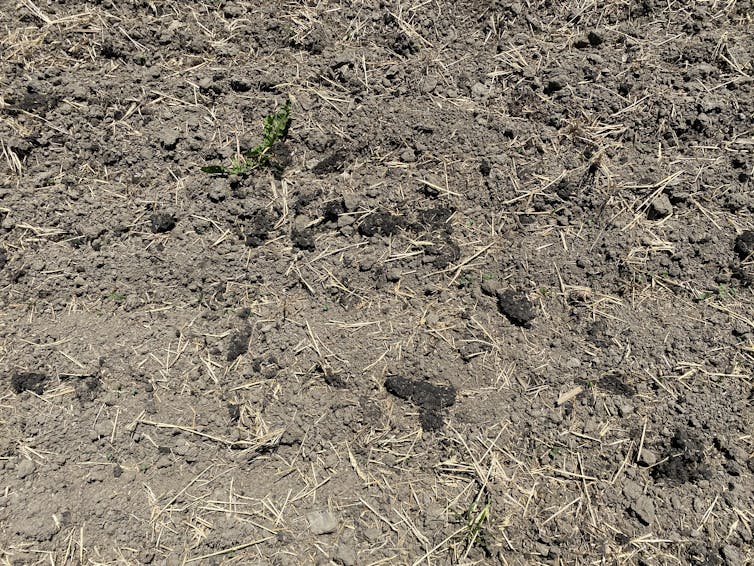
            A close-up photo of a dark substance lying on top of dry dirt
Biosolids applied to an agricultural field. (Branaavan Sivarajah), Author provided
           

Municipal biosolid applications are carefully regulated in Canada for heavy metals, nutrients and pathogens. However, guidelines for emerging contaminants, such as microplastics, are not currently available.

While current wastewater treatment plants are not explicitly designed to remove microplastics, they are nevertheless efficient at removing nearly 90 per cent of microplastic contaminants. The removed microplastics are often concentrated in the settled sludge and eventually end up in the biosolids.


Microplastics in municipal biosolids

Previous studies have shown that municipal biosolid waste is an important pathway for microplastics to enter the broader terrestrial ecosystems, including agricultural fields.

In collaboration with scientists from Environment and Climate Change Canada and Agriculture and Agri-Food Canada, we conducted the first pan-Canadian assessment of microplastics in municipal biosolids. We analyzed biosolid samples from 22 Canadian wastewater treatment plants across nine provinces and two biosolid-based fertilizer products.

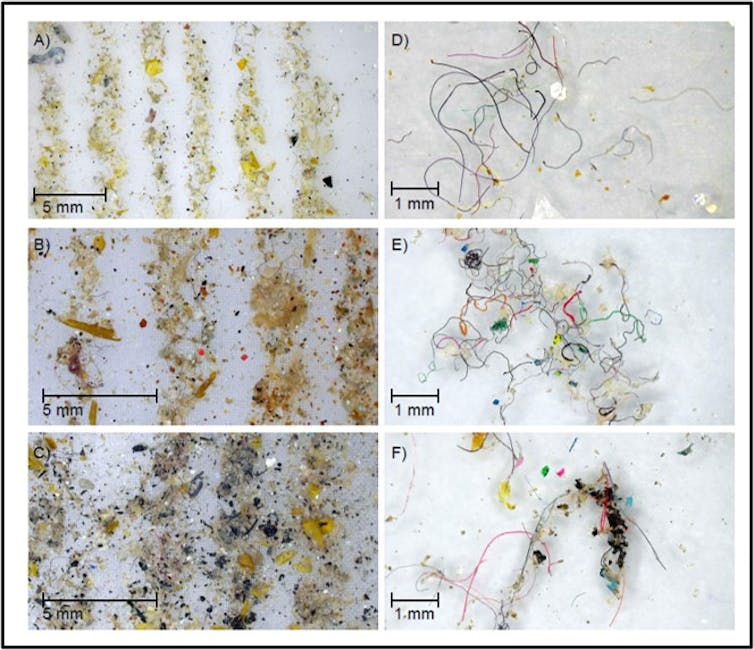
We found hundreds of microplastic particles in every gram of biosolids. The most common type of microplastic particles we observed were microfibres, followed by small fragments. We found small amounts of glitter and foam pieces too.


            Photos of microplastics seen through a miscroscope
Microplastics in municipal biosolids. A-C: Processed biosolid samples; D-F: Assortment of microplastic particles in biosolids.(Jesse Vermaire), Author provided


Microplastic concentrations in municipal biosolids are substantially higher than other environmental networks in Canada like water, soil and river sediments. This provides further evidence that microplastics are concentrated in biosolids produced at wastewater treatment plants.


Reducing microplastics

Wastewater treatment plants are well-equipped to remove large plastics like bottle caps and plastic bags from municipal wastewater. However, microplastic particles are so small they can’t be caught by current treatment  infrastructure, so they end up concentrating in wastewater sludge.

As wastewater streams concentrate microplastics, they also offer an opportunity to reduce the plastic pollution that is entering the environment. While researchers across Canada are working to find insights on the short- and long-term ecological consequences of microplastic pollution on soil ecosystems, one solution is already clear.

Microplastics can be reduced at sources via systematic reductions in the use of single-use plastics, washing clothing with synthetic fibre less frequently and removing microfibres using washing machine filters. These approaches will help minimize the amount of microplastics that get into the wastewater stream and, ultimately, into the broader terrestrial and aquatic environments.

Building new technologies at our wastewater treatment plants to remove microplastics through physical or chemical means should also be explored.

We need to better understand the impact of high concentrations of microplastic on agro-ecosystems where biosolids are applied, including its impacts on soil-dwelling organisms like earthworms and insects. We also need to start building national guidelines for microplastic levels in biosolids and agricultural soils.

Branaavan Sivarajah, Postdoctoral Fellow, Department of Geography and Environmental Studies, Carleton University and Jesse Vermaire, Associate Professor, Institute of Environmental Science, Carleton University

This article is republished from The Conversation under a Creative Commons license. Read the original article.

But her emails: Lara Trump is furious that Hillary Clinton is “laughing” at Trump’s indictment

Lara Trump, former President Donald Trump’s daughter-in-law, repeatedly hit out at Hillary Clinton for “laughing” at Trump’s Fulton County indictment and suggested that the former secretary of state’s email scandal is “far worse” than the former president’s alleged criminal scheme to subvert democracy.

Clinton, who beamed as she sat down for an interview with MSNBC’s Rachel Maddow on Monday, said that she doesn’t “feel any satisfaction” at her former Republican rival’s legal woes.

“I feel great—you know, just great, profound sadness that we have a former president who has been indicted for so many charges that went right to the heart of whether or not our democracy would survive,” she said.

“This is a terrible moment for our country, to have a former president accused of these terribly important crimes,” she added. “The only satisfaction may be that the system is working.”

Lara Trump in an appearance on Fox News’ “Hannity” Tuesday accused Clinton of “laughing” at the former president.

“She led into that interview with Rachel Maddow, by the way, laughing. She was laughing about this last night! Let me tell you something: There is nothing funny about this,” she complained.

“There’s nothing funny about the erosion of our American values, about the erosion of our Constitution, about the weaponization of our systems like Third World countries do against political opponents,” she continued. “Nothing funny, Sean, about our current president of the United States selling out our country to enrich his family, and of all people, Hillary Clinton, to be talking about this, who admitted to doing things criminally that are far worse than anything Donald Trump is even accused of doing, yet as you pointed out, no indictment there.”

Lara Trump later aired her grievances again on Newsmax, where she bemoaned that Clinton “got absolutely no heat from anybody at the Department of Justice” after “she BleachBitted and destroyed 33,000 emails after she was told not to” even though the FBI investigated her use of a private email server as secretary of state and declined to charge her with any crimes.

“We know what happened with Hillary Clinton, and yet she got absolutely no heat from anybody at the Department of Justice,” she complained, referencing Clinton’s nearly seven-year-old emails scandal.

Eleven days prior to the 2016 presidential election, then-FBI Director James Comey announced that the Democratic candidate’s emails were being investigated. Critics of the decision alleged Comey had violated a long-held Justice Department policy against publicizing investigations into presidential candidates so close to an election. Ultimately, the department chose not to prosecute Clinton.

We need your help to stay independent

“What they accused our campaign and my father-in-law of doing in 2016, conspiring somehow with Russia to win an election. Hillary Clinton herself and the DNC actually did these things,” Lara Trump claimed.

“And I think beyond that, this is what is frustrating to people, to see them throwing everything at the wall, to see anything that might stick for Donald Trump because they don’t care in actuality how it is they prevent him from becoming president of the United States again,” she added. “That is their angle. And they will try everything as evidenced now by this fourth ridiculous indictment.”


Want a daily wrap-up of all the news and commentary Salon has to offer? Subscribe to our morning newsletter, Crash Course.


Other conservative commentators also complained about Clinton’s reaction.

Fox News host Kayleigh McEnany, who was on the receiving end of one of the former president’s attacks earlier this year, called Clinton’s apparent joy “gross.”

“It’s so gross to see her laughing, positively giddy,” McEnany, Trump’s former White House press secretary, said on Fox, adding: “Watching Hillary Clinton laugh… this isn’t a laughing moment. It’s a sad moment for our country, and I think that’s something we should all agree on.”

Hours later on “The Story with Martha MacCallum, Fox News contributor Tomi Lahren echoed McEnany’s sentiments. 

“It’s no doubt she’s gleeful about this. But hatred is also obsession, and Hillary Clinton happens to be obsessed with Donald Trump,” she alleged, later calling the indictment of Trump and 18 other defendants a “dark day” for the country.

The former president, who once threatened in 2016 to jail Clinton if he were to become president, now faces a whopping 91 criminal charges after being indicted in New York, Florida, Washington, D.C. and Georgia. 

Like a good neighbor, Howard Morris is there for us on “Only Murders in the Building”

Eagle-eyed “Only Murders in the Building” viewers know the animated opening credits sequence requires close viewing. It provides a swooping view of the Arconia from the outside, capturing its residents going about their business inside their private spaces – including our three favorite amateur detectives Charles-Haden Savage (Steve Martin), Mabel Mora (Selena Gomez) and Oliver Putnam (Martin Short).

Everybody save for one – the person walking their pet near the entry gate. That figure becomes a sentinel of sorts as each season evolves. At first, it was simply an old lady with her dog who we later come to realize is Arconia’s grand dame and Board President Bunny Folger (Jayne Houdyshell). 
Now that honor falls to Howard Morris, Michael Cyril Creighton’s cat-loving sweater fan who has assumed the role of knowing everybody’s business.

Howard calmly strolls by with what we can assume is his newest furry ward Sevelyn on a leash in front of him, pausing to peer inside.

From a production standpoint, this animation serves the simple role of announcing Creighton’s promotion to series regular for the third season of “Only Murders in the Building.”  But Howard’s also essential to running Oliver’s production of “Death Rattle,” the showbiz obsessive’s momentarily doomed return to Broadway.

As the new season begins, Howard has been tapped as Oliver’s assistant, wrangling the cast and crew through table reads and rehearsals. Next to Oliver, the previously high-drama cat fancier is downright Zen-like. (Creighton’s Howard is also saddled with regularly fulfilling the show’s integrated sponsorship deal with State Farm, which he does by reminding Oliver at regular intervals of a family connection to the insurance company — you know, just in case.)

When Oliver’s lead actor Ben Glenroy (Paul Rudd) is murdered, Howard is one of the few loyal figures at Oliver’s side as he strives to resurrect an already-ridiculous play about a murder where the three main suspects are infant triplets into a musical called “Death Rattle Dazzle.”

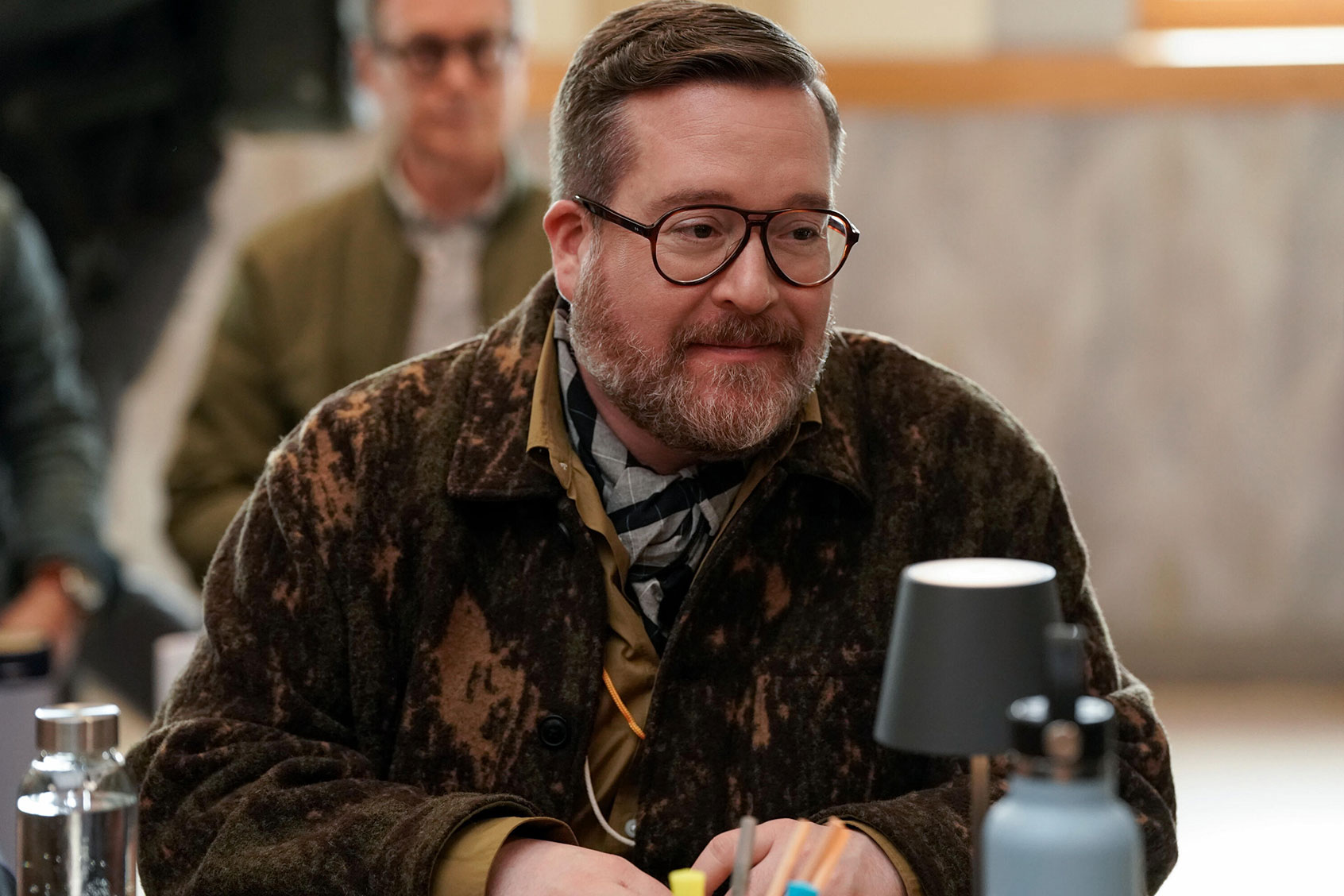
Only Murders in the BuildingHoward (Michael Cyril Creighton) in “Only Murders in the Building” (Hulu)If one were to predict that Howard would be such a close confidante to our murder mystery podcasters in Season 1 we might have scoffed. A defining characteristic of Howard is his bitchiness and tendency to gossip; plus, he was as suspicious of Charles, Oliver and Mabel as everyone else in the Arconia.
But Howard’s cat obsession outranks all his other quirks, rising above even his love for a chunky knit, his yodeling barbershop quartet and his boyfriend, Jonathan (Jason Veasey), Ben’s understudy in the production. And that makes him a harmonious foil for Oliver, whose effort to compose a musical overnight has made him frantic. 

The third episode of the latest season, “Grab Your Hankies,” shows Howard slumped in a chair as Oliver bangs out a melody on his piano, part of a dusk-to-dawn marathon that yields “one complete song, 11 fragments, and 25 rough notions screamed over a piano chord.”

Most people would have slept through Oliver’s mania without taking a single note. Oliver, however, is a cat daddy of the Jackson Galaxy variety, not the other kind. Meaning, he’s accustomed to getting his winks in around random 2 a.m. caterwauling slaps in the face. He knows some beings simply aren’t trainable. You can only suggest behaviors and hope they’ll go with it. Are we talking about Sevelyn, or Oliver? Yes, that’s a trick question.

We need your help to stay independent

The combined charisma of this season’s “Only Murders in the Building” ensemble is far more fascinating than the mystery or the sleuthing, to the extent that whatever shortcomings there may be in that department don’t get in the way of enjoying the larger story. The overarching plots dealing with Mabel’s penchant to isolate, Charles’ burgeoning commit-phobia, and Oliver’s obsession with both success and his acting discovery Loretta (Meryl Streep) are full to the brim with enough heart, whimsy, and lunacy to carry the whole show.

Within all this, pairing Creighton and Short brings a welcome and unexpectedly fresh sparkle to the core cast’s already strong chemistry. Placing his Howard in a pen with Short’s jumpy, cheerfully peevish Oliver is perfect. Howard is persnickety but forbearing and appreciates quirks. When Oliver fires off one of his cutting quips at Howard, he either takes it or responds in kind, albeit more slyly.

But one may also notice a relative absence of actual cats this season – negated, perhaps, by what Howard represents. Why bother bringing in a cat actor when the building’s foremost enthusiast serves the same purpose?

There must always be somebody pulling the neighborhood together, even if that person tends to be taken for granted.

Howard may not have much dialogue compared to the “Death Rattle Dazzle” cast, but he’s always standing close to the action or stoically enduring Oliver’s swipes. He’s a silent witness to every tantrum and an amiable grounding presence evening out Oliver’s disorganization.

He also solidifies an unspoken detail about the Arconia’s ecosystem: there must always be somebody pulling the neighborhood together, even if that person tends to be taken for granted.

In the first season, the building enjoyed the strains of Jan’s (Amy Ryan) bassoon wafting through her window into its courtyard – “the sound of the Arconia,” a smitten Charles called it. Her music augmented the romance of the place until, you know, she was outed as a murderer.

Bunny is recognized in Season 2 as the soul of the place, someone who wanted nothing more than to maintain its dignity as an extension of her own. When she died, a new resident named Nina (Christine Ko) assumed her Board President role but didn’t seem interested in living up to Bunny’s unofficial job of being the building’s social glue.

That’s where Howard comes in.


Want a daily wrap-up of all the news and commentary Salon has to offer? Subscribe to our morning newsletter, Crash Course.


Judging by the ratio of canine-loving bumper stickers to those pledging allegiance to our feline friends, our society leans heavily in favor of dog lovers. Oliver is one of those dog people, by the way – a bulldog lover who acts like a high-strung terrier.

But some environments are best navigated by experts in cuddly anarchy, especially the version prone to baring its claws at unpredictable intervals. 

That describes Howard to a tee. In a previous season’s post-mortem interview series creator John Hoffman revealed to me that briefly the writers contemplated making Howard the perpetrator, but Creighton made the character too likable to cage.

We’re grateful they followed this instinct. The people surrounding him, whether they’re actors or his neighbors may not fully appreciate what he brings to a room. They may even prove immune to his calming influence. But it’s tough to imagine what the Arconia would be without Howard quietly, keeping an eye on the drama, judging everyone all the while.


Ex-White House lawyer: Trump’s “irrefutable” fraud report may “end up as evidence against him”

Former White House lawyer Ty Cobb predicted that former President Donald Trump’s “irrefutable” report on alleged election crimes in Georgia could come back to bite him. On Tuesday, the former president responded to his election conspiracy indictment by claiming that he had evidence proving voter fraud in Georgia to be presented next week at his Bedminster, New Jersey residence. “A Large, Complex, Detailed but Irrefutable REPORT on the Presidential Election Fraud which took place in Georgia is almost complete & will be presented by me at a major News Conference at 11:00 A.M. on Monday of next week in Bedminster, New Jersey,” Trump wrote in a Tuesday Truth Social post. “Based on the results of this CONCLUSIVE Report, all charges should be dropped against me & others – There will be a complete EXONERATION! They never went after those that Rigged the Election. They only went after those that fought to find the RIGGERS!”

But Cobb dismissed the claim as “Trump PR” in an interview with CNN. “This is, you know, generating chaos. I mean, frankly, there’s a good chance that whatever document he produces ends up as evidence against him. It could even end up as the basis for an obstruction count against the author because it’s likely to be fiction and solely for the purpose of contaminating the jury pool,” he said. Michael Bromwich, a former federal prosecutor and Justice Department inspector general, also predicted the stunt would backfire. “Trump’s lawyers will be hiding under the covers, and prosecutors will be listening for obstruction and witness tampering,” he tweeted. “The most likely result: accelerated trial dates in DC and Georgia.”

“Special treatment”: Judge suggests Musk trying to “cozy up” to Trump by trying to tip him off

Special counsel Jack Smith obtained a litany of former President Donald Trump’s Twitter data, including direct messages, draft tweets, and location data, despite the social media company’s pushback, according to unsealed court documents

In February, U.S. District Judge Beryl Howell fined Twitter — which is now known as X — $350,000, holding it in contempt of court for missing a court-ordered deadline to respond to prosecutors’ search warrant. 

“Is this to make Donald Trump feel like he is a particularly welcomed new renewed user of Twitter?” Howell asked at the February 7 hearing, dragging Twitter for taking “extraordinary” measures to notify Trump about the search warrant in advance, despite being told not to.

“Twitter has no interest other than litigation its constitutional rights,” replied Twitter attorney George Varghese.

The judge went on to single out Elon Musk, who acquired the company in October of last year, saying, “Is it because the new CEO wants to cozy up with the former president?”

“Elon Musk hired expensive lawyers to fight a lawful search warrant to defend Donald Trump’s interests,” tweeted former federal prosecutor Renato Mariotti. “Twitter receives court orders like this regularly, and doesn’t spend that kind of money to fight them on behalf of customers. Why the special treatment for Trump?”

Politico reported that the new filings show that the search warrant ordered Twitter to provide the following data:

— Accounts associated with @realdonaldtrump that the former president might have used in the same device.

— Devices used to log into the @realdonaldtrump account

— IP addresses used to log into the account between October 2020 and January 2021.

— Privacy settings and history

— All tweets “created, drafted, favorited/liked, or retweeted” by @realdonaldtrump, including any subsequently deleted.

— All direct messages “sent from, received by, stored in draft form in, or otherwise associated with” @realdonaldtrump

— All records of searches from October 2020 to January 2021

— Location information for the user of @realdonaldtrump from October 2020 to January 2021

“I’m surprised that Trump had ‘many’ direct messages,” Mariotti wrote in a Tuesday tweet. “Given that he doesn’t use text and email, they could more directly reveal his intent than other evidence Jack Smith has.”

We need your help to stay independent

As Politico notes, the legal kerfuffle between Smith’s team and Twitter primarily stemmed from a “nondisclosure” order prosecutors issued to Twitter, ordering the social media company to keep Trump in the dark about the search warrant. Twitter responded by expressing concerns that Smith was mining for data that could be protected under presidential power, “a contention that drew incredulous responses from both prosecutors and the judge, who said Trump was unlikely to be doing government business with senior aides via Twitter DM.”

“You don’t even know the half about the very warrant you are coming in here to delay the execution of,” Howell said, underscoring the fact that Twitter, at the time, was relatively unaware of what the encompassing evidence Smith’s team had used to justify obtaining the warrant was. 

“There actually are concrete cognizable reasons to think that if the former president had notice of these covert investigative steps, there would be actual harm and concern for the investigation, for the witnesses going forward,” special counsel team member Gregory Bernstein said, according to the transcript.


Want a daily wrap-up of all the news and commentary Salon has to offer? Subscribe to our morning newsletter, Crash Course.


“First, they don’t know anything. I mean, they know some stuff. They know what they have read in the newspapers,” Bernstein said. “But they’re making these confident factual assertions without knowing the actual facts of the investigation.”

Former U.S. Attorney Joyce Vance said the transcript suggests the special counsel’s office “had a close informant” who gave them the probable cause they needed and “who they were strenuously protecting from Twitter’s efforts to disclose to Trump.”

New York University Law Prof. Ryan Goodman told CNN that the “timescale for the search warrant means this is not just around January 6th.

“It’s much broader than that. It’s soaking up a lot of information that the government must have had probable cause,” he said. “We don’t yet know, are the DMs only incoming?” he added. “He’s famously known for not really emailing. It could be that he’s receiving private DMs coming in and maybe not sending them out. That could be part of what’s still very valuable information.”

Trump raised $250M with “Big Lie” — then stiffed lawyers who were indicted in his scheme: report

Former President Donald Trump failed to pay several of the attorneys who assisted him in his efforts to overturn the 2020 election after they tried to collect payment for their work, CNBC reports, citing testimony to congressional investigators and Federal Election Commission records. The lawyers incurred the losses despite their lawsuits baseless fraud allegations helping Trump’s campaign raise $250 million in donations in the aftermath of the November vote, according to the final report from the House Select Committee investigating the Jan. 6 attack on the Capitol.

Trump’s closest ally and former personal lawyer, Rudy Giuliani, was among the slate of stiffed lawyers. Timothy Parlatore, a lawyer for Giuliani ally Bernard Kerik, Trump and the former New York City mayor had a handshake agreement that Giuliani and his team would be paid for their post-election work. However, the Trump campaign’s finance records showed that it fell short of that promise, only reimbursing Giuliani’s companies for travel and not the $20,000 a day he requested. “Lawyers and law firms that didn’t do s— were paid lots of money and the people that worked their ass off, got nothing,” Kerik complained in a 2021 tweet.

The FEC records and testimony from the House Jan. 6 Select Committee also indicate that, alongside Giuliani, none of the private-sector lawyers identified in the special counsel’s election case — Sidney Powell, Kenneth Chesebro and John Eastman — were compensated for the work they did for Trump after the 2020 election. All four lawyers were charged alongside the former president on Monday in Fulton County, Ga. District Attorney Fani Willis’ sprawling RICO case

Mark Meadows surfaces at last — and it sure looks like he’s flipped on Trump

One of the most compelling images that came out of the Jan. 6 House committee hearings was of former White House chief of staff Mark Meadows slumped on his couch on the afternoon in question, disconsolately scrolling through his phone while Donald Trump’s angry mob stormed the Capitol. As the New York Times reported:

[White House aide Cassidy] Hutchinson said around 2 p.m. or 2:05 p.m. that day, she went to Meadows’ office because she saw rioters were getting closer to breaching the Capitol. Meadows was on his couch, scrolling through his phone, as he had been that morning. “I said, ‘Hey, are you watching the TV, chief? … The rioters are getting really close. Have you talked to the president?’ He said, ‘No, he wants to be alone right now,'” she recalled.”I remember Pat saying to [Meadows], something to the effect of, ‘The rioters have gotten to the Capitol, Mark, we need to go down and see the president now.’ And Mark looked up at him and said, ‘He doesn’t want to do anything, Pat,'” Hutchinson said.

This was the man who had been constantly by Trump’s side in the previous tumultuous weeks as the president tried every possible means to overturn the results of the 2020 election. He knew Trump didn’t want to stop the violence at the Capitol. He knew Trump actually relished it. And he knew there was nothing to be done about it. 

Meadows had originally agreed to cooperate with the select committee himself and had turned over a large volume of communications pertaining to the post-election attempts to reverse the results. But after Meadows’ book “The Chief’s Chief” was published, in which he incurred Trump’s wrath by his unflattering portrayal of the president’s behavior after he contracted COVID, Meadows withdrew his cooperation and was eventually referred to the Department of Justice for contempt of Congress.

Unlike podcaster and agitator Steve Bannon and former trade adviser Peter Navarro, both of whom also refused to comply with a congressional subpoena, Meadows was not prosecuted by the DOJ. Neither was former White House communications official Dan Scavino. No explanation was given at the time, but many observers assumed that since Meadows was no longer in Trump’s orbit, he was cooperating with federal investigators.

Meadows has not publicly addressed the events of Jan. 6 or the post-election schemes since he left the White House. CNN reported that he is quietly employed in a high-level job as “the senior partner at the Conservative Partnership Institute, a pro-Trump think tank that pays him more than $500,000 and has seen its revenues soar to $45 million since Meadows joined in 2021, according to the group’s tax filings.” Nice work if you can get it. Meadows also serves as an informal adviser to the hard-right House Freedom Caucus, reportedly helping to guide the group’s rebellion against Kevin McCarthy’s speakership bid and its strategy during the debt ceiling talks. But according to his “best friend,” House Judiciary Committee Chairman Jim Jordan, with whom Meadows reportedly speaks at least once a week, they “make a point not to talk about” legal matters.

All this has Trump feeling very nervous that Meadows has become a “rat.” According to Rolling Stone, Meadows’ lawyers cut off contact with the Trump team months ago and the latter have had no idea what contact Meadows has had with either special counsel Jack Smith or Fulton County District Attorney Fani Willis. Meadows has reportedly testified before the federal grand jury in Washington, but took the Fifth when called before the special grand jury in Georgia. When the federal indictment against Trump finally came down in the Jan. 6 case, Meadows was not mentioned among the “unindicted co-conspirators,” despite ample public evidence that he had been heavily involved in the plots for which Trump was indicted. That seemed like a clear indication that he’d become a key witness.

Meadows’ lawyers reportedly broke off contact with Trump’s team months ago. The latter have no idea what the former chief of staff has told Jack Smith or Fani Willis.

This week we received another important clue about what exactly Meadows has been up to. He was among the long list of Trump associates indicted in Fulton County on Monday night in Willis’ sweeping conspiracy case. Unlike Trump and other key figures like Rudy Giuliani and John Eastman, Meadows was only indicted on two counts: violation of Georgia’s racketeering act and “solicitation of violation of public oath by a public officer.”

The first of those is the overall conspiracy charge laid out in the indictment, which cites Meadows’ dissemination of false theories of election fraud and his attempts to pressure DOJ officials as well as various state officials in Georgia and elsewhere. The second relates to the fact that Meadows “actively participated in and spoke” in Trump’s infamous phone call with Georgia Secretary of State Brad Raffensperger, the one when the then-president suggested “finding” enough votes to give him the win in that state. It’s easy to see why Meadows took the Fifth on that one.


Want a daily wrap-up of all the news and commentary Salon has to offer? Subscribe to our morning newsletter, Crash Course.


On Tuesday, Meadows became the first defendant in the Georgia case (but surely not the last) to announce that he would request moving his case to federal court because his alleged criminal activity “all occurred during his tenure and as part of his service as Chief of Staff.” In his statement, Meadows explained that “arranging Oval Office meetings, contacting state officials on the President’s behalf, visiting a state government building, and setting up a phone call for the President” were all part of his duties and that you would expect the president’s chief of staff “to do these sorts of things.” It sounds like Meadows’ defense will be, as they say, that he was just following orders.

That strategy is not unprecedented and many legal observers suggest Meadows has a good chance of getting his case booted to the federal level. Willis would still be the prosecutor, but would try the case before a federal judge and a jury pool drawn from the entire state, both of them potentially more sympathetic to Meadows. There would be no cameras in a federal courtroom, which is unfortunate since a televised trial might offer one last chance to penetrate the minds of those few remaining Republican voters who aren’t completely far gone.

None of this, however, explains Meadows’ role in Jack Smith’s federal case in D.C., where the former chief of staff has apparently been treated with kid gloves throughout the process. No doubt Trump’s team is anxious to look through all the discovery material to see what they can find out.

I always thought Meadows was a bit thick, not to mention certainly unqualified for the important job that he did remarkably poorly. Apparently, he’s smart enough to hire a highly competent lawyer and take that person’s advice, which makes him a very stable genius compared to his former boss. He may be the one major Jan. 6 conspirator who gets to walk away from this mess relatively unscathed.

“Aiding a coup is not your job”: Experts rip Meadows bid to dodge Fulton DA under “official duties”

Former White House chief of staff Mark Meadows on Tuesday filed to move the case brought against him by Fulton County District Attorney Fani Willis to federal court.

Meadows’ attorneys argued that federal law requires the removal of the case to federal court when a federal official is acting “under color” of their duties, ABC News reported. Sources told the outlet that former President Donald Trump is expected to mount a similar effort.

Meadows attorney George Terwilliger argued in the filing that the former Trump aide was merely doing his job.

“Nothing Mr. Meadows is alleged in the indictment to have done is criminal per se: arranging Oval Office meetings, contacting state officials on the President’s behalf, visiting a state government building, and setting up a phone call for the President,” the filing said. “One would expect a Chief of Staff to the President of the United States to do these sorts of things.”

“This is precisely the kind of state interference in a federal official’s duties that the Supremacy Clause of the U.S. Constitution prohibits, and that the removal statute shields against,” the filing added.

Terwilliger also wrote that while Meadows plans to file a motion to dismiss his indictment entirely, removing the case to federal court would “halt the state-court proceedings against Mr. Meadows.”

District Judge Steve Jones, an Obama appointee, has been assigned to Meadows’ case, according to the report.

Meadows was indicted by a Fulton County grand jury for allegedly violating the state’s racketeering law and solicitation of violation of oath by a public officer. The indictment accuses Meadows of partaking in Trump’s efforts to overturn his election results in close states and cites Meadows’ surprise December 2020 visit to an Atlanta-area facility where ballots were being audited. He was also on Trump’s infamous call to Georgia Secretary of State Brad Raffensperger demanding he “find” enough votes to overturn his loss.

Legal experts expressed skepticism at Meadows’ argument.

Terwilliger is “now in the unenviable position of arguing that using authority one only has because they’re a public official to try to overturn an election is acting [within] the scope of official duties—a tight needle to thread, if he can,” former U.S. Attorney Joyce Vance wrote on X, formerly Twitter.

New York University Law Prof. Ryan Goodman said it was “difficult to see how his defense lawyers can argue he was acting under ‘color of his federal office'” given the allegations against him.

Watergate prosecutor Jill Wine-Banks rejected Meadows’ claim that “he was doing his job.”

“Aiding a coup is not your job, nor is following orders of a criminal wanna be dictator,” she wrote.

“I don’t think it’s going to work because removal is only for official duties & an attempted coup isn’t in the job description,” agreed CNN legal analyst Norm Eisen, who served as a Democratic lawyer in Trump’s first impeachment.

We need your help to stay independent

Former U.S. Attorney Harry Litman argued that Trump has a better shot of having his case moved to federal court than Meadows.

“He can’t be following illegal orders and still say ‘I’m acting under color of my office.’ Look at the way the attorney is trying to frame it,” he told MSNBC. “It is less of an easy case for him than it is for Trump,” he added.

Eric Segall, a law professor at Georgia State University, told Salon’s Areeba Shah on Tuesday that Trump may be able to get his case moved because engaging in “official duties” is defined “very broadly.”

Though Trump’s bid to move his Manhattan hush-money case to federal court failed because a judge rejected his claim that it was related to his office, Trump could argue that his efforts were aimed at protecting the fairness of elections, Segall explained.

“We know that wasn’t his motivation,” he added. “His motivation was he hated losing.”


Want a daily wrap-up of all the news and commentary Salon has to offer? Subscribe to our morning newsletter, Crash Course.


But even if Meadows or Trump is able to move their case to federal court, they won’t be able to dodge Willis.

“Even if Trump succeeds in removing the case, the offenses are still Georgia state crimes, not federal offenses subject to Article II,” wrote Steve Vladeck, a federal courts expert at the University of Texas.

“It’s still Georgia state law charges. Fani Willis and her team will still prosecute the case. The only difference is they will prosecute the case a few blocks down the road at the federal courthouse,” Lawfare Fulton County correspondent Anna Bower explained on MSNBC.

“Federal procedural rules will largely apply and a federal judge preside over the case,” she explained, adding that there would also be a different jury pool. “But it doesn’t mean that the charges are any different or that the prosecutorial team is any different. It won’t be federal prosecutors, it will still be state prosecutors. And, importantly, Trump or any other future president will still not be able” to issue pardons because they are state charges.

“Teflon Don” is a collective fiction — it’s time to tell the story of Trump in jail

As soon as the magistrate judge in Washington warned Donald Trump that it was a crime to “influence a juror or try to threaten or bribe a witness or retaliate against anyone” related to his federal indictment for attempting to overturn the 2020 election, you could feel it coming: Trump would immediately flout the order his lawyers had agreed to in court. Sure enough, it took less than 24 hours for the 78-times-indicted former host of “The Apprentice” to issue all-caps challenges to the judge’s authority on Truth Social. “IF YOU GO AFTER ME, I’M COMING AFTER YOU!” he posted in his usual understated manner.

Prosecutors promptly bundled up the threat into a request for a protective order. That was largely granted by U.S. District Court Judge Tanya Chutkan, who warned Trump, “I will take whatever measures are necessary to safeguard the integrity of these proceedings.” Now, of course, Trump sees that warning as a dare. Except for a brief campaign visit to Iowa, he spent most of last weekend doing what he loves best: Delivering unhinged rants on social media attacking the judge, the prosecutors and, in a direct violation of the order, potential witnesses he called out by name.

Trump is showing no less restraint when it comes to the most recent round of indictments delivered by Fulton County District Attorney Fani Willis in Atlanta. Unsurprisingly, this latest round of spleen-venting also featured some gross wordplay referring to a notorious racial slur. 


Want more Amanda Marcotte on politics? Subscribe to her newsletter Standing Room Only.


No doubt those being targeted this way remember the brutal assault on Paul Pelosi, husband of then-Speaker of the House Nancy Pelosi, or the recent arrest of someone who threatened Barack Obama after Trump posted the former president’s home address. No reasonable person can deny that the intent here is to intimidate witnesses, potential jurors, judges and prosecutors. 

There’s an annoying tendency among the pundit class, however, to act like it’s completely out of the question for Trump’s bail to be revoked, which would silence him by sending him to jail (or possibly consigning him to house arrest). On “Pod Save America” last Thursday, host Dan Pfeiffer — despite claiming he’s not in the prediction business — repeatedly scoffed at that idea. Legal experts on cable news and social media talked up such toothless consequences as further hearings, injunctions or an accelerated trial schedule. But so far, the conventional wisdom is echoed in former federal prosecutor Neama Rahmani’s comments to Salon: “Is a judge actually going to jail Donald Trump in the middle of a presidential campaign? Probably not.”

To which I say: Why not? Trump is a human being, approximately speaking, with a physical body that would fit quite nicely inside a jail cell. The only reason Trump is perceived as invincible is because he’s managed to hex almost everyone into believing that he’ll get away with everything, every single time. All we need to do to change that is to stop believing in the collective fiction of Trump’s impunity. It’s not a law of physics. Donald Trump can go to jail. The only thing that’s required is the will to make it happen. 

It wasn’t long ago that the possibility of charging and indicting Trump for his numerous alleged crimes was routinely shrugged off as a #resistance fantasy. Anonymous FBI agents have told the Washington Post that higher-ups refused to entertain the idea of investigating Trump’s role in the Jan. 6 insurrection until the House select committee held public hearings and shamed them into it. Now Justice Department special counsel Jack Smith has two criminal cases against Trump headed to court, one for the coup attempt and one for stealing classified documents. Willis filed a whopping racketeering indictment against Trump and 18 other alleged conspirators this week. The “unimaginable” can become reality. Trump is not physically impervious to justice. That imaginary protective shell around him is the result of choices of those in power, and it’s time for those people to make different choices. 

Whether this is strategic or just the result of a sociopathic need to test boundaries, Trump’s rapidly escalating violations of every court order are already shaking the mainstream certainty that locking him up is out of the question. Prominent legal experts have actually observed that it’s the only real remedy for a defendant this badly out of control.  

Kyle Cheney of Politico pointed out an ironic subtext in Trump’s online attacks on Judge Chutkan: Likely without meaning to, Trump’s comments have highlighted Chutkan’s observation that there’s a double standard in play that leaves Trump free to strut, boast and complain while so many of his foot soldiers face punishment. 

Cheney also notes that Trump agreed to explicit conditions: Witness tampering is a crime punishable by prison. 

On MSNBC on Tuesday morning, Dave Aronberg, the state attorney in Palm Beach County, Florida, took this analysis a step further. “I’m waiting to see if there’s going to be a partial gag order, because Donald Trump can’t comply with one. And if he gets ordered to stay silent, you know he’ll violate that. And that may be the quickest way that he ends up in an orange jumpsuit.” 

(People keep leaving “trade the orange makeup for an orange jumpsuit” jokes on the table. C’mon! It’s time.) 

Sure, there could be logistical problems for the Secret Service (which protects all current and former presidents) if the judge sends Trump to jail for violating his release agreement. Those can surely be worked out. Even if the only realistic answer is somewhat unsatisfying — putting Trump under house arrest and depriving him of his phone — that’s a lot better than doing nothing. Frankly, it’s better for almost everyone if Trump actually loses his freedom for these threatening antics. It’s better for witnesses, for the judge, for potential jurors and for prosecutors. It’s better for Trump’s lawyers, who can do their jobs more easily without the constant headaches caused by their impulsive man-child of a client. I won’t claim it’s actually better for Trump himself, but even he benefits in one way: History suggests that his poll numbers go up when he’s being relatively quiet, because people start to forget what a noxious asshole he is. 

Most importantly, making Trump shut up is crucial to public safety. One of the most dangerous aspects of Trump’s seeming invulnerability is that some of his followers start to believe they’re immune to all consequences themselves. Most of the Jan. 6 insurrectionists weren’t concerned with the cameras all around them, and many of them posted photos and videos of their escapades that day on social media. Trump’s years of breaking the law with zero consequences had lulled them into thinking that they also were free to run buck-wild without fear of prison. 

More than 1,000 people have now faced legal punishment for their role in the Jan. 6 riot. That has definitely quelled the MAGA tribe’s collective overconfidence. But it’s reasonable to worry that if Trump keeps thumbing his nose at the law, his followers will start believing themselves to be untouchable all over again. Just last week, a self-proclaimed MAGA devotee was killed by the FBI, after waving a gun at agents and public threats against President Biden and other perceived Trump opponents. Fox News and other right-wing outlets are professing outrage, reinforcing the message to the MAGA faithful that they have some kind of “right” to commit violent acts on Trump’s behalf. With their hero’s flagrant refusal to respect a straightforward court order, this dangerous sense of entitlement will only get worse. Tossing Trump in jail, even briefly, would go a long way toward reminding these people that there’s no special MAGA exemption from obeying the law. 

Wealth and privilege are only impregnable barriers to accountability if we believe they are. But it’s not inconceivable for an elite person to get popped for a bail violation. Look at what just happened to Sam Bankman-Fried, the disgraced FTX founder now facing charges of financial fraud. He harassed a potential witness in his case, likely due to a Trumpian confidence that the judge wouldn’t dare revoke his bail. But the judge did just that, and now a man who a year ago lived at a luxury resort in the Bahamas sits in jail awaiting trial. 

Trump’s belligerence is so over-the-top that it can bamboozle people into thinking that nothing can be done to stop him. But that act could collapse pretty fast if those who hold actual power stopped playing along. It’s worth remembering that in the end Trump did leave office as scheduled on Jan. 20, 2021, without being physically dragged from the White House. He had spent the previous two months loudly refusing to admit he had lost the election and cooking up schemes to undo that fact. He clearly hoped his childish tantrum might convince everyone to give up and just let him have the office in perpetuity. But even the vague threat of personal conflict and humiliation was enough to make him skedaddle down to Mar-a-Lago when it was time to go.

The moral of the story is simple: Donald Trump is a coward. He can be contained and controlled, if he faces real consequences. Dealing with him just takes belief, imagination and some spine. It can be done.

Donald Trump’s real conspiracy: It’s much larger than even Fani Willis imagines

So Donald Trump is finally being charged as the mob leader he has been for many years. It’s about time.

Trump’s father, who told him that he could either be a killer or a loser, and his later father figure, Roy Cohn, who taught him the dark Machiavellian arts, would be proud as putsch, er, punch.

When I heard that among the 41 felony counts in the 98-page indictment, Trump is being charged with conspiring to make a public official break his oath of office (technically speaking, with “Solicitation of Violation of Oath by Public Officer”), that stood out. In a larger sense, Donald Trump has asked all his followers to renege on their duties as citizens of a democratic republic.

Just as he strong-armed Georgia Secretary of State Brad Raffensperger to “find” those 11,780 votes to overturn the 2020 election results in Georgia, he has used the authoritarian’s playbook to divide us as a nation and methodically train his followers to be bad citizens.

And according to the indictment just filed by Fulton County District Attorney Fani Willis, this was all part of an overall conspiracy — a criminal enterprise under racketeering law — led by the Hamberder King. Mark Meadows, Trump’s former White House chief of staff, who also participated in the infamous call with Raffensperger on Jan. 2, 2021, has also been charged with that same felony. (It’s No. 28 of the 41, if you’re keeping score). One suspects that all the guys who were in the “war room” at the Willard Hotel in Washington on Jan. 5 and 6 will eventually face similar charges from Jack Smith.

But Trump’s conspiracy to falsify the Georgia vote count, as heinous and as blatant as it was, pales in comparison to his ongoing and highly successful effort to train a sizable chunk of the American public to despise their own government, to hate the free press, to dehumanize their political opponents, not to take even the most basic precautions in a public health emergency and to embrace all kinds of dangerous conspiracy theories.

Trump’s co-conspirators in this larger scheme go well beyond the 18 people indicted this week and their 30 or so unindicted co-conspirators. They include dark money–funded Republican members of Congress, a number of Republican governors who are avidly experimenting with autocracy at the state level, the Federalist Society-approved majority on the Supreme Court, and the Fox News­-Newsmax-OAN propaganda triad.

We could call this suggested indictment “The Conspiracy to Bring Down American Democracy,” since that’s precisely what it is. Even with Trump and a lot of other folks facing multiple indictments, the plan is ongoing. The coup attempt is still underway, although its headquarters have been moved from the White House and the Willard a thousand miles south to Mar-a-Lago. The former president is still this country’s criminal in chief, and he desperately wants to weasel his way back into power.

We need your help to stay independent

And there are plenty of people out there ready to help, or actively conspiring to assist him in this larger criminal enterprise. Consider those behind the darkly funded No Labels effort, which makes a false equivalence between a well-intentioned political party trying to govern in good faith and a cult of personality trying to end democracy as we know it. 

Sowing mistrust and hatred is the only real platform of the MAGA party in its determination to wield minority power into the indefinite future. It’s mind-boggling that so many of Trump’s co-conspirators in the ongoing plot against democracy are still walking around bloviating about Democratic conspiracies and the “deep state” and generally behaving like troubled middle schoolers, often in the very halls of the U.S. Capitol their followers attacked.  

Is there a way to charge Trump, the entire Republican Party, Fox News, et al., with a criminal conspiracy aimed at “Soliciting Followers to Become Crap Citizens” or some such thing? Can we get that in front of a grand jury ASAP? 

Trump recently made a characteristically puerile reference to hell that struck me as classic psychological projection — claiming, oddly, that Nancy Pelosi both came from hell and will be going back there — so I think it’s fair game to end in the hot place. I’m not a particularly religious person, so when the concept of hell comes up my mind always goes to Dante’s “Inferno,” the best known section of his “Divine Comedy.” As the poet outlines the circles of hell, I would imagine that both Fred Trump and Roy Cohn are doing time in one or another of the lowest levels. As for Donald John Trump himself, the multiply-indicted and twice-impeached former president of the United States and reality-TV host, it’s not easy to say where he might land in Dante’s scheme. Perhaps he would tarry briefly with the corrupt politicians and sowers of discord and falsifiers in Circle Eight (Fraud) before landing forever in the icy lake of Circle Nine (Treachery), where betrayers and traitors spend eternity.

As I say, I don’t really believe in such things. But it’s a nice thought.

Legal scholar: Georgia Trump indictment is a confirmation of states’ rights – a favorite GOP cause

For the past 50 years, Republican policymakers and judges have sought to bolster federalism in the United States. Since Ronald Reagan’s first inaugural address in 1981, Republicans have been calling for policymakers to rein in the federal government in favor of devolving more power to the states.

Contrary to what it sounds like, “federalism” does not mean a strong central government. Instead, it refers to a system of government in which the people may be regulated by both the federal and state governments.

Reagan succinctly expressed it in his 1981 inaugural speech: “It is my intention to curb the size and influence of the federal establishment and to demand recognition of the distinction between the powers granted to the federal government and those reserved to the states or to the people.”

All U.S. citizens are actually citizens of two separate governments: They are citizens of the United States as well as citizens of the state in which they live. And they are subject to two systems of law as a result.

The framers of the U.S. Constitution valued federalism — and the division of power between different levels of government — as a bulwark against tyranny and a protector of liberty.

But this division of power has doubled the trouble for the leading Republican in the country: former president and likely GOP presidential nominee Donald Trump, who now stands indicted on 13 criminal counts by a Fulton County, Georgia, grand jury for “knowingly and willfully” joining “a conspiracy to unlawfully change the outcome of the election.” Eighteen other individuals were also indicted on a variety of charges related to the attempt to overturn the election.

Prosecutions by “separate sovereign governments”

With federalism come two sources of law — state and federal — which creates a complex web of regulations that can lead to criminal charges at both the state and federal levels, even for the same behavior.

While this may sound like a violation of the constitutional ban on double jeopardy, that constitutional protection only applies to repeated prosecutions by the same sovereign government. The state and federal governments are separate sovereign governments.

We need your help to stay independent

The federal government may criminalize behavior within the constraints imposed by the U.S. Constitution that limit federal power. Most federal crimes involve some form of interstate travel or transactions, for example. But the states’ criminal codes may often regulate the same behavior or additional behaviors with different standards and different penalties.

For example, when Timothy McVeigh blew up the federal building in Oklahoma City in 1995, he was subject to prosecution by both state and federal officials for violations of the laws of both governments.

McVeigh committed federal crimes, such as use of a weapon of mass destruction on federal property and the murder of federal law enforcement officers. The state of Oklahoma could also have prosecuted him for violating Oklahoma murder statutes, among other state criminal violations, although once McVeigh was convicted and sentenced to death in a federal trial, Oklahoma prosecutors did not ultimately seek to bring a case against him.

Donald Trump is now experiencing the full weight of a system of government in which criminal law is produced and enforced by law enforcement agencies and prosecutors across 50 states and by one powerful central government.

A woman in a sleeveless orange dress, holding papers and walking in a wood-paneled room.

Fulton County Court Clerk Che Alexander arrives with indictments for Superior Court Judge Robert McBurney on August 14, 2023 in Atlanta, Georgia. Megan Varner/Getty Images

The “very essence” of federalism

Trump’s activities in Georgia and New York may be prosecuted independently by state prosecutors — district attorneys and state attorneys general — under those states’ criminal codes.

At the same time, many of the facts implicated in the Georgia and New York cases could contribute to, or be relevant to, federal criminal prosecutions as well.

Prosecutions at both levels represent the very essence of federalism in action.

Usually in such circumstances, state and federal prosecutors must negotiate with one another about who will bring their prosecutions first, and how the state and federal trials will be managed and accommodated by each government.

But no matter what, neither set of officials has the power to deny the other the chance to prosecute a defendant who has violated the laws of their respective jurisdictions.

There is abundant irony in the fact that federalism — championed by Republicans and conservative judges for decades — has now come back to haunt the leading Republican for the U.S. presidency.

What is perhaps even more ironic is that even if Trump becomes president again, he will not have the authority to pardon himself (if that is even constitutional at the federal level, which is not clear) or anyone else for the violation of state crimes.

Presidential pardon authority extends to federal crimes alone.

This article is republished from The Conversation under a Creative Commons license. Read the original article.