Spring Sale: Get 1 Year, Save 58%

Shutting down the right-wing rabbit hole is possible: First, follow the money

“The man I loved wasn’t there anymore — and instead this monster that had the most horrible thoughts about people was in its place.”

When the woman I’ll call Ann married her husband in 2002, he was “someone who couldn’t care less about anything political at all.” Over the years, he drifted into being a Republican, but it wasn’t until 2017, after the election of Donald Trump, when she says “his radicalization and intro to conspiracy theory happened.” Within the last few months, Ann told me, her husband began telling their children “how the people behind Monster Energy drink are obviously Satanists because they hid symbols on their can.”

I met Ann on the Reddit forum QAnon Casualties, where family members and friends of QAnon believers and other far-right conspiracy theorists come to commiserate. Like several other members of the forum I contacted, she requested that Salon not publish her real name.

Ann hung in there for years, sticking with her husband through the far-right conspiracy theories and the flat-out weird ones. “He tried to convince me that the NFL was run exactly like the WWE in that it was entirely scripted,” she told me. Eventually, with the help of a therapist, she came to the conclusion that “there is literally nothing I can say to bring him back.”

That realization “has made things easier to handle,” Ann says. Before that, “all I could think about was how badly I wanted to die,” she continued. “I was scaring myself with how badly I just wanted out.” With her therapist’s aid, she says she is now  planning an exit strategy from her marriage. 

Ann’s journey is one that untold numbers of people have endured in recent years: watching a loved one become radicalized through online disinformation. Once such people have disappeared down the proverbial “rabbit hole,” it can sometimes be impossible to get them back. Preventing people from falling into the disinformation abyss in the first place is obviously crucial — and the good news is that prevention is possible. Experts already know a lot about both why and how people get radicalized, but the difficult part is interrupting the process by which vulnerable people are exposed to ever more vicious propaganda that lures them into the darkest caverns of social media. 

One of the most promising avenues for prevention has emerged from a surprising place: Parents and schools who have made it a mission to battle social media addiction. They’re using the same tools that proved so effective at curtailing a different and even deadlier public health menace: cigarette smoking. Only this time around, instead of suing Philip Morris and other big tobacco companies, they’re going after Meta, Twitter, TikTok, YouTube and Snapchat. 


Want more Amanda Marcotte on politics? Subscribe to her newsletter Standing Room Only.


Another QAnon Casualties poster who goes by Tristan Penifel (also not his real name) told me that Ann’s story is highly typical of visitors to the forum. People show up initially, he said, wondering how they can debunk the wild stories and outrageous claims they’re hearing from a formerly normal loved one. Tristan says he and the other forum regulars gently try to steer the newbies away from that path. The old hands know that it’s nearly impossible to argue people out of false beliefs they’ve picked up online, once those have become ingrained in their identity. 

Tristan told me his father fell deep into the realm of right-wing conspiracy theory years ago, and became obsessed with the claim that Barack Obama had been born in Kenya. “I spent hours one evening debunking every single thing that he could find about the birth certificate being fake,” Tristan explained in a Zoom interview. “By the end of all of that, he was like, OK, maybe the birth certificate is real.”

Preventing people from falling into the disinformation abyss in the first place is obviously crucial — and the good news is that experts say that’s possible.

But Tristan’s victory was short-lived. His father immediately pivoted to another conspiracy theory that claimed Obama “was handpicked by the banks to protect them after the 2008 financial crisis.” Tristan’s father had once been involved in Occupy Wall Street, but the allure of online conspiracy theories had pulled him far to the right.

Tristan went on to write about his experiences at Medium, arguing that “all of this is ultimately on the conspiracy theorist. They are the one who has some kind of emotional sickness driving them into these beliefs, and they are the one who can cure themselves. If they refuse to engage, no one else can save them.”

None of this comes as a surprise to experts who research far-right groups and conspiracy theorists. What the members of QAnon Casualties see happening to their loved ones is much bigger and more systematic than a small subset of the population adopting some kooky notions. Instead, they have become radicalized, and recent history tells us that while most people who believe outlandish conspiracy theories will not commit violent acts, the danger is very real. 

Even when they don’t commit violence, “people who get involved in these movements destroy their lives,” David Neiwert, author of “The Age of Insurrection: The Radical Right’s Assault on American Democracy,” told me in a recent interview. “It draws people into the abyss. It ruins their family relationships, ruins their relationships in the community.”

Early in the Trump administration, activists like Christian Picciolini, who has worked to help deradicalize white nationalists, attracted a flurry of media attention. Most experts believe, however, that convincing someone who has dug themselves deep down the rabbit hole is a difficult and unpredictable process. 

“Deradicalization is even more personal and idiosyncratic than radicalization,” Brian Hughes, an American University professor who co-founded the Polarization and Extremism Research and Innovation Lab (PERIL), told me. “Deradicalization is something that you do after the worst has already happened,” he continued, meaning “after a person has really made a grave social and even moral mistake, or sometimes committed an act of violence.”

Even at that point, it frequently doesn’t stick. Even as defendants from the Jan. 6 Capitol attack face prison sentences, there’s a common thread to many of their stories: They’re totally not sorry. Jacob Chansley, the infamous “QAnon shaman,” got some relatively sympathetic media coverage after his arrest, when his defense attorney portrayed him as a regretful dupe. Now that he’s out of jail, however, Chansley has made clear that he’s still a member of the QAnon faithful.

Even as defendants from the Jan. 6 Capitol attack face prison sentences, there’s a common threat to many of their stories: They’re totally not sorry.

Chansley told the Arizona Mirror he was “not a big fan” of his now-former lawyer, “after I found out all the things he was saying in the media without my consent. He said that I felt duped by Trump. I never said that. I never asked him to say that. He said that I denounced Q and the QAnon community. I never said that.”

Lisa Sugiura of the University of Portsmouth encountered a similar phenomenon, she said, while researching her book “The Incel Rebellion: The Rise of the Manosphere and the Virtual War Against Women.” While some men she interviewed identified as former rather than present-tense incels, Sugiura reports that many still share the same misogynistic views found on the “involuntary celibate” forums they have supposedly left behind.

“They will still say, ‘Oh, well, you know, women still get away with a ‘pussy pass,'” or that “women shouldn’t be so picky,” she said. “It’s very depressing. You think, well, is there a way out?”


Want more Amanda Marcotte on politics? Subscribe to her newsletter Standing Room Only.


“There is no getting him back. He is very much dead to me,” said George Fincher, who lives in Birmingham, England, and agreed to use his real name. He was talking about his stepfather, a former Royal Marine who has gone deep down the online QAnon rabbit hole. Fincher said he suspects that his stepfather is battling unresolved trauma, and in the process has alienated his family.

“He doesn’t speak to his kids. He’s met his grandchild once,” Fincher explained. “Probably, in his mind, the only thing that he has going for him is this [QAnon] idolatry. Because he certainly doesn’t have a family anymore.”

This comports with what researchers know about people who become radicalized. PERIL uses a “supply and demand” model to explain the process. Hughes laid out this theory in a legal brief filed in a lawsuit after Steven Carrillo, an Air Force sergeant affiliated with the extremely online Boogaloo movement, shot three law enforcement officers in California, killing one of them. 

“On one hand, extremist recruiters and propagandists offer a supply of ideological material, imagery, entertainment, and opportunities to organize with like-minded extremists,” Hughes wrote. “On the other hand, individuals pursue radicalization because it meets certain social and psychological needs — this is the demand side of radicalization.” 

As Hughes told Salon in an interview, “In the days before the internet, a person would have to be very lucky — or very unlucky, depending on how you want to look at it — to encounter extremist propaganda or an extremist recruiter.” Neo-Nazis used to trawl hardcore punk clubs looking for vulnerable kids; white nationalists would look for prospects target at gun shows. “What’s changed nowadays with the internet,” he said, “is that you can’t avoid radicalizing material. Propaganda is everywhere.”

Evidence that the internet has accelerated radicalization is also everywhere, as anyone who has watched Facebook friends melt down in real time can attest. Researchers at the Public Religion Research Institute (PRRI) found in 2022 that “nearly one in five Americans (16%) are QAnon believers.” Among Republicans, that proportion rose to 25%.

Beyond the damage done to individuals, families and the body politic, there is compelling evidence that online radicalization has fueled a rapid rise in extremist violence. The Government Accountability Office reported a nearly fourfold rise in domestic terrorism cases from 2013 to 2021. In many of the most dramatic examples, a common factor is online radicalization. Consider “incel killer” Elliot Rodger in California, white supremacist mass murderer Dylann Roof in South Carolina and the mass shootings in a Pittsburgh synagogue, an El Paso Walmart and a Buffalo supermarket. These dreadful cases are alarmingly similar: A young man radicalized by online propaganda decided to act on his bigoted delusions with real-world violence.

A Facebook whistleblower opens the door

In the fall of 2021, former Facebook employee Frances Haugen began to release reams of internal company documents exposing all manner of embarrassing secrets: Facebook had knowingly let disinformation flourish on its platform, had turned a blind eye to hate speech and overt incitements to violence, and deliberately targeted underage users, despite internal research showing that social media overuse could be dangerous to minors. 

“There were conflicts of interest between what was good for the public and what was good for Facebook,” Haugen told “60 Minutes.” “Facebook, over and over again, chose to optimize for its own interests, like making more money.”

In many of the most dramatic examples of domestic terrorism in the past decade, there’s a common factor: The perpetrators were young men who became radicalized online.

The Facebook document dump was a big scandal, at least at first. But media attention faded rapidly, especially as Elon Musk flirted with buying Twitter and then finally did so, shifting the locus of concern over social media disinformation away from Facebook and toward the “bird site.” But Haugen’s whistleblowing clearly had an impact on government and the legal system in terms of one crucial issue: The mental health impacts of social media algorithms on teenagers and children.
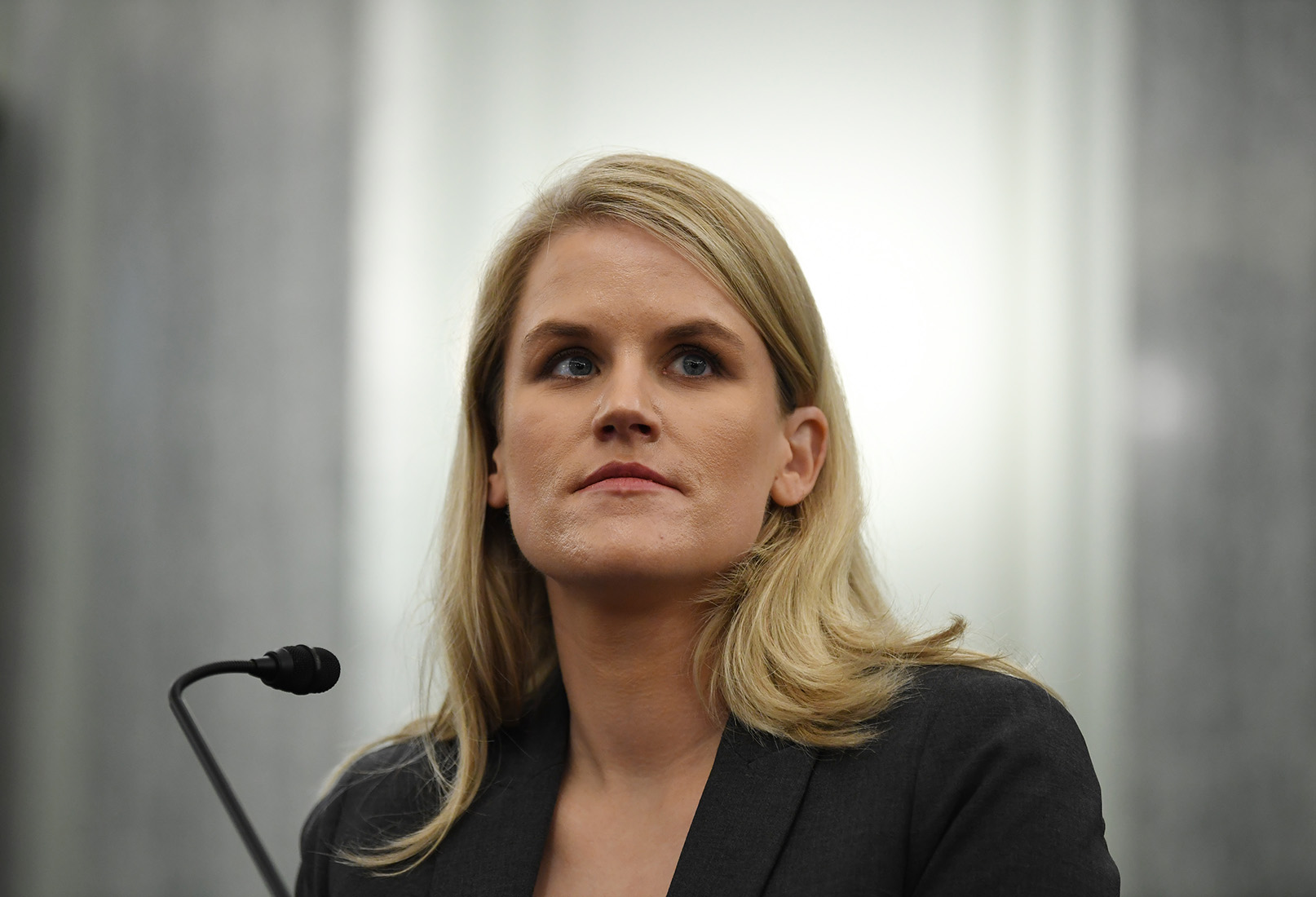
 Frances HaugenFacebook whistleblower Frances Haugen appears before the Senate Commerce, Science, and Transportation Subcommittee on October 05, 2021 in Washington. (Matt McClain/The Washington Post via Getty Images)

Over the past year and a half, there have been multiple congressional hearings about the health risks of social media for underage users. A Centers for Disease Control report on the teen mental health crisis included concerns about the impacts of social media. In May, Surgeon General Dr. Vivek Murthy released an advisory noting “growing evidence that social media use is associated with harm to young people’s mental health.” While admitting that the phenomenon is complex and that social media access can be beneficial for some kids in some circumstances, he argued that unregulated, excessive use was a likely contributing factor to the “national youth mental health crisis.”

What mental health risks are we talking about here? This remains a fraught topic, where research is continuing. What’s discussed most often are issues like low self-esteem, suicidal ideation, eating disorders, insomnia and attention disorders. But there is also evidence that the potentially addictive qualities of social media — although the term “addictive” remains controversial — contribute to right-wing radicalization. So one way of framing the problem, and a potential solution, is to argue that if social media companies can be forced to curtail the business strategies that lead users down right-wing rabbit holes and negatively affect mental health, it would be much more difficult for far-right movements to recruit online. 

Legislative approaches to regulating social media are still in their infancy, and are likely to encounter strong resistance. But there’s one promising channel that could move a lot faster: Litigation. A growing number of lawsuits filed by school districts, parents and young people themselves are claiming that social media companies deliberately design their products to be addictive — or at least to draw in users for longer periods of time and maximize “engagement” — which is contributing to the youth mental health crisis. 


Want more Amanda Marcotte on politics? Subscribe to her newsletter Standing Room Only.


“The end goal is to make young people engage with and stay on the platforms as long as possible, because that means they can sell more advertising,” lawyers for the Cabrillo Unified School District in Northern California argue in a district court lawsuit filed in May. “The YouTube, TikTok, Snap and Meta companies have learned that this is best accomplished by catering an endless flow of the lowest common denominator of content that is most provocative and toxic that they can get away with.”

Anne Murphy, one of the plaintiff’s lead attorneys, told Salon: “There’s been good research done that shows that social media’s effect on the brain is very similar to the effects that you have with gambling or even taking recreational drugs.”

“What we are looking at is the ‘public nuisance’ legal theory, which allows government entities to hold companies liable for unique damages caused as a result of a company’s conduct,” said Ron Repak, a lawyer who is representing Pittsburgh-area schools in a similar lawsuit.

The lawyers who spoke to Salon pointed to precedent-setting lawsuits of years past, based on claims that companies had deliberately addicted their customers to harmful products in search of greater profitability. The most famous of these were the consumer protection cases against tobacco companies that began in the 1990s, which were so successful the federal government joined in. In 1999, the Department of Justice won a racketeering suit against Philip Morris and other tobacco companies, successfully claiming those huge corporations had systematically defrauded the public by lying about the health risks of smoking. Now the school districts suing social media companies are making similar claims, also from a position of governmental authority. Similar lawsuits are being filed by parents who allege direct damages to their children. 

Lawyers in these cases emphasize that their goal is not strictly financial. They also hope that a measure of real accountability can force social media companies to rethink how they do business.

The lawyers who spoke to Salon emphasized that their goal is not strictly financial, although their claims are partly based on the taxpayer money lost because schools must spend more on mental health and security. They also hope that a measure of real accountability can force social media companies to rethink how they do business. Ira Weiss, who represents a different Pittsburgh-area school district, said he believes that these kinds of lawsuits — against the tobacco giants, Big Pharma and vape manufacturers, for instance — can also help educate the public and political leaders. 

During the discovery process, Weiss explained, internal company documents will likely be obtained, and “there will be depositions taken where all this marketing and technology strategy will become known.” (One recent model that made headlines was the defamation suit against Fox News by Dominion Voting Systems, which exposed a great deal of embarrassing material about the right-wing cable network’s internal operations.)

Theories about exactly how social media addicts people or lures them in deeper, especially younger people, are still being developed. It’s fair to say the mechanism is not exactly understood, as was also true of nicotine addiction for many years. But there can be little doubt that social media companies program their algorithms to make scrolling seem almost irresistible. As Haugen put it, Facebook’s internal research made clear that its products were “designed to be engaging,” and also that “that can lead to very high rates of what we call ‘problematic use.'” As an article for NBC’s “Today” site explains it, “That’s how an innocent search for ‘healthy recipes’ on Instagram might lead a teenager to eating disorder content instead.” 

That’s what is meant by the ubiquitous term “rabbit hole”: Users may begin with relatively innocuous content, but to keep them “engaged,” social media algorithms keep serving up ever more extreme — and, yes, more engaging — content that can plant dark thoughts and provoke deep insecurities. One lawsuit filed by California parents cites Pew research showing that, for some users, “the more they use social media, the more they are drawn down the rabbit hole into further use, making it increasingly difficult for them to stop.”

“Addicted” to QAnon, misogyny and the Boogaloo

The same rabbit-hole phenomenon that can draw social media users deeper into the world of eating disorders or suicidal ideation also appears to be a factor in online radicalization. Lisa Sugiura notes that many of the men she interviewed while researching the “incel” community were first drawn into that world through unrelated or apolitical online material, before the algorithm turned their heads toward darker stuff. One interviewee, she said, had done a “simple Google search” about male pattern baldness and eventually ended up on “incel forums, which were heavily dissecting and debating whether being bald is an incel trait.”

That man became an incel “very much through the algorithm,” Sugiura said, and through online conversations with people who “showed him a different way to view the world.”

“Pathologies like eating disorders and suicidality exist on a continuum with radicalization,” said Brian Hughes, the American University scholar. “In a lot of cases, they’re co-morbid. Depression and radicalization are commonly seen together.” Just as online merchants hawking dangerous diet products exploit young women’s insecurities, he added, the world of far-right influencers displays “an obsession with an idealized masculine physique, which often leads to steroid abuse.”


Want more Amanda Marcotte on politics? Subscribe to her newsletter Standing Room Only.


The most famous example of that phenomenon is Andrew Tate, a British influencer currently being held by Romanian authorities on charges of rape and human trafficking. Tate’s alleged victims say he choked them until they passed out, beat them with a belt and threatened them with a gun. A former kickboxer, Tate has made a fortune by showing off his muscular physique and expensive toys, gizmos and gear to attract a massive online following of young men, promising that he can turn them into “alpha males.” Tate has become so popular with boys and young men in the English-speaking world that educators are organizing and sharing resources in an effort to combat his influence. 

“There’s been a huge increase in rape jokes that the boys are making,” a seventh-grade teacher in Hawaii told Education Week

“Pathologies like eating disorders and suicidality exist on a continuum with radicalization,” said Brian Hughes of American University. “Depression and radicalization are commonly seen together.”

Conspiracy theories and right-wing propaganda often hook people, as Tate does, by appealing to anxiety and insecurity, especially regarding hot-button issues like race, gender and status. In his legal brief in the case of Steven Carrillo, Hughes explained that the murderer “was gratified by the feelings of anger and indignation” from far-right videos he saw on Facebook and “was rewarded with more extreme, more angering content.” (Carrillo pleaded guilty to murder and eight other felony charges last year, and is serving a life sentence without parole.)

“Facebook algorithms would encourage Carrillo to join a Facebook group called ‘/K/alifornia Kommando,'” Hughes wrote. Once there, “his deterioration increased at a terrific speed. He fully embraced the new identity of Boogaloo revolutionary.”

Jason Van Tatenhove understands how that process works. A former member of the Oath Keepers, he offered dramatic testimony before the House Jan. 6 committee last year, explaining how leaders convinced their followers to join the insurrection on Trump’s behalf. In his book “The Perils of Extremism: How I Left the Oath Keepers and Why We Should Be Concerned about a Future Civil War,” Van Tatenhove details how he first got sucked into the group, and what it took for him to get out.

 Jason Van TatenhoveJason Van Tatenhove, who served as national spokesman for the Oath Keepers testifies on July 12, 2022, in Washington. (Kevin Dietsch/Getty Images)

“There’s kind of a formula to what we were doing,” said Van Tatenhove, who was hired to do communications work by Oath Keepers leader Stewart Rhodes, who was recently convicted of seditious conspiracy and various other charges, and sentenced to 18 years in prison. “We were always watching the news aggregates. We would set up Google alerts on certain keywords,” in order to tailor recruitment content to what potential prospects were seeking out, especially on social media.

“What were the issues that really got people outraged and angry? Because that’s the low hanging fruit,” Van Tatenhove added. “We were looking for that outrage and that anger, because it seems to short-circuit our critical thinking centers.”

That’s exactly the kind of content that Facebook’s algorithms have favored, according to Frances Haugen. “When you give more distribution to content that can get reactions,” she said in a recent MSNBC interview, “you end up rewarding more extreme content. Because the shortest path to ‘like’ is anger.” 

Van Tatenhove says he is personally in recovery from drug addiction and, during our conversation, compared the allure of conspiracy theories to that of heroin. “While heroin feels great, it ruins your life,” he said. “While conspiracy theories feel great and we get all those chemical releases — much like shooting heroin — it’s damaging to our country and it’s damaging to our democracy.” He suggested that the U.S. needs an analogue to “methadone” for our conspiracy-theory addiction.

What is to be done?

There’s clearly no magic-bullet solution to this problem, but the growing number of lawsuits by parents and schools could be the beginning of one. None of these plaintiffs seek a cold-turkey approach to social media, which would neither be possible nor desirable. As Murthy told the “Offline” podcast, it’s clear that many people “find community” on social media they might not find elsewhere, and that was doubly true during the pandemic. Social media, he added, can be especially beneficial for those “from a historically marginalized group where it’s difficult to find people who may be going through similar experiences,” such as LGBTQ youth. 

“Conspiracy theories feel great and we get all those chemical releases, much like shooting heroin,” said Jason Van Tatenhove. But “it’s damaging to our country and it’s damaging to our democracy.”

As the complaint in the California parents lawsuit argues, the issue is not the existence of social media but the companies’ reliance on an “algorithmically-generated, endless feed to keep users scrolling in an induced ‘flow state’; ‘intermittent variable rewards’ that manipulate dopamine delivery to intensify use; ‘trophies’ to reward extreme usage” and other features that keep people overstimulated and unable or unwilling to log off.  

The desired outcome here is simple: Perhaps the financial threats from these lawsuits will induce social media companies to make their products less addictive. Haugen has repeatedly argued that the path forward will require some form of government regulation. But the two approaches aren’t separate but intertwined, the lawyers who spoke to Salon emphasized. They believe their lawsuits can generate public attention and information that will help shape both future regulation and the public will to enact it. 


Want more Amanda Marcotte on politics? Subscribe to her newsletter Standing Room Only.


The most promising legislative effort is a bipartisan bill introduced by Sen. Brian Schatz, D-Hawaii, and co-sponsored by another liberal Democrat, Chris Murphy of Connecticut, and two conservative Republicans, Katie Britt of Alabama and Tom Cotton of Arkansas. The Protecting Kids on Social Media Act, like a similar state law in Utah, would bar kids under 13 from starting social media accounts and require parental consent for older teenagers. That is almost certainly unenforceable but, more intriguingly, the bill also takes aim at online algorithms, barring companies from using them to drive content to minors, although it would remain legal to use them on adults.

“While kids are suffering, social media companies are profiting,” Schatz said in a statement. “Our bill will help us stop the growing social media health crisis among kids by setting a minimum age and preventing companies from using algorithms to automatically feed them addictive content based on their personal information.” Of course, as the families of QAnon believers and the victims of right-wing extremist violence can attest, it’s not just kids who are going down dangerous online rabbit holes. Schatz conceded as much in a Wired interview, saying that “it’s bad enough that it’s happening to all of us adults,” but that “the least we can do is protect our kids.”

Regulating social media may be cast as an attack on the First Amendment, but Sen. Brian Schatz argues that there’s “no free speech right to be jammed with an algorithm.”

The fate of that bill is uncertain, and there’s considerable resistance in both parties to pursue direct federal regulation of social media, which would surely be cast by the social media industry and some civil liberties advocates as an attack on First Amendment rights. Schatz has argued, however, that there is “no free speech right to be jammed with an algorithm.” Restricting the use of algorithms wouldn’t impact anyone’s constitutional right to express their opinions on social media. It would simply prevent the companies from shoving the most incendiary content at the most vulnerable users.

These questions of free speech and social media algorithms are tricky, and the legal and legislative arguments are in their early stages. When the Supreme Court was confronted earlier this year with a case arguing that social media companies should be liable for algorithmic promotion of pro-terrorist content, the justices seemed grateful to punt the entire issue.

Legal experts hope that the consumer protection argument driving this new wave of social media lawsuits will create a framework for addressing this issue that sidesteps First Amendment concerns. The recent Supreme Court case looked at “whether a company can be held accountable for specific content,” attorney Anne Murphy said. “We’re looking at it much more holistically,” by considering whether the algorithm should exist in its current form at all, considering the demonstrable harm it does to children.

The core idea here is to shift the focus from individual speech, which everyone agrees is protected by the Constitution, to the larger question of regulating the social media business model to mitigate its effects on public health. If the legal groundwork can be laid in these cases on the principle that children and teenagers should be protected from predatory business practices and deliberately harmful products, that could open the door to a larger regulatory structure that makes the internet safer for everyone. 

This entire discussion is still in its infancy, and more needs to be learned about the way social media affects mental health. As mentioned above, there’s considerable debate over whether the “addiction” model is a fair or accurate way to describe what happens when people get sucked deep into online rabbit-hole communities that encourage destructive behavior or ideologies. As the lawyers who spoke to Salon almost universally expressed, they hope this litigation can help illuminate some of these issues and drive more resources toward the necessary research.  

Still, the family members of right-wing conspiracy believers have little doubt that social media had a profoundly debilitating effect on their loved ones, in many cases people who were vulnerable to the algorithm-driven pressure to stay online. Some people who dive down the rabbit hole may be struggling with long-term trauma or undiagnosed mental illness. Many are extremely lonely. In some cases, they have pre-existing prejudices and are eager to have their bigoted views validated by disinformation. Whatever the root causes may be, social media platforms are profiting handsomely off people who are slowly losing their minds to the reality-distortion field of their feeds. No one suggests these lawsuits can solve the problem by themselves, but they could mark the beginning of a major public reckoning with the harms of social media that leads, eventually, to real answers. 

The Supreme Court’s term of clear corruption and the innocence of influence

As the Supreme Court closes out another term, Americans now have yet another scandal to process concerning the nation’s highest court, this one involving Justice Samuel Alito. On June 20, ProPublica reported that Alito spent three fun-filled days in 2008 at an upscale lodge in Alaska, reeling in salmon and rubbing elbows with Paul Singer, a right-wing billionaire whose private plane ferried Alito to said wilderness redoubt. The redoubt itself was owned by yet another right-wing magnate, Robin Arkley II. The plane trip and the accommodations were provided gratis to the good Justice, who then failed to report them as gifts and to recuse himself when entities connected with Singer brought cases to the Court. One of these, decided in Singer’s favor in 2014, netted his hedge fund a cool $2.4 billion thanks to  Alito and six other justices.

These revelations were as unsurprising as they were dispiriting, given the tranche of recent exposes about the overlapping social circles of conservative Supreme Court Justices and Bond villain-rich conservative donors. The Alito news joined a spate of stories about BFFs Clarence Thomas and Harlan Crow, in which the Walmart-loving Justice was identified as the recipient of decades of financial and other support from the Dallas real estate magnate, and earlier reports about the frequent canoodling of the late Justice Antonin Scalia with various denizens of the Republican pecuniary pantheon. 

These stories are now frequent enough to have accreted their own rituals of response and defense. First comes the pearl-clutching indignation of the Justice himself, protesting that no “reasonable person” could possibly think he had an “obligation” to report or recuse, and then the covering fire from the Right’s network of publicists and apologists. The Wall Street Journal huffed that the Alito reveal was “a non-scandal built on partisan spin” which constituted a “political assault on the Supreme Court” and “judicial independence.” The only novelty in this latest “non-scandal” would seem to be the Journal’s decision to publish Alito’s rebuttal before the ProPublica story itself appeared. (When Alito told ProPublica that he would have “no comment” on their story, he apparently meant “No comment that won’t appear in a major national newspaper friendly to me and mine.”)

Of course, even ideologues as cossetted as Alito have a sense of what a plausible defense against such charges requires. A purely technical (if highly selective) recitation of relevant guidelines for reporting and recusing won’t pass muster with the general public; something more demotic and direct is necessary. (But for those interested, there’s nothing quite like the high comedy of Alito’s exploration of the meaning of “facilities” in his WSJ response.) And so, after all the parsing and hair-splitting, we come to the heartfelt, rough-hewn denials. Alito, after a rumble of throat-clearing no doubt, assured everyone that where Singer was concerned “On no occasion have we discussed the activities of his business, and we have never talked about any case or issue before the Court.” Singer himself was similarly emphatic. He and Alito “never discussed his business interests,” he said through a spokesperson. And besides, how could he have known, in 2008, that a case would arise years later resulting in a $2.4 billion payday? You can almost hear the tremolo of injured innocence in his voice. It’s hard to be a robber baron.

Masters of the Universe such as Singer and Crow and their plutocratic familiars are far too slick to get caught arm-twisting a Supreme Court Justice.

I’m not very interested in the surface details of this denialism. The ProPublica article quotes legal ethicists who argue that Alito’s duty to report and recuse should have been clear to him. Then again, given the absurdly lax nature of the ethical rules for the Court, I’m more than ready to believe there was enough wriggle room to make Alito’s demurrals plausible if not persuasive. I’m more interested in the unspoken assumption that anything wrong here, anything that could count as corruption, must take the form of relatively crude horse trading and quid pro quoing. I respectfully suggest that this is a straw man even an Alaskan salmon could identify.


Want a daily wrap-up of all the news and commentary Salon has to offer? Subscribe to our morning newsletter, Crash Course.


What it hides, or tries to hide, is the fact that Masters of the Universe such as Singer and Crow and their plutocratic familiars are far too slick to get caught arm-twisting a Supreme Court Justice. The principals in these scandals want us to believe that corruption must take the form of bulging envelopes passed on dark rain-soaked streets or in the hallways of luxe vacation lodges. But that’s not how it works, not when it comes to the super-rich and high-profile persons such as Samuel Alito or Clarence Thomas. It’s too obvious, too vulgar, and—- more to the point—- too indictable. Everyone these days has a camera in her pocket, financial transactions are too traceable, and exactly how much can you buy for what fits inside a garden-variety envelope? How dreadfully twentieth century.

The first, best option of the oligarchs is not extortion but assimilation: If they can colonize the mind, the results will be both more reliable and more subtle, and hence less susceptible to interference.

What the Singers of the world want is not so much a particular decision in a particular case—- though they do, of course, want that too—- but a relationship, an alliance over time. They want to create an atmosphere in which their concerns and interests will be treated tenderly. The intent is not to extort a specific result, but to lure a powerful and influential person into an opulent world of apparent grace, style, and charm. In this world everyone, or almost everyone, is well-educated and articulate; attention is paid to detail and tasks are thoughtfully tended to. Care is taken. Corners are turned down and loose ends tied up, but all this energy and activity float on a smooth surface of undulant ease. 

The expectation is that these qualities will recommend themselves to people whose minds tend to love order but whose personal resources prevent them from realizing it on a similar material scale. As this happens, the interests and priorities of the rich, their values and desires, come to seem reasonable, then natural, and then, finally, normative. How could a world so successfully managed not be a source of virtue and talent, of insight and instruction? An outsider who finds himself inside of it, if only as an occasional (though welcomed) guest, may eventually find himself unable to believe that what its permanent residents want is different from what the country needs. 

It is certainly possible that the robust denials of Alito and Thomas, and the earlier denials of Scalia, are completely cynical. Maybe they know they’re being bought and simply don’t care. But I doubt it. The first, best option of the oligarchs is not extortion but assimilation: If they can colonize the mind, the results will be both more reliable and more subtle, and hence less susceptible to interference. My guess is that Alito and his ilk, at this point, don’t see themselves as doing anything at all problematic. They carry a world inside their heads now, and they want to share its lessons—- its efficacy and efficiency, its stability and rationality—- with the rest of us. How could that be wrong? From their side of the looking glass, it’s not corruption; it’s just common sense.

“Far beyond simple narcissism”: Why Donald Trump can’t simply keep quiet — even when facing prison

One of my casual friends is an attorney. He is very good at getting people out of trouble – trouble that is usually of their own making. My attorney friend would often tell me stories about people who would get on the stand and talk themselves into prison. Why? I asked him. He explained that some people know that they are right and believe they can prove it, but don’t understand that winning in court is not about being right or the smartest person in the room. Sometimes you just need to be quiet. And if you must talk, be damn sure to let your attorney do it for you!

The traitor ex-president Donald Trump is going to be put on trial for allegedly violating the Espionage Act and committing other serious crimes such as conspiracy and obstruction of justice. It also appears very likely that special counsel Jack Smith is going to charge Donald Trump and his cabal with other federal crimes in connection with the Jan. 6 coup attempt. If found guilty, Donald Trump could potentially spend the rest of his natural life in federal prison. As such, Trump has most certainly been told by his personal attorneys to be quiet. Trump has also received the same advice, publicly and for free, from other attorneys and experts in the law. It would appear, however, that Donald Trump lacks the ability to be quiet.

“Trump’s behavior is far beyond simple narcissism.”

For example, in a Tuesday morning post on his Truth Social disinformation social media website, Trump raged against special counsel Jack Smith, threatening his family like some type of mafia boss:

COULD SOMEBODY PLEASE EXPLAIN TO THE DERANGED, TRUMP HATING JACK SMITH, HIS FAMILY, AND HIS FRIENDS, THAT AS PRESIDENT OF THE UNITED STATES, I COME UNDER THE PRESIDENTIAL RECORDS ACT, AS AFFIRMED BY THE CLINTON SOCKS CASE, NOT BY THIS PSYCHOS’ FANTASY OF THE NEVER USED BEFORE ESPIONAGE ACT OF 1917.

In various interviews, speeches, and other communications, Trump and his spokespeople have offered up a range of “defenses” and “explanations” for why he stole many dozens of boxes reportedly containing some of the country’s most closely guarded secrets such as war plans, the identities of human assets, i.e. spies, documents detailing America’s nuclear capabilities (and vulnerabilities to attack), and other information that could cause the country cataclysmic harm if its enemies were able to access it. These “defenses” and “explanations” include that Trump was too busy and distracted to actually know what was in the boxes that he stole and refused to return to the United States government, that Trump has some type of psychic superpower to declassify top secret and other classified information with his “beautiful mind” and “big brain” and that he is a victim of a political “persecution” and the documents themselves don’t really matter. Of course, none of this is true.

In an audio recording that was recently obtained by CNN, the former president basically admitted that the documents he had in his possession were in fact classified and that he has no right to keep them:

The recording obtained by CNN begins with Trump claiming “these are bad sick people,” while his staffer claims there had been a “coup” against Trump.

“Like when Milley is talking about, ‘Oh you’re going to try to do a coup.’ No, they were trying to do that before you even were sworn in,” the staffer says, according to the audio.

The next part of the conversation is mostly included in the indictment, though the audio makes clear there are papers shuffling as Trump tells those in attendance he has an example to show.

“He said that I wanted to attack Iran, Isn’t it amazing?” Trump says as the sound of papers shuffling can be heard. “I have a big pile of papers, this thing just came up. Look. This was him. They presented me this – this is off the record but – they presented me this. This was him. This was the Defense Department and him.”

The indictment includes ellipses where the recording obtained by CNN shows where Trump and his aide begin talking about Clinton’s emails and Weiner, whose laptop caused the FBI to briefly re-open its investigation into her handling of classified information in the days before the 2016 election she lost to Trump.

Trump then returns to the Iran document, according to the audio recording and indictment transcript.

“I was just thinking, because we were talking about it. And you know, he said, ‘He wanted to attack Iran, and what…,’ ” Trump says.

“These are the papers,” Trump continues, according to the audio file.

“This was done by the military and given to me,” Trump continues, before noting that the document remained classified.

“See as president I could have declassified it,” Trump says. “Now I can’t, you know, but this is still a secret.”

“Now we have a problem,” his staffer responds.

Trump’s newest excuse-defense is that he was just bragging and none of what he said on the recording obtained by CNN should be taken as representing his real intent.

“We have to hope that his supporters will finally see that they are no more than prey he uses for himself.”

In all, the CNN recording and Trump’s other lies, evasions, and attempts to justify his apparent criminal behavior in connection to the Espionage Act, the crimes of Jan. 6, and his decades-long public crime spree (which includes sexual assault as proven in the E. Jean Carroll case) are a type of classroom or clinic, a horrible “teachable moment” about one man’s obvious extreme mental unwellness and other pathological behavior. Moreover, the last seven years and the Age of Trump have been teaching the American people and the world that same horrible lesson ad infinitum.


Want a daily wrap-up of all the news and commentary Salon has to offer? Subscribe to our morning newsletter, Crash Course.


I asked Dr. Justin Frank, author of the book “Trump on the Couch,” for his thoughts about the CNN recording of Trump talking about the top secret and other classified documents in his possession. He told me via email that “Trump’s behavior is far beyond simple narcissism.”

Donald Trump’s attachment to his boxes reminds me of a humorous list sent me to me about dogs’ attitudes towards their objects of desire: “If I see it, it’s mine; if it’s been in my mouth, it’s mine; if I can take it from you, it’s mine…” This is how Trump feels about the reams of government documents he illegally removed from the White House. Simply put, the boxes belong to him and to no one else, and Uncle Sam can’t play with them anymore.

Trump’s behavior is far beyond simple narcissism. It is even far beyond grandiose omnipotence.

To Trump, the actual truth about the custody of the documents and his actions is irrelevant. They’re his because, one, he says they’re his; and two, because he never does anything wrong. Trump’s psychopathic behavior reflects the disturbing fact that to him (and his cult followers), the only “truth” is whatever comes out of his mouth in any given moment. If faced with jail time, he will most likely continue to stir up hatred for the DOJ, for the press, for whomever tries to make him accountable for his destructive actions. The sway Trump has over his mindless supporters is chilling, and has we’ve seen, he will take no responsibility for their violent actions, either. Nor will he lift a finger of his tiny hand to repair the damage he’s done. Trump’s behavior is dangerous in a democracy and to a democracy.

I also asked Dr. Lance Dodes, who is a retired assistant clinical professor of psychiatry at Harvard Medical School and a training and supervising analyst emeritus at the Boston Psychoanalytic Society and Institute, for his insights about Trump’s behavior and apparent inability to be quiet about violating the Espionage Act and committing other crimes. Dr. Dodes explained to me via email that:

Trump’s keeping boxes of classified documents regardless of the law, compromising the safety of the country and its people, fits exactly with what we know: he is a dangerous psychopath, acting only for himself and utterly uncaring about harm to anyone else. His remarkable ability to draw crowds of worshipful people, despite volumes of evidence that he is lying continuously, is the same capacity as successful predators in the animal kingdom. Like them, he senses the vulnerabilities of others as prey, using code words and ideas to lure them into believing him to be safe and on their side. As we’ve seen many times, if anyone who has been in his thrall stops completely supporting him, he turns on them immediately. Like his adoring crowds, they have been tricked into thinking he cares about them.

As his several trials move forward, he will likely become more out of touch with reality, insisting all the more that he is not just innocent, but a godlike figure persecuted by evil men. He will likely renew his calls for a violent revolution to end democracy and install him as dictator since, as he has psychotically claimed in the past, only he can save us. We have to hope that his supporters will finally see that they are no more than prey he uses for himself.

For those of us, myself included, who have direct experience with sociopaths and other such dangerous people, living through the Age of Trump and trying to warn the American people about the disaster has been and continues to be remarkably frustrating and exhausting. For most of the Age of Trump, people said we had “Trump Derangement Syndrome” when we were just telling an uncomfortable and unpopular truth.

If Donald Trump were just one man, he would still be a public menace and a problem because of his vast wealth and potential reach. But Donald Trump is much more than a man, he is now a fascist symbol, a type of godhead, a political cult leader, and a Great Leader for the tens of millions of people who follow him. In total, Trump’s obvious mental, emotional, and other pathologies and unwellness are now a collective societal problem that will not be going away anytime soon. Sick leaders attract sick followers; sick societies create sick politics like Trumpism and the larger American neofascist movement.

Donald Trump, because of the many types of privileges and other unearned advantages he enjoys (his skin color, gender, money and inherited wealth, a political and media machine backing him, tens of millions of followers, and other forms of power, however diminished they may now be) has largely been able to escape serious consequences for his decades-long public crime spree. But now, with his being arrested and indicted for federal crimes, Trump may finally be held accountable. If he does end up in prison, Trump mostly has no one to blame but himself and his inability to shut his mouth and be quiet. For most people that is a relatively easy thing to do, but for a pathological person such as Donald Trump it is a Herculean task.


Cetacean secret agents: All about Putin’s covert combat dolphins

Reports of dolphin warfare, marine mammal combat and sea assassins of the Kremlin this week have not been exaggerated. You may have even heard murmurs of the US’ secret sea lion program in San Diego. Maybe you’re wondering: Do they have lasers? (I was.) But who enlists such intelligent animals into warfare?

Don’t worry. Even if all this sounds like fully unhinged geopolitical gibberish, it’s assuredly real: Recent reports from British intelligence have alerted the world to Russia’s latest military maneuver in its war against Ukraine: the recruitment and training of weaponized attack dolphins.  

Here are the four most important (read: absurd) facts to share with your friends about the top-secret military use of dolphin warfare. 

1. No, you’re not losing your mind. Russia really does have attack dolphins. 

The marine base in Sevastopol is Russia’s central base in the Black Sea area and, as mentioned, British intelligence officials have recently relayed that Russia’s secret attack-dolphin program there is doubling in size, with an eye toward defending against any Ukrainian enemy divers. 

Russia’s wariness of losing high-value Black Sea naval ships has been noted by defense analysts and US Naval Institute watchers since April 2022, when satellite photos captured new developments at the marine training center. 

“The killer-dolphins would be trained to attack enemy combat swimmers using special knives or pistols fixed to their heads.”

But according to the UK Ministry of Defense, the Russian Navy has been beefing up security at its base in occupied Crimea, enhancing its water-based defenses since last summer. The previously estimated two or three dolphins has now reportedly been upped to five or six, with evidence suggesting room for even further “recruitment.”

Iuliia Mendel, a spokesperson for Ukrainian President Volodymyr Zelensky, explained the latest dolphin intelligence in a recent tweet: “Russia has almost doubled its floating mammal pens in Sevastopol, according to British defence officials, and is ‘highly likely’ to contain trained bottle nosed dolphins … The Russian navy, which also uses Beluga whales and seals for missions, has invested heavily in its Black Sea Fleet’s main base since last summer.”

The latest image captures show two floating pens of the kind usually used for dolphin training at the mouth of the Sevastopol base in the Black Sea. 

“This includes at least four layers of nets and booms across the harbour entrance. In recent weeks, these defences have highly likely also been augmented by an increased number of trained marine mammals,” said the ministry in its statement.

That’s right — Russia’s got a secret combat dolphin program, with the aim of stopping Ukrainian enemy dive teams and protecting Russian ships. And yes, it gets weirder. 

2. Ukraine’s horny war dolphins once escaped, armed with head-knives

The real scoop here is that Russia’s secret attack dolphins are swimming exactly where Ukraine’s own sea assassins were once kept. Sevastopol was where the Soviet Union’s secret military dolphin program began in 1973. Once the USSR collapsed, however, the dolphins and sea lions fell under Ukraine’s command. 

The Sevastopol combat dolphins remained under Ukraine control through the 1990s and the program saw something of a resurrection in 2012 — with the dolphins being trained to plant bombs on ships, hunt for mines and attack enemy divers. Then, in 2014, Russia annexed Crimea and Sevastopol. And with it, came the dolphins.

Bottlenose DolphinBottlenose Dolphin (Getty Images/Stuart Westmorland)Amid conflicting reports on the fate of the Ukrainian sea soldiers, Ukraine officials said that shortly after being captured by the Russians, the dolphins refused to be flipped and died “patriotically after going on a hunger strike.” 
Back in 2015, Russian state media reported that not only had Ukraine restarted its attack-dolphin efforts, but that five Ukrainian combat dolphins had gone rogue — busting out of their aquatic barracks for a little mating-season R&R. Two of the dolphins, apparently successful, came back after a couple of days — but the other three highly-trained marines remained AWOL on a sex bender, reportedly armed to the teeth.

“The killer-dolphins would be trained to attack enemy combat swimmers using special knives or pistols fixed to their heads,” the Russian military source told Rio Novosti

In the same report, former Soviet naval anti-sabotage officer Yury Plyachenko highlighted the surprisingly critical role the species played in combat areas, despite having a well-known lubricious streak. 

“There were repeatedly cases in the 1980s when control was lost over dolphins,” said Plyachenko. “If a male dolphin saw a female dolphin during the mating season, he would immediately set off after her and would no longer obey any commands. But in a week or so, he’d come back.”

Ukraine’s Ministry of Defense denied the report at the time, along with denying the restart of the combat dolphin program. 

3. Yes, the US did have a classified military dolphin operation — because America.

The US tried to keep its own dolphin defense ops under wraps for decades, but finally the San Diego-based program was declassified in the 1990s. As the Navy’s Marine Mammal Program has repeatedly said in official statements, the dolphins were largely used for sniffing out undersea mines and finding unauthorized swimmers in off-limits areas. 

In an archived version of the Navy’s FAQ, the animals are praised, along with sea lions, for their resistance to pressure-change sickness known as  “the bends” that can be detrimental to human divers when resurfacing. 

“The Navy currently relies on dolphins and sea lions to help protect lives and naval assets for two major reasons: their sensory capabilities and their diving capabilities. Dolphins naturally possess the most sophisticated sonar known to man. Mines and other potentially dangerous objects on the ocean floor are acoustically difficult targets to detect, especially in murky or dark water,” the program said. 

Of the sea lions, the Navy said they possess “excellent low light vision and underwater directional hearing capabilities. Sea lions are not only adept at locating objects in challenging conditions, they also have the ability to maneuver in tight spaces and can go onto the shore if necessary.” 

Since 2003, reports have continued to circulate more widely about the use of military dolphins as touted by the US. As of 2010, 80 bottlenose dolphins and 30 California sea lions were held by the Navy in San Diego Bay, according to The Seattle Times. And in 2012, retired Admiral Tim Keating told NPR that during the invasion of Iraq the US Navy had also used toothed whales to detect mines — though he wouldn’t confirm whether the dolphins were also used in the Persian Gulf. 

“I’d rather not talk about whether we used them or not. They were present in theater,” Keating said.

There’s also the matter of the US spending years trying to turn far less intelligent sharks into Cold War suicide bombers, as documented by Mary Roach in her book, “Grunt: The Curious Science of Humans at War.”

But that’s a dorsal of another color.

4. Russia is actually killing thousands of dolphins

There’s a darker context to the Russian use of dolphins for war, however. As pointed out recently by UAnimals — an advocacy organization aimed at saving animals affected by the Ukraine invasion — the fallout of recent Russian waterway attacks has included devastating effects on marine wildlife

Some marine biologists previously estimated as many as 50,000 Black Sea dolphins were killed as a result of Russia’s invasion of Ukraine. As reported in May by USA Today, top ecology scientists in Ukraine report that more than 100 Black Sea bottlenose dolphins died in one month.

“Unfortunately, during April 2023, more than a hundred dead dolphins have already been registered in the bays of Sevastopol and other shores of the occupied Crimea and nearby Novorossyska, Sochi, Gelendzhik,” said Ivan Rusev, Ukraine’s research head at the Tuzly Estuaries National Park.

The fact that we drag other animals into our atrocious battles is yet another reason war is hell.

Hunter Biden to fork over some of his paintings in finalized child support settlement

After considerable back and forth, Hunter Biden and Lunden Roberts — mother of their 4-year-old daughter — have reached a finalized agreement in their Arkansas child support case.

Per the stipulations of Thursday’s court filing, as of July 1, Biden will issue monthly payments to Roberts for a redacted amount, as well as health insurance reimbursement, until whichever of the following life events occurs:

  • The child turns 18
  • The child dies
  • The child’s disabilities are otherwise removed for general purposes
  •  The child is otherwise emancipated

In addition to the payments, Biden will also make available a selection of his art, “which shall vary in size with a minimum size of 24×24,” with the specification that “the child shall select the painting which shall either be sent to the child” or a gallery selected by Roberts.

According to Politico, “The New York City gallery exhibiting Hunter Biden’s work in 2021 estimated his paintings to be worth between $75,000 and $500,000 apiece.”

After establishing paternity following a lawsuit that Roberts filed in 2019, Biden agreed in 2020 to pay $20,000 a month — retroactive to November 2018 — towards the child in a temporary settlement and, according to reporting by The Arkansas Democrat Gazette, that sum has now been reduced, which seems to be how to addition of the art work factors in. 

In negotiations leading up to the finalized agreement, Roberts had requested that the child be granted use of the Biden surname, but has now let that part go.


Want a daily wrap-up of all the news and commentary Salon has to offer? Subscribe to our morning newsletter, Crash Course.


At the start of their back and forth, Roberts stated that Biden has “never seen or contacted” the child, per USA Today, and that President Joe Biden and first lady Jill Biden “remain estranged” from her.

“I think it’s embarrassing the president doesn’t acknowledge his granddaughter — who looks just like his son,” Roberts’ lawyer said following an earlier court hearing in a quote obtained from New York Post.  

Dirty tea towels are breeding grounds for harmful bacteria — here’s how to clean them properly

Kitchens can harbor all sorts of germs and bacteria. These can arrive via humans, pets, uncooked food or even plants, meaning that a high proportion of foodborne infections are acquired directly within the home.  

An important cleaning aid in most kitchens is the tea towel, also known as a dishcloth. Usually made of cotton or linen, they are used to dry wet hands and kitchen implements as well as wiping down surfaces — so play an important role in kitchen hygiene.

But, because hands and uncooked fresh produce are often rich in a diverse variety of germs, tea towels are prone to picking up the bacteria they come into contact with.  

Indeed, in a study that used tea towels to wipe down chopping boards that had been used to prepare raw chicken with salmonella (which can cause diarrhea, fever and stomach cramps), 90% of the cloths became contaminated with salmonella, too.

Several studies have looked at the germs tea towels typically carry in domestic kitchens. One study sampled 100 used tea towels and found a marked presence of staphylococcus aureus Staphylococcus aureus, which is often found on the skin but is also a pathogen that can cause a variety of issues such as abscesses, joint infections and even pneumonia.

Tea towels are good at picking up germs which is important as another study of 46 kitchens found a wide range of harmful bacterial species living on kitchen surfaces, which are often cleaned by tea towels.

Surfaces were found to have Enterobacter (which can cause respiratory tract infections, skin infections, urinary tract infections and heart, bone and eye infections), Klebsiella (which has been linked to serious infections of the lungs, bladder, brain and blood) and E. coli (which can cause upset stomachs and urinary tract infections).

Several kitchens also had Pseudomonas aeruginosa, which can cause lung infections. Bacillus subtilis, which can lead to eye infections and abscesses, was also found in more than half of the kitchens sampled. And all of the samples from the kitchens were found to have Staphylococcus and Micrococcus. In people with weak immune systems, Micrococcus has been linked to lung infections, such as pneumonia and septic arthritis along with eye and heart infections.

The levels and types of germs found on these tea towels were influenced by how they were used, how often they were washed and how long they were dried for. Rinsing tea towels in hot water at 60°C was found to reduce levels of bacteria later spread by contaminated cloths, which is important as infection likelihood is often related to how many bacteria you ingest.


Clean your cloths

These studies suggest there is an infection risk from tea towels and that most kitchen cloths may be contaminated with high levels of bacteria. It’s easy, then, for these germs to transfer on to food preparation surfaces, potentially causing serious food poisoning.  

The infection risk of using tea towels is well-recognized by the medical profession. Indeed, in UK hospitals, fabric tea towels are not allowed. Instead, patient crockery, cutlery and food preparation work surfaces are cleaned and dried with disposable paper towels.  

One of the reasons tea towels act as such good microbial reservoirs is that they are often damp as they are used to absorb moisture and mop up spills. Water enables germs to grow. And so a moist tea towel left in a warm kitchen provides an ideal environment for bacteria to multiply. This is particularly the case if food traces are present, too.  

So what’s the best way to sanitize your used tea towel? Tea towels that are hung up in the air tend to dry faster than cloths stored and squeezed into balls, which can affect levels of bacteria in the towels.

Laboratory experiments that involved covering tea towels in salmonella, found that the bacteria multiplied in all types of cloths that were crumpled. But levels of bacteria were reduced by 1,000 times if the tea towels were hung to dry for 24 hours at room temperature.


Reduce the germs

To avoid tea towels spreading germs around the kitchen, it’s recommended that the cloths are washed regularly and when they get wet, are allowed to dry completely before being used again. Using disposable cloths or paper towels for heavily contaminated areas, such as those involving raw meat, could also help to stop the spread of bacteria.  

In terms of tea towel hygiene, you should clean and thoroughly dry your kitchen towel at least once a day or after each use. The UK government recommends that tea towels should be sanitized by washing them in a washing machine with laundry detergent on a hot wash cycle of 90°C.

Laundry detergents contain hard water softeners, surfactants (which increase the wetting effect of water by reducing its surface tension), detergents, bleaches and digestive enzymes. Food stains on tea towels will probably be a mixture of proteins, fats and carbohydrates, which the enzymes degrade.

And the detergent helps to dissolve the stains, which are released into the washing water. Since proteins and fats are also involved in the attachment of bacteria to surfaces, laundry detergents will help to detach and so reduce bacteria levels in tea towels.

If you wash tea towels by hand, ensure any obvious food and dirt are removed by rinsing in hot water with detergent before disinfection. After washing, you can sanitize any microbes remaining using boiling water or a disinfectant such as bleach, diluted as per the manufacturer’s instructions.

Ironing tea towels on a hot setting will also effectively sanitize as the temperature is above 90°C. You should also store your laundered tea towels in a dry, clean area, away from any uncooked food and grubby hands.

Primrose Freestone, Senior Lecturer in Clinical Microbiology, University of Leicester

This article is republished from The Conversation under a Creative Commons license. Read the original article.

Report reveals anti-LGBTQ case now before Supreme Court may have been “fabricated”

The supposed author of the inquiry for a same-sex couple’s wedding website cited in the filing for 303 Creative v. Elenis — a Supreme Court case regarding Colorado web designer Lorie Smith, who refuses to create wedding sites for same-sex couples and seeks an exemption from anti-discrimination laws — told New Republic that he never made the request.

According to court filings, Stewart contacted Smith in September 2016 through her website regarding his wedding to his partner, Mike, slated for “early next year.” He wrote that they “would love some design work done for our invites, placenames etc. We might also stretch to a website.” Stewart also listed his number, email address and a link to his own website, which indicated that he was also a graphic designer, in the inquiry.

When the New Republic’s Melissa Gira Grant contacted Stewart, whose information except for his last name was included in the filing, about the website creation request, he told her it was “the very first time I’ve heard of it.”

Stewart confirmed that the contact information on the inquiry form was correct, but said he never sent the form and was married to a woman at the time of its creation. 

“If somebody’s pulled my information, as some kind of supporting information or documentation, somebody’s falsified that,” Stewart said.

“I wouldn’t want anybody to … make me a wedding website?” he continued. “I’m married, I have a child—I’m not really sure where that came from? But somebody’s using false information in a Supreme Court filing document.”

The Supreme Court is expected to deliver its opinion on the case, in which the Stewart contact form plays a minute role, by the end of its session this summer. The case could be, as stated in a question from Justice Sonia Sotomayor at a December oral argument, “the first time in the Court’s history … [that] a commercial business open to the public, serving the public, that it could refuse to serve a customer based on race, sex, religion, or sexual orientation.”

Smith and her attorneys first brought the case before the U.S. District Court in Colorado in 2016, asking the court to exempt her from the state’s anti-discrimination law so she could legally offer her wedding website design services to straight couples only. Smith had previously never designed any wedding websites, and she and her attorneys ultimately lost the case.

She received the “Stewart” inquiry on Sept. 21, a day after she filed the lawsuit, according to the date-stamp shown in later court filings. It is unclear when or if the inquiry from “Stewart” was ever verified over the course of the initial legal battle.

The defense filed a motion to dismiss the case on Oct. 19, 2016, citing Smith’s lack of inquiries for the services she wants to deny. Smith’s legal team, the Christian right group Alliance Defending Freedom, issued a response the following month, notably not mentioning the September inquiry from Stewart but arguing that Smith did not need to have received a request in order to challenge the law over fears of consequences she could face if she denied services to a same-sex couple.

ADF did not make mention of the “Stewart” inquiry or argue its relevance until February 2017.

“Notably, any claim that Lorie will never receive a request to create a custom website celebrating a same-sex ceremony is no longer legitimate because Lorie has received such a request,” the group wrote. “Even though she is not currently in the wedding industry, Lorie received an email inquiry on September 21, 2016.”

In a sworn statement, Smith further explained that she “received a request through the ‘contact’ webpage on my website from a person named, ‘Stewart,’ reference number 9741406, to create graphic designs for invitations and other materials for a same-sex wedding (‘same-sex wedding request’).”


Want a daily wrap-up of all the news and commentary Salon has to offer? Subscribe to our morning newsletter, Crash Course.


The federal court ruled on the case in September 2017, stating that the evidence provided did not allow it to “determine the imminent likelihood that anyone, much less a same-sex couple, will request Plaintiff’s services.” The court also said that the “Stewart” inquiry was “too imprecise” and that “assuming it indicates a market for Plaintiff’s services, it is not clear that Stewart and Mike are a same-sex couple (as such names can be used by members of both sexes).”

ADF fired off in defiance of the ruling at a press release, claiming that “a federal judge ruled that Smith and her studio can’t sue to challenge a portion of Colorado’s Anti-Discrimination Act because a request sent to Smith by a couple, self-identified as ‘Stewart’ and ‘Mike,’ isn’t formal enough to prove that a same-sex couple has asked her to help them celebrate their wedding.” 

The group’s later appeal expanded those arguments: “according to Social Security Administration (SSA) data, only a nanoscopic number of women have been named Stewart or Mike since 1880. Lorie faces a 16 times greater chance of being struck by lightning than either name being female,” it read.

Stewart, who said he was never contacted in connection to the case, later told New Republic via text message that the situation didn’t make sense to him. He questioned why a web designer living in San Francisco would endeavor to hire someone from a different state who has never constructed a wedding website to build one for him.

He had also told the outlet that he first learned of Smith when her case was brought before the Supreme Court and the design community began discussing its potential results.

“I disagree with this, in the strongest possible terms,” Stewart told Grant of Smith’s desire to circumvent laws protecting people from discrimination on the basis of sexual orientation. “I couldn’t disagree with her stance more.”

During their arguments before the Supreme Court this session, ADF did not bring up the “Stewart” inquiry or refer to Stewart and Mike specifically, but Grant writes, “they don’t need to.”

“Their entire case, after all, is built around the idea of gay people doing something that they have not yet done, nor ever will do,” she continued.

“The Bear” hides crusts of meaning and trauma in an episode about the Feast of the Seven Fishes

Tradition is prime among the many wonderful, terrible traits that make us human, with no example externalizing this quite so well as the holiday meal. Our gatherings of family and friends are freighted with reverence and meaning, defying any attempts at alteration regardless of whether a clan’s defining actions serve us anymore, or if they ever make sense.

This is the first point made by “Fishes,” the sixth Season 2 episode of “The Bear.” In a flashback to a Christmas five years past, Carmy (Jeremy Allen White) nervously heads into another chaotic kitchen, the one ruled by his mother Donna (Jamie Lee Curtis). 

She’s frantically prepping the family’s version of the Feast of the Seven Fishes, an arduous undertaking she takes upon herself despite the rest of the family begging her not to do it. She asks for help and then moans that nobody is helping her. Alarms ding every couple of minutes, accentuating the insanity of Donna’s frenetic tarantella between her wine glass, a blazing stove, and a countertop stacked with pots and pans in use or used up. 

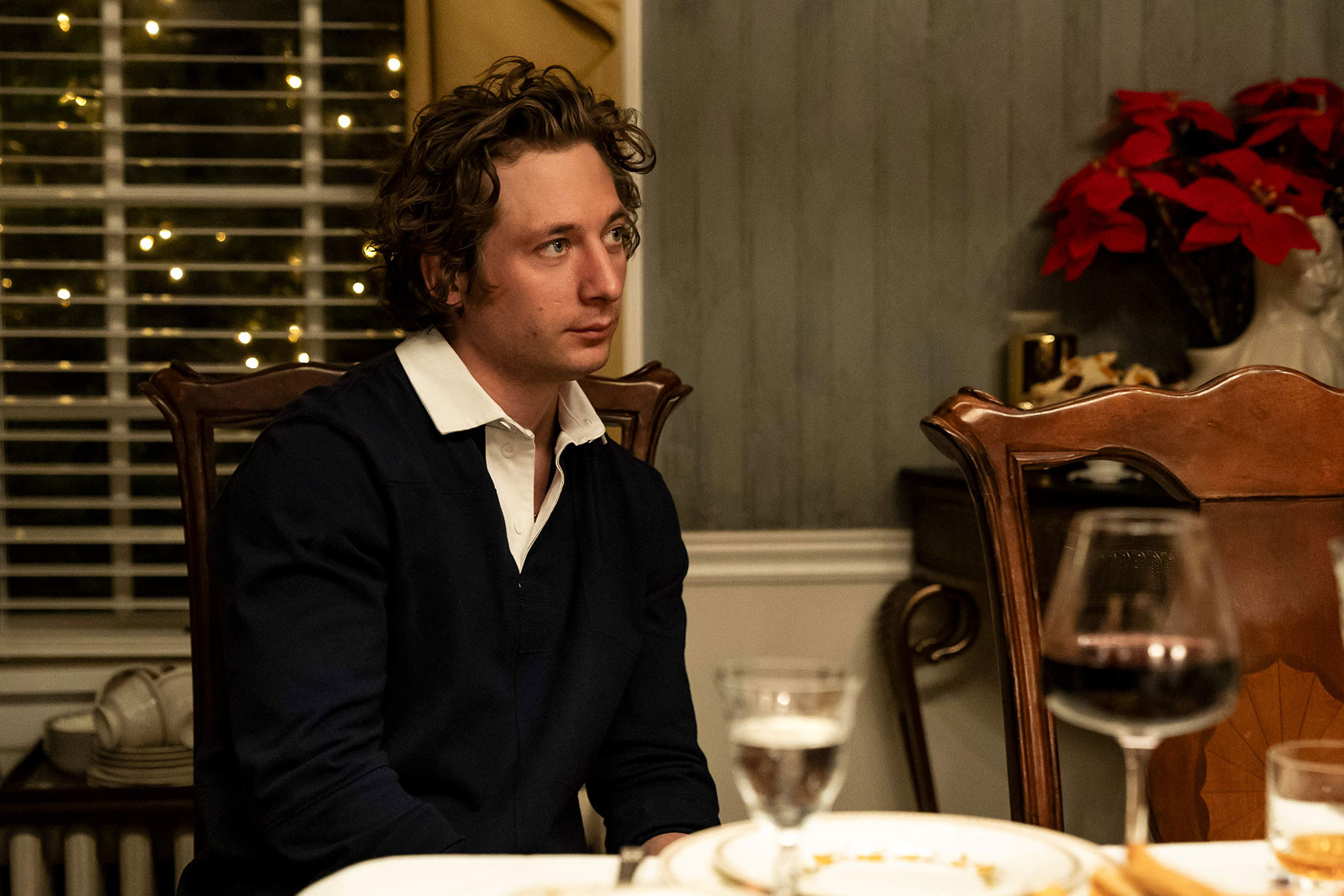
The BearJeremy Allen White as Carmen “Carmy” Berzatto in “The Bear” (Chuck Hodes/FX)
Splattered marinara covers everything — the screeching kitchen timers, walls and appliances. It dots the ceiling, as if an artery were opened by force, creating a crime scene of heat and havoc. When Carmy asks why she’s made a gigantic stock pot of red gravy on top of juggling the sea’s bounty Donna hisses at him, “Because nobody eats this s**t!”

Donna is angry, chain-smoking and getting drunker by the moment. Nothing can placate her. But even if she weren’t working herself into a rage, Carmy would still have to contend with belittling snipes disguised as affection from his brother Michael (Jon Bernthal), and calm his sister Natalie (Abby Elliott) and her raw nerves. 

Hence we’re presented the second tectonic moral of the “Fishes” story: Nothing scars more deeply than a traumatizing holiday dinner. 

The family caretaker often serves the head chef of such celebrations, working themselves to exhaustion with little left to show for it. Appropriately, Carmy, Nat and Michael’s mother is played by the queen of horror movies, suitable casting for a woman who looms large in their lives. 

Our first whisper about Donna comes in the fifth episode of the first season, “Sheridan,” when Carmy’s line cook Tina (Liza Colón-Zayas) tells him that Mike brought her to Christmas one year. Carmy asks if his mom was psycho as he nervously drums a spoon between his thumb and forefinger.

“She wasn’t calm,” Tina replies diplomatically, “but the food was great.”

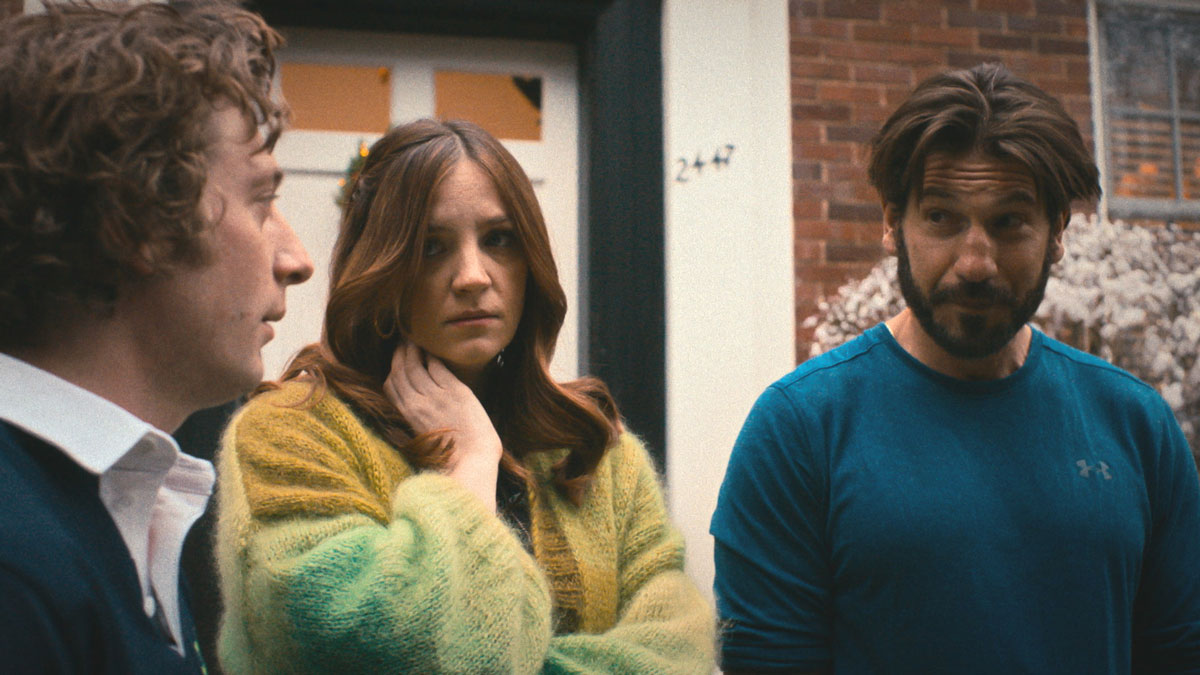
The BearJeremy Allen White as Carmen “Carmy” Berzatto, Abby Elliot as Natalie “Sugar” Berzatto and Jon Bernthal as Michael Berzatto in “The Bear” (Chuck Hodes/FX)
Donna’s dark mood is as much a part of the Berzattos’ holiday tradition as the fishes, and like the feast nobody can explain where it comes from nor know what will set it off. Other than Natalie reflexively asking if her mom’s OK, which she can’t help doing. Donna responds by shattering a dish, fleeing the room and returning to the scene by driving her car through the living room wall. Later Carmy confesses that ruined cannoli for him.

Nothing scars more deeply than a traumatizing holiday dinner. 

“The Bear” deserves all the hype poured over it for the usual reasons – its atmospheric directing, writing, awareness of place, and performances collaborate to grant its consumption a sense of urgency and necessity. 

On top of this, these new episodes capture the philosophical and ethereal essence of the story at every turn, blending practicality with what one might refer to as the romance of culinary pursuits. It treats each episode as a chance to evoke the sensory singularity of food, for better or worse.

And as second season progresses, its multicourse presentation of visual symbolism grows more sublime. Sitting with it for longer than one binge unearths the many meaningful cues coursing through the story’s soul.

As Carmy and his head chef Sydney (Ayo Edebiri) rise to the challenge of transforming what used to be the Berzatto family’s money pit of a sandwich joint into an upscale bistro gunning for a Michelin star, they push everyone else on the staff to advance their skills as well. 

Each crew member embarks on an intentional improvement quest shepherded by instructors who are precise and demanding without being abusive. This is part of Carmy and Sydney’s respective fresh starts. Both had hard-driving, soul-crushing psychopaths for bosses and aren’t keen to inflict that mistreatment on their people. Instead, Carmy opts to shape those around him into extensions of his talent and strengths while he takes a stab at starting up a relationship with Claire (Molly Gordon), a girl he grew up with.

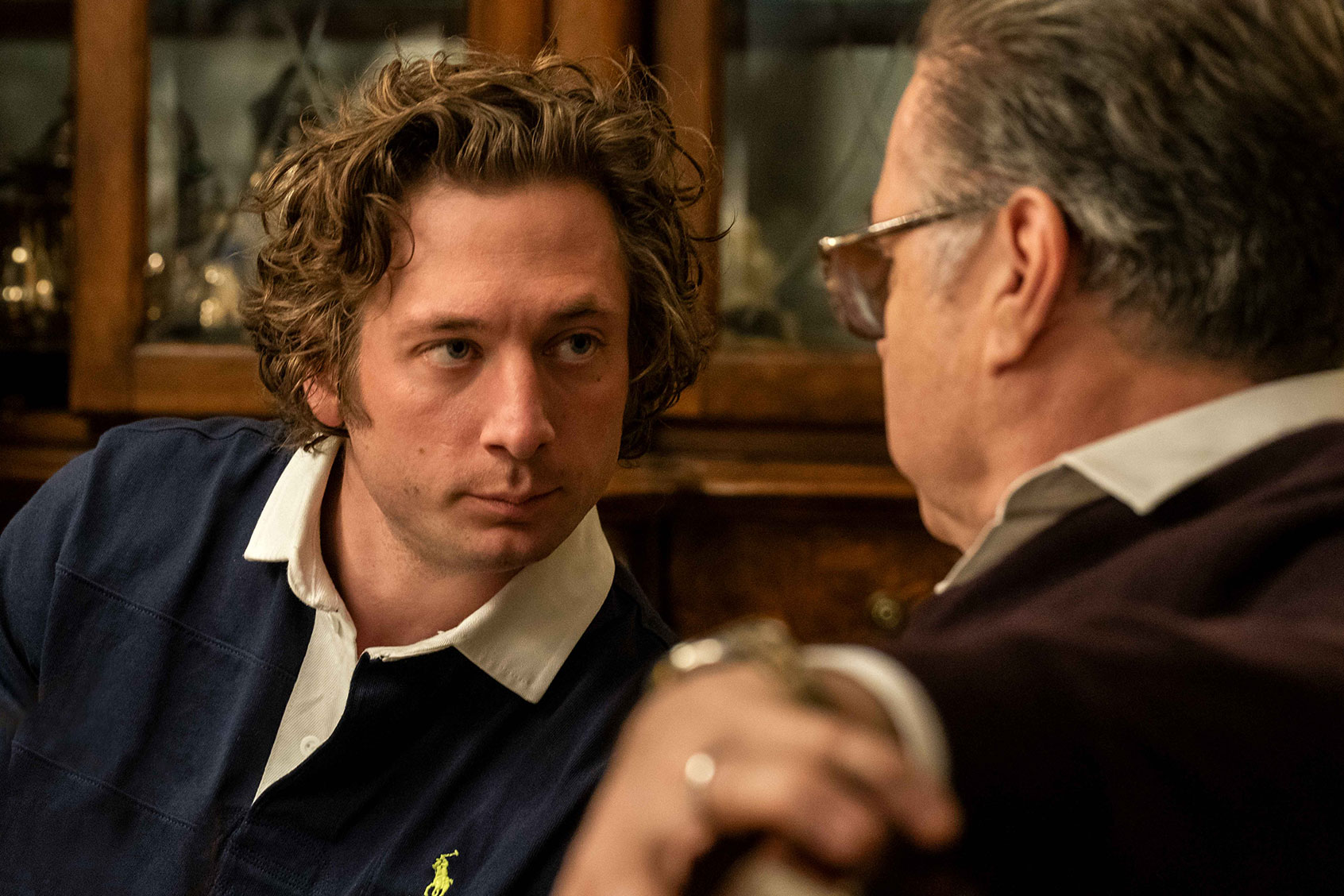
The BearJeremy Allen White as Carmen “Carmy” Berzatto in “The Bear” (Chuck Hodes/FX)
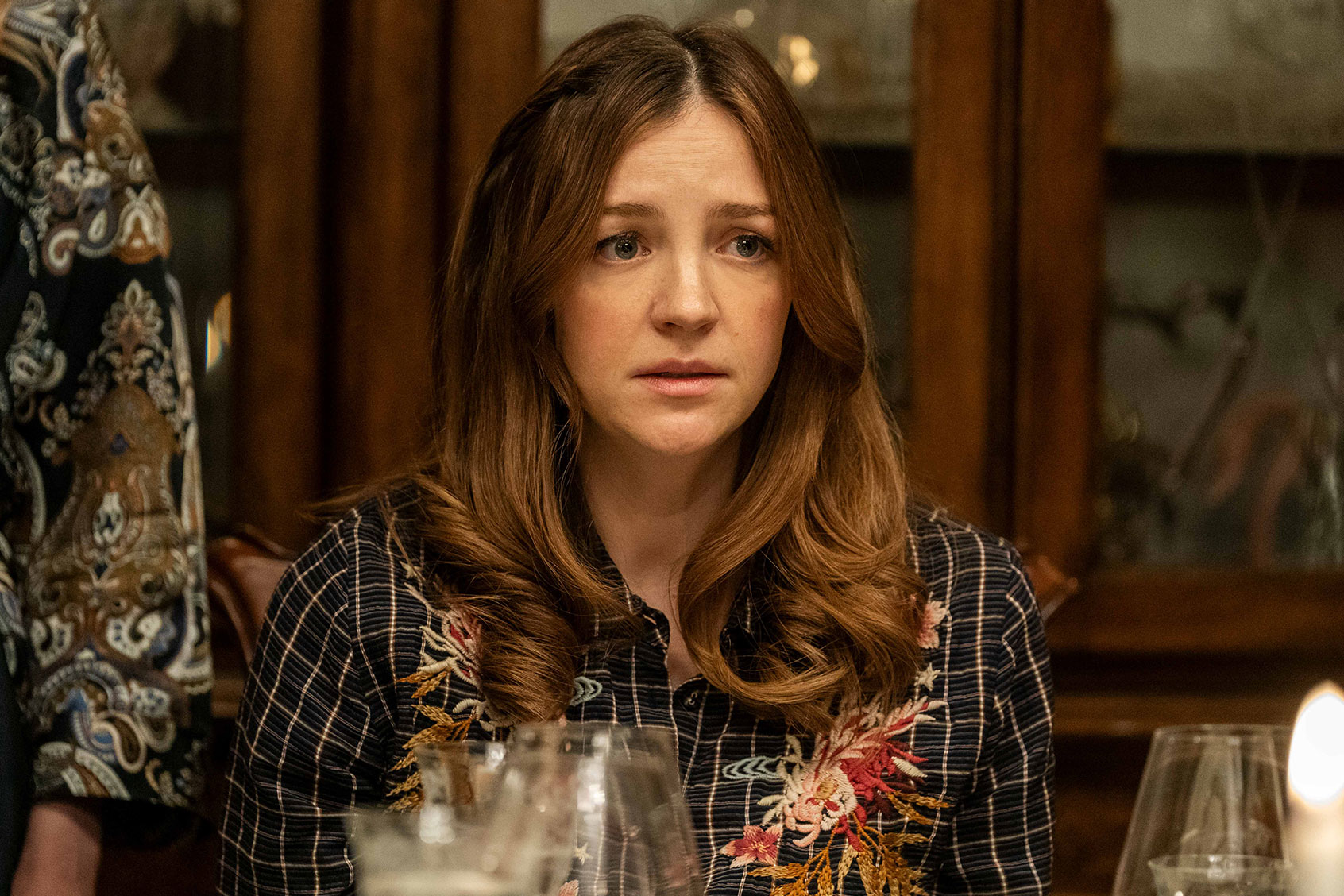
Regardless of his best efforts, certain parts of the plan fail, including the building itself.  What begins as a remodel uncovers mold, termites, and dead vermin in the walls. Cleaning up the surface isn’t enough. Unless the rot lurking underneath is dealt with and replaced with all new material, they can’t move forward. This is true of the building and the man who inherited its problems.

“Fishes” is a somatic pairing with “Review,” the acclaimed real-time one-shot episode near the end of Season 1. “Review” captures the 20 minutes where all the order Carmy sought to impose on The Beef disintegrates, bringing out the worst in him – and “Cousin” Richie, Michael’s best friend (Ebon Moss-Bachrach), and everyone else. 

That episode’s brevity allows director Joanna Calo and series creator Christopher Storer to place the viewer inside its crisis so we can feel the anger and frustration building in that claustrophobic space.

“Fishes,” co-written by Calo and Storer and directed by him, takes us to a similar place, body and soul. But its hour and six minutes are equally as disciplined, trapping us in the Berzattos’ brand of family dysfunction beside Carmy and refusing to release us before our nerves are as fried as his.

It all starts with Curtis’ scarlet-clawed mother bear, who is brash and histrionic, responding to soothing flattery from her generational peers like Uncle Jimmy (Oliver Platt) while ripping into her daughter for daring to ask if she’s OK. When she draws on her cigarette through tensely pressed lips you feel sorry for the cancer stick, wondering who is killing who.

Not content to merely employ “Fishes” as a psychological assault, Calo and Storer impress the allegorical significance of this Christmas dinner through its guest star casting. Before Curtis appears we see Bob Odenkirk as Uncle Lee, referenced in the season premiere. (He’s the Lee Layne of KBL, an acronym recurring through Michael’s shoddy bookkeeping.) Odenkirk is also a Chicago-area native, lending an extra sprinkling of regional specificity to the story. Only Bill Murray could match the perfection of that choice, but he’s already been namechecked in a previous story of a celebrity run-in.

“Fishes” traps us in the Berzattos’ brand of family dysfunction beside Carmy and refuses to release us before our nerves are as fried as his. 

The meta parade continues with Sarah Paulson – Emmy winner and FX royalty – as Michelle, the cousin who’s doing better than Carmy, Nat and Michael. Her boyfriend Stevie (John Mulaney) is clever and erudite and has been around long enough to navigate the family’s explosions. Gillian Jacobs plays Tiffany, who is still married to Richie in the flashback and is also pregnant. 

The first season’s sleeper success makes “The Bear” an easy yes for any of these guest stars, but their familiarity also illustrates Carmy’s nagging sense of inadequacy. Natalie’s too; she’s tortured by her mother’s verbal digs, including one that explains the pitiless origin of her nickname, Sugar.

The BearAbby Elliot as Natalie “Sugar” Berzatto in “The Bear” (Chuck Hodes/FX)
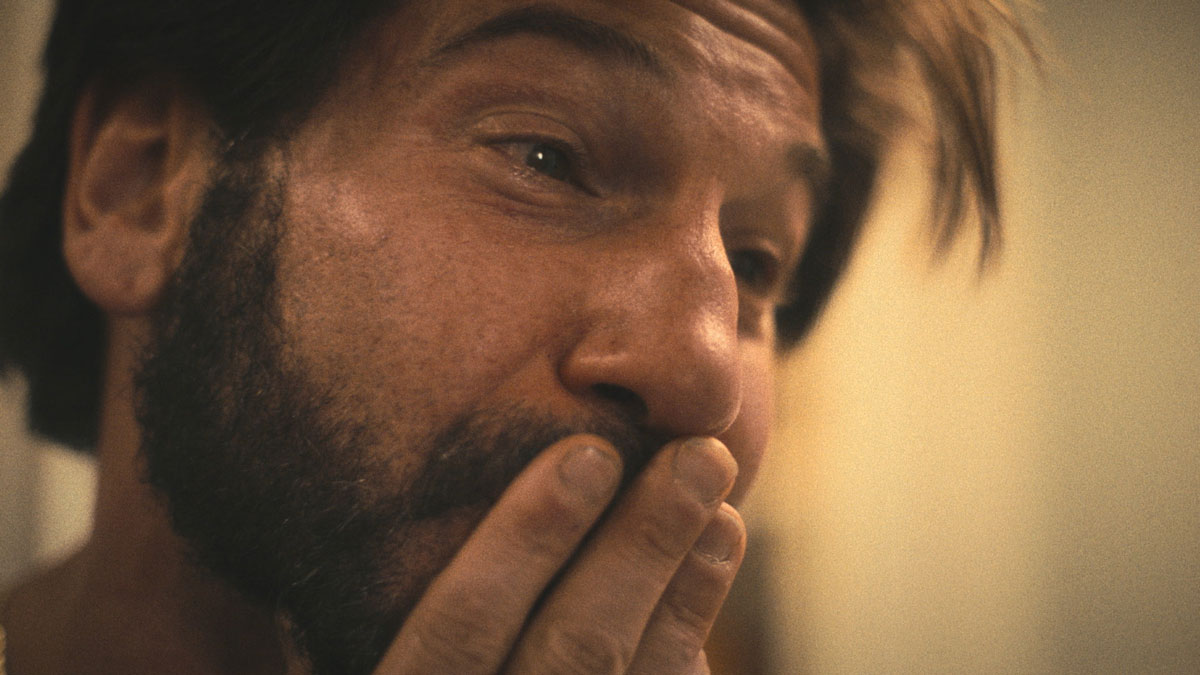
This nod at fame’s hierarchy begins when we first glimpse Bernthal in the series. White’s years of starring in “Shameless” lends him recognizability, but perhaps not on the level of Bernthal, who starred in “The Walking Dead” and headlined “The Punisher” among other roles. 

Placing Bernthal at the end of the table where a string of greats are seated in places of honor tells us how this family views Michael, Carmy’s hero. Michael can’t help but regress to hurling forks at Uncle Lee until the older man screams, “You’re nothing!” at him on repeat. Storer draws out this moment into an eternity, steeping the viewer in Carmy’s horror and discomfort. If this respected elder declares his brother is nothing, where does that leave him?

“Fishes” captures the sensory power of this holiday meal in all its disarray, tension, momentary joy and lasting pain. It’s a vision of Michael and Richie in better days that weren’t so great after all; Michael is living at home, it turns out, and reduced to throwing forks at Uncle Lee to goad him into a fight . . . for no good reason. 

The BearJon Bernthal as Michael Berzatto in “The Bear” (Chuck Hodes/FX)
But Carmy may be the only family member who can appreciate what Donna sees as her plight in life, which he explains to Richie and his Alcoholics Anonyous support group when he admits that there’s nothing fun about his drive to succeed. “I make things beautiful for them,” she whispers to her youngest at that terrible Christmas dinner, “and no one makes things beautiful for me.”

Stevie tries to lighten the mood with a rambling speech (that proves Mulaney’s ability to carry a naturalistic monologue) where he offers his interpretation of the Feast of the Seven Fishes since nobody can agree on its origin story, which is true of the actual tradition. Steve posits that the point of the feast is to take extra time with loved ones. “And we have to chew more, and we have to listen more. And we only get to do this tonight, one time,” he says.

Minutes later, Michael cements that evening in Carmy’s memory by hurling another fork that ends up in a pyramid of cannoli instead of Uncle Lee’s head, almost bringing them to blows – a fight interrupted by Donna’s auto accident.


Want a daily wrap-up of all the news and commentary Salon has to offer? Subscribe to our morning newsletter, Crash Course.


At the end of the season Carmy, Sydney and Marcus reclaim the cannoli with a savory creation Marcus christens The Michael. It’s part of an opening night menu that’s both nostalgic and future-gazing, bold and healing. But Carmy can’t resist the Berzatto tradition of ruining gorgeous celebrations and ends up locking himself in the walk-in refrigerator because he failed to secure an easy repair. 

He bangs away at a door that won’t let him out, cursing maniacally as the people he prepared to navigate disorder do precisely that, ignoring him while successfully executing his vision entirely from a place of love. 

His chosen family redeems Carmy, enabling him to triumph professionally where Michael couldn’t. And unlike their boss, his crew refuses to allow the howling demon at the heart of their kitchen to ruin a meal to remember.

All episodes of “The Bear” are streaming on FX on Hulu.


“She is a potential government witness”: Top Trump campaign official cited in indictment revealed

A highly trusted advisor on Donald Trump’s 2024 election campaign is among the individuals mentioned but not explicitly named in the indictment against the former president, regarding his alleged mishandling of classified documents, according to ABC News

Susie Wiles, who is leading the former president’s second reelection effort, is the individual listed in special counsel Jack Smith’s indictment as the “PAC Representative” to whom Trump allegedly showed a classified map, sources told ABC.

The incident allegedly happened in August or September of 2021 while Trump was discussing a military operation that he said “was not going well” and then added that he “should not be showing the map” to her and “not to get too close,” according to the indictment.

“Just as in the case of the Iran war plans Trump allegedly disclosed, this incident shows that Trump was aware of the sensitive contents of what he unlawfully retained and even realized he ‘should not be showing the map’ to third parties,” former federal prosecutor Kevin O’Brien told Salon. “The impact is devastating to two of Trump’s defenses: one, that he had already declassified all relevant documents, and, two, that he had no inkling of their sensitivity.”  

This marks the second instance detailed by investigators in which the former president allegedly disclosed classified information in private meetings after exiting the White House.

Trump previously discussed holding onto a classified Pentagon document about a potential attack on Iran that he acknowledged he could no longer declassify after leaving office in a July 2021 audio recording made at his Bedminster, N.J., golf club. 

Recent reports of Trump showing classified documents to individuals who did not have security clearances as well as evidence of him retaining documents, “underscores the casual manner in which the documents were stored and shared,” Javed Ali, former senior counterterrorism official at the Department of Homeland Security, told Salon.

“While President Trump continues to claim that he unilaterally declassified all the classified materials before he left office, there is no record of that occurring from the National Archives or the Office of the Director of National Intelligence, so henceforth these and potentially other stories about individuals who may have seen classified documents could also create legal problems for them outside of the case against President Trump,” Ali said. “Whether the Department of Justice decides to seek criminal indictments against those persons remains to be seen.”

O’Brien added that Trump treated highly classified national security information in a “casual, even light-hearted, manner” and added that there “is no stronger evidence of Trump’s criminal intent in this case.”


Want a daily wrap-up of all the news and commentary Salon has to offer? Subscribe to our morning newsletter, Crash Course.


Trump, who has pleaded not guilty to 37 criminal counts related to his handling of classified materials, has repeatedly denied any wrongdoing and still claims that he was not showing off classified documents despite recent evidence.

Wiles ran Trump’s campaigns in Florida in 2016 and 2020 and also previously helped lead Ron DeSantis’s two campaigns for governor. 

“Wiles is now in a difficult position – put there by the recklessness of her employer, Trump himself,” O’Brien said. “She is a potential government witness at any trial. While there is no legal reason why she cannot continue to advise Trump, her status as a witness may inhibit her advice or disrupt their relationship.”

Attorney Andrew Lieb suggested Wiles may be forced to testify against the former president and this will likely result in her receiving “a terrific nickname from Trump.”

“She will either be held in contempt for failing to cooperate,”  Lieb said, “or, cooperate and be deemed disloyal to Trump and be, what feels like, the millionth former employee who he throws under the bus.”

Celebrate fig season with the easiest, creamiest homemade ice cream you’ve ever tasted

One of the best things about the month of July is fresh figs. I look forward to them all year like a child does Christmas. With the hot weather being nearly unbearable, it’s nice to have something about which to get excited. 

I was nearly thirty years old before I ever tasted what is now one of my most favorite things: a fresh fig. It wasn’t until I visited a friend one summer in Munich that I ever tried one. She had previously lived in Greece, where figs are native and grow in abundance and she introduced me to them. I couldn’t believe what I had been missing. We ate our way through countless baskets of them that summer — and I have had an addiction ever since. 

Once picked, figs don’t continue to ripen or keep well. You have to pluck them from the tree at their peak and enjoy them during the few days they last, which I have absolutely no problem doing. Of course, you can save them by canning them (making them into preserves) or freezing them to add to a smoothie, but there is nothing like a fresh, ripe fig picked from the tree still warm from the sun. It is one of nature’s finest gifts. 

Unlike dried figs whose sugars become concentrated during the drying process, fresh figs are delicate and only mildly sweet with a faint taste of honey. They are shaped like fat teardrops and range in color from green to maroon to a dark, almost black, shade of purple. The flesh inside can be a yellowish-pink or a vibrant pinky-red with tiny edible seeds that create an amazing texture. If you have never tasted one, you have seriously missed out. 

I grew up with fig trees at my grandparents’ house in Oxford, Mississippi, but for some reason, no one ate them raw, at least not that I recall. Grammy, my dad’s mother, made them into preserves, which were delicious, but I can’t believe we never ate them right off her trees. I’m still mad I missed out on them for all those years.  

These days, I get my fix of fresh figs from John and Elsie, a retired couple who have an impressive garden only a mile or two up the road from where I live. They see me at least once a week once they hang their FIGS sign out by the road and I can hardly make it home without devouring nearly half of what I’ve purchased.


Want more great food writing and recipes? Subscribe to Salon Food’s newsletter, The Bite.


Both of these recipes are old favorites, but could not be more different. Fresh Fig Ice Cream is rich, delicious and tastes incredibly indulgent, whereas Fresh Figs with Honey and Black Pepper is lighter and satisfies your sweet tooth in a fresher, cleaner sort of way. 

Fresh Fig Ice Cream is straightforward and I make it the same way every time, but when I make Fresh Figs with Honey and Black Pepper, I most often create a mixed platter using a variety of cheeses and nut/seed butters. After halving the figs, I top some with soft goat cheese, whipped feta or even bleu cheese and on other halves, I use non-dairy options like raw coconut butter (one of my favorites) as well as different nut and seed butters like walnut, almond, cashew, sunflower seed or pumpkin seed butter. Every variation is blissfully delicious and can serve as an appetizer or a dessert. 

Fig season never lasts long enough for me, but some years it can be even shorter than usual thanks to our summer rains. Fig trees don’t like to drink while they fruit. In their native Mediterranean climates, it doesn’t rain in the summer and the plants’ deep roots like it that way. Here in Baldwin County, it is nothing to get a “pop-up” storm that pours down several inches (or more) of rain in what seems like a flash. That extra water causes delicate figs to split and once split, they are ruined. 

Fig season reminds me to seize the day! Find the joy, love and excitement that’s embedded in everyday life because you never know what tomorrow may bring.  

Fresh fig ice cream
Yields
8-12 servings
Prep Time
20 minutes (plus freezing time)
Cook Time
05 minutes

Ingredients

2 cups heavy cream

2 cups milk

6 large eggs, separated

1 cup sugar

1 quart fresh figs, mashed*

2 tablespoons sherry

1/8 teaspoon vanilla extract


Directions

  1. Combine cream and milk in a saucepan and scald (bring to 180 degrees).

  2. Remove from heat and allow to cool slightly.

  3. Beat egg whites to stiff peaks. Beat egg yolks and sugar until light. 

  4. Stirring constantly, pour hot milk over sugar-egg yolk mixture.

  5. Fold in egg whites and mix thoroughly. 

  6. Add sherry and vanilla then mashed figs and freeze.


Cook’s Notes

-The skin of early season figs is thin and delicate, so no need to peel just snip off the stem. Late season figs can have thicker, tougher skin and should be removed before mashing. All is edible; it is simply a matter of preference.

Fresh Figs with Honey and Black Pepper
Prep Time
5 minutes

Ingredients

Fresh figs with stems removed

Spread(s) of choice: soft goat cheese, softened blue cheese, labneh, raw coconut butter or any kind of nut/seed butter. (Large walnut halves can also be used in place of spread) 

Raw honey

Fresh ground black pepper


Directions

  1. Slice figs in half lengthwise and spread with cheese, butter of choice or walnut half. 

  2. Drizzle with honey and a sprinkle of pepper. 

  3. Arrange on a serving platter. 

“No end in sight” to wildfire smoke suffocating American cities. And yes, climate change is to blame

The Canadian wildfires are continuing a development that is becoming all too common: Climate change is causing extreme abnormal weather, and millions of people are suffering as a result. As many people in Chicago and the Midwest likely noticed, air quality has plummeted in recent days, thanks to flaming forests to the north.

“It is important to recognize that dangerous climate change is already upon us. This is not our grandchildren’s problem. It is our problem.”

The wildfires, which started in late April and worsened considerably in recent weeks, are causing severe air quality problems all over the northern part of North America. (In the southern part of the continent, there is an unprecedented heat wave; Texas is currently the hottest place on Earth, and the heat wave has caused at least a dozen deaths in the American South.) The National Weather Service warned Thursday that air quality would continue to suffer due to the wildfire smoke, which has drifted as far down as the Midwest, the Northeast, the Upper and Middle Mississippi Valleys and even the Carolinas. The worst air quality is in the Great Lakes region and Ohio Valley region, with Chicago ranking as the worst large city in the world when it comes to air quality as of Thursday morning.

Scientists have long predicted that extreme weather events like heat waves and wildfires would become more frequent as humans continue emitting greenhouse gases that trap heat and cause the planet’s temperature to rise. Now a nation accustomed to lockdowns from the COVID pandemic era is being advised to stay inside, so as to avoid hazardous air caused by the wildfire smoke.

The National Weather Service warned that “with no end in sight to the Canadian wildfires and west to northwesterly winds expected to persist from south central Canada into the north central to northeast U.S., poor air quality conditions are likely to continue.”

Experts who spoke with Salon agree that these current wildfires, which are freakish in their duration and intensity, are ultimately the product of unmitigated climate change.


Want more health and science stories in your inbox? Subscribe to Salon’s weekly newsletter The Vulgar Scientist.


“Climate change, as our own work shows, is leading to more of these very persistent ‘stuck’ summer jet stream patterns.”

“It is important to recognize that dangerous climate change is already upon us,” Michael Wehner, a senior scientist in the Computational Research Division at the Lawrence Berkeley National Laboratory, told Salon by email. “This is not our grandchildren’s problem. It is our problem.”

Wehner clarified that this doesn’t mean experts can precisely quantify the role of climate change in these wildfires. “This is not the right question. Climate and weather event attribution science is like epidemiology. It uses statistical causal inference techniques to answer two related questions. First, how has climate change altered the chances of an event of the observed magnitude? Second, how has climate change altered the size of the observed event presuming an inferred probability of an event?”

Wehner compared the question of attributing wildfires to climate change to studies that prove links between smoking and lung cancer.

“Not every smoker gets cancer, not every lung cancer victim smoked [tobacco],” Wehner pointed out. “But the chances of getting lung cancer are increased by smoking. So the chances of wildfires have definitely been increased by global warming. Estimating how much those chances increased would take a targeted study. Wildfires have only recently been the focus of our attention.”

Even so, the considerable amount of data on past weather provides important context to the circumstances that caused these wildfires to happen. As Dr. Michael E. Mann, a professor of Earth and Environmental Science at the University of Pennsylvania, explained in his email to Salon, “climate change, as our own work shows, is leading to more of these very persistent ‘stuck’ summer jet stream patterns, where e.g. a big high pressure system with hot sinking air gets stuck in one particular region of the country.” He observed that this happened in 2021 when there was a Pacific North West heat dome.

“Something very similar is playing out right now over central North America right now,” Mann concluded. “We are in the process of confirming whether or not planetary wave resonance is implicated with this latest event, but it certainly fits the pattern of increased persistent weather extremes that we’re seeing now summer after summer.”

“Cheapest S.O.B. I’ve ever met”: Chris Christie calls out Trump’s campaign donation “grift”

Former New Jersey Gov. Chris Christie this week ripped into his leading GOP primary opponent, former President Donald Trump, following reports that the former president is diverting campaign funds to his political action committee that has paid for his mounting personal legal fees.

The New York Times first reported Sunday that Trump had redirected a large portion of his campaign donations to his Save America PAC in late February or early March, amounting to what may be at least $1.5 million. 

In a Wednesday evening interview with CNN’s Kaitlan Collins, Christie called Trump’s donation scheme “disgraceful.”

“He’s going to middle class men and women in this country and they’re donating $15, $25, $50, $100 because they believe in Donald Trump and they want him to be president again. They’re not giving that money so he can pay his personal legal fees,” he said. “And let’s remember something. He’s a billionaire. He’s a billionaire, self-professed billionaire. Why can’t he use his own money to pay his personal legal fees and not use money coming from the public?

“It’s disgraceful and it’s a continued grift,” he said before breaking down the history of what he said is Trump and his family’s involvement “in grifting.”

Collins then asked Christie for his opinion on why Trump isn’t using his own money to pay for legal fees.

“Because he’s the cheapest person I’ve ever met in my life. That’s why. And what he’s very good at, Caitlin, is spending other people’s money.” Christie replied, echoing sentiments he shared with Politico in a Tuesday evening interview, in which he referred to Trump as “the cheapest S.O.B. I’ve ever met in my life.”

“This is a billionaire who refused to pay his lawyers with his own personal money, and instead, men and women out there who believe in him and wanted [him] to be elected president are donating money to try to forward his candidacy … and he’s diverting that money to pay his own legal fees,” Christie told Politico.

“He should take a pledge today to instruct his campaign to no longer spend any public money on his legal fees,” Christie added. “He is the richest candidate in this race, yet he is using public money to pay his legal fees. He should be ashamed of himself.”

Save America has previously covered Trump’s legal fees, including the $3 million paid to lawyer Chris Kise for legal representation and the costs for the legal bills of some of the key witnesses in the federal probe into his handling of classified materials post-presidency. 


Want a daily wrap-up of all the news and commentary Salon has to offer? Subscribe to our morning newsletter, Crash Course.


As the current Republican frontrunner faces other investigations into his efforts to overturn the 2020 election — in addition to the two criminal indictments he has already incurred at the state and federal level — his legal fees could continue to rise.

Christie has attempted to distinguish himself from the other Republican presidential candidates by standing staunchly against Trump, an approach that has yielded mixed results and even gotten him booed during last week’s Faith and Freedom conference.

A Saint Anselm poll showed Christie gaining traction in New Hampshire, where he has concentrated much of his campaign efforts, polling at 6 percent among the state’s Republican primary voters. The poll ranks Christie in third place in the state behind Florida Gov. Ron DeSantis, who sits at 19 percent, and the former president, who leads the race at 47 percent.

“June in the year before the election is not a time when people should be figuring out who they think is gonna win and who they think is gonna lose,” Christie said. “No campaign has really started yet in earnest.”

KBJ rips “let-them-eat-cake obliviousness” of affirmative action ruling — calls out Clarence Thomas

The Supreme Court on Thursday struck down the affirmative action programs of Harvard University and the University of North Carolina in a ruling that will likely bring the systemic consideration of race in college admissions to an end, NBC News reports

The court found the university programs to be unlawful and in violation of the Constitution’s Equal Protection Clause. The justices voted 6-3 in favor of the conservative opinion in the UNC case and 6-2 in the Harvard case, in which Justice Ketanji Brown Jackson, who graduated from Harvard and Harvard Law and has other ties to the university, recused herself.

The decision effectively overturned the 2003 Grutter v. Bollinger ruling that allowed race to be factored into admissions considerations and cited universities’ interests in developing and maintaining diverse campuses. Thursday’s ruling discarded decades of legal precedent, including a 1978 decision that allowed for a limited consideration of race in college admissions in an effort to assuage the historic discrimination against Black people and other marginalized groups in the university processes.

Though Chief Justice John Roberts did not explicitly state that the former decisions were overturned in the majority opinion, he explained that Harvard and UNC’s programs “lack sufficiently focused and measurable objectives warranting the use of race, unavoidably employ race in a negative manner, involve racial stereotyping, and lack meaningful end points.”

In the concurring opinion, however, conservative Justice Clarence Thomas, the second Black Supreme Court Justice in the court’s history, said the Grutter case was “for all intents and purposes, overruled.”

“In a nutshell: The majority does not expressly overrule Grutter or formally bar *all* race-based affirmative action, but the Court reconstrues the test in a way that will make it virtually impossible for any university to satisfy going forward,” Steve Vladeck, a Supreme Court expert at the University of Texas School of Law, tweeted. “It’s ending it without ending it.”

Roberts also noted that the decision does not apply to the consideration of race in admissions for military programs. The Biden administration had previously cautioned that a limit on affirmative action would negatively impact the U.S. military, which relies on “well-qualified and diverse officer corps” trained in military academies.

In a dissenting opinion, Jackson, who appeared “visibly angry” and stared straight ahead without making eye contact as Thomas read his concurring opinion, according to NBC News, directly called out the conservative justice’s argument in her dissent.

“Justice Thomas ignites too many more straw men to list, or fully extinguish, here,” she wrote.

Jackson, the first Black woman to serve in the high court, wrote that the ruling was “truly a tragedy for us all.”

“With let-them-eat-cake obliviousness, today, the majority pulls the ripcord and announces ‘colorblindness for all’ by legal fiat. But deeming race irrelevant in law does not make it so in life,” she wrote.

“No one benefits from ignorance,” she continued. “Although formal race-linked legal barriers are gone, race still matters to the lived experiences of all Americans in innumerable ways, and today’s ruling makes things worse, not better. The best that can be said of the majority’s perspective is that it proceeds (ostrich-like) from the hope that preventing consideration of race will end racism. But if that is its motivation, the majority proceeds in vain. If the colleges of this country are required to ignore a thing that matters, it will not just go away. It will take longer for racism to leave us. And, ultimately, ignoring race just makes it matter more.”


Want a daily wrap-up of all the news and commentary Salon has to offer? Subscribe to our morning newsletter, Crash Course.


Justice Sonia Sotomayor, the first Latina justice and a fellow liberal, said in her dissenting opinion that the court’s decision “stands in the way and rolls back decades of precedent and momentous progress.”

“[T]he Court cements a superficial rule of colorblindness as a constitutional principle in an endemically segregated society where race has always mattered and continues to matter,” she wrote. “The Court subverts the constitutional guarantee of equal protection by further entrenching racial inequality in education, the very foundation of our democratic government and pluralistic society. Because the Court’s opinion is not grounded in law or fact and contravenes the vision of equality embodied in the Fourteenth Amendment, I dissent.”

The Congressional Black Caucus also rang out against the court’s decision in a statement:

“By delivering a decision on affirmative action so radical as to deny young people seeking an education equal opportunity in our education system, the Supreme Court has thrown into question its own legitimacy,” it said.

The ruling marks a major victory for conservative legal activists who have argued that affirmative action undercuts the meaning of racial equality. It also provides another example of the conservative-majority court’s decisions in those activists’ and advocacy groups’ favor. Thursday’s strike down comes days after the anniversary of the court’s overturning of Roe v. Wade, which guaranteed the right to abortion, in 2022.

“This is of a piece w/ Dobbs, a complete conservative victory that could only have been imagined, or discussed at Federalist Society meetings, 15 years ago and now is the law of the land, with huge and immediate social impact,” former U.S. attorney Harry Litman, a former law clerk to former Justices Thurgood Marshall and Anthony Kennedy, tweeted Thursday.

These most recent challenges to affirmative procedures were brought by a group called Students for Fair Admissions which argued that any consideration of race in university admissions was unlawful under Title VI and the Constitution. They claimed that UNC’s policy discriminated against white and Asian applicants while Harvard’s discriminated against Asian students. But lower courts ruled in favor of the universities in both cases.

In defense of the admissions policies, the universities and their supporters countered by saying that excluding someone based on race is different from seeking diversity on campus. They explained that race is only one factor of many that admissions officers consider when analyzing each application.

The decision will mostly affect the few universities with highly competitive admissions rates — like Yale University, Brown University, Columbia University, the University of Chicago and Dartmouth College — who say that some consideration of race is essential to diversifying their student bodies and that the ruling will cause a decrease in minority student enrollment on their campuses. A majority of colleges across the country, however, accept nearly all applicants.

Roberts did allow for colleges to consider discussing race in an individual student application, using an example of someone personally experiencing racial discrimination and adding that the student “must be treated based on his or her experiences as an individual — not on the basis of race.” 

“Give us pizza or give us death”: Conservatives blame “pink-haired liberals” for ruining NYC pizza

Seven years ago, an air quality ordinance passed in New York City that would eventually require some pizza shops to install small air filters, the same type that shops in Italy have been using for decades. 

Food professionals and pizza historians both say that it’s not a big deal, but as we’ve seen this month — through the Bud Light controversies and right-wing declarations that “conservative coded” restaurants like Chick-fil-A and Cracker Barrel are secretly “woke” — it seems like some right-wing public figures are still looking for reasons to get mad. 

So now, they are blaming climate activists and “pink-haired liberals” for ruining New York-style pizza, a statement that is not based in fact. Dave Portnoy is the founder of Barstool Sports — and is known for both his pizza reviews and, as New York Magazine has catalogued, his jokes about rape, using racial slurs in his content and pervasive accusations of sexual misconduct

After finding out that the air-quality rule, which soon takes effect and requires a handful of pizzerias to reduce exhaust fumes that could harm neighbors, he posted a video on Twitter of him ranting. 

“Some f**king little liberal arts, Ivy-League, pink-haired, crazy liberal who’s never worked one day in the real world is trying to get rid of coal oven pizzerias in New York City,” he said. 

As Wilfred Chan of The Guardian pointed out, a lot of the confusion about the ordinance seems to stem from a New York Post article that published over the weekend; it is riddled with inaccuracies and relies on the testimony of an unnamed restaurant owner who reportedly said that the filters would result in “totally destroying the product.” 

Scott Weiner, a leading New York City pizza expert and historian, told The Guardian that “this is not legislation that will corrode the New York pizza scene … Pizzerias have mostly already adapted, and most pizzerias that need them have already installed them, and nobody has noticed. This is something that is not going to make or break a pizzeria.”

However, some conservatives aren’t letting facts stand in the way of them making a complete spectacle of themselves, like in the case of pro-Trump activist Scott LoBaido who recorded a video of himself throwing cheese pizzas over the gate at New York City Hall while angrily monologuing. 

“Our teachers and first responder heroes who were fired [are] still not compensated because they didn’t take the Fauci injection,” he said. “Our city schools produce the dumbest kids and the woke-ass punks who run New York Sh**y are afraid of pizza? The world used to respect New Yorkers as tough, thick-skinned and gritty. Now, we have become pussified.”

He continued, shouting: “Well, this is the New York Pizza Party! Give us pizza or give us death!” 

From Colorado, Republican Congresswoman Lauren Boebert wrote on Twitter, again without basis, that “the majority of NYC’s world-famous pizza joints utilize decades-old brick ovens, and will be directly affected by this.” Elon Musk, similarly, decided to weigh in on Twitter: “This is utter bs. It won’t make a difference to climate change.” 

In response to LoBaido’s antics, New York City Mayor Eric Adams — who is a vegan — took a moderate tone and said that he needed to “bring vegan pie to me so we can sit down and I want to hear his side of this.” That extended to his public statement he gave Monday, in which he said: “We don’t want to hurt businesses in the city and we don’t want to hurt the environment. So let’s see if we can find a way to get the resolutions we’re looking for.” 

Currently, New York City restaurants and the city’s environmental agency are in discussion about how the city could do more to subsidize the cost of the units, which typically come in between $10,000 and $20,000 including installation. 


Intermittent fasting could help protect the brain from age-related diseases like Alzheimer’s

As the world population has grown older, Alzheimer’s disease has become increasingly common. Alzheimer’s disease is the most prevalent form of dementia. Dementia is a term used to describe a range of symptoms linked to the decline in brain function with age. Symptoms include memory loss, communication difficulties, problem-solving struggles and personality or behavioral changes.

Alzheimer’s disease is an increasingly urgent global issue. The World Health Organization predicts that the number of people with the condition will triple by 2050.  

Despite this growing problem, Alzheimer’s disease remains a relatively understudied condition. This is particularly the case in sub-Saharan countries such as South Africa. One major challenge is that Alzheimer’s is a complex condition with no known cure. However, researchers have identified several key risk factors associated with the disease. These include age, genetics, lifestyle factors and underlying medical conditions.

In recent years, one of the most promising areas of research on age-related diseases, such as Alzheimer’s disease, has been the accumulation of harmful proteins in the brain. Specifically amyloid-ß. Amyloid-ß has remained a prominent area of research in Alzheimer’s disease as its build-up is a classic feature in the development of the condition. Understanding its involvement in the disease process is crucial for advancing our knowledge and developing effective strategies to diagnose, prevent and treat the disease.

The accumulation of amyloid-ß can lead to the formation of plaques. These plaques can interfere with communication between brain cells. This ultimately contributes to cognitive decline and other symptoms associated with Alzheimer’s disease.

Amyloid-ß is a large membrane protein that is essential in neural growth and repair. But its corrupted form in later life can destroy nerve cells. This triggers the loss of thought and memory that is associated with Alzheimer’s.

We therefore sought to find out if dietary interventions, particularly intermittent fasting, would counteract the accumulation of amyloid-ß in the brain and potentially safeguard against age-related brain cell death.

In a paper published in 2021, my colleague and I showed that in experiments conducted in mice we found that intermittent fasting counteracted amyloid-ß accumulation in the brain. These findings were further confirmed in a paper published in May of 2022.

Our findings are an important contribution to the search for the potential role of dietary interventions and are consistent with previous studies supporting the idea that intermittent fasting may help counteract amyloid-ß accumulation in the brain and protect against age-related brain cell death. To my knowledge, the most recent study using a variation of intermittent fasting, was published in September 2022. The clinical branch of this study remains ongoing.

Research into the causes of Alzheimer’s has gathered pace in recent years with new ground being broken on a regular basis as scientists search for treatments.

Our study’s findings suggest that intermittent fasting may be an effective way to increase the efficiency of autophagy — the process that breaks down and recycles damaged or unnecessary cellular components, such as organelles and toxic proteins. This process can therefore reduce the risk of amyloid-ß build-up and associated brain cell death.

These findings are particularly significant because they shed light on the relationship between autophagy and the death of brain cells with age and the potential therapeutic benefits of interventions that target this process.


How it works

Intermittent fasting is a dietary approach that involves regulating food intake by alternating periods of fasting and eating. This dietary regimen comprises periods of restricted food consumption, followed by periods of normal eating.

There are different types of intermittent fasting. One is time-restricted eating, where food is consumed within a specific time window each day. Alternate-day fasting is where food is restricted every other day.

Intermittent fasting has been shown to have various health benefits. Some of the benefits relate to the promotion of brain health.

Our study’s findings suggest that intermittent fasting may be an effective way to increase the efficiency of autophagy, an essential process for removing toxic or misfolded proteins that can build up in cells.

Sometimes autophagy doesn’t work properly to remove harmful proteins or other cellular components from cells. This has been strongly implicated in the development and progression of various age-related diseases and is a target of research for potential therapies.


What we did

In our study we investigated the effects of intermittent fasting on brain cells in mice and brain cells isolated from mice with increased amyloid-ß toxicity. Mice cells are frequently used as a model for human cells in scientific research. This is because of the significant genetic similarity between mice and humans. This use of animal models allows researchers to gain valuable insights and test hypotheses. It is generally considered ethically preferable before potentially conducting human studies.

We found that 24 to 48 hours of intermittent fasting by mice provided protection against cell death in specific regions of their brain. We noted increased autophagy levels in cells of fasted mice. Even in the presence of a high amyloid-ß protein load in brain cells, intermittent fasting maintained autophagy activity. And the process remained effective over a 21-day treatment intervention period.

By increasing the efficiency of autophagy, it is possible to maintain the removal of harmful proteins in cells, even as we age.

The findings of this study suggest that interventions such as intermittent fasting could potentially protect against the development of age-related diseases. This has important implications for public health.

Intermittent fasting is a relatively simple dietary intervention: It’s easy to do. It has the potential to be widely adopted as a preventive measure against the onset of age-related diseases. These findings also provide a basis for future research into the mechanisms by which intermittent fasting protects against brain cell death, exploring the potential for additional therapeutic interventions that target autophagy and examining the effects of different fasting regimens on brain health.

Claudia Ntsapi, Lecturer, University of the Free State

This article is republished from The Conversation under a Creative Commons license. Read the original article.

Confused Trump demanded “my documents” back — after lawyers warned him he’d be indicted: report

Former President Donald Trump last month demanded the return of “my documents” and “my boxes” — even asking his lawyers if they could reclaim them from the federal government — after they informed him that he would soon be indicted, a source with direct knowledge of the matter and two other people briefed on it told Rolling Stone.

The request came in one of several similar conversations the former president has had in recent months, the sources said. In another exchange, Trump asserted that those materials belong to “me” and claimed that it was “illegal” for him to no longer have access to the documents seized in the FBI search of Mar-a-Lago last August. He has also asked about what other legal tactics or court filings his team could employ to get them back that they may not have thought of.

According to the source with direct knowledge, Trump has said that he will get the seized materials back in 2025 because he believes he will be re-elected and have unchallenged access to them and a host of other government information again.

Trump was indicted on 37 charges, including willful retention of national security documents and obstruction of justice, earlier this month in special counsel Jack Smith’s investigation into his handling of classified documents after leaving office. The former president and his campaign have argued that the Presidential Records Act, which was passed after the Watergate scandal to define the scope of and limit claims to official materials after leaving office, actually exonerates him of any wrongdoing.

Several attorneys in Trump’s wheelhouse have told him that, in their opinions, he is entitled to the return of documents under the PRA, namely 44 USC 2205(3), which states that “Presidential records of a former President shall be available to such former President or the former President’s designated representative,” two sources familiar with the matter told Rolling Stone. But many legal experts have disputed that argument. 

“Whatever one might say about his Presidential Records Act argument, there’s no argument that it immunizes him from criminal prosecution under the Espionage Act,” attorney Brian Greer, who served in the CIA’s office of general counsel from 2010 to 2018, told Rolling Stone. He added that the law also doesn’t permit former presidents to defy a lawful subpoena or obstruct government efforts to retrieve materials, as the indictment accuses Trump of doing.

Former U.S. attorney and University of Michigan law professor Barb McQuade also previously told Salon that “the records Trump is alleged to have illegally retained are agency records, such as records of the CIA, NSA, and Department of Defense, not presidential records,” adding that they’re covered by the Espionage Act “because of their content — information about the national defense, which information could be used to the injury of the United States or advantage of a foreign nation.”

Despite disagreements among his own legal advisers, Trump has continued to tout his claims about the PRA.

“Whatever documents a president decides to take with him, he has the absolute right to take them,” he told the audience of the Faith and Freedom Coalition conference last week. “He has the absolute right to keep them, or he can give them back [to the government], if he wants…That’s the law, and it couldn’t be more clear.”

He also repeated them during an interview with Fox News’ Bret Baier last week, telling the host that he has “every right to have those boxes” that the FBI seized. “This is purely a Presidential Records Act. This is not a criminal thing,” Trump added.

On Wednesday afternoon, his campaign also sent out an email blast to the media Wednesday that read, “TRUMP IS RIGHT! The Presidential Records Act Allows Presidents To Take Whatever Documents They Want.”

Conservative legal nonprofit Judicial Watch, which is closely aligned with Trump, published an op-ed in the Wall Street Journal, arguing that the classified materials Trump had taken were not “agency records” as outlined by the PRA, and that “his decision to maintain the records can’t be second-guessed.”


Want a daily wrap-up of all the news and commentary Salon has to offer? Subscribe to our morning newsletter, Crash Course.


A Trump spokesperson asked to comment on Trump’s desire to have “my documents” back did not disclose any specifics, but instead reiterated the former president’s line: “This is a Presidential Records Act issue, and it’s ridiculous that the government is trying this under the Espionage Act.”

Trump’s revitalized campaign to regain access to the documents follows an earlier attempt to do so through a Rule 41 motion, which allows those “aggrieved by an unlawful search and seizure of property” to request that a judge return the property. 

Though Judge Aileen Cannon granted Trump attorneys’ request to appoint a special master to review the evidence seized in the FBI’s court-ordered search, the third-party review was ultimately smacked down by a federal appeals court on the grounds that the move would “defy our nation’s foundational principle that our law applies ‘to all, without regard to numbers, wealth or rank.'”

Liz Cheney is right: We’re electing idiots — and she’s a more dangerous idiot than most

Apparently the world has gone crazy. 

Blame it on that idiot Donald Trump if you want, but in fact our world’s bad craziness predates that nattering nabob of narcissism. 

When your first memories of life include John F. Kennedy’s assassination and a neighbor who built a bomb shelter under his vegetable garden, craziness is the rule. Mature, rational thinking? I’ve rarely seen it.

Many have difficulty dealing with the craziness. Few handle it as well as National Security Council spokesman John Kirby. This week in the White House briefing room, Kirby took an idiotic question from a reporter who asked what label we should apply to the weekend melodrama in Russia. His answer has already turned into a meme. “We’re not slapping a bumper sticker on it, Ed,” Kirby replied.

It takes a special brand of crazy to cut through the clutter of idiocy you see on a daily basis, especially since Trump usually has crazy on sale at half price – and if you buy now you’ll get a T-shirt. After all, as he told a Fox News Digital interviewer this week, he doesn’t do things wrong. He does them right.

How we got this crazy is up for debate: Maybe it’s bad parenting, poor education, lead in the water or eating too much macaroni and cheese. Maybe there’s a bran muffin involved. Who knows? But each day Mike Judge’s film “Idiocracy” looks more like a documentary and less like satire. 

Don’t believe me? Listen to former Rep. Liz Cheney, who said this week: “What we’ve done in our politics is create a situation where we’re electing idiots.” Mind you, she has run for office and been elected (until she turned on Trump). But that particular idiot has a point.

And it is the idiocy of our political world that dominates news coverage. It is so endemic that Donald Trump, on a visit to  New Hampshire, called himself a “legitimate person.” I’m sure all  his QAnon fans thought he was actually a lizard with a bad skin job. 

But that’s just the beginning. If excremental emanations are your forte, then look no further than Rep. Marjorie Taylor Greene, the idiot who tweeted out Monday morning, “I’m very happy” and “I just love my country,” but in the same tweet suggested that the previous night her television had turned itself on and was spying on her. 

But, wait, there’s more. Before you use the Way-Back Machine to buy your favorite Ronco Veg-O-Matic that dices, slices and makes julienne fries (whatever in the hell those are) let’s visit our next political idiot — Ron DeSantis.

Last week the governor of Florida and presidential aspirant traveled to San Francisco, to tell us within 20 minutes of his arrival that “leftist policies” had caused the city’s collapse and that he ran into fentanyl users near boarded-up downtown businesses. He didn’t explain why he had to travel across the country to see what he could far more easily see in his home state but, as it turned out, his idiocy was just getting warmed up. 

Monday, hot on the campaign trail and attempting to squeeze into the extreme-right lane previously dominated by Trump, DeSantis showed up in the border city of Eagle Pass, Texas, to talk more about the fentanyl he’s so obsessed with This time he went after drug dealers, saying that if the cartel members are “cutting through the border wall” — which doesn’t exist, so drug cartels can’t circumvent it — “they’re going to end up stone-cold dead.” There’s a whole lot of crazy going on in that sentence. He’s talking about a wall that hasn’t been built, ignores the fact that cartels use the ports of entry like everyone else and then claims that people are “cutting holes” in the wall  that doesn’t exist. That’s before you get to the whole “stone-cold dead” part.

DeSantis also said he wants to “end birthright citizenship” if he becomes president. To most of us that sounds like a blatant violation of the Constitution,  but I guess the upside is that we could end DeSantis’s citizenship if we wanted to. 

But I’m sorry to say that DeSantis is not the most batshit crazy idiot out there in the world of politics.

Nor is Robert F. Kennedy Jr., who at age 69 says he’s preparing for primary debates with Joe Biden by taking his shirt off and doing nine pushups for the camera. He is, of course, more flotsam and jetsam in the idiot stew — preparing for debates that won’t happen by doing things that don’t matter while speaking in a voice that sounds like he’s been gargling razor blades. But as Alan Rickman said in “Galaxy Quest,” “I see you managed to get your shirt off.” There are some things you just can’t unsee. But apparently there’s no truth to the rumor that RFK Jr. is going to change his name to Dwayne Elizondo Mountain Dew Herbert Camacho.


Want a daily wrap-up of all the news and commentary Salon has to offer? Subscribe to our morning newsletter, Crash Course.


Meanwhile, there are reports that idiot savant Rudy Giuliani is hemorrhaging hair dye, terrified that at any moment he’s going to be indicted. But even he isn’t the biggest idiot on the political stage.

Some want to claim it is so-called House Speaker Kevin McCarthy who owns the crazy crown. He owes his political life to Donald Trump, yet while he claims to believe that Trump can defeat both Biden and DeSantis to reclaim the presidency next year, he said on Sunday that he’s not sure Trump is the best choice for the Republican Party. Crazy, right? Not so. The crazy part is that McCarthy was forced to spend the next two days contorting himself into knots as he apologized for that comment.

This problem isn’t  just in the United States. You can point to just about any world leader and find an idiot. The Idiot Zen master of disaster with the complexion of alabaster is Vlad “The Impaler” Putin. His actions in Ukraine led to one of his closest allies, Yevgeny Prigozhin — another idiot, and the head of the criminal mercenary outfit called the Wagner Group —  to complain about his 50,000-man private army being used as cannon fodder. So Prigozhin turned his army around and marched toward Moscow, collecting Russian booty, shooting down Russian planes and taking over a city in the process. Then, just as suddenly, it was over.

Putin apparently made a deal that sends Prigozhin to Belarus for a first-round draft choice, while Prigozhin’s army gets a pass on charges of treason. Everyone ends up happy! For the moment. That deal was cut by Aleksandr Lukashenko, the leader of Belarus, a country known as the North Korea of Europe. Another idiot.

Closer to home, our reigning champion idiot, Trump, can’t seem to get much attention any more. His recent appearance in New Hampshire looked like an Amway convention. His antics on stage, although crazy enough, are wearing thin for most Americans as the toll from two impeachments, two felony indictments and two more criminal investigations continues to eat away at him.

But his loyal idiots, those benighted Americans who continue to worship him, have not given up. They continue to attack Joe Biden, the actual president, accusing him of suffering from dementia while also promoting the theory that he’s an evil genius working with the CIA to encourage the Wagner Group’s brief rebellion — all in order to hide Hunter Biden’s alleged crimes. Idiots.

You can’t expect anything better from a group of people who believe Trump’s claims that the classified documents he held at Mar-a-Lago and claimed he didn’t have, before saying they were planted by the FBI — and then admitting he had them, while claiming he had declassified them with his mind – were safely stored in a bunch of cardboard boxes scattered around the place, including in a bathroom and on an open stage. 

Liz Cheney is right. What a bunch of idiots. 

She’s also right in saying that Donald Trump must be indicted for the actions he took, not only at Mar-a-Lago but on and before Jan. 6, 2021. 

But listen: Cheney is no hero. She voted with Trump more than 93 percent of the time when he was president. She supported the idiot she now condemns. She is a danger.

Cheney’s danger is that she has crossover appeal. As the idiotic Trump continues his slow implosion in public, along with his minions like MTG and his opponents like DeSantis, there is a growing infatuation with Cheney because she stood up to Trump and helped lead the Jan. 6 hearings.

She couldn’t get elected today as a Republican. But the election isn’t today. It is next November. Republicans are notorious for their “win at any cost” mentality. If they ever figure out that Cheney has enormous crossover appeal, and if they understand that if she gets elected Republicans could permanently flip a lot of voters — by becoming the first party to elect a woman as president — then Biden and the Democrats could be doomed.

But the truth is, even in that unlikely but dire scenario, Cheney would still be right: We just keep electing idiots.  

“This won’t go well for Trump”: Experts say Giuliani “trying to avoid indictment” by cutting a deal

Former Trump attorney Rudy Giuliani was interviewed by special counsel Jack Smith’s team last week as part of its investigation into efforts to overturn the 2020 election, sources told CNN and The New York Times.

The “voluntary interview, which took place under what is known as a proffer agreement,” comes as the special counsel probe has ramped up in recent weeks, according to the Times.

Sources told the outlet that the interview “touched on some of the most important aspects” of the probe into the ways that former President Donald Trump tried to overturn his loss.

A proffer agreement is an understanding between prosecutors and subjects of a criminal investigation that can precede a formal cooperation agreement, the report noted. Subjects agree to provide information to the government in exchange for avoiding potential charges or to avoid testifying under a subpoena before a grand jury. In exchange, prosecutors agree not to use their statements against them in criminal proceedings unless they lied.

Smith’s team pressed Giuliani about the fake elector scheme and the role played by Trump legal adviser John Eastman in the plot. Giuliani also discussed former Trump lawyer Sidney Powell, who pushed bizarre conspiracy theories that voting machines were hacked to steal the election before she was sanctioned by a federal judge.

Prosecutors also asked Giuliani about the scene at the Willard Hotel, where he, Eastman, and Trump advisers Steve Bannon and Boris Ephsteyn, among others, gathered to discuss strategies ahead of the deadly Jan. 6 Capitol riot.

Giuliani’s interview came as prosecutors “appear to be nearing charging decisions” in the fake elector scheme, a source told CNN, as prosecutors have pressed attorneys to “quickly bring in other witnesses for interviews.”

National security attorney Bradley Moss tweeted that the “big news is this wasn’t just an interview: it was a proffer session.”

“Rudy is trying to avoid indictment,” he wrote, though he cautioned that “this isn’t necessarily an indication he is turning on Trump.”

“Those conversations are still privileged anyway,” he explained. “But he could be ratting out Eastman and Powell, for example, in order to make a deal.”


Want a daily wrap-up of all the news and commentary Salon has to offer? Subscribe to our morning newsletter, Crash Course.


Former federal prosecutor Noah Bookbinder, the head of Citizens for Responsibility and Ethics in Washington, wrote that Giuliani’s interview is “very significant” because he had a “front row seat to Donald Trump’s efforts to overturn the 2020 election and was himself a leading force behind that effort.”

CNN legal analyst Norm Eisen pointed out that there is only “one reason” Smith’s team would take a proffer from Giuliani.

“They’re considering ways to move up the Jan. 6 food chain,” he wrote. “That’s ominous for Trump.”

Former Watergate prosecutor Nick Ackerman told MSNBC that Giuliani was “smack-dab in the middle of everything.”

“If he comes totally clean here, Donald Trump is in big trouble, John Eastman is in big trouble, right down the line, possibly General Flynn, Roger Stone, Steve Bannon,” he said.

“I don’t think they have anybody who was in place in that Willard Hotel war room, and what was going on there, and what was the connection between people in that war room and the Proud Boys and the Oath Keepers,” he added. “That’s what we want to find out, and that’s what Jack Smith is going in for. Absolutely this is it. This is the big kill.”

But former federal prosecutor Andrew Weissmann cautioned that while it’s possible Giuliani could reach a deal with prosecutors, “it also could be far less than that.”

“Remember Rudy went into the GA grand jury too and testified and apparently was adjudged by one juror as credible,” he tweeted.

“Whether or not the Special Counsel buys what Rudy is selling,” wrote former FBI Assistant Director Frank Figliuzzi, “this won’t go well for Trump.”

Extreme heat will cost the US $1 billion in health care costs — this summer alone

Extreme heat — summertime temperatures and humidity that exceed the historical average — is being made more frequent and intense by climate change. In the first two weeks of June, a late-spring hot spell prompted schools in the Northeast, Mid-Atlantic, and Great Lakes areas to close or send students home early. A heat wave broke temperature records in Puerto Rico — the heat index, a measure of how temperatures feel to the human body, reached 125 degrees Fahrenheit on parts of the island. And extreme heat spurred deadly storms and power outages for hundreds of thousands of customers from Texas to Louisiana.

All that heat is bad for human health and leads to a rise in hospitalizations for cardiovascular, kidney, and respiratory diseases, particularly among the urban poor, who often lack access to air conditioning and green spaces. Those hospitalizations will come with a hefty price tag. A new report from the public policy research group Center for American Progress estimates extreme heat will create $1 billion in health care-related costs in the United States this summer. The analysis, provided exclusively to Grist, projects that excessive heat will spur nearly 235,000 emergency department visits and more than 56,000 hospital admissions for conditions related to increased body temperature across the country this summer.

“As the number of heat-event days increases, the probability that people are going to get rushed to the emergency room or get hospitalized increases,” said Steven Woolf, a senior fellow at the Center for American Progress, a professor of family medicine and population health at Virginia Commonwealth University School of Medicine, and a coauthor of the report. “We were interested in trying to quantify how big a risk that is.” 

Woolf and a cohort of academics, scientists, and doctors from Virginia Commonwealth University analyzed health insurance claims in Virginia during the 80 extreme heat days that occurred in the state, on average, every summer from 2016 and 2020. The claims were filed for emergency room visits, hospital admissions, and other medical care. They used that data to determine how many Virginians sought a doctor’s help during these heat waves compared to other days. The authors tallied up “heat-related illnesses,” defined as including heat cramps, heat exhaustion, and heat stroke, as well as “heat-adjacent illness” — dehydration, rapid pulse, dizziness, or fainting. 

In Virginia, extreme heat spurred some 400 outpatient care visits for heat-related illness, 4,600 emergency room visits for heat-related or heat-adjacent illness, and 2,000 heat-related hospital admissions each summer. These are likely underestimates, the report’s authors noted, since many patients with higher body weight or organ diseases such as heart disease, for example, experience complications during heat waves that could be classified as heat-adjacent illnesses but are rarely formally diagnosed as such by their physicians. And many victims of extreme heat don’t seek medical care at all, which further obscures the true burden of heat-related illness. 

The authors extrapolated from Virginia’s data to reach the conclusion that extreme heat will inflate health care costs across the nation by $1 billion every summer for the foreseeable future, an estimate Woolf said will probably shift as the breadth of research on this topic expands. The authors also found that the burden of extreme heat will be shouldered unequally by Americans. The costs will be felt most acutely in low-income and historically marginalized communities, where access to cooling resources such as air conditioning is patchy and green spaces are scarce. “People who live in nice neighborhoods, who have air-conditioned homes and tree-lined streets with plenty of shade,” Woolf said, “are protected from the heat in a way that doesn’t occur in a different part of town where there’s not much shade and people are less likely to either have air conditioning and fans or to have the resources to pay the electrical bills.” 

These inequities point to a slew of possible solutions, starting with a recognition on behalf of local and state governments that neighborhoods need to become more resilient to the effects of extreme heat. Many cities are already adapting to protect people from climate change, Woolf said, including using building and roofing materials that reflect heat, passing laws that subsidize power bills for low-income residents, and planting trees — a relatively low-cost intervention that is surprisingly effective at bringing down street-level temperatures. Local emergency management officials could also do a better job forecasting extreme heat so people have time to prepare, and public health officials could offer clearer communication about the symptoms of heat illness.

Justin S. Mankin, an assistant professor in Dartmouth University’s geography department who was not involved in this report and published a separate study last year on the economic impact of heatwaves in the U.S., acknowledged that the report is part of an essential effort to quantify the health care burden associated with extreme heat. But he said the methods the report’s authors used didn’t paint a complete picture, noting that a more comprehensive assessment of the economic toll of heat would have also accounted for the costs that pile up in the “weeks, months, and even years after an extreme event,” not only while the event is happening, as the report does. 

“I’d like to see more rigorous estimates of these costs using more sophisticated approaches,” he said. A more complete analysis would have looked at insurance claims from every state, instead of nationally extrapolating from Virginia’s data. The problem is that many states don’t have what’s called an all-claims database, which is a full and public accounting of all of the emergency room visits and hospitalizations that occur in a given year. “If we had that for all 50 states, we could do this analysis for the whole country,” Woolf said.

The report, Woolf noted, also doesn’t take the ways in which heat may affect businesses, infrastructure, schools, and other aspects of American life into account. He called for more research on this topic. “The collective implications of severe weather are really rather intimidating,” he said. “They just strengthen the arguments for us needing to do something about climate change and to be proactive about it.”

This article originally appeared in Grist at https://grist.org/extreme-heat/extreme-heat-will-cost-the-us-1-billion-in-health-care-costs-this-summer-alone/.

Grist is a nonprofit, independent media organization dedicated to telling stories of climate solutions and a just future. Learn more at Grist.org


GOP’s lackluster frontrunner: Trump seems awfully low energy lately

By his own measurements, Donald Trump should be flying high these days. He’s the frontrunner for the 2024 GOP presidential nomination, up 28 points in average polling over his closest contender, Florida Gov. Ron DeSantis. Approximately one million candidates have entered the race, ensuring that any anti-Trump contingent that develops will split the vote, making it easy for him to sail into the nomination. It’s 2016 again.

Sure, he’s under federal indictment for stealing classified documents, after facing another set of indictments from the Manhattan district attorney for campaign fraud, but according to Trump’s own bluster being arrested for his various crimes only makes him more popular. (Left unspoken is that appeal is limited to the GOP base and no one else.) He’s not wrong that it helps both his fundraising and his polls within the GOP, because Republicans are apparently a pro-crime party these days, but only as long as the criminals are white. 

But looking at Trump these days, it’s hard not to notice that his usual fake-it-til-you-make-it bombast, honed from decades of being a con artist, is faltering. It hardly seemed possible that he could do any more fuming on his Twitter knock-off Truth Social. Yet, he’s somehow bringing new levels to the phrase “tweeting through it,” repeating the same incoherent all-caps talking points about “CLINTON SOCKS” and falsely claiming the Espionage Act of 1917 “has never even been used!” 

I never thought it would be possible, but even Trump is starting to seem a little weary of his own bullshit.

(Trump should have listened to his mentor, disgraced lawyer Roy Cohn, more. Cohn was personally involved in an Espionage Act case in the 1950s, which led to the execution of Julius and Ethel Rosenberg, on allegations they leaked nuclear secrets to the Russians.) 


Want more Amanda Marcotte on politics? Subscribe to her newsletter Standing Room Only.


What’s really remarkable, however, is how Trump seems so low energy, to swipe his nickname for former governor Jeb Bush, R-Fla. I never thought it would be possible, but even Trump is starting to seem a little weary of his own bullshit. Witness how he spoke on Fox News when asked about a leaked tape showing him bragging about how he stole classified documents. 

Even on paper, his babbling excuses are cringeworthy:

“I don’t do things wrong.”

“I am a legitimate person.”

Seriously, one really should watch the clip because Trump just seems tired.

The other excuses he’s been puking up are even lazier. Seizing on the word “plans” during another Fox News interview, for instance, Trump insisted that it’s not a classified Iran war plan he was waving around on a tape, but “building plans” and “plans of a golf course.” But even the biggest MAGA idiot can hear clearly that Trump is talking about preparations in case the U.S. went to war with Iran. 

Trump then contradicted himself by admitting to ABC News that he was talking about an Iran document, claiming it was just “bravado” but “I didn’t have any documents.” 

Close Trump observers will note that this is a variation of his “locker room talk” excuse when a tape leaked of him bragging about sexual assault. The jury in the E. Jean Carroll trial found Trump was lying with this deflection. He does sexually assault women, as he bragged about and as the over two dozen other accusers can attest. He’s likely lying again with this deflection. Considering how much effort he’s gone to in order to hang onto the documents illegally — including allegedly asking his own lawyer to hide documents from federal authorities — odds are that he simply still has the Iran war plans stashed away somewhere. Hopefully in another state, where the feds will find it and can file some more charges against him. 

It’s exhausting just trying to keep up with all of Trump’s legal problems, so it’s no surprise he’s tired these days.

Obviously, one reason Trump is barely putting any energy into his dumb excuses is that he believes he doesn’t need to, at least to keep his MAGA base on board. He could respond to questions about this case by ripping a giant fart and scurrying away, and they’d all applaud him for “owning” the liberals. But, as the verdict in the Carroll trial showed, his usual grifter tactics tend to fall apart in a courtroom setting. Adding to his troubles is the fact that his behavior in the hoarded documents case is so egregious that even the lightest of media scrutiny showcases the emptiness of his defense, as demonstrated by his faceplant of an interview with Bret Baier of Fox News

Is it any wonder Trump is making noises about skipping the GOP primary debate in August? In 2016, Trump relished the debates as an opportunity to engage in his favorite sport, insulting other people. But these days, he turns into a mess under the gentlest of questioning. A debate is a chaotic environment full of people trying to trip him up. The odds are extremely high that headlines after the fact would center more on his continued tendency to confess publicly to crimes than to whatever childish name-calling he coughs up. 


Want more Amanda Marcotte on politics? Subscribe to her newsletter Standing Room Only.


Every Trump path to the White House assumes he loses the popular vote and instead grabs the ring through the minority-empowering electoral college. Doing so legally, however, requires more voters than just the MAGA base. He has to capture enough independent voters, a prospect that seems dimmer with this classified documents case dominating the news. Add to it the growing public evidence that the Justice Department will likely also charge Trump for leading a fascist coup, and it’s hard to see Trump winning over voters he lost to President Joe Biden in 2020. But of course, Trump’s plan was never really to win fair and square. If anything, one gets the impression he’d rather steal it than win outright. Yet any plans for a more successful coup attempt in 2024 were dealt a serious blow this week by the Supreme Court, which ruled 6-3 Tuesday against the so-called “independent state legislature” theory. This was an idea, championed by Trump’s lawyers John Eastman and Rudy Giuliani, that Republican-controlled legislatures in states like Pennsylvania and Georgia could simply throw out the results of a presidential election won by a Democrat and hand their electoral college votes to the Republican candidate instead. 

As retired federal judge Michael Luttig has pointed out during the January 6 House committee hearings, “The independent state legislature doctrine was the centerpiece to Trump’s effort to overturn the 2020 election.” The people who rioted that day were using violence to try to force Congress to accept the preferences of Republican state legislators instead of the voters themselves in determining the outcome of that election. It was clear that there would be another attempt to substitute fake electors for the real ones in certain swing states if Biden won, but that avenue has now been shut down by the Supreme Court. 

Meanwhile, things aren’t looking so good for Eastman or Giuliani, either. Eastman is currently in disbarment hearings, which aren’t going well for him. Giuliani was forced this week to talk to federal authorities in the grand jury probe of January 6. If Trump is indicted for leading this coup effort, it’s quite likely these two major henchmen, Eastman and Giuliani, will be arrested right alongside him. 

It’s exhausting just trying to keep up with all of Trump’s legal problems, so it’s no surprise he’s tired these days. Even someone like Trump, who draws surprising amounts of energy simply from being evil, only has so many hours in the day — especially when you spend so many of them to ranting on social media. Like any horror movie villain, however, Trump seems to have endless lives, always rebounding when you think he’s down. So it’s not over yet. Still, that Trump is struggling to keep up his overconfidence act is a heartening sign. He’s worried that this may be his last lap. If so, his loss is America’s gain. 

Sorry Obama, Donald Trump is actually proof that some people are “above the law”

I have a great amount of respect for former President Barack Obama, both as a leader and a man. That does not mean, however, that I always agree with him. 

During an interview last Thursday with CNN’s Christian Amanpour, the former president told a big fib, or what could more generously be described as a white lie. He said the following about Donald Trump finally being indicted for his crimes: “But the fact that we have a former president who is having to answer to charges brought by prosecutors does uphold the basic notion that nobody is above the law and the allegations will now be sorted out through a court process.”

Barack Obama is a Harvard-trained lawyer, an expert in constitutional law who taught at the University of Chicago Law School, the country’s first Black president, and someone with a deep scholarly knowledge of the color line and the realities of social inequality and injustice in American society. As such, he most certainly knows it is not true that “nobody is above the law in America.” That Obama would make such a statement given his unique role in America’s history and as one of its most powerful people is not a surprise, however. And it certainely does not make what Obama said about the law and justice in America any more true.

During the last few weeks since Donald Trump’s indictment(s) and arrest(s) in New York and then Miami, Barack Obama was not the only person among America’s elites (and everyday people as well) to have told the same fib and white lie about how “nobody is above the law in America” and “that justice is blind”. That chorus was and is very loud and large.

American exceptionalism and its many myths – of which how “the law is blind” and applied “equally to all people” is among the most prominent — is a hallucinatory ideology. These myths help the system to sustain itself even though many know on a deep level, even if they cannot articulate it clearly, that something is fundamentally unjust and broken in American society. In reality, Donald Trump’s indictment and arrest for violating the Espionage Act is the exception that proves the rule: Rich white people (men, specifically) like Donald Trump are generally above the law in America.

Consider the following, even though Trump was arrested and indicted on 37 counts of concealing top secret documents and allegedly breaking other federal laws, he was released on his own word, his passport was not surrendered, he was not perp walked, and no bond or bail was required.

In reality, Donald Trump’s indictment and arrest for violating the Espionage Act is the exception that proves the rule: Rich white people (men, specifically) like Donald Trump are generally above the law in America.

Trump has also been allowed by law enforcement to publicly intimidate, threaten, and incite violence against special counsel Jack Smith, Attorney General Merrick Garland, witnesses, prosecutors, and others who are involved in the investigation(s) and upcoming trial(s).

In addition, the Department of Justice (DOJ) allowed Trump to keep dozens of boxes full of the country’s most important secrets for many months instead of acting quickly and aggressively to secure those documents as they would in almost any other situation. The DOJ was also very reluctant to investigate Donald Trump for his role in the Jan. 6 terrorist attack on the Capitol.


Want a daily wrap-up of all the news and commentary Salon has to offer? Subscribe to our morning newsletter, Crash Course.


The very idea that a rich white man like Donald Trump should be held in some way accountable for his crimes like anyone else has provoked an outcry among conservatives that any “fair” application of the law is somehow a form of “persecution” by a “two-tiered legal system” and a threat to society and the freedom of the average American.On this, Jill Lawrence writes at the Bulwark+:

Most GOP leaders are offering hedged concerns about Trump accompanied by fevered falsehoods about a two-tiered justice system weaponized by President Joe Biden, Attorney General Merrick Garland, the Department of Justice, and the FBI to go after, well, Donald Trump.

It’s enough to make you want to require critical race theory classes in every junior high school in America. Because, yes, kids, there is a legacy of systemic bias in this country, whether in housing, health care, education, or the criminal justice system, and it is not bias against rich white guys who used to be president. Or the supporters who have broken the law for them.

With these protests and howls, Trump’s defenders among the Republican Party are unintentionally revealing something very true about American society, a truth that they would forcefully deny: The law, in this country and around the world, has historically been written by and to serve the needs and interests of the powerful and not the powerless.

If Barack Obama had engaged in any of the illegal activity that Donald Trump did throughout his presidency and after (or even in the decades before he became a prominent public figure) he would have been removed from office, investigated, prosecuted, arrested, convicted, and put in prison almost immediately.

Of course, Donald Trump who is a lawless fascist, a malignant narcissist, and an apparent sociopath if not a psychopath, who yearns for unlimited corrupt power has been proclaiming and ranting that he is a “victim” and that the larger legal system has no legitimacy and therefore no authority over him. This is not a performance. Trump and his followers actually believe such a thing; fascists and other authoritarians reject the principle of fairness and equality under the law.

Donald Trump also has an entire “news” media and propaganda machine that is working to protect him from accountability for his decades-long crime spree. Trump’s agents even include Judge Aileen Cannon, who will be presiding over the Mar-a-Lago Espionage Act trial. Cannon already signaled her fealty to Trump in a previous case, as Loyola Law School professor Jessica Levinson elaborates:

We should worry about the judge’s impartiality because of a ruling she made in an earlier stage of this very case where she acted more like a legal advocate for the former president than a neutral arbiter overseeing a historically significant case.

Cannon, without any legal grounding to do so, granted Trump’s request for a special master to review the documents the FBI obtained in August during the execution of a search warrant at Mar-a-Lago. Cannon’s outrageous ruling was reversed by a panel of judges, including two appointed by Trump, in the conservative 11th U.S. Circuit Court of Appeals. In addition to saying the district court “stepped in with its own reasoning” and reached an “unsupported conclusion,” the panel wrote, “The law is clear. We cannot write a rule that allows any subject of a search warrant to block government investigations after the execution of the warrant. Nor can we write a rule that allows only former presidents to do so.”

Again, the justice system is not blind in America. Donald Trump has resources and advantages that few others possess to bend, corrupt, and receive special and deferential treatment.

For those who insist, contrary to the facts and evidence, that Trump’s status as a former president is the primary explanation for why he has been able to escape being punished for his obvious crimes against democracy and the rule of law to this point, I offer a thought experiment. If Barack Obama had engaged in any of the illegal activity that Donald Trump did throughout his presidency and after (or even in the decades before he became a prominent public figure) he would have been removed from office, investigated, prosecuted, arrested, convicted, and put in prison almost immediately. If then President Barack Obama lost the election and then attempted a coup, the FBI and all manner of law enforcement, and likely the US military, would have dragged his Black body out of the White House in shackles and leg irons – if he was so lucky.

If nobody were truly above the law in America, Trump would not have been allowed to engage in a decades-long crime spree without being punished or facing serious consequences. Likewise, if nobody was above the law in America, Trump would not have been allowed to become president, impeached twice, attempt a coup on Jan. 6 that involved a lethal attack on the Capitol, and not be immediately arrested, put on trial, found guilty, and put in prison for the rest of his life.

Ultimately, if the law and justice were really blind in America and nobody was above the law, and we are really “a nation of laws not men,” then Donald Trump would not be the presumptive Republican Party 2024 presidential nominee, almost tied with (if not ahead of) President Joe Biden in the polls and possessing a very good chance of returning to the White House.

Supermassive black hum: Scientists discover gravitational wave background that permeates universe

On Earth, a visible ripple effect occurs when a stone is thrown into the water. In space, a similar phenomenon happens. However, instead of creating waves that can be seen by the human eye or optical telescopes, the shockwaves that are produced from gravitational energy merging are called gravitational waves.

Physicist Albert Einstein first theorized about the existence of gravitational waves in 1916. But it wasn’t until nearly a century later, in 2015, when the Laser Interferometry Gravitational-Wave Observatory (LIGO) made its first detection of gravitational waves in the universe. Since then, the discovery of gravitational waves have allowed scientists to peer inside neutron stars and discover the wobbliest black hole ever detected.

Yesterday, scientists announced compelling evidence that they’ve discovered a massive “hum” of low-frequency gravitational waves rippling through the universe — and they think it’s highly likely they’re coming from the merging of two supermassive black holes, each of which can range in size from 100,000 to tens of billions of times more massive than our Sun. The news, which can significantly advance our fundamental knowledge of the universe, comes from a series of five papers published on June 28 in The Astrophysical Journal Letters.

“We have evidence of what we call ‘the gravitational wave background,’ which is a hum of gravitational waves coming from all of the gravitational waves in the universe,” Dr. Sarah Vigeland, an astrophysicist at the University of Wisconsin, Milwaukee and co-lead for the Gravitational-Wave Background Paper, told Salon. “Each individual source is giving off a single note, and you can’t hear the individual notes, but it’s a hum, a mesh of gravitational waves all together.”

“We have evidence of what we call ‘the gravitational wave background,’ which is a hum of gravitational waves coming from all of the gravitational waves in the universe.”

The discovery from the North American Nanohertz Observatory for Gravitational Waves (NANOGrav) Physics Frontiers Center is the result of an international collaboration of scientists, who used pulsars to search for the gravitational waves. (Pulsars are highly magnetized, rotating neutron stars spewing beams of electromagnetic energy.)

The first gravitational waves detected by LIGO were high-frequency: fleeting, quick and frequent. The new gravitational waves detected are occurring on longer timescales, from months to decades, and they’re produced by different sources. The discovery was made by scientists collecting over 15 years of observations with the Arecibo Observatory in Puerto Rico, the Green Bank Telescope in West Virginia and the Very Large Array in New Mexico.

Very Large Array; Radio TelescopeHale-Bopp Comet behind the Very Large Array (VLA) Radio Telescope near Socorro, New Mexico. (Education Images/Universal Images Group via Getty Images)NANOGrav scientists detected these low-frequency waves by looking to the stars. Together, they observed pulsars which are the ultra-dense remnants of massive supernova stars. Thanks to their rapid spins, they can be detected as rhythmic pulses of radio waves. Vigeland described the pulsars as “clocks” that are spread throughout the galaxy. The clock metaphorically ticks faster or slower, driven by gravitational waves. 

“By measuring the changes, we can measure the gravitational waves and then we can learn about the sources that are producing them,” Vigeland said. Indeed, scientists have compelling evidence that the source of this gravitational wave is two supermassive black holes merging — a type of explosive collision almost too big and too powerful to imagine.

“Before this discovery, we weren’t even sure that supermassive black holes merged — in fact, there’s a paper from the ’80s that claims that supermassive black holes will never merge because there’s not enough stuff for them to interact with to ever merge within the age of the universe,” NANOGrav scientist Chiara Mingarelli told Salon. “And now, not only do they merge, but we found this signal that comes from hundreds or thousands of these merging supermassive black holes.”


Want more health and science stories in your inbox? Subscribe to Salon’s weekly newsletter The Vulgar Scientist.


But the supermassive black holes are just one candidate for a source of the massive gravitational hum.

“We found the choir, but we don’t know who’s singing in it — the pop stars are the supermassive black holes, they’re the ones that are the most obvious candidates,” Mingarelli explained. “However, there are other potential sources of gravitational waves, like quantum fluctuations in the early universe that were driven to the size of the whole universe by inflation.”

Mingarelli said if quantum fluctuations in the early universe are the source, there would be a “complete paradigm shift” in cosmology.

“We found the choir, but we don’t know who’s singing in it — the pop stars are the supermassive black holes”

“It would mean that we likely lived in an ekpyrotic universe which means that the universe would be undergoing these infinite sequences of expansion and contraction phases forever and ever,”  Mingarelli said. “That would be very mind-bending and completely different from the current paradigm.”

Another possible explanation is that the hum is also coming from cosmic strings, which are remnants from the early universe when it cooled down quickly and left cracks that are floating around in space.

late-stage galaxy merger and its two newly-discovered central black holesThis artist’s conception shows a late-stage galaxy merger and its two newly-discovered central black holes. (ALMA (ESO/NAOJ/NRAO) / M. Weiss, NRAO/AUI/NSF)“They’re these ultra-dense, almost string-like things that are really infinitely small, but very, very dense matter energy filaments that are floating around in the universe,” Mingarelli said. “That’s what’s also really exciting is that the least revolutionary way of interpreting the data is that we found this evidence for hundreds of thousands of merging supermassive black holes, and that is the most boring way of interpreting the result.”

If quantum fluctuations in the early universe are the source, there would be a “complete paradigm shift” in cosmology.

Still, even if it is supermassive black holes causing the hum, such a finding will tell scientists more about how supermassive black holes grow and evolve.

“We know from observations that most massive galaxies have massive or supermassive black holes at their centers,” Vigeland said. “And the properties of those galaxies are related to the properties of their black holes because the two are evolving together — we also know that galaxies merge, but there are still a lot of questions about how these things happen.”

Next, scientists are going to try and measure the power of the gravitational hum which could hopefully lead to confirmation of the source.

“When we get more data, more pulsars, potentially from combining all of our data with Europe and Australia, we might be able to tell very soon, perhaps in the next five years, what exactly is the source of this gravitational background,” Mingarelli said. “It might be a combination of all of these things or maybe none of these things.”

Mingarelli added that scientists will also next map the gravitational waves.

“I think we’re, as theorists, going to be in business for a very long time thinking about all the different sources of these gravitational waves,” Mingarelli said. “And then thinking about how they interact with light and how we can use the interplay between the two to learn more about the physics of the universe.”

Liz Cheney thinks Americans are electing idiots and “The View” has something to say about it

During a segment of “The View” on Wednesday, host Whoopi Goldberg led a discussion about former Rep. Liz Cheney, R-Wyo. speaking her true feelings on the caliber of people American voters have been favoring.

In discussion with David Rubenstein at The 92nd Street Y, New York on Monday, Cheney, in no uncertain terms, said that America is “electing idiots,” a statement that has since made quite a few waves. 

“I don’t look at it through the lens of like, you know, is this what I should do or what I shouldn’t do. I look at it through the lens of how do we elect serious people,” Cheney says in a clip shown on “The View.” 

Ending the clip at the mention of electing serious people not being partisan, Goldberg cleared room for comments with Former White House Director of Strategic Communications Alyssa Farah Griffin jumping in to say, “Well, louder for the folks in the back of the room, Liz.”


Want a daily wrap-up of all the news and commentary Salon has to offer? Subscribe to our morning newsletter, Crash Course.


“I love her. I wish she was running,” the co-host said. “. . . Here’s what she hits the nail on the head of. Our political system incentivizes, frankly, electing idiots. I would said partisan gerrymandering is part of it. What happens is you carve out Congressional districts that are meant to elect the most extreme candidates as long as they wear the right jersey, and they can be safe for life.”

Using Marjorie Taylor Greene as an example of this, she goes on to speak of the trend of “performative fights” that are used as a kickoff for fundraising.

Elsewhere in Cheney’s 92nd Street Y, she put a fine point on her mention of “idiots,” bringing Donald Trump into the mix.

“I really believe, and I’ve never believed something as strongly as I know this, that the single most important thing for the country is that Donald Trump can’t be anywhere near the Oval Office again,” she said.

Watch “The View” segment on Cheney here:

Media ignores real issues affecting voters — focuses on Biden’s age and Trump’s crimes instead

So far, the news coverage of the 2024 campaign has fixated around Donald Trump’s alleged criminality and President Biden’s advanced age. There’s precious little discussed about truly consequential issues facing the American people like the dramatic decline of our life expectancy for all races but especially for people of color.

“Overall life expectancy declined by 2.7 years between 2019 and 2021, with AIAN [American Indians and Alaska Natives] people experiencing the largest life expectancy decline of 6.6 years, followed by Hispanic and Black people (4.2 and 4.0 years, respectively), and a smaller decline of 2.4 years for White people,” reported the Kaiser Family Foundation.

In a less distracted democracy, the actual well-being of the polity would be at the heart of the debate. Yet, with so many deep pocketed vested interests banking on keeping the status quo, the political discourse centers on just about everything else.

Perhaps, it’s all the corporate news propaganda about American ‘exceptionalism’ which helps us exempt ourselves from an honest self-reflection. Such an exercise would include inconvenient statistics that show we rank 44th in the world in terms of life expectancy with experts predicting that by 2040 we will drop much lower.

This was a troubling trend that predated COVID and in fact may have contributed to the stark reality that while we are just 4 percent of the world’s population, we were at least 12 percent of the world’s COVID deaths. Adding insult to national injury, even before COVID hit, we spent much more than any other industrialized nation on health care yet had the worst outcomes.

“Life expectancy in the United States — the Institute for Health Metrics is Seattle ranked us in the 40s worldwide for life expectancy,” Gregg Gonsalves, from the Yale School of Public Health, told several hundred delegates to the Poor People’s Campaign Moral Poverty Action Congress that gathered in Washington D.C. this week. “That does just not mean [ranking below] France and Germany it means [below] other countries much, much poorer than we are. By 2040, we will be in the 60s in global health rankings in terms of life expectancy.”

He continued. “We came out being the highest per capita death rate from COVID and the highest excess deaths from COVID among the G-7, the big rich industrialized democracies. It’s not rocket science. We didn’t invest in healthcare. We didn’t invest in social protections, and it came back to bite us basically.”

The Poor People’s Campaign Moral Poverty Action Congress drew close to 1,000 social justice activists and faith leaders from over 30 states including several attendees from New Jersey who went on to lobby Congress this week after the briefing.

The PPC, under the leadership of Rev. Dr. William Barber and Rev. Dr. Liz Theoharis, is carrying forward into the 21st century the work of the Poor People’s Campaign that was led by Rev. Dr. Martin Luther King Jr. in the 1960s.

Gonsalves’s remarks were made in response to a presentation by Professor David Brady, with the School of Public Policy at the University of California Riverside of a multi-year study he recently published that documented poverty was a greater risk factor than the fourth leading cause of death in the United States. In 2019, according to Brady’s research, poverty was linked to 183,000 deaths, or 500 hundred deaths a day, and that was before COVID.

Brady’s research is based on a ‘panel study’ that tracked 20,000 people from 1997 to 2019 which excluded subjects under 15 years old which also meant it did not include infant mortality, which has historically been exponentially higher for households of color. For Brady, those qualifications meant that his findings on the impact of poverty on mortality were “conservative.”

Brady told the audience that his tracking research documented a clear linkage between poverty, race, and pre-mature death. Those trends would help contribute to America’s overall life expectancy decline. He said that for several decades the U.S. poverty rate at 17 percent had been well above the 9 to 10 percent of the population reported in peer nations like France and Germany.

The foundation for race based economic and health disparities is apparent early on in life, according to Brady’s analysis.

“The reality is child poverty in the U.S. 10 is percent for White kids, which is too high, but it’s a similar rate of poverty to what we see in Germany and France,” Brady told the audience. “The reason why the United States has such high poverty is that we have egregiously high child poverty for Black, Latino and Native American children. In the U.S. a third of African American children are poor. No country in the history of rich democracies has had a child poverty rate that high.”

Perhaps most disconcerting was Brady’s observation that that there were three times as many poor people who were employed than those who were not working.

Barber said that Brady’s data underscored the need “for a moral movement” that “connects the dots and the injustices” that’s resulted in the nation having 140 million poor and low-income people, a statistic that includes those below the poverty line and also those that struggle month to month to make ends meet.

“That’s why in this movement we can tell you that there are 26 million poor and low wealth Black people, that’s 60 percent of the Black population—there’s 30 percent of White people that are poor and low wealth, that’s 66 million…If your poor and you can’t pay your light bill, when the lights go off, we are all Black in the dark,” Barber said.

“We are that movement that puts everybody in the room…a Black woman from Alabama in the same space as a Kentucky coal miner and we put the Kentucky coal miner in the same space as a Native indigenous brother and his suicided children,” Barber observed. “And what we recognize is that everybody has the right to live…because the truth of the matter is if you die from cancer, you don’t die Black — you don’t die White — you don’t die Republican — you don’t die Democrat. You die dead.”

Pastor Ruppert Hall, 68, leads Trenton’s Turning Point United Methodist Church. He was in the audience and was inspired by what he heard.

“This is my first event for the Poor People’s Campaign, and I have already commented this morning that I am energized to see Dr. King’s legacy is more than just ‘picking up trash’ on a day of service,” Hall told InsiderNJ. “I am energized to see that Rev. Barber has taken up the mantle and I have seen it firsthand, and I understand how he has put into practice most of what Dr. King spoke about in Memphis that night. Many people don’t realize that his last speech in Memphis was centered on economic equality and the Poor People’s Campaign is centered on equality or everyone across the board — understanding that as you lift from the bottom – everybody gets raised and this is consistent with my personal theology.”

Hall said his congregation, one of the oldest in the nation, had to grapple with “a lot of hopelessness and inequality” in a state where there are neighborhoods where a majority of the households live below the poverty line or struggle month to month to get by.

“I am chairman of a non-profit that maintains a 364-unit affordable housing complex which is coming upon hard times, and we are right now seeking to do some renovation but it’s a complex of poor people—low-income people that we are struggling to get city officials to understand that as the poor people are treated, so goes your city,” Hall said.

On Tuesday, up on Capitol Hill the PPC campaigners fanned out for their Congressional office assignment.

Newark Pastor Gloria Jones Swieringa, 85, a Barringer High School graduate was the first blind student to be admitted to the National Honor Society who went on to become a lifelong activist working on the regional, state, and national level with a concentration on disability rights as well as economic and social justice issues.

“What people need to know most is that most of all they count — they matter because poverty— job loss — horrible living conditions make them feel like they don’t matter but these things don’t exist because they have to,” Swieringa told InsiderNJ before she set off on her lobbying assignment. “They exist because they are political decisions and that’s what we have to change the narrative about.”

PPC delegate Alison Hayes grew up in Little Silver. She became an activist as a consequence of having to navigate the social service system after she was diagnosed with functional neurological disorder, FND.

“I have been dealing with it for 20 years and because of it I had to get on Social Security Disability at the age of 23, Hayes said. “Basically, my career plans didn’t happen, and I was pretty much forced into the borderline of poverty within two years of graduating college.”

Hayes hopes through her activism to improve the system she knows so well.

“And one of the big things for especially the social welfare and disability programs—they are built around proving yourself to be a failure which is really damaging to self-esteem and self-efficacy which makes it even harder to recover once you are on these programs and the social welfare programs are all built around financial limits that they don’t clearly explain to you,” Hayes said. “So, in trying to better yourself you end up losing assistance that’s worth more money than what you have gained financially.”

Rachel Dawn Davis, 40, has two children and is the Public Policy and Justice organizer with Waterspirit, a Rumson based spiritual ecology non-profit. She told InsiderNJ that being involved with the Poor People’s Campaign was a logical extension of her grass roots work for environmental justice.

“When I was 20, I personally connected with grief of veterans coming back from conflicts for a society that very much took for granted their sacrifices,” Davis said. “So, I started as an anti-war activist after I had a class in income inequality. Why are we at war in the first place when it is so wasteful? What about peace, gardening, and farming. We could ensure everyone had enough food, water shelter and creatively regenerated the earth together.”

On Tuesday, before she set out with Hayes and Swieringa to walk the halls of Congress, she told InsiderNJ that the PPC policy briefings that linked premature death and poverty had fortified her for the challenges ahead.

“Just having all this data that is fresh is going to shake some people to their core—or I hope it will and frankly it should because poverty is a policy choice, and it always has been and now we see that there are statistics that have never been studied before and now they’ve been studied and they can’t be unseen,” she said.

PPC activist Karen Szczepanski, 67, lives in Montclair and has been a lifelong labor activist working with the CWA, HPAE, the state’s largest nurses’ union and then with 1199SEIU.

“This has been an amazing experience meeting people from all over the country and hearing stories—sharing our frustrations and hopes actually that we can change the direction of the country and make it a better place for everybody,” Szczepanski told InsiderNJ about the PPC gathering.

Szczepanski said the reception the PPC delegation got ranged from polite to very enthusiastic. “Rep. Bonnie Watson Coleman’s (D-12th) been extremely supportive,” she said.

PPC activists reported that briefings with staff from Rep. Donald Payne Jr. (D-10th) and Rep, Bill Pascrell (D-9th) went very well as did a meeting with Senator Cory Booker’s staff.

“Those meetings were pretty positive and gave us a path forward with doing some more work in New Jersey in terms of some town halls or speak outs on poverty in New Jersey so we can start to change the narrative on poverty in New Jersey,” Szczepanski said.

Those sessions contrasted with other interactions the PPC crew had.

“We had very brief meetings with legislative staff where they took the materials and kind of herded us out, but it wasn’t really a dialogue,” Szczepanski added. “We have three Republicans in that delegation who were surprised to see us.”