Gene Lyons

In defense of Obama’s drones

Targeting al-Qaida operatives isn't tyranny. It's a legitimate way to protect America from another attack

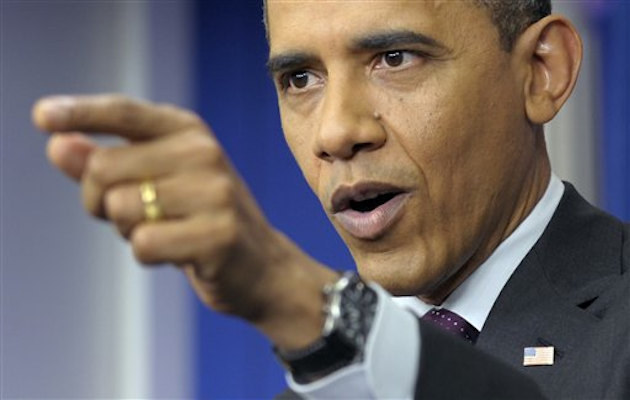
(Credit: AP Photo/Pablo Martinez Monsivais)

To hear some people tell it, the United States hovers on the brink of tyranny. President Obama has seized dictatorial power to murder any American citizen he secretly deems a terrorist. Attorney General Eric Holder’s craven rationalization of the so-called “CIA assassination” of U.S.-born Muslim cleric Anwar al-Awlaki in the wilds of Yemen last September struck some as the veritable death-knell of democracy.

“The President and his underlings,” writes one fiery critic, “are your accuser, your judge, your jury and your executioner all wrapped up in one, acting in total secrecy and without your even knowing that he’s accused you and sentenced you to death, and you have no opportunity even to know about, let alone confront and address, his accusations.”

Sounds grave, doesn’t it? No less penetrating a critic than Esquire’s Charles Pierce characterized Holder’s March 5 speech at Northwestern University’s School of Law, as “a monumental pile of crap that should embarrass every Democrat who ever said an unkind word about John Yoo.”

Yoo, of course, is the Bush administration lawyer who helped write memos rationalizing that anything short of “organ failure or death” wasn’t torture.

Then why are so many Americans, myself included, so blasé about it? Partly because we’ve all been raised on spy thrillers like the Jason Bourne series, in which picturesque world capitals teem with rogue CIA agents scheming to bump off Matt Damon.

But more importantly because most feel that, American citizen or not, if you’ve run off to join a band of lunatics at war with the United States, then the United States is also at war with you. Indeed, Congress has specifically authorized armed hostilities against al-Qaida and its affiliates.

Anwar al-Awlaki called the play; he basically got what he asked for. John Yoo has nothing to do with it.

Terrorism suspects can be arrested in Detroit or Miami, read their rights, and brought to trial. Holder made a big point of that, taking credit for the life sentence administered to failed “underwear bomber” Umar Farouk Abdulmutallab.

Not so, however, in the Pakistani tribal areas or the mountainous wastes of Yemen where al-Qaida plotters hide—places where governments barely control major roadways, and then only by day.

At Northwestern, Holder enumerated circumstances under which the President, as commander-in-chief, can legally use “lethal force” against an al-Qaida operative planning terrorist attacks.

First, the U.S. government has determined, after a thorough and careful review, that the individual poses an imminent threat of violent attack against the United States; second, capture is not feasible; and third, the operation would be conducted in a manner consistent with applicable law of war principles.”

He added that “the Constitution does not require the President to delay action until some theoretical end-stage of planning—when the precise time, place, and manner of an attack become clear.”

In short, it’s not a legal proceeding; it’s an act of war.

In a stinging editorial, the New York Times declared Holder’s reasoning “deeply inadequate.” Specifically because, the newspaper argued, the attorney general “gave no inkling what the evidence was in the Awlaki case…Mr. Awlaki made tapes for Islamist Web sites that justified armed attacks on the United States by Muslims. But was he just spouting off, or actively plotting or supporting attacks?”

Actually, Holder gave far more than an inkling. Don’t Times editors feel a responsibility to read the attorney general’s speeches before condemning them?

According to the Justice Department transcript, Holder said Abdulmutallab confessed in detail to FBI agents “how he became inspired to carry out an act of jihad, and how he traveled to Yemen and made contact with Anwar al-Awlaki, a U.S. citizen and a leader of al-Qaida in the Arabian Peninsula. Abdulmutallab also detailed the training he received, as well as Awlaki’s specific instructions to wait until the airplane was over the United States before detonating his bomb.”

He confessed these things freely, without being tortured.

Holder never said so, but the U.S. District Judge who accepted Abdulmutallab’s plea needed to be convinced that his story checked out—both for his sake and the government’s.

So I have no tears for the late Anwar al-Awlaki. Nor for Ibrahim Hassan al-Asiri, a Saudi bomb maker also reported killed by the same drone-launched CIA Hellfire missile. He built Abdulmutallab’s infamous dud bomb, among several others. Also among the dead was Samir Khan, an American citizen of Pakistani origin who edited articles like “Make a Bomb in the Kitchen of Your Mom.”

No, we don’t kill people in the USA for blogging about jihad. But Khan surely understood the risks he was taking.

As for secrecy, my goodness. U.S. and Yemeni agents had pursued al-Awlaki ever since Abdulmutallab dropped the dime on him in 2009. Yemen’s army fought pitched battles with rebellious villagers sheltering him. The manhunt couldn’t have been better publicized had Donald Trump led the posse. He knew he was wanted; everybody knew why. If al-Awlaki had wanted a jury trial, there was never a time he couldn’t have surrendered.

Moreover, in a war, no commander is obliged to risk more soldiers’ lives than an objective is worth. For all the dubious morality of drone strikes, this would seem the kind of operation for which the weapons are well-suited.

Are there troubling precedents? Certainly. We can all imagine a President Santorum raining Hellfire missiles on promiscuous women or proponents of the Albigensian heresy.

But that’s make-believe. al-Awlaki’s terrorist bombs were real. President Obama certainly wasn’t obliged to wait until one of them exploded.

The economic story Obama must tell

We need government investment to restore prosperity. The president needs to explain that in a way that makes sense

(Credit: AP Photo/Susan Walsh)

Look at it this way: If the Wall Street banking crisis had taken place in 2007 instead of 2008, George W. Bush wouldn’t be able to leave home without being jeered. (As it is, he rarely leaves Texas.) Hardly anybody would buy the brand of tycoonomics GOP presidential candidates are selling. People would understand that save-the-millionaires tax cuts and deregulation had dramatically failed. President Obama would get more credit for pulling the economy out of a nose dive.

Alas, people have short attention spans and a weak understanding of abstract economic issues. You have to tell them a story. The failure of policymakers to do that has been driving progressive MVP Paul Krugman crazy. How can it be, he asks, that governments foreign and domestic are repeating the mistakes of the early 1930s — slashing government spending to reduce budget deficits, putting more people out of work, reducing demand, and inadvertently increasing  deficits? Rinse and repeat.

Part of it is that the lessons of the Great Depression belong to history, and, as such, are infinitely malleable. Arguments your grandfather would have dismissed — such as Mitt Romney’s plans to assure prosperity by topping off Scrooge McDuck’s bullion tank — are given credence today. Granddad may not have grasped Keynesian economic theory, but he remembered “Hoovervilles” and bread lines. Scrooge McDuck wasn’t a cartoon figure for nothing.

Professor Krugman acknowledges that some kinds of economic thinking seem counterintuitive. “Thus,” he writes, “it’s normal to think of the economy as a whole as being like a family, which must tighten its belt in hard times; it’s also completely wrong.” Yet it makes him crazy that even President Obama has used the belt-tightening analogy.

While deeply misleading, the family metaphor works politically because it sounds like common sense. Sometimes I wonder if Grandpa didn’t also have an advantage in living closer to the farm. Though innately conservative, rural people do understand that if you skimp on fertilizer in April, you’ll have a poor hay crop come September and a hard time getting your livestock through the winter.

But nobody ever puts it to people like that. Even somebody like Krugman can be brilliant at argumentation, less gifted at storytelling. Democrats generally have lost the knack.

The key is to stress government investment. In Arkansas, where I live, nothing could be clearer than the relationship between public investment and economic prosperity. It’s practically written on the landscape, yet many need reminding.

I recently read a beautifully written memoir called “A Straw in the Sun,” by Charlie May Simon, an Arkansas writer who homesteaded in Perry County (where I live) during the 1930s. Back then, rural Arkansans basically lived in the Third World. Simon and her neighbors grew their own food, made their own clothes, music and home brew. They had no electrical power, telephones, indoor plumbing or paved roads. Few in Perry County did. They walked to town, or hitched rides on mule-drawn wagons.

Enchanting as Simon makes it sound, the world she evokes feels not 75 years distant, but 175. After World War II, what brought Perry County into the 20th century was government investment. My 65-year-old neighbor was in high school when the main highway through the county was first paved after the U.S. Army Corps of Engineers bridged the Arkansas River at Conway.

So it came as something of a surprise to read that my ambitious state representative, a genial former neighbor now living over in Conway, has conceived a plan to return us to the bad old days. Supposedly by eliminating income taxes from 40 of the state’s less prosperous counties — along with concomitant cuts in public spending — GOP visionaries envision that nothing less than an economic miracle will take place.

Never mind why no such thing happened during Arkansas’s first 150 years or so of statehood. Thankfully, the proposal got nowhere. What’s amazing to me, however, is that otherwise intelligent people could be so blinded by ideology as to entertain so preposterous a scheme. Believe me; these fellows are rapt with sincerity. What’s more, their ideological brethren are taking over state governments from sea to shining sea.

That Conway, a pleasant town of approximately 60,000, should serve as the epicenter of this backward revolution strikes me as comically ironic. Although filled with Republicans, there are few cities of like size whose prosperity depends more obviously upon public largess. Located along Interstate 40, it’s also home to three state agencies and the University of Central Arkansas, a rapidly growing public institution. Trim UCA’s budget 20 percent, and Conway’s economy would go into a tailspin.

The city’s two private colleges are greatly dependent upon state-sponsored tuition scholarships, just as its nonprofit medical center relies upon Medicaid and Medicare. I could go on. Even Conway’s two newest large private employers are Internet- (hence government) dependent.

Around these parts, alas, Democrats have lost control of the story line.

Continue Reading Close

Romney’s only principle

Mitt flip-flops on everything else but there's one thing he does believe in: That he deserves to be president

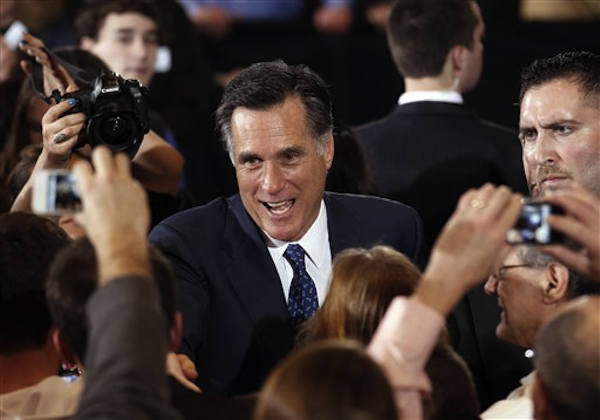
(Credit: AP Photo/Gerald Herber)

If he weren’t so smug, it would almost be possible to feel sorry for Mitt Romney. Beyond the flip-flopping, has any worse actor ever attempted the role of presidential candidate? It’s beyond Romney’s powers to persuade most people of his sincerity about things he does believe, much less the many tenets of contemporary GOP faith he probably doesn’t share — assuming for the sake of argument that anybody, including himself, knows which is which.

There’s little doubt, however, that Romney believes he deserves to be president, in rather the way the fictional Lord Grantham deserves to preside over Downton Abbey. It’s his inability to conceal that sense of entitlement that makes him such an awkward politician.

The candidate’s cringe-inducing attempts to present himself as a Regular Joe almost invariably end in boasting. Campaigning in his native Michigan, he assured voters that his wife drives not just one $50,000 Cadillac, but two — one at their Boston home, the other at their seafront mansion near La Jolla, Calif., as aides subsequently clarified. No word how Mrs. Romney gets around at their New Hampshire lakeside compound or their Park City, Utah, ski palace.

Visiting the Daytona 500, Romney admitted he’s not a keen NASCAR fan, but does have friends who own racing teams. Defending himself on CNN from the perception that his wealth leaves him “out of touch,” he allowed as how, “If people think that there is something wrong with being successful in America, then they better vote for the other guy, because I’ve been extraordinarily successful and I want to use that success and that know-how to help the American people.”

On the “Today” show, Romney explained that people concerned with income inequality are simply jealous. “You know, I think it’s about envy,” he said. “I think it’s about class warfare. When you have a president encouraging the idea of dividing America based on the 99 percent versus 1 percent—and those people who have been most successful will be in the 1 percent — you have opened up a whole new wave of approach in this country, which is entirely inconsistent with the concept of one nation under God.”

Got that, peasants? God’s behind the 13.9 percent tax rate Romney paid on $43 million he earned in 2010 while technically unemployed. Anybody who thinks differently is merely eaten up with resentment. In my experience, the more money people inherit, the more they’re tempted to lecture others about talent and hard work. And to cry the blues about the indignity of paying taxes.

Romney’s air of personal superiority appears to be the one topic about which the poor dork is absolutely sincere. That’s what makes him such a terrible liar. He’s almost frantic with it, like a golden retriever with his ball. Even with the mute button on the TV pressed, you can almost hear him panting.

Look — modest, humble people don’t run for president. President Obama often appears to have trouble restraining his bemusement at the antics of less intelligent people. Nevertheless, Romney’s unrestrained egotism is the reason I think Paul Krugman (among others) has made far too much of an offhand remark the candidate made seemingly renouncing the central tenet of GOP economic dogma.

“If you just cut, if all you’re thinking about doing is cutting [government] spending,” Romney told a group of Michigan voters, “as you cut spending you’ll slow down the economy.”

Well, no kidding.

To Krugman, Romney’s slip of the tongue revealed him as a “closet Keynesian” who “believes that cutting government spending hurts growth, other things equal.” The columnist added that, after all, “Mr. Romney is not a stupid man. And while his grasp of world affairs does sometimes seem shaky, he has to be aware of the havoc austerity policies are wreaking in Greece, Ireland and elsewhere.”

Oh no he doesn’t.

Or, to be more precise, Romney can be perfectly aware and blithely unconcerned. Krugman left off the next sentence where Romney stipulated that cutting spending alone wasn’t enough. “You have to, at the same time, create pro-growth tax policies.”

Translation: even lower taxes for multimillionaires.

But I’d never presume to argue economics with professor Krugman. My point is that Romney’s tycoon capitalism has only partly to do with jobs, money and the real economy. It’s also about cultural revanchism, putting the right people back firmly in charge and the lower orders back in their place.

Tycoon capitalists like Romney see a prolonged slump as an opportunity to render the workforce more docile and grateful. Remember, this is the same guy who opposed government loans to save Chrysler and General Motors. Better to crush the Auto Workers Union. Who said the best way to resolve the national foreclosure crisis would be to speed it up, so that “investors” could buy people’s houses cheaply and rent them out.

In the end, it’s all about No. 1.

Continue Reading Close

The futile search for meaning in “Linsanity”

Real fans aren't shocked at the sight of an Asian-American star. The hype is just New York being New York

(Credit: Reuters/Eduardo Munoz)

About two weeks ago, my son asked me how a team with an imposing lineup like the New York Knicks could possibly have a losing record. “Because they have no point guard,” I said. They played like strangers. Either nobody wanted the ball or everybody did. Long intervals would pass without the Knicks putting up a decent shot — although being NBA players they often made enough bad ones to stay close.

Well, as the world knows, they have a point guard now. The feel-good story of Jeremy Lin, the underdog Chinese-American player from Harvard, has made NBA fans of millions who scarcely know the 24-second clock from a goaltending call. Here’s hoping they stick around, because it’s a heck of a show. Meanwhile, how about if we dialed down the ethnic sensitivity meter until the kid settles in?

As a lifelong basketball guy married to a coach’s daughter, I’m bewildered by people who say they love the college game but dislike the professionals. Around our house, the end of the NBA owner’s lockout was cause for celebration. It was going to be a long winter without “Da lig” as ESPN’s Hubie Brown pronounces it.

Does my sainted wife ever wish I didn’t watch a NBA game most nights? Absolutely. But I’d also bet you $20 she can name the Boston Celtics’ starting five. As for my sons, well, freeloading off dad’s NBA Season Pass helps keep us together. Some families argue about politics and religion; we bicker about LeBron James and the Miami Heat.

Anyway, from a strictly basketball perspective, what’s not to like about Jeremy Lin? The kid’s got a nice all-around game and an ideal point guard’s temperament; he’d sooner pass than shoot. He’s aggressive, but rarely forces plays that aren’t there. He’s got terrific court awareness and tactical smarts. He makes adjustments.

If Magic Johnson says Lin’s the real thing, that’s good enough for me. Magic’s always diplomatic, but he doesn’t lie.

However, Lin also commits too many turnovers. His on-ball defense is suspect. The New Jersey Nets’ Deron Williams recently lit him up for 38, shooting threes over him at will. Lin’s no Derrick Rose, Steve Nash or Rajon Rondo yet. We’ll see how his stamina holds up through a full NBA season; he’s wondered aloud about it himself. The Knicks need to find a backup; if Lin keeps playing 46 minutes every game, he’ll get hurt.

As for the hype, if the Knicks had Ricky Rubio, the brilliant 20-year-old Spanish point guard for Minnesota, Spike Lee would be sitting at courtside in a bullfighter costume, and people would be writing dopey articles about the link between flamenco rhythms and basketball. It’s just New York being New York.

“Linsanity” ain’t necessarily good for its object. There may be days when Lin wishes he could change places with Rubio.

Few NBA fans are astonished at an Asian-American player achieving stardom. It’s been an international league for years. (Ivy Leaguers aren’t unknown in the NBA either. Remember Bill Bradley? He ran for president.) There are NBA players from all five continents and Australia. One could put together an all-star team from Spain, Germany, Turkey, France, Argentina, Brazil, Canada, Italy, Serbia and Great Britain that could compete against an all-American squad.

All racial and ethnic theories of basketball are bunk.

Religious ones too. Maybe the most absurd commentary came from the New York Times columnist David Brooks, who pronounced Lin an “anomaly” as “a religious person in professional sports.” Brooks, who evidently doesn’t own a TV set, has somehow missed all those jocks thanking their Lord and personal savior for hitting home runs and throwing touchdown passes, silly boys.

Look, Jeremy Lin is a fellow fortunate enough to make a handsome living putting an inflated rubber ball through an iron hoop, as millions of his clumsier brethren dreamed of doing in our youth. Watching him gives the rest of us a playground break, sometimes with adult beverages and cute cheerleaders. It has no transcendental meaning. It’s a ballgame.

New England Patriots quarterback Tom Brady probably said it best.

“Look at the attention I get,” he said. “It’s because I throw a football. But that’s what society values. That’s not what God values. God could give a [bleep] … He didn’t invent the game. We did. I have some eye-hand coordination, and I can throw the ball. I don’t think that matters to God.”

Meanwhile cueing up the MSNBC fake-outrage machine over a dumb ESPN headline about “a chink in the Knicks’ armor” doesn’t advance racial harmony. It impedes it. The phrase is what we pedants call a “homonym” — two unconnected words with identical pronunciation. It’s a hoary sports cliché having nothing to do with ethnicity.

The dope who wrote it in a 2:30 a.m. haze has apologized, and Lin was gracious enough to accept. So should everybody else.

Continue Reading Close

Catholic hypocrisy at its worst

Bishops condone much more direct contradictions of church dogma. The birth control uproar is a cynical power play

Archbishop of New York Timothy Dolan is interviewed at the North American College in Rome, Feb. 14, 2012.

For the record, the priest who married my wife and me in 1967 advised us that we could in good faith practice birth control. He reasoned that as Pope Paul VI was then preparing an encyclical regarding faith and sexuality, young Catholics could reasonably assume that church dogma regarding contraception would soon change to reflect contemporary realities: specifically that a couple intending to bring children into their marriage might legitimately seek to do so in their own time.

A university chaplain, he no doubt understood how the combination of Rome’s authoritarianism and theological nit-picking tended to drive educated young people from the church. Anyway, everybody knows how that worked out. Next came Humanae Vitae, Pope Paul VI’s 1968 doubling down on the church’s blanket condemnation of artificial means of birth control — a blast from the medieval past as most American Catholics now see it.

“Vatican Roulette,” we called it, and like the vast majority, declined to play. Surveys have shown that approximately 13 percent of the faithful agree with the Roman Catholic Church’s categorical ban on birth control; a mere 2 percent actually practice what the bishops preach. For most, it isn’t a serious personal issue. Sure, Your Grace, whatever.

For that matter, birthrates are declining in Catholic countries around the world. And a blessing it is, if poverty and human dignity concern you.

Until the U.S. Conference of Bishops recently got crosswise with the Obama administration, even the church rarely emphasized the contraceptive issue. So at first, I was mainly struck by the sheer quaintness of it all. (As, evidently, were many Catholic universities and hospitals quietly complying with state laws mandating contraceptive coverage.) The bishops’ indignant fulminations about their wounded consciences put me in mind of the hilarious production number in Monty Python’s “The Meaning of Life,” with its chorus of impoverished Catholic urchins singing

“Every sperm is sacred. Every sperm is great.
If a sperm is wasted, God gets quite irate.”

Coarse jokes about priests, altar boys and contraception virtually wrote themselves. I’ll spare you. But while we’re at it, let’s light a candle for Sinead O’Connor, an eccentric woman in combat boots with a shaven head, who tore up the pope’s photo on “Saturday Night Live” in 1992 to protest clerical sexual abuse of children in her native Ireland: wrecking her U.S. career to make a point entirely lost upon most viewers at the time.

In a bankruptcy proceeding last week, the diocese of Milwaukee listed 8,000 claims of sexual abuse among its liabilities. I’m with Esquire’s Charles P. Pierce, who writes that the great contraceptive kerfuffle with the Obama administration represents a fairly obvious power play by “the institutional American church to regain the power and influence in the secular government that it lost when it was exposed to be a multigenerational conspiracy to obstruct justice.”

If the reader detects bitterness, that’s an error of tone. The best priest I know is prone to remind his parishioners that the church is not God; rather, it’s a human institution, prone to sin and error. Recently watching him bless four little girls who carried alms to the altar, I was moved to think how humble, hardworking priests like him are also victims of the church hierarchy’s grave moral failure.

So you’d think they’d be a bit more modest in their rhetoric, the bishops. Particularly in anything touching upon human sexuality. This may be the place to say that I speak for nobody but myself. Not for Irish Catholics, Catholics in the South, Catholics Who Raise Fleckvieh Simmental Cows, nor even for my wife.

Her issue is how easily rich people are granted marriage annulments. The late Sen. Ted Kennedy’s marriage was declared null and void after 24 years and three children because — get this — he’d entered it with reservations. Specifically, he never intended to quit “dating.” (Evidently a family tradition.) Never mind that Kennedy’s ex-wife Joan agreed. Mine found it sickening, a patent end-run around the church’s unwillingness to countenance divorce.

For that matter, a couple of bishops attended Newt Gingrich’s third wedding. So don’t tell me they couldn’t find a way to accommodate President Obama’s downright Jesuitical compromise to the effect that Catholic hospitals don’t have to offer employees contraceptive care, but their insurance companies do. Canon lawyers make distinctions like that one every day.

Instead, they’ve settled upon a partisan power play to subvert the First Amendment rights they claim. Look, nobody’s forced to use contraceptives; it’s an individual’s choice, nobody else’s. Religious organizations have the right to believe anything they like, but not to impose those beliefs upon others. By essentially demanding a Catholic veto, the bishops and their GOP allies would impose their theological views upon millions of American women as a condition of employment.

That’s not “liberty,” it’s liberty’s opposite; and precisely what the First Amendment was written to prevent.

Continue Reading Close

Israel’s real target: Obama

Prime Minister Netanyahu's threats have more to do with challenging Washington than with actually attacking Iran

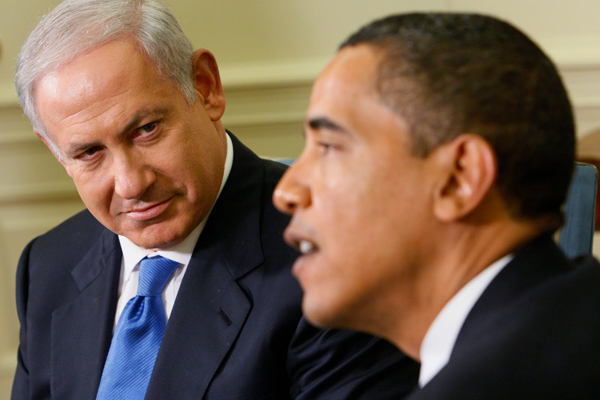
Israeli Prime Minister Benjamin Netanyahu and President Obama (Credit: AP)

After being elected in large part because he’d opposed a “dumb” war in Iraq, President Obama finds himself confronting an even dumber one in Iran. Exponentially dumber, actually.

Dumb because like the targeted assassinations of Iranian nuclear scientists rarely cited by columnist commandoes, bombing raids alone can’t achieve the alleged goal: preventing the Ayatollahs from acquiring nuclear weapons.

Slow them down, probably. Stop them, no. Short of a full-scale invasion and occupation of a nation three times larger than neighboring Iraq in population and five times larger in land area, that can’t be done. Global disapproval didn’t stop North Korea, Pakistan or, for that matter, Israel.

Exponentially dumb because it could set the entire Middle East aflame.

You’d think the Israelis, of all people, would recognize that threatening a people with death and destruction hardens their resolve. Yet the New York Times reports that Israeli Prime Minister Benjamin Netanyahu “told visitors that he believes the Tehran government to be deeply unpopular, indeed despised, and that a careful attack on its nuclear facilities might even be welcomed by Iranian citizens.”

Yes, and Dick Cheney predicted that U.S. forces invading Iraq would be greeted with candy and flowers. “Most analysts [in Jerusalem] and abroad,” the Times noted cautiously, “take a different view.” Indeed, historical examples of civilian populations cheering on aerial bombardments are rare, if not nonexistent. Despite his and Cheney’s obvious affinities, one would expect Netanyahu to be made of saner stuff.

Assuming that the Israeli prime minister’s motives for threatening a unilateral Israeli strike against Iranian nuclear facilities are as reported. I suspect they are not. To put it bluntly, it’s not so much the regime in Tehran that Netanyahu is keen to destabilize as the one in Washington. The question now is how far he’s willing to take it.

Despite media chatter about “red lines” being crossed, it’s hard to point to anything the Iranians have done to provoke the current crisis. They’ve been trash-talking since 1979. Otherwise, no Iranian armies are massing. With its navy badly outgunned in the Persian Gulf, and a vestigial air force scarcely capable of defending against Israeli bombers, Iran sits surrounded by U.S. bases in Turkey, Saudi Arabia, Iraq, Pakistan, Afghanistan — well, everywhere.

Iran’s last military action of any consequence was its catastrophic 1980s war with Saddam Hussein’s Iraq, during which it suffered more than a million dead. The Persians haven’t actually invaded anybody for more than 300 years. The Shiite regime’s expanded regional influence came about as an unintended consequence of the U.S. invasion of Iraq.

For what it’s worth, the Ayatollahs deny any intention of attacking the “Zionist Entity”— despite frequently wishing that it would vanish from the earth. Even Iranian clients Hezbollah and Hamas have been mostly quiet. With Iran’s economy faltering under economic sanctions engineered by the Obama administration, and much of its population seething with resentment amid an acrimonious feud between President Ahmadinejad and Supreme Leader Khameni, the Tehran regime’s got all it can do to survive, much less to start a suicidal conflict with Israel — not to mention the United States.

But when articles invoking the Holocaust and urging “creative destruction” in Iran appear on the same day (Feb. 7) in the Washington Post, Wall Street Journal, Newsweek and Bloomberg News, a skeptical observer might be forgiven for suspecting a well-coordinated propaganda campaign.

Writing in Beirut-based Al-Akhbar, American journalist Max Blumenthal dates its inception to a Jan. 3 article in Israel Hayom revealing that Israel’s National Security Council — basically Netanyahu’s closest political allies — had concluded that “U.S. President Barack Obama is ‘naive’” and fails to understand Israel’s precarious position. Deemed a Likud Party organ, the newspaper is owned by multibillionaire Las Vegas casino tycoon Sheldon Adelson, who bankrolls Netanyahu and serves as Newt Gingrich’s Sugar Daddy too.

Netanyahu appears to see an Obama second term as an impediment to further Israeli expansion into the West Bank — or “Judea” and “Samaria,” as Likudniks style it — and has cast his lot with the Republican right. He’s made public appearances with notables like Glenn Beck and “End Times” evangelist John Hagee. Adelson himself has pledged his vast resources to Obama’s defeat.

In his State of the Union speech, President Obama reiterated his determination to prevent Iran’s getting nuclear weapons. He said he was “taking no options off the table.” But he also expressed hope that international sanctions could lead to a peaceful resolution.

On cue, Washington Post columnist Richard Cohen called this “startlingly naïve.” Only a fool or a Frenchman, the same pundit once opined, could doubt the existence of Saddam Hussein’s WMD. Bombs away!

President Obama also reportedly dispatched Joint Chiefs Chairman Gen. Martin Dempsey to Israel to warn Netanyahu that if he tries to force the United States’ hand, he’s on his own.

But can he make it stick?

For his sake and everybody else’s, he’d better.

Continue Reading Close

Page 1 of 29 in Gene Lyons

www.salon.com/writer/gene_lyons/index.html