Spring Sale: Get 1 Year, Save 58%

We’ve finally slowed the surge in overdose deaths. The Trump admin may undo all of it

On May 14, 2025, the Division of Overdose Prevention at the Centers for Disease Control and Prevention announced that the number of overdose deaths in 2024 had dropped 27%. This was an extraordinary, even historic announcement, given overdoses had risen relentlessly for more than 33 years, resulting in the deaths of more than a million Americans, with another 1 million projected to die before this decade is over. Now, for more than a year, overdose deaths have decreased every single month, most dramatically for deaths caused by illicit fentanyl — considered the toughest problem, given the opioid’s high potency, simplicity of manufacture, and ease of smuggling. 

That very same day, the new Secretary of Health and Human Services, Robert F. Kennedy Jr., in testimony before Congress, made no reference to overdoses, the number one killer of Americans 18 to 44 years of age, nor to the recent success. A week later, in his agency’s 72-page “Making America Healthy Again” manifesto, the word “opioid” was never mentioned. Instead, he went on to propose that CDC should be disassembled, along with the other principal agencies responsible for addressing the overdose crisis.  Those proposals, as part of the administration’s 2026 fiscal year budget,  passed the House and await action by the Senate.

For nearly thirty years I was a CDC scientist. I have been outspokenly critical of how CDC and those other agencies have handled the opioid crisis, but the solution is not to take a wrecking ball to the institutions that protect us, particularly when we seem to be making progress. What will be the consequences? A health secretary who systematically ignores mention of the major killer of adult Americans is clearly not interested in research on what could account for a decrease in deaths. 

But among recent national initiatives, the push to increase availability of the opioid overdose antidote, naloxone (brand name Narcan), has clearly played a role. Between 2021 and 2023, the number of naloxone doses dispensed from retail pharmacies doubled, and millions of additional doses were distributed by harm reduction organizations. Then in March 2023, the Food and Drug Administration approved over-the-counter distribution of a nasal spray version

I have been outspokenly critical of how CDC and those other agencies have handled the opioid crisis, but the solution is not to take a wrecking ball to the institutions that protect us.

By the end of the year, 20 million doses had been dispensed. The decline in overdose death rates started the month after the nasal spray became widely available. Temporal sequence is not causation, but in a public health crisis, a plausible step is mass distribution of an antidote easily administered by lay persons. Few interventions in medicine are more cost-effective than saving a life in ten seconds for $25. 

Shortly after being put in charge of the U.S. health care system in February 2025, Kennedy, called for immediate decreased funding for naloxone. And he didn’t stop there. Slated for abolition is the National Institute for Drug Abuse, the research group at the National Institutes of Health that helped develop the nasal version of naloxone. NIDA is currently researching opioid analgesics with lower addiction risk and developing wastewater detection systems to provide early warning of new illicit drugs. What is left of NIDA will be absorbed, with other decimated institutes, into a single entity focused on “behavioral health.”


Want more health and science stories in your inbox? Subscribe to Salon's weekly newsletter Lab Notes.


Also on the chopping block is the Substance Abuse and Mental Health Services Administration, which provides the major funding for state and local naloxone distribution and drug treatment programs. CDC’s Division of Overdose Prevention, which is responsible for monitoring the drug epidemic, is marked for demolition too, despite having just reported the unprecedented reduction in overdose deaths. Adding to the threat of a renewed overdose explosion, the CDC issued the stark warning of a seven-fold rise in overdoses from illicit carfentanil, an opioid 100 times more potent than fentanyl — so potent that the drug is used to sedate elephants and minuscule amounts can easily kill a person. Remnants of SAMHSA and the CDC’s Division of Overdose Prevention will be folded into the new “Agency for Healthy America." Even if we assume that every cent of the budgets of the three cancelled drug control groups is eliminated, the total reduction in the federal budget would be one-tenth of one percent, or considerably less than the cost of one aircraft carrier.

According to the new director of the Office of Management and Budget, Russell Vought, these transformations should be done in a way to assure that the federal workforce will “be traumatically affected,” and “viewed as the villains.” What should the few remaining traumatically affected villains do about the drug crisis? Kennedy, who attributes his heroin recovery to 12-step abstinence, made that clear in his 2024 documentary: “We’re going to build hundreds of healing farms” — places where people with addiction “learn the discipline of hard work” and “get re-parented,” all the while bringing “a new industry to these forgotten corners of America.” Antidotes, treatment, prevention? These are at best irrelevant — more likely, a moral hazard. 

We need your help to stay independent

The first thing you learn in public health is that all victories are temporary. Back in 2000, the CDC group where I worked demonstrated that ongoing transmission of measles — the most infectious pathogen known to humankind — had been eliminated from the U.S., thanks to nationwide hard work to raise immunization levels. A quarter-century later, because of lowered immunization levels consequent to a torrent of vaccine misinformation by Kennedy and others, there have been more than 1,000 measles cases in 30 states over the first five months of this year.

The question is now before Congress: If the agencies battling the drug epidemic are disabled, will a renewed explosion of deaths result? The last time the current president was in office, overdose rates rose more than 44% over the course of his tenure — the largest overdose increase in American history, with more than 300,000 lives lost. This time, we may never know if history is repeating itself since the systems that monitor overdose deaths are themselves subject to elimination. However, families of future overdose victims may still wonder if 2025 was the year we helped make Americans die again.

Millionaire CEO’s rejection of work-life balance exposes the problem with hustle culture

In an interview with Steven Bartlett on the "Diary of a CEO" podcast, SKIMS co-founder Emma Grede recently made waves for her views on work-life balance. She claims that work-life balance is an employee's problem and employers have no responsibility for how employees manage their life obligations outside of work. She also cautioned that asking about work-life balance in an interview is a red flag. 

Grede’s views on work-life balance do not reflect the reality for most employees and what they expect from their organizations. According to Ranstad’s most recent workmonitor reportwork-life balance surpassed pay as a top motivator for employees in 2025. Employees don’t want to spend every waking hour at work — they want to have hobbies, spend time with friends and family and finally enjoy that vacation they’ve dreamed about, all without feeling guilty that they’re not working enough or fear of a bad performance review.  

To make that magic balance happen, it is both the employee’s and employer’s responsibility, and employees have a right to ask about it before they commit to a job. Let’s break that down.

Employers take responsibility through the culture they create

Culture captures everything that is normal and expected of employees in an organization. And it’s created by the policies the organizations implement, the behaviors that leaders model and the things that employees are rewarded (or punished) for. If leaders consistently stay in the office past 6 or 7 p.m., employees are more likely to do the same. If the employee that is available via email 24/7 gets the promotion or yearly bonus, other employees copy that. This creates a culture of work-life imbalance where employees are expected to and rewarded for letting work dominate their lives.  

We need your help to stay independent

Organizations must actively create a culture of work-life balance. Policies such as flexible working arrangements and limiting after-hours communication, and holding leaders accountable for sticking to those policies, contribute to the culture. Flexible working policies allow employees to get their job done but in a way that suits them and their needs outside of work. Further, a recent study found that monitoring email after hours is a main contributor to a lack of work-life balance. A California lawmaker introduced a bill that would make it a finable offense for managers to contact employees after hours. Just a note: While the law might force work-life balance, research suggests that policies like these are more powerful when the organization implements them voluntarily. 

Employees aren’t looking for organizations to figure out how to pick their kids up from soccer or how to get to a doctor’s appointment, as Grede suggests in the interview. Instead, they are looking for a culture with reasonable expectations and the flexibility that makes getting those things done easier. And it’s the employer’s responsibility to create that culture.  

Employees have a right to ask about work-life balance 

We often think that interviews are solely for the organization to pick the best candidate for the job. But organizations are just as much in the hot seat as prospective employees are. Interviews offer an opportunity for applicants to ask the company hard-hitting questions — to understand the culture, the expectations of the job and whether the company’s values align with their own. Asking about work-life balance in an interview is not only appropriate but can save time and resources down the line for both parties. 

Almost half of the more than 26,000 respondents said they would pass on a job offer if their personal values didn’t align with the organization’s

In that same Randstad workmonitor report, almost half (48%) of the more than 26,000 respondents said they would pass on a job offer if their personal values didn’t align with the organization’s. Fit between the employee and the organization is a key driver of both employee job satisfaction and turnover later on. Not everyone defines success as a straight shot to the top of the corporate hierarchy, as Grede implies. Some employees define success as a fulfilling career or one that allows them to pursue other passions. And they want to find an organization that allows them to achieve their own version of success.  

Prospective employees use interviews to learn about the expectations of a job. It is a major red flag if the hiring manager doesn’t answer the question rather than if the candidate asks it. If the values don’t align, it saves all parties the headache for candidates to self-select out of the application process at the interview stage. 

There’s nothing “wrong with” employees who want work-life balance, as Grede claims. It’s natural to want to enjoy all that life has to offer beyond the confines of the office. Employers have a responsibility to promote work-lifebalance for employees, particularly if they want to retain top talent. And employees are entitled to learn that information so they can find an organization that feels like home.

Dismissed by DEI: Trump’s purge made Black women with stable federal jobs an “easy target”

In February 2020, President Donald Trump’s first education secretary issued a memo to employees emphasizing the department’s policy “to ensure that diversity, inclusiveness, and respect are integral parts of our day-to-day management and work.”

“Diversity and inclusion are the cornerstone of high organizational performance,” Betsy DeVos continued, adding that all people were welcome in the Department of Education. The memo ended with a call for employees to “actively embrace” principles of diversity, equity and inclusion, or DEI.

As part of that push, Quay Crowner was among the top education officials who enrolled in the “diversity change agent program.” Crowner thought little of it at the time. She had over two decades filled director-level human resources roles at several federal agencies, including the IRS and Government Accountability Office, and she’d participated in seminars on leadership and workplace discrimination. But five years later, as Trump entered office a second time, his administration’s tune on DEI had changed. Crowner was abruptly placed on leave under Trump’s executive order to dismantle DEI programs across the federal government.

As a longtime manager familiar with federal hiring and firing policies, Crowner, 55, believed she knew what it looked like to be unfairly targeted. Her current job as the director of outreach, impact and engagement at the Education Department was not connected to diversity initiatives. She said the only part of her responsibilities that could have been considered DEI was that her team guided students who’d had trouble navigating financial assistance applications; while most people who seek federal student aid are from disadvantaged backgrounds, her office was a resource for any and all and had no diversity mandate. She was not involved with hiring and retention efforts.

More troubling, she said, was that she was the only person on her team who had been let go, and her bosses refused to answer her questions about her dismissal. When she and colleagues from different departments began comparing notes, they found they had one thing in common. They had all attended the training encouraged under DeVos. They also noticed something else: Most of them were Black women.

“We are still just in utter shock that the public service we took an oath to complete … has fallen apart,” said Crowner, whose bills related to an injury and health issues are likely to mount as she loses her federal health care coverage.

“We never imagined that this would be something that would happen to us.”

Her experience is part of a largely untold story unfolding as Trump dismantles civil rights and inclusion programs across government: Many of those being forced out, like Crowner, are Black women who spent decades building a career of government service, only to see those careers shattered in a sudden purge.

ProPublica interviewed Crowner and two other career civil servants, all Black women, who are among the hundreds of fired federal employees represented in a legal action brought against the Trump administration. Filed in March with the U.S. Merit Systems Protection Board by legal teams including the Washington branch of the American Civil Liberties Union, the case contends the administration violated the First Amendment rights of employees by targeting them for holding views perceived as contrary to the Trump 2.0 doctrine.

What has received less attention is the suit’s claim that the administration also violated Title VII of the Civil Rights Act of 1964. They claim the DEI purge disproportionately affected those who aren’t white men.

Hard numbers documenting the demographics of those forced out by Trump are hard to attain. The Trump administration has provided little information on those being fired, and a revolving door of firings and reinstatements in some departments makes capturing formal figures even more challenging.

But a broad assessment of Trump’s firings by ProPublica and other media shows the agencies with the most diverse staffs are often the hardest hit. Before the firings, the Education Department’s staff was majority nonwhite, with Black women making up about 28% of workers, the most recent federal data shows. According to a New York Times tracker of the firings, that department has seen a reduction of about 46% of its staff. The staff of the U.S. Agency for International Development was majority women and nearly 40% racial and ethnic minorities before Trump all but eliminated it.

Meanwhile, at the Department of Justice, where white personnel make up two-thirds of the workforce, most of it men, staff has been cut just 1%, according to the most recently available federal data and the Times tracker. The Department of Energy, more than 70% white, saw a reduction of about 13%.

Lawyers representing federal employees whose careers and families have been uprooted cite anecdotal evidence of disparate impact, a key ingredient in many successful civil rights claims.

“We have observed approximately 90% of the workers targeted for terminations due to a perceived association with diversity, equity and inclusion efforts are women or nonbinary,” said Kelly Dermody, one of the plaintiffs’ attorneys, who have asked an administrative law judge to approve class-action status for the fired employees.

Nearly 80% of potential case plaintiffs are nonwhite, she said; most of that cohort are Black women.

A spokesperson for the White House declined to comment. The Education Department did not respond to a request for comment.

Since reentering office, Trump has made clear his feelings about diversity programs, referring to them in an executive order as “Radical and Wasteful Government DEI Programs and Preferencing.”

Disparate impact?

Ronicsa Chambers graduated from Florida A&M University, a historically black college, in 1990. Afterward, she got an MBA from Johns Hopkins University and landed a finance job with U.S. Airways, where she fell in love with aviation.

In 2005, she left the private sector to work in finance for the Federal Aviation Administration. She worked her way up the chain and, by 2019, helped create a program to address a lack of diversity in the agency by gaining the interest of graduates from historically black colleges and universities, or HBCUs.

In 2022, Chambers was named Air Traffic Manager of the Year. “I didn’t even know that non-air traffic controllers could get that award, and I was so proud,” she said. As titles in government do, hers changed in December 2024 as her team’s mission expanded to help FAA employees with issues such as providing accommodations so people with disabilities could do their jobs.

Then this January, she felt as though she’d been hit “in the face with a brick.” She was told on a video conference call that her FAA career was over. Though her work had involved DEI in the past, it was no longer in her title or her job description, and she said no one had asked her what her job entailed before she was removed.

She said she began moving through stages of grief but keeps coming back to anger because her team members — five Black women and one white man with a disability — were told they would be reassigned. She says they never were.

“As far as we know, we’re the only ones still on administrative leave,” she said, referring to those removed as part of Trump’s DEI executive order.

It’s unclear if the FAA, whose workforce was largely spared due to recent airline safety concerns, has fired or even fired and rehired people in departments outside of Chambers’ team. A spokesperson for the FAA did not respond to requests for comment.

The FAA has long been criticized for its lack of diversity. According to the most recent federal data, the agency was composed of 57% white men compared with 4.4% Black women.

Scott Michelman, an ACLU of DC attorney working on the complaint against the Trump administration, said Chambers’ case underscores how mass firings aimed at people who had even a peripheral connection to a DEI program, past or present, “harms the American people.”

“It takes dedicated, experienced, award-winning civil servants out of their job, their expertise, the place where we as the public want them and need them so that our government works for us,” he said. “This is a lose-lose.”

Key to their case is the argument that minority workers were disparately impacted, a long-held civil rights theory at which Trump has taken direct aim. In April, Trump issued an executive order to broadly eliminate that doctrine from civil rights enforcement, one of many steps he’s taken to reverse the traditional role of the federal government in protecting individuals from issues such as housing and employment discrimination.

For instance, the Trump administration gutted the Department of Education’s Office for Civil Rights, which was tasked with ensuring equal treatment for students regardless of gender and race, and instead focused that office at targeting transgender athletes and their schools.

Lawyers and former employees say focusing on people who may have had some DEI training or job duties would cause greater harm to nonwhite employees. And historically, the federal government has been a prominent force in upward mobility.

“For a segment of Black America, the federal government has been crucial to stepping up,” said Marcus Casey, an economist and associate professor at the University of Illinois Chicago. The opening of federal work following the Civil Rights Movement provided an alternative to manual labor, teaching or ministerial work in the form of white-collar jobs and skills training that many took into private sector jobs.

Today, Black people make up about 18.6% of the federal workforce, larger than their percentage in the overall U.S. workforce, 12.8%, according to the Pew Research Center.

“So, you think about HBCU graduates, like Howard University, a lot of these people tell us the same story: ‘This is where I started. This is where I got my first internship,’” Casey said.

Upward mobility

Sherrell Pyatt’s family story is quintessentially American.

Her great-grandfather served in the Vietnam War and, on his return, took a job in the U.S. Postal Service, a key employer in the story of upward mobility for middle-class Black families. His granddaughter, Pyatt’s mother, also found a career at the Postal Service. So, even though she would attain more education than the previous three generations, it seemed fitting that eventually Pyatt would find herself at the Postal Service.

Pyatt grew up in the Bronx, New York City’s poorest borough, but tested well enough to attend a private school. She became the first of her family to get a degree, from the University of North Carolina at Chapel Hill, where she worked to pay tuition. She got a master’s degree and worked at a nonprofit before landing a job in 2014 with the Postal Service, shaping policy as a government relations specialist.

While at USPS, she coordinated with Customs and Border Protection to stop drug shipments through the mail. That experience, as well as her fluency in Spanish, led her to a similar role at Immigration and Customs Enforcement. While there, she was involved in immigrant removal operations as part of Trump’s first-term “zero tolerance” clampdown on border crossings. She next transferred to CBP, where she helped investigate deaths of migrants in federal custody and rampant racism in a Facebook group of Border Patrol agents.

During the COVID-19 pandemic, both of her parents fell ill, and she moved to an Atlanta suburb to care for them. To make the move work, she transitioned to a job at the Federal Emergency Management Agency, where she worked as a supply chain analyst, ensuring that equipment such as medical masks made their way to U.S. hospitals. In early 2024, she moved yet again, to the Department of Homeland Security’s Office for Civil Rights and Civil Liberties, which investigates allegations of rights abuses lodged by both immigrants and U.S. citizens.

“My team was almost exclusively African Americans, and I think it’s just because of the experience of Black people in this country,” Pyatt said. “We seem to be more likely to go into those types of roles — one, because we have experience, and two, because of the passion to make a difference.”

In March, the Trump administration fired nearly all 150 employees in that office, including Pyatt. A DHS spokesperson did not respond to a request for comment about her firing.

“I think it was an easy target to get rid of people of color and people who fight for people of color,” Pyatt said. “It’s absolutely a way to attack people of color, people who are differently abled, people who don’t agree with what this administration is.”

Pyatt’s sudden loss of a career wrought instant consequences for her family. She was the primary breadwinner, but now her husband, who works for the Postal Service, provides the only income. They worry they won’t be able to make the mortgage payments on their home for the long run. Their three daughters, all middle school age, may no longer be able to attend their private Christian school or play softball.

Career federal employees like Pyatt are supposed to be able to petition for a transfer or receive preference in hiring at other agencies. Despite having worked for the federal government for more than a decade, at five agencies, including four Homeland Security posts, Pyatt says she’s faced nothing but silence.

“So it’s little things like that that this administration is doing that makes it really feel like they’re targeting people like me, people who love the country, come from a family that has served the country for generations, did what we were supposed to do,” Pyatt said through tears. “And it just doesn’t matter.”

“Elon’s telling the truth!”: Dem Rep. says GOP bill will balloon debt and “get rid of Elmo”

Rep. Jared Moskowitz, D-Fla., has found an unlikely ally in Elon Musk

Musk recently decamped from the Trump administration and has spent the days since his departure trashing Trump and the GOP over their massive spending bill. Moskowitz joined in the chorus on Wednesday, during a hearing on "NGOs gone wild," singing the praises of the tech billionaire while accusing House Republicans of talking out of both sides of their mouth on the topic of government efficiency.

"Elon has turned on them, but he's telling the truth," Moskowitz said. "The bill will add to the deficit and it will add to the debt… If you want to drop the "e" from DOGE, because we've not done efficiency, that's fine."

Moskowitz said that the "One Big Beautiful Bill" that recently passed the House would do nothing but inflate the national debt and kill off popular programs.

"They are going to do a $9 billion recision bill," he said. "They're going to get rid of Elmo, which the American people were clamoring for, but they're going to add $2.4 trillion to the debt."

Moskowitz went on to scoff at Republican leadership who trot the spending package out as a win.

"They want us to cheer for them and give them a trophy like they are a 5-year-old at a soccer game," he said. "Congress has not codified anything at all."


Start your day with essential news from Salon. Sign up for our free morning newsletter, Crash Course.


Moskowitz's remarks come in the midst of a growing feud between Musk and congressional Republicans. Speaker of the House Mike Johnson, R-La., has repeatedly bashed Musk in the press after the SpaceX CEO called for all Republicans who supported the bill to be voted out. 

“I think he’s flat wrong, and I’ve told him as much,” Johnson said on Wednesday, claiming he had spoken to Musk directly.

How the one who brought Musk into national politics feels is about his recent about-face is a matter of some debate. Fox News reported that the president is "furious" with the SpaceX CEO. Politico, on the other hand, said Trump is not too concerned Musk's efforts to kill the bill, citing senior administration officials.

“I would have voted no”: Marjorie Taylor Greene didn’t read Trump spending bill before voting on it

Marjorie Taylor Greene wishes she had read Donald Trump's "big, beautiful bill" more carefully.

On Tuesday, the Georgia Republican took to X to condemn a portion of the spending bill that she voted in favor of on May 21.

"Full transparency, I did not know about this section on pages 278-279 of OBBB that strips states of the right to make laws or regulate AI for 10 years," Greene wrote. "I am adamantly OPPOSED to this and it is a violation of states' rights, and I would have voted NO if I had known this was in there."

Greene called for the portion to be "stripped out" in the Senate, criticizing the "free rein" the bill gives to "potentially dangerous" AI development. She added that she would vote against the bill when it comes back to the House if the portion barring AI regulation remains. 

Greene is not the only Trump ally to break ranks with the president's controversial bill. Recent Trump administration departee Elon Musk called the bill "a disgusting abomination" earlier this week.


Start your day with essential news from Salon.
Sign up for our free morning newsletter, Crash Course.


"Shame on those who voted for it," Musk wrote on X. "You know you did wrong. You know it."

Kentucky Senator Rand Paul called the spending cuts "wimpy and anemic" while saying the bill would "explode" the deficit, a claim backed up by an analysis from the Congressional Budget Office.

“An unwarranted betrayal”: Karine Jean-Pierre leaves Democratic Party, announces new book

Karine Jean-Pierre has left the Democratic Party.

The former press secretary announced her decision on Wednesday, along with the news of her upcoming book, "Independent." 

"Until January 20, I was responsible for speaking on behalf of the President of the United States," Jean-Pierre said in a statement. "At noon that day, I became a private citizen who, like all Americans and many of our allies around the world, had to contend with what was to come next for our country. I determined that the danger we face as a country requires freeing ourselves of boxes."

Set to release on October 21, the book's subtitle promises a "look inside a broken White House" and hints at a defense of the Biden administration. In a description from the publisher, Democratic Party pressure to force Biden to end his campaign is painted as a "betrayal." The description goes on to call the book a guide to carving out "a political space more loyal to personal beliefs than a party affiliation."

Jean-Pierre's book will follow Jake Tapper and Alex Thompson into the suddenly crowded market of post-mortems on Biden's single term in the Oval Office. Her departure-cum-book announcement drew mockery from her former colleagues, who called it a "joke" and a "grift." 

"She made a joke about being an independent last year, and now it's a book," an anonymous former White House staffer told Politico. "All ideas are monetary, even the dumb ones."


Start your day with essential news from Salon. Sign up for our free morning newsletter, Crash Course.


Democratic strategist Caitlin Legacki pushed back against KJP while speaking to the outlet, saying that Biden and Harris did "hero's work" in preventing a Republican supermajority in Congress.

"It's more productive to focus on that, and thank Biden for doing the responsible thing by stepping aside, than it is to pretend this was an unwarranted act of betrayal," she said.

“Caught the president by surprise”: Fox News says Trump is “furious” with Elon Musk

President Donald Trump and tech billionaire Elon Musk’s apparent relationship troubles don't seem to likely to blow over anytime soon.

Musk has ripped Trump’s “One Big, Beautiful Bill” on X, calling it a “disgusting abomination” on Tuesday. Trump and his administration have been uncharacteristically quiet on the subject, but on Wednesday morning’s edition of "Fox & Friends," co-host Brian Kilmeade said there was anger behind the scenes: “I think the Elon Musk thing really caught the president by surprise and I hear he is furious.” 

Kilmeade went on to say that Trump’s public silence is “smart,” arguing the president’s focus should remain on pushing the bill forward and getting it passed by the Senate. “Don’t worry about it,” Kilmeade said. 

The strife appears to extend beyond the president, however. Speaker Mike Johnson, R-La., shared with reporters Wednesday that his calls to Musk have gone unanswered and unreturned. 

"I called Elon last night and he didn't answer. I hope he calls me back today,” the speaker said. 

Johnson added that he’s spoken to Trump, noting that the president is “not delighted that Elon did a 180 on that.” 

The speaker suggested that Musk’s discontent with the House-passed bill comes from language that would terminate electric vehicle tax credits, an issue that obviously matters to the Tesla CEO. Axios reported that Tesla has spent at least $240,000 lobbying for the electric vehicle credits and that Musk even spent time personally advocating for it.

Publicly, Musk has criticized the bill for expanding the federal deficit. According to the Congressional Budget Office, the bill's spending cuts would be more than offset by the inclusion of tax cuts that disproportionately aid the wealthy, adding more than $2.4 trillion to the debt.


Start your day with essential news from Salon. Sign up for our free morning newsletter, Crash Course.


Despite Johnson’s criticism, other GOP legislators have backed Musk. Sen. Rand Paul of Kentucky and Sen. Mike Lee of Utah showed their support for Musk’s criticism of the bill in posts on Musk’s social platform, X.

Paul responded on X, saying: “I agree with Elon..We can and must do better.”

“The Senate must make this bill better,” Lee responded on X.

Musk’s tirade on X continued into the night on Tuesday as he eventually said a continued increase in the country’s debt would “drive America into debt slavery!” 

“People saw the money being spent”: Jasmine Crockett says wealthy elites bought the Trump presidency

When asked to describe how government corruption impacts everyday Americans, Rep. Jasmine Crockett, D-Texas, had one answer: look no further than the re-election of President Donald Trump.

The congresswoman pointed to tech billionaire and former Department of Government Efficiency head Elon Musk pouring over $250 million into the president’s 2024 campaign and reaping the benefits — in power and new government contracts — when Trump took office. Meanwhile, she argued, Trump and the nation’s Republican-controlled Congress intend to cut billions of dollars from social services like Medicaid, Social Security and SNAP with no regard for the Americans it will hurt.

“People saw the money being spent on the election, but I don't think that they connected the dots until now,” Crockett said. “And I don't think that there's ever been a clearer picture.”

Crockett described the harmful connection between big money and politics alongside former Sen. Jon Tester, the three-term Montana Democrat unseated in the November election, during a virtual town hall hosted Tuesday by Democratic political action committee End Citizens United. The organization, which held the event to celebrate its 10th anniversary, supports candidates who champion campaign finance reform; it strives to overturn Citizens United, a 2010 Supreme Court decision that loosened restrictions on the amount of independent expenditure groups could contribute to candidates during elections. 

Throughout the event, Crockett and Tester drew connections between what they described as their Republican colleagues’ self-dealing, the political contributions that put them in office and the toll those actions ultimately have on Americans. Tester focused particularly on the House’s passage last month of the “One Big Beautiful Bill,” which would slash hundreds of billions of dollars in funding for Medicaid, SNAP and other social programs if enacted.  

“Are they taking up issues that really help regular folks, like making health care more affordable, or housing more affordable, or education more affordable?” Tester said. “No, they're taking up issues that really grease the pockets of the uber-rich in this country at the expense of the folks who need these programs the most.”

The former senator also criticized Musk, who has since blasted the spending bill, over his role in leading Trump’s effort to curtail federal bureaucracy and eliminate excess government spending. 

“As Elon Musk was running around trashing the government — cutting this, cutting that, cutting this — did he cut the $38 billion that he received from the federal government? Hell no, he didn't,” Tester added. “And the truth … is that’s the kind of stuff that's going on right now. You rip apart programs that have been around for generations. Why? To give the folks who paid for these campaigns big tax breaks.” 

We need your help to stay independent

Crockett rejected the notion that all politicians are corrupt regardless of party, arguing that Democrats' actions “have not come anywhere near” the “blatant lawlessness coming directly” from their Republican colleagues. But, she said, the distrust in politicians comes down to the amount of information the public takes in about the candidates they elect. 

“A lot of times we can't break through the noise if you have so much money that is pouring in, and it's literally sending out misinformation and disinformation,” Crockett said, pointing to Musk and other megadonors’ money going to ads spreading false claims about former Vice President Kamala Harris' proposed policy during her brief presidential bid. 

That political noise is also why the Citizens United decision matters, she added. 

The 5-4 ruling along ideological lines reversed century-old campaign finance restrictions, permitting corporations and other groups to spend money on elections without limits. The decision resulted in the emergence of wealthy megadonors and special interest groups increasingly exerting more influence over election outcomes — and the politicians they back — than before, according to the Brennan Center for Justice


Start your day with essential news from Salon. Sign up for our free morning newsletter, Crash Course.


“It is about breaking through the noise,” Crockett said, calling on her Democratic colleagues to scream the criticisms they have of Republicans from the rooftops. “It is very difficult to break through the noise if the noise is singularly focused on, say, making sure that Elon Musk can still make $8 million a day while that hungry child or that hungry mother can't access $6 a day to eat. That is the difference. That is the stark difference in who it is that we are fighting for.”

Crockett also left attendees with a call to action, asking that they remain “tuned in” to local elections every year in the face of voter suppression bills and special-interest spending at the federal level. She also urged viewers to “harness their influence” within their communities to engage everyone politically. The power belongs to the people, she said.

“They want you to feel helpless, they want you to feel hopeless, and if you feel that way, then you literally are playing into their hand,” Crockett said. “The scariest thing about the people is literally your power."

“Murderbot” is the break from darkness Alexander Skarsgård needed

Alexander Skarsgård, the Emmy and Golden Globe Award-winning actor, has excelled at portraying dark and deeply troubled characters. His roles in television shows like "Succession," "Big Little Lies" and "True Blood" built up his career as one of Hollywood’s favorite bad guys. Skarsgård was so compelling as Eric Northman in "True Blood" that he had people all over the world swooning and dreaming to be friends with a vampire.

Skarsgård has incredible range as an actor, as he has also played "Tarzan" and a war hero in "Generation Kill," but his portrayal of villains tends to stand out more. On Salon Talks, I asked him if that success has had an impact on the kinds of roles that land on his desk. “A lot of dark, disturbed characters. I don't know what that says about me, but that's a lot of darkness coming my way," Skarsgård said.

“I think it's also kind of informed by what I've done,” he continued, “Not most recently but in the past couple of years. Especially if something hits the zeitgeist, then I notice that there's a lot of incoming projects that are tonally similar to the character that I've played, which is rarely exciting because then it's like, ‘Yeah, this is cool, but I've literally just played this character for six months.’"

Skarsgård exercises his range in the new Apple TV+ series “Murderbot,” where he plays a TV-obsessed cyborg both intrigued by humans as well as repulsed by them, who works as a cheap security unit capable of pulling off difficult missions, but would rather kick back and watch old-school soap operas. "Murderbot" is based on the sci-fi book series "The Murderbot Diaries" by Martha Wells, set in an unknown time in the future. The role allows Skarsgård to be funny and, at times, goofy, in a way we rarely get to see him.

“It was refreshing to have a character that wasn't so self-confident, or a protagonist of a story, that again, would rather be left alone or confounded or confused by certain elements of the way humans interact with each other,” Skarsgård said.

Watch my "Salon Talks" episode with Alexander Skarsgård here, or read a Q&A of our conversation below to learn more about the reality of coming from a family of actors, Skarsgård's pick for who would win in a battle between his most powerful characters, and why "Murderbot" is making waves in the neurodivergent community.

The following conversation has been lightly edited for clarity and length.

“Murderbot” is based on the Martha Wells series, "The Murderbot Diaries." Were you a fan of the books before the show?

I was actually not aware of the book series before Chris and Paul Weitz, the show creators, reached out. I read the scripts first, and then when I was introduced to this very strange character of Murderbot, it was definitely not the type of character that I expected to meet when I heard the title and the premise. I expected someone very self-assured, confident and tough — and then instead, you meet this socially awkward android who would rather be watching space soap operas and left alone than getting into the thick of it, the action. 

I was really intrigued, and then I went back and read “All Systems Red,” which is the first novella that Martha Wells wrote based on this character, and I just fell in love with Murderbot. I thought it was such a beautiful, weird character; so idiosyncratic, and just something I haven't seen or read before.

Can you walk us into where things stand when we meet Murderbot?

I'd say the opening scene of the first episode paints a picture of Murderbot's existence up until this moment. Murderbot is a security unit. It is a low-rent security unit, kind of the cheapest version. Basically, if you imagine a stormtrooper from "Star Wars," but the worst, the cheapest, s**ttiest version of that.

It has AI components, but also organic components. It's a cyborg. Its job is to pull security for miners on different planets in the galaxy, and it's very much treated as a commodity, a piece of equipment, and miners or other workers on these planets that need security for insurance purposes never really invite Murderbot into the group. It's very much like a piece of equipment, so in the first scene, you see how it's normally treated.

But unbeknownst to the miners, Murderbot has been able to hack its governor module, its system, so it's gained autonomy, free will. It has decided to call itself Murderbot, and it's talking about all these epic adventures that it's going to go on. You think that that's going to be the show now, that you're going to go on these crazy adventures with this badass cyborg called Murderbot, but instead you cut to a couple of months later when it's on another deployment and it's pulling security, and it's discovered that it can watch soap operas because it's been able to hack into the entertainment feeds. So Murderbot, instead of proactively going out on these adventures, is procrastinating. Which, when reading it, I thought was a really fun turn. I didn't expect it to go in that direction. You get to know this android who is confused by humans and sometimes disgusted by humans, but also somehow intrigued. It would rather watch humans on the space soap opera because that's safe. You can switch it on and off whenever you want.

"Being confounded and appalled by humanity, it's something quite relatable sometimes. Murderbot is definitely more of an introvert than I am, but I can definitely relate to the feeling."

This group of humans that it's now assigned to protect, they are very different from the humans it normally protects. You see in the opening scene where people vomit on it, and just no one respects Murderbot or cares about him. This is a group of space hippies, basically, and they are very different. They want Murderbot to join the common area of the habitat. They ask Murderbot how Murderbot is doing, if it wants to join them, ask about Murderbot's opinion, and that is very strange. I guess it could be flattering, but it makes Murderbot incredibly uncomfortable because, again, it prefers to be at a safe distance, but slowly it gets pulled into this group of humans.

You’ve played one of the most popular vampires ever, and your prep for "Tarzan" was insane. How does one prepare to play an android who's mostly wearing a suit?

Being confounded and appalled by humanity, it's something quite relatable sometimes. Murderbot is definitely more of an introvert than I am, but I can definitely relate to the feeling, I think most people can, of walking into a room of strangers and trying to figure out how you fit in, if and when you should say something or interject, and the social dynamic of the situation. To me, that was very relatable, and it was just about leaning into that awkwardness. It's all about avoiding eye contact, and the motivation in each scene is basically, “How can I get out of here? How can I end this?” Because a conversation should just be giving and receiving orders, be very pragmatic, but suddenly they're like, "How are you feeling? Are you okay, SecUnit?" 

It was about letting that awkward feeling grow and take over in a way, and then I found that the suit helped as well. Murderbot is in a very rigid, human-sized condom of thick latex, basically, and that helped with the physicality of the character.

Was it heavy?

It wasn't super heavy. It was just very tight and rigid, which helped because I wanted Murderbot to be very precise in its movement. It doesn't fidget much or use a lot of body language. It's rarely comfortable, but at least if it's standing, it's just standing. It's very straight up, and that suit definitely helped.

Murderbot could probably take out any other role you played before.

I think Eric Northman would probably put up a pretty good fight because he's got that vamp speed.

The guy you played in “Succession,” he’d take him right out.

Physically? Yeah, but Lukas Matsson is incredibly wealthy, so he could build a superior AI.

While watching the show, I came to the feeling that it shares some DNA with "Star Trek." Were you a fan of that show, or sci-fi in general?

I grew up in the '80s, '90s. In my world, it was all “Star Wars.” The first movie I saw in the theater was “The Empire Strikes Back.” I lived in Stockholm, Sweden, at the time, and I remember coming out here in 1984 when I was a little kid, with my family. We lived in Texas for a while, and on my way back went to a big toy store here in New York City and I got the Ewok village. You couldn't get that in Sweden at the time, so for two weeks, I was the coolest kid at school in Stockholm. It didn't last long, but for two weeks, everyone wanted to come over to my place and play with Ewoks. My entry into sci-fi was definitely the "Star Wars" universe.

The character Murderbot has been embraced by the neurodivergent community. Were you playing the character with that in mind or just responding to what you saw on the page?

I was very much responding to what I saw on the page, and I found Murderbot relatable. It was refreshing to have a character that wasn't so self-confident, or a protagonist of a story that, again, would rather be left alone, or [who is] confounded or confused by certain elements of the way humans interact with each other.

I have a friend who has Asperger's, and I can definitely see similarities, but I also didn't want to lean too heavily in that direction because I didn't want to specifically portray that. I'm not surprised that it's been embraced and that people can relate to the character in a way.

"That's the moral of the story. 'Hey guys, don't worry about AI at all because they're not going to take dominion over mankind. They're just going to watch soap operas and chill. Nothing to worry about at all out there. What could possibly go wrong?'"

One thing I missed was what year "Murderbot" takes place in. Is it 500 years from now? One thousand years from now?

I have no idea. I don't even know where it takes place. It could be in our solar system X centuries in the future, or it could be right now, but in a different galaxy. I don't really know. I remember talking to Chris and Paul — the showrunners — about it, and we didn't really agree, but I didn't think we needed to come to a consensus on that. I thought it was quite nice that the viewer can decide for themselves when and where this takes place.

I think about our children, and I'm like, is this going to be how they're living 70, 80 years from now? And are we going to be more evolved? 

Well, that's the moral of the story. "Hey guys, don't worry about AI at all because they're not going to take dominion over mankind. They're just going to watch soap operas and chill. Nothing to worry about at all out there. What could possibly go wrong?" [Laughter.]

Did playing Murderbot change any perspective you had on AI, or what's happening with tech and creativity?

No. I kind of go back and forth on that. I'm a luddite. I don't know anything about AI or artificial super intelligence, and I have moments on a good day where I'm like, "This is pretty exciting, the speed at which this is advancing and developing, and the benefits of this." But then on a bad day, I'm also terrified.

I was listening to a podcast with Max Tegmark. He's an expert on this, and the fact that if you don't regulate it at all, if it's a free-for-all, like an arms race in developing artificial super intelligence, I'm like, "Oh, we're doomed. This is it. There's no way we're going to be around." They're not going to be as peaceful as Murderbot if they take control, so yeah, I kind of go back and forth between, and obviously, I know almost nothing about it.

A buddy of mine, who is not in the film industry, wanted to put together a lookbook for a project that he was working on as a hobby, and he was able to visualize and create this world through AI that was incredibly impressive, that he couldn't afford hiring 10 people to come up with these images and these renderings. He did it on his own, back home. I was like, "That's pretty cool." That levels the playing field in a way because you don't have to have enough money to hire 10 people to do this. You can do it on your own.

But then, of course, those 10 people who would've done it will lose a job, so yeah, I think it's a complicated issue, for sure.

You come from a family of actors. Do you guys spend a lot of time talking about craft, or do you leave that stuff at work?

We talk about it, I think, to a healthy amount. My dad's an actor, four of my brothers are actors. There are a lot of actors in the family, and it's a big part of our lives. We travel a lot, so when we get together, a lot of it is about the projects but also the adventure, the, "What was that experience like?" The working with people that someone else had worked with before.

Does it ever get competitive? 

It doesn't really, because we're all quite different. I think we're up for different roles, so I think it would've been harder if we were up for the same roles. I can see how that could have been painful. If you're really excited about a role and you're auditioning and you try to get it, and then you don't get it, and then you're like . . .

We found this guy who looks just like you, and he's a little cheaper.

Yeah. He's a little younger, a little more handsome.

What about getting the whole family together on one project? Has there ever been a conversation?

No, not the whole family. That would be exciting, and also terrifying, probably. I'd be down. 

"A lot of dark, disturbed characters. I don't know what that says about me, but there’s a lot of darkness coming my way. I think it's also kind of informed by what I've done, not most recently, but in the past couple of years."

There have been a couple of opportunities to work with my brothers. My dad and I were both in a movie called “Melancholia” years ago. We only had one or two scenes together, but at least we were on location together for a month, which was awesome.

There’s been a couple of other opportunities, but nothing that we've been excited enough about creatively. I think if we come across something or if we think of something that we want to develop, I'd love it. I think it'd be fantastic to work with my brothers and my dad.

Murderbot can download whatever it wants. If you had that power, what would be the first five films you would download?

I mean, we do have that power, don't we? 

We do, but you can download them inside your brain and watch them in your glasses between here and the next interview.

I'd say a lot of '80s comedies. That would be my go-to. Shows that I go back to or movies that I go back to watch and re-watch are what I loved when I was a kid growing up. Some hold up, some have definitely not aged well, but a lot of Steve Martin, Chevy Chase, that kind of stuff.

You've played so many roles, and your range is incredible. Is there a role that you're most commonly offered?

A lot of dark, disturbed characters. I don't know what that says about me, but there’s a lot of darkness coming my way. I think it's also kind of informed by what I've done, not most recently, but in the past couple of years. Especially if something hits the zeitgeist, then I notice that there's a lot of incoming projects that are tonally similar to the character that I've played, which is rarely exciting because then it's like, "Yeah, this is cool, but I've literally just played this character for six months." 

It's fun to go off and do something different, and that's part of the reason I was so excited when “Murderbot” landed in my lap. I'd done “The Northman” and “Infinity Pool” prior to “Murderbot.” Both were incredible experiences, but really dark characters and just disturbing stuff, so I felt primed and ready for something tonally different and something that leaned more towards comedy. I was very excited when I was introduced to “Murderbot.”

Is there anything you would like to do that you haven't done yet?

It's not one dream role that I have on a pedestal. I kind of just stumble my way through my career and find stuff like, "Oh, this excites me." I've been very blessed and lucky to have had these opportunities to work on really interesting characters, and if I can keep stumbling forward and stumbling into great, fun, weird, occasionally really dark characters, but occasionally lighter, then I'm very happy.

I have friends and colleagues who are like, "I need to play Iago." And then they make that happen. They put it together, and I admire that, but for me, there's never been that one role that's like, "I’ve got to play that one."

Marc Maron’s heart made “WTF” a hit. In the Joe Rogan age, it’s all about shallow brawn

In the way of many things born at an era’s dawning, “WTF with Marc Maron” reminds us that podcasting began with good intentions. Some of us remember what that territory was like, especially when “WTF” launched and, as Maron recalls at the top of his Monday, June 2 episode, no one knew what a podcast was.

As he defined what his podcast would grow to be loved for, Maron carved out a space for his guests to bridge the distance between their celebrity and their humanity. Early “WTF” episodes are deeply confessional, a product of Maron figuring out his life’s direction after a horrendous divorce. His version of self-examination had a way of prying open everyone from comedians to President Barack Obama in 2015, making his podcast the first to interview a sitting president. Anyone willing to spend time with him in his garage and contemplate what it all means was on the lineup, with the definition of “it” changing from moment to moment.

As he defined what his podcast would grow to be loved for, Maron carved out a space for his guests to bridge the distance between their celebrity and their humanity.

Appropriately enough, Monday’s episode featured John Mulaney – a performer and host who, like Maron, lived out his messiness in the public eye and was judged for that. Mulaney may have been Maron's guest, but the episode’s main takeaway was the host’s announcement that he’s ending his podcast after sixteen years.

"We have put up a new show every Monday and Thursday for almost 16 years, and we're tired. We're burnt out,” Maron told his faithful listeners during the episode’s opening check-in, before adding, “and we are utterly satisfied with the work we've done.”

Yes, and. Minutes later, he threw in one more searingly accurate confession. “I feel like I've partially done an amazing thing for culture,” he said. “But on the other side of that, I feel like I've released the Kraken.”

Accurate. Maron’s production output has been daunting since the earliest days of “WTF,” churning out two episodes a week to build an archive surpassing 1600 installments. (Monday’s episode is No. 1648.) All these years later, and with a constellation’s worth of additional competition, it’s still one of the most downloaded and streamed podcasts going.

But it’s also a small island in a medium overrun by shallow rage theater celebrating thoughtlessness. Within that swirl, “WTF” stands out as an oasis of introspection thanks to Maron presenting his show as an open cavern of feeling, constantly exposing new corners of insight and inviting listeners inside to revel in those discoveries.

“It's always twofold when you're at the beginning of a new medium,” Maron said Monday while reflecting on his podcast’s legacy. “There's a lot of, like, ‘Wow, the freedom of it!’ And I think those words are said before anything turns into a horrendous, malevolent force.”

“WTF” may not be the first comedy podcast, but Maron is one of the earliest bigger-name performers to establish that the format is useful for expanding one’s fan base.

Before “WTF,” he was a featured personality on Air America, the short-lived progressive response to conservative talk radio. But Maron was less broadly popular than his colleagues Janeane Garofalo, Al Franken and “Daily Show” co-creator Lizz Winstead. Garofalo and Franken were already stars by the time Maron scored his first significant film credit in Cameron Crowe’s 2000 classic “Almost Famous.” (An audio sample of his most memorable line from that movie — “Lock the gates!” — opens every “WTF” episode.)

After parting ways with "Air America," Maron held on to his keycard to the AAR studio and covertly used it to record the first few episodes of "WTF," which he launched with his producer, Brendan McDonald. At that time Maron had no TV or movie deals waiting for him — just his garage in Los Angeles, where subsequent episodes of "WTF" would be recorded. 

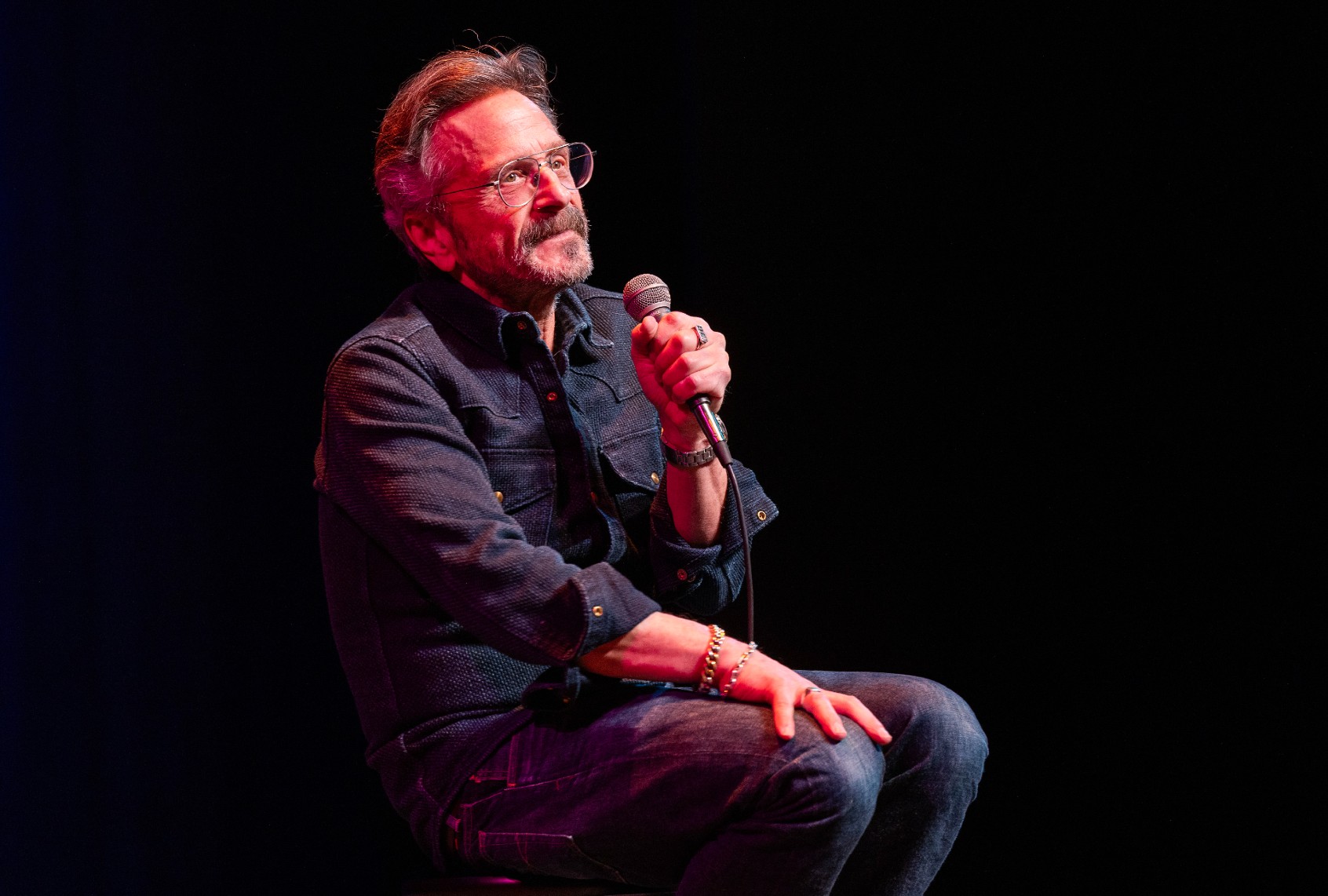
Marc Maron performs his "All In" tour at the North Shore Center For The Performing Arts on March 28, 2025, in Skokie, Illinois (Barry Brecheisen/Getty Images)

In September 2009, Maron's career was at its nadir. But so was the country. "WTF with Marc Maron" launched as the great financial recession was beginning to lift. Since that headline hadn't done much to pull us out of our collective depression, maybe Maron was the right guy to meet us where we were.  

His first "WTF" guest was fellow comic Jeff Ross. Soon his Highland Park place became a destination for actors, directors, producers and rock stars. Bridget Everett, Ryan Coogler, Ariana Grande, Delroy Lindo and Carrie Coon are among his recent guests.

"WTF with Marc Maron" launched as the great financial recession was beginning to lift. Since that headline hadn't done much to pull us out of our collective depression, maybe Maron was the right guy to meet us where we were.

In 2015, Maron sat down with Chris Hayes on MSNBC's “All In,” where he revealed his secret for getting the most guarded of personalities to lower their defenses. “If you listen to the first 100 or so ‘WTF’s, it's really a thinly veiled effort for me to get emotional help from celebrities,” Maron said half-jokingly. “. . . I don't feel that I interview people. I feel that I need to connect in conversation and emotionally. I'm very adept at becoming co-dependent within seconds.”

That tendency makes his listeners feel like visitors to some exclusive space, where guests say things they wouldn't reveal to a regular interviewer. “WTF” is where Obama candidly shared his experiences with racism. Comedian Todd Glass came out during his interview. And in 2010, Robin Williams confessed his thoughts of suicide four years before he tragically saw those dark fantasies to their end.

That episode was eventually inducted into the Library of Congress’ National Recording Registry. "‘WTF with Marc Maron’s' popularity has helped to legitimize the podcast as a media format and created an idiosyncratic document of this moment of American culture,” reads the accompanying text.

We need your help to stay independent

Maron fosters that sincerity by applying it to himself. The top of every “WTF” episode is his emotional check-in time, where he sometimes rails against the rancid politics of any moment but usually shares some flash of perceptivity. 

“WTF" is both quintessentially him and an entity of singular significance. It was never designed as the left-leaning answer to anything.

A segment in a late October 2024 episode exemplifies this. In it, Maron shares his recollection of Sharon Stone encouraging him to connect to his loving memories of his late partner, Lynn Shelton. But his praising Stone’s generous sensitivity serves another purpose, letting his listeners know he’s appearing in a film with Stone by describing a scene requiring him to cry.

Maron is similarly effusive about Owen Wilson, with whom he co-stars in Apple TV+’s “Stick," now streaming. Maron plays Mitts, the former caddy and current grifting partner to Wilson’s old pro Pryce Cahill, a washed-up golf pro who finds a late-in-life second wind by discovering a young prodigy.

Marc Maron in "Stick" (Apple TV+)

Mitts’ personality is reminiscent of Sam Sylvia, Maron’s lovable grump of a director on Netflix’s wrestling dramedy “GLOW.” But then, Sam is only a bit removed from who we know Maron to be through “WTF” and “Maron,” his IFC comedy in which he played a fictionalized version of himself.

“WTF,” however, is both quintessentially him and an entity of singular significance. It was never designed as the left-leaning answer to anything – not AM talk radio and certainly not to “The Joe Rogan Experience,” partly because their ascension routes wildly differ.

Before “WTF,” Maron earned more respect from his more prominent peers than the industry.

Rogan’s podcast, which launched months after “WTF” debuted, benefited from Rogan’s higher profile as the host of NBC’s “Fear Factor” and as an Ultimate Fighting Championship commentator. He’s always taken an opposing approach from Maron, purveying raunch instead of raw honesty, channeling swagger, shock and dismissiveness as opposed to connection and intimacy. That direction, regrettably, is more attuned to our times.


Start your day with essential news from Salon. Sign up for our free morning newsletter, Crash Course.


Although the recent race for the presidency has been dubbed the podcast election, “WTF” wasn’t mentioned in that conversation.

I doubt Maron would have wanted to be. Except for the times he used his platform to say what few of his peers would about comedy’s role in enabling fascism or the overturning of Roe v. Wade, he’s intentionally shied away from making “WTF” political.

That would go against what the show sought to be from the start, which is a refuge, however temporary, from the world’s anger and confusion. In ending “WTF” now, Maron leaves the medium with one less progressive, empathetic voice. Considering his reasons for starting it, though, we can understand why he’s ready to let go of the podcast.

“WTF” might be shutting down this fall, as Maron said Monday, but his fans won’t have seen the last of him by a mile. In addition to “Stick,” he also has a new HBO comedy special on the way. Next week, a documentary about him titled “Are We Good?” debuts at the Tribeca Film Festival.

“It’s OK for things to end,” Maron assured us. “. . . Let’s just enjoy it. The world is on fire . . . We’ll find a little joy, we’ll find a little connection, we’ll find a little solace in each other’s company. We’ll learn some things. We’ll get some laughs. We’ll cry a little bit. And we'll move on.”

“What it means to be a partisan centrist”: At WelcomeFest, a billionaire-backed vision for Democrats

Centrist Democrats are trying to replicate the movement politics that drive the progressive wing of the party, but it’s not clear that the party’s moderates — boosted by billionaire donors — can build the same sort of grassroots support that has driven more left-wing campaigns.

A political consultant and co-founder of the Welcome Party, Lauren Harper Pope, told Salon that “WelcomeFest,” kicking off Wednesday in Washington, D.C., is the “largest public gathering of centrist Democrats.” The goal, she said, is to seek “advice from Democrats who overperformed this cycle” and discuss "what it means to be a partisan centrist."

“We respect the very robust and multifaceted effort on the progressive faction of the party over the last few years. They had a lot of clear coherency behind it, and there was a lot of action,” Harper Pope told Salon. “We are essentially just trying to emulate that faction of the party.”

The 2025 event, the theme of which is “responsibility to win,” features elected Democrats such as Sen. Elissa Slotkin, D-Mich., Rep. Jake Auchincloss, D-Mass., and Rep. Marie Gluesenkamp Perez, D-Wash. 

The event also includes some notable figures from the party, like Adam Jentleson, Sen. John Fetterman’s, D-Penn., former chief of staff; Derek Thompson, a columnist at The Atlantic and co-author of “Abundance”; and Matt Yglesias, proprietor of “Slow Boring” on Substack.

Harper Pope described the Welcome Party and an associated PAC as an attempt to organize and support centrists in the Democratic Party, mirroring efforts by those on the more left-leaning side of the party.

We need your help to stay independent

In terms of strategy, Harper Pope described a formation similar to that of the Justice Democrats, except instead of supporting progressives, the Welcome Party would support centrists. And, instead of putting up primary challengers against incumbents in deep blue districts, the Welcome Party would support candidates in purple districts where they think a more liberal candidate, who might prevail in a Democratic primary, would be at a disadvantage in a general election and might also be a mismatch for the district.

Another key point of comparison is the funding behind the groups. While the Justice Democrats PAC received over 25,000 donations in 2024, a cycle when they were not even supporting new candidates, the Welcome PAC received just a few hundred.


Start your day with essential news from Salon. Sign up for our free morning newsletter, Crash Course.


The bulk of the PAC’s money came from a handful of donors with familiar names, like James Murdoch, the liberal-leaning son of billionaire media mogul Rupert Murdoch. Combined, James Murdoch and his wife, Kathryn Murdoch, donated $2.5 million to the Welcome PAC in 2024, according to FEC filings.

Reid Hoffman, the billionaire LinkedIn founder and critic of former Federal Trade Commission Chair Lina Khan, donated $671,000 to Welcome PAC in 2024.

Samuel Walton, the grandson of Walmart founder Samuel Walton, donated $825,000 to Welcome PAC.

Joshua Bekenstein, a co-chairman of Bain Capital, alongside his wife, Anita Bekenstein, donated a collective $375,000.

Harper Pope said the goal, shared by centrist think tanks like Third Way, is to win by meeting voters where they are. A recent Gallup poll found that 45% of Democrats and Democratic-leaning moderates want the party to move toward the center.

“We want to be representative of the party overall, and I think the majority of those voters are people who are less progressive,” Harper Pope told Salon. “If the centrist faction of the Democratic party can be strong, robust and vibrant, it can help us not only win more elections but also help us have the liberal democracy we aspire to.”

Elon Musk versus MAGA: Republicans have reached a tipping point

I had the weird experience last evening of watching the new film "Mountainhead," written and directed by Jesse Armstrong, the creator of the iconic HBO series "Succession," while simultaneously doom-scrolling social media. The premise of the movie is that the four horsemen of the apocalypse, in the guise of four tech billionaires, gather at a $50 million mountain castle to play poker while the world literally burns due to the richest one's release of a new AI program that allows undetectable deepfakes and disinformation. (It's not hard to figure out who his character is based on.)

As I was watching and scrolling, like the card-carrying internet addict I am, imagine how startling it was to come across this headline from Time: "Google’s new AI tool generates convincing deepfakes of riots, conflict, and election fraud—sparking fears about AI’s role in misinformation"

Life imitating art in the creepiest way possible. Just as creepy was the movie's dialogue that sounded almost verbatim like the kind of techno-utopian, puerile sci-fi, billionaire geek speak we hear from the world's richest man, who recently told Fox News that he plans to go to Mars (and die there), because, “Eventually, all life on Earth will be destroyed by the sun. The sun is gradually expanding, and so we do at some point need to be a multiplanet civilization because Earth will be incinerated.”

I think we have more immediate planetary survival issues than the sun exploding, but he's the big billionaire genius, so what do I know? Having just read the latest in-depth interview with Silicon Valley guru Curtis Yarvin in the New Yorker, I felt a little bit off balance watching this "Mountainhead" broligarch fan-fic satire because it's obviously not a total fantasy. Such people exist in real life, and they are exerting a lot of influence on our society and politics.

They're not, however, omnipotent. And to the extent they are visionaries, it is probably more limited in scope than we might think.

Musk's SpaceX is going into space, and that's notable (despite his recent failures), but let's be clear, his accomplishment is doing it as a private company. It's all been done before by the U.S. government. He didn't invent electric cars, he just created one that has bells and whistles people like. (His Cybertruck, designed wholly by him to his own tastes, is a dud.) His Neuralink company is creating implantable brain–computer interfacesbut it isn't the only one. (His long-term plan is to bring about "transhumanism," which was inspired by a series of sci-fi novels.) Musk's Boring Company, created to build tunnels to relieve traffic in urban areas, has accomplished almost nothing. His satellite company, Starlink, has been very successful, although lately they've been falling out of the sky. And then there's the social media site X, formerly known as Twitter, which Musk bought and turned into a free-for-all, which clearly influenced the creation of the Musk character and his dystopian website in "Mountainhead."

Musk is a very successful entrepreneur, obviously. His fortune alone attests to that. And some of his companies are truly visionary, even if he isn't the only one to have had that particular vision. However, what we've seen recently with his foray into government is a good example of the Dunning-Kruger effect: a cognitive bias in which people with limited competence in a particular domain overestimate their general abilities.

It's tempting to think that the truly perfect example is Donald Trump, but it doesn't quite fit. Trump's only talent lies in one domain — self-promotion. That leads him to lie about his talents in other areas. I don't think he actually cares if he has any competence in them because he is content with simply saying it and convincing others that it's true. Musk actually believes that he is a genius who can do anything. But as we've seen with his experience in government and politics, he is not.

We need your help to stay independent

He used to be a pretty standard-issue liberal from Silicon Valley. But Musk began to drift right as he became more and more red-pilled on Twitter, where he quickly went down the rabbit hole of conspiracy theories like "The Great Replacement." It's clear that he hasn't read much about history, philosophy or politics and developed his political worldview in an online intellectual silo, like so many other people who are temperamentally drawn to the right. He bought the platform so he could remake it in his image, thinking that would automatically make it even more successful. That was not to be. It's still functional and has many users, but it's no longer what it was.

Musk destroyed his reputation and the reputation of his companies, losing a lot of money and prestige. Now that he's backed off, the White House is back-stabbing him ruthlessly.

Musk enjoyed holding court on his website, and it stands to reason that all the adulation he got there and elsewhere (as anyone with his kind of money always gets) gave rise to the belief that he's a genius at everything he touches. So he got involved in politics and we've all watched him go from eccentric curiosity to big-time donor to campaigner and then government reformer. I think we can safely say that he was unsuccessful at all but the donor part and even that eventually led to diminishing returns.

Trump gave Musk some questionable credit ("he knows those vote-counting computers") for his win in Pennsylvania, where Musk parked himself in the last month and gave away $1 million checks to voters. He came to believe he'd invented a strategy that could guarantee a win for any Republican he chose to back and a lot of people in politics agreed with him. But when he tried to replicate it in the recent Wisconsin Supreme Court race, Musk spent over $100 million and put himself out on the campaign trail, only to suffer a humiliating defeat. It turns out that he doesn't know as much about political campaigning as he thought he did. And money can't buy you love.


Start your day with essential news from Salon.
Sign up for our free morning newsletter, Crash Course.


And then there was DOGE, the department he talked Trump into letting him have to slash at least $1 trillion, which he promised to do without even breaking a sweat. After all, when he buys a company, he immediately sets out to save money by firing massive numbers of people and dismantling entire departments and only replaces them if he later finds out it's necessary. Naturally, he believed a genius strategy like that could easily be done in the federal government. He ended up accomplishing very little except causing chaos, creating pain and, in the case of putting USAID "into the wood-chipper," ending the lives of potentially hundreds of thousands of people around the world.

In the process, he destroyed his reputation and that of his companies, losing a lot of money and prestige. Now that he's backed off, the White House is back-stabbing him ruthlessly, passing on gossip about his drug use and personal life, necessitating that he go on a sad-sack media tour to restore his image, which isn't working. And now he seems to be going to war with the White House over the GOP budget bill, which he calls "abominable," telling anyone who voted for it they should be ashamed. That means he's referring to all but two Republican House members.

He's fallen a long way from the pedestal he was on as the ungodly wealthy, visionary genius who was going to save mankind with his prescient techno-utopian imagination. Now he just seems like another Republican whiner lamenting that nobody understands him anymore.

All the broligarchs like Musk think AI is going to make the world over in their image. It is to be fervently hoped that what they are creating is better than they are, because they really aren't very good at anything but technology. And technology isn't everything. 

CORRECTION: An earlier version of this article gave the wrong first name for "Mountainhead" writer and director Jesse Armstrong. The story has been corrected. 

Trump’s judicial nominees are key to the far right’s crusade against our courts

Less than 200 days into Trump 2.0, amid an unrelenting wave of scandals, it’s easy to forget his first term. But we are still feeling its shockwaves every day through the lasting impact of his judicial appointments. We’re reminded again this week of the importance of judges with the Senate Judiciary Committee’s consideration of Trump’s first group of judicial nominees in this second term.

Talk about the Trump administration’s unprecedented assault on our fundamental freedoms has revolved around the breathtaking corruption and flouting of our law being committed in plain sight, including fancy dinners for foreign interests who buy Trump’s cryptocurrency, a $400 million flying bribe from Qatar, and abusive immigration enforcement tactics that include snatching a college student off the street with no due process.

Trump’s allies have promised that his second-term nominees will be even more extreme than the first. 

But the people who are likely to have the most lasting impact on our lives and future are those Trump has nominated to serve lifetime appointments on the federal bench. If confirmed, these nominees would be expected to not only look the other way as the building blocks of America’s democracy are gutted, but to pave the way for Trump’s radical agenda — gutting reproductive freedoms and allowing the administration to take health care away from millions. 

This isn’t hyperbole. Just look at the records of the first slate he nominated. Many of them have histories of defending anti-choice legislation and other radical policies championed by Trump and his MAGA allies in Congress. 

Whitney Hermandorfer, Trump’s nominee to the U.S. Court of Appeals for the Sixth Circuit, has a history of arguing for extreme positions in court, including defending abortion bans that even lack exceptions for rape and incest. 

Josh Divine, Trump’s nominee to the U.S. District Court for the Eastern District of Missouri and the Western District of Missouri, is Missouri’s Solicitor General and has tried to undo the FDA’s approval of mifepristone and neutralize the results of Missouri’s voter-approved Amendment 3, which overturned the state’s abortion ban. New reporting also revealed that in a 2010 opinion piece, Divine called for literacy tests for voters despite the racially discriminatory practice being banned in the 1960s. 

Some of the nominees in this first slate have also supported Trump’s attack on birthright citizenship, which has been widely viewed as unconstitutional. And in true loyalist fashion, one worked to defend Trump by seeking to interfere in New York’s attempt to hold Trump accountable for state crimes.

To understand the current environment we must remember how we got here. The far-right’s weaponization of the judiciary started long before Trump took office and paved the way for him to install 234 lifetime appointees to the federal courts, including one-third of the Supreme Court, during his first term. 

The results have been catastrophic. 

The Supreme Court has stripped away women’s rights and emboldened Trump to evade accountability. In the lower courts, judges dangerously distort legal standards to arrive at certain policy outcomes while others repeatedly appeared to put personal loyalty to Trump above the rule of law. 

We need your help to stay independent

This is what the far-right wants: a judiciary that functions as another arm of the MAGA movement. And Trump’s allies have promised that his second-term nominees will be even more extreme than the first. 

Given what we are seeing out of the administration, there is no acceptable reason for Senate Democrats to assist their Republican colleagues in pushing through Trump’s judicial nominees. The desire for compromise is human and, in many cases, necessary. But this is not the time to capitulate. Anyone who believes in our democracy cannot just cast a vote and hope for the best. Doing so would lend a dangerous legitimacy to the corrosive behavior of the administration and its supporters when it comes to the rule of law.

Recently, some Senate Democrats have voiced regret for supporting Trump’s cabinet nominees, including those who were seen as mainstream picks before going full MAGA once confirmed. Senators should not set themselves up for the same feelings of shame in voting for those who Trump nominates for lifetime appointments. 

We at Demand Justice will be tracking every vote, and calling attention to every nominee set to bolster far-right interests from the bench. America deserves better than judges gutting healthcare, endangering our kids’ schools, and rolling back our rights. America deserves better than judges serving the whims of the President. 

There is far too much at stake to support this administration’s crusade to endlessly expand its own power and assert it over the courts.

Joni Ernst’s “we’re all going to die” pushes MAGA’s toxic Christian compassion on us all

Sen. Joni Ernst, R-Iowa, certainly has absorbed the first rule of MAGA: You're never in the wrong as long as you're "triggering" the liberals. On Friday, she drew outrage from her constituents at a town hall in Butler County, Iowa, with her bizarre defense of taking away people's medical care to pay for tax cuts for billionaires: "Well, we’re all going to die." The crowd, furious about her plans to vote for drastic cuts to Medicaid that will deprive millions of health care, booed her. Ernst, having absorbed Donald Trump's philosophy of always doubling down, responded on Saturday with a favorite lady MAGA trick: pretending to be stupid. 

"I made an incorrect assumption that everyone in the auditorium understood that, yes, we are all going to perish from this earth," she sneered while walking in a cemetery. "So I apologize, and I’m really, really glad that I did not have to bring up the subject of the tooth fairy as well."

Ernst may play the mean bimbo for the camera, but she is aware that people aren't asking to live forever. They just don't want to die decades before their time, due to a lack of basic health care. But while most of the media focused on her act, her follow-up spin was, if anything, even more callous. She invoked Jesus Christ as the reason it's okay to let people die from easily preventable causes. "But for those that would like to see eternal and everlasting life, I encourage you to embrace my lord and savior, Jesus Christ," she smugly declared. 


Want more Amanda Marcotte on politics? Sign up for her free newsletter, Standing Room Only.


To those whose understanding of Christianity is based on compassion and love, this comment was jarring. But Ernst understands the second rule of MAGA: their version of Christian "love" is cruelty. When Ernst was asked again about her comments by a CBS News reporter on Monday, she snapped. "I'm very compassionate," she barked while running for an elevator. 

Reporter: “Would you like to clarify your comments?” Joni Ernst: “I’m very compassionate.” In a Carella Deville sort of way…

[image or embed]

— Christopher Webb (@cwebbonline.com) June 2, 2025 at 10:28 PM

Sarah Longwell of The Bulwark speculated on MSNBC that Ernst "must be having a nervous breakdown." That's doubtful, as Ernst drove to the cemetery, recorded herself, and likely had a younger staffer edit and post the video to Instagram. This was a deliberate choice, which makes more sense in light of the larger trend in white evangelical circles to redefine empathy as a "sin" and insist that unfeelingness is a higher form of compassion. As David French explained in the New York Times:

At the same time, hard-right Christians began to turn against the very idea of empathy. Last year a popular right-wing podcaster, Allie Beth Stuckey, published a best-selling book called “Toxic Empathy: How Progressives Exploit Christian Compassion.” This month, a right-wing theologian, Joe Rigney, is publishing a book called “The Sin of Empathy: Compassion and Its Counterfeits.”

These Christians claim that true compassion comes from rejecting empathy, arguing that empathy gets in the way of speaking what they believe are "hard truths" they need to browbeat alleged sinners with. This is how the conservative Christian convinces himself it's love to deny LGBTQ people their freedom, because compelling heterosexuality will get them into heaven. Or to believe it's compassion to scream invective at a woman entering an abortion clinic, which gets reimagined as "counseling" the women to stop sinning. 

Ernst understands the second rule of MAGA: their version of Christian "love" is cruelty.

These are the rationalizations of people who want to hate while denying they are hateful. Ernst's behavior also shows how it can be used to justify opposition to Republican hostility towards Jesus' call to care for the poor and the disabled, especially if doing so means a slightly higher tax rate for the wealthy. Holly Berkley Fletcher, the author of the upcoming book "The Missionary Kids: Unmasking the Myths of White Evangelicalism," explained this in her Monday newsletter. Evangelicals tell themselves they "prioritize saving souls for eternity over helping bodies in the here and now," she wrote. In reality, of course, it's a way "to avoid responsibility and reform and to serve their own interests."

Ernst's implication that people should welcome suffering and death has a long and ignoble history. Fletcher notes slave owners used this message to bully enslaved people in the 19th century. In recent years, the idea was revived due to the COVID-19 pandemic as a way to justify Republican opposition to life-saving measures like social distancing, masks, and eventually, vaccination. By October 2020, Tucker Carlson of Fox News was sounding this message, declaring, "At some point we are all going to die. Dying is the central fact of life," and suggesting that was reason enough to pull back all public health measures. 

We need your help to stay independent

It was a message that got a huge boost from evangelicals, especially pastors at megachurches who didn't want to put church services online, depriving them of the adulation of the adoring crowd. Rev. Tony Spell of Louisiana drew headlines in early 2020 by declaring, "True Christians do not mind dying." Caleb Mathis, pastor at the enormous Crossroads Church of Ohio, wrote at the time, "I hope it's the end of the world," because he believes heaven "sounds pretty freakin’ amazing." Even after the vaccine, Joy Pullman of The Federalist wrote an article titled, "For Christians, Dying From COVID (Or Anything Else) Is A Good Thing." In it, she argued, "There is nothing we can do to make our days on earth one second longer or shorter," and also "death is good."

None of these folks live by their own pro-death rules, of course. They see a doctor or take other measures to protect their health. It's only when they're asked to help others, whether through vaccination or paying slightly more in taxes, that they find this duty in others to welcome death with a smile. But this is worse than the usual Republican hypocrisy. It also reflects the increasingly Christian nationalist bent of the GOP. They are explicitly arguing that everyone else has to live by their fundamentalist religious belief that death is good. You may be an atheist, a non-Christian, or a more liberal Christian who believes in healing the sick. Too bad for you. In the MAGA view, we're all members of their fanatical death cult, whether we like it or not. 

The good news is that Ernst's shut-up-and-die ideology is not popular, even with a lot of people who consider themselves conservative Christians. On Monday, Democratic state Rep. J.D. Scholten announced that he's challenging Ernst in the 2026 election. Scholten told the Des Moines Register, "When she doubled down on Saturday with her, I felt, very disrespectful comments, I was like, 'OK, game on.'" It's a long shot in a deep-red state, but Scholten has some advantages, including being the pitcher for the Sioux City Explorers. He also has a long history of advocating for universal health care, drawing a contrast with Ernst's nihilistic views. Iowa is considered conservative, but its voting population has a significantly higher percentage of elderly individuals compared to the rest of the country. They may be especially hostile to Ernst's suck-it-up-and-die message. 

Petty, abusive — and popular: Why New York Democrats are afraid to speak out against Andrew Cuomo

Democrats who were once vocal critics of former New York Gov. Andrew Cuomo are sitting on the sidelines of the New York mayoral primary, and insiders think it’s because Cuomo’s victory appears inevitable. At the same time, critics argue that they’re letting Cuomo off the hook.

Democrats who vocally criticized Cuomo in the past, like Gov. Kathy Hochul and Sen. Kirsten Gillibrand, D-N.Y., have declined to remind the public why they called on Cuomo to step down. Hochul called the allegations of sexual harassment against Cuomo “repulsive” in 2021 and now says that she’ll “deal with whatever the voters decide to deal with.” Gillibrand, who called the allegations against Cuomo “serious and deeply concerning,” now compliments Cuomo, saying that “He has a lot of talent as an executive.”

Rep. Ritchie Torres, D-N.Y., called for Cuomo’s resignation in 2021, issuing a joint statement with other New York Democrats saying, “It is clear that he engaged in inappropriate, unlawful and abusive behavior.” He has since endorsed the former governor in the mayoral primary, saying “we need not a nice guy, but a tough guy like Andrew Cuomo.” 

Gillibrand's office responded to a request for comment from Salon by referencing comments the senator made in an appearance on WNYC, when she said: "The question being asked today is what's my opinion about someone after they've resigned, after they've taken the penalty that I called on them to take? Do they have any say from you one way or the other? And my answer to that is everyone gets to decide in this election who they want to vote for. It's up to New Yorkers. It is not up to me. And that's it."

Hochul's office did not respond to a request for comment.

Former New York Gov. David Paterson, who immediately preceded Cuomo as the state’s chief executive, told Salon that elected Democrats coming out against Cuomo at this stage of the race probably won’t matter. Given many Democrats’ unpopularity in New York, he argued that criticism might even help Cuomo in the primary.

Paterson said that the bigger question in his mind is why haven’t voters in New York City “taken him to task.”

“I'm not advocating that they should, I’m just wondering why they haven’t done that," Paterson said. "Somebody has a commercial: ‘Andrew Cuomo spent $60 million of your money defending himself against allegations.’ Now that's a pretty significant amount of money, and it's a pretty significant amount of money and it's to review someone now running for office, and the public paid for all his legal bills. That's an interesting subject, but it doesn't seem to matter."

In Paterson’s view, Cuomo is almost certain to win the New York City mayoral primary, which discourages elected Democrats who have spoken out against Cuomo in the past from doing so again.

New York state Sen. Gustavo Rivera, a Bronx Democrat, was first elected in 2010, the same year Cuomo was elected governor. He said that Cuomo’s personal and political style helps explain Democrats’ reluctance to speak out.

“He was vengeful and petty, and certainly politically popular and politically powerful,” Rivera said. “He's somebody who's been an abusive bully, who only cares about himself, how people perceive him, and how people view him, and he does not particularly care about well-being, regardless of what he says. His actions say something different.”

Rivera said that Cuomo has held a grudge against him because of his outspoken criticism of him, alleging that the former governor even moved an early COVID vaccine distribution site from his district because it was the district he represented. Cuomo has denied the allegation.

“For the sake of a political slap on my face, because I was one of the only people who stood up to him publicly, he made the decision to put it someplace else and that means that there’s people in my district who died because they did not have early enough access to the vaccine, based on a political decision that he made to be some sort of payback,” Rivera said.

We need your help to stay independent

Jasmine Gripper, co-director of the New York Working Families Party, told Salon that there is deep irony in Cuomo promising to fix the city’s problems as a mayoral candidate, because many of the city’s problems stem from Cuomo’s time as governor. The Working Families Party previously endorsed Cuomo in the 2018 New York gubernatorial general election, even after backing activist Cynthia Nixon in the Democratic primary and criticizing Cuomo as a corporate Democrat. The endorsement, however, came after Nixon declined to run on the Working Families Party line in the general election.

The party, which had to receive 50,000 votes in November or else lose its party line, ultimately decided to endorse Cuomo at the last minute. It is not likely to ever do so again.

“New York City lost hundreds of mental health beds while Andrew Cuomo was governor. He is the reason why our mental health infrastructure in the city was decimated and, as a result, we see the people in our streets with nowhere to go, and the people experiencing homelessness — that is Andrew Cuomo,” Gripper said. “The reason why our subways are delayed and flooding, and not up to date, is because of Andrew Cuomo.”

Gripper pointed to Cuomo’s record working with Republicans in the state Senate to sideline Democrats in the upper chamber as another topic that deserves to be discussed in the mayor's race. Gripper said that, working with the IDC, Cuomo was able to sideline priorities for many New Yorkers, like investments in transit, public edcation, healthcare and housing, while simultaneously raiding the MTA budget and cutting funding for schools.

"Andrew Cuomo helped orchestrate a coup where a group of Democrats decided to conference with Republicans, and so Republicans, plus what they call the IDC, the Independent Democratic Conference, gave Republicans control of our state Senate and that structure existed for many years,” Gripper said. “He was holding the line for the wealthy, for the billionaires, for the developers, and at the expense of everyday working people. And he really was holding the line against New York City and not adequately funding the city the way he should have been.”

Rich Azzopardi, a spokesman for Cuomo, told Salon that Cuomo had nothing to do with the formation of the IDC. Politico has, however, reported as far back as 2014 that, while the IDC was not the governor's idea, Cuomo and top aides made it "very clear they wanted the IDC to work with Republicans to run the Senate."

In response to Gipper's statements, Azzopardi said, "Those are empty advocate talking points with no relation to reality." He said that the mental health care beds that were cut were non-forensic beds, set aside for people who are not considered dangerous and who are not involved in the criminal legal system; he added that the cut beds had been unoccupied for six months.

Responding to Gripper's other criticisms, Azzopardi said that Cuomo oversaw an increase in operational funding for the MTA by $2.4 billion annually and a $54.8 billion Capital Plan, which represented the largest investment in the authority's history. He also claimed that Cuomo's administration never cut school funding.  

Susan Kang, a professor of political science at John Jay College who has written extensively on New York under Cuomo and the IDC, told Salon that this sort of maneuvering to prevent a Democratic-controlled legislature was typical of Cuomo during his time as governor.

Kang also referenced the post-2010 Census redistricting process, in which Cuomo signed off on maps drawn by the state legislature, with the then Republican-controlled state Senate proposing legislative districts designed to help them retain control of the chamber. The same deal allowed Assembly Democrats to draw maps that helped protect their incumbents.

The maps Cuomo signed off on carefully underrepresented voters in New York City by packing more voters into the city's state Senate districts compared to upstate, Republican-dominated districts. When Cuomo was sued over the issue, the U.S. District Court for the Eastern District of New York found that population distortion across the state Senate districts had fallen just within the legal limit courts have allowed under the 14th Amendment. 

In practical terms, this means that, despite campaigning on independent redistricting, Cuomo signed off on a carefully-calculated maximal gerrymander designed to reduce the power of New York City's largely Democratic voters and help Republicans maintain control of the state Senate. Thirteen years later, Cuomo is running for mayor of New York City, pitching himself as the candidate who will stand up against a Republican administration in Washington.

Kang said that, politically speaking, having a Republican-controlled state Senate was useful for the former governor because it meant “he got to control the spigot of changes coming out of Albany.”

“I think he wants to present himself as sort of like a bipartisan compromise-maker in a state where you don't have to do that,” Kang said. “But he wouldn’t have to do that, if he hadn’t propped up this artificial division."

While the exact effects on what legislation made it into law are hard to quantify and still debated, critics blame the conference for blocking major legislation on ethics in government, reproductive health care and health care more broadly, voting rights, climate change and even earlier versions of the Child Victims Act, which extended the period that victims of child sexual assault have to bring civil cases.


Start your day with essential news from Salon. Sign up for our free morning newsletter, Crash Course.


On the topic of redistricting, Azzopardi pointed to the passage of New York's independent redistricting amendment, which was passed during Cuomo's tenure.

Other critics have highlighted Cuomo’s handling of COVID as an area ripe for scrutiny, especially his handling of nursing homes during the crisis, which has received renewed interest given the Justice Department’s investigation into his congressional testimony on the topic

Denis Nash, a professor of epidemiology at the City University of New York, told Salon that the full impact of Cuomo's COVID-era policy of discharging recovering COVID patients into nursing homes is unknown, but that it likely contributed to new infections in nursing homes. Nash also criticized the subsequent effort from the administration to undercount the number of deaths among nursing home residents by excluding residents who were infected in nursing homes but who died in hospitals from official tallies. A 2022 state audit conducted by the comptroller's office found that New York's health agency undercounted COVID-related deaths in nursing homes by at least 4,100.

“This greatly obscured the scale of the crisis. It also compromised the ability to learn from what happened in a very high-stakes situation. We can’t evaluate the effectiveness or harm of policies if our government officials and agencies are not transparent about the outcomes. New York eventually corrected the death count, but I think really only after external investigations forced its hand,” Nash said.

Paterson said that the nursing home fiasco and its subsequent cover-up point to one of Cuomo’s core political instincts: “Don’t ever admit to anything.”

“He just doesn't do it. Somewhere, he must have read a book that said, ‘Don’t ever admit to anything.’ And that has largely worked in his favor,” Paterson said. 

Cuomo has publicly admitted that there was a "delay" in the reporting of some nursing home-related deaths during the pandemic, though he has stopped short of apologizing for either the policy or the undercount. In congressional testimony in 2024, Cuomo said he did not review a State Health Department report on nursing home deaths, a statement that appears to be contradicted by emails between Cuomo's aides, according to the New York Times.

Azzopardi, Cuomo's spokesperson, told Salon that New York's nursing home policy was consistent with federal guidance and that the issue had been "weaponized and politicized for purely electoral purposes for years." Azzopardi referenced a report from the Department of Justice Office of the Inspector General, obtained by ABC News in early January of 2025, which found that DOJ officials were directed to "focus specifically on New Jersey and New York despite having been provided data indicating that the nursing homes with the most significant quality of care issues were in other states."

The same report found that in October of 2020, a Justice Department Office of Public Affairs official proposed a plan to leak information to the New York Post pertaining to information related to nursing home deaths in New York and New Jersey. That official texted another OPA official in mid-October 2020 that the leak would "be our last play on them before the election but it's a big one."

Paterson said that he’s advised Cuomo to reflect on his record, whether it be relating to the nursing home issue or his multiple sexual harassment scandals, and say, “If something such as this came up again, I’m pretty sure I would handle it differently.” In Paterson’s view, such reflection would open “the door for people to embrace your humanity.”

“And this is a conversation that he and I have had over the years. He agrees with me when we have the general conversation, but he never seems to adapt it. And I guess the reason that he's never adapted is that it's never actually come back to bite him,” Paterson said.

Editor's note: This piece was updated with additional comments from the Cuomo campaign.

“More problems than it was helping”: Behind the growing distrust of antidepressants

In 2017, Julie moved to Massachusetts to start a new job in biotech. She was maintaining her relationship with her partner long distance, and starting a new position in an unknown city alone had her distressed. Her psychologist and doctor recommended she start taking the antidepressant Prozac (fluoxetine) to feel better, and it helped her function — for a while.

Then years went by, and she started to develop other symptoms. Her insomnia got worse. She felt oddly detached from herself and she started to have thoughts about suicide that she had not had before. During this time, she was processing traumatic experiences from her childhood in therapy, but she felt like these symptoms were being exacerbated by Prozac. So in 2022, Julie started tapering off of her medication after talking with her primary care doctor.

“I just continued taking it, sort of without questioning,” Julie, who is using a pseudonym to protect her privacy, told Salon in a phone interview. “I came to believe that Prozac was causing more problems than it was helping.”

Antidepressants like Prozac were a major breakthrough in psychiatry when they were first marketed in the 1980s. However, their use has become so widespread in the U.S. that some argue they are now being overprescribed. In fact, an entire internet subculture has developed to help people get off of their antidepressants, which doctors warn can be dangerous if not performed under the medical supervision of a health care provider. 

In an executive order issued in February, President Donald Trump said the administration would “assess the prevalence of and threat posed by the prescription of selective serotonin reuptake inhibitors,” referring to SSRIs, a common class of antidepressants and other psychiatric medications. During his testimony at the Senate Finance Committee, secretary of the Department of Health and Human Services Robert F. Kennedy Jr. also said that antidepressants were harder to get off than heroin.

"At the same time we have people overtreated, we also have people who are untreated."

Antidepressants can be life-saving and life-enhancing for many people, but for most people with mild or moderate forms of depression they are not intended for long-term use. The drugs can also carry side effects that can significantly impact a person’s quality of life, including weight gain, sexual dysfunction and emotional blunting, in which people feel fewer positive emotions along with negative ones. While Kennedy is wrong — antidepressants are not harder to stop using than heroin — the withdrawal process can come with its own side effects as well, which some argue is an underrecognized problem.

“These are very individualized things,” said Dr. Mark Olfson, a psychiatrist at Columbia University. “There is no one-size-fits-all in terms of how people make trade offs between the burdens of staying on the medication versus the protection the medication offers some individuals.”

The most commonly used antidepressants today are SSRIs like Prozac, which came on the market in 1988. In the decades that followed, the prevalence of SSRI prescriptions continued to increase year over year to a climax in the pandemic when the proportion of the U.S. population taking antidepressants approached 25%. This more than tripled the proportion of people on them in 1990.

Depression has also increased over the years, or at least has been detected in more people. Yet the proportion of the population with depression remains lower than the proportion on antidepressants, in part because these medications are also commonly prescribed for other conditions like obsessive-compulsive disorder, eating disorders, insomnia and anxiety — which has also increased in the U.S. in recent decades.


Want more health and science stories in your inbox? Subscribe to Salon's weekly newsletter Lab Notes.


Still, some believe they are inappropriately prescribed for too long, or in cases when lifestyle changes or psychotherapy should be tried first. However, many people with depression and severe anxiety who could benefit with antidepressants are also not getting the help they need, Olfson said.

“I do think there was and maybe still is overprescription,” he told Salon in a phone interview. “But at the same time we have people overtreated, we also have people who are untreated.”

Although antidepressant use is still on the rise, a study Olfson co-authored last month found that, for the first time since these drugs were introduced, the use of psychotherapy increased at a higher rate than medication alone. This may in part be due to the increased availability of telehealth counseling, he explained.

“It's still the case that most people with depression or anxiety who receive treatment receive antidepressants, but in the last few years, a rising proportion of them are receiving psychotherapy and the growth of psychotherapy has occurred more quickly than the growth of antidepressants,” Olfson said. “This change is coming after years and years of medications just sort of dominating mental health care in America.”

However, psychotherapy remains steeped in stigma and inaccessible to many. This may be one reason that antidepressants are prescribed when other strategies could work as well. Sometimes a person’s only point of contact with a medical professional who could help them with depression is their family doctor, who could refer them to a psychologist. But if they are not available or too expensive, patients are left with few options other than antidepressants, explained Dr. Awais Aftab, a psychiatrist at Case Western Reserve University, who said we often end up using antidepressants “as a matter of structural convenience."

“However, if you look at the practice guidelines, they recommend that for mild to moderate depression, it is better to start with psychotherapy and lifestyle change and reserve antidepressants for cases of mild to moderate depression that are not getting better or those of more severe intensity,” Aftab told Salon in a phone interview.

Julie struggled to find an affordable psychiatrist in her area that could help guide her through the process of getting on antidepressants back in 2017. Her primary care doctor ended up overseeing her prescription, but once she got on Prozac, they didn’t really discuss it anymore, she said.

Aftab said this can happen often: “They just put people on antidepressants and then they kind of forget about it and it just keeps getting refilled,” he said. Then, the discussion about whether the medication is working or if they need to stay on it "doesn't really happen,” he explained.

However, the problem with staying on antidepressants longer than necessary is that withdrawal symptoms can be more difficult the longer you stay on them. If someone is stopping antidepressants, it's recommended to wean off them slowly and under medical supervision because doing so too quickly and without the right dosage can be dangerous. It can lead to side effects such as a symptom called "brain zap" in which patients feel sudden shocks in their head.

Depending on a range of factors including the dosage and medication, it can take months or more. Julie did it in eight weeks, but she experienced symptoms that were worse than the original depression she felt, she said.

“My biggest symptom after that was extreme anhedonia, like a feeling of not being myself or getting pleasure from anything — almost not feeling human,” she said. “Along with extreme physical fatigue, both of those symptoms lasted for about two years.”

"The evidence for the serotonin theory of depression was weak and inconsistent but the general public thought it wasn't just a theory."

Sometimes the withdrawal from antidepressants can be mistaken for the return of the original depression it was intended to treat. This could lead some people to go back on medication, if the feeling is so uncomfortable that being on the medication ends up providing relief, Aftab said.

Overall, there is relatively limited research exploring the right protocol to get off of antidepressants and how to avoid the symptoms of withdrawal, Aftab said. There is even still much debate about what causes depression in the first place. In 1967, an English psychiatrist named Alec Coppen proposed the “serotonin theory,” suggesting a chemical imbalance of serotonin in the brain caused depression.

In response, the pharmaceutical industry developed Prozac, the first SSRI. However, in the decades that followed, some questions were raised about the trials used to demonstrate the effectiveness of SSRIs. Around the same time, researchers started to question the serotonin theory that had been publicized as a potential cause of depression.

Joanna Moncrieff, a professor of critical and social psychiatry at University College London, co-authored a review in Nature in 2022 that concluded there was “no consistent evidence of there being an association between serotonin and depression.” 

“We can’t conclude that depression is related to serotonin abnormality,” Moncrieff told Salon in a phone interview. “The evidence for the serotonin theory of depression was weak and inconsistent but the general public thought it wasn't just a theory: They thought it was an established scientific fact.”

Moncrieff’s paper received significant backlash, with five responses published in the journal along with a comment authored by 35 academics that challenged Moncreiff’s findings.

It’s likely that the cause of depression is far more complex than something operating on a single neurotransmitter like serotonin, said Dr. Philip Cowen, a professor of psychopharmacology at the University of Oxford and one of the co-authors on the comment.

Nevertheless, that doesn't mean these drugs don't help people. For one, it's common for medications to not target the direct cause of illness. Instead, many are designed to alleviate symptoms and suffering, Cowen explained. For example, asthma inhalers activate receptors, which relax the airways to help facilitate breathing. This helps with asthma symptoms but does not treat the direct cause of asthma, which is ultimately an allergic reaction. A similar thing may be happening with antidepressants, Cowen said.

“[The serotonin theory] is a simplistic view and it can't be right,” Cowen told Salon in a phone interview. “Taking SSRIs might make you feel better for various psychological reasons, but it doesn't necessarily mean it's working on a fundamental problem with serotonin.”

Although these medicines are still not fully understood, the fact remains that antidepressants do help many people feel better. Yet the back and forth within the medical community about the efficacy of antidepressants and the cause of depression might be why some have grown to mistrust them. Other false claims in the media and some scientific papers have stated that antidepressants can be addictive like alcohol.

Add on misleading criticisms from the White House, and more people are likely to get off of them, said Dr. Rifaat El-Mallakh, a psychiatrist who leads the Mood Disorders Research Program at the University of Louisville Depression Center. 

“When you have your leaders saying things like, 'it's harder to get off an antidepressant than it is to get off heroin,' you say, ‘Oh my god, I better get off now before I'm stuck on this forever,’” El-Mallakh told Salon in a phone interview.

We need your help to stay independent

As distrust grows and it remains challenging for many people to access psychotherapy or medical treatment, many are seeking advice online. In fact, there is an entire subculture online where people talk about getting off of their psychiatric medications. 

While Julie did talk with her primary care doctor about getting off her medication, she felt there were more resources on the internet, she said. As she explained: “Most of the support I got through that process was just through online forums.”

Despite the difficulty of the withdrawal process, Julie has been tempted to go back on them again during challenging parts of her life. If she is ever in a place where she feels like her own safety is threatened by her mental health, she would consider it, she said. At the same time, she questions whether she actually needed them in the first place.

“I wish we had a different culture in the medical care community around recommending antidepressants,” she said. “If they were treated more as a last resort, then maybe I would have made a different choice.”

Nevertheless, Julie feels more stable these days and developed strategies in the process of the antidepressant withdrawal that help her move through challenging moments, she said. Some of her symptoms, like problems with her libido, have not fully recovered. But she has started exercising again and feels like her body is more responsive to lifestyle changes she implements.

“I think getting better is now a bit more under my control,” she said. “So there is potential for things to keep improving.”

“Six one-way tickets”: White House gloats after Boulder attack suspect’s family is detained by ICE

The family of the suspect in a recent attack on a march for Israeli hostages has been detained by U.S. Immigration and Customs Enforcement.

Mohamed Sabry Soliman, an Egyptian man, was arrested and charged with a federal hate crime and multiple state charges of attempted murder, assault, and possession of an incendiary device after he allegedly threw several Molotov cocktails into a crowd during a march in Boulder, Colorado, on Sunday. Soliman is being held on a $10 million bond.

Soliman's wife and five children had their visas revoked by the State Department following the attack, per DHS spokeswoman Tricia McLaughlin. They await processing for immediate removal. The detention of Soliman's family was celebrated by members of the Trump administration on Tuesday.

"This terrorist will be prosecuted to the fullest extent of the law. We are investigating to what extent his family knew about this heinous attack, if they had knowledge of it, or if they provided support to it," Department of Homeland Security Secretary Kristi Noem wrote on X. "I am continuing to pray for the victims of this attack and their families. Justice will be served."

The White House shared an image of Soliman's mugshot as well as a screenshot of video footage of a shirtless Soliman at the scene of the attack. 

"Six One-Way Tickets for Mohamed’s Wife and Five Kids. Final Boarding Call Coming Soon," they wrote on X.


Start your day with essential news from Salon. Sign up for our free morning newsletter, Crash Course.


Secretary of State Marco Rubio threatened similar actions against others in a post to social media on Monday. 

“In light of yesterday’s horrific attack, all terrorists, their family members, and terrorist sympathizers here on a visa should know that under the Trump Administration we will find you, revoke your visa, and deport you,” he wrote.

“Amen” at the end of the long day: Finding community and solace online after a layoff

When Melanie Ehrenkranz, the founder of the "Laid Off" Substack newsletter, launched her newsletter for unemployed workers in August 2024, she didn’t expect to create a vibrant, active community of over 11,000 readers in less than a year.

In addition to the newsletter, Ehrenkranz also runs a Discord community, which offers its members additional ways to connect, support each other and navigate the uncharted waters of unemployment during the second Trump term. This community is private for paid readers at the monthly fee of $5. 

While the particular kind of financial strain and psychological pressures that characterize unemployment have been around as long as there have been jobs, the scale of layoffs, the transformative nature of AI that is upending entire industries, stubborn inflation, economic uncertainty and new ways social media is connecting people again post-pandemic makes 2025 a unique time to be navigating the ever-shifting job market.

“This moment feels heavier,” Ehrenkranz told Salon. “People aren’t just getting laid off — they’re getting ghosted, strung along, maybe even experiencing their second or third or fifth layoff in their career.”

Magenta Fox, one of the members of the community Ehrenkranz created, has been laid off since 2023. Fox says this period of unemployment is “vastly different” from the other times she was looking for work, in 2009 and during 2016-2018.

“With this search, I’ve paid for resume rewrites and interview coaching— something I’ve never done at any point in my career,” Fox said. “And it seems like there’s no end in sight. At least with the Great Recession it seemed like there was an effort in Washington to try to make things better.”

We need your help to stay independent

This time around, Fox found her interactions with recruiters more cutthroat. 

“I’ve had recruiters no-show on calls and write rude emails— something I’ve never gotten from anyone, recruiter or no, in my professional life, ever,” she said.

The uptick in ghosting behavior from recruiters adds to the mental health toll job hunting can take.

“The psychological effect was really enormous,” said New York-based Dio Martins, who has been recently laid off and has just landed a new remote opportunity. 

Martins found networking and connecting with friends helpful in his job search.

“It’s incredible how helpful a little text message can be to someone, just reminding you that you’re not alone, and to keep trying things,” he said. 

As of late May 2025, U.S. employers cut nearly half a million jobs, which is a 93% jump compared to the same period last year. 

So far, 2025 has been a brutal year for US employees. Major U.S. employers like Chevron, JPMorgan Chase, Microsoft, Meta Platforms, Blue Origin, Estée Lauder, Kohl’s, Southwest Airlines, Walmart and Business Insider have announced major layoffs ranging from hundreds to thousands of jobs. 

"It’s incredible how helpful a little text message can be to someone, just reminding you that you’re not alone, and to keep trying things"

Inspired by communities like Rachel Karten's Link in Bio Discord and Julia Harrison's Saloon Substack, Ehrenkranz wanted to remove the stigma from being unemployed and create a nurturing environment for those looking to get back on their feet.

“I noticed a lot of readers were using the Substack Chat to share their stories and ask for advice, and so I wanted to create a space that had more layers to it for people experiencing job loss to connect,” Ehrenkranz said. “The intention behind the Discord, similar to the overall mission, is for people to feel less alone and to destigmatize layoffs. And also to have some fun and maybe make some friends.”

Over time, she noticed that members started using the Discord as a way to deal with the day-to-day pressures of job searching, both online and in person.

“I've seen people in the Discord share advice on how to post about their layoff on LinkedIn without it feeling cringe, how to wear their hair in a Zoom job interview, how to respond to a hiring manager that ghosted them after several rounds of interviews, and how to tweak their resume so it doesn't get trashed by ATS software,” she said. “I've also increasingly seen folks trying to meet up outside of the Discord, whether it's in a vent session on Google Meet or grabbing drinks during the week.”

Ultimately, the mental health break and human connection is what online communities like Laid Off offer its members: without the gloss or pretenses of traditional social media or the unproductive bureaucracy of an unemployment office.

"We exchange tips and share rejection stories. I feel like I can go there to vent without being seen as a bummer"

“In this economy, finding full-time employment is like finding a needle in a haystack,” said 25-year-old Niya Doyle, one of the people Ehrenkranz profiled for her newsletter. Doyle made a TikTok about how she was laid off, one of many who turned to social media to seek solace from others going through the same experience.

“I just saw a lot of my FYP even before I got laid off,” she said. “I guess it makes it feel like you're not alone. It's comforting.”

Whether it’s Substack comments, Reddit forums, Discord communities or TikTok posts detailing their layoff experiences, more job seekers are finding comfort in numbers on social media, making their isolating experience of a layoff a little bit more palatable. 

“They’re the co-workers I wish I had, in a way,” Fox said about the Laid Off community. “We exchange tips and share rejection stories. I feel like I can go there to vent without being seen as a bummer.” 

Correction: Magenta Fox entered the job market in 2009 and was employed from 2016 to 2018. A previous version of this story incorrectly stated that she was laid off during those years. 

“Shameful, vindictive erasure”: Hegseth orders removal of Harvey Milk’s name from Navy ship

Secretary of Defense Pete Hegseth has ordered the Navy to remove the name of gay rights icon and Navy veteran Harvey Milk from one of its ships.

Per a report from Military.com, the order was passed down in a memo from Navy Secretary John Phelan. The memo said that the redesignation of the oil tanker USNS Harvey Milk was an attempt to get into "alignment with president and SECDEF objectives and SECNAV priorities of reestablishing the warrior culture."

A defense official who spoke to the outlet said that the directive came from Hegseth, adding that the Pentagon had intentionally timed the announcement to coincide with the start of Pride Month. The renaming is expected to become official next week. 

Milk was the first openly gay man to hold elected office in the United States after winning a seat on the San Francisco Board of Supervisors in 1977. He was assassinated less than one year after assuming office. Milk was also a commissioned naval officer who served in the Korean War, and came from a family with a history of service in the branch.

Former House Speaker Nancy Pelosi, whose district contains much of San Francisco, called the decision "a shameful, vindictive erasure of those who fought to break down barriers for all to chase the American Dream."


Start your day with essential news from Salon. Sign up for our free morning newsletter, Crash Course.


"Our military is the most powerful in the world – but this spiteful move does not strengthen our national security or the 'warrior' ethos," she shared in a statement. "Instead, it is a surrender of a fundamental American value: to honor the legacy of those who worked to build a better country."

Hegseth has made the war against “wokeness” and the restoration of what he calls a “warrior ethos” central to his scandal-ridden tenure. This decision was reportedly framed as part of that effort. On Tuesday, CBS News reported that the Navy was looking into changing the names of other ships named after prominent civil rights leaders and icons, including Thurgood Marshall, Ruth Bader Ginsburg, Harriett Tubman, Cesar Chavez and Medgar Evers

“Disgusting abomination”: Elon Musk attacks “big, beautiful” spending bill

Just days after leaving his post in Donald Trump's administration, Elon Musk said that he isn't too happy about the president's favored spending bill. 

"I’m sorry, but I just can’t stand it anymore," Musk wrote in a post to X on Tuesday. "This massive, outrageous, pork-filled Congressional spending bill is a disgusting abomination. Shame on those who voted for it: you know you did wrong. You know it."

As head of the Trump-created Department of Government Efficiency, the tech billionaire wielded a literal chainsaw while orchestrating massive federal layoffs to cut costs. Less than a week after leaving the post, Musk lashed out at GOP legislators for racking up debt via the "One Big Beautiful Bill."

 "It will massively increase the already gigantic budget deficit to $2.5 trillion (!!!) and burden American citizens with crushingly unsustainable debt," he wrote.

According to an analysis by the Congressional Budget Office, the bill would reduce federal funding for SNAP and Medicaid by over $800 billion over the next decade while increasing the federal deficit by $3.8 trillion.


Start your day with essential news from Salon. Sign up for our free morning newsletter, Crash Course.


This isn’t the first time Musk has expressed his dissatisfaction with the bill. In an interview with CBS News last week, Musk said he was “disappointed” in the spending bill, which passed the House by a vote of 215-214.

"I think a bill can be big or it can be beautiful," Musk said, "but I don't know if it can be both."

On Tuesday, White House Press Secretary Karoline Leavitt told reporters that Musk’s criticism of the bill doesn’t change Trump’s opinion.

"The president already knows where Elon Musk stood on this bill," she said.

The bill has yet to pass the Senate, but one senior White House official told NPR it would be an “all-out advocacy effort” to get the bill through the upper chamber.

“Reckless disregard of facts”: Newark mayor sues Alina Habba, Trump lawyer turned prosecutor

Newark Mayor Ras Baraka has filed a lawsuit against Alina Habba, the interim U.S. attorney for New Jersey, after he was arrested last month for protesting at a new immigration detention center.

The lawsuit, filed Tuesday, accuses Habba of false arrest, malicious prosecution, and defamation and says that the attorney “acted as a political operative, outside of any function intimately related to the judicial process.” Habba previously worked as President Donald Trump’s personal attorney, including as part of his team in the E. Jean Carroll defamation case. 

Baraka’s suit argues that Habba has made her “biased political goals explicit,” including criticizing Democratic officeholders and saying she hopes to turn the state red, goals which the lawsuit says are “antithetical to her role and ethical obligations as a U.S. attorney.”

In addition, the lawsuit alleges that the U.S. attorney, acting in her personal capacity, made defamatory statements that “falsely accused Mayor Baraka of criminal conduct and misconduct, despite Habba’s actual knowledge and reckless disregard of facts demonstrating his innocence.”

At the time of his arrest, the Newark mayor was accused of trespassing and disregarding warnings that he would be arrested if he did not leave. He insisted he did nothing wrong and charges against him were dropped.

Baraka is currently running in the Democratic primary to replace term-limited Gov. Phil Murphy. In-person early voting begins today, with the primary election taking place next Tuesday.

“Unlawful, chaotic and reckless”: House Democrats condemn DHS harassment of Nadler aide

In a letter dated June 3, Reps. Jerrold Nadler, D-N.Y., and Jamie Raskin, D-Md., urged Republicans in the House Judiciary Committee to investigate the Department of Homeland Security after agents stormed Nadler’s congressional office and handcuffed one of his aides. 

Nadler and Raskin wrote that these “intimidation tactics are completely unwarranted and cannot be tolerated.” They go on to assert that the behavior is a part of a “broader pattern” of the Trump administration’s use of “unlawful, chaotic and reckless tactics.” 

According to the letter, DHS agents forcefully entered Nadler’s office on May 25. A video acquired by Gothamist shows DHS agents attempting to enter a non-public area of Nadler’s office, citing the need for a “security check”. A staffer can be heard asking the agent for a warrant, while the handcuffed aide is heard crying in the background. An agent can be heard telling the aide to “Stop resisting.”

The aide was later released and no charges were filed. 

In the letter, legislators wrote: “The decision to enter a congressional office and detain a congressional staff member demonstrates a deeply troubling disregard for proper legal boundaries.” 

Over the weekend, commenting on the incident, Nadler told The New York Times that the Trump administration is “behaving like fascists.”

Nadler and Raskin’s letter urges the chair of the House Judiciary Committee, Rep. Jim Jordan, R-Ohio, to condemn the actions and launch an investigation. It’s unclear how Jordan, a strong ally of the Trump administration, will respond. 

Hungrier kids, missed check-ups: Trump’s cuts to childcare make it a lot harder to be a parent

“People don't think about those parents,” Angelique Marshall, a Washington, D.C.-based at-home childcare provider, told Salon. Most of the parents the 56-year-old serves have children with disabilities and don't have much flexibility in their schedules. “They have to go to work to be able to take off when the children need surgery or they have a serious illness or impact on their life.”

Under the Trump administration, the nation’s pandemic-stressed child welfare system has taken a hit through temporary funding freezes, staffing cuts and Project 2025-aligned moves to weaken critical programs. The changes — some part of President Donald Trump’s effort to slash social spending — place a strain on the government’s distribution of funds and support for programs like Head Start and the Child Care and Development Fund, argued a group of U.S. senators in an April letter to Health and Human Services Secretary Robert F. Kennedy Jr. By the time those changes trickle down to providers like Marshall and the families she serves, the impacts feel much more like crashing waves.

That’s why Marshall counted herself — and her students — among the attendees of last month's "Day Without Child Care" action in Washington, D.C. Organizers had asked that parents call off work and providers close their doors to demonstrate how critical childcare is to the nation’s daily grind. But Marshall chose to keep the doors of her daycare, Ms. P’s Child and Family Services, open; her parents, she said in a video call, can’t afford to go without work for a day, even if it’s in protest. 

At Washington's Freedom Plaza, a makeshift field day took place, where children enjoyed free swag, food and activities. Meanwhile, parents and providers shared stories during a rally at the plaza while organizers with SPACEs in Action, a nonprofit advocacy organization, led visits with city council members to advocate for early childhood education funds. 

“Children and families with low-income wages, they won't get a quality start in education at all, and it's not because a child can't learn, it's because the underinvestment effect that they have [on] the overall potential,” Marshall said. “We're going to see a downslide if they don't get the help and support they need because you're talking about defunding them, but you're not talking about what you're going to do with them.”

The administration’s effort to cut some 10,000 jobs at the Department of Health and Family Services has resulted in a roughly 37.5% reduction in staff at the Administration for Children and Families, which oversees childcare and child welfare programs. Those layoffs included staff of the Office of Child Care and Office of Head Start, a federal program that provides early childhood education, social and health services to more than 750,000 children of low-income families up to age 5 — and that was flagged for elimination in Project 2025. The reduction in force also shuttered five of the 10 ACF offices, which helped ensure that grants reached individual facilities in 22 states and five territories, and acted as liaisons between program administrators and the government. 

The Trump-backed reconciliation bill passed by the House on May 22 also stands to make matters worse for children and families. The bill threatens to cut more than $700 billion from Medicaid and nearly $300 billion from SNAP through 2034, according to Congressional Budget Office estimates of an earlier version of the bill. Medicaid serves more children than any other age group, while SNAP provides food assistance for more than 40 million people, including some 16 million children. 

We need your help to stay independent

Marshall said she became a childcare provider in 1995 out of need, having searched for nearly five years for someone who could care for her daughter, who she said has intellectual disabilities, while she worked for the federal government. After exhausting all of her options, she opened Ms. P’s Child and Family Services in the downtown Washington area to provide services to middle- and low-income families with disabled children. Not long after she opened her doors, she realized that other parents of children with disabilities faced similar hurdles while not fully understanding how best to support their kids with the limited knowledge of disabilities available at the time. 

The issues she faced have become more complicated for her and the families she works with, as childcare has become less affordable. Living in Washington under Trump also means that a good portion of her clients are federal workers — or at least they used to be. Marshall said that several of the parents she serves have lost their jobs as a result of DOGE’s recommended federal layoffs, which a judge blocked on May 22. Combined with threats to federal funding for public assistance, it has been too much for many of them to bear, she said.

“We're supporting the most vulnerable children in the District of Columbia and their parents who are working, and the ones who work in the federal government, who lost their job, who’re now having mental health issues and breakdowns and anxiety —  I mean, they're unpacking a lot of new things, and people are not realizing it,” she said. 

Potential funding cuts to needed federal services, alongside the stress of job loss and parenting a child with a disability, create layers of hardship that many of these parents are struggling to navigate, Marshall added. “That's like an onion.”

As her families adjust to the upheaval in their lives, Marshall said she’s had to make some changes herself. She has had to lay off two members of her four-person daycare staff since January on account of Congress’ 2025 budget change for D.C. Even with the pay equity fund’s support, the increased costs and 80-to-100-hour work weeks associated with providing care for children with a range of disabilities also mean she’s unable to pay her remaining staff more than the mandated minimum, let alone what she believes they’re worth. 

While Marshall said she’s left the door open to her former employees to return should they choose if the funding increases again, she’s also had to work with parents to find temporary solutions to the problems introduced by their new normal. In some cases, she’s helped some parents with resumes as they start job hunts, facilitated exchanges of leftover baby formula and clothing, and connected them with others to create a sort of weekend childcare network. 

“It's all about strategizing and thinking through some things,” Marshall said. “I mean, if we got two parents who lost their jobs and on the weekends you want to work, let's see if this parent will be able to take care of your child, since they have the same disability. It's all about community and building it.”

In Washington, SPACEs in Action organizers pressed council members to vote for Democratic Mayor Muriel Bowser’s then-upcoming budget proposal, which promised to fully fund child care programs, including the Early Childhood Educator Pay Equity Fund, a fund that supports childcare facilities in offering competitive minimum wages and healthcare for staff. 

Destynee Bolton, a childcare organizer for SPACEs in Action, told Salon that they also wanted to make sure that the funding included increases and adjustments to account for inflation and program educators’ growth in credentials.

Meanwhile, the city is facing a $1.1 billion shortfall for the 2025 fiscal year after Congress decided to revert its budget to the 2024 fiscal year allotment, following the House of Representatives' refusal to vote on a new proposal. While Bowser has invoked a law allowing the city to autonomously increase its budget, she also planned to reduce city spending by $410 million in response to the federal budget cuts. 


Start your day with essential news from Salon. Sign up for our free morning newsletter, Crash Course.


Taken together with the threats to public assistance, these potential cuts to local dollars will only worsen the inequities in education, food security and health care access already affecting the district, Bolton said. 

“That means a child loses their education, and then they lose that access to food security, in addition to Medicaid services being cut as well,” she said in a video call. “Not being able to have that security — that means that children and families, low-, middle-income, working families, won't be able to go to doctor's appointments and get health advice that they would need.”

Bowser, however, unveiled her response to the district's budget deficit on May 27, which included full funding for core childcare programs like the Child Care Subsidy Program and the pay equity fund. While her proposed budget still needs approval from the D.C. Council, the mayor also asserted that the city was still calling on Congress to restore its spending to its initial budget. 

Both Bolton and Marshall say that a substantial federal and local investment in early childhood education through a comprehensive approach to the workforce and revenue raisers, as well as an equitable tax system, would alleviate the difficulties that low- and middle–income families face. 

“If high earners in D.C. are to contribute at the same level that low- to middle-income individuals have to contribute, that would help a lot with the programs that we have in the district,” Bolton said. “They're able to have more viability because it's always the same thing every year — something always ends up on the chopping block.”

The impact of New Mexico making childcare free for about half of the state's children is a prime example of the value of adequate investment in childcare, Bolton added. 

Five years after implementation, the state began to see the percentage of New Mexicans falling below the federal “supplemental” poverty drop from 17.1% between 2013 and 2015 to just 10.9% today, according to The Guardian. Simultaneous wage increases for childcare workers in the state had a similar effect, with just 16% of childcare providers living in poverty compared to 27.4% in 2020. 

Marshall questioned where the funds the Trump administration has recouped from layoffs and federal funding freezes will be going — and why it couldn’t go to childcare. 

“I believe that the United States of America is one of the most industrialized countries, but we do not budget childcare as an essential part of the infrastructure. Why not?” she said. “But let me tell you, you can tell a lot about the heart of the nation when you have to care for the most vulnerable children and the seniors, and when you don't care and you’re just throwing things away, what are you doing?”

“It’s not just one ruling”: Now Trump’s mad at Amy Coney Barrett, sources tell CNN

The Supreme Court justices nominated by President Donald Trump are now reportedly the latest targets in his ongoing campaign of grievances against the judiciary.

Trump has been privately expressing frustration with the justices he appointed, particularly Justice Amy Coney Barrett, according to a CNN report citing multiple sources familiar with the matter. The network reports that Trump has repeatedly complained that his nominees have not shown sufficient loyalty to him or his political agenda.

CNN’s sources say the complaints have gone on for at least a year and extend beyond Barrett to Justices Brett Kavanaugh and Neil Gorsuch. But Barrett, whom Trump nominated in 2020 to replace the late Justice Ruth Bader Ginsburg, has drawn the most criticism. 

“It’s not just one ruling,” a senior administration official told CNN. “It’s been a few different events he’s complained about privately.”

The backlash has been building in MAGA circles for some time. After Barrett joined a 5-4 majority to require the Trump administration to release nearly $2 billion in frozen foreign aid funds in March, right-wing commentator Mike Cernovich called her “evil” and said that she had been “chosen solely because she checked identity politics boxes.” In January, former White House chief strategist Steve Bannon said Barrett was a “disgrace” and called on her to step down. 

Despite some high-profile disagreements, Barrett has voted with Justices Samuel Alito and Clarenence Thomas, the two most conservative members of the bench, more than 80% of the time, according to the Empirical SCOTUS blog 


Start your day with essential news from Salon. Sign up for our free morning newsletter, Crash Course.


CNN reports that the president prefers to keep his frustrations private for the time being, even as he has recently lashed out at other elements of the conservative judicial establishment.

“President Trump will always stand with the U.S. Supreme Court, unlike the Democrat Party, which, if given the opportunity, would pack the court, ultimately undermining its integrity,” principal deputy press secretary Harrison Fields said in a statement to CNN. “The President may disagree with the Court and some of its rulings, but he will always respect its foundational role.”