Spring Sale: Get 1 Year, Save 58%

Justice Alito slams “efforts to intimidate” the Supreme Court over Texas abortion ban

Justice Samuel Alito gave a blistering defense of several of the Supreme Court’s recent rulings on contentious cases, including its decision to allow the Texas law banning all abortions after six weeks. 

Critics have accused the majority-conservative Supreme Court of abusing the idea of a “shadow docket” over the past few months — an idea which Alito rejected wholeheartedly in a speech at the University of Notre Dame on Thursday.

“The catchy and sinister term ‘shadow docket’ has been used to portray the court as having been captured by a dangerous cabal that resorts to sneaky and improper methods to get its ways,” he said. “This portrayal feeds unprecedented efforts to intimidate the court or damage it as an independent institution.”

The “Texas Heartbeat Act” — which the Supreme Court bench declined to block in early September — has been seen as a near nullification of Roe v. Wade. Alito, however, referred to these claims as “false and inflammatory.” 

“We did no such thing,” he said. “And we said so expressly in our order.” Quoting from the order, Alito stressed that the ruling was not an evaluation of the constitutionality of the law, but rather that the majority (5-4) made its decision following procedural bases. 


Want a daily wrap-up of all the news and commentary Salon has to offer? Subscribe to our morning newsletter, Crash Course.


In this case, and in other extreme emergency cases, Alito favors a different term to describe the group: the “emergency docket.” Much like how first responders, in dire circumstances, do not have the same luxury of careful consideration as a nurse or doctor in a hospital, the Supreme Court could not use its regular deliberation strategies, according to Alito.

“You can’t expect the E.M.T.s and the emergency rooms to do the same thing that a team of physicians and nurses will do when they are handling a matter when time is not of the essence in the same way,” he explained.

In a dissenting opinion, Associate Justice Elena Kagan wrote that the ruling “illustrates just how far the Court’s ‘shadow-docket’ decisions may depart from the usual principles of appellate process.” She added that their decision making becomes more “un-reasoned, inconsistent, and impossible to defend,” by the day.

The strict abortion rules that came into effect after the passing of the act, S.B No. 8, was a celebratory moment for conservatives — and a dreaded point for women, abortion activists and practitioners and the left in general. 

The restrictions, which took effect on Sept. 1, are extreme. Implementing a cutoff date that is often too early for a person to identify that they are pregnant, the act also follows a “vigilante-style system of policing Texans’ right to choose” that punishes nearly everyone involved in facilitating a clandestine abortion  — including the Uber driver. It also does not grant exceptions in cases of rape, incest or sexual abuse.

But all hope is not lost for Texas abortion rights.


Want a daily wrap-up of all the news and commentary Salon has to offer? Subscribe to our morning newsletter, Crash Course.


Earlier this month, the Justice Department filed a lawsuit against the state of Texas over the law, claiming that it was enacted “in open defiance of the Constitution.” Judge Robert Pitman of the U.S. District Court for the Western District of Texas is presiding over the arguments presented by the Justice Department in their plea to block the ban. Meanwhile, the state has been enjoining the court to deny motion and dismiss the case out of hand.

​​”The federal government has not clearly shown that the Texas Heartbeat Act is unconstitutional, that a preliminary injunction would remedy irreparable harm, or that the balance of equities and public interest favor extraordinary relief,” the state said in a filing, as reported by NPR.

There is currently no time table for the decision. In the meantime, people seeking abortions continue to travel to neighboring states to evade the harsh laws set out by the state.

Trump falls off Forbes list of richest Americans for the first time in a quarter century

Donald Trump has always prided himself on his expertise in running a successful business. On the 2016 campaign trail, he promised to run the country in the same way. Now a series of poor, and perhaps unethical, business decisions have caused him to be booted out of the exclusive list of wealthiest Americans for the first time in a quarter of a century, according to Forbes.

This year’s cutoff for the list was higher than ever: a whopping $2.9 billion. Trump, however, is only worth $2.5 billion, leaving him $400 million shy of the mark, Forbes reported on Tuesday. So, what happened? The magazine claims that the former president only has himself to blame.


Want a daily wrap-up of all the news and commentary Salon has to offer? Subscribe to our morning newsletter, Crash Course.


Holding a spot in the top half of the list from 1976 to 2016, for the past five years since taking office Trump’s ranking on the list fell steadily, dropping to no. 339 just last year, wrote Forbes. But, since the start of the pandemic, the real estate magnate has lost about $600 million. At a time where tech is booming and the real estate market is on shaky ground, Trump’s holdings have left him in a weakened financial position.

But it didn’t have to be that way.

Following his election in 2016, Trump was urged by federal ethics officials to divest from his real estate holdings, which at the time were worth an estimated $3.5 billion. He could have put the money into index funds and other forms of investment, such as the S&P 500, freeing himself from conflict of interest – and possibly doubling his wealth, said Forbes. According to their calculations, had he done so, he could have been the 133rd-richest person in the country.

Instead of doubling his wealth, the former president doubled down.

“I could actually run my business and run government at the same time. I don’t like the way that looks, but I would be able to do that if I wanted to,” Trump said to a group of reporters in early 2017, prior to taking office. And that’s what he did. Ignoring ethical and financial advice, Trump held tightly to his assets, and lost his spot on the Forbes 400.

But Trump wasn’t the only one to drop off the list. Start-ups and up-and-coming entrepreneurs are pumping up the wealth and kicking established figures, like Oprah Winfrey, out of the club. Among the 51 business moguls losing their spot on the list, 31 are still wealthier than they were last year. 


Want a daily wrap-up of all the news and commentary Salon has to offer? Subscribe to our morning newsletter, Crash Course.


As the economic impact of the pandemic has hit hard for many, the rich still only seem to be getting richer.

“The members’ collective fortune rose a massive 40% over the last year to $4.5 trillion, up from $3.2 trillion,” reported Forbes. “Nearly all are richer than they were a year ago. The top 20 on the list are together worth a stunning $1.8 trillion.”

Amazon founder and current chairman of the online retailer, Jeff Bezos, tops the list at $201 billion, followed closely by the Tesla mastermind, Elon Musk, at $190.5 billion.

Will the mainstream media ever face its failure to tell the truth about Jan. 6?

A year or so ago, many or most of the professional smart people in the mainstream news media felt certain that Donald Trump and his allies would not attempt a coup. Those of us who warned that Trump would do anything to stay in power were described as hysterical or alarmist, and suffering from “Trump derangement syndrome.”

We were told that Republicans, for all their bad behavior, were patriots who loved America, and that Trump himself was too ignorant, too disorganized and too incompetent to succeed in overturning an election.

After Jan. 6, those who denied that such a thing was imaginable were made to look like adults who believe in Santa Claus. More important, Trump’s coup was not defeated. Its ringleaders and organizers are not in jail, but are walking free and overtly planning for a more successful attempt next time.

Donald Trump and the other ringleaders and organizers are still not in prison. They are walking free and have not been punished.

Trump and his fascist movement are continuing their nationwide effort to undermine multiracial democracy through spreading the Big Lie and using lawsuits, legislation, and other means — including threats of terrorism and political violence — to restrict the right to vote, particularly for Black and brown people and other key members of the Democratic base.

How have many of the gatekeepers of approved public discourse in America responded to the events of Jan. 6 and the continuing attacks on American democracy? For the most part, by throwing their huge mistake down the memory hole. The boldest among them now present themselves as full-throated defenders of American democracy, claiming that they actually warned the country and the world about Trump’s imminent coup attempt.

They simply hope that the public is not paying attention. To watch this public rewrite of American history in real time is something like seeing a TV series recast a prominent character with a new actor in the middle of a season, while pretending that nothing has changed. Given the limited attention span of the American people at large, this ploy may work.

But the constant torrent of “revelations” about the Trump cabal’s coup attempt has made it increasingly difficult for the media and political classes to maintain the charade. Last week we learned about right-wing legal scholar John Eastman, who created a how-to guide designed to encourage Vice President Mike Pence to overturn the Electoral College votes in Congress and award Trump a bogus victory.

In an essay at New York magazine, Jonathan Chait describes Eastman’s guide to overthrowing America’s constitutional order:

Eastman’s argument at least broadly tracks the plan embraced by Trump and the mob of right-wing supporters who stormed the Capitol on January 6. It posits that the Electoral Count Act grants the vice-president discretion over which electoral ballots to accept as part of the official count.

The legal merits of the argument don’t matter very much — Eastman’s interpretation is widely derided as crazy, but the key point is that even if he’s right, he would have identified a wormhole in the Constitution permitting the vice-president to override the election results. Since the vice-president’s interests are typically aligned with the president’s, this power would allow the president’s party to stay in office through an indefinite series of elections.

The last few weeks have seen other damning “revelations” about Trump and his regime’s coup plot. As reported in Bob Woodward and Robert Costa’s new book “Peril,” Trump appeared so unhinged after the November election that Gen. Mark Milley, chairman of the Joint Chiefs, and other senior national security leaders were worried that he might start a war with China or Iran. 

As I wrote in an earlier essay for Salon, these “revelations” should not be surprising: “In so many ways, these “revelations” about Trump and his regime’s misdeeds are like the picture on the front of a jigsaw puzzle box. We know what the final image will look like, but still need to put together the pieces. So the end result is something of an anticlimax.”

Last week, the House select committee on the Jan. 6 uprising issued its first subpoenas to members of the Trump regime  and other apparent participants, including former White House staffers and Trump lackeys such as Steve Bannon, Mark Meadows, Kash Patel and Dan Scavino.

It’s possible we will learn more about the events of Jan. 6 if those people are compelled to testify. But honestly, that is not likely. Those people are deeply loyal to Trump and have already demonstrated their contempt for American democracy and the rule of law.

Former Republican strategist Rick Wilson offered admirably clear advice to the committee, via Twitter:

Each one of these Trump mooks will resist the subpoenas. Each one of them will demand to testify in private. Each one with make spurious claims of executive privilege. Each one of them will lie and lie.

Now…and this is the tricky part, but do try to pay attention. Fuck. These. Guys. Don’t let them or their lawyers wedge you into the phony courtesies and hollow formalities of the Old Washington. These are people who would have gladly burned down our nation.

1/6 for them wasn’t a failed coup. It was training exercise.

In hindsight, Donald Trump’s repeated threats that he would not respect the outcome of an election if he lost were clear statements of intent. Some of the efforts to deny or otherwise minimize Donald Trump and his cabal’s imminent coup attempt are stunning in their level of failure and denial.

In an essay for CNN, Stephen Collinson attempts to navigate the morass of wrongness and self-delusion in the mainstream media, beginning with the observation that a “growing paper trail … appears to prove Trump’s intent to stay in power illegally”:

The record is beginning to add up to an extraordinary indictment of the ex-President’s abuses of power and one of the darkest moments in US history.

In the fraught days after the election last year and after the Capitol insurrection, many observers were unwilling initially to use the word coup — aware of the explosive nature of such language. The surreal experience of watching an assault on constitutional guardrails once thought inviolate also was, at times, hard to process. And skeptics of the coup terminology also suggested that Trump’s efforts were little more than madcap and incompetent political theater.

Yet the conspiratorial and at times clownish attempts to overturn the election — especially by Trump’s legal team — don’t make an unprecedented effort to destroy America’s democratic traditions any less mendacious.

In this era of grave and imminent danger, the mainstream media remains beholden to an old order that is now obsolete, one in which Democrats and Republicans behaved in accordance with a shared belief in democracy and other foundational rules about the respect for institutions, the Constitution and the rule of law, among other political norms.

This commitment to an obsolescent political order, with its conventions of horserace journalism, both-sides-ism and other false equivalencies have only served to normalize and empower a criminal, destructive, racist and deeply sociopathic  political movement.

Dan Froomkin, media watchdog and founder of Press Watch (and a frequent Salon contributor) offers these additional insights:

No one can possibly argue that modern political journalism has fulfilled its essential mission of creating an informed electorate.

So it’s long past time for a reset.

Let’s start with the overarching problem: Misinformation, disinformation and gaslighting have become rampant in our political discourse, turning citizens against each other, choking the legislative process, eroding confidence in elections, and, in the age of Covid, literally getting people killed. A striking number of voters are laboring under a series of delusions that make them incapable of rational decision-making. The country is still reeling from a violent attempted coup in the name of a Big Lie — a lie that has essentially become doctrine for one of our two major political parties.

Despite all this, our elite political media recognizes no need for a course change.

If the mainstream news media is to redeem itself and take up the mission of serving the public interest during this democracy crisis, there must be a public reckoning with its failures. One possible beginning might include public letters and other statements from the editors and producers of major media institutions in which they explain their coverage of Trump’s coup attempt and his regime more generally. Those who minimized, rejected or mocked the imminent possibility of a coup should also be invited to explain their reasoning.

Nationwide panel discussions or public forums on how and why the media performed so poorly should also be contemplated. Civil society organizations could play a critical role in creating and enabling this necessary moment of national reckoning.

Will any of that happen? Quite likely not — but if the media is unwilling to engage in critical self-reflection about its failures in the Age of Trump, we can almost guarantee that the next coup attempt will be better organized and more effective. Where will press freedom and the First Amendment be after that?

It’s not just you: Everyone is Googling “climate anxiety”

The signs of climate change are hard to miss. The apocalyptic sight of a hazy, red-orange sky has become all too familiar as forests go up in flames. Mountains just don’t look the same after a summer of heat waves has melted their once-permanent glaciers, leaving strange, rocky bald spots. Some places are getting way too little rain, while others are getting rained on way too much, submerging basements and subway stations. 

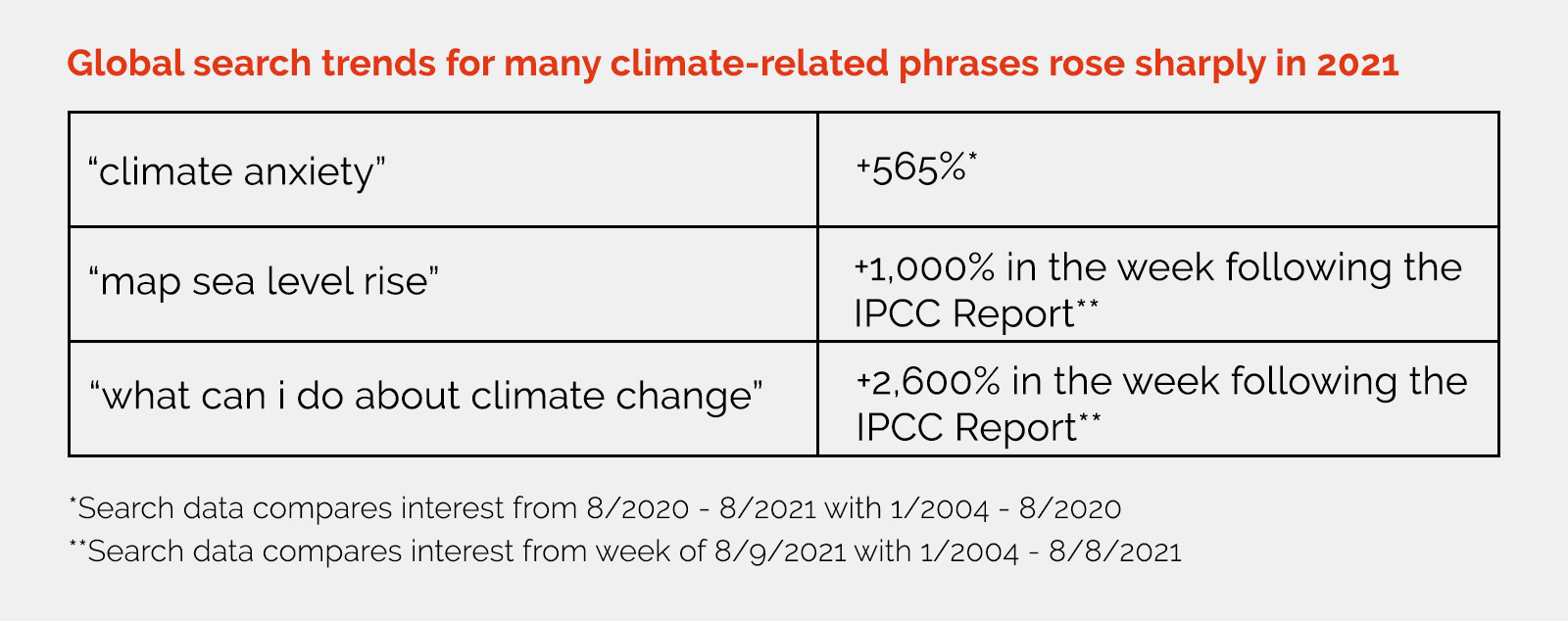
It’s enough to provoke a crippling anxiety, a deep dread about the future of our overheating planet. The proof: Google searches for “climate anxiety” have soared 565 percent over the past 12 months, according to data Google provided to Grist. 

This sharp increase is “unusual,” said Simon Rogers, Google News Lab’s data editor. “There really seems to be this kind of existential fear.” Over the past year, he said, he’s seen big changes in what people have been Googling about climate change, a shift that reveals a public increasingly trying to grapple with what the crisis means for their lives and looking for answers.

Chart showing global search trends for climate related phrases

“Whereas maybe before it felt like the climate was this abstract thing, now with fires and the floods and heat waves and so on, it’s become this real thing for people that they can see in a way that they haven’t felt before,” Rogers said.

There’s a growing recognition that climate change is here and happening in the United States. An all-time high of 70 percent of Americans are worried about it, according to a recent survey from the Yale Program on Climate Change Communication, which has been tracking levels of concern since 2008.

In September, the largest survey of its kind found that the climate crisis was causing widespread psychological distress for young people in 10 countries across the globe. Some 45 percent of teens and young adults said that climate anxiety was affecting their daily lives and ability to function; 56 percent said they thought that “humanity is doomed.” The average 6-year-old today will likely live through about three times as many climate-enhanced disasters — fires, crop failures, droughts, floods — as someone born in 1960, according to another recent study.

Search results offer a unique glimpse of the public’s mood, a window into private thoughts rather than ones tailored for public display on Twitter or Facebook. “There’s ubiquity to the way that people search which takes you beyond the echo chamber,” Rogers said. “When people are searching, it’s not about how they’re presenting themselves — it’s about something they genuinely care about and want to find out more about.” 

Given the number of people Googling stuff every day, his team can’t analyze the total number of searches — instead, they use a measure called “search interest,” which shows how significant a specific query is compared to the overall volume of searches (globally or in a specific region).

This summer, search spikes coincided with extreme events happening around the world. In Greece, where thousands of islanders evacuated from fires in July and August, search interest for wildfires was up 40 percent compared to the average over the past 17 years, according to Google News Lab. Interest in heat waves also increased, going up by 6 times in the United Kingdom, where the national weather service issued its first-ever extreme heat warning in July, and 24 times in Russia as heat shattered temperature records in the Arctic Circle.

Chart showing European searches for heat and wildfire

In August, a dire report from a United Nations-backed panel of scientists declared that climate change was “unequivocally” caused by humans and warned that greenhouse gas emissions were quickly destabilizing Earth’s ice, ocean, and land systems, with “irreversible” consequences. The Intergovernmental Panel on Climate Change report led to alarming headlines, with the BBC warning that this was “code red for humanity.” Interest in “what can I do about climate change?” hit an all-time high that week, increasing 27 times over the average since Google started keeping track in 2004. Rogers said that “personal action queries” like these — searches that start with “what can I do …” or “how can I …” have increased in the past year around climate change and other weighty problems, like the COVID-19 pandemic.

While climate change “feels like this huge, scary thing” you don’t have much control over, Rogers said, these practical “what can I do?” searches could be a way to exercise some amount of control over an uncertain future (even if it feels tiny in comparison to the scope of the crisis). People may be finding their own way to what many psychology researchers recommend as an antidote to climate anxiety: taking action.

Student nurses who refuse vaccination struggle to complete degrees

Kaitlyn Hevner expects to complete a 15-month accelerated nursing program at the University of North Florida in Jacksonville in December. For her clinical training this fall, she’s working 12-hour shifts on weekends with medical-surgical patients at a hospital.

But Hevner and nursing students like her who refuse to get vaccinated against COVID-19 are in an increasingly precarious position. Their stance may put their required clinical training and, eventually, their nursing careers at risk.

In early September, the Biden administration announced that workers at health care facilities, including hospitals and ambulatory surgery centers, would be required to receive COVID vaccines. Although details of the federal rule won’t be released until October, some experts predict that student nurses doing clinical training at such sites will have to be vaccinated, too.

Groups representing the nursing profession say “students should be vaccinated when clinical facilities require it” to complete their clinical training. In a policy brief released Monday, the National Council of State Boards of Nursing and eight other nurse organizations suggested that students who refuse to be vaccinated and who don’t qualify for an exception because of their religious beliefs or medical issues may be disenrolled from their nursing program or be unable to graduate because they cannot fulfill the clinical requirements.

“We can’t have students in the workplace that can expose patients to a serious illness,” said Maryann Alexander, chief officer for nursing regulation at the national council. “Students can refuse the vaccine, but those who are not exempt maybe should be told that this is not the time to be in a nursing program.”

“You’re going to go into practice and you’re going to be very limited in your jobs if you’re not going to get that vaccine,” Alexander said.

Hevner, 35, set to finish her clinical training in early October, said she doesn’t feel it’s acceptable to benefit from a vaccine that was developed using fetal cells obtained through abortion, which she opposes. (Development of the Johnson & Johnson COVID vaccine involved a cell line from an abortion; the Pfizer-BioNTech and Moderna mRNA vaccines were not developed with fetal cell lines, but some testing of the vaccines reportedly involved fetal cells, researchers say. Many religious leaders, however, support vaccination against COVID.)

With vaccines for nursing students still optional in many health care settings, nursing educators are scrambling to place unvaccinated students in health care facilities that will accept them.

Down the coast from Jacksonville in Fort Pierce, Florida, 329 students are in the two-year associate degree nursing program at Indian River State College, said Roseann Maresca, an assistant professor who teaches third-semester students and coordinates their clinical training. Only 150 of them are vaccinated against COVID, she said.

Not all of the eight medical facilities that have contracts with the school require student nurses to be vaccinated.

“It’s been a nightmare trying to move students around this semester” to match them with facilities depending on their vaccination status, Maresca said.

Commonly, health care facilities have long required employees to be vaccinated against various illnesses such as influenza and hepatitis B. The pandemic has added new urgency to these requirements. According to a September tally by FierceHealthcare, more than 170 health systems mandate COVID vaccines for their workforces.

In May, the federal Equal Employment Opportunity Commission made it clear that under federal law employers can mandate COVID vaccinations as long as they allow workers to claim religious and medical exemptions.

Under the Biden administration’s COVID plan, roughly 50,000 health care facilities that receive Medicare or Medicaid payments must require workers to be vaccinated. Until the administration releases its draft rule in October, it is unclear how nursing students assigned to health care sites for clinical training will be treated.

But the federal rule published in August that lays out regulations for government hospital payments in 2022 offers clues. It defined health care personnel that should be vaccinated as employees, licensed independent contractors and adult students/trainees and volunteers, said Colin Milligan, director of media relations at the American Hospital Association.

In addition to staff members, the Biden plan says mandates will apply to “individuals providing services under arrangements” at health care sites.

A spokesperson for the Centers for Medicare & Medicaid Services declined to clarify who would be covered by the Biden plan, noting the agency is still writing the rules.

Nonetheless, vaccination mandates threaten to derail the training of a relatively small proportion of nursing students. A recent survey by the National Student Nurses’ Association reported that 86% of nursing students and 85% of new nursing graduates who responded to an online survey said they had been or planned to be vaccinated against COVID.

But the results varied widely by state, from 100% in New Hampshire and Vermont on the high end to 63% in Oklahoma, 74% in Kentucky and 76% in Florida on the low end. The survey had 7,501 respondents.

Students who don’t want to be vaccinated are asking schools to offer them alternatives to on-site clinical training. They suggest using life-size computer-controlled mannequins or computer-based simulations using avatars, said Marcia Gardner, dean of the nursing school at Molloy College in Rockville Centre, New York.

Last year, when the pandemic led hospitals to close their doors to students, many nursing programs increased simulated clinical training to give nursing students some sort of clinical experience.

But that’s no substitute for working with real patients in a health care setting, educators say. State nursing boards permit simulated clinical study to varying degrees, but none allow such instruction to exceed 50% of clinical training, said Alexander. A multisite study found that nursing students could do up to half their clinical training using simulation with no negative impact on competency.

The policy brief by the council of state nursing boards states that nursing education programs “are not obligated to provide substitute or alternate clinical experiences based on a student’s request or vaccine preference.”

As more nursing students become vaccinated, the issue will grow less acute. And if the Biden plan requires nursing students to be vaccinated to work in hospitals, the number of holdouts is likely to further shrink.

Hevner, the University of North Florida student, said she’s not opposed to vaccines in general and would consider getting a COVID vaccine in the future if she could be assured it wasn’t created using aborted fetal cells. She filed paperwork with the college to get a religious exemption from vaccine requirements. It turned out she didn’t need one because Orange Park Medical Center, where she is doing her clinical training, doesn’t require staffers or nursing students to be vaccinated against COVID “at this time,” said Carrie Turansky, director of public relations and communications for the medical center, in Orange Park, Florida.

Although Hevner opposes getting the vaccine, “I take protecting my patients and protecting myself very seriously,” she said. She gets tested weekly for COVID and always wears an N95 mask in a clinical setting, among other precautions, she said. “But I would ask: Do we give up our own religious rights and our own self-determination just because we work in a health care setting?”

She hopes the profession can accommodate people like her.

“I’m concerned because we’re in such a divisive place,” she said. But she is eager to find a middle ground because, she said, “I think I would make a really great nurse.”

Trumpers stand up for Kyrsten Sinema, suggest bathroom protesters should be “deported”

Sen. Kyrsten Sinema, D-Ariz., found herself the recipient of some unwanted attention over the weekend, as the “centrist” senator continues her apparently intractable opposition to President Biden’s legislative “Build Back Better” agenda. 

In a video posted to Twitter on Sunday, young activists with the organization Living United for Change in Arizona (LUCHA) confronted Sinema outside a classroom at Arizona State University, where she has taught classes since 2003.

The video captures the senator stating, “Actually, I am heading out,” and locking herself into a bathroom stall as hecklers pepper her with remarks from the bathroom’s entryway.

Following the sound of a flushing toilet, an activist speaks up, arguing they are holding her “accountable.” 

“We need to hold you accountable to what you told us, what you promised us that you were going to pass when we knocked on doors for you,” the activist who identified herself as Blanca says. “It’s not right!”


Want a daily wrap-up of all the news and commentary Salon has to offer? Subscribe to our morning newsletter, Crash Course.


A Sinema spokesperson didn’t return a Salon request for comment about the confrontation. In a statement released on Twitter, however, Sinema said the bathroom encounter “was not legitimate protest.” 

“It is unacceptable for activist organizations to instruct their members to jeopardize themselves by engaging in unlawful activities such as gaining entry to closed university buildings, disrupting learning environments, and filming students in a restroom,” her statement added.  

Right-wing media quickly seized upon the unlikely task of defending a Democratic senator against people who (very likely) voted for her.

Coup-crazed former Trump adviser Steve Bannon suggested that the progressive activists who confronted the senator might have been “Illegal aliens.” 

“By the way, no illegal aliens vote in Arizona. They are bragging about it,” he added Monday morning on his podcast. “Out there, they’re stalking Sen. Sinema and bragging about how they organize and vote out in Arizona. Just saying.” 

“Watch — Leftist Protesters Stalk, Harass Sen. Kyrsten Sinema in a Restroom,” the far-right Breitbart site flashed on its homepage early on Monday. The conservative blog RedState asked its readers a rhetorical question: “Did Leftists Who Stalked and Filmed Sinema in the Bathroom Commit a Crime?” (The answer would almost certainly be no.)

Stephen Miller, the former speechwriter and adviser to Donald Trump, who has often expressed an affinity for white nationalist views, also took up Sinema’s cause, expanding on Bannon’s illogical views. 

“An illegal alien is stalking a US Senator to demand passage of Biden’s reconciliation bill [because] it includes mass amnesty for illegals,” he tweeted, citing the ruckus on the Arizona State campus. “In a functioning democracy, ICE would swiftly deport this person, but under Biden’s new edict (as the lawbreaker knows) she’s immune from removal.”

“Did we #DeportBlanca yet?” former Trump official Steve Cortes asked aloud on Twitter. 

On Monday afternoon, President Biden said the Sinema protesters’ actions were “not appropriate,” but observed shortly thereafter that such events are “part of the process.” 

“I don’t think they’re appropriate tactics, but it happens to everybody,” the president said from the White House. “The only people it doesn’t happen to are people who have Secret Service standing around them. It’s a part of the process.”

Giada De Laurentiis’ pumpkin carbonara celebrates traditional Italian and seasonal flavors

Pasta carbonara is a melt-in-your-mouth masterpiece that flaunts a simple yet elevated ingredients list: spaghetti, guanciale (salt-cured pork jowl), pancetta (Italian bacon), eggs, black peppercorns and salty Pecorino Romano. The traditional Roman dish, which has its own national day of celebration in April, is reimagined as a seasonal delicacy in Giada de Laurentiis’ latest recipe.

Giada’s rendition is an autumnal themed carbonara that revitalizes signature Italian flavors with pureed pumpkin and spicy nutmeg. Her final creation features al dente pasta deliciously coated in a hearty and earthy egg-based sauce. Giada promises that her innovative dish is “an amazingly creamy pasta you’ll be coming back to all season.” This pumpkin carbonara is guaranteed to become your new fall favorite meal. 

To kickstart the cooking process, bring a pot of salted water to a boil over high heat. Throw in your choice of long pasta (Giada recommends either spaghetti or linguini) for approximately 10 minutes. Drain the pasta and reserve 1/2 cup of pasta water. Set them aside before working on the carbonara sauce.  

Add the canned pumpkin puree, chicken broth, egg, egg yolk, pecorino, nutmeg and black pepper into a blender. Blend on high until the mixture achieves a smooth consistency that resembles a mash.

Heat a large skillet over medium heat, add oil and cook the pancetta until it becomes golden and crispy. Stir in garlic, onions and salt and cook until the onion is both soft and fragrant. Then, add the cooked pasta and sprinkle over a generous amount of parmesan cheese there’s no right or wrong amount of cheese here.  

Pour the carbonara sauce on top of the pasta and cook for an additional two to three minutes. Slowly add pasta water, as needed, until the mixture becomes thick and fully covers the pasta. Be sure to continuously stir the pasta to avoid scrambling the raw eggs included in the carbonara sauce.

Garnish with black pepper, parsley and additional parmesan (once again, the specific amount is all up to you). Enjoy with a slice of toasted focaccia or ciabatta for a heavenly carb loaded meal. If you prefer something lighter, add a simple salad like kale Caesar or an assortment of roasted vegetables on the side. Full recipe here.

Hurricane Ida’s destruction was the result of years of systemic racism

With nearly two months left of this year’s turbulent hurricane season, thousands of Louisianans are entering their sixth straight week without power following Hurricane Ida. Meanwhile, displaced residents in search of adequate shelter for their families are piling into any neighbors’ homes that are still intact, some with up to 10 people in a single-wide trailer. Destroying more of Louisiana’s power grid than any other storm in the state’s history, Hurricane Ida has left millions without homes or access to clean water during a pandemic.

This destruction wasn’t by simple happenstance or some sort of unpredictable anomaly — it was the direct result of the failure of political and corporate leaders, year after year, to build adequate infrastructure, implement equitable protections for relief and provide Black communities the same resources and protections afforded to wealthy, white neighborhoods.

We’ve seen this before — 16 years ago nearly to the day, when Hurricane Katrina decimated Louisiana. The government and corporations provided no support that the people of New Orleans needed as delays in relief and rescue left millions of residents without food, water or shelter for weeks and severely undermined the economic stability of residents in the years since.

Color of Change, the organization I have led for the last 11 years, was founded in 2005 in the aftermath of Hurricane Katrina. It was born in response to a profound realization in that moment: No one in power was nervous about disappointing Black people and failing to meet our needs, not even at that massive scale of suffering. There were no consequences for hurting Black communities.

Now, 16 years later, Black people have built the kind of power that it takes to be heard. As a result of the work of the movement for racial justice, we can now see how racial impact is more and more frequently part of the policy discussion when it comes to the problems we need to solve as a country — from climate disasters and a pandemic to consumer protections to tax and education policy. But being a topic of conversation, whether in a government office or a corporate boardroom, is not enough. We do not yet have the power it takes to get the results we need when it comes to preventing events like Ida — or COVID-19 — from causing us more harm (and forcing more sacrifices from us) than other communities.

We must continue to build the power required to keep both politicians and corporations in check. This is what people are talking about when they talk about Black power: the ability to create tangible consequences for bad actors that are strong enough to prevent injustice and devastation.

When our government allows exploitative real estate corporations to develop shoddy private developments to maximize profit and displace Black residents, thousands are left without homes during a disaster. When elected leaders redirect vital infrastructure and health funds to already bloated, inept and abusive police departments, health and emergency services cannot reach those in need during times of crises. Even with widespread organizing for reinvestment into our communities, corporations actively disrupt movements for collective power and change

Climate change and structural racism share something profound: they are both outcomes that corporations and politicians have manufactured for their own narrow purposes and profits. They also bring out the worst of corporate myth-making.

Corporate leaders have pushed the sham of individual consumption reduction as the main solution to climate change while it’s apparent that reckless corporate overproduction, inefficiency and willful neglect of responsibility, including an extensive history of exploiting Black people, is the greatest contributor to climate change. Conservatives, including corporate leaders, have similarly tried to convince us that racism is a matter of individual behavior, rather than policies, systems and structures designed to maintain white supremacy and privilege. 

Climate change and structural racism reinforce one another — each makes the other stronger. We need to accept that racism is a climate change accelerator, and that climate change is a major racial impact and racial justice issue. And in both cases, unchecked corporate power is the biggest driver. 

Climate disasters aren’t a simple misfortune — their destruction derives from geographic segregation, generational poverty and a lack of accountability from corporate powers and elected leaders who have siphoned resources from our communities from the start. Historic and current political decisions have placed Black people directly in the initial zone of climate danger. From consistent faults in emergency protocols in New Orleans, unlivable air quality for majority Black neighborhoods in Detroit produced by Chrysler production plants, investing funds to police departments and giving tax breaks to corporations, environmental racism is the direct result of those in power intentionally choosing to prioritize profits over the well-being of our communities. 

Corporations that have the means to ensure housing and substantial recovery for survivors of disaster but choose to do nothing are attacking Black communities, no matter what their slick advertisements featuring Black people may say. To understand the impact of climate change and refuse to implement legislative regulations to halt its impact is another form of attack on Black communities. 

As individuals around the country are showing up for survivors via fundraising, mutual aid and neighborly support, inaction from corporate powers and harmful policies implemented by lawmakers have led to New York City, one of the wealthiest cities in the world, being entirely unprepared for mass flooding in subway systems and homes as a result of Hurricane Ida. Both private corporations and public elected officials have a responsibility not only to provide the necessary relief, but to prevent this kind of negligence from causing more damage in the future.  

Last year, corporations of all kinds publicly claimed to care about racial justice. But the fact is, moments like these let us know which corporations are actually willing to put their money where their values are. Energy providers like Entergy and hospitality companies like Hyatt have an opportunity to uphold their commitments to justice and directly help those displaced in Louisiana. If they claim to care about Black lives, they, too, must support Black livelihood and wellbeing. 

Forcing Black communities to bear the brunt of climate disasters disproportionately is not only unjust but will only postpone the moment at which we realize that climate change is an issue that affects us all and will drastically impact our shared fate. We must see decisive and effective action — right now — from the corporations that say Black lives matter, in order to undo decades of racist political and corporate exploitation that have targeted Black communities.

But that requires investing more effort in movements for racial justice that can create consequences for those corporations if they fail to act. Rather than letting the intense energy of 2020 fade away, we must take that energy and our collective focus on racial justice to the next level. And that means increasing our support for Black-led organizing and Black community power. That is the only true bulwark against the flood of bad decisions that continue to produce climate disasters.

Why did prominent Democrats invite anti-LGBTQ Ukrainians to National Prayer Breakfast?

One of a series about the Fellowship Foundation, the secretive religious group that runs the National Prayer Breakfast and is popularly known as The Family. This series is based on Family documents obtained by TYT, including lists of breakfast guests and who invited them.

Why would congressional Democrats invite two dozen anti-LGBTQ politicians and civic leaders from Ukraine to attend America’s National Prayer Breakfast?

The answer is complicated. For one thing, the 12 Democrats — and one independent senator who caucuses with them — didn’t actually invite the Ukrainians. Spokespeople for two of them told TYT they didn’t even know who was invited in their names.

They did, however, let their names be used to give the event their imprimatur, which was then used to convene at least 25 foes of LGBTQ rights from Ukraine alone at the 2016 breakfast. (Future reports will look at other countries.)

The people who actually chose the 63 guests from Ukraine were Family insiders and allies, a mix of American Republicans and Europeans building conservative movements at home. Their Ukrainian guests who came to network with like-minded Family allies had a range of anti-LGBTQ records:

  • Calling homosexuality “a mental deviation” and “a treatable disease,”
  • Opposing “so-called LGBTQ rights” and
  • Declaring that “Homosexuality is a parasite of the society.”

Twenty-one of the Ukraine attendees were listed on internal Family documents with the same contact email address as that of a far-right website with ties to anti-LGBTQ American conservatives.

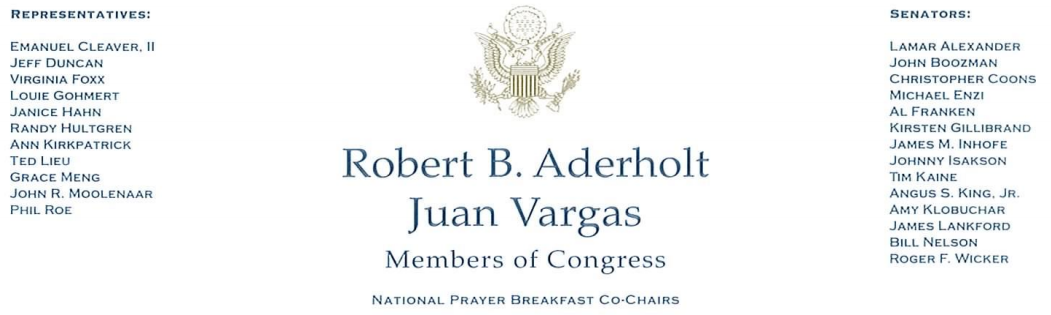
The letter sent to these Ukrainians said, “On behalf of the Congressional Host Committee, we are pleased to have you join us.” It was signed by Reps. Bob Aderholt, R-Ala., and Juan Vargas, D-Calif., the 2016 breakfast co-chairs. The letterhead bore the Great Seal of the United States, as if it were an official document, and listed the congressional host committee.

The committee that year included seven Democratic senators (counting Sen. Angus King, the Maine independent who caucuses with them) and four Democratic House members. The other senators were Chris Coons of Delaware, Al Franken of Minnesota, Kirsten Gillibrand of New York, Tim Kaine of Virginia, Amy Klobuchar of Minnesota and Bill Nelson of Florida. The House members were Emanuel Cleaver II of Missouri, Janice Hahn and Ted Lieu of California, Ann Kirkpatrick of Arizona and Grace Meng of New York. 

Republicans on the host committee included Family allies and known opponents of LGBTQ and reproductive rights. For example, Vargas’ co-chair, Rep. Aderholt, has actively worked to roll back abortion access and LGBTQ rights.

In a travel disclosure form earlier this year, a representative of the Family’s legal entity, the Fellowship Foundation, wrote that Aderholt and Rep. John Moolenaar, R-Mich., had worked together “for the last several years in giving direction to the National Prayer Breakfast … [and] are tremendous representatives of what is good and attractive about America and American leaders!”

(Like other Family insiders, Aderholt figured into the Trump-era Ukrainian lobbying scandals. His political backers include former Family board member Ron Cameron, a multi-million-dollar GOP donor and Trump supporter.)
Democrats on the 2016 host committee included ostensible LGBTQ allies. But even after consulting with Ukrainian human rights advocates, TYT was able to identify only two Ukrainian invitees that year with records of supporting LGBTQ rights. Leading LGBTQ advocates and actual LGBTQ Ukrainians themselves appear to have been excluded entirely. (TYT previously reported that the 2016 invitation list largely excluded LGBTQ and reproductive rights advocates, as well as Christian religious leaders on the left. An overwhelming majority of the top Family insiders who choose the guest list are Republicans.)

Nelson, the former Democratic senator from Florida who now heads NASA, is married to Grace Nelson, one of the few Democrats still active with The Family and a former Fellowship Foundation board member. NASA, like all but two members of the host committee, did not respond to TYT’s request for comment.

Of the host committee Democrats still in office, Lieu, Meng and Vargas all belong to the House LGBTQ+ Equality Caucus. Lieu distanced himself from the breakfast after Russian operatives used the event to network with American conservatives. Meng let her name be used most recently in 2019.

Vargas, as TYT recently reported, was a featured participant at last month’s Ukrainian National Prayer Breakfast in Kyiv, which The Family helped launch and which has multiple ties to anti-LGBTQ individuals and organizations. The EU LGBTQ group Forbidden Colours issued an intelligence brief in response, saying that Vargas was “misled” and warning Democrats to do their due diligence before getting involved with prayer breakfasts and similar events.

A source close to The Family said that most members of Congress who lend their names to the breakfast have virtually nothing to do with it. “The Fellowship insiders that are … inviting people in the name of Congress … have very little to no connection to the [weekly congressional prayer] breakfast groups or Congress,” the source said.

That account gibes with what two congressional spokespersons told TYT.

Asked about the 2016 breakfast, Kirkpatrick’s chief of staff, Abigail O’Brien, said in a statement that “Rep. Kirkpatrick did not know the background information of the invitees. Had she [known] of anti-LGBTQ leaders being invited, she would have not allowed her name to be on the host committee.” Neither Kirkpatrick nor her staff could remember the event, O’Brien said.  

Liz Odendahl, communications director for Hahn, who is now a Los Angeles County supervisor, called the host committee position “ceremonial” and said Hahn “was not at all involved in determining the guest list in 2016.”

Two years before that, however, Hahn had served as co-chair. Even in that position, Odendahl said, Hahn “was not involved in determining the guest list.” (That same year, Hahn walked out of the National Day of Prayer after Focus on the Family’s James Dobson attacked then-President Barack Obama over his support for abortion rights.)

Together, the statements support longstanding accusations that the primary role congressional Democrats play in the breakfast is to help The Family create the impression that the event is both bipartisan and semi-official. The identities of the actual inviters, whose names are never publicly disclosed, tell another story.

Who’s really inviting guests to the National Prayer Breakfast?

An internal Family list specifies exactly who submitted each name for the guest list. The 63 guests from Ukraine in 2016 were submitted by just nine people, none of them members of Congress. At least three of the inviters were not Americans, and only one was a Democrat:

  • Former South Carolina Gov. David Beasley, a Republican and Family insider appointed by Donald Trump to run the UN World Food Programme
  • Barry Blufer, a consultant
  • Doug Burleigh, the Family’s lead liaison in Russia, a Trump supporter and Big Lie donor
  • Doug Coe, a now-deceased Family leader
  • Vladimir Gusinsky, a Russian media magnate and longtime Family insider
  • Grace Nelson, the wife of former Democratic Sen. Bill Nelson and a Family insider
  • Yulia Tymoshenko, a former Ukrainian prime minister whose lobbyist, Jim Slattery, was a Family insider
  • Pavlo Unguryan, a Family insider and one of Ukraine’s leading anti-LGBTQ activists
  • Michael Zhovnir, a Family insider and Washington state businessman with ties to Ukraine

Unguryan was a member of the Rada, Ukraine’s parliament, at the time. The previous year, The Family had allowed him to invite 17 people to the 2016 National Prayer Breakfast, Unguryan has called homosexuality “a treatable disease.”

As Right Wing Watch has noted, Unguryan that same year fought against banning anti-LGBTQ discrimination in the workplace. Both Right Wing Watch and Bellingcat have reported on Unguryan’s extensive ties to a well-financed network of anti-LGBTQ American conservatives. He submitted his guest names jointly with Burleigh, the Family’s Russia liaison, who also acquired invitations that same year for Russian operatives who used the event to build their political network.

Meet the guest list

TYT was able to identify two Ukrainian guests with public positions in support of LGBTQ rights. Grygoryi Nemyrya was a human rights commissioner invited by Tymoshenko, the former prime minister. Grace Nelson’s one Ukrainian guest that year was Hanna Herman, a member of parliament who reportedly once urged awareness of and respect for LGBTQ people.

Pavlo Unguryan, the anti-LGBTQ activist who runs Ukraine’s National Prayer Breakfast, invited 17 people to the U.S. breakfast in 2016. His guests included Ukrainian politicians Dmytro Yarosh — who in 2015 railed against “the West” imposing a “pervert ideology” on Ukraine — and Yurii Miroshnychenko, who has called for state policy to preserve “the values of the family.”

Then there’s Ruslan Kukharchuk, whose ties to the American right wing and Unguryan have also been chronicled by Bellingcat. Kukharchuk has written that “Homosexuality is a parasite of the society,” and that “Any healthy society should stand tall, united, in order to defeat the virus of homo-dictatorship.”

Kukharchuk was invited to the 2016 National Prayer Breakfast more than a decade after starting the group Love Against Homosexuality and four years after he and Unguryan had backed a bill to impose prison time for publicly depicting homosexuality in a positive light. (Several years earlier, journalist Jeff Sharlet revealed the pivotal role some Family leaders played in Uganda’s infamous LGBTQ capital punishment bill.)

The men who invited Kukharchuk to the 2016 National Prayer Breakfast weren’t members of Congress. It was Burleigh, the Family’s point man in former Soviet countries, and Zhovnir, the Washington state businessman. Zhovnir has been referenced occasionally by Ukraine media for his involvement in the breakfast. More notably, his company, Alpha Tech, figured in the Ukrainian lobbying scandals of the Trump presidency, as did other Family insiders.

Ukraine’s minister for sports and youth, Igor Zhdanov, was invited to the 2016 breakfast by Vladimir Gusinsky, a fugitive Russian media mogul who reportedly is a friend of Rupert Murdoch. Zhdanov has taken a public stand against “so-called LGBTQ rights” and praised nationalist Ukrainian youth camps where instructors reject LGBTQ “perversions.”

Ukraine’s first president, Leonid Kravchuk, was also invited in 2016. Although he was only in office for a few years, Kravchuk oversaw a national giveaway on a scale history seldom sees. After the collapse of the Soviet Union, Kravchuk privatized some 12,000 Ukrainian companies, handing them out to political insiders and cementing the foundation for decades of oligarchy and corruption.

Kravchuk is also a homophobe. Here’s an excerpt from a 1999 interview he gave to a Ukrainian publication:

For all my respect for human rights, I consider that it [homosexuality] is a mental deviation. I have lived my life already, but I still cannot accept it as something normal. It is either an illness or some sort of mental pathology. … Or maybe the outcome of education by foreign movies. … It’s disgusting even to speak about it.

Kravchuk’s invitation came from Burleigh and Barry Blufer, who has been a member of the U.S.-Ukraine Business Council and calls himself a consultant. His background is slightly more interesting than that.

According to a book by former Rep. Don Bonker, D-Wash., Blufer used to be a CIA agent. Bonker, whose state is something of a hub for The Family, was publicly linked to The Family as early as the 1980s. It was Bonker who brought Gusinsky to The Family. (By that time Bonker was in public relations, with Gusinsky as a client; Bonker wrote that Gusinsky would pick up the tab for international delegations to attend the breakfast.)

In his book, Bonker says he brought Ukrainian oligarch Hryhoriy Surkis to attend the 2002 breakfast. Bonker identifies Surkis’ assistant at the time as “Barry Blufer, a former CIA agent.” Surkis and his brother were two of Blufer’s invitees for the 2016 NPB.

All together, Burleigh, Unguryan and Zhovnir invited 21 other Ukrainians who were all listed with the same contact email address, one also used by Unguryan’s anti-LGBTQ organizations. Unguryan’s parliamentary prayer breakfast group used that email address in a congressional disclosure form when sponsoring travel by Rep. Tim Walberg, R-Mich., to Ukraine’s 2019 prayer breakfast.

The parliamentary group’s website says its main activities include “organizing the [Ukraine] National Prayer Breakfast [and] protection of the institution of family and marriage as the basis of society.”

In the travel disclosure form, Unguryan says explicitly that Walberg was invited because of “his stance on sanctity of life, marriage, freedom and prayer.” Video unearthed by the Take Care, Tim blog shows Walberg using the occasion to praise Christian influence for steeling then-President Trump against abortion and same-sex marriage, praising prayer breakfasts for their potential to do the same.

The Ukrainian breakfast, Walberg’s disclosure form says, “has been copied from the U.S. NPB.” And it has worked. Ukraine’s prayer breakfast is now said to be the largest of a growing number in Europe. In a report this year, the European Parliamentary Forum for Sexual and Reproductive Rights included Ukraine on a list of countries where “parliamentary prayer breakfasts, while superficially apolitical and multi-confessional, include speakers who echo extremist positions.”

The report quotes a document by the far-right European Christian Political Movement (ECPM), discussing its strategy of “co-hosting Prayer Breakfasts throughout Europe with the aim to improve relations between Christian MPs and to form cross-party alliances on Christian values.” Unguryan, the Family insider and head of Ukraine’s breakfast, is a member of ECPM. (Ordo Iuris, a Polish far-right group, was also represented at Ukraine’s 2021 breakfast.)

Unguryan is connected with another group, Hope Ukraine, which also uses the same email address that Unguryan used for his parliamentary group. Despite its name, however, Hope Ukraine has its roots in the U.S.

While Unguryan is listed as a project director, the director of Hope Ukraine is actually Nick Logan, an American. And the address listed on Hope Ukraine’s tax filing is in Tustin, California, the same address as another company, Cornerstone Payment Systems, where Logan serves as president.

Cornerstone Payment Systems is the donation-processing company of choice not only for Hope Ukraine but for far-right American evangelicals like James Dobson. Cornerstone’s public relations firm is run by A. Larry Ross, the Family leader who helped radicalize Mike Lindell, the Big Lie-promoting founder of MyPillow.

One of the websites for Hope Ukraine includes a page for volunteers. A photo there of Hope Ukraine volunteers appears either to originate from the stock photo company iPhoto, or the young, diverse Ukrainian volunteers it depicts are also satisfied patrons of Midtown Dental in Logan, Utah.

Screen Shot 2021-09-30 at 7.51.42 PM


As journalist Jeff Sharlet has reported, The Family has a history of portraying the prayer breakfast as a semi-official event, while simultaneously obfuscating its role in building right-wing networks. Hope Ukraine’s own website hints at similar ambivalence about revealing the full extent of its ties.

The hint comes in a parenthetical comment that suggests the author wasn’t sure whether to include it. The passage refers to “the remarkable cooperation of Evangelical churches in Ukraine (and the United States?) …”

With additional research by TYT News Assistant Zoltan Lucas and TYT Investigates Intern Jamia Zarzuela.

In HBO Max’s “The Way Down,” one evangelical church preaches dieting as the way to salvation

“We just thank you for this teaching that has given us freedom, and kept our weight off after all this time, God,” says one of the women praying on her knees in the opening of new HBO Max docuseries “The Way Down.” 

The series follows Gwen Shamblin Lara’s rise as an evangelical preacher through archival footage, depositions and interviews with former members of Remnant Fellowship Church, which she founded. The documentary’s full title – “The Way Down: God, Greed, and the Cult of Gwen Shamblin” – makes it clear that this is not the typical exposé of an evangelical church. Here, diet culture prevails.

But before delving into that peculiar aspect of the church, one other detail makes this story particularly fascinating right now. Shamblin Lara died unexpectedly in May at age 66 in a plane crash shortly after takeoff.

That grim turn of events had an unforeseen effect on “The Way Down,” which opens with footage of the search and rescue team sent out after Shamblin Lara’s private jet crashed into Percy Priest Lake in Tennessee, killing her and five other church members aboard. And although director Marina Zenovich never was able to interview her subject for the series directly, many of those who were afraid to speak out about their experiences with Remnant Fellowship while Shamblin Lara was alive have now come forward. This sparked the need for two more episodes of the series, which will follow in 2022. 

For now, HBO Max has released the first three episodes, which go into detail about the ways that Remnant Fellowship controlled former members, including allegations of child abuse and, in one case, accusations of the killing of one child by his parents. There’s behavior that the series characterizes as cultlike, such as mega worship services with a charismatic leader, whom people both love and fear. But throughout the series, one of the oddest themes is of Shamblin Lara’s obsession with the weight of her followers.


Want a daily wrap-up of all the news and commentary Salon has to offer? Subscribe to our morning newsletter, Crash Course.


Shamblin Lara, who’s recognizable for her gravity-defying teased hair, earned a Masters in food and nutrition and was a registered dietitian who worked with the Tennessee Department of Health for five years. She put a twist on the usual weight loss approaches by developing her Christian diet program called the Weigh Down Workshop, which proposes that devotees can lose weight through belief in God. While some would see this as a more spiritual departure from diets that usually focus on physical and behaviorial approaches, the patriarchal aspects of evangelical teachings begin to reveal themselves.

The basic principles of Weigh Down are supposedly portion control (hardly a revolutionary diet strategy), and dedicating the rest of the time to prayer instead of thinking about food. Throughout the series, we see former members describing their experiences with Weigh Down that go beyond merely prayer: one is told to fast even after losing over 100 pounds. Another remembers asking her husband for permission to order Starbucks, and being told she could have that or dinner. Another fasted for 40 days. 

In one archival video, Shamblin Lara sits in a white dress with huge gold hoops in her ears.

“God revealed to me that this is the true deliverance,” she coos, “and that the key to permanent weight control is a matter of the heart.”

More footage shows women proudly holding up pants that no longer fit them, similar to before and after ads for services like Jenny Craig or Weight Watchers. 

Then Shamblin Lara’s teachings go further: the congregation at Remnant is told that a thin body means you are “right with God.” This meant that the overweight among the congregation were doing something wrong, that the people putting weight back on after losing it were clearly not in God’s good graces (and presumably this means they’re on “the way down” in the afterlife). To Shamblin Lara, the faster you lost weight, the holier you were. As one former member put it, if you weren’t skinny, you weren’t saved. “It was all about salvation. Nothing to do with Jesus Christ, it was about being thin.”

This intersection of faith and diet culture is a twisted version of the world of juice cleanses and intermittent fasting in mainstream culture. Replace the negative language Remnant uses to describe plus-sized people with words like “lazy” , “weak-willed”, or “unintelligent.”Replace the “fear of God” as the motivator of the Weigh Down Workshops with “nothing tastes as good as skinny feels.” The stigma surrounding plus-sized people is the same, repackaged in a way that the believers of Remnant understand. 

Fatphobia plagues the way that we as a society operate. It’s a normalized structure that if you don’t look a certain way, you can’t find clothes that fit, or be comfortable on an airplane, or access proper medical care.  According to the National Association of Anorexia Nervosa and Associated Disorders, 28.8 million Americans will struggle with an eating disorder in their lifetime. 

Throughout the series it’s shown how Shamblin Lara used the language of manipulation present in many alleged cults to control believers. She tailored her teachings to an audience of the faithful by having them believe that the message she spread was one communicated to her by a higher power. She told her congregants that people in Weigh Down who were not a part of Remnant were gaining weight back from not being a part of the true religion she preached.

“The overarching theme of everything she ever taught in there was about being under God’s authority, which was her.” one former member says, “Everything fell around that. And then everything else was about the weight and what you looked like. . . . she was the voice from God.”

“She beckoned to people,” Reverend Rafael Martinez, a cult interventionist, says in the series. “She began to believe that the Weigh Down Workshop message was the answer to all the world’s evils . . . Christian perfectionism could only be achieved by following her message.” That version of perfection may have looked different from how mainstream society would view it in everything but its clothing size. 

Groups that exhibit what is interpreted as cultlike behavioer are made entertaining in documentaries like “The Way Down” because their beliefs and actions are outside of the reality of the average viewer. And in many ways, the series hits all the right points of a good exposé: Anonymous talking heads in dark rooms. Footage of people crying in prayer. Laughter in how ridiculous it all is, now that the former members are out. Sadness when you realize that Remnant is still in operation, run by Shamblin Lara’s daughter Michelle, with no sign of changing. But the thread of the Weigh Down Workshops and the way this belief of theirs reflects our own societal pressures ultimately humanizes Remnant. 

Diet culture and fatphobia are so pervasive that they can even infiltrate the places we would least expect it. Members of Remnant aren’t special for the way they interpret diet culture. In fact, they’re just like us. It turns an unforgiving look at the viewer who would believe they’re above cultlike fanaticism: if we’re able to ingest certain beliefs about other people in our day to day, what’s stopping us from taking that further? What would we believe next? 

The first tree episodes of “The Way Down” are available now to stream on HBO Max, with two more releasing in 2022. 

From Hitchcock to the Macarena, “Titane” director on how monstrosity and humor feed her body horror

Julia Ducournau‘s astonishing “Titane” is a dangerous film — and that is a good thing. It is not because this intense, uncompromising drama starts out as one kind of film and then morphs into another. It is more that Ducournau, who won the Palme d’Or at Cannes, can mix hypnotic images and body horror while also generating tremendous emotion. Viewers will pick at it like a scab to see what’s underneath.

It is hard to discuss the film without spoiling things, but it involves Alexia (Agatha Rousselle in a stunning feature debut) who has a titanium plate in her head (hence the title) escaping a tricky situation by posing as Adrien, the adult missing son of Vincent (Vincent Lindon), a firefighter. What happens over the course of the story may defy logic, but that is what makes the film so involving — viewers become invested in these characters, who make some very risky decisions, to see what they will do next.

Ducournau delivers on the tremendous promise she showed in her feature debut, “Raw,” which was equally unsettling. She spoke with Salon about the vivid images and damaged bodies in “Titane.”

There is this idea of the organic and the mechanic. Can you talk about creating the visceral visuals that are both difficult, but beautiful, such as the scar on Alexia’s head?

The scar in Alexia’s head is something she would keep throughout whole film. It was highly symbolic for many reasons. Obviously, because of the plate underneath, but the shape of the scar had to have something to do with identity, as there is a question of that in the film. The scar is shaped like a spiral, a snail, which is a direct homage to Madeleine’s chignon in “Vertigo,” which is also shaped like a snail. “Vertigo” was an important reference for me here, especially through Vincent’s fantasy of being able to sculpt his own son back through her and the way he models Adrien — shaving his head, the clothes, the nose, all that. This homage was important for me. I wanted to have a modern version of Madeleine’s chignon on the side of Alexia’s head. But also, because Alexia has a chignon constantly — that’s where she puts her pick.

“Titane” features numerous tonal shifts that keep viewers off guard, which makes your film thrilling and enthralling. Can you talk about this narrative strategy?

I like to subvert the codes of different typologies of film, obviously, body horror, but also comedy, drama, and thriller. I do that because naturally, for me, that is a good way to play with the audience’s emotions and to keep in touch with my characters’ points of view all the time. Not imposing one mood but having the mood shift with my characters. For example, in the Macarena scene, that starts out as something socially heavy and very dramatic, but then all of sudden, because the main character looks at an old lady, who is derailing, that opens door for comedy and it takes us out of the drama because she focuses on the lady who is clearly not well. Then you add the Macarena on top in order to make a very clear shift that brings us to full comedy, which I use to create a bond between the characters at this level. I love this. In the same way I use different codes and typologies of film, to create my own language throughout the film, I love to make scenes morph, so you go from one emotion into another, from drama to comedy, or comedy to horror. 


Want a daily wrap-up of all the news and commentary Salon has to offer? Subscribe to our morning newsletter, Crash Course.


You also have a very distinctive way of filming gender, sexuality, bodies, and nudity. Can you talk about how you film bodies here? The car show is one style but the scenes with Adrien are another.

For me, all the imagery of the body within the realm of the car show is complete allure. I try to create the stereotype that I am going to debunk afterwards. In the car show, we have an evolution that goes from something that looks like a male gaze on the dancers and when we get to Alexia, she reclaims the narrative by dancing with complicity with the car and looking through the camera. She is reclaiming the narrative by looking at you, rather than you looking at her. It’s not relevant or very significant in terms of how I treat bodies in the whole film or in my work. 

What I am interested in is to portray bodies that are extremely trivial. I do not do anything to glamorize them, quite the contrary. I do not feel that glamour is something we can relate to at all. My goal is to make you relate to my characters’ bodies, in the perspective of your own body experience, but also in the way you look at your own body. We are never satisfied with our bodies, like most people all the time, and that creates a bond between us. I tried to build that same bond with my characters. All my characters’ bodies are not nice to look at; they are damaged, and often in pain. They open up, they shed their skin. This is not glamorous, but I do think, in its triviality, and in its, let’s say, almost monstrosity, we can relate to that. I think we can’t relate to perfection or perfect bodies, but we can relate to every single imperfection that we see on someone else’s body. I find that incredibly endearing. 

The film is certainly going to test the pain threshold for viewers. As if “Raw” didn’t! What can you say about creating sequences featuring people suffering — sometimes by their own hand? 

It’s not like I have agenda: “I’m going to make my characters suffer and I’m going to make you watch.” The specific scene when Alexia changes her appearance, there is something here that is essential for me to make you feel how far she will go to leave her former skin behind. I needed to do that because Alexia is an unrelatable character. She feels no emotion, she’s closer to a machine than a human being. That makes her someone we cannot feel for in your heart or head, but I want you to feel for her in your body. If you can’t relate, that you will leave because you don’t understand the story or the character, you are not interested to see where she is going. My entry point is her body. What she inflicts upon it in order for you to feel this immediate body empathy is the same as if you see someone break their legs in real life. You may not have had your legs broken, but you know that it’s painful because you have this immediate body empathy that links us all. This is my entry point to the character.

“Titane” is currently in theaters.

Netflix’s “The Guilty” isn’t as progressive and critical of cops as it pretends to be

“I killed a man, a boy actually,” Jake Gyllenhaal as LAPD officer Joe Baylor blurts out in Netflix’s cop thriller, “The Guilty.” He’s speaking on the phone with a woman who is standing on a highway overpass, preparing to jump.

“Why?” she asks.

“I don’t know, because I could. I wanted to punish him. I was angry, I’m so angry,” Joe responds, breathless and holding back tears.

It’s a pivotal moment for both Joe and viewers alike. Throughout the film, it’s been hinted that Joe is in trouble for some reason, which is why he’s been taken out of the field and sidelined to the 911 operator’s desk. A Los Angeles Times reporter has been calling to get his side of the story before his court date the next day. But despite these hazy hints, the audience has watched as Joe helps this mysterious woman, Emily, (voiced by Riley Keough) and her kids, even after his shift has ended. Despite seeming initially cynical about his call operator duties at first, this particular call reinvigorated Joe’s passion and has moved him to own up to his transgression.

Subverting your typical cop story

Taking place during the movie’s last act, Joe’s rueful confession seems to be what “The Guilty” wants the audience to take away from the film. Joe has abused his power to perpetrate a horrifying act that in real life is an unfortunately recurring trend among law enforcement officers. By the end of the film, Joe is finally honest about what he’s done, even when it means he will inevitably face serious consequences.

With the revelation that Joe has done something terrible, one might think the film bucks the usual portrayals of pro-cop propaganda (copaganda), right? Not exactly.

“The Guilty,” Antoine Fuqua’s adaptation of the 2018 Danish film of the same name, certainly differs from the typical hero-cop fare in many ways. The movie lacks the usual highly physical, bad-guy-chasing sequences that often valorize police officers and portray their violence and physicality as heroism in cop films. The most action we see in the claustrophobic thriller is when Gyllenhaal takes a hit from an inhaler; we never even see a gun out of its holster. 

Instead, nearly all of “The Guilty” is shot from the perspective of Joe, alone in a room on the phone as he tries to track down Emly, a woman in distress who initially calls him from the road and sounds like she’s been kidnapped. Most of the movie is just Joe making calls, doing searches from his computer, desperately trying to find Emily, and ensure she and her children are safe. From his perspective, Emily is a woman who has been abducted by her ex-husband at knifepoint.


Want a daily wrap-up of all the news and commentary Salon has to offer? Subscribe to our morning newsletter, Crash Course.


The movie’s thrills come from how Joe and the viewers’ expectations are subverted. The more he discovers about Emily’s real story, the clearer it becomes that whatever she’s told Joe isn’t to be trusted. Instead, it turns out that she suffers from a severe mental illness, and after not being able to access her medications, she’s cut open and possibly killed her infant son. To protect the kids, her ex removed Emily from her home, intending to place her in a psychiatric facility when Emily first calls 911 and reaches Joe.

Damaging depictions

For all of the nuance and refreshing creative direction of “The Guilty,” much of it still suffers from the same, tired tropes that it presumably tries to avoid.

Sure, Emily is a highly sympathetic character, a mother who loves her kids and has done her best despite being severely ill. But the movie still falls into a common trap of seemingly equating mental illness with violence, despite how those with mental illnesses are more likely to be victims than perpetrators of violence. Emily has attacked her baby to rid him of imagined “snakes,” and therefore becomes yet another example of a woman who isn’t to be trusted or believed, and now needs to be saved from herself. 

And of course that duty falls to men in the film – first her ex-husband, who predictably turns out to be the trustworthy one, and then Joe, a man whose wife won’t let him see his own child.

At a time when the thriller and horror genres are increasingly subverting stereotypes and sexist writing of “crazy,” hysterical or mentally ill female characters, “The Guilty” feels like a step backwards. Why must we have another movie perpetuating the harmful stereotype? More recent movies like Netflix’s “The Woman in the Window” or Hulu’s “False Positive” both involve the very real-life, gendered issue of gaslighting, or forcing someone to question their own reality. Hysteria, paranoia and erratic behavior among female characters in these movies are shown to be a product of male manipulation and cruelty.

As for Joe, however “complicated” we’re to believe he is, ultimately, he’s still our protagonist, the one person whose perspective defines the entirety of the movie. He may have killed someone, but we know nothing about his victim or what they did or didn’t do. All we see instead is Joe as he tries to save a woman’s life, desperate to compensate for taking someone else’s. Instead of the pain of the family of the man Joe killed, we see Joe, crying on the bathroom floor, physically ill with guilt and shame. 

It turns out that Joe’s crime goes beyond the killing that he confessed to Emily. In the film’s final scene, he calls his former cop partner, Rick (Eli Goree), who is revealed to not only have seen Joe killing the man, but has also lied in a witness statement to protect Joe from accountability. According to an agreed upon plan, Rick was supposed to continue that lie in court. Joe now wants to walk back that plan entirely, and insists that his former partner help him come clean. 

“Just tell them what you saw Rick,” Joe says. “Just tell them the truth, tell them I killed someone.”

“You won’t see your daughter for years,” Rick warns him, as both men cry over the phone.

There was perhaps a time in this country, maybe even just a few years ago, that a movie like “The Guilty” could have been seen as progressive and honest about the ways police officers often use their power to perform horrific acts and can easily cover for each other. But today, at a time when racial justice activism has pushed beyond individualistic narratives of systemic police violence as a matter of bad apples vs. good apples, it’s clear how “The Guilty” still ultimately contributes to copaganda.

Yes, Joe killed someone, and yes, he and his partner initially planned to lie to ensure he could get away with it — this doesn’t exactly portray policing in a positive light. But Joe’s story – with his sobbing at the end – is portrayed as one of heroism. Good job for telling the truth! His honesty is ultimately a far cry from what we see in real life, as cops who have brutally killed people on camera with videos of their murders going viral, still stand trial and insist that we not believe what we’ve seen with our own eyes. All too often, they do, in fact, get away with it — so much so that the conviction of George Floyd’s killer earlier this year came as a moment of overwhelming relief. Speaking of what we see in real life, Joe’s journey to save a woman’s life also quite differs from jarringly high rates of police violence against women

Ultimately, “The Guilty” isn’t quite as unwatchable as some of the older cop thrillers and “Law and Order” spinoffs, set on ennobling law enforcement and the criminal justice system. But intentionally or not, it still bolsters older, bygone tropes, of women as crazy, the mentally ill as violent, and policing as salvageable by individual, honest cops.

Opinion: At the FDA, a key opportunity to advance abortion justice

Perhaps more now than in any other time in recent memory, Americans’ right to abortion care seems to be hanging by a thread. On Sept. 1, a Texas law went into effect that barred nearly all abortion care in the state. The U.S. Supreme Court, more anti-abortion than it has been in decades, will soon consider a case that could completely dismantle our federal right to abortion care.

But in one branch of the federal government, officials are weighing a decision that could actually expand access to abortion care: The Food and Drug Administration is considering whether to lift 21-year-old restrictions that limit access to medication abortion.

Medication abortion care is widely considered a safe way to end an early pregnancy. It involves taking two medications and is considered safe and effective for ending pregnancies up to 10 weeks. Nearly 40 percent of abortions are now done using medication abortion, according to recent data from the Guttmacher Institute, a research and policy nonprofit advocating for sexual and reproductive health and rights.

Yet outdated FDA restrictions, coupled with state restrictions, have created enormous and unnecessary barriers to care. Specifically, under federal rules, medication abortion is not available at pharmacies, nor is it always deliverable through mail; it’s only offered by providers or clinics who are specially certified to stock, prescribe, and dispense it from their office. The restrictions keep many providers from dispensing medication for abortion at all. State restrictions go even further: 19 states bar people from using telehealth for medication abortion. And, while medical experts agree that medication abortion can be safely provided by advanced practice nurses and physician’s assistants, 32 states mandate that it be provided by a doctor.

Due to the Covid-19 pandemic, advocates have been pushing the FDA to lift in-person dispensing requirements, resulting in a federal ruling in July 2020 that allowed patients to virtually speak to a doctor and have medication mailed to them. Following a Supreme Court ruling that halted the practice in January, the FDA temporarily lifted the in-person dispensing requirement in April. In May, the FDA announced it was reviewing its restrictions, with advocates hoping officials will make the new rule change permanent. If the agency does decide to lift the in-person dispensing restriction, it would hold incredible promise to remove some of the barriers to care. According to the Guttmacher Institute, medication abortion provided by telehealth could reduce the distance someone would have to travel to get care, especially in rural communities. People who choose medication abortion wouldn’t have to sacrifice wages or give up limited financial resources to pay for gas, child care, and related expenses.

If the FDA permanently lifts these restrictions, it will be a significant step forward — at least for people fortunate enough to live in states that protect the right to abortion care. But expanded access to medication abortion cannot be at the expense of other abortion care, nor can it leave behind those who are continually marginalized by our health systems. To achieve true abortion justice, we must create policy that meets the following four conditions.

First, it must be equitable — its benefits must extend to Black, Brown, Indigenous, and other people of color, and those working to make ends meet. For complex reasons due to systemic racism and economic inequality, women of color are more likely to have an abortion and are therefore more likely to bear the brunt of abortion restrictions, including restrictions on medication abortion. As an example of the impact on Indigenous communities, one tribal hospital in Arizona has been working for two years to cut through the red tape to stock medication for abortion at health facilities located on federal reservation land. New regulations on medication abortion should be tailored to expand access to these communities.

Second, medication abortion, and all forms of abortion care, must be made more affordable. Medication abortion in the U.S. costs, on average, around $500. But the federal Hyde Amendment prohibits people enrolled in Medicaid from using their health insurance to cover abortion, including medication abortion. Since it was initially passed in 1976, the Hyde Amendment has been expanded to deny coverage for many other groups of people, including federal employees and their dependents, military personnel and their dependents, people in federal prisons and immigrant detention centers, Native Americans, and Peace Corps volunteers. Policymakers must break down these and other financial barriers to care.

Third, ensuring access for all depends on addressing America’s digital divide. Most Americans express support for telehealth, which became widespread during the Covid-19 pandemic, and a majority of people who have used telehealth want to keep using it beyond the current crisis. Yet people of color and those struggling financially have less access to high-speed internet at home than their White, wealthier peers. What’s more, people with limited English proficiency face deep gaps in digital literacy. If we tackle these issues, telehealth-provided medication abortion could make it easier for someone seeking abortion to connect with a culturally competent provider, including one fluent in their primary language. It might also boost access to abortion for undocumented immigrants who fear being detained by immigration enforcement if they seek in-person care.

Finally, medication abortion cannot be seen as a one-size-fits-all solution, advanced at the expense of in-clinic procedures. It must be understood as one among many options for care, because we all should have the ability to decide what type of care is right for us, and because not everyone can get an abortion before 10 weeks. Patients may need to use one option of care over others for different reasons. Travel, cost, and time constraints may lead one person to seek medication abortion. Someone else may be more comfortable controlling their experience at home but want to pick up their medication in person. Someone experiencing intimate partner violence may have very specific needs related to the time and place of their abortion, which may be crucial for their safety. For as many reasons as there are people, all points of access to abortion care must be available and equitable.

Medication abortion has the potential to dramatically reshape the provision of abortion care, particularly if onerous federal dispensing regulations and state restrictions on telehealth are removed. These actions would begin to clear a path for people of color and rural communities to get care on their own terms. But they are not the only steps we should take. For policymakers to advance true abortion justice, they must protect the availability of all abortion care, ensure it is affordable, and ensure it can reach communities of color and those working to make ends meet without unnecessary barriers, stigma, or shame. They must make racial and economic justice a central part of this transformation. If we meet these core conditions, we can move toward a future with true abortion justice — a future that doesn’t leave anyone behind.


Destiny Lopez is the co-president of All* Above All, which unites individuals across the country and over 130 organizations to build a future where abortion is affordable, available, and supported for anyone who seeks care.

This article was originally published on Undark. Read the original article.

Couples in long-term relationships develop uncanny biological similarities, study finds

When couples get together and stay together, their bodies synchronize on a deep biological level, according to a new large-scale study conducted by Japanese researchers. This bodes well for couples in happy, physically active relationships, and can lead to bolstered health deep into old age. For others, it can produce uncanny and exacerbated health problems.

The study analyzed health data from tens of thousands of couples — 5,391 from Japan and 28,262 from the Netherlands. Across both populations, the researchers found that, in general, long-term partners experienced similar levels of blood pressure, triglyceride, and cholesterol, and were also more likely to simultaneously suffer from chronic ailments such as diabetes and hypertension. 

The study’s conclusions echoed those of a related study conducted in 2016, when researchers at the University of Michigan at Ann Arbor discovered a similar phenomenon on a smaller scale. By looking at health data from 1,568 older couples in the United States, those researchers found that partners who had been together for more than 50 years had roughly equivalent kidney function and grip strength. That research piggybacked on another set of findings from the University of British Columbia, which found that couples in long-term relationships often experienced concurrent symptoms of psychological illnesses such as depression. 

In all of these studies, this linked-health phenomenon was frequently found in couples who were genetically dissimilar. This largely ruled out a possible biological explanation tied to “assertive mating” — a scientific term that describes the tendency for organisms with similar underlying physical characteristics to couple up. Instead, researchers believe that lifestyle factors — the daily routines and rhythms of a relationship — wind up playing a long-term role in the health of a couple. 

“Aging is something that couples do together,” said Shannon Meijia, a postdoctoral research fellow at the University of Michigan, in a 2016 interview with NPR. “You’re in an environment together, you’re appraising that environment together, and making decisions.”

While this deep synchronicity may be harmful in certain cases, in others it can prove beneficial.

The researchers behind the Japanese study also suggested that their findings could have implications for the way doctors diagnose illnesses and evaluate the health of their elderly patients. By looking at the health of a spouse, physicians might be able to glean important clues regarding the health of their patients — and in doing so, suggest preventative actions to assuage future health problems.

Another study, conducted by researchers at Michigan State University, found even more tangible benefits to corollary health between couples. Their 2014 paper described a four-year project, in which 2,754 older couples in the United States were asked to self-report health information while also evaluating their general level of optimism. The researchers discovered that relatively fewer cases of both arthritis and diabetes were present when at least one partner had a naturally optimistic disposition. In other words, positivity was not only good for an individual’s health — a somewhat mystifying but widely established fact — but it benefited their spouse, too.


Want more health and science stories in your inbox? Subscribe to Salon’s weekly newsletter The Vulgar Scientist.


Michael Flynn hid $200k in payments for Middle East nuclear power plan before joining White House

Michael Flynn received $200,000 in undisclosed payments for consulting work in the Middle East before joining Donald Trump’s administration.

The retired U.S. Army general was paid for his work in 2014 and 2015 on a plan to build 40 nuclear power plants in the Middle East, which never came to fruition but would have involved companies from Canada, France, Russia and the U.S. constructing and managing nuclear plants in Arab nations, reported the Dutch newspaper NRC Handelsblad.

Flynn briefly served as Trump’s first national security adviser before he resigned in disgrace for lying to FBI agents about his communications with then-Russian ambassador Sergey Kislyak and his undisclosed work for the Turkish government.

Robert Mueller’s prosecutors filed charges against Flynn, who pleaded guilty to making false statements to the FBI, but Trump pardoned him in November.

The newly revealed payments to Flynn came from a U.S. firm connected to the project, ACU Strategic Partners, although his relationship to the project had been reported in 2017.

Two U.S. House committees investigated Flynn’s involvement in the project, which he had not disclosed before joining the White House, after Newsweek reported he had been repaid between $10,000-$15,000 for travel expenses.

An audit of a Dutch company that specializes in transport revealed the $200,000 payment to Flynn.

Climate advocates warn Sen. Joe Manchin is “holding a gun to the planet’s head”

Climate campaigners on Friday responded to Sen. Joe Manchin’s unrelenting obstruction of his own party’s efforts to spend $3.5 trillion to combat the climate crisis and make other major social investments by accusing the right-wing West Virginia Democrat of doing the fossil fuel industry’s bidding, and drawing attention to the “modern-day coal baron’s” staggering conflicts of interest.

Manchin — Senate Democrats’ 50th and potentially decisive vote on the pending Build Back Better and bipartisan infrastructure bills — admitted Thursday that he planned to pass legislation containing at least $25 billion in potential fossil fuel subsidies and then torpedo the more ambitious $3.5 trillion budget reconciliation package funding robust investments in climate solutions.

Manchin’s insistence on a top-line reconciliation bill spending level of $1.5 trillion defies the wishes of the vast majority of his own constituents and has drawn fire from progressive critics, some of whom noted the senator’s consistent support for annual Pentagon budgets approaching or surpassing $700 billion.

Others have drawn attention to the fact that Manchin is currently the top congressional recipient of fossil fuel industry donations, and last year personally earned roughly three times as much income from investments in his son’s coal company as he did from his congressional salary. Since his election to the Senate in 2010, Manchin has made more than $4.5 million from his family’s coal business. He has also earned the praise of an ExxonMobil lobbyist for obstructing climate action.

“Should any lawmaker with such a sizable financial conflict of interest wield decisive influence over what the U.S. government does about a life-and-death issue like the climate emergency?” asked Covering Climate Now executive director Mark Hertsgaard in a Thursday column calling Manchin a “modern-day coal baron.”

“Shouldn’t there be public discussion about whether that lawmaker should recuse himself from such deliberations?” Hertsgaard added.

Bill McKibben, co-founder of the climate advocacy group 350.org, wrote Friday that “Joe Manchin is actually doing the work of the fossil fuel industry.”

“The Biden administration was trying to… move toward the clean energy world that both physics and finance demand — but the fossil fuel industry won’t let it, and Manchin is their hostage-taker,” he continued. “Whatever deal emerges today will be judged on… whether or not it allows us to meet [President Joe] Biden’s target of cutting emissions in half by 2030. If Manchin gets his way, that won’t happen.”

“Manchin came to power with an ad showing him shooting climate regulations,” added McKibben, “now he’s holding a gun to the planet’s head.”

On Thursday, Varshini Prakash, executive director of the youth-led climate justice group Sunrise Movement, said, “Let’s be clear, progressives are not the ones delaying the vote—Joe Manchin and Kyrsten Sinema are.”

“The reality is that while our movement has been fighting like hell to pass historic climate, immigration, and economic policies, Manchin and Sinema have been in backroom fundraisers finding ways to kill the $3.5 trillion climate and jobs package to help working people,” she added. “Let’s stop pretending that there’s anything else going on.”

24 brilliant Brussels sprouts recipes that are definitely not bitter

We’re about to turn orange. And no, it’s not because we’re nervous or embarrassed; it’s not because we’re stressed about planning that gigantic meal for next week. It’s because we’re eating way too many sweet potatoes, squashes, pumpkins, and carrots

It’s time to get some green back in our lives; it’s time to eat more brussels sprouts. And it’s time to start thinking about the ones you’ll serve on Thanksgiving. A basic Brussels sprouts recipe would likely call for arranging the greens on a sheet pan, sprouts cut side down, drizzling them with olive oil, and roasting them in the oven for 20 minutes to 30 minutes, or until they’re golden brown. Season the cooked Brussels sprouts with a little bit more salt and pepper, maybe some Parmesan cheese or red pepper flakes, and call it a day.

But there are so many other ways to cook and eat Brussels sprouts. They’re great in soups and salads, stuffing and sides. Pro tip: No matter how you prepare to cook Brussels sprouts, always remove the outer leaves first. They’re usually the toughest and bitter and no amount of olive oil or honey can save them. Here are 24 of our favorite Brussels sprouts recipes — because green is the new black.

1. Brussels Sprouts Gratin

Combine thinly sliced Brussels sprouts with heavy cream, whole grain mustard, and maple syrupfor the base of this creamy vegetarian gratin, and top with a pecan-breadcrumb crumble. 

2. Sheet-Pan Pasta With Brussels Sprouts and Garlicky Walnut Crumbs

Weeknight dinner has never been easier, thanks to this creative sheet pan pasta dinner. Pre-cooked pasta bakes alongside halved Brussels sprouts, red onion, and lots and lots of cheese for a family-friendly, quick-cooking meal.

3. Green Minestrone with Lime-Arugula Meatballs

“Minestrone made with green vegetables (like beans, peas, and zucchini) tastes crisp and fresh. But it still should be a soup that warms the soul, so I’ve added tiny meatballs, brightened with arugula and lime, for that cozy, hearty feeling,” writes recipe developer Meike Peters.

4. Sheet-Pan Miso Tofu with Brussels Sprouts, Apple and Arugula

Extra-firm tofu and Brussels sprouts team up for one flavorful, colorful fall feast. Soy saucemiso, and maple syrup bring bursts of umami and sweetness to every bite. 

5. Crispy Brussels Sprouts with Garlic-Chile Butter in a Multi-Cooker

Make use of the always-popular multi-cooker for crispy-tender Brussels sprouts that are loaded with spice, thanks to an abundance of garlic (two! whole! heads!) and Fresno chile peppers. 

6. Sautéed Brussels Sprouts

Simple and sautéed, this Brussels sprouts recipe is a timeless side dish that never fails. 

7. Pasta with Brown Butter and Brussels Sprouts

Choose your own adventure — in this case,  your favorite shape of pasta — for this nutty Brussels sprout recipe that we want to eat all fall long.

8. Brussels Sprouts With Bacon

The only way to make Brussels sprouts more delicious? Add bacon! Okay, it’s not the ONLY way, but it’s kind of the best way.

9. Squash and Brown Butter Tortelli with Brussels Sprouts and Balsamic

Pasta is often thought of as a quick dinner when you just want to “throw something together.” But Meryl Feinstein has taught us that it can be a labor of love, deeply innovative, and beautiful too. This autumnal recipe is the perfect example of that.  

10. Turmeric Chickpea Soup with Charred Brussels Sprouts

Crispy pan-fried Brussels sprouts are served atop a piping hot bowl of vegan soup made with chickpeasturmeric, and coconut milk.

11. Roasted Brussels Sprouts with Pears and Pistachios

This Brussels sprout recipe was voted our readers’ favorite “green holiday side,” so you know it’s good. And really, you can’t go wrong with this trio of crunchy, nutty ingredients.

12. Brussels Sprouts Hash and Eggs

If the only hash you’re acquainted with is potato, it might be time to widen your horizons. Here, slivers of sprouts served with butter, garlic, and olives instantly upgrades a breakfast of fried eggs and toast.

13. Brussels Sprouts Caesar Salad

“Thinly shaved brussels sprouts have a discernible flavor that stands up to and complements the lemon juice, garlic, and parmesan cheese of the Caesar dressing,” writes recipe developer Josh Cohen.

14. Kale and Brussels Sprout Salad with Honey Balsamic Dressing

Ribbons of Brussels sprouts and bitter kale team up for a cheesy, crunchy salad that will be at the center of the dinner table all fall long. The two greens are known for being quite bitter, so a sweet dressing made with balsamic vinegarhoney, and soy sauce is key.

15. Julia Child’s Brussels Sprouts with Braised Chestnuts

Chestnuts are roasting on an open fire for this beautiful Brussels sprouts recipe by the one and only Julia Child.

16. Roasted Brussels Sprouts with Bacon and Balsamic-Cranberry Glaze

If you have leftover cranberry sauce post-Thanksgiving feast, turn it into a rich syrupy glaze for roasted sprouts.

17. Sheet Pan Stuffing with Brussels Sprouts and Pancetta

The perk of making stuffing in a sheet pan instead of a deep baking dish is that the croutons get extra crispy and crunchy versus custardy…and let’s face it, sometimes a little soggy!

18. Warm, Cheesy Brussels Sprouts Salad

Roasted red pepperscanned artichoke hearts, and Castelvetrano olives pack a punch in this Brussels sprouts recipe that can serve two as an entrée, or a few more as a side salad.

19. Gaby Dalkin’s Shaved Brussels Sprouts and Bacon Pizza

We’ve said it here before, but we’ll say it again. Brussels sprouts and bacon are a dream team. So put them on the best base ever: pizza!

20. Union Square Café’s Hashed Brussels Sprouts with Poppy Seeds and Lemon

Quickly sautéeing sprouts in a skillet over high heat gets them crispy, and a sprinkle of crunchy poppy seeds, garlic, white wine, and lemon juice brings it all together.

21. Brussels Sprouts and Apple Salad with Cheddar and Rye Bread Crumbs

“With its Brussels sprouts, apple, cheddar, rye bread, and mustard, this hearty salad is the kind of thing you’ll want alongside a sausage and beer on a Saturday, but — good news — it’s also light enough for Tuesday’s lunch, and making it won’t drag you down, either,” writes recipe developer Ali Slagle.

22. Butternut Squash, Brussels Sprout and Bread Stuffing with Apples

A savory mix of winter squash, brussels sprouts, cranberries, apples, nuts, and good bread (think: sourdough or cornbread) make an unstoppable Thanksgiving stuffing. 

23. Brussels Sprouts with Honeycrisp Apples

Bacon and apples and Brussels sprouts, oh my! Meet the trio of peak-fall ingredients in this fall side dish recipe.

24. Boiled Brussels Sprouts with Bacon Mayo

You may be thinking, “boiling? Why, of all the cooking methods on the planet, would you boil Brussels sprouts?” I thought the same thing too, until this thoughtful recipe changed my mind. Follow it exactly and you won’t end up with sprouts that are mushy, smelly, ugly, or any of the other horrid qualities you may associate with boiled Brussels sprouts.

What are the best substitutes for vegetable oil?

Vegetable oil is a product on its own, but it’s also a category. Grapeseed, avocado, safflower, peanut, and coconut oils are all considered vegetable oils. Vegetable oil typically refers to soybean oil: flavorless, scentless, colorless, and with a high smoke point — the temperature at which oil starts to burn and emit smoke — that’s ideal for high-heat cooking. If you cook with it on a regular basis, you’ve probably wondered what the best substitutes for vegetable oil are, and we’re here to break it down.

If vegetable oil’s purpose is simply to conduct heat quickly and efficiently without imparting much flavor in the process, why reach for a more expensive variety? The author of The Big Book of Healthy Cooking Oils Lisa Howard told TIME Magazine, “vegetable oil is guaranteed to be highly processed.”

“It’s called ‘vegetable’ so that the manufacturers can substitute whatever commodity oil they want — soy, corn, cottonseed, canola — without having to print a new label,” Howard explains. In lieu of cold-pressing, oil-rich ingredients are combined with solvents and “pushed past their heat tolerance,” effectively killing off all nutrients. The resulting oils “have become rancid in the processing,” writes Howard. To add insult to injury, the production of many of these untraceable oils has been linked with land degradation.

Picking a single-ingredient oil instead of vegetable oil means knowing exactly what you’re using to cook your food. Here are seven of the best substitutes for vegetable oil, for a variety of applications from searing to sautéing, broiling, baking, frying, and finishing.

* * *

7 best substitutes for vegetable oil

1. Extra-Virgin Olive

The odds are good that extra-virgin olive oil is already a valued member of your pantry, but its advantages are no less worth reiterating: It’s unrefined — that’s what “extra-virgin” means — full of good-for-you fats, incredibly versatile and wonderfully delicious. Olive oil’s smoke point is 350°F, the lowest on this list, so reserve it for lower-heat methods like poaching, searing, and sautéing, or no-heat recipes like salad dressing (though there are plenty of other oils you can use for those, too).

2. Canola

Not to be confused with Mazola (a blend of corn and canola oils), canola oil is extracted from the canola seed — a type of rapeseed related to turnips, Brussels sprouts, and cabbage specially bred for oil production. Its smoke point is 400°F, which makes it a sensible option for at-home frying — sweet potato fries, anyone?.

3. Filtered Coconut

Coconut oil is made from dried, crushed coconut flesh, or boiled coconut milk. If your recipe welcomes a mild infusion of coconut flavor and doesn’t require the application of very high heat, go for virgin or unrefined coconut oil, with a smoke point of 350°F: perfect for in granolas or dairy-free cookies. Filtered or refined coconut oil has a smoke point of 400°F — great for frying base aromatics.

4. Grapeseed

Grapeseed oil is made from, you guessed it: grape seeds, a by-product of winemaking. It’s flavorless and can be heated up to 420°F. Use it to roast vegetables, make perfect stovetop popcorn, and make delicious condiments like homemade chili crisp and aioli.

5. Safflower

Safflower oil is extracted from seeds of the prickly safflower, the petals of which are sometimes used as imitation saffron. Because of its neutral flavor, it’s often used in salad dressings and mayonnaise. Refined safflower oil’s smoke point is on the higher end — 510°F — which makes it a suitable choice for broiling, and a natural choice for deep-frying everything from tortilla chips to oysters.

6. Avocado

Like coconut oil, avocado oil is one of the few oils extracted from fruit flesh, not seeds. Even unrefined, avocado oil’s smoke point of 480°F is higher than that of olive, canola, and grapeseed. That smoke point shoots up to 520°F if you’re using refined avocado oil. As with safflower oil, avocado oil is a great choice for very high-heat cooking methods, like shallow and deep-frying, as well as grilling.

7. Peanut

With a high smoke point of 450°F, peanut oil is an excellent, much less-processed substitute for vegetable oil. It’s made solely from peanuts, but imparts no discernible peanut odor or flavor — especially in baked recipes like cookies or when used for deep-frying. Those with allergies are generally safe to consume foods made with refined peanut oil, which loses much of its allergen content in the refining process, but should avoid cold-pressed peanut oil.

“Every failed coup is just practice”: Domestic extremism is going to get worse, intel expert warns

Right-wing media outlets like Fox News, Newsmax and Breitbart News have a long history of downplaying the terrorist threat posed by far-right White nationalists, white supremacists and militia groups — even after the January 6 assault on the U.S. Capitol Building. But media outlets like MSNBC have been giving the threat the attention that it merits, and when MSNBC’s Nicolle Wallace recently featured Kristofer Goldsmith — CEO of the intelligence firm Spaverius — on her show, he warned that the problem is showing no signs of letting up.

Goldsmith told Wallace, a Never Trump conservative who served in the Bush Administration, “Every failed coup is just practice. What’s, I think, most disturbing, to people now is that it’s become out in the public.”

The Oath Keepers, an extremist militia group, were among the insurrectionists who attacked the U.S. Capitol Building on January 6. And Goldsmith discussed their recruiting efforts during his MSNBC appearance.

Goldsmith warned, “The Oath Keepers are an organization that’s primarily vying for not just military service members, veterans, but also, police. These are people who have a warped sense of patriotism, who believe that fighting against the government, against their fellow Americans is somehow patriotic…. What’s disappointing to me is to see people using.gov and .mil e-mail addresses to sign up to be one of these members of an unlawful militia.”

The Spaverius CEO went on to call out Fox News for downplaying the violence that occurred on January 6.

“Over on Fox News,” Goldsmith told Wallace, “January 6 is no big deal. And that is the most popular channel on all military bases all over the world right now, because they use Nielsen ratings. They say, ‘Oh well, Fox News is popular. So, we have to show it to the troops.'”

Individualistic societies managed the pandemic worse than communal ones, study says

The existence of millions of American reactionaries, who despise public health measures that save lives like their own, seems to attest to our nation’s storied obsession with individualism. As a culture, the United States is defined by its focus on the individual and individual rights, something that has, more or less, been intrinsic to national culture since America’s founding. 

Anecdotally, other countries with seemingly less hyper-individualistic cultures have done far better managing the pandemic, at least in terms of controlling the virus. Recently, researchers from the United States (a notoriously individualistic society) and China (a notably communal society) studied whether one could answer this question quantitatively. Specifically: are citizens of collectivistic cultures more likely to wear masks than those from individualistic cultures? Or are facemask scofflaws evenly distributed throughout humanity?

In probing this, researchers looked at data from all of America’s 3,141 counties, as well as data from dozens of countries. Publishing their findings in June in the scientific journal Proceedings of the National Academy of Sciences, they stated definitively that “collectivism positively predicts mask usage during the COVID-19 pandemic—both within the United States and across the world.” These findings could have major implications for our understanding of how to handle both this pandemic and future crises — assuming, of course, that we accept the existing academic framework regarding “collectivism” and “individualism” at face value.

It is important to understand exactly what “collectivism” and “individualism” mean in these contexts. When social psychologists use those terms to describe cultures, they are usually referencing the ideas of Dutch scholar Geert Hofstede. Hofstede’s cultural dimensions theory attempts to measure culture and how individual behaviors in a society are affected by culture. The theory has its critics — some feel his ideas are methodologically flawedsimplistic or reinforce cultural uniformity — and over the years it has evolved. 

When it comes to COVID-19, however, the relevance of Hofstede’s concepts is pretty straightforward. As Hofstede himself explained last year when describing COVID-19 and culture, “in an individualistic society, such as Anglo countries or the Netherlands, people behave like atoms in a gas. They can freely choose whether to group or to separate.” By contrast people in collectivist societies “are more like atoms in a crystal. What they do, reflects their role in society. Whatever the external circumstances, they organize themselves in groups that tend to stick together for life. Getting out of role can be severely shamed or even punished.” 

Other studies have applied Hofstede’s ideas to understanding public responses to COVID-19. A February paper by American, Israeli and Swiss researchers also found that individuality in cultures negatively corresponded to their overall willingness to abide by public health measures. Defining culture as “the collective programming of the mind which distinguishes the members of one category of people from another,” they cite a 1968 academic article which predicted that people in more individualistic cultures would likely be more severely impacted by a pandemic because members are trained to care less about the common good. After finding that people in more collectivistic societies responded in a healthier way to the pandemic, they concluded that “leaders should try to foster a more collectivistic mindset among their constituents regarding promoting safe conduct during the current pandemic or future ones.” They added that in cultures where the individualism is deeply rooted, they should try to get people to protect the common good by trying to “stress the individual benefits of safe conduct and vaccination instead of making the case of collectivistic social responsibility.”

These studies collectively explain much of the anti-mask and anti-vaccine sentiment in the United States.


Want more health and science stories in your inbox? Subscribe to Salon’s weekly newsletter The Vulgar Scientist.


“Compared to countries like India and China, the USA is very high on individualism, implying that people are expected to only look after themselves and their immediate family and not be very concerned with societal welfare at large,” Dr. Hansika Kapoor, who works at the Department of Psychology in Monk Prayogshala, told Salon by email. “This would also impact vaccine uptake rates wherein COVID-19 may not be seen as a cooperation/coordination problem but rather as something to be dealt with at the individual level without appreciating larger consequences.”

Anirudh Tagat, who works at the Department of Economics at Monk Prayogshala, said that a couple of things about America stand out when studying COVID-19 and vaccination rates.

“For one, there is no precedent in terms of data to understand adult vaccination rates — routinely, vaccinations are something we only look at as something that children should get,” Tagat wrote to Salon. “Therefore, there’s also not that much data on adult vaccination rates. Just using the currently available COVID-19 data, there’s no clear indication that vaccination is different in culturally dissimilar countries — but this might be mainly because what we’re looking at is vaccination rates (which is not just down to who takes the vaccine, but also to that country’s ability to deliver a vaccine), rather than things like vaccine hesitancy (which are harder to measure).”

Both scholars also warned against reducing too much to cultural dimensions theory.

“Considering that each nation is uniquely diverse within itself, cultural dimensions at the national level should be interpreted with caution,” Kapoor explained. She noted that someone living in a large city like Mumbai or New York City may have very similar outlooks because of education, social standing and other sociodemographic factors, regardless of the fact that they live on opposite sides of the planet.

“It may be necessary to supplement national level metrics of cultural dimensions with individual-level ones (to identify the diversity within one’s sample and the extent to which that maps onto the nation’s dimensions),” Kapoor argued. Tagat had a similar point.

“I think it’s difficult to boil a thing down like culture to a single measure or metric, or even several ones as cultural dimensions theory attempts to do,” Tagat argued. “There’s merit in it for sure, but I think we still have a long way to go in terms of figuring out how to incorporate culture into our understanding of human behaviour because it involves many disciplines (psychologists, evolutionary biologists, behavioural scientists, anthropologists, sociologists, economists) speaking to each other (something we’re neither trained to do nor eager to do).”

Facebook whistleblower exposes a dark reality: Right wing disinformation is popular — and profitable

There’s been a steady drip of revelations for some time now about how much damage Facebook has known its various social media platforms are doing and how little they have done in response. On Sunday, the source of much of this information finally revealed herself on “60 Minutes.” Frances Haugen worked for Facebook’s “civic integrity” division, a job she says she took because fighting dangerous conspiracy theories was important to her. But she says Facebook wasn’t interested in shutting down disinformation at all. Instead, the company sought the appearance of taking the problem seriously while doing as little as possible to interrupt the flow of lies, conspiracy theories and right wing propaganda. The reason, according to Haugen, is simple: Pure profit motive. 

“There were conflicts of interest between what was good for the public and what was good for Facebook,” Haugen told Scott Pelley. “And Facebook, over and over again, chose to optimize for its own interests, like making more money.”

Haugen carefully documented all the ways Facebook demonstrated internally that they knew their platform was a conduit for right wing disinformation and ultimately did as little to stop it as they could get away with. As Haugen explained, the reason was not because of some sinister plot to make America more fascist, but “the incentives are misaligned,” because people “enjoy engaging with things that elicit an emotional reaction.” The more anger they get exposed to, she argued “the more they interact and the more they consume,” leading to more money for Facebook. 


Want more Amanda Marcotte on politics? Subscribe to her newsletter Standing Room Only.


This is true across the board, of course. Anyone who spends time on the social media feeds of progressives can see how outrage drives traffic, and unfortunately leads to a lot of people grandstanding for attention, even if doing so means ginning up outrage over objectively stupid controversies. Competitive outrage is a weakness that appears to be widespread among human beings. 

But when it comes to the specific problem of disinformation fueling performative umbrage-taking, then there’s no contest between left and right. Right wing lies proliferate far faster than anything the left could even imagine. Research shows that “more engaging but false stories tended to support beliefs held by conservatives, while viral news stories that were also true tended to support beliefs held by liberals,” as CNN reported in June. Repeated analyses of fake news spread about the 2016 election shows “most of the fake news was favorable to then-candidate Donald Trump,” U.S. News & World Reported explained

On any given day, the Facebook Top 10 Twitter feed shows that the most popular Facebook posts of the day heavily favor right wing sites that are heavily committed to perpetuating right wing notions rooted in disinfo, such as anti-vaccine sentiment or claims that the 2020 election was illegitimate. 

Most people — especially liberals, journalists and Democratic politicians — have a mental model of how disinformation functions that is all wrong. The assumption is that audiences are passive vessels, wide-eyed innocents who are being taking advantage of, due to their gullibility. People are described as being “susceptible” to misinformation and disinformation because of an assumed lack of education, or other factors like being older and less internet-savvy that are believed to make them less able to tell the difference between good information and bad information, especially online. Fixing the problem certainly would be a lot easier if that were true. 

But Facebook allows disinformation to proliferate because doing so makes them money. This complicates the entire situation. Disinfo is everywhere because of old-fashioned market demand. Ordinary people, especially conservatives, crave lies and actively seek out and reward those who will feed them the lies they so dearly desire. The consumers of disinformation are not innocent victims being exploited for their naivete. They are complicit actors, sharing and driving up demand for lies, because doing so helps them further their goal of undermining American democracy. 

This is something that journalist Brooke Binkowski of the website Truth or Fiction is constantly trying to hammer home: Disinformation is permission, not persuasion

That means people seek out and repeat fake news and other disinformation because it helps them recommit to their pre-existing beliefs. They may even be fully aware that what they’re reading and sharing isn’t true. Ultimately, they don’t care. The mere fact that the disinfo is already out there circulating is, in itself, a form of social permission: If other people are lying to advance their political goals, Facebook users can believe it’s OK for them to engage with and promote the lie as well. That’s why figures like Mike Lindell will tell lies that are so outrageous that it’s unlikely anyone believes them, such as the claim that nearly three times as many people who voted for Trump will demand his reinstatement. Often, the ridiculousness of the lie is the point. It helps conservatives detach from a lingering fondness for facts, and commit wholly to a strategy of lying their way into power. 


Want more Amanda Marcotte on politics? Subscribe to her newsletter Standing Room Only.


Market demand also helps explain why Fox News has gone all-in on spreading anti-vaccine sentiment. Partially it’s because the network is committed to putting Republicans in power, and the hosts clearly see prolonging the pandemic as bad for Biden’s presidency. But it’s also about money. As Roger Sollenberger and Asawin Suebsaeng of the Daily Beast recently reported

One Fox News insider succinctly described the anti-COVID-mandate segments and vaccine-resistant commentary as “great for ratings.” Another current Fox employee said the numbers clearly demonstrated that there are vanishingly fewer subjects these days that get “our viewers more excited or engaged than” those kinds of segments.

None of which is to say that the criticisms of Facebook for allowing disinformation to spread are misplaced, or that Haugen is wasting her time. As the January 6 riot and widespread vaccine refusal both show, disinfo campaigns can cause serious damage. Indeed, if disinformation wasn’t powerful, it’s unlikely that people would engage in it at all. 

But it’s important to understand that power of disinformation comes not from fooling people, but rather from stirring them up and creating a social permission to become ever worse versions of themselves. Fighting the problem means understanding it. Disinfo wouldn’t work if there was no audience for it. It’s part of a larger problem, in which huge numbers of Americans are excited to embrace fascism and are just looking for an excuse — even if it’s based on a bunch of obvious lies — to go there. Cleaning up social media is necessary. But that can be only one part of the more comprehensive solution we clearly need for the growing problem of American authoritarianism. 

Pramila Jayapal rejects Manchin demand to slash Biden bill to $1.5T: “Not going to happen”

Congressional Progressive Caucus Chair Pramila Jayapal, D-Wash., said on Sunday that Sen. Joe Manchin’s proposed “compromise” of a $1.5 trillion budget bill was “too small” to pass the House.

Battle lines appear to be hardening between progressive and more centrist Democrats, with no clear resolution in sight. Led by Senate Budget Chairman Bernie Sanders, I-Vt., progressives originally pressed for a $6 trillion spending bill but ultimately compromised on the $3.5 trillion package embraced by President Biden and Democratic leaders that would fund climate change initiatives, expand health care and child care and pursue other key Democratic priorities.

Manchin, the West Virginia moderate who plays a crucial role in the Democrats’ 50-50 Senate “majority,” has criticized the price tag for weeks. Last week he countered last week with a $1.5 trillion proposal — which would slash the Biden package by nearly 60% — after Jayapal led a progressive blockade that delayed a House vote on the bipartisan Senate infrastructure bill Manchin had helped negotiate.

“That’s not going to happen,” Jayapal told CNN on Sunday, speaking of Manchin’s proposal. “That’s too small to get our priorities in. It’s going to be somewhere between $1.5 and $3.5 [trillion], and I think the White House is working on that right now because, remember, what we want to deliver is child care, paid leave and climate change, housing.”

Biden and Democratic leaders had initially agreed to advance the $1 trillion infrastructure bill and the $3.5 trillion spending bill at the same time to avoid alienating progressives who were unhappy at the lack of climate change funding and other priorities in the Senate package, which was negotiated with Republicans.

But House Speaker Nancy Pelosi, D-Calif., later cut a new deal with a rogue group of House moderates to hold a vote on the infrastructure bill last week, in exchange for their votes to advance the spending framework. Ultimately she had to delay that vote after failing to convince progressive members to support it. Although political rhetoric has been kept to a minimum, the divisions within the Democratic caucus appear serious, with Biden’s entire legislative agenda hanging in the balance.


Want a daily wrap-up of all the news and commentary Salon has to offer? Subscribe to our morning newsletter, Crash Course.


Sen. Kyrsten Sinema, D-Ariz., who also opposes the overall price tag, along with a number of popular measures disliked by her major corporate backers, called the delay on the infrastructure bill “inexcusable” and “deeply disappointing” in a statement on Friday after leaving Washington to spend the weekend in Arizona, where she met with donors at a high-end resort, according to The New York Times.

“Democratic leaders have made conflicting promises that could not all be kept — and have, at times, pretended that differences of opinion within our party did not exist, even when those disagreements were repeatedly made clear directly and publicly,” Sinema said, calling the dual-track plan that had been agreed to months earlier an “ineffective stunt.”

House moderates hoped that Biden could break the impasse during his visit to Capitol Hill on Friday, but the president instead effectively backed the progressive caucus, downplaying the urgency of passing the infrastructure plan. Biden said the infrastructure bill would not pass without the larger spending package, which he predicted would likely end up being between $1.9 trillion and $2.3 trillion, according to Politico. Pelosi has since said that Congress needs to pass the infrastructure bill before the end of October before the extension of funding for surface transportation runs out.

White House adviser Cedric Richmond told Fox News on Sunday that there is no “time frame” on passing the two bills.

“This is just about delivering and making sure that we deliver both bills to the American people because it meets their needs,” he said. “So we’re not using an artificial timeline, and we’re not concerned with process. We’re concerned about delivering.”

Senate Majority Whip Dick Durbin, D-Ill., predicted on Sunday that “concessions will be made” and some lawmakers have floated a $2.1 trillion price tag as a potential compromise, according to CNN.

But it’s unclear what priorities Democrats are willing to leave on the cutting room floor. Some lawmakers have suggested cutting the overall cost of the package by reducing the length of some programs from the 10-year framework laid out in the proposal.

Jayapal told CNN that progressives want clean electricity standards to be included for the full 10-year period and said that universal pre-K, free tuition for community college, climate change measures, Medicare expansion and an extension of the enhanced Child Tax Credit were priorities for the caucus as well.

Manchin has called for means-testing certain programs like the Child Tax Credit to cut off recipients above a certain income threshold, which Jayapal said is “not what I want to do” but acknowledged that negotiations are only beginning. The negotiations, she said, have “never been about the price tag. It’s about what we want to deliver.”

One issue that could stall negotiations is Manchin’s demand to include anti-abortion language in the spending bill. Manchin, who describes himself as “pro-life,” told the National Review last week that the bill’s Medicaid expansion proposal must include the Hyde Amendment, which bans the federal government from paying for abortions. “That’s dead on arrival if that’s gone,” he said.

Jayapal told CNN that she could not vote for a bill that includes the amendment but said it would be a subject for negotiation.

“The Hyde Amendment is something that the majority of the country does not support,” said Jayapal, who last week testified at a House hearing about her own abortion. “One in four women have had an abortion and need to have reproductive care in a very, very important time when those protections are being rolled back. That is nobody’s business. It is our business, as people that carry the babies. And you know, we have to be able to make the choices during our pregnancy.”

While Manchin and Sinema have led the opposition to Biden’s spending bill in Congress, an army of lobbyists for industry groups and corporations — who hope to kill proposed tax increases and various other provisions — have waged a months-long blitz to defeat the package. Jayapal and fellow Progressive Caucus leaders Ilhan Omar, D-Minn., and Katie Porter, D-Calif., specifically called out the U.S. Chamber of Commerce, a gigantic business lobby that has backed both Manchin and Sinema, and the pharmaceutical industry, which has been a top contributor to Sinema, as key opponents who have sunk tens of millions to try to kill the bill.

“Corporate lobbyists, Big Pharma, and Wall Street executives have declared all-out war to stop the bill,” they wrote in a CNN op-ed published Monday, warning that if “we allow corporate lobbyists to dictate our legislative agenda, the economic recovery will grind to a halt.”

The lawmakers note that the package is supported by 62% of Americans, according to a recent poll. More than two-thirds of voters support the proposals to fund home care for seniors, affordable housing and universal pre-K, as well as the tax increases on corporations and the wealthy that would help pay for the bill.

“These were the priorities Democrats ran on in 2020,” they wrote. “These were the values that allowed us to take the House, the Senate, and the White House. And by getting both the Build Back Better Act and the Infrastructure Investment and Jobs Act signed into law, we will meet the needs of the American people.”

Rep. Madison Cawthorn calls on “God-fearing patriots” to fight in a “spiritual battle” against Dems

Rep. Madison Cawthorn, R-N.C., called on the “American Christian church” to “come out of the shadows” in a campaign ad posted Sunday, imploring “strong, God-fearing patriots” to stand up against the apparent “tyranny” of Democratic Party. 

“If we bend the knee to the Democrats today, our country will be lost forever and our children will never know what freedom is,” he said in a video released on Twitter. Cawthorn further called for likeminded believers to join his supporters in the “spiritual battle” unfolding on Capitol Hill. 

The video, likely to be one of many in his 2022 re-election campaign, features footage from a recent September speech delivered at the North Carolina Faith & Freedom Coalition’s “Salt & Light Conference,” where he framed himself as a congressional guardian against “the Devil.”

“I don’t feel an overwhelming sense of darkness as if the Devil has complete dominion of that area,” he said of D.C. politics, “because I feel a spiritual battle going on on Capitol Hill.”

“Look back into the Old Testament. Look at David, look at Daniel, look at Esther. Look at all these people who influenced the governments of their day to uphold Christian principles,” he added. As Mic’s Rafi Schwartz noted, these figures are “expressly Jewish,” making them an odd choice for their purported promotion of Christian valor.


Want a daily wrap-up of all the news and commentary Salon has to offer? Subscribe to our morning newsletter, Crash Course.


This isn’t the first time Cawthorn has invoked themes of war, with and without religious overtones, in his political remarks. In August he warned there could be “bloodshed” in future elections while echoing former President Donald Trump’s false claims about “rigged” votes. And in July, Cawthorn objected to the House mask mandate instituted by House Speaker Nancy Pelosi, D-Calif., telling her “you are not God.”

“Your will does not bow the knee of millions of my countrymen who refuse to heed your callous command,” he said.

During a sermon in 2019, the Republican called the separation of church and state “silly,” saying: “[Religion] is the basis of all of my experience and everything I’ve learned, everything that I believe in, how I’ve formed all of my worldview.”

In the past, Cawthorn has also been criticized for instances of insensitivity to Jewish history, culture and faith.

In a November interview with Jewish Insider from last year, Cawthorn openly admitted that he was on a personal quest to convert Jews, saying that he’s succeeded in proselytizing “a lot of … culturally Jewish people.”

Last August, during his candidacy, Cawthorn sparked outrage when Instagram photos from 2017 were unearthed showing the North Carolina conservative on a visit to Adolf Hitler’s vacation house in Germany, also known as the “Eagle’s Nest.”

“Strange to hear so many laughs and share such a good time with my brother where only 79 years ago a supreme evil shared laughs and good times with his compatriots,” he captioned the photos, saying that the retreat was on his “bucket list for awhile” and “did not disappoint.”

Cawthorn faces a number of challengers in his 2022 bid, according to WFAE, which last month reported that four Republicans and seven Democrats have announced campaigns to strip him of his seat. Last year, Cawthorn won 50.4% of his district’s vote against Democratic Air Force veteran Moe Davis.

Now the GOP has a coup plan — and Steve Bannon’s ready to put boots on the ground

One of the more memorable quotes from the 2020 post-election period was the one in which a Republican insider blithely told a reporter for the Washington Post that there was no harm in letting Trump cry himself out:

“What is the downside for humoring him for this little bit of time? No one seriously thinks the results will change,” the official said. “He went golfing this weekend. It’s not like he’s plotting how to prevent Joe Biden from taking power on Jan. 20. He’s tweeting about filing some lawsuits, those lawsuits will fail, then he’ll tweet some more about how the election was stolen, and then he’ll leave.”

We all know how that turned out, don’t we?

Today, the congressional Jan. 6 commission continues to subpoena witnesses and demand documents from various players in the post-election saga, and the press keeps reporting new information on exactly what went down during that bizarre period weekly. Last month, the new book from Bob Woodward and Robert Costa, “Peril,” revealed the existence of a full-blown coup plot based upon a legal theory advanced by conservative constitutional lawyer John Eastman, formerly of Chapman College and a founder of the Claremont Institute, a right-wing think tank. They actually memorialized what they planned to do in writing.

The idea was to have Mike Pence refuse to acknowledge the electoral votes of certain states whose legislatures might be persuaded to send an alternate slate of electors and then declare Trump the winner based upon the remaining electoral votes. It was a cockamamie scheme, but the concept of Republican state legislatures declaring that the vote was rigged and sending an alternate slate to declare Trump the winner did not come from nowhere. I wrote this in November 2020, just a couple of weeks after the election:

Having lost over and over again in court, Trump and his team have switched to their Plan B, which, as longtime Democratic strategist Chris Marshall spelled out in detail in Salon on Thursday, is to delay the certification of the vote in certain states and try to get Republican legislatures to assign electors to vote for Donald Trump instead of the actual winner, Joe Biden. This is based on the theory that if they can create enough chaos around the election results, Republican loyalists will rise to the occasion and “save democracy” from the Democrats, who are allegedly stealing the election.

Trump’s behavior with all these phony “audits,” even in places like Texas where he won, is explained as an extension of that plan. They are attempting to create so much distrust in the electoral process that in the case of a semi-close election, the default “solution” will be for the (Republican) state legislatures to take over the process and decide the winner. Lest you think the courts would automatically reject such a clearly unconstitutional move, don’t count on it. As the New Yorker’s Jane Mayer noted:

Few people noticed at the time, but in … Bush v. Gore, Chief Justice William Rehnquist, along with Antonin Scalia and Clarence Thomas, hinted at a radical reading of the Constitution that, two decades later, undergirds many of the court challenges on behalf of Trump. In a concurring opinion, the Justices argued that state legislatures have the plenary power to run elections and can even pass laws giving themselves the right to appoint electors.

Today, the so-called Independent Legislature Doctrine has informed Trump and the right’s attempts to use Republican-dominated state legislatures to overrule the popular will. Nathaniel Persily, an election-law expert at Stanford, told me, “It’s giving intellectual respectability to an otherwise insane, anti-democratic argument.”

That’s the legal argument. The implementation will require provocateurs to help foment the chaos and distrust on the ground. Enter Trump’s former campaign chairman (and pardoned accused felon) Steve Bannon. You may recall that Bannon was heavily involved in the Jan. 6 planning, urging Trump to “kill the Biden presidency in its crib” and promising listeners of his wildly popular podcast the night before that “all hell will break loose tomorrow. It’s them against us. Who can impose their will on the other side?”

ProPublica did extensive reporting last month showing that since then Bannon has been pushing a “precinct strategy,” whereby MAGA followers take over the Republican apparatus at the precinct level, which in many states means they have influence over how elections are run, including the choice of poll workers and members of election boards. When Bannon announced this strategy, it “rocketed across far-right media” and suddenly people who had never before been involved in politics were volunteering all over the country, in blue states as well as red states, cities and suburbs and rural areas alike.

This strategy is the brainchild of Arizona activist Daniel J. Schultz, who has been pushing it for several years:

In December, Schultz appeared on Bannon’s podcast to argue that Republican-controlled state legislatures should nullify the election results and throw their state’s Electoral College votes to Trump. If lawmakers failed to do that, Bannon asked, would it be the end of the Republican Party? Not if Trump supporters took over the party by seizing precinct posts, Schultz answered.

Schultz is now a huge right-wing celebrity, has been on Bannon’s show at least eight times and holds weekly Zoom calls with activists around the country. Last July he told his audience, “Make sure everybody’s got a baseball bat. I’m serious about this. Make sure you’ve got people who are armed.”

Bannon isn’t confining himself to trying to destroy the democratic electoral system. NBC News’ Jonathan Allen reported that he’s also planning an assault on the government once he gets Trump back in the White House, as a continuation of his “deconstruction of the administrative state.” To that end, Bannon held a meeting last week with “scores of former Trump political appointees” at the Capitol Hill Club and gave them their marching orders for the hypothetical day when Trump returns to power.

He was invited by a new group called the Association of Republican Presidential Appointees, which has the goal of having non-confirmable executive branch appointees ready on Day 1 to go in and take over. In practice, that means they would immediately set about systematically dismantling everything put in place under a Democratic president and deregulating everything in sight. Bannon aptly calls them his “shock troops.”

Now maybe all this is just the lunatic fringe acting out and nothing will come of it. Bannon has been flogging this kind of anti-democratic strategy for a long time. But considering how radical the GOP establishment itself has become, it seems foolhardy to make that assumption. Inviting Bannon to address this ambitious new Republican group sends a clear signal that his previously outlandish ideas and strategies have become mainstream conservative thinking.