Spring Sale: Get 1 Year, Save 58%

Why the risk of attending the Super Bowl in Tampa during the pandemic might be too great

Tens of millions of fans will tune into the 55th Super Bowl on Feb. 7 to watch the Tampa Bay Buccaneers play the Kansas City Chiefs. Despite the ongoing pandemic, 22,000 of those fans will be screaming and cheering from the stands in Tampa, Fla.

The number of new cases of COVID-19 in Florida peaked in early January, and have been in decline since. Still, the state is reporting about 46 cases and 0.79 deaths per 100,000 residents in the last seven days. A more infectious strain of COVID-19, known as B.1.1.7, is on the rise in the state.

In all, 27,018 people have died from the coronavirus in Florida. Only Texas, California and New York have seen a greater number of deaths.

Our ongoing research, centred on the ethical dilemmas faced by fans, athletes and organizations around the return to live sports during an ongoing pandemic, gives insight into the constructs that influence individuals when making ethical decisions. Public health officials and politicians have access to the same data on COVID-19 cases, deaths and transmission, so why do they arrive at different decisions?

A pandemic Super Bowl

The rules governing fan participation at major sporting events have varied during the pandemic. Lately, the decision has been left to local health authorities. Some states allow fans but others don’t. When California banned attendance at sporting events, the Rose Bowl was moved to Arlington, Texas.

The 55th Super Bowl will be a scaled-down version of past events. The National Football League has given tickets to 7,500 vaccinated health-care workers, and the rest will go to fans and the media, many of them travelling to Florida from all over the U.S. They will have to wear face masks, but none of them will need to show they have been vaccinated or be tested before entering the stadium.

We recognize that society is currently operating in a grey zone, where the social conventions and rules of behaviour during COVID-19 are still being established. Often, once codes of conduct are established, laws soon follow. Yet, in the interim, sports fans are largely left to decide for themselves on whether going to a game is safe.

So, why would Florida Gov. Ron DeSantis allow 22,000 fans to attend the game? As a mega sport event, the Super Bowl is more than just the game, it is a week-long event with live music, sponsor parties, events with NFL legends and the opportunity to take your picture with the Vince Lombardi Trophy.

Why allow fans?

Research from the early stage of the pandemic suggests there is a partisan divide when it comes to enforcing and following physical distancing orders. Republicans are less likely to impose and follow social distancing orders in support of personal freedoms.

DeSantis, a Republican governor, has said he won’t shut down Florida to stop the spread of the coronavirus, that people should have freedom and practise personal responsibility, and that it’s not the government’s responsibility to impose social distancing orders. Florida has also bid to host the postponed 2020 Olympic Games should Japan decide to cancel them.

There’s also the health-care perspective. The discourse around “flattening the curve” has widely been based on the number of beds available in hospitals.

As COVID-19 cases surged this past summer in Florida and ICU beds filled up, DeSantis continued to defend the state’s hospital capacity. In early February, hospital beds in the Tampa Bay area were at 84 per cent capacity.

Even if a region’s hospitals have space for patients, is it ethical to knowingly put more people at risk? Jacinda Ardern, the prime minister of New Zealand, implemented an aggressive strategy to eliminate COVID-19 because her government realized that the health system didn’t have the capacity for a large outbreak. Only 25 people have died in New Zealand from COVID-19.

The sporting event industry has been hit hard by COVID-19. The NFL has projected US$3 billion to US$4 billion in lost revenues. Local economies can benefit greatly from hosting large events like the Super Bowl.

Florida and Tampa may be especially eager to have fans attend since the Buccaneers are the first team in 50 years to play a Super Bowl at home. Past research suggests that the hometown fan advantage can enhance performance.

But is it safe?

Before attending a sporting event, the Centers for Disease Control and Prevention (CDC) recommends fans know the number of COVID-19 cases where they live and where the event is taking place. They should also pay attention to the “transmission rate (Rt),” the average number of cases caused by one infected individual. The higher the value, the faster the spread, but when the value is less than one, the spread of the disease is slowing down.

As of late January, the transition rate for Florida was 0.97, which means that each person infected with the disease would spread it to just under one other person. For comparison, Ontario’s Rt value is 0.84.

The Tampa Bay Buccaneers averaged 14,483 fans per game this season, the third-highest in the NFL. For the Super Bowl, they will have to deal with a 50 per cent increase in attendance. And fans appear eager to attend: ticket prices for the available seats are skyrocketing.

The CDC states that what matters most for COVID-19 transmission is how the stadium seating is set up. Groups from different households should remain at least two metres apart from each other.

Assuming everyone arrives as a two-person household, each group would require six seats, or 66,000 seats total, exactly the capacity of the Tampa stadium. Fans, however, will be on the move, both upon entry, exit and at various times throughout the game. People must wear masks at Super Bowl events or risk being fined up to US$500.

Still, recent polls show that only 40 per cent of U.S. adults would attend an outdoor sporting event even after getting vaccinated. For many, attending a sporting event remains too risky.

Businesses, government officials and public health experts may have access to the same information but many have reached different conclusions. Ticket prices aside, given the chance to attend this year’s Super Bowl, would you do it?

Kathleen Rodenburg, Assistant Professor, Gordon S. Lang School of Business and Economics, University of Guelph; Ann Pegoraro, Lang Chair in Sport Management, Lang School of Business and Economics, University of Guelph, and Lianne Foti, Assistant Professor, Gordon S. Lang School of Business and Economics, University of Guelph

This article is republished from The Conversation under a Creative Commons license.

The all of “y’all”: On finally embracing my voice, country twang and everything

The summer I was 12, my mother and I moved from a tiny Arkansas farm town to a university city, Jonesboro — home of Arkansas State — and from the first minute of the first day of seventh grade, when I uttered my affirmative to the roll call of homeroom, my unrefined Southern accent unwittingly marked me to my new classmates as “country.”  Though I had never thought of myself as such, I’d spent nearly all my life up until that August 40 miles away in Walnut Ridge, a fundamentalist agrarian community my mother and I had left to escape the blowback of her divorce of my father, where the vast majority of my family had worked as sharecroppers for as long as anyone could remember. And so to that extent, it was true. I was country.   

But apparently that wasn’t my only oratory fault. When I corrected teachers all morning and afternoon on my last name — my paternal family doesn’t pronounce “Quarry” the primary way, but the far less common tertiary one, rhyming with “scary” — some of my peers conspiratorially took note that it sounded not unlike the adjectival form of a homophobic epithet (a word that actually does not exist, but one that junior high schoolers were delighted to invent for torment). This, plus my status as an outsider, convinced them I was the worst thing they, or I, could imagine: gay.     

Though I had never thought of myself as that either, it, too, I would discover, was true, however not until college, when I came to care so much for a gay classmate that I finally launched from the depths of my shame and, as I soared in my affection for him with abandon, didn’t care to admit that, wrong as my former persecutors had been in my treatment, they’d been right in my sexual identification.

But in the ten years leading up to college, I spent much of my young and anxious life trying to flatten and deepen my speech into a complete collection of sounds that to my peers — to most Americans, I was already absorbing — registered as neither deviant nor dumb. Into a steady pattern of talk that read as nothing beyond the norm, that spoke only to worthiness of belonging.

Indeed, recent studies have discovered that Americans with Southern accents, like me, have lower incomes and job attainment outcomes than those who speak with the Standard American English accent.  However, for many Southerners — for many people from any part of rural America, I daresay — such statistics only confirm what we’ve always known: that our regional identity is a queerness, a foreignness in its own rite, conjuring for our listeners imaginings of the most garish stereotypes.  Long before we’re employable, many rural Southerners learn, just as I did, the cost of the very sounds of our words — forget their content — even in the South itself.  

Ultimately, I failed in my decade-long efforts to remake myself for the aural approval of others. For one thing, the ubiquitous Standard American English accent I observed on “General Hospital” and “The Young & the Restless” was all I could ever hear when I spoke. Also I excelled in my accelerated English classes. I knew my grammar was near, if not entirely, perfect. I loved rules, such as those of syntax, and clung to them. I took pride in my practice of them, both as a means of stabilizing myself amidst my parents’ still-frequent feuds and attracting positive attention from adults. I thrived as a perennial “pleasure to have in class.” If someone had issued me specific instructions to make my vocal expression, or any other aspect of myself, more palatable to people with whom I wished to gain favor, or at the very least acceptance, my 12-year-old-self would have strived to master them.  

Years before, as a child, I’d recorded on a brown Fisher-Price tape player the most guttural and raspy death threats I could muster, replaying them to myself as I sat alone in dark and suffocating closets, in attempts to terrify myself. I had never succeeded. But one day in the fall of seventh grade, I recorded and replayed my plain voice for myself to try to detect my apparent flaws so I could correct them. I was mortified by what I heard. There it was, undeniable, like the aural equivalent of a cheese grater or sandpaper: my rough-edged, backwoods accent, the adolescent voice shaping it more Ellie May than Jethro. I could hear why, when answering the phone, callers sometimes mistook me for my mother. Forget trying to emulate the actors on soap operas set in affluent faraway suburbs — I didn’t even sound as polished as the bit-playing carpenters or salesmen of Atlanta on “Designing Women.”

I detested what I heard on my boombox that day. I never recorded myself again in all of my efforts to renovate my speech. Puberty would deepen my voice soon enough, I prayed — and it finally did, I realized, when calling customer service representatives stopped referring to me as “ma’am” or, most alarming, “the lady of the house.” Until then, when I spoke in class, I squashed my tone in such a way that must have made me sound like an android.

What I did instead was simply made certain to enunciate the -g on all my participles — I was never “communicatin'” and always “communicatingG” — and I rooted from my tongue the most telltale word in the Southern lexicon: “y’all.” In its place came “you guys,” the most stereotypically Northern phrase I knew. “Y’all,” as I began to understand it, put a target on my chest, identified me as outcast; “you guys” obscured me, added a layer of armor to my heart.

And so as I ultimately made friends, it was “you guys” I asked to see “Goldeneye” and “Romeo + Juliet” and “Never Been Kissed” and “Titanic” with me. “You guys” with whom I compared taste in music, “you guys” whom I told I would meet at the mall in front of Sam Goody’s. “You guys” with whom I condemned the mobs of rednecks, as we classified them, who trekked to Jonesboro — from places like where I once lived — on Friday and Saturday nights to cruise one of our city’s thoroughfares in a creeping clog.  

By the time I left Arkansas as a first-generation college and then graduate student, I’d internalized all the negative assumptions of people who speak with Southern accents, and in particular the coarser incarnations like mine: their probable lack of education and sophistication, their poverty and their naiveté and their xenophobia. The same assumptions that indeed lead many managerial Americans, even fellow Southerners, to pay such speakers smaller salaries, to hire them less frequently. The assumptions that, in me, had festered and warped into self-loathing of my regional and sexual identities — assumptions that led me to assess anyone who reminded me of me, be they ostensibly country or gay, as less worthy.  

Once the belief that my voice might inadvertently signal my inadequacy had become second nature, I policed it on high alert well into adulthood. After all, though in both my post-secondary educations I remained in the South, in each case I emerged into a larger, wealthier, far more cosmopolitan city than Jonesboro, into the elite institutions of Vanderbilt and the University of Virginia, where most of my peers had no idea that sharecropping, in which a number of my family continued to labor, still existed, believing it to have ended along with either slavery or Jim Crow.

Socially, I thrived among greater diversity and its unlimited buffet of accents, in which mine was but one of many. I took others’ occasional labeling of me as “country” — if not “damn country,” if not “goddamn country” — with the playfulness my designators now meant it. To some, my accent was even an object of fascination. But I still overenunciated my participles — “enunciatINGGG.” And by habit I still asked “you guys” what borough of New York City they were from, if they’d seen our dormmate drain his microwavable macaroni and cheese water directly onto the hallway carpet,  if they’d heard about the labyrinth of secret tunnels supposedly under campus. In graduate school I asked: what are “you guys” writing, who are “you guys” reading? 

Far more problematically, in the classroom, rather than continue trying to pronounce my words as dialectically neutral as I could, most often, I chose not to speak at all. Rather than make myself vulnerable in such public, cultured discourse, not only with my ideas, but also the mere sound of them, I chose the invulnerability — the intellectual and emotional isolation — of silence.  

In fact, of the nearly 40 classes I took in college, I only spoke willingly, with any regularity, in five. And in these, all creative writing courses, I only did so because after the critique of my first short story, my professor held me after class to tell me he thought I had talent for words. And if I tried hard, very hard, he said, I might be able to do something with it.  

Though a simple observation, and only tentatively affirmative, in the hibernation of my inhibition, this sentiment registered to me like the last and loudest call of spring that finally stirs the creature that might otherwise sleep through its starvation. The professor couldn’t have known the full force his nudge of encouragement would carry. But in the paralysis of my shame, it struck me as the animating permission to speak that I hadn’t even known I’d needed.  

Over the years after that moment, writing offered me the supreme control of the presentation of my words that I’d long coveted, to produce as perfect and precise of a verbal expression of myself as I could manage. Furthermore, it served as my means to create tangible proof, if only for myself, that even if my voice wasn’t standard or neutral or normal, its strangeness might nonetheless someday — if I tried hard, very hard — add up to something of value and wonder. The practice of writing gave me greater and greater confidence in my written voice, which in time gave me greater confidence in my spoken voice — freeing me, even if only by degrees, to speak more openly, more publicly, less scripted. 

Simultaneously, the resolve required to come out of the closet minimized all my other fears, including my fear of my own voice, in comparison. Nothing, I venture, is more mortifying than revising the label of one’s sexual orientation for one’s mother, knowing that, as she watches your lips move, delivering the information, all she must be able to imagine is what amounts to you as a protagonist on every page of a homosexual Kama Sutra.

Nonetheless, I still never fully shook self-consciousness of my speech in what I perceived to be high-stakes settings until I switched roles from student to professor. Then, given how ultimately affirming and transformative the classroom had been for my life, the sacred duty I felt to impart the best of myself to my own students — a largely performative act that allowed me no time to overthink, if I were to do it with any grace — eclipsed this ingrained social survival instinct. I strive to shake the connotations I carry of the sound of myself, of the sound of “country” — not only from my own mouth, but in the rare instance it shows up in the form of one of my university students, or when I hear it with regularity just outside Nashville, where I now live.

And yet “you guys” remains a staple of my vocabulary.

Years ago, a student in my course on monsters in fiction, one of my most popular classes, asked me why I teach on that topic. The simplest answer, I told her, is that it’s an introductory writing course most take to fulfill degree requirements, and so I want to teach it on a subject that might interest even someone who doesn’t like to read — as well as interest me. But the more I thought about it, I realized that monsters interest me because for years I’d searched for beings, for ideas, that were stranger, odder, more alien, more horrific than my perception of myself. And I often identify with their quests to belong, their struggle to ascertain self-realization and meaning in a world often hostile to the  sight and sound of them, to their very existence.   

As American culture inches closer toward full inclusion, with academia often at its forefront, it heartens me to witness greater space open in the classroom not only for my younger gay self but also that younger working class self, that first-generation college student self. That country self. While this more and more hospitable space continues to flourish years too late for him, it’s arriving just in time for my more and more diverse students, his proxies.  

In doing my part to accelerate its expansion, I strive to create a classroom dynamic that invites students to speak and, even more, to simply be. It begins with the first few minutes of each course term, in which I go around my classrooms asking students to answer a ridiculous, inconsequential ice-breaker question — exactly the sort of thing that would have sent my younger, insecure self into a panic. That obligation to speak, the shortage of time to formulate and deliver an ideal answer.

“If you guys were WWE wrestlers,” I’ll ask, “what would your entrance songs be?”

“If you could have one superpower, which would you guys choose?”

“If you guys could dispense a condiment from your navels, which would you serve?”

“If you guys had to write a one-word autobiography, which single word would tell your story?” 

Another thing that would have made him squirm: breaking the rules of grammar, especially, of all places, in an English class. But I, like most professors, now sometimes employ the third-person plural, “they,” to address a singular subject, in order to recognize and embrace people who are nonbinary. After all, why not? Especially when it costs me nothing to welcome someone to be who they are, to be who they’ve always been — which in turn fosters a world in which I am ever freer to be who I am, who I’ve always been, myself.

Most recently, though, after 15 years of teaching — and now that I give little thought to, nor do I have little care about, how I sound — I’ve come to realize the gendered way my old habit of saying “you guys” — which, in my association of it with the North, I once glamorized as urbane, perhaps even chic — in fact excludes at least half the world. And in one of the most ironic insights of my life, I realized the most obvious and inclusive solution was, in fact, to start using again the word I’d once believed to be its inferior, the one I’d once identified as my most obvious, most isolating problem.  

Y’all.

In the last months I’ve tried to sow “y’all” back into the landscape of my speech, often with the awkwardness of self-correction, similar to the aftermath of having called a student or colleague or friend by the wrong pronoun or name. “Excuse me” or “sorry,” I’ll say—”y’all.”  

That single word, often freighted and fraught with the worst racist horrors of a whole region when it comes out of a white Southern mouth. Its class implications, too: the highest rates of poverty and illiteracy and obesity and teen pregnancy in the country.

And yet, “y’all” is a word that in and of itself integrates rather than segregates. In this so-called New South, in this new century, it holds the potential to acknowledge and accept the entirety of a population, both rural and urban, in one of the most rapidly diversifying regions in the nation, and beyond.

Y’all. A word that, for me, in my renewed usage of it, both honors the difficulty of my familial and personal histories, and expresses hope in the complexity of my region’s present and future.  A word that exemplifies my belief in the transformative power of knowledge of oneself, in the alchemical strength of intimate experience with the unfamiliar.

Y’all.

I don’t know how to describe what I sound like anymore. I only know that no one in Arkansas thinks I sound like I’m from Arkansas, nor does anyone in Nashville think I sound like I’m from Nashville. I only know that on occasion one of my students, almost always from the West coast, can’t understand what I’ve said — a long vowel unintentionally held for a beat too long is almost always the culprit. I know that strangers often trust me far too much, far too soon, and I’m convinced it’s not only because I’m short, not only because I’m gay, but also because I sound, as they might describe it, “country” — each quality, based on nothing but stereotypes, casting me as less and less and less of a threat to those I encounter. In this way, I sometimes wonder if I might have missed my calling as a spy or hostage negotiator — but I’ve learned, too, that there are just as many ways as a writer or educator to make this underestimation work to my advantage.

I don’t know what I sound like anymore because, still, I shiver to think of repeating my self-recording experiment of seventh grade. But I do know that, now, if I had a choice, I might well opt to sound more, not less, country, in order to elevate the sound of “country” from the pits of stereotypes to the influential fronts of elite classrooms, where I now often stand. To demonstrate who and what the sound of “country” might actually be to my students, the majority of whom will repopulate America’s upper echelon, and many of whom will go on to do America’s hiring.

When asking my students ice-breaking questions at the beginning of each semester, I always answer each first myself — after all, if I’m asking students to make themselves vulnerable, however minutely, it only seems fair for me to make myself vulnerable as well. For years, when sharing with them my single-word autobiography, I said “anxious.”  In subsequent years, I admitted that while in truth my story was still probably “anxious,” I was, at least, working on revising it to “open-hearted.”

But now if I ask myself what one word encapsulates me, encapsulates both of those sentiments, what one word dramatizes my thus-far journey? “Y’all,” I might well say.

“Y’all,” I am permitting myself to say. 

“Y’all,” I am working and working to say.

Treat your inner kid at heart to homemade versions of Bagel Bites, Combos and more nostalgic treats

Since I (more or less) gave up processed junk food like Bagel Bites and Pizza Rolls in a celebrity doctor Andrew Weil-sparked cabinet purge some 20 years ago, I’ve thought back to those treats with longing more than I’d like to admit. 

The vaguely pizza-inspired finger foods were the lion’s share of my college-budget Major Food Group of cheese on tomato on carb, and they figured prominently in the only attempt at a Super Bowl party I ever made (also a low-rent college endeavor).

Since we won’t be packing the bars to ogle J.Lo at this year’s weird big game, why not comfort ourselves with from-scratch renditions of nostalgic junk-comfort food like my beloved Bagel Bites? It’ll be brutally cold in most of the country, so where better to be than in a nice, toasty kitchen? 

RELATED: Why you should be eating biscuit pizza, an endlessly versatile and crowd pleasing food with soul

It’s not hyperbole to say it was a dream come true to find a food writer who could create what has come to be known in my household as a straight up Bagel Bite. Dan Whalen author of several cookbooks, including “Tots, 50 totally awesome recipes”  and blogger at Thefoodinmybeard.com is the guy behind one of the most heart-stopping (maybe literally) Instagram feeds I follow. His grown-up (read: real food) versions of comfort classics make me want to give up and move to my couch with a TV tray. 

In other words, he was ideal for this mission. Granted, every scrap of joy a year into pandemic life feels monumental, but I’d have been fairly ecstatic  global catastrophe notwithstanding  when he jumped on my ask and turned around a recipe in a day. 

I’m no baker, and don’t even dabble, but it seemed eminently doable, if a bit lengthy of a process. Mix and knead dough, rise, form balls, rest, poke holes, rest, boil, bake, top and bake again. Rather a lot? Sure. But what cost real, honest-to-God homemade Bagel Bites

RELATED: The secret to making restaurant-quality pizza at home starts with the crust

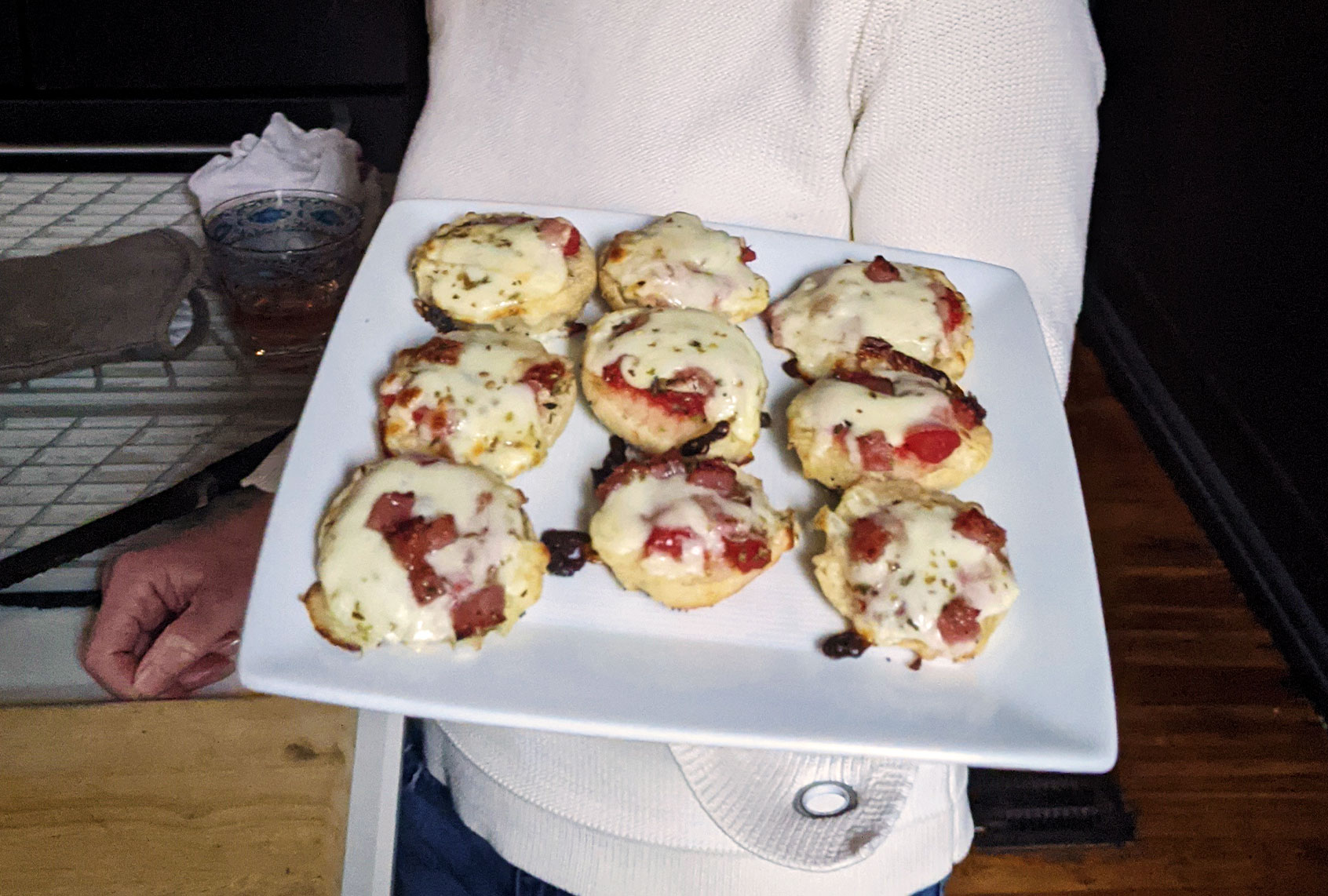
So off we went, and in one afternoon, I turned out 32 from-scratch miniature bagel pizzas and life will never be the same again. The kitchen even smelled like my Bagel Bite memories as they baked, though minus the aroma of corn syrup solids, high fructose corn syrup, modified cornstarch, nonfat dry milk and methyl cellulose (I guess?).

In true Bagel Bites fashion I gobbled the first one so fast it burned the roof of my mouth and still couldn’t resist the next bite. It was a legit bagel base complete with poppy and sesame seed sprinkle, a clean, bright layer of tomato sauce, more cheese (mozzarella and Parmesan) than was strictly necessary — because I used to also add more cheese to my Bagel Bites — teeny squares we chopped up of salami and a hit of dried oregano for the finishing touch. In other words: perfection. The only possible improvement would have been homemade ranch to dip them in. Ah, well, next time. 

You could certainly make just these and be perfectly happy with your Super Bowl spread, but why not go all out? Dan also shared a recipe for homemade Combos, because don’t we all need that in our lives? 

RELATED: Homemade pizza in under an hour is entirely possible — & entirely delicious

And one of my favorite Kentucky (or anywhere, for that matter) chefs, Kristin Smith, owner of The Wrigley Taproom in Corbin and a sixth generation farmer at Faulkner Bent Farm, completed my Super Bowl dreams when she shared a homemade take on a Totino’s Pizza Rolls recipe. I’d only ever had her beautiful Appalachian fare, but a mutual friend and fellow food fiend shared the valuable intel with me that Kristin had one time served pizza egg rolls at a dinner that he labeled “oddly stoner-themed.” Yup, that sounded just about right for this undertaking, so I asked and received. Her recipe  a specific and commanding creation  promises just the type of junk food nirvana I experienced with the homemade Bagel Bites, and I can’t wait to make them myself this Sunday. Enjoy!

Home-made pizza bagels

Recipe: Dan Whalen’s “Bagel Bites”

(Base bagel recipe adapted from Sophisticated Gourmet)

Yields 32 mini bagels

Ingredients:

For the Bagels:

  • 3/4 cups water
  • 1 teaspoon active dry yeast
  • 2 teaspoons sugar
  • 2 cups flour
  • 1 teaspoon salt
  • 2 tablespoons sesame seed
  • 2 tablespoons poppy seed
  • 1 teaspoon fresh cracked black pepper
  • 1 teaspoon coarse salt

For the Toppings:

  • 1/2 cup crushed tomatoes
  • 2 cups finely grated mozzarella cheese
  • 1 cup finely grated parmesan cheese
  • 2 ounces sopressata or other thin sliced salami
  • Dried Oregano

Instructions:

  1. Microwave the water for about 30 seconds until it is about 100 degrees. It should be hot to the touch but not burning your fingers. I like to think of it as the temperature of a hot tub. Not sure if that is weird or not.
  2. Mix the yeast and sugar into the water and allow to sit for 10 minutes until the yeast is bloomed.
  3. In a large bowl, mix the flour and salt. Pour in the water mixture and stir until a thick dough is formed. Pour out onto the counter and knead for 10 minutes until the dough is smooth.
  4. Place into an oiled bowl, turning the dough to coat. Cover the bowl with plastic wrap or a kitchen towel and put in a warm location for about an hour until doubled in size.
  5. Preheat oven to 475, put a large pot of water on to boil. line a baking sheet with parchment paper, and put another piece of parchment on the counter. Line a plate with paper towels. Mix the sesame seeds, poppy seeds, pepper, and salt in a bowl.
  6. Roll out the dough into a log and cut it into 16 equal pieces. Form each piece into a ball. Allow to rest for about 10 minutes.
  7. Lightly flour your finger, and one by one, form a small hole in each ball. I actually used two of my fingers to make the holes slightly bigger, but be gentle at this step so they stay uniform and don’t rip. Allow the formed bagels to rest another 10 minutes on a piece of parchment paper.
  8. In batches of 4, boil the bagels, about 1 minute per side. Strain and place on the paper towel lined plate. Immediately sprinkle with the sesame seed mixture. Then place on the parchment lined baking sheet. Repeat with the remaining bagels.
  9. Bake for about 10 -12 minutes until browned on top and cooked through.
  10. Slice the bagels in half. Spread each bagel half with a very thin layer of crushed tomato, then top with both cheeses, a few ripped pieces of soprasatta, and a sprinkle of dried oregano. Line them up on a baking sheet and return to the oven to cook about 7 minutes until the cheese is melted and just starting to brown. Serve.

***

Combo Pizza Rolls

Recipe: Dan Whalen’s “Combos”

Yields 30 Combos

Pretzel recipe from Alton Brown (with notes below)

For the Filling:

  • 20 Pepperoni
  • 1 cup grated Romano
  • 1/2 cup canned diced tomato, well drained
  • Pinch oregano

Note: Piping bag and wooden dowels needed.

Instructions:

Food process filling to a paste adding a small amount of olive oil as needed. Put this into a piping bag and pipe it into the combos. Make sure it is well processed or it will get stuck in the thin piping tip.

Instead of shaping the dough into pretzels, roll it out thin and cut it into the combo sized strips. Also don’t boil it or use egg wash. Wrap the small strips of dough around wooden dowels that are really well oiled. Use a little splash of water at the seam to help seal the dough together. Then put the seam side down on the baking sheet. Bake for about 30-40 minutes at 400 until hard and lightly starting to brown.

Take the combos off of the dowels and pipe them with the pizza filling mixture.

***


Recipe: Kristin Smith’s “Pizza Rolls”

Yields 12

Ingredients: 

For the Pizza Rolls:

  • 1 package of spring roll wrappers 
  • 36 pepperoni slices 
  • 12 mozzarella sticks or slice 2 low moisture mozzarella cheese blocks into 6 equal pieces about 1/2 – inch thick each, then cut each slice in half to yield 12 equal pieces.
  • 1 quart (approximately) peanut or vegetable oil, for frying

For the Marinara Dipping Sauce:

  • 1 28 oz can whole peeled san marzano tomatoes 
  • 1 medium white onion, quartered 
  • 3 Tbsp tomato paste 
  • 1/2 tsp dried basil or oregano (or combine the two, if you have both) 
  • 1 pinch red pepper flakes 
  • 5 Tbsp unsalted butter 
  • 1/2 tsp salt  

Note: start your marinara sauce first, then create the pizza rolls as the marinara sauce is simmering. 

Instructions:

For the Pizza Rolls:

Place 1 spring roll wrapper on a clean, dry work surface so that one corner of the wrapper is pointing at you (position this like a diamond, rather than a square). This part gets tricky to explain in writing, so let’s just keep going with the diamond analogy and think of it as a baseball field. It’ll make this easier as we go.  

Starting at the bottom third, closest to you — standing at home plate, and halfway between home plate and the pitcher’s mound — place 3 pepperoni slices horizontally. Overlap them slightly. Your baseball diamond now has some round, spicy mascots clustered in the zone between the pitcher’s mound and the catcher. 

Next, lay 1 mozzarella stick right on top of the pepperoni party. Now the real fun begins: 

Take the “home plate” corner of the wrapper and roll it up and over the filling, stopping at the pitcher’s mound. Now fold third base over the filling, as close to the pitcher’s mound as you can get. Do the same for first base: fold it as close to the pitcher’s mound as you can get. You should have 2nd base still wide open, doing nothing — kind of like fourth inning at a Reds game. (too soon?) 

Next, use your fingers (or a pastry brush, if you’re fancy), and dab the edges of 2nd base and the outfield border of the wrapper with water. Continue to roll the wrapper towards the outfield, snugly but not so tight that you rip the wrapper.  

You’ve made it through the hard parts. Congratulations. Now: 

Place that finished roll aside, underneath a slightly damp towel. Continue rolling until all spring rolls are finished and resting under the towel. 

Next, pour around 1 inch of oil into a large, heavy skillet. Heat the oil over medium-high heat until it reaches 350F on a deep fry or instant read thermometer. 

Using a set of tongs, slip the spring rolls into the oil carefully in batches of four for around 3-4 minutes, turning occasionally until golden brown and crispy.

Remove from skillet and transfer the pizza rolls to a paper towel-lined plate to absorb excess oil. 

Serve immediately, with the marinara sauce below: 

For the Marinara Dipping Sauce:

This sauce is a riff from Marcella Hazan’s ridiculously famous tomato sauce. 

The most important thing you need to know about this sauce is: the tomatoes MUST be San Marzano. There are no substitutions. There are no pinch hitters. Get. San. Marzano. They can be fresh — if you go fresh, you need 2 lbs — or they can be canned.  But don’t short yourself on this step. 

Next, crush the tomatoes with your hands. There’s just some kind of magic that happens when you do this. Don’t use a metal fork or a spatula or a plastic bag to keep your hands from getting dirty: commit to this sauce.  Invest all of your intention into making this beautiful sauce turn to magic through your hands. Trust me. 

Place a medium sized pot over low-medium heat and add your tomatoes until they start to simmer. Then add your quartered onion, red pepper flakes, butter, tomato paste, herbs and salt. Cook uncovered at a very slow, but steady simmer for about 45 minutes. Stir occasionally until it reaches your preferred sauce texture. One clue that it is ready: the butter fat will separate and float free, away from the tomato.

Discard the onion segments, or keep them to nibble on later. I won’t tell. 

Transfer sauce to your ideal dipping bowl, and serve immediately alongside your pizza rolls. 

For more from our pizza oven, check out: 

How to make the best wings at home — no fryer needed

Every month, in Off-Script With Sohla, pro chef and flavor whisperer Sohla El-Waylly will introduce you to a must-know cooking technique — and then teach you how to detour it toward new adventures.

* * *

I’m the luckiest girl in the world because when we roast a chicken, my husband lets me eat both wings. With the ideal ratio of skin to meat, wings are flavorful, forgiving, and always ready to take on big flavors. And who can forget those bonus bits of crunchy cartilage?

Roasting wings takes time but, aside from a couple of flippy flips and toss-y tosses, my method is mostly hands-off. Today I’ll show you all my tips and tricks for tender, juicy chicken wings with glassy, sticky skin — and how to take your next batch off-script.

What’s a chicken wing, anyways?

A whole chicken wing has three parts: drumette, flat (aka wingette), and wingtip. Wings aren’t white or dark meat, but rather a hybrid of the two. The drumette is attached to the breast, so the meat there is leaner. The flat (my favorite) has much more skin, connective tissue, and rich flavor. The tip is mostly bone and skin, best saved in the freezer for chicken stock (or tossed in your next pot of rice for extra flavor).

If you purchased your wings whole, use a sharp knife to cut through the joints and separate the three parts. This allows the wings to cook evenly and render out more fat — and it’s ultimately easier to eat and share.

Now, if you cook these different chicken parts straight from the package, it’s easy for the drumettes to get overcooked and dried-out while the flats remain flabby. Luckily, all it takes is a simple brine to bring out the best of both parts of the wing.

Let the brine do the time

I’ve brought up dry-brining before (in my one-skillet chicken and rice!) because it’s the simplest way to guarantee moist, flavorful meat every time.

Here, I toss the wings in a mixture of kosher salt, granulated sugar, baking powder, and MSG. Next, I space out the wings on a wire rack, flipping them once during brining, so I end up 360 degrees of dryness (which means better browning later).

The dry brine draws moisture from the meat to create a solution on the surface that’s then pulled back in, drying out the skin, seasoning the meat, denaturing the proteins, and breaking down the fat. All of this happens when you just let the dry brine do its thing.

It takes time — at least six hours but preferably 24 — to make culinary magic happen. The sugar and MSG add flavor to the wings, so you can leave them out if you prefer. But the salt and baking powder transform them: Salt tenderizes and seasons the meat. It also breaks down the fat, so it renders faster and more evenly in the oven. Meaning you can cook the drumettes and flats at the same temperature, for the same amount of time, and still get the best out of both.

Adding baking powder is a trick I learned from J. Kenji Lopez Alt. He found that this ingredient encourages the development of microbubbles on the wing’s surface. That craggy exterior holds on to sauce tighter, just like ridged pasta, and results in skin with a delicate crisp.

Start slow and not-so low

After they brine, I roast the wings at 350 degrees Fahrenheit, flipping once during cooking, until the meat pulls away from the bone. This takes about an hour, which allows all the connective tissue to break down while being basted in melting fat. The dry brine keeps the meat moist despite the long cook time, so all the fat can render out and there’s no flabby skin. A moderate temperature also ensures that the fat doesn’t get too hot and smoke up your kitchen.

Get glossy and saucy

While those bake, I stir up a simple sauce. Here are the big components:

  • Sweetness caramelizes during the second roast, yielding sticky wings. In my fish sauce wings, this is palm sugar or granulated sugar. In my pomegranate wings, it’s pomegranate molasses and granulated sugar. Other great picks: maple, honey, brown sugar.
  • Spice cuts through all the schmaltzy richness. You could try slivered Thai chiles as in my fish sauce wings. Or take a cue from the pomegranate wings with pops of cracked black pepper. Or detour toward Calabrian chiles, pickled jalapeños, or gochujang.
  • Acidity balances out all the big flavors. Lime juice levels out the funk and heat. Pomegranate molasses offers a one-two punch of sweet and tart. More acids to play with: rice wine vinegar, hot sauce, or tamarind.

Turn up the heat

I tumble the wings in the sauce before roasting — again — this time at 375 degrees Fahrenheit. By now, the chicken is fully cooked, so the second roast is about creating texture. The sauce reduces on the wing, growing sticky, lightly charred, and caramelized.

Suppose you want to try this method with the classic hot sauce–butter combo? Dose with that mixture after the second roast. Unsweetened sauces will only make the wings soggy unless they’re added right before serving.

Add some crunch

An oven-roasted wing will never have the same crispy, crackly skin as one blistered in a deep fryer. But that doesn’t mean we have to skip out on the crunch! That sticky glaze is ready to catch toppings, so sprinkle on a final flourish and give the wings — and the people — what they want!

I like to shower fish sauce wings with roasted peanuts and pomegranate wings with toasted walnuts, but anything crisp can up your wing game. Try broken pretzels on honey mustard wings, blitzed BBQ potato chips on brown sugar chipotle wings, or crushed corn nuts on maple miso wings.

There are countless ways to cook a wing — that’s why I enjoy playing with them. Now that you’ve gotten to know my method, I hope you feel empowered to try your own combos and take my recipe off-script.

Related recipes

More recipes from Sohla!

The best appetizer recipes to fuel a night of binge-watching TV, according to the Salon Food team

It’s that time of year . .  . The weekends ahead are filled with Super Bowls of food and entertainment, plus a long list of shows to watch because it’s way too cold to go outside (and, hey, we’re still in the middle of a pandemic). We can agree to disagree on who should win an award or championship, as well as what series to watch next on Netlfix. But we all can all agree on this: Food is necessary to fuel these wild adventures on our couches. The team at Salon Food has already shared 11 Instant Pot recipes ready for the Super Bowl (or any TV event). Now, we’ve made a master list of our favorite appetizers, which are guaranteed to fuel any binge-watching occasion. 

Bob Armstrong Chile con Queso: No trip to Austin is complete without stopping at Matt’s El Rancho for legendary queso. According to Rick Martinez, it was “named after former Texas land commissioner Bob Armstrong, who one day asked them to make him ‘something different.’ What resulted was a now-legendary layered dip of taco meat, queso, guacamole, sour cream, and pico de gallo.” Thankfully, Rick developed a copycat recipe so that fans of the beloved queso can enjoy it without leaving home. That’s particularly great for this Manhattanite, because New York is a queso dessert.  Joseph Neese, Managing Editor 

Buffalo Chicken (and All Things) Dip: Both hot AND cold dips are pretty unbeatable for me, regardless of seasonality and/or what game may or may not be on TV. Any combination of cream cheese, crispy bacon, lots of alliums, some sort of greenery and copious amounts of cheese (primary faves are super-sharp cheddar, Parmesan or pecorino and even fontina or gruyere) is always welcome — and you can’t forget a heaping pile of scallions. I love raw carrots, pita chips, torn pieces of baguette, thick potato chips and raw celery as dippers. I’m not a heat fan, but I will also always appreciate a good buffalo chicken dip. — Michael La Corte, Salon Food Contributor 

Buffalo Latkes: I’m not Jewish, nor am I really a football fan, but when I saw Sara Tane’s recipe for Buffalo Latkes, I knew I would have to tuck this recipe back for the Super Bowl. She takes the crispy, starchy Hanukkah staple and adapts it for game day with thin-sliced jalapeños and a Frank’s Red Hot-based glaze. Instead of sour cream or applesauce, the dip of the day is a homemade, creamy and funky blue cheese dressing. — Ashlie D. Stevens, Staff Writer

Charcuterie Board: This is kind of cheating, but I like to pick up a cheese kit from Costco. You know, the kind with a few nice hunks of cheese for, what, 20 bucks? Then I’ll grab some salamis , a package of dates — their fresh dates are the BEST  and some kind of nuts and crackers. And, look, all of a sudden I have the fixings for a board! Whatever I have at home gets added — maybe some mustards, why not some olives. Any leftovers go in the fridge for a few days of ready made snacks. — Dana McMahan, Salon Food Contributor 

Hot Corn Dip: I found Trisha Yearwood’s hot corn dip while digging through Pinterest back in its early days, looking for a meatless make-ahead hot appetizer to round out a party menu. I knew her as a country star and had no idea she had her own Food Network show, but I figured Trisha Yearwood wouldn’t steer me wrong. (She’s got her God and she’s got good wine / Aretha Franklin and Patsy Cline . . . and hot corn dip?) I made it once, and now my friends demand it for any festive occasion where dairy-heavy dips are served. If you’re lactose intolerant or philosophically opposed to canned “Mexican corn,” you will not like this dip. I could suggest five ways to fancy it up, but that would defeat the purpose. This is an unpretentious appetizer that anyone who can work an oven can make. It is aggressively corn-colored. People might be skeptical. But trust me: If you make it once you might end up having to make it for the rest of your life  or at least until all your friends go vegan. — Erin Keane, Editor-in-Chief

Samin Nosrat’s Sauces: If you, like me, always forget to plan for munchies until the last minute (and don’t have time for anything elaborate), a quick way to impress is some homemade dipping sauces. These can go with dumplings, vegetable platters, pitas, chips or crackers. Along with the perennial hummus, I’m fond of Samin Nosrat’s sauce recipes at The NYT Cooking vertical. Herbed yogurt goes well with kebabs, raw vegetables and even french fries. Soy dipping sauce plus a bag of steamed dumplings from the frozen food section looks fancy and takes about 10 minutes to make. Plus, you can always make this beer queso recipe, courtesy of me if you really want people to chow down. — Amanda Marcotte, Senior Politics Writer

Rotel and Velveeta Famous Queso Dip: I learned early on in my days of throwing children’s parties that the guests most excited by the most garbage of foods are always adults. Sure, I could make real queso with good cheese and fresh tomatoes. But if you want to see people’s eyes light up with nostalgic joy, you can’t beat the campy American classic made of just two ingredients — and they are quite specific. I like to stick this in the Crock Pot mini and leave the works in the kitchen next to a bowl of tortilla chips. It’s also a big hit with pretzel logs. — MaryElizabeth Williams, Director of Community 

We tested the internet’s favorite ground beef trick

Mid-December, a Tik Tok circulated that left me, to put it plainly, mouth agape. In the clip, made by Tik Tok user Emily Harper, we’re promised a trick our narrator learned in “nutrition a couple years ago.” Nutrition, I can only surmise, is some sort of health or wellness class, perhaps with a dietary premise. Well, Emily, let’s see it.

She starts by adding ground beef to a non-stick pan, pretty standard issue stuff to start. What happened next left me, and a huge portion of the internet, in shambles. She shows us, the viewer, the digital amorphous mob, all the grease and water that seeps out of the ground beef once it’s cooked. “All this grease is disgusting,” she writes in a text overlay across the now-cooked beef. Emily then moves the pan to the sink, pours out the excess moisture, empties the beef into a metal sieve, and runs it under the tap. The fat collects at the bottom of the sink like an oil slick on asphalt. She returns the rinsed beef to the pan for a final sear before imploring us to “Look at the difference!”

Upon first view, I felt numb. What had I just watched? Had she really washed all the meat grease down the drain? Where had it all gone? Was it ever coming back? What does squeaky-clean beef even taste like? Should I be doing this? Should I not be doing this?

The internet, of course, had opinions.

But Emily, perhaps, was on to something. I mean, cooking ground beef does leave you with a sort of grayish liquid at the bottom of the pan that prevents the meat from ever really browning. I’m always chasing that maillard and that dang water reliably gets in the way. What if there was a workaround — one that didn’t involve giving your dinner a bath?

It turns out, there is! Just this week, it came to my attention that non-soggy, nicely browned, crispy ground beef is just a swish of the wrist away. No, really. There’s a one-ingredient fix that’s completely changing the way I’ll cook ground beef from here on out. And chances are, it’s already somewhere in your kitchen.

The answer? Baking soda.

According to this graphic from America’s Test Kitchen, all a bunch of ground beef needs is a sprinkling of baking soda and a short sit. The baking soda helps lock in the moisture and prevent the beef from getting soggy, a la Emily.

I decided to give it a try. According to this article in Cook’s Illustrated, the baking soda “raises the pH on the meat’s surface, making it more difficult for the proteins to bond excessively,” and allows the meat to remain tender even as it cooks. They recommended a slurry of baking soda and water and a 15-minute minimum soak before cooking. I took my beef out of its package and sprinkled it with a generous spoonful of the baking soda I had already sitting in the fridge. I decided to forego the slurry and dusted the baking soda directly onto the meat, following the example of this Skillet explainer instead. I mixed it together until fully incorporated and left it to sit for 15 minutes. Then, I put the beef into a hot pan without any olive oil, gave it a stir and left it alone to develop a nice brown crust all on its own.

I came back every few minutes to move it around the pan and let the beef brown on all sides. Very quickly, I noticed an immediate difference. There was very little liquid pooling along the bottom pan and the meat, once I flipped it, was developing a nice crispy edge to it just like I wanted.

Once all the beef had cooked through, I took it off the flame and surveyed the scene. There was, of course, a little grease still left in the pan, but by no means was there any liquid, and all the meat had cooked on the outside. Some of the smaller bits even charred a little. In my excitement, I tossed the beef with some rice, parsley, raisins, pinenuts, sumac, cinnamon, and onion and stuffed some peppers. Right into the oven they went! No beef rinse necessary.

GRAB A SPATULA & COOK WITH US:

Related recipes


Dungeons & Dragons is truly the best saving throw to escape the pandemic doldrums

Sometime at the end of last summer my friends and I started hitting the road together. We weren’t limited to states, regions or time zones. International travel bans were meaningless. Our journeys took us to a place called the Sword Coast and a cluster of small towns blessedly free of coronavirus. It was fantastic, in a very real way. We’ve been returning once or twice a month since.

One downside is that the place is plagued by zombies, dragons, cultists, pirates and every variety of fiend and villain, but even that is navigable with decent weapons, a few helpful spells and lucky rolls and a generously loaded charcuterie plate.

At this point if you haven’t caught the references, I’m talking about Dungeons & Dragons, truly the best saving throw against the pandemic blues going. Little wonder there, given the way the game first came into my life. Back in college, when my friends and I were all extremely broke and shivered against terrible Midwestern winters my then-boyfriend (now husband) introduced me to the game. It didn’t take much persuasion, since I grew up as a fantasy nerd who loved playing “Wizardry” and “The Legend of Zelda.”

Absent a gaming system among us, our main options were cards, old board games and D&D, which only required dice rolls, our imagination and copious amounts of beer. Eventually we all graduated and scattered across the country, checking in every few weeks or months. For some of us it had been years since we’d rolled a 20-sider or indulged in any fantasy not served up by Peter Jackson, Lucasfilm, DC or Marvel.

But my husband and I had played recently on a trip to San Francisco to visit two of our best friends. We’d had a few shots at their kitchen table and next thing we knew, we were playing a short beginner level game. Since it was a weekend trip, we didn’t finish.

Then came 2020, its virus and lockdowns. Fortunate as I am to be in stable partnership where we genuinely like each other, our fairly small house felt a lot smaller once the fall started chilling the air.

No matter who or where you are, though, surely COVID-19 shrank your world in some way. For those of us who are social distancing, travel plans were delayed or cancelled, family visits pushed down the road, regular dinner and TV nights with friends went on indefinite hiatus.

Once the walls that used to constitute home encompassed work and school, our need to get away took on a new urgency.  And this smash-up of claustrophobia and agoraphobia has proven to be an additional boon for Dungeons & Dragons. Our San Francisco fam called us up, and we finished that game. Then we started another and rang up our crew from college, slogging through nine-, 10-, 11-hour marathons with people we still adore and whose lives have taken them far away from us, geographically. A Zoom connection, our old bag of dice and a wacky story is enough to close the distance and collapse the time we’ve been apart into nothing.

Long before COVID-19 knocked the world sideways D&D was already a hit among younger generations, helped along by its central role in “Stranger Things” and a cool factor lent to it by celebrities like Vin Diesel and Joe Manganiello flying their D&D flags proudly. The game has morphed many times over since its original version was released in 1974.

Since the fifth edition launched in 2014 a spokesperson for the game’s publisher Wizards of the Coast says Dungeons & Dragons has seen seven years of consecutive growth in product sales and the community that supports it. Sales for the basic introductory products such as the all-essential Player’s Handbook rose by 300% in 2019.

But 2020 was monstrous – its best year ever. Online platforms reported surges in game sessions and new account registrations that year, with Fantasy Grounds reporting three times as many game sessions in April 2020 compared to April 2019, according to the company’s report.

Another site, Roll20, says that its user base from Italy increased while the country was hardest hit by the pandemic.

So in the way of many diversions that used to be the province of the uncool (or, in the 1980s, a pillar of the Great Satanic Panic), Dungeons & Dragons is mainstream, and I suspect it’s not just for the fun.

It’s a creative escape mechanism blended with a means of hanging out with friends and exerting power and strength to counteract darkness at a time when so much is uncertain. And there are so many reasons to feel powerless. In this world I’m limited to a few hundred square feet. On the Sword Coast I climb cliffs and run through forests. Best of all, I don’t have to be me.

Sometimes I face down these goons as a dragonborn stoner cleric raised by hippies who told him they adopted him but probably stole the egg he hatched from when they were high.

In another adventure I square off with them as a rogue with a shifting name who acts like several characters on the classic adult puppet show “Crank Yankers,” which delights and confuses the rest of the party. We can cast spells and shop for ridiculous pieces of equipment and do everything we can to keep each other convulsing in hysterics. In those moments I feel more myself than I do in my normal life.

One day, hopefully soon, we’ll be able to gather together in the same room, share the same snacks and toast each other in person and enjoy the physical world as before. Living and socializing virtually has taught us that there’s simply no replacement for this.

But if we have to contend with social distancing, curtailed travel and the virtual limbo of Zoom for a little while longer, it’s comforting to have a reliable classic like this one to encourage us to connect and lose our regular selves for a while, to huddle together around a campfire and against the dark.

What the Weeknd’s changing face says about our sick celebrity culture

You might have seen The Weeknd’s altered face on the internet lately – either bloodied and covered in bandages or transformed by faux plastic surgery. With the 30-year-old singer set to perform at the Super Bowl LV halftime show on Feb. 7, it’ll be interesting to see whether he continues the act before hundreds of millions of viewers.

The changes to The Weeknd’s face didn’t simply appear overnight.

Rather, they surfaced as a slow crescendo, as notes in a larger arrangement.

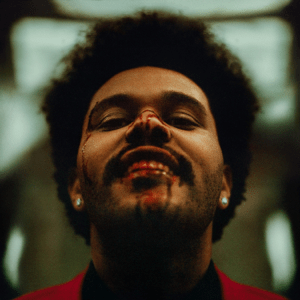
Initially, there were facial bruises at the end of his “Blinding Lights” music video, in which an all-night bender ends in a car accident. He sported a bandaged nose for performances on “Jimmy Kimmel Live” in January 2020 and “Saturday Night Live” in March 2020. Later that March, the bloodied nose and lips appeared on the cover of “After Hours,” his most recent album.

He took the performance a step further while accepting two awards at the 2020 American Music Awards, showing up with his whole head covered in bandages, which worried some fans who assumed the bandages were real. When those bandages come off for the “Save Your Tears” music video, a face disfigured by excessive plastic surgery is revealed – a carefully constructed visage created using makeup and prostheses that make him nearly unrecognizable.

As an anthropologist who has been analyzing the societal implications of plastic surgery for over 15 years, I was struck by The Weeknd’s use of this medical practice.

What, I wondered, was he trying to say?

Initially, I’d assumed the bruises and bandages were a metaphor for The Weeknd’s struggle with drug addiction, a topic he has long explored in his music. He’s noted that, when scripting his music videos for “After Hours,” he was inspired by the film “Fear and Loathing in Las Vegas,” in which writer Hunter S. Thompson, played by Johnny Depp, often hallucinates or spirals out of control.

However, another key emerges in the videos from the “After Hours” album. In all the videos, people are constantly watching him, whether it’s the crowd of stiff, masked fans in the “Save Your Tears” music video or the frantic crowd reaching out to grab him as he tries to escape at the end of “Until I Bleed Out.”

In both cases, he seems to be comparing fandom to an unsettling loss of privacy, one where his very safety is at stake. It’s not that he fears his fans will hurt him. It’s more a commentary on how his celebrity status makes him vulnerable to a prying gaze at all times.In his most violent music video to date — for the song “Too Late” — the themes of plastic surgery and fandom collide. Two wealthy white women with bandaged heads find his severed head and swoon over it, before deciding to murder a Black male stripper so they can attach The Weeknd’s head onto that muscular body.

The racial dynamics of the video are hard to miss: The women seem to exoticize Blackness and reduce the body parts of two Black men to objects that give them pleasure.

People love musical performances —  or art, more generally — because it’s pleasurable to soak in the talented work of other people.

In the celebrity culture of late capitalism, however, artists are finding it more and more difficult to separate themselves from their art: The show continues after the work has been published or the performance has concluded. Fans feel entitled to access all aspects of their personal lives – even their bodies.

Communication scholar P. David Marshall has written about the ways in which the public assumes celebrities are automatically open to — or deserving of — scrutiny thanks to their fame. When their privacy is invaded, it’s simply shrugged off as coming with the territory.

Some celebrities, like the Kardashians, lean into it. They’re willing to expose themselves in increasingly invasive ways — whether it’s through social media or reality television —because they want to exploit the symbiotic relationship between media exposure, wealth and power.

But other celebrities, like Lady Gaga, have been forthright about the ways in which fame has harmed their mental health. Musicians like Sia and Daft Punk have gone to great lengths to hide their faces and protect their privacy, making it part of their act.

By using bandages and prostheses to hide his face, perhaps The Weeknd is also telling us that parts of his life are off limits – and should stay that way.

The Weeknd also seems to be acknowledging the immense pressures that celebrities feel to conform to unrealistic beauty standards. Celebrity journalism can be particularly cruel when famous people fail to measure up, with the paparazzi making a fortune off pictures that demonstrate celebrities as vulnerable or imperfect.

Feminist and literary scholar Virginia Blum has written about how celebrities are admired for their ability to transform and beautify themselves, and yet they also become canvases for harsh critique when it seems they’ve gone too far with plastic surgery or have aged ungracefully.

For celebrities, it can sometimes seem that there’s no pleasing anyone. By making those concerns with superficial beauty part of his art, The Weeknd seems to throw that mirror back at his listeners, asking them to reflect on the irrelevance of his appearance to his craft.

Alvaro Jarrin, Assistant Professor of Anthropology, College of the Holy Cross

This article is republished from The Conversation under a Creative Commons license. Read the original article.

Trump fell for “constitutional jiu-jitsu” by refusing to testify in impeachment trial claims analyst

Early Saturday morning, MSNBC legal analyst Danny Cevallos suggested Donald Trump walked into a trap with his refusal to appear and testify at his second impeachment trial which starts next Tuesday.

Speaking with hosts Kendis Gibson and Lindsey Reiser, the defense attorney stated that House impeachment manager, Rep. Jamie Raskin (D-MD) executed “constitutional jiu-jitsu” by asking the former president to appear as opposed to subpoenaing him.

“How much could Trump’s absence, actually, hurt him, in this case next week?” the attorney was asked.

“Jamie Raskin is using a great bit of constitutional jiu-jitsu here,” Cevallos replied. “They did not issue a subpoena, they just requested or invited him to come testify and President Trump declined. This is not a subpoena situation, but, you know, in our parallel-judicial courts, we have a principle: in criminal cases only that the prosecution and the judge cannot comment on an accused’s silence at a criminal trial. But in civil cases, that comment or that inference, that negative inference from a defendant’s silence, is allowed.”

“Beyond that, the president or former president isn’t even being compelled to come speak or testify at this impeachment,” he continued. “And the reality is, whereas in judicial court, we have centuries of case law and bound volumes of books like the ones behind me telling today’s courts what to do, the Senate is bound by none of that. They are bound by whatever the head count is of their votes in today’s Senate.”

Watch below:

Lancet editor says inequality and COVID-19 have converged to create a “syndemic”

In his new book “The COVID-19 Catastrophe: What’s Gone Wrong and How to Stop It Happening Again,” Dr. Richard Horton does more than trace the history of the COVID-19 pandemic and explain how we should listen to scientific experts in confronting this global scourge.

He does this, of course, but Horton is more ambitious than that. As editor-in-chief of “The Lancet” — one of the world’s oldest, most famous and most prestigious medical journals — Horton has overseen the publication of countless articles on a variety of medical subjects. Hence, one can sense in his book a desire to apply the full breadth of his knowledge and experience to this problem. His conclusion is both fascinating and extremely relevant, even urgent.

As Horton explains, the COVID-19 pandemic was unnecessarily worsened by deeper social problems, from economic policies that left millions upon millions of people especially vulnerable to Western governments who made political assumptions about the virus that proved to be gravely mistaken. Speaking with Salon, Horton discussed everything from President Donald Trump’s failure to address the pandemic (as well as President Joe Biden’s early successes) to an intriguing thought experiment on what would have happened if the governments the world could have simply paid people to stay home.

As always, this interview has been lightly edited for clarity and context.

How would you sum up the main thesis of your book?

What I’m trying to do is to look back over the past 12 months and draw conclusions and learn lessons, in a sense to provide a preliminary verdict on the world’s response to the pandemic. But second, and in some ways more importantly, to look forward and to try and put the pandemic into perspective and answer questions about what kind of society we want to live in and how do we get to that society. 

Let’s talk about Donald Trump’s response to the pandemic. How would you characterize that?

On dear! Donald Trump exemplifies the kind of leadership that really dragged America into the international shadows in his response. There wasn’t a political leader, except perhaps for President [Jair] Bolsonaro in Brazil, who was so dismissive of the science, so dismissive of expert advisors around him, so reckless in his pronouncements, so inconsistent in his advice to the public, and seemingly so unwilling to mount any kind of coordinated national response. It really was remarkable to observe the United States of America, the world’s only scientific superpower, fail utterly to bring the talent and knowledge of its scientific and medical community to bear on this pandemic. And it’s a failure that will hold the US for decades to come.

How would you contrast that with the early policies we’ve seen from Joe Biden in responding to the pandemic?

President Biden very quickly assembled an expert team to counsel his administration, people on that team who had great expertise in public health, and of course, of managing previous infectious disease outbreaks such as AIDS. I’m thinking about Dr. Eric Goosby. He was certainly correct to retain Dr. Anthony Fauci as a principal advisor, and my impression is that he shows due deference and respect to the science while at the same time showing firm political leadership and then the intention to put in place the kind of national response that President Trump seemed to find so difficult. There is a sobriety about President Biden which may not produce exciting politics, but certainly delivers reassuring competence at a moment of national crisis. 

In your book, you described certain countries as having better responses than others. Which ones would you cite as the gold standard? I’m thinking of New Zealand, as one example.

I think that if you actually look to East Asian countries, we can see now that countries such as China, Taiwan, Singapore, to an extent Vietnam, certainly New Zealand and even laterally Australia, were about to mount decisive responses and understand that the only way to address this virus through a strategy of what one might call “zero COVID.” One has to act in a way that squeezes this virus out of every possible community. Now it’s never going to be possible to eradicate this coronavirus. It’s not going to be like smallpox, but it is possible to eliminate the virus, in a word to ‘suppress’ it so much, that you do not have community transmission. And that needs to be the objective in the U.S., the United Kingdom and across Europe. And at the moment, unfortunately, we have failed to learn the lessons from the successes of East Asian countries. We’re pinning all of our hopes on the vaccine. A vaccine will be important, but a vaccine is not a magic bullet, and it does not alleviate us from the fact that we need to pursue a policy of zero COVID. 

Now I want to pivot to your book’s discussion of austerity economics, which you describe as making this crisis worse than it needed to be. Can you elaborate on that?

Yes. This pandemic, we have viewed I think as a threat from a virus, but actually it’s not a pandemic where the virus is the only threat. The pandemic also hit societies that were very poorly prepared for the virus, and they were poorly prepared in two ways. Firstly, the very high levels of chronic ill health amongst many Western societies — particularly chronic ill health from overweight and obesity, diabetes, high blood pressure, very common disorders — and secondly, we were vulnerable because of the deep inequalities in our society. And the decades of austerity has deepened those inequalities in our society. And indeed it was the people who were poorer, who lived in less good housing, who were working on the front lines, who are living in the gig economy, who didn’t have the luxury of being able to choose to work from home but had to put themselves at significant risk by going out to work every day — I think what we’ve seen is that that austerity, which worsened inequality, created the conditions for an exquisitely vulnerable society when a virus hits.

So that’s why I don’t call this a pandemic. I call it a “syndemic.” It’s a synthesis of epidemics, which together — the biological and the social — together has caused this global emergency.

In a sense then could you argue that the failure on the international level to effectively respond to the pandemic is an indictment of capitalism

I would say that it’s an indictment of the past 40 years of a version of capitalism. Since the days of Ronald Reagan and Margaret Thatcher, we have pursued a very intensive form of capitalism that has come to be called neo-liberalism. And that intensified capitalism elevates the market as the supreme arbiter for all social problems. And what we’ve seen is that in the good times, having efficient just-in-time societies and supply chains might work well, but when a pandemic hits, what you need is not efficient market based societies, but what you need is resilient societies. In other words, societies that are able to absorb shocks, and one of the reasons why many Western countries have performed so badly is that their societies were not able to absorb these shocks. So I think one could say that this pandemic has held a mirror up to the way we’ve lived our lives for the past 40 years. 

And we’ve looked into this mirror and seen that the kinds of societies we live in are not fit for purpose for the threats that we face today. Because we will have another pandemic. There will be one. We don’t know when it will happen. It might not be next month or next year, or even next decade, but it will happen, and we need to be ready. And that means we need to change the direction of travel in the way we construct our societies so that they are resilient, so that they can absorb these shocks, and that means that death of neo-liberalism.

I would like to ask a hypothetical question. Let us say the governments of the world would have been able to simply pay people to stay at home, and redirected all of the resources necessary to fighting this pandemic. Would this have been contained more quickly and effectively than with the patchwork of policies that we’ve seen internationally instead?

I think it’s a very interesting thought experiment because I don’t think it’s outlandish. I think that it would have been a highly desirable outcome. We’ve already said that East Asian countries pursued a very tough lockdown in the first wave and were very effective at squeezing the virus out of their communities. One of the myths of this pandemic is the trade-off that is alleged between health and the economy. People say, ‘Well, we have to think about livelihoods as well as lives, but if we pursue the objective of health, then we will end up sacrificing our economies.’ That’s plainly not true. What we’ve seen is that those countries that did put a premium on saving lives actually have seen an economic bounce back.

I’m thinking here of China, as an example. It’s not a trade-off between health and the economy. In order to get back on track with economic growth, you need to put health first. And what we in the West have done is not understand that lesson. And as a result, we’re constantly cycling back and forth between lockdowns, release, resurgence of the epidemic, lockdowns, release, resurgence, in this endless cycle, which is doing far greater harm to our economy and at the same time driving up mortality. We have the worst of both worlds.

That makes sense. I would now like to pivot to specifically the Chinese government’s response to the pandemic and how it compares to that from the United States and the United Kingdom. I personally feel that there has been a tendency to vilify China. I’m curious how you would contrast the government’s responses strictly in terms of COVID-19 and protecting their populations.

I think we have to be very nuanced about our judgments of China. I worked very closely with a group of Chinese scientists and doctors who were on the frontline at the outbreak in Wuhan last year, and I can honestly say that the world owes them a debt of gratitude for the way they fought this outbreak when it first took place, for the fact that they sequenced the genome of this virus and posted it in early January for the world to be able to use, for the fact that they wrote up the first case descriptions, which we published in the last week of January, so that the world could get an accurate understanding of the threat that we were facing, the fact that they signalled to the world the dangers of person-to-person transmission. And finally, they raised the alarm about the risk of a global pandemic.

This work was done in China. So when I see and hear Western political leaders vilifying China in the way that they do, I think that there is a dimension of Sinophobia, even racism, against the Chinese. Now that’s not to say that the Chinese government doesn’t have some very important questions to answer about the very early stages of what took place in Wuhan and how that information was handled by the local authorities there, how it was transmitted to the government in Beijing and how they evaluated that evidence. I hope that the current WHO team that is in Wuhan and is investigating these early stages of the outbreak, I really hope that the Chinese authorities give them the freedom to investigate.

But when you compare the way China acted, which was decisively and quickly in those early stages, and I compare the way my government in the United Kingdom or President Trump’s government acted in those weeks in January and February and early March, I’m afraid that showed the dangerous incompetence of our democracies, and actually points to a potentially very dangerous flaw in our democracies, that we were not able to apply our scientific knowledge and translate it into political decision-making that protected the lives of our people. And that is a terrible, terrible failure of the democratic system. 

My final question is — and this is something that you broach in your book, so I was hoping you could elaborate on it here — what specific mistakes did US and UK policymakers make when it came to working, or more specifically not working, with Chinese scientific experts in dealing with the pandemic? 

One of the advantages about an authoritarian political regime, which China is, is that there’s a relatively small number of people who have a great deal of influence and power, and in the world of medicine and public health, we know those individuals very, very well indeed. Now when the first news of the outbreak became known, it seems to me that government advisors in the US, UK and elsewhere should either directly or through their embassies in Beijing have got in touch with these individuals. We all know them. Your leading experts in America know personally George Gao, director of the Chinese CDC, or Chen Wang, President of the Chinese Academy of Medical Sciences, or the Ministry of Health’s Ma Xiaowei, or the former minister of health who has a very well-known international laboratory in Shanghei, Chen Zhu.

These people are very well known to us in the West. Why didn’t we get in touch with them and ask them what actually was happening? Was this a real global danger? And again, there’s a failure of statecraft here, which I do find very difficult to understand. In those weeks in January, those early weeks in January, we were in touch with all of those individuals asking them what was happening in Wuhan, and we built up a picture by the end of January of this real emergency that was taking place in the country and that was on the edge of breaking out into the rest of the world.

Now, if we, as a medical journal, could see that just through our own network. I don’t understand how with the great power and reach and network of governments, that message was not somehow funneled into all the offices of presidents and prime ministers. And this failure of statecraft is what I believe there needs to be a reckoning for. The information was available in January last year, and somehow we were unable to grasp it and to translate it into policy. And the result is that literally hundreds of thousands of our fellow citizens have died. Needless deaths. They did not need to die, and they died because their governments were inept.

The second edition of Dr. Horton’s book,  “The COVID-19 Catastrophe: What’s Gone Wrong and How to Stop It Happening Again,” was just released by Polity Press in January 2021. 


Fox News made Lou Dobbs its “sacrificial lamb” but will still lose billions in lawsuits says analyst

On CNN Saturday, chief media correspondent Brian Stelter suggested that Fox News threw Lou Dobbs overboard to cover themselves legally against a defamation suit from a voting equipment company — but that it won’t save them.

“Do we know how much the lawsuit played into Dobbs’ firing?” asked anchor Victor Blackwell.

“Certainly seems like it was a factor, but sources at Fox say that there were other factors as well,” said Stelter. “They say Dobbs’ show, although relatively high-rated for Fox Business, was actually a loss leader because advertisers did not want to be associated with his extreme right-wing content. Of course that is true for others at Fox like Tucker Carlson, but Carlson has a much bigger audience.”

“But the timing is obvious,” added Stelter. “He was on the air Thursday. The lawsuit filed on Thursday. He was off the air on Friday and he is never coming back. That is a shocking move by a network to make. And you have to wonder if what the network is doing is basically kind of a sacrificial lamb in the midst of this massive lawsuit and waiting to see what will happen next. I know Dobbs and other hosts on say Fox rail against ‘cancel culture’. But it might be really ‘consequence culture’. There are consequences for constantly pedaling falsehoods on television and perhaps that there are real consequences for Dobbs.”

“So you mentioned he may be a sacrificial lamb,” said anchor Christi Paul. “But really, what is the assertion of legal experts when it comes to this suit?”

“They say that getting rid of one host won’t change the dynamics of this defamation lawsuit,” said Stelter. “Because this is about what was said on television in November and December, not about what Fox does in January and February. So the lawsuit has teeth. We’ll see how it moves through the court system and how Fox will try to defend itself. But what we are seeing is real consequence for the Big Lie, for people that desperately tried to support Trump and prop up his bid to stay in power.”

Watch below:

One year on, Muslim women reflect on wearing the niqab in a mask-wearing world

One year into the pandemic, protective face masks have come to signify different things for different groups of people.

To some it’s an issue of protest, while for some others it’s a statement of social responsibility. Some people have even turned it into a style statement and are willing to spend hundreds of dollars on designer masks.

At the same time, racialized perceptions related to masks have put an additional burden on groups that already experience racism and inequality. Across the country, several Black American men have been arrested, followed and challenged by police officers who claimed they looked “suspicious” in pandemic masks.

But in a group I have studied since 2013 – Muslim women in the West who wear the niqab, or the Islamic veil, along with a headscarf, the experiences have been more positive.

Challenges faced by many Muslim women

The niqab is worn by a small minority of Muslim women. It is a piece of cloth tied over the headscarf (hijab) that comes in a variety of styles and colors. It is sometimes mistakenly labeled as the burqa, which is an all-enveloping garment that largely entered the American imagination during the U.S.-led invasion of Afghanistan. At that time the Western media, while depicting burqa-clad women, wrote about how the war would help advance the rights of Afghan women.

Niqab wearers are a difficult group to study, and scholars have described them as a “rare and elusive religious sub-culture.” Despite this challenge, I have been able to conduct three research projects that relied on interviews with women who wore the niqab.

Initially, I conducted a larger study of 40 women that I published in my book “Wearing the Niqab: Muslim Women in the UK and the US.” I also interviewed a group of 11 women in April 2020 after mask-wearing became mandated in public in many U.S. states and countries. In January I was able to reach 16 women who agreed to be interviewed about their experiences of wearing the niqab one year into the pandemic.

I found that many recently adopted the niqab because walking around with a covered face became less daunting as more people appeared in public with face masks. As I found, many wanted to wear the niqab to underscore the religious character of this practice.

Some women wore a mask under the niqab, mindful of the health guidance that requires masks to be constructed out of a “tightly woven fabric,” in order to stop the virus from being spread. Others used thick, snugly attached niqabs in lieu of a mask.

Studies have shown that Muslim women more likely to experience prejudice in public spaces, employment and other services, when they dress religiously. Over 80% of the women I interviewed for my book said they experienced some form of abuse in public, such as hostile stares, comments, having the niqab ripped off or being physically injured.

Legislation that bans religious face coverings in public has been passed in some countries and territories, such as France and Quebec. On March 7, Swiss citizens will be voting on a niqab ban in a nationwide referendum. In the past, advocates of such laws have argued that face-covering is a sign of religious extremism, social separation and patriarchal oppression of Muslim women.

However, during the pandemic, criticism has been leveled by scholars and activists at governments that upheld such legislation while simultaneously requiring their citizens to wear masks.

In France, for example, one is liable to pay US$165 (or 135 euros) if caught in public without a mask, while wearing a niqab still carries a risk of being fined up to $180.

During my interviews in April with 11 niqab-wearing women in the United States and Europe about their experiences of face-covering during the early phase of the pandemic, I found their responses to be guardedly positive. Women reported decreased levels of the kinds of prejudice they experienced before the pandemic. They attributed this to the new social expectation that everyone was wearing a facial covering. Many enjoyed the sense of “invisibility” while wearing the niqab.

A woman from Illinois who I spoke with over Zoom (names of the respondents are withheld to preserve their anonymity) said: “There are so few of us, and still we were told we were a threat to society because we covered our faces. Now that argument has just disappeared. I just hope this sentiment doesn’t make a comeback once the pandemic is over.”

Free to dress religiously

Almost a year later, I went back to find out whether the “mask effect” held steady for these women. I spoke with 16 women who said that the niqab had become a much more accepted option among the pandemic masks. I found that many women were switching from wearing it only occasionally outside their homes to every time they were in public spaces. Some actually adopted this garment for the first time in their lives.

In an online poll that I ran with the help of the owner of the online Islamic fashion boutique Qibtiyyah Exclusive UK as part of my 2021 study, 14 women out of 51 who responded said that they had decided to begin wearing the niqab during the pandemic.

One anonymous respondent commented: “I feel this is the perfect opportunity for any Muslimah [Muslim woman] to start wearing the niqab. I would if I didn’t already.” Another wrote: “It’s been a flawless transition [to wearing the niqab]. No one says a word.” Another stated, “I’d been experimenting with the niqab before, but now, since COVID, I have worn the niqab full time.”

The niqab is not mentioned by the Quran – which mandates only modest clothing for both men and women more generally. The Quran (24:31) says: “And tell the believing women to lower their gaze and guard their chastity, and not to reveal their adornments except what normally appears. Let them draw their veils over their chests, and not reveal their hidden adornments . . .”

An individual practice

There is a common misconception in the West that this is an oppressive, patriarchal practice forced upon Muslim women. In reality, several studies have shown that many women choose to wear the niqab – sometimes against their families’ preferences.

The 40 niqab wearers I interviewed for my book considered it a religious practice. Many of them said that the wives of Prophet Muhammad reportedly wore it regularly. A woman from Texas said: “I wear the niqab because I choose to follow what I believe to be the most accurate interpretation of God’s word that says women who cover their faces will be rewarded for fulfilling this extra duty.”

It is a highly individual practice to which the women I interviewed came after a long reflection. They acknowledged that while the niqab may be suitable for them, it might not work for others. A woman from the U.K. explained why some women choose to wear it while others don’t: “The Quran says to cover yourself modestly. Now, the interpretation of that is different to every group of Muslims. Some people believe it just to be the loose dress. Others believe it to be an outer garment as well as headscarf. Yet others would go one step further and say it’s the face covering as well, because [the Quran] says to cover yourself.”

Women who adopted the niqab after the beginning of the pandemic also described their experiences to me. Following years of doubt about the safety of wearing the niqab in their neighborhoods, they felt this was the best time to try.

A woman from Pennsylvania who began wearing the niqab in late 2020 sent me a message: “I wanted to wear the niqab for a long time, but I live in a very white area. I was afraid – I don’t like to be stared at and I already get enough of that in my hijab. With everyone wearing a mask, I figured now’s the time. At first, I wanted to only test it out, but literally nobody looked at me twice. So I’m just wearing it, with a mask underneath.”

Anna Piela, Visiting Scholar in Religious Studies and Gender, Northwestern University

This article is republished from The Conversation under a Creative Commons license.

“A moment of moral and political nihilism”: Theologian Adam Kotsko on our current crisis

In the wake of Donald Trump’s failed insurrection, the most reflective observation I have encountered is theologian Adam Kotsko’s article “An Apocalypse About Nothing,” in a new left-wing Christian publication called The Bias. (That confusing name apparently has a heritage in the 1960s British Catholic left.) While the 24/7 cable news narrative has been all about how dramatically different the Trump and Biden presidencies are, Kotsko stressed the opposite: Trump’s child separation policy was virtually the only thing to set him apart from previous Republican presidents, while “Joe Biden is the most conservative Democratic nominee of the postwar era.” 

While many people might argue with those assessments, it’s more difficult to dispute Kotsko’s deeper point about the broader historical pattern: “Over and [over] again, and to an increasing degree, the alternation of power between two broadly similar political parties is treated as an apocalyptic emergency.” When every election is the most catastrophically important in history — when nothing is ever gained, beyond a temporary reprieve — something is surely missing at the core. 

Kotsko also noted that “the word ‘apocalypse’ refers etymologically to a revelation, or more literally an uncovering,” adding: “Apocalyptic literature always finds its society and historical moment to be corrupt and decadent.” So rather than rail against the overheated apocalyptic rhetoric of others, Kotsko undertook his own cool-eyed, analytical version, saying, “I will follow my prophetic and apostolic forebears in diagnosing the root cause of that corruption and decadence as a failure to recognize the truth, which has resulted in a thoroughgoing moral and political nihilism.”

That truth is not simply the failure of the neoliberal order — ushered in by Ronald Reagan and Margaret Thatcher, but embraced by Bill Clinton, Tony Blair and Barack Obama as well — but a good deal more as well: the lies about human nature, freedom and the market which lie at the core of the neoliberal faith, as Kotsko unfolded in his 2018 book, “Neoliberalism’s Demons: On the Political Theology of Late Capital.” So I reached out to ask him to discuss what he had uncovered at the core of our historical moment’s “corruption and decadence.” This interview has been edited, as usual, for clarity and length.

Shortly after Trump’s failed coup attempt, you wrote  “An Apocalypse About Nothing.” You called the attempt “a potentially apocalyptic moment, one in which all our certainties about constitutional government and electoral politics dissolved and all bets were off,” and yet in terms of normal politics, you argue, it was hard to see why. Above the blow-by-blow melodrama, from a larger perspective many people would agree that the Democrats lack the confidence and vision to stand up to Republicans, and  I think your work can help us better understand why.  But I want to begin with your deeper argument. You write that in your book you argue that neoliberalism “has always been an apocalyptic discourse.” First of all, how do you define neoliberalism?

Neoliberalism is the political and economic project which has been a shared ambition by most major parties in most Western countries for the last generation. It is a project of trying to reimagine and re-create as many parts of society as possible on the model of a competitive market. 

What do you mean by describing it as an “apocalyptic discourse”?

It started off as an oppositional movement. Especially after the First World War and the Great Depression, the free market ideal was under threat. It had been discredited and different alternatives were being tried, including more radical alternatives like the Soviet Union. So the people who were theorizing this before it became public policy were constantly like, “You need to adopt our free-market ideals or else you’re going to be Communists.” So it was like a voice calling in the wilderness: “Get back to the gospel of the free-market or else you’re going to lose your freedom forever!” 

When Reagan came in, and Thatcher as well, they adopted a similar kind of apocalyptic tone, except that they were kind of like the messiah implementing this plan. It was defeating all these enemies. Reagan is often credited — probably falsely — with delivering the crushing blow against the Soviet Union that made its dissolution inevitable and breaking the welfare state, all these powers that were literally demonized in a lot of neoliberal discourse The perception was that he was the one vanquishing them. 

Then when the Democrats adopted the discourse themselves, how was it apocalyptic for them? 

I think for them it turned around the idea that once the neoliberal order was established, it was no longer a matter of defeating these alternatives, because they had been all defeated. You know, the claim that there was no alternative to neoliberalism seemed true at that moment. The only threats were just these nihilistic threats of disaster — natural disasters, chaos, failed states, terrorism — these purely negative threats that were constantly menacing the world scene. The Democrats, and basically the left wing of neoliberalism in general, positioned themselves as trying to stabilize and rationalize the neoliberal system so that these nihilistic threats would not fester and lash out.

In your book, “Neoliberalism’s Demons,” you write that “neoliberalism makes demons of us all.” Can you explain what’s entailed in this demonization? It’s a bit different from what folks might think.

I think the common use of the word “demonization” — aside from literally making an analogy between somebody and a demon — suggests saying something like really, really negative about them. Like, Republicans hate Hillary Clinton, so they demonized her. But I think there’s a little bit more nuance to that, if you look at the theological tradition and what Christian thinkers were saying about how demons came about. 

According to this mythology, God created them initially as angels, but then gave them this kind of impossible test, from the very first moment that they were created. Some of them were deemed to have failed for choosing not to submit to God quickly enough, or something like that. I took that to be emblematic of something that happens constantly in neoliberalism, which is that we’re given a kind of false or meaningless choice that just sets us up to fail. That just puts us in a position where we are supposedly responsible for the bad outcome but doesn’t give us enough power to actually change the situation, or change the terms of the choice we’re given. 

Your book talks about student debt in relationship to that. Could you say something more about that, to help flesh it out? 

I think especially with talk of student loan forgiveness coming up, this is an especially relevant example. When people are arguing against student debt forgiveness, they say it’s unfair to those who were responsible, and either didn’t take on debt or worked their way through college or they paid them off, and that you’re going to create incentives for people to take on all these irresponsible debts that they can’t pay for. In general, student debt us a great example of this entrapment, because on the one hand, it’s a contract that’s freely entered into, but on the other hand, students are constantly told from a very young age that the only way they’re going to have a livable life is if they go to college. 

So they feel trapped. They have to take on student loans, because the alternative of not going to college just doesn’t seem viable to them. And then they’re on the hook for this very unusual form of debt that you can’t get out of through bankruptcy, that you have to pay for even if you didn’t finish your degree. It’s a situation that’s basically set up so that they can only fail, that they can only hurt themselves. But on a formal level, they are still responsible because they freely chose to do it.  

You go on to talk about the benefits that flow to the purveyors of neoliberalism, both Republicans and Democrats, from leaning into this apocalyptic tone. Say a bit more about that.

If you look at what neoliberalism is promising, it’s kind of boring. There’s not a lot of dynamism or meaning to it. It’s just like, if we set up economic incentives in the right way, then the right people will be rewarded and the lazy people will be punished, or something like that. I think Thomas Frank once wrote an article where he called neoliberalism “The God That Sucked.” [Note: Frank was referring to the market with that term, but by extension the ideology of neoliberalism was clearly implicated.]

I think this apocalyptic rhetoric really gives us a sense of meaning and moral heft that it doesn’t objectively have. It’s the paradox of somebody claiming, “I’m on this great moral crusade and opposing these powerful forces,” when really they’re saying we should let the rich get even richer. The apocalyptic stance helps to resolve some of this cognitive dissonance, and give people an emotional attachment to it that wouldn’t otherwise exist. 

There’s also an awful lot of scolding that goes along with neoliberalism. 

It is very moralistic, very intent on blaming people. I think that neoliberalism presents itself as being about individual freedom and that it’s trying to set up society so that whatever happens is a reflection of all of us collectively — or at least that it aggregates all our decisions onto the outcome that we all want. Since individual choice is the only kind of choice it recognizes, politicians wind up kind of pulling that string a lot to offload responsibility on individuals rather than themselves.  

I think we’ve seen this a lot with COVID, the pandemic. It’s intrinsically a shared, collective thing that requires a large-scale response, and yet we’re constantly asked to be angry at individuals who choose not to wear masks, when there isn’t a law making them wear masks. Individuals are supposed to discern what the true guidance should be on safety and respond appropriately, even though the political authorities haven’t actually given that to them. It’s really been reduced to a pretty absurd point in the pandemic, but it shows a dynamic that’s always been going on.

You write that “Over and [over] again, and to an increasing degree, the alternation of power between two broadly similar political parties is treated as an apocalyptic emergency.” But then came what you call “the genuine neoliberal apocalypse,” meaning the great financial crisis of 2008. Why was that an apocalypse specifically for the neoliberal worldview?

Because it objectively discredited all their claims about how society works and how the market works. For them, the market is supposed to take individual choices and produce the appropriate rewards or punishments. But given that the crisis was so widespread and universal, it’s not as though everybody just stopped and decided to make the wrong choices. And especially the fact that the choice that was being punished was buying a house, which is normally seen as the mark of responsibility. That added a kind of absurdity, like adding insult to injury. It also exposed the fallacy that the market is supposed to be much wiser and more far-seeing than any human being could be, when in fact the market was so completely wrong about these subprime mortgages and had built so much on them. That seemed to discredit the ideas that the market can handle things.  So I think, objectively speaking, this should have forced a reckoning: Man, maybe we’ve been wrong this whole time. And it did not. 

That’s just what I wanted to ask about next: Why didn’t we get any kind of significant or meaningful change? 

I think that, first of all, we shouldn’t have expected any change from the Republicans. They just kind of doubled down on their scapegoating, and they fantasized that the crisis was due to individual bad actors, which just so happened to be minorities. For instance, with the fantasies that mortgage subsidies somehow caused it, or something like that. So they’re just stuck in a complete fantasyland of trying to make the math work out. 

I think that for Democrats, it was both fortunate and also very unfortunate that Obama arose at the moment that he did. Because it seems like he was kind of a unique political talent, and the only one who could sell this agenda. He was very dedicated to doing neoliberal best practices, and bringing everybody in who supposedly knew what they were doing. They applied those practices and the economy did start to get better, based on the metrics, even if people were suffering, and even though the unemployment rate was misleading because so many people had supposedly given up. It still seemed to be getting better. And he then won re-election too, which seemed to endorse the fact that the best practices had worked.  

I think that on the one hand, the Republicans became completely detached from reality, and on the other hand, the Democrats became complacent, because they were treating very meager successes as, like, a vindication of their entire strategy. The real problem is that, given the neoliberal hold over both parties for so long, there’s just been basically brain drain. There’s nobody other than old-timers like Bernie Sanders who has any kind of different outlook. Anybody who’s come up since the neoliberal turn has to be within that mindset, or else they can’t get anywhere in the party. So when the time came, there was nobody to ask questions or to look at the situation differently. 

You also identify the coronavirus crisis as the second time in this young century when “the neoliberal paradigm has faced an apocalyptic challenge.” There’s a greater divergence between Trump and Biden’s responses than there was between Bush and Obama’s, but you write that “the goal was still to ensure that the market continued to function ‘normally,'” and you make the related observation that both parties “cannot afford to tell the truth … that the neoliberal consensus has failed and will continue to fail.”  

This ties into the beginning of your piece, where you argue that Trump is not all that different from other Republicans, while Biden was the Democrats’ most conservative postwar nominee. I see Biden as a weathervane candidate, who responded to a younger, more diverse electorate to get elected and has some desire to try new things, although perhaps there’s a lack of sustaining ideas.  

I’ve been pleasantly surprised by the directions Biden has taken, although my expectations were basically at rock-bottom. I think that what’s lacking — the ideas are not lacking. I mean, if we’re talking about basically reforming every aspect of society, plans exist, activist groups exist, academic studies of their plausibility exist. In terms of knowing what to do, we’ve got it. But all those solutions seem to be impossible. I think it’s good that Biden is pushing for more relief, but that’s still basically cutting checks to people. That’s not restructuring the economy to make it more robust against the next inevitable pandemic. We know they’re going to become more frequent. We know this is going to happen again, and simply giving people aid now does not restructure the economy so that it’s more robust against something like that.  

Most absurd of all, I think, is the rejection of Medicare for All. if there’s ever been an event that shows that health is an intrinsically public good that he should be handled by society as a whole, not on a for-profit basis, surely it’s this pandemic, yet that’s still off the table. Biden has ruled all along that option is off the table, and has even said he would veto it. So I don’t think it’s a lack of ideas. I think it’s just that so much is dismissed as impossible from the get-go, or as unrealistic, that it doesn’t even get discussed. There is a difference, obviously an important difference, between the two parties. But on the grand scale of things, it’s minuscule compared to what could be done and needs to be done. 

What I meant by “ideas” was overarching, organizing ideas that can make sense of specific proposals and provide a shared framework on the scale of neoliberalism, ideas that are sweeping enough to provide a common orientation and set of shared assumptions people can draw on in a political discussion. That seems to be what we’re lacking. 

Yeah, that makes more sense. I think there is a kind of grab-bag quality to a lot of progressive proposals. That was something that the Green New Deal was castigated for, kind of wanting to do everything at once, but without a shared, easy core idea that’s animates all of it and tells us why it’s all connected. Have you seen this book by Mike Konczal, “Freedom From the Market“? It seems like that could be a promising step in the right direction. Trying to reclaim the term “freedom,” instead of the market and freedom being identified. Making clear that we realize that the market is constraining in a lot of ways, and that it doesn’t do certain things well, doesn’t always have the right answers. 

I think it helps to see the market as a human creation. Wheels are good things, but we get flat tires all the time. The maintenance of wheels and the maintenance of bridges are part of the package that comes with them. The same applies to markets: They’re useful creations, but you don’t worship them. You fix them to work properly.

I’m sure you’re right there are good uses for markets, but it’s the idolatry of markets that’s the problem, the idea that everything has to be in that mold. Even right now, we’re only talking about them negatively. We don’t have a positive alternative. I think you’re right, that’s what’s lacking. It’s probably unrealistic to expect a man in his late 70s to suddenly have a come-to-Jesus moment and develop a whole new politics. [Laughter.]

We could perhaps stimulate those around him, and those coming up, to seek an alternative! Another thing I’m struck by is that idolatry of the market leads to a contraction of moral considerations: Rather than facing a multitude of moral goods that need to be considered distinctly, in different situations, everything is given a market price. It flattens out all moral reasoning. I think we need to push back against that, to revitalize our sense of diverse, pluralistic moral goods, as well as moral agency. 

Yeah, I think you’re right. Whenever we do that, we’re always in this defensive crouch. There’s always a temptation to turn the corner and say, “Actually, if we were more humane to each other, that would help the economy!” It tends to be this black hole that sucks everything out. In my own experience — I’m an academic in the humanities, and we always have to prove our worth somehow. Why can’t we say, “Hey, business leaders, why don’t we prove the worth of what you’re doing? Why should you dominate our lives? Why should you control everything? The one chance we get for education in our lives — why should it be for you? Why can’t it also be for us? Why can’t it be for our own minds and our own interests?” 

But it seems like everybody’s more stuck on, like, “We provide critical thinking skills that will make you better at doing business!” That may be true or not true, but it’s still within that framework. I think you’re right that we lack that alternative. Even in my book, I wind up saying, “We need to abolish the market,” but I don’t say, “And here’s what it will look like when we do it. Here’s the positive alternative that will replace it.” So I’m just as guilty as anybody.

I like to end my interviews by asking, “What’s the most important question I didn’t ask? And what’s the answer?”

Where you can buy my book. [Laughter.]


Elizabeth Warren calls for investigation into “dark money” used to fund the U.S. Capitol riot

Democratic lawmakers are calling for an investigation to determine how dark money contributed to the U.S. Capitol riot.

According to Law & Crime, Sens. Elizabeth Warren (D-Mass.) and Sheldon Whitehouse (D-R.I.) on Wednesday, Feb. 3, penned a letter to newly-confirmed U.S. Treasury Secretary Janet Yellen calling for an investigation to map out non-profit organizations’ paper trail to determine how they may have aided the angry mob that stormed the U.S. Capitol.

“[T]he IRS’s regulation and enforcement related to 501(c)(4) organizations has been woefully inadequate in the post-Citizens United era,” a letter to Yellen reads. “We urge you to undertake a careful review of what the IRS has done, reform its approach, and rein in abuse by ‘dark money’ organizations.”

The lawmakers’ arguments focus on the U.S. Supreme Court’s 2010 Citizens United decision which emphasizes the importance of imposing regulatory requirements. While the Supreme Court did cancel out limits on campaign spending, it did leave disclosure requirements intact. 

With the advent of the Internet, prompt disclosure of expenditures can provide shareholders and citizens with the information needed to hold corporations and elected officials accountable for their positions and supporters. Shareholders can determine whether their corporation’s political speech advances the corporation’s interest in making profits, and citizens can see whether elected officials are “in the pocket” of so-called moneyed interests. The First Amendment protects political speech; and disclosure permits citizens and shareholders to react to the speech of corporate entities in a proper way. This transparency enables the electorate to make informed decisions and give proper weight to different speakers and messages.


According to Warren and Whitehouse: “Once Citizens United allowed unlimited political spending in elections, the value of hiding donors’ identities exploded, and political activity by 501(c)(4) groups exploded in parallel,” the letter continues. “Since 2010, 501(c)(4) organizations have spent over $900 million on political expenditures, compared to $103 million in the previous decade.”

The two also attempted to explain the possible connection between 501(c)(4) organizations and the Capitol riots as it urged the Treasury and U.S. Department of Justice to open an investigation. 

“Most immediately, Treasury should work with the Department of Justice and other law enforcement agencies investigating the attack on the United States Capitol on January 6, 2021,” the letter stated. “According to reports, a number of dark money organizations helped organize and fund the rally that eventually led to the armed attack on the Capitol. Treasury and the IRS should provide any assistance necessary to help law enforcement in its investigations into the groups behind this tragic assault on our democracy, and should review whether organizers of the assault should keep their tax-exempt status.”

Why using fear to promote COVID-19 vaccination and mask wearing could backfire

You probably still remember public service ads that scared you: The cigarette smoker with throat cancer. The victims of a drunk driver. The guy who neglected his cholesterol lying in a morgue with a toe tag.

With new, highly transmissible variants of SARS-CoV-2 now spreading, some health professionals have started calling for the use of similar fear-based strategies to persuade people to follow social distancing rules and get vaccinated.

There is compelling evidence that fear can change behavior, and there have been ethical arguments that using fear can be justified, particularly when threats are severe. As public health professors with expertise in history and ethics, we have been open in some situations to using fear in ways that help individuals understand the gravity of a crisis without creating stigma.

But while the pandemic stakes might justify using hard-hitting strategies, the nation’s social and political context right now might cause it to backfire.

Fear as a strategy has waxed and waned

Fear can be a powerful motivator, and it can create strong, lasting memories. Public health officials’ willingness to use it to help change behavior in public health campaigns has waxed and waned for more than a century.

From the late 19th century into the early 1920s, public health campaigns commonly sought to stir fear. Common tropes included flies menacing babies, immigrants represented as a microbial pestilence at the gates of the country, voluptuous female bodies with barely concealed skeletal faces who threatened to weaken a generation of troops with syphilis. The key theme was using fear to control harm from others.

Following World War II, epidemiological data emerged as the foundation of public health, and use of fear fell out of favor. The primary focus at the time was the rise of chronic “lifestyle” diseases, such as heart disease. Early behavioral research concluded fear backfired. An early, influential study, for example, suggested that when people became anxious about behavior, they might tune out or even engage more in dangerous behaviors, like smoking or drinking, to cope with the anxiety stimulated by fear-based messaging.

But by the 1960s, health officials were trying to change behaviors related to smoking, eating and exercise, and they grappled with the limits of data and logic as tools to help the public. They turned again to scare tactics to try to deliver a gut punch. It was not enough to know that some behaviors were deadly. We had to react emotionally.

Although there were concerns about using fear to manipulate people, leading ethicists began to argue that it could help people understand what was in their self-interest. A bit of a scare could help cut through the noise created by industries that made fat, sugar and tobacco alluring. It could help make population-level statistics personal.

Anti-smoking poster.

New York City has run tough anti-smoking campaigns. NYC Health

Anti-tobacco campaigns were the first to show the devastating toll of smoking. They used graphic images of diseased lungs, of smokers gasping for breath through tracheotomies and eating through tubes, of clogged arteries and failing hearts. Those campaigns worked.

And then came AIDS. Fear of the disease was hard to untangle from fear of those who suffered the most: gay men, sex workers, drug users, and the black and brown communities. The challenge was to destigmatize, to promote the human rights of those who only stood to be further marginalized if shunned and shamed. When it came to public health campaigns, human rights advocates argued, fear stigmatized and undermined the effort.

A Canadian campaign against drunk driving showed the risks to others.

When obesity became a public health crisis, and youth smoking rates and vaping experimentation were sounding alarm bells, public health campaigns once again adopted fear to try to shatter complacency. Obesity campaigns sought to stir parental dread about youth obesity. Evidence of the effectiveness of this fear-based approach mounted.

Evidence, ethics and politics

So, why not use fear to drive up vaccination rates and the use of masks, lockdowns and distancing now, at this moment of national fatigue? Why not sear into the national imagination images of makeshift morgues or of people dying alone, intubated in overwhelmed hospitals?

Before we can answer these questions, we must first ask two others: Would fear be ethically acceptable in the context of COVID-19, and would it work?

For people in high-risk groups – those who are older or have underlying conditions that put them at high risk for severe illness or death – the evidence on fear-based appeals suggests that hard-hitting campaigns can work. The strongest case for the efficacy of fear-based appeals comes from smoking: Emotional PSAs put out by organizations like the American Cancer Society beginning in the 1960s proved to be a powerful antidote to tobacco sales ads. Anti-tobacco crusaders found in fear a way to appeal to individuals’ self-interests.

This CDC campaign used smokers’ stories as a warning.

At this political moment, however, there are other considerations.

Health officials have faced armed protesters outside their offices and homes. Many people seem to have lost the capacity to distinguish truth from falsehood.

By instilling fear that government will go too far and erode civil liberties, some groups developed an effective political tool for overriding rationality in the face of science, even the evidence-based recommendations supporting face masks as protection against the coronavirus.

Reliance on fear for public health messaging now could further erode trust in public health officials and scientists at a critical juncture.

The nation desperately needs a strategy that can help break through pandemic denialism and through the politically charged environment, with its threatening and at times hysterical rhetoric that has created opposition to sound public health measures.

Even if ethically warranted, fear-based tactics may be dismissed as just one more example of political manipulation and could carry as much risk as benefit.

Instead, public health officials should boldly urge and, as they have during other crisis periods in the past, emphasize what has been sorely lacking: consistent, credible communication of the science at the national level.

Amy Lauren Fairchild, Dean and Professor, College of Public Health, The Ohio State University and Ronald Bayer, Professor Sociomedical Sciences, Columbia University

This article is republished from The Conversation under a Creative Commons license.

From badass Peter Dinklage to thriller “Behind Her Eyes,” here’s what’s new on Netflix in February

I don’t always tend to gravitate towards rom-coms and romantic dramas, but with Valentine’s Day around the corner, I’ve started adding some to my Netflix watch list to get in the mood for the holiday, which, this year, will likely center around dinner and a movie from the comfort of the couch. 

For some (really) dumb fun, there’s “The Wrong Missy,” starring Lauren Lapkus and David Spade. It’s a classic mixed-up identity premise — disaster strikes when a man invites his dream girl to an island resort, but a previous blind date shows up instead — that’s given a little bit of fresh life with some raunchiness and slapstick humor. 

For something that veers a little sweeter, “Always Be My Maybe,” starring Ali Wong and Randall Park as a former pair of teenaged best friends who have since drifted apart and are pushed together once more in adulthood. Their lives have taken very different paths, but their chemistry is undeniable. 

If you’re looking for a couple straight-up tearjerkers, I’ve got you covered: “Marriage Story,” “About Time” and “Carol” all show some of the heavier sides of love. 

If you’re not really feeling romance this year, though, have no fear. There’s a wide variety of new projects coming to Netflix this month — from a South Korean space opera to an interactive adventure that puts you face-to-face with wild animals. Here are our picks: 

“Malcolm & Marie,” Feb. 5

This black & white romantic two-hander starring John David Washington and Zendaya (who both also produced), takes place on the night after hotshot director Malcolm’s breakthrough film about a young woman’s struggle with drug abuse. Marie, his girlfriend who is in recovery from drug addiction, was the muse he forgot to thank in his premiere screening speech. 

Malcolm is high on the promise of success, but as the two await the film’s critical response, the evening takes a turn as revelations about their relationships begin to surface, testing the couple’s love. As the trailer puts it, “This isn’t a love story. It’s a story of love.” 

“Malcolm & Marie” was the first Hollywood feature to be entirely written, financed, and produced during the COVID-19 pandemic, with filming taking place in June and July 2020. 

“Space Sweepers,” Feb. 5

This South Korean space opera, which is directed by Jo Sung-hee, is set in the year 2092. The Earth has become uninhabitable, so the UTS corporation begins building a new Martian home for humanity. However, it’s only available for a chosen few; the non-UTS citizens are forced to live in overcrowded space stations overcome by poverty. 

One dangerous way to earn an income is by becoming a Space Sweeper, someone who chases down the space debris — satellites, radioactive materials, weird bits of metal —floating around from all of the construction. 

“Space Sweepers” follows the crew of a space junk collector ship called The Victory whose lives are suddenly changed when they discover a humanoid child named Dorothy — who is also a weapon of mass destruction. 

“Strip Down, Rise Up,” Feb. 5

At S Factor, a Los Angeles dance studio, celebrity instructor Sheila Kelley teaches pole and erotic dance for a greater purpose. She teaches students to use movement as a way to feel more powerful. In this documentary, two dozen individuals embark on a transformative journey with Kelley. There’s Megan, a survivor of gymnastics doctor Larry Nassar’s abuse; there’s Evelyn, a woman processing her late husband’s affair. There are participants who are dealing with sexual assault, their gender presentation, body image issues and disordered eating. 

Over the course of six months, they learn new things about themselves and their bodies. Along the way, viewers are introduced to Amy Bond, a competitive pole dancer and pro bono attorney, who used pole as a way to shed the shame she experienced growing up in a Mormon family, and then Jenyne Butterfly, a Cirque du Soleil pole performer. 

“Crime Scene: The Vanishing at the Cecil Hotel,” Feb. 10

For nearly a century, the Cecil Hotel in Downtown Los Angeles has been linked to some of the city’s most notorious criminal activity — from being the location of mysterious deaths to housing serial killers. In 2013, college student Elisa Lam vanished from the hotel, which ignited a media frenzy and mobilized a global community of amateur web sleuths who were eager to solve the case from behind their laptops. Director Joe Berlinger unpacks the latest chapter of one of LA’s most nefarious settings. 

“Nadiya Bakes,” Feb. 12

Less than a year after the debut of her wildly successful “Nadiya’s Time to Eat,” “Great British Bake Off” alum Nadiya Hussain returns to the kitchen where she will make an array of sweet recipes, from simple, everyday treats like freshly baked bread to special-occasion desserts. 

“For me, baking really is my happy place, and I want it to be yours, too,” Hussain says in the trailer below. “There will be bakes for every occasion.”

“Animals on the Loose: A You vs. Wild Movie,” Feb. 16

In this Netflix Family original, viewers can direct the course of the story, following the success of the streamer’s interactive feature used in “Black Mirror: Bandersnatch,” users receive multiple choice prompts that help determine how adventurer Bear Grylls will help a South African animal sanctuary after it loses power and the protective fence goes down, too. 

For example, you can decide whether Grylls climbs a tree or hides under a van to escape a lion on the loose — and that’s only one of the animals on the loose and only one of the missions you’re expected to clear. The adventure lasts between 45 and 90 minutes, and it remains to be seen how realistic the depiction of the dangers of messing with animals in the wild will be. 

“Behind Her Eyes,” Feb. 17

In 2017, “Behind Her Eyes,” a psychological thriller novel by English author Sarah Pinborough, made a big splash the literary world with an ending that shocked readers (and inspired the hashtag #wtfthatending). A Netflix series was inevitable, and now it’s finally arrived. 

“Behind her Eyes” centers on Louise (Simona Brown), who gets caught between an affair with her psychiatrist boss, David (Tom Bateman), and a friendship with his mysterious wife, Adele (Eve Hewson). David and Adele aren’t the picture perfect couple they appear to be, and there are some supernatural twists that you definitely won’t see coming — including that “what the f**k ending.” 

“I Care a Lot,” Feb. 19

In this dark comedy, Rosamund Pike plays Marla Grayson, a con artist who has a long-running scam in which she’ll argue that senior citizens can’t care for themselves any longer and that she should become their legal guardian. Once they are stuck in a nursing home, she slowly dips into their assets with the help of physician Dr. Amos (Alicia Witt), Marla’s partner in crime. 

Her latest target is Jennifer (Dianne Wiest), a woman whom Marla claims is showing signs of dementia. Little does she know that Jennifer actually has connections to an underworld businessman, Roman Lunyov, played by Peter Dinklage. 

Here’s everything coming to the streaming platform this month: 

Feb. 1
“The Bank Job”
“Beverly Hills Ninja”
“Eat Pray Love”
“Inception”
“Love Daily” Season 1
“My Best Friend’s Wedding”
“My Dead Ex” Season 1
“National Lampoon’s Christmas Vacation”
“The Patriot”
“Rocks”
“Shutter Island”
“The Unsetting” Season 1
“Zac and Mia” Seasons 1-2
“Zathura”

 Feb. 2
“Kid Cosmic”
“Mighty Express” Season 2
“Tiffany Haddish Presents: They Ready” Season 2

Feb. 3
“All My Friends Are Dead”
“Black Beach”
“Firefly Lane”

 Feb. 5
“Hache” Season 2
“Invisible City”
“The Last Paradiso”
“Little Big Women”
“Malcolm & Marie”
“Space Sweepers”
“Strip Down, Rise Up”
“The Yin-Yang Master: Dream of Eternity”

Feb. 6
“The Sinner: Jamie”

 Feb. 8
“iCarly” Seasons 1-2
“War Dogs”

Feb. 10
“Crime Scene: The Vanishing at the Cecil Hotel”
“The Misadventures of Hedi and Cokeman”
“The World We Make”

Feb. 11
“Capitani”
“Layla Majnun”
“Red Dot”
“Squared Love”

Feb. 12
“Buried by the Bernards”
“Nadiya Bakes”
“Hate by Dani Rovira”
“To All The Boys: Always And Forever”
“Xico’s Journey”

Feb. 13
“Monsoon”

 Feb. 15
“The Crew”

Feb. 16
“Animals on the Loose: A You vs. Wild Movie”
“Good Girls” Season 3

Feb. 17
“Behind Her Eyes”
“Hello, Me!”
“MeatEater” Season 9, Part 2

Feb. 18
“Thus Spoke Kishibe Rohan”

Feb. 19
“I Care a Lot”
“Tribes of Europa”

Feb. 20
“Classmates Minus”

Feb. 21
“The Conjuring”
“The Conjuring 2”

Feb. 23
“Brian Regan: On the Rocks”
“Pelé”

Feb. 24
“Canine Intervention”
“Ginny & Georgia”
“Two Sentence Horror Stories: Season 2”

Feb. 25
“Geez & Ann”
“High-Rise Invasion”

Feb. 26
“Bigfoot Family”
“Captain Fantastic”
“Caught by a Wave”
“Crazy About Her”
“No Escape”
“Our Idiot Brother”


Harriet Tubman: Biden revives plan to put a Black woman of faith on the $20 bill

The Biden administration has revived a plan to put Harriet Tubman on the U.S. $20 bill after Donald Trump’s Treasury secretary delayed the move.

That’s encouraging news to the millions of people who have expressed support for putting her face on the bill. But many still aren’t familiar with the story of Tubman’s life, which was chronicled in a 2019 film, “Harriet.”

Harriet Tubman worked as a slave, spy and eventually an abolitionist. What I find most fascinating, as a historian of American slavery, is how her belief in God helped Tubman remain fearless, even when she came face to face with many challenges.

Tubman’s early life

Tubman was born Araminta Ross in 1822 on the Eastern Shore of Maryland. When interviewed later in life, Tubman said she started working as a housemaid when she was 5. She recalled that she endured whippings, starvation and hard work even before she got to her teenage years.

She labored in Maryland’s tobacco fields, but things started to change when farmers switched their main crop to wheat.

Grain required less labor, so slave owners began to sell their enslaved people to plantation owners in the Deep South.

Two of Tubman’s sisters were sold to a slave trader. One had to leave her child behind. Tubman, too, lived in fear of being sold.

When she was 22, Tubman married a free black man named John Tubman. For reasons that are unclear, she changed her name, taking her mother’s first name and her husband’s last name. Her marriage did not change her status as an enslaved person.

Five years later, rumors circulated in the slave community that slave traders were once again prowling through the Eastern Shore. Tubman decided to seize her freedom rather than face the terror of being chained with other slaves to be carried away, often referred to as the “chain gang.”

Tubman stole into the woods and, with the help of some members of the Underground Railroad, walked the 90 miles to Philadelphia, where slavery was illegal. The Underground Railroad was a loose network of African Americans and whites who helped fugitive slaves escape to a free state or to Canada. Tubman began working with William Still, an African American clerk from Philadelphia, who helped slaves find freedom.

Tubman led about a dozen rescue missions that freed about 60 to 80 people. She normally rescued people in the winter, when the long dark nights provided cover, and she often adopted some type of disguise. Even though she was the only “conductor” on rescue missions, she depended on a few houses connected with the Underground Railroad for shelter. She never lost a person escaping with her and won the nickname of Moses for leading so many people to “the promised land,” or freedom.

After the Civil War began, Tubman volunteered to serve as a spy and scout for the Union Army. She ended up in South Carolina, where she helped lead a military mission up the Combahee River. Located about halfway between Savannah, Georgia, and Charleston, South Carolina, the river was lined with a number of valuable plantations that the Union Army wanted to destroy.

Tubman helped guide three Union steamboats around Confederate mines and then helped about 750 enslaved people escape with the federal troops.

She was the only woman to lead men into combat during the Civil War. After the war, she moved to New York and was active in campaigning for equal rights for women. She died in 1913 at the age of 90.

Tubman’s faith

Tubman’s Christian faith tied all of these remarkable achievements together.

She grew up during the Second Great Awakening, which was a Protestant religious revival in the United States. Preachers took the gospel of evangelical Christianity from place to place, and church membership flourished. Christians at this time believed that they needed to reform America to usher in Christ’s second coming.

A number of Black female preachers preached the message of revival and sanctification on Maryland’s Eastern Shore. Jarena Lee was the first authorized female preacher in the African Methodist Episcopal Church.

It is not clear whether Tubman attended any of Lee’s camp meetings, but she was inspired by the evangelist. She came to understand that women could hold religious authority.

Historian Kate Clifford Larson believes that Tubman drew from a variety of Christian denominations, including the African Methodist Episcopal, Baptist and Catholic beliefs. Like many enslaved people, her belief system fused Christian and African beliefs.

Her belief that there was no separation between the physical and spiritual worlds was a direct result of African religious practices. Tubman literally believed that she moved between a physical existence and a spiritual experience where she sometimes flew over the land.

An enslaved person who trusted Tubman to help him escape simply noted that Tubman had “de charm,” or God’s protection. Charms or amulets were strongly associated with African religious beliefs.

An injury becomes a spiritual gift

A horrific accident is believed to have brought Tubman closer to God and reinforced her Christian worldview. Sarah Bradford, a 19th-century writer who conducted interviews with Tubman and several of her associates, found the deep role faith played in her life.

When she was a teenager, Tubman happened to be at a dry goods store when an overseer was trying to capture an enslaved person who had left his slave labor camp without permission. The angry man threw a 2-pound weight at the runaway but hit Tubman instead, crushing part of her skull. For two days she lingered between life and death.

The injury almost certainly gave her temporal lobe epilepsy. As a result, she would have splitting headaches, fall asleep without notice, even during conversations, and have dreamlike trances.

As Bradford documents, Tubman believed that her trances and visions were God’s revelation and evidence of his direct involvement in her life. One abolitionist told Bradford that Tubman “talked with God, and he talked with her every day of her life.”

According to Larson, this confidence in providential guidance and protection helped make Tubman fearless. Standing only 5 feet tall, she had an air of authority that demanded respect.

Once Tubman told Bradford that when she was leading two “stout” men to freedom, she believed that “God told her to stop” and leave the road. She led the scared and reluctant men through an icy stream – and to freedom.

Harriet Tubman once said that slavery was “the next thing to hell.” She helped many transcend that hell.

This is an updated version of an article originally published on Dec. 3, 2019.

Robert Gudmestad, Professor and Chair of History Department, Colorado State University

This article is republished from The Conversation under a Creative Commons license. Read the original article.

There are multiple coronavirus vaccines available. Is any one of them better?

Assuming that the paperwork all goes as planned, the United States will likely have three novel coronavirus vaccines available by late spring: the Moderna vaccine, the Pfizer vaccine, and the forthcoming Oxford University/AstraZeneca vaccine, which is already being distributed in the United Kingdom and will soon face regulatory scrutiny here. 

Many Americans don’t have a choice as to which vaccine they get: their health care provider issues whatever they have on hand. Yet as time goes on and scarcity diminishes, some of us might actually be faced with a choice. That raises a curious question: With so many vaccines available to the public, which one should patients opt for if they do have the choice?

Notably, there are even more than three vaccines for SARS-CoV-2 available if you include the rest of the world. According to the Regulatory Affairs Professionals Society, an international organization for individuals involved in the regulation of healthcare and related products, there are nine vaccines that had been authorized and/or approved in at least some countries as of the end of January: the Pfizer/BioNTech vaccine, the Moderna vaccine, the Oxford-AstraZeneca vaccine, two Russian vaccines (Sputnik V and EpiVacCorona), three Chinese vaccines (by Wuhan Institute of Biological Products/Sinopharm, Beijing Institute of Biological Products/Sinopharm and Sinovac) and one from India (Bharat Biotech, ICMR). Another 58 vaccine candidates were listed as being in various stages of development.

There are different types of vaccines within these different candidates. Some, like the Pfizer/BioNTech and Moderna versions, are mRNA vaccines, which create synthetic RNA — that is, a single-stranded RNA molecule that complements one of the DNA strands in a gene — and injects it into the body. These vaccines infect one’s cells and make them produce proteins similar to those associated with a specific pathogen (disease-causing agent) and learn to fight the virus based on those proteins. More traditional vaccines inject weakened or dead versions of a given pathogen, or fragments from those pathogens, into the body in order to train the immune system to recognize and fight them.

Yet while various vaccines may work in different ways, any vaccine that has been approved by a reputable government agency should be considered both safe and potentially life-saving. 

Dr. Carlos del Rio, Distinguished Professor of Medicine at Emory University School of Medicine, told Salon by email that “there is no ‘best here.’ They are all actually quite good and I keep telling people we will need to use all tools in the toolbox to defeat this pandemic.” He pointed out that many people probably will not have a choice as to which vaccine they receive, “as our health care providers may generally give it to us based on their supply,” but even if they did “choosing” a certain vaccine is “the wrong message,” adding that he would “take any vaccine available that the FDA has given an EUA [Emergency Use Authorization].”

He added, “We have two vaccines available now in the US, Pfizer and Moderna. Both are very similar in terms of efficacy and safety profile. I am a Moderna investigator yet my healthcare system offered me Pfizer and I took it, as I want protection.”

Dr. Monica Gandhi, infectious disease doctor and professor of medicine at the University of California, San Francisco, wrote to Salon that “they are all absolutely perfect in preventing hospitalizations/deaths” and similarly are nearly all “perfect in preventing severe disease but not severe enough to be hospitalized.” She expressed a personal preference for the Johnson & Johnson vaccine, “because it is one dose.” That vaccine has not yet been approve, but the pharma giant requested emergency use authorization from the Food and Drug Administration just last week. 

Dr. Georges Benjamin, executive director of the American Public Health Association (APHA) and former secretary of health in Maryland, expressed a similar point. He wrote to Salon that all of the vaccines are “highly safe and highly effective” and that if people are in a position to choose between different options, “you need to decide which characteristics you care about since there are subtle trade-offs,” such as whether a given vaccine only requires one shot or two. He added that there are “no substantive differences in side effects, no differences in protection for severe disease or death, differences in preventing transmission is still unknown and the differences between overall effectiveness are minor.”

He emphasized, however, that major findings so far indicate that “all work well and so far, the tradeoffs are so minor that we should focus people on getting the first available vaccine because it is better to get any of the approved vaccines than not get one.”

Texas pastors are referring to Kamala Harris as a “Jezebel” — even in their church sermons

A report from Baptist News says there’s a growing trend within Texas Baptist churches where pastors are referring to Vice President Kamala Harris as “Jezebel” — a misogynistic slur that describes a morally unrestrained woman.

In a Jan. 3 sermon at First Baptist of Rockwall, Pastor Steve Swofford asked, “What if something happens to [President Biden] and Jezebel has to take over? Jezebel Harris, isn’t that her name?”

Two days after the presidential inauguration, another Texas pastor, First Baptist Church of Lindale’s Tom Buck, also lobbed the epithet at the new vice president.

“I can’t imagine any truly God-fearing Israelite who would’ve wanted their daughters to view Jezebel as an inspirational role model because she was a woman in power,” he said on Twitter.

According to Baptist News, calling a Black woman “Jezebel” is a racist trope documented by the Jim Crow Museum of Racist Memorabilia at Ferris State University. “It has roots in slavery and the perceived sexual promiscuity of Black women compared to white women.”

The comments were called out by another Texas pastor, Dwight McKissic of Cornerstone Baptist Church in Arlington, who called on the president of the Southern Baptist Convention (SBC) in a Twitter post to repudiate both Swofford and Buck, saying that referring to Harris as “Jezebel” in any context “is simply unwarranted & disrespectful & extremely harmful to the image of Southern Baptists, when this label emanates from the heart & mouth of an SBC pastor.”

Buck, however, says he “fully stands by” the “Jezebel” characterization. 

Read more at Baptist News.

How racial diversity can help the FBI solve its “privilege naiveté” problem

Improving racial diversity at the FBI is not just a question of optics (how the bureau looks) or doing the “right thing” for the sake of inclusivity. There is a clear functional argument in the sense that racial diversity makes the FBI smarter. But that’s not something that the FBI has yet admitted publicly. It is time to push them to say it.

So far, the institution has taken the “unique” and “unique perspectives” approach, which is a claim that people of color are recognized for their differences, not an admission that people of color actually make the FBI better and smarter. “Not better, different” is a politically correct construction that can comfortably apply to some situations, but the nuance here is telling.

Diversity is more than just a tedious thing that an organization has to do. There is untapped potential in the way that racial and gender diversity can make the FBI intellectually stronger, on the whole, and not just by including people who are “special” or “different.”

The Mirror Project is a group of Black former FBI special agents, and I got in touch with them recently. Last year, they went public with criticism of the FBI’s culture, which is far from appreciative and open to professionals of color. Members of he Mirror Project appeared on CBS last year, to make the point that the outward image the FBI is trying to project does not correspond to reality. The photos of racially diverse, happy people, former Black special agents claim, is far from what professionals of color experience on the inside. The group sent a letter to FBI Director Christopher Wray several months ago, urging the bureau’s top leadership to take action to improve racial diversity.

With deputy director David Bowdich stepping down soon due to an early retirement, his place will be taken by Paul Abbate, the associate deputy director, who until now was the top guy in charge of HR and personnel. Racial diversity efforts fall under his portfolio. FBI’s racial diversity efforts cannot be limited to having black Latino criminals such as Proud Boys leader Enrique Tarrio as an informant on the side. The change in top leadership is an opportunity to put racial diversity front and center.

Racial diversity is a question of recruitment and retention. Good applicants of color could be screened out even at the pre-selection stage — if not due to official policy, then due to subconscious bias. Some of the Mirror Project’s former special agents made that point.

Retention is also difficult because agents of color don’t feel appreciated or seen by white male colleagues and managers. One former Black special agent said that as a woman of color she felt “invisible” at the FBI. Whether it was a matter of casually ignoring her or downright underestimating her, this treatment was among the reasons why this special agent quit.

Black agents can’t be the people used as FBI’s public front for “Black issues,” or the ones sent to bad neighborhoods. They could as easily be the ones cracking links to terrorism cells in Central Asia or dealing with white-collar fraud and schemes on Wall Street. Similarly, the approach can’t be that female agents are needed for “the women stuff.”

The fact that racial diversity is lacking at the FBI could also be turned around — for example, criminals wouldn’t expect a friendly young black woman to be an undercover FBI agent. There is an element of surprise there, which can be used to the bureau’s advantage.

But there is also a much deeper argument for racial diversity that goes to the heart of addressing the intellectual downfalls of “privilege naiveté.” That’s a term I coined recently to describe the unrealistic notion that the world will give you the same preferential treatment that your own social bubble or parts of society have granted you so far. It’s the unrealistic expectation that those who do not belong to your own age, racial, gender or social group will necessarily want to follow you, recognize your needs before their own, and will reorient their agenda according to the privilege you are accustomed to. It’s a self-held belief that is bound to break in the real world.

Privilege naiveté is the inverse of white privilege — it’s what happens when you fall off the horse of white privilege and bump your head hard on the pavement.

Law enforcement is one of the areas where there is no place for privilege naiveté. Criminals do not care to please you so that you can have things your own way, as entitled law enforcement professionals learn very quickly. 

When found in groups, white privilege naiveté is even more dangerous because entire FBI teams can develop blind spots that can break down and destroy important cases. In groups, privilege naiveté becomes white groupthink privilege naiveté.

Racial diversity can help rescue the FBI from the many pitfalls of privilege naiveté by offering a check to white groupthink.

FBI professionals of color could bring a more realistic lens of how life actually works, and make FBI teams more street-smart. Professionals of color know that, realistically speaking, sometimes the odds will be neutral, sometimes the odds will be against you, and sometimes the odds will be on your side. Privilege naiveté creates the false notion in an FBI agent that the odds have got to be in your favor, that a case can be bent in any direction, and that the FBI can rule and recreate reality.

If an agent got into an Ivy League school on the hereditary track, there is a decent chance they may develop, consciously or subconsciously, the idea that society owes them success — that a case has to follow you and not the other way around. A person of color who had to beat the odds to make it as an FBI special agent, on the other hand, knows that you have to pedal hard to dynamically master your environment and avoid pitfalls. which the field of resolving crimes is full of. Nothing is easily handed to you, let alone allowing you to rule it, dominate it and bend it. That is the more productive and constructive attitude for someone cracking crimes at the top level.

A person of color or a woman knows that intellect follows a random distribution found across various groups. A law enforcement agent suffering from privilege naiveté assumes that those that do not belong to his group have to know and act as if he is the smarter and more competent, irrespective of the facts on the ground. An agent of color will not make the assumption that a white, middle-aged man owes her that, for example.

One of the side effects of white privilege naiveté is that white male agents could well be unaware of the laws of nature. White male groupthink privilege naiveté prevent groups of FBI agents from seeing clearly the laws that apply in real life, such as “you reap what you sow” or “there is no free lunch.” “I set the rules” is how privilege naiveté thinks, which then runs head-on into the tough reality of how law enforcement works.

Privilege naiveté among white, male middle-aged FBI special agents can destroy and ruin a case when an agent tends to think that the narrative has to follow him rather than the other way around: A good agent analyzes and figures out the narrative, instead of fiddling with the narrative however he wants. A false sense of control can create a catastrophe where a case completely falls through.

An agent driven by privilege naiveté may hold the belief that an agent should be able to control those under investigation, and for that matter victims or witnesses. All of them are supposed to recognize him as the lead and the most capable. Anyone who is not male, not white and not middle-aged naturally has to follow him and recognize him as more competent and more knowledgeable. But this is not how real life works. This false sense of importance leads to agents thinking they have a say on major decisions in a survivor’s life — occupation, family, children, how  survivor should be portrayed in society and other big decisions. When life doesn’t work out that way, the case falls through.

Privilege naiveté – which agents of color are much less likely to suffer from – makes an agent believe that it is not necessaryto master the events and the actors in the case. Instead, the events, actors and circumstances have to please him, centering outcomes according to his preferences, placing his needs and wants ahead of the actual participants’ goals — just as society has treated him throughout his life. FBI agents suffering from this false belief think they can cancel, diminish or discredit qualifications and successes by people who do not belong to their social group.

White privilege is counterproductive and completely unrealistic as a lens for the FBI in the 21st century. More agents of color and women could break the harmful psychological group dynamic at play, because they are less likely to hold the idea that others are there to serve them, rather than pursuing their own unrelated goals and agendas. Participants in real life cases, especially criminals, do not care what the FBI wants. White privilege naiveté breeds a false sense of importance that is crushed by real-life practice. 

An FBI agent of color who had to earn everything in life, against, the odds tends to appreciate opportunities and knows that nothing can be taken for granted. A person of color would be more appreciative of hard-earned valuable evidence, while an agent suffering from privilege naiveté could be dismissive and disrespectful of evidence channels, confident that it will always keep coming anyway. 

Thinking you should have the upper hand, when you don’t, is a sign of privilege naiveté. FBI agents of color would not automatically assume that white people are there to serve them, for example. (Whereas the opposite assumption remains far too common.) 

Privilege naiveté, on the other hand, is blind to realistic odds, assuming that any case can be bent and recreated in whatever direction the FBI pleases. This kind of thinking has distorted the bureau, and other areas of law enforcement, for far too long. 

Simply put, greater racial and gender diversity can improve the FBI’s collective brain and make the organization intellectually smarter and better in terms of predictions, case management and outcomes. Faced with a new president and a new era in American politics, FBI leaders like Chris Wray and Paul Abbate must now demonstrate that they get that.

Biden urged to “be the hero” to save American bumblebee from extinction

Warning that threats including the climate crisis and pesticides are pushing the American bumblebee toward extinction, two conservation groups on Monday urged the Biden administration to give federal protections to the native pollinator.

“We’re asking President [Joe] Biden to be the hero that steps up and saves the American bumblebee from extinction,” said Jess Tyler, an entomologist and staff scientist at the Center for Biological Diversity, in a statement. “It’s unthinkable that we would carelessly allow this fuzzy, black-and-yellow beauty to disappear forever.”

To stave off that scenario, Tyler’s group joined the Bombus Pollinator Association of Law Students of Albany Law School in urging the U.S. Fish and Wildlife Service to list the American bumblebee as endangered under the Endangered Species Act (ESA).

Keith Hirokawa, a professor of law at Albany Law School, called it “unfortunate that we’re forced to call upon the Endangered Species Act to protect a species so fundamental to human and ecosystem health.”

“It is our hope,” said Hirokawa, “that the Biden administration grasps the gravity of this moment.”

The groups’ 72-page petition [pdf] to the agency describes the gravity in clear terms, pointing in part to how the species — referring to the pollinators known as both Bombus pensylvanicus and Bombus sonorous — have gone from being once common and dominant to suffering a “devastating loss” of abundance. From the filing:

Once the most commonly observed bumblebee in the United States, the American bumblebee has declined by 89% in relative abundance and continues to decline toward extinction due to the disastrous, synergistic impacts of threats including habitat loss, pesticides, disease, climate change, competition with honey bees, and loss of genetic diversity. In the last 20 years, the American bumblebee has vanished from at least eight states, mostly in the Northeast, and it is in precipitous decline in many more. For example, in New York it has suffered a catastrophic decline of 99% in relative abundance, and in Illinois it has disappeared from the northern part of the state and is down 74% since 2004. In sum, the American bumblebee has become very rare or possibly extripated [sic] from 16 states in the Northeast and Northwest; it has experienced declines of over 90% in the upper Midwest; and 19 other states in the Southeast and Midwest have seen declines of over 50%.

Bolstering the groups’ argument for ESA protections is international recogintion of the American bumble’s plight, with the petition citing as an example the IUCN’s “vulnerable” classification. Further, the groups add,  “The American bumblebee has not been protected under any state endangered species statute.”

Simply put, the species “urgently needs the protections that only ESA listing can provide. Without these necessary protections, the American bumblebee will continue to precipitously decline,” the groups wrote.

According to the center’s Tyler, while the situation for the bee is grim, there is hope.

“There’s no question that human activities have pushed this bee toward extinction, so we have the ability to wake up, reverse course, and save it,” said Tyler.

“But this late in the game,” he added, “it’s going to take the powerful tools provided only by the Endangered Species Act to get the job done. Anything short of that and we risk losing this iconic part of the American landscape forever.”

Trump’s new PAC dodges its first subpoena, thanks to loyalist Jason Miller’s legal woes

Two weeks after former President Donald Trump left office, his new leadership PAC is already dodging its first subpoena, Salon has learned. The PAC, Save America, refused to respond to an attorney’s questions about whether former Trump campaign strategist Jason Miller, who now identifies himself as a senior adviser to Trump while claiming to be unemployed, is on its payroll. Instead, the PAC passed the matter along to Miller’s personal attorney, who says he accepted the responsibility without knowing why. Unpaid legal work for a political committee is considered an in-kind donation, and must be reported to the Federal Election Commission.

The subpoena came up last week in an email sent by a lawyer representing AJ Delgado, a former official in Trump’s 2016 campaign and the mother of Miller’s child, who has battled Miller in family court for child support over the past two years. Miller, who is married to another woman, has repeatedly ducked payments and misleadingly characterized his monthly income, attempting to conceal his $35,000 monthly campaign payouts from federal regulators, as Salon first reported.

In the email, which was obtained by Salon, Delgado’s attorney asked Bradley Crate, treasurer for both the Trump campaign and the Save America PAC, whether the PAC had a current or future relationship with Miller, who claimed in a December court filing that he would be unemployed before the end of 2020. If no such relationship exists, the attorney said, then there were no further concerns. But it if there is a relationship, Delgado’s attorney said, then she intended to subpoena Save America in order to get a better picture of Miller’s finances.

The reply, however, came not from Save America but from Miller’s personal attorney, Sandy Fox, who claimed, in an email, obtained by Salon, that “Save America PAC has authorized me to accept service of the subpoena. Therefore, please send me the subpoena.” That response would seem to imply that the PAC either has some contractual agreement with Miller or anticipates paying him in the future.

Furthermore, the PAC declined to respond to Delgado’s questions directly, and instead chose to contact Miller’s personal attorney, who, like Miller, has no known relationship with the PAC. In response to questions from Salon, Fox explained by email: “Many times third parties, both individually and corporate, will agree for an attorney to accept service of process.”

That response appears to elide or evade the core issue. Multiple contract law experts told Salon that Save America’s move to deputize Miller’s personal attorney to handle the PAC’s subpoena was unusual, and raises questions about its affiliation with Trump’s top 2020 strategist.

“That would be weird unless Miller has some sort of official tie — as an employee or a contractor — to Save America,” one veteran political law attorney told Salon.

Indeed, Fox himself expressed confusion in the email to Salon, writing, “I am not sure why Save America PAC made this request but I was just conveying the message.” He did not say why he took on this responsibility, or whether he would be paid. If he performs the service for free, that would qualify as an in-kind donation which must be reported to the Federal Election Commission.

Miller, who served as an especially aggressive spokesman for Trump in dozens of media appearances before the election, is among the small handful of loyalists who stuck with the outgoing president through his final beleaguered weeks in office, defending the commander in chief after he incited a deadly insurrection at the U.S. Capitol on Jan. 6 in a futile effort to cling to power.

Yet even though Miller performed some of the most publicly visible campaign work, neither he nor the campaign have ever disclosed any form of compensation: His $35,000 monthly salary was routed through one of the campaign’s media contractors, Jamestown Associates, and marked for “video production.” That arrangement prevents the media, regulators or donors from fully understanding how the campaign has spent its money, and at least plausibly appears designed to conceal Miller’s true income from Delgado and her attorney.

During the course of a lengthy email exchange between Fox, Delgado’s attorney, PAC treasurer Bradley Crate and Salon, Fox (who represents Miller) at one point referred to Delgado and her attorney as “conspiracy theorists” about Miller’s finances, an accusation that Delgado’s attorney indicated was defamatory and legally actionable. Crate and Fox both denied that Miller was currently being compensated by Save America, but repeatedly refused to answer questions about Miller’s affiliation with the PAC, or about whether future federal filings would show payments to Miller from Save America or the Trump campaign.

Additionally, Fox refused several times to explain how Miller was being compensated for his current work as Trump’s spokesperson. He would also not answer Salon’s more general questions about how Miller — who claimed $683,660 in income last year — is paid, or why he would volunteer for a potentially lucrative position when he owes child support.

Over a period of several months between 2019 and 2020, Miller avoided making child-support payments to Delgado almost entirely, while simultaneously submitting court filings that showed monthly incomes between $27,000 and $99,000. That income for a time included payments from a consulting firm called Teneo, where Miller collected a $500,000 salary until severing public ties in 2019, reportedly as a result of crass insults he tweeted at Rep. Jerry Nadler, D-N.Y., chair of the House Judiciary Committee.

During that period, however, Miller paid Delgado as little as $500 a month — one-sixth of what a court had demanded. That was the bare minimum required by the state for a parent who makes $2,300 a month. Miller’s financial affidavits make clear that he spends that amount or more every month just on expenses related to his cars.

A top campaign official familiar with the arrangement had previously told Salon that Miller had negotiated both his abundant salary and the unusual third-party payment deal with top campaign officials, and that former White House adviser Jared Kushner had personally signed off on the arrangement. Executives at Jamestown Associates, the media contractor, were initially displeased about being used as a pass-through, according to the official.

Campaign finance experts say the scheme is illegal.

(Notably, the campaign withholds taxes from its salaried employees whereas Miller, as an independent contractor, would have more latitude to estimate his own taxes, which he could argue should not figure into child support payment calculations. Court filings show that Miller claimed liabilities of $250,000 to the IRS and $65,000 to the Commonwealth of Virginia, although it’s possible that those amounts are projected taxes owed for the current fiscal year.)

A number of officials distanced themselves from Trump in the months after his election defeat, especially in the flurry of departures following the deadly riot at the Capitol. Others, such as former White House press secretary Kayleigh McEnany and former chief of staff Mark Meadows, have taken private sector jobs. Former campaign manager Bill Stepien launched a political consulting venture with former senior adviser, and the previous campaign manager, Brad Parscale, has rebooted his old consulting firm and launched a new hub for digital campaign services.

But in the two weeks since President Biden took office, Miller appears to be alone in reprising his campaign role, acting as official spokesman for the private citizen who is now posturing as an unofficial president and Republican kingmaker, and faces an unprecedented second impeachment trial. Miller has made a number of statements on Trump’s behalf, most recently in a Fox News op-ed published Thursday, where Miller declared the forthcoming Senate trial unconstitutional, arguing that because Trump is now a private citizen, impeachment is “null and void.”

Notably, Miller’s article never actually calls Trump the “former president,” and instead repeatedly refers to him as if he were still in office, most directly in its first two words: “The president’s legal counsel …” The editor’s endnote echoes that language, and further confirms that Miller works for Trump: “Jason Miller serves as a senior advisor to President Donald J. Trump.”

Delgado told Salon that she intends to proceed with serving subpoenas on Save America PAC, as well as the Trump campaign, the Trump Organization and American Made Media Consultants — a shell company that the campaign has used to obscure more than $700 million in vendor payments.

Elizabeth Warren vows to introduce wealth tax after landing spot on Finance Committee

After announcing that she had landed a spot on the powerful Senate Finance Committee, Sen. Elizabeth Warren, D-Mass., on Tuesday said she plans to immediately introduce legislation to impose a wealth tax on individual fortunes above $50 million with the goal of reining in soaring inequality and funding “needed investments for working families.”

“I’m very pleased to join the Finance Committee, where I’ll continue to fight on behalf of working families and press giant corporations, the wealthy, and the well-connected to finally pay their fair share in taxes,” Warren said in a statement. “I look forward to being a progressive voice at the table to secure meaningful relief and lasting economic security for struggling families, including as an aggressive advocate for accomplishing much of our agenda through the budget reconciliation process.”

At the top of the Massachusetts senator’s to-do list upon joining the finance panel — which has jurisdiction over the Internal Revenue Service — will be advancing a two-cent tax on every dollar of individual wealth over $50 million, a proposal that Warren pushed during her 2020 presidential bid. Warren’s campaign estimated that the two-cent wealth tax would raise $3.75 trillion in revenue over the next decade.

“My first order of business on the Senate Finance Committee — the committee that leads tax and revenue policy in the Senate — will be to introduce legislation for a wealth tax on fortunes above $50 million,” Warren tweeted Tuesday. “It is time to make the ultra-rich pay their fair share.”

The Massachusetts Democrat said she also intends to work on other key priorities such as “reforming our trade practices, expanding Social Security, lowering drug prices, advancing racial equity, and enforcing our tax laws.”

“And I will continue to fight on issues like college affordability, cancelling student loan debt, adequate funding for K-12 schools, and racial equity in education,” said Warren. “There’s a lot of work to do.”

Majority Leader Chuck Schumer, D-N.Y., on Tuesday released a full list of Democratic committee assignments, which must be ratified by the full Senate.

Weeks into the new Congress, Senate committee memberships have yet to be finalized as Schumer and Minority Leader Mitch McConnell, R-Ky., iron out the details of a must-pass organizing resolution, which the Kentucky Republican delayed in an effort to preserve the archaic legislative filibuster.

McConnell’s slow-walking of the organizing resolution means Republicans have remained in charge of several key committees until this week, and were in position to hold up some of President Biden’s nominees.

Schumer announced on the Senate floor Wednesday that he and McConnell had finally reached a deal on the organizing resolution. In a statement on Tuesday, incoming Senate Finance Committee chairman Sen. Ron Wyden (D-Ore.) said he is “thrilled to welcome” Warren to the panel and looks forward to “working with her on a range of issues, particularly fixing our broken tax code and ensuring billionaires and mega-corporations pay their fair share.”

“Income inequality will be a major focus of my legislative and investigative work,” said Wyden, “and Senator Warren will certainly play a significant role in advancing this agenda.”

Biden’s administration can eliminate food insecurity in the U.S. — here’s how

The Biden administration faces many challenges, some of which may prove to be intractable. But in one key area affecting tens of millions of Americans, it is well-positioned to attain a truly monumental achievement — the near total elimination of food insecurity in the U.S.

This may at first glance seem a little far-fetched. After all, despite numerous efforts from the administration of John F. Kennedy through that of Donald Trump, the achievement of a hunger-free American has been elusive.

But as someone who has spent over 25 years investigating the causes and consequences of food insecurity, I know that this is a relatively straightforward problem to fix with the right political will. Importantly, the Biden administration has inherited a food ecosystem and social safety net that has the potential to make it possible with only a few relatively minor — albeit not inexpensive — changes to the system.

What is at stake could be transformative for millions of American families. By sharply reducing food insecurity — defined by the U.S. government as “the uncertainty of having, or unable to acquire, enough food due to insufficient money or other resources” – the Biden administration would be ensuring that all Americans have the right to food and tackle what is a leading indicator of well-being.

The extent of the problem is large — more than 35 million Americans lived in food-insecure households in 2019, with a higher number projected due to COVID-19.

Food insecurity increases the risk of many health issues, including diabetes, depression and poorer general health – all of which lead to dramatically higher health care costs.

But the extent of food insecurity and the consequences would be far higher were it not for two salient characteristics of the U.S. food economy, which could be leveraged to nearly eliminate food insecurity.

Agricultural supply chain

The United States has an agricultural supply chain that, I believe, serves as a model to the rest of the world. This manifests itself in the astounding variety of food that comes from farmers and food manufacturers from the U.S. and around the world on our supermarket shelves and in our restaurants. Some of this food is, of course, quite high-priced, and other items are not particularly nutritious. But America’s food retail outlets are generally filled with safe and nutritious food that is low-priced.

The existence of these readily accessible food stores across our country has led to substantially lower food insecurity rates than in countries with higher food prices such as the Netherlands, Denmark, South Korea and Taiwan.

During the pandemic, this agricultural supply chain remained intact as evidenced by food prices remaining low and our shelves full. In short, the nation doesn’t have to redesign its food system to alleviate food insecurity.

Supplemental Nutrition Assistance Program

The most critical component of the social safety net against food insecurity in the U.S. is the Supplemental Nutrition Assistance Program (SNAP), formerly known as the Food Stamp Program. For almost 60 years, this program has served tens of millions of Americans who have nowhere else to turn during their times of need.

SNAP’s success in alleviating food insecurity has been demonstrated in study after study after study. Research has shown that SNAP recipients are up to 30% less likely to be food-insecure than people who are eligible but don’t get these benefits.

Households are eligible for SNAP if they satisfy three criteria: Their overall income must be less than 130% of the poverty line, although it can be higher in some states; this income after deductions cannot exceed the poverty line; and their total assets, not including the value of a home, cannot exceed US$2,250 — although this test is waived in most states and set at a higher rate in others.

Those who get SNAP benefits receive an electronic benefit transfer card that they can use at over 250,000 supermarkets and other retail food outlets in the U.S. The amount they receive is usually inversely related to their net income.

With SNAP, the Biden administration has at its disposal what is the quintessential example of a successful government program — it sets out to alleviate hunger, and to a degree it succeeds. But it doesn’t pull everyone out from food insecurity despite its size and success.

To a hunger-free America?

These two realities — a robust and sustainable food supply chain and a government program designed to reduce food insecurity — provide the bedrock upon which a concerted effort to end food insecurity in the U.S. can be built. There are three steps the Biden administration can take to build on this platform.

First, the government can increase the maximum SNAP benefits.

As others and myself have previously shown, an increase of roughly $160 per month in the maximum benefit would lead to an over 60% drop in food insecurity among SNAP recipients. Biden has announced an increase to the maximum benefit level of 15% in response to the COVID-19 crisis. While this is a good idea during a pandemic-induced economic downturn, the same arguments for higher benefits also hold, I believe, outside of this time of crisis.

Eligibility for SNAP could be expanded as a second step.

Millions of Americans have incomes that are too high to get these benefits. For example, one in four of those who are designated near-eligible for SNAP — that is, with household incomes between 130% and 185% of the poverty line — are food-insecure.

By increasing the gross income threshold to 200% of the poverty line, raising the net income threshold to 130% of the poverty line and setting the asset test at $25,000, the Biden administration could move millions of Americans to food security who currently fall through the social safety net. The total cost, according to my estimate, would be in the region of $70 billion.

Third, the Biden administration will need to protect the agricultural supply chain underpinning these potential gains so that it can continue to produce affordable food. Of particular note, they need to consider any trade-offs that exist between meeting environmental goals and food prices. For many Americans, the potential price increases can be borne and are perhaps worth paying for if they lead to improved environmental conditions. But for those who are facing economic hardship, higher prices would lead to more food insecurity.

I believe the Biden administration, in constructing its new environmental policies, should take care that any cost to low-income Americans is not too excessive. One solution could be to find ways to compensate people for any resulting higher prices. Again, this could be achieved through increased SNAP benefits.

The tools to nearly eliminate food insecurity in the U.S. are at the disposal of the Biden administration. If it takes up these tools, it would constitute a truly monumental achievement.

Craig Gundersen, Professor of Agricultural and Consumer Economics, University of Illinois at Urbana-Champaign

This article is republished from The Conversation under a Creative Commons license. Read the original article.