Spring Sale: Get 1 Year, Save 58%

While Trump pressured Mike Pence, his brother Greg was spending money at Trump’s hotel — again

While former President Trump was agitating to overturn his election defeat, Rep. Greg Pence, R-Ind., the older brother of then-Vice President Mike Pence, was spending money at Trump’s Washington hotel, according to a new filing with the Federal Election Commission. Weeks later, on the day Mike Pence publicly rejected a lawsuit that members of Congress filed against him, the Trump campaign returned a $4,000 donation that his brother had made seven months earlier.

According to a year-end FEC report filed last weekend, Greg Pence’s campaign, which had previously drawn scrutiny for thousands of dollars in apparent personal expenses at Trump’s hotel, reported spending $1,551 on Dec. 3 for a catered event at BLT Prime, the Trump International Hotel’s restaurant and a popular hub for conservative allies of the former president. Rep. Steve Scalise of Louisiana, the GOP House whip, reported a $1,000 expense at BLT Prime the same evening, for catering and facility rental.

Earlier that day, members of the House Freedom Caucus held a press conference to call on then-Attorney General Bill Barr to release the results of a Justice Department investigation into possible election fraud. That conference featured Rep. Louie Gohmert, R-Texas, who later filed a statement in support of the doomed Supreme Court election challenge brought by Texas Attorney General Ken Paxton, which both Pence and Scalise joined. (That suit was almost immediately rejected.)

A few weeks later, while Greg Pence mulled the decision of whether to object to the electoral votes, his campaign reported that the Trump campaign had never cashed a $4,000 contribution that Pence made in May, seven months earlier, according to FEC filings. The donation does not appear on the Trump campaign’s receipts.

Pence ultimately joined three other Indiana Republicans to side with the former president and challenge Pennsylvania’s votes — hours after rioters had hunted his younger brother through the Capitol. Pence had also objected to Arizona’s votes earlier that day.

Pence later issued a statement saying that his choices “reflect both my support of the Constitution and the disenfranchised voters of the Sixth District,” while declaring that “violence and anarchy is never the answer.”

“I took an oath to support and defend the Constitution on behalf of Hoosiers in the Sixth District. The United States is a country of law and order,” Pence said in the statement. “There are millions of American voters in our nation who currently feel disenfranchised, but violence and anarchy is never the answer. The way forward for our nation is to follow the U.S. Constitution.”

That position diverged from Indiana’s two Republican senators, Todd Young and Mike Braun. The latter had originally planned to challenge the electoral count but reversed that decision after the insurrection, saying in a statement on Twitter that the day’s violence had “changed things drastically.”

“Though I will continue to push for a thorough investigation into the election irregularities many Hoosiers are concerned with as my objection was intended, I have withdrawn that objection and will vote to get this ugly day behind us,” Braun wrote.

It is unclear why Pence did not reverse his original decision amid widespread reports that the Capitol rioters had specifically targeted his brother for execution, after Trump’s dissatisfaction with his vice president became widely known.

The Pence family as a whole has channeled a significant amount of money to the Trumps over the last four years. Between November 2017 and early 2019, Greg Pence, who won his brother’s former seat in 2018, made headlines for substantial and frequent expenditures at Trump’s Washington hotel. Those payments, totaling $45,000, included thousands of dollars in donor funds for personal lodging, an unlawful expense which his campaign later reclassified as fundraising events after USA Today exposed the apparent violations.

A Pence spokesperson said at the time that the campaign had only made the changes “in order to avoid confusion here from hostile reporters.”

Greg Pence did not reply to Salon’s request for comment. Mike Pence could not be immediately reached for comment.

HBO doc shows how it’s easy to make “Fake Famous” influencers, whose job is to “make you feel bad”

Have you ever logged onto Instagram and felt like you were doing something wrong with your life? You went to college, landed in your career, worked extremely hard and handled all of your responsibilities, yet your life sucks in comparison to everybody you follow. Strangers and even some of your friends from high school effortlessly post images of the kind of lifestyle you dream about every day. They live on vacation, live in the gym, eat the best foods from the best restaurants, wear the best clothes and do it all without doing boring things like maintaining a career. Scrolling through their lavish lifestyles can lead you into thinking that your life sucks.

However, you are completely wrong. Many of those extravagant realties, those followers, those likes and that lifestyle is completely fake, a total hoax. That’s what I learned from talking to Nick Bilton this week on “Salon Talks” about new HBO documentary “Fake Famous.”

The veteran journalist and first-time director captures the rise of fake, curated realties online and influencer culture in the film. In “Fake Famous,” Bilton conducts a social experiment where he selects three aspiring, wannabe celebrities with small social media followings and attempts to transform them into big time Instagram influencers with the same kind of fake vacations, fake followers and fake likes you see when you scroll­­. The end result of this experiment is mind-blowing and even pushed Bilton’s own skeptical views of social media’s detrimental effects to a new level.

You can watch my “Salon Talks” episode with Bilton here, or read a Q&A of our conversation below for more on the internet’s effect on culture and society today, why the classification of fame today is largely BS, and how he is raising his kids in a world where fake realities reign supreme.    

The following conversation has been lightly edited for length and clarity.

A lot of our viewers and readers might not know what an influencer actually is. Break it down for us.

An influencer is someone who technically, I guess, influences. Anyone could be an influencer because they influence other people, but the way the term has now been kind of hijacked is it’s someone who has a large following online who influences other people to engage with the brands and the products that that person does. For example, you could be a book influencer who reads lots of books and you recommend what book people should read. You could be a travel influencer where you go on fancy vacations and you tell everyone, “Oh, you should come on this fancy vacation too.” Kim Kardashian, of course, is like the number one influencer who tells people which products to buy for the beauty regimens and how to live a wonderful life that she apparently lives.

What has happened in recent years with the proliferation of Instagram and all these things, is that you now have thousands of different kinds of influencers on social media. And everyone thinks that they live this grand amazing life because they get all these free things.

The timing of this documentary is so important because you have people out there who say, “Well, oh, it doesn’t matter. It’s just social media. It’s just all fun. The impact isn’t really real because it’s the internet.” But then we see what happened in D.C. with the insurrection and all.

What’s really interesting is I think it’s very difficult to discern if the internet is by and large, good or bad in one direction or another. You have the Black Lives Matter movement and then you have the MAGA movement. And you have the rise of giving people voices who’ve never had voices before. Holding people accountable and corporations, and men who have abused women for years, and you have all that.

And then at the same time, you have this culture where, which we talk about in the film, where 87% of kids today in America want to be famous influencers, right? That is what they want to be more than any other occupation on earth. And as we show in the film, that whole thing is bulls**t. It’s just made up. It’s not real. And you have millions and millions of people that are pretending that they are famous and lying about how many followers they have, and the influence they have, and so on. And the effect it’s having on culture and society I think is pretty bad.

A lot of people who watch this film are going to fall in love with the subjects that you chose. Without giving too much away, are any of the subjects who participated in your social experiment still addicted to fame?

Just to give the viewers a little taste of how we got here, when we started the film we didn’t really know who we were going to pick and how we were going to find people to turn into fake famous influencers. We did a casting call and we decide, okay, let’s just ask the very simple question of, “Do you want to be famous?” And that was literally what we said in the casting call. If you want to be famous, show up to the spot at this time. We had 5,000 people respond instantly.

We didn’t put it on social media or anything, we just sent out a casting call. We narrowed that down to 250 people and then we had to get it down to two. We ended up getting it down to three people because we really liked three of the people in there. And then the goal was, okay, let’s take these three people who have a thousand followers or so each, and see if we can buy them fake bots, and fake likes, and fake followers, and fake comments, and doing fake photo shoots, see if we can make them appear famous and have their lives changed.

And so I’m not going to give away what happens to all of them, but one of them, it works out. She becomes a famous influencer. She’s got 350,000 followers now and she gets tons of free stuff. And I think that as you see in the film, I think she kind of struggles with whether she actually wants to be one or not. And if it wasn’t for the way the film ends, I think she probably would’ve still gone down that route.

Do you think the idea of being an influencer as a career choice is something that young people should aspire toward or do you think they should totally stay away from it?

This was a realization I had. When we first started this, I actually didn’t like influencer culture. I thought it was vapid and I thought maybe it didn’t really offer the world much. But I figured, okay, well maybe they’re recommending some stuff that’s actually beneficial to the people. And by the end of it, what I had the realization of, I fell into it.

I was on social media because of the film, monitoring our subjects and engaging with them and their followers and things like that to make sure it appeared that they were being fake famous. There were moments where I was looking at these influencers and I was like, “Oh my God, they have this great life. I don’t have that great life.” And then I realized, wait a second, it’s working on me and I’m fully aware of it. And what I realized was the whole point of influencing is to make you feel bad. It is to make you say, you don’t get to live the life I live. You don’t get to go on these fancy vacations. You don’t get to get these free products, you have to go work for them.

The whole concept from the bottom to the top is to make you feel bad and for you to want to buy these things that this influence gets for free so that you can live the life that they live. But in reality, as we show in the film, their life is really just a lie. It’s not real. They don’t have the real engagement. They don’t love the vacations they go on. They don’t like the products they use. They’re kind of prisoners that they have created in their own world because they have quote unquote, a lot of followers.

How dangerous has the mass subscribing to fake realities had in the last few years? When I hear, for instance, that the suicide rates went up, I stop and think. What kind of impacts do you think it’s having on society as a whole?

We didn’t expect the film to go down this route. We actually thought it was going to be kind of like a funny commentary and for one of the people that we followed, it did end up going down this route and we discussed this a little bit. But when you look at the rise of social media concurrently, as the numbers and the users have gone up and teens have started to use it, teen suicides have gone up, depression has gone up, all of these things. In some instances by 600%. It’s insane. And teen bullying, there’s all these things that have happened. Look, I am a grown man who was making a movie about this topic and I felt bad a couple of times thinking like these people have this great life. So if you’re a teenager who doesn’t know the difference, of course you’re going to feel bad seeing this. And you’re going to feel worse about yourself because this person has a better life than you. They drive a better car, they’re skinnier, they have more money, they go to better parties, all these things.

I personally do not think that there is any aspect of influencer culture that makes society better. I just don’t believe it. I think that 95% of it has a detrimental aspect on society. And I think the 5% that works are the smaller, authentic people who are not just taking pictures of their body on a beach, but are saying, “Oh, let me show you to cook this meal,” or whatever it is. Something that is positive and makes you feel good because you’ve accomplished something. But most of it is half-naked people saying, “Look how amazing my life is.” And really it’s not.

A bunch of fluff. You did, however, mention the power social media can have when talking about justice. But then the flip side of that is how do we tell when it’s real and when it’s fake? Who’s marching for a cause or trying to unite and organize for something positive? And who’s organizing just so that they can put the beret on, and do a fist pump, and take the nice influencer picture for the protest?

Well, that’s what happened with Black Lives Matter, right? So we were in the middle of filming, COVID hit, we had to stop filming because we couldn’t film because of COVID. We were in quarantine. A few months later, we can finally organize some shoots that we had to finish the film. And we were filming at the pink wall in Los Angeles, which is the famous opening of the film. It’s the famous pink wall where people go to take a selfie because that pink wall photo on your Instagram feeds stands out. You get more likes, you get more followers of course. And incidentally, the pink wall has become the number one tourist attraction in LA, which is kind of mind-boggling within itself.

Crazy. Put a pink wall anywhere!

I know, anywhere. But people flock to it from all over the world. And finally the day we go back to shoot, we were out there shooting and we could see helicopters floating above. And then all of a sudden there’s a boom and then the smoke in the air, black smoke. And we were a couple of blocks away from where the George Floyd protest had become chaotic. And they had set a police car on fire and the riot cops showed. It was just total pandemonium.

We were smack in the middle of that as we’re filming. And what was so fascinating is you have people that are protesting, you have people that are looting, and then you have these random influencers that are taking selfies in the middle of all this. And we’re watching this and it’s like, what are they doing? It was totally mind-boggling to see. Everything has become a backdrop for a selfie for these influencers. And somebody joked around, I think it was Charles Blow from the New York Times, said it was like Coachella for influencers. That’s not what it was supposed to be. And so I think what really says is that, before you had these different pods of movements, and now they’ve kind of all blended together in some respects and in the middle of that is if people using it as this backdrop.

I actually know a guy who identifies as a celebrity protester. It’s a thing and he does get gifts. He gets gifts.

What kind of gifts?

Clothing, suitcases, sneakers, the typical stuff any other influencer would get sent. That is a whole different conversation, but that’s kind of scary to me. What were your social media habits before this film? And did they change after you completed your researching in putting everything together?

That’s a great question. I have struggled with social media for 12, 13 years since it has been around. I remember being at the New York Times when Twitter came about in 2006, so it’s now 15 years, wow. And I was like a cheerleader. I was going around the newsroom, telling everyone to sign up. “It’s going to change the world.” And I got into a very public debate with George Packer from the New Yorker, where he said it was evil resurrected. And I said it was just an old guy who didn’t know what he was talking about. I got into an argument with Bill Keller, who was then the New York Times editor-in-chief, which was kind of a bit of a crazy move for me to do that and where I essentially defended it. And I wrote the book on Twitter. And all through this, through that period, I saw the positives.

I saw the Iranian revolution, I saw people having a voice that didn’t have it before. I just saw people influencing the news in a way that it should be whereas it wasn’t just a bunch of old white guys in a room deciding what was going on the front page of the paper, everyone was having an impact. But then as with everything, it gets subverted, it gets taken advantage of. And the same thing with Instagram, and Facebook, and all of these platforms.

I’ve often struggled myself because A, I feel like the hundreds of hours I’ve spent on social media over the years, the thousands of hours. What do I have? I don’t remember any of it. It’s not like a book that I read that I can sit back and be like, Oh wow, that was an amazing book that I read and I still think about today. I think so much of it is just, it’s just crap, honestly. It’s just such a waste of time. And on Instagram, I think the majority of it is. At least on Twitter, you sometimes get news and information. On Instagram you’re just looking at people, showing you how wonderful their life is and that’s all it really is. It doesn’t matter. I wrote one of the very first stories on Instagram because of covering that world and I got really into it, and then I quit using it. And then I started using it again for the film. And now once the film is done, I’m deleting it from my phone because it doesn’t make me feel good, it really doesn’t.

It’s like a double-edged sword for me because I didn’t get my first book deal until one of my essays went viral like crazy on Twitter and Facebook. So, part of me is like, it’s so much BS, so much bad information, so much lies. I was telling somebody the other day that I’ve never heard so many people lie in one space until I downloaded Clubhouse. It’s like a Pandora’s box and you open it up and lies just spill out into the universe. There’s so many billionaire CEOs, private jet plane owners in East Baltimore, I didn’t know.

That’s funny.

As a journalist, Twitter is a way for me to just spread my work to so many different people. And then part of me feels like, well, do I still need to do this because I have a readership?

I struggle with the same thing. I mean, it’s difficult because it does reach people that way. But I guess the question is, do you have to be the one who’s trying to reach them? Or if the work is great, will it find the audience anyway? And I don’t know. I honestly don’t know the answer and I struggle with the same thing. I put limits on my phone for how much I can use Twitter. As a journalist, I really don’t have much of a choice but to use it. But I definitely try as hard as I possibly can to not engage with it. And as Twitter has become so much more vitriolic and just gross over the years and everyone’s trying to take everyone down.

Yeah, it’s not 2009, 2008 when Twitter was fun. It’s a very dark place for regular engagement.

No matter what you say, it will be construed in the wrong way. Just doesn’t matter what you say. So I’m much more like, “Here’s a link, read this.” That’s it. Rather than, “Here’s my funny joke today,” which could make me lose my job because it could be construed incorrectly or something.

Do you feel like influencer culture will last?

That’s a great question. When you look at the statistics on Instagram, there are 40 million people who have over 1 million followers. 40 million people with over a million followers. There are 140 million people who have over a hundred thousand followers. So you’re going to tell me that 140 million people are famous? That’s the population of Russia. It’s impossible. It’s just statistically impossible. If that was the case, people would be walking down the street . . . They would be unable to walk down the street. When you look at the numbers, and it’s hard to kind of actually tell the exact numbers, but I’ve read a couple of things that say there are probably around three to 4,000 A/B list celebrities out there, real legit celebrities. So how can there be 4,000 celebrities in the real world and 140 million in the fake world?

So what I hope happens is that people start to realize, oh, this doesn’t add up. And brands are going to have to do that, they’re going to have to come to that realization because they’re going to have to realize that they’re not reaching the audience there. But in the film, brands keep giving our influencers free stuff and they’re clearly not engaging with a real audience because I bought all the fake followers for our influencers, but then they keep giving them free stuff. And so my guess is that yes, there will be famous influencers, absolutely. But my hope is that there are a hell of a lot less of them. And the kids realize that, these 87% of kids that want to be one, that they realize that this isn’t necessarily the dream they should be going after.

Speaking of kids, I have a one-year-old daughter. It was shocking to see in the film that there are so many kids who just want to be famous when they grew up. How did you plan on raising your family in this crazy social media world?

It’s so funny, I have a three-year-old boy and a five-and-a-half-year-old boy. This is insane actually. This morning, the five-and-a-half-year-old said to me, “Can I get a cell phone?” And I was like, “What? No.” And he said, “Well my friend has one.” And I was like, “No, your friend doesn’t.” And it turned out his friend, this little girl, has a cell phone at five years old. And my mind was blown. I was like, why does this kid have a cell phone? And she FaceTimes people and texts emojis. Having two little kids and seeing how much of a sponge they are for everything, I think it’s really important that you distill at this age, at three and five years old, the reality rather than waiting until they’re 12.

My five-year-old now knows how to go to YouTube on the iPad and has figured that out. And I have to tell him this can be bad or this is not real. Or don’t click on that because of this. And I feel like where we kind of messed up with the previous generation was we let them go on there. Baratunde Thurston is one of the folks that we’ve talked to in the film and he has this great line where he says, “We tell our kids not to smoke cigarettes, we make them get a driver’s license to drive a car. But when it comes to social media, we’ve left them to the wolves.” And I feel like the only way to stop that and to help them and to avoid the things that have happened with this generation is for the next one, to teach them at a really, really young age, what this is really all about.

We have a big job ahead of us. I can learn from you about this stuff all day, but please tell everyone where they can see the film and when it comes out?

Tuesday, February 2nd on HBO. And then it’ll be on HBO Max, it’s called “Fake Famous” and it’s a pretty wild ride.

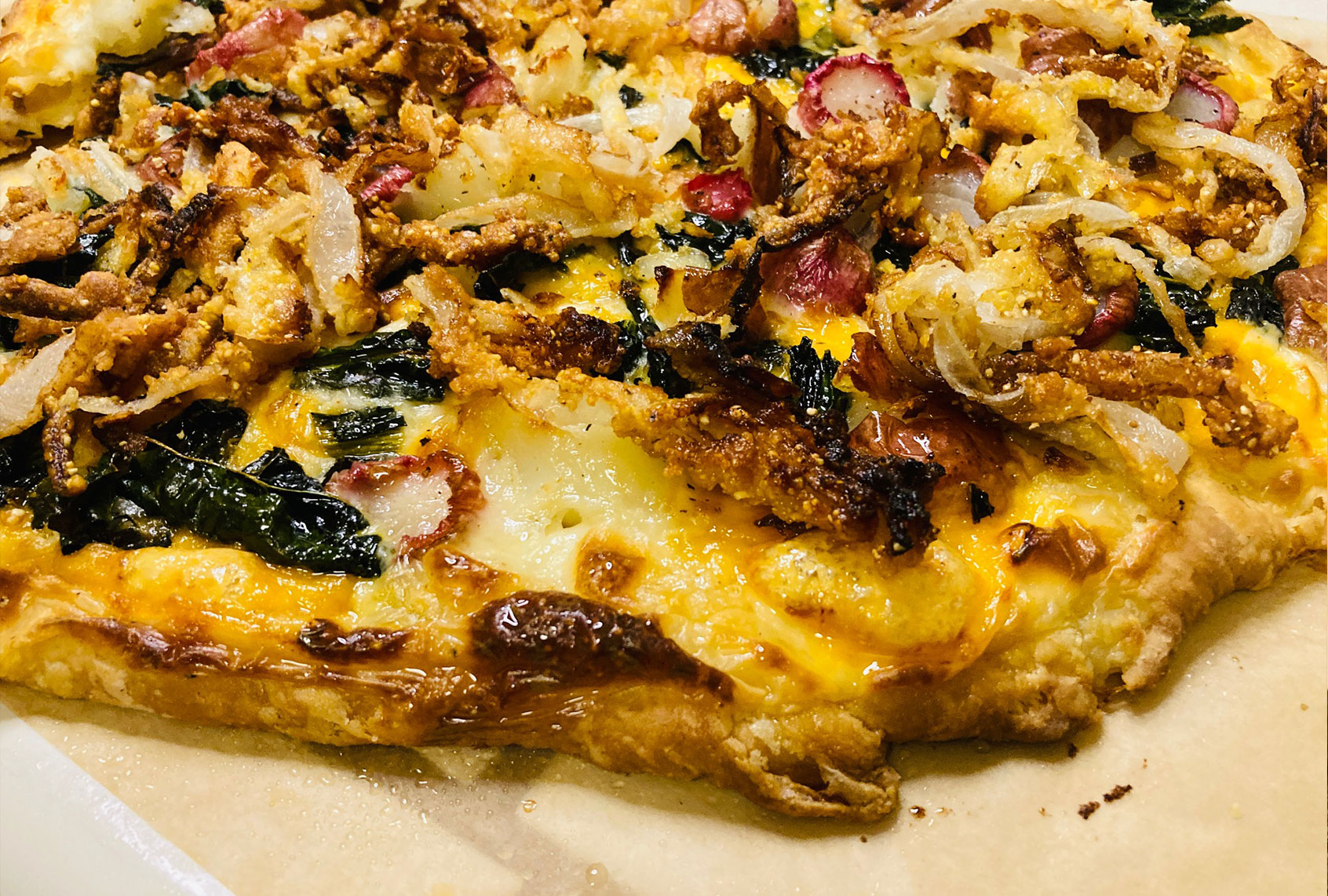
Why you should be eating biscuit pizza, an endlessly versatile and crowd-pleasing food with soul

Karter Louis wants us to remember where American food came from, and he feels the route there is on a biscuit. Specifically, a Soul Slice biscuit pizza, the San Francisco by way of Louisville restaurateur’s latest venture. 

This is not, he hastens to note, to be confused with Italian pizza (another American creation as we know the dish, he would add). No. This is a straight-up biscuit crust, a most American of ingredients, topped with soul food. Because, he says, “the landscape of traditional American cuisine is based on soul food.” 

So let’s start by calling it what it is: People talk about southern food and comfort food, Karter says. “Say soul food. No one will say soul food. Why can’t you say soul food?”

“Southern food is just hijacked soul food in a lot of cases,” he points out. As for comfort food, well, that’s different for everyone and doesn’t necessarily have to be what we might call southern or soul. It’s nori and rice for him, or ramen, after his years spent living in points across Asia from Shanghai to Taiwan.

Biscuit Pizza

RELATED: The best deep dish pizza is not from Chicago

But for Karter, and for me, it’s also biscuits. “Do you know the history of biscuits?” he asked me with his usual exuberance when we met up on Google Meet video chat recently. Um, no. I have enjoyed many a biscuit at Hillbilly Tea, his late, great, Appalachian restaurant in Louisville, Ky. And I certainly grew up on them, loving both my grandma’s “Tony biscuits,” her homemade drop biscuits I ate with cold bacon and store-bought biscuits that squished satisfyingly out of the can.

It turns out I’ve been tucking into a quintessentially American food all along. A “biscuit” in the rest of the world is what we’d call a cracker or cookie, Karter says. European sailors relied on an early form of biscuit called hardtack on the journey to North America. Though that hard, dry crackery biscuit tasted awful, it paved the way for what would become the fluffy delight we dig into smothered in gravy at diners now. 

***

I didn’t know Karter until about 10 years ago when he opened Hillbilly Tea in Louisville, and we became fast friends, often eating together while we talked non-stop about other food we’ve eaten or had plans to eat. Somehow, we didn’t learn that we each grew up making the same thing: biscuit pizza. The Frankencreation of canned biscuit dough, Ragu red sauce and American cheese that I called pizza was the first thing I cooked for myself as a kid. Without enough spending money to get the real deal from a pizzeria, Karter, too, made biscuit pizza. It never really left his mind, though I hadn’t thought about it in years until I learned about his plans.

RELATED: The secret to making restaurant-quality pizza at home starts with the crust

The plan for a soul food place had been on his back burner for a long time, but it took a catastrophe for it to really spark. Devastated, he says, by how much the pandemic decimated the hospitality industry, Karter wanted to do something positive. Something where employees wouldn’t just earn a living wage, but would share in profits and could even become owners. With a business partner, he developed Soul Slice as a B Corp (meaning they have to do good), where every employee starts as a dishwasher, gets cross-trained in every job, is paid a salary and has the opportunity to rise through the ranks. 

On the menu? Foods from his childhood. Foods that take us back to our roots as a country. Think yams, collards, fried chicken, green beans, blackeyed peas, ham hocks, okra. And not just because they taste good, and for many of us, are comfort foods. The very idea is to pay homage to, and to honor, the enslaved people who cooked these foods. 

***

Biscuit Pizza

Where do you think many of these foods came from, Karter asks. “How do we have rice? It’s not indigenous to America. Rice came in the pockets of the slaves . . . There are many ingredients in American cuisine that we’re just like, ‘Oh, we just have it?’ No, we don’t just have it. Like, it was cultivated by someone. And that’s the part of soul food that I want to give homage to, because it’s forgotten about. We don’t get the credit for being the cooks, you know, the slaves were the ones talking to the Native Americans to figure out what would kill us and what would not kill us.”

And that ability? “It’s not just because we were enslaved and told to cook,” he says. “It’s because we brought the skill to America to cook.”

“Most people don’t realize that most slaves came from West Africa,” Karter says. And that was a trading post, like a Silk Road “with spices from India, every kind of food and the West Africans were exposed to all this.” They knew what to do with these ingredients, he says  and that has never been recognized. 

RELATED: Homemade pizza in under an hour is entirely possible — & entirely delicious

So yes, Karter says he takes issue with saying comfort food or southern food when we’re talking about soul food.  “The reason why I wanted to do a soul food venture is because I don’t think it ever got its due,” he says. “If you look on any app  you grab your Caviar, or whatever. If you go to Yelp, soul food is just so shat on. It’s not a real category. It became so important to me as I was working on Hillbilly Tea, and southern food was becoming a thing. I didn’t like the blurred line.”

The foods Karter’s topping a biscuit with reflect those special foods that African-American people fell in love with, he says. 

He’ll open Soul Slice in Oakland, first, as soon as they’re funded. His hometown of Louisville is up next, and then they’ll branch out based on feedback. “Texas is hot for us,” he says, and he’d like to see shops in Harlem and New Orleans. But you don’t have to wait for Karter to come to your town. Biscuit pizza is easy enough for a 10 year old, and it translates well to a more discerning palate. 

Biscuit Pizza

It also adapts to your skill level, as well as how much work you want to do. Pop a can, top it with a jar of sauce and cheese and call it a day. Or make your own homemade dough, and go to town with Karter’s mac cheese sauce (bechamel with cheddar mixed in), collards and sweet potatoes. Make a gluten-free crust, or use shortening instead of butter and stick with veggies on top for a vegan version. Biscuit pizza is endlessly versatile and crowd pleasing. 

Whatever you do, maybe just take a minute before you sit down to eat. Think about the stories behind the food, the soul of it. And dig in. 

For more from our pizza oven, check out: 


“Who cares!”: Trump writes bizarre open letter to resign from SAG-AFTRA before the union boots him

Former president Donald Trump resigned from the Screen Actors Guild-American Federation of Television and Radio Artists on Thursday, after the union’s National Board voted “overwhelmingly” to convene a disciplinary process that could have resulted in expelling him in response to Trump’s part in inciting the Jan. 6 attack on the United States Capitol. 

Trump released an open letter to SAG-AFTRA on what appears to be photocopied White House stationery addressed to union president Gabrielle Carteris (of “Beverly Hills 90210” fame) detailing his immediate resignation. “I write to you today regarding the so-called Disciplinary Committee hearing aimed at revoking my union membership,” Trump wrote. “Who cares!” 

Trump went on to write that while he was “not very familiar” with the union’s work, he was proud of his work on movies and television shows like “‘Home Alone 2,’ ‘Zoolander’ and ‘Wall Street: Money Never Sleeps’; and television shows including ‘The Fresh Prince of Bel-Air,’ ‘Saturday Night Live,’ and of course, one of the most successful shows in television history, ‘The Apprentice’ – to name just a few!” 

He also wrote that, due to his involvement in politics, he helped resurrect interest in television, which he characterized as a “dying platform with not much time left.” 

“[I’ve] created thousands of jobs at networks such as MSDNC and Fake News CNN, among many others,” Trump wrote. 

He concluded the letter by saying that he no longer wished to be involved in the union and was tendering his immediate resignation. 

On Thursday afternoon, SAG-AFTRA offered a two-word statement, jointly attributed to Carteris and the union’s National Executive Director David White, in response to Trump’s resignation: “Thank you.” 

Trump’s resignation letter was a response to a Jan. 19 release from SAG-AFTRA, which stated that the organization’s National Board had ordered a disciplinary hearing regarding Trump’s role in inciting the attack on the U.S. Capitol and “in sustaining a reckless campaign of misinformation aimed at discrediting and ultimately threatening the safety of journalists, many of whom are SAG-AFTRA members.” 

“Donald Trump attacked the values that this union holds most sacred – democracy, truth, respect for our fellow Americans of all races and faiths, and the sanctity of the free press,” Carteris said at the time. “There’s a straight line from his wanton disregard for the truth to the attacks on journalists perpetrated by his followers.”

The release stated that if Trump was found guilty of violating SAG-AFTRA constitutional guidelines during the union’s disciplinary committee hearing, there would be possible penalties including reprimand, censure, fines, suspension from the rights and privileges of membership, or expulsion from membership in SAG-AFTRA. 

According to the Hollywood Reporter, Trump had pensions at both the Screen Actors Guild and American Federation of Radio and Television Artists — dating back from before the two organizations merged in 2012 — and throughout his time in office continued to receive residuals from roles in projects such as “The Apprentice,” “Home Alone 2” and “The Little Rascals.” 

How to make a sbagliato, the cocktail that’s a perfect match for a watch party

A person I once knew, who was not a sentient inspirational poster, was fond of saying that in the end, people don’t regret things they’ve done, only the things they didn’t do. Bless his optimistic heart, I think he even believed it. Wouldn’t it be nice to live in that world, to not ever regret things you’ve said or done? Who hasn’t wished for a do-over on occasion? 

We are discouraged from reconciling our mistakes by a culture that expects effortless perfection and smears a changed mind as a “flip-flop.” Dwelling too long on wrong decisions or accidental disasters isn’t healthy, but neither is brushing them off with selective amnesia. Perfectionists might recognize in themselves a fear of others seeing that they are fallible, while standard-bearers of positivity work overtime under the tyranny of the silver lining to avoid a turn into the swamp of sadness. But our mistakes are often more instructive than our triumphs. We downplay them at the risk of our own growth. 

After all, another word for mistake can be discovery. Or so says the sbagliato, a cocktail that wears its origin as a mistake as a badge of honor. It came into being when, according to the stories, a bartender reached for the wrong bottle while mixing a Negroni, pouring sparkling wine instead of gin into the glass of vermouth and Campari. No “I meant to do that” posturing here: The very name of this drink embraces its origin as a screw-up, an oops grand enough to enshrine it forever. 

RELATED: How to make a perfect French 75, the gin cocktail with the welcome effervescence of sparkling wine

So let’s drink to a practice of admitting our mistakes to ourselves and to others. Not every mistake ends in delight, and minor regrets don’t necessarily demand a prolonged ritual of dramatic repentance. But every time we pause to acknowledge an active choice or an instinctive response that results in even a small amount of regret, we lower the risk of repeating that mistake in the future. 

Whether or not you’re already a Negroni fan, you’ll find the sbagliato to be its softer, friendlier cousin thanks to the dry sparkling wine standing in for the gin. It’s still a drink that’s all alcohol, no mixer, but it does pack less of an alcoholic punch without the hard liquor, making it a solid choice for pre-dinner drinks, weeknight gatherings or any other time you wish to keep the risk for feeling like last night was a terrible mistake low. Bittersweet and a bit bubbly, the sbagliato is also a perfect match for those long watch parties where rich dips and heavy bar food are served.

This is a straightforward, simple drink. Any basic prosecco or sparkling wine works fine, but I suggest treating yourself to a high-quality Italian vermouth, because you’ll actually be able to taste it in this drink. My go-to is a grand dame of Turin vermouths, Antica Formula Carpano, made from the same formula since 1786; Punt e Mes is delicious, as well. (The upside of a good vermouth is that it can stand on its own as an apéritif. Try it with tonic or in a spritz, too.) Store open vermouth in the refrigerator, where it should last for about a month. 

Ingredients:

Serving size: one beverage

  • 1 oz. Campari
  • 1 oz. Italian vermouth
  • Prosecco or other dry sparkling wine
  • Orange wheel or peel
  • Ice

Gear:

You don’t need any specialty equipment to mix or serve a simple cocktail. Improvise with what you have. But here’s what I keep at hand:

Instructions:

Add ice to your mixer glass, and stir together the Campari and vermouth. Strain into a rocks glass over fresh ice, then gently stir in the prosecco. Add more prosecco to taste, if needed. Garnish with an orange wheel or peel.

Variations:

In her book “Apéritif,” Rebekah Peppler suggests using a sparkling rosé instead of standard bubbles. You can also cut down on the alcohol content by making an Americano, which swaps in soda water for the sparkling wine.

Salon Food writes about stuff we think you’ll like. Salon has affiliate partnerships, so we may get a share of the revenue from your purchase.

COVID-19 has exposed the fragility of our food system — here’s how we can localize it

The U.S. was once a haven for small-scale, family farmers. Today, food giants have gobbled up most of those family farms, creating the monstrous and unsustainable food industry known as Big Ag. The extent to which this massive, industrialized, global food system falls short became especially unmistakable in 2020. The current food system is “fraying.” It relies on the horrendous treatment of laborers, a wasteful allocation of resources, worldwide environmental devastation—and in a pinch, can quickly devolve into near-collapse of the entire system, as evidenced by the delays, shortages and pressure during the COVID-19 pandemic, and the deepening hunger crisis in America. Among the many necessary systemic changes 2020 has illuminated is the need to majorly restructure the way we cultivate and access food in our communities.

Faced with the shortcomings of the current food systems, food producers across the Pacific Northwest have been innovating ways to reestablish locally sourced, regional food systems. In the process of localizing the food supply chain, they aim to establish food security for their communities, create local jobs and support the surrounding ecosystems.

During a free, online event called Festival of What Works, which took place in November 2020, entrepreneurs from an array of backgrounds shared their success stories to demonstrate how it is possible to build and scale local food production across geography as well as institutions and create more food-secure communities. The festival was a project of a newly launched eco-trust network called Salmon Nation. It gathered a collection of voices from various cultures and focuses, to showcase solution-oriented projects from Northern California through Alaska (a region called “Salmon Nation” by many of the area’s Indigenous people) that offer place-based responses to the current political, economic and climate realities.

Here are three examples of localized food projects successfully challenging the current system—all of which lend themselves to replication in other areas.

1. Localizing Flour Mills Across a Region

When food giants wiped out family farmers, mills were no exception. Just about 120 years ago there were 24,000 mills in the United States. Today there are only 180.

In recent years, both Indigenous groups and small-scale, independent farmers in the Pacific Northwest have started to bring back regional grain farms and flour mills. These mills process non-commodity grains that are meant to grow within the specific regions where they are cultivated, and a regionally oriented food supply chain is beginning to reemerge around flour produced by the mills.

Kevin Morse, the founder of the regionally sourced and operated Cairnspring Mills flour mill in the Skagit Valley in Washington, says he founded the company as a way to bring back small-scale, local flour milling and respond to the ecological problems and issues of climate resilience associated with large-scale production.

The Cairnspring Mills sources from grain farmers across the region between Northern California and Northern Washington.

“[Regional food supply chains will be key into the future] when it comes to climate resilience because we’re going to have food deserts and food shortages,” Morse says. “By bringing back local supply chains and local production capacity to turn that crop into food, we automatically make the community more resilient because we’re not relying on imports.”

A video on the company’s website details how Cairnspring Mills was instrumental in keeping flour in production in the region during the COVID-19 outbreak. When many food supply chains were interrupted and grocery aisles sat empty, many of them without flour for months, Cairnspring stayed in operation and supported other local businesses in the process.

“Our supply chain is local, our grain storage is local, so we never skipped a beat on production [during the pandemic],” Morse says. “We were able to keep people employed and were able to help businesses that relied on flour to stay in operation. We were [also] able to keep the farmers farming and give them contracts so that they could go to the bank and get their financing. [Having a local mill] really brings back control [and] resilience.”

During the Food Democracy at Scale panel discussion on November 16, 2020, at the Festival of What Works, speaking about Cairnspring, Morse said that it is “the first craft mill in this country,” and currently operates at a similar scale to some of the early craft beer companies and small coffee roasters. He said the mill is doing for flour what “Starbucks did for coffee and Sierra Nevada did for craft beer.”

The mill has the capacity to make about 7 million pounds of flour per year, and it sells its flour to the surrounding community via commercial customers and craft bakeries—both locally and down the West Coast region into Northern California. In comparison, a single mill belonging to the large-scale milling companies in operation today can make the same amount of flour his mill produces in a year, in just two days, he says.

He, however, pointed out in the panel discussion that the flour produced by these large-scale milling companies is “a very different flour… What they have brought us, unfortunately, is grain that’s not healthy. What they have brought us is grain that’s oftentimes polluted with chemicals or grown in monocrop environments, which are contributing to other issues we have with water quality and disease resistance… They can source grain from Kazakhstan, Canada and Kansas, and that could all be in that white bag on your shelf.”

He says Cairnspring is doing the exact opposite by sourcing from farmers and paying them premiums above commodity pricing so that they can stay economically viable while being incentivized to steward the land. They’ve helped provide a market for regionally viable grains that have long been used as a financially unsustainable rotation crop. And, they’re focused on producing a quality, flavorful craft product rather than driving down prices with mass production.

Morse says when the pandemic hit, more people began to understand the importance of local food systems for community resilience and in the six months since March, the business has raised $2 million.

“There’s been a shift in consciousness—not only of people seeing the need for this, but more people are seeing that it’s just a better product and it has real market potential,” he says.

Morse has a background in farming, economic development and conservation ecology. Prior to founding the mill, he worked for a decade with the Nature Conservancy and was director of the Puget Sound Working Lands Program. It was his job, he says, to find ways to align conservation and farming, “to achieve conservation outcomes on private land.”

After working in various fields for 35 years, he came to see that all of the things he cared about—from regenerative and sustainable farming to conservation—were in response “to a food system that wasn’t serving us well.”

He explains that as the food system was centralized, local communities lost their access to local food processors. This, in turn, forced farmers into the commodities system, or into single-buyer markets, making them more vulnerable to market changes, and pricing out the majority of small-scale farmers. He came to realize that many of the environmental issues he came across in his work—like issues with water quality or wildlife habitat—stem from that commodity system.

“Modern farming and chemical agriculture were destroying habitat and not giving farmers an alternative market to take care of their lands,” he says. “I’ve never met a farmer that says, ‘I’d really love to use more chemicals on my land,’ or ‘I really don’t want to see any wildlife on my land.'”

He came to realize that in order to rebuild local food systems, there was a need to rebuild local processing infrastructure. He also realized farmers would need to get a higher premium for their “higher-value, better-tasting, more nutritious products.”

“Thankfully, we’re at a time where the consumers are demanding cleaner food and they have more awareness of the challenges with some of our modern agriculture,” Morse says.

The idea to create a local mill came out of community interest in adding value to local grains, which were seen as “a crop that farmers have lost money on for a hundred years, but they’ve used in cereal grain rotations as a way to break disease cycles and add organic matter to the soil to maintain a high quality in their other cash crops like potatoes or brassicas,” Morse adds.

At the time Morse had the idea for the mill, the Washington State University Bread Lab as well as port officials at the Port of Skagit, farmers and other interested stakeholders were already looking into better ways to utilize the grains grown in the region.

The mill now provides a local, resilient model of producing flour using those undervalued regional grains—and the model encourages ecologically supportive farming practices.

“[Farmers] have a market incentive to improve their stewardship of the land for healthy soils, water conservation, carbon sequestration,” he says. “They’re incentivized to implement those best practices instead of pushing them to the side because they can’t afford them in the current commodity system.”

Looking at the next five years or so, Morse says the company is considering expanding to bring small, locally operated mills with similar models into other regions—but not before the current mill is well established.

“We’re looking at a half-dozen places around the West, maybe one or two on the East Coast that are prime for partnerships and collaboration with new communities to build new mills.”

2. A Regenerative Way to Farm Chickens

An innovative chicken farming model in British Columbia could help pave the way for a new standard of poultry farming that is regenerative and solar-powered. The system is referred to as poultry-centered regenerative agriculture (PCRA), and Skeena Energy Solutions (SES), a project started by the Skeena Watershed Conservation Coalition (SWCC), is putting it into action. It has 1,500 chickens living in sustainably built, solar-powered coops, with free range to wander during the day under a low canopy of brush, which encourages increased egg production and healthier birds while also fertilizing and replenishing the soil where the birds graze.

“Canopy is really important as we discovered because chickens are jungle fowl, [not pasture animals],” says Kesia Nagata, energy coordinator for SWCC. She notes that even if poultry farms are free-range, but the range does not have a covering canopy to allow chickens to hide from potential predators, chickens’ wandering range will stay limited.

The regenerative poultry model gives the birds free access to rotating, fenced grazing areas. Rotating the area where the birds graze allows chickens to fertilize and nourish the soil while avoiding damage to the land by overuse, Nagata explains. The chickens are given locally grown feed from small-scale producers, and the project has hired local workers, the majority of them Indigenous people, who are paid living wages.

One of the big incentives for SWCC to explore the regenerative chicken farm concept is that it models a potential way for communities to stimulate their local farming economies. Ideally, it provides a method of raising 1,500 healthy, productive chickens at once on plots of land that are two acres or smaller, which keeps the cost of entry low.

“With this set-up on 1.5 to 2.5 acres, a single farmer can work three hours a day to produce 4,500 four-pound, free-range chickens in nine months, along with thousands of pounds of nuts, berries, and other cash crops… [translating] to over $80,000 (meat) or $250,000 (eggs) gross income per year, per single plot,” states an article by BC Local News while quoting a description of the project provided by SES.

The idea behind the pilot chicken farm program was to demonstrate a sustainable, land-based, inclusive, ecologically and socially viable way of farming, Nagata says.

She says the idea to incorporate a chicken farming model for an organization like SWCC, which is usually focused on salmon, was inspired by a similar regenerative farming project in Minnesota that works to pair Indigenous and immigrant farmers with small land plots.

“The focus of [SWCC] is to look at community economic development as a basis for salmon conservation, and it’s all holistic. If you don’t have communities that are healthy and wealthy and connected, they don’t have the privilege to protect the land that they depend on,” she says.

The pandemic, intense weather and other unforeseen hiccups delayed certain aspects of the project as it was getting set up through 2020, and Nagata says one of the goals for SWCC is to work through all the potential kinks so that they can eventually offer a streamlined, regenerative chicken farming model that small-scale farmers might be able to replicate across the region.

“We wouldn’t expect a small-scale, low-income farmer to be able to do all of the research and take all the losses that we are taking,” she says. “Our hope is that we can iron out those details to make it a lot more accessible to people and potentially have a working business plan and a template for how to get loans and grants and so on for this type of project. Because it’s so adaptable. The whole thing can be scaled.”

Nagata says while the project’s first months have illuminated the challenges inherent to straying from the current food system, they also ended up stimulating the local economy in some unexpected ways.

“I’ve been really humbled by how hard it is to make such a tiny little dent in such a huge problem—as well as having to be part of the problem in some ways in order to make it work—but I get excited about the fact that one project like this has inspired so many people to think about how else they can tag onto it,” she says. “Supportive jobs, businesses, and products can be created around this one idea—and that’s where the real economic development part is for me. Like, okay, great, there are some chickens. But there’s also a chicken soup and a chicken pie company. There are also local grain growers. We’ve got the local feed store interested in helping out. There are also all the administrative jobs involved in running things. There’s also the potential for pet food—and whatever else. There’s so much potential for change from a single project like this.”

3. Sustainable Livestock Ranching

The American meat industry is unsustainable, and beef alone carries a significant carbon footprint. During the Food Democracy at Scalepanel discussion at the Festival of What Works, Cory Carman, a fourth-generation cattle rancher, shared how and why she operates Carman Ranch, which is spread across 5,000 acres, as a sustainable, grass-fed, locally oriented meat business.

Carman Ranch, located in Northeast Oregon, is a century-old family business that raises grass-fed cows on an open pasture. The main focus of their business is on building healthy, carbon-sequestering soil while producing beef that is more nutritious and healthier than many of the mass-produced options.

The ranch recently began to partner with other family ranch producers across the greater region in order to stay afloat in a meat industry saturated by major conglomerates.

Carman said as she took charge of the family ranch and looked at what the fourth generation of the farm would need to look like into the future, she realized partnerships with other producers would be key.

“Individuals doing their own thing is not how you create change,” she said in the panel. “I started marketing grass-fed beef from our ranch and added additional producers from our region. Now we work with eight to ten producers in the Northwest, from Montana into Idaho, Washington and Northern California, to provide a year-round supply of grass-fed beef.”

The operations of Carman Ranch are also unique in that they ship cattle directly from the farm where they are raised to the meat-processing plant. From there, the meat goes directly to wholesale, or directly to the customer—and all of these steps happen within the local region. These steps are highly uncommon in the meat industry.

Carman said in the panel that the ranch produces 20,000 to 30,000 pounds of meat per week, on average. This is far less than what industrial cattle farms produce, and Carman said the biggest meat players can produce in a single day or even half a day what their ranch produces in a year. What they do provide, bolstered by regional partnerships, is enough to meet the demand for their product, which remains niche, and has a dedicated customer base.

“[Our customers] share our vision… [about] what the food system could look like and the values the food system could deliver,” she said during the panel discussion. And, through the COVID-19 pandemic, they’ve already proven more resilient than the large-scale meat industry.

“When it comes to food security, with the huge processing [plants] shut down [due to COVID], we weren’t impacted at all,” she said in the panel. “We have been a family-owned, smaller-scale processing facility, and a smaller crew that could take much more precautions… Nothing about our supply chain was impacted at all through COVID.”

Rather than focusing on expanding or scaling up their production to drive down costs, the company is focused on carving out a space in the market with their present setup, and investing the time to develop a successful long-term alternative to the unrealistic mainstream model.

“There is absolutely a vision toward changing the whole food system,” she said. “My biggest hope is if we have some success it will only make it easier for other people who want to do that same type of work.”

Their ultimate goal is to serve as a model or “learning laboratory” for sustainable meat production that future farms can pick up and replicate, Carman said. And, according to her, Carman Ranch is in a unique position to explore what does and doesn’t work well, as they have investors who support their larger vision of a more sustainable future for meat.

“We have a really distinct theory of change, [which] is that the food system of the future will be more distributed, more regional, and it will be scaled to ecological realities, not processing realities,” she said in the panel. “In that, we think about something like livestock production, we think about the places where it makes sense to [raise] livestock and how different regional companies could be connected to each other. In our vision of the future, there are a lot of regional grass-fed beef companies and they collaborate to potentially trade cuts, to do things like value-added co-packing that would benefit from aggregating products, maybe they do marketing together.”

She said that collaboration with other regional producers is what keeps the larger vision alive and inspired.

“The biggest breakthrough moments and things that bring me joy, they have to do with our alignment as a group around things like regenerative agriculture, soil health principles, carbon sequestration, animal welfare,” she said. “All these disparate producers are aligned; we’re doing things like nutrition testing on our beef to help us internally understand… what the relationship is between the soil health and nutritional density of the beef. Those are really esoteric things for the customers, but that sort of foundation of all of us working together, around these shared goals and vision… is the success that we feel every day.”

This article was produced by Local Peace Economy, a project of the Independent Media Institute.

Meghan McCain rails against Kevin McCarthy for showing “such severe cowardice” on Greene and Cheney

Meaghan McCain, conservative co-host of ABC’s “The View,” blasted Rep. Kevin McCarthy, R-CA, on Thursday for showing “such severe cowardice” after House Republicans’ secret ballot vote failed to oust Rep. Liz Cheney, R-WY, one of the few Republicans who voted to impeach Trump, from her leadership position in Congress. 

“Liz Cheney has had the living crap beat out of her by fellow caucus members,” McCain pointed out, calling it “one of the more dramatic moments in politics.”  The third highest Republican in the House was targeted by her colleagues, McCain pointed out, for “saying that she should be stripped of her chair because she dared to vote for impeachment.” The conservative explained that Trump sycophants in the House GOP caucus, like Florida Republican Matt Gaetz, said “‘We have the votes. We’re going to oust her from her role,”‘ before Cheney won the backing of her colleagues by “a whopping 145-61.”  

McCain called out the hypocrisy of Republicans who have not publicly come forward to condemn Rep. Marjorie Taylor Greene, R-GA, for her inflammatory conduct out of fear of disturbing Trump’s voting bloc but willing to secretly vote against Cheney. “There’s a lot of people going on TV saying different things than they’re privately voting,” McCain said, “to me, it shows such severe cowardice.”

The co-host also warned Republican leaders that their constituencies –– herself included –– will be unwilling to ultimately go along with the GOP’s slide toward conspiracy and violence.

“There are a bunch of people in swing states, a bunch of women, specifically in suburbs, and places that we’ve lost a bunch of Republicans voters, who are not going to get on board with this QAnon crap” and “that don’t want the era of Trumpism anymore.”

McCarthy is urging his Republican members to vote against a Democratic resolution to strip Greene of her committee assignments. The House is gearing up to vote on whether it will strip Greene of her assignments on the House Education and Labor Committee and the Budget Committee, a move which McCarthy called a “partisan power-grab.”

“If we are of any value to you,” McCain addressed McCarthy, “You will get rid of this as soon as possible.”

Don’t blame a lack of education — QAnon proves privileged white people are losing their minds too

In the weeks after Donald Trump sent a violent mob to rampage the U.S.  Capitol on January 6, a lot of focus has risen on the role played by QAnon and other lurid conspiracy theories in radicalizing Republicans. Unfortunately, a lot of that discourse has centered around the idea that QAnon and similar conspiracy theories are the result of poor education or economic stress. Blame it on years of misleading media coverage misattributing the rise of Trumpism on “economic anxiety.” Sadly, even Democratic leadership has slipped up and drawn a false equation between educational privilege and immunity to QAnon-style conspiracy theories. 

“They can do QAnon, or they can do college-educated voters. They cannot do both,” Sean Patrick Maloney of New York, the chair of the Democratic Congressional Campaign Committee, told Politico in an interview published Tuesday

Maloney is spearheading the move to make Rep. Marjorie Taylor Greene, a newly-elected Republican from Georgia, the face of the GOP, complete with her love of violent threats against Democrats and conspiracy theories about fake school shootings and space Jews with laser beams. So far, the strategy has been effective, as the Republican minority in the House voted against removing Greene from her committees and even reportedly gave her a standing ovation. Politically and ethically, it’s a smart move for Democrats, because it helps highlight for voters that the nutty faction has completely consumed the Republican Party and the supposed “reasonable adults” are non-existent. 

But this rhetoric from Maloney does expose a potential downside. Falsely attributing QAnon and other conspiracy theories to poor education has the potential to reinforce ugly and often unfair stereotypes of Democrats as a “liberal elite” that looks down its nose at ordinary Americans and even the working class. This helps QAnon defenders like Greene or Tucker Carlson of Fox News present themselves as the voice of hard-working, salt-of-the-earth Americans simply defending themselves against “elites” — the same supposed “Democratic elites” that QAnon accuses of killing and raping children. 

This framing isn’t just likely to backfire on Democrats, it’s also flat-out untrue. There is no reason to believe that QAnon is the result of a lack of educational opportunities. As with the Trumpism that gave birth to QAnon, the phenomenon is the result largely of privileged white people losing their minds because of perceived threats to their social status from people of color and cosmopolitan liberals. 

Greene is being called things like “trailer trash” and “white trash” by liberals on Twitter who really should know better. But, as many of them are plainly shocked to discover, Greene graduated from the University of Georgia, inherited a successful construction business from her father, and is a millionaire who even owned a CrossFit gym. 


Want more Amanda Marcotte on politics? Subscribe to her newsletter Standing Room Only.


This is more common than not with the high profile supporters of QAnon. Tucker Carlson, who defended QAnon as an exciting “forbidden idea,” has money from the Swanson frozen foods empire, was educated at a boarding school and graduated from Trinity College. Sidney Powell, one of the Q-inflected lawyers leading the charge to overturn the election, graduated from the University of North Carolina. She spent her career as a well-regarded corporate lawyer on the right, especially for her work defending the high-profile wealthy executives caught up in the Enron scandal. Lin Wood, the Atlanta attorney who has also been heavily pushing Q-related election lies, graduated from Mercer University’s law school. Q-promoting Michael Flynn is a former lieutenant general and graduate of the University of Rhode Island. Trump and his conspiracy theory-loving son Donald Trump Jr. are both literally Ivy League-educated, having graduated from the University of Pennsylvania. His other son, Eric Trump, has promoted QAnon conspiracies and graduated from Georgetown University. 

We don’t have much good information on rank-and-file QAnoners, who are largely anonymous internet users. But anecdotal evidence from r/QAnonCasualties, a message board for exasperated friends and family of QAnoners, suggests that it’s quite common for people with high levels of education to fall down the rabbit hole. A sample of descriptions of people lost to the QAnon cult from their loved ones: “a highly educated and intelligent person,” “a graduate of one of the United States Military Academies” with “a nearly 4.0 GPA,” “intelligent, educated“, “college degree, smart and inquisitive, high responsibility position in an energy firm,” “an exec at an Investment Bank,” and “has a college degree and has a MBA.”

This reality should have been exposed by the stories and arrests that exposed the identities of the Capitol insurrectionists, all of whom were motivated by conspiracy theories and many who are deeply into QAnon. As Adam Serwer at the Atlantic notes, they were “were business ownersCEOsstate legislatorspolice officersactive and retired service members, real-estate brokersstay-at-home dads.” And as Will Bunch of the Philadelphia Inquirer pointed out, the rioters “came from lush-green suburbs all across this land, flying business class on Delta or United and staying in four-star hotels with three-martini lobby bars.” One of the most prominent QAnon figures in the riot, Jacob Chansley, lost 20 pounds because he refuses to eat the cheap, non-organic food served in jailBuzzfeed reported recently on public schools struggling with teachers — a class of people who are required to be college-educated — promoting QAnon and related conspiracy theories in class.

It’s understandable that liberals and Democrats like Maloney are comforted by the idea that QAnon is the result of poor education. That narrative implies a solution, suggesting that better educational opportunities and teaching people critical thinking skills will prevent the uptake of dangerous conspiracy theories. It also casts the problem as one of a few cynical ringleaders manipulating the hapless masses. 


Want more Amanda Marcotte on politics? Subscribe to her newsletter Standing Room Only.


But that story has it backward. The reality is that QAnon spread rapidly among privileged people — and often people with college educations and healthy economic profiles — because it was a story that recasts them as the good guys for doing something very bad indeed, which was voting for Trump. It’s arguable that their privileges made them even more susceptible to the theories because they’re people who are frequently told they’re smart, leading them to feel confident about their ridiculous beliefs. They’re people who feel a lot of entitlement, and that insulates them from challenges to their beliefs. 

Republican leadership isn’t pushing QAnon on the country. They are bowing down before it because they recognize the social and political power that the Q adherents have, and believe they need these people to win elections. 

The single most damaging stereotype of Democrats is that they’re a bunch of elitist snobs who look down their noses at the “uneducated” and “working class.” In reality, of course, the party is the one that is more protective of the rights of working-class people, while Republicans are the party of a wealthy donor class mostly interested in tax cuts and gutting social services and unions. But comments like Maloney’s can, unfortunately, reinforce these backward narratives that cast Democrats as “elites” and Republicans as salt-of-the-earth “real” Americans.

To counter this, Democrats would do well to emphasize, repeatedly, how QAnon is the temper tantrum of a class of privileged white people, like Greene, who feel like their social status is being threatened by changing demographics and social justice movements. It’s not only politically wise — it happens to be the honest truth. 

Kevin McCarthy claims he doesn’t know what QAnon is after GOP gives Greene “standing ovation”

House Republicans on Wednesday decided to stand by both Rep. Marjorie Taylor Greene, R-Ga., and Rep. Liz Cheney, R-Wyo., highlighting the party’s divisions in the post-Trump era.

The House GOP caucus voted 145-61 in a secret ballot to keep Cheney, the No. 3 Republican in the chamber, in her leadership position, following a contentious four-hour meeting in response to her vote to impeach former President Donald Trump. The conservative House Freedom Caucus pushed for Cheney to be removed as chairwoman of the House Republican Conference as punishment for her impeachment vote. Rep. Matt Gaetz, R-Fla., who traveled to Wyoming recently to attack Cheney at a rally, insisted on former Trump adviser Steve Bannon’s podcast that “we have the votes to remove” Cheney before his caucus overwhelmingly voted in her favor. Trump also worked behind the scenes to push for Cheney to be booted from the GOP leadership, according to CNN.

Cheney, who has said there has “never been a greater betrayal by a president” than Trump’s incitement of the deadly Capitol riot, refused to apologize for her vote during the meeting, according to the Associated Press. She gave an eight-minute speech that sources described to CNN as a “calm yet firm defense of the Constitution.”

Some of Cheney’s critics were combative. Rep. Matt Rosendale, R-Mont., “loudly and angrily” berated Cheney and Rep. Scott Perry, R-Pa., alleging that they had “aided and comforted the enemy,” according to CNN. Other Republicans fired back, with Rep. Adam Kinzinger, R-Ill., a frequent critic of Trump, defending Cheney and lashing out at House Minority Leader Kevin McCarthy, R-Calif.

McCarthy, who did not publicly say he would vote in Cheney’s favor, told reporters after the meeting that he defended her to his colleagues.

“People can have differences of opinion,” he said. “That’s what you can have a discussion about. Liz has a right to vote her conscience.”

Prior to the vote, Greene, a longtime QAnon conspiracy theorist who is facing removal from House committees for pushing conspiracy theories about school shootings and wildfires and calls to execute top Democrats, apologized to her colleagues. Greene said it was a mistake to subscribe to QAnon conspiracy theories, claimed not to know what “Jewish space lasers” were and defended her comments alleging that the Parkland and Sandy Hook school shootings were “false flag” events, according to The Hill, though it’s unclear if she also discussed her calls to execute Democrats. “She received a standing ovation from some members of the caucus at the conclusion of her remarks,” the outlet reported.

“Roughly half” of the House GOP caucus gave Greene a standing ovation, confirmed Vice News’ Cameron Joseph.

McCarthy, feigning ignorance about QAnon despite previously condemning it, said he wished reporters could hear Greene’s contrition.

“I think it would be helpful if you could hear what she told all of us,” he said. “Denouncing ‘Q-On,’ I don’t know if I’m saying it right, I don’t even know what it is.”

McCarthy knows exactly what QAnon is. He was previously forced to denounce the conspiracy theory multiple times after Greene and fellow QAnon supporter Rep. Lauren Boebert, R-Colo., won their primaries and later their elections.

“I do not agree with their beliefs at all,” McCarthy said during a press conference last August while discussing Greene’s apparent beliefs. “There is no place for QAnon in the Republican Party,” he told Fox News that same day.

House Speaker Nancy Pelosi, D-Calif., hit out at McCarthy’s defense of Greene, labeling him “Kevin McCarthy Q-CA” in a press release for “refusing to take action against conspiracy theorist Rep. Marjorie Taylor Greene.”

Though Greene may have apologized during the meeting, she has shown no public contrition for her comments and on Tuesday tried to fundraise off the controversy.

“With your support, the Democrat mob can’t cancel me,” she tweeted in one fundraising appeal.

Over the weekend, Greene declared, “I won’t back down. I’ll never apologize.” She later said in an interview with former Trump aide Sebastian Gorka that she has “said things I shouldn’t say at some time or another, but I don’t think I have anything to apologize for.”

“It’s me this week, and it’ll be someone else next week, and our leaders are too weak to stand up against it,” she said in another interview with fellow right-wing conspiracy theorist Dinesh D’Souza. “That is why Republican voters will not vote for them anymore.”

Greene even insisted in an interview with the Washington Examiner that Democrats were “dumb” and “stupid” because “they don’t even realize they’re helping me.”

House Majority Leader Steny Hoyer, D-Md., said on Wednesday that the House will vote to remove Greene from the House Budget and Education and Labor committees. McCarthy met with Greene and later with Hoyer, and reportedly planned to offer a deal in which Greene would only lose her Education and Labor assignment or trade that position for a seat on the Small Business Committee. Democrats didn’t bite.

“It is clear there is no alternative to holding a Floor vote on the resolution to remove Rep. Greene from her committee assignments,” Hoyer said after meeting with McCarthy.

McCarthy previously removed former Rep. Steve King, R-Iowa, from his committee assignments after he made comments defending white nationalism and white supremacy. He ultimately lost to another Republican in a 2020 primary.

Republicans have tried to shift blame amid the growing backlash to Greene’s comments. McCarthy accused Democrats of “choosing to raise the temperature” with a “partisan powergrab” and compared Greene to Rep. Ilhan Omar, D-Minn., who he said had “spread anti-Semitic tropes.” Omar in 2019 criticized Israel’s influence in American politics and later apologized after being accused of anti-Semitism.

Republican leaders have privately pushed members to unite against the “harmful” precedent it would set for the majority party to punish a minority member for comments she made before joining Congress.

“If we are now going to start judging what other members have said before they’re even members of Congress, I think it’s going to be a hard time for the Democrats to place anybody on committee,” McCarthy told reporters on Wednesday.

House Rules Committee chairman Jim McGovern, D-Mass., whose committee has advanced a measure to strip Greene of her assignments, said the move was the “right thing to do.”

“We have never had a member like this before. This is truly sick stuff,” he told reporters. He rejected the Republican argument, asserting that “if the precedent’s going to be that if somebody advocates putting a bullet in the head of a member … if that is going to be the new determination as to what it takes to throw people off of committees, I’m fine with that.”

After learning how to make mayonnaise, you may never reach for a store-bought jar again

Mayonnaise is flavored fat that’s been processed in a special way to make it spreadable, even when it’s cold. The concept rests on the intuition that fat is good; flavored fat is better; and (in certain situations) creamy, spreadable flavored fat is best of all. Learn how to make mayonnaise in your home kitchen by learning all about it here, and you may never reach for the store-bought jar again.

What Is Mayonnaise?

The process of creating mayonnaise is a sort of culinary magic trick called emulsification. Emulsification is when two liquids that don’t mix realize a kind of union with the help of a third ingredient (known as an emulsifier). In the case of mayonnaise, oil and water are held together by emulsifiers found in egg yolk.

An emulsion looks like a homogeneous blend, but it’s really not. At a microscopic level, the oil in mayonnaise is still separate from the water, suspended in droplets. The emulsifier is the key element that makes this possible, because it keeps the oil droplets from coalescing into larger globules and separating (like oil and water). Paradoxically, the emulsifier keeps the oil and water together by keeping them apart.

Why is this relevant? Because to learn how to make mayonnaise, it helps to understand how it works, and to visualize what you’re doing with your whisk, blender, or other mechanical implement: breaking drops of oil into tiny droplets — which must be kept tiny — so the emulsifier can do its magic.

As with most cooking techniques, understanding the foundation gives you control and creative freedom. Master the basic process, and start making mayonnaise without a recipe, customizing it to your tastes, and creating variations. Then you can extend your abilities to the many mayonnaise derivatives like remouladeaioli, Russian dressing, blue cheese dressinggreen goddess dressingvegan mayonnaise, and so on.

Tips And Tricks

  • Use quality eggs. This one almost goes without saying. The best-quality eggs you can get your hands on are the best ones for making rich, flavorful mayonnaise. If you have any concerns about consuming raw egg, then use pasteurized eggs. You can find pasteurized eggs at any supermarket, or you can pasteurize your own (but honestly it’s a bit of a pain and not guaranteed to work). If you really want to geek out on the safety of mayonnaise, read this.
  • Use room temperature ingredients. Using cold ingredients will reduce the effectiveness of emulsifiers.
  • Use a neutral-flavored oil (unless you want a stronger flavor). Mayonnaise is mostly oil. If you use a mild-flavored oil, like canola or sunflower, you’ll be able to taste the other ingredients in the mix. If you use an oil with a strong flavor, like a grassy, peppery extra-virgin olive oil, your mayonnaise might be out of balance if the mayo itself is what you’re looking to taste (or if you’re looking for a milder overall flavor to use in sweet recipes like mayonnaise cakes).
  • Use oils with higher amounts of unsaturated fats. These fats, like canola and avocado oils, are easier for the emulsifier to keep separate.
  • Add the oil very, very slowly. Otherwise, the droplets won’t disperse. They’ll coalesce, and the emulsion will start to break and separate.
  • If your emulsion breaks, it’s easy to fix. Do this by whisking a small amount of the broken mayo with a little water. When the mixture starts to emulsify, slowly, slowly drizzle in the rest of the broken mayo.
  • Use water to make the mayo thinner, and oil to make it thicker. To a point, that is. One egg yolk can emulsify only about 7 ounces of oil. Much more than that, and your emulsion is likely to break.

Basic Mayonnaise Recipe

  • 1 egg yolk, room temperature
  • 1 1/2 teaspoons fresh-squeezed lemon juice or white wine vinegar
  • 1/2 teaspoon mustard (prepared or dry)
  • 6 ounces neutral oil
  • 1 1/2 teaspoons salt
  • In a medium bowl, whisk together the egg yolk, lemon juice or vinegar, and mustard.
  • Whisking constantly, add the oil slowly, drop by drop.
  • When you see the oil incorporate and thicken, your emulsion has begun. You can add the oil a little faster, as long as you are still able to disperse it quickly.
  • When all the oil is incorporated and the mayonnaise is thick and creamy, stir in the salt. Taste, and adjust, if necessary.
  • Store in a tightly sealed jar or container in the refrigerator for 3 to 4 days.

Make Your Own Mayonnaise

With demand far exceeding supply, it matters that people are jumping the vaccine line

The Biden administration’s much-needed national strategy to end the covid-19 pandemic includes plans to remedy the chaotic vaccination effort with “more people, more places, more supply.” The Federal Emergency Management Agency will open more vaccination sites, the government will buy more doses, and more people will be immunized. Still, by all estimates, the demand for vaccines will far exceed the supply for months to come.

For weeks, Americans have watched those who are well connected, wealthy or crafty “jump the line” to get a vaccine, while others are stuck, endlessly waiting on hold to get an appointment, watching sign-up websites crash or loitering outside clinics in the often-futile hope of getting a shot.

To eliminate this knock-out-your-neighbor race to score a vaccine, the administration needs to find ways to build trust in the system. It will take more than “more people, more places, more supply” to end the Darwinian competition and restore confidence and order.

That’s in part because, desperate to end their own pandemic nightmare, many of our most respected institutions and politicians have behaved badly. Of course, hospitals have performed heroics during the pandemic — turning orthopedic wards into covid intensive care units, canceling elective surgeries, bringing retired health care workers back to help, all the while losing thousands of staff members to the virus. But some also have behaved selfishly during the vaccine rollout.

When the vaccine was released in December, the Centers for Disease Control and Prevention recommended that health care personnel and nursing home residents receive the first doses. It was pretty clear whom the agency had in mind for “health care personnel”: those who deal directly with patients, including doctors, nurses, technicians, janitors and the people who deliver meals, along with those who might come into contact with the virus, like security guards and laundry staff, as part of their jobs.

But many hospitals interpreted the recommendation broadly, inoculating their entire staff — public relations departments, administrators, programmers, laboratory scientists and, sometimes, their boards. They offered vaccines to psychiatrists who were seeing their patients on Zoom. They vaccinated radiologists who were reading films at home. Some of those immunized were at the upper end of the medical income totem pole, people who had sat out the pandemic at country homes.

Many hospitals pay no taxes because the care they provide benefits their communities. In their vaccine rollout, many of those were not thinking about their communities, only about themselves.

That behavior set a precedent for the national chaos that followed. “From soup to nuts, the whole thing has fallen apart,” said Arthur Caplan, one of the country’s leading medical ethicists. What Caplan called “unfair priority” left him “incredibly irritated”; ethics were often absent from the algorithm. “Once you’ve lost public confidence in the fairness of the process, it undermines willingness to follow the rules,” he said.

Once random people working remotely got shots, those outside medical centers played whatever cards they had, too. Therapists who were teleworking claimed eligibility. Politicians and their spouses — sometimes former spouses — got vaccines.

People offered donations in exchange for vaccinations. Health officials and private doctors tipped off friends about when new vaccine doses would be released. On screening forms, people checked the boxes needed to get a vaccination appointment and in some places were immunized even after their duplicity was discovered.

Pity the rule-followers: Many older Americans who are not tech-savvy or lack internet access have been unable to get slots. It might be theoretically possible to sign up by phone, but by the time you get through, the newly released appointments may be gone. Those without a child or grandchild to help secure an appointment could be out of luck.

Hospitals, clinics and vaccination sites have explained away bad behavior by saying they didn’t want to waste unused vaccines. Many have experienced higher-than-expected refusal rates from those expected to get a shot.

I don’t blame the lucky recipients; after all, hospitals would just offer the unused vaccine to the next person on the list. But I do blame whoever it was in the hospital hierarchy or the health clinic who decided to distribute and redeploy vaccines this way.

If there were unexpected extras, couldn’t hospitals have instead walked those doses to patients in the geriatric, hypertension or diabetes clinics? Or offered them to one of the many nursing homes and assisted living facilities whose workers and residents have still not been vaccinated, though they, like health care personnel, were the Centers for Disease Control and Prevention’s top priority?

Gregg Gonsalves, who is 57, HIV-positive and an epidemiologist at the Yale School of Public Health, said he faced an ethical quandary when he was notified of his eligibility for the vaccine; he was unsure whether to sign up. His 86-year-old mother has not gotten one yet.

“Ethicists are saying, ‘if offered, take it,’ but stepping in line in front of my own mother? I know speed is of the essence in getting shots into arms, but this is entrenching gross inequities,” Gonsalves said. (He declined to say what his decision was.)

The problem is that, often, people are not really being “offered” the vaccine; in some cases, they are grabbing it through position, influence or deceit. They are, in the abstract, taking it from someone perhaps more in need — a subway worker, a high-risk patient, maybe even their own mother.

Now, the new administration is coordinating with states to set up more mass vaccination sites. That’s great. But the United States has allowed its public health system to become a hollowed-out underfunded mess, and many vaccination clinics are being run and staffed by contracted private companies. And the private sector has so far proved too vulnerable to private favoritism.

Until the supply is sufficient, the government needs to give the shots to the people and places that need it most, and find ways to ensure that the plan is followed; the system could prioritize ZIP codes that have high covid-19 infection rates or target low-income populations who might otherwise have a difficult time securing an appointment.

In Britain, citizens are notified, according to risk group, when it is their turn to book an appointment. They don’t have to play knock-out-your-neighbor to score one. We shouldn’t either.

News flash: That bloomy-rind cheese on your plate isn’t actually brie

That Cheese Plate is a column by Marissa Mullen — cookbook author, photographer, and Food52’s resident cheese plater. With Marissa’s expertise all things cheddar, comté, and crudité — plus tips for how to make it all look extra special, using stuff you probably have on hand — we’ll be crafting our own cheesy masterpieces without a hitch.

* * *

I’ve been on a bloomy-rind cheese kick this month. First with my a cheese plate in honor of my favorite sandwich, followed by this little number with balsamic-roasted grapes, I can’t get enough of these French cow’s milk beauties. So naturally, I wanted to take a deep-dive into the origin story behind these plush, fragrant cheeses.

There are two types of Brie that are protected under AOC guidelines in France: Brie de Meaux and Brie de Melun. AOC stands for “Appellation d’Origine Côntrolée,” or “controlled label of origin.” A cheese can’t be called “Brie de Meaux” and “Brie de Melun” if they’re not made in these designated regions, following the specific methods from pasture to cow to cheesemaker to affineur (a professional cheese ager).

Same goes for Camembert de Normandie, a small bloomy-rind cow’s milk round from the Camembert region of Normandy. Similar to Brie, Camembert has a bloomy rind yet develops a much stronger, earthy flavor. These AOC guidelines ensure that these cheeses are made authenticity, protecting the historical origin of the product.

Here’s the catch: The real-deal versions of Brie and Camembert are actually illegal in America because they’re made with raw unpasteurized cow’s milk. In 1987, the FDA passed a law requiring pasteurization of all milk products, with the requirement of raw-milk cheese to be aged for a minimum of 60 days and clearly marked “unpasteurized.” Brie and Camembert are typically only aged for 4 to 5 weeks. As a result, the singular terms “brie” and “camembert” are not protected, causing some confusion in labeling.

After this law was enacted, French cheesemakers began to produce and import pasteurized brie and camembert in different styles from the AOC protected varieties. Some may argue that these cheeses are not considered authentic, but others contest that these imports are as close to accessing the “real thing.”

On the domestic front, American cheesemakers have been crafting their own styles of bloomy-rind and brie-style cheeses, yielding a new variety of tasting notes and textures based on their herd and terroir. Cheesemakers have been experimenting with goat milk and sheep’s milk, as well as adding additional cream in the cheesemaking process to craft decadent double and triple crème cheeses.

Can these domestic cheeses still be considered “brie”? I asked my friend Christine Clark to weigh in, a Certified Cheese Professional by the American Cheese Society and notable cheese writer.

Marissa Mullen: Why, in American supermarkets, do producers label cheeses “brie” when in fact they are not traditional bries? For example, I’ve seen “goat brie” and smaller camembert-like rounds labeled “brie” at the store.

Christine Clark: Oh, it’s 100% marketing — many people understand what a brie is (or at least think they do), and they’re probably more likely to buy that than a wheel of something with a name they’ve never heard of. It’s kind of a bummer because this can confuse consumers, but I understand why producers do it. Part of the problem is that brie has gotten so iconic that it’s kind of outgrown its original identity as a 6ish pound wheel of raw milk cheese from Northern France. According to most cheese people, it’s not a brie if it’s not made in France. But, the lines are blurry. The name “brie” has a ton of history behind it, but it’s technically not name-protected on its own. So, something like “goat brie” may not count as a brie for some people, but there’s no law saying it’s not a brie.

Cheesemongers get upset when consumers call a great American brie-style cheese like Four Fat Fowl “St. Stephen,” Sweet Grass “Green Hill,” or Cowgirl Creamery “Mt. Tam” a “brie,” but it’s just because we love those cheeses and think they’re special. We don’t love them because they’re an imitation of something else, we love them in their own right!

Do you foresee a world in which America will have cheeses protected by some AOC style guidelines? Do they already?

Maybe one day we’ll have something like that. Right now, we have something called “standards of identity” in the Code of Federal Regulations. But, whereas AOC guidelines are meant to preserve a culinary tradition, the CFR requirements are pretty bare-bones and mostly meant to keep people safe.

AOC guidelines for cheeses stipulate things like where the milk must come from, the breed of cow you have to use (usually, the one that’s lived in that area for centuries), what you can and can’t feed your animals, how quickly you must use the milk for cheesemaking, and so on. Our guidelines have really none of that. The CFR for cheddar, for instance, stipulates that you can use hydrogen peroxide in your cheesemaking as long as you use something called catalase to eliminate the hydrogen peroxide afterward. Just not even the same universe.

If not brie, what’s the proper way for consumers to refer to these cheeses on a cheese plate?

I was taught to call them “bloomy rinds.” I like that term, because it invites some education — when the cheese ripens, the cultures sprout like little fuzzy blossoms atop it, and the affineur pats that down into what becomes the rind.

But, I think “brie-style” works just as well, and maybe even better if you don’t have the time to explain what a bloomy rind is. The term is simple, accurate, and easy to remember.

* * *

Brie-Style Cheese Varieties

After chatting with Christine, I decided to go on an adventure to the market for some brie-style bloomy-rinded cheese taste-testing myself. Although these cheeses may all look similar, they vary greatly in taste and texture.

French Brie

This is the most common Brie sold at American grocery stores. The cheese is imported from French producers and labeled “brie,” but is a pasteurized version specifically for American guidelines. Still considered a brie, but not the traditional raw cow’s milk type. French brie is typically made in large rounds, between 9 and 14 inches across. The texture is creamy with a mild and buttery flavor.

French Camembert

Imported from French producers with pasteurized milk, camembert is notably made in 5-inch rounds with a more earthy funk encompassing notes of mushrooms and creme fraiche.

American Bloomy-Rind Goat Cheese

The cheese I tried is called “Merry Goat Round” from Firefly Farms in Maryland. A cheese like this could be mistaken for brie at first glance, but it’s vastly different in flavor because of the goat milk. This cheese is smooth and slightly tangy when young, developing a complex and earthy flavor with age.

American Bloomy-Rind Sheep’s Milk Cheese

This cheese is called “Simply Sheep Mini” from Nettle Meadow Artisan Cheese in New York. This mini bloomy-rind cheese is made with sheep’s milk, resulting in deep flavors of mushrooms, grass and earth.

American Brie-Style Cheese

Here, I tried a cheese called “Moses Sleeper” from Jasper Hill Creamery in Vermont. Although the cheese may be a “brie-style” the cheesemaking technique and terroir of the region gives this cheese it’s own original flavor of cauliflower, crème fraîche, and toasted nuts.

French Brie (Lepetit)

Another brie-style imported from France, made from pasteurized milk using traditional methods. This specific cheese is made in a smaller format than the French brie wedge picture above. Bries made of pasteurized milk are generally milder in flavor than Brie de Meaux and Brie de Melun, and this one is no different.

* * *

Next time you’re at the grocery store, try to experiment with all types of bloomy rind cheeses! If we can’t even access the real French Brie in America, try out some domestic artisanal creations and support your local cheesemakers!

“QAnon shaman” granted organic food in jail after he loses more than 20 pounds: report

The attorney for Jacob Chansley, also known as the “QAnon shaman,” said that his client hasn’t eaten in more than a week and has lost 20 pounds, Business Insider reports. Previously, it was revealed by Chansley’s mother that he was having trouble in prison, because he refuses to eat non-organic food during his stay in the Department of Corrections in Washington.

“The Defendant has not been able to consume any food since the commencement of his stay in Washington, DC, being a period in excess of one week,” Chansley’s attorney, Albert Watkins, wrote, adding, “It is understood the Defendant has lost weight in excess of twenty pounds during the last week.”

Chansley was arrested after participating in the riot at the U.S. Capitol on Jan 6. He was widely seen in photos and video footage wearing bull horns and carrying a staff.

Watkins argued that Chansley is an actual “shaman” and eating organic food is part of his religious beliefs.

“Based on Mr. Jacob Chansley’s shamanic belief system and way of life, non-organic food, which contains unnatural chemicals, would act as an ‘object intrusion’ onto his body and cause serious illness if he were to eat it,” Watkins wrote. “An ‘object intrusion,’ is the belief that disease originates outside the body from unhealthy objects coming into the body. In shamanic traditions, the body, mind, and soul are interconnected, and the well-being of all three are necessary for my client to be able to practice his faith.”

Politico reported after that Chansley was finally granted his “organic diet” after his health began to deteriorate.

Read the full report at Business Insider.

How Jeff Bezos and Amazon changed the world

Amazon announced Jeff Bezos is stepping down as CEO almost 27 years after he founded the company to sell books to customers over dial-up modems.

Amazon wasn’t the first bookstore to sell online, but it wanted to be “Earth’s biggest.” When it first launched, a bell would ring in the company’s Seattle headquarters every time an order was placed. Within weeks, the bell was ringing so frequently employees had to turn it off.

But Bezos — who will remain at the company — set his sights on making it an “everything store.” After achieving dominance in retail, the company would go on to become a sprawling and powerful global conglomerate in numerous lines of business.

Today, Amazon is the third-most valuable U.S. company — behind Apple and Microsoft — with a market capitalization of around US$1.7 trillion, greater than the gross domestic product of all but a dozen or so countries.

Here’s how Bezos reshaped retailing.

Redefining retail

Amazon – named after the world’s largest river – continually took shopping convenience to newer levels.

Before Amazon’s founding on July 5, 1994, shoppers had to travel to stores to discover and buy things. Shopping used to be hard work – wandering down multiple aisles in search of a desired item, dealing with crying and nagging kids, and waiting in long checkout lines. Today, stores try to reach out to shoppers anywhere, anytime and through multiple channels and devices.

After first experiencing two-day free shipping from Amazon’s Prime membership program, shoppers started expecting no less from every online retailer. An estimated 142 million shoppers in the U.S. have Amazon Prime.

The company made shopping more convenient through features like one-click ordering; personalized recommendations; package pickup at Amazon hubs and lockers; ordering products with the single touch of a Dash button; and in-home delivery with Amazon Key.

Shoppers can also search for and order items through a simple voice command to an Echo or by clicking an Instagram or Pinterest image. Amazon even has a cashier-less “Go” store in Seattle.

Amazon has also been a factor in the rising closures of brick-and-mortar stores that can’t keep pace with the changes in retail. Even before the pandemic, stores were closing at a phenomenal rate, with analysts predicting a coming “retail apocalypse.” Amazon benefited enormously last year as much of the U.S. went into lockdown and more consumers preferred ordering goods online rather than risking their health by going to physical stores.

Amazon’s share price has almost doubled since the lockdown began in March 2020, even as over 11,000 retail stores closed their doors.

A major employer

Amazon’s impact extends to other industries, including smart consumer devices like Alexa, cloud services like Amazon Web Services and technology products like drones.

Such is Amazon’s impact that industry players and observers use the term “Amazoned” to describe their business model and operations being disrupted by Amazon.

Today, Amazon is the second-largest U.S.-based publicly listed employer and the fifth biggest in the world. It employs 1.2 million people, having hired 427,000 during the pandemic. No wonder Amazon created such a buzz in 2018 when it held a competition to select a location for its second headquarters. It eventually picked Arlington, Virginia.

Amazon’s work culture is intense. It has a reputation as a cutthroat environment with a high employee burnout rate. It is automating as many jobs as possible, mostly in warehousing.

At the same time, after criticism from policymakers, Amazon stepped up in 2018 and raised the minimum wage for its U.S. employees to $15 per hour.

Faced with growing criticisms about the mounting impact of Amazon’s boxes and other packaging material on the environment, Amazon has also pledged to disclose more information about its environmental impact.

The next generation

What’s in store for Amazon as Bezos steps down from his CEO role later this year?

Bezos, who will stay on as Amazon’s executive chairman, has previously said his focus is on preventing Amazon from dying. As he noted at a 2018 all-hands meeting, “Amazon is not too big to fail.”

As a professor of marketing who has conducted research on online retailing and analyzed hundreds of cases, I believe that Amazon’s future — and humanity’s – is inextricably linked to the rise of artificial intelligence. Starting with Alexa, the company’s virtual assistant, Amazon is betting on AI.

In fact, Amazon is testing anticipatory shipping, a practice in which it anticipates what shoppers need and mails the items before shoppers order them. Shoppers can keep the items they like and return those they don’t want at no charge. It is also betting on cashier-free stores and AI-powered home robots.

Amazon’s future success will depend on how the incoming CEO – current head of cloud computing Andy Jassy – navigates these new technologies while pushing the company into more industries, such as health care and financial services.

His challenge is to keep Bezos’ legacy and Amazon’s disruptive culture alive.

Venkatesh Shankar, Coleman Chair Professor of Marketing and Director of Research, Texas A&M University

This article is republished from The Conversation under a Creative Commons license. Read the original article.

Mark Meadows is the only person ever to spend campaign funds on the Secret Service

Former White House chief of staff Mark Meadows in December became the first and only person in recorded campaign finance history to report an expense related to the U.S. Secret Service, according to his leadership PAC’s year-end filing with the Federal Election Commission.

The report, which Freedom First PAC’s treasurer Collin McMichael submitted over the weekend, notes two Dec. 7 payments designated for “Food/Beverage for PAC Reception Honoring Secret Service Members.” The PAC, an extension of Meadows’ campaign committee, made the disbursements, both for around $250, to Costco headquarters and a Walmart in Hendersonville, North Carolina, home to Meadows’ former congressional district office.

search of FEC records shows that before this, exactly zero political committees in recorded history have ever designated expenses related to the Secret Service. Because one of Meadows’ two payments went to a Walmart in his hometown, it’s possible that the event honored the detail that guarded Meadows during his nine months in the top White House job. If that is the case, the payments might violate the federal prohibition against the personal use of campaign funds.

Salon reported on Wednesday that the PAC’s year-end filing suggests that the FEC may already be investigating Meadows for personal use violations. In October, the government watchdog group Citizens for Responsibility and Ethics in Washington filed an FEC complaint, based on Salon’s previous reporting, calling on the agency to investigate what appear to have been tens of thousands of dollars of campaign expenditures on personal items in the previous year — including on gourmet cupcakes, clubs, lavish meals and a $2,650 purchase at a high-end Washington jeweler on Meadows’ final day as a member of Congress.

The year-end report only shows three PAC expenditures: the two food and beverage purchases for the Secret Service affair, and a $6,300 payment to Foley Lardner LLP for “PAC legal services.”

While chief of staff, Meadows received Secret Service protection, a standard taxpayer-backed benefit for that position which former President Trump reportedly extended for an additional six months — an arrangement that a veteran senior official of two administrations told Salon was “bizarre” and “unheard of.” According to The Washington Post, Trump issued the same directive for his four adult children and two of their spouses, who would not otherwise be automatically eligible, as well as to two other administration loyalists: former national security adviser Robert O’Brien and former Treasury Secretary Steve Mnuchin, who headed the department that oversees the Secret Service.

But by the end of Trump’s term, Meadows’ prospective employment options had thinned out to the point that he was considering a position with the Trump Organization, Politico reported on Jan. 25. It is unclear if the reported Secret Service extension was connected to possible employment with the former president’s private company. Two days after the Politico story was published, Axios reported that Meadows would be joining the Conservative Partnership Institute, an organization led by former South Carolina Sen. Jim DeMint which Axios has described as a “networking hub” for Republicans.

A former senior Trump White House official told Salon that although Meadows’ FEC expenditures, like his Secret Service extension, appeared to violate ethical precedent, the Trump administration had cultivated a special relationship with a few specific Secret Service agents. “Over time, they sort of found their people, you could say,” the former official said.

Trump was apparently so successful at shaping the ideological makeup of his Secret Service detail that it created national security concerns for the incoming administration, which initially staffed President Biden’s detail with agents who had personally protected him as vice president in the Obama White House.

In mid-November, the Washington Post reported that more than 130 Secret Service officers had been directed to quarantine after testing positive for the coronavirus or coming in contact with other agents who had contracted the virus. The outbreak was thought to be linked to campaign rallies. Meadows, a regular attendee at many of Trump’s public events, tested  positive less than a week after the November election.

How one billionaire family bankrolled election lies, white nationalism — and the Capitol riot

Four years before Sen. Josh Hawley, R-Mo., pumped his fist to a supportive mob that would soon overrun the Capitol Police and hunt lawmakers through the halls of Congress, the former Missouri attorney general needed a deep-pocketed patron. Naturally, he called on the man who helped bankroll former President Donald Trump’s rise: hedge-fund billionaire Robert Mercer, whom he would soon describe as a friend while name-dropping him to court support from far-right figures like Steve Bannon, a longtime Mercer ally. It’s unclear what came of Hawley’s meeting with Mercer, but the Club for Growth, which has received millions from the Mercer family, and the Senate Conservatives Fund, which also got Mercer donations, quickly became Hawley’s biggest financial backers, by far. Mercer’s daughter Rebekah kicked in a near-maximum donation to his 2018 Senate campaign for good measure.

While Charles Koch and his late brother David have dominated Republican fundraising in recent decades, the Mercers’ recent strategic investments in far-right candidates bought them a disproportionate level of influence in the Republican Party before culminating in an effort to subvert the election that fueled the deadly Capitol siege.

“The Mercers laid the groundwork for the Trump revolution,” Bannon told The New Yorker in 2017. “Irrefutably, when you look at donors during the past four years, they have had the single biggest impact of anybody, including the Kochs.” Steve Schmidt, a former Republican strategist and co-founder of the anti-Trump Lincoln Project, sees it differently. Rebekah Mercer, he said in an interview with Salon, is the “chief financier or one of the chief financiers of the fascist movement, and that’s what it is.”

Hours after the pro-Trump mob stormed the Capitol, killing five people and injuring dozens of police officers in a futile bid to stop the counting of electoral votes, Hawley joined with top Mercer beneficiaries in objecting to the results to back Trump’s “big lie” that the election was somehow stolen. There was Sen. Ted Cruz, R-Texas, whose super PAC got $13.5 million from the Mercers during the 2016 presidential campaign — before the family dropped another $15.5 million to back Trump. There was House Minority Leader Kevin McCarthy, R-Calif., defending the majority of the GOP House caucus voting to overturn legal election results after his Congressional Leadership Fund received $1.5 million from the Mercers. And there was Rep. Mo Brooks, R-Ala., who received $21,600 from the Mercers before speaking at the rally that preceded the riot and objecting to the results. Brooks was later named by “Stop the Steal” organizer Ali Alexander as having helped orchestrate the event, though his office said he has “no recollection communicating in any way with whoever Ali Alexander is.”

Alexander himself may have benefited from the Mercers’ millions while working for the Black Conservative Fund, a small and mysterious group that received $60,000 from Robert Mercer in 2016. Though the group did not raise any money in 2020, it promoted the White House rally to tens of thousands of followers, according to CNBC.

The Mercers funded numerous key players who helped foment the Jan. 6 insurrection, though their full involvement remains unclear. Along with far-right candidates and groups, they have also funded the far-right social network Parler, which was used to coordinate the Capitol siege, and Cambridge Analytica, the now-defunct London-based data firm that stole Facebook user data to help Trump’s 2016 campaign target potential voters.

“As I discovered first-hand, the Mercers are exceptionally skillful at obfuscating and masking their political enterprises,” David Carroll, a professor at The New School in Manhattan who sued Cambridge Analytica for his data in London, said in an email to Salon. “I marveled at how their ownership of Cambridge Analytica was effectively shielded from the U.K. courts where they were prosecuted.”

Now that the Mercers have survived the scrutiny of the Federal Trade Commission and former special counsel Robert Mueller’s investigation, Carroll added, “I would assume the family has doubled-down on investing in its own privacy.”

Schmidt agreed that “it’s hard to keep track of the money” the Mercers have doled out to their pet causes.

“In this movement, the money is a fundamentally important part of it. It fuels the movement and that movement is an extremist movement,” he said. “Is there a better than even chance that the Mercer money is flowing, like so many tributaries, right into a larger seditious stream on this? Of course there is.”

Lax laws surrounding dark money donated to nonprofit entities mean it will likely be “several years before the public will have a complete sense of how much the Mercers spent,” wrote The Intercept’s Matthew Cunningham-Cook.

Publicly available data shows that the Mercers helped fund numerous players who pushed the “big lie.” The family donated $3.8 million to Citizens United, which is run by longtime Trump adviser David Bossie, who was tapped to lead the former president’s legal challenges. Though the Mercers have pulled back their financial support in recent election cycles amid growing scrutiny, they donated $300,000 during this past cycle to the Republican National Committee, which joined Trump’s legal battle.

The Mercers were also the top donors to Arizona Republican Party chairwoman Kelli Ward, a devoted Trump loyalist, The Intercept reported last week. Ward joined the lawsuit led by the Republican attorney general of Texas that sought to overturn the results of the election in multiple states and spoke at a December rally that featured Alexander to push Trump’s election conspiracy theories. On Twitter, Ward promoted her appearance at a “Stop the Steal” rally alongside former national security adviser Michael Flynn, who urged Trump to invoke martial law to rerun the election, and posted the hashtag “#CrossTheRubicon,” a phrase that refers to Julius Caesar marching his army into Rome to declare himself a dictator. The Arizona GOP also promoted Alexander’s tweets, which included his declaration that he was “willing to give up my life for this fight.”

“Live for nothing, or die for something,” the party tweeted about a month before the Capitol riot.

More recently, Rebekah Mercer co-founded Parler, ostensibly a “libertarian” moderation-free social network that quickly became a megaphone for far-right figures like Alexander and fellow organizer Alex Jones, both of whom had been banned from mainstream social networks for spreading disinformation. Alexander, Jones and others used Parler to spread falsehoods about the election while others simply trafficked in white supremacist content, according to the Anti-Defamation League. “Holocaust denial, antisemitism, racism and other forms of bigotry are also easy to find,” the ADL said.

Parler was used by some of the Capitol rioters to plan and coordinate the attack. The site was briefly taken offline by Amazon before finding a new host, though its apps have been removed from the Apple and Google app stores. Rebekah Mercer said in a Parler post that she started the social network to combat the “increasing tyranny” of our “tech overlords,” slamming mainstream social networks over “data mining” — which is exactly what the Mercers’ former company, Cambridge Analytica, exploited to steal Facebook users’ personal data to help Trump in 2016. Although Mercer touted Parler’s protection of user data, hackers were able to easily gain access to unsecured user data, which showed that Parler users had penetrated deep inside the Capitol and shared videos and photos of their crimes.

Before Trump, the family for years bankrolled Breitbart News, formerly run by Steve Bannon, who affectionately termed it the platform of the alt-right. Along with Breitbart, which received a $10 million investment from the family, the Mercers also funded Bannon projects like Glittering Steel, a film production company, and the  Government Accountability Institute, whose president authored the anti-Hillary bestseller “Clinton Cash” and later pushed discredited conspiracy theories about Joe Biden and his son Hunter’s work overseas. Bannon’s appointment to Trump’s White House, after Rebekah Mercer pushed for him to take over Trump’s campaign, was celebrated by the Ku Klux Klan and American Nazi Party. Though Bannon fell out with Trump after a few months in the White House, both he and Breitbart aggressively pushed Trump’s false narrative following the election.

The Mercers also funded conservative groups that helped push Trump’s election lies and spread hate. An analysis by Georgetown University’s Bridge Initiative, which researches the spread of Islamophobia, extensively detailed the Mercers’ donations to groups that promote “racism, xenophobia, Islamophobia, and anti-Semitism,” and that have since moved on to pushing election conspiracy theories.

In 2017, the Mercers donated $200,000 to the Gatestone Institute, where Rebekah Mercer sat on the board of governors. The group spent years pushing anti-Islam writings before echoing Trump’s baseless fraud claims following the election. That same year, the Mercers gave $1.725 million and another $500,000 the following year to the Bannon-founded Government Accountability Institute, whose research director Eric Eggers pushed unfounded fraud claims on Sean Hannity’s radio show. In 2018, they gave $8.1 million to DonorsTrust, which later donated $1.5 million to the white nationalist group VDARE, which subsequently promoted conspiracy theories about the election.

“Any examination of the growth of the far-right today in the U.S. must take into account the role of the Mercer family,” said Mobashra Tazamal, a senior research fellow at Bridge who authored the report, in an email to Salon. “Rebekah Mercer, in particular, has provided financial support to politicians who amplify white nationalist sentiments, and platforms like Breitbart and Parler that magnify far-right conspiracy theories.”

Tazamal added that the Capitol riot should not be understood as “an organic event” but rather as a “coordinated attack.”

“By strategically funneling millions into known hate groups, platforms amplifying racism, Islamophobia, and xenophobia, and politicians who pushed forth outright lies of a stolen election, Rebekah Mercer played a role in inciting the violence by providing material support,” she said. “The billionaire family has used their extraordinary wealth to bankroll the rise of violent white nationalism in this country.”

Rebekah Mercer defended herself in a 2018 Wall Street Journal op-ed, claiming that she “welcomes immigrants and refugees” and rejects “any discrimination based on race, gender, creed, ethnicity or sexual orientation,” despite repeatedly funding lawmakers and groups accused of trafficking hate. She said she supported Trump “because he promised to tackle entrenched corruption on both sides of the aisle,” even though he did far more to fill the swamp than drain it. She insisted that she had “no editorial authority” at Breitbart and argued that Bannon took the outlet in the “wrong direction,” though The New Yorker reported that the family had invested $10 million in the outlet on the condition that Bannon would be placed on the company’s board. The report also said that she is “highly engaged” with the site’s content and “often points out areas of coverage that she thinks require more attention.”

“She reads every story, and calls when there are grammatical errors or typos,” a source told the outlet.

The Mercers were also the principal patrons for far-right troll Milo Yiannopoulos. After Yiannopoulos was fired by Breitbart for comments defending pedophilia, he received a wire transfer from Robert Mercer’s accountant, according to BuzzFeed News. “Rebekah Mercer loves Milo,”  a source told the outlet. “They always stood behind him, and their support never wavered.”

Politico in 2016 dubbed Rebekah Mercer the “most powerful woman in GOP politics.” Newsmax founder Chris Ruddy, whose outlet also pushed the “big lie,” labeled Mercer the “first lady of the alt-right.” Though her father signed the large checks, Politico reported, it’s Rebekah Mercer who is “running the family operation” and whose “frustration” with the Koch brothers’ donor network — in which the Mercers previously participated — led her to start a “rival operation.”

Rebekah Mercer heads the Mercer family’s foundation, which donated $35 million to right-wing think tanks and policy groups between 2009 and 2014, according to the Washington Post. It marked a massive shift for the family, which donated just $37,800 in 2006, including a $4,200 check from Robert Mercer’s wife Diana to Hillary Clinton’s Senate campaign. The election of Barack Obama changed everything, leading the family to pump at least $77 million in political donations into conservative candidates and causes between 2008 and 2016. Though their early forays into politics in New York and Oregon were utter failures, and Ted Cruz’s 2016 presidential campaign crumbled under the weight of relentless attacks from Trump and general bipartisan disdain, their investment in Trump quickly paid dividends.

Rebekah Mercer reportedly led a major reorganization of Trump’s 2016 campaign, connecting him with Bannon and former Cruz adviser Kellyanne Conway, who would replace Paul Manafort at the helm of the team. Mercer, who also served on the Trump transition’s executive committee, pushed for Trump to hire Flynn, a retired Army lieutenant general who was forced to resign less than a month into Trump’s presidency amid a criminal investigation and now spreads QAnon conspiracy theories online.

It’s unclear why the Mercers fund so many far-right causes, though sources close to the family told Politico in 2016 that they “harbor a deep and abiding enmity toward the political establishment.” Robert Mercer has been described as a “reclusive” former IBM computer scientist who made his fortune as co-CEO of the algorithmic trading company Renaissance Technologies. Sources close to him told The New Yorker that he is a conspiracy theorist who believes the Clintons had opponents murdered and were involved in a drug-running ring with the CIA. He has also described the Civil Rights Act as a mistake, arguing that Black people were better off financially before the passage of the landmark law, according to the same New Yorker report. Racism in the U.S. is “exaggerated,” Mercer reportedly said, attributing most of it to “Black racists.” He has likewise argued that climate change is not a problem and would actually be beneficial for the Earth, sources told the magazine.

“Bob believes that human beings have no inherent value other than how much money they make,” David Magerman, a former colleague of Mercer who later sued him for unlawful termination, told the New Yorker. “A cat has value, he’s said, because it provides pleasure to humans. But if someone is on welfare they have negative value. If he earns a thousand times more than a schoolteacher, then he’s a thousand times more valuable.”

Magerman warned in an op-ed in the Philadelphia Inquirer that Mercer was “effectively buying shares in the candidate.”

“Robert Mercer now owns a sizable share of the United States Presidency,” he wrote.

While painting herself as a philanthropist who supports small government and personal responsibility, Rebekah Mercer, who reportedly home-schools her four children in a $28 million Trump-branded apartment in New York, described the state of the country in apocalyptic terms in a 2019 book first flagged by The Intercept.

“[W]hat is the state of [the American] experiment today?” Mercer asked. “‘Now we are engaged in a great civil war,’ said Abraham Lincoln at Gettysburg in 1863. One hundred and fifty-five years later, it is barely hyperbolic to echo the Great Emancipator.” She added, “We are not yet in armed conflict, but we are facing an ever more belligerent, frantic, and absurd group of radicals in a struggle for the soul of our country.”

The report added that the Mercers own Centre Firearms, a company that claims to have the “country’s largest private cache of machine guns,” and has a  Queens warehouse filled with guns and “an Mk 19 belt-fed grenade launcher, capable of hurling 60 explosives per minute.”

The Mercers’ extremist sympathies set them apart from other big Republican donors like the Kochs, whom Schmidt described as transactional limited-government ideologues who “got none of what they were seeking” from their Republican funding.

The Kochs “wanted conservative governance,” said Schmidt, who was senior strategist for Sen. John McCain’s 2008 presidential campaign. “They didn’t get that. They got big government, they got big-spending, out-of-control government, led by the Republican Party. That’s the complete opposite of what they invested in.”

But the Mercers “invested in a different cause,” he added.

“That cause is not a democratic cause. It’s not a limited-government cause. It seems that the Mercers invested in chaos and they got exactly what they wanted. It seems like they invested in someone who didn’t believe in American democracy, and they got someone who tried to burn it down.”

Republican leader stands by Marjorie Taylor Greene despite condemning her conspiracy theories

On Wednesday, House Minority Leader Kevin McCarthy (R-CA) issued a statement making it clear that his party will take no action to remove pro-QAnon Rep. Marjorie Taylor Greene (R-GA) from her committee assignments.

“Past comments from and endorsed by Marjorie Taylor Greene on school shootings, political violence, and anti-Semitic conspiracy theories do not represent the values or beliefs of the House Republican Conference. I condemn those comments unequivocally,” said McCarthy. However, he added, “While Democrats pursue a resolution on Congresswoman Greene, they continue to do nothing about Democrats serving on the Foreign Affairs Committee who have spread anti-Semitic tropes, Democrats on the House Intelligence and Homeland Security Committee compromised by Chinese spies, or the Chairwoman of the House Financial Services Committee who advocated for violence against public servants.”

With the GOP taking no action, Democrats are now likely to hold a chamber-wide vote to remove her from her committees — a highly unusual move.

Greene has triggered nationwide outrage with her statements and social media posts, including her belief that school shootings were staged by the government and that wildfires are being ignited by a Jewish space laser.

“White privilege Trumps everything”: Jokey meme, or symbol of America’s disease?

Last week, prosecutors announced charges against a California man who was arrested on Jan. 15 for possession of pipe bombs and other weapons. Ian Rogers was apparently intent on attacking Democrats and other “enemies” of Donald Trump and his movement. Law enforcement also seized as evidence a card from Rogers that read “White Privilege Trumps Everything” and had the number “0045” (Trump was the 45th president) repeatedly listed as its account number.

This apparent murderous plot has, for the most part, already been thrown down the memory hole by the mainstream news media and an American public engaged in “organized forgetting.” This is unfortunate, but somewhat understandable.

The Age of Trump has inflicted great trauma on the American people and its elites. The human mind, both collectively and individually, responds to pain with a desire to forget. The post-Trump years will likely be structured by a cycle of amnesia and shock, both at the horrors which will continue in the former president’s name and those newly discovered that took place under his regime. Because (white) America is an amnesiac nation there will likely be no true reckoning or justice for the crimes perpetrated by Trump’s regime and its followers.

Joe Biden has been president for only three weeks, yet for many Americans that brief time feels like years because the Age of Trump was so horrible.

An earlier article by Salon’s Igor Derysh offers these details on Ian Rogers and his alleged crimes:

A California man accused of being a right-wing extremist faces dozens of federal and state charges after he was arrested with a cache of weapons and text messages appearing to threaten Democrats and social networks, according to the FBI.

Ian Rogers, 44, was arrested on weapons charges after local law enforcement and FBI agents found five pipe bombs, bombmaking materials, 49 firearms, and thousands of rounds of ammunition during a raid of his Napa County home and auto repair shop, according to an FBI affidavit filed on Tuesday. Some of the guns appear to have been modified, including one that was intended to look like a Nazi-era machine gun and appears to be “capable of firing fully automatic,” the complaint said. Investigators also found a Nazi flag, according to prosecutors.

Rogers admitted that he built the pipe bombs but claimed they were for “entertainment purposes only,” the FBI said. But investigators found messages suggesting he planned to “attack Democrats and places associated with Democrats in an effort to ensure Trump remained in office.”

“I want to blow up a democrat building bad,” he wrote in one text message on Jan. 10, days after the deadly Capitol riot, according to the affidavit. “The democrats need to pay,” he wrote in another, “let’s see what happens, if nothing does I’m going to war.”

“I hope 45 goes to war if he doesn’t I will,” he said in another message, according to the complaint.

Unfortunately, Rogers is not alone. Numerous other Americans have been radicalized into right-wing extremism and violence by the Age of Trump. Trump’s coup attempt, culminating in the Jan. 6 attack on the U.S. Capitol, was but a preview of what experts warn will likely be years of widespread right-wing terrorism and other violence in the United States, likely targeting Democrats, progressives, Muslims, Jews, nonwhite people and others deemed to be “the enemy.”

Rogers was armed with bombs and guns and could have inflicted great harm on many people with such an arsenal. But in some ways, the greatest and most lethal weapon in Rogers’ possession was his “white privilege card.”

Whether or not intended as a “joke” or a real-world meme, that card symbolized the assumption and belief that white people are and should be the most powerful and privileged group in the United States and the world. Such white supremacist ideas have likely killed hundreds of millions of people since the invention of the race concept in the 15th century.

A white privilege card also represents the logic of European and American colonialism and imperialism, ideologies that have manifested in such forms as white settler colonialism, the enslavement of Black people, racial segregation and the genocide of indigenous peoples.

In post-civil rights “colorblind” America, that logic and harm continues in the form of police brutality and thuggery, mass incarceration, environmental racism, poverty and other forms of structural violence that disproportionately impact nonwhite people.

A desperate (and in many ways self-destructive) effort to protect white privilege and white power elected Donald Trump to the presidency in 2016.

What happened next? Donald Trump and his regime reduced the American economy to rubble through willful neglect and intentional sabotage of coronavirus relief efforts. Public health experts predict that at least 500,000 people will ultimately die in the U.S. from the coronavirus pandemic. The real number is likely much higher because of systematic errors in data collection as well as the impact of co-morbidities. The long-term harm to the health of people who have survived COVID will also lead to many deaths in the years and decades to come.

In total, the “white privilege card” elevated Donald Trump to the White House — an outcome that has directly and indirectly led to the preventable deaths of hundreds of thousands of people. A white privilege card also symbolizes and channels what W.E.B. Du Bois described as the “psychological wages” of whiteness. That is the emotional and psychological investment in the fiction that white people are naturally superior, a fiction that in turn leads individual white people to make political and other choices that often cause themselves economic and other types of harm.

Lyndon B. Johnson famously described the psychological wages of whiteness and their role in day-to-day life and politics in memorable terms: “If you can convince the lowest white man he’s better than the best colored man, he won’t notice you’re picking his pocket. Hell, give him somebody to look down on, and he’ll empty his pockets for you.”

As implied by Johnson, one of the primary reasons why the U.S. does not have a robust social safety net is because of white racism and related anxieties about maintaining social dominance and control over Black and brown people. This is just one of many ways that racism and white supremacy actually injure white people.

Researchers have shown that racism and other forms of discrimination against Black and brown Americans (as well as women) costs the U.S. economy more than a trillion dollars each year. This contributes to severe wealth and income inequality, an outcome that diminishes lifespans throughout society.

Today’s neofascist Republican Party has become the world’s most dangerous political organization. Maintaining, protecting and expanding systems of white supremacy, white racism and white privilege are its foundational principles, and those of the conservative movement more generally. It is not quite true that Trump-era Republicans reject democracy per se; rather, they want a type of “democracy” that functions as an apartheid state, in which affluent white people have much more power than other Americans — especially those who are Black or brown.

If the Republican Party were fully honest about its core principles and its mission, it would take a cue from Donald Trump’s would-be terrorist and hand out “white privilege cards” as tokens of membership.

The decline and fall of the American empire: Joe Biden’s biggest challenge

In 2004, journalist Ron Suskind quoted a Bush White House adviser, reportedly Karl Rove, as boasting, “We’re an empire now, and when we act, we create our own reality.” He dismissed Suskind’s assumption that public policy must be rooted in “the reality-based community.” “We’re history’s actors,” the adviser told him, “and you, all of you, will be left to just study what we do.”

Sixteen years later, the American wars and war crimes launched by the Bush administration have only spread chaos and violence far and wide, and this historic conjunction of criminality and failure has predictably undermined America’s international power and authority. Back in the imperial heartland, the political marketing industry that Rove and his colleagues were part of has had more success dividing and ruling the hearts and minds of Americans than of Iraqis, Russians or Chinese.

The irony of the Bush administration’s imperial pretensions was that America has been an empire from its very founding, and that a White House staffer’s political use of the term “empire” in 2004 was not emblematic of a new and rising empire as he claimed, but of a decadent, declining empire stumbling blindly into an agonizing death spiral.

Americans were not always so ignorant of the imperial nature of their country’s ambitions. George Washington described New York as “the seat of an empire,” and his military campaign against British forces there as the “pathway to empire.” New Yorkers eagerly embraced their state’s identity as the Empire State, which is still enshrined in the Empire State Building and on New York State license plates.

The expansion of U.S. territorial sovereignty over Native American lands, the Louisiana Purchase and the annexation of northern Mexico in the Mexican-American War built an empire that far outstripped the one that George Washington built. But that imperial expansion was more controversial than most Americans realize. Fourteen out of 52 U.S. senators voted against the 1848 treaty to annex most of Mexico, without which Americans might still be visiting California, Arizona, New Mexico, Texas, Nevada, Utah and most of Colorado as exotic Mexican travel spots.

In the full flowering of the American empire after the Second World War, its leaders understood the skill and subtlety required to exercise imperial power in a post-colonial world. No country fighting for independence from the U.K. or France was going to welcome imperial invaders from America. So America’s leaders developed a system of neocolonialism through which they exercised overarching imperial sovereignty over much of the world, while scrupulously avoiding terms like “empire” or “imperialism” that would undermine their post-colonial credentials. 

It was left to critics like President Kwame Nkrumah of Ghana to seriously examine the imperial control that wealthy countries still exercised over nominally independent post-colonial countries like his. In his book “Neo-Colonialism: The Last Stage of Imperialism,” Nkrumah condemned neocolonialism as “the worst form of imperialism.” “For those who practice it,” he wrote, “it means power without responsibility, and for those who suffer from it, it means exploitation without redress.”

So post-World War II Americans grew up in carefully crafted ignorance of the very fact of American empire, and the myths woven to disguise it have provided fertile soil for today’s political divisions and disintegration. Trump’s “Make America Great Again” and Biden’s promise to “restore American leadership” are both appeals to nostalgia for the fruits of American empire. 

Past blame games over who “lost” China or Vietnam or Cuba have come home to roost in an argument over who lost America — and who can somehow restore its mythical former greatness or leadership. Even as America leads the world in allowing a pandemic to ravage its people and economy, neither party’s leaders are ready for a more realistic debate over how to redefine and rebuild America as a post-imperial nation in today’s multipolar world.

Every successful empire has expanded, ruled and exploited its far-flung territories through a combination of economic and military power. Even in the American empire’s neocolonial phase, the role of the U.S. military and the CIA was to kick open doors through which American businessmen could “follow the flag” to set up shop and develop new markets. 

But now U.S. militarism and America’s economic interests have diverged. Apart from a few military contractors, American businesses have not followed the flag into the ruins of Iraq or America’s other current war zones in any lasting way. Eighteen years after the U.S. invasion, Iraq’s largest trading partner is China, while Afghanistan’s is Pakistan, Somalia’s is the United Arab Emirates and Libya’s is the European Union.

Instead of opening doors for American big business or supporting America’s diplomatic position in the world, the U.S. war machine has become a bull in the global china shop, wielding purely destructive power to destabilize countries and wreck their economies, closing doors to economic opportunity instead of opening them, diverting resources from real needs at home, and damaging America’s international standing instead of enhancing it.

When President Dwight Eisenhower warned against the “unwarranted influence” of America’s military-industrial complex, he was predicting precisely this kind of dangerous dichotomy between the real economic and social needs of the American people and a war machine that costs more than the next 10 militaries in the world put together but cannot win a war or vanquish a virus, let alone reconquer a lost empire.

China and the EU have become the major trading partners of most countries in the world. The United States is still a regional economic power, but even in South America, most countries now trade more with China. American militarism has accelerated these trends by squandering the nation’s resources on weapons and wars, while China and the EU have invested in peaceful economic development and 21st-century infrastructure.

For example, China has built the largest high-speed rail network in the world in just 10 years (between 2008 and 2018), and Europe has been building and expanding its high-speed network since the 1990s, but high-speed rail is still only on the drawing board in America.

China has lifted 800 million people out of poverty, while America’s poverty rate has barely budged in 50 years and child poverty has increased. America still has the weakest social safety net of any developed country and no universal health care system, and the inequalities of wealth and power caused by extreme neoliberalism have left half the U.S. population with little or no savings to live on in retirement or to weather any disruption in their lives.

Our leaders’ insistence on siphoning off 66% of U.S. federal discretionary spending to preserve and expand a war machine that has long outlived any useful role in America’s declining economic empire is a debilitating waste of resources that jeopardizes our future. 

Decades ago Martin Luther King Jr. warned us that “a nation that continues year after year to spend more money on military defense than on programs of social uplift is approaching spiritual death.”

As our government debates whether we can “afford” COVID relief, a Green New Deal and universal health care, we would be wise to recognize that our only hope of transforming this decadent, declining empire into a dynamic and prosperous post-imperial nation is to rapidly and profoundly shift our national priorities from irrelevant, destructive militarism to the programs of social uplift that Dr. King called for.

Claim of anti-conservative bias on social media platforms is “a form of disinformation,” study finds

After decades of claiming that everyone from the Los Angeles Times to Newsweek and Time has a “liberal media bias,” the far right has found a new target: social media. Countless Republicans — along with their allies at Fox News, Newsmax TV and AM talk radio — have been claiming that major social media outlets like Facebook, Twitter and Instagram have it in for conservatives. But according to a new study from New York University, there is no evidence that such a bias exists. And in fact, the study found that social media outlets and big tech have allowed conservatives to reach a larger audience.

“(The) claim of anti-conservative animus is itself a form of disinformation: a falsehood with no reliable evidence to support it,” according to New York University’s report. “No trustworthy large-scale studies have determined that conservative content is being removed for ideological reasons or that searches are being manipulated to favor liberal interests.”

In fact, some anti-Trump pundits have attacked social media for failing to adequately police content from President Donald Trump and his allies. Joe Scarborough, the Never Trump conservative and former GOP congressman who hosts “Morning Joe” on MSNBC with liberal pundit Mika Brzezinski, has repeatedly slammed Facebook CEO Mark Zuckerberg for letting Trump use Facebook to promote lies and disinformation. According to Scarborough, Zuckerberg has been much too easy on Trump.

In New York University’s report, Paul M. Barrett and J. Grant Sims explain, “Conservatives have attacked Twitter’s decision, in the wake of the Capitol insurrection, to ban Donald Trump permanently. But Twitter did not act based on ideology. The former president repeatedly violated the platform’s rules and contributed to a real danger of further violence. By closely analyzing such episodes, the report clarifies the industry’s actual conduct and clears the way for needed reform.”

But as reporter Mark Sullivan notes in Fast Company, many Republicans are buying into the claim that social media companies have an anti-conservative bias. In a poll released in August 2020, Pew Research found that 90% of Republicans and GOP-leaning independents believe that it is at least somewhat likely that social media companies shut out right-wing viewpoints they disagree with.

Ironically, many Republicans have used Twitter to claim that social media outlets have it in for conservatives:

Barrett serves as deputy director of the NYU Stern Center for Business and Human Rights, while Sims is a Ropes & Gray Research fellow with the Stern Center. Discussing GOP claims that social media companies and big tech are discriminating against conservatives, Barrett told Fast Company, “Those claims tend to crumble under scrutiny . . . That’s not to say that every single (content) takedown has been correct. The social networks have reversed their own decisions. But when you look at the whole picture altogether, it is difficult for a fair-minded person to say that they are going after conservatives.”

Barrett added that social media companies welcome controversial posts from conservatives if they think those posts will drive traffic and increase corporate profits.

“The social media companies have a mercenary outlook,” Barrett told Fast Company. “They want to increase user engagement, and they’ll use whatever kind of content users are engaging with. If that’s with a sensitive piece of political content, or if it’s something cultural like kittens and puppies, it’s all good.”

A conservative writer on why “the vast majority of Republicans prefer to live in a world of denial”

Conservative Washington Post columnist Jennifer Rubin has made no secret of the fact that on January 20, she was delighted to see President Joe Biden sworn into office and former President Donald Trump exit the White House. Rubin was hoping — not expecting, but hoping — that the GOP would abandon Trumpism after Trump was voted out of office. Instead, Rubin laments in a column published this week, Republicans are doubling down on it. And she argues that a party that has been overtaken by dangerous extremists and insurrectionists must be kept away “from the levers of power.”

Trump is facing a second impeachment trial following the violent insurrection on January 6, when a violent mob of pro-Trump insurrectionists stormed the U.S. Capitol Building in the hope of preventing Congress from certifying Biden’s Electoral College victory in the 2020 presidential election. Yet many Republicans, Rubin notes, are still unwavering Trump supporters.

“The vast majority of Republicans prefer to live in a world of denial, even at the price of refusing to hold the instigator of a domestic terrorist attack responsible,” Rubin laments. “The party’s base, at this point, is as delusional as Republican ‘leaders’ who refuse to convict Trump for instigating the assault and who treat conspiracy-monger Rep. Marjorie Taylor Greene (R-Ga.) as a member in good standing.”

The far-right Greene has been drawing a great deal of criticism this week not only for supporting the unhinged QAnon cult, but also, for promoting violence against well-known Democrats — including House Speaker Nancy Pelosi and Rep. Alexandria Ocasio-Cortez — and mocking survivors of violent attacks like the ones at Sandy Hook Elementary School and Marjory Stoneman Douglas High School. But instead of throwing Greene under the bus, Rubin observes, House Republicans have welcomed her with open arms and picked her for the House Education Committee.

“Democrats should follow Pelosi’s lead in denouncing the Republicans’ indulgence of dangerous demagogues,” Rubin stresses. “Democrats should not mince words. Republicans, after attempting to fulfill the wishes of the mob they cultivated to overthrow the election, are now coddling White supremacists and want to ‘move on’ from the murder of a law enforcement officer. Their conduct is indefensible; their language suggests they have abandoned their oaths and their fidelity to democratic, peaceful governance. Republican officials, including House Minority Leader Kevin McCarthy (R-Calif.) — who went to Mar-a-Lago on Thursday to kiss the ring of the disgraced former president — have spread insane conspiracy theories and rationalized racism and even violence. The mob applauds and demands more.”

Rubin argues that conservative Republicans in Congress who are willing to call out violent extremism — Sen. Mitt Romney of Utah, for example — have become the exception instead of the rule.

The conservative columnist laments, “The number of ‘normal’ Republicans willing to live in the real world and embrace their responsibilities is frightfully small….. Expecting a sliver of the party to reform from within is a bad bet, no matter how honorable Sen. Mitt Romney (R-Utah) might be….. The political insanity that has gripped one party is not going away soon. ….. The rest of us need to keep Republicans away from the levers of power.”

At least 30,000 GOP voters have left the party since the Capitol breach

Since the attack on the United States Capitol building by a mob of loyalists to former President Donald Trump three weeks ago, tens of thousands of voters who were previously registered as members of the Republican Party have changed their affiliation away from the GOP.

The Hill reported on Wednesday that the departure of voters from the Republican Party is a “virtually unprecedented exodus” as party affiliations don’t typically change by that large a number unless there is a primary election for a different party that voters want to take part in.

Around 30,000 voters have changed their allegiance away from the party, the publication reported. That’s likely just a fraction of the true total, however, as the number represents just a few states that have reported on registration data since the events of January 6.

The change in party affiliation does not necessarily benefit the other major political party in the U.S. Voters in Pennsylvania, for example, who opted to remove themselves from being registered Republicans, were two times more likely to join a third party or become unaffiliated with any party at all than they were to register as Democrats.

Although thousands are leaving the GOP, those who are sticking with the party appear to have a “forgive and forget” attitude with regards to the attacks on the Capitol, particularly when it comes to their views on Trump. 

In surveys taken after the Capitol breach occurred, it had appeared that support for Trump within the party had waned, with only 42 percent of Republican respondents in a Politico/Morning Consult poll saying they wanted to see him run for president again in 2024. That number represented a decrease of 12 points compared to a poll that asked the same question in November, shortly after the presidential election.

But polling this week from Morning Consult indicates that Trump is on a rebound with Republican voters. In a new poll released this week, 50 percent of Republican respondents say that Trump should play a major role in the GOP. A similar poll conducted by the organization on January 6-7 showed only 41 percent of respondents saying Trump should play a major role in the party.

The Capitol breach is still on the minds of lawmakers in Congress, as the Senate is set to begin an impeachment trial against Trump for his role in instigating the attacks, while members of the House are involved in hearings over the slow response from Capitol police and other agencies on the day that it happened. Acting chief of the Capitol Police Yogananda Pittman, speaking to lawmakers on Tuesday about the Capitol breach, said that while the department was aware of a “strong potential for violence,” it had failed to take action to prepare for the possibility of an attack on Congress.

Discussing those closed-door hearings with CNN, Rep. Rosa DeLauro (D-Connecticut) said that House members were “shaking their heads in disbelief” after hearing of how poorly agencies had planned for the attack.

“It was only by pure … luck that elected officials, staffers and more Capitol policemen were not killed,” Rep. Matt Cartwright (D-Pennsylvania) also told the network.

The consequences from the violence of that day are still being felt, as a second Capitol police officer has now died by suicide. According to CBS Congressional reporter Zak Hudak, the officer in question was Jeffrey Smith, a 12-year member of the force. 

Yesterday, Rep. Alexandria Ocasio-Cortez (D-New York) called for extending mental health services to Capitol support workers. 

“It wasn’t just members of Congress who were subjected to violence on January 6,” Ocasio-Cortez wrote in a tweet. “Everyone at the Capitol that day experienced first-hand one of the most traumatic events in our nation’s history. Support staff must have the same counseling & other resources as Congressional staff.”

Copyright © Truthout. Reprinted with permission.

The rise of “vaccine nationalism”: How rich nations could cost the global economy over $9 trillion

In addition to endangering the health and lives of millions of people in developing nations, coronavirus vaccine hoarding by rich countries such as the United States, Canada, and the United Kingdom also poses a significant threat to the global economy, potentially causing worldwide income losses of up to $9.2 trillion USD.

That’s according to a report out Monday titled The Economic Case for Global Vaccinations (pdf), a comprehensive analysis showing the dramatic economic benefits of “funding multilateral efforts to ensure equitable access to vaccines”—and the likely massive costs of failing to do so, for both rich and poor nations.

Commissioned by the International Chamber of Commerce (ICC) Research Foundation, the 64-page report warns that given the interconnectedness of the modern global economy, wealthy countries that have the ability to adequately vaccinate their populations will still suffer major financial losses due to the pandemic “if infection continues to spread unabated in emerging markets.”

“The longer we wait to provide vaccines, tests, and treatments to all countries, the faster the virus will take hold, the potential for more variants will emerge, the greater the chance today’s vaccines could become ineffective, and the harder it will be for all countries to recover,” Dr. Tedros Adhanom Ghebreyesus, director general of the World Health Organization, said in response to the new report.

“Truly,” Tedros added, “no one is safe until everyone is safe.”

Compared to the trillions of dollars in economic losses rich nations could face as a result of their “vaccine nationalism,” the ICC-commissioned report estimates that the cost of facilitating sufficient production and worldwide distribution of existing coronavirus vaccines would be relatively small—around $38 billion USD. 

“The new year presents us with an opportunity to correct course—to consign vaccine nationalism to the past and ensure multilateral efforts have the funding and support necessary to succeed,” ICC Secretary-General John W.H. Denton AO said in a statement. “As this study shows, ensuring equitable access to Covid-19 tests, treatments, and vaccines is not only the right thing to do—to do otherwise is economically irresponsible.”

In an analysis released last month, The People’s Vaccine Alliance (PVA) estimated that 90% of people in nearly 70 low-income countries are unlikely to be inoculated in 2021 due to vaccine hoarding by wealthy countries, which quickly bought up much of the initial supply of doses.

Pointing to the ICC study, PVA declared in a tweet Monday that “a people’s vaccine is in everyone’s interests.”

“Time for pharmaceutical companies and governments to step up,” the coalition said.

South African President Cyril Ramaphosa issued a similar call to action during a virtual meeting of the World Economic Forum on Tuesday, declaring that “we all must act together in combating the virus.”

“The rich countries of the world went out and acquired large doses of vaccines,” said Ramaphosa. “Some countries even acquired up to four times what their population needs. We are all not safe if some countries are vaccinating their people and other countries are not vaccinating.”

Late last week, pharmaceutical giants Pfizer and BioNTech announced an agreement to sell up to 40 million doses of their coronavirus vaccine to COVAX, a global vaccination initiative led by the WHO and other organizations.

Niko Lusiani, senior adviser with Oxfam America, said in a statement Monday that while the deal is a step in the right direction, “it is woefully insufficient and will be barely leave a dent in our goal of ending this pandemic.”

“Forty million doses will indeed be lifesaving for the 20 million people who will receive protection,” said Lusiani. “But Pfizer’s deal with COVAX would supply less than one half of one percent of the five billion people living in low- and middle-income countries… Meanwhile, the U.S., with only 4% of the world’s population, has already called dibs on over 50% of the Pfizer’s total expected supply in 2021.”

Mourning the Capitol riot: Officer slain during insurrection honored at Capitol he died defending

Slain U.S. Capitol Police Officer Brian Sicknick was laid to rest on Wednesday after a two-day funeral procession that included lying in honor in the Capitol Rotunda, where both Presiden Joe Biden and Vice President Kamala Harris laid their hands on his urn in remembrance of the veteran officer who died in the line of duty defending Congress from an insurrectionist mob. 

“We will never forget his sacrifice,” House Speaker Nancy Pelosi, D-Calif., said of Sicnick’s “heroism.” 

Despite the widespread political sniping elsewhere on Capitol Hill on Wednesday, Sicnick, only the fifth person to lie in honor in the Capitol Rotunda, drew bipartisan condolences. 

“Four weeks ago, the Rotunda was strewn with the debris of an insurrectionist mob,”  Senate Minority Leader Mitch McConnell, R-Ky., said. “Today, we mourn and give thanks for the true patriot who lies in the Rotunda.”

In a closed-door briefing with the House Appropriations Committee last week, the Acting Capitol Police chief addressed members of Congress –– many of whom narrowly escaped from the hands of right-wing insurgents –– to apologize for what was an undeniable security failure during the Capitol riot, according to CNN

“We knew that there was a strong potential for violence and that Congress was the target,” said Capitol Police Chief Yogananda D. Pittman, adding, “The Department prepared in order to meet these challenges, but we did not do enough.” Pittman explained that the on-site police force on Jan 6, which stood at 1,200 officers (with only 170 in riot gear), was completely overwhelmed by the hundreds of pro-Trump attendees who would violently crossed police lines. 

According to House Appropriations Committee Chair Rosa DeLauro, D-CT, the meeting left members of Congress “shaking their heads in disbelief” as they attempted to make sense of why the Capitol had not been fortified adequately despite there being ample intelligence to do so. “They had the information. They did not act on it,” stated DeLauro, “And a question that I have, and one that I think we need to get to the bottom of, is who made the decision not to act?”

In the days leading up to the riot, Capitol police had intelligence that white supremacist groups with histories of violence would be attending the rally and marching to the Capitol. “We knew that militia groups and white supremacists organizations would be attending,” Pittman said, “We also knew that some of these participants were intending to bring firearms and other weapons to the event. We knew that there was a strong potential for violence and that Congress was the target.”

Despite this intel, Capitol police rejected a request by former Capitol Police Chief Steven Sund on Jan 4 for security reinforcement by the National Guard, according to Politico. J. Brett Blanton, the Architect of the Capitol, however, disputed Pittman’s testimony that any request was made at all, alleging that there was nothing on record being “submitted to the board… prior to January 6, 2021.”

On the day of the attack, Sund made another request to the Capitol police board –– this one on record –– asking for additional support. However, the authorization of the request took over an hour. According to CNN, Pittman was the chief of operations on the day of the riot, but she “never took control of the radio or commanded officers what to do in any way, shape or form,” leaving officers completely in the dark during the attack.

The Washington Post reported that D.C. police sent 850 officers, almost a quarter of its entire police force, to Capitol, costing the District an estimated $8.8 million in a single week. 

Acting D.C. Police Chief Robert J. Contee III, who was sitting in on Tuesday’s briefing, identified an officer by the name Jeffrey Smith, who had committed suicide following the Capitol riot. Smith is the second law enforcement officer to commit suicide in the aftermath of the riot, preceded by Capitol police officer Howard Liebengood. Capitol police officer Brian D. Sicknick died on the day of the attack due to injuries sustained while engaging rioters.

“The costs for this insurrection — both human and monetary — will be steep,” D.C. police chief Contee said, adding, “This assault on the Capitol has exposed weaknesses in the security of the most secure city in the country. Contee expressed that the D.C. police department will have to reexamine its relationship with other law enforcement agencies in the district. 

Rep. Matt Cartwright, D-PA, who listened in on the briefing, said, “It was only by pure dumb luck that elected officials, staffers and more Capitol policemen were not killed.”