Spring Sale: Get 1 Year, Save 58%

Trump sees power as private property – a habit shared by autocrats throughout the ages

Shortly before crowds of his supporters stormed the Capitol on Jan. 6, Donald Trump implored them to “take back our country.” His words echoed a long history of authoritarians who have attempted to privatize power and turn it into personal property.

Taking back what is yours would not, by this logic, be trespassing, terrorism or treason. Instead, it is merely setting things right. By inciting a predominantly white crowd to lay siege to an institution that was ratifying what they had been told was a “stolen” election, Trump was trying to preserve his presidency as if it were private property — his to keep, or give away.

Turning power into property

As scholars of comparative authoritarianism, we have come to learn that this is nothing new. History offers plenty of egregious examples of autocrats who treated their office and powers as their private property. Louis XIV, king of France, did not know how to distinguish between himself and the state. According to the legend, the “Sun King” said that he was the state or, modified in property terms, that the state belonged to him.

Whether autocrats come to office by chance of birth, are elected or usurp the leadership of the state, they almost habitually succumb to the temptation to regard their position not as a temporary loan, but as capital they can dispose like landlords. The way autocrats deal with tenure, succession and state assets reveals how they treat political power as private property.

Once elected, fairly or after manipulation, autocrats tend to wrench power from a legitimate government and, if necessary, remove the time limits on their term of office.

In the case of China’s Xi Jinping, this was achieved through cosmetic constitutional changes handled by compliant party cadres. Referendums, marred by intimidation and violence, had the same result of extending the tenures of Alexander Lukashenko in Belarus, Abdelaziz Bouteflika in Algeria and Hugo Chávez in Venezuela.

Brazen despots, such as Uzbekistan’s former leader Islam Karimov, simply disregard a constitutional term limit. Vladimir Putin sidestepped it by first setting up a stooge, Dmitry Medvedev, before faking a fresh start after manipulating the constitution.

When it comes to Trump, he dealt with the looming end of his term of power through denial. The lost election forced him to deny it happened, instead claiming a landslide victory. Against all evidence, Trump decried what he claimed was electoral fraud, insisted on repeated recounts and filed a flurry of lawsuits without merit.

But even Trump-appointed Supreme Court justices could not defend his claims to what he believed to be his own: the presidency. Trump’s last call to manufacture facts that supported his denial went out to Georgia’s secretary of state to find over 11,780 votes.

Inheritance of power

Following the example of hereditary monarchies, autocrats have a penchant for controlling the transfer of political office as property. Acting as if they “own” the power justifies the selection and anointing of an heir. It also ensures the tacit amnesty of any crime they may have committed by putting in place someone likely to absolve them and the gentle continuity of authoritarian rule to continue their legacy.

Hardcore versions of this include the Kim dynasty in North Korea and the Assad family clan in Syria, in which the authoritarians guarantee continuity through their offspring. Elsewhere, it is wives — for instance, Eva Perón in Argentina and Imelda Marcos in the Philippines, who became powerful national figures utilizing the base of support that their spouses had amassed.

Meanwhile, for others it is friends, such as Nicolas Maduro in Venezuela, who was a Chavez loyalist, or personal physicians, such as the murderous François “Papa Doc” Duvalier in Haiti, who become confidants to ruling strongman leaders and then heirs to the throne.

Under Soviet-style communism, the party first takes the place of power as the legitimate heir to ensure unbroken continuity.

Succession tends to be more difficult where reasonably reliable elections carry the risk of expropriating the holder of power.

Trump may have intended to eliminate this risk by combining denial of the results with court action, the spread of false narratives and the incitement to insurrection of his followers.

Appropriation of public property

Political authoritarianism pays off, history has shown, especially for those who ruthlessly commercialize their position of power. They assume that by virtue of their office they are entitled to the assets of the state, or rather society, for private use.

Authoritarian leaders have tended to disdain generating a regular income, so their hidden balance sheets read much like those of operational networks of organized crime specializing in theft, embezzlement, fraud and bribery. Latter-day autocrats conceal, as best they can, the sources of their wealth or refuse to pay taxes. Hitler had his tax debt waved in 1935 and then declared that paying taxes was incompatible with the political office of the Führer. Putin’s declared income compares to that of a mid-level Russian bureaucrat, while in reality, by conservative estimate, his assets amount to over US$200 billion. It has remained unclear until today how former Italian Prime Minister Silvio Berlusconi increased his already considerable wealth during his four terms. He was convicted of tax evasion and balance-sheet fraud. Chilean dictator Augusto Pinochet spread his and his family’s ill-gotten liquid assets in over 100 accounts in the U.S. alone.

Trump broke with the practice of presidential candidates and presidents by persistently refusing to disclose his tax returns, a refusal his lawyers justified before the Supreme Court on the grounds of “irreparable harm.” Trump also took advantage of his office to enrich family members by providing them with business opportunities. At a cost to U.S. taxpayers, the Trump company charged the Secret Service for rooms at Trump properties. The entrepreneur-entertainer has seemingly glorified in the monetary benefits of his presidency with notions that he embodies “the Great” America.

It remains to be seen whether U.S. democracy will have the strength to expropriate ex-President Trump, take away from him the perks — honor, trust and profit — of the presidency and teach whoever may follow the difference between private and public property.

Fernanda G Nicola, Professor of Law, American University and Günter Frankenberg, Professor of Public Law, Legal Philosophy and Comparative Law, Goethe University Frankfurt am Main

This article is republished from The Conversation under a Creative Commons license. Read the original article.

DOJ watchdog opens new probe into Trump’s effort to overturn the election results

A Justice Department watchdog is launching a probe to examine whether any former or current officials “engaged in an improper attempt” to overturn the results of the 2020 election on former President Trump’s behalf. 

The Office of Inspector General Michael Horowitz made the announcement on Monday following Sen. Chuck Schumer’s call on Horowitz to immediately begin looking into foul play within the department.

Schumer’s request comes on the heels of two recent reports from The New York Times and The Wall Street Journal detailing Trump’s attempt to gather support from within the Justice Department to expedite his attempt to overturn the election. 

According to The Wall Street Journal, after the Texas Attorney General’s lawsuit against four states that voted for Mr. Biden failed in early December, Mr. Trump began considering more aggressive options, and the internal “pressure” to go along with Trump’s plan at the department “got really intense,” according to an insider. 

Following former acting attorney Jeffrey A. Rosen’s replacement of former Attorney General William Barr, Trump shortly pressured Rosen to have the Justice Department file its own lawsuit off the back of Paxton’s failure. Mr. Trump pressured Rosen to assemble special counsels to investigate the alleged failures of Dominion’s Voting Systems. However, when Rosen refused to go along with Trump plan, Mr. Trump reportedly began plotting to replace Rosen with former assistant attorney general Jeffrey Clark. 

Clark had, in fact, been in Trump’s pocket weeks before this. On one account, Clark drafted a letter –– which falsely alleged that the Justice Department was investigating voter fraud in Georgia –– and asked Rosen to send this letter to Georgia state officials, a move which might pressure the state to void Biden’s victory. Mr. Clark also asked Mr. Rosen to authorize a news conference in which the Department of Justice would announce that it was seriously investigating widespread election fraud. Rosen shut down both Clark’s letter and proposal for a presser.

On New Years Eve, Mr. Rosen and deputy attorney general Richard P. Donoughue called for a meeting with Mr. Clark, urging him to back down in his attempt to involve the Justice Department in the President’s baseless election conspiracy. Nevertheless, Clark told his colleagues that he would “discuss his strategy with the president early the next week,” just before the day of the election certification.

Shortly after, Mr. Clark told Mr. Rosen that the President intended to replace Mr. Rosen with Mr. Clark. After Mr. Clark made this pronouncement, Steven Engel, the head of the Justice Department’s office of legal counsel, told the President that he and the remaining department officials would resign if the President fired Rosen. Miraculously, the President allowed Mr. Rosen to keep his post.

Clark, in response to the Inspector General’s probe of the Justice Department, has maintained his innocence. “Senior Justice Department lawyers, not uncommonly, provide legal advice to the White House as part of our duties,” Clark told The Times. “All my official communications were consistent with law.”


TakingCaraMAGA: What to do when your favorite mommy influencer is outed as a Trump supporter

It looks like “cancel culture” has struck again, to which I say, good. 

Conservative bloggers, right-wing media outlets that exist only to stir up online outrage and anti-abortion activists are up in arms again — this time over the apparent “cancellation” of one of the most popular mommy influencers and baby sleep training consultants on Instagram after she was outed as a longtime and consistent Trump donor. 

Recently, I have been digging into the online world of baby sleep trainers, who promise that it is possible to get my months-old baby to sleep through the night after endless hours of blurry-eyed scrolling on Instagram. One of these influencers, Cara Dumaplin, came highly recommended by friends, neighbors, former co-workers and even strangers in the park. Molly Osberg details Dumaplin’s rise at Jezebel:

Cara Dumaplin—better known by her business’ name, Taking Cara Babies—quit her job as a pre-natal nurse in the mid-2010s and has since developed a tidy business offering e-books, classes, and phone consultations to mothers struggling to get their newborns to sleep through the night. As a major voice in the lucrative business of helping harried parents deal with the stresses of raising small children, she’s been featured on Good Morning America; 1.2 million people follow her on Instagram, where she posts inspirational content and short videos of tips for “conquering quarantine naps” in a carefully muted color scheme. 

News of Dumaplin’s longtime financial support for Trump spread during his final moments in office, as the nation prepared for Joe Biden’s Inauguration. It appears that parenting blogger Jamie Grayson originally outed her after Dumaplin used an image of a Black child and the words of Martin Luther King as promotional material last week. “You cannot take cara babies if the person you’re supporting puts them in cages. Full stop,” Grayson wrote in a caption accompanying the screenshot of Federal Election Commission records of Dumaplin’s multiple donations to Trump’s campaign.

Dumaplin and her husband, who is a pediatrician, evidently made a series of donations to Trump over a few years; she then went online to defend her support. She donated to a president who consistently showed that he’s a xenophobe, racist and misogynist. They donated to Trump after the implementation of his Muslim ban and after it was revealed that he separated babies from their mothers who sought refuge in this nation. Donations even continued after Trump lost the election, just as he was convincing his supporters of election fraud and calling for a convocation of crazies to descend on Capitol Hill

“As with many citizens, there were aspects of the Trump Administration that I agreed with and some that I disagreed with,” Dumaplin wrote in a public statement defending her support of Trump. “I will continue to serve all parents by empowering them with the tools they need to help their babies sleep.”

This insistence that we separate politics from other aspects of life is seemingly reasonable, especially after the Trump era, when it was nearly impossible to disassociate from the larger political moment at any point. But then again, the ability to disassociate at all was always a privilege afforded to few. Being a woman is political. Being a mom is political. Being a Black mom is political. 

As a Black mom who was trying to sleep train a six-month-old baby as military surveillance helicopters hovered above my Washington, D.C. apartment harassing Black Lives Matter protesters last summer, I nearly gave in and turned to TakingCaraBabies for help. Shelling out more than $300 for one of Dumaplin’s packages briefly seemed worth it amid one of my insomnia-induced stupors. But then, social media influencers started posting performative black squares, pandering instead of using their platforms for dialogue. When some of my favorite mommy bloggers blocked me for daring to speak out against their dismissal of Black Lives Matters protests following the killing of George Floyd, I let out a huge sigh of relief that Dumaplin used her account to forward what looked like serious support for the movement.

I now know that too was pandering. 

Predatory providers whose actions are not supportive of all families and cause harm to vulnerable communities don’t deserve our protection or our sympathies — despite all the protestations of “cancel culture” that are disingenuously thrown out to circumvent accountability. 

“Americans should be able to engage in politics without fear of personal or professional backlash,” said Kelsey Bolar, senior policy analyst at Independent Women’s Forum complained. “It’s hard to imagine parents defining their children by who they donate to or how they vote, so why is it acceptable to do it to others?”

It’s hard to imagine not thinking that donating to Donald Trump defines your values. Just fly the MAGA flag with pride — that way we know to park our dollars (and our desperate eyeballs) elsewhere.

AMC’s tense “Salisbury Poisonings” shows how easily terror and toxicity almost consumed a small town

“The Salisbury Poisonings” scene in which Charlie Rowley presents his partner Dawn Sturgess with a bottle of perfume is devastatingly tender. Johnny Harris and MyAnna Buring, the actors playing the couple, emphasize the ordinary sweetness of this romantic exchange between two people who by this point in the AMC series we know to be troubled. He’s a recovering drug addict, and she has own issues with irresponsibility and past alcohol abuse that are straining her relationship with her parents.

Harris and Buring channel the exhaustion draining Charlie and Dawn through their bodies, making the audience feel the weight of their struggle.  But in this moment all that we see is Dawn constructing a brave front starting with smoothing a bright color across her lips.

Charlie watches with the look of a man aware he’s the reason Dawn’s family shuns her, and in a gesture filled with love and apology he offers her this small token, a surprise gift.

She accepts it with a smile, sprays the liquid on her wrists and remarks how strange it is that it doesn’t seem to smell like anything. He bows toward her extended forearm and inhales deeply, not realizing that he has poisoned himself and the woman he loves.

Presumably those watching “The Salisbury Poisonings” know what happened to the real Sturgess and Rowley. In 2018 they became two of the most prominent examples of the collateral damage that rippled outward from strange case of former Russian intelligence officer Sergei Skripal and his daughter Yulia, who were found collapsed and convulsing on a park bench.

The Skripals’ story drew sustained international attention once Sergei’s status as a double agent working for British intelligence became public along with the cause of their sudden illness – traces of a highly potent nerve agent known as Novichok. Their poisoning proved how bold Vladimir Putin’s regime had become, proving it had zero compunction about striking out at its enemies even in foreign countries.

But in “The Salisbury Poisonings” the Skripals are small players in this crisis that writers Adam Patterson and Declan Lawn design to highlight the toll such events play on the people typically overlooked by international news coverage.

This also makes the four-part series a thoughtful examination of vulnerability and the heroism of so-called ordinary citizens stepping up when the unthinkable lands at their threshold, personified by Tracy Daszkiewicz, played in the series by Anne-Marie Duff. When Novichok turned up in Salisbury, Daszkiewicz was the head of Wiltshire Council Public Health at the time and mainly responsible for monitoring hygiene at restaurants and school kitchens.

Local law enforcement turn to her when the Skripals’ poisoning initially looks like a matter of public health, and it is due to her quick and thorough reaction to the nerve agent’s discovery that the poisoning’s effects weren’t more widespread. Once officials figure out the agent was placed on the Skripals’ doorknob and absorbed through the skin they anxiously race to retrace the steps of where they might have gone and which other places they may have touched on during their daytime walk through town.

The answer is frightening, leading to much of the city being shut down for an extended period of time, causing an uproar among locals upset to be losing business. But what could they do? The enemy is invisible and unthinkably lethal. Half a teaspoon of the stuff has the potential to kill tens of thousands. Trace contact is all it takes to fell a grown man, as we see through the eyes of DS Nick Bailey (Rafe Spall), the investigating officer who visits the Skripals’ home and begins exhibiting symptoms of poisoning shortly thereafter.

When watching “The Salisbury Poisonings,” directed by Saul Dibb, it may be tempting on the part of some viewers to search for parallels to other fact-based disaster series such as 2019’s “Chernobyl,” HBO’s multiple award-winning limited series look at the 1986 nuclear accident in the Soviet Union and the disastrous response and cover-up that followed.

This is understandable considering the shared threads of a Russia connection and crisis. From there each story’s purpose and tone sharply diverge, in that “Chernobyl” is a story about a corrupt government’s hubris and effort to cover up its mistakes and the price paid by its citizens and the people tasked with containing the radioactive fallout.

Dibb and the writers craft “The Salisbury Poisonings” as a tighter human drama, I think, in that it takes us inside of the lives of the people most impacted by the event, those of Tracy, Nick, Dawn and Charlie. As public servants directly involved in the case Duff’s and Spall’s characters receive more extensive screen time and expansion in the first two episodes while Dawn and Charlie’s plot flits around the edges.

They also live in Amesbury – a town outside of Salisbury, just far enough away from the event for it to be a story happening to someone else. Because of this, people who don’t know this story or the role this struggling couple eventually play in it may wonder why so much time is being invested in their story – until we get the answer, which is that they don’t deserve what eventually happens to them.

The Salisbury incident was handled swiftly and is one of the rare cases of a national government allowing capable local agency personnel to do the jobs they were already capably executing. With this as the story’s driving thesis, “The Salisbury Poisonings” becomes much more of a showcase of how one supposedly targeted act of terror can grind down an entire community’s patience and a person’s trust in themselves.  

The gnawing stress that Duff exudes in her performance combines passion with a wearying concern as Tracy wrestles with the real life cost of what can happen if she fails in any part of her job. Her teen son and husband cannot comprehend the pressure she’s under and gripe at her absence in their lives.

Then again, they’re part of a larger mob of locals who can’t conceive of how close they came to being sickened or killed by foreign assassins attempting to snuff out two people without any consideration for anyone else. The enemy cannot be seen and hasn’t affected many people, certainly not anyone they know.

Viewers have gotten to know these people intimately, and even before this we witness how easily this invisible death can proliferate when Nick returns home after work and the camera focuses on what he touches as he enters his home: light switches, the refrigerator door, the faucet handle for the kitchen sink, the kettle.

Everyone does these thing during our daily lives without thinking about it, actions we take for granted even our new era of carefully washing our hands and sanitizing surfaces.

By the end of the series we may not be thinking about ourselves and whether this can happen to us as much as we may be grateful for dedicated servants like Daszkiewicz, one of the many real people featured in a sequence at the end of the series, and perhaps mourn for the family of Dawn Burgess, shown in happier times in mobile phone video. They are dancing, happy and unaware that a foreign power would reach out upend their lives. Why would they fear such a thing? They’re just normal people living in a small town.

“The Salisbury Poisonings” premieres at 10 p.m. Monday, Jan. 25 on AMC.

A new coronavirus strain discovered in Los Angeles may be behind the surge in cases there

Newly mutated strains of the novel coronavirus spotted around the world — such as the ones ravaging the United Kingdom and South Africa — are spurring fear they could become dominant here in the U.S., too. Now, Americans have a newly homegrown strain to worry about — and public health experts suspect that it could have been the cause of southern California’s most recent surge.

Recently, U.S. scientists were searching for signs of the UK coronavirus variant, known as B 1.1.7, in California when they stumbled upon something different. Coronavirus strain B 1.1.7 has a transmission rate that is 50 to 70 percent greater and may be more deadly, which has prompted studies to see how much it has infected the US population. Yet while looking for B 1.1.7, scientists stumbled upon a novel strain that has peculiar mutations, which is now being dubbed CAL.20C. According to a paper published by researchers at Cedars-Sinai, that has yet to be peer-reviewed, the new SARS-CoV-2 strain appeared to account for at least 36 percent of COVID-19 cases in the Los Angeles area and 24 percent in southern California in December 2020. That correlates with a huge surge in coronavirus infections in southern California at the time. 

“After an analysis of all of the publicly available data and a comparison to our recent sequences, we see a dramatic growth in the relative percentage of the CAL.20C strain beginning in November of 2020,” the researchers wrote in the paper. “The predominance of this strain coincides with the increased positivity rate seen in this region.”

In mid-January, scientific modeling estimated that one in three L.A. County residents had been infected with the coronavirus. While the southern California surge seems to be dying down, scientists are concerned that a further mutation of the CAL.20C strain, called L452R, has a structural change similar to the variant found in South Africa.

As Salon previously reported, variant 20C/501Y.V2, also known as the B.1.351 lineage — which emerged in Durban, South Africa — is alarming because the mutation occurs on the virus’ so-called outer “Spike,” or the proteins on the outer layer of the virus that resemble spikes like those on a sea urchin. Mutations to Spike have a chance at disguising the virus’s appearance to the immune system of someone who already has coronavirus antibodies, which can make it easier to bypass immune protection. L452R’s could be similar to the South African strain in that regard.

“The S protein L452R mutation is within a known receptor binding domain that has been found to be markedly resistant to certain monoclonal antibodies to the spike protein,” the Cedars-Sinai researchers wrote in the paper. They note that mutations to the spike protein could be “resistant” to antibodies from previous coronavirus infections with other strains.

But scientists say it’s not time to panic yet, as we do not know for certain if this variant of the new strain is resistant to vaccination or not. Identifying the variant is the first step of many to understanding how and if this variant is more transmissible — or, worse, if it could change how one’s immune system responds to a vaccine.

Dean Blumberg, chief of pediatric infectious diseases and associate professor in the Department of Pediatrics at the University of California, Davis, told Salon he would characterize this paper as a “preliminary report.” The coronavirus, he said, naturally mutates every two weeks or so.

“So you’re always going to get various mutations and different strains,” Blumberg said. “Some of these strains make mutations that will be minor and will make very little difference in terms of how they infect people in terms of the rate, or severity of infection, and then others are more significant.”

Blumberg echoed concerns about several of the mutations for the CAL.20C strain occuring primarily on the Spike protein.

“This could make them more efficient at binding and being transmitted and infecting cells,” Blumberg said. “But that’s not clear to me from reading this paper whether the mutations make this a more fit virus or not, and so that’s why I’m not sure of the significance yet.”

Blumberg added that it’s “good news” that we are finding these variants. Before, the U.S. was behind in sequencing the coronavirus— hence, the discovery of the variant B 1.1.7 in the U.K., which was preceded by its discovery in the United States. Moreover, it is unclear whether this new variant is behind Southern California’s surge.

“We don’t know if this is just coincidental that this is just the current variant that is being transmitted or we don’t know if it could be because of this variant being more efficiently transmitted, that that’s why there is a surge in cases,” Blumberg said. “We need to look into that.”

Other scientists agree.

“It may have contributed to this surge, or simply gone along for the ride,”  Dr. Charles Chiu, a laboratory medicine specialist at University of California-San Francisco told the Los Angeles Times.

When it comes to prioritizing variants and which ones are the most concerning, Blumberg said “there are a lot of things to be concerned about,” but like the variants found in the U.K. and South Africa, which we have more information on at this moment. Blumberg said more information is needed before the California variant reaches the same level of concern. 

“This variant, they don’t know that much about yet, so it’s not rising to that level of concern,” he said. “Just because we don’t have that information.”

Keira Knightley says that she’ll no longer do sex scenes in films directed by men

Actress Keira Knightley revealed during a recent appearance on the Chanel Connects podcast, an interview series that was launched by the French fashion house earlier this month, that she would no longer do sex scenes for male directors, citing discomfort with “trying to portray the male gaze.” 

According to The Hollywood Reporter, Knightley — who most recently appeared in the 2020 comedy-drama “Misbehaviour” which was set during the British women’s liberation movement of the 1970s — has maintained a “no nudity clause” since becoming a mother in 2015. 

But, as she told fellow podcast guests filmmaker Lulu Wang and writer Diane Solway, she is at a place where she would be more flexible if she was working with a female director. “I don’t have an absolute ban [on filming nude scenes], but I kind of do with men,”  Knightley said. “It’s partly vanity and also it’s the male gaze.”

She continued: “Saying that, there’s times where I go, ‘Yeah, I completely see where this sex would be really good in this film and you basically just need somebody to look hot,’ so therefore you can use somebody else. Because I’m too vain, and the body has had two children now, and I’d just rather not stand in front of a group of men naked.”

As the conversation continued, which was partially centered on the need for strong women on both sides of the camera, Knightley expressed that she was particularly interested moving forward in pursuing projects that explore the depth of the female experience, from motherhood to the complicated nuances of body image, especially in a society that prizes youth — but those films would have to be done with a female filmmaker on the other side of the camera. 

“If it was about motherhood, about how extraordinary that body is, about how suddenly you’re looking at this body that you’ve got to know and is your own and it’s seen in a completely different way and it’s changed in ways which are unfathomable to you before you become a mother, then yeah, I would totally be up for exploring that with a woman who would understand that,” she said. “But I feel very uncomfortable now trying to portray the male gaze.”

Knightley skyrocketed to fame as an actress following her appearance in the 2002 film “Bend It Like Beckham.” She went on to star in blockbusters like the “Pirates of the Caribbean” franchise and the 2005 film adaptation of “Pride and Prejudice.” She will next be featured in the upcoming Christmas comedy “Silent Night,” which is being directed by Camille Griffin. 

As Los Angeles COVID vaccines roll out, Black and Latino cases surge

To no one’s surprise, California’s patchwork approach to distributing and administering COVID-19 vaccines has been chaotic. Statements from the governor’s office are countered by local health officials, sometimes almost immediately. Clinics and providers scramble to learn how many doses they’ll be allocated and when those will arrive, and patients may wait on hold for hours to schedule an appointment. The Trump administration’s abdication of federal responsibility has exacted a heavy toll, while the state’s inability to contain the virus suggests that even a smooth vaccination process would cover only so much of the damage.

Through it all, though, some truths have remained maddeningly consistent. And as the latest information out of virus-ravaged Los Angeles County makes clear, those truths aren’t going to change – so vaccine policy will need to.

L.A. County’s Latino community is being decimated by the virus. Often working in lower-paying, higher-risk jobs that must be performed in person, Latinos, who comprise nearly half of the region’s 10 million people, are dying at rates that are 800% higher than they were just a couple of months ago, according to public health officials.

Black residents of the county, too, have seen their COVID fatalities skyrocket, from one daily death per 100,000 residents in November to 15 per 100,000 now (whites and Asian Americans are seeing relatively lower death totals). But even that figure, alarming as it is, does not approach what is happening in the Latino-centric neighborhoods of the city, where the fatality numbers have jumped from an average of 3½ daily deaths per 100,000 to the latest estimate of 28 deaths a day per 100,000.

Those harrowing numbers are an accelerated version of a story that has played out across the state since the pandemic began. While Latinos comprise 38.9% of the state’s population, according to the California Department of Public Health, they account for 55% of its COVID cases and 46.5% of its deaths overall.

“As cases surge, it’s very clear and very alarming that certain groups are, once again, bearing the greater burden of illness,” county public health director Barbara Ferrer said in a weekly briefing. She also called the escalation in Latino fatalities “staggering.” Yet almost nothing about the county’s or the state’s approach to the vaccine appears to address it.

That includes a priority list for vaccines that recently expanded to place those age 65 and older near the front of the line, by definition pushing most essential workers further back. Absent a coherent plan to distribute vaccines in lower income and working class neighborhoods, it could be months before the county’s Latino population sees relief – yet this is the population that is suffering most heavily.

Welcome to the vaccine rollout, a process so decentralized that a Santa Cruz County official likened it to “flying the plane as we are building it.” California’s 58 counties essentially are left with 58 plans for how to distribute doses – and to whom.

* * *

There are, of course, supply issues everywhere, not only in L.A. Just last week, Gov. Gavin Newsom acknowledged what other governors also had concluded: The federal government’s touted shipment of millions of new vials of the vaccine was a mirage. Earlier in the week, the Department of Health and Human Services had said it would be freeing up its reserve of “second doses” so they could be administered immediately. In reality, the agency, under the late Trump administration, had no such reserve.

Beyond that, California remains one of the worst states in the U.S. at getting its doses into arms. Per the Centers for Disease Control and Prevention, as of Jan. 17, the state had received 3.55 million doses of vaccines, but administered only 1.07 million of them – a rate of just 30%. According to the Washington Post‘s tracking project, only four states (Alabama, Georgia, South Carolina and Idaho) have gotten a first dose of vaccine into a smaller percentage of their residents than California’s 2.7%.

But even if those rates improve dramatically, there’s still the question of who gets vaccinated and when. Los Angeles, with a heavy concentration of essential workers in food production, food service, hotel and transportation service, would be prudent to reconsider those workers — including many Latinos — for early vaccines, but there’s no plan to do so. In fact, health providers are still trying to get through the first phase of high-priority groups: front-line health workers and those in long-term care facilities.

In some ways, the situation is a microcosm of the challenges that face Latinos in L.A. every day when it comes to health care. Unless forced to stay home by layoff or company shutdown, cash strapped service sector workers have little choice but to show up in person: to clean hotel rooms, offices and buildings; work in meat packing plants; prepare food in restaurants; and keep grocery stores running, among other things. Health officials say that these workers often are exposed to the virus on the job, under crowded conditions and lax safety protocols.

They then return to their homes, many of which are in densely packed neighborhoods that include multigenerational dwellings, and the spreading of COVID-19 continues. Beyond that, many work for employers with poor or unaffordable health plans, and their neighborhoods may be generally underserved by health providers because they don’t turn enough profit.

Some of these problems are systemic, born of an economic and health care system that is inherently imbalanced. It’s far from ideal — but it is not new. And the last thing any service sector worker wants, amid a dramatic unemployment crisis, is to do anything that would put their job in jeopardy.

“I would take a vaccine shot and go back to work, yes, because then I could pay my rent,” hotel worker Liliana Hernandez told us in December. “But we’ve been given no word. No one knows anything and no one tells us anything.”

A month later, it appears the only thing that has changed is COVID’s fatal reach among Latinos. While state data shows California at 3.0 million cases of the disease, other sources already have it above the 3 million mark, with L.A. County alone accounting for more than 1 million of the total. And in the heart of that county are members of a Latino community under siege, waiting for a vaccine that – unless priorities change – is nowhere near to being a reality for them.

Copyright 2021 Capital & Main

“Affirmation of complete incompetence”: Biden team says Trump vaccine distribution plan nonexistent

In a development that critics say provides additional evidence of former President Donald Trump’s incompetence and malfeasance, newly sworn-in President Joe Biden learned soon after Wednesday’s inauguration that his administration will have to develop a coronavirus vaccine distribution strategy from “square one” because the previous administration departed without a federal inoculation plan in place.

“There is nothing for us to rework. We are going to have to build everything from scratch,” one source with knowledge of the Biden team’s pandemic response told CNN.

With more than 406,000 people having died from Covid-19 in the U.S. alone, and with seven-day averages of nearly 200,000 cases and more than 3,000 deaths per day, Biden has pledged to ramp up the production and distribution of vaccines—vowing to inoculate 100 million Americans in the first 100 days of his administration. 

But the failure of the Trump administration to leave behind any national rollout plans has made that task more challenging. Describing the moment when it dawned on Biden’s team that there was no vaccine strategy for them to build upon, another source told CNN: “Wow, just further affirmation of complete incompetence.”

Along with many others, Rep. Rashida Tlaib (D-Mich.) noted how unsurprising the news was, considering the Trump administration’s penchant for dishonesty—including previous lies about vaccine distribution.

Biden’s advisers had endured hostility from the Trump administration during the transition, but according to Jeff Zients, coordinator of the White House’s Covid-19 task force, “What we’re inheriting from the Trump administration is so much worse than we could have imagined.”

“We don’t have the visibility that we would hope to have into supply and allocations,” Zients said.

The Daily Beast reported Thursday that as the Biden administration “begin[s] to strategize on how best to remedy the situation they are finding that the foundation on which the Trump administration built its vaccine distribution program is more flawed than previously understood… From the accounting to the way vaccines are allocated and scheduled for delivery—the system doesn’t allow for the quick movement of vaccines off the manufacturing line to state vaccine distribution points.”

According to reporting from CNN, “Biden’s Covid advisers had wanted to be careful not to be overly critical in public of the Trump administration’s handling of the virus and vaccine, given that the Biden transition team was already having a hard time getting critical information and cooperation from the outgoing administration.”

“Now that the transition of power has taken place, the Biden administration is hoping that they can quickly start to get a clearer picture of where things actually stand with vaccine distribution and administration across the country, going through something of a ‘fact-checking’ exercise on what exactly the Trump administration had and had not done,” CNN noted.

Speaking to reporters on Wednesday, Zients said that “for almost a year now, Americans could not look to the federal government for any strategy, let alone a comprehensive approach to respond to Covid. And we’ve seen the tragic costs of that failure.”

“That’ll change” now that Biden is in office, he added.

Actor and #MeToo leader Asia Argento accuses “Fast and Furious” director Rob Cohen of sexual assault

Italian actor and director Asia Argento has accused director Rob Cohen of sexually abusing her while she was filming the Cohen-directed “xXx,” a 2002 action movie that also starred Vin Diesel and Samuel L. Jackson. As Variety reports, Argento told the Italian newspaper Il Corriere della Sera that “[Cohen] abused me, making me drink GHB, he had a bottle of it.” 

GHB, or gamma-hydroxybutyrate, is a fast-acting anaesthetic that has a history of being used in date rape. 

“At the time, I really didn’t know what it was. I woke up in the morning naked in his bed,” Argento told the newspaper. She confirmed the accusations to Variety in a text message on Sunday. She also said that a more detailed account of the events involving Cohen, who is also known for directing “The Fast and the Furious,” will appear in her upcoming memoir “Anatomy of a Wild Heart,” which will be out in Italy on Tuesday. 

Cohen has been accused of sexual assault and abuse before. In 2019, his eldest child, Valkyrie Weather, accused him of molesting her as a child.

“When I was very young, Rob used my body for his own sexual gratification,” Weather wrote in a public Facebook post. “My mother witnessed one of the assaults when I was between two and two and a half years old, and has since confirmed what she saw.”

Cohen’s first wife, Diana Mitzner, confirmed to The Hollywood Reporter that she witnessed the incident, while Cohen maintains that the accusations are “categorically false.” Several months later, an anonymous accuser — called “Jane” by The Huffington Post — alleged to the publication that the filmmaker raped her in 2015, and that she “found herself regaining consciousness in Cohen’s hotel room, naked, while the director sexually assaulted her.” 

In response to a detailed list of questions from the Huffington Post regarding the incident, Cohen’s lawyer Martin Singer sent a 13-page letter denying any wrongdoing

“The proposed Story is an outrageous defamatory hit piece, making extraordinarily offensive assertions that my client engaged in heinous sexual misconduct, criminal wrongdoing, and other inappropriate behavior, which are vehemently disputed and denied by my client,” Singer wrote. 

According to Variety, knowledge of these incidents prompted Argento to come forward. A representative for Cohen told the Agence France-Presse on Friday that the accusations against Cohen were “absolutely false.” 

Argento became a leading figure in the #MeToo movement when she spoke out against disgraced film producer Harvey Weinstein in Ronan Farrow’s bombshell New Yorker piece “From Aggressive Overtures to Sexual Assault: Harvey Weinstein’s Accusers Tell Their Stories.” Subsequently, Argento was accused of sexual assault by the U.S.-based actor Jimmy Bennett, who alleges that she assaulted him in a California hotel room in 2013, when he was 17. Argento publicly countered that Bennett “sexually attacked” her, and that her late partner Anthony Bourdain had arranged to pay $380,000 as part of the settlement.

Biker group gave Rep. Lauren Boebert a Glock with congressional seal — likely an illegal gift

Rep. Lauren Boebert, R-Colo., received this weekend a custom-printed Glock 22 handgun with the congressional seal on the grip as an apparent gift from members of a group called “Boots on the Ground Bikers for Trump.” Boebert now says she does not currently have possession of the gun, perhaps because it’s a violation of House ethics rules for members to accept gifts worth more than $50. Furthermore, unauthorized use of the official seal of the U.S. Congress seal is a federal crime.

Video posted to Facebook on Sunday shows group member Duke Everest presenting the gun to the freshman conservative at a private event in a Colorado living room with about two dozen people in attendance. He explains that Boebert, who has made a show of flouting gun regulations in Washington, D.C., and within the U.S. Capitol, earned the gift by doing “exactly what we asked you to do.”

Everest’s Facebook post included the video and a series of photos. “It’s been a little works in the making but we finally got to give Lauren her gun tonight. Colorado Chapter — Boots on the Ground — Bikers for Trump put together a Glock 22 for our Freedom Fighter,” he wrote, tagging Boebert’s Facebook account. “Love you all!”

In the video, Everest begins by telling the crowd, which had gathered in violation of Colorado coronavirus restrictions,  “Unfortunately we weren’t able to give our congresswoman the big surprise we wanted to,” without explaining what that “big surprise” would have been. “But I did just want to say, thank you, Lauren. In just the couple weeks you’ve been there, you’ve been raisin’ hell. You’ve been doing just exactly what we asked you to do, defending our U.S. constitutional rights.” Everest holds up what appears to be a small booklet, saying, “This is what it’s all about right here. … It’s the Bill of Rights, not the Bill of Suggestions.”

Everest continues, “On behalf of the Colorado chapter of Boots on the Ground Bikers for Trump we got a little present for you.” He produces a wooden box with the U.S. flag painted on it, and opens it to reveal the pistol, which he describes as a .40-caliber Glock 22, to loud cheers in the room.

After Everest makes sure the firearm is unloaded, he hands it to the visibly delighted Boebert, and points out the customized grip, with the official congressional seal on one side and the Bikers for Trump logo on the other. The congresswoman poses with it, beaming, and says, “This is incredible. Thank you so much!”

Everest then gives Boebert a custom-printed magazine, and then from a separate drawer retrieves a box of bullets. “These are freedom seeds,” Everest says, drawing laughs.

House ethics rules bar members and staff from accepting gifts valued at more than $50, and federal statutes make it a crime to use the congressional seal without authorization. Standard Glocks run between $500 and $600, and magazines can typically range from between $20 and $50.  

Asked Monday morning about the gift, Boebert told Salon in a text message, “Who said I accepted it? You saw a presentation.” She would not say whether she refused, returned or did not accept the gift, replying: “I didn’t leave with it. You’re grasping at air here.”

The House Ethics Committee declined to comment.

Government ethics attorney Brett Kappel told Salon that while House ethics rules bar members and staff from accepting gifts valued at more than $50, certain exemptions apply — such as for commemorative items, like trophies or plaques inscribed with the member’s name.

“That’s the exception they may be trying to use here,” Kappel said. “Unfortunately, the House ethics rules say that this exception does not apply to items that have ‘significant utilitarian value’ — such as a working firearm — even if it is inscribed with the member’s name and presented to her in a special box for display.”

Kappel said that Congress has already addressed this question, specifically with firearms. “Both the House and Senate Ethics Committees have dealt with this issue before, when the NRA tried to give guns to members by placing them on display racks and calling them commemorative items,” he said. “The Ethics Committees said no dice, unless the rifle was permanently affixed to a plaque and could not be removed for use.” 

Kappel continued, “She can, however, keep that Glock if she pays Bikers for Trump its fair market value.”

In a later text, Boebert cited this loophole: “I do not have possession of the firearm. I may purchase it from the current owner in the future. That has not yet been determined.” Asked who that current owner was, Boebert replied, “I’m not telling you or anyone.”

An hour after her conversation with Salon, Boebert posted a photo from the event on her official Facebook page, captioned: “I had a great time with Colorado Boots on the Ground Bikers for Trump. Very grateful for their support and for their gesture with this custom Glock 22. I like it so much, I plan on buying it so I can keep it. What a great group of patriots!”

Kappel pointed out that a political group could also give the gun to Boebert’s campaign committee as an in-kind contribution, and the committee could auction it off at a fundraising event.

Video of the event was shared on Facebook by Steven Moore, an alleged member of the anti-government Three Percenters militia group who in December 2019 posed in a now-infamous photo with Boebert and other militia members on the steps of the Colorado State Capitol, with a number of them flashing what is commonly understood to be a “white power” sign. Moore appears to have removed the video from his Facebook page not long after Salon inquired with Boebert about his connection to the event.

A few minutes after midnight on the morning of Jan. 6, Moore changed his Facebook cover photo to a picture of a forearm, presumably his, with a fresh tattoo of “1776” and the American flag. Later that morning, Boebert tweeted “1776.” The year of American independence is also part of QAnon lore, as code for the day that the people and a secret government coalition, supposedly led by Donald Trump, will rise up in a bloody revolution against Democratic leaders. It was a common refrain among the insurrectionists who tried to take the Capitol later that afternoon, some of whom may have planned to kidnap and execute members of Congress.

“Every day we learn more and more about just how deep Lauren Boebert’s ties to White Supremacists go,” Rural Colorado United co-chair George Autobee told Salon in an emailed statement. “If she’s willing to break laws on camera for them today, what is going on behind the scenes?”

Boebert has faced fierce criticism for her professed admiration of the QAnon conspiracy theory, which helped fuel the attack on the Capitol. Since arriving in Washington, the gun-rights absolutist, who in 2019 drove three hours one-way to tell then-presidential candidate Beto O’Rourke at a campaign event that he would not take her guns away, has sought attention by challenging local and federal firearms laws. Last week she refused to cooperate with Capitol Police after setting off a metal detector in the building. She faces a $5,000 fine.

Dominion sues Rudy Giuliani for $1.3 billion over “demonstrably false” stolen election claim

Dominion Voting Systems sued Trump attorney Rudy Giuliani on Monday, accusing the former New York City mayor of pushing a “big lie” about the company to gin up a baseless narrative of election-rigging.

The voting machine manufacturer filed a defamation lawsuit in a federal court in Washington, D.C., seeking $1.3 billion in damages after Giuliani waged a “viral disinformation campaign” based on “demonstrably false” claims, according to the complaint. The company says the false claims have jeopardized its contracts with states around the country and that it expects to lose hundreds of millions over the next five years.

“Just as Giuliani and his allies intended, the Big Lie went viral on social media as people tweeted, retweeted, and raged that Dominion had stolen their votes. While some lies — little lies — flare up on social media and die with the next news cycle, the Big Lie was different,” the lawsuit said. “The harm to Dominion’s business and reputation is unprecedented and irreparable because of how fervently millions of people believe it.”

The company, which has also sued pro-Trump lawyer Sidney Powell for the same amount for similar statements, listed dozens of instances in which Giuliani baselessly alleged that Dominion was linked to former Venezuelan president Hugo Chávez, who died in 2013, had sent votes overseas to be counted and had flipped votes from former President Donald Trump to President Joe Biden. Dominion, the second-largest voting machine company in the country — whose equipment is used in more than half of the 50 states, including many won by Trump — was founded in Canada and has its U.S. headquarters in Denver.

“Dominion was not founded in Venezuela to fix elections for Hugo Chávez,” the lawsuit says. “It was founded in 2002 in John Poulos’s basement in Toronto to help blind people vote on paper ballots.”

The company may file additional lawsuits, according to The New York Times, noting in its complaint that MyPillow founder Mike Lindell, Fox Business host Lou Dobbs and conservative cable news outlets like Fox News and Newsmax also pushed the claims. Thomas Clare, a lawyer for Dominion, told the outlet that the company has not ruled out suing Trump personally as well.

The lawsuit cites numerous false claims that Giuliani made in state legislative hearings, on social media, on conservative news outlets and on his podcast, but notes that he avoided mentioning Dominion in any of the court documents he filed on behalf of Trump’s baseless and failed attempt to overturn the results of the election.

“Notably, not a single one of the three complaints signed and filed by Giuliani and other attorneys for the Trump Campaign in the Pennsylvania action contained any allegations about Dominion,” the complaint said.

The lawsuit added that Giuliani mentioned Dominion during his speech at the Jan. 6 Trump rally that preceded the deadly Capitol riot.

“Having been deceived by Giuliani and his allies into thinking that they were not criminals — but patriots ‘Defend[ing] the Republic’ from Dominion and its co-conspirators — [the rioters] then bragged about their involvement in the crime on social media,” the lawsuit said.

Clare told the Times that the riot showed the extent to which Trump’s followers accepted the baseless claims about the company despite a lack of any evidence.

“From a defamation law perspective, it just demonstrates the depth to which these statements sink in to people,” he said. “That people don’t just read them and tune them out. It goes to the core of their belief system, which puts them in a position to take action in the real world.”

A Dominion executive previously sued Giuliani, Powell, and numerous conservative media outlets and pundits after he said baseless claims linking him to the unfounded conspiracy theory led to death threats and forced him into hiding.

The company’s lawsuit on Monday said it has spent more than $500,000 on security costs in response to violent threats targeting employees and has spent more than $1.1 million to fight the disinformation campaign.

“Giuliani’s statements were calculated to — and did in fact — provoke outrage and cause Dominion enormous harm,” the suit said.

Poulos, the company’s founder and CEO, added that Giuliani’s false claims not only “damaged the good name of my company, but they also undermined trust in American democratic institutions.”

“The thousands of hand recounts and audits that proved machines counted accurately continue to be overshadowed by disinformation,” he said.

The company sent warnings to Giuliani and others in December to stop making false statements about the company but he continued to push the narrative. He called for “phony Dominion voting machines” to be investigated after receiving the warning and last week said on his radio show that he had “boxes of evidence” to back his claim that Dominion is a “clear and present danger.”

“Giuliani has not retracted his false claims about Dominion, and many of his false and defamatory television and radio appearances and tweets remain available online to a global internet audience,” the lawsuit says. “Indeed, to this day, he continues to double down on the Big Lie.”

Dominion’s lawsuit also argues that Giuliani used the false claims to enrich himself, noting that he “reportedly demanded $20,000 per day” to represent Trump and “cashed in by hosting a podcast where he exploited election falsehoods to market gold coins, supplements, cigars and protection from ‘cyberthieves.'”

The lawsuit is the latest bit of fallout from Giuliani’s leading role in the legal campaign to overturn the election that fueled the deadly Capitol riot. He and Powell also face potential legal action from the voting tech firm Smartmatic. Giuliani falsely claimed that Dominion was actually a “front” for Smartmatic even though the companies have no ties to each other, and claimed the latter firm had actually been founded by Chávez and was “designed to fix elections,” while offering no evidence. A legal threat from Smartmatic prompted Fox News, Newsmax and others to retract their claims about the company and issue corrections.

New York State Senate Judiciary Committee chairman Brad Hoylman has also asked the state’s court system to strip Giuliani of his law license, citing potential ethical violations in the legal challenges and his role in a “violent insurrectionist attack on the United States Capitol.” The New York State Bar Association also announced it had launched an investigation into Giuliani that could lead to his expulsion from the group, though it does not have the power to strip his law license.

The riot also led the House to impeach Trump for a second time for inciting the insurrection. Trump himself pushed the Dominion conspiracy theory in a video posted in December.

“On top of everything else, we have a company that’s very suspect. Its name is Dominion,” he said at the time. “With the turn of a dial or the change of a chip, you could press a button for Trump and the vote goes to Biden. What kind of a system is this?”

Clare told the Times that the company may still sue Trump and others who pushed the narrative against the company.

“We’re not ruling anybody out,” he said. “Obviously, this lawsuit against the president’s lawyer moves one step closer to the former president and understanding what his role was and wasn’t.”

“Miss Scarlet” and the case of the Victorian outsiders

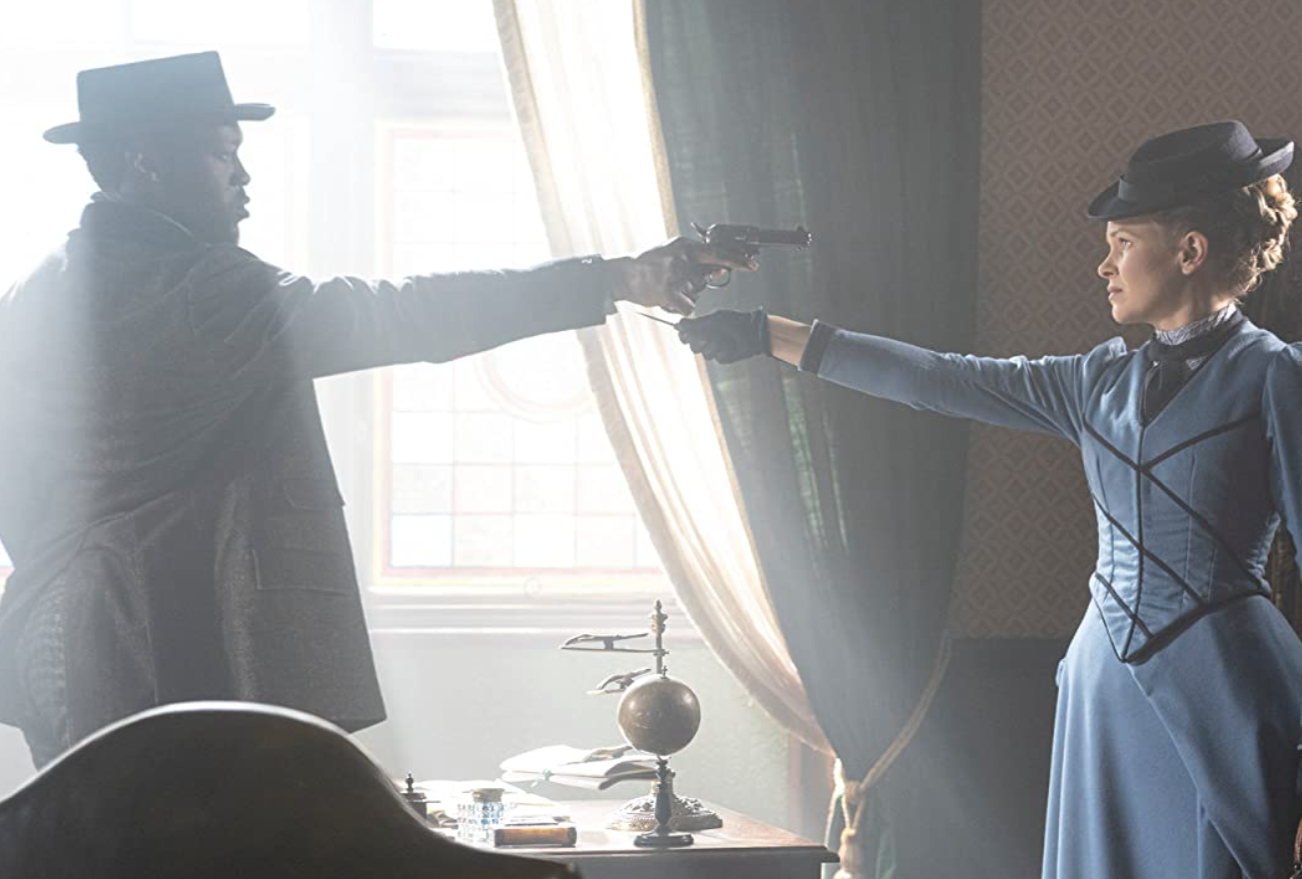
On Sunday’s episode of the Masterpiece mystery series “Miss Scarlet & the Duke,” tenacious sleuth Eliza Scarlet (Kate Phillips) learns that her former suitor and now business investor Rupert Parker (Andrew Gower) is a self-styled “like-minded fellow.”

While today’s viewers may immediately comprehend Rupert’s meaning, it’s not until he refers to “a man whose taste does not lie with women” that Eliza understands. Despite being a sharp and progressive detective, the sheltered Victorian young woman probably only at that moment realized that a person could be gay. (Despite the popularity of Victorian-set romance novels, women of the time were not expected to think about sex at all, and the terms “homosexual” and “heterosexual” weren’t in use at the time.) It’s part of Eliza’s awakening to life’s realities that began with inheriting her father’s private detective business upon his untimely death.

Rupert’s revelation is tied to Eliza’s latest case involving the murder of Sebastian Ridley, despite detective William “Duke” Wellington (Stuart Martin) preferring that she stay out of Scotland Yard business. Eliza had entered the morgue without permission and, glimpsing a tattoo of a dark rose on Ridley’s body, recalled seeing that same flower adorning the lapel of one of Rupert’s friends.

“Victorians had all these different meanings using floriography, the language of the flowers,” series creator Rachael New said in an interview with Salon. “If you have roses sent, that might mean betrayal or violence or jealousy. They had all of these emotions attached to the different flowers.”

While people have attached symbolism to flowers throughout the centuries, this specific type of floriography gained popularity in the Victorian era in both England and America. While courting couples no doubt exchanged bouquets imbued with tender sentiments, this method of communicating could also be used as a code for less amorous purposes. In Netflix’s YA Sherlock adventure “Enola Holmes,” the detective’s teen sister uses floriography to trade messages through newspaper ads with her mother, who has gone underground to plan a suffragist rebellion. 

In “Miss Scarlet,” the code is more straightforward. 

“I wanted to almost create a secret society of how these men knew the other had the same kind of liking for other men,” said New. “So I did use flowers for that. The midnight rose was completely fabricated by me. It’s a very deep, dark blue rose.”

The dead man wasn’t just gay, but hosted regular meetings for closeted gay men in his Mayfair tavern, Ridley’s Saloon. Such discreet, gay meeting places were common. Although England’s death penalty for homosexuality was abolished in 1861 (with the last executions occurring in 1835), homosexuality was still criminalized in 1882, when the series takes place. Rupert’s act of confiding in Eliza is not without risk.

“If Rupert was found with another man, you could be looking at 10 years hard labor,” said New. “It was absolutely brutal, apart from the fact of utter disgrace for your family. For someone like Rupert, his mother would just socially never, ever be able to get over that. So the stakes are really, really high.”

In the reputation-obsessed Victorian age, social ruin wasn’t just a matter of weathering a few spiteful gossips, but could destroy one’s life. Strict morality and abiding by social mores was crucial to survival. On the show, it makes some sense that Rupert is keen to help fund Eliza’s business; it’s one marginalized person helping another. Although he cannot be open with his sexuality or partners, he does have the privilege afforded to a white wealthy man. 

Similarly, New creates a way for Eliza to help Moses (Ansu Kabia), the son of a Jamaican man who had been enslaved in England and later freed, after he loses his employment. With few opportunities given, Moses has often turned to criminal acts to survive, and Eliza hires him to do odd jobs for which his experience is an asset. In this episode, we see him gleefully collecting Eliza’s fee from a reluctant client.

“Eliza’s an outsider, and I wanted to have all her main resources [be] outsiders too,” said New. “So obviously, Rupert is gay. Duke has his own obstacles — he’s got this glass ceiling that he just can’t break through. And for Moses, if you were a Black man living in Victorian London, you would have had a really hard time. He is a crook, he is a criminal, but they bond and they get each other. Eliza has these resources — Moses, Rupert, Duke — and they help her, but they can often hinder her too.” 

Modern-day Americans might be surprised that New counts the Duke as one of society’s outsiders. As a white man in a position of power, in law enforcement, he can move around England with impunity. Such privilege would not usually make him sympathetic to any of Eliza’s marginalized friends, much less Eliza, who wasn’t afforded basic rights because of her gender. 

And while there are plenty of moments where he fulfills sexist expectations, Duke doesn’t blink when Eliza reveals Sebastian Ridley had a male lover. New acknowledges the incongruity in Duke’s character.

“It was really important to me that Duke was a 19th century man, because that’s what makes the show work with the obstacles that Eliza is trying to get over,” she said. “But equally, I had to dance carefully around what type of attitude he would have about Moses, about homosexuality. 

“The reality is he would probably have been every horrible thing — a bigot, homophobic, racist — but obviously we can’t have our leading man being like that. And so I sort of covered that, in that he is a cop who’s been around a long time. As he said in the episode, ‘Nothing would surprise you if you’ve seen what I’ve seen.’ He’s a decent man — how we value a decent person now.” 

“Miss Scarlet and the Duke” airs Sundays at 8 p.m. as part of PBS’ Masterpiece.

“Men don’t wear make-up”: GOP civil war heats up as Liz Cheney mocks Matt Gaetz

As part of the battle for the soul of the Republican Party, embattled Rep. Liz Cheney (R-WY) took a low shot at colleague and antagonist Rep. Matt Gaetz (R-FL) for wearing make-up.

Apparently, in reference to Gaetz’s admission in an HBO documentary that he does his own make-up before cable TV appearances, the Washington Examiner reported on the escalating battle between Gaetz and Cheney, who is under fire for supporting Donald Trump’s impeachment.

According to the report, a spokesperson for Cheney, noting Gaetz is coming to Wyoming for an anti-Cheney rally, stated for the congresswoman, “Rep. Gaetz can leave his beauty bag at home. In Wyoming, the men don’t wear make-up.”

Gaetz, along with a gaggle of like-minded GOP House members, are hoping to force the Wyoming Republican out of her leadership position as the House Republican Conference Chair.

You can read more here.

Trump’s coup didn’t fail just from incompetence — credit the progressive activists who stopped him

Last week, Donald Trump finally left the White House, after two and a half months of trying to steal the election — which culminated in Trump inciting a violent insurrection at the Capitol. Even before he sent a mob to violently interrupt the certification of Joe Biden’s win on January 6, Trump’s efforts to overturn the election were relentless to the point of being uncountable: Dozens of lawsuits (which were nearly all struck down), pressure campaigns on local election boards and state legislators, an extortion scheme against Senate Republicansthreats against state officials, demands that then-Vice President Mike Pence illegally invalidate the election, and even meetings to explore the possibility of a military coup

In the face of all this, a narrative has shaped up: Trump’s failure to pull off a coup was largely due to his own shortcomings. 

It’s a narrative that started early, with Max Boot of the Washington Post opining shortly after the election that he’s “never been more grateful for President Trump’s incompetence,” because he “can’t even organize a coup d’état properly.” It culminated in Adam Serwer of the Atlantic arguing that Trump’s “assault was most often futile, almost always buffoonish.”

To be clear, no one is saying that Trump’s efforts were inconsequential, just because he failed to steal the election. Even Ross Douthat, who was most devoted to the “incompetence” narrative, admitted in his New York Times column that it was bad that a violent mob had descended on the Capitol, killing a police officer and coming perilously close to getting their hands on the lawmakers they were threatening. As Ed Kilgore wrote last week at the New Yorker, the lesson we all learned is that there were “some moments of real peril,” and Trump got distressingly close to pulling it off at times. Still, the focus on why Trump failed is largely on his own inadequacies and bad planning — Kilgore suggests he could have succeeded with “better timing and better lawyers” — and some lucky breaks, such as the quick thinking of some Capitol police who saved lawmakers from the insurrectionists. 

Over the weekend, however, a piece by Alexander Burns of the New York Times highlighted how much the credit to ending Trump’s coup should go to Democratic and progressive activists. Far from standing by idly while Trump bumbled his way towards failure, these groups never underestimated Trump’s likelihood of winning. If not for these groups and their organized and devoted efforts, the odds are quite high that Trump could have stolen himself a second term. 


Want more Amanda Marcotte on politics? Subscribe to her newsletter Standing Room Only.


Defeating Trump took a “long season of planning and coordination by progressives who anticipated Mr. Trump’s postelection schemes, including his premature attempt to claim a victory he had not achieved, his pressure campaigns targeting Republican election administrators and county officials and his incitement of far-right violence,” Burns writes. It took a remarkable “degree of collaboration among progressive groups that often struggle to work so closely together because of competition over political turf, funding and conflicting ideological priorities.”

The Democracy Defense Coalition brought together over 200 groups, guided by the correct assumption that Trump would try to stage a coup after he lost the election. Their work was largely quiet, no doubt to keep Trump and his minions from finding out about it and interfering with it. But without this coordinated response, it’s quite likely Trump would have been able to pull off at least one of his many plans to steal the election.

As I chronicled at Salon back in October, with help from activists doing this work, defeating Trump required an organized, calm, and persistent response from Democratic voters. For instance, activists recognized that Trump was going to use the partisan divergence on voting styles — coronavirus-concerned Democrats would vote by mail and COVID-denying Republicans would vote in person — as a wedge point, and try to get mail-in ballots thrown out in large numbers. The counteraction to that was to convince Democratic voters to vote as early as possible, on the theory that ballots that arrived before Election Day were easier to protect from Trump’s legal assault.

The strategy was effective.

In Pennsylvania, so few mail-in ballots arrived after Election Day that even if Trump had been successful in arguing that they should be thrown out, it wouldn’t have changed the outcome of the election. The result was swifter court decisions shutting down Trump’s challenges, depriving him of the momentum needed for a successful coup. As Burns notes, the activists had a nearly impossible task, of striking a balance between taking the coup seriously but also projecting an air of confidence that Trump would fail. Defeating a coup is very much about convincing the public that your side will prevail. This balance was struck, but not by accident. It took lots of hard work by activists, often working quietly behind the scenes, to organize progressives in a way that showed concern-but-confidence. The result was events such as one night in Philadelphia when pro-democracy crowds ran off Rudy Giuliani and Eric Trump from the convention center, where the two men were trying to whip a right-wing crowd up to harass vote counters. After Giuliani and Trump took off, the protest broke out into a dance party. 


Want more Amanda Marcotte on politics? Subscribe to her newsletter Standing Room Only.


It’s important to learn from this recent history for a very simple reason: The effort to end democracy isn’t over.

Trump may run again, and as he did in every election he’s been in, he will cheat and encourage others to cheat on his behalf. But even if Trump doesn’t run again, he’s empowered a movement of anti-democracy Republicans who will look for every advantage they can to nullify the results of elections they lose. Senate Minority Leader Mitch McConnell, R-Ky., is already doing this, with his plot to keep the Senate from even beginning business unless the Democratic majority simply relinquishes the power given to them by the voters. 

To defeat the longer-term assault on democracy, it’s critical for everyday voters to understand that they do have power, and that, by taking action, they can help preserve and restore democracy.

The reason why Republicans have gotten so far in their efforts to undermine democracy is that they’ve trained ordinary people into believing that efforts to stop them will all be in vain. The true story of how Trump was defeated, by regular people who fought for their democracy, is empowering. It can convince people to keep up the fight. So while no one should doubt Trump is an idiot, it’s important to give credit where it’s due for his defeat: On the progressives who fought him, every step of the way. 

The great GOP crack up: Mitch McConnell is still scrambling to lead Donald Trump’s Republican Party

It took a little longer for the inevitable post-election Republican implosion than might have been expected. Perhaps they were exhausted from all the excitement of witnessing a historic violent insurrection or maybe they are just aimless without former President Donald Trump’s Twitter feed to guide them. It’s possible they were a little bit gun-shy since people are being investigated for committing sedition all over the country after their assault on the U.S. Capitol on January 6th. Whatever the reason, the normally voluble Republicans went uncharacteristically quiet for a few days during Joe Biden’s Inauguration week. That silence ended over the weekend after two state Republican parties decided it was time to deal with the traitors in their midst.

In Arizona, the party reelected Kelli Ward — a Trump fanatic who lost her bid for the GOP nomination to the Senate in 2018— as the state chairman and her first order of business was to offer a censure motion against a raft of prominent Republicans, including former Senator Jeff Flake, Cindy McCain, the wife of former Senator John McCain and sitting Governor Steve Ducey, all for the crime of failing to be properly loyal to Donald Trump. The first two are vocal critics and didn’t vote for Trump, but Gov. Ducey has been a loyal minion whose only crime was refusing to break the law and somehow give Donald Trump more votes in the election.

Meanwhile, the Republican State Central Committee of Kentucky met on Saturday to vote on a resolution demanding that Minority Leader Mitch McConnell support former President Donald Trump and condemn his second impeachment. The resolution failed on procedural grounds but the people who brought it up say they plan to bring another motion demanding McConnell’s resignation. There is no chance that will pass either. Mitch McConnell is the most powerful Republican in the federal government and the Kentucky political establishment knows that. But both of these events reveal that Trump loyalty remains a potent force in the party.

It also illustrates the bind that Mitch McConnell finds himself in.

Polling shows that a large majority of Republicans are still in thrall to Trump to be sure, but somewhere between one-fifth and one-fourth of the party has fallen away. A Pew poll taken after the insurrection found that more than 30% of Republicans disapprove of Trump. That may not seem like much but it is enough to make it impossible for Republicans to win nationally if those people fall away from the GOP permanently. As the Atlantic’s Ron Brownstein put it, “if Biden could lastingly attract even a significant fraction of the Republican voters dismayed over the riot, it would constitute a seismic change in the political balance of power.”

Nobody knows that better than Mitch McConnell who just lost four Senate seats in Arizona and Georgia, states that were solid red not long ago. Those kind of wins are predictable in purple states like Colorado (which the Republicans also lost) but losing four seats in Arizona and Georga is a harbinger of big problems for the GOP in metro and suburban areas around the country. And after what happened on Jan. 6th, Trump and his agitated, radical following are very likely to make things even worse. In that Pew Poll, 43% of Republicans said they do not want Trump to remain a major political figure.

It has long been obvious that Mitch McConnell doesn’t care for Donald Trump. He’s a big pain in the neck if nothing else and McConnell understands that a leader who can never get above 50% approval is not someone they can count on to deliver for the party. In fact, Trump never did. He barely pulled out an electoral college win in 2016, lost in 2020 and lost both the House and the Senate during his only term. It’s not a good record.

McConnell gave a strong speech condemning the move to object to the electoral votes before the riot started on Jan. 6th, even making the point that the election was “not unusually close.” And after the attack, he floated several trial balloons in the mainstream press to test out the appetite for convicting Trump in a second impeachment trial. He’s made it clear that his senators are free to vote their conscience and even gave a speech on the floor saying “the mob was fed lies. They were provoked by the President and other powerful people.”

But before we get too excited about this born again, patriotic Mitch McConnell, let’s not forget that he declined to step up and say that the election was decided until very late in the game and then held back from his criticism until the Georgia runoff elections were over, just in case he got to keep the majority. He, along with all the other GOP leaders, allowed Trump’s Big Lie to spread and metastasize into a massive conspiracy theory that led hundreds of people to storm the Capitol. And for four years, knowing what Trump was didn’t stop McConnell from using the power he had while he had it. Just because Trump was driving the party into the ditch was no reason not to confirm a whole bunch of right-wing judges and pass some huge tax cuts, am I right? He even went out of his way to make sure that Trump stayed in office when the Democrats conveniently offered him a way to get rid of him and replace him with good old, reliable right-wing Mike Pence. McConnell made that deal with the devil and he’s scrambling to figure out what to do about old Beelzebub now that he’s on the outside looking in.

McConnell isn’t the only member of the GOP leadership who is dancing as fast as he can either.

House Minority Leader Kevin McCarthy, one of the most verbally incontinent politicians in Washington, doesn’t know which way to turn either. At first, he said Trump won the election and he voted to overturn the electoral college, then turned around and said Trump bears some responsibility for the insurrection, then reversed himself and said Trump didn’t provoke it and finally laid the blame at the feet of all Americans.

The 10 House Republicans who voted to impeach Trump are being threatened including Liz Cheney who is in danger of losing her leadership role in the caucus. The House Republicans are all at McCarthy’s, and each other’s, throats.

And nobody knows what they’re going to do about the Senate impeachment trial. Some Republicans would like to draw it out and make it a Trumpian spectacle, while McConnell would prefer not to have Trump back in the spotlight. And now there may even be some jockeying for power within the Senate leadership:

https://twitter.com/stuartpstevens/status/1353452195090317314

McConnell has plenty of tricks up his sleeves and it’s unlikely Cornyn is actually maneuvering. But it’s been years since they had this much tension within their caucus and he may not be able to control his fractious bunch of Trumpish radicals like Josh Hawley, R-Mo, Ted Cruz, R-Tx, and Lindsey Graham, R-SC, who is strangely obsessed with defending Trump far beyond what is politically useful. I hope the Democrats are prepared to battle a party that’s in disarray. It may not be as easy as it seems.

10 bold moves Biden can make without Congress

We did it. We took control of the Senate from Mitch McConnell. Even so, Republicans may still be able to block key parts of Joe Biden’s agenda. But there are plenty of critical policies he can and must enact without them.

Biden’s first task is to undo Trump’s litany of cruel and disastrous executive orders. He has already announced he’ll rejoin the Paris Climate Accord, re-enter the World Health Organization, and repeal Trump’s discriminatory Muslim travel ban. And there are at least 48 other Trump policies that he can reverse on day one.

In addition, here are 10 critical policies Biden can implement without Congress:

FIRST: He can lower drug prices through Section 1498 of the federal code, which gives the government the power to revoke a company’s exclusive right to a drug and license the patent to a generic manufacturer instead. 

SECOND: He can forgive federal student loans – thereby helping to close the racial wealth gap, giving a financial boost to millions, and delivering a major stimulus to the economy. 

THIRD: He can use existing antitrust laws to break up monopolies and prevent mergers –– especially in Big Tech and the largest Wall Street banks.

FOURTH: He can institute pro-worker policies for federal contractors – who are responsible for a fifth of the economy – such as requiring a $15 minimum wage and paid family leave, and refusing to contract with non-union companies.

FIFTH: He can empower the Labor Department to aggressively monitor and penalize companies that engage in wage theft and unpaid overtime, and who misclassify employees as independent contractors – as Uber and Lyft do.

SIXTH: He can make it easier for people to get health care by eliminating Medicaid work requirements, reinstating federal funding to Planned Parenthood, and expanding access to Affordable Care Act plans. Then it’ll be up to us to push him to enact Medicare for All.

SEVENTH: He can ban the sale of public lands and waters for oil and gas drilling. He can further tackle the climate crisis by reinstating the 125 environmental regulations rolled back by Trump and directing federal agencies to deny permits for new fossil fuel projects, and halting all fossil fuel lease sales and permits.

EIGHTH: His Securities and Exchange Commission can reinstate its ban on stock buybacks – so that corporations are more likely to use their cash to invest in workers instead of enrich their shareholders. And he can rein in Wall Street by strengthening the Consumer Financial Protection Bureau and other financial regulators, while his Treasury Department can close many tax loopholes.

NINTH: He can address the cruelty of capital punishment by granting clemency to everyone on federal death row, effectively ending the death penalty with the stroke of a pen. He can address other injustices by having the Department of Justice implement mass commutations for low-level drug offenders, strengthening the department’s Civil Rights Division, and reining in rampant police misconduct through consent decrees. And he can undo some of the damage wrought by the racist war on drugs by directing his Attorney General to reclassify marijuana as a non-dangerous drug.

TENTH: He can reverse Trump’s cruel immigration agenda by restoring and expanding DACA and raising the yearly number of refugees who can be admitted. 

Even with control of the Senate, Democrats’ slim majority means that Republicans can still obstruct Biden’s policy agenda at every turn. Biden can and must wield his presidential powers through Executive Orders and regulations. The problems America is facing demand it. 

Author Rick Perlstein on the challenge ahead: “Biden knows that he is managing a dying regime”

Donald Trump is no longer president of the United States, but he appears to have remade the Republican Party in his image. Many or most Republican elected officials and other leaders remain committed to Trumpism and American fascism. Even those who may feel misgivings are terrified of Trump’s 70 million-plus political cult members — some Republican elected officials have admitted to fearing that Trump’s followers will kill them and their families for being disloyal.

Trump has suggested he may try to form his own political party, one that he will use to be a type of shadow president or political crime family boss who extorts the Republican Party to do his bidding. Trump’s forces will also continue their war against nonwhite people and multiracial democracy. As Trump both promised and threatened in his farewell announcement to his followers, “We will be back in some form.”

At Trump’s encouragement, his followers launched a lethal attack on the U.S. Capitol on Jan. 6. Their obvious objective was to overthrow democracy, nullify the 2020 presidential election and keep Trump in power indefinitely.

While too many voices in the American news media downplayed such an imminent danger as some type of “joke” or “distraction,” something that was “unimaginable” in the United States, ongoing criminal investigations and reporting have revealed that Donald Trump’s coup attempt was not merely “performative” or merely “symbolic.”

One of the most damning new “revelations” about Trump’s plot is that he apparently considered replacing the leadership of the Department of Justice in hopes of overturning the results of the 2020 presidential election. Trump’s cabal, under this plan, would then have pressured the Supreme Court and various state legislatures to discard Democratic votes in key battleground states. Law enforcement officials have also revealed that the Capitol attack also involved a coordinated effort by militia members with violent intentions, who may have hoped to kill or kidnap Democratic members of Congress or Vice President Mike Pence.

The Republican Party’s evolution (or devolution) into an anti-democratic, white supremacist political organization has taken decades: From the 1960s and the Southern Strategy to Reagan and his “welfare queens” to Newt Gingrich, the Tea Party, birtherism, the Age of Trump and beyond.

Ultimately, Donald Trump’s presidency is but one more milestone on that journey. The resurgence of American fascism, in the form of the current Republican Party, the “conservative” movement and the White Right more generally, will long outlast Trump himself.

Writing at the New Republic, historian and bestselling author Rick Perlstein summarizes this:

Mere politics, however, could only deliver diminishing returns. With fewer and fewer old, white, terrified reactionaries to draw votes from, the Republicans since 1992 lost the popular vote in seven out of the last eight elections — although, thanks to the minoritarian constitutional structures bequeathed them by their reactionary eighteenth-century forbears, they were able to squeeze three presidential terms from that increasingly meager electoral base.

This year, neither the most frantic conspiracy theories imaginable nor a fresh new outbreak of 1950s-vintage Electoral College chicanery were enough for the political wing to prevail. One of America’s founding traditions, however, endures: a rump reactionary minority insisting that the nation is nonetheless theirs to rule by right. Their politicians having failed them, it should be no wonder their paramilitary wing charged into the Capitol behind a Confederate flag to finish the job.

Rick Perlstein’s books include “The Invisible Bridge: The Fall of Nixon,” “Nixonland: The Rise of a President and the Fracturing of America” and, most recently, “Reaganland: America’s Right Turn 1976-1980.” His essays and other writing have been featured in The New Yorker, The New York Times, The Washington Post, The Nation and elsewhere.

I recently spoke with Perlstein about Joe Biden’s presidency and the challenges he and the Democratic Party will face in trying to escape the ominous shadow of Donald Trump. He explained that in his view, Trump’s rise to power and the American right’s increasing extremism can be traced back many decades, to the 1950s if not before. Perlstein also offered President Biden some free advice: He should not concern himself with “bipartisanship” or “compromise” with a Republican opposition that will obstruct and condemn him no matter what he does.

This conversation took place before the Jan. 6 coup attack on the Capitol and Biden’s inauguration. This transcript has been edited, as usual, for length and clarity.

How are you feeling given the Age of Trump and all that mayhem and pain, a pandemic and an overall surreal state of affairs? How are you making sense of this?

For all the horror of seeing one of America’s two major parties descend into fascism, the fact is that I am a writer and a historian. That we are living in the middle of a time that people will probably be talking about in a hundred years is interesting and exciting to me.

COVID, for example, raises basic questions about how society organizes itself and how capitalism works. Trump’s presidency forces us to revisit basic questions about our constitutional form of government and whether it works or not.

I fantasized about being a historian when I was a teenager. I was obsessed with the 1960s, a time when everything seemed so very dramatic and interesting. And here we are now, as they say, cursed to live in an in interesting time. Ultimately, I want to use my fascination with history in a productive way.

There are many political observers — the pundit class, journalists and the like — who are afraid to admit, privately or in public, that these events, even if horrible, are also exciting in a way. We are in a world-historical moment. Have you asked yourself such questions about this moment and what it represents?

When I wrote my essay about COVID and market society for In These Times, I included William James’ famous essay “The Moral Equivalent of War.” He was a socialist and a pacifist. In that piece, James was lamenting the fact that the only thing that really forces masses of human beings to sacrifice collectively in a way that is truly selfless is war.

In that essay, I drew upon James as a way of arguing that market society led us to our failure with COVID. I wrote that here we were presented with this opportunity to mobilize our society as if for war, and yet we had nothing in us to spur us to collective sacrifice because our society has become so selfish and so market-oriented.

As we try to make sense of American fascism and Trump and how that came to be, the mainstream news media has a large blind spot in term of grappling with emotions and politics. Trumpism and other forms of antisocial and destructive behavior are fun for the participants. That behavior makes the followers feel brave. Instead there is this obsolete focus by the mainstream news media on policies and agendas, and a ridiculous assumption that voters are “rational.”

It is just that the reporting on politics in America is bad. Many journalists and reporters do not have the patience, skill, motivation and structural incentives to actually go out and talk to people in any in-depth or insightful way. The reporting is often so shallow and so cheap and so limited in terms of the questions asked. For example, being part of a mass movement is fun. Being part of history is fun. Collective struggle is fun. Being part of something that transcends the self is something that human beings long for. That is especially true in a time when there is great alienation.

Is this inability or unwillingness by the mainstream news media to get at real truths, challenging truths, caused by a lack of training in history and related fields? The superficiality of the 24/7 cable news cycle?

There is a lost intellectual tradition of understanding how demagoguery and mass movements rise to power. The generations that experienced the rise of fascism and World War II are very attuned to such questions, they know that it is not hard for an evil person to mobilize people by leveraging anger. For example, much of the popular culture from the 1950s and the 1960s, such as the film “A Face in the Crowd” or the TV series “The Twilight Zone,” were about how thin the membrane is between civilization and barbarism. For many people, those memories have been lost. Those stories are not being told anymore in that same way.

If Rod Serling came back to life he’d say, “Well, of course this is happening.” He had an experience with seeing the most civilized places on earth, places like Italy and Germany, descend into becoming charnel houses. How did that happen? There was a lot of critique and there was a lot of understanding of how ordinary people could lose their moral moorings very easily if the right inducements are placed in their way. That is especially true in times of economic dispossession and alienation, and when institutions are breaking down.

America needs to have truth and reconciliation commissions and other investigations to bring to light all of Trump and his regime’s crimes and other misdeeds. But Biden has been insisting on “unity,” on “reaching out” and “coming together.” I believe that Joe Biden is a fundamentally decent human being. But can a president be too decent for a moment such as this, and just be taken advantage of by his adversaries?

Joe Biden, in many ways, is a decent man. But he obviously had some very profound moral blind spots along the way. I have written about how Biden ran for re-election [to the Senate] in 1978, and was basically a “I promise to lock them up” type of law-and-order politician.

For me, the interesting question is, what kind of blind spots can even decent people have? Specifically, what kind of awakening has Joe Biden had? What type of awakenings is Biden capable of having at this point in his life?

One thing I do like about Joe Biden is that he has enough self-knowledge and self-possession to be able to say out loud that he is part of a transitional generation of Democrats and that he sees himself handing the torch to the next generation. Biden knows that he is managing a dying regime. No one is going to be talking about the “Age of Biden.”

I do not see Joe Biden escaping the shadow of Trumpism. He has the practical problem of unreasonable expectations. The news media is going to turn on Biden at some point, sooner rather than later, and default to scandal-mongering and both-sides-ism. I am deeply worried that Biden will be boxed in.

All Joe Biden can do is govern compassionately and well and let the chips fall where they may. Biden has to do what he can, using the powers at his disposal to create the types of political and social transformations that are required, for example, to stop the country and world from being drowned by global climate change over the next few decades.

Biden also needs to understand that there is no sweet spot, or some notional center that one arrives at which will somehow turn off the spigot of reactionary rage. Joe Biden is going to be seen as the warlord of a tribe of sex-trafficking demons by the right wing whether he introduces Medicare for All or not. Biden might as well actually do something that makes lives better for as many people as possible. On the margins, Biden can act hoping that he convinces enough people to vote with or become Democrats to squeeze out another Electoral College win for him or the next candidate. By doing that, Biden will create a future for the Democratic Party, a future which does not rely on merely reacting to what the Republicans do or say.

Here is one of my favorite data points about the fool’s errand of trying to reach out to some type of notional center in American politics. The stimulus bill that Barack Obama signed in 2009 gave a tax cut to 95% of American families, but by the time of the 2010 midterm elections — when the Tea Party people did so well — among likely voters, by a margin of two to one, people actually believed that Obama had raised their taxes. There will be a backlash because there is just a considerable portion of Americans for whom liberals and Democrats are not legitimate governing partners.

How much distance do you believe will be necessary to get a sense of perspective on the Age of Trump?

There are different kinds of understanding. People will write brilliant stuff, which will help us put together pieces of the puzzle. I really enjoy Tim Snyder and Masha Gessen who do this kind of intellectual work in the moment. That gives their scholarship a certain urgency and truth that only that kind of closeness can tell. Other people will be arriving at structural understandings about these events with the Age of Trump, connecting events and facts and other information, and that might take 20, 30, 40, 50 or 100 years. There are so many things to put together. Why was there this right-wing authoritarian turn in so many societies all over the world? Brexit, Poland, Russia? What of Brazil? It has to be a global history.

You have written a trilogy of books on the American right wing and the country’s politics from Nixon to Reagan. What is the role of critical distance in how we make sense of politics? What do you think you would have seen differently in terms of the United States, for example, if you were writing during the 1960s and 1970s?

If I were writing then, I would have been completely enraptured with the brave new world, one still waiting to be born. I probably would have been involved in these liberation movements and had no cognizance at all that being nurtured in its bosom was a force of triumphal reaction. Very few people had the insight to see that. It is very difficult to see the larger structures that determine the reality we are living in.

One of the dominant narratives of the last few years is this fixation on the “good Republicans” who are not Trumpists. In that narrative, Ronald Reagan and the two Bush presidents are put on a pedestal. In reality, Trumpism is the direct outgrowth of a long trend and a path-dependency in the Republican Party and the American right more generally that spans decades.

It is a longstanding pattern. When Barry Goldwater was around, there was this pining for the “good” conservatives of the 1940s and ’50s. They would point to this guy Robert Taft, yet somehow forget that there was Joseph McCarthy who was coming up at the same time. When Watergate was happening, people were pining for Barry Goldwater as someone who had all these right-wing ideas, but at least he seemed straightforward and honest. We always seem to domesticate the reactionaries of the previous generation. I believe that to be a function of the cult of American consensus and the inability we as a people have to really wrap our minds around just how vicious the various strains of American history are.

That has not been the story we as Americans have told about ourselves. That is a very hard corner to turn and — that the history of America is full of the kinds of feral hatreds that we mostly associate with Europe. That is what was most dangerous about Ronald Reagan: He taught Americans to live a life of political denial. That was Reagan’s whole appeal to the electorate. You don’t have to criticize America. You can absolve it of any sins because it has no sins. Its sins are all introduced by people who are not quite American at all.

How do you reconcile the Lincoln Project’s relationship with American conservatism and the Republican Party?

It is a really complicated phenomenon that ranges from cynical hustlers to earnest political and spiritual seekers. To borrow a favorite Ronald Reagan phrase, I would caution, “Distrust, but verify.” There is this old saying that the left seeks heretics, and the right seeks converts. I’m perfectly willing to bring a convert to my bosom.

Why has Jimmy Carter become such a beloved figure in these last few years?

I was immediately attracted to writing in depth about Carter because he was the father of the Democratic Party’s cult of austerity, the idea that the way to solve problems of economic dispossession is to cut government. I hope that people revisit Carter as the source of a colossal wrong turn in the evolution of the Democratic Party. That is my Jimmy Carter. People are hungering for public figures who present a face of decency. Whatever you say about Jimmy Carter, he oozed decency. It is not particularly surprising that people will roll up Jimmy Carter into another narrative of American innocence, that we can be governed by decent people. The danger of that temptation is that Carter pursued an agenda that was explicitly a backlash against the New Deal just as much as Reagan did.

If Joe Biden called you for advice, what would you say?

Govern compassionately and well. Do not worry about hitting some kind of notional ideological center because you will be framed as a Bolshevik enemy of truth, decency and the American way no matter what you do.

What if Biden then says “I want to heal America. I truly believe that the Republicans and Trumpists — my opposition — are basically good people”.

I would say that America is a country where almost a million people killed each other in a war. So you have got to deal with that America, too.

U.S. exceptionalism is dead: long live U.S. uniqueness?

An insurrection in a capital city, in which the halls of the national legislature are violated by thugs, was never an unimaginable event. 

When chaos truly hits home

Most Americans, however, would have envisioned such a staggering act as happening overseas in an unindustrialized, undemocratic backwater or similar setting — definitely not in the citadel of U.S. democracy — the U.S. Capitol building in Washington, D.C. 

After all, the United States, as the leader of the free world, is supposed to be somehow different, exceptional — hence the term, “American exceptionalism.”

Two tenets

After the events of January 6th, 2021, can we reconcile American exceptionalism with the disgraceful insurrection at the Capitol? 

No, we can’t. And we shouldn’t. 

If we are honest with ourselves, the idea of American exceptionalism was overblown and ham-fisted ever since it was first articulated. 

Now we see plainly that the concept ultimately can become self-destructive — rendering a nation tone-deaf, and a populace unable to comprehend the difference between “listening” and “waiting to speak.” 

In the worst case, people turn brutish and speech turns violent. 

Even so, facts of U.S. uniqueness can pull the United States through the present crisis.

I submit two tenets as observations:

1. The United States is not exceptional — and never has been.

2. The country is unique — and hopefully always will be.

An important distinction

These statements seem contradictory, but are not, because they draw an important distinction. 

It is vital that American citizens — and leaders — keep this distinction in mind both during the present crisis — and as the nation moves forward.

To begin with, American exceptionalism argues that the United States is inherently different from, and even superior to, other countries. 

The United States supposedly became “the first new nation,” as Seymour Martin Lipset famously put it, because it emerged from a successful founding revolution to develop a distinctively American ideology.

That ideology was based on individual liberty, equality and responsibility in the context of republicanism, federalism, representative democracy and laissez-faire economics. 

Superiority merely alleged

In this framework, the United States’ alleged superiority is often used to justify a U.S. mission — or burden — to transform the world. 

This is expected to happen either by directly intervening in world affairs — or by serving as John Winthrop’s “city on a hill” which other nations should aspire to be.

American exceptionalism has a long history. French political scientist and historian Alexis de Tocqueville was the first writer to describe the United States as “exceptional” in the 19th century. 

Stalin and American exceptionalism

The phrase itself was first used by Soviet leader Joseph Stalin in 1929. He coined the term to critique revisionist factions of American communists. They had argued that the U.S. political climate was so singular as to be an exception to some elements of Marxist theory. 

Closer to our own day, statements of American exceptionalism can be found in sources as disparate as an interview with then-President Barack Obama or a plank in the 2012 platform of the Republican Party. 

Indeed, they are on the speaking menu of many public figures.

A flawed theory

Despite their distinguished pedigrees, all flavors of American exceptionalism have always been flawed theories. 

These flaws have now been powerfully underscored by the insurrection that took place in the U.S. Capitol — but the faults have always been there.

Some scholars dismiss the theory of American exceptionalism by claiming that all countries are exceptional in their own way. Others argue that there are no essential differences between the United States and other countries. 

Truth be told, far from exhibiting a liberal consensus since the United States’ founding, U.S. history is in fact a story of competition between the ideologies of civic republicanism and liberalism.

While conventional arguments against American exceptionalism often raise salient issues, even the above objections to American exceptionalism often miss the most vital point.

The people dimension

The central element of the United States — the American people — makes the United States the same as every other nation: The United States is comprised of individual human beings. 

And despite humanity’s intrinsic strengths, resiliences and potentials, these individuals are saddled with all the inherent weaknesses, vulnerabilities and shortcomings that characterize the human person and that limit human society. 

Triumphalist or salvation — oriented rhetoric notwithstanding, — the United States does not provide a cure for human brokenness.

Unique, but not exceptional

However, there is a secondary — but vital — characteristic of the American populace which, in my view, does indeed make the United States unique. 

Although it is a learned — rather than innate trait — it is an attribute that can be, and has been, measured.

A Pew Research Center 2014 survey highlights American attitudes which are different from those of other nations, especially richer nations. 

Americans are generally optimistic and believe in the power of the individual and in the importance of hard work.

Trump’s downsizing of American virtues

The outgoing U.S. President, rhetoric notwithstanding, has done much to pollute this core, even constitutive, national belief.

What is now clearer than ever is that for these distinctive American beliefs to have any real meaning and salience, they need to be translated into concrete roadmaps for success.

This is no easy task. To the extent that these beliefs permit Americans to focus on themselves as individuals rather than as members of something greater than themselves, these outlooks can obscure, rather than resolve, real divisions across lines such as race, gender and class in society.

How to combat poverty

Take class as an example. Some Americans of goodwill want to eliminate poverty, but they believe that race and gender are not relevant to understanding or solving the problem. 

Although many Americans come to this view from places of compassion and pragmatism, the fact remains that treating poverty on a one-size-fits-all, individualistic basis cannot succeed unless the United States also grapples with the complex and continuing connections between poverty, gender and race. 

Rising economic tides do not necessarily lift all boats. And this economic example is but one of many elements which must come together for the United States to become and remain the country it aspires to be.

The post 1/6/21 era

In the era post 1/6/21, Americans must bring these unique attitudes to bear against forces and patterns of inequalities while respecting legitimate differences.

What the person and the presidency of Donald Trump did was to contaminate a society’s most important virtue — respecting legitimate differences. 

Worse, the contagion threatened to remake the U.S. value system into something impoverished and selfish.

The agenda after Trump

To regain our footing as a nation, we must put much higher emphasis on personal morality and professional ethics. 

However, as we do so, we must engage across moral, ethical and ideological lines collectively, cooperatively and civilly in such a way as to err on the side of least imposition even upon minority positions. 

Now more than ever, American predispositions towards optimism, individual responsibility and reliable work ethic must be promoted, cultivated and sustained by wisely chosen and appropriately designed educational, legal and social policies that focus on the common good.

Democracy challenged

U.S. democracy has been challenged — and American exceptionalism has been shown to be a fraud.

But U.S. uniqueness has a chance to remain a valid proposition. 

If all goes well, this uniqueness can pull the United States through this perilous hour, repair trust in its institutions and leaders and restore its international reputation.

Sidney Powell releases Kraken — on herself, with new super PAC not far from Mar-a-Lago

A Friday filing with the Federal Election Commission shows that Sidney Powell, the Texas lawyer and conspiracy theorist so extreme that Donald Trump’s campaign fired her, has launched a new super PAC which will allow her to raise an unlimited amount of money and put it towards virtually any political cause — including paying herself. The PAC, called “Restore the Republic,” lists its physical address as a UPS dropbox about half an hour from the former president’s residence Mar-a-Lago.

Powell rode her ludicrous allegations about election fraud to international notoriety in November, joining the Trump campaign’s “elite strike force” alongside former LifeLock spokesperson Rudy Giuliani and legal adviser Jenna Ellis. Her off-the-wall performance at a now-infamous Nov. 19 press conference, where she declared, among other things, that voting machines across the country had been rigged on behalf of former Venezuelan president Hugo Chávez (who died in 2013), drew so much backlash that the Trump campaign cut her loose. Powell was back in the White House weeks later, however, with Trump floating her as a possible special counsel tasked with investigating his election defeat.

Only last week, Powell finally withdrew her fabled “Kraken” lawsuit, an incomprehensible and error-riddled unified theory of fraud in Georgia’s election that likely did more to indoctrinate and radicalize Trump supporters than any other legal case made by the campaign. The withdrawal came days after the 11th Circuit Court of Appeals reminded Powell that she hadn’t been admitted to practice law in that state.

The suit, along with Powell’s ceaseless promotion of its baseless claims, prompted voting machine manufacturer Dominion to sue the Texas lawyer for $1.3 billion in damages. Considered in that light, a super PAC is the natural choice for a nationally shunned attorney with a crazed fan base, who now faces untold expenses.

The Restore the Republic PAC’s treasurer, Jesse Binnall, also represented the Trump campaign in its post-election litigation, by way of Trump’s Washington law firm, Harvey Binnall. The FEC filing lists Harvey Binnall’s main switchboard number as the contact number for Binnall, and for Powell as well. The firm did not reply to questions about the apparently new affiliation.

Neither Binnall nor Powell, whose firm is in Texas, appear to have Florida connections, and it is not entirely clear why they chose to locate their super PAC in West Palm Beach. Trump, however, is in need of counsel for his upcoming impeachment trial in the Senate, and has shown an appreciation for Powell. The PAC’s name, Restore the Republic, might suggest that its mission involves returning Trump or members of his administration to power.

Super PACs can function as for-profit fundraising vehicles that don’t have to make clear promises on how they spend their money, beyond the prohibition on direct contributions to political committees. Executives and founders can use PAC funds to pay themselves, and can even obscure those payments in reports.

“If you are a consultant who is part of the control group that forms a super PAC or one of these nonprofits, then you get to figure out how you are going to compensate yourself, and it is not always a matter of public record,” former FEC chair Trevor Potter told the K Street blog in 2018.

Some super PACs hide those payments in consulting or fundraising fees transferred to companies operated by the PAC owners or their friends. It can be difficult to tease out the true recipient of those funds.

Trump himself started a PAC after the November election, called Save America, and began directing campaign donations to its account almost immediately. It is unclear how he plans to use the money.

“Jim Crow relic”: Progressives push Chuck Schumer to dump Senate filibuster

A coalition of more than 40 progressive groups — Just Democracy — is ramping up the pressure on new Senate Majority Leader Chuck Schumer by running a digital billboard in New York’s Times Square, at the heart of Schumer’s home state, urging him to end the Senate filibuster. The filibuster rule requires most legislation to reach 60 votes to pass in the Senate.

The coalition — made up of more than 40 grassroots civil rights and social justice groups from around the country — created and paid for the week-long billboard starting Monday.

Just Democracy tweeted Sunday that the billboard was previewed on NBC’s “Meet the Press” earlier in the day:

Sen. Dick Durbin, D-Ill., the majority whip, said on “Meet the Press” that “the American people want us to take action, action on this pandemic, action on this economy and on a host of other issues, and if this filibuster has become so common in the Senate that we can’t act, that we just sit there helpless, shame on us. Of course we should consider a change in the rule under those circumstances.”

The Just Democracy ad quotes Rep. Alexandria Ocasio-Cortez: “A cherished tool of segregationists”; former President Barack Obama: “Jim Crow relic”; and ex-Senate Majority Leader Harry Reid: “Outlived its usefulness.” Ocasio-Cortez is reportedly considering a challenge to Schumer for his Senate seat in 2022.

“Democrats gained control of the Senate because of Black and Brown organizers and voters,” Stasha Rhodes, campaign director for 51 for 51 and a member of the Just Democracy coalition, said in a statement. “Now they have a chance to remove the biggest impediment to the legislation those voters care about most — voting rights, healthcare, a serious COVID rescue package and more.”

Meanwhile, another progressive/labor coalition — Fix Our Senate — ran a full-page ad in Sunday’s New York Times that also pushed Schumer to end the filibuster. “There is absolutely no reason to give Sen. McConnell months and months to prove what we absolutely know — that he is going to continue his gridlock and dysfunction from the minority,” said Eli Zupnick, a spokesman for Fix Our Senate. The group has launched a six-figure ad campaign and plans to deploy field staff in states where Democratic senators have expressed reluctance to ditch the rule.


Trump’s pardons included health care execs behind massive frauds

At the last minute, President Donald Trump granted pardons to several individuals convicted in huge Medicare swindles that prosecutors alleged often harmed or endangered elderly and infirm patients while fleecing taxpayers.

“These aren’t just technical financial crimes. These were major, major crimes,” said Louis Saccoccio, chief executive officer of the National Health Care Anti-Fraud Association, an advocacy group.

The list of some 200 Trump pardons or commutations, most issued as he vacated the White House this week, included at least seven doctors or health care entrepreneurs who ran discredited health care enterprises, from nursing homes to pain clinics. One is a former doctor and California hospital owner embroiled in a massive workers’ compensation kickback scheme that prosecutors alleged prompted more than 14,000 dubious spinal surgeries. Another was in prison after prosecutors accused him of ripping off more than $1 billion from Medicare and Medicaid through nursing homes and other senior care facilities, among the largest frauds in U.S. history.

“All of us are shaking our heads with these insurance fraud criminals just walking free,” said Matthew Smith, executive director of the Coalition Against Insurance Fraud. The White House argued all deserved a second chance. One man was said to have devoted himself to prayer, while another planned to resume charity work or other community service. Others won clemency at the request of prominent Republican ex-attorneys general or others who argued their crimes were victimless or said critical errors by prosecutors had led to improper convictions.

Trump commuted the sentence of former nursing home magnate Philip Esformes in late December. He was serving a 20-year sentence for bilking $1 billion from Medicare and Medicaid. An FBI agent called him “a man driven by almost unbounded greed.” Prosecutors said that Esformes used proceeds from his crimes to make a series of “extravagant purchases, including luxury automobiles and a $360,000 watch.”

Esformes also bribed the basketball coach at the University of Pennsylvania “in exchange for his assistance in gaining admission for his son into the university,” according to prosecutors.

Fraud investigators had cheered the conviction. In 2019, the National Health Care Anti-Fraud Association gave its annual award to the team responsible for making the case. Saccoccio said that such cases are complex and that investigators sometimes spend years and put their “heart and soul” into them. “They get a conviction and then they see this happen. It has to be somewhat demoralizing.”

Tim McCormack, a Maine lawyer who represented a whistleblower in a 2007 kickback case involving Esformes, said these cases “are not just about stealing money.”

“This is about betraying their duty to their patients. This is about using their vulnerable, sick and trusting patients as an ATM to line their already rich pockets,” he said. He added: “These pardons send the message that if you are rich and connected and powerful enough, then you are above the law.”

The Trump White House saw things much differently.

“While in prison, Mr. Esformes, who is 52, has been devoted to prayer and repentance and is in declining health,” the White House pardon statement said.

The White House said the action was backed by former Attorneys General Edwin Meese and Michael Mukasey, while Ken Starr, one of Trump’s lawyers in his first impeachment trial, filed briefs in support of his appeal claiming prosecutorial misconduct related to violating attorney-client privilege.

Trump also commuted the sentence of Salomon Melgen, a Florida eye doctor who had served four years in federal prison for fraud. That case also ensnared U.S. Sen. Robert Menendez (D-N.J.), who was acquitted in the case and helped seek the action for his friend, according to the White House.

Prosecutors had accused Melgen of endangering patients with needless injections to treat macular degeneration and other unnecessary medical care, describing his actions as “truly horrific” and “barbaric and inhumane,” according to a court filing.

Melgen “not only defrauded the Medicare program of tens of millions of dollars, but he abused his patients — who were elderly, infirm, and often disabled — in the process,” prosecutors wrote.

These treatments “involved sticking needles in their eyes, burning their retinas with a laser, and injecting dyes into their bloodstream.”

Prosecutors said the scheme raked in “a staggering amount of money.” Between 2008 and 2013, Medicare paid the solo practitioner about $100 million. He took in an additional $10 million from Medicaid, the government health care program for low-income people, $62 million from private insurance, and approximately $3 million in patients’ payments, prosecutors said.

In commuting Melgen’s sentence, Trump cited support from Menendez and U.S. Rep. Mario Diaz-Balart (R-Fla.). “Numerous patients and friends testify to his generosity in treating all patients, especially those unable to pay or unable to afford healthcare insurance,” the statement said.

In a statement, Melgen, 66, thanked Trump and said his decision ended “a serious miscarriage of justice.”

“Throughout this ordeal, I have come to realize the very deep flaws in our justice system and how people are at the complete mercy of prosecutors and judges. As of today, I am committed to fighting for unjustly incarcerated people,” Melgen said. He denied harming any patients.

Faustino Bernadett, a former California anesthesiologist and hospital owner, received a full pardon. He had been sentenced to 15 months in prison in connection with a scheme that paid kickbacks to doctors for admitting patients to Pacific Hospital of Long Beach for spinal surgery and other treatments.

“As a physician himself, defendant knew that exchanging thousands of dollars in kickbacks in return for spinal surgery services was illegal and unethical,” prosecutors wrote.

Many of the spinal surgery patients “were injured workers covered by workers’ compensation insurance. Those patient-victims were often blue-collar workers who were especially vulnerable as a result of their injuries,” according to prosecutors.

The White House said the conviction “was the only major blemish” on the doctor’s record. While Bernadett failed to report the kickback scheme, “he was not part of the underlying scheme itself,” according to the White House.

The White House also said Bernadett was involved in numerous charitable activities, including “helping protect his community from COVID-19.” “President Trump determined that it is in the interests of justice and Dr. Bernadett’s community that he may continue his volunteer and charitable work,” the White House statement read.

Others who received pardons or commutations included Sholam Weiss, who was said to have been issued the longest sentence ever for a white collar crime — 835 years. “Mr. Weiss was convicted of racketeering, wire fraud, money laundering, and obstruction of justice, for which he has already served over 18 years and paid substantial restitution. He is 66 years old and suffers from chronic health conditions,” according to the White House.

John Davis, the former CEO of Comprehensive Pain Specialists, the Tennessee-based chain of pain management clinics, had spent four months in prison. Federal prosecutors charged Davis with accepting more than $750,000 in illegal bribes and kickbacks in a scheme that billed Medicare $4.6 million for durable medical equipment.

Trump’s pardon statement cited support from country singer Luke Bryan, said to be a friend of Davis’.

“Notably, no one suffered financially as a result of his crime and he has no other criminal record,” the White House statement reads.

“Prior to his conviction, Mr. Davis was well known in his community as an active supporter of local charities. He is described as hardworking and deeply committed to his family and country. Mr. Davis and his wife have been married for 15 years, and he is the father of three young children.”

CPS was the subject of a November 2017 investigation by KHN that scrutinized its Medicare billings for urine drug testing. Medicare paid the company at least $11 million for urine screenings and related tests in 2014, when five of CPS’ medical professionals stood among the nation’s top such Medicare billers.

An attack on the Capitol shattered the myth of public lands

A week has passed since the invasion of the Capitol by pro-Trump radicals, but a violation of that scale isn’t very quickly forgotten. As an American, one cannot help but feel a tacit sense of ownership of that building and the monuments that surround it. To see them so disrespected, especially by a seditious horde seeking to overthrow the government, is a sort of personal affront, even for those with a scant ounce of patriotism left. I, for one, thought I had lost most of my reverence for the integrity of the United States, but to see the mundane physical accessories of the legislative process — the podiums and the seats and the flags — shattered and broken throughout the “people’s house” was more viscerally upsetting than I had expected.

The National Mall and Memorial Parks, the federally protected area that abuts the Capitol, does technically belong to all Americans. And though it may seem myopic to hone in on the violation of public lands as a source of indignation for last week’s assault, that particular stretch of grass and brick and concrete is unique among the nation’s national parks; its allure hinges entirely on its proximity to the roots of our republic. There are no majestic rock faces or towering groves of redwoods, no gaping red canyons or rolling blue hills. Herds of buffalo grazing under the Washington Monument would be both unexpected and unwelcome. You do not have to shell out $30-ish for entry.

The National Mall is arguably the most genuinely “democratic” — a term that has lost much of its significance in recent years — of all U.S. public lands. And now much of it is cut off from the public. The day after the attack, Army Secretary Ryan McCarthy announced that a “7-foot non-scalable fence” would be erected around the entirety of the U.S. Capitol, to remain in place for at least through Inauguration Day. As of Monday, in direct response to the violence last week, the National Park Service has closed the Washington Monument and placed restrictions on other parts of the Mall.

Wednesday’s grotesque demonstration proved that “public” lands, as they exist in 2021, have become as meaningless as the word “patriotism” itself. Like other celebrated landscapes, the National Mall is ostensibly for every American to enjoy. Yet last summer, on the very same public land, peaceful Black Lives Matter protesters with no intention to violate were met with the full force of the National Guard. Contrast that with last Wednesday, when rioters emerging from the Capitol were met with only a handful of arrests and declaration of love (!) from the commander-in-chief. Ivanka Trump actually had the gall to call these people “patriots” in a quickly deleted tweet, hammering in the proverbial last nail for the significance of that term. Was this humiliating insurgence a show of any kind of love or respect or even barely minimal consideration for the other people with whom those rioters share the country?

It’s common knowledge that American public lands, including national parks, are not equally welcoming to all Americans. People of color make up about 23 percent of all visitors, despite the fact that 42 percent of the national population is non-white; about a quarter of non-white national park visitors reported feeling unsafe or unwelcome in some way. “Outdoors for all” advocates say part of the problem is also financial: Steeper admission prices and the high cost of hiking gear rules out participation for those with less means.

While a peaceful forest jaunt seems a world away from an attack on the Capitol, the same disparities of entitlement apply. While millions of Black and brown people don’t feel secure enough to go for a walk in nature for fear of harassment or worse, an armed mob of white people felt perfectly entitled enough to literally shit on America’s front lawn while attempting to break its very mechanism of government.

David Foster Wallace has a line in his famous speech, “This Is Water:” “The patriotic or religious bumper-stickers always seem to be on the biggest, most disgustingly selfish vehicles, driven by the ugliest, most inconsiderate and aggressive drivers.” Last week’s coup-like attempt was the result of an undeniably selfish president’s actions, and it gave new meaning to the words ugly and inconsiderate and aggressive.

If there were any sort of respect for the ostensibly communal nature of public lands, no one would feel entitled to their destruction, nor barred from their enjoyment. Last week’s national embarrassment demonstrated that that truth is far from self-evident.

The First Amendment won’t save Trump

Donald Trump is the only American president to be impeached twice. This time, he stands accused in a single article of impeachment of “incitement of insurrection” for delivering an incendiary speech on January 6 to an angry mob of supporters, sparking them to storm the U.S. Capitol building to prevent the certification of Joe Biden’s Electoral College victory.

Trump will now be tried in the Senate. There, he will be given the opportunity to defend his shameless rhetoric and behavior. Among other claims, he will likely mount a defense under the First Amendment, and argue that his speech was constitutionally protected by the Supreme Court’s landmark 1969 decision in Brandenburg v. Ohio.

The Senate can be expected to consider Trump’s position carefully and fully. But at the end of the proceeding, no matter who leads his legal team, any impeachment defense based on Brandenburg and the First Amendment will be—to put it in the vernacular—complete and utter garbage.

Clarence Brandenburg was a small-time bigot who owned a television repair shop in the Village of Arlington Heights, a tiny hamlet roughly 11 miles north of Cincinnati, Ohio. He was also a Ku Klux Klan leader.

On June 28, 1964, at Brandenburg’s invitation, a reporter and a cameraperson from a Cincinnati TV station attended a Klan rally held on a nearby farm. Footage from the rally showed 12 hooded figures gathered around a burning cross, shouting various epithets, including: “This is what we are going to do to the niggers,” “Send the Jews back to Israel,” “Save America,” “Bury the niggers,” “Give us our state [sic] rights,” and “Freedom for the whites.”

Brandenburg was also filmed, saying:

“The Klan has more members in the State of Ohio than does any other organization. We’re not a revengent [sic] organization, but if our President, our Congress, our Supreme Court, continues [sic] to suppress the white, Caucasian race, it’s possible that there might have to be some revengeance [sic] taken.”

“We are marching on Congress July the Fourth, four hundred thousand strong. From there, we are dividing into two groups, one group to march on St. Augustine, Florida, the other group to march into Mississippi. Thank you.”

Brandenburg was subsequently arrested and convicted of violating Ohio’s criminal syndicalism law, which made it a crime to advocate violence as a means of achieving political reform. He was fined and sentenced to prison.

Five years later, the Supreme Court reversed his conviction. In its decision, the court articulated a new test for determining the constitutionality of subversive speech, holding that the First Amendment protects advocating the use of force or lawbreaking “except where such advocacy is directed to inciting or producing imminent lawless action and is likely to incite or produce such action.”

As should be obvious to anyone this side of Rudy Giuliani, Brandenburg’s prosecution was entirely different from the incitement case against Trump, both on the facts and the law.

Unlike Trump, Brandenburg never threatened imminent action of any kind. His diatribes were racist and repugnant, but also the stuff of addlebrained, semi-grammatical fantasy. Brandenburg had no minions at his command, let alone the 400,000 he had conjured in his speech. He posed no immediate danger to anyone.

Trump, by contrast, has millions of dedicated supporters at his disposal. In the first presidential debate in September, he told the Proud Boys to “stand back, and stand by.” Starting in December, he began to urge his supporters to come to Washington on January 6, tweeting on December 19 that there would be a “[b]ig protest,” and inviting them to “Be there, will be wild!” Referring to the protest again at a rally in Georgia on January 4, he pledged, “We’re going to take what they did to us on November 3. We’re going to take it back.”

The MAGA zealots, white nationalists, and neofascists who showed up to hear Trump on January 6 were ready, willing and able to do his bidding. They were treated to a rambling speech filled with violent imagery, as the sitting president of the United States urged his supporters to march down Pennsylvania Avenue to the Capitol and to “fight like hell” to “stop the steal” of the election. He even falsely promised to march alongside them, proclaiming, “I’ll be there with you.”

While Trump never mentioned specific acts of violence and only once, in a single brief mention, did he tell his supporters “to peacefully… make your voices heard,” the speech as a whole was a call to imminent lawless action, as many in the mob construed it. Both the Washington Post and the New York Times have reported that some of the Capitol marauders actually thought they were acting on direct orders from Trump.

In inciting the mob, Trump arguably violated two federal statutes that prohibit insurrection and rebellion against the United States as well as seditious conspiracy.

Whether or not Trump is ever criminally prosecuted, he without question committed an impeachable offense. The history of American impeachment clearly establishes that such offenses may encompass both criminal and noncriminal conduct. According to the House of Representatives’ procedural practice manual, “Less than one-third of all the articles [of impeachment] the House has adopted have explicitly charged the violation of a criminal statute or used the word ‘criminal’ or ‘crime’ to describe the conduct alleged.”

In Federalist Paper No. 65, Alexander Hamilton described impeachable offenses as “those… which proceed from the misconduct of public men, or, in other words, from the abuse or violation of some public trust. They are of a nature which may with peculiar propriety be denominated POLITICAL, as they relate chiefly to injuries done immediately to the society itself.” [emphasis in original]

The First Amendment cannot be invoked to save Trump from an abuse of power so egregious and deadly. To do so would be to turn the amendment on its head. As Joshua Matz and Norm Eisen argued in a January 13 op-ed in Politico, “the Free Speech Clause exists to protect private citizens from the government, not to protect government officials from accountability for their own abusive statements.”

It’s now up to the Senate to sit in judgment on Trump’s defilement of the Constitution. To borrow a line from the Broadway musical Hamilton, each and every senator should know, “History has its eyes on you.”

Josh Hawley’s history of siding with extremists: He backed militia members on Oklahoma City bombing

Sen. Josh Hawley (R-MO) exhibited “warning signs” of an extremist sympathizer long before he sided with a mob of people who set out to attack the U.S. Capitol, according to a recent report.

The Kansas City Star revealed on Sunday that Hawley has a history of standing up for racists and extremists that stunned his early mentors.

According to the Star, Hawley spoke up for the rights of militia members after the 1995 Oklahoma City bombing and defended L.A. police detective Mark Fuhrman against charges of racism following the trial of O.J. Simpson.

“Many of the people populating these movements are not radical, right-wing, pro-assault weapons freaks as they were originally stereotyped,” Hawley wrote regarding militia groups following the bombing. “Dismissed by the media and treated with disdain by their elected leaders, these citizens come together and form groups that often draw more media fire as anti-government hate gatherings.”

Hawley also argued in his writings that Fuhrman was unfairly called a racist after his use of racial slurs came to light during the Simpson trial.

“In this politically correct society, derogatory labels such as ‘racist’ are widely misused, and our ability to have open debate is eroding,” he opined.

“Since the Capitol rampage, Hawley’s mentors have disavowed him,” the Star report explained. “Donors have demanded refunds. Colleagues have called for his resignation or expulsion. And those who helped guide his career are asking themselves if they missed something essential about their former mentee.”

David Kennedy, a Stanford professor who served Hawley’s academic adviser, told the paper that he felt “a little bamboozled” after learning the details of the senator’s past.

Read the entire report from The Kansas City Star.