Spring Sale: Get 1 Year, Save 58%

From dread to action: Tracking the Trump-Musk death toll from cuts to USAID

At the outset of the United States' freeze on billions of dollars in foreign aid, Brooke Nichols thought President Donald Trump would never cut funding to the President's Emergency Plan for AIDS Relief, a $6.5 billion program that supplies most of the HIV treatment drugs in low-income countries across the world. PEPFAR saves too many lives, the global health expert recalled thinking, he couldn't possibly touch it.

But the Trump administration soon did. Dread then set in.

"I immediately knew what the impact was," Nichols, a Boston University associate professor of global health and infectious disease mathematical modeller, told Salon in a video call. "If you don't have that funding, and it just disappears overnight, people die."

Nichols said she wracked her brain over how she could make clear to others just how devastating the cuts to U.S. foreign aid would be for the world. How could she impart how outrageous the Trump administration's decision was — and how outraged everyone should be?

Then an idea came to her during a run: create a model tracking the human impact, including the inevitable increase in HIV/AIDS infection and transmission and the subsequent rise in otherwise preventable deaths. HIV response research was one of her first professional focuses when she got her start in 2008, so the effort came naturally, the Amsterdam-based mathematical modeler said.

The first version of her model, now a web dashboard focused on multiple diseases called the Impact Counter estimating the death tolls caused by the funding freezes, terminations and the effective elimination of the U.S. Agency for International Development, would go live on Jan. 28. The hope, Nichols said, was that it would resonate with others and galvanize them to advocate for the government to change course. 

"I hope that people can feel the numbers because I know there's a subset of people that understand and 'feel' numbers, that these are people," she said. "To a lot of people, numbers are just numbers, and without stories around them, it's really hard to engage with what those mean. But because I'm a numbers person, I'm speaking to the numbers people, and I hope that all the people that visit the site or engage with the work can feel the gravity of what's happening."

On the first day of his presidency, Trump signed an executive order establishing a 90-day, program-by-program review of foreign assistance programs to determine which would continue, bringing funding for foreign assistance to a screeching halt. Elon Musk's Department of Government Efficiency also forced out the majority of USAID employees, reducing its staff to just 15 legally required positions and folding it into the State Department as part of the administration's concerted effort to shrink the size of the federal government. 

Aid organizations dependent on U.S. funding felt the fallout immediately, including largely successful programs that contained outbreaks of Ebola and saved more than 20 million people through HIV and AIDS treatment. Musk and Trump have both characterized USAID projects as a waste of money that push a liberal agenda. 

As of Friday afternoon, the Impact Counter estimates that the funding discontinuation and terminations will result in 70,856 adult deaths and 147,852 child deaths at a combined rate of 103 deaths per hour. The PEPFAR-related counters, which reflect the number of adult and child deaths to date since funding disruption earlier this year, estimate nearly 40,000 additional adult HIV deaths and just over 4,000 additional infant HIV deaths. Those numbers are projected to reach nearly 159,300 and 16,954 deaths, respectively, after one year. 

In the face of such anticipated loss at the hands of her native government, Nichols said she's battling a "general feeling of powerlessness" not unlike other Americans, particularly those on the left. But she said creating the Impact Counter is her way of attempting to fight back. 

"I found that this is something I can do that I hope has even the tiniest impact on either giving other people the tools that they need to speak about what's happening, [or] even as futile as it might feel, to call their representatives," she said.  

Nichols' calculates the estimates from previous research on how changes in policy regarding treatments of infectious diseases or aid distribution affect health outcomes, like deaths or transmissions. A separate tab on the website breaks down the methodology behind the projections for deaths from HIV/AIDS, malaria, tuberculosis, neglected tropical diseases and other categories.

Once Nichols created the initial model estimating the death toll from the PEPFAR funding freeze, she reached out to colleagues, angered by what felt like the impending carnage. One suggested she publish her estimates online so that others could understand the consequences. Nichols then set out to build a website. 

We need your help to stay independent

After an unsuccessful attempt at HTML coding, she tapped Eric Moakley, a friend and Amsterdam-based product manager, to help her create the dashboard. Nichols' text came in around 4:30 p.m. local time while Moakley was on his regular bike ride home and, with the help of AI, the site went up an hour later. 

Moakley told Salon that prior to assisting Nichols with website development, he wasn't familiar with the intricacies of how the U.S. distributes foreign aid and who it helps. In some ways, he was the first non-academic her estimations reached. 

"Even with AI helping, there's no way you can stare at the numbers that are on these sites, and not be moved and not be concerned," he said in a video call.

"I just wasn't as informed on that, so for me, I was going about my business, reading the news, reacting," added Moakley, who serves as the site's back-end technical resource. "But for Brooke, it was very real. These are people that she knows. These are causes that she's been driving, so it was nice to be able to help, to try and deliver an outcome for her and clarify it, and also do some good with a cause that I am aligned with but was less informed about the details of."

The 24 hours that followed were a whirlwind. Colleagues at the HIV Modelling Consortium reached out with an offer to rapidly peer-review the estimates and endorse their numbers. The website also saw heavy circulation, snapshots of the counters shared across social media platforms X, BlueSky and LinkedIn, as well as among government officials and workers.

Later on Jan. 28, just hours after the site went live, the State Department announced it would be issuing a waiver on its foreign assistance funding for life-saving medicine, medical services, food and shelter among other categories, a decision Nichols and Moakley want to believe their project played a part in motivating. Former and current USAID officials said earlier this year, however, that the waivers were functionally useless, with response teams dismantled and payments to partner organizations stalled.  

The website has since undergone a number of expansions as Nichols' colleagues contributed modeling on estimated deaths from tuberculosis, malaria and other diseases impacted by the funding freezes, and site visitors wrote in with feedback on how to improve the projections or functionality.


Want a daily wrap-up of all the news and commentary Salon has to offer? Subscribe to our morning newsletter, Crash Course.


In particular, the PEPFAR tracker has seen more than 200 iterations, from minor changes to large updates. An early version of the site, for example, initially included a tracker of the financial return on PEPFAR funding — estimated at over $380 billion — to translate the value of the aid program into the financial terminology of the president's executive order. But Moakley said they removed that feature to maintain the focus on the human toll of the funding halts. 

Impact Counter has received more than 65,000 visitors from nearly 200 different countries since it launched, Moakley said. The reception to the project has also remained largely positive, with Nichols noting that a majority of visitors use their outrage to advocate and others voice their appreciation for their work (though a small share writes in to tell them that they don't believe the numbers).  

Months removed from the initial launch, the duo is working on hashing out what the future of their effort will look like. Nichols' has even enlisted a team of graduate student researchers in Amsterdam and postdocs to assist in reviewing the estimates.

More recently, they've developed a model projecting deaths and catastrophic costs from the proposed funding cuts to Medicaid after one year — more than 28,000 and 750,000 respectively — which is an addition Nichols said she hopes will appeal to viewers who may relate better to estimated impacts in the U.S. A group of more than a dozen professors at Boston University is also working with the pair to develop estimates around more domestic changes, with additions to the site expected in the coming weeks and months. 

While Moakley said he'd like to strengthen the call to action the site will attempt to mobilize viewers around going forward, Nichols said she wants the initiative to hit home with U.S. officials, who most need to recognize how their actions are affecting people within the nation's borders and globally. 

"I would want people to understand — even if they can't understand the gravity of the impact of what's happening abroad — the choices that they are making will ultimately lead to the deaths of their constituents," Nichols said. "They should, at the very least, care about that. And if they don't, they should be brave enough to say it."

A college student wrote a blog about killing tyrants. The Secret Service had questions

A George Mason University student who got a visit from President Donald Trump’s Secret Service after publishing an essay on his blog was nonplussed, telling Salon that the attention might even help him land a job even as First Amendment experts say the visit fits in a larger campaign by the administration aimed at intimidating its critics.

Nicholas Decker, an economics PhD student at George Mason University, was visited by the Secret Service after the university referred the student to federal law enforcement for what the university characterized as “evaluation of criminal behavior.” That was apparently because Decker published an essay, titled "When Must We Kill Them?," on his blog posing the question of when violence becomes justified in the face of authoritarianism. 

"Your threshold may differ from mine, but you must have one. If the present administration should cancel elections; if it should engage in fraud in the electoral process; if it should suppress the speech of its opponents, and jail its political adversaries; if it ignores the will of Congress; if it should directly spurn the orders of the court; all these are reasons for revolution," the essay reads.

Against the backdrop of a crackdown on criticism of the administration and anti-war protesters, the visit from the Secret Service has been criticized as an attempt to curtail First Amendment rights, by organizations like the Foundation for Individual Rights and Expression, which said that George Mason University's behavior has "no place at an American university bound by the First Amendment." In response, defenders of the president unleashed a wave of online harassment against the student, although Decker said that hasn’t translated to in-person harassment, at least yet.

Decker, a self-described liberal who graduated with a bachelor's degree in economics from George Mason University in 2023, has helped raise money for research on transgender youth and match refugees with sponsors in the United States. When asked whether he was concerned the incident might make it harder for him to get a job in the future, Decker said that, actually, “I think this does benefit me,” citing the fact that it drew attention to his work.

In the interview, Decker, whose blog focuses mostly on libertarian economic policy and features interviews with far-right commentators like Richard Hanania, mostly wanted to discuss trade policy, saying that, in his opinion, the Trump administration is “spiritually leftist,” which he portrayed as a bad thing. He cited the president's fixation on tariffs and "constrictions on free enterprise, price controls, trade barriers and whatnot — cartelization of the economy, many very bad things." 

Asked what advice he had for other students facing Trump’s crackdown on criticism of the administration, Decker said, “Certainly, I think that free expression is very important.” 

"That's another margin upon which the gains from trade occur in terms of communicating ideas across borders that might be tacit, and that's one of the reasons why I believe that export subsidies are not isomorphic to import barriers like tariffs, in spite of the Lerner symmetry," Decker said.

Decker has other objections to the Trump administration, citing how it has, in his view, "arbitrarily imprisoned its opponents, revoked the visas of thousands of students, imposed taxes upon us without our consent and seeks to destroy the institutions which oppose it." But in his essay, and while speaking to Salon, he preferred talking bout trade policy over his own encounter with law enforcement.

While the Secret Service ultimately did not decide to arrest Decker, other students haven’t been so lucky. On Wednesday, pro-Palestinian students at the University of Michigan were temporarily detained after FBI agents broke down the door of their apartment, accusing them of “multi-jurisdictional vandalism,” an allegation that the agency has not elaborated on.

Axios has also reported that some administration officials are considering bringing criminal charges against critics of the administration, based on the assertion that they are aiding terrorists. Seb Gorka, a senior counterterrorism director at the White House, alluded to this plan in an interview with Newsmax.

We need your help to stay independent

"You have to ask yourself, are they technically aiding and abetting them, because aiding and abetting criminals and terrorists is a crime," Gorka said. 

Wayne Unger, a professor at Quinnipiac University’s school of law, told Salon that in the context of the current administration’s actions, moves like the one against Decker should be interpreted as an effort “to chill speech or to retaliate for certain speech.”

“We don't want to police speech insofar as it chills it,” Unger said. “And for those individuals who choose to remain anonymous in your peers and their reporting, I think it's clear that there is an effort to chill speech. For what it's worth, I think the immigration cases against the international students are perhaps the strongest illustration of the administration's efforts to attack the First Amendment and First Amendment rights.”

Unger also said that, given that George Mason University is a public school, administrators have an obligation to respect First Amendment rights. While he said that the university didn’t do anything unconstitutional by referring a student for speech that they thought might be criminal to law enforcement, he did say that the university doesn’t have any legal basis to discipline Decker.

On Friday, Decker told Salon that he had been informed the school would not be pursuing any disciplinary action against him.

In response to a request for comment from Salon, the school said in a statement: "The George Mason University student in question published an essay on social media calling for the killings of federal officials, which officials referred to university police for evaluation. Because of the student’s circumstances and the fact that the threats were directed at federal authorities and not the university community, the matter is outside the jurisdiction of university police. The department followed standard procedure by referring the matter to federal law enforcement for further evaluation."

Lyrissa Lidsky, a professor of constitutional law at the University of Florida, told Salon that she thought the Secret Service made the right decision in choosing not to arrest Decke. But she pointed out that, given previous attempts on Trump’s life, there is a reason why they might take perceived threats more seriously.

“It's not incitement, it's not a true threat,” Lidsky said. “I think it's a musing about when violence would be justified with a kind of subtext critical of the administration.”

A new film champions “passive investing.” But is that method overhyped?

Whether or not you're a finance geek, the Academy Award-winning filmmaker Errol Morris’ "Tune Out the Noise" is a compelling, timely documentary. 

It’s an engaging chronicle of the academic breakthroughs that transformed investing from guesswork and gut feelings into a more scientific endeavor. And it's a reminder of an era where many of the truisms we take for granted now —such as a diversified portfolio and the benefits of an index fund — weren’t always common practice.

The film, available on YouTube, explores the rise of passive investing and the people and conditions — like the computer revolution — that came to dominate the thinking behind millions of Americans’ retirement accounts.

But it also raises questions about the limits of passive investing and whether its glory days are over.

What is passive investing?

As the name implies, this investing strategy does not try too hard: It aims to replicate the performance of a market index rather than trying to outperform it through day trading or stock selection. 

So instead of stock picking or betting on individual winners, passive investors buy and hold a broad, diversified mix of assets, such as index funds or exchange-traded funds. The goal is to invest in the long-term growth of the entire market, minimizing costs and avoiding the pitfalls of market timing and speculation.

We need your help to stay independent

“Instead of pulling your hair out and watching financial news all day long, tune out the noise," David Booth, a founder of Dimensional Fund Advisors, says in the film. The investment firm was involved in the production of the documentary. 

"Instead of outguessing the market, let me make all these thousands or millions of people who are investing work for me. I’m just going to sit back and let them duke it out," Booth says. 

The allure of finance as a science

The documentary traces the roots of the passive approach to a period of intellectual renaissance in the 1950s and 1960s, when a group of young, hungry financial economists at the University of Chicago began to challenge Wall Street’s conventional wisdom. 

Before this era, most investors believed that skilled professionals who were well-informed could outsmart the market by uncovering hidden opportunities. 

“The conventional wisdom at the time was to find a person who has access to information, works really hard — not to trust the markets to do their job,” Eugene Fama, a director at Dimensional Fund Advisors and one of several Nobel Prize winners who work at the firm, says in the documentary.

The film shows how these academics used data and mathematical models to poke holes in this thinking.

The turning point came in 1952, when Harry Markowitz published his groundbreaking work on portfolio selection. Markowitz’s insight was simple but profound: Rather than focusing on individual stocks, investors should construct portfolios that balance risk and return through diversification. 

"The conventional wisdom at the time was to find a person who has access to information, works really hard — not to trust the markets to do their job"

By combining assets that don’t move in lockstep, the overall risk of the portfolio can be reduced even as returns remain strong. That was the birth of modern portfolio theory, now a common strategy in any financial planner’s toolbox. 

The revolution accelerated in the 1960s, as researchers like Eugene Fama, Robert Merton and Myron Scholes were able to make use of the newly emerged data sets of market data. 

“The market is a big information processing machine. If you’re going to beat the market, you’ve got to be faster,” Booth says in the film. “Trying to outguess the market is more like gambling —it’s not investing.”

"Tune Out the Noise" also highlights how these insights led to the creation of index funds and democratized investing, allowing millions to participate in market growth without needing to become financial experts.

These early pioneers of financial economics, by collecting and analyzing vast amounts of market data, laid the groundwork that Jack Bogle, known as the father of indexing, would later use to create the first index mutual fund aimed at retail investors at Vanguard in 1976. 

“Intelligent investors will use low-cost index funds to build a diversified portfolio of stocks and bonds, and they will stay the course,” Bogle told the New York Times in 2012. “And they won’t be foolish enough to think that they can consistently outsmart the market.”

Don’t go all in just yet

While "Tune Out the Noise" can be a helpful reminder to have a level-headed approach to long-term investing, it is not always applicable, according to some investors.

Maleeha Bengali, who actively manages her clients’ portfolios through women-focused asset management platform AWAAM Consulting, says the success rate of passive investing depends on the economy and what kind of cycle you are in.

“If you're, let's say, in a deflationary cycle, it works beautifully,” she said. “But now, as we enter into a new 20-year economic cycle of inflation, this may not work. The next 15 to 20 years will not be as easy as the last."

In fact, researchers at Goldman Sachs recently predicted that the S&P 500 will only return a compound rate of 3% a year over the next 10 years, noting that “equities will face stiff competition from other assets during the next decade." That may prompt more investors to seek higher returns through active management. 

Mark Hawtin, head of the Global Equities team at Liontrust, recently cited market concentration, record margins and valuation as key risks for the passive investing strategy.

"We are at or close to a peak in the trend that will make it very hard to achieve a satisfactory return in equity markets through passive investing alone. The case for increasing active strategies is compelling"

“Passive investors have ridden the wave of innovation, and that ride has been easy,” he said in a note published in January 2025. “However, we are at or close to a peak in the trend that will make it very hard to achieve a satisfactory return in equity markets through passive investing alone. The case for increasing active strategies is compelling.”

Rather than trust and copy the market blindly the way previous generations have, consumers might consider a more creative strategy that combines active and passive investment, taking into account their risk tolerance and years left before retirement.

Smaller S&P returns mean that more people will evaluate the traditional 60-40% portfolio allocation, with 60% going to equities and 40% to bonds, and start seeking better returns elsewhere.

"If you're in a market period where there is a recession or stagflation, being long on the market [alone] won't work,” Bengali said. “You've got to be active, and be short and long. And that's something that people are not used to."

Weird, rare mushrooms in Ecuador reveal secrets about life and loss of biodiversity

Danny Newman is an independent mycologist and parataxonomist — fancy words for a fungi expert specializing in biodiversity — whose career in some ways mirrors that of the animated series "Common Side Effects," which launched on Adult Swim in February, given his own decade-long participation in attempts to study and preserve the staggering and endangered fungal biodiversity of cloud forests in the Ecuadorean Andes. Much like in the show, where ruthless, polluting Reutical Pharmaceutical is the corporate antagonist, unscrupulous companies are the problem: in this case, the cloud forest is under threat by Canadian and Ecuadorian mining companies as well as by deforestation and climate change. 

By the time Newman enrolled at the State University of New York, had already been studying the weird and marvelous world of fungi for many years, never finishing the degree but working with university institutions and research groups in the field in Bolivia, Argentina, Madagascar and other places; guest-lecturing; and co-publishing academic work, sometimes crowdfunding to get himself in the field, where the mushrooms are.

Working with a National Geographic-funded team of biologists in the roughly 5,256 hectare Los Cedros Biological Reserve, among the last unlogged watersheds on the western slopes of this part of the Andes, he contributed to the work described in “Richer than Gold,” a 2023 scientific paper in which they document the fungal biodiversity they found at Los Cedros: at least 727 unique fungal species, representing 4 phyla, 17 classes, 40 orders, 101 families, and 229 genera of life. 

The parallels run all the way down to the discovery — following a court case that went all the way to Ecuador's Constitutional Court, ultimately saving the rare ecosystem and all its species from mining — of a magic mushroom unknown to science: in the series, it’s called the Blue Angel, and has awe-inspiring pharmaceutical properties. In Newman’s real life, it was a psychoactive psilocybin mushroom that, like all of them, stains blue when bruised. And while Common Side Effects creators Joseph Bennett and Steve Hely were inspired in part by mycology popularizer and mushroom entrepreneur Paul Stamets, the Los Cedros mushroom is merely named after him: Psilocybe stametsii. 

A precisely sliced cross-section of a diminutive (>5mm tall) member of the genus Xylaria, representing an as of yet undescribed species related to X. melanura. (Danny Newman)As Newman wrote on Reddit, much like in the TV show, “this all takes place against the backdrop of a decade or so of accelerated psychedelic research and the mainstreaming and funding of same, to where there are currently some very powerful players waiting to get in on the multi-billion dollar ground floor for the unique but overlapping markets of psychedelic medicalization and decriminalization, if not legalization. Some other, better known, even more powerful players (i.e. drug manufacturers) are looking at putative psychedelic therapies as a threat to their bottom line. These groups are not necessarily mutually exclusive.”

Newman spoke with Salon about his visits to Los Cedros in 2014 and 2018 to 2019, as well as an earlier bio-remediation project he took part in elsewhere in Ecuador, in two leisurely Zoom conversations from outside his New Orleans home, a few days after Mardi Gras. His long hair and beard, and even the hat he wore the second day, were strikingly, if not deliberately, reminiscent of the Common Side Effects’ mycology expert protagonist, Marshall Cuso (voiced in the series by Dave King), though unlike Cuso, Newman wore dark, Dr. Oc-ish Julbo Vermont mountaineering sunglasses throughout our conversation. Whether speaking about the exquisite wonders of fungal life or about science funding woes, his tone was sober, frank, and scientific.

This conversation has been edited for length and clarity.

So your work shares a lot of parallels with "Common Side Effects."

Yeah, this is the latest in a long line of multimedia objects that I've spent a foolish amount of time and energy curating that have something to do with fungi or mycology. I think I might be the only person alive or dead to curate such a collection or such a large collection. From the very moment I saw the trailer, it met all the important criteria for a show that I would pay attention to. Having had a lot of other mycological media to judge it by, there were some tropes that I was kind of expecting. 

The anamorphic stage of the widely distributed and charismatic Xylaria globosa. The droplets seen here are referred to as exudates, and contain a plethora of both known and undiscovered secondary metabolites, whose uses are still being determined by fungal chemists.What kind of tropes?

I'd say first and foremost, that mushrooms are reducible to poisons, pizza toppings and party drugs. And a kind of characterization of mushrooms, mycology, people associated with either as being wacky, wild, weird … not occupying, or perhaps [not] deserving to occupy the mainstream. Like an inherent eccentricity, I guess. And, I mean, there's some ways in which the show kind of invokes some of that, but so far, I think it's doing a really excellent job… And I'm interested to see where it goes.

You spent 10 years in Ecuador, what did you learn there?

My first involvement in Ecuador [was in 2008] with a group that called itself the Amazon Mycorenewal project. That was a group of mostly Californian volunteers with several Ecuadorian counterparts seeking to find and develop low-tech, easily replicable, inexpensive ways of achieving mycoremediation of the abundant oil contamination in the northeastern corner of the country in what's been called the Chernobyl of the Amazon. And specifically using oyster mushrooms and techniques that were not created by, but were sort of popularized by, Paul Stamets, and a study of his that was really super popularized by his TED Talk, "Six ways mushrooms can save the world." And we most definitely found fungi growing in amongst that contamination.

Is that the only thing you would see in these pits, the only life?

No, there was other life there. The aggressiveness of life in the Amazon is hard to put down, even when something as catastrophic as oil [is involved]. Oil and toxic formation waters are everywhere. Like it's unequivocal that damage has been done by that contamination. But we did find fungi, we found plants, we found [animals.]

We did have some documented successes, including having piles of soil and substrate that had once been, as Paul Stamets would say, "dead, dark and stinky," then having plants and seeds and sprouts and worms and bugs and eggs, and having no detectable odor, or consistency between the fingers, of petroleum. Replicating that at scale for the 800+ Olympic swimming pool sized unlined pits was another matter. That fungi growing in proximity to, if not being directly reliant upon, contaminated environments in the Andes, you know that was definitely a very close parallel [with Common Side Effects.]

"We've got an entire kingdom of life on the planet, which, for much of the dominant culture, is very disregardable or disregarded, but is absolutely critical to all life on Earth."

And then you went up to the cloud forest?

It would be a couple few years later that I met Dr. Roo Vandergrift, who was doing his PhD work in the cloud forest, a place called Reserva los Cedros. The way that I could be useful to Roo then and now was photography and taxonomy. Those are sort of my areas of interest and of ability. In my time I'd spent, oh seven or so years, you know, mycologizing, both in the US, but also taking every opportunity I had to return to Latin America.

People on the expedition had experiences being around nature that I think had not become evolutionarily accustomed to the threat that is our species. Our collecting really didn't happen very much outside of about a 100 meter radius of our base camp. We've 100% found new species. Before "Richer than Gold," there had never been a paper to summarize, or a project to summarize, all of those fungi. [Psilocybe stametsii, which was found by a different group, is] one of surely thousands, if not tens of thousands, of new species that are waiting to be described from Los Cedros. It's part of the Chocó bioregion, which is a forest type that only exists in remnant plots. We're down to 2 or 3% left of the total cover that the Chaco would have had historically. It has been beset on all sides by threats of one kind or another, since, really colonial times, but most recently, that threat has come in the form of mining.

Can you tell me about the court case in Ecuador, which was a challenge based on the constitutional rights guaranteed in the country's 2008 Constitution? Specifically, it included "the right of nature to have its existence respected holistically, and to the maintenance and regeneration of its vital cycles, structure, functions, and evolutionary processes," and provides broad legal standing for the launching of judicial claims by "all individuals, communities, peoples and nations" to enforce the rights of nature.

It was three, four years ago, because the man who founded [the Los Cedros reserve], a piss-and-vinegar draft dodger and conservation hero named Joseph DeCoux, who recently passed away, and a consortium of Los Cedros supporters, community organizers, and board members brought a case against this Canadian mining company and the Ecuadorian national mining company, and I think by extension, the Ecuadorian Ministry of Mining, claiming the unconstitutionality of this mining concession that covered two-thirds of Los Cedros being given to these companies or this ministry.

A >5mm member of the Physalacriaceae, with no clear match in genetic databases, but clustering near the genus Rhizomarasmius. This species is unique for the dorsal attachment of its stipe to the top of the pileus, and the abundant cystidia covering all surfaces of the fruiting body. (Danny Newman)This court case went from municipal to provincial to constitutional with the Ecuador Supreme Court. And we won, which was a David and Goliath upset, but one that I still can't wrap my head around. I think most of us can’t. Not only was that tremendously lucky, also the result of a lot of hard work, but in the initial analyzes that were done illegally by the mining companies, they did not find enough indication of what they were looking for. Perhaps they would have been even more aggressive about turning Los Cedros into a pit mine, if they had found stronger indication [of the copper and gold for which they were prospecting].

[Note: The case was launched as a protective action to stop the initial exploration phase of the Río Magdalena mining project in the Los Cedros protected area. It was ultimately selected by the Constitutional Court to help determine binding jurisprudence on how the Rights of Nature should be applied to endangered ecosystems and species. The court ruled that mining in the protected forest would be a violation of the constitutional rights of nature, but also that the application of these rights applies not just to protected areas, but, because it's a constitutional right, to the entire territory of Ecuador.] 

I don't want to say they found nothing. In 2019, we went to the exact spot where these technicians from the mining company had illegally entered the property to set up a sort of makeshift base camp to do this soil and water analysis to test for trace amounts and minerals. And that was when the project took on the sort of moniker, "richer than gold." That's how we titled our National Geographic Foundation Explorer grant application. We applied in the area of the category of urgent concern and conservation, citing that this was very likely headed in the direction of becoming a mine very soon, and we wanted to go to exactly that base camp where they had set up shop. 

So if we collect in a 100 meter radius from right here, nowhere else, this is all of the biodiversity that will be impacted, and hopefully [we'd] be able to use that information to argue against the opening of the mine, if it came to that. 
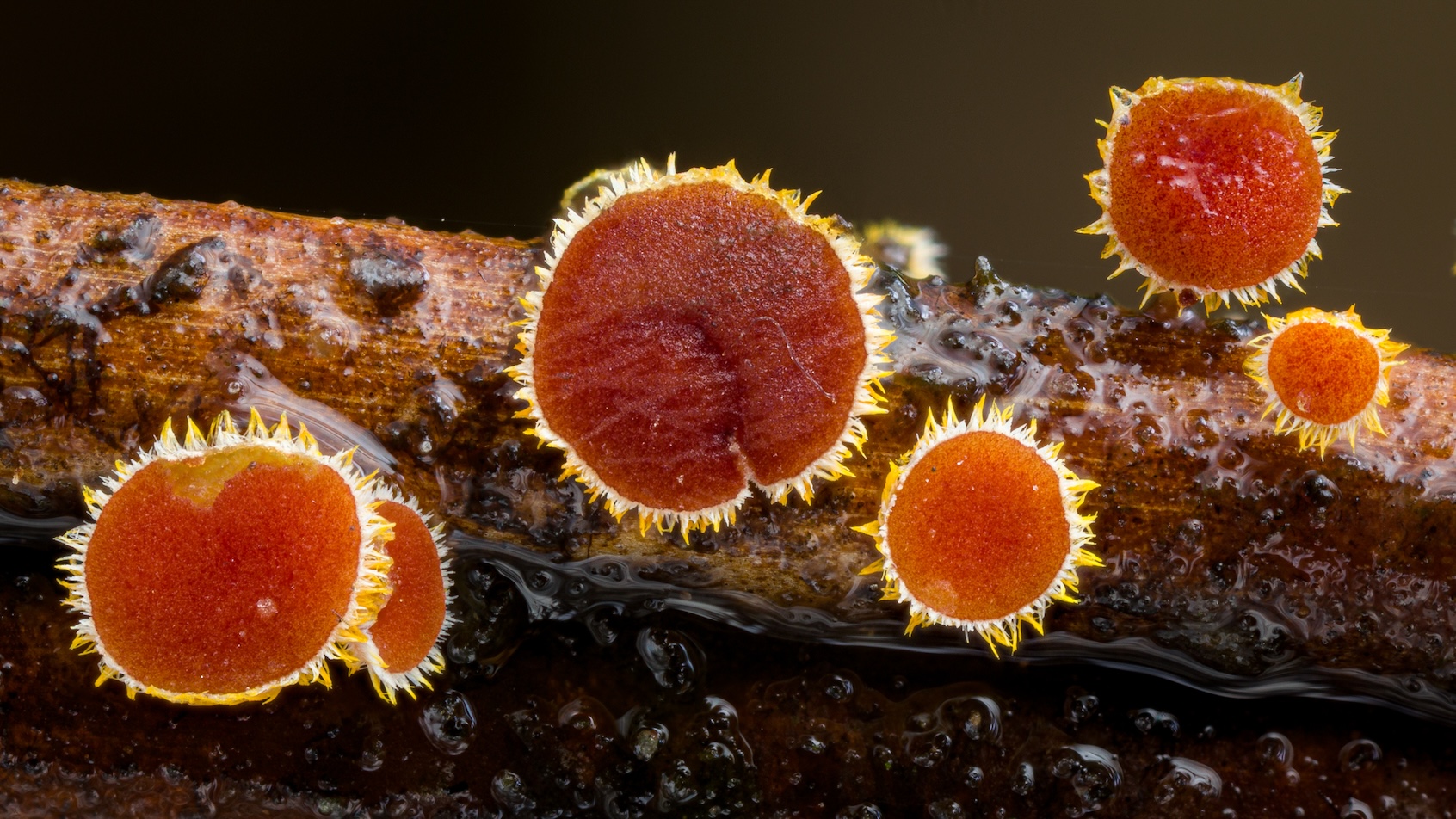
The features of this charismatic cup fungus place it equidistantly between two genera (Belonidium and Trichopeziza) in the hyperdiverse family, Lachnaceae. Its two-toned, yellow and white hairs instantly turn a rich violet in the presence of potassium hydroxide (KOH). (Danny Newman)It was a far, far more remote location prior to these mining company employees coming in during the dry season, being able to drive along a road that would normally be sort of mudded out and then hiking in a relatively short distance. We were coming in the wet season, and had to hike around nine, nine and a half hours in, sometimes thigh-high mud in sometimes 45 degree incline, the hardest hike of everyone's life who participated in that. But our group and this mining company that came in to set up the base camp very likely could have been the first human beings to set foot in this area. The terrain is difficult enough and inaccessible enough that it likely would not have been utilized even by pre-Columbian peoples, certainly not in a permanent way. 

And the resulting research?

Our paper from 2023 is a big, big summary of the fungi found through these opportunistic sampling events over an 11 year period. But [Los Cedros] is just one sort of piece of the larger puzzle. Because these mining activities are replete throughout the country. This kind of rises to the top on account of being the sort of poster child for putting constitutional ideas [about the Rights of Nature] to the test in a way that would ultimately affect the rest of the country.

Your photos of fungi are just extraordinary, so beautiful. And to someone who hasn't spent that much time looking at fungi they’re mind-blowing. I mean, you hear about the diversity of it, but to actually see such gorgeous things is just amazing. Why do you take these wonderful photos?

So I hope it doesn't come across as smug to say that's kind of the point. In my first trips to the neotropics, I was seeing these extraordinarily beautiful things that many of which had only ever been written about in a very cryptic, inaccessible Latin or science-speak in 100-year-old tombs collecting dust in the basements of university libraries that, like, you would have to paint a picture in your mind to be able to get an idea of what it looks like.

 If you can take good pictures of something, you can convey a lot of these characteristics that formerly would have just been illustrated or more often described using taxonomic terminology. There's a section of our paper called "simulated access", where we kind of make this case. The work that we did in Los Cedros, and the work that I try to do everywhere I go, is intended to be a kind of taxonomic brochure. So to not just have the data in a neat package tied with a bow to hand to the specialist, but to also have really captivating and feature-rich images so that they can see the thing. 

Instead of saying, ‘Well, I think we may have found this species that was first described 125 years ago by a German botanist who came on a mission to a remote part of Brazil,’ here's a picture of the thing so you can see it. And also have that picture be aesthetically pleasing enough that it appeals to all kinds of people, from a conservational standpoint, trying to galvanize public interest and capital W wonder to really see how extraordinary these things are. Because if we're after public funding or even private funding, the public and the private, I suppose, has to be compelled, has to see that there's something really, really captivating and beautiful there. So that's a big part of why. 

I just wanted to ask, what is a parataxonomist?

I think if that were a Jeopardy question posed to the total world population, you might get 500 people who could answer it correctly. In 1991 an entomologist named Daniel Janzen wrote a paper called “How to save tropical biodiversity,” and he correctly pointed out that there was this extraordinary amount of tropical biodiversity that at the current or historical rates of species description would take several thousands of years to fully describe. Given the obstacles faced by taxonomic research and researchers and to the planet, we didn't have that long left. And so he devised a division of labor system, which he called parataxonomy. 

He envisioned local people being trained up in doing essentially the first 90 yards of 100 yard sprint in order to maximize the time of the specialists, the PhD biodiversity researchers, who, up until this point, had been tasked with doing the entire 100 yards themselves, but really their expertise and time and resources were best applied to answering the questions that only they could answer.

And you know, he also correctly pointed out that most of these specialists, historically, contemporarily, were coming from somewhere else. They were coming largely from the West to the Global South to do this work, and they could be there for maybe a few days to a few weeks, to, if you were lucky, a month or more. But from a phenological perspective of what occurs at what times of year, that also is posing a limit that doesn't need to be there. Why not partner with people who are there all the time?

We need your help to stay independent

Okay, could you tell me about the particular psychedelic mushroom you mentioned, P. stametsii?

So that one was one that had been found during expeditions prior to my involvement. The people who had collected it knew that it was a new species of Psilocybe and had expressed an interest in publishing it then going out and collecting fresh material to serve as the type collection for that species that would happen later. They mounted their own separate expedition trip to Los Cedros and got new material to serve as the type for that, describing it and naming it after Paul Stamets. 

I talked about it a little bit, when I lectured on our work, that I think it was a curious choice to pick the white male straight CEO of a Fortune 500 company in North America to name the first new species of fungus described from Los Cedros after when there were a lot of other, maybe 'better alternatives' lying around. But I am much happier that we live in a mycological world with Paul Stamets in it, as opposed to one without him in it. If it ends up bringing more conservational attention to the reserve, that's positive.

What's happened with descriptions of other fungi that you've found that were also never previously described?

So those wheels have always moved extraordinarily slowly, and I wish that revelations like Dan Janzen's back in the early '90s would have really changed that in a permanent way, in a global way, but they haven't. We've got very, very few people who are still carrying out the very important and dramatically underfunded work of biodiversity inventorying and now, equally, conservation research at a time when every day it's needed more than the day before, and that is, I think, largely a funding problem.

"We're just in the interest of finding out who else is here on the spinning ball of juice in the sky, you know, whizzing through the galaxy at millions of miles an hour."

You could put the starting point of that as far back as the 1970s, the starting point that I pick in that article I wrote in 2019 is the National Science Foundation coming out and declaring that they were essentially henceforth and forthwith [only] in the business of funding what they call transformative research, which is a little bit oxymoronic. It's like rewarding hips for being taller than feet. The only way you get transformative research is by having something to transform in the first place. So they want cake without having to pay for the flour, eggs and sugar. 

These are the vegetables that organismal biological science has to eat that may not have immediate, honestly, won't have immediate, sexy results. It's in the pure or unapplied kind of realm of the sciences that is just exploratory. Then the applied side comes later, people looking at what compounds exist in these things, what applications they might have. 

We're just in the interest of finding out who else is here on the spinning ball of juice in the sky, you know, whizzing through the galaxy at millions of miles an hour. And I think that that's beautiful and interesting enough in its own right. We don't have to be looking at nature in the form that I think far too many people do, of "what can they do for us?" I think there's a reverential approach that is just as, if not more, valuable.

CORRECTION: This story has been updated to fix errors in the timeline of Newman's academic and mycological career and correct the name of the Chocó bioregion.

This buttery, tangy banana cake is your sign that spring has arrived

One bite — really just one whiff — and my feet are in the sand — a whirl of weeklong spring beach trips over the last thirty-five years, coconut tanning oil and Coppertone sunscreen and the honeysuckle sweetness of the first magnolia blossoms. It is sea spray softened paperback and laughter filled reunions. Dense and sweet and cold, it tastes like freedom and zero responsibilities.

Born adrenaline averse, I have never sought being in the thick of crowds. Spring Break on Panama City Beach, Daytona, or even among the throngs of rowdy teenagers close to home never appealed. My hedonistic weeklong breaks from school were about resting up and devouring novels, my stack of fiction pushed aside through semesters of full class loads and at least one job.

Like the books I could not wait to dive into, this cake became another constant. I either brought it along or made it once I settled at my destination. Habit? Seasonal craving? I am unsure how it became synonymous with this time of year, but it is fully entrenched. 

Banana Cake is for right now — for windy, sunny, even chilly and stormy, abundant spring! It is not something I associate with any one person but rather with a particular time, this time, a certain kind of day, a specific smell in the air. 

If I avoid looking into a mirror and take a bite, I am my nineteen year old self — sun bleached locks framing my face, leaner and more muscular — always somewhere close to a water’s edge. My memories of place and people dance together, some Polaroid-like, the exactitudes of which I will never forget. Others combine to forge inexact recollections, grouping together years of returning to specific family properties, rental houses and cottages, condos and campsites. 

Pressing my lips firmly around a forkful to cleanly drag all the icing and every moist crumb, I could be in my own front yard of Alabama beaches—Gulf Shores, Orange Beach, Perdido Key—or along some nearby river or creek. I could be farther south, in Islamorada (Florida Keys), at The Moorings, a secluded and sprawling former coconut plantation (and the first place I genuinely felt was paradise on Earth) to which I made an annual pilgrimage for many years in the late 1990’s and early 2000’s. Lying close to the water on a cushioned topped wooden chaise listening to the sound of palm fronds tapping in the breeze, I know I had plenty of worries, but for the life of me I cannot bring to mind what they were.

I make Banana Cake and have it covered and ready in the icebox for a week when I have time to squeeze fresh pink grapefruit juice for both breakfast and sunset cocktails. It is the chilled bite I want, straight from the refrigerator in the afternoon, and it provides the perfect counter-taste to simple dinners made with little effort in the low light of a seaside bungalow. It can relieve my anxiety in between hand after hand of gin rummy while feeling the electric charge of a thunderstorm moving in from offshore and right over my rooftop, and it will be breakfast when I wake to the calm morning that follows.  

Banana Cake is what I want after dragging my chair, towels, drinks, snacks and bag across a football field of grainy Earth for what will turn out to be an unsuccessful, and far from uncommon, spring day at the beach. Banana Cake will taste the way the day was supposed to go, but April days are unpredictable. Whether a car ride away or just a short walk, you head to towards the water with nothing but clear skies. You feel a nice breeze and think it will make the day even nicer, and half the time it does. But, other times that light breeze is more like a gale force along the shore. You ignore it picking up while you make your nest: secure the corners of your blanket, adjust your umbrella and finally, comfortably recline. It is only then, once you are still, that a now low, whipping wind, riddled with sand begins pricking and abrading your skin and collecting in the pages of your novel; it is intolerable.

A decent Plan B is to leave the majority of your stuff, move back from the water, and see if protection can be found tucked into the valleys of sand dunes. Really though, you are only busying yourself and putting off the inevitable trek back home for a few more minutes.  

Packed in my picnic basket beside my chair, Banana Cake joined me while watching sunsets on some of the most beautiful, sugar white, talcum powder soft beaches in the world. When baked in my home oven, the smell of it complements the honeysuckle sweetness of all that is blooming outside: my tall and tangled magnolias dotted throughout with creamy white flowers, sweet olive bushes and viburnum bursting out with clusters of tiny pale buds, lillies and climbing roses—splendor.    

Like background music behind the compilation of a lifetime of spring trips, boat days, and springtime weeks at home with my flower-babies, some planted and nursed from infancy, Banana Cake tastes of easy times, of breakfast casseroles, boiled shrimp and toasted, open-faced pimento cheese and cucumber sandwiches. It marks the beginning of going barefoot and the initial self consciousness of baring more skin, and with no cinnamon to hark back to winter or fall, it is tropical enough to add to the vernal vibe.  

Everything about Banana Cake brings my backward glances into focus with the passing years drawing out the spaces in between the things that shook, uprooted, and sent me hurtling in a new direction. What a blessing it would have been to know and trust things were going to work out, maybe not how I thought or wanted at the time, but workout nonetheless. Relationships, health crises, jobs, professors, exams, house issues, car problems; turns out none were all that fret worthy—I mean, here I am, enjoying Banana Cake looking out at the water, healthy and happy, feeling like I am where I am supposed to be.

Spring Break Banana Cake
Yields
16 to 20 servings
Prep Time
20 minutes
Cook Time
50 minutes

Ingredients

For cake:

3 cups flour

1 teaspoon baking soda

1 teaspoon salt

2 sticks butter

2 cups coconut sugar (or brown sugar)

3 eggs

2 cups mashed ripe bananas

1 teaspoon vanilla

1/2 cup buttermilk

1 cup chopped pecans or walnuts


For frosting:

2 tablespoons butter, room temperature

1/4 cup mashed banana

Juice of 1 small lemon

8 ounces cream cheese

1 cup powdered sugar

Directions

  1. Bring butter, eggs, and buttermilk to room temperature.

  2. Butter and flour a 9×13 baking pan. Preheat oven to 350F.

  3. Whisk to combine flour, soda and salt, and set aside.

  4. Beat butter and sugar until light and creamy.

  5. Add eggs one at the time, beating well in between.

  6. Add half of flour mixture, then half the buttermilk. Continue beating, then add the rest and beat another minute or so to fully combine. 

  7. Stir in mashed banana, being careful not to overmix.

  8. Stir in nuts and pour into prepared pan.

  9. Bake 50 minutes or until top is golden.

  10. Set on rack to cool, and prepare frosting.

  11. For frosting: Mix butter, banana, lemon juice, and cream cheese well, then add powdered sugar and beat until smooth. Refrigerate until cake cools.

  12. Cover and store frosted cake in refrigerator.


Cook's Notes

For gluten-free: Use 2 cups GF baking blend and 1 cup whole GF flour of choice, like sorghum flour, plus 1 tsp baking powder.

Buttermilk replacement: dairy or non-dairy milk plus a teaspoon vinegar

Pesto is not a recipe. It’s a mindset

"April showers" has been a bit of a misnomer in my area lately. I love a good torrential spring downpour, so I’ve felt a little cheated. But the sunshine and warmth that have taken its place? It's hard to complain about that.

As temperatures rise, there's one particular sauce that embodies the brightness, promise and ease of spring-into-summer: pesto.

Pesto is raw, vegetarian and endlessly versatile—but it delivers big flavor. Every ingredient adds something essential: garlic for punch, cheese for salinity, herbs for color and base flavor, nuts for richness, oil for body. There’s nothing extra, nothing showy: just the perfect balance. Toss it with hot pasta and you’ve got one of Italian cuisine’s most iconic, satisfying dishes.

In a 2011 Saveur piece, Laura Schenone called pesto "the uncooked, economical pride of Liguria" — a sauce born of poverty and a reliance on gathered greens. Its name comes from the Italian word pestare, meaning "to pound." Traditionally, pesto was made using a mortar and pestle, though a blender or food processor gets the job done just fine today.

The traditional approach

Classic pesto alla Genovese calls for basil, Parmigiano-Reggiano, pine nuts, olive oil, garlic and salt (but go easy—Parmesan is salty on its own). Both Cathy Whims, in her excellent new cookbook "The Italian Summer Kitchen," and New York Times columnist Martha Rose Shulman recommend blanching basil before blending to preserve its vibrant color. It's an optional step, but worth considering if you're chasing that vivid, spring-green hue.

The creative approach

That said, why stop at basil? Spring is bursting with flavor-packed herbs and greens, and pesto is one of the best ways to use them. Try:

  • Leafy greens and herbs: arugula, spinach, beet greens, mustard greens, radish tops, kale, dandelion, nasturtiums, fennel fronds, nettles, lovage, microgreens.

  • Spring specialties: garlic scapes, pea shoots, ramps, fiddlehead ferns, English peas, fava beans.

Don’t limit yourself to just greens, either. Zucchini and artichokes make wonderful bases. Some pestos throughout Italy also lean more toward a romesco-style sauce, using tomatoes or roasted peppers with nary a green in sight.

We need your help to stay independent

Customize the rest, too

  • Cheese: Parmigiano-Reggiano is classic, but try Manchego or Pecorino for a funkier edge. Just steer clear of soft cheeses like goat or mascarpone—they’ll alter the texture.

  • Nuts: Go beyond pine nuts. Cashews, walnuts, macadamias, pistachios, even peanuts all work.

  • Oils: Olive oil is the standard, but you can try walnut, grapeseed or almond oil for a twist.

Pesto also plays well with dietary needs. Going vegan? Skip the cheese. Nut allergy? Use seeds or a nut-free oil. This sauce is meant to flex with you.

Ways to use your pesto (beyond pasta)

Pesto is a lot more than a pasta sauce. A few of my favorite ways to use it:

  • Stir into yogurt or ricotta as a base for roast vegetables.

  • Spread onto grilled bread, mix into chicken salad or use in a sandwich.

  • Use as a marinade for vegetables or meat.

  • Mix with Caesar dressing for a punchy salad.

  • Swirl into scrambled eggs or top poached eggs on toast.

  • Spread onto flatbreads or tuck into savory pastries.

  • Dollop onto soups or use in lasagna layers.

  • Drizzle over grilled fish, shellfish or roasted vegetables.

  • Thin with vinegar, fish sauce or lemon juice for a crudités dip.

  • Mix with fruit in a savory fruit salad 

  • Stir into mayo for a herby sandwich spread.

  • Use it cooked: baked into apps, spooned onto hot gnocchi, or swirled into brothy soups.

  • Combine with tomato sauce for something bold and new.

  • Add unexpected flavors like ginger, sesame oil, yuzu or even pomegranate molasses.

And yes, some people even find ways to use pesto in desserts. (Don’t knock it until you try a tiny swipe alongside a slice of ricotta cheesecake.)

Of course, there's an inherent freshness within pesto that makes it a perfect kick-off of the bright promise of spring and a way to shed the heavy, laden dishes of winter. So this spring, there’s no better kitchen reset than a big bowl of green.

Let pesto be your excuse to cook without a recipe — and eat with abandon.

The illusion of change made Joe Goldberg into the handsome devil you know

When did you stop rooting for Joe Goldberg? Were you ever rooting for him? Admittedly, "You" — the Netflix series wrapping up with its fifth and final season — was never really in Joe’s corner, with star Penn Badgley firmly reminding fans from day one that Joe was not someone to root for. But still, there’s just something about the guy that keeps viewers coming back for more. 

Sure, it’s entertaining to watch a serial killer con and cajole his way through problem after problem — America has a borderline unhealthy fixation on serial killers, after all — but there’s something more about Joe that keeps us tied to his narrative. His running inner monologue endears us to him by ostensibly revealing his vulnerabilities and insecurities to the audience. However, as the show stretched from one season to five, it became clear that Joe was never going to change; his monologue was simply a story he spun for himself so he could continue to indulge in his worst impulses.

When the first season of the show premiered, I initially found value in Joe’s tortured voice. Despite the criticisms of the show’s initial portrayal of women as one-dimensional characters that only served to further Joe’s narrative (an error that the show sought to fix, with varying results, in subsequent seasons), I was taken with the fact that the show gave us a window to feel empathy for what society would otherwise consider to be an irredeemable man. Joe wasn’t Dexter Morgan, trying to sate his violent impulses by targeting people who deserved to die. No. From the moment we met him, Joe Goldberg was a killer, capriciously murdering his way through Guinevere Beck’s entire support system in the name of “love.” 

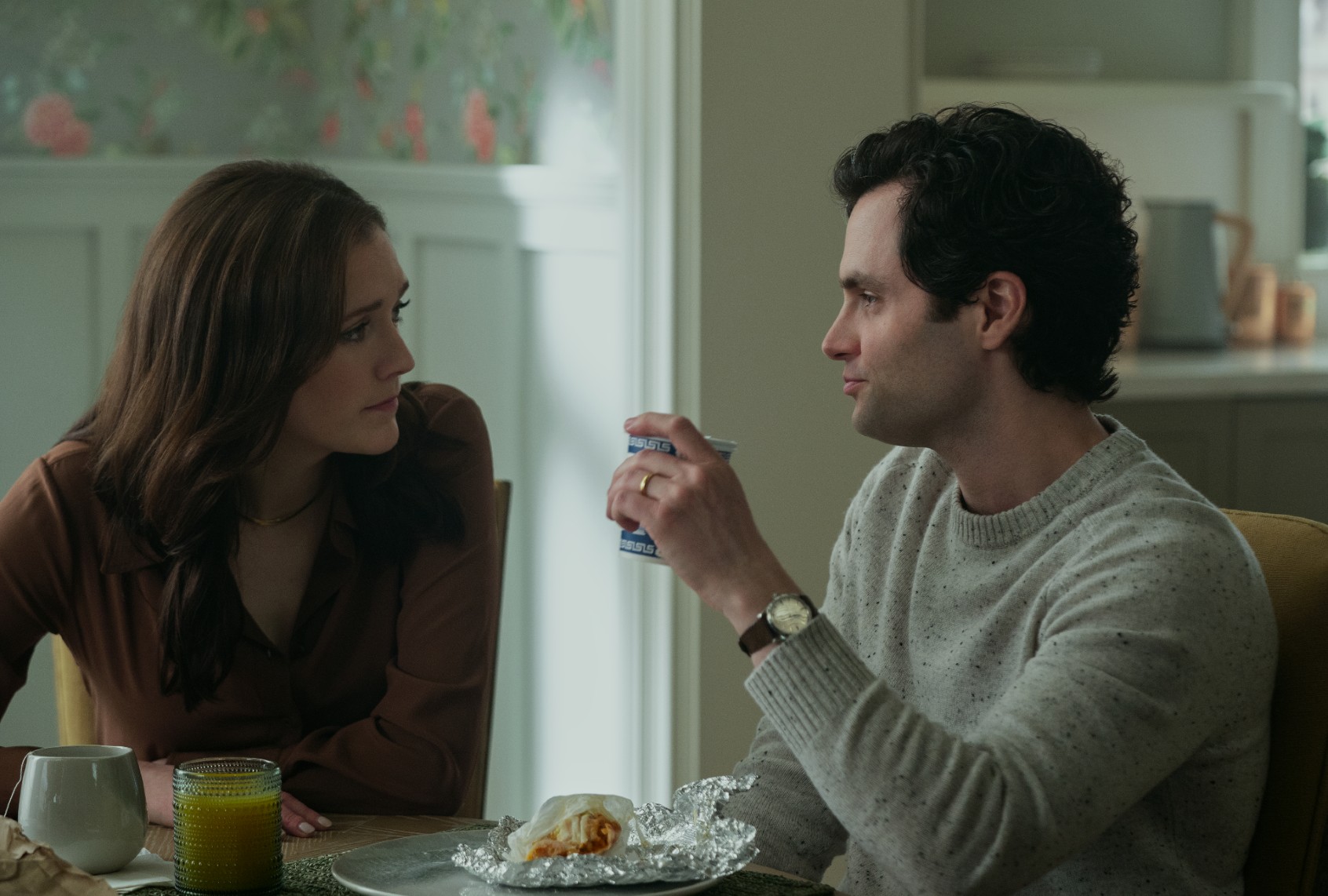
(L to R) Charlotte Ritchie as Kate Lockwood and Penn Badgley as Joe Goldberg in "You" (Clifton Prescod/Netflix). 
Joe Goldberg has maintained the status quo of his original inner narrative, learning nothing, changing nothing.

Through Joe’s raw inner monologue, "You" challenged us to empathize with a man fighting a losing battle with his sanity, and confronted the reality of being open and honest with destructive thoughts. Because viewers felt like Joe was attempting to change, they kept giving him chances. (Hi, it’s me. I’m the problem.) As a therapist focusing on treating people with addictions, I felt for Joe, stuck in his maladaptive patterns of destruction, and I initially wondered if the show would allow him to grow as his narrative progressed. In fact, I actively hoped for him to change. Perhaps he’d vocalize his destructive thoughts at some point and seek help? Maybe he’d hit rock bottom somehow and work his way out?

But, alas, rock bottom never really came for Joe until it was too late. Throughout five seasons of love and death, Joe Goldberg has maintained the status quo of his original inner narrative, learning nothing, changing nothing, and lying his butt off to both himself and viewers. Even in the fourth season, where he was ostensibly trying to make a new start as a professor in London, he (and his alternate personality) murdered more people than in the previous two seasons combined. Joe’s mindset is that of a person in the throes of a dependency-level behavioral addiction. He mainlines all of his romantic entanglements as if they were the antidote to his unresolved traumas. 


Want a daily wrap-up of all the news and commentary Salon has to offer? Subscribe to our morning newsletter, Crash Course.


To everyone else in the "You"-niverse, Joe is just a handsome guy looking for a love that will last, but his inner monologue, with all its shades of gray, has painted a different story for viewers over the years. As much as Joe desperately wants to believe that love is the motivator for his actions, he isn’t truly seeking love. Instead, he’s subconsciously repeating the behavioral pattern that upended his life as a child, his lack of introspection and internalized misogyny dooming him to a cycle of pain and suffering for both him and his eventual victims. (Freud would have had a field day with Joe and his mommy issues, am I right?) Joe uses love as a weapon to absolve himself of his own worst impulses. His true addiction is maintaining control. And when he loses control, all bets are off.

With Joe always passing the buck to the idealized woman in his mind, nothing he does is ever his fault.

Over five seasons of "You," Joe Goldberg has killed scores of people and engaged in deep relationships with six women, two of whom he married. Until the very end, Joe does the same thing, over and over, expecting different results. He indulges in his compulsions to escape from his own discomfort, and consistently blames his actions on his current love interest. That way, he can never be responsible for his own misdeeds. Oh, he poisoned Beck’s boyfriend? Well, Beck really made him do it because Joe just had to keep her safe. Oh, he suffocated Greg Kinnear, er, Tom Lockwood to death? Of course, it was just to help his paramour Kate escape her father’s evil clutches. With Joe always passing the buck to the idealized woman in his mind, nothing he does is ever his fault. 

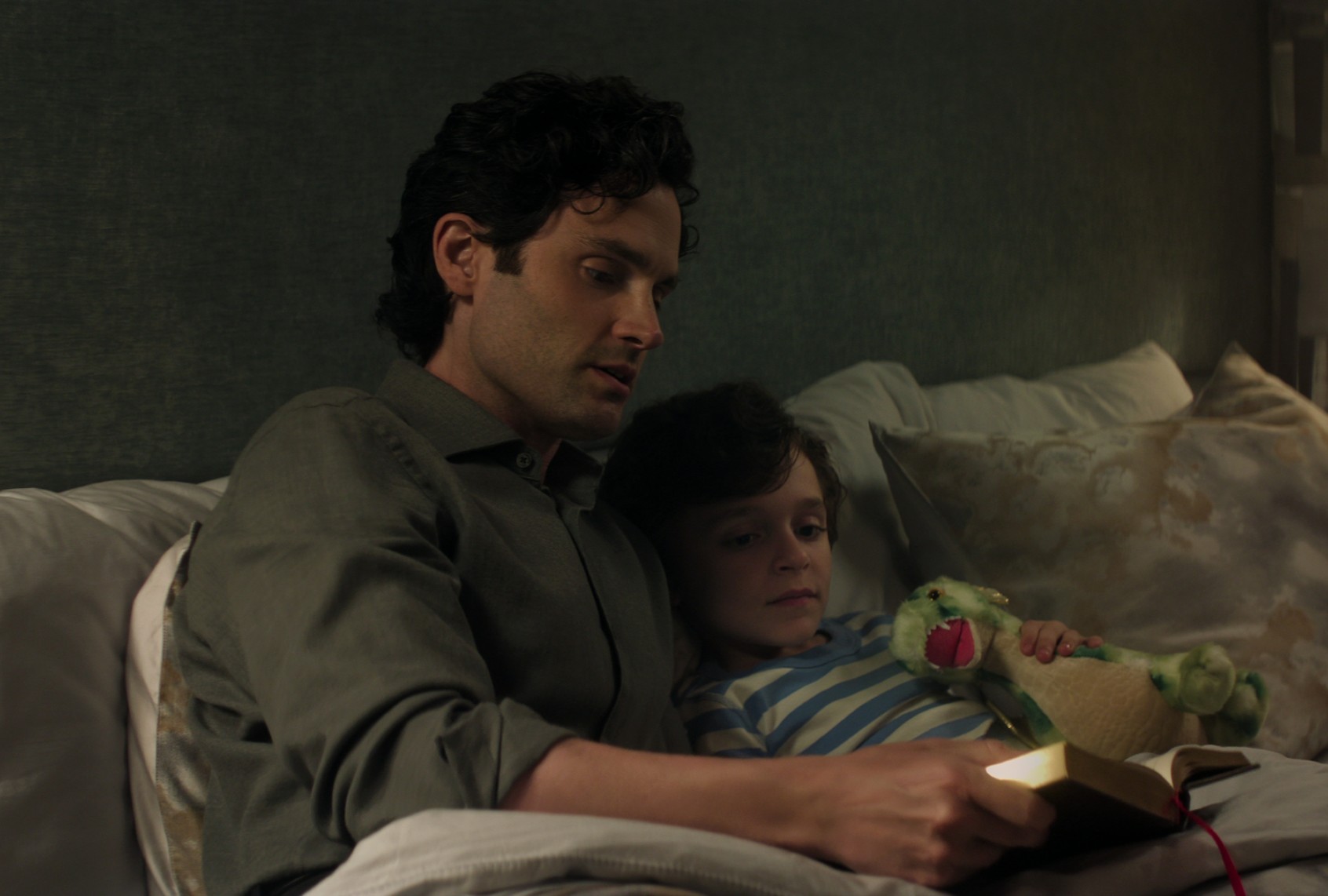
(L to R) Penn Badgley as Joe Goldberg and Frankie Demaio as Henry Goldberg in "You" (Courtesy of Netflix)And that’s why, when his love turns on him — which it always does, because even when he does connect with a partner who’s willing to stick around for a bit (see: Love Quinn, Kate Lockwood) he sabotages the situation — he needs to eliminate it. When these women go to leave him after finding out about his penchant for violence — under the same circumstances his mother left him when he was a child — he desperately clings to the idea of love for as long as he can before impulsively lashing out in rage-fueled violence. Joe consistently blames his drug (his lovers) for his pain, attacking these women as if they were the root cause of all his problems; as if killing them when they fail to deliver his required dose of love will quiet the tumult inside of him. We see this play out for the final time in the "You" finale, as Joe begins to realize that his latest lover, Brontë (Madeline Brewer), has turned on him for good. 
As Brontë confronts Joe at gunpoint in the middle of a steamy encounter, he is caught off guard, literally with his pants down. Yet, even as he stares down the barrel of a gun, he harbors the delusional hope that he can puppeteer this relationship back to life. Joe’s inner monologue pipes up, excitedly stating, “In the canon of epic romances, bouncing back from a gunpoint confessional is practically a genre staple.” He still wants us to believe that he’s seeking love. He desperately wants to believe it, too. Then, as Joe tries and fails to whittle away at Brontë’s sense of self in a bid to regain her affections, he realizes that he has lost control. Joe’s inner voice begins to growl, “I have been delusional. Putting so much faith in love. In the universe. In her. F***ing Brontë.” This is Joe’s last voiceover before the final scene of the series. He doesn’t need to hide his inner voice from Brontë anymore because he’s planning on being completely and totally honest with her. Why not? As far as he’s concerned, she won’t be around to tell anyone, so he can openly monologue like a Bond villain all he wants. Like so many others before her, Brontë gets to see the version of Joe she’s known was there all along when Joe’s monster emerges from within. 

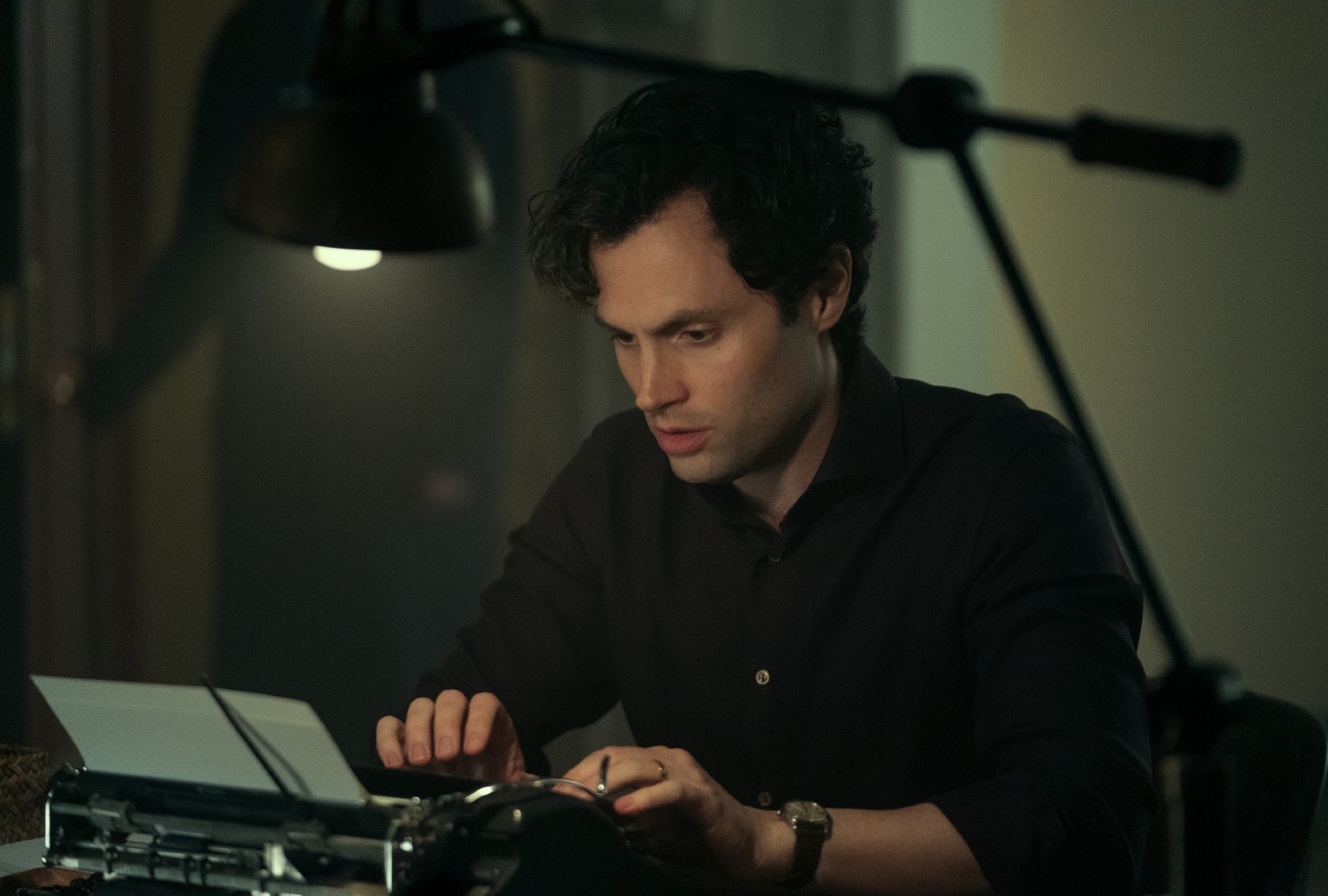
Penn Badgley as Joe Goldberg in "You" (Clifton Prescod/Netflix). In this final sequence, we see the real Joe, a man who doesn’t value love so much as he requires control. He says as much to Brontë as he confronts her on the front lawn. “I made you special!” he screams at Brontë, his inner anguish made manifest before he hunts her down like an animal in the woods. It's debatable that this version of Joe — the shameless killer — is the real him, even more real than the inner monologue that we get to hear throughout the series. So many others have gotten a chance to see this version of Joe while trapped inside his cage (or, in Love’s case, paralyzed with her own poison). In these moments, he mostly dispenses with the pretense of love and simply just wants to be seen as who he is, with all his torturous flaws, by another human being. This level of vulnerability is too much for Joe, though, so it’s no wonder that most of the people who see him this way end up dead. But not all of them. Brontë ends up surviving and once again holds Joe at gunpoint while he begs her to kill him so he doesn’t have to face the fate he so deserves. She doesn’t kill him, and the cops finally take him into custody. 
Joe’s final missive to viewers comes when justice has finally found him. Locked away for life, he’s picked up his old coping mechanism, dissociating by escaping into books, and he’s seething inside. Not at himself, of course, but at us, at society as a whole, for allowing him to get to this point. He’s lost control, and it’s our fault. After years of trying to convince viewers to set aside their allegiance to the unrepentant murderer at the center of its story, "You" plays a fun little trick on us with the final inner monologue, imploring viewers to finally see the true Joe: When someone tells you who they are, over and over again, maybe you should believe them.  

FBI arrests Wisconsin judge for allegedly obstructing ICE arrest at her courthouse

The FBI has arrested a state circuit court judge in Wisconsin over her alleged obstruction of immigration agents' attempt to arrest someone scheduled to appear in her courtroom, Bureau Director Kash Patel announced Friday.

In a now-deleted post to X, Patel said that Milwaukee County Circuit Court Judge Hannah Dugan had been charged and taken into custody Friday because of "evidence of Judge Dugan obstructing an immigration arrest operation last week,” per The Independent. The Milwaukee Journal Sentinel reported earlier this week that the FBI was looking into whether the jurist, who has served on the bench since 2016, had tried to assist an undocumented immigrant evade an Immigration and Customs Enforcement arrest.

“We believe Judge Dugan intentionally misdirected federal agents away from the subject to be arrested in her courthouse, Eduardo Flores Ruiz, allowing the subject — an illegal alien — to evade arrest,” Patel said, adding that ICE officers had still arrested Ruiz and claiming that Dugan had "created increased danger to the public."

The allegations against Dugan follow right-wing radio host Dan O'Donnell's Tuesday "exclusive," posted on X, that the judge was under investigation “for allegedly helping an illegal immigrant defendant evade ICE agents who came to arrest him in her courtroom during a hearing” the Friday before. O'Donnell claimed that she had allowed Ruiz to "hide in her jury room" after being informed of his impending arrest and made "that hearing off the record in an attempt to hide from ICE the fact that the illegal would be in her courtroom that day.”

Dugan's arrest is not the first time the Justice Department has taken a jurist into custody for allegedly obstructing an enforcement action. In President Donald Trump's first term, Massachusetts State District Court Judge Shelley Richmond Joseph and a court officer were indicted in 2019 on charges that they had prevented an ICE officer from arresting a man by letting him out of a back door rather than into the lobby, according to The New York Times. Under President Joe Biden, however, the DOJ dropped the charges against both Joseph and the officer after reaching an agreement with the accused. 

Trump is not invincible: Democrats, immigrants and the politics of due process

It’s a setup, they said: President Donald Trump, an accomplished demagogue with his finger on the pulse of America’s most reactionary voters, wanted Democrats to make a big fuss about his lawless deportations and extraordinary renditions — to show how out of touch they are with the majority of Americans who say they want fewer people to step foot in their country. 

“Look, what Donald Trump did was set up a trap for Democrats to run into,” Sen. Ruben Gallego, D-Ariz., told a newspaper in Tucson last month. He was talking about the hundreds of Venezuelan men expelled from the country without due process and sent to a prison in El Salvador, where, according to the administration, they should remain until they die. “Of the 500 they sent there, I’m sure 200 of them are actually hardcore criminals,” Gallego said (reporting suggests that more than 90% have no criminal conviction anywhere in the world). “Now, are we going to go run to the podium and defend and try to get those people back? No, absolutely not.”

That, again, would be taking the bait.

“This is the debate they want,” Gov. Gavin Newsom, D-Calif., chimed in earlier this month, describing the Trump administration’s defiance of a Supreme Court order to “facilitate” the return of one man, Kilmar Abrego Garcia, as “the distraction of the day.” That, he argued, is in part because court orders should not be the subject of a public back-and-forth between politicians — “When a judge adjudicates, it’s not in question. How in the hell are we even debating that?” — but he also suggested it’s bad politics. “It’s exactly the debate they want, because they don’t want this debate on the tariffs.”

Newsom has advocated for the return of one asylum seeker who was sent, without charge or trial, to spend the rest of his life in a Salvadoran hellscape. But his message, and long the conventional wisdom, was thus: Don’t get stuck fighting on Trump’s turf when “cruelty towards immigrants” is a big reason why a plurality of Americans — many with ancestors who stumbled onto a boat and got off at Ellis Island without a visa (“the right way”) — decided he should get another shot at being president.

Democratic timidity is an understandable reaction to seeing former Vice President Kamala Harris lose to an already-disgraced man who campaigned on little more than the idea that immigrants are “poisoning the blood of our country” and, accordingly, responsible for all of its problems. It’s also craven and wrong; even if throwing foreigners into a volcano polled at upwards of 90%, opposition would be both justified and required for the simple fact that civilized, free societies do not incinerate their guests.

It’s also not, it seems, such a big loser. Ignoring the advice of every Beltway consultant, some elected Democrats decided that there are worse things than falling into the “trap” of defending immigrants and the U.S. Constitution — like losing the republic (and one’s humanity). Sen. Chris Van Hollen, D-Md., traveled to El Salvador and demanded to meet Abrego Garcia, noting that if “you deny the constitutional rights of one man, you threaten the constitutional rights of everybody”; a delegation of House Democrats followed suit, draping their cause in the red, white and blue of the flag.

“To me, there is nothing more American than due process and the rule of law,” Rep. Yassamin Ansari, D-Ariz., explained to Fox News’ Laura Ingraham.

We need your help to stay independent

Recent polls suggest that framing could be broadly popular — and that refusing to bring back a man admittedly expelled by mistake, in defiance of the Supreme Court, is not. In a survey released this week, Reuters found that 45% of Americans now approve of Trump’s approach to immigration, down from 48% in January and below the 46% that now disapprove. YouGov likewise found that Trump is underwater on immigration: 45% approve compared to 50% who don’t, a double-digit drop from last month.

As G. Elliot Morris, former editorial director of data analytics at FiveThirtyEight, wrote about the latest numbers, the big reveal here is: “Public opinion can change!”

For too long, many Democrats have treated public opinion as something they must respond to rather than shape. That has resulted in cliched language that tests well in a focus group but feels inauthentic to real voters who do not actually care, in practice, about Bipartisan Solutions to America’s Policy Challenges. In the case of immigrants, some Democrats decided to just do the right thing — to not just abandon an inconvenient category of human beings — while noting that the rule of law benefits all.

The timid and cowardly do have a point, though: Americans, by and large, remain horrid on the issue of treating immigrants with dignity. Another recent survey from Pew found that 20% of Americans say they like Trump’s approach to immigration the “most,” more than double any other policy, with 48% expressing confidence in his handing of the issue, “his highest-rated issue”; this, despite — or more distressingly, perhaps, because of — the administration advertising its lawlessness and inhumanity.


Want a daily wrap-up of all the news and commentary Salon has to offer? Subscribe to our morning newsletter, Crash Course.


The median voter need not read an exposé in ProPublica to understand that abuses are being carried out in their name; the White House brags about it, images of immigrants in shackles packaged and shared on social media. Asked to defend specific abuses and the average American will likely say “no,” but tens of millions will nonetheless express confidence in the abuser.

The problem is not all Americans — with all due respect, it’s the white ones. After the Trump administration expelled a man by mistake and refused to bring him back; after the president promised to send asylum-seekers to a military prison at Guantanamo Bay, and then did; after the White House announced, fittingly, that only Caucasians from South Africa would be welcome as refugees — after all that, a majority of white Americans are telling pollsters that they like what they see.

The blood of the country has in fact been poisoned, and there’s no getting around the grim reality that, for millions of Americans, the evils imposed on others are not cause for outrage but just another form of sick content to like, share and subscribe to. But there is no alternative to confronting this darkness head on; if defending the rights of one’s neighbors is a trap — “poor politics and bad optics,” in the words of one newspaper editorial — then this is indeed the time for taking the bait. Public opinion may well reward a plucky fight for the soul of the nation — and if it doesn’t, then the republic was already lost.

Trump plays spoiler for his own MAGA Congress

As Donald Trump approaches the 100 day mark of his ambitious second term in office, the news isn't looking very positive for presidency. The shock and awe of these first three months has left the country dazed and confused and it is starting to rebel. Pollsters always go out into the country as a president reaches this milestone and the results this time show a floundering administration that's lost the support of a sizeable majority on virtually every issue.

The "flood the zone" strategy has revealed the classic Trumpian chaos and ineptitude that too many people shoved down the memory hole last November in the face of the braggadocious hucksterism at which Trump excels. Virtually all of his promises during the campaign have come up short.

At the 100 day mark, President Donald Trump finds himself more unpopular than any other president at this point in their terms and he's sinking fast.

He said he would end the war in Ukraine on the day after he was elected. It rages worse than ever with Trump openly selling out Ukraine. He has produced a ludicrous tariff policy which every economist, hedge fund manager, CEO, small businessman and stock trader knows is virtually designed to cause inflation, if not stagflation and recession. (He's saying that gas and grocery prices have come way down, but he's lying.)

His immigration policy, driven by the increasingly unhinged Stephen Miller, is far more draconian than he even said it would be, randomly hitting foreign studentstourists, scientists and business people and the brutal deportations to a Salvadoran gulag have brought shame and dishonor on America around the world.

And then there's Elon Musk, the wealthy weirdo nobody in America voted for, to whom Trump gave the keys to the federal government and told him he could fire anyone he wanted to. That resulted in pandemonium in the U.S. and all over the globe as life-saving services have been abruptly ended, people have been fired and programs that Americans depend on are no longer functioning. All of that in the name of saving money which doesn't appear to be materializing.

Meanwhile, weirdo #2, HHS Secretary Robert F. Kennedy Jr., has taken another wrecking ball to the American health care system, ending decades of medical research, firing the scientists who know what they're doing and replacing them with cranks determined to chase conspiracy theories down the rabbit hole. Following up that demolition of the medical system, Trump himself has decided to destroy the education system including some of the most prestigious universities in the country by dictating they change their policies and curriculum or lose the funding that has made the United States the leading nation in the world for scientific research.

Foreign policy and national security are both bleak and dismal nightmares. There is the above mentioned Ukraine "peace deal" which comes down to forcing Ukraine to surrender to Vladimir Putin so Trump can do some of his vaunted "deals" with Russia. He's alienated our closest allies, made demented proposals such as offering to have the U.S. ethnically cleanse Gaza to build an international resort there, demanded that Greenland give itself to the United States and essentially insulted every international institution that America helped build. On top of that, he's put the U.S. military in the hands of a weekend TV show host so out of his depth that even his closest allies are abandoning ship.

Pundits and analysts keep saying that the huge drops in the stock market and the subsequent, ongoing volatility are a reflection of their deep dissatisfaction over Trump tariff policies. And it's true that their dramatic reaction has had some success in tempering some of his worst impulses. But it actually seems to be more than just that. The weird behavior in the bond and currency markets and the way the world has reacted to Trump's erratic and bizarre behavior suggests, as some economists and important investors are saying, that people are "selling America"

Well, why wouldn't they? It's not just his economic policies, as daft and dangerous as they are. It's that whole (waves arms frantically) list of atrocities I just outlined above. Donald Trump and his administration are totally berserk and America is in the middle of an unprecedented, turbulent maelstrom. Who would buy something in this condition?

We need your help to stay independent

When you look at it that way, it's very hard to see how any American can support this president and his administration but apparently quite a few do. The good news is that fewer and fewer of them are standing behind him every day. The spate of recent polls have his approval ratings lower than he was at this point in his first term, which was the lowest of any president up to that time. So he's breaking his own abysmal record.

Even the Fox poll has him underwater:

The Pew Poll shows him right at 40%

And these polls are all showing that the public disapproves of his other policies as well. Even on immigration, his supposed strong suit, he's underwater, the Economist You/Gov poll shows:

45% of Americans approve of how Trump is handling immigration, while 50% disapprove, a net approval of -5. That's down from 50% approval and 44% disapproval — a net approval of +6 — on Trump's handling of immigration when it was last asked about two weeks ago

The drop comes as Americans are more likely to side against Trump on the highest-profile immigration case over the past week: that of Kilmar Abrego Garcia, who was recently deported to El Salvador despite a court order prohibiting his deportation. 50% of Americans say Trump should bring Abrego Garcia back to the U.S., and 28% say he shouldn't.


Want a daily wrap-up of all the news and commentary Salon has to offer? Subscribe to our morning newsletter, Crash Course.


That's consistent with the other polls as well. And according to Pew, 78% of Americans believe that the administration must obey the rulings of the courts. That includes 65% of Republicans. If the Supreme Court were to issue the ruling, that goes up to 95% among Democrats and 82% among Republicans. If Trump decides to defy the high court and trigger a constitutional crisis he will not have the support of the American people.

At the 100 day mark, President Donald Trump finds himself more unpopular than any other president at this point in their terms and he's sinking fast. Contrary to his repeated lies that he won in a landslide and has a mandate for the radical change he's enacting, even many of the people who voted for him did not expect this level of chaos, ineptitude and lawlessness.

Whether he cares about that remains to be seen. Trump will never face the voters again and he is determined to use his power to wreak vengeance on his enemies and prove that his cockamamie ideas about tariffs and world dominance through threats and bullying were right all along. Despite the massive amount of damage his shambolic first 100 days has already caused and will likely continue to cause for some time, none of that is actually working. People are beginning to fight back. The public is turning on him. The courts aren't buying his arguments.

He's proved once again that he's a weak, vain and ignorant man, which should have been obvious to anyone who lived through his failed leadership during the pandemic. Unfortunately, it's only been a hundred days. We're going to have to find a way to survive the 1,365 days that are left — and I don't think anyone knows yet how we're going to do that. 

A simple Supreme Court test unravels Trump’s entire tariff scheme

Since the 1930s, the Supreme Court has set its lowest bar for constitutional review to economic regulation. The court’s rational-basis test doesn’t require policymakers to be wise, or even reasonable. It requires only rationality— an acceptable policy goal combined with rational actions to achieve that goal.

Yet even that deferential standard has limits. And the reasons for those limits — grounded both in history and modern economic theory—have particular force in the modern political climate. While court challenges to these tariffs have primarily relied on statutory limits to presidential authority — including a lawsuit filed this week by a dozen states — rational-basis review has a significant role to play in that litigation because it complements and clarifies why Congress imposed such statutory requirements in the first place. 

As economic regulations, the constitutionality of the tariffs is reviewed by courts under the rational-basis standard. And the standards face severe problems under that test, for at least three reasons. 

First, the tariff-calculation methodology remains inexplicable. The administration’s tariff “formula,” based on total American imports of goods from a country, ignores services — an area where the United States consistently excels. It also attributes 100% of that (incorrectly measured) trade deficit to foreign tariffs, ignoring structural factors such as consumer preferences, capital flows, and the U.S. dollar’s global reserve currency status. The American Enterprise Institute — no bastion of liberal thought — has bluntly pointed out the administration’s “formula” has “no foundation in either economic theory or trade law.”

Second, while the administration touts tariffs as a revenue generator from foreign manufacturers, the reality is that tariffs inevitably become taxes on American consumers. One of the plaintiffs in the current litigation, a small Florida company, says that the tariffs force it to lay off employees, raise prices, and as a result, lose business to the point of insolvency. Multiply these effects nationwide, especially in response to tariffs exceeding 100% on Chinese imports, and the claimed revenue benefit quickly becomes a widespread economic burden on vulnerable Americans. 

Third, no rational economic basis has been provided for singling out China with tariffs more than tenfold higher than those imposed on any other trading partner—while also excluding phones and computers, which are China’s main exports. These stark disparities are signs of arbitrary action, not rational policymaking. 

Even under the century-old, highly deferential rational-basis test, the Constitution demands rationality for economic regulation. The U.S. Court of Appeals for the Fifth Circuit — again, no stronghold of liberalism—powerfully illustrated this point in its 2013 decision of St. Joseph Abbey v. Castille. 

In that case, Louisiana regulators prevented monks from selling handmade caskets without demonstrating any legitimate public interest in health, safety, or consumer protection. The court struck down that law, asserting: “The great deference due state economic regulation does not demand judicial blindness to the history of a challenged rule or the context of its adoption nor does it require courts to accept nonsensical explanations for regulation.”

Similarly, the statutes cited by President Trump in support of present tariffs require genuine findings of national security threats or violations of trade agreements. These laws are not congressional whim—they arise from and embody the Constitution’s baseline requirement that the political branches act rationally when they make major economic decisions.

We need your help to stay independent

That baseline requirement has a solid foundation in both history and modern economic thought. Historically, the driving motivation for the framers of the Constitution was to create a fair system of government to replace the arbitrary whims of King George. While “rationality” is a low baseline, it was foundational to the framers’ conception of the new country that they were creating with the Constitution. 

Fast forward to the present day, and modern neoclassical economic thought. With some exceptions in the field of consumer-choice theory, modern economic theory is grounded in the concept of markets driven by rational actors. In those markets, as famously illustrated by Adam Smith’s “invisible hand,” thoughtful buyers and sellers create efficient outcomes as a result of their pursuit of personal profit. To abandon that baseline requirement of rationality is to abandon economics, period. 

The judiciary should not accept incoherent justifications merely because they originate from the White House. If policy rests upon transparently flawed economic reasoning or arbitrary distinctions lacking rational explanation, courts not only have the authority but also the constitutional duty to intervene. The augmentation of that constitutional baseline by statute is not congressional overreach—rather, it is implementation and enforcement of that baseline. And that baseline, grounded both in Constitutional history and modern economic theory, is a fundamental requirement of a just society.

Why MAGA media is fixated on a Texas teen murder case

If anyone hoped that the Jan. 6 defendants Donald Trump released from jail would be humbled enough to embrace a quieter, more productive existence, well, the exact opposite is happening with quite a few of them. And one post-pardon case is already sticking out for sheer depravity. Jake Lang, who spent years in jail while contending with multiple charges for violence during the Capitol riot, is making a racist spectacle of a high school murder case in Texas.

On April 2, Austin Metcalf, 17, was stabbed to death at a track meet in Frisco, a suburb of Dallas. Karmelo Anthony, also 17, was charged with murder, after admitting he stabbed Metcalf to police. Metcalf was white. Anthony is Black. Lang saw an opportunity and leapt into action. After circulating a flyer with Metcalf's face labeled "Protect White Americans," Lang descended on this Texas suburb to lead a rally painting Black Americans as a near-existential threat to white Americans.

When Jeff Metcalf, the victim's father, called Lang during the rally, the former inmate now running for State Secretary Marco Rubio's Florida Senate seat, got visibly excited. But his joy turned to rage when Metcalf did not play along with the racist stunt. "You’re trying to create more race divide than bridging the gap," Metcalf declared, and an enraged Lang called this reaction "weakness."

Incredible moment in Frisco: Austin Metcalf’s dad just called the organizers of the Protect White People rally to say they’re “part of the fucking problem” and to stop using photos of his kid. They responded by blaming his “white guilt” for “thousands more Austin Metcalfs.”

[image or embed]

— Robert Downen (@robertdownen.bsky.social) April 19, 2025 at 2:09 PM

Lang is a clown, but he is not an outlier. The whole of right-wing media, including Fox News, has decided to make a spectacle of this case, with endless, breathless coverage painting this single situation as symbolic of what they view as a racist war on white people. It's useful agitprop for MAGA, which desperately needs a distraction from Trump's failures and falling approval ratings. It's gross, and it's coming at a high cost for the families involved and the larger community, ratcheting up racial tensions and sowing paranoia, all over a case that is already heart-wrenching enough. 


Want more Amanda Marcotte on politics? Subscribe to her newsletter Standing Room Only.


The details of the killing are tragic, but don't seem mysterious. Metcalf and Anthony got into a scuffle at a track tournament after arguing about whether Anthony was allowed to hang out in Metcalf's team tent. Witnesses say the fight ended when Anthony stabbed Metcalf. When police arrested Anthony, the report says, he began "crying hysterically" and saying it was self-defense. "He put his hands on me, I told him not to," Anthony said, according to the police report. It also noted that Anthony asked if Metcalf, who bled to death, was "going to be OK?"

It's useful agitprop for MAGA, which desperately needs a distraction from Trump's failures and falling approval ratings.

It seems like Anthony is facing an uphill battle with his claims of self-defense. If he is successful, it's due to Texas law's broad definition of legitimate "self-defense," which was passed by Republican lawmakers acting on behalf of gun lobbyists. Despite this, right-wing media is treating this case like it's definitive evidence that a white person can't get justice in "woke" America. Matt Walsh of the Daily Wire treated Anthony's acquittal as a fait accompli, claiming all they need is "one juror who harbors a deep and abiding resentment towards white people" and "Karmelo Anthony can continue driving around in expensive SUVs and living in rented mansions." The Blaze compared Anthony to O.J. Simpson," calling it a "psyop" to "frustrate white people." Will Cain of Fox News has been hyping this story relentlessly, even featuring a conservative commentator Brandon Tatum warning that this is about an "underbelly of racism" he claims is "perpetuated by Black people" and hosting Austin Metcalf's mother and twin bother one day after his killing to publicly reject Jeff Metcalf's plea for grace. "Murdering a white kid in cold blood seems acceptable to some," Charlie Kirk of Turning Point USA declared. And because no right-wing grift is complete without it, there's now a crypto memecoin exploiting the incident. 

I am legitimately at a loss for words

[image or embed]

— Robert Downen (@robertdownen.bsky.social) April 20, 2025 at 12:40 AM

Tellingly, the right-wing noise machine can't even articulate the injustice that needs to be remedied here. Anthony was arrested and is being held accountable. There is not a smidgen of evidence that police and prosecutors aren't taking this case seriously. Yes, Anthony's parents and their friends are defending him, but that's typical in criminal cases and part of a larger right of the accused to defend himself. The deafening outrage is about shutting off the brains of the audience, keeping MAGA audiences in a state of racist paranoia, so they don't think about how Donald Trump's incompetence is hurting the economy and national security

The spiraling race hysteria had led to serious harassment of both the families of Metcalf and Anthony. Frisco police have confirmed both of Metcalf's parents have been targeted by "swatting" calls, where pranksters send SWAT teams by lying to 911 operators. Anthony's family has been getting death threats and relocated their son, after he was released on bond, to a hidden location to protect him. When Anthony's parents had a likely ill-advised press conference last week, asking people to leave them alone, Jeff Metcalf showed up and had to be escorted out by police. The right-wing press exploited this, as well, which likely contributed to his desire to speak out against those who want to use this to sow racial division. Social media has been awash in lies, including a fake autopsy report. The abuse seems to be coming from all sides, from people who want to demonize either Metcalf or Anthony. But all this is being turbocharged by the MAGA media's obsession with this case, which is raising tensions all around. 

It's unsurprising that a Jan. 6 defendant would be drawn to the racialized drama, especially someone with a history as shady as Lang's. His legal exposure from the Capitol riot was not of the low-level "trespassing" charges. He was charged with assaulting officers "using a dangerous weapon" and other violent crimes. The appeals court judge said evidence showed Lang "repeatedly pushed, punched, and kicked at police officers" and "slammed a door against one officer’s head and struck other officers first with a stolen riot shield and later with a metal baseball bat." In jail, he spent his time playing a "political prisoner" on far-right podcasts and social media, and even tried (and failed) to create a MAGA militia from his cell. Now he's arguing that Black people are uniquely violent, as part of his bid to rebrand himself as a Republican candidate. 

Lang did not react well to Jeff Metcalf telling him to step off. After the grieving father embarrassed Lang in front of reporters, Lang posted on X that Metcalf is an example of "White Weakness & Submission" and that Metcalf would "hand his daughter over to be raped." Philip Anderson, another pardoned Jan. 6 defendant who has joined up with the "Protect White Americans" stunt, called Jeff Metcalf the P-word on X. Apparently, grieving fathers aren't on the list of white people Lang wishes to "protect," unless they agree with his racist campaign. 

This entire debacle reveals the ugly lie Trump and his MAGA movement are selling to white Americans, that they can "protect" themselves by aligning with a fascist movement. In reality, MAGA is only making a terrible situation much worse. I don't know the political leanings of either of Austin Metcalf's parents, but there is no universe in which being the centerpiece of a racialized circus is helping them deal with this nightmarish situation. As Jeff Metcalf observed, it's just making things worse for everyone, regardless of race, when a crime like this is being used to turn people against each other. Dialing down the temperature with a sober-minded, fact-guided effort at giving Anthony due process would work out better for everyone in the community. The person being aided by this racial spectacle is Donald Trump, who needs a highly emotional spectacle to distract from how he's failing Americans, including those who voted for him. 

Humans think — AI, not so much. Science explains why our brains aren’t just fancy computers

The world, and countless generations of interactions with it, coaxed our brains to evolve in the unique way that humans perceive reality. And yet, thanks to the past century's developments in cognitive science and now artificial intelligence, we have entrenched a view of the brain that doesn't spend much time on this dynamic. Instead, most of us tend to see our brains as a "network" made of undifferentiated brain cells. These neurons produce cognition by the patterns in which groups of them fire at once — a model that has inspired advanced computers and AI. 

But accumulating discoveries of different specialized brain cells pose a challenge to models of human or artificial intelligence in which thoughts and concepts arise purely from the distributed firing of many essentially-identical brain cells in a network. Perhaps it's time to consider that if we want to replicate human intelligence, we ought to take a closer look at some of the amazing adaptations that have evolved in mammalian neurons — and specifically, neurons in the human brain. Instead of the popularly understood idea of the brain as a neural network of undifferentiated brain cells, research has increasingly found that different neurons, even of the same basic type, have their own specific functions and abilities.

In fact, in the modern, popular understanding of the brain, we really tend to think of this organ as a sophisticated version of the technology it inspired. Merriam-Webster defines neural network as "a computer architecture in which a number of processors are interconnected in a manner suggestive of the connections between neurons in a human brain and which is able to learn by a process of trial and error." This is a typical definition, in which the computer-brain analogy focuses on the distributed connections between neurons (or, in a computer, nodes) with no attention to what exactly those neurons are for. 

It's a definition that has been good enough since the 1980s, when future Nobel Prize-winner Geoffrey Hinton and others picked up on an older idea called backpropagation, applying it as an algorithm that mimics human brains by systematically reducing errors through repeated iterations and thus allows for more efficient training of multilayer neural networks. This reinvigorated the earlier idea that a system of nodes and connections that mimics the human brain might work to create an artificial form of intelligence, leading to the deep learning models and machine learning we have today. Since the discipline of artificial intelligence latched onto the neural network, though, it's largely focused on developing different forms of artificial (or simulated) neural networks, and mostly moved away from studying the human or animal brain as an artifact of evolution with specifics worth mimicking.

Individual pieces of research have gradually identified a host of different brain cell types, upending our simple image of the brain as a very powerful computer.

But while it's true that that most neurons are important only for their firing or non-firing, not for their specific role, even as computer scientists have been expanding the things that artificial neural networks can do, research on the brain itself has continued. Over decades, and especially the past few years, individual pieces of research have gradually identified a host of different brain cell types, upending our simple image of the brain as merely a very powerful computer. 

Instead, they reveal mammalian brains to be the product of millions of years of evolution and adaptation to environments. Over all those years, countless tiny changes have led animal brains to evolve a unique nervous system in which the key component, the neuron, is now able to represent our experiences and thoughts and surroundings in specific and wondrously clever ways not available to other animals who have not evolved our most recent adaptations. Our particular form of intelligence, it seems, depends on this minority of specialized neuron types.

The brain as a computer 

Back in 2001, Yuri Arshavsky wrote, "I argue that individual neurons may play an important, if not decisive, role in performing cognitive functions of the brain." At that time the research was already accumulating, but the idea went counter to the prevailing view in neuroscience. By now, though, it's becoming hard to argue against Arshavsky's claim. 

There are brain cells that represent entire concepts, some with an affinity for visual information and others for olfactory input. Scientists have also found neurons that can encode entire concepts with the firing of a single cell, or that are devoted to specific aspects of cognition and how we represent the world, and that fire when their particular function is needed: warm-sensitive neuronsplace cells and related time cells, olfactory concept cells, visual concept cells, Lepr neurons that control metabolism… the list of discoveries is long and still growing. 

New research looking into the already-brewing notion of time and space-encoding cells demonstrates how different cell types work together to give us both "what" and "where" information that allows our brains to represent our experience of time. Researchers still haven't decided how best to classify all the different types, but they are increasingly trying to map the specific kinds of input they encode through the patterns of which neurons fire when, and the relationships between the different representations this creates.

We need your help to stay independent

"I do agree that today’s AI models have important deficiencies — and among them might be that they lack some of the predispositions various parts of our brains may have," Jay McClelland, a noted cognitive scientist at Stanford University, told Salon in an email. 

AI is doing incredible (and destructive) things these days, solving impossible medical problems and generating imagery that manages the trick of being simultaneously trite and bizarre. The computing power this requires sucks water from a parched earth and puts entire creative industries out of work. AI models that act as "artificial brains" are able to do therapy, provide health care or write (in a manner of speaking.) But there are ways in which the large language models and similar generative AI are missing not simply the feeling of being human, but the actual function.

How do we know we think differently from computers?

Most of our understanding of how the brain works at the single neuron level — equivalent to a node in an artificial neural network — comes from studies of murine (mouse or rat) or primate models, because it isn't considered ethical to do brain surgery on humans just to find out what interesting things are going on in our brains. So it's only with the recent development of a technique that allows for single neuron recordings to be taken during unavoidably necessary brain surgery done on epilepsy patients for diagnostic purposes that researchers gained subjects who would be available for perhaps a week at a time to look at things and talk about them while scientists recorded which neurons fired, how intensely, and for how long.

This is a very particular situation, but luckily there are many people with epilepsy of different kinds, and a subset of them need electrodes implanted in their brains to record their spontaneous seizures over the course of a week or two so as to figure out if they are a candidate for surgery to cure them. These implants are done in two parts of the brain that often produce seizures, the medial temporal lobe and the medial frontal lobe.


Want more health and science stories in your inbox? Subscribe to Salon's weekly newsletter Lab Notes.


The majority of brain cells are neurons, while some cells have other functions. But the exact number of neuron types is unknown, although recent research in human brains has identified at least two million neurons, which researchers were able to categorize into different types: "31 superclusters, 461 clusters, and 3313 subclusters," resulting in a massive number of individual types. It's remarkably different from the simple three neuron types classification — motor neurons, sensory neurons, and interneurons — one might have learned in a cursory overview of brain science. 

Itzhak Fried, lead author on the newly published research on time and space cells, is a neurosurgeon at UCLA whose lab, and postdoctoral students trained there, spawned many of the major discoveries of these specialized neuron types. Fried told Salon about the two decades of research, or more, that have led to the profusion of concept cells and other neuron types we now understand to play critical roles in encoding and representing our experience with the world.

Not just with the world, but with our imaginations, and experiences that now live only in memory rather than being triggered by external stimuli. Fried cited the work of Hagar Gelbard-Sagiv, a postdoc in his lab, who, as described in a 2008 paper, found that when subjects were shown a variety of film clips while researchers recorded the activity of single neurons in their hippocampus and surrounding areas, a subset of those neurons fired in response to a particular concept — there was one neuron, for example, that began firing at the start of a clip from "The Simpsons" and continued firing despite the changing images on the screen. That is, it responded not to a specific image but to the general Simpsons concept — and not to any other videos that weren't Simpsons-related. 

Even more remarkable was that when the movie-watchers were asked to tell the researchers what they'd seen, they would begin to describe the assortment of 20-odd movie clips they'd been shown, and that particular neuron would fire during the actual act of remembering the Simpsons video.

"After we presented, let's say, 20 videos … we said to the patient, 'Just tell us what you say, okay?' She says, 'well, you know, I remember Martin Luther King's speech, and I saw a landing on the moon'. And suddenly the Simpsons neuron started firing and then a second later, [the patient] says 'The Simpsons'," Fried recalled for Salon. "It's as if there was some process going on [that] she didn't even realize yet, as there was already a signature of that memory. Obviously there was no sensory input. She was completely locked in her mind. And that concept neuron started firing, and the memory came out, essentially emerged at the conscious level."

In some ways, we do work like computers and use distributed networks of firing neurons in important ways. In fact, most parts of the brain work like that, Dr. Florian Mormann, a cognitive and clinical neurophysiologist at the University of Bonn who conducts single neuron recordings on epilepsy patients (and who was a postdoc in Fried's lab), told Salon in a video interview. "One control region we have in the visual pathway is the parahippocampal cortex, which indeed features a distributed network code, which is what most of the brain regions do."

And in the Simpsons neuron case, for example, it was just a subset of neurons in the medial temporal lobe that behaved with extreme specificity to enable patients to quickly grasp the relevant concept. Just a single neuron could determine the patient's memory that a video of, say, Itchy and Scratchy, or of Moe's bar, or of a three-eyed fish at the Springfield nuclear power plant, was a video about the Simpsons. 

AI just doesn't work like that. Instead, it analyzes large amounts of data to detect patterns, and its algorithms rely on the statistical probability of a particular decision being the right one. Incorrectly chosen, biased or inadequately large data sets can result in the famous "hallucinations" to which AI models are prone.

"It comes to a fundamental issue about what sort of a system do we need to model intelligence," McClelland explained in a keynote talk, Fundamental Challenges for AI, that he delivered last April at the Computer History Museum in Palo Alto, CA.

Writing to Salon, he offered the example of place cells, the specialized neuron he's most familiar with.

"There are different views, but the role and nature of so-called place cells is extremely nuanced.  These cells can code for all kinds of things in tasks that aren’t simply requiring animals to move around in space," McClelland said.

McClelland pointed out that the differences between human brains and artificial intelligence systems include how we learn. Indeed, learning and the necessary process of memory formation and retrieval are key to the specialized roles played by concept cells and some of our other specialized neurons.

"I also think that our brains use far different learning algorithms than our current deep learning systems," McClelland said. "I’m taking inspiration from a fairly-recently discovered new form of learning called Behavioral Time Scale Synaptic plasticity [BTSP] to think about our brains might have come to be able to learn with far less training data than we currently need to train contemporary AI systems."

Concepts in the human brain, as we've seen, can be encoded with just a small number of neurons firing, or even just one.

The pattern recognition that allows AI to learn is based on something called Hebbian-style synaptic plasticity, based on Donald Hebb's idea that learning arises through repeated use of the same connections between neurons in the brain: repeated activation strengthens the efficiency of cells firing together. The term "synaptic plasticity" just means the ability of these connections to be strengthened or otherwise changed.

"The prevailing theories of the 20th century and later all proposed that the primary mechanism of CA3 ensemble or attractor formation was Hebbian style synaptic plasticity, based on correlated AP [action potential, or neurons firing] activity," write the authors of a study published in Cell in November that explored the dynamics of neurons contributing to memory formation. Hebbian-style synaptic plasticity allows for creation of memories and learning from experience within a network of neurons and synapses. 

This is the basic understanding that underlies deep learning models used in AI. But the authors of the Cell study propose that in human brains, what's actually going on is a different form of synaptic plasticity, BTSP, which allows for far fewer firings of neurons to create a memory — in fact, you might just need a single "event" to result in learning. Like another hypothesis for how neurons do their thing, the sparse coding hypothesis, BTSP works well because it doesn't need the kind of overlap that Hebbian-style plasticity requires.

Concepts in the human brain, as we've seen, can be encoded with just a small number of neurons firing, or even just one, Mormann explained: "So when I say sparse versus network, or sparse versus distributed, that means that [most] neurons are silent, and then just a few neurons suddenly say 'Look, this is my favorite stimulus.' It indicates that that stimulus is there."

A reason evolution might allow itself "the luxury of having these sparse representations" when network codes would be more efficient, Mormann suggested, is that "they actually provide the semantic building blocks that are being pieced together to form mnemonic episodes." That is, our episodic memories are pieced together from a small number of concepts embellished by the brain's tendency to make up less important details, or to remain fuzzy about them.

"The only things that are really reliable and can be reliably tested are a few core semantic facts, and those are the ones that we believe are represented or provided by concept neurons, and they are being pieced together to form episodic memories," Mormann said.

Although we have not yet created a complete picture of how humans represent experience, including through the apparently vital roles played by concept cells, place or grid cells, time cells and other specialized cell types, it's becoming clearer that neurons in animals have evolved unique adaptations. Researchers have, for example, identified thousands of specialized neurons in mice. But they help them do mouse things. In humans, culture, language, care, tools and other still-to-be demonstrated ways in which we interact with the world around us has produced specializations that let us encode entire concepts and think in an abstract way, internally representing our experiences. 

So AI might do well to look back at how the world has shaped us, letting us do human things by the way our brains now make the world.

Fast fashion is getting pricier — and maybe that’s a good thing

Every spring, I get the urge to buy something new: a sundress, a pretty blouse or something hopeful after a long, drab winter. This year, though, something made me stop mid-scroll: the prices.

Fast fashion is about to get more expensive, and maybe that’s not such a bad thing.

With new tariffs on the horizon and the de minimis loophole set to close, ultra-cheap imports from platforms like Shein and Temu could soon cost significantly more. These companies have flooded the U.S. with low-cost items by exploiting a trade policy that exempts shipments under $800 from duties. But the loophole, which has helped fuel the fast fashion boom, is set to close for shipments from China and Hong Kong starting May 2, per CBS News. Shein and Temu have announced price increases beginning Friday in response to these changes, according to USA Today.

This is not just a trade dispute. It might mark the start of a cultural shift.

For years, we’ve been encouraged to buy more, wear occasionally and move on. First, it was mall brands like H&M and Forever 21. Then came Zara. And now, Shein and Temu, where buying clothes feels more like scrolling than shopping. These platforms are often associated with Gen Z, but as a middle-aged woman I’ll admit I’ve bought from them, too. When money was tight or I needed something fast, the price and convenience were hard to ignore.

But what are we really buying? Most of these garments are made from synthetic fibers like polyester, which are essentially plastic. A 2023 Reuters report found that 75.7% of Shein’s products are made from polyester, with only 9.9% from cotton. These materials are designed to be cheap, trendy and disposable. And in my experience? They are.

We need your help to stay independent

When I ordered the $12 dresses, what arrived looked nothing like the photos. The seams twisted. The fabric itched (and often didn’t feel like actual fabric). Buttons fell off after one wash.The clothes weren’t built to last — and they didn’t.

Now, with prices rising, I’ve started to rethink how and why I shop. And I’ve realized how often I’ve used clothes to escape.

I grew up wearing handmade clothes when I was small because my mom, who was raised in poverty, knew how to create a wardrobe with little money. This was practical and personal. But I always saw clothing differently. I loved vintage pieces, and saved up for higher-quality items when I could. Clothes, to me, were expressive: They helped me feel more like myself.

Still, even with that mindset, I’ve made impulsive purchases. When you're overwhelmed, a $12 dress can feel like a luxury, even if it unravels and literally falls apart at the seams.

There’s also something seductive about newness. In a world where everything feels uncertain, in our finances, our health and even our safety, there’s comfort in something new — even if it’s wrapped in plastic. It’s easy to believe a new piece can change your mood, and sometimes it does. But the feeling is fleeting. And the dress usually doesn’t last, either.

It’s easy to believe a new piece can change your mood, and sometimes it does. But the feeling is fleeting. And the dress usually doesn’t last, either

Lately, I’ve stopped chasing the thrill of an instant purchase. Instead of filling my online cart, I’m digging into my wardrobe. I’m shopping secondhand more. I’m asking better questions: Will this last? Do I love it? Does it fit my life?

Another shift that’s helped is leaning into secondhand platforms like ThredUpPoshmark and Re/Skinned. These platforms make it easier to shop sustainably. But I’ve also found treasures at small local thrift shops, the kind of surprises that don’t show up in an algorithm.

Which brings me to what might seem like an old-fashioned idea: shopping in person. While online shopping has its place, there are things you just can’t replicate through a screen. The feel of a fabric, the fit of a jacket — there’s something about that moment when you see something unexpectedly work. Shopping in person helps me reconnect with how I actually want to dress. 

And surprisingly, I’m spending less. When I don’t default to quick-fix purchases, I spend more intentionally and less often. I also feel better about what I wear.

When I think of the most fashionable women I’ve known or admired from afar, they rarely chase trends. They tend to follow a more European model: fewer pieces, better made. Style, for them, is about deliberate choices. Fabric, cut and color all serve the person wearing them, not the other way around. Accessories shift with mood or season. Many mastered the capsule wardrobe long before it became trendy.

As a New Yorker, I know I’m lucky. I can browse racks at a thrift store with vintage Diane von Furstenberg or a fun vintage Pucci dress. I’m surrounded by access. In smaller towns, especially those without department stores, Shein and Temu offer something tangible: affordability, variety and sizing that other brands often overlook, which can be an attractive and convenient option. 

As the cost of fast fashion rises, I wonder if this is a moment for all of us, myself included, to rethink what we value. Is it speed? Quantity? The thrill of newness? Or are we finally ready to value longevity, craftsmanship and emotional connection to what we wear?

But as the cost of fast fashion rises, I wonder if this is a moment for all of us, myself included, to rethink what we value. Is it speed? Quantity? The thrill of newness? Or are we finally ready to value longevity, craftsmanship and emotional connection to what we wear?

A few months ago, I went through my closet and counted 20 items I’d worn once or not at all. Some still had tags and I barely remembered buying them, as they sat in bins. That’s when I realized: I don't need more clothes. I need a better relationship with the ones I have.

I found a local tailor who mends with precision and fell in love with pieces that I forgot I even had. I’ve found boutiques where salespeople give honest advice and I’ve learned to be my own fashion stylist (with varying degrees of success). I’m not doing it perfectly, but I’m trying.

Fast fashion has never been truly affordable. We just haven’t always counted the cost.

Clothing has always been about expression, but it’s also about memory, intimacy and comfort. 

Maybe it’s time to stop dressing like everything is disposable, including ourselves.

“Heinous loser”: Pedro Pascal bashes JK Rowling over anti-trans bigotry

With a grip of bestselling books, a successful series of movies and about a half-decade of goodwill-destroying social media posting, it's fair to say the world has heard enough from JK Rowling. 

Pedro Pascal counts himself among the number who wish the "Harry Potter" author would leave her moldy house and touch grass. The star of "The Last of Us" lashed out at Rowling's recent celebration of a United Kingdom Supreme Court ruling that could spell disaster for the cause of trans rights

That ruling narrowly defines sex and blocks trans women from the protection afforded to cis women under a 2010 anti-discrimination act. Rowling has made no secret of her aversion to trans women, calling them "men performing their idea of femaleness" and endlessly arguing that accepting trans women harms biological women. She drew the ire of Pascal after celebrating the ruling with a seaside shot shared to X.

"I love it when a plan comes together," she wrote.

Responding to an activist calling for a boycott of Rowling-associated brands, Pascal commented on Instagram that Rowling was exhibiting "heinous loser behavior" and spouting "awful disgusting s**t" about trans women. 

Pacal's sister, Lux, is a trans woman and his comments aimed at Rowling are not the first time he's shown support for the community. Shortly after the UK ruling was announced, Pascal walked the red carpet for the premiere of Marvel's "Thunderbolts*" wearing a t-shirt with the slogan "Protect the dolls." The Conner Ives-designed shirt raises money for the US charity Trans Lifeline. 

"The hotline connects trans people to a wider community, offering support and resources they need to survive and thrive," a description on Ives' shop reads. "Given the US Federal government's current hostility towards trans people, support like this is needed now more than ever."

“I’ll hook you to a f**king polygraph!”: Hegseth’s paranoia bubbles over as Pentagon leaks continue

Defense Secretary Pete Hegseth's time at the helm of the largest executive department has been anything but smooth sailing. Plagued with leaks and buffeted by scandals, this "infidel" Ahab has become anxious, ornery and isolated as President Donald Trump's second term enters its third month. 

A new report from the Wall Street Journal shows that Hegseth is starting to see elusive leakers in his nightmares. According to the outlet, Hegseth threatened top officials with lie-detector tests to root out media sources on recent embarrassing stories. 

Shortly after word broke last month that the Pentagon might brief Elon Musk on secret war plans in China, Hegseth exploded at the then-chairman of the Joint Chiefs, Admiral Christopher Grady. 

“I’ll hook you up to a f**king polygraph!” Hegseth reportedly yelled at Grady, per two unnamed sources who spoke with the outlet. 

The Times of London reported that Hegseth has created "an atmosphere of intidimidation" via threats of lie-detector sessions. 

“The extraordinary thing is that lie detector tests are being threatened not to uncover potential anti-President Trump civil servants but to catch political appointees suspected of leaking classified or sensitive information,” a source in defense told the paper. 

Hegseth's Defense Department has been a reliable source for palace intrigue stories, as dangerously sloppy information security around military strikes in Yemen has led to a chaotic wave of firings. A source who spoke to Politico characterized the situation in Hegseth's inner circle as a "knife fight." Many senior advisers were shown the door by Joe Kasper, Hegseth's chief of staff, who is reportedly leaving his role.

The FDA will phase out petroleum-based synthetic dyes used in Mountain Dew, Fruit Loops and more

The Food and Drug Administration (FDA) announced Tuesday that it will phase out petroleum-based synthetic dyes by the end of next year.

“For the last 50 years, American children have increasingly been living in a toxic soup of synthetic chemicals,” FDA Commissioner Marty Makary said at a press conference, per CNBC.

The latest initiative is part of Health and Human Services Secretary Robert F. Kennedy Jr.’s ongoing efforts to “Make America Healthy Again.” At this time, the FDA and food companies — including PepsiCo, General Mills, Mars and WK Kellogg — don’t have a formal agreement to remove artificial dyes, but an “understanding,” according to Kennedy.

It’s unclear how the agency would enforce this ban if companies refuse to comply.

“There are a number of tools at our disposal,” Makary said. “I believe in love, let’s start in a friendly way and see if we can do this without any statutory or regulatory changes, but we are exploring every tool in the toolbox to make sure this gets done very quickly. And they want to do it — so why go down a complicated road with Congress?”

The FDA is in the process of establishing a “national standard” and a timeline for food companies to switch over from petroleum-based food dyes to natural alternatives, CNBC reported. The agency is also looking to “revoke authorization of synthetic food colorings, including those not in production, within the coming weeks,” the outlet specified.

The six dyes being targeted include Red No. 40, Yellow No. 5, Yellow No. 6, Blue No. 1, Blue No. 2 and Green No. 3. Food companies are also being urged to phase out Red No. 3 by the end of new year, which is sooner than the 2027 to 2028 deadline previously required.

“For companies that are currently using petroleum-based red dye, try watermelon juice or beet juice,” Makary said. “For companies currently combining petroleum-based yellow chemical and red dyes together, try carrot juice.”

“Pope killer”: Bowen Yang shocks “The View” with Vance comments

Bowen Yang has had plenty of time to get inside the mind of Vice President JD Vance, playing him week in and week out on "Saturday Night Live." The comedian has learned from his hillbilly parodies: Vance definitely caused the death of Pope Francis

Yang dropped a bombshell joke on the hosts of "The View" on Thursday, turning from his apprehensions over playing the veep to say in no uncertain terms that the pope is dead and it's Vance's fault. 

The quip came up during a rapid-fire rundown of recent "SNL" controversies, including spats with Aimee Lou Wood and Morgan Wallen's post-show huff. When the hosts asked Yang about Vance, he first shared that he was worried he wasn't a fit for the role.

"I just thought there would be better people for it," Yang said. "It was my impostor syndrome, I was like, there are better people than this. I worked with an accent coach, I had to get it between Ohio and Appalachia with the accent. It's hard, it's very subtle!"

When the hosts complimented his turn as Donald Trump's second-in-command, Yang unloaded.

"Thank you, I mean, look, the guy's a pope killer, okay?" he said, causing the audience and hosts to erupt.

Vance flew to Vatican City for a visit with the Pope over the weekend. He was initially brushed off by Pope Francis, who instead had church higher-ups talk to the vice president about migrants and refugees. Vance was granted a brief meeting with Francis on Easter Sunday and Francis' passing was announced the next day

The timing led many on the internet to joke that the death of the pope was Vance's fault, a meme of which Yang is no doubt aware.

Watch the entire interview with Yang below:

“The Real Housewives” is officially reality TV’s least exciting franchise

It seems like ancient history now, but once upon a time, there was a little backdoor pilot that dreamed of growing up to be a full-fledged reality television spectacle. Its name was “Vanderpump Rules” (you may have heard of the headline-making scandal it recently produced), and it was developed as a spinoff of “The Real Housewives of Beverly Hills,” the lustrous crown jewel of the Bravo network’s most popular franchise. While “RHOBH” documented the glitzy lives of the women inhabiting one of America’s most famous zip codes, “Vanderpump Rules” focused on the working-class drama of the staff at SUR — one of “Beverly Hills” star Lisa Vanderpump’s handful of restaurants. 

When a cheating scandal concerning a staff member at Vanderpump’s restaurant became fodder for a “RHOBH” storyline, Bravo execs made the brilliant decision to let an episode of the show’s third season bleed directly into the series premiere of “Vanderpump Rules.” For the first two seasons of “VPR,” the two shows would air back-to-back in a two-hour programming block that allowed viewers to traverse metropolitan California’s wealth spectrum. The Housewives let audiences immerse themselves in the 90210 fantasy before leaving through the golden gates of Beverly Hills to indulge in the familiar drama of real-life service workers. The pairing was an instant sensation. 

Lisa Vanderpump in "Vanderpump Villa" (Disney/Andrea Miconi)
“The Valley” and “Vanderpump Villa” provide viewers suffering from “Housewives” fatigue with a messy, less-produced reality TV experience, one that Bravo’s star franchise hasn’t offered in some time. Perhaps everything Lisa Vanderpump touches does turn to gold — or, at least, shiny, fake pyrite.

But for Vanderpump, having two shows on Bravo was about more than upping her profile; it was a shrewd business decision. “Vanderpump Rules” gave one of the breakout stars of “Beverly Hills” the chance to go it alone, and to prove that she is more than just an affected British accent and some stuffed — excuse me, very much “alive” — dogs: She’s an entrepreneur, an icon of the hospitality industry, whose name is powerful enough to draw customers no matter how many food poisoning lawsuits it’s named in. (Let the lesson be learned: Ordering an “orange fish with cream sauce” will cost you a lot more in hospital bills than what you planned to spend during an ironic night out with friends.)

Vanderpump left “Beverly Hills” some time ago, yet she still keeps a foot in “Vanderpump Rules,” even with the show overhauling its entire cast for its upcoming twelfth season. And it seems like she knows when it’s a good time to reorient. “Beverly Hills” has been struggling for years, and though it has occasional bright spots, the show is far from what it once was. The entire “Housewives” franchise is in a similar position. While the Salt Lake City and Potomac-based iterations have been doing well, the Dubai, New York City, New Jersey, Atlanta, Miami and Orange County-set series have stumbled. Even with “Vanderpump Rules” being retooled, Vanderpump herself has set her sights elsewhere, using old cast members to dredge up fresh, new flavor in Bravo’s “The Valley” and Hulu’s “Vanderpump Villa,” which have both entered their second season. Though they differ in watchability, these two spinoffs provide viewers suffering from “Housewives” fatigue with a messy, less-produced reality TV experience, one that Bravo’s star franchise hasn’t had in some time. Perhaps everything Lisa Vanderpump touches does turn to gold — or, at least, shiny, fake pyrite.

Stassi Schroeder and Lisa Vanderpump in "Vanderpump Villa" (Disney/Andrea Miconi). The artificiality of Vanderpump’s makeshift empire is most easily spotted in “Vanderpump Villa,” a show made of popsicle sticks and glue. The conceit is that Vanderpump is expanding her American-based hospitality dominion into a global brand with luxurious European destination getaways, and she needs a batch of fame-starved, wannabe influencers to help her do it. These men and women must put down their DJ careers and pick up the pressed cotton uniforms worn by the staff at Castello Rosato, the gorgeous Italian palace where Vanderpump has staged Season 2 — just a hop, skip and a jump from the French chateau where Season 1 was filmed.
“I need the staff to stay focused on helping me expand the Vanderpump brand,” Vanderpump says in a confessional in the season premiere. Of course, “brand” isn’t referring to her hospitality business; Vanderpump is talking about her television brand, which depends on keeping these aspiring reality stars drinking the liquor and feeling the pheromones to try to recreate some of the chaotic magic that’s been so memorably displayed in “Vanderpump Rules.” 

(l-r) Jesse Lally and Jax Taylor in "The Valley" (Griffin Nagel/Bravo)

Want a daily wrap-up of all the news and commentary Salon has to offer? Subscribe to our morning newsletter, Crash Course.


Like the show’s first season, viewers won’t have to squint to make out the falsities in the “Vanderpump Villa” charade. As with the chateau in Season 1, Castello Rosato is not a Vanderpump property. Rather, the castle is Hotel La Badia di Orvieto, a semi-popular vacation spot anyone with enough money can rent out for events and lodging. The place has been decked out in Castello Rosato branding to make it look convincing to the untrained eye. But under scrutiny, the details fall apart. Luckily, Hulu and Vanderpump have lightened up on the subterfuge themselves, turning Season 2 into a competition show that doubles as an opportunity for cross-promotion. Last season, Vanderpump claimed the show was a “trial run.” Now, with “Vanderpump Villa” an established notch in its creator’s diamond belt, it’s the staff being trialed. Whoever proves themself the most competent among the housekeepers, chefs, waitstaff and concierges will be rewarded with “a job opportunity” and a $30,000 bonus. If you connect the dots, it’s not hard to imagine the highest performing staffer at Castello Rosato ending up as one of the fresh faces on the upcoming “Vanderpump Rules” reboot. 

But there are familiar faces abound in the Vanderpump universe, too. Stassi Schroeder — a staple of “Vanderpump Rules” until she was fired in 2020 after Bravo learned she and castmate Kristen Doute called the police on a Black cast member for a crime she didn’t commit — makes her reality return in “Vanderpump Villa.” She is, however, left with nothing more to do than putz around the castle grounds with her husband and children as she mulls over a permanent move to Italy. It’s an anticlimactic return that feels more intended to scrub the remaining tarnish from her image than it does to induct her back into Vanderpump’s fold. But those who seek the antics of the “Vanderpump Rules” heyday need not worry. They’ll only have to look to Southern California for their fix. 

Stassi Schroeder in "Vanderpump Villa" (Disney/Andrea Miconi). In Season 2 of “The Valley,” Schroeder’s one-time partner in amateur crime solving, Doute, is far messier (and, frankly, more fun to watch) than her former castmate. “Vanderpump Villa” might make for decent background watching for “VPR” diehards — especially with incredible lines like, “The last thing we need is for any of this drama to affect the castle” — but “The Valley” is this summer’s best reality television getaway. 
“The Valley” is as real as it gets. The cast doesn’t care about achieving fame or manufacturing their persona for the cameras. They are the new frontier of America, a strange return to some recognizable normalcy after years of being inundated with nothing but Kardashian clout-chasing. Ironically, not even the “Real Housewives” are this authentic. 

Set in the semi-suburban San Fernando Valley neighborhood of Los Angeles, “The Valley” is where “Vanderpump Rules” castoffs go to dry up (or dry out) in the sun. Alongside Doute sit previous “VPR” cast members Jax Taylor and his ex-wife, Brittany Cartwright. Cartwright and Taylor kick the show’s second season off with a bang as they duke it out in a battle of dim wits. Joining them in divorce hell are Jesse Lally and Michelle Saniei, who boast the most poisonous dynamic I’ve seen on reality television, which is a high bar for a format that has repeatedly redefined the word “toxic.” Their shared vitriol is palpable and terribly compelling, especially as they navigate this season in the arms of their respective new partners. 

There’s also Danny Booko and his wife, Nia Sanchez. He’s a charming voice actor, and she pronounces every word through her nostrils, so they balance each other out better than any other couple on the show. Finally, there’s Janet and Jason Caperna, who have such a healthy marriage that they function as rainsticks for producers to prop up and make noise to fill out a scene. Despite their dreariness as a couple, Janet does come armed with a stare so blank it looks like she saw a ghost and never recovered. It’s impossible to tell what she’s thinking at any given moment. That is, until she pops up with a perfect insult out of nowhere, like when she says her friend Zack’s hair “still looks like a LEGO,” a thought I’d already had many times myself as I measured the distance between his hairline and his browline with two fingers. Janet may be impossible to read, but I know I would’ve walked the mile with her in middle school gym class, and casting an everywoman like her is the foundational key to success for any reality television show.

(l-r) Brittany Cartwright, Nia Booko and Michelle Lally in "The Valley" (Griffin Nagel/Bravo)While “Vanderpump Villa” manages to maintain some of the air of grace and refinement that its namesake is known for, “The Valley” — on which Vanderpump is an executive producer — has no such sophistication. Maybe that’s because the executive producer credit is one of the entertainment industry’s most opaque titles. Vanderpump could have some say in the episodes, or she might sit back and cash the checks the spinoff earns her. Whatever her role, “The Valley” is unquestionably marked by her influence; this brand of suburban chaos wouldn’t exist without Vanderpump. And though she’s tried to make elegant strides in other countries and on other streaming platforms, those attempts at branding feel far more hollow. “The Valley,” on the other hand, is as real as it gets. None of its cast seems to care about achieving fame or manufacturing their persona for the cameras. These are all people who are trying to sustain their marriages and families in the most absurd way possible. They are the new frontier of America, a strange return to some recognizable normalcy after years of being inundated with nothing but Kardashian clout-chasing. Ironically, not even the “Real Housewives” are this authentic. 

That veracity is frighteningly exemplified by Taylor’s blowup in Season 2’s second episode. When Cartwright returns to the home they share to send Taylor off to a 30-day treatment center for anger and substance abuse issues, her ex stomps his feet and yells with all the petulance of his four-year-old son. Since filming wrapped last summer, Taylor has admitted to a decades-long cocaine problem, as well as a diagnosis of bipolar disorder. But when cameras capture Taylor in a semi-contained fit of anger before leaving for treatment, it’s both a disquieting sight and a far cry from the intervention so civilly depicted in the most recent season of “Real Housewives of Salt Lake City.” However, it’s undeniably real. And for a network that cut its teeth on reality so authentic it could be named in the show’s title, it’s a thrillingly candid return to form. For all of the horribly renovated condos and body fluid-strewn McMansions “The Valley” puts us through, it’s hard to imagine any “Housewives” property airing this summer will feel as underproduced. The disarray is real. And though it’s also perturbing, it’s nice to watch something where even the darkness isn’t synthetic.

Melbourne’s sandwich renaissance has a New York City accent

Sangas, toasties or whatever moniker Melburnians use — sandwiches are finally having a moment in Australia’s food capital. Back in 2015, when I lived there, even a mention of a tuna melt drew a furrowed brow. But now, trendy delis and diner-style joints across Melbourne are slinging ooey-gooey gourmet creations between two slices of fresh bread.

“The ‘chef-ification’ of sandwiches became popular off the back of COVID,” says MasterChef Australia judge and food journalist Sofia Levin. “The lockdown of restaurants followed by a reduced interest in dining out led restaurateurs and chefs to pivot from open kitchens to sandwich counters.”

Levin says it was a win-win, as running a sandwich shop is more economical than a restaurant, and diners can still indulge in quality food without exorbitant prices. “Add in a hefty dose of nostalgia, and it’s a trend that seems to have stuck,” she says.

Hector’s Deli is arguably the OG of Melbourne’s sandwich scene, opening in the Richmond neighborhood in 2017. Post-COVID, Hector’s has expanded to four locations across the city, and there’s still a daily lunch queue for their wildly good “Beef & Pickle” sandwich, made with beef brisket, mustard pickle spread, pickles and sauerkraut served on rye. But their fried chicken sandwich — made with crumbed chicken schnitzel, tarragon butter, lettuce and housemade pickle mayo on a steamed potato bun — is their bestseller.

“Once Hector’s took off, it felt like similar-style sandwich delis started popping up everywhere,” says Ross Howse, Melbourne-based digital creator of Bangin’ Sangas social media accounts. “Melbourne has fully embraced the variety and artistry that goes into sandwiches. It’s slowly turning into a mini New York, which is known for its iconic deli culture.”

We need your help to stay independent

After sampling nearly every piled-high creation from the city’s meat, cheese, and bread artists, Howse swears by lesser-known sanga spots like Don’s in the inner suburb of Prahran. This stylish wine bar perfectly pairs a fried chicken sandwich—topped with cabbage, cucumber, and buttermilk dressing—with a local Aussie vintage. “Their chicken sandwich is like nothing else. Crunchy, juicy, and absolutely loaded with sweet and spicy flavors,” says Howse.

At Warung Coffee, in the South Yarra neighborhood, they market themselves as a “humble local sandwich bar,” but they make what Howse once called the best sandwich in Melbourne: the beef rendang toastie. They slow-cook the beef in Indonesian spices for four hours before layering it with sauerkraut, mayo, sweet mustard, and pickles on sourdough. “Beef rendang is one of my all-time favorite dishes. Put it between two slices of toasted sourdough with cheese and sauerkraut and it hits a whole new level,” he says.

Celebrity foodie Levin also opts for the lesser-known spots rather than the city’s sandwich giants. “The ones that I love the most stand out because they make everything from scratch, use unique ingredients or have points of difference, which I find more exciting,” she says. “My absolute favorite is Ca Com, the banh mi shop from the Anchovy team. They break down whole pigs in their hatted kitchen next door to make the jungle sausage in my favorite order.”

Honorable mention goes to Smith + Deli for their range of vegan sandwiches using plant-based cold cuts and Maker & Mongers inside the Prahran Market for having what Levin thinks is the world’s best cheese toastie.

So when in Melbourne, skip the fish and chips — or even pavlova — and opt for a prosciutto-stacked focaccia from Stefanino Panino in Collingwood or a meatball sub made from a three-generation-old recipe at Piccolo Viccolo in Ascot Vale.

Comfort food at its finest and most accessible, Melbourne’s sandwich scene is arguably the city’s most satisfying food craze. As Howse says, “Melbourne has a way of turning you into a sandwich lover.”

A skeptic’s guide to loving tinned fish

I grew up in a seafood-loving household, so I’m no stranger when it comes to indulging in fish, shrimp, crab and anything else that comes fresh out of the sea. I’ve loved (and continue to love) fried fish eggs, spiced shrimp stir-fry and Bangladeshi fish curry coated in coconut sauce, mustard and poppy seeds. But for some reason, I struggled to stomach canned and tinned fish.

That all changed a few months ago, when I visited a Fishwife pop-up in Manhattan shortly after moving to the city. I enjoyed everything bagels paired with smoked salmon cream cheese. I downed a Fishwife Tiny ‘Tini topped with a Gilda made with the brand’s anchovies. I also nibbled on deviled eggs with smoked rainbow trout, butter & anchovy toast and salmon seaweed snacks. By the end of my experience, I had become a lover of tinned fish — the Internet’s favorite chic food.

“Tinned fish is the ultimate hot girl food,” Fishwife founder Caroline Goldfarb told Nylon in a 2021 interview. “There is no food that will make you hotter than tinned fish. Straight up. Do you know a hot girl who doesn’t exist on protein? I don’t.”

I like eating my tinned fish straight from the can alongside cheese, toasted bread, spreads, pickles and fresh fruits. I also love tossing them into salads, pasta and ramen if I want a little bit of protein.

Of course, tinned fish is an acquired taste, so prioritizing good quality fish and embracing variety are key. Here are some tips on how to slowly (but surely!) become a newfound fan of the tinned delicacy.

01
Go for the expensive stuff

By no means should tinned fish break your bank, but it’s important to buy brands that use higher-quality oils to preserve their fish. Be sure to keep an eye out for tinned fish packed in olive oil, extra virgin olive oil or avocado oil. Avoid cheaper brands that use refined oils, like vegetable, sunflower and soybean oils, as they’re skimping on both quality and taste.


My personal favorites are Fishwife’s Sardines with Preserved Lemon and Albacore Tuna in Spicy Olive Oil. Ortiz’s White Tuna In Olive Oil, Cento’s Flat Fillet Anchovies in Olive Oil and Bela’s Lightly Smoked Portuguese Sardines In Extra Virgin Olive Oil are great options too. 


For the best supermarket tinned fish that tastes fancy but isn’t, check out Trader Joe’s Wild Caught Boneless Grilled Sardines in Olive Oil and its Lightly Smoked Sardines in Olive Oil.

02
Pick boneless options over bones

Yes, bony fish have bones, but they can be a pain to deal with. The last thing you need while enjoying tinned fish is having a thin fish bone lodged inside your throat or getting stuck between your teeth.


“The reason I really like Trader Joe's tinned fish is because everything is boneless,” said Barbara Rich, lead chef-instructor of Culinary Arts at the Institute of Culinary Education’s New York City campus. “I mean, flavor aside, people tend to get a little squidgy when there’s bones in their fish. It’s kind of tough for people to deal with.”


Many tins will state if the fish have bones in them. Sardines, mackerel, and anchovies are common bone-in fish, although boneless options are available too. Tuna and salmon are common boneless options.

03
Incorporate tinned fish into your recipes
One of the perks of tinned fish is that it can be enjoyed in various ways. You don’t have to eat the fish straight from the can or plain. Try adding them to pasta, whether that’s with tomato sauce or olive oil, garlic and lemon. Alison Roman’s recipe for Caramelized Shallot Pasta calls for a tin of anchovy fillets. Tinned fish is also great in salads, sandwiches and soups (like this gazpacho) or mixed with scrambled eggs.
04
Be adventurous — and have fun!
Don’t be afraid to try new kinds of fish! It’s important to figure out what kinds of tinned fish you prefer and how you prefer to enjoy them. While sardines, tuna and salmon are more approachable options to try initially, don’t forget about trout, anchovies, yellowtail and mackerel.

The name of the grower behind a deadly E. coli lettuce outbreak has been disclosed

A federal court case has revealed the name of the grower behind a deadly 2024 E. coli outbreak linked to romaine lettuce, Food Safety News reported Friday. On April 17, Marler Clark, Inc., PS, a law firm representing victims of foodborne illnesses, filed three federal lawsuits — two in Indiana and one in Missouri — against Taylor Farms, a fresh produce grower based in Salinas, California.

The lawsuits were filed on behalf of two children and one adult woman who suffered from hemolytic uremic syndrome (HUS), a serious complication that causes kidney failure, due to E. coli, according to a recent press release. Marler Clark also amended five other cases to include Taylor Farms’ romaine lettuce, which sickened over 50 individuals after it was found in salads catered at a high school in St. Louis, Missouri. 

In the 2024 outbreak, which occurred in November and December, a total of 89 individuals became ill across 15 states. Seven individuals developed HUS and one person died.

Earlier this month, the U.S. Food and Drug Administration (FDA) and the Centers for Disease Control and Prevention (CDC) withheld from naming the grower because “by the time the investigation was over, the implicated lot of romaine lettuce was no longer available for sale,” Food Safety News reported. The FDA also refrained from naming all firms and companies that handled and processed the tainted lettuce.

“It is disappointing, but with 20,000 employees at Health and Human Services (HHS) being fired, investigating, and reporting on outbreaks and alerting the public to the cause is clearly not a priority for this administration,” William "Bill" Marler, the food safety attorney who filed the lawsuits, said in a statement. “If the gutted CDC and FDA can no longer do the job, we will step up to inform and protect the public — so much for ‘Make America Healthy Again (MAHA).’”

In a statement sent to Food Safety News, Taylor Farms defended itself and its products:

“Taylor Farms product was not the source of the referenced 2024 E. coli outbreak. We perform extensive raw and finished product testing on all our product and there was no evidence of contamination. Any reporting that connects Taylor Farms products to these heartbreaking illnesses is dangerous, irresponsible and unfair to the impacted families.”

“Two beautiful poles”: President Trump turns the White House into a joke

At first I thought it was satire.

On Earth Day, the Trump administration published a press release with the headline, “On Earth Day, we finally have a president who follows science.”

I stifled a laugh. 

Washington, Adams, Jefferson and every other previous president took actions that supported science. John F. Kennedy challenged us to go to the moon. Richard Nixon established the Environmental Protection Agency. But, apparently, none of that counted. Thank God, we “finally” have Donald Trump. Of course, Trump also couldn’t help himself. The press release also took a swipe at former President Joe Biden and referred to “the previous administration, which wasted billions of taxpayer dollars on virtue signalling and ineffective grifts.” According to Trump, the guy who promoted an anti-vaxxer,the man who wants to eliminate climate change science, cut funds to the EPA, NOAA, NASA and the National Weather Service, is the only president who has ever supported science.

That’s not the only laughable thing Trump has said recently. Wednesday morning, the president walked out of the White House to the North Lawn and told members of the press he’s paying out of his own pocket for two new flag poles at the White House. “We're putting up a beautiful, almost 100 foot tall American flag on this side and another one on the other side, two flags top of the line. And they needed flag poles for 200 years. It was something I've often said, you know, they don't have a flag pole per se. So we're putting one right where you saw us, and we're putting another one on the other side, on top of the mounds. It's going to be two beautiful poles."

The current flag poles, 75 feet tall, and one on top of the White House apparently don’t count. Trump’s does because it’s bigger. “You don’t think he’s overcompensating do you?” a former GOP member of Congress asked me. “He probably needs something that looks patriotic to sit on.”

But wait, there’s more. 

Trump’s secretary of defense, Pete Hegseth, apparently sent texts including classified information to his family members. The Trump administration blamed the corrupt media for that. Hegseth went on Fox News to say the media and others would be investigated. After all, we were reminded, it’s a crime to publish classified information.

Pot, meet kettle. 

And, while you’re at it, don’t forget about that briefing on Tuesday.White House press secretary Karoline Leavitt claimed the whole Pentagon is out to get Hegseth and he’s the only one telling the truth. When reminded that it was Hegseth’s own people – those closest to him – who outed him for his less-than-stellar behavior, Leavitt blamed “leakers” – those people who are disloyal to the president — for causing the problems. As for Hegseth himself, the president still claims to love him – although there are dozens of defense and White House sources who say the hunt is on for another defense secretary. After all, it’s hard to be taken seriously when the “entire” Pentagon considers Hegseth a cable news clown with bad tattoos who wants to install a makeup room in the Pentagon. Seriously, you can’t make this up.

Meanwhile, the comedy keeps coming. 

The Supreme Court, in a rare late Saturday night order, directed the Trump administration "not to remove any member of the putative class of detainees from the United States until further order of this Court," following an urgent application by the American Civil Liberties Union.The ACLU argued the individuals have not been afforded due process. By Tuesday, in an Oval office spray with pool reporters, the president was again publicly defiant, saying that he hoped to "get cooperation from the courts" to deport the "thousands of people that are ready to go out" and claimed that "you can't have a trial for all of these people."

So, who gets due process? Apparently only those Trump deems worthy – which will only be those with whom he has beneficial transactions. Cue the canned laughter.

We need your help to stay independent

But, admittedly, the most cringe-worthy attempt at low brow humor came last week when the Trump administration paraded a crime-victim’s mother through the briefing room.

The hardest thing I’ve ever done as a reporter is interview parents of dead children who were victims of violent crimes. For several years, I did so for the television show “America’s Most Wanted,” and it affected me on such a level that when I left I needed to find something less draining and more life affirming. So I started writing for Playboy Magazine.

I learned that the key to interviewing a crime victim is to not exploit them. In fact, I would often explain it this way to parents when I approached them about having to relive a horrifying aspect of their lives, “You may not know it, but in telling your story, you may remember a detail that could trigger a memory in a viewer that could lead to the capture of the killer.”

It was a fine line to walk, but in my years with the show, we caught hundreds of criminals and helped console thousands of suffering crime victims.

So, when Patty Morin, the mother of Rachel Morin, who was murdered by a Salvadorian fugitive in Maryland, stepped into the Brady Briefing room and in anguished tones told the story of the death of her daughter, I connected on a level I had not since I left AMW. I was left in tears.

I was also angry.

The Trump administration, including the Presidential Pep Secretary, did something we never did on AMW. They exploited a mother’s grief to make a political point and they did it dishonestly and by caring less about that mother’s horrifyingly bone-chilling grief than Trump cared about painting the press, Democrats and anyone who didn’t agree with his accidental removal of a different Salvadorian migrant in Maryland to a prison in El Salvador. The two cases are totally unrelated, but that didn’t stop Trump, once caught in a mistake, from describing Kilmar Abrego Garcia as an MS-13 member and a terrorist, though he’s never been convicted of either crime. 

The only enemy to this country that I see is Donald Trump – and by extension all of his servants, especially his Pep Secretary who acts as a propaganda minister for the most egregious anti-American activities ever taken by any president. 

But, again, they are worth laughing at for their venal stupidity, empty reasoning, and sheer chutzpah in preaching the unbelievable to the unknowing and uncaring. It’s like watching Lucy constantly convincing Charlie Brown that she won’t pull the football away from him if he wants to kick it. On that note, Stephen Miller has his Lucy impersonation working overtime. In fact, he is second only to Trump in that arena and is destined for shackles and prison yard time for openly lying in the Oval Office about Trump’s 9-0 Supreme Court loss concerning immigration that Miller peddles as a victory. Of course, Stephen Miller is about as funny as a hack comic on open mic night.

“You saw him in the Oval,” Mary Trump said about the president. “He looked at Stephen Miller and said, ‘hey, we won that one, right?’ and Miller said ‘yes’ they did. Nobody is telling this deeply damaged, destroyed human being the truth about anything that could bring him down. He’s entirely buffered and his very, very fragile ego is being protected at all costs by people who need him and are using him.”

And while that is ultimately to the detriment of the rest of us, it is still cause for laughter because it is blatantly obvious and so extremely juvenile. Unfortunately it’s like laughing at a child who continues to stick his finger in a light socket.

And speaking of hilarious, watching Tesla stock fall while Elon Musk tries to cosplay Tony Stark is worth a laugh or two. The joke running around the bubble in D.C. on Easter was that Musk had replaced all the Easter Eggs in the White House Easter Egg hunt with Teslas because they are cheaper.

With a few days left in the first 100 days of the new Donald Trump regime, it is perfectly clear (to steal a bad saying from Richard Nixon) Donald Trump remains convinced that only his opinion matters – that only his words are law. It’s kind of like Ramses in the movie “The Ten Commandments” when he says, “Command them to kneel before Pharaoh.”  Mark Zaid, the Freedom of Information and national security attorney who lost his security clearance because of Trump, put it this way, “The one thing we  quote we have seen in this administration is that any decision that emanates from the President of the United States is the ultimate law. That’s it. Nothing else. There is no due process.”


Want a daily wrap-up of all the news and commentary Salon has to offer? Subscribe to our morning newsletter, Crash Course.


But, what, if anything, can be done about this unending parade of low-brow comedians assaulting us on a daily basis from the executive branch of government? That’s a natural question that evolves from the unending daily tirade of articles and headlines telling us that Trump is a tyrant, a liar, a moron and a horrible fool. 

“I think things are going to get bumpy and violent,” former Republican congress member Joe Walsh explained to me. “I think the American people are going to be in a position where we’re literally going to have to practice civil disobedience. He’ll soon be at the point where he’ll say, “we don’t need no stinkin’ midterms” and declare Martial Law. And some say that will lead to a general strike that will bring everything grinding to a halt. “That may be the only thing that will work,” Mary Trump said.

That’s a hell of a way to end a bad comedy, but it’s not the only way.

Harvard filed suit against the Trump administration to stop his erosion of education. The Associated Press successfully sued Trump to keep the AP in the White House press pool. And on Wednesday, 12 states sued the Trump administration for “illegally imposing” tax hikes on Americans through tariffs. The question remains whether Trump will respect any court decision that doesn’t go his way. At least in the case of the AP, he’s already proved that he will not.

That leaves what his niece Mary says may be the only action left: a general strike.

If you can’t use a hook to yank the bad comic off the stage, then the only way left is to simply refuse to be part of the audience. After nearly 100 days of Trump in office the options left to stifle our descent into madness and monarchy are dwindling to just that. 

RFK Jr.’s quest for the cause of autism ignores what children truly need

Health and Human Services Secretary Robert F. Kennedy Jr. recently promised to find the cause of autism in five short months. When asked about the reason for this focus, he commented that “President Trump wants dramatic change in the next two years, and we are going to deliver that for him.” 

Secretary Kennedy does not want slow research, he wants to act. But there is plenty of existing rigorous research that is worth actioning. Rather than wasting time and resources examining the private health records of Americans in hopes of findings a cause and cure for autism, we should be focusing on using the scientific evidence we already have to improve the lives of autistic individuals and their families. 

As an autism researcher, I know autism can be reliably identified as early as 18 months old, which can unlock a whole world of services and support from therapists, doctors and teachers. Yet currently, the average age of diagnosis remains stagnant at over four years old. 

This is particularly problematic because by the age of three, a child's brain has grown to 80% of its adult size. Before that, it’s more moldable, making it easier for the child to rewire, adapt and learn. In autistic children, this early-intervention period is crucial because it could make a difference in whether they ever learn to talk, write or dress themselves, or regulate their emotions and hyper-sensitivities to noise, light and textures. 

Many parents see the signs before age three, but they typically face a one-year-long bureaucratic and resource-strapped process of obtaining a formal diagnosis. 

Reducing the time it takes for parents to receive a diagnosis and start interventions requires dramatic changes to our current approaches to diagnosing autism.

It shouldn’t take a year — or longer — for a concerned parent to get answers.

And right now, advancements in a timely and accurate autism diagnosis are under threat. Recent reductions at the Department of Education, which supports the Institute of Education Sciences, could be a dramatic blow to research initiatives like my Reduce the Wait, study of more than 600 toddlers, which aims to improve autism diagnosis timelines. Without this crucial funding, we risk losing momentum in our efforts to improve autism diagnosis and intervention strategies.

My niece, Savannah, is one of the children who waited too long for her autism diagnosis. Her mother first suspected she was autistic when she was two years old. I initially dismissed the idea because Savannah was social and engaging. However, my sister persisted, knowing her daughter was struggling in ways that were not being recognized. It wasn’t until Savannah was seven that she finally received an autism diagnosis — five years later than is now possible. 


Want more health and science stories in your inbox? Subscribe to Salon's weekly newsletter Lab Notes.


It shouldn’t take a year — or longer — for a concerned parent to get answers. The consequences of these delays are profound: children miss out on critical early interventions; families face unnecessary stress, and our society loses the opportunity to fully support neurodiverse individuals from the start.

One fundamental problem with our current diagnostic approach is that the tools we use were primarily developed based on research conducted on white male children. This narrow focus has led to significant disparities in diagnosing girls, children of color and those from low-income backgrounds. To address this, in our “Reduce the Wait” study we are developing individualized scoring algorithms that account for factors like biological sex to ensure more accurate assessments.

We need your help to stay independent

This research project is also pushing for an expansion of who is allowed to diagnose autism.

In most states, currently, only physicians and clinical psychologists can formally diagnose autism. Pediatricians, already overwhelmed with responsibilities during 15-minute well-child visits, lack the time for comprehensive autism evaluations. Additionally, with only 4,400 clinical psychologists in the U.S., they are in short supply. One promising solution is to authorize the more widely available Speech-Language Pathologists — who number 180,800 in the U.S. — to conduct autism evaluations. As communication specialists, SLPs are trained to differentiate between speech/language delays and autism-related communication differences.

Our research has demonstrated that SLPs can diagnose autism as accurately as clinical psychologists and physicians. If we change outdated policies to allow SLPs to diagnose autism, we could dramatically increase access to evaluations and reduce wait times. This simple policy shift could ensure that more children receive the support they need during the most critical years of brain development. 

As we observe Autism Acceptance Month, now is not the time to cut funding for vital research projects like mine and countless others that have measurable impacts on families. In addition, we must push for policy changes that prioritize early diagnosis. We must expand the pool of qualified professionals who can diagnose autism. Every child deserves timely access to the support they need to thrive. We do need dramatic change.