Spring Offer: Get 1 Year, Save 58%

Trump says he’s “looking at” allowing bans on birth control, backtracks after criticism

Last month, Donald Trump claimed credit for states passing abortion bans, noting it was only possible because the judges he nominated had overturned Roe v. Wade. What the Republican has carefully avoided saying, though, is whether he would also tolerate states going even further and limiting access to birth control.

But in a Tuesday interview, the former president suggested he is actually open to allowing the sort of state-level restrictions advocated by anti-choice activists in the GOP base.

“We’re looking at that, and I’m going to have a policy on that very shortly, and I think it’s something that you’ll find interesting,” Trump told Pittsburgh's KDKA News. “I think it’s a smart decision. But we’ll be releasing it very soon.”

The Biden campaign, which has already been attacking Trump’s opposition to reproductive rights, seized on the former president's remarks.

“Women across the country, are already suffering from Donald Trump’s post-Roe nightmare, and if he wins a second term, it’s clear he wants to go even further by restricting access to birth control and emergency contraceptives,” Sarafina Chitika, Biden campaign spokeswoman said in a statement. 

In light of the reaction to his statements, Trump angrily took to his Truth Social website to clean up the mess.

“I HAVE NEVER, AND WILL NEVER ADVOCATE IMPOSING RESTRICTIONS OF BIRTH CONTROL, or other contraceptives,” he posted, claiming it was a "Democrat fabricated lie."

Of course, the question remains how President Trump would handle his Republican allies at the state level imposing such restrictions.

Virginia's GOP governor, Glenn Youngkin, just vetoed a measure that would have safeguarded the ability to get birth control, claiming it was not necessary because that access is protected by the Constitution. But, as critics noted, abortion too was once believed to be a constitutional right — one now prohibited by more than a dozen states.

Bottled water is full of microplastics. Is it still “natural”?

Is bottled water really "natural" if it's contaminated with microplastics? A series of lawsuits recently filed against six bottled water brands claim that it's deceptive to use labels like "100 percent mountain spring water" and "natural spring water" — not because of the water's provenance, but because it is likely tainted with tiny plastic fragments.

Reasonable consumers, the suits allege, would read those labels and assume bottled water to be totally free of contaminants; if they knew the truth, they might not have bought it. "Plaintiff would not have purchased, and/or would not have paid a price premium" for bottled water had they known it contained "dangerous substances," reads the lawsuit filed against the bottled water company Poland Spring. 

The six lawsuits target the companies that own Arrowhead, Crystal Geyser, Evian, Fiji, Ice Mountain, and Poland Spring.  They are variously seeking damages for lost money, wasted time, and "stress, aggravation, frustration, loss of trust, loss of serenity, and loss of confidence in product labeling."

Experts aren't sure it's a winning legal strategy, but it's a creative new approach for consumers hoping to protect themselves against the ubiquity of microplastics. Research over the past several years has identified these particles — fragments of plastic less than 5 millimeters in diameter — just about everywhere, in nature and in people's bodies. Studies have linked them to an array of health concerns, including heart disease, reproductive problems, metabolic disorder, and, in one recent landmark study, an increased risk of death from any cause.

Of the six class-action lawsuits, five were filed earlier this year by the law firm of Todd M. Friedman, a consumer protection and employment firm with locations in California, Illinois, Ohio, and Pennsylvania. The sixth was filed by the firm Ahdoot & Wolfson on behalf of a New York City resident.

Each lawsuit uses the same general argument to make its case, beginning with research on the prevalence of microplastics in bottled water. Several of them cite a 2018 study from Orb Media and the State University of New York in Fredonia that found microplastic contamination in 93 percent of bottles tested across 11 brands in nine countries. In half of the brands tested, researchers found more than 1,000 pieces of microplastic per liter. (A standard bottle can hold about half a liter of water.) More recent research has found that typical water bottles have far higher levels: 240,000 particles per liter on average, taking into account smaller fragments known as "nanoplastics."

The complaints then go on to argue that bottled water contaminated with microplastics cannot be "natural," as implied by product labels like "natural artisan water" (Fiji), "100 percent natural spring water" (Poland Spring), and "natural spring water" (Evian). The suit against Poland Spring cites a dictionary definition of natural as "existing in or caused by nature; not made or caused by humankind." That lawsuit and the others also point to the U.S. Food and Drug Administration, which does not strictly regulate the use of the word "natural" but has "a longstanding policy" of considering the term to mean a food is free from synthetic or artificial additives "that would not normally be expected to be in that food.".

The lawsuit against Arrowhead bottled water, advertised as "100 percent mountain spring water," argues that it's the "100 percent" that's deceptive. "Reasonable consumers do not understand the term '100 percent' to mean '99 percent,' '98 percent,' '97 percent,' or any other percentage except for '100 percent,'" the complaint reads. In other words, consumers expect a product that's labeled as 100 percent water to contain exactly 0 percent microplastics.

Are reasonable consumers really taking labels so literally? Jeff Sovern, a professor of consumer protection law at the University of Maryland, said it's "plausible" that people would expect bottled water labeled as "natural" to not contain non-natural microplastics, but it's hard to say without conducting a survey. It will be up to judges to evaluate that argument — if the cases go to trial. One of the lawsuits filed by the firm of Todd M. Friedman against the company that owns Crystal Geyser was withdrawn last month, potentially a sign that the parties reached a settlement.

"A lot of these types of cases get settled," said Laura Smith, legal director of the nonprofit Truth in Advertising, Inc. This may reflect the strength of the plaintiffs' arguments, or it could reflect a company's desire to avoid the expense of going to court.

In response to Grist's request for comment, Evian — owned by Danone — said it could not comment on active litigation, but that it "denies the allegations and will vigorously defend itself in the lawsuit." 

"Microplastics and nanoplastics are found throughout the environment in our soil, air, and water, and their presence is a complex and evolving area of science," a spokesperson told Grist, adding that the FDA has not issued regulations for nano- or microplastic particles in food and beverage products.

The companies named in the other lawsuits — BlueTriton Brands Inc., CG Roxane LLC, and The Wonderful Co. LLC — did not respond to requests for comment.

Erica Cirino, a spokesperson for the nonprofit Plastic Pollution Coalition, said the new lawsuits are part of a longstanding effort to hold bottled water companies accountable not only for microplastic contamination, but also for other misleading claims about their products' purity. A lawsuit against Nestlé in 2017 said its "Pure Life Purified" brand name and labels misrepresented the purity of its water, in violation of the California Legal Remedies Act. That case was dismissed in 2019 for a "failure to allege a cognizable legal theory"; the latest lawsuits' "natural" claims represent a different tactic.

Perhaps the best-known legal challenges have involved the origin of so-called "spring water." In 2017, for example, a class-action lawsuit against Nestlé Waters North America, which owned Poland Spring at the time, said the company was fooling customers into buying "ordinary groundwater." A U.S. district court judge dismissed that suit in 2018 on the grounds that its allegations improperly cited violations of a state law, rather than a federal one. Nestlé settled a similar lawsuit in 2003 for $10 million, though it denied that its practices had been deceptive.

More recent lawsuits have taken aim at bottled water companies' claims that their products are "carbon neutral," or that their bottles are "100 percent recyclable." Only 9 percent of plastics worldwide ever get recycled. 

Many of these lawsuits have yet to be evaluated by a judge, although a 2021 complaint against Niagara Bottling over "100 percent recyclable" labels was tossed out by a U.S. district court judge in New York in the following year.

According to Smith, one hurdle for these lawsuits is that they're only able to cite research on the microplastics' potential to damage people's health, rather than actual damages that they've suffered from drinking contaminated bottled water. Even if the plaintiffs did have health problems linked to microplastics, these particles are ubiquitous; it would be nearly impossible to isolate the effects from drinking microplastics in bottled water from those of microplastics found everywhere else.

"It's a wider systemic issue with our entire food and beverage supply," Cirino said.

Keeping microplastics out of people's bodies would require a similarly systemic approach, potentially involving government rules and incentives for companies to replace single-use plastics with reusables made from glass and aluminum — as well as an overall reduction in the amount of plastic the world makes. In the meantime, one recent article in The Dieline floated the idea of putting microplastics warning labels on plastic water bottles

Of course, anyone worried about drinking plastic could turn to tap water, which typically has lower concentrations of microplastics and other contaminants, and is hundreds of times cheaper than water from a plastic bottle. Research suggests that more than 96 percent of the United States' community water systems meet government standards for potability.


This article originally appeared in Grist at https://grist.org/accountability/bottled-water-microplastics-natural-evian-poland-spring-arrowhead-crystal-geyser-fiji-lawsuit/.


Grist is a nonprofit, independent media organization dedicated to telling stories of climate solutions and a just future. Learn more at Grist.org


"This story was originally published by Grist. Sign up for Grist's weekly newsletter here."

“I don’t think he helped”: Law professor says Trump witness may have badly backfired on defense

Former federal prosecutor-turned-defense lawyer Robert Costello's testimony may have backfired on former President Donald Trump's team as the prosecution rested its case on Tuesday, a legal expert told Salon.

Judge Juan Merchan sent the jury home for the week mid-day Tuesday. Jurors are set to return next Tuesday for closing arguments, with deliberations set for Wednesday, May 29.

Trump is charged with 34 felony counts of falsifying business records, with prosecutors saying that audio recordings, internal business records and witness testimony prove he was scheming to kill damaging stories about alleged extramarital sex ahead of his 2016 campaign and disguising reimbursements to Cohen as legal fees — all in violation of state and federal election law and state tax law. Each count carries up to four years in prison, which Trump would likely serve concurrently if convicted.

Trump denies the charges, as well as the alleged sexual encounters.

Trump's defense team called just two witnesses — Costello, and a paralegal, with Trump opting not to speak in his defense.

On Tuesday, the prosecution continued their cross-examination of Costello, who has worked as Rudy Giuliani's lawyer.

Costello on Monday lambasted the credibility of former Trump fixer Michael Cohen — and also received a reprimand from Merchan, who told him to stop rolling his eyes, saying "jeez" and side-eyeing the judge.

John Coffee, a law professor at Columbia Law School, said Costello "greatly antagonized" Merchan. 

"I don't think he helped," Coffee said.

Prosecutor Susan Hoffinger asked Costello at length about his relationship with Giuliani, and whether he worked with others in Trump's camp to ensure Cohen would stay loyal following the 2018 raid at his home. 

According to The New York Times, Costello acknowledged that an email to Cohen talking about his support in the White House "definitely referred to President Trump."

Prosecutors also asked Cohen about another email in which he described his goal in his communication with Cohen as getting him "on the right page without giving him the appearance that we are following instructions from Giuliani or the president.”  

Another email directly used the phrase "back channel" — a key part of prosecutors' argument about Costello's role. 

In that email, Costello told Cohen he spoke with Giuliani, who “said thank you for opening this back channel of communication and asked me to keep in touch.”

Coffee said Costello didn't help the defense much overall as jurors weigh whether Trump played a role in the scheme to reimburse Cohen for payments to adult film star and director Stormy Daniels. 

Coffee called the references to back channels "harmful" to the defense.

"They called Costello, but Costello basically told the jury again and again, that Trump had back channels to get information from and that's not what you want to emphasize," Coffee said. "Because the jury will say, 'Well, see? he gets everything from backchannels. He has Cohen tell somebody and somebody tells him. I'm sure that all those people told him about this.'"

We need your help to stay independent

Costello repeatedly asked if he could provide additional "context" in response to Hoffinger's questions. 

Hoffinger declined, saying: "That's alright."

Coffee said that's in line with court protocol.

"Judges don't like witnesses to give speeches. They want a witness to answer the questions that have been asked," he said.

"Costello was a cipher — he didn't have the impact they wanted," he added.

By Tuesday afternoon, prosecutors and the defense began hashing out the crucial wording of jury instructions.

Prosecutors are elevating the falsification of business records charges to felonies because they allege Trump caused the falsification to conceal an underlying crime. Manhattan District Attorney Alvin Bragg alleged that Trump tried to “conceal criminal activity, including attempts to violate state and federal election laws." New York’s election conspiracy statute says it’s a misdemeanor to “conspire to promote or prevent the election of any person to a public office by unlawful means.”

That means prosecutors not only have to prove to jurors that Trump led to the falsification of the business records with an intent to defraud — they also have to prove he had a direct role in falsifying the records.

Cohen testified about a key 2017 meeting at Trump Tower where he said Trump approved the reimbursement plan. 

Coffee said even if the jury has misgivings about Cohen's credibility, they could rely on the prosecution's overall evidence of Trump's role as a micro-manager boss who wanted to know about financial decisions. 

"I think the jury kind of overall sense that there was a conspiracy of interacting people and all of them reporting up to Trump," Coffee said. "He was the boss. No one doubted who was in command. And if you believe who's in command and you wouldn't dare go behind his back that suggests the jury is is likely to attribute things to him."


Want a daily wrap-up of all the news and commentary Salon has to offer? Subscribe to our morning newsletter, Crash Course.


Coffee said the jury instructions about how to weigh Trump's involvement will be crucial. 

"I'm sure the defense team is going to insist that you must find that witnesses told you that he had actual knowledge and they communicated to Donald Trump that there would be this repayment system," Coffee said. "And the government is going to want that they're going to say you can find this from all the facts and circumstances, et cetera. So the most important area of the jury instructions will be: what do you have to find?"

Coffee added: "Cohen did testify several times that these payments were not for legal services. But that still is not quite enough. You want to know that he was aware that the system was mischaracterizing these payments, these payments for legal services."

Coffee said Trump could have "constitutional arguments and some statutory arguments on the appeal."

""The Supreme Court doesn't like the idea that anything you omit in an election campaign can be seen as an attempt to subvert or cheat in that campaign," Coffee said. 

Coffee said Trump could also raise questions about whether a state prosecutor can charge him for charges related to a presidential election. 

Wayne Brady on why coming out as pansexual made “The Wiz” star happy

Wayne Brady on Monday at the Live Out Loud’s 23rd annual Young Trailblazers Gala in New York City, spoke about his coming out as pansexual, and why the decision to do so was rooted in his own personal happiness. Receiving the Pathfinder Award in honor of his efforts toward supporting and bettering the LGBTQ+ community, Wayne shared with PEOPLE that his advocacy work is something he "would've done earlier." 

"Knowing the work that's being done here, and the fact that I can talk to the youth and try to encourage them to live out loud, it's something that I wish that I would've done earlier," the actor, comedian and media personality said. "The fact that the organization can encourage them and make them feel safe — that's something I wish that I would've done.

"It's been a year. Folks expect your life to change in some radical way, and it doesn't. It just changes that you get a level of freedom that you're happy with," he continued. "No one's going to throw me a parade. It's more about me being happy."

Regarding the response he received from the public when he came out in August of 2023, Brady said, "A lot of people loved it and applaud you, some people don't care, and other people probably hate on it. So that's just the human condition.

"But, at the end of the day, circling back around to the last year, I'm happy. So, no matter what any of them say, I'm great."


Trump’s defense blundered by calling its last witness, who looked “even less competent” than Cohen

After what must have been careful deliberation, Donald Trump’s defense team decided to end on the testimony of Robert Costello, an attorney who previously advised Michael Cohen. The consensus is this was an enormous blunder. 

“You hit the nail on the head,” former federal prosecutor Gene Rossi said on a CNN panel Tuesday when asked if Trump's lawyers erred by putting Costello on the stand. “Instead of focusing on Michael Cohen as a thief and a liar, they made a huge mistake.” 

Costello began testifying on Monday, claiming that Cohen had told him previously that Trump charged with 34 felony counts of falsifying business records over a hush payment to a porn star had done nothing wrong. But it was his clashing with Judge Juan Merchan that drew the most attention, a display of petulance that one expert said would not "play well" with jurors.

Rossi argued that the defense should have gone out on its cross-examination of Cohen, who acknowledged that he stole money from the Trump Organization. Trump’s team messed up the key element of “primacy and recency,” Rossi explained. 

Prosecutors presented an email that undermined Costello's claims, showing him to be a Trump enforcer. 

In a May 2018, Costello wrote to a partner at his law firm: “Our issue is to get Cohen on the right page without giving him the appearance that we are following instructions from [Rudy] Giuliani or the President.”

A month later, Costello complained that Cohen was stalling with respect to whether or not he'd turn on Trump. “What should I say to this [obscenity]?" he wrote. "He’s playing with the most powerful man on the planet.”

That evidence undercut Costello's claim to be an honest broker.

"No clue how prosecutors got these emails, but Costello may have accomplished the impossible feat of appearing even less competent and ethical than Michael Cohen," Andrew Fleischman, a lawyer following the case, posted on X.

Here’s why? Prosecutors have spun the narrative that Costello participated in a pressure campaign on Cohen in 2018 when Trump’s fixer was undergoing his own federal investigation in relation to the Stormy Daniels hush money payments and was considering turning on Trump. 

However, instead of shaking the credibility of Cohen’s story, calling Costello to the stand as a witness gave the prosecutors a chance to reinforce their own narrative during cross-examination

“These documents are fraudulent”: Elvis’ granddaughter Riley Keough sues to stop sale of Graceland

Actress Riley Keough, the granddaughter of Elvis Presley, has sued to halt the sale of Graceland, the late singer's home in Memphis, Tennessee. Keough in a lawsuit filed this month alleged that Naussany Investments & Private Lending LLC, the company planning to auction off Graceland, does not exist and is fraudulently claiming that her mother (and Elvis' daughter) Lisa Marie Presley "had borrowed $3.8 million from Naussany Investments and gave a deed of trust encumbering Graceland as security," per CNN.

“These documents are fraudulent,” the suit states. “Lisa Marie Presley never borrowed money from Naussany Investments and never gave a deed of trust to Naussany Investments.”

Keough’s lawsuit also argues that a promissory note that was allegedly notarized in Florida in 2018 is also worthy of review, as the notary who is named in the court document — Kimberly Philbrick — has "never met Lisa Marie Presley, nor have I ever notarized a document signed by" her. 

Lisa Marie, who died in 2023, was the sole heir to Graceland, which was Elvis' private home from 1957 until his death in 1977. Following a drawn-out legal dispute last year with her grandmother, Priscilla Presley, Keough became the sole trustee to Promenade Trust, which the New York Times noted was established by Lisa Marie in 1993 to manage the Presley estate. According to CNN, Keough, who currently owns the large, Colonial-revival home, was able to obtain a restraining order against any sale before a court rules on her application for an injunction.

Israeli official backtracks order to seize AP equipment after outcry from White House

Update: Shortly after this article was published, Israeli Communications Minister Shlomo Karhi backtracked his order after outcry from the White House and others, according to the Times of Israel

“The Communications Ministry acted today to confiscate equipment that, despite repeated warnings, transmitted to Al Jazeera about the positions of our forces in the northern Gaza Strip while putting them at risk —  in accordance with security opinions and the government’s decision,” Karhi said in a statement. “Since the Ministry of Defense wishes to examine the matter of the broadcasts from these locations in Sderot regarding the risk to our forces, I have now ordered a cancellation of the operation and return the equipment to AP, until a different decision is made by the Ministry of Defense."

Original story:

The White House and press freedom advocates were among those who on Tuesday criticized the Israeli government's shutdown of The Associated Press' live video shot of northern Gaza for violating a new media law by providing access to the banned Al Jazeera network.

The AP said Israeli authorities confiscated its camera and broadcasting equipment from a home in the southern Israeli city of Sderot. The live shot was broadcast from a balcony on the home.

"The Associated Press decries in the strongest terms the actions of the Israeli government to shut down our long-standing live feed showing a view into Gaza and seize AP equipment," said Lauren Easton, vice president of corporate communications at the New York-based news organization.

"The shutdown was not based on the content of the feed but rather an abusive use by the Israeli government of the country's new foreign broadcaster law," Easton added. "We urge the Israeli authorities to return our equipment and enable us to reinstate our live feed immediately so we can continue to provide this important visual journalism to thousands of media outlets around the world."

The law to which Easton referred empowers the Israeli government to shut down the operations of foreign media outlets if they are deemed national security threats. Israeli Prime Minister Benjamin Netanyahu's far-right Cabinet used the law to ban Qatar-based Al Jazeera—the sole international media outlet providing 24/7 live coverage from Gaza—from operating in Israel.

Israeli Communications Minister Shlomo Karhi said the AP broke the foreign broadcaster law by providing the live feed to Al Jazeera, one of thousands of AP clients. Karhi accused the AP of "causing real harm to the security of the state."

"It should be noted that a warning was given to the AP agency already last week that according to the law and the government's decision they are prohibited from providing broadcasts to Al Jazeera, however they decided to continue broadcasting on the channel," Karhi said.

Speaking to reporters aboard Air Force One en route to New Hampshire on Tuesday, White House Press Secretary Karine Jean-Pierre said that U.S. President Joe Biden believes journalists should be free to do their jobs. Addressing Israel's shutdown of the AP live feed, Jean-Pierre said, "Obviously this is concerning and we want to look into it."

Paris-based Reporters Without Borders (RSF) was one of several press freedom groups that condemned Israel's shutdown of the AP live feed.

"After having banned Al Jazeera, Israel is lashing out at the AP," RSF said in a statement. "RSF denounces the seizure of the news outlet's camera and the interruption of the continuous feed that films Gaza under the pretext that these images are supplying, among others, Al Jazeera."

The U.S. advocacy group Freedom of the Press Foundation said on social media that "Israel is now using its Al Jazeera ban as a pretext to seize equipment belonging to one of the world's largest news agencies, stripping millions of people of a view into Gaza at a time of war and mass atrocities."

Kenneth Roth, a visiting professor at Princeton University in New Jersey and former head of Human Rights Watch, said that "rather than stop the war crimes charged yesterday by the International Criminal Court, Israel tries to cover them up."

Roth was referring to Monday's decision by ICC Prosecutor Karim Khan to seek arrest warrants for Netanyahu and Israeli Defense Minister Yoav Gallant and Hamas leaders Yahya Sinwar, Ismail Haniyeh, and Mohammed Deif for alleged war crimes and crimes against humanity in connection with the October 7 attacks on Israel and that country's genocidal retaliation—which has killed, wounded, or left missing more than 126,000 Palestinians, according to Gazan and international officials.

More than 100 journalists, the vast majority of them Palestinians, have been killed by Israeli forces since October 7 in what the Committee to Protect Journalists and others say are often intentional targetings of not only media workers but also their families. Previous investigations—including the probe of Israeli troops' 2022 killing of Palestinian American Al Jazeera reporter Shireen Abu Akleh—have confirmed that Israel has deliberately targeted journalists.

Israeli forces have also attacked newsrooms during every major Gaza war, including in May 2021 when the 11-story al-Jalaa Tower—which housed offices of Al JazeeraAP, and other media outlets—was leveled in an airstrike.

Even Yair Lapid, who leads Israel's political opposition and is a former journalist, called the AP shutdown "an act of madness."

"This is an American media outlet that has won 53 Pulitzer Prizes," Lapid said in a statement. "This government behaves as if it has decided to make sure at any cost that Israel will be outcast all over the world. They went mad."

Rudy Giuliani forced to post $10,000 bond after avoiding Arizona investigators

Rudy Giuliani, the former New York City mayor, pleaded not guilty Tuesday to nine felony charges from his role in trying to reverse Donald Trump’s 2020 election loss to Joe Biden in Arizona.

Giuliani, who was served with an indictment after his 80th birthday party with much difficulty, appeared virtually for the arraignment held in a Phoenix courtroom. His trial is in October.  

Eleven other people, including former Arizona Republican Party head Kelli Ward, were also arraigned Tuesday for conspiracy, forgery and fraud charges. Of the twelve, Ward and nine others have pleaded not guilty. Ward’s trial date is set for October 17. 

Giuliani did not have an attorney during his remote appearance but assured the court he would. According to him, he had received a summons but no copy of the indictment but he he said he was familiar with the charges by reading about them. When asked whether he needed counsel for the arraignment he said “No, no, I think I am capable of handling it myself,” AP News reported.

Because Arizona investigators spent several weeks trying to serve Giuliani his indictment, prosecutors requested a $10,000 cash bond as compensation. Giuliani argued that wasn't fair, claiming he was hard to find because of concerns for his safety (he had mocked Arizona officials in a post on social media just before he was finally served).

“I have a fair number of threats including death threats, and I don’t have security anymore… so I have very strict rules about who gets up and who doesn’t," the former mayor explained.

The judge, however, did not buy it, requiring Giuliani to post a $10,000 secured appearance bond. He is required to appear in Arizona within the next 30 days for booking procedures, the Associated Press reported.

In a statement, Ted Goodman, a spokesperson for Giuliani, denounced the case and said that the former mayor "looks forward to full vindication soon."

“Is autocracy actually compelling?”: Jordan Klepper examines why we’re falling for Russian misinfo

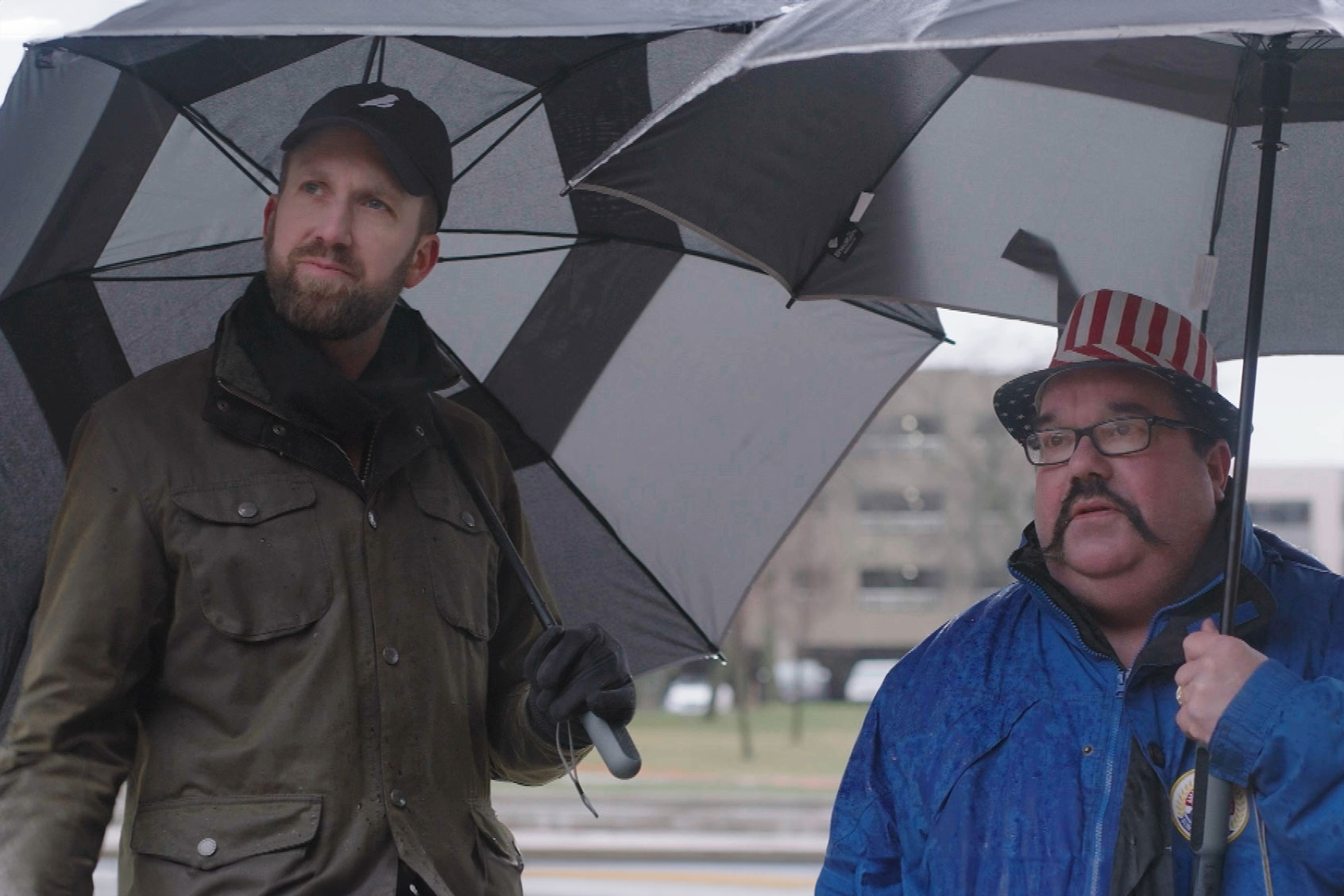
Jordan Klepper’s field pieces for  “The Daily Show” have taken him to places most progressives prefer to avoid. Trump rallies, mostly. “I’m this big, lanky, white guy. And I think people feel more comfortable and confiding some of these things to this person who they see, perhaps, as closer to an ally,” the correspondent told Salon in a recent interview conducted over Zoom.

That ease in his presence has netted Klepper a wealth of material for “Jordan Klepper Fingers The Pulse,” his regular journeys into the dark heart of the partisan divide. But some excursions produce broader examinations. 

"The Daily Show Presents: Jordan Klepper Fingers The Pulse: Moscow Tools," his latest special, is a nimble dive into how effectively Russian propaganda has insinuated itself into our political discourse. Klepper's objective is stone-cold serious as always, even as he places a comedic spin on a topic that should scare all of us.

Similar to his 2022 special on the far-right’s obsession with Hungary, “Moscow Tools” grew out of Klepper noticing the changing MAGA-world conversation around Russia.  When the same lies were used in Congress to slow down financial assistance to Ukraine, he realized this was a gateway to examining American gullibility.

“That's what I essentially cover,” Klepper said. “And I think there are these big questions there of like, why are we so gosh darn gullible? How much of it is us being a pawn to misinformation, and how much of this is revealing what we actually want? Are we just stooges? Or are there people in the MAGA movement who want these more autocratic desires, and these powerful players who limit LGBTQ rights and the power of the press? They’re kind of big questions and frankly, I think they’re scarier questions.”

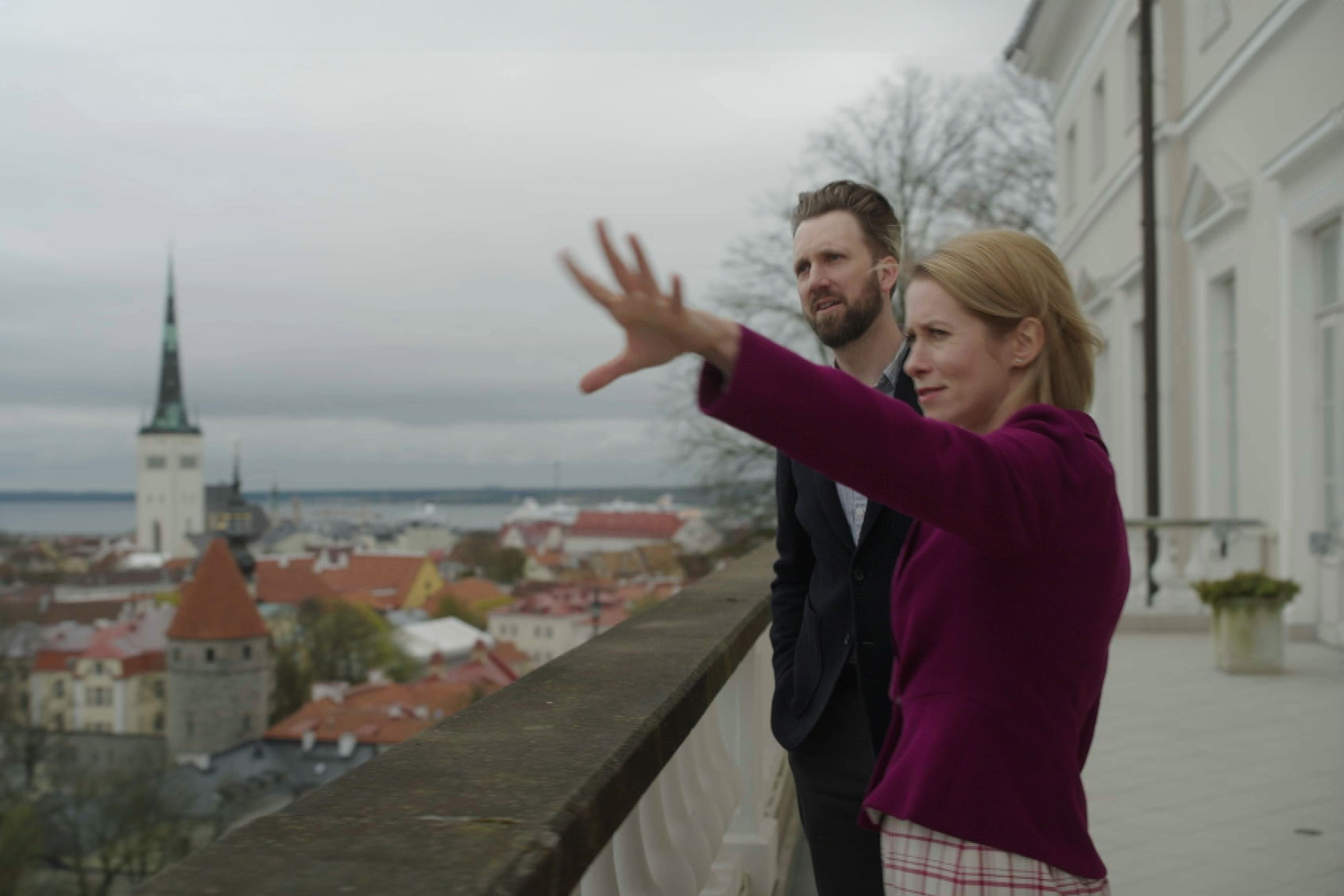
“Moscow Tools” has the distinction of showing Klepper in conversation with two unlikely allies in this fight to maintain Western democracy. One is Estonian Prime Minister Kaja Kallas, whom Klepper visits in her home country to discuss what the stakes are should Donald Trump return to the Oval Office and do as he’s promised, withdrawing from NATO.

The other, former Trump administration National Security Advisor John Bolton, sounded the alarm concerning his former boss’ threat to American democracy from a well-apportioned wine cellar. 

Spending a decade with “The Daily Show” has given Klepper a reputation for tangling up his subjects in their own webs of illogic, including among some of the conservatives who agree to speak to him on camera. Bolton is not immune to this, although perhaps he recognizes Klepper is on his side of this urgent debate. It probably also has something to do with Klepper’s ethos of, in his words, listening with curiosity.

That principle takes him to other places in “Moscow Tools” that are just as unexpected as his interview locations with former and present world leaders and, as he explained in our conversation, represents a truer interpretation of what patriotism means.

The following interview has been edited for length and clarity.

First of all, watching you talk to John Bolton in a wine cellar made me think to myself, “Oh, that's the nicest doomsday bunker I've ever seen.” Did you ever think that you would be in a situation where, to say nothing of the wine cellar-slash-bunker, you would be consulting him as a voice of wisdom?

Not at all. No. And I brought that up in the interview, although, it's not in the special but . . . The fact that I'm sitting down with the prime minister of Estonia and John Bolton, both people who are afraid about Russian propaganda and how it's affecting the GOP, to me is more just reflective of the weirdness of the time we're in. I can't say I had "wine cellar with John Bolton" on my bucket list, but you know, 2024 has a weird way of making strange bedfellows.

Moscow ToolsMoscow Tools (Comedy Central)

Your segment where you spent time with the Estonian militia is also enlightening, especially when the person you’re speaking to tells you he’s preparing to be a choir director while he’s armed and wearing fatigues and assorted camouflage. What was that moment like for you, and what are you hoping that the image of that moment will convey?

Yeah. As a Michigan boy, I always feel most at home hanging out with militia. So even when I go abroad, I'm keeping an eye out for them. These specials happened fairly organically, and so when we notice something in the field, we want to explore it more. 

This one provides some interesting opportunities for us to sit down with experts and try to use them to walk through Russian propaganda and show it in the field. And then when we started to hear the stories around Estonia — and more so, hearing stories in America, where there was just such a lack of actual information about what it meant to be threatened by Russia, and what it meant to be living underneath an oppressive Russian regime, we thought it was an opportunity for us to go there and talk to people.

So much gets lost in translation and social media and TikTok that when we decided we wanted to talk to the Estonian prime minister, we said we wanted to talk to real people as well. And the story comes up about the Estonian Defence League. 

Quite frankly, it's shocking to me to see people come together and fight a common enemy. This is what we were told about World War II, that there were these unifying moments where there was a larger enemy. When the enemy is at the gates, people put aside their differences, and they come together to battle for the common good. 

"I can't say I had 'wine cellar with John Bolton' on my bucket list, but you know, 2024 has a weird way of making strange bedfellows."

And I feel like America has faced some threats, COVID being the most recent worldwide threat, and we haven't seen this unifying moment where people come together. In fact, when I go out on the road and I talk to people, the biggest enemy that they see is usually their neighbor. It's not a foreign adversary. It's somebody on the left, it's somebody who's been too “woke,” somebody who wants to have a trans athlete in a middle school competition. That is their largest fear and threat. 

And so hearing the story about the Estonian Defence League, these are people who are coming together because they actually are afraid for their families. They actually can look across the border and see a threat. They have a recent history of living under that oppressive, autocratic regime. 

We need to talk to these people. We need to dispel some of these rumors and these images and lies that Tucker Carlson pushes on the MAGA faithful about like, this autocratic regime is beautiful. “Look at the subway, look at the baguettes!” No, look at the people in Estonia who have lived underneath this oppressive regime who are training — who are teachers, who are going to be choir conductors – who are putting their time aside because they are afraid. And they're not talking about partisan politics. They're talking about protecting democracy and freedom. 

To me, that was so inspiring and an opportunity for us to just get their story told. It's something that I felt was lost in this weird partisan American environment we're in. And it's surreal that it happens on a place like Comedy Central. But I think it's more important than ever to talk to people who are actually affected by this and show that there are people who have more at stake than the . . . culture wars that we have back at home.

Moscow ToolsMoscow Tools (Comedy Central)

It's also a powerful image when you think about when we see images of militias in the news. A lot of that is in the context of Jan. 6, right? There's all this whole idea of people kind of playing Weekend Warrior as if it's a concept that they want to execute in real life without truly understanding the consequences.

I was there on Jan. 6 —  working, to be clear. To be clear! And you're right, there's a lot of weekend warriors dressed in fatigues who train for one big issue and that issue was apparently to overthrow their own government.  They were angry at, again, their neighbors.

I did a special, “Jordan Klepper Solves Guns,” where I spent a weekend with the Georgia state militia training in the woods. And there's a lot of straw men they’re training to fight. Their heads are swimming with misinformation and these faux narratives of heroism. So getting to see in Estonia, all of that stripped away . . . they're not doing it for glory, or for clicks, or Instagram likes or to get away from their kids on the weekends. They're doing it because they want to protect their kids 365. 

It is a wake-up call when people have more on the line than you do, when people aren't getting caught up in what feels like fake arguments over the internet about stuff that actually isn't affecting people's lives, and it is just being used to have some sort of outrage competition. When you go into the woods, and you see people training for the things that actually could affect their family members, it really is a wake-up call. 

For me, it was also a reminder that patriotism could be defined in perhaps a more earnest and true way than what I've been privy to these last few years.

We need your help to stay independent

I want to return to the idea of looking at this through the lens of comedy. I think that when Tucker Carlson went to Russia, afterward there was a lot of breaking down of all of the fallacies he perpetuated and Putin's reaction of basically calling him a soft target. There was a tendency, I think, to laugh at it. 

But I also think there's a tendency on the part of what I would call the mainstream media, and however you’d characterize Chris Cuomo, to understand what it was that he was thinking. The theory is that doing so will help us to understand the MAGA tribe, those people who are locked in this specific kind of information silo. And I'm wondering whether you think this might affect that audience, either positively or negatively.

I find comedy is a very effective tool to frame issues in a way that perhaps a general population might not approach. . . . The “Fingers the Pulse” pieces are a little bit unique in that we do look for humor, we look for hypocrisy. But I also find them to be revelatory, because more often than not, what I get to do that most journalists don't get to do is, I get to come in with a biased perspective. I get to ask follow-up questions, I get to say yes to their ideas to hopefully have them reveal more in the field than they normally would to somebody else, so that I can understand them a little bit more. 

"It's easy enough to sort of look at what's happening with Russia misinformation, and just look at the useful idiots . . . But the scarier question is the other side of it: Is autocracy actually compelling to many Americans?"

Like when we spoke to [journalist] Julia Ioffe, who walked us through what the Kremlin's talking points were, as far as how they wanted to get these narratives into American mainstream culture, how can I have that conversation, and then use my comedic skills and my fieldwork, to actually show the effects of Russian propaganda in conversation with the actual propaganda?  

And so for me, that was a really exciting part of using comedy as a way to ignite an audience interest, and to show a contradiction and hypocrisy, but hopefully also to evolve what we've been doing and use that as proof of the Kremlin’s success. And so I'm hoping that we're showing somewhat of a coherent narrative as to how that propaganda can find its way into the middle of Pennsylvania.


Want a daily wrap-up of all the news and commentary Salon has to offer? Subscribe to our morning newsletter, Crash Course.


Now, the effect that has on an audience is a much bigger conversation, I think. I don't know if it's getting inside the bubble of the people out there in MAGA world. I think we are in these silos in a way where I don't know if they're ingesting this comedy in any kind of a way and, more often than not, their knives are out. Because if it seems critical, then they won't engage whatsoever. But I think we approach it more so not as a way of converting people, but hopefully as a way of articulating some of the chaos and, frankly, manipulation that we see day in and day out. 

It's easy enough to look at what's happening with Russia misinformation, and just look at the useful idiots – and there are plenty of them in America, and that's part of what Putin wants. But the scarier question is the other side of it: Is autocracy actually compelling to many Americans? And do we pretend like democracy is this thing that will just always exist when frankly, there are folks who may desire something completely different? 

Moscow ToolsMoscow Tools (Comedy Central)

And maybe that is because of Russia's manipulation or outside manipulation. Maybe it's because of naïveté. Or maybe it's because that is a desire — a strongman, a conservative nation with a white leader might be something that people are actually pining for. Again: big, scary ideas, but hopefully, we can use whatever tools we have to kind of start to ask those questions because I think they are really percolating right now.

What you said about the difference between Estonia versus here is important, because in most cases when Americans are talking about their neighbor, they're talking about the concept of them. I don't think they're talking about anyone they actually know and fear.

I think that's 100% true. People are so angry about their neighbor, and they talk about bringing guns to their neighbor. The way in which people talk about the person on the other side of the aisle is so scary. And Jan. 6 was a goddamn s**tshow. The rhetoric got so high and there were a lot of bad actors there who had one goal in mind. And there are a lot of other people who had been talking about overthrowing the government and being so angry at their neighbor and then got caught up in something that was way beyond what they had expected. 

So I do think it's dangerous to have these conceptual talks about our anger and our fears, and where we want to seek vengeance. You look at this Trump campaign, it's all about vengeance. 

People are often like, “You went to Estonia?” Yes, we went to Estonia. There are other stories being told, where people are facing real consequences. Like, let's hear these out before we get lost in the world of concept.

"The Daily Show Presents: Jordan Klepper Fingers The Pulse: Moscow Tools" is streaming on Paramount+, the "Daily Show" YouTube channel, CC.com and video on demand.


Trump promised he would testify in his own defense, but his lawyers have “decided against it”

After over a month in court over his criminal hush money case, former president Donald Trump has decided not to testify in his own defense.

Before the trial started, Trump had ardently maintained that he would testify, telling reporters at Mar-a-Lago: “I’m testifying. I tell the truth.” One of his lawyers, Alina Habba, told Fox News just yesterday that Trump “is willing, he is able, he is nothing to hide it all. He's absolutely ready to tell the truth.”

But that willingness couldn't be found on Tuesday.

Although Trump's lead counsel, Todd Blanche, had indicated earlier in the trial that the former president could take the stand, “ultimately they decided against it,” The New York Times reported.

The consensus among legal experts had been that it might be best if did not. After all, "the jury may simply not like him,” as Sarah Krissoff, a former federal prosecutor, put it.

Trump's defense team ended up only calling two witnesses, one of whom, Robert Costello, put on a performance that most legal experts said was a set back to the defense.

Next week will likley bring the case to an end, with closing arguments scheduled after Memorial Day. A dozen jurors will then decide whether Trump is guilty of any or all of the 34 felony counts against him.

SNAP benefits fall short in 98% of US counties. Republicans still want to gut the program even more

According to a new analysis conducted by the Urban Institute, a Washington, D.C-based think tank specializing in economic and social policy research, Supplemental Nutrition Assistance Program, or SNAP, benefits did not cover the cost of a modestly-priced meal in 98% of United States counties last year. 

This analysis, which was funded by the Robert Wood Johnson Foundation, included data from 2023 and found the U.S. Department of Agriculture’s annual cost-of-living adjustment had little effect on the adequacy of SNAP benefits that year; researchers also discovered that in the last quarter of 2023 a “19% shortfall existed between the $3.37 cost of a moderately priced meal and SNAP’s average maximum benefit.” 

This was true across the majority of the country, though in counties with the largest gaps — New York County, N.Y.; Leelanau County, Mich.; Teton County, Idaho; and Dukes County and Nantucket County, Mass. — there is a staggering 70% disparity between SNAP benefits and meal costs. 

“Food insecurity increased for the second straight year in 2023 after inflation rates remained higher than average and household budgets stayed tight,” Elaine Waxman, a senior fellow at the Urban Institute said in an emailed statement. “For many families, SNAP provides them with the support they need to keep food on the table. 

She continued: “Our research shows SNAP benefits did not cover the cost of a meal in 98% of counties in 2023. With the Farm Bill up for reauthorization, potential cuts to SNAP could be devastating for families with low incomes, who are already struggling with food insecurity.” 

Waxman brings up the incredibly important point — one that’s been consistently raised by food security advocates over the last few months. The Farm Bill, which funds SNAP, expires in September, meaning that it’s a crucial time to assess whether the program is actually meeting the needs of its participants. However, there’s a distinct possibility that Republican legislators will attempt to cut funding to SNAP even further, which could have a devastating impact on hunger in America. 

As Salon Food reported, House Agriculture Committee Chairman Glenn “GT” Thompson, a Republican from Pennsylvania, has proposed a funding framework for the Farm Bill that includes a $30 billion cut in Supplemental Nutrition Assistance Program benefits over the next decade. The proposal would limit future updates to the Thrifty Food Plan, which is used by the United States Department of Agriculture to set SNAP benefits. 

Last Monday, after more than a year of hearing and listening sessions, Thompson released a title-by-title overview of his Farm Bill draft — which has already gained significant support from Republican lawmakers — and scheduled a markup of the legislation for May 23rd, 

Thompson has argued his proposal is not a “real cut” because average benefits would still rise incrementally alongside food inflation, but food insecurity experts continue to push back on that assertion, both because the new Urban Institute data shows current funding is already out of step with with the cost of healthful meals, and because America is already in the midst of a worsening hunger crisis. 

We need your help to stay independent

New data seems to drop every week that indicates this would be the absolute worst time for cuts. For instance, Feeding America’s annual Map the Meal Gap report was released on May 15 and found that “the extra amount of money that people facing hunger said they need to have enough food reached its highest point in the last 20 years.” 

“People facing hunger said they need an additional $24.73 per week in 2022, a 9.5% increase after adjusting for increased prices,” the report found. “Nationally, the amount needed among all 44 million people facing hunger in 2022 hit a record high of $33.1 billion, up nearly 43%. This increase suggests that rising prices, especially food prices, likely contributed in part to the increase in need.” 

“In recent years, the data show that more and more people cannot keep up with rising food prices and are struggling to feed their families,” Gina Hijjawi, a senior program officer at the Robert Wood Johnson Foundation, said in an emailed statement. “Any reductions in SNAP funding will make it even harder for people and families to make ends meet, potentially increasing the number of households facing food insecurity. Because children and marginalized groups are most at risk to food insecurity, this would only exacerbate the already stark health disparities that exist along geographical, racial, and economic lines.” 


“Victimhood is the entire brand!”: Jon Stewart calls out GOP over the real “cancel culture”

Jon Stewart weighed in on the controversy swirling around Kansas City Chiefs kicker Harrison Butker, whose commencement speech at Benedictine College was criticized as misogynistic and homophobic. 

Butker in the May 11 speech referred to Pride month as a "deadly sin," bemoaned abortion rights, and encouraged the women in the crowd at the small, Catholic college's graduation ceremony to seek fulfillment in marriage and homemaking instead of professional careers. 

“Not the advice you want to hear when you’re $100,000 in debt, earning a degree in electrical engineering,” Stewart said at the start of Monday night's episode of "The Daily Show." “But I imagine that the cancellation of one Harrison Butker was swift and unforgiving at the White House.” Stewart followed by playing a clip of White House Press Secretary Karine Jean-Pierre stating that Butker was still welcome to Washington D.C. to celebrate the Chiefs' historic consecutive Super Bowl win. 

“I’m sorry, what was that?" Stewart jokingly asked. "He can still go to the White House and be on his football team, and all that’s really happened is some people roasted him on TikTok? So I guess this is just kind of a passing distraction,” the comedian added, before playing various clips of conservative media portraying Butker as a beleaguered victim of the liberal left, who have attacked him for his Christian identity.

“My question to the right, I guess, is … Have you never been on the internet before? Because that’s all it is,” Stewart said. “My God, you’re all so thin-skinned. Look, Jerry Seinfeld took more s**t over the past two weeks promoting a Pop-Tart movie than Harrison Butker did for his entire speech.”

“Of course, nothing about the right-wing reaction is surprising," Stewart said. "Because the idea that there is an all-pervasive, all-powerful threat to free speech called ‘cancel culture’ has become a central tenet of modern conservatism. They celebrate their being silenced at conferences. They celebrate their being silenced on podcasts and streaming outlets. They celebrate their being silenced with over 700 book titles about ‘being canceled.’ Why are there so many of these f****ing books?”

Stewart began wrapping up the segment by declaring that "conservatives have an entire industry devoted to complaining about not being allowed to say the things they say all the time. Their victimhood is the entire brand!"

The late-night host underscored footage of various Fox News personalities claiming that people cannot state their opinions without being persecuted, followed closely by a series of clips of those same hosts doing just that some time afterward. 

"This is their identity now — constant victimization," Stewart said. "They say what they want and if you get upset about it, you don't believe in freedom."

We need your help to stay independent

He argued that censorship affects every subset of the political spectrum equally, saying, "We are not censored or silenced. We are surrounded by and inundated with more speech than has ever existed in the history of communication."

"It is all weaponized by professional outrage hunters of all stripes, scouring the globe for graduation speech snippets, offhand comments during promotional tours, out of context comedy bits, lame marketing ideas, or any words and phrases they believe they can latch onto to generate monetized clicks," Stewart alleged. "Outrage is the engine of our modern media economy."

Stewart concluded the segment with a zinger aimed at former President Donald Trump, observing that while conservatives have blown the cancellation war waged by the left vastly out of proportion, the former president has been successful in canceling members of his own political party. Anyone who dares speak against Trump, Stewart claimed — such as those unwilling to support his fraudulent election claims, like former Rep. Liz Cheney, R-Wyo. — will be ousted and lose their job. 

"Everything the right says cancel culture does to them is actually being done by MAGA," Stewart said.

"The Daily Show" airs Monday through Thursday at 11 p.m. on Comedy Central and streams on Paramount+

“He’s not that hard to find”: Arizona’s AG explains how the state served Giuliani on his birthday

For more than three weeks, former New York Mayor Rudy Giuliani dodged multiple attempts to serve him with legal papers after he was indicted in Arizona over his efforts to undermine the 2020 election. But as Arizona Attorney General Kris Mayes recounted in an interview on CNN, that evasion came to an end on Giuliani's 80th birthday.

"Over a series of weeks," Mayes said, agents had tried to serve the former Donald Trump lawyer “on multiple occasions in multiple ways.” As the search dragged on, however, Giuliani kept posting online, Mayes noted, saying it was his fondness for podcasting and live streaming that sealed the deal last Friday, resulting in an awkward end to the celebration in Palm Beach, Florida.

“He’s not that hard to find," Mayes said. "And so we did that and our agents professionally served him after his birthday party, as the party was winding down and as he himself was leaving the house that he was in, we gave him a copy of the papers, and he went along his way."

Mayes added that, although the former mayor might have been a bit surprised, “this is a serious case” and they “expect him to be in court [Tuesday].” 

She said Giuliani's claim that he informed agents of his location, intentionally, was not true. “He did not tell us where he was going to be," Mayes said, "except that he told the world where he was through his live cast."

Truth Social keeps tanking: Trump’s social media company reports $327 million loss

The parent company of Donald Trump's Truth Social website has revealed losing $327.6 million in the first quarter of 2024 after raking in less than $771,000 in revenue.

The earnings report, filed with the Securities and Exchange Commission on Monday, comes after Trump Media & Technology's debut as a public company on the Nasdaq stock exchange in March, NBC reported.

According to the report, the company is on a downward trajectory, making less money in the first quarter of this year than it did in the same time period in 2023. It is now  “nowhere close to profitable,” Axios reported

Since going public, the company's stock has enjoyed "meme" status, with stark rises and falls. As of 11:00 a.m. Eastern Time, it was priced at just over $44 per share, a nearly 9 percent drop from the market close on Monday. It's total value remains over $6 billion, NBC reported.

CEO Devin Nunes said in a statement Monday that the company is exploring “a wide array of initiatives and innovations to build out the Truth Social platform including potential mergers and acquisitions activities.”

Truth Social has struggled to carve out a niche in a competitive social media landscape, with X, formerly known as Twitter, capturing much of its prospective user base under the management of Elon Musk.


“Are you staring me down right now?”: Trump witness’ fight with judge won’t “play well” with jury

One reason Donald Trump’s lawyers probably are telling him not to testify in his own defense is because they — and everyone else in a certain Manhattan courtroom on Monday — have now seen what happens when a defiant witness takes the stand and has a tantrum in front of the jury.

Robert Costello, an attorney who briefly advised Michael Cohen after the FBI raided his home in 2018, is the first person the defense team has called to provide substantive testimony. Firmly on Team MAGA, Costello was asked to counter the former president’s ex-fixer, who had told the court that Trump called him after the raid and told him to “stay tough.”

According to Costello, Cohen was distraught after the raid — but adamant, at the time, that he had no dirt on his boss that he could share with law enforcement in hopes of softer treatment. “He said, ‘I swear to God, Bob, I don’t have anything on Donald Trump,’” Costello said, purportedly quoting his former client.

But that was far from the highlight. What drew the most attention from Costello’s brief time on the stand was the way he acted toward Judge Juan Merchan, who had sustained multiple prosecutions objections to the apparent annoyance of the defense witness. “Jeez,” Costello muttered in response to one such ruling, whose sarcasm extended to his body language – and prompted the judge to clear out the jury to remind the witness how to behave in a courtroom.

“I want to discuss proper decorum in my courtroom,” Merchan said. “You don’t give me a side eye and you don’t roll your eyes,” he continued. “If you don’t like my ruling, you don’t say, ‘jeez.’”

Costello responded with what CNN described as a “long glare,” further setting off the judge.

“Are you staring me down?” a visibly upset Merchan asked Costello. The scene ended with the judge threatening to strike Costello’s testimony altogether if he didn’t learn how to control himself. “Your conduct is contemptuous right now,” he said. “If you stare me down one more time, I will remove you from the stand.”

We need your help to stay independent

CNN legal analyst Paula Reid said she was shocked by the performance, which she believes was intended to please one man – the defendant – but could “jeopardize” the entire Trump defense.

“This is unbelievable,” Reid said Monday night. “I know Bob Costello quite well. I talked to him for about a decade. The fact that he would allow this to happen on the stand, it suggests in many ways that he is probably posturing for the defendant. Remember, it’s the defendant that overrode his own defense attorneys – they said this is not a good idea, do not put Costello on the stand. He overrode them.”

As attorney and Brookings Institution senior fellow Norm Eisen commented, Costello’s performance was what might call an “own goal”: he added nothing that jurors would not have already gathered from Cohen himself — the former president’s ex-fixer told jurors he repeatedly lied to protect his boss — while needlessly antagonizing the judge. Even if the jury had left the room for the talking down, jurors could likely figure out the reason they had to get up and go: “ill manners of a kind we have not seen from any witness yet across the 19 days of trial, even on the most contentious cross-examinations.”

Whether the former president’s desire to testify is real or just public relations, defense lawyers Todd Blanche, Emil Bove and Susan Necheles are unlikely to be urging their client to do so after watching Costello’s best Trump impression.

The question, according to Rebecca Roiphe, a law professor at New York University, is whether Costello’s in-court petulance will be remembered when jurors begin to deliberate as soon as next week.

“I wonder how the jury is going to react to the part it saw,” Roiphe told The New Republic. “I can’t imagine that helps the defense … to have somebody treat the authority figure, who’s been pretty evenhanded, that way. I don’t think that’ll play well.”

Trump posts “unifed Reich” video on Truth Social, campaign puts blame on “staffer”

Former president Donald Trump posted a video on his social media network, Truth Social, that includes hypothetical headlines should he win in November — including a reference to a “unified Reich.”

In a statement to the Associated Press, Trump campaign spokesperson Karoline Leavitt claimed the video, including its apparent signalling to neo-Nazis, was the result of a "staffer" posting it after seeing it shared by "a random account online." But it was posted while Trump, who is on trial in Manhattan, was on a lunch break from court.

In the 30-second video, headlines appear such as “Trump wins!!” and “Economy booms!”  Headlines referencing World War I also show up — specifically, a text copied from a Wikipedia entry on the war: “German industrial strength and production had significantly increased after 1871, driven by the creation of a unified Reich.”

On Tuesday outside court, Trump ignored a reporter's question about why the video was posted.

Although the word “Reich” is typically used about Nazi Germany’s Third Reich, in the video, it appears to be referencing “the formation of the modern pan-German nation, unifying smaller states in single Reich, or empire, in 1871,” AP reported

Some of the other headlines read: “Border Is Closed” and ”15 Million Illegal Aliens Deported."

The former president, who dined with white supremacist influencer Nick Fuentes in 2022, has previously echoed Adolf Hitler’s rhetoric, saying immigrants entering the U.S. are “poisoning the blood of our country.”

Red Lobster officially files for Chapter 11 bankruptcy

After news of a massive auction last week, Red Lobster has officially filed for bankruptcy, Nathaniel Meyersohn reports for CNN.

The seafood chain is reportedly 1 billion dollars in debt and has less than $30 million in cash on hand. According to Meyersohn, Red Lobster's plan forward is two-pronged: It plans to sell its business to its lenders and receive financing to stay afloat, while also closing additional locations permanently. Currently, the chain has nearly 600 restaurants throughout the US and Canada, and employs 36,000 people, most in part-time roles. 

The official statement from Red Lobster Management LLC on PRNewswire also adds "The Company intends to use the proceedings to drive operational improvements, simplify the business through a reduction in locations, and pursue a sale of substantially all of its assets as a going concern," noting that the restaurants will continue to "remain open and [operate] as usual during the Chapter 11 process, continuing to be the world's largest and most-love seafood restaurant company." 

While one in five lobster tails purchased in the United States is still bought by the chain, according to Meyersohn, the number of customers visiting Red Lobster has dropped 30% since 2019 and has only slightly improved (though it's worth noting that casual dining as an overall sector has seen a 5% drop in the past decade). 

Richard Collings writes for Axios that "The company will also receive $100 million in debtor-in-possession financing from its existing lenders," adding a quote from CEO Jonathan Tibus, who said in a statement: "The support we've received from our lenders and vendors will help ensure that we can complete the sale process quickly and efficiently while remaining focused on our employees and guests."

Tibus notes in the statement that "this restructuring is the best path forward for Red Lobster." 

This bodacious, super flavorful turkey bacon marmalade will become your new go-to condiment

Maybe five or six years ago, I happened to stop at a small, unassuming eatery about a half hour from my house because I was starved and thought I'd pick something up on the way home. Called Catchy, it doubles as both a storefront and a catering business.

There was no one else there except for someone behind the counter (who turned out to be the owner) and a cook, so instead of automatically getting something to go, I opted to stay and dine in at one of the few white tables scattered in the small storefront, which had a set of white double doors that opened up into a tiny courtyard with a small, backyard wrought iron table.

I perused the menu, dotted with soups, salads and sandwiches galore, as well as some additional options like pastas and grain bowls  along with a towering refrigerator on the opposing wall stocked with tons of jams, jellies, sauces and the like.

I ended up going pretty retro and unadorned, ordering a grilled cheese and fries, but the grilled cheese happened to have a bacon jam on it. I sat at the table closest to the counter, chitchatting with the owner, until my food came out.

And I was blown away.

It was served in one of those plastic "baskets" you might get from an amusement park food kiosk, lined with decorated wax paper, but the food itself was so far from pedestrian. The fries were, quite possibly, the single crispiest fry I've ever eaten  and with just the right amount of salt. The grilled cheese was immensely gooey and rich, the bread perfectly crisped and with great structural integrity, with no bread slipping or overtly melted cheese causing an absolute mess.

But the piece de resistance was most certainly the bacon jam.

It was the most beguiling mixture of pork-y, fatty, miniscule pieces of uber-crisp bacon melded together with some sort of jammy-sweet-deeply savory amalgamation. I shoveled every bite of grilled cheese, bacon jam and french fries into my mouth as quickly as possible before fawning over the food to the owner and cook and running out the door, certain that I'd return again and again to get as much of that bacon jam as possible.

Then COVID happened. Then I gave up pork. I haven't been back in quite a while. What I am sure of, though, is that that bacon jam was formative for me, so I took it upon myself to create another version, with turkey bacon instead of pork, that hit on all the same textural and flavor notes and so that I could eat it in every possible which way. And I then proceeded to do exactly that.

Warning: There's no way this will last very long, but keep it in the fridge and pull it out whenever you want to slather some immensely delicious, wildly well-balanced flavor and texture on practically anything you eat.

We need your help to stay independent

Turkey bacon & maple marmalade
Yields
10 servings
Prep Time
10 minutes
Cook Time
45-55 minutes

Ingredients

8 to 10 strips turkey bacon, finely chopped

1 large onion, peeled and finely minced

2 to 3 shallots, peeled and finely minced

5 cloves garlic, peeled and minced

1/4 to 1/3 cup maple syrup

2 to 3 tablespoons balsamic or Sherry vinegar

Dash ground cinnamon

Dash ground mustard

A splash of coffee

A splash of fruit juice, optional

Dried herbs, optional

Water

Directions

  1. Add bacon to a deep pot over medium-low heat, adding a touch of oil to help move it along. Stir often until very, very crisp, about 15 minutes.
  2. Add onions and shallots, stir well, and cook for another 10 minutes. 
  3. Add garlic and let toast for a minute until fragrant. Stir well, lowering the heat if anything is starting to scorch. 
  4. Add syrup, vinegar, cinnamon and mustard, stirring well until well combined. Let syrup caramelize until slightly tacky and aromatic, about 5 minutes more.
  5. Add coffee and juice, if using. Turn heat to low and stir, cooking for another 5 minutes.
  6. Finish with dried herbs and a touch of water, if the mixture is getting too dry. 
  7. Pardon my French, but you're going to really need to cook the s**t out of this to take it to its most flavorful capacity. Keep the heat very low, make sure there's enough liquid, stir frequently, but you want the end result to make the onion and the bacon almost indistinguishable from each other. The final product should be viscous, very thick and smell incredibly rich. Add water if the mixture gets too dry but still needs some cook-time. The whole cooking process shouldn't take more than an hour.
  8. Transfer to a jar or food storage container, let cool completely, then cover and refrigerate. Use within a week.

Cook's Notes

-If you're not into turkey bacon, you can also sub. in pork, beef, chicken, or plant-based, if you'd rather.

-Do your darnedest to cut the onion and shallot as finely as possible, about the same size as the bacon pieces.

-I've mainly been eating this on a ridiculously hard-seared Impossible burger topped with melted, plant-based Cheddar and a touch of some mayonnaise or aioli to help the jam "adhere" to the bun. It's exceptional. But it's also great as a topping for French fries, over a hot dog, as a spread on any sandwich imaginable, served with crudite or, or course, added liberally to a grilled cheese.

-Feel free to swap in agave or molasses if you're not a fan of maple syrup, toss in some brown sugar if you're into that, or even add some dried herbs (like chives) at the very end to round it all out. 

-The depth of flavor here is genuinely bonkers, so don't use too much at once. A little goes a long way, truly.

-In regards to the coffee, feel free to throw in a touch of whatever you have on hand; I literally just splashed in some leftover black Dunkin' Americano that I had on hand and the bitter notes were perfect. A drizzle of some cola could work, too. 

-The fruit component isn't necessary, but it helps to add another dimension of flavor. I'd go with a cherry or orange juice, not an extract.

-Do not use regular mustard here; you'll need dry, or just omit it.

Trump’s MAGA rallies are getting an inflated boost from the press

Officials in Wildwood, New Jersey who were the source for the Associated Press’s (AP) reporting that former President Trump drew between 80,000 to 100,000 to a beachfront weekend rally now say it was not the number on the beach at the rally per se, but rather the number of people “in our town.”

For the actual rally number “we defer to the Trump Campaign for the exact count on the beach,” the latest Wildwood statement asserts. Lisa Fagan, the Wildwood press spokesperson AP originally cited as the source for the original crowd estimate was quoted as saying the eye-popping estimate was “based off her own observations on the scene Saturday, having seen ‘dozens’ of other events in the same space.”

Five days later, when asked to explain the wide variance between the AP reporting and the NJ.com video that reveals a crowd in the few thousands, Fagan provided a statement from Wildwood Mayor Ernie Troiano, a Republican, at odds with what the wire service initially attributed to Fagan.

“As a tourist town, we speak in tourism numbers,” Troiano wrote. “When we see that volume of people attending a beach event, we know that 80,000+ people are in our town. We see a quarter of a million visitors every weekend in the summer on our 1.89-mile boardwalk, not to mention our five-mile island, so we know what that volume looks like. They were watching and listening from the beach and boardwalk, in bars and restaurants, at hotels and second homes. People even lined up along the streets parade-style. We defer to the Trump Campaign for the exact count on the beach.”

Troiano told NJ Advance Media last week “the rally will be held between Schellenger and Spicer avenues, a stretch of beach between two amusement park piers” accommodating “a crowd size of between 30,000 and 40,000.”

Troiano is under indictment on state corruption charges that he, along with former Wildwood Mayor Pete Byron and City Commissioner Steve Mikulski, fraudulently obtained coverage in the State Health Benefits Program (SHBP) as full time employees. All three pleaded not guilty.

There’s a hearing scheduled in Troiano’s case on May 17.

I had cited the AP reporting on Trump’s rally size in my story.

Since I started writing for the Ramsey Mahwah Reporter at 17, over a half century ago, the AP has been the gold standard for news gathering. Founded in 1846, AP has been “an independent news cooperative, whose members are U.S. newspapers and broadcasters, steadfast in our mission to inform the world,” according to its website.

Steve Peoples, AP’s chief political reporter, who was on the rally story byline, tweeted “Lisa Fagan, spokesperson for the city of Wildwood, told The Associated Press that she estimated the crowd represented between 80,000 and 100,000 attendees, based off her own observations on the scene Saturday, having seen ‘dozens’ of other events in the same space.”

On May 11 before the rally, People tweeted “Trump’s team expects ‘tens of thousands’ of supporters to attend this afternoon’s Jersey Shore rally, which may be among the largest of his political career.”

People’s X (formerly Twitter) account phrase is “the other side is not the enemy.”

But it just wasn’t the crowd size that AP used to boost the former president’s narrative. They gave his grievance about his having to endure criminal prosecution credence in their story headlined “Trump tells Jersey Shore crowd he’s being forced to endure ‘Biden show trial’ in hush money case.” Then in the body of the story what the headline says is Trump’s view pops up in the ‘objective’ narrative.

“Trump, the presumptive Republican presidential nominee, drew what his team called a ‘mega crowd’ to a Saturday evening rally in the southern New Jersey resort town of Wildwood, 150 miles (241 kilometers) south of the New York City courthouse where he has been forced to spend most weekdays sitting silently through his felony hush money trial.

Sounds oppressive.

We need your help to stay independent

I wrote about AP’s media relations about the wide discrepancy between AP’s reporting on the crowd size and the actual video from the event. “The number is an estimate from an independent city official. The reporting notes this and is transparent about how Fagan arrived at the estimate,” AP’s media relations responded.

But the AP wasn’t alone.

@salonofficial

How many people were actually at Trump's rally on Saturday?

♬ original sound – Salon

“Sandwiched between the boardwalk and the Atlantic Ocean, Mr. Trump stood in front of tens of thousands of people at a rally on the beach in Wildwood, N.J., where he largely repeated the same criticisms of President Biden that have characterized his stump speech in recent months,” the NewYork Times reported from a story datelined from the rally.

Of course, Trump cranked up his calliope proclaiming to the audience he had drawn “a much bigger crowd than Bruce Springsteen. Right?”

CBS News proclaimed that Trump’s one-day appearance at Wildwood had ushered “in an economic boom” in the Cape May county town.

“The story is a gift to the Trump campaign, and a peerless propaganda victory in an environment in which momentum and intensity are critical factors,” wrote anti-Trump Steve Schmidt, who advised Sen. John McCain. “The fantastical number is now ‘real.’ Speaker Mike Johnson tweeted about it too (as an aside, big numbers are a challenge for Johnson, who believes Earth is 6,000 years old and people and dinosaurs lived happily together). It has the double effect of intimidating Biden supporters, and simultaneously disaffecting them. How could it not? Immense rallies — even imagined ones — can have a profound psychological effect.”

By Monday, the Times was asserting Trump was leading President Biden “in five crucial battleground states, a new set of polls shows, as a yearning for change and discontent over the economy and the war in Gaza among young, Black and Hispanic voters threaten to unravel the president’s Democratic coalition.”


Want a daily wrap-up of all the news and commentary Salon has to offer? Subscribe to our morning newsletter, Crash Course.


The Times continued: “The surveys by The New York Times, Siena College and The Philadelphia Inquirer found that Mr. Trump was ahead among registered voters in a head-to-head matchup against Mr. Biden in five of six key states: Michigan, Arizona, Nevada, Georgia and Pennsylvania. Mr. Biden led among registered voters in only one battleground state, Wisconsin.

Headed into the 2024 election, every American needs to up to the challenge of authenticating the news that they use to inform how they vote. After a generation of newspaper, cable and broadcast consolidation and layoffs news gathering has taken a major hit.

Truth and facts matter now more than ever.

We are in treacherous territory when the House of Representatives is controlled by a caucus that the overwhelming majority of whom broke their oath office voting not to certify the election of President Biden after the violent attack on the U.S. Capitol at the instigation of former President Trump.

This same junta is now taking turns trying to subvert the rule of law by trying to delegitimize the ongoing New York State court proceedings in which former President Trump is a criminal defendant.

This is more like an ongoing insurrection and subversion of the rule of law rooted in twisting reality to validate Trump’s delusion that the 2020 election was stolen from him.

The essential question is how we know what we know because the so-called reliable sources we’ve always counted on historically appear to be buckling under as they cover this election as just another horse race.

My book is not my baby — but the two do have a lot in common

I remember in my first year of motherhood the way I felt my world grow smaller and more intimate, the pace of my life grow slower and more focused. When my husband would come home from coaching and consulting meetings, networking events, and the workshops he facilitated, he would find me ensconced in the tiny world of our home, wrapped up in the milky sweetness of the baby. The private, domestic realm became my primary realm during those early months of motherhood, when I would walk around and around our small apartment with my baby wrapped to my chest, murmuring “shh, shh,” over and over again, like a mantra, or a prayer. Her heart beating against my heart, recreating womb-like conditions on the outside.

In the same sun-drenched week in August, that baby, my elder daughter, started preschool and I signed a publishing contract for my debut novel, "California Dreaming." Two years after that, my younger daughter has started at that same preschool, and "California Dreaming" is mere days from being released.

Like those early months of motherhood, writing is an intensely private, solitary act. For me, to write necessitates going inward, it requires shutting out the outside world and external stimuli for the sake of being able to listen fully. My writing process takes inspiration from Anne Lamott’s practice of the one-inch picture frame. All through my daughters’ early years, I would carve out pockets of time — while they napped, or after bedtime, or when they were at the playground — to write. My pace of writing my novel was complementary to the pace of motherhood, the pace of attending to a baby and then a toddler. Each day I wrote just 250 words, filling my one-inch frame.

I am not the first to notice the connection between writing and parenting, but while many have compared publishing a book to giving birth, for me there is an even more apt comparison. Both child and book lived in and then with me for many years after their births. For me, publishing a book feels most parallel to sending my child to preschool for the first time, for it is in both these acts that that which once lived solely inside the private, domestic realm, and within only a few primary relationships, now enters the public sphere.

The distinction between the public and private realms, the separation between domestic and political spheres, has long been deeply intertwined with the preservation of a capitalistic society. Mothering so often happens outside of the public sphere, outside of the public gaze, and much has been written about the hidden, unpaid labor of caretaking. In our society, there is a hiddenness inherent in the domestic realm and a hiddenness to the lives and experiences of women.

Like those early months of motherhood, writing is an intensely private, solitary act.

Perhaps the novel form itself could be considered a kind of public square, a forum in which human relationships, motivations, self-discovery, and journeying gets played out again and again through different lenses, and under different gazes. Historically, even in the context of the novel, significant female life experiences — childbirth and abortion, breastfeeding and postpartum depression — have not been explored nearly as deeply as those life experiences of typical male self-development.

In my writing, I am drawn to exploring the inner lives of women, especially during moments of significant life transitions. In "California Dreaming," the main character is Elena, who, over the course of the novel, grows from a young, idealistic early 20-something, into a 30-year-old woman who reckons with the decisions she has made, the values she holds and the stories she has inherited. It is a bildungsroman, a story form that traces the general and spiritual coming-of-age process, and it is told in the first-person point of view, granting Elena herself the narrative voice to describe her journey. There is an intimacy in using the first-person, a way of drawing near to the narrator that allows for greater play and insight into the narrator’s own development, her way of viewing the world, her inner life.

In an interview with Terry Gross in 1985, the writer Grace Paley reflected, “When you write, you illuminate what’s hidden, and that’s a political act.” For many years, my primary world has been the private, domestic, intimate world of mothering little children and writing and rewriting and editing a novel. A hidden world. And now, gradually, there are bridges between the private and public realms, and that which has been hidden is becoming illuminated, revealed.

In the months after giving birth, I felt the deep truth of the fact that I was not fully separate from my children. And yet, as they have grown, we have each gone through periods of differentiation, of reasserting the boundaries of self. My children no longer exist primarily in a carrier or in my arms; they are no longer solely dyadic extensions of me. They go to school, they have thoughts and experiences and dreams and feelings and wishes that I am not witness to, and that they navigate with peers and teachers and the many other people who populate their life. They have relationships that are their own.

So, too, with my novel. For many years I worked in private tandem with the novel, with my own creative process. In the months since I signed my book deal, however, I have begun to experience the way my creative process—a process of unfolding, refining, listening, and responding—is being transmuted into an object, into something that will go out into the world, into the public sphere, and there take on a life of its own. We are differentiating, my book and I, and soon it will be in relationship with others, with readers who will encounter it as themselves, and form judgments, connections, and opinions about it that are distinct from my own.

Motherhood’s value has often been located in the fact that the children we are mothering will eventually become citizens of the larger society. Similarly, a book on its publishing journey—as I have newfound understanding and appreciation for—ultimately becomes a commodity. The publishing industry measures a book’s success in sales, and even my chance at publishing another book in the future may rest on the sales numbers of my first. In these months of preparing for my book’s launch, of asking bookstores and libraries to stock my book, and friends and family to pre-order, I have been struck by my own doubts of its inherent worth. To ask people to buy it, to spend money on it, has necessarily sent me diving into questions of its value: Will this book change your life? Must it be read? Will you like it? I don’t know.

For many years, my primary world has been the private, domestic, intimate world of mothering little children and writing and rewriting and editing a novel. A hidden world.

Here’s what I do know: it had to be written. It called to me again and again during the writing process itself, that private, intimate birthing and caring for of this idea, these characters, this story, this particular viewpoint on the whole messy endeavor that we call life, and I couldn’t not write it.

In many ways, this is the same way I feel toward mothering my children. I don’t know who they will become, or what they will or will not contribute to society. I mother them in this moment, now, because they are here, in front of me, whole and perfect and messy and complete human beings just as they are. I attend to them because I must, because I am called to with my whole self.

It can seem at times that worth and value exist exclusively in the public sphere, in the shared collective, in the process of being witnessed and incorporated into the greater whole. But when this greater whole is one whose meaning rests in capital, then worth and value become markers for how much something contributes to capital: the book that sells well, or the child who grows up to be a “productive” member of society—a worker, a voter, a consumer.

It is not that I am against a shared, collective space, not that I wish for more individualized and individualistic paths toward meaning — far from it. However, in the context of a public sphere that primarily operates in terms of product, output and money, the private realm can sometimes seem a place of refuge, a place where creative process and attentive mothering can actually coexist in harmony, for the sake of attention itself, for the sake of love—and not future production or consumption.

Yet, I wonder whether that coexistence can only occur out of the public gaze, in a hidden domain, or if it would be possible for it to thrive in the public sphere. What kind of relationships could we have, the witnessers and the witnessed, in which we could write and mother from a place of intimate curiosity, where we could do so in a way that feels held by others, by community, where it is neither solely a solitary, lonely endeavor, nor one whose worth is measured in a balance sheet?

Perhaps it is only in a novel where we can fully explore that possibility.

Supreme Court’s Samuel Alito problem compounded by Donald Trump’s immunity case

Public outrage continues this week in response to the disturbing New York Times report that, in the days after the Capitol riot of January 6, 2021, a symbol of support for the insurrection was displayed at the home of Supreme Court Justice Samuel Alito. The justice has half-heartedly tried to deflect blame onto his wife with some convoluted tale involving her bickering with the neighbors, but in the end, there's no real evading the conclusion: The Alitos publicly hat-tipped the fascist effort to overthrow democracy because they backed Donald Trump's attempted coup. Now there's a growing chorus of people, including Senate Democrats, calling on Alito to recuse himself from all coup-related cases, including one involving Trump's claims to be "immune" from prosecution for his attempts to steal the 2020 election. 

The justices are part of this larger Republican drift away from being opposed or even just ambivalent to January 6.

Like Justice Clarence Thomas, whose own wife was intimately involved in the attempted coup plot, Alito is almost certainly going to blow off all the criticism. Chief Justice John Roberts, for his part, will likely allow it. This is for one simple reason: The entire GOP majority on the court is complicit with Trump's designs to end democracy.

The other Republican-appointed justices on the Supreme Court may not all be as loud and proud about it as Alito and Thomas, but that's more of an aesthetic difference than a material one. When it gets down to brass tacks, the Republican majority is cooperating fully these days with Trump's seditious plans. We know this for two reasons: First, the supposedly "originalist" conservative justices ignored the plain text of the Constitution — which explicitly forbids politicians who have "engaged in insurrection or rebellion" from holding future office — to rule that Trump can still run for president. Second, they are currently blocking Trump from being tried for his efforts to steal the 2020 election, using transparently disingenuous methods. 


Want more Amanda Marcotte on politics? Subscribe to her newsletter Standing Room Only.


The timing is especially telling here. The justices were practically tripping over their robes in their haste to issue their illegitimate decision in the ballot case. They heard oral arguments on February 8 and issued their unconstitutional, pro-Trump ruling less than a month later. But on the immunity claims, they are taking a luxurious amount of time. They pushed oral arguments nearly two months after Trump's trial in his Jan. 6 case was supposed to start. It's been nearly a month since then, and still no sign of a ruling. And that's despite every good faith legal scholar pointing out that this case should have never even made it to the Supreme Court. The D.C. circuit already issued a rock solid, common sense ruling that presidents don't get to just attempt coups without consequences. 

Even if some conservative justices, as they seemed to indicate during arguments, aren't keen on ruling that a president is forever above the law, it may not matter. By taking up the case in the first place and taking their sweet time ruling on it, they likely doomed any chance that special prosecutor Jack Smith could actually bring Trump to court to answer to a jury before the election. And that's assuming the court issues a straightforward affirmation of the D.C. decision. Odds are they create a bunch of new, nonsense legal tests, forcing the lower courts to tinker with this case for months, if not years — and if Trump wins the election, he will kill the case anyway. 

If the Supreme Court continues to delay Trump's Jan. 6 trial, Jennifer Rubin of the Washington Post writes, it's proof that the fascist sympathies of Alito and Thomas "have thoroughly corrupted the court." Sure, it's possible Roberts hears her and, within a week, we have a Supreme Court ruling that allows the federal trial to start this summer. It's also possible, theoretically, that a massive asteroid decimates planet Earth and ends our collective misery in one glorious swoop. But neither will realistically happen. The latter we know because NASA would have detected such an anomaly. The former we know because the Roberts court is run by a bunch of partisan hacks. If it weren't, they would have already kicked Trump off the ballot, as the Constitution requires, while also inviting the Justice Department to try him with the swiftness the public deserves. 

Because Alito and Thomas are especially bad at hiding the petty spite that fuels their authoritarian ideology, they get most of the public's negative attention. But if it were just two of them, it wouldn't really matter so much on a nine-person court. The reason they are so powerful is that they have the quiet support of the other four Republicans on the bench, who have demonstrated in the past few months that they are fine with what happened on January 6, so much so that they are happy to torch the reputation of the Supreme Court to shield Trump from consequences. 

This is all happening while elected Republican officials are lining up to exalt Trump's criminality. Last week, Republican politicians by the bucketful made the pilgrimage to New York City to speak out for Trump in a campaign fraud case where the overwhelming documentary evidence points to his guilt. This is after he's been found liable in two other cases for committing decades of business fraud and for sexually assaulting journalist E. Jean Carroll so brutally that the judge repeatedly said it was basically rape. To stand by him now is not really about believing he is innocent of these various crimes so much as it's championing an explicitly fascist principle: Dear Leader should not have to obey the law. 

Not only are Republicans venerating Trump's past crimes, but they are actively encouraging him to commit more in the future, especially concerning election fraud. When reporters ask Republican politicians if they will accept the results of the 2024 election, almost to a person they find their way to say "only if Trump wins." This isn't just political tapdancing around the easily miffed feelings of Trump and MAGA voters who want to believe elections are "rigged" if they lose. Every politician who backs the Big Lie is, whether they admit it to themselves or not, justifying political violence and future criminal conspiracies to steal the next election. 

When he was actually in the process of attempting to steal the 2020 election, the court was less accommodating of Trump's fascist impulses than they are now. They rejected his lawsuits attempting to throw out the electoral college votes of states that backed President Joe Biden. So it's understandable that the punditry is surprised to see the justices grow more protective of Trump's aspirations to be a dictator. But the justices are part of this larger Republican drift away from being opposed or even just ambivalent to January 6. Nowadays, most Republicans openly embrace Trump's Big Lie and any crimes committed to seize control of government illegally. Alito has revealed he was one of the hardcore fascists who was with the insurrectionists from day one. But, like many Republicans, the rest of the conservative justices on the court look to have moved in his direction. 

“Trump is all dominance, all the time”: New research reveals “his most formidable political asset”

Despite his many policy successes both at home and abroad, President Biden is consistently losing to Donald Trump in the key Rust Belt battleground states polls. These are states that Biden will presumably need to win a second term in office. President Biden also appears to be losing support among key members of the Democratic Party’s base such as Blacks, Latinos and Hispanics, and young people.

Political scientist M. Steven Fish believes that the Democratic Party’s inability, despite their many policy successes, to conclusively defeat the Republicans and the larger “conservative” movement and American neofascists, is rooted in much bigger and systematic failings. A professor of political science at the University of California, Berkeley, Fish has appeared on BBC, CNN, and other major networks, and has published in The New York Times, The Washington Post, and Foreign Policy, among others. His new book is “Comeback: Routing Trumpism, Reclaiming the Nation, and Restoring Democracy's Edge.”

In this conversation, Fish warns that Donald Trump and the other Republican leaders use a high-dominance approach to politics and communication that allows them to set the agenda, which in turn puts the Democrats, who tend to be more passive and consensus-oriented, in a consistently weak position of reaction and defense. It is this failure of messaging and leadership style that has largely made the (white) working class so attracted to the Republicans and Trumpism.

Fish counsels the Democrats to learn from and model their behavior on such high-dominance liberal leaders as President Franklin Delano Roosevelt, President Kennedy, and Dr. Martin Luther King Jr. who acted and spoke with force, clarity, moral vision, courage, and who actively sought to shape the terms of the debate and policy through the force of their personalities and clarity of vision.  

This interview has been lightly edited for clarity and length

How are you feeling given the state of the country, the 2024 election, and more generally with the world?

We haven’t seen a more serious threat to democracy and liberal values since WWII. But I also firmly believe that we can beat this threat back, too, just as we did then. We just have to be clear about the nature of the danger and act now to defeat it.

"Dominance is always a crucial aspect of politics, but it’s especially important in the Age of Trump. And the Democrats are definitely losing that game."

I’m a comparative political scientist who specializes in democracy and authoritarianism around the world. What I care about most is how people can get their freedom, if they don’t have it, and keep it, if they do. Democracy has been taking a hit over the past 20 years or so all over the world. The question is why.

There’s a standard story about how we got Trump. Basically, it holds that rising economic and cultural anxieties drove working-class voters to Trump. This story claims Democrats adopted neoliberal policies that exacerbated inequality and ignored the struggles of non-college-educated whites in favor of big business, minorities, feminists, and immigrants. It assumes white working-class bigotry escalated along with economic frustration. Now, as a result of believing this story, the Democrats’ main electoral strategy is to double down on progressive economic policies and to duck culture war issues to try to win these voters back—and this is a major problem in the fight against Trumpism.

What’s wrong with the standard story? What do you think the mainstream news media and political elites and opinion leaders have generally gotten wrong about Trump voters?

Economic conditions are actually as good for democracy as they’ve ever been. Of course, some people are hurting, but working- and middle-class incomes have risen faster in America than in other rich countries where democracy hasn’t come under threat. What’s more, long-term surveys show that white working-class voters’ perceptions of life satisfaction, job security, quality of employment, and personal opportunity have been pretty high and largely stable since the 1970s. In fact, Republicans have reported slightly higher satisfaction levels than Democrats.

Today the stock market is setting records and unemployment is lower than it’s been since the 1960s. Inflation is way down. To the extent that injustice still prevails, whether it’s on tax policy or union-busting or pretty much anything else, Republican machinations and intransigence, not some supposed abandonment of the working person by the Democrats, are to blame. The problem is the Democrats don’t get the political credit for their policies and the great things they’ve done that they deserve. That’s due to the Democrats’ poor messaging, not their policies.

What’s more, while Trump has special appeal among hardcore racists, they’re a diminishing minority of the population. Attitudes on race, immigration, and gender have liberalized dramatically in recent decades, including among working-class whites. Meanwhile, Trump’s support among nonwhite voters is rising fast. I document all this data and more in my new book.

How do these flawed assumptions hurt the Democrats with working-class voters? Definitions matter. How do you define “working class?” Specifically, the “white working class” that the news media, punditry, and Democratic Party are so obsessed over?

These days researchers generally define the working class to mean people who don’t have a college education. This tends to be an easier way to measure this demographic than occupation or income. It’s a diverse group—almost half are people of color. But as you point out, the political world has focused on the non-college-educated whites who mostly support Trump. This group makes up about 35 percent of the electorate. 

Everything about the standard story as it’s evolved in the wake of Trump’s rise strikes white working-class voters as baffling and condescending. The Democrats paint a dismal picture of these voters: Ignorant of their own interests, despairing to the point of self-destruction, desperate for government help, vulnerable to the appeals of racist demagogues—how can we win people over if this pathetic, ugly caricature is the story we tell about them?

This may explain why this group has voted Republican since Lyndon Johnson. The exception is Bill Clinton, who won them twice. Clinton’s policies were far more progressive than many on the left believe. But the way he talked about them tended to focus on getting people back to work and encouraging personal responsibility. He honored Americans’ bootstrap mentality, and while he felt everybody’s pain, he did it without the condescension that the Democrats often dish out today. He was wildly popular among Blacks and Hispanics, but he didn’t play identity politics and he didn’t give white working-class folks reason to think that he suspected they were inclined to racism. That all changed after he left office and especially—and perhaps ironically—with Hillary Clinton’s candidacy.

Trump-like figures have been coming to power all over the world. Is there a larger pattern here, and if so, how can it inform how we think about the democracy crisis in the United States?

In the bigger global picture, what I’ve found is that everywhere they’ve won power, democracy’s adversaries—from Orbán to Modi to Putin and the Philippines’ Rodrigo Duterte—have convinced people that they’re the toughest guys on the block and they can get things done. The specifics don’t matter. What impresses voters is that these leaders can work their will, whatever it may be. They shape opinions and tell folks what they want them to believe, rather than what they think they want to hear. They savor conflict and treat politics as an us-versus-them game. They take big risks and play to win.

"The problem is that the Democrats don’t unmask Trump’s essential cowardice and overmatch his dominance game."

They also never neglect the power of narrative and nationalism and always hammer away at their own supposed superiority as lovers and protectors of the nation. They play to voters’ emotions more generally, rather than just appealing to their material interests. They use entertaining, provocative parlance. In a word, they embrace what I call a high-dominance political style.

Liberal leaders today are often more comfortable in the role of petitioners and followers of public opinion than as commanders and shapers of public consciousness, so they’re always taking the public temperature and adjusting their messaging—and even policy stances—to polling. They’re conflict-averse and prefer compromise to combat. Us-versus-them framing and “othering” seem unnecessarily polarizing to them.

We need your help to stay independent

Rather than exude iron self-assurance and unqualified optimism about their countries’ futures, liberals fret about the complexities of governing and social problems. Nationalism makes them uncomfortable. They treasure norms of civility and distrust provocative, aggressive language. Generally speaking, then, they have adopted what I call a low-dominance political style.

Not only are the liberals’ low-dominance ways costing them elections. They also often seem to confirm the authoritarians’ claims that democracy itself is “weaker” than authoritarianism—and that playing by the rules is for chumps. Of course, getting people to believe that is every autocrat’s and would-be autocrat’s aim and the key to ensconcing himself in power forever.

Your recent New York Times guest essay focused on dominance behavior and how Donald Trump and other members of the right wing are masters of it. What is Trump doing that is so vexing and challenging to Democrats and many others outside of the MAGAverse and Trumpworld?

Donald Trump is all dominance, all the time. My research finds that his dominance game, much more than his policies or appeals to racism, is his most formidable political asset. He largely ignores the polls and tells you what he thinks, while low-dominance leaders tell you what they think you want to hear. His disdain for optics and polls isn’t a sign of real courage. Instead, they’re products of his narcissism combined with a lack of impulse control. But his congenital political gift is that the way these character defects manifest what looks like bravery, at least to a substantial minority. It’s what creates the perception that he’s his own man (however sociopathic) and acts on his own convictions (even if they’re nothing but ego-driven ambitions and resentments).

Trump’s dominance style is what separates him from every other politician and explains the ardor he elicits among those who thirst for strong leadership. And it’s what’s enabled him to retain his grip on his party, even as he’s proven to be a liability in elections. To many people, it makes him look indomitable—and other politicians like panderers by comparison.

The problem is that the Democrats don’t unmask Trump’s essential cowardice and overmatch his dominance game. Liberals often seem to think that people just need to evolve past their need for dominant leaders and get on with creating a world in which everyone gets along, and nobody seeks to dominate anybody else. But as the eminent psychologist Dan McAdams notes, our desire for commanding leaders is baked into our DNA. It isn’t all we seek in our leaders, but seek it we do, and that isn’t going to change anytime soon. McAdams argues that no American president has tapped into what he calls “the primal psychology of dominance” as effectively as Trump has. In fact, McAdams suggests that Trump has little but dominance going for him.

"If Democrats can beat Trump on dominance, his area of greatest strength, we can crush the Trumpian menace before it crushes our democracy."

Trump’s high-dominance style taps into a complex combination of emotions. You’ve smartly written about how he triggers his voters with his horror movie strategy. Trump then piles on with narratives of self-pity, rage, and resentment. But what truly sets him apart, even from other Republicans, is his extreme high-dominance style that reassures his triggered followers that he will fix everything. Trump’s constant norm-breaking and crass behavior, which are also part of his high-dominance style, also makes his followers feel accepted and part of his group. And no one “owns the libs,” who they think look down on them, like Trump does.

Of course, many voters are repelled by Trump’s style. But overall he has gained more than he has lost because of his high-dominance strategies.


Want a daily wrap-up of all the news and commentary Salon has to offer? Subscribe to our morning newsletter, Crash Course.


Finally, Trump’s exuberance and humor not only keep his followers entertained but often disarm even his critics. After all, how bad can he be if we can laugh and be charmed by his antics? Few American politicians have ever been able to tap into so many emotion centers as ably as Trump does—and his dominance style is what pulls it all together. If Democrats can beat Trump on dominance, his area of greatest strength, we can crush the Trumpian menace before it crushes our democracy. This does not mean they have to emulate Trump. Our greatest liberal heroes have been high-dominance, but in distinctly liberal ways and to liberal ends, whether it be Frederick Douglass and JFK, or Nobel Laureate Maria Ressa and Eleanor Roosevelt.

Is dominance behavior unique to men and traditional forms of masculinity? In your New York Times essay, the examples of high-dominance leaders you referenced were all men.

Thanks for asking this, and the answer is absolutely not. A raft of recent studies, including excellent work by scholars like Deborah Jordan Brooks and Nancy L. Cohen, show that women can wield dominance no less effectively than men. Ovarian fortitude can beat the testicular variety in politics no less than in all other realms of social interaction.

One of my new liberal high-dominance heroes is Democratic Rep. Jasmine Crockett, the glamorous second-term congresswoman from Dallas. She revels in skewering MAGA loonies like Reps. Anna Paulina Luna and Marjorie Taylor Greene with a mix of lawyerly analytic mastery and gleeful gut punches wrapped in down-home—and often transgressive—language. Michigan Governor Gretchen Whitmer’s personal style differs from Crockett’s, but she’s another example of effective feminine high-dominance leadership. Whitmer doesn’t limit herself to protesting MAGA hardheartedness; she flips the script and owns her MAGA opponents. That helps explain why she won re-election in 2022 by beating her MAGA opponent by double digits in a state that swung to Trump in 2016, and her leadership helped flip the Michigan state legislature from red to blue. Then, of course, there’s Nancy Pelosi. Nobody ever owned that boss.

How are the Democrats losing the struggle over strength, dominance, and leadership? What do we know empirically?

Dominance is always a crucial aspect of politics, but it’s especially important in the Age of Trump. And the Democrats are definitely losing that game. In Gallup’s most recent poll, 57 percent said they saw Trump as a “strong and decisive leader,” compared to an abysmal 38 percent who said that about Biden. What these numbers suggest is that overwhelming numbers of independents, and even some Democrats, see Trump as stronger than Biden. Now, Biden is seen as more likable, caring, and honest. But people value “strength” in their leaders more than how much they care about people like them, or how knowledgeable they are, and so on.

And it isn’t just Biden; the Democrats more generally are losing the dominance game. In a 2022 CBS News survey, the term most frequently cited to describe the Democratic Party was “weak.” Fifty-one percent ascribed that quality to it, while 41 percent said it applied to the Republicans. Thirty-eight percent saw the Democrats as “strong,” compared to 46 percent for the Republicans.

"The liberal heroes we know by their initials—FDR, JFK, LBJ, and MLK—were high-dominance paradigms who defended democracy."

The Democrats have grown pathologically poll-driven, risk-averse, and allergic to engaging on every hot-button issue except abortion. Rather than embrace the fight and give as good as they get or better, the Democrats cry foul. They’re ever basking in umbrage and acting offended by Trump when they should be ridiculing him and playing offense. They complain that Republicans are bullies—then leave them in charge of the playground. They even hesitate to claim credit for policy successes for fear the Republicans will attack them and polls will turn against them. This makes them look weak and craven, and makes Trump seem like the only real leader in American politics.

One of the most embarrassing and pathetically idealistic statements of this political era was “when they go low, we go high.” Am I being unfair? At the time I wrote and publicly stated in interviews that is a recipe for disaster and defeat. You sometimes must get in the mud with the pig to beat him or her in a fight.

I hear you and agree that you’ve got to get down in the mud with the pig to beat him in a fight, but that doesn’t mean you need to be a pig yourself. You can be a lion instead and help yourself to a heaping, tasty portion of BBQ Trump pork.

Illiberal pigs use dominance politics to pursue corrupt, oppressive, authoritarian ends. Liberal lions employ it for democratic ends. The liberal heroes we know by their initials—FDR, JFK, LBJ, and MLK—were high-dominance paradigms who defended democracy against racists, fascists and Stalinists. They also leveraged their dominance skills to muscle into existence every progressive program, from Social Security and Medicare to color-blind immigration policy and voting rights, that we’re fighting a rearguard action to salvage today.

Another obvious difference is that high-dominance illiberals like Trump, Putin, Xi Jinping, and Narendra Modi always make it about themselves. As Trump says, only I can do it. Here he’s just imitating his Kremlin master—and, for that matter, Hitler. China has become a shrine to Xi. As Obama accepted his party’s nomination for president at the DNC convention, the crowds lifted their hands and roared their campaign slogan, along with Obama, “Yes we can!” During Trump’s RNC acceptance speech in 2016, the Republicans pointed to their hero and chanted “Yes you will!” Figures like FDR, JFK, and MLK could easily have tried to erect personality cults, but none of them ever did. Ditto for Eugene Debs, the preeminent socialist leader of the early 20th century. The way they told it, only the entire justice-seeking people could be the agents of change. Their own job was just to help organize the effort and help history along.

What lessons in leadership are today’s Democrats not learning from the greats such as FDR, Brother King, and JFK?

They made opinions using their powers of persuasion rather than just reading polls and then telling people what they thought they wanted to hear. King didn’t care that his crusade against the Vietnam War diminished his popularity; he just kept hammering home his message that America could not possibly fulfill its magnificent mission in the world as long as it was engaged in what King cast as a senseless, imperial war.

Kennedy knew that his brave stand against George Wallace’s segregationist actions could cost him part of the South in the reelection campaign that he was beginning in 1963 prior to his assassination; he gave the speech and pushed the legislation anyway. FDR proudly asserted that the plutocrats had never hated a presidential candidate like they despised him, then roared “And I welcome their hatred!”

These great democratic leaders also framed the struggle with their opponents in stark, us-versus-them terms, and they used the language of good and evil without equivocation.

“Crazy haywire”: Massive coral reef bleaching driven by climate change

"Crazy haywire" are not words one usually hears from an official at the National Oceanic and Atmospheric Administration (NOAA), yet that is how Derek Manzello recently described the record-high temperatures threatening to decimate the world's coral reefs. Speaking at a press conference on Thursday, the coordinator of the NOAA’s Coral Reef Watch Program said that more than three-fifths of the world's coral reefs (60.5%) had started bleaching due to high ocean temperatures.

Coral reefs "bleach," or expel the algae (zooxanthellae) living with them, when they experience significant stress. This does not kill the coral, although it turns them white (hence the term "bleaching") and usually means the organisms are in poor health.

“We had to add additional bleaching alert levels to appropriately categorize just how hot it was,” Manzello said. In December the NOAA updated their bleaching alert system to create categories for heat stress on a scale of 1 to 5.

“For an Alert Level 5, we are estimating that approximately 80% or more of corals on a particular reef may die,” Manzello said. “This is analogous to a Category 5 hurricane or cyclone.” NOAA's Coral Reef Watch says that there are Bleaching Alert Level 5 reefs in the southern Atlantic and Bleaching Alert Level 4 reefs in the central Pacific Ocean and off the Atlantic coast of South America.

Scientists have determined our "fingerprints" are over the rapidly heating oceans, and it is even changing its color to a more greenish shade.

“Coercive climate” of Silicon Valley’s AI boom fuels “troubling” sex parties, researcher says

Female researchers in artificial intelligence and machine learning are calling for greater transparency into what they allege is a culture of sexual coercion in Silicon Valley. On Sunday, computational neuroscience and machine learning expert Sonia Joseph took to X (formerly Twitter) to describe a "dark side" of startup culture — including "heavy LSD use" and sex parties held by mainly male tech and entrepreneurial elites that involve mock-violent role playing with female participants.

"I have seen some troubling things around social circles of early OpenAI employees, their friends, and adjacent entrepreneurs," she said in a detailed tweet

Joseph, who said she is not currently under any non-disclosure agreements and has never worked for OpenAI, is a Princeton graduate and doctoral researcher at deep learning institute Mila Quebec. Her observations, she said, reflect what she witnessed in San Francisco's well-known community housing tech scene and through a network of women quietly navigating it. Joseph did not name any individual employees or executives at OpenAI in her posts, but said her knowledge of these incidents includes participants who were early employees at OpenAI and other companies. 

"I don't think events like the consensual non-consensual (CNC) sex parties and heavy LSD use of some elite AI researchers have been good for women," Joseph said, adding that when "combined with the shadow of 100B+ interest groups, leads to some of the most coercive and f***ed up social dynamics that I have ever seen."

CNC is a term used in alternative sexual-interest and kink communities to describe sexual acts that are agreed to by all parties in advance, but that may include violent fantasy re-enactment of rape, sexual assault or abuse. Group sexual events involving CNC are generally considered by sex researchers, community advocates and abuse survivors to be among those requiring the strictest participant-safety and ethics protocols in order to mitigate risks of potential criminal abuse

"It’s an event where by attending you implicitly give up right to consent," said Bay Area founder and former Palantir machine-learning specialist Rochelle Shen in a May 18 tweet. "The part I’m very concerned with is the age range and that they often target newcomers to (San Francisco). I've had friends who moved here recently ask me what they’re getting into, not fully understanding the nature of the event,"

"People hosting sex parties in their spare time isn’t the issue, it’s when they (consciously or not) use power gradients to encourage those who do not seek these experiences to join."

Shen's background includes computational neuroscience at the University of Pennsylvania. She added that the tech startup scene's lack of accountability is "resulting in issues not unlike those in Hollywood (and to a lesser degree, academia)."

"For many women, Silicon Valley can be like Westworld, where violence is pay-to-play"

"The relevant thing is the subsequent erosion of basic social etiquette as SV blurs personal and professional lines, magnified by lack of enforcement of accountability on those who misuse these structures," said Shen. 

Joseph similarly described how male researchers' participation in these allegedly coercive sexual contexts reflects a longer trend of industry predation. She further alleged that women who try to speak out — including herself — are placing their careers at risk if they week address male founders about the sex parties.

Such parties "create a climate that can be very bad for female AI researchers, with broader implications relevant to (artificial intelligence) safety," she said. "I believe they are somewhat emblematic of broader problems: a coercive climate that normalizes recklessness and crossing boundaries, which we are seeing playing out more broadly in the industry today. Move fast and break things, applied to people."

"For many women, Silicon Valley can be like Westworld, where violence is pay-to-play," Joseph said. "I have seen people repeatedly get shut down for pointing out these problems. … Once, when trying to point out these problems, I had three OpenAI and Anthropic researchers debate whether I was mentally ill on a Google document. I have no history of mental illness; and this incident stuck with me as an example of blindspots/groupthink."

Joseph and Shen are the latest women to add their accounts to a long list of allegations from other female investors, researchers, programmers, founders, tech-community members and even family members of prominent CEOs — all of whom have repeatedly called for greater accountability for Silicon Valley power players and broad changes to a tech culture they believe encourages systemic sexual harassment, discrimination and misogyny

OpenAI did not immediately return Salon's request for comment. If it does, this story will be updated.