Spring Offer: Get 1 Year, Save 58%

To galvanize voters, the Biden Administration must reject half-step on marijuana reform

During the 2020 presidential campaign, then-candidate Joe Biden repeatedly pledged to decriminalize marijuana and automatically expunge marijuana records – identifying these issues as barriers to racial equity.

As we lead into the 2024 election, President Biden still hasn’t fulfilled that promise. Instead, Biden is pushing watered down marijuana reform and nice-sounding rhetoric in hopes of reaching more voters, particularly Black, Latinx and young voters. 67% of young voters are dissatisfied with the candidates in the upcoming presidential election according to CNN, and nearly 1 in 5 Black voters who voted for Biden in 2020 say they are uncertain about him in 2024, according to a Washington Ipsos poll. These same voting blocs overwhelmingly support marijuana legalization.

But here’s the truth: rescheduling marijuana to Schedule III, as Biden’s DEA is proposing, would maintain federal criminalization. Currently, marijuana is a Schedule I drug in the Controlled Substances Act (CSA), the most restrictive category. A shift to Schedule III would symbolically acknowledge that marijuana has a relatively low risk for abuse and medical value. But in effect, the proposed change would keep federal penalties for marijuana in place and would benefit businesses rather than those harmed by marijuana criminalization.

Eliminating these glaring contradictions between our state and federal laws is not radical.

Rescheduling would provide tax benefits for marijuana companies, but people imprisoned for marijuana would not be released, have their criminal records erased or have access to federal benefits restored. Parents could still have their children taken away for marijuana violations. Immigrants could still be deported for marijuana use or working at a dispensary. Workers in marijuana industries would still lack critical federal protections. Research on state-regulated cannabis products would continue to face limitations under Schedule III.

While marijuana laws have shifted at the state level in a relatively short time, people across the country carry the collateral consequences of marijuana records — and the looming threat of federal criminalization — with them every day. Our current patchwork of marijuana laws leaves glaring holes through which tens of thousands of people fall each year – most of them poor, Black, Latinx or Indigenous.


Want more health and science stories in your inbox? Subscribe to Salon's weekly newsletter Lab Notes.


Your aging aunt might have a tin of THC-infused gummies on her bedside table to soothe her arthritis, but she could be charged with a federal felony for growing cannabis plants in her garden. The cafe downtown might offer CBD-infused cold brew, but a worker at that same cafe could be banned from receiving SNAP benefits to buy food because of a past marijuana conviction. Eliminating these glaring contradictions between our state and federal laws is not radical. Federal legislation to deschedule marijuana is necessary to bring our federal laws up to speed with state-based reforms.

Biden needs to fulfill his promise to voters to decriminalize marijuana. Decriminalizing marijuana at the federal level by descheduling it or removing it from the Controlled Substances Act (CSA), is necessary to end future federal criminal penalties. But to address past convictions and the other ramifications of prohibition, Congress must act.  

Biden needs to fulfill his promise to voters to decriminalize marijuana.

Instead of misleading talking points and false promises of change, Biden should endorse the Cannabis Administration and Opportunity Act (CAOA), which was reintroduced in the Senate with eighteen cosponsors, including Senate Majority Leader Chuck Schumer.

The CAOA would not only federally decriminalize marijuana and automatically expunge federal marijuana records but would create a regulatory framework rooted in social equity that prioritizes public health, upholds states' rights, protects workplace safety, creates economic opportunities for small businesses and addresses the harms of the failed war on drugs. Biden can also take executive action in support of expanded pardons and commutations, protection of state marijuana programs, and directing federal agencies to stop punishing people for marijuana use.

We need your help to stay independent

It was Vice President Harris herself that said when it comes to marijuana reform, “this is no time for half-steppin’. This is no time for incrementalism.” For years, our friends and families have grown cynical from being promised transformative change and then being offered more of the same. It’s going to take more than half-steppin' to get our communities to the polls. 

Biden has the power to urge his Administration and Congress to federally decriminalize marijuana, end punishments associated with marijuana criminalization, and begin the process of creating a federal regulatory framework that prioritizes public health and reinvests in people. Actions like this would show Black, Brown and young voters that he is someone who takes their concerns, their values and their votes seriously.  

How Amal Clooney advised ICC prosecutor to seek arrest warrants for Netanyahu, Hamas leaders

Amal Clooney was among a group of lawyers based in the U.K. to advise the International Criminal Court’s prosecutor in issuing an arrest warrant for Israeli Prime Minister Benjamin Netanyahu, his Defense Minister Yoav Gallant, and three Hamas leaders — Yahya Sinwar, Mohammed Diab Ibrahim Al-Masri, and Ismail Haniyeh.

Prosecutor Karim Khan said on Monday that the warrants against Netanyahu and Gallant would be in relation to war crimes committed in Gaza, while the warrants for the Hamas leaders would be issued in connection to the Oct. 7 massacre in southern Israel and the subsequent treatment of those taken hostage, as noted by The Daily Beast.

“The Panel . . . unanimously agrees that the evidence presented by the prosecutor provides reasonable grounds to believe that Netanyahu and Israel’s minister of defence Yoav Gallant have committed war crimes and crimes against humanity,” Clooney and other legal advisers wrote in an op-ed published by the Financial Times. 

Clooney, who is married to actor George Clooney, is an accomplished human rights lawyer — as one X/Twitter user noted, she has been since "before George came along." Comedians Tiny Fey and Amy Poehler memorably jested at Clooney's legal and ethical accomplishments being overshadowed by her husband's celebrity status at the 2015 Golden Globes awards. 

"Amal is a human rights lawyer who worked on the Enron case, was an advisor to Kofi Annan regarding Syria, and was selected for a three-person UN commission investigating rules of war violations in the Gaza strip," Fey said. "So tonight her husband is getting a lifetime achievement award."


“His career is effectively done”: Experts assess footage of Diddy’s assault on Cassie, his apology

Sean "Diddy" Combs, once a prolific and successful rapper and producer, has faced steadily mounting lawsuits alleging a troubling history of violence, including sex trafficking and sexual assault. In March, federal agents raided his homes in Miami and Los Angeles in connection to the sex trafficking investigation. 

The latest piece of evidence against the Grammy-winning hip-hop mogul is so damning, in fact, that legal experts say his career may have been irrevocably damaged. Over the weekend, surveillance footage of Combs physically assaulting his ex-girlfriend, Cassie Ventura, during a 2016 stay at the InterContinental Hotel in Century City, Los Angeles, widely circulated the internet. The video shows Ventura waiting near the hotel's internal elevators while Combs, wearing only a bath towel and socks, runs down the hallway after her before grabbing her by the neck and throwing her to the ground. Combs proceeds to kick her numerous times while she lies defenseless on the floor, before attempting to drag her back towards their hotel room. 

Ventura on Nov. 16, 2023, sued Combs, claiming that he had sexually abused her throughout their more than a decade-long relationship. Ventura's suit stated that the rapper was “a serial domestic abuser, who would regularly beat and kick Ms. Ventura, leaving black eyes, bruises and blood." When Ventura attempted to terminate the relationship in 2018, the suit claimed that Combs raped her in her Los Angeles home. The lawsuit also stated that Combs paid the now defunct InterContinental Century City $50,000 for the hallway security footage, in an effort to keep it from public view. Combs denied Ventura's allegations. 

"After years in silence and darkness, I am finally ready to tell my story, and to speak up on behalf of myself and for the benefit of other women who face violence and abuse in their relationships," Ventura said in a statement at the time. “With the expiration of New York’s Adult Survivors Act fast approaching, it became clear that this was an opportunity to speak up about the trauma I have experienced and that I will be recovering from for the rest of my life,” she added.

On Nov. 17, 2023, Ventura and Combs came to an undisclosed settlement, with Ventura saying in a statement, “I have decided to resolve this matter amicably on terms that I have some level of control. I want to thank my family, fans and lawyers for their unwavering support.”

She declined to comment on the recently disseminated clip when asked by CNN; however, her attorney Douglas H. Wigdor said, "The gut-wrenching video has only further confirmed the disturbing and predatory behavior of Mr. Combs. Words cannot express the courage and fortitude that Ms. Ventura has shown in coming forward to bring this to light."

On Sunday, Combs posted a response to the video to his Instagram account. "It’s so difficult to reflect on the darkest times in your life, but sometimes you gotta do that,” the musician said, adding, "I was f***ed up. I mean, I hit rock bottom. But I make no excuses. My behavior on that video is inexcusable.

"I take full responsibility for my actions in that video," Combs continued. "I’m disgusted. I was disgusted then when I did it. I’m disgusted now. I went and I sought professional help. After going to therapy and going to rehab, I had to ask God for his mercy and grace. I’m so sorry. But I’m committed to being a better man each and every day. I’m not asking for forgiveness. I’m truly sorry.”

https://www.instagram.com/reel/C7J4iUFRGUk/?igsh=MWthYjV2a20wOXpiOQ%3D%3D

In response to Comb's video apology, another lawyer for Ventura, Meredith Firetog, shared her own statement, saying, "Combs’ most recent statement is more about himself than the many people he has hurt.

"When Cassie and multiple other women came forward, he denied everything and suggested that his victims were looking for a payday," Firetog added, according to PEOPLE. "That he was only compelled to ‘apologize’ once his repeated denials were proven false shows his pathetic desperation, and no one will be swayed by his disingenuous words."

Camron Dowlatshahi, an attorney at Mills Sadat Dowlat LLP, told Business Insider that Combs' purchasing of the surveillance footage, while something of a commonplace practice in the world of A-list entertainment, "certainly doesn't look good."

"It's rare to have smoking-gun evidence in those types of cases, and this video is a form of smoking-gun evidence with respect to Diddy's propensity for violence," Dowlatshahi also said, noting that the video could pay legal dividends for other the four other women who have filed sued Combs for assault by serving as evidence for his "propensity for violence."

While Combs cannot be indicted for the 2016 incident with Ventura because of the statute of limitations on felony assault and domestic violence charges, as Dowlatshahi observed, the video's surfacing could prompt investigators to search for similar clips from other hotels Combs had previously stayed at. 

"His career is effectively done," Dowlatshahi said.

“Very underwhelming”: Legal experts question Trump defense strategy, lack of big-name witnesses

Legal experts say they're closely watching how Trump's defense team will address the falsified business records at the heart of the case as the trial extends into a sixth and expected seventh week.

Trump is charged with 34 felony counts of falsifying business records, with prosecutors saying that audio recordings, internal business records and witness testimony prove he was scheming to kill damaging stories about alleged extramarital sex ahead of his 2016 campaign and disguising reimbursements to Cohen as legal fees — all in violation of state and federal election law and state tax law. Each count carries up to four years in prison, which Trump would likely serve concurrently if convicted.

Trump denies the charges, as well as the claimed sexual encounters.

Last week and again on Monday, defense attorney Todd Blanche focused his cross-examination of former Trump fixer Michael Cohen on attacking Cohen's credibility, pointing to his history of lying to authorities in official proceedings, citing his time behind bars and portraying him as hellbent on revenge on an ex-president he says threw him away after years of loyalty. 

Cohen, for his part, said it would be "better" for his podcasts, books and social media streams — which have netted him about $4 million — if Trump didn't get convicted, arguing it would provide him more content.

Prosecutors entered into evidence a photo of Trump with bodyguard Keith Schiller on the night of Oct. 24, 2016. That came after Blanche claimed Cohen had "lied" when he said that he called Schiller that day and spoke with Trump to discuss a hush payment to adult film star Stormy Daniels; Blanche argued that Cohen only spoke to Schiller to discuss a series of harassing phone calls he had received, the call lasting roughly 90 seconds.

Neama Rahmani, a former federal prosecutor, said he thought Blanche's questioning on that call did raise concerns. "I think it did impeach Cohen's memory of it," he said.

Blanche also argued Monday that Cohen touted his role as Trump's personal lawyer, and did do work for the Trump's — including reviewing Melania Trump's agreement with Madame Tussauds.

We need your help to stay independent

Cohen previously testified that reviewing that agreement was part of "very minimal" legal work for Trump in a year where he got paid $420,000, which prosecutors say was to reimburse him for paying $130,000 in hush money to Stormy Daniels plus taxes, a bonus and $50,000 to repay a tech company.

Blanche got Cohen to acknowledge that he kept over half the $50,000 meant to go to that tech company.

“You stole from the Trump Organization, right?” Blanche said.

Cohen replied: “Yes, sir."

Cohen said on the witness stand that he felt he got ripped off on his bonus.

It'll be up to the jury to decide whether that acknowledgment further impacts their view of Cohen's credibility.

Still, Rahmani said he expected Cohen's testimony to be much more devastating for the prosecution.

"My expectations were so low for Michael Cohen," he said. "I thought it was gonna be a total disaster, a train wreck. If you had listened to his past testimony, he's kind of been obnoxious, belligerent. He was a lot calmer and more collected than I thought he would be." 


Want a daily wrap-up of all the news and commentary Salon has to offer? Subscribe to our morning newsletter, Crash Course.


According to The New York Times, defense lawyers told the judge Monday they might call three witnesses: lawyer Robert Costello, who once advised Cohen; election law expert Bradley Smith; and Daniel Sitko, a paralegal at Blanche's office.

Rahmani said he questioned the potential inclusion of Smith. 

"Witnesses talk about facts, or expert witnesses come in to kind of explain a particular technical or scientific issue," Rahmani told Salon. "You can't bring in an expert to talk about the law. So I don't think the judge will allow it or if he does, it'll be very limited."

The defense ended up calling two of its witnesses on Monday: Costello, who described Cohen as "manic" at their first meeting in 2018, according to The New York Times, and Sitko, who took to the stand in order to introduce phone records showing calls between Costello and Cohen.

About the Daniels payments, Costello said Cohen repeatedly told him that Trump “knew nothing about those payments, that he did this on his own.” Cohen, however, has repeatedly said he would lie for Trump's sake at the time, saying he did so "out of loyalty" to his long-time boss.

Rahmani said he questioned why the defense isn't calling in potentially more crucial witnesses.

"I thought maybe they might bring in Keith Schiller, the bodyguard," he said. "A lot of this is kind of a cat and mouse game."

Rahmani said he expected more from the defense on Monday.

"I thought that the defense was going to come out out and just really score some some big wins," he said. "They had the whole weekend to prepare, more, we were off on Friday. But very underwhelming in my opinion, in terms of the cross. They had so much fodder. But I don't think there was anything particularly noteworthy."

Bennett Gershman, former New York prosecutor and law professor at Pace University, said the extent of prosecutors' evidence of checks to Cohen with Trump's signature, Cohen's invoices to Trump, and Trump Organization ledger entries classifying the Cohen reimbursements as legal expenses makes it hard for the defense to make a "head-in-the-sand" ostrich defense.

"An argument that Trump didn’t know about his own checks and his business’s false accounting is difficult to take seriously," Gershman said in a Sunday column in the New York Law Journal.

Still, Cohen's credibility could prove crucial as jurors weigh evidence that prosecutors say directly ties Trump to the reimbursement scheme at the heart of the falsification of business record charges. Cohen has said Trump approved the repayments to him in an early 2017 meeting at Trump Tower where he, Trump and former Trump Organization CFO Allen Weisselberg were all present.

As for Trump himself, on Monday afternoon one of his attorneys, Alina Habba, said on Fox News that he is "willing" and "able" to testify, but "has to listen to his attorneys."

"He has nothing to hide at all," Habba said.

Gershman questions how defense will address Trump not testifying.

"They will probably simply note the cardinal rule that a defendant is presumed innocent and is not required to testify," he said. "If the defense goes further, and tries to explain why Trump didn’t testify, the prosecution will be able to answer, and my sense is the answer will be devastating. This is not to say that the prosecution will be precluded from arguing that the defense did not call Weisselberg, the Trump Organization’s chief financial officer, to explain the falsified records, or Keith Schiller, Trump’s bodyguard, to refute the testimony of Stormy Daniels. With the exception of the defendant’s testimony, there is no rule barring the prosecution from noting the absence of defense evidence."

British court says Julian Assange can appeal his extradition to the US over espionage charges

Julian Assange, the WikiLeaks founder wanted by U.S. authorities for spying, might not have to go to America after all, CNN reports.

Two senior judges on the UK's High Court to granted Assange permission to appeal his extradition on the grounds that as a foreign national from Australia, his right to free speech on U.S. soil was not guaranteed. American prosecutors had tried unsuccessfully to assure the court that Assange would enjoy full rights and not be discriminated against.

While Assange's lawyer Edward Fitzgerald argued that such assurances were inadequate, he accepted a separate guarantee from U.S. prosecutors that they would not seek the death penalty.

Hundreds of supporters gathered outside the court, beating drums and calling for the U.S. government to drop the case against Assange. When the ruling was announced, the crowd broke into cheering and singing. Amnesty International called the decision “a rare piece of positive news for Julian Assange and all defenders of press freedom" after 13 years of legal battles. During that period, Assange was first holed up in the Ecuadorian embassy in London before spending five years in London's high-security Belmarsh prison.

“The USA’s ongoing attempt to prosecute Assange puts media freedom at risk worldwide. It ridicules the USA’s obligations under international law, and their stated commitment to freedom of expression,” said Simon Crowther, legal adviser at Amnesty. “It is vital that journalists and whistleblowers are able to participate in critical reporting in the public interest without fear of persecution.”

U.S. authorities are seeking to nail Assange on foreign espionage charges for overseeing the leak of thousands of classified documents and diplomatic cables in 2010 and 2011. If convicted, Assange faces imprisonment for life. The case against Assange was filed by Donald Trump's administration in 2019, and now his successor, Joe Biden, is facing calls to let it go. “We’re considering it," Biden told reporters in April.

What is pasteurization? A dairy expert explains how it protects against foodborne illness

Recent reports that the H5N1 avian flu virus has been found in cow's milk have raised questions about whether the U.S. milk supply is safe to drink. According to the federal Food and Drug Administration, the answer is yes, as long as the milk is pasteurized.  

Nonetheless, raw (unpasteurized) milk sales are up, despite health experts' warning that raw milk could contain high levels of the virus, along with many other pathogens.

As an extension food scientist in a state where raw milk sales are legal, I provide technical support to help processors produce high-quality, safe dairy foods. I also like to help people understand the confusing world of pasteurization methods on their milk labels, and why experts strongly discourage consuming raw milk and products made from it.

What can make milk unsafe

Dairy products, like many foods, have inherent risks that can cause a variety of illnesses and even death. Our milk comes from animals that graze outdoors and live in barns. Milk is picked up from the farm in tanker trucks and delivered to the processing plant. These environments offer numerous opportunities for contamination by pathogens that cause illness and organisms that make food spoil.

For example, listeria monocytogenes comes from environmental sources like soil and water. Mild infections with listeriosis cause flu-like symptoms. More serious cases are, unfortunately, too common and can cause miscarriages in pregnant women and even death in extreme cases.  

Other pathogens commonly associated with dairy animals and raw milk include E. coli, which can cause severe gastrointestinal infections and may lead to kidney damage; Campylobacter, the most common cause of diarrheal illness in the U.S.; and Salmonella, which cause abdominal pain, diarrhea and other symptoms.


Washington State University students explain the process of milking cows in their school's herd and pasteurizing the milk at the university creamery.


Keeping beverages safe with heat

In the 1860s, French microbiologist Louis Pasteur discovered that heating wine and beer killed the organisms that caused spoilage, which then was a significant problem in France.

This heating process, which became known as pasteurization, was adopted in the U.S. prior to World War II, at a time when milk was responsible for 25% of all U.S. outbreaks of foodborne illnesses. In 1973, the federal government required that all milk sold across state lines in the U.S. had to be pasteurized, and in 1987, it banned interstate sales of raw milk.

Pasteurization heats every particle of a food to a specific temperature for a continuous length of time in order to kill the most heat-resistant pathogen associated with that product. Different organisms have different responses to heat, so controlled scientific studies are required to determine what length of time at a given temperature will kill a specific organism.

Since 1924, pasteurization in the U.S. has been guided by the Grade "A" Pasteurized Milk Ordinance, a federal guidance document that is updated every two years to reflect current science and has been adopted by all 50 states. Pasteurization equipment in the U.S. must meet stringent requirements that include sanitary design, safety controls and material standards.

            A man in work clothes stands on a truck bed loaded with stacked multi-gallon cans.
A farmer unloads milk cans for processing at a cooperative creamery in East Berkshire, Vt., on Jan. 1, 1941. Jack Delano, FSA/Library of Congress


Pasteurization methods

Dairy processors can choose among several different types of pasteurization. When executed properly, all of these methods produce the same result: pathogen-free milk. Processors may treat milk beyond minimum times or temperatures to provide an extra margin of safety, or to reduce bacteria that can cause milk to spoil, thus increasing the product's shelf life.

Vat pasteurizers, also known as batch pasteurizers, often are used by smaller-scale processors who handle limited volumes. The milk is pumped into a temperature-controlled tank with a stirrer, heated to a minimum of 145 degrees Fahrenheit (63 Celsius) and held there continuously for 30 minutes. Then it is cooled and pumped out of the vat.

The most common method used for commercial milk is high-temperature short-time pasteurization, which can treat large volumes of milk. The milk is pumped through a series of thin plates at high speed to reach a minimum temperature of 161 F (71 C). Then it travels through a holding tube for 15 seconds, and the temperature is checked automatically for safety and cooled.

The most complex and expensive systems are ultra-pasteurizers and ultra-high-temperature pasteurizers, which pasteurize milk in just a few seconds at temperatures above 285 F (140 C). This approach destroys many spoilage organisms, giving the milk a significantly longer shelf life than with other methods, although sometimes products made this way have more of a "cooked" flavor.

Ultra-high-temperature products are processed in a sterile environment and packaged in sterile packaging, such as lined cartons and pouches. They can be shelf-stable for up to a year before they are opened. Ultra-high-temperature packaging makes taking milk to school for lunch safe for kids every day.

Avian flu in milk

The detection of avian flu virus fragments in milk is a new challenge for the dairy industry. Scientists do not have a full picture of the risks to humans but are learning.


Health experts are warning against consuming raw milk during the H5N1 avian flu outbreak.


Research so far has shown that virus particles end up in the milk of infected cows, but that pasteurization will inactivate the virus. However, the FDA is advising consumers not to drink raw milk because there is limited information about whether it may transmit avian flu.

The agency also is urging producers not to manufacture or sell raw milk or raw milk products, including cheese, made with milk from cows showing symptoms of illness.

It's never a good time to get a foodborne illness, and this is the beginning of ice cream season. At a time when avian flu is showing up in new species and scientists are still learning about how it is transmitted, I agree with the FDA that raw milk poses risks not worth taking.


Kerry E. Kaylegian, Associate Research Professor of Food Science, Penn State


This article is republished from The Conversation under a Creative Commons license. Read the original article.

“That is madness”: Pope Francis condemns Texas migrant crackdown, rejects “conservative” Catholicism

Is the pope Catholic? Following a rare interview with an American TV channel, in which the pontiff spoke out against closed minds and a "suicidal" opposition to reform, traditionalist critics are likely to double down on their claim that Francis is betraying the faith with his rejection of dogma.

Speaking with Norah O'Donnell of CBS's "60 Minutes," Pope Francis was asked to respond to "conservative bishops" who oppose his outreach to the LGBT community. As The Washington Post recently reported, Francis has been regularly meeting with transgender sex workers, for example, as part of an effort to make the Catholic Church appear more open and welcoming, to the chagrin of more reactionary theologians.

"You used an adjective, 'conservative," Francis told O'Donnell, speaking in his native Spanish. "That is, conservative is one who clings to something and does not want to see beyond that. It is a suicidal attitude. Because one thing is to take tradition into account, to consider situations from the past, but quite another is to be closed up inside a dogmatic box."

Francis also noted that he has endorsed the church offering blessings to LGBT parishioners, while stopping short of blessing same-sex unions. Homosexuality, he noted, "is a human fact."

Francis also spoke out against conservatives in the explicitly political sense, addressing Texas Attorney General Ken Paxton's efforts to shut down Annunciation House, a Catholic nonprofit that provides humanitarian assistance to asylum seeker and other migrants who cross the U.S.-Mexico border. The Texas Tribune has reported that investigators with Paxton's office have conducted surveillance of Annunciation House employees, one of staff members accusing the nonprofit of being "engaged in the business of human smuggling."

Texas officials, asserting control over the border, also recently blocked federal agents from responding to a report of migrants struggling in the Rio Grande river. Mexican authorities later recovered the bodies of a woman and two children.

"That is madness," Francis responded in the interview published Monday. "Sheer madness. To close the border and leave them there, that is madness. The migrant has to be received. Thereafter you see how you are going to deal with him. Maybe you have to send him back, I don't know, but each case ought to be considered humanely. Right?"

Paxton's office did not immediately respond to Salon's request for comment.

“I sense Matthew’s around”: Courteney Cox says she feels her late “Friends” co-star’s presence

Courteney Cox recently shared that she still feels a connection to her late "Friends" co-star, Matthew Perry, who passed away in October of 2023 at the age of 54. 

"You know, he's just so funny. He is genuinely a huge heart, obviously struggled," Cox said of Perry during a recent sit-down with CBS Sunday Morning, per Entertainment Weekly. "I'm so thankful I got to work so closely with him for so many years. He visits me a lot, if we believe in that.

"You know, I talk to my mom, my dad, Matthew — I feel like there are a lotta people that are, I think, that guide us," she added. "I do sense, yeah, I sense Matthew's around, for sure."

Perry was found unresponsive in a hot tub at his Los Angeles home, with the L.A. County Medical Examiner's Office ultimately determining that ketamine use had been the primary cause of death. Other contributory factors included drowning, coronary artery disease, and the effects of buprenorphine. 

Cox, along with fellow "Friends" co-stars Jennifer Aniston, Lisa Kudrow, David Schwimmer and Matt LeBlanc provided a statement to CNN grieving the loss of Perry not long after he died. “We are all so utterly devastated by the loss of Matthew. We were more than just cast mates. We are a family," the group wrote.

“There is so much to say, but right now we’re going to take a moment to grieve and process this unfathomable loss,” the statement continued. “In time we will say more, as and when we are able. For now, our thoughts and our love are with Matty’s family, his friends, and everyone who loved him around the world.”

“This happened with Vietnam too”: “The Sympathizer” star Alan Trong on the power of anti-war protest

Fiction reflects reality in HBO’s “The Sympathizer,” in a way that feels both eerie and timely, where a young anti-war journalist reports on the effect of a war on innocent children and families. Alan Trong who plays Sonny, says the one person he was mostly in fear of watching the show was his mom. Having left Vietnam by boat in the ‘80s, she watched the show for the first time and was markedly shaken up. 

“She was like, 'I don't cry during movies.' She's very Vietnamese, but she cried during this,” Trong tells me in a Zoom interview.

As someone born and raised in Seattle, Trong lamented that American textbooks would often summarize the Vietnam War in a brief paragraph and conveniently leave out the effect the war had on Vietnamese civilians and refugees. “The more and more conversations that I have with non-Vietnamese people, the more I don't blame them [for not knowing],” Trong says. “People just don't know how our parents came here. It was never in any of our curriculums to know about this.”

But now all of that changes for the next generation with “The Sympathizer” which aims to depict the story of Vietnamese refugees in America post-1975, from their side. Inspired by the real-life Vietnamese American journalists who opposed the Vietnam War in the 1960s to 1980s, Trong’s Son Do, nicknamed Sonny, is an investigative reporter who edits a newspaper that serves the Vietnamese American community. Similar to how the character is written in the novel of the same name by Pulitzer Prize-winning author Viet Thanh Nguyen, Sonny left Vietnam with the goal of one day returning with his education to help liberate the country from the United States. While studying in California, he led a group of Vietnamese anti-war students in monthly discussions at his college, which is wheen he befriended the Captain (played by Hoa Xuande). 

When Captain returns to California after the fall of Saigon in 1975, he reunites with Sonny, who is revealed to have never left America since his student days. Where the Captain is sort of a calmer, morally ambiguous character intent on survival – striking a delicate, tenuous balance between the Southern Vietnamese refugees and his communist higher-ups – Sonny is a passionate, naked leftist, eager to solicit a direct quote or debate his opponent’s inconsistencies for his newspaper. 

"He’s just so frustrated with hearing about his people, kids and families that are being killed that have nothing to do with the war."

Their relationship begins to clash when Sonny becomes entangled with Captain’s former lover, Sofia Mori (played by Sandra Oh), and when he starts to report on the General’s (played by Toan Le) grassroots, anti-communist military group, garnering him suspicions as a potential Viet Cong communist mole. At the same time, Sonny’s self-confidence begins to falter when Captain calls him out for his role in the Vietnam War effort, or specifically his lack thereof, leading to a violent debate and confrontation in Sunday's episode.

Trong is currently co-starring in the Broadway play “An Enemy of the People,” with "Succession" star Jeremy Strong in New York City. In the Henrik Ibsen play, a man dares to publicly expose the hypocrisies and truths of his society and is punished for it. Even Trong found similarities between his current work and “The Sympathizer,” sharing how in both works, “people don’t really care about the people in the middle.” In other words, the people who get stuck in the crossfire deserve to have their stories told. Likewise, while chatting, I couldn’t help but bring up how Sonny’s fictional student journalism in the show mirrors the current real-life student reporting on the university protests against the Palestinian genocide, both of which have received backlash.

Trong sat down with me to discuss Sonny’s arc and the parallels between the show’s political messages and the current student campus protests. 

The following interview has been lightly edited for length and clarity.

Did you read the book before or after getting the role of Sonny? 

I read the book eight to nine times. People don't know this, but Hoa [Xuande] and I auditioned for the Captain. I never read anything for Sonny. It was all just for the Captain. They flew me to Korea for the first screen test. And there were certain directions that [Director Park Chan-wook] would give me on certain scenes where I'm like, the Captain wouldn't do that. He's an emotionally repressed kind of character. Looking back on it now, I'm pretty sure early on he knew that he wanted me as Sonny instead. But yeah I had read the book to just prepare for this. It was surprisingly informative for me, as someone who was born and raised in Seattle. It sounds weird to even say it out loud, but as a Vietnamese person, I just didn't really know a lot about my history.

I read that Sonny from the novel was a character loosely inspired by real-life Vietnamese American journalist Duong Trong Lam, who reported on anti-war activism and was assassinated in San Francisco in 1981 at 27 years old. Did you take any inspiration from this real-life journalist when prepping for the role? 

Yeah, absolutely,1,000%. I didn't know that Sonny's character was written based on Lam Duong. We share the same middle name, which is Trong. It's so crazy. I [spoke with] Viet Thanh Nguyen at the longevity party scene [in the show] because he had his little cameo there. He had told me that when he was writing Sonny there were parallels between the character and Duong Trong Lam. It's the historical fiction adaptation of that, literally. There’s the PBS Frontline documentary that's great about the Vietnamese journalists from 1981 until 1990 who were, as they would say, assassinated in America. Not a lot of that is in the script story-wise, but some parallels that helped activate a feeling of self-righteousness, anger, protectiveness, empathy, melancholy and guilt of maybe [Sonny] could have done something more. I could have done more to save my people. That's kind of the thing that drove Sonny. 

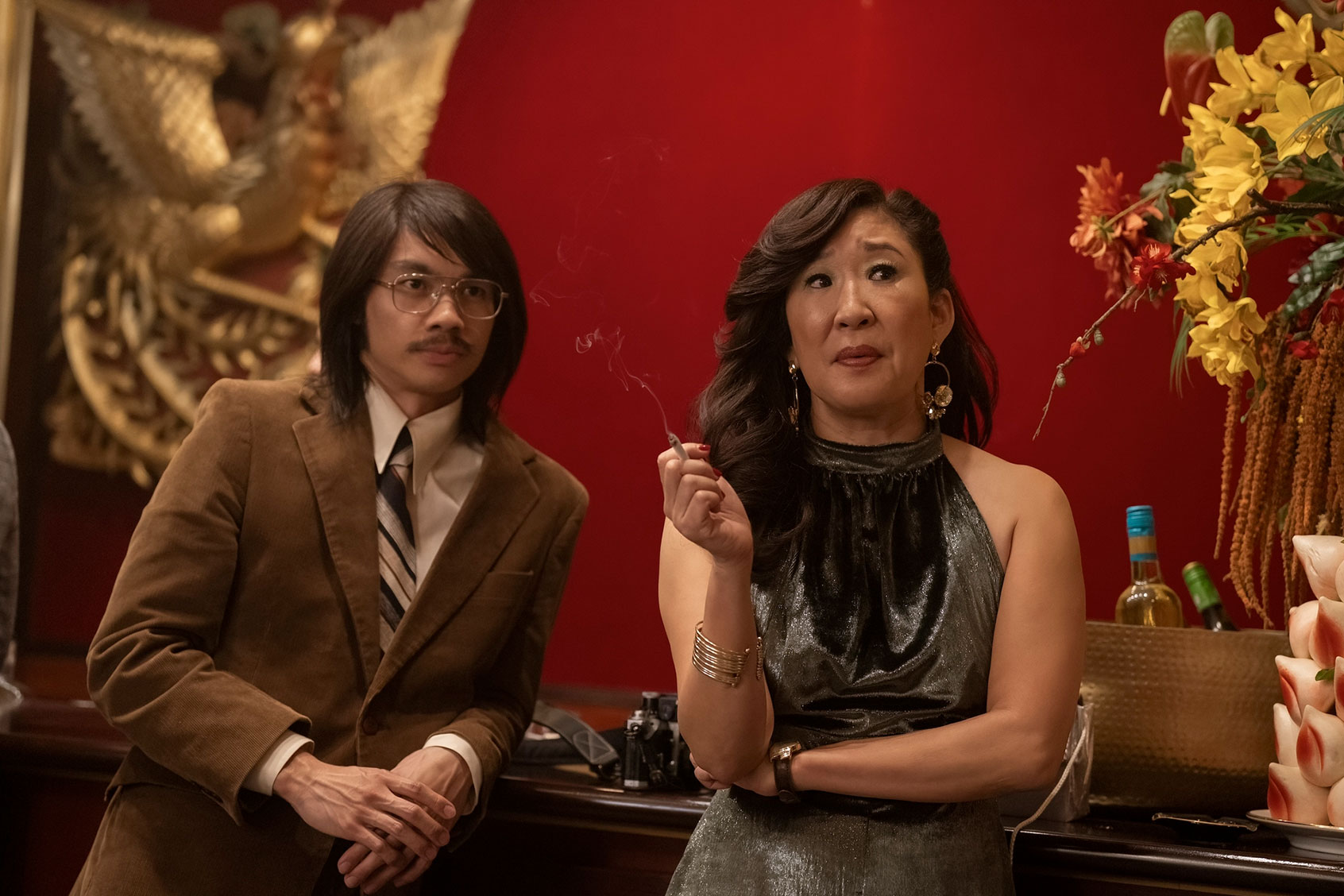
The SympathizerAlan Trong and Sandra Oh on "The Sympathizer" (Beth Dubber/HBO)Let’s talk costume, hair and makeup. I read that Sonny’s look was partially inspired by another journalist, Rolling Stone American rock journalist, Ben Fong-Torres, from the 1970s. How did Sonny’s appearance inform your performance? How much preparation and research went into Sonny’s look? 
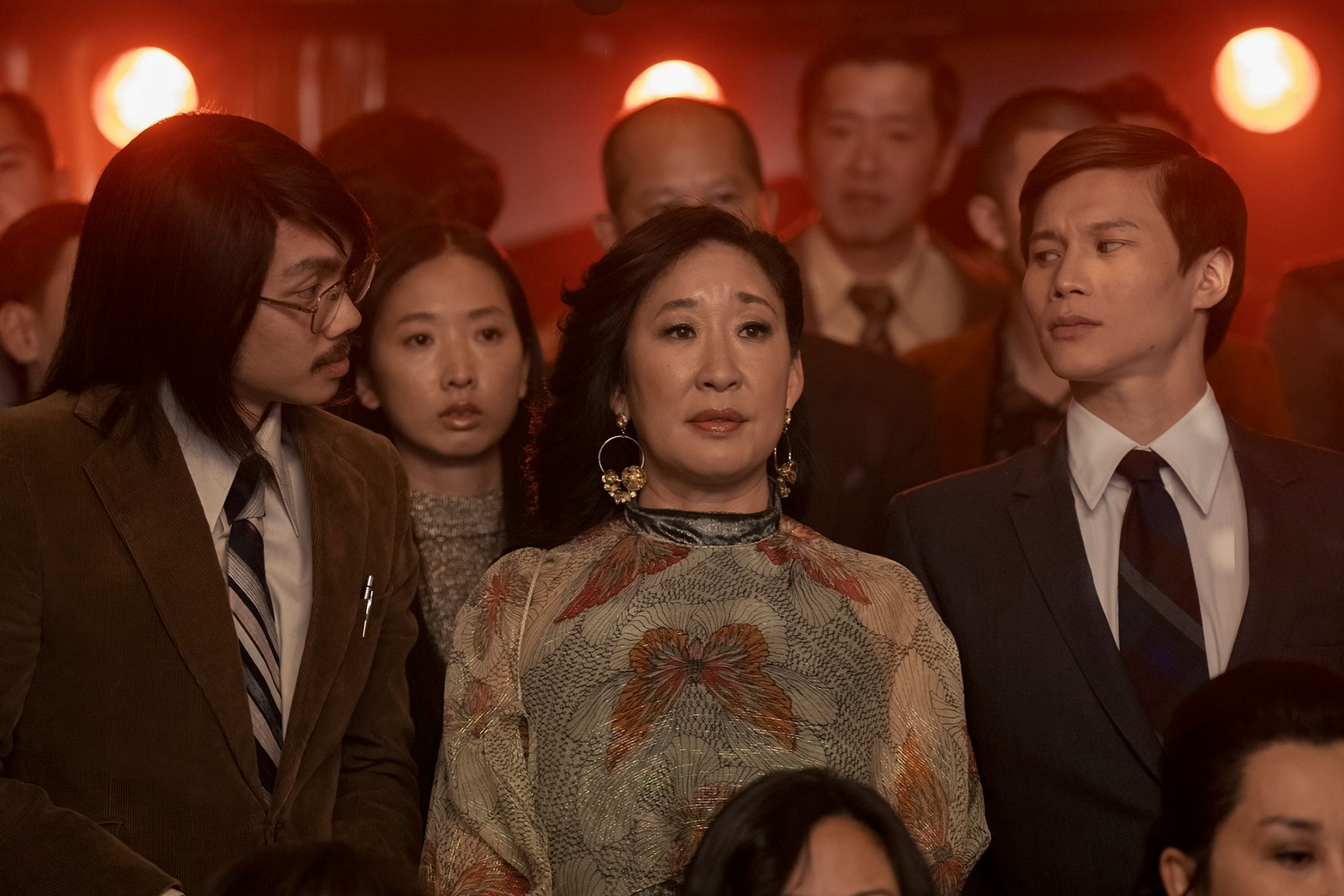
When I was doing “The Sympathizer,” I had a buzz cut. We were looking for a wig for a long time. I had sent photos of Ben Fong Torres. There’s a documentary that came out about him during the ‘70s era. What you see in the show is [Torres’] swoosh. And it's crazy because if you go back to the other documentary [I mentioned], that's the exact hairstyle that [Duong Trong] Lam had when he first came over through the American Field Society, which sponsored the students to study in America. There’s a photo of him in black and white. I was really geeked out. We didn't even plan that.

What do you think are Sonny’s primary character motivations as a journalist in the post-Vietnam War, post-1975 era? What did he feel was his responsibility? 

You see this in Episode 2. I was really nervous about being in Hoa’s face like that, but Director Park was like, '"Just trust me on this. Just go in with full conviction in what you're saying. Almost cross the line right away. Then that way you can mask any guilt you have of, maybe you didn't do enough to stop this war." Because the Captain went back during the war, and Sonny stayed in America. Sonny will never admit this, but later on in the story, he feels like a poser and like he's not doing enough. Those types of human beings, whether they're journalists or not, it's an interesting human study. It's like, why are you acting with so much gravitas? It's because there's probably something under that that you're trying to cover up. And that was really interesting for me to play with.

In the novel, Captain describes Sonny as a very radical leftist character. He has communist sympathies in the same way that Captain is a sympathizer for the refugees in America. So I was curious, in your opinion, what communist beliefs does Sonny believe in? Any beliefs he disagrees with? 

Can I read you something? This is kind of in that world. This isn't in “The Sympathizer,” but there was a quote from [Duong Trong] Lam that he had when he was getting a lot of criticism for being a communist where he goes, “If you think I'm a communist, then prove it.” Journalists love to stir things up like that. It's fun for them. That was very helpful for me to make this guy human. Lam was not only a journalist but he also ran the VYDC, the Vietnamese Youth Development Center, which helped refugees with legal jargon for the Department of Social Services. If you're doing something that specific, then that means you care about your people. And it doesn't have anything to do with politics necessarily. A lot of the criticism that Lam was getting there was: one, they thought he was too young. Two, they thought he was too liberal. And three, they thought he was too Americanized. These are things I can relate to on a personal level that's like, why don't you take me seriously? 

"When you look at journalists who have been assassinated, there are a lot of cases where there was never justice."

To be further honest with you, I never put myself in a headspace of “I'm a communist” when I was playing Sonny. I would focus on printing photos of children from that era and listening to Trinh Cong Son, the Bob Dylan of Vietnam. These are songs of poetry where he's painting a picture of mothers sweeping the front of their yard, and then next thing you know it's getting bombed and then she doesn't have a yard anymore. That's what was activating for me. 

Can you break down Sonny’s emotions leading up to that shocking scene in Episode 6 when he gets assassinated by the Captain? 

It’s so funny, my family was like, “So do you die in it? Are you gonna die?” Because I die in everything I’m in. I’d say fear. Guilt. Loss of connection with another person who is my age and looks like me. Unexpressed grief. Franticness. Frustration that we couldn’t communicate effectively. I remember shooting some stuff in Episode 5 where there were moments where Sonny’s obviously poking at the Captain. I look at the Captain and think, is there a world where we could be family or friends? Are we actually on the same page here? Because this war s**t is really lonely. Hoa’s a great scene partner. You see so much behind his eyes, saying, "Can we be together in this? Does it have to be like this?" A lot of unexpressed stuff. I think that the ripple effect on the Captain for the deaths of Sonny and the Crapulent Major is that these are things that he didn’t want to do. Guilt. I think the Captain in the second half of the book and show, he’s living through a state of perplexion and confusion because two ghosts keep on haunting him. 

The SympathizerAlan Trong, Sandra Oh and Hoa Xuande on "The Sympathizer" (Beth Dubber/HBO)Why do you think that the war in Vietnam became such a flashpoint at that time?
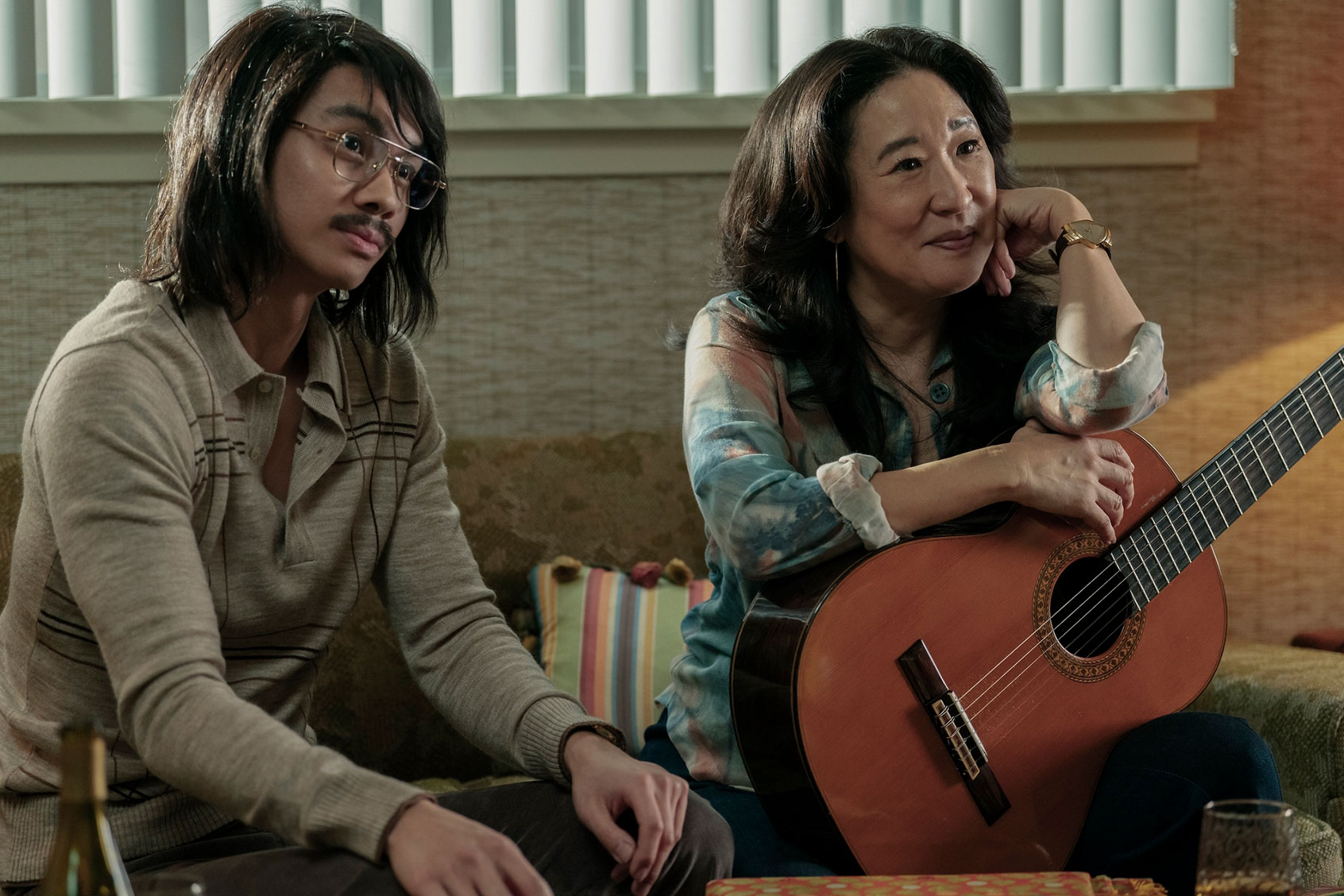
We’re living in such a different time with social media now, but back then, thanks to these brave journalists, there were physical representations of civilians being massacred, innocent families. That is the reason I think why it sparked. And as you see why it’s sparking so much right now because you see people who have nothing to do with politics, nothing to do with an agenda, a regime, anything, they’re just trying to find grains and rice for their kids. I think there was a statistic from a panel that Viet Thanh Nguyen did at either Harvard or Yale, where he said there were approximately 58,000 American soldiers who died in the Vietnam War. But there were 3 million Vietnamese that were massacred or didn't make it out. And then other additional millions in Laos and Cambodia, which many people don't even know about.

There’s a line in the play I’m in right now called "An Enemy of the People" that gets a rumble of laughter every night thanks to Amy Herzog, our playwright. Also, Henrik Ibsen. But the line is, "In America, we wouldn't have to worry about anything like this." And it gets a rumble of laughter every night. Sometimes I'll be backstage listening to that laughter before I enter the stage. And I'm like, wow, this is kind of heartbreaking in a way that thousands of people are able to relate and recognize this pain that in America, we feel completely lost in leadership and empathy and these things. And that's why the joke hits so hard. And that's like watching Episode 4 of “The Sympathizer,” there were so many moments where I would just be laughing so hard. But then after the laughter, I'd be like, "Damn, I feel kind of sad inside."

Do you think there are any similarities between the conflicts and motivations that Sonny navigated in the show with what’s currently going on right now with the student campus protests sweeping the nation? 

If anybody follows Viet Thanh Nguyen on any social media, you’ll see that he’s attending a lot of these protests. He used to do it when he was younger as well. Of course, there are parallels. Yeah, of course. Going back to the feeling of frustration that Sonny had, at a certain point, he’s not taking a clear political side. He’s just so frustrated with hearing about his people, kids and families that are being killed that have nothing to do with the war. That’s why people are protesting. There was this other thing I saw from my favorite poet Ocean Vuong. He was saying something along the lines of, "I can’t believe I’m living in a time where it’s a crazy idea to stop killing children. It’s like what are we living in right now?" This is not really a political thing. It’s like a human thing. At least what I’m talking about and what Sonny is talking about. But of course, there are parallels. 

In the play [I’m in], Petra who’s the daughter, sits down and goes, . . . something along the lines of, "I hate that I feel this way. I keep on having this thought that they deserve what comes to them." Dr. Stockman, who is played by Jeremy Strong, whose character has every human right to be cynical, to be like, you’re right. F**k those people. Yet he’s kneeling down and he goes, "We shouldn’t think like that. In a few years, I’m going to be gone. You’ll be gone. But your little brother will still be here and the truth will be told." The through line of the play is that we just have to imagine. It hits every night. Part of me has avoided looking at [the news], because I’m just so sensitive to it. Because this happened with Vietnam too. 

Do you think Sonny views the act of the protest and its ability to create change in a pessimistic or optimistic light? Or do you think maybe he started out viewing it one way and then by the time he died, he viewed it in another way? 

I don’t think anything is ever linear. With Sonny, I think it fluctuates. People will call him a poser and he feels like a poser himself. He feels like a complete fraud. I think a person like that has to have high feelings of pessimism. You can only feel that when you’re alone when you come home to your apartment. The moment you walk out, you act all, "I’m confident, I’m convicted in my power." That’s how I felt playing him. Let’s fake it til you become it, you know? Sonny loses hope over the course of the show whether he shows it or not. That’s why you see him getting frustrated with the Captain. Perhaps pessimism and cynicism are a byproduct of that frustration with the Captain. He looks at the Captain and he’s like, "You are somebody that can absolutely help this cause. And you’re choosing not to. Like the war is over. What the f**k are you doing? You know this is not right."

How does the character of Sonny reflect the legacy and impact of Vietnamese journalism, student journalism or even Vietnamese student journalism in the U.S.? Any combination of those.

That’s a great question that I don’t know if I have the answer to. When you look at journalists who have been assassinated, there are a lot of cases where there was never justice. I’m not an activist. I look and I observe the situation I see. This is a show with some parallels to that. I don’t know if it’s even my place to answer that, because I’m not family of these victims, because that’s what they are. I really hope that having Sonny’s character written as a character contributes to some way of showing that somebody tried, you know? I’m being super vague, but with the kind of things that we’re living through today. These students are trying. Whether there’s something that comes out of it or not, they’re trying to stop the war or bring attention to a specific region of a country, to stop military funding. That’s what Sonny was trying to do in the story. He’s a representation of the anti-war movement. 

The SympathizerAlan Trong and Sandra Oh on "The Sympathizer" (Hopper Stone/HBO)
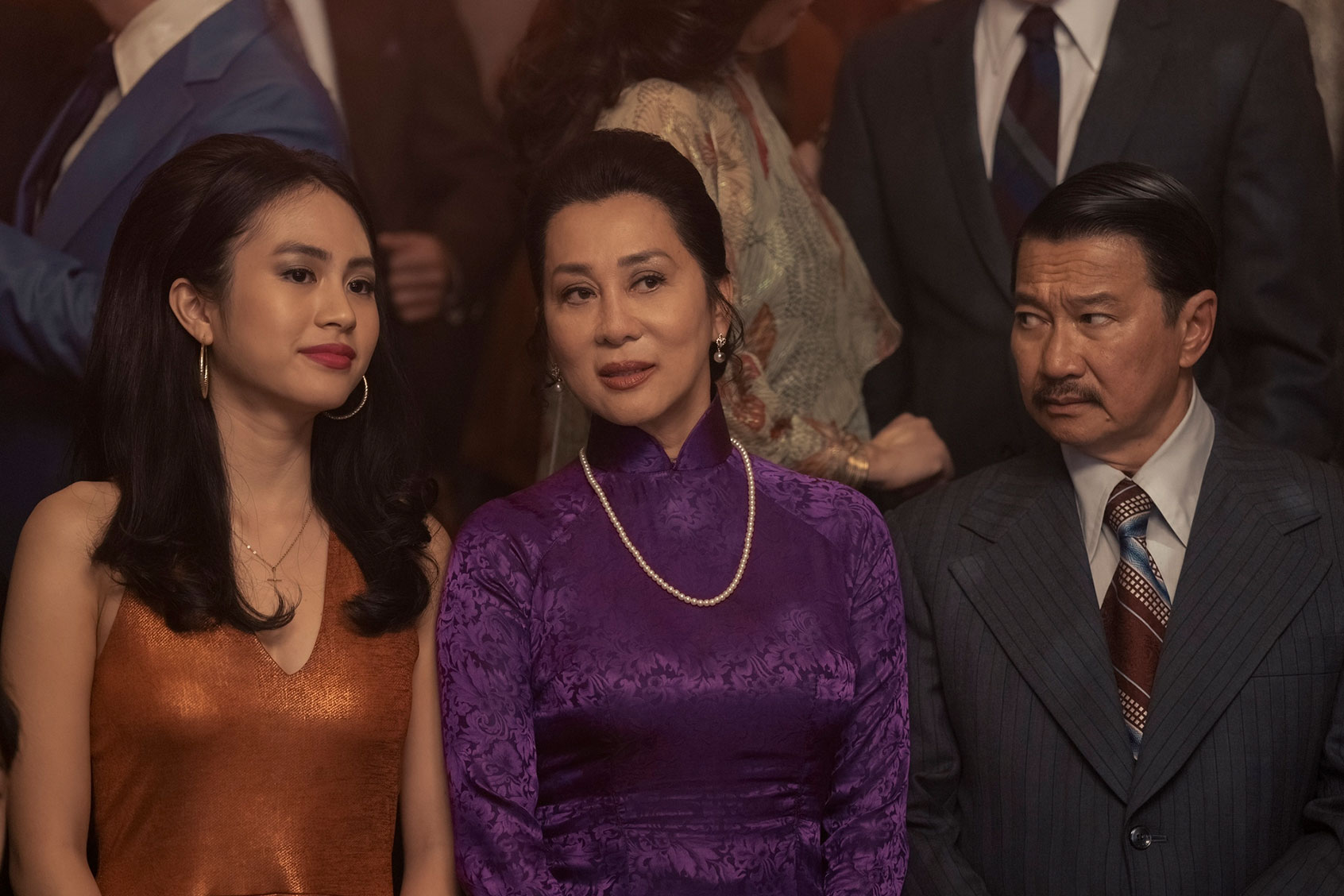
You’ve made it to “The Sympathizer” and you’re working with heavyweights like Sandra Oh, Robert Downey Jr. and Director Park Chan-wook. What was that like? 

It’s like a masterclass, honestly. I don’t really have scenes with Robert, but he’s just been a supporter. He and [his wife] Susan came to see [“An Enemy of the People”]. He and Jeremy Strong did a movie called “The Judge,” which I really recommend to anybody who hasn’t seen it. That movie is one of my favorites. But Robert’s been supportive of not just me, but everybody. He’s aware of what self-esteem is. Sometimes we as humans need a little boost. He’s like, "Hey, just want to remind you how dope you are." He has that understanding of human behavior that’s like a real leader.

Sandra is an effortless scene partner. I think all of us hope to evolve into someone like that, someone who is questioning everything openly in a non-combative way. Just a very, "I’m holding responsibility for my function in this story." The level of care that’s put into everything. It was dope to see an experienced, very seasoned Asian female actress who has so much power in her body and conviction in her creative choices.

Speaking of seasoned Asian American and Asian female actresses. Because I’m somebody who grew up watching “Paris by Night,” what was it like getting to work with Vietnamese legends Nguyen Cao Ky Duyen and Kieu Chinh? 

[Laughs] Ky Duyen must get this all the time from our generation. "Oh my god, we used to watch you at karaoke parties!" It’s just weird. It’s like, "Whoa! Aren’t you the emcee of that one show?" That’s crazy. Like my uncles were so lit off of Heineken, Cognac and f**king Macallan and there’s belligerent music blasting. This is Seattle for me, and I’m watching "PBN" on VHS tapes. It’s like, [to Ky Duyen], "That’s you, isn’t it?" [Laughs]. I didn’t really have any scenes with her, but we were together a lot. 

My Ba Ngoai was telling me about Kieu Chinh. I really had to catch up with Vietnamese cinema. And I finally watched "Journey from the Fall" (2006), which starred Kieu Chinh. Which is an amazing film. Oh my god. To be honest, I wasn’t too familiar with it. But as my Ba Ngoai was telling me, she’s like earlier generation. She did all those movies. I felt so honored to be working with them both. 

What was the dynamic like working with the other actors on “The Sympathizer”? Was it cool to get to work with a mostly Vietnamese cast?

Oh, I can’t stand them. I can’t stand them. [Smiles]. I mean, no, it’s hard to not get close, you know? You’re completely thrown into this thing that’s so nerve-wracking, joyful, fulfilling and stressful. You have to lean on each other. Vy [Le], who plays Lana, is from Nha Trang, but she went to a boarding art school in Boston. So her Vietnamese is on point. But I feel like the more she hangs out with us, her Vietnamese gets s**ttier and s**ttier. We have that broken, five-year-old Vietnamese, you know? Then there’s Fred [Nguyen Khan], who’s from Montreal. Hoa is from Australia. I’m born and raised in America. There are these three different diasporas. But at the same time, we have a shared sense of humor of not feeling like we belong. We traveled together in Thailand and we went to Vietnam afterwards. We spent a month there just to get away and eat and drink. And we went to these gay clubs in Saigon, which I had no idea even existed. Yo, Saigon is getting progressive. When I would travel with my dad to Vietnam, I was always told that this is what Vietnam is, but until I went on my own as an adult and experienced the country for myself, I was like, yo, this is actually not what my dad told me it was. 

Yeah, it’s because [our parents] left at a very specific time. I think Vietnamese Americans, who don’t visit the motherland often, or who just get their information from their parents, get information that is stuck in time. We’re told Vietnam is conservative, that it’s very homogenous. But when you start to craft your own relationship to Vietnam as an adult, outside of your family, you realize that Vietnam is very diverse. They’re actually much more open-minded than you think they are. And it’s because they’re humans and not just quote-unquote Vietnamese people that we’ve been told growing up. I’m really glad that you and the cast got to experience that after the shoot.

That was so beautifully said. I’m definitely a Saigonese kind of guy. 

The SympathizerVy Le, Ky Duyen and Toan Le on "The Sympathizer" (Beth Dubber/HBO)You’re in a play on Broadway right now called "The Enemy of the People.” Congratulations. What has that experience been like for you? What’s it like working with Jeremy Strong?
It’s the best acting job I’ve ever had in my life. 1,000%. There’s no contest. I’ve never done theater, like a real play. I did a small musical as a background character and some stuff in community college. But I’ve never done a real drama play on stage. It’s so fulfilling. I have so much gratitude for even being able to be a part of something like this. Because it’s like I kind of feel like I’m relearning how to act. It’s like free education. 

Jeremy Strong is . . . there’s a reason why he’s nominated for a Tony. He’s different every night. He cares a lot about what he’s doing. I share similar sentiments of feeling that the space is sacred and somehow almost being drawn to this dangerous element of theater. There are moments when we think, why did we sign up? Like this is crazy. There are nights when the nerves start kicking in because of certain circumstances. But then we enter the stage anyway, and it’s a lot smoother than I thought it was going to be. 


Want a daily wrap-up of all the news and commentary Salon has to offer? Subscribe to our morning newsletter, Crash Course.


Your character Sonny in “The Sympathizer” has a calling when it comes to his profession. Do you feel similarly, that you have a particular purpose as an actor?

Yeah, 1,000%. I have a little brother. I feel like not only him but there's a lot of younger Vietnamese kids who may or may not have access to a role model. Now we're talking about representation and all these cliché things, but it's important to me. Because when I was growing up, I never felt sexy. I never felt like I was allowed to cry, that I was allowed to be scared of something, that I was allowed to be self-righteous about something, that I was allowed to be petty if I wanted to be petty. It's a very common thing in our culture, you know? I remember what it was like to want to date a white girl because that was what made me feel powerful. This sounds kind of self-important, but at times it does feel like, “Well s**t, I'm lucky enough to get this far.” I would like to keep on being selective about what I do and being curious and checking in on my humanity so that my little brother or somebody that is under 10 years old can see me. If I would have known that I could be more than enough through watching movies, it would have saved me at least a lot of pain and self-doubt as I was coming into adulthood.

"The Sympathizer" airs Sunday nights on HBO and streams on Max.

“Self-help”: Michael Cohen argues he was owed the money he “stole” from the Trump Organization

Donald Trump's defense team on Monday sought to paint star witness Michael Cohen as not just a liar but a thief, nothing that the former president's ex-fixer pocketed some of the money that he was supposed to pay a third-party vendor.

Earlier in Trump's hush money trial, prosecutors introduced evidence showing that Cohen was paid $50,000 by then-Trump Organization Chief Financial Officer Allen Weisselberg for the stated purpose of reimbursing RedFinch, an IT company that had helped the 2016 Trump campaign game online polls. Cohen previously testified that Trump had balked at paying the company, forcing him to do it himself. Cohen was provided the money to do so alongside money that prosecutors say was reimbursement for a $130,000 hush payment to Stormy Daniels.

On Monday, Trump attorney Todd Blanche returned to that testimony, zeroing in on Cohen's admission that he took some of the money set aside for RedFinch and pocketed it himself. The firm ultimately accepted a payment of just $20,000, with Cohen pocketing the difference.

"So you stole from the Trump Organization?” Blanche asked. “Yes, sir,” Cohen replied.

Throughout the trial, Blanche had sought to tar Cohen as a spiteful man trying to profiteer from his criticism of Trump, without much success, while Cohen overperformed expectations as he testified that Trump was intimately involved in the scheme to cover up his payment to an adult film star, Daniels, who alleges she had a sexual encounter with the Republican candidate.

Following Blanche's cross examination, prosecutors asked Cohen to once again address the RedFinch situation. He explained that he felt he was owed money from the Trump Organization, which had slashed his bonus.

"I was angered because of the reduction in the bonus, and so I just felt it was almost like self-help," said Cohen. "I wasn’t going to let [Trump] have the benefit [of] this way as well. I wasn’t going to correct the conversation I was having with Allen about it. I had not only protected him to the best that I could, but I had also laid out money to Red Finch a year and a half earlier and again $130,000 to have my bonus cut by two-thirds was very upsetting to say the least."

When asked by prosecuting attorney Susan Hoffinger whether or not he thought it was wrong, Cohen said that he thought it was.

John Oliver takes on Donald Trump and the “long history” of politicians being “weird around corn”

Comedian John Oliver took a shot at Donald Trump's intelligence Sunday night during a "Last Week Tonight" episode on the corn industry and the politicians who cater to it.

At the start of the segment, Oliver explained that the U.S. has a record of politicians pandering to voters in corn-farming regions. The show flashed photos of former President Barack Obama, Sen. Mitt Romney and former President George W. Bush with corn on the campaign trail.

"There's a long history of American politicians being weird around corn," Oliver said. However, Oliver noted, "No one has been weirder when discussing it than this …"

"I just met non-liquid gold, you know where it was? Iowa! It’s called corn,” Trump said in a speech in New Hampshire in January. “You have more non-liquid gold. They said, ‘What is that?’ I said, ‘Corn!’ They said, ‘We love that idea.'”

Trump continued, “That’s a nickname in its own way, but we came up with a new word for … a new couple of words for corn!”

Oliver joked at Trump's confusing statements: “Did you though? Because non-liquid gold isn’t so much a way of describing corn as it is a way of describing regular gold.”

The host delivered another jab at the former president, “That’s a level of non-innovation innovation that we haven’t seen since Lyft invented something called Lyft Shuttle, which was — and this is true — the bus!”

However, Oliver did agree with Trump that America is the “largest producer, consumer, and exporter of non-liquid not-gold in the world.”

The nearly $90 billion industry services Americans in different ways. The host highlighted that about 15% of U.S. domestic corn use is for food, seeds and industrial use; 40% for animal food; and the last 45% for ethanol.

"As it turns out, corn's utter dominance of American agriculture comes at the expense of our environment, our health and some of our farming communities," Oliver pointed out.

Oliver noted that the government has ultimately forced small farmers into producing corn even if they are not making profits off of production. "In the world of agricultural products, corn is the questionable superstar. Beans wanna be it. Oats wanna f**k it."

He continued: "As the corn industry has ballooned, some of the biggest beneficiaries haven't actually been the farmers themselves but enormous corporations."

Oliver pointed out that while production by corporations has been supersized, the methods used to capitalize on its growth are detrimental to the environment. These methods can result in chemicals like nitrates infiltrating drinking water and depriving kids of oxygen in a disease called blue baby syndrome.

"No child should ever turn blue unless they disobeyed Mr. Wonka's clear instructions about not trying the chewing gum and now only suffering the only slightly disproportionate consequences," Oliver joked.

Eventually such fertilizer chemicals find their way into the ocean, resulting in pollution dead zones in places like the Gulf of Mexico, Oliver noted. At the same time, corn is now used for fuel, in the form of ethanol added to gasoline, part of a stated effort to wean the U.S. of its dependence on foreign oil

"There are lots of negatives when it comes to ethanol, mainly because the positives have been so widely overstated," Oliver said.

We need your help to stay independent

"While ethanol lobby groups have long argued it slashes greenhouse emissions," Oliver continued, "one recent study found that thanks to fertilizer and land use needed to grow the corn for it, corn ethanol produced under the Renewable Fuel Standard has a carbon footprint at least 24% higher than regular gasoline."

The comedian finished the episode by saying he thinks it is "long past time we shift our farming policy when it comes to America's number one crop."

"Maybe the best way to drive this home is to explain it in the way people seem to most being educated about corn, and that is watching someone get absolutely assaulted by it," Oliver said while walking into a corn maze. 

Last Week Tonight with John Oliver airs on Sundays at 11 p.m. ET on Max.


Elise Stefanik tells right-wing Israelis that Trump will ship them all the weapons they need

Rep. Elise Stefanik, a rising GOP leader and staunch Trump ally who has used her platform to conflate pro-Palestine activism with antisemitism and called for harsh crackdowns against protesters, declared before a group of Israeli lawmakers that America, and particularly Donald Trump, "is firmly behind Israel and the Jewish people."

"When the enemy is inside the gates of the United Nations, America must be the one to call it by its name and destroy it," Stefanik continued, referring to calls for recognizing Palestinian statehood at the United Nations. "President Trump understood that, and b’ezrat hashem, we will return to that strategy soon."

Stefanik spoke at the Knesset, Israel's unicameral legislature, at the invitation of Speaker Amir Ohana, a member of Prime Minister Benjamin Netanyahu's ruling coalition. Although she described her own remarks as a "historic address," Stefanik's audience was limited to members of the Knesset Caucus for Jewish and Pro-Israel Students on Campuses Around the World rather than to the entire Knesset.

Despite speaking on foreign soil, Stefanik condemned President Joe Biden for wavering on unconditional military aid to Israel, halting a shipment of bombs that could be used on Rafah even as his administration moves forward with other weapons shipments.

"There is no excuse for an American president to block aid to Israel  aid that was duly passed by the Congress," she said. The only justifiable approach, she continued, is to "crush" antisemitism and supply "the State of Israel with what it needs, when it needs it, without conditions, to achieve total victory in the face of evil."

Though she has sidestepped questions about the Trump's VP sweepstakes, Stefanik's public reverence for the former president, frequent pilgrimages to Mar-a-Lago and potential electoral appeal have prompted speculation about her political future. Some observers, including Fox News host Shannon Bream, have suggested that her speech in Israel, inflected with Trump praise, was part of an audition to be his running mate.

Israel “intentionally causing death” among Gaza civilians, Hamas guilty of war crimes, ICC says

After an "independent and impartial" investigation by his office, International Criminal Court (ICC) Prosecutor Karim A.A. Khan filed arrest warrant applications for three Hamas leaders, Israeli Prime Minister Benjamin Netanyahu, and Israeli Minister of Defense Yoav Gallant, charging them with war crimes and crimes against humanity.

Khan said that the Hamas leaders Yahya Sinwar, Mohammed Diab Ibrahim Al-Masri (Deif), and Ismail Haniyeh bear primary responsibility for the October 7 attacks that killed more than 1,200 Israelis and resulted in some 250 hostages being taken to Gaza. As for Israel, Khan said Netanyahu and Gallant have prosecuted a war in Gaza that has, by willful design, killed more than 35,000 Palestinians and put millions more at risk of starvation.

"Notwithstanding any military goals they may have, the means Israel chose to achieve them in Gaza  namely, intentionally causing death, starvation, great suffering, and serious injury to body or health of the civilian population  are criminal," Khan said in a statement announcing the warrants.

ICC action on this issue has been anticipated for several months, as the death toll from Israel's military offensive rises and the fate of the hostages still held in Gaza remains uncertain. Both the Israeli government and opposition parties predictably voiced disdain for a warrant that they say should not equalize the two belligerents' violations. "Drawing parallels between the leaders of a democratic country determined to defend itself from despicable terror to leaders of a bloodthirsty terror organization [sic] is a deep distortion of justice and blatant moral bankruptcy," said Israeli war cabinet member and Netanyahu rival Benny Gantz.

In a mirror image of the Israeli reaction, Palestine Liberation Organization (PLO) official Wasel Abu Yousself called the dual warrants a "confusion between the victim and the executioner."

The application filing is one of many steps required to issue the actual warrants. A pre-trial panel of three judges, who take an average of two months to consider the evidence, will decide whether or not the proceedings will move forward. While Israel is not a member of the ICC and is highly unlikely to comply with any prosecution of its leaders, the announcement by Khan is yet another signal of Israel's deepening isolation on the world stage.

Will Trump testify? Legal experts say he probably shouldn’t because jurors “may simply not like him”

Donald Trump loathes the gag order that has been imposed on him, complaining about it and the "kangaroo court" responsible for imposing it just about ever time he enters or exits the Manhattan court where he's on trial, accused of falsifying business records to cover up an election-eve hush payment to a porn star. He's already violated the order at least 10 times, forcing the former president to lean on a crop of Republican "surrogates" to make all the attacks — on witnesses, the jury, the legal system — that he would like to make himself, were he not threatened with jail.

But with the prosecution expected to rest its case this week, Trump now has an opportunity to spell out, in his own words, in a setting where he's totally allowed to do so, why the witnesses against him are liars, why the whole trial is a "sham" and why he shouldn't be convicted of the 34 felony charges against him: He himself could take the stand.

In March, Trump boasted that he would do so, saying he had "no problem testifying" because he "didn't do anything wrong."

A lot has changed since then, however. For one, the trial is underway; when he pledged to testify, Trump was speaking at a time when his lawyers were still trying to delay the case. And two, with the defense only needing to sow doubt in the minds of one person to get a hung jury, attorneys Todd Blanche, Emil Bove and Susan Necheles — having scored some hits on the credibility of star witness and former Trump fixer Michael Cohen — are not likely to be encouraging their client to take a risk that most defendants would reject.

"We don't yet know if Trump is going to testify," noted former U.S. attorney Joyce Vance. "The smart money says no."

Trump's allies are already spinning as if he won't.

Speaking to Politico, Rep. Mike Bost, R-Ill, argued that Trump would have "plenty of time" after the trial to say his piece. "Anybody testifying for their own sake, it doesn't play out well," he argued.

"I don't think he really needs to," added Rep. Nicole Malliotakis, R-N.Y..

We need your help to stay independent

Sarah Krissoff, a former federal prosecutor, said testifying would afford Trump the opportunity to tell his own side of the story, in his own words. The problem, she told the outlet, is that Trump's version of events would of course be subject to cross examination; the crowd in Manhattan will also not be anything like the crowd for a MAGA rally in South Jersey.

“Trump has so much baggage here — his own story about these events has shifted over time, so he will be painted as a liar by the prosecution,” Krissoff said. “It will be very hard for him to maintain a calm and cool demeanor, and the jury may simply not like him.”

MSNBC legal analyst Katie Phang, in a column published Monday, noted that Trump not taking the stand would be a case of the former president backing down. "I'm testifying," he declared just last month. "I tell the truth."

But testifying, and telling his version of the truth, has backfired before. In his civil fraud trial, he grew so angry on the stand that the judge had to instruct Trump's lawyer to "control your client." He then lost the case and was fined $454 billion.

Trump, Phang noted, is under no obligation to testify. She would advise him not to (and most defense lawyers would advise most defendants to do the same). But the former president, the first to ever be put on criminal trial, is not a normal client.

"Trump is 100% in the driver’s seat on the decision whether or not to testify in his own defense," Phang wrote. "No one can force him to testify; the decision is not his lawyers’ to make."

Trump learns the truth about RFK Jr. the hard way

For many months former president Donald Trump's henchmen pushed the candidacy of Robert F. Kennedy Jr. as an agent of chaos and a boon to Trump's latest bid for the presidency. Salon's Amanda Marcotte presciently called out their strategy in a piece last May titled "Of course Steve Bannon and Alex Jones love RFK Jr. — he's a great weapon for their war on reality." At that time Kennedy was running in the Democratic primary and it was easy to dismiss the right-wing "support" from the likes of Bannon and Jones as well as from former Trump admirer and QANON adherent Michael Flynn, Turning Point USA's Charlie Kirk and Trump henchman Roger Stone as partisan mischief. But it was more than that.

They touted Kennedy as a perfect Trump running mate; a "dream ticket" ostensibly to attract low information, liberal anti-vaxxers and environmentalists to the GOP. Bannon worked this idea hard, suggesting that a Trump-Kennedy ticket would win in a landslide. In one of his podcasts last spring he told his audience that when MAGA crowds heard him say that Kennedy would be an excellent choice for Trump's running mate, he would get a standing ovation. (Kennedy denies that they ever spoke about it.)

Unfortunately for the Trumpers, their tactics appear to have backfired. 

In the beginning, Trump was very complimentary, calling Kennedy a "very smart guy, and a good guy. He’s a common-sense guy, and so am I. So, whether you’re conservative or liberal, common sense is common sense.” Florida Gov. Ron DeSantis, while he was still in the primary, said that he would appoint the conspiracy theorist, anti-vaxxer to run the Food and Drug Administration (FDA) or the Centers for Disease Control (CDC). Even Tucker Carlson declared that Kennedy was not an extremist, extolling his character as "deeply insightful and above all honest." House Republicans called him to Capitol Hill to testify about censorship (because Twitter had banned him for spewing dangerous vaccine disinformation.) They all just loved the guy. 

When Kennedy dropped out of the Democratic primary to run as an independent, many political pundits assumed that it was yet another disaster for the Biden campaign. Kennedy had been garnering around 15 to 20 percent in the primary polls and the glittering Kennedy name was considered a massive draw among Democratic voters. If he could hold that 15 percent in a general election, Trump could win. So maybe that bizarre Trump-Kennedy ticket wasn't going to happen but Bannon looked like a hero in that moment for drawing Kennedy into the race anyway. 

It would be poetic justice if Steve Bannon putting an anti-vax conspiracy theorist into the mix proved to be Trump's undoing.

But then a funny thing happened. Right after he announced his independent bid, NPR/PBS NewsHour/Marist conducted a poll that found Biden beating Trump by 49 to 46%, but when Kennedy entered the mix, Biden's lead over Trump jumped to 7 points (Biden lost 5 points, but Trump lost 10). It turns out that the "common sense guy" who pushes a raft of conspiracy theories is more appealing to the right than the left. Who could have guessed? 

In case you're wondering, here's a very small sample of his cracked beliefs. In addition to his decades-long disinformation campaign against vaccines, Kennedy has also claimed that antidepressants cause mass shootings and that the Russian invasion of Ukraine was a CIA operation. He promises to seal the U.S.-Mexico border permanently and thinks that kids are swimming through a soup of toxic chemicals that cause them to become transgender. He thinks 5G cell towers are going to control our behavior and Bill Gates wants to genetically modify humanity. That's just for starters. It stands to reason that he would be popular among Republicans. They "do their own research" too. 

That polling has not changed in the intervening months. A recent NBC poll showed that Trump leads Biden by two points but with Kennedy in the race, Biden leads by the same number. Trump's favorite pollster, John McLaughlin, showed an even more alarming result among Independents. In the head-to-head, they preferred Biden by 4 points. But with Kennedy on the ballot, it's Biden 29 percent, Kennedy 23 percent and Trump at 22 percent. All of this explains why Donald Trump has suddenly gone on the offensive against Kennedy in a big way. 

We need your help to stay independent

Trump first tried to spin this on a Truth Social video by saying that Kennedy has “got some nice things about him” and “I happen to like him," but he's really "more in line with Democrats" and he believes that he "will do very well" and take a lot of votes from Biden. He offered that if he were a Democrat he would vote for him. That's what passes for subtlety from Donald Trump.

But those numbers must be getting worse because now he's taken off the gloves and poor junior isn't a nice guy after all.

In one of his most "up-is-down" rants ever, Trump filmed another Truth Social video claiming that RFK Jr. is a "Democratic plant" and a "Radical Left Liberal who’s been put in place in order to help Crooked Joe Biden, the Worst President in the History of the United States, get Re-Elected." As we've seen, if he's a plant he's a Republican plant, coaxed into the race by Steve Bannon and Roger Stone. And Trump actually had the audacity to issue one of the most ridiculous whoppers ever: He said that Kennedy isn't a real anti-vaxxer:

You think he’s an anti-vaxxer, he’s not really an anti-vaxxer. That’s only his political moment. He said the other night he’s okay with a vaccine. RFK’s views on vaccines are fake, as is everything else about his candidacy.


Want a daily wrap-up of all the news and commentary Salon has to offer? Subscribe to our morning newsletter, Crash Course.


Say what you will about RFK Jr, but he is the nation's foremost anti-vaxxer and has been for many years. If that's your jam, he's the real deal. Trump, on the other hand, is the guy who is yearning to take credit for the COVID vaccines but he can't because he gets booed by his cult followers. He's the fake anti-vaxxer. 

Trump sounded uncharacteristically desperate at the NRA convention on Saturday slamming Kennedy again, saying that he calls the NRA a terrorist group and comparing him to a fly that was driving him crazy. 

There's no way of knowing if Kennedy will get on the ballot in all the swing states or if people will actually vote for him or one of the other third party candidates in November. It would be better not to have them running when the stakes are so high. But it would be poetic justice if Steve Bannon putting an anti-vax conspiracy theorist into the mix proved to be Trump's undoing. Live by the rat-f***k, die by the rat-f***k. 

In “integral ecology,” science and religion find middle ground on climate and politics

Massachusetts Gov. Maura Healey is an openly partnered lesbian with a track record of advancing LGBTQ+ protections in health and labor policies. She’s an unflinching defender of abortion and reproductive rights in her state. And she’s a science-driven leader using every executive-office tool at her disposal to advance an all-of-government approach to tackling climate change.

By most accounts, she's the last person you’d expect to see deliver a keynote address at the Vatican on the invitation of the Pope. But, to the chagrin of conservatives in her state this week, Healey — herself, a Catholic — did just that.

And her attendance of Pope Francis’ three-day climate change summit, along with governors of New York and California, should give pause to the science-minded among us. We, who too often mistake the data for the story when charting the slow-rolling havoc of climate change, are now forced to reckon with new evidence of possible hope. Even if only for a moment. And we shouldn’t turn away from that possibility. 

At the summit, Healey advanced an ambitious agenda to build a resilient state economy with skilled labor in climate-tech which, as NBC Boston reports, would demand “30,000 new workers who can install heat pumps, prepare residential homes to charge electric vehicles, build offshore wind farms, and more.” 

Catholic or not, Healey told the Holy See that she doesn't "need to cite the Book of Genesis to say that a flood can send a message."

"We have to be nimbler and more innovative than ever before, to adapt to urgent new realities. We need to be more evidence-based than ever before, to inform all our policies with climate science,” she said. “We have to be more collaborative than ever before, to work across every function of government and every sector of the economy. We need to align all our efforts around our climate goals.”

"Science and religion, with their distinctive approaches to understanding reality, can enter into an intense dialogue fruitful for both"

She drove home her sentiment with a bit of diplomatic charm, offering His Holiness a Red Sox ballcap, and an inscribed copy of “Walden” by Massachusetts native Henry David Thoreau. The gesture returned, Healey was sent back to Boston with a rare gift which she says she'll give to her mother — a rosary blessed by Pope Francis himself. 

https://x.com/MassGovernor/status/1790500632584994926

As shocking as some conservatives may find her papal invite, progressives may be more shocked that her call for urgent collaboration is nearly identical to Francis’ own pleas the past decade. 

May 24 marks the ninth anniversary of his Laudito Sí (Praise Be to You), an encyclical letter on what he calls “integral ecology” — a holistic and collaborative call to action on climate change from every corner of science and faith. The letter is a bold about-face, rounding sharply on the Church’s past timidity toward environmentalism, dealing out rebukes of corporate and political greed, and of techno-capitalism built on the backs of the poorest.


Want more health and science stories in your inbox? Subscribe to Salon's weekly newsletter Lab Notes.


"Never have we so hurt and mistreated our common home as we have in the last two hundred years,” he writes, just before offering his olive branch to science. 

"I am well aware that in the areas of politics and philosophy there are those who firmly reject the idea of a Creator, or consider it irrelevant, and consequently dismiss as irrational the rich contribution which religions can make towards an integral ecology and the full development of humanity,” he offers. 

"How can a little conference be enough evidence to rationally justify hope for the logical among us?"

“Nonetheless, science and religion, with their distinctive approaches to understanding reality, can enter into an intense dialogue fruitful for both … If we are truly concerned to develop an ecology capable of remedying the damage we have done, no branch of the sciences and no form of wisdom can be left out, and that includes religion and the language particular to it."

It’s consistent with his 2013 encyclical:

"The gaze of science thus benefits from faith: faith encourages the scientist to remain constantly open to reality in all its inexhaustible richness. Faith awakens the critical sense by preventing research from being satisfied with its own formulae and helps it to realize that nature is always greater,” he wrote in 2013. 

In that much, he wasn’t wrong. And the 2015 encyclical offers rejoinder:

“The respect owed by faith to reason calls for close attention to what the biological sciences, through research uninfluenced by economic interests, can teach us about biological structures, their possibilities and their mutations," he writes. "The majority of people living on our planet profess to be believers. This should spur religions to dialogue among themselves for the sake of protecting nature.” 

One summit is hardly enough to persuade most of us to hopefulness, of course. Environmental despair grows proportional in this country to the number of oil lobbyists checks pocketed by elected officials and the defanging of regulatory watchdog agencies — all of which has been outpaced only by the length of extinction lists and the speed of melting of glaciers. 

We need your help to stay independent

The 21st-century American Dream of an automated, laborless society — where medicine and food manifest via quantum-mysticism with endless scientific advancement — has begun to peel at the edges. And all of us seem to sleep a bit worse these days with that nightmare world peeking out from beneath the chrome-polished veneer of our laptops. Our artificially intelligent angels are not housed in heavenly clouds but in data centers siphoning the same old fossil fuels. 

Overwhelmed, it can feel like the only thing left to do is surrender, disassociate into a mindless scroll until we sleep. In all this, how can a little conference be enough evidence to rationally justify hope for the logical among us?  

Here’s how: Faced with even the most microscopic parcel of evidence that human good yet may be possible within this world’s immeasurable scope of shifting variables, a scientist’s right to despair becomes more costly a purchase on their ethical duty than can be afforded by logic alone. And one needn’t cite Matthew to know just how quickly the tables can turn.

An earlier version of this article originally appeared in Salon's Lab Notes, a weekly newsletter from our Science & Health team. 

The Gaza encampments and history: Is this the “right” kind of protest?

Students opposed to Israel's war in Gaza have spent nearly a month escalating their protests on college campuses across the country, frequently erecting encampments on their university greens, occupying buildings and even demonstrating on their graduation stages.

Colleges caught in the throes of the wave of encampments, largely sparked by the one at Columbia University that drew national media attention and an aggressive police response, have offered varied responses. These have included barring students from campus and applying university sanctions to summoning local police to quash the demonstrations, resulting in nearly 3,000 arrests at 60 or so campuses, according to The Associated Press.

Some universities have instead reached agreements with students, avoiding the massive controversy caused by Columbia president Minouche Shafik, who called upon New York City police to clear encampments twice last month, resulting in student injuries, more than 100 arrests and a rebuke from Columbia's faculty. Some other institutions have simply allowed the encampments to continue without much incident.  

Support for the students among the general public appears to be slim, even as Americans’ overall support for Israel’s actions in Gaza continues to diminish. Opposition to campus protests appears to span the political spectrum, with nearly 50 percent of respondents to an early May YouGov poll strongly or somewhat opposing them. 

“We are not doing this for praise or because we want people to agree," said Ember McCoy, a graduate student at the University of Michigan in Ann Arbor, in an interview with Salon. "It's more just trying to get the visual out there. We are very aware that in the moment, the favor might not be on our side. That doesn't mean that we're not doing the right thing.”

The wide range of institutional responses and dissenting opinions about the method and significance of this wave of protests and their methods have dominated the discourse such as to frame a larger question: What is the right way to protest on an issue one feels passionate about? 

"If you want to answer that question, you first need to be sure that you understand the goals of the protest," said Angus Johnston, a professor and historian of student activism at Hostos Community College in New York. "You need to understand what the protesters are trying to achieve, and what their theory of how to achieve that is.” 

*  *  *

More than 34,500 Palestinians have been killed in Gaza since the start of Israel's offensive, according to the Gaza Health Ministry (which is affiliated with Hamas but largely regarded as reliable by international observers). Israel's attack came in response to the Hamas attack last Oct. 7, in which about 1,200 Israelis were killed and more than 200 were seized as hostages. 

Campus demonstrations began last fall, with students largely demanding that their colleges and universities call for a permanent ceasefire. Many activists warned that Israel's operation could amount to a genocide. Now, the rising Palestinian death toll and worsening humanitarian crisis in Gaza leads many to declare that it has become one. 

After eight months of war, as the Israeli Defense Forces invade the southern Gaza city of Rafah, students have rallied behind an additional demand: divestment from companies that they believe profit from Israel’s invasion of Gaza and its occupation of the West Bank. 

Other demands vary by institution but have included calls for universities to institute greater transparency around the school’s investment portfolio, to cut ties with Israeli colleges and to end alleged land grabs in neighborhoods adjacent to college campuses. Many students see the latter issue as part of a broader neocolonial project. 

If passing referendums and other procedural actions weren’t enough to convince university leaders, then student campers were “willing to risk everything to stay here until the university we attend is no longer profiting off the genocide,” in the words of a Columbia graduate student who wished to be identified only as Jared. That was the “visual, guttural” message Columbia protesters wanted to send, he continued. (Jared said members of his family had received threats over his previous remarks quoted by the media.) 

Student campers were “willing to risk everything to stay here until the university we attend is no longer profiting off the genocide,” in the words of a Columbia graduate student.

Many Republican elected officials have latched onto the unrest, safety concerns and perceived antisemitism on many campuses to characterize the protests as a reflection of higher education's "woke" indoctrination of students. Many Democrats have also deplored perceived antisemitism, admonished the demonstrators as overly disruptive and bemoaned the threat they may pose to Joe Biden's prospects of re-election. 

Widespread criticism of the protest movement as antisemitic has become a painful and divisive issue, as Salon recently reported. This concern is rooted partly in undisputed but isolated instances of hate speech, in the fears of Jewish students who say they’ve been targeted on campus since October and in the longstanding debate over whether anti-Zionism — that is, opposition to Israel's identity as a Jewish state — constitutes de facto antisemitism. 

Pro-Palestinian protesters have frequently derided Zionism and accused Israel of being an apartheid state that systematically oppresses and marginalizes Palestinians, often driving them from established villages in the West Bank to expand Jewish settlement. For many protesters, a "one-state solution" to the Israeli-Palestinian conflict is the only fair remedy. 

Controversial chants like “globalize the intifada” and “From the river to the sea,” which have ambiguous connotations — to some, simply a call for Palestinian resistance, but to others a call for genocide against Jews — have become rallying cries at numerous demonstrations. 

Mikael Rochman, a Jewish rising senior at Columbia and IDF reserve soldier, told Salon it seemed “pretty clear" that the protesters' agenda was "using the suffering of Palestinians, which is genuine, to attack Israel." He added, “If people actually cared about Palestinians, they need to also care about Israelis. They need to push us together, not bring us further apart.”

Tyler Gregory, CEO of the Jewish Community Relations Council Bay Area, said the loss of civilian life in Gaza is tragic but that the protesters have crossed the line into antisemitism with demands that seek to hold Israel to a standard that other nations, including the U.S., cannot meet.

If universities divest from Israel, he said, it would harm Jewish student life on campus far more than it would damage the Israeli government. "Israel doesn't care what Brown University or whatever university does with their investments,” said Gregory, who supports a two-state solution that would include an independent Palestinian nation. “But Jewish students do — because it looks like the university is now taking a position on the conflict."

We need your help to stay independent

Student organizers, however, reject the claims of antisemitism and maintain their targets have always been the universities, not Jewish fellow students or the Jewish community.

Many Jewish students, in fact, have also participated in encampments and demonstrations and risked arrest. Jared, the Columbia student quoted above, is Jewish and explained that during the Columbia encampment, student protesters held a Passover seder as well as weekly Shabbat dinners. 

McCoy, the Michigan student, said any antisemitism expressed around the Ann Arbor encampment came from outsiders. When student protesters have made inflammatory comments, as when a Columbia protester called for the death of Zionists, student organizations have condemned that behavior and advocated for education on antisemitism.

“I'm deeply concerned about the safety of the Jewish people. I want my family to be all right. I want to be safe,” Jared said. He described the state of Israel as "a political entity that is just using my religious identity as a cover for shielding itself from any criticism — I don't like that. I don't like that there’s a country that's willing to do that.”

*  *  *

This will be the fourth week of the student encampment on the University of Michigan's Ann Arbor campus. It has held hours of programming each day, including rallies, teach-ins, craft workshops for protest art and visits from guest speakers.

Protest actions have largely been peaceful, said McCoy, a spokesperson for the pro-Palestinian student coalition known as TAHRIR (Transparency, Accountability, Humanity, Reparations, Investment, Resistance). The encampment, McCoy said, has attracted strong support from the community in the form of donated meals and a volunteer medic team, among other contributions. 

"Israel doesn't care what Brown University does with their investments. But Jewish students do — because it looks like the university is now taking a position on the conflict."

The atmosphere is tense because of police presence and surveillance, McCoy said, along with the memory of previous clashes with police on the Ann Arbor campus and increasingly frequent drop-ins from university administrators urging students to leave. The group intends to stay, McCoy said, until university regents agree to divest a portion of Michigan's $17.9 billion endowment from companies tied to Israel. 

A recent analysis from the independent nonprofit Acled of more than 550 U.S. college demonstrations found that 97 percent had been peaceful, according to The Guardian. Those that had turned violent largely did so because of police intervention and physical dispersal tactics, the study said.  

At Dartmouth College in New Hampshire, the encampment built by student protesters stood for just a few hours before police descended, resulting in injuries and arrests of 89 students, staff, faculty and community members. 

The arrest of Dr. Annelise Orleck, a history professor at Dartmouth, went viral precisely because of its brutality. A video of the incident showed the 65-year-old woman, formerly the chair of Jewish Studies at the school, being shoved to the ground and dragged away by police who zip-tied her hands.

Orleck, who said she attended the peaceful demonstration to support the students, told Salon that police officers had knelt on her back and ignored her complaints that she was having trouble breathing. “We were transported in Dartmouth vans, taken to a series of different jails and holding cells," she said. "I had taught the civil rights movement that day, so we sang civil rights songs and labor songs in the van and the holding cell.” Orleck said she had sustained nerve damage from having her wrists tightly bound. 

Protesters have also faced occasional violence from pro-Israel counter-protesters, most notably in a bloody clash at UCLA's pro-Palestine encampment in late April. Such incidents have been rare, according to the Acled study. 

“We have to change the narrative, because if we demonize these kids, then it's OK to brutalize them," Orleck said, referring to remarks made by some right-wing political figures. “That's the narrative — you compare them to 1930s Nazi youth on campuses in Germany, and then it's OK to brutalize them. That's a very dangerous slippery slope.”

*  *  *

The First Amendment broadly protects speech and peaceful assembly, with two main exceptions, according to the Foundation for Individual Rights and Expression. The first exception applies to threats intended to make someone believe they are at real risk for bodily harm. 

But even the most hateful of hate speech is not generally recognized as an inherent threat. Whether and when such speech crosses into a true threat has to be weighed on a case-by-case basis, explained Lindsie Rank, FIRE’s director of campus rights advocacy. 

"We have to change the narrative. If you demonize these kids, if you compare them to 1930s Nazi youth on campuses in Germany, then it's OK to brutalize them."

Even a patently offensive remark such as “I want to kill all Zionists," Rank said, is "a little bit more rhetorical hyperbole" or a political statement, not a direct threat. "That isn't them saying to a specific person, or even to a specific small group of people in front of them, ‘I'm going to kill you right now.’" Rank told Salon. 

The other exceptions are rules regarding reasonable time and place, and in the case of protests, those restrictions must be content-neutral, equally applied and adequately justified. Universities may institute noise restrictions on amplified protests during exams, for example, or implement tent rules barring camping in order to allow students and faculty to traverse the campus. 

Public universities, such as Michigan and other state-owned schools, are subject to the U.S. Constitution. Private universities are not, and remain relatively free to decide how large a commitment they make to protecting free speech on campus. Many of them, including prestigious Ivy League schools like Columbia and Dartmouth, have generally agreed to make broad commitments, Rank said. “We do hold them to the same standard that we would hold a public institution to,” she explained.

But how students reconcile their desire to have their grievances heard and their demands met with the rules set by their respective institutions is a different matter altogether.

At Michigan, protesters with TAHRIR and other aligned student groups went to the homes of university regents early last Wednesday morning to post a list of demands on their doors, even holding a protest at the home of board chair Sarah Hubbard and decorating her lawn with faux body bags. 

In a social media post, students claimed that protest organizers have yet to meet with university leaders, and urged regents to sit down at the negotiation table they established at the encampment.  

Regents disputed that assertion in Wednesday’s board meeting as “short of what the actual truth is,” saying students had opportunities to engage with the board, the university president and staff both virtually and in person. The university’s public affairs office condemned the students’ “intimidating behavior” as “dangerous and unacceptable” in a statement

“A lot of what we're seeing is civil disobedience, and part of the potential power of civil disobedience," Rank said, "is that those who are engaging in it are willing to accept the consequences.” 

*  *  *

Until the first crackdown at Columbia in mid-April, the pro-Palestinian student protests had not seemed particularly significant in either scale or impact, said historian Angus Johnston said.

It was the Columbia president's decision to escalate that changed the dynamic, he continued, raising the chances that students would “come back stronger” and “gain more support on campus.” What inevitably occurred after that, he said, “is that media attention, social media attention, is going to shine a spotlight on your campus, and it's going to spur other students on other campuses to respond as well.”

According to Jared, the Columbia activists galvanizing students at other campuses was always an important goal — though to a different end. If a prominent school like Columbia could be convinced to divest, Jared said, other universities would follow suit. One obvious model was the anti-apartheid protests of the 1980s, which saw students erect “shantytowns” on many campuses.


Want a daily wrap-up of all the news and commentary Salon has to offer? Subscribe to our morning newsletter, Crash Course.


Columbia activists also modeled their most controversial action — occupying a campus building and temporarily renaming it for a Palestinian girl killed in the Gaza bombings — after the actions of Vietnam War protesters during a famous campus rebellion in 1968, 56 years earlier that same week.

Student protests of the Civil Rights Movement offered another early model showing how students could exact change, said Aldon Morris, a professor emeritus of sociology at Northwestern University. Students staged a now-legendary 1960 sit-in at a segregated lunch counter in Greensboro, North Carolina, starting a movement that eventually spread across the South, mobilizing young Black people and their white allies against Jim Crow and demonstrating the power students held.

Those protests would influence numerous other student actions of that decade, in which campus protesters railed against war, the draft, university involvement with the military-industrial complex and university acquisitions of land, Johnston said. 

The current wave of demonstrations, Johnston added, have been far less radical than many seen in the '60s, when property destruction, building takeovers and physical violence were not uncommon.

"The student movement of the '60s was really, by the end of the decade, a pretty violent revolt. There's nothing even vaguely similar to that happening now.”

One of the first incidents of the 1964 Free Speech Movement at the University of California, Berkeley, for instance, saw thousands of students swarm a police car after a former student was arrested for passing out flyers without permission. Students surrounded the car for 32 hours, demanding that the young man be freed and delivering speeches from the car's hood, Johnston explained. By the end of the decade, student protests had escalated to full-scale campus rebellions, violent exchanges with police and, in the most extreme cases, firebombing and burning down campus buildings.  

“The student movement of the '60s was really, by the end of the decade, on many campuses a pretty violent revolt,” Johnston said. “There's nothing even vaguely similar to that happening now.”

Most Americans didn't much care for the peaceful demonstrations of the 1960s either, as Gallup polls from those moments show. Respondents to one 1963 survey said that mass demonstrations were more likely to hurt than help the chances of Black Americans obtaining racial equality. 

Characterizing the current wave of protests as antisemitic or influenced by radical outside agitators, according to Morris, the Northwestern sociologist, represents an effort to delegitimize students' moral convictions and to distract attention from the actual cause of the protests.

“All of a sudden you're not talking about the possible genocide of Palestinians in Gaza. You're not talking about babies being starved to death,” he said. “You’re not talking about 35,000 people that have been killed, including entire families and so forth.”

Morris continued, “Protest is designed to create discomfort. So when the authorities, the school administrators and political leaders want to tell the students how to protest, that doesn't work. The point of protest is to discontinue doing business as usual, to create a disruption." Canceled commencement ceremonies, remote classes and faculty walkouts are signs of that disruption, he suggested. “And it is through doing that, that they get the leverage to push for what they want to see happen.” 

*  *  *

While the Michigan encampment has not yet achieved its goal of negotiating on divestment with university leaders, McCoy said protesters can also measure their success in other ways, like the growing turnout seen at rallies and the support they have received from others.

“Even if the encampment ended today, you would see multiple successes in the ways in which we've brought community together and built relationships and seen community solidarity,” McCoy said, noting that the campers have received messages of support from children in Gaza. “Sensing they feel heard, I think, are also successes that we celebrate along the way.”

Most universities hit with protests, including Michigan and Columbia, have rejected student demands for divestment. Whether those that have agreed to discuss the matter or to vote on divestment will follow through seems unclear, and the practical impact of any such divestment from Israel is uncertain. Whether the students are protesting the way others feel they should be is also likely to remain a subject of heated debate. 

Still, McCoy says, understanding the history of previous student protests, and how they are remembered today, helps ground today's activists in their convictions.

Many institutions that have been the site of historic student movements, including Columbia, Berkeley and Michigan, have later acknowledged and even commemorated those student movements because of their long-term effect on American public opinion and the world's perception of American democracy and America's global role. 

“We tried our damn hardest to raise awareness and change things,” Jared said. "Hopefully, this will be remembered as the time we accomplished something, and not the time we almost did." 

When Trump gets dark, Biden goes light

Donald Trump’s fundraising emails and other communications show that he and his propagandists are masters of what I have termed “horror politics.” Ultimately, Trump’s horror politics strategy is designed to terrify his MAGA people and other followers into supporting him as their savior and protector. Because Trump is ruled by an obsessive need for power and adoration, the support he seeks takes the form of lots of money from his followers, their undying loyalty to him, and voting him back into the White House where, as promised, he will become the country’s first dictator.

Trump’s fundraising emails and other communications are weapons in a struggle over emotions, information, the political battlefield, and the future of the country and its democracy and society.

In this political battlespace, how are President Biden and his campaign responding and maneuvering?

As seen with President Biden and his campaign’s fundraising emails, he is communicating a constant message of steady and responsible leadership. Biden's image is of a leader who fundamentally believes in the American project and its democratic institutions. Joe Biden is a fundamentally decent person who loves America and he and his strategists are making that the centerpiece of his re-election campaign.

In what is almost an act of self-parody of the folksy grandfather, President Biden has even gone so far as to invite some of the everyday people who donate money to his campaign to an ice cream social with him and First Lady Jill Biden. President Obama is also helping his successor and friend by inviting one lucky donor via email to a special dinner:

Hey there, it's Barack Obama.

You know how I feel: Reelecting my friends Joe and Kamala is reason enough to pitch in a few bucks. But today, we're sweetening the deal.

Any supporter who donates to this email will have a chance to join me and President Biden in Los Angeles, California.

Oh, and a couple of A-list movie stars will be there, too: George Clooney and Julia Roberts.

You read that right. Joe, George, Julia, and I want to meet one lucky supporter (and their guest) in Hollywood. You don’t want to miss out on this. Chip in $25 to Team Biden-Harris right now to be automatically entered to win this once-in-a-lifetime opportunity.

President Biden was even more folksy and nostalgic in this fundraising email his campaign recently sent out in which he invoked his beloved grandfather:

Folks — One thing my grandpop used to say is "Joey, nobody is more worthy than you, and everybody is your equal," and it still resonates with me.

When I wake up in the morning and shut my eyes at night I'm thinking about ways to fight for the American people, to protect fundamental rights, and to defend our democracy.

Many of Biden's fundraising emails are just so…. nice (one even included two cute drawings of the sun). It is highly doubtful that being nice will defeat Trumpism and the MAGA movement.

A review of the Biden fundraising and other campaign emails I have received these last few weeks does show some increased urgency about the existential threat that Donald Trump and the MAGA movement represent to American society. However, even this increased level of urgency is rather uninspired and uninteresting. For example, one fundraising email featured an embedded gif of President Biden that looks like a bad hologram or an effort to communicate from another dimension.

We need your help to stay independent

President Biden and his campaign strategists are now taking Donald Trump to task for his support of Republican Gov. Kristi Noem of South Dakota, who shot her family dog, a puppy, to death and then, like a serial killer in training, bragged about the heinous act in her new book.

President Biden’s campaign sent out this email last week:

Trump Defends Kristi Noem’s Puppy Killing

At the Biden campaign, we are proudly anti-puppy killing

On the same day Joe Biden stood up for American workers, Donald Trump chose to take a break from visiting freshman pledges and his personal issues to give an interview to the Clay and Buck Show. 

On Kristi Noem’s puppy execution (which she has doubled down on), Trump had this to say:

“Until this week, she was doing incredibly well and she got hit hard and sometimes you do books and you have some guy writing a book and you maybe don't read it as carefully. You have ghost writers… No, she's terrific. Look, she's been a supporter of mine from day one. She did a great job as Governor… the dog story, you know, people hear that and people from different parts of the country probably feel a little bit differently, but that's a tough story and– but she's a terrific person.”

The following is a statement from Biden-Harris 2024 Spokesperson James Singer:

“At the Biden campaign, we are proudly anti-puppy-killing and don’t think those who murder puppies are ‘terrific.’”

Fundraising emails target existing supporters and those who the campaign believes are persuadable. Most voters will not be moved by this messaging or even be exposed to it. Only a small number of people who receive emails will donate. In terms of money raised, Biden’s fundraising has been much more effective than Donald Trump and the Republican Party’s. However, these fundraising emails reflect the larger campaign strategy and the type of story each candidate and their surrogates are trying to tell the American people.

Whose supporters appear to be more energized? 

Donald Trump’s hush money and other criminal trials were supposed to significantly blunt and weaken his support. That has not yet happened.

Polls continue to show a virtual tie between President Biden and Donald Trump. In what should be a serious warning for President Biden, public opinion polls have consistently shown that he is losing in the key battleground states. Even more concerning for President Biden and the Democrats is how new public opinion research shows that there is a lack of support for Biden specifically, and not for the Democratic Party’s other candidates.

In a new essay at The American Prospect, Harold Meyerson explains:

The chief effect of The New York Times’ release yesterday of its latest swing-state poll has been to raise Democrats’ already high anxiety levels about their presumptive presidential nominee. Not about his achievements in office or his policies; the support for those is evident in voters’ support for down-ticket Democrats who’ve consistently voted to approve Joe Biden’s legislative initiatives. If this fish stinks, it’s only at the head.

What the Times/Siena poll of seven swing states made clear was that every Democratic senator up for re-election in those states had a clear lead over their Republican opponents, while the president was trailing Trump in six of those seven.

It’s among those groups of Americans who’ve long been part of the Democratic base—Blacks, Latinos, and the young—that Biden has hemorrhaged support. These groups make up a disproportionate share of the financially strapped, which highlights the need for Biden to highlight much more than he has his initiatives to bring down the costs of medicines and the junk fees that corporations inflict on consumers.

And yet these are themes that Biden regularly sounds. Part of his problem is that this message has yet to penetrate to low-information voters. But part of his problem is also that he’s frequently on mute, stepping on his own delivery, coming across predominantly as old. As a result, the quantity of his public announcements is restricted by his handlers’ concern for the quality of them.

As his campaign emails show, Biden’s messaging needs to improve. If the 2024 election is truly an existential one for the future of American democracy – a theme that President Biden and his spokespeople and surrogates are emphasizing – Biden’s fundraising and other communications need to have the energy and powerful narrative that such a reality demands.

In an excellent new essay at the New York Times, political scientist Stephen Fish highlights how the Democratic Party and its leaders’ communication and leadership styles put them at a marked disadvantage in a battle with Donald Trump, the Republican Party and the neofascist movement:

Psychologists have noted the effectiveness of dominance in elections and governing. My recent research also finds that what I call Mr. Trump’s “high-dominance strategy” is far and away his most formidable asset.

High-dominance leaders shape reality. They embrace conflict, chafe at playing defense and exhibit self-assurance even in pursuit of unpopular goals. By contrast, low-dominance leaders accept reality as it is and shun conflict. They tell people what they think they want to hear and prefer mollification to confrontation.

Today’s Republicans are all about dominance. They embrace us-versus-them framing, double down on controversial statements and take risks. Today’s Democrats often recoil from “othering” opponents and back down after ruffling feathers. They have grown obsessively risk-averse, poll-driven, allergic to engaging on hot-button issues (except perhaps abortion) — and more than a little boring….

Fish continues:

Politicians’ language reflects their dominance orientations. Mr. Trump uses entertaining and provocative parlance and calls opponents — and even allies — weak, gutless and pathetic. Still, neuroscientists monitoring listeners’ brain activity while they watched televised debates found that audiences — not just Mr. Trump’s followers — delighted in the belittling nicknames he uses for his opponents. His boldness and provocations held audience attention at a much higher level than his opponents’ play-it-safe recitations of their policy stances and résumés.

Mr. Trump is also often crude and regularly injects falsehoods into his comments. But these are not in and of themselves signs of dominance; it’s just that the Democrats’ inability to effectively respond makes them appear weak by comparison.

One can reasonably describe Donald Trump and his MAGA fascist movement as one of the worst things to ever happen to the United States (these are actually self-inflicted wounds). In addition, one can focus in on Donald Trump, both the man and the symbol, as having no redeeming qualities and as embodying almost everything wrong with American society. As I have repeatedly warned (and will continue to) in my more than eight years of writing about the Trumpocene and the larger democracy crisis: sick societies produce sick leaders – and American society and Donald Trump are very sick, indeed.


Want a daily wrap-up of all the news and commentary Salon has to offer? Subscribe to our morning newsletter, Crash Course.


With all that having been noted, one cannot say that Trump (and by extension the larger right-wing propaganda disinformation machine) is not a compelling storyteller for his followers and supporters – and apparently, per the polls, a not insignificant number of other Americans as well.

As I am writing this essay, Donald Trump’s campaign sent out another fundraising email:

I will always love you…

Please read the letter I wrote last night!

NOW is the time to help me SAVE AMERICA

You are truly a special Patriot, and I really mean that.

You are the only reason I’m still running for President!

They’ve thrown everything at me: Hoaxes, Witch Hunts, Impeachments, Indictments, Raids, and ARRESTS!

But you never left my side. NOT EVER!

So this letter goes out to every single member of the MAGA Movement…

I WILL NEVER SURRENDER!!!

Earlier today, Trump sent out this fundraising email:

Friend, before I do anything else, I had to get this off my chest:

THANK YOU!

Watching Crooked Joe Biden destroy our country makes me SICK.

I’m stuck in courtrooms, enduring WITCH HUNTS, and every day I see the Fake News push LIES AFTER LIES AFTER LIES!

But it’s people like you who keep this movement alive.

To be completely honest: Without your support, America would’ve been dead & gone a long time ago.

But right now my campaign is at its most critical moment.

My mid-month deadline is TOMORROW, and Joe Biden is raking in MILLIONS to destroy our movement.

So if you’ve EVER voted for me, I have one humble ask:

Can I count on you to chip in any amount before midnight and proudly proclaim: I STAND WITH PRESIDENT TRUMP!

STAND WITH TRUMP

I truly mean it, supporters like you keep me in the fight.

And I know it will be your support – right here, right now – that will get us through this dark moment in history.

Please stand with me before my critical deadline. I know with you by my side, WE WILL MAKE AMERICA GREAT AGAIN!

President Biden in his fundraising and campaign emails – at least the ones I have received — has offered little that is as compelling, engaging, and yes, entertaining.

President Biden and his spokespeople and surrogates need to display much more fire and fight. “When they go low, we go high” will not defeat Donald Trump and the neofascist MAGA movement and their forces in 2024. It didn’t even work in 2016.

The Democrats are obsessed with winning the argument based on the facts and the policies. Republicans, however, know that political arguments are actually mostly won based on emotions and storytelling.

Sociopaths and psychopaths are not necessarily monsters. Experts urge using these terms properly

To learn how to spot a psychopath and a sociopath, one must begin by dispelling a common myth about them: They are not all murderers.

"[Sociopathy] is a term that reflects this sort of messy crossroads between psychopathy and narcissism."

This may come as a surprise to some readers. When we hear about psychopaths, it is usually in the context of true crime stories or horror movies, such as when the Michael Myers of the 2007 "Halloween" series is described as having "the eyes of a psychopath." Similarly, when the word "sociopath" is dropped, it often refers to abusive, manipulative and cruel people. 

But these are related to real, diagnosable mental conditions not confined to Hollywood monsters.

Regardless, people are conditioned to be wary of both psychopaths and sociopaths, with the two terms often conflated or used as epithets applied (correctly or otherwise) to seemingly narcissistic and un-compassionate celebrities like past Miss Universe Kanika Batra and former President Donald Trump. Although sociopathy may not be as stigmatized as psychopathy, people are still trained to fear sociopaths as potential life-wreckers utterly without empathy.

Yet experts who spoke with Salon argue that the terms "psychopath" and "sociopath" can be both overused and misused. Indeed, neither are literal clinical terms: People with the traits labeled "psychopath" and "narcissist" often have a clinical condition officially known as antisocial personality disorder. That does not mean the terms "psychopath" and "sociopath" are useless, though; rather that they must be regarded as colloquial concepts rather than real medical diagnoses.

Similarly, they must be employed as precisely as possible. One of the experts who warns against reckless usage of the term is sociologist Dr. Bob Faris, who teaches at the University of California at Davis.

"Misuse of the terminology in the media muddies the waters," said Faris. "It also intrudes on the air of scientism that the field wishes to present: if the New York Times is running op-eds about Trump being a sociopath, it encroaches on the special power and privilege that psychologists have to make those determinations, and so they push back, arguing that such a diagnosis can only be made by a professional, in a clinical setting."


Want more health and science stories in your inbox? Subscribe to Salon's weekly newsletter Lab Notes.


"Misuse of the terminology in the media muddies the waters."

Not everyone agrees that it is dangerous to armchair diagnose politicians. Speaking with Salon in 2023, Dr. Jerome Kroll — a professor of psychiatry emeritus at the University of Minnesota Twin Cities — said he opposes policies like the American Psychiatric Association's so-called Goldwater Rule, which restrict what psychiatric professionals can say about public figures they have not personally treated.

"What psychiatrists owe their patients (confidentiality, respect, thoughtfulness, technical knowledge) has nothing to do with offering public comments about a public figure about whom there is a controversy," Kroll said. "I see this as an issue of free speech, which often leads to ill-advised, divisive, even stupid statements, but not to an ethical breach of my professional responsibilities. A court of law can determine my liability if the person commented on takes offense."

Regardless of where the scientific community stands on questions like the Goldwater Rule, there is little debate that ordinary people should accurately understand what they mean when using terms like sociopath. Dr. Ramani Durvasula, a licensed clinical psychologist and professor of psychology, explained to Salon that psychopaths are people who lack remorse, have a cold and calculating interpersonal style and tend to exploit people in their interpersonal relationships. Sociopaths are similar in many ways: Like psychopaths, they tend to have a "grift parasitic lifestyle," lack remorse and do not display empathy, but while narcissists care about looking good to the world, a sociopath will violate social norms and rules.

By contrast, sociopathy is more of a "sociological criminological term. We tend not to use it as much clinically, but it's a term that reflects this sort of messy crossroads between psychopathy and narcissism," Durvasula said.

According to Dr. Paul Hokemeyer, a marriage and family therapist and author of "Fragile Power: Why Having Everything Is Never Enough," the best way to understand both psychopathy and sociopathy is to remember that they are both informal terms for antisocial personality disorder, a very real and severe mental health syndrome. Psychopathy refers to a more violent and criminal manifestation of what is ultimately the same underlying condition.

Antisocial personality disorder is "a severe mental health syndrome that causes people to disregard moral standards, social laws and interpersonal commitments," Hokemeyer said. "People who suffer from it live to take advantage of other people. Their relational histories are defined by betrayal, sexual objectification, financial exploitation and Machiavellian power grabs. They need to win at all costs and have no problem engaging in criminal activity that they subsequently deny."

He added, "They lash out at anyone who dares challenge them and have no remorse for their abusive behaviors. They frequently are highly charismatic and use charm to seduce others into following them absolutely and blindly."

Perhaps it is easiest to view all of these conditions as existing on a spectrum. When someone talks about a psychopath or a sociopath, the chances are that they really want to describe someone with antisocial personality disorder. "It's not an either/or" situation, says Durvasula.

"I think it's very, very important to view all of these things as being along a continuum," Durvasula said. "That is why that your friend who has little empathy, is entitled, is on Instagram all the time and feels like an overgrown adolescent is obviously a very different experience than somebody who is sort of a grifter and keeps taking advantage of people and doing real harm. They just don't feel like the same person, but the core personality may be the same."

This is why the term "Dark Triad" exists — a catch-all for people with narcissistic, Machiavellian and psychopathic traits.

"These formulations get at the idea that these styles all overlap," said Durvasula. "What we tend to see is that narcissism, psychopathy, Machiavellianism, sadism — and I'd even argue some to some degree paranoia — all sort of overlap. And when you have that kind of complex stew, it really then is going come down to things like impulsivity, reactivity, other behavioral pieces that are gonna tell us whether this is someone who's very more as a psychopathic, sociopathic or a narcissistic presentation."

We need your help to stay independent

To distinguish between more innocuous cases of narcissism and the literally dangerous varieties, Durvasula offered a thumbnail test: "Narcissists who are narcissistic do feel remorse," Durvasula said. "They will feel shame, they might even feel guilt — but they tend to lash out at people who bring up that sense of shame by letting them know they did something bad. Psychopathic and sociopathic people tend not to care at that assessment that they've just done a bad thing."

At the same time, all of the experts who spoke to Salon agreed that one should not turn these antisocial personality disorders into something supernatural. This is where the pop culture conceptions (such as Myers as reimagined by director/writer Rob Zombie), though entertaining as works of art, are less effective as fair representations of mental health — even if they are quite good at capturing how the public views people with the Dark Triad of conditions.

Despite pop culture depictions of sociopaths as inherently violent, there is strong evidence people with mental illness are more likely to be a victim of violent crime than those causing it. Just like we must do away with the stigma toward autism, ADHD, depression, PTSD and other mental conditions, judging people for antisocial personality traits is just as harmful.

“A thin veil”: Why that “Interview with the Vampire” letter to Louis rings true to Anne Rice’s style

Comparing the writing in AMC's adaptation of Anne Rice's 1976 debut novel "Interview with the Vampire" to that of the network's ambitious but clumsy reimagining of her "Mayfair Witches" series is, fittingly, like night and day.

In "Interview," episode after episode, the writers effectively tap into the thrum of Rice’s own words, providing viewers — even ones who have no prior experience with her work — big gulps of the guilt, longing and love her vampire characters spend endless years trying to wrap their arms around. The exquisite pain that can threaten to make eternity feel like an impossible burden, when joy and anguish are always hand in hand. While, in "Mayfair," the established roots of the source material are left dry – with much of the cast and crew admitting in past interviews to not doing their homework going into production, which would have been evident – even left unsaid. The difference is like watching a well-costumed high school performance based on a beloved work or, in the case of "Interview," watching with the feeling that the original creator is behind every shoulder, guiding every hand, whispering the words in their own voice, in their own cadence, just beyond the veil. A possession of creativity. 

In "Do You Know What It Means to Be Loved by Death," the second episode of "Interview with the Vampire's" sophomore season, Louis de Pointe du Lac (Jacob Anderson) is getting settled in 20th century Paris, dragged through its lonely and war-torn streets by a bloodthirsty Claudia (Delainey Hayles), haunted by the memory of Lestat de Lioncourt (Sam Reid) his maker and lover, whom he betrayed at the end of the first season. Complicit in a botched attempt at murdering him; but knowing full well that he'll always be with him, in some form, in some way; Louis tortures himself by going to Pierre Roget & Associates, the law firm that handles the vamp family's finances, to hear from something other than his own guilty conscience that Lestat's death is probable, but not confirmed. While there, Louis is given an ornate keepsake box containing a letter from Lestat, pre-written in the event of his death, and the words of this letter are so much in the style of Rice herself that I spent days doing a deep dive into it, which brought me back to her archives, put into the care of Tulane University after her own death in 2021.

Finding an opportunity to, once again, sit at a table surrounded by Rice's perfume-scented journals  – revision pages marked with rusty paper-clip indentations, and day planners filled with every tip she ever left a server, accounts of most of the meals she ate each night, and notations of the alcoholic beverages she tried not to drink, but did, most evenings – I found myself moved to tears, beyond reason. Having to lean back from the table several times to avoid dripping on the stacks, because they're irreplaceable, and we'll never get any more of them. But as I flipped through hundreds of her pages – including a first draft of "Interview with the Vampire" that had been kept in her office in her home in New Orleans, in a keepsake box I imagine being similar to Lestat's – I couldn't find the origins of the letter read in this episode, leaving me to conclude that the show's writers, Jonathan Ceniceroz and Shane Munson, wrote it themselves. With the help of the show's team of publicists, I was able to hear back from the writers about this, which was such a pleasure for me.

“We felt it would be totally romantic if Lestat left an 'open upon my demise' letter to Louis, solidifying his eternal love, and yet one that signals that he may still be alive in some way, 'waiting on the other side,' etc." Ceniceroz and Munson said in a response via email. "Moreover, we wanted to introduce Pierre Roget as a character, and having Louis visit his office would most likely reveal some documents or objects of Lestat's left under Roget's care, which could be an unexpected way for Louis to confront their fateful romance early on in Paris.” 

In response to my prodding on how they were able to nail Rice's writing style so perfectly, Munson said, "We were reading the books and keeping them forever close. The letter speaks to love's otherworldly (dare I say, supernatural) power among all beings. It is a double-edged sword of hope and despair for Louis."

“Rice’s influence is a flickering candle, always," adds Ceniceroz, "but we can choose which areas of the room to illuminate." 


Want a daily wrap-up of all the news and commentary Salon has to offer? Subscribe to our morning newsletter, Crash Course.


No writer, or team of writers, has ever given me the sort of emotional goosebumps Rice has. But Ceniceroz and Munson pulled it off with this:

In the event that you are reading this, something dreadful has occurred. Which is not my own death, but rather, the fact that we both now exist in two different worlds. Do not waste your life seeking revenge on the person or persons who did this. Do not give them the satisfaction of the hunt. Let treachery eat away at them from within. And you, you go carry on with your living. Know only this, mon cher: you are the only being I trust, and whom I love, above and beyond myself. All my love belongs to you. You are its keeper. A veil will now forever separate our union. But it is a thin veil, and I’m always on the other side, face pressed up against your longing. 

Hearing Lestat — not his physical form, but Louis' memory of him — read this letter, it's easy to not only imagine Rice writing the words, but saying them herself, as she, also, now exists in a different world. In the literal sense, she rests in the Rice family mausoleum in New Orleans' Metairie Cemetery. But, for the fans who loved her, and love her still, the veil, as Lestat said in his letter, is thin. And this show brings her back to life, in so many ways, although she didn't live long enough to see it, and her son, Christopher Rice, wants nothing to do with it.

Interview with the VampireSam Reid as Lestat de Lioncourt in "Interview with the Vampire" (Larry Horricks/AMC)
In 2022, I slid into Christopher's DMs on X (Twitter at the time) to share with him a story I'd written about "Interview with the Vampire" last season, and received this response: "Dear Kelly. Thanks so much for writing and for reaching out and for your kind words about Anne. It's always deeply moving to hear how others were affected by her passing. I have no comment on the series and must direct all inquiries to AMC. Hope you are well and enjoying this spooky fall season. Best, Chris." A kind response to me, yes. But reading between the lines, it says a lot about his feelings towards the series. I hold on to hope that he gives it another chance. But I can only imagine how difficult it must be to — perfect or not, in his eyes — be haunted by the memory of her in this way when, as Louis has said of Lestat, nights are reserved for remembering.

Weeks ago, at the start of my research at Anne's archives for this article, Christopher sent out an email regarding preparations for a massive celebration of her life, the planning for which has been underway for some time now. 

"We know there’s a long and glittering reputation of lavish, nighttime costume balls celebrating Anne’s life and legacy," He writes in the email. "Anne’s Celebration of Life is going to be a complement to those wonderful parties, but with its own unique flavor. Costumes will most certainly be welcome, but we are envisioning ours to be a daytime, multimedia theatrical event where the stage will play host to a variety of musicians and speakers, all of whom will join together to tell the story of Anne’s dazzling life and legacy. In other words, we plan to put on a pretty big show! That’s why we’re taking the time to make it perfect." 

With her name permanently tattooed on my arm and her words indelible in my heart and mind, I'd like to think that, yes, I do know what it means to be loved by death. And all of Anne's other fans, friends and family do as well as we wait for this celebration of her life, faces pressed up against her longing. 

In researching Lestat's words, I'm called back to Anne, his true maker, and a journal entry from 1974 where she writes, "It's just before 4am on Monday morning, Jan. 14, and I have just finished my vampire novel. Three hundred and thirty-eight pages. Even as I write this, the flaws occur to me. Perhaps I'll go in and add something terribly essential. But right now I want to enjoy the moment of being finished." Further down, she continues with, "I feel that even the writing of this entry is important — I dream, hope, imagine that this will be my first published work. I feel ashamed of nothing in it. Not even what I know to be flaws. I feel solidly behind it, as though Louis' voice were my voice, and I do not run the risk of being misunderstood."

Louis' voice, mentioned by Anne here, is a perfect way to end this, as he speaks in this episode of the importance of time, beauty, and leaving your mark on life with creative pursuits. Describing it as: “Wrestling time to the ground. Staring it into submission. Holding it in your hand."

"I was there. This occurred," he says. And it, like Lestat's letter to him, is all but a whisper from Anne herself. 

Iranian president Ebrahim Raisi dead after helicopter crashes into mountain

Iranian President Ebrahim Raisi has been confirmed killed after his helicopter crashed over the weekend. State media had previously claimed Raisi's helicopter had experienced a "hard landing," but on Monday the official IRNA news agency confirmed that he died alongside Foreign Minister Hossein Amir-Abdollahian.

The confirmation of the deaths followed a day of murky reporting. On Sunday, Al Jazeera had reported that rescue crews were on their way to where they believe the helicopter crashed in a rural forest. Rescuers faced adverse weather conditions, including heavy fog.

A local government official on Sunday described the incident using the word “crash,” but told an Iranian newspaper he hadn’t been to the site to confirm this, AP News reported.

Before the crash, Raisi was at the inauguration ceremony of Qiz Qalasi, the third dam jointly built by Iran and Azerbaijan on the Aras River. The Iranian president met with his Azeri counterpart Ilham Aliyev ahead of the ceremony.

State TV claims that the incident occurred near Jolfa, a city bordering the nation of Azerbaijan, about 375 miles northwest of the Iranian capital Tehran. Later reports claim that it might be further east, near a village called Uzi. 

Iran's constitution dictates that the first vice president, who is currently Mohammad Mokhber, will become president with the approval of the supreme leader. In the Iranian political hierarchy, the head of state is Supreme Leader Ali Khamenei while the president is considered the head of the government or second in command.

Once the vice president takes charge, the country will have 50 days to hold an election for the new president.  

“A Crockett Clapback Collection”: Insults directed at MTG launch a swag collection

Jasmine Crockett said what she said.

During an appearance on CNN’s “State of the Union,” the representative from Texas' 30th congressional district tells  Jake Tapper that she has zero regrets after clapping back at Marjorie Taylor Greene at the House Oversight Committee hearing onThursday.

Commenting on what took place after Greene attacked Crockett’s appearance by saying, “I think your fake eyelashes are messing up what you’re reading,” Crockett told Tapper she feels as though she responded in “a very lawyerly way.” Instead of shouting out remarks, she raised a question. As is allowed by committee rules.

“I’m just curious, just to better understand your ruling,” Crockett said about Chair James Comer’s (R-Ky.) ruling on Greene's comments during the session. “If someone on this committee then starts talking about somebody’s bleach blond bad-built butch body, that would not be engaging in personalities, correct?”

While the two lawmakers have clashed before, Crockett explained to Tapper that her job is “hostile” enough without the personal insults being thrown around. 

“Here’s the thing. I signed up to be a member of Congress. That didn’t mean that I was supposed to walk into a position where I’m going to walk in and be disrespected,” she said.

She added, “The problem with MAGA is that MAGA does not respect rules nor do they respect the law, that is exactly why they're all running up to Trump's trial . . . the 'party of law and order' is gone at this point in time."

Crockett took to X Saturday to launch “A Crockett Clapback Collection.” She posted a picture of a t-shirt that reads “Bleach Blonde Bad Built Butch Body,” which will be the first.


“Mary & George” star Nicholas Galitzine is happy to be more to us than the ideal boyfriend

My conversation with “Mary & George” star Nicholas Galitzine began with a risky admission that I haven’t seen all his work. “How dare you!” he replied with mock outrage, before breaking into an easy laughter. 

If you’re curious as to how Galitzine’s star has risen so quickly, moments like this provide some clues. Many young actors start taking themselves too seriously when their profile blows up. Not Galitzine. Over the course of our Zoom chat he's effortlessly charming and seems genuine in refusing to take his overnight popularity for granted.

That isn’t to say he's casual about his career or developing his craft. Playing George Villiers, a man who evolves from a naïf into a political player negotiating peace between kingdoms in the 17th century, required the actor to sit with George and his layered interiority, along with learning how to convincingly die.

Hence my confession – I  wasn’t sure if this was Galitzine's first fatal stabbing onscreen. Turns out that it was. To prepare for his bloody exit, he consulted an interview that the late Christopher Lee conducted related to his work in Peter Jackson’s “Lord of the Rings." Lee's military experience informed his physical portrayal of taking a blade to the gut, Galitzine explained, so he simply followed his demonstration. 

“How do you think I did?”  he merrily inquired. “Was I convincing enough?”

I lobbed the question back to him – what was his first death like? Some actors love a majestic ending. Others resent being killed off.  What about him? 

“I had a great time, to be honest,” he answered. “Firstly, it was fun getting to see George a few years on and so haggard, and kind of just stuck in this horrible spiral of just needing more. But the stabbing was so fun.” (And for the record, the death is quite convincing.)

Within a few short years, Galitzine has transitioned from playing fantasy princes to a comedy foil to seducing Anne Hathaway in “The Idea of You,” where his 24-year-old boy band star wins the heart of her 40-year-old divorcee. 

The Idea of YouNicholas Galitzine and Anne Hathaway in "The Idea of You" (Alisha Wetheril/Prime Video)But Starz’s historical drama, in which he co-stars with Julianne Moore as his plotting, ambitious mother, Mary, challenged him in unforeseen ways.
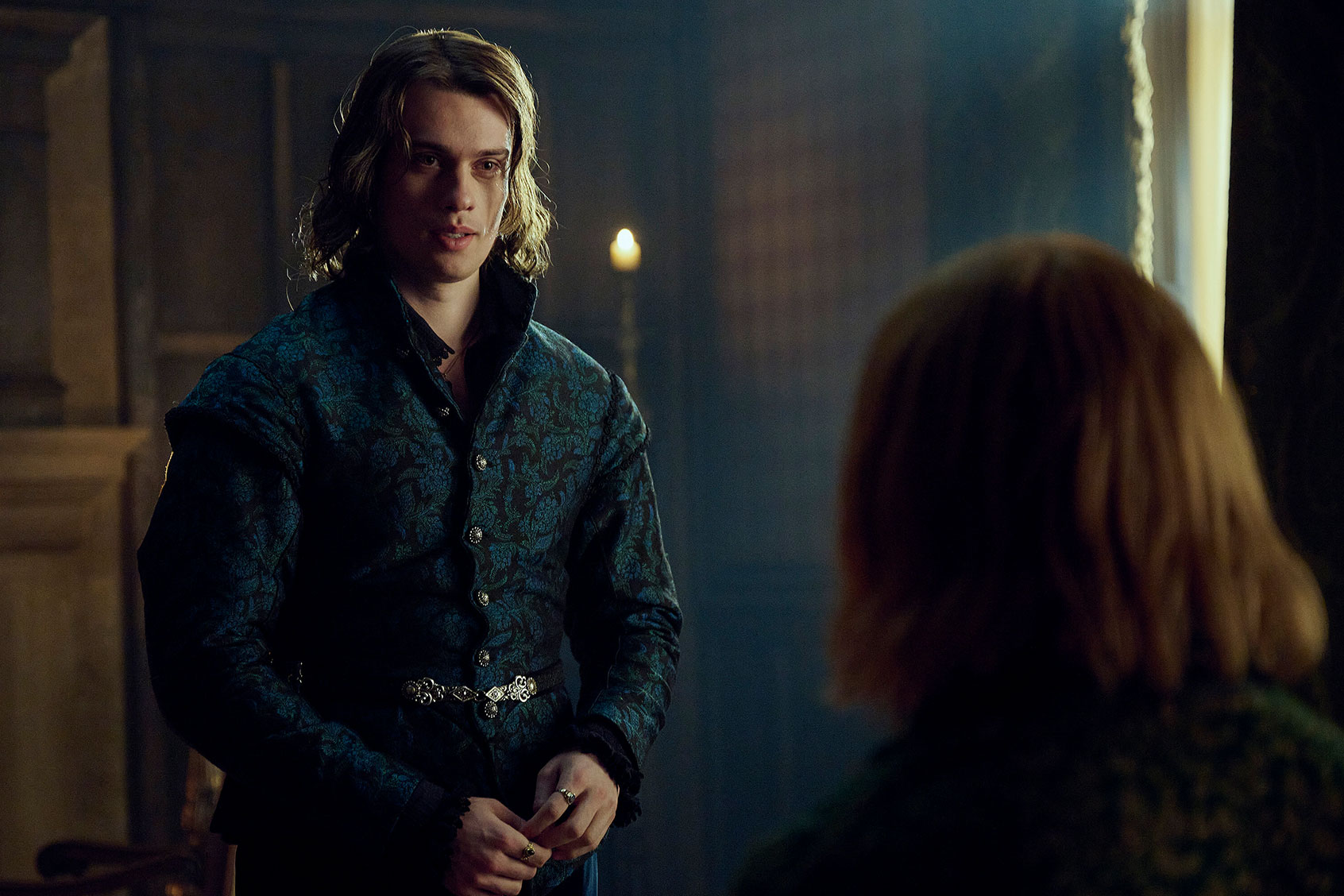
“I've never played a character like George, and I think he's sort of been the most fulfilling character I've ever played because [he’s] exploring purity and lack of identity and sexual awakening, and then going into this kind of uncertainty of being.”

“Look, I've obviously lived within the romantic lead space for a while. And I think ‘Mary & George’ completely subverted that."

“Mary & George” lined up for Galitzine after he’d worked on the three movies — “Red, White & Royal Blue,” "Bottoms" and "The Idea of You” – with no break in between. He admitted that stepping into his first role in a historical period drama that had him playing against an Oscar winner and a BAFTA was "scary." Where many performers in his position would have tales about elocution training and other pre-production research to share, Galitzine had about two weeks over the holidays to prepare to play his. “A lot of it was having to rely on instinct,” he said.

Aspects of George Villiers, the courtier who seduces his way into a king’s bed, fit firmly in what we might perceive to be the actor’s wheelhouse. Galitzine says as much, likening his courtier’s experience to that of an actor “growing into the spotlight.”

George wouldn’t have caught the eye of King James (Tony Curran) if he weren’t arrestingly beautiful and erotically pliable, similar to the way that Galitzine’s physical desirability has made him the internet’s dreamboat of the moment. In the royal court, Galatzine explains, George contends with being in a very uncertain position, he's trying to learn the tools of the trade, gaining confidence, and dealing with the unpredictable  — James, in his case. 

We need your help to stay independent

The recent PR onslaught in support of “The Idea of You” has made the basics of Galitzine’s background well known. He excelled at rugby and might have pursued going pro if he hadn’t sustained a series of injuries that made it impossible to continue.

Joining a friend’s production at the Edinburgh Fringe Festival led to a new passion and, in recent years, steady work. Influenced by his string of romantic lead roles – princes among them, including in a recent production of “Cinderella” – magazine profiles can't help bringing up his movie idol looks and his tendency to appear in movie love scenes with men and women. George is also sexually fluid, which he exploits to gain a political or social edge.

Mary & GeorgeNicholas Galitzine in "Mary & George" (Starz)But the facets of the character that are foreign to Galitzine are what helped him to stretch his abilities.
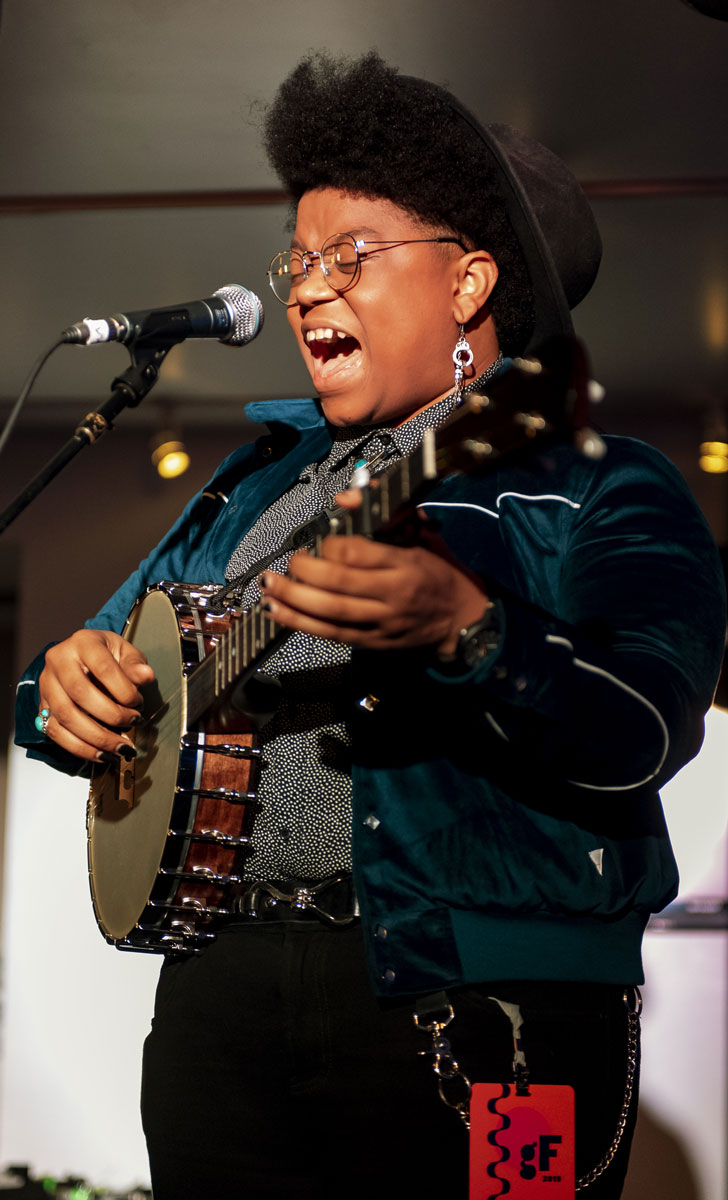
George is eventually undone by his inability to quell his appetites or rein in his mercurial lover who is convinced George has betrayed him. Galitzine was fascinated by the ways that his character was forced to kill parts of himself, starting with the unconditional love he has for his psychologically unstable brother and his first crush, a servant whom he abandoned after she’s maimed.

By the end even Mary tosses George aside to solidify her power, allying herself with her son only to save his life when a deranged James sentences George to death. 

“It culminates in that scene where he has to kill James,” he says. “We don't get to see a lot of marital bliss between them, but in that scene, I feel that we conveyed there was genuine love, you know, if not frequent bickering.”

One theory I shared with Galitzine concerning his appeal is that his most recent roles aren’t merely fulfilling the audience’s fantasy but inviting considerations of female power and its limits. In “The Idea of You” Hathaway’s Solène is socially crucified for daring to have a romantic relationship with a man 16 years younger than she is, despite Galitzine’s star Hayes’ insistent willingness to fight for them.


Want a daily wrap-up of all the news and commentary Salon has to offer? Subscribe to our morning newsletter, Crash Course.


Moore’s strategic countess can only elevate her position and that of her family by using George, which she does without guilt. That George eventually becomes a capable politician matters less to her than his ability to keep James happy, and therefore suggestible. But George’s evolution also helped Galitzine to transform before our eyes and, he hopes, expand the variety of roles he's offered beyond the fantasy boyfriend. 

 “Look, I've obviously lived within the romantic lead space for a while. And I think ‘Mary & George’ completely subverted that in a way,” he said. “I'm definitely looking to continue to play people who are sort of morally questionable . . . and I want to dip into genres that I haven't gone into before like sci-fi and action.”

Then, as if to remind his audience and himself that nothing is guaranteed, he adds, “I feel very lucky to be at a point now where I have much more agency over the roles I can play.” 

This sparks a recollection of being on a beach in Norfolk on the final day of filming with one of the drama’s directors and executive producers Oliver Hermanus, who Galitzine acknowledged “really took a chance on me.”

“I'm so grateful that he did because working with the likes of him and Julianne Moore has just been exciting,” he said. “And I can't wait for people to see what I've got coming up next.” 

The finale of "Mary & George" encores at 10 p.m. ET Sunday on Starz and is available to stream on the Starz app.


“The truth is being told”: Amythyst Kiah on Beyoncé, Black country music roots and Appalachia

Amythyst Kiah is a powerhouse folk singer. Her raspy but commanding voice is one you cannot miss when she strums her guitar or banjo.

But alongside her growing command of the music that she has loved all her life, she is proudly a Black Appalachian native. While living in the birthplace of early roots music, Kiah found her love of country and bluegrass. The singer's life story and personal journey to becoming a successful folk musician is documented in PBS' "The Express Way with Dulé Hill."

The series invites viewers into the perspective of everyday people and how music can be a universal language and healer to all. In the second episode titled "Appalachia," the former "Psych" actor and professional tap dancer Hill travels to parts of Appalachia, namely Tennessee, to talk to people about their relationships with music and the deeper and more personal ways that it has affected their personal lives. What Hill sees in Appalachia is a community so determined to come together and uplift one another even during the most challenging moments of their lives. Alongside talking to a founder of Appalachian Stringed Instrument Co. – who helps bring in people who have struggled with addiction, as the opioid crisis hit blue-collar workers – Hill spotlights Kiah to share her experiences with addiction, loss and grief and how music helped heal her mind.

"Music is a representation of how we can treat each other in real life."

In an interview with Salon, Kiah told me that for her it was crucial to learn "the role that Black people played" in roots music but "it also just revealed another layer of 'OK, so this music has always had these cross-cultural connections.'" She described her love and motivation for music as connected. She said, "That's beautiful. I think music is a representation of how we can treat each other in real life." While sharing intimate parts of her life for the docuseries was "a bit nerve-wracking" it was a very humbling experience, Kiah felt "grateful that people are gaining something from the story." 

Moreover, Kiah also clarifies that Black Appalachians exist, and even though "the depiction of Black people has usually been disparaging," "The Express Way," highlights how they are the backbone of roots music. She felt like the show's depiction of the rich history and Black Appalachians "was done with dignity and respect."

Read more of our conversation below:

The following conversation has been lightly edited for clarity and length.

What do Appalachian instruments like the banjo mean to you?

For me, learning about Appalachian music was a way for me to establish a sense of place and identity. For a really long time, specifically like in my late teen years, I developed a certain amount of social anxiety. It came from that awkwardness of grappling with my sexuality and grappling with body dysmorphia, and being around a lot of people that didn't necessarily look like me and feeling overlooked a lot of the time, just as I got older. I would say this is even more egregious than the other two faiths but we didn't go to church which is a big no-no in the predominantly, conservative Christian, suburban area that we lived in. There was just a lot of confusion as far as understanding where I fit in. A huge part of my later teen years involves just getting on the family computer and just really digging into music 

Amythyst KiahAmerican musician Amythyst Kiah plays banjo on the Rooftop Stage at the 16th annual GlobalFest at the Copacabana, New York, New York, January 6, 2019. (Jack Vartoogian/Getty Images)Things like the banjo and seeing that connection even though no one should have a birthright to enjoy the music or be interested in any kind of music. I mean, we had it at the college and we had Japanese exchange students who loved bluegrass and played in the bluegrass band. No one should have a birthright to play it. But I think learning about the role that Black people played, it also just revealed another layer of "OK, so this music has always had these cross-cultural connections." And that's beautiful. I think music is a representation of how we can treat each other in real life and not to say that everybody around the world, we all need to hold hands and sing "Kumbaya." That's unrealistic, right, but the idea of being able to find your tribe, find your path, find the people that love and support what you do, and not like just stay in your lane and just fighting and arguing with each other about all these different things going on.
Like whether or not a Black person should be able to play an excellent kind of music or a white person should do this or have an Asian person do that. We get caught up in this discourse of who's right and who's wrong and then we forget that we're fundamentally human. And while yes, and it's inevitable, that we're going to have the kind of diversity that we have so far as people's cultural upbringing, the way that they speak, the foods that they eat, all of these things.

A lot of Black Appalachian history is being brought to the light by pop culture figures like Beyoncé in "Texas Hold 'Em" which features banjo player Rhiannon Giddens. What does this feel like for you to see like playing out in real time?

It's really been fascinating to see this all to see this all unfold. I couldn't see any other Black woman being able to do this on this level. When I first heard about, "Cowboy Carter" and "Texas Hold' Em" and she was the first Black woman to have a No. 1 country hit on the Billboard 200 I was like this is the only Black woman on this planet that would have been able to do that. The fact that she reached out, that her people and herself reached out to Rhiannon, and recognized her role in helping and being a huge role in reshaping the narrative about Black country music history, which is American history as well. It's all connected, and for her to reach out to her – what it got me thinking about was that Beyoncé is obviously fully aware of her power and what she's able to bring to the table. So for her to reach out to Rhiannon, who has been literally busting her a** – she's been working herself, just through and through, to get her art out and to get the message out, which is something I've always admired about her.

To see the two of them coming together and her getting a platform to speak further on the issue that she's been campaigning now for the past 10 or 15 years, to be able to see that I think this is just a huge, very symbolic moment in just a moment in music history because it's now finally on a national, international scale.

This is now being seen. The truth is being told, and it's being seen on such a massive scale. I know that there has been some discourse around whether or not Beyoncé did enough. She's a pop artist. She is a pop veteran, one of the most acclaimed artists, in our generation. So she is doing what she wants to do, and she wants to incorporate country music, but she also wants to continue to be fluid in her genre expression. And it's what I that's what I do with my music. That's what a lot of us do with our music. A lot of us that are in Americana, do that exact thing. Every song doesn't have to sound exactly the same, have the exact same chords. It's not cookie-cutter. Regardless of whether someone is really rich or really popular, or whether they're not. If we're really going to talk about gatekeeping and how toxic it can be, which of course it can be, it has been. There are different ways to help shed light on things, and I think if we start to then police, who should be doing what, I just don't see where that's helpful.

Your song "Black Myself” garnered a Grammy nomination in 2020 for Best American Roots song. The song lyrics, “I pick up a banjo and they sneer at me/Cause I’m Black myself,” really stick out to me. Is this the constant push and pull that is at the center of what it's like to be Black in country music?

I will say that one in particular was more directly pointed at the gatekeeping in country music specifically. And the remnants of that segregation of the commercial music industry inevitably led to the remnants of that in my own personal experience. Obviously, I've been able to make a living doing this so obviously there are have been people that I've met along my journey that appreciated what I did, knew the history and never once saw me as out of my league to be interested. I would run into people that never directly challenged [that] in any way.

Usually, the way it would come about would be if I'd be at a show and, or I'd be coming to play somewhere for the first time. The most common question that was asked to me would be, how'd you get into this music? That's what you could consider a microaggression. Whether intended or not, but when I decided to respond by talking about history and nine times out of 10 people would be like, "Oh, I had no idea." Fortunately, in a lot of my situations, I've been able to really disarm people and put them in a position where they're actually rethinking some things. I'm sure there have been people that have had a problem with it. I'm sure I know those people exist, but out there. At this point in my life, they've not stood in my way. As long as they're not my way, I'm good. You can do whatever you want to do, but just stay out of my way because I live my life regardless.

Addiction is heavily present in a lot of the backstories of Appalachian people, including yours. How did sharing this intimate part of your mother and father feel? 

To be honest, it was a bit nerve-wracking. Because during my album campaign, the album is full of songs that I've written over the course of five or six years, and they were all about me dealing with the unhealthy ways in which I was trying to cope with my own grief. What I wasn't anticipating was how I would feel talking about some of these things repeatedly in interviews. While I think it's important to talk about mental health and talk about addiction and how it can affect people – how it can affect literally anybody, anywhere at anytime, no matter how great your life looks that people can fall victim to it – it really took a mental toll on me.

"[Music] helped me heal my entire relationship with myself."

And so I hadn't had to do that in quite some time. I've been focusing on the record and really getting into this new chapter in my life with these new songs. And being able to really enjoy writing as opposed to just always being this catharsis or trauma. It was becoming something that I realized could have so much more dimension and adds so much more to my life and to be able to write about things that I enjoy and that I think are interesting. While also still always write songs about how I'm feeling, I mean that that'll always be present, but just to be in a new chapter run in a healthier mindset. So going back to the documentary, having to talk about all that stuff again. It was very nerve-wracking to do that. From the feedback I've gotten, I'm very humbled and grateful that people are gaining something from the story and or maybe gaining a better understanding about not just even just my story, but the other two guys, their stories as well.

Music can be this universal healer. What did it heal for you?

The best way I can describe it, is it healed my mind. It helped me heal my entire relationship with myself. It played a role in that. There was a lot of other things that had to play a role too: eating well, taking my physical, mental health obviously more seriously, having a therapist for the past eight years. Actively looking to improve my quality of life. But also, trying not to get too obsessed with it and then making that the stressor, which I've unfortunately done a few times in my life. We all do it to some capacity. My relationship with myself and my sense of self-loathing, and anger anxiety. I think by really actively just being able to reshift the way that I approach my art, the way that I listen to music, it's allowed me to be the most creative that I think I've been.

Amythyst KiahAmythyst Kiah speaks on her music outside her home (Larkin Donley/ Joe Bressler; CALICO)“The Express Way” highlights how music is also a sense of community for people who are struggling and just people who want to be seen. How do you see the importance of music to Appalachian people?
I think music is a part of — it's just a part of life. I don't think it's necessarily so much different than any other any other places per se. I live in East Tennessee. A lot of times people talk about Tennessee, they'll talk about the talk about Nashville, it's all about Memphis. And obviously some, some amazing things have happened musically about those places. But when you talk about East Tennessee, it's a little off the beaten path. But I think that, musically, the music history here is just as rich as any other place. Two of the first big country stars for commercial music were the Carter family and Jimmie Rogers, and they both came to Bristol to the recording sessions that Ralph Peer record executive was hosting. Those were known as the Big Bang of country music in that area. There's a whole history museum there that I was part of the curation team called The Birthplace of Country Music Museum.

There's so many different other really fascinating cultural aspects here that are celebrated. Unfortunately, in a lot of media, back to the days of travel writers in 1800s and 1700s, the depiction of Black people has usually been disparaging and it's been showing the worst of the worst. I think if you take a camera into any rural area or area that's poverty-stricken, it's not gonna look pretty, but somehow we were special. I just think there's been a lot of underestimation so that's why I truly think it's awesome to be part of something that is really going to show the breadth of a good sampling of what Appalachia is for people and can be for people. So I feel like it was done with dignity and respect I think that all we want is just dignity and respect and to be able to share what we have to offer.

In your experience, how have Black Appalachians been forgotten, ignored population or just misrepresented?

Yeah, I think I just I think generally speaking, There are still people that think there are only white people who live in Appalachia. You know, I was talking with someone there a few months back that came that told their friends that they were coming to the festival to write about the festival. And the person was like, "Oh, no, they still lynch people down there?? What? Like that doesn't happen. So there are people that truly think that it's "Deliverance" over here, that it's the "Beverly Hillbillies" or something. 

Amythyst Kiah headshotAmythyst Kiah headshot (Todd Roeth)Alongside the downsides or maybe the negative experiences, what are the joys of being in this space as a Black Appalachian musician?

Things are things feel really good. I feel like I'm in a really, really good place in my life. I've got my fiancée, bought a house, got a house out in the county. There's a really lovely community here. Johnson City is a college town. So there's camaraderie between artists and just all different kinds of people. It's a really awesome art and music community. I mean, we've got bluegrass and country, and then we've also got punk rock and metal. There's all people and all kinds of music. There's also all these different visual artists as well. A lot of different coffee shops settled and host local art. So it's a very, very active art community.

"There are still people that think there are only white people who live in Appalachia."

We don't move to bigger cities because we all love where we live. I think the reason why we wanted to stick around, one of them being that we'd love to be part of continuing to grow what we have as opposed to leaving. Because when people leave, then things don't change. Not to say anything is people that do leave because everybody's got to decide what they need to do. If your life is going to be treated negatively— if you are a trans person, and you're heavily concerned about being able to get the care you need, I understand why you need to leave. You have to do what you need to do. But I think because I'm privileged and able to be in the space that I'm in and to see the diversity of community where I am, I want I'm in a position where I can take part in that

What are you listening to these days, and who do you want to recommend people to listen to?

I was just turned on to this band; apparently it's been around since 2014. There's this band called Jungle. I think maybe they're from the U.K. or something. But the music is just this incredible blend of of hip-hop and contemporary R&B and some electronic elements. It's just really, really good. Really good dance music. It's so awesome.

What's next after "The Express Way"? Do you have new music coming or? What do you want to share with people about what you've got going on?

Right now we're working on an album. I've been recording it. All the recordings are finished and now we're working on the packaging. I just did a photo shoot a couple of days ago with some really sick photos — super excited to have out in the world. So we did a bunch of basic –  just been working on the promo stuff for it and the packaging for the album, and that will be coming out later in the fall. We'll announce the dates. Hopefully soon, but it will be in the fall. So that'll be coming out.

And then I started tour opening for Molly Tuttle for some shows this week. I'm going to start driving towards Texas. Then opening for Iron & Wine in the summer out west, which I'm also really excited about. So yeah, working on getting the new album out and just start releasing singles. And then on the road with two amazing artists. Things are looking pretty good.

"The Express Way with Dulé Hill" is now available to stream on PBS.com