Spring Offer: Get 1 Year, Save 58%

The Mars Sample Return mission has a shaky future. NASA is calling on private companies for backup

A critical NASA mission in the search for life beyond Earth, Mars Sample Return, is in trouble. Its budget has ballooned from US$5 billion to over $11 billion, and the sample return date may slip from the end of this decade to 2040.


The mission would be the first to try to return rock samples from Mars to Earth so scientists can analyze them for signs of past life.

NASA Administrator Bill Nelson said during a press conference on April 15, 2024, that the mission as currently conceived is too expensive and too slow. NASA gave private companies a month to submit proposals for bringing the samples back in a quicker and more affordable way.

As an astronomer who studies cosmology and has written a book about early missions to Mars, I’ve been watching the sample return saga play out. Mars is the nearest and best place to search for life beyond Earth, and if this ambitious NASA mission unraveled, scientists would lose their chance to learn much more about the red planet.

The habitability of Mars

The first NASA missions to reach the surface of Mars in 1976 revealed the planet as a frigid desert, uninhabitable without a thick atmosphere to shield life from the Sun’s ultraviolet radiation. But studies conducted over the past decade suggest that the planet may have been much warmer and wetter several billion years ago.

The Curiosity and Perseverance rovers have each shown that the planet’s early environment was suitable for microbial life.

They found the chemical building blocks of life and signs of surface water in the distant past. Curiosity, which landed on Mars in 2012, is still active; its twin, Perseverance, which landed on Mars in 2021, will play a crucial role in the sample return mission.

An overhead view of a sandy crater.

The Mars Jezero Crater, which scientists are searching for signs of ancient bacteria. ESA/DLR/FU Berlin, CC BY-SA

Why astronomers want Mars samples

The first time NASA looked for life in a Mars rock was in 1996. Scientists claimed they had discovered microscopic fossils of bacteria in the Martian meteorite ALH84001. This meteorite is a piece of Mars that landed in Antarctica 13,000 years ago and was recovered in 1984. Scientists disagreed over whether the meteorite really had ever harbored biology, and today most scientists agree that there’s not enough evidence to say that the rock contains fossils.

Several hundred Martian meteorites have been found on Earth in the past 40 years. They’re free samples that fell to Earth, so while it might seem intuitive to study them, scientists can’t tell where on Mars these meteorites originated. Also, they were blasted off the planet’s surface by impacts, and those violent events could have easily destroyed or altered subtle evidence of life in the rock.

There’s no substitute for bringing back samples from a region known to have been hospitable to life in the past. As a result, the agency is facing a price tag of $700 million per ounce, making these samples the most expensive material ever gathered.

A compelling and complex mission

Bringing Mars rocks back to Earth is the most challenging mission NASA has ever attempted, and the first stage has already started.

Perseverance has collected over two dozen rock and soil samples, depositing them on the floor of the Jezero Crater, a region that was probably once flooded with water and could have harbored life. The rover inserts the samples in containers the size of test tubes. Once the rover fills all the sample tubes, it will gather them and bring them to the spot where NASA’s Sample Retrieval Lander will land. The Sample Retrieval Lander includes a rocket to get the samples into orbit around Mars.

An animation showing the Mars Sample Return mission’s plan, as designed by the Jet Propulsion Laboratory.

The European Space Agency has designed an Earth Return Orbiter, which will rendezvous with the rocket in orbit and capture the basketball-sized sample container. The samples will then be automatically sealed into a biocontainment system and transferred to an Earth entry capsule, which is part of the Earth Return Orbiter. After the long trip home, the entry capsule will parachute to the Earth’s surface.

The complex choreography of this mission, which involves a rover, a lander, a rocket, an orbiter and the coordination of two space agencies, is unprecedented. It’s the culprit behind the ballooning budget and the lengthy timeline.

Sample return breaks the bank

Mars Sample Return has blown a hole in NASA’s budget, which threatens other missions that need funding.

The NASA center behind the mission, the Jet Propulsion Laboratory, just laid off over 500 employees. It’s likely that Mars Sample Return’s budget partly caused the layoffs, but they also came down to the Jet Propulsion Laboratory having an overfull plate of planetary missions and suffering budget cuts.

Within the past year, an independent review board report and a report from the NASA Office of Inspector General raised deep concerns about the viability of the sample return mission. These reports described the mission’s design as overly complex and noted issues such as inflation, supply chain problems and unrealistic costs and schedule estimates.

NASA is also feeling the heat from Congress. For fiscal year 2024, the Senate Appropriations Committee cut NASA’s planetary science budget by over half a billion dollars. If NASA can’t keep a lid on the costs, the mission might even get canceled.

Thinking out of the box

Faced with these challenges, NASA has put out a call for innovative designs from private industry, with a goal of shrinking the mission’s cost and complexity. Design studies are due by May 17, which is an extremely tight timeline for such a challenging design effort. And it’ll be hard for private companies to improve on the plan that experts at the Jet Propulsion Laboratory had over a decade to put together.

An important potential player in this situation is the commercial space company SpaceX. NASA is already partnering with SpaceX on America’s return to the Moon. For the Artemis III mission, SpaceX will attempt to land humans on the Moon for the first time in more than 50 years.

However, the massive Starship rocket that SpaceX will use for Artemis has had only three test flights and needs a lot more development before NASA will trust it with a human cargo.

In principle, a Starship rocket could bring back a large payload of Mars rocks in a single two-year mission and at far lower cost. But Starship comes with great risks and uncertainties. It’s not clear whether that rocket could return the samples that Perseverance has already gathered.

Starship uses a launchpad, and it would need to be refueled for a return journey. But there’s no launchpad or fueling station at the Jezero Crater. Starship is designed to carry people, but if astronauts go to Mars to collect the samples, SpaceX will need a Starship rocket that’s even bigger than the one it has tested so far.

Sending astronauts also carries extra risk and cost, and a strategy of using people might end up more complicated than NASA’s current plan.

With all these pressures and constraints, NASA has chosen to see whether the private sector can come up with a winning solution. We’ll know the answer next month.

This article has been updated to reflect that design studies, rather than proposals, for the sample return mission are due May 17, 2024.The Conversation

Chris Impey, University Distinguished Professor of Astronomy, University of Arizona

This article is republished from The Conversation under a Creative Commons license. Read the original article.

Distorted gospel: Marjorie Taylor Greene, Jesus and the Jews

Marjorie Taylor Greene has a lot of big feelings about the Jews. Whenever the Georgia congresswoman opines on the topic, her thoughts are bound to produce some combination of hilarity and concern. Her latest musings on interfaith dialogue, in response to her vote against the Antisemitism Awareness Act of 2023, skew much more toward the latter. Greene appears to imagine this act as a threat to religious freedom, and grounds her position in an antisemitic trope that has led to violence against Jews for centuries.

H.R. 6090, the “2023 Awareness of Antisemitism Act,” was introduced last October and passed the House by a 320-91 vote on May 1. In an X post shortly before the House vote, Greene stated her intention to vote against it, saying that the bill “could convict Christians for believing the Gospel that says Jesus was handed over to Herod to be crucified by the Jews.” She’s not entirely making this up, since the bill adopts the International Holocaust Remembrance Alliance’s definition of antisemitism, which includes “claims of Jews killing Jesus” as part of its definition. (For what it’s worth, the ACLU has also spoken out against H.R. 6090, arguing that it “threatens to censor political speech which is critical of Israel.”) 

Aside from Greene’s slippage from belief to acts — Americans will remain free to believe whatever they want, but could face penalties for harassing or intimidating others with those beliefs — her statement also indicates some basic problems with biblical literacy, or at least an intent to disguise her particular belief as a universally accepted truth.

Part of the challenge is in the way the term “Gospel” is used. The word literally means “truth” or “belief,” but is also used more specifically to mean the Christian message. Furthermore, the four books of the Bible that recount Jesus’ life and crucifixion — Matthew, Mark, Luke and John — are referred to as “the Four Gospels.” So when Greene refers to “the Gospel that says…” it’s unclear how she’s using the word. (It might be yet another case of MAGA’s love of deliberate ambiguity.) She might mean “the Gospel” as “the truth” — meaning, this is what a Bible-based Christian should believe. Or she might be referring to “the [one] Gospel that says Jesus was…crucified by the Jews,” as opposed to the others that take at least some steps to blame the religious leadership, not the people. While it’s always dangerous to chase MTG down her rabbit holes, I think it’s important to unpack what she’s talking about here.

In the Gospel accounts — which often have disagreements, or just supply different details — the Roman authorities and the Jewish religious leaders are both implicated in Jesus’ crucifixion. Jewish religious leaders are upset with him for offering new interpretations of their religious laws, interpretations which often pose a direct threat to the power structures in place. In addition, “the crowd” has some degree of culpability, though some of the Gospels take pains to highlight that this crowd was stirred up by the religious leaders. The current conflict in Gaza is just one example of how important it is to separate the morality and culpability of the leaders from that of the people. Much of the Gospel text asks us to do this as well.

The current conflict in Gaza is just one example of how important it is to separate the morality and culpability of the leaders from that of the people. The Gospel text asks us to do this as well.

In most of the Gospel accounts, it’s abundantly clear that the leaders are to blame. The Gospels of Luke and Mark ascribe the plot to the “chief priests and the scribes” (Luke 22:2; Mark 14:1), not to the people as a whole. It is this council of religious leaders that brings Jesus before Pilate, the gentile governor of Judea (Luke 23:1; Mark 14:53 — here Mark adds “the elders”). When Pilate offers to release him, a group Luke describes as “the chief priests, the leaders, and the people” (23:13) all demand that Pilate put Jesus to death. He’s crucified by Roman soldiers, not the Jews as Greene states in her post. John’s Gospel is more troubling, as it frequently refers to the crowd as “the Jews.” (Since we’re in Jerusalem, the majority of the people, including Jesus and his disciples, would have been Jewish, after all.) But in spite of this language that may trouble our sensibilities today, it’s clear that John also places the blame on the leadership, not on the people.

Things get stickier with the Gospel of Matthew, largely due to one deeply unfortunate line.

For most biblical scholars, Matthew’s in-depth knowledge of Scripture and Jewish law indicates that he was an observant Jew, writing to an audience that was primarily Jewish as well. So his rhetoric against “the Jews” who do not accept Christ’s divinity is more pointed than can be found in the other Gospels. Much of the account of Jesus’ arrest and trial follows that of the other Gospels; it is clear that the religious authorities are the primary drivers. But as Jesus’s crucifixion grows near, Pilate is increasingly frightened by how restless the crowd is getting. 

In this account, Pilate is more sympathetic to Jesus in this account. As he washes his hands, he says, “See, I am innocent of this man’s blood” (Matthew 27:24). The crowd then answers, “His blood be on us and on our children!” (27:25). It’s a horrifying line, one that the Guardian (in analyzing some of Sarah Palin’s ugly rhetoric) has called “the most notorious verse in the Bible.” There are good reasons to read this line in the context of Matthew’s Jewishness and see an author embroiled in a struggle about the direction of his own religious community, but the effects this verse has had are undeniable. For centuries, this was the verse that the Church used to justify persecution and murder of Jewish people.


Want a daily wrap-up of all the news and commentary Salon has to offer? Subscribe to our morning newsletter, Crash Course.


Mel Gibson stepped in the same controversy with his film “The Passion of the Christ.” While the screenplay was cobbled together from a variety of sources, the initial cut of the film included the crowd shouting this line from Matthew. Word that the scene had been included got out, and — after initially saying he would cut the scene — Gibson included the dialogue, but left it unsubtitled. I imagine the intent was to obscure the ugliness of the line while still remaining true to what he thought his Gospel source demanded, but I worry that it just makes the line serve as a dog whistle. Viewers who are prone to antisemitic interpretations understand perfectly well what line has been left without an English translation. (There are plenty of other problems with the film’s depictions of Judaism — a few examples are here.) Gibson had four Gospel sources to work with, and had to make choices about what to include and what to leave out. He chose to include this line, in spite of its terrible history of being used to justify antisemitic violence.

Greene makes a similar choice. While she might have you believe that her interpretation is “the Gospel,” it’s really just one way to read these accounts — and a particularly dangerous one. The Roman Catholic Church renounced the idea of Jewish responsibility for Jesus’ death in an official 1960 document, and most of mainline Christianity has been in agreement in the wake of the Holocaust. (Institutions can take a long time to get on the right side of history.) MTG’s use of “the Gospel” would have us believe that the basic tenets of Christianity are under threat, when the bill simply acknowledges that antisemitic tropes can do harm. Her use of this one indicates that she is, in fact, already well aware of antisemitism — aware enough to be a highly accomplished practitioner. For Greene, this is just the latest outburst in a long line of outlandish statements that indicate she has no interest in a serious reading of the texts she claims to hold in such high esteem, or in building relationships with anyone outside the MAGA tent.

“Please let your attorney know”: Judge tells Trump he can testify at his hush money trial

Donald Trump has falsely claimed that he can "not testify" in his own trial because of the gag order. On Friday, Judge Juan Merchan corrected him.

The gag order “does not prohibit you from taking the stand," Merchan clarified, adding that it does not otherwise limit what Trump can say at trial.

Merchan then told Trump to “please let your attorney know.” That's because Trump’s lead defense lawyer, Todd Blanche, nodded along when Trump made his comments outside the courtroom yesterday. 

When Merchan finished addressing Trump, the former president mouthed the words, “thank you,” The New York Times reported (as he entered the courtroom Friday, Trump had told reporters the order "stops me from talking about people and responding when they say things about me").

It is far from clear that Trump will ever take the stand in his own defense. But it is important that he understands the conditions of his gag order. Earlier this week, he was fined $9,000 for nine violations of that order, with Merchan warning that a harsher, “incarceratory punishment” is not off the table if the violations continue.


“Worse than anything else”: Expert says Trump’s attacks on jurors are “especially” troubling

Donald Trump’s attacks on witnesses have garnered much attention, but it’s his attacks on jurors that are “worse than anything else,” former prosecutor Jeffrey Toobin said on a CNN panel Thursday.

“I think judges are especially concerned about jurors much more even than witnesses, especially public figures like already seen,” Toobin said. He added that jurors can pull out of the trial, which could worry Judge Juan Merchan because “this is not a jury that has been sequestered, right?” 

While the former president has mostly gone after potential witnesses, such as former attorney Michael Cohen, he has also gone after jurors, suggesting they are "95% Democrats" and too liberal to judge his case fairly. One juror already pulled out after saying she feared the public attention, while Trump was earlier admonished for muttering in court during jury selection.

"I think Merchan was somewhat sympathetic to the Michael Cohen issue because Michael Cohen has been beating the hell out of Trump and there is a sense of fairness about the response," Toobin said. "But that line about the jury, that's the thing that's worse than anything else Trump has said, because that means he has been looking into the juror's backgrounds. That means he has reached conclusions about them."

Trump has already been found to have violated his gag order and hit with a contempt fine of $9,000. But it's hard for a judge to control what goes on outside their courtroom, former federal judge Nancy Gertner said on the panel.

“The judge is not supposed to be concerned about the give and take in the public arena, he’s trying to sort of hermetically seal his courtroom,” she noted. She added that Cohen can say whatever he wants, although it is probable that prosecutors are calling up his lawyers to ask him to “please shut up.”


Former prosecutor notes “oddity” in Trump’s trial defense: One of his attorneys isn’t talking

Former federal prosecutor Andrew Weissmann says the seating of Trump's defense lawyers may reveal something important.

Speaking to MSNBC's Nicolle Wallace on Thursday, Weissmann noted that one of Trump's attorneys, Susan Necheles, is an “experienced defense lawyer” but she has played a minimal role thus far in the trial itself, positioned “at the far end of the table."

That's notable because of something another Trump attorney, Emil Bove, admitted to Judge Juan Merchan during a sidebar, as Raw Story reported. He “told the judge, 'this is the first cross-examination I’ve done as a defense lawyer,'” Weissmann noted.

Weissmann said it was "fascinating" not only that Necheles hasn't yet done any cross examination, but that she has "not signed certain submissions" to to the court. "I've never see that," he said, calling it a possible red flag. "I assume she ethically did not think she could sign it," he continued. "She is independent and not going to do something she thinks crosses a line."

"Everyone knows Susan Necheles is terrific," Weissmann added. "It's an oddity she's not there."

“Weirdest moment”: Experts call out Trump lawyers’ “planted evidence” defense over damning recording

The audio recording that jurors heard Thursday lays it all out: There is then-candidate Donald Trump, in September 2016, talking about a hush payment with his former fixer, Michael Cohen, including the amount and how the Trump Organization would facilitate the whole thing.

"We'll have to pay," Cohen can be heard telling Trump, who responds by discussing whether they should "pay with cash." The president's former personal attorney, now a star witness for Manhattan District Attorney Alvin Bragg, goes on to say he's gone over the deal — to buy the silence of Playboy model Karen McDougal, who alleges she had an affair with the Republican candidate — with Trump Organization chief financial officer Allen Weisselberg on "how to set the whole thing up."

"What do we got to pay for this?" Trump responds. "One-fifty?" (The parent company of the National Enquirer paid McDougal $150,000 for the rights to her story).

In another recording, Cohen can be heard discussing a separate, $130,000 hush payment to Stormy Daniels with the adult film star's attorney, Keith Davidson. “I can’t even tell you how many times he said to me, you know, I hate the fact that we did it,” Cohen said on the call, referring to Trump.

As prosecutors tell it, the recordings show that Trump was intimately involved in the scheme to "catch and kill" potentially damning stories about him — and that Cohen wasn't just acting on his own. Trump has been charged with 34 felony counts of falsifying business records to evade campaign finance laws and cover up a the hush payment to Daniels; in 2018, Cohen was sentenced to three years in prison after confessing to his own role in the alleged conspiracy.

For Trump's defense team, a priority has been undermining the credibility of Cohen, who they paint as a perjurer acting out of bitterness that he didn't get a job in the Trump administration.

But how can you argue with a recording? By trying to undermine its credibility, too.

That's exactly what Trump defense attorney Emil Bove tried Thursday. During a cross examination of Douglas Daus, a forensic data expert for the Manhattan DA, Bove appeared to be trying to suggest that the 2016 Trump-Cohen recording may have been altered, zeroing in on the fact that the phone containing the recording had first been obtained by the FBI.

"There is at least … a risk that a prior acquisition and extraction could impact the data that you looked at in 2023, isn't there?" Bove asked. "And you didn't talk to the FBI about the methods they used, did you?"

We need your help to stay independent

Undermining the credibility of damning evidence is what defense lawyers are paid to do. But the insinuation that the FBI might have mishandled the data in question, in such a way as to effectively frame a former president, plays into conspiracy theories on the right, where — particularly since the Jan. 6 insurrection and subsequent arrest of hundreds of its participants — a bureau led by a Trump appointee is said to be a mere arm of the liberal deep state.

To MSNBC legal analyst Lisa Rubin, the exchange between Trump's defense team and the data forensics expert was the "weirdest moment" of Thursday's testimony. Daus, she wrote on social media, "struck me as knowledgeable, earnest, and honest." But "for a defense looking to sow seeds of mistrust — and in need of only one juror — even that guy is ripe for a brutal cross," she continued, highlighting Bove's suggestion that the recordings "could have been manipulated and/or deleted by the FBI."

Former U.S. attorney Joyce Vance said the exchange actually revealed Trump's lack of a good defense. "The 'they planted evidence' defense, especially in a white collar crime case is such a tell," she posted on social media, noting that Trump also deployed it after the FBI raided Mar-a-Lago and found top secret national security documents. "It's spaghetti thrown at the wall. If there was anything to it, Trump would have his own forensic experts to say so."

Andrew Weissmann, a former federal prosecutor who worked for special counsel Robert Mueller, was even more harsh in his assessment of Trump's legal strategy. "The 'someone planted the evidence' defense," he wrote, "is the last refuge of a scoundrel."

“I was in awe and unable to speak”: Jeff Daniels recalls a music-filled meeting with George Harrison

Emmy Award-winning actor Jeff Daniels joined host Kenneth Womack to talk about the lesson he learned from George Harrison, the beauty of “Get Back,” his new Netflix series “A Man in Full” and much more on “Everything Fab Four,” a podcast co-produced by me and Womack (a music scholar who also writes about pop music for Salon) and distributed by Salon.

Daniels, who has lit up the screen for decades in such films as “Dumb and Dumber,” “The Squid and the Whale” and “Arachnophobia,” is also a stage actor and playwright, in addition to being a musician. And his introduction to how music could change the world arrived in elementary school when the Beatles debuted on “The Ed Sullivan Show” in 1964. As he told Womack, “You could just feel a change in the room. Here were fourth-grade girls, and they were in love with these British mop tops.”

His own admiration for the band didn’t really take off until a few years later, with the release of their “Sgt. Pepper” album. “It freed them up to chase anything,” said Daniels, “as long as it was different than what they'd done before.” Little did he know that as he continued to buy each album the Beatles released from then on, that one day he would end up in the same room – professionally – with one of his musical heroes.

“In 1988 I got cast in an indie movie called ‘Checking Out,’” he told Womack, which was produced by George Harrison’s company Handmade Films. While shooting in Los Angeles, Harrison visited the set. “A photographer captured a photo of George talking, because he was the only one who could talk. I was in awe and unable to speak.” Daniels had his guitar with him and asked George to sign it, and the former Beatle obliged – and ended up playing 20 minutes’ worth of songs for the people in the room. “He knew he was giving us a gift that we would talk about forever. It was a very giving thing for him to do, and I never forgot that.”

LISTEN:

As for Daniels’ own career, from 1985’s “The Purple Rose of Cairo” (for which he named his Chelsea, Michigan-based theatre company) to this week’s release of “A Man in Full” (based on the novel by Tom Wolfe), he explained to Womack that he’s “been trying to fail for years. I’ve been risking failure every time out. It's the challenge of doing something you haven't done before.” And much like the Beatles’ continued drive to create something new in the “Get Back” documentary (which Daniels found “just fascinating”), he said, “There's something to the ‘what's next.’ It's very intoxicating. It's also very dangerous and frustrating – but there's just something to it.”

Listen to the entire conversation with Jeff Daniels on “Everything Fab Four” and subscribe via Spotify, Apple, Google or wherever you’re listening. “Everything Fab Four” is distributed by Salon.

Host Kenneth Womack is the author of a two-volume biography on Beatles producer George Martin and the bestselling books "Solid State: The Story of Abbey Road and the End of the Beatles” and “John Lennon, 1980: The Last Days in the Life.” His latest book is the authorized biography of Beatles road manager Mal Evans, “Living the Beatles Legend,” out now.

Trump’s Big Lie is hurting Republicans’ efforts to get out the vote

Donald Trump was all over the place in his big Time Magazine interview this week but there is one issue on which he's never wavered. When asked if he thought there would be violence around the election this fall he said, "If we don’t win, you know, it depends. It always depends on the fairness of an election.” On Wednesday he went even further, telling the Milwaukee Journal Sentinel, “If everything’s honest, I’ll gladly accept the results. I don’t change on that. If it’s not, you have to fight for the right of the country.” It's pretty clear that in his mind and the minds of his followers, there is no such thing as an honest and fair election that doesn't result in a Donald Trump victory so there's little doubt about what to expect if they don't get their way in November. 

Over the past three years, Trump's Big Lie has become the main organizing principle of the Republican Party. There had been a festering sense of grievance and resentment among the GOP base for decades which Trump skillfully tapped into. But ever since his flukey win in 2016, his insistence that the succession of losses the party has suffered under his leadership were all the result of rigged elections, has taken a toll. Among the Republican faithful these days are quite a few who question whether it's even worth it to participate. 

Their only option is to turn Election Day into a chaotic circus and hope that somehow they can find a way to disqualify enough votes to eke out a win in the Electoral College.

"The skepticism is hurting us," local Pennsylvania GOP organizer Milo Morris told Antonia Hitchens of the New Yorker. "A lot of people are disenfranchised by the fraud allegations," Morris said, explaining that he is often confronted with suspicion and distrust from voters who say, "This whole game is just ridiculous and I’m not going to participate anymore." Gosh, I wonder where they are getting those crazy ideas. 

Trump's campaign and his supporters in the media begged him to stop talking about the Big Lie and insisting that it was going to happen again. They knew that this relentless drumbeat going into another election is counterproductive. But he won't stop. They've apparently accepted that fact and are now desperately trying to compensate for it. Unfortunately, Trump's sabotaging those efforts as well. 

Trump has been disparaging early voting and mail-in voting since before the 2020 election when he correctly surmised that he was going to have trouble getting re-elected. States were changing some of their election procedures to deal with difficulties getting to the polls due to the pandemic and if he lost, he saw that he could use that as an excuse to challenge the election. He and his henchmen (like Attorney General Bill Barr) spent months suggesting that the mail-in votes were rife with fraud and told his voters not to use that method or trust the results where it was used. This formed the basis for his claims that the election was stolen despite no evidence that anything untoward had happened. 

But that has presented a big problem for the party in subsequent elections. Early voting and voting by mail boost turnout. They are convenient methods for people to participate and they like using them. But by insisting that Republicans should only vote on Election Day, some voters just don't make it to the polls. Moreover, it makes it much more difficult for the people running the ground game to focus their get-out-the-vote efforts.

As Bloomberg recently reported

New research shows that Trump's crusade against mail-in voting is backfiring. According to a study in the Election Law Journal by researchers at the Universities of Florida and Alabama, the more voters embraced vote-by-mail in the primaries through mid-March, the worse Trump did.

[…]

In 11 red states where Republican legislators actively worked to discourage mail-in voting, the report found that mail voting declined, but so did turnout — to 17%. 

Now some state and local Republicans are desperate to get their people to use these methods and are working to persuade voters to forget what they've been told in the last two election cycles and vote early. Unfortunately, they keep running into one big orange roadblock. 

We need your help to stay independent

Trump is hooked on the idea that elections should only be held on one day and that they should be done with paper ballots and hand-counted. He reiterated that this week in Wisconsin. He told Fox News' Laura Ingraham in February, "If you have mail-in voting, you automatically have fraud.” (He has also stated in the past that he thinks the counting should be stopped at midnight, which is certifiably insane.) 

Trump has posted on Truth Social that people should vote absentee or early, but it appears to be something he did under duress. After all, it's almost as if he's admitting he was wrong about something and that simply cannot happen.

There are various groups working to persuade voters to essentially forget that Trump has been instructing them for years to only vote on Election Day because it's the only way they can be sure their vote will count. Last month the New York Times published a big, sexy profile of Turning Point USA's get-out-the-vote program called "chase the ballot," which they characterize as attempting to fix this problem. But Axios recently quoted the COO of the organization, Tyler Bowyer, saying "We're not trying to encourage more people to get on the early voting list. If you vote too early, you're basically telling Democrats how many votes they need to win," which is simply bizarre since it would do no such thing. (Bowyer, by the way, is also one of the fake electors who was indicted in Arizona last week so he is something of an expert on voter fraud.) 

Donald Trump has no one to blame but himself for this problem. But it's unclear whether the Republican Party is really putting its efforts into getting out the vote anyway. From what we hear from the new Chair of the RNC, Trump's daughter-in-law Lara Trump, the real efforts are going toward something else entirely: vote suppression and intimidation.

"We now have people in the RNC," Trump told Newsmax's Eric Bolling, "who can physically handle the ballots."


Want a daily wrap-up of all the news and commentary Salon has to offer? Subscribe to our morning newsletter, Crash Course.


This comes from the top. Trump has said for years now that "sometimes the vote counter is more important than the candidate." 

His daughter-in-law didn't mince words when she said that they will have people in the polling places "handle the ballots" and issue threats of prosecution. Why bother with trying to maximize turnout when you can intimidate the election workers and manipulate the vote count? 

This is really their last resort. Their leader has spent the last several years telling their voters that their votes are irrelevant because the system is rigged and now they're having to scramble to try and convince them they should vote anyway, even as he's still saying it's probably pointless. Their only option is to turn Election Day into a chaotic circus and hope that somehow they can find a way to disqualify enough votes to eke out a win in the Electoral College. That's what they like to call "election integrity."

Donald Trump is using campus protests to stoke right-wing violence for the election

Despite all the hysteria in the punditry about campus protests against the war in Gaza, by and large, the student activists have been peaceful. Even at Columbia University, where an ill-advised police crackdown caused an inevitably angry reaction from protesters that led to a building occupation, this has been true. As former Washington Post journalist Paul Waldman explained in his newsletter, "People who have actually reported from the protests (see here or here) have by and large found them to be well-behaved." The vast majority of scary, violent images stem not from the protesters themselves, Waldman argues, but from the police crackdowns. "At the universities where the administrators had the sense to just let the students have their say, there has been almost no violence."

As the cable news has breathlessly covered, there was violence this week at UCLA. But even then, it was not the leftist protesters to blame, but a gang of far-right counter-protesters who rushed in and started to attack students. As ABC 7 reported, violence only broke out "when counter-protesters tried to break down the encampment." Unfortunately, this was framed by much of the media as "clashes" between protesters and the right-wing assailants. Any good faith reading of the situation is clear: The far-right demonstrators stormed the encampment and started the violence. The student protesters were defending themselves. 

Why a group of right-wingers decided to swarm on the UCLA students hasn't been thoroughly investigated yet, but here's one likely factor contributing to the choice: The Republican nominee for president, Donald Trump, told them they were entitled to assault unarmed, non-violent protesters. And he did so with his favorite tool: dishonest whataboutism.

"I wonder if that’s going to be the same kind of treatment they gave J6," Trump complained on Tuesday, falsely claiming the students were being violent and "a lot of people getting hurt very badly." 

Trump also claimed that the 2017 white supremacist riot in Charlottesville, Virginia, is "peanuts" compared to the current protests. As a reminder, one of the rioters — who explicitly said they were emboldened by Trump's election — murdered a woman and injured a number of others by running over them with his car. 

Trump's rhetoric is hamfisted, making it not hard at all to parse what he's saying: If the left "gets" to be violent, why can't his people be violent, too? The whine is dishonest in every way, of course. First, the leftist protesters are largely non-violent. Second, the few who do act up end up arrested, despite Trump's insinuations to the contrary. But his tactics have never needed to be fact-based to accomplish their goal of permitting his followers to be their worst selves. They already want to believe that the left is violent, so they feel justified in actually being violent.

By conflating a few outliers with all the protesters, centrist liberals are validating Trump's efforts to characterize the protests as "violent" — which, in turn, is being used to justify actual right-wing violence.

We saw how this works very clearly with the Capitol insurrection of January 6, 2021. For months, Trump's base had wallowed in right-wing propaganda that falsely accused both Black Lives Matter protesters and the largely imaginary "antifa" of practically burning down American cities during protests. (In reality, the protests after George Floyd's murder were 93% peaceful, with what little violence there was largely driven by police overreaction.) When Trump summoned a mob to Washington D.C. to help him steal an election, they did so by acting out their fantasies of what the "left" supposedly does, by rioting. Afterward, when they were arrested for their actual violence, the insurrectionists kept citing the made-up violence of Black Lives Matter in their legal defense, as if what other people did in their dreams justified what they did in reality. 


Want more Amanda Marcotte on politics? Subscribe to her newsletter Standing Room Only.


Trump has not been especially coy about his longing for a repeat of January 6. He celebrates the Capitol riot at every rally. He begs his supporters to show up outside his criminal trial in Manhattan to intimidate the judge and jury. He hasn't had any takers on that front, because he hasn't been able to convince them his personal legal problems are connected to the culture war grievances that fuel MAGA. But resentment against progressive college kids, who are routinely demonized as sexy, spoiled brats in right-wing media? It didn't take much prompting to get violent right-wingers to attack. That is why the founder of the Proud Boys showed up at the New York protests. He knows that the insecurities about their own masculinity and virility can be used to motivate his followers into lashing out at the kids. 

Trump's celebratory attitude towards January 6, of course, is about encouraging his supporters to turn to violence to help him steal the 2024 election. During an interview with Time magazine, Trump said, "I think we're going to win and there won't be violence." When pressed about what happens he doesn't win, he replied, "And if we don't win, you know, it depends." Which is, of course, an unsubtle way to establish the binary choice: Let him have the White House, or violence. 

Even though his supporters are ignoring Trump's pleas to descend on his criminal trial, they do seem far more interested in heeding the call for election violence. As with the attack on college kids, the reason is that election violence is about their grievances, not just Trump's. It taps into the ongoing MAGA outrage that they are a minority, even as they identify as the only "real" Americans. Politico reported Wednesday that 38% of local election officials surveyed "have experienced threats, harassment or abuse due to their jobs." Large numbers of officials are quitting rather than putting up with these threats, which stem mostly, if not exclusively, from Trump's lies about "stolen" elections. 

While there's no logical link between the Gaza protests and Trump's anti-democracy conspiracy theories, the two share an emotional connective tissue in the MAGA imagination. For many Trump supporters, the protesters symbolize the young progressives that MAGA wants to eject from the body politic. Former George W. Bush advisor and current MAGA-tinged right-wing consultant Ari Fleischer straight up demanded that the government "Arrest, imprison, expel, and deport" college kids who peacefully protest. As Jamelle Bouie of the New York Times pointed out on Instagram, Fleischer is quite literally saying we should "strip them of their citizenship and kick them out of the country." 

We need your help to stay independent

This is eliminationist rhetoric, and fascist to its core. It's telling conservatives not to learn to deal with the inevitability of change but to wallow in their belief that everything should stay exactly how they imagined it was when they were kids. And that if other people's differences make them uncomfortable, they are justified in reacting with maximum violence — arrest, imprison, expel, and deport — to simply erase people for having a different opinion. Coupled with lies about the protesters being "chaotic" or "violent," an entire rationale has emerged for Trump and his followers to use real violence to achieve these ends. 

This is a big reason why it's not just childish, but short-sighted of pundits and centrist Democrats to be lashing out at the student protesters in the often-hysterical tones being used. Whether or not one agrees that encampment-style protests are good or bad, cherry-picking a few bad actors to demonize the entire protest movement is only helping Trump lay the groundwork for future right-wing violence. Have a few protesters committed vandalism or yelled unforgivably bigoted things? Absolutely, and it's foolish to deny it. But by conflating a few outliers with all the protesters, centrist liberals are validating Trump's efforts to characterize the protests as "violent" — which, in turn, is being used to justify actual right-wing violence. When faced with hurt feelings over protesters making you uncomfortable, it's always worth remembering that adage: Shutting up costs nothing. Especially when emoting at hyperbolic volumes is only helping Trump plan for the next January 6. 

“As he sees fit”: Trump lays out the stakes — and the media is starting to hear his message

The election stakes are as stark as they're simple: Law and order to ensure freedom versus lawlessness and disorder without freedom. That message screams aloud from the pages of TIME Magazine’s most recent cover story, “How far would Trump go?” It’s based on interviews with Trump and others close to him, including a full transcript and fact-check.

The most chilling example of what is at stake this fall is the devastation of women’s right to privacy and reproductive freedom. Trump “would let red states monitor women’s pregnancies and prosecute those who violate abortion bans.” A scenario that gruesomely echoes The Handmaid's Tale

Doubt he means it? He’s already bragged about his role in overturning Roe v. Wade. Now he’s endorsing the next governmental invasion of women’s bodies. 

It’s not only abortion rights he’s after. All the individual freedoms our Constitution guarantees are at risk if we hand power to someone intent on being a dictator “on Day One.” As the eminent historian Ruth Ben-Ghiat tweeted Tuesday, “Trump has been conditioning Americans for years to desire authoritarian rule with him as dictator.”

She pointed to Trump’s response to Time's question about whether he understood “why so many Americans see all this talk of dictatorship as contrary to our most cherished freedoms?” He disagreed, insisting quite the opposite: “I think a lot of people like it.”

Constant repetition that the abnormal is normal: That’s how authoritarians pave the path to dictatorial rule. The unending recital of once-aberrant ideas dissolves resistance to the elimination of norms and conditions the populace to the relaxation of constraints on the leader.

Consider just four stunning samples from TIME’s interview with Trump: 

First, there’s Trump’s promise to “deploy the National Guard to American cities as he sees fit.” The federal “Posse Comitatus statute,” adopted 150 years ago, “remove[s] the military from regular civil law enforcement.” 

A legislated exception to that law allowed the steps taken in 1957 and 1963 by Presidents Dwight Eisenhower and Jack Kennedy — they invoked the Insurrection Act and federalized the National Guard to keep rebellious Southern governors and police from obstructing the established rights of black students to an equal education. 

Perversely, during the insurrection on January 6, Trump sat on his hands after inciting the mob. In any case, he’s not talking about insurrection when he discusses “going into the cities.” He’s talking about using the military “as he sees fit,” legally or not. That would spell doom for our First Amendment rights to assemble peaceably in protest against his policies.

Second, he vowed “to carry out a deportation operation designed to remove more than 11 million people from the country. . . [and is] willing to build migrant detention camps and deploy the U.S. military to that end.” Never mind that, as Justice Antonin Scalia once wrote, “the Fifth Amendment entitles [noncitizens] to due process of law in deportation proceedings.” Never mind that the Supreme Court has repudiated its World War II decision blessing detention camps for Japanese Americans.

Third, Trump said he is “weighing pardons for every one of his supporters accused of attacking the U.S. Capitol on Jan. 6, 2021, more than 800 of whom have . . . been convicted.” Forget the beatings by flagpole of bear-sprayed police. Forget the terrorism and the desecration of the halls and offices of the Capitol, the mob chorus screaming, “Hang Mike Pence.” Such mass pardons would open the floodgates to future political violence by Proud Boys, Oath Keepers and any paramilitary group that supports Trump.

We need your help to stay independent

Fourth and perhaps most ominous of all, Trump refused to rule out violence if he loses the 2024 election. “If we don't win, . . . it depends. It always depends on the fairness of an election.” Fairness, no doubt, “as he sees fit.” If Trump loses, prepare for January 6 deja vu with Proud Boys “stand[ing] by.”

Three guardrails stop most human beings from committing terrible evils: A sense of right and wrong, the threat of being stopped, and fear of punishment. None exist for Trump.

As to the first, only someone comatose for the last nine years would fail to see that Trump’s guiding lights are money, power and self-interest, not a moral code. 

Regarding the second, he plans to stock another Trump administration with yes-men and strip civil service protections from government employees who aren’t loyal to him and ready to betray their constitutional oath.

And as to the third, the Supreme Court majority gives every indication of being “in the tank for Trump,” and he told TIME that he would “fire a U.S. Attorney who doesn’t carry out his order to prosecute someone.” The guardrails will be down, the car will be going 110 mph on the mountain curve, and it will be veering straight over the constitutional cliff.

On Saturday night at the White House Correspondents’ dinner in DC, President Joe Biden paused the joking and put it on the line with his audience of political journalists: 

I’m . . .  asking you to rise up to the seriousness of the moment; move past the horse race numbers and . . . the distractions . . . and focus on what’s actually at stake. [The stakes] couldn’t be higher.

Hats off to Time and outlets like it that take to heart the unique gravity of this moment.

Why climate change action requires “degrowth” to make our planet sustainable

Climate change truly is a major existential threat, one we're clearly not addressing fast enough. But as individuals, there's little we can do to stop it on a grand scale — it will require global cooperation to overcome. Nonetheless, the accompanying feelings of helplessness when faced with such a daunting crisis can make many feel paralyzed with despair. So what can be done?

"Slow Down: The Degrowth Manifesto," a new book from University of Tokyo philosophy professor Kohei Saito, offers more than a diagnosis of the systemic problems that brought us to this moment; it lays out, in clear and well-researched language, how those problems can be thoroughly addressed. In 2020, when "Slow Down" was originally published in Japan, it went by the far more fitting title "Capital in the Anthropocene" — with "Anthropocene" being the proposed geological era that began when human activity started radically altering natural conditions on the planet.

"My idea is really not state socialism, but associated model production."

Saito's argument, as translated by Brian Bergstrom, is that climate change exists because humans as a species prioritize economic growth instead of economic sustainability. Capitalism itself, Saito asserts, is unsustainable. Even though well-meaning liberal politicians like to push for Green New Deals in the hope of continuing non-stop economic growth without the consequent ecological harm, Saito argues capitalist societies need to perpetually consume resources to remain prosperous.

As a result, capitalism itself inevitably brings about planet-wide problems like climate change, habitat destruction, plastic pollution and other environmental issues. The only solution is for humanity as a whole to slow down our obsession with work, productivity and materialism. Notably, Saito stresses that the bulk of the burden to consume less falls on the wealthiest among us.

Saito doesn't take credit for these observations. Philosopher Karl Marx developed a philosophy in the 1860s that Saito describes as "eco-Marxist" (particularly in Saito's previous work, "Karl Marx's Eco-Socialism"). While the German philosopher's early works like "The Communist Manifesto" urged the working class to insist on receiving its fair share of the benefits of industrialism, Marx's later writings praised Indigenous peoples in the Americas, India and Algeria for living in communes that stressed sustainable environmental practices.

As such, "Slow Down" is that rare hybrid among ideological manifestos: It opens new insights into an existing ideology while uplifting something distinct of its own. Salon spoke with Saito about "Slow Down" and the relationship climate change has to economics.

This interview has been lightly edited for clarity and length.

For those who are totally unfamiliar with the works of Karl Marx, can you please explain how one must distinguish between his early works and the later works that you describe as "eco-Marxism"? 

Marxism is known for socialism, and socialism is often described as the exploitation of the working class. Capitalism has a tendency to increase technologies and promote innovations because of market competition. But Marx thought that once the workers take over power and kick out the capitalists, they can utilize the development of productive forces for the sake of themselves — more wealth, more well-being.

But there is one problem: Sustainability. Because as Marx started to study natural sciences later in the 1850s and 1860s, he came to realize the development of technologies in capitalism actually don't create a condition for emancipation of the working class. Because not only do those technologies control the workers more efficiently, they destabilize the old system of jobs and make more precarious, low skilled jobs. At the same time those technologies exploit from nature more efficiently and create various problems such as exhaustion of the soil, massive deforestation, and the exhaustion of the fuels, and so on.

Marx came to realize that this kind of technology undermines material conditions for sustainable development of human beings. And the central concept for Mark at that time in the sixties is metabolism. He thinks that this metabolic interaction between humans and nature is quite essential for any kind of society, but the problem of capitalism is it really transforms and organizes this entire metabolism between humans and nature for the sake of profit-making. Technologies are also used for this purpose. So technologies are not for the purpose of creating better life, free time and sustainable production, but rather it exploits workers and nature at the same time for the sake of more growth, more profit, and so on.

My point is basically Marx was quite optimistic when he was young in terms of the development of technologies, but later he came to realize actually technologies have more damaging impact on both humans and nature. So he became more critical of that possibility of solving those problems of poverty and ecological problems using technology. That's how the issue of degrowth and eco-socialist ideas came to be central for his ideas.


Want more health and science stories in your inbox? Subscribe to Salon's weekly newsletter Lab Notes.


"We used to believe that it's impossible for the state or for the society to intervene in the market and say, 'You know, we shouldn't be making profit because human lives are more important or nature is more important.' But in the middle of the pandemic, we did this."

There's another distortion in Marxist thought, what you described as "the monster known as Stalinism." What ideological corrections do you offer to the Marxist model to avoid a repetition of history? 

So I advocate for a kind of eco-socialism, that kind of socialism that is more sustainable, that is not based on exploitation of nature. Because in the 20th century, Stalinism and other kinds of socialist experiments was a disaster. It was un-democratic. It was a dictatorship of the Communist Party, but at the same time it was also destruction of the environment.

I think their ideas were rather based on the development of progress through technology, and productive force is the condition for the working class emancipation. And the most efficient way of developing these technologies and productive forces is the monopoly of the means of production by the bureaucrats and the party. It just created a kind of the central planning, which is very top-down and authoritarian and anti-democracy. At the same time, they didn't care about the environment, so it basically destroyed nature.

In Marx's later works, he quite intensively studied natural sciences. He also studied at the same time other societies, non-Western societies, that were more sustainable. He came to realize that these societies were not driven toward endless growth. They were communally managing land. They were also democratically redistributing wealth. So he came to realize that more of a kind of bottom-up management of the commonwealth is good for people and creates a more equal society. It's also good for the environment. It was more sustainable because that's why those [Indigenous] societies lasted for many, many years. In America, they lasted many, many years before those people coming to conquer the land.

Marx came to recognize that not necessarily Western societies are more progressive in creating a better society for the workers, but rather Western society also need to learn from non-Western societies. This is another very radical transformation for Marx in his late years. But then he came to realize not a top-down Soviet style dictatorship is necessary for the sake of establishing socialism, but rather more democratic, horizontal management of commonwealth lands, water, forests and other resources. That is quite essential for creating a better society.

And he actually uses the term association — not socialism or communism. He often describes the future society with "association." And so my idea is really not state socialism, but associated model production. This is why I still use the term "communism," because the society based on capital is capitalism and a society based on the commonwealth, the democratic management of commonwealth is actually to be called "communism."

Could you elaborate on how the degrowth philosophy that you say has been implemented in locations like Quito, Ecuador or Barcelona, Spain, as well as during the COVID-19 pandemic.

My book, originally in Japanese, was published like three years ago, so it was published in the middle of pandemic. Japan is also a captive society and it's a very conservative society. I didn't expect that this call for going back to Marx and reviving the tradition of communism combined with new idea of degrowth would attract so much attention and interest from people.

But it was, I think, because of the pandemic, that we came to recognize how destructive our economic activities were. It was obviously deforestation and that kind of thing. Ugly business was a main cause of the pandemic. Now at the same time, the climate crisis was deepening. So it was a moment we saw how our daily life was quite clearly destructive, but at the same time, we had to stop the economy for the sake of protecting our lives. Shutting down departments, shopping malls and restaurants and so on.

We used to believe that it's impossible for the state or for the society to intervene in the market and say, "You know, we shouldn't be making profit because human lives are more important or nature is more important." But in the middle of the pandemic, we did this. We came to realize that these things are actually possible. And once we started working from home, once we stopped taking trains and going to hang out with people, buying new clothes all the time and so on, we came to realize, 'Why did we consume so much? Why did we work so hard?'

The pandemic created some kind of space for reflection upon our previous life, the massive consumption, massive production, and massive waste. This is really the moment when the degrowth idea appeared more attractive, because people could spend more time with family, friends — not necessarily friends because of the pandemic, but maybe with friends — they could read more books and newspapers, and they enjoyed different ways of life that are not necessarily consumptionist. 

"The solution to some kind of environmental damage was simply externalized to somewhere else. It was shifted basically to the global south."

At the same time, a new crisis is coming — the climate crisis — and it will accelerate inflation. It will create a bigger economic inequality. And various natural disasters will also create a food shortage, which might lead to various kinds of conflicts. Geopolitical tension will increase, and so on. My claim in my book is basically this crisis cannot be simply overcome by investing in new green technologies. It is like early Marx: We overcome the crisis of capitalism by technologies, the state should intervene, the Green New Deal must be new investments, blah, blah, blah. But I don't think that works.

My idea is basically we need to learn from the experience of the pandemic — that capitalist society is driven for the sake of creating more profit, not necessarily able to provide what is necessary. Because what is necessary, like medicine and education and hospital masks and so on — are not necessarily profitable. Capitalism doesn't produce what is necessary unless it is profitable.

This gap creates disparities for us to tackle. My idea is basically degrowth is focusing on what is necessary rather than what is profitable. We should share more with the commonwealth like public transportation, the education system, the medical care system. These necessary things, essential goods, must be shared more equally instead of some rich people monopolizing all the wealth of the planet. 

Can you explain the "Netherlands Fallacy" — namely, the idea that the Netherlands proves that socialism can be ecologically sustainable and prosperous. Can you elaborate on why that is indeed a fallacy? 

I don't know why it's really the Netherlands. It can be the U.S. Fallacy or whatever, but it's traditionally called the Netherlands Fallacy. The Netherlands had some environmental pollution and basically they overcame this issue with new technologies. Everything seems fine, but the problem is this fallacy. The solution to some kind of environmental damage was simply externalized to somewhere else. It was shifted basically to the global south.

One contemporary example is electronic vehicles, EVs, which are today very important; Tesla making massive profits, and so on. For the sake of a decarbonized society, I totally agree that we need more electronic vehicles and we need to produce them more, and that gasoline should be abandoned as fast as possible. I totally agree. But the problem is, are electric vehicles totally sustainable? 

"This is open to misunderstanding that degrowth denies technology to try to go back to nature or something like that. This is absurd."

The answer is obviously no. It is not just that usage of electric vehicles still consumes electricity, which might be produced by using fossil fuels, but the problem is — instead of fossil fuels — we also need a lot of rare metals: Lithium, copper, cobalt. And those rare metals are often located in the global south: Latin America, China, Russia, Africa and so on. And in these places now, the extraction of metals are creating very poor working conditions for even children.

Child labor is obviously a problem in Congo, where a lot is massively extracted, but also the problem of environmental pollution, massive deforestation and the lithium use uses a lot of water. Chile is now suffering by wildfires, but they are also suffering from drought. And then mining lithium consumes a lot of water when people actually need water for their lives, and also for producing food, and so on. 

People like us and affluent people in the global north can continue a very comfortable life by buying new electric vehicles like Tesla instead of Toyota. And they think that, "Okay, we did something good for the environment. I feel my responsibility for the next generations and so on." They are actually falling into this fallacy of believing their sustainability. No, they're not. Their behavior is not sustainable because the real problem is only hidden: massive extraction of the lithium in the global south. It's still causing quite a damaging impact upon people and the environment. So the metabolism between humans and nature, it's still distorted and disrupted in a quite serious manner.

And my idea of degrowth is not a negation of technology. We need electric vehicles. I repeat again because this is open to misunderstanding that degrowth denies technology to try to go back to nature or something like that. This is absurd, but at the same time, I clearly want to say that there are too many cars.

We need to shift to a society where we share electric vehicles with neighbors. So sharing cars. And we also need to invest in more green technologies like public transportation and also bicycles. And the bicycles of today are kind of dangerous because all the roads are created for the sake of cars. So the city urban planning is centering around all industries, and that needs to be challenged, that needs to change. And these are idea that degrowth will create a more eco-friendly, pedestrian friendly kind of society. The new kind of fair mobility is a central idea of degrowth. But this is just one example we need.

We need your help to stay independent

My basic point is that often technologies simply hide the true environmental impacts, and we needed technological development, but at the same time, we need to reduce our excessive consumption. Otherwise we will fall into the Netherlands Fallacy. 

I'm reading a book by billionaire philanthropist, Tom Steyer, who argues for more traditional approaches to addressing climate change: Funding green technologies, pushing voter registration drives, supporting a Green New Deal platform. Do you think there is anything fundamentally flawed about approaches for dealing with climate change when they come from billionaires or from others in the elite classes? 

Yes. I don't actually deny some kind of Green New Deal, but not a Green New Deal for people like the American people. Because my idea of sustainability is more comprehensive. It includes the people in the global south. So greening or decarbonization in the U.S. can be achieved at the cost of people in the global south, and that doesn't make sense, right? And the same thing can be said within the U.S.

The green transformation for the sake of billionaires could be achieved at the cost of many people in the global south. Minority indigenous people could be sacrificed for the sake of sustaining today's capitalism. What do I mean by this? Growth is always good for billionaires. They say, "Okay, we'll invest more in something good — green technologies — and it will grow the economy. And then all the poor people working class people will also benefit from growth."

Growth actually hides the necessity of redistribution. When we talk about redistribution and compensation or reparation, billionaires needs to give up some of what they have gained. Not just wealth, but also private jets, massive houses and cruise ships and those luxury items, too.

But when we invest in green technologies, flying jets can be sustainable, blah, blah, blah. And they also don't have to redistribute their own wealth because the entire pie of the economy will be bigger, so that the working class can also gain higher salaries and so on. My idea of degrowth is much more challenging because the degrowth doesn't seek after continuous growth of the economic pie. 

When the pie doesn't grow, we need to share more. So it really clearly demands the massively distribution of the wealth from the rich people to the poor people. But also we should give up what is actually unnecessary. I claim that, but the most obvious example is private jets. Private jets are unnecessary because people can still fly with business class or whatsoever. So my point is, rich people should give up their wealth, rich people should give up private jets and so on, other unnecessary things. And when people now talk about the Green New Deal, they hide the necessity of such a radical transformation of our lifestyle for the sake of everyone.

Expert: Columbia University protests look increasingly like those in 1968 as police storm campuses

Columbia University has become the epicenter of student protests over the war in Gaza. In the following Q&A, Stefan Bradley, a history professor at Amherst College and author of the 2009 book “Harlem vs. Columbia University: Black Student Power in the Late 1960s,” touches on the similarities and differences between the protests of the 1960s and now.

How do protests now differ from those of 1968?

Similarities lie in students’ opposition to war, racism and prejudice.

A key difference is social media, which has contributed greatly to the ability of students to mobilize. News of various actions and protests spreads quickly.

Violence or the threat thereof is another difference. Initial demonstrations at Columbia University in April 1968 started with the threat of violence between radical students who wanted to end the university’s ties to war research during the Vietnam War and terminate a university gymnasium construction project and mostly white athletes who wanted to push forward with it. The gym had been designed for mostly Black and brown Harlem residents to enter one door and Columbia affiliates in another. Columbia affiliates also had greater access to various parts of the gym, leading residents to refer to the situation as “Gym Crow.”

Considering the institution’s history of expansion and the uprisings surrounding the assassinations of the Rev. Martin Luther King Jr. that took place just weeks earlier, tension was in the air. Taking the demonstration to the gym site, student activists then clashed with police in the park before returning to campus to take over Hamilton Hall, the same building where dozens of Columbia student activists in this year’s protests over Gaza were arrested on the night of April 30, 2024.

Until April 30, students were less disruptive than they’d been in the past. The encampments on the South Lawn did not prevent major functions of the university.

But after students took over Hamilton Hall, the calculus has changed. By breaking into the building and barricading themselves in, the campus activists provided administrators with even more justification to call on the police to remove them.

How so?

Officials in 1968 called city police to forcibly remove students, who had subsequently taken over four more buildings, and to make arrests. It quickly turned violent. Police charged into buildings and around campus to make arrests. In a building called Math Hall, activists, including Tom Hayden – author of the Port Huron Statement, a leftist manifesto that called on students to work against racism, imperialism and poverty – fought back. Police struck observers and activists alike with batons.

With long-standing critiques of the university in their minds, and the death of King in their hearts, Harlem residents were ready to support protesting students.

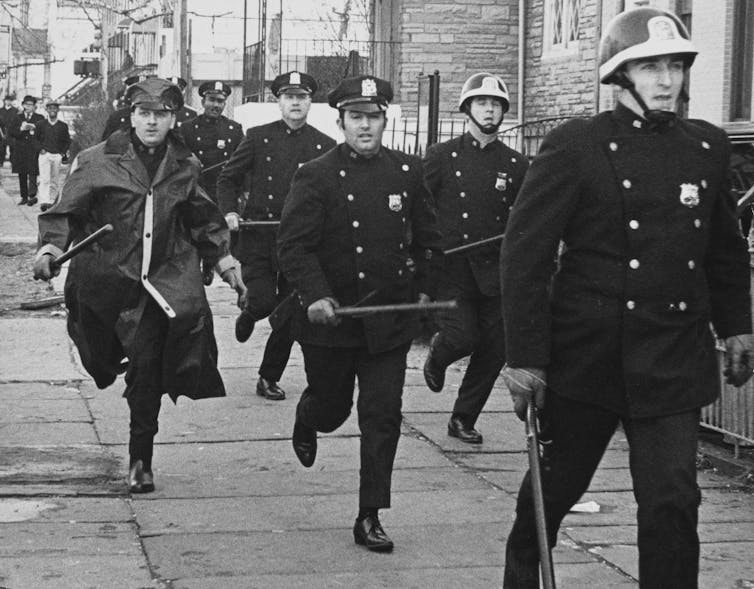
Police officers in a black in white vintage photograph wield batons as they move to cut off students.

NYPD officers run to head off striking students during the series of protests on the campus of Columbia University in New York City in 1968. Authenticated News via Getty Images

Black Power leaders such as Stokely Carmichael and H. Rap Brown explained to the press that if Columbia did not negotiate with the Black students in Hamilton, then the university would have to deal with the “brothers out on the streets” of Harlem. The threat of a coalition with Harlem neighbors aided in the success of the activists in ending the university’s construction of a private gymnasium in nearby Morningside Park and the cessation of the school’s ties to the Institute for Defense Analyses, a consortium of flagship and elite higher education institutions conducting government-funded defense research during the Cold War.

The threat of violence loomed with the recent building capture and arrests at Hamilton. The 2024 protest is starting to resemble the 1968 protest in terms of students feeling uncomfortable with their university’s decision-making and administrators feeling compelled to regain control of campus. The differences are becoming slimmer and the similarities thicker.

What about the use of symbolism?

In 1968 and today, students used symbolism to send a message.

Fifty-six years ago, demonstrators also took over Hamilton Hall – named after Alexander Hamilton – renaming it Malcolm X University and hanging images of Stokely Carmichael.

Today, protesters renamed it Hind’s Hall – in honor of a 6-year-old Palestinian child killed by Israeli tank fire in Gaza – and flew a Palestinian flag from a Hamilton window.

What is the legacy of the 1968 protest?

The major legacy is that students are the moral compass of these well-endowed, elite institutions – even if they engage in disruptive behavior. They are willing to act on campus when no one else will. If left to the trustees, administrators, faculty and staff, the university would likely be quiet and civil while waiting for the marketplace of ideas and countless committees to suss out what to do about real-time humanitarian crises.

Young people have always been impatient in their calls for justice. In 1968, the issues were Columbia’s construction of a gymnasium in West Harlem and the university’s relationship with the IDA; in the 1980s, it was the university’s financial interests in apartheid South Africa; and in the 2010s, the school’s investments in private prison corporations. The 1968 rebellion taught later generations not to accept indiscriminate killing and injustice.

Another legacy is that the deployment of police to break up demonstrations may end disruptions in the short term, but it may also end up radicalizing moderate students who see their friends get arrested or injured.

What makes a protest successful?

Of course, students want every demand met, but that is often unlikely to happen. A better mark of success is the disruption of the status quo and the amount of attention they bring to issues. In that regard, the protests have been a success.

Conflict at a place like Columbia garners attention because of its location in the media capital of the world. When administrators respond to issues students raise by focusing on policies and procedures, it can give the impression that the issues are not important.

Fifty-six years ago, campus activists inspired students abroad to chant “Two, Three, Many Columbias!” Administrators may want to remain apolitical, but campus demonstrators want to know where their tuition goes and have a say in how it is spent. Highlighting the conflict between key sources of funding – the students paying tuition and the school’s major donors – is a notable victory.

How unprecedented are the student arrests?

There is precedence for student arrests on and off campus. The NYPD violently arrested more than 700 students in April 1968 and dozens more in May.

When students in the 20th century rebelled against the idea that the university was supposed to act in the place of their parents, higher education officials turned to law enforcement in the hope that students would comply.

There were arrests at the Fisk Institute in 1925 for protests over strict student rules, including those that limited participation in civil rights movements; there was the Berkeley Free Speech Movement, when students demanded the right to pass out civil rights literature on campus.

In 1970, there were also police or National Guard-involved shootings of students at Jackson State and Kent State, a predominantly white university.

In 2016, police battled students protesting tuition hikes in California. There were no fatal shootings, but nonlethal weapons like pepper spray were deployed. Inviting police onto campus introduces an element that concedes power to those not interested in the educational well-being of students.


Stefan M. Bradley, Professor of Black Studies and History, Amherst College

This article is republished from The Conversation under a Creative Commons license. Read the original article.

Students sing “Imperial March” and shout “Beetlejuice” at Boebert during “liberation camp” visit

Rep. Lauren Boebert (R-CO) paid a visit to a pro-Palestinian encampment at George Washington University on Wednesday, accessorized with her signature red lipstick and a blue bullhorn.

Seemingly intending to protest the protest that has been holding steady on campus for about a week now, she was met with some creative jeers that left her visibly rattled.

In a clip that has been circulating on social media, students can be heard calling out "Beetlejuice" at Boebert, in reference to her handsy, vape-plumed wild night at the theater in Colorado last year. And, to put a soundtrack to the heckling, others joined voices in a spirited rendition of John Williams and London Symphony Orchestra's "The Imperial March" — Darth Vader's Theme, as she made her way through campus, backed by other House Republicans, including Reps. Byron Donalds (FL), Anna Paulina Luna (FL), and James Comer (KY).

At one point during her visit, Boebert struggled to tear down a Palestinian flag draped over a statue of George Washington while grumbling, “This is America, and that s**t needs to come down." 

“It’s time that Mayor [Muriel] Bowser gets aggressive in keeping safety here on this campus and the surrounding perimeter,” she said in a quote from The Daily Beast, going on to call the protestors “very disrespectful” for disrupting other students.


Another Boeing whistleblower has died, mere months after the first

Joshua Dean, a former quality auditor at Boeing supplier Spirit AeroSystems, died on April 30 after battling a stretch of illness that began with influenza B and MRSA, a bacterial infection, and eventually pneumonia. In a statement from Dean's mother, posted to Facebook, he had been "fighting for his life."

One of the first whistleblowers to draw attention to Spirit leadership ignoring aircraft defects — specifically on the 737 MAX — Dean's death comes shortly after the apparent suicide of John “Mitch” Barnett in March, who had been "in the midst of giving depositions alleging Boeing retaliated against him for complaints about quality lapses when he was found dead from a gunshot wound," according to The Seattle Times

Let go from Spirit in April 2023, Dean had filed a complaint with the Department of Labor alleging that his termination was retaliation for drawing attention to the company's lax aviation safety measures, related to improperly drilled bulkhead holes.

“I think they were sending out a message to anybody else,” Dean told NPR in February: “If you are too loud, we will silence you.”

“Whistleblowers are needed," says Brian Knowles, one of Dean’s lawyers. "They bring to light wrongdoing and corruption in the interests of society. It takes a lot of courage to stand up,” Knowles said. “It’s a difficult set of circumstances. Our thoughts now are with John’s family and Josh’s family.”

“Boogeyman narrative”: Columbia professors call out Eric Adams over “outside agitators” trope

New York City mayor Eric Adams and New York Police Department officials insisted this week that the protest occupation of a Columbia University hall, escalating months-long pro-Palestine demonstrations at the institution, was carried out by "outside agitators." 

But when repeatedly pressed by media for evidence to support the claim, the Democratic mayor and officials bobbed and weaved, with Adams arguing, reports The New York Times' Dana Rubinstein, on CNBC Thursday morning that the percentage of "outside agitators" compared to the number of student protesters "doesn't matter" following a spiel about the danger a professor espousing misinformation poses to young people. 

"The real outside agitators in this situation have been the conservative congressional members who have showed up to campus."

“I know that there are those who are attempting to say: ‘Well, the majority of people may have been students.’ You don’t have to be the majority to influence and co-opt an operation,” Adams said at a Wednesday press conference, as reported by Politico, while warning of a global movement working to radicalize young people. “And so if you want to play the word 'police,' you could do so. I’m going to play the New York City Police.”

Adams also suggested that the alleged outsiders had taught the students to barricade themselves in an effort to evade police removal attempts, the Associated Press notes

Columbia faculty members, however, rebuff that claim and the notion that students are being influenced to escalate their protests, with some instead emphasizing the students' own desire to protest. 

"I think it's a pathetic attempt to discredit the political investments and moral conscience of this movement," Dr. Shana Redmond, a professor of English and comparative literature at Columbia University, told Salon. "I think that the investment in paying attention to people beyond the university discredits the fact that these are adults. These students of Columbia University are adults who are making very principled decisions about how they want to live in the world and the kinds of impacts that they want to make."

Redmond, who participated in a faculty protest against the police presence at the campus, added that "the fact that they're trying to blame someone else, as if these young adults could not have come to this reasonable position on the genocide in Palestine on their own, is an absolute fabrication and [Adams] should be ashamed of himself for having insulted their intelligence in this way."

Adams and NYPD officials' "outside agitators" claim, according to Politico, has served as a justification for the mass arrests and offers cover to Columbia president Minouche Shafik, who requested police presence on campus to clear the encampment and through to graduation. Droves of NYPD officers entered Columbia's campus Tuesday night in riot gear, removing students from the Hamilton Hall building they had seized the night before. Officers would go on to arrest nearly 300 people that night, between the Columbia campus and the City College of New York, less than a mile north. 

Police brass identified other tactics they argued could only be the work of professionals, including protesters sporting "black bloc attire," forming barricades inside the hall, breaking windows and blocking cameras. They also pointed to a social media post indicating that a woman with ties to a group the State Department has designated a terrorist organization had been present on campus, Politico notes. 

That woman, Nahla Al-Arian, told The Associated Press Wednesday that Adams had misrepresented her role in the student protests and the facts about her ties to the Palestinian Islamic Jihad group through her husband, Sami Al-Arian, a former prominent Palestinian activist and computer engineering professor, who made the social media post. Her husband was arrested in 2003 on charges of supporting the group but was not convicted. His case stayed in "legal limbo" for years, the AP notes, with Sami Al-Arian later accepting a plea deal for aiding the group. He was deported to Turkey in 2015.

Nahla Al-Arian told the outlet that she wasn't on Columbia's campus this week, was not among the arrested protesters and has not been accused of a crime. Instead, she said she visited Columbia briefly on April 25 to see the encampment while visiting the city and sat on the lawn but did not speak directly to any protesters. 

Redmond said that several people visited Columbia's campus in the days the encampment stood, "many of whom came in solidarity" and "some of whom came to share about what they know, having been in student movements in prior decades." Alumni of the 1968 sit-ins and occupations and intellectuals alike came to campus, she recalled, describing how visitors took the time to sit in "peaceful, deliberate, quiet contemplation with" students, as well as to sing and dance with them. 

"The real outside agitators in this situation have been the conservative congressional members who have showed up to campus. Eric Adams has been an outside agitator who has done nothing but stir up already volatile emotions and communications on this campus as set by the example of our president," Redmond said, noting she doesn't "buy" their arguments.

The NYPD has often rolled out the outside agitator rhetorical tactic in the face of protests, Politico notes, employing the claim in the midst of racial justice protests following the murder of George Floyd in 2020. But the history of the claim goes even farther back, as Dr. Mae Ngai, a Columbia professor of Asian American studies and history, told Salon. 

The outside agitator is a "boogeyman narrative" that's used to "shift the blame away from people who are protesting" and has been employed against students who protested the Vietnam War in 1968 — some of whom staged a similar occupation of Hamilton Hall exactly 56 years, to the date, before the latest Columbia occupation — and civil rights leader Dr. Martin Luther King Jr., who was said to have been "controlled by communists," she explained. The "trope" also serves to "discredit any ties" the students may have with community members who align themselves with the students' cause.

Because there has been a swath of protesters outside Columbia's gates, which Ngai said includes "provocateurs who are trying to inflame the situation with antisemitic slogans" which student organizers have denounced, "this outside agitator narrative is also being used to take the most extreme and provocative politics that are on the street and attribute it to the students," she said.

We need your help to stay independent

In an interview with MSNBC, Deputy Commissioner Tarik Sheppard presented chains that NYPD officers had recovered from their raid of Hamilton Hall at Columbia, which protesters used to secure the building, describing them as indicators that professional outsiders had taken over peaceful student protests for Palestine. 

The chain Sheppard displayed appeared to be highly similar to a bike lock the university's Public Safety Department sells to students at a discounted price. The only difference between the chain featured on the website and the one Sheppard presented is that the former is covered by a black printed fabric that appears to be removable.

When shown the image of the Public Safety Department's promoted bike lock by a reporter at the Wednesday press conference, Sheppard insisted that the chains the NYPD had removed from Hamilton were not the same and were a sign of professional work.

Using the chain as evidence of the alleged outside agitators is "laughable," Ngai said. 

"Bicycle locks are just commonplace. Everyone has access to them — Columbia and non-Columbia students alike — so, I mean, if [officials are] presenting that as evidence that's very strange. They should be able to present much more convincing evidence one way or the other," Dr. Michael Thaddeus, a mathematics professor at Columbia University who is currently overseas on sabbatical, told Salon. He added, "Why the police department has to offer this very indirect evidence I have no idea. They arrested everybody. They have their names. They should be able to tell us whether they were outsiders or not."

Adams continued to dodge reporters' questions about the identities of the alleged outside agitators and the number of supposed outsiders respective to student protesters present in media appearances Thursday morning. According to Rubinstein, Adams refused to tell local news outlets Spectrum News NY1, Fox 5 and PIX11 News who and how many he believed were "outside agitators." He later told NPR that a "preliminary review" showed that "over 40 percent of those who participated in Columbia and CCNY protests were not from the school, Rubinstein reported. 


Want a daily wrap-up of all the news and commentary Salon has to offer? Subscribe to our morning newsletter, Crash Course.


When approached for comment regarding the 40 percent figure Adams cited on NPR Thursday morning, the mayor's office directed Salon to the NYPD Office of the Deputy Commissioner of Public Information. That office did not respond to a request for comment. 

An NYPD official told CNN Thursday that of the 282 people arrested at either Columbia and CCNY and Tuesday, 134 were not affiliated with either university. The remaining 148 protesters were affiliated with one or the other. 

At Columbia, CNN noted, 80 people arrested had an affiliation with the Ivy League university, compared to only 32 who didn't — numbers that account for arrests made both inside and outside Hamilton Hall. 

While Columbia student protesters have been clear they welcome outside community members, organizers have maintained that their actions have been student-led, according to the AP. Some of those students said they had closely studied tactics employed by the students who took over university buildings in 1968 to protest the Vietnam War. 

In a statement to the AP, Columbia University Apartheid Divest, the coalition behind Columbia's now dismantled encampment comprised of more than 100 student groups, defended its right “to include people from outside the Ivy League or the ivory tower in this global movement” and dubbed the "outside agitator" narrative a "far right smear."

"Columbia’s attempt to repress the movement only strengthens our resolve. We are not finished," the group said in a press release published on its Substack, recounting its occupation of Hamilton Hall, which was renamed "Hind's Hall" by the protesters in honor of a six-year-old Palestinian girl killed by Israel's bombardment of Gaza, which has killed more than 34,000 Palestinians according to the Gaza health ministry.

"The protesters defending Hind’s Hall belong to a rich, beautiful legacy of civil disobedience at Columbia," they added, pointing to the police raid of the April 30, 1968, occupation of Hamilton Hall. "On the 56th anniversary of that day (to the very same day of the week), we met the same militarized adversaries with a resolve fiercer than before."

That's what's most important, Ngai and Redmond argued. Students led the protests, they insist — not an outside agitator but students galvanized to action for Palestinian lives. Ngai drew a comparison to her own experience as an NYU student protesting, striking and occupying buildings in 1969 and 1970 in protest of the Vietnam War.

"I think then, as now, the students [are] on the right side of history, and they lead the way as a moral conscience for the nation," she said, adding: "They don't need outsiders to tell them what to do. They're the leaders."

Dan Schneider sues “Quiet on Set” for defamation, citing the show as a “hit job” on his reputation

The fallout of exposé "Quiet on Set" continues to reverberate in Hollywood. 

The bombshell Investigation Discovery series revealed a myriad of shocking revelations about the systemic abuse at Nickelodeon through interviews with numerous former child actors. While the series received a strong and generally positive response from viewers, ultimately becoming Max's biggest streaming title, there has been some backlash regarding the ethics of how the docuseries was made. Child actors like Raquel Lee Bolleau and Alexa Nikolas have stated that they feel like the people behind "Quiet on Set" have used their traumatic experiences as a way to cash in on success and money.

But now, Dan Schneider  – the former Nickelodeon creator of shows like "iCarly," "The Amanda Show" and "Drake and Josh" –  has become the first to take legal action against the show's producers, accusing the show of defaming him and painting him as a child sex abuser. 

In the lawsuit, filed in Los Angeles on Wednesday and obtained by Variety, Schneider's attorneys stated that “‘Quiet on Set’s’ portrayal of Schneider is a hit job." The lawsuit named Warner Bros. Discovery, Sony Pictures Television and Maxine Productions as the defendants, The Associated Press reported.

It continued that it is indisputable that there were two child sexual abusers who worked on Nickelodeon sets, but "It is likewise indisputable that Schneider had no knowledge of their abuse, was not complicit in the abuse, condemned the abuse once it was discovered and, critically, was not a child sexual abuser himself."

However, Schneider alleged that "for the sake of clickbait, ratings, and views — or put differently, money — Defendants have destroyed Schneider’s reputation and legacy through the false statements and implications that Schneider is exactly that.”

The lawsuit stressed that Schneider "was not a child sexual abuser" but the voiceovers and graphics in "Quiet on Set," alongside the trailer are "purposefully and intentionally defamatory in that they falsely and repeatedly state or imply that Schneider is a child sexual abuser and committed crimes in this regard — and have been interpreted as such by countless average, ordinary or reasonable viewers.”

In a statement to Variety, Schneider personally wrote that the docuseries "highlighted mistakes I made and poor judgment I exhibited during my time at Nickelodeon, most of which happened decades ago during my early career as a producer, working on shows for Tollin/Robbins Productions."

We need your help to stay independent

"There is no doubt that I was sometimes a bad leader. I am sincerely apologetic and regretful for that behavior, and I will continue to take accountability for it. However, after seeing ‘Quiet on Set’ and its trailer, and the reactions to them, I sadly have no choice but to take legal action against the people behind it," he said.

Schneider alluded to how "Quiet on Set" producers successfully attempted "to mislead viewers and increase ratings, they went beyond reporting the truth and falsely implied that I was involved in or facilitated horrific crimes for which actual child predators have been prosecuted and convicted.

“I have no objection to anyone highlighting my failures as a boss, but it is wrong to mislead millions of people to the false conclusion that I was in any way involved in heinous acts like those committed by child predators," Schneider continued. "I owe it to myself, my family, and the many wonderful people involved in making these shows to set the record straight.”

The AP reached out to the three companies named in the suit but there has been no comment yet.

“The story has always been missing one key side”: Watch trailer for Nicole Brown Simpson documentary

Lifetime is set to premiere a documentary focusing on the life and death of Nicole Brown Simpson, timed to the 30th anniversary of her tragic murder. 

"The Life and Murder of Nicole Brown Simpson" will be released over two days, June 1 and 2, at 8 p.m. ET.  The docuseries will delve into the infamous killings of Nicole and her friend Ron Goldman, who were found brutally slain in 1994 outside Simpson's townhome in Brentwood, California. According to a press release from Lifetime, the series “provides an opportunity for Nicole’s own narrative and voice to be heard in one of the most notorious crimes and trials in history."

O.J. Simpson, former all-star NFL running back and Nicole's ex-husband, was considered a prime suspect and faced first-degree murder charges. After attempting to evade arrest by fleeing in a white Bronco, giving way to that infamous car chase, O.J. stood for a highly publicized trial. He was ultimately acquitted of the double homicide in October of 1995 and maintained his innocence, despite widespread speculation of his guilt. However, in 1997, the disgraced football player was found liable for both murders in a civil lawsuit filed by the victims' families and was ordered to pay $33.5 million in damages. The highly publicized trial led to further notoriety for O.J., who, along with being a professional athlete, also acted in several films. He published a book called "If I Did It," a fictionalized account of the murders he long maintained he didn't commit.

His story would become the subject of documentaries such as "O.J.: Made in America," and Emmy- and Golden Globe-winning limited series,  "The People v. O. J. Simpson: American Crime Story."

Now, Lifetime will endeavor to illuminate Nicole's story, the "one key side" the network claims has "always been missing." 

The documentary, which was made in collaboration with the National Domestic Abuse Hotline, will feature 50 participants, including Simpson's sisters — Denise, Dominique and Tanya Brown —  and other close friends. 

“What happened to our sister Nicole should never have happened to her or to any other woman,”  the Brown sisters said in a statement. “Her life was stolen from her and while her abuser is finally gone, it doesn’t take away the anguish we feel or the pain of her children who lost their mother. We hope that by sharing Nicole’s story, it will help others recognize the signs and get the help they need and her legacy will continue to live on.”

In the trailer, one of Nicole's sisters says that "the one thing I could not protect her from was the monster she was married to" while another claims that "she always knew he was going to hurt her."

Last month, O.J. died at the age of 76 from metastatic prostate cancer. His family posted a simple statement on social media, writing, "On April 10th, our father, Orenthal James Simpson, succumbed to his battle with cancer. He was surrounded by his children and grandchildren. During this time of transition, his family asks that you please respect their wishes for privacy and grace." 

"The Life and Murder of Nicole Brown Simpson" will air on Lifetime on June 1 and 2 at 8 p.m. ET.


We think we control our health – but corporations have a greater say

You go to the gym, eat healthy and walk as much as possible. You wash your hands and get vaccinated. You control your health. This is a common story we tell ourselves. Unfortunately, it's not quite true.

Factors outside our control have huge influence – especially products which can sicken or kill us, made by companies and sold routinely.  

For instance, you and your family have been exposed for decades to dangerous forever chemicals, some of which are linked to kidney and testicular cancers. You're almost certainly carrying these chemicals, known as PFAS or forever chemicals, in your body right now.

And that's just the start. We now know exposure to just four classes of product – tobacco, alcohol, ultra-processed foods and fossil fuels – are linked to one out of every three deaths worldwide. That is, they're implicated in 19 of the world's 56 million deaths each year (as of 2019). Pollution – largely from fossil fuels – is now the single largest environmental cause of premature death. Communities of colour and low-income communities experience disproportionate impacts. Over 90% of pollution related deaths occur in low middle income countries.

This means the leading risk factor for disease and death worldwide is corporations who make, market and sell these unhealthy  products. Worse, even when these corporations become aware of the harms their products cause, they have often systematically hidden these harms to boost profits at the expense of our health. Major tobacco, oil, food, pharmaceutical and chemical corporations have all applied similar techniques, privatising the profits and spreading the harms.


Profit and loss statements

When companies act to conceal the harm their products do, they prevent us from protecting ourselves and our children. We now have many well-documented cases of corporate wrongdoing, such as asbestos, fossil fuels, pesticides, herbicides sugar, silica, and of course tobacco. In these instances, corporations intentionally manufactured doubt or hid the harms of their products to delay or prevent regulation and maintain profits.

Decades of empirical evidence shows these effective tactics have actually been shared and strategically passed from one industry or company to the next.

For instance, when large tobacco companies Philip Morris and R.J. Reynolds bought food companies Kraft, General Foods and Nabisco in the 1980s, tobacco executives brought across marketing strategies, flavoring and colorings to expand product lines and engineered fatty, sweet and salty hyperpalatable foods such as cookies, cereals and frozen foods linked to obesity and diet-related diseases. These foods activate our reward circuits and encourage us to consume more.  

Or consider how 'forever chemicals' became so widespread. A team of scientists (including this article's co-author) investigated previously secret internal industry documents from 3M and DuPont, the largest makers of  forever chemicals PFOA and PFOS.

The documents showed both 3M and DuPont used tactics from the tobacco industry's playbook, such as suppressing unfavorable research and distorting public debate. Like Big Tobacco, 3M and DuPont had a financial interest in suppressing scientific evidence of the harms of their products, while publicly declaring in-demand products such as Teflon were safe.

For decades, forever chemicals PFOA and PFOS have been used to make Teflon pans, Scotchgard, firefighting foam and other non-stick materials. By the early 2000s, one of these, PFOS, ended up in our blood at 20 times the level its manufacturer, 3M, considered safe.

As early as 1961, the chief toxicologist at DuPont's Teflon subsidiary reported the company's wonder-material had "the ability to increase the size of the liver of rats at low doses", and recommended the chemicals be handled "with extreme care". According to a 1970 internal memo, the DuPont-funded Haskell Laboratory found the chemical class C8 (now known as PFOA/PFOS) was "highly toxic when inhaled and moderately toxic when ingested".

Both 3M and DuPont did extensive internal research on the risks their products posed to humans, but they shared little of it. The risks of PFOA including pregnancy-induced hypertension, kidney and testicular cancers, and ulcerative colitis was not publicly established until 2011.

Now, 60 years after DuPont first learned of the harms these products could cause,  many countries are facing the human and environmental consequences and a very expensive cleanup.

Even though the production of PFOA and PFOS is being phased out, forever chemicals are easily stored in the body and take decades to break down. Worse, PFOA and PFOS are just two of over 15,000 different PFAS chemicals, most of which are still in use.


How can we prevent corporate injury to our health?

My co-author and I work in the field known as commercial determinants of health, which is to say, the damage corporations can do to us.


Corporate wrongdoing can directly injure or even kill us.


One of the key ways companies have been able to avoid regulation and lawsuits is by hiding the evidence. Internal studies showing harm can be easily hidden. External studies can be influenced, either by corporate funding, business-friendly scientists, legal action or lobbying policymakers to avoid regulation.

Here are three ways to prevent this happening again:

1)    Require corporations to adhere to the same standards of data sharing and open science as independent scientists do.

If a corporation wants to bring a new product to market, they should have to register and publicly release every study they plan to conduct on its harms so the public can see the results of the study.

2)    Sever the financial links between industry and researchers or policymakers.

Many large corporations will spend money on public studies to try to get favourable outcomes for their own interests. To cut these financial ties means boosting public health research, either through government funding or alternatives such as a tax on corporate marketing. It would also mean capping corporate political donations and bringing lobbying under control by restricting corporate access and spending to policymakers and increasing transparency. And it would mean stopping the revolving door where government employees or policymakers work for the industry they used to regulate once they leave office.

3)    Mandate public transparency of corporate funding to researchers and policymakers.

In 2010, the United States introduced laws to enforce transparency on how much medical and pharmaceutical companies were spending to influence the products doctors chose to use. Research using the data unearthed by these laws has shown the problem is pervasive. We need this model for other industries so we can clearly see where corporate money is going. Registries should be detailed, permanent and easy to search.

These steps would not be easy. But the status quo means corporations can keep selling dangerous or lethal products for much longer than they should.

In doing so, they have become one of the largest influences on our health and will continue to harm generations to come – in ways hard to counter with yoga and willpower. And your health is more important than corporate profits.


Nick Chartres, Senior Research Fellow, Faculty of Medicine & Health, University of Sydney and Lisa Bero, Chief Scientist, Center for Bioethics and Humanities and Professor of Medicine and Public Health, University of Colorado Anschutz Medical Campus


This article is republished from The Conversation under a Creative Commons license. Read the original article.

“He doesn’t play games”: Experts say judge may “come down strongly” on Trump for gag order violation

New York prosecutors said Thursday they are not seeking jail time “yet” for Trump’s repeated violations of his gag order in his hush money trial – but that doesn’t bar the judge from taking that step anyways.

“The fact that the prosecution doesn't point to jail time doesn't really matter to the judge,” Bennett Gershman, former New York prosecutor and law professor at Pace University, told Salon.

“This judge, he doesn't play games,” Gershman said. “And if he sees that individuals are playing games with him, he's going to come down strongly on them.”

Judge Juan Merchan fined Trump $9,000 on Tuesday for nine violations of his gag order and ordered him to take down social media posts about jurors and witnesses.

On Thursday, prosecutors argued for Trump to be hit with four more sanctions for violating the gag order. 

The alleged violations stem from his comments made to reporters outside the courtroom and in other interviews and news conferences.

According to The New York Times, prosecutor Christopher Conroy told the judge Thursday that Trump’s “statements are corrosive to this proceeding and the fair administration of justice.”

Those statements, according to The Times, include:

  • Trump saying the jury was “mostly all Democrat” in a telephone interview with a right-wing media outlet. He also said: "It's a very unfair situation."
  • Trump calling former National Enquirer public David Pecker ”very nice” at a news conference
  • Trump calling his former counsel Michael Cohen a “convicted liar” who has “no credibility whatsoever” in a television interview.
  • Trump speaking outside a courtroom to reporters and calling Cohen a liar on April 22 – the same day testimony began. 

Trump’s legal team again argued that Trump was merely responding to political attacks. Trump’s gag order does say it “in no way prevents Defendant from responding to alleged political attacks.”

According to The Times, Trump lawyer Todd Blanche pointed to Cohen’s litany of TikTok videos criticizing Trump. “This is not a man that needs protection from the gag order," he said.

Reporters said the judge appeared to nod at some of Blanche’s arguments – with an exception for Trump’s comments about the jury.

Merchan did not rule on the four additional contempt allegations Thursday, but could do so in coming days.

“If a judge threatens you with contempt and threatens to throw you in jail, that's usually going to do the trick,” Gershman said.

We need your help to stay independent

Trump has faced numerous gag orders in criminal and civil cases over the past year – last fall, a judge fined him at least $15,000 for violating a gag order in his New York civil fraud trial for comments that included remarks about a judge’s law clerk. Trump’s team sued and called the gag order an abuse of power infringing on constitutional rights, according to The Associated Press.

Whether the judge would put Trump behind bars at any length of time for repeated violations of the gag order is unclear. Some legal experts say the move could upend the trial, feed into Trump's witch hunt narrative or lead to a more lengthy legal fight.

Peter Joy, a law professor and director of the criminal justice clinic at Washington University School of Law, said there’s a “lot of precedent” about a judge’s authority to find people in contempt and place them in jail. 

“I have no doubt in my mind, that he's going to continue to violate the order that he has up until the point where there's a more serious repercussion,” Joy said.


Want a daily wrap-up of all the news and commentary Salon has to offer? Subscribe to our morning newsletter, Crash Course.


Trump’s legal team also sought to discredit the integrity of Stormy Daniels’ lawyer Keith Davidson during a heated exchange Thursday. 

“There's a certain degree of latitude that any lawyer has in terms of trying to discredit a witness or undermine a prosecution's theory,” Joy said.

Trump’s lawyers grilled Davidson about his association with celebrity scandals – including a former client who allegedly leaked that Lindsay Lohan was in rehab.

Davidson for his part said he’s had over 1,500 clients, according to The Times.

Whether Trump’s strategy of grilling Davidson will work remains to be seen – but appears to be within ethical bounds, according to Joy.

“Those kinds of statements seem to me to be ones that Trump's lawyers are using to try to test the government's case, which is something that they're ethically permitted to do,” Joy said. “Is there a point where they might cross align themselves in such an attack? Yes, if they say something with basically reckless regard for what the truth might be. But the statements so far, I think that they've made concerning Daniels’ lawyer probably fall into the realm of: ‘Well, that might be their opinion, even though it's speculative.” So I think they're probably on safe ground.”

Barb McQuade, a former U.S. Attorney and University of Michigan law professor, said prosecutors on Thursday focused on providing the foundation for the admission of text messages proving their case into evidence. 

“The government is telling much of the story through text messages,” she said.

Prosecutors are arguing that a vast trove of text messages and other evidence outline the Trump organization’s scheme.

Trump is charged with 34 felony counts of falsifying business records, with prosecutors saying he was part of a scheme to kill damaging stories ahead of his 2016 campaign. Trump denies those charges. Each count is punishable by up to four years behind bars.

“Steer clear”: Judge issues warning to Trump lawyer seeking pre-approval for Truth Social posts

Donald Trump keeps getting in trouble for what he posts online, already racking up $9,000 in contempt charges for attacking jurors and witnesses in violation of the gag order in his Manhattan criminal trial. Faced with the prospect of jail if he keeps offending, and following another contempt hearing Thursday morning, Trump's defense team tried a novel approach: asking the judge if he could sign off on some of Trump's Truth Social posts before he ever posts them.

Susan Necheles, a criminal defense attorney representing Trump in the hush money case, made the request Thursday afternoon, explaining to Judge Juan Merchan that her client would like to post articles about the trial but isn't sure that's allowed.

"These articles are all articles which [former] President Trump would like to post on his Truth [Social], but they discuss this case," Necheles said, per NBC News.

Necheles argued that, while the articles are "perfectly fine," in her view, there is "ambiguity in the gag order."

Neither the prosecution nor the judge seemed to buy the argument.

Chris Conroy, with the Manhattan District Attorney's Office, described the request as "odd," according to CNN. Merchan was a little more diplomatic, saying he "appreciates what you're bringing to my attention" but affirming that he does not wish to be Trump's social media editor.

"If in doubt, steer clear," he told Trump's defense counsel. "There is no ambiguity, I believe, in the [gag] order."

“Oh my god”: Stormy Daniels lawyer texted “what have we done?” after seeing Trump win election

The lawyer who negotiated a hush money deal to prevent a Playboy model's alleged affair with Donald Trump from going public reacted with shock to the former president's victory in 2016, according to text messages revealed Thursday.

Keith Davidson, a former attorney for Karen McDougal, was testifying in Trump's Manhattan criminal trial when prosecutors introduced as evidence text messages he sent to Dylan Howard, then the editor in chief of the National Enquirer. The tabloid had agreed to pay $150,000 for the rights to McDougal's story, which it buried as part of an effort to assist Trump's campaign, according to testimony from former publisher David Pecker.

Immediately following Trump's shock victory in 2016, Davidson picked up his phone and sent a 3 a.m. text to Howard.

"What have we done?" he wrote as it became clear that Trump was going to win enough electoral votes to become president.

"Oh my god," Howard responded.

Testifying Thursday, Davidson, who also represented adult film star Stormy Daniels, explained that the texts were a form of "gallows humor," NBC News reported.

"There was sort of surprise amongst the broadcasters and others that Donald Trump was leading in the polls, and there was a growing sense that folks were about ready to call the election," Davidson said, adding that he and Howard understood that "our activities may have in some way assisted the presidential campaign of Donald Trump."

“Hacks” returns with its funny ladies on the mountaintop, but questions the cost of the climb

On April 26, Vanessa Williams pulled a Beyoncé – or is it a Cher? – by dropping her first new single in 15 years without much fanfare, relying on its catchiness and her followers, online and IRL, to share the links and spread the word. 

“Legs (Keep Dancing)” isn’t just Williams’ first new single in 15 years, it’s a dancefloor paean to aging fiercely that spins around its catchy refrain of, “They say the legs are the last to go/ I’ma keep dancing." 

Her explanation of the single’s message on Tuesday’s “Today” sounds straight out of Deborah Vance’s playbook on “Hacks.” “It's like, I'm still here. I'm still relevant. I still got stuff to say and do and act,” she said.

Her moves in her video back up those words. Williams, at 61, hits choreography marks that would hang up dancers many years younger, either keeping up or outpacing most of her backup dancers. It’s too early to predict whether the single will be the hit of the summer, but if people of a certain age needed a banger Williams has served.

Besides, as alluded to by Hoda Kotb and Jenna Bush Hager, if she didn’t do it, who would? She’s “not waiting for people to get stuff done for me,” she says, producing and directing her own work. She’s betting on herself.

That attitude has served “Hacks” and its brusque diva Deborah well, not to mention giving Jean Smart the best role of her career. So far. 

“Hacks” could have ended for good on a high note at the end of its second season, which resolved Deborah’s plummet from the Las Vegas firmament with a comeback engineered by her writing partner Ava (Hannah Einbinder) pushing her to do more confessional, self-skewering comedy. Smart’s comedian is modeled in part on Joan Rivers, but the critical knives she turned on herself were cruel. Deborah, in contrast, opts to wield blistering honesty concerning her faults and sins in her self-produced special. She kills.

Even so, every network passed on it. But Deborah isn't deterred. She took the video directly to her QVC faithful, proving her marketability with blockbuster sales numbers. Suddenly she’s hot again. 

“Hacks” consistently preaches that “aging gracefully” business is at least partially a load of bull while qualifying that aspirational truth by showing that it’s a constant fight, and women are obligated to swing hardest and never stop swinging. Men, meanwhile, can come and go from comedy’s mainstages as they please.

Following delays imposed by last year’s dual actors and writers strikes and Smart’s recovery from heart surgery, “Hacks” returns on a new creative high, one that positions itself to keep going as long as its pins can support it. As the star comedian’s cosmetic surgery and skincare regimen does, so goes this series – both are constantly “refreshing."

Some of that means playing with commonly accepted notions concerning aging and one’s marketplace viability. But the more crucial cuts take a scalpel to its core duo’s addictively poisonous dynamic.

One year after Deborah’s return to the mountaintop, she’s on such a hot streak that simply appearing in a room gets her applause, which is a great way for a comedian to lose their edge. Not even the stylist teams at her beck and call have the guts to be brutally honest about her choices. Only Ava was ever that brave.

But Deborah lovingly shooed away the writer so she could tend to her own career, which, thanks to her mentor’s reflected heat, scored her one of TV’s most sought-after staff gigs as a co-producer of this show’s version of “Last Week Tonight.” Ava doesn’t need Deborah anymore. 

HacksHannah Einbinder and Aristotle Athari in "Hacks" (Max)No superstar lights up the sky by themselves. Williams’ crew of producers, for example, include veteran R&B artist Kipper Jones, who worked on her earlier albums, and Chantry Johnson, who has also produced Lana Del Rey. 
If her track wins over Gen Z, some credit for that win is due to songwriter Kjersti Long's contribution to the track; the teenage pop singer has a co-writer credit along with Johnson and Jones. 

Staying relevant takes the foresight and humility to respect youthful skills and perspectives. Thus, when Deborah gets a rare second chance to finally realize her lifelong dream, she understands that only Ava can help her clinch it.

This kicks off one of the better third-season reversals in recent memory, one that pulls in an impressive roster of guest stars, including but not limited to Helen Hunt. "Hacks" creators Lucia Aniello, Paul W. Downs and Jen Statsky gamely position Einbinder to be closer to the level of Smart’s glamorous showbiz raptor — all claws and plumage dazzling enough to hide all the arrow wounds.

Einbinder sustains the awkward insecurity that keeps the character lovable despite her tendency to cling to career-imperiling decisions and egotistical outbursts which, in these new episodes, are fewer. Ava has her problems to process, having evolved from a thankless comedy brat to being too grateful and respectful of the woman who both nurtures her and at times has threatened to reduce her life to ashes.  

Still, she’s confident enough to pass on flimsy projects her and Deborah’s manager Jimmy (Downs) suggests, including a revival of “Gumby” that makes the character bisexual. “He bends both ways!” chirps Jimmy’s barnacle of a partner Kayla (Meg Stalter).

Every time this crew reaches a good place, it can never stay that way.  If you recall, one of the first lessons Deborah teaches to Ava is that good is the minimum, the baseline. “You have to be so much more than good," she says.

We need your help to stay independent

Season 3 sifts through what that really means — to Deborah, and Ava, and to Deborah and Ava. The writers spend two full seasons immaculately closing the sale on why these two women remain loyal to one no matter the mutual damage they inflict. They are vindictive, self-serving, and bruise easily – not the types of people we’d want in our lives.

Together they’re rocket fuel, pure wizardry, partners who push each other to want more for themselves. You’d think that Deborah, the seasoned comedian who has weathered the severest industry toxicity imaginable, would appreciate that about Ava. Not always. 

In one of the new season’s most riveting screaming matches, she tears into her writer for pushing her out of her Las Vegas comedian comfort zone after she realizes the younger woman is in her head. She finds it annoying.

But if Ava and Deborah had never teamed up, the veteran may never have taken another shot at a coveted legacy late-night chair that unexpectedly opens. 

As is the case in our reality, no broadcast network has ever hired a woman to host an 11:30 variety talk show, let alone one as old as Deborah – her words, not mine. (She also throws in being blonde as another barrier to shatter.) Common sense and history tell her that campaigning for the position would be a waste of time. 

HacksJean Smart, Megan Stalter and Paul W. Downs in "Hacks" (Max)On the other hand, rejecting the notion that ambition has limits is Deborah’s defining maxim. Allegedly. For all her success, Deborah is haunted by having lost out on her chance to host late-night in the same sweep of terrible fate that led to her envious husband leaving her for her sister. Everyone around her pays for that disappointment, including her prickly daughter DJ (Kaitlin Olson), whose relationship with her mother is a casualty of Deborah’s relentless drive to stay on top. 

In some twisted sense, Ava has come to understand that’s what it takes to succeed. Hence, the pair swiftly relapses into their loving exchange of insults and encouragement following that gap year during which Deborah cut off all contact with her protégé.

And yet, as several characters point out, Ava welcomes Deborah’s manipulations. When she mentions to someone that Deborah “freed” her to pursue other opportunities, the person observes that makes Ava sound like Deborah’s prisoner.

Endearing as they can be when Deborah is ripping on Ava’s fashion choices and the younger comic peels back her mentor’s shielding to question her outdated ideal, the writers also recognize that’s what we find comforting about “Hacks.”  That makes it a fresh pleasure to let them stroll us through situations that challenge that status quo.


Want a daily wrap-up of all the news and commentary Salon has to offer? Subscribe to our morning newsletter, Crash Course.


As ever, “Hacks” episodes hum along with a fine-tuned comic cadence, buoyed by the stars’ performances along with that of Downs and Stalter. Season 3 affords Jimmy and Kayla a more extensively developed B-plot, albeit one spun out of sugar and about as substantial. Somehow they outshine the journey written for Carl Clemons-Hopkins’ Marcus, Deborah’s unflappable business manager.

That said, a late-season development spotlights Clemons-Hopkins’ confidence and the calm in their performance, reminding us how central they are to the Vance team’s winning formula. Deborah is proud to say she’ll work until the day she dies — or her legs go, as the song says. 

Such determination has its privileges, like airplane hangars full of couture or random room drops of the coveted Tom Cruise white chocolate coconut cake. But when you think about it, these prizes are as flimsy as the concepts that networks are purporting to want, which makes us question why these two women fight so viciously for bigger slices than what they already have. 

Maybe it’s because so many of us covet that life but will never attain it. “Hacks,” however, makes the battle entertaining, even when the characters we love draw blood.

“Hacks” premieres Thursday, May 2 on Max with two episodes. New episodes stream weekly in pairs on Thursdays.

“Vegetable-forward”: How chef and farmer Emma Hearst makes produce the center of her plate

Emma Hearst has held many titles — James Beard-nominated chef, former restaurateur, farmer, cookbook author, youngest-ever "Icon Chef" competitor, store owner, wife and mother — but to me, she is best known as the former co-owner and chef of Sorella, an New York City restaurant (and subsequent cookbook) that was formative in my culinary "adolescence," if you will.

Hearst, whose vibrant new cookbook "Flavors from the Farm: Vegetable-Forward Food to Share" is out now, has settled on a 60-acre farmstead upstate. The book follows that sentiment, with produce-focused, elevated dishes that are simple to prepare but bodacious in flavor and color, all made with with the humblest of ingredients.

Of course, placing a focus on gardening and produce is beneficial for many reasons, from sustainability and health to animal rights and economic issues. In addition, gardening can also be something of a fun hobby for some — or perhaps even a vested passion, too. Furthermore, many folks are feeling the impact of food inflation, so being able to build a meal from your own garden is freeing financially, too.

Clearly, prioritizing produce is a win-win.

Hearst recently spoke with Salon Food about her ethos towards cooking, her adoration for fresh produce, the genesis of her love for food and much, much more.

Flavors from the Farm by Emma HearstFlavors from the Farm by Emma Hearst (Photo courtesy of Insight Editions)
The following interview has been lightly edited for clarity and length.

What about vegetables (and fruit!) are so special to you? 

Well, I have a farm, and let me tell you, great vegetables and fruit take a lot of work, time and money to grow. There are so many elements — like weather — that are just out of one's control, so when the universe aligns and you get a really fantastic product, it must be treated with respect! 

Do you have a favorite recipe in the book? 

Though they are all dear to me, I would have to say that Tomatoes with Brown Butter might be my favorite because of its simplicity and elegance. We also grow bad-ass heirloom tomatoes on the farm, so it is always a treat to have once they come into season. 

What stands out for you as a formative moment that got you into cooking or food at large? 

When I was four years old, my parents took me on my first trip to NYC. They got tickets to the Rockette's Christmas Show and planned to take me to fancy dinners, along with a trip to the glorious old school FAO Schwarz, which has since moved. Being an only child, I was always treated like a little adult and therefore acted like one too.

I always had a love of food as a little person and remember getting insulted when handed a children's menu at any restaurant. Many of the restaurants we went to during this trip did not allow children, but my dad made sure to assure them I would not act like one! (laughs)

We dined at La Caravelle, La Cote Basque, The 21 Club and The Four Seasons Restaurant, all of which are now either closed or have been taken over by new people. Being the only little person in the room, these restaurants all gave me the royal treatment.  I was enamored by the tableside service, beautiful cuisine and the art of how fine restaurants worked. It was like a dance performance.

It was my meal at The Four Seasons, where I got to sit poolside in their grand dining room, when I knew I needed to become a chef for the rest of my life and that would be the path I followed as I grew up.  

We need your help to stay independent

Tell me a bit about your farm? 

My farm has been in operation for nearly a decade now.  My husband and I knew we did not want to be involved in restaurants in the same way we had before (he is also a chef), but we both wanted to be involved in food.  He always had a dream to farm. I did not. So, we made a deal!

We would farm, but we would only grow beautiful, interesting varieties of very chef-driven produce that we would want to buy ourselves as chefs. We knew positively nothing about how to farm when we started, but learned more and more each year through many failures!

As we put more infrastructure into the farm, our capacity in our offerings grew as well.  We now grow about 300 varieties of chef-driven produce, flowers and herbs.  In addition to that, we have a commercial kitchen in our barn and get to make amazing meals and products with all the beautiful things that come out of our field.  The farm also has an apiary operation that produces incredible honey, two rescue steers, and a smattering of laying hens.  

Emma HearstEmma Hearst (Photography by James Barker)
I've heard about Farm Shoppe (wonderful things!) — can you explain a bit about it for our readers? 

Farm Shoppe is exactly what the name is and so much more! It is where we showcase everything from the farm for customers to enjoy.  We sell our produce and flowers in addition to our line of hot sauces and condiments, all of our honey, our grab and go foods and our new book!

In addition to our farm products, we carry a smattering of our favorite pantry items and kitchen tools we cannot live without, antique table attire and all things meant for having fun and entertaining with ease and style. I curate all of our inventory and wanted a sense of whimsy, style and FUN throughout.

When people enter they definitely need a moment to soak it all in because there is a lot going on in my tiny jewel box of a shop. My goal is for the shop to serve as inspiration and reprieve from this crazy world.  I want it to leave people feeling happy and hopefully they spread that happiness out into the great beyond.


Want more great food writing and recipes? Subscribe to Salon Food's newsletter, The Bite.


For those looking to get into gardening or planting their own seeds, what would you recommend? 

I would highly recommend fresh herbs! Herbs are something we are obsessed with on the farm and in my opinion, your cooking is only as good as your fresh herbs. They are essential in making a meal pop. Whether you have a kitchen window, balcony or full yard, herbs can always be grown and will always be worth their weight in gold in the kitchen.  

What was the development process of the book like? How did it go from an initial idea to a fully formed, beautiful cookbook?

My process generally comes spilling out of me, and I have a pretty clear vision for nearly anything I do.

I wrote this book over the period of about four months during the winter of 2022-23. Once it was outlined and written, we began to tinker here and there and commence on the photography portion of the book.  My brother-in-law, James Barker, who is my business partner, does all of our photography, so he and I went to work on styling and shooting the entire book ourselves at both our barn and my parents house. All of the photography was wrapped up in a few months and voila! We handed it over to our publishers so we could suss out page design, branding etcetera.  It was done and off to print by late fall of last year. 

Banana BreadBanana Bread (Photography by James Barker)

I was (and am) obsessed with the Sorella cookbook; I almost staged there in culinary school! How would you say your time with Sorella, plus all of your other culinary accolades and career experiences, impacted your food outlook and recipes in this book? 

WOW! That is so sweet and what a small world! I opened Sorella at the ripe age of 21 and didn't know the first thing about running a business so during those years I definitely learned a lot through its successes and failures. The Sorella book was definitely more restaurant-y food because well, it was a restaurant.  Many restaurant cookbooks cannot be executed with ease at home unless you have a real desire to cook them. 

Being a busy small business owner and a mom, and not being in restaurants any longer,  I knew I wanted this book to be very flexible and not intimidating.  I've been doling out advice to our customers verbally over the past 10 years on the best ways to use our produce once they get home and this was an opportunity to give them a hard copy version of some of the ways I cook at home.  

How would you define "vegetable-forward"? 

Vegetable-forward means that the produce is the focus of the dish rather than placed on the sidelines.  Many of the recipes are not vegan or vegetarian, but they all showcase the produce first and foremost any meat or dairy serves more as a garnish. 

For a particularly picky eater, regardless of age, what would you say is a good gateway vegetable recipe in the book? 

The Fatty Bistro Salad is one that I find everyone, including my own picky 6 year old, finds hard to turn down. The punchy dressing, fatty cheese and crisp lettuce are addictively good.

I'm obsessed with the "conduct of the kitchen" section. How would you distill that for our readers? 

A lot of people can get overwhelmed with cooking, so this was my way of simplifying the language behind what really matters in the kitchen to make it be the most useful expression of oneself and distilling down what is truly needed in the home to cook with ease and improvisation. 

TomatoesTomatoes (Photography by James Barker)

You dedicate the book to "small farms and artisans out in the world doing beautiful, difficult, and meaningful work." Can you talk a bit about that? 

Many small farms, really any farmers in general, and artisans producing food do not get the recognition they deserve in this country. They are so valuable and this world would be a shadow of what it is without these products. It is a labor of love to grow food in any capacity, so I just wanted to give a shout out to all of those people out there in the world who are making it happen. 

Cabbage au poivre — brilliant! How did that dish come about? 

This dish literally came about when I was having Steak Au Poivre at home one night and I served it with a side of grilled cabbage wedges. Cabbage can be thought of as a rather mundane vegetable and is generally turned into a slaw of sorts.  When caramelized and cooked slowly, it takes on a meaty texture and its sweetness comes out.  It pairs fabulously with a peppery creamy Au Poivre sauce!

Even the way certain dishes are titled are positively mouth-watering: Peeled Tomatoes with Burnt Toast & Torn Herbs in Cold Cream, Dripping Tomatoes with Mustard Vinaigrette & Aged Cheddar, Golden Melting Potatoes, etcetera. How do you normally go about naming your dishes? 

The only thing I love more than eating food is talking about it! I think how we talk about things in life, whether it be ourselves, the world or a menu item, shapes the outcome so it's very important to use the right adjectives to assist in making them the most delectable versions of themselves. If you like these names then just wait until you see my next book! I get crazy [laughter]. 

Cher says she dates younger men because men her age are “all dead”

Cher, musical icon and 2024 inductee into the Rock & Roll Hall of Fame, never shies away from voicing an opinion.

Currently, the 77-year-old musician is dating music producer Alexander “AE” Edwards, who is 38. The pair have been together since 2022. Cher confirmed the relationship online when she posted a photo of Edwards and replied to a fan asking if they were together, confirming it with an emoji. The couple's nearly 40-year age gap has led to some public backlash. However, the singer responded to the criticism on X saying, "Love doesn't know math."

On "The Jennifer Hudson Show" Wednesday, the singer said that she was shy around men, “And the reason I go out with young men is because men my age or older — well, now they’re all dead — but before they just never, they were always terrified to approach me and younger men were the only ones that . . .”

According to data from the World Bank, the average life expectancy for men in the U.S. is 76 years — just a year younger than Cher. So to the data, Cher is certainly right.

“They’re bold,” Hudson, who is 42, said to Cher.

“Yeah, raised by women like me!" Cher said.

When the couple began dating in 2022, she said on "The Kelly Clarkson Show" that "On paper, it's kind of ridiculous. But in real life, we get along great. He's fabulous. And I don't give men qualities that they don't deserve."