Spring Offer: Get 1 Year, Save 58%

SCOTUS majority abandons conservative principles to mount bizarre defense of Trump’s immunity claim

Yesterday’s message from the rightwing justices of the Supreme Court, particularly the male justices, was shocking to any believer in true, conservative jurisprudence and the rule of law. Their questions at the oral argument in the Donald Trump immunity case signaled strongly that they really care more about enhancing presidential power than preserving democracy, and to that end, lean toward giving Trump the gift of even more delay.

Trump, the former president and Republican presidential nominee-in-waiting, is accused of trying to overturn an election in the weeks before January 6. He has said the “constitution should be terminated” and that he will be “a “dictator on Day One.” 

In that context, Americans want to know before they vote if Trump is innocent or guilty of using unlawful means to interfere with the 2020 certification of President Biden’s election. We deserve that knowledge. 

The Supreme Court, however, has no such care. In the stunning words of Trump appointee Justice Brett Kavanaugh, “I’m not concerned about the here and now, I’m more concerned about the future.” Justice Samuel Alito said he didn’t want to talk about the “particular facts” but rather to talk “in the abstract.” To the same effect was the statement of Trump appointee Justice Neil Gorsuch: “We’re writing a decision for the ages.”

Gorsuch, you may recall, is the occupant of the seat that Mitch McConnell stole from President Obama and his appointee, then-Judge Merrick Garland. Then, of course, there’s Justice Clarence Thomas, who declined to disqualify himself from hearing the case even though the emails of his wife, Ginni, show that she was an inside operative trying to help Trump get the election overturned four years ago. 

Here’s why the statements from Kavanaugh and Gorsuch are offensive to those committed to honest, conservative jurisprudence. The Constitution limits federal courts to deciding the “Cases or Controversies” presented to them based on case-specific facts. 

Hence, federal jurists are duty-bound to focus their attention on what Kavanaugh said he didn’t care about: the facts of “the here and now.” 

To be sure, the implications of any decision for future situations are always to be taken into account. But when the facts of a case are so exceptional, so confined, so clear, two things matter above everything else: First, that the case be disposed of purely on those facts; second, that courts are well practiced in how to limit their decisions’ future application. 

Indeed, all the justices need to say, even repeat, is, “This case is unique in all of American history. The allegations of the indictment, which we must take as true for now, shock the conscience. We limit our holding today to its facts and only these facts.” As the Supreme Court’s own website states

The Constitution limits the Court to dealing with "Cases" and "Controversies." John Jay, the first Chief Justice, clarified this restraint early in the Court’s history by declining to advise President George Washington on the constitutional implications of a proposed foreign policy decision. The Court[’s] . . . function is limited only to deciding specific cases.

Indeed, in Dobbs v. Jackson Women’s Health Organization, which overturned Roe v. Wade, Chief Justice John Roberts chided the majority for going outside the boundaries of the case or controversy presented – a Mississippi statute permitting abortions up to 15 weeks after inception. But now we are faced with the prospect that the Court may send the case back to the lower courts to decide a controversy not presented, giving Trump the delay he wants by asking a lower court to analyze a bogus constitutional theory — that a president is criminally immune when he acts as president. 

President Nixon did not object to a pardon for his crimes in Watergate. Notably, no prior president or court has ever suggested presidential immunity from prosecution after leaving office. Under the argument of John Sauer, Trump’s lawyer, President Biden might initiate a coup to avoid the coming election, or order his rival assassinated, and be immune from prosecution.

The notion simply cannot be reconciled with the text of the Constitution. It includes no immunity provision for presidents. It expressly recognizes that a president is subject to criminal prosecution, even if impeached and convicted for high crimes and misdemeanors. 

Contrary to the nonsensical argument made up by Trump’s lawyers – that a president must be impeached and convicted in the Senate before he can be prosecuted – “high crimes and misdemeanors” may include misconduct not even criminalized in federal statutes. In no rational universe would the choice by a House of Representatives as to which abuses of political power to allege in impeaching a President determine whether he has committed statutory offenses. 

We need your help to stay independent

The problem is that many of the conservative justices, including Roberts, served in the White House for Republicans and  came up under the constitutional theory of presidential supremacy created by neo-conservatives in the 1970s, encapsulated by the label “unitary Executive.” This pernicious notion purportedly justifies giving presidents virtually unlimited power and autonomy. The concept that a president must be able to commit federal crimes in order to function would have been considered incredible and absurd by the framers who rebelled against royal prerogative. Do you know what they would have said about the horribles of future political prosecutions the right-wing paraded out yesterday? “That’s what we created courts to stop.” Just as they stopped Trump’s 60 or so court filings to reverse the election results based on ballot fraud.

I watched Andrew Weissman, the accomplished former FBI legal counsel and former Mueller team special counsel, try to make bittersweet lemonade from lemons. He said that if the case is sent back to consider issues beyond the scope of the narrow facts, there could well be a hearing this summer in which the parties litigated Trump’s role in the lead up to January 6. Like the January 6 Committee hearings last summer, that could be educational. But how likely is it that America’s voters, with so many other priorities and such stratified media, will be educated with clarity by anything other than a black-and-white verdict of innocence or guilt?

Here is what is crystal clear. If the Court waits until the end of its session in June to decide the case, there is little chance for a trial to complete before the election. If the Court sends the case back to the lower courts, there is no chance. We will know that we have a Supreme Court majority who think that preserving the power of a future president who aims to be a dictator is more important than giving the people the information we need to make an existential choice as voters. 

You may have heard wise commentators like Robert Hubbell say that the courts are not coming to save us. Unfortunately, we may have a Supreme Court bent on the opposite – enabling a Presidency committed to destroying the freedoms that the Constitution has guaranteed us.

If so, we have but one solution. Elect a president and a congress that are committed to changing the Court before it’s too late. 

As bird flu outbreaks worsen, experts say the situation threatens to spiral out of control

For weeks, the dairy industry has been gripped by a highly contagious virus that is threatening to only get worse. Federal regulators announced this week that samples of pasteurized milk tested positive for H5N1, the strain of bird flu that has jumped from poultry to cows with one recent infection in an American.

At the moment, the U.S. Food and Drug Administration (FDA) reports that the country’s milk supply is safe thanks to the pasteurization process, which works by heating milk to kill bacteria and viruses, and “the diversion or destruction of milk from sick cows.”

However, infectious disease experts warn this these positive tests are a sign that the outbreak is much bigger than previously thought, and indicate that the government doesn’t have a good grasp on the situation. And the problem only seems to be worsening. According to the USDA’s Animal and Plant Health Inspection Service (APHIS), H5N1 has been identified in 33 herds in eight states. On Thursday, a senior FDA official said 1 in 5 milk samples have tested positive for H5N1.

While experts aren’t expecting a H5N1 pandemic in humans to spread across the United States this year, yet, it’s likely it could be the next pandemic in the not-so-distant future. The fact that the current spread between species, and even to a few humans, is likely underestimated could mean that an emergency could arrive too late to contain.

Katelyn Jetelina, an epidemiologist and author of the newsletter Your Local Epidemiologist, told Salon “the worst case scenario” is that this turns into a “massive pandemic.” If a person asked a group of epidemiologists what the next pandemic is going to be, a majority would likely say “bird flu,” she said. 

“I think what would be most helpful is to mount a proactive response rather than always being in this reactive, defensive mode with diseases,” Jetelina said. “And if we can understand where it's going, how it's changing, then we can certainly prepare and know when it jumps to humans and when we do need to employ all the other steps.”

Such steps include making more vaccines, starting to get frontline workers vaccinated and more. 

“But if we're not following it, this could easily jump and start spreading without us knowing for a while,” Jetelina said. “And by then we're already in this reactive-defensive perspective.”

"What would be most helpful is to mount a proactive response rather than always being in this reactive, defensive mode with diseases."

Just like humans, birds can get the flu. When that happens, they can pass it on to other poultry — such as chickens, ducks and turkeys. But the most recent strain of avian influenza, H5N1, has jumped species. Instead of only infecting fellow birds, the current outbreak is infecting dairy cows.

In the most recent confirmed human case, the virus spread from a cow to a human; which is the first time cow to human transmission has happened. The last time a human tested positive for H5N1 was in April 2022 in Colorado when an individual got infected from poultry. As Salon previously reported, one major concern is that the more it jumps from animal to animal, or animal to human, the more likely it is to mutate to become more effective at infecting humans. 


Want more health and science stories in your inbox? Subscribe to Salon's weekly newsletter Lab Notes.


Jetelina said at the moment, infectious disease experts are “pretty much blind” to how big the outbreak is, and that the discovery of viral fragments in milk suggests it’s more widespread among dairy cows. Another clue the bird flu is more widespread is genomic surveillance that suggests the spillover to dairy cows started in December of last year despite the outbreak being detected at the end of March.

Part of the issue is that testing animals is voluntary at the moment. According to APHIS, the agency is recommending a voluntary testing approach instead of a mandatory one for cattle. The agency says it wouldn’t be “practical, feasible or necessarily informative to require mandatory testing.” For context, the agency stated, there are more than 26,000 dairy herds nationwide and it’s still a small portion that’s infected. However, if cows are going to be moved between state lines the USDA is requiring testing.

However, Dr. Rajendram Rajnarayanan of the New York Institute of Technology campus in Jonesboro, Ark., told Salon testing is still voluntary for the most part and there needs to be comprehensive guidelines on what a common citizen should know, as well as the cattle ranchers.

"Mandatory tests for cattle that are transported is a welcome move. I'd strongly recommend them to include a period of quarantine and retesting before integrating them into the existing herd," Rajnarayanan said. "The recent data about commercial milk samples testing positive for H5N1 fragments suggests a much wider spread of H5N1 among dairy cattle. Several cows are asymptomatic [but] they still spread the virus to others.”

He added there is no guidance on asymptomatic cattle testing either. However, dairy farmers, Rajnarayanan said, will likely see signs that their herds are infected without testing. In the confirmed infected cows with H5N1, their milk production dropped and turned yellowish. “But what about beef cattle?” Rajnarayanan asked. 

Dr. Angela Rasmussen, a virologist at the Vaccine and Infectious Disease Organization, told Salon via email that more testing needs to be done — especially among asymptomatic cows, beef cattle and cows in states with no known cases. Testing people in contact with animals and testing other animals is “essential.” Serology testing to see evidence of previous infections would be helpful, too.

“In addition, we need complementary lab research to show how tissues of the cow can be infected and more epidemiological data to better understand transmission routes,” Rasmussen said. “Above all, we need more data on virus sequences and sample collection/analysis to date from USDA and other government agencies to better direct our efforts.”

When asked if more humans could be infected, Rasmussen said “this is definitely possible.” But she said it is challenging to assess since the one cow-to-human case was mild and not a respiratory infection. 

“As well as the fact that many people at the greatest exposure risk may be undocumented, discouraged from reporting by their employers, and not have access to health care,” she added.

Some public health experts are concerned that human cases are flying under the radar, likely because they are asymptomatic, highlighting anecdotes about dairy workers who have pink eye and other symptoms, but are avoiding testing or being seen by doctors. Earlier this week, James Lowe, a researcher who specializes in pig influenza viruses, told ScienceInsider, “I believe there are probably lots of human cases.”

We need your help to stay independent

Rajnarayanan told Salon he is cautious to categorize the current outbreak as “mild” and downplay it despite it not being an immediate risk to humans right now. He added that if public health experts learned anything from the COVID-19 pandemic, it’s that if you keep saying “everything is mild” then “the common people tend not to pay attention at all.” He added the biggest concern is that officials are missing other infections among other species, like pigs. The goal should be to contain the virus as much as possible to keep it from mutating and evolving into something worse. 

“The moment it hits species like pigs, it can produce all this reassortments from coinfected viruses; that's when we'll have problems,” Rajnarayanan said. “Then it will be better adapted to mammalian species.”

Jetelina agreed. 

“The more this spreads, the more it jumps from animal to animal, the more ability it has to mutate,”Jetelina said. “I think that it's a good sign that we haven't seen more human cases, we haven't seen any human clusters, but that doesn't mean that it can't happen — the flu is incredibly unpredictable and we need to treat it with urgency and transparency.” 

Jennifer Aniston teams with Diablo Cody for remake of “9 to 5”

When "9 to 5" was first released in 1980, the internet was still a rumbling of the future, and remote work was a practical luxury that had not yet entered the imagination as something to even look for, or gripe about. So, what would a remake of the Colin Higgins comedy about office life, originally starring Jane Fonda, Lily Tomlin and Dolly Parton, look like 44+ years later? Seems like we're about to find out.

On Thursday, it was confirmed by Entertainment Weekly that Jennifer Aniston's Echo Films production company will partner with 20th Century Studios for a remake of "9 to 5," with Diablo Cody ("Juno," "Jennifer's Body") attached to write the script. And although casting details and a release date were not included in the confirmation, fans of the original are already weighing-in with excitement or, in some cases, apprehension, and their picks for who should take on the three iconic lead roles — all big shoes to fill.

Out Magazine responded to the news of Aniston and Cody's project with a list of queer actors they'd like to see stirring up some Skinny & Sweet, with Sarah Paulson, Tessa Thompson, Niecy Nash and Abbi Jacobson among their top picks. My vote would be for Lizzy Caplan, and not just because she'd look great in that Snow White costume. But also, yeah, because of that. 


“How’s our girl doing?” Pecker says Trump was worried about election “impact” of alleged affairs

When Donald Trump first learned that his alleged affairs could be exposed to the public, his initial worry was that his wife and daughter would think poorly of him, according to David Pecker, the former National Enquirer publisher who made hush payments to Stormy Daniels and Karen McDougal. But, Pecker testified Thursday, Trump's concerns ultimately shifted towards the implications for his 2016 presidential campaign.

Before the election, Pecker said, Trump would express concerns that his wife Melania and daughter Ivanka would find out about the alleged affairs with adult film actress Stormy Daniels and other women. "Prior to the election, if a negative story was coming out with respect to Donald Trump and we spoke about it, he was always concerned about Melania, he was concerned about Ivanka, he was concerned about what the family may hear or say about it, not saying whether it was true or not," Pecker said.

Once he embarked on his presidential campaign, however, Trump mentioned his family less frequently. The concern was no longer "what his family would say," Pecker testified, "but the impact it would have upon the election."

After the election, Pecker continued, Trump expressed his gratefulness to him for hiding the stories. "How's our girl doing?" he once asked, referring to McDougal, a Playboy model who had been paid to keep quiet about her alleged tryst with Trump.

When prosecutor Joshua Steinglass asked Pecker why Trump was grateful to him for hiding the affairs, Pecker paused momentarily as Trump glared at him from across the courtroom. Then he responded that Trump believed "the stories would be very embarrassing."

Experts: Trump associates “in a world of hurt” — may cooperate after they’re “left holding the bag”

Former White House chief of staff Mark Meadows, attorney Rudy Giuliani and other associates of former President Donald Trump were indicted Wednesday in Arizona over efforts to overturn his 2020 electoral defeat in the state. 

An Arizona grand jury handed down charges, including felony counts of conspiracy, fraud and forgery, against 18 total defendants, 11 of whom were fake electors, according to The New York Times. Trump, who faces criminal charges in Georgia and federal charges over alleged efforts to subvert the 2020 election, is also referenced as "unindicted co-conspirator 1."

The 58-page indictment makes Arizona the fourth state to bring an election interference case over the Trump campaign's activities in 2020, but only the second — after Georgia — to charge more than the false electors the campaign enlisted in the states Trump lost. 

"I think it's a righteous indictment, but it certainly didn't need to take this long" to charge, former federal prosecutor Neama Rahmani told Salon. "Now, they're going to be really at the back of the line in terms of criminal cases."

Taking three-and-a-half years from the time of the alleged misconduct to charge the case is "surprising, to say the least," he added, noting later that the case amounts to "more [of] the same" fake electors plot conduct that other jurisdictions have brought indictments over.

In a recorded statement announcing the indictment, Arizona Attorney General Kris Mayes addressed concerns over the delay, the responsibility for which Georgia State University law professor Anthony Michael Kreis argued on X/Twitter, belongs to her GOP predecessor, Mark Brnovich. 

“I understand for some of you today didn’t come fast enough, and I know I’ll be criticized by others for conducting this investigation at all,” said Mayes, a Democrat elected in 2022, noting the investigation lasted 13 months. “But as I have stated before and will say here again today, I will not allow American democracy to be undermined. It’s too important.”

The indictment outlines a series of the defendants' alleged efforts to subvert Arizona's election results, with the attorney general accusing them of pressuring "officials responsible for certifying election results to encourage them to change the election results," including the Maricopa Board of Supervisors and the governor.

While seven of the defendants' names are redacted, the context and their descriptions in the charging document make their identities clear. The passage making reference to ex-New York City Mayor Giuliani, for example, said that he was known as "the mayor."

Boris Epshteyn, one of the former president's top legal strategists, was among those indicted. Other defendants include 2020 Trump campaign operative Mike Roman, fake-electors-scheme architect John Eastman and two other lawyers involved with Trump's presidential campaign: Jenna Ellis and Christina Bobb.

Trump skirting charges in the case was "the most surprising" aspect, Rahmani said. "I mean, you either believe that he's part of the scheme or not. In fact, he's the one that benefits the most from the conspiracy. So why wouldn't you charge him?"

We need your help to stay independent

Kreis hypothesized on X that Mayes may not have sought charges against the former president for a number of reasons, including it being an election year with Trump as the presumptive GOP nominee, her possibly wanting to avoid the likely "headache" of joining the pipeline of Trump's four other criminal cases, and her potentially aiming for a "cleaner prosecution" by waiting out the Supreme Court's decision on presidential immunity. 

Legal experts also took note of the absence of Trump-aligned lawyer Kenneth Chesebro, another architect of the fake electors plot, from the list of defendants, with some speculating it suggests he may be cooperating with prosecutors. 

Among the charged false electors are some former top Arizona Republican Party officials, including Kelli Ward, a former state party chairwoman, and Greg Safsten, who served as the executive director of the state party in 2020. State Sens. Anthony Kern and Jake Hoffman were also charged. 

In total, according to the Times, 35 people who acted as false electors in four key 2020 swing states — Michigan, Arizona, Georgia and Nevada — are facing criminal charges for signing certificates falsely proclaiming Trump the winner of their states' electoral votes. 

Giuliani, Meadows, Eastman and Roman now face charges in both Georgia and Arizona. Ellis struck a plea deal with Georgia prosecutors last fall. 

The defendants all face "potential state prison time," Rahmani said. But Giuliani and Eastman are likely now in "a world of hurt."

"Giuliani has a host of legal problems," Rahmani explained. "He's been sued, and there's a judgment against him for defamation. He's looking at issues regarding his law license. I mean he's charged in the Georgia case. Now he has to deal with this. And he's reportedly broke."

Eastman is "dealing with state bar issues in California and is disgraced," Rahmani added. "It is, in some ways, piling on. But that doesn't mean that it's not a righteous case because they did try to defraud the people of Arizona."


Want a daily wrap-up of all the news and commentary Salon has to offer? Subscribe to our morning newsletter, Crash Course.


A lawyer for Eastman and spokesman for Giuliani — Charles Burnham and Ted Goodman, respectively — bemoaned the prosecution of their clients to the Times late Wednesday.

“The phenomenon of partisan lawfare grows more troubling by the day," Burnham said. "Professor Eastman is innocent of criminal conduct in Arizona or any other place and will fight these charges as he has all the other unjust accusations leveled against him.”

“The continued weaponization of our justice system should concern every American as it does permanent, irrevocable harm to the country,” Goodman told the outlet.

For Donald Trump, the indictment "doesn't mean a whole lot," Rahmani explained, arguing that the former president will "obviously" choose not to testify and won't "show up to this case."

"Maybe it dirties him up a little bit more, but how much dirtier can Donald Trump get?" he said, noting that "even though he's not a named party, it's really more of the same for him."

The possibility of Trump reclaiming the presidency doesn't grant his advisors and allies any reprieve — a fact that could incentivize them to cooperate with authorities, NYU law professor Ryan Goodman notes in a Just Security analysis of the indictment.

Because a president can't issue pardons for state crimes, the fake electors and Trump associates' prosecutions "will accordingly proceed whether or not Trump wins" in November, Goodman explained. Meanwhile, Trump enjoys a "high likelihood" of being deemed immune from state and local prosecution. 

"In other words, co-defendants and co-conspirators may be left holding the bag," Goodman writes. "That dawning reality may create incentives for some of these individuals to cooperate with law enforcement authorities sooner than later."

Sugar in baby food: Why Nestlé needs to be held to account in Africa

Public Eye, a Swiss investigative organization, sent samples of Nestlé baby-food products sold in Asia, Africa and Latin America to a Belgian laboratory for testing. The laboratory found in many cases that baby formula with no added sugar sold in Switzerland, Germany, France and the UK contained unhealthy levels of sugar when sold in countries such as the Philippines, South Africa and Thailand.

As the Public Eye investigation revealed, one example of this is Nestlé's biscuit-flavored cereals for babies aged six months and older: in Senegal and South Africa they contain 6g of added sugar. In Switzerland, where Nestlé is based, the same product has none.

In South Africa, Nestlé promotes its wheat cereal Cerelac as a source of 12 essential vitamins and minerals under the theme "little bodies need big support". Yet all Cerelac products sold in this country contain high levels of added sugar.

Obesity is increasingly a problem in low- and middle-income countries. In Africa, the number of overweight children under five has increased by nearly 23% since 2000.

The World Health Organization has called for a ban on added sugar in products for babies and young children under three years of age.  


Why is extra sugar particularly unhealthy for babies?

Adding sugar make the foods delicious and, some argue, addictive. The same goes for adding salt and fat to products.  

Children shouldn't eat any added sugar before they turn two. Studies show that adding sugar to any food for babies or small children predisposes them to having a sweet tooth. They start preferring sweet things, which is harmful in their diets throughout their lives.

Unnecessary sugar contributes to obesity, which has major health effects such as diabetes, high blood pressure and other cardiovascular diseases, cancer and joint problems among others.

The rate of overweight children in South Africa is 13%, twice the global average of 6.1%.

These extra sugars, fats and salt are harmful to our health throughout our lifetime, but especially to babies as they are still building their bodies.

Children eat relatively small amounts of food at this stage. To ensure healthy nutrition, the food they eat must be high in nutrients.


How do multinationals influence health policies?

Companies commonly influence public health through lobbying and party donations. This gives politicians and political parties an incentive to align decisions with commercial agendas.

Low- and middle-income countries often have to address potential trade-offs:  potential economic growth from an expanding commercial base and potential harms from the same commercial forces.  

Research into how South African food companies, particularly large transnationals, go about shaping public health policy in their favour found 107 examples of food industry practices designed to influence public health policy.

In many cases companies promise financial support in areas such as funding research. In 2023 a South African food security research centre attached to a university signed a memorandum of understanding with Nestlé signaling their intent to "forge a transformative partnership" to shape "the future of food and nutrition research and education" and transform "Africa's food systems".


What happens in high-income countries?

Most high-income countries have clear guidelines about baby foods. One example is the EU directive on processed cereal-based foods and baby foods for infants and young children.

Another is the  Swiss Nutrition Policy, which sets out clear guidelines on healthy eating and advertising aimed at children.

The global food system is coming under scrutiny not just for health reasons but for the humane treatment of animals, genetically engineered foods, and social and environmental justice.


What should governments in developing countries be doing?

South Africa already has limits on salt content  but we need limits on added sugar and oil.  

Taxing baby foods as we do sugary beverages is another way of discouraging these harmful additions.

We need to make sure that consumers are aware of what's in their food by having large front-of-package warning labels. Take yogurt: many people assume it is healthy, but there is lots of added sugar in many brands.

Consumers should be calling for front-of-pack labels that the Department of Health has proposed so that parents can easily identify unhealthy foods.


Susan Goldstein, Associate Professor in the SAMRC Centre for Health Economics and Decision Science – PRICELESS SA (Priority Cost Effective Lessons in Systems Strengthening South Africa), University of the Witwatersrand


This article is republished from The Conversation under a Creative Commons license. Read the original article.

This unique, ten-ingredient pie is sure to blow you away (and don’t skimp on the toppings!)

The first time I had Sawdust Pie was at a small mom-and-pop diner off Interstate 40 in North Carolina, somewhere between Raleigh and Wilmington. I was with my husband who had been on a mission to revisit a few of his favorite haunts from his college days, back when he had lived along the North Carolina coast.

Caffeine-high, we feasted and visited our way from Durham back to Wrightsville Beach. On that very gray and overcast afternoon, it was our foray off the main road that wound around to a restaurant where Sawdust Pie was on the menu. It turned out to be a particularly bright highlight for us both. 

When our waitress brought it to our table, my first thought was, It really does look like sawdust, and though I had been told, it was still a shock.

Similar in texture to a soft granola bar, it was uniformly brown and dense like a cake. Without question, it was unlike any pie I had ever seen, but despite my accurate description of it looking like its namesake, it was, and is, quite a handsome dessert, especially when plated and adorned with my preferred accoutrements. 

Its heavy crumb filling is made from three of my favorites: graham crackers, pecans, and coconut, all held together with little more than egg whites. It is unique and delicious presented simply with a dollop of whipped cream, but it shifts to scrumptious and to a class of its own when served warm with ice cream, caramel and thinly sliced bananas.

When peaches are at their season’s peak, I use them in place of bananas for a brighter, summerier dessert that is equally outstanding.


Want more great food writing and recipes? Subscribe to Salon Food's newsletter, The Bite.


Because Sawdust Pie requires only egg whites, I choose to make it when I have a plan for the yolks.

Most any time of year, I have plenty of reasons to make hollandaise sauce. Aside from a weekend breakfast that might include Eggs Benedict, it is just the thing to accompany fresh steamed artichokes, asparagus or shrimp.

Alone or as a base to for additional ingredients and flavors, hollandaise is so easy to make and can elevate a simple dish in a snap. And if you have never used only yolks for French toast, you are in for a supremely decadent treat. You will appreciate the richer flavor and be happy to have finally ridded yourself of those unattractive scrambled-egg bits of white that invariably dot your final product when whole eggs are used in your recipe.

We need your help to stay independent

Sawdust Pie
Yields
08 servings
Prep Time
20 minutes
Cook Time
30 minutes (plus 2 hours cooling time)

Ingredients

5 to 6 egg whites

1 cup sugar — coconut, regular, or brown

Pinch of salt

1 teaspoon vanilla

1 1/2 cups graham cracker crumbs

1 1/2 cups flaked, unsweetened coconut

1 1/2 cups chopped pecans

3 to 4 tablespoons unsalted butter, melted (optional, but highly recommend)

1 unbaked pie shell 


Directions

  1. Preheat oven to 350F. Chop pecans finely. Do not pulverize in a machine, just chop fine, then mix with crumbs and coconut in a bowl and set aside. 

  2. Whisk egg whites vigorously by hand about 3-4 minutes then add sugar 1/4 cup at a time, whisking well with each addition. Whisk in salt and vanilla.

  3. Stir in crumbs, coconut, and pecan mixture and combine before drizzling melted butter, then continue to stir until all is incorporated.

  4. Bake for 30 to 40 minutes, but check at 30 min. Do not over bake. It should be fully set before taking it out of the oven, but will continue to cook while cooling. (See Cook’s Notes)

  5. Very important: Cool 2 hours on a rack before cutting. This time finishes the bake. 

  6. Serve warm with ice cream or whipped cream, then top with thinly sliced bananas and caramel sauce. Peaches are also good, especially in the summer.


Cook's Notes

Bake Time: This pie is intended to be gooey in the center, but some folk, like those in my family, prefer a drier version, It is Sawdust pie, they like to remind me. I believe they like the texture of a drier pie because of the large spoon they invariably use when serving themselves caramel sauce. Caramel Sauce will indeed cover a variety of sins, over-baking being one.

Half Drop Caramel Sauce:  This is called “Half Drop” because if you can remember the order of the three main ingredients, the amounts for each drop down by half. Pretty handy when you want to make a larger or smaller batch!

-1 cup coconut or brown sugar

-1/2 cup butter

-1/4 cup milk

-Dash of vanilla

-Mix all but vanilla in a small saucepan. Bring to a low boil and simmer 5 to 7 minutes until thickened. Remove from heat and stir in vanilla. It will continue to thicken as it rests. Once fully cooled, cover and refrigerate. Reheat gently as needed.

American Music Honors celebrates musical greats with a rollicking rock ‘n’ roll showcase to remember

The second edition of the American Music Honors convened on Wednesday evening at Monmouth University in dazzling style. Presented by the Bruce Springsteen Archives and Center for American Music, the annual event honors American artists who have achieved excellence as musicians, while also championing creative and social integrity. With the likes of Jackson Browne, Dion DiMucci, John Mellencamp and Mavis Staples waiting in the wings, the capacity crowd at the Jersey Shore university’s Pollak Theatre enjoyed a rollicking rock ‘n’ roll showcase of the highest caliber.

Hosted by retired journalist and news anchor Brian Williams, the event is the brainchild of visionary music industry veteran Bob Santelli, the Executive Director of the Bruce Springsteen Archives and Center for American Music, whose leadership has been behind some of the nation's most vaunted institutions, including the Grammy Museum, the Rock and Roll Hall of Fame and the Experience Music Project. 

Having grown up in nearby Middletown, New Jersey, Williams extolled Monmouth County as ground zero for some of the 20th century’s finest musicians and composers. “This great institution, this great archive, the Center for American Music,” he remarked, “could only exist because Bruce and his pals made us the center of American music.”

The festivities began with Darlene Love’s exuberant induction of Mavis Staples, the pioneering R&B and gospel singer and civil rights activist. The Chicago native first came to renown with the Staples Singers, later embarking on a celebrated solo career. Staples joined the Disciples of Soul onstage for a boisterous rendition of the chart-topping soul number “If You’re Ready (Come Go with Me).” 

Up next was DiMucci, whose star-studded career was honored by Stevie Van Zandt. The American singer-songwriter enjoyed fame with Dion and the Belmonts when he was still in his teens prior to launching a multi-decade career as a solo artist. With the Disciples of Soul as his accompaniment, he turned in a sizzling take on “King of the New York Streets,” from his 1985 LP "Yo Frankie."

Rock journalist and producer Jon Landau inducted Jackson Browne, the American singer-songwriter who has crafted some of popular music’s most introspective compositions, including “These Days,” “Doctor My Eyes” and “The Pretender.” In his acceptance speech, Browne struck a somber note, observing that “with all that’s happening in the world, with all that’s going wrong with our society, with all that we continue to find out about human nature, it can be good to pull back from the panoramic view of our decline and narrow our focus and sing of love and present the truth of a single life,” adding that “it’s one of the only things that makes any sense, and it’s one of the things that unites us.”

Following Browne’s spirited rendition of his 1977 hit “Running on Empty,” Springsteen took the stage to induct Mellencamp into the American Music Honors. “Seymour, Indiana, is the birthplace of our next honoree, and I have been there, and I can tell you it is a small town,” Springsteen joked. “His eye for the details of working-class life in the belly of the country has been flawless and unforgiving. He’s captured and remained true to an unflinching vision of a country at war with itself, a country caught between its hard realities and better angels.” Armed only with his acoustic guitar, Mellencamp took the stage and performed “Jack and Diane,” his chart-topping 1982 composition, in a rousing duet with the audience.


Want a daily wrap-up of all the news and commentary Salon has to offer? Subscribe to our morning newsletter, Crash Course.


With the inductions concluded, Dion performed his signature hit “The Wanderer,” while Love brought the house down with “River Deep Mountain High.” As the encores continued, Browne turned in a moving rendition of “Take It Easy,” the song that he penned with the late Glenn Frey and that launched the Eagles on a path towards superstardom. With the audience on its feet, Springsteen took the stage and performed “Small Town” with Mellencamp and the Disciples of Soul, followed by “Glory Days” and “Tenth Avenue Freeze Out” with fellow E Streeter Van Zandt. True to the spirit of the evening and the central tenets of the American Music Honors, the event concluded with the inductees and attendant musicians singing Staples’ gospel anthem, “Will the Circle Be Unbroken.”

“I will be pardoned for electoral fraud,” National Enquirer editor texted after Trump won in 2016

Manhattan prosecutor Joshua Steinglass on Thursday presented text messages from an editor at the National Enquirer that suggested participants in Donald Trump's alleged hush money scheme knew their actions were criminal in nature.

According to the texts, read aloud by Steinglass, former National Enquirer editor Dylan Howard wrote to an unnamed relative, "[Trump]'s just been named President-elect… at least if he wins I will be pardoned for electoral fraud."

Howard and publisher David Pecker were allegedly involved in a $150,000 payment made by National Enquirer parent company America Media Inc. (AMI) to Playboy model Karen McDougal, purchasing exclusive rights to her life story in an effort to bury her claims of an affair with Trump. Pecker, testifying this week in Trump's crimianl trial, said that in addition to demanding money, McDougal wanted to write for celebrity magazines, be on the cover of health-and-fitness titles, and anchor red-carpet events for Radar Magazine.

At the time of the payment, Pecker went to great lengths to keep the deal secret from the rest of the AMI newsroom. “I believed that that payment would raise a lot of questions and issues and be communicated to the rest of the editors, which is something I didn’t want to happen,” he testified Thursday.

Pecker's discretion and Howard's texts appear to contradict the argument of Trump's lawyers, who have called the falsification of business records to conceal the hush money payments as a "bookkeeping" case and "a very minor thing."

But Judge Juan Merchan, despite being bashed by Trump as biased against him, ruled that the texts could not be admitted as evidence.

"What we have here is a private conversation between a co-conspirator and a family member," Merchan said, adding that to allow its admission would be an "error."

“Trump is likely to get what he wants”: Experts say Supreme Court poised to delay Jan. 6 trial

The headline from Thursday's oral arguments before the Supreme Court is that Donald Trump's attorney — and thus, presumably, Trump himself — believe that a U.S. president be able to kill their rivals without fear of prosecution.

But while it was startling to hear a case for absolute tyranny from the Republican candidate's legal team, experts said the court is unlikely to agree that such assassinations would be "official acts" not subject to review, even as its right-wing majority appears willing to hand Trump a victory by delaying his federal trials until after the 2024 election.

The arguments Thursday related to special counsel Jack Smith's case concerning Trump's efforts to overturn the 2020 election, including the Jan. 6 attack on the U.S. Capitol and the plot to block the counting of electoral votes. A federal appeals court ruled in February that Trump is not immune from prosecution, prompting the Supreme Court to take up the case.

Rick Hasen, a law professor at UCLA and head of the school's Safeguarding Democracy Project, said the nation's highest court probably won't give Trump all he wants, but that it would still likely shield him from legal consequences until at least this fall, if not after the November election.

The Supreme Court, Hasen wrote on social media, "is unlikely to embrace either Donald Trump's extreme position — that would seem to give immunity for a president who ordered an assassination of a rival or staged a coup." It's also unlikely to completely side with the Department of Justice, either, which argues that even unquestioned "official acts" could be subject to legal review, he wrote.

What Hasen foresees is the court releasing a set of opinions, all of which will take time to draft, and ordering lower courts to reconsider the legal questions raised therein. "The bottom line is that Trump is likely to get what he wants — a further delay of this election subversion case, maybe pushing it to after the election," he wrote.

We need your help to stay independent

During the oral arguments, it was apparent that Trump had at least two votes in his corner: those of Justices Clarence Thomas and Samuel Alito, with the latter suggesting that presidents would refuse to leave office if they knew they could be criminally prosecuted. Other conservative justices, such as Amy Coney Barrett, who Trump nominated in 2020, were more ambiguous in their questioning, appearing uncomfortable with Trump lawyer John Sauer's arguments for unqualified immunity.

Sauer did not impress some of Trump's defenders in the legal world, either. Jonathan Turley, a law professor at George Washington University who previously argued against Democrats' efforts to impeach Trump, expressed shock when Sauer declined to respond to additional questions raised by Barrett and other justices.

"Wow, Trump counsel just waived rebuttal?" he wrote on social media. "I am not sure why counsel would not want to get added time to answer these questions before the justices."

If the court's right-wing majority was looking for sound legal cover from Trump's legal team, in other words, they did not appear to get it. CNN legal analyst Paula Reid said Thursday's hearing indicated, to her, a court prepared to reject claims of "absolute immunity" while still setting back the case against Trump.


Want a daily wrap-up of all the news and commentary Salon has to offer? Subscribe to our morning newsletter, Crash Course.


"It's pretty clear from what we heard that the majority of justices are not willing to just toss out the special counsel's case," Reid said. But Chief Justice John Roberts "clearly believes that the lower courts did not do enough to suss out exactly what is an official act versus a private act. So what they're setting up here is likely the justices are going to come up with some sort of test, and then send it back down to the lower courts for more litigation."

Wendy Weiser, a legal expert with the Brennan Center for Justice, argued that such a move would be a betrayal of the justices' responsibilities to the American public. She also noted that Trump's actions, as detailed in the election interference case, were not carried out in his official capacity as president but as a candidate who had just lost. That, she said, argues for a speedy decision, even if most observers believe that's unlikely.

"Regardless of what you think of the outer bounds of presidential immunity, there is no immunity for corrupt attempts to overturn the result of a presidential election," she wrote on social media. The Supreme Court "must act quickly," Weiss said, and "should not be complicit in the delay tactic to avoid accountability for [Jan. 6]."

America’s school lunch program is in crisis — but there’s a small silver lining

America’s school lunch program is in crisis. 

As of last year, the national public school meal debt was approximately $262 million, with 30.4 million students unable to afford their school meals. Those meals aren’t always the most nutritious; while cafeterias slopping out “mystery meat” and cardboard pizza slices are a now teen TV cliché, it’s not far off from the truth. According to the Public Education Review, reheated chicken nuggets, French fries, shriveled hamburgers, iceberg lettuce salads and a bevy of processed foods make up a significant portion of the school lunch program’s offerings. 

Just last week, a consumer watchdog group issued a report urging schools to remove Lunchables and similar food kits from their lunch menus. According to Consumer Reports, the kits served in school have even higher levels of sodium than the kits available for purchase in stores nationwide, both of which also contained “relatively high levels” of lead and cadmium. 

Then, once students finally have snaked their way through the lunch line, received their trays, paid — or, in the case of many students with lunch debt, receive a stamp on the hand to indicate they couldn’t afford their meal — and find a table, they often only have 20 minutes to eat their meals. Experts say (and teachers observe) this isn’t enough time for students, especially younger children, to adequately chew fibrous fruits and vegetables without feeling rushed. 

However, there is a small silver lining — one that could eventually pave the way for sustained change. 

On Wednesday, the U.S. Department of Agriculture announced the nation’s school meals will meet new nutrition standards that, for the first time, limit added sugars. According to a news release, The Department arrived at these changes after listening closely to public feedback and considering the latest science-based recommendations from the Dietary Guidelines for Americans.

“We all share the goal of helping children reach their full potential,” said Agriculture Secretary Tom Vilsack in a statement. “Like teachers, classrooms, books, and computers, nutritious school meals are an essential part of the school environment, and when we raise the bar for school meals, it empowers our kids to achieve greater success inside and outside of the classroom. Expanding on this major milestone, the Biden-Harris Administration will continue to partner with schools, districts, states, and industry to build on the extraordinary progress made to strengthen school meals.”

According to the Associated Press, the limits on added sugars would be required in the 2025-2026 school year, starting with high-sugar foods such as cereal, yogurt and flavored milk. By the fall of 2027, added sugars in school meals would be limited to no more than 10% of the total calories per week for breakfasts and lunches, in addition to limits on sugar in specific products. 

We need your help to stay independent

“The new standards build on the great progress that school meals have made already and address remaining challenges – including reducing sugar in school breakfasts,” said the USDA’s Food and Nutrition Service Administrator Cindy Long in a statement. 

The move to reduce both sugar and sodium across the national school lunch program — which comes after the Trump administration rolled back nutritional requirements from the Healthy, Hunger-Free Kids Act of 2010 that were set during the Obama administration — has been praised by several leaders of health-focused groups, including Nancy Brown, the chief executive of the American Heart Association.

“For the first time ever, the USDA will cap the amount of added sugars in school meals, a major stride in helping children achieve a more nutritious diet and better health,” Brown said in an emailed statement. “Added sugars are a significant source of excess calories, provide no nutritional value and may cause weight gain and increased risk for cardiovascular disease, diabetes and other chronic health conditions. We are thrilled to see the USDA has followed the recommendations from a 2022 citizen petition from the American Heart Association and other public health groups to include an added sugars standard in this final rule.” 

However, Brown indicated that the program has a way to go in terms of nutrition. 

“Although we are disappointed that the whole grain standard does not fully align with the Dietary Guidelines for Americans, and the sodium standard does not require more significant reductions, we understand recent legislation limited USDA’s ability to go further,” Brown wrote. “Overall, the updated standards are an important step forward and we applaud the agency for continuing to move in the right direction.” 

While the national school lunch program needs to adapt in several critical ways to fully serve the country’s student population, reducing the amount of sugar in meals is a small improvement that could set a precedent for more nutritional changes in the future. 

California has officially listed the desert tortoise as endangered. Will it be enough to save them?

Native to northern Mexico and the southwestern United States, the desert tortoise (Gopherus agassizii) once roamed all over the vast Mojave and Sonoran deserts, marking the landscape with their distinctive dark brown and greenish-tan shells. Unfortunately for the species' long-term survival, human beings have been destroying their habitat in a number of ways, from paving new roads and operating military bases to constructing utility plants and grazing livestock.

The animals are also vulnerable to a range of deadly diseases such as upper respiratory illnesses and the shell disease cutaneous dyskeratosis, which softens their shellsFinally, as climate change worsens heat waves and intensified wildfires, desert tortoises suffer disproportionately.

"They are a keystone species, meaning if they were to be removed from the ecosystem, we would see a cascade of ecological effects — an unbalancing."

Now the California Fish and Game Commission is officially recognizing what scientists and conservation experts have long asserted: The desert tortoise is an endangered species.

The desert tortoise had previously been classified as "threatened" by the California Endangered Species Act in 1989, as well as by the federal Endangered Species Act of 1990. The agency's new decision was made after four years of petitioning and advocacy from wildlife groups. It will expand the policy put into place more than thirty years ago, one that included a recovery plan establishing 10 designated tortoise conservation areas. In the subsequent three decades, the average the tortoise population has fallen by an average of 1% per year in locations like the Eastern Mojave and Colorado Desert recovery units. For the tortoise species to remain viable — an especially difficult feat, given their slow reproduction rates and long lifespans — an average of 3.9 adults must inhabit every square kilometer of those recovery areas.

At present, only two of the 10 regions meet that requirement.

If their population continues to decline at this precipitous rate, the desert tortoise will soon go extinct. That is why people like Kelly Herbinson, executive director of the Mojave Desert Land Trust (MDLT), agree with the recent decision to upgrade their conservation status from "threatened" to "endangered."

"Species like the desert tortoise play an important role in the health of the desert ecosystem," Herbinson said. "They are a keystone species, meaning if they were to be removed from the ecosystem, we would see a cascade of ecological effects — an unbalancing."

Once the desert tortoise is lost, it will be easier for invasive and highly flammable plant species to prevail and cause chaos, such as the red brome (Bromus madritensis) and cheatgrass (Bromus tectorum) that keep choking the desert to death. Wildfires could become more common, and the desert ecosystem overall may "even more wildly out of balance contributing to our ecosystems not functioning in a way that maintains human life," Herbinson said.

Desert TortoiseDesert Tortoise (Getty Images/Fuse)

The desert tortoises also provide literal homes to countless animals that will suddenly be left exposed to the harshest elements of desert life. That's because these tortoises are also known as "ecosystem engineers" due to the ways in which they reshape the landscape.

"They are one of the few species in the desert that dig deep burrows into the soil," Herbinson said, adding that they do this to thermoregulate but often excavate more than they need. This allows other animals like birds, snakes, frogs, small rodents, lizards and many insects to move into those spaces.

Now, organizations like MDLT say it is humanity's turn to set aside spaces for the desert tortoise.


Want more health and science stories in your inbox? Subscribe to Salon's weekly newsletter Lab Notes.


Even if all of these conservation measures work… it will still take decades for the desert tortoise to have enough individuals to be entirely safe from threats to its survival.

"MDLT has made the protection of desert tortoises a priority in our conservation strategy," Herbinson said. "Many of our partners, including state and federal agencies and other NGOs are doing the same." The MDLT specifically is working with a large, multi-year grant to restore and protect a region inside a desert tortoise critical habitat with the goal of making sure it "remains an area tortoises can thrive." The organization is also working to purchase private land where desert tortoises live so that it too can be protected.

Other groups are joining the MDLT in trying to purchase more land to protect the desert tortoise, which is California's state reptile. One such group is the Desert Tortoise Preserve Committee, which was a co-petitioner in the original 2020 document that catalyzed the California Fish and Game Commission to make its recent decision. 

We need your help to stay independent

“Our fifty years of experience at the Desert Tortoise Research Natural Area in the western Mojave desert showcases the effectiveness of protecting large tracts of contiguous land free of key threats such as off-highway vehicle use and livestock grazing,” said Roger Dale, president of the Desert Tortoise Preserve Committee. “We are hopeful that the uplisting will attract additional resources for proven conservation measures such as land acquisition, fencing, habitat restoration and permanent stewardship of preserve areas.”

Even if all of these conservation measures work, however, it will still take decades for the desert tortoise to have enough individuals to be entirely safe from threats to its survival. The primary reason for this is that the tortoises grow very slowly, often lay eggs only once or so a year and have eggs that take roughly 70 days to hatch. Unlike many other endangered species, it takes a lot of time for desert tortoises to replenish their populations even when outside conditions are ideal.

Yet they are far from ideal, which is why Herbinson has by her own admission spent "the better part of my 20+ year career as a desert tortoise field biologist." She recalled one occasion when she met eyes with a tortoise emerging from a burrow and found the experience "so magical it changed my life. I decided to dedicate my career to protecting them after that day."

The president could “assassinate” political rivals and still enjoy total immunity, Trump lawyer says

Trump lawyer John Sauer argued before the Supreme Court on Thursday that his client and other presidents should be entitled to order an assassination of a political rival without fear of prosecution. The claim came as part of a broader argument that Trump should enjoy absolute immunity for his efforts to overturn the 2020 election.

The exchange came during questioning from Justice Sonia Sotomayor, who sought to know whether immunity for an "official act" would extend to a politically motivated killing.

"If the president decides that his rival is a corrupt person and he orders the military or order someone to assassinate him, is that within his official acts that for which he can get immunity?" Sotomayor asked.

"It would depend on the hypothetical," Sauer responded. "From what we can see, that could well be an official act."

Sauer made a similar assertion during Trump's immunity hearing before the D.C. Court of Appeals in January, telling judges that a president could order Seal Team Six to assassinate a political rival and still be immune from prosecution unless they were first impeached and convicted by Congress.

On Thursday, Sotomayor argued that position, and the broader argument for presidential immunity, was deeply concerning.

“I am having a hard time thinking… that ordering the assassination of a rival, that accepting a bribe and countless other laws that could be broken for personal gain, that anyone would say that it would be reasonable for a president or any public official to do that,” she said.

Trump, facing charges that he stole classified documents and incited the Jan. 6 attack on the U.S. Capitol, is hoping that the Supreme Court's right-wing majority will render a ruling that would at the very least delay his trials. If he wins in November, Trump could make the cases against him go away, indefinitely, by firing prosecutors or even pardoning himself.

“Wreak havoc”: Text messages suggest a top Wisconsin Republican tried to suppress Black vote

Wisconsin GOP operative Carlton Huffman is blowing the whistle on what he claims was an effort to suppress Black votes ahead of the 2020 election. While unproven confessions from a disgraced figure accused of sexual assault may be viewed with suspicion, the text messages he revealed to the Milwaukee Journal-Sentinel implicate new Wisconsin GOP executive director Andrew Iverson in an apparent 2020 election plot to sabotage "Souls to the Polls," a Black-led voter turnout group.

"Can Mario [Herrera, head of Hispanic outreach for Trump Victory] help get some Trump supporters to participate in Souls to the Polls?" Iverson texted Huffman on Election Day. "'Can't wait to go vote for President Trump!' Wearing [sic] MAGA hat or something."

The then-Wisconsin state head of Trump Victory continued: "I'm excited about this. Wreak havoc."

Iverson released a statement claiming that the text messages were jokes not meant to be taken seriously. But Huffman said that he didn't take them as such at the time. He told the Journal-Sentinel that Iverson was trying to suppress the Black vote by forcing Souls to the Polls to divert valuable resources on Trump supporters.

"I had had some concerns leading up to that point, but I just kept my head down, did my job and kept my mouth shut otherwise," said Huffman, who claimed to have ignored the directive. "But I had said there was a red line for me, and that was being told to do anything that was immoral."

According to Huffman, Iverson made followup calls throughout Election Day to make sure that his orders were followed through. In response to Huffman's accusations, Iverson derided his former staffer as "a disgruntled colleague who has a history of fabricating the truth and was fired for threatening his coworkers and espousing white supremacist views."

The effort to sabotage Souls to the Polls wasn't the first time Iverson used dubious tactics for electoral gain (what he himself called "stunts"). Huffman claims that, in August 2020, Iverson ordered him to distribute flyers around the Democratic National Convention portraying Vice President Kamala Harris as a cop, hoping that the media would blame disillusioned supporters of Vermont Sen. Bernie Sanders. Iverson, for his part, claims he merely approved of a plan that Huffman conjured up himself.

“Shock”: Court overturns Harvey Weinstein’s NY rape conviction over judge’s “egregious errors”

New York's highest court on Thursday overturned Harvey Weinstein's 2020 felony sex crime charges, reversing a decision in the case that catalyzed the #MeToo movement. New York's Court of Appeals determined that the judge who oversaw the disgraced Hollywood producer's previous trial allowed testimony from witnesses whose allegations were not part of the charges brought against Weinstein, and permitted prosecutors to question the producer about uncharged allegations, as noted by the New York Times.  

This "reversible error" by the trial judge serves as the grounds for the overturning, as noted by MSNBC's Katie Phang on X/Twitter. Georgia State University law professor Anthony Michael Kreis cited in a tweet how "prior bad acts were allowed into evidence that were not charged and that evidence of prior sexual crimes served no material non-propensity purpose."

“We conclude that the trial court erroneously admitted testimony of uncharged, alleged prior sexual acts against persons other than the complainants of the underlying crimes,” the court said in a 4-3 decision, per the Associated Press. “The remedy for these egregious errors is a new trial.”

Weinstein, who was also convicted of sex crimes in California, will not be released. Instead, he will be processed through New York's justice system before being sent to California to continue his sentence.

The court's majority argued that “it is an abuse of judicial discretion to permit untested allegations of nothing more than bad behavior that destroys a defendant’s character but sheds no light on their credibility as related to the criminal charges lodged against them.”

 Judge Madeline Singas wrote in her dissent that the “majority’s determination perpetuates outdated notions of sexual violence and allows predators to escape accountability."

Commenting on the decision to flip Weinstein's rape conviction, former federal prosecutor Joyce Vance tweeted, "Not entirely unexpected after oral argument but still quite a shock."

Jodi Kantor, one of the two NYT journalists who broke the bombshell Weinstein story, wrote in an update for the outlet that she spoke to actor Ashley Judd, who was victimized by the former movie mogul. "I just telephoned Ashley Judd, the first actress to come forward with allegations against Mr. Weinstein, and shared the news from the court," Kantor wrote in the update. “'That is unfair to survivors,' she said. 'We still live in our truth. And we know what happened.'”

Bill Barr endorsed Trump after years of criticism. Trump responded by brutally taunting him

Bill Barr, the U.S. Attorney General under former President Donald Trump  who once called his former boss "erratic" and "petty" and dismissed his false claims of a stolen 2020 election  told Fox News that he would still vote for the former president in November.

"The real danger to the country — the real danger to democracy, as I say — is the progressive agenda," Barr said, calling the prosecution of Trump for illegally covering up hush-money payments to Stormy Daniels a "perversion of justice."

Trump rewarded Barr's renewed allegiance with a mocking Truth Social post that doubled down on past name-calling. "Former A.G. Bill Barr, who let a lot of great people down by not investigating Voter Fraud in our Country, has just Endorsed me for President despite the fact that I called him 'Weak, Slow Moving, Lethargic, Gutless, and Lazy' (New York Post!)," he wrote. "Based on the fact that I greatly appreciate his wholehearted Endorsement, I am removing the word 'Lethargic' from my statement."

Before distancing himself from Trump, Barr was one of the administration's most prominent figures, using his position to protect Trump from legal probes, enforce his orders targeting anti-fascist protesters, and echo his inflammatory rhetoric on everything from pandemic restrictions to the security of mail-in ballots. But the fallout of the 2020 election persuaded Barr to jump ship, at least for a time, as he rejected Trump's false claims of mass fraud. When Barr published a book to defend his own reputation, Trump called him "a disappointment in every sense of the word."

The Fox News interview isn't the first time Barr has indicated that he remains a loyal soldier for the GOP. In 2022, he told NBC  that it was "inconceivable to me that I wouldn’t vote for the Republican nominee.”

“All You Need Is Love”: Rare new Beatles and James Bond insights into creation of the art we adore

In their heyday, the Beatles and Ian Fleming’s James Bond novels marked the United Kingdom’s greatest exports. In 1964 alone, the Fab Four sold 25 million records in the United States. Fleming died that same year, having already sold more than 30 million books. As with the Beatles, Fleming proved to be the darling of the American marketplace. In 1961, President John F. Kennedy cited "From Russia with Love" as one of his favorite books, and Fleming subsequently enjoyed a massive uptick in U.S. sales.

In the ensuing decades, our fascination with Bond and the Beatles has continued to flower. Bond, of course, is the protagonist in a multibillion-dollar movie franchise. Fans of the international spy will relish Nicholas Shakespeare’s "Ian Fleming: The Complete Man." While Fleming has been the subject of several biographies, they seem slight in comparison with Shakespeare’s study, which has the depth and texture typically associated with literary fiction. 

In Shakespeare’s hands, Fleming’s world comes vividly to life. Of particular value are Shakespeare’s forensic recounting of Fleming’s war years, when he was involved in many of Great Britain’s most sensitive special operations. Fleming’s wartime experiences no doubt impinged upon his later characterization of 007, the spy who would transform the author into a household name.

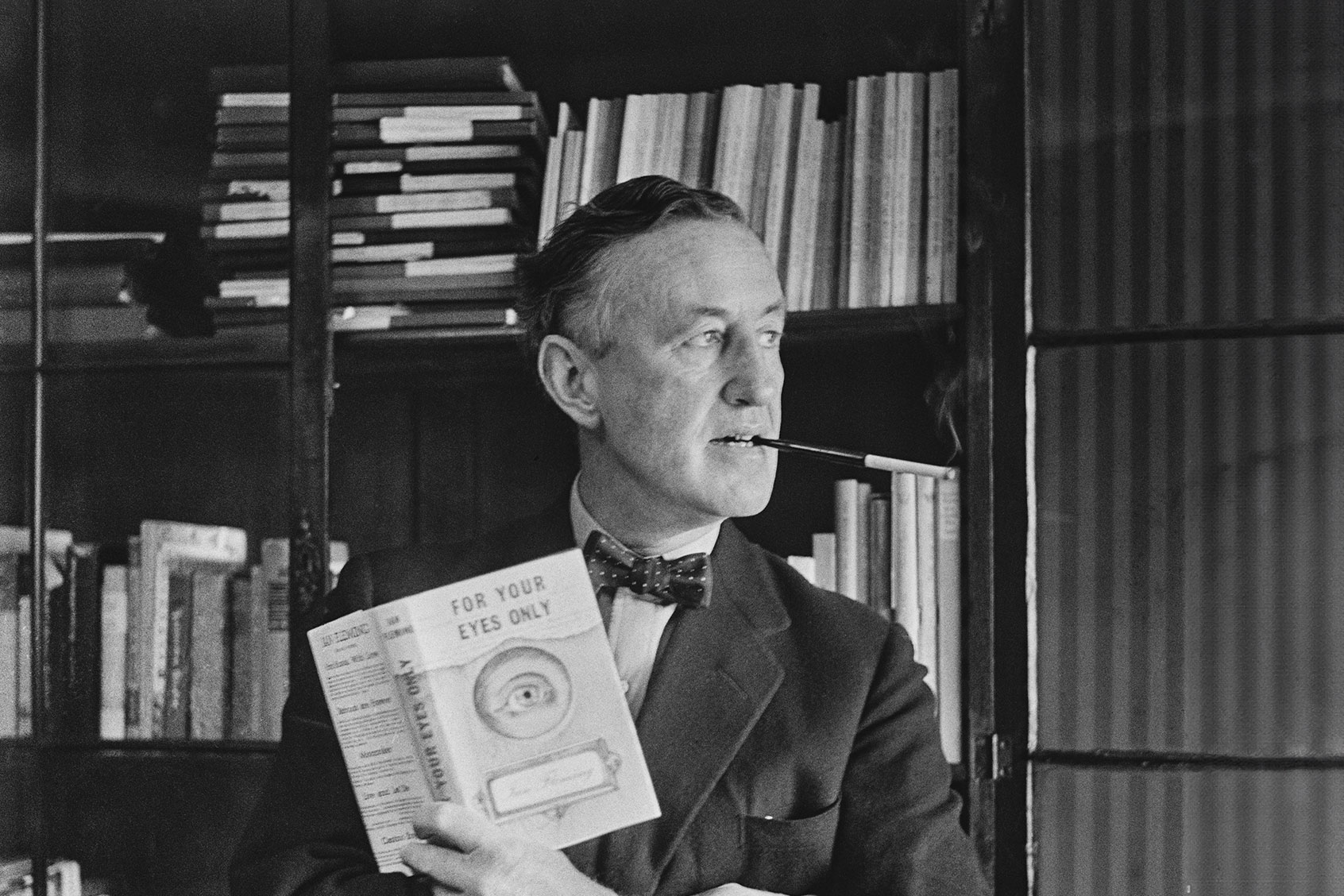
Ian FlemingAuthor Ian Fleming (1908-1964) smoking in his study while holding a book of "James Bond" short stories called "For Your Eyes Only," April 4th, 1960. (Evening Standard/Hulton Archive/Getty Images)Shakespeare also makes vital inroads into Fleming’s personal background and its interconnections with Bond’s well-known penchant for romantic sport. In particular, Shakespeare highlights Fleming’s tortured attachment (and one-time engagement) with Monique Panchaud de Bottens. Fleming severed his relationship with Monique after his mother threatened to disinherit him, an act that would reverberate across his lifetime in pangs of sadness and despair. In his research, Shakespeare sagely quotes Fleming’s friend Ernest Cuneo, who saw the genesis of Bond’s womanizing character in Fleming’s ill-fated relationship with Monique. “It seems to me,” said Cuneo, “that James Bond embodies Ian’s revenge for the terrible hurt; Bond tumbles them into bed, leaves them with the memory of a savage ravishment, which, ye gods, leaves them pining for Bond and forever bereft without him.”

And then there’s the Fabs. While Beatles-related books now number in the thousands, one of the most notorious — save for Albert Goldman’s "The Lives of John Lennon" (1988) — arrived in the form of "The Love You Make: An Insider’s Story of the Beatles" (1983). Authored by Beatles insider Peter Brown and journalist Steven Gaines, the salacious book notched a bestseller during an era in which new information about the band was scarce. Brown and Gaines landed a bestseller in "The Love You Make," largely due to the book’s salacious and prurient contents. 

The former Beatles considered the book to be an unforgivable betrayal on Brown’s part, especially given his once vaunted place in their inner circle. Paul McCartney was particularly incensed, excoriating the book as "The Muck You Rake" and famously burning his copy as wife Linda memorialized its destruction on film. Although critics objected to its seamier aspects, including speculation about John Lennon and manager Brian Epstein’s ostensible affair during a Spanish holiday, the book devoted precious little space to the music-making at the heart of the Beatles’ achievement and enduring popularity.

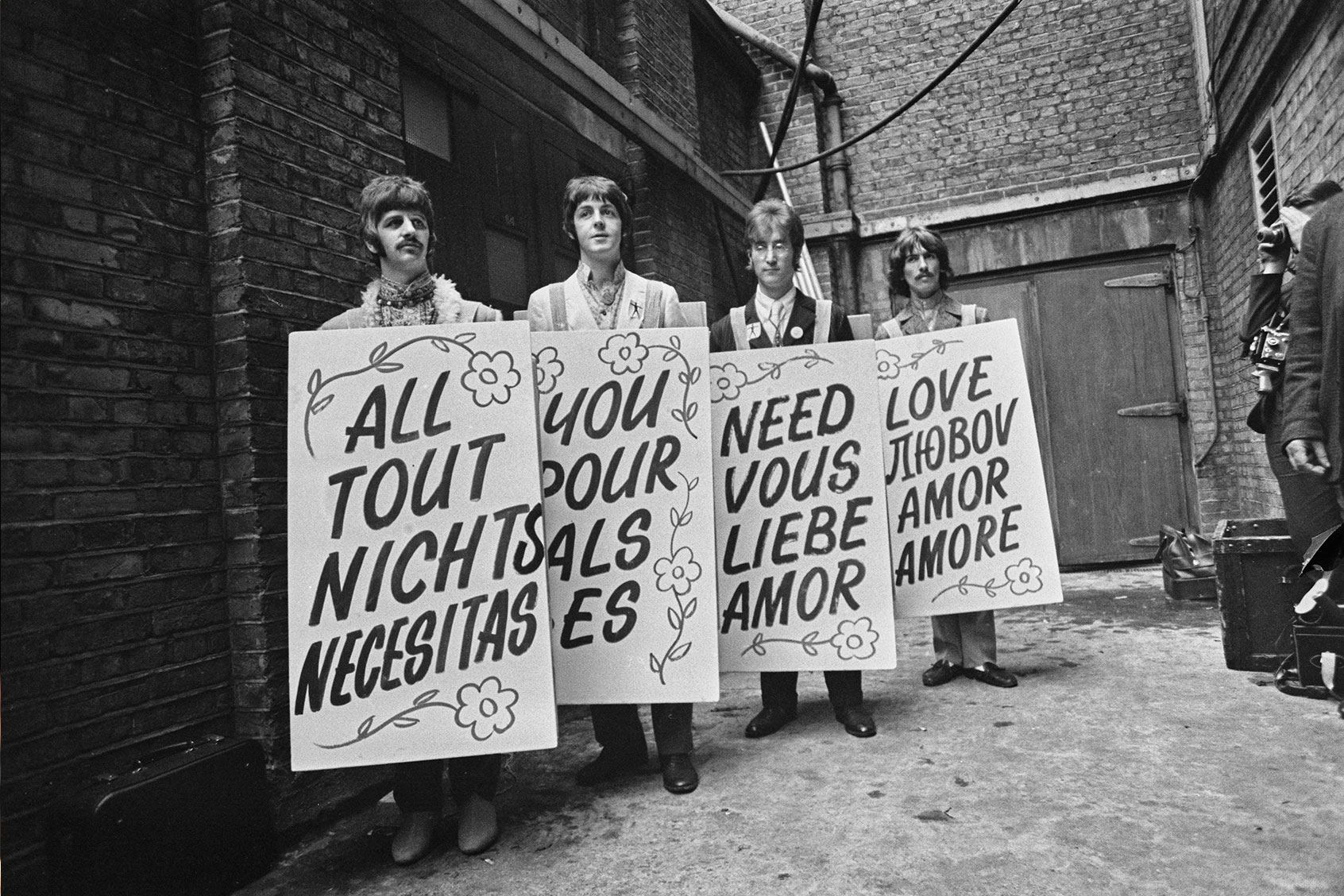
The Beatles; All You Need is LoveThe Beatles hold up sandwich boards in different languages (English, French, German, Spanish and Russian) during the Our World satellite broadcast of the song 'All You Need is Love' from in London, UK, 24th June 1967. (Evening Standard/Hulton Archive/Getty Images)Which brings us to Brown and Gaines’ "All You Need Is Love: The Beatles in Their Own Words." Subtitled as "Unpublished, Unvarnished, and Told by the Beatles and Their Inner Circle," Brown and Gaines’ latest book makes a substantial contribution to the historical record. While the passage of four decades makes "The Love You Make" seem positively dated, "All You Need Is Love" affords readers with a feast of new information.

Comprised of transcripts from the interviews that Brown and Gaines conducted in support of their work on "The Love You Make," "All You Need Is Love" presents the band members and their circle in rare instances of unmediated frankness. Crucially, the majority of the interviews were carried out prior to John Lennon’s senseless murder in December 1980. Hence, the bandmates reveal a sense of candor that would become increasingly guarded in the wake of his untimely death. Where "The Love You Make" felt unsavory in some readers’ experiences, "All You Need Is Love" proves itself to be an invaluable historical resource, presenting the Beatles entirely in their own words in a series of moments in which an unknown future was still splayed out before them, those precious last instances in which all four Fabs still safely walked the earth.

“Reeks of Ken Chesebro”: Experts say Arizona indictment suggests Trump lawyer “may be cooperating”

Donald Trump’s Arizona allies didn’t just take notes on an alleged criminal conspiracy – they videotaped themselves engaged in one and straight up posted it on social media, boasting of their scheme to have Republican partisans pose as legitimate electors in order to rob President Joe Biden of his 2020 victory in the state.

They were pompous about it, too. The video, posted by the Arizona Republican Party on December 14, 2020, is titled, “The Signing,” and shows former state party chair Kelli Ward declaring, falsely, that she and others in the video are the “duly elected and qualified electors” and that the winner of Arizona, lo and behold, was the man who received 10,000 fewer votes.

On Wednesday, Arizona Attorney General Kris Mayes said she had enough. “I will not allow American democracy to be undermined, it’s too important,” Mayes, a Democrat elected in 2022, said in a video announcing that she had indicted Ward and others involved in the conspiracy to keep the loser of the 2020 election in power. Among the 18 individuals charged with felonies include Rudy Giuliani, Mark Meadows, Christina Bobb, John Eastman and Jenna Ellis, who are accused of helping to orchestrate the fraud, which aimed – through forged documents falsely claiming election deniers were legitimate electors – to provide Republicans at the federal level just enough cover to reject the 2020 results and engage in a congressional coup d'état.

“Defendants deceived the citizens of Arizona by falsely claiming that those votes were contingent only on a legal challenge that would change the outcome of the election,” the indictment states. “In reality, Defendants intended that their false votes for Trump-Pence would encourage Pence to reject the Biden-Harris votes on January 6, 2021, regardless of the outcome of the legal challenge.”

Left unindicted, but clearly identifiable as a co-conspirator in the 58-page charging document, is the former president who stood to gain from the conspiracy (is it still only “alleged” when you can see it on Twitter?). But he’s not the only big name missing but nonetheless clearly present in the indictment.

“It reeks of Ken Chesebro,” MSNBC legal analyst Lisa Rubin commented after the indictment was unveiled. The document cites multiple emails involving Chesebro, a lawyer who worked for the 2020 Trump campaign and helped organize fake-elector plots in battleground states, including one that spells out that the fake electors would be useful even in the absence of litigation; that is, the electors were never a real backstop, only to be invoked if a court threw out the 2020 results, but a fig leaf.

Chesebro was charged in the Georgia election interference case, pleading guilty in October 2023 to a felony county of conspiring to file false documents. He has since sat down for interviews with investigators in other states and, while his honesty has been called into question, legal experts say he appears to have been useful to the attorney general and her case.

We need your help to stay independent

Joyce Vance, who served as a U.S. attorney under President Barack Obama, said the indictment suggests “Chesebro may be cooperating with prosecutors.” And that, she wrote Wednesday, could make it easier to convict others – including other Trump attorneys – who were charged. Indeed, it could even break the case wide open, for if “that cooperation is fulsome, it could lead to a situation where people he is able to testify against become highly motivated to cooperate as well.”

Chesebro has already impacted the scope of the Arizona case. As The Washington Post reported, the Arizona attorney general had zeroed in on “local conservatives” until late last year, when Chesebro sat down with investigators and “provided Mayes’s team with records — some that had been previously unseen — that revealed more information about those involved in the Arizona effort,” the Post reported, citing two sources familiar with the investigation.

If Chesebro’s apparent cooperation leads others to cooperate, that could spell trouble for a far better known but similarly unindicted co-conspirator, currently standing trial in lower Manhattan.

“It’s not simply that they are in great peril, they of course imperil Trump because they are people who could cooperate and really don’t have that many options or that much money,” Harry Litman, a former U.S. deputy assistant attorney general, told MSNBC. Particularly vulnerable are the seven Arizona Republicans who were indicted for posing as electors, he said, arguing that they are far more likely to seek plea deals and cooperate with investigators, potentially sharing damning information on not just Trump’s inner circle, but the man himself.

“They are people who presumably want futures in their individual states,” Litman said of the local fake electors, “and therefore they are not going to fall on their swords for Trump.”

Texas state troopers in riot gear crack down on UT students’ Gaza protest

Civil rights advocates on Wednesday expressed alarm at a rapid escalation by Texas state troopers who descended on a student-led protest at University of Texas at Austin, which was organized in solidarity with Gaza and other U.S. college students taking part in a growing anti-war movement.

UT students gathered on campus at midday and were promptly given two minutes to disperse by state troopers, who had already been called to the scene.

The troopers were equipped with riot gear, with some carrying assault rifles and several stationed on horses.

Erick Lara, a 20-year-old sophomore, told The Dallas Morning News that the nonviolent protest transformed "within minutes" after the police began arresting demonstrators.

"I didn't think it would escalate this far," he told the outlet. "And I didn't think there would be this much police intervention from what's supposed to be a peaceful protest. Not very peaceful when there's a bunch of aggressors around, especially on horses."

The organizers called the gathering "The Popular University" and said it was aimed at pressuring UT to "divest from death."

The protesters walked out of their classes to demand UT divest from weapons manufacturers in order to end its complicity in Israel's U.S.-backed assault on Gaza, which has killed at least 34,262 Palestinians.

Student-run newspaper The Daily Texan reported roughly 50 state troopers were deployed to stop the initial protest of about 150-200 people.

Ryan Chandler, a reporter for NBC affiliate KXAN-TV and UT alum, reported that there were at least 10 students detained.

"Went here for four years, never saw anything like this," said Chandler, posting a video of a group of police pushing one student to the ground and arresting them.

Joseph Pierce, a Stony Brook University professor who attended graduate school at UT, also said the escalation was an unusually "drastic response to students advocating for an end to the genocide of the Palestinian people."

"It is a response that did not occur when in 2005 we protested the anti-gay marriage bill; in the late 2000s when we protested anti-immigration bills; in the 2010s when we protested the open-carry bill," Pierce said. "It is a clear attempt at silencing Palestinian and anti-Zionist Jewish voices."

The students faced the state troopers in a standoff on the university's main street.

"This violence against peaceful student protesters at UT Austin is absolutely horrifying—and should be condemned in the strongest terms by every politician and mainstream journalist," said former New Yorker editor Erin Overbey.

UT media and Middle East studies professor Nahid Siamdoust said the university "brought out everything but the kitchen sink to make sure" students couldn't erect an anti-war encampment like students at Columbia UniversityNew York University, and other schools across the U.S. have in recent days.

The university had informed organizers with the on-campus Palestine Solidarity Committee on Tuesday that exercising their First Amendment rights in support of Palestinians in Gaza would "violate our policies and rules."

"The freedom to protest is integral to our democracy," said the ACLU of Texas Wednesday amid reports of the crackdown. "UT Austin students have a First Amendment right to freely express their political opinions—without threats of arrest and violence."

MAGA begins to panic: Trump may not make it to the ballot

Donald Trump.

Those two words spoken out loud can elicit an emotional response on par with the worst invectives, curses or insults you can conjure.

The man himself is capable of the same emotional outbursts under the proper stimuli. This week he finds himself cornered in a Manhattan courtroom, facing 10 counts of violating a gag order because he simply cannot control himself. 

His emails to his faithful include statements like “They can’t keep me off stage,” and “Trump Tower is mine,” along with cryptic threats such as “The bloodbath is 24 hours away,” along with even more outlandish claims that he’s just hours from being thrown in jail. 

I still do not think Trump will be on the ballot this November and this week in court shows why.

It’s all calculated to drive his followers mad, and by firing scattershot insults he hopes to convince his faithful followers who aren’t showing up in Manhattan to protest in the numbers that Trump wants. It’s also a projection of growing fear that he’s finally being held accountable for his actions.

While this was going on, President Joe Biden announced the U.S. had given missiles to Ukraine he’d previously denied sending and signed into law the latest Ukrainian arms package he helped negotiate past Republican extremists in Congress. Along with forcing China to divest itself of TikTok, the foreign aid package is a huge policy win for Biden that comes on the heels of a major union endorsement this week.  

Biden has largely steered clear of talking about Trump, trying to actually get his job done as proof that he deserves another term, but reminded everyone this week that “Trump is a toxic threat to planet earth.” 

Trump’s only response is to claim Biden is losing it. Biden seems to be rising to the challenge even as Trump falters. This week found the president playfully sparring with reporters. When asked what his legacy would be on abortion, Biden showed his cheek and replied, “What will your legacy be to be reporting?”

Yeah. Sleepy Joe, the cocaine-addicted mastermind – at least according to Trump – can still hold his own with a reporting pool that honestly looks like Middle School students at a pep rally.

Today the Supreme Court takes up Trump’s claim of absolute immunity – apparently ready to consider whether or not they will give Trump the power of a King and adjudicate themselves out of a job. No one believes the Supreme MAGAs on the court are intent on doing anything more than delaying the inevitable decision against Trump, while at the same time buying time so Trump can ride back into town and inflict upon the country his brand of dystopia and dyspepsia. Make no mistake; Trump has no coherent policy. The people who control him have an agenda, and maintain control over Trump by telling him what he wants to hear. Those who worship him love what he has to say. None of it makes sense. It’s all chaos in a blender designed to benefit those who control Trump to the detriment of the rest of us.

But a funny thing happened on the way to Trump’s coronation. In Manhattan, facing nearly three dozen felonies, Donald Trump’s thin veneer of competence is being stripped away by a guy named Pecker and Trump’s increasingly apparent mental decline. He is on a downward spiral caused by dementia, depression and derision.

We need your help to stay independent

Speaking on Chip Franklin’s podcast, “Really Political,Dr. John Gartner, an assistant professor at Johns Hopkins University Medical School, reminded us this week that we are currently seeing “The best Donald Trump – today.” In other words, he’s never going to be as good as he was the day before — no matter how bad that is. Dr. Gartner believes it is Trump who is suffering from a precipitous decline in mental health, and he’s never going to get better. With each day the former president’s mental acumen slips further and soon the rate of acceleration of mental decline will take Trump to a “mental cliff.” Once he falls off, watch out. Should Trump see a second term, Dr. Gartner compared it, potentially,  to a “Weekend at Bernie’s.”

As a comparison for how bad a second Trump administration could be, actor Tom Arnold asked me on that show what it was like during Trump’s first term. I came to the realization there are still many Americans who do not understand how truly dysfunctional Trump was and is. The fact is Trump’s first administration was extremely dangerous — and it had nothing to do with his politics.

The Trump White House was unlike anything I have ever seen — nor will likely see again. It was unprofessional, intolerable, idiotic, chaotic and filled with innuendo. It was a grade-B Hollywood production led by a self-loathing narcissist with delusions of adequacy.

No one in that administration seemed to even understand U.S. law. A quick example: Trump told us he was going to send U.S. troops to the Southern border. He was unaware of the fact that the Posse Comitatus Act precludes him from doing so — unless a congressional waiver is secured. This has been done in the past.

I remember speaking with one of Trump's assistants about this in the lower press offices with another reporter. "Is this like a rule, or a policy?" he asked. I explained it was a law — one heavily supported by Republicans historically. He was unaware. "That's a law?" he questioned. Then we asked a few other questions and at the end of the conversation the man turned to me and said, "I'll get back to you about that Hakuna Matata thing." 

A Trump administration official compared the Posse Comitatus Act to the “Lion King,” didn't know what the law was and never got back to me. The next day he seemingly forgot it, so I had to ask another Trump official about it. When I said it seemed like there was some really poor planning at the White House, he just laughed and said, "You give us too much credit. We don't have any plans."

It isn’t politics. It’s reality. Trump is incapable of serving another term as president.


Want a daily wrap-up of all the news and commentary Salon has to offer? Subscribe to our morning newsletter, Crash Course.


The good news is I still do not think Trump will be on the ballot this November and this week in court shows why. It’s not his sleeping. It’s not his reported flatulence (which I care little about). It is that Trump is showing undeniable signs of dementia. He seems to be melting into a puddle of his own makeup and sweat. The stress can be seen in the photos and the videotape from New York. If Donald Trump is this stressed out a week into his first trial, how could he possibly be expected to last through three more trials, or lead our country for four more years in what is probably the most stressful job on the planet? 

His decline combined with his narcissism are slowly consuming him. The trial in New York is also exposing the depravity of those in his inner circle. David Pecker is the colorectal cancer of journalism. The guy wanted to be the editor of Time Magazine. Thank God that never happened. His willingness to run a supermarket rag like the National Enquirer as a PR firm for Trump underscores not only his vacuousness, but how cheap Donald really is – not just monetarily, but spiritually. He's an empty suit of plastic emotions bound in hubris and anger. He’s screaming for thousands to show up at court and show their support, and even his rabble are growing weary of his constant whining.

Trump says we can’t keep him from the stage – but the trial is doing just that. For eight hours a day, four days a week, he has to sit in a courtroom while a jury of his peers scrutinizes his every move, his sleeping patterns, his doddering dementia, his flatulence, his grunts – everything. 

Trump made his grifting possible, in part, by a carefully staged persona seen in glimpses at private and public events. It’s why he didn’t do many press conferences and didn’t show up in the White House briefing room until the COVID crisis made his appearances a requirement. Those appearances were well known for his inane claims regarding the virus, ranging from there would be no deaths to suggesting the introduction of light into the body or injecting bleach could cure COVID. 

Being on a jury confined in close quarters with such a frightened, angry narcissist does not bode well for Drowsy Donny. The longer the trial takes in Manhattan, the more it becomes clear to the world, including his faithful minions, that Donald Trump has no more gas in his tank.

This opens up speculation as to what will go on in Milwaukee when the MAGA faithful descend like a horde of cicadas to choose their candidate for president. It is presupposed that Trump, no matter what, will become the nominee. But there are whispers, and growing speculation among the faithful and the faithless in MAGA land that Donald Trump may not be up for the job.

“For the first time,” I was told this week by a Trump organizer in Wisconsin, “I’ve started to think about what we would do if Trump isn’t our candidate. It’s a real s**t show to consider.”

If Trump is somehow rejected from the ballot or is incapable of serving, the Milwaukee convention could end up looking like the House of Representatives searching for a speaker after it expelled Kevin McCarthy. It could take several ballots, lots of smoke and drinks in backrooms combined with banshee-like wailing and gnashing of teeth. The whole Republican convention, always a circus show of pretense and populism, will more accurately resemble a hallucinogenic Barnum and Bailey event under the big top – or even more precisely  Mad Max under the Thunderdome.

Each day in court brings that reality closer. Trump can’t run. Trump can’t hide. Trump can’t do all the things that have enabled him to thrive as a despotic grifter his entire life. His mind is slipping, his grip on the world is weakening and at the end of the day Donald Trump recognizes it. You can see it in his eyes. His last cogent thought may well be the recognition that he’s the world’s largest loser and everything he’s done his entire life has led to utter failure.

Then again, his last cogent thought might be “I love hamberders."

10 times as much of toxic pesticide could end up on your tomatoes and celery under new EPA proposal

When you bite into a piece of celery, there’s a fair chance that it will be coated with a thin film of a toxic pesticide called acephate.

The bug killer — also used on tomatoes, cranberries, Brussels sprouts and other fruits and vegetables — belongs to a class of compounds linked to autism, hyperactivity and reduced scores on intelligence tests in children.

But rather than banning the pesticide, as the European Union did more than 20 years ago, the U.S. Environmental Protection Agency recently proposed easing restrictions on acephate.

The federal agency’s assessment lays out a plan that would allow 10 times more acephate on food than is acceptable under the current limits. The proposal was based in large part on the results of a new battery of tests that are performed on disembodied cells rather than whole lab animals. After exposing groups of cells to the pesticide, the agency found “little to no evidence” that acephate and a chemical created when it breaks down in the body harm the developing brain, according to an August 2023 EPA document.

The EPA is moving ahead with the proposal despite multiple studies linking acephate to developmental problems in children and lab rats, and despite warnings from several scientific groups against using the new tests on cells to relax regulations, interviews and records reviewed by ProPublica show.

To create the new tests designed to measure the impact of chemicals on the growing brain, the EPA worked with the Organization for Economic Cooperation and Development, which comprises some of the world’s wealthiest democratic countries and conducts research on economic, social and scientific issues. The OECD has warned against using the tests to conclude a chemical does not interfere with the brain’s development.

"It’s exactly what we recommended against."

A scientific advisory panel the EPA consulted found that, because of major limitations, the tests “may not be representative of many processes and mechanisms that could” harm the developing nervous system. California pesticide regulators have argued that the new tests are not yet reliable enough to discount results of the older animal tests. And the Children’s Health Protection Advisory Committee, a second group of advisers handpicked by the EPA, also warned against using results of the nonanimal tests to dismiss concerns.

“It’s exactly what we recommended against,” Veena Singla, a member of the children’s committee who also teaches at Columbia University, said of the EPA’s acephate proposal. “Children’s development is exquisitely sensitive to toxicants. … It’s disappointing they’re not following the science.”

The EPA’s proposal, which could be finalized later this year, marks one of the first times the agency has recommended changing its legal safety threshold largely based on nonanimal tests designed to measure a chemical’s impact on the developing brain. And in March, the EPA released a draft assessment of another pesticide in the same class, malathion, that also proposes loosening restrictions based on similar tests.

The proposed relaxing of restrictions on both chemicals comes even as the Biden administration has been strengthening limits on several other environmental contaminants, including some closely related pesticides.

In response to questions from ProPublica, the EPA acknowledged that it “will need to continually build scientific confidence” in these new methods but said that the introduction of the nonanimal tests to predict the danger chemicals pose to the developing brain “has not been done in haste. Rather, a methodical, step-wise approach has been implemented over the course of more than a decade.”

The agency said its recent review of acephate included a thorough examination of a variety of scientific studies and that, even with its proposed changes, children and infants would still be protected.

The EPA expects to start accepting public comments on the acephate proposal in the coming months before it makes a final decision. The agency anticipates soliciting comments on malathion this summer.

Some environmental scientists strongly oppose loosening the restrictions on both acephate and malathion, arguing that the new tests are not reliable enough to capture all the hazards a chemical poses to the developing brain.

“It will put children at an increased risk of neurodevelopmental disorders like autism and ADHD that we already know are linked to this class of chemicals,” said Rashmi Joglekar, a toxicologist at the Program on Reproductive Health and the Environment at the University of California, San Francisco.

Health and environmental scientists are concerned about more than the direct impact of having potentially greater amounts of acephate and malathion on celery and other produce. They also worry that using the new tests as a basis for allowing more pesticides on crops will set a dangerous precedent for other brain-harming chemicals.

“I think the companies see this as a new way over a 10- or 20-year period to gradually lobby” the EPA “to allow higher levels of pesticides in food,” said Charles Benbrook, an agricultural economist who has monitored pesticide regulation for decades. “If they can convince regulators to not pay attention to animal studies, they have a very good chance of raising the allowable exposure levels.”

Industry helped fashion EPA’s testing strategy

Since its founding in 1970, the EPA has relied on studies of mice, rats, guinea pigs and other species to set exposure limits for chemicals. The lab animals serve as a proxy for humans. Scientists expose them to different doses of substances and watch to see what levels cause cancer, reproductive problems, irritation to the skin and eyes, or other conditions. Some tests look specifically at chemicals’ effects on the offspring of rats exposed during pregnancy, and some of those tests focus on the development of their brains and nervous systems.

But over the past decade, chemical manufacturers and animal rights advocates have argued for phasing out the tests on the grounds they are impractical and inhumane. The animal experiments are also expensive, and the pesticide industry, which by law shoulders the cost of testing its products, is among the biggest proponents of the change.

The EPA has allowed the chemical industry and animal rights groups to help fashion its testing strategy. Agency officials have co-authored articles and held workshops on the use of the cell-based tests to regulate chemicals alongside representatives of People for the Ethical Treatment of Animals as well as Corteva Agriscience, BASF and Syngenta Crop Protection, companies that make pesticides regulated by the EPA.

The EPA said its scientists have been working to develop the nonanimal tests for decades with other government and scientific organizations, both nationally and internationally.

“It is absurd to describe those scientific efforts as an apparent conflict of interest,” the agency said in a statement.

The EPA’s Office of Pesticide Programs has previously come under fire for its willingness to allow pesticides onto the market without required toxicity testing. In 2018, as The Intercept reported, staff members held a party to celebrate a milestone: The number of legally required tests the office had waived for pesticide companies had reached 1,000. A science adviser to the office at the time said the move spared companies more than $6 million in expenses.

"It will put children at an increased risk of neurodevelopmental disorders like autism and ADHD that we already know are linked to this class of chemicals."

While phasing out animal experiments would save money and animal lives, experiments involving collections of cells do not always accurately predict how entire organisms will respond to exposure to a toxic chemical. The new cell-based tests and computer techniques that are sometimes used with them can be reliable predictors of straightforward effects like eye or skin irritation. But they are not yet up to the task of modeling the complex, real-world learning disorders that have been linked to acephate and malathion, according to Jennifer Sass, a senior scientist at the Natural Resources Defense Council, an environmental advocacy organization.

The new tests can show whether a chemical can kill a brain cell. And they can show if a chemical affects how a brain cell connects with other brain cells, said Sass.

“But these tests can’t show that a kid is going to be able to sit through class and not go to the principal’s office,” she said.

While the cell-based tests may point to certain harms, they are likely to miss others, said Sass, who likens their use to fishing with a loose net. “You only know what you caught — the big stuff,” she said. “You don’t know about all the little stuff that got through.”

A 2023 study revealed the failure of the cell-based tests to detect certain problems. In it, scientists exposed brain cells to 28 chemicals known to interfere with the development of the nervous system. Although the tests were specifically designed to assess whether chemicals harm growing brains, they failed to clearly identify harm in one-third of the substances known to cause these very problems. Instead of registering as harmful, the test results on these established developmental neurotoxins were either borderline or negative.

Because of these potential blind spots and other uncertainties associated with the tests, the Organization for Economic Cooperation and Development has advised against interpreting results of the nonanimal tests as evidence that a chemical doesn’t damage the brain. Several scientific groups have recommended that the EPA do the same.

A federal advisory panel of scientists assembled to advise the EPA on pesticide-related issues published a 2020 report that identified numerous limitations and gaps in the nonanimal studies, finding that they “underestimated the complexity of nervous system development.”

In 2021, the Children’s Health Protection Advisory Committee, a group the EPA created to provide advice on how to best protect children from environmental threats, warned the agency that, “due to important limitations,” the test results “cannot be used to rule-out a specific hazard.”

In comments to the EPA, California’s Department of Pesticide Regulation also cautioned the agency against using the tests to conclude that a chemical doesn’t cause specific harms. The California regulators emphasized that the traditional battery of animal tests was still necessary to understand complex outcomes like the effects on children’s developing brains.

“To abandon it at this time would be to abandon a critical support for health-protective decisions,” they wrote.

EPA accused of double standard

As much as 12 million pounds of acephate were used on soybeans, Brussels sprouts and other crops in 2019, according to the most recent estimates from the U.S. Geological Survey. The federal agency estimates that up to 30% of celery, 35% of lettuce and 20% of cauliflower and peppers were grown with acephate. Malathion is used on crops such as strawberries, blueberries and asparagus. (The U.S. Department of Agriculture prohibits the use of most synthetic pesticides, including acephate and malathion, to grow and process products certified by the agency as organic.)

Acephate and malathion belong to a class of chemicals called organophosphates, which U.S. farmers have used for decades because they efficiently kill aphids, fire ants and other pests. But what makes the pesticides good bug killers — their ability to interfere with signals sent between nerve cells — also makes them dangerous to people. For years, there has been a scientific consensus that children are particularly vulnerable to the harms of pesticides, a recognition that led the EPA to strengthen restrictions on them. But with both acephate and malathion, the agency is now proposing to remove that extra layer of protection.

The EPA effectively banned another organophosphate pesticide, chlorpyrifos, in 2021, based in part on evidence linking it to ADHD, autism and reduced IQ in children. (In response to a lawsuit brought by a company that sells the pesticide and several agricultural groups, a court vacated the ban in December, allowing the resumed use of chlorpyrifos on certain crops, including cherries, strawberries and wheat.) While some health and farmworker groups are petitioning the EPA to ban all organophosphate pesticides, the agency is arguing that it can adequately protect children by limiting the amount farmers can use.

Several studies suggest that, even at currently allowable levels, acephate may already be causing learning disabilities in children exposed to it while in the uterus or in their first years of life. In 2017, a team of University of California, Berkeley researchers, partly funded by the EPA, found that children of Californians who, while pregnant, lived within 1 kilometer of where the pesticide was applied had lower IQ scores and worse verbal comprehension on average than children of people who lived further away. Two years later, a group of UCLA scientists reported that mothers who lived near areas where acephate was used during their pregnancies had children who were at an increased risk of autism with an intellectual disability.

The EPA considered this research when deciding to relax the limits on acephate use but stated that flaws and inconsistencies made these epidemiological studies “not compelling.” The agency also dismissed a rat study submitted to the EPA in 2005 in which the pups of mother rats exposed to higher levels of acephate were, on average, less likely to move than the pups of mothers exposed to lower levels. The EPA told ProPublica that “no conclusions could be drawn” from the experiment, citing the “high variability of the data” it produced. But some scientists outside the agency find that study a particularly worrisome indication of the pesticide’s potential to harm children.

In its proposals to increase the allowable amount of both acephate and malathion on food, the EPA also had to look past other potentially concerning test results. Some of the cell-based tests of acephate showed borderline results for interference with brain functions, while some of the tests of malathion clearly indicated specific problems, including interference with the connections between nerve cells and the growth of certain parts of nerve cells. Several scientists interviewed by ProPublica said that such results demand further investigation.

Some scientists see a double standard in the agency accepting the imperfect nonanimal tests while citing flaws in other research as reasons to dismiss it.

“They’re acknowledging limitations in epidemiology while at the same time not acknowledging the even greater limitations of using a clump of cells in a petri dish to try to model what’s happening in a really complex organism,” said Nathan Donley, a scientist at the Center for Biological Diversity, an environmental advocacy organization.

Asked about the criticism, an EPA spokesperson wrote in an email to ProPublica that the agency “does not believe there was a double standard applied.”

ProPublica is a Pulitzer Prize-winning investigative newsroom. Sign up for The Big Story newsletter to receive stories like this one in your inbox.


“Where’s Melania?”: Missing wife is why Trump’s lawyers can’t pull off the “family man” defense

In his opening statement in the People v. Donald Trump, defense attorney Todd Blanche told the Manhattan jury to gaze upon the criminal defendant and see a devoted family man. "He’s a man. He’s a husband. He’s a father," Blanche said of the former president accused of election interference. "He’s a person just like you and just like me." Hamfisted as it may be, it was a play by Blanche to distance his cranky, often sleepy client from what promised to be days, if not weeks, of testimony detailing a tawdry conspiracy to pay hush money to an adult film actress in order to cover up what sounds like rampant adultery. 

There are many obvious pitfalls in this effort to recast Trump in the image of a suburban sitcom dad. The biggest might be one very noticeable absence in the courtroom. As a reporter who was pointedly ignored by Trump asked on Tuesday: "Where's Melania?" 


Want more Amanda Marcotte on politics? Subscribe to her newsletter Standing Room Only.


It's not just the failed fashion model-turned-Mrs. Trump #3 who hasn't shown up in support. None of Trump's five children, or their spouses, have stood by his side in court, either. His two adult sons would rather spend time screening hypothetical future political appointments for "loyalty" than bother to show their father any in-person care at court. His eldest daughter, Ivanka Trump, is posting photos of her fancy vacations rather than staying in New York with her father. 


Trump is so lonesome that he's dreaming up imaginary friends to comfort himself, claiming "thousands" of people are clamoring to be with him but are being stopped by invisible police officers. As Lawrence O'Donnell pointed out on MSNBC, even "Jeffrey Dahmer’s parents were there every single day" for his trial. 

Trump's alienation is both very funny and deeply satisfying, but it also points to a much bigger legal problem for him: The near-impossibility of pulling off what is often called the "John Edwards defense." The former Democratic presidential candidate was indicted in 2011 for having donors pay off his mistress to keep quiet not just about the affair, but the child the two shared. (Full disclosure: I was interviewed by the FBI during its investigation, as I briefly worked for the Edwards campaign. It was an uneventful interview since I knew nothing about the affair or the payments.) Edwards was ultimately acquitted, in part because he successfully argued the payments were more about hiding his secret from his dying wife than helping him win an election. 

Trump's defense is hoping to similarly paint Trump as an embarrassed adulterer simply hiding the truth from his family — instead of a corrupt politician trying to influence the election illegally. But they really have their work cut out for them. It's hard to sell Trump as a loving family man who regrets his adultery when the family in question is missing in action. The task became even harder after David Pecker, the National Enquirer publisher who was in on the conspiracy, took that stand on Monday and Tuesday.

It's hard to sell Trump as a loving family man who regrets his adultery when the family in question is missing in action.

Pecker, who regularly helped Trump bury damning stories by buying off sources, spoke at length about why Trump asked him to help pay people off for their silence. The big one, of course, was to "help the campaign," Pecker said. To do this, they didn't just bury negative stories but also ran false or misleading stories painting Trump's opponents in a negative light. Trump was allegedly also worried about a story that suggested he had sex with a woman who wasn't white. As Maggie Haberman of the New York Times recounted, "Pecker appeared to be saying that Cohen indicated that a child with a Hispanic mother couldn’t be Trump’s." But mostly, Pecker said the focus was on any story that offered a "potential embarrassment" to "the campaign." 

As of press time, the transcript for Tuesday's hearing has not yet been published, but in scouring all the live blogging done by reporters of the testimony, it appears the name "Melania" did not come up, even in passing. On the contrary, Pecker at one point described Trump during the period as an "eligible bachelor" who "dated the most beautiful women." But, of course, Trump was not a bachelor. Trump married his current wife in 2005. Both the women whose stories Pecker was involved in silencing claim that they slept with Trump in 2006, the year that Melania Trump gave birth to the couple's only child. 

We need your help to stay independent

But while Trump was technically not a bachelor, the comment speaks to a deeper truth evident in Pecker's testimony: Trump simply does not care about his wife or children. He wasn't worried about their feelings and didn't seem to think of them much at all during all this conspiring. During opening arguments, prosecutor Matthew Colaneglo underscored this point by noting that Trump and his fixer, Michael Cohen, even schemed to delay the hush-money payments to Stormy Daniels, one of the two women in question, until after the election. The idea was they could keep her quiet until the election and then refuse to pay her at all. Clearly, the goal was to keep this information from voters, and Melania Trump's feelings weren't a factor. 

For people who follow politics closely, there is nothing surprising about Trump seeming to have no one in his life that he loves or who loves him. Anyone who has watched the man closely can tell there's something deeply wrong with him, psychologically. He simply isn't like a normal person with normal attachments to other people. But the jury was carefully chosen, after an arduous process, to weed out people who pay enough attention to the news to have previously formed this opinion of Trump. The default assumption most people have is that other people have normal human emotions. So there was an opportunity to trick the jury into believing Trump is, as Blanche said, "a person just like you." 

Still, that would have required providing some reassurance to the jury that Trump, like a normal person, experiences love and concern for others. Especially as the prosecutor will present Trump, correctly, as a cold-hearted narcissist whose only concern is personal gain. That portrayal will be backed by testimony like Pecker's, and of course by Trump's own behavior in court. But the fact that during the first days of his first criminal trial, Trump can't scrounge up one person from his rather large family to stand by his side? Well, that alone will tell quite a bit of the tale. 

Underestimating Alvin Bragg’s case against Donald Trump is a historic mistake

Prosecutors are off to a strong start in the Manhattan trial of Donald Trump. Their evidence is aimed at proving that the former president committed crimes by falsifying business records to cover up a pre-election payoff in 2016 meant to keep women who would have otherwise revealed some of his sexual scandals ahead of that presidential election silent. 

Some critics, including some very smart legal minds who have no love for Trump, don’t like the case. Boston University Law School Professor Jed Shugerman — who previously described to SalonTrump abuses” at the Department of Justice as “using the system of prosecution to reward your political allies and to punish your opponents” — took major issue with the first criminal case against Trump to reach trial in an April 23 New York Times guest essay:

After listening to Monday’s opening statement by prosecutors, I still think the Manhattan D.A. has made a historic mistake. Their vague allegation about “a criminal scheme to corrupt the 2016 presidential election” has me more concerned than ever about their unprecedented use of state law and their persistent avoidance of specifying an election crime or a valid theory of fraud.

Shugerman went on to publicly accuse prosecutors of engaging in “an embarrassment of prosecutorial ethics and apparent selective prosecution.” But if you are to call the criminal prosecution of Donald Trump for election interference a “historic mistake,” you ought to have arguments that are as close to airtight as humanly possible. The ones in Professor Shugerman’s essay, lamentably, are not even legally persuasive.

Let’s put aside his description of the prosecution’s opening statement as “vague.” That’s not how former Trump impeachment counsel Norm Eisen reported it from the courtroom for CNN, or how reporters for The New York Times and the Washington Post described it.

The core of Shugerman’s faulty argument is that he sees “three red flags raising concerns about selective prosecution upon appeal” because of the “unprecedented” way in which the grand jury used the statute at issue – New York Penal Code §175.10 – to charge Trump with a felony. That offense – falsifying business records – becomes a felony only when committed with an “intent to commit or conceal another crime.”

As former prosecutors and as current defense lawyers, we know that the claim of selective prosecution is notoriously difficult for defendants to prove. Justice Juan Merchan, the seasoned judge presiding over the trial, rejected Trump’s claim, finding that he did not carry his burden of showing that the DA had discriminated against him by not prosecuting any other similarly situated individual. 

The reasoning is not mentioned in Shugerman’s Times essay yet it is a necessary element of proving selective prosecution in New York. Merchan also found that prosecutors had demonstrated that they had brought many other actions charging defendants with “falsifying business records with the intent to commit or conceal the commission of another crime.” 

But, Shugerman writes, there’s “no previous case of any state prosecutor relying on the Federal Election Campaign Act either as a direct crime or a predicate crime.” That, he says, is a “sign of overreach.”  

Wait! The case is unprecedented? Now there’s an understatement! 

Have we ever had a presidential candidate from New York against whom prosecutors have assembled strong evidence of falsifying information in business records to cover up a scandal on his way to winning election? Have we ever had such a man now seeking the voters’ approval for a return White House run?  

We need your help to stay independent

Rather than overreach, a novel use of the statute here is the sign of a prosecutor willing to extend the law to a new fact situation that society has a right and a duty to protect itself against. That is especially so when the case is brought to hold accountable someone whose company a different jury already found guilty of criminal tax fraud and falsifying business records, and who has been found to have committed massive civil fraud against the state.

Shugerman also emphasizes that there’s not even any other New York case that sustains the use of another jurisdiction’s statute – federal law in this case – as the “other crime” in. It’s not enough, he says, that prosecutors have cited multiple parallel New York appellate court decisions – ones sustaining the use of crimes from other jurisdictions to satisfy the “other crime” element in different New York criminal statutes.

Why not? The extension of parallel situations is precisely the kind of reasoning on which the law is built. Whenever new fact patterns arise, the law operates by analogy from contexts where it is established. That’s why Justice Merchan has endorsed it. 

Next, Shugerman says that a jury instruction endorsing the use of federal law violation as the “other crime” in another §175.10 case doesn’t count” as precedent. Technically correct, but what that instruction shows is that another New York trial judge in a different case reached the same result that Justice Merchan reached here. That sounds like support for his decision and guidance for others in analyzing whether the prosecutors are making “an historic mistake.” 

The Boston University professor also takes issue with the Manhattan DA’s use of federal election law because, he says, the reliance on Trump’s alleged violation of state election law is flawed. He argues that state election law applies only to “public officers,” and “state statutory definitions of “public office” seem to limit those statutes to state and local races.”

But the essay omits the basis on which Justice Merchan rejected this argument. New York election law, he wrote, explicitly states it “shall govern the conduct of all elections at which voters of the state of New York may cast a ballot for the purpose of electing any individual to any party position or nominating or electing any individual to any federal, state, [or local] office . . . ." 

Further, Shugerman attacks the prosecutor’s election interference theory. He argues there is no precedent for satisfying the law’s “intent to defraud” requirement with an allegation that the defendant intended to defraud the general public. Shugerman says that “a conviction based on it may not survive a state appeal.”

Again, one is left to wonder why not. In the universe of threats to democracy, a candidate’s intent to defraud voters, if proven, is perhaps the most serious intent to defraud one can imagine. Trump is accused of seeking to deprive Americans, through deceit, of information most would have wanted to know about a candidate before deciding whether to make him president. The law is wise enough to take account of this element of a crime against democracy.

“Incredibly dangerous”: Experts decry challenge to law protecting emergency abortion care

Last year, one pregnant patient at the Boise-based St. Luke’s Health System in Idaho had to be airlifted for emergency care. Since January of this year, there have been six pregnant patients who have had to be airlifted out of state because physicians couldn’t provide emergency, stabilizing care typically guaranteed under the federal law known as Emergency Medical Treatment and Labor Act (EMTALA).

As Salon previously reported, OBGYNs and family medicine doctors in Idaho live in fear that they will have to deny a pregnant patient stabilizing care if it includes an abortion. If they can’t justify that the patient was close enough to death, they risk facing two to five years in prison and losing their medical license. That’s because in January, the Fifth Circuit Court of Appeals in Texas ruled that emergency rooms aren't required to perform emergency abortions that would stabilize the health of the pregnant patient under EMTALA.

​On Wednesday, the U.S. Supreme Court finally heard oral arguments on whether doctors can provide emergency abortions to stabilize a patient’s health under EMTALA in Idaho, or if Idaho’s near-total abortion ban takes precedence.

“We are in a situation in Idaho where pregnant persons no longer have access to routine, high-quality care,” Dr. Kara Cadwallader, who is a family medicine physician in Idaho, said in a statement prior to the oral arguments. “In particular, our legislature has banned appropriate care when folks are most in need of it, when they have a complication of pregnancy.”

"In Idaho, doctors have to shut their eyes to everything except death"

An example of what patients are facing in Idaho right now is this: a pregnant woman’s water breaks when she’s 17 weeks pregnant, before a fetus is viable. Instead of terminating the pregnancy, which is already an incredibly difficult decision for the pregnant patient to make, doctors in Idaho have to wait until the patient is close to death to offer abortion treatment. In the meantime, the patient remains at a high risk for infection, sepsis or hemorrhage. By waiting, the pregnant patient could face an increased risk of losing reproductive organs. 

“In Idaho, doctors have to shut their eyes to everything except death,” Solicitor General Elizabeth B. Prelogar said during the arguments on Wednesday. “Whereas under EMTALA, you’re supposed to be thinking about things like, ‘Is she about to lose her fertility? Is her uterus going to become incredibly scarred because of the bleeding? Is she about to undergo the possibility of kidney failure?’”

During the hearing, justices appeared to be split on whether or not Idaho’s near-total abortion ban overrides EMTALA or not. 


Want more health and science stories in your inbox? Subscribe to Salon's weekly newsletter Lab Notes.


Under EMTALA, hospitals and emergency rooms were required to provide emergency abortions even where there were strict abortions laws. The Biden Administration even sued Idaho, claiming that the state's near-total ban was in direct conflict with the law. But the state claimed that there wasn’t a conflict because technically it has a life-saving exception. Then in January, the Fifth Circuit Court of Appeals in Texas ruled that emergency rooms aren't required to perform life-saving abortions under EMTALA. The U.S. Supreme Court can now either rule that EMTALA preempts Idaho’s abortion ban, or it doesn’t. 

As Alexa Kolbi-Molinas, deputy director of the ACLU Reproductive Freedom Project, told Salon, if the Supreme Court doesn’t rule that EMTALA covers emergency abortions, it would “make pregnant people second-class citizens in America's emergency rooms.”

On Wednesday, Justice Samuel A. Alito Jr. asked about the term “unborn child” in the EMTALA statute, questioning whether or not EMTALA should guarantee abortion care or not. “Isn’t that an odd phrase to put in a statute that imposes a mandate to perform abortions?” he asked. 

In a press conference after the oral arguments, Carrie Flaxman, a senior advisor at Democracy Forward, told Salon that it’s “clear” that EMTALA is meant to expand protections for pregnant people, not “eviscerate” them.

"They are pushing a legal strategy to give rights to embryos and fetuses that would override the rights of the pregnant."

“That was the purpose of the amendment that added the language issue, the language ensures that when a pregnant person is in labor, that they're not transferred to another hospital unless it's safe to do so,” Flaxman said. “It ensures that a pregnant person can receive treatment for their pregnancy even if their own health or life is not currently at risk.” 

Flaxman said that not only is this argument suggested by Alito “just wrong on the plain meaning of the statute, but it's incredibly dangerous.”

“Through EMTALA, Congress protected the ultimate power of every pregnant person to decide what's best for themselves, their health and their pregnancies, including if that means ending the pregnancy,” Flaxman said. “And so the notion that the same language that was used to expand EMTALA’s protections for pregnant people somehow now carves them out of the law’s full protections defies logic.”

Kolbi-Molinas said this goes “beyond” a strategy to restrict abortion. 

“They are pushing a legal strategy to give rights to embryos and fetuses that would override the rights of the pregnant,” Kolbi-Molinas said.  “Threatening access not just to abortion, not just to emergency abortion, but access control to fertility care to other forms of reproductive health care.”

We need your help to stay independent

Notably, EMTALA first came to light as a response to hospitals turning away uninsured pregnant people in active labor. Congress passed the law in 1986 and specifically included provisions mandating federally-funded hospitals to accept a patient in active labor, even if she doesn’t have insurance. President Ronald Reagan signed it into law. The purpose of EMTALA, Kolbi-Molinas said, was to establish a national baseline of emergency care.

Alexis McGill Johnson, president and CEO at Planned Parenthood Federation of America, said during the press conference that abortion opponents are playing a “dangerous game” and there’s “no line” they won't cross.

“The Supreme Court must reject this effort to end federal protections for pregnant people who need emergency care,” McGill Johnson said. “You go into an emergency room, you should be able to get the emergency care you need, including an abortion.”

What happens next? In the next few days, the justices will likely cast tentative votes in private. Subsequently, draft opinions will be prepared and shared. Like the mifepristone case also being considered by the Supreme Court, which concerns a common abortion drug, experts believe the public won’t hear about a ruling until late June of this year. 

CORRECTION: This article has been updated to clarify a quote from Carrie Flaxman that was incorrect due to a transcription error.