Spring Sale: Get 1 Year, Save 58%

Personal budgets don’t help you save money — use this method instead

When I tell people budgeting doesn’t work, a major worry is that they won’t know what’s going on with their money if they don’t keep track of a budget.

But eliminating budgeting from your life doesn’t mean ignoring your financial obligations, plans or goals. You can keep tabs on your financial situation without planning for every dollar or restricting spending on things that bring joy to your day.

In place of a prescriptive and restrictive budget, I recommend creating a “money map,” which can keep you informed of your financial situation without the added stress and expectations of a restrictive budget or persnickety spending plan.

In my book, "You Don’t Need a Budget," I help readers create a money map by answering a series of questions about their finances. Here’s how you can create and use this tool to guide your own financial decisions.

01
Focus on four key pillars of your money

A typical budget looks at your income and uses it to make a spending plan. To avoid restricting your spending this way, I recommend using a money map to get a look at four key pillars before making a plan:

  • Resources: Money, assets, assistance and credit available to spend
  • Commitments: Bills and expenses you’ve agreed to pay each month
  • Goals: Savings and debt-payoff plans
  • Spending: Amount available to spend on everything else
02
Recognize ALL of your resources (not just your income)

Restricting the life you live based on income you can earn from working is impractical for most people and impossible for many. Eighty percent of Americans hold some kind of debt, and 69% say non-mortgage debt is a necessity for them, according to a Pew Trusts study.

We need your help to stay independent

That’s why I recommend considering not only your income when determining what you have available to spend, but these four types of resources:

  • Income: Money you earn from working
  • Assets: Non-liquid value you can tap, like property, investments and goods you can sell
  • Community support: Non-profit or government resources, services and benefits
  • Debt: Credit cards, lines of credit and loans

Start drawing your money map by listing your available resources across these four categories. Income and community support might dictate your monthly resources, while assets and debt are more likely supplemental resources.

To quantify community resources, note the cost covered (e.g. monthly health insurance supplement, Social Security income, grocery cost saved by using a food bank, child care cost replaced by neighborhood care, etc.).

To quantify debt resources, note the credit limits on any credit cards or lines of credit you already have open, less the balance. You can note loans if you have an idea of loans you might qualify for in the future, but only include this if it adds clarity.

03
Name your commitments and the consequences of non-payment

To get a picture of the money you prioritize spending each month, list the amounts of your monthly financial commitments, including any regular payments you make toward life costs and minimum debt payments. Include bills you pay toward things like housing, utilities and subscriptions, but not groceries or other fluctuating costs.

Next to each of your commitments, make a note of what happens if you don’t pay. For example, if you don’t make mortgage payments, you’ll eventually lose your house. If you don’t make minimum credit card payments, you’ll accrue interest and fees.

Listing consequences alongside your commitments helps you prioritize payments when you have to. If you don’t have the resources one month to pay all of your bills, would you rather live with the consequence of not paying your mortgage or that of not paying your credit card bill, for example?

This section of your money map is also vital because it shows you where the bulk of your money goes. Commitments tend to make up the majority of a household’s monthly expenses and financial challenges, so this is a good place to look when you need to make changes. Adjusting a commitment — like moving to a cheaper place, cutting subscriptions or negotiating a debt down — can have a more sustainable impact on your finances than counting pennies and restricting day-to-day spending.

04
Name your goals

Use this space to get a full picture of your outstanding debts and your savings goals.

Under debt goals, list the full balance of any outstanding credit cards and loans, so you get a full picture of your debts. Then list extra payments (if any) you want to make toward them beyond your minimum monthly payment.

Also use this space to list contributions you’ll make toward:

  • Rainy-day fund
  • Investment accounts
  • Big-spending plans such as travel or your next car

Putting this all in one place, alongside the rest of your money map, helps you see how prioritizing various financial goals can impact your overall financial picture. If a financial expert’s recommended debt payoff method or aggressive retirement savings puts a strain on your monthly resources, for example, you can adjust those goals to create more room for spending and commitments.

05
Set up your "Yes Fund"

“Yes Fund” is the cheesy name I made up for your spending money. I call it that because the goal is to be able to say “yes” as often as possible when you’re wondering whether you can use money toward something you want.

If money is flowing and you use an automated anti-budgeting (a.k.a. ”pay yourself first”) method to fund your commitments and goals from your resources, then your "Yes Fund" is the money left over to spend however you want. No budgeting or spend tracking.

However, a money map isn’t a budget or spending plan, and it doesn’t set priorities for you. If, for example, buying a daily latte is more important or impactful to you than putting an extra $100 each month toward savings or debt, make that choice.

There’s no hierarchy among resources, commitments, goals and spending. A money map shows you how various financial decisions impact your overall picture, so you can move money where it matters most to you.

Trump authorizes military to take control of lands at U.S.-Mexico border

President Donald Trump sent a memorandum to four federal department heads yesterday with instructions to allow the military to take control of federal lands along the U.S.-Mexico border. The move is part of a broader effort to crack down on undocumented immigration.

“Our southern border is under attack from a variety of threats,” a presidential memorandum posted Friday night claims. “The complexity of the current situation requires that our military take a more direct role in securing our southern border than in the recent past.”

The memo was sent to Secretary of Defense Pete Hegseth, Interior Secretary Doug Burgum, Homeland Security Secretary Kristi Noem and Agricultural Secretary Brooke Rollins. It specifically instructs occupying the Roosevelt Reservation, a 60-foot-wide strip of land owned by the federal government that stretches through three of the four border states. Federal Indian Reservations are exempt.

It allows soldiers to arrest and detain migrants, a role that has legally been the purview of law enforcement, not the military. Such military activities include “border-barrier construction and emplacement of detection and monitoring equipment,” the memo states. Migrants that are detained would be put into “holding” for trespassing onto a military property, CNN reported. They would later be transferred into the hands of the Department of Homeland Security and from there be deported.

The Guardian reported that “The DHS’s announcement was widely seen as a workaround of the Posse Comitatus Act, a federal law that bars U.S. military troops from participating in most civilian law enforcement actions.” Only two days into his second term, Trump declared immigration a national emergency. There are already about 10,000 U.S. troops spread out across the border, according to The Independent, which represents “a vast increase from the 2,500 deployed there under the Biden administration.”

In “Drop,” Meghann Fahy gives new meaning to keeping your wits about you on a first date

At the outset of the immensely entertaining new thriller “Drop” — director Christopher Landon’s latest work for the hit-or-miss Blumhouse studio — Violet (Meghann Fahy), a therapist specializing in treating survivors of domestic abuse, is having a difficult time breaking through to her client. The woman across from her is tormented by the memories of what she endured and, more acutely, how low and empty the abuse made her life feel. The fact that Violet is trying to conduct a productive therapy session over Zoom doesn’t exactly help, either. Technology’s not doing anything but getting in her way, so Violet quickly comes up with an idea that uses the tools at her disposal. She asks her client to turn on “self-view” and turn off Violet’s window so that the only person her patient can see on the screen is herself. “Look at the woman in front of you,” Violet instructs her. “Try to tell her that she’s worthless.”

To Violet’s surprise, this method works. At least for this session, her tactic has quelled her patient’s self-contempt. It’s a silent affirmation that Violet — a fellow survivor of domestic abuse — is doing good work and a reminder to heed her own words. She is not a burden walking the Earth. She has a limitless supply of power and agency; all she needs to do is call on it.

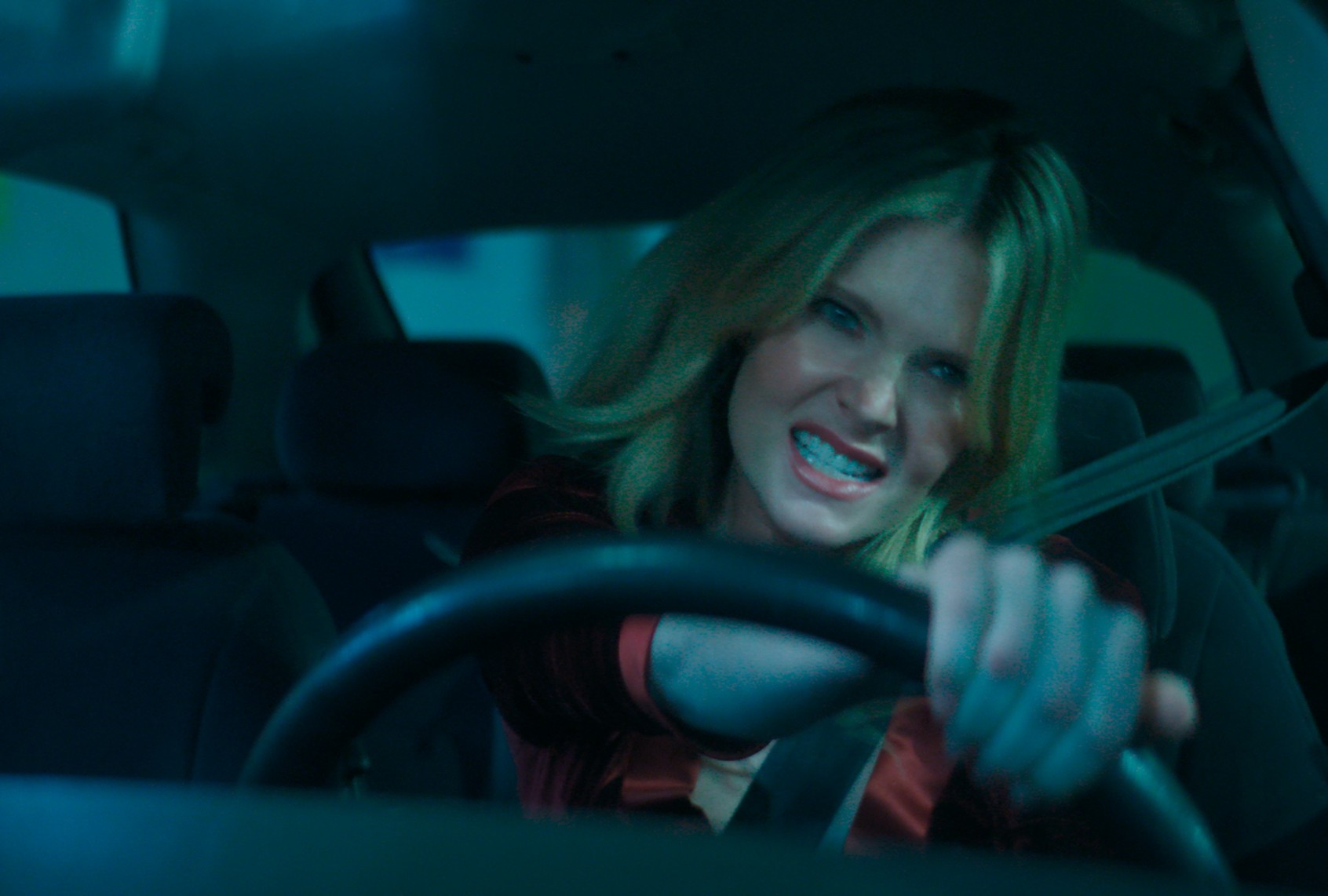
Violet never becomes the conventional image of a woman subjected to a man’s torture. She’s as capable and crafty in a real-life bind as she is in her sessions, and Fahy’s movie-star-making performance is a gripping glimpse of a woman in full control.
Landon’s film, co-written by Jillian Jacobs and Chris Roach, takes excellent care to be economical. This is, after all, a studio crowd-pleaser that’s got to get the job done in 95 minutes. However, Jacobs and Roach refuse to sacrifice Violet’s character for the film’s expediency. This opening scene might be quick and straightforward, but it’s also deceptively informative. In just about 120 seconds, viewers learn that Violet is not only intensely caring but clever enough to think of cunning, new approaches in a short amount of time when one method falls flat. For “Drop,” a film that deftly balances modern-day tech with the thriller subgenre’s classic twists, establishing Violet’s ingenuity in a sticky situation is integral to ensure every viewer has a great time.

Violet would love some entertainment of her own, too. She’s so starved for it that she’s finally booked her long-awaited first date with Henry (Brandon Sklenar), a handsome and incredibly patient suitor she’s been chatting with on a dating app for the past three months. After a long time wrestling with the trauma of her last relationship, Violet decides to go for it and leaves her son Toby (Jacob Robinson) in the doting care of her sister, Jen (Violett Beane). She’ll keep her phone on in case Jen needs her, and they’ve got security cameras throughout the house that feed to an app on her device; everything will be fine. 

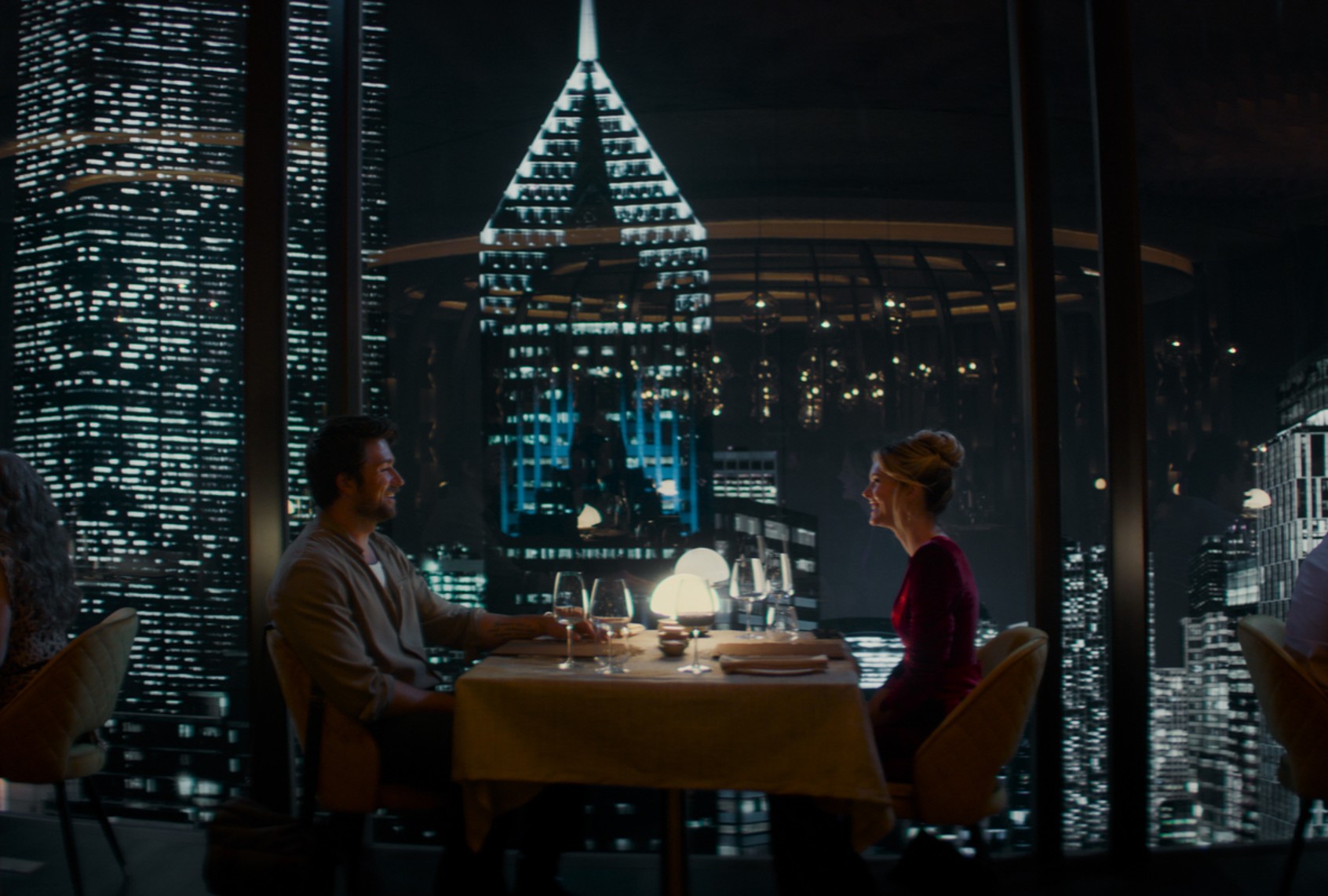
Henry (Brandon Sklenar) and Violet (Meghann Fahy) in "Drop" (Bernard Walsh/Universal Pictures). Unfortunately, Violet will have no such luck. Her first date with Henry quickly devolves into a living nightmare — and not just the kind where you find out that the person sitting across from you is, like, really into deadlifting. When she sits down to dinner, Violet gets caught up in a game of digital cat-and-mouse that threatens her future romantic prospects and her son’s safety. But with Jacobs and Roach’s sharp character writing, Violet never becomes the conventional image of a woman subjected to a man’s torture. She’s as capable and crafty in a real-life bind as she is in her sessions, and Fahy’s movie-star-making performance is a gripping glimpse of a woman in full control.

If your mind is still lingering on the film's title and how it could be related to this almost retro-style thriller, one that — get this — actually thrills, “Drop” refers to the series of AirDropped photos and messages that Violet begins to receive during her date. (Or, in this movie’s case, “DigiDrops”; that Apple licensing money will eat up the budget.) As if Violet wasn’t nervous enough, her pleasant conversation with Henry is interrupted by trite memes covered in Impact-font text. That’d be a jump scare as it is, but the images blowing up Violet’s phone quickly become unnervingly specific and personal. Henry assures her it’s probably just a prank some nearby high school kids are playing on her while they eat a fancy dinner before heading to their prom. And because chivalry is not dead, Henry even goes so far as to help Violet weed out other potential suspects.


Want a daily wrap-up of all the news and commentary Salon has to offer? Subscribe to our morning newsletter, Crash Course.


Speaking from experience, receiving a bunch of drops while out in public is not fun. I, too, was the victim of some high school kids sitting on the other side of a train car not too long ago, who kept sending me random images as I tried to pass the time by aimlessly scrolling on my phone. They were dropping images so fast and frequently that, as soon as I declined one, another one would be on my screen half a second later. I kept my face unchanged so they wouldn’t get any kicks from my annoyance until I remembered that I didn't have to deal with this at all. With two swipes of my thumb, I turned my Bluetooth off. My device left their range and the torment ended. 

That Violet could conceivably do the same thing is the film’s biggest weakness, a plot hole that could swallow viewers who can’t suspend disbelief. Violet’s already pretty annoyed by the drops before they become threatening, and something as simple as tapping her phone to turn the Bluetooth off could’ve saved her a whole lot of trouble. Jacobs and Roach have written such a quick-witted character that it seems implausible Violet wouldn’t think of this herself, even if she was overwhelmed by the sudden collision of her nerves and trauma. But to Landon’s credit, his direction keeps the pace swift and the tension mounting. (Albeit with some shot/reverse shot conversations that are whiplash-inducing.) And once Fahy digs into Violet’s strength under pressure, “Drop” shakes off its most glaring flaw.

Meghann Fahy as Violet in "Drop" (Universal Pictures). It helps, too, that Henry is such a charmer. In a movie where most would expect the romantic co-lead to turn out to be the villain, Sklenar’s hard leaning into the affable good-guy persona removes his character from the suspect list early on. But there are plenty of others around the penthouse restaurant they’ve chosen for this outing: A shifty couple on a blind date, an overly sweet bartender, a handsy piano player and a skulking man who’s “waiting for his sister.” There’s also Violet and Henry’s waiter, Matt, played by the scene-stealing Jeffery Self. Perhaps his anecdotes about doing improv at Second City are a brilliant diversion, but probably not. They do, however, inject some fantastic comedic relief to cut Landon’s tension; if Fahy is the film’s star, Self is its supernova. 

So many characters in one place means that Landon can use the single confined space to its maximum potential. Amid the relentless drops on her phone and texts threatening to hurt her sister and son, Violet trots around the luxurious eatery, looking for clues, security camera blind spots and places where her stalker might be out of range. None of it works, of course, but these tactics allow Roach and Jacobs to display Violet’s brilliance and grace. She manages to keep Henry unaware of her situation as long as possible, and as we watch Violet juggle her anxieties, “Drop” shrewdly reminds viewers of how women are expected to perform in public without being seen as “crazy.” 

Violet is not worthless, she’s invaluable. And when she uses that power to her advantage, “Drop” enters a high-octane third act that concludes with some of the most satisfying sequences of any thriller in recent memory.

In her marriage, Violet spent too much time being made to feel like everything was her fault and that the abuse forced on her was a symptom of her own instability. Now, she’s trapped in the same horror. If Violet sets off the wrong alarm bells, she and her family could die. And for what it’s worth, she’s also really into Henry! Losing this great guy after spending so long afraid of putting herself out there would be a huge emotional setback. That’s precisely why the pressure ratchets up further when the anonymous person contacting Violet tells her to poison her date.

Here, it becomes clear how much of a debt “Drop” owes to Wes Craven’s 2005 masterpiece “Red Eye.” The two films share similar plots and thematic structures. In Craven’s film, a hotel manager named Lisa (Rachel McAdams) finds herself seated next to the smooth-talking, debonair Jackson (Cillian Murphy) on a late-night flight. She soon learns she’s been lured into a trap 35,000 feet in the air and that Jackson needs Lisa to move a high-powered government target into a room more conducive for a contracted terror attack. Similarly to Landon’s film, Craven’s movie deals primarily with contemporary cultural anxieties. “Red Eye” was released while the September 11 attacks were still at the front of the audience’s mind, and just boarding a plane felt unnerving. In “Drop,” Landon, Roach and Jacobs all prey on the viewer’s obscured worry that they’re losing control in a tech-forward world. If our devices are compromised, so is our safety.

But it’s not only era-specific concerns that bind these films. Like “Red Eye,” “Drop” is a brisk and breathtaking thriller where the woman outsmarts her persecutor at every turn, despite her past traumas. What’s more, she doesn’t need anyone’s assistance to do so. Violet understands that whoever has chosen her knows about her past and demonstrates growth and resilience as they stare her down somewhere in the restaurant. She’s no longer the woman thrown to the floor and beholden to her abuse, as we see in flashbacks. She is not worthless, she’s invaluable. And when she uses that power to her advantage, “Drop” enters a high-octane third act that concludes with some of the most satisfying sequences of any thriller in recent memory.

That a woman can be the key to her own salvation — without the help of a man, or anyone else for that matter — is still a rare thing in these films. The display of power seen in “Drop” feels as exceptional as it did 20 years ago in “Red Eye.” Perhaps these things recycle with each new generation, along with the anxieties that writers hinge their suspense on. But with “Drop,” Fahy reminds the next generation of women that they call the shots in their own lives, no matter who tries to tell them otherwise. That’s a critical message for viewers, regardless of how often it’s told.

“Devastating blow”: Student activist Mahmoud Khalil can be deported, U.S. immigration judge rules

Mahmoud Khalil, the student activist who led pro-Palestinian protests at Columbia University last year, can be deported by the Trump administration, a judge ruled on Friday. Khalil was arrested at his New York City apartment on March 8, the first arrest under President Donald Trump’s agenda to crack down on protestors who joined campus demonstrations against Israel’s war in Gaza.

Khalil is a green card holder and permanent legal resident who is married to Noor Abdalla, an American citizen. He was taken to a detention center in Jena, Louisiana. No criminal charges have been filed against Khalil — instead, Secretary of State Marco Rubio has cited a 1952 Cold War law that allows for deportation of non-U.S. citizens if they are deemed a threat to American foreign policy.

Judge Jamee Comans of the LaSalle Immigration Court in Louisiana said she lacked the authority to overrule a secretary of state. ABC News reported that Khlalil addressed the court, reiterating some of Comans’ earlier comments.

"I would like to quote what you said last time, that there's nothing that's more important to this court than due process rights and fundamental fairness," Khalil said. “Clearly what we witnessed today, neither of these principles were present today or in this whole process. This is exactly why the Trump administration has sent me to this court, 1,000 miles away from my family. I just hope that the urgency that you deemed fit for me are afforded to the hundreds of others who have been here without hearing for months.”

Khalil will not be immediately deported and his lawyers have vowed to appeal if such an order were to happen. NPR reported that “Comans gave Khalil until April 23 to request a stay of his deportation if his attorneys believe he qualifies for one. And the judge said if they don't meet that deadline, she will order him deported either to Syria, where he was born, or to Algeria, where he is a citizen.”

After the ruling, one of Khalil’s supporters read a statement from his wife Abdalla, who described the decision as a "devastating blow to our family."

"No person should be deemed removable from their home for speaking out against the killing of Palestinian families, doctors and journalists," Abdalla's statement said. "Today, in court, the government reiterated the same baseless racist claims about my husband that we have heard time and again, an attempt to smear those calling for an end to Israel's brutal genocide in Gaza. My husband is a political prisoner who is being deprived of his rights because he believes Palestinians deserve equal dignity and freedom."

The key to making the fluffiest cream cheese frosting every time, without fail

Planning to whip up a showstopping carrot cake for Easter? You’ll need a frosting that’s equally impressive — light and fluffy, yet rich and flavorful enough to steal the show.

There’s something inherently joyful about a beautifully decorated cake. It draws out those delighted gasps and effusive praise: This cake is amazing! What’s in this frosting?!

Because let’s be honest — the frosting is often what gets people talking. Sure, the cake is important (a dessert can’t live on frosting alone), but frosting is the focal point. It’s the face of the cake, the glossy veneer, the carefully crafted crown that covers any flaws and makes a dramatic first impression.

So, it needs to be perfect. Not just in looks — though a frosting should be aerated and smooth, with enough firmness to hold shape — but also in taste. That’s where balance comes in.

It’s all about balance 

A great frosting isn’t just sweet. It should play off the cake, adding contrast or complement. The goal isn’t to double down on sugar, but to create complexity. You want the eater to pause mid-bite and say, “Wait — what is that flavor?” rather than, “Whew, that’s sweet.”

Take Krispy Kreme’s Chocolate Iced Kreme Filled Doughnut. The filling has a surprising hint of salt, which cuts through the richness and prevents the donut from feeling cloying. It’s subtle, but it transforms the experience. That’s the kind of dynamic you want in a good frosting.

The ingredients

Most cream cheese frostings call for just a handful of ingredients — typically cream cheese, sugar, vanilla and salt. Cream cheese provides the base; vanilla adds warmth and aroma; salt sharpens the flavors; and sugar rounds out the tang.

From there, you can build. I like adding a splash of dairy — cream, half-and-half or even buttermilk — to soften the cream cheese and create a silkier texture. Lemon juice or zest adds brightness and cuts through the richness. Mascarpone, a lush Italian cream cheese, lends depth and smoothness.

Depending on your flavor preferences, spices like cinnamon or ginger can bring a cozy warmth — especially nice with carrot cake.

And please, don’t skimp on the salt. A pinch can make all the difference in balancing sweetness and enhancing complexity.

We need your help to stay independent

The technique

But here’s the real secret: it’s all in the method.

Whip, whip, whip. You want to incorporate as much air as possible. A dense frosting won’t do your cake any favors—it should be cloud-like, yet sturdy enough to hold its shape when piped. Think of the frosting on a cupcake: you want peaks that stand tall, not slump.

If you’re adding cream, there are two options:

All-in-one method – Follow pastry chef and cookbook author Stella Parks’s advice from Serious Eats: mix cream, sugar and cream cheese together in one bowl. The cream helps dissolve the sugar, while the sugar stabilizes the cream cheese, preventing over-whipping.

Fold-in method – Whip the cream cheese base separately. Then whip heavy cream until airy and gently fold it into the base. This creates an especially light and silky texture, though it’s a bit more effort.

The sugar debate 

Most bakers reach for powdered sugar, but I’ll admit: I like the slight texture of granulated sugar. It gives the frosting a bit of chew and lets the tanginess of the cream cheese shine through—especially when you use less sugar overall.

Also, while I’m usually a brown butter devotee, it’s too temperamental here. Skip the butter entirely. This way, when someone hears “cream cheese frosting,” that’s exactly what they taste—pure, tangy, balanced perfection.

Final thoughts 

The best cream cheese frosting should be luscious, structurally sound, and just sweet enough to enhance—not overpower—the cake. It should balance tang, richness and lightness, and it should feel like an integral part of the dessert, not just an afterthought.

Stay tuned for my carrot cake recipe coming soon—complete with this frosting technique. Buona Pasqua!

Yes, you can air-fry halloumi— and it belongs on this salad

One of my favorite things to eat in recent years is a smart, thoughtful combination of raw and cooked ingredients — especially in a dish served chilled or at room temperature.

A few years back, just before COVID, I had dinner at a sun-drenched, wood-paneled restaurant and wine bar that served one of the brightest, most refreshing main dishes I’ve ever had: poached, sliced chicken breast with cucumber, avocado and a chilled buttermilk sauce.

It was sublime — refreshing the way a dessert or beverage might be, in a way entrées are rarely granted the opportunity to be.

Another relatively new discovery I’ve eaten with reckless abandon in the past five years is halloumi, often featured in Greek cuisine, slicked with olive oil and a touch of honey, served alongside olives, pita or salads. Now, cheese has been my favorite food forever and always—I will drone on about this to anyone who’ll listen—but I was late to discovering my love for halloumi. I’ve been an adherent ever since.

Halloumi is somewhat unassuming at first. A white, square block that resembles tofu, it has a mild, milky flavor with a touch of salt—almost like a distant cousin of mozzarella. But once it’s cooked and browned? It becomes something else entirely.

I love the squeak of halloumi, the way it bounces off your teeth, the chew, the salinity. It’s become one of my absolute favorite things to eat.

So why not combine these two concepts? Here, I went for a chopped-salad-style dish, with halloumi as the star. Be careful when cooking it: halloumi is naturally “squeaky,” but if overcooked, it can veer into rubbery territory. You’re better off slightly undercooking it.

We need your help to stay independent

For this salad, I cut the halloumi into planks, air fry it, then quarter it. If you’re going for more of a grilled-chicken-on-salad vibe, you can keep the planks intact. Just be sure to cut everything to about the same size, with the halloumi and cucumber making up the largest bites.

Halloumi is inherently fascinating—I mean, it’s a cheese you cook like a protein. Hard to go wrong. Pairing it with bright, punchy ingredients like grassy, celery-flavored vinegar; smooth walnut oil; sweet, chewy golden raisins; and clean, crisp cucumber creates an exploration of flavors, textures, consistencies and temperatures. Add fennel, shallot, a touch of honey, bright lemon and a blend of tarragon and fennel fronds, and it becomes the perfect Greek-Italian mash-up to welcome spring.

Eating raw produce is often considered more nutritious, and this vegetarian dish is deeply satisfying on its own. You can bolster the protein with chicken, beans or tuna if you’d like, but it’s not necessary. The vegetal purity of this dish—emboldened by halloumi as the centerpiece—is more than enough. It also comes together in 20 minutes or less. Most of the work is just knifework.

I love it. I hope you will, too.

Halloumi salad with cucumber, fennel, golden raisins and pine nuts
Yields
3 to 4 servings
Prep Time
15 minutes
Cook Time
8 minutes

Ingredients

8 ounces halloumi, sliced into planks length-wise 

Cooking spray

1 teaspoon honey

1 to 2 tablespoons celery vinegar (champagne or white wine also work)

2 to 3 tablespoons walnut oil (or any neutral oil)

2 lemons, juiced and zested

Freshly ground black pepper

Kosher salt

1 large shallot, peeled and minced

3 tablespoons golden raisins

1/4 fennel bulb, halved, core removed and very, very thinly sliced, fronds reserved

2 seedless cucumbers, quartered and chopped, ends removed

3 tablespoons toasted pine nuts 

Handful tarragon, roughly chopped

Directions

  1. Place halloumi, in a single flat layer, in air fryer basket. Spritz with cooking oil spray or Pam. Cook for 8 minutes at 350 degrees, flipping once. 
  2. In a large bowl, whisk honey, vinegar, oil, juice and zest, freshly ground black pepper and a touch of salt. Add shallots, raisins and fennel and let sit for 5 minutes. This will help to soften the fennel, plump the raisins and tame the shallot's sharp flavor.
  3. Stir mixture well. Add cucumber, pine nuts, half the fennel fronds and half the tarragon. Stir again.
  4. Quarter each halloumi plank. Add to salad. 
  5. Stir, finish with the remaining herbs and serve immediately. 

Can we imagine a progressive version of DOGE? Almost: Here’s how it would work

By now, the American people have had about enough of Elon Musk’s DOGE. Enough of the destruction of things they care about, and the threats to so much more. The Hands Off demonstrations, up to 5 million strong, reached even into previous Trump strongholds. A few weeks earlier, a mid-March Quinnipiac poll found that 60% of voters disapproved of DOGE’s mass firings of federal workers, while just 36% approved. 

But the idea behind DOGE — that there’s massive government waste, which could easily be slashed — remains stubbornly popular, driven by generations of conservative messaging and neoliberal me-tooism. As Paul Krugman noted in December, a Reagan-era commission of nearly 2,000 business executives organized into 36 task forces "mostly came up empty" after 18 months of investigation. As Krugman noted, “most government spending happens because it delivers something people want, and you can’t make significant cuts without hard choices.” The conservative fantasy of “waste, fraud and abuse” evades that fundamental fact. That’s how you get the mass dismissal of IRS workers, which will cost the government $500 billion in revenue, presented as an example of conservative efficiency. 

Breaking DOGE’s momentum and reversing the damage done are the highest priorities, but serious long-term counter-measures are needed as well. Messaging clearly needs to be a big part of it, but so does actually making government work for people, in an effective and visible way. We need a different DOGE — let’s call it here the Department of Government Effectiveness — oriented toward promoting the general welfare. As I’ll argue below, that necessarily means involving the public directly in the process. 

Political scientist Henry Farrell suggested as much in a February post that combined critical analysis of DOGE with the question of whether there's a more democratic alternative. The answer, so far, is no — and I’m not here to offer one, for reasons suggested by Farrell’s post. As he points out, “Power fantasies are a bad idea,” whoever’s they may be, adding, “If you want a better alternative to DOGE, it has to involve some form of democratic steering.” In other words, developing that alternative must be a democratic process, not just one person’s bright idea. What I will offer are some foundational ideas that may be vital for that enterprise, and may encourage others to pursue it further. Some of them Farrell described in this post and an earlier one last year, which I'll explore below.

Effectiveness subsumes efficiency as a goal — of course we want to do things efficiently, but we want to do the right things, not things we have to undo later because they’ve caused even more problems than they solve. And being effective in the long run often means seeing the short run differently. The climate crisis presents the most obvious example. In January, risk management experts at Britain’s Institute and Faculty of Actuaries warned that the global economy could face 50% loss in GDP between 2070 and 2090 from climate shocks, along with billions of deaths. In early April, a top insurer warned of even worse coming even sooner: At 3℃ of global heating, which is definitely possible in that timeframe, climate damage can’t be insured against, either privately or by governments. “That means no more mortgages, no new real estate development, no long-term investment, no financial stability. The financial sector as we know it ceases to function. And with it, capitalism as we know it ceases to be viable.”

If government cannot protect us against such a disastrous future, any talk of efficiency is just a distraction at best. What we need is effective government action to ensure we even have a future. That’s not some high-minded ideal — it should be the bare minimum.

To craft a sound progressive anti-DOGE focused on effectiveness, there are at least four foundations we should draw on: 

  1. The hands-on experience of government employees who already working on enhancing government effectiveness and efficiency before DOGE fired them. 
  2. A general recognition of the value of resilience in government, which must have the capacity to respond to dire emergencies, both foreseen and unpredictable. 
  3. New information and new ideas about how to empower government decision-makers at the appropriate levels. 
  4. A frank recognition of the role of political power in limiting or expanding government effectiveness and efficiency. 

What already works

The place to start with developing a Department of Government Effectiveness is with what already works — or at least used to work, until Musk and DOGE destroyed it: the technology problem-solvers with more than decade of experience at the U.S. Digital Service and 18F, both of which were created in 2014 after the failure of healthcare.gov. As explained by Don Moynihan, a professor of public policy at the University of Michigan, in early March

Both organizations use similar managerial technologies, which includes agile, iterative design, a user-centric approach, a reliance on data-driven decision making, directly managing relationships with vendors, favoring open-source solutions, the prioritization of platform models, and a flatter organizational culture.

He also notes that these programs weren’t adequately staffed and “lacked power to make big changes.” But they had a considerable track record, which offers a foundation for how to further government effectiveness in the future. And despite being sabotaged by DOGE, they continue to inform the public online along with other current and fired federal workers at We the Builders

Faced with the climate catastrophe, talk of government "efficiency" is just a distraction, at best. What we need is effective government action to ensure we even have a future.

One enlightening post contrasts the USDS with DOGE, explaining that the former was “precision engineering for public good” with an approach defined by empowering agencies, transparency and collaboration, and delivering meaningful value rapidly. In contrast, DOGE’s disruption is characterized by lack of understanding, closed-door decision-making, superficial agility and eroded government capabilities. “Rather than making government more efficient,” that post continues, “their actions dismantle agencies' ability to perform the very services they were designed to provide to help the American public.”

Resilience, not "optimization"

The value of resilience, rather than “optimization,” is laid out by Brian Klaas in an early January post. He makes the argument at multiple levels, writing that both in larger social terms and our individual lives, “we are over-optimized, courting disaster because we are deliberately slicing away the sinews that make ourselves and our world sturdier.” 

He pointed to the example of the Ever Given container ship, which was hit by a gust of wind in the Suez Canal in 2021 and got wedged sideways between the canal banks. That blocked the pipeline for 12% of global trade, at a cost estimated at $73 billion. By contrast, when a power cable linking Estonia and Finland was severed in December 2024, it took several months to repair but caused no blackouts. “Unlike the Suez Canal incident, the Estonian power grid was resilient, able to withstand an unexpected blow,” Klaas notes. 

On a more philosophical level, Klaas writes that it’s a “tragic mistake” to believe that “'survival of the fittest’ — with overtones of relentless, flawless optimization” fairly describes evolutionary principles. “A hyper-optimized species that can only survive in one environment will get wiped out if that environment changes,” he notes, and “lasting species are defined not by optimal solutions, but by 'good enough' ones. It’s not survival of the perfectly optimized, but survival of the resilient, as only the most robust inherit the Earth.”

The argument for resilience applies at all levels, but is even important for government than for business. A failed business will be replaced by more successful competitors; a failed government is a societal catastrophe. We can’t tolerate optimization as a core principle of government, without putting ourselves — and the shared democratic values government is supposed to protect — at great risk. 

Empowering decision-makers 

I noted above that USDS and 18F were unable to make “big changes,” and surely we’d want a progressive DOGE to do more. I want to draw on two sources of ideas about that, both discussed by Farrell in a post last year about Dan Davies' book "The Unaccountability Machine" (published this month in the U.S.). The first is the stream of thought going back to Ross Ashby known as “management cybernetics,” which Davies clarifies. Most crucial is Ashby’s “Principle of Requisite Variety,” which argues that we live in a complex world which produces successive waves of variety, which come with many surprises. To anticipate and manage those, Farrell explains that you need complex systems built into your organization, which must be "as complex as the system that you’re trying to manage."

A progressive version of DOGE either requires a more equitable political environment or must work to create one, by increasing the decision-making power of ordinary citizens and literally empowering the powerless.

There are two main strategies: First is “attenuation” of the variety of environment, such that “that the system produces fewer possible states of the world to be anticipated or managed.” In other words, fewer and more manageable surprises. Second is “amplification” of the variety within your organization so it “better matches the variety of the environment.” That often means  “building better feedback loops through which different bits of the organization can negotiate with each other over unexpected problems.” 

As Davies makes clear in a discussion in the Niskanen Center’s Hypertext newsletter, he sees management cybernetics as a remedy to the problem of outsourced government functions, which has resulted in a “decentralized” bureaucracy that “is a disaster in terms of accountability while failing to deliver the goods in terms of efficiency.” 

Farrell also more briefly discusses a second source of ideas, Jennifer Pahlka’s book "Recoding America," which offers, he says, “an applied informational theory of the state”:

Jen argues that we need to move away from top down decision making, to systems that will allow bureaucrats a lot more autonomy. She frames her argument for change in terms of “agile” software design. … The solutions that Jen emphasizes — bringing policy design and implementation into much closer contact; identifying bottlenecks and chokepoints; allowing people far greater flexibility to do needed stuff towards the shared end goal, even if no one anticipated this stuff was needed — are just the kinds of solutions that a cybernetician would press for too.

Politics and power

As Margaret Levi notes in an online discussion of Davies’ book, it advocates “improved communication,” which is surely important, but largely avoids questions of “politics and power.” Farrell agrees, noting that the "cybernetic vision" will work best “in a world of less unequal power relations…. Power relations are about many things, including basic human dignity and autonomy. But they are also about information, in the sense that systems with horribly unequal power relations are extremely unlikely to have good feedback.”

A progressive version of DOGE would require either a more equitable political environment or, more likely, it would work to create one by increasing the decision-making power of ordinary citizens and literally empowering the powerless. Doing that will require a clearer understanding of what government already does — and what more it can do. 

I’ve written previously about the use of Athenian-style citizens’ assemblies to make governmental decisions. These assemblies are chosen by lot from the citizenry at large and deliberate on matters of policy, much as trial juries deliberate on matters of civil or criminal liability. These remain largely experimental or hypothetical, but represent an instructive ideal we can keep in mind when considering other forms of public engagement and how they might be improved. 

Federal, state and local governments already allow for citizen input in a variety of different ways — public comments, stakeholder groups, advisory committees, citizen initiatives, town halls, etc. One task for a progressive DOGE could be a systemic review of all such bodies with the aim of making them truly effective, both in giving citizens more say and in solving the problems they’re meant to address.  

One common form of public engagement is the public-comment phase of regulatory rule-making or other decision-making processes. On the federal level, they are broadly required by the Administration Procedures Act. Recently, HHS Secretary Robert F. Kennedy Jr. announced that his department would end this practice on regulations affecting government benefits and grants, including National Institutes of Health funding. An activist, progressive DOGE could either veto such an autocratic action outright or force Kennedy to justify it in federal court. It should be obvious to almost everyone, regardless of party politics, that true government effectiveness should make it easier for citizens to comment, rather than easier for political appointees to ignore them.

Empowering the powerless

While enhancing the power of citizens should be a major concern, it’s not enough to address concerns of unequal power. Consider the history of Colorado Basin water management, discussed by Levi in the forum mentioned above: Throughout the process, those with more power gained and those with less lost. Land and water rights were taken from Native Americans and apportioned to white settlers, but in turn most of the small farmers failed, “and the result was the agglomeration of land by wealthier farmers,” Levi notes. As competition for water intensified, “demands by powerful farmers and urbanites drove costly infrastructure projects such as dams. The ultimate result was the draining of the Colorado River Basin.”

This was a story of successive unjust decisions, which appear obvious in hindsight. Undoing any particular injustice along the way appeared difficult or impossible, and allowing them to accumulate ultimately contributed to an unequal and increasingly unsustainable status quo. The Bible offers a solution for this: the tradition of Jubilee, a 50-year ritual of debt forgiveness, land restoration and the emancipation of slaves and indentured servants. Of course we can't return to Mosaic law, but there’s evident wisdom here: People’s futures should not be foreclosed forever because of past injustice. 


Want a daily wrap-up of all the news and commentary Salon has to offer? Subscribe to our morning newsletter, Crash Course.


Debt forgiveness is a powerful concept with a long history in many cultures and traditions, but the larger issue is redressing the dramatically unequal distribution of power. If we can’t accomplish that, we’re headed for social catastrophe, as forecast in Peter Turchin’s "End Times: Elites, Counter-Elites, and the Path of Political Disintegration" (Salon review here), based on the evidence of hundreds of civilizational cycles. Turchin argues that the greatest problem repeatedly facing human civilizations is the creation of a perverse "wealth pump" that siphons money away from the common people and redistributes it upward, to the rich. One way or another, that pump must be shut off or reversed; otherwise the result is social breakdown, civil war, even national destruction. One in five civilizations succeeds in such a reversal, as the U.S. during the Great Depression. But the odds of doing it again aren’t in our favor.  

There’s no silver bullet available, although raising taxes on the rich and raising the minimum wage would help a great deal. Typically, such major change requires an ensemble of different measures, motivated by changes in attitude that reflect widespread recognition of the dangers. Our progressive anti-DOGE could help find solutions and then help build consensus around them. In recent history, we've seen numerous potentially popular progressive initiatives be sidelined, suppressed or watered down through a combination of conservative fear-mongering and establishment resistance. 

The greatest problem repeatedly facing human civilization is the creation of a perverse wealth pump that takes money from the common people and gives it to the rich. That pump must be shut off or reversed to avoid social breakdown.

Consider the 2020 Black Lives Matter protests, far and away the largest wave of public demonstrations in American history, representing a mass awakening to historic, systemic injustice and a desire to redress it. What happened since then offers clear evidence that our political system is set up to thwart such awakenings of conscience. That’s the opposite of how an effective democratic government should operate — it should welcome an honest reckoning with history, reform of the criminal justice system and effective alternatives to mass incarceration. 

Something is profoundly wrong when the country that defines itself as a beacon of freedom has 20% of the world’s prison population, but only 5% of the world’s population. Effective democracy would involve learning from other countries that do a much better job protecting public safety without sending millions of people to prison. 

Reality and realism

In March, Renée DiResta wrote that “internet fantasies have become a sufficient pretext for crippling the government,” citing Elon Musk’s claim that “There are a lot of vampires collecting Social Security,” which was rapidly debunked but still made it into Trump’s address to Congress. If fantasy is the lifeblood of DOGE, then reality must be the lifeblood of a progressive alternative— especially one that prioritizes effectiveness. Three principles follow from this.

First, what government actually does must be made visible and legible to the American public. Over a decade ago, Suzanne Mettler’s book “The Submerged State” revealed that Americans often don’t recognize what government does, even if they directly benefit from it.

“Until political leaders reveal government benefits for what they are by talking openly about them, we cannot have an honest discussion about spending, taxes or deficits,” she wrote in a New York Times op-ed at the time. “The threat to democracy today is not the size of government but rather the hidden form that so much of its growth has taken. If those who assume government has never helped them could see how it has, it might help defuse our polarized political climate and reinvigorate informed citizenship.” This should be a major part of the mission for a left alternative to DOGE. 

But realism also requires recognizing that there is significant government waste — not due to inefficiency or waste in the Republican sense, but because political power too often serves private ends. In December, Krugman cited the example of Medicare Advantage, which may overbill as much as $140 billion a year, a result of privatization and politics, rather than inefficiency. 

Realism also requires recognizing that there is significant government waste — not due to inefficiency or waste in the Republican sense, but because political power too often serves private ends.

Another huge source of waste is military spending. In 2016, for example, the Pentagon buried its own study that revealed $125 billion in bureaucratic waste. That’s the kind of wasted expenditure Musk claims to be rooting out, but it exists largely because of the immense political power of the military-industrial complex. And there’s more: Katerina Canyon of the Guardian described a range of major spending problems ignored by DOGE, including “failed weapons programs [the $1.7 trillion F-35, originally budgeted at $200 billion], an overreliance on private contractors [almost half of all military spending], unnecessary nuclear expansion [$756 billion through 2032] and a Pentagon budget so massive that it has never passed an audit.” No other government department has any comparable problems, which are direct results of the growing power that Dwight Eisenhower warned against 65 years ago.

Finally, there’s the cost of inaction against climate catastrophe, which could destroy the global economy, as mentioned above. As far back as 2004, another buried Pentagon report argued that climate change “should be elevated beyond a scientific debate to a U.S. national security concern.” Given the Pentagon’s problems just described, it’s not surprising the report was essentially suppressed and there’s been little or no follow-through. A progressive DOGE would make sure that such gross failures would never happen again. 

As I said earlier, I’m not proposing a democratic alternative to DOGE, but rather some foundational ideas: We need to start by appreciating what already works, strive for resilience rather than optimization, adopt a management-cybernetics approach to empowering government decision-makers and confront the barriers of unequal political power. That last task is by far the most challenging. We must empower citizens in general, and the most powerless among us in particular, and we must commit ourselves to realism. It’s a tall order, to be sure.  But it’s a rewarding opportunity to move away from what we’re against, and focus on building a shared future we can support. 

Amid tariff chaos, Republicans plot “massive redistribution” of wealth from workers to the rich

While conservatives hail the Republicans’ budget plan as the “biggest tax cut in history” and say that President Donald Trump’s tax plan is necessary tax relief, Trump and his allies are working to execute an enormous transfer of wealth from working Americans to the wealthiest.

Elizabeth Pancotti, a former adviser to Sen. Bernie Sanders, I-Vt., and a managing director at the Groundwork Collective, described the current GOP plan as a “triple whammy of massive redistribution in a society that is already tilted toward the wealthy.”

“The end goal here is to redistribute trillions of dollars from the middle and working class at the bottom to the one percent and the wealthy folks,” Pancotti said. “They’re doing that in three different ways.”

The first is through tariffs. Although Trump’s decision to roll back his so-called “reciprocal tariff” plan was often referred to as a pause on tariffs, this isn’t exactly the case. His administration is maintaining a 10% tariff on all imports as well as a 145% tariff on imports from China, alongside a handful of tariffs on specific industries.

Tariffs, Pancotti said, are a regressive tax that disproportionately impacts lower earners because, in essence, a tariff is a sales tax on imported goods. Because lower-income Americans spend a larger proportion of their income on goods, they will also spend a larger proportion of their income paying the tariffs on affected goods.

At the same time, Pacotti said, the Trump tax cuts, which Republicans were planning to extend, were skewed to benefit the wealthiest Americans. While the top 1% of households received an average tax cut of $60,000, according to the Tax Policy Center, the bottom 60% of households received an average tax cut of less than $500.

We need your help to stay independent

For comparison, the Yale Budget Lab estimated that Trump’s tariff plan will likely cost the average American household around $4,689 a year, a sum that eclipses the tax cut that most households received in the GOP’s budget plan while only being about 8% of the average tax cut the wealthiest households received. In practical terms, this means the Trump administration and his Republican allies in Congress are planning to hike taxes on most Americans while cutting taxes for the wealthiest households.

Pancotti pointed out, however, that this isn’t the only part of the GOP’s budget plan. They also passed a budget that will almost certainly result in dramatic cuts to services like Medicaid or CHIP, which serves as a safety net for the poorest Americans.

Dean Baker, an economist at the Center for Economic and Policy Research, told Salon that, in addition to this dynamic, cuts at the IRS, supported by Republicans and spearheaded by billionaire and Republican megadonor Elon Musk, will also make it easier for the wealthy to avoid paying the taxes they owe. Baker said that, in practice, it’s much easier for the wealthy and those who make money from capital investments to avoid paying taxes, saying, “Most of us have our tax deducted from our wages. We don’t have much choice in the matter.”

“So you both have, you know, the legislative changes that reduce their tax liability, but also, you know the fact of change is that if you don't have much by way of enforcement, you have a lot of people that don’t pay their taxes,” Baker said.

The new space race is raining more garbage from the sky. We’re not doing enough to stop it

In the early morning hours of February 19, 2025, a bright object streaked through the skies above western Europe. The mysterious, flaming hunk of metal traveled for several hours before smashing into a warehouse in the Polish village of Komorniki.

“I felt surprised but also a little scared,” Adam Borucki, the warehouse’s owner, told the BBC in an interview. “But ultimately, I’m glad no one was hurt.” After inspection by local authorities and the Polish space agency, officials determined the object’s identity: a piece of debris from a SpaceX Falcon 9 rocket that had re-entered the atmosphere.

This isn’t the first time space junk has crashed to Earth. In December 2024, a half-ton piece of space debris flattened trees in a remote village in Kenya. Earlier that same year, a chunk of rocket landed on a North Carolina roof and a discarded space station battery pelted property in Florida. In 2023, fragments of carbon fiber and metal rained down on a Ugandan home.

Falling space junk is starting to become a real problem. So how worried should you be about it landing on you?

“The chance of you getting hit is absolutely minuscule,” Ewan Wright, a space sustainability researcher at the University of British Columbia, told Salon. “But across the whole world, the chances of somebody getting hit is rising to a level where we actually have some concerns about it.”

Individually, a person’s estimated chance of being struck by space debris is something like one in a trillion. But the odds of debris striking someone on Earth is closer to one in 10,000, as Wright and his colleagues calculated in a 2022 paper published in Nature Astronomy. In fact, in 2002, a young boy in China became the first person to ever be reportedly injured by a piece of a falling rocket (he survived with only minor injuries.)

"The chances of somebody getting hit is rising to a level where we actually have some concerns about it."

Of course, a direct bodily hit isn’t the only hazard of falling space junk. There is a chance that debris could reenter commercial or federal airspace and pose a danger to aircraft, for example. Experts estimate that the world’s busiest airports have about a 26% chance each year of being affected by uncontrolled re-entries. Some countries have already had to deal with this — in 2022, Spain and France closed parts of their airspace to avoid a falling Chinese Long March 5B rocket. And such risks, however small, are growing.

“The problem we’re facing is that the number of launches is continuing to increase,” says Aaron Boley, an astronomer at the University of British Columbia.

That pace shows no sign of slowing down. 2025 is expected to see a record-breaking number of launches, as a new international space race heats up and companies like Starlink, a subsidiary of SpaceX, rush to put internet satellite “megaconstellations” in place.


Want more health and science stories in your inbox? Subscribe to Salon's weekly newsletter Lab Notes.


Another issue is that climate change is messing with LEO, according to research published last month in Nature Sustainability. As carbon dioxide and other greenhouse gasses build up in the dense lower atmosphere, they absorb heat and keep it trapped there. But in the thin upper atmosphere, carbon dioxide can’t hang onto its extra heat. This means the upper atmosphere ends up contracting “like a balloon being placed in liquid helium,” Matthew Brown, a systems engineer at the University of Birmingham in the U.K., explained to Salon.

As a result, objects in this region are now experiencing less drag than they did decades ago — which means they are staying up longer, and fewer are completely burning up on reentry. More objects in orbit means more debris with the potential to leave come down unexpectedly.

A crowded upper atmosphere could also trigger a phenomenon called “Kessler syndrome.” In this scenario, pieces of debris crash into one another, fracture into smaller pieces, which then crash into more junk or even functional spacecraft, creating a chain reaction. This cascade goes on until LEO is filled with shrapnel zipping around at intense speed.

“This runaway effect could render entire orbits unusable,” Michele Scaraggi and Rajat Srivastava of the University of Salento in Italy told Salon in an email interview.

So what can we do to address the hazards posed by space debris? Some space agencies and private companies have begun designing their craft to ablate — break apart and burn up — in the atmosphere at the end of their life, an approach called “design for demise.” While great in theory, the issue is that optimal design is difficult to predict, especially given Earth’s changing atmospheric composition. “If they’re wrong, then they have 10,000s of pieces of space debris that are going to come down and hit the ground,” says Wright.

SpaceX, for instance, designs most of its Starlink satellites to disintegrate upon reentry. But some of those de-orbited satellites don’t seem to fully ablate or burn up. One landed on a farm in Saskatchewan, Canada last year. And even craft that burn up completely might cause harm; researchers are concerned that the aerosolized metal could be damaging the ozone layer, reversing years of progress in protecting it.

We need your help to stay independent

Another option is managed re-entry. The idea behind this is to guide large pieces of re-orbiting debris to a predetermined location, usually a spot in the Pacific Ocean. Managed re-entry is often used for large craft on short missions, but it can be very difficult to arrange for long-term missions.

Some agencies are also making plans to remove debris directly from LEO. Proposed approaches include snatching debris with a robotic arm, scooping it up with giant nets, attracting it with magnets and spearing it with harpoons. Though there are currently no removal efforts active in orbit, the European Space Agency has plans to launch its first clean-up mission, called ClearSpace-1, in 2028. “These initiatives are critical stepping stones,” Scaraggi and Srivastava said.

Finally, there is ground-based emergency management. Counties in a few U.S. states, including those with rocket launch sites like California, Texas and Florida, have drafted emergency response plans for falling space debris. However, this is an area that needs to be developed much further, both in the U.S. and globally.

As climate change intensifies and new launches clutter our planet’s orbit, we’re almost certainly going to see more debris crash back to Earth. Humanity is going to need to come up with ways to prevent these re-entries from becoming casualties. This will involve, perhaps, being more intentional and strategic about how we send things into space.

“We definitely want to ensure that we have continued and safe access to outer space,” Boley says. “But the promise of prosperity is not permission for recklessness.”

The high cost of not having a bank account

Imagine your daily life without using a debit card to pay for groceries or pulling up your bank app to check your account balance. But that is the current reality for millions of Americans. 

According to a recent survey by the FDIC, data from 2023 reveals over 5.6 million unbanked households in the U.S. In other words, they don't have a checking or savings account. That's a record low number since the survey began in 2009, but some groups were more likely to not have a bank.

The survey shows that people who are disabled, lower-income, less educated, Black, Hispanic and living in single-parent households are more likely to be unbanked. Most single-parent households are run by women, and those households had an unbanked rate of 13.4% versus 7.8% of single-father households, the survey said.

"When you don't have banks, you don't have access to really basic things that we take for granted," said Valerie Rivera, a certified financial planner and founder of First Gen Wealth.

"Even in a dual-income household, women continue to carry the bulk of responsibility for child care," Rivera said. "And if you couple that with you're doing this on your own, and you are working, it's really difficult to find the time and the understanding to stop and say, 'How do I make my financial situation better? How do I figure out banking?' Because you're in survival mode."

Challenges persist when you're unbanked 

While there are a lot of hurdles if you don't have a checking or savings account, here are some major ones: 

We need your help to stay independent

Difficulty getting a loan or credit card. Getting a loan, credit card or mortgage can be nearly impossible if you don't have bank statements or documents showing you have a certain level of assets. 

"Even getting a credit card can be out of the picture, which for a lot of lower-income people —especially if they have inconsistent income — credit cards can help them with cash flow," said Tiffany Johnson, a certified financial planner and co-founder of Piece of Wealth Planning

Limited shopping options. If you don't have access to a credit or debit card and can only pay for things with cash, you can limit your purchases and be barred from shopping online and in stores that only accept cards.  

Theft and loss issues. If you keep a lot of cash on hand, there are many theft and loss issues, Johnson notes. This depends on whether you're keeping it secure or locked up. Is it easily accessible? Is it something you can lose?

High fees. If you don't have a bank to cash a check, you'll need to go to a cash-checking center. The fees can vary depending on where you cash the check and the type of check. For example, there might be different fees for a government-issued check versus a payroll check versus a personal check. 

Fees can be anywhere from 1% to 12% of the check's value. Or there might be a flat fee that's tiered and depends on the amount. Especially when money is already tight, those fees can have a larger impact and hurt you.  

"There are so many transactions that we do that involve bank accounts, and it's the people who earn the least that pay the highest fees for not having that level of access"

"There are so many transactions that we do that involve bank accounts, and it's the people who earn the least that pay the highest fees for not having that level of access," said Rivera. 

Financial planning is harder when there's no time

When you're a single mother and doing the job of two people by yourself, time is the biggest resource you just don't have access to, says Rivera. 

Besides working and taking care of your children, if you're low income, chances are you don't have a job where you're working from home, which means a commute and added costs.  "You're likely trying to get through your day, and you're not thinking about tomorrow," said Rivera.

In turn, you might be so exhausted and overwhelmed that you can't research and determine which bank is the right one for you. As Rivera mentions, you know you need to find a bank and do your homework; you know that not having a bank account isn't working. However, you don't know where to start and don't have the time to figure it out. 

Gender wage gap presents hurdles 

The gender wage gap can potentially prevent single moms from opening a bank account, Johnson says. According to Pew Research, women continue to earn 82% of what their male counterparts earn. 

The reasons behind this can vary, but it can be attributed to factors like women treated differently than men in the workplace, making different choices when balancing work and family and working in jobs that pay less than men.

Because a lot of financial institutions still have account minimums or require that you have a certain number of monthly deposits dropped into your checking account to avoid a banking fee, it might make it harder for a single mom to meet those thresholds. 

"If it's a lower-income single mom household, I think there is hesitation to just go all in with a bank account if cash flow is not as consistent," says Johnson. "They don't want to get hit by fees." 

Leveling the playing field 

If you're unbanked, the first thing to do is acknowledge that it's a change you want to make. Maybe the negative impacts are costing too much, and you want to do something different.

Set aside the time. Rivera recommends spending an hour or two in the next few weeks to map your next steps. "Put it on your calendar," she said. "Because there's never going to be a time in your life when you feel like looking up bank accounts right now."

Do your homework. If you're unsure about opening an account with a big bank, you can look into local credit unions or online banks that offer free accounts. You'll want to look for no monthly account fee and no account minimums to open and maintain an account. If there are fees, see what the requirements are and if you can comfortably meet them. Watch out for overdraft fees.

Another thing to keep in mind is the potential downsides of not using a big bank. For example, some online banks don't allow cash deposits or don't have ATM access. Credit unions typically have membership requirements and might not offer as many branches. "You want to find the one that's going to be the best for you and what you need," Rivera said.

Consider an online bank. As banking has changed a lot over the years, some folks may not realize they can open an account online instead of having to step foot inside a brick-and-mortar location. Online banks also typically have lower fees. 

Detained Tufts student details “unsanitary, unsafe, and inhumane” ICE conditions in new filing

Tufts University doctoral student Rümeysa Öztürk, detained by plainclothes ICE agents in a chilling scene last month, has experienced multiple health emergencies and had her hijab removed by a staff member, she said in a Thursday court document.

In a six-page declaration filed by the ACLU and Öztürk's lawyers, the student said she has had four separate asthma attacks in federal custody which were largely ignored, with one nurse telling Öztürk that her asthma was “all in my mind.”

“I fear that my asthma is not being adequately treated and it will not be adequately treated while I remain in ICE custody,” Öztürk said. “The air is full of fumes from cleaning supplies and is damp which triggers my asthma. We don’t get much fresh air which also impacts my ability to breathe well. The conditions in the facility are very unsanitary, unsafe, and inhumane. There is a mouse in our cell. The boxes they provide for our clothing are very dirty and they don’t give us adequate hygiene supplies.”

Öztürk, slated for deportation for authoring a pro-Palestinian op-ed in the Tufts student newspaper, said she’s experienced a lack of respect for her faith, too. She alleges ICE has refused her pleas for prayer materials, denied her a meeting with a Muslim chaplain and even attempted to take her hijab.

“Once they finally took me to the medical center, the nurse took my temperature. She said ‘you need to take that thing off your head’ and took off my hejab without asking my permission. I told her you can’t take off my hejab and she said this is for your health,” the doctoral student explained. “I don’t feel safe at the medical center because of my prior experiences there. They complain when I go there… They also write information in my medical records that is not accurate.”

The Tufts student also spoke out about the day of her arrest in the declaration, explaining she initially worried the ICE agents were private citizens with violent intentions.

“Since appearing on the Canary Mission website in February, I had begun to be afraid that I could be targeted for violence,” Öztürk said, referring to an organization tracking pro-Palestinian student ideology. “When the men approached me, my first thought was that they were not government officials but private individuals who wanted to harm me.”

The 30-year-old Turkish native said she was taken from Massachusetts to New Hampshire, to Vermont, and eventually to Louisiana by officers who gave her few answers and kept her from a lawyer for days. 

Öztürk, who has lived in the U.S. since 2018, is one of more than 600 students to have their visas revoked by Secretary of State Marco Rubio, who argued in a memo made public this week that he has the authority to deport individuals for their “beliefs.”

Gold might be an investment worth considering now

Gold’s reputation as a safe haven asset has been tested again as global economic uncertainty and geopolitical tensions lure investors toward the ancient precious metal. 

Gold reached a record high of $3,177.50 per ounce on Thursday, driven by factors ranging from tariff uncertainty to inflation concerns. U.S. consumer sentiment has worsened significantly in April, with 12-month inflation expectations surging to their highest level since 1981, fueled by concerns over escalating trade tensions and the rising cost of goods.

“Trump tariff uncertainty has added to its rise, as gold shines (no pun intended) in times of market stress and economic slowdowns,” said Maleeha Bengali, managing director of women-focused asset management platform AWAAM Consulting and founder of MB Commodity Corner newsletter. “It is also an incredible inflation hedge, so at times when the market has been going through a bit of stagflation, gold stands out.”

Growing demand

In some ways, gold’s upward trajectory isn’t new. It was fueled by central banks globally as they stocked up on gold reserves after the U.S. froze Russia’s state assets following the invasion of Ukraine in 2022. For central banks navigating complex political dynamics, gold provides a unique advantage: It cannot be frozen or confiscated.

“Gold is one asset that nobody can freeze,” Lina Thomas, Goldman Sachs analyst, explained in a podcast hosted by the firm earlier this year. 

We need your help to stay independent

Goldman Sachs projected in February that prices could reach $3,100 by the end of 2025 — a forecast that gold has already exceeded.

For everyday investors, gold’s appeal is in its ability to diversify their portfolios and act as a hedge against inflation and market volatility. 

“There's only a certain amount of gold in the world, and it goes up in value when stocks go down,” said Sherry Finkel Murphy, founder of Madrina Molly, an investing financial education community for older women. “Now you can take advantage of that by rebalancing your portfolio.”

How to invest in gold

She recommends looking into mutual funds, which are baskets of investments, and examining commodities within each fund.

“The goal is to sell the profit in the gold and buy the depressed stocks,” she said. “So the benefit of the gold is that it could give you something to rebalance your portfolio, and then when the stock market rights itself, you have all that lovely free money because you purchased it when it was depressed.”

To gain exposure to gold without the complexity of actively managed mutual funds, exchange-traded funds could offer a simpler alternative. The Sprott Gold Miners ETF, for example, has gained 35% year to date.

There are other options for non-traders. “The best way for non-professionals to have exposure to gold is to buy actual gold bars — physical assets one can never go wrong with," Bengali said.

Regardless of the financial instrument you decide on, the demand for gold is projected to continue to increase, according to the World Gold Council’s latest report.

“Central banks and ETF investors are likely to drive demand with economic uncertainty supporting gold’s role as a risk hedge,” World Gold Council analysts wrote.

“Your Friends & Neighbors” lets Jon Hamm sell you the life you can’t afford

It’s tough to shake the feeling that “Your Friends & Neighbors” is selling us something. Some of that is surely unintentional, a matter of its star Jon Hamm’s evergreen association with midcentury ad man Don Draper and “Mad Men.”

Still, his choice to foreground particular aesthetics makes it seem as if series creator Jonathan Tropper purposefully wants to stoke certain urges. Begin with the decision to have Hamm’s dethroned New York hedge fund maestro Andrew Cooper share his secret truths via voiceover: Coop, as his intimates call him, hides his bitter resentment well enough, but the polished flatness of his interior monologue tells another tale.

“Your Friends & Neighbors” has little to share about making money or even keeping it. But it has plenty to pitch concerning the joys and burdens of conspicuous consumption.

Before he becomes a broke rich man, we see him as a hard-working, high-earning financier who scraped his way to a giant house in the tony neighborhood of Westmont Village only to discover his friend Nick (Mark Tallman) boning his wife Mel (Amanda Peet).

Mel and Coop divorce, but the real fortune reversal hits when his firm fires him out of the blue. From there, he does the math: alimony payments, two kids in private schools, multiple car payments, all the fancy bells and whistles of a life that is over-leveraged. With an onerous non-compete benching him for two years, finding another job in his field is out of the question.

One slice of wealth that can’t be repossessed, however, is Coop’s encyclopedic knowledge of top-shelf luxury goods. That comes in handy when he’s casing his neighbors' homes to figure out which ones to burglarize.

“Your Friends & Neighbors” has little to share about making money or even keeping it. But it has plenty to pitch concerning the joys and burdens of conspicuous consumption. Tropper and his writers try to validate our disdain for the greedy while coaxing us to feel something for the people chained to their castles. Not quite sorry; perhaps a few inches shy of empathy. A closer thought is that most people could only wish to have those problems.

Seven of the nine episodes made available for review establish "Your Friends & Neighbors" as one of Tropper’s better TV efforts, although, in the tradition of past shows like "Banshee" and "Warrior," its handsomeness disguises significant creative shortcomings.

That doesn’t make it less watchable – it's certainly that. Nevertheless, if you’re exhausted with voiceover exposition, you’re probably also over in medias res openers, i.e. starting with a scene from the middle of the story before flashing back to the beginning. This show commits both sins, introducing our burglar as he wakes up on his neighbor’s floor, his expensive haircut resting in a puddle of blood.

Since it’s Hamm’s mug and voice doing the trespassing, these cliches are easily forgiven. He’s a familiar type, after all. Where Don Draper sold the mirage of the American dream through products on “Mad Men,” Coop understands that maintaining that illusion takes a mastery of the tiniest, rarest details.

Jon Hamm in "Your Friends & Neighbors" (Apple TV+). Since he’s secretly penniless, Coop keeps up the posture of affluence. He drinks aged scotch with people he barely likes and eats brunch at the country club he’ll soon be unable to afford. There, his ex and other wives carouse with another soon-to-be divorcee, Sam (Olivia Munn), who Coop is secretly banging.
All the while, he’s surmising what he might gain by rifling through his associates’ drawers and desks. Whenever he discovers some pretty little thing, the frame momentarily transforms into a commercial for excess, with a gleaming image of his unearthed treasure floating onscreen as a heavenly glissando tinkles in the background. Then Coop launches into a meticulous description of what makes each item worth coveting.  

One unauthorized visit to someone else's closet yields a brief soliloquy on the implication of a Patek Philippe timepiece.

Hard times haven’t turned us off of upper-class fairy tales.

“Like the ads said, you never actually own the Patek Philippe. You merely look after it for the next generation,” Coop observes in that familiar timbre, his baritone temporarily lifted by the object’s powers of aspirational fulfillment. After a pause, he returns to his usual sullen pitch and adds, “Well, the next generation tells time on their phones, so I figured no one was gonna miss this one.”

Another inspires a short rhapsody detailing the six-figure worth of a Richard Mille Felipe Massa automatic chronograph with a rose gold skeleton and a flyback function. You don’t have to know what those words mean — only notice, perhaps, that the very same dry Chablis voice describing it has spoken for Mercedes-Benz since 2010.  

We need your help to stay independent

“Your Friends & Neighbors” is the latest in a miles-long parade of shows about the grossly rich and their hidden miseries, stepping into the recently vacated villa occupied by “The White Lotus” cast of characters. HBO is a veritable warehouse of rich people's tales stretching to the pre- “Sex and the City” era, with “Big Little Lies,” “The Undoing” and “Succession” defining the contemporary generation. Apple TV+ has its share, including “Expats,” another drama about the rich and miserable starring Nicole Kidman, who is fast becoming the oeuvre’s mascot.

With so many similarly themed titles in this expanding portfolio, a common prediction is that we may soon be fed up with the woes of the 1%. We’re lurking on the fringes of recession, financial analysts warn, which would seem to limit our tolerance for, say, listening to Coop’s wealth manager and best friend Barney (Hoon Lee) complain about his wife buying him a Rolls-Royce Spectre.

Jordan Gelber, Hoon Lee, Mark Tallman and Manu Narayan in "Your Friends & Neighbors" (Apple TV+). But if past habits hold, we may never be done with gawking at the well-heeled. Scan the recent evidence – the third season of “The White Lotus” was a ratings smash. “With Love, Meghan” was far less of one for Netflix, but it launched the Duchess of Sussex’s lifestyle brand, As Ever, with a product line featuring jams and edible flowers that immediately sold out.

Hard times haven’t turned us off of upper-class fairy tales since "Dynasty” became a sensation in the midst of an early ‘80s recession. Its slightly older rival “Dallas” has been credited, somewhat apocryphally, for contributing to the downfall of Romanian president Nicolae Ceaușescu’s repressive regime. Allegedly, Romanians saw an American oil tycoon enjoying easy access to nice cars and other possessions and thought, in so many words, "Why can't that be me?"

Today’s affluence tales uniformly cast the rich as spiritually or morally hollow, something of a condolence prize to viewers living paycheck to paycheck.

A 2008 story in The Washington Post explains that Ceaușescu absurdly believed his people would find the primetime soap to be anti-capitalistic and allowed it to air. “After the dictator and his wife were shot on Christmas Eve 1989,” the story recounts, “the pilot episode of ‘Dallas’ — with a previously censored sex scene edited back in — was one of the first foreign shows broadcast on the liberated Romanian TV.”

Americans aren’t that badly off (yet), but the messaging woven throughout "Your Friends & Neighbors" is a smidge closer to the type of consumerist indictment that Soviet-era autocrat thought he was getting.

Among the wisest of Coop’s early introspections considers the way that the race to acquire status symbols makes you lose sight of the things that once mattered. “You're moving too fast to ask yourself those hard questions like, when is it enough? And really, what's the point of all this s**t?”

Amanda Peet in "Your Friends & Neighbors" (Apple TV+)“Your Friends & Neighbors” doesn’t entirely counsel against wanting more (and more and more), preferring to speak plainly about what the good life costs in monetary terms. You’d be hard-pressed to find another show as concise in its education concerning the subtler signifiers of having “made it.” And the market for the appearance of success, especially secondhand, is only growing. Coop is risking his lifestyle on that bet.

Balancing this is the show’s caustic tut-tutting at materialists for wanting these baubles in the first place.

Today’s affluence tales uniformly cast the rich as spiritually or morally hollow, something of a condolence prize to viewers living paycheck to paycheck. When you’re barely making ends meet, you can only wish to be any degree well-off and, therefore, be open to watching why that life comes with its predicaments, mainly having to do with ego. (Most of Coop’s anxieties could be solved by downsizing, but who wants to watch anything that sensible?)

At least Hamm’s poor rich man is somewhat self-aware in this regard. In a moment of dour reflection, Coop admits that he targeted two of the people who live in his community because he didn’t think they deserved all their nice things. He knew plenty of people like them, with houses filled with expensive prizes that would never be missed, “piles of forgotten wealth just lying around in drawers where they were doing no one any good.”

He knows this, he concludes, because only recently he’d been one of them. Few of us will ever afford to gain entry to such circles. But there’s nothing wrong with a little window shopping.

"Your Friends & Neighbors" premieres with two episodes Friday, April 11 on Apple TV+.

“Sacramento” makes a hilarious, heartfelt case for California’s capital

As the song goes, “I left my heart in San Francisco.” Yet, I find there’s not much in the Golden City worth pining over that hard. The food’s good, the people are pretty nice and the hills assure everyone’s calves are shredded year-round. But in all my time spent within state lines, I remember the days in San Francisco the least. The quieter locales of California are the most notable to me. There might be a mythic air to places like San Francisco or its pretentious older sister city, Los Angeles. But in those places, it’s hard to remain grounded in the state’s soft beauty, most easily admired in its sleepiest spots like its fair capital city, Sacramento.

Sacramento is sprawling yet confined, natural yet metropolitan. If you round the corner of a busy, sun-drenched downtown street, you might suddenly discover yourself buried under the shade of trees that stretch up to the skies and merge, as if a forest appeared in the city’s center one afternoon. Drive along its residential streets, and you’ll notice that houses exist outside of time. Stately, white colonials are on one block, while modest Spanish revivals sit on the next. For all that has been said about the dreammaking happening in Los Angeles, the city itself is far less romantic. On the other hand, Sacramento is the kind of town where you leave your heart without even realizing it. 

“Sacramento” isn’t so much a love letter as it is a film that spends its runtime capturing the city’s unpredictable spirit. It’s wry and authentic, a sweet but slight gem that properly reflects life’s ever-changing nature and how we find contentment amid that chaos.

Artists have been trying to capture Sacramento’s strange, electric majesty for years. Joan Didion’s 2003 memoir “Where I Was From” does this with a generous realism. But the city played a part throughout all of her major works, popping up in wistful anecdotes about how she learned to swim in the town’s rivers and how she both valued and contended with how her perception of the city had changed since she was a child. In 2005's “The Year of Magical Thinking,” she wrote about how memories of high school dances at Christmas comforted her during a rare but intense moment of panic following the deaths of her only daughter and husband. And then there's Greta Gerwig’s directorial debut “Lady Bird,” an all-out love letter to Sacramento that opens with a Didion quote and acknowledges just how restricting it can feel to be stuck halfway between a big city and a small town.

Now, actor, writer and director Michael Angarano tries a hand at something different in “Sacramento,” a film that, despite its title, is only partially set in California's capital. But that’s not to say that the movie is misleading, only that it’s not so much a love letter as it is a film that spends its runtime capturing the city’s unpredictable spirit as its characters journey toward their titular destination. When they arrive, “Sacramento” proves itself wry and authentic, a sweet but slight gem that properly reflects life’s ever-changing nature and how we find contentment amid that chaos.

The film opens somewhere deep in the California redwoods, where Rickey (Angarano) is startled by a shout from across the riverbank. It’s the voice of a fellow hiker, Tallie (Maya Erskine), warning him that she can see his manhood splayed out in a chair as Rickey dozes in the sun. After he calls her bluff, the two share a romantic evening that will change their lives forever. The film’s cold open meet-cute is a delightful start to “Sacramento” that keenly hooks its audience with the palpable chemistry between Angarano and Erskine, the latter of whom continues to be the shining glory of every project she’s in, which is no different here. However, when the movie flashes forward to a year after their first night together and waves goodbye to Tallie for a significant stretch of its runtime, Angarano threatens to commit the cardinal sin of wasting his most charming actor. Or, he would if Angarano himself wasn’t just as engaging.

As Rickey, a flighty self-starter who just can’t seem to get started, Angarano is wildly funny and also painfully familiar. He’s a people pleaser with attachment issues, the kind of character who is alluring enough to make those two opposite traits feel uniquely linked. At the outset of the film’s narrative, Rickey is kindly asked to leave a grief support group that he’s all but taken over after the death of his father. He’s become a little too good at making other people in the group feel like his whims are their ideas. That pattern rears its head again a short time later when Rickey meets up with his old friend Glenn (Michael Cera) and convinces him to join him on a road trip to Sacramento.

Maya Erskine, Michael Angarano, Michael Cera and Kristen Stewart in "Sacramento" (David Haskell/Vertical)The two best friends are perfectly mismatched: Rickey is a pathological liar who doesn’t realize his frustrating mendacity, while Glenn has difficulty expressing how he feels about anything, leading to fugue states of panic. Glenn is leveled out at home by his wife Rosie (Kristen Stewart), who manages to keep things running smoothly despite being in the third trimester of her first pregnancy. When Rickey shows up unexpectedly in the couple’s backyard, it’s not long before he whisks Glenn away on a trip at Rosie’s behest. She could use some time alone, and Glenn could use a forced change of scenery — even if it’s under false pretenses.

Rickey tells Glenn that he’s headed to Sacramento to honor his late father, who was born there and loved his hometown. Rickey could use emotional support when he scatters his ashes. When Glenn relents and calls the Mrs. for approval, Rickey sprints to the nearby desert and scoops up some dirt in a Wilson tennis ball canister. Neither Glenn nor the viewer knows exactly what will happen when the two get to their destination. But, then again, no one who visits Sacramento ever really realizes why they’re there until long after they cross the city limits.

When I last visited the city just over a decade ago, I was there to see a then-boyfriend and his family before we departed for our own road trip down the Pacific Coast Highway. My time in Sacramento bookended the voyage, and I got the chance to fall in love with the city in a way that I rarely do when I visit someplace for the first time. There’s something special about seeing a place like Sacramento through the eyes of somebody who grew up there. A relatively average town becomes the most breathtaking place on Earth when someone you love points out all of their favorite places, ones conjuring particular memories each time they pass. This is a much taller order in places like Los Angeles and San Francisco, where the transient, ephemeral nature of the city makes it harder for memory to persist. “That Capital One Café used to be the YMCA where I learned to swim” just doesn’t share the same emotional resonance.

Kristen Stewart and Michael Cera in "Sacramento" (Courtesy of Vertical). A few months after that trip, we got news that my boyfriend’s father had become sick, and he passed away soon after. Almost two years later, we stopped the relationship and ended all communication. I haven’t been back to Sacramento since — only in the movies, like “Lady Bird” and 2016’s all-too-familiar “Other People,” Chris Kelly’s excellent and criminally underrated dramedy about losing a parent to cancer. With these films, I got another chance to come face to face with my memories of the city, seen through my ex's eyes. There were all those familiar landmarks and peaceful side streets tucked away in pockets of California you don’t often see on the big screen. 

Despite the capriciousness of Glenn and Rickey’s friendship as they rocket toward Sacramento, Angarano dutifully acknowledges the city’s agreeably slow pace in the film. It’s the kind of deceleration that an Angeleno like Glenn needs, and it also buys time for Rickey to figure out how to keep his lie going as long as he possibly can. But though they’re different in many respects, the two best friends can see right through each other, and there’s a clock ticking until the jig is up. Rickey isn’t there to scatter his dad’s ashes; he’s there to reconnect with Tallie, whom he bailed on after their one blissful day together. 

“Sacramento” might not be about California’s capital per se, but it perfectly reflects the latent magic so many people have experienced in the city it’s named for. It’s unassuming but unforgettable, a place that teaches you about yourself, even if you might not understand how until years later.

Glenn all but malfunctions when he discovers the real reason he’s been dragged across California and the lengths that Rickey has gone to avoid telling the truth. Angarano and his co-writer, Christopher Nicholas Smith, handle this inevitable revelation with care and humor. And though the innate chemistry between Angarano and Cera is on display for almost the entire movie, it’s never more human and believable than it is when Glenn and Rickey have to navigate the potential fallout of their friendship and own up to what they both could’ve done to avoid the mess they're in. Erskine comes back into the picture to prop up the film’s warm final act, and though she and Stewart are underutilized, the film’s dialogue is tender enough to give both women a whole lot of realism with a short amount of screen time. 

When Rickey and Glenn learn to let go of petty squabbles and stop using their physical distance as an excuse to refute their connection, “Sacramento” hits a lovely final note. They are two people who fundamentally understand one another; their differences balance each other. Rickey and Glenn are meant to be in each other’s lives — inextricably connected through time, despite whatever distance they might incur from here on out.

I felt something similar to that fated inevitability a couple of years back, running into that old boyfriend on the street one afternoon in Brooklyn. Removed from all of the quarrels of our past and further from the fresh sting of grief, we hugged and talked about how much we missed one another over the years and about all of the regrets we shared. Had we not spent that time together in his hometown — days laughing with his family in Sacramento, getting to know all of the things about the city that made it feel like home to them — I don’t know that we would’ve had a connection that kept us thinking about each other through the years. I don’t know that I would’ve cried watching or reading anything set in Sacramento. I don’t know that we would’ve become friends again, as we are now. 

“Sacramento” might not be about California’s capital per se, but it perfectly reflects the latent magic so many people have experienced in the city it’s named for, and the bonds people forge there. It’s unassuming but unforgettable, a place that teaches you about yourself, even if you might not understand how until years later, when all of the things you felt during your time there come bubbling back up to the surface. 

We could stand to surrender ourselves to life’s unpredictability a little more often, as Glenn, Rickey and now I have learned to do. Trying to control everything only spoils the surprise. 

Thanks to factory farming, bird flu is a ticking time bomb

Three months into 2025, over 30 million birds have been culled to control avian flu in the U.S. According to the USDA, the vast majority — 74% or over 22 million — were from battery cages this year. Continuing to raise animals in overcrowded conditions and relying on mass depopulation is an unsustainable and inhumane response. Industrialized animal agriculture has created this crisis, and we are all dealing with the consequences.

The primary U.S. response to avian flu is culling entire infected flocks, often through ventilation shutdown plus (VSD+), which kills animals by overheating them until their organs fail. Endorsed by the American Veterinary Medical Association (AVMA), VSD+ is an inhumane method that would be criminal if done to a pet. Veterinarians are now demanding the AVMA reclassify VSD+ as "not recommended."

Raising billions of animals in crowded, unsanitary conditions heightens the risk of pandemics. Scientists warn that the risk is rising. A new strain of avian flu, more deadly to humans, was detected in a broiler flock in Mississippi. This subtype has a nearly 40% mortality rate in humans. Bird flu is also spreading beyond poultry, affecting dairy cows, house cats, wild birds, and even seals, disrupting ecosystems.

While the U.S. relies on mass culling, other nations have developed more effective, humane strategies. Canada also culls but avoids extreme supply disruptions by not cramming as many animals into tight spaces. More than 30 countries—including China, France, and South Korea—have implemented vaccination programs to combat avian flu. These efforts have effectively reduced outbreaks and human transmission. As Abdel-Sattar Arafa of Egypt’s National Laboratory for Veterinary Quality Control on Poultry Production explains, "As long as the vaccine is updated and epidemiological surveillance is maintained, vaccines remain effective."

So why isn’t the U.S. using vaccines? The primary roadblock is opposition from the chicken meat industry.

Since 2022, avian flu has cost the industry billions, with taxpayer-funded bailouts supporting losses. Approximately 168 million birds have been culled. Implementing a vaccine program now could help slow the spread, minimize animal suffering, and stabilize consumer prices.

Vaccines are not a perfect solution, but they significantly reduce the severity and spread of avian flu. Vaccinated birds release far less virus, making transmission harder. Poultry vaccination also minimizes human exposure, particularly to strains that could adapt to humans. Yet, the federal response remains inadequate. Of the administration’s $1 billion avian flu response budget, only $100 million is allocated to vaccine research. Even after the USDA conditionally approved a promising vaccine, only 10% of response funding was directed toward research and implementation.


Want more health and science stories in your inbox? Subscribe to Salon's weekly newsletter Lab Notes.


Some critics argue vaccination could lead to virus mutations, but research suggests otherwise. Intensive agriculture itself is driving mutations. A study found that 95% of documented cases of mild avian influenza evolving into severe strains occurred in commercial poultry operations.

Like human flu vaccines, avian flu vaccines require ongoing updates and monitoring to remain effective. A successful program would combine vaccination with biosecurity measures such as PPE, restricted access, sanitation, ongoing surveillance, and early detection. Leading veterinary organizations, including the AVMA, support poultry vaccination. The United Egg Producers, representing 90% of U.S. egg farmers, has formally endorsed vaccination for both poultry and dairy operations. The evidence is clear: implementing a vaccine program is critical.

We need your help to stay independent

So why isn’t the U.S. using vaccines? The primary roadblock is opposition from the chicken meat industry. The National Chicken Council, representing broiler chicken farmers, fears that vaccinating U.S. flocks would trigger trade restrictions. Broiler meat exports generate $5 billion annually, and the industry prioritizes maintaining these trade relationships over disease prevention. This creates a direct conflict: egg producers need vaccines to protect their flocks, but meat producers resist due to economic concerns. As a result, the policy deadlock continues, leaving both birds and consumers vulnerable.

Accepting mass culling or reverting to even crueler farming practices is not a solution. Extreme confinement—where animals cannot fully stand, spread their limbs, or move away from sick and dying animals—only promotes disease spread. The evidence is clear: most birds lost to avian flu this year were kept in cages.

Consumers are demanding change, and corporations are responding, as seen in this year’s Cage-Free Eggsposé. Companies like Subway must be held accountable for following through on their commitments to higher welfare. For the sake of animals, public health, and the environment, we must push for a food system that prioritizes safety and sustainability over profit-driven confinement and cruelty.

“Tariff surcharges” hit shoppers as Trump’s trade war plays out

As Trump's trade war with China grows and the possibility of high tariffs on other countries lingers, companies have begun to pass costs on to consumers.

China, one of America's largest trading partners, faces a minimum tariff rate of 145% on all exports to the U.S., the White House said Thursday. China responded Friday by raising its tariffs on American goods to 125%. 

Trump paused high tariffs on other countries earlier this week, but others remain in place, including a 10% across-the-board tariff and a 25% tariff on imported steel, aluminum and vehicles.

Some businesses have notified shoppers of a "tariff surcharge," CBS News reported. They include Labucq, a high-end footwear brand made in Italy that announced a 10% price increase beginning April 15 that will rise by 10% in May, per CBS.

Customers of Dame, a brand that offers adult toys and personal care products, will automatically add $5 to customers' online bills, per CBS. "Our whole industry is in China, so we've already seen the impact," Dame CEO Fine told CBS MoneyWatch.

U.S. chipmaker Micron and Honeywell Building Automation also announced tariff surcharges, CBS reported. Other companies have used the tariffs as an opportunity to entice shoppers to buy now before more tariffs are imposed.

The steel tariffs that went into effect in early April are expected to raise prices of new cars by thousands of dollars. But they appear to be adding value to used cars. 

Bloomberg Kiel Porter reported he paid just over $30,000 in November for a used 2022 Honda CR-V hybrid with 41,000 miles on the odometer. Porter reports last week he received "a panicked call from a manager at the dealership that sold me my CR-V."

“I need to buy your car back, sir, and I’m willing to pay substantially more than you paid for it,” Porter quotes the manager as saying.

The manager said he needed to replenish his inventory of used vehicles that was dwindling because of the tariffs, according to Porter. 

"It was just the kind of car he could sell straight away," Porter reported. 

“Unbelievable and egregious”: NC voters fear retroactive disenfranchisement after court ruling

Five months after the 2024 election, voters in North Carolina are still awaiting a certified conclusion in the state's contentious Supreme Court race after their ballots were swept up in Republican candidate and Appeals Court Judge Jefferson Griffin's election challenge seeking to overturn his November defeat by throwing out 65,000 votes. 

Spring Dawson-McClure, a Hillsborough resident who was informed a few weeks after the election that her vote was being challenged, told Salon the challenge has made her "incredibly disheartened" and "angry," especially given its disparate impact on women and voters of color. As Griffin's effort to claim victory against Democratic incumbent Justice Allison Riggs, to whom he lost by just 734 votes, drags on, Dawson-McClure said that it's hard to remain hopeful about the outcome. One of the latest major updates in the case — a ruling from the state Court of Appeals that threatens to retroactively disenfranchise thousands of challenged voters should it ever take effect — has only worsened her disappointment. 

"I don't know any other way to feel about it than it is a direct assault on our democracy," Dawson-McClure said in a phone interview. "To me, it's like this next level that they apparently feel emboldened and entitled to disenfranchise 60,000 voters so he can win."

The North Carolina Supreme Court issued an 11th-hour order in the case Monday that temporarily blocked the implementation and enforcement of the appellate court's remedy to what they ruled is the state Board of Elections' unlawful and erroneous counting of tens of thousands of votes in the Supreme Court election. But the decision and its cures, paused pending the Supreme Court's decision on whether to take up the case, has already left some North Carolina voters reeling as the threat of disenfranchisement appears more real.

"People are angry. People are fired up to continue to follow this in support of democracy," Dawson-McClure said. "I think that people care about this very much — care about their own vote, care about our right to vote in the state and getting back to a place where we can have faith that the voters will decide who represents us in office."

The public health researcher previously told Salon she suspected her vote was being contested due to a clerical error in matching her now-hyphenated last name with her Social Security number in her voter registration. After following the election challenge litigation in late 2024, she went to the Orange County Board of Elections to pull her voter registration file in January. She confirmed she had included the last four digits of her Social Security number when she registered to vote in the state in 2012 and ensured that her name and registration were properly matched. The Orange County board staffer who assisted her told her that her verification would only apply going forward; her 2024 vote would still be under contest. 

"I did not fathom in my lifetime that I would be fighting to have my vote count. That is such a basic tenet of our democracy, and [that] that's where the battleground is right now is just absolutely chilling about how far things have gone in this state," Dawson-McClure said ahead of the court's Monday order. "If this doesn't go down in support of democracy — upholding our Constitution — I don't have any faith that there will ever be free and fair elections in the state again."

If Republicans are "successful in challenging an election by changing the rules after the fact, they are going to do that in every other state in which they have an opportunity."

Griffin first filed his election challenges before the state Supreme Court in December 2024 after two recounts confirmed his loss and the state Board of Elections rejected his claims that the votes are invalid. He contested the votes of some 60,000 voters he alleges are ineligible because they did not provide or were not asked to provide their Social Security or driver's license numbers on their voter registrations; another 5,500 absentee ballots from overseas and military voters because those voters failed to include photo ID with their ballots; and the votes of several hundred "never resident" voters who have never lived in the state. 

Griffin has argued that tossing out the votes — many of which are mail-in or early votes from North Carolinians in Democratic-leaning counties — would hand him the win. 

On Friday, the North Carolina Court of Appeals handed down a 2-1 ruling in favor of Griffin, overturning a lower court's opinion that the state Board of Elections acted properly in including those contested votes in the count.

"The post-election protest process preserves the fundamental right to vote in free elections 'on equal terms,'" the judges wrote in the opinion, referencing legal precedent. "This right is violated when 'votes are not accurately counted [because] [unlawful] ballots are included in the election results.'"

So far, Griffin has not proven in court that any of the flagged voters are actually ineligible — a point that Appellate Judge Tobias Hampson emphasized in his dissent Friday. Hampson also noted that the Board has "produced evidence tending to show at least 28,803 of the challenged voters did, in fact, supply a drivers license or social security number when they registered to vote."

Still, the court's order, which was set to take effect at 5 p.m. Monday before the stay, directed the state and county Election Boards to create a process for voters to "cure" the defects in their registrations or abide by the photo ID requirement. Voters would have 15 business days from the date the county boards mail the notice to provide the missing documentation in order for their 2024 votes in just the state Supreme Court race to be counted. 

The panel also ruled that the hundreds of "Never Resident" voters flagged would be excluded from the count, which would retroactively disenfranchise voters protected by a 2011 state law

The judges' cure would present a number of logistical challenges for the county boards and North Carolinians, especially those still recovering from the devastating hurricane in September and the wildfires now ravaging the state, argued Anne Tindall, special counsel with a focus on North Carolina for Protect Democracy, a nonpartisan voting rights group that has submitted an amicus brief in the case on behalf of affected North Carolinians. 

County Boards of Election may lack the budget to execute the process seamlessly and may have difficulty tracking down people who have moved since the election or been displaced by the natural disasters in order to notify them, Tindall said. Notice will likely take longer to reach military and overseas voters, and a 15-day window to verify or correct registration information and submit photo ID would put any voter on a time crunch.

"The burden of proof is now on the voters, and that is exactly where it should not be," Tindall said. 

She also argued that the ruling itself presents a "screaming violation" of due process rights under the United States Constitution because of its retroactive application of new rules to ballots cast in November and a "screaming equal protection violation" because it appears the court "has sanctioned" Griffin's voter ID challenge to just overseas voters registered in four Democratic-leaning counties rather than in all 100.

"The opinion and the process they outline is just wholly not grounded in reality, unless if the reality is one where you accept that tens of thousands of people will be disenfranchised," Tindall said.  

We need your help to stay independent

With the opinion now halted and Riggs and the state Board of Elections' appeals filed in the North Carolina Supreme Court, voters will learn in the coming weeks whether the justices will decide to hear the case, Tindall said, noting that the court has not expedited a response to the appeal from Griffin. While the justices declining would allow the appeals court decision to stand, they have an incentive to hear the case because of its "monumental" importance to voters. 

In their appeals, counsel for Riggs and the Board noted that Griffin did not object to a stay in the appeals court ruling pending an answer from the Supreme Court. They said, however, that Griffin does object to the justices taking up the case and will be filing a response asking that the appeals be denied. 

In a statement to Salon, Griffin campaign adviser Paul Shumaker acknowledged voters' frustrations with the election challenge, noting that the case has been about the equal application of the law. 

"As the Court of Appeals ruling pointed out, the State Board of Elections failed to do so," Shumaker said. "It is easy to understand why voters have lost confidence in the process; this case is about the failure of the NC State Board of Elections to equally apply the law."

But to Rachel Arnold, a Greensboro resident whose vote Griffin has also challenged over her voter registration, the case has been built on a lie. Similar to Dawson-McClure, Arnold said she received notice that her vote was being contested in the weeks after the election and went to the Guilford County Board of Elections to verify her registration in January. Upon pulling her application, she saw that she had provided her North Carolina driver's license number when she registered in 2009.

"So when Judge Griffin and his attorneys allege that none of us provided the information that we were required to provide, that is a lie — not just 'incorrect,'" Arnold said in a phone interview with anger in her voice.

"It is an election challenge using a lie as the main argument. That's the part that is so absolutely unbelievable and egregious," the 51-year-old added.


Want a daily wrap-up of all the news and commentary Salon has to offer? Subscribe to our morning newsletter, Crash Course.


Arnold, who participated in an amicus brief affected voters represented by the Southern Coalition for Social Justice filed in the case, said she has previously voted in most general, special and primary elections in North Carolina since she registered and has never before had her vote challenged there, nor in any other states she's lived and voted in. She told Salon she believes her vote was caught up in the incomplete voter registration challenge because she voted early this election cycle. 

While Arnold said Griffin's challenge has not shaken her trust in the integrity of the state's election process, she argued that it does make her "call into question" the ethics of the candidates on the ballot, particularly the Republican ones.

"I have a really hard time with the idea that someone is challenging an election result who wants to be a judge on the highest court in our state," she said. "If he's going to question the results of the election, shouldn't we be questioning every decision that he makes on any court that he sits on at this point?"

Arnold also bemoaned the notion that she and other voters should have to "constantly be watching" to make sure that the election board staff "don't make mistakes" with voter data. They should be able to trust that their applications remain valid once they're approved, that election rules are upheld after they've been put in place and that judges expecting voters to adhere to their rulings and follow the law do the same, she said.

This election challenge, she argued, is "a test case" for the rest of the nation 

If Republicans are "successful in challenging an election by changing the rules after the fact, they are going to do that in every other state in which they have an opportunity," Arnold said, emphasizing she feels "very strongly" about the prospect.

“I will come after them hard”: Alina Habba investigating NJ governor for snubbing ICE

President Donald Trump’s former personal lawyer and acting U.S. Attorney Alina Habba on Thursday announced a probe into Democratic New Jersey Gov. Phil Murphy over the refusal of law enforcement in the state to cooperate with ICE agents.

Murphy and New Jersey Attorney General Matthew Platkin are the latest targets of the Trump administration’s legal crusade against political opponents, with Habba citing their noncompliance with federal immigration crackdowns.

“I want it to be a warning for everybody,” Habba told Fox News. “I have instructed my office today to open an investigation into Gov. Murphy, to open an investigation into Attorney General Platkin, who also instructed the state police not to assist any of our federal [agencies].”

Habba, who represented Trump in his failed legal battles with writer E. Jean Caroll, added that the state’s refusal to act on federal warrants could constitute a crime.

“Anybody who does get in the way of what we are doing, which is not political, it is simply against crime, will be charged in the state of New Jersey for obstruction, for concealment. And I will come after them hard,” Habba said. “Those investigations will start immediately.”

A Tuesday report from right-wing news site Shore News Network seemingly sparked the investigation, claiming that a state directive from Murphy and Platkin prohibits law enforcement from “participating in civil immigration operations” without a court order.

“It is instructing [state police] to go against our federal rules, our executive orders,” Habba claimed of the memo.

Since at least 2018, a directive in the state has prevented local authorities from working directly with federal immigration authorities, and Sanctuary State laws have routinely held up to legal scrutiny. It is unclear whether any federal or local laws under which Habba could charge the Jersey officials exist.

Legal expert stunned by Supreme Court’s “extraordinary unanimous rebuke” of Trump

The Supreme Court’s Thursday ruling demanding federal authorities “facilitate” the return of a mistakenly deported Maryland man marks a serious “rebuke” of the Trump administration, former federal prosecutor Jeffrey Toobin says.

In an interview with CNN’s Anderson Cooper, the former assistant U.S. Attorney said the court’s order in favor of Kilmar Armando Abrego Garcia was a check on Trump.

“I think it's just worth pausing to recognize this was an extraordinary unanimous rebuke of the Trump administration,” Toobin said, highlighting the finger-wagging from the court’s six conservatives especially.

Still, the court’s conservatives appeared to throw Trump a lifeline, scaling back a lower district court’s order to “effectuate” his release. Toobin worried that the instructions to “facilitate” Garcia Abrego’s return alone could leave Abrego Garcia in limbo.

“But what does that mean in the in the real world? The Trump administration has already said, ‘Mr. Garcia is in the custody of El Salvador. We have no control over prisons in El Salvador so we can't get him back,’” Toobin said, adding that, given the Trump administration’s relationship with the country, “it seems like this is something that they could facilitate if they wanted.”

The ex-prosecutor and legal analyst said the question of what levers the courts can pull to make sure the government does facilitate his release remains open under the order.

“The question is how hard will the Trump administration try to get Mr. Garcia back, if at all?” Toobin said.

But the court’s ruling alone marks a broader split between Trump and the high court, despite its reluctance to rule against him so far.

Justice Amy Coney Barrett, installed by Trump on the high court just weeks before his 2020 election defeat, has become a lightning rod for far-right fury after joining the liberal minority to dissent against a ruling temporarily green-lighting Trump’s use of the 1789 Alien Enemies Act to deport Venezuelans to the El Salvadorian camp.

Trump advisor and billionaire Elon Musk blasted the justice’s “suicidal empathy” in response to the ruling in a Monday X post.

Trump unleashes his harshest retribution on “disloyal” Republicans

Never say he didn't warn us. Going back decades, President Donald Trump has publicly declared that his one overriding philosophy of life was the necessity of getting revenge on anyone he believes has wronged him. As he told Charlie Rose back in 1992, "I love getting even with people."

Since his first run for president in 2015, he's made it quite clear that he intended to exact revenge on his political opponents. He showed a little bit of discretion during that first campaign, declaring that his rival Hillary Clinton "has to go to jail" ostensibly for her email server, but it was obvious even then that he wanted to use the presidency for payback.

He actually attempted to do it and was thwarted by the proverbial "guardrails." The New York Times reported that in his first term, Trump did demand that the Justice Department prosecute Clinton and former FBI Director James Comey but was steered away from it by his White House Counsel Don McGahn, who told him he didn't have the authority to order such a thing. He finally managed to get his Attorney General Bill Barr to name a special prosecutor to investigate Robert Mueller's Russia probe. They spent years trying to prove wrongdoing and ultimately failed because there wasn't any.

It wasn't until his third run for president that he really cranked up the threats. In his "comeback" speech at CPAC in 2023, Trump made no bones about what he planned if he were to win the White House again:

In 2016, I declared: I am your voice. Today, I add: I am your warrior. I am your justice. And for those who have been wronged and betrayed: I am your retribution….I am your retribution.

By that time, of course, his own list of grievances was a mile long, having been sued repeatedly and charged with several crimes related to actions he took as president and afterwards. Although he had a long history of lawsuits filed against him and being found liable, and his crude personal behavior toward women was well documented, he persuaded his followers that he was being railroaded for political purposes. He framed his campaign as a restoration to the White House after the election was stolen from him in 2020, and tens of millions of people believed the lie.

At his first big rally of the campaign held in Waco, Texas, near the site of the government's siege against the Branch Davidian cult, Trump repeated his "I am your retribution" line and added:

“the Biden regime’s weaponization of law enforcement against their political opponents is something straight out of the Stalinist Russia horror show. … From the beginning it’s been one witch hunt and phony investigation after another. … The abuses of power that we are witnessing at all levels of government will go down as among the most shameful, corrupt, and depraved chapters” in all of history."

His henchman Stephen Miller does know how to produce a florid turn of phrase, doesn't he?

There were plenty of people pointing out that Trump was bent on revenge. He didn't try to hide it. And some of his supporters in the media tried everything they could to get him to say that he wasn't, that he was just going to restore impartial justice. He wouldn't do it.

Fox News' Sean Hannity practically begged him:

We need your help to stay independent

Dr Phil tried to give him a good talking point, but he wasn't buying it:

In fact, on many appearances such as this one on Newsmax, he was explicit about his regrets for not throwing Hillary Clinton in jail and seemed to be suggesting that he still wanted to do it:

Even though he was saying these things, there were many Republicans who insisted that he had no intention of getting retribution. And even he would say from time to time, "My revenge will be success" just to keep everyone guessing.

Since he's been in office, he's completely dissolved any barrier between himself and the Department of Justice, and his Attorney General Pam Bondi is honored to be his loyal hatchet woman. She has inappropriately trashed the reputation of any judge who rules against the administration and fired prosecutors who worked on the Jan. 6 cases. And she is helping him with his crusade against the big law firms who represented clients who opposed him. Trump is withdrawing their security clearances and threatening to bar them from government facilities, putting any business with the government at risk. It's extortion, plain and simple, by the president and the Department of Justice and many of the firms have capitulated, agreeing to spend hundreds of millions of dollars in pro-bono work, essentially becoming his personal army of lawyers, to do his bidding. As the White House press secretary Karoline Leavitt said:

“Big Law continues to bend the knee to President Trump because they know they were wrong, and he looks forward to putting their pro bono legal concessions toward implementing his America First agenda.”


Want a daily wrap-up of all the news and commentary Salon has to offer? Subscribe to our morning newsletter, Crash Course.


But this week, Trump finally went the distance and publicly issued presidential memos instructing his Department of Justice to investigate and prosecute two political appointees he believes betrayed him in the first term. The first was cybersecurity expert Christopher Krebs, who testified truthfully that the 2020 election was secure despite Trump and his mindless acolytes' conspiracy theories that the voting machines had been "rigged." Trump instructed Bondi to investigate if Krebbs had violated the Espionage Act by providing classified information to someone who was not authorized to receive it. (The incredible chutzpah of Trump accusing him of the very crime that he has committed numerous times is impressive, even for him. But then, that's probably the point.) He stripped Krebs of his security clearance, and in an act of sheer, gratuitous malice, he did the same to the people Krebs works with at his security firm.

The First Amendment is apparently no longer operative, at least for critics of Donald Trump.

The other person Trump is demanding to be investigated is Miles Taylor, the former Department of Homeland Security Chief of Staff who wrote the famous anonymous op-ed in the New York Times saying that there were people in the administration who were keeping Trump from going off the rails. When Trump announced his instructions, he said that he believes Taylor committed treason.

Both men are being investigated for things they said that Donald Trump doesn't like. The First Amendment is apparently no longer operative, at least for critics of Donald Trump.

The orders aren't really meaningful in any legal sense. He could have just phoned Bondi and told her to look into them and taken away their clearances without a ceremony. But this is meant as a shot across the bow. Krebs and Taylor were Republicans, hired by Trump, and they were, in his view, disloyal to him personally. As he said in that Charlie Rose interview all those years ago, that is the ultimate crime in his book, and he's going to "wipe the floor with them."

For the moment, it's Republicans being put on notice: cross him and you will pay the price. They're listening. Democrats are almost certainly going to be next. 

The winners of Trump’s tariff “game show” are in for a rude surprise

The first nationally televised presidential debate took place on September 26, 1960. Before debates were televised, most members of the public never saw the presidential candidates in person. They learned about them from the radio and newspapers. Republican nominee, Vice President Richard Nixon, was not well: he had injured his knee and was recovering from a bad cold. He looked sickly under the harsh studio lighting. This was made worse by Nixon’s decision not to wear proper makeup. By comparison, Democratic nominee Senator John F. Kennedy Jr. was energetic, youthful, handsome, and charismatic. Kennedy also had someone from his campaign team do his makeup. What happened next would become part of American political lore.

People who heard the presidential debate on the radio judged Nixon as the winner. Those who watched the debate on television thought that Kennedy had won. The next day, Kennedy would take the lead over Nixon and then go on to win the election by one of the slimmest margins in history. Nixon was leading Kennedy by six points before their first televised debate. American politics had entered the age of television and there was no going back.

The ascendance of Donald Trump as the country’s first elected autocrat is the horrific apotheosis of television’s dominance over American politics and society. Trump’s genius skill as a propagandist is amplified by social media and other forms of digital culture. Trump and his propagandists have mastered these mediums as well. To that point, public opinion polls and other research show that low-information voters who get their “news” from social media such as YouTube, podcasts, Instagram and apps as opposed to traditional media such as newspapers were much more likely to support Trump in the 2024 election. In many ways, the Trumpocene is the mating of a man and a medium in some of the worst ways possible for American democracy and society.  

"Trump’s faux daily press briefing and access is more akin to the established TV format of game show host. See 'Let’s Make a Deal.' The super game show host masquerading as a President is seeking ratings, approval and recognition. He is dangling the prize of U.S. support for countries, withdrawing sanctions and punishment of his perceived domestic enemies, such as universities and some law firms. He wants contestants—basically, the entire world—to keep coming back and paying homage and money for his support."

The mainstream American news, even after more than nine years of experience, has still not developed an effective framework or narrative for making sense of confronting Donald Trump and his norm-shattering approach to politics and “leadership.” Public opinion polls have consistently shown that the mainstream news media is experiencing a worsening legitimacy crisis; the news media’s inability to adapt and its many failures of imagination in the Age of Trump largely explain this lack of trust and confidence by the American people.  

In his many roles, Donald Trump is more of a character and a symbol than “just” a human being and now president of the United States for a second time (and if he gets his way, a third time in 2028).

Trump rose to national prominence by being a billionaire playboy and socialite in New York in the 1980s and through guest appearances on such shows and movies as "Lifestyles of the Rich and Famous" and "Home Alone 2: Lost in New York." Trump’s book “The Art of the Deal” was a bestseller. Trump's hit NBC show “The Apprentice” cemented his national celebrity status. As I and others have explained, Donald Trump is also a professional wrestling “heel” (villain) who mercilessly insults his opponents (and the audience), is a bully, lies, cheats, and does whatever else he deems necessary to achieve his goals. The worse Trump the heel behaves, the more his fans love him. On Inauguration Day, in his heel professional wrestling persona, Donald Trump even went so far as to sign his first executive orders on stage inside the Capitol One arena as thousands of his fans cheered him on. Trump, acting all the part of a professional wrestler or boxing champion, walked through the crowd at the Capitol One arena on his way to the stage.

Trump’s political rallies and other large gatherings are more like fundamentalist Christian evangelical tent revivals where he is the preacher laying hands and saving souls than they are traditional political rallies. Trump also plays the role of a late night TV infomercial pitchman, selling such things as steaks, books, personalized classes on how to become rich like him, his iconic MAGA hats, t-shirts and other clothing, photos, NFTs, bibles, watches, sneakers, cologne and perfume, membership cards and other Trump-MAGA branded “collectibles” and “memorabilia.” Being “Donald Trump” is a highly lucrative business.

Donald Trump’s manipulation(s) of power and people (and overall approach to politics and being a public figure) are guided by the logic of television and the need to create constant drama and conflict. In this story, Donald Trump is, of course, the main character who is battling against such nefarious forces as “Sleepy Joe Biden,”  Lying Kamala,” the evil “Deep State,” “Fake News,” the Democrats, the liberals, socialists, Marxists, WOKE, DEI, CRT and other monsters. In his epic, Trump is also doing battle against countries and their leaders who are taking advantage of the United States and the American people and treating them like suckers. In this apparently never-ending story, Trump is purifying the poison in the blood of the nation by stopping the Hannibal Lecter-like brown illegal aliens, the dog-eating Black Haitians and other invaders who want to destroy “real” (White) Americans and ravage the (White) heartland.

Trump also uses the narrative device of the cliffhanger, where he will not reveal his plans and/or changes them at the last moment before moving on to the next crisis and drama that he (and his MAGA Republicans and other agents) have created.

Trump’s mastery of the logic of television and media in service to his demagoguery was painfully and starkly demonstrated last week by his decision to announce unprecedented global tariffs — these tariffs also targeted America’s closest trade partners. Economists and business leaders are warning that Trump’s tariffs will cause a deep recession if not a depression. Trump announced his historic tariff regime in the format of a game show (Trump described this as “America’s Liberation Day”) with him playing the role of the host.

The BBC neatly summarized the stakes and spectacle as “a high-stakes game of chicken, with the world's economy hanging in the balance.”

Predictably, Trump’s tariffs have caused chaos across the global economy. Last week, the Stock Market lost trillions of dollars in value. It is estimated that Trump’s tariff regime will cost the average American family $3,800 a year. This pain will be amplified by how the Trump administration is gutting the federal budget and firing or otherwise dismissing tens of thousands — and potentially hundreds of thousands — of government employees while also cutting back government programs that stimulate the economy.

Like the compelling character and villain-heel he is, Donald Trump played golf last weekend while the American and global economy spun out of control. Continuing with his “art of the deal” persona, during a speech Tuesday night, Trump told the Republican Congressional Committee that "I'm telling you these countries are calling us up, kissing my ass. They're dying to make a deal." On Wednesday, Trump announced a 90-day pause in his global tariff regime. U.S. stock markets surged with the Dow and the S&P 500 up significantly. While pausing most tariffs, Trump has moved forward on raising tariffs against China by up to 125%. Trump made this announcement via his Truth Social media platform. The following day, Thursday, U.S. stock markets continued their erratic behavior and decline, as CNN reports:

The US stock market tumbled deeply into the red on Thursday as the White House clarified its plan for a massive 145% tariff on China, escalating a trade war.

The Dow, after rising nearly 3,000 points Wednesday, had a volatile day in the red on Thursday. The blue-chip index fell 1,015 points, or 2.5%, pulling back after tumbling as much as 2,100 points midday.

The S&P 500 fell 3.46% and the Nasdaq Composite slid 4.31%. The S&P 500 was coming off its best day since 2008, and the Nasdaq on Wednesday posted its second-best daily gains in history.

The stock market, fresh off its third-best day in modern history, is sinking back into reality: Although President Donald Trump paused most of his “reciprocal” tariffs, his other massive import taxes have already inflicted significant damage, and the economy won’t easily recover from the fallout.

Via email, David Altheide, who is a leading expert on the media, shared this context for Trump’s game show-like approach to “governance”:

Trump’s faux daily press briefing and access is more akin to the established TV format of game show host. See “Let’s Make a Deal.” The super game show host masquerading as a President is seeking ratings, approval and recognition. He is dangling the prize of U.S. support for countries, withdrawing sanctions and punishment of his perceived domestic enemies, such as universities and some law firms. He wants contestants—basically, the entire world—to keep coming back and paying homage and money for his support. Greenland, Canada, Ukraine, and the Democratic Republic of the Congo are but a few of the countries he is basically blackmailing to give up their precious metals and minerals in exchange for being left alone, protection, or provided military and economic support.

Indeed, he will use USAID food benefits as a bargaining chip. That’s why support for food, medicine, and vaccines are being withdrawn worldwide: They are used to “make a deal,” as in give us your tapped and untapped wealth—and much of your economic future — and the U. S. will give you food and protection. Protection and survival come at a price driven by scarcity and markets, not values, morality, and even strategic national interest. With the Ukraine, he withheld some military support until he got the “right answer.”  As Trump said in his takedown of Ukraine President Zelensky, “you don’t have the cards.”  

We need your help to stay independent

Altheide continues:

President Trump’s relentless assault on American institutions, economic theory, and the world economy is front and center of the world’s media. As it should be. Or not. Trump continues to play at being the star of the show, and in keeping with the entertainment format and media logic that got him his start, continues to strive to be the dominant personality of the world. He plays unbridled power. He directs from a fat chair in front of cameras. The U. S. lost $5 trillion in market value in two days, but the President’s family and business grows as thousands of golf fans, including the governor of Saudi Arabia’s $925 billion sovereign wealth fund, swarm with MAGA hats and cigars. Sharpie pens, like the ones he uses for executive orders, sell for $3 at Mar-a-Lago.  

Trump’s TV focus has shifted from hate and the politics of fear of migrants and criminals to good news about an economic future and country-without-migrants by turning the calendar back to isolationism. His audiences are social media feeds, Fox News, quaking allies, and others (e.g., law firms) under attack. His Friday (April 4, 2025) social media feed: TO THE MANY INVESTORS COMING INTO THE UNITED STATES AND INVESTING MASSIVE AMOUNTS OF MONEY, MY POLICIES WILL NEVER CHANGE. THIS IS A GREAT TIME TO GET RICH, RICHER THAN EVER BEFORE!!! Trump is television with consequences for the world economy, for consumers and workers—many of whom elected Trump, for starving third world people who are cutoff from American foreign aid, and global alliances built on 80 years of trust and trade negotiations that helped sustain world prosperity, stability and peaceful coexistence with adversaries.  And he even disparages close allies — Canada and Mexico —  just to keep the world watching and wondering about his menacing persona. And it works. 

The mainstream news media’s failures in understanding and explaining Donald Trump’s union of media, entertainment, and politics in the era of social media are numerous.

These failures begin with an obsolete set of assumptions and a crisis in imagination about the strength of American democracy and its political and societal institutions, the permanence of the rule of law and respect for the Constitution, and the character of the American people and how tens of millions of them are authoritarians or otherwise sufficiently compelled towards such antidemocratic values, beliefs, and behavior to put an open authoritarian and autocrat back in the White House.

The mainstream news media’s slavish adherence to obsolete norms about “fairness,” “balance, “objectivity,” “bothsidesism,” obsessions with the polls and the horserace, and a dunderheaded insistence on treating Donald Trump the then candidate and now president like a traditional politician instead of an extreme danger to American democracy were easily exploited if not crushed by Trump and his MAGA authoritarian populist movement and its operatives and forces. The Russian propaganda technique of “flooding the zone” mostly (and continues to) drowned the mainstream American news media. In response, the American news media as an institution is choosing to surrender and submit to Donald Trump and the authoritarian populist MAGA movement. As has been seen in other countries whose democracies have collapsed to authoritarianism and fascism, such anticipatory obedience and other acts of surrender and supplication will, at best, offer only temporary and illusory safety.

In a new essay, independent journalist Marcy Wheeler offers these insights about the American news media’s failures in the Age of Trump as demonstrated by their coverage of his apparent plans to seek a third term in office:

Trump’s genius is in managing attention: both keeping it, and directing it away and towards topics of his choosing. He has long integrated assertions about a third term into his political spiel. This is nothing new (indeed, NBC linked an earlier instance in the story). And yet NBC — along with a pack of credulous pundits — chose to focus on Trump’s third term comments all day Sunday rather on the things he did in the last week, covering up disappearances on Mondaytampering in elections on Tuesdayassaulting the independence of another law firm on Wednesdayattacking unions and whitewashing history on Thursday, compromising DC self-rule on Friday, that are obviously about a third term and beyond.

How can you have lived through that week, or any of the last nine, and have doubts about the intent here? Why do you think hypothetical discussions about assaults on the Constitution will better serve fighting back than concrete discussion and organizing about specific assaults on it?

Do not gape at spectacular language. Do not let it distract you from more concrete reality that can be directly addressed. That is the goal of it. Rather, neutralize it, point to it as such, rob its power.

This seems to be yet another instance where journalists and liberals, both of whom institutionally presume that language is transparent, misunderstand how authoritarians use language instrumentally and therefore forgo the most effective response to instrumental language.

Altheide offers these suggestions about how the American news media should adapt to Trump’s autocratic rule and quest for dictatorial power:

Look at me. Look at me.  Trump holds court with a clamoring media seeking to ask a question. This works until it doesn’t.  Journalists and some organizations have been edited out or been essentially chilled from being too provocative and critical for him to give a witty, brazen, but seldom truthful answer….

Trump rides media logic. The media formats on which Trump and the news media rely, must be broken. TV entertainment formats enable President Trump to continue to set the agenda and direct the focus rather than shifting format and allocating time to escape the media tunnel focus on Trump. The key issue that must guide media coverage is how Trump’s agenda, policies, and appointees are destroying democratic institutions and the rule of law. This is Gonzo Governance. Networks should cover the onslaught of Gonzo Governance, the way they cover weather: Daily, graphically showing stormy patterns and attacks on institutions and civil liberties. Specific issues and problems with fascist attacks must be developed and followed up. Trump and his Republican sycophants should be asked repeatedly about the breakdowns, harms to people, and basically put them on the defensive. For example, the Trump administration clearly is not following judge’s rulings. Networks should be blasting a version of an Amber Alert for Disappeared People, grabbed off the street and university campuses by masked agents, who shunt them off to another state or a brutal prison in El Salvador. News reports should develop this and compare it to what is done in authoritative regimes. But TV network news is not doing this.  It is time to change the channel to a new format.


Want a daily wrap-up of all the news and commentary Salon has to offer? Subscribe to our morning newsletter, Crash Course.


During Trump’s first presidency, the mainstream news media and the larger responsible political class was still largely operating from a self-assured and self-soothing (and incorrect belief) that Trump was some type of “dotard,” an incompetent who was more bluster than an existential threat to the country’s democracy and freedom.

With Trump’s return to power, the American media’s mockery and hubris has been replaced by fear and terror of Trump’s revenge and retribution. In the more “innocent” time of Trump’s first administration, there was the dark joke that he was actually Andy Kaufman in disguise and that this was all an elaborate act of performance art about the gullible nature of the American people and the worst of their individual and collective character as personified by the rise of the MAGA movement. Donald Trump is no Andy Kaufman and none of this disaster is funny.

Donald Trump and his campaign to end American democracy and turn the United States into a version of Putin’s Russia or Orbán’s Hungary (or something much worse) is becoming more powerful and dangerous every day. Contrary to what hope-peddlers and happy-pill sellers in the news media and commentariat would like the American people to believe, Trump is never going to stop. Why should he? The so-called Resistance has been mostly ineffective and America’s democracy is collapsing very quickly. The Age of Trump is not a TV show. There will be no deus ex machina moment or big plot twist where the hero saves the American people. To borrow from media theorist and cultural critic Neil Postman, the American people “amused themselves to death” and put Donald Trump back in the White House. Now they are experiencing how the resulting disaster is neither funny nor entertaining.

MAGA’s war on empathy exposes misogynist fears

The New Yorker's Isaac Chotiner is famous in people-who-read circles for his ability to get maloevent and/or stupid people in leadership to humiliate themselves in his interviews. Lucky for him, the right provides an endless supply of people who are egotistic as they are ignorant, meaning he will never go without subjects who don't bother to learn this history before agreeing to go on the record with him. The latest deserving victim is Albert Mohler, the head of the Southern Baptist Theological Seminary, who went from denouncing Donald Trump as a "predator" in 2016 to being one of Trump's loudest Christian right defenders. Chotiner drew Mohler, a supposed follower of Jesus Christ, to admit he now condemns empathy. Mohler sneered that empathy is "an artificial virtue," calling empathy "destructive and manipulative."

"Empathy means never having to say no," Mohler insisted, attacking the straw-iest of strawmen. 

Much was made in the media, for good reason, of billionaire Elon Musk's crusade against empathy, an emotion he describes as "suicidal" and the "fundamental weakness of Western civilization." Musk is an atheist, but in this attitude, he is increasingly joined by the Christian right, as Julia Carrie Wong documented at the Guardian this week. A growing chorus of evangelical leaders has taken to calling empathy "sinful," "toxic," and "satanic." Right-wing Catholics are going there, too, with Vice President JD Vance rejecting Jesus's exhortations to love your neighbor and welcome the stranger, drawing a rebuke from the Pope. 

The political impetus behind this overt assault on what was once considered a baseline virtue is obvious enough. All these people follow Trump, a man who is incapable of empathy, so much so that many high-profile psychologists have argued that he should be considered a sociopath, despite not consenting to a formal diagnosis. Trump has eclipsed Jesus himself as the object of worship on the Christian right, as evidenced by the hosts of "Girls Gone Bible" invoking Trump's name as if he were God in their rewrite of the Lord's Prayer. At his inauguration ball, a "worship painter" even replicated Trump's image while the crowd sang "amen" over and over, underscoring this shift in the de facto theology of these "Christians." 


Want more Amanda Marcotte on politics? Subscribe to her newsletter Standing Room Only.


So yeah, Trump's sociopathy now outranks the empathy of Jesus in MAGA eyes. But there's another angle to this, as well: This is about the MAGA right's unhinged obsession with gender and escalating hatred of women. Empathy is seen as a "feminine" emotion by both the atheistic techbro right and the Christian nationalist right. Both firmly agree that femininity is the root of all evil. One doesn't have to speculate, either, to see this aspect of the war on empathy. Plenty of MAGA leaders will say the misogynist part out loud. 

Empathy is seen as a "feminine" emotion by both the atheistic techbro right and the Christian nationalist right. Both firmly agree that femininity is the root of all evil.

When the Episcopalian Rev. Mariann Budde spoke out about Trump's cruelty during an inauguration service, Blaze Media's Allie Beth Stuckey tweeted that this is "to be expected from a female Episcopalian priest: toxic empathy." Stuckey has repeatedly argued that women cannot be pastors and that it's "arrogance" for women to believe otherwise. She also wrote "Toxic Empathy: How Progressives Exploit Christian Compassion." 

Pastor Joe Rigney, author of "The Sin of Empathy: Compassion and Its Counterfeits," also lambasted Budde for daring to speak back to Trump. He wrote that she displayed "the man-eating weed of Humanistic Mercy" that was "enabled by the feminist denial of the complementary design and callings of men and women." He's fine with women having empathy inside the home, for family members. But, in leadership roles,  "empathy is a liability, not an asset." He's also called it "pathological feminine empathy" to defend LGBTQ people and immigrants. 

The "sin of empathy" talk got even louder this week when Justice Amy Coney Barrett was the only conservative on the Supreme Court to agree with the three liberal justices that Trump has no right to send innocent Venezuelan immigrants to a torture prison in El Salvador. The four justices who dissented against Trump are women, so William Wolfe, former aide to Al Mohler, used it as evidence that women cannot be trusted with power. "Illegal alien criminals don’t need to be ‘mothered’ by the women on the Supreme Court," he screeched on X. (Wolfe is lying, it must be said. Reports show many, probably most of the men who were disappeared had legal asylum status.) He then called them the "Four Horsewomen of Suicidal Empathy." 

As journalist and lawyer Jill Filipovic noted in her newsletter, "Coney Barrett signing onto part of the dissent in the Supreme Court decision at issue here had nothing to do with empathy," but was based on a "cold, rational reading of the Constitution." It's the men who appear to have let their emotions — whether it's unjustified fear of immigrants or an unwillingness to cross Trump — interfere with rational decision-making. 

On the secular side of MAGA, the claims are just as unfounded, but possibly even grosser. As Wong notes, Musk gets his ideas about "suicidal empathy" from Gad Saad, a Canadian marketing professor who pretends to be an expert in biology as cover for his baseless gender essentialism and racism against immigrants. Saad likes to tell the story of Karsten Nordal Hauken, a Norwegian man who Saad mocks for calling himself "feminist and anti-racist." Hauken was raped by a Somali immigrant a few years ago and went public about the complex emotions he felt when his rapist was deported. "I felt a relief and joy that he was going away forever," Hauken wrote. "But I also got a strong sense of guilt and responsibility. I was the reason why he should not be left in Norway, but rather to face a very uncertain future in Somalia."

Hauken has become a punching bag on the right, which has clung only to the word "guilt," while ignoring that Hauken wasn't opposed to punishing his rapist. He just had complex emotions about treating an immigrant more harshly than a native-born Norwegian. Saad excused making fun of a rape victim by saying it was necessary to prove his point about "suicidal empathy." But really, what he's doing is reiterating the misogynist fears driving the right-wing war on empathy. After all, the MAGA movement can hardly be considered anti-rape. They back Trump, who was found liable by a civil jury for sexually assaulting E. Jean Carroll. Saad is using Hauken's experience to signal not disapproval of rape, but of empathy. It's a fable about how empathy makes you a woman, which is what makes you eligible for rape in the grim Trumpian landscape. 

For years, there have been endless rounds of media hand-wringing about the loneliness epidemic among men, which is unfairly implied to be the fault of women. Rhetoric like this, however, is far more to blame. Men who buy this message that empathy is stupid, suicidal, and effeminate — which is supposedly the worst thing you can be — are going to struggle to make friends and maintain romantic relationships. Empathy is a basic skill people need to get along with other people. Yes, most empathy-haters will offer some throat-clearing about how the feeling has its place, even for men. But that caveat is drowned out by the hyperbolic and highly gendered language that frames empathy as emasculating. And, of course, by the continued hero-worship of Trump, a man who has likely never felt a pang of feeling for a fellow human being in his life. 

As DOGE slashes services, disability advocates fight to maintain government lifelines

In January, Annie’s food stamps suddenly dropped down to $56 a month, roughly one-quarter of what she had been receiving for the past six years. Unable to work or drive due to her Crohn’s disease and a predisposition to seizures, she relies on services like the Supplemental Nutrition Assistance Program (SNAP) and FlexRide, a Medicaid program that provides transportation for people with disabilities.

But around the same time her benefits decreased, FlexRide started to become harder to access, too, she told Salon in a phone interview. She is concerned that cuts being debated at the federal government could make these services even less accessible.

“It’s very, very difficult to reach anybody,” Annie, who is using her first name only for privacy reasons, said about FlexRide. “The apps aren’t working a lot of the time, so I have to ask my folks to pay for Lyft, which is expensive.”

As the Trump administration continues to make sweeping cuts to federal agencies, people with disabilities are concerned that programs they need to survive will be caught in the crosshairs. Advocates are concerned that terminating diversity, equity and inclusion (DEI) initiatives will make “disability” a word like “gender” or “race” that can make grants ineligible for government funding. They also emphasize that closing the Department of Education could remove protections for students with disabilities. Many say dismantling the Administration for Community Living (ACL), which provides support for people with disabilities and aging populations, will make it harder for people to stay in their communities.

Although the administration said cutting ACL would not impact Medicaid, many are concerned that Medicaid cuts being proposed by Congressional Republicans will take away their health care, leaving them unable to pay for expensive services. Annie said she is already stockpiling some of her medications because she is afraid that she won’t be able to afford them if Medicaid is cut. One of her primary medications for Crohn’s costs roughly $4,000, she said.

"Without urgent court intervention, the harm will only grow.”"

“A lot of times with disabilities come chronic health issues, and so this can even be a life and death kind of thing,” said Dr. Joseph Stramondo, a philosophy professor at San Diego State University who specializes in bioethics and disabilities. “If we start cutting Medicaid … and defunding all these programs, that is a recipe for disaster when it comes to disabled people being able to access this sort of basic health care.”

Advocacy by people with disabilities is largely responsible for many of the laws designed to increase accessibility and equity that are currently in place. When people gathered across more than 1,400 "Hands Off" protests this weekend to resist some of the changes proposed by the Trump administration, advocates in the disability community who couldn’t attend met online. Then this week, hundreds of disability advocates protested the proposed cuts to Medicaid outside of the Capitol building.

A coalition of disability rights organizations including the American Association of People with Disabilities filed a lawsuit last week against the Social Security Administration, the Department of Government Efficiency (DOGE, which is not a government agency), and other government agencies alleging that these cuts unlawfully harm Americans with disabilities.


Want more health and science stories in your inbox? Subscribe to Salon's weekly newsletter Lab Notes.


“Americans with disabilities deserve a functioning Social Security system, not arbitrary shutdowns and inaccessible service,” said AAPD president and CEO Maria Town in a statement. “We filed this lawsuit because disabled Americans are already suffering — and without urgent court intervention, the harm will only grow.”

Last month, President Donald Trump said the Department of Health and Human Services (HHS) will handle “special needs” moving forward. HHS Secretary Robert F. Kennedy Jr. said in a social media post that the agency is “fully prepared to take on the responsibility of supporting individuals with special needs” and would “make the care of our most vulnerable citizens our highest national priority.”

During his last term, Trump invested millions of dollars in services for people with disabilities and launched a task force focused on creating more employment for people with disabilities. However, sources say this term is different.

According to Trump, the goal of DOGE is to "slash excess regulations, cut wasteful expenditures and restructure federal agencies." Yet disability advocates say some of the decisions made to reduce spending are being made at the expense of some of the country’s most vulnerable.

"I feel like this is going to hurt a lot of other children who are in the position I was in."

“It’s about shifting priorities and moving away from social support and things that people need to live their lives toward other priorities,” said Dr. Michael Rembis, a history professor and director of the Center for Disability Studies at the University at Buffalo. “The rhetoric is all in the name of cost-savings and efficiency, but it hasn't really been shown through any studies that I'm aware of that this is a more efficient or cost effective way to manage care.”

Before his last term even began, Trump mocked a reporter with disabilities. In January, he cast blame on people with disabilities employed at the Federal Aviation Administration after a plane crash in Washington D.C. killed 67 people. Kennedy has repeatedly touted misinformation linking autism to vaccines, and many fear his proposed plan to bring back mental health farms would lead many people with disabilities to be reinstitutionalized.

“[Kennedy’s] idea about creating these sort of mental health care farms is really a retrograde idea,” Rembis told Salon in a phone interview. “If we start … removing people from the community and sending them to institutions, that is a real concern for disabled people and for people with mental health conditions.”

It remains unclear how HHS will handle the additional responsibility of providing services for people with disabilities, especially considering the 10,000 jobs that were recently cut.

Since it was created in 1979, the Department of Education has been responsible for making sure states are compliant with educational standards. It also handles civil rights complaints that families with children with disabilities may file against local school districts, said Michael Gilberg, a special education attorney in New York and Connecticut. Abolishing the DOE could remove those federal protections, he said.

“As somebody who grew up with undiagnosed autism, I feel like this is going to hurt a lot of other children who are in the position I was in, who aren't going to get the chance to go to get services and get what they need to graduate,” Gilberg told Salon in a phone interview.

Before the DOE was established, many children with disabilities did not receive an education and were institutionalized and siloed from the community. In 1975, Congress passed the Individuals with Disabilities Education Act (IDEA) that requires children with disabilities to be given educational opportunities tailored to their needs. The DOE plays a critical role in ensuring IDEA funding for children with disabilities is delivered to schools.

“Part of the reason the DOE was created was to uphold the mainstreaming of disabled kids after the passage of the [IDEA] in 1975,” Rembis said. “If they move all education concerns related to disabled people under HHS, then they're medicalizing kids in school, rather than treating them like other students and that is problematic as well.”

The responsibilities of ACL, the agency that distributes funding to more than 2,500 programs designed to help older Americans and people with disabilities live in the community, will be divvied up between the Administration for Children and Families, the Assistant Secretary for Planning and Evaluation, and the Centers for Medicare and Medicaid Services, according to HHS.

Jill Jacobs, the executive director of the National Association of Councils on Developmental Disabilities and a Biden-era commissioner of ACL's Administration on Disabilities, said she is concerned that there won’t be enough staff and resources available after the funding cuts to deliver funding to these programs.

These include services like Meals on Wheels, which serves 260 million meals to 2 million people each year. ACL also distributes funding to over 400 Centers for Independent Living across the country that help people with disabilities get jobs through employment training and similar programs. Meals on Wheels fate is still uncertain.

Laws like IDEA that require services to be delivered to people with disabilities have not been changed by these decisions announced by the Trump administration, but the question that remains is: How are those mandatory services going to be delivered without the agencies and staff that have been put in place to handle them?

“What I’m struggling with and what people with intellectual and developmental disabilities and their families … are struggling with and want to understand is: What is the plan?” Jacobs told Salon in a phone interview. “People with disabilities and their families and the folks that support them need to be a part of that plan because we cannot have people make decisions about the lives of disabled people without consulting them.” 

It is unclear how exactly many of the changes announced by the Trump administration will be implemented. Trump can propose plans to reorganize federal agencies, but changes need to go through Congress. On the other hand, Trump has repeatedly bypassed Congress with little pushback.

In some cases a lawsuit can reach federal court and effectively block President Donald Trump’s orders. However, the Supreme Court can still side with the Republican administration if one of these cases reaches them, which is what happened this week with a case involving the reinstatement of thousands of federal workers who were fired.

Nevertheless, people with disabilities say the actions that have been taken, including the massive staff layoffs in federal offices, are already impacting them. Daniel Davis, a policy analyst at ACL, was terminated from his position this week after working there for 15 years, he said.

Although he is concerned about losing his health insurance with his employment, as Davis has disabilities that require medical treatment, he said he is more concerned that the restructuring of the ACL will disrupt services for the Americans with disabilities and older adults that it serves.

"It feels like we're just not a priority," Davis told Salon in a phone interview. "Like they didn't even bother to come up with a reason for pushing us aside."

We need your help to stay independent

Annie can feel a flare-up coming on and has some new neurological symptoms she is getting checked out this week. The last thing she needs is more stress on her system, yet she doesn’t have the luxury of tuning out the news when programs she needs to live are on the chopping block.

“How do you balance staying informed and not eating away at your own mental health?” she said. “I get told by my doctors that I have to manage my stress levels if I want to prevent a flare-up, so things are already super stressful and they’re just pouring gasoline on it.”

Yet she emphasized that she felt privileged compared to many other people with disabilities who do not have family there to help them care for themselves and navigate these administrative changes.

“I know that it is a million times worse for a lot of other people, and I think about that every day to put things in perspective,” she said. “It’s crazy to think that somebody in my situation is sleeping out on the street. That’s not okay.”

Women live longer — but Trump’s tariffs might derail their retirement plans

Women live longer, earn less and save less — leaving them uniquely vulnerable to financial insecurity in retirement, especially at a time when the Trump administration is seemingly using tariffs to play chicken with other countries.

Regardless of the motives, Trump’s aggressive policies have shaken international stock markets in recent days, erasing trillions from Americans’ retirement accounts and making women especially at risk because they’re already disadvantaged by lower earnings and caregiving responsibilities. 

A lot of the challenges women face aren’t new: They are living longer than men, and yet their retirement account balances are often 30% lower than men’s, according to the latest research from investment company BlackRock.

Now stock market jitters are adding to the overall uncertainty, making financial planning more challenging than even during COVID or the Lehman Brothers collapse of 2008, according to economic experts. 

Even as stocks soared following Trump’s announcement of a 90-day pause on reciprocal tariffs on Wednesday, unease over the economy's future and security continued.

“I’m worried about Social Security, too, because nobody can predict what the president is going to do,” said Julie, a Wisconsin resident who is partially retired and declined to give her last name. “I’m having a meeting with my financial adviser in about two weeks. I can’t wait to meet with him to find out what I should do.”

We need your help to stay independent

A recent survey from the Employee Research Benefit Institute found that 40% of women say they’re not confident they’re doing a good job planning financially for retirement, while 71% said preparing for it makes them feel stressed, versus 56% of men.

“When women have lower account balances (and less wealth overall), they are more vulnerable when the value of their investment drops — more so, the closer they are to retirement,” said Amy Matsui, senior director of income security at the National Women’s Law Center.

Pay gap, low wages hurt women

The gender pay gap is a major factor in setting women back when it comes to saving: Women still earn only 83 cents for every dollar earned by men. The difference compounds over time and directly impacts their ability to save long term. 

“Women, especially women of color and those facing multiple forms of marginalization, tend to have lower incomes because of pay discrimination, occupational segregation and overrepresentation in the low-paid work,” Matsui said. “They also tend to spend more time out of the workforce because of caregiving, make up a larger share of single-parent households and are more likely to work part-time.”

But it’s not just about income disparities. Women are disproportionately represented in low-wage sectors like child care, health care and retail — jobs that often lack robust benefits like pensions or 401(k) plans. 

"Women, especially women of color and those facing multiple forms of marginalization, tend to have lower incomes because of pay discrimination, occupational segregation and overrepresentation in the low-paid work"

“We’ve looked at basically the 40 lowest-paid jobs,” Matsui explained. “Women, especially women of color, are really overrepresented in these jobs where wages are not rising and benefits are scarce.”

This structural inequality leaves many women financially unprepared for retirement despite decades of hard work.

Market volatility adds to uncertainty

The risks extend beyond the stock market. The U.S. 10-year Treasury yield has surged by 65 basis points in four days, briefly exceeding 4.5%, making it the most dramatic spike since the 2008 financial crisis. This unusual selloff in bonds, which are normally considered safe assets during economic uncertainty, is attributed to Trump's new tariffs, weak demand for Treasurys as well as fears of foreign investors offloading U.S. debt.

“This is not consistent with how the government securities market should trade,” Amar Reganti, a fixed-income strategist at Hartford Funds, told MarketWatch.

"It could be worse than COVID, worse than Lehman Brothers [in terms of Americans' wealth destruction] because there is no bond offset," said Laurence McDonald, author of "A Colossal Failure of Common Sense: The Inside Story of the Collapse of Lehman Brothers," in a video posted on X on Tuesday. “What’s happening today is we’ve lost about 9 trillion dollars in American wealth in 401Ks. If you look back to COVID and Lehman, investors lost about 8 trillion dollars, but they made back $3.5 billion on the bond side.”

In any scenario, the lack of clarity and increasing uncertainty is adding to Americans’ anxieties.

Mariah, 37, who declined to give her last name, said she and her husband are in "wait and see" mode as they figure out the best course of action for their retirement savings and their family of six.

“It’s so fluid and it’s changing every day,” she said while loading two toddlers in her car at a Target parking lot in a Milwaukee suburb. “I just hope we can turn it around.”