Spring Offer: Get 1 Year, Save 58%

How dollar stores exacerbated American food deserts — and what it means when they leave them

The past few years have held a series of difficulties for Family Dollar, which characterizes its brand as a collection of “neighborhood discount stores.” 

 In 2015, Dollar Tree bought the company in a $8.5 billion deal that the New York Times described as a “a lifeline” for Family Dollar, which had struggled financially for years. However, numerous financial and data analysts — including Neil Saunders, managing director of GlobalData, and Joe Feldman, an analyst at Telsey Advisory Group — have characterized the acquisition as a difficult one. “Basically, almost 10 years on, Dollar Tree is still sifting through the mess it inherited and has not been able to completely turn around,” Saunders told The Guardian

The issues have been apparent on both store-specific and company-wide levels; for instance, last month, the United States Justice Department slapped Family Dollar with a $40 million fine after it was revealed they had been distributing items from a rat-infested warehouse, forcing hundreds of stores to temporarily close. Now, a month later, Family Dollar’s CEO Rick Dreiling has announced that the company plans on closing 1,000 stores permanently, citing several reasons: an increase in shoplifting, stubborn inflation and and the reduction of pandemic-era Supplemental Nutrition Assistance Program (SNAP) benefits, which has left some families with $250 less to spend on groceries each month. 

“Persistent inflation and reduced government benefits continue to pressure the lower-income consumers that comprise a sizable portion of Family Dollar’s” customer base,” Dreiling said Wednesday on a call with analysts.

However, it’s likely those same customers who are going to feel the impact of the closures most. In many rural and urban food deserts, dollar stores have come to double as grocery stores, though critics have pointed out that their existence doesn’t actually solve many food security concerns and, in some cases, only exacerbates them, making this rash of closures a complex loss. 

Of course, there’s never a great time for a those living in a food desert — defined by the Food Empowerment Project as a “geographic areas where residents’ access to affordable, healthy food options, especially fresh fruits and vegetables, is restricted or nonexistent due to the absence of grocery stores within convenient traveling distance” — to lose access to a place where they buy groceries, but now is particularly challenging time as food insecurity is on the rise. 

As Salon Food reported last year, data from the Census Bureau’s Household Pulse Survey showed that nearly 28 million people reported experiencing food scarcity in October, both the highest number of 2023 and the highest number recorded by the survey since December 2020. There are several factors contributing to that number, ranging from the aforementioned changes in SNAP benefits to sustained food inflation. 

We need your help to stay independent

People living in food deserts are more likely to experience food insecurity as it’s simply more difficult to shop for food. As NPR reported in 2020, about 19 million people, or roughly 6% of the population, lived in a food desert. 

In 2012, the USDA’s Economic Research Service examined the socioeconomic and demographic characteristics of 6,500 food desert tracts in the United States to” see how they differ[ed] from other census tracts and the extent to which these differences influence food desert status.” The report authors wrote

Relative to all other census tracts, food desert tracts tend to have smaller populations, higher rates of abandoned or vacant homes, and residents who have lower levels of education, lower incomes, and higher unemployment. Census tracts with higher poverty rates are more likely to be food deserts than otherwise similar low-income census tracts in rural and very dense (highly populated) urban areas. For less dense urban areas, census tracts with higher concentrations of minority populations are more likely to be food deserts. 

These also happen to be the same communities where dollar stores tend to reign supreme. To be clear, his is a case of correlation, not causation; as Civil Eats reported in 2022, it’s important to consider that dollar stores satisfied a need as larger grocery stores over the last decade have both exited and avoided opening locations in low-income areas across the country, including many predominantly Black communities, in a move that some experts have referred to as “supermarket redlining.” 

“When [grocery stores] started closing, it really left a big gap and dollar stores were very aggressive about filling this void,” said Kevin Kelley, the former president of the Clevelands city council, which, in 2022, unanimously passed a measure that permanently prevents discount stores like Family Dollar, Dollar General and Dollar Tree from opening within two miles of each other. 

A 2023 study from experts at Tufts University School of Medicine and the Friedman School of Nutrition Science and Policy, which was published in the American Journal of Public Health, found that “dollar stores are now the fastest-growing food retailers in the contiguous United States.”

“It’s a notable evolution: Dollar stores once focused primarily on personal care and craft items,” the university wrote in a release. “Now, they’re expanding to offer prepackaged, shelf-stable food items. These items might be convenient, but they often have suboptimal nutritional value.”

"Sales in local grocery stores are known to drop by 30% following the opening of a nearby dollar store."

It continued: “While dollar stores don’t tend to specialize in fresh foods and produce, they do fill a void that can’t be ignored, especially for people who live in remote areas. In some ways, their rise is actually a positive development, providing consumers with food options in low-access areas. On the other hand, the recent growth in dollar store food expenditures raises concerns that such stores could force out local grocers through competitive pricing, the researchers write — leaving consumers with limited, less healthy options.” 

Along those lines, the Center for Science in the Public Interest found that when dollar stores stores saturate a community’s grocery market, full-service food stores are deterred from opening, and existing grocers are pushed out, reporting that “sales in local grocery stores are known to drop by 30% following the opening of a nearby dollar store.”

For these reasons, Cleveland isn’t the only city to take or consider measures to curb the growth of discount stores. In December 2019, DeKalb County, which is included in the Metro Atlanta statistical area, issued a 45-day moratorium on the construction or expansion of “small box discount retailers.” 

The measure was then extended 11 times until, three years later, the DeKalb County Board of Commissioners “unanimously passed comprehensive text amendments to the DeKalb Zoning Ordinance to set distance requirements” for small box discount retail stores. 

So, what comes next? According to the New York Times, Dollar Tree, which owns Family Dollar, said Wednesday that it would close 600 Family Dollar locations this year and phase out 370 more when their leases expire. Who exactly will take their place remains to be seen, but will be of the utmost importance to food security in those communities. 

Donald Trump warns of a “bloodbath” if he loses to Joe Biden

During a rally in Ohio on Saturday, Donald Trump took things up a notch, describing a hellish societal collapse that he envisions unfolding if he loses to Joe Biden in the upcoming presidential election.

During a section of his address in which he spoke of the possibility of an increasing trade war with China over auto manufacturing, Trump referred to President Xi as a friend of his, leaning into the importance of being part of this equation himself, saying, "Those big monster car manufacturing plants that you’re building in Mexico right now … you’re going to not hire Americans and you’re going to sell the cars to us, no. We’re going to put a 100% tariff on every single car that comes across the line, and you’re not going to be able to sell those cars if I get elected . . . Now if I don’t get elected, it’s going to be a bloodbath for the country. That will be the least of it. But they’re not going to sell those cars. They’re building massive factories." Later adding, “If this election isn’t won, I’m not sure that you’ll ever have another election in this country.” 

Echoing Trump's sentiments in a quote to NBC News, campaign spokeswoman Karoline Leavitt said, “Biden’s policies will create an economic bloodbath for the auto industry and autoworkers.” But, of course, Biden sees things differently.

“This is who Donald Trump is: a loser who gets beat by over 7 million votes and then instead of appealing to a wider mainstream audience doubles down on his threats of political violence,” Biden campaign spokesperson James Singer said in a statement following Trump's rally.   

Watch here:

My calling as a Christian minister: Stand up against evangelical hypocrisy

Some time ago, when I was working as a chaplain at a secular university, I had an article published condemning the hypocrisy of evangelical leadership. I was asked to stop writing things like that, or face the potential of losing my job. My answer to that was easy: I'll keep writing what I write, and they can keep firing me. It is not my business to keep my job by sacrificing my integrity. My calling as a Christian and a minister is for something bigger, something better, something honest and true. As I continue to write for Salon and whoever else will publish my work, I know full well that it's likely to hurt my professional career and even some personal and family relationships.  

The question that was posed to me when I held that post was an important one. Why speak out against the evangelical leaders, for virtually no financial or professional gain, if it damages my professional and personal life? Why put my divisive voice (according to some) out into the public square? It's a fair question, one I have often asked myself and one I would like to answer.

There is a time in every life when a decision must be made. One option is to buy into the structure that is in place, have a decent career, buy that home and then — if things go reasonably well — do whatever you want in retirement. The other is to blow it all up and hold onto the ideals you believe to be true. I choose to engage in my favorite type of battle: a losing battle to serve "the least of these," because that is the true calling of every minister of Jesus Christ. As we know, it's a calling that can lead to persecution, even to death on the cross. I write, I fight and I accept loss and defeat because my savior Jesus Christ showed me how.

My work can indeed be called divisive, and I don't run away from that. In Luke 12:51, Jesus tells Peter, "Do you think that I came to provide peace on earth? No, I tell you, but rather division." In a sense, that's the calling of a true minister of the Christian faith. Even the evangelicals have laid claim to that perspective. Many evangelical ministers preach messages of division, speaking against homosexuality, feminism, abortion, immigration and countless other things. The difference between me and those kinds of evangelical minister is not in the approach but in our understanding of the faith. In other words, the difference is that the evangelical leaders are wrong, and I am not.

That's not mere arrogance on my part. The profound errors of evangelical teaching can be clearly defined in at least three areas. It's like a trinity of stupidity, preached by ministers who are more interested in power and wealth than in standing up for Christ.  

1. How in the hell did the Christian political voice become anti-immigrant?

The language of Donald Trump and his allies preaches hatred and fear of immigrants. That is clear enough. Some on the political right will protest that they are in favor of legal immigration. That is what I'd like to call bull***t. There has not been one single piece of legislation presented by Republicans that shows any consideration for the working-class migrants, immigrants and refugees who come to America from all over the world. Trump's language on immigration is shameful and disgusting, which should be enough for any branch of the Christian church to reject him. Yet every major evangelical leader in America is fighting each other to stand on that stage with Trump. The Bible is clear on this: "The foreigner residing among you must be treated as your native-born. Love them as yourself, for you were foreigners in Egypt." (Leviticus 19:34).

We need your help to stay independent

2. How in the hell did the Christian political voice become opposed to health care for all?

Every Christian knows that healing the sick was a huge part of the ministry of Jesus. I do not remember Jesus asking the sick whether they were employed or had any pre-existing conditions. He healed them because they were sick, and because of the love and mercy in his heart. Why should the supposed followers of Christ reject the concept of providing health insurance for all? There is not one argument that can be made to support that that comes from the teachings of Christ or from any verse in the Bible. "Jesus went throughout Galilee, teaching in their synagogues, proclaiming the good news of the kingdom, and healing every disease and sickness among the people. News about him spread all over Syria, and people brought to him all who were ill with various diseases, those suffering severe pain, the demon-possessed, those having seizures, and the paralyzed; and he healed them" (Matthew 4:23-24).

3. How in the hell did the Christian political voice become a celebration of the wealthy?

This is a bizarre and obviously wrong way of thinking that we encounter widely within the evangelical community. I get that American society is built on wealth and greed, but that's not what the Christian faith teaches. Jesus was a man of the poor, the meek, the oppressed and the rejected, and now suddenly the evangelical church is run by multimillionaires with private jets, designer suits and luxurious mansions who rest easy in the power of a blatantly evil man like Donald Trump. That is not the path of a follower of Christ still less a minister of Christ. But don't listen to me. Read the words of James, describing the ministry of Jesus: 

Now listen, you rich people, weep and wail because of the misery that is coming on you. Your wealth has rotted, and moths have eaten your clothes. Your gold and silver are corroded. Their corrosion will testify against you and eat your flesh like fire. You have hoarded wealth in the last days. Look! The wages you failed to pay the workers who mowed your fields are crying out against you. The cries of the harvesters have reached the ears of the Lord Almighty. You have lived on earth in luxury and self-indulgence. You have fattened yourselves on the day of slaughter. You have condemned and murdered the innocent one, who was not opposing you.


Want a daily wrap-up of all the news and commentary Salon has to offer? Subscribe to our morning newsletter, Crash Course.


That speaks to the true calling of the Christian ministry: to stand up for what is right, regardless of the effect on your personal, professional or financial life. There is a greater calling than buying a home, having a 401(k) or being granted a tenured position. In the end, we are all heading for the grave. As a man who claims to be a minister for Jesus Christ, my choice is obvious, no matter what happens to me personally or professionally. This is why I continue this testimony, and why I will never stop. I have held a lot of jobs in my life. I have done stand-up comedy, been a church pastor, led mission trips to Haiti, served as a career counselor, delivered newspapers and dug ditches. But in the end, I am a minister of Jesus. That's who I am, and that's who I will be when I die. Christ welcomes me despite my failings, my shortcomings and my lack of talent. He provided me a voice anyway. I am grateful for this passion in my heart, and even more grateful that God qualifies who is called instead of calling only who is qualified. 

Facing three global crises, the American empire may be nearing final collapse

Empires don’t just fall like toppled trees. Instead, they weaken slowly as a succession of crises drain their strength and confidence until they suddenly begin to disintegrate. So it was with the British, French and Soviet empires; so it now is with imperial America.

Great Britain confronted serious colonial crises in India, Iran and Palestine before plunging headlong into the Suez Canal and imperial collapse in 1956. In the later years of the Cold War, the Soviet Union faced its own challenges in Czechoslovakia, Egypt and Ethiopia before crashing into a brick wall in its war in Afghanistan.

America’s post-Cold War victory lap suffered its own crisis early in this century with disastrous invasions of Afghanistan and Iraq. Now, looming just over history’s horizon are three more imperial crises in Gaza, Taiwan and Ukraine that could cumulatively turn a slow imperial recessional into an all-too-rapid decline, if not collapse.

As a start, let’s put the very idea of an imperial crisis in perspective. The history of every empire, ancient or modern, has always involved a succession of crises — usually mastered in the empire’s earlier years, only to be ever more disastrously mishandled in its era of decline. Right after World War II, when the United States became history’s most powerful empire, Washington’s leaders skillfully handled just such crises in Greece, Berlin, Italy and France, and somewhat less skillfully but not disastrously in a Korean War that never quite officially ended. Even after the dual disasters of a bungled covert invasion of Cuba in 1961 and a conventional war in Vietnam that went all too disastrously awry in the 1960s and early 1970s, Washington proved capable of recalibrating effectively enough to outlast the Soviet Union, “win” the Cold War and become the “lone superpower” on this planet.

In both success and failure, crisis management usually entails a delicate balance between domestic politics and global geopolitics. John F. Kennedy’s White House, manipulated by the CIA into the disastrous 1961 Bay of Pigs invasion of Cuba, managed to recover its political balance sufficiently to check the Pentagon and achieve a diplomatic resolution of the dangerous 1962 Cuban missile crisis with the Soviet Union.

America’s current plight, however, can be traced at least in part to a growing imbalance between a domestic politics that appears to be coming apart at the seams and a series of challenging global upheavals. Whether in Gaza, Ukraine or even Taiwan, the Washington of President Joe Biden is clearly failing to align domestic political constituencies with the empire’s international interests. And in each case, crisis mismanagement has only been compounded by errors that have accumulated in the decades since the Cold War’s end, turning each crisis into a conundrum without an easy resolution or perhaps any resolution at all. Both individually and collectively, then, the mishandling of these crises is likely to prove a significant marker of America’s ultimate decline as a global power, both at home and abroad.

Creeping disaster in Ukraine

Since the closing months of the Cold War, mismanaging relations with Ukraine has been a curiously bipartisan project. As the Soviet Union began breaking up in 1991, Washington focused on ensuring that Moscow’s arsenal of possibly 45,000 nuclear warheads was secure, particularly the 5,000 atomic weapons then stored in Ukraine, which also had the largest Soviet nuclear weapons plant at Dnipropetrovsk.

During an August 1991 visit, President George H.W. Bush told Ukrainian Prime Minister Leonid Kravchuk that he could not support Ukraine’s future independence and gave what became known as his “chicken Kiev” speech, saying: “Americans will not support those who seek independence in order to replace a far-off tyranny with a local despotism. They will not aid those who promote a suicidal nationalism based upon ethnic hatred.” He would, however, soon recognize Latvia, Lithuania and Estonia as independent states since they didn’t have nuclear weapons.

When the Soviet Union finally imploded in December 1991, Ukraine instantly became the world’s third-largest nuclear power, though it had no way to actually deliver most of those atomic weapons. To persuade Ukraine to transfer its nuclear warheads to Moscow, Washington launched three years of multilateral negotiations, while giving Kyiv “assurances” (but not “guarantees”) of its future security — the diplomatic equivalent of a personal check drawn on a bank account with a zero balance.

Under the Budapest Memorandum on Security in December 1994, three former Soviet republics — Belarus, Kazakhstan and Ukraine — signed the Nuclear Non-Proliferation Treaty and started transferring their atomic weapons to Russia. Simultaneously, Russia, the U.S. and Britain agreed to respect the sovereignty of the three signatories and refrain from using such weaponry against them. Everyone present, however, seemed to understand that the agreement was, at best, tenuous. (One Ukrainian diplomat told the Americans that he had “no illusions that the Russians would live up to the agreements they signed.”)

Meanwhile — and this should sound familiar today — Russian President Boris Yeltsin raged against Washington’s plans to expand NATO further, accusing President Bill Clinton of moving from a Cold War to a “cold peace.” Right after that conference, Defense Secretary William Perry warned Clinton, point blank, that “a wounded Moscow would lash out in response to NATO expansion.”

In 1994, Defense Secretary William Perry warned Bill Clinton, point blank, that “a wounded Moscow would lash out in response to NATO expansion.”

Nonetheless, once those former Soviet republics were safely disarmed of their nuclear weapons, Clinton agreed to begin admitting new members to NATO, launching a relentless eastward march toward Russia that continued under his successor George W. Bush. It came to include three former Soviet satellites, the Czech Republic, Hungary and Poland (1999); three onetime Soviet republics, Estonia, Latvia and Lithuania (2004); and three more former satellites, Romania, Slovakia and Slovenia (2004). At the Bucharest summit in 2008, moreover, the alliance’s 26 members unanimously agreed that, at some unspecified point, Ukraine and Georgia, too, would “become members of NATO.” In other words, having pushed NATO right up to the Ukrainian border, Washington seemed oblivious to the possibility that Russia might feel in any way threatened and react by annexing that nation to create its own security corridor.

In those years, Washington also came to believe that it could transform Russia into a functioning democracy to be fully integrated into a still-developing American world order. Yet for more than 200 years, Russia’s governance had been autocratic and every ruler from Catherine the Great to Leonid Brezhnev had achieved domestic stability through incessant foreign expansion. So it should hardly have been surprising when the seemingly endless expansion of NATO led Russia’s latest autocrat, Vladimir Putin, to invade the Crimean peninsula in March 2014, only weeks after hosting the Winter Olympics.

In an interview soon after Moscow annexed that area of Ukraine, President Barack Obama recognized the geopolitical reality that could yet consign all of that land to Russia’s orbit, saying: “The fact is that Ukraine, which is a non-NATO country, is going to be vulnerable to military domination by Russia no matter what we do.”

Then, in February 2022, after years of low-intensity fighting in the Donbas region of eastern Ukraine, Putin sent 200,000 mechanized troops to capture the country’s capital, Kyiv, and establish that very “military domination.” At first, as the Ukrainians surprisingly fought off the Russians, Washington and the West reacted with a striking resolve — cutting Europe’s energy imports from Russia, imposing serious sanctions on Moscow, expanding NATO to all of Scandinavia and dispatching an impressive arsenal of armaments to Ukraine.

After two years of never-ending war, however, cracks have appeared in the anti-Russian coalition, indicating that Washington’s global clout has declined markedly since its Cold War glory days. After 30 years of free-market growth, Russia’s resilient economy has weathered sanctions, its oil exports have found new markets and its gross domestic product is projected to grow a healthy 2.6% this year. In last spring and summer’s fighting season, a Ukrainian “counteroffensive” failed and the war is, in the view of both Russian and Ukrainian commanders, at least “stalemated,” if not now beginning to turn in Russia’s favor.

Most critically, U.S. support for Ukraine is faltering. After successfully rallying the NATO alliance to stand with Ukraine, the Biden White House opened the American arsenal to provide Kyiv with a stunning array of weaponry, totaling $46 billion, that gave its smaller army a technological edge on the battlefield. But now, in a move with historic implications, part of the Republican (or rather Trumpublican) Party has broken with the bipartisan foreign policy that sustained American global power since the Cold War began. For weeks, the Republican-led House has even repeatedly refused to consider President Biden’s latest $60 billion aid package for Ukraine, contributing to Kyiv’s recent reverses on the battlefield.

Between March 2022 and December 2023, the Pew Research Center found that the percentage of Republicans who think the U.S. gives “too much support” to Ukraine climbed from just 9% to a whopping 48%.

The Republican Party’s rupture starts with its leader. In the view of former White House adviser Fiona Hill, Donald Trump was so painfully deferential to Vladimir Putin during “the now legendarily disastrous press conference” at Helsinki in 2018 that critics were convinced “the Kremlin held sway over the American president.” But the problem goes so much deeper. As New York Times columnist David Brooks noted recently, the Republican Party’s historic “isolationism is still on the march.” Indeed, between March 2022 and December 2023, the Pew Research Center found that the percentage of Republicans who think the U.S. gives “too much support” to Ukraine climbed from just 9% to a whopping 48%. Asked to explain the trend, Brooks feels that “Trumpian populism does represent some very legitimate values: the fear of imperial overreach … [and] the need to protect working-class wages from the pressures of globalization.”

Since Trump represents this deeper trend, his hostility toward NATO has taken on an added significance. His recent remarks that he would encourage Russia to “do whatever the hell they want” to a NATO ally that didn’t pay its fair share sent shockwaves across Europe, forcing key allies to consider what such an alliance would be like without the U.S. (even as Vladimir Putin, undoubtedly sensing a weakening of U.S. resolve, threatened Europe with nuclear war). All of this is certainly signaling to the world that Washington’s global leadership is now anything but a certainty.

Crisis in Gaza

Just as in Ukraine, decades of diffident American leadership, compounded by increasingly chaotic domestic politics, let the Gaza crisis spin out of control. At the close of the Cold War, when the Middle East was momentarily disentangled from great-power politics, Israel and the Palestine Liberation Organization signed the 1993 Oslo Accord. In it, they agreed to create the Palestinian Authority as the first step toward a two-state solution. For the next two decades, however, Washington’s ineffectual initiatives failed to break the deadlock between that authority and successive Israeli governments that prevented any progress toward such a solution.

In 2005, Israel’s hawkish Prime Minister Ariel Sharon decided to withdraw his defense forces and 25 Israeli settlements from the Gaza Strip with the aim of improving “Israel’s security and international status.” Within two years, however, Hamas militants had seized power in Gaza, ousting the Palestinian Authority under President Mahmoud Abbas. In 2009, the controversial Benjamin Netanyahu started his nearly continuous 15-year stretch as Israel’s prime minister and soon discovered the utility of supporting Hamas as a political foil to block the two-state solution he so abhorred.

We need your help to stay independent

Not surprisingly then, the day after last year’s tragic Oct. 7 Hamas attack, the Times of Israel published this headline: “For Years Netanyahu Propped Up Hamas. Now It’s Blown Up in Our Faces.” In her lead piece, senior political correspondent Tal Schneider reported: “For years, the various governments led by Benjamin Netanyahu took an approach that divided power between the Gaza Strip and the West Bank — bringing Palestinian Authority President Mahmoud Abbas to his knees while making moves that propped up the Hamas terror group.”

On Oct. 18, with the Israeli bombing of Gaza already inflicting severe casualties on Palestinian civilians, Biden flew to Tel Aviv for a meeting with Netanyahu that would prove eerily reminiscent of Trump’s Helsinki press conference with Putin. After Netanyahu praised the president for drawing “a clear line between the forces of civilization and the forces of barbarism,” Biden endorsed that Manichaean view by condemning Hamas for “evils and atrocities that make ISIS look somewhat more rational” and promised to provide the weaponry Israel needed “as they respond to these attacks.” Biden said nothing about Netanyahu’s previous arm’s-length alliance with Hamas or the two-state solution. Instead, the Biden White House began vetoing ceasefire proposals at the U.N. while air-freighting, among other weaponry, 15,000 bombs to Israel, including the behemoth 2,000-pound “bunker busters” that were soon flattening Gaza’s high-rise buildings with increasingly heavy civilian casualties.

After five months of arms shipments to Israel, three U.N. ceasefire vetoes and nothing to stop Netanyahu’s plan for an endless occupation of Gaza instead of a two-state solution, Biden has damaged American diplomatic leadership in the Middle East and much of the world. In November and again in February, massive crowds calling for peace in Gaza marched in Berlin, London, Madrid, Milan, Paris, Istanbul and Dakar, among other places.

Biden has damaged American diplomatic leadership in the Middle East and much of the world, and weakened his domestic support in constituencies that were critical for his win in 2020.

Moreover, the relentless rise in civilian deaths well past 30,000 in Gaza, striking numbers of them children, has already weakened Biden’s domestic support in constituencies that were critical for his win in 2020 — including Arab Americans in the key swing state of Michigan, African Americans nationwide and younger voters more generally. To heal the breach, Biden is now becoming desperate for a negotiated ceasefire. In an inept intertwining of international and domestic politics, the president has given Netanyahu, a natural ally of Donald Trump, the opportunity for an October surprise of more devastation in Gaza that could rip the Democratic coalition apart and thereby increase the chances of a Trump win in November — with fatal consequences for U.S. global power.

Trouble in the Taiwan Straits

While Washington is preoccupied with Gaza and Ukraine, it may also be at the threshold of a serious crisis in the Taiwan Straits. Beijing’s relentless pressure on the island of Taiwan continues unabated. Following the incremental strategy that it’s used since 2014 to secure a half-dozen military bases in the South China Sea, Beijing is moving to slowly strangle Taiwan’s sovereignty. Its breaches of the island’s airspace have increased from 400 in 2020 to 1,700 in 2023. Similarly, Chinese warships have crossed the median line in the Taiwan Straits 300 times since August 2022, effectively erasing it. As commentator Ben Lewis warned, “There soon may be no lines left for China to cross.”

After recognizing Beijing as “the sole legal Government of China” in 1979, Washington agreed to “acknowledge” that Taiwan was part of China. At the same time, however, Congress passed the Taiwan Relations Act of 1979, requiring “that the United States maintain the capacity to resist any resort to force … that would jeopardize the security … of the people on Taiwan.”

Such all-American ambiguity seemed manageable until October 2022 when Chinese President Xi Jinping told the 20th Communist Party Congress that “reunification must be realized” and refused “to renounce the use of force” against Taiwan. In a fateful counterpoint, Biden stated, as recently as September 2022, that the U.S. would defend Taiwan “if in fact there was an unprecedented attack.”


Want a daily wrap-up of all the news and commentary Salon has to offer? Subscribe to our morning newsletter, Crash Course.


But Beijing could cripple Taiwan several steps short of that “unprecedented attack” by turning those air and sea transgressions into a customs quarantine that would peacefully divert all Taiwan-bound cargo to mainland China. With the island’s major ports at Taipei and Kaohsiung facing the Taiwan Straits, any American warships trying to break that embargo would face a lethal swarm of nuclear submarines, jet aircraft and ship-killing missiles.

Given the near-certain loss of two or three aircraft carriers, the U.S. Navy would likely back off and Taiwan would be forced to negotiate the terms of its reunification with Beijing. Such a humiliating reversal would send a clear signal that, after 80 years, American dominion over the Pacific had finally ended, inflicting another major blow to U.S. global hegemony.

The sum of three crises

Washington now finds itself facing three complex global crises, each demanding its undivided attention. Any one of them would challenge the skills of even the most seasoned diplomat. Their simultaneity places the U.S. in the unenviable position of potential reverses in all three at once, even as its politics at home threaten to head into an era of chaos. Playing upon American domestic divisions, the protagonists in Beijing, Moscow and Tel Aviv are all holding a long hand (or at least a potentially longer one than Washington’s) and hoping to win by default when the U.S. tires of the game. As the incumbent, Biden must bear the burden of any reversal, with the consequent political damage this November.

Meanwhile, waiting in the wings, Donald Trump may try to escape such foreign entanglements and their political cost by reverting to the Republican Party’s historic isolationism, even as he ensures that the former lone superpower of Planet Earth could come apart at the seams in the wake of election 2024. If so, in such a distinctly quagmire world, American global hegemony would fade with surprising speed, soon becoming little more than a distant memory.

Loneliness in America is a crisis. The solution is more structural than individual

Four years ago, the world went into lockdown as cases of a novel virus named SARS-CoV-2 began to climb. In the early days, this meant people barely left their homes as cities and states implemented stay-at-home orders and social distancing measures which inevitably placed limits on peoples’ social lives.

Instead of gathering in person after work, we turned to Zoom happy hours. Universities across the country went from teaching in classrooms to offering full-time curriculums online. Traveling to see long-distance families was no longer a safe option leaving many to go without a hug or seeing a familiar face for years. While this process saved many lives, it did come as a cost for many people's mental health: it worsened their feelings of loneliness. 

Since then, the U.S. government has declared that COVID-19 is no longer a public health emergency, a move that many have interpreted as life “going back to normal.” Yet poll after poll shows that many Americans are still struggling with loneliness. According to a recent American Psychiatric Association monthly poll, 1 in 3 Americans cited they have felt lonely at least once a week over the past year.

Younger people are more likely to report these feelings than other age groups. United States surgeon general Vivek Murthy has said that the epidemic of loneliness is still a "public health crisis on the scale of the opioid epidemic or obesity." It’s true that COVID-19 led to an increase in loneliness around the world, but it was also a problem before the pandemic, too. 

During the height of the pandemic, I interviewed Cat Moore, the director of belonging at the University of Southern California, who teaches a class on how to create meaningful relationships. At the time, we spoke about what loneliness meant in the coronavirus age, how people could connect meaningfully virtually, and what advice she had for those feeling extra lonely. Four years later, I caught up with Moore to see how the state of loneliness has changed after lockdowns, what’s working in terms of solutions — and what’s not.

This conversation has been lightly edited and condensed for clarity.

The last time we spoke was during the pandemic. I’m curious in your opinion, how has loneliness in America improved or worsened since then?

The pandemic, not surprisingly, was correlated with increased levels of loneliness. I remember distinctly the first semester that students came back in person. The whole university was trying to gear up and to anticipate: what will students be like when they come back? I think workplaces were in the same situation. People thought, "Oh, it’s going to be another roaring '20s where people are like we can finally do all the things and see each other and hug each other." Or will people be in a frozen state?

"COVID-19 almost gave rise to an almost infinite variety of forms of loneliness."

At least experientially, what we found is that it was a complete mixed bag. I think that one of the hardest things to work with is when there isn't one or two standard responses to a catastrophe like COVID. How do you then support students who are all experiencing different things, with their loneliness and how they want to re-engage with their social skills? It’s been an exercise in lying down old approaches to a problem, and having to sort of pick up a completely different framing of there is not just one solid state problem that we then create a new tool for. COVID-19 almost gave rise to an almost infinite variety of forms of loneliness.

I actually think that that's kind of the nature of loneliness anyway, but it's always experienced in hyper-particular complex ways. But I think certainly post-pandemic, whatever was left of our social norms and social landscape was more or less flattened and liquefied.

So we're kind of working with a radically new context that I just refer to as a “social frontier.” No one knows what they're doing, really. We still have simple basic principles of human interaction, but the structures of society are so changed. Not everyone in positions of authority and education and leadership have the skill set to empower pioneers. There's a really big problem with trying to deal with loneliness post-pandemic. 


Want more health and science stories in your inbox? Subscribe to Salon's weekly newsletter Lab Notes.


Can you elaborate a little more on how you've seen loneliness on a college campus evolve from before, during and after the pandemic?

There was a fundamental change in the social structures and people's habits and patterns, expectations and capacities. With this new social frontier, I think it also really did change for a lot of people on a very deep kind of existential level around their values. I think before the pandemic, loneliness was just not as much a part of social consciousness. The students might have been experiencing it a lot but didn’t have the language to communicate what it was. It seemed to be more to be located in what you would expect as a transition from your home base to a brand new college.

Any transition can be filled with loneliness. I think during the pandemic, that not only ratcheted those things up, but it introduced just the communal experience of isolation at a level that no one who's currently alive has ever experienced before. I think that people's social energy shrunk, like their capacity to hang out as much or with as many people, kind of shrunk. And I don't think that's a bad thing. I think that's part of the process of having more agency and wisdom around them.

Last year, Vivek Murthy released the U.S. Surgeon General’s Advisory on the Healing Effects of Social Connection and Community. One year later, what are your thoughts on what’s been implemented and what hasn’t yet? What is working in our society and what isn't? 

I think anytime someone who is that big of a microphone is trying to spotlight an issue, it’s a good thing in that it's raising public awareness. I know one big win that policymakers were able to get a bill passed that allows doctors to do social prescribing. At the same time, loneliness, belonging, these are extraordinarily complex, multifaceted, multi-layered experiences that are going to require everyone and everyone everywhere to be doing something.

It’s the human desire that when there's a big problem, there will be just the big solution that takes care of it. And really, my only concern with these big public health dominated conversations. Loneliness is not inherently a medical problem or a mental health problem. It has effects downstream. The goal is not to get rid of loneliness. It’s not a problem any more than saying anger or sadness is a problem. 

"Loneliness is not inherently a medical problem or a mental health problem. It has effects downstream."

I think we have to sort of slow down and be like, what is the nature of loneliness? And it's an experience, and that some of the most important leaders and saints and movement heads in history have experienced lifelong profound loneliness. I think it's really important to me to normalize loneliness within the context of the human experience and empower people to befriend it.

As long as we're thinking that its presence is a problem, that it needs to be thought of as a condition or disease, we're shortchanging the power that loneliness can have when we know what to do with it. I think we need to really start thinking of people as the generators have solutions in their own lives and to trust them that if they’re given the space and the support, they can not only learn what to do when they inevitably experience loneliness, but also to let them know that they have the power to generate solutions.

What have you seen works in helping Gen Z cope with loneliness?

I’ve never been able to see if someone has crossed the threshold without asking them: How bad is it? Are you shutting down? Are you able to function? Are you able to reach out to anybody? Or are you sliding into the existential problem of I'm alone and therefore there's something wrong with me therefore I stuck there? Because that's a dangerous slide. But you really don't know until you ask someone because people have different thresholds, and tolerances. 

What helps on an individual level is literally sitting down with someone in a neutral environment, whether that's outside or in a coffee shop, somewhere where there's not a power dynamic and there are no expectations. And literally, you're slowing down. You give it at least 30 minutes. Set the time aside and make space to listen to them. And ask them some basic questions that just start with: tell me what you're experiencing. If we don't know how to slow down, to create that space and ask that question, we will never know what else needs to be done.

In that context, you're just helping students even articulate what they’re feeling and what they are willing to try. You’re helping them re-see places they’re already in, class and walking places, which helps them re-see opportunities in their routines to make micro-gestures of friendliness. You’re shrinking their world and helping them focus so they don’t get overwhelmed. In this, you’re also validating their most basic need for belonging. Your presence matters. 

More broadly, at USC, we’ve had success with programming like an open mic night, a storytelling night or game night, where kids are meeting people. 

We need your help to stay independent

It seems like it’s been a struggle for you to do what you’ve wanted to do to ease the loneliness crisis on campus because of bureaucracy. Can you share more of what barriers you have faced?  

There is a known need that our institutions need to be rebalanced. Research institutions are literally designed to ask and answer research questions. They’re not designed to cultivate conditions of belonging for all the students. There are efforts that professors make, there are efforts that the staff make, but as an institution, it's organized and incentivized to do research.  So what happens is that most of the funding and resourcing goes towards research.

We get so much research on loneliness, and all of the ancillary constructs around it — mattering, social isolation, hope, purpose — like these things are all, at root, interrelated. And yet, we still don't even have an agreed construct of what belonging even is. I think there's a massive disconnect between people experiencing loneliness, what they need, and where research leads off. 

Other groups trying to be part of the solution don’t have the right resources. And honestly, I think a lot of it is I think it's also a bias towards feminine approaches of relationship building. The relational laborers are predominantly women — [though] not always, in every society. There’s a lot of bias against this approach that wants you to justify everything from stuff that's already come before or existed. But I’m like we’re in a social frontier, and this is requiring radically different relational embodied ways of being and imagination and the system can't process that.

There is a lot of talk about scaling relationships, but I think the most you can do is scale conditions. Like creating enough time and space and money in the system for relational laborers to be able to do what they do.

George Santos takes random swipe at Taylor Swift, questioning her taste in men and presidents

Taylor Swift isn't the most political of artists, in that she doesn't go around handing out pamphlets or dedicating songs from her piano to the candidate of her choice, but it's pretty obvious who she'll be voting for in November — and George Santos is butt-hurt about it. 

On Super Tuesday, Swift shared a video to Instagram urging her 282 million followers to exercise their right to vote, saying, "I wanted to remind you guys to vote the people who most represent YOU into power," and Santos' takeaway from this and her hush-hush pro-Biden vibe is that she is known for having bad taste in men.

“I see @taylorswift13 endorsing @JoeBiden for president,” Santos posted on X (formerly Twitter) on Saturday. “I mean I see how this makes sense since 95% of her songs are about choosing the wrong guy. I guess we can all expect a Taylor Swift revenge song on Biden in 2025…”

With the power that Swift wields, when or if she does come out and say that Biden's her guy, that'll turn millions of young voters in his direction, to be sure. 

Tucker Carlson pranked by YouTuber claiming responsibility for fake Kate Middleton photo

British YouTubers Josh & Archie got a big laugh at Tucker Carlson's expense after forging Kensington Palace employment documents that landed one of them an interview, pretending to be the person responsible for doctoring the photo of Kate Middleton and her children that created a major stir this week.

In a video posted on X (formerly Twitter) the pranksters break down how they made up a story about being released by the Prince and Princess of Wales for “not doing a good enough job” editing the photo, which was believable enough to fool production staff at the Tucker Carlson Network (TCN).

Following the interview, Josh & Archie fessed up before the network had a chance to air the segment, saying, “[they] didn’t want to cause any more rumors, that are not true, to go out to lots and lots of people.”

Following the announcement from Kensington Palace on January 17 that Middleton underwent a “planned abdominal surgery” and would be hospitalized for 10 to 14 days, there has been a considerable amount of speculation regarding her health and her marriage. The release of the now infamous Mother's Day photo has taken that to a whole new level with people theorizing that she's recovering from plastic surgery, off with a lover somewhere, or dead. 

Watch the segment with Carlson here:

Boxty and colcannon: Try these 2 Irish ways to enjoy potatoes for St. Patrick’s Day

Though a corned beef and cabbage plate may be synonymous with St. Patrick’s Day celebrations in the U.S., the dish is more rooted in Irish-American culture than traditional Irish culture.

To celebrate this year, consider trying two simple, classic Irish potato dishes — boxty and colcannon — for true tastes of Ireland that come with a built-in history lesson.

Ireland’s relationship to the potato is complex. Potatoes are not native to Ireland, but matters of geography, politics, economics and agriculture all played an important part in establishing the humble spud as a standby in the diets of much of Ireland's working population by the middle of the 19th century. Between 1845 and 1852, large percentages of Irish potato crops failed from blight, causing mass starvation and disease. The famine heightened tensions between native Irish tenant farmers and the British ruling class, ultimately putting forces in motion that would lead to Irish independence by the early 20th century.

Fortunately, preparing or enjoying traditional Irish potato dishes such as colcannon and boxty in honor of St. Patrick’s Day is a much simpler matter. (Arguably simpler, even, than that other St. Patrick's Day staple: Irish soda bread.)

These humble dishes, born out of necessity, as well as the ingenuity of the working classes, help to define the culinary culture of Ireland, much in the way that certain peasant dishes often become emblematic of the cultures and countries that developed them. Given their importance to the culture and spirit of the place, potatoes are the ideal medium for celebrating the patron saint of Ireland.

Let’s take a closer look at these two iconic potato dishes, either of which make an excellent base for your St. Patrick's Day feast, whether it be alongside a hearty Irish stew, sausages, or if you must, corned beef.

Here's how to make each recipe (potentially paired with green cocktails from Institute of Culinary Education Director of Spirits Education Anthony Caporale).

Boxty

Potato pancakes have a spiritual home in many world cuisines and cultures: from Jewish latkes to Swedish raggmunkar to Irish boxty.

Where other starches such as wheat, corn or rice are scarce, potato preparations are used as a sturdy base for meat, seafood or vegetable toppers. From the Irish arán bocht tí, boxty literally indicates “ poor house bread. ”

For Irish boxty, try a starchy potato, like Idaho. Fashion finely grated potatoes into a batter — or when thoroughly drained of their water, a sturdy dough — and then bake, griddle-fry or even boil as dumplings. The hallmark of Irish boxty versus other potato pancake recipes is the fine grain of the potatoes. Boxty may even be grilled thin enough to stand in as a potato crepe wrapped around various fillings.

Colcannon

What better way to dress up mashed potatoes for St. Patrick’s Day than to give them a flash of green?

The name colcannon comes from the Irish cálceannann, meaning “white-headed cabbage. ” This would imply a dish that is more cabbage than potato, but colcannon is decidedly a potato dish spiked with hearty greenery; typically cabbage, but kale can stand in for a particularly deep green hue. Like potatoes, both cabbage and kale have sturdy, long storage capabilities, making it easy to imagine how rural families would rely on such a dish well beyond the harvest.

Ireland's primary potato variety of yore, the Irish Lumper, is a white potato that is more waxy than starchy, and so mashed potatoes made from these varieties fare better as smashed, rather than emulsified, providing ideal conditions for hearty mix-ins. Scallions are also a welcome addition to either the cabbage or kale; they fashion another Irish potato dish known as “champ."

“I tried on the American dream”: CNN analyst Natasha Alford on finding success without assimilating

Natasha Alford is an award-winning journalist, the Vice President of Digital Content for The Grio, and CNN political analyst. She is most known for her sharp commentary on Black life in America and racism in politics. But she's also developed a knack for highlighting talent from the most sought after shows in Black Hollywood. 

When I talked to Alford recently about having the ability to cover multiple beats and be effective, she chalked it up as something that Black journalists have to do, especially they we are working in Black newsrooms. 

“I had to be everything from a producer to a writer, to an editor, to a videographer,” Alford said, explaining the mini rolls she had to master during her tenure at The Grio. Gaining an understanding of all those different responsibilities has afforded Alford the opportunity to be one of the most effective leaders in her field.

Existing in different spaces is not new to Alford, which she explains in her new book "American Negra," a deep dive into Alford's personal life as she came of age as a biracial brown girl in Syracuse, New York, learning to understand the beauty, the love and the difficulties that came with existing in both Black and Puerto Rican spaces. 

Read the  Q&A of our conversation below to learn more about "American Negra," colorism in the Latin community and to learn the life lesson Oprah shared with Alford that ultimately changed her life. 

This transcript has been lightly edited for length and clarity.

Welcome, Welcome. 

I'm so happy. This is so full-circle talking to you, because I've interviewed you many times about your books, so honored to be here. Thanks for having me.

Congratulations. I know you have been working at this for a long time. We spoke about it a little bit in passing, but I was so happy to just learn about your story, and we'll get into identity and all of these different topics that you cover. Could you start with the title?

Yes, yes. The title, I hope, is a declaration. When you are a young Latino or a Latina and you are going through your community, whether you're walking down the street or you're at a family gathering, sometimes you're referred to by the color of your skin. So people will call you, "negra" or "negro" or "morena," and it's really just really two sides of the same coin. It could be a term of endearment, people saying that they love you for your Blackness, or it could be an insult and an attack.

And so I wanted to embrace the term to let the world know that I'm proud to be a Black woman, but also that wherever I go, I'm a Black woman, whether I'm here in the United States or I'm traveling around the world in Latin America, people see my Blackness first. And so that declaration, I think, is really important because we do hear a narrative that's a little oversimplified that the majority of Afro-Latinos don't want to be Black or they don't know they're Black or they're not proud to be Black, when in fact there are so many who are very racially conscious and actually on the front lines fighting for racial equality.

So this is a declaration. It is also an assertion that America see Black people in all of our diversity, all of our unique stories, and that's why I called it "American Negra."

So, you talk about a lot in this book. You talk about everything that happened in high school, you talk about your family's history in this country, you talk about your mom and dad's relationship, you talk about bumping heads with your dad. 

You got really personal, and I was kind of curious as to that process. How did you know that now was the time to tell this story?

You know, I've lived many lives. I'm only in my mid-30s and I've had at least three different career experiences. Working in a hedge fund, so that's one world. Think about "Billions," that show. That's where I worked. Working in inner-city classrooms, so to speak, "Abbott Elementary," I've lived that life. You could literally just find different worlds, and I've traversed them all. And I think the purpose was to come back and give a testimony. I feel like I tried on the American dream, the American dream that we're sold, and I learned what was true about it. I also learned what was a fantasy in terms of what is supposed to fulfill you and satisfy you on a soul level. And so I wanted to come back and say, "Look, I'd done it all. I've checked off these boxes and these are the lessons and the takeaways of that."

Really, I hope this is a blueprint, particularly for young people who are coming up, who are trying to go after the American dream, who feel hopeless at times, who feel like they did what they were told, and yet they're not satisfied on a soul level. I hope it speaks to them, and it lets them know the power of being true to themselves. And also that to be successful, you don't always have to assimilate. You don't always have to follow whatever traditional career ladder you're told you need to climb.

So those are some of the thoughts that went into doing a memoir this young. I think we need more memoirs from young people, that you don't have to wait until you're 50 and 60 years old because I am closer to this generation in terms of the experiences that I've had, and I want to give them some of the game, which I think a lot of people hold onto once they become successful. So that is part of the motivation.

No, there's so many stories in there that I think is going to help young people, dealing with people in high school who lie and say they were with you, dealing with people who aren't fully trying to support your dreams or telling you that, "You can't get into an Ivy League school." So it's navigating all of that. It is all in the book, and I think you do a great job at that.

Thank you.

What was it like dealing with the publisher? So we know the article side, we know how to crank out some articles, but just sitting down and sustaining a thought for two, three, 400 pages, and then working with your publisher, what was that like?

It was a journey, D. I mean, I was brand new to the publishing world. I got a few offers, which is incredible, right? First, you think you've hit the lottery because you're like, "Wow, people want me to write a book." But I went with the publisher who let me do the story the way I wanted to.

There are a lot of people who see me, they think, "Oh, CNN political analyst, she's a journalist. We want her to do a traditional history book. We want something that's more about journalism rather than personal." And I had to fight for this story. I had to really sell it and say, "No, I think we need a memoir. I think we need to hear the internal dialogue. We need to hear the personal ups and downs, and that this story could be really compelling if we tell it this way." So I went with the publisher who let me do it that way.

Actually, my editor was switched mid-process, so the editor who accepted the pitch wasn't the editor who I finished the journey with. 
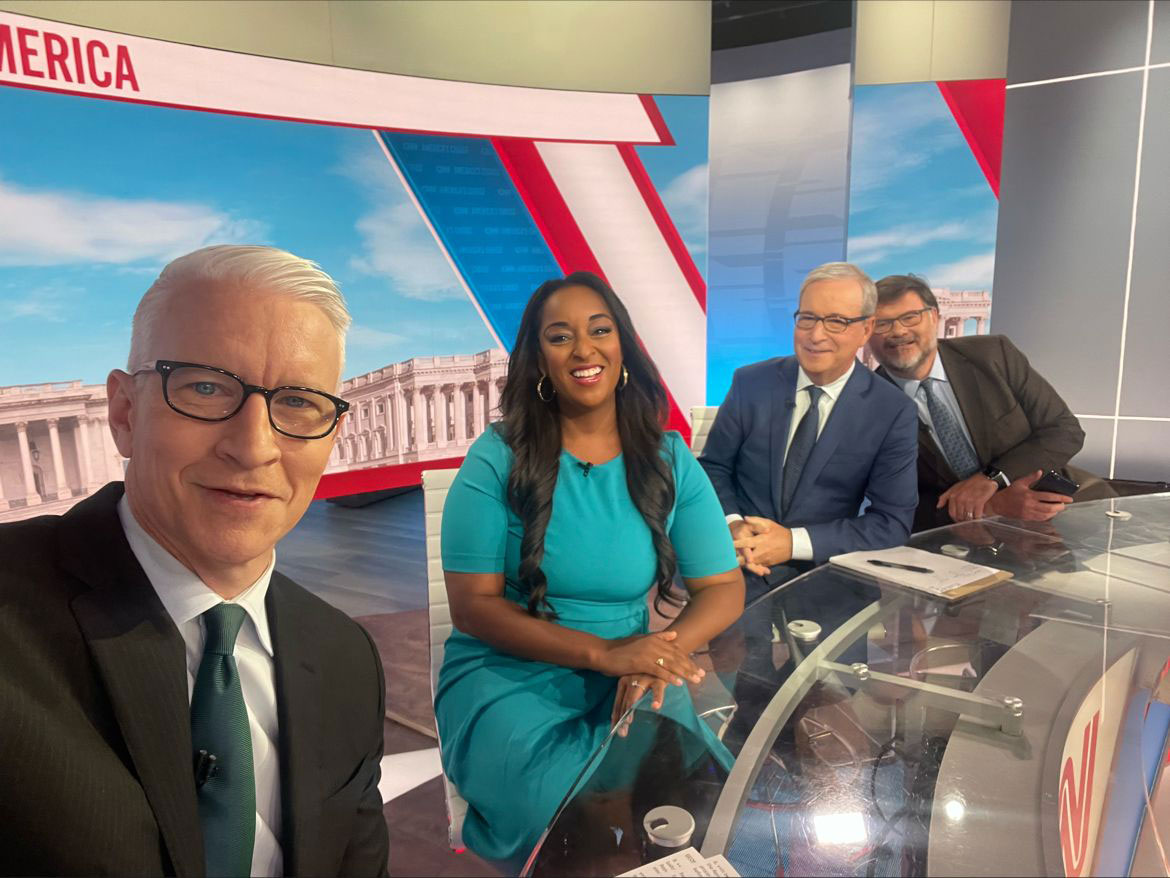
American Negra; Natasha Alford at CNNNatasha Alford at CNN (Photo courtesy of Riverchild Media)

"I've made peace with the fact that this is the way I wanted to tell my story. And no matter what happens, whether it makes a list or if it doesn't make a list, this is how I want to be remembered at this moment in my life."

I hate it, I hate it. It happened to me three times.

It did? OK, so you've been through this too.

Three times, yeah. It happened to me three times. The editor who acquires the book is the one who's turned up. They're the one who was crying when they read your pitch. They're the ones that they really, really, really want to rock with you. So yeah, no, I've been through it. It's terrible.

Yeah, it's a reset, so to speak. And so I mean, I was fortunate that the new editor I got, she's actually a woman of color, she's a Black woman. And so we were connecting in different ways in terms of just things that she saw that maybe I wasn't thinking about the first time in my first attempt to write the book. So it was almost like a second chance at writing the book, even though from a logistics standpoint, it was very disruptive to have to start over.

But yeah, I tell this story just to say if you're a creative, and you're a Black creative in particular, trust yourself. Trust your voice. Fight for what you want because your name is on this project and so you want to put something into the world that you're proud of and that you can stand behind.

And so I've made peace with the fact that this is the way I wanted to tell my story. And no matter what happens, whether it makes a list or if it doesn't make a list, this is how I want to be remembered at this moment in my life.

So this is something that I can relate to and something that you may be able to relate to. But on Instagram, you commented on Jeffrey Wright's character in "American Fiction" being upset that his book was categorized in the African American section of the bookstore. What are your thoughts on how the publishing industry views writers of color?

Yeah. Oh, man, that was so funny. I just loved it. The low-key going into the bookstore, asking for your book, knowing that you're the author, I haven't done that yet, although I did send my fiancé into the store to ask where the book was placed. I was like –

Oh, yeah. Like a good fiancé should, he should move everything to the front.

Right. I'm like, "Yo, if you see it in the back, just slide it to the front." So thankfully, he did find it, and that was heartwarming.

But for me, I'm like, "I'm OK being a Black author if you want to put me in that category or put me in the African American literature section because those are the books that saved my life. Those are the writers that gave me a reason to strive." I grew up in a segregated upstate New York. We think about New York City, we are often thinking about the city, but the rest of the state is a very red state, and it's a very segregated place to grow up as a young Black child. So it was Black writers who helped me to imagine worlds that I never knew existed.

So there's no stigma for me in terms of being seen as a Black writer, but what I will say is that publishers were very excited to acquire these Black voices during the George Floyd era, and you can already see that they've kind of moved on. Right? Like they're –

I was going to ask you that because I mean, we're both in newsrooms, so we kind of remember just fighting. And you and I were on camera together a couple of times just having these conversations about all of this movement that was happening throughout the country. And then George Floyd comes and it's like this boom where everybody's like, "Oh, now I see why they're upset." And it's almost like a tipping point situation because that's when the corporations are changing, the people are changing, Mitt Romney's in the street with a dashiki on. All of this s**t is happening, and then all of a sudden, it's kind of like it goes kind of quiet.

Isn't that crazy? It's like you have to always know your value because if you base it on external validation, you will be left in the cold. You will be abandoned. And so we knew that Black stories mattered before the mainstream knew it, and we know it now, even after the mainstream has moved on to whatever is trending. And so that's what I feel. I feel that already the budgets have been cut. They're not doing DEI, they don't want to hire the speakers. They don't want to invest as much as before, which is why we have to really invest in our own audiences, our own institutions.

And that's why the happy ending in this book is not just me getting on CNN. I think I'm really trying to show this is what happens when you build with a Black media company or you invest in Black institutions, Black-owned institutions, that you can have a success story. It doesn't always have to be getting out and going somewhere more traditional that is the happy ending. So I hope that people see the intention in the way that I told the story.
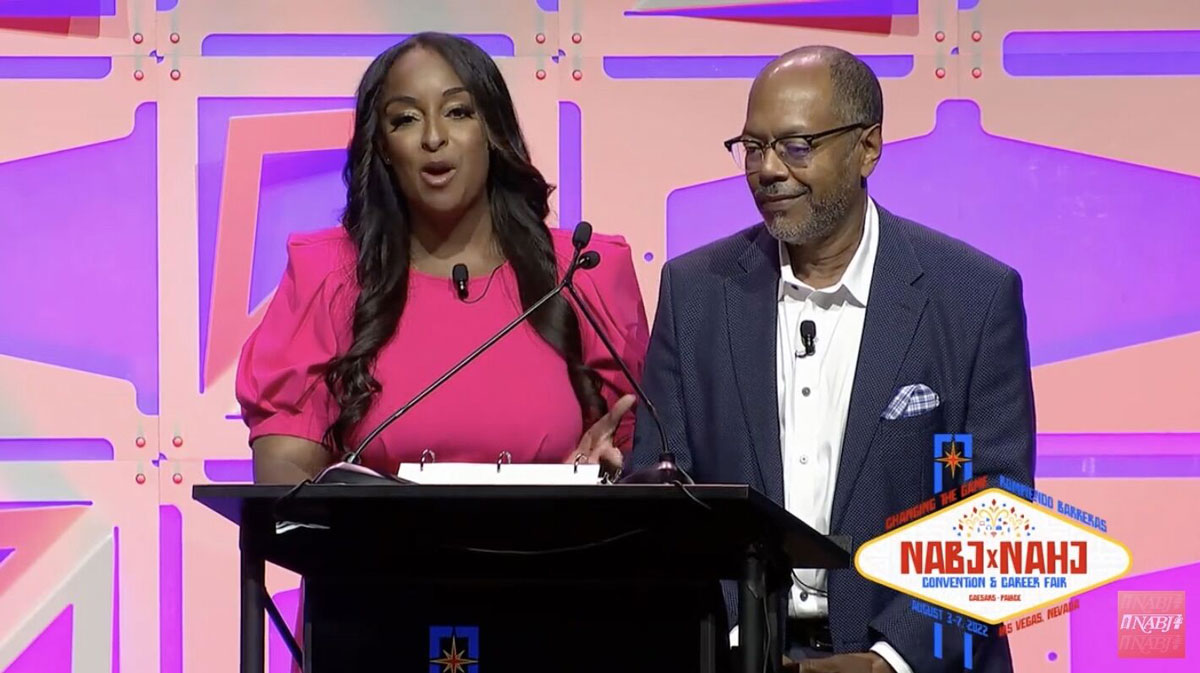
American NegraNatasha Alford at NABJ (Photo courtesy of Riverchild Media)A considerable amount of this book is about identity, and I think you're talking to everyone, but I think it would be great for our readers to learn a little about that journey of how does one celebrate both their African American and Puerto Rican heritage?

Yes. Well, when I am a young child, I'm told that I'm both, and you receive what your parents tell you generally as the truth. And as I traverse through life and I get older, I find that it's other people who are projecting expectations onto me about what it means to be Black and what it means to be Latino. And what I find is that people generally accept me as a Black person, but as a Latino, as a Latina, people kind of have a hard time accepting that. And they want me to perform, they want me to speak Spanish, salsa in the middle of the street, whatever it is that they think a Latino does. And I start to learn the ways in which I, as a Latina, just don't exist in people's imaginations. They think of J.Lo, they think of Shakira, they don't think of someone like me.

And so when you feel erased, you may turn to some protective mechanisms. Mine being, "All right. Well, I'm just not going to proclaim my roots or go out of my way to tell you that I'm a Latina. I'm just Black," and I just left it at that. So you see me kind of move into that thinking I can be both. And then being a little bit defensive about what I am. And then eventually in the book, you see I start to find space for being both. I find my people, I find examples of people who've managed to be both and to be true to themselves. And so that, I think, is the journey.

And you mentioned that, you being this little kid running around town, winning these awards and giving these speeches and putting on, I imagine, it should have been a little tug of war between Black people, between African Americans and Puerto Ricans. I thought about the racial draft on the "Chappelle Show" where it's like, "We got Tiger Woods in the draft."

I love it. I love it. But see, that's the thing. Black people always claim me. Black people saw me as one of their own. And I think people – that's the problem. When Latinos look at you and assume that because you're Black, you're not one of them, there's sort of a missing out that happens. You're invisible within your own culture.

And so I think geography had a lot to do with it. But also, it's the way that America talks about Latinos, and that's why this is so relevant to right now. Think about election 2024. We're constantly talking about, "The Black vote," or, "the Latino vote," but what exactly does that mean? There's so much complexity, even in those two general titles. And so I think people who read this memoir will understand where that complexity comes from after they're done.

"Until you address that anti-Blackness and where it comes from, how it's connected to colonialism and the slave trade and all of those things . . . those tensions, they're always going to be there."

And you talk about the colorism, you talk about that and what it looks like. What are some of the biggest misconceptions when you get into the dynamics of the Latino community in regards to race?

Yes. Well, I think a lot of Latinos really believe that they aren't racist, that because they have a Black cousin or a Black grandmother, that systemic racism is not a problem for the Latino community, and that they really believe that it's the U.S., us with our Black and white race obsessiveness, that we are the problem, that we're projecting racism into their communities where it doesn't exist. But how many news stories have we read? The LA City Council members who were calling the Black child "a monkey," or there have been Latino shows that have worn blackface, making fun of Black people, or the Latino news anchor who said Michelle Obama, compared her to an animal. I mean, all this racism is there. It's just a matter of people being in denial, sometimes gaslighting, sometimes being unwilling to have those uncomfortable conversations.

So I think that is the notion that we have to confront because until you address that anti-Blackness and where it comes from, how it's connected to colonialism and the slave trade and all of those things, you will continue to have a population that has silenced and erased, and those tensions, they're always going to be there.

We kind of passed the identity part of the conversation, but I was laughing at your journey through buying Hype Hair Magazine and trying to pull that Mary J. look off.

It was not for me. I'll tell you that right now. I wanted it though, I wanted  to look like Mary J. Blige.

It's fire though because it's like I'm older than you, but just the conversations around perms and around hair has changed.  I remember running to the store to grab a box of perm for my mom or grab a box of perm for my sister and them combing it through their hair and sitting there. The longer you let it burn, the more bone-straight it's going to be. And it's like you have that conversation with somebody that's 22 years old now, and they're going to look at you like you're crazy. So even that, even embracing that, the conversation has changed, which is fire.

It is. It is. I hope people read chapter three, which is called, "Fellow Bueno," and I hope y'all have a good laugh, but also an eye-opening sort of experience thinking about hair politics because think about it. I'm a Black Latina. I'm a Black woman. On the African American side, my hair is exoticized. It's like, "Oh, she got good hair. It's so pretty. It's so long." I'm hearing that in one culture. And then when I go to the other side, it's not the standard. My hair isn't long enough. It isn't straight enough. It's the, again, the J.Los and the Shakiras, that is what's considered beautiful.

So sitting right in that intersection, you got to think about what does that tell a young girl or a young woman about what's valuable? Where does she negotiate her value? And so that's the journey that I'm taking people on is figuring out how to ultimately accept yourself.
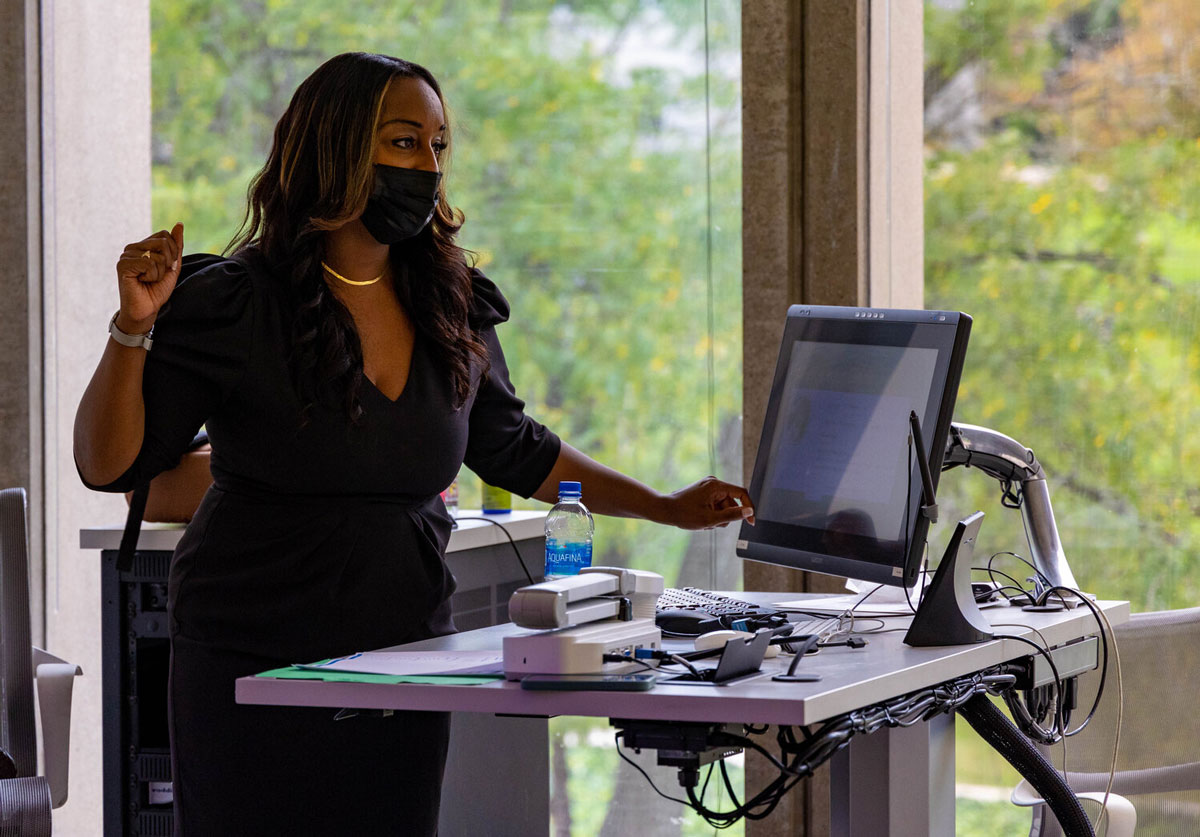
American NegraNatasha Alford hosting a workshop (Photo courtesy of Riverchild Media/Courtney Glen)You also give some great perspective on working in a Black newsroom. Some of the struggles when it comes to the resources needed to report at the highest level, but then some haters from the outside too with people. "Why is she running TheGrio?"

Yes. So I compare it to some of the debates we have around PWIs and HBCUs, this assumption that because someone goes to an HBCU that maybe they have less resources. And in many ways, that's what it felt like. Being in a Black newsroom was like, "OK, it's great," but there were people who marginalized it and were like, "Yeah, but don't you want to work in a more traditional newsroom or a bigger newsroom?" Which really was code for, "Superior newsroom."

But what I found was that Black newsrooms, because we often had smaller budgets, we were scrappier. We did know how to do more with less. I mean, I learned so many skills because I had to be everything from a producer to a writer, to an editor, to a videographer.

No, you be hustling. You be hustling.

You know? That's what it was. And also, real talk, in many ways, we were insulated from some of the economic blowups that happened in the media industry because we knew how to do more with less and how not to overspend and just sort of run up the bill. I mean, we always were pretty conservative. And so I'm watching all these newsrooms lay off journalists, and I have not endured a single layoff being at theGrio for seven years.

So sometimes it's that whole idea of going to a whiter place somehow equating to being better, I really wanted to disrupt that notion and talk about the value of investing in Black institutions, and so I hope that's what people see.

One of my highlights was that when you wrote about covering "Queen Sugar" and then you in Panama and the crew going to the Soho House to the party, and you got a chance to meet Oprah, and her influence on you and getting you to chase that dream. That was just a beautiful scene. It was well-written and it was special. Can you just reflect on that moment?

I felt like a Black journalism Cinderella in that moment. You know?

You had a glass slipper on?

I felt like Black journalist Cinderella, like struggling all those years, feeling like a second-class citizen in media, and then ending up in the room with Oprah and getting the royal treatment and being able to look her in the eye and just tell her, "Thank you for representing for us for so long. Thank you for building your own network." I mean, this was a beautiful moment, and it's real. It happened.

There's so much negativity right now, and I hope that my book is a beautiful respite for people who just want to feel good about what's possible. When you step out on faith, when you follow through, when you do the work, even in the midst of all the challenges, you have those victory moments and you say, "Wow, this is the beauty of America when it works the way that it's supposed to." And it didn't require me changing who I was to succeed. In fact, it required me leaning into who I was, ethnically, racially, my passions for all this to work out.

So I hope it's inspirational for people, but yes, that moment, Top 10, Top 3 moments in life, I would say.

You know, her big start, where she was the anchor and had her own show, "People Are Talking, "was down here in Baltimore.

Oh, yeah!

So you was almost here.

She's the reason I went into local news. And even though some people would say that was a huge failure, you got to read the "Prodigal Daughter" chapter. I mean, the drama of me going to my first TV newsroom, it was because I was following Oprah. I was like, "Well, Oprah did the TV news thing, so I got to do that too." And then when it all blew up in my face, I was like, "OK, maybe I wasn't supposed to do what Oprah did. Let me go figure out what my path is." You know?

So my only fear, and this is something I would just like you to speak on, is I think your book is so important, I think it can be so transformative, but we are living in this era where people are trying to ban books that tell the truth. And your book, you definitely tell the truth. Do you have any hopes or predictions on how do we get past this moment? I mean, Trump is gearing up and people are saying he has a good chance at winning, even if he's arrested. 

What do you think is our pathway forward?

I've thought about this a lot. I have to admit, I never thought I'd live in a time where books were banned in America. I mean, I knew our past, I knew where we came from, but I just didn't imagine that it would come back to this. And what it shows is the power of local politics and activism because this is happening with school boards, and city counselors, and at the state level. There are frontline soldiers in this army of oppression and historical erasure. And I just ask, who are the soldiers on our front lines? It's one thing to talk about what is true from the comfort of our homes or sort of nationally, maybe on television or on radio, but who is actually doing the work locally? I worry about that.

And I think with our generation, millennials in particular, we're transient in a way. We move from city to city. You can be someplace and not really invest in the community that you live in. And the internet, I think, has also made it that way where you really don't have to know the people around you. You can just sort of go to work and get by. But we have to get back to that on the ground, like boots-on-the-ground activism where we're putting people on the school board and we're running for mayor, and we're running for city council because that's where these changes are taking place. And clearly, the people who want to suppress the truth, they're armored up. They've had a long-term strategy that they have played out step by step. And I just think that so many of us have benefited from the work of generations that came before, but we don't have a playbook. We're not actually in the fight.

So I say I believe the tools are there. It's part of the reason why I'm in policy school right now because I needed to understand how laws are made, how people actually effectuate change. I think we have people with the right mindset. They just got to get in the game.

Well, tell everybody where they can catch up with you and get this amazing book.

Oh my God, please follow me. I'm on Instagram @NatashaSAlford, all one word on this. I'm on X as well. We'll see how long that lasts.

I know, right?

Yeah, every day I question that decision.

Every day!

Every day is some new nonsense. But you can also go to americannegra.com and I'm doing a book tour. People have been coming out. It's been inspirational. It's been motivational, illuminating. So you can get tickets for any of my book tour stops.

And yeah, just support the book. Go into a bookstore, ask for it. This is how we keep stories like this alive. This is how we show that these stories matter.

Well, you know we rooting for you. Congratulations.

Thank you, friend. I appreciate you.


Bernie Sanders is making progress on his vision for a four-day workweek

In a hearing on Thursday before the Senate Committee on Health, Education, Labor and Pensions, Sen. Bernie Sanders (I-VT) highlighted the benefits of a new bill titled the “Thirty-Two Hour Work Week Act,” which he hopes will improve quality of life for Americans who have, for too long, found themselves in a rut of working more and receiving less. And while a four-day workweek sounds like a relief that anyone could appreciate, Sanders is still coming against opposition.

“It’s time that working families— not just CEOs and wealthy shareholders — are able to benefit from increased productivity so that they can enjoy more leisure time, family time, education and cultural opportunities, and less stress,” a fact sheet on the bill highlights, breaking down that "The Thirty-Two Hour Workweek Act" would:

  • Reduce the standard workweek from 40 to 32 hours over four years by lowering the maximum hours threshold for overtime compensation for non-exempt employees.
  • Require overtime pay at time and a half for workdays longer than eight hours, and overtime pay at double a worker’s regular pay for workdays longer than 12 hours.
  • Protect workers’ pay and benefits to ensure that a reduction in the workweek does not cause a loss in pay.

Per reporting from NBC News, Senator Bill Cassidy (R-La) spoke against Sanders' bill during the hearing, saying, “We have a balance. We don’t have people as they do in China working 80 hours a week, but we have that balance — this disrupts that balance. And we won’t maintain the status of being the world’s wealthiest nation if we kneecap the American economy with something which purports to be good for the American worker but indeed will lead to offshoring of jobs seeking for a lower-cost labor force.”

So far, Sanders' bill has the support of two other lawmakers, California Democrats Sen. Laphonza Butler and Rep. Mark Takano, but will need to get a thumbs-up from the Republican-controlled House as well as a filibuster-proof 60 vote approval in the Senate before it makes its way to Biden's desk.

"It will never get through Congress — not in my lifetime," Tracy Roof, a professor of political science at the University of Richmond who focuses on labor issues, told ABC News. "Maybe it will happen in my children's lifetimes."

Could decaf coffee be banned? A controversy over chemicals is brewing

A significant coffee controversy is brewing as two activist groups and a California lawmaker have petitioned to ban European Method decaf — the most common form of decaffeinated coffee — because it is produced using chemical solvents, including methylene chloride, which bind to the caffeine and extract it from the beans. 

The National Coffee Association says the decision would “unjustifiably deny decaffeinated coffee drinkers access to a safe product associated with decreased risk of multiple cancers and other health benefits,” while the petitioning groups have voiced concerns that the federal government is shirking its responsibilities in allowing methylene chloride to be consumed. “FDA has been disregarding the law by permitting these long-established carcinogens to be added to food,” Maria Doa, senior director for chemicals policy at Environmental Defense Fund, said in a statement to Quality Assurance

In January, the Environmental Defense Fund (EDF) petitioned the FDA to amend their food additive regulations in order to prohibit the use of four chemical solvents, including methylene chloride, from food production. Shortly thereafter, California Assemblymember Eloise Reyes proposed new legislation that would expressly prohibit a “person or entity from using methylene chloride in the process of decaffeinating coffee” starting in 2027. 

“The bill would make a violation of these provisions punishable by a civil penalty not to exceed $5,000 for a first violation and not to exceed $10,000 for each subsequent violation, upon an action brought by the Attorney General, a city attorney, a county counsel, or a district attorney,” the legislative counsel’s digest read. 

The nonprofit Clean Label Project has been lobbying the state assembly to support the bill, which was introduced on Feb. 1 and has yet to be heard in counsel. 

In the wake of the filing, the National Coffee Association and its president issued a statement via email last week, saying that “European Method decaf is authorized as safe by the rigorous standards of the U.S. Food and Drug Administration (FDA), the European Food Safety Authority, Food Standards Australia New Zealand, and other food safety authorities around the world.” 

We need your help to stay independent

According to the FDA’s current food safety regulations, methylene chloride is acceptable in coffee as a residue from its use as a solvent in the extraction of caffeine from green coffee beans “at a level not to exceed 10 parts per million (0.001 percent) in decaffeinated roasted coffee and in decaffeinated soluble coffee extract (instant coffee).” 

“Banning European Method decaf would defy science and harm Americans’ health,” said National Coffee Association president and CEO Bill Murray. “The overwhelming weight of independent scientific evidence shows that drinking European Method decaf is safe and furthermore that drinking European Method decaf, like all coffee, is associated with decreased risk of multiple cancers and other significant health benefits.” 

He continued: “Neither EDF nor CLP have presented anything resembling compelling evidence to the contrary, so FDA and the California legislature must reject these baseless proposed bans.”

This push to do away with European Method decaf comes amid other efforts to ban certain chemicals from food production in California. In October, Governor Gavin Newsom signed AB 418 — known as the California Food Safety Act, sometimes referred to colloquially as the "Skittles ban” — into law. The historic legislation bans the “manufacturing, selling, delivering, distributing, holding, or offering for sale” of food products that contain four additives: brominated vegetable oil, potassium bromate, propylparaben, and red dye 3. 

Red dye 3 was banned from cosmetic use in the United States in 1990 which helped serve as a precedent for those interested in seeing the substance cut out of food production; similarly, methylene chloride has been banned from cosmetic use since 1989. In a statement at the time, the FDA wrote: 

Methylene chloride has been used as an ingredient of aerosol cosmetic products, principally hair sprays, at concentrations generally ranging from 10 to 25 percent. In a 2-year animal inhalation study sponsored by the National Toxicology Program, methylene chloride produced a significant increase in benign and malignant tumors of the lung and liver of male and female mice. Based on these findings and on estimates of human exposure from the customary use of hair sprays, the Food and Drug Administration concludes that the use of methylene chloride in cosmetic products poses a significant cancer risk to consumers, and that the use of this ingredient in cosmetic products may render these products injurious to health.

According to the National Coffee Association, about 10% of American adults — or about 26 million people — drink decaffeinated coffee every day and the majority of decaffeinated coffee has been made using the European Method for more than 50 years. 

Our government’s quiet war on press freedom

Over the past 14 years, a war on the free press has been quietly escalating in the U.S. This brewing conflict is fueled by increased and unchecked government surveillance, a post-truth intolerance of any criticism of media coverage, and prosecutions of media sources, journalists and publishers which have been endorsed by politicians on both sides of the political spectrum. Beginning a decade ago with the prosecution of whistleblowers, the U.S. campaign to tamp down leaks has spread to the criminalization of standard investigative journalism. While the U.S. still presents itself as the global standard-bearer for free speech and freedom of the press, recent fissures expose a looming calamity.

Due to aggressive national security investigations and two draconian laws, journalists and media sources are at severe risk of increased criminal investigation and prosecution. We have seen these risks realized in the cases of Timothy Burke, Julian Assange and Catherine Herridge, three individuals who might not seem to belong in the same category at first — and who may not all look, to many readers, like "real journalists." Whether or not one personally approves of what they do, all three are being punished for the work of journalism, and the laws and systems being used to target them do not discriminate based on whether the mainstream media considers them legitimate. The precedent set by these cases will apply in future to anyone engaging in such entirely normative journalistic activities as cultivating sources while protecting their anonymity, and seeking to publish information in the public interest that governments or other powerful forces seek to control.

Investigative journalist and media consultant Timothy Burke was indicted last month on accusations that he acted illegally in obtaining information that was available online by using dummy login credentials that had been openly published, and which were shown to him by an anonymous source. According to the Tampa Bay Times, Burke gained access to a number of “protected commercial broadcast video streams,” apparently including behind-the-scenes video content from Fox News of an infamous October 2022 Tucker Carlson interview with the rapper Ye (formerly Kanye West). Burke’s lawyers maintain that no illegal hacking occurred, and the investigation targeting Burke has drawn condemnation from dozens of press freedom groups, including ours, following a raid on Burke’s house during which his computer equipment and other electronic devices were seized. The charges against Burke center on alleged violations of the Computer Fraud and Abuse Act, a law we view as over-broad and fatally vague.

Because this climate has emerged from a slow burn of byzantine laws used in selective prosecutions of controversial figures, the American public has become too inured to perceive how much the fundamental rights of press freedom have been chipped away.

The CFAA was first passed in the 1980s amid a hacking hysteria driven as much by pop culture as by the nascent computer age. Ronald Reagan was reportedly worried about hacking after seeing the movie "War Games," which depicted a teenager hacking into the U.S. air defense system and nearly sparking nuclear war. Congress amended the law numerous times in the years following, including in the 2001 Patriot Act, which made it easier for prosecutors to allege felonies and doubled the penalty under the law. Even with those amendments, the CFAA has failed to keep pace with technology and remains so extraordinarily broad that it has become the government’s bludgeon of choice to punish hacktivists such as Aaron Schwartz, who died by suicide after years of government investigation, and whistleblowers such as Chelsea Manning.

Julian Assange, the legendary or notorious founder of WikiLeaks, now faces the last phase of an extradition battle in the U.K., where he has been in custody for nearly five years. If he is returned to the U.S., he faces potential charges both under the CFAA and the equally problematic Espionage Act. 

The Espionage Act was originally passed in 1917, amid the patriotic fervor and social chaos of America's entry into World War I. Its supposed purpose was to prosecute German spies, but the law wad immediately used instead to tamp down dissent and has been criticized by many legal experts as poorly drafted, overly broad and vague. The Espionage Act cast a chill over journalists, publishers and whistleblowers throughout the Cold War years, most spectacularly in the case of Pentagon Papers whistleblower Daniel Ellsberg. The case against Ellsberg collapsed, largely due to extreme (and illegal) misconduct by the Nixon administration. But after lying dormant for 40 years of dormancy, the law was deployed with renewed vigor: Barack Obama's administration prosecuted twice as many Espionage Act cases as all previous administrations combined. Those included the prosecutions of NSA whistleblowers Thomas Drake and Edward Snowden, U.S. Army whistleblower Chelsea Manning and CIA whistleblowers Jeffrey Sterling and John Kiriakou. Many Espionage Act cases of that period also ensnared reporters, resulting in their communications being subpoenaed — as in Sterling’s case —or reporters actually being labeled co-conspirators, as in the case of former State Department employee Stephen Kim.

The Trump administration further normalized the use of Espionage Act prosecutions to suppress media disclosures, bringing cases against FBI whistleblower Terry Albury and NSA whistleblower Reality Winner, and resurrecting the dormant case against drone whistleblower Daniel Hale. Trump officials also took the law a step further by indicting Assange under the Espionage Act for conduct that national security reporters engage in on a regular basis, such as publishing classified information, protecting sources’ identities and using encryption. The Assange indictment has since been condemned as a threat to press freedom by NGOsmedia outlets, academic experts and members of Congress.


Want a daily wrap-up of all the news and commentary Salon has to offer? Subscribe to our morning newsletter, Crash Course.


Now we come to Catherine Herridge. Herridge is an acclaimed investigative journalist who was held in contempt of court for refusing to reveal her source in a Privacy Act lawsuit brought by the Chinese-American scientist Yanping Chen, who for years was the target of an FBI counterintelligence investigation that was abandoned in 2016 with no charges filed. Herridge, who then worked for Fox News, reported several stories on the investigation, including information that Chen claims was provided to Herridge by the federal government in violation of the Privacy Act. Herridge had moved on to CBS News when she was called to reveal her sources in the Chen lawsuit. Although CBS initially supported Herridge’s position, she was laid off by the network last month. Initial reports suggested that CBS had seized or retained Herridge's files, computer and records, including information on her confidential sources, but the network has denied that and Herridge's possessions have since reportedly been returned

The use of the CFAA and the Espionage Act against journalists, coupled with contempt orders aimed at compelling reporters to reveal confidential sources, has created a perfect storm of anti-free-press activity in the U.S. Because the current climate has emerged from a slow burn of byzantine laws used to selectively prosecute the most controversial media sources and whistleblowers, the American public has become too inured to perceive how much the fundamental rights of press freedom have been chipped away. There are small pockets of protest with every individual case, but most Americans, regardless of their party affiliation or ideological views, do not understand the dimensions of this assault on the freedom of the press.

Judge stops Trump’s Georgia sideshow: 5 key takeaways from the Fani Willis ruling

On Friday, Georgia Judge Scott McAfee rejected a motion to disqualify Fulton County district attorney Fani Willis from prosecuting Donald Trump and other defendants in her 2020 election interference case. Within hours, Nathan Wade, one of Willis’ three special prosecutors and her romantic partner, resigned from the case, as the decision essentially compelled him to do.

McAfee was unsparing in his criticism of Willis and Wade’s testimony and of their serious lapses of judgment. But what matters most in McAfee’s decision is what it shows about his devotion to legal principles, not what it means for Willis and Wade. 

Indeed, if anyone needs evidence of the rule of law’s powerful force, look no further than Judge McAfee’s exemplary 26-page decision.

After hearing two and a half days of testimony, the judge did what the law required and ruled “that the Defendants failed to meet their burden of proving that the District Attorney acquired an actual conflict of interest in this case through her personal relationship and recurring travels with her lead prosecutor.” 

The court went on to recognize, however, that the record established an appearance of impropriety. That required, the court said, that Willis had to let Wade go as a special prosecutor if she wanted to continue prosecuting the case. 

By giving Willis an option, the court did more than what judges often do in “splitting the baby.” In fact, metaphorically speaking, he saved the baby – the case against Trump – and "the mother" from herself. He told Willis to do what she should have done long ago without any push from a court.

Here are five key takeaways from McAfee’s decision.

1. The sideshow is gone. The allegations of a conflict of interest on Willis’s part were always meant as distractions – Trump’s brand – from the subject of the case: The allegation that Trump  tried to overturn the 2020 election. He has denied culpability.

Pending any further legal action, we can now all get back to the real issue: holding Trump to account for his effort to end the lawful transfer of power to President Joe Biden.

2. A lesson for Supreme Court Justices.  There are justices on the United States Supreme Court who could learn a thing or two from Judge McAfee about calling balls and strikes in an impartial and even handed way. 

Like six of the justices on the Supreme Court, Judge McAfee was appointed by a Republican. Yet, unlike most or all of them, he refused to cater to Trump’s manipulation of the legal process in an effort to avoid his day of reckoning in court. 

Just last month, the Republican-appointed justices on the Supreme Court were likely the ones who greenlighted that manipulation by agreeing to hear Trump’s frivolous claim to presidential immunity, thereby delaying Special Counsel Jack Smith’s federal election interference prosecution in DC.

In Georgia, after hearing every piece of testimony McAfee determined that Trump and his fellow defendants did not prove  that the District Attorney received  “a material financial benefit as a result of her decision to hire and engage in a romantic relationship.” 

We need your help to stay independent

He also found that even if Willis got some financial gain by hiring Wade, it was not “a motivating factor . . . to indict and prosecute this case.” Similarly, he found a failure on Trump’s part to “demonstrate that the District Attorney’s conduct has impacted or influenced the case to the Defendants’ detriment.”

Ultimately, the plain and simple motivation for the Fulton County grand jury’s indictment was the evidence it heard about the conspiracy to interfere with Georgia’s election. That evidence included Trump’s infamous Jan. 2, 2021 call to Georgia Secretary of State Brad Raffensperger, asking him to “find” 11,780 votes, one more than needed to overturn Biden’s win in the state.

3. A model “fair and balanced” opinion. Administering the rule of law impartially requires dispassionate decision-making. Judge McAfee evidenced that quality by acknowledging and considering evidence unfavorable to his decision. 

For example, his opinion recounts that DA Willis kept no ledger of her reimbursements to Wade for expenses he initially paid for her, and that the amounts she claimed for those repayments were “best guesstimates.” By doing so, McAfee  showed how a judge can assure the litigants and the public that he considered every fact presented. 

As McAfee wrote, “Whether this case ends in convictions, acquittals, or something in between, the result should instill confidence in the process.”

4. A clarion call to prosecutors. Judge McAfee’s opinion also called out some “unpersuasive” testimony from Wade, Willis and others as part of his determination that a significant appearance of impropriety had arisen. He stated unequivocally that he could not condone DA Willis’ “lapse in judgment [and] the unprofessional manner of the District Attorney’s testimony during the evidentiary hearing.”

For prosecutors, as McAfee once was, the opinion sings in perfect pitch about their special responsibilities to the judicial system: 

[P]rosecutors are held to a unique and exacting professional standard in light of their public responsibility. . . [They] must seek justice . . . [and] assume a role beyond a mere advocate for one side and must make decisions in the public’s interest – not their own personal or political interest. 

Of course, prosecutors make mistakes like anyone. In the Georgia case, defendants identified errors that called the conduct of a prosecutor into question. The district attorney’s responsibility in that situation is to remedy the error immediately and end a story that could distract from a powerfully indicted case. That could easily have happened early here, but Willis chose a different course.

5. The case must proceed expeditiously. With the sideshow behind her, Willis needs to press for a trial that reaches a jury before November’s election. Before they cast their ballots this fall, voters deserve to know the whole story of what Trump and his co-conspirators did in Georgia and if they violated the law. 


Want a daily wrap-up of all the news and commentary Salon has to offer? Subscribe to our morning newsletter, Crash Course.


In fact, a decision from Judge McAfee earlier this week streamlining the case could help expedite it. 

He dismissed lesser charges against Trump and his defendants, leaving undisturbed the chief count against them – the 20-year racketeering conspiracy charge of attempting to overturn the election. 

As former White House ethics czar Norm Eisen said on Friday, “If I were Fani Willis . . . on Monday I would move to either renew the August [trial start-date] request she’s made, or go even sooner . . . .”

Whether she can accomplish that end remains to be seen. But what McAfee did on Friday stands out as an important reminder of what the law offers: fairness, impartiality and scrupulous attention to evidence. 

If we value those things, we will have to stand up for them when we go to the polls in November. We will have to recognize that our freedom and way of life depends on the kind of fidelity to law that Judge McAfee displayed and that Donald Trump dishonors. 

No one is above the law.

“Absolutely shocking”: Experts worry “astonishing” delay could derail Trump’s NY trial entirely

A New York judge on Friday delayed the start of Donald Trump's New York hush-money trial by 30 days to at least mid-April to allow the former president's legal team to parse through a massive batch of newly disclosed evidence, The Associated Press reports.

Judge Juan Merchan agreed to the delay just under two weeks before its scheduled start date and a day after the prosecutors who brought the case against Trump voiced support in a court notice for a 30-day delay should the judge grant one. Merchan also scheduled a hearing to discuss questions about federal prosecutors' recent evidence dump on March 25, the previously scheduled start date for the trial. 

The Manhattan district attorney's office, which accuses Trump of falsifying business records to cover up a hush-money payment during his 2016 presidential campaign, was initially expected to oppose the Trump team's recent request for a delay in the trial. But in the Thursday court filing, District Attorney Alvin Bragg agreed with a shorter postponement “out of an abundance of caution and to ensure that defendant has sufficient time to review the new materials," which amount to tens of thousands of pages.

His office has repeatedly requested those records from federal prosecutors, who investigated the hush-money payments at the center of the case years prior, for more than a year and had only received a portion of the material before now, according to The New York Times.

Prosecutors' evidence dump is "astonishing" and "absolutely shocking," Bennett Gershman, a law professor at Pace University and former New York prosecutor, told Salon.

"The public interest in a fair and timely criminal trial has been undermined by this development which may not only delay the most historic criminal trial in American history but even worse, to scuttle it entirely," he said ahead of Merchan's Friday decision.

The evidence contains records about ex-Trump lawyer and current prosecution witness Michael Cohen that are “exculpatory and favorable to the defense,” attorneys for the former president told the AP. Prosecutors said most of the newly disclosed evidence is “largely irrelevant to the subject matter of this case,” but some are pertinent.  

Federal prosecutors in the Southern District of New York started producing records for the case 10 days ago, turning over about 73,000 pages of files. They provided about 31,000 additional documents on Wednesday and said they would send more next week, according to Bragg's office.

Trump is "at least partially responsible" for the federal prosecutors' delay, Stephen Gillers, a New York University law professor, told Salon.

Trump only subpoenaed the records from the U.S. attorney's office in January after receiving the first subset of materials in early June last year, Bragg noted in the filing. Upon receipt of the latest batch, the former president requested the trial be delayed 90 days.

The district attorney's support of a postponement, despite Trump's common tactic to stall his cases by making such requests, raised the likelihood of Merchan granting it. Bragg, however, also made sure to emphasize in Thursday's notice Trump's fault in consenting "to repeated extensions of the deadline" for federal prosecutors. 

It remains unclear why the Southern District did not turn over the records to Bragg earlier, The New York Times reported. 

We need your help to stay independent

"What on god’s green earth were the Southern District federal prosecutors thinking in turning this over so late?" former FBI general counsel Andrew Weissmann wrote on X. "If I’m the Manhattan DA, himself a former Southern District prosecutor, I’m LIVID."

https://twitter.com/AWeissmann_/status/1768358753001152775  

Unless federal prosecutors have a "legitimate and explainable reason" for doing so, their delay "is a terrible commentary on the conduct of the law enforcement community in New York," Gershman added, arguing it prompts "serious questions" about what, if any, potential tensions, conflicts or biases between the prosecuting offices could have provoked this response. 

While Brookings senior fellow and CNN legal analyst Norm Eisen agreed federal prosecutors' behavior does seem "a bit dubious," he said on X Thursday that a short trial postponement to "deal with" these kinds of document surges is "not unusual."

"DANY is not ASKING for a continuance, they're saying they won't object if the judge decides to order one of up to 30 days in response to Trump's demand for even more time," Eisen wrote, explaining that Bragg is trying to "cabin the amount of delay and keep this trial moving."

Any delay "longer than 30 days would certainly be unnecessary & contrary to the interest of judgment," he later concluded.


Want a daily wrap-up of all the news and commentary Salon has to offer? Subscribe to our morning newsletter, Crash Course.


Bragg's case against the former president revolves around a $130,000 hush-money payment Cohen, made to adult film actress Stormy Daniels days before the 2016 presidential election. 

When Trump repaid Cohen, his family business falsely characterized the payments as "legal expenses" in internal records, prosecutors say, furthering a cover-up that hid potentially damaging information of an alleged sexual encounter between Trump and Daniels from voters ahead of the election. Cohen pleaded guilty to campaign finance violations in 2018 after federal prosecutors in Manhattan caught wind of the arrangement and threatened to indict him. 

Those prosecutors investigated Trump's role in the hush-money deal but ultimately chose not to bring charges against him. They noted in court filings, however, that Trump did instruct Cohen to offer Daniels the hush money.

Gillers and Syracuse University College of Law professor Gregory Germain expect Trump will make further attempts to delay the trial going forward. It's unclear exactly what these efforts will look like or how accommodating the court will be, Gillers explained, but it's incredibly likely Trump will push to "avoid a trial before the election."

Merchan, who ultimately has the authority to determine whether to delay the trial further, has routinely opted to keep the case moving along.

"The unknown is whether Bragg will aggressively push forward with a pre-election trial. Bragg took years before bringing the charges (and changing prosecutors), and has always seemed reticent about the case," Germain added, noting this is Bragg's "most high profile" prosecution and a challenge because of the uncertainty around Trump's intent for covering up the payments and its reliance on a complex campaign finance law.  

Because he may be in the "uncomfortable position" of bringing the case without "being confident" of the outcome, "Bragg might get cold feet as well, and not fight that hard for a pre-election trial," Germain explained. "We'll just have to see."

Ignorance and democracy: Capitalism’s long war against higher education

Donald Trump exposed his profound condescension and blatant manipulation with the notorious 2016 declaration, “I love the poorly educated.” Election results and polling data consistently show that the most poorly-educated Americans — at least, those who are white — love him back with almost religious reverence, treating him as guru, despot and pop-culture idol all in one. While it is easy to chortle at the hillbilly-Deadhead vibe surrounding Trump rallies, it is more important to consider how the better-educated are weakening their country by rejecting the tools necessary to maintain the structure of liberal democracy.

Decades ago, universities across the country began making cuts to the liberal arts. The humanities, fine arts and social sciences are endangered everywhere, as evident by the staggering variety of state colleges and private universities no longer invested in their survival. In 2023, West Virginia University eliminated its world languages department, reduced its education department by a third and slashed its programs in art history, music, architecture and natural resource management. In the same year, Lasell University, a small private school in Massachusetts, killed five majors, including English and history. In Ohio, numerous of the state's best-known institutions of learning have announced cuts to the liberal arts, including Kent State, the University of Toledo, Miami University, Youngstown State, Baldwin Wallace University and Marietta College.

But the academic carnage in the Buckeye State is hardly an outlier. A quick Google search reveals intellectual wreckage piling up across the nation. The University of New Hampshire permanently closed its art museum, the University of Tulsa eliminated degrees in history, and the chancellor of the University of Wisconsin system has instructed all 25 of its campuses — which enroll more than 160,000 students every year — to prepare for reductions in liberal arts programs.

My alma mater, Valparaiso University, is now preparing to join in the self-destruction. A Lutheran liberal arts college on the shores of Lake Michigan, 50 miles or so southeast of Chicago, Valparaiso recently announced that it is considering the “discontinuation” of 28 programs, including philosophy, public health, theology and the graduate program in English Studies and Communication, where I earned a master's degree. When I graduated in 2010, Valparaiso had a regional reputation as a small, private institution with excellent educational standards, bolstered by an emphasis on the arts and humanities.

The English Studies and Communication program was a hybrid, requiring study of creative writing, journalism, English literature and mass communication theory. Professors collaborated with the directors of the campus art museum and instructors in the social sciences and business departments, to demonstrate that knowledge is impossible to segregate or compartmentalize. A truly educated person should be adept at making connections across disciplines, cultures and different sectors of society.

Time and again, college and university leaders across the country have cited a business-model imperative for transforming their institutions into glorified vocational schools.

Gore Vidal defined an intellectual as “someone who can deal with abstractions.” Valparaiso, at its best, did exactly that — equipping its graduates with an ability to handle abstractions, while showing that abstractions aren’t all that abstract. What might seem abstract in the academic context, as recent American history ought to have taught us, may soon transform into the concrete, creating situations of urgent social consequence. Arguments about democracy, disinformation, the public good and moral philosophy are inseparable from such issues as climate change, gun violence, the effects of new communication technology and the struggle to defeat autocracy.

In the 14 years since my graduation, Valparaiso has suffered from poor leadership that has caused consistent damage to its reputation. In 2020, it shut down its law school after years of lowering its standards to attract enough more students. Last year, the university's current president, José Padilla, launched a bizarre crusade to fund the renovation of a first-year dormitory by selling off a Georgia O’Keeffe painting, along with other signature works of art from the campus museum. Despite widespread opposition from students and faculty, and condemnation from the American Alliance of Museums, Padilla seems determined to proceed with this philistine maneuver (I wrote about the proposed sale for the New Republic.)

The potential gutting of Valparaiso's liberal arts programs is one small part of a much larger social and cultural trend of viewing education as nothing more than a business proposition. As Matthew Becker, a theology professor at Valparaiso, wrote, this decision, "if implemented, will completely dismantle the stated mission of the university":

Valpo will no longer be "grounded in the Lutheran tradition of scholarship, freedom, and faith," nor will it really be preparing students "to serve in both church and society." With the elimination of foreign languages, music, the theology programs, and other programs in the humanities, Valpo will no longer be a liberal arts university.”

My nephew, Justin McClain, a recent graduate of the endangered public health program, stated the obvious: “On the heels of a pandemic that resulted in millions of lives lost and trillions in economic losses … educational institutions should be embracing students interested in joining a field that has proved far too valuable to the functioning of society at large yet remains chronically understaffed.”

Becker identified Valpo's plan of self-destruction as “completely market-driven,” and that's a critical point. Padilla and other university leaders have offered exclusively economic reasons to explain their agenda.

Time and again, college and university leaders across the country have cited financial justification and a business-model imperative for transforming their institutions into glorified vocational schools. And this wrecking-ball campaign runs in parallel with an ideologically motivated war on learning.

Right-wing governors and legislatures in many states, including Florida, Texas and Tennessee, have attempted to strip-mine universities, often by eliminating diversity, equity and Inclusion programs, prohibiting instruction in topics related to race and gender, and even threatening to deny loans to students who want to major in an “impractical” discipline.

This anti-intellectual campaign of destruction against higher education takes place alongside book-ban campaigns in many of the same states, where astroturf organizations funded by right-wing groups have worked to remove books from school curricula and libraries that focus on issues of racial justice or LGBTQ equality. 

It may be worth noting that many of those who claim to hate education are blatant hypocrites. Florida Gov. Ron DeSantis holds a bachelor’s degree in history from Yale and a law degree from Harvard. Sen. Ted Cruz of Texas, a defender of book bans who routinely bashes institutions of learning, also has a Harvard Law degree, as well as a B.A. in public policy from Princeton. Even Donald Trump — despite his incoherent rambling and his impressive lack of knowledge on almost every conceivable topic — doesn't technically qualify as “poorly educated.” Although exactly how and why Trump was admitted to the University of Pennsylvania in the first place remains unclear, he holds a B.S. in real estate from Penn's Wharton School. 

Many of those who claim to hate education are blatant hypocrites. Ron DeSantis holds a history degree from Yale and a law degree from Harvard. Ted Cruz also has a Harvard Law degree, as well as a B.A. from Princeton.

For all their phony anti-educational posturing, Republican officials and pundits have succeeded in selling ignorance as virtuous to their voters and viewers. A 2022 Pew Research survey found that 76 percent of Republicans now believe that colleges “affect the country negatively,” while 76 percent of Democrats said they believe colleges “affect the country positively.”

A good rule to follow is never to trust highly educated people who tell you that education is a waste of time. A good question to ask, after that, is why they want so many people to remain ignorant.

If democracy is to function as intended, it demands a well-informed and reasonably sophisticated citizenry. Without an intelligent electorate, democratic governance is under threat from despots and demagogues who can acquire power by appealing to base emotions and instincts. Thomas Jefferson called information the “currency of democracy.” America is now at risk of bankruptcy.

Jefferson was also one of the founders of the University of Virginia, where organized a committee to develop a holistic program of learning that, in today’s ruthless, profit-obsessed climate, would not survive at Valparaiso, at West Virginia University or at countless other schools. Its program was to include “ancient and modern languages, mathematics, physio-mathematics, physics, botany and zoology, anatomy and medicine, government and political economy and history, municipal law, and Ideology (rhetoric, ethics, belles lettres, fine arts).”


Want a daily wrap-up of all the news and commentary Salon has to offer? Subscribe to our morning newsletter, Crash Course.


George Washington advocated for a national university that would teach the arts and natural sciences, along with literature, rhetoric and criticism. But the father of our country might now have pariah status on most campuses — perhaps as an adjunct instructor with no health benefits, begging for a summer course.

In an age of extreme partisan rancor, there is dispiriting bipartisan unity on one point: Most Americans are increasingly hostile to the liberal arts. While only Republicans are overtly hateful of higher education as a whole, many students and administrators no longer claim to see the value in programs that, according to their standards, lack immediate and practical application to the job market. Recent data indicate that only 10.2 percent of college students major in any humanities discipline, and barely over 1 percent major in history or political science.

High schools across the country, meanwhile, have been cutting courses in civics, the social sciences, humanities and fine arts for decades.

Divorcing education from philosophical, political and social ambitions creates a culture in which people view public-health measures during a pandemic as stepping stones to the gulag.

Richard Hofstadter, one of the premier historians and public intellectuals of the 20th century, explained in his 1963 classic, “Anti-Intellectualism in American Life,” that most Americans view intelligence as merely functional. Brainpower, in this view, should serve some practical and tangible purpose, typically one that can be measured in dollars and cents. Abstractions, to return to Gore Vidal’s remark, are seen as irrelevant distractions from learning the skills that can earn a bigger paycheck.

One of the numerous things people seem to have forgotten amid this rat-race competition is the question of how to maintain a democratic system of governance. Representative government is complicated, and often moves slowly. It requires sustained wrestling with the complex and thorny questions of ethics, personal freedom versus social responsibility, and balancing the progress driven by new knowledge and new ideas with the benefits of existing norms and traditions.

That kind of intellectual labor is taxing enough for those with a decent formal education, but with no training in the study of government, culture or mass communication, Americans are increasingly likely to fall for bad arguments and stupid ideas. Divorcing education from philosophical, political and social ambitions creates a culture in which people view public-health measures during a pandemic as stepping stones to the gulag, convince themselves that a racist con man most famous for hosting a game show could not possibly have lost a free and fair election, or believe that information about transgender people is more dangerous than assault rifles.

Democratic voters hope — as should everyone else with a conscience — that Joe Biden can overcome his poor approval ratings and doubts about his age by appealing to Americans' belief in democracy. He will have to consistently remind the electorate that his opponent presents an unprecedented threat to the system that millions of voters take for granted. For many Americans, however, democracy is a hazy concept at best. Survey results consistently show that large proportions of the American public don't understand the Bill of Rights, cannot name the three branches of government and are unfamiliar with the most important and basic facts of U.S. history.

Tech journalist Kara Swisher, author of the new history and memoir “Burn Book,” recently observed that leading figures in Silicon Valley, including Elon Musk and Mark Zuckerberg, have "no sense of history." If so, they are little different from the average citizen in that regard, yet they are routinely heralded as geniuses. It is hardly surprising that they’ve allowed hate speech, deceitful propaganda and other harmful material to proliferate on their platforms.

A society actually grounded in the liberal arts might see Zuckerberg and Musk as allegorical characters, perhaps as archetypal warnings against the reckless pursuit of wealth and the refusal to balance technical wizardry with more mature forms of insight and wisdom. But that is not our society. The outsized influence of Zuckerberg and Musk — not to mention Donald Trump —makes clear that we are at risk of handing our country over to cynical, power-mad morons who are, at best, indifferent to hate, poverty and violence. A little education might help.

Different, not broken: Asexual people still reckon with erasure from their doctors

When Sophie was hospitalized for kidney problems in January, her doctor insisted on ordering a pregnancy test. This is standard practice for many patients presenting to the emergency room, but Sophie knew it was unnecessary for her. At 24, she had never had sex and wasn’t planning to. 

As someone who identifies with the asexual community, she is averse to sex. Yet her doctor wasn’t familiar with asexuality and didn’t believe her until a case manager was assigned to handle the dispute, she said.  

“I understand that for a CT scan, you can never be too sure, but the way it was approached was absolutely not okay,” Sophie, who is using a pseudonym to protect her privacy, told Salon in a phone interview. “He absolutely would not believe me, and the way he worded it was like, ‘Well, everyone lies about that.’”

Ultimately Sophie, a musician pursuing her master's degree in criminology, was given nephrostomy tubes to treat her kidney problems and discharged. But the experience stuck with her. The doctor’s office is a vulnerable space, and to be disbelieved after disclosing her sexuality there left her feeling like her identity was invalid. 

Sophie’s umbilical cord never closed when she was born and scar tissue build-ups have left her with urinary problems that worsened over the past decade. As someone who has been in and out of doctors' offices throughout her life, her experience in January wasn’t the only time her asexuality has been dismissed or misunderstood. During another kidney treatment, doctors were concerned she was hemorrhaging but waited three hours to get a CT scan because they were waiting for pregnancy test results.

“It just makes me feel really invalidated and helpless,” Sophie said. “It feels like if I make one wrong move, they’re going to discharge me because of my sexuality.”

"It’s important to study asexuality because it allows us to understand sexuality better."

People who are asexual experience little or no sexual attraction to others. The ace spectrum includes asexuals, who experience no sexual attraction to others; demisexuals, who experience sexual attraction but only after forming a close bond; graysexuals, who may experience infrequent sexual attraction; and other identities. Asexuality is distinct from aromanticism, in which people experience little or no romantic desire, although there is some overlap between these communities, says KJ Cerankowski, an American and gender sexual studies at Oberlin College who studies asexuality.

“There are different ways people experience their asexuality,” Cerankowski told Salon in a phone interview. “Some experience it as something that feels innate and something that might be lifelong, whereas some people experience it in a temporary period of their life.”


Want more health and science stories in your inbox? Subscribe to Salon's weekly newsletter Lab Notes.


Anecdotally, people in the asexual community report their identities are pathologized by medical professionals, who order unnecessary tests or fail to perform necessary screenings because patients report feeling little or no sexual desire. When people on the ace spectrum turn to their doctors for help understanding their identities, they can be met with stigma and stereotypes. Some are misdiagnosed with conditions like depression and their asexuality is seen as a symptom that needs to be fixed. Flibanserin, a drug prescribed to increase sex drive, has been described by bioethicists as the "asexual equivalent of conversion therapy."

One percent of the population was thought to identify as asexual based on a 2004 survey by Anthony Bogaert, a professor at Brock University who authored one of the first books on the subject, "Understanding Asexuality." However, that data didn’t include other people in the ace community who identify as demisexual or graysexual, and other data sets have suggested that the number could be higher. It’s also a number that would be expected to change, as sexuality is wont to do in general, and as awareness increases and people find communities that help them understand their identities. 

“It’s important to study asexuality because it allows us to understand sexuality better,” Bogaert told Salon in a phone interview. “It allows us to understand the whole spectrum of sexuality, and that includes asexual people.”

For decades, a lack of sexual desire was explicitly considered a disorder in the American Psychiatric Association’s (APA) Diagnostic and Statistical Manual of Mental Disorders (DSM). It wasn’t until 2013 that through advocacy from the Asexuality Visibility Education Network (AVEN), the APA added a clause that stated people with a lifelong absence of sexual desire who identified as asexual should not be classified as having a disorder.

Still, many criticize the new DSM because it requires people to know about asexuality and identify with it in order not to be pathologized. In reality, asexuality is still largely invisible in many settings, says David Jay, AVEN’s founder. In the ace community census the organization regularly conducts, people report that providers often hyperfocus on their asexuality and see it as an issue to be cured, Jay said.

“The current criteria is insufficient in protecting us,” Jay told Salon in a phone interview. “What we’re seeing anecdotally and through the ace community census is that very often, mental health practitioners just don’t have a concept of what a fulfilled life could look like without a sexual relation at the center of it.”

Demographic surveys and research often exclude asexuality in drop-down menus of identities to choose from, and there is a paucity of asexuality research as a result, said Lauren Beach, an assistant professor at the Feinberg School of Medicine. That’s a problem because if those with the power to make change don’t know these people exist, they can’t know what unique health needs they may have and how to help them, Beach said.

“There’s just really nowhere for asexual people to be seen,” Beach told Salon in a phone interview. “We do have a signal that there are health disparities in this population, and it is important that ace people are counted.”

As it stands, many people in the ace community are navigating a world that has sexuality embedded in most of its systems and was not designed for them, said Megan Carroll, a sociologist at California State University, San Bernardino. This exclusion extends beyond the doctor’s office: Assumptions that all people experience sexual attraction and romantic desires, also known as allonormativity, are embedded in housing, taxing and marital systems. More than half of states still have marriage consummation laws that require sex to in some way prove the authenticity of a partnership.

“For most asexual people, if they’re not aware of what asexuality is, they reach the conclusion that something must be wrong with them, and that is because we live in a society that tells you something must be wrong with you if you’re not interested in sex,” Carroll told Salon in a phone interview. “Compulsory sexuality is this phenomenon that you are compulsorily required to be a sexual person, and that is threaded through all of these major institutions like medicine.”

Jay, of AVEN, is a co-parent in a three-parent family in California. When his son was born, the hospital didn’t allow both he and his co-dad to be in the delivery room at the same time, he said.

“We had to trade off because they were institutionally structured to only allow one partner,” Jay said. “So my co-dad wound up not being there when our son was born.”

"There’s just really nowhere for asexual people to be seen."

In one 2020 study published in the Archives of Sexual Behavior, more than one-third of participants said their doctors misdiagnosed them with a medical condition instead of recognizing their asexuality. The majority reported feeling uncomfortable discussing issues related to sexuality in the doctor’s office. Katherine Linder, a doctoral student at the University of Iowa whose thesis examines the medicalization of asexuality, said many people in the ace community also report not getting routine screenings or going to OBGYN appointments because they are not sexually active, even though some screenings are recommended regardless.

“Some doctors have misconceptions that all asexual people don't have sex, and there's a lot of treating the asexual community like a homogenous group,” Linder told Salon in a phone interview. “It’s very much a spectrum and there are so many identities that exist on it that healthcare professionals and people in general should be aware of.”

Yet multiple studies show there is little consensus on how medical school curriculums should incorporate sexuality, with most focusing on its pathological aspects. According to one survey published in the Journal of Sexual Medicine, just one-third of medical students who responded felt comfortable addressing patients' concerns related to sexuality. The issue extends beyond medical school: Just 29 states require sex education programs in schools, with most approaches excluding queer communities. According to a 2021 study published in the American Journal of Sex Education, only 17 states require sex education to cover sexual orientation.

Seer, a family medicine physician based in Oakland, California, who uses a single name only, co-taught an optional course in medical school at Mount Sinai on sex and medicine that helped students learn more about the gender and sexuality spectrums and how to be more inclusive of diverse queer identities and experiences, including sex work and kink. Seer hopes courses like these become more integrated into mainstream curricula, rather than extracurricular.

“For many folks, this is an important part of their identity that is already marginalized and unsupported, and that can be reinforced by pressures from the medical institution to pathologize it,” Seer told Salon in a phone interview. “To have a provider who sees it from more of a liberated and supportive perspective can be really healing and normalizing, and it stops [providers from] othering or marginalizing folks for being who they are.”

A lot of queer culture is itself very sexually saturated, explained Liza Blake, an associate professor of medieval and Renaissance literature at the University of Toronto who co-created the Asexuality and Aromanticism Bibliography. While many in the ace community are sex-positive without necessarily wanting to have sex themselves, sometimes queerness gets reduced to an eroticism that leaves out ace identities, she said. As a result, people who identify as ace are not always welcomed in straight communities or queer communities.

“I was in Berlin this Christmas and went to a queer market, where there were just penises and vaginas everywhere,” Blake told Salon in a phone interview. “The idea that queer equals erotic rather than all the sorts of identities that fall under the queer umbrella [is false].”

The marginalization currently faced by many in the ace community has serious consequences, including forcing many in the community into violent situations. In the 2021 Asexual Lived Experiences Survey, 39% of respondents who reported ever being in a relationship experienced intimate partner violence, or forced and nonconsensual sexual situations. 

“Representation allows asexual people to know that asexuality is just part of the normal spectrum of human sexuality and that they are not broken and nothing is wrong with them,” Carroll said. “Without that knowledge, we have plenty of evidence that asexual people under systems of compulsory sexuality can find themselves in violent situations.”

"There is this burden of guilt in some contexts for marginalized people … That’s a piece of the puzzle that doesn’t often get talked about."

The intersections of race and disability with asexuality present their unique challenges. People with disabilities who are asexual have to navigate a system that very recently could have institutionalized them for telling their doctors they didn’t feel sexual attraction for others, for example. Indigenous, Black and Latinx people who identify as asexual may have to combat other stereotypes and hypersexualization to express themselves, said Brittney Miles, a sociologist studying race and sexuality at the University of Illinois Urbana-Champaign.

“As a Black person whose ancestors survived the transatlantic slave trade, it is seen as your responsibility to procreate and exist in this world that has tried to eradicate you,” Miles told Salon in a phone interview. “The reality is, there is this burden of guilt in some contexts for marginalized people, racially marginalized people and people who are asexual. That’s a piece of the puzzle that doesn’t often get talked about.”

Ultimately, the erasure of asexual identities stems from the same powers that have oppressed women, people of color and queer communities for centuries, said Jessica Hille, a gender and sexuality researcher at Indiana University's Kinsey Institute. 

“There are appropriate ways of being in service to a particular vision of society, which has historically in our Western European colonial history been heterosexual, monogamous, marital and reproductive,” Hille told Salon in a phone interview. “Anything that deviates from that is seen as a threat to the status quo, which is a threat to people in power and has to be regulated.”

Cerankowski, at Oberlin, traced the roots of many of society’s sex-imbedded systems to colonialism and an agrarian society that prioritized childbearing to have extra farmhands. It was also strongly tied to generational wealth and having heirs to pass down one’s fortune to.

“The very idea of the American dream and American citizenship is to be a product — not just a productive citizen, but a reproductive citizen,” Cerankowski said. “The very ideology that America is founded on is sort of anti-asexual in that way.”

We need your help to stay independent

There’s evidence to suggest there were broader understandings about gender and sexuality among cultures pre-colonization, Hille said. Still, history is rife with attempts to erase queer expressions of love and relationships, including asexual identities. 

Yet that hasn’t stopped the ace community from ensuring their voices are heard. Jay, of AVEN, emphasized the importance of updating sexual education materials to be more inclusive to the ace community and recently passed a non-discrimination ordinance in Massachusetts to protect alternate family structures that exist outside of the nuclear family. 

Beach is the prime investigator for Project Recognize, which aims to improve data collection for asexual and sexual minority identities. Research is also starting to catch up with ace advocacy, with a review of 44 papers describing best practices for healthcare providers who have patients in the ace community published last year. 

There is still a ways to go before equity is reached. Yet increasing visibility for sexual minorities makes space for the infinite forms that love and relationships for everyone can take. Ultimately, making systems in and outside of medicine more inclusive expands them for people both in and outside of queer communities. 

“If you start to see the world in a different way, where there are these different options of how you can be and exist, then I think that it frees up a lot more room for even sexual people to define their relationships and their sex lives and even their own identities,” Beach said. “We are giving language to these experiences.”

Gypsy Rose Blanchard steps away from social media at the advisement of her parole officer

Immediately following Gypsy Rose Blanchard’s early release from Missouri's Chillicothe Correctional Center in December, after serving 85% of her 10-year sentence for her role in the fatal stabbing of her mother, Clauddine “Dee Dee” Blanchard in 2015, she was caught up in a whirlwind of media attention, which she now says she regrets.

Fanning the flames of that attention by building up her social media accounts — garnering more than 7.8 million followers on Instagram in just months — she frequently shared photos of her life with husband Ryan Scott Anderson, whom she connected with while still in prison, and posted videos to TikTok showing her playing guitar, partying with friends, or celebrating her post-lockup physique. But as of Thursday, her public accounts have been taken down, leaving only private accounts on Instagram and Facebook, both with a bio that reads #LoveForWhoIAm.  

According to a source referenced by PEOPLE, Blanchard is stepping away from social media "at the advisement of her parole officer, so she won’t get in trouble and go back to jail," which Blanchard touched upon in a final post to TikTok just prior to deleting her account, highlighting her "regret" surrounding "coming out of prison and all the interviews and stuff like that."

"To all the people that I offended with a lack of accountability, the first month or so that I was out of prison and the lack of accountability in my interviews, I'm sorry. I'm learning," Blanchard says in that video. "I take accountability for my part, and I'm saying this right now. I'm taking accountability. I did a bad thing."

Although the full video has been deleted, snippets from it captured by other users can still be found, including the one below shared to X (formerly Twitter) by Daily Mail Online in which Blanchard mentions people calling her "insane" for "deleting that kind of following."

Mike Pence plans to keep his vote to himself, but “cannot in good conscience” endorse Trump

During a Friday appearance on Fox News, former VP Mike Pence said "It should come as no surprise" that he will not be endorsing Donald Trump's 2024 presidential bid.

Speaking to host Martha MacCallum, he elaborated on his decision, saying, “As I have watched his candidacy unfold, I have seen him walking away from our commitment to confront the national debt. I’ve seen him start to shy away from a commitment to the sanctity of human life. And this last week his reversal on getting tough on China and supporting our administration’s effort to force a sale of ByteDance TikTok . . . Donald Trump is pursuing and articulating an agenda that is at odds with the conservative agenda that we governed on during our four years. That is why I cannot in good conscience endorse Donald Trump in this campaign."

Having ended his own presidential bid in October, Pence previously vowed to back the eventual GOP nominee, as CNN points out, but a clear case can be made for why he's turning that back early.

“During my presidential campaign, I made it clear there were profound differences between me and President Trump on a range of issues. And not just our difference on my constitutional duties that I exercised January 6th,” Pence said, adding that when it comes time to cast his vote in this election, he'll keep it to himself. And although he says he'll never vote for Biden, or back a third-party candidate, it goes without saying that he won't be voting for Trump. 

“You’re engaging in Holocaust denial”: Critics slam J.K. Rowling’s latest anti-trans stance

J.K. Rowling, the British author known for the beloved "Harry Potter" series is in hot water yet again for her controversial views on transgender women. But this time the author is also being accused of being a Holocaust denier by critics.

On Wednesday, Rowling went on another rant about transgender people and appeared to cross the line more than usual. On the social media platform X, the author responded to post that challenged her: "The Nazis burnt books on trans healthcare and research, why are you so desperate to uphold their ideology around gender?" The author wrote, “How did you type this out and press send without thinking ‘I should maybe check my source for this, because it might’ve been a fever dream’?”

The post was viewed 8 million times and was met with fury from those accusing the author of Holocaust denial by insinuating that Nazis never burned books on trans healthcare and research. Numerous people refuted her claims with information about the Jewish German doctor Magnus Hirschfeld, who was considered one of the first known advocates for transgender rights. His sex research institute was raided, with books from there burned by Nazis.

One of those critics challenging Rowling is actor George Takei, who replied to her tweet questioning Nazis burning trans books with, "This is in fact true." Then he went on to school her in detail

In a longer post, Takei educates her on Adolf Hitler's "policies to rid the country of Lebensunwertes Leben, or 'lives unworthy of living.' His targets included Jews, Roma people, disabled people and communists — but also specifically homosexuals and transsexuals." Takei highlighted Hirschfeld's work at the Institute for Sexual Research and how the first book burnings in Germany came from texts from the institute. 

"As Scientific American notes, the Institute was 'full of life everywhere' and provided incredible and groundbreaking gender affirmation care to trans individuals. Its mission was to provide a center for 'research, teaching, healing and refuge' that could 'free the individual from physical ailments, psychological afflictions and social deprivation,'" he wrote.

Takei concluded that the first book burning in Germany "was an attack on a trans care institution. There are echoes of this today: The far-right has specifically chosen to target trans care centers in America, including repeated bomb threats to Boston Children’s Hospital, for providing gender affirming medical care."

Another critic, Alejandra Caraballo, a clinical instructor and civil rights attorney replied to Rowling, "You're engaging in Holocaust denial, Joanne." Her tweet included links to articles from the Smithsonian Magazine and the United States Holocaust Memorial Museum that cited information about Hirschfeld, the openly gay doctor who was a leading researcher in sex, sexuality and gender. According to the Holocaust Encyclopedia, Hirschfeld worked to educate and advocate for the rights of gender-nonconforming people. However, when Adolf Hitler became Germany's chancellor in 1933, Hirschfeld was forced into exile. The Nazis also vandalized his Institute for Sexual Science in Berlin, forcing it to close.

Rowling replied to the tweet saying, "Neither of your articles support the contention that trans people were the first victims of the Nazis or that all research on trans healthcare was burned in 1930s Germany. You are engaging in lying, Alejandra."

Caraballo then cited another source, this time from the Holocaust Memorial Day Trust. The article stated a day in history, May 6, 1933 — the exact day that the Hirschfeld's Institute of Sexology was broken into and then its library was eventually entirely removed and burned by the Nazis. The books were burned at Berlin’s Bebelplatz Square alongside 20,000 other books across Germany.

Also, Erin Reed, an independent LGBTQ+ journalist, said to Rowling, "Magnus Hirschfeld's institute was raided by early Nazis and the first 30 years of trans research were burned, Joanne." She continued, "Here's a picture of an early edition of the German Nazi publication Der Stürmer with Hirschfeld's picture on it essentially calling him a groomer."

The author also faced criticism from people who saw this denial of Nazi practices as part of a larger pattern of antisemitism, stemming from the portrayal of characters in "Harry Potter" series that plays on harmful Jewish stereotyping, portraying Gringotts goblins as greedy bankers. One person posted their observation: "So JK Rowling has officially reached the Holocaust denial stage of transphobia, huh? I honestly can't say I'm surprised considering this is Little Miss Hook-Nosed Banker Goblins we're talking about," they said.

Nathan Wade resigns, allowing DA Willis to remain on Trump’s Georgia election case

Judge Scott McAfee is allowing Fulton County District Attorney Fani Willis to remain on the election subversion case against Donald Trump, having accepted the resignation of special prosecutor Nathan Wade as part of an agreement on Friday.     

In his 23-page decision, McAfee proposed two options to wrap-up the matter of a conflict presented by Willis and Wade's romantic ties, writing, "The district attorney may choose to step aside, along with the whole of her office, and refer the prosecution to the Prosecuting Attorneys' Council for reassignment. Alternatively, Wade can withdraw, allowing the district attorney, the defendants, and the public to move forward without his presence or remuneration distracting from and potentially compromising the merits of this case." And Wade, choosing the latter, received praise from Willis for his "professionalism and dignity."

In Wade's resignation letter, he writes:

“The furtherance of the rule of law and democracy is and has always been the North Star of our combined efforts in the prosecution of those who are alleged to have attempted to overthrow the results of Georgia's 2020 Presidential Election. I am proud of the work our team has accomplished in investigating, indicting, and litigating this case. Seeking justice for the people of Georgia and the United States, and being part of the effort to ensure that the rule of law and democracy are preserved, has been the honor of a lifetime. I am offering my resignation in the interest of democracy, in dedication to the American public, and to move this case forward as quickly as possible.”

In a post to Truth Social to offer his two cents, Trump blasts both Willis and Wade, writing, "The Fani Willis lover, Mr. Nathan Wade Esq., has just resigned in disgrace, as per his and her reading of the Judge’s Order today. Nathan was the 'Special,' in more ways than one, Prosecutor 'engaged' by Fani (pronounced Fauni!) Willis, to persecute TRUMP for Crooked Joe Biden and his Department of Injustice, for purposes of Election Interference and living the life of the Rich & Famous. This is the equivalent of Deranged Jack Smith getting 'canned,' BIG STUFF, something which should happen in the not too distant future!!!"  

Michael Imperioli remains in character while ejecting an activist disrupting a Broadway performance

Members of a climate justice group called Extinction Rebellion created a disturbance mid-way through a Broadway performance of "An Enemy of the People" on Thursday and a star in the play, Michael Imperioli ("The Sopranos," "The White Lotus"), took matters in his own hands to personally eject one of the activists, all while remaining in character.

According to coverage of the fracas by various outlets, as well as videos from all angles posted to social media by a number of attendees, the group made themselves known during a scene featuring "Succession" actor Jeremy Strong, shouting out, “There is no Broadway on a dead planet.” And as things escalated, with one activist identifying himself as a theater artist, Imperioli shouted back, “Go back to drama school!” 

Exiting the stage to help security push out one of the activists, Imperioli earned a hoot of “Christopher!,” from a woman seated for the event, in reference to his character on "The Sopranos," Christopher Moltisanti.

"Tonight was wild," the actor wrote in a post to Instagram in response to the disruption. "No hard feelings Extinction Rebellion crew. Michael is on your side but Mayor Stockmann is not," creating a distinction between himself and his character in the Henrik Ibsen revival.


“Manhunt” limps between a conspiracy thriller about hunting Lincoln’s assassin and necessary history

Much like one of its secondary characters, "Manhunt" is a peculiar kind of double agent. Initially, it progresses as advertised: a conspiracy thriller that launches with one of American history’s most famous crimes. The assassination of Abraham Lincoln (Hamish Linklater) at Ford's Theatre is, like his biography, a tale often told.

Most of these works depict Lincoln's assassin John Wilkes Booth (Anthony Boyle), as a bit player in a great man’s story, with an exception being Stephen Sondheim’s "Assassins."

This adaptation of James L. Swanson's bestseller, "Manhunt: The 12-Day Chase for Lincoln's Killer," fleshes out Booth's role only so far as it's required to show him as he is: a petty, second-rate thespian with delusions of grandeur who leaps from Lincoln’s balcony box onto the stage after he shoots him in the head.

Showrunner Monica Beletsky, a "Fargo" veteran, makes Booth less than that, a servant to the schemes of greedy men with vision and wealth who are convinced they can restore slavery in the South.

Through them, Beletsky and her writers enact a secondary history lesson personified through Lincoln’s confidant and Secretary of War Edwin Stanton (Tobias Menzies).

I haven't read Swanson's book, but Stanton's role in this version of history seems extremely embellished. He's part Eliot Ness, part devotee to a dead good king. He's also asthmatic, which is true, and to a degree that prevents him from moving fast enough to intercept Booth as his officers close in.

ManhuntAnthony Boyle as John Wilkes Booth in "Manhunt" (AppleTV+)"Manhunt" also makes Stanton an advocate for fairly compensating formerly enslaved people by redistributing confiscated lands among them.
This is where references to the 40 acres promised to newly freed Black Americans originate: a discussion between Stanton and Union General William T. Sherman that yielded Special Field Order No. 15. Though the show doesn't mention the order by name, it presents it as a concrete, if fleeting, victory worth protecting by bringing us into the story of one of its beneficiaries, Mary Simms (a subtle performance by Lovie Simone).

Simms, an enslaved woman serving as a domestic for the doctor (Matt Walsh) who treated Booth's broken leg, is a witness to her oppressor's crime doubly robbed when she takes possession of the land promised to her, only to have it taken back from her.

ManhuntLovie Simone as Mary in "Manhunt" (AppleTV+)Stanton's quest to find Booth spreads him too thin to prevent Lincoln's Reconstructionist policies from being killed in the crib by his successor, Andrew Johnson (Glenn Morshower), a Confederate sympathizer more interested in appeasing plantation owners than holding them accountable for treason.
Stanton does try, mainly by trying to be everywhere all at once. One minute, he's dining with a wealthy relative who's secretly contributing to Lost Cause hangers-on. The next, he's uncovering cargo that holds the key to exposing the defeated Confederacy's spy network.

All the while, Booth, who breaks his leg in the leap from the scene of the crime in Lincoln's theatre box to the stage, is steadily reduced from a Confederate hero to a sweaty, screaming condemned man limping around in dead soldiers’ clothing. Shortly before he's caught, he brags about who he murdered to a gaggle of shattered veterans too exhausted and demoralized to care.

We need your help to stay independent

Had Beletsky and the writers relied solely on the titular history and its performances, "Manhunt" wouldn't have held me beyond its first couple of episodes. But its noble, if slight, effort to explain what this turn meant for generations of Black Americans grants the series a higher purpose that, combined with Menzies' stoic and heartfelt performance, kept me engaged.

Mind you, Menzies' energy elevates the material. Stanton, as written, is a typical hero, down to the wife who begs him to abandon this dangerous and all-consuming mission, think of his health and so on. With all that, he still sculpts a performance that is solid granite supporting a crackled shale of a script.

Try as he may, he can't fully mask some of the didactic "we're going to teach you something" nature of the dialogue, even if what it's conveying is historical information that most people don't know. Reconstruction is glossed over history at best, and its ramifications linger nearly 160 years after Lincoln's murder.

ManhuntTobias Menzies as Edwin Stanton in "Manhunt" (AppleTV+)

"You will see thousands in misery on the streets. Is that the America you want?" Stanton lectures Johnson to prevent him from rescinding the promised land grants, adding: "You are making a mistake that may take decades to mend. Please, I am begging you: Keep the order."

Alas, there are too many villains for Stanton to take alone, many of them designed to echo versions of men we’re living with now. Decent historical dramatizations should make us reflect on this design. The irksome part of "Manhunt" is the way the writers seem to assume the audience isn't savvy enough to notice the many modern parallels, so they shove air horn blasts into the dialogue to make sure we don't miss anything.

The irksome part of "Manhunt" is the way the writers seem to assume the audience isn’t savvy enough to notice the many modern parallels. 

Some are goofily anachronistic, as when Johnson mutters a few times about pulling himself up by his bootstraps like everyone else. Others, such as when Stanton declares, "This is America, we replace our presidents with elections, not with coups," or "I think if we don’t draw the line with traitors, there is no line," might as well have coincided with someone behind him pointing to Jan. 6 on a calendar while clearing their throat.

In case we still don't pick up all that subtext, one mustache twirler holding a gun on Stanton hisses, "I could fire this on Wall Street in broad daylight, and nothing would happen to me."

Chances are you already know how Booth's story resolves, leaving it to Boyle to make him both compelling and hateful enough to cheer for his ignominious demise. True to his duty, the actor squeezes Booth's depravity just enough to slick his portrayal with a thin slime of odiousness — enough to make him nasty, yet bearable enough to keep us invested in seeing if and when he gets what's coming to him.


Want a daily wrap-up of all the news and commentary Salon has to offer? Subscribe to our morning newsletter, Crash Course.


He may be one of the lesser established stars in a cast that includes Lili Taylor and Patton Oswalt as spymaster Lafayette Baker, the detective to Stanton’s administrator, but his pull balances Menzies'.

Some people may also recall that Harrison Ford was supposed to star in a movie adaptation of "Manhunt" that withered on the vine years ago, not as Stanton, but as Col. Everton Conger, the man who eventually trapped Booth at the end of these 12 days. We may yet see that version, and it wouldn’t take much to improve upon this one. However, it may not contain as much ambition and eagerness, overly-applied though it may be in this TV show, to entertain us into getting its many points across.

The first two episodes of "Manhunt" are streaming on AppleTV+, with new episodes debuting Fridays.

FBI sent several informants to Standing Rock protests, court documents show

Up to 10 informants managed by the FBI were embedded in anti-pipeline resistance camps near the Standing Rock Sioux Indian Reservation at the height of mass protests against the Dakota Access pipeline in 2016. The new details about federal law enforcement surveillance of an Indigenous environmental movement were released as part of a legal fight between North Dakota and the federal government over who should pay for policing the pipeline fight. Until now, the existence of only one other federal informant in the camps had been confirmed.

The FBI also regularly sent agents wearing civilian clothing into the camps, one former agent told Grist in an interview. Meanwhile, the Bureau of Indian Affairs, or BIA, operated undercover narcotics officers out of the reservation’s Prairie Knights Casino, where many pipeline opponents rented rooms, according to one of the depositions.

The operations were part of a wider surveillance strategy that included drones, social media monitoring, and radio eavesdropping by an array of state, local, and federal agencies, according to attorneys’ interviews with law enforcement. The FBI infiltration fits into a longer history in the region. In the 1970s, the FBI infiltrated the highest levels of the American Indian Movement, or AIM. 

The Indigenous-led uprising against Energy Transfer Partners’ Dakota Access oil pipeline drew thousands of people seeking to protect water, the climate, and Indigenous sovereignty. For seven months, participants protested to stop construction of the pipeline and were met by militarized law enforcement, at times facing tear gas, rubber bullets, and water hoses in below-freezing weather.

“The culture of paranoia and fear created around informants and infiltration is so deleterious to social movements, because these movements for Indigenous people are typically based on kinship networks and forms of relationality.”

After the pipeline was completed and demonstrators left, North Dakota sued the federal government for more than $38 million — the cost the state claims to have spent on police and other emergency responders, and for property and environmental damage. Central to North Dakota’s complaints are the existence of anti-pipeline camps on federal land managed by the Army Corps of Engineers. The state argues that by failing to enforce trespass laws on that land, the Army Corps allowed the camps to grow to up to 8,000 people and serve as a “safe haven” for those who participated in illegal activity during protests and caused property damage. 

In an effort to prove that the federal government failed to provide sufficient support, attorneys deposed officials leading several law enforcement agencies during the protests. The depositions provide unusually detailed information about the way that federal security agencies intervene in climate and Indigenous movements. 

Until the lawsuit, the existence of only one federal informant in the camps was known: Heath Harmon was working as an FBI informant when he entered into a romantic relationship with water protector Red Fawn Fallis. A judge eventually sentenced Fallis to nearly five years in prison after a gun went off when she was tackled by police during a protest. The gun belonged to Harmon. 

Manape LaMere, a member of the Bdewakantowan Isanti and Ihanktowan bands, who is also Winnebago Ho-chunk and spent months in the camps, said he and others anticipated the presence of FBI agents, because of the agency’s history. Camp security kicked out several suspected infiltrators. “We were already cynical, because we’ve had our heart broke before by our own relatives,” he explained.

“The culture of paranoia and fear created around informants and infiltration is so deleterious to social movements, because these movements for Indigenous people are typically based on kinship networks and forms of relationality,” said Nick Estes, a historian and member of the Lower Brule Sioux Tribe who spent time at the Standing Rock resistance camps and has extensively researched the infiltration of the AIM movement by the FBI. Beyond his relationship with Fallis, Harmon had close familial ties with community leaders and had participated in important ceremonies. Infiltration, Estes said, “turns relatives against relatives.”

Less widely known than the FBI’s undercover operations are those of the BIA, which serves as the primary police force on Standing Rock and other reservations. During the NoDAPL movement, the BIA had “a couple” of narcotics officers operating undercover at the Prairie Knights Casino, according to the deposition of Darren Cruzan, a member of the Miami Tribe of Oklahoma who was the director of the BIA’s Office of Justice Services at the time.  

It’s not unusual for the BIA to use undercover officers in its drug busts. However, the intelligence collected by the Standing Rock undercovers went beyond narcotics. “It was part of our effort to gather intel on, you know, what was happening within the boundaries of the reservation and if there were any plans to move camps or add camps or those sorts of things,” Cruzan said.

A spokesperson for Interior Secretary Deb Haaland, who oversees the BIA, also declined to comment. 

The biggest beneficiary of federal law enforcement’s spending was Energy Transfer Partners.

According to the deposition of Jacob O’Connell, the FBI’s supervisor for the western half of North Dakota during the Standing Rock protests, the FBI was infiltrating the NoDAPL movement weeks before the protests gained international media attention and attracted thousands. By August 16, 2016, the FBI had tasked at least one “confidential human source” with gathering information. The FBI eventually had five to 10 informants in the protest camps — “probably closer to 10,” said Bob Perry, assistant special agent in charge of the FBI’s Minneapolis field office, which oversees operations in the Dakotas, in another deposition. The number of FBI informants at Standing Rock was first reported by the North Dakota Monitor.

According to Perry, FBI agents told recruits what to collect and what not to collect, saying, “We don’t want to know about constitutionally protected activity.” Perry added, “We would give them essentially a list: ‘Violence, potential violence, criminal activity.’ To some point it was health and safety as well, because, you know, we had an informant placed and in position where they could report on that.” 

The deposition of U.S. Marshal Paul Ward said that the FBI also sent agents into the camps undercover. O’Connell denied the claim. “There were no undercover agents used at all, ever.” He confirmed, however, that he and other agents did visit the camps routinely. For the first couple months of the protests, O’Connell himself arrived at the camps soon after dawn most days, wearing outdoorsy clothing from REI or Dick’s Sporting Goods. “Being plainclothes, we could kind of slink around and, you know, do what we had to do,” he said. O’Connell would chat with whomever he ran into. Although he sometimes handed out his card, he didn’t always identify himself as FBI. “If people didn’t ask, I didn’t tell them,” he said.  

He said two of the agents he worked with avoided confrontations with protesters, and Ward’s deposition indicates that the pair raised concerns with the U.S. marshal about the safety of entering the camps without local police knowing. Despite its efforts, the FBI uncovered no widespread criminal activity beyond personal drug use and “misdemeanor-type activity,” O’Connell said in his deposition. 

The U.S. Marshals Service, as well as Ward, declined to comment, citing ongoing litigation. A spokesperson for the FBI said the press office does not comment on litigation.

Infiltration wasn’t the only activity carried out by federal law enforcement. Customs and Border Protection responded to the protests with its MQ-9 Reaper drone, a model best known for remote airstrikes in Iraq and Afghanistan, which was flying above the encampments by August 22, supplying video footage known as the “Bigpipe Feed.” The drone flew nearly 281 hours over six months, costing the agency $1.5 million. Customs and Border Protection declined a request for comment, citing the litigation.

The biggest beneficiary of federal law enforcement’s spending was Energy Transfer Partners. In fact, the company donated $15 million to North Dakota to help foot the bill for the state’s parallel efforts to quell the disruptions. During the protests, the company’s private security contractor, TigerSwan, coordinated with local law enforcement and passed along information collected by its own undercover and eavesdropping operations.

Energy Transfer Partners also sought to influence the FBI. It was the FBI, however, that initiated its relationship with the company. In his deposition, O’Connell said he showed up at Energy Transfer Partners’ office within a day or two of beginning to investigate the movement and was soon meeting and communicating with executive vice president Joey Mahmoud.

At one point, Mahmoud pointed the FBI toward Indigenous activist and actor Dallas Goldtooth, saying that “he’s the ring leader making this violent,” according to an email an attorney described.

Throughout the protests, federal law enforcement officials pushed to obtain more resources to police the anti-pipeline movement. Perry wanted drones that could zoom in on faces and license plates, and O’Connell thought the FBI should investigate crowd-sourced funding, which could have ties to North Korea, he claimed in his deposition. Both requests were denied.

O’Connell clarified that he was more concerned about China or Russia than North Korea, and it was not just state actors that worried him. “If somebody like George Soros or some of these other well-heeled activists are trying to disrupt things in my turf, I want to know what’s going on,” he explained, referring to the billionaire philanthropist, who conspiracists theorize controls progressive causes.

To the federal law enforcement officials working on the ground at Standing Rock, there was no reason they shouldn’t be able to use all the resources at the federal government’s disposal to confront this latest Indigenous uprising.

“That shit should have been crushed like immediately,” O’Connell said.

This article originally appeared in Grist at https://grist.org/indigenous/fbi-informant-standing-rock-protest-court-documents-surveillance/.

Grist is a nonprofit, independent media organization dedicated to telling stories of climate solutions and a just future. Learn more at Grist.org

“Legal bills are expensive”: Bob Menendez reportedly considers independent bid so he can raise cash

Sen. Bob Menendez, D-N.J., is considering running for re-election as an independent despite his bribery scandal and upcoming trial, according to NBC News.

Menendez is considering the bid, in part, because "legal bills are expensive" and he "can fundraise as a candidate," NBC's Julie Tsirkin reported.

To have his name on the November ballot as a Democrat, Menendez would need 1,000 signatures by March 25. However, as an independent, he would have until June 4 to collect 800 signatures. As a result of his indictments, Menendez stepped down from his role as chair of the Senate’s foreign relations committee last fall when the scandal broke, but he kept his Senate seat despite fellow Democrats urging him to resign. Many Democrats are vying for the seat come November. 

This week, Menendez also tried to claim legislative immunity for four charges relating to alleged bribery and obstruction of justice. U.S. District Judge Sidney H. Stein said in a written ruling, “the fact that this information sharing is part of a corrupt scheme prevents a characterization of those discussions as legislative acts.” 

Menendez and his wife face 18 charges in total for taking cash, gold bars and a luxury car from the Egyptian government and two New Jersey businessmen in exchange for Menendez using his political power and knowledge of sensitive information to benefit the related parties. Menendez pleaded not guilty to four of the charges this week. 

In January, the DOJ alleged that Menendez also accepted gifts from Qatar in exchange for public statements in support of the Qatari government. 

When Mendenez was asked about his plans to run, he said “I don’t have to declare what I am doing,” he told NBC News, “when I do, everybody will know.”