Spring Offer: Get 1 Year, Save 58%

MTG pushes Great Replacement rhetoric, and threatens Speaker Mike Johnson with ouster, on Fox News

In a “Sunday Morning Futures” appearance on Fox News, Rep. Marjorie Taylor Greene told anchor Maria Bartiromo that “Democrats are going to bring in millions and millions of illegals and turn them into Democrat voters,” using language that echoes the white supremacist-linked Great Replacement Theory.

Greene made the comments as she explained her opposition to the Senate immigration deal. On Saturday, The Hill reported that Taylor Greene said House Speaker Mike Johnson, R-LA, "would be 'weakening border security' by negotiating with Democrats over aid to Ukraine amid its war with Russia."

"That Senate border deal, or so-called border deal, it's really an amnesty deal where Democrats are going to bring in millions and millions of illegals and turn them into Democrat voters, that's their plan, to replace Americans with millions and millions of illegal aliens," Taylor Greene told Bartiromo. "They want to do this in exchange for $60 billion more for Ukraine." 

“I told Speaker Johnson if he made that deal in exchange for $60 billion for Ukraine, I would vacate the chair,” she continued. “And I still stand by those words.” 

Just last week, Taylor Greene pushed back against fellow Republicans threatening to topple yet another sitting Speaker, saying she was "sick of the chaos" and "here to solve problems." 

The Great Replacement is a theory that, as Salon’s Areeba Shah writes, “claims that liberal elites are deliberately driving high levels of immigration in order to ‘replace’ white Americans — or even to kill them off — [which] was once confined to the far-right white nationalist fringe [and] at this point … has been almost completely normalized within the Republican Party.”

In the same interview on Sunday, Taylor Greene also mocked Hunter Biden over his appearance in the House Oversight Committee contempt hearing last week. “It was really telling that he left as soon as Chairman Comer recognized me," the Congresswoman told Bartiromo, going on to accuse the president's son of "trafficking women across state lines.” Taylor Greene claimed that evidence for this allegation exists, “and I was going to bring that up and I think he knew it.” 

Watch the segment on Fox News.

Traveling into “Night Country” sparks an overdue reinvention for “True Detective”

In the 10 years since the first season of “True Detective” premiered, our definition of prestige television has warped, fractured and smoothed out again, many would say to the medium’s detriment. Some of that disappointment has to do with our own outsized expectation that everything must be on par with HBO’s standard setters — if only! Studios’ abandonment of originality in favor of familiar IP shoulders a lot of that blame, too.  

We hooked into Nic Pizzolatto’s eerie, engrossing, seductive and terrifying beauty right when this fever was beginning to take hold. The poetic dialogue woven through each "True Detective" episode and the bayou haze cast a spell on the audience, all of which Matthew McConaughey took full advantage of in playing Rust Cohle, the philosopher detective driving Woody Harrelson’s cynical Marty Hart.

Their performances and director Cary Fukunaga’s mesmerizing imagery, as executed by cinematographer Adam Arkapaw, broke "True Detective" free from the crime genre’s pack . . . for a short time. Eight episodes, to be specific. Seasons 2 and 3 of “True Detective” failed to recreate the first’s winning formula, which, for all the goodwill it earned, plunked down an ending that didn't justify the misdirecting woo-woo differentiating the anthology series from other bloody meanderings.

Why go back five years after the last and least successful chapter of this show? For the same reasons every “True Detective” story reels us in despite the shortcomings of the previous: unfinished business, along with the unrelenting feeling that it is salvageable.

Enter Issa López, who successfully married horror and crime in her 2019 entry “Tigers Are Not Afraid.” López is credited for creating, writing and directing this latest edition, officially titled “True Detective: Night Country,” but in truth, the franchise was reshaped to fit a story she’d already created.

Ergo, do not mistake this effort to be a woman working in the shadow of the men who came before her. She’s the one who brought the dark, addictively reeling us into that inkiness.

Season 4 circles back to the first’s high notes, inverting nearly everything about it. López trades Southern humidity and slow-boiling tension for the harsh land situated 150 miles north of the Arctic Circle. Sprawling, sometimes too bright sunshine is swapped for weeks without natural light. Remember all the male angst and posturing that defined the title?

Now, at last, we follow a capable, damaged pair of women as they contend with a bizarre murder case that’s placed an entire community on high alert.

TV has no lack of compelling mysteries, not even ones set near the Earth’s poles. FX just concluded “A Murder at the End of the World,” which is also set in the Arctic – Iceland, instead of Ennis, Alaska (although “Night Country” was filmed in Iceland). That limited series joins the expanding whodunit crime trend, a softer counter to the rise of true crime rawness. Real cases are usually more unsettling than fiction, and there are a lot more to choose from.

What most lack is the sense of locale and surreal atmosphere that is this franchise’s specialty, which López both honors and makes her own.

True DetectiveJodie Foster in "True Detective" (HBO)

"Night Country" creator Issa López brought the dark, addictively reeling us into that inkiness.

Ennis is a frigid place where the local economy is supported by industry, mainly mining, which has divided the locals. Employment at the mine sustains the local and mainly Indigenous community while fouling their water, contributing to a growing unrest. Between this and the usual local squabbles police chief Liz Danvers (Jodie Foster) and her tiny department are already spread thin.

Nevertheless, when an international team of scientists working at a nearby research station suddenly goes missing, leaving no clues except for a severed tongue, Danvers refuses to pass the case off to Anchorage.

State trooper Evangeline Navarro (Kali Reis, star of "Catch the Fair One") won’t let it go either. She and Danvers have a history that diverged with the unsolved murder of an Iñupiaq woman. Navarro believes Danvers has turned her back on the case, which has haunted her for six years. Perhaps Danvers has. But when the scientists’ bodies are discovered in a scene reminiscent of a nightmarishly grotesque sculpture, a detail links the two and soon the women are in each other’s orbit again.

In a nod to the original “True Detective,” “Night Country” López teases the audience with hints that supernatural forces are at work, heightened by the timing of these mysterious murders. Not only do the scientists disappear on Dec. 17 – a week before Christmas, the day of the last sunset – they turn up dead at a time when the veil between the living and the dead is understood by the locals to be especially thin.

Juxtaposing the cheeriness of Beach Boys and Beatles anthems along with upbeat pop tunes with sightings that blur the line between imagination and truth only adds to the slightly off-balance nature of the story. Already the setting has us constantly reminding ourselves that the sky is always dark, throwing off our sense of time along with theirs. Joining this is the touch of local lore that Ennis is a place where the land speaks and renders its own justice.

People see the impossible. To one transplant, Fiona Shaw’s Rose Aguineau, conversing with the dead is normal. Navarro has other reasons to worry about strange visions, which might be spiritual or related to a darker fate lurking in her lineage.

We need your help to stay independent

Danvers’ world is spinning out, too. Her law enforcement job alienates her from her teenage stepdaughter Leah (Isabella Star LaBlanc), who burns to connect with her cultural identity, including protesting against the mining company.

True DetectiveIsabella Star LaBlanc in "True Detective" (HBO)Danvers’ workaholism is also drowning her young subordinate Pete (Finn Bennett), a greenhorn aspiring detective torn between a family that needs him and his desire to appease both. Pete’s father Hank (John Hawkes) is the department’s senior officer bent on eroding Danvers’ authority. And she isn’t exactly well-loved around town, thanks to her predilection for sleeping with other women’s husbands and partners.

If “Night Country” were little more than a reactionary gender inversion it wouldn’t sustain itself as well as it does for six episodes. But it is a response to the franchise’s historically disappointing treatment of its female characters. Previous seasons categorized their women as nags, whores, pawns or victims, used as accessories to the male lead’s ego or to reveal some flaw or quality in him. López purposefully provides her lead detectives with an array of psychological facets and shading, and ties the locals’ demeanor to the unforgiving nature of their environment.

The Arctic darkness doesn’t make life any easier for women than elsewhere, but it hides many secrets, and the people of Ennis follow that lead. It’s not quite a metaphor for either Navarro or Danvers since neither meets the qualification of a “hard” woman. But each is thickly shielded, and the differentiating nuances with which Reis and Foster play to that notion make them extraordinary to watch.

The Arctic darkness doesn’t make life any easier for women than elsewhere, but it hides many secrets, and the people of Ennis follow that lead.

Foster’s performance is all cracked leather and matriarchal bittersweetness, pushing Danvers’ sadness to a place just beneath her impatient, determined surface. With Bennett’s wide-eyed Pete, she’s both a stern mother and mentor, pressing him to “ask the questions” – her motto for crime-solving that she never turns on herself.  

With Navarro, Foster transforms Danvers into someone more brittle but not lacking in heart, a cornered creature vacillating between allying herself with what’s facing her or turning on it. Reis meets Foster’s dynamism at every turn, but with an even stoicism camouflaging a boiling stew of fears and resentments Navarro only reveals to the right people, unless they break through during the wrong time.

In more intimate scenes the actor plays off a tonal palette that demands us to read the corners of her expressiveness, which might lead viewers accustomed to the explosiveness of Harrelson, Colin Farrell or Vince Vaughn to question the effort behind her performance’s naturalism. But as the danger thickens Reis easily matches Foster’s nerviness.

True DetectiveKali Reis in "True Detective" (HBO)There’s always a question with “True Detective” of whether the magical elements whirling about overcomplicate the mystery – or mysteries, plural. Visual cues to past seasons pop up early and often, and they might mean nothing at all or be the key to solving everything. That’s no different from the way the first season tricked us into obsessing over those mud and hair totems and whisperings about the Yellow King for nothing.

Want a daily wrap-up of all the news and commentary Salon has to offer? Subscribe to our morning newsletter, Crash Course.


At least this shard of Iceland-as-Alaska works with its intrinsic enchantment to encourage our sense of belief more than denial. “Night Country” cinematographer Florian Hoffmeister, whose vision captured the clouded morality at work in “Tár” and the unfeeling monstrosity behind “The Terror,” finds a glow in Ennis' wide, spare landscapes and plays up the warmth and chill of artificial light to meet the mood.

I appreciated his work more on a second viewing of each episode and how they matched each scene’s emotional tenor. If we’re persuaded this place has a sorcery about it, the photography and López's surefooted direction are why.

As for the mystery, in the way of previous cases this one is explainable. And that reveal will surely divide the audience. I found it to be deeply satisfying for the same reasons staunch defenders of past seasons may be left wanting. López and her co-writers also leave a few strings dangling which, again, is part of the deal with this title.

Some viewers may be less forgiving of the relative flatness of the male characters’ development although it is plain that some of that may be attributed to the general sense among the community’s women that men are, in many cases, obstacles around which they must navigate. Yeah, sure, of course – not all men. Pete’s goodness and his struggle to maintain it is a B-story worth investing in, along with local bar owner and bootlegger Eddie Qavvik (Joel D. Montgrand), who wants more from Navarro than she’s prepared to give.

In the main, the braiding of personal, communal, environmental and political subplots is presented and resolves cleanly. López weaves cultural details throughout the story without stepping outside the momentum to manufacture a sense of place and “otherness.”  We spend enough time with some Inupiaq ceremonies and practices to get a sense of how this Indigenous population persists, and to understand what it means for Navarro, whose mother came from Ennis, and is both an insider and an outsider.

My main quibble is that HBO should have given López two more hours to arrive at its conclusion – the same number of episodes as past seasons inside of an economic six, which spurred the season’s second half into a sprint in some places. Wondering why “Night Country” didn’t receive eight hours may be asking the wrong question, to paraphrase Danvers. A better query may be to request whether and when we’ll get more seasons of this caliber.

"True Detective: Night Country" premieres at 9 p.m. Sunday, Jan. 14 on HBO and streams on Max.

Lily Gladstone’s acceptance speech shows why we need to save endangered languages

When Lily Gladstone accepted her historic Golden Globe award earlier this month, the "Killers of the Flower Moon" star didn't just express her thanks. She introduced herself. She said her name. She said "I love you." And she said it in Blackfeet. "One of the first things we're taught is you say your name, you say where you're from and you say hello to everyone," she explained later. "So it was one of the more natural things I could do in the moment." It was a greeting received around the globe, in a language spoken only by a few thousand people. There are roughly 7,000 languages in the world. And UNESCO has estimated that 3,000 of them — including Yiddish, Irish and Blackfoot — are endangered and could be lost by the end of the century. That's one language every two weeks. Potentially gone.

Languages don't just randomly go missing. They don't disappear because the world is becoming a smaller place, or because a common tongue is automatically a good thing. Their precarity or obliteration means something else, something we need to pay attention to. "People don't lose their languages to globalization," says Daniel Bögre Udell, the co-founder of the language preservation nonprofit Wikitongues. "Rather, economic exclusion, political oppression and violence force people to abandon their languages. Globalization didn't drive Blackfoot, known natively as Siksika, into decline. Rather, until 1978, the federal government took indigenous children from their families and forced them into so-called residential schools where they were given English names and punished for speaking their languages." He cites another, more personal example.

"I'm an Ashkenazi Jew," he continues, "so one of my ancestral languages is Yiddish, which today is natively spoken by no more than 10% of our community. Globalization didn't drive Yiddish into decline, the Holocaust did. It goes on and on like that. In nearly every country, language loss is an intended consequence."

We need your help to stay independent

"The situation is quite dramatic," says Marcin Dadan, PhD, a visiting professor in the linguistics department of the University of Iowa. "The linguist Kenneth Hale from MIT said that losing a language is like dropping a bomb on a museum." But Dadan believes there's cause for optimism. "The current administration is actually doing a lot," he says. "Biden's administration has a grant that was awarded to around 200 tribes and through tribal organizations to help them preserve language."

"Losing a language is like dropping a bomb on a museum."

I first became aware of the significance of language loss through studying Irish history, learning how a systematic repression of — and subsequent revival of — a people's language can shape its history and identity. I thought about it again when I spent a few weeks in Switzerland last summer, and discovered that the nation has four official languages: French, German, Italian and Romansh, a language spoken by just 60,000 people, almost exclusively in one small region of the country. 

In a world in which any skill that can't be leveraged for the maximum benefit of capitalism is seen as a dubious enterprise, it can be difficult to make the case for languages that are not widely spoken. Yet their continued existence matters, for a variety of compelling reasons. "First of all, it's just the right thing to do," says Daniel Bögre Udell. "Virtually every endangered language is endangered because its community was systematically targeted by genocide, forced cultural assimilation, some kind of political marginalization. On a practical level, language diversity encodes the sum of human cultural, historical and ecological knowledge. As a species, we lose knowledge when we lose languages. For example, the way that languages change can give us clues into prehistory. If migration took place, we can actually see that in the way that languages change across a certain geography, even if that migration was never recorded."

He continues, "In biodiverse regions, about 80% of the world's ecologically sensitive territory is in indigenous hands. The languages of the people who live there tend to contain vocabulary that encodes knowledge of that ecosystem. In fact, when paired with land management, language revitalization can improve conservation efforts." He adds that "There's some neuroscientific evidence that being multilingual is really, really good for your brain. And it's good for one of them to be your cultural language, because that's good for your self esteem and emotional health." He cites Switzerland as an example. "Switzerland attributes about 11% of its GDP to multilingual policies that support French, Italian, German and of course, Romansh," he says, "whereas Great Britain has been recorded to lose out on an additional 3% of its GDP every year because of its relatively monolingual workforce."

"I do not like to use the word 'preservation' because that hinges on language being preserved like a pickle in a jar."

As initiatives in Switzerland, the U.S. and around the world prove, the course toward language endangerment can be reversed. "Language is the purest expression of intangible heritage, that there is," says Udell. "As the world becomes more globalized, we're actually seeing more language revitalization, which far from promoting cultural isolation, encourages multilingualism. It's about more languages, not fewer."

Keeping language alive requires commitment and active participation, especially from younger members of a community. It means speaking the language and using it. "I do not like to use the word 'preservation' because that hinges on language being preserved like a pickle in a jar," says Mizuki Miyashita Director of Linguistics at the University of Montana and former leader of its The Blackfoot Language Group. "It doesn't resonate to a community's needs, which is to revitalize the language, to have the language used all over as many domains as possible." But, she says, "Younger people have a passion to learn the language."

Whether we speak the same language or not, when we give each other space to speak and be heard, we understand each other better. Reflecting on Lily Gladstone's Golden Globes moment, Cynthia Hansen, a professor of linguistics at Grinnell College who specializes in  endangered languages, observes, "Her speech was just a beautiful moment of intimacy. I think we lose sight when we say everyone should speak English, because that's the way of the business world or whatever. In many ways, she was speaking to her mom and her family, saying, 'I'm up here because of you, I love you.' That's something that is also important in terms of language. She wasn't speaking so that people didn't understand her. She was speaking so that a very specific group knew how important this was. Something that's lost in the media coverage is the intimacy of that moment, and also the platform that she used to draw attention to the work of language revitalization for her community." She says, "We use language to tell our kids we love them, to tell our friends that we're part of the same group. To reach out to a stranger and say, 'You're not alone.'"

“Abbott’s inhumanity has no limit”: Dems blame Texas governor for migrant children drowning deaths

Three migrants, including two children, drowned in the Rio Grande on Saturday, CNN reports. A woman and two minors were part of a group attempting to cross into the United States from Mexico on Friday night at Eagle Pass, Texas, where federal Border Patrol access has been blocked by Texas Governor Greg Abbott’s border security project, Operation Lone Star, since last week.

Democratic Rep. Henry Cuellar posted a statement to X (formerly Twitter) on Saturday, blaming Abbott for the tragedy. “Border Patrol personnel were forced out of Shelby Park earlier this week by the Texas National Guard under order of Governor Abbott. As a result, Border Patrol was unable to render aid to the migrants and attempt to save them. This is a tragedy, and the State bears responsibility.” In a follow-up, he clarified, “the Texas Military Department and the Texas National Guard did not grant access to Border Patrol agents to save the migrants.”

U.S. Customs and Border Protection told Texas Public Radio that Border Patrol agents were prevented from initiating rescue efforts Friday evening on Friday. Shelby Park, a 47-acre public park in Eagle Pass on the banks of the Rio Grande. Shelby Park was seized under an emergency declaration by Abbott on Wednesday, surprising local residents. Shelby Park had previously been under state control until the city council reclaimed it last August for public recreation.

Texas Military Department “did not deny that it had blocked access,” reports TPR, but claims a unit “actively searched the river with lights and night vision goggles. No migrants were observed,” then later observed Mexican authorities “responding to an incident on the Mexico side of the river bank.”

"At no time did TMD security personnel along the river observe any distressed migrants, nor did TMD turn back any illegal immigrants from the US during this period," the Texas Military Department continued in a statement to press.

Democratic Rep. Joaquin Castro released a statement Saturday on the deaths, saying, “This is what Operation Lone Star looks like on the ground. Texas officials blocked U.S. Border Patrol agents from doing their job and allowed two children to drown in the Rio Grande.”

“Governor Abbott’s inhumanity has no limit,” Castro’s statement continued. “Everyone who enables his cruelty has blood on their hands."

The U.S. Department of Justice has petitioned the Supreme Court to intervene after a court ordered Border Patrol to stop removing concertina wire installed by Texas at the border, arguing that Texas was blocking access to a crucial boat ramp in Shelby Park and, in effect, "Border Patrol’s ability to patrol or even to surveil the border and be in a position to respond to emergencies,” as Solicitor General Elizabeth Prelogar wrote in the filing.

Trump still far ahead in Iowa poll, trailed by Haley and DeSantis — and taking shots at Ramaswamy

Results of the key Iowa Poll, released Saturday, show Donald Trump retains a strong lead against other Republicans ahead of Monday's caucuses, the first of the state contests to kick off the nomination process for this year's presidential election. This final poll conducted by the Des Moines Register, NBC News, and Mediacom has Trump in the lead, with 48% of likely Republican caucus participants picking the former president as their first choice for the GOP nomination. Former South Carolina Governor and United Nations Ambassador Nikki Haley is in second with 20%, with Florida Gov. Ron DeSantis in third with 16%. 

The Register also reports that while most poll responders say they would vote for Trump against Biden in the general election, only 23% of Haley supporters say they would. 

Vivek Ramaswamy, who continues to campaign heavily in Iowa and maintains his strong public support for Trump, polled at 8%. Yesterday, Trump blasted Ramaswamy on Truth Social, claiming, “all he does is disguise his support in the form of deceitful campaign tricks” and “Vivek is not MAGA.” In return, Ramaswamy posted a lengthy response on X (formerly Twitter), saying “I don’t think friendly fire is helpful,” and calling Haley “a puppet” of the media and accusing her of being “prop[ped] up” by “the same billionaires funding the lawsuits against Trump.” 

The caucuses are scheduled to begin at 8 p.m. Eastern time on Monday.

Reactionary centrism: The toxic force that could elect Trump — and kill off democracy

Donald Trump is crushing his opponents in polls of Republican voters, and will likely do the same as the caucuses and primaries begin this week. He’s running a backward-looking, grievance-driven, base-strategy campaign and the rest of the GOP is following him — full on in the House, with bogus investigations in fealty to MAGA, and more mutedly in the Senate and the ever-shrinking primary campaign for second place

But that only gets Trump’s approval ratings into the low 40s, at best, and House Republicans’ budget-slashing campaign is even less popular. Trump will need to reach the high 40s to win the general election against Joe Biden. For that, he needs the help of reactionary centrist elites in the political establishment — meaning funders, establishment media and organizations like No Labels — to make him competitive. If Biden’s ill-conceived support for Israel’s genocidal attack on Gaza should prove fatal, that, too, is partially due to reactionary centrist politics.  

Aaron Huertas introduced the term "reactionary centrist" in 2018, defining the species as “Someone who says they’re politically neutral, but who usually punches left while sympathizing with the right.” This is related to the media’s false equivalence problem, but not exactly the same thing. False equivalence is more about the institutional results of passively adhering to dysfunctional norms, while reactionary centrism is more about the active production of a distorted picture.  

But the two interact with and feed each other. Both pretend to adhere to neutrality as a touchstone of virtue, while producing results that belie that claim, and that obscure or deny the asymmetrical nature of American politics, as documented in Matt Grossmann and David Hopkins’ 2016 book "Asymmetric Politics." (Salon review here.) 

To summarize that analysis, the Democrats are a relatively pragmatic, results-oriented coalition, whose officeholders are rewarded for delivering concrete benefits to address specific social problems, while Republicans “forge partisan ties based on common ideological beliefs, encouraging party officials to pursue broad rightward shifts in public policy." Therefore, the authors conclude, "Republican voters and activists are more likely than their Democratic counterparts to prize symbolic demonstrations of ideological purity and to pressure their party leaders to reject moderation and compromise."

Reactionary centrism and false balance have created their own fantasyland: Rather than preserving and building on what’s best in our civic tradition, as their practitioners imagine, they’ve become witless handmaids in its ongoing destruction.

Those differences have only grown more extreme since 2016, as the Democratic base grows increasingly diverse and progressive, and Republican ideology has drifted into conspiracy-theory fantasyland. Both developments can be traced to the utter failure of George W. Bush’s administration — particularly on national security (9/11, the Iraq war) and economics (the Great Recession). the GOP’s supposed strong suits — followed by the rise of the Tea Party, a reactionary movement that effectively torpedoed Barack Obama’s efforts to forge a bipartisan governing consensus. That drove  younger Democrats to take up more militant politics — on immigration, climate, gun safety, racial justice and more — in pursuit of policies that actually work, as opposed to those that might, hypothetically, draw a few votes from Senate and House Republicans. 

By obscuring or denying this reality, reactionary centrism and false balance have created their own fantasyland as well. Rather than preserving and building on what’s best in our civic tradition, as their practitioners might imagine, they’ve become witless handmaids in its ongoing destruction, which could well come to fruition this November.

While Huertas highlighted reactionary centrism as something new, or newly visible, the longtime U.S. posture as an “honest broker” seeking a two-state solution in Israel/Palestine, while supporting increasingly right-wing Israeli governments in practice, reflects a similar dynamic. 

To understand how and why reactionary centrism could get Donald Trump elected in 2024, we first need to understand what it is and then how it will help him in three main ways. Huertas introduced the term in the context of “a crisis of lopsided political polarization in the United States,” despite a strong tendency to pretend otherwise: 

Opinion columnists, influential academics, and think tankers feel a need to occupy a middle ground, even if it’s one that is increasingly a product of their own imaginations. As a result, they wind up giving the right wing a free pass or accepting its worst impulses as a reality we have to live with, while reserving their criticism and armchair quarterbacking for anyone to their left.

On the one hand, Huertas wrote, “Reactionary centrists need an intolerant left to match the intolerant right,” while on the other, they tend “to prop up the moderate right.” Another point he makes is that “Reactionary centrists think politics is about positions, not actions,” which leads them to think “that if only the left and right could meet in the middle, wherever that middle is, we could settle contentious debates.” This not only assumes an imaginary symmetry between left and right, but also ignores the asymmetrical nature of political activism, which on the right has reached the level of insurrection and ongoing threats of violence.

Journalist Michael Hobbes spread the term on social media, defining it more pointedly: “Reactionary centrism consists of exactly one proposition, to wit: Leftists are about to start being authoritarians and Republicans are about to stop.” 

There’s also a bottom-up dimension at work. Historian Thomas Zimmer describes reactionary centrism as “fueled by a pervasive anxiety among elites who are convinced that the assault on traditional authority has gone too far. … I think the key to understanding not just the cancel-culture panic, but the political conflict in general is to conceptualize it as a struggle over authority — a struggle between those who want to uphold traditional authority vs. those who are challenging it.”

Last January, New York magazine pundit Jonathan Chait struck back in an aggrieved column that identified reactionary centrism as “the left’s hot new insult for liberals,” categorizing it as the latest in a series of epithets from “social fascist” to “Cold War liberal,” “corporate liberal” and neoliberal. Amusingly, Chait wrote a similarly outraged column in 2017 headlined “How ‘Neoliberalism’ Became the Left’s Favorite Insult of Liberals,” which betrayed a total ignorance of that term's long history

This time around, Chait had problems dealing with the evidence right in front of him. “Looking at the Twitter commentary, I think everyone he quoted has pointed out that he's not accurately representing their views,” Huertas noted on Mastodon. Although he quoted both Huertas and Zimmer contradicting this, Chait insisted that the  “actual standard, and … most commonly applied usage” of the term was as “an insult for liberals who sometimes criticize the left.”

Huertas responded firmly but patiently. “It's not meant as an insult, at least in my mind. It's a descriptive term about ideology and resulting communication strategy,” he wrote. “Further, some people who engage in reactionary centrism, including one cited in my essay, do explicitly identify as centrists.” He also insisted he only meant the term to apply to bad-faith criticism, not “good faith criticism, which obviously exists.

If you view yourself as a liberal but “are experiencing reactionary impulses,” said Thomas Zimmer, “it creates an intellectual and emotional dissonance that is often resolved by declaring that which makes you uncomfortable is radical and extreme.” 

In this context, bad-faith arguments generally claim a position of dispassionate objectivity, but in fact appear to be driven by personal circumstance. For example, changing demographics and the social-media mean that elite white heterosexual men encounter personal pushback in ways they've never encountered before, as Thomas Zimmer discussed with sociologist Lily Mason and columnist Perry Bacon Jr. on the "Is This Democracy" podcast in December 2022. Zimmer argued that this version of centrism is “not about policy positions” as such, but more about self-image. If you view yourself as a liberal but “are experiencing these reactionary impulses,” he said, “it creates a kind of intellectual and emotional dissonance that is often resolved by declaring that which makes you uncomfortable is radical and extreme.” 

What fundamentally defines reactionary centrism, Zimmer concluded, is this kind of sentiment: “'I feel this discomfort, I feel uncomfortable. That can't be right. So it must be the fault of these radicals. So we must must push back against this.”

That kind of discomfort can be displaced onto others, Mason observed: 

What they claim to do is to say, yes, I think that same-sex marriage should be legal everywhere, but there are a lot of Americans who don't believe that. And the left needs to listen to them and the left is very unpopular with these people, some imaginary group of people [who] hate the left because the left likes same-sex marriage. And therefore the left should not support same-sex marriage. I support it, but the left shouldn't.

This kind of pretzel logic works both subconsciously and pre-logically, shaping how one frames the world and one’s relationship to it, which in turn determines what issues or ideas stand out as most significant. It has very little direct relationship with what’s actually happening in the world. In the same conversation, Bacon sketched out the backdoor effects of political change in the Trump era: 

To be a quote unquote liberal or Democrat in good standing, until about 2017, required you basically to have voted for Barack Obama, and to profess to want to have some women, LGBTQ people, people of color at your workplace — like, a few. But if you ultimately said that you couldn't find a qualified one, that's OK, because you voted for Barack Obama, so obviously you’re for diversity, you just haven't found the right kind yet.

In the wake of the 1619 Project and the Black Lives Matter protests of 2020, things have changed. “Being like, ‘I like Barack Obama, I voted for him and I have his views on race’ is no longer enough in a lot of liberal environments,” Bacon said. 

Indeed, the backlash to the summer protests of 2020 can’t be fully understood without understanding the role of reactionary centrists. When right-wing activist Christopher Rufo launched his attack on critical race theory, it was propelled by Fox News but validated by the New York Times and other “liberal” institutions, culminating with the Times’ pile-on role in ousting Harvard president Claudine Gay, which completely ignored numerous facts, including conservatives’ about-face on campus free speech

Let’s consider the Times’ role in recent elections. The Gray Lady’s coverage played a much bigger role in electing Donald Trump in 2016 than Russian propaganda did, according to a study by published in the Columbia Journalism Review. As I reported in 2017:

The Times was de facto strongly biased against Hillary Clinton and in favor of Donald Trump, simply by what the paper chose to focus on. For example, over one six-day period, the Times "ran as many cover stories about Hillary Clinton’s emails [10] as they did about all policy issues combined in the 69 days leading up to the election.” 

A follow-up study last November looked at Times front-page coverage of the 2022 midterms, along with the Washington Post's, which the authors found to be less biased. But neither paper dealt with policy to any significant extent. Just 10 out of 219 front-page Times stories on domestic politics “explained domestic public policy in any detail.” At the Post, it was just four stories out of 215. Informing voters about policy clearly wasn’t a priority at either paper, another indication of the hollowness of their claims to objectivity. The Times ran 37 articles on Republican-favored topics (crime, inflation, immigration) compared to just seven on Democratic-friendly issues like abortion and gun policy, a bias that intensified when it mattered most:

In the final days before the election, we noticed that the Times, in particular, hit a drumbeat of fear about the economy — the worries of voters, exploitation by companies, and anxieties related to the Federal Reserve — as well as crime. Data buried within articles occasionally refuted the fear-based premise of a piece. Still, by discussing how much people were concerned about inflation and crime — and reporting in those stories that Republicans benefited from a sense of alarm—the Times suggested that inflation and crime were historically bad (they were not) and that Republicans had solutions to offer (they did not).

This is closer to reactionary centrism than to false balance, as that last sentence suggests — the premise is about speaking on behalf of “real Americans,” however inaccurately, against the supposed extremism of the left. The Times is an institution, not an individual, but the shoe still fits: “Someone who says they’re politically neutral, but who usually punches left while sympathizing with the right.” The consistent subtext of Times coverage — if not simply the text — was that Biden’s big-spending, soft-on-crime policies were a problem that Republicans had rightfully identified. The “left” had taken over the Democratic Party and the midterm election had helped “restore balance.” 


Want a daily wrap-up of all the news and commentary Salon has to offer? Subscribe to our morning newsletter, Crash Course.


Reality, of course, was quite different. The federal government has little if any short-term impact on crime rates, which in any case saw only a temporary spike during the pandemic from historic low levels. On inflation, the U.S. rate was in line with that other G7 countries and dropping dramatically by the time of the election. Given that GOP victories in five New York districts won by Biden were enough to give control of the House to Republicans, the Times’ coverage on these issues alone could have tipped the balance. 

But the Times has a much broader reach as an agenda-setter, and the media as a whole has dramatically misrepresented the economy under Biden, which has recovered dramatically from the COVID collapse. Unemployment is lower than it’s been in 50 years, and prime-age (25–54) employment surpassed its pre-recession peak last March, far more rapidly than the 12-year recovery from the Great Recession, when centrist economists and GOP opposition limited stimulus spending to half of what was needed, leaving millions needlessly unemployed for years for no good reason. 

The consistent subtext of New York Times coverage in 2022 was that Biden’s big-spending, soft-on-crime policies were a problem that Republicans had rightfully identified. The “left” had taken over the Democratic Party and the GOP had helped “restore balance.”

The media’s obsession with inflation, and with fears of a recession that has never materialized, has drowned out genuine economic reporting. Mark Copelovitch, a political scientist at the University of Wisconsin, has been tracking media headlines throughout the Biden presidency, comparing inflation, recession, unemployment/jobs and recovery. In his most recent update, he wrote that “we're still pretzeling ourselves to explain why folks think the economy is so terrible despite all the data,” and that “truly astounding imbalances” persisted through the end of 2023. The media’s latest conventional wisdom seems to be that you can’t tell people how to feel about the economy, although the media itself has been telling people how bad it is throughout the Biden presidency.

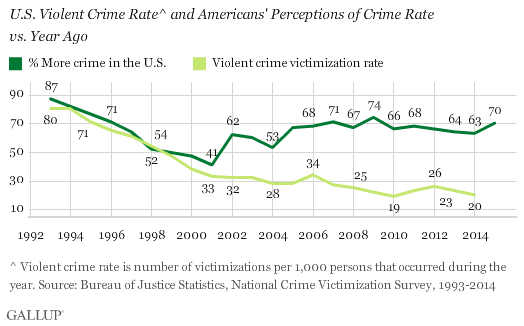
A similar but even longer narrative can be told about crime. Ever since George W. Bush’s first term, Americans’ perceptions of rising crime rates have been utterly at odds with the real world, where crime continues to decline. The number of people actually experiencing crime is down dramatically since the 1990s — even allowing for a spike related to the pandemic — but the number of people who think crime is rising stays well above 50%. They don’t believe that based on anything that has happened to them or their neighbors. They believe it because of mainstream media, which pretends to be objective while consistently demonizing progressives as “soft on crime” — a key ingredient of the reactionary centrist dynamic.

So why does all this bolster Donald Trump’s chances in November, assuming he makes it that far? I see three specific ways.

It divides Democrats

By its very nature, reactionary centrism works to divide Democrats, and not just pitting moderates versus progressives, as reactionary centrists might claim, but doing so unfairly, in bad faith and with wanton disregard for facts. In reality, following the Biden-Sanders Unity Taskforce program, moderates and progressives worked together to pass important legislation in Congress, even as major components were blocked by centrist darlings Joe Manchin and Kyrsten Sinema, both of whom delight in punching left. Given how popular some of the policies they blocked actually are — a $15 minimum wage, universal pre-K and child care, paid parental leave, a permanent refundable child tax credit (which cut child poverty by 50%) — it seems obvious that Biden and the Democrats would be a lot more popular without persistent centrist sabotage, and that the narrative that the party has moved “too far left” doesn’t hold up.

Indeed, most of what progressives prioritize is also supported by moderates as well, if not as intensely. Reactionary centrism works to conceal that reality, highlighting divisions that are more sizzle than steak. As I wrote in October 2022, for example, the actual substance of the movement slogan “defund the police,” such as shifting police funding to “social workers, mental health care and other social services," drew 75% support in households with a police officer in a Los Angeles-area poll. 

Even the most “extreme” criminal justice reform activists — those who identify as prison abolitionists — see their advocacy and their policy proposals as part of a long political process, not a magical solution. If it weren’t for the work they’ve been doing for decades, no one would even be talking about this option, much less supporting it. Misrepresenting and demonizing them, as reactionary centrists do, only serves to block future progress and, by the way, to undermine the kind of reality-based, pragmatic public dialogue that reactionary centrists claim to want. 

What’s true of prison abolitionists is true of movement activists more generally. Their job is not to win elections, generally speaking, but to change what elections are about — and ultimately to change the world by changing what we accept as normal and just. The interaction of movements and political parties is always complicated, given the nature of our political system. Reactionary centrists work to diminish and distort the value of activism, and thereby to stand in the way of genuine democratic progress. Their divisive obstructionism in 2024 could be a boon to Donald Trump. 

It poisons discussion on Israel/Palestine 

The most serious division facing Democrats is Israel’s genocidal attack on Gaza, where more than 10,000 children have died so far. The official narrative of waging war to destroy Hamas was never credible, as Jewish Currents editor Peter Beinart explained on Democracy Now! in October:

You can’t defeat Hamas militarily, because even if you depose it in Gaza, you will be laying the seeds for the next group of people who will be fighting Israel. We know that Hamas recruits from the families of people that Israel has killed. You need, it seems to me, to support Palestinian leaders who offer a vision of ethical resistance, not what we saw on Oct. 7, but ethical resistance, and a path to Palestinian freedom, that also means safety for Israeli Jews. 

This common-sense assessment finds support among the majority of Americans who support a ceasefire, in contrast to the political leadership of both parties who are in lockstep support of Israel, despite growing internal dissent among younger staffers both within government and outside it. This reflects the broader situation that nourishes reactionary centrism, in which an established and largely homogeneous opinion elite is challenged from below by diverse groups it finds alienating or distressing. 

While the U.S. gives lip service to Palestinian rights and claims to support a two-state solution, the reality has been almost limitless support for Israel, even as it moves inexorably toward an increasingly extreme apartheid-style ethnostate. The gap between rhetoric and reality has become increasingly evident, especially to younger voters.  

There’s a long tradition of the U.S. claiming to respect universal human rights but ignoring that principle whenever it’s convenient. Now there’s a rising demand to set that right, and reactionary centrists meet that demand with panic, inflammatory rhetoric and wild accusations. There is nothing reasonable, objective or moral in what they’re doing, which is to defend genocide and aid Trump. 

It promotes fake “alternatives”

One serious challenge to Biden that could help Trump win is the potential promotion of a “moderate” third-party alternative. The most obvious threat is No Labels, a donor-driven group that pretends to represent "the commonsense majority," basically meaning the broadly unpopular combo of modestly liberal social views and staunch economic conservatism. The No Labels sales pitch is all about image: It claims “independence” from both parties, portraying them as equally insular, intransigent and extreme, and claims that No Labels will give voters “a choice,” even though voters will play no role in choosing the group’s potential presidential ticket, which could feature program-killer Joe Manchin and will have no chance of winning the election. To be blunt, it’s a reactionary centrist’s wet dream — and it would only need to draw off a small percentage of voters in a few key states to hand the election to Trump.

This should be sufficient to make the point that right-wing authoritarianism is not the only threat facing American democracy this year. Without the help of reactionary centrism, Trump and his followers are likely headed for history’s trash-heap. But the more Trump’s “moderate” handmaidens muddy the political waters, the darker our future looks.

Liberal cowardice, Trump and the Constitution: Surrender is not an option

I worked as a congressional staff member during the protracted, nerve-wracking run-up to the Iraq invasion in 2003. Readers will recall a time of peak national hubris, with the White House, congressional Republicans and most of the press fairly bawling for war. It was then that I began to understand that Democrats were afraid of Republicans.  

Given how pitifully weak the justifications were for an unprovoked invasion of a country that had nothing to do with 9/11, it was striking how many Democrats were swept along by it, more from conformity than conviction. Even those who opposed it usually advanced tepid, process-driven arguments. Sen. Robert Byrd of West Virginia, no one’s idea of a Squad progressive, was among the few Democrats who denounced the Iraq misadventure in hard-hitting and memorable terms. Why were Democrats pulling their punches?

I was reminded of that historic political timidity by the thesis of a center-left establishment warhorse, New York magazine's Jonathan Chait, that the U.S. government should not enforce the insurrection provision of the 14th Amendment to disqualify Donald Trump as a presidential candidate. Why not? Because Republicans won’t like it.

The author showcases excruciatingly nuanced logic-chopping over whether the violent takeover of the Capitol and attempted overthrow of government on Jan. 6, 2021, really was an insurrection according to his own ethereal definition; whether Trump actually honest-to-God incited it; and gee, what is insurrection, anyway — is it like secession, or different? Chait missed his calling as a medieval scholastic agonizing over how many angels can dance on the head of a pin.

He insists that those who support democracy and the rule of law face a terrible dilemma: How can we, the wise thinkers, possibly resist authoritarianism without seeming mean and unfair to all those reasonable Republicans we might otherwise win over to Team Democracy? Never mind that the number of them who would definitively abandon Trump is statistically negligible; the ones he cites (Mike Pence, Mitt Romney, Jeff Flake and Liz Cheney) have already abandoned electoral politics, and some of them have received death threats.

If enough of the punditry retreat, their fear could become self-fulfilling. The authoritarian psyche can sense fear and exploit it, a situation that suggests the far-right and center-left in this country are playing out yet another Stockholm syndrome.

It is unnecessary to further deconstruct Chait’s bold counsel of passivity; Brian Beutler has already done an admirable job. What intrigued me, however, is that Beutler states, without saying precisely why he believes it, that Chait's argument is based in fear. I think he is correct, but his assertion needs expansion if we are to grasp the full implications of Chait’s thinking and those who agree with him.

Fear is certainly implicit in the cringing quality of Chait’s entire argument, and strongly suggested by his final paragraph: “It is going to be difficult to convince the American public that throwing a popular candidate off the ballot after it’s too late for his party to course-correct is the definition of democracy. Even if it were to succeed, it would bring the kind of short-term victory we might eventually come to regret.”

Why might we regret it? Why not spell out the reason? I suspect (although I can’t prove) that liberal pundits like Chait — who has a public reputation and a record of political advocacy — are consciously or subconsciously afraid of being identified and physically attacked by Trump supporters, or at a minimum afraid of massive violence in the country should Trump be disqualified. By virtue of being visible Trump opponents, they personally stand exposed to the “retribution” he has explicitly promised.

If Chait’s line of argument is fear-based, as Beutler believes, and if the underlying fear is that Trump’s followers could commit serious violence over disqualification, then why is there any reason to believe they wouldn’t behave in exactly the same way if Trump loses the election in 2024? Trump has already made it clear he won’t accept any result that does not mean victory for him.

And if Trump actually does win the election, why do people like Chait think that they personally, or society at large, will be safer than in a disqualification scenario? Suppose Trump declares martial law (as he has promised, although implausibly claiming it would only be “on day one”) and mass-deputizes tens of thousands of crazed gun nuts to exact the retribution he has offered his following.

The baleful precedent of Jan. 6 and the countless death threats to judges, politicians, election workers and others coming from Trump’s supporters suggest we should assume the possibility of a worst-case scenario. Given that the judge in Trump’s New York fraud trial, Arthur Engoron, received a bomb threat on the morning of the trial's final day, there is every reason to believe that violence is an ever-present danger for as long as Trump remains in elective politics. It’s one more reason, following Chait’s logic, to give in to Trump’s demands.

That said, let’s now assume another scenario, that the likelihood of violence is minimal. In that case, Chait’s thesis centers on his willingness to suspend enforcement of the Constitution as a kind of professional courtesy to Republicans who somehow failed to foresee the possibility of disqualification and didn’t plan an alternative.


Want a daily wrap-up of all the news and commentary Salon has to offer? Subscribe to our morning newsletter, Crash Course.


Why do people like Chait appear to operate out of fear in the first place? Is it too hard to adhere to the plain text of the Constitution? Should the document be enforced only when those who face its sanctions agree? If enough of the punditry retreat alongside him, and there are plenty of influential examples, their fear could become self-fulfilling. The authoritarian psyche can sense fear and exploit it, a situation that suggests the far-right and center-left in this country are playing out yet another Stockholm syndrome.

Two decades ago, Jonathan Chait was one of those muscular New Republic liberals who was gung-ho on invading Iraq. When an action is popular, and when Republicans approve it (or stridently demand it, in the case of Iraq), Chait appears to be all-in for forceful solutions. Never mind that we were invading the wrong country.

But whenever politics demands heavy lifting, controversy and potential confrontation to defend the rule of law, not so much.

Forgetting the lessons of the war on terror in Gaza

Since Hamas’ horrific attacks of October 7, the Biden administration has been clear and consistent in its expectations for the eventual outcome of the Israeli military offensive that has devastated the Gaza Strip. Early on, President Biden laid out his red lines for post-conflict policy in Gaza. “To start, Gaza must never again be used as a platform for terrorism. There must be no forcible displacement of Palestinians from Gaza, no reoccupation, no siege or blockade, and no reduction in territory. And after this war is over, the voices of Palestinian people and their aspirations must be at the center of post-crisis governance in Gaza.”

Secretary of State Antony Blinken doubled down on the president’s position at a speech in Tokyo, echoing Biden’s prohibitions against forced displacement, reoccupation, reduction in Gaza’s territory, use of Gaza as a platform for terrorism, and besiegement. The administration is now referring to those five prohibitions as the “Tokyo principles,” holding them up as the basis of U.S. policy regarding Gaza.

As the violence and regional volatility continue to escalate, the administration is running out of time to use its leverage to help shift us away from more devastation and certain catastrophes.

Principles, rather like New Year's resolutions, often are incredibly worthy. The trouble is with their implementation – and the gulf between their stated principles and what the Biden administration has thus far accepted from its Israeli partners is stark. 

First off, the notion that Gaza shouldn’t be used as a platform for terrorism isn’t controversial. The horrific acts of October 7 have rightfully been condemned, including by my organization, repeatedly. Yet, the administration’s endorsement of a military solution to destroy Hamas fails to engage with our very own history of trying to defeat terrorism on the battlefield. Two decades of war in Afghanistan ended without eradicating al Qaeda and the Taliban back in charge. In Iraq, a war premised on removing the threat from Saddam Hussein’s regime resulted in violent instability and directly spawned the horrors of ISIS, requiring another war to which the U.S. is still committing troops. And throughout the parts of northern Africa where the war on terror has expanded, the results have been spreading violence, military coups, and a surge in the number and power of extremist organizations. While ‘mission accomplished’ has been declared more than once, the failure of our own war on terrorism is crystal clear.  

Even Biden’s own Secretary of Defence, Lloyd Austin, said: “If you drive [civilians in Gaza] into the arms of the enemy, you replace a tactical victory with a strategic defeat.” The War On Terror was the igniting force behind the creation of ISIS – imagining what a more extreme group than Hamas would be in Gaza is horrifying even to comprehend. We should be forwarding these lessons to the Israeli government – not enabling a strategy that will lead to even more horrific cycles of violence. 

Also, the current military strategy is a threat to hostages still held by Hamas. Weeks of war delivered the release of a single hostage and the accidental killing of three others, while the temporary ceasefire saw more than a hundred reunited with their families. The concern over the treatment of the hostages is real and urgent. We should be doing everything we can to get hostages released and there’s been a single pathway that has delivered results – diplomacy and a ceasefire. 

Second, the president made clear that Palestinians must not be forcibly displaced in Gaza. The Israeli government has advocated for just that outcome, including Gila Gamliel, Israel’s intelligence minister, who argued for “a worldwide refugee resettlement scheme” and said that those who supported Palestinians should be willing to “welcome Gazans to their countries.” Israeli National Security Minister Itamar Ben-Gvir called forced displacement “correct, just, moral, and humane,” while Finance Minister Bezalel Smotrich said that forced displacement from Gaza is “what needs to be done.”

Such comments are not only dangerous to Palestinians but for Muslims and Arabs experiencing hate around the world – including here at home. But only when the call started being echoed repeatedly did the Biden administration offer a public condemnation, and even then it came from a State Department spokesperson – not the White House. 

We need your help to stay independent

Even if the Biden administration is more vocal in private conversations with their Israeli counterparts, we know the current strategy is not working. According to the United Nations, nearly 1.9 million Gazans (85 percent of the population) have been displaced since October 7, and there is no plan in place to get them back to their homes.

While we are told that Israeli military operations in Gaza have slowed down, there is little evidence to back that up. The Israeli government is still pushing further into the South of Gaza, where only weeks ago it told people to flee to safety. The conditions near Gaza's southern border are overcrowded and the people do not have access to clean water or basic medical support – where organizations have warned about the outbreak of disease and a humanitarian catastrophe. 

As Gaza has been reduced to rubble, the Biden administration has offered little: no concrete public plans of its own, no public regional forums on how to rebuild Gaza. The Biden Administration can and should work with Arab leaders as well as civil society groups in Palestine to commit resources and political support so people in Gaza can rebuild and safely return to their homes. 

Lastly, the president said that “the voices of Palestinian people and their aspirations must be at the center of post-crisis governance in Gaza.” Yet, there haven’t been high-profile roundtables of Palestinian leaders with the president or Palestinian voices alongside the U.S., Israel, and Arab leaders to lay out a political solution that offers peace and dignity for Palestinians and Israelis alike. There’s been little talk of which civil society groups the administration is engaging on the ground who have key perspectives to offer. Such conversations won’t be easy, especially given the widespread grief in these communities. Still, it is an opportunity for this administration to lead and model the behavior needed to make this principle a reality. As this crisis polarizes people in the U.S., the president and all senior members of the administration have a key responsibility: centering and engaging with Palestinian voices to counter the destructive ‘us vs them’ narratives and humanize the debate. 


Want a daily wrap-up of all the news and commentary Salon has to offer? Subscribe to our morning newsletter, Crash Course.


Thankfully, the Biden administration has a track record that shows that when it chooses to use them it makes a difference in the calculation of the Israeli government. 

The administration did the right thing when it helped broker a temporary ceasefire that saw dozens of hostages reunited with their families and gave people in Gaza access to aid and a respite from bombing. They’ve taken other concrete steps such as warning the Israeli government that they were violating the visa waiver agreement if they arbitrarily denied Palestinian Americans living in the West Bank entry into Israel. They’ve also issued sanctions against West Bank settlers who are convicted of violence towards Palestinians. After both these moves, the Israeli government shifted its approach somewhat. The Biden Administration has leverage — and an obligation to apply pressure. 

As the violence and regional volatility continue to escalate, the administration is running out of time to use its leverage to help shift us away from more devastation and certain catastrophes. If the Tokyo Principles are to be taken seriously, the Biden administration needs to take concrete action to enforce them. If it does not, the Israeli government has shown that it will simply ignore the principles, immiserating Gazans even further and dealing yet another blow to U.S. credibility.

Here’s why road rage is on the rise

In December, a four-year-old boy was killed in his parent's car in California.

According to a report, the man who has now been charged with one count of murder allegedly cut off the victim’s vehicle and engaged “in aggressive driving maneuvers and road rage” before using a handgun to fire eight shots at the family’s car, which killed the child. The tragedy has been called a “road rage shooting,” a type of devastating catastrophe that appears to be on the rise over the last couple of years. Last March, Everytown for Gun Safety released a report that found the number of road rage injuries and deaths involving guns had increased every year since 2018. The nonprofit said that in 2022, every 16 hours someone was shot, injured or killed in a road rage incident. 

If drivers seem more aggressive these days, it’s not just you who thinks so.

And it’s not just road rage shootings, which is the worst form that road rage takes, but road rage in general that’s trending upward. In Colorado, Colorado State Patrol said more drivers on the highway have called in with road rage complaints than drunk drivers. The Los Angeles Police Department said in 2022 there were nearly 870 incidents of road rage in 2022, the highest number in the last seven years. Texas is another state where drivers are becoming more aggressive and violent. 

E. Scott Geller, a distinguished professor of psychology at Virginia Tech, told Salon he’s personally seen an increase in aggressive driving recently. People are tailgating closer or they’re speeding more frequently. Indeed, if drivers seem more aggressive these days, it’s not just you who thinks so. Psychologist Carla Manly told Salon the psychological underpinnings of road rage are “complex” as they are often connected to unresolved personal issues in a person’s life. From her point of view, the shell of a person’s car can create an atmosphere of “invulnerability” and “anonymity" – similar to how people are more likely to be bullies and harass others on the internet anonymously. 

“Many acts of road rage occur when upset drivers, even those who are normally self-contained, unconsciously give themselves permission to act out their anger or frustration from behind the ‘protected safety’ of their vehicle-turned-weapon-of-assault,” Manly said. “Acts of road rage are generally far out of proportion to the error that provoked the act of aggression.” 

The country seems to be losing its sense of “we’re all in this together” and that’s likely showing up on the road. 

But the internet could also be a reason why people are acting out aggressively while driving. As Geller pointed out, technology has led to a decline in in-person interactions, which have caused people to dehumanize each other more. Geller said the lack of in-person interactions, co-opted by technology focused on automating services where in-person interactions would usually occur, has contributed to a general lack of trust and empathy for others in our society.

“We've come to a culture where interaction is very impersonal,” Geller told Salon, adding that selfishness is at play here too. “We’re losing the perspective of interdependence, now it is all about independence instead of interdependence.”

Geller further elaborated that the country seems to be losing its sense of “we’re all in this together” and that’s likely showing up on the road. 

In the Everytown report, researchers said they didn’t know what is behind “the persistent increase in road rage shootings.” “The pandemic and its continuing effects have brought all kinds of new stressors into people’s lives,” the report stated. Psychologists suspect social isolation could be a contributing factor, too. Manly said humans are social creatures who benefit from spending time together. She added that mental health issues increased during the pandemic, and while some progress has been made since then, many people are still suffering from social isolation.

“On its own, social isolation can foster a sense of alienation from humanity — from the common decency, social norms and kindness — that create safety in society,” Manly said. “When we become socially isolated, a part of the self can fragment and become somewhat inhuman; when this occurs, issues such as road rage will, unfortunately, increase.”

Ryan Martin, a psychologist at the University of Wisconsin-Green Bay, told Salon it’s likely a variety of factors connected to the pandemic that are influencing the rise in road rage. First, since more people worked remotely, traffic was not as prominent during the peak of the pandemic when many cities and states were under lockdown. Since people have had to return to working in person, it could be that people have been overwhelmed by the traffic and congestion. Economic uncertainty could explain why people are more likely to become aggressive on the road. 

“I also think there’s been considerable economic uncertainty that puts people on edge in a way that might lead to greater anger,” he said. “I think the political divisiveness has also been an issue in that the last few elections as well as the pandemic led to feelings of animosity regarding one another.”

But why does it seem to always be men behind fits of road rage? 

Martin told Salon in general both men and women get angry at similar frequency rates. Both men and women, he said, seem to be really angry right now and taking it out on service workers in general. Road rage could be seen as an extension of this societal anger. However, the way anger is expressed is gendered. Research has shown that men are more likely to commit violent acts more frequently than women. Martin said he believes this difference in how anger is expressed between men and women is a result of the social messaging men receive throughout their lives in America. 

“Society tends to send boys and men the message that it’s not just OK, but right to express their anger physically,” Martin said. “Girls and women get a very different message ,and it’s to hold their anger back, and I think we see that playing out on the road.”

Biden campaign taps Jon Stewart alum for help with media-savvy tactics

In a smart move that will surely help to draw the eyes of younger voters in 2024 — especially those of the TikTok generation — the Biden campaign is bringing on Andy Crystal, former research producer for Apple TV+’s "The Problem with Jon Stewart" and Netflix’s "Patriot Act with Hasan Minhaj," in an effort to give Biden a sharp, media-savvy advantage over his opponents. 

According to campaign officials, Crystal will combine traditional campaign research with a greater emphasis on viral videos, investigative reporting and other tactics that will break through in the media. He will report to Michael Tyler, communications director.

“Andy’s vision, vast intellect and passion for finding and reporting important stories drove our most memorable episodes," Jim Margolis, executive producer and showrunner of "Patriot Act" said in a statement. "He has an uncommon ability to quickly process huge amounts of information, to make complex stories understandable and to put a human face on issues that matter. His brain is a firehose of smart and interesting ideas, and he was always the person we turned to make sure we had the story right."

According to Politico, Biden's campaign has also tapped Lauren Hitt, who most recently served as Rep. Alexandria Ocasio-Cortez’s (D-N.Y.) communications director, as a senior national spokesperson.  

“We’re excited to welcome Andy and Lauren to the already talented and fierce communications team working to reelect Joe Biden and Kamala Harris,” Michael Tyler, Biden’s communications director, said in a statement. “I’m also proud to recognize Kevin’s invaluable role representing our campaign since launch and communicating the president’s vision directly to voters.”

Bill O’Reilly’s own books swept up in book ban he supported

Former Fox News host Bill O’Reilly has found himself a living example of the "golden rule," angered to learn that a select number of his book titles are being banned after staunchly supporting such treatment towards other author's works.

Having spoken in favor of Ron DeSantis' book ban laws in Florida, O’Reilly is incensed now that the Florida Freedom to Read Project saw his name on a list of over 1,000 book titles that were to be temporarily removed from the Escambia County School District and made the fair call to treat him as he would have treated others. 

In response to his books "Killing Jesus: A History" and "Killing Reagan: The Violent Assault That Changed a Presidency" being effectively banned, O’Reilly told Newsweek on Friday, “It’s absurd. Preposterous,” adding that he’ll “find out exactly who made the decisions" and blast them on his various outlets.

"I’m going to ask them for a detailed explanation of why they did that,” he says.

According to a spokesperson for the school district, O’Reilly’s books aren’t permanently banned but are under review “to ensure compliance.” That being said, he's been burned by his own fire, writing, "Things are getting crazy with book banning in #Florida," in a statement to X (formerly Twitter) on Friday.


How to cultivate a healthy relationship with sweets holistically, physically and mentally

As a natural foods chef who also loves to bake, I often get asked about“healthy desserts.” Do they even exist? Which is best: whole wheat banana bread, a raw date-nut cacao truffle or a baked apple?I say, choose whichever sounds most appealing to you.

What I’ve found is when eating “healthy desserts,” the relationship we have with food is just as important as the ingredients. So, before you read the nutrition label, check in with your own label first. I’ve broken it down into three ways we can improve our relationships with sweets physically, emotionally and holistically.

Physically: Reset your palate

1. Cut back on the white stuff.This may be obvious but, if you haven’t already, wean yourself off white sugar (even if it’s organic). I once heard the taste of white sugar described as “an entire orchestra playing one note,” which is hauntingly accurate of its harshly sweet taste. It’s also incredibly addicting, so cut back gently. If you like your coffee sweet, instead of switching to black, gradually reduce the amount of sugar you use over the course of a week or so. It takes only 10 days to reset the human palate and your body will soon appreciate the more nuanced, natural sweetness found in real, whole foods.

2. Increase the amount of whole grains and cooked starchy vegetables in your diet. Not only do they provide sweetness, but their complex carbohydrate and B-vitamin content make them extremely comforting and relaxing to the body, which decreases the desire for sugary desserts like cupcakes. Grains to consider include oatmeal, polenta and wholewheat pasta; vegetables include yams, winter squash and beets.

3. Use natural sweeteners. The complex flavors of maple syrup, honey and maple sugar are all naturally satiating, meaning that after the flavors hit your palate, the body pretty quickly registers that it’s had enough and doesn’t want more food. That “one-note” taste of white sugar provides no satiety, so our bodies crave more and more

Emotionally: Honor desserts for what they are  a treat to celebrate life

1. Desserts are meant to be tasted and enjoyed, not eaten for nutritional sustenance. Don’t cram kale and protein powders into your desserts so you can justify having cookies for lunch. In order for the vegetables to be properly digested, your taste buds need to detect their inherent bitter and astringent flavors. These flavors stimulate digestive juices and if we don’t taste them, our bodies don’t release the hormones needed get the metabolism going. (I won’t even get started about protein powders; one of the biggest causes of sweets cravings is from inadequate protein intake. Eat balanced meals with whole grains, beans, responsibly-raised animal protein and good-quality fats, not just green juice, carrot sticks and salads.)

2. When you do have dessert, own it.Practice choosing food from a place of power, rather than feeling like a victim to your cravings. Sit down, breathe, pour yourself some tea and savor every bite. Pay attention to your thoughts–are they full of pleasure and gratitude (“Mmm! This is heavenly.”), or of shame and guilt (“Ugh, I have no self-control, I shouldn’t be eating this.”)?The energy you put into your food is going to be reflected in how your body absorbs it. Stress raises cortisol, the hormone responsible for increasing inflammation and visceral fat, while feelings of joy and relaxation decrease it

Holistically: Look at the big picture

1.Taste the sweetness of life. Indulge in the pleasures of life by spending time outdoors, enjoying the company of friends and doing what you love. Spoil yourself by taking a warm bath or buying yourself flowers.

2. Take care of yourself. Get enough sleep and keep hydrated. It doesn’t matter how well you eat; you can’t feel great if you are tired, dehydrated, or stressed.

3. Listen to your body. What does it really want? Do you feel fulfilled in your life, career, relationships, living arrangements and daily schedule? Cravings are a sign of imbalance. Ask yourself the big questions and trust your body’s answers

How “The Sopranos” elevated and complicated the mob wife

"The Sopranos" premiered 25 years ago, and as new generations find the Shakespearean-inspired mob story, the show's alluring female characters stand out from those found in the usual gangster films.

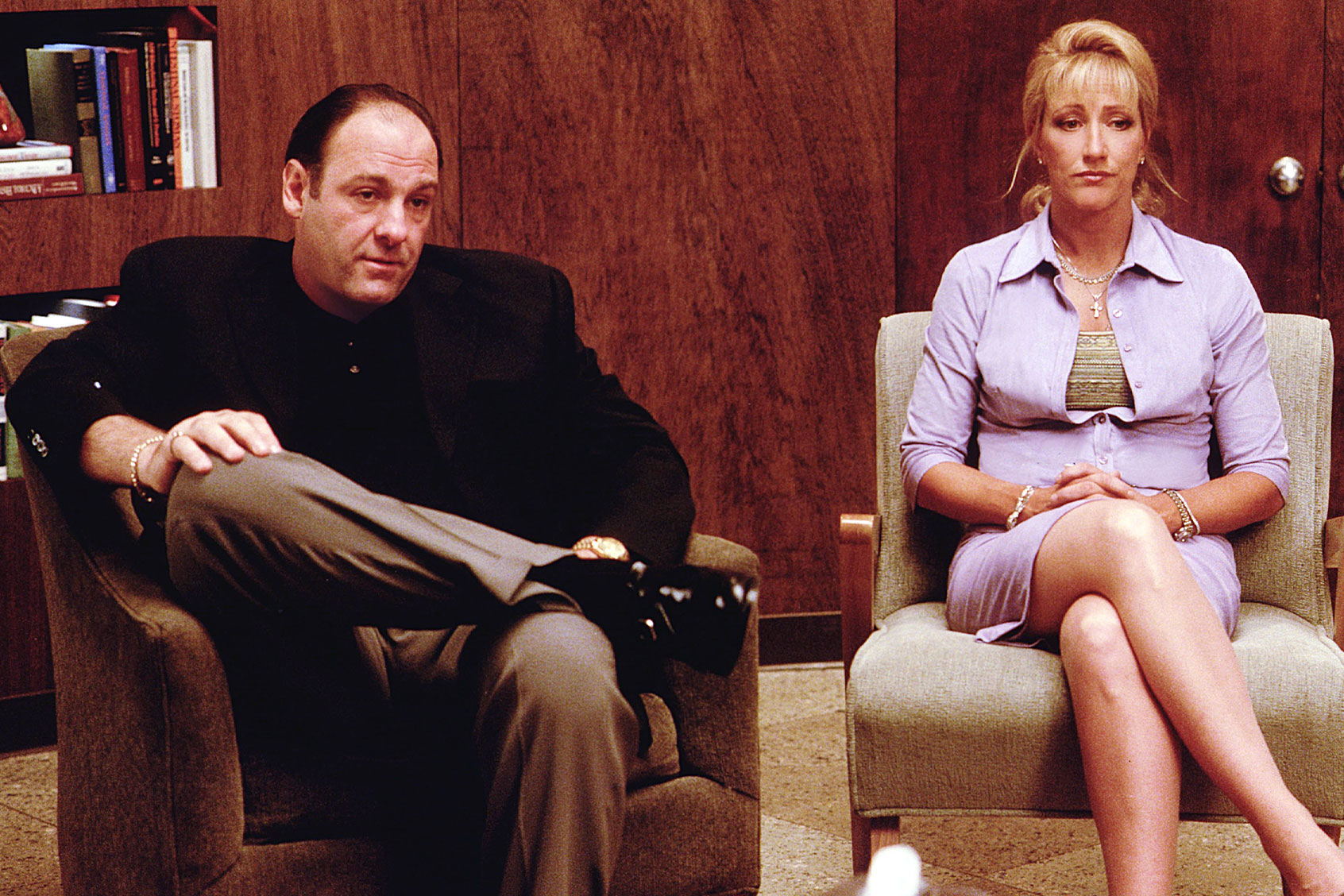
In the series, New Jersey mobster Tony Soprano (James Gandolfini) struggles to balance his home life and being the leader of a criminal organization, turning to therapy sessions with a psychiatrist. "The Sopranos" really shines when it focuses on the nuances of Tony's home life through his love for his family: his homemaker wife Carmela (Edie Falco), his rebellious son AJ (Robert Iler), his academically inclined daughter Meadow (Jamie-Lynn Sigler) and his "cousin" and protégé Christopher (Michael Imperioli).

"The Sopranos," turned the vapid stereotype on its head through Carmela.

But the series also put the spotlight on the women in ways we hadn't seen before. While mobster movies like "Goodfellas" and "The Godfather" portray wives and girlfriends as props of the men's lavish lifestyle, wealth and success, "The Sopranos" allows its audience to peek behind the curtain into the internal world and dilemmas of those women. Television offered more time onscreen to dive deeper into each female character, allowing them to be nuanced and complicated women — not mere status symbols or accessories. Creator David Chase said that when he imagined the show, it would have "really good roles for women."

The men and their crimes are the surface-level appeal in "The Sopranos," but characters like Tony's wife, Carmela and Christopher's girlfriend and eventual fiancée Adriana (Drea de Matteo), are the pulsing heart of the series. The show becomes so much more than its toxic, hyper-masculine mob violence through the women's perspectives as the women closest to criminal men. It's through these lead female characters that the audiences see how the vapid role of a mob wife or fiancée can be so much more than that. And how for the most part, the lifestyle that they trade their freedom for has grave, fatal consequences.

Lavish lifestyles and ambitious aspirations

James Gandolfini; Edie FalcoJames Gandolfini as Tony Soprano and Edie Falco as Carmela Soprano seek counseling in HBO's hit television series, "The Sopranos" (Year 3). (Photo by HBO/Getty Images)In the most stereotypical portrayals, mob wives or love interests are known for their life of opulence and style. One might recall the expensive slinky satin gown and the jewels draped on Michelle Pfeiffer's character Elvira in "Scarface." Mob wives exude that conspicuous luxury, and therefore have a knack for shopping and fashion to help them keep up appearances. Internally, they are as shallow as a kiddie pool, always used as plot devices or damsels in distress. As an audience, we revel in characters like this. They exist as our gateway into their fictional lives of wealth and access. It's why the characters are largely associated with their iconic images decades beyond a film's shelf life.
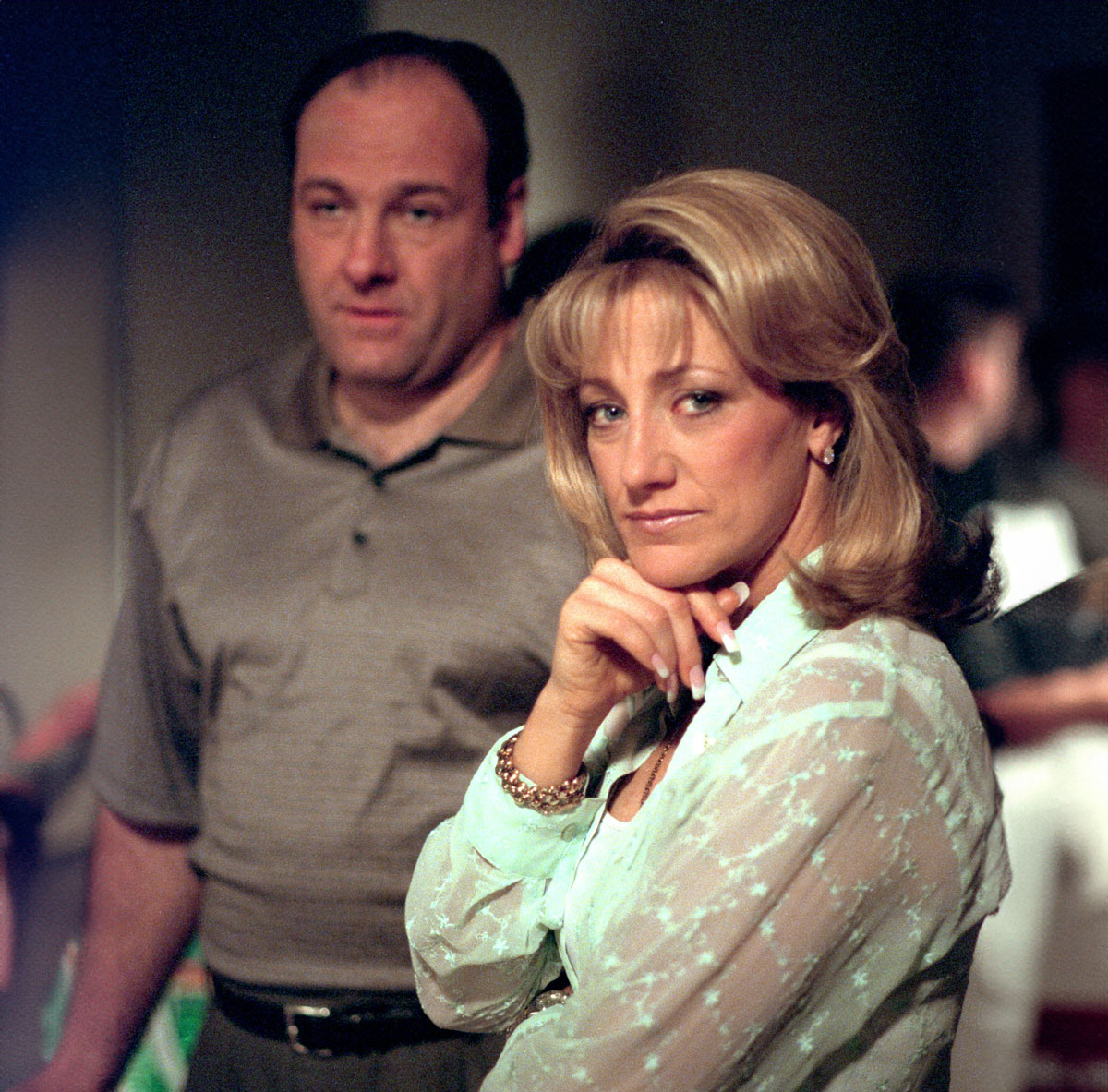
But "The Sopranos," turned the vapid stereotype on its head through Carmela who on the surface may seem like she's just about appearances but is working tirelessly behind the scenes. Even though she is married to a mobster, she largely stays out of his business because she is busy running her household. She is a typical housewife with a beautiful, large New Jersey home and two kids. She always has a perfect blowout, fresh from the salon, French nails and a Juicy Couture and Fila tracksuit to match. She's got all the makings of an upper-class stay-at-home mom. 

When she's not tending to her kids and Tony's every need, she's shopping with her daughter and friends — her clothes and aesthetics inspired by Italian designers like Pucci, Adrianna Vittadini and Robert Cavalli. Or she's receiving pity gifts from Tony like a massive sapphire ring for her birthday and a matching necklace at Christmas, a top-of-the-line Porsche, and an extravagant fur coat. The gifts are never-ending just like Tony's faults in their marriage. And the gifts are almost always illegally obtained by Tony or one of his goons.

As Tony moves up the ladder, he becomes increasingly entrenched in the lifestyle and the bad behavior that comes along with it. And Carmela knows the position she is in. She's been in this with him for decades. She accepts gift after gift, affair after affair just like a doting housewife should. In the episode "Whitecaps," the couple have an explosive fight and are on the brink of divorce. After she finds out about another one of his affairs, she tells Tony that buying her a beach house is just "like a big emerald ring" that he got for her birthday. Another gift to shut her up. Tony towering over Carmela says, "Where do you get off acting surprised and miffed when there are women on the side? You knew the deal." She knows the freedom she's signed away for simply being his wife.

Eventually, when the couple reconciles, he pays to build her a spec house to be allowed back into their house. He gives her pricier and pricier gifts, and he continues to do basically whatever he wants to with no objection from Carmela. She has what she wants but not fully what she needs from Tony.

Whereas Christopher's girlfriend Adriana is accustomed to the mob lifestyle because she's grown up seeing it in her family. Adriana is seemingly nice but exceedingly shallow and materialistic. Like Carmela, she is also always dripping in gold jewelry and designer fashions, and wants the kind of grand lifestyle Tony and Carmela have.

Carmela and Adriana form a close relationship, finding solace in their mutual understanding of complicated, violent men. And because Christopher is Tony's protégé, with time, the young couple aspires to mirror the married one. One day, Adriana hopes to get the life she's dreamed of, which includes more expensive cars, designer shoes, jewelry and clothes. But the young couple struggles to get there, living in a crappy apartment with Adriana working as a hostess, as they blow through their money on drugs and partying.

Adriana and Carmela have also been able to level up their materialistic lifestyle, benefitting from and Christopher's access to power and social standings in their mob community. When Carmela gets bored of the housewife life, she wants to start flipping houses, and while Tony is a pain about her working, he pulls some strings for her.

On the other hand, Adriana gets a taste of the high life with Christopher; the access to drugs and partying keep her coming back for more. But she’s also ambitious and craves to be a business owner. So Christopher acquires a bar called the Lollipop Lounge through a person who owes the family a debt. She renames the bar Crazy Horse and turns it into a successful venue where indie rock bands perform.

The price paid

The Sopranos James Gandolfini Edie FalcoJames Gandolfini And Edie Falco of "The Sopranos" (Getty Images)

But all these material gains mean that they've traded their personal goals and independent lives to tolerate abuse. There is always a price to pay, and this is where Chase and his writers find the richness of their characters. Carmela didn't always want to be a housewife. She dropped out of college even though her passions have always been in real estate development. But she chose to marry Tony and have a family instead. It's why she stresses the importance of an education to her children, especially her daughter Meadow. Carmela spends a lot of the series resentful of her choices, jealous of women who had the opportunity to go to school and start their own businesses.

We need your help to stay independent

All these material gains mean that they've traded their personal goals and independent lives to tolerate abuse.

This resentment builds and leads to an emotionally abusive relationship with Tony as he continues to have affairs that she pretends don't exist. But the dynamics in their relationship shift when Tony finds out that Carmela has a crush on a member of the mob family, Furio (Federico Castelluccio). This leads to a brutal fight in “Whitecaps" that's frightening because Tony almost hits Carmela. She tells him, "What, you want to hit me, Tony? Go ahead. Just go away, please. I can't stand it anymore," adding, "I know you better than anyone,Tony, even your friends. That’s probably why you hate me.”

Drea De Matteo; Michael ImperioliActors Michael Imperioli & Drea De Matteo in scene from HBO cable TV series The Sopranos. (Anthony Neste/Getty Images)Meanwhile, Adriana is on the receiving end of brutal and violent behavior from Christopher who goes through periods of addiction and recovery throughout the show. Christopher's actor Michael Imperioli said, “The most brutal, difficult stuff for me is when Christopher had to be physically abusive with Adriana, for obvious reasons."
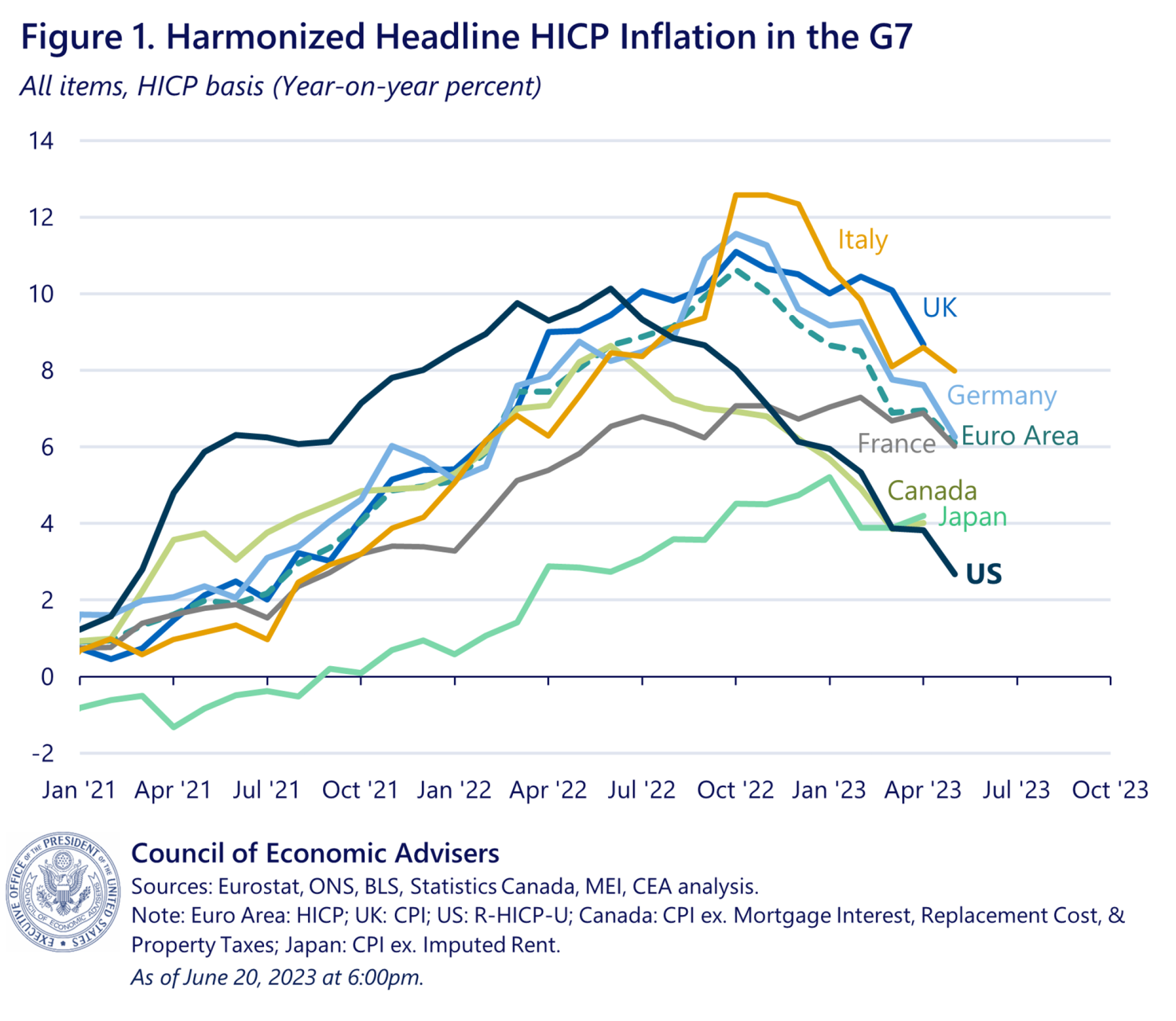
When he is under the influence, Christopher flips like a switch. In the episode “The Strong, Silent Type,” Christopher beats Adriana for suggesting he get clean from his heroin addiction, and that’s not the first time he’s laid his hands on her either. But in the most harrowing episode of the series, "Long Term Parking," he almost strangles her to death when it is discovered she is a mole for the FBI. It's a brutal assault on Adriana who is riddled with guilt for being an informant but ultimately wants out of a life that is so wrapped up in criminality and endless pain. So Christopher tricks her into thinking they’ll run away together, and it ultimately leads to her ruthless killing by an associate of Tony's.

Ultimately, “The Sopranos” added to the prestige television boom, earning respect for creating art on the small screen. Women got to be all shades: kind, supportive but selfish and materialistic while also being human, having desires to be successful, loved and seen outside their romantic counterparts. The downside is that they fell into the trap of servicing dominant, violent and power-hungry men.

In characters like Adriana and Carmela, the show broadened the audience's preconceived notions of what a mob wife looked like. And 25 years later, these characters set the gold standard of what it looks like to be the few women at the center of a series so centered on the animalistic, aggressive ways of mob men.

Hunter Biden seems to have changed his mind about that closed-door deposition

In a twist, Hunter Biden seems to have reversed his path in terms of his refusal to appear for a private deposition as part of the House Republicans’ impeachment inquiry into his father, after a considerable amount of controversy over him dodging a subpoena to do so. 

According to NBC News, "Hunter's lawyer Abbe Lowell told House Republicans that their previous subpoenas were 'invalid' because the House had not authorized an impeachment inquiry into the president when they were issued in November," and if a new subpoena is issued requesting a closed-door convo, he'll go along with it. 

House Oversight Committee Chair James Comer, R-Ky., and House Judiciary Committee Chair Jim Jordan, R-Ohio have said that they will work with Hunter to schedule a date for the deposition, but until that time, he's still in hot water for dodging their previous attempts to have him in, intending to carry on with a full House vote on a resolution to hold him in contempt of Congress, per MSNBC

“While we will work to schedule a deposition date, we will not tolerate any additional stunts or delay from Hunter Biden,” they told Lowell.

Katt Williams is right about the mediocre state of comedy – just look around

Knowing comedy means respecting Katt Williams’ greatness and understanding that all his umbrage boils down to one irritant: laziness. For more than three decades Williams has been grinding it out on the road and filling arenas, holding nothing back verbally and physically regardless of audience size.

He attacks his jokes with his whole body, lending conviction to nearly everything he says. That made his appearance on the Jan. 3 episode of  ESPN correspondent Shannon Sharpe’s podcast "Club Shay Shay" the first not-to-be-missed internet drop of 2024.

Over nearly three hours Williams fired enough shots at other major names to make folks sit up and take notice, punching up each statement by theatrically grinning at the camera or taking measured sips of cognac between thoughts and “there, I said it” declarations.

Woven throughout the bluster are several accurate observations hinting at why so many of the top stand-up specials served on streaming platforms feel stale.

His main targets are familiar to most TV viewers. Cedric the Entertainer stole one of “his very best jokes,” Williams alleges. Steve Harvey supposedly swiped bits from him too and lied about why he stopped doing stand-up. He quit, Williams claims, “because he got in a comedy battle called The Championship of Stand-up Comedy with one Katt Williams in Detroit in front of 10,000 people and lost.”

Kevin Hart, he said, is an industry plant who never paid his dues in Hollywood and built his career on Williams’ sloppy seconds, roles Williams says he passed on.

Other spilled tea is even more defiant, including his allegation that Hollywood “canceled me for talking about Harvey Weinstein before the thing came out. But he offered to suck my penis in front of all my people at my agency.”

“This is the reckoning,” he bellows at one point, gleefully before raising his glass. “2024!” Sweetest Taboo was indeed in rare form.

A week after Williams’ conversation with Sharpe the episode is still racking up clicks; as of Thursday night it was closing in on 44 million views. A brief YouTube clip would consider that audience to be a whopping success. This tête-à-tête's runtime approaches “Killers of the Flower Moon” territory.

Williams’ braggadocio is glorious, and enough of his claims are questionable to let a person know he’s best considered as a master of telling tall tales in games of he said-he said. Woven throughout the bluster, however, are several accurate observations hinting at why so many of the top stand-up specials served on streaming platforms feel stale.

Part of what Williams says we already know, which is that fame in the stand-up world is related less to the material than who the gatekeepers want to push to the fore. Netflix, Amazon and Warner Bros. Discovery, which owns Max, are the comedy world kingmakers, awarding some performers millions and others a relative pittance, as Mo’Nique revealed years ago.

Still, exposure is exposure. Netflix is a boon to performers like Taylor Tomlinson, whose introduction to its massive subscriber base contributed to her becoming the first woman to host a late-night talk show on CBS. (Tomlinson’s “After Midnight” debuts Tuesday, Jan. 16 at 12:37 a.m. ET/PT.) But the company has boosted fewer Black comedians who aren’t Hart, Chris Rock, Dave Chappelle or their friends.

Granted, there are other reasons Williams hasn’t crossed over into film and TV as easily as those other names. He doesn’t play the industry game like they do, compromising his image or integrity to expand his filmography. (In developing Money Mike, his character in “Friday After Next,” he demanded the studio remove a prison rape scene insisting, “Rape is never funny.”) Williams also has a double-digit arrest record, which he mentions several times throughout the episode and factors into his reasons that Hollywood has rejected him.

Mediocrity has become standard in part because the demand is high for fresh streaming content, and huge names are attention magnets.

But what he says about Harvey and Cedric the Entertainer, both of whom have regular TV gigs, and Hart, who has a growing library of stand-up specials and movies on Netflix, is also true of the streaming service gatekeepers redefining what is funny and what isn’t by surfacing a select group of names time and again.

“It’s a consortium. They rock with who they rock with and they don’t with who they don’t,” Williams said.

This is not exactly breaking news. However, it explains why, for example, five-time Golden Globes host Ricky Gervais received the inaugural Globe for best stand-up last week for a special, “Armageddon,” which is basically a quilt of recycled bits and years-old throwbacks.

This type of mediocrity has become standard in part because the demand is high for fresh streaming content, and huge names are attention magnets.

But if the quality seems to be plummeting, Williams offers a theory in his story about his work ethic.

“When I got into the craft, I thought it was my obligation to make sure that I kept writing new material so much that it forced these comedians to stop doing the set they've been doing for 10 years and keep writing some new stuff,” he said.

“And I knew that if I could get that to take on, that most of these bums will have to just quit comedy because they can't keep up. They're not gonna keep writing an hour’s worth of material. I've written an hour’s worth of material 19 times. They're not gonna do it. Why? Because they're not creative writers.”

Well, they’re still here. They’re just not working as hard. Gervais' “Armageddon,” a collection of “woke culture” buzzwords copied from X and pasted into a flaccid rant, proves it.

We need your help to stay independent

Offensive material is disagreeable to the affronted party, but even a wounded critic might concede when such jokes are successful and exciting. And let me establish something straightaway – I am not easily offended. Inspiringly constructed crude jokes are as much my jam as clean comedy that’s equally or more creative. Gervais offers neither in “Armageddon,” only a rehash of quips about trans people, the disabled, little people and CRT. Then there’s this:

In Africa, a baby can be born in a mud hut, there's a lion outside, it’s covered in blood because they can't wash it — they've got no water — oh, and it's already got AIDS. Now, by the time that joke goes on Netflix, it'll be nuanced. There’ll be an underlying satirical point, I’ll claim. Until then, all I've got is, "Baby's got AIDS!" I know that it's funny. I just have to work out why. Leave it with me, leave me it with me.

Again, the anti-Black ignorance in this passage is so old hat that reacting with anger would be a waste. The more dominant emotion is bafflement. Gervais attempts to land the gag with something along the lines of, If you're offended, you're an idiot because the characters in this joke don’t exist. Which still doesn’t make it qualify as funny. Or a joke.

I hope this “reckoning” of his wakes up those who have been coasting on brainless cruelty without placing much effort into innovation.

Williams’ greatest claim to fame may be his legendarily inspired 2006 rant about Michael Jackson. Even some of the pop star's biggest devotees can't deny that it killed. In “Armageddon” Gervais mentions Jackson because his name is an easy giggle trigger – and, though he may not know or acknowledge it, because Katt set and slew the best joke nearly 18 years ago, and comics have been grasping to claim shards of that energy since.  

My bias is showing here, I'll grant you. Many find Gervais to be a brilliant, writer, pointing to "The Office.” But that was a long time ago; stand-up is a different beast from series TV, as Williams and other greats prove time and again by honing a joke to perfection, delivering it and sharpening the next great joke after that. Williams tells Sharpe that he spends time exploring each major city where he performs, making each performance comedically bespoke in some way. (The opener of 2018's "Great America" exemplifies this.) Gervais in a 2019 New York Times piece discusses at length the amount of time he spends online collecting material and ideas, which is telling. 

In the spirit of Williams’ opening 2024 with bracingly unfiltered admissions, I hope this “reckoning” of his wakes up those who have been coasting on brainless cruelty without placing much effort into innovation.


Want a daily wrap-up of all the news and commentary Salon has to offer? Subscribe to our morning newsletter, Crash Course.


If people are laughing, why bother? Here’s a reason. A week after Williams' "Club Shay Shay" episode debuted, a comedy AI called Dudesy dropped an hour-long set impersonating the late George Carlin, who died 15 years ago, called “George Carlin: I’m Glad I’m Dead.”

Listening to the set, it’s a fairly accurate approximation of Carlin’s style, humor, cadence and even his voice, delivering his takes on the absurdities of religion, mass shootings and social media and eventually turning its digital knives on itself by skewering the concept of artificial intelligence. It isn’t terrible. But despite Dudesy listening to all of George Carlin’s material and doing his best “to imitate his voice, cadence and attitude,” it isn’t vintage Carlin by a longshot.

The quality that stands out most, though, is that it’s passable to the average person who’s become accustomed to the lowered creativity passed off as excellence.

“There’s one line of work that is most threatened by AI — one job that is most likely to be completely erased because of artificial intelligence: stand-up comedy,” joked the digital Carlin impersonator. “I know what all the stand-up comics across the globe are saying right now: ‘I’m an artist, and my art form is too creative, too nuanced, too subtle to be replicated by a machine. No computer program can tell a fart joke as good as me.'” Then it proceeds to generate a fart joke one doubts Gervais could manage.

One popular Netflix stand-up special shows the faintest signs its creator may yet wean himself off cheap cruelty, and I’m as surprised as anyone to make this observation given his recent track record. But Chappelle’s “The Dreamer,” refrains from being as wholly antagonistic and downward punching as previous sets, although he can’t resist entirely regressing to exhausted trans jokes, shots at the disabled and a light ha-ha referencing sexual assault. Much of his material is also self-involved, processing his spectator experience of Chris Rock being slapped by Will Smith at the Oscars and Chappelle's own attack at The Hollywood Bowl.

Incredibly, though, when Chappelle retells the part about trying to recover from his Hollywood Bowl set by lightening the mood with a transphobic punchline, he frames it as a lazy response, admitting he was booed for it. (His closing bit pays an affectionate tribute to Lil Nas X, demonstrates thoughtful writing and is quite funny.)

Williams admits to Sharpe that he’s been booed, too. “I don't think any comedian has ever been booed unnecessarily, either . . . That's supposed to be used as a learning experience. Most comedians don't get booed enough.” Audiences, take that to heart. Be freer with your boos if you want better comedy, and give Williams the applause he’s due for setting the record straight.

“He is mocking Christianity”: Conservatives upset over Lil Nas X’s “J Christ” music video

Rapper Lil Nas X often challenges the sanctity of biblical images in his colorful, widely campy music videos, and his latest video is no different.

The southern rapper, known as Montero Lamar Hill, broke through the mainstream with his country rap single "Old Town Road." The song spent 19 weeks on the Billboard 100 charts. Not long after his song became the longest-running No. 1 song since the chart itself debuted in 1958, the rapper came out as gay.

But Lil Nas really shook up the industry and conservative politics when he dropped his hit single "Montero (Call Me by Your Name)" in 2021. The music video featured the rapper in knee-high platform boots performing the ultimate pole dance – sliding into hell on the pole and giving the devil a lapdance. The video gave enough ammo to conservatives to pick the next target in their culture wars, accusing the rapper of being a devil worshipper and corrupting young listeners with his supposed promiscuity. This single was also the rapper's first venture into adding his queer identity into his music. He said in an interview with GQ that the music video for the song was “rebellious on many, many levels for me."

Nearly three years after that, Lil Nas is back with another biblical-inspired song and video for what he is calling his "Christian era." It is already ruffling conservative feathers. Here is everything you need to know about the rapper's new single "J Christ": 

Leading into the "J Christ" release

Before the "J Christ" music video dropped, the rapper was active on social media drumming up excitement. He posted clips of himself eating communion wafers like chips and drinking wine, offering up an all-expense paid trip to heaven and dressing like a Jesus Christ-looking figure on a cross before morphing Transformers-style into a robotic figure.

He also posted an acceptance letter from the Christian school, Liberty University on Instagram that said he was "about to go to college for biblical studies in the fall. Not everything is a troll!"

The letter read that he was accepted into the school for the Fall 2024 semester in a "Dual Concentration in Christian Leadership and Biblical Studies."

"Montero, the entire Liberty family congratulates you! Now is your time to train as a Champion for Christ," the letter said.

However, a university spokesperson said in a statement to Billboard “We can confirm that Liberty University did not issue the Montero Hill ‘acceptance letter’ posted yesterday to social media, and we have no record of Montero Hill applying to the university."

Of course the big tip-off that this was fake for anyone paying attention was that the letter was signed by Jerry Falwell, who is dead.

A breakdown of the "J Christ" music video

On Friday, the "J Christ" video finally dropped. It opens with a long line of people dressed in white, seemingly making their way onto the stairway to heaven. They mimic celebrities and public figures like Taylor Swift, Ed Sheeran, Kanye West and Barack Obama. As they enter heaven, we see Lil Nas as a white angel without wings. After a glimpse of a Michael Jackson-like figure and brief dip into hell, we're back in heaven with Lil Nas facing off against the devil in a game of basketball in a packed stadium. 

He sings as he slam dunks:

Is he up to somethin' only I-I know?
Is he 'bout to hit 'em with the high-igh note?
Is he 'bout to give 'em somethin' vi-iral?

In rapid succession we see Lil Nas as a cheerleader leading a group dance, then Lil Nas dressed as Jesus Christ on the cross, and then a shepherd shearing a lamb. All the while, the world is on the brink of destruction, and Lil Nas transforms into Noah who leads his animals to the ark that will save their lives. The video ends with Lil Nas leading the ark into clear waters.

A bible verse is Lil Nas' parting words on screen: 

"Therefore, if anyone is Christ/He is a new creation. The old has passed away; Behold the new has come." — 2 Corinthians 5:17

The right-wing backlash

Upon the video's release, Christian rapper Bryson Gray denounced the images of Lil Nas dressed as Jesus and called on other Christians to also publically condemn him.

Gray told Fox News, "I think that he is mocking Christianity. He is mocking Christ. That's why he uses Christian imagery to do it."

He continued, "He's doing it with the goal to mock us because that's how he gets his clicks. I don't care if he gets the clicks about Christians reacting. I want to see more Christians reacting."

But Lil Nas took to the internet to address his critics. He said, "The crazy thing is nowhere in the picture is a mockery of Jesus. Jesus’s image is used throughout history in people’s art all over the world."

"I’m not making fun of s**t. Y'all just gotta stop trying to gatekeep a religion that was here before any of us were even born," he said.


Biden betrays his moral standing in Buffalo: Death penalty decision reveals his true colors

In a Friday afternoon announcement, the Biden Administration crossed the Rubicon when it said that it would seek the death penalty in the case of Payton Gendron. He killed 10 people in a racially motivated shooting at a Tops Supermarket in Buffalo, New York, in May 2022. Gendron, who was 19 at the time of the shooting, has already been convicted of murder and sentenced to life in prison without parole in a state criminal case.

His lawyer had told the feds that Gendron would plead guilty to the various federal charges brought by the Justice Department if the department would take the death penalty off the table.  But none of that seems to have mattered to an administration that once touted its abolitionist credentials.

A lifetime of punishment was apparently not enough for the Biden Justice Department.

Horrible crimes, like Gendron’s, pose the sternest test for people opposed to the death penalty. The Biden administration just failed that test. 

Recall that when Joe Biden ran for president he campaigned as a death penalty abolitionist. It was the first time any major presidential candidate had ever done so. Biden laid out a detailed plan for reform of the criminal justice system which included a promise to “work to pass legislation to eliminate the death penalty at the federal level, and incentivize states to follow the federal government’s example.”

More to the point, in light of the announcement at the start of the Martin Luther King holiday weekend, in 2020 Biden had said that people convicted of even the most egregious crimes should not get death sentences, but “should instead serve life sentences without probation or parole.”

His promise and his commitment to act decisively to change this nation’s approach to crime and punishment helped solidify support for Biden among crucial consistencies, including young people and many people in the Black community.

But now, with the initiation of the administration’s first capital prosecution, that promise has been broken. Indeed, three years into his presidency the only thing consistent about the Biden administration’s handling of the death penalty has been its inconsistency.

On the anti-death penalty side, in 2021 the Justice Department under Attorney General Merrick Garland imposed a moratorium on federal executions. Moreover, Garland decided not to move forward with most of the capital prosecutions begun by the Trump Administration.

But on the other side of the ledger, the Justice Department has vigorously defended all existing federal death sentences and has done nothing about the use of solitary confinement on the federal death row. As I noted at the start of last year, “The department is defending death sentences even when there are concerning issues, like intellectual disability or severe mental illness of defendants, or racial bias and prosecutorial misconduct in those cases.”

Nothing has changed since then.

The president also has not indicated that he intends to commute the sentences of people now on the federal death row.

And the administration has made decisions in high-profile cases that have raised eyebrows among death penalty opponents. For example, it asked courts to uphold Boston Marathon bomber Dzhokhar Tsarnaev’s death sentence. It continued other death cases started under Trump in instances of mass murder and domestic terrorism. As the New York Times notes, “In the case of Sayfullo Saipov, Mr. Garland denied the defense’s request to drop the pursuit of the death penalty if the trial ended in a conviction. After the conviction of Mr. Saipov, who in 2017 drove a pickup truck down a Manhattan bicycle path, killing eight people, a jury deadlocked on the death penalty, returning a sentence of life in prison.”

The administration pursued a similar course in the case of the Tree of Life Synagogue killer, Robert Bowers, who murdered 11 worshipers in Pittsburgh 6 years ago. Garland, as the Times reported, “did not withdraw the request for the death penalty in that case.” The Bowers jury returned a death verdict.

And now the Gendron case

We need your help to stay independent

That the decision to seek death in this case was not a hasty or impulsive one does not make it any more acceptable to people with sincere abolitionist convictions. It came after a Justice Department case review that, as the Washington Post notes, “took nearly 20 months and included input from prosecutors, the criminal division and the civil rights division.” 

The Biden Justice Department indicted Gendron last July on 27 federal counts related to the shooting at the supermarket, a shooting that Gendron had grotesquely live-streamed online. He targeted the area because of its Black population and was motivated by white supremacist hate and extremism.

In New York Gendron was, as NPR reported “charged… with one count of domestic terrorism in the first degree, 10 counts of first-degree murder, 10 counts of second-degree murder as a hate crime, three counts of attempted second-degree murder as a hate crime and one count of second-degree criminal possession of a weapon.”He eventually pled guilty in a state court to 15 charges, including murder and attempted murder. According to ABCNews, he was “the first person in state history to be charged with domestic terrorism motivated by hate.”

Before his sentence was imposed, Gendron apologized, saying he was "very sorry for all the pain" he caused and "for stealing the lives of your loved ones." 

"I did a terrible thing that day,” he acknowledged, “I shot people because they were Black."  

After that apology, Susan Egan, the judge in the New York case, told Gendron, "There is no place for you or your ignorant, hateful and evil ideologies in a civilized society. There can be no mercy for you, no understanding, no second chances. The damage you have caused is too great and the people you have hurt are too valuable to this community. You will never see the light of day as a free man ever again."


Want a daily wrap-up of all the news and commentary Salon has to offer? Subscribe to our morning newsletter, Crash Course.


A lifetime of punishment was apparently not enough for the Biden Justice Department. At the time of Gendron’s federal indictment, Attorney General Garland may have tipped his hand about Friday’s death penalty decision. “The Justice Department,” he said “fully recognizes the threat that white supremacist violence poses to the safety of the American people and American democracy. We will continue to be relentless in our efforts to combat hate crimes, to support the communities terrorized by them, and to hold accountable those who perpetrate them.”

Now we know what accountability means to the Attorney General and perhaps to the president under whom he serves. Just as hard cases are said to make bad law, the most serious crimes can bring out the worst in some otherwise thoroughly decent people.

Like Garland, I have no sympathy for Gendron, and I condemn the racism that motivated his awful crime. But, in the end, I am convinced the Biden Administration and its Justice Department made the wrong call.

Just like you can’t be half pregnant, a commitment to ending the death penalty means ending it for everyone, including people who commit the worst crimes — like Payton Gendron. His lawyers got it right when they responded to the administration’s decision to seek the death penalty by saying “Rather than a prolonged and traumatic capital prosecution, the efforts of the federal government would be better spent on combating the forces that facilitated this terrible crime.”

Attack on Yemen exposes hypocrisy of Biden and Blinken’s “rules-based order”

Have you heard the one about the U.S. government wanting a “rules-based international order”?

It’s a grimly laughable premise, but the nation’s major media outlets routinely take such claims seriously and credulously. Overall, the default assumption is that top officials in Washington are reluctant to go to war, and do so only as a last resort.

That framing was in evidence when the New York Times published this sentence at the top of the front page: “The United States and a handful of its allies on Thursday carried out military strikes against more than a dozen targets in Yemen controlled by the Iranian-backed Houthi militia, U.S. officials said, in an expansion of the war in the Middle East that the Biden administration had sought to avoid for three months.”

So, from the outset, the coverage portrayed the U.S.-led attack as a reluctant action — taken after exploring all peaceful options had failed — rather than an aggressive act in violation of international law.

On Thursday, President Biden issued a statement that sounded righteous enough, saying that “these strikes are in direct response to unprecedented Houthi attacks against international maritime vessels in the Red Sea.” He did not mention that the Houthi attacks have come in response to Israel’s murderous siege of Gaza. In the words of CNN, they “could be intended to inflict economic pain on Israel’s allies in the hope they will pressure it to cease its bombardment of the enclave.”

In fact, as Common Dreams reported, Houthi forces “began launching missiles and drones toward Israel and attacking shipping traffic in the Red Sea in response to Israel’s Gaza onslaught.” And as Trita Parsi at the Quincy Institute pointed out, “the Houthis have declared that they will stop” attacking ships in the Red Sea “if Israel stops” its mass killing in Gaza.

But that would require genuine diplomacy — not the kind of solution that appeals to President Biden or Secretary of State Antony Blinken. The duo has been enmeshed for decades, with lofty rhetoric masking the tacit precept that might makes right. (The same approach was implicit all the way back to 2002, when then-Sen. Biden chaired the Senate Foreign Relations Committee’s hearings that promoted support for the impending U.S. invasion of Iraq. Blinken was the committee’s chief of staff.)

We need your help to stay independent

Now, in charge of the State Department, Blinken is fond of touting the need for a “rules-based international order.” During a 2022 speech in Washington, he proclaimed the necessity “to manage relations between states, to prevent conflict, to uphold the rights of all people.” Two months ago, he declared that the G7 nations were united in support of “a rules-based international order.”

But for more than three months now, Blinken has provided a continuous stream of facile rhetoric to support the ongoing methodical killing of Palestinian civilians in Gaza. Days ago, behind a podium at the U.S. embassy in Israel, he defended that country's actions in the face of abundant evidence of genocidal warfare, claiming that “the charge of genocide is meritless.”

For more than three months now, Tony Blinken has provided a continuous stream of facile rhetoric to support the ongoing methodical killing of Palestinian civilians in Gaza.

The Houthis are avowedly in solidarity with Palestinian people, while the U.S. government continues to provide massive arms supplies to the Israeli military as it massacres civilians and systematically destroys Gaza. Blinken is so immersed in Orwellian messaging that, several weeks into the Gaza slaughter, he tweeted that the U.S. and its G7 partners “stand united in our condemnation of Russia’s war in Ukraine, in support of Israel’s right to defend itself in accordance with international law, and in maintaining a rules-based international order.”

There’s nothing unusual about extreme doublethink being foisted on the public by the people running U.S. foreign policy. What they perpetrate is a good fit for the description of doublethink in George Orwell’s "1984": “To know and not to know, to be conscious of complete truthfulness while telling carefully constructed lies, to hold simultaneously two opinions which cancelled out, knowing them to be contradictory and believing in both of them, to use logic against logic, to repudiate morality while laying claim to it …”


Want a daily wrap-up of all the news and commentary Salon has to offer? Subscribe to our morning newsletter, Crash Course.


After news broke about the attack on Yemen, a number of Democrats and Republicans in the House quickly spoke up against Biden’s end-run around Congress, which flagrantly violated the Constitution by effectively going to war on the president's say-so. Some of the comments were laudably clear, but perhaps none more so than a statement by then-candidate Joe Biden in January of 2020: “A president should never take this nation to war without the informed consent of the American people.”

Like that disposable platitude, all the Orwellian nonsense coming from the top of the U.S. government about seeking a “rules-based international order” is nothing more than a brazen PR scam.

The vast quantity of official smoke-blowing now underway cannot hide the reality that the U.S. government is the most powerful and dangerous outlaw nation in the world.

“Really personal”: Billionaire targets MIT after Harvard plagiarism crusade backfires on his wife

After former Harvard President Claudine Gay's resignation last week, Harvard alum Bill Ackman, one of the leading voices calling for the former college leader's firing, set his crosshairs on MIT President Sally Kornbluth, announcing his intention to carry out an informal investigation into the cell biologist and other MIT faculty's work in search of plagiarism.

"It's a war about white anxiety that's happening in academia, and that's happening in other parts of the country."

The billionaire hedge fund manager announced the move in a post to X last Friday in response to back-to-back reports from Business Insider that accused his wife, Neri Oxman, a former MIT professor, of plagiarizing parts of her 2010 dissertation, Bloomberg reported

“We will share our findings in the public domain as they are completed in the spirit of transparency,” Ackman wrote, adding that “it is unfortunate that my actions to address problems in higher education have led to these attacks on my family.”

Calls for Kornbluth's removal have circulated since Dec. 5, 2023, when she, along with Gay and former University of Pennsylvania President Liz Magill, provided responses that, though legally correct, were regarded by many as inadequate to a question about whether calling for the genocide of Jews violated university policy during a congressional hearing. 

Gay's resignation almost a month after Magill's had initially redirected the backlash onto Kornbluth, who has largely evaded the brunt of the outrage, kept her job and remained relatively silent amid the calls for her ouster. But as the focus of the online outrage now trains on Business Insider, the calls for the presidents' firings — once primarily fueled by concerns over antisemitism on campus — are shifting to a broader campaign against diversity, equity and inclusion initiatives at U.S. colleges and then detouring into seemingly tit-for-tat plagiarism probes. The shift appears to reveal that the initial uproar was never really about protecting Jewish students, scholars told Salon.

"Given how quickly the focus of the people claiming to be concerned about antisemitism on our campuses shifted to academic dishonesty, it certainly appears that the focus was never really about antisemitism and protecting students," Irene Mulvey, the president of the American Association of University Presidents told Salon. "It's part of a long-running, well-funded effort to create a false narrative for the public that higher education is broken."

Mulvey argued that the month-long pressure campaign carried out by Republican lawmakers and conservative social media pundits is just part of another strategy to discredit the institution of higher education and "quash academic freedom."

"The next step is for these bad actors to say, 'Well, now we need to fix it. Now that we've explained to you that it's broken. We need to fix it.' And the so-called fixes are things that will mold higher education to their benefit," she predicted, pointing to undermining tenure, censoring content and reversing efforts to diversify campuses as potential outcomes.

"Now we're off on this road of weaponizing repeated language detectors until that no longer works. And while we're on this road, we're distracting from the real issues we should be working on," Mulvey added, highlighting college affordability as an example. 

All three university presidents faced intense backlash for what critics have called their moral failure to protect Jewish students and refusal to plainly answer "yes" to Rep. Elise Stefanik's, R-N.Y., question about whether calls for the genocide of Jews — as well as chants of intifada during on-campus Palestinian solidarity protests — count as violations of their university policies. 

Gay and McGill's responses garnered greater pushback with both women testifying that the answer depended on the context and that their universities would take action against the speech if it rose to the level of conduct. According to Bloomberg, Kornbluth, who is Jewish, delivered a relatively stronger response, stating that the alleged calls would be investigated as harassment "if pervasive and severe." 

But some of the outcry over Jewish student safety on campus neglected to establish a key distinction between being physically unsafe and feeling vulnerable in the aftermath of Hamas' deadly Oct. 7 attack on Israel, argued Rabbi Shaul Magid, a visiting professor of modern Judaism at Harvard.

"There are certain students that will say that they feel vulnerable if they see a bunch of students wearing a keffiyeh in the library, or they walk past a pro-Palestinian rally, but those students are not unsafe. They just feel unsafe," Magid, who is also a professor of Jewish Studies for Dartmouth, told Salon, speaking to the Harvard experience and noting that the university, along with Penn, saw far more Palestinian solidarity rallies than MIT. 

"I think that the idea that any student, any person has to feel totally safe everywhere they walk, in everywhere they go, is just unrealistic," he added, pointing to the experiences of his students of color who told him they regularly feel vulnerable "because that's just what it is to be a minority in America."

Still, the outcry about their testimonies prompted Magill, who had already been under fire for allowing Penn to host a Palestinian literature festival in September, to resign days after the hearing. After Gay stepped down last week, Kornbluth became the conservative pressure campaign's next natural target. Ackman called her out by name, writing "Et tu Sally?" in a Jan. 2 post to X, while Stefanik settled for a count — "Two down. One to go" — before later demanding Kornbluth's immediate firing. 

Stefanik's comment, Magid argued, revealed right-wing lawmakers' and activists' aim of using the concerns around antisemitism arising from pro-Palestinian, on-campus protests to make their case against DEI initiatives, which has become a frequent target of the ultra-conservative in recent years.

"If they can get rid of these three people, they see this as a kind of trifecta victory against what they consider to be the war on wokeness or DEI," Magid said, noting he doesn't believe Stefanik, who has espoused antisemitic theories in calls against immigration, really cares much about antisemitism. "So I think that [Kornbluth]'s being targeted now because she's the only one left standing. And she's being targeted because Ackman is blaming her and others at MIT for outing his wife. So now it's become really personal."

A spokesperson for Stefanik did not respond to Salon's request for comment.

We need your help to stay independent

Though Jewish students and alumni have lambasted the cell biologist with calls for an apology, which her counterparts from the hearing did give, and more targeted initiatives to address their concerns, some, notably have not pushed for her resignation. 

"We're not, at this time, calling for her to step down for two reasons: One, we're still hoping to work with the administration. And number two, given how much of this problem seems to be not just with Dr. Kornbluth but really the broader administration, we're not looking for a symbolic scalp at this time," Matt Handel, a 1991 graduate and member of the MIT Jewish Alumni Alliance's executive committee, told Salon, adding that "we have to separate" the national conversation from that of the on-the-ground groups still pursuing concrete actions to address Jewish safety concerns at MIT. 

Kornbluth has maintained her silence about the charges against her and MIT's governing board has continued to rally behind her, giving no indication that she will step down. 

"Our leaders remain focused on ensuring the vital work of the people of MIT continues, work that is essential to the nation’s security, prosperity and quality of life," Kimberly Allen, an MIT spokeswoman, told Salon via email, pointing to Kornbluth's recently outlined steps to address antisemitism and Islamophobia on campus in the new year. 

Ackman's criticism of Gay, first for her approach to addressing antisemitism fears on Harvard's campus, then for her alleged lack of qualifications — a notion he advanced with suggestions that Gay was a diversity hire elevated to the role solely because of her work in the DEI sphere — brought widespread attention to the right-wing media-pushed plagiarism allegations against the ex-Harvard president. He shone a spotlight on the claims that eventually became part of their proof of Gay's alleged deficit — and of the failures of DEI, according to Magid.

But the act backfired for the financier, whose involvement in the controversy had brought him his fair share of criticism according to Bloomberg, last Thursday after Business Insider released reports accusing Oxman of failing to cite and copying passages from other authors without proper citation in her 2010 MIT dissertation, claims The New Republic notes are similar to those thrown at Gay. While Oxman acknowledged some of the claims and apologized for errors in a post to X, the outlet published a second report the day after alleging at least 15 new instances of plagiarism in her dissertation, including segments claimed to be directly lifted from Wikipedia. 

With the ire aimed at his spouse, Ackman's strong-minded stance against plagiarism in all forms suddenly became more nuanced, with the billionaire arguing in a post to X that charges of plagiarism in academia should be more context-reliant and weigh intentionality. The Business Insider reports prompted Ackman to expand his campaign against higher education to the journalism industry, with the Pershing Square CEO announcing his plans to launch an AI-powered dig for potential plagiarism in the outlet's work. 

"I think we're entering into like a really strange moment because [with] the level of sophistication of these AI databases that are used if you're going to subject people's work to that level of detail, you're going to find out that a lot of people are going to be accused of plagiarism," Magid told Salon, adding, "I don't know why [Ackman] doesn't see that the fact that he's now going to subject all these professors to this AI database to show that actually what his wife did was not so extraordinary, is undermining the whole claim that he's making about Claudine Gay."

A spokesman for Ackman did not respond to Salon's request for comment.


Want a daily wrap-up of all the news and commentary Salon has to offer? Subscribe to our morning newsletter, Crash Course.


In the same post in which he detailed a strict stance on plagiarism, Ackman also gave voice to a conservative talking point about DEI, concluding, after meeting with students and faculty at Harvard, that DEI was at the core of the antisemitism cropping up on the campus in the wake of Oct. 7.

House Republicans have since latched onto the winding controversy they helped create, announcing last week their plans to expand their investigations into institutions of higher learning to target academic elites in the name of weeding out campus antisemitism, The New York Times reported. The Education and Workforce Committee, which held the contentious December hearing, launched an investigation aiming to explore DEI efforts on U.S. campuses and their effect on Jewish students; accreditation and whether a school can be stripped of federal aid for failing to protect Jewish students from antisemitic acts on campus; and academic integrity at Harvard in light of the allegations against Gay. 

"Even though these things seem very separate from one another, if you can be creative in a narrative way and braid the scandals together, then it just creates more strength for the idea that you're pushing, which I think, overall, is that higher education is suspect," Johns Hopkins sociology professor Amy Binder told Salon of the various threads the controversy has taken in the last month. 

The House Education and Workforce Committee did not respond to a request for comment.

For his part, Ackman, who is Jewish, has maintained across his explanatory X posts that his initial motivation in seeking Gay, Magill and Kornbluth's terminations was what he described as their failures to lead their universities and champion the safety of Jewish students in light of their Dec. 5 testimonies, even sharing on Friday a lawsuit filed by Jewish students against Harvard. Stefanik has also denied claims that her intense questioning during the congressional hearing was intended to trap the college leaders. 

However, as the controversy progresses well beyond where it began — now seeing a claim boosted by X owner Elon Musk, who has been accused of antisemitism himself and subsequently defended by Ackman, connecting corporate DEI initiatives to an increased risk of death by way of Boeing plane blowouts  — it appears their proclaimed intentions have given way to, as Magid suggests, a wholly different scheme.

"It's a war about white anxiety that's happening in academia, and that's happening in other parts of the country," Magid told Salon, pointing to the charges against DEI and immigration as indicators of growing fears of a decreasing white population.

Ackman's AI-powered plagiarism crusade against MIT and higher education at large seems to be increasingly relegated to the back burner as he takes on Business Insider executives and members of its parent company over the accusations the outlet leveled toward Oxman. But the work he's done to bolster the distrust in academia has already set the harm in motion, Binder said. She pointed to an analogy that likens the three pillars of academic careers — research, teaching and service — to the three legs of a stool.

"It seems to me like with plagiarism, one of the legs of the stools is being kicked out — research. And the protecting students — protecting Jewish students in this case — really kicks out the stool under teaching," Binder said.

She further described the seeds of doubt in higher education these right-wing efforts could be planting.

"If you can't trust these leaders, to protect students in the face of threats of genocide, and you can't trust them to do their own research, then they don't have the common sense like just regular folks like you and me," Binder said. "And, so lacking that, why would we put any trust in their expertise? And all kinds of other areas like climate change, or protecting democracy, or teaching history, or any of a variety of other things we've long trusted higher education to do?"

The end of the fair fight

The history of human conflict has always included a set of rules, regulations, and ethical considerations to be followed to keep the fight fair. Whether on the playground or on the battlefield, all societies have a sense of a line that shouldn’t be crossed. Comedians are meant to punch up, not down. Schools have anti-bullying rules. Military conflict should limit civilian casualties. Many of these guidelines, like the Geneva Conventions, have been codified into international humanitarian law.

If your first thought was to immediately list the various times that those rules have been broken, then consider this: We now live in an era where we don’t even pretend to follow rules of fighting fair.  If we once gestured towards ethical guidelines for conflict, then later worried over the effects of moral relativism, today, we don’t even bother.

We are witnessing the absence of meaningful guardrails in military conflict across the globe.

The point is that there is a significant difference between bending, manipulating or ignoring rules for conflict, and having no rules at all. As Rachel Kleinfeld, senior fellow in the Democracy, Conflict, and Governance Program at the Carnegie Endowment for International Peace, explains, “ideas that were once confined to fringe groups now appear in the mainstream media. … These shifts have created a new reality: millions of Americans willing to undertake, support, or excuse political violence.”

Rather than disagree, debate, or dialogue with an opponent, the goal now is total destruction.

We are witnessing the absence of meaningful guardrails in military conflict across the globe. In 2018 Doctors Without Borders declared "that the conduct of hostilities in Syria may violate the basic rules of war." That same year a British MP called out Britain’s complicity in Saudi Arabia’s war on Yemen "for any violations against civilians and breaches of the rules of war."  Scott Paul, the humanitarian policy leader of Oxfam America, told NPR "It has become glaringly obvious that respect for international humanitarian law is in decline.” Basic guidelines for military conflict like not targeting civilians, not engaging in torture, offering detainees humane treatment, not attacking hospitals or aid workers, allowing civilians safe passage, offering access to humanitarian assistance, and avoiding unnecessary loss and suffering have been routinely ignored in recent conflicts. From Syria to Yemen to Gaza, there has been a total abdication of standard rules of engagement.

At first, this sea change may feel inconsequential. Didn’t the Puritans burn the village of the Pequot people? Who would describe the U.S. response to Pearl Harbor as proportionate? Didn’t the United States wage a war on a sovereign country because of an attack by terrorists who lived in a few of its caves? What about when the United States made up a reason to invade Iraq? Or Russia doing the same in Ukraine? Hasn’t China openly waged a war on Tibetans and their identity? In essence, have the so-called rules for fighting fair ever really reduced human tragedy? Or, even worse, haven’t they really only been used to justify the actions of the most powerful and minimize the losses of the weak? 

Both the just case for war, jus ad bellum, and just conduct in war, jus in bellum, have countless examples of transgressions, manipulations, distortions, and outright contraventions, but the point is that, even when the rules weren’t respected, there were still efforts to suggest that they were being and should be followed. The aggressors may have been only pretending to obey rules of engagement, but at least they played the game.

That is no longer true. Today, in conflict after conflict, there is not even the slightest pretense of trying to follow any rules of engagement, any codes of conduct, and any ethical protocols. But it’s worse. Because in today’s conflicts it is only one side that gets carte blanche to engage in conflict without limits. While those they attack are held to standards that exist for their side alone.

That is the definition of the end of the fair fight.

We need your help to stay independent

This is the context we find ourselves in as we watch Israel execute a punishing attack on Gaza. Observers almost all uniformly agree that Hamas crossed a line when they attacked Israeli civilians on October 7. There may be debates over whether Hamas had been provoked, but, in the main, there is consensus that the conduct of Hamas was reprehensible. In contrast, while there is lip service to the idea that Israel should uphold standards for conflict, there is almost no clarity whatsoever on what those lines are. 

What there is clarity on, however, is that with each passing day the suffering, loss, and destruction of Gaza only multiplies. Forget the fog of war or the idea that it is difficult to assess casualties. By whichever metric you use, the scale of destruction in Gaza is outpacing anything we have seen in recent history and that includes the razing of Aleppo or Russia’s bombing of Mariupol.

Even Israel openly explains that they plan to follow no rules whatsoever. While social media posts have mistakenly claimed that the Israeli government has explicitly stated that they plan to “abolish all the rules of war,” there have been ample public statements made by Israeli leadership that use more artful rhetoric to imply the same thing.

At the start of the Israeli response to the October 7 Hamas attacks, it became clear that there was a loss of proportionality. “We have only started striking Hamas,” Prime Minister Benjamin Netanyahu emphasized early on. “What we will do to our enemies in the coming days will reverberate with them for generations.”

How is such a statement even remotely inside the lines of anything resembling reasonable rules of conflict?

It hasn’t just been Israel that has suggested that the traditional rules of a fair fight are gone; the United states is complicit too. As Politico reported, Biden administration officials want Israel to retaliate against the vicious Hamas attack in a ‘proportionate’ manner, but they won’t say if there are any lines Jerusalem shouldn’t cross.


Want a daily wrap-up of all the news and commentary Salon has to offer? Subscribe to our morning newsletter, Crash Course.


Egyptian satirist Bassem Youssef called out the lack of rules for Israel in an interview on the Israel-Hamas conflict with Piers Morgan. When asked how he would respond to the Hamas attacks if he were in Israel’s place he replied, “I would do exactly like Israel did. Kill as many people as possible since the world is letting me do it.”

But here’s the thing, the end of the fair fight isn’t just about losing a commitment to rules of conduct; it is also about losing the idea that there are two sides in a conflict. There is a loss of the notion of reciprocity. One side has no rules; the other side is not supposed to fight, or defend itself, at all. Even worse, any effort at self-defense is seen as an attack that justifies even harsher retaliation. 

Youssef described this problem perfectly, calling Israel’s disregard for rules of engagement as the response of a narcissist: “Israel wants you to believe that they are the victim. Dealing with Israel is so difficult, it’s like being in a relationship with a narcissistic psychopath. He f*cks you up and then he makes you think it’s your fault. You look at Israel as Superman, but they’re really Homelander.” 

For the narcissist, everything that happens to them is a huge deal, while nothing that happens to you matters. When that logic translates to geopolitics, the disproportionate damage only magnifies. This is why Israel is not held to any standards, while those who question that logic are told to shut up. And if they don’t shut up, they are punished or threatened.

The ACLU reports that students wishing to speak out in support of Palestine are being silenced and censored on college campuses, with accounts of repressed student speech coming from Columbia University to all across the state of Florida. Suggesting Palestinians should not be forced to live in camps, that they have a flag, that they should be free, and that they should not be indiscriminatingly murdered sets off a flurry of aggressive acts that include censorship, firing, canceling, doxing, and outright violence.

Germany has effectively banned any public support for Palestinians. According to Reuters, supporters of Palestinians in Germany “say they feel blocked from publicly expressing support or concern for people in the Hamas-controlled enclave of Gaza without risking arrest, their jobs or immigration status.” Candidates and elected officials in the United States have threatened to revoke the visas of international students if they voice support for Palestine.

Palestinians are not allowed to defend themselves, and we are not supposed to even talk about it. Not one word. No debate, no dialogue, and certainly no defense of the innocent lives lost. In fact, some students at college campuses have been told not to protest in support of Palestine because they will be arrested.

How exactly did it come to be that even suggesting that Palestinians are people sounds threatening to Israeli apologists? Has the hangover of moral relativism gotten so bad that the brutal deaths of 1,200 justify a literally limitless response?

Human rights scholars know that the key to waging an unfair fight is demonizing and dehumanizing your opponent. Less attention has been put to the fact that doing that means that there are now no longer two legitimate sides in a conflict. You don’t have a fair fight because you actually don’t have a fight. When there aren't two recognized sides in a conflict, you get blood sport, not fighting.

Trump ordered to pay hefty sum for New York Times’ legal fees

In one of many Trump related news items to hit on Friday, he's been ordered to pay $392,638.69 in legal fees to the New York Times and three reporters — Susanne Craig, David Barstow and Russ Buettner — as a consequence of his failed lawsuit against the publication for a 2018 Pulitzer-winning story on his family’s finances.

In May 2023, New York Judge Robert Reed tossed out the lawsuit on the basis that the reporters were protected under the First Amendment and this latest development would otherwise put it rest, were it not for Trump's team railing against it.

In his order at the start of the weekend, Reed wrote that the sum put upon Trump is “reasonable” given the case’s complexity, according to Politico, but Trump’s lawyers pushed against it, calling the amount “exorbitant.”

Mary Trump, the niece of the former president who was part of this lawsuit — accused by her uncle of conspiring with the reporters of the NYT to publish his tax records — was also in the mix for possible reimbursement of her legal fees, but her request was denied in June 2023.


Oregon Supreme Court not kicking Trump off ballot just yet

In a brief order published on Friday, the Oregon Supreme Court’s chief justice, Meagan Flynn declared that Donald Trump can remain on the state’s 2024 primary election ballot, but that the U.S. Supreme Court “may resolve one or more contentions” made by the challengers in Oregon, per reporting from The New York Times

This comes after a string of states have fought to disqualify Trump from their individual ballots, citing he's ineligible to serve under the 14th Amendment, which disqualifies officials who have engaged in insurrection after swearing by oath to support the Constitution. A group of voters with the nonprofit Free Speech For People lead the charge in the filing of Oregon's lawsuit to boot Trump in this most recent instance.

“Because a decision by the United States Supreme Court regarding the Fourteenth Amendment issue may resolve one or more contentions that relators make in the Oregon proceeding, the Oregon Supreme Court denied their petition for mandamus, by order, but without prejudice to their ability to file a new petition seeking resolution of any issue that may remain following a decision by the United States Supreme Court,” the court said in a release.


Fox News and Mike Lindell on the outs over MyPillow founder’s alleged unpaid bills

During a recent appearance on Steve Bannon's "War Room" podcast, MyPillow founder Mike Lindell claims to have been "canceled" by Fox News for various election comments made over the years, but according to sources familiar with the matter, the network is pulling his ads due to an issue with unpaid bills more than anything else.

“I’m bringing some disturbing news,” Lindell told Bannon on Thursday. “Ever since I’ve been speaking out about our election platforms since January ’21, they’ve been attacking my company, MyPillow, with cancel culture… and now Fox News.”

Theorizing that Fox has taken issue with his brand because it's pro who he refers to as "our great real president, Donald Trump," Lindell calls the split "disturbing" and "disgusting," but according to Mediaite, sources say it's simply a matter of money and that Lindell hasn’t paid for any MyPillow ads aired on the network since August 2023, which Fox News confirmed in a statement to the outlet.

“As soon as their account is paid, we would be happy to accept their advertising,” a spokesperson said. 

Loomer questions if Haley is using “weather manipulation” to steal caucus from Trump

In a post to X (formerly Twitter) on Thursday, Laura Loomer threw out a fresh conspiracy theory, questioning if perhaps Nikki Haley is using weather control as a form of political witchery to steal Monday’s caucus from former President Donald Trump, of whom Loomer is a passionate supporter. 

In the post, Loomer writes, "Is the Deep State activating HAARP to disrupt the Iowa Caucus? We all know 
Nikki Haley has a lot of friends in the defense industry and Military industrial complex. She’s losing in Iowa, and now Iowa is set to get hit with a ONCE IN A DECADE blizzard as Donald Trump is set to dominate the Iowa Caucus. Is the Deep State using HAARP to rig the Iowa Caucus? Looks like weather manipulation to me." 

"I've literally been thinking the same," @votefloridaman replied. "The tornadoes, massive storms across the US, now this. Too many coincidences." 

Elsewhere on the platform, people chimed in with contrary responses to Loomer's comment, posting memes of her wearing a tinfoil hat.

On Friday, Loomer revisited the topic, making it seem like it had all been a joke, writing, "The media has no sense of humor." But her addition of, "Besides, everyone knows who REALLY controls the weather," is further puzzling.