Spring Offer: Get 1 Year, Save 58%

The killing of Gaza’s environment: Israel war turning Gaza into unlivable hellscape

On a picturesque beach in central Gaza, a mile north of the now-flattened Al-Shati refugee camp, long black pipes snake through hills of white sand before disappearing underground. An image released by the Israel Defense Forces (IDF) shows dozens of soldiers laying pipelines and what appear to be mobile pumping stations that are to take water from the Mediterranean Sea and hose it into underground tunnels. The plan, according to various reports, is to flood the vast network of underground shafts and tunnels Hamas has reportedly built and used to carry out its operations. 

“I won’t talk about specifics, but they include explosives to destroy and other means to prevent Hamas operatives from using the tunnels to harm our soldiers,” said IDF Chief of Staff Lieutenant General Herzi Halevi. “[Any] means which give us an advantage over the enemy that [uses the tunnels], deprives it of this asset, is a means that we are evaluating using. This is a good idea…”

While Israel is already test-running its flood strategy, it’s not the first time Hamas’s tunnels have been subjected to sabotage by seawater. In 2013, neighboring Egypt began flooding Hamas-controlled tunnels that were allegedly being used to smuggle goods between the country’s Sinai Peninsula and the Gaza Strip. For more than two years, water from the Mediterranean was flushed into the tunnel system, wreaking havoc on Gaza’s environment. Groundwater supplies were quickly polluted with salt brine and, as a result, the dirt became saturated and unstable, causing the ground to collapse and killing numerous people. Once fertile agricultural fields were transformed into salinated pits of mud, and clean drinking water, already in short supply in Gaza, was further degraded.

Israel’s current strategy to drown Hamas’s tunnels will no doubt cause similar, irreparable damage. “It is important to keep in mind,” warns Juliane Schillinger, a researcher at the University of Twente in the Netherlands, “that we are not just talking about water with a high salt content here — seawater along the Mediterranean coast is also polluted with untreated wastewater, which is continuously discharged into the Mediterranean from Gaza’s dysfunctional sewage system.”

This, of course, appears to be part of a broader Israeli objective — not just to dismantle Hamas’s military capabilities but to further degrade and destroy Gaza’s imperiled aquifers (already polluted with sewage that’s leaked from dilapidated pipes). Israeli officials have openly admitted their goal is to ensure that Gaza will be an unlivable place once they end their merciless military campaign.

“We are fighting human animals, and we are acting accordingly,” Defense Minister Yoav Gallant said shortly after the Hamas attack of October 7th. “We will eliminate everything — they will regret it.”

And Israel is now keeping its promise.

As if its indiscriminate bombing, which has already damaged or destroyed up to 70% of all homes in Gaza, weren’t enough, filling those tunnels with polluted water will ensure that some of the remaining residential buildings will suffer structural problems, too. And if the ground is weak and insecure, Palestinians will have trouble rebuilding.

Flooding tunnels with polluted groundwater “will cause an accumulation of salt and the collapse of the soil, leading to the demolition of thousands of Palestinian homes in the densely populated strip,” says Abdel-Rahman al-Tamimi, director of the Palestinian Hydrologists Group, the largest NGO monitoring pollution in the Palestinian territories. His conclusion couldn’t be more stunning: “The Gaza Strip will become a depopulated area, and it will take about 100 years to get rid of the environmental effects of this war.”

In other words, as al-Tamimi points out, Israel is now “killing the environment.” And in many ways, it all started with the destruction of Palestine’s lush olive groves.

Olives No More

During an average year, Gaza once produced more than 5,000 tons of olive oil from more than 40,000 trees. The fall harvest in October and November was long a celebratory season for thousands of Palestinians. Families and friends sang, shared meals, and gathered in the groves to celebrate under ancient trees, which symbolized “peace, hope, and sustenance.” It was an important tradition, a deep connection both to the land and to a vital economic resource. Last year, olive crops accounted for more than 10% of the Gazan economy, a total of $30 million.

Of course, since October 7th, harvesting has ceased. Israel’s scorched earth tactics have instead ensured the destruction of countless olive groves. Satellite images released in early December affirm that 22% of Gaza’s agricultural land, including countless olive orchards, has been completely destroyed.

“We are heartbroken over our crops, which we cannot reach,” explains Ahmed Qudeih, a farmer from Khuza, a town in the Southern Gaza Strip. “We can’t irrigate or observe our land or take care of it. After every devastating war, we pay thousands of shekels to ensure the quality of our crops and to make our soil suitable again for agriculture.”

Israel’s relentless military thrashing of Gaza has taken an unfathomable toll on human life (more than 22,000 dead, including significant numbers of women and children, and thousands more bodies believed to be buried under the rubble and so uncountable). And consider this latest round of horror just a particularly grim continuation of a 75-year campaign to eviscerate the Palestinian cultural heritage. Since 1967, Israel has uprooted more than 800,000 native Palestinian olive trees, sometimes to make way for new illegal Jewish settlements in the West Bank; in other instances, out of alleged security concerns, or from pure, visceral Zionist rage.

Wild groves of olive trees have been harvested by inhabitants of the region for thousands of years, dating back to the Chalcolithic period in the Levant (4,300-3,300 BCE), and the razing of such groves has had calamitous environmental consequences. “[The] removal of trees is directly linked to irreversible climate change, soil erosion, and a reduction in crops,” according to a 2023 Yale Review of International Studies report. “The perennial, woody bark acts as a carbon sink … [an] olive tree absorbs 11 kg of CO2 per liter of olive oil produced.”

Besides providing a harvestable crop and cultural value, olive groves are vital to Palestine’s ecosystem. Numerous bird species, including the Eurasian Jay, Green Finch, Hooded Crow, Masked Shrike, Palestine Sunbird, and Sardinian Warbler rely on the biodiversity provided by Palestine’s wild trees, six species of which are often found in native olive groves: the Aleppo pine, almond, olive, Palestine buckhorn, piny hawthorne, and fig.

As Simon Awad and Omar Attum wrote in a 2017 issue of the Jordan Journal of Natural History:

“[Olive] groves in Palestine could be considered cultural landscapes or be designated as globally important agricultural systems because of the combination of their biodiversity, cultural, and economic values. The biodiversity value of historic olive groves has been recognized in other parts of the Mediterranean, with some proposing these areas should receive protection because they are habitat used by some rare and threatened species and are important in maintaining regional biodiversity.”

An ancient, native olive tree should be considered a testament to the very existence of Palestinians and their struggle for freedom. With its thick spiraling trunk, the olive tree stands as a cautionary tale to Israel, not because of the fruit it bears, but because of the stories its roots hold of a scarred landscape and a battered people that have been callously and relentlessly besieged for more than 75 years.

White Phosphorus and Bombs, Bombs, and More Bombs

While contaminating aquifers and uprooting olive groves, Israel is now also poisoning Gaza from above. Numerous videos analyzed by Amnesty International and confirmed by the Washington Post display footage of flares and plumes of white phosphorus raining down on densely populated urban areas. First used on World War I battlefields to provide cover for troop movements, white phosphorus is known to be toxic and dangerous to human health. Dropping it on urban environments is now considered illegal under international law, and Gaza is one of the most densely populated places on earth. “Any time that white phosphorus is used in crowded civilian areas, it poses a high risk of excruciating burns and lifelong suffering,” says Lama Fakih, director for the Middle East and North Africa at Human Rights Watch (HRW).

While white phosphorus is highly toxic to humans, significant concentrations of it also have deleterious effects on plants and animals. It can disrupt soil composition, making it too acidic to grow crops. And that’s just one part of the mountain of munitions Israel has fired at Gaza over the past three months. The war (if you can call such an asymmetrical assault a “war”) has been the deadliest and most destructive in recent memory, by some estimates at least as bad as the Allied bombing of Germany during World War II, which annihilated 60 German cities and killed an estimated half-million people.

Like the Allied forces of World War II, Israel is killing indiscriminately. Of the 29,000 air-to-surface munitions fired, 40% have been unguided bombs dropped on crowded residential areas. The U.N. estimates that, as of late December, 70% of all schools in Gaza, many of which served as shelters for Palestinians fleeing Israel’s onslaught, had been severely damaged. Hundreds of mosques and churches have also been struck and 70% of Gaza’s 36 hospitals have been hit and are no longer functioning.

A War That Exceeds All Predictions

“Gaza is one of the most intense civilian punishment campaigns in history,” claims Robert Pape, a historian at the University of Chicago. “It now sits comfortably in the top quartile of the most devastating bombing campaigns ever.”

It’s still difficult to grasp the toll being inflicted, day by day, week by week, not just on Gaza’s infrastructure and civilian life but on its environment as well. Each building that explodes leaves a lingering cloud of toxic dust and climate-warming vapors. “In conflict-affected areas, the detonation of explosives can release significant amounts of greenhouse gases, including carbon dioxide, carbon monoxide, nitrogen oxides, and particulate matter,” says Dr. Erum Zahir, a chemistry professor at the University of Karachi.

Dust from the collapsed World Trade Center towers on 9/11 ravaged first responders. A 2020 study found that rescuers were “41 percent more likely to develop leukemia than other individuals.” Some 10,000 New Yorkers suffered short-term health ailments following the attack, and it took a year for air quality in Lower Manhattan to return to pre-9/11 levels.

While it’s impossible to analyze all of the impacts of Israel’s nonstop bombing, it’s safe to assume that the ongoing leveling of Gaza will have far worse effects than 9/11 had on New York City. Nasreen Tamimi, head of the Palestinian Environmental Quality Authority, believes that an environmental assessment of Gaza now would “exceed all predictions.”

Central to the dilemma that faced Palestinians in Gaza, even before October 7th, was access to clean drinking water and it’s only been horrifically exacerbated by Israel’s nonstop bombardment. A 2019 report by UNICEF noted that “96 percent of water from Gaza’s sole aquifer is unfit for human consumption.”

Intermittent electricity, a direct result of Israel’s blockade, has also damaged Gaza’s sanitation facilities, leading to increased groundwater contamination, which has, in turn, led to various infections and massive outbreaks of preventable waterborne diseases. According to HRW, Israel is using a lack of food and drinking water as a tool of warfare, which many international observers argue is a form of collective punishment — a war crime of the first order. Israeli forces have intentionally destroyed farmland and bombed water and sanitation facilities in what certainly seems like an effort to make Gaza all too literally unlivable.

“I have to walk three kilometers to get one gallon [of water],” 30-year-old Marwan told HRW. Along with hundreds of thousands of other Gazans, Marwan fled to the south with his pregnant wife and two children in early November. “And there is no food. If we are able to find food, it is canned food. Not all of us are eating well.”

In the south of Gaza, near the overcrowded city of Khan Younis, raw sewage flows through the streets as sanitation services have ceased operation. In the southern town of Rafah, where so many Gazans have fled, conditions are beyond dire. Makeshift U.N. hospitals are overwhelmed, food and water are in short supply, and starvation is significantly on the rise. In late December, the World Health Organization (WHO) documented more than 100,000 cases of diarrhea and 150,000 respiratory infections in a Gazan population of about 2.3 million. And those numbers are likely massive undercounts and will undoubtedly increase as Israel’s offensive drags on, having already displaced 1.9 million people, or more than 85% of the population, half of whom are now facing starvation, according to the U.N.

“For over two months, Israel has been depriving Gaza’s population of food and water, a policy spurred on or endorsed by high-ranking Israeli officials and reflecting an intent to starve civilians as a method of warfare,” reports Omar Shakir of Human Rights Watch.

Rarely, if ever, have the perpetrators of mass murder (reportedly now afraid of South Africa’s filing at the International Court of Justice in the Hague, accusing Israel of genocide) so plainly laid out their cruel intentions. As Israeli President Isaac Herzog put it in a callous attempt to justify the atrocities now being faced by Palestinian civilians, “It’s an entire nation out there that is responsible [for October 7th]. This rhetoric about civilians not aware, not involved, it’s absolutely not true. They could’ve risen up, they could have fought against that evil regime.”

The violence inflicted on Palestinians by an Israel backed so strikingly by President Biden and his foreign policy team is unlike anything we had previously witnessed in more or less real-time in the media and on social media. Gaza, its people, and the lands that have sustained them for centuries are being desecrated and transformed into an all too unlivable hellscape, the impact of which will be felt — it’s a guarantee — for generations to come.

“Nobody and nowhere will be safe”: Experts say we can’t hide from climate change

In science fiction movies that imagine a climate catastrophe, characters are often driven to flee disastrous conditions and retreat to a safer place to live. Whether seeking the mysterious territory of Dryland in "Waterworld" or fleeing from all northern latitudes in "The Day After Tomorrow," pop culture foregrounds the notion that one can somehow "run away" from climate change. It is a tantalizing idea, a seeming off-ramp from the oppressively bleak reality of the near future, which may well include a seriously overheated planet where life in some places reaches unsustainable levels. Mainstream media outlets like Time and Business Insider have added to climate-migration speculation with articles about the supposed best places to live.

"Very few people have died of starvation with money in their pockets. Climate change hits hardest those with empty pockets."

But as various scientific experts told Salon in recent interviews, "climate migration" is not realistic for much of the world's population, and the premise that we can run away from climate change is false in the first place.

"Uprooting yourself and your family to move to another part of the world can take a huge amount of financial resources — which the wealthy have access to and the poor do not," explained Dr. Charlotte A. Kukowski, a postdoctoral research associate at the Cambridge Social Decision-Making Lab, and Dr. Emma Garnett, a researcher in the Sustainable and Healthy Food Group. The two scientists co-authored a recent study in the journal Nature Climate Change that focused on the importance of "tackling inequality" as our societies strive to move toward net-zero carbon emissions. Both in that article and in emails to Salon, Kukowski and Garnett noted "a further unjust barrier to poorer people relocating: many countries have income thresholds for a number of visas," including the U.K., where the co-authors live.

Of course, legal barriers are only one of many logistical and practical obstacles to climate emigration, at least for most human beings without considerable wealth at their disposal.

"It's hard for most people to find the available energy, time and mental bandwidth to voluntarily move somewhere else, especially to avoid a diffuse threat that is getting gradually stronger every year," Dr. Peter Kalmus, a NASA climate scientist, wrote to Salon. "Moving is expensive, and poorer people around the world are perhaps becoming less welcome in other nations as authoritarianism and fascism rise around the world." (Kalmus made clear he was speaking for himself, not for NASA or the federal government.)

Dr. Ken Caldeira, an atmospheric scientist at the Carnegie Institution for Science's Department of Global Ecology, told Salon about his 2020 paper for the European Geosciences Union (co-authored with another scientist) which concluded that India is the nation with the largest potential number of people who might want to relocate due to climate change. But the cruel reality is that most of the Indian population will simply lack the financial means to do this.

"Very few people have died of starvation with money in their pockets," Caldeira wrote to Salon. "Climate change hits hardest those with empty pockets." Caldeira pointed to scholarly research which has found that people from low-income countries who are able to emigrate are overwhelmingly from the more affluent classes. "Migration is an option for people with money in their pockets," Caldeira added. "Migration takes resources. The subsistence farmer who is starving to death due to heat- and drought-induced crop failures does not have the resources necessary to partake in international travel."


Want more health and science stories in your inbox? Subscribe to Salon's weekly newsletter Lab Notes.


Yet even for the small percentage of people who do have the funds to travel anywhere in the world, most scientists agree that the idea of running away from climate change (as fictionalized in the recent TV miniseries "A Murder at the End of the World") is illusory. This phenomenon is literally impacting the entire planet, they insist, and in that sense no place is "safe" from climate change. 

"Nobody and nowhere will be safe," Dr. Michael E. Mann, a professor of earth and environmental science at the University of Pennsylvania, told Salon by email. "Less food, water and space is a recipe for heightened conflict and instability, and increasingly extreme weather events will interrupt supply chains and food distribution systems."

"Nobody and nowhere will be safe. Less food, water and space is a recipe for heightened conflict and instability, and increasingly extreme weather events will interrupt supply chains and food distribution systems."

Kalmus echoed that observation, saying that the multiple disasters of the last few years should make it clear that "there is no safe place." He continued, "Temperature is just too fundamental and inescapable, and drives so many process changes in the Earth system — everything is connected." The only valid distinctions, Kalmus said, are about places that are particularly unsafe, citing Miami and Phoenix as two cities where he has "no plans to move."

Kukowski and Garnett added that, generally speaking, the regions that will be worst impacted by climate change are also heavily populated areas where millions of low-income people face a difficult struggle ahead. "Nowhere is 'safe' from climate change but of course many people in certain parts of the world are more vulnerable than others," they wrote by email. "Tragically, those who are least responsible for climate change are the ones most at risk: namely low-income people in low-income countries in the global south. Low-lying regions such as Bangladesh are particularly vulnerable to storm surges and climate change-induced sea-level rise."

Some parts of the world are undeniably at less short-term risk than others, Kukowski and Garnett added. "That gives some of the super rich the idea that they can bunker down in a bunker in New Zealand and aren’t in this with the rest of us, and unfortunately that’s true to some extent." People who have money are disproportionately likely to live in cooler climates rather than tropical ones, and are also likely to be nearer the end of their lifespans rather than the beginning. So they have a much higher chance of leading relatively comfortable lives without enduring the worst of climate change.

If climate change affected individuals and rich societies in proportionate terms, relative to the amount of emissions they had created, "we wouldn't be in this mess," Kukowski and Garnett continued. "The rich, powerful and highly emitting would be personally incentivized to solve the crisis," They did observe the irony behind the fact that many wealthy and powerful people continue to purchase property in coastal regions that are vulnerable to storm surges and sea-level rise, describing that as "not a particularly sensible decision." But the more important issue, they said, is "making sure those whose primary residences are particularly vulnerable to climate change are given the support to relocate if they wish. We also need to ensure that emissions align with fair shares so that the rich do not continue to drive unprecedented levels of climatic change and associated extreme weather events."

Mann had harsh words for conservatives and so-called climate skeptics who try to deflect attention from the global crisis by criticizing the carbon profiles or real estate decisions of prominent liberals like Barack Obama and John Kerry. "It’s total bull***t and they know it," he wrote by email. "One of the most dishonest arguments I’ve seen. Barack Obama and John Kerry aren’t harming anyone. Climate deniers, with their crocodile tears and bad-faith charges of hypocrisy, are harming everyone."

Emma Stone’s quest to be a “Jeopardy!” contestant

Actress Emma Stone recently shared with Variety's Awards Circuit Podcast that she desperately wants to be a contestant on the non-celebrity edition of the game show, "Jeopardy!" The actress, who just nabbed two Golden Globes for producing and starring in Yorgos Lanthimos's "Poor Things," revealed that she applies to the show every year.

"I don’t want to go on ‘Celebrity Jeopardy!,'" she said. "I want to earn my stripes. You can only take the test once a year with your email address, and I’ve never gotten on the show. I watch it every single night and I mark down how many answers I get right. I swear, I could go on ‘Jeopardy!'”

In her latest film Stone portrays Bella Baxter, a young woman brought back to life Frankenstein-esque style by scientist Dr. Godwin Baxter (Willem Dafoe), who keeps Bella shielded from the world. Eventually, she falls for attorney Duncan Wedderburn (Mark Ruffalo) and absconds with him, engaging in a quest for physical and intellectual knowledge. The Oscar-winning actress garnered overwhelmingly favorable reviews for her performance in "Poor Things," which Variety noted will likely land her Academy Award nominations as well. 

Expert: State legislatures and governors increasingly undermine ballot measures approved by voters

Less than half of Americans trust elected officials to act in the public’s interest.

When voters want something done on an issue and their elected officials fail to act, they may turn to citizen initiatives to pursue their goals instead. The citizen initiative process varies by state, but in general, citizens collect signatures to have an issue put directly on the ballot for the voters to voice their preferences. Nearly half the states, 24 of them, allow citizen initiatives.

These measures, also called “ballot initiatives,” often focus on the controversial issues of the day. Citizen initiatives on same-sex marriage and marijuana legalization have been on many state ballots through the years. Abortion rights have repeatedly been on the ballot since 2022, after the Supreme Court overturned the constitutional protection for abortion, and more voters can expect to vote on the issue in 2024.

I am an American politics scholar who studies the connection between representation and public policy. In American democracy, the people expect to have a voice, whether that comes through electing representatives or directly voting on issues.

Yet it is becoming increasingly common for lawmakers across the country to not only ignore the will of the people, but also actively work against it. From 2010 to 2015, about 21% of citizen initiatives were altered by lawmakers after they passed. From 2016 to 2018, lawmakers altered nearly 36% of passed citizen initiatives.

A big sign projected on a wall that says 'Eggs & Issues' with a man to the right at a lectern, talking.

Maine Gov. Paul LePage refused to expand Medicaid in his state after voters in 2018 passed an initiative authorizing it. Gregory Rec/Portland Portland Press Herald via Getty Images

Invalidate, weaken, repeal

Here’s what some of those cases look like, from successful to unsuccessful efforts to alter the will of the people:

• In November 2023, Ohio voters passed an amendment to their state’s constitution protecting the right to abortion. Within a week, a group of Ohio Republican lawmakers declared the amendment to be invalid and introduced legislation that would strip state courts from having authority to rule on the issue of abortion. Ohio House Speaker, Republican Jason Stephens, rejected the proposed legislation.

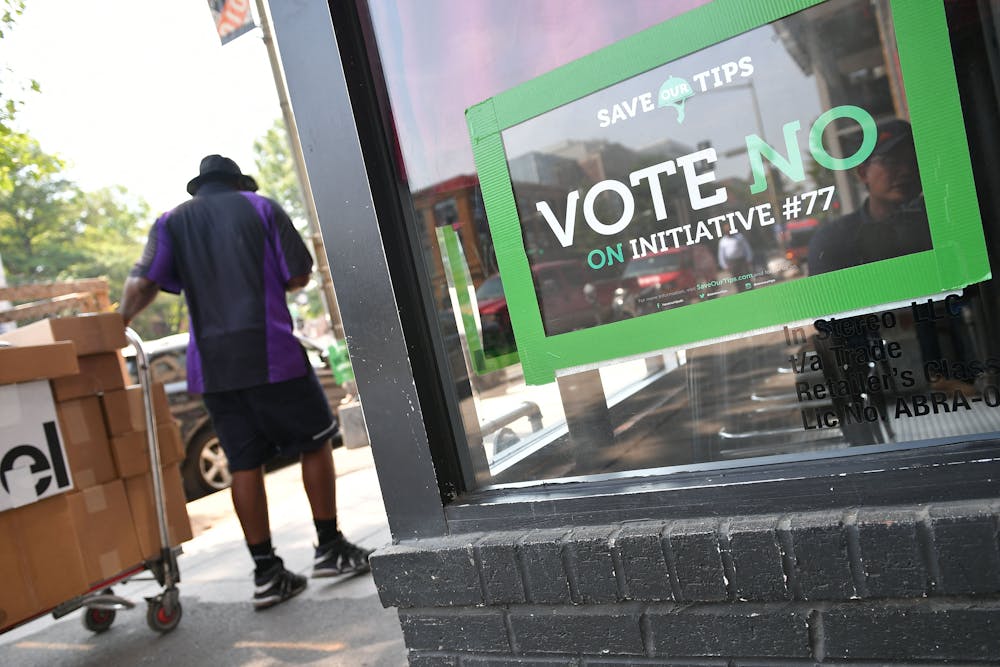
• In July 2018, Washington, D.C., voters approved an increase in the minimum wage for tipped workers. Three months later, the City Council repealed the initiative.

• In 2016, voters in South Dakota supported an initiative to revise campaign finance and lobbying laws and create an ethics commission. Governor Dennis Daugaard signed a law repealing the initiative in February 2017. Another citizen initiative to create an ethics commission was on the ballot in 2018, but did not pass.

Revise and amend

Often lawmakers rewrite laws passed through initiative. Some revisions change key components of the initiatives, while others amend technical details.

Ohioans voted in favor of legalizing marijuana in November 2023. In that initiative, part of the tax revenue from marijuana sales would go to a financial assistance program for those who show “social and economic disadvantage.” The Ohio Senate passed a bill the following month that would instead use the tax revenue to fund jails and law enforcement.

• Massachusetts voters passed recreational marijuana legalization in 2016. In 2017, the Legislature passed a bill to increase the excise tax on marijuana from the 3.75% set in the citizens’ initiative to 10.75%.

• In 2018, Utah voters made adults with income up to 138% of the federal poverty level eligible for Medicaid – a federal-state health insurance program for low-income individuals and those with disabilities. The state Legislature applied to the federal government for waivers to lower the income limit to 100% of the federal poverty level, which curtailed the expansion voters approved.

• Arizona voters approved a tax increase on the wealthy to fund the state’s schools in 2020. In 2021, the Legislature responded by exempting business earnings from the tax. There was an attempt by citizen initiative later that year to repeal the legislature’s law exempting business earnings, but it did not gather enough signatures from citizens to make it to the ballot.

A green-bordered sign on a window that says 'VOTE NO on Initiative #77.'

Initiative #77 was a 2018 ballot measure to gradually raise the minimum wage that tipped workers receive; passed by Washington, D.C. voters, the City Council repealed it. Mandel Ngan/AFP via Getty Images

Governors object

In some cases, it is not the legislature that opposes the will of the voters, but the governor. In recent years, several Republican governors have refused to implement Medicaid expansions passed by voter initiatives.

• Maine’s former governor, Paul LePage, said he would go to jail before he would implement Medicaid expansion after it passed by voter initiative in 2017. Medicaid was not expanded until Democrat Janet Mills took office in 2019.

Missouri Governor Mike Parson said he would not move forward with the 2020 voter-passed Medicaid expansion because it would not pay for itself. In 2021, the Missouri Supreme Court ruled the initiative valid and Medicaid expansion moved forward.

Why they do it

Lawmakers who rewrite or overturn ballot initiatives sometimes argue that voters do not understand what they are supporting. Lawmakers, unlike citizens, have to balance state budgets every year, and they often raise questions about how to pay for the policies or programs passed by initiative.

Lawmakers also argue that outside groups play an outsized role in passing ballot initiatives. While political science research provides some support for this claim, outside groups also have influence in the regular legislative process. And they often work to defeat initiatives as well.

Citizen initiatives became popular during the Progressive Era of the early 20th century as a way to give power back to citizens. Then, as now, citizens felt political power was too concentrated in the hands of the wealthy. Initiatives were one way for everyday people to get more involved in their government.

That only half of states permit citizen initiatives suggests that political elites are not always supportive of a process that limits their own power. Historically, though, legislators have respected the results. Some lawmakers, including Ohio Governor Mike DeWine, state they will continue to “accept” the will of the people. To do otherwise undermines democracy.


Anne Whitesell, Assistant Professor, Political Science, Miami University

This article is republished from The Conversation under a Creative Commons license. Read the original article.

From Brooke Shields to FKA Twigs: A timeline of Calvin Klein’s most controversial ads

Calvin Klein — the American fashion house best known for its underwear and denim lines — has garnered notoriety for its sexy ad campaigns. Television networks have prohibited the brand's suggestive commercials from being broadcasted nationwide. Conservative groups have launched boycotts against the company. And advertising regulators have issued bans on ads considered to be incredibly vulgar.

Most recently, a 2023 Calvin Klein ad featuring FKA Twigs was banned in the U.K. following complaints that an image of the singer-songwriter and dancer went way too far. The outcry has called attention to the apparent double standards — FKA Twigs’ ban comes amid ongoing praise for Jeremy Allen White’s Calvin Klein underwear campaign. In fact, Allen White’s ad has caused such a frenzy that it was brought up during a backstage interview at this year’s Golden Globes ceremony.

Calvin Klein is no stranger to controversy or scorn. Let's look back at the brand’s most controversial ads:

01
1980: Brooke Shields

The infamous Calvin Klein Jeans ad campaign features a then 15-year-old Brooke Shields wearing a pair of slim-fit jeans and a brown button-down shirt exposing her midriff. Alongside her photo is the tagline, “You want to know what comes between me and my Calvins? Nothing" — insinuating that the underage Shields was not wearing underwear. Commercials of the campaign were banned from being shown on CBS and ABC in the U.S.


Shields revealed in the 2023 ABC News documentary "Pretty Baby: Brooke Shields" that at the time, she didn’t understand the innuendo implied in the tagline: "There was nothing in me that ever had the idea that it was sexual," she said.


She expressed similar sentiments while speaking to Dax Shepard in an episode of his podcast “Armchair Expert," saying, "I didn't think it had to do with underwear, I didn't think it was sexual in nature. I would say it about my sister, 'Nobody can come between me and my sister.'"

02
1992: Kate Moss and Mark Wahlberg

Moss was only 17 when she was asked to pose topless alongside the then 21-year-old Wahlberg. Although the campaign kicked off Moss’ modeling career — and made her a household name within the industry — Moss said years later that she has “not very good memories” about the shoot.


In a 2022 episode of BBC Radio 4’s “Desert Island Discs,” Moss said she felt “vulnerable,” “scared,” and “objectified” when she was asked to pose salaciously alongside Wahlberg.


“I was quite young and innocent; Calvin loved that,” she said, adding, “I really didn’t feel well at all before the shoot. For like a week or two, I couldn’t get out of bed, and I had severe anxiety, and the doctor gave me Valium.”


Wahlberg also addressed the campaign during a 2020 interview with The Guardian. “I never really had a problem with Kate, did I?,” Wahlberg said when asked if he ever made up with Moss.


“I think I was probably a little rough around the edges. Kind of doing my thing. I wasn’t very . . . worldly, let’s say that,” he continued. “But I’ve seen her and said hello. I think we saw each other at a concert here and there, we said hi and exchanged pleasantries.”

03
1993: Kate Moss

The following year, Moss posed nude in commercials for the brand’s “Obsession,” the fragrance “that traffics in the singular feeling of infatuation,” as Elle Magazine described it. To help capture the sensual themes in the ads, Klein refrained from shooting in a studio and instead, sent an 18-year-old Moss and her then boyfriend, 20-year-old photographer Mario Sorrenti, to the British Virgin Islands for 10 days to photograph the campaign.


Many critics bashed the campaign for its glorification of the “Heroin Chic” aesthetic, which glamorizes traits associated with drug abuse, like pale skin, dark eye circles, thin figures and emaciated features.

04
1995: Child welfare concerns and Bill Clinton’s outrage

Regarded as the most controversial campaign in Calvin Klein’s history, the 1995 commercials (shot by Steven Meisel) features several young, scantily clad models – perceived as possibly underage teenagers – posing in a small, wood-paneled room. The commercials’ lewd innuendos along with the male interviewer’s suggestive tone drew many comparisons to porn audition videos.


The campaign also garnered widespread backlash from child welfare authorities, leaders of the Catholic league and the conservative American Family Association, who collectively threatened a nationwide boycott of the brand. Bill Clinton publicly condemned the Calvin Klein campaign, calling the ads “outrageous” and manipulative to children.


“I may be stepping on somebody's toes tonight. I don't have any comment on whether those Calvin Klein ads were legal or illegal,” he said. “But those children were my daughter's age in those ads, and they were outrageous. It was wrong. It was wrong to manipulate those children and use them for commercial benefit. It's hard enough to grow up as it is without confusing people further.”


The Justice Department launched an investigation into the ads, but later closed it after Calvin Klein proved that all the models were adults. Although the brand asserted that the ads were “misunderstood by some,” it eventually agreed to cease the campaign.

05
1999: Children’s underwear campaign yanked

Calvin Klein also pulled its 1999 campaign for children's underwear after Donald Wildmon, the then-president of the American Family Association, said the ads were “nothing more than pornography.” 


“Whether you like it or not you have pedophiles in this society. Anything that could get them excited is detrimental, irresponsible and reckless,” he said.


A black and white photograph of the promotion shows two boys wearing briefs. The photograph was published in full-page newspaper ads before Calvin Klein announced that it would pull all print ads and billboards associated with the campaign.


The company stood by its campaign, saying it was “intended to show children smiling, laughing and just being themselves.”

06
2008: Eva Mendes

National television networks refused to broadcast Calvin Klein and Coty’s commercial for their new fragrance Secret Obsession because it starred a naked Eva Mendes. In the unedited commercial, Mendes is seen rolling around naked in the sheets and, in one moment, exposing her nipples.


The ad’s creative director Fabien Baron blamed much of the outcry on George W. Bush, who was president at the time. “You must be kidding me. This country really needs a new President — this country is so messed up,” Baron told WWD.” He added that if kids could watch people get killed, then they could certainly handle seeing Mendes nude.

07
2009: The orgy and foursome ads

In January, Calvin Klein launched a racy ad featuring six models, many of them wearing nothing but a pair of jeans, fondling each other on a sofa and moving in ways that could be construed as having sex. Although the ads were banned from television, they were available to watch on YouTube, where they quickly amassed views and much attention.


The brand also came under fire in June for a provocative billboard that was spotted in New York City's Soho neighborhood. The towering 50-foot ad depicted a four-way sex scene, which Calvin Klein defended as “a very sexy campaign that speaks to our targeted demographic.”


“Not only the billboard, but a company — a corporate giant in America — feels it appropriate to put a semi-nude photograph in a major billboard in a high-traffic area where tens of thousands of children see this kind of activity going on,” Randy Sharp, director of special projects for the American Family Association, told ABC News at the time.

08
2010: Lara Stone

The Calvin Klein Jeans campaign that features Lara Stone surrounded by several men was taken down by the Advertising Standards Bureau in Australia after many suggested that the ad connotes gang rape. 


“The Board considered that whilst the act depicted could be consensual, the overall impact and most likely takeout is that the scene is suggestive of violence and rape,” the bureau said.


“The Board considered that the image was demeaning to women by suggesting that she is a plaything of these men. It also demeans men by implying sexualized violence against women.”

09
2023: FKA Twigs

A 2023 Calvin Klein ad with FKA Twigs was banned in the U.K. after people complained that an image of FKA Twigs draped in a denim button-down was offensive and inappropriate.


“The ad used nudity and centered on FKA Twigs’s physical features rather than the clothing, to the extent that it presented her as a stereotypical sexual object,” a statement from the the Advertising Standards Authority (ASA) read. Similar complaints were also made about Kendall Jenner’s 2023 Calvin Klein campaign, in which she appears topless, but a ban was never issued.


FKA Twigs defended her campaign, writing on Instagram, “I do not see the ‘stereotypical sexual object’ that they have labeled me. I see a beautiful strong woman of color whose incredible body has overcome more pain than you can imagine.”


“[I]n light of reviewing other campaigns past and current of this nature, [I] can’t help but feel there are some double standards here,” she continued. FKA Twigs’ Calvin Klein ad ban was announced amid ongoing praise for Jeremy Allen White’s steamy Calvin Klein ad.

“Overwhelming and devastating”: South Africa lays out genocide case against Israel at ICJ

Human rights defenders and legal experts on Thursday lauded what many called South Africa's "compelling" opening presentation at the International Court of Justice in The Hague in a case accusing Israel of genocide against Palestinians in the embattled Gaza Strip.

In a bid to obtain an ICJ emergency order for the suspension of Israel's relentless 97-day assault on Gaza, South African jurists including Justice Minister Ronald Lamola argued that Israel is violating four articles of the Convention on the Prevention and Punishment of the Crime of Genocide, commonly called the Genocide Convention. The landmark 1948 treaty—enacted, ironically, the same year as the modern state of Israel was born, largely through the ethnic cleansing of Palestine's Arabs—defines genocide as acts intended "to destroy, in whole or in part, a national, ethnical, racial, or religious group."

South African lawyers detailed Israel's conduct in the war, including the killing and wounding of more than 80,000 Palestinians, mostly women and children, forcibly displacing over 85% of the besieged enclave's 2.3 million people, and inflicting conditions leading to widespread starvation and disease. They also cited at length statements by Israeli officials calling for the destruction and even nuclear annihilation of Gaza in their presentations, which eschewed graphic imagery in favor of arguing "clear legal rights."

"In its opening argument thus far, South Africa has made a compelling case showing how the genocidal statements by [Israeli Prime Minister Benjamin] Netanyahu and other senior officials were interpreted as official orders by Israeli forces in their attacks against Gaza," U.S. investigative journalist Jeremy Scahill said on social media.

"Beyond the citations of the vast civilian deaths and injuries caused by Israel in Gaza, [South Africa's] lawyers argued effectively that Israel's 'evacuation' orders were in and of themselves genocidal, demanding the immediate flight of a million people, including patients in hospitals," Scahill continued.

"What becomes crystal clear listening to the openly genocidal words of Netanyahu and other Israeli officials is that they know exactly what they are saying," he added. "And they are comfortable saying these things publicly because they know the U.S. will shield them from accountability."

Left-wing author and activist and former South African parliamentarian Andrew Feinstein said that "South Africa's presentation to the ICJ thus far has been exceptional, overwhelming, and devastating," opining that "the only way the ICJ doesn't impose interim measures is if the judges are open to pressure from 'the West.'"

"South Africa's lawyers have done the nonracial, post-apartheid country proud," he added.

Legal scholar Nimer Sultany, a Palestinian citizen of Israel, called South Africa's presentation "compellingly argued and powerfully presented."

"Given the court's case law, and given the lower threshold required for issuing provisional measures, it will be very surprising if the court does not issue provisional measures against Israel," Sultany asserted.

"This also should prompt reflection amongst all those governments and media outlets who supported [Israel's war,] because they have been supporting a genocide," he added.

Sultany and numerous other observers said the most powerful presentation of the day was made by Irish lawyer and case adviser Blinne Ní Ghrálaigh, who delivered South Africa's closing statement.

Israel—some of whose officials have condemned South Africa's case as a meritless "blood libel"—is scheduled to present its defense on Friday. Israeli jurists are expected to focus heavily on the atrocities committed by Hamas-led attackers who killed more than 1,100 Israelis and took around 240 others hostage on October 7. They will likely argue that the country has a right to defend itself, and that it is seeking to eliminate Hamas, not the Palestinian people.

While an emergency order from the World Court would not be enforceable, it would represent a major international embarrassment for Israel, which is increasingly isolated on the world stage. A growing number of nations including Brazil, Pakistan, Turkey, Malaysia, Venezuela, Colombia, Saudi Arabia, Bolivia, Jordan, and Bangladesh are supporting South Africa's case, as are the Arab League, more than 1,250 international human rights and civil society group, and progressive U.S. Congresswomen Rashida Tlaib (D-Mich.) and Cori Bush (D-Mo.).

"Whatever the outcome, we are witnessing an amazing moment of rule of international law history," said Amnesty International secretary general Agnès Callamard.

Tina Fey’s savvy new “Mean Girls” is a musical surprise that makes a charming argument for itself

In the recent trend of movie musicals being afraid to tell people that they are, in fact, musicals, “Mean Girls” might be the one with the least to worry about. Genuinely exciting in some ways while understandably stilted in some others, the end result of reviving a beloved film for a new adaptation ends up being a far savvier move than you might expect. 

“Mean Girls” really finds its groove when it uses its predecessor as a suggestion rather than a template.

Though there are surprises to be found here in other ways, anyone familiar with the 2004 original “Mean Girls” will recognize the plot contours. After being homeschooled and living her formative years in Kenya, Cady Heron (Angourie Rice) has to navigate the treacherous social waters of North Shore High School. Helping her along the way are instant pals Janis 'Imi'ike (Auliʻi Cravalho) and Damian Hubbard (Jaquel Spivey). When Cady catches the eye of school royalty Regina George (Reneé Rapp, reprising her Broadway work) and her coterie of Plastics (Bebe Wood as Gretchen Wieners, and Avantika as Karen Shetty), a plan emerges to flip the high school pecking order from the inside out. 

Of course, all of this is delivered with the added flair from the recent stage musical, written once again by Tina Fey with songs by Nell Benjamin and Jeff Richmond. Credit directors Samantha Jayne and Arturo Perez Jr. for taking full advantage and actually wanting to make a movie musical. The sequences blanketing school hallways aren’t cut to ribbons. There’s a genuine fluidity with the camera that takes advantage of the spaces on and off campus. Some really playful scene transitions make for a fun merging of stage and screen DNA. And the lively, ensemble-heavy choreography is personality-driven without being precious.

“Mean Girls” really finds its groove when it uses its predecessor as a suggestion rather than a template. There are a handful of scenes that play out with similar details, but whether by different performance choices, or the addition of one of those musical numbers, this largely avoids being a paint-by-numbers retelling. Two of the cast members that really help that happen are Spivey and Avantika. Karen’s Halloween number is exactly what you want from a musical version of this story: taking tiny details and building on them, in this case spinning the “sexy mouse” costume of the original  into a peppy treatise on what the holiday allows. It’s a much better alternative to fashioning those little observations into a repetitive, three-minute musical aside (a trap that some of the numbers in this movie do fall into.) 

And then there’s Spivey, someone who buoys everything that is asked of Damian with confidence and charm. Like pretty much everyone else, he’s saddled with recreating some remnants of 2004, but the new contexts for some of his gossipy monologues and other storytelling duties give him a chance to really shine and make the role his own.

Mean GirlsJaquel Spivey plays Damian Hubbard, Angourie Rice plays Cady Heron and Auli'i Cravalho plays Janis ‘Imi’ike in "Mean Girls" (Jojo Whilden/Paramount Pictures)Maybe the shrewdest “Mean Girls” move here is to cut the original Cady voice-over. Here, Janis and Damian act as de facto narrators, checking in every once in a while to set up some new complication. But for the most part — either by cultural osmosis or by some savvy script changes —the backstory and internal monologue stuff isn’t as necessary this time around.

Given all of this new and genuine exciting energy, this “Mean Girls” does deflate whenever the obligatory nods to the original pop up. Some of these don’t even rise to the level of a callback and, many of the ported-over punchlines from North Shore High past feel like Bart apologetically “saying the line” to a classroom filled with eager, waiting students. It’s doubly disappointing when multiple of the most-quoted bits have more-than-capable alts that pop up in other parts of the movie. 

Aside from the jokes that land flat when delivered the exact same way, the other big challenge facing this new “Mean Girls” is pacing. One of the enduring assets of the 2004 version is that it’s barely an hour and a half, delivered with a freight train momentum by usual high school comedy standards. Being a musical, this latest “Mean Girls” sometimes gets halted in its tracks just when it’s finding a groove. Janis and Damian’s revenge number or the aforementioned costume party celebration are brimming with the kind of energy that the one-location ballads often lack. 

For all the self-imposed hurdles this project puts in its path, it’s surprising how many of them “Mean Girls” clears. Having Fey and Tim Meadows revisit their roles as North Shore staff members is a move that, in an alternate execution, could be drenched in cynicism and apathy. Yet, each seasoned pro finds something new to bring to this that isn’t just a verbatim rehashing of the same part they played two decades ago. Some of that comes from some reworked punchlines and line deliveries, but both seem to understand where the shifting energy of the movie is this time around.

Mean GirlsTina Fey plays Ms. Norbury in "Mean Girls" (Jojo Whilden/Paramount Pictures)That recognition is also true with the other adult characters here. Jenna Fischer is a welcome addition as Ms. Heron, as is Busy Philipps, who is taking a decidedly less cartoonish tack to being Regina‘s mom. 8

There are a handful of jokes in here that fit very neatly alongside some of [Tina Fey's] best work.

One of the successes of the original was crafting Regina George as a villain, sinister in her own way, but not at the expense of the playfulness underneath. It’s not that Rapp falls short here as Regina, but this conception of the character shows what maybe gets lost in transition from film to stage to film again. With Regina, this “Mean Girls” does so much extra work tossing in a few extra songs to set her up as a vicious force. Where its predecessor built up this character in a few fourth-wall breaks and a slow drip of intimidating details, having to halt the movie’s momentum to make a flashier case for why Cady should be wary doesn’t really work to anyone’s advantage. To some extent that process (combined with the shift in narrator) also leaves Rice drifting in the breeze a little bit, especially compared with the built-in meta narrative advantages that Lindsay Lohan had in her stint as Cady. Here, the slow transformation from undercover Plastic to the real thing is less a character arc and more “just a thing that happens in ‘Mean Girls.’” 

But a new “Mean Girls” can withstand all that when it has an overall approach that rejects the feeling of a made-for-streaming nostalgia cash-in. Being a high school story set in 2024, adapting burn book culture for the social media age is a little inevitable. The aforementioned Karen Halloween number does a pretty admirable job at translating a TikTok aesthetic to a movie context in a non-annoying way. Even if the movie goes back to the “montage of posts” well one too many times, it’s still handled in a better way than most fake viral moments of its kind.


Want a daily wrap-up of all the news and commentary Salon has to offer? Subscribe to our morning newsletter, Crash Course.


And this is something that still has plenty of Fey’s fingerprints on it. Wouldn’t dream of ruining the surprises, but there are a handful of jokes in here that fit very neatly alongside some of her best work. This is a script that seems to understand and reflect other broader changes since the last iteration, with additions by subtraction that excise some of the cheaper low-hanging fruit. 

Even with those new touches as an asset, this “Mean Girls” is something that doesn’t have to be reliant on them. Maybe the world didn’t need a two-decades-later recontextualizing of this story. Now that it’s here, though, it’s one that doesn’t wear out its welcome.

"Mean Girls" is in theaters Friday, Jan. 12.

Julia Roberts talks not doing nude scenes throughout her “G-Rated” career

During a recent interview for Vogue conducted by "Notting Hill" director Richard Curtis, Julia Roberts discussed her role in Hollywood. “Do you ever think, ‘I’m representing something?'” Curtis asked Roberts, who is primarily known for playing the lead in a number of '90s rom-coms, including "Notting Hill" and "Pretty Woman."

“I think it would be more to the point that the things I choose not to do are representative of me,” Roberts replied, citing her largely “my G-rated career." She added, “Not to be criticizing others’ choices, but for me to not take off my clothes in a movie or be vulnerable in physical ways is a choice that I guess I make for myself. But in effect, I’m choosing not to do something as opposed to choosing to do something.”

While Roberts has starred in some films that contain moments of sexuality, the choice to never go nude for a role was intentional. She noted that the modern film industry is "completely different" from what it was during her own heyday. “That’s when I really feel like a dinosaur, when you just look at the structure of the business. It’s completely different," she said. "There are so many elements to being famous now, it just seems exhausting . . .  It kind of just made this sort of structural sense, and now it just seems more chaotic. There’s more elements, there’s more noise, there’s more outlets, there’s more stuff.”

“Unacceptable violation of the Constitution”: Democrats slam Biden over “illegal” Yemen air strikes

Progressive Democrats in Congress excoriated President Joe Biden Thursday for failing to seek congressional authorization before launching airstrikes on the Iran-backed Houthis in Yemen.

The retaliatory attacks, according to Politico, mark the "first major U.S. military response to the group’s ongoing attacks on commercial ships since the start of the Israel-Hamas war."

"These strikes are in direct response to unprecedented Houthi attacks against international maritime vessels in the Red Sea — including the use of anti-ship ballistic missiles for the first time in history," Biden said in a statement. "More than 50 nations have been affected in 27 attacks on international commercial shipping."

The Biden administration also defended the strikes, carried out with the United Kingdom and backed by the Netherlands, Bahrain, Australia and Canada, declaring that they were launched “in accordance with the inherent right of individual and collective self-defense, consistent with the UN Charter.”

Legislators, however, challenged that justification, arguing that Biden violated Article 1 of the Constitution — which requires Congress to first authorize military action — by side-stepping Congressional approval. Biden informed Congress of the move but did not request approval.

Progressive Reps. Rashida Tlaib, D-Mich, and Cori Bush, D-Mo., called Biden's actions unconstitutional and asserted Americans no longer wish to see — or fund, according to Bush, "endless war." 

Rep. Pramila Jayapal, the Progressive Caucus chair, also decried the move, writing on X, formerly Twitter, that Biden's act "is an unacceptable violation of the Constitution."

"These airstrikes have NOT been authorized by Congress. The Constitution is clear: Congress has the sole authority to authorize military involvement in overseas conflicts," Rep. Val Hoyle, D-Ore., added. "Every president must first come to Congress and ask for military authorization, regardless of party."

Rep. Ro Khanna, D-Calif., echoed arguments that the president's move was unconstitutional, stating that Biden "needs to come to Congress before launching a strike against the Houthis in Yemen and involving us in another middle east conflict."

"I will stand up for that regardless of whether a Democrat or Republican is in the White House,” Khanna tweeted.

We need your help to stay independent

Khanna's post earned a retweet from Rep. Ilhan Omar, D-Minn., and approving responses from Sens. Mike Lee, R-Utah, and Thomas Massie, R-Ky.

Democratic Rep. Mark Pocan, Wis. further demanded the Biden administration collaborate with Congress before carrying out any other strikes, arguing the "United States cannot risk getting entangled into another decades-long conflict without Congressional authorization.”

Some Republicans praised Biden for launching the airstrikes, though many also argued that the action was "overdue."

"This strike was two months overdue, but it is a good first step toward restoring deterrence in the Red Sea. I appreciate that the administration took the advice of our regional commanders and targeted critical nodes within Houthi-controlled Yemeni territory,” Sen. Roger Wicker, R-Miss., the ranking member of the Senate Armed Services Committee, said in a statement.

The joint bombings were "long overdue," according to Sen. Joni Ernst, R-Iowa, who added that “Iran-backed Houthis should never have been emboldened to wreak havoc on U.S. troops and global commerce.”


Want a daily wrap-up of all the news and commentary Salon has to offer? Subscribe to our morning newsletter, Crash Course.


“Terrorists know only the language of force and it is about time the administration acted on that fact. This action should have been taken weeks ago,” Sen. Rick Scott, R-Fla., tweeted, adding, "Biden must now act every day to end the ability of Houthi forces and all Iran-back terrorists to attack the US and our partners."

Sen. Lindsey Graham, R-S.C., said he was "very supportive" of Biden's decision to launch the attack, writing that he hopes "the Biden Administration understands that their deterrence policy has completely failed" and urging it to "continue using military force in the face of aggression from Iran and their proxies."

“I am hopeful these operations mark an enduring shift in the Biden Administration’s approach to Iran and its proxies," Senate Minority Leader Mitch McConnel, R-Ky., said in a statement. "To restore deterrence and change Iran’s calculus, Iranian leaders themselves must believe that they will pay a meaningful price unless they abandon their worldwide campaign of terror."

Former Trump attorney throws shade at Trump lawyer Alina Habba: Nobody “at the wheel”

Former Trump attorney Tim Parlatore criticized the former president’s legal team after a disastrous round of closing arguments capped off by Trump’s rant attacking the judge. Parlatore said that Trump’s team has been “kind of un-led for a while” when asked who is controlling the case.

“With Alina Habba handling discovery, that’s not something where I think anybody’s really at the wheel. And so now you get into this trial where it does seem to me to be kind of a combination of building a record for the appeal and putting out things into the media that are helpful to the campaign,” Parlatore said, adding that fellow Trump attorney Chris Kise is “not a trial lawyer” and is “probably just to prep this case for an appeal.” The Trump team’s strategy appears to be to try to “convince this trial judge to get so mad that he makes bigger mistakes for the appeal.”

Habba, who previously served as the general counsel for a parking garage company, previously came under criticism from several Trump allies. "He has some lawyers that are very sophisticated with years of experience litigating, and he has now fallen prey to inexperienced lawyers who are just telling him what he wants to hear," a source close to Trump told Axios last year. "It's disconcerting to everyone around him who actually care about him.”

Trump melts down on Truth Social after “the judge cut me off in court”

Former President Donald Trump fumed on Truth Social after the judge overseeing his New York fraud trial shut down his courtroom rant. Trump launched into a lengthy tirade in court on Thursday, attacking Judge Arthur Engoron and New York Attorney General Letitia James. Engoron allowed Trump to rant for several minutes before finally cutting him off. “Control your client,” he pleaded with Trump’s attorney.

“The Judge cut me off in Court and would not let me explain that I was worth much more than the 4 plus $Billion (years ago) I show in the Financial Statements, which are conservatively done,” Trump complained on Truth Social after the hearing. “Judge Engoron, curiously, cut Mar-a-Lago’s VALUE by a Billion Dollars, all the way down to $18,000,000 (and other assets as well!) to try and save the A.G.’s case. What is going on here? WITCH HUNT! ELECTION INTERFERENCE!”

Trump continued his complaints on Friday morning. “Why didn’t Judge Engoron announce his decision yesterday after we proved conclusively that I DID NOTHING WRONG!!!” the former president wrote, repeating his argument that he didn’t commit fraud because there are no “victims.” Engoron ruled before the trial began that Trump, his company and top executives are liable for persistent fraud. He is expected to issue his decision on the remaining issues in James’ lawsuit by Jan. 31.

“He’s failing on the job”: Marjorie Taylor Greene is leading a MAGA rebellion against Mike Johnson

Here we go again. The House Republicans are running around in circles, unable to agree among themselves about what they were sent to Washington to do and we are once again on the cusp of a government shutdown. No matter who's in charge or what the circumstances are, they just can't get anything done. And for some reason, they believe this is a winning election year strategy.

The week started on a hopeful note. I was pleasantly surprised to see that Speaker Mike Johnson and House Majority Leader Chuck Schumer had agreed on a top-line budget number. This seemed to signal that Johnson and his team were serious negotiators who might be able to avoid a government shutdown. Of course, the framework was already in place from the deal struck last spring between then-Speaker Kevin McCarthy and President Joe Biden to raise the debt ceiling. But it still spoke well of McCarthy's successor that he could be practical enough to recognize that he was going to have to negotiate.

The MAGA extremists are talking about ousting Johnson as they did McCarthy.

The MAGA crazies on the far right had rejected that bipartisan deal at the time and it was passed with Democratic votes, eventually bringing about McCarthy's ouster in October when he once again was forced to rely on Democratic votes to pass a temporary funding extension to keep the government open. Johnson had a little honeymoon that allowed him to pass another short-term spending bill without being defenestrated by the crazy caucus. Buyt unfortunately for him and the country, that honeymoon is over.

After announcing the top-line spending deal that would have set the levels until September 30th, everyone understood that it was still going to take a lot of work to agree on the details and that would require yet another short-term extension. Yet the MAGA hardliners in Congress are a hard no on all of it.

Johnson is a hardliner himself so you would think he'd know how this was going to go over. He seems to think that by "listening" and having "thoughtful conversations" he would have enough credibility with the Freedom Caucus that they would go along. He thought he could tell them "I think it’s the best possible deal that conservatives and Republicans could get under these circumstances" and that would be that. Is he living in a dream world?

He must know that they truly believe that if they shut down the government the Democrats will throw up their hands in surrender and give them everything they want. And if they don't, the Democrats will all be defeated in November because the government will have been shut down for 10 months, the economy will be in ruins and they will be blamed. In Republicans' addled minds, it's a win-win either way.

Needless to say, that is irrational nihilism but that's who they are. According to the Washington Post, conservatives in the House want Johnson to renege on the funding agreement and go back to the Senate with their new top line number, destroying any credibility he has with the Senate and the White House. The Freedom Caucus must also be given a say in how any funding is allocated, which is the Appropriations Committee's job or there must be a 1% cut across the board. Oh, and they also demand new draconian immigration restrictions before they will agree to any short-term spending bill.

After a meeting on Thursday morning between Johnson and the rebels, the members emerged saying that Johnson was with them. Johnson disagreed, telling reporters, he's made "no commitments" — and that "if you hear otherwise, it's just simply not true." Nobody really knows what Johnson is doing. It's a mess:

We need your help to stay independent

The MAGA extremists are talking about ousting him as they did McCarthy.

Don't tell anyone but with their tiny majority, there's a good chance that if they do this we'll be looking at a Speaker Hakim Jeffries, D- NY. Somebody may just crack.

In case you're wondering why these zealots think this is such a good idea and that it's going to work for them, look no further than the "intellectual leader" of the MAGA cult, Steve Bannon. Media Matters reported that he has begun an effort to oust Johnson after having successfully led the effort to depose Kevin McCarthy in October. They report that "although Bannon and his guests have been criticizing Johnson since November — just weeks into the new speaker’s tenure — the attacks have escalated in recent days."

On Thursday, Bannon interviewed Russell Vought, one of the new MAGA gurus who is working on all those dystopian plans for Trump's second term at the MAGA "think tank" Center for Renewing America, who told him “I am one of the biggest critics of Mike Johnson right now. He is bowing to the fear of a government shutdown within his own ranks. I think he should stand up to that fear like, Congresswoman Greene would have him do, but he's not.”

Vought is said to be very influential in Trump's inner circle which may explain why Johnson told Hugh Hewitt he was planning to talk to Trump about this situation but Trump has been a little busy. If Johnson's counting on Trump's support he should probably have a chat with his predecessor who did everything in his power to curry favor with the Dear Leader and it did him no good at all when push came to shove. Trump has always been for a government shutdown.


Want a daily wrap-up of all the news and commentary Salon has to offer? Subscribe to our morning newsletter, Crash Course.


Perhaps the most ominous part of Vought's comment is the fact that he extolled the virtues of Marjorie Taylor Greene, who is asserting her power as a MAGA leader. Media Matters reports that she also appeared with Bannon on Thursday and said,

If I was speaker of the House, I’d finish the job in the House. I’d pass the appropriation bills, and then I’d tell Chuck Schumer in the Senate, ‘It’s your job now, buddy. You do your work and then we’ll talk.’ But right now, Mike Johnson is getting rolled in meeting after meeting after meeting.

When he is talking to Jake Sullivan and Chuck Schumer every day and impressed with these four corners meetings, but he's not talking to me and other important members in our Republican conference at all about any of the negotiations and any of the plans and exactly what we want to see done, he's failing on the job."

She certainly sounds like someone who thinks she's the right woman for the job, doesn't she? I suspect that there are more than a few Republican House members who would happily vote for Hakim Jeffries over Greene. But you never know. The House Republicans have been infected with MAGA fever and there doesn't seem to be a cure.

Time will tell if Mike Johnson can corral these rebels, keep the government open and hold his seat. But the pressure from the MAGA base, incited by Steve Bannon and others, to blow up the system is going to be relentless. They've tasted the power that comes from deposing a leader and they want more. The only thing that will stop them is the loss of their majority. If there is any justice in this world, that will happen next November. Until then, it's going to be a very turbulent time in the U.S. House of Representatives.

“What Trump said was so damaging to him”: Experts say NY AG “struck gold” with Trump court rant

Former President Donald Trump’s Thursday courtroom tirade could backfire, legal experts warn.

Trump attorney Chris Kise asked Judge Arthur Engoron, who is overseeing Trump’s New York fraud trial, to allow Trump to speak on his own behalf during closing arguments. Engoron asked Trump if he would agree to stick to the facts and relevant law but the former president launched into a lengthy diatribe, accusing the judge and New York Attorney General Letitia James of waging a “political witch hunt” and demanding “damages” because the real “fraud is on me.”

During one portion of his rant, Trump referred to a key allegation in James’ lawsuit alleging that the former president’s Trump Tower penthouse was valued at three times larger than it actually is.

"They made a mistake. It was an honest mistake," Trump said.

James’ team allowed Trump to speak until the judge ultimately shut him down and pleaded for Kise to “control your client.”

“There may be a reason that James' staff didn't interrupt,” wrote NBC News legal analyst Lisa Rubin. “The AG’s office may have struck gold because some of what Trump said was so damaging to him, especially his explanation of the triplex square footage ‘error.’”

Former New York prosecutor Charles Coleman Jr. agreed that Trump “hurt himself” with the outburst.

"I think that what he was trying to do was force the judge into a position where, by denying him an opportunity to speak, he would have created an issue for appeal for himself,” he told MSNBC on Friday.

"Judge Engoron basically gave him the rope, and he hung himself, predictably," he continued. "What he ended up doing was creating a space where this is one less thing that becomes an appealable issue in the long run for an appeal. That he might be able to go back and say, 'Look, I was treated unfairly and my rights were abridged in some way, shape, form or fashion.'"

Coleman said Engoron took a “calculated risk” by allowing Trump to ramble.

“He understood that there was a risk that this could happen, but, ultimately, it didn't play a factor in the way Donald Trump wanted it to," he said.

We need your help to stay independent

Coleman also questioned Trump’s legal team for allowing their client to behave that way in court.

"Even if you had a client who wanted to testify, and you thought that was a bad idea, and you still allowed that client to exercise their right to testify during your closing argument, you are absolutely not allowing your client to leave that judge or that jury with the final impression of what it is that your case represents," Coleman told MSNBC. "Particularly if you know or have any inkling that that client is going to get on the stand and get in the well and gesticulate and berate the court officers and berate the judge and the entire justice system that is responsible for conducting this hearing, that you are an officiant of, as a lawyer, you're not going to do that."


Want a daily wrap-up of all the news and commentary Salon has to offer? Subscribe to our morning newsletter, Crash Course.


Former federal prosecutor Kristy Greenberg, who was in the courtroom, told CNN she was stunned to “see somebody have so much disrespect” for the judge and the court.

"The attacks on — the personal attacks on the judge — this is a judge who had a bomb threat this morning. That's why the amount of security that was in the courthouse was unlike anything I have seen. and I have been other days when various Trump family members have testified, and this was heightened. They were very concerned about threats,” she said.

"I'm waiting for the judge to tell him 'You're done and if you continue you'll be held in contempt!'” she added. "That's what happened to me and any other lawyers happening in courts and it was not done."

Engoron is expected to issue a ruling by Jan. 31.

The coronavirus could mutate to cause more severe disease, according to experts

The coronavirus subvariant JN.1 continues to retain its status as the most dominant strain in the United States this year.

According to CDC estimates, nearly 61 percent of COVID-19 cases are infections with the JN.1 strain. Over the course of one month, JN.1 went from being the third most prevalent strain in the U.S., after EG.5 and HV.1., to No. 1. Experts have previously said that JN.1 is largely contributing to this year’s surge of winter illnesses as COVID-19 hospitalizations and deaths are on the rise in some parts of the country.

But as previously reported, JN.1 didn't come out of nowhere. In August 2023, virus trackers first discovered its parent, BA.2.86, and noted that it was significantly different from Omicron. With nearly double the number of mutations on the spike protein than previous strains, experts warned BA.2.86 likely had a stronger ability to bind to cells, making it more infectious. It also had a mutation in the virus’s spike protein, which experts said increased the chances of immune evasion to the disease. Until recently, BA.2.86  and JN.1 were grouped together as experts referred to them as the so-called "Pirola clan.” In December, the World Health Organization announced that it was classifying JN.1 as a separate variant of interest. This week, two new studies reveal not so great news about what has been dubbed the Pirola clan, perhaps revealing more clues as to why JN.1 is behind a coronavirus surge this winter.

In the first study published in the journal Cell, researchers found that BA.2.86, the parent of JN.1, can infect lung cells more efficiently. Specifically, the researchers found that it can infect lung cells more easily with the help of a cellular enzyme called TMPRSS2, suggesting that two mutations in the spike protein are responsible for making it easier for the virus to enter the lung cells. Researchers said this is significant because previously circulating Omicron sub-variants did not have this mutation, hence contributing to it being a "more mild" form of COVID-19. But the variants Alpha, Beta, Gamma and Delta, which circulated during the first years of the pandemic, did have mutations that made it easier for the virus to enter into lung cells.

“It is noteworthy that two years after the global dominance of the Omicron variant, which fails to robustly enter lung cells, now a quite different virus is spreading,”  said Stefan Pöhlmann, co-author of the study and head of the Infection Biology Unity of the German Primate Center, said in a media release. “And that this virus is able to again enter lung cells with high efficiency.”

The good news is that once the lung cells were infected, according to the study, they weren’t able to replicate as effectively as the pre-Omicron variants. 

“No matter how virulent a variant is, it won’t cause much damage overall if it can’t successfully infect new hosts.”

A second study published in Cell this week by researchers at Ohio State University also found that BA.2.86 can merge with cells more efficiently and that they can easily infect cells in the lower lung. Both studies show that instead of the virus evolving to be more “mild” it could be evolving in a more disconcerting direction. What does this all mean for JN.1, which is dominating U.S. infections?

Technically, the jury is still out regarding whether or not JN.1. leads to more severe disease or not. These studies focused on BA.2.86. But as Ryan Gregory, an evolutionary and genome biologist at the University of Guelph in Canada, told Salon there are very few genetic differences between JN.1 and BA.2.86.

“It seems likely that the same lung infecting properties are found in JN.1, along with the significantly increased ability to infect new hosts versus BA.2.86,” he told Salon via email, adding that there is good news in terms of how it weakly replicates. “No matter how virulent a variant is, it won’t cause much damage overall if it can’t successfully infect new hosts.”

As the first study noted, BA.2.86 has not been especially successful in that regard. Gregory said it’s concerning to see variants succeeding in terms of immune escape, transmissibility and its ability to infect the lungs. At the same time, he noted, the level of immunity in the world’s population is much higher compared to pre-pandemic times. Just because JN.1 could be better at infecting lungs, and maybe even better at infecting more hosts, that doesn’t necessarily mean JN.1 will “cause a huge wave of severe respiratory infections,” he said.

“It will add to pressure on healthcare systems, though, and of course there is the ever-present issue of long COVID,” he said, adding that future generations of JN.1 could pick up “additional mutations” that make it even more concerning. Indeed, this appears to be the crux of the concern. 

Dr. Rajendram Rajnarayanan, of the New York Institute of Technology campus in Jonesboro, Arkansas, told Salon he is also concerned about what this means for future generations of the coronavirus.

“Concerns arise with JN.1 and its sublineages, as new mutations could potentially push boundaries,” he said via email. “The lack of efficient lung tropism in previous Omicron lineages contributed to their mild presentation without immediate hospitalization requirements.”

The idea that viruses evolve to become benign . . . is a “myth” and was never guaranteed.

He added that he believes it’s urgent for the next round of vaccines to be utilizing “a JN.1 spike backbone” and anticipate further mutations as the variant continues to spread. 

In terms of how the coronavirus will evolve from here, Gregory emphasized that the idea that viruses evolve to become benign — like the coronavirus evolving into the “common cold” — is a “myth” and was never guaranteed. “That’s not how evolution works,” he said, adding that it’s important to recognize that the current situation is “unprecedented.” 

“We’ve had pandemics before, but never one with 8 billion potential hosts, massive global travel, a virus that can infect and reinfect year-round, and a population living to older age as we have now,” he said.

MAGA’s sexy beer calendar scandal cracks up the Christian right

In our era of wars, political violence, and climate catastrophe, Republicans have shown yet again that they have their priorities straight by freaking out over a sexy beer calendar.

Ultra Right Beer, which markets itself as an "anti-woke" brew for people worried Bud Light doesn't hate queer people enough, last month released a pin-up calendar of right-wing women. The calendar is relatively tame for what it is. It's nothing more than trying to prop up the sad fantasy of lonely MAGA men that hot women might one day date them. 

Some of the pin-ups are even wearing shirts. But the whole thing outraged many Republicans who, As Zack Beauchamp at Vox reports, complained that sticking your booty in a camera while flashing come-hither eyes runs counter to Christian values. "If conservatives aren’t morally grounded Christians, what are we even ‘conserving’?" complained former Donald Trump lawyer and confessed criminal Jenna Ellis. Speaking for this faction, Madeline Kearns at the National Review wrote that conservatives should stand for "a courtship culture, one that emphasizes male and female sexual complementarity, abstinence before marriage, fidelity within it, openness to the gift of children." (For those who don't speak Republican, "openness to children" is code for banning birth control.) 

By signing off on Trump as their new messiah, the Christian right signaled that this attitude is the new way of doing business for the GOP. 

Beauchamp portrays this as a fight between Christian conservatives and "Barstool conservatives," who he describes as dude-bros less interested in Jesus and more in hating "what they see as censorious political correctness." The truth is that it's even weirder than that.

In many circles, the dirtbag aesthetic of the Joe Rogan world has been combined with a lot of Jesus talk. Many people on the right who never darken a church doorstep now proclaim themselves "evangelical." It's become an identity marker more than a faith, a way to create a tribal identity for white conservatives that runs deeper than mere partisan preference. Even the Proud Boys, who were initially sold as a secular authoritarian group, are now mixing showy prayer with all the hard drinking. Indeed, many of the women who posed for the cheesecake photos espouse conservative Christianity. Like this woman

She recently told the audience at Cornerstone Chapel in Leesburg, Virginia that she views herself in a "spiritual battle" between "moral versus evil." 

Or this lady, who otherwise likes quoting Bible verses on Twitter

Separating the "evangelical" identity from actual Christian teachings may be politically popular — all those "thou shalt nots" suck! — but it understandably frustrates people who actually believe all that "blood of the Savior" stuff. This fight has been brewing for awhile. Right-wing social media is rife with personalities who claim to advocate for "traditional" Christian values, but whose feeds regularly serve up sexually provocative imagery. As I recently wrote, for instance, the whole world of "tradwives" online looks like a 50s-era Playboy magazine ad. 

The reason for this isn't hard to suss out: Sex sells. On social media especially, it can be hard to capture people's attention as they scroll rapidly through their feeds. The easiest and quickest way to grab their eyes and cause them to linger over a post? Boobs. Or a butt. Or a scantily clad woman making "f—k me" eyes. So conservative creators, even those who champion themselves as Christians, have come around to the tits-forward marketing strategy. 

The problem is that this runs directly counter to the "purity" messaging that the Christian right has been peddling forever. The contradictions are especially galling after the Supreme Court overruled Roe v. Wade. It's already difficult for Republicans to pretend they don't hate women when they are punishing women — even with death — for having sex. It becomes impossible in the face of this endless stream of softcore porn being served to men from MAGA influencers. 

Frustration over this has been building within the Christian right for a while now. Even before the sexy calendar fight, a growing chorus vented frustration at female MAGA influencers who unsubtly use sex to bolster their following. Last fall, for instance, there was an intra-right social media war over this video by a woman who has figured out how to get hundreds of thousands of followers for her far-right propaganda.

We need your help to stay independent

For the men consuming this content, I suspect they don't feel much cognitive dissonance between "sex is good when straight men have it" but "women who have sex have no rights." The two views are entirely consistent if you believe in male supremacy. Read enough "men's rights" material and it swiftly becomes evident that they see sex as men's right and women's burden — and childbirth and marriage as ways to trap women into servitude to men. 

The Republicans pushing back against this, of course, understand that while "orgasms for me, forced childbirth for thee" is a pleasing ideology for conservative men, it's a hard sell outside of their circles. Most Americans don't like to think of themselves as sexist or unfair. There's a reason that most Americans oppose the flood of abortion bans being passed in red states. It's hard to justify the belief that men get to have sex, but women who do should be punished. 

In the pre-Donald Trump era, the way Christian conservatives sold their views as just was to argue that their roles applied to both men and women. They claimed to believe that both sexes should wait until marriage. They argued that, in exchange for women's submission, a man was required to provide and protect. Patriarchy was propped up as an arrangement where both sexes had duties and made sacrifices. It was always a lie, of course. Men's sexual transgressions were always quietly forgiven while women were condemned. Men's "duties" were not enforced, while women's submission was policed heavily. But this concept of "complementarianism" seemed fair enough in the abstract to deflect criticism from feminists. 

Donald Trump, however, has blown all that up. He doesn't pretend to buy this "equal but different" view of gender. He brags about his own womanizing while shaming women who have sex. It mirrors his attitude towards Christianity. Trump waves a Bible around and demands to be treated as a Christian leader, but he barely bothers to hide that he's never read the Bible, doesn't believe in basic Christian tenets, and doesn't even know the basic rituals of church

Trump's worldview, shaped by his severe personality disorders, is simple: He should get all the benefits with none of the work. He should get all the traditional privileges of being a man, including dominion over women, without having any of the responsibilities. He should get the glory and praise of being a Christian leader, but without having to know anything or do anything vaguely Christ-like. By signing off on Trump as their new messiah, the Christian right signaled that this attitude is the new way of doing business for the GOP. 

Is it really any wonder that the ranks of Republican voters are now flush with people who call themselves "evangelical" but never go to church? This fight over the porn-ification of right-wing media is just more of the same. Republican men don't care about propping up an illusion of fairness. They just want to be sexually gratified while heaping punishment on the heads of women who want the same. They feel entitled to hang it all out like that because their leader, Trump, approaches the world with the same over-the-top selfishness. 

But yeah, it turns off everyone outside of the GOP bubble. For those who want Republicans to win elections, this situation is aggravating. Running on the "men get to have sex, while women get to suffer" platform is especially tough when trying to win the women's vote. None of that really matters to the right-wing influencers and beer peddlers and other online marketers trading on conservative resentments to make money, however. If anything, they probably make more cash if Republicans are out of power. Not that anyone should feel sorry for the Christian right, however. They knew Trump was trouble when they backed him, but they were done in by their own short-sightedness. Now they're lying in the bikini photoshoot bed they made for themselves. 

The “Chosen One”: Why experts say a new campaign ad from Trump signals impending violence

Donald Trump has declared that he will be a dictator on “day one” of his regime if he defeats President Biden in the 2024 election.

But Trump will not just be a regular political thug. Instead, he will be a type of dictator who claims a divine mandate. Some of history’s most evil and destructive dictators, most notably Adolf Hitler also believed that they were on a mission from god.

Public opinion polls and other research show that millions of Trump’s MAGA supporters already believe that he is a divine figure, anointed by their god. By extension, this means that they too are part of a divine struggle and are blessed by their god for supporting Donald Trump and that heaven will be their reward for such loyalty. This is the “logic” of religious-political radicalization and extremism and the violence and destruction it inevitably brings.

"The irony in all this is unmistakable since Trump is hardly a religious man."

Reiterating his malevolent intent, in a fundraising email he sent on Wednesday to his MAGA people, Trump (again) announced that “I AM YOUR RETRIBUTION!”

Trump has been escalating his claims of divine power as the 2024 election approaches. In early December, Trump told his followers at a rally in Iowa that God and Jesus Christ were on his side and are intervening to put him back in the White House. Apparently, Trump and the Christian Right’s version of god and Jesus Christ are fascist and authoritarian. In his most recent claim on divine power and authority – which in essence means that the ex-president is a type of divine figure and messiah – last Friday Trump shared a campaign video proclaiming that “God made Trump.” The MeidasTouch Network details the ad:

On Truth Social, Trump posted a video with the caption, “God made Trump.” In the video, a narrator explains “God gave us Trump” because he was looking for certain qualities God allegedly needed in a leader including a “caretaker,” and working long hours. Trump, who said he would be a president who never took vacations, spent over 400 days visiting Trump properties while president.

Besides the “caretaker” description, the video also contains messianic descriptions of Trump as “man who cares for the flock, a shepherd to mankind who won’t ever leave or forsake them.” Similar language is found in the Bible.

In Psalm 23, David describes God as a shepherd who provides for the flock. The teaching that God will “never leave or forsake you” is found multiple times in the Bible. Jesus called himself “the good shepherd” who “lays down his life for the sheep” and taught he “is with you always.”

This latest video echoes the teachings we’ve seen by Christian nationalists who make Trump out as a divine figure sent by God to save the world. American Christian nationalists have not just woven Trump into their faith, they’ve placed him on the throne and are rewriting, ignoring, and breaking away from historic teachings on helping the poor, migrants, and upholding justice as these conflict with their MAGA agenda.

Donald Trump already believes that he is immune from the law and therefore should not be held responsible for his many obvious crimes. To that point, Trump’s attorneys argued in federal court on Tuesday that while president, Trump had the legal authority and power to order his rivals killed or to accept money for pardons and other such favors. Of course, such claims of immunity from the law are hostile to the Constitution. But that Trump and his attorneys would dare to make such claims to total power is an eerie preview of what is to come next. If Trump wins the 2024 election, there will few if any limits on his power. 

In an attempt to better understand Trump’s claims of being God’s chosen candidate and a type of messiah, the implications for the country’s worsening democracy crisis, and what comes next with the ex-president and his neofascist movement’s rapidly escalating dangerousness, I recently asked a range of experts for their thoughts and suggestions.

Jared Yates Sexton is a journalist and author of the new book "The Midnight Kingdom: A History of Power, Paranoia, and the Coming Crisis":

The "God Made Trump" ad is disturbing but incredibly predictable. We've watched for years while Trump used every white religious fanatic in this country for his own purposes, bilking them out of their money and promising them their wildest and most extreme fantasies. Eventually, he was going to say, explicitly, that God sent him because that's what every cult leader eventually says. There's a thin line between Give me your money and I'll talk to God for you, and I am God. That's where we are. And people need to understand what comes next, always, is violence.

Rick Wilson is a co-founder of The Lincoln Project, a former leading Republican strategist, and author of two books, "Everything Trump Touches Dies" and "Running Against the Devil: A Plot to Save America from Trump – and Democrats from Themselves":

The “Chosen One” ad that Trump is promoting is just another touchpoint showing how he’s driven by nothing but ego and a need for adulation. Trump has built the MAGA movement not around policy but as a cult of personality with dangerous implications for the nation.

Trump is wrapping himself in this religious cloak not out of any real belief, but to convince his followers they are on a moral crusade. This is a dangerous moment for the nation because many of his supporters believe they must do whatever they can to put Trump back in power – including using violence – because God wills it.

Contrast this with President Biden, someone who goes to Church regularly and wears his faith on his sleeve. He governs with grace and humility while steering the nation through some very difficult foreign policy and domestic challenges. He epitomizes the thoughtful leader who puts the nation first. The difference between the two could not be more stark.

Dr. Lance Dodes is a former clinical professor of psychiatry at Harvard Medical School and a training and supervising analyst emeritus at the Boston Psychoanalytic Society and Institute:

Trump’s recent ad in which he describes himself as having been created by God is an instance of not just his dangerous and pathological grandiosity, but his efforts to fool the least thoughtful among us who may believe his delusional self-image. One hopes that leaders will care particularly about those least able to know the truth, either because of lack of education or opportunity in life. But Trump’s plan has always been to rely on the Big Lie technique to convince those who are easily conned. It is another example of the disdain for others and the sadistic drive to dominate, which he has shown repeatedly.

We need your help to stay independent

David L. Altheide is the Regents' Professor Emeritus on the faculty of Justice and Social Inquiry in the School of Social Transformation at Arizona State University and author of the new book "Gonzo Governance: The Media Logic of Donald Trump":

Today, salvation and damnation are media performances. Ten years ago, Pope Francis launched a Facebook page and the Vatican offered indulgences to those who followed a service via Twitter. At least he is authorized by the Catholic Church. Donald Trump’s endorsement of a fan’s messianic poem/video “And God Made Trump” captures the important elements of a memetic fictional character who is devout, divinely directed, righteous, and the savior incarnate. The “shepherd to mankind,” who attends church on Sunday after working overtime to save the world from Marxists, deep state, and tame the world economy.

Trump’s endorsement suggests that he is playing to the fascist script of using God to embellish his attacks on established authorities and institutions. He apparently felt the divine power when he stated in his Christmas message that his enemies could “rot in hell.” The playbook is well known. Scholars argue that Hitler’s misuse of Christianity enabled the Third Reich terror that included murdering more than six million Jews. Indeed, Nazi propagandist, Joseph Goebbels venerated Hitler and created a pseudo-religion to gain popular support.

The poem plays off conservative radio personality, Paul Harvey’s (“So God Made a Farmer”), but it also illustrates a gross misreading of the difference between the reflexive non-linear digital media on which Trump depends, and Harvey’s linear radio. Harvey-era radio personalities used one-way communication to pitch their wares. Trump is a non-linear digital brand, a kind of meme that resonates with his disciples, who do not seriously engage the short snippets. This means that his utterances are largely insignificant for those who have bought his brand unless they challenge a foundational assumption of followers. And this could be a conundrum for Trump, who, in true Gonzo Governance fashion, attacks sensibilities and order about religious beliefs.


Want a daily wrap-up of all the news and commentary Salon has to offer? Subscribe to our morning newsletter, Crash Course.


Harvey's poem violates the religious views of many Trump disciples. The divine claim—made and chosen by God— may be a bridge too far even for some Trump disciples. Just as Trump attacks our election processes, courts, and law enforcement, the missive mocks and violates the historical, theological, and religious institutional barriers separating mere mortals from celestial musings. He is playing digital divination, reaching for the stars with another narcissistic leap. Perhaps Harvey foresaw the future of Trump’s hateful tirades and undying Republican support when he suggested in one of his broadcasts (“If I Were the Devil”) that the Devil had taken over the United States. Clearly, the devil is in the details.

Marcel Danesi is Professor Emeritus of linguistic anthropology and semiotics at the University of Toronto. His new book is "Politics, Lies and Conspiracy Theories: A Cognitive Linguistic Perspective."

Trump’s performative abilities are truly second to none—he knows how to talk, act, and behave according to his specific audience of followers, putting on a veritable “show” for them. In the case of his evangelical followers, he has always presented himself as the one chosen to save the world from atheistic secularism, which he claims is being imposed upon Americans by a radical left deep state. Trump has thus evolved into a Messianic figure among the primarily white religious right, who is fulfilling a divine mission—a conspiracy theory that he opportunistically promotes himself, portraying himself as an angry spiritual leader who alone can rid America of its deep state enemies.

The irony in all this is unmistakable since Trump is hardly a religious man. But this does not matter to his religious followers, who see him as a “savior sinner,” like other such sinners and martyrs in biblical history. Many on the religious right see Trump as a vessel who will adopt a moral agenda in office, no matter what opposition he faces. Before Trump’s rise to power, the mass media hardly paid attention to the religious right, generating a perception among evangelicals of news reporters and Democrats as harboring a liberal secular agenda and worldview that they have been imposing on America for decades. The sense of exclusion that those who belong to Trump’s base felt before his leadership, allowed him to become their spiritual leader, no matter his philandering past and his shady business dealings. For such individuals the MAGA narrative is perceived to be a redemptive religious one, implying a restoration of America’s moral heritage, in opposition to the view of America as a culturally diverse society (religiously, ideologically, and ethnically).

Ron DeSantis suffers a stinging defeat in his war on woke

In the last gasps of his presidential campaign, Florida’s Republican Gov. Ron DeSantis continues to brag that he made his state the place where “woke goes to die.” He has made his war on woke a central plank in his ongoing effort to secure the Republican nomination.

There has been nothing subtle about DeSantis’ effort to promote himself as a leading culture warrior or to take credit for slaying the woke dragons. That self-promotion was quickly put on display in his victory speech after he was re-elected governor in a 2022 landslide. Standing behind a banner with an image of Florida and the words “Freedom Lives here,” DeSantis proudly proclaimed, “We reject woke ideology.” He then listed in his ongoing battles against that ideology: “We fight the woke in the legislature. We fight the woke in the schools. We fight the woke in the corporations. We will never ever surrender to the woke mob.”

He repeated these lines in his second-term inaugural address and has used them throughout his effort to win the Oval Office. In debate after debate over the last several months, DeSantis has faulted his rivals for being unwilling to “stand up and fight back against what the left is doing to this country” and boasted of many victories over the woke mob. 

Among them, DeSantis lists wins over the teachers union on school choice, over Dr. Anthony Fauci on COVID policies, and over George Soros after the Sunshine State governor “removed two of his radical district attorneys.”

On Wednesday, DeSantis suffered a stinging defeat when a three-judge panel of the notoriously conservative  11th Circuit Court of Appeals ruled in favor of Andrew Warren, one of those district attorneys in a suit he filed last year. That suit alleged that DeSantis had suspended him “in retaliation for exercising his right of free speech….” and asked “the court to declare the suspension unconstitutional and require that DeSantis reinstate him.’

The court agreed. 

DeSantis’ war on woke has no room for the exercise of freedom from people who have not signed on as soldiers in the governor’s crusade.

It turns out that elected public officials, like Warren, who have the temerity not to fall in faithfully with the party line, still have free speech rights even in Ron DeSantis’ Florida. 

Warren, a Democrat, was elected Hillsborough County state attorney in 2016 and re-elected in 2020 with the support of 53% of his constituents. He ran as a progressive and promised to reform criminal justice policies in the state attorney’s office.“In the realm of criminal justice,” Warren told voters, “we have problems that we need to address. How do we reduce gun violence? How do we make our system more efficient and keep our neighborhoods safe?”

In his campaigns Warren says he may have benefited from Soros’ largess, but at best indirectly.  “We understand,” Warren noted, that Soros “gave money to the state (Democratic) party. And the state party money … went to support different candidates. And I have very little insight into the amount of money he gave, who it went to, etc.”

Warren drew the ire of DeSantis when he publicly voiced his opposition to the governor’s efforts to limit the rights of transgendered people and of women seeking abortions

As Judge Jill Pryor recounts in her 11th Circuit opinion, “In the summer of 2021, Warren signed… (a statement) expressing concern about ‘bills targeting the transgender community,’ especially transgender youth access to gender affirming care…’” and pledging  “‘ to use their settled discretion and limited resources on enforcement of laws that will not erode the safety and well-being of their community.’”  

We need your help to stay independent

A year later, Pryor says, Warren “joined nearly 70 elected prosecutors nationwide in signing… (a statement) addressing the criminalization of abortion after the Supreme Court decided Dobbs vs Jackson Women’s Health Organization.” That statement included an acknowledgment that prosecutors have a responsibility “to refrain from using limited criminal justice system resources to criminalize personal medical decisions.”

As the New York Times reports, an investigation of the circumstances surrounding DeSantis’ suspension of Warren, revealed that the governor’s office “seemed driven by a preconceived political narrative, bent on a predetermined outcome, content with a flimsy investigation and focused on maximizing media attention for Mr. DeSantis.”

Judge Pryor reached a similar conclusion. She highlighted the fact that one of the early drafts of the suspension order “introduced five paragraphs describing Warren’s affiliation with Soros and the Democratic Party. Those paragraphs explained that Warren… Subordinated the people of the 13th judicial circuit (to) entities associated with activist George Soros.”

While she acknowledged that existing law says that “when a citizen enters government service, the citizen by necessity must accept certain limitations on his or her freedom,” she noted that Warren was serving elective office and that “the role that elected officials plan our society makes it all the more imperative that they be allowed freely to express themselves.”

When Warren signed the statements on transgender and abortion rights, the judge said, he “spoke as a private citizen.” His “speech occurred outside the workplace, and he never distributed the advocacy statements inside the workplace or included them in internal materials or training sessions. He employed no workplace resources and never marshaled the statements through his process for creating policies.” 

Moreover, Pryor noted that “neither statement referenced any Florida law that would go on unenforced.”


Want a daily wrap-up of all the news and commentary Salon has to offer? Subscribe to our morning newsletter, Crash Course.


Contrary to what DeSantis contended, the statements that Warren made in no way “impeded the government’s ability to perform its duties effectively.” And, invoking familiar language from long-standing Supreme Court precedent, she said that there was no evidence to suggest that “the statements’ time, place, manner, or context disrupted Warren’s office.”

She scolded the governor for punishing Warren for purely partisan reasons. She called him out  for seeking political benefit from “bringing down a reform prosecutor,” and reminded DeSantis that “the First Amendment protects government employees from adverse employment actions based on partisan considerations.”

The judge also noted that despite the governor’s imperial pretensions, “Voters elected Warren; DeSantis did not appoint him.” She explained that “If alignment with DeSantis’s political preferences were an appropriate requirement to perform the state attorney’s duties, there would be little point in local elections open to candidates across the political spectrum.” 

And, in language that has particular resonance in 2024, Judge Pryor wrote, “Elections mean something. Majorities bestow mandates.” In a democracy, the job of elected officials, including prosecutors, is to translate those mandates into policy.

Democracy can only work when candidates or incumbent officeholders are free to speak about what they will do if they are elected or how they will act in the discharge of their office. Apparently, DeSantis’ war on woke has no room for the exercise of freedom from people who have not signed on as soldiers in the governor’s crusade.

At the time he was suspended, Warren got it right when he labeled what DeSantis had done as “part of the authoritarian playbook,” and “something you’d expect to see in Russia. Not in the United States.” He was right again this week when he called the 11th Circuit’s free speech decision crucial to “the protection of democracy.”

Donald Trump Jr. has some thoughts on Hunter Biden’s manliness

While speaking in support of his father during an event hosted by the Bull Moose Club at The Machine Shed restaurant in Urbandale, Iowa on Thursday, Donald Trump Jr. threw a verbal low blow at Hunter Biden, calling his manliness into question. 

Weighing-in on the controversy surrounding Hunter continuing to dodge a subpoena for a closed-door deposition before Congress in relation to the ongoing impeachment inquiry into President Joe Biden, Trump Jr. drew a comparison to himself with the implication that he handles/has handled such situations better. 

“I’m the one that did 50 hours of testimony before Congress,” Trump Jr. said, referring to testimony provided in his father's civil fraud trial in New York. “I went because I’m a man.”

Prior to Thursday's event, Trump Jr. shared a social media post written by GOP Congressman Byron Donalds that echoed this sentiment. In that post, Donalds writes, ".@DonaldJTrumpJr showed-up for 5 SUBPOENAS. There was never a circus of fake, phony, lame, press conferences. And today, Hunter has the unmitigated gall to pull a stunt in committee. This is about Hunter's DEM PRIVILEGE. This is a JOKE. The man has been subpoena'd by Congress."


“It’s such a gay movie”: Kristen Stewart reflects on the queerness of “The Twilight Saga”

Kristen Stewart, who publicly came out as queer during her opening monologue as host of "Saturday Night Live" in 2017, has made yet another highly anticipated declaration, confirming in a new interview that the franchise that made her a household name, "The Twilight Saga," is also gay.

Speaking to Variety, Stewart reflects on the LGBTQIA-ness of the five film series that she wrapped just a handful of years before taking on that SNL gig, saying, “I don’t think it necessarily started off that way, but I also think that the fact that I was there at all, it was percolating. It’s such a gay movie. I mean, Jesus Christ, Taylor [Lautner] and Rob and me, and it’s so hidden and not okay. I mean, a Mormon woman wrote this book. It’s all about oppression, about wanting what’s going to destroy you. That’s a very Gothic, gay inclination that I love.”

Elsewhere in the interview, in which she promotes her latest film, the queer crime thriller “Love Lies Bleeding,” Stewart mentions trying to convince the press that it was OK to write about her relationships with women years before she officially came out, while also being a bit skeeved out about people's intrusive curiosity about her sexual identity.

“For so long, I was like, ‘Why are you trying to skewer me? Why are you trying to ruin my life? I’m a kid, and I don’t really know myself well enough yet,’” she says. “The idea of people going, ‘I knew that you were a little queer kid forever.’ I’m like, ‘Oh, yeah? Well, you should honestly have seen me f**k my first boyfriend.’”

Lauren Boebert’s ex-husband arrested for allegedly assaulting son

Jayson Boebert, the ex-husband of Rep. Lauren Boebert, R-Colo., is having a rough start of the year. Days after a reported physical altercation with his ex at the Miner’s Claim restaurant in Colorado, during which he claims to have been punched in the face several times, he's been arrested for an incident said to involve the former couple's 18-year-old son at their home in Silt.

According to The Denver Post, Jayson "shoved his thumb into the mouth of one of their sons during an altercation early Tuesday morning," and was taken in on suspicion of misdemeanor assault, criminal mischief, prohibited use of a firearm, obstructing a peace officer, trespassing and disorderly conduct in connection to this most recent event and the one that happened in the restaurant last weekend.

Per the outlet's reporting, Garfield County deputies responded to a call from the home at 1 a.m on Tuesday and were informed that Jayson “shoved [his son] by placing one hand in the area of his throat/neck and pushing back. [The son] became upset at this point and a physical altercation began between Jayson and him. During the physical altercation, Jayson stuck his right-hand thumb into [his son’s] mouth. While Jayson dug his thumb into [his son’s] mouth, [his son] felt that Jayson was going to pull his tooth out.” After this allegedly took place, Jayson is said to have then grabbed a rifle and went outside of the home, according to the affidavit. 

According to court records, Jayson was released hours later after bail was set at $1,000 for the criminal mischief charge and $1,500 for the assault charge.


Who says you can’t drink eggnog all year long?

My local market has stopped selling eggnog, even though I believe it should be available all year round. So, I experimented with some different ingredients and came up with the perfect solution. 

My wife and I had eggnog for the first time during the holiday season of 2023. Well, to be clear, I have been having eggnog for years — so I should say that it was the first time I experimented with an alcohol-free version of the classic drink.

For years, my recipe would include 4 parts rum and one part eggnog. My drink was so heavy on the rum, that I'm not even sure if I could legally call it eggnog. 

And since 2023 was my big year of cutting back on alcohol and being more healthy in general, I completely forgot about eggnog. I wasn't being the Grinch, I had just always associated the drink with a buzz that I wasn't currently seeking.

The big difference in 2023, though, was that my daughter was now three years old and fully into Christmas spirit. Yes, she wanted to wrap presents; yes, she wanted to sing Christmas songs all day and all night (even at 3 am); yes, she wanted to bake cookies for Santa and yes, my wife said to make sure I get that baby some oat or almond milk-based eggnog. 

I consider myself an entry-level chef and barista, so I made a sweet concoction for the young lady. It consisted of oat milk based eggnog that I warmed up, mixed with cinnamon, before topping it off with a healthy portion of dairy free whipped cream. She drank like she never drank before, guzzling every drip, wiping off the whipped cream mustache, and then saying, “More please, I would like more eggnog please.” 


Want more great food writing and recipes? Subscribe to Salon Food's newsletter, The Bite.


And then she wanted to have a glass of eggnog with her oatmeal in the morning, and a glass of eggnog after school, and even a glass of eggnog while she enjoyed her baked chicken and broccoli. The girl is hooked.

It's so bad that my wife and I secretly used eggnog as a reward; i.e, “Put your toys away and we'll give you some eggnog,” or “If you finish your vegetables, and go to bed, I'll let you have a sip of eggnog.”
 
Now the holiday season has come to an end, but we are going to ride this eggnog thing until we can’t, so I took to the Internet, tried to bunch of different recipes, and ended up with something that works perfectly for my baby girl. And me too. 

We need your help to stay independent

10Yields
4 to 6 servings
Cook Time
10 minutes (plus 2 hours refrigeration time)

Ingredients

2 ½ cup oat milk
1/2 tablespoon ground cinnamon
1/4 tablespoon ground nutmeg
3/4 tablespoon pure vanilla extract
6 egg yolks
3/4 cup sugar
1 ¼ cup dairy free heavy cream
Whipped cream  


Directions

  1. Pour the oat milk into a pan and heat on low. 
  2. When the oat milk comes to a boil, stir in the nutmeg, sugar, cinnamon, and vanilla.

  3. As that simmers, whip the egg yolks is a container large enough to hold all of your ingredients, until they are smooth. There should be no globs or lumps. 

  4. Gradually and carefully, pour the hot oat milk on top of your whipped egg yolks in intervals and continue whisking for about 3 minutes, until homogenous. 

  5. Pour everything back in the pan and cook over low heat until the mixture starts to thicken. As soon as the texture changes, pour in the heavy cream and stir for about 2 minutes.

  6. Chill in the refrigerator for about two hours and serve. 

  7. Add as much whipped cream as you want. 

Ashley Judd and Anderson Cooper sit down to talk about loved ones lost to suicide

During a Wednesday episode of CNN's "All There Is With Anderson Cooper" podcast, Ashley Judd and the host both shared personal stories about grief.

Judd spoke candidly about the recent loss of her mother, Naomi Judd, who died in 2022 and how the death was “traumatic and unexpected because it was death by suicide, and I found her.” However, she also said she was "so glad" she had been present. "Even when I walked in that room and I saw that she had harmed herself, the first thing out of my mouth was, ‘Momma, I see how much you've been suffering and it is OK . . . I am here, and it is OK to let go.' "

Cooper shared his own story of familial loss. His brother Carter Cooper took his own life at age 23 in 1988. “One of the things I have found so hard about losing my brother to suicide was, I get stuck in how his life ended and the violence of it,” Cooper said.

“I think we all deserve to be remembered for how we lived, and how we died is simply part of a bigger story," said Judd. She also advised listeners to "pay attention" to thoughts and feelings related to their grief. "Consider it a nudge, perhaps from your loved one," she said. 

If you are in need of help, call or text 988 to reach the Suicide and Crisis Lifeline. Hours of operation are 24/7 and it's confidential.


TV screen time associated with sensory differences in toddlerhood, study finds

Parenting in the era of screens is no easy task. Screens are all around us, and there’s certainly no shortage of programming options for young kids. The American Academy of Pediatrics (AAP) offers some guidance on screen time for parents, but scientists are still figuring out the potential health consequences (or benefits) of screen time.

This week, a study published in the journal JAMA Pediatrics found that children who watch television before the age of two may be more likely to exhibit “atypical sensory behaviors,” such as being disengaged in activities, seeking more intense stimulation or being overwhelmed by loud sounds or bright lights. The researchers looked at data on TV and DVD watching by babies and toddlers between 12 and 24 months provided by the National Children’s Study of 1,471 kids. They also looked at sensory processing outcomes that were assessed at 33 months, using data from the Infant/Toddler Sensory Profile (ITSP) questionnaire.

The researchers found that any screen time exposure by 12 months of age, compared to no screen time, was associated with a 105% greater likelihood of those kids exhibiting “high” sensory behaviors instead of “typical” sensory behaviors at 33 months. At 18 months, an additional hour of daily screen time was associated with a 23% increased chance of the child exhibiting high sensory behaviors. The more children were exposed to TV by their second birthday, the more likely they were to be less sensitive to respond to stimuli, like their name being called, by 33 months.

This study adds to a list of growing concerns about screen time and developmental outcomes, according to the researchers.

“This association could have important implications for attention deficit hyperactivity disorder and autism, as atypical sensory processing is much more prevalent in these populations,” lead author Karen Heffler, MD, associate professor of psychiatry at Drexel’s College of Medicine, said in a statement. “Future work may determine whether early life screen time could fuel the sensory brain hyperconnectivity seen in autism spectrum disorders, such as heightened brain responses to sensory stimulation.”

If toddlers exhibit these symptoms, Heffler recommends a reduction in screen time and possibly occupational therapy.

Creole or Cajun? Either way, jambalaya is clearly a “veritable delight to the senses”

Quick to make, soundly delicious, and endlessly adaptable, Jambalaya is theposter-food” for South Louisiana, if not for the entire state.

With family recipes dating back over a century, many cooks are very passionate about what constitutes an “authentic” jambalaya and exactly which ingredients do (or do not) belong. It is not unheard of for some of these discussions to sometimes lead to a just as impassioned argument between otherwise friendly, easy-going people. Jambalaya is a big deal!

To generalize, it is a robust cornucopia of seasoned meats, oftentimes seafood, and an assortment of diced colorful veggies, all of which are nestled within and cooked among spicy, flavorsome, comforting white rice. There is nothing better to feed a crowd, and that is a good thing because it is nearly impossibly to make a batch for fewer than a dozen or more. 

Choices of protein, as well as specific seasonings, sauces or cooking methods vary between recipes, but jambalaya falls under two main categories: It is either “brown” or “red,” shorthand-speak for Cajun or Creole, respectively, and this “Creole-Cajun divide” centers around the tomato — the beautiful Creole tomato, a hallmark of so many Creole dishes.  

Which is best — Creole or Cajun — will forever be debated, but Mark’s Creole version with sausage, chicken and shrimp is an aromatic one-dish-meal sensation that has been perfected over many years.

Overflowing with flavor and color, it is a veritable delight to the senses — all five of them! 

Mark, my one-and-only (and much beloved) brother-in-law, knows how to do many things . . . one of which is how to entertain. With the help of my sister, his reliable sous-chef, he cooks up beautiful, restaurant-quality food on a regular basis. Whether for a crowd or a few, he has a seemingly endless repertoire of noteworthy dishes for any occasion. He makes whatever he creates look effortless, delivering funny one-liners or sharing hilarious family stories while humming a tune as he casually goes about all that is required to deliver the delicious menu he has decided to prepare. 


Want more great food writing and recipes? Subscribe to Salon Food's newsletter, The Bite.


For his jambalaya, he uses what he and my sister call the “Papa Bear Pot,” a beast of a dutch oven. Hey . . . the larger the pot, the more spectacular the presentation! And a jambalaya this beautiful deserves to be framed in an applause-worthy vessel.

Measuring in at twenty inches wide and almost nine inches deep, the Papa Bear Pot is an eighteen-quart Caldero/Dutch Oven and is just the thing for the big reveal once the lid is removed. Jambalaya is always garnished with something green before serving, and one of my favorites is Mark’s signature placement of two long green onions on either side of a whole jalapeño pepper, placed right in the center.        

With both Mardi Gras and the Super Bowl only weeks away, this is the dish to serve if you are hosting a party. It does, however, freeze well, so cooking up a batch simply to stock your freezer is as good a reason as any to make a batch. Portioned properly, you will have the most luxurious fast food right at your fingertips to grab at your leisure. What could be better?

From tailgating to hosting a gussied up to-do, jambalaya will have everyone circling back for more.      

We need your help to stay independent

Yields
20 servings
Prep Time
15 minutes
Cook Time
45 minutes

Ingredients

Avocado oil, enough to cover bottom of pan

1 large or 2 small packages Conecuh sausage, cut into small rounds

1 1/2 pound chicken, deboned, skinless and cut into bite sized pieces

**2 pounds large shrimp, peeled and deveined

**2 large onions, chopped 

4 bell peppers – include red, yellow and green, chopped 

4 stalks of celery, chopped 

1 large can crushed tomatoes

1 can Rotel tomatoes

4 cups chicken broth

2 cups white rice

Creole/Cajun Seasoning, like Tony Chachere’s Creole Seasoning

Crystal Sauce (or hot sauce of choice)

Cayenne pepper

**Feel free to use more or less

Directions

  1. Prep. all vegetables and meats:

    -Cut sausage into bite-sized rounds and set aside.

    -Debone and cut chicken into bite sized pieces, season lightly with Creole/Cajun Seasoning and set aside.

    -Deseed and chop peppers, peel and chop onions and chop celery.

  2. In a large Dutch oven or deep, heavy bottomed pan with a lid, pour oil just to coat and barely cover bottom.

  3. Heat oil in pan over medium, brown sausage and set aside.

  4. Keep the drippings from the sausage in the pan and cook seasoned chicken until almost cooked through. Set aside.

  5. In same drippings, saute all vegetables until tender, adding several shakes more of Cajun Seasoning while cooking.

  6. Add crushed tomatoes and Rotel, stirring to combine, and allow to cook 10 minutes over medium heat.

  7. Add sausage and chicken back in, and cook, covered, another 10 minutes, stirring often.

  8. Stir in chicken broth, along with a several dashes of Crystal and a pinch of cayenne. Once mixture is boiling, add rice and stir just to combine. Cover. Reduce heat and simmer for 20 minutes. Do not over-stir at this point or rice will be mushy. If possible, leave cover on until you add shrimp.

  9. After 15 minutes of cooking, add shrimp (lightly seasoned with Creole Seasoning) and gently fold into rice. Replace cover and cook additional 5 minutes.

  10. Do not overcook! When the rice is done, it is done. Taste and adjust seasonings one last time before serving.

  11. Add a green garnish on the top like green onions or a jalapeño to make it pretty.

  12. Serve in bowls with French bread.


Cook's Notes

Seasoning: Make sure your favorite Creole/Cajun Seasoning has salt in the ingredients list, and do not be shy about using it. Because the rice soaks up quite a lot, it is important to add seasonings throughout the cooking process. Cooking each addition in the sausage drippings, from the chicken to the vegetables, adds layers of flavor you cannot get otherwise.

Conecuh Sausage: Many will say smoked Andouille sausage is what should be used for jambalaya, but not around here. The vast majority of chefs in our area overwhelmingly prefer Conecuh, believing it to be the best sausage in the world. In fact, in one of our local magazines, Mobile Bay Monthly, a renowned chef who moved here from out-of-state is quoted to say that the only people who prefer other types of sausage have simply never tasted Conecuh. The Conecuh sausage company has been in business since 1947 and is still family owned. Located just south of Montgomery, Ala in a town called Evergreen, which is in the heart of Conecuh County.

Shrimp: Fresh is great, but frozen shrimp make for easier, less time-consuming prep, and our taste tests prove previously frozen shrimp work just as well.

Vegetarian/Vegan: Emeril Lagasse has a recipe for vegetarian jambalaya in which he adds eggplant and additional vegetables. I think the addition of a smoked paprika is needed, especially while browning your onions, in order to get a more authentic flavor. Quorn brand “chicken” pieces (vegetarian, not vegan) work well when added to Lagasse’s recipe if seasoned first with smoked paprika and Creole seasoning and then browned.