Spring Sale: Get 1 Year, Save 58%

Two giant planets collided and astronomers caught the explosion 1,800 light years away

It's a bit mind-boggling to imagine something as big as the planet Neptune crashing into a similar-sized planet, but astronomers caught this exact scenario, as described in a recent study in the journal Nature. A pair of ice giants — or massive planets the size of Uranus and Neptune, but composed of elements that are heavier than hydrogen and helium — collided into each other as they passed in front of the star they orbit, ASASSN-21qj. (If you say the name of the star ASASSN-21qj aloud, it sounds a bit like "assassin.")

ASASSN-21qj is described as an "otherwise unexceptional" star, but thanks to a tip from an amateur astronomer, it was observed being obscured by two of its own planets as they demolished one another. As they did so, they released a giant cloud of debris that ultimately managed to dim astronomers' ability to view the distant star, which is 1,800 light-years away from Earth.

This cloud of kicked-up matter formed a new, extremely hot, spinning object that may be hundreds of times larger than Earth. This is the first time that astronomers have ever seen the aftermath of such a planetary collision.

Arttu Sainio — a citizen scientist who volunteers for NASA — decided to analyze past ASASSN-21qj observations using images from the agency's Neowise mission (an infrared space telescope), according to The Guardian. He had felt prompted to do so in response to a tweet by Dr. Matthew Kenworthy from the Netherlands' Leiden Observatory, who had asked for images of shadows cast by giant rings around planets as they orbit their parent stars. Instead of those discoveries, however, Sainio drew attention to something altogether different: ASASSN-21qj had been emitting a strange light output, one in which the infrared light increased twofold in intensity before fading into visible light a mere three years later.

“I was looking for something completely different,” Kenworthy later told The Guardian. “The infrared brightening told us something unusual had happened in the neighbourhood of this star, and so it took us down this new path.” (Kenworthy later helped lead the study, which also credits Sainio as a co-author.)

Merely identifying the unusual light output was nowhere near enough. In order to identify what they had just observed, researchers had to utilize the technology offered by the Wide-field Infrared Survey Explorer (WISE) satellite, which further monitored ASASSN-21qj and its environs on infrared. The scientists ultimately ruled out two other hypotheses — one that there had been a "warm-dust-generating collision within 0.1 [astronomical unit] of the star, with a separate object transiting the star 900 days later," which was dismissed as too unlikely; and the other that "warm dust is generated close to the star" and caused the optical effect, a theory that was ultimately dismissed for technical reasons.

The scientists also continued their astronomical observations of ASASSN-21qj for two years, watching and recording as its brightness fluctuated. Additionally, a computer model was created to simulate what the collision would have been like, which supplemented the scientists' other observations and helped them hypothesize that the resulting debris formed a large body.


Want more health and science stories in your inbox? Subscribe to Salon's weekly newsletter Lab Notes.


This is the first time that astronomers have ever seen the aftermath of such a planetary collision, which came to their attention thanks to a tip from an amateur astronomer.

"Our calculations and computer models indicate the temperature and size of the glowing material, as well as the amount of time the glow has lasted, is consistent with the collision of two ice giant exoplanets," co-lead author Simon Lock, a researcher at the University of Bristol, explained in a statement. They confirmed that they had indeed witnessed what astronomers refer to as a "giant impact," or (to quote the paper) "a single collision between super-Earths or mini-Neptunes" that amounts to "one of the most energetic events that planets can experience."

There will be further research into this planetary collision and the star around which it transpired. NASA scientists and others plan on studying ASASSN-21qj and the planetary debris caused by the collision over future years, particularly as the debris cloud continues to spread out along the orbit of the erstwhile planets. Scientists also plan on utilizing the potential of the James Webb Space Telescope, particularly to capture light as it scatters off of the dust cloud. Ground-based observatories like those used for the research in this paper will also be heavily utilized.

Study co-author Zoë Leinhardt, an associate professor of Astrophysics at the University of Bristol, said in a statement that "it will be fascinating to observe further developments. Ultimately, the mass of material around the remnants may condense to form a retinue of moons that will orbit around this new planet."

13 surprising facts about Friday the 13th: Demystifying the superstitious date

The date Friday the 13th sends shivers down many people's backs. As another Friday the 13th arrives in the spooky month of October, it raises the question of why we are so averse to the haunting date. The infamous and superstitious date is notoriously known for being one of bad luck, so some people avoid fear-induced activities on the date. It has played a significant role in Western superstition and it has developed into an irrational fear for most as the date swings around every year.

Considered a harbinger of bad luck, Friday the 13th is very misunderstood. There is no clear-cut answer as to why the date stokes paralyzing terror into people but the lore is said to be traced back to ancient Christian mythology. Some say that the day is so unlucky because Friday was the day that Jesus was crucified and 13 symbolizes the number of disciples at the Last Supper, with the duplicitous Judas as the 13th person seated at the table.

Regardless if you do not believe in all the hoopla surrounding the date and its superstitious origins and implications, you may have experienced the woes of this bad luck Friday one way or another. But for the most part, the date doesn't deserve the reputation it receives from the general public. Here are 13 surprising facts about Friday the 13th that will help de-horrify the seemingly dark-side date.

01
Friday and 13 weren't always unlucky together. Here's when we think it started
 
Some historians trace the cursed idea back to Norse mythology, when Loki (not Tom Hiddleston's Loki y'all), the god of mischief, crashed a banquet in Valhalla bringing the number of gods at the event at 13. Loki then tricked one of the gods into shooing his brother, Balder the god of light and goodness. The superstition traveled its way throughout Europe and found its way to the Mediterranean by the start of the Christian era. Enter Jesus and the Last Supper. 
 
The Last Supper comprised Jesus and his 12 disciples, with some counting the 13th attendee as Judas Iscariot, the disciple who famously betrayed Jesus, leading to the messiah's crucifixion on Good Friday. Friday is also said to be the day that Adam and Eve ate the forbidden fruit; the day Cain murdered Abel; and the day Noah's ark set sail in the Great Flood. All of these significant biblical events, cemented Friday as a historically bad day, but it wasn't until the 1800s were Friday 13th became synonymous with bad luck.
 
But it's mostly Western Christianity that formed our ideas of the date's misfortune. In pagan times, Friday was believed to have a unique association with the divine feminine and 13 the number was associated with the lunar and menstrual cycles in the calendar year.
02
Famous people born on Friday the 13th
Most importantly though, the date hosts many birthdays for our favorite celebrities like the Olsen twins Mary-Kate and Ashley who were born on June 13, 1986. Multiple Emmy winner, Julia Louis-Dreyfus was born on Jan. 13, 1961. Comedy actor legend Steve Buscemi was born on Dec. 13, 1957. Riverdale star Lili Reinhart was born on Sept. 13, 1996.
03
Dates that other cultures find unlucky
Friday the 13th isn't the only other unlucky day of the year. April 4th is unlucky for the Chinese — 4/4 is considered the unluckiest day of the year. Most hotels in the country do not even have a fourth floor. Italy has Friday the 17th. Japan has September 9th. The Spaniards have Tuesday the 13th.
04
Real people are afraid of Friday the 13th
If you can believe it, people are actually afraid of Friday the 13th for real. The phobia even has an official name called paraskavedekatriaphobia while fear of the number 13 itself is called triskaidekaphobia. It affects an estimated 17 to 21 million people, according to NBC News. This is the avoidance of the number 13 because it brings immense fear and anxiety.
 
According to Saybrook University psychology professor Stanley Krippner, “people are hard-wired to find meaning in various patterns, connections and perceptions. They need someone or something to blame when stuff goes wrong, and numbers are an easy target,” he told TIME Magazine.
05
Finland chooses Friday 13th on purpose for their National Accident Day
To bring awareness to car safety in Finland, the Nordic country chose Friday the 13th of each year to be National Accident Day because there is at least one accident on the date every year. The day of awareness was started in 1995.
06
More accidents do happen on Friday the 13th
Yes, there are more accidents on Friday the 13th but it is nothing to be incredibly alarmed about. A 2017 study showed that there were 12 percent more car crash accidents on the 13th and there are claims that Fridays in general are typically worse for emergency rooms in hospitals. But most of the time, these accidents just happen by chance and are not really defined by the date or superstition. But there is conflicting numbers on whether this is the case everywhere else in the world as the U.K. reportedly had less accidents.
07
An asteroid will fly by Earth on Friday the 13th, 2029
The asteroid named Apophis, which was once thought to be a collision course with Earth will fly by us in six years to the date. But the near-Earth flyby could bring serious damage to our Earth as it is estimated to be about 1,100 feet (340 meters) across.
 
Apophis will get within approximately 20,000 miles of Earth on Friday, April 13, 2029. Space.com has reported that the asteroid will be ten times closer to us than our moon and will be visible to the naked eye in some parts of the world during its travels.
 
08
It's Taylor Swift's birthday number and favorite number
The number 13 is the pop star's lucky number. She was born on December 13, 1989, and the number has been prominent in the singer's life ever since.
 
Swift said: "I was born on the 13th. I turned 13 on Friday the 13th. My first album went gold in 13 weeks. My first #1 song had a 13-second intro. "Every time I've won an award I've been seated in either the 13th seat, the 13th row, the 13th section or row M, which is the 13th letter."
09

Alfred Hitchcock was born on the 13th

Horror and suspense genre mastermind Alfred Hitchcock was also born on the 13th. His birthday to be exact is August 13, 1899. His directorial debut was a film called "Number 13." But the film never launched into success due to some financial troubles. His other works "Psycho," "Vertigo," and "The Birds" blasted him to the heights of Hollywood filmmaking success. 
10
Humans find comfort in superstitions
There's no question that the reason we feel connected to keeping the traditions surrounding Friday the 13th is because it makes us feel united in something to potentially fear together. It is a part of making peace in the chaotic world in which crazy things happen all the time and these crazy situations happen to all types of people — not just good or bad. We believe in it because it explains the disjointed nature of the human experience
11
Don't worry, the 13th is mostly like other days
While we may feel a sense of heightened anxiety on Friday the 13th, there isn't need to worry. It is truly like most days. There are some good and bad days — it isn't defined by the specific date. A 2015 study found that the day had no effect at all on personal luck. “We found no effect,” said Jan Fidrmuc, one of the study’s authors, who is now a professor at the University of Lille in France. “There is nothing to the superstition.”
12
Friday the 13th comes in threes
Even if you fear the day, you're in luck! There cannot be more than three Friday the 13ths in any given calendar year and the longest we will go without seeing one is 14 months. There's nothing to be afraid of, as even Friday the 13th follows the rule of thirds.
 
13
The date inspired the slasher horror series "Friday the 13th"
Finally, the date has inspired one of the most classic slasher films of all time "Friday the 13th." The franchise is a behemoth starting in 1980 with 12 films following since its release. It was also the highest-grossing horror franchise before Jamie Lee Curtis' "Halloween" toppled its record.
 
The franchise mainly centers on the horrifying masked killer Jason Voorhees, who was believed to have drowned as a boy during summer camp. Decades later, the camp and lake were deemed cursed and is the setting of a series of mass murders of teenage camp counselors, picked off one by one as they attempt to re-open the abandoned and creepy camp Jason allegedly died at.
 
The original film made about $59.8 million worldwide and its budget was only half a million dollars.

House GOP in total chaos: So much for fascist order and discipline!

Nearly eight decades after the end of World War II, the thing we ought to understand most clearly about Nazi propaganda is not to believe a word of it. The images pumped out by Hitler's messaging apparatus depicting a healthy, thriving and prosperous Germany were blatant lies used to paper over a horrifying genocide, as well as a self-destructive war that left much of the nation in ruins. But there's one historical claim made by fascists that gets accepted at face value by people who ought to know better: The idea that authoritarian regimes are models of order and discipline. Videos of goose-stepping soldiers and myths about full employment and the trains running on time have persisted in the cultural imagination. The belief that the far right is ruthlessly efficient and well organized terrifies its opponents and emboldens its supporters, then and now. 

If you still buy any of that, consider the Republicans in Congress, who are behaving like a sackful of trapped weasels over what should be a simple task: Picking which one of the indistinguishable MAGA-monsters gets to be speaker of the House. 

Calling this a "clown show" really undersells the situation, and is unfair to the skill and training of actual clowns. All of this kicked off last January, when it took the smaller-than-expected Republican majority 15 ballots to elect Rep. Kevin McCarthy of California who had spent his entire career in politics aiming for that moment. It didn't go well: McCarthy's stint with the gavel lasted less than nine months, the shortest tenure for any speaker since Michael Kerr died in office in 1876. He was ousted, of course, by Rep. Matt Gaetz of Florida and seven other renegade Republicans, motivated more by a desire for airtime on Fox News than any coherent grievance against McCarthy. 


Want more Amanda Marcotte on politics? Subscribe to her newsletter Standing Room Only.


So it's not a huge surprise that the House GOP's efforts to elect another speaker are going poorly, even though there are officially only two candidates: Rep. Steve Scalise of Louisiana and Rep. Jim Jordan of Ohio. It was announced Wednesday that Scalise, previously McCarthy's No. 2 in House leadership, had won a secret ballot vote at the GOP caucus meeting. But the prospect that Scalise could actually win a floor vote for the speakership fell apart quickly, after some of the most camera-hungry members of the GOP have refused to go along with the party's vote. By Thursday, Scalise had enough and dropped out of the race

Adding to the tumult is the behavior of the alleged adults involved. Rep. George Santos, R-N.Y., is trying to leverage his vote for a promise that he won't be expelled, despite his 23 felony indictments for various kinds of fraud. (His fellow New York Republicans have finally had enough and want him gone.) Then there's Rep. Nancy Mace, R-S.C., who paraded around on Wednesday wearing a scarlet "A" on her shirt to make … some kind of point about how she's the real victim in all this. (Her real point, clearly is, "Look at me" — and she definitely hasn't read "The Scarlet Letter.")

The Beltway press keeps trying to make sense of this, grasping desperately for any hint that some debate over policy or government philosophy driving the conflict. But let's not pretend that actual ideological differences or competing viewpoints are at the heart of this. All the bickering House members agree, virtually without exception, that they're all in on the GOP's authoritarian march to the right. Like McCarthy before them, both Scalise and Jordan are champions of Donald Trump's pseudo-fascist agenda. All three are members of the "Sedition Caucus" who voted to give the Jan. 6 rioters what they wanted by rejecting the results of the 2020 election. Trying to tell them apart is like winding up in an ice cream parlor where all the flavors are Fascist Vanilla, with slightly different sprinkles on top. 

Veering hard toward the radical right hasn't made Republicans more cohesive or more disciplined. On the contrary, it's this rightward shift that is fueling the ugliness. Contrary to popular belief, authoritarianism brings chaos, not order. 

The reasons for this are multi-layered. The top layer is about personality. To put it bluntly, authoritarian movements valorize assholes, mistaking cruelty for strength and showboating for passion. Republicans have created and embraced a system in which being as toxic and mean-spirited as possible is the fastest route to political power. It shouldn't be surprising that when you throw a bunch of nasty people together, they start taking out their aggression on each other. 

But the issue runs even deeper than "these people are the worst." These incomprehensible power struggles are a direct outgrowth of the internal logic — if you can call it that — of authoritarianism. At the risk of oversimplifying things slightly, authoritarianism is at heart a movement that rejects and despises the ideals of rationality and democratic power-sharing. Its adherents embrace an absolutist view of power, one where "truth" is handed down on high from authority, power is its own justification and any form of reasoned debate is a sign of weakness. 

We need your help to stay independent

In theory, that leads to a follow-the-leader mentality, and that can work for a while when there's a leader with sufficient power to keep everyone else in line. (Donald Trump, of course, has largely accomplished this in the GOP, even now that he holds no institutional power.) But in many cases, it ends up sowing the seeds of ugly power struggles, like the one we're seeing right now in the House. Everyone may agree, in the abstract, that they want an authority figure who rules with an iron fist. But a bunch of them also imagine that they'd look awfully nice wearing that crown, or at least being the kingmaker to whom all favors are owed. 

To be sure, every political party and every ideological faction is shaped by ambition. Even the biggest-hearted and most progressive Democrats in Congress got where they are because they like to give speeches before enthusiastic crowds. But what those tired old Enlightenment values of democratic discourse can offer, among other things, is a way to distinguish between all those ambitious people, rewarding those who can persuade others that they'd be good at the job. 

This incomprehensible power struggle is a direct outgrowth of the internal logic of authoritarianism, a movement that rejects and despises the ideals of rationality and democratic power-sharing.

Republicans these days suck at the whole discussion-and-debate aspect of politics, because they've rebuilt their party around the idea that only soy-sucking wimps care about girly stuff like winning over actual humans with the strength of your arguments. Of course people who are hostile to democracy can't handle a basic vote for a leader. In the authoritarian mindset, the legitimacy of power flows through conquest, not consent. Choosing a leader through negotiation and horse-trading and a majority vote isn't satisfying. These folks would probably be happier if they could throw the contenders into a cage match and let them fight, with the gavel awarded to whoever is left standing. 

It's here where I remind readers that Hitler understood this very well. His "Night of the Long Knives" was a series of assassinations of other Nazis, not of socialists, Communists or liberals. In authoritarian systems, you gain power by crushing — or literally killing — your competitors, or even just your perceived competitors. The Nazis weren't actually masters of efficiency or coordination. They were mainly just ruthless murderers. It's true that killing people to keep them from talking back may work in the short term, but it's not exactly a model of spine-stiffening order and collective morale. Ask the people who have to mop up the blood. 

That's why the shelf life of Republican House speakers has gotten shorter as the party has moved further toward the radical right. Consider Newt Gingrich, John Boehner, Paul Ryan and now Kevin McCarthy: All were ousted in some form of intra-party warfare, often by people who probably couldn't have told you what the actual disagreement was about, in substantive political terms. (The other Republican speaker of those years was Dennis Hastert, who held the job for eight years — and later went to prison on federal charges relating to the sexual abuse of underage boys.) The GOP is an authoritarian party that discourages real debate and fetishizes domination. One way for pack animals to prove their power is to take out the top dog. Whoever finally gets the speaker's gavel next will no doubt feel powerful in that moment — but he should also know that he just stuck a bullseye on his back. 

From MAGA to Gaza: Trump’s disorder engine has global consequences

Donald Trump is a human chaos machine. He will never stop — at least not until outside forces stop him.

Chaos is a defining feature of fascism and authoritarianism. It helps to create the societal upheaval under which a people can be convinced to abandon democracy and embrace autocrats and dictators.

During his time as president, Trump created chaos and uncertainty both as a function of his own mercurial nature and overall mental instability (not to mention laziness) and as part of a larger, partly conscious plan to undermine the country’s governing institutions, norms, values and political culture.  

Trump’s chaos campaign – with its open and direct threats of violence and intimidation against the MAGA movement’s perceived enemies – is central to his attempt to win back the White House in 2024, even as he faces four potential criminal trials that could put him in prison for the rest of his life. His civil trial in New York for decades of alleged fraud is likely to result in the death or dismemberment of his business empire.  

He is of course lashing out against any and all attempts to hold him accountable for his long career of serious alleged crimes. He has threatened the judges and prosecutors involved in his various cases, up to and including special counsel Jack Smith, Attorney General Merrick Garland and the entire Justice Department and FBI.

Trump’s chaos strategy has also been embraced by the Republican Party and larger “conservative” movement, which continue to discredit and delegitimize the very idea of government, rendering it increasingly dysfunctional and unable to respond properly to the many challenges facing America and the world.

Trump’s Agenda 47, Project 2025 and the “Red Caesar” plan now popular on the right represent an effort to present de facto right-wing dictatorship as the “solution” to the chaos and tumult the Republican fascists have themselves created.

In a recent conversation with Salon, journalist Katherine Stewart expressed her view that the Republican Party “has largely abandoned conservatism and has now refashioned itself as a revolutionary party":

It’s not interested in preserving key American institutions. A segment of the party doesn’t even care about governing. … The extreme faction of the Republican Party is aiming to blow up the system and take control of whatever remains….

We need to stop calling the Republican Party’s dominant faction “conservative.” The real conservatives, right now, are the incrementalists on the center-left, people who think that we should try to preserve, build on and improve our key democratic institutions and international alliances. Leaders of the New Right and related movements are not remotely conservative. I would say they are revolutionaries without a rational or coherent purpose, or reactionary nihilists.

In a recent essay, commentator and author Thom Hartmann drily observed that the primary goal of contemporary Republicans is to destroy "what they call the 'deep state' and the rest of us call the American government": real goals of the Republican Party and “conservative” movement's cult-like worship of “small government”:

From Trump followers in MAGA hats at rallies to Republican senators, they’ll all tell you this without a moment’s hesitation. Steve Bannon even proclaimed it as the main goal of the Trump presidency in their first months in the White House, saying Trump’s goal was the “deconstruction of the administrative state.” … In this, the GOP, Putin, and fossil fuel billionaires are all working toward the same goal: to do away with or at least fatally weaken the institutions of our government that prevent the morbidly rich and wannabe strongman autocrats from taking over America.

Trump’s chaos is global, not purely American: It has direct connections to both Russia’s war in Ukraine and the new conflict in Israel and Gaza. 

As president, Donald Trump befriended dictators and autocrats, weakened America's alliances and leadership role in the world and encouraged global instability. He appeared more interested in using the power of the presidency to glorify himself — and personally enrich himself, his family and his inner circle — than to protect America’s national interests.

We need your help to stay independent

And then there are the lingering questions about Trump’s relationship to Vladimir Putin and what he may have told senior Russian officials about Israel's intelligence capabilities during a 2017 Oval Office meeting.

On Monday, Trump’s niece Mary Trump, who is a clinical psychologist, issued another warning about her uncle, describing him as a “f**king maniac” in a post on X. She speculated that Donald Trump "likely gave Putin (who gave Iran, who gave Hamas) Israel’s national security secrets,” adding that he had also "divulged highly classified information about our nuclear subs to an Australian cardboard guy. Why is he still allowed to roam free?”

S.V. Date elaborated on that hypothesis in a HuffPost article this week:

Less than four months into his term, the coup-attempting former president was bragging to Russian Foreign Minister Sergey Lavrov and Ambassador Sergei Kislyak during their Oval Office visit about the quality of the briefings he was receiving, and as proof offered details about a secret Israeli intelligence operation into Syria.

Israeli intelligence officials were incensed upon learning of the leak because, given Russia’s close ties to Iran and Syria, they had to assume that their local source for the information had been compromised and possibly killed, according to Israeli press accounts at the time.

“If indeed Trump, out of innocence or ignorance, leaked information to the Russians, then there is a real danger to sources that it took years to acquire, and to our working methods,” an Israeli intelligence source told journalist Ronen Bergman.

Shabtai Shavit, who led the Mossad intelligence agency in the 1990s, told the Times of Israel: “If tomorrow I were asked to pass information to the CIA, I would do everything I could to not pass it to them. Or I would first protect myself and only then give it, and what I’d give would be totally neutered.”

Instead of rallying behind President Biden in a unified front of support for Israel after the criminal attack by Hamas last weekend, Trump and other leading Republicans have instead chosen to attack and undermine Biden’s leadership in this moment of global crisis.

Trump has also impugned Israeli Prime Minister Benjamin Netanyahu, although the two have often been identified as ideological allies. In an interview with Brian Kilmeade of Fox News on Wednesday night, Trump said that Netanyahu “has been hurt very badly because of what’s happened here. He was not prepared. He was not prepared and Israel was not prepared. And under Trump, they wouldn’t have had to be prepared.”


Want a daily wrap-up of all the news and commentary Salon has to offer? Subscribe to our morning newsletter, Crash Course.


That's a typical symptom of Trump's malignant narcissism, which has led him to place himself at the center of Israel’s tragedy, telling his followers at a MAGA cult meeting in West Palm Beach on Wednesday that the Iranian-backed terrorist group Hezbollah was “very smart" and vowing that he would "never forget that Bibi Netanyahu let us down," which "was a very terrible thing." He did not explain meant by that, but it was likely a personal grievance. 

Incredibly, Trump connected his Big Lie about the 2020 election to the Hamas attacks on Israel, telling his followers that “If the election wasn’t rigged, there would be nobody even thinking about going into Israel."

Almost incredibly, Trump even connected his Big Lie about the 2020 election to the Hamas attacks on Israel, telling his followers that “If the election wasn’t rigged, there would be nobody even thinking about going into Israel…. The election was rigged, very sadly rigged.”

He shared a related but more elaborate conspiracy theory-lie in a Truth Social post on Monday:

The same people that raided Israel are pouring into our once beautiful USA, through our TOTALLY OPEN SOUTHERN BORDER, at Record Numbers. Are they planning an attack within our Country? Crooked Joe Biden and his BOSS, Barack Hussein Obama, did this to us!

Similar baseless claims that the U.S. has been “infiltrated” by “Muslim terrorists” are being amplified across Fox News and the right-wing disinformation echo chamber in the aftermath of last weekend's horrific events in Israel.

But for all his lies and all the chaos he deliberately spreads, Donald Trump is remarkably consistent and transparent. In a certain sense, that's a good thing — or at least it could help pro-democracy Americans defeat Trump and his neofascist movement.

When the autocrat tells us who and what they are, we should believe them. Avoidance and denial is not an adequate defense strategy; such behavior will not save us. The American people can choose to pay attention and take the danger seriously, in this moment of multiple overlapping crises, or they can simply be swept away in the chaos and confusion.

“Israel’s 9/11” is a dangerous, bloody trap — just like America’s 9/11

When Israel’s ambassador to the United Nations spoke outside the Security Council on Sunday, he said: “This is Israel’s 9/11. This is Israel’s 9/11.” Meanwhile, in a "PBS NewsHour" interview, Israel’s ambassador to the U.S. said: “This is, as someone said, our 9/11.”

While the phrase might seem logical enough, “Israel’s 9/11” is already being used as a huge propaganda weapon by Israel’s government — which is now engaged in massive war crimes against civilians in Gaza, in response to the mass murder of Israeli civilians by Hamas militants last weekend.

On the surface, an analogy between the atrocities just suffered by Israelis and what happened on Sept. 11, 2001, might seem to justify calls for unequivocal solidarity with Israel. But horrific actions are already in progress — with much worse to be expected — from an Israeli government that has long maintained an apartheid-style system while crushing the basic human rights of Palestinian people.

What is perhaps most sinister about trumpeting “Israel’s 9/11” is the willful blindness to history. By now we should all understand what happened after America’s 9/11. Wrapping itself in the shroud of victimhood, the U.S. exploited the trauma and tragedy of those events as a license to kill vast numbers of people — nearly all of whom had nothing to do with the 9/11 attacks — in the name of retaliation, righteousness and, of course, the “war on terror.”

What is perhaps most sinister about trumpeting “Israel’s 9/11” is the willful blindness to history. By now we should all understand what happened after America’s 9/11.

It’s a playbook that Benjamin Netanyahu's government is currently adapting and implementing with a vengeance. Israel’s collective punishment of 2.3 million people in Gaza, which is now underway and certain to accelerate, is an intensification of what Israel has been doing to Palestinians for decades. But Israeli extremism, which more than ever justifies itself as a matter of self-defense, has reached new depths of racist rhetoric, and now displays a willingness to treat human beings as suitable for extermination.

On Monday, Israeli Defense Minister Yoav Gallant described Palestinians as “beastly people” and said: “We are fighting animals and are acting accordingly.”

Indiscriminate bombing is now happening in Gaza, along with a cutoff of food, water, electricity and fuel. Noting that “even before the latest restrictions, residents of Gaza already faced widespread food insecurity, restrictions on movement and water shortages,” the BBC reported that a U.N. official said people in Gaza “were ‘terrified’ by the current situation and worried for their safety — as well as that of their children and families.”

This is a terrible echo of the U.S. government's approach in the aftermath of 9/11, which from the outset conferred advance absolution on itself for any and all future crimes against humanity.

We need your help to stay independent

In the name of fighting terrorism, the U.S. inflicted collective punishment on huge numbers of people who had no connection to al-Qaida and literally nothing to do with 9/11. The Costs of War project at Brown University calculates there were more than 400,000 direct civilian deaths “in the violence of the U.S. post-9/11 wars in Afghanistan, Pakistan, Iraq, Syria, Yemen and elsewhere.”

Early in the “war on terror,” Defense Secretary Donald Rumsfeld fashioned a template to provide approval for virtually any killing by the U.S. military. “We did not start this war,” he said at a news briefing in December 2001, two months into the Afghanistan war. “So understand, responsibility for every single casualty in this war, whether they’re innocent Afghans or innocent Americans, rests at the feet of al-Qaida and the Taliban.”

Rumsfeld was showered with acclaim from the U.S. media establishment, while insisting not just that the U.S. bore no responsibility for the deaths caused by its armed forces but that the American military’s decency was especially noteworthy. “The targeting capabilities, and the care that goes into targeting, to see that the precise targets are struck, and that other targets are not struck, is as impressive as anything anyone could see,” Rumsfeld said. He lauded “the care that goes into it, the humanity that goes into it.”

Even before its current high-tech attack on Gaza, Israel had amassed a long track record of killing civilians there, while denying it every step of the way. For instance, the U.N. found that during Israel’s 2014 assault on Gaza, dubbed “Operation Protective Edge,” 1,462 Palestinian civilians died, including 495 children.

It seems inevitable that the civilian death toll from current Israeli military actions in Gaza will soon climb far above the number of people killed by the Hamas assault in southern Israel days ago. As in the aftermath of 9/11, official claims to be only fighting terrorism will serve as PR smokescreens for a government that terrorizes and inflicts mass carnage on Palestinians. Hamas’ killing and abduction of civilians, which deserve only unequivocal condemnation regardless of one's political perspective, have set the stage for Israel’s slaughter of civilians now underway in Gaza.


Want a daily wrap-up of all the news and commentary Salon has to offer? Subscribe to our morning newsletter, Crash Course.


A grisly news story that was not visible on the New York Times home page Monday night, and was relegated to page 9 of the print edition on Tuesday, began this way: “Israeli airstrikes pounded Gaza on Monday, flattening mosques over the heads of worshipers, wiping away a busy marketplace full of shoppers and killing entire families, witnesses and authorities in Gaza said. Five Israeli airstrikes ripped through the marketplace in the Jabaliya refugee camp, reducing it to rubble and killing dozens, the authorities said. Other strikes hit four mosques in the Shati refugee camp and killed people worshiping inside, they said. Witnesses said boys had been playing soccer outside one of the mosques when it was struck.”

It seems inevitable that the civilian death toll from current Israeli military actions in Gaza will soon climb far above the number of people killed by the gruesome Hamas assault in southern Israel days ago.

Evasion is central to public statements from U.S. officials as more and more civilians die in Gaza. When National Security Council spokesperson John Kirby appeared on NPR’s “All Things Considered,” the interview included some pointed questioning from host Mary Louise Kelly, who asked: “What is the U.S. assessment so far of how Israel has carried out retaliatory strikes in Gaza?”

“They have certainly been going at these targets aggressively,” Kirby replied. “We expected that they would. They have made it clear that they would, and they have.”

Kelly cited the rising death toll in Gaza, and this exchange followed:

Kirby: Look, we don't want to see any innocent civilian life taken — none. And all too sadly now, the death toll in Israel is now over a thousand, and it's just brutal. We don't want to see any civilian life lost or any civilians harmed. And that is why the president made it clear also when he gave his speech that, look, we share a lot of the same values and interests with Israel. And one of those is a respect for law, a respect for the law of war specifically. And we know that that's an important thing for the Israeli people as well.

Kelly: Yeah. Well, and to stay with that a second — respect for the law of war. Israel has cut off food, water, electricity to Gaza. The International Criminal Court defines a war crime as intentionally using starvation of civilians, willfully impeding relief supplies, as provided for under the Geneva Convention. So my question again — what's the U.S. assessment of whether the response is appropriate?

Kirby: Right. Right. And right now we know that — Mary Louise, that they were going to be aggressive in these early — the early days, and they have been. And we are doing everything we can to help them defeat this terrorist threat and to defend themselves, and that's what our focus is right now.

My translation of that exchange would be this: The U.S. government is fine with Israel continuing to commit war crimes on a large scale in Gaza.

This horrific cycle of violence in the Middle East, which has grown dramatically worse in recent days but has not changed its fundamental character, is not likely to end until the Israeli occupation ends — and one of the biggest obstacles to ending the occupation is the U.S. government.

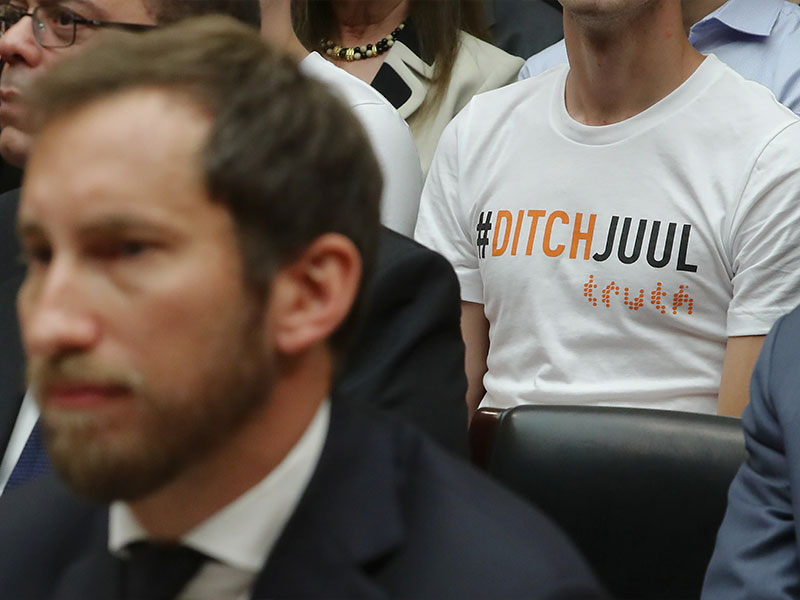
The 6 biggest Juul revelations from Netflix’s docuseries “Big Vape: The Rise and Fall of Juul”

When Juul was first conceived, it was set on being a new kind of electronic cigarette (or e-cigarette) that would help adult smokers finally quit a longstanding habit. Juul was meant to be a leading tech company. But years later, it became much more sinister than it could’ve imagined.

The e-cigarette company was founded by Adam Bowen and James Monsees, two ex-cigarette smokers who met while they were graduate students in product-design at Stanford University. Bowen and Monsees were determined to create a sleek e-cigarette that wasn’t anything like its goofy-looking predecessors. They first developed an e-cigarette called Ploom and later, developed Pax vaporizers for cannabis and loose-leaf tobacco. Juul was created in 2015 and quickly became one of the fastest-growing companies in the world.

Today, Juul is long past its glory days and instead, marred by infamy. The product, which was created for a good cause, ultimately became a public health crisis after it got in the hands of countless children and teens nationwide. Once disaster struck, the company struggled to redeem itself in the public eye.

Juul’s epic rise and subsequent downfall is explored in Netflix’s latest docuseries “Big Vape: The Rise and Fall of Juul.” Over the course of four episodes, the documentary explores Juul's early mission, its financial success and its ardent backlash through a series of interviews and old footage. Current and former employees of the company make several appearances throughout the feature. A few even chose to remain unnamed and anonymous for their own safety. As for Bowen and Monsees, they both agreed to not be featured in the documentary.

“At its height, Juul employed over 4,000 people, and was valued at nearly 40 billion dollars,” the documentary said in its opening. “Today, it’s worth less than 5% of that value.”

Here are the 6 biggest Juul revelations from the series:

01
Juul developed a novel form of nicotine that was more potent
Big Vape: The Rise and Fall of JuulBig Vape: The Rise and Fall of Juul (Photo courtesy of Netflix)

In the summer of 2013, Bowen brought on a chemist named Chenyue Xing to figure out how to make the nicotine delivery of Juul equal to that of an actual cigarette. Many Juul users complained that they were still smoking cigarettes because of Juul's low and impotent nicotine levels.  


Earlier generations of e-cigarettes used freebase nicotine, a form of the drug which can be incredibly difficult to inhale. Freebase nicotine was also difficult to raise in content because too much of it in an e-cigarette would produce an unpleasant, bitter taste. To combat that issue, Bowen and Xing decided to make salt nicotine — a combination of nicotine and a weak organic acid. Salt nicotine produced a “softer,” less harsh taste while still providing an adequate hit to its users. 


When it came to product testing, Jamie Ducharme, the author of the “Big Vape” series, said Bowen and Xing recruited their own co-workers to test the Juul products.


“It was called ‘buzz testing,’ because it’s a commonly-used term by smokers to describe the nicotine head hit that they feel,” Xing, who declined to appear in front of the camera, said.


An unnamed, anonymous engineer for Ploom described the test as “simple”: testers were asked to take 10 puffs in two minutes and describe how they felt.


“Around the fourth or fifth puff, I would have to start tallying because I’d hit the buzz so hard I’d be like, ‘Where am I?’ Then I’d come back and be like, ‘I’m done with number six,’” they said.


“The potency, I had never really felt anything like that before since high school, when I tried my first cigarette. Like a punch in the face, ‘Whoa!’ It really opened our minds to what was possible.”

02
Juul pods were a major issue … but Monsees didn’t care
Big Vape: The Rise and Fall of JuulJames Monsees in "Big Vape: The Rise and Fall of Juul" (Photo courtesy of Netflix)

A supply chain engineer, who remained unnamed and anonymous in the documentary, said Juul pods were a major problem — out of 100 Juuls produced, only eight contained effective pods.


David Pierce, a reporter for Wired, said many users got “a squirt of nicotine” in their mouth when they would inhale a Juul with a faulty pod. 


“One employee said he got crème brûlée liquid [a popular Juul pod flavor before it was banned] in his mouth so often that he now can’t eat [actual] crème brûlée because it was so disgusting,” said Ducharme.


Juul's sleek and slim design posed a technical challenge. It was difficult to fit in a battery, tubes and a small enough pod that was also functional.


“People would say, ‘We need a bigger unit,’” recalled Juul's supply chain engineer. “James [Monsees] refused to budge on the unit size. He really liked the way that unit looked.” Another Juul employee said they were rushed: “About a month before the original launch date, we didn’t have a way to fill pods yet.” 


Monsees was adamant that the problems be fixed in that short amount of time. And if they weren’t, Juul would still be launched regardless.


“Ever heard the old adage, ‘When in doubt, ship it?” Monsees is heard saying in an old recording. “There’s a variation on that one, which is ‘F**k it, ship it.’”

03
Juul's flashy, “lifestyle-oriented” marketing ultimately led to its downfall
Big Vape: The Rise and Fall of JuulBig Vape: The Rise and Fall of Juul (Photo courtesy of Netflix)

Juul quickly became known as a tobacco-adjacent company thanks to its gaudy marketing. What once began as a business seeking to help adults quit smoking actually encouraged more users — namely adolescents — to pick up the habit.


Juul's marketing campaign recruited so-called “cool kids,” who were average yet incredibly good looking millennials, posing and dancing while taking puffs from their e-cigarettes. The resulting advertisements were sophisticated, flashy and alluring, which made the product seem like a sort of toy or lifestyle accessory rather than a beneficial health device. Many were quick to notice that Juul ads greatly resembled those of Big Tobacco companies.


“Juul, in its advertising, faithfully followed the playbook of Big Tobacco companies and their cigarette brands,” explained Dr. Robert Jackler, a tobacco marketing expert at Stanford. “[Juul's] Vaporized campaign. It has direct roots from the way the tobacco industry marketed to youth. Take a bunch of 20-somethings, and you have them dance around."


Jackler added that Juul took the “very worst” elements of tobacco marketing and thrived on that.


“Cigarette makers could no longer advertise on television. Juul could. Cigarette makers could no longer have a billboard on Times Square. Juul could,” said Dr. Robert Proctor, a tobacco historian at Stanford.


Shortly after Juul's Vaporized campaign came out, Ad Age magazine published an article that formally called out the company's advertisements for looking very similar to old Big Tobacco ads. Juul's marketing team, led by chief marketing officer Richard Mumby, went into hyperdrive and began redoing aspects of the campaign, even though it had just been released.


Many employees said Juul had become a hot mess at that point and pointed fingers at the company's creative leadership, who they claimed had "no knowledge of what was responsible marketing of a tobacco company."

04
Juul was being used by children as young as 12 and 13 years old
Big Vape: The Rise and Fall of JuulBig Vape: The Rise and Fall of Juul (Photo courtesy of Netflix)

Juul's inconspicuous design allowed many young people to discreetly use the product in schools. Many kids tucked their Juul inside their sweatshirt, occasionally taking puffs and exhaling into their sleeves without their teachers knowing. Users as young as 12 and 13 years old were also seen using and passing Juuls around in public, like they were candy.


Juul's social media team began doing damage control to sway away from the negative publicity and encourage more adults to use the product responsibly. The company’s social media posts abandoned the Vaporized campaign and instead, displayed images of older folks carrying Juuls. The company's social media team also limited the use of bright colors and ultimately, made its account “stodgy and boring.”

05
Juul representatives went into classrooms and convinced students that vaping wasn’t harmful
Big Vape: The Rise and Fall of JuulBig Vape: The Rise and Fall of Juul (Photo courtesy of Netflix)

Two students recalled the time their school hosted a mental health seminar and invited a mental health speaker to come and talk to them about addiction and drug usage. The so-called “mental health speaker” turned out to be a representative for Juul, who advocated for the product rather than against the consequences of smoking or vaping.


“Throughout the presentation, there were slides up in which the speaker was discussing how the Juul was not harmful and how it was 99.9% safer than combustible cigarettes,” said Caleb Mintz. “That’s an actual statistic that was used in the presentation.”


“He also pulled a Juul out of his pocket and referred to it as the iPhone of vapes. So he really came off as a salesman.”   


Phillip Fuhrman, a teen vaper who began vaping between eighth and ninth grade, said he was convinced that vapes weren’t harmful and didn’t feel compelled to quit after the presentation. Mintz, however, had different thoughts: “After the presentation, I didn’t find that many people shared the sentiment that I had, that this guy was trying to market nicotine products to a bunch of teenagers. It was so absurd, I didn’t feel like a lot of people would believe me, and I felt like the only person who would listen would be my mom.”

06
The FDA ordered Juul to pull its vaping products off the market
Big Vape: The Rise and Fall of JuulBig Vape: The Rise and Fall of Juul (Photo courtesy of Netflix)

Per the documentary, the U.S.Food and Drug Administration (FDA) rejected Juul's premarket tobacco product applications (PMTAs) and ordered the company to pull all of its vaping products off the market. Juul, however, successfully appealed the ban and “remained on the market, pending another PMTA review.”


“At the end of 2023, Juul has paid nearly $3 billion in legal settlements across the United States,” the documentary continued. “The future of the company remains uncertain.”

"Big Vape: The Rise and Fall of Juul" is currently available for streaming on Netflix. Watch a trailer for it below, via YouTube:

Suffering in the shadows: The humanitarian calamities that aren’t on the world’s agenda

Various versions of the aphorism “War is God’s way of teaching Americans geography” have been making the rounds ever since the rise of U.S. imperialism in the late 1800s. The quip (which, despite legend, appears not to be attributable to Mark Twain, Ambrose Bierce, or any other famous person) has proven all too accurate when the war in question directly involves American troops. When, however, non-U.S. combatants and civilians suffer and die from conflicts relatively unrelated to Washington’s “strategic interests,” our media outlets tend to avert their eyes, aid agencies get stingy, and Americans learn no geography whatsoever. Oh, and given this country’s power and position on this planet, millions suffer the consequences of that neglect.     

Terror Days in Khartoum

Let’s start with Sudan. A civil war between the Sudanese Armed Forces and a paramilitary group called the Rapid Support Force (RSF) is now dragging into its seventh month with no end in sight. Since the conflict erupted, Washington has issued only a few token calls for the fighting there to end, while providing insufficient aid to desperate millions of Sudanese. The assistance that did go out has proven microscopic compared to the vast quantities of humanitarian, economic, and military aid our government has poured into similarly war-torn Ukraine.

In the first five months of brutal fighting in Sudan, 5,000 civilian deaths and injuries to at least 12,000 more were reported — and those were both considered significant underestimates. Meanwhile, more than a million people have fled that country, while a staggering 7.1 million have been displaced in their own land. According to the International Office of Migration, that represents “the highest [number] of any internally displaced population in the world, including Syria, Ukraine, and the Democratic Republic of Congo.” Human Rights Watch reports that “over 20 million people, 42% of Sudan’s population, face acute food insecurity and 6 million are just a step away from famine.” 

Try to take that in for a moment and wonder, while you’re at it, why you’ve heard so desperately little (or nothing at all!) about such an immense human tragedy. Worse yet, the Sudanese people are hardly the only ones being treated shabbily by Uncle Sam and other governments of the rich North while suffering deadly deprivation. Sudan is, in fact, at the center of a region stretching from the Middle East deep into Africa in which countries suffering some of the world’s worst humanitarian emergencies are largely being ignored by the Global North.

Given the near vacuum of news on the Sudan conflict in our media, we contacted Hadeel Mohamed, an educator we know who fled Sudan for neighboring Egypt, but is still in frequent contact with her neighbors who stayed behind in the capital city, Khartoum. We asked her for an update on what people still living there were telling her they were enduring after six months of unending civil war.

Every house in their neighborhood, she’s heard, has been looted by combatants. In the process, her friends and neighbors say that they’ve experienced “terror days when their houses were being invaded or even re-invaded to see if there’s anything left.”

“When it starts to get dark outside,” she told us, “that’s scariest, because you never know who’s going to come in and attack.” If female household members are there, what grim fates are they likely to suffer? And she adds, “If you have males in the house, are they going to be abducted and what’s going to happen to them?”

We asked whether atrocities were being committed by both the Sudanese Army and the RSF? “Yeah, both sides,” she responded. “Listen, I’m not validating any side, but when you’re in war, you really don’t know who’s coming at you or who’s a threat to you. So, everyone is seen as a threat.” And that, she adds, leads the combatants to act violently toward the civilians who’ve stayed behind.

Food is especially scarce in Khartoum, because travel in and out of the city is so dangerous for the usual suppliers and, as Hadeel points out, “Most of the stores have been looted, but in certain areas, some bread and other food is available for a few hours per day per week. There’s no fixed schedule, though.” Worse yet, wherever there’s active fighting, electricity and water supplies are normally cut off. “Some people can have electricity for weeks, while others will not have it for weeks.” Some engineers have bravely remained in Khartoum trying to keep power and water supplies flowing, but it’s often a hopeless task.

“People are on such unstable ground,” Hadeel concludes. “They really don’t know when their next food supplies are going to come in or when they’re going to be able to refill their water.” They have to watch for opportunities to slip outside in relative safety to “find something to keep them and their neighbors going.”

And what exactly has been Washington’s response to this ongoing horror? Well, the State Department issued a toothless admonishment that the army and RSF “must comply with their obligations under international humanitarian law, including obligations related to the protection of civilians.” And that was about it, other than ineffective sanctions applied to the leader of the RSF. Meanwhile, international efforts to negotiate an end to the fighting have collapsed, and humanitarian aid efforts have been hopelessly bogged down. Anyway, who has time for Sudan when arming and backing the Ukrainians has the attention of everyone who matters in the United States?

“Severe, Extreme, or Catastrophic Conditions”

Mind you, that paucity of interest is anything but unique to the crisis in Sudan. For example, U.N. World Food Program (WFP) Director Cindy McCain recently told ABC’s This Week that there isn’t enough food-assistance money for desperate Afghanistan, filled with starving people, to “even get through October.” In addition, the WFP has had to cut food aid to other countries in desperate need, including Bangladesh, the Democratic Republic of Congo, Haiti, Jordan, Palestine, South Sudan, Somalia, and Syria. As for explaining that shortfall, McCain was blunt, blaming the rush of rich nations of the Global North to support Ukraine which, she says, “has sucked the oxygen out of the room.”

Typically, the U.N. Office for the Coordination of Humanitarian Affairs (OCHA) reports that its famine-prevention program for war-ravaged Yemen is now receiving just 30% of the funds it needs, putting millions of Yemenis at risk. OCHA points to the peril facing Fatima, a 60-year-old woman living in the village of Al-Juranah. The program supplies her family with wheat, peas, and oil, but delivery is sporadic, a reality about which Fatima is all too matter-of-fact. “We receive a sack of wheat,” she says, “and sometimes we get only half a sack. They also give us roasted peas and oil. If this support stops, we will starve to death.” And sadly enough, that support is now anything but guaranteed.

Two years after a ceasefire in that brutal civil war fed by Saudi Arabia (with U.S. support), a conflict that received only the scantiest media coverage in this country, more than half of Yemenis — 17 million people — are food insecure. U.N. forecasters predict that without massive intervention, a quarter of those people will experience “acute food insecurity” by year’s end, with three-quarters of them reaching “crisis levels of hunger.” Such massive intervention is decidedly not in the cards, however, and the continuing neglect is having horrific consequences. National Public Radio’s Fatma Tanis did, in fact, report on this from a Yemeni hospital in August:

“We head next to the intensive care unit for newborns, often born with complications because of malnutrition. As we enter, a nurse pulls a sheet over a baby who just died. The parents aren’t here. Often, families use all their resources to bring their child to the hospital but can’t afford to return again. So the hospital has to take care of burials too, without them.”

The people of Syria are similarly striving to recover from the civil war that erupted in 2011 and was finally put on hold with a 2020 ceasefire, but only after a full decade of ferocious warfare and terrible suffering. Like the Sudanese and Yemenis, they remain largely unnoticed and uncovered these days in the American media. In addition to extreme water shortages, a catastrophic 55% of Syrians are officially in the crisis phase of acute food insecurity. In late 2022, OCHA reported that “severe, extreme, or catastrophic conditions” were affecting 69% — yes, you read that right! — of the country’s population. Furthermore,

“Basic services and other critical infrastructure are on the brink of collapse… Over 58 percent of households interviewed reported accessing only between three to eight hours of electricity per day, while almost seven million people only had access to their primary water source between two and seven days per month in June.”

Is the world paying attention? In one respect, Syria is more fortunate than Sudan or Yemen, enjoying its very own annual conference of donor nations. At this June’s conference, hosted by the European Union, donors pledged an increase in total aid, but the amount still fell $800 million short of what the U.N. was seeking for that country. Worse yet, just before the conference kicked off, the World Food Program announced that it would cut food aid to almost half of Syria’s 5.5 million current recipients just when they’re most in need.   

The Democratic Republic of Congo, another country in deep distress, finds itself in the global spotlight, but not for the suffering its people are experiencing. Its huge deposits of cobalt, copper, and other mineral elements essential to future renewable-energy economies have finally brought it some attention. However, the Global North, transfixed by those priceless minerals, has remained remarkably blind to the wave of human misery now sweeping the Congo.

Last month, Jan Egeland, Secretary General of the Norwegian Refugee Council, just back from a trip there, told Democracy Now, “It’s the worst hunger catastrophe on Earth. Nowhere else in the world is there more than 25 million people experiencing violence, hunger, disease, neglect. And nowhere in the world is there such a small international response to help, to aid, to end all of this suffering.”

As in Sudan, Syria, and Yemen, hunger and war have gone hand-in-hand in the Congo. Today, Egelend said, an almost unbelievable 150 or so armed groups vie for power in the cobalt-rich eastern part of the country. In the early 2000s, cobalt was valued for its role in mobile phones and laptops. The stakes are far higher now, with vastly larger quantities required to produce the lithium-ion batteries essential to the development of sprawling new power grids and a vast global fleet of electric vehicles.

Collateral damage radiating from the Congo’s ongoing violence includes a hunger crisis, an epidemic of sexual assault by combatants on tens of thousands of civilian women, and so much more. The U.N. sought $2.3 billion in humanitarian assistance for the Congo in 2023. It has, however, only received a measly one-third of that sum, enough to help just one of every 18 people now in desperate need.

On Democracy Now!, Egeland put his finger on the terrible calculations of global economics and diplomacy: “Congo is not ignored by those who want to extract the riches of that place. It is ignored by the rest of the world… As humanity, we’re really, really failing Congo now, because it’s not Ukraine, it’s not the Middle East.”

As a refugee from Sudan, Hadeel Mohamed worries every day about these kinds of terrible calculations being made in the North. As she puts it,

“This war has really opened our eyes to a lot of things. Although we saw the news of what’s happening in Yemen and Syria, and all these countries where wars erupted, we never really understood the depth of it. A worry of ours is that what’s happening to Syrian refugees is going to happen to Sudanese refugees… where your prospects are not going to mean anything… where you’re limited in your work transactions, you’re limited in your educational abilities.”

Because organizations like the U.N. and the International Red Cross were activated “quite late” in Sudan, she points out, some who fled the country, especially youth, “started forming groups to help people cross borders to get out, to find jobs, and to raise funds for food and water aid for those still in Sudan.” Hadeel herself is involved in such efforts. “But progress is a bit slow, because we’re still trying to rebuild our own lives in parallel.”

“If the war is not contained in Khartoum,” she adds, “the chances of it spreading are very high and we’ve seen a lot of spreading recently, whether it’s in Port Sudan or Madani or surrounding cities.” Violence has been raging for months in the Darfur region of western Sudan as well. The conflict could also be significantly prolonged by the desire of both sides to control northeastern Sudan’s vast gold deposits, which play a role analogous to that of cobalt in the Congo.

With no relief in sight, says Hadeel, the people of Khartoum, understand that lacking true humanitarian aid, “you really come back to more of community-based aid. With our limited resources, with our limited abilities, we still find people rising up to take care of each other.” Nevertheless, for refugees, “there are only two possible outcomes here: either you go back and fight for your country and potentially die or you go on living and establishing yourself outside of Sudan.”

Meanwhile, on the Outskirts of Democracy…

Tyranny, civil war, systemic breakdown — it can’t happen here, right? Or can it? We privileged folk in the United States may still think we live in a democracy, but so many of us don’t. In truth, the 140 million poor and low-wage folks, Black, Latino, Asian, Pacific Islander, and Indigenous, along with about one-third of White people, live on the outskirts of our “democracy.” Like the people of Sudan, Syria, and Yemen, they dream of being in a country where there’s equality and justice, and where democracy, while not complete, is at least not dying.

The United States never was, and by the looks of it, now has little chance of becoming a truly pluralistic, multiracial democratic system. If we were, we’d be spending every free hour raising hell to make sure the possibility of democracy doesn’t die in next year’s election. The media are replete with dystopian scenarios of its end and the rise of Trumpistan. We’re scared shirtless about that, too, and it’s a gut punch to realize that, if we had a truly functioning democracy, there’d be no way it could be toppled by a single guy like Donald Trump.

Ask a Sudanese or a Syrian or an Egyptian or an Afghan what it’s like to live under autocracy. Then ask marginalized Americans what it’s like to live on the outskirts of democracy. For the latter, democracy is like Sudan’s gold and the Congo’s cobalt. There may be a lot of it, but very few get any.


Steve Scalise bows out of speaker race

Nine days after former Speaker Kevin McCarthy (R-Calif.) was booted from his position, voting to land on his successor is at a stalemate, with a group of GOP holdouts planting their heels.

On Thursday evening, House Majority Leader Steve Scalise (R-La.) took action in the face of other's inaction, making the decision to bow out of the race after — just yesterday — winning the nomination by a 113-99 margin over Rep. Jim Jordan of Ohio.

“I just shared with my colleagues that I’m withdrawing my name as a candidate for the speaker designee,” he told reporters. “If you look at where our conference is there’s still work to be done. Our conference still has to come together and is not there. There are still some people that have their own agendas and I was very clear we have to have everybody put their agendas on the side and focus on what this country needs. This country is counting on us to come back together. This House of Representatives needs a speaker and we need to open up the House again, but clearly not everybody is there and there’s still schisms that have to get resolved.”

According to Axios, Scalise said he will remain in his role as House majority leader, and he has no plans to endorse another speaker candidate at this time. 

Speaking to reporters after this latest upset, McCarthy weighed in on the ordeal, saying, "I just think the conference as a whole has to figure out their problem solving and select a leader." 

“Building blocks of life” found in NASA’s Bennu asteroid sample

When the OSIRIS-REx mission touched down in Utah with a sample from the 4.5-billion-year-old asteroid, Bennu, scientists who opened the hatch gave an audible gasp when they saw what was inside. Now, early studies from the materials parachuted down to Earth have revealed why: The sample contains evidence of carbon and water, which “together could indicate the building blocks of life on Earth,” according to a NASA press release.

The samples from Bennu could reveal answers to questions about how the solar system formed that scientists have been pursuing for decades. In the two weeks since Bennu’s sample was delivered, scientists have analyzed the crumbled rock and dust surrounding the main canister from the mission to get initial readings about the asteroid’s composition. The main analysis will be performed in the next few weeks when they open the canister. According to Nature, Bennu has already been found to have the highest percentage of carbon ever measured in an extraterrestrial object at 4.7 percent.

“The bounty of carbon-rich material and the abundant presence of water-bearing clay minerals are just the tip of the cosmic iceberg,” said OSIRIS-REx principal investigator Dante Lauretta in the press release. “These discoveries, made possible through years of dedicated collaboration and cutting-edge science, propel us on a journey to understand not only our celestial neighborhood but also the potential for life’s beginnings.”

CORRECTION: The original headline to this story incorrectly suggested that "signs of life" had been detected in the asteroid sample. The headline has been updated, but the article itself is unchanged. 

The best takeaway from this season of “Love Is Blind”? Act like Milton

It's a truth universally acknowledged that each new season of "Love Is Blind” will be messier than the previous one. If, for some reason, this isn't a given, then the ample evidence Season 5 tosses on the table tells us it should be. But (pardon this metaphorical mash-up of literary references) in the same way that each unhappy family is unhappy in its own way, every season’s trash fire burns a bit differently.

This Houston-based fifth season has been one for books — and not in a good way. Past seasons featured absolute villains and aspirational love stories; this one has a few of the former and a paucity of the latter, yielding only two altar-bound couples out of the three who made it to the engagement stage.

But marriage is no longer the bounty viewers should expect from this “experiment,” which at this point holds no mystery for anyone. Neither the audience nor the contestants, groups of men and women sequestered from the outside world and made to live in separate groups.

Instead, its highest and best service is in providing a stupendous realization of the virtue of valuing its figurative blindness in Milton Jackson, the 24-year-old petroleum engineer no one — and I mean no one — would have predicted as the frontrunner for this season's Prince That Was Promised (by Disney, not George R.R. Martin).

To review, each contestant interacts with their fellow male and female contestants face-to-face, meeting potential marriage partners of the opposite sex in “pods” divided by an opaque wall. The idea, as presented by co-hosts Nick and Vanessa Lachey, is to find out whether the emotional connection these individuals forge supersedes physical attraction — and if it's sustainable enough to take them to the altar after merely four weeks of knowing one another.

This assumes each person has the emotional intelligence to go the distance — any distance — with a person they not only desire but also have only gotten to know over a compressed period of time. As many singletons would confess, it’s hard out in these streets.

This is where the current season of “Love Is Blind” distinguishes itself as a manual for "How and Who Not to Date" more than others, beginning with a masterfully edited deception. In the pods, we watched Uche Okoroha, a muscular, well-coifed attorney, pull into the frontrunner position in the unofficial pageant of desirability. Uche seemed to know a little about everything and was popular among the guys, as was Jared "JP" Pierce, the avuncular firefighter another man went on to admiringly refer to as his Captain America.

Then we got to know them by their actions. A few installments into the 10-episode season, it came to light that Uche and a female contender, Lydia Velez Gonzalez, dated before entering the show’s pods.

Love Is BlindUche Okoroha and Lydia Velez Gonzalez in "Love is Blind" (Courtesy of Netflix)Subsequent episodes reveal Uche to be an ogre fronting as a prince. He isn’t the only one. Before they lay eyes on each other, JP hits it off with Taylor Rue, who might as well be a St. Pauli Girl poster model come to life. Then he meets her IRL.

Instead of their fairytale evolving into the “love at first sight after 10 or 11 deep conversations” phase, he clams up on their all-inclusive resort getaway, the prize for the couples who make it to the engagement stage. He kisses her like a third grader trying out the act for the first time in a game of spin the bottle. It’s weird! But not as bizarre as his reasoning for growing cold, which is straight out of a web forum for incels.

“I feel like if you represented yourself . . . without any makeup, it would have been better,” he tells Taylor, explaining that he first saw her with a fully made-up face, before adding: “It felt like you were fake.” His solution? She should stop wearing makeup, and then he could bring himself to love her again.

Then there is Milton, a 6-foot, 7-inch beanpole who loves playing Pokémon and appears to take his facial hair manscaping cues from a walrus.

Wisely, Taylor chooses to continue her lifelong relationship with looking however the heck she wants over whatever horrors might lie ahead with JP, who it should be pointed out, has a wardrobe resplendent with stars and stripes attire.

Then there is Milton, a 6-foot, 7-inch beanpole who loves playing Pokémon and appears to take his facial hair manscaping cues from a walrus. There’s also Izzy Zapata, a smoking hot sensitive dude who people suspect may be hiding terrible credit and possible lack of employment. Those can be transformed, much like a person’s physique.

Behavioral characteristics, however, are fairly immutable. Regardless of what people claim about being able to change, the human tendency is to evolve and mature, much in the way a leopard can become a better hunter but can't swap its spots for stripes. In this, time is on Milton’s side, as well as Lydia’s, to whom he becomes engaged. Lydia also becomes Uche's target in the season’s seventh and eighth episodes, creating a situation that tests Milton's loyalty.

We need your help to stay independent

Currently, we’re awash in data concerning our masculinity crisis, addressing the healthy and emotional wages of male loneliness and a lack of healthy definitions concerning what it means to be a good man. “Love Is Blind,” a series that has blessed us with an assortment of jerks over the years, isn't going to ameliorate that problem.

In Milton, however, we have someone who trusts his brain, his heart and — here’s the best part — his mother’s wisdom. Remember your elder’s advice about judging a man's suitability as a partner by how he treats his mother? Watch it in action through Milton and how he deals with other men who don’t have his best interests at heart.

See, Uche found a connection with another woman, Aaliyah Cosby, who also forged a fast friendship with Lydia on the women’s side of the pods. Lydia’s overfamiliarity with Aaliyah — combined with Uche’s self-righteous reaction to Aaliyah’s confession of having cheated on a past boyfriend — led Aaliyah to flee the “experiment” and Uche. As it turns out, that was the right call.

Remember your elder’s advice about judging a man's suitability as a partner by how he treats his mother? Watch it in action through Milton.

Uche, however, isn't someone who can let things go. He attends the gathering producers stage each season that brings together the engaged couples with the people they broke up with in the pods, along with a few friends they made along the way.

In this season’s get-together, Uche confronts Lydia and states his wild accusations to her face, accusing her of stalking him on Instagram before “following” him onto the show as if they’re co-starring in a “Fatal Attraction” reboot. When Lydia dismisses Uche, walking away angrily, he tries to drag Lydia to the other women in the pod. That doesn't work, to a disastrous degree.

Then he pulls Milton aside, which Lydia and many viewers don't appreciate before Milton reassures us all with a “trust me.”

Milton listens to Uche’s insistence that Lydia was always there for him — not Milton. He's only looking out for his bro, you see.

All the while, Milton gazes into the distance thoughtfully before responding.

“So my mom always told me, like, your perception is like your reality,” he says to Uche. “You and her have very different perceptions. You guys are both grown . . . I understand there’s nuances and things are situational. Like, you know, this isn't Pythagorean theorem going on, but this is like multi-dimensional calculus. You're in the X direction, she's in a Y direction and I’m the Z direction. Like, I’m not even adjacent. I’m just like on a different parallel. It’s all perception.”

Love Is BlindMilton Johnson in "Love is Blind" (Courtesy of Netflix)Unless you’re an expert in algebra, the natural response to this is . . . huh? Milton is relying on that. He stares down a natural-born emotional con artist and responds with mathematics, empirical data analysis and reason — which isn't wielded forcefully enough these days.

Later, as Milton is comforting Lydia, he tells her that he has been a douchebag before, too. “What did I tell you about getting so emotional? Act more like Milton,” he says as he’s holding Lydia’s face between his hands. "You’re too strong. You’re too big. Look at you, you’re a f**king grown-a** woman. You’re a bada**. You have a great a** job. You make great-a** money. You’re independent as f**k. F**k everybody else. Who cares? We’ll make it through.”

Literary professors and devoted Austenites will be the first to tell you the famous opening line of “Pride and Prejudice” was never meant to be taken at face value. You know, the whole business that goes “it is a truth universally acknowledged, that a single man in possession of a good fortune, must be in want of a wife.” Certainly, this notion is less applicable today than it was in Jane Austen’s lifetime, as both single men and single women can be in possession of a good fortune nowadays.

That doesn’t stop people from seeking that trip to the altar, despite “Love Is Blind” proving how tricky that quest can be. Lydia, a geologist, initially wrote off Milton despite discovering that this potential suitor also loves rocks. They’re both nerds. She is also 30 at the time of this season’s filming, making her around six years older than him. (Netflix's press notes list their current ages as 25 and 32.)


Want a daily wrap-up of all the news and commentary Salon has to offer? Subscribe to our morning newsletter, Crash Course.


Their final big date together takes place in the Cullen Hall of Gems and Minerals at Houston Museum of Natural Science, which would have been perfection if not for the quarrel that erupts at dinner over Lydia’s emotional reaction to an ex who accused her of being a stalker.

Milton isn't perfect, understand. Their argument starts when Lydia complains that Milton doesn’t pick up after himself, and he counters that he doesn’t appreciate her explosive reaction to Uche’s insults.

This reveals the flaw in Milton’s logic: He wants her to be herself, only less. This is another shade of the whole “just don’t wear makeup” business that was JP and Taylor’s undoing. As such, there comes a point during their meal where Milton goes too far, and Lydia walks away from the table to collect herself.

When she returns, we witness something not often shown in this series or any other reality romance competition. By most relationship standards, it's a solid resolution to a relatively sane, if heated argument. Instead of digging in, Milton offers these words: “I’m sorry if I hurt your feelings. “ This isn’t a proper apology, but most people don’t know that, so we can let it slide.

Love may not be blind, but there may be an element of calculus in succeeding at it.

Lydia diplomatically responds with “I’m sorry that I don’t abide by your expectations . . . and I’m sorry that I’ve done things that you don’t like. But that’s me. This is me. I feel a lot. I am loud. I am passionate. I am emotional. God forbid that what my mind doesn’t say, my face is going to say. And I want to stand by you, to support you with any decision that you want to do, but I need you to understand me.”

They end the dinner by exchanging “I love yous” and holding hands.

When all is said and done, Milton and Lydia may not go the distance and exchange the two words that elude so many on this show: “I do.” Nevertheless, they're an unintended successful byproduct of a so-called “experiment” in desperate need of reconfiguration. In a show that allows the audience to judge its participants' chances based on their appearances before they get to do so, Milton demonstrates it’s better to be Captain Atom than anyone’s toxic fantasy of what Captain America looks like.

Love may not be blind, but there may be an element of calculus in succeeding at it. In that way, maybe many of us would be better off acting like Milton.

The fifth season finale of "Love Is Blind" streams Friday, Oct. 13 on Netflix.

How did Israeli intelligence miss Hamas’ preparations to attack? Expert on how Israeli intel works

Israel is widely recognized as having highly sophisticated intelligence capabilities, both in terms of its ability to collect information about potential threats within its own country and outside of it. And so as details unfold about the full extent of Hamas’ unprecedented and surprise attack on 20 Israeli towns and several army bases on Oct. 7, 2023, the question lingers: How did Israel fail to piece together clues about this large-scale and highly complex plot in advance?

Israeli intelligence did detect some suspicious activity on Hamas militant networks before the attack, The New York Times reported on Oct. 10, 2023. But the warning wasn’t acted upon or fully understood in its entirety – similar to what happened in the United States shortly before the terrorist attacks on Sept. 11, 2001.

“Intelligence analysis is like putting a thousand-piece jigsaw puzzle together from individual pieces of intelligence every day and trying to make judgments for policymakers to actually do something with those insights,” said Javed Ali, a counterterrorism and intelligence scholar who spent years working in U.S. intelligence.

We spoke with Ali to try to better understand how Israeli intelligence works and the potential gaps in the system that paved the way for the Hamas incursion.

1. What questions did you have as you watched the attacks unfold?

This took an enormous amount of deliberate and careful planning, and Hamas must have gone to great lengths to conceal the plotting from Israeli intelligence. This plotting may indeed have been hidden as the plot was being coordinated.

Because of the attack’s advanced features, I also thought that Iran almost certainly played a role in supporting the operation – although some U.S. officials have so far said they do not have intelligence evidence of that happening.

Finally, Hamas is on Israel’s doorstep. One would think Israel could better understand what is happening in Gaza and the West Bank, as opposed to 1,000 miles away in Iran. How did Israel not see something this advanced right next door? Some Israeli officials have said they believed Hamas was already deterred by recent Israeli counterterrorism operations, and that the group lacked the capability to launch an attack on the scope and scale of what occurred.

2. How does Israeli intelligence work, and how is it regarded internationally?

Israel has one of the most capable and sophisticated intelligence enterprises at the international level. The current design and functioning of Israel’s intelligence system broadly mirrors that in the U.S., with respect to roles and responsibilities.

In Israel, Shin Bet is the Israeli domestic security service, so the equivalent of the FBI, which monitors threats within the country. On the foreign security side, Israel has Mossad, which is equivalent to the CIA. Third, there is an Israeli military intelligence agency, similar to the U.S. Defense Intelligence Agency – and there are other, smaller organizations within military intelligence that are focused on different intelligence issues.

Like most Western countries, Israel relies on a combination of different intelligence sources. This includes recruiting people to provide intelligence agencies with the sensitive information they have direct access to, which is known as human intelligence – think spies. There is what is called signals intelligence, which can be different forms of electronic communications like phone calls, emails or texts that the Israelis gain access to. Then there is imagery intelligence, which could be a satellite, for example, that captures photos of, say, militant training camps or equipment.

A fourth kind of intelligence is open source, or publicly available information that is already out there for anyone to get, such as internet chat forums. While I was winding down my work in intelligence a few years ago, there was a shift to seeing much more publicly available intelligence than other kinds of traditional intelligence.

A man with a suit stands at a podium that says 'ICT's 22nd world summit on counter-terrorism' and next to a large screen that shows headshots of people

David Barnea, the director of Israel’s Mossad, shows a video that depicts Iranian intelligence operatives during a counterterrorism summit in September 2023. Gil Cohen-Magen/AFP via Getty Images

3. How does Israel’s intelligence system differ from the US system?

Unlike the U.S., one thing that Israel doesn’t have is an overall intelligence coordinator, a single representative who knows about and oversees all of the different intelligence components.

The U.S. system has a director of national intelligence position, who runs the Office of the Director of National Intelligence, which was created in 2004. These were both recommendations of the 9/11 Commission, after it found that the U.S. approach to intelligence was too fragmented across different agencies and offices.

So, when there are tough issues that no one agency could resolve on its own, or analytic differences in intelligence, you need an independent office of experts to help work through those issues. That’s what this office does.

I spent several years working within the Office of the Director of National Intelligence. In one of my jobs there, I reported to the director of national intelligence.

There is no equivalent to that central office and function in Israel. In my opinion, Israel might consider down the road how a comprehensive intelligence coordinator could help avoid this challenge in the future.

4. What role does the US have in monitoring threats to Israel, if any?

The U.S. and Israel have a very strong intelligence relationship. That partnership is bilateral, meaning it is just between the two countries. It is not part of a larger international group of countries that share intelligence.

The U.S. also has a broader intelligence partnership, known as “Five Eyes,” with Britain, Canada, Australia and New Zealand. Nevertheless, the general rule in these strong bilateral relationships is that when one side picks up intelligence about threats to the other, it should automatically get passed on.

This may be a case where the U.S. is shifting its intelligence priorities to other parts of the world, like Ukraine, Russia and China. As a result, we may not have had significant intelligence on this particular Hamas plot, and so there was nothing to pass to Israel to warn them.


Javed Ali, Associate professor of practice in counterterrorism, domestic terrorism, cybersecurity and national security law and policy, University of Michigan

This article is republished from The Conversation under a Creative Commons license. Read the original article.

CFO called out for fudging the value of Trump Tower Penthouse while under oath

During sworn testimony on Tuesday, Allen Weisselberg, longtime chief financial officer of the Trump Organization, did some editing on the fly regarding statements made as to the monetary value of Trump’s penthouse in Trump Tower.

According to Forbes, when Weisselberg fielded questions on the Penthouse being 30,000 square feet — which would put it at a higher value than the 10,996 square feet it actually is — he commented on the inflated numbers in a roundabout way. Per the outlet's reporting, Weisselberg acknowledged that the 30,000-square-foot figure was wrong, but suggested that he didn't have much of a hand in that calculation, saying, “I never focused on the triplex, to be honest with you. It was almost de minimis relative to his net worth, so I really didn’t focus on it." But there is evidence to the contrary.

Reporter Dan Alexander did some digging into this and, apparently, "A review of old emails and notes, some of which the attorney general’s office does not possess, show that Weisselberg absolutely thought about Trump’s apartment—and played a key role in trying to convince Forbes over the course of several years that it was worth more than it really was."

In their feature on the vacillating fiction of the value of this property, they break down a number of instances where Trump, with Weisselberg by his side, boasted the inflated figures. The following being one of them: 

In 2015, Trump hosted three Forbes journalists inside Trump Tower, with Weisselberg by his side. “This is the entire floor of Trump Tower, just so you know,” Trump said, showing off his penthouse. “Now, this wraps all around the building. All around the elevators. And I have three times three. So there’s like 11,000 feet on a floor. So I have three. So 33,000—and I have the roof.”
 

Glyphosate, an herbicide linked to cancer, found in 98% of Ecudorian youth: study

A recent study in the journal Environmental Health Perspectives reveals that nearly all of the adolescents living in the agricultural county of Pedro Moncayo, Ecuador (98%) have high concentrations of a common pesticide, glyphosate, in their urine. In addition, it found that 66.2% of the participants had an herbicide in their urine known as 2,4-D. The researchers also tested for chemicals found in the insecticide DEET, including DCBA in 63.3% of the urine samples and ECBA in 33.4% of the urine samples.

The good news is that the DEET metabolites were not linked to neurobehavioral problems, which the scientists examined in the patients. The bad news is that higher glyphosate concentrations were linked to lower scores in social perception, while higher 2,4-D concentrations were linked to problems memory and learning, language and attention and inhibitory control. Glyphosate specifically has been linked to cancer, particularly non-Hodgkin's lymphoma. The popular weedkiller has also been found in 80% of Americans' urine, according to a 2022 study by the Centers for Disease Control and Prevention. In 2020 Bayer, the German pharmaceutical company that manufactures Roundup (a popular weedkiller which contains glyphosate), paid up to $10 billion to settle cancer lawsuits related to Roundup.

"There is a lot of exposure to Roundup in the environment as well, in everything that we actually do, so there is a huge ubiquitous prevalence," researcher Dr. Chadi Nabhan told Salon regarding glyphosate in a February interview.

In praise of almonds and nuts

They're known as 'oily fruits'. Because of their numerous health benefits, notwithstanding their high fat content, almonds, hazelnuts and other nuts are among foods recommended for consumption in Canada, the US, France and across the EU — to the tune of a small handful each day.

From a nutritional standpoint, these hard-shelled fruits are distinguished by high levels (50-75%) of unsaturated fats (which are seen as 'good fats'), significant protein content (10-25%), plus minerals (sodium, magnesium, potassium), vitamins B3, B9, B6 and E, fibre, antioxidants and vegetable oils. A stack of data suggests that they could help us age well and protect us from a range of chronic conditions.

Stripping out 'bad' cholesterol

If there's one area where shelled fruits [JN1] have proved their worth, it's bringing cholesterol down. Reducing the amount of animal fat in your diet and eating fibre are, for certain, effective ways to cut levels of LDL-cholesterol, that's to say 'bad cholesterol'. But many studies have also shown the benefits of a daily handful of almonds. The same seems true of all nuts.

In 2010, a study of the collected data over the course of 25 clinical trials involving men and women with high cholesterol showed that eating 67g of nuts every day for 3-8 weeks could cut LDL-C levels by 7.4%, with more sizable effects than this on symptoms since the patients were over healthy limits previously.

Another systematic data review confirmed this, albeit at a more modest rate. Carried out in 2018, it analyzed results from 26 clinical trials: The authors in this case detected a 3.7% fall in LDL-C levels for a diet rich in shelled fruits (15-108g per day) over a period of one to 12 months. It's known that lowering LDL-C levels is linked to a reduction in total mortality and in deaths from cardiovascular disease, particularly if levels were high to start with. Even if no clinical study has yet shown that eating nuts can reduce the risk of heart failure, there's no shortage of arguments to support such a hypothesis.


Lower risk of cardiovascular disease

First one might point to the results of a meta-analysis published in 2019. Applying the criteria used by Canada's Cochrane Centre, the authors chose 19 studies and evaluated that a 28g daily portion of shelled fruits is associated with a 13% fall in cardiovascular disease and 29% in deaths from heart disease.

You could also refer to a huge randomised and controlled study across many different locations on the role of a Mediterranean diet enriched with nuts in reducing the risk of heart disease. Participants in this, aged 55-80 and registering a significant risk of heart disease were assigned one of three diets — low-fat, a Mediterranean diet rich in olive oil and a Mediterranean diet with added nuts. They were tracked for almost 5 years on average. At the end of the research, it was shown that heart problems were less frequent among the two groups following the Mediterranean diet.


Fat that doesn't make you put on weight

On the energy side, 30g of almonds, peanuts, pistachios or cashews work out as a 180 calorie snack; the same quantity of pecans or Brazil nuts come to 220-230 calories. These figures are roughly equivalent to 30-40g of milk chocolate. Since the calorific content is essentially made up of fats, one might be given to think one must beware of 'oily fruits' if weight-watching. But that assumption would be wrong . . . 

In fact, a recent piece of research closely analysed six cohort studies and 62 randomized diet tests. This concluded that regularly eating nuts for a longer or shorter period of time (between 3 and 336 weeks) is linked to very slight weight loss (an average of 200g) and a shrinking waistline (by an average of 0.5cm).

If the reasons for these counter-intuitive outcomes haven't been adequately explained yet, various theories can be put forward. For one, the matrix that encases the oils in nuts limits, to an extent, their absorption in the gut. To put it simply — some of the fat content in nuts is eliminated in the body's cells, rather than being absorbed. Meanwhile, thanks to how they blunt our appetite, almonds and other nuts reduce the amount we eat at meals, so much so that our overall calorie count is no greater or perhaps less than it would have been without them.


Do nuts have anti-cancer properties?

Other benefits are attributed to shelled fruits — notably around cancer prevention, although the evidence for this is weak. The relevant studies rely on observations alone and suffer from various interpretation biases.

Thus, according to an analysis of 33 studies published before June 2019, increased consumption of nuts is demonstrably linked to a 10% fall in cancer risk; and the effect is more marked for cancers of the digestive system, with a risk reduction of 17%.

Nuts' high antioxidant content might be one of the drivers for this. But before exploring this hypothesis further, we need to check the observed data with verifiable controlled and randomized clinical trials. For the moment, there's nothing that allows us to say that eating nuts protects against cancer.


Fewer neurodegenerative conditions

Oils and fats are vital for the brain. After fat tissue, it's the organ in the body richest in lipids: They can be found in the neuron membranes and related cells, but also in the myelin which speeds up the transmission of electrical impulses through the nervous system.

Several research teams have set out to evaluate the benefits of nuts for the central nervous system. What have they learned?

Their notable discovery was that after a few weeks of a diet more or less rich in nuts, 19 month-old rats performed better on psychometric tests. A diet of 2% nuts boosted their performance on a rod-clambering test, one of 6% nuts saw them do better on a plank-walking test and at both these levels their powers of short term memory were heightened. These results have been confirmed by a study of shorter duration, with a marked improvement detectable in the rodents' learning and memory.

As for humans, a study of the PREDIMED diet intervention has shown that a Mediterranean diet rich in nuts improves short-term memory. It has also offered evidence, at a biological level, of a reduced risk of low BDNF plasma — a protein which helps the growth and vigour of new neurons. Nuts seem to have a beneficial role at warding off age-related cognitive decline. However, we don't have direct proof that if one regularly eats nuts, it reduces the risk of neurodegenerative diseases.

To sum up: Nuts appear at first glance to have all the features allowing them to be considered allies of our health. While they are calorie-rich and high in fats, a 30g serving per day seems to cut "bad cholesterol" and protect us from cardiovascular disease, without affecting our weight. There are plenty of theories that suggest they a positive impact, both on other illnesses and warding off cognitive decline associated with age.

Plenty of good reasons to recommend everyone to include a handful of almonds, hazelnuts or other nuts in the food they eat each day — obviously without added sugar or salt!


Translation from French into English by Joshua Neicho

Boris Hansel, Médecin, Professeur des universités- Praticien hospitalier, Inserm U1148, Faculté de Santé, Université Paris Cité; Diana Kadouch, Praticien Hospitalier, Hôpital Bichat, Service de Diabétologie-Nutrition,  AP-HP, Chargée de cours au sein du DU de nutrition, Université Paris Cité, and Jérémy Puyraimond-Zemmour, Assistant spécialiste, Service de Diabétologie-Nutrition, Hôpital Bichat, AP-HP, Chargé de cours au sein du DU de nutrition, Université Paris Cité

This article is republished from The Conversation under a Creative Commons license. Read the original article.

Legal expert: Jack Smith has “very few tools” to prevent Judge Cannon from delaying Trump trial

Donald Trump’s legal team on Wednesday accused special counsel Jack Smith’s office of violating the former president’s due process rights by attempting to pursue both of his federal trials before the 2024 election, The New York Times reported

The lawyers reasserted their request to delay Trump’s trial ​​related to his handling of classified records until after the 2024 election. His team filed a request last week asking U.S. District Judge Aileen Cannon to postpone the trial until "at least mid-November" of 2024 — after Election Day on Nov. 5.

Christopher Kise, who is representing Trump, strongly criticized the special counsel's office for opposing his requests to postpone the documents trial. In the Wednesday filing, Kise expressed concerns that the May trial could clash with Trump's other federal trial, set to begin in March in Washington, where the former president faces accusations of three election-related conspiracies, The Times reported. 

The special counsel’s office continues to maintain that it is “appropriate and not a violation” of Trump’s “due process rights” to push forward back-to-back multi-month trials in different districts, he added.

“The special counsel’s office is engaged in a reckless effort to try to obtain a conviction of President Trump prior to the 2024 election, no matter the cost,” Kise wrote.

While Trump’s counsel argues that Smith committed to “obtaining a conviction” of Trump prior to the 2024 election, it is “clear” that Trump’s strategy has been and will be to delay his federal trials “through extensive pre-trial motion practice at every turn,” Temidayo Aganga-Williams, a white-collar partner at Selendy Gay Elsberg and former senior investigative counsel for the House Jan. 6 committee, told Salon. 

This filing marked the third round of court documents regarding the request for a delay in the documents trial, the Times reported. Trump has been pursuing this strategy since he was initially charged in the case.

He previously asked that the trial be put off indefinitely, as his lawyers worked through complex procedural issues. Their request was denied by Cannon. 

“Trump will continue to file motion after motion, in an attempt to build a record before the court that he can use to argue he is not receiving a fair trial,” Aganga-Williams said. “He is both litigating before the judge but also before the public.”

We need your help to stay independent

The indictment alleged that Trump unlawfully retained over 30 classified documents following his departure from the White House and conspired with aides at Mar-a-Lago to impede the government's repeated attempts to retrieve these documents that contained intelligence on nuclear weapons programs and information on the nation's defense capabilities. 

The former president has a pattern of pushing to delay his trials. His legal team attempted a similar strategy last week, seeking to slow down the election interference case by arguing that Trump is shielded from criminal prosecution because of “presidential immunity.”

His lawyers contended that the acts he is criminally charged with were part of his official presidential duties rendering him “absolutely immune from prosecution.”


Want a daily wrap-up of all the news and commentary Salon has to offer? Subscribe to our morning newsletter, Crash Course.


“Trump is not exercising his right to a speedy trial,” former federal prosecutor Neama Rahmani told Salon. “On the contrary, his lawyers are saying they need more time to prepare.”

While this may be true since the ex-president is in the middle of a civil trial and fighting four different criminal cases in four different states using many of the same lawyers, the timing issue “may be strategic as well,” he added.

“Trump has a better chance of becoming president again than getting acquitted in the classified documents case,” Rahmani said. “A conviction is also bad for his chances of beating Biden. Voters don’t like a felon.”

Earlier this week, special counsel prosecutors asked Judge Tanya Chutkan, who is overseeing his election subversion case, to force Trump to inform them whether he plans to blame his former legal team for providing poor advice to avoid any delays in the trial. 

The formal order would force Trump to inform the prosecutors about his plans by mid-December thereby preventing any disruptions and delays ahead of the trial. 

“It is not surprising that Trump is pursuing an adjournment before Judge Cannon, who has proven herself to be receptive to some of Trump’s complaints, whether those complaints are supported or not,” Aganga-Williams said. “Federal judges have almost absolute control over how fast cases move on their docket.  If Judge Cannon does not want this trial to happen before the election, the special counsel has very few tools to force her to act otherwise.”

“I was wrong to be optimistic”: Ex-prosecutor slams Cannon for considering Trump’s “frivolous” suit

U.S. District Court Judge Aileen Cannon has floundered in her handling of former President Donald Trump's federal criminal case in Florida compared to the judge presiding over Trump's Georgia criminal case, who "has been impressive, in a quiet, competent sort of way, ever since the Fulton County case was first assigned to him," former U.S. Attorney Joyce Vance suggested in a Thursday post to her Substack. 

Vance praised Georgia State Court Judge Scott McAfee for being "courteous to both sides" and seeming "fair-minded, up to speed on the law, and unafraid to rule promptly," giving credit to his courtroom proceedings in the Georgia election interference case being televised. In contrast, Vance conceded that, though she wanted to give Cannon — who the Eleventh Circuit ruled to have overstepped in her serious consideration of a "frivolous" lawsuit Trump had filed to delay the government's investigation after the FBI searched Mar-a-Lago last year — the benefit of the doubt upon her assignment to the case, she had ultimately misplaced her faith in the Trump-appointed judge.

"Initially, I wasn’t concerned. I even made the argument that every federal judge gets that gig because they’re appointed by a president from one party or the other, and there was no reason for us to be critical of her before observing how she would handle the case. Of course, I was wrong to be optimistic in that case," Vance wrote. "But I continue to believe that most judges do take their job seriously and set aside their politics and any party affiliation when they take to the bench."

Candy makers push back on California’s controversial so-called “Skittles ban”

Big food groups aren’t thrilled about Governor Gavin Newsom signing AB 418, known as the California Food Safety Act, sometimes referred to colloquially as the "Skittles ban," into law on Saturday. The historic legislation bans the “manufacturing, selling, delivering, distributing, holding, or offering for sale” of food products that contain four dangerous additives — brominated vegetable oil, potassium bromate, propylparaben, and red dye 3 — beginning on Jan. 1, 2027.

The additives are currently found in about 12,000 candies (including Skittles), cereals, and sodas, per Eater. California is the first state to enact such a ban on the additives, which have already been outlawed in the European Union.Although the contentious law strives to prohibit the use of carcinogens and food toxins, it’s facing ardent backlash from several food groups — like the National Confectioners Association (NCA) — that argue AB 418 isn’t rooted in science and will “create confusion around food safety.”

“They’re making decisions based on soundbites rather than science,” the NCA said, per Food Safety News. “Governor Newsom’s approval of this bill will undermine consumer confidence and create confusion around food safety.”The NCA continued, “This law replaces a uniform national food safety system with a patchwork of inconsistent state requirements created by legislative fiat that will increase food costs. This is a slippery slope that the FDA could prevent by engaging on this important topic. We should rely on the scientific rigor of the FDA to evaluate the safety of food ingredients and additives.”The U.S. Food and Drug Administration, however, claimed otherwise, saying all the aforementioned additives “have been evaluated by the FDA” in an email sent to NBC Los Angeles.

These two super-simple artichoke appetizer recipes are perfect for the holidays — or this weekend

Thank God for canned, bottled, frozen, available-all-year-round prepared artichoke hearts! Can you imagine the time and effort it would take — the sheer number of artichokes required — for a sufficient amount of hearts for even the smallest recipe? Today, I am extra grateful that I don’t have to cook every artichoke I need for all the wonderful artichoke heavy recipes I love.  

Without question, my husband and I eat our share of artichokes. Big, beautiful globe artichokes cooked whole and eaten petal by petal dipped in lemony butter or curried mayonnaise is a favorite. (Thank you to the growers out west whose microclimates make for year round availability. We are grateful!) But despite having a pressure cooker that can cook an artichoke to perfection in only a few minutes, still I reach for my beloved canned or bottled variety to add to pizzas, salads, pastas or to simply season and roast as a side dish.

These delicious thistles also happen to be good for you too: They are high in fiber and are loaded with vitamins (particularly vitamin C and folate/vitamin B9), minerals and antioxidants.  And they are a great source of inulin, a type of prebiotic, soluble fiber that provides nourishment for all the favorable bacteria in your gut microbiome. Jerusalem artichokes, aka sunchokes, provide even more, but my favorite thorny-tipped, green ones have their fair share as well.         

Of the two appetizers, the Artichoke Pickups is more versatile; it has a few more ingredients, but neither recipe takes much time to make. Artichoke Pickups are satisfying like hot artichoke dip, but much more elegant to serve. Because of the eggs in the recipe, the bite-sized cut squares stay together, which makes for a clean and easy to pick-up style nibble, hence the name. Served warm or at room temperature, they are always a favorite and so much nicer than a drippy dip that must be cautiously held on crackers or toast points.

I mentioned that the Artichoke Pickups recipe is versatile. Well, it makes for a great crustless quiche. Follow it as written or reduce the amount of chopped artichokes and add some frozen chopped spinach that has been thawed and squeezed dry. You can add chopped, cooked mushrooms as well. The options are limitless really. If you want a more traditional quiche look, you can bake it in a pie pan, but it is delicious no matter the shape of the serving. 

I rarely have leftovers when I serve Artichoke Pickups as an appetizer, but if you do, those little squares are delicious straight from the refrigerator or reheated. I think you will find this recipe to be one you go back to again and again, especially during the holidays when it is essential to have an arsenal of delicious things on the ready that can be made ahead of time and aren’t much trouble.


Want more great food writing and recipes? Subscribe to Salon Food's newsletter, The Bite.


The second one, Artichoke Balls, is made from only four ingredients. These little bites are simple, but wonderful — with a sharper, saltier flavor thanks to the hefty amount of grated Parmesan, or other similar hard Italian cheese, used in the recipe. You’ll agree they are irresistible, both in taste and appearance — and like Artichoke Pickups, I think you’ll like them hot, straight out of the oven, room temperature or even cold. They can be reheated if you have leftovers and they can be prepared and frozen to bake at a later date.            

With the multitude of horrors passing across every news outlet each hour these last days, multiplied tenfold since the latest attacks in the Middle East, I have all but sequestered myself in the kitchen for some space to temporarily detach from the images and stories of so many who are in turmoil and are suffering. My kitchen is a place of refuge for me. And I am feeling extra grateful for it now as my heart can only take so much war on top of the ongoing footage of wildfires, maps of wildfire smoke and of floods and drought and earthquakes in addition to all calamities happening in my own back yard.

There is no doubt that creating good food in my kitchen and carving out time to take walks outside to be in nature, both calm me during challenging times. Today, I felt myself relax and my shoulders drop from the tactile experience of hand-forming my artichoke mixture into small uniform spheres, covering them with cracker crumbs and placing them neatly on my baking sheet. I was lost in it like I was performing a sacred act and it brought me back to some of my oldest and most comforting memories of playing with play dough as a child.

Being mentally immersed in my recipes, unable to think of anything else and smelling the gorgeous aromas while it all baked made me feel rooted firmly in the present where, at least right now, my world feels safe. The making  and subsequent eating and sharing  of these artichoke appetizers provided me a respite from my anxiety about all that is going on in the world. 

It IS a lot.  

But I will continue to find comfort in the small things, join in with family and friends to celebrate life’s good things, laugh and keep believing that this too shall pass . . . whatever it is. 

This is the season of gratitude and sharing. Maybe these appetizers are just what you need to get you in the spirit.    

Artichoke Pickups
Yields
10 servings
Prep Time
10 minutes
Cook Time
45 minutes

Ingredients

2 cans chopped artichoke hearts, squeezed dry

Pat of butter

1 cup onion, finely chopped 

2 to 3 cloves garlic, finely chopped

4 large eggs

1/3 cup cracker crumbs (like Ritz)

Small pinch of salt and black pepper

2 to 3 dashes hot sauce

1/4 teaspoon dried oregano

2 cups shredded cheddar 

1 to 2 tablespoons dried parsley


Directions

  1. Preheat oven to 350F and butter or oil an 8”x10” pyrex or other oven-proof pan.

  2. If your artichokes are not purchased chopped, then drain and chop. Squeeze as much water out as possible and set aside.

  3. Sauté onion in a pat of butter until soft. Lower heat, add chopped garlic and cook an additional minute or two. Set aside to cool.

  4. Beat eggs in a bowl large enough to hold all ingredients and once beaten, add remaining ingredients. Stir well to blend fully.

  5. Spread evenly into pan and bake for 30 to 35 minutes.

  6. Remove and allow to rest 3 to 5 minutes before cutting into desired serving size squares.

We need your help to stay independent


Artichoke Balls
Yields
3 to 4 dozen
Prep Time
5 minutes
Cook Time
35 minutes

Ingredients

2 eggs

2 cans chopped artichoke hearts, drained and squeezed dry  -OR-  2 cans whole artichoke hearts, drained, dried and mashed

1 1/3 cup grated Pecorino Romano, Parmesan or similar Italian cheese

1/2 cup olive oil

Fine bread crumbs


Directions

  1. Mix all ingredients together except bread crumbs. Place bread crumbs in a large shallow bowl by themselves.

  2. Form artichoke mixture into small uniform balls and roll in bread crumbs and place on parchment lined baking sheet.

  3. Bake 30 to 35 minutes until golden.

  4. Makes 3 to 4 dozen, according to how you size them.

“Follow the money”: Experts suspect Weisselberg’s “muted” testimony linked to $2M severance deal

The lapses in former Trump Organization CFO Allen Weisselberg's recollection of his work for Donald Trump during his testimony in the former president's ongoing civil fraud trial could stem from the $2 million severance agreement he made with the company earlier this year, legal experts suspect.

Weisselberg, a fellow defendant in the civil suit who took to the stand as a prosecution witness Tuesday, testified that he couldn't recall speaking with Trump, Don Jr. and Eric Trump, or former Trump attorney and fixer Michael Cohen about their statements of financial condition, which were key to the company's deal-making with banks and insurers and are at the center of the trial.

Among responses to the other dozens of questions he could not recall answers to, the former executive also acknowledged that he "periodically" received comments from the former president about the documents before they were finalized but said he couldn't remember any details about changes to them that Trump may have requested. In a May deposition that's now an exhibit in the case, the former chief financial officer explained that his conversations with Trump about the financial statements were limited. 

"It was more of just handing it to him and him taking it up to his apartment, maybe reading it in the evening, and making some notations giving it back to me," Weisselberg said, according to a transcript of the deposition.

The deposition also revealed that, in leaving the Trump Organization in 2022, Weisselberg — who left a New York City jail six months ago following a 100-day stint after he pleaded guilty to fraud and tax evasion in 2022 — had signed a severance agreement with the company in January of this year, allowing him to receive $2 million paid in quarterly installments over two years. 

Upon learning of the contract, legal experts suspected that it played a role in Weisselberg's forgetfulness on the stand Tuesday.

"If you want to understand why Allen Weisselberg’s testimony against the Trump Organization is muted, just follow the money," former federal prosecutor Renato Mariotti wrote on X, formerly Twitter, of the severance agreement. "He is still owed $1.25 million by the Trump Org, to be paid according to the schedule below. That is likely on his mind as he testifies."

According to the schedule, Weisselberg is slated to receive five more severance payments between December of this year and December 2024. 

MSNBC legal analyst Lisa Rubin dug deeper into the ex-chief financial officer's agreement with the Trump Organization in a thread on X, highlighting a passage that prohibited Weisselberg from communicating with, providing information to or otherwise cooperating "in any way with any other person or entity, including his counsel or other agents," who have claims against the company in relation to the claim. The clause also bars Weisselberg from taking any action to "induce, encourage, instigate, aid, abet or otherwise cause any other person or entity to bring or file a complaint, charge, lawsuit or other proceeding of any kind against the Company."

We need your help to stay independent

Though stipulations like the one agreed upon in the document are not "atypical," Rubin notes, the timing and context of the agreement raise concerns.

While Weisselberg left the company at the end of 2022, he didn't execute the agreement until the day before his Jan. 10, 2023 sentencing, and it wasn't signed by Alan Garten, the Trump Organization's chief legal officer, until Jan. 12, which was two days after Weisselberg was imprisoned, Rubin said. She also pointed out that the former executive didn't receive his first payment per the contract until Mar. 31, 2023, a date over two months into his sentence and "certainly *after* reports that the Manhattan DA was still investigating Weisselberg for insurance fraud."

Returning to his severance obligations, Rubin noted that the requirement that he cooperate in litigation against the company by meeting with the Trumps regarding "discovery or pretrial issues" and potential testimony likely means Weisselberg was obligated to meet with them prior to his trial testimony.

Plus, while the agreement ensures his repayment for any legal fees in matters against him or the company, he's barred from hiring an attorney without the company's prior approval and "to the extent there is no direct conflict of interest and at the election of the Company, [Weisselberg] shall be jointly represented by counsel for the Company," the document says, according to Rubin.

"Put another way, if he wants his own fees paid, they get to decide who represents him and even force their own lawyers on him," she added.

Those obligations, she said, are not as significant as the one prohibiting Weisselberg from giving information to anyone with claims against the company or anyone individually released by the agreement. 

"Read broadly, the agreement precludes Weisselberg from voluntarily cooperating with any law enforcement or prosecutorial agency in exchange for lenience as to other crimes for which he could be under investigation and/or ultimately charged," Rubin continued.

"And yes, that might be the definition of unenforceable as a matter of public policy," she concluded. "But if you're Weisselberg, what incentive do you have to test that proposition when you have $2 million in severance, payable even if you die, riding on it? None."


Want a daily wrap-up of all the news and commentary Salon has to offer? Subscribe to our morning newsletter, Crash Course.


His controversial testimony nonetheless both helped and harmed Trump's case in the lawsuit, Rubin asserted in an analysis for MSNBC earlier Wednesday, arguing that his time on the witness stand "gave way to important, if not damning admissions."

She first pointed to his admission that the selling price, rather than the asking price, of real estate is an appropriate metric in determining its value.  

"That concession probably meant little to him, but it was huge for the AG’s office, which has shown evidence that [fellow defendant and Trump Organization executive Jeffrey] McConney used the asking price of certain New York residences to inflate the estimated value of Trump’s Trump Tower triplex apartment," Rubin writes.

When asked about the accuracy of his 2017 representation to accounting firm Mazars that the financial statements were presented in compliance with generally accepted accounting principles (GAAP), Weisselberg responded that the company "relied on Mazars to know GAAP." But when the prosecutor questioning him asked if that meant they relied on the firm to make representations to itself, Weisselberg said no.

While he admitted to giving Trump the financial statements to review before he became president, Weisselberg also admitted that once Trump assumed the role, he started giving the documents to either of Trump's eldest sons but couldn't recall exactly who or whether he discussed the statements with either. 

"It’s curious that Weisselberg more clearly remembered the period before Jan. 2017," Rubin said in the analysis. "One has to wonder whether, in light of who currently manages Trump’s real estate empire day-to-day, Team Trump desperately wants to insulate the two brothers from admissions of wrongdoing."

Weisselberg attempted to distance himself from the Trump Organization's insurance program in the testimony, at one point insisting the company had “no real reason” to procure any appraisals while conceding that it was "possible" they retained the appraisals conducted for the lenders' benefit, Rubin said. Ultimately, she concluded. Weisselberg was forced to acknowledge that he was a part of the group the insurance employees interacted with and that insurers visited them to review the statements of financial condition. 

The lawsuit, brought by New York Attorney General Letitia James, accuses Weisselberg of embellishing the financial statements to meet Trump's demands while authorizing exaggerated valuations for assets despite appraisals indicating the contrary. She seeks $250 million in penalties and a range of sanctions on the company, alleging that it, Trump and its executives engaged in fraud for years by exaggerating the value of its assets on its statements of financial condition.

Bob Menendez charged with acting as foreign agent while serving as Foreign Relations chairman

Sen. Bob Menendez, D-N.J., was hit with a superseding indictment on Thursday accusing him of accepting bribes from the Egyptian government and acting as a foreign agent while he served as the chairman of the Senate Foreign Relations Committee, NBC News reports. A Manhattan grand jury handed up an indictment on Thursday alleging that Menendez “provided sensitive U.S. Government information and took other steps that secretly aided the Government of Egypt.” He could face up to two years in prison on the new charges.

Menendez and his wife Nadine pleaded not guilty last month to corruption charges alleging that they used his influence to collect hundreds of thousands in bribes. The new indictment alleges that Nadine Menendez and New Jersey businessman Wael Hana “worked to introduce Egyptian intelligence and military officials to Menendez for the purpose of establishing and solidifying a corrupt agreement.”

Hana, along with fellow New Jersey businessmen Jose Uribe and Fred Daibes, “provided hundreds of thousands of dollars of bribes to Menendez and Nadine Menendez, in exchange for Menendez’s acts and breaches of duty to benefit the Government of Egypt, Hana, and others, including with respect to foreign military sales and foreign military financing," prosecutors allege. The indictment accused Menendez of acting as an unregistered foreign agent for the Egyptian government from January 2018 until June 2022. Menendez, who helped oversee billions in aid to Egypt as the Foreign Relations chair, temporarily stepped down last month after an earlier indictment alleged that he and his wife received bribes in the form of “cash, gold bars, payments toward a home mortgage, compensation for a low-or-no-show job, a luxury vehicle and other items of value." Menendez has refused to resign despite calls from dozens of Democrats.

America’s farmers are getting older and young people aren’t rushing to join them

On Oct. 12, National Farmers' Day, Americans honor the hardworking people who keep the world fed and clothed.

But the farming labor force has a problem: It's aging rapidly.

The average American farmer is 57 and a half years old, according to the most recent data from the U.S. Department of Agriculture. That's up sharply from 1978, when the figure was just a smidge over 50.

As researchers who study well-being in rural areas, we wanted to understand this trend and its implications. So we dug into the data.


Amber waves of graying

We found that the average age of farmers was fairly consistent across the country, even though the general population's age varies quite a bit from place to place.

For example, the average Maine farmer is just a few months older than the average farmer in Utah, even though the average Maine resident is more than a decade older than the average Utahn.

To be fair, we did find some local differences. For example, in New York County — better known as Manhattan — the average farmer is just north of 31. Next door in Hudson County, New Jersey, the average farmer is more than 72.

On the whole, though, America's farming workforce is getting older. If the country doesn't recruit new farmers or adapt to having fewer, older ones, it could put the nation's food supply at risk. Before panicking, though, it's worth asking: Why is this happening?

           
CC BY-ND
                    

A tough field to break into

To start, there are real barriers to entry for young people — at least those who weren't born into multigenerational farming families. It takes money to buy the land, equipment and other stuff you need to run a farm and younger people have less wealth than older ones.

Young people born into family farms may have fewer opportunities to take them over due to consolidation in agriculture. And those who do have the chance may not seize it, since they often report that rural life is more challenging than living in a city or suburb.

The overall stress of the agriculture industry is also a concern: Farmers are often at the mercy of weather, supply shortages, volatile markets and other factors entirely out of their control.


The ups and downs of farm life take center stage in "On the Farm," a docuseries produced by Mississippi State University.

In addition to understanding why fewer younger people want to go into agriculture, it's important to consider aging farmers' needs. Without younger people to leave the work to, farmers are left with intense labor — physically and mentally — to accomplish, on top of the ordinary challenges of aging.

In other words, the U.S. needs to increase opportunities for younger farmers while also supporting farmers as they age.


Opportunities to help

The USDA already has programs to aid new farmers, as well as farmers of color and female farmers and those who operate small farms. Expanding these programs' reach and impact could help bring new talent into the field.

Congress could do just that when it reauthorizes the farm bill — a package of laws covering a wide range of food — and agriculture-related programs that get passed roughly every five years.

The farm bill also includes nutrition aid and funds telehealth and training and educational outreach for farmers, all of which could help meet the needs of young and aging farmers alike. Notably, the Cooperative Extension Service offers programs that range from 4-H and youth development, including introduction to agriculture, to providing on-site technical help.

Congress was supposed to reauthorize the farm bill by Sept. 30, 2023, but it missed that deadline. It now faces a new deadline of Dec. 31, but due to dysfunction in the House of Representatives, many expect the process to drag on into 2024.

Also in 2024, the USDA will release its next Census of Agriculture, giving researchers new insight into America's farming workforce. We expect it will show that the average age of U.S. farmers has reached a new all-time high.

If you believe otherwise — well, we wouldn't bet the farm.

David R. Buys, Associate Professor of Health, Mississippi State University; John J. Green, Director of the Southern Rural Development Center & Professor of Agricultural Economics, Mississippi State University, and Mary Nelson Robertson, Assistant Professor of Human Development and Family Science, Mississippi State University

This article is republished from The Conversation under a Creative Commons license. Read the original article.

Beyoncé surprises Taylor Swift at “Eras Tour” concert film premiere: “An actual fairytale”

The hottest pop stars of the moment are arguably Beyoncé and Taylor Swift. In a summer filled with their era-defining and fashion-centric tours, "Eras Tour" and "Renaissance" which have helped boost local economies across the country and helped each star gross over a billion dollars in revenue. Needless to say the pop singers have a hold on this cultural moment and they know it. 

Last night at Swift's premiere for her "Era Tour" concert film, Queen Bey, aka Beyoncé, showed up in a surprise appearance on the carpet. The decorated musician is known for showing up late or not even appearing at events she's invited to, so it came to a shock to Swifties and Beyhive fans that she adorned the carpet and even took a photo with Swift. Even Swift seemed to be stunned at Beyoncé's appearance. The singer posted a moving photo of the two seated in an empty theater on her Instagram. Swift said in her caption “I’m so glad I’ll never know what my life would’ve been like without @beyonce’s influence.”

“The way she’s taught me and every artist out here to break rules and defy industry norms,” Swift continued. “Her generosity of spirit. Her resilience and versatility. She’s been a guiding light throughout my career and the fact that she showed up tonight was like an actual fairytale.”

Fans were aghast at the joint appearance, some online getting emotional over the comparisons between both artists and highlighting that "we are just so lucky to be living in a time with two absurdly talented, very different women at the top of the music industry."


“Deadlocked” director Dawn Porter: “This very radical conservative Supreme Court is not an accident”

The foundation of America should be freedom; at least, that's what we are told, with our three-branched government set up in a way that, in theory, keeps everyone honest. Grade school civics classes call it “checks and balances.” However, we have long known that wealthy donors have heavily influenced our nation's presidents and members of Congress. And now we are discovering the ridiculous amounts of money and gifts that Supreme Court justices like Clarence Thomas have been taking over the years. What's a citizen to do? Dawn Porter explains how endangered our democracy is on a recent episode of "Salon Talks."

The Emmy Award-winning director is most known for acclaimed films such as "The Lady Bird Diaries," "37 Words," "The Me You Can’t See," executive produced by Oprah Winfrey and Prince Harry, "The Way I See It," "John Lewis: Good Trouble," "Gideon’s Army" and the multi-platform project "Un(re)solved," which investigated Civil Rights era cold cases. Her latest Showtime docuseries "Deadlocked: How America Shaped The Supreme Court" takes a deep dive into the history of the court. 

In "Deadlocked," Porter slowly walks us through the dense history of the Supreme Court, from shining a light on landmark cases such as Roe v. Wade to highlighting the glorious journey of justices like Thurgood Marshall and Ruth Bader Ginsburg, explaining the messiness of Brett Kavanaugh, and the downfall of our democracy as we know it. 

You can watch my "Salon Talks" episode with Dawn Porter here or read a Q&A of our conversation below to learn more about her thought-provoking new film, the history of the Supreme Court, Mitch McConnell's role in breaking the system and her upcoming documentary on Luther Vandross. 

The following conversation has been lightly edited for length and clarity.

When you make films like "Good Trouble," "Rise Againand now “Deadlocked,” and you do these deep historical dives, what kind of feedback do you get from people who buy into the idea of this precious, beautiful country? Because you tell hard truths.

I think people appreciate when they see how much work has gone into it, and one of the things that we try really hard to do — like with “Deadlocked,” there's 200 minutes of archival footage in the series, and that's on purpose, and that is because it's not what I think, it’s what happened. It's what people said. Mitch McConnell almost 30 years ago said, "You didn't confirm my guy. I'm never going to confirm your people." Then fast forward to Obama's pick for the Supreme Court and there's Mitch McConnell 260-plus days before the election and he refuses to seat Barack Obama's Supreme Court pick

You need to see these things to believe them. I think people who come to a series with an open mind appreciate the care that we take to put together the facts. I always say, I don't care what you take from the work, but you should take something from it. In “Deadlocked” episode one, we spend a lot of time on Thurgood Marshall, and that's on purpose, because Marshall, I don't know that people remember what a spectacular genius lawyer he and the Black people that worked with him were.

How many Supreme Court cases did he win? What was his record?

Marshall argued before the Supreme Court 32 times as a private lawyer and won 29 of the cases.

Out of control.

Out of control. And so he literally, if you think about it, he and Constance Baker Motley and the other all-Black legal team, they literally were dismantling segregation in America through their advocacy. That was not an accident. That was their strategy.

I think Marshall was so good because he was a Baltimore guy. I could be wrong. I mean, you put that in the film, you're talking about where he was from and the law school and all of that stuff, but people need to know. 

How did the whole project come together? 

"This very radical conservative Supreme Court is not an accident."

I used to work at ABC News and Vinnie Malhotra was a producer on “World News Tonight.” Vinnie called me up three years ago, and he had since moved on to Showtime and was the head of documentary, and he called me up and he was like, "Do you want to do something on the Supreme Court?" And I was like, "Yes." But we didn't have a plan, and that's actually something I love, is like, “Okay, wait, you have the opportunity to tell a story. What story do you want to tell?” So, we went through this process, and in doing the research, I thought we have a lot of good news outlets, people reporting Clarence Thomas took another $2 billion from some rich person, and those contemporary stories are important, but the history is important and we have to know where we came from to understand where we are.

This very radical conservative Supreme Court is not an accident. It did not happen overnight. It did not even happen when Trump came in. This has been a process of decades moving the court to where it is today, where it is so out of step with the American public.

Will we ever see a Justice like Thurgood Marshall again? Or even just someone who can lead with the law and what's right versus who they’re politically affiliated with?

You know, if you had asked me that a year ago, I would've said I don't know. But I will say one thing that has been spectacular about Ketanji Brown Jackson, the latest justice to be seated, is what she's doing on the court in the dissents that she's writing. The newest justice on the court, a Harvard Law, Harvard undergraduate, you can't restate her qualifications enough because literally people said she wasn't qualified. Editor of the Harvard Law Review, federal judge. Just saying.

She's like a cartoon.

She's like a cartoon. She's like, you couldn't craft this woman more perfectly, and still people are going to come for her. 

What she's doing is so interesting because she's writing dissents and pointing out all the flaws in some of the recent decisions. That is important because someday this court will come back, hopefully, to the center at least, and she's really creating a roadmap for that future court, and that's important to do too.

I'm on the road a lot and I'm in front of a lot of young people, and every time I go to these high schools or I'm talking to people in their first two years of college and the conversation around the courts comes up, it's almost like a joke. No one takes it serious. We only hear about Clarence Thomas and the money he's taking and how corrupt and how a person like him clearly doesn't take the job seriously, a person like Donald Trump didn't take the job seriously, and they're not buying into the system. What should I be telling them?

That's exactly why I made this series, and Showtime, to their credit, gave us four hours to tell this history. The reason we started in episode one with Marshall and the Warren Court is because of all the great things that that court did. Before that Warren Court, the Supreme Court really mostly dealt with economic issues, and one economic issue they dealt with a lot was protecting the rights of slaveholders to control their slaves and to have economic benefit from the labor of enslaved people. 

"The United States Supreme Court, the most powerful court in the world, has no code of ethics."

In the Warren Court, you see the court for the first time saying, "Wait a minute, the Bill of Rights applies to people, and that's our job." You have this time where Thurgood Marshall and Earl Warren together, Warren's on the court, Marshall's arguing before the court, and together you have this remarkable period where we get some of the most important rights that Americans, all those flag-waving people, it's because of those decisions. You have the right to an attorney, that's Gideon v. Wainwright in the Marshall Court. You get your Miranda rights read when you're arrested, hopefully, if they don't tase you first. That's Miranda v. Arizona. Brown v. Board of Education, my grandmother used to talk about time, she would say, "Well, before the Supreme Court decision," like there was only one, because for her there was one. It was Brown v. Board. 

This is also why I wanted to tell this story, is I could have made this whole story about race and the court, because race has just, it keeps showing up in so many decisions. But there was a time when particularly Black people, they were like, "Let's just get to the Supremes," and that was because Marshall would win, but that's also because the court would hear these arguments and say, "This is what we do. We protect the rights of the least powerful." That is the history and that's what I would tell young people, is it hasn't always been like this and it's going to be up to you to make sure that it comes back to what it should be; protecting people who are not powerful, who are not rich.

We know the perception of the court. Now in an ideal democracy, what should happen when a justice takes gifts and gives favors and is unethical?

It's not even like an ideal democracy. In our democracy, which is far from ideal, we need to hold the justices accountable. Alabama has been trying to redistrict to get rid of the Black vote, essentially. To not give Black people, who are 27% of Alabama, a district that has Black representation. Once upon a time when that went up to the Supreme Court, they would say, "Alabama can do what it wants." And we're seeing the court say, "Oh, nope, Alabama, you can't do that." So, we're seeing public pressure and public opinion. I think that that is influencing the court to actually say, "Maybe we better moderate a little bit."

What should happen when we find justices where a wealthy donor owns their mother's house, or pays for the tuition of their nephew, or flies them on private jets to multimillion-dollar exclusive vacations, or flies them on private jets to an ideological conservative "How Do We Overturn a Hundred Years of Supreme Court Precedent?" meeting and he has gone for the last six years to that same convening, what should we do to that justice? We should say, "You have violated your oath and you are compromised, and we would urge you to step down and seek retirement." That's what we should say. What are we going to say? I think we're seeing a lot of pressure to at least, at least adopt a code of ethics. The United States Supreme Court, the most powerful court in the world, has no code of ethics. 

"This series is meant to accompany all the reporters who are out there sometimes screaming into the wind saying, 'Pay attention.'"

If you are an administrative law judge in Temecula, you have a code of ethics, and yet these Justices do not, and it's gone far beyond, "We will regulate ourselves. Trust us." You have shown that you are not trustworthy. You're not trustworthy. Congress should step in, the president should step in and say, "We demand that you at least abide by the ethics code that every other judge in this country has to comply with."

What do you think of term limits?

I actually support term limits. I think that there certainly could be a process where you have your terms and then you go back to the higher federal courts. You don't have to be fired. But you could do it in a way that would allow each new presidential administration to have the opportunity should these openings arise. I think it keeps the court relevant, I think it helps isolate the court from ideas that it is political, as political as it has felt in recent years. I think that there are constitutional issues with term limits, and so we're not likely to see them, but we certainly, I think we need to do something really important. This is not a joke. There's no plan B for this country and for the rights that we have, and I would like to look a high schooler in the eye and say, "You can believe in this court. This court has democracy at its heart."

I love RBG.

Oh, you've got to go there.

I mean, such an amazing person and amazing figure and just important to our country in so many different ways, but she should have retired. But no one thought this guy was going to win. No one thought that the White House would turn into a bigger circus than the Reagan years.

So, RBG did not retire when Obama could have put somebody in, but when you think about it, Obama should have been able to put Merrick Garland in, so I think what is being revealed is the fragility of our system, and that a lot of Supreme Court practice is actually what we think of as norms. What people normally do. 

When you have a Donald Trump, when you have a Mitch McConnell, they're not doing what has normally been done, and so to your earlier question, that is the argument for regulation. Because if people are not going to follow what has been done for 200 years, you let the sitting President nominate and confirm a Supreme Court Justice when they're in office, then it's time to say, "Well, maybe we need some actual rules."

You've been teaching me since I discovered your work, and I wonder, after so many hours of archival footage, so much research, all of the effort put into this, has your perspective on anything flipped?

Yes. There's two things that have happened. One is, I'm a lawyer, I went to Georgetown Law School and I used to live on East Capitol Street, and I would walk to school. When I was walking to school, I had to walk by the Supreme Court and I would look up and I would see that beautiful marble building and it kind of takes your breath away. I would think about what my grandmother said, I would think, "Thurgood Marshall was here," and it would just make you stand up straight, right?

I took pride and I was proud that I was in law school. I was proud that I had the opportunity to be in law school, I was proud that I felt like I was following in some footsteps. Then over time, like a lot of people, I have just become so saddened and so cynical. Actually, what doing this it made me realize I should be proud and I can't just say, "Forget you, Supreme Court." I actually have to be part of trying to make it better, make it what it should be.

Because what Marshall did is still, I mean it's done. He did it.

He did it. And we own that, and it is as much a part of our history as any other accomplishment. So, actually what making the series did was kind of reinvigorate my pride in what could be. That's the first thing. 

But the second thing is the response to the series has been really great. I was like, "Nobody's going to watch this." The way that documentary has gone and what people are buying, and there's not always an appetite for things that begin in history, and so we were worried. But I was like, "This is what it needs to be," but also as a filmmaker, I was like, "This is what I want it to be, and so I'm just going to do what I want." Kind of saying like this series is meant to accompany all the reporters who are out there sometimes screaming into the wind saying, "Pay attention." So, what else changed is I have been really heartened that so many people are like, "This really helps me understand." And then, we need to take back our flag. This flag is for me. It's kind of strengthened my resolve.

“You should be ashamed”: Reporter throws fit in briefing because press secretary won’t call on him

A New York Post reporter confronted White House Press Secretary Karine Jean-Pierre at Wednesday's press briefing for ignoring him as she took questions. “You haven’t called on me in two seasons, Karine,” the Post's Washington correspondent, Steve Nelson, called out per HuffPost. “I’m not calling on you today,” Jean-Pierre replied before turning to another reporter and beckoning to that person to "go ahead." Nelson, however, pressed further. “You should be ashamed of that,” he said as Jean-Pierre gestured to the other reporter and asked them to proceed. “That shows disrespect to a free and independent media. It’s blacklisting one of the nation’s largest and most widely read newspapers, Karine. That shows contempt for a free and independent press.”

After listening to Nelson's complaint with a smile, Jean-Pierre again gestured to the other reporter to speak. “I’m calling on somebody who I haven’t called on in a long time as well,” she told Nelson before taking the next question. The New York Post reporter later complained on X, formerly Twitter, that Jean-Pierre had not called on his since May. He also linked to an article he wrote about the press secretary denying the outlet's claim that the White House was restricting it and other publications from the president's indoor events. Nelson has written a number of articles critical of Democratic President Joe Biden for the conservative outlet, and Jean-Pierre has fielded her fair share of outbursts from other reporters since assuming the position in May 2022.