Spring Sale: Get 1 Year, Save 58%

Women are ferally horny, according to TV and movies. Then why are they not having sex?

It is a truth once almost universally debated that women enjoy sex, even desire it. It may not seem like it in Hollywood, when women are so often the ones being chased and coerced into having it à la “American Pie” or murdered for having sex (just check any slasher movie). But as radical as the idea (doesn’t) sound, it’s true — and it seems the big screen is finally catching on.

Women on screen are getting it on; women IRL are not.

“Bottoms,” the new campy comedy starring Rachel Sennott and Ayo Edebiri, is the latest example. The movie, which follows two self-described “ugly and untalented gays,” is full of coochie references and raunchy jokes. Like a gender-inverted “Superbad,” Sennott and Edebiri’s characters start a high school fight club under the false pretense of going to juvie and believing in women’s solidarity all in an effort to have sex with the school’s hot cheerleaders. From start to (ahem) finish, the duo is not shy about their sexuality and feral horniness for their love interests.

The movie follows a rising number of raunchy women comedies in movies and TV who follow desire on their own terms. We see this in “Joy Ride,” the directorial debut of Adele Lim that follows a friend group on a road trip in China. Along the way, the film’s women — played by Stephanie Hsu, Ashley Park and Sherry Cola — embark on their own sexual pleasure at the direct harm of the men’s well-being. Another gender reversal lies in “Sex Lives of College Girls,” the coming-of-age Max comedy from Mindy Kaling and Justin Noble that focuses on its strong cast of women in an academic setting rather than from the tired perspective of horny jocks. Bela (Amrit Kaur) is the series’ vocally horny queen, who introduces herself as “ready to smash some Ds” in the very first episode. 

It’s about time women got to be in charge of their sexual desire rather than have it be something acted onto them. But it’s peculiar that now of all times there’s a rise in vocally thirsty young women on screen when sex is at an all-time low. According to a study in the Archives of Sexual Behavior, people of all ages from 2009 to 2018 are having less sex. More recently, women are throwing in the towel, as headlines in 2022 reported it was the “year of the femcel” and time for the “femcel revolution.” The involuntarily celibate women (female incels) are not alone, either. This year has seen a rise in volcels (voluntary celibate people). Abstinence is firmly in vogue with the hashtag #celibacy amassing over 200 million views on TikTok. In January there was a 90% increase in searches for celibacy according to Google trends data.

In this case, life does not imitate art. Women on screen are getting it on; women IRL are not. The rise of feral horned-up women in the media is a reflection of a turning point in the sexual landscape in which women are finding sexual liberation in themselves — not partners.

The pandemic, as well as the loss of reproductive rights, hammered home the failure of the sexual revolution.

The latest sex recession can be traced back to the pandemic which helped create conditions for women to not only take a step back from hookup culture but also reflect on how much it mattered to them in the first place. For Huck Magazine, Katie Tobin investigated “Why more young women are turning to celibacy,” finding that more women are disillusioned about dating when the sexual playing field is rife with power imbalances. A large part of this was due to the increase in conversations about what consent is, especially as more labels that describe toxic and manipulative dating behavior — like gaslighting, love-bombing or woke-fishing — became a part of the everyday vernacular. 

“I got lulled into a false sense of security that this man is better as he knows all the right language,” a woman tells Tobin, as she reflects on how he fed her the right buzzwords to give the impression that he was emotionally mature and woke. “And before I know it, they’ve hurt me in a different way, but it would take longer for me to realize. I don’t have the energy to do this anymore; I’d rather just give up sex completely.”

We need your help to stay independent

The fall of Roe v. Wade added more fuel to the fire. Insider reported that Gen Z is swearing off men and avoiding intimacy post-Roe. If it wasn’t enough for women to have to wade through the murky and coercive parameters of consent and the threat of violent consequences for saying no, they also have to contend with a possibility of an unwanted pregnancy. It’s not the sexiest of situations.

The pandemic, as well as the loss of reproductive rights, hammered home the failure of the sexual revolution. Beginning in the ’60s, feminists fought for the truth that women also enjoy sex, and that it was a double standard for them to be shamed for participating in it just as much as men do. The birth of the contraceptive pill and developments in the gay rights movement helped liberalize the parameters of sexuality in America, setting the stage for feminists to focus on sex positivity. While this wave of feminism has importantly helped fight against slut-shaming, it also sold a false premise that women could hump their way to freedom. 

South Korea may be feeding the wet dream fodder, but that doesn’t mean they’ve escaped the sex recession.

This is the argument that Louise Perry makes in her book, “The Case against the Sexual Revolution.” She argues that these sex-positive feminists “made the error of buying into an ideology that always best served the likes of Hugh Hefner and Harvey Weinstein.” In hindsight, encouraging women to rub one out in order to “be free” when the system is still very much against them is a bit like sending out troops to a battlefield rigged with landmines. 

Of course this is not to say that women should not have sex. Rather, simply having more sex or trying more positions is not the path toward sexual and gender liberation. And now, more women are coming to this realization and thus taking a step back from the hookup scene. 

As women are having less sex, it makes sense that they’d act more feral than ever. But this is about more than sexual frustration, women are embracing their thirst: creating erotic scenarios inspired by Seattle Kraken hockey player Alex Wennberg (some even going too far to the point that Wennberg and his wife had to issue a statement), joining the online BookTok community to read all things smutty and steamy (even lining up outside for a new romance, erotic-themed bookstore in New York) and leaving very explicit comments under food porn content.

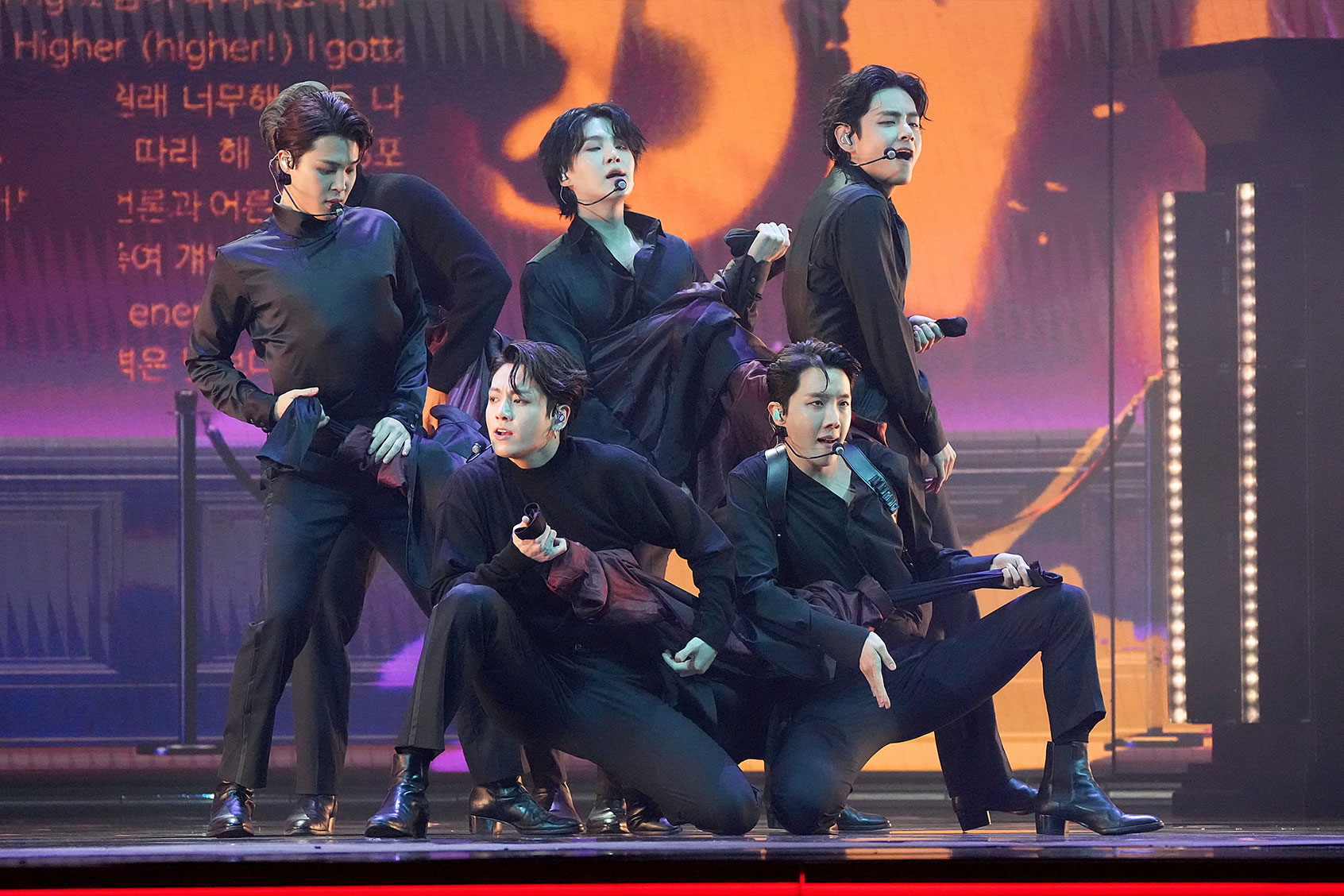
BTSJimin, Jungkook, Suga, J-Hope, and V of BTS perform onstage during the 64th Annual GRAMMY Awards at MGM Grand Garden Arena on April 03, 2022 in Las Vegas, Nevada. (Kevin Mazur/Getty Images for The Recording Academy)Women are complete horn dogs when it comes to K-pop and K-dramas too, from the NSFW fanfictions women write based off of Korean boy bands to sultry video montages called fancams. South Korea may be feeding the wet dream fodder, but that doesn’t mean they’ve escaped the sex recession. Fertility rates in the country are so bad (declining to a record low fertility rate of 0.78 last year) that the government is playing matchmaker. A growing feminist movement in South Korea, called 4B, is taking things one step further, swearing off heterosexual dating, sex and marriage and even boycotting any men in their lives completely. All this is happening while South Korean idols like BTS’ Jung-kook and V are sites on which women project their sexual fantasies.

Sorry boys, we actually don’t need you for us to be sexual.

Even in fashion, sex is back with a vengeance. The rise of the label Slut (non-practicing) captures this ethos. The new iteration of the word slut is not about your body count, but a lifestyle and aesthetic. It’s about wearing micro mini-skirts, being sexy, confident and empowered and yet . . . not having sex. As Tom George for i-D notes, people referring to themselves as slut (non-practicing) is “an ownership of a sexuality that is completely our own, expressed through the way we dress, the way we strut down the street whilst listening to Doja Cat, our horny bookstyling and thotty digital footprint.” Sorry boys, we actually don’t need you for us to be sexual.

Horny women on screen reinforce this “slut in vibes only” concept. They offer a way for non-practicing sluts to live vicariously through their sex adventures without the harm that comes with IRL meetups. While it may seem contradictory for these sex-centered movies and shows to be a symbol of the failure of the sexual revolution, sex in these depictions are not portrayed under the male gaze. In fact, some of them are violent but critically towards men.

In “Bottoms,” the women in the show almost reclaim violence, brutally punching and beating each other up in order to better defend themselves against men. This training prepares them for the brutal fight at the end of the movie as they face off against their high school’s rival football team. The girls don’t just win — they annihilate the boys, even impaling one man through his chest and killing him. When Josie (Edebiri) finally gets the girl at the end and kisses her, a bomb explodes behind them, as if hammering home the idea that women’s desire is a force to be reckoned with.


Want a daily wrap-up of all the news and commentary Salon has to offer? Subscribe to our morning newsletter, Crash Course.


Whereas the sexual revolution failed to create change as it continued to encourage sex on male terms, these raunchy comedies are told through the female gaze, letting women dictate when, where, how and who to sleep with. As more women rethink the typical scripts for sex, these movies offer a reminder: For so long sex has been defined by the straight, cis man — begin with penetration, then ejaculation, the end — but what would “mainstream” sex look like if men were not the default? 

Media often reflects and reframes the rules of our dating behavior. With more movies and shows portraying sex on women’s terms, where will it take us next?


Whoopi Goldberg tests positive for COVID, missing “The View” season premiere

“The View” lead host and actress Whoopi Goldberg missed Tuesday’s premiere after testing positive for COVID, co-host Joy Behar addressed at the beginning of the episode Tuesday.

Behar thanked the audience for showing up to their 27th season premiere and noted Goldberg’s missing presence.

“As you can see, Whoopi is not here, she has COVID. Yes, it’s back, it’s back, but she’s on the mend, she’s on the tail end, and she’ll probably be back this week,” Behar said. “But, sorry she’s not here, for those of you that were looking forward to seeing her.”

This would be the third time Goldberg contracted the virus. The 67-year-old missed several episodes of “The View” due to COVID in November 2022. Also before that, she dealt with a COVID infection in January 2022, Entertainment Weekly reported.

While Goldberg might be out, but the new season welcomed back other hosts such as Sunny Hostin, Sara Haines, Ana Navarro and Alyssa Farah Griffin.

“Disturbed”: For a second time, federal court strikes down Alabama’s congressional map

For a second time, the Republican-drawn congressional map in Alabama was rejected by a panel of federal judges on Tuesday for failing to comply with Section 2 of the Voting Rights Act. 

The three-person panel in Alabama, including two Trump-appointed judges, threw out an earlier redistricting plan approved by Republican lawmakers in the state after finding that it diluted the power of Alabama’s Black voters. That earlier ruling was held up by the conservative Supreme Court. After the 2020 census, a group of Black voters challenged the map that maintained six congressional districts with a white Republican incumbent. More than one in four residents of Alabama are Black.

“The law requires the creation of an additional district that affords Black Alabamians, like everyone else, a fair and reasonable opportunity to elect candidates of their choice,” the judges wrote Tuesday. “The 2023 plan plainly fails to do so.”

The ruling continued:

We are not aware of any other case in which a state legislature — faced with a federal court order declaring that its electoral plan unlawfully dilutes minority votes and requiring a plan that provides an additional opportunity district — responded with a plan that the state concedes does not provide that district

“What I hear you saying is that the state of Alabama deliberately disregarded our instructions,” Judge Moorer, a Trump appointee, pointedly stated. The Alabama attorney general’s office, for its part, defended the legislature’s map in the case

For the 2024 elections, the judges have assigned court-appointed experts to draw three potential maps that each include two districts where Black voters have a realistic opportunity of electing their preferred candidate. Those redistricting proposals are due to the court by the end of the month. 

Alabama’s only majority-Black district was formed two decades ago after a lawsuit.

Peter Navarro to face contempt trial for defying Jan. 6 committee as legal fees soar

Peter Navarro, a former trusted White House adviser to Donald Trump, will head to trial this week for contempt of Congress. Navarro, a staunch advocate of Trump’s “stolen election” claims, is charged with two misdemeanor counts of contempt for refusing to cooperate and provide testimony and documents to the House select committee investigating the Capitol insurrection. Former MAGA aide Steve Bannon was similarly convicted in July 2022 after defying congressional subpoenas and was hit with a four-month prison sentence. 

The Washington Post reports that Navarro, who has pleaded not guilty, stated last week outside a Washington courthouse that his “legal bills just went up by another half-million dollars”  and that he expects the final cost of those fees to reach $750,000, on the expectation that his case “is probably going to the Supreme Court.”

“Do I look like a rich man?” Navarro continued. “This is the same suit I wore in 2017 going into the White House, OK?” He described his prosecution as “partisan” and an attempt “to punish political rivals,” saying, “[T]hey try to put you in prison, which they’re trying to do with me. But it’s also to bankrupt you, OK?”

Navarro reportedly refused to cooperate with the Jan. 6 committee largely because Trump, although no longer in the White House, had “broadly invoked executive privilege in conversations” with Navarro, telling him not to testify about matters related to the House committee’s probe. Initial court rulings indicate that is not likely to be a successful defense.

Priscilla Presley: Elvis was “respectful” of controversial 10-year age gap when she met him at 14

Priscilla Presley said that her late ex-husband and singer Elvis Presley was “respectful” of their controversial 10-year age gap at the Venice Film Festival on Monday promoting the release of Sofia Coppola’s film “Priscilla.” The new film focuses on Priscilla’s whirlwind and controversial romance with Elvis, Entertainment Weekly reported.

“I was a little bit older in life than in numbers and that was the attraction. And you know, people think, ‘Oh, it was sex. . .’ Not at all. I never had sex with him,” Presley said. “He was very kind, very soft, very loving. But he also respected the fact that I was only 14 years old. We were more in mind and thought. And that was our relationship.”

The two met in Germany in 1959 when Priscilla was 14 and Elvis was 24, while the singer was in the U.S. Army and Priscilla’s stepfather was stationed in the Air Force there. Their marriage lasted from 1967-1973.

“It was very difficult for my parents to understand that Elvis would be so interested in me, and I really do think because I was more of a listener,” Presley said.

Presley also called Elvis the love of her life and said the reason for their split wasn’t because they didn’t love each other: “It was the lifestyle that was so difficult for me, and I think any woman can relate to that. But it didn’t mar our relationship, we still remained very close. And of course, we had our daughter, and I made sure that he saw her all the time. It was like we never left each other.”


“Every defendant for himself”: Mark Meadows and others may be ready to flip on Trump

A new report from Politico details evidence that Donald Trump’s inner circle of co-defendants have begun seeking to shift the onus from themselves to Trump in multiple concurrent criminal cases.  

Co-defendants implicated alongside Trump (or named as “unindicted co-conspirators” in the federal case) have begun, Politico reports, “to show glimmers of a tried-and-true strategy in cases with many defendants: Portray yourself as a hapless pawn while piling blame on the apparent kingpin.”

One of the most notorious Trump flippers of earlier years, his former personal attorney and fixer Michael Cohen, is now a pivotal witness in the ex-president’s New York criminal case over his alleged role in facilitating hush money payments to adult film star Stormy Daniels in the final stretch of the 2016 presidential campaign. 

“I suspect it will be every defendant for himself,” Cohen told Politico, speaking about Trump’s current legal plight. “History has shown the 18 co-defendants that Donald doesn’t care about anyone but himself,” he said, specifically referring to the long list of alleged co-conspirators charged by District Attorney Fani Willis in the Georgia election racketeering case.

A potentially significant example came late last week, when former White House chief of staff Mark Meadows signaled that he would likely point to Trump as the ringleader and orchestrator of efforts to subvert the Georgia election. Meadows made a surprise appearance as a witness in Atlanta, testifying in his effort to move his case from state to federal court. Meadows claimed that he did not play “any role” in the plot to name Georgia “fake electors” pledged to Trump. In a post-hearing brief, however, Willis suggested that Meadows had not been truthful. 

We need your help to stay independent

“And after insisting that he did not play ‘any role’ in the coordination of slates of ‘fake electors’ throughout several states, the defendant was forced to acknowledge under cross-examination that he had in fact given direction to a campaign official in this regard,” Willis wrote in the filing. A footnote to the brief argued that the judge “has ample basis not to credit some or all of the defendant’s testimony.”

Politico further reported that court documents from Meadows’ hearing showed that one of his defense attorneys, Michael Francisco, underscored the infamous phone call Trump made to Georgia Secretary of State Brad Raffensperger in early January of 2021, pressuring Raffensperger to “find 11,780 votes.” As Politico notes, Meadows personally arranged the call, but after prosecutors played a recording of the call in court, “an attorney for Meadows emphasized that his client’s part in the actual discussion was both more minor and less provocative than Trump’s.”

“There’s a lot of statements by Mr. Trump. Mr. Meadows’ speaking roles were quite limited,” Francisco said during his cross-examination of Raffensperger, who also testified.

“He didn’t make a request that you change the vote totals — Mr. Meadows, himself?” Francisco continued.

“Correct,” Raffensperger replied.


Want a daily wrap-up of all the news and commentary Salon has to offer? Subscribe to our morning newsletter, Crash Course.


Politico also highlighted a portion of Meadows’ testimony in which he said that Trump “viewed the false electors as a significant part of his strategy to remain in power. “

Meadows claimed he then sent an email pushing the campaign to assemble pro-Trump slates of electors largely because he feared a tongue-lashing from his boss.

“What I didn’t want to happen was for the campaign to prevail in court action and not have this” lined up, Meadows said, adding that if that happened, “I knew I’d be yelled at by the president of the United States.”

“Strategically speaking, if you are one of the less important players, you would definitely want to be in the same trial with Donald Trump. All of the focus is going to be on him,” said Florida-based lawyer Scott Weinberg. “They don’t want the little guys, they want Trump. You’re always compared to who you’re next to.”

Also prominently mentioned in Politico’s report was Yuscil Taveras, an IT aide at Trump’s Mar-a-Lago estate who has significantly altered his initial testimony about alleged efforts to destroy surveillance video, and has now agreed to cooperate with special counsel Jack Smith, who is prosecuting Trump in Washington, D.C. Politico notes that Taveras’ apparent “flip may help him dodge a possible perjury charge … and it is likely to bolster Smith’s obstruction-of-justice case against Trump and two other aides.” Three Republican activists who were indicted with the ex-president in Georgia for attempting to overturn Joe Biden’s 2020 win have all stated that they had acted in accordance with Trump’s “direction,” after posing as legitimate Trump electors and signing false documents.

John Lauro, Trump’s lead lawyer in Smith’s federal election case, recently said that he intends to file a series of motions, including a claim presidential immunity claim, in hopes of getting the charges against Trump reduced or dismissed altogether. Lauro has protested U.S. District Judge Tanya Chutkan’s ruling that the trial should begin next March, saying that mounting a defense of the ex-president is “an enormous, overwhelming task.” 

Future diets will be short of micronutrients like iron — it’s time to consider how we feed people

Iron deficiency is one of the most common forms of nutrient deficiency around the world.

Severe iron deficiency, also known as anaemia, affects nearly 50% of women of reproductive age in regions like South Asia, Central Africa and West Africa (in contrast to 16% of women in high-income countries).

In New Zealand, 10.6% of women aged 15-18 and 12.1% of women aged 31-50 suffer from iron deficiency. The risk increases during the third trimester of pregnancy and the iron status must be carefully monitored to ensure good health for both the mother and baby.

As more people consider switching to plant-based diets, the risk of iron deficiency will likely increase.

We use the latest version of the Sustainable Nutrition Initiative® global food mass balance model to project nutrient availability in current and future global food systems. It suggests we can expect a gap in dietary iron by 2040 if global patterns of food production and supply remain unchanged.

This means we’ll have to address iron shortfalls in our diet, especially in populations with higher requirements such as adolescents and women. We argue that fortifying foods with iron could provide a one-stop solution to bridge nutrient gaps caused by inadequate dietary intake.


Food fortification

Many foods in supermarket shelves, including common staples such as bread and cereals, already have added nutrients.

Unlike mandatory iodine and folic acid fortification of bread, there is currently no government initiative to encourage or mandate iron fortification in New Zealand.

Since iron-fortification strategies have the potential to prevent deficiencies in many countries, including New Zealand, we argue that introducing iron to our foods may be a convenient and cost-effective way to provide a source of dietary iron.


Shift to plant-based diets

More consumers are opting for diets that include fewer animal-sourced foods in the hope of reducing environmental impacts and emissions. Recent statistics show a 19% increase in the adoption of vegan and vegetarian diets among New Zealanders from 2018 to 2021.

Considering these plant-based diets for a sustainable food system must involve conversations about nutrient availability. Plant foods often contain high amounts of fibre and phytates, which reduce the body’s capacity to absorb the iron.

Iron in plant foods such as whole grains, nuts, seeds, legumes and leafy greens is known as non-heme and is less readily absorbed than heme iron in animal-sourced foods. In a mixed diet,  consisting of vegetables, grains and animal-sourced foods, the consumption of some red meat, fish or poultry facilitates non-heme iron absorption.

Fortification can be a potent strategy in helping people to shift towards plant-based diets by enriching these diets with nutrients that would otherwise be lacking.

A recent study investigating this potential revealed that fortifying foods with essential micronutrients, including iron, enables a more gradual dietary adjustment. Consumers wishing to adopt more plant-based diets without compromising nutrient adequacy may find this approach helpful.

However, there’s a caveat. These iron-fortified foods often contain wheat or cereal-based ingredients, which can act as iron absorption inhibitors. As these are common breakfast foods that may be consumed with a morning coffee or tea, the inhibition effect may be even stronger due to the presence of phenolic compounds in these beverages.

One solution could be to eat iron-rich plant foods with foods high in vitamin C, such as orange juice, which helps to convert iron to a more absorbable form.


Is NZ ready for iron-fortified foods?

Although fortified foods can offer great benefits in tackling iron deficiency, some consumers are hesitant to include these foods in their diets.

Food Standards Australia New Zealand (FSANZ), a government entity responsible for developing food regulations for both nations, found many consumers had second thoughts about reaching for fortified foods, viewing them as unnatural, processed and less healthy.

This hesitancy was particularly evident when it came to non-mandatory fortifications. Added vitamins and minerals in breakfast cereals or, more recently, in plant-based milks and meat alternatives, are examples of non-mandatory or “voluntary fortification”. Consumers often perceive this as a marketing tactic rather than a health-promoting intervention.

Given the importance of adequate dietary iron intake and the projected shortage in dietary iron, it is crucial to evaluate the benefits of fortification. Educational interventions such as promoting awareness of iron deficiency and positive impacts of fortification may help improve consumers’ acceptance of these initiatives.

Mahya Tavan, Postdoctoral research fellow – Sustainable Nutrition Initiative, Massey University and Bi Xue Patricia Soh, PhD Fellow – Sustainable Nutrition Initiative, Massey University

This article is republished from The Conversation under a Creative Commons license. Read the original article.

This California city wants to ban all junk foods from being sold at supermarket checkout aisles

The city of Perris, California, is looking to axe all unhealthy foods sold near its grocery store register. Earlier this year, Perris’ City Council unanimously passed a new law that bans junk foods from being sold at supermarket checkout aisles, the East Bay Times reported. Specifically, the law forbids grocery stores of at least 2,500 square feet in size from selling snacks or drinks that are more than 200 calories per package, contain trans fats, derive more than 35% of their calories from total sugars or have more than 200 milligrams of sodium. Grocers will be limited to selling healthy snacks and drinks instead, per a requirement that must be met no later than 2024.

Perris officials hope the law encourages consumers to adopt healthy eating habits. The city currently struggles with high poverty rates along with several public health challenges. Approximately 11.5% of residents live below the poverty line, according to census data. One in 10 Perris adults is diabetic, about one in four is sedentary and almost four in 10 are obese, according to county public health numbers.

Despite the law’s intended goals, many major markets and industry lobbying groups — like the San Bernardino-based supermarket chain Stater Bros. and the California Grocers Association — claim the ordinance is “unfair” because it neglects convenience stores and other junk food retailers. 

This isn’t the first time Perris has encouraged its residents to live healthy lifestyles via legislation. Prior to the onset of the COVID-19 pandemic, the city passed a law requiring either water or milk to be the default beverage with children’s meals at fast food restaurants.

Dan Patrick rules in favor of suspended Texas AG Ken Paxton in first major move of impeachment trial

After Senators resoundingly rejected all of Attorney General Ken Paxton motions to dismiss articles of impeachment against him Tuesday morning, Lt. Gov. Dan Patrick handed Paxton a small victory by ruling that he cannot be forced to testify as a witness in his trial before the Texas Senate. 

The Senate-approved rules for the trial gave Patrick, who is acting as the presiding officer, or judge, the power to issue subpoenas to compel the attendance of witnesses.

Paxton had stated that he would not testify in the trial, and his lead lawyer, Tony Buzbee said in a statement in early July that Paxton “will not dignify the illegal House action by testifying.”

His lawyers followed by filing a pretrial motion asking the Senate to excuse Paxton from testifying, arguing that the trial is a criminal proceeding, giving Paxton the same legal protections as a criminal defendant who would not be forced to testify. 

House managers had opposed that motion, saying the trial rules provided no exception for Paxton. They also argued that Paxton must assert his Fifth Amendment right to refuse to incriminate himself in testimony from the witness stand. 

Patrick said Tuesday that the rules adopted by the Senate apply many of the same rules reserved for criminal cases, including the requirement that Paxton plead guilty or not guilty, and House impeachment managers are required to prove their case beyond a reasonable doubt, a standard also used in criminal trials. 

“The House managers have repeatedly compared actions of the House of Representatives to a grand jury as they prefer the articles of impeachment,” Patrick said as he granted the motion. “Grand juries are utilized only in criminal cases.”

Therefore, Paxton cannot be compelled to testify as a defendant in at his impeachment trial, Patrick concluded.

“The Great British Bake Off” doesn’t want to learn from its mistakes

“I don’t feel like we should make Mexico jokes, people will get upset” Noel Fielding, wearing a Party Central sombrero and a sarape, mused at the beginning of “The Great British Bake Off’s” ill-fated 2022 “Mexico Week.” His similarly dressed co-host, Matt Lucas, responded: “What? No Mexico jokes at all? Not even Juan?” 

In that moment, it was evident that the “Bake Off” hosts were trying to use stale humor to address just how poorly the show’s internationally-themed baking weeks had been received in seasons prior. The show’s 2020 Japan Week was described even by British newspapers as being “borderline racist,” while Eater London termed it an “Orientalist mess,” featuring Lucas “mishearing” katsu curry as “cat poo curry” and reminders that Paul Hollywood once confessed that he doesn’t believe Japan understands baking — on a show about Japanese baking.

Mexico Week, filled with lazy stereotypes and a purposeful obtuseness about the preparation of classic pastries, didn’t fare much better as Eater London’s James Hansen ultimately declared it “the nadir of the show’s fall from grace.” 

In speaking with Salon Talks in January, “Bake Off” judge Prue Leith acknowledged that the series had made some mistakes, though denied ill-intent: 

What was so upsetting about it was the idea that we would somehow want to be either patronizing or mocking. The truth is that on “Bake Off,” we make jokes about everything, but we certainly would never do it being anything other than friendly. People got upset because the hosts wore sombreros and ponchos. But you can’t arrive in Mexico and walk through the airport without people wanting to sell you ponchos and sombreros. Yes they’re clichés, but then a hot dog is a cliché and Americans don’t mind if we make a hot dog.

The show’s producers have now responded, too, announcing in advance of the new season, which premieres later this month, that “Bake Off” would discontinue internationally-themed weeks for the foreseeable future. The series’ executive producer Kieran Smith told The Guardian that the show was “going very traditional.”

“We didn’t want to offend anyone, but the world has changed and the joke fell flat,” Smith said. “We’re not doing any national themes this year.” 

Instead, the contestants will focus on “cakes, biscuits, bread, patisserie, chocolate,” plus Smith adds, “party cakes is a new theme.”

In light of all the missteps, it makes sense from a brand safety standpoint that “Bake Off” would scrap theme weeks and “return to the classics.” That said, the series has long been lauded for being comforting, educational and accepting. In its tone and gentle touch, it broke the mold as a cooking competition series during a time when other food television was becoming increasingly cutthroat. So why couldn’t the show apply that same ethos to its theme weeks?

I suppose it’s easier to just retreat when one’s mistakes have been called out, but it’s a shame that “Bake Off” couldn’t just learn from those mistakes and come back with a more nuanced flavor. 

There are many beautiful examples (from Anthony Bourdain’s salty “Parts Unknown” to Phil Rosenthal’s decidedly more saccharine “Somebody Feed Phil“)  of how to approach food traditions that are different from your own with curiosity and delight, rather than suspicion or superiority. And it’s not like the series creators don’t have many people in their orbit, including former contestants, who could oversee theme weeks. 

We need your help to stay independent

I look to Nadiya Hussain, the beloved winner of the show’s sixth season. Following “Bake Off,” Hussain starred in a two-part BBC One travelogue called “The Chronicles of Nadiya” which followed her as she traced her familial and culinary roots to Bangladesh. It was thoughtful, informative and fun — which is likely what a Bangladeshi “Bake Off” theme week hosted by Hussain would feel like, too. 

While it may be easy to dismiss “Bake Off” as just another cooking show, with an average audience of 9.2 million real-time viewers, the series had a unique opportunity to use food as an accessible, yet powerful, means to bridge cultural understanding. For instance, following Nadiya Hussain’s turn on GBBO, she was described in a British government report on community cohesion as having done “more for British-Muslim relations than 10 years of government policy.” 

Now, not every cooking show or personality needs to do that, but this is a time where “The Great British Bake Off” could have committed to leaning into the kaleidoscopic world of pastry that exists outside the Eurocentric cannon. Yet, to borrow a line from another famed cooking series, they instead decided to pack their knives and head home.

Welcome to the Big Tech company town, where democracy and labor rights are a farce

Although it's been quietly happening over the last decade, historian Timothy Snyder's new book "The End of Reality" has crystallized the tale of how an "interlocking directorate of Silicon Valley" moguls have come to snatch up large swathes of land to develop modern-day company towns. 

In light of the de facto handover of U.S. territory ceded to the likes of Facebook, Amazon, Google, SpaceX and other tech giants, I'd like to extend a warm welcome to our new president-governor-fiefdom-plutocrats, as they take to their respective thrones. The writing is on the wall and there's no winning this battle, folks, so we're gathered here today to bend the knee. 

Company towns are flourishing under Big Tech — a revival not seen since the 1920's. Sure, we could keep putting up a fight, exposing the tech industry's secret contracts with cities, and demanding a defense of constitutionally protected democratic governance on U.S. soil. But, c'mon, we've known this was coming for ages now. Nothing's changed that would stop tech moguls from buying literal towns in the decade since Google's 2013 California land-grab, so there's no reason to think anything is going to stop them now. 

We need your help to stay independent

US lawmakers, elected officials and even Supreme Court justices aren't going to bite the hand that writes their campaign checks — whether Republican or Democrat. Some might suggest that we can just vote our way out of this one by electing people who will enforce anti-monopoly regulations and enshrine public protections into law. But cracking jokes about electoralism during our new god-kings' coronation is generally considered poor manners. 

Besides, it's cruel to get people's hopes up that we can be saved from corporate capture by some miracle of electoralism (roughly, the fallacy that voting is the only way to change things, or that you can vote your way out of authoritarianism). Everyone knows that Democrats are better at destroying reformist candidates within their own party than they are at winning elections against lunatic-fringe right-wingers. And no one can deny that voter suppression and mass incarceration have escalated so wildly in the past 20 years that an ever-greater portion of the country is losing its right to vote. 

And it's not like you can actually vote the money out anyway. The power of money in politics has wholly eclipsed the power of the electorate, even without the help of the tragi-comic dog and pony show we call the Electoral College. Electoralism hasn't been able to stop abortion clinic doors from closing, AR-15s from being toted into elementary schools, US presidents from crippling unions, police violence from damaging black communities, state governors from shoving LGBTQ communities back into the closet, nor corporations from unleashing climate hell across the globe. 

Electorialism hasn't been able to stop the US from operating full-blown domestic spying operations of literally immeasurable size against its own citizens. Nor even prevent drinking water from being poisoned with lead across the US, nor stop the air we breathe from choking us. 

So I'm hard pressed to find even one logical reason or piece of material evidence that supports electoralism as a singularly viable solution to stop full-blown corporate takeover by Big Tech, especially when state governors like Nevada's are literally inviting companies to form their own governments and write their own laws. America's for sale, as NOFX once screamed, and you can get a good deal on it — and make a healthy profit.

We weren't sure of the process for obtaining a parade permit for the soon-to-be streets of Googletown, Metaville and Amazonia. So we've organized a welcoming procession around the perimeter of the towns to celebrate the arrival of our new overlords and their union-busting Pinkerton secret police. Not that we're making assumptions about our god-kings' choice of law enforcement, of course. 


Want more health and science stories in your inbox? Subscribe to Salon's weekly newsletter Lab Notes.


It's just that, once the inevitable climate change-prompted devastation rips through one of these company towns, the Pinkertons would obviously be an ideal choice to make sure corporate overlords can secure their hoarded food and clean water from the desperate masses. No doubt the private militia's reputation benefited significantly from the New York Times' generous 2019 portrait, but Amazon's history of successfully using Pinkerton spies to track warehouse workers like they're KGB assets — along with Facebook and Google's use of them — is a far better recommendation. 

Thus, gather we plebeian masses to hand over as a symbolic token of surrender this carefully folded American flag and welcome their high exaltednesses — the Great Jabbas of the technocratic confederacy, and the corporate jackboots whose leather we've come to polish with our wagging tongues. 

An earlier version of this article originally appeared in Salon's Lab Notes, a weekly newsletter from our Health & Science team. 

In St. Tropez, the Rolling Stones made “Exile on Main St.” — and turned rock stars into high society

The French Riviera was discovered in the 1800s by those British who were seeking a climate to cure tuberculosis. During the following century, the rich and royalty – British, Russian and pan-European – turned this region into a pleasure haven with luxury hotels and casinos. In the early 20th century, the dollar was king. American tycoons and bohemians came – among them, novelist F. Scott Fitzgerald and musical composer Cole Porter. The British maintained their presence with figures like Edward VIII, the King who abdicated for love, and songwriters like Noël Coward. Aristocratic scandals bubbled over from London drawing rooms and nightspots.

After World War II, with the opening of the Cannes Film Festival, Hollywood descended on the coast. It was a home away from home, laced with French finesse. The Antibes Jazz Festival became big — Charlie Mingus, turning his back on Newport, headlined, and Miles Davis recorded an album at the festival in 1963. The Beatles — never too popular in France — played to 8,000 people in Nice in 1965. Paul McCartney returned to film a sequence to accompany his song “The Fool on the Hill” in The Beatles’ improvised television special that has been dubbed “The Tragical Mystery Tour.” Then four years later, the Rolling Stones installed themselves on the Riviera for the challenging basement recording of “Exile on Main St.”

* * *

At the beginning of the 1970s, UK supertax stood at 83 percent with tax on unearned income at 98 percent. On April 5, 1971 — the start of a new English tax year — the Rolling Stones fled to the south of France, where Keith Richards rented the Belle Époque Villa Nellcôte at the base of the Cap Ferrat peninsula. The rest of the group were spread about. Hating the Riviera in season, Charlie Watts rented in the Vaucluse. Mick Jagger was in Saint-Tropez for his marriage in May.

During the Sixties, rebellious and provocative Saint-Tropez had stiffened into a self-conscious resort where people went to be seen. Limited space and high prices initially secured an exclusivity that was soon destroyed by the sheer number of people wanting to be there. David Dodge noted that on Tahiti Beach “the sheen of sun oil… was blinding.” People slept during the day — on the sand under sunscreen, under trees in the shade. Nights were swilled with drink and danced away in cha-cha-chas and twists. By May 1971, Saint-Tropez was still an “in” resort — a place where you could make a glamorous splash for a big event, and where Mick Jagger married the Nicaraguan Bianca Pérez-Mora amid a media scrum. As Keith Richards wryly remarked, Jagger wanted a quiet wedding, so he chose Saint-Tropez in the middle of summer. Although Bianca was four months pregnant, the couple had to fight through tight crowds to get to the civic ceremony. French marriage involves a declaration of ownership to be used in the case of divorce. Bianca nearly called the whole thing off when she found out how few assets were declared to be common. The couple were then mistakenly locked out of the religious ceremony — the fisherman’s chapel of St. Anne had been shut against the surge of photographers.

The reception was held at the Hôtel Byblos, built four years earlier on the highest hill of Saint-Tropez by a Lebanese businessman who had developed a crush on Brigitte Bardot. Among the local guests were Bardot and Roger Vadim. Seventy-five others had been flown down from London in a plane chartered by Jagger. Paul McCartney and Ringo Starr — temporary enemies during a post-Beatles legal wrangle — kept away from each other. Keith Richards was out of his head and flat on his back. Bianca later declared that her marriage ended on her wedding day. Despite all the chaos, journalist David Hepworth claimed that the wedding marked “the establishment of rock and roll as a viable branch of high society.”

As Keith Richards wryly remarked, Jagger wanted a quiet wedding, so he chose Saint-Tropez in the middle of summer.

Meanwhile, Richards bought a speedboat — Mandrax — and the denizens of the Villa Nellcôte would speed along the coast for breakfast in Menton or over the border in Italy. The villa’s cook, Fat Jacques, had connections with the Marseille underworld and soon became their drug dealer, bringing Richards huge sacks of lactose and small sacks of pure heroin. These had to be mixed to the gram — 97 percent lactose to 3 percent heroin. Get the proportion wrong – Richards warned — and you were in trouble.

They were having a wild time. Richards and a couple of mates fought off some muggers in Villefranche. Go-karting in Cannes, Richards’s kart flipped and he was dragged 50 meters down the tarmac, scraping all the skin from his back. Just off dope, he was given morphine. By July, however, Richards was getting itchy fingers. Deciding against studios in Nice or Cannes, the Stones recorded what many people consider their finest album, “Exile on Main St.,” in the damp, badly ventilated basement bunkers of the villa — hence the track “Ventilator Blues.” They hooked up their eight-track mobile recording studio, started in the late afternoon and worked on through the night. The dampness affected the tuning of their instruments and their voices. Richards found the fumes of Jack Daniels beneficial.


Want more stories behind classic albums? Listen to the Salon + Wonderwall podcast “Everything Fab Four,” hosted by Kenneth Womack.


Recording was interrupted by the birth of Jade Jagger in Paris in October, and by the theft of Keith Richards’s collection of vintage guitars from the villa later that month. When the recording was finished in December, the Stones were arrested on drug charges. Only Richards and his partner, Anita Pallenberg, were convicted, but they escaped to the West Indies. It was rumored that the corrupt mayor of Nice, Jacques Médecin — allegedly pal to to some of the coast’s big drug dealers — was behind the arrests.

The Stones helped glamorize the Riviera for rock stars. Sir Elton John bought a Belle Époque villa overlooking Nice, Tina Turner a property at Villefranche, ex-Stones player Bill Wyman a villa near Saint-Paul-de-Vence. Bono chose Èze-Bord-de-Mer. Meanwhile, there were many crummy characters — including the mafias of several nations — exploiting the ostentatious wealth displayed by visitors.

The Once Upon a Time World – the Dark and Sparkling Story of the French Riviera,” published September 5 by Pegasus, looks at the history of this glamour-tanned region – from Roman times to the Russian oligarchs.

Extreme heat is now affecting one of your cooking must-haves: Olive oil

Olive oil is, for all intents and purposes, probably one of the biggest staples in most kitchens worldwide.

Unfortunately, though, you might need to stock up soon: Extreme heat, especially throughout Europe, may soon wreak havoc on your olive oil. Don’t take it for granted.

In an aptly titled Grist story called “Climate change is coming for your olive oil, too,” Max Graham writes that the oil has seen raising prices recently due to “heatflation,” which he defines as “when scorching temperatures harm crops and push food prices up.” Due to droughts and high heat throughout Europe, especially Spain, olive oil may become a sought after fat in the near future.

Per Graham Spanish olive oil production has already fallen by a half. This, of course, will also undoubtedly impact the price of your favorite olives oils, as well as their availability; Spain is the number one provider of the world’s olive oil.

“The price of olive oil has surged to an all-time high, double a year ago,” wrote Javier Blas for Bloomberg. “In 2019, before the pandemic, the ratio was less than five times.”

We need your help to stay independent

Even Californian olive orchards are struggling, primarily due to excessive, unprecedented rains, though less than 3% of the olive oil consumed in the United States is actually made in California. 

That said, this is also unfortunately by no means a new development. As Samantha Larson wrote for Epicurious, in 2018, some California olive harvests were so low that companies using “olives grown in Argentina, Chile, Portugal to blend with their California production.” This was not looked favorably upon by many customers.

What’s even more concerning is that fact that in 2019, the olive production of the year prior was less-than-ideal — but in 2023, it’s fallen even further.

In March 2021, Elazar Sontag wrote in Eater that Italian olive production was down.

“Olive trees are alternate bearing, with a plentiful harvest year usually followed by a smaller one. Farmers know to anticipate this cycle, but now the successful harvests are sometimes almost as meager as the predictably small ones,” Sontag wrote.

So, while the trees themselves are often resilient, that’s not always the case for the fruit — or oil — itself. Whether due to extreme heat, drought, frosts, excessive rains or invasive insects, olives have a slew of adversaries, if you will. As CNN reported, The International Olive Council has “stopped short of calling the situation a crisis, but a spokesperson said ‘we are facing a complex situation as a consequence of climate change.'”


Want more great food writing and recipes? Subscribe to Salon Food’s newsletter, The Bite.


As the title of Mitski’s upcoming album “The Land Is Inhospitable and So Are We” predicts, it is thought that many traditionally lush, olive-producing places — such as Northern Italy — may not be able to produce such olives in upcoming years, with their fertile grounds soon becoming too darn hot for the fruit to flourish. 

As Giuseppe Morisani and Skyler Mapes, co-founders of Calabrian olive oil company EXAU, told Sontag: “People are like, ‘I want to protect the environment.’ And I’m like, ‘You should plant an olive tree.”

“Putting our national security at risk”: Tuberville blasted over “blanket hold” on military officers

In a Washington Post op-ed published on Monday night, the civilian secretaries of the U.S. Army, Navy and Air Force sharply criticized Sen. Tommy Tuberville, the Alabama Republican "who is blocking the confirmation of our most senior military officers," as they put it. 

Tuberville, an anti-choice conservative and staunch supporter of Donald Trump, has single-handedly placed a "blanket hold" on the appointments of all "general and flag officer nominees" in all branches of the U.S. military. He strongly opposes "Defense Department policies that ensure service members and their families have access to reproductive health" — and, more specifically, to abortion services — "no matter where they are stationed." The gist of this policy is that service members in states where abortion is now illegal or sharply restricted may travel at government expense to jurisdictions where it is permitted, a policy Tuberville and other Republicans strongly oppose.

In the Post article, Navy Secretary Carlos Del Toro, Air Force Secretary Frank Kendall and Army Secretary Christine Wormuth write that the policy on reproductive access is fully legal and also "critical and necessary to meet our obligations to the force." Tuberville's hold, they assert, is "putting our national security at risk" by preventing the Pentagon "from placing almost 300 of our most experienced and battle-tested leaders into critical posts around the world":

Three of our five military branches — the Army, Navy and Marine Corps — have no Senate-confirmed service chief in place. … Across the services, many generals and admirals are being forced to perform two roles simultaneously. … Each of us has seen the stress this hold is inflicting up and down the chain of command, whether in the halls of the Pentagon or at bases and outposts around the world.

Tuberville's claim that "holding up the promotions of top officers does not directly damage the military," the three secretaries conclude, "is wrong — plain and simple."

The NRA’s toxic fuel: When racism and guns unite

There’s been another mass shooting, this time in Jacksonville, Florida. 

Like rapid fire bullets from an AK-47, American gun carnage is set to repeat. Random shooters can fell anyone, anywhere: at church, at school, at the Dollar GeneralMass shootings occur with such frequency that Americans seem inured to a brutal reality where the unstable and aggrieved — and the racist —can buy a gun as easily as a pair of shoes.  

The 2nd Amendment wasn’t intended as a death warrant

Alleged “originalists” on today’s Supreme Court, who claim to hew to the original meaning of the Constitution, did an about face on the 2nd Amendment.  (Disclaimer, my federal litigation practice focuses on 1st and 14th Amendments, I’ve never tried a 2nd Amendment case.) As Chief Justice Warren Burger observed: 

The gun lobby’s interpretation of the Second Amendment is one of the greatest pieces of fraud, I repeat the word fraud, on the American people by special interest groups that I have ever seen in my lifetime… The real purpose of the Second Amendment was to ensure that state armies, the militia, would be maintained for the defense of the state… The very language of the Second Amendment refutes any argument that it was intended to guarantee every citizen an unfettered right to any kind of weapon he or she desires.

The NRA, like the fossil fuel industry, has lobbied extensively for laws and interpretations that protect their profits at the expense of human life, and a tainted Supreme Court has enabled them.

This view, shared by many Constitutional law scholars, holds that an unbought and un-lobbied interpretation of the 2nd A flows squarely from its historical context:  In 1775, King George declared that the American colonies were in a state of rebellion.  Eager to defeat, tax and control them while extracting their natural resources, the king sent bayonet-armed soldiers to occupy the 13 colonies.  The British army quartered itself in the colonists’ meager homes, slept in their beds, burned their firewood, ate their scarce food, and confiscated their guns so they couldn’t form a militia to fight back. 

England disarmed the colonists to frustrate their efforts to organize a militia, which handicapped the rebels and, initially, the Continental Army.  When the fighting finally ended, Revolutionary War leaders met at the first Constitutional Convention in 1787 to draft their new governing laws.  General George Washington, fresh from the fighting, didn’t just attend the Constitutional Convention, he was the convention president.

We need your help to stay independent

As written and adopted in 1791, the 2nd Amendment reflected the inequity of weaponry felt during the British occupation: “A well regulated Militia, being necessary to the security of a free State, the right of the people to keep and bear Arms, shall not be infringed.”  

Nowhere does the original 2nd Amendment state that citizens have the right to bear arms against each other, rather, the right to bear arms was described as a matter of collective defense.

From militia to every man for himself

After ratification, the 2nd A was in quiet effect for nearly 200 years, and various gun regulations were adopted without conflict or controversy.  Trouble started brewing in the 1970s when the National Rife Association began lobbying to increase the production, sale, and distribution of firearms. After decades of effort, the NRA’s lobby paid off in 2008, when the Supreme Court declared for the first time that an individual right to gun ownership under the 2nd A was separate from the ‘militia clause’ in the very same sentence, effectively erasing those terms and their historical context altogether.  

In 2022, Justice Clarence Thomas made matters worse in the shameful Bruen decision, which overturned New York’s common sense concealed carry law that had been on the books for more than 100 years.  Relying on specious and selective historical justification, Thomas essentially wrote that an individual’s interest in carrying a concealed gun outweighed the government’s interest in reducing gun deaths.  It was an outrageous but predictable result from a justice who has accepted gifts of immense value from right-wing political donors.  

The NRA’s long-standing relationship with dark money campaign finance is no secret.  Thanks to the handiwork of tainted justice(s) and Citizens United, which allows organizations to spend limitless amounts to influence elections and thereby the courts, today’s gun lobby estimates that there are over 433 million firearms in civilian possession in the US.  

Lax gun laws kill

Democrats like to claim that Democratic states have lower murder rates than Republican states, which is true, but only because political affiliations drive gun policies. Arranging gun mortality rates according to controlling party affiliation, the CDC reports that twice the number of people are murdered per capita in red states than blue, even though red states tend to have more rural populations. In 2021, there were 6 murders per 100,000 residents in Democratic states, compared to 14 in Republican states.  The correlation between gun regulations and homicide rates is plain; states with stronger gun laws experience less per capita gun violence, a fact of no relevance to lawmakers funded by the NRA.  

The NRA, like the fossil fuel industry, has lobbied extensively for laws and interpretations that protect their profits at the expense of human life, and a tainted Supreme Court has enabled them.  It’s a good thing education in red states is also subpar, or people might read up on American civics and see a deadly pattern.

Guns and racism make a lethal combination in DeSantis’ Florida 

Florida is perhaps the most lethal state of all, because its Governor promotes guns and espouses racist policies at the same time.  

Ron DeSantis previously made it legal to drive over protesters in Florida without criminal penalty, and made it obvious that he was targeting BLM protestors reacting to the murder of George Floyd.  The next year, as multiple Neo-Nazi protests took place in Florida, complete with white power insignia and anti-Biden banners, DeSantis hesitated to condemn the protesters at all.

DeSantis has always supported permit-less concealed carry, which became Florida’s law in 2023.  He is also a champion of ‘Stand your ground’ laws, under which people can shoot and kill because they feel threatened by another person.  Racial inequities under ‘stand your ground’ are unmistakable:  When white shooters kill black victims, they are deemed ‘justified’ 11 times more frequently than when the shooter is black and the victim is white. 

When DeSantis’ pro-gun instincts are viewed alongside his vitriol toward race studies, the arrests of black voters his own administration registered, and his promise to ‘destroy leftism,i.e., minority protections, DeSantis walks, talks, and quacks like a racist duck.  In 2020, his enthusiasm for Florida’s ‘stand your ground’ law elicited this from Florida Moms Demand Action:  

Florida’s hate-fueling, so-called ‘Stand Your Ground’ law already encourages violence and deadly vigilantism — especially against Black Floridians. Governor DeSantis’ proposal would make it even worse and embolden white supremacists.

Fast forward to 2023.  Last week, when DeSantis appeared at the vigil in Jacksonville for three black people killed by a white supremacist with swastikas on his gun, he was booed. He seemed surprised to hear that he was not welcome, that their deaths were on his hands.  

“Recovering from Gonzo Governance”: Media scholar on how journalism can get over “Trump, the meme”

Donald Trump is best understood not as a politician but instead as a type of meme where his identity and politics are perceived as being one and the same thing by his followers. Trump, the meme, uses social media and other digital technologies (as well as more traditional media and communication tools such as television) to maintain and build support with MAGA and to attack his enemies while undermining any sense of shared reality and truth.

The Age of Trump has been an emotional rollercoaster.

The American news media have largely failed in their responsibilities to stop Trump and his neofascist movement, in large part because, even after having seven years of experience, they lack the conceptual tools to grasp the true nature of the crisis and what it represents.

So in an attempt to make better sense of how the Age of Trump has disrupted our understanding of the relationship(s) between the media, politics and society — and what may come next in the country’s ongoing democracy crisis — I recently spoke with David L. Altheide. He is the Regents’ Professor Emeritus on the faculty of Justice and Social Inquiry in the School of Social Transformation at Arizona State University and author of the new book “Gonzo Governance: The Media Logic of Donald Trump.” Altheide other books include “Terrorism and the Politics of Fear” and “The Media Syndrome”.

In this wide-ranging conversation, Altheide explains that Trump and the Trumpocene are the product of what he describes as “Gonzo Governance” and a new media and digital culture that American society is still struggling to comprehend. Altheide argues that the American media elevated Trump to power because his performance style, meme identity, politics, and extreme behavior were and remain a perfect fit for a superficial society that has a limited attention span and is fixated on amusement and distraction.

At the end of our conversation, Altheide offers advice for the American news media about how to better respond to the demands and disruptions of the Age of Trump.

This conversation has been edited for clarity and length.

Given the tumult and norm-breaking and general chaos of the Age of Trump and beyond, how are you trying to make sense of it all?

These are troubling times. The most worrisome thing about the Trump years is what will remain after he leaves the stage: undermining our institutions, and damaging civility that is essential to a diverse society like ours.

Some social scientists foresaw the political moment we are in and wrote about it for decades. My colleague, Robert Snow, and I argued more than four decades ago in our book, “Media Logic,” that new information technologies and media formats were changing our social institutions, including religion, education, sports, and politics.  

But like many research-based conclusions and suggestions, our concerns were ignored. Our current moment is one borne of our entertainment-oriented mass media and popular culture that fosters conflict and drama. The goal of commercial media in the U. S.—and social media are commercial media—is to attract audiences and users to deliver them to advertisers. How to do this? Entertainment was the answer. And one of the tried-and-true ingredients of entertaining messages and performances is fear. 

Essentially, the same underlying media processes are at work that gave us entertainers like Ronald Reagan, Arnold Schwarzenegger, Jesse Ventura, and numerous other popular culture and sports figures and heroes. Now, it is Donald Trump, a reality TV show actor. The thing to keep in mind is that the sole fault lies not with Trump or Reagan or others; it is the audience involvement with various media formats, especially visual ones, and particularly today’s social media that are instantaneous, personal, and visual. This has led to what I describe as “Gonzo Governance” and the damage to our major social institutions.

Given your expertise in media and culture, how are you “seeing” and processing the Age of Trump and America’s democracy crisis and the larger moment? 

The most important thing you can know about someone is what they take for granted.

Power is the ability to define a situation for you and others. 

The mass media and communication formats—how messages are selected, organized, presented, and interpreted—are key for what people understand and take for granted about their everyday lives. Repetitive images, symbols, language, metaphors, and overall discourse affect what people take for granted, while also shaping how they perceive and interpret information.   

Part of the answer involves how to cultivate and cash in on fear. Media are key. Trump is very good at this, but he had a lot of help with decades of sensationalized TV news and popular culture—about minority groups, crime, drugs, gangs, gays, terrorists, immigrants— that sold fear as entertainment to mass audiences. Fascists play to fears.

We need your help to stay independent

The Trump approach went beyond anything that we’ve seen before: He preached that whatever institutions disagreed with him were corrupt, could not be trusted, and must be changed. He said that citizens were being left behind because the social institutions they counted on had failed them. Many institutions could not be trusted; they were corrupt. This included the news media (fake news), election procedures and basic democratic processes, law enforcement, science, education, and military.  Other officials feared his wrath and fell into line parroting the same slogans.

Properly understanding (and defeating) the Age of Trump and ascendant neofascism really demands the expertise and insights of experts in cultural studies, media, popular culture, performance art and theory, race, power, philosophy, psychology, political science and history and other related fields. Unfortunately, those perspectives and experts are not featured by the mainstream news media or among the commentariot.

There have been numerous attempts to explain why Donald Trump received nearly 63 million votes for President of the United States in 2016 and more than 74 million in 2020. Many analysts focus only on media content, but more importantly, it is the way that our culture is mediated, and cut through with media logic. For example, Brad Parscale, candidate Trump’s digital media advisor in 2016—along with several Russian and other foreign hackers—developed thousands of Facebook advertisements that were instantaneous, personal, visual, and often negative.

Twitter-internet writers are technologically forced to limit utterances to 280 characters; users and receivers of tweets expect this and become accustomed to short-handwriting to save space. It is understood that tweets are not elaborate statements of explanation or justification; they tend to be evocative. They invite simple recognition, slogans, and individual participation and sharing. This is consequential when it becomes a normal form. And it is very important for memes.

“The thing to keep in mind is that the sole fault lies not with Trump or Reagan or others; it is the audience involvement with various media formats, especially visual ones, and particularly today’s social media that are instantaneous, personal, and visual.”

It is apparent that President Trump’s messages are reflexive of his digital identity, in a kind of digital circuitry. Hard-core Trump supporters, like religious zealots, cannot easily be dissuaded by his actions, law enforcement, court victories, or even election results. 

Trump is a reflexive propagandist, meaning that messages are tailored to the audience’s expectations and use of the formats and digital logic of Twitter and the internet, as well as the reciprocal posting of Fox News. 

Becoming a meme representing oneself can convey an open-ended meaning to viewers, who may interpretively select a wide range of content to lend meaning. Virtually anything tweeted will resonate meaningfully and emotionally with sympathetic supporters who are looking to confirm rather than challenge their champion. Even his detractors will process the messages as digital circuitry.

Who and what is Donald Trump? Note my emphasis: the man vs. the symbol; the semiotics of Donald Trump and his movement.

The short answer is that he is a meme.

President Trump’s pursuit of attention-based politics with digital media became institutionalized and he ritually performed as expected by alluring supporters. His message and persona are joined. In one sense, he is a quintessential communicator: His identity and presence speak volumes to those who matter. 

A digital media persona like Trump relies on social media to gain attention, promote himself, and attack critics, including those who use his own words to challenge his credibility and consistency.

Journalists and critics use conventional referential syntax, but Trump’s tweets are often evocative, vulgar, ad hominem personal attacks. He steps outside of convention and norms and boundaries of acceptable speech, especially by politicians and other leaders.

He adopted a tough street code to violate rituals of civility and align with alienated supporters. This gonzo break with tradition focused media attention on his persona as the solution.

A meme is a cultural element, meaning, or ideological identification that is widely shared. Memes are similar to an urban legend with an emotional or bizarre appeal, but they tend to be shared via electronic technology and digital formats, often including a visual or graphic along with a few words or a phrase. Memes stir emotional responses and can create meanings and framings of issues and events.  The precise meaning of a specific post is less salient than the supportive interpretation of an audience member.

The Gonzo Trump spectacle became objectified as a meme. The evocative character of memes takes on added significance for President Trump. A large percentage of his tweets are in opposition or a reaction to a statement or action by others. The Twitter routine and the response are communicative independently of the specific content; it is Trump again! The postings may be considered as Donald Trump, the meme.

 What does Donald Trump mean to different audiences and publics?

Trump represents a mythical salvation and relief of nascent fear and a better future where the only rules that will apply are those that help individuals achieve rapidly changing goals.

This is the new normal of gonzo governance that has emerged from our communication order featuring digital media that provide instantaneous, personal, and visual information.

This entertaining conflict-ridden media logic promotes evocative reaction rather than referential and reflective communication. 

“Recovering from Gonzo Governance will require planning and perseverance to reaffirm a civic culture at home, and maintaining, reassuring, and rebuilding domestic and international alliances.”

Gonzo, or breaking the mold of a conventional activity, was popularized by Hunter Thompson’s deviant-drugged-edgy lifestyle and approach to journalism. 

A key feature of a gonzo perspective is that individual actors use media performances to rail against a fearful disorder that needs drastic correction. Politicians cultivate and pursue the emotional appeals to audiences and potential constituents. Gonzo rhetoric requires attention-grabbing bold action that only the savior can provide, such as Donald Trump. Gonzo Governance is becoming institutionalized as routine resistance to the election process and the rule of law.

We are in the age of “content” across this late capitalist society. In an attention economy where the public is constantly distracted and “fear of missing out” rules so many people’s behavior, democracy and any form of serious public deliberation and reflection are in real trouble.

Everyday life today is a media cauldron. Everyday life has also changed with and through media changes. The ease of access of digital media in short doses provides enough news and evocative information for conversations, but no depth. Marketing dominates news. The rise of visual media and availability have altered even traditional network news, which now routinely uses meaningless visual vignettes of animals, car chases and crashes. So, we have a lot of access to information vignettes but little depth, or context, and thus, little understanding. 

Demagogues are nothing new in human history. But Donald Trump is truly very much a product of this era of digital media and communications.

I believe that digital media were key for Trump’s impact and election. He is not just a populist demagogue but is a meme that resonates the politics of fear and vengeful emotions against institutions that have denied him legitimacy. His future success depends on weakening major social institutions.

The long history of entertaining fear along with a changed media environment and new information technologies that are personal, visual, and instantaneous were foundational for audiences to be receptive to crude messages of hate and institutional revenge.

Most efforts to use fear to win elections relied on rhetoric. Presidential candidate Donald Trump’s propaganda took the politics of fear to a new level by promoting the fear of immigrants, especially Mexicans, while demonizing Muslims.

Many American citizens supported this fear with ballots as well as large increases in hateful attacks on Mexican Americans, Jews, Muslims, and minority groups. Creating political theatre with clashes between unidentified federal agents and protesters is a new level of manipulation, one that is aided by TV networks’ pursuit of exciting visual coverage that can distort a more complex reality.

What are some of the more serious errors that you have seen the mainstream American news media make during the Age of Trump and beyond?

It is important to understand that President Trump’s tweetable news and influence were aided by entertaining news formats that favored dramatic visuals with emotional appeal in the pursuit of high ratings.

News organizations enable propaganda with presidential politics, albeit with occasional disclaimers and challenges to the blatant lies, because of two things: First, there is a commitment to report daily and heavily on the president and now Republican candidate under numerous indictments; even absurd tweets.


Want a daily wrap-up of all the news and commentary Salon has to offer? Subscribe to our morning newsletter, Crash Course.


Second, news coverage—especially TV— is guided by an entertainment format that prefers evocative drama, conflict, and violence. It was estimated that in the first two months of the 2016 presidential campaign, Donald Trump received more than three times the coverage of his political opponents. The Chief Executive Officer of CBS said of Trump’s candidacy, “It may not be good for America, but it’s damn good for CBS.” CNN’s president admitted, “We put him on because we you never knew what he was going to say.”  Trump continues to command news attention as journalists play along and he benefits.

If you were to give a talk at a journalism conference or at a leading publication like the New York Times or CNN, what suggestions would you make about how to better adapt to the Age of Trump?

There are many fine journalists, but few can operate independently of the bonanza of wealth and hubris of their organizations. Academics’ op-ed submissions routinely are rejected. Americans are ill-informed about so much—domestic problems, foreign affairs, etc.—and, ironically, it is not totally their fault. Public airwaves and even many print outlets have not provided systematic coverage of these topics, preferring to go with what grabs the audience, brief, evocative, dramatic, conflictual—and almost always, visual—renderings that basically tell audiences what they might already know. These same media strategies underlie the assault on our own institutions and entrenched values and goals that require significant forbearance and support for their continuation. It is time to change and counter established broadcast formats.

Here are a few specific suggestions.

Recovering from Gonzo Governance will require planning and perseverance to reaffirm a civic culture at home, and maintaining, reassuring, and rebuilding domestic and international alliances. Hopefully, more informed voters will simply reject the people, politics, and policies that are gonzo driven. The vote and election results are key. This is why elections, voting rights, and independent voting oversight are being attacked nationally.  However, as we saw in the resistance to the January 6 insurrection attempt, citizens and politicians differ in their allegiance to this destructive movement and respect traditional guardrails. 

Key organizations and institutions should join in a well-publicized national and international communication campaign to convey their commitment to help retrench and reinforce basic American values including equality of opportunity, voting rights, non-discrimination and equal rights for women, racial, religious, and ethnic minorities, support for science and international treaties, affirmation of scientific research for collective health and well-being, as well as diplomatic solutions to major world problems.

In addition, we must understand the role of the mass media, digital media, and propaganda in promoting an entertainment-based politics of fear that was part of the foundation for the election of reality-TV star Donald Trump.

Another important step involves journalism training, ethics, and responsibility. With the explosive growth of fake news by propagandists—Russians included—journalists and internet and digital service providers must become more critical and bolder in refusing to report on blatant lies, or at least greatly qualifying the fallacious claims.

Space junk in Earth orbit and on the Moon will increase with future missions

There’s a lot of trash on the Moon right now – including nearly 100 bags of human waste – and with countries around the globe traveling to the Moon, there’s going to be a lot more, both on the lunar surface and in Earth’s orbit.

In August 2023, Russia’s Luna-25 probe crashed into the Moon’s surface, while India’s Chandrayann-3 mission successfully landed in the southern polar region, making India the fourth country to land on the Moon.

With more countries landing on the Moon, people back on Earth will have to think about what happens to all the landers, waste and miscellaneous debris left on the lunar surface and in orbit.

I’m a professor of astronomy who has written a book about the future of space travel, articles about our future off-Earth, conflict in space, space congestion and the ethics of space exploration. Like many other space experts, I’m concerned about the lack of governance around space debris.

Space is getting crowded

People think of space as vast and empty, but the near-Earth environment is starting to get crowded. As many as 100 lunar missions are planned over the next decade by governments and private companies like SpaceX and Blue Origin.

Near-Earth orbit is even more congested than the space between Earth and the Moon. It’s from 100 to 500 miles straight up, compared with 240,000 miles to the Moon. Currently there are nearly 7,700 satellites within a few hundred miles of the Earth. That number could grow to several hundred thousand by 2027. Many of these satellites will be used to deliver internet to developing countries or to monitor agriculture and climate on Earth. Companies like SpaceX have dramatically lowered launch costs, driving this wave of activity.

“It’s going to be like an interstate highway, at rush hour in a snowstorm, with everyone driving much too fast,” space launch expert Johnathan McDowell told Space.com.

The problem of space junk

All this activity creates hazards and debris. Humans have left a lot of junk on the Moon, including spacecraft remains like rocket boosters from over 50 crashed landings, nearly 100 bags of human waste and miscellaneous objects like a feather, golf balls and boots. It adds up to around 200 tons of our trash.

Since no one owns the Moon, no one is responsible for keeping it clean and tidy.

The clutter in Earth’s orbit includes defunct spacecraft, spent rocket boosters and items discarded by astronauts such as a glove, a wrench and a toothbrush. It also includes tiny pieces of debris like paint flecks.

There are around 23,000 objects larger than 10 cm (4 inches) and about 100 million pieces of debris larger than 1 mm (0.04 inches). Tiny pieces of junk might not seem like a big issue, but that debris is moving at 15,000 mph (24,140 kph), 10 times faster than a bullet. At that speed, even a fleck of paint can puncture a spacesuit or destroy a sensitive piece of electronics.

The amount of debris in orbit has increased dramatically since the 1960s.

In 1978, NASA scientist Donald Kessler described a scenario where collisions between orbiting pieces of debris create more debris, and the amount of debris grows exponentially, potentially rendering near-Earth orbit unusable. Experts call this the “Kessler syndrome.”

Nobody is in charge up there

The United Nations Outer Space Treaty of 1967 says that no country can “own” the Moon or any part of it, and that celestial bodies should only be used for peaceful purposes. But the treaty is mute about companies and individuals, and it says nothing about how space resources can and can’t be used.

The United Nations Moon Agreement of 1979 held that the Moon and its natural resources are the common heritage of humanity. However, the United States, Russia and China never signed it, and in 2016 the U.S. Congress created a law that unleashed the American commercial space industry with very few restrictions.

Because of its lack of regulation, space junk is an example of a “tragedy of the commons,” where many interests have access to a common resource, and it may become depleted and unusable to everyone, because no interest can stop another from overexploiting the resource.

Scientists argue that to avoid a tragedy of the commons, the orbital space environment should be seen as a global commons worthy of protection by the United Nations. The lead author of a Nature article arguing for a global commons filed an amicus brief – a type of outside comment offering support or expertise – on a case that went to the U.S. Court of Appeals for the District of Columbia Circuit in late 2021.

The author and his research collaborators argued that U.S. environmental regulations should apply to the licensing of space launches. However, the court declined to rule on the environmental issue because it said the group lacked standing.

The tragedy of the commons asserts that if everyone has unlimited access to a resource, then in the long run it may become depleted and unusable.

National geopolitical and commercial interests will likely take precedence over interplanetary conservation efforts unless the United Nations acts. A new treaty may emerge from the work of the U.N. Office for Outer Space Affairs, which in May 2023 generated a policy document to address the sustainable development of activities in space.

The U.N. can regulate the activities of only its member states, but it has a project to help member states craft national-level policies that advance the goals of sustainable development.

NASA has created and signed the Artemis Accords, broad but nonbinding principles for cooperating peacefully in space. They have been signed by 28 countries, but the list does not include China or Russia. Private companies are not party to the accords either, and some space entrepreneurs have deep pockets and big ambitions.

The lack of regulation and the current gold rush approach to space exploration mean that space junk and waste will continue to accumulate, as will the related problems and dangers.

What it takes to win over MAGA: Will the GOP “hand Ukraine to Russia?”

After more than 18 months of war, a plurality of Republicans say the U.S. should do more to support Ukraine. But despite the view shared by 40 percent of Republicans, according to a recent CNN-SRSS poll, the Republican presidential candidates remain as splintered as ever. 

While a summer of campaigning through Iowa, New Hampshire, and Ukraine itself initially revealed the GOP’s splintered views on U.S. aid to Ukraine, the Republican presidential debate in August further revealed the candidates’ diverging views. 

Opting to talk of COVID-19, abortion, and Hunter Biden, the eight candidates who qualified for the debate didn’t speak of Ukraine until the halfway point, when Fox News hosts Bret Baier and Martha MacCallum provoked the topic. The debate stage was ripe grounds for Republicans to oppose further U.S. support.

Entrepreneur Vivek Ramaswamy and Florida Governor Ron DeSantis seized the debate stage as an opportunity to express their ‘America First’ opposition to further aid, drawing stark dissent to the supportive views of fellow candidates; former South Carolina Governor Nikki Haley, former New Jersey Governor, Chris Christie, and former Vice President, Mike Pence. However, it was the Jesuit-educated Ohio businessman, Ramaswamy, who garnered some of the debate’s fiercest attention. With a grin ear to ear and his lonely hand adamantly raised in the air to the question “Is there anyone on stage who would not support the increase of more funding to Ukraine?” Ramaswamy made it known he was the candidate beholding the most passionate opposition to Ukrainian aid (and support of former President Donald J. Trump.)  

We need your help to stay independent

 “At the Republican debate in August, [Ramaswamy] accused Republicans who support military aid of prioritizing Ukraine’s border security over the United States’ border security, and disparaged Pence’s and Chris Christie’s visits to Ukraine as making a ‘pilgrimage to Kyiv, to their pope, Zelensky,'” wrote The New York Times’ Maggie Astor.

 Taking the attention he amassed on the debate stage and running with it to further campaigning in Iowa, Ramaswamy was quickly met with Republican pushback to his hardline against aid to Ukraine. 

While U.S. aid to Ukraine was continuously raised through the ‘America First’ lens at the GOP’s first presidential debate, the threat Russia’s invasion poses to democracy was merely brushed upon.

So, why do most Republican candidates adamantly oppose further Ukrainian aid when a significant portion of their base supports it? Donald Trump.

As for that “elephant not in the room,” Donald J. Trump, who Ramaswamy made sure to praise during the August debate, the entire war would’ve been prevented had he been in office during February 2022 when Russia invaded Ukraine due to his willingness to surrender Ukrainian land to Russia. In his counterprogramming session with former Fox News host Tucker Carlson the same night of the debate, Trump spoke of Russia’s war in Ukraine not as a conflict provoked by Russia that is stripping Ukrainians of fundamental rights and freedoms but rather as a mass casualty event that wouldn’t be happening under his watch.

Russia’s invasion of Ukraine and subsequent conflict is a “horrible war that we’re very involved in,” according to Trump, who opted to speak about the suicide of the disgraced financier Jeffrey Epstein and water pressure during his nearly hour-long session on the platform X, formerly known as Twitter. 

 Speaking over the waving finger of Ramaswamy, DeSantis, lacking assertion, said the U.S. should decrease aid to Ukraine because Europe needs to “carry their weight.” However, Haley was sure to remind the 12.8 million viewers that some European countries have given more aid to Ukraine than the U.S. in percentage of their defense budget.

Currently using Soviet-era planes for their war defense, Ukraine has long asked for 20mm cannon-strapped F-16 fighter jets from Western countries, which has been approved by the U.S. and fulfilled by Norway, Denmark, and the Netherlands. While the Pentagon did recently announce the U.S. will train Ukrainian pilots on F-16s in October, no American F-16s have been committed to Ukraine, so it seems in terms of Ukraine’s biggest wish of late, Europe is carrying its weight.

In the latter half of the debate, Ukraine was more topical, however, two opposing groups were formed, the American-first majority who said the U.S. should focus on the Southern U.S. border before worrying about Ukraine’s, and the minority who believes the U.S. can address immigration while also protecting Ukrainian democracy. The latter, who think the two topics aren’t mutually exclusive, included Haley, Christie, and Pence.

In viewing Ramaswamy’s argument as a “giveaway” to Russian President Vladimir Putin, Pence, who’s also recently visited Ukraine, displayed confidence in America’s capacity to handle both aid to Ukraine and the Southern U.S. border. Although he is still actively sewing together his role in the sovereignty dilemma of the 2020 presidential election to garner the most polling support today, Pence stood in Ukraine’s capital, Kyiv in June and committed “everything in our power” to “restore the sovereignty” of Ukraine.  

Elevating the severity of the U.S. border argument, in opposition DeSantis displayed arguably his most audible point in assuring a DeSantis Administration would have U.S. troops at the Southern U.S. border, not in Ukraine, because as he sees it, the current administration is not handling both, therefore, he will pick one over the other.


Want a daily wrap-up of all the news and commentary Salon has to offer? Subscribe to our morning newsletter, Crash Course.


Convoluting the opponent’s argument was their continual assertion that the cordial relationship between Russia and China is an immense threat to the US. Considering this to be the “single greatest threat we face,” Ramaswamy was met with opposition from Haley, the former U.S. ambassador to the United Nations, who said Ramaswamy wants to “hand Ukraine to Russia, he wants to let China eat Taiwan.”

 “A win for Russia is a win for China,” Haley, who was also the only candidate to acknowledge the then-recent supposed (now confirmed) death of Yevgeny Prigozhin, the Russian mercenary leader who led a march on Putin’s Moscow in June, said.

While U.S. aid to Ukraine was continuously raised through the ‘America First’ lens at the GOP’s first presidential debate, the threat Russia’s invasion poses to democracy was merely brushed upon. This represented a broader held belief, that Americans are more concerned with “protecting a rules-based international order than defending democracy,” according to polling early in the war by the Brookings Institute.

 With $113 billion in aid to Ukraine approved by the U.S. to date under the current democratic Biden Administration, the GOP’s August squabble could’ve only further decreased the popularity of a Republican White House in 2025 for Ukrainians. In a debate that concluded with a much less clear “winner” than usual, the greatest loser might just have been Ukraine itself, whose U.S. backing is vividly not guaranteed with Trump’s GOP.

“Dark” right-wing network recruits MAGA “army” to replace 50K federal workers Trump plans to purge

A network of conservative groups is gearing up for the potential reelection of Donald Trump, actively enlisting an “army” of Americans to come to Washington with a mission to disassemble the federal government and substitute it with a vision that aligns more closely with their own beliefs and ideas, according to The Associated Press

Organized by the Heritage Foundation, the sweeping new initiative called Project 2025, offers a policy agenda, transition plan, a playbook for the first 180 days and a personnel database for the next GOP president to access from the very beginning to take control, reform, and eliminate what Republicans criticize as the “deep state” bureaucracy. Their plan includes the possibility of firing as many as 50,000 federal employees.

Democracy experts view Project 2025 as an authoritarian attempt to seize power by filling the federal government, including the Department of Justice and the FBI, with unwavering Trump supporters, which could potentially erode the country’s system of checks and balances.

“The irony of course is that in the name of ‘draining the swamp’, it creates opportunities to make the federal government actually quite corrupt and turn the country into a more authoritarian kind of government,” Matt Dallek, a professor at George Washington’s Graduate School of Political Management, who studies the American right, told Salon. 

One of the most important bulwarks of democracy is the career of federal civil service, he added. Civil servants often have decades of experience inside their agencies and provide knowledge of policy and law in the federal government that enables them to serve the public. 

“The country relies on these people to not only enact administration or presidential priorities, but also to enact the laws and fulfill their oath of office,” Dallek said.

He pointed to one of the dangers of this project, which includes “the purging of federal employees,” as he described it, or the project’s plans to fire and replace federal workers en masse in an effort to dismantle the “deep state.”

“In basically one fell swoop – if this plan were to be implemented – we would, as a society, lose many of the people who help [the federal government] function and also the people who are not subjected to the whims of the president,” Dallek said.

This would make it difficult for agencies like the FBI, the DOJ or the CIA to carry out their nonpartisan missions and to fulfill their oath of office and oath to the Constitution, Dallek explained. 

By replacing federal employees with like-minded officials, Trump-era conservatives are planning to remove federal employees whom they perceive as obstacles to the president’s agenda early on. This would avoid “the pitfalls of Trump’s first years in office,” and eliminate the possibility of any resistance a Republican president would encounter, the AP reported.

“Project 2025 is extremists’ newest plan to set fire to our democracy,” Kyle Herrig, a senior adviser at the left-leaning government watchdog group Accountable.US, told Salon. “It would allow far-right groups like Heritage and the Conservative Partnership Institute to implement their dangerous wish lists with no regard for everyday Americans.”

If Project 2025 is implemented, it would reinstate Schedule F — an executive order from the Trump era aimed at redefining the employment status of tens of thousands of federal employees, effectively making them at-will workers and removing protections for anyone in decision-making positions.

Upon taking office in 2021, Biden revoked the executive order. However, Trump, along with other potential presidential candidates, is pledging to reinstate it.

Anywhere from 50,000 to hundreds of thousands of federal employees can be impacted by it since Schedule F is “ambiguously written,” allowing political appointees to extend its application from top civil servants to those in lower ranks, Mary Guy, a professor of public administration at the University of Colorado Denver, told Salon. 

“The problem with removing job protections from civil servants is that experienced executives are no longer protected should they need to speak truth to power and explain the downsides to what otherwise seems like a ‘good’ idea,” Guy said. “They are at risk of being fired for offering alternative points of view or insisting that laws, such as the Administrative Procedures Act, be followed.”

We need your help to stay independent

Project 2025’s nearly 1,000-page policy blueprint, called “Mandate for Leadership,” serves as a step-by-step guide for the incoming president, from proposing a comprehensive transformation of the Department of Justice to ending the FBI’s efforts to combat the dissemination of misinformation. It even includes plans to intensify the prosecution of individuals involved in providing or distributing abortion pills by mail.

“The next conservative President must make the institutions of American civil society hard targets for woke culture warriors,” the document says. “This starts with deleting the terms sexual orientation and gender identity (‘SOGI’), diversity, equity, and inclusion Project (‘DEI’), gender, gender equality, gender equity … and any other term used to deprive Americans of their First Amendment rights out of every federal rule, agency regulation, contract, grant, regulation, and piece of legislation that exists.”

There are suggestions to reverse the Biden Administration’s use of the federal government’s resources to “further the woke agenda” and erase them from all policy manuals, guidance documents and agendas.

“From gutting critical climate protections to dismantling checks and balances to put maximum power in the hands of the president, Project 2025 takes extremism to a whole new level,” Herrig said. “The project — and the dark network propping it up — must be held accountable for their efforts to undermine our democracy.”


Want a daily wrap-up of all the news and commentary Salon has to offer? Subscribe to our morning newsletter, Crash Course.


Although presidents usually depend on Congress to implement policies, the Heritage Project embraces a perspective known to legal scholars as a unitary view of executive power. This perspective asserts that the president possesses extensive authority to act alone, as the AP report highlights. 

The dangers of subordinating the entire federal government to the “whims of one person,” is like pointing “a dagger at the heart of democracy,” Dallek said. 

“It’s a central threat to democracy because what we would lose is some of the important checks and balances that are within the executive branch, and that frankly, we saw playing out in the run-up to January 6,” he added.

While these checks and balances were not perfect, he pointed out, senior officials in the federal government were able to push back on the Big Lie and the delaying of the certification of the election.

“It showed that even at the end of Trump’s first term, there were some mechanisms in place to defeat Trump’s efforts basically to steal the election,” Dallek said. “The danger of this project is that it would weaken these already atrophied mechanisms.”

In addition to this, the project would also “demonize” civil servants, who do the type of work that keeps democracy functioning, he added. 

“So an attack on them is also an attack on democracy, and that’s why I think it has advocates of democracy so concerned about the future of the country,” Dallek said. 

“He didn’t build a damn thing”: Biden drags Trump in Labor Day speech

Speaking to a union crowd in Philadelphia on Labor Day, President Joe Biden made comparisons between his office and that of former President Trump without actually speaking his name.

On the subject of labor, progress and the verifiable proof that steps have been made in that direction, Biden took a look back at Trump while he was in office saying, “The great real estate builder, the last guy, he didn’t build a damn thing. Under my predecessor, infrastructure week became a punch line.”

Regarding the work done under his own watch, he said, “Bidenomics is a blue collar blueprint for America . . . My plan for the country is to make the economy work for people like you, because when it works for people like you, it works for everybody.”

“The last guy who was here, he looked at the world from Park Avenue,” Biden furthered. “I look at it from Scranton, Pennsylvania. I look at it from Claymont, Delaware.” Addressing the people of Philadelphia directly, he gave a bit of a pep talk.

“It wasn’t that long ago that 20 million people were out of work, but you didn’t give up,” he said. “Philadelphia didn’t give up. America didn’t give up.”

The persistent mysteries of electroconvulsive therapy

In June 2015, Jeffrey Thelen’s parents noticed their son was experiencing problems with his memory. In the subsequent years, he would get lost driving to his childhood home, forget his cat had died, and fail to recognize his brother and sister.

His parents wondered: Was electroconvulsive therapy to blame? Thelen had been regularly receiving the treatment to help with symptoms of severe depression, which he’d struggled with since high school. At 34 years old, he had tried medications, but hadn’t had a therapy plan. His primary care physician referred him to get an evaluation for ECT, which was then prescribed by a psychiatrist.

Electroconvulsive therapy has been used to treat various mental illnesses since the late 1930s. The technique, which involves passing electrical currents through the brain to trigger a short seizure, has always had a somewhat torturous reputation. Yet it’s still in use, in a modified form of its original version. According to one commonly cited statistic, 100,000 Americans receive ECT annually — most often to ease symptoms of severe depression or bipolar disorder — although exact demographic data is scarce.

According to one commonly cited statistic, 100,000 Americans receive ECT annually — most often to ease symptoms of severe depression or bipolar disorder.

For Thelen, the treatment appeared to relieve his depression symptoms somewhat, but he reported new headaches and concentration issues, in addition to the memory loss. Those claims are central to a lawsuit Thelen filed in 2020 against Somatics, LLC and Elektrika, Inc., manufacturers and suppliers of ECT devices, alleging that the companies failed to disclose — and even intentionally hid — risks associated with ECT, including “brain damage and permanent neurocognitive injuries.”

Thelen’s legal team told Undark that they have since reached a resolution with Elektrika on confidential terms. With regard to Somatics, in June a jury found that the company failed to warn about risks associated with ECT, but could not conclude that there was a legal causation between that and Thelen’s memory loss. The following month, his lawyers filed a motion for a new trial. (In response to a request for comment, Conrad Swartz, one of Somatics’ co-founders, directed Undark to the company’s attorney, Sue Cole. Cole did not respond to multiple emails. Lawyers for Elektrika declined to comment.)

“The verdict here is significant in that a federal jury, a unanimous jury, decided that, yes, Somatics had failed to warn about risks that are known and that we were able to establish at trial,” said Monique Alarcon, one of Thelen’s lawyers.

Although experts agree that ECT can cause temporary memory loss, the scientific evidence as to whether those effects are permanent is far from settled: John Read, a professor of clinical psychology at the University of East London, was retained as an expert witness by Thelen’s legal team. In his deposition, he testified that somewhere between 12 and 55 percent of ECT patients experience long-term memory loss, and that whatever positive effects exist are short-lived. Read’s view, however, is not shared by all scientists.

While the public perception of ECT — colloquially known as “shock therapy” — has largely been negative, many experts in the field view ECT as a safe and effective tool to help people who are struggling and haven’t found relief from other treatments. In addition to being used to treat depression and bipolar disorder, ECT is also used for schizophrenia, catatonia, and, more recently, self-injury in people with autism, among other conditions.

But even among proponents, there’s little consensus as to what mechanism underlies ECT’s therapeutic effect. And as electroconvulsive therapy is in its 85th year of use, definitive answers continue to elude scientists — and patients.

Understanding how ECT works could offer important clues about the nature of psychiatric illness.

Some researchers say the treatment helps ease depression and other psychological symptoms by promoting the growth of new neurons and neurological pathways. Others have theorized that ECT could impact a patient’s mood by triggering the release of certain hormones. And still others wonder if understanding how it works even matters.

“When I shut down this computer and I reboot it, I turn it back on and it works,” said Michael Alan Taylor, a retired neuropsychiatrist who studied ECT for years. “I know as much about the mechanism of that as I do about ECT. Which is zero.”

Still, understanding how ECT works could offer important clues about the nature of psychiatric illness, said Charles Kellner, an adjunct professor of psychiatry at the Medical University of South Carolina. “The problem is that the brain is a very complicated organ, and ECT changes many things in the brain,” he said. Teasing out which of those changes ease symptoms of depression, for example, will take years, he added: “The good news is that once that is figured out, then we may be able to figure out what’s causing psychiatric illness.”


The idea that seizures might offer some therapeutic potential started to gain ground in the 1930s. Ladislas Meduna, a young neuropathologist from Budapest, had studied the brains of epileptic and schizophrenic patients under a microscope, and observed that epileptic brains featured too many glial cells — which are often referred to as the “glue” of the nervous system and are thought to help facilitate communication between neurons, among other critical functions. Those of schizophrenic patients, on the other hand, featured too few.

Seeing that stark difference led Meduna to theorize that glial cells could have something to do with mental health, and that a seizure might help ease schizophrenic symptoms, including catatonia. To test his theory, Meduna chemically induced a convulsion in a catatonic patient. Several sessions later, the treatment seemed to be a success. For the first time in four years, the patient “got out of bed, began to talk, requested breakfast, dressed himself without any help, was interested in everything around him, and asked how long he had been in the hospital,” wrote Meduna in an autobiography published posthumously. “When we told him that he had spent four years, he did not believe it.”

Meanwhile, in Rome, Italian neurologist Ugo Cerletti had been researching epilepsy by electrically inducing seizures in dogs. He learned of Meduna’s findings but speculated that electricity might be a safer way to induce a seizure compared to the chemical agents Meduna had used.

Cerletti, along with his assistant Lucino Bini and others, administered ECT for the first time in April 1938 to a patient with schizophrenia. After more than 10 sessions, the patient was discharged and Cerletti reported his symptoms resolved, though, according to his wife, they returned two years later.

In spite of those potential side effects, ECT was seen as a gateway towards a prompt recovery at a time when the field hadn’t yet invented key psychoactive drugs.

The treatment wasn’t for the fainthearted, even among its proponents. Max Fink, a neuropsychiatrist and fervent advocate of using convulsive therapies where appropriate, wrote in an unpublished autobiography about witnessing his first ECT treatment in 1952: “As the currents were applied, the neck and back arched, the body became rigid, followed by rhythmic muscle movements and breath holding,” he recalled. “The patient became cyanotic with blue lips, movements stopped, the muscles relaxed, deep breathing followed, cyanosis waned, and color returned to the lips as the patient was moved to a recovery room.” At first, the neuropsychiatrist was “jarred” by the sight of a grand mal seizure. In his training, he had been told repeatedly that convulsions were to be avoided as they could cause fractures and lethal injuries.

In spite of those potential side effects, ECT was seen as a gateway towards a prompt recovery at a time when the field hadn’t yet invented key psychoactive drugs, such as SSRI antidepressants. But use of the treatment declined in the 1960s and ’70s, when a growing anti-psychiatry movement, along with troubling depictions of the treatment in popular media, contributed to a negative public perception. The 1975 film “One Flew Over The Cuckoo’s Nest” is among the most infamous portrayals, depicting ECT as a violent punishment to subdue an unruly patient.

“There’s no doubt that the stigma is what has kept it from wider use,” said Harold Sackeim, a professor of psychiatry and radiology at Columbia University and the former chief of biological psychiatry at New York State Psychiatric Institute. Sackeim, a long-time researcher of ECT, is a proponent of the treatment. “Most people say that it really did help them,” he added. “You can convince people, but it’s a hard sell.”

Anti-ECT activists have been vocal about what they see as the negative side effects. Fink, who has researched the treatment for 70 years, vividly remembers a lecture he gave in the early 1990s: A woman who had previously undergone ECT accused him of failing to recognize the terrible side effects she said the treatment had on her memory and cognitive capacities. She then handed him a frying pan filled with an animal’s brains on a bed of dollar bills.

Many of ECT’s core principles remain unchanged from when it was first introduced. But the treatment has evolved to improve effectiveness, reduce side effects, and protect patient safety. For example, ECT was originally administered without anesthesia or muscle relaxants, which made vertebrae fractures more likely. Those drugs are now considered part of standard care. Research has also been conducted to determine optimal electrode placement. Positioning electrodes on just one side of the head, rather than both sides, is increasingly recommended for less severe cases.

A typical ECT patient today undergoes a total of six to 12 treatments over three to six weeks. But some patients require regular sessions for a longer period of time. Thelen, for example, had more than 90 ECT sessions over the course of two years, according to court documents. This rarely but increasingly practiced method is called “maintenance” ECT or “continuation” ECT.

In 2018, ECT devices were reclassified by the Food and Drug Administration, which allowed the treatment to be more accessible to adolescents suffering from catatonia and major depressive episodes. ECT practitioners increasingly adapt the treatment according to the patient’s age, sex, electrode placement, or seizure threshold — the amount of electricity needed to trigger a seizure — so that the dose is as low as possible to reduce side effects — yet still effective.

George Kirov, a professor of psychiatry at Cardiff University in Wales, acknowledged that developments to reduce side effects have been a positive advance in the field.


As researchers debate ECT’s effectiveness — and patients wonder about side effects — the field still lacks consensus about the mechanism by which it works. There are several theories, in part because ECT has been found to elicit so many changes in the brain that it can be difficult to pinpoint exactly which are affecting behavior. Various studies have found it can change everything from how blood moves through the brain, to how genes related to brain function turn on and off, to how parts of the brain communicate.

“It is really a complex effect,” said Maryna Polyakova, a postdoctoral researcher at Max Planck Institute for Human Cognitive and Brain Sciences in Germany. “This is the reason why we cannot explain it so easily.”

Despite the evidence, many experts feel the neuroendocrine approach doesn’t fully explain ECT’s benefits.

Still, scientists have tried. One leading theory proposes that ECT changes brain chemistry: Electrical signals trigger the release of certain neurotransmitters, chemicals that help brain cells communicate, such as dopamine and serotonin, which can then help stabilize mood. Other theories say that ECT may help foster the growth of new neurons — a process that scientists still debate — or can help create and maintain connections between neurons. Because those effects are difficult to observe in living patients, most studies are done on human brains post-mortem — as Meduna did in the early days of convulsive therapies — or on rodents.

Another idea is the “neuroendocrine hypothesis,” which was first proposed in the 1980s by Fink and the late Jan-Otto Ottosson, a Swedish psychiatrist and historian of ECT. The duo looked at a circuit in the brain called the HPA, or hypothalamic-pituitary-adrenal, axis, which helps govern the body’s response to stress. For patients with depression and other severe mental illnesses, the HPA axis often doesn’t function as it should. Fink and Ottosson theorized that ECT-induced seizures might improve mood by triggering the release of various hormones. Although it has lost some of its initial appeal, there are studies to support it.

But Kellner, who has collaborated with Fink, said that despite the evidence, many experts feel the neuroendocrine approach doesn’t fully explain ECT’s benefits. “ECT does change neuroendocrine functions tremendously, and that’s certainly a part of it. But that may be a downstream thing, rather than the main initial part of why ECT works,” Kellner said. Changes to the HPA axis are “certainly an integral and important part. Whether or not that’s the big driver? I don’t think anybody knows.”

Most researchers have long thought that ECT’s therapeutic potential comes from the seizure itself, but others suggest what really matters is how the brain protects and repairs itself after the seizure.

Indeed, it became apparent that as patients received ECT, the amount of electrical current required to induce a seizure would increase over time, so Sackeim and his colleagues proposed what’s known as the anticonvulsant theory — the idea that ECT gradually improves the brain’s capacity to prevent seizures by inhibiting the region of the brain that is hyperactive in patients with depression. “The only reason why we’re triggering the seizure is to get the brain to stop it,” said Sackeim.

The researchers suggested this might have something to do with the transmission of a neurotransmitter called GABA, which is like the brake system of the brain and allows “the brain to function at the right speed,” said Dirk Dhossche, a former student of Fink and medical director of the child and adolescent unit at Inland Northwest Behavioral Health in Spokane, Washington.

A small 2008 study involved 25 patients with depression, all of whom had lower GABA levels at the start of the experiment compared to healthy patients. The depressed patients went through seven to 12 sessions of ECT. Three days after their last treatment, researchers found their GABA levels had increased significantly.

In recent years, the idea that ECT works by promoting the creation, maintenance and growth of neurons — what’s known as the neurotrophic hypothesis — and by helping boost neural connections — the neuroplasticity hypothesis — has begun to gain ground. “There’s a tremendous amount of neuroimaging research in the last five to 10 years that shows the neurotrophic hypothesis and neuroplasticity hypothesis are probably even more important than the neuroendocrine ones,” Kellner added.

“ECT probably releases important chemicals that support glial cells and enhance their function in some way. But it’s certainly not understood at a fine level yet.”

Some researchers have revisited Meduna’s initial suggestion that the therapeutic effect of seizures had something to do with glial cells, the glue of the nervous system, which seem to play a role in mood disorders. But as Kellner, the professor at the Medical University of South Carolina, pointed out, scientists still don’t have a complete understanding of exactly how glial cells operate.

“We still don’t know what glial cells do,” said Kellner. With renewed interest in their function, he continued, “people are beginning to go back to that very old theory about glial cells and say, you know, ECT probably releases important chemicals that support glial cells and enhance their function in some way. But it’s certainly not understood at a fine level yet.”

“It’s going to take another 10 years to figure that out,” he added.

Still other researchers suggest that there is no single pathway by which ECT works — instead, it could be a combination of these different theories, perhaps with some pathways helping certain disorders more than others. “ECT is actually such a big, big stress for the brain. It’s short term, but it is a very big stress. So it’s not surprising that all the mechanisms which were ongoing just before the shock would be stimulated,” Polyakova said.

“And that’s why,” she continued, “I don’t think there is a single mechanism of action.”


In Jeffrey Thelen’s lawsuit against the ECT device manufacturers and suppliers, the central question is about long-term memory loss, and whether the companies should have done more to warn Thelen, and all ECT patients, of those risks. Thelen was informed by his doctors about losing memories immediately before and after the treatment. “I was okay with that,” he recalled in his deposition.

“Waiting in the waiting room,” he continued, “who cares if you forget that.” But he was unaware that the effect could potentially last much longer. “Thirty-five years compared to 30 minutes, that’s ridiculous,” he said.

Even though the majority of patients do not seem to experience long-term adverse effects, Thelen is not alone in reporting them either. Sarah Price Hancock says she underwent 116 ECT sessions between 2002 and 2009, and is critical of the treatment. “I have no memory of 36 years of my life,” she said.

Loretta Wilson received about 60 treatments starting in 1993, when she was in her 50s. ECT triggered, according to her, significant autobiographical memory loss. “I have no memory of my own wedding,” she said. She says she also doesn’t remember the birth of her children. “I don’t remember their birthdays.”

“Some specific memories may be erased. But you know what I say? So what? You saved the person’s life.”

While memory loss is a documented side effect of ECT, proponents of the treatment claim that it is temporary. “ECT does not harm memory function long term,” said Kellner. However, he did note that, while a person is undergoing treatment, “some specific memories may be erased. But you know what I say? So what? You saved the person’s life,” he said. “And we’re back to that same thing where people don’t understand that these are life-threatening illnesses.”

Fink takes a similar approach: “If a person goes to surgery, and they lose a pint of blood, they lose blood. You have to put new blood in. People who get ECT lose some memory. And then in time it comes back,” he said.

“You can’t do surgery without some blood change,” he continued. “As an example, I use that as an argument, and you can’t give ECT without some memory change.”

Indeed, the debate over ECT often centers on its cost-benefit ratio. In a 2010 literature review on the effectiveness of ECT, Read, the University of East London professor who testified in Thelen’s trial, and co-author Richard Bentall wrote that “the cost-benefit analysis for ECT is so poor that its use cannot be scientifically justified. ” In that review, Read and Bentall examined 60 years of scientific literature on ECT with a primary focus on depression. They found little evidence for improvement during the treatment and none afterwards.

But many researchers stand by the treatment. “Anything you do in medicine is a risk-benefit calculation,” said Kellner. “And the risk benefit calculation for ECT is so far in favor of the benefit that it’s one of the best and safest procedures in all of medicine.”

Part of the issue is that there are still so many unknowns in the study of memory. The brain forms long-term memories through a process called consolidation. If a person is given a random streak of numbers, they will likely not remember it one hour, let alone days, after learning it. But if that streak of numbers is repeated over and over again, the brain conveys this information from short term to long-term memory. Electrical stimuli like ECT prevent the brain from transferring the information, explained James McGaugh, a retired neurobiologist whose research focused on learning and memory.

In the 1990s, a task force for the American Psychiatric Association, a widely recognized authority in the field, published a report with draft guidelines for practitioners to follow. Until then, ECT proponents had argued that the treatment could do no wrong — that it was totally underutilized and had no side effects, only transient ones. “That wasn’t true,” said Sackeim, the Columbia University professor. His research team “showed without a doubt that you can have persistent memory effects, that these things can last forever. But it’s also the most effective treatment that there is. I mean, there can be two truths.”

Sackeim’s team had devised a test intended to assess memory loss post-ECT. They asked people some 300 facts about their lives, ranging from old, new, neutral, positive, and negative memories. “We were able to show, depending on what type of ECT you got, the amount of amnesia immediately after the treatment course, two months after the treatment course, six months after the treatment was different.”

But even though patients usually score well on these kinds of tests, when asked whether ECT hurt their memory, they often report it did. Complicating things further is the fact that people who are treated with ECT, such as Wilson and Hancock, are often on a cocktail of medications, which along with mental illnesses themselves, have documented impacts on memory.

Meanwhile, critics of ECT point to the field’s lack of research studies. In his testimony at Thelen’s trial, Read noted: “The research is very poor. There is very limited research, and the methodology is not good.”

Many researchers argue that ECT should be used as a primary treatment for severe depression.

Kellner disagrees. There is already a large amount of high-quality ECT research, he wrote in an email to Undark. He, however, acknowledges that the field does need more funding. “Compared to studies of heart disease and cancer, the funding has been minuscule, and part of the reason is that there’s no industry to support it. There’s no pharmacology industry to support ECT research,” he said. Among the studies that are conducted, some do involve a small number of patients and lack a placebo group. But Kellner insists that this is not unusual. Looking at studies of any medical procedure, he said, some will have small cohorts while others — including those for ECT — will have very large ones.

Still, many researchers argue that ECT should be used as a primary treatment for severe depression. To this day, some of the most pivotal work done in the U.S. to examine ECT’s impact on such patients with depression has been led by the Consortium for Research in ECT, or CORE, initially conducted by Fink, Kellner and two colleagues, and the Columbia University Consortium. According to the CORE findings, ECT seems to work quicker than medication and should be considered earlier in the course of treatment.

In the neurobehavioral unit at the Kennedy Krieger Institute in Baltimore, Lee Elizabeth Wachtel refers children, teenagers and young adults to be treated with ECT. She believes the proof lies in how many patients ECT has already helped, reflected by numerous published case studies, bolstered by extensive literature from the past 80 years.

Part of Wachtel’s work focuses on catatonia in patients with autism. But she said introducing a controlled study is ethically questionable: “It’s impossible to lead studies because you need two groups of patients: catatonic patients getting ECT and others with the same condition not getting the treatment,” she said. “We know ECT works on catatonia, not giving it for the purpose of a study would be cruel.”


The lack of predictability can be unnerving for prospective patients, many of whom have tried various other treatments with limited to no beneficial effect.

To reduce the cognitive side effects, ECT practitioners have been using less invasive methods that lower risks of cognitive side effects but also remission rates.

Other brain stimulation techniques have been developed as well: Transcranial magnetic stimulation​, for instance, “uses magnetic fields to stimulate nerve cells in the brain,” according to the Mayo Clinic, and is less invasive than ECT. Magnetic seizure therapy is another alternative but operates at a significantly higher frequency than TMS so it requires that the patient be anesthetized. Both innovations are representative of the field’s effort to personalize treatments by targeting certain areas of the brain as opposed to overwhelming it with electrical currents.

In the 20th century, experiments of ECT on rodents revolutionized researchers’ understanding of memory. “Electroconvulsive shock studies were critically important in the early stages of understanding the physiological basis of memory in the 1950s, ’60s, and ’70s,” said McGaugh.

The same could be true about the causes of psychiatric illness if researchers can better understand the mystery behind ECT, according to Kellner. “The only people who get ECT are very, very seriously ill, so they represent a much purer biological sample of people with these particular illnesses than are treated by psychotherapy or medication,” he said. “So it’s a subset of much more severely ill people who, by nature, have a more specific genetically transmitted type of the illness. And that’s why ECT is a wonderful platform to look at. Not only how ECT works, but what’s causing psychiatric illness.”

Understanding what causes someone to be sick could lead to a greater personalization of treatments. For patients such as Thelen, who struggled to find an effective treatment for the better part of two decades, this could be life changing.

For many practitioners, ECT is still seen as worth the risk. “I know how to give it so that people are safe, and they get better,” said Michael Alan Taylor, the retired neuropsychiatrist and ECT researcher. “And for me, that’s enough at the moment.”

As for Thelen, his lawyers filed a motion for a new trial.


This story was supported by a grant from the Pulitzer Center.

This article was originally published on Undark. Read the original article.

“Bottoms” takes a swing at the meaning of ugly, reclaiming it for the average, untalented folks

“It was as though some mysterious all-knowing master had given each one a cloak of ugliness to wear, and they had each accepted it without question. The master had said, ‘You are ugly people.’ They had looked about themselves and saw nothing to contradict the statement; saw, in fact, support for it leaning at them from every billboard, every movie, every glance. ‘Yes,’ they had said. ‘You are right.’ And they took the ugliness in their hands, threw it as a mantle over them, and went about the world with it. Dealing with it each according to his way.”   – Toni Morrison, “The Bluest Eye”

“Bottoms” begins with best friends PJ (Rachel Sennott) and Josie (Ayo Edebiri) primping in front of a mirror with typical teenage self-involvement, prepping for a pre-senior year carnival where they hope to be noticed by the cheerleaders they’re crushing on, Isabel (Havana Rose Liu) and Brittany (Kaia Gerber).  

These two are typical awkward high schoolers, which is to say they’re horny and style deficient. Unlike Molly Ringwald‘s Andie Walsh, the creative outsider heroine of “Pretty in Pink,” they don’t have a knack for putting quirky outfits together, leaving the frills to other girls. PJ tosses together a busted homage to Britney Spears that the object of her lust describes as making her look like a Dutch boy. 

Josie, whose expectations are much lower, refuses to make even that much of a fuss. What’s the use? Isabel is dating the school’s football star Jeff (Nicholas Galitzine), who rules the highest rung of the social ladder while they’re hanging out on the bottom.

Still, Josie says, just because they’re ugly and untalented doesn’t mean they don’t deserve to get laid. They’re also lesbians, but whatever. Nobody cares about that. It’s the two strikes of being ugly and untalented that mark them as outcasts.

Such a complicated word, ugly. Highly subjective, bewilderingly non-specific, ugly is a catchall for everything undesirable. We know exactly what a cautioning parent means when they say “God doesn’t like ugly” or “Don’t act ugly” or “You don’t want to see me get ugly.”

When one adult says it to another, it might be time to either walk away from a conversation or remove your earrings and crack those knucks.

Fist fighting is the ugliest activity a proper woman can do, after all, and PJ and Josie’s fight club, which includes members of the cheerleading squad, gets hideous on their attackers. But they don’t fight “like girls” — no flailing, no hair-pulling, no shoe soles slapped across faces. They punch, strike, and kick with precision, breaking bones and saving feckless boys from themselves. They wear their bruises and bloodstained smiles with pride. Getting ugly gets results.

Highly subjective, bewilderingly non-specific, ugly is a catchall for everything undesirable.

In the real world, though, the word is a rock hurled at others to put them in their place — especially women, who are conditioned to equate our worth with our attractiveness. 

Nobody wants to be seen as ugly. But when assailing someone’s insecurities is the goal, it doesn’t matter if the target is a supermodel. That’s why those lines from Tori Amos’ “Precious Things” were such a gut punch back in the day – we’ve all been her at some time or another: “He said you’re really an ugly girl/ But I like the way you play/ And I died/ But I thanked him . . .”

As the song implies, you may not remember the first time someone referred to you as ugly, but you can almost certainly recall one incident. Mine involved a teenage boy loudly telling his flawlessly coiffed and manicured girlfriend, who he had his arm around, how ugly I was after I couldn’t provide him a better justification for why my nails weren’t polished than the truth: “I didn’t feel like painting them.”

Said interaction also revealed how limited the power of calling a person ugly can be — you have to value the offender’s opinion. If you’re not invested in that person’s feelings, being called ugly produces a momentary sting at best. Once that passes, it’s just material.

We need your help to stay independent

That’s why the intentional recurrence of “ugly” throughout “Bottoms” augments its uplift. PJ and Josie really don’t care what anyone thinks, whether that refers to their supposed ugliness or their ludicrous desire to start a fight club, ostensibly to foster sisterhood, but with the ulterior motive of getting laid.

Before the pair found their so-called self-defense club they describe themselves as ugly with casual acceptance. Edebiri delivers the “ugly and untalented” phrase with absolute neutrality, as if PJ and Josie have accepted that these are their defining characteristics. That’s because they have. So has everyone else at their school.

“Could the ugly, untalented gays please report to the principal’s office?” booms an administrator’s request over the school’s P.A. system. The rest of the students know exactly who he’s referring to, and PJ and Josie respond immediately. The talented gays are following the program silently requiring everyone to strive for extraordinariness and perfection. These lesbians aren’t on board.

But their untalented designation goes hand in hand with ugly to reinforce its true meaning, indicating averageness. In “Bottoms,” “ugly” is more often connected to a character’s style than her physical appearance.  “Don’t talk to me you ugly b***h, OK?” Jeff screams at Josie, adding, “I do not talk to girls in overalls!”

Later, when Isabel visits Josie’s place, she notices an oversized hoodie and excited remarks that she’s always wanted one. Alas, her mother forbade it, telling Isabel that sweatshirts would make her physique look shapeless and, yes, ugly.

If director Emma Seligman, who co-wrote “Bottoms” with Sennott, is deliberate in using that word over and over, maybe it’s because they want people who see themselves in Sennott’s and Edebiri’s characters to seize it as a badge of honor.

One might also view “Bottoms” as an inadvertent rebuke to the ridiculous social media rage that is “ugly beauty.” While it sounds like an outgrowth of the body positivity movement, “ugly beauty” is the opposite of all that, and somewhat contradictory since its top evangelists are models like weak-tea provocateur Julia Fox, Jazzelle Zanaughtti and pop stars like Doja Cat: conventionally gorgeous people doing wacky things with expensive makeup. Fox’s trademark is to bleach her eyebrows, calling it “man repellent.” Zanaughtti posts Instagram shots of herself under the handle @uglyworldwide in which she may sport rodent-like buck teeth and pincushion-spiked hair in addition to creatively beating her mug.

https://www.instagram.com/p/CvzysqGOlnx/?img_index=1

The fashion world praises these and others as avant-garde; the fashion world is also one of culture’s foremost gatekeepers, determining who has the luxury to play in this mud puddle and who lacks the bone structure or the right skin tone. Notice that none of the top “ugly beauty” representatives are dark-skinned Black or brown women.

That’s because for anyone who doesn’t fit the dominant white, small-framed beauty standard, playing at “ugly beauty” simply isn’t a thing.  Toni Morrison’s prose explains why that is – when the world holds up a certain image of Eurocentric, heteronormative attractiveness into which you do not fit, “leaning at [you] from every billboard, every movie, every glance” claiming your beauty becomes a lifelong effort. Accent on the effort.

Maybe not for Josie, though. Not quite yet. Her t-shirts and slouch verge on being acts of protest. Her aesthetic philosophy is exhibited by a natural hairstyle barely manipulated by leave-in conditioners or de-frizzing products. And this is said by a Black woman who’s had natural hair for most her life – to be someone who looks at their ‘fro, says, “It’s gonna do what it do” and gets on with it, takes backbone and a heavy dose of “je ne care pas.”

BottomsAyo Edebiri stars as Josie, Rachel Sennott as PJ, Zamani Wilder as Annie, Summer Joy Campbell as Sylvie, Havana Rose Liu as Isabel, Kaia Gerber as Brittany and Virginia Tucker as Stella Rebecca in “Bottoms” (Orion Pictures)Josie’s lack of polish contrasts the immaculate mode of her classmate Annie (Zamani Wilder) who Josie also embraces as the smartest of her cohorts, “despite being a Black Republican.” Annie represents edged perfection, but a person can achieve Josie’s rumpled look by barely trying.

Want a daily wrap-up of all the news and commentary Salon has to offer? Subscribe to our morning newsletter, Crash Course.


The dark horse prominence of “Bottoms” means more people taking in the ugly and noticing how the word claps back at the behavioral standards permeating our culture. PJ and Josie refuse to be model examples of cinematic gays or teenage girls. They aren’t artsy or witty or a cut above. They’re not even their club’s best combatants.

Should they get hordes of us running toward the shout-out to ugly, untalented gays, even straight people, consider their reclamation of ugly’s true meaning successful. It might sound like an insult, but “Bottoms” translates the term to mean unbothered, casual and comfortable in our skin.

“Bottoms” is now playing in theaters nationwide.


Bulldogs, pugs and other snout-less dogs will suffer as climate change worsens, experts warn

Bulldogs. Pugs. Boston terriers. French bulldogs. There is a term for these widely-loved pups who seem to lack snouts altogether, with their face instead appearing to have been smooshed in through years of inbreeding. That term is “brachycephalic,” derived from the Greek for “short head.”

Whether you adore these animals or think their very existence is inhumane (a controversial subject indeed), experts from both the dog worlds and the climatology world agree on one thing: Brachycephalic dogs are going to suffer a lot more as climate change worsens. It all comes down to the science.

“Heat radiating off paved streets and walkways is much more intense for dogs than it is for people. Overheating may lead to collapse or even death.”

“Brachycephalic breeds are more susceptible to heat stress (hyperthermia) than non-brachycephalic breeds, especially if they are overweight, and will begin to overheat when temperatures exceed 91º degree F and 62% humidity,” Dr. James A. Serpell, professor of Ethics & Animal Welfare at the University of Pennsylvania School of Veterinary Medicine, told Salon by email. “Overheating may lead to collapse or even death.”

Dr. Lisa Gunter, an assistant professor of Animal Behavior & Welfare at the Virginia Tech School of Animal Sciences, broke down the biology of why these sweet-natured dogs are unfortunately prone to heat-related health problems.

“Unlike people that sweat as our primary way to stay cool in the heat, dogs pant,” Gunter explained by email. “It’s their special form of evaporative cooling.”

The key is understanding that in order to attain the smoosh-faced look that their fans find aesthetically pleasing, brachycephalic dogs are bred in ways that prioritize style over function. If the nostrils need to be closer to slits to accommodate the reduced facial real estate (i.e., no snout), often that is what happens. If their windpipes are practically crushed inside their necks and their soft palates are elongated, frequently that is simply the way they are bred. The end result is that these breeds suffer from more than the breathing problems one would expect with these structural problems. After all, they also need their faces to thermoregulate.

“These physical limitations make breathing difficult, causing these breeds to be particularly susceptible to heatstroke more so than other dogs, [even] in surprisingly mild weather and humidity,” Gunter said. “Struggling to breathe can also limit the amount of oxygen in the bloodstream, straining the hearts of brachycephalic dogs and making them more susceptible to heart problems.”

To project what the future will be like for brachycephalic dogs as climate change cooks the planet, Gunter turned to a city that has already begun experiencing the most extreme version of those conditions — Phoenix, Arizona, where she used to live for nearly a decade.

“Scheduling what time you walk your dog, where you walk (is it shaded?), and how long the walks are becomes essential as does carrying water, no matter the outing’s duration,” Gunter explained. “Heat radiating off paved streets and walkways is much more intense for dogs than it is for people. Often, dog owners will use booties to protect their dogs’ feet.”


Want more health and science stories in your inbox? Subscribe to Salon’s weekly newsletter Lab Notes.


“They’re very susceptible to heat stress, and so they are especially threatened by climate change.”

She added, “Seemingly routine activities with brachycephalic dogs, like a mid-day potty break in the backyard or coming along on a car ride, can be deadly in extreme heat if they’re accidentally forgotten about or closed in a space without air conditioning for just a few minutes. Overall, owners of brachycephalic dogs need to be much more aware of the heat and its devastating effects than typical dog owners.”

While Gunter was merely describing dogs who experience the day-to-day hotter weather that will become a “new abnormal,” Molly Sumridge — a PhD candidate in anthrozoology at the University of Exeter — told Salon by email that these breeds can also be expected to fare worse from the natural disasters that these events will make more frequent. Indeed, as compound drought and heatwaves (or CDHW events) become more common, heat-related weather extremes will be more common as well.

“Whether a region experiences higher overall temperatures, or longer stretches of hot weather, these dogs will require access to air conditioned spaces for their health and wellbeing,” Sumridge said. “Smoke from wildfires local and miles away can harm dogs of all breeds, however sensitive respiratory symptoms are of increased concern. Exposure of smoke to these breeds where breathing is already compromised can further put them at risk of complications, injury or illness.”

Dr. Michael E. Mann, a professor of Earth and Environmental Science at the University of Pennsylvania, who wrote a paper in July about CDHW events, confirmed in an email to Salon that the assessments of the dog experts is correct: Brachycephalic dogs are going to suffer more than other dogs as the weather gets hotter.

“Whenever out and about, have water with you and a dish that your dog is comfortable drinking from. Dehydration can make a heat-related situation worse.”

“My understanding is that they’re very susceptible to heat stress, and so they are especially threatened by climate change,” Mann wrote to Salon. He clearly lamented this fact, stating that “as a dog person, I’d hate to see them suffer or vanish altogether as species.” His advice to owners of brachycephalic dogs is “avoiding letting them or taking them outside during especially warm periods.”

The dog experts had their own tips as well.

“Keeping your dog properly hydrated at home by making sure multiple water bowls are available and easily accessible throughout your house is a simple thing to do,” Gunter said. “Whenever out and about, have water with you and a dish that your dog is comfortable drinking from. Dehydration can make a heat-related situation worse.”

The same is true of excessive weight, Gunter added — and brachycephalic dogs are prone to weight problems.

“Regular low-impact exercise can benefit your dog’s health as well as identify possible breathing problems that need veterinary attention,” Gunter said. “For dogs with moderate to severe breathing problems, surgery may be necessary to widen their nostrils and shorten their soft palate for better breathing.”

Although Gunter stopped short of saying that brachycephalic dogs should not be bred any more, she urged that they be bred “with less extreme physical features.” She also encouraged potential owners to find rescue dogs and research breeders to make sure they are breeding new dogs responsibly.

“As a consumer, it is important to frequent breeders that care about their dogs’ physical welfare, including how extreme physical features will negatively impact their dogs’ lives,” Gunter observed. “Good breeders should have their dogs screened for brachycephalic obstructive airway syndrome (BOAS) and not be breeding those individuals that exhibit BOAS symptoms.”

We need your help to stay independent

For any owner whose dog does overheat, which can be seen if they are disoriented or vomit or pant excessively, “cool them down as quickly as possible before seeking medical attention,” Gunter said. “This can be achieved by pouring cool water over the dog and using a home fan or your car’s air conditioning to assist in the evaporate cooling process.” Only then should the dog be taken for medical rehabilitation.

Serpell also said that brachycephalic dogs should be kept “lean,” adding that they should not be exercised during the warmest times of day: 12 PM to 6 PM. Yet unlike the others interviewed, he was very blunt when asked if the solution might be to stop breeding brachycephalic dogs altogether: “Yes!”

12 of the biggest strikes during this Hot Labor Summer

There is a lot to celebrate this Labor Day after a season that was proudly dubbed the “summer of strikes.” This summer, thousands of workers across the country have taken collective action to advocate for themselves, their coworkers and future employees. While the Writers Guild of America (WGA) and Screen Actors Guild – American Federation of Television and Radio Artists (SAG-AFTRA) double strike against the Alliance of Motion Picture and Television Producers (AMPTP) has been making headlines, many others across the nation have been forming their own picket lines. From nurses in New Jersey to bus drivers in Louisiana to city workers in Los Angeles, there were over 100 labor actions held across 168 locations between June 1 and Aug. 31 according to Cornell University’s Labor Action Tracker

Overwhelmingly, workers are concerned with issues like earning wages that support the cost of living, addressing staffing shortages that cause safety issues and unfair workloads, and securing health care benefits. They are also standing in solidarity with each other. Starbucks union members were seen on the SAG-AFTRA picket lines, small businesses across the country coordinated and shut their doors to protest Ron DeSantis’ anti-immigration laws, and Amazon workers from California traveled to warehouse locations all across the country.

Though summer is coming to a close, the scope of labor organizing is not. The WGA and SAG-AFTRA have still not reached a deal and neither have the nurses in New Jersey. A United Postal Service strike was recently avoided, but workers at companies like Ford, General Motors and Stellantis and tens of thousands of healthcare workers at Kaiser Permanente hospitals and clinics across the country could strike in the near future. Even reality TV stars are thinking about organizing for better treatment and conditions.

Read on to learn about some of the biggest strikes with workers who made this a “hot labor summer.”

01
Writers Guild of America initiates a Hollywood shutdown
Striking WGA Writers Guild of America membersStriking WGA (Writers Guild of America) members picket outside Warner Bros. Studio on August 16, 2023 in Burbank, California. (Mario Tama/Getty Images)
Some 11,500 screenwriters are on strike until the WGA can reach a deal with the AMPTP over issues including abysmal residual payments and artificial intelligence. The strike began on May 2, shutting down late night shows and writers’ rooms across the country.


Since writers aren’t working, no new TV shows or movies are being written or sold and some of our favorite shows like “Abbott Elementary” and “Yellowjackets” have halted production on their new seasons. New content begins with the writers, so with each day that the AMPTP fails to meet the WGA’s demands, any hope of brand new TV shows and movies gets further away. The Guild’s efforts are approaching the largest WGA strike since 1988, when they were on the picket lines for 153 days. I guess we’ll all be watching “The Golden Bachelor” and other reality TV while we wait for scripted series to return.

02
SAG-AFTRA actors join the writers on the picket lines
Fran Drescher SAG-AFTRA picket lineFran Drescher is seen at the SAG-AFTRA picket line in Downtown, Manhattan on August 03, 2023 in New York City. (Jose Perez/Bauer-Griffin/GC Images/Getty Images)

On July 14, SAG-AFTRA members joined the writers, also striking after not being able to reach a deal with the AMPTP.  Around 160,000 actors have taken to the picket lines, fighting for higher wages and protections against AI, and essentially shutting down Hollywood. Production across TV and film has been shut down, and you won’t see any actors promoting their work until the strike ends either. Just imagine how glorious a “Bottoms” press tour would have been. 


Nonetheless, both the actors and writers felt they had no choice but to strike after negotiations with the AMPTP broke down over issues as critical as addressing how the streaming model keeps them from making both a living wage and having health insurance and how they have little control over their own likeness due to rapid and recent developments in AI. Earlier this summer, SAG-AFTRA chief negotiator and national executive director Duncan Crabtree-Ireland told Salon Video what he thought the dual-strikes said about the moment. “Clearly, the AMPTP companies are not taking their responsibility seriously to find a path to an agreement with these unions,” he said. 

03
Workers across the country stood up against Ron DeSantis
Immigration law SB 1718 protestProtesters against a new immigration law march along Palm Beach Boulevard in Fort Myers, Florida, on June 28, 2023. (JOSEPH AGCAOILI/AFP via Getty Images)

This summer’s labor movement began with a national show of solidarity for undocumented immigrants. On June 1, workers across the country — farmers, small business owners and more — participated in “Un Día Sin Inmigrantes,” or “A Day Without Immigrants” to protest Florida Governor Ron DeSantis’ anti-immigrant laws. The month before, a group of Latino truckers began to boycott Florida out of fear for their safety.
04
Call center workers react to mass layoffs and low wages
Call Center Headset Device At Office DeskCall Center Headset Device At Office Desk (Getty Images/Tashi-Delek)

Approximately 200 call center workers across Virginia, Mississippi, Louisiana, Arizona and Florida went on a one-day strike in early June and August, picketing Maximus, the government’s largest call center contractor. Communications Workers of America (CWA) members asked for $25 an hour, opportunities for career advancement, longer lunch and bathroom breaks, better COVID-19 protocols, and protection from layoffs. Just one month before the strike, 700 Maximus call center workers were laid off – the company’s second round of layoffs this year. Some workers feel they were laid off for their organizing efforts, which include calling attention to the racial disparities at Maximus.

05
Journalists make history at Gannett and Insider
Microphone, pencil and note padMicrophone, pencil and note pad (Getty Images/Michal_edo)

Hundreds of journalists across eight states and 24 local newspapers staged a walkout on June 5 to protest budget cuts and the leadership at Gannett. The walkouts, which lasted for two days at some locations and one day at others, coincided with the company’s annual shareholder meeting, where union members hoped shareholders would hold a vote of no confidence for CEO Mike Reed, who led the company through a 2019 merger that resulted in layoffs and the closing of newsrooms. The NewsGuild, which represents Gannett workers, says that the company’s workforce has decreased by 47% in the past three years because of layoffs and other cost-cutting measures. Those on strike were also demanding an increase in base pay to $60,000 a year.


Separately but also within the media industry, Insider Union reached a tentative agreement with their management after a 13-day strike in mid-June, winning a $65,000 salary minimum, immediate raises for members, significant healthcare cost reimbursements and no layoffs through 2023. The approximately 250 union members made history by staging the longest digital media strike ever.

06
Amazon warehouse workers travel the country standing up to Jeff Bezos
Amazon Prime TruckAmazon Prime TruckView of rear section of Amazon Prime semi truck in California, December 12, 2019. (Smith Collection/Gado/Getty Images)

Starting in June, Amazon delivery drivers and dispatchers from California have joined forces with Teamsters to picket Amazon’s unfair labor practices. In addition to demanding higher wages and safer working conditions, Palmdale organizers are fighting to get Amazon to recognize the Teamsters, respect their contract and reinstate unlawfully terminated employees. The 84 workers have picketed 10 Amazon warehouses across the country. 

07
Starbucks workers celebrate Pride Month with a national strike
Starbucks union busA Starbucks worker boards the Starbucks union bus outside Netflix studios on July 28, 2023 in Los Angeles, California. (Mario Tama/Getty Images)
In late June, around 3,000 Starbucks workers across over 150 stores striked after employees in 21 states reported they were not able to display Pride Month decorations (though the company says this is not part of their policy). Members of Starbucks Workers United (SWU), which consists of around 8,000 workers, participated in a staggered strike that lasted a week and began in the company’s flagship store in Seattle.


Then, on Aug. 7, Starbucks workers initiated a “Day of Action” across the United States to call attention to the stores that are trying to unionize. Major issues the union is working for include higher pay, better benefits and more consistent staffing. In total, there were 17 additional strikes held at individual stores across the United States, in places like Oregon, Alabama, New York, Philadelphia, Iowa, California and New Jersey. Workers expressed concerns about their safety, union-busting and fighting for their first contract. Recently, the company’s flagship store in Seattle, which the SWU says has experienced “massive union-busting,” recently hosted Ed Sheeran for a shift, landing the singer in hot water.

08
California hotel workers battle for a living wage and call for a boycott
Hotel Workers Strike In Los AngelesHotel Workers Strike In Los AngelesHotel workers outside InterContinental Los Angeles Downtown hotel on Monday, August 7, 2023 demand higher wages and better benefits. (Sarah Reingewirtz/MediaNews Group/Los Angeles Daily News via Getty Images)

On July 2, about 15,000 UNITE HERE Local 11 members that work across 60 Southern California hotels began their strike, demanding higher wages to match the rising cost of living. Housekeepers, dishwashers and other hotel workers were negotiating for a $5 hourly wage boost that would ultimately increase to $11 by the end of a three-year contract in hopes to be able to live near where they work. Other issues include health care, health and safety on the job, securing full time positions for temporary workers and racial justice. They are also calling for a boycott of the hotels they’re negotiating with, who they say have also been failing to hire more staff when necessary, resulting in unfair workloads.

09
Factory workers at Thombert Inc. fight to keep their benefits
United Auto Workers (UAW) strike signUnited Auto Workers (UAW) strike sign (Scott Olson/Getty Images)


On Aug. 1, 84 United Auto Worker factory workers in Newton, Iowa went on strike after their company refused to bargain until a week before their contract was about to expire. These workers, who help build polyurethane wheels for electric forklifts, were fighting for fair wages, a better work-life balance and to secure their Accident and Sickness benefits after the company attempted to weaken them.

10
L.A. city employees shut down public services in one-day demonstration
Los Angeles City Workers Stage One-day WalkoutLos Angeles City Workers Stage One-day WalkoutLos Angeles city workers gather at City Hall over unfair labor practice on August 8, 2023 in Los Angeles, California. (I RYU/VCG via Getty Images)

On Aug. 8, over 11,000 SEIU Local 721 members went on a one-day strike, protesting exploitative working conditions and “bad faith” contract negotiations. The striking Los Angeles city workers shut down some public services for the day while they fought for issues like higher pay so that they could afford to live near where they work and better staffing, something that impacts their safety on the job. These sanitation workers, lifeguards, mechanics, airport custodians and more held dozens of picket lines across city landmarks.

11
East Baton Rouge Parish bus drivers get class canceled
A row of parked school busses in a lotA row of parked school busses in a lot (Getty Images/Herman Bresser)

Classes were canceled on Aug. 21 in East Baton Rouge Parish, when bus drivers and cafeteria workers pledged to call in sick that day over wage increases and short staffing. While the bus drivers are fighting for the increase, cafeteria workers called in sick in solidarity and encouraged teachers to join. On Friday of the previous week, about half of bus drivers had also called in sick to protest the one-year stipend they were given instead of a permanent pay raise. 

12
Nurses across the country are demanding better working conditions
Robert Wood Johnson University HospitalRobert Wood Johnson University Hospital in New Brunswick, New Jersey. (Bobby Bank/Getty Images)

Ever since the COVID-19 pandemic, we’ve come to understand the importance of nurses on a deeper level. Still, these essential, front-line workers do not have their needs met on the job. Across the United States, thousands of nurses have been striking this summer over issues that include short staffing, wages, hazard pay and health insurance, and there are still more to come. The Cedars-Sinai Marina del Rey recently issued a 10-day notice of a one-day strike. Below are some of the many nurse strikes from throughout the summer:


On June 17, 1,800 nurses at two Providence hospital locations in Oregon went on strike that lasted five days.
 

On June 27, registered nurses were on strike for one day at three Ascension hospitals in Texas and Kansas.


On July 11, nurses at Oahu Care Facility in Honolulu, Hawaii went on a seven-day strike.


On July 31, Loretto Hospital, an Austin, Chicago hospital that primarily serves low-income patients, ended in victory after an 11-day strike. 


On Aug. 3, hundreds of nurses at Rochester General Hospital in New York went on strike for two days.


Since Aug. 4, approximately 1,700 nurses at the Robert Wood Johnson University Hospital in New Jersey have been on strike.


On Aug. 5, dozens of hospital workers at Trinity Grand Haven Hospital in Michigan went on a one-day strike.


In Monterey Park, California, nurses at Garfield Medical Center went on strike for 10 days in mid-August.


Over 500 nurses at Ascension St. Joseph Hospital, Joilet, Illinois’ only hospital, went on strike in late August after working without a contract since May.


On Aug. 29, hundreds of nurses at St. Francis Medical Center in Lynwood, California went on strike for one day.


Want a daily wrap-up of all the news and commentary Salon has to offer? Subscribe to our morning newsletter, Crash Course.