Spring Sale: Get 1 Year, Save 58%

In bluefin tuna, fisheries science is never neat

Spend enough time in the world of fisheries science, and you’re likely to hear an adage, coined by a researcher named John Shepherd, that neatly encapsulates the field’s uncertainty. Counting fish, the saying goes, is not unlike counting trees — if the trees constantly moved around the forest, and also you had to somehow tally them blindfolded. The point is clear: Few natural resources so confound measurement, let alone management, as fish.

Fisheries biology is an inherently challenging science that’s made even more difficult by its tense relationship with commercial fishing. The on-board observers who collect critical data sometimes face harassment and even, allegedly, murder by the crews they monitor. Illegal fishing runs rampant, making it hard to know how many fish are being pulled from the sea. And catch limits are set by councils beholden to the very industry they’re supposed to regulate. Add it up, and it’s hard not to conclude that, as Karen Pinchin puts it in her riveting debut book, “Kings of Their Own Ocean: Tuna, Obsession, and the Future of Our Seas,” fisheries science is “an impossible, thankless job with no easy answers.”

Pinchin’s eponymous kings are Atlantic bluefin tuna, marine predators that can weigh well over a thousand pounds — “imagine a grand piano shaped like a nuclear weapon,” as Pinchin puts it. Bluefin are extraordinary organisms: warm-blooded, keen-eyed, coated in pigment-producing cells that flash a rainbow of colors when the fish are hauled onto a boat.

Pinchin excels at evoking her piscine subjects, whose sickle-shaped tails beat nearly as fast as a hummingbird’s wing. “To stand beside a just-landed giant bluefin, still slick from salt water, feels akin to standing beside a natural marvel like Niagara Falls or an erupting volcano,” writes Pinchin, a Nova Scotia-based science journalist. “There’s beauty, but also danger.”

Her book isn’t just an ode to bluefin — it’s about humankind’s obsession with them, a fixation as old as our species. Early hominids harvested tuna that orcas chased onto European beaches; Greeks and Phoenicians depicted them on currency; Spaniards funneled them into labyrinthine traps near the Strait of Gibraltar; and 20th-century sportfishermen hooked them off North America’s eastern seaboard. By the 1980s, tuna fisheries on both sides of the Atlantic had come to be dominated by Japanese buyers, who prized the rich belly meat known as toro. Today bluefin comprise just 1 percent of the world’s tuna catch, but two-thirds of its total value.

Pinchin’s own obsession began in 2019, the year she learned of the late Al Anderson, the curmudgeonly captain of a charter fishing boat called the Prowler. In the 1960s, Anderson, a conservation-minded angler who also taught high school biology, began jabbing plastic tags — emblazoned with dates, GPS coordinates, and other data — into tuna his clients caught and released off the Rhode Island coast. Ultimately Anderson would mark more than 60,000 fish, likely among the largest citizen-science efforts in fisheries history.

A young female bluefin that Anderson tagged in 2004, for example, ultimately turned up in a Portuguese net in 2018 — an astonishing testament to her species’ nomadic nature. Scientists dubbed the fish Amelia, as in Earhart, another traveler renowned for a trans-Atlantic journey.

Amelia’s epic migration was no mere curiosity: As Pinchin explains, it vividly demonstrated the folly of conventional tuna management. Historically, biologists believed that the Atlantic Ocean’s bluefin were divided into two populations that rarely mingled: one that spawned in the Mediterranean, another that spawned in the Gulf of Mexico. Under this “two-stock model,” codified by a coalition of tuna-harvesting nations in 1981, fish caught off Europe and Africa were deemed “eastern,” and tuna caught near North America were considered “western.”

With bluefin split in half, two distinct approaches to their governance emerged. Whereas the U.S. and Canada restricted catches to prevent overfishing, European harvests “remained a free-for-all with no quotas on how many fish could be caught and killed.” The two-stock theory, Pinchin posits, thus “allowed humans to run roughshod over one of the world’s most contested species for decades.”

“Kings of Their Own Ocean” serves, in a sense, as an extended debunking of this catastrophic paradigm. As early as the 1970s, fish tagged by Anderson and other North American anglers turned up in Europe, demonstrating that the supposedly isolated pools of fish often mixed. Yet the two-stock model persisted, in part because managers found it “frustratingly inconvenient” to incorporate such complexity into their equations, Pinchin writes. Although the decision to cleave bluefin into two populations was motivated primarily by what she calls “political expedience,” fisheries managers came to defend it as “scientific truth” even in the face of conflicting data — a concession to industry, masquerading as empiricism.

And what was the managerial authority that clung to the two-stock theory? That would be the International Commission for the Conservation of Atlantic Tunas, a regulatory body so dominated by commercial interests, writes Pinchin, that environmentalists once joked that its acronym, ICCAT, should stand for the “International Conspiracy to Catch All Tunas.”

The dig wasn’t unwarranted: In 2008, for example, ICCAT’s scientific committee proposed a total allowable catch of about 11,000 tons — only to see its member nations set the quota three times higher. Through this and many other examples, Pinchin ably proves one of her book’s primary theses: that “science itself, the tool and technique through which we grasp for certainty in an uncertain world, has little to do with who, or what, wins or loses.”

With admirable thoroughness and clarity, Pinchin guides us through the human ecosystem that surrounds bluefin tuna — the scientists, the activists, the fishermen, the bureaucrats. Each figure seems to have a different interpretation of tuna research, a further suggestion that fisheries management is a social science as well as a biological one. Witness the conflict between two of her book’s central figures: Molly Lutcavage, a marine scientist who collaborates with commercial fishermen, and Carl Safina, a conservationist and author more apt to fight them.

Pinchin spends several pages explicating their personal animus, which ostensibly stems from an arcane debate over the location of bluefin spawning grounds but seems really to be about how scientists should position themselves vis-a-vis industry. To Lutcavage’s mind, Safina and his ilk are alarmists who fail to recognize that fishermen have a “vested interest” in preserving the tuna on which they depend. Although Pinchin doesn’t push back against this argument, it seems facile: If it were true, overfishing would never occur, but of course it does.

In some ways, however, Pinchin’s account ultimately vindicates Lutcavage — for, despite the historic mismanagement she depicts, she paints a surprisingly rosy picture of bluefin’s future. According to one biologist, new management paradigms, better data, and improved collegiality between ICCAT’s members have left bluefin “safe and secure.” That claim may seem hyperbolic — climate change, ocean acidification, and other epochal threats mean that no marine life is secure, aside perhaps from jellyfish and a few other organisms — yet it’s heartening to know that bluefin are no longer entirely synonymous with the corruption of science.

And what of Al Anderson, the Rhode Island fisherman whose myopic devotion to his quarry recalls another famous New England sea captain? Anderson’s tuna-tracking project doesn’t prove quite as pivotal as a reader might hope: Were “Kings of Their Own Ocean” a Hollywood movie, it would culminate with the old salt slapping down one of his tags at an ICCAT meeting to disprove the two-stock theory and reform tuna management once and for all.

Instead, the bluefin’s more hopeful future appears to be the product of many separate lines of evidence — revised catch estimates, satellite tracking data, new mathematical models — gradually accumulating to advance humanity’s knowledge. But perhaps that’s appropriate. If Pinchin’s book makes one thing clear, it’s that fisheries science is never neat.


Ben Goldfarb is an independent journalist whose work has appeared in the Atlantic, The New York Times, Science, and many other publications. He is the author of “Eager: The Surprising, Secret Life of Beavers and Why They Matter” and the forthcoming “Crossings: How Road Ecology Is Shaping the Future of Our Planet” (W.W. Norton, September 2023).

This article was originally published on Undark. Read the original article.

“This isn’t a reasonable argument”: Experts say Trump lawyer’s defense “won’t fly in any court”

In the wake of former President Donald Trump’s indictment over his efforts to overturn the 2020 presidential election, his attorney John Lauro is adopting a novel legal defense: He contends that the entire case is a deliberate attempt to suppress Trump’s political speech.

“Our focus is on the fact that this is an attack on free speech, and political advocacy, and there’s nothing that’s more protected under the First Amendment than political speech,” Lauro told CNN’s Kaitlan Collins in an interview on Tuesday. “So, at the end, our defense is going to be focusing on the fact that what we have now is an administration that has criminalized the free speech, and advocacy of a prior administration, during the time that there is a political election going on.”

Lauro went on to say that Trump had every right to advocate for his positions about voter fraud irregularities and other electoral matters and only asked then-Vice President Mike Pence to “pause the vote counting” after seeking advice from lawyer John Eastman.

Federal prosecutors have filed four felony charges against Trump, which include the conspiracy to defraud the United States, conspiracy to obstruct an official proceeding, obstruction of and attempt to obstruct an official proceeding and conspiracy against rights. Eastman is described as one of Trump’s co-conspirators in the indictment.

“This is politics. This indictment is about pure politics,” Lauro told CNN. “We engage in vigorous debate in this country about politics. What we don’t do is criminalize political speech. This indictment is a game-changer. It’s the first time that we’ve taken political speech and said, we’re going to criminalize it by the party that’s in control against the party that’s contesting the next election, where the two individuals involved are going to be running for office. That is an incredible set of circumstances.”

The former president and his co-conspirators attempted to overturn the results in key states by promoting baseless claims of election fraud that they were well aware were false, according to the indictment.

While Lauro’s argument likely will not hold up in court as a valid legal defense, it will almost certainly be embraced by many of Trump’s supporters, former federal prosecutor Christine Adams, a partner with Los Angeles-based Adams, Duerk & Kamenstein, told Salon. 

“The indictment very carefully ties the words of Trump and others to actions that show that Trump and others said the things they said with the intent to carry out criminal activity,” Adams said. “Notwithstanding the First Amendment, people are charged all the time with crimes based on their statements to others for example if they’re involved with a Ponzi scheme, if the government can establish the requisite criminal intent in making those statements.”

Appearing on NBC’s “Today,” Wednesday morning, Lauro continued to employ the same defense strategy saying that since Trump followed the advice of Eastman, “one of the leading constitutional scholars in the U.S.,” who told him that the protocol he was following was legal, this “eliminates criminal intent.”

But legal experts argue otherwise and don’t view Lauro’s defense as sound. 

“This isn’t a reasonable argument, and it won’t fly in any court of law,” Anthony Michael Kreis, a Georgia State University law professor, told Salon.”The speech at the heart of the indictment informs the underlying criminal conspiracy and the indictment outlines conduct that was undertaken in furtherance of that conspiracy. The argument is without merit.”

Kreis pointed to the example of a person joking about robbing banks, which would be protected free speech since it lacks criminal intent. He added that a person can even explain why it should be lawful to rob banks or praise bank robbers, and that is protected political speech. 

“However, a person cannot walk into a bank and say, ‘stick ’em up,’ and then cling to the First Amendment’s protections nor can two people plan to rob a bank and then claim they were just engaged in constitutionally protected thought,” Kreis said. 

We need your help to stay independent

Adanté Pointer, an Oakland civil rights attorney, said that while everyone has a Constitutional right to express their opinions, you cross the line from “constitutionally-protected speech to criminal conduct” when your motive and intent are in furtherance of a criminal conspiracy.

“Things changed when he weaponized his baseless statements to promote lawless activity, to present false evidence to the courts, and to recruit and direct fake electors and other co-conspirators to carry out the fraud,” Pointer said. 

The 45-page indictment filed by the special counsel Jack Smith is “just the tip of the iceberg of the mountain of publicly known evidence,” Norman Eisen of the Brookings Institution and a legal analyst for CNN, said during a post-indictment press call Wednesday afternoon. 

“We have a right to know that one of the leading contenders for the nominee for the presidency of one of our two major political parties is a criminal who has assaulted American democracy,” Eisen said. 

He added that cases are not just about the prosecution, evidence, proof and law, but also about the strength of the defenses that the defendant is going to mount. 


Want a daily wrap-up of all the news and commentary Salon has to offer? Subscribe to our morning newsletter, Crash Course.


Jamie White, a Michigan-based attorney who handles criminal defense and civil rights cases, said that Trump isn’t being charged for “being a liar,” but is instead being charged with “affirmative action to alter an election in his favor to the detriment of others.” 

The idea that Trump’s first amendment rights have been violated is going to fail, he added.

“This is the most historic indictment in the history of the United States,” White said. “I hope people will put aside their partisan interests and digest all 45 pages of the evidence in the indictment which was supported almost entirely by the Republicans that either worked with him and relied on Trump or have some close affiliation with him because the notion that this is some democratic or left-wing conspiracy is ridiculous. There is no evidence pointing to that and it is time for people to realize this man has been taking advantage of people and should not have any place in the White House.”

It’s always an “Ina Garten Girl” summer

Since the 2019 advent of the Megan Thee Stallion song “Hot Girl Summer,” people have used their own iterations of the phrase to categorize the season a little differently. A “Tony Soprano Summer,” for instance, includes robe-wearing, eating cured meats and going to therapy. If one were to have a “Barbie Girl Summer,” they might wear pink and smash the patriarchy

Me? At this point in my life, I’d like to have an “Ina Garten Girl” Summer. 

Garten was actually behind another phrase that took on a life of its own; throughout her seasons of “Barefoot Contessa,” the Food Network host would occasionally remark that “store-bought is fine” to assure home cooks that they didn’t really need to make everything from scratch — even if that’s what she was doing in the episode. While Garten was sincere in her delivery, the phrase made its way through the more ironic corners of the internet, until it was eventually imbued with a slightly more snide edge. 

The best example I can give is from a meme that tends to go viral as soon as October 1 hits. It features an image of Garten dressed in a witches hat (from the ninth-season episode “Halloween for Grownups”) with the caption: “If you can’t summon the flames directly from hell, store-bought is fine.” 

I think because of this, there’s sometimes perhaps a misconception that Garten’s style of eating and entertaining is inaccessible, but inevitably, especially as hot weather descends, she reminds us that nothing could be further from the truth. Just a few days ago, Garten posted a recipe on Instagram for her Summer Garden Pasta, which was originally published in her 2006 book “Barefoot Contessa at Home” and developed by her late friend Jean Halberstam

It’s incredibly simple: Garten combines chopped garden-fresh cherry tomatoes, basil, good olive oil, garlic and spices in a big glass bowl and allows them to marinate for four hours. Right before serving, she tosses them with a pound of al dente angel hair pasta and a generous flurry of grated parmesan cheese

“Haven’t we all done this without a recipe?” one commenter snippily asked.   

But I’d argue that most of Ina Garten’s best summer recipes are the ones that don’t really require a recipe, like her watermelon mojitos, a simple tomato and avocado salad, orzo with roasted vegetable, and her lemon chicken breasts, all recipes that Garten classified as some of her personal favorites for summer (as well as being her “top clicked” recipes online) in a July post on her website. 

We need your help to stay independent

I think, ultimately, that’s the heart of Ina Garten’s summer magic — her unique ability to remind me to do the things I should do to embrace the season, but often neglect because of busy schedules and burnout. Things like buying fresh-cut flowers “just because;” or inviting all your gay friends over for dinner; or hosting a beachside birthday party for a dog; or perhaps, as she advised in a recent Instagram post, “playing hooky and reading a good book on the porch in the afternoon.” 

Sure, maybe they aren’t bespoke flower arrangements from Sag Harbor Florist, Gartens’s flower shop of choice, but the Trader Joe’s bouquets are looking pretty nice this year, too. So, join me in having an Ina Garten Girl summer where the dinners are easy, the vodka is flowing —and store-bought really is just fine. 


RFK Jr.’s biggest backer is a Republican megadonor who spent $20 million boosting Trump: FEC filings

A super PAC affiliated with Robert F. Kennedy Jr., the anti-vaccine conspiracy theorist and nephew of famed President John F. Kennedy running for president as a Democrat, has received half its funding from a longtime conservative megadonor and bankroller for former President Donald Trump, The Guardian reports. In the campaign finance reports it filed on Monday, American Values 2024 reported receiving $5 million from Timothy Mellon, a wealthy Wyoming businessman and grandson of former U.S. Treasury Secretary Andrew Mellon. 

The PAC registered with the Federal Election Commission in April, days before Kennedy launched his 2024 presidential bid, according to FEC records. Mellon, 81, was a top donor to Trump's 2020 re-election campaign, giving $10 million twice to the Trump-aligned American First Action super PAC that year. "The fact that Kennedy gets so much bipartisan support tells me two things: that he's the one candidate who can unite the country and root out corruption and that he's the one Democrat who can win in the general election," Mellon said in a press release circulated by the super PAC ahead of the reporting deadline.

The industrialist heir also sports an air of controversy for his support of contentious immigration laws, large contributions to Texas Gov. Greg Abbott's fund to build a border wall and use of racist, anti-Black stereotypes in his self-published 2015 autobiography. Alongside donations from the PAC's other primary donor Gavin de Becker, an author and security specialist associated with Jeff Bezos, their contributions amounted to 97% of the super PAC's funding.  

Experts and reporters speculate who mystery “co-conspirator 6” in Trump’s latest indictment may be

Former President Donald Trump’s latest indictment, which was handed down on Tuesday by a federal grand jury in its investigation into his efforts to overturn the 2020 election and the deadly Jan. 6 Capitol attack, lists six unidentified co-conspirators alleged to have aided him in the scheme. But while legal experts have identified the first five with confidence, many are speculating online about who the sixth could be.

Trump, who denies any wrongdoing in the case, was charged with four felonies: conspiracy to defraud the United States, conspiracy to obstruct an official proceeding, obstruction of and attempt to obstruct an official proceeding, and conspiracy against rights. He was summoned to appear in court on Thursday by Obama-appointed U.S. District Judge Tanya Chutkan, who is the only federal judge to deliver sentences to Jan. 6 defendants that were longer than what the government requested.

The former president’s six co-conspirators were not charged in the indictment, but according to NYU Law professor Andrew Weissman, a former member of special counsel Bob Mueller’s team, the sextet will likely be charged “in a separate DC indictment (if that has not happened already).”

“Indeed, the Trump DC indictment reads like an indictment of them already,” Weissman tweeted.

Several legal experts and reporters have confidently identified co-conspirators one through five as former Trump attorneys Rudy Giuliani, John Eastman and Sidney Powell, former Assistant Acting Attorney General for the Civil Division Jeffrey Clark and Trump-tied appellate attorney Kenneth Cheseboro respectively, per their descriptions in the charging document.

The identity of the unnamed sixth conspirator, whom the indictment describes as “a political consultant who helped implement a plan to submit fraudulent slates of presidential electors to obstruct the certification proceeding,” remains unclear.

Attorneys and reporters dug through the indictment for clues, with some suspecting it could be Ginni Thomas, the wife of Supreme Court Justice Clarence Thomas who also works as a political consultant.

“Is Ginni Thomas unindicted co-conspirator # 6?” civil rights lawyer Arthur Benson asked in a post to X, the platform formerly known as Twitter. “If so, that would disqualify Justice Thomas from participating in any appeal that reaches the United States Supreme Court.”

Benson also named former Trump advisor Peter Navarro, who served in Trump’s administration as the assistant to the president and director of trade and manufacturing policy, as the potential sixth co-conspirator.  

Grace Panetta, a reporter for 19th News, pointed to Navarro’s 2022 interview with Insider where he recalled that then-Vice President Mike Pence hung up on him when he pitched him an electoral-slate scheme as evidence that the former Trump aide could be the sixth person.

We need your help to stay independent

“A clue for who co-conspirator 6 might be: Peter Navarro recounted last year how VP Pence hung up on him when he was pitching him on “The Green Bay Sweep,” a plan he said he & Steve Bannon came up with to overturn the election w/ the fake electoral slates,” she wrote on X.

Former U.S. Attorney Harry Litman also threw Trump’s former White House chief strategist, Steve Bannon’s, hat into the ring, adding that former White House Chief of Staff Mark Meadow’s absence from the lineup of co-conspirators indicates that he’s cooperating with authorities.


Want a daily wrap-up of all the news and commentary Salon has to offer? Subscribe to our morning newsletter, Crash Course.


Others believe that the sixth individual is more likely to be Trump advisor Boris Epshteyn or former Trump campaign official Mike Roman.

“This piece, from late June, makes me wonder if alleged CC6 in the new Trump indictment is Mike Roman. (Roman or Epshteyn?),” foreign policy reporter Laura Rozen tweeted, citing a June article from the New York Times that describes Roman’s efforts to garner support for the creation of a slate of false electors in states like Georgia, Arizona, Nevada and Michigan. 

“but, this June 2022 piece makes me think CC6 was Boris Epshteyn,” Rozen added, citing another Times article that indicates Epshteyn was acting as a political advisor to Trump following his 2020 defeat rather than his legal counsel. 

“I agree that Co-Conspirator 6 is most likely Mike Roman or Boris Epshteyn. However, I would consider crossing Roman off the list because he attempted to get Ron Johnson to hand the fake electors to Pence on Jan. 6 and that person is named as ‘an agent’ in the indictment, not CC6,” HuffPost senior reporter Paul Blumenthal wrote

“I believe that @fordm is probably right that Co-Conspirator 6 is Boris Epshteyn — who is a lawyer, but at that point was not acting as one, hence his description in the indictment as a political consultant,” added former Obama-appointed Justice Department official Eric Columbus.

The vice of spice: confronting lead-tainted turmeric

Before the heat of the day set in, dozens of people were already gathered under a large banyan tree at the twice-weekly turmeric market in Ataikula, Bangladesh. The season for harvesting turmeric was quickly coming to an end. Those who had arrived watched from the shade as other farmers brought their haul on motorbikes and auto rickshaws on the dirt road, their harvests to be combined in large piles atop orange and blue tarpaulin mats. Traders would buy however much they wanted in bulk.

Mohammad Abdullah Sheikh wandered around the market helping farmers weigh their sacks and traders make their purchases. Over the last 30 years, he’s become well acquainted with the space, as his turmeric processing business and trading facilities are headquartered next door. He buys most of his turmeric from this market and processes it to sell to larger food manufacturers and wholesalers across the country.

For most of his turmeric trading career, Sheikh engaged in an open secret: While processing raw turmeric to powder, he added a chemical called lead chromate to get the tubers to glow yellow. Sheikh and the locals refer to the compound as peuri — and nearly all the farmers and traders at the market are familiar with it. Lead chromate is a chemical used in paints to, for instance, make school buses yellow, and it can enhance the radiance of turmeric roots, making them more attractive to buyers.

For decades, Sheikh didn’t know the exact harm that peuri could cause. That changed in the fall of 2019, when researchers from the nonprofit International Center for Diarrheal Disease Research, Bangladesh, or ICDDR,B, traveled to Ataikula and adjacent districts in the northwest to meet with Sheikh and others in the turmeric business. The researchers warned them that consuming lead chromate could lead to kidney and brain damage or cause developmental delays in children. By that point, the spice had made its way out of the country: The problem had already gone global.

That outreach was the culmination of years of work conducted by an international group of researchers, including a research scientist at Stanford University. They worked together with the ICDDR,B and Bangladesh’s Food Safety Authority to protect the country’s food supply from further lead exposure. The impacts of this intervention were significant, and summarized in a study published recently in the science journal Environmental Research. When researchers sampled and tested turmeric across the country before and after the intervention, the level of adulteration in this one study dropped from 47 percent to 0 percent.

The use of peuri in turmeric renders the food fraudulent, as it is done purposefully to alter the commodity for economic gain. Instances of food fraud are notoriously difficult to resolve, said Michael Roberts, expert on the regulation of food fraud, and executive director of the Resnick Center for Food Law and Policy at the University of California, Los Angeles School of Law. Often, the economic incentives just aren’t there for authentically made food. Processors are likely to increase their margins if they cheat.

Fighting food fraud isn’t easy, and experts have a range of ideas on how to do it. Some approaches rely heavily on scientific testing while others work through undercover investigations. Regardless of the method, rooting out food fraud requires constant surveillance across long and complex supply chains. In this sense, Bangladesh’s success is noteworthy, said Roberts, who was not involved in the project to eliminate lead chromate from turmeric. “It’s unusual that this kind of campaign takes place, whether in developed or developing countries,” he said, and there are lessons from this case study that could be applied to other commodities.


Native to South Asia, turmeric has been used for thousands of years as both a culinary and a medicinal ingredient. In Bangladesh, it is often planted in the middle of the year, and requires nine to 10 months to mature before it’s harvested. Precipitation during the monsoon season is critical: A generous amount of rain will allow for the root to bloom, shooting off additional roots, known as “fingers,” from the bulb.

Eskandar Molla, a farmer from northwest Bangladesh, has been growing turmeric for over 50 years. He sells his fresh turmeric fingers at nearby Hazir Hat, an open air market. There, he gets paid a market rate for what he sells: In March of this year, it was around 1,400 taka (about $13 USD) for a 88-pound satchel. Middlemen, who have the facilities to boil and dry the root, buy it from him and other farmers.

Getting the moisture out is critical for the root to be pulsed into powder. Traders lay out a single layer of turmeric fingers in vast, sunny, open fields for a month. Workers manually go through and inspect for roots that are either too long, too fat, or too skinny.

Once dried, the turmeric fingers are polished. Here, they are dumped into large “drums,” which are turned by hand or motorized. This continual physical agitation removes the outer skin of the turmeric to reveal the true color of the root. It’s in this step that lead chromate would be used to enhance color. Once polished, the roots are then ground to a fine golden powder.

In the northwest districts around Ataikula, farmers often talk about a large flood in 1988 that damaged the crop and darkened the color of the roots. To cope with a bad turmeric growing season, Bangladeshi businesses began importing the spice from India. Meanwhile, to remain competitive, Bangladeshi processors started using peuri to disguise the color of the water-damaged crop. The practice of adulteration became more common after the flood.

Sheikh, the trader from Ataikula, recalls being enthralled by the golden glow of the turmeric that he saw at a market in the early 1990s. When he asked the traders about it, they told him to go to India to learn to add peuri during processing. Sheikh followed their advice. When he returned home and brought his haul to the market, he earned more when selling turmeric polished with peuri. “Sometimes,” he said, “wholesalers were not willing to buy if there was no chemical in it.”


Over the past decade, turmeric’s popularity has expanded widely, becoming something of a global trend. Actress Gwyneth Paltrow helped boost turmeric’s stardom by popularizing the spice-infused golden latte on Instagram. The supplement industry sells an array of turmeric products used to curb inflammation and purportedly protect against high cholesterol and heart disease. And scientists are studying the plant for chemicals that might help treat cancer and other challenging medical conditions.

But hundreds of millions of consumers worldwide may have unknowingly purchased a contaminated product.

Lead chromate is comprised of two heavy metals, lead and chromium. The risks of lead consumption are well documented. Continual exposure can cause developmental and neurological issues in children, who absorb four to five times as much lead as adults. In adults, repeated lead exposure is linked to high blood pressure, as well as kidney and reproductive issues. Over time, lead can get integrated into bones because the body mistakes it for calcium, owing to similar chemical properties. There is no known safe level of lead consumption.

The chromium in lead chromate poses a health risk, too. It exists in a chemical form that’s known to be cancerous. It can also cause allergic reactions, respiratory issues, and kidney damage.

The use of peuri in turmeric is just one of many examples of food fraud. According to the U.S. Food and Drug Administration, food fraud affects at least 1 percent of the global food industry and costs as much as $40 billion a year. Cheaper oils have been blended into products labeled 100 percent extra virgin olive oil, and some companies have added low-cost cellulose to grated cheese. Sometimes the fraud poses a safety issue. Baby formula and pet food manufacturers have had to recall products containing melamine that caused kidney failure. And spice producers have sold cumin with peanut powder as filler, putting individuals with peanut allergies at risk of anaphylactic shock.

The FDA began sounding the alarm about turmeric around 2011. In April of that year, Archer Farms recalled its turmeric, which was sold nationwide at Target and Top Food stores, for having high levels of lead. In 2013, continued surveillance and testing by food safety inspectors at the New York State Department of Health identified lead in turmeric sold by Pran, a Bangladeshi company. Since then, the FDA has issued more than a dozen alerts for turmeric products from South Asia for high lead content.

These recalls notwithstanding, turmeric purchased in the United States tends to have lower levels of lead, said Paromita Hore, the director of environmental exposure assessment and education in New York City’s Department of Health and Mental Hygiene. She coauthored a study that tested nearly 1,500 samples of spice products. The turmeric purchased abroad — in Bangladesh, India, Nepal, Pakistan, and Morocco — had the highest lead concentrations, meaning that people all over the world could have been affected. This disparity, the study explained, may have been due to the adulteration of spices in countries with poor regulatory control.

Families in the U.S. were affected, too, through the informal movement of spices that happens when they visit their home countries and bring products back to the U.S. This practice circumvents the regulations in place for commercially imported foods.

Studies conducted in Boston, New York City, North Carolina, Colorado, and Washington have all found a connection between consumption of lead-tainted turmeric (mostly procured from markets overseas) and elevated blood-lead levels. Still, it’s challenging to calculate exactly how much lead in spices is problematic for human consumption.

For years, the only food in which the FDA had established a maximum level of lead was candy: 0.1 parts per million for small children. It took the agency about 16 years to announce another update, outlining guidelines for other foods commonly consumed by babies and young children. Fruits, the agency said, should not exceed 10 parts per billion in lead, and root vegetables and dried cereals should not exceed 20 parts per billion. This guideline did not discuss spices, and no maximum limits for lead are noted for adults.

Many of the lead levels detected in turmeric have ranged from 28 to 146 parts per million, magnitudes more than the FDA’s established acceptable levels for other foods. (The FDA said in a statement that even though it monitors levels of lead in food, and knows about the turmeric recalls owing to high lead levels, it has not yet set a limit for lead in spices.)

Tom Tarantelli, the New York Department of Agriculture and Market’s former senior food chemist, has estimated that children in families that use turmeric regularly could be consuming 3 to 4 grams a day of that spice alone, suggesting that these kids are consuming far more spice than, say, candy. Public health surveys in Colorado have detected blood lead levels of over 24 mcg/dL — equivalent to about 630 grains of sand in a filled bathtub — in children of families who regularly consumed spices high in lead.

The Centers for Medicare and Medicaid Services requires that children on Medicaid get tested for lead at ages one and two. The U.S. Centers for Disease Control and Prevention recommends the same for those not on the government program but who are at risk for exposure, but this doesn’t always happen, and turmeric-induced lead poisoning might be under-diagnosed, said Jessica Ivers, a general pediatrician at The Polyclinic in Seattle, Washington. She recently tested a patient who had immigrated to the U.S. in 2019 and was exhibiting developmental delays. “Lo and behold,” the lead level was high, she said. And the culprit? The turmeric powder that the family had brought back to the U.S. from India.

In a period of 18 months, in her small practice of at most 2,000 kids, Ivers said she had three cases of elevated lead, all in families from India and all related to the consumption of spices. “If the prevalence is three in 2,000,” she added, physicians are missing a lot of cases.


Jenna Forsyth knew nothing about the practice of adding lead chromate to turmeric in 2014, when she started her Ph.D. in environment and resources at Stanford University. Excited to continue her masters research on water and sanitation, she sought out working with Stephen Luby, a world expert on the subject. When she arrived, Luby instead pointed Forsyth to a conundrum he was encountering in his work in Bangladesh: In a rural part of the country, pregnant women and children had high levels of lead in their blood. There were none of the usual suspects of lead exposure. There were no nearby battery recycling plants and families didn’t paint their homes. How could this be?

Forsyth and her Bangladeshi colleagues had a slew of hypotheses. Maybe the lead was coming from jewelry or food storage containers. Or perhaps it came from clay, soil, or ash that the mothers were exposed to during pregnancy. Rice was another possibility, as the staple crop could have absorbed lead from the soil. Forsyth and her colleagues sampled and tested all of these. She vividly remembers the first summer of her Ph.D., as she baked and ground rice into a pulp to test for lead in a sweltering laboratory in rural Bangladesh. But there was no obvious red flag.

Forsyth also scoured the literature and eventually discovered a study published in 2014. A team that included researchers from Harvard’s School of Public Health had reported that contaminated turmeric was contributing to elevated lead levels in children in rural Bangladesh. This was intriguing, Forsyth thought, as the families she was working with were growing their own food, but not their own spices. She went back to the homes she had sampled from earlier. Seventeen out of 20 gave her samples of turmeric — and that’s when Forsyth found the culprit.

When she showed Luby her results, he was skeptical and encouraged her to gather more data. So Forsyth and her colleagues used a method called isotopic analysis, which uses chemical clues to definitively determine the source of lead. When they compared the isotopes of lead in the blood to those from other possible contaminants, the isotopes most closely matched that of turmeric.

In 2017, on the heels of this discovery, Forsyth and her Bangladeshi collaborators at the International Center for Diarrheal Disease Research, Bangladesh, met with government officials from Bangladesh’s Department of Agricultural Authority to understand how turmeric was produced and distributed. From these conversations, and from conversations with others in the industry, they identified nine regions of Bangladesh, eight of which contribute almost half of the nation’s turmeric for domestic use and export.

The research team then interviewed turmeric producers and food safety inspectors in each district. They also collected samples of pigments and turmeric — powdered, polished, unpolished, labeled, unlabeled. In 140 turmeric samples collected nationwide, Forsyth and her colleagues found that lead concentrations were highest for polished bulbs and for some turmeric powders, with two samples of powdered turmeric exceeding the country’s limit for lead in turmeric powder, at 8.4 ppm and 26.6 ppm. (At the time of the study, the limit was 2.5 ppm; it has since been raised to 5 ppm.)

They visited mills, and sometimes found sacks of the pigment on-site. They sampled dust from the polishing machine and from the floors of the mill. If there was about one part of lead to chromium, it was a dead giveaway that the adulterant was being used. From interviews, they also understood the motive: Brighter roots led to more profit, and adulterating with a consistently bright paint agent could disguise poorer-quality roots. The findings from this study were published in 2019.

The team held a meeting with the Bangladesh Food Safety Authority. The agency’s chairman at the time, Syeda Sarwar Jahan, was immediately concerned. She decided to spearhead a massive public information campaign.

Local and international news outlets disseminated the findings from Forsyth’s new studies to create public awareness. The researchers met with businesses to make them aware of the risks of lead in turmeric. BFSA posted notices in the nation’s largest wholesale spice market, Shyambazar. The flyers warned people of the dangers of lead and that anyone caught selling turmeric adulterated with lead would be subject to legal action.

Authorities also raided Shyambazar using a machine called an X-ray fluorescence analyzer which can quickly detect lead in spices. Nearly 2,000 pounds of turmeric was seized in the raid and two wholesalers were fined 800,000 taka, more than $9,000 USD.

A few months later, the team went back again to collect samples to see how their intervention had fared. Only about 5 percent of 157 samples were found to be adulterated with lead chromate, down from nearly 50 percent before. When the researchers conducted a sampling spree again in 2021, they found that the use of lead chromate had practically disappeared.


On a rainy Sunday morning in March, Shyambazar was already bustling. Vendors selling eggplant, garlic, onion, greens, and fruits lined the side of the market facing the Buriganga River, which connects the capital city to the rest of the country by an intricate path of waterways. Other vendors were offloading truckloads of pineapple, as rickshaws, motorbikes, and cars drove neck-to-neck, negotiating for space along the road.

Narrow passageways connect the bustling vegetable market to its interior, where dried goods, including spices, are found. The fragrant, sharp scents of chili, cumin, and turmeric travel down the slick, narrow walkways as wholesalers and buyers maneuver about with large burlap sacks atop their heads.

Many of the turmeric wholesalers selling in Shyambazar have been at it for more than 30 years. Law enforcement, they said, had only showed up for the turmeric. No other spices, they noted, have ever come under scrutiny.

In late 2019, as part of the intervention against lead chromate use in turmeric, the Bangladesh Food Safety Authority printed and distributed an estimated 50,000 copies of green flyers, that they shared with traders and plastered around the market. Be skeptical of fingers that appear too bright and yellow, it advised, and if the yellow dusting from turmeric doesn’t come off easily, it’s likely you’ve been played.

Most of those flyers are now gone. One trader, Mohammad Mosharof Khokon, who has been selling turmeric for over 30 years, kept a copy under the glass top of his desk. At the time of the raid, he was compliant, albeit nervous for the researchers to scan his satchels of spice. “The machine could show some error,” he said about the XRF, “and then I would lose my business.” Despite the uncertainty of when authorities could show up again, Khokon said that the enforcement is a good thing: “It ensures the quality and purity of the product.”

Shoraf Ali Biswash was one of the traders who had turmeric from his warehouse seized during the raid and paid a fine of 400,000 taka (approximately $3,700). For him, selling turmeric is a family affair: His brother has a polishing mill near Pabna and for years, used peuri to polish the roots that Biswash then sold. Despite the fine, Biswash believes the increased surveillance is also for the best. “It’s 100 percent good because the chemical was bad for our health,” he said. At home, he was feeding his family turmeric polished with lead chromate and immediately stopped once he learned the health effects.

The crackdown on turmeric in 2019 may, in part, explain why the use of lead chromate in polishing turmeric has since decreased. It was a punishable crime, and although there was only one raid, people now know there’s a risk of getting caught. This spring, Undark collected three samples of polished turmeric fingers from Shyambazar and brought them back to get tested at NVL Labs, a Seattle-based company that tests for environmental contaminants including lead. In this admittedly small sample, none of the turmeric had lead levels of concern.

But government officials and researchers say that enforcement and surveillance must be maintained. “A one-time conviction is not sufficient,” wrote Jahan, who has since moved on from the Bangladesh Food Safety Authority. Follow-up is required as she has “seen such criminals go back to doing what they did even after facing consequences.”

Monzur Morshed Ahmed, a member of BFSA, says that the agency is in the process of procuring handheld X-ray fluorescence analyzers to distribute to districts around Bangladesh so local authorities can continue monitoring the use of lead chromate themselves. And on top of that, he said, BFSA aims to inspect over 7,000 markets and food establishments for violations of food safety, with turmeric being one of the products that will be investigated.


Forsyth is heartened by the impact that she and her colleagues have had in Bangladesh, and she wants to replicate these methods — studying the supply chain, understanding the incentives for adulteration, and creating interventions to dissuade the use of lead chromate — in India and Pakistan.

But reproducing this success is already posing challenges. “It’s easy, obviously, to collect data of spices and analyze them and understand the patterns and where the high levels of lead are. That’s been straightforward,” said Forsyth. Identifying government officials who can advocate for and run an intervention has been harder.

Ending food fraud entirely for any commodity is a huge challenge, said Roberts, the food fraud expert from UCLA. Regulatory agencies in different countries need to set clear standards, enable constant testing and surveillance, and be willing to enforce penalties when someone has committed fraud.

This constant vigilance can be expensive, he continued, and the economic incentive to cheat is going to remain. As such, “it will be interesting to see if this problem pops up again.” Still, many of the interventions used in Bangladesh can be applied to other food communities that have a history of fraud, Roberts added.

“You have to have good science,” said Roberts. “In this case, that turned out to be a blessing for Bangladesh.” And, importantly, he added, “consumers have to care. And in this case, it’s pretty clear that consumers should care because of the health and safety issues.”

In Bangladesh, even those who have committed a crime see this crackdown on lead chromate use as a net good.

Sheikh said he had felt helpless to change direction before the crackdown. Although he didn’t know the precise health impacts of the lead chromate, he said, “it’s common sense that chemicals are harmful.” In fact, he never used peuri-laced turmeric at home.

“I have to answer to Allah that I used it in food,” he recalled. “It hurt me, sometimes, to do that.”

When Shyambazar was raided, Sheikh knew he had to stop. Now, he can rest easy: There’s no economic incentive to adulterate his product.

Outside his polishing mill, Sheikh held up a basket of polished turmeric, ready to be shuttled along to the next set of hands in the supply chain. The roots were a light gold, not as aggressively bright as they used to be. “I’m happy with this color,” he said. “Everyone in Bangladesh is happier with it.”


UPDATE: Due to an editing error, an earlier version of this story incorrectly stated that children in families that use turmeric regularly could be consuming up to 10 grams of the spice per day. The estimate is 10 grams per day for all spices, and 3 to 4 grams per day for turmeric.

Wudan Yan is an award-winning independent journalist in Seattle covering science and society.

This story was supported in part by grants from the Pulitzer Center on Crisis Reporting and the UC Berkeley Food & Farming Fellowship.

Note: Ali Ahsan, a Bangladesh-based producer, translated interviews and coordinated logistics for meetings with farmers and traders.

This article was originally published on Undark. Read the original article.

Newsmax host warns Rudy Giuliani to “be careful” as he absolutely melts down over Trump indictment

Former Trump lawyer Rudy Giuliani on Tuesday fumed at special counsel Jack Smith for indicting former President Donald Trump over his role in trying to overturn his 2020 election loss.

During an evening appearance on the conservative media network, Newsmax, Giuliani — who is facing disbarment and has been identified as the unnamed “Co-Conspirator 1” in the plot to challenge President Joe Biden’s victory — argued that the special counsel’s team should be indicted for criminally charging the ex-president.

“The people lying are the people bringing this … They should be indicted for conspiracy against rights,” Giuliani ranted, referring to a civil rights law included in the indictment related to Trump’s alleged attempt to disenfranchise voters by trying to overturn the election

Host Eric Bolling responded by cautioning the former New York City mayor, who could still be charged in the case, according to legal experts.

“I guess you have to be careful what you say. He still is the special investigator, the special prosecutor,” Bolling warned.

“I long ago stopped being careful and I don’t worry about the Jack Smiths of this world,” Giuliani responded. “I have a chapter in my book called ‘Stand Up to Bullies’, so here’s what I say to Jack Smith.”

“After the Supreme Court threw out your case, which should have been a disgrace … you should have gone and found another profession because you don’t belong in this one,” Giuliani said, referring to the Supreme Court vacating Smith’s conviction of former Republican Virginia Gov. Bob McDonnell. “This one will be your legacy, violating the rights of free speech of an American citizen. Nevermind whether he was president or not.”

“It could be anybody. It could be a homeless person. You don’t get to violate people’s first amendment rights, Smith,” Giuliani ranted. “No matter who the hell you are, no matter how sick you are with Trump derangement syndrome.”

“This isn’t the first time you’ve acted like an unethical lawyer,” Giuliani said while waving a copy of Trump’s indictment in front of the camera. “It should be the last.”

We need your help to stay independent

Trump on Tuesday was hit with four counts, including conspiracy to defraud the United States, conspiracy to obstruct an official proceeding, obstruction of and attempt to obstruct an official proceeding, and conspiracy against rights. The charges marked the former president’s second federal indictment and his third overall, indicating that he will remain mired in legal trouble for the foreseeable future, even amid his campaign for the presidency. 

The indictment also alleged that Trump had six co-conspirators “assist him in his criminal efforts to overturn the legitimate results of the 2020 presidential election and retain power.” While Trump’s collaborators — which include four lawyers, one Justice Department official, and one political adviser — were not formally named or charged in the indictment, legal experts and reporters were able to discern most of the identities through descriptions provided by prosecutors. 


Want a daily wrap-up of all the news and commentary Salon has to offer? Subscribe to our morning newsletter, Crash Course.


Regarding Giuliani’s involvement, the indictment names a person who was “willing to spread knowingly false claims and pursue strategies” that other members of the MAGA campaign were not willing to. The charges also state that the individual was recruited by Trump after learning he had lost the election, working in cahoots with him to knowingly “impair, obstruct and defeat” the veracity of the election results. 

Giuliani political adviser Ted Goodman told The Washington Post that the indictment criminalized the act of “daring to ask questions about the 2020 election results.”

“Every fact Mayor Rudy Giuliani possesses about this case establishes the good faith basis President Donald Trump had for the actions he took during the two-month period charged in the indictment,” Goodman said.

Prepare for a lovely last “Reservation Dogs” ride, circling back to where its cinematic trip began

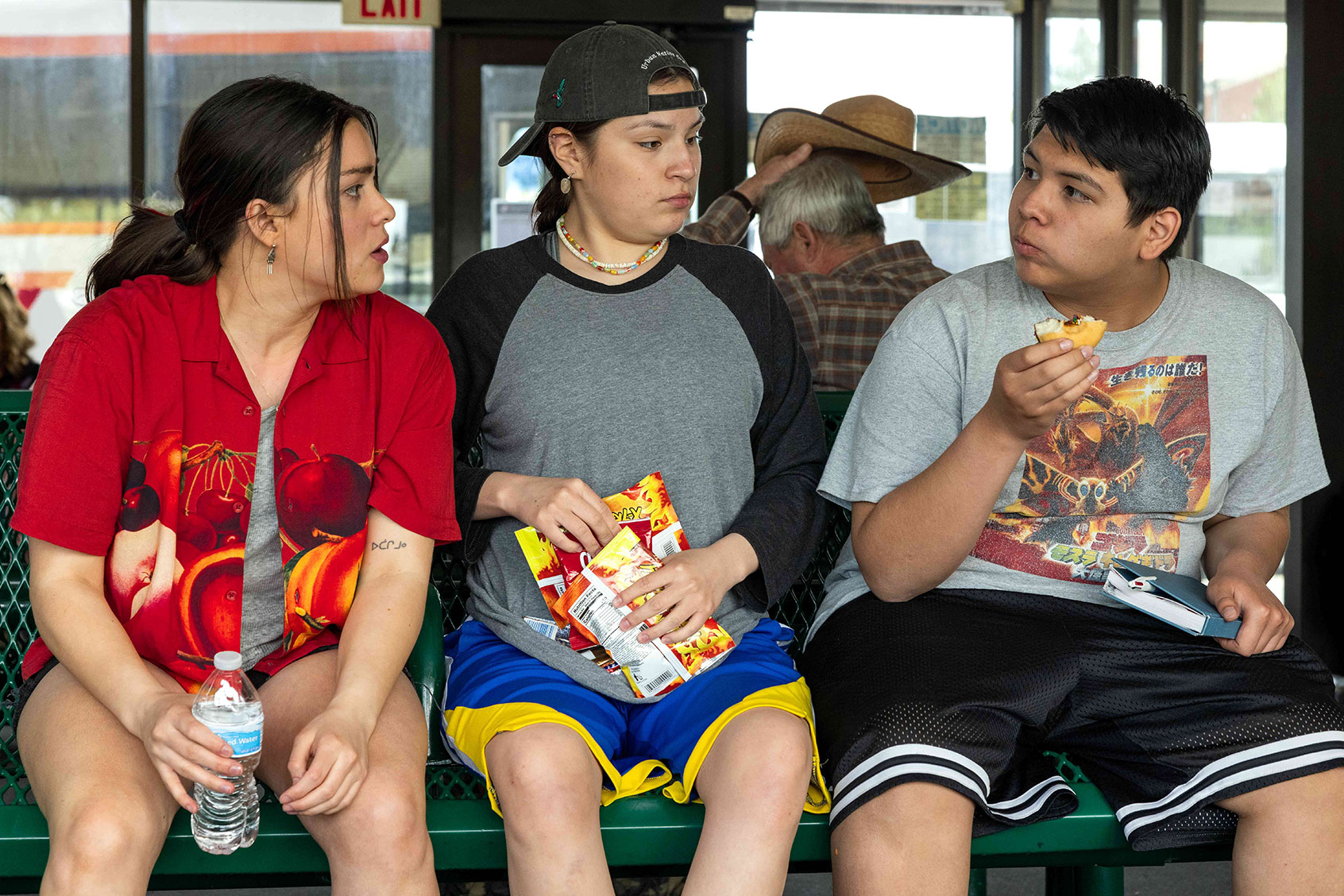
Reservation Dogs” was never shy about wandering. Describing other TV shows thusly implies a lack of narrative discipline or confused intent, but that’s not the case here. Series creator Sterlin Harjo and his writers have always conveyed a sense of knowing where Bear (D’Pharaoh Woon-A-Tai), Elora Danan (Devery Jacobs), Willie Jack (Paulina Alexis) and Cheese (Lane Factor) are headed in their shared and individual quests while expanding their stories along the way.

The show began with the quartet vowing to leave their small community in Okern, Oklahoma for a fresh start in California without really knowing what that would take or what they’d find when they got there. Ostensibly their reason was to honor the last wishes of their friend Daniel, who took his own life before the series began.

The four episodes made available to critics hint at a wistful final run for this cinematically adventurous show that never loses sight of where it began.

By the end of Season 2, they’d realized that goal, only to have their car stolen along with whatever money they had, forcing them to share a bedroll with White Jesus. Even that ending was dreamy and tinged with ’80s nostalgia as they get their feet wet in the surf, and Bear, overcome by the glow of the place, announces he wouldn’t be returning to Oklahoma with them.

To paraphrase that line from “The Outsiders,” if Bear is this show’s Pony Boy, California would not be the place he’d stay gold. But Oklahoma might not be where he belongs either, something he contemplates in a third season premiere where he intentionally gets lost as everyone else begins to light on their purpose.

The four episodes made available to critics hint at a wistful final run for this cinematically adventurous show that never loses sight of where it began and everything that makes it outstanding.

That includes its otherworldly figures like White Jesus.  In a show that haunts one of its main protagonists with the ghost of a feckless warrior called William Knifeman (Dallas Goldtooth) and makes the vigilante spirit Deer Lady (Kaniehtiio Horn) a regular visitor several characters can see, why wouldn’t some scraggly street guy actually be the son of God?

It’s all part of the show’s pragmatic treatment of life on the rez for its young characters and their elders. Although Bear, Elora, Willie Jack and Cheese are quick to remind their parents, aunts and uncles who treat them like children that they’re 18 (or close enough) their exploits retain an innocence because their expectations are both romantic and childish.

Reservation DogsDevery Jacobs as Elora Danan, Paulina Alexis as Willie Jack and Lane Factor as Cheese in “Reservation Dogs” (Shane Brown/FX)Still, the best episodes of “Reservation Dogs” also focus on the men and women raising these kids and their gleeful reversion to their adolescent personas whenever they can. Season 2’s “Wide Net” encapsulates this with buffoonish splendor as the four main mother figures in the show, Bear’s mother Rita (Sarah Podemski), Bev (Jana Schmieding) Elora’s aunt Teenie (Tamara Podemski) and Natalie (Nathalie Standingcloud) enjoy a girls’ trip to the Indian Health Conference where their primary aim is to get lit and get laid.

We need your help to stay independent

The Podemskis and Schmieding return in this new season, with Schmieding running away with the fourth episode so completely that you’ll wish for someone to write a show just for Bev. Schmieding had a Peacock show, “Rutherford Falls,” but her “Reservation Dogs” turn sells her as a compelling antiheroine game for just about anything. A dirty flirty exchange with Zahn McClarnon‘s Lighthorseman Big proves this beyond all doubt.

Foremost “Reservation Dogs” remains a story of manifesting a path forward in life and what we gain and lose in that.

Schmieding’s Bev is one among many we wish we’d get to see more of, and maybe we will – we hope. While we’re weeks away from saying a definite goodbye to this show, it’s understandable to already miss the unique ways that it feels simultaneously common to the American working class experience and specific to this community and Indigenous. Like any version of the American story that runs concurrent to the white experience while contradicting what it holds to be the truth, it reflects what we know back to us from a viewpoint not commonly sought out or shared.

That may sound didactic — far from it. An upcoming episode depicting the anguished history of government-mandated Indian schools comes from a true and tragic place but shows it for the horror story that it was visually and tonally while flipping familiar genre tropes on their heads.


Want a daily wrap-up of all the news and commentary Salon has to offer? Subscribe to our morning newsletter, Crash Course.


Foremost “Reservation Dogs” remains a story of manifesting a path forward in life and what we gain and lose in that. With their California adventure complete, these next chapters circle back to Oklahoma where life as they know it and its accompanying consequences wait for the four friends.

Bear’s journey home takes a detour partly guided by Goldtooth’s spirit, whose main purpose is to frustrate and befuddle those unlucky enough to see him. But he also meets a couple of figures along the way who hint at how special he is even if the world doesn’t see it.

Reservation DogsPaulina Alexis as Willie Jack, Devery Jacobs as Elora Danan, D’Pharaoh Woon-A-Tai as Bear, Lane Factor as Cheese and Elva Guerra as Jackie in “Reservation Dogs” (Shane Brown/FX)What that means is unclear, since Bear doesn’t have any firmer sense of where he’s going than the others do. But the plot teases a larger message reminiscent of so many heroes’ journeys that end with the protagonist back where he started with a renewed appreciation of family and community.

No one aside from the cast and crew knows whether this is how their story concludes, but if it is, I doubt the writers will make that ending feel typical or reductive. Those terms could never be used to describe this show, which keeps finding new ways to nurture and break our hearts, and will probably maintain that trend right up to the finale’s end credits.

The first two episodes of the third and final season of “Reservation Dogs” streams Wednesday, Aug. 2 on Hulu. New episodes premiere weekly on Wednesdays.


“Conspiracy s**t beamed down from the mothership”: DOJ says Trumper wanted to use “Insurrection Act”

Former Justice Department official Jeffrey Clark, identified as “Co-Conspirator 4” in former President Donald Trump’s latest 45-page indictment, was prepared to quash any anti-Trump protests that would arise if he had remained in office following his 2020 electoral defeat, the indictment alleges.

Three days before the Capitol attack by a pro-Trump mob, then-deputy White House counsel Patrick Philbin attempted to dissuade Clark, then the acting assistant attorney general for the civil division, from accepting the role of acting attorney general. Philbin argued that if Trump remained in office despite his loss, there would be “riots in every major city in the United States.”

“Well, [Deputy White House Counsel], that’s why there’s an Insurrection Act,” Clark responded, according to the charging document, referring to the act that empowers the sitting president to employ state militias and armed forces to enforce federal authority and suppress civil rebellion or insurrections as he considers necessary. 

The revelation, New York Magazine reports, is one of several shocking details outlined in the special counsel’s indictment of Trump, who was charged Tuesday evening with conspiracy to defraud the United States, conspiracy to obstruct an official proceeding, obstruction of and attempt to obstruct an official proceeding, and conspiracy against rights in connection to his efforts to overturn the 2020 election results. 

The indictment also described how then-Vice President Mike Pence’s chief of staff was worried that Trump was putting his vice president at risk of physical harm as he continued to pressure Pence to overturn the election results from Arizona, Michigan, Wisconsin and Pennsylvania during his certifying duties at the Capitol. 

Trump had repeatedly attempted to goad the vice president into the alleged conspiracy to remain in power following his 2020 electoral defeat, and had even done so during phone calls on Christmas and New Year’s Day. According to the document, Pence repeatedly rejected Trump’s efforts and told the former president that he had no legal power to change the outcome of the election. In one instance, Trump allegedly told Pence, “You’re too honest,” in response. 

The set of exchanges potentially indicates that Trump knew he was lying about widespread election fraud as he pressured Pence to reject electoral votes for President Joe Biden. Pence had also taken what the special counsel referred to as “contemporaneous notes” about his interactions with Trump and his allies, which the indictment explicitly referenced twice. 

In one instance said to be detailed in Pence’s notes — a Jan. 4, 2021, meeting with Trump and his attorney John Eastman, who has been identified as “co-conspirator 2” in the charging document — Pence questioned the lawyer’s proposal to return the election results to the states. Eastman told Pence that “nobody’s tested it before.” 

“Did you hear that?” the then-vice president said to Trump. “Even your own counsel is not saying I have that authority.”

We need your help to stay independent

After Pence refused Trump’s request on the morning of Jan. 6, 2021, to return Biden’s legitimate electoral votes again, the former president reinserted false claims about Pence’s authority to send electoral votes to the states into his speech for the Stop the Steal rally on the Ellipse ahead of the Capitol attack. Hours later, Trump singled Pence out again on Twitter, claiming that the vice president “didn’t have the courage” to overturn the election as his supporters rioted in Washington, D.C. and threatened to hang Pence.

Trump’s team continued to pressure Pence even after the Capitol insurrection, according to the charging document, with Eastman attempting to get Pence to delay the election certification in a last-ditch effort via email.

“I implore you to consider one more relatively minor violation [of the ECA] and adjourn for 10 days to allow the legislatures to finish their investigations, as well as to allow a full forensic audit of the massive amount of illegal activity that has occurred here,” Eastman wrote in an email to Pence late in the night on Jan. 6. 


Want a daily wrap-up of all the news and commentary Salon has to offer? Subscribe to our morning newsletter, Crash Course.


Rudy Giuliani, who is clearly identifiable as “Co-Conspirator 1” in the indictment, also pressured a senator after the Capitol attack to slow down the certification. According to the indictment, Giuliani left a voicemail for the unnamed U.S. senator that said: “We need you, our Republican friends, to try to just slow it down so we can get these legislatures to get more information to you. And I know they’re reconvening at eight tonight but the only strategy we can follow is to object to numerous states and raise issues so that we get ourselves into tomorrow—ideally until the end of tomorrow.”

The special counsel accused Trump of peddling election fraud claims he knew were false for months, noting that the former president was informed by multiple parties — including White House lawyers, his campaign, the Justice Department and the intelligence community — that his claims had no merit.

The Trump campaign’s efforts to contest the election results in Georgia, Arizona, Pennsylvania and Michigan even took center stage in the indictment with the special counsel describing the frustration Trump’s Georgia team felt with the lack of evidence Trump and Giuliani were providing as they received constant assurance from state officials that there was no election fraud. 

“When our research and campaign legal team cant back up any of the claims made by our Elite Strike Force Legal Team, you can see why we’re 0-32 on our case,” the campaign advisor then wrote in an email. “I’ll obviously hustle to help on all fronts, but it’s tough to own any of this when it’s all just conspiracy shit beamed down from the mothership.”

Trump draws judge who gave harshest Jan. 6 sentences and warned him “presidents are not kings”

Former President Donald Trump’s federal criminal indictment over his efforts to overturn the 2020 election was randomly assigned to U.S. District Judge Tanya Chutkan, who happens to have expressed her dismay for his behavior before.

The Washington Post reported that Chutkan, an Obama appointee, was one of the first federal judges in Washington D.C. to heavily scrutinize Trump’s attempts to invoke executive privilege to refuse to turn over White House communications to members of the House select committee investigating the deadly Capitol attacks. 

In November 2021, Chutkan wrote in a ruling that Congressional interest in seizing illuminating presidential correspondence on Jan. 6 evidence was strong. She also acknowledged that President Joe Biden had waived executive privilege. 

“Presidents are not kings, and Plaintiff is not President,” Chutkan wrote in her ruling. “At bottom, this is a dispute between a former and incumbent President. And the Supreme Court has already made clear that in such circumstances, the incumbent’s view is accorded greater weight,” she concluded.

The House committee, Chutkan concluded, was within its right to request White House communications as they pertained to a matter of “unsurpassed public importance because such information relates to our core democratic institutions and the public’s confidence in them.” Obtaining such records, she wrote, could “prevent such events from ever occurring again.”

Chutkan, who was appointed to the U.S. bench in 2015 by former President Barack Obama, has doled out the harshest Jan. 6 sentences on the D.C. federal court, per the Washington Post’s database. The Post reported that through the middle of June, the judge sentenced all 31 defendants she saw to some amount of prison or jail time. Additionally, Chutkan has exceeded prosecutorial sentencing recommendations nine times and granted them fourteen times. 

Chutkan has repeatedly expressed her disgust and horror over the Jan. 6 attack, noting that no one accused of orchestrating the attack has been held responsible, Politico reported. 

We need your help to stay independent

“You have made a very good point,” she told Jan. 6 rioter Robert Palmer at his December 2021 sentencing, “that the people who exhorted you and encouraged you and rallied you to go and take action and to fight have not been charged.”

“The issue of who has or has not been charged is not before me. I don’t have any influence on that,” she said. “I have my opinions, but they are not relevant.”

But the judge said that was not a reason to go easy on the convicted rioters.

“The people who planned this and funded it and encouraged it haven’t been charged, but that’s not a reason for you to get a lower sentence,” she said. “I have to make it clear that the actions you engaged in cannot happen again. Every day we’re hearing about reports of antidemocratic factions of people plotting violence, the potential threat of violence, in 2024.”


Want a daily wrap-up of all the news and commentary Salon has to offer? Subscribe to our morning newsletter, Crash Course.


In another sentencing of defendant Carl Mazzocoo, Chutkan said he “went to the Capitol in support of one man, not in support of our country.”

Chutkan was also outspoken in rejecting comparisons between the Jan. 6 attack and violence that took place at some Black Lives Matter protests after the police killing of George Floyd.

“People gathered all over the country last year to protest the violent murder by the police of an unarmed man. Some of those protesters became violent,” Chutkan said at a sentencing hearing. “But to compare the actions of people protesting, mostly peacefully, for civil rights, to those of a violent mob seeking to overthrow the lawfully elected government is a false equivalency and ignores a very real danger that the January 6 riot posed to the foundation of our democracy.”

Pence hits Trump over election charges as indictment reveals a lot of the information came from him

Former President Donald Trump’s latest 45-page indictment references his former vice president, Mike Pence, or the office of the vice presidency more than 100 times, demonstrating Pence’s importance in the investigation, The Washington Post reports. According to the indictment, Pence took “contemporaneous notes” about Trump and his associates’ efforts to overturn the former president’s 2020 electoral defeat in the leadup to the attack on the Capitol carried out by a mob of Trump supporters. 

The indictment explicitly cites Pence’s notes twice in connection to two interactions he had with Trump or his allies ahead of Jan. 6, 2021. The first references an exchange with Trump on Dec. 29, 2020, where he allegedly told Pence that the Department of Justice was “finding major infractions,” according to the notes. The second outlines a Jan. 4, 2021, meeting, in which Trump allegedly repeated his false claims of election fraud and Pence questioned if Trump lawyer John Eastman’s proposal to return the election results to the states was “defensible.” 

“Today’s indictment serves as an important reminder: anyone who puts himself over the Constitution should never be President of the United States,” Pence said in a post to X, formerly known as Twitter, Tuesday night. “Our country is more important than one man. Our constitution is more important than any one man’s career. On January 6th, Former President Trump demanded that I choose between him and the Constitution. I chose the Constitution and I always will,” he added

Researchers announce Pac-Man ghost-shaped jellyfish is the oldest in fossil record

When a group of paleontologists dusted off a group of fossils that had been sitting on the shelf at the Royal Ontario Museum in Toronto, Canada since the 1980s, they uncovered a spooky organism with a bell-shaped body and about 90 stubby tentacles extending out from its rim. 

The 505 million-year-old fossil revealed the oldest known species of swimming jellyfish, which the research team named Burgessomedusa phasmiformis, according to a study published today in the Proceedings of the Royal Society B. 

“That [name] means ‘the Burgess Shale jellyfish with a ghost-like form,'” study author Joseph Moysiuk, a Ph.D. candidate at the University of Toronto, told Salon. “We gave it that name because its overall body shape looks a little bit like the ghost from Pac-Man.”

Only a handful of jellies have ever been discovered in fossils, (without bones, it’s hard to fossilize), including one 2007 discovery in Utah also tracing back to the Cambrian time period, when most animal groups were born. However, Moysiuk says these might have been comb jellies from the Ctenophora phylum, rather than the Cnidaria phylum which includes jellyfish, corals and sea anemones. Although they are similar, the latter is more predatory and mobile. 

“We gave it that name because its overall body shape looks a little bit like the ghost from Pac-Man.”

The fossils examined by Moysiuk and his team showed the bulbous body of the jellyfish extending up to 20 centimeters, with dozens of flexible tentacles it would have used to swim. Although B. phasmiformis has a box shape similar to one of the most venomous types of jellyfish, it also has a ring of tentacles similar to a group called true jellyfish, Moysiuk said. These traits that resemble many different kinds of modern-day jellyfish provide a glimpse into how the species evolved.

“I think what’s neat about this mix of characteristics is it’s probably suggesting to us that Burgessomedusa diverged from the line quite deep in that group’s history,” Moysiuk said. “It’s telling us a little bit about the ancestry of the group of jellyfish as a whole.”

A jellyfish begins its life cycle as an anemone-like creature on the sea floor before undergoing a metamorphosis and sprouting into a recognizable medusa — that Pac-Man ghost shape we’re all familiar with. Jellyfish have also been identified in fossils in this time period in these earlier forms, suggesting this transformation began at the species level at least 505 million years ago.


Want more health and science stories in your inbox? Subscribe to Salon’s weekly newsletter The Vulgar Scientist.


The Anomalocaris canadensis, a long arthropod with spiny claws resembling a shrimp, is thought to have been a major predator during the Cambrian era. But in one fossil Moysiuk’s team worked with, they discovered evidence that suggested the Burgessomedusa phasmiformis might have given it some competition as an ancient predator underwater.

Within the bell shape of one fossil, researchers found additional fossils from relatives of modern-day crustaceans and spiders. Although this was only found in one sample, the presence of these critters suggests this ancient creature was carnivorous, like jellyfish that feed on plankton and crustaceans today.

The presence of these critters suggests this ancient creature was carnivorous, like jellyfish that feed on plankton and crustaceans today.

“It’s possible this represents some kind of predatory interaction preserved in the fossil,” Moysiuk said. “But since we only have one specimen, we can’t be certain that it’s not just a chance occurrence.”

The fossil was uncovered from a region known as the Burgess Shale, a designated UNESCO World Heritage Site in Yoho National Park in British Columbia, where fossils of arthropods, predators and even some of the oldest human ancestors have been found.

Typically, jellyfish are uncommon in the fossil record because squishy, soft materials like jellies don’t preserve as well as hard materials like bones. Because of the conditions in the Burgess Shale, which was likely buried rapidly in an underwater mudslide, many soft tissues like brains, eyes and digestive organs were preserved. 

We need your help to stay independent

It’s there that B. phasmiformis swam among the shrimp-like Anomalocaris canadensis (and other creatures we’ve yet to discover) that paved the way for life as we know it today.

“Jellyfish have been so elusive in the Cambrian fossil record, and yet we think jellyfish are one of the earliest groups of animals to diverge,” Moysiuk said. “This discovery helps fit that final piece in and complete our picture of how much animal diversity was already existing in the Cambrian period.”

Legal experts identify Trump’s co-conspirators — and warn they “will be charged” unless they “flip”

The federal indictment against former President Donald Trump over his efforts to overturn his 2020 election loss alleged that Trump had six co-conspirators to “assist him in his criminal efforts to overturn the legitimate results of the 2020 presidential election and retain power.”

The co-conspirators were not charged or even named in the indictment but legal experts and reporters quickly used the detailed descriptions by prosecutors to identify five of the six individuals.

“The 6 unnamed coconspirators will be charged, in a separate DC indictment (if that has not happened already),” tweeted former federal prosecutor Andrew Weissmann, who served on special counsel Bob Mueller’s team. “Indeed, the Trump DC indictment reads like an indictment of them already.”

“Co-Conspirator 1” appears to be former Trump lawyer Rudy Giuliani, according to Weissmann. The indictment identifies the individual as an attorney who was “willing to spread knowingly false claims and pursue strategies” that Trump’s campaign would not pursue. The indictment alleges that Trump enlisted the co-conspirator after his campaign told him he lost the election and that they both knew they were making false claims to “impair, obstruct and defeat” the election results. The indictment also alleges the co-conspirator admitted to an Arizona lawmaker that he had no proof for the claims.

“We don’t have the evidence, but we have lots of theories,” he allegedly said, per the indictment.

Giuliani political adviser Ted Goodman told The Washington Post that the indictment criminalized the act of “daring to ask questions about the 2020 election results.”

“Every fact Mayor Rudy Giuliani possesses about this case establishes the good faith basis President Donald Trump had for the actions he took during the two-month period charged in the indictment,” Goodman said.

“Co-Conspirator 2” appears to be John Eastman, the author of the so-called “coup memo” that crafted Trump’s Jan. 6 strategy to try to throw the election back to state legislatures to decide. The indictment describes the co-conspirator as an attorney who “devised and attempted to implement a strategy to leverage the Vice President’s ceremonial role overseeing the certification proceeding to obstruct the certification of the presidential election.” The indictment says the co-conspirator acknowledged in an email about a Georgia lawsuit that he and Trump had “been made aware that some of the allegations (and evidence proffered by experts) has been inaccurate” but the claims remained in the lawsuit.

Eastman lawyer Charles Burnham told the Post that the indictment “relies on a misleading presentation of the record to contrive criminal charges against Presidential candidate Trump and to cast ominous aspersions on his close advisors.”

“[I]f he were invited to plea bargain with either state or federal prosecutors, he would decline. The fact is, if Dr. Eastman is indicted, he will go to trial. If convicted, he will appeal,” Burnham said. “The Eastman legal team is confident of its legal position in this matter.”

“Co-Conspirator 3” appears to be Sidney Powell, who is described as an attorney whose baseless allegations were “embraced and publicly amplified” by Trump even as he told others her claims sounded “crazy,” according to the indictment. Powell, who baselessly claimed there was a global conspiracy to flip votes from Trump to President Joe Biden, filed numerous lawsuits that went nowhere after the election, drawing sanctions for misconduct and multiple defamation lawsuits. Powell told the House Jan. 6 committee that she did not read or review all of the declarations she presented as evidence of fraud and argued through an attorney that “no reasonable person” could take her claims as fact.

“Co-Conspirator 4” appears to be Jeffrey Clark. The indictment describes the person as a Justice Department official who focused on civil matters and worked with Trump to “use the Justice Department to open sham election crime investigations and influence state legislatures with knowingly false claims of election fraud.” Former Attorney General Bill Barr and his replacement, Jeffrey Rosen, have testified that the DOJ did investigate some claims and found no evidence of widespread fraud.

The indictment alleges that Trump’s deputy White House counsel warned Clark that if Trump refused to leave office, there would be “riots in every major city.” Clark responded, “That’s why there’s an Insurrection Act,” according to the indictment.

“Co-Conspirator 5” appears to be Kenneth Chesebro, an attorney described by the indictment as having “assisted in devising and attempting to implement a plan to submit fraudulent slates of presidential electors to obstruct the certification proceeding.” Chesebro played a key role in the fake elector plot.

It’s unclear who is “Co-Conspirator 6,” who was described in the indictment as a “political consultant who helped implement a plan to submit fraudulent slates of presidential electors to obstruct the certification proceeding.” The indictment claims the person sent Giuliani an email identifying lawyers in six swing states who would assist in the fake elector scheme and participated in a conference call about the effort in Pennsylvania. On the evening of Jan. 6, after the mob had overrun the Capitol, the co-conspirator looked for senators’ phone numbers for Giuliani to call to further delay the certification of electoral votes.

The co-conspirators were not indicted alongside Trump but they could still face charges.

Weissmann told MSNBC that the decision not to charge the co-conspirators in the same case “shows that Jack Smith wants to get to trial and he wants to get to trial quickly.”

“Those other people may be charged in a separate case,” he said. “He clearly is saying that they are guilty. But the reason you don’t see seven defendants is if you want to get to trial you bring something narrow and focused against the defendant who you need to try before the general election. If I were those six people, I would not be sleeping well tonight.”

We need your help to stay independent

Former acting Solicitor General Neal Katyal agreed that the co-conspirators were not included because “Smith doesn’t want the trial of the other six to be bundled up in this and slow this down.”

Smith faces a challenge in “timing and making sure Donald Trump can’t run out the clock before the November 2024 elections through his typical delay strategy,” he told MSNBC.

New York University Law Prof. Ryan Goodman tweeted that there is a “ton of pressure in this indictment for co-conspirators to flip (if they haven’t already).”

“Some very strong evidence they knew Trump lost election, the litigation was a “pretext,” that their means were unlawful,” he wrote.


Want a daily wrap-up of all the news and commentary Salon has to offer? Subscribe to our morning newsletter, Crash Course.


Former U.S. Attorney Joyce Vance pointed out that it is “unusual” for prosecutors to lead with potentially identifying details about unnamed co-conspirators in an indictment.

“It might be that Jack Smith is sending these folks a really strong signal that they can either get on the bus or be underneath it when everything here is said and done,” she told MSNBC. “These are folks who need to have that come to Jesus moment, who need to cooperate with the government. If they don’t, they will ultimately be indicted and they will be looking at charges that will carry very serious penalties for people who abuse a position of trust to commit these crimes.”

Former Trump attorney Tim Parlatore, who left his legal team in May, told CNN that he was surprised the indictment came this soon because “this is something that I know Jack Smith’s team is still investigating.”

“They’re still interviewing witnesses that, just from my brief, have information that’s directly relevant to these things,” he said. “It’s surprising he would hand down the indictment today, instead of a couple of weeks from now after they finish doing all of those witness interviews.”

Parlatore said it “may be an indication that this is just the initial indictment.”

“He is going to try and put pressure on the other six to move over to become cooperating witnesses, or else there is going to be a superseding indictment that will name them all as co-defendants,” he predicted.

New York Times reporter and Trump biographer Maggie Haberman told CNN that Trump is “much more rattled than he is projecting.”

“He is very upset. Folks around him are very upset,” she said. “On the one hand, they were relieved reading this indictment that there were not more details that they didn’t know that were in it. On the other, there was a reference to six co-conspirators, and that raises questions about: Will anyone else face charges, and will more details be revealed if that happens?”

Donald Trump’s Jan. 6 indictment: Too late for justice?

During the 2016 presidential campaign, Donald Trump repeatedly said that the electoral process was rigged. After losing the Iowa primary caucus he declared that Sen. Ted Cruz had stolen it and tweeted, “based on the fraud committed by Senator Ted Cruz during the Iowa caucus, either a new election should take place or Cruz results nullified.” That was just the beginning. Throughout the general election campaign, he refused to say if he would accept the results, even in a televised presidential debate in October. He finally told his followers that he would accept the vote count — but only if he won — and they responded with rapturous adulation. Even when he won the Electoral College he refused to accept the popular vote results and formed a commission to prove that the numbers were fraudulent. (It came up empty, of course.)

So, it was no surprise that he spent most of the 2020 election casting aspersions on mail-in voting and planting the suspicion that the election was going to be stolen from him.

It’s not like he kept it a secret. We always knew he would never accept the results of an election unless he was the victor. So when he came before the cameras in the wee hours after election day 2020, as the votes were still being counted, and declared that there was something wrong with the election and that he won in a landslide, it was almost anti-climactic. What followed, however, was anything but predictable.

We need your help to stay independent

We knew Trump would whine and cry and declare the election was rigged but I don’t think anyone knew how far he would go to manipulate the system and break the law to stay in office anyway.

Donald Trump is under indictment for trying to steal an election but he may very well be given absolution for his crimes by the free and fair electoral system he has demeaned and degraded ever since he entered politics.

On Tuesday, Donald Trump was finally indicted by the special counsel investigating the January 6 insurrection on four felony charges: obstruction of an official proceeding (the certification of the presidential election on January 6), conspiracy to defraud the United States, conspiracy to obstruct an official proceeding and conspiracy to deny voting rights.

If you wonder what the significance of this indictment might be in contrast to the other cases pending in various venues throughout the country, former acting solicitor general Neal Katyal told MSNBC:

This is a momentous legal event. It’s the most significant legal event of our lifetimes, one of the most significant legal events ever in the history of this country. It is up there with Marbury vs Madison, Brown vs Board of Education, Dred Scott as a defining case for the times… This indictment lays out a case that a guy who was president of the United States while he was president of the US leveraged his office, used his power to thwart the will of the people in the most solemn thing they do in our country, vote… this is the biggest constitutional crime in our history.

He was the only one indicted but six unnamed co-conspirators are accused of helping him do it, five of them lawyers and one a political operative. The five lawyers are assumed to be Rudolph Giuliani, John Eastman, Sidney Powell, Jeffrey Clark and Kenneth Chesebro. The identity of the political operative remains obscure.

Those of us who followed the January 6 committee hearings and read its final report are familiar with the narrative laid out in the indictment. Trump and his henchmen cooked up several different plots to pressure local Republican election officials to change the vote count in his favor, create a fake set of electors from the close swing states, have the Justice Department send out letters erroneously suggesting the feds had found fraud and then strong arm the vice president to defy the Constitution and refuse to count the legitimate electoral votes on January 6.

The indictment has a few new details, such as the fact that even after the violence, as Congress was preparing to reconvene to certify the election near midnight, one of Trump’s co-conspirators emailed the vice president, saying “I implore you to consider on more relatively minor violation [of the ECA] and adjourn for 10 days to allow the legislatures to finish their investigations as well as to allow a full forensic audit of the massive amount of illegal activity that has occurred here.” After the violent insurrection in which Trump’s inflamed followers stormed the Capitol during a joint session and chanted “hang Mike Pence,” this person (assumed to be conservative constitutional scholar John Eastman) had the audacity to beg the Pence to knowingly break the law —- but just a little bit. (That plan, incidentally, was also pushed hard by Senator Ted Cruz.)

The assumption among the TV lawyers is that the co-conspirators were not indicted in order to move the case along more quickly and that some of them may well be indicted separately or are cooperating with the investigation. Giuliani appeared on television last night to defend his honor:

To be honest, Giuliani may not even know that he cooperated. He’s pretty far gone.


Want a daily wrap-up of all the news and commentary Salon has to offer? Subscribe to our morning newsletter, Crash Course.


There is a lot of gnashing of teeth that federal trials aren’t televised and demands that someone do something about it so that the nation can watch the most important political trial in our history. That seems like an excellent idea but apparently, it would come down to a decision by Chief Justice John Roberts so I wouldn’t get my hopes up. The good news is that we did have an excellent presentation of the facts and the narrative from the January 6 congressional hearings so it’s not as if we are fully dependent upon the press to report them from the courtroom.

Regardless of the outcome of this trial, even if they manage to get it done before the election next year, I think we may have to face a disappointing truth. In a normal, healthy democracy a candidate in this much trouble would drop out of the race, either because of a need to focus on the legal problems, pressure from the party or perhaps even a sense of shame. None of that applies to Donald Trump, the frontrunner for the Republican nomination who has vowed to stay in the race no matter what. Judging by the initial commentary from the right-wing media, these charges aren’t going to make a bit of a difference.

In the end, we are dealing with a great irony. Donald Trump is under indictment for trying to steal an election but he may very well be given absolution for his crimes by the free and fair electoral system he has demeaned and degraded ever since he entered politics. If that were to happen I’m afraid that the half of the country that still believes in democracy and the rule of law would be hard-pressed to keep the faith if that were to happen. What would be the point? 

Criminal indictments are not enough: Donald Trump must be defeated at the ballot box

In 2016, almost 63 million Americans failed a basic test of civic responsibility and wisdom when, with the help of a broken and archaic Electoral College, they elevated Donald Trump, a reality TV show star, professional wrestling heel, confirmed sexual assaulter and failed casino owner to the White House over Hillary Clinton, one of the most accomplished, experienced, and distinguished public servants in recent American history.

In 2020, some 74 million Americans failed their second test of civic responsibility and wisdom when they voted for Trump again. This time they made the same decision with the experience and hindsight of Trump’s two impeachments, demonstrated mental unwellness, democide via the COVID pandemic, white supremacy and betrayal of the nation’s interests at home and abroad. 

In 2024, the American people will be faced with a third test of their civil responsibility, wisdom and collective intelligence. The future of the country as a democracy governed by the rule of law and the Constitution is almost literally on the ballot.

Donald Trump is currently the Republican Party’s presumed presidential nominee. By the time of Election Day 2024, all indicators suggest that Trump will be embroiled in multiple criminal trials where he could potentially be sentenced to hundreds of years in prison. Depending on the timeline and outcome of the criminal trials and appeals process, Donald Trump may even be in prison on Election Day 2024 – which would not disqualify his candidacy or presidency if he were to win.

Donald Trump has made Hitler-like threats to crush his and the MAGA movement’s perceived “enemies” in a campaign of revenge and terror targeting the Democrats, liberals, progressives, and others once he is back in power. As outlined in Trump’s “Agenda 47” plan, he will become a type of de facto dictator if he takes power again.

In reaction to his latest criminal indictment, his third handed down just this year, Trump’s campaign released a statement likening his prosecution to “Nazi Germany in the 1930s.”

In a recent interview with Ali Velshi on MSNBC, historians Timothy Snyder and Anne Applebaum explained the extreme importance of the 2024 Election and defeating Donald Trump for the future of American democracy and the rule of law:  

Snyder explained to Velshi that:

The fundamental difference is sometimes people will break laws in the name of a principle, and that principle can itself be the rule of law. That’s actually the foundation, the history of the United States of America. The common law tradition that we inherited from Britain assumed that the king was not above the law, the basis of the American Revolution, therefore, was holding the king to the law. And once we had done that, we then wrote up that common law in the form of a written constitution, which made it very clear that there would be no king and that nobody would be above the law. The President is someone who holds office for a certain period of time; it’s not a special person who is somehow above the law.

[When] Mr. Trump talks about being retribution or he threatens revenge what he’s doing is that he is using fascist language. He’s using language from an entirely different political system, one which says that that law doesn’t matter, that there’s no difference between the leader and the party and the state, and the people. Everything ultimately comes down to the whim and the will of one person. If we want to get ourselves into a fascist system, then the thing to do…. is not to prosecute, Mr. Trump, because the meaningful polarization in this country, I believe, is between people who believe in law, and people who don’t….

The people who don’t believe in law are going to be galvanized and encouraged by a powerful figure, someone who has been president and wishes to be president. And of course, that’s the difference. The person who is the leader and has the power is now calling upon people to break the law.

Applebaum located Trump’s obvious criminality and his disdain for the rule of law in the context of how the (then) Republican Party turned against President Nixon and is now supporting the demagogue and full-on dictator in waiting Donald Trump:

The reason why that situation was so different from this one is that Nixon was condemned by his own party. So Republicans in Congress, Republicans in the country, not all of them, but many of them wanted him to resign, they participated in the Watergate hearings process. And by the time Gerald Ford became president, there was a consensus, at least within the party leadership that, you know, that he was well out of the White House. We don’t have that now. We have a Republican Party that is encouraging Trump, that is spreading the same kinds of messages that is …. questioning whether January 6, even was an insurrection at all, even though as…. we have more and more evidence that it was.

And so in that circumstance, it’s very important that the law proceeds further, because there isn’t anything else that can stop that further radicalization of the Republican Party….Let me mention one more precedent, which is that of Hugo Chavez in Venezuela, who was released from prison, this is….way back in the early days before he had been elected. He was released from prison after an attempted insurrection and this actually encouraged his followers more….we also have to think about what are the risks of not condemning him, of not carrying the January 6 investigations to their to their obvious end, because if we don’t do it, then we give…. more impetus to that movement.

We need your help to stay independent

In an analysis at the Washington Post, reporters Dan Balz, Ann E. Marimow and Perry Stein highlight how the confluence of Donald Trump’s criminal trials and the 2024 Election are an extreme stress test for American democracy and society:

America’s institutions have been attacked repeatedly over the past half-dozen years, thanks principally to the conduct and actions of Donald Trump. The next 18 months could further undermine confidence in democracy and the rule of law as the former president seeks a return to the White House while defending himself against federal and state criminal charges.

Not since the Vietnam War in the 1960s or perhaps the mid-19th century before the Civil War has the country’s governing structure faced such disunity and peril, given the unprecedented nature of a federal criminal indictment of a former president compounded by the fact that Trump has been charged by the Justice Department in the administration of the Democrat who defeated him in 2020 and who is his likeliest general election opponent in 2024, if Trump is nominated again by the Republican Party.

Scholars, legal experts and political strategists agree that what lies ahead is ugly and unpredictable. Many fear that the 2024 election will not overcome the distrust of many Americans in their government and its pillars, almost no matter the outcome. “A constitutional democracy stands or falls with the effectiveness and trustworthiness of the systems through which laws are created and enforced,” said William Galston of the Brookings Institution. “If you have fundamental doubts raised about those institutions, then constitutional democracy as a whole is in trouble.”

The indictment in the case involving Trump’s retention of classified government documents coming in the midst of a presidential campaign raises legal questions about what might happen if he were to be convicted and elected. Could Trump pardon himself? Could he serve as president after a conviction? Could he run for office from a prison cell? Depending on events, those could become ripe for adjudication.

Balz, Marimow, and Stein reach the semi-hopeful conclusion that:

Many of Trump’s critics wish that through the legal process, the former president were somehow disqualified from serving again as president. The counterargument to that is that questions about his fate and the country’s future probably would be better answered at the ballot box than in the courtroom.

A conviction and a decisive defeat at the ballot box might force Trump from the political scene and cause the Republican Party to move in a different direction, although in an era of close elections, the prospect of 2024 producing a blowout in either direction remains doubtful — and even that would not necessarily cleanse the system.

“The country functioned after the Civil War,” Galston added, “but it was a long time before the system was drained of the political poisons of the Civil War.”

The 2024 Election is most than a year away, but at this early point in what is truly a historic and unprecedented moment in American history, Trump the traitor ex-president is either tied with or slightly behind President Biden in many reputable polls.

In a new essay at CNN, Harry Enten sounds this alarm about the very real possibility of a Trump victory in 2024:

Donald Trump is facing two indictments, with the potential for more. Political wisdom may have once suggested the former president’s bid for a second White House term would be nothing but a pipe dream. But most of us know better by now.

Trump is not only in a historically strong position for a nonincumbent to win the Republican nomination, but he is in a better position to win the general election than at any point during the 2020 cycle and almost at any point during the 2016 cycle….

The fact that the polling between Biden and Trump is so close shouldn’t be much of a surprise. Elections are a choice between two candidates. Trump isn’t popular, but neither is Biden. The two, in tandem, would be the most disliked presidential nominees in polling history, if their numbers hold through the election.

All that being said, the 2024 election will probably come down to a few swing states. Polling in swing states has been limited because we’re still over a year from the election.

One giant warning sign for Democrats was a late June Quinnipiac University poll from Pennsylvania, a pivotal state for the past few election cycles where Trump rallied base supporters in Erie on Saturday. The state barely voted for Trump in 2016 and for Biden in 2020.

Trump was up on Biden by 1 point in the Quinnipiac poll – a result within the margin of error, but nevertheless a remarkable achievement for the former president.

Why? It was only the second Pennsylvania poll that met CNN standards for publication since 2015 that had Trump ahead of either Biden (for 2020 and 2024) or Clinton (for 2016).

The good news for Democrats is that general election polling, unlike primary polling, is not predictive at this point. Things can most certainly change.

But for now, the chance that Trump is president in less than two years time is a very real possibility.

It is true that Donald Trump’s impending criminal trials and the chaos and trouble that surrounds him more generally, has caused some Republican voters to modulate their support for his candidacy.

But there is a key qualifier: They support what Trump and his fascist MAGA movement represent but find Trump’s personal style to be a liability in advancing their revolutionary project of ending multiracial pluralistic democracy.

Such a calculation is no victory for the long-term health and safety of American democracy. In the end, Republican and other Trump voters have been so radicalized by their leaders, news media, and other right-wing influentials that they will rally around Trump on Election Day no matter what because they have been programmed to hate the Democratic Party and “liberals”.

As others have warned, today’s Republicans and conservatives hate the Democrats and their voters (especially black and brown people and the LGBTQI community) more than they love the country and real democracy.

At the New York Times, Shane Goldmacher writes:

Former President Donald J. Trump is dominating his rivals for the Republican presidential nomination, leading his nearest challenger, Gov. Ron DeSantis of Florida, by a landslide 37 percentage points nationally among the likely Republican primary electorate, according to the first New York Times/Siena College poll of the 2024 campaign.

Mr. Trump held decisive advantages across almost every demographic group and region and in every ideological wing of the party, the survey found, as Republican voters waved away concerns about his escalating legal jeopardy. He led by wide margins among men and women, younger and older voters, moderates and conservatives, those who went to college and those who didn’t, and in cities, suburbs and rural areas.

The poll shows that some of Mr. DeSantis’s central campaign arguments — that he is more electable than Mr. Trump, and that he would govern more effectively — have so far failed to break through. Even Republicans motivated by the type of issues that have fueled Mr. DeSantis’s rise, such as fighting “radical woke ideology,” favored the former president.

Overall, Mr. Trump led Mr. DeSantis 54 percent to 17 percent. No other candidate topped 3 percent support in the poll….

Goldmacher continues:

Yet these arguments do not appear to be working. A strong majority of Republicans surveyed, 58 percent, said it was Mr. Trump, not Mr. DeSantis, who was best described by the phrase “able to beat Joe Biden.” And again, it was Mr. Trump, by a lopsided 67 percent to 22 percent margin, who was seen more as the one to “get things done.”…

Yet Mr. Trump’s grip on the Republican Party is so strong, the Times/Siena poll found, that in a head-to-head contest with Mr. DeSantis, Mr. Trump still received 22 percent among voters who believe he has committed serious federal crimes — a greater share than the 17 percent that Mr. DeSantis earned from the entire G.O.P. electorate.

In a series of posts on Twitter, Rick Wilson, former Republican Party strategist and co-founder of the pro-democracy organization the Lincoln Project, explained Trump’s power over the Republican Party and its voters and why his criminality and other sociopathic behavior will not break that hold.           

The GOP base in our polling, and literally every public and private poll I’ve seen does not give a damn about the truth viz Trump. At. All. Zero. Nada.

The final group of people are trying to weaken Trump by calling him a loser (he is), political poison (he is), a criminal (QED, everything), and a weak man who will lose to Joe Biden are hoping against hope that moral or political suasion will reform the GOP base.

The base is irredeemable. They can only be changed by destroying the GOP as it exists today. No ad strategy, alternate candidate, impassioned op-ed, or heartfelt speech will reclaim them from the spell of Trump, Fox, and Facebook.

They’re not economically anxious. They’re not the Forgotten Workin’ Man. They’re not Ordinary Folks Who Just Don’t Like All These Progressives Ideas.

They’re willing members of an authoritarian personality cult. They’ve bent and sworn.

Also on Twitter, Dean Obeidallah, SiriusXM radio host, echoed Wilson’s truth-telling:

The fact trump is way ahead in GOP polls says less about Trump and everything about GOP base. The gop has become the enemy of democracy and freedoms. We are confronted by a full blown fascist movement. We must utterly destroy this version of the gop to save our Republic.

In a healthy democracy and society, Donald Trump would not be the Republican Party’s nominee having been exiled from public life and already prosecuted and put in prison for his decades-long crime spree. And in the America that actually exists, even allowing for all of its many defects, Donald Trump should be far behind President Joe Biden and not competitive with him in the 2024 Election. The rot in Americas political culture and larger society is that deep.

Defeating Trump at the polls will be insufficient by itself to secure the future of American democracy. Trump must also be punished by the courts. If both those things happen only then will the nation have the breathing room to begin to recuperate from the Age of Trump, and then do what is necessary to fix the root causes of American neofascism so that such a plague is vanquished for the foreseeable future.

Oppenheimer’s hero Niels Bohr has a legacy as complicated as the “father of the atomic bomb”

In Christopher Nolan’s hit biopic “Oppenheimer,” real-life Danish physicist Niels Bohr is more than just a major character. As depicted by Shakespearean actor Kenneth Branagh, he is a living legend, looming large both over the film’s depiction of the Manhattan Project and over the psyche of the titular protagonist himself, J. Robert Oppenheimer. The film even includes a controversial scene in which Oppenheimer tries to poison his professor after being denied the right to attend a lecture being given by Bohr. (Experts on Oppenheimer strongly doubt this ever happened.)

“Without relativity, no GPS. Without quantum theory, no lasers, no transistors, no computers, no smartphones. And without relativity and quantum mechanics, no atomic bombs.”

There is a good reason why both the fictional and real Oppenheimer were so awed by Bohr. In real life, Bohr revolutionized the world of physics, and then went on to be a humanitarian as passionate and progressive as Oppenheimer himself.

Then again, also like Oppenheimer, Bohr’s legacy is also colored because of his involvement in the Manhattan Project — and, by extension, all of the horrors wrought by the birth of nuclear weapons.

Yet for most of his life, Bohr’s name would hardly have been linked to human rights violations such as the bombings of Hiroshima, Nagasaki and the Marshall Islands. When World War II broke out in 1939, the Nobel Prize-winning Bohr had already spent decades as one of the most famous scientists in the world. He had cracked the code of atomic structures, determining how atoms are modeled — electrons orbiting a nucleus of protons and neutrons — and helping create quantum theory in the process.

Along with the German theoretical physicist Werner Heisenberg and others, Bohr developed the field of quantum mechanics (which Heisenberg founded) and constructed a popular interpretation known as the complementarity or Copenhagen interpretation of quantum mechanics. Bohr’s interpretation remained the dominant view until the 1960s, while quantum mechanics is still taught in physics classes — and was instrumental to the creation of nuclear physics.

Atom illustrationAtom illustration (Getty Images/KTSDESIGN/SCIENCE PHOTO LIBRARY)“Through his physics, Bohr fundamentally changed our view of the world we live in,” Dr. Christian Joas, Director of the Niels Bohr Archive at the University of Copenhagen, told Salon by email. “The genesis of quantum mechanics in the mid-1920s as the theory that now underlies almost all of physics, was a scientific revolution akin to Einstein’s theory of relativity. And Einstein and Bohr together not only changed the way we look at our world, they changed the world itself, in many ways.”
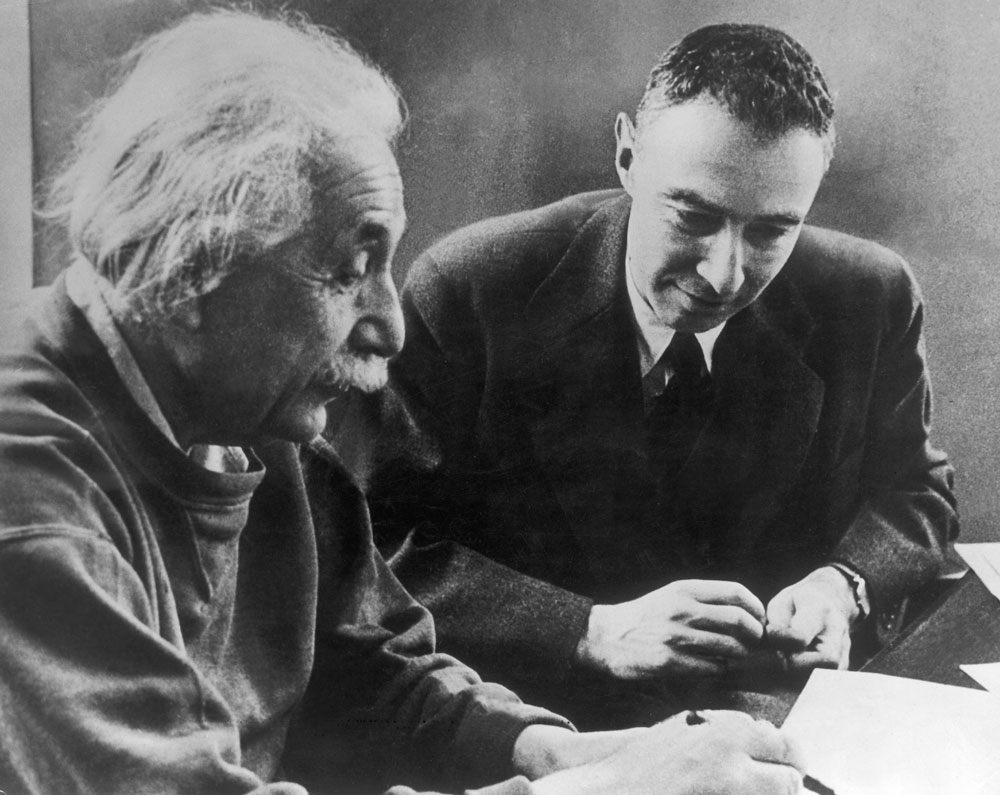
Joas added, “Without relativity, no GPS. Without quantum theory, no lasers, no transistors, no computers, no smartphones. And without relativity and quantum mechanics, no atomic bombs.”

“Without relativity and quantum mechanics, no atomic bombs.”

That last event is, of course, the most controversial in both men’s careers. Just as the film “Oppenheimer” is cagey about the exact nature of Bohr’s role in the Manhattan Project, historians in real life aren’t entirely clear on what exactly Bohr did at Los Alamos.

“He also participated in the Manhattan Project, although his exact role is not fully known,” Joas explained. “We know that he visited Los Alamos three times for about three weeks each time, and that he participated in some technical discussions, for instance about the implosion mechanism for the initiator of one of the two types of bomb that were being built.”

Regardless of his role, it is difficult to praise Bohr without acknowledging this mark on his legacy. Overall between 110,000 and 210,000 people died because of the atomic bombs that were dropped on Hiroshima and Nagasaki. Millions more have perished as a result of the Cold War which followed, some would argue inevitably. Yet very much like Oppenheimer before him, Bohr never joined the Manhattan Project with the idea that he was playing the role of a future villain. Quite to the contrary, he did so to try to stop one of the greatest destructive forces humanity has ever known.


Want more health and science stories in your inbox? Subscribe to Salon’s weekly newsletter The Vulgar Scientist.


“I hate to say it this way, but [he would have been] a prize if he were captured.”

Jim Ottaviani, author of a series of graphic novels about great scientists that includes “Suspended in Language: Niels Bohr’s life, discoveries, and the century he shaped,” offered a plausible explanation for why Bohr sided so strongly with the Allies. Although he was not a religious man, ethnically Bohr was half-Jewish (his mother came from a prominent Jewish banking family.) And as secular Jewish intellectuals like Sigmund Freud learned the hard way during the Holocaust, Nazis regarded Bohr as a Jew regardless of incidental details like how he happened to worship. If there was one thing Bohr knew, it was that Nazis are pure evil.

“I hate to say it this way, but [he would have been] a prize if he were captured” by the Germans, Ottaviani explained. “That would have been something that the Nazis probably would’ve been very happy about, and for good reason. He eventually did escape to the United States and did offer his expertise and services to the Manhattan Project. He was pretty well known and probably his relationship to many, many German physicists — most particularly Werner Heisenberg —brought him to the attention of people who probably wouldn’t have paid much attention to physicists and scientists, otherwise.”

Bohr did more than help the United States military best the Nazis. He also used his clout to come to the aid of the Jews of Denmark. 

“The Bohr brothers helped by writing letters and arranging stays or even positions at the University, but also raised funds with private foundations to help support the refugees,” Joas explained. “Unfortunately, most of the records of these activities have not survived, possibly because the German occupation of Denmark in 1940–1945 may have made it advisable to destroy documentation of who in Central Europe was helping scholars escape Nazi Germany. According to Bohr’s biographer Abraham Pais, the documents were burned in 1940.”

Perhaps Bohr’s most dramatic moment occurred in late September and early October 1943, when Bohr met with Sweden’s King Gustav V, the Swedish Crown Prince and other Swedish government officials to plead for humanitarian assistance for Danish Jews less fortunate than himself.

“Bohr proposed specific courses of action to the Swedish foreign minister and other senior officials in the ministry,” Joas told Salon. “Historians debate the extent to which these interventions were crucial for Sweden’s policy of accepting all Jews from Denmark into their country. They certainly did not hurt their cause.”

“Everyone associated with the atomic energy project was, of course, conscious of the serious problems which would confront humanity once the enterprise was accomplished.”

After World War II ended, Bohr adopted a cause that Oppenheimer also embraced: World peace. Both men opposed nationalist impulses as irrational and dangerous, and instead supported a global system for regulating nuclear weapons and other technologies that posed an existential threat to the human species. In an open letter to the United Nations that he published in 1950, Bohr argued that there are “unique opportunities for furthering understanding and co-operation between nations which have been created by the revolution of human resources brought about by the advance of science.”

On the one hand, he clearly relished the prospect of brilliant people working together to improve the quality of life for all individuals in a selfless enterprise. At the same time, he admitted that he and his fellow scientists recognized the darker implications of their work.

Albert Einstein And J. Robert OppenheimerAlbert Einstein And J. Robert Oppenheimer In 1947 (Keystone-France/Gamma-Keystone via Getty Images)“Everyone associated with the atomic energy project was, of course, conscious of the serious problems which would confront humanity once the enterprise was accomplished,” Bohr wrote, addressing a theme that also appears in “Oppenheimer” — balancing the need to win World War II with a desire to not create a hellish tomorrow after doing so. “Quite apart from the role atomic weapons might come to play in the war, it was clear that permanent grave dangers to world security would ensue unless measures to prevent abuse of the new formidable means of destruction could be universally agreed upon and carried out.”
The solution, Bohr argued, was for the better impulses of human nature to win out.

“Indeed, it need hardly be stressed how fortunate in every respect it would be if, at the same time as the world will know of the formidable destructive power which has come into human hands, it could be told that the great scientific and technical advance has been helpful in creating a solid foundation for a future peaceful co-operation between nations,” Bohr wrote.

“Bohr’s ‘Open Letter to the United Nations’ has aged well and in my view is as relevant today as it was back then, if not more so, given the more complex balance of power in international politics and the much wider availability and greater destructive power of nuclear weapons,” Joas wrote to Salon, later describing Bohr’s ideas as “still the most important tool towards a safer world. In a world that is undergoing turbulent and dramatic changes on the international scene — which is as true today as it was in 1950, when Bohr wrote his letter—we urgently need actors who, in Bohr’s spirit, stand up for a hopeful change in international relations, and actors who dare to talk to others, even across political and ideological divides.”

Indeed, Bohr certainly practiced what he preached, with Joas noting that after World War II the physicist “was centrally involved in the discussions that led to the founding of CERN [European Organization for Nuclear Research], and was the key person in the founding of NORDITA, the Nordic Institute for Theoretical Atomic Physics, now located in Stockholm, and the Risø nuclear research facility in Denmark.”

We need your help to stay independent

Ottaviani was more critical of Bohr’s geopolitical philosophy.

“I think he was considered, to some extent like Oppenheimer, naive about where things were with the threat, real and perceived, of say the Soviet Union,” Ottaviani told Salon. “He had an idealistic view of international cooperation, probably colored in large part by how cooperative the scientific community had been up until roughly that point, in terms of developing the theories and the basic ideas behind what turned out to be a horrible nuclear arms race. I don’t think he was realistic about whether and how it would be possible to close Pandora’s Box again.”

The simple reason why Ron DeSantis keeps finding his campaign embroiled in scandal

When GOP presidential hopeful Gov. Ron DeSantis fired a campaign staffer who posted a video with Nazi imagery in it, the media coverage fell into a predictable pattern: letting DeSantis off the hook. The staffer, Nate Hochman, had retweeted a video that celebrated DeSantis using Nazi imagery. Hochman denied knowing that the Sonnenrad symbol in the video was a popular alternative to the swastika that Nazis and neo-Nazis have long used. Because DeSantis let the staffer go, the media coverage implied that the campaign was unaware of the video or its meaning, and bore no responsibility for putting Nazi propaganda out there. 

Further reporting, however, has since suggested that DeSantis’ exonerating narrative is false. Hochman did not innocently retweet a video he happened to see online. As Axios swiftly reported, Hochman was actually the creator of the video, which he then tried to pass off as made by someone else. As the report also noted, Hochman was let go during a purge of about one-third of the staff to budget issues. Nor was it a one-off incident of DeSantis staff making incendiary videos in-house, and then using sockpuppet accounts to trick the press into believing they were fan-made content. The New York Times recently reported that a shockingly hateful video attacking LGBTQ people, which the campaign retweeted and pretended was made by a DeSantis supporter, was also made by campaign staff.

Nor was there any reason to believe the DeSantis campaign was unaware of Hochman’s radical leanings prior to his hiring. As the Daily Beast reported, Hochman interviewed Hitler fanboy Nick Fuentes in 2021 on Twitter Spaces. During the interview, Hochman said it would be “ideal” to have a political coalition “strictly organized around white identity at the exclusion of other people.”


Want more Amanda Marcotte on politics? Subscribe to her newsletter Standing Room Only.


Tuesday, David Weigel and Shelby Talcott of Semafor reported that the Nazi video and the viciously homophobic video “were not the result of an individual staffer or two striking out on their own, but something that was embedded in the campaign’s operations.” Instead, they write, “Senior aides to Ron DeSantis oversaw the campaign’s high-risk strategy of laundering incendiary videos produced by their staff through allied anonymous Twitter accounts, a set of internal campaign communications obtained by Semafor reveals.” The campaign’s director of rapid response, Christina Pushaw, “told junior staffers that they should keep making meme videos,” which she planned to distribute through cut-outs disguised to look like ordinary voters and not the campaign. 

As Jonathan Chait of New York wrote in response, all this suggests that this is not an accident or a matter of “campaign dysfunction.” Instead, he argues, the DeSantis campaign’s associations with the far-right are a very deliberate choice. Plus, DeSantis’ flirtation with Nazis and other fascist scum is hardly new. Last year, a group of neo-Nazis held an anti-semitic demonstration in Orlando. DeSantis and Pushaw did everything they could to avoid condemning the neo-Nazis, as many other Republicans did without hesitation. DeSantis deflected by claiming Democrats were trying to “smear” him with the condemn-the-Nazis requests. Pushaw resorted to conspiracy theories claiming the neo-Nazis were a Democratic false flag. As Chait notes, white nationalists “have reciprocated these gestures,” recognizing they have an ally in DeSantis. 

Chait argues that DeSantis is doing this stuff as “a fundamental strategic decision” to “actively court the far right.”  He attributes the choice to a “decision to position DeSantis to [Donald] Trump’s right” in the 2024 presidential primary. But if it were just a strategy, then it’s not just immoral, but odd.

Polling repeatedly shows that the most right-wing Republicans, especially those who express the most racist or homophobic views, tend to be the most steadfast in their love of Trump. The only gettable votes for a challenger come from primary voters who are looking for someone more moderate, or at least someone who appears moderate enough to trick swing voters in the general. Plus, as the Rolling Stone reports, donors are starting to complain, demanding DeSantis “clean house” of a staff that’s more interested in catering to the 8chan crowd than everyday voters. 

But it’s unlikely that DeSantis is going to “clean house,” because the problem is not really his staff. It’s him.

This isn’t strategic. This is just an extremely racist man and his extremely racist allies doing everything in their power to revive the kind of false ideas that powered the KKK. 

DeSantis is not an innocent babe in the woods who just stumbled into a bee’s hive full of young fascists who happen to work for him. The simplest and likeliest explanation for why DeSantis has built such an odious campaign is that it reflects his own worldview. And, like most authoritarian nitwits, he’s convinced himself that the numbers of people who agree with him are far larger than they actually are, and that they are just hiding their true views out of fear of “political correctness.” We see this most recently in DeSantis’ reactions to reports that Florida’s education board, in response to his “anti-woke” censorship mandates, now requires students to learn that enslaved people experienced “personal benefit,” because they “developed skills.” As many historians and commentators pointed out, this is a barely-updated version of the apologetics slave owners used in the 19th century, in which they portrayed Black people as “savages” who needed white people to “civilize” them.


Want more Amanda Marcotte on politics? Subscribe to her newsletter Standing Room Only.


But DeSantis just can’t admit that Black people did not and do not need white people to force them in order to learn skills. Instead, he keeps circling back to this idea that Black people were helpless without white guidance. He whined to reporters that it’s a historical fact that enslaved people parlayed “being a blacksmith into doing things later in life.” But it is not a fact at all.  As many people pointed out, DeSantis is acting like African people didn’t have, uh, metal work and other skills that have been around for thousands of years. Indeed, many people were targeted for enslavement precisely because they had skills their white captors didn’t possess. 

It’s telling that DeSantis is so stubborn, despite not just being wrong, but so wrong that he’s drawing out a negative news cycle he probably could have made disappear by simply admitting slavery didn’t have any silver linings. He keeps digging in deeper, sending an insulting public letter to Vice President Kamala Harris, claiming that it’s “nation-leading” history class standards to recycle the talking points of 19th-century slave owners. This isn’t strategic. This is just an extremely racist man and his extremely racist allies doing everything in their power to revive the kind of false ideas that powered the KKK. 

It’s also worth noting that Pushaw’s radicalism has not exactly been secret, either. Pushaw has been a big champion of the anti-LGBTQ Twitter account Libs of TikTok and has echoed the claims that LGBTQ people are the equivalent of pedophiles. The woman who runs that account, Chaya Raichick, has described LGBTQ people as “evil” and “a cult.”

DeSantis is not a person who surrounded himself with far-right bigots unknowingly. He knows. This is what he wants. 

Of course, this doesn’t exactly explain why Trump is crushing DeSantis in the polls of likely Republican primary voters. Trump is also a loud-and-proud racist who refuses to condemn neo-Nazis, and, in fact, called white nationalists “very fine people.” DeSantis is not wrong to guess that Republican voter attitudes about white nationalism range from indifferent to enthusiastic, but that anyone who actually opposes it left the party a long time ago. But what Trump does that DeSantis doesn’t is make those voters feel daring and edgy for being racist, instead of the tired, out-of-touch bigots that they actually are. As this week’s New York Times polling shows, while Republican voters don’t think of Trump as “likeable,” the majority think he’s “fun”  — a word most will not apply to DeSantis. Trump’s tendency to style his vicious rants in the cadence of bad stand-up comedy allows his followers to tell a story about how their racism is just “jokes,” even though the actual punchline never seems to show up. Obviously, they and Trump are just as sincere in their racial bigotries as DeSantis, but Trump’s style lets them tell this more flattering story about themselves. For MAGA, looking at DeSantis is like looking in a mirror and seeing the seething hate reflected right back, in a harsh and unforgiving light. 

Discounting produce at the end of its shelf-life can cut food waste— and help fight climate change

A new study from the University of California San Diego’s Rady School of Management found that dynamic food pricing could help keep more perishable items out of landfills, reducing food waste by 21% or more. 

The practice encourages retailers to establish a system that determines when grocery stores should reduce the price of perishables depending on their inventory and expiration date. This allows grocers to change the price of food throughout the day — instead of maintaining a fixed, daily price — beginning from when foods arrive on the shelf until they expire.

More than 10% of food waste comes from grocery retailers that throw out surplus perishables past their expiration date. The study showed that grocers are more inclined to produce high amounts of waste because it’s profitable to do so. In fact, “when gross profit margins are higher, the retailer stocks its shelves more fully to make sure it doesn’t miss out sales, but as a result, waste increases.” However, such high amounts of food waste also lead to several environmental consequences. When organic wastes decompose, they release methane, a potent greenhouse gas. Collectively, global food waste releases up to 10% of worldwide annual greenhouse gas emissions, which in turn intensifies global warming and climate change.

“Oddly enough, fewer than 25% of U.S. grocery retailers offer any kind of dynamic pricing at all, while most hotels and airlines will discount rooms and seats when they have a surplus,” said Robert Sanders, an author of the study and assistant professor of marketing and analytics at the Rady School. “However, this research shows that the increased price flexibility of discounting food that is about to expire significantly reduces food waste and increases profit margins among retailers.”

Sanders found that dynamic pricing, on average, reduces waste by 21% while increasing grocery chain’s gross margins by 3%. It’s also more effective than a strict organic waste ban (which reduces waste by only 4%) and makes perishables more affordable for and accessible to consumers.

“If regulators want to directly reduce grocery-store waste, they should incentivize grocery chains to adopt dynamic pricing over imposing organic waste bans or waste taxes,” Sanders added. “It is also a market-based solution that the retailer’s themselves could implement.”


Want more great food writing and recipes? Subscribe to Salon Food’s newsletter, The Bite.


Although grocers are now being encouraged to implement more dynamic food pricing, the practice itself isn’t anything new. Just take a look at salvage grocery stores, which exist to help cut food costs and reduce food waste. These stores are essentially “a kind of discount retail store that offers food products that traditional grocery stores are unwilling (or unable) to sell,” per Taste of Home. Shoppers can find products that are near or past their expiration dates along with out-of-season products, overstocked items and imperfect produce, baked goods and meat.

Dynamic food pricing certainly isn’t the sole solution for battling the ongoing climate crisis, but it’s a step in the right direction. “Of course, waste bans could still be helpful if businesses comply and divert waste from the landfills, but the best and first thing to do is reduce the overall amount of waste generated to begin with,” Sanders said. “Dynamic pricing would likely lead to much larger reductions in retailer food waste.”

Scientists warn deep sea mining could be an environmental disaster as regulation negotiations stall

Mining the bottom of the ocean for precious metals is a dangerous proposition, given the near-freezing temperatures and crushing pressures, but it’s being increasingly optioned by nations and mining companies eager for raw materials like cobalt and nickel. Last week, officials met in Kingston, Jamaica to discuss international regulations for deep sea mining, operations many scientists and policymakers oppose due to the potential harm they can cause to the environment.

The International Seabed Authority (ISA), a United Nations-affiliated group, faces pressure to establish rules that protect ecosystems on the ocean floor, many of which are still being investigated. After a “two-year rule” expired earlier in July, the meeting was held as part of negotiations on how nations should proceed with ocean floor mining ventures.

Ultimately, the ISA kicked the can down the road, agreeing to finalize rules for scraping the seafloor for valuable metals by 2025. Although officials did not approve mining operations, they also didn’t agree on what process they’d follow should any requests to mine be filed in the meantime. Many are concerned this will open up the possibility that mining for materials on the ocean floor will begin without regulations in place, threatening the creatures that live there.

“From a scientific point of view, one of the things we have emphasized is that there’s still such a lack of data — of environmental baselines and responses of ecosystem impacts — to be able to effectively develop rules and regulations related to environmental impact assessments, thresholds of harm, monitoring, and things like that,” Beth Orcutt, vice president of Bigelow Laboratory for Ocean Sciences, told Salon.

Little is known about the deep sea floor, and what evidence does exist suggests excavating it could damage sensitive marine life. 

Those who support deep sea mining argue the practice is a means to shift toward renewable energy, as much of the cobalt and nickel recovered in these operations could be used for battery production in electric car manufacturing. Currently, nearly 70 percent of the world’s supply of cobalt is sourced from the Democratic Republic of the Congo (DRC), but operations there have come under scrutiny for enacting child labor and inhumane working conditions. Nauru, an island nation in the Pacific Ocean, gave the U.N. an ultimatum two years ago to finalize regulations.

As reported by The Guardian, Nauru’s president, Russ Kun, told delegates, “We have a window of opportunity to support the development of a sector that Nauru considers has the potential to help accelerate our energy transition to combat climate change.”

Takuyo-Daigo Seamount deep-sea mining machineryTakuyo-Daigo Seamount deep-sea mining machinery (Photo by Travis Washburn)In 2021, more than 700 scientists and policy experts signed an open letter asking for a moratorium on the extraction of materials from the seafloor. A coalition of Indigenous nations in the Pacific also came forward to formally oppose deep sea mining and over a dozen countries have called to pause or completely halt mining operations until more data is available. Little is known about the deep sea floor, and what evidence does exist suggests excavating it could damage sensitive marine life. 

This month, a study in the journal Current Biology analyzed deep sea mining operations in Japan, finding that even small operations could seriously disrupt deep sea dwellers. Although the mining operation lasted just two hours, fish, eels, and shrimp started disappearing from the zone shortly thereafter. Thirteen months later, populations of these kinds of mobile deep sea dwellers, known as swimming benthos, had dropped by 43 percent in the mining location and 56 percent in adjacent areas surrounding the site.

In 2021, more than 700 scientists and policy experts signed an open letter asking for a moratorium on the extraction of materials from the seafloor.

There is no way to mine without completely destroying the ocean floor from which resources are extracted, said study author Travis Washburn, who works with the Geological Survey of Japan. But this study shows the extent of the impact reaches beyond the primary mining zone and into what is called the area of deposition.

“We have to have controls, areas where there is preservation, where there is no mining,” Washburn told Salon. “Even if we choose places that are somewhat farther away, it makes it harder to find an area that is not impacted at all.”

Plans for deep sea mining are largely concentrated in the 1.7 million square mile region known as the Clarion-Clipperton Zone (CCZ) in the Pacific between Hawaii and Mexico. In May, scientists calculated the discovery of more than 5,000 new species in the region, from Psychropotes longicauda, nicknamed the “gummy squirrel,” to Elpidiidae, a part of the family of deep sea cucumbers. Nearly all species identified were unique to the zone, and over 90 percent were new to science. Many still do not even have names.


Want more health and science stories in your inbox? Subscribe to Salon’s weekly newsletter The Vulgar Scientist.


Unmoving animals like sponges and corals have previously been thought to have been the most susceptible to harm from human activity on the ocean floor, given they can’t escape the impacts of mining, Washburn said. But this study showed that swimmers could be impacted too.

“They’re not dying from a plume. They’re not getting chopped up — they’re swimming away,” Washburn said. “They’re leaving the area and that could impact everything. They perform a lot of things.”

Noise associated with scraping the ocean floor has been linked to disruptions in marine life ecosystems in the CCZ. But in Washburn’s research, the operation only lasted a couple of hours, so he hypothesized that what instead caused swimming animals to abandon the site was a lack of food. Typically, deep sea dwellers feed on substances that fall from the surface level and sink down. But mining kicks up debris and rock from below the sea bottom that might cover any food that was available, he said.

We need your help to stay independent

Another study that reviewed the effect of a disturbance to the sea floor in 1989 found the ecosystem still hadn’t returned to equilibrium nearly 30 years after the fact. Some researchers estimate another decade of research is needed to understand each type of ecosystem on the ocean floor. But with pressure on the ISA to finalize regulations by 2025, scientists are collaborating with the agency to comb through what data exists to come up with thresholds for harm, Orcutt said.

“The concern is the impacts would be permanent,” Orcutt said.

“Straight out of the authoritarian playbook”: Hate speech watchdog sued by Musk’s X hits back

The internet watchdog Center for Countering Digital Hate hit back at billionaire Elon Musk Tuesday after X—his company formerly known as Twitter—sued the organization over its research into the dissemination of hate speech on the social media platform.

In a complaint filed Monday in the U.S. District Court for Northern California in San Francisco, X accused the Center for Countering Digital Hate (CCDH)—a nonprofit with offices in the U.S. and United Kingdom—of “using flawed methodologies to advance incorrect, misleading narratives” and engaging in a series of unlawful acts designed to improperly gain access to protected X Corp. data” after the group published research critical of the social platform’s failure to tackle hate speech.

One CCDH analysis found that X failed to remove 99% of hate speech posted by Twitter Blue users, who pay an $8 monthly subscription fee.

“Elon Musk’s latest legal move is straight out of the authoritarian playbook—he is now showing he will stop at nothing to silence anyone who criticizes him for his own decisions and actions,” CCDH founder and CEO Imran Ahmed said in response to X’s lawsuit.

“The Center for Countering Digital Hate’s research shows that hate and disinformation is spreading like wildfire on the platform under Musk’s ownership and this lawsuit is a direct attempt to silence those efforts,” Ahmed continued. “People don’t want to see or be associated with hate, antisemitism, and the dangerous content that we all see proliferating on X.”

“Musk is trying to ‘shoot the messenger’ who highlights the toxic content on his platform rather than deal with the toxic environment he’s created,” he added. “CCDH has no intention of stopping our independent research—Musk will not bully us into silence.”

Since purchasing Twitter for $44 billion last year, Musk has laid off around 80% of the company’s workforce, including many content moderators. Last December, the company dissolved its Trust and Safety Council, an independent advisory board of around 100 human and civil rights experts.

Meanwhile, Musk—who describes himself as a “free speech absolutist” even as he allegedly purges left-wing users—has welcomed or reinstated the accounts of white supremacists, anti-LGBTQ+ bigots, election conspiracy theorists, antisemites, and others.

“This is an unprecedented escalation by a social media company against independent researchers. Musk has just declared open war,” Ahmed toldThe Associated Press on Sunday. “If Musk succeeds in silencing us other researchers will be next in line.”

Family of Henrietta Lacks settles lawsuit over use of immortal cell line

The family of Henrietta Lacks on Tuesday announced that it had settled a lawsuit against Thermo Fisher Scientific, a biotechnology company that commercialized the immortal cell line of Lacks, a housewife and tobacco farmer who died in 1951. The announcement was made on what would have been her 103rd birthday.

Decades after her death, Lacks continues to make incredible contributions to medical science. The problem is that these contributions weren’t achieved with her consent. In 1951, doctors at Johns Hopkins Hospital extracted Lacks’ cervical cells as part of an attempt to treat her cancer. Dr. George Gey, a physician at the hospital, noticed that Lacks’ cells reproduce at a very high rate, and began cultivating them for use in a broad range of medical research.

Known as HeLa cells in tribute to their originator, Lacks cells have been used to test toxins, drugs, cancer treatments and much more. They were critical in the development of polio and COVID-19 vaccines and even went to space. Yet the Lacks family never received compensation for the use of her “stolen” cells, and they sued in 2021.

“The exploitation of Henrietta Lacks represents the unfortunately common struggle experienced by Black people throughout history,” the lawsuit said. “Indeed, Black suffering has fueled innumerable medical progress and profit, without just compensation or recognition. Various studies, both documented and undocumented, have thrived off the dehumanization of Black people.”

The Lacks’ life was detailed in a book and later in a movie, both known as “The Immortal Life of Henrietta Lacks.” These immortal cells will continue to help scientists and doctors study diseases, but hopefully with more respect to the patient involved.

Republicans — including Trump’s rivals — cry out after third indictment drops against ex-president

Donald Trump’s third indictment was so highly anticipated that the former president’s campaign reportedly drafted its response days in advance. So it was little surprise to see Republicans rush to Trump’s defense en masse after Tuesday’s indictment for the Jan. 6, 2021 attack and effort to overturn the 2020 election. Even Trump’s political rivals, like Florida Gov. Ron DeSantis, were quick to release statements decrying the criminal prosecution of an ex-president. 

Trump is charged with four criminal counts: conspiracy to defraud the United States; conspiracy to obstruct an official proceeding; obstruction of and attempt to obstruct an official proceeding; and conspiracy against rights. 

Missouri Sen. Josh Hawley, whose raised fist was infamously memorialized in a photo in front of the U.S. Capitol ahead of the riot, claimed that the newest indictment is part of an “effort to stop Trump from running against Biden.” 

Republicans in the House of Representatives were even more ferocious in their defense of Trump:

“No politically-motivated indictment is going to change my mind,” declared Rep. Lauren Boebert, R-Colo.

Republicans’ cries aside, the indictment sheds light on previously unreported efforts to overturn the 2020 election.

“Despite having lost, the Defendant was determined to remain in power,” the indictment reads. “So for more than two months following election day on November 3, 2020, the Defendant spread lies that there had been outcome-determinative fraud in the election and that he had actually won.”

We need your help to stay independent

The charging document continues: “These claims were false, and the Defendant knew that they were false. But the Defendant repeated and widely disseminated them anyway — to make his knowingly false claims appear legitimate, create an intense national atmosphere of mistrust and anger, and erode public faith in the administration of the election.” 

At least one Republican — and Trump presidential rival — was willing to criticize the former president. 

 “Today’s indictment serves as an important reminder: anyone who puts himself over the Constitution should never be President of the United States,” Mike Pence, whose life was threatened by Trump supporters on Jan. 6, said in a statement. 

That Lizzo lawsuit reminds us that even our progressive faves can be a disappointing letdown too

Lizzo is the self-described queen of body positivity and inclusion. The four-time Grammy winner’s infectious pop anthems preach messages of self-love and acceptance. She has her own body-inclusive and gender-affirming shape-wear brand, Yitty, which intentionally includes transgender people. Her Amazon reality dance competition television show “Lizzo’s Watch Out for the Big Grrrls” won an Emmy for showcasing the nuanced journey of fat Black female dancers and their extreme dedication to dance, self-love and ultimately success. After all of that empowerment, why are the same people she mentored in “Big Grrls,” suing her?

The detailed lawsuit, obtained by NBC News Tuesday, claims Lizzo sexually harassed and created a hostile work environment for three of her former dancers. Some of the more serious allegations state that the singer pressured one of them to touch a naked performer at a club and eat erect bananas from the performers’ vaginas, called a dancer out for gaining weight and later berated, then fired, that dancer after she recorded a meeting on her phone because of a health condition.

The suit also claims that Lizzo subjected her dancers to an “excruciating” audition after leveling false accusations that they were drinking on the job. Not only does the suit claim sexual harassment and a toxic working environment — it underlines alleged instances of religious and racial harassment. Lizzo’s team did not respond to any requests for comment from NBC News.

The dancers’ attorney said in a statement: “The stunning nature of how Lizzo and her management team treated their performers seems to go against everything Lizzo stands for publicly, while privately she weight-shames her dancers and demeans them in ways that are not only illegal but absolutely demoralizing.”

Disturbing and shocking, right? When I read through the claims I immediately questioned how the allegations don’t mesh with this impenetrable women’s advocate and spokesperson for body inclusivity impression that the singer has constructed for herself in her last several years rising into a megastar. Some of this image was thrust onto the star because of the position fatphobic people have put her in as one of the few plus-sized Black women in mainstream culture and music. She has had to defend herself from the onslaught of fatphobia and encouraged her fans to pick themselves up when they go through challenging times. It’s been her message for years.

We need your help to stay independent

And it seems that message may not have been communicated to her former dancers. It’s contradictory that the women on a dance competition reality show that champions women of color and their challenges as fat women allegedly ended up facing abuse. It’s treatment they most likely thought they’d be free and protected from because they were under the assumption that Lizzo’s values — one of inclusion for all marginalized women and people — would automatically mean they were in a safe place with other women that looked like them and shared the same experiences. 

So, what happens when our favorite progressive celebrity appears to breaks the pre-established social contract we had with them? What happens when they fail to live up to the expectations they’ve sold to us? I don’t have all the right answers on accountability culture but I do feel that celebrities owe it to themselves to be honest when they haven’t lived up to expectations they hold themselves to. Lizzo accomplished that when she changed ableist lyrics after public criticism urged her to take accountability.

This squeaky-clean progressive image that we so earnestly believe in is something the singer has also had a hand in curating. It’s not uncommon for left-leaning celebrities to attach themselves to causes they believe in to sell a certain image or brand. Body positivity has worked for Lizzo because of her personal experiences as a fat Black woman in the entertainment industry. Her successful shapewear brand, Yitty, is literally marketed as “Shapewear for Every Body.” And yet she is being accused of fat-shaming one of her plus-sized dancers who has worn and promoted Yitty. 

At the end of the day, Lizzo exists in a multitude of different intersecting identities as a fat Black woman, and that still doesn’t absolve her if the allegations are true. It does not exonerate her from being equally as culpable of fostering and reinforcing toxic and abusive working conditions and upholding power structures that perpetuate violent fatphobia, sexual misconduct and religious and racial prejudice. This level of injustice and cruelty can manifest itself in people who have suffered a great deal from its same destructiveness too. As imperfect people and in Lizzo’s case, an imperfect celebrity, we can easily transform into a perpetrator as easily as we can be a victim. 


Man sues Taco Bell for false advertising of Crunchwrap and Mexican Pizza menu options

A New York man sued Taco Bell Monday, alleging that the popular fast food chain misled customers by offering several menu items, like its Crunchwrap Supreme and Mexican Pizza, with less filling than advertised. In a proposed class action lawsuit filed in the Eastern District Court of New York, Frank Siragusa included side-by-side photos of Taco Bell’s ads for their Crunchwrap Supreme, Vegan Crunchwrap, Grande Crunchwrap, Mexican Pizza, and Veggie Mexican Pizza, next to photos of what he claimed are the actual photos of the products. Compared to the ads, the actual products appear to be smaller in volume and filled with half the beans and beef.

“Taco Bell’s actions are especially concerning now that inflation, food, and meat prices are very high and many consumers, especially lower income consumers, are struggling financially,” Siragusa’s attorney wrote in the lawsuit, per Business Insider.

The lawsuit hopes to win $5 million for New Yorkers who have also been scammed by Taco Bell within the last three years. Per Reuters, lawyers from the firm representing Siragusa have also sued Wendy’s, McDonald’s, and Burger King on similar allegations of deceptive marketing practices.