Spring Sale: Get 1 Year, Save 58%

North Carolina Supreme Court ruling boosts Republican efforts to overturn November election loss

The North Carolina Supreme Court on Thursday rejected the state Board of Election's request to bypass the North Carolina Court of Appeals and review Appellate Court Judge Jefferson Griffin's legal effort to toss out tens of thousands of votes cast in the state's November Supreme Court race. 

Four of the Republican-majority court's justices concurred, while two justices — one Republican and the lone Democrat considering the case — dissented. In a concurring opinion, Republican Justice Trey Allen argued that the Wake County Superior Court, which heard arguments in the case earlier this month, had not adequately explained its same-day ruling upholding the Board of Election's decision to count the votes Griffin challenged.

"Perhaps influenced by this Court’s order directing it to move expeditiously, the superior court simply ruled against Judge Griffin without explaining why, in its view, his claims should be denied," Allen said. "Consequently, if we were to take this case now, we would do so in the absence of any meaningful examination of those claims by a lower court."

Given the significance of the case, he added, the court would benefit from a "well-reasoned and thorough evaluation of the parties' arguments" from the appeals court.

The decision to keep the case in the North Carolina Court of Appeals further extends the months-long legal battle over the Republican judge's loss to incumbent Supreme Court Justice Allison Riggs, a Democrat whose 734-vote victory has been twice confirmed by recounts. Riggs has recused herself from the case.

Griffin sued the state Election Board in December, asking the Supreme Court to force the board to toss more than 65,000 votes he claims are invalid after it earlier denied his election challenges. Griffin argues the votes shouldn't be counted either because voters had incomplete voter registrations, overseas ballots lacked necessary photo identification or they were cast by voters who had never physically resided in the state. Tossing those votes, he argues, will overturn his loss. 

In court, however, attorneys for Griffin have not shown that any of the contested voters would have actually been ineligible. 

The state Supreme Court last month blocked certification of the election and later sent the case back to the Wake County Superior Court, whose ruling Griffin quickly appealed. Both Riggs and Griffin have recused themselves from the case as it appeared before their respective courts. 

In a statement following Thursday's decision, Riggs said she would continue to fight to have her November victory acknowledged.

"No matter how long this drags out, I will continue to defend our state and federal Constitutions and North Carolinians’ fundamental freedoms," Riggs said. "As constitutional officers, judges must respect the will of voters. My commitment to upholding the rule of law is why voters elected me to keep my seat more than 3 months ago.”

The Griffin campaign did not immediately respond to a request for comment. 

In a brief ahead of the North Carolina Supreme Court's decision, Griffin had urged the court to reject the state Election Board's petition for discretionary review, arguing that the request is a "stark reversal of the Board's own arguments."

"The Board successfully opposed Judge Griffin’s earlier petition by insisting that election disputes must follow the 'ordinary course of judicial proceedings,'" a lawyer for Griffin wrote. "Now, having won that battle, the Board urges this Court to leapfrog the very process it demanded."

In her Thursday dissent, Democratic Justice Anita Earls, who has consistently criticized the court's decisions in the case, noted that state law does not require an appeal from the trial court to first go through the North Carolina Court of Appeals before the state Supreme Court hears it. The high court's failure to take up the case, she argued, harms both the involved parties and North Carolinian voters.

"Further delay at this stage continues to erode trust in our elections and calls into question the ability of the legal system to guarantee that fundamental principles of democracy are capable of being recognized and enforced by a fair and impartial judiciary," she wrote.

Earls also admonished Griffin over his opposition to the discretionary review request, specifically his assertion that the six-member court could deadlock on the decision and leave the Wake County Superior Court's decision as the final ruling in the matter. 

"In other words, he asks us not to hear the case because he might lose," Earls said. "Such outcome-determined reasoning has no place in a court committed to the rule of law."

Riggs and the North Carolina Board of Elections previously attempted to remove the case to federal court, arguing that tossing the votes of thousands of North Carolinians violated federal law. The Fourth Circuit Court of Appeals ruled that the case should be litigated in state court first but allowed for any outstanding federal matters to be resolved in federal court. 

The case will now proceed in the North Carolina Court of Appeals on an expedited schedule, with an appeal to the state Supreme Court likely.

MAGA’s not-so-secret weapon: “Major media are a key tool for Trump’s destruction of the government”

One month into his second term, President Donald Trump’s shock and awe campaign against America’s multiracial democracy — and the very idea of responsible governance — continues mostly unabated. Trump’s many dozens of executive orders, diktats and other mandates (many of which are clearly unconstitutional) were just an opening fusillade. Trump’s shock and awe strategy will last much longer as his autocratic rule takes hold.

The courts have intervened, but President Trump is signaling he will (and in some instances already has) ignore any rulings he disagrees with. This will inevitably cause a constitutional crisis, which is likely the next step in a much larger plan to expand Trump’s increasingly unlimited power and authority.

Ultimately, the not-so-secret power of Trump’s political success and rise to power is that he is an expert propagandist and entertainer who knows how to manipulate and maximize his relationship to, and control over, the news media and attention economy. Trump is an expert at being “Donald Trump." The mainstream media and political class have few effective defenses against such a leader in an era of global populist discontent.

In an attempt to help the American people better navigate and make sense of Trump’s surreal and unprecedented first month back in power, the country’s rapidly worsening democracy crisis and the role of the media, I recently spoke with David Altheide. He is the Regents' Professor Emeritus on the faculty of Justice and Social Inquiry in the School of Social Transformation at Arizona State University and author of the book "Gonzo Governance: The Media Logic of Donald Trump."

This is the first part of a two-part conversation.

Trump’s first month back in power has been a spectacle, a shock and awe campaign against American democracy and society. So many horrible things are happening at once that it is very difficult, by design, to make sense of it all. Beginning with Trump’s surreal inauguration, how are you trying to make sense of these last few weeks?  

The inauguration was a spectacle on steroids, with amped-up drama emphasizing power, strength, salvation and greatness. It was a vulgar display of power. America First. First, the setting at the Capitol Rotunda, where Trump-inspired insurrectionists battled police just four years ago, became a stage for the usual pomp. People were sitting close to the rostrum so that Trump’s insults at President Joe Biden were not even a head turn away. Trump made his financial statement very clear: Seated in front of his Cabinet picks and glaringly present were several of the richest men in the world. Second, the speech, as others have noted, was more of a campaign speech that spewed a lot of cliches of American and Western Civilization mythology, including a new Golden Age and Manifest Destiny. Trump also decreed that there are only two genders and pledged to restore America’s potential in the world and history.

"The Trump fascist takeover of major public governmental programs, agencies and institutions is a crisis."

Perhaps the most vulgar thing that Trump did was to assert that divine intervention, in essence, God, prevented an assassination so that he could make America great again. Trump also proclaimed a national emergency at the southern border and promised massive deportations of millions of migrants and “illegal aliens,” attacked the civil rights movement(s) and racial and ethnic equity and promised to upend legal and judicial organizations that had been unfair to him. Trump did not stop there. He promised to take back the Panama Canal and rename Mt. McKinley and the Gulf of Mexico [renamed to the Gulf of America].

The spectacle gained momentum in the other venues, such as the DC Capitol Arena, where he would reenter each time to more applause. There, Trump would single out some of his supporters, including his family, all choreographed as they rose from mini thrones seated behind him. His wife and family, like the Israeli hostage families who were also there, were all props.

The ultimate spectacle was when he transformed a rostrum into his Oval Office and dramatically began to sign and display multiple executive orders, pausing for the applause and approval of the crowd.

Donald Trump is more than just a man or politician. He is best understood as a symbol and type of meme. How has Trump been fulfilling that role?

Trump is playing the role of savior, saving America from further decline, challenging government bureaucracy, tradition, norms, entrenched values and policies about authoritarianism, equality and progress. Trump is so repetitious that he has become a meme who is interpreted by audiences for what they want him to be and stand for.

"We are caught up in entertainment formats that have helped propel gonzo governance, the larger media spectacle that helped to propel Trump and the MAGA movement to power."

For example: The major media can’t be trusted; they provide fake news, only Trump gets it right. The U.S. is being invaded. Trump took people behind the scenes and confided that now he could say things he couldn’t really say in his inaugural speech.

He stressed that American policy for years has been all wrong: Trump will restore America’s promise, but many things had to be changed, including major institutions, legal and judicial processes and appointments; real civil rights that don’t include diversity, equity and inclusion practices that have been followed for 70 years, international agreements and treaties, even national boundaries would have to be changed. Trump promised to stop “birthright” citizenship, which is guaranteed in the Constitution. Educators and schools are on notice to no longer teach bad things about America. Injustices would be corrected; he pardoned the “J6 hostages”, a group who Trump and his followers believe are true patriots that were given unfair sentences for their role in the coup attempt and attacking the Capitol on Jan. 6.  

Donald Trump is an expert at being “Donald Trump,” the persona and character, and manipulating the media and the public in the age of spectacle. To this point, the establishment voices across American society, politics, and civil society have no answer for Trump’s power and appeal as a strongman leader.

Trump is effective because he promotes fear and frames everything in terms of victims and saviors. Trump commands digital media and repeats what he likes from Fox News. He controls the narrative with props and staging. Trump’s America is frightening and scary. He asserts that Americans are victims of corrupt politicians and non-white migrants invading and exploiting them. Trump also lies and distorts reality and the facts with claims such as President Biden and the Democrats are the real enemies of the American people, the real fascists and authoritarians and enemies of democracy, and not him and the Republicans and the MAGA people.

Trump talks in short slogans, often repeating emphasis. This fits the format, rhythm and grammar of social media —instantaneous, personal and visual. He doesn’t qualify terms; he just says them. For example, the innocent are being persecuted by a weaponized legal system. Trump is the parent: strong, male and protective.

How do you explain Trump’s effectiveness as a character and personality? Donald Trump is very funny while at the same time possessing great menace. He is very compelling as a character and media personality. That is verboten to many liberals and progressives because they too often confuse their normative priors and disgust at Trump with a substantive analysis of his symbolic power and why so many tens of millions of people support and even love him.  

Trump’s style is entertaining. He continues to play the part from the TV show “The Apprentice.” He is the boss, tough, masculine and direct.

"Journalists and news outlets must change this behavior."

Sociologist Orrin Klapp’s book, “Heroes, Villains, and Fools: The Changing American Character,” helps explain Trump’s effectiveness with the media. Trump repeats many myths about good and evil, victims and criminals. Trump plays the hero – a hero is a winner, performer, independent, strong, and an authentic defender and a savior. Migrants are cast as criminals and villains. They are weak but cunning, untrustworthy, sneaky, and renegades. Biden and other politicians can also be criminals, as well as fools, who are incompetent, small-minded, and pompous. Trump, the hero, will vanquish all villains and fools, change the Constitution, prosecute any citizen or official who opposes him, and make a lot of money on the side.

President Trump's Cabinet nominees and other appointees are being confirmed by the MAGA Republican-controlled Congress. The media and centrist voices were aghast and basically promised that the Republicans would not support them because these candidates, almost to the one, are manifestly unqualified — except for the qualification of being loyalists and destroying democracy, the rule of law and the institutions they lead. One of the main reasons these people were selected is because they are Fox News personalities. They are familiar faces to the Trump public and larger right-wing. Trump’s Cabinet members are experts in playing their roles on TV. This aspect of Trump's move has been largely neglected by the news media.

Major media are a key tool for Trump’s destruction of the federal government and his refusal to follow court mandates. The takeover is easy when journalism and massive news organizations stay the course and pretend everything is normal. Trump’s attention-based politics of fear stresses a Man of Action; he gets things done; many dozens of felt-tipped signature mini-whiteboards of Executive Orders and proclamations are signed and held up for cameras — it is Document Choreography. The Trump fascist takeover of major public governmental programs, agencies and institutions is a crisis.  

News routines are not amenable to such chaos and disruption: There is only one significant story to be told! That is the fascist takeover of the American government, the raiding of the Treasury, the sacking of experienced FBI leadership, the shutting down of life-saving medical and scientific research, and the firing and dismissal of tens of thousands of civil servants who keep the country functioning, including Social Security, Medicare, Medicaid and the Centers for Disease Control and Prevention. This has been aided by the usual suspects of massive digital disinformation and Fox News diatribes. The Trump regime continues to set the agenda and narratives. The Trump administration counts on ritualized news programs sticking with their format of a few 2–4-minute reports (including the weather report of course!). These formats have evolved to maximize entertainment as news: short, brief, dramatic, conflictual and visual. The network news closes with a thank you to visitors and with NBC’s Lester Holt admonishing us to take care of “yourselves and each other.”  We are caught up in entertainment formats that have helped propel gonzo governance, the larger media spectacle that helped to propel Trump and the MAGA movement to power. 

Journalists and news outlets must change this behavior. The high ground must be retaken every day with headlines about such topics as violating court orders, unelected officials gaining access to personal and financial information, national health care being compromised, children’s cancer treatments being interrupted, food shipments to starving children stopped, school children’s free lunches stopped, life-saving medical research interrupted, the Consumer Protection Agency being shut down, etc. Every day, these and many other casualties of the Trump administration’s illegal and unconstitutional attacks on our democracy and society should be emphasized.   

“He’s not standing up”: Protesters want Hakeem Jeffries to lead an aggressive opposition to Trump

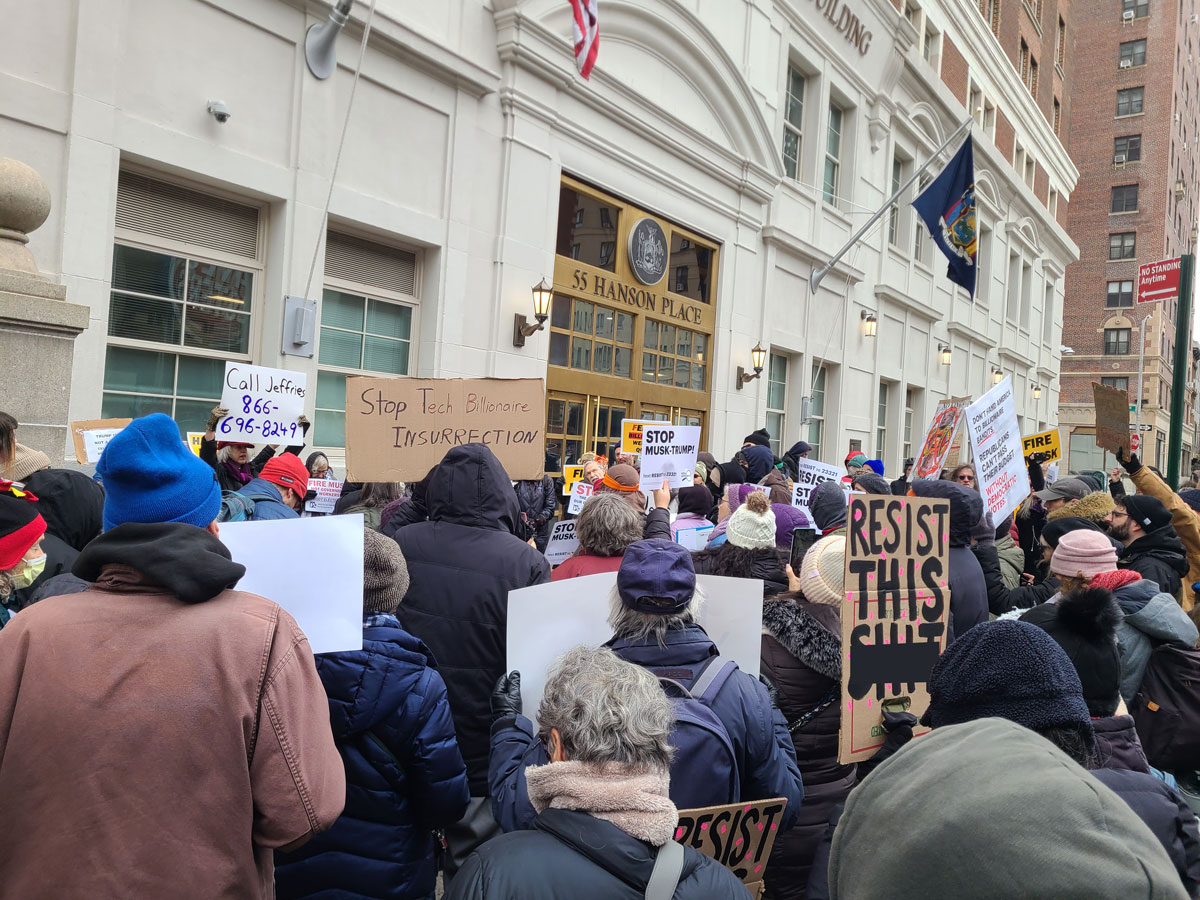
Hundreds of New Yorkers gathered outside the central Brooklyn office of Rep. Hakeem Jeffries. D-N.Y., on Thursday to demand that the minority leader put up more forceful opposition to the administration of President Donald Trump and his billionaire benefactor, Elon Musk.

“Hakeem Jeffries, where’s the firewall? Where’s your plan B? While Musk and his Musketeers are digitally destroying our democracy, you’re making speeches. While our democracy is being decapitated you’re issuing press releases,” Ken Scheles, an organizer with Food and Water Watch, said in a speech. “I don’t see you.”

Protesters rallied in frigid weather for an hour, beginning at noon, demanding that Jeffiries and congressional Democrats refuse to vote for the upcoming Republican budget proposal and use every lever of power at their disposal to oppose the administration’s gutting of the federal workforce. Beyond action, however, protesters also expressed disappointment with the communication from leadership in Congress.

One protester, Ed Goldman, told Salon that he was there to he was there to let Jeffries know that his “leadership of the opposition has been weak.”

“Jeffries and the Democratic Party writ large, as opposition to Trump, is legalistic and formalistic. It assumes that everything in the country before Trump was okay, pretty much, and if we just got back to where we were it would be fine again,” Goldman said. “I don’t think that they speak to the deep mistrust of the population of government."

Charlie Worthheimer, another protester, said that he hoped “it’s possible, with enough pressure” that Jeffries can be moved to take bolder action against the Trump administration.

Protest outside Hakeem Jeffries Brooklyn OfficeProtesters outside Rep. Hakeem Jeffries' Brooklyn office. (Russell Payne)

Another protester, who declined to give their name, said that “Republicans certainly knew how to be obstructionists and speak up when they were in the minority,” and pointed to other Democrats, like Rep. Alexandria Ocasio Cortez, as being more effective in opposition.

“I would like to see people on the steps of Congress every day giving a daily report and talking to people directly,” they said.

Outside his office, people called on Jeffries to come out in support of the removal of New York City Mayor Eric Adams, who appears to have struck a deal with Trump and his Justice Department, which has sought to drop the federal corruption charges against Adams without prejudice, meaning they could be brought again at any moment. In exchange, Adams appears to have promised to collaborate with the Trump administration on its immigration enforcement priorities.

Yona Zeitz, an advocacy director for the Katal Center for Equity, Health, and Justice who attended the protest, told Salon that he was concerned about the Adams-DOJ deal, which he described as a “quid pro quo.”

We need your help to stay independent

“Adams has made it clear that he’s not willing to protect New Yorkers — he’s willing to sell out New Yorkers," Zeitz said. "He wants to bring ICE back to Rikers, so it’s clear the mayor has chosen self-interest above New Yorkers and so Jeffries should call for his removal right now."

Jeffries, for his part, said earlier this month that he's still "trying to figure out what leverage we actually have" as Democrats in the minority, referring to the debate over the GOP budget proposal.

“What leverage do we have? Republicans have repeatedly lectured America — they control the House, the Senate and the presidency. It's their government,” Jeffries said at a press briefing.

The Democratic leader has suggested his eye is on the 2026 midterms and how Democrats can best position themselves to win back Congress.

In response to a request for comment from Salon, Jeffries' office pointed to comments the minority leader made Wednesday night on MeidasTouch, a liberal web show, where he said "I think the American people understandably see all of what I would call diabolical intensity coming from the other side of the aisle."

"We have to not simply match that intensity, but exceed it by enlightened and righteous intensity. We have the high ground on these issues," Jeffries said, later adding: "We have to continue to aggressively push back. It is an all-hands-on-deck effort and it's going to require everyone and we have to lean in with a level of intensity every day, every week, every month, get through the first 100 days, get through the year, get to the midterm elections, and then cut Donald Trump's presidency in half legislatively and begin to turn things around in the United States of America."

Protesters outside Rep. Hakeem Jeffries's Brooklyn office.Protesters outside Rep. Hakeem Jeffries' Brooklyn office. (Russell Payne)But so far Democrats aren't happy with the performance of Jeffries and others in Democratic leadership, the protest Thursday being just one example of that. A recent Quinnipiac survey found that the approval of congressional Democrats among Democratic voters was underwater, with 49% of Democratic respondents disapproving of how their performance and just 40% expressing approval.
Molly Ornati, an activist with 350 Brooklyn Water, a local environmental organization, told Salon that she thought the minority leader was “not presenting a forceful energy of resistance and outrage to what’s going on.”

“He’s acting as though this is a normal part of the political process, when this is a completely never before seen violation of the Constitution, of federal laws, separation of power, democratic principle — all of the key American values. He’s not standing up with the level of outrage that people meant to see, that Democrats want to see,” Ornati said.

Editor's note: This piece was updated to note that Jeffries' comment on Democratic "leverage" was referencing the budget debate.

about this topic

“Never meant to be ruled by a dictator or a king”: The DOGE backlash hits Trump districts

It's been a month since Donald Trump was inaugurated but it feels like a year. When they said we were going to be hit with "shock and awe" they meant it and when Trump said he was going to be a dictator on day one, he actually told the truth for once. It's been one of the most fearful, distressing political events in most of our lifetimes and it's gotten worse every day.

As a result of his many escapes from accountability for his crimes and a Supreme Court that gave him the green light to commit more with impunity, Trump believes that he is invincible, even recently quoting a (possibly apocryphal) line from Napoleon Bonaparte: “He who saves his Country does not violate any Law.” He's carrying on about "manifest destiny" and dreaming aloud about expanding American territory and starting wars with neighbors. He is convinced that he can bully everyone into submission, whether it's a political opponent, an ally or a foreign adversary. He has even called himself a king.

Over the course of this past month, it has appeared that he's not wrong. The Republican Congress has completely abandoned any pretense of integrity and independence. He's sending migrants to Guantánamo and flobbing off others on foreign countries to suffer who-knows-what fate. His followers have physically threatened those few who showed any inkling that they might oppose him and his executioner, Elon Musk, a man charged with the destruction of the federal workforce. In record time he has managed to storm through the government like an Abrams tank, crushing everything in his path and leaving anyone who survives stunned and disoriented.

I have to spend my days poring over every news story because that's my job but I understand if people are choosing to limit their exposure to this carnage so that they can keep their sanity. But I confess that I've been worried that too many Americans have been averting their gaze in order to maintain some sense of emotional equilibrium. I worried that perhaps we are failing to fully understand the seriousness of our current moment. The last couple of days have given me reason to hope otherwise.

Trump has been telling his followers that he now has a 71 percent approval rating:

That's a complete fantasy. While it's true that his approval numbers have been higher in this first month than they were the first time, he still has the lowest numbers of any president at this point in his term, except one — himself. In fact the latest rash of polls this week show that his numbers in the high 40s are rapidly declining. A new Reuters Ipsos poll has him at 44%, down from 47% in January. The Washington Post poll has him at 43% and Quinnipiac UniversityCNN and Gallup all range from 44 to 47%. In other words, he's pretty much back to where he's always been.

But these polls are finding massive discontent over his policies. In the Reuters poll, the wrong track number rose to 53% from 43% percent in just one month and his economic approval number is now at 39%. Only 41% are in favor of Trump's tariffs with 53% opposing the policy.

How about the DOGE cuts? You might have assumed from the commentary that Americans don't care about foreign aid so putting USAID in the "woodchipper," as Musk described it, wouldn't be particularly unpopular. Not so. In the Post poll, 59% oppose Musk's scheme while only 38% approve. In the CNN poll, it was 53-28. The Post also reports that the mass firing of federal workers is opposed by 58% to 39% as well.

And while 51% in the Post poll say they support mass deportation of undocumented immigrants, it's not that simple. According to the Post:

Americans strongly oppose deporting undocumented immigrants who aren’t criminals (57-39), who arrived as children (70-26) and who have U.S. citizen children (66-30).

Quinnipiac reports that only 38% of voters think the system of checks and balances is working well while 54% do not. And they find that 55% think Elon Musk has too much power while 36% think it's just fine.

CNN reports that 62% feel Trump hasn't gone far enough in trying to reduce the cost of living and that includes 47% of Republicans. And from their opinions on the tariffs, it's pretty clear they understand that he's only going to make things worse.

We need your help to stay independent

These polls numbers indicate that people are paying attention and they understand what's going on. Trump may be fantasizing about a 71% approval rating, and there's no telling him otherwise, but other elected Republicans are apparently starting to panic. After all, they have to face the voters in two years. Politico reported that while they are all being very good boys and girls in public, in private they are freaking out:

[M]any are feeling helpless to counter the meat-ax approach that has been embraced so far, with lawmakers especially concerned about the dismissal of military veterans working in federal agencies as well as USDA employees handling the growing bird flu outbreak affecting poultry and dairy farms.

They are being inundated with phone calls and the town halls are starting to look like they're about to get a taste of some of their own tea party medicine. Atlanta Journal-Constitution reporter Greg Bluestein reported on a Thursday night meeting with Rep. Rich McCormick, R-Ga., in which an overflow crowd of very angry constituents in this very red district denounced Trump as a tyrant and a king.

"It's clear from all of the writings of our founding fathers and mothers," one constituent noted, "that our great republic was never meant to be ruled by a dictator or a king."

Some California Republicans were greeted by some very angry protesters in Los Angeles on Thursday as well:


Want a daily wrap-up of all the news and commentary Salon has to offer? Subscribe to our morning newsletter, Crash Course.


We haven't yet seen the mass street protests we saw in 2017 or the aftermath of the 2020 George Floyd murder, but they are springing up organically all over the country. People are showing up at Tesla showrooms to protest Musk and closing down streets to oppose the deportations. Federal workers who are being treated despicably by the DOGE operation are rallying in Washington and elsewhere. High school kids are walking out of classes and boycotts are being organized to oppose corporate America folding to Donald Trump's crusade against DEI.

So far, most Republicans are sticking with Trump. The opposition consists of Democrats and a surprisingly large majority of independents and it's growing rapidly. This could matter when it comes to whether the judiciary actually stands up for the Constitution (yes they do pay attention to public opinion) which remains the best hope to slow down Trump and Musk.

Meanwhile, the Republican Party still has a job to do, which is to pass a budget. Public opinion has a strong effect on how Congress is going to deal with that and those GOP House members in marginal districts (and possibly even in some presumably safe districts if that town hall in Georgia is any indication) are going to be squeezed from both sides, giving the Democrats some real leverage.

It took a while to shake off the despondency and depression many of us felt after Trump was restored and then deputized a weird billionaire to wreck the government. But the opposition is awake and clear-eyed about what they are doing to our country and they aren't going to take it lying down. It won't be a one-sided battle after all. 

“Another barrier”: GOP “voter fraud” proposal could make it harder for married women to vote

A Republican proposal ostensibly aimed at discouraging noncitizens from voting in federal elections — an act that is already illegal and rarely happens, experts say — could have another effect: discouraging women from taking part in democracy.

The Safeguard American Voter Eligibility Act, reintroduced by Republican Rep. Chip Roy of Texas this legislative session, seeks to amend the National Voter Registration Act to mandate that eligible voters provide documentary proof of U.S. citizenship to register to vote in federal elections, a response to unsubstantiated concerns of widespread noncitizen voting. Voting rights advocates and legal experts worry, however, that the bill also threatens to restrict voting access for women — and millions of other Americans — by making it harder for them to prove they are eligible to cast a ballot.

Celina Stewart, CEO of the League of Women Voters of the United States, told Salon that the bill would create "substantial barriers" for eligible voters that would especially burden low-income and working Americans, who may not be able to afford fees for document copies or have to take time off work to acquire them. 

"While on its face, it appears to address election security, this measure deceptively creates unnecessary obstacles to voting when adequate safeguards against non-citizen voting exist," Stewart said in a statement. "The timing and scope of these requirements will prevent individuals from voting rather than [be] meaningful election security reform." 

The bill, which had been passed by the House but stalled in the Senate during the last legislative session, is billed as an effort to prevent voter fraud and ensure only citizens participate in U.S. elections. Federal law already prohibits noncitizens from registering to vote and participating in federal elections, and research indicates noncitizen registration and voting is exceedingly rare. The 1993 NVRA also requires voters to attest to their eligibility on their registration application under the penalty of perjury. 

Acceptable documentation to prove one's citizenship under the SAVE Act includes an ID that fulfills the 2005 REAL ID Act's requirements; a valid U.S. passport and a valid government-issued photo ID when presented alongside a certified birth certificate; an extract from a U.S. hospital record of birth; a final adoption decree; or an American Indian Card, among other documents. 

A problem that opponents of the bill flag concerns Americans' access to proof of citizenship. While the majority of Americans have documents proving their citizenship readily available, a 2023 Brennan Center and University of Maryland Center for Civic Democracy and Engagement survey found that at least 9% of American citizens of voting age do not, amounting to around 21.3 million people. That disparity is more pronounced among Americans of color, 11% of whom lack ready access to citizenship documents compared to just 8% of white Americans. 

For Americans' who do have documents proving their citizenship readily available, the primary document type they'd reach for is their birth certificates. More than 140 million American citizens do not have a U.S. passport, according to a Center for American Progress report.

That's where the SAVE Act presents an additional hurdle. If someone's birth certificate does not match their legal name — which is more often the case for married women who have taken their spouse's last name — they may have to provide additional documentation to register to vote under the measure. Marriage certificates and name-change documents are not listed in the bill as accepted documents to prove citizenship.

Per the CAP report, some 69 million voting-age women who have taken a spouse's last name would then face obstacles voting under the SAVE Act.

As currently written, the hurdles the bill creates could serve as a disincentive to marriage — or, at least, traditional marriage — agued Marcia Zug, a University of South Carolina School of Law professor whose research focuses on immigration law, reproductive rights, federal Indian law and marital law.

"If you want to be cynical — there a lot of policies attacking women — the way it struck me, almost, was a kind of return to coverture," Zug said in a phone interview, referencing the colonial legal practice that held women had no legal identity of their own. "'Married women don't need to vote, right? They're married. Their husbands will take care of their interests.'"

"I don't know it's that thought out — that's maybe being ungenerous," she added, emphasizing that "it's concerning to me." 

We need your help to stay independent

In a statement to Salon, primary bill sponsor Rep. Chip Roy, R-Texas, called claims that the SAVE Act would make it harder for married women to vote "absurd armchair speculation being spun up by media outlets who care more about clicks than reality." He emphasized the "myriad ways for people to prove citizenship" provided in the proposal and pointed to a safeguard in the bill's language intended to address discrepancies in proof of citizenship documents.

That provision requires that each state establish a process that allows a voter registration applicant to provide "such additional documentation to the appropriate election of the State as may be necessary to establish that the applicant is a citizen of the United States."

“This bill isn't being attacked because it'll exclude citizens from voting — it won't," Roy said. "It's being attacked because the policy is wildly popular with the American people, its opponents want and need illegals to vote, and they'll use anything they can to attack it.”

But Joanna Grossman, an SMU Dedman School of Law professor who specializes in women and the law, said that even if the legislation includes a mechanism allowing for states to overcome the discrepancies in documentation, it can still dissuade eligible voters from exercising their right to vote. 

"Any administrative burden you add to voting just decreases the number of people affected who can vote," she told Salon in a phone interview.

The added difficulty in registering to vote will likely dissuade some eligible voters from bothering to, while a swath of others may be unable to successfully obtain documentation needed to do so due to procedural hurdles, Grossman said, citing as an example the recent challenges Texans faced in getting IDs renewed and reissued ahead of an election. 

"It doesn't really matter what the formal rule is," Grossman said. "You're just adding administrative obstacles that are, in fact, going to mean that lots of people who should be eligible to vote can't vote, and those people will be almost 100% women just based on name-changing practices."

Similar requirements implemented for state and local elections in Arizona and Kansas in 2022 and 2011, respectively, either threatened or led to the denial of tens of thousands of legitimate voter registrations. As a result of its law, some 31,000 Kansans — around 12.4% of new voter registrations between Jan. 1, 2013 and Dec. 11, 2015 — had their registration applications canceled or suspended because they could not provide the required documentation, according to court documents from a 2020 U.S. Court of Appeals case challenging the law. 

The process of addressing discrepancies that Roy's bill would establish, Stewart said, "ignores the documented failures of these policies at the state level." The legislation would also fundamentally change how millions of Americans register to vote by, in practice, eliminating online and mail-in registration and voter registration drives, she added. 

"This bill is not solving a problem; it’s creating one by making it harder for eligible Americans to vote," Stewart said.  

She called on Congress instead take "immediate action" to support measures that protect democracy, safeguard voting rights and ensure fair access to the ballot without creating barriers like the John Lewis Voting Rights Advancement Act, the Freedom to Vote Act, and the Native American Voting Rights Act.

"Leaving it to the states is not a solution, as we saw in Arizona and Kansas," Stewart said of the SAVE Act. "The bill is another barrier to voting, and Congress should not and will not pass it."

Texas banned abortion. Then sepsis rates soared

Series: Life of the Mother: How Abortion Bans Lead to Preventable Deaths

Pregnancy became far more dangerous in Texas after the state banned abortion in 2021, ProPublica found in a first-of-its-kind data analysis.

The rate of sepsis shot up more than 50% for women hospitalized when they lost their pregnancies in the second trimester, ProPublica found.

The surge in this life-threatening condition, caused by infection, was most pronounced for patients whose fetus may still have had a heartbeat when they arrived at the hospital.

ProPublica previously reported on two such cases in which miscarrying women in Texas died of sepsis after doctors delayed evacuating their uteruses. Doing so would have been considered an abortion.

The new reporting shows that, after the state banned abortion, dozens more pregnant and postpartum women died in Texas hospitals than had in pre-pandemic years, which ProPublica used as a baseline to avoid COVID-19-related distortions. As the maternal mortality rate dropped nationally, ProPublica found, it rose substantially in Texas.

ProPublica’s analysis is the most detailed look yet at a rise in life-threatening complications for women losing a pregnancy after Texas banned abortion. It raises concerns that the same pattern may be occurring in more than a dozen other states with similar bans.

To chart the scope of pregnancy-related infections, ProPublica purchased and analyzed seven years of Texas’ hospital discharge data.

“This is exactly what we predicted would happen and exactly what we were afraid would happen,” said Dr. Lorie Harper, a maternal-fetal medicine specialist in Austin.

She and a dozen other maternal health experts who reviewed ProPublica’s findings say they add to the evidence that the state’s abortion ban is leading to dangerous delays in care. Texas law threatens up to 99 years in prison for providing an abortion. Though the ban includes an exception for a “medical emergency,” the definition of what constitutes an emergency has been subject to confusion and debate.

Many said the ban is the only explanation they could see for the sudden jump in sepsis cases.

"This is exactly what we predicted would happen and exactly what we were afraid would happen."

The new analysis comes as Texas legislators consider amending the abortion ban in the wake of ProPublica’s previous reporting, and as doctors, federal lawmakers and the state’s largest newspaper have urged Texas officials to review pregnancy-related deaths from the first full years after the ban was enacted; the state maternal mortality review committee has, thus far, opted not to examine the death data for 2022 and 2023.

The standard of care for miscarrying patients in the second trimester is to offer to empty the uterus, according to leading medical organizations, which can lower the risk of contracting an infection and developing sepsis. If a patient’s water breaks or her cervix opens, that risk rises with every passing hour.

Sepsis can lead to permanent kidney failure, brain damage and dangerous blood clotting. Nationally, it is one of the leading causes of deaths in hospitals.

While some Texas doctors have told ProPublica they regularly offer to empty the uterus in these cases, others say their hospitals don’t allow them to do so until the fetal heartbeat stops or they can document a life-threatening complication.

Last year, ProPublica reported on the repercussions of these kinds of delays.

Forced to wait 40 hours as her dying fetus pressed against her cervix, Josseli Barnica risked a dangerous infection. Doctors didn’t induce labor until her fetus no longer had a heartbeat.

Physicians waited, too, as Nevaeh Crain’s organs failed. Before rushing the pregnant teenager to the operating room, they ran an extra test to confirm her fetus had expired.

Both women had hoped to carry their pregnancies to term, both suffered miscarriages and both died.

In response to their stories, 111 doctors wrote a letter to the Legislature saying the abortion ban kept them from providing lifesaving care and demanding a change.

“It’s black and white in the law, but it’s very vague when you’re in the moment,” said Dr. Tony Ogburn, an OB-GYN in San Antonio. When the fetus has a heartbeat, doctors can’t simply follow the usual evidence-based guidelines, he said. Instead, there is a legal obligation to assess whether a woman’s condition is dire enough to merit an abortion under a prosecutor’s interpretation of the law.

Some prominent Texas Republicans who helped write and pass Texas’ strict abortion bans have recently said that the law should be changed to protect women’s lives — though it’s unclear if proposed amendments will receive a public hearing during the current legislative session.

ProPublica’s findings indicate that the law is getting in the way of providing abortions that can protect against life-threatening infections, said Dr. Sarah Prager, a professor of obstetrics and gynecology at the University of Washington.

“We have the ability to intervene before these patients get sick,” she said. “This is evidence that we aren’t doing that.”

A new view

Health experts, specially equipped to study maternal deaths, sit on federal agencies and state-appointed review panels. But, as ProPublica previously reported, none of these bodies have systematically assessed the consequences of abortion bans.

So ProPublica set out to do so, first by investigating preventable deaths, and now by using data to take a broader view, looking at what happened in Texas hospitals after the state banned abortion, in particular as women faced miscarriages.

“It is kind of mindblowing that even before the bans researchers barely looked into complications of pregnancy loss in hospitals,” said perinatal epidemiologist Alison Gemmill, an expert on miscarriage at Johns Hopkins Bloomberg School of Public Health.

In consultation with Gemmill and more than a dozen other maternal health researchers and obstetricians, ProPublica built a framework for analyzing Texas hospital discharge data from 2017 to 2023, the most recent full year available. This billing data, kept by hospitals and collected by the state, catalogues what happens in every hospitalization. It is anonymized but remarkable in its granularity, including details such as gestational age, complications and procedures.

To study infections during pregnancy loss, ProPublica identified all hospitalizations that included miscarriages, terminations and births from the beginning of the second trimester up to 22 weeks’ gestation, before fetal viability. Since first-trimester miscarriage is often managed in an outpatient setting, ProPublica did not include those cases in this analysis.

When looking at stays for second-trimester pregnancy loss, ProPublica found a relatively steady rate of sepsis before Texas made abortion a crime. In late 2021, the state made it a civil offense to end a pregnancy after a fetus developed cardiac activity, and in the summer of 2022, the state made it a felony to terminate any pregnancy, with few exceptions.

In 2021, 67 patients who lost a pregnancy in the second trimester were diagnosed with sepsis — as in the previous years, they accounted for about 3% of the hospitalizations.

In 2022, that number jumped to 90.

The following year, it climbed to 99.

ProPublica’s analysis was conservative and likely missed some cases. It doesn’t capture what happened to miscarrying patients who were turned away from emergency rooms or those like Barnica who were made to wait, then discharged home before they returned with sepsis.

Our analysis showed that patients who were admitted while their fetus was still believed to have a heartbeat were far more likely to develop sepsis.

Because of the risk of infection, major medical organizations advise doctors to always offer abortions.

“What this says to me is that once a fetal death is diagnosed, doctors can appropriately take care of someone to prevent sepsis, but if the fetus still has a heartbeat, then they aren’t able to act and the risk for maternal sepsis goes way up,” said Dr. Kristina Adams Waldorf, professor of obstetrics and gynecology at UW Medicine and an expert in pregnancy complications. “This is needlessly putting a woman’s life in danger.”

Studies indicate that waiting to evacuate the uterus increases rates of sepsis for patients whose water breaks before the fetus can survive outside the womb, a condition called previable premature rupture of membranes or PPROM. Because of the risk of infection, major medical organizations like the Society for Maternal-Fetal Medicine and the American College of Obstetricians and Gynecologists advise doctors to always offer abortions.

Researchers in Dallas and Houston examined cases of previable pregnancy complications at their local hospitals after the state ban. Both studies found that when women weren’t able to end their pregnancies right away, they were significantly more likely to develop dangerous conditions than before the ban. The study of the University of Texas Health Science Center in Houston, not yet published, found that the rate of sepsis tripled after the ban.

Dr. Emily Fahl, a co-author of that study, recently urged professional societies and state medical boards to “explicitly clarify” that doctors need to recommend evacuating the uterus for patients with a PPROM diagnosis, even with no sign of infection, according to MedPage Today.

UTHealth Houston did not respond to several requests for comment.

ProPublica zoomed out beyond the second trimester to look at deaths of all women hospitalized in Texas while pregnant or up to six weeks postpartum. Deaths peaked amid the COVID-19 pandemic, and most patients who died then were diagnosed with the virus. But looking at the two years before the pandemic, 2018 and 2019, and the two most recent years of data, 2022 and 2023, there is a clear shift:

In the two earlier years, there were 79 maternal hospital deaths.

In the two most recent, there were 120.

Caitlin Myers, an economist at Middlebury College, said it’s crucial to examine these deaths from different angles, as ProPublica has done. Data analyses help illuminate trends but can’t reveal a patient’s history or wishes, as a detailed medical chart might. Diving deep into individual cases can reveal the timeline of treatment and how doctors behave. “When you see them together, it tells a really compelling story that people are dying as a result of the abortion restrictions.”

Texas has no plans to scrutinize those deaths. The chair of the maternal mortality review committee said the group is skipping data from 2022 and 2023 and picking up its analysis with 2024 to get a more “contemporary” view of deaths. She added that the decision had “absolutely no nefarious intent.”

“The fact that Texas is not reviewing those years does a disservice to the 120 individuals you identified who died inpatient and were pregnant,” said Dr. Jonas Swartz, an assistant professor of obstetrics and gynecology at Duke University. “And that is an underestimation of the number of people who died.”

The committee is also prohibited by law from reviewing cases that include an abortion medication or procedure, which can also be used during miscarriages. In response to ProPublica’s reporting, a Democratic state representative filed a bill to overturn that prohibition and order those cases to be examined.

Because not all maternal deaths take place in hospitals and the Texas hospital data did not include cause of death, ProPublica also looked at data compiled from death certificates by the Centers for Disease Control and Prevention.

It shows that the rate of maternal deaths in Texas rose 33% between 2019 and 2023 even as the national rate fell by 7.5%.

A new imperative

Texas’ abortion law is under review this legislative session. Even the party that championed it and the senator who authored it say they would consider a change.

On a local television program last month, Republican Lt. Gov. Dan Patrick said the law should be amended.

“I do think we need to clarify any language,” Patrick said, “so that doctors are not in fear of being penalized if they think the life of the mother is at risk.”

State Sen. Bryan Hughes, who once argued that the abortion ban he wrote was “plenty clear,” has since reversed course, saying he is working to propose language to amend the ban. Texas Gov. Greg Abbott told ProPublica, through a spokesperson, that he would “look forward to seeing any clarifying language in any proposed legislation from the Legislature.”

Patrick, Hughes and Attorney General Ken Paxton did not respond to ProPublica’s questions about what changes they would like to see made this session and did not comment on findings ProPublica shared.

In response to ProPublica’s analysis, Abbott’s office said in a statement that Texas law is clear and pointed to Texas health department data that shows 135 abortions have been performed since Roe was overturned without resulting in prosecution. The vast majority of the abortions were categorized as responses to an emergency but the data did not specify what kind. Only five were solely to “preserve [the] health of [the] woman.”

At least seven bills related to repealing or creating new exceptions to the abortion laws have been introduced in Texas.

Doctors told ProPublica they would most like to see the bans overturned so all patients could receive standard care, including the option to terminate pregnancies for health considerations, regardless of whether it’s an emergency. No list of exceptions can encompass every situation and risk a patient might face, obstetricians said.

“A list of exceptions is always going to exclude people,” said Dallas OB-GYN Dr. Allison Gilbert.

It seems unlikely a Republican-controlled Legislature would overturn the ban. Gilbert and others are advocating to at least end criminal and civil penalties for doctors. Though no doctor has been prosecuted for violating the ban, the mere threat of criminal charges continues to obstruct care, she said.

In 2023, an amendment was passed that permitted physicians to intervene when patients are diagnosed with PPROM. But it is written in such a way that still exposes physicians to prosecution; it allows them to offer an “affirmative defense,” like arguing self-defense when charged with murder.

“Anything that can reduce those severe penalties that have really chilled physicians in Texas would be helpful,” Gilbert said. “I think it will mean that we save patients’ lives.”

Rep. Mihaela Plesa, a Democrat from outside Dallas who filed a bill to create new health exceptions, said that ProPublica’s latest findings were “infuriating.”

She is urging Republicans to bring the bills to a hearing for debate and discussion.

Last session, there were no public hearings, even as women have sued the state after being denied treatment for their pregnancy complications. This year, though some Republicans appeared open to change, others have gone a different direction.

One recently filed a bill that would allow the state to charge women who get an abortion with homicide, for which they could face the death penalty.

Do you live in a state that has passed laws affecting abortion in the last few years? In the time since, have you or a loved one experienced delayed health care while pregnant or experiencing a miscarriage?

ProPublica would like to hear from you to better understand the unintended impact of abortion bans across the country. Email our reporters at reproductivehealth@propublica.org to share your story.

We understand this may be difficult to talk about, and we have detailed how we report on maternal health to let you know what you can expect from us.

Lucas Waldron contributed graphics. Mariam Elba contributed research.

ProPublica is a Pulitzer Prize-winning investigative newsroom. Sign up for The Big Story newsletter to receive stories like this one in your inbox.

Republicans shouldn’t be surprised Trump blames Ukraine — his sexual assault views predicted this

Even by Donald Trump's sub-basement standards, the sadism was shocking. "You should have never started it," he declared to the nation of Ukraine, which has been fighting off an invasion by Russia for three years now. Even many Republicans, so used to making excuses for Trump's various lies and abuses, were taken aback by Trump's total reversal of victim and abuser.

"Putin started this war. Putin committed war crimes. Putin is the dictator who murdered his opponents," Rep. Don Bacon, R-Neb., posted on X, clearly rattled in the way liberals have been for nearly a decade under the onslaught of Trump's endless gaslighting. 

"Russia’s the aggressor here, there’s no question about that," Senate Majority Leader John Thune, R-S.D., told reporters, while trying to pretend Trump didn't mean to say the vile thing he said. Sen. Lindsey Graham, R-S.C., also pitifully tried to inject some reality into the discourse without explicitly criticizing Trump, feebly insisting, "I blame [Russian President Vladimir] Putin above all others." 

Trump's Secretary of State Marco Rubio is an especially sad sack. After being trotted out to brag about "the incredible opportunities that exist to partner with the Russians," he rushed to tell European allies that the U.S. is not switching from the white hats to black hats. They would be foolish to accept his reassurances. 

In Trump's view, the larger and more violent party is fully entitled to take what they want from someone smaller and less powerful.

The anxiety among even Republicans to accede to Trump's lie is understandable. Trump and his minions may downplay it, but what Putin has done to Ukraine is unvarnished evil. The illegal invasion has led to an estimated 100,000 Ukranian deaths and even more Russian deaths, as Putin treats his soldiers like cannon fodder. It spawned a refugee crisis and led to Russia kidnapping thousands of Ukrainian children. Putin has been charged with war crimes by the International Criminal Court. Only someone completely awash in Russian misinformation or with no moral compass would say what Trump said. 

But of course, that is who Trump is and no one should be surprised. As soon as I heard him blame Ukraine, I thought of how Trump blamed journalist E. Jean Carroll after a New York civil jury found him liable for sexually assaulting her. "What kind of a woman meets somebody and brings them up and within minutes you're playing hanky panky in a dressing room?" complained Trump the next day on CNN. The implication was not subtle: She had "started it" by letting herself be alone with him. As he argued to host Kaitlan Collins, men have had the right to sexually assault "for a million years," adding the word "fortunately," in case there was any doubt where he stood.


Want more Amanda Marcotte on politics? Subscribe to her newsletter Standing Room Only.


Trump continues to blame Ukrainian President Volodymyr Zelenskyy for Russia's invasion, unsubtly suggesting the problem is not invading a sovereign nation, but the victim resisting. He insists Zelenskyy needs to accept it's "a War that couldn’t be won" and insists he makes a "deal," the likes of which appears to be to give Putin everything he wants. It calls to mind Trump's similar thoughts on the infamous "Access Hollywood," where he praised victims of sexual assault who "let you do it." 

The common thread here isn't hard to see. In Trump's view, the larger and more violent party is fully entitled to take what they want from someone smaller and less powerful. In his view, the target is obliged to give in without a fight. If the victim is foolish enough to resist, they are responsible for whatever level of violence their oppressor uses against them. If a rape victim fights back, she deserves it if her rapist beats her down. If Ukraine's army holds back Russian invaders, they are the villains for not laying back and taking it. 

Authoritarianism and sexual assault have this in common: They are modes for weak and cowardly people to feel powerful. What's striking about Trump's many excuses for sexual violence is not just that he thinks it's okay, but that he whines so much about victims who fight back. He's a feeble man who seeks shortcuts to feeling powerful, without showing an ounce of real courage ever in his life. He only picks on those who can't fight back. It's not enough to be able to be physically stronger, because there's still a threat that they will, as Carroll did, fend him off long enough to escape. No, he needs his targets to be wholly cowed, which is why he was bragging on "Access Hollywood" that other women had to "let you do it" because he's "a star." 

Trump, the ultimate example of a loud-mouthed but chicken-hearted fascist, is almost comically unnerved by Zelenskyy, who has proven himself a brave man leading what is undeniably a courageous struggle by Ukrainians for their independence. Trump is resorting to the favorite response of lily-livered trolls everywhere: sniping insults at the better man from the safety of his computer screen. He sneeringly referred to Zelenskyy's prior career as "a modestly successful comedian" (a far harder job than being a phone-it-in reality TV host!). He accused Zelenskyy of being too busy "sleeping" to make a meeting. As usual with Trump, it's all projection. It was Trump who, true to sniveling form, canceled a joint press conference with the man he's been insulting safely from an iPhone for the past couple of days. 

Again, it's so reminiscent of how Trump scurries to welcoming crowds of sycophants to talk smack about the women who had the courage to step forward with sexual assault accusations. He has repeatedly attacked the looks of his accusers, which implies that being assaulted by him is a compliment. He's called Carroll "a whack job" and "not my type." And, always, he suggests that victims want it. "She actually indicated that she loved it, okay?" he raved to CNN's Anderson Cooper in 2019. "She said it was very sexy to be raped." In reality, Carroll said the opposite, that rape is often portrayed as sexual, but in her experience, it's more like a "fight." 

His apologists are apeing Trump's whiny behavior about Ukraine. When Zelenskyy publicly pushed back against Trump's lies, Vance lashed out — from the right's ultra-soft safe space of the Daily Mail — by crying about Zelenskyy "badmouthing" Trump. "Everyone who knows the president will tell you that is an atrocious way to deal with this administration," he added. Yep, Vance's "defense" of his boss is to paint him as a thin-skinned bully who needs to be coddled with flattery. 

Mistaking their own weakness for strength is the MAGA way. Thursday, I linked an essay by the blogger Scarlet at Dialectics of Decline, but by gum, her entertaining description of the MAGA mindset deserves to be aired again. "They are crybabies of the highest order," she wrote, noting that the main tone of Trump's fanbase is self-pity over the smallest stuff. "They’re scared to take the subway, they’re offended that you called them white or cis, they’re upset that you didn’t think they were cool in high school, they want to call the manager because there’s less boobies in video games."

Her only error is treating this as a new thing. That's always been the central tension of fascism. It's men who have fantasies of being "ubermensch," but who are acting on their justified fears that, underneath the bluster, they're cowards. They can't handle criticism, can't handle change, and can't handle the knowledge that there are other people — especially people they look down on, like women or queer people — who exhibit far more courage every day than the fascist musters in a lifetime. Fascists are fundamentally people who can't pick on someone their own size. And even when they're punching down, they're crying because the victim's resistance makes their knuckles hurt. 

Tuberculosis is on the rise again. We can fight it — if we try

Tuberculosis, the world’s oldest and deadliest pandemic, has been plaguing us for well over 4,000 years, with a relative of TB bacteria detected since the dinosaur age, and an ancestor having infected our early human ancestors. Indeed, the pathogen seems like ancient history — but as recent developments indicate, tuberculosis isn’t done with us yet.

As it happens, Mycobacterium tuberculosis, the bacteria that causes tuberculosis, is second only to SARS-CoV-2 as the leading cause of death by infection right now. And it’s on the rise,  according to the World Health Organization’s 2024 country report for the United States. In 2023, the most recent year for which they have data, there were an estimated 11,000 cases and 626 deaths. The U.S. resurgence reflects a global trend that has seen an estimated 10.8 million people become ill worldwide with TB in 2023. 

TB is a slow disease: it can take months, years or decades for an infection to result in symptoms. This is why the current outbreaks have actually been brewing for at least a year (“recent” transmission means within the past two years.)

In the decades and centuries we’ve lived with TB, it has taught us some painful lessons. Now, as it surges back with one of the largest outbreaks in the U.S. in several decades, still ongoing in Kansas, we can learn from the lessons it’s taught us over our decades and centuries of coexistence. As well as helping us fight TB, these lessons offer powerful tools to improve the health of Americans and protect us from our tiniest adversaries: such as the viruses that cause bird flu, mpox, COVID-19, HIV and even the common cold.

Take advantage of the good news: U.S. rates of TB are still low

“I remember 20 years ago as a grad student naïvely thinking that since it was clear that we had diagnostics and drugs for TB, we would be able to beat it and I might have to pursue a different line of research later in life,” Dr. Jonathan Stillo, a medical anthropologist at Wayne State University, said in an email interview with Salon. “Stepping back and thinking about it though, it is a little crazy.”

Why crazy? Because tuberculosis is curable in virtually all instances so long as the person is properly diagnosed and able to receive and complete the correct treatment for the strain they have.

“Yet TB is the world's top infectious killer, accounting for about 1.5 million deaths a year,” Stillo said. “And every single one of these deaths is an unnecessary, preventable death.”

"TB is the world's top infectious killer, accounting for about 1.5 million deaths a year."

As of 2023, the U.S. remains among countries with the lowest incidence of TB. But it’s also made little or no progress in reducing the number of new cases. More worrisome: although active, or symptomatic, TB is a reportable disease, latent TB is not.  So in 2024 Centers for Disease Control and Prevention still relied on 2011 to 2012 data to estimate that up to 13 million people in the U.S. have a latent tuberculosis infection — and the vast majority (80%) of TB cases in the U.S. result from longstanding, untreated latent TB.

So while there aren’t that many cases of active TB causing the familiar symptoms of coughing, fever, weight loss or night sweats, a huge number of people are at risk of it, given the right conditions. So, too, are their close contacts, who are at risk of acquiring latent TB from them if they fall ill. If you spend a lot of time in an enclosed space with someone who is frequently coughing, you can easily inhale the airborne droplets they expel: many children, who are in close, ongoing contact with their parents and whose immune systems are less developed, are infected in exactly this way.

At this very moment, far too many of the conditions are right in the U.S. for latent TB, carried by perhaps millions of people, to become active and for active TB to be passed on, kicking off  major spread of the disease like the outbreaks in Kansas.

Make sure people with TB can complete their full treatment

It shouldn’t be difficult to prevent TB epidemics. We simply need to identify everyone who has the disease and treat them, and also identify their contacts who are at risk of getting TB themselves. We can provide preventative treatment, and then also identify as many people as possible who have the infection without being sick and treat them before it can turn into active tuberculosis and then be spread to others. Easy-peasy. But the trick (or one of the tricks, as we’ll see) lies in treatment.

You’ve probably taken antibiotics for an infection and been told very sternly to finish the entire bottle of medication, even if you feel better after just a few days. The drugs can suppress the bacteria without killing them all, but if you stop treatment too early, they can surge back. Even worse, the ones that weren’t killed right away will be the hardiest among them, and so you may be performing your own personal experiment in artificial selection of the toughest bugs, an experiment that could leave you with an antibiotic-resistant disease. This means that the first line drug will no longer work and doctors will have to find a new medication to give you. 

Antibiotic resistance is already a very serious problem where tuberculosis is concerned, forcing doctors to use the small remaining number of medications they have to offer. And now, frighteningly, there is tuberculosis that is resistant to all known drugs to treat it. In 2023 there were 100 cases of drug-resistant TB but a far smaller number of multidrug resistant disease. That year, there were just 15 cases of what’s called pre-extensively drug-resistant TB, and just a single case reported of the worst kind: extensively drug-resistant disease. It is very important to keep those numbers as low as possible or we risk returning to the days when humanity really had no control over TB and it infected a staggering list of writers, artists, musicians, politicians and other luminaries, killing many in their prime.

But preventing resistance requires diagnosis and treatment, which is no walk in the park. Rather than a 10 day course of treatment, you must take at least one (usually four) medications every single day for six months, usually under supervision at a clinic. They have side effects, which range from the unpleasant, like nausea or fatigue, to the very serious, like kidney damage, depression or hearing loss, making it extremely difficult for patients under treatment to attend school or work, or take care of children. So it’s expensive and gruelling, to say the least.

“Let’s say TB services are scaled down, people don’t get the support that they usually have. They’re kind of left more to themselves. The chances of getting more drug resistant TB is high because they will stop treatment, and then they will get relapses, and then they’ll be treated, maybe with the wrong drugs,” Dr. Beate Kampmann, professor of paediatric infection and immunity at the London School of Hygiene and Tropical Medicine, told Salon in a video interview. “I’m pretty sure that the rate of drug resistant TB will rise.”

Prevent the spread of diseases that contribute to TB susceptibility

Co-infection with HIV has long been understood as a major risk in activation of latent TB into active disease. Of the 626 deaths recorded from TB in the U.S. in 2023, 86 of them among people with HIV, a common co-infection — nearly 5 % of TB patients in the U.S. that year were also living with HIV. Does this mean being HIV-free means no need to worry? Nope. Rather, it tells us that a population where infectious diseases weaken the immune system is a population at risk of outbreaks of TB; diabetes and chronic obstructive pulmonary disease (COPD), and immunosuppressive diseases beyond HIV are also associated with tuberculosis.


Want more health and science stories in your inbox? Subscribe to Salon's weekly newsletter Lab Notes.


Leaving infections untreated is thus a recipe for disaster, so it’s vital for the health of the American population as a whole to ensure all residents are able to afford timely medical care that helps eliminate viruses or keep viral loads undetectably low, and in the case of bacteria like tuberculosis, that allows patients to complete a full course of treatment without the interruptions that can allow partly-suppressed infections to surge back, and perhaps to become resistant to the antibiotics that were used.

President Trump’s 90-day freeze on foreign aid funding through USAID, and then the shut down of the organization itself, means an immediate halt to funding for global TB programs to diagnose, treat and prevent the disease (worth $406 million in 2024), and if not somehow reversed or this funding replaced before it’s too late, will increase the risk of TB and of drug-resistant TB worldwide, inevitably affecting rates in the United States over time. But the impact of a freeze or cuts to foreign aid also means a freeze on global HIV prevention programs, and this puts everyone, again including Americans, at risk of a major explosion of not just HIV but also antibiotic-resistant TB. Put together, we may be deliberately engineering a global catastrophe that could eventually return us to those bad old pre-antibiotic days of early deaths from TB among all classes.

Clean the air

In a December episode of her new podcast, Public Health is Dead, Daniella Barreto took listeners behind the scenes at the Orpheum, a Vancouver theatre built in 1927 to be a luxurious, comfortable venue — cunningly designed to provide excellent ventilation in order to prevent spread of disease, like the age-old scourge of tuberculosis, but more specifically the H1N1 influenza, which swept the world in that last year of WWI, killing 675,000 Americans. A couple of decades before that, Dr. Carl Flügge, a microbiologist, epidemiologist and hygienist, discovered that tuberculosis bacteria were spread in droplets freshly coughed into the air by TB patients, validating the idea that fresh air was important for prevention.

In a video interview with Salon, Barreto, a public health advocate with a masters degree in population and public health, explained that TB provides a great example of a disease where clean indoor air can reduce infection rates. And yet in a way, our historical understanding of tuberculosis as the paradigmatic airborne disease has resulted in an odd reluctance, including by infectious disease physicians, to accept that breathing in pathogens from the air is an important way people get infected by other diseases like COVID and even influenza, too. But in those diseases, which are caused by viruses, it’s not just droplets, but far smaller airborne particles that play the critical role in infection. This reluctance to think outside the TB box has resulted in people resisting the sensible use of respirator masks in health care settings. This is despite the risk of vulnerable patients entering hospital for a non-infectious complaint and coming out with a new  infection, even if not coughed on directly.

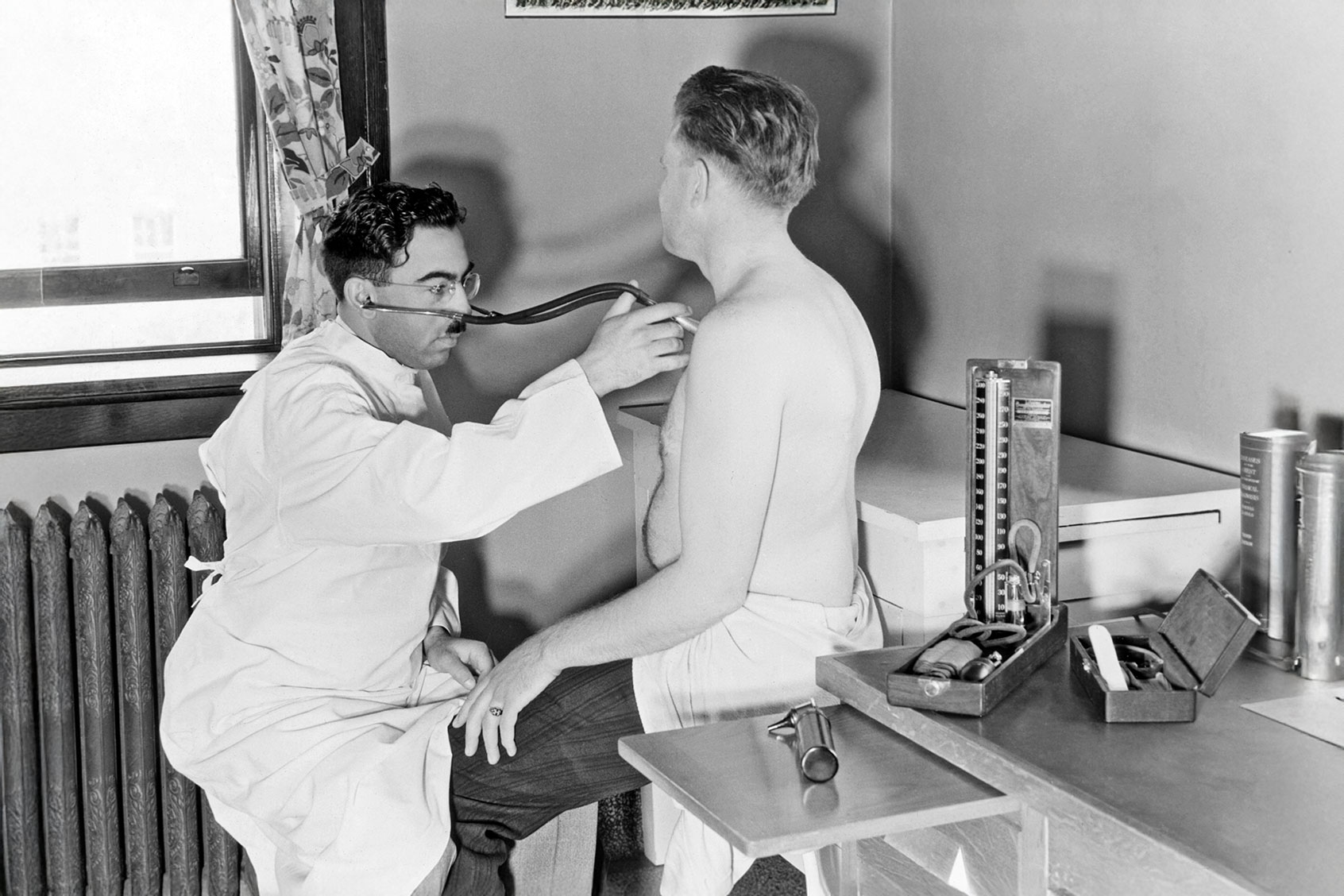
Doctor physician examining patent for tuberculosisPhysician conducting a medical examination of a dairy worker at the state tuberculosis sanatorium in Ah-Gwah-Ching, Minnesota, 1932. (Smith Collection/Gado/Getty Images)
It’s not Flügge’s fault we’ve missed the point. In fact, his real interest was in “all aspects of the environment in which infection transmission occurs and the environmental conditions that predispose to all manner of human disease,” as infectious disease researchers write.

In 1897, Flügge even “collated evidence that a variety of infections can be transported following aerosolization by coughing or even just breathing or speaking or following aerosolization of infectious agents by air currents of varying speed from various surfaces,” according to those researchers. But errors of interpretation made by American epidemiologist Charles Chapin a decade later resulted in everything other than sprayed droplets being dismissed as irrelevant to transmission, a persistent mistake that has endured until today, resulting in preventable deaths due to SARS-CoV-2 floating around as exhaled particles too small to be considered droplets.

Nevertheless, Flügge’s air-related lesson of tuberculosis remains vitally important, and is gaining supporters.

“We’re sort of at this precipice, I think, of a paradigm change where we’re understanding way more about aerosol transmission when it comes to COVID and other diseases like influenza,” Barreto says.

Ensuring clean indoor air as the designers of the Orpheum did in 1918; or as do proponents of the widespread adoption of indoor air quality standards (in particular the ASHRAE standard 241, which updates minimum requirements to reduce the risk of disease transmission through exhaled pathogens), or the DIY makers of cheap, easy to build Corsi-Rosenthal boxes to filter the air in schools and homes. Sunlight, too, is a great and timeless disinfectant: airy, open spaces don’t just allow air movement that reduces transmission risk  —  they actually let sunlight in where it can kill bacteria in the air. The old sanatoria in the Alps to which European TB patients lucky enough to have wealthy relatives might be sent focused on cleanliness, fresh air and sunlight, ample nutritious food and rest. It’s a prescription suitable for both treatment and prevention today — along with, not instead of, the medications that actually kill the bacteria in a patient’s lungs.

Focusing on implementation of ASHRAE standard 241 in buildings may be one of the highest return initiatives we could take to reduce prevalence of all sorts of infectious disease. This would make Americans less susceptible to the next pandemic, whether it’s the latest new COVID-19 variant, or H5N1 becoming capable of human-to-human transmission, or tuberculosis brewing in lungs for years before sickening many patients. ASHRAE standards are not mandatory, but can be adopted by states or cities as the energy code requirement for new buildings and renovations alike.

Another reason to clean indoor air is in hopes of mitigating the harmful effects of pollution from wildfires or vehicle exhaust on TB risk. A study of Northern California residents last year found carbon monoxide and nitrogen dioxide exposure, largely the product of vehicle emissions, was correlated with risk of tuberculosis. Also in California, a 2023 study found that each event that exposed residents to wildfire-associated tiny particles was associated with between 19 and 28% higher odds of a tuberculosis diagnosis within 6 months.

"It is clearly very much a socioeconomic determinant disease."

In addition to ventilation and filtration to clean the air, you can use light. At around the start of the 20th century, scientist Niels Ryberg Finsen developed a light-based treatment for lupus vulgaris, a form of TB that affects the face. Finsen’s work won him a Nobel Prize in 1903 and paved the way for light-based therapies in many other ailments and the more recent use of red and blue LED lights for skin care and some therapeutic applications. And yet, in the face of the COVID pandemic, interest in the potential of UV light has been confined to a small group of researchers, engineers and “makers” who have, for example, created devices using UV in a wavelength that makes it safe for humans to be in the room while they’re on. This is a powerful way of cleaning the air and an area of great innovation. 

Focus on poverty, equity and housing to prevent TB outbreaks that affect everyone

“If they live in a very crowded environment and [a person has] contact with someone who’s got active TB, they’re much more likely to get it. And if they’re in a place where there is poor ventilation, for example, and then there is a nutritional need,” Kampmann said. “If they also have HIV or some immunocompromised [condition], then they are a sitting duck to get active TB.”

As Kampmann explained, TB is the classic example of a disease where you must think holistically, and where social determinants of health are vital to understanding the dynamics of the disease. This has been known for decades or centuries: in the U.K., she explains, sunlight exposure in new tenement settlements built in Manchester during industrialization, and then the rising standard of living, both contributed to a decline in TB rates well before doctors had any meaningful treatment to offer their patients.

“So it is clearly very much a socioeconomic determinant disease,” Kampmann said. William Osler, often described as the father of modern medicine, put it like this: “Tuberculosis is a social disease with a medical aspect.”

Poverty, which forces people into poorly ventilated, crowded conditions in inadequate housing or shelters, and leaves them vulnerable to poor nutritional status, immune-weakening stress, and lack of health insurance, interacts with each of these other factors to put people at greater risk of being infected in the first place, and of greater risk of that latent infection progressing to actual TB.

We need your help to stay independent

“The active case is always just the tip of the iceberg,” Kampmann told Salon. “And under that [are] all those people who might be exposed or infected, and the ones who are exposed, like children who might not be infected, you want to give medicines to so that they don’t get it in the first place, and the ones who are already infected, it depends what age they are and whether they’re in a particular vulnerable group, whether you would give them a treatment or not.”

Finally, education is vital in both the seeking health care part of addressing TB and the sticking-with-treatment part. Inequality and marginalization are major factors blocking patient access to reliable, comprehensible and trustworthy information about how to protect themselves and their loved ones. Racism and persistently race-based differences in treatment and outcomes within the health care system erode trust, and make people unwilling to participate in the real shared effort that is proper and effective treatment for TB.

And, Kampmann said, the current climate in which fear of deportation or immigration status issues may prevent people from seeking health care is a climate in which TB may spread silently for a long time. Preventative treatment for people who don’t have tuberculosis but are close contacts of people who are likewise depends on trust in the health care system and everyone who might interact with it.

“Most people in the USA probably do not know how fragile the public health situation is — especially as it relates to TB,” Stillo said. And just because poverty makes TB more likely and harder to treat does not mean it is only a disease of the poor: take the 2007 case of an Atlanta lawyer with multi-drug resistant TB who took international flights to several European countries before flying home to the U.S., where he was forced into isolation, received surgery to remove the upper right lobe of his lung, and was sued by fellow passengers. A similar case occurred in 2013.

Strengthen public health agencies

“One might look at the low TB rate in the USA and think that the situation is good here. It is not. Our public health infrastructure is fragile, understaffed and under-resourced,” Stillo said. And public health infrastructure is key to preventing TB-related disaster.

This is an old lesson. “To the classic epidemiologic triad of agent, host and environment, tuberculosis adds the category of Health Services,” wrote Victor W. Sidel, Ernest Drucker and Steven C. Martin in a 1993 paper with a focus on NYC, where crowding, inequality and poor socioeconomic conditions had set off a resurgence of TB.

Indeed, historically, outbreaks of TB have generally dissipated when public health has made a real effort such that healthcare agencies have worked well together to share information, reach out to communities, and ensure both knowledge and medical services are accessible to everyone, whatever their socioeconomic status. It’s one reason TB rates have stayed relatively very low in the United States.

“The USA has maintained a low rate of TB, but by having a little bit of TB everywhere, it means that we must have well-funded and staffed local public health infrastructure to address this infectious threat (as well as other ones), Stillo explained.

Although the cost of health care and medicines are prohibitive for many people in this country, putting them at risk of the poor health status that increases susceptibility to tuberculosis, direct TB care is currently free for patients, mostly funded by the CDC’s Division of Tuberculosis Elimination, although this does leave out the substantial time patients in treatment lose to paid work, as well as transportation costs and childcare if needed. But the actual cost of treatment itself is very substantial, with some estimates for patients reaching $23,000 per person. It’s one of the reasons public health and infectious disease experts worry about what will happen under the new administration.

“Particularly [in] the current political climate where public health and specifically infectious disease has been identified as something that should be cut and deprioritized, [this] threatens the health of the whole country,” Stillo said. “I strongly support increasing the attention that we pay to chronic and noncontagious diseases as well, but it is not a zero sum game.”

And it’s not just treatment. The CDC, for example, provides free molecular sequencing to help public health laboratories detect mutations in the bacteria early, a vital service to prevent spread of antibiotic-resistant strains. Cuts to funding could be disastrous. So could cuts to jobs that support the careful tracing of patient contacts and provision of individualized treatment for people at risk of infection or already infected.

“If you don’t have any personnel to look after these people, they will get more disease, and that will be a snowball, infecting others and so on, and it will be over a period of time, because TB is a slow disease,” Kampmann said.

Also disastrous would be suppression of health data and information. Barreto said we’ve done a “horrible job” with public health communication during the ongoing COVID pandemic.

“I think trying to now do education for something else, on top of a public health system that’s in tatters and the CDC not being allowed to … share information, I think, is kind of looking like a recipe for disaster,” Barreto said. “But also if TB starts becoming more of a problem. Understanding around preventing disease transmission being important, I think, is just like a fundamental thing that somehow has gotten lost.”

“Gravedigger of American Democracy”: McConnell gave us the do-nothing Congress

Following a crushing electoral defeat in 2008, in which Democrats captured the House, the Senate and the Oval Office, then-66-year-old Senate Minority Leader Mitch McConnell drew out a roadmap for his GOP colleagues. The plan for the better part of the next decade? Obstruct, obstruct, obstruct.

This platform of negation took root quickly, radically changing what the GOP saw as its purpose. Asked in 2010 what his party’s priorities would be following a potential shift in D.C. power in the upcoming midterm elections, McConnell passed over sharing his vision for the country and instead promised to wield his power to nip President Barack Obama's agenda in the bud.

“The single most important thing we want to achieve is for President Obama to be a one-term president,” McConnell told the National Journal.

McConnell kept his caucus in lock-step, putting up a fight on even the most popular Obama initiatives. Early signs showed the extent of his grip on the GOP. Not one Senate Republican voted in favor of the Affordable Care Act. Nearly the entire party voted against the 2009 Recovery Act, meant to bolster the reeling U.S. and lessen the pain of the market crash.

His ability to obstruct only got better with age. During the 118th Congress, a GOP-led House and cloture-happy GOP minority in the Senate led the legislature on its least accomplished session in decades.

McConnell announced his retirement from the upper chamber on Thursday, opting to bow out of the 2026 Senate elections. But his legacy is likely to live on in the dug-in heels of a new generation of obstinate MAGA Republicans. The senator from Kentucky's decades-long impact on legislation, the courts, and the fundamentals of congressional leadership itself make him perhaps the most divisive man on Capitol Hill.

“Gravedigger of American Democracy,” New York Times columnist Jamelle Bouie proclaimed McConnell in a post to Bluesky, adding that the senator was “a more malign influence than John C. Calhoun," an antebellum Southern politician and infamous defender of slavery.

For McConnell’s acolytes, the Kentucky power broker kept the tradition of the “cooling saucer” Senate alive, keeping the bar for passing legislation high above a simple majority and preventing two Democratic presidents from enacting their agendas.

The Cloture Motion

The Senate may have a storied tradition of deep political divides, but McConnell called his ships and blockaded nearly a staggering amount of the Democratic Party's efforts to govern. As political scientist Bert Rockman put it in a 2012 paper, McConnell’s “opposition tactics in the Senate made it not so much the 'cooling saucer' as the deep freezer of legislation.”

Republicans in the Senate were outnumbered for the majority of Obama’s presidency, but that didn’t stop them from blocking hundreds of bills and nominations. Republicans utilized the filibuster and cloture procedures in the upper chamber. The de facto requirement of 60 votes to advance legislation from debate effectively killed majority-favored bills in Democrat-steered sessions. 

Coupled with McConnell’s knack for whipping votes and halting in-party dissent, the filibuster-everything strategy made just about any dewy-eyed bipartisan efforts dead on arrival. The McConnell minority's ability to put the kibosh on laws was merely a teaser for their most radical and influential strategy. McConnell oversaw a historic effort to curtail the Obama administration’s appointment of federal officials and judges, turning the formerly bipartisan process into another front of a trench war.

By 2013, McConnell’s GOP had made nearly half of all cloture motions on presidential nominations in history, a Congressional Research Service study in 2013 found. Frustrated by McConnell's antics, Senate Democratic leader Harry Reid amended the rules in 2013 to allow cloture by simple majority on nominations (Supreme Court justices, excepted).

McConnell lost that particular battle, but he won the war. Using the same logic, a McConnell-led Senate in 2017 augmented the rules further to allow a simple majority to break a filibuster on Supreme Court nominees.

Shaping the Supreme Court

When conservative Supreme Court Justice Antonin Scalia passed away in early 2016, President Obama gained an opportunity to tilt the balance on an evenly split court. Obeying in advance to perceived conservative pushback, Obama nominated moderate Merrick Garland to the vacancy on the high court.

Garland, a man that Utah GOP Senator Orrin Hatch called a “consensus nominee” in the years before the nomination, never got close to the bench, though.

McConnell invoked an iffy senatorial precedent to stonewall Garland’s confirmation, claiming that the Senate shouldn’t confirm high court appointees in the final year of a presidency. Historical basis or not, McConnell’s chamber successfully stalled the vacancy until after the 2016 election, in which President Donald Trump was chosen to fill it.

We need your help to stay independent

Confirming cross-party consensus was far from top of mind when McConnell’s party won power in 2016. With a chance to augment the judiciary for a generation, the Majority Leader abandoned his vaunted norms of prior sessions and helped Trump ram Justices Gorsuch, Brett Kavanaugh, and Amy Coney Barrett through the chamber. In a particularly brutal peeling back of McConnell's veil of norms, Barrett was nominated to the court less than six weeks before a presidential election.

McConnell and Trump were laser-focused on the lower courts as well, stacking the wider judiciary with 226 right-wing justices in just four years, rivaling the appellate appointment count of two-term presidents. 

“100% of our focus is on stopping this new administration”

McConnell could have retired with a truly impressive legacy in 2021, having halted much of Obama’s second-term agenda and reshaped the Supreme Court. But he stayed at the helm of his party when Democrats won an even 50-seat split of the Senate, a majority with former Vice President Kamala Harris’s vote, hoping to hamstring the Biden administration.

In mid-2021, the then-Minority Leader again promised to obstruct.

"100 percent of our focus is on stopping this new administration," McConnell said. "We're confronted with severe challenges from a new administration, and a narrow majority of Democrats in the House and a 50-50 Senate to turn America into a socialist country, and that's 100 percent of my focus.”

While a few bills slipped through the cracks, with Senate Democrats getting crafty in budget appropriations packages that require a simple majority to legislate, McConnell’s party blocked most of the Biden agenda.

Former President Biden resorted to utilizing administrative power to achieve its goals. Many of the Biden administration’s flagship bureaucratic and regulatory wins were killed by the very judiciary that McConnell had pushed to the right. Relief for student debt, firearm and discrimination protections for LGBTQ+ Americans faced roadblocks in the courts.

Lying in it

McConnell leaves Senate leadership with few friends on the new right. In spite of the work he's done to instill Trump-friendly judges, President Donald Trump is loud about his disdain for the Kentuckian. 

Votes against Trump’s anti-scientific and hair-raising Cabinet nominees proved unsuccessful and inspired Trump to call McConnell “not equipped mentally” for leadership from the Resolute Desk.

But McConnell chose to spare Trump at every pass. Endorsing the President in 2020 and 2024, and even sparing Trump in a Senate impeachment trial after he led a violent mob of supporters to stop the certification of Biden’s election win, McConnell tossed his most powerful critic a lifeline.

McConnell is the longest-serving party leader in Senate history. But that's unlikely to be the first thing anyone remembers about him. The senator's legacy lies in the now standard abuse of institutional guardrails to hamper political opponents — with the GOP holding Democrats to set-in-stone norms while in the minority and ripping up the bedrock when in power. His hard work grinding good-faith governance efforts to a halt will far outlive any other aspect of his storied career.

“The chainsaw for bureaucracy”: Musk waves power tool onstage at CPAC following mass IRS layoffs

Elon Musk rode online hucksterism into the Oval Office. Javier Milei waited until after he'd secured the Argentinian presidency to associate with digital grifters. It only makes sense that the two libertarians would collide at the hive of scum and villainy that is CPAC

Musk was gifted one of Milei's favorite campaign trail props on the stage: a chainsaw. Meant to represent the pair's hack-and-slash attitude toward the federal government, it instead gave Musk the opportunity to groan and shout while awkwardly waving a power tool. 

 "This is the chainsaw for bureaucracy," he shouted before doing a Leatherfacian waltz. "Chainsaw!"

The bit of lumberjack cosplay came as the Trump administration was beginning layoffs of around 6,000 employees of the Internal Revenue Service. The tax agency was targeted directly by President Donald Trump in an executive order, but the layoffs were one small part of a much wider attack on federal employees being carried out by Trump's cronies, none more visible than Musk and his Department of Government Efficiency

Trump and Musk have been attached at the hip since before Election Day, with the pair taking joint interviews and phone calls from world leaders. Musk appeared to inspire an early attempt to clear out federal workers with an offer of "deferred resignations" and both DOGE and Trump's orders have cut portions of the government with all the finesse of…well, a chainsaw. The mass layoffs at the IRS are part of a wider Trump plan to shutter the agency, according to Commerce Secretary Howard Lutnick.

 "His goal is to abolish the Internal Revenue Service and let all the outsiders pay," Lutnick shared during an appearance on Fox News earlier this week.

“I will not be silenced”: US Attorney launches inquiry into Democratic rep. over Musk criticism

Rep. Robert Garcia, D-Calif., has run afoul of Elon Musk and, by extension, the Department of Justice.

The Democratic congressman shared a letter from interim U.S. Attorney for D.C. Ed Martin that revealed he's the target of an “inquiry” thanks to his disparaging comments about the billionaire.

Garcia shared a letter from Martin to social media, in which DOJ official recalled the congressman calling Musk a "d*ck" and questioned whether a suggestion that Democrats need to “fight for democracy” could be construed as a threat.

“So if you criticize Elon Musk, Trump’s DOJ will send you this letter,” Garcia wrote in a post to Bluesky. “Members of Congress must have the right to forcefully oppose the Trump Administration. I will not be silenced.”

So if you criticize Elon Musk, Trump’s DOJ will send you this letter. Members of Congress must have the right to forcefully oppose the Trump Administration. I will not be silenced.

[image or embed]

— Robert Garcia (@robertgarcia.bsky.social) February 20, 2025 at 2:56 PM

The comments that prompted the letter came during an interview with CNN. Attempting to construe the uncivilized and norms-busting battle that Democrats found themselves in, Garcia likened the politics of Trump's second term to a "bar fight." Worrying that Democrats might go along to get along, he called for the party to bust out their "actual weapons."

"I respectfully request that you clarify your comments,” Martin wrote in a letter dated Monday. "This sounds to some like a threat to Mr. Musk… We take threats against public officials very seriously."

Senator Chuck Schumer, D-N.Y., also received a letter probing comments he made in mid-2020 suggesting that right-wing Supreme Court justices “won’t know what hit” them if they struck down settled precedent.

Earlier this month, Martin sparked concern with a letter to Musk promising to “pursue any and all legal action against anyone who impedes your work or threatens your people.” In the letter posted to X, Martin also told Musk to refer “any questionable conduct or details that you find or notice” to his office. Martin also suggested in a post to X last weekend that former Special Counsel Jack Smith could face legal pressure from his office in the future.

Other top Democrats have faced threats of prosecution from the Trump administration, including Rep. Alexandria Ocasio-Cortez, D-N.Y., who border czar Tom Homan suggested could face legal action for instructing undocumented constituents on their rights.

“Telephone” turns 15: Lady Gaga and Beyoncé’s pop classic still holds cultural weight

Lady Gaga is ready to pick up the telephone again . . . 15 years later. 

In 2010, Lady Gaga teamed up with fellow pop icon Beyoncé to create the hit "Telephone" for the deluxe edition of her 2008 debut album, "The Fame." Co-written by Gaga and directed by Swedish arthouse filmmaker Jonas Åkerlund, the song’s music video serves as a continuation of her "Paparazzi" video. Caught red-handed poisoning her abusive boyfriend, played by Alexander Skarsgård, Gaga embarks on a nine-minute, high-energy spectacle featuring a dramatic jailbreak, bold fashion, and more poisoning.

At the end of Gaga and Beyoncé's "Thelma & Louise"-inspired escapade, a title card teases, To be continued…

Now, more than a decade later, Gaga is returning to her dark, avant-garde roots. With her seventh album, "Mayhem," set for release on March 7, she is hinting at the long-awaited sequel to "Telephone" after years of speculation. Fans—both Little Monsters and the Beyhive—have kept the song’s cultural impact alive, celebrating its cinematic references, daring fashion and infectious 2010s pop sound. 

The references 

The music video opens with a bang as Gaga arrives at a rural prison, her platinum-blonde hair paired with a black-and-white striped bodycon dress featuring pointed sleeves sharp enough to take out an eye. In what appears to be a homage to Elvis Presley's "Jailhouse Rock," she strides into her cell with a commanding presence and a possibly suspicious agenda—despite her impeccable poker face. Inside, she and her fellow inmates strike dramatic poses reminiscent of "Chicago"’s “Cell Block Tango.”

In the next scene, Gaga sports another unforgettable look: sunglasses covered in lit cigarettes. Her street cred appears high as she distracts someone in the prison yard with a kiss—just long enough to pickpocket their phone. Her glamorous escape becomes inevitable when “Honey Bee,” a.k.a. Beyoncé, calls her while Gaga sits in curlers made of Coke cans, a nod to vintage pinup aesthetics.

Gaga and Beyoncé’s "Thelma & Louise"-style adventure kicks off when Beyoncé bails her out of jail. Waiting outside in a bright yellow pickup truck emblazoned with red flames—familiarly known as the “P***y Wagon”—Beyoncé sets the stage for their crime spree. If the truck looks familiar, that’s because it is: "Kill Bill" director Quentin Tarantino personally urged Gaga to use the iconic vehicle, which Uma Thurman drove in the 2003 action film.

In a 2010 interview, Gaga said, “[Tarantino’s] direct involvement in the video came from him lending me the P***y Wagon. We were having lunch one day in Los Angeles, and I was telling him about my concept for the video, and he loved it so much he said, ‘You gotta use the P***y Wagon!'” 

The Tarantino callback isn’t the only surprise in the video—"Fast & Furious" star Tyrese Gibson also makes an appearance. As the scheming masterminds, Gaga and Beyoncé poison Gibson and every other inhabitant of the diner they're in, all while breaking into song and dance amid a scene of seemingly lifeless bodies.

Explaining her vision at the time, Gaga said, "What I really wanted to do with this video is take a decidedly pop song, which on the surface has quite a shallow meaning, and turn it into something deeper. The idea that America is full of young people inundated with information and technology, and turn it into something that was more of a commentary on the kind of country that we are."

The impact . . . 15 years later

Since the release of "Telephone," Gaga has evolved through numerous artistic phases and albums, yet her impact has only expanded. She has successfully ventured into film, solidifying her influence not just in music but in pop culture as a whole.

"Telephone" has enjoyed a similar lasting legacy, whether through its continued presence in clubs or its humorous rendition on "Glee." Originally intended for Britney Spears, the song became one of 2010’s best-selling tracks, selling 7.4 million digital copies worldwide and peaking at No. 3 on the Billboard Hot 100.

We need your help to stay independent

The enduring legacy of the song and video is evident in the endless speculation about when the long-awaited sequel will finally be released.

Fans can now rest easy—there’s no need to keep pressing Gaga for part two. During Vanity Fair's Lie Detector interview, she confirmed that "Telephone"'s long-promised continuation is on the way.

"The video for your song 'Telephone' said 'To be continued…' at the end. Will it ever be continued?" the host asked.

"Yes," Gaga replied.

While she remained tight-lipped about the release date, she did hint at Beyoncé’s involvement.

"Will this person be in it?" the host asked, showing a photo of Queen Bey.

"Maybe," Gaga answered with a smile.

“Reacher” star Alan Ritchson says he is “adversaries” with former classmate, Matt Gaetz

Alan Ritchson doesn't seem to think very highly of Matt Gaetz, a former classmate of the "Reacher" star.   

Ahead of the highly anticipated season three premiere of his Prime Video action show, Ritchson opened up about his political views, military upbringing and his surprising tie to Gaetz in a profile with GQ. Born in North Dakota, Ritchson and his family moved around the U.S. until they settled in Niceville, Florida, where he came to know the controversial President Trump ally and former congressman.

“That motherf***er. We are adversaries,” Ritchson said of Gaetz in the profile. 

“It's shocking to me that the panhandle of Florida continues to vote for somebody—knowing everything we know about him and the promises that he's made behind closed doors about pardoning certain criminals—he's just not a good dude!" The "Reacher" star continued. 

Gaetz has been engulfed in scandal and controversy since December 2024 when the House Ethics Committee said it would release a report that found “substantial evidence” that during Gaetz's tenure in the U.S. House of Representatives, he had paid for sex — in one case, allegedly with a minor — and used illegal drugs, The Associated Press reported.

The then-House member denied the allegations of wrongdoing, claiming the report was a smear. However, weeks after the report, Trump nominated Gaetz for attorney general, leading Gaetz to swiftly resign from his congressional seat. Gaetz later withdrew from consideration and is now a host on a conservative television network.

Ritchson told writer Matthew Roberson that he even considered a career in politics to cancel out politicians like Gaetz: "There's part of me that wants to get into politics to outdo somebody like him for good, and there's part of me that's like, I'm not duplicitous enough to succeed in politics. There are certain people that do a good job of staying true to who they are, but they're ineffective. I think Bernie Sanders is a hero. But it's like, what has he accomplished?”

Musk calls Mogensen the r-word after falsely claiming Biden abandoned ISS astronauts

Billionaire Elon Musk hurled a slur at Danish astronaut Andreas Mogensen in a heated exchange on X on Thursday.

The world’s richest man and the head of President Donald Trump's newly minted federal cost-cutting scheme threw out the r-word after Mogensen called Musk’s assertion that two American astronauts were stranded in space “for political reasons” a blatant falsehood.

“What a lie,” Mogensen said in response to an interview snippet from Trump and Musk's joint interview with Sean Hannity. “And from someone who complains about lack of honesty from the mainstream media.”

After dropping accusing Mogenen of being mentally disabled via a slur, the seeming "co-president" accused the administration of former president Joe Biden of intentionally delaying the astronauts' return. 

"SpaceX could have brought them back several months ago,” Musk wrote. “I OFFERED THIS DIRECTLY to the Biden administration and they refused. Return WAS pushed back for political reasons. Idiot.” 

Astronauts Butch Wilmore and Suni Williams have indeed been on the International Space Station since last summer when the Boeing Starliner craft they were taking on a test flight experienced several failures. NASA felt it best to have the Starliner return to Earth empty and bring the astronauts home on a later SpaceX flight. That make-up flight has also been delayed.

The astronauts themselves have objected to the "stranded" framing.

“That’s been the rhetoric. That’s been the narrative from day one: stranded, abandoned, stuck — and I get it. We both get it,” Wilmore told CNN's Anderson Cooper. “But that is, again, not what our human spaceflight program is about. We don’t feel abandoned, we don’t feel stuck, we don’t feel stranded.”

Mogensen replied to the billionaire and SpaceX CEO's rude rant, pointing out that SpaceX was already tasked with bringing the two home last year by the Biden administration. Musk, who averages around 100 posts to his social media platform per day, quickly pivoted to a proposal to end trips to the ISS.

The near-half-a-trillionaire wrote on Thursday that it was “time to begin preparations for deorbiting” the station that serves as the centerpiece of a global scientific partnership.

Kash Patel confirmed to lead the FBI, an agency he has vowed to purge of Trump’s “deep state” foes

The Senate voted 51-49 Thursday to confirm Kash Patel, a former counterterrorism prosecutor and staunch defender of President Donald Trump, to lead the Federal Bureau of Investigation. Sens. Susan Collins, R-Maine, and Lisa Murkowski, R-Alaska, joined all 47 Democrats in opposing his nomination.

Republicans pressed ahead with the confirmation vote despite Democratic demands for an additional hearing to question Patel on an array of issues, including past threats to enact political retribution on Trump's enemies and his possible involvement in an ongoing purge of FBI personnel, which he has denied.

As a staffer to former House Intelligence Committee chair Devin Nunes, R-Calif., during Trump's first term, Patel played a key role in House GOP efforts to thwart the FBI investigation into Russian interference in the 2016 election. He then served as a counterterrorism advisor on the House Intelligence Committee before being elevated to Trump's National Security Council.

After the 2020 election, Patel emerged as an aggressive backer of Trump who claimed that the FBI, along with the news media and other institutions, was teeming with conspirators plotting to destroy Trump. At the same time, records show that Patel made hundreds of thousands of dollars a year off the brand he built as a Trump loyalist, including from merchandise marketed to Trump supporters and emblazoned with his trademarked "K$H" heraldry. 

At Patel's confirmation hearing, Democrats resurrected many of the statements he made in those years in exile, including vows to "come after" people who questioned Trump's allegations that the 2020 election was rigged for Joe Biden, assertions that the FBI planned the Jan. 6 insurrection as a false-flag operation and other incendiary remarks from hundreds of interviews and a book he wrote called "Government Gangsters."

Trump himself was said by an anonymous staffer to describe Patel as "kind of crazy," according to The Atlantic, but also suggested that "sometimes you need a little crazy." Republican lawmakers have largely agreed with the president's qualifier. Senate Judiciary Committee chair Chuck Grassley, R-Iowa, said that Patel's vow to fire FBI officials was a necessary measure for an agency that was biased against conservatives and “long overdue for massive reform.”

Others worry that far from making the FBI a more accountable and orderly body, Patel would use the FBI to enforce Trump's wishes, no matter how unlawful, above the good of the country.

“The idea that he is going to become the FBI director is appalling,” Charles Kupperman, a former deputy national security adviser for Trump, told the Washington Post. “His legal career is modest at best. His ideas are ludicrous.”

Since Trump nominated him as FBI director, Patel has alternated between defiance and downplaying or denying his record, often claiming to have no knowledge of what Democrats were raising. When Sen. Dick Durbin, D-Ill., questioned him over his association with far-right podcaster Stew Peters, Patel claimed not to know who Peters was despite appearing on his podcast eight times, then insisted that he was only there to “de-vow [far-right podcasters] of their false impressions and to talk to them about the truth.”

We need your help to stay independent

At other points during his confirmation hearing, Patel defended himself from accusations that a list he published of 60 "members of the executive branch deep state" was tantamount to an "enemies list," calling the idea a “total mischaracterization.” But when pressed further, he refused to say explicitly that he would not use the FBI against people on the list, saying only that he would not investigate anyone unless they had broken the law. 

Patel also refused to say that he would keep the FBI politically independent and disobey or resign over illegal orders from the White House, breaking with past FBI director nominees who have typically made those assurances.

While Patel did say that “all F.B.I. employees will be protected against political retribution," an apparent reversal from his previous statements, Trump administration officials were already removing senior FBI leaders, raising concerns from Democrats that Patel may have been involved in the opening stages of a potential purge. FBI officials reportedly submitted a list of around 5,000 agents, analysts and support staff members who worked on the cases against Jan. 6 insurrectionists and are likely targets for the mass firings that Trump has said he would enact.

Sen. Lisa Murkowski, posting on X to explain her vote against Patel, wrote that she was "disappointed that when he had the opportunity to push back on the administration’s decision to force the FBI to provide a list of agents involved in the January 6 investigations and prosecutions, he failed to do so."

Patel is not the only controversial Trump nominee, but his role as FBI director would put him in a uniquely powerful position compared to other agency heads. That position, Yale University senior lecturer and former FBI agent

Patel's critics argue that he does not pass the smell test.

"It is heartbreaking to see so many of my Republican colleagues, many of whom I admire, put loyalty to Donald Trump ahead of loyalty to this country, and more specifically loyalty to that sacred principle, the rule of law," said Sen. Chris Murphy, D-Conn., in a floor speech. "My prediction is that if you vote for Kash Patel, more than any other confirmation vote you make, you will come to regret this one to your grave.”

Mitch McConnell announces retirement after 2026, ending four decades in the Senate

Former Senate Majority Leader Mitch McConnell, R-Ky., announced in a floor speech Thursday that he won’t be running for re-election in 2026, capping four decades in the Senate and a record as the longest-serving party leader in that chamber’s history.

The Kentucky conservative, who also turned 83 on Thursday, has been facing several health issues, including sudden freeze-ups in public, and been using a wheelchair pushed by aides. Politically, the establishment fixture and once-dominant GOP figure on Capitol Hill has been sidelined by the ascent of President Donald Trump, a one-time ally who McConnell has since criticized as a “despicable human being,” a “narcissist” and “stupid as well as being ill-tempered.”

Before he became Senate GOP leader, McConnell was perhaps best known for his advocacy on behalf of unlimited, anonymous donations in political campaigns, repeatedly tussling with former Sen. John McCain, R-Ariz., over campaign finance reform and leading efforts to open the floodgates of so-called “dark money” even after the Bipartisan Campaign Reform Act of 2002 was signed into law.

McConnell was pleased to see the law partially overturned by the Supreme Court in 2010, and has remained one of the party’s most effective fundraisers.

Throughout his career, McConnell had stayed close to the GOP’s ideological center of gravity, which included a rightward march in the 1980s. As the top Republican in the Senate since 2007, McConnell played a key role in blocking former President Barack Obama’s legislative agenda and held open several vacant judgeships, including a Supreme Court seat, for Trump to then fill with conservative nominees. He also helped Trump pass a massive tax cut that critics said primarily benefited the country’s wealthiest people.

Even after the Jan. 6 insurrection destroyed whatever personal rapport McConnell had with Trump, the GOP leader voted to acquit him in the subsequent impeachment trial, and then endorsed him in the 2024 election.

But McConnell was never truly comfortable with the direction of the GOP under Trump, which has included an orientation towards of blanket tariffs and an eclectic foreign policy that combines threats of unilateral military force with an embrace of traditional foes like Russia. He’s recently voted against several of Trump’s nominees, and in his retirement announcement, McConnell said that he would continue trying to push the GOP to return to its earlier approach to foreign affairs.

“Thanks to Ronald Reagan’s determination, the work of strengthening America’s hard power was well underway when I arrived in the Senate, but since then, we’ve allowed that power to atrophy, and today, a dangerous world threatens to outpace the work of rebuilding it,” McConnell said. “So lest any of our colleagues still doubt my intentions for the remainder of my term, I have some unfinished business to attend to.”

McConnell’s retirement sets off a race for his seat in a state that has not elected a Democrat to the Senate since 1992 — but in subsequent years elected several Democratic governors and state officials, including current Governor Andy Beshear and his father Steve, McConnell’s campaign opponent in 1996. Shortly after the announcement, former state attorney general Daniel Cameron, a McConnell protégé, said that he would run for his seat. He may face opposition in the primary from Rep. Andy Barr, R-Ky., who said that he would make a decision about running as an “America First” candidate “soon.”

“No idea how risky it was”: Harry Hamlin explains why playing gay in ’80s became an impactful moment

“In the film business, if you look a certain way, you’re a leading man,” says Harry Hamlin. Yet, despite the veteran actor having the marbled profile of a star from Hollywood’s heyday, some may have a difficult time placing exactly where they know him from. Hamlin has had so many memorable, boundary-pushing roles in film and television that the brain short-circuits trying to sort through all of his credits at once.

Whether it be in his breakout role in 1981’s “Clash of the Titans,” his long-running arc on “L.A. Law,” or his maniacal turn on “Veronica Mars,” Hamlin is a standout whenever he’s onscreen. His latest scene-stealing role is in the AMC series “Mayfair Witches,” where he plays Cortland Mayfair, the patriarch of a long line of powerful sorcerers trying to survive in modern-day New Orleans.

It’s the ideal part for Hamlin, who says that, from the beginning of his career, he fought against being pigeonholed as a leading man to seek smaller, more challenging roles as a consummate character actor. “If I can find something that’s out of the box, I’ll go for that before I go for the guy wearing the tie, carrying the briefcase, the suit and all that,” Hamlin tells me during a recent episode of “Salon Talks.”

Ironically, it’s that very buttoned-up image that some might know Hamlin for best. He was nominated for an Emmy in 2013 for his recurring role in AMC's “Mad Men,” where he played the enigmatic, unpredictable ad exec Jim Cutler. Though it scored him awards recognition, Hamlin says that he’s just grateful to have been working for almost 50 consistent years in the industry—a feat, considering that his radical early work got him trounced from the list for studio films.

When I ask him about the 1982 melodrama “Making Love,” a film I first watched on YouTube as a teenager scouring the web for halfway decent gay movies, Hamlin exhibits some well-earned pride. “We had no idea how risky it was at the time,” he tells me. “After I did ‘Making Love,’ I didn’t go up for one more studio feature until three years ago.”

But whether by force or necessity, Hamlin enjoys his character actor industry status just fine. He's happiest making his own way through the Hollywood chaos, which has allowed him to experiment and detour between acting, fatherhood and entrepreneurship. Along with the second season of his cooking show “In the Kitchen with Harry Hamlin” on the horizon, Hamlin is also adding new products to his line of Harry’s Famous pasta sauces and embarking on a podcast with his wife, Lisa Rinna.

Watch our “Salon Talks” here, or read about it below to hear more about “Mayfair Witches,” the gamble of playing gay in a pre-AIDS crisis world, his response to Bethenny Frankel’s comments about his pasta sauce, and being a “Real Housewives” husband.

The following conversation has been lightly edited for clarity and length.

To list even the most notable of your credits would not even be skimming the surface of your extensive resume. Is that a free pass to feel a little bit of pride and hubris, or does that just feel like it's coming along with the work?

The word that comes to mind is “gratitude.” This is now just under 50 years I've been doing this, and I've raised the family and sent my kids to school. Thank God they're doing a lot better than I've ever done, which is great. It’s very, very fortunate to have been working this long.

Let's dive into “Mayfair Witches.” This is the second show in AMC's expanding Immortal Universe. You play Cortland Mayfair, who isn’t just the patriarch but one of the most fun characters on the show.

You’re right to say that he's the patriarch of a family of witches. People often ask me, “Are you a warlock? Do you have powers? What's your deal?” Well, actually, I'm immortal. I don't have powers the way the witches do, but I do have some job security with AMC because they've made me immortal on the show. So if I can't be killed, then I can't be killed off, right? Very happy about that.

Cortland Mayfair, the way I envisioned and developed the character was a little bit different from how they originally envisioned it. We actually had to go back and reshoot my entrance in the first season because they wanted something a little hotter and more interesting, and I decided to have fun with this character and make him kind of a bon vivant. He's also not the nicest guy.

He's a little mischievous, a little debonair.

Definitely, in the first season, he's mischievous. In the second season, which is on right now, I'm a little more contrite. They make me a little bit nicer, but that's because something amazing is going to happen to my character over the next three episodes, which are the last three of this season. I can't tell you what that is but it's going to be amazing.

At the end of the first season you had turned to stone, so we thought that that might be the end of Cortland for a little bit —

Which was, by the way, an homage to “Clash of the Titans.”

I noticed that! Turning the Kraken to stone. Was that written into the show?

No, it was not written that I was turned to stone. It was written that Alexandra Daddario’s character froze me because she can't kill me. Because I'm immortal, she froze me and sent me off into some netherlands somewhere. But the idea of freezing me into a stone came in post when they said, “Oh yeah, ‘Clash of the Titans,’ remember? Stone.”

What was it like filming Season 2 versus Season 1? Sometimes in the first season of something, you're not sure if it's going to find its fan base. Now, you've got this established fan base, you've got opportunities for crossovers with “Interview with the Vampire,” and the show is ratcheting up in plot lines and intensity each week.

Season 1, you're right, everybody's getting their footing, you don't know if the show's going to work or not. Look, Alexandra Daddario is headlining it, it's going to work.

When they got to Season 2, they decided to shoot half of it overseas, over in Ireland. The last three episodes were shot entirely in Ireland [standing in] for Scotland because we take the [story] over to Scotland, which makes it really interesting to change the location now. Shooting Season 2 was easier than Season 1 because we kind of all knew where we were headed with our characters. Though, Alexandra was pregnant throughout Season 2, so that made it a little bit of a challenge.

Did she travel to Ireland as well?

She did, of course. She was a trooper. She never missed a moment.

You said in Entertainment Weekly that this season features some of your favorite work and scenes that you've ever done in your career. You've been in the business for almost 50 years, that's got to be a high bar.

"If I can find something that's out of the box, I'll go for that before I'll go for the guy wearing the tie, carrying the briefcase and the suit."

A highlight was working with Ted Levine. Of course, Buffalo Bill from “Silence of the Lambs,” a very intimidating character to begin with, just because we've all seen that movie, and the way he talked about skinning the girls, it's a little creepy. When he arrived on the set, everyone was like, "Oh, that's Ted Levine." He turned out to be just a fantastic actor.

He plays my dad in the show, and we had some of the most fun scenes I've ever done. He was able to somehow enter my consciousness in the scenes that we did. There's one scene where I actually feed him part of myself, and I had no idea how that was going to go when we arrived on the set, but he was so forceful. I actually felt like my father was dressing me down and telling me I was no good.

Those sequences are so terrifying because you're reduced to this sniveling child character, and it felt different from the types of characters that we usually see you play, which are so headstrong and confident. It felt like a different mode for you.

It was, and like I said, I had no idea that that scene would have that effect on me. I thought I was going to go in there and be a strong opponent to him, the father-son thing; and the way he did it just reduced me. I was a blithering idiot.


Want a daily wrap-up of all the news and commentary Salon has to offer? Subscribe to our morning newsletter, Crash Course.


Your career has had so much variety. Is that something that you look for when you're taking on new roles or looking for new roles, the chance to try something new like that?

Absolutely. I trained for a long time, longer than I want to talk about, before I ever got a paycheck. The whole idea of going to acting training was to learn to be a classical actor and to become a character actor. I actually trained to be a character actor, and then I got into the film business, and in the film business, if you look a certain way, you're a leading man. You're not a character actor. I was going, “But no, no, I'm a character actor.” So I'm always looking for characters to play, and if I can find something that's out of the box, I'll go for that before I'll go for the guy wearing the tie, carrying the briefcase and the suit and all of that.

You’ve taken so many risks throughout your career, and the film “Making Love” was one of those huge risks, playing gay in 1981, pre-AIDS crisis. You've said it damaged your leading man status for a while, right?

It didn't damage my status as a leading man, but what it did do is, before that [film] I was on the list for all the feature films that were being made by the studios. Warner Bros. had been my main studio up to that time. Every movie they were doing, I was up for. But after I did “Making Love,” I didn't go up for one more studio feature until three years ago when “80 for Brady” came up. That was my first studio feature in 40 years after playing a gay guy.

"I was not aware that I was going in there to play a killer to begin with, but it was delicious at the end of the day."

At the time we knew that it was maybe somewhat risky. We had no idea how risky it was, but look, not a week goes by when someone doesn't come up to me in a market or a store and say, “Hey man, thank you so much for doing that movie. You helped me. I took my dad to it. It helped me come out. It gave me my life.” If I've been able to have that kind of an effect as an actor, come on. That's it, right?

It really was ahead of its time in the way that it presents gay characters as loving and as having lifestyles as viable as any straight lifestyle. It was such an important film to be made at that time. I don't know that it would've been able to be made after the AIDS crisis either.

No, I'm sure. When I first meet Michael Ontkean in the film, he plays a doctor and I'm there because I've got an ingrown hair under my neck. This is before anybody knew that that scourge existed. Now if you did that, they go, “Oh, death sentence.”

“Clash of the Titans” was your breakthrough and it was an archetypical hero role, but you’ve also taken on more villainous roles like Aaron Echolls in “Veronica Mars,” and now Cortland Mayfair. What is it about playing a villain that's an intriguing opportunity for an actor like you?

With “Veronica Mars,” I came on playing a movie star and the father of one of the main characters on the show. They didn't tell me that I was the killer. I knew that the show was about a killer, about a girl who'd been killed, but they didn't say that I was the guy. Then after a few episodes, they said, “Oh, by the way, the show's kind of about you.” I go, “What?” So I was not aware that I was going in there to play a killer to begin with, but it was delicious at the end of the day.

On the not-so-villainous side, you've also got “In the Kitchen with Harry Hamlin.” You say in the first episode that you had never seen a cooking show prior to doing the series. Is that really true?

I still have never seen a cooking show. I am not interested in the least cooking shows. If I was, I would've seen them.

Have you watched your own show?

I have watched my own show. I saw two episodes from Season 1, but I haven't seen all of the episodes. I've seen one rough cut for Season 2. It's amazing what these guys do. They take all this raw footage and they put it together, and then you get a half-hour that looks like we knew what we were doing, but we didn't.

It certainly is a show that seems like it's got its own flavor. Do you feel like this is uniquely you? Is this a fun opportunity after so many years of playing characters?

You know, I have not thought about it that way. AMC asked me if I would be willing to do a cooking show, and I said, “Excuse me, why?” I guess one of the wives of one of the executives had seen me cook some stuff on the “Real Housewives” show that my wife was on, and she thought it would be fun to do that. I said, “If I can do it with my niece [Renee Guilbault] who's a certified Cordon Bleu chef and has been in the food industry for 30 years, then I at least have some guidance in the kitchen to know what I'm doing.” So they brought her in and I guess it just works. The chemistry between the two of us seems to work.

"The first sauce is magnificent, I love it, I created it. The second sauce created by my niece is even better."

You are cooking with your family; your niece, your wife Lisa Rinna, and with your daughters. I imagine that that makes your home and your kitchen a very special place. What has it been like watching the amount of devastation that's been occurring in LA over the last month with the wildfires?

My son's house burned down and he's been dealing with that. It's been pretty traumatic. He actually asked to borrow a special reciprocating saw so he could saw through some drywall that had fallen over on his office. I guess they got the fire out before it burned everything, so there was still some stuff left. He was trying to go in and see if he could find his office and find his hard drives because all of his artwork, which is digital art, was on his computer and he made it before the cloud, so it wasn't backed up. It's been tough. Los Angeles has been through it in the last few months.

Living there, you'd think that you might be prepared, but you never think it's going to happen to you. I remember seeing you on one episode of “Housewives” running fire drills with Lisa Rinna.

Right! [Laughs.]

Are the fires something you feel like you're prepared for, or does this always take you by surprise?

We know that we live in what's considered a fire zone because our fire insurance has quintupled, of course, but I do have this fire hose. I've got a fire pump for the pool, and I've got a system on the roof that'll soak down the house, and we keep a suitcase near the front door that has all of our important stuff in it. That's been there for 10 years, that suitcase. Sort of sits there.

We just mentioned “Housewives.” I want to talk about your bolognese sauce, Harry's Famous sauce. It became a hot topic on “Housewives.” What was it like to get pulled into the drama for something so innocuous as pasta sauce?

Who knew? They asked me to throw a lunch for the girls. Normally what they do is they'll hire a caterer and hire a party planner, they'll come in and they'll fluff and puff your house and cook all the food, and I would just disappear. I didn't want to spend all that dough on that. I can cook, right? Why don't I cook bolognese for them?

I did that thinking, oh, then maybe we'll get through this day. Then, all of a sudden, they just loved the sauce on the pasta. We've always loved it, it's been part of our family for years and years, but they took it to another level. Then Garcelle Beuvais took it to even another level, and she and Lisa got into it. Now everywhere I go, people say, “God, I love your wife. Where can I get your sauce?” I always say, “Well, I love my wife too, and you can get my sauce on Amazon, and you can get my sauce at harrysfamous.com.” But soon we're hoping to have it on store shelves as well.

I know that you've got one flavor already, but you might be gearing up to release a second?

We have sauce number two, which is vodka sauce, and it's called Spicy Tarragon Vodka. I have to tell you, the first sauce is magnificent, I love it, I created it. The second sauce created by my niece is even better. It's so good. Lisa puts it on everything, not just pasta. Whatever we're having, she'll say, "Oh, I want some of that sauce," she'll put it on there because it's really good.

When you're moving into a new business, there are always going to be people who do like it and who don't like it. Being in the “Housewives” by proxy, I know that Bethenny Frankel tried the sauce and posted a TikTok reviewing it, and she was not a huge fan. Did you happen to see the video at all?

I have not seen the video, but I did hear about it. I'm very fond of her, we've known her for a long time. There's no accounting for taste. That's an old saying. Some people have good taste, some people don't. The sauce is doing great. 99.9% of people love it. If someone doesn't like it… [Shrugs.]

You’re very transparent about the ingredients; what goes into the sauce, how it's made. Why was being so transparent an important thing for you?

What my niece and I are trying to do is enhance the world. Let's not say change the world, but enhance. I'm a huge proponent of fusion energy. I started a company in 1998, which is now the biggest publicly funded fusion energy company, and I think that fusion is going to enhance human existence because it's a way to make electricity that is completely clean. It'll be cheap, it'll be abundant, it'll be affordable, and around for hundreds of thousands of years. No more burning of fossil fuels.

What my niece and I wanted to do was take that paradigm and move it into the whole food world. We look around and we see how many people have diabetes today, how many people are obese today, how [many] illnesses caused by affluence are out there, and we said, “Well, the root problem of that is what people are eating. They're eating processed foods that are making billions of dollars for huge food companies. Why don't we put out food that is absolutely clean?” You can make it at home if you want, we'll give you the recipe, we'll tell you how to cook it. You can go to the market, you can buy the stuff to make the vodka sauce. You can buy the stuff to make the red wine sauce, and you can spend an hour making it on your stove. Or you can go to the market and buy it, or go on Amazon and get it too. The whole idea is if we can get a foothold in this business, if we can get our products out there, we can do our part to clean up the food industry.

This time “Reacher,” like us, may be dealing with something too big for him to handle

It is simply too big, this foe – unexpectedly huge and surprisingly quick. Jack Reacher’s creator, Lee Child, designed his hero to strike this fear in his adversaries as they size up all six feet and five inches of him and realize he’s tougher and more strategic than they expect him to be. Maybe we can empathize with that powerlessness, what with rogue forces presently stomping systems meant to protect the vulnerable. 

Jack Reacher, if he were real, wouldn’t be the villain in this scenario. A billionaire plays that part, whereas Reacher takes pride in moving through life with nothing but the clothes on his back and a toothbrush.  

Reacher is both an overt right-wing power fantasy and the kind of avenger lefties can get behind.

But it’s satisfying to imagine that somewhere in the wilderness, a Goliath slayer is waiting for the right time to strike. In every season of “Reacher,” Alan Ritchson’s retired military investigator doesn’t gun for anyone who doesn’t deserve it.

So what happens when he’s the little guy going toe-to-toe with someone who is physically much larger? Does he stand a chance? Do we?

If cinematic violence is a language of escalation, “Reacher” is fluent and specific. There are many scenes in which Ritchson’s wandering knight succinctly spells out to some lunkhead he’s just broken how he broke them – that is, if they don’t die outright. 

Although the stories change with each new season of “Reacher,” some pleasures are constant. Foremost among them is the assurance that’s he going to extralegally kill a lot of people who have it coming and not feel bad about one of them. Neither will we. 

That’s because Reacher is an expert in what he does, a type frequently dismissed in this kakistocracy. In “Killing Floor,” Child’s 1997 debut and the inspiration for the first season, the author explains what differentiates Jack Reacher from, say, Dexter Morgan or another righteous vigilante. Reacher's quarry is former military or law enforcement turned evil, not simply murderers but “[extremely] well trained, at huge public expense. So the military policeman is trained even better. Better with weapons. Better unarmed.”

ReacherAlan Ritchson (Jack Reacher) and Maria Sten (Frances Neagley) in "Reacher" (Jasper Savage/Prime)

Reacher, then, is both an overt right-wing power fantasy and the kind of avenger lefties can get behind. Consider his traits. He’s a man of his word and precise in his actions, usually the smartest guy in the room and always the quietest. He values skill, graciousness, and intellect and detests wanton corruption — especially when it touches him or someone he cares about. He only wears thrift store clothing and has no permanent address.

Somehow his charm shines through nevertheless, or maybe it’s Ritchson’s chiseled abs that do the talking. Either way, another season-to-season surety is the lead woman on Reacher’s side who isn’t his platonic and marvelously capable ride-or-die Neagley (Maria Sten), gets a roll in the hay with the guy regardless of how little chemistry they share. 

But the bipartisan pull of “Reacher” primarily rests in the title character’s endless vendetta schedule. Vengeance drives our current politics and culture, but it has always been the TV adaptation’s North Star.

We need your help to stay independent

Season 1 placed Jack Reacher on the trail of the people who killed his brother and the entity that put them up to it. The second season was an ensemble affair, pulling together the remaining members of his hand-picked Special Investigations Unit to track down those who slaughtered their compatriots.

The latest “Reacher” adventure, based on Child’s “Persuader,” installs him inside the business of an anxious rug importer, Zachary Beck (Anthony Michael Hall), who may be hiding drugs in his carpet shipments. Beck is wanted by DEA agents Susan Duffy (Sonya Cassidy) and Guillermo Villanueva (Roberto Montesinos) who have a personal reason for placing Reacher on Beck's tail. 

"Reacher" can be interpreted as a far-right fever dream of America—a land of gorgeous vistas and open roads, with a heartless criminal lurking at rest stops—or as a product of the same.

But their mission is secondary to the headlining confrontation set up in the third season premiere, placing another certainty in doubt: the assurance that Reacher wins every fight. From the moment our avenger lays his eyes on Beck’s massive gatekeeper Paulie (Olivier Richters), we understand his unstoppable force is on a collision course with an immovable object. 

That also changes the story’s pacing. This season’s arc draws attention to Reacher’s ability to talk his way into a criminal organization and out of flaws in a plan that comes together at the last minute; as much as Duffy wants to nail Beck to the wall, there's someone Reacher is positively spoiling to annihilate.

ReacherSonya Cassidy (Susan Duffy) nd Alan Ritchson (Jack Reacher) in "Reacher" (Sophie Giraud/Prime)

Where the first two seasons scheduled a brawl or a shootout in nearly every episode, this story challenges us to accept Reacher not as a raging bulldozer but as a stealth vehicle. Getting Reacher to his target takes patience on our part and a cool head on his, two ideas that don't always align with our desires. Fight sequences are fewer this time around, which makes the narrative progression feel sluggish at times, compared to previous rampages. 

Compensating for all that is the regular reminder that a battle royale is brewing between the title character, played by a 6’3” actor, and a heavy portrayed by a bodybuilder known as the Dutch Giant, a 7-foot, 2-inch tower. Some of the best popcorn movie climaxes are built around less.

"Reacher" can be interpreted as a far-right fever dream of America—a land of gorgeous vistas and open roads, with a heartless criminal lurking at rest stops—or as a product of the same. Right now, distinguishing between the two can feel like a matter of degrees.

Last year, Ritchson stated his opposition to Donald Trump in a Hollywood Reporter profile, stunning the series’ MAGA viewership. Even so, in the way that all resonant art concretizes the reigning philosophy of the culture producing it, “Reacher” valorizes the perilous and very American notion that might equals right, and that the justice system doesn’t go far enough with its punishments. This cuts both ways.


Want a daily wrap-up of all the news and commentary Salon has to offer? Subscribe to our morning newsletter, Crash Course.


Those with political dominance are purging branches of the civil service, taking over national arts organizations, defunding entitlement programs and threatening corporations that defy their dictates.

Those who have far less but everything to lose must rely on their hands and will. In that respect, “Reacher” places the darkest impulses in full sunlight beside our brightest, speaking to the furious whisper within that wants those doing us wrong to pay dearly, but doubts honest justice is possible anymore. 

That stifled voice might find comfort in watching Ritchson’s brawler get his bell rung and refuse to back down from the inevitable conflict that might break him. Someone worries that Reacher may be afraid at long last, but he denies it. This seemingly unconquerable mountain, he assures us, is just another problem he hasn’t solved yet.

The first three episodes of "Reacher" premiere Thursday, Feb. 20 on Prime Video. New episodes stream Thursdays. 


Argentina court acquits Liam Payne’s friend and two hotel workers in his death

Three people at the center of the investigation into Liam Payne's death have had their charges fully dropped, a panel of judges in Argentina ruled Wednesday evening.

In the court ruling obtained by Rolling Stone, Argentina’s Court of Appeals ruled Payne's friend, Roger Nores, who was charged with manslaughter, was not responsible for Payne "obtaining and consuming alcohol,” and could not have prevented Payne's death in the hours leading up to the incident.

“It is possible that, if he had stayed in his company at all times, [Payne] would not have obtained the drugs and alcohol in the quantities necessary for the state of intoxication he exhibited at the time of his death,” the ruling read. “But it cannot be ruled out that, even if he had taken those extreme precautions… that [Payne] would have managed to obtain the substances anyway, as is common among addicts, even when they are under the loving care of their family.”

Following the ruling, Nores told Rolling Stone, “Glad this is finally over. I’m happy I’m now going to be able to travel to the UK and say goodbye to my friend.”

The judges also ruled that there was not enough evidence to prove that two Casa Sur Palermo Hotel workers, Gilda Martin and Esteban Grassi, acted "thoughtless, reckless, or merely negligent behavior" in the lead-up before Payne's death.

The rulings clear Nores, Grassi, and Martin of wrongdoing and responsibility in Payne's death, stating that the “formation of this case does not affect their good name and honor.”

The judges explained, “It is unknown whether [Payne's death] was due to a clumsy maneuver on [Payne’s] part near the railing or in the vicinity, or if it happened because they lost consciousness and fell into the void as dead weight."

However, the two men accused of supplying drugs to Payne will remain in custody as they await a trial.

Payne, a former member of British pop group One Direction died in October 2024 after falling from the third-floor balcony of his hotel room. Payne was 31. 

“It’s not being looked at as a crazy thing”: Emboldened Republicans renew push to restrict divorce

As the Trump administration continues its opening barrage of contentious executive actions targeting federal protections for marginalized Americans, legislators at the state level are taking another shot at no-fault divorce, renewing a heretofore quiet effort to turn a fringe idea — restricting Americans' ability to get a divorce — into a potential reality in the most conservative states.  

In Oklahoma last month, a state senator introduced for the second time a bill seeking to remove "incompatibility" from the state's grounds for divorce, while also proposing a separate piece of legislation that would provide a tax credit to encourage covenant marriages, which make it harder for spouses to obtain a divorce. In Indiana, a now-dead bill introduced last month aimed to add a hurdle for married couples with minor children seeking a divorce on no-fault grounds.

The recent bills targeting no-fault divorce come against a backdrop of a slew of executive actions at the federal level that threaten civil rights and freedoms for a host of Americans. While these state bills have previously failed to gain any traction in their respective legislatures — Republican Oklahoma state Sen. Dusty Deevers' 2024 attempt at eliminating no-fault divorce failed to make it out of committee — their reappearances in state legislatures illuminates a potentially burgeoning trend toward further limiting women's rights.

In a post-Dobbs United States, legal experts find such a prospect alarming.  

Marcia Zug, a professor of marital law at the University of South Carolina School of Law, told Salon that she expects more of this kind of legislation to arise in the years to come because of their spread. Despite these bills' current unpopularity, their failures are not dissuading lawmakers in other states from introducing similar proposals. 

"It's not being looked at as a crazy thing," Zug said of some ultraconservative state lawmakers' approach to the legislation. "'Some state over there is doing it. Let's consider it, and maybe we want to propose it, and maybe it'll pass — maybe it won't.' But if more and more, states propose it, some state will pass it. Maybe other states will pass it. That's more likely than not at this point."

No-fault divorce laws allow for married couples to split without having to prove either spouse's fault at a trial. Often coupled with unilateral divorce, which provides that only one spouse has to file to begin the process, no-fault divorce provides greater ease in ending a marriage while keeping the already overwhelmed family court system from getting bogged down.

In 1969, then-California Governor Ronald Reagan's implementation of no-fault divorce set off a tidal wave of other states adopting "incompatibility" as divorce grounds over the following 20 years. Though it came alongside the expansion of women's social and political power during the second wave of feminism, no-fault divorce initially arose to defend the integrity of the family court system from fraud and perjury as spouses fabricated evidence of fault to prove they were entitled to a divorce.

Its modern-day opponents, which include men's rights activists and these bills' sponsors, argue that eliminating no-fault justification would in turn promote traditional families and values, reducing the risk of harming children with contentious divorce proceedings. 

SB 829, the Oklahoma no-fault bill, is part of an eight-piece slate of proposals that Sen. Deevers claims will "restore moral sanity in Oklahoma." It would end no-fault divorce in the state while still allowing for splits in cases of "abandonment," including "habitual drunkenness" and "gross neglect of duty," "extreme cruelty," "adultery" and "unknown pregnancy." For couples with minor children, the bill would also require the at-fault parent to establish a trust fund accessible when the child reaches adulthood as a form of restitution for the divorce. 

Alongside his proposal to eliminate no-fault divorce, Deevers introduced another bill offering a $2,500 tax credit as an incentive for opting into a covenant marriage, a restrictive marriage contract favored by right-wing Christian groups that creates barriers to divorce like required counseling and limits applicable divorce justifications. Only a few states offer covenant marriages — Louisiana, Arkansas and Arizona — and they are widely unpopular. 

Zug said the bill's "extreme cruelty" grounds is what most alarmed her because of its vagueness and implication that non-extreme cruelty would be insufficient grounds for divorce. 

"One of the worries of getting rid of no-fault divorce is that it will increase domestic violence because lots of people who get divorced under no-fault theoretically would have grounds because they're abused," she said. "But there's so many problems with trying to get a divorce based on physical cruelty that people don't. So here, not only would they have to go through all of that, they would have to show that it is extreme — and what does that mean?"

Marilyn Chinitz, a veteran divorce attorney at Blank Rome in New York, flagged Deevers' no-fault bill as especially problematic when paired with the covenant marriage incentive

"In my view, the state is totally overstepping its bounds" in proposing such legislation, she said. "Whether you have kids or not, you should have the same right to get divorced. There shouldn't be any burden or hurdles for you to end the marriage," she added.

Neither a spokesman for Deevers nor the senator himself responded to requests for comment.

Deevers, in a January press release announcing the bills, argued that the no-fault bill elevates the profile of marriage by making it meaningful and a binding contract while protecting people's right to leave abusive spouses.

“A society that teaches and allows a marriage covenant to be less important and binding than a business contract will reap the fruit of social upheaval, unfettered dishonesty, crime, violence towards women, war on men, and expendability of children," he said. 

Indiana state Rep. Timothy Wesco also stressed the impact of divorce on children though he only attempted to complicate no-fault divorce for married couples with minor children. Under his now-defunct bill, at least one of the parties seeking a divorce on "irretrievable breakdown" grounds would have to present a witness who could testify to affirm the breakdown. The legislation also placed limits on who that witness could be, naming as acceptable individuals an officiant of the marriage, a parent or sibling of the party, and a religious leader with knowledge of the marriage among others.  

Unlike the Oklahoma proposal, the Indiana bill was trying to implement a "speed bump," argued Zug. The assumption behind it, she said, is that "if you have to bring in a third party to agree with you that this marriage is one that can't be saved, you're less likely to divorce."

While she said she doesn't find that assumption "likely to be true," she added that the bill could be a step toward further attacking no-fault justification in the future. 

However, Joanna Grossman, an SMU Dedman School of Law professor of family law, said that despite Wesco's possible intention, in practice, his bill would have been unlikely to have any tangible impact on the divorce process. If ever implemented, divorces would likely proceed exactly as they currently do with the addition of a third party who submits an affidavit to attest to the grounds. 

"This rule only applies in the divorce that's on a no-fault ground, and so they're testifying to nothing," she told Salon. "They're testifying that the person who filed for divorce thinks the marriage is over. It's not an objective fact."

The Indiana House voted to withdraw Wesco's bill a week after it was filed in late January because its introduction violated the legislature's rules governing how many proposals a lawmaker can submit during one legislative session. While dead this session, the bill could theoretically return to the state legislature.

Salon asked a spokesperson for Wesco whether the lawmaker had plans to reintroduce the bill or similar legislation. That spokesperson told Salon he'd pass the questions on to the Indiana representative. Wesco did not respond by late Tuesday afternoon. 

Wesco said in a late January post to X that he introduced the bill after watching parents "casually getting divorced and ruining their kids' lives while mutually claiming their marriage was irretrievably broken." 

Chinitz argued, however, that these kinds of bills would have a similar effect on children and fail to protect children in the way they set out to. Increasing the time spent in a "vulnerable situation" with parents in an unhappy marriage "could be very dangerous for them and for their kids," she said.

"It's dangerous, and it has tremendous negative and adverse impact," Chinitz said of legislation targeting no-fault. "I think it's going to be very costly — costly, financially and costly because it's going to force people to stay in dangerous situations. Let's face it, victims will be less likely to report domestic violence, and it prolongs the divorce process — what a terrible impact that has on children."

Deevers' and Wesco's bills are far from the first proposals taking aim at no-fault divorce laws. 

Deevers' first introduced legislation attempting to strike "incompatibility" from the state's divorce grounds in 2024, and a Republican state representative in South Dakota, Tony Randolph, introduced a similar bill every year between 2020 and 2024. The GOP in other states have also voiced an interest in legislation restricting or cutting no-fault divorce grounds, with Republican parties in Texas and Nebraska including guidance for potential legislation in their most recent platforms.

These bills, should they ever be successful, threaten to ensnare people in abusive and violent relationships while disproportionately limiting low-income Americans' access to divorce, argued Katie Dilks, the executive director of advocacy organization Oklahoma Access to Justice.

"When we look at this pitch to reduce divorce rates, it's really displaying a lack of understanding of what the actual causes and contributors are to Oklahoma's high divorce rates, which is unsafe families and unsustainable living conditions," Dilks said of Deevers' bill in a phone interview. 

Oklahoma, which has one of the highest divorce rates in the nation, also has some of the country's highest rates of intimate partner violence and domestic violence homicides. Oklahomans also face procedural and legal barriers to obtaining divorces such as a lack of standardized court forms, Dilks noted.

"If we were to move to a system that required proving fault and having a full evidentiary trial, it would be a significant burden both on our courts but also on Oklahomans who need access to this to stay safe," Dilks said.

Dilks and Grossman said that in the current political climate, they don't expect these bills to gain any serious traction in state legislatures. While Dilks said the Trump administration may act as a sort of tailwind for rightwing lawmakers pursuing this legislation, she's unsure if it will "fundamentally change the paths and outcomes of those bills."  

"I think it's just standard issue conservatism misogyny. There's nothing special about these bills," Grossman added. "They seem to be consistent with people who either want to take symbolic actions that shore up their conservative bona fides, or they actually want to trap women in marriages."

She also argued that the level of social disruption wrought by the current administration's actions makes it less likely these types of legislation will advance seriously because, by comparison, they may appear as "petty distractions."

"At the same time, maybe the big picture distraction will mean that people really can't pay attention to the small things that actually will cause a lot of harm and are just not going to get the attention they deserve from opponents," she said.

The gospel according to Amanita muscaria, the world’s most charismatic mushroom

In a snow-covered village on the northern outskirts of Moscow, Russia’s most famous mycologist, Mikhail Vishnevsky, poured me a cup of light psychoactive mushroom tea. But it wasn’t psilocybin, the psychedelic drug in so-called “magic” mushrooms, but instead the world’s most charismatic fungi, the red and white fly agaric mushroom, known to scientists as Amanita muscaria. While both shrooms contain trippy molecules, their effects can be profoundly different.

“Fly agaric, unlike other mushroom or plant-based psychedelics, immerses you so deeply that you can’t tell what you’re seeing from the real world,” he explained. “With psilocybin you see things too, but you understand that you’re in a room. There’s the microwave, it might look funny but it’s still there. Fly agaric turns the world away from you completely and replaces it with something else entirely. You can be sitting at the table in this room and around you there’ll be a forest, and a path you must follow. So your experience is far stranger than you’d have from other plants or mushrooms. For you, this new world seems real, and this can be very scary for first-timers.”

With its iconic bright red cap dotted with white spots, Amanita muscaria, is probably the most recognizable fungi in the world: the default mushroom emoji on WhatsApp, and a power-up for Mario on his quest to rescue Princess Peach. With his books and lectures, Vishnevsky almost single-handedly started a massively popular trend of Russians microdosing or trying to invoke lucid dreams and mystical experiences with fly agaric. He's the closest Russia has to a Rick Doblin, Paul Stamets, Michael Pollan or Terence McKenna — some of the patriarchs of the so-called psychedelic renaissance.

But it’s catching on stateside, too. Between 2022 and 2023, Google searches for the mushroom surged 114%. Unlike psilocybin, this mushroom hasn’t been widely banned yet. It’s still legal in 49 states (the lone exception being Louisiana), and online retailers offering fly agaric-based gummies, smoking blends and tinctures can sleep soundly knowing their front doors won’t be kicked down by SWAT teams with machine guns in the middle of the night. 

However, in December the Food and Drug Administration (FDA) ruled that A. muscaria products do not meet health-and-safety standards. The mushrooms can be poisonous with unpleasant side effects including coma, convulsions and death, though these outcomes are incredibly rare, but not unheard of. Psilocybin mushrooms, on the other hand, are considered safer than alcohol. So what’s inside the fly agaric that makes it so risky — but people still seek it out?

"Where there wasn’t enough fly agaric, they wouldn’t let pee go to waste."

“Amanita muscaria tends not to be a highly visual substance, as one might be used to with tryptamines and other kind of classic psychedelics,” Kevin Feeney, a lecturer at Central Washington University and editor of a compendium on fly agaric, told Salon. “At high doses people become less coordinated and they may also experience blackouts, similar to alcohol, and often enter into either a dissociative state or a state of delirium. And these things are quite distinct from what one experiences with more traditional psychedelics.”

Fly agarics contain no psilocybin, but two other chemicals: muscimol and ibotenic acid. Muscimol is responsible for a soothing, Valium-like sensation and, in heroic doses, hallucinations, while ibotenic acid is not inherently psychoactive but can be converted into muscimol in the body. In small doses, muscimol can help treat sleeplessness and anxiety. Ibotenic acid can be dangerous, as it’s linked to brain lesions akin to Alzheimer’s and may explain some of the more negative side effects of these fungi.

Vishnevsky became fascinated by fly agaric through the accounts of explorers in the 17th and 18th centuries witnessing mushroom rituals and shamanism in Siberia. Before the Russians and Finns introduced them to vodka, A muscaria was not only a sacrament but the inebriant of choice for the native tribes of Siberia and Lapland, in northern Scandinavia, eaten in a soup or fermented into a brew. Sometimes the natives fed the mushrooms to reindeers first before drinking their urine, or each other’s (after metabolizing in someone’s body, it’s more potent and less toxic.)


Want more health and science stories in your inbox? Subscribe to Salon's weekly newsletter Lab Notes.


“Where there wasn’t enough fly agaric, they wouldn’t let pee go to waste,” said Vishnevsky. “If you had to pee, they’d pass you a cup. And this cycle can happen three to four times. Someone eats, pees in a cup for the next person, they drink it, and so on, until the fifth man along. But since the fly agaric is a sacred mushroom, it was more prestigious to be the one eating it, than the one drinking the pee, although the pee is stronger.”

According to Vishnevsky, the psychedelic golden showers would take the shamans to the spirit realm, where they would ask where to herd their reindeer next week, where’s the tastiest grass for them to chew, and so on. The spirits appear and tell them to head north, take a left, and everything will be peachy. 

But the mycologist believes our relationship with fly agaric goes back further still, all the way to the ancient roots of religion itself.

“Now there is evidence that all the Abrahamic faiths – namely Judaism, Christianity and Islam, as well as their later incarnations such as Mormonism – descend from a ten to twelve thousand-year-old cult centered around red fly agaric,” Vishnevsky explained. “Experts tracing how language has evolved from ancient times to the present have concluded there is a taboo on the fly agaric – everyone talks about the apple but that’s a new-fangled innovation that only appeared in the 18th century. There wasn’t an apple in the Bible originally, it was just the forbidden fruit. Perhaps it was more comfortable to think of them as apples.”

"Even me, a 100% militant atheist, one of my first trips on red fly agaric, I had an experience that can’t be described as anything other than religious."

He’s referring to a controversial theory proposed by equally controversial British scholar John Allegro in his 1970 book “The Sacred Mushroom and the Cross,” in which he argued that Christ never existed and the Bible is just an allegory for a mushroom-crazed sex cult. Needless to say, this was not well-received by the faithful. Less scandalously, the shrooms have been suggested as the secret ingredient in soma-haoma, the trippy concoction from ancient Indo-Aryan scriptures forming the basis of modern Hinduism and Zoroastrianism. 

“Even me, a 100% militant atheist, one of my first trips on red fly agaric, I had an experience that can’t be described as anything other than religious,” Vishnevsky  recalled. “I witnessed how the universe was born, how the gods fought one another on a cosmic level, how one of them created the Sun, our world and everything in it, the purpose of humanity. I understood how to found a new religion, the Church of the Shroom, where I would be the Pope. I knew exactly what to do with the priests and how the energy would flow through me to honor the gods, for which I’d be granted eternal life. The whole Fly Agaric Gospel was in my head. When I came to, for the next three weeks I felt like I was the prophet; I had to tell everyone what I’d seen. But I knew on a certain level this is just a trick on the mind played by the mushroom, and it faded away.”

Sadly, Russian conquest and Soviet repression have diminished Indigenous shamanism, but thanks to Vishnevsky and his wife, as well as celebrities such as actor and self-admitted psychonaut Vladimir Epifantsev, microdosing has made its way into Russian popular culture. Microdosing entails ingesting small red fly agaric capsules throughout the day for a mildly sedative sensation for a good nights’ sleep, as well as vivid, lucid dreaming. And then there’s macrodosing for a new outlook on life.

“Afterwards, you don’t think, ‘I’m going to travel to a different country or try a new job’ like you might after psilocybin,” Vishnevsky said. “You think, ‘shit, I’m grateful I even have a job in the first place.’ You think, ‘I have childhood trauma… I had a childhood! How cool is that?’ This is what fly agaric points you to: it shows you all these problems you thought were problems aren’t problems at all. You can just enjoy life. Everything that’s troubling you is so insignificant, you should be grateful you even have it. After this realization, people start walking with a little skip. Even your vision seems to improve. This lasts approximately two weeks.” 

But, he cautions that fly agaric is not, under any circumstances, “just for fun.” The effects can be so strong, Vishnevsky advises against using them without supervision.

“I think probably one of the bigger dangers though is that at certain dose levels, people become unaware of their surroundings, and they do become kind of impervious to pain and discomfort,” Feeney warned, pointing to a case where a camper froze to death because he didn’t have enough awareness to get inside warm clothes or a sleeping bag. “At some point, it really is necessary to have a sober individual present who can watch out for the individual if they're going to be taking high doses of the mushroom.”

Indeed, trips can be very nerve-wracking and intense.

“There is another effect – looping visions,” Vishnevsky warned. “You appear in this new world, live in it, and very often your life ends in death. And when you die, you think you die for real. Then the cycles begins again, and again. You can die three, five, seven times in a row, and you don’t know if you’re dying in the real world or not. When the trip is finally over, eight or twelve hours later, the first emotion you see on their faces is absolute terror. It’s very rare that your first trip will be a positive experience.”

Although scientific inquiry into the matter is scarce, Vishnevsky touts the benefits of fly agaric for treating sleeplessness, depression and anxiety, and as a remedy for alcoholism.

“Obviously this is something that requires actual research above and beyond the anecdotal reports, but there are a significant number of people reporting that using this mushroom in small quantities has helped them — with their sobriety and getting off substances like alcohol and benzodiazepines, which work on the same area of the brain as muscimol,” Feeney explained. “So it shouldn't be surprising that there is a connection there. And of course, muscimol is not a dependence-producing substance. So you have something that activates the same areas of the brain as these addictive substances like alcohol and benzodiazepines without triggering or activating that sort of dependence response.”

Others are skeptical. Fellow mycologists have questioned Vishnevsky's motives, pointing to his microdosing business empire, and dismiss his brand of fungotherapy as both dangerous and ineffective.

“Unfortunately our Russian specialists are falling behind other scientists,” Vishnevsky fired back. “And what’s more, they don’t know anything about fly agaric. They consider it a scary, poisonous mushroom, a narcotic. Listening to them is just funny, as if they finished their education in the ‘70s or ‘80s and never learnt anything new.”

Nevertheless, A. muscaria has evaded serious scrutiny so far. According to the Russian press, in 2023 export permits were issued for over half-a-tonne of dried fly agaric destined as far afield as Kyrgyzstan, the Philippines and even the U.S.

Despite the FDA’s decision in December, retailers can still operate openly, albeit in a slightly grey area of the law. But while prohibition is a bad idea, under-regulation is another.

We need your help to stay independent

Last year, Diamond Shruumz edibles were withdrawn from sale after dozens of emergency room visits, which the company blamed on “higher levels of muscimol than normal.”  However, only six of their nineteen products tested by the FDA actually contained muscimol, and the agency admitted that muscimol “cannot explain all the symptoms reported by ill patients.”

“They're not investing money in safety protocols and understanding safety parameters,” Feeney said of the industry. “They're not interested in that — they're interested in making a quick buck, and so they're just shoving stuff in there. They don't know how the substances are going to interact with one another. They don't appear to understand the dosing, and they also don't appear to understand much about Amanita muscaria. While a handful of these products have shown some traces of muscimol in them, it seems like primarily that's absent. But a lot of these products will advertize muscarine, for example, and promote this. Muscarine is a compound that's found in amanita muscaria, but it's not psychedelic. It's not psychoactive. It's actually a poisonous compound that can be quite unpleasant.”

Symptoms of muscarine poisoning include muscle cramps, blurred vision, foaming from the mouth, vomiting and diarrhea.

“We’re in a complicated situation,” Feeney added. “There's a sizable public demand for access to psychedelic substances, and we really are at a point in time where interest in these substances has moved beyond the confines of the counterculture. So I think what we see is companies exploiting this interest in demand by taking a highly recognizable mushroom, amanita muscaria, that people generally know has some kind of psychoactive or psychedelic properties. And so they're saying, our candies contain this, and that makes it legal. The problem, of course, is that most of these companies are really pulling a bait-and-switch.”

Trump’s vision for America is a throne

After a little more than a month of the new Donald Trump regime, we’ve learned a few things — at least if we’ve paid attention through the blue smoke and mirrors, the limited press briefings by his “pep” secretary and the inevitable and frequent golf outings at Mar-a-Lago (nine on 31 days by last count). And if you can’t read between the lines, Wednesday the official White House account on “X” posted a picture of the president on a knock off TIME magazine cover called “TRUMP” that declared him king and sported “Long Live the King” in front of a smiling Trump wearing a crown. Laugh or cry, we’ll be here all week. I’d say try the veal, but I’m not sure our food supply is secure enough to do that anymore thanks to budget cuts.

Trump’s deep vision for ruling is to declare “I am the law!” As if he were Judge Dredd. Makes sense because Sylvester Stallone, who originated the role, is a huge Trump fan. As recently as this week Trump reminded the Supreme Court they gave him “unlimited immunity” for any official act he takes. He’s bound and determined to make the most of that as he continues forever changing the face of the presidency and leaving future historians a wealth of material to study — should we survive the coming asteroid. 

Trump’s deep vision for ruling also includes an unending number of executive orders that he will defend in court, or defy the rulings of the courts should they issue judgments against him.

But, I digress. 

Trump has some very deep visions for us and they’re only now, after a month of chaos becoming clear through the settling haze from the fires Trump set and will later claim to extinguish. Trump’s deep vision for dealing with our allies in Europe is to side with Russia and to blame Ukraine for Russia’s invasion of that country. “Russia fought for that land in Ukraine and lost a lot of soldiers doing it, so Russia should keep it,” Trump said from Mar-a-Lago this week.

With reasoning like that, one can only imagine if Trump were President in 1942 he would say something like, “Germany fought for that land in Russia and lost a lot of soldiers doing it, so Germany should keep it,” then blaming Russia for Germany’s invasion.

Trump’s deep vision for justice is to fire and/or prosecute anyone who disagrees with him.

Trump’s deep vision for the economy is to destroy it with reciprocal tariffs and budget cuts which lays off thousands of government workers thus enabling him to give tax cuts to the excessively wealthy.

Trump’s deep vision for building unity is by banishing, belittling or politically beheading anyone who doesn’t fall into line. Mitch McConnell, one of the architects of the current Republican Party, among others, can testify about being thrown under the Trump bus.

Trump’s vision for free speech is to ban those who refuse to play by his rules.

After just one month in office, the only thing we can be sure of with Donald Trump is that the next month will be more chaos in a blender, more devastating and the realization that those who are concerned about a “constitutional crisis” are very wrong.

He came out against the AP, calling the organization a bunch of “liars” for not conceding that the name of the Gulf of Mexico had changed – by his decree that it do so.

Trump’s deep vision for clean food, water, medical care, air traffic control and regulation of the industries his billionaire sidekicks own and operate is to fire everyone who makes any regulation possible.

One of Robert F. Kennedy Jr.’s first acts as United States Secretary of Health and Human Services was to fire CDC disease investigators and to potentially reverse the course on childhood vaccines. Meanwhile in West Texas a lack of vaccinations has led to a resurgence in measles among young children.

We need your help to stay independent

Trump’s deep vision for education is to end it. Linda McMahon, of WWE fame, is now the Secretary of Education – a department Trump has repeatedly said should be closed. Maybe if she could raise enough money by the WWE sponsoring physical education Trump might keep it. Who knows?

Trump’s deep vision for America is to sell it off for personal profit. He wants to “Drill baby Drill” and remove all manner of climate controls and exploit all natural resources for the sake of money.

Trump’s deep vision for international relations is to carve up the globe among the U.S., Russia and China – if for nothing else to exploit natural resources (as in Greenland and Ukraine).

Trump’s deep vision for entertainment is to dictate what the rules are in sports, what constitutes “art” and the elimination of drag shows he claims he’s never seen. Several acts have canceled Kennedy Center performances since he made himself the chair of the Kennedy Center of the Performing Arts, and the center canceled its Pride celebration

Trump’s deep vision for religion is to placate anyone who attends the “Six Flags Over Jesus Church of the Evangelical Righteous Gemstones” while never going to church or reading the Bible.

Trump’s deep vision for curing the “immigration problem” boils down to making the United States a less desirable place in which to live or visit. He claimed this week that illegal immigration was down since he took office. But he inflated the numbers when he came in, and so just reporting the facts now makes it seem he’s done something he actually hasn’t.

Trump’s deep vision for Social Security benefits is to lie about corruption at the Social Security Administration so he can cut or eliminate benefits while pocketing the money. He, his co-president Elon Musk and his Pep Secretary all pushed the well-established lie this week that there is widespread fraud in the dispersal of SSA funds.

Trump’s deep vision for all of government is to turn it over to Musk after the first 100 days. He then will burn it to the ground while Trump enjoys himself on the back nine at Mar-a-Lago.

Finally, Trump’s deep vision for dealing with any failure is to blame DEI, Joe Biden, the Democrats, our former European allies, “wokeism”, binomial nomenclature, science, and/or the LGBTQ community — not necessarily in that order.

Trump supporters, for the most part, are ecstatic at the speed with which Donald Trump has cemented his takeover of government. “I hope we hear more country music at the Kennedy Center now,” a Trump supporter from Kentucky told me. “I am glad he’s ending the woke agenda.” Another said that “getting rid of vaccines is the most responsible the government has ever been,” while still another Trump supporter told me, “It’s about time we ditched the pretend Democracies in NATO for our true friends in Russia.”


Want a daily wrap-up of all the news and commentary Salon has to offer? Subscribe to our morning newsletter, Crash Course.


Others who voted for Trump, particularly the swing voters, are not so sure. There is a crack in his support, though his honeymoon in office looks a lot like a party at Studio 54 in the early 80s. Just look at the eyes. Or his pretend crown.

There are those who believe there will be a loud crash soon, or to employ mythology, Trump risks flying too close to the Sun, like Icarus, and will crash and burn. Of course, we’ve heard that for years and Trump still survives like a New York sewer rat desperately clinging to a piece of pizza.

One thing Trump hasn’t clung to is his claim that he would lower consumer prices from “Day One” of his new administration. Wednesday he admitted prices were still rising, claimed he couldn’t do anything about it, and . . . wait for it . . . blamed Biden.

So as the failures inevitably begin, the real question at this point is how long the bromance will continue between Trump and his co-president Musk? This is where it gets interesting. Monday the Department of Government Efficiency released a “wall of receipts” claiming to have slashed billions of dollars in the budget.

CBS News and others reported that the receipts were filled with inaccuracies and overestimated the amount saved “by billions of dollars.”

While the DOGE team led by Musk has become Trump’s favorite bragging point, there is growing backlash among Republicans and MAGA members who note that the richest man in the world is cutting jobs for average Americans while  still getting multi-million dollar contracts from the government. “He’s just getting handouts,” I was told.

Should the outcry become too loud, and the failures begin to pile up too much, even the closest Trump supporters believe the Donald will dump Musk. And that could be a catastrophic event that would make the impending doom of an asteroid strike seem like another party at Studio 54.

Still, with Trump’s track record for leaving bodies in his wake, the higher Musk flies the more he risks being Icarus – not Trump. For example, look around to see who’s left from the first Trump administration; a lone Stephen Miller. That guy kisses Donald Trump’s posterior so effectively, it’s hard to believe he’s not surgically attached. He’s a political sucker fish. A remora who eats scraps of food dropped by Trump, is protected by Trump and gets a free ride from Trump. And like the Remora, Miller is known to eat the other parasites residing in and around Trump’s orifice.

That’s not Elon. He wants to jump on board only enough to lead a worldwide resurgence of the Nazi party’s sponsored trip to Mars to avoid the asteroid. Trump just wants the limelight and money.

And that leads us to the unavoidable conclusion that after just one month in office, the only thing we can be sure of with Donald Trump is that the next month will be more chaos in a blender, more devastating and the realization that those who are concerned about a “constitutional crisis” are very wrong.

That concern is in the rearview mirror. Take a look ahead. You're traveling through another dimension; a dimension not only of sight and sound but inside Trump’s mind.

Trump’s vision for America is the next episode of the Twilight Zone.

P.S; he loves the crown.

From opera to the kitchen: Chef Alexander Smalls on a life shaped by art and food

Back in 2020, esteemed chef and James Beard-winning writer and cookbook author Alexander Smalls was deep in research about the foundations of African cooking and cuisine in preparation for an expo in Dubai.

He named the food hall Alkebulan, "which was the first written name of Africa," adding, "I was off and running. I created the whole concept, soups to nuts, every menu . . . you name it."

Then, though, Smalls noticed something was awry. "And then I had an ‘aha’ moment: How dare me, with great arrogance, tell Africans what African food is all about? And so I took the role of curator and I brought in African chefs," he said.

That realization led to his book “The Contemporary African Kitchen,” which bridges the gaps between Smalls' Gullah Geechee upbringing and the African culinary traditions that shaped his work. Smalls, who is gregarious and deeply knowledgeable about global foodways, approaches his craft with a reverence for both African and Gullah Geechee cuisine.

"The strength and power of the Gullah Geechee table"

Smalls drove home the idea that food is identity. "The extraordinary thing about the Gullah Geechee household is that that doesn't leave you. [My family] could have moved to Alaska. The concept of who we were was through the lens of our food, culture and heritage," he said.

Alexander SmallsAlexander Smalls (Photo by Rich Kissi)

His father's family was based in Spartanburg, South Carolina, at the foothills of the Blue Ridge Mountains. But Smalls noted that his childhood meals were completely unlike those of his friends.

"So it was as if I lived in another world," he said. "And I say that simply to emphasize the strength and power of the Gullah Geechee table, which relates directly to the West African culinary expression."

We need your help to stay independent

For Smalls, food is a currency, a language, and a way for people of the African diaspora to connect with their heritage. "Nothing was clearer to me than when I first got on a plane and flew to West Africa and saw essentially a whole world of people who looked like my grandparents and talked like them."

From opera to the kitchen

Before Smalls was a chef, he was an opera singer. He grew up playing classical music and dreaming of a career onstage. "The world, to me, came alive through music," he said. "I knew I was an artist, but I also knew I was a culinary expressionist — a culinary artist — because my two languages as a child were food and music, and I was either doing one or the other."

The link between the two disciplines was clear to him. "First, it's all an art," he said. "And the lyricism of each of those disciplines — they intersect."

As a child in a "one-horse town in South Carolina," Smalls was drawn to Shakespeare and prose, spending time in his mother’s rose garden, despite the skepticism of those around him. "Everybody thought I had lost my mind," he said. But his parents never discouraged him.

"They were training me to be a doctor or lawyer, maybe the first Black president — not an entertainer. And opera? We didn't know anybody who did that," he said. "But they never said no. They supported all of it and hung in there with me."

Smalls said that foundation gave him the confidence to explore different forms of artistic expression. "That was the anchor that sort of pushed me into the arena of what I do. When I hit the glass ceiling so many times in opera — it was just not a welcoming place for Black men — it became clear that my career was going nowhere. And my second love was calling me, which was food."


Want more great food writing and recipes? Subscribe to Salon Food's newsletter, The Bite.


Building a culinary legacy

Smalls’ family was deeply rooted in the culinary world — many of his aunts and uncles worked in kitchens — so when he left music, he turned to food. But he noticed a glaring absence.

"There was no space, no place set at the table for African food and food of the African diaspora," he said. "So I decided when I left classical music, I was going to open the first fine-dining concept translating soul food, if you will, through the lens of fine dining and essentially create something that I had not seen."

The Contemporary African KitchenThe Contemporary African Kitchen: Home Cooking Recipes from the Leading Chefs of Africa (Courtesy of Phaidon)

Thirty-five years ago, Smalls opened his first restaurant, Café Beulah, which set him on that path. His next three restaurants continued exploring Gullah Geechee low-country cooking, but after a decade in the industry, he took a hiatus to study the transatlantic slave trade and its impact on food culture. He traveled through South America, Brazil, and the Far East, tracing how African culinary traditions shaped global cuisine. That work culminated in his award-winning restaurant The Cecil.

COVID-19 shuttered his next project, the Harlem Food Hall, but then Smalls received an unexpected call from Her Excellency, the sheikh of Dubai’s daughter, which led to his work on Alkebulan.

Through it all, Smalls has remained committed to telling the story of African and diasporic cuisine. "I am a warrior for the food of the African diaspora," he said. His latest book, backed by Phaidon Press, is another step in that mission.

"They wrapped their arms around it, loved it, and gave me wings to fly."

Beyond abortion: A timeline of reproductive health care and the true impact on women and society

The conversations and debates over reproductive rights in America have long been centered on abortion. However, the fight for reproductive justice extends far beyond access to abortion — it encompasses the full spectrum of reproductive health, including contraception, pregnancy, childbirth, postpartum care, and more. 

Beyond the moral and political arguments, there is a profound lack of awareness about how these policies — shaped in Washington, state legislatures, and the courts — impact not only women’s health but also the economy, workforce, family structures, health care costs, and the well-being of future generations. 

This is not just about personal choice; it is about national stability, economic sustainability, and the future of public health. If we continue to narrowly define reproductive care and ignore the dire consequences of inadequate services for women, we will see an escalating national crisis — one that threatens not only individual lives but also the country’s economic and health care systems as a whole.

Phase one: The wastelands of women’s health care

Even before the fall of Roe v. Wade, the United States was already in the midst of a reproductive health care crisis. Over 35% of counties nationwide qualify as maternity care deserts — areas with no hospitals providing obstetric care, no birthing centers, and no OB-GYNs available. Women in these regions face higher maternal and infant mortality rates, increased risks of preterm birth, and limited access to contraception and family planning services.

Even before the fall of Roe v. Wade, the United States was already in the midst of a reproductive health care crisis.

The looming policies of the new administration threaten to exacerbate this crisis. Proposed cuts to Medicaid expansion and nutritional support programs for low-income pregnant women could further restrict access to essential maternal health care. Research has shown that states with Medicaid expansion have significantly lower maternal mortality rates, while non-expansion states have higher rates of pregnancy-related deaths. Without these critical services, the health care gap between wealthy and low-income mothers will widen, worsening disparities in birth outcomes and long-term health for both mothers and children.

Phase two: The expansion of abortion bans and medication restrictions

With a conservative majority in the Supreme Court and anti-abortion activists emboldened, the current administration is expected to push policies that further restrict reproductive health care. The enforcement of the Comstock Act could ban the mailing of abortion pills nationwide, even in states where abortion remains legal. Meanwhile, Planned Parenthood faces further defunding, cutting off access to birth control, cancer screenings, and STI treatment.

In addition, there are growing challenges health care providers face in offering tele-health abortion services across state lines, particularly in states with restrictive abortion laws. As these laws evolve, tele-health providers are increasingly exposed to legal risks, leading to hesitation and a chilling effect on reproductive care delivery. A landmark case has already set a precedent: a New York-based doctor was criminally indicted in Louisiana for prescribing abortion pills to a patient in a state where abortion is banned. Legal experts predict this case will escalate to the Supreme Court, where a conservative majority could rule that states have the power to extend their abortion bans beyond their borders.

Phase three: The collapse of maternal and postpartum care

One of the most underreported consequences of banning abortion in the United States is how forced births will devastate maternal and postpartum care. The U.S. already has the highest maternal mortality rate among developed nations, and ongoing restrictions on reproductive health care will worsen outcomes for both mothers and children. 

As more women are forced to carry high-risk pregnancies to term without adequate prenatal care, rates of gestational diabetes, preeclampsia and postpartum hemorrhaging will increase — leading to lifelong health complications and even death.

Maternal mental health is the primary complication associated with childbirth and one of the leading causes of maternal mortality in the United States, which will make the consequences even more severe. Perinatal mood and anxiety disorders (PMADs), which already affect 1 in 5 women — are projected to skyrocket as more women are forced into pregnancies they did not plan or cannot afford. Women with unintended pregnancies are twice as likely to experience postpartum depression at 12 months compared to those with intended pregnancies, even after adjusting for factors like age, poverty and education level. Additionally, the American Psychological Association reports that individuals who are denied abortions are more likely to experience higher levels of anxiety, lower life satisfaction, and lower self-esteem.

Catherine Birndorf, MD, a reproductive psychiatrist and founder of The Motherhood Center of New York, warns: "Whatever you believe about a woman's right to have an abortion, the irrefutable medical fact is that forced pregnancy — when a woman or girl becomes pregnant without seeking or desiring it, and abortion is denied, hindered, delayed or made difficult — will profoundly increase the number of perinatal mood and anxiety disorders in women and birthing people, also commonly known as postpartum depression.”

And it won’t just affect mothers — children born to mothers with untreated PMADs face a greater risk of developmental delays, emotional instability, behavioral and cognitive impairments, and higher rates of substance use disorder and economic hardship later in life. According to Dr. Birndorf, “When left untreated, PMADs not only impact mental health but also contribute to long-term physical illnesses that can lead to epigenetic changes that can affect women, their children, and their families for generations.”

Phase four: Economic fallout and the rising cost of inaction

The failure to invest in postpartum care is already destabilizing families, driving women out of the workforce, and creating long-term illness in mothers and children — consequences that will ripple across generations. As more mothers are forced to give birth without access to comprehensive reproductive health care, both mental and physical, the crisis will only deepen. Many will face long-term disability, chronic pain, or severe mental health struggles, making it difficult to return to work or care for their children. Household incomes will decline, workforce shortages will intensify, and reliance on government assistance will increase. 

But the crisis will not end with mothers. Their children of women with untreated PMADS will face lifelong health consequences, requiring costly special education services, medical interventions, and mental health support. These challenges will persist across generations, compounding economic instability and widening health disparities.

We need your help to stay independent

Furthermore, without investment in proper postpartum care, hospitalization costs will soar from emergency room visits to inpatient stays — a crushing financial strain on hospitals, particularly in states that restrict reproductive health care but fail to invest in maternal health. Medicaid and social services will also need to absorb the rising financial strain of treating preventable postpartum conditions which can overwhelm both state and federal budgets.

A call to action: Reproductive health care is an economic imperative

The short and long-term consequences of restricting reproductive health care will ripple across this nation — from escalating education and welfare expenses to rising poverty and deteriorating maternal and infant health outcomes. States mandating births without ensuring postpartum health care funding will face deepening economic instability and widening health inequities.

This is no longer just a women’s health issue — it is an economic and public health emergency that demands immediate action. If policymakers fail to act now, the cost to our health care system, workforce and economy will be catastrophic. Investing in comprehensive reproductive care is not just a political choice; it is a national necessity.