Spring Sale: Get 1 Year, Save 58%

“Stunning proof”: Legal experts say Rupert Murdoch deposition admission is “absolutely devastating”

Fox Corp. Chairman Rupert Murdoch admitted in a deposition that some Fox News hosts “endorsed” false election conspiracy theories but he chose not to stop them, according to unsealed court documents in Dominion Voting Systems’ $1.6 billion defamation lawsuit against the network.

“They endorsed,” Murdoch said in the deposition in response to questions about hosts Sean Hannity, Jeanine Pirro, Lou Dobbs and Maria Bartiromo.

Asked whether he told the network’s top stars to stop promoting false claims that the election was stolen from former President Donald Trump, Murdoch acknowledged, “I could have. But I didn’t.”

At one point in the deposition, Murdoch said he declined to tell the network to stop airing ads from MyPillow founder Mike Lindell, an avid election conspiracy theorist. The filing showed that Fox News CEO Suzanne Scott sent Lindell a personal note and gift while encouraging hosts to book him as a guest to “get ratings.”

Asked why he continued to give Lindell a platform to “spout lies about Dominion,” Murdoch agreed that “It is not red or blue, it is green.”

But Murdoch rejected the allegation that the entire network endorsed the conspiracy theory.

“Not Fox. Not Fox,” But maybe Lou Dobbs, maybe Maria [Bartiromo] as commentators.

 “I would have liked us to be stronger in denouncing it in hindsight,” he said in the deposition. At another point, he acknowledged that he personally did not buy the claims that hosts promoted. “I mean, we thought everything was on the up-and-up,” he said.

The statements were revealed in an unsealed deposition by Dominion, which submitted another brief including internal messages showing Fox News hosts and executives dismiss the same false election claims they aired.

Fox Corp. has argued that Dominion has not shown that Murdoch or other top executives played a “direct role” in the decisions to air the conspiracy theories and in a filing on Monday said that the statements cited by Dominion are not directly related to the 115 allegedly defamatory statements in the case, according to NPR.

“After obtaining millions of documents and taking dozens of depositions— including depositions of Fox Corporation’s CEO, Fox Corporation’s Chairman, Fox News’s CEO, Fox News’s President, and dozens of producers, on-air talent, and executives—Dominion has produced zero evidentiary support for its dubious theory,” Fox Corp. said in a filing.


Want a daily wrap-up of all the news and commentary Salon has to offer? Subscribe to our morning newsletter, Crash Course.


But Dominion’s filing showed that Murdoch regularly communicates with Fox News CEO Suzanne Scott.

“I’m a journalist at heart,” he said in the deposition. “I like to be involved in these things.”

The filing shows that Murdoch repeatedly urged Scott to express concerns about the direction of Fox News after the election, fretting that Fox was getting “creamed” by CNN and pushing the network to cover Trump’s election lies.

“[T]his was big news,” Murdoch said in his deposition. “The President of the United States was making wild claims, but that is news.”

Other executives too expressed concerns about “strong conservative and viewer backlash,” and complained about factual coverage from anchor Leland Vittert, who soon left the network.

The filing showed that former House Speaker Paul Ryan, who sits on the board of directors at Fox Corp., told the Murdochs “that Fox News should not be spreading conspiracy theories.”

By mid-December, Trump campaign lawyers Rudy Giuliani and Sidney Powell were no longer welcome on air and Murdoch’s other outlets, The New York Post and The Wall Street Journal, pushed back against Trump’s false claims leading up to the Jan. 6 Capitol riot.

“Fox News [is] very busy pivoting. … We want to make Trump a non person,” Murdoch told an executive on Jan. 8.

Murdoch advised his son Lachlan to tell the company board that Fox News, “which called the election correctly, is pivoting as fast as possible. We have to lead our viewers which is [] not as easy as it might seem.”

Dominion would have to show that the network acted with “actual malice” to prove their defamation case. Lawyers for Fox News argued in a response to Dominion’s filing that Fox News hosts did not endorse the false claims about Dominion despite Murdoch’s statement and argued that the coverage was protected under the First Amendment.

“Far from reporting the allegations as true, hosts informed their audiences at every turn that the allegations were just allegations that would need to be proven in court in short order if they were going to impact the outcome of the election,” the Fox News filing said. “And to the extent some hosts commented on the allegations, that commentary is independently protected opinion.”

A Fox News spokeswoman told The New York Times that Dominion’s filing “has always been more about what will generate headlines than what can withstand legal scrutiny” and said the company had taken an “an extreme, unsupported view of defamation law that would prevent journalists from basic reporting.”

Andrew Weissmann, a former FBI general counsel, said that Dominion has to meet a “really high standard” to prove defamation but the latest filing goes a long way.

“For anybody suing for false claims, you have to show actual malice. But gosh, I mean, these documents show that they are a pretty long way to getting there,” he told MSNBC.

“It is remarkable to me that in the filing, you have Rupert Murdoch saying that he realizes that his own anchors endorsed the false story. But in the filing, the lawyer says that Fox News did not endorse,” he added. “I don’t know how they’re going to square that circle.”

“The 1st Amend broadly protects Fox News. But not if it endorses lies—& that’s exactly what Murdoch admitted in his deposition,” argued CNN legal analyst Norm Eisen, adding that Fox is potentially looking at “HUGE damages” in the case.

“It is absolutely devastating to Fox,” he tweeted. “Stunning proof of libel,” he said.

“If Dominion can’t win this lawsuit no media outlet can ever lose,” tweeted attorney Bradley Moss.

That’s an opinion shared by some Fox News insiders as well, according to Axios media reporter Sara Fischer.

“If you talk to folks, I have sources inside Fox News… they’ll tell you that they think they’re going to likely lose this case,” Fischer told CNN. “They might say that there was a newsworthiness in covering what Donald Trump was saying, but there’s a clear difference in newsworthiness versus peddling, and having the people who are peddling these lies on your show… I am hearing that. And I think that Rupert Murdoch’s deposition, which was unsealed yesterday, concedes that.”

Report: World’s fossil fuel subsidies surged to $1 trillion after Ukraine invasion

Even as European countries rolled out a suite of climate-friendly policies over the past year, they also provided an unprecedented volume of subsidies for continued fossil fuel use: The United Kingdom slashed its tax on gasoline and sent out government payments to help people heat their homes with natural gas. Greece reimbursed millions of citizens for high electricity bills, helping them keep up with the rising cost of gas and coal. Germany capped gas and electricity prices and bailed out a massive fossil-fuel-powered utility.

Global fossil-fuel subsidies doubled last year to $1.1 trillion, by far the highest number ever recorded, according to a new report from the International Energy Agency, or IEA. The surge in financial support for oil and gas was largely a response to the energy crisis caused by the war in Ukraine, which caused many countries to abruptly reconsider their dependence on Russian fossil fuel reserves. Experts say the subsidies could be difficult to unwind, if consumers become accustomed to having a cushion against high prices.

Nevertheless, 2022 also saw record spending on green energy — indeed it was the first year in which the world spent as much on the energy transition as it did on finding and producing fossil fuels — leaving hope that the unprecedented fossil fuel handouts are only temporary.

“In an energy crisis, governments prioritize shielding consumers from damaging price impacts over commitments to phasing out subsidies,” wrote the report authors. “This reduced hardship but diminished the incentive for consumers to save or to switch to alternative sources of energy, thereby delaying a lasting resolution of the crisis.”

The world’s fossil-fuel consumption subsidies have risen and fallen over the last decade in tandem with the price of oil, but they have tended to hover somewhere between $400 and $600 billion. The biggest supporters of oil and gas over the past decade were large developing economies like Russia, China, Iran, India, and Saudi Arabia, with Iran spending almost one-fifth of its gross domestic product to pad fuel prices.

That dynamic changed last year with the Russian invasion of Ukraine. The sudden loss of Russian oil and gas supplies forced European countries to seek out alternative fuel sources, causing oil and natural gas prices to soar. This in turn drove a huge increase in heat and electricity costs. Meanwhile, the Organization of Petroleum Exporting Countries, or OPEC, cut production later in the year, keeping crude prices high. The price increase wasn’t limited to Europe, either: As European countries outbid their poorer neighbors for shipments of liquefied natural gas, countries like Pakistan saw record prices and intermittent power outages.

Countries around the world responded with a slew of tax breaks and subsidies for homeowners and businesses who had come to rely on lower prices. Thailand and Peru capped the price of gasoline and diesel; South Africa and Belgium froze or waived fuel taxes; and Italy and South Korea sent direct payments to consumers who were struggling with energy bills.

However, more than half of the new fossil fuel subsidies that appeared last year were implemented within the European Union, or EU, according to the IEA. The EU spent $349 billion last year to cushion consumers from volatile prices — almost the exact same amount that the United States’ groundbreaking climate bill, the Inflation Reduction Act, allocates over ten years to subsidize clean energy. The rest of the world’s advanced economies added only $163 billion in new subsidies to deal with the energy crisis.

The authors of the IEA report argue that these subsidies could make political and social sense in some cases, since high fuel costs often hit poor populations hardest, and expensive gas doesn’t by itself speed a transition to clean energy. This is because energy demand is what economists call “inelastic” over the short term: Most consumers are unlikely to dramatically change their energy usage based on a change in price, and instead are more likely to cut back their spending on other needs. That’s why most energy subsidies go to consumers, rather than producers like oil and gas companies. While subsidies for consumers have skyrocketed recently, subsidy growth on the production side has been much smaller.

“High and volatile fossil fuel prices drive home the unsustainability of today’s energy system and underscore the benefits of energy transitions, but these episodes come with significant economic and social cost,” the authors write. “High fossil fuel prices are no substitute for consistent climate policies.” 

But the authors also note that sunsetting financial support for gas and electricity payments can be “politically difficult,” and they argue that in general “it is far better for governments to spend time and money on structural changes that bring down fossil fuel demand” than to offer consumers relief only during periods when prices are high.


This article originally appeared in Grist at https://grist.org/international/fossil-fuel-subsidies-iea-report-ukraine-russia-europe/.

Grist is a nonprofit, independent media organization dedicated to telling stories of climate solutions and a just future. Learn more at Grist.org

How dangerous was the Ohio chemical train derailment?

Headaches and lingering chemical smells from a fiery train derailment in East Palestine, Ohio, have left residents worried about their air and water – and misinformation on social media hasn’t helped.

State officials offered more details of the cleanup process and a timeline of the environmental disaster during a news conference on Feb. 14, 2023. Nearly a dozen cars carrying chemicals, including vinyl chloride, a carcinogen, derailed on the evening of Feb. 3, and fire from the site sent up acrid black smoke. Officials said they had tested over 400 nearby homes for contamination and were tracking a plume of spilled chemicals that had killed 3,500 fish in streams and reached the Ohio River.

However, the slow release of information after the derailment has left many questions unanswered about the risks and longer-term impact. We put five questions about the chemical releases to Andrew Whelton, an environmental engineer who investigates chemical risks during disasters.

Let’s start with what was in the train cars. What are the most concerning chemicals for human health and the environment long term, and what’s known so far about the impact?

The main concerns now are the contamination of homes, soil and water, primarily from volatile organic compounds and semivolatile organic compounds, known as VOCs and SVOCs.

The train had nearly a dozen cars with vinyl chloride and other materials, such as ethylhexyl acrylate and butyl acrylate. These chemicals have varying levels of toxicity and different fates in soil and groundwater. Officials have detected some of those chemicals in the nearby waterway and particulate matter in the air from the fire. But so far, the fate of many of the chemicals is not known. A variety of other materials were also released, but discussion about those chemicals has been limited.

State officials disclosed that a plume of contamination released into the nearby creek had made its way into the Ohio River. Other cities get their drinking water from the river, and were warned about the risk. The farther this plume moves downstream, the less concentrated the chemical will be in water, posing less of a risk.

Video of the derailment and fire.

Long term, the greatest risk is closest to the derailment location. And again, there’s limited information about what chemicals are present – or were created through chemical reactions during the fire.

It isn’t clear yet how much went into storm drains, was flushed down the streams or may have settled to the bottom of waterways.

There was also a lot of combusted particulate matter. The black smoke is a clear indication. It’s unclear how much was diluted in the air or fell to the ground.

How long can these chemicals linger in soil and water, and what’s their potential long-term risk to humans and wildlife?

The heavier the chemical, often the slower it degrades and the more likely it is to stick to soil. These compounds can remain for years if left unaddressed.

After the Kalamazoo River oil pipeline break in Michigan in 2010, the U.S. Environmental Protection Agency excavated a tributary where the oil settled. We’ve also seen from oil spills on the coasts of Alaska and Alabama that oil chemicals can find their way into soil if it isn’t remediated.

The long-term impact in Ohio will depend in part on how fast – and thoroughly – cleanup occurs.

If the heavily contaminated soils and liquids are excavated and removed, the long-term impacts can be reduced. But the longer removal takes, the farther the contamination can spread. It’s in everyone’s best interest to clean this up as soon as possible and before the region gets rain.

A stream of water, as from a fire hose, pours into a creek.

Air-stripping devices, like this one used after the derailment, can help separate chemicals from water. U.S. EPA

Booms in a nearby stream have been deployed to capture chemicals. Air-stripping devices have been deployed to remove chemicals from the waterways. Air stripping causes the light chemicals to leave the water and enter air. This is a common treatment technique and was used after an 2015 oil spill in the Yellowstone River near Glendive, Montana.

At the derailment site in Ohio, workers are already removing contaminated soil as deep as 7 feet (about 2 meters) near where the rail cars burned.

Some of the train cars were intentionally drained and the chemicals set on fire to eliminate them. That fire had thick black smoke. What does that tell you about the chemicals and longer-term risks?

Incineration is one way we dispose of hazardous chemicals, but incomplete chemical destruction creates a host of byproducts. Chemicals can be destroyed when heated to extremely high temperatures so they burn thoroughly.

The black smoke plume you saw on TV was incomplete combustion. A number of other chemicals were created. Officials don’t necessarily know what these were or where they went until they test for them.

We know ash can pose health risks, which is why we test inside homes after wildfires where structures burn. This is one reason the state’s health director told residents with private wells near and downwind of the derailment to use bottled water until they can have their wells tested.

The EPA has been screening homes near the derailment for indoor air-quality concerns. How do these chemicals get into homes and what happens to them in enclosed spaces?

Homes are not airtight, and sometimes dust and other materials get in. It might be through an open door or a window sill. Sometimes people track it in.

So far, the U.S. EPA has reported no evidence of high levels of vinyl chloride or hydrogen chloride in the 400 or so homes tested. But full transparency has been lacking. Just because an agency is doing testing doesn’t mean it is testing for what it needs to test for.

Media reports talk about four or five chemicals, but the manifest from Norfolk Southern also listed a bunch of other materials in tanks that burned. All those materials create potentially hundreds to thousands of VOCs and SVOCs.

Are government officials testing for everything they should?

People in the community have reported headaches, which can be caused by VOCs and other chemicals. They’re understandably concerned.

Ohio and federal officials need to better communicate what they’re doing, why, and what they plan to do. It’s unclear what questions they are trying to answer. For a disaster this serious, little testing information has been shared.

In the absence of this transparency, misinformation is filling that void. From a homeowner’s perspective, it’s hard to understand the true risk if the data is not shared.


Andrew J. Whelton, Professor of Civil, Environmental & Ecological Engineering, Director of the Healthy Plumbing Consortium and Center for Plumbing Safety, Purdue University

This article is republished from The Conversation under a Creative Commons license. Read the original article.

“Patients would come 9 or 10 times”: What we can learn from the first time abortion was banned

It’s a historical fact that has been buried for far too long, but is now more relevant than ever: In the 19th century, abortion was extremely popular.

Abortion was so popular, in fact, that it became the source of wealth for one of the richest women in the country at the time, Ann Trow Lohman, who was better-known by her advertising moniker, Madame Restell. Over decades of running an abortion empire from her home in New York City, Madame Restell was able to amass a massive fortune and so much fame that “Restellism” became the Victorian-era term for terminating an unwanted pregnancy. But then, as now, she faced deeply misogynist opposition by those appalled at a woman who helps other women control their bodies. Madame Restell died in 1878 by suicide, after being hounded legally by the self-appointed guardian of American sexual morality, Anthony Comstock. 

“I like to believe she did manage to escape and go to Paris. Suicide was just so unlike her.” 

In her new book, “Madame Restell: The Life, Death, and Resurrection of Old New York’s Most Fabulous, Fearless, and Infamous Abortionist,” author Jennifer Wright uses the wild story of Lohman’s life as a lens to examine not just how Victorians thought about sex, motherhood, and gender roles, but how modern people still struggle with these issues. Wright spoke to Salon about her book and why this history matters even more now that abortion is being banned across the nation again.

This interview has been edited for length and clarity. 


Want more Amanda Marcotte on politics? Subscribe to her newsletter Standing Room Only.


Abortion opponents typically frame abortion as a relatively new phenomenon, as if it was invented during the sexual revolution of the ’60s. Your book is about a very famous 19th-century abortion provider named Madame Restell. Tell me what you learned about what abortion looked like in the 19th century.

Abortion was so much more common in the 19th century than people think it was today. When Madame Restell started her work, abortion in the first five months was still just a misdemeanor. You might be fined for it. You could be punished, but not with more than a year in jail. There was a huge amount of money to be made performing abortions, as more women move to urban areas. It’s a huge problem if you have a ton of children that you need to support in a city. It’s manageable if you’re living in a rural area, but if you’re living in a tenement with one room in it, you don’t wanna have a bunch of kids.

Women started turning to abortionists. They started using medicines, which Madame Restell and others provided, that were made out of things like turpentine and tansy. These would be regularly advertised in the newspaper. The ads wouldn’t say the drugs would induce a miscarriage. They would be advertised with statements about how they could “return women to regularity” and “return your flow.” Everybody would’ve understood this is what you take if you are pregnant and you want to menstruate again.

I know there’s probably no way to know this, but it seems to me that women got more abortions in the 19th century than they do now.

The estimate is that about one in five pregnancies ended with abortion. One anti-abortion crusader at the time said that he thought that, in New York, it was closer to one in four. Also, people would not have just one abortion. Madame Restell had patients who would come 9 or 10 times. Without good birth control, abortion was how you avoided having a baby. So there would be many repeat customers, for years.

Madame Restell was a free thinker. She and her husband were prolific writers, who published extensively about their philosophy and their ideology of freedom and autonomy for women. And yet, she didn’t seem to have had a direct relationship with the feminist movement of the era.

She did not. With suffragettes in this period, you would read these affectionate letters between them. They would talk about how they would get so nervous about public speaking. They would burst into tears and hug each other to give each other the strength to go on. It is just unthinkable that Madame Restell would ever be in that situation. She had no problem flipping off the police. She was very forthright in her opinions. She wrote an article, that ran on Christmas Day, about how great birth control was. But she was not a sisterly person who would’ve been embracing suffragettes as they wept.

“Abortion was so much more common in the 19th century than people think it was today.”

And I don’t think she ever really saw herself as part of that movement. She had a husband who was very supportive of everything she wanted to do. Her brother came over to the United States from England and worked for her. She used other means to influence politicians. She did not worry about not having the vote, because she thought money was power. As long as she made as much money as she could, she thought she and her business would be safe.

One of the things that we see by the end of Madame Restell’s life is that that is not true. She made as much money as you could doing this. But when the law decided to crack down on women’s rights, it did not save her.


Want more Amanda Marcotte on politics? Subscribe to her newsletter Standing Room Only.


Still to this day, a lot of women think if they just don’t call themselves feminist….

It won’t save you. Madame Restelle had the “all my friends are men” attitude, for sure. It one way, it’s understandable. Men were the only other people who are running businesses. She had more to talk about with other business owners than she would have with most women of the period. But she is still a woman. She is still a woman working in a business where her clients were women.

Towards the end of the 19th century, doctors and politicians decided to force women back into traditional roles as wives and mothers. They didn’t like women campaigning for the vote. They certainly didn’t like the influx of children being born to immigrants. They were very afraid of Black people, who had been newly freed after the Civil War, and believed they could outnumber the white population. So they decided they were going to make women stay at home and have babies. Madame Restelle’s money couldn’t stop that at all. And I think she was genuinely surprised by that.

A lot of people don’t know that abortion was quasi-legal for much of America’s early history. 

Yeah, it got more illegal as the 19th century went on. One factor is the medical establishment. The American Medical Association comes out against abortion by 1859. A great new number of medical schools were producing doctors, but the doctors they were training didn’t really have much expertise on how to work with female patients. Doctors were encouraged to avert their eyes whenever they were examining a female patient, to “respect” her modesty. You would never see a pregnant woman when you were at medical school. So a lot of people still preferred to work with midwives when it came to giving birth or otherwise having their female needs addressed.

Doctors wanted some way to compete with midwives. One of the ways they did that was by saying that abortion is terrible. Many midwives could perform abortions, as well as deliver babies. So they claimed midwives were barbarians, and told women they would be so much better served by a male doctor. 

After nearly 50 years of abortion being legal in the U.S., Roe was overturned in June. I I know you were working on this book before that happened. What do you think people can learn from Madame Restell’s experiences? She lived through the same thing, watching abortion become more criminalized. It eventually took her life, this crackdown on abortion.

When Madame Restell started working, women were assumed to have sexual appetites and to not want an unlimited amount of children. She lived to see that freedom taken away entirely. And I think if she had lived longer, she would’ve also seen the negative consequences of that. Because as women are forced to bear children, it was not good for their health. We’re beginning to see the consequences of that again, in our own age. Maternal death rates go up in the states that have criminalized abortion, and we’re going to keep seeing that. Throughout the later decades after Madame Restell, people didn’t stop having abortions. They just increasingly tried to perform them upon themselves, often with disastrous results.

We’re also seeing a lot of the same attitudes from politicians now as in the 19th century, in terms of fears of the “great replacement.” They talk about it a lot on Fox News, this idea that the white population is diminishing. We even see mass shooters who talk about how we need to increase white birth rates. Once again, we’re entering an age where if you don’t want to be a mother, the government will make you be a mother. 


Want more Amanda Marcotte on politics? Subscribe to her newsletter Standing Room Only.


One of my favorite parts of this book was the way that Madam Restell trolled the Catholic Church.

Madame Restell loved trolling the church. Once, a group of religious ladies came to visit her in prison and brought her a Bible. She turned to them and said, “No, thank you. I have enough novels.”

When an archbishop spoke out against Madame Restell, she responded by outbidding him for a plot of land across from a Catholic church, where he was planning to build a house. She built  her own house, a magnificent and tasteful mansion, where she continued performing abortions in the basement. It was jokingly called Madame Restell’s Asylum for Lost Children.

It’s by St. Patrick’s Cathedral in New York City, correct?

Oh, yeah.

That’s so funny. Sadly, however, her life ended with suicide after she was persecuted by anti-choice activists — unless you believe the urban legends about her escape.

I buy the urban legend about Madam Restell escaping.

She was arrested because [anti-choice crusader] Anthony Comstock came to her in disguise pretending he wanted to help a woman get an abortion. Madame Restell gave him some pills. Anthony Comack comes back with the police and reveals himself. At first, Madame Restell is completely cool and even asks the officers if she can eat like a nice lunch of oysters before she goes off to jail. She demands to go in her own carriage. She goes she takes interviews when she’s in jail, and reporters report that she is perfectly happy.

Then suddenly she commits suicide? Her former son-in-law told the police that the entire family had a plan in place for her to get out of the country if something really bad happened. After a dead body is found in Madame Restell’s tub, nobody can really confirm how much it looks like her. With a few strategic bribes, she could have gotten a corpse. The only real evidence anyone had that it was Madame Restell is that a bunch of her rings were on its fingers. Her grandchildren — who she was very close to — don’t show up in mourning attire. And for the next 10 years, they take a three month trip to Paris once a year. So I like to believe she did manage to escape and go to Paris. Suicide was just so unlike her.

Roe has overturned and now we’re looking at the return of black market abortion. What would you tell people to learn from Madame Restell’s life? 

We have ceded far too much ground to anti-abortionists. We use language like, “Abortion should be safe, legal, and rare.” Meanwhile, they have been shooting people who perform abortions. These people are not your kindly grandmother, who maybe has some uncomfortable feelings about abortion. We need to start saying that abortion is absolutely necessary care, and abortion is a human right. There is no other situation where you are forced to use your body to support somebody else’s life.

Every time I donate blood, I see a sign that reminds me that my donation of blood will save three lives. That is such a nice thing to read. And it does not mean that the government should come to your house and take your blood You are not even allowed to take organs from a corpse, unless that person donated their organs. The right to control over your own body is sacred in America, except as it pertains to women and as it pertains to pregnancy. And that really just has to do with this idea that women exist so they can have children.

The thing that is so impressive to me about Madame Restell is how uncompromising she was in her arguments. She never seemed to have any doubts. We need to get back to that. It’s just not that complicated an issue.

“Banning” TikTok is pointless political theater — and it’s impossible anyway

Calls to ban TikTok, the social media app famous for teen dance routines and karaoke versions of pop hits, on all devices in the U.S. are growing in intensity among both Democrats and Republicans. On Monday, President Biden gave government agencies 30 days to make sure they’ve removed TikTok from all their devices. Now lawmakers on Capitol Hill are rumored to be moving legislation ahead that would allow the president to ban TikTok across the board. Meanwhile, a growing number of U.S. states have banned the app on public employee and school-issued devices, mirroring official-device TikTok bans in the EU and Canada

But here’s the thing: banning TikTok from every American’s personal device isn’t just politically implausible and constitutionally dubious — unless lawmakers want to destroy access to the free internet — it’s also technologically impossible. 

See, the internet doesn’t belong to the government 

Anticipating escalated political threats to its business model, TikTok parent company ByteDance recently offered the U.S. press an unimpressive bit of data privacy theater. It’s undeniable that among apps that actually reveal the extent of their user data collection, TikTok is one of the most privacy-averse

But it’s by no means the only offender, nor is it the worst. That much was pointed out by Bruce Schneier, cybersecurity legend and Harvard Kennedy School lecturer, and by USC computer science professor Barath Raghavan.

“Many apps you use do the same, including Facebook and Instagram, along with seemingly innocuous apps that have no need for the data,” they wrote in an essay for Foreign Policy published last Friday. “Your data is bought and sold by data brokers you’ve never heard of who have few scruples about where the data ends up. They have digital dossiers on most people in the United States.”

“If we want to address the real problem, we need to enact serious privacy laws, not security theater, to stop our data from being collected, analyzed, and sold — by anyone.”

Sure, lawmakers could hit TikTok where it hurts — with punishing financial penalties. But what members of Congress (and a lot of other folks) may not understand is this: You can’t actually ban popular apps in a globally connected internet environment. At least not without breaking the internet as we know it.

At best, lawmakers could ban Google and Apple from hosting the app in their marketplaces (more below on the latest bills aimed at doing this). But Google and Apple aren’t the internet. Sideloading apps — or downloading them straight from their makers — is already as common as breathing for most Android users, and increasingly common among the iPhone-jailbreaker set. The only thing an app-store ban would accomplish is greater security risks for users, who wouldn’t have access to automatic security updates and might be more easily lured into downloading malicious copycat apps.

But couldn’t they ban TikTok’s website in the U.S.? Ha, no. The federal government has no technological power to enforce that, beyond the sort of wrist-slap letters you may have received after downloading an album or two. TikTok users would need to take an additional minute or so to download a VPN before going back to TikTok, nominally as a user from Estonia or Bhutan or Greenland. 


Want a daily wrap-up of all the news and commentary Salon has to offer? Subscribe to our morning newsletter, Crash Course.


Even with an unenforceable ban and app-store removals, there’s no way the government can remove software that you’ve already installed on your phone. At least, not without joining the list of authoritarian countries that use the kind of internet censorship and surveillance software produced in — wait for it! — China. That list already includes China, of course (with its “Great Firewall”), along with Iran, Cuba, North Korea, Russia, the UAE, Turkey and India. 

Meet the congressional security-theater actors’ guild

Of course, the members of Congress calling for a nationwide TikTok ban either don’t understand all this fine print or simply don’t care. 

“The European Commission has banned TikTok from staff phones. America and Europe must stand united against the threat of Communist China and ban TikTok from all phones,” Sen. Marsha Blackburn, R-Tenn., tweeted Monday. 

“A big Chinese balloon in the sky and millions of Chinese TikTok balloons on our phones. Let’s shut them all down,” Sen. Mitt Romney, R-Utah, said in a Feb. 3 tweet.

In January, Rep. Ken Buck, R-Colo, and Sen. Josh Hawley, R-Mo, filed the “No TikTok on United States Devices Act” bill. 

You can’t actually ban popular apps in a globally connected internet marketplace, no matter how many laws you pass or how hard you close your eyes and wish you could.

“TikTok poses a threat to all Americans who have the app on their devices. It opens the door for the Chinese Communist Party to access Americans’ personal information, keystrokes, and location through aggressive data harvesting,” Hawley said in a statement. “Banning it on government devices was a step in the right direction, but now is the time to ban it nationwide to protect the American people.”

This month a Democratic senator, Michael Bennet of Colorado, joined the chorus calling on Google and Apple to remove TikTok from Play and the App Store. Just 10 days later, Senate Majority Leader Chuck Schumer told ABC’s George Stephanopoulos that a nationwide TikTok ban was “something that should be looked at.” 

If you’re just tuning into the federal TikTok battles, none of this is new. We had a year-long back-and-forth between U.S. officials and TikTok administrators in 2022, including these high points: 

In July of last year, Sen. Marco Rubio, R-Fla., and Sen. Mark Warner, D-Va., sent a letter to the FTC urging an immediate agency investigation into TikTok. Just before that, Senate Republicans sent Treasury Secretary Janet Yellen a letter, demanding to know what the the Biden administration was doing to protect U.S. data privacy after overturning a 2020 Trump administration order banning the app. And before that, an FCC commissioner had called on Google and Apple to pull TikTok from their app stores. 

All along, TikTok officials and engineers have continued to issue statements denying that they share any U.S. user data with Chinese authorities. After BuzzFeed reported that China had access to some private data on U.S. servers, TikTok moved data to Oracle servers to shore up security.

Back to the present, where Rubio and Sen. Angus King, I-Maine, have introduced legislation that would corner ByteDance — the Chinese parent of TikTok — into either selling the app to a U.S.-based company or removing it from U.S. devices.  

“We cannot allow hostile governments to use our social media habits as a Trojan Horse into our networks,” King said in a Feb. 10 statement. “The company must either divest from dangerous foreign ownership, or we will take the necessary steps to protect Americans from potential foreign spying and misinformation operations.”

Rubio and King’s measure goes beyond a TikTok ban: It would grant the president sweeping new powers to block social media companies from “countries of concern,” including China, Hong Kong, North Korea, Russia, Iran, Cuba, Venezuela and beyond.

Reps. Mike Gallagher, R-Wis., and Raja Krishnamoorthi, D-Ill, have offered a bipartisan bill aimed at a full ban of TikTok. But Krishnamoorthi, the top Democrat on the House’s Select Committee on China, has admitted the measure is unlikely to pass. 

“I don’t think it’s gonna get banned,” he told CBS’ “Face the Nation” on Sunday. “I think what we’re asking for is, you know … don’t have that user data and algorithms controlled by an adversarial regime.” 

What’s the next act of the TikTok pantomime? 

TikTok CEO Shou Zi Chew is slated to appear before the House Energy and Commerce Committee on March 23. The panel will no doubt question TikTok’s consumer privacy and data security practices, along with the company’s business relationship to the Chinese regime, and (if that isn’t enough to unpack in a single hearing) the app’s impact on children. 

In a statement ahead of the meeting, Committee Chair Cathy McMorris Rodgers, R-Wash., said her aim was “asking Big Tech CEOs — from Facebook to Twitter to Google — to answer for their companies’ actions.” 

TikTok has largely kept repeating what a company spokesperson told the Hill in January: 

“The Chinese Communist Party has neither direct nor indirect control of ByteDance or TikTok. Moreover, under the proposal we have devised with our country’s top national security agencies through CFIUS, that kind of data sharing — or any other form of foreign influence over the TikTok platform in the United States—would not be possible.” 

Chuck Schumer has tried to sound tough but noncommittal, telling reporters he’ll wait to hear from Chew before weighing in on a nationwide ban. 

“There’s a company called ByteDance, which owns TikTok, which we think has a relationship with the Chinese government,” Schumer said earlier this month.  “But we’ve got to check it out before we do anything.”

A mysterious cloud near the Milky Way’s central black hole is on the verge of destruction

Two decades ago, the W. M. Keck Observatory on top of Mauna Kea in Hawaii spotted a peculiar cloud-like object — now named X7 — in dangerous proximity to the supermassive black hole Sagittarius A*, which sits at the galactic center of the Milky Way. Objects like this that orbit close to black holes typically don’t live long; their orbits tend to erode over time, as they are warped by intense tidal forces.

Hence, since the discovery of X7, the clock is ticking for astronomers to identify and study this mysterious object. Indeed, astronomers anticipate it will likely disintegrate in the next 15 to 20 years as it is dragged into the supermassive black hole around which our star system (and every object in the galaxy) orbits.

“This is our best chance at looking very close to the environment of a supermassive black hole in our own galaxy, so we’re kind of obsessed about the center of the galaxy for this reason,” Anna Ciurlo, an assistant researcher at University of California, Los Angeles, told Salon. “We don’t know why there are so many young stars too close to a black hole where they should not be able to form, we don’t know how the gas actually reaches the black hole and then gets fed to the black hole, so we are just obsessing about this region because there’s so much physics you can learn from it.” 

X7 is a particular mystery because it is, unlike most of other objects close to the galactic center, not a star. 

“The black hole actually has an influence on this pair of twin stars, and they can actually start getting close enough to each other that they start stripping material from one another.”

According to a new study published in The Astrophysical Journal, astronomers now have a hypothesis they feel they can really get behind: X7 is a cloud of dust and gas that was created when two stars collided. Ciurlo said there are “several reasons” to support this theory. 

“We know that there are a huge amount of stars [in that region] and we know that lots of stars are formed in pairs, and when stars form in pairs what happens is that they orbit each other and then they orbit the black hole,” Ciurlo said. “And the presence of the black hole actually has an influence on this pair of twin stars, and they can actually start getting close enough to each other that they start stripping material from one another and then they eventually merge.”


Want more health and science stories in your inbox? Subscribe to Salon’s weekly newsletter The Vulgar Scientist.


This process is “messy,” Ciurlo emphasized, but astronomers would expect to see objects like X7 as a result. However, Ciurlo stressed this is one possibility among several.

For a long time, X7’s appearnce and velocity have stood out to astronomers. Initially, due to its comet-like shape, astronomers suspected it was the result of stellar winds or jets of particles that originated from the black hole. But as researchers took a closer look, they noticed that X7 became more elongated over time rather than more condensed — meaning the object is accelerating toward the black hole at speeds that are as high as 700 miles per second. In essence, our Milky Way’s central black hole is stretching and pulling apart X7 as it is being dragged towards the black hole’s center.

“Something must have put this cloud on its particular path with its particular orientation,” Ciurlo said.

Astronomers estimate the object will disintegrate when it veers too close to the black hole around 2036.

Ciurlo emphasized to Salon that the idea that X7 is the result of two stars colliding is just one possible hypothesis. Yet it is one that astronomers like right now because “it fits with what we expect to see given what we know about what’s going on in this region.”

Still, Ciurlo notes there are other theories.

“Another possibility is that instead of coming from the construct of two twin stars that were formed together, this could be created when the two stars were not created together,” Ciurlo said. “For example, you think about a red giant, these are very puffy stars, very big… [but] a black hole or star remnants or something could strip material out of it and then could create an object like X7.”

Another theory is that X7 broke off from a larger structure nearby.

Ciurlo said it would be helpful to have hydrodynamic simulations, which would show what might be produced in the condition of emerging stars. But until then, astronomers will continue to study and speculate.

Unfortunately, there isn’t much time left, as astronomers estimate the object will disintegrate when it veers too close to the black hole around 2036. But in the lead-up, studying X7 could truly lead to historic physics breakthroughs. 

“This is a great opportunity to see the forces of the black hole act in real time — the way it’s evolving right now. The way it’s getting stretched is basically only dependent on the black hole forces, so we might be able to better understand the physical conditions near the black hole,” Ciurlo said. “If we can understand how quickly the black hole is stripping it apart and what’s happening. I think we can do some interesting calculations on the physical conditions of that region.”

Alabama rushes to resume executions — but hasty “investigation” feels more like a cover-up

On Feb. 24, John Hamm, the director of Alabama’s Department of Corrections, informed Gov. Kay Ivey that he had completed the investigation of the state’s execution process that she requested last November. He wrote her a brief letter describing what that investigation entailed and what changes he was implementing as a result. 

Despite the report’s brevity, Ivey seems neither to have asked any questions nor requested more information. The next day she sent a letter to Alabama Attorney General Steve Marshall asking him to seek execution dates for people on the state’s death row as soon as possible.

Marshall quickly complied. The day he received Ivey’s request, he filed a motion with the state Supreme Court asking it to set an execution date for James Barber, who has been on death row since 2004. Barber was sentenced to death for killing a 75-year-old woman. 

Marshall also told the governor that his office would be “seeking death warrants for other murderers in short order.” 

These grim exchanges may put Alabama back in the execution business, but they leave many questions unanswered. Without those answers, we cannot possibly know whether the changes Hamm is implementing will prevent Alabama’s executions from again becoming gruesome spectacles of suffering for those the state puts to death. 

In fact, the governor and the attorney general went to great lengths to make clear that they care more about restarting executions and satisfying murder victims’ families than about what people condemned to death experience in the state’s execution chamber.

As Ivey noted in her letter to Marshall, “Far too many Alabama families have waited for far too long — often for decades, to obtain justice for the loss of a loved one and to obtain closure for themselves.”

“Now it is time,” the governor said, “to resume our duty of carrying out lawful death sentences.” 

The only thing Ivey had to say about the condemned was to criticize them for throwing sand into the machinery of death. As she put it, they will “continue doing everything in their power to evade justice.”

Marshall echoed the governor’s tough-on-crime soundbite language, adding that “those on death row — as well as their victims — can be certain that I and my office will always do our part to ensure that they receive just punishment.”

But Hamm’s Feb. 24 letter offers little assurance that Alabama’s death penalty can and will be carried out justly. It neither discusses what went wrong in last year’s string of botched executions nor identifies what caused them.

It says almost nothing about how the Department of Corrections carried out its in-house investigation, or what changes it will make in its execution protocol. And as if to deepen the mystery, the Department of Corrections says that no other statement or additional details would be forthcoming. 


Want a daily wrap-up of all the news and commentary Salon has to offer? Subscribe to our morning newsletter, Crash Course.


About the investigation process itself, Hamm wrote, “The Department conducted an in-depth review of our execution process that included evaluating: the Department’s legal strategy in capital litigation matters (and) training procedures for Department staff and medical personnel involved in executions….”

Who, if anyone, was interviewed as part of the review? What were they asked? Were they under oath? What did they say about the problems that have plagued Alabama’s death penalty system? 

Hamm’s letter doesn’t give a clue.

It does note that “during our review, Department personnel communicated with corrections personnel responsible for conducting executions in several other states. Our review also included thorough reviews of execution procedures from multiple states to ensure that our process aligns with the best practices in other jurisdictions.”

But again, crucial details are missing and question are left unanswered.

How many people were contacted, and in which states?  What changes did they recommend in Alabama’s execution procedures? What comprises the “best practices in other jurisdictions”? Which of those practices did the Alabama Department of Corrections consider but not adopt? And if such a decision was made, why?

Turning to the changes Alabama plans to make for future executions, we again learn little.

Hamm’s letter contains just two short paragraphs describing those changes and offers no explanation of why they are being made. Neither its brevity nor omissions are “best practices” when it comes to investigations and the final reports they are meant to yield.

The Department of Corrections, Hamm writes, has “decided to add to its pool of available medical personnel for executions. The vetting process for these new outside medical professionals will begin immediately.”

He does not say how many medical people will be added, what their qualifications will be, what the vetting process will entail or, most importantly, what they will be asked to do.

Hamm adds that his department “has ordered and obtained new equipment that is now available for use in future executions.” This suggests that equipment failures might have caused problems in the past, but his letter says nothing about what those problems were or what “new equipment is now available.”  

Both the governor and attorney general made clear that they care much more about restarting executions than about what people condemned to death may experience in the execution chamber.

Hamm reported that the people in his department responsible for carrying out executions “have conducted multiple rehearsals of our execution process in recent months to ensure that our staff members are well-trained and prepared to perform their duties during the execution process. We will continue to update our rehearsal and training procedure to ensure that Department personnel are in the best possible position to carry out their responsibilities during the execution process.”

“Multiple rehearsals” — what does that mean, exactly? Two or three? Ten or 20? Who was in charge of the training, and what did they observe? How often will procedures be updated, and who will be tasked to ensure that this is done?

The one change about which Hamm’s letter offers any detail is particularly worrisome.

“The Supreme Court of Alabama,” he reminds Ivey, “changed its rule for scheduling executions…. [U]nder the new rule, the Court will issue an order permitting you to set a ‘time frame’ for the execution to occur. This change will make it harder for inmates to ‘run out the clock’ with last-minute appeals and requests for stays of execution.” 

The court’s decision ensures that if things go wrong in the execution chamber, the state can do whatever it wants with inmates for as long as it wants, no matter how much suffering they endure. 

In the end, Hamm’s letter offers no evidence that his department’s investigation was thorough or that the changes it mentions will be adequate. It reads as if Hamm was saying, as Richard Dieter, interim executive director of the Death Penalty Information Center, puts it, “‘Trust us, we did everything.'”

Given Alabama’s dismal execution track record and its disregard for the rights of the people it executes, there is no reason for death row inmates, citizens or judges charged to protect those rights to trust this report. All of those people need to know a great deal more before Alabama is allowed to try carrying out another execution.

Welcome to the predator state: How elite police units like Memphis’ “Scorpion” hunt humans

To residents of Memphis’s resource-poor, predominantly nonwhite neighborhoods, the Scorpions were easy to spot. The plainclothes patrols were known for driving their unmarked Dodge Chargers through the streets, often all too recklessly, sowing fear as they went, spitting venom from their windows, jumping out with guns drawn at the slightest sign of an infraction.

On the night of January 7th, Tyre Nichols was two minutes from home when members of that squad pulled him over. Probable cause: reckless driving (if you believe the official story). Five Scorpions, all of them trained use-of-force specialists, proceeded to take turns hitting him with everything they had, including boots, fists, and telescopic batons.

The 29-year-old photographer died three days later. Cause of death? “Excessive bleeding due to severe beating.” A body-cam snuff film of sorts was later released, showing some of Nichols’s last moments. The video transcripts speak for themselves.

Officer to Tyre:
“You’re gonna get your ass blown the fuck up. Oh, I’m gonna knock your ass the fuck out!”

Tyre to officers:
“OK. You guys are really doing a lot right now…”

 “Lay down!”
 “Stop! I’m just trying to go home.”
 “Spray him! Spray him!”
 “Stop! I’m not doing anything.”
 “Tase him! Tase him!”

Tyre cries out:
“Mom! Mom!”

Officer to Tyre:
“Watch out! I’m gonna baton the fuck out of you!”

 “Dude, hit him!”
 “Hit him!”
 “Hit him!”
 “Mom…”

Plainclothes Paramilitaries

Welcome to America’s emerging predator state.

Memphis is anything but an outlier. There are thousands of “elite” teams like that city’s Scorpion unit and they come in all calibers, shapes, and sizes. They range from specially trained teams in small-town police departments to sprawling “anti-crime” squads in big cities like Atlanta and New York, not to mention federal tactical units like the Border Patrol’s BORTAC and counter-terrorism task forces like the one that killed Manuel Terán in Georgia last month.

Beyond the scary names, such specialized units tend to share some other characteristics. In their warlike tactics, their strategic outlook, and their often-violent subculture — if not always in their uniforms — they are virtually indistinguishable from their counterparts in the military. In their “wars” on crime, drugs, and terror, they work with a similar playbook imported from U.S. combat missions overseas but seemingly stripped of any reference to the rules of war.

They conduct themselves, in other words, as plainclothes paramilitaries in America’s urban war zones (or what they like to call “hot spots“). Like Army Special Operations forces, they are regularly charged with the execution of “time-sensitive,” “clandestine,” and often “unilateral” missions — with or without the support of the local population — using “assurance, deterrence, and coercion” to fight the enemies of the state and exert control over “hostile, denied, or politically sensitive environments.”

What’s more, these units operate with a legal guarantee of “qualified immunity” for violence against civilians. In other words, despite the recent Memphis exception, they normally have near-total impunity when it comes to violent offenses which, had they been committed in another country, might be classified as war crimes, crimes of aggression, or even crimes against humanity.

For offenses of this nature, the United States is itself an international hot spot. In the course of a given year, according to one recent study, our law enforcement agencies were responsible for 13% of all fatalities caused by the police globally, even though Americans make up just 4% of the world’s population. And as investigative journalism has revealed, specialized units like the Scorpions are responsible for a wildly disproportionate share of those deaths.

Take the New York City Police Department. Since 2000, its own use-of-force reports show that nearly one in three police killings have been by non-uniformed officers, especially “anti-crime” plainclothes units with paramilitary training and a long-standing reputation for terrorizing communities of color.

Nearly a decade before the slaying of Tyre Nichols, there was, for instance, the murder of Eric Garner, a 43-year-old street vendor, “neighborhood peacekeeper,” and father of six. His life was snuffed out thanks to a police chokehold after he was stopped for selling “loosies,” unlicensed cigarettes, on a Staten Island street corner in the summer of 2014. (In the end, the only person to serve jail time in Garner’s death was the young filmmaker of color who had the courage to record the encounter.)

Like the officers in the South Bronx who gunned down Amadou Diallo outside his home as he reached for his wallet, the ones in Queens who sprayed Sean Bell with 50 bullets on his wedding day, and the ones in Brooklyn who opened fire on a mentally ill man named Saheed Vassell in 2018, those responsible for Garner’s murder were members of the infamous “anti-crime” units whose work would become a blueprint for Scorpion-style policing.

The force’s predatory philosophy is often summed up in a single sentence lifted from Ernest Hemingway’s 1936 (satirical) short story, “On the Blue Water.” Officers of the peace have been known to quote it, to wear it to work, and to plaster it on the walls of their precincts: “There is no hunting like the hunting of man, and those who have hunted armed men long enough and liked it, never care for anything else thereafter.”

In the words of one New Yorker, a nurse from Crown Heights who witnessed the killing of Vassell, “The undercovers think they have the authority to do anything they want. They hunt [people] — like us black people — down… They act tough… like they’re from a gang. But they’re only like that because they have a badge.”

A History of Violence Against Women

In December 2019, the city of Louisville, Kentucky, rolled out its version of the Scorpion unit. It was labeled the Place-Based Investigations Squad (PBI) and put under the aegis of its police department’s Criminal Interdiction Division.

Following paid consultations with “problem-oriented” academics and police executives from other cities, the Louisville Metropolitan department implemented a then-little-known practice called “Place-Based Investigations of Violent Offender Territories,” or PIVOT. In the end, this would prove but a variation on an already all-too-familiar theme of hot-spot policing first pioneered by “police scientists” in Minneapolis some 30 years before George Floyd’s murder. (In fact, the use of the term “hot spots” can be traced back to the early years of World War II.)

Under this model, police assets were to be specially directed toward a handful of hot spots or “chronically violent urban locations.” That such places were home to populations of disproportionately Black, Indigenous, and immigrant Americans will no longer shock anyone; nor that they overlapped strikingly with areas of concentrated impoverishment and “planned abandonment“; nor that an influx of heavily armed strangers was undoubtedly the last thing such communities needed from the government. All of this was beside the point. The “marginal deterrent effect” — the minimal difference such hot-spot policing purportedly made in the calculations of would-be criminals — was enough to keep most critics quiet.

Three months after the rollout, the Place-Based Investigations Squad would play an integral part in the police raid that took the life of Breonna Taylor, a 26-year-old Black woman and emergency-room technician at the University of Louisville, accused of no crime, but executed anyway by three Louisville police officers standing in the hallway of her own home. Officers from the PBI Squad had requested and obtained five search warrants with “no-knock” clauses, including one for Ms. Taylor, acting on what one would later call a “gut feeling.”

Within moments of the officers’ arrival at her apartment on the night of March 13, 2020, Breonna Taylor lay dying, felled by six of 32 shots fired into her home. It would be 20 minutes before she even received medical attention — 15 minutes too late to save her life. Although four officers have now been federally charged for civil rights violations, and three stand accused of lying on the affidavit they used to secure the warrants, a grand jury ultimately failed to return a single indictment for the officers who opened fire.

That night in 2020, Ms. Taylor joined a long litany of Black women, robbed of their lives while simply trying to live them by those supposedly tasked with their protection. According to the latest count, some 280 women have been slain in encounters with law enforcement over just the past five years. Researchers have found that women made up nearly half of all police-initiated contacts and Black women were three times more likely than white ones to experience the use of force during a police-initiated stop.

“Elite” police units have played an outsized role in such state-sanctioned femicides.

Take the case of India Kager, 27, a Navy vet killed by a tactical team in Virginia Beach in 2015, as she sat in her car with her four-month-old baby in the back. Or consider Atlanta’s RED DOG (short for “Run Every Drug Dealer Out of Georgia”) Unit. On November 21, 2006, plainclothes officers from that narcotics squad — having lied under oath to obtain a no-knock warrant — barged into the home of Kathryn Johnston, a 92-year-old grandmother, and promptly gunned her down. Drugs were then planted near her body in a sorry attempt at a cover-up.

Disbanded or Rebranded?

We’ve been here before: Officers are charged with second-degree murder. Sweeping reforms are promised. Controversial units are “deactivated,” their officers reassigned to other bureaus.

We saw this with the Amadou Diallo protests and the New York Police Department’s Street Crimes Unit in the early 2000s. We saw it with Atlanta’s RED DOGs after the killing of Kathryn Johnston. We saw it with Louisville’s PBI Squad in the months following the murder of Breonna Taylor — and we’re seeing it now in the aftermath of the assault on Tyre Nichols.

Count on this, however: as time passes and attention subsides, reforms are abandoned, charges are dropped, or the defendants found not guilty by juries of their peers. And special ops teams are rebranded and brought back to life under different names.

Today, Atlanta’s “Titans” have replaced the “RED DOGs” of old, while the very police executive who ran the old unit, Cerelyn “CJ” Davis, was made commissioner of the Memphis police department. The city of Memphis has also sought guidance from Ray Kelly, who was New York police commissioner during a particularly trigger-happy period in that department’s history (including the deaths of Sean Bell, Ousmane Zongo, Timothy Stansbury, Ramarley Graham, and Kimani Gray).

Meanwhile, New York City Mayor Eric Adams, himself a veteran of a plainclothes police unit, is touting his “Neighborhood Safety Teams” (along with another elite strike force inherited from his predecessors, the “Strategic Response Group“) as the basis for a whole new approach to policing. In truth, they are simply picking up where the Street Crimes Unit left off. The only real differences: longer guns, modified uniforms, and body cameras that can be turned on or off at will.

The names change, but the strategy (such as it is) remains the same and the body counts only climb higher.

“Collateral Damage” and the War at Home

Yet such police killings are not truly local matters. The final piece of the puzzle is the national security state, itself a predatory entity and the source of much of the surplus that supplies the police with significant military-grade weaponry and the bipartisan consensus that keeps the dollars flowing.

Local police agencies would not have anything like the arsenals they have today — ones that would be the envy of many of the world’s militaries — without the largesse of the Pentagon’s popular 1033 program. For years, it has been arming police departments around the country in a distinctly military fashion, sometimes even with weapons directly off the battlefields of this country’s distant wars. Thanks to that program, the Memphis police department has managed to obtain a significant stockpile of high-powered rifles and multiple armored personnel carriers, while the State of Tennessee alone has received $131 million worth of weaponry from the Department of Defense.

Meanwhile, paving new ground, the Special Operations Bureau of the San Francisco Police Department has procured unmanned, remotely piloted killer robots with names like TALON and DRAGON RUNNER. It is now advertising its intent to use them as a “deadly force option” in criminal apprehensions and other incidents like “riots, insurrection, or potentially violent demonstrations.”

None of this would be possible without the support of politicians from both parties. The 2023 budget agreed upon by both parties, for instance, promises $37 billion in new spending on law enforcement — with double-digit percentage increases in discretionary funding for local police departments, above and beyond the nearly $1 trillion for the Departments of Defense and Homeland Security. As a “moral statement,” that document bears a striking resemblance to its predecessors, backing the blue with billions of public tax dollars, while bearing witness to the priorities of a government on the warpath against enemies domestic and foreign.

Zooming out, we can see this kind of predatory policing for the national crisis it really is.

In recent decades, according to a definitive study published in the British medical journal The Lancet, more than 30,000 American civilians have lost their lives in encounters with law enforcement, a figure perhaps best compared to the rates of “collateral damage” in war-torn places like UkraineGazaYemen, or the Sahel. And whatever we call them, “elite” units like the Scorpions have played a leading role in that carnage. From their basic training to their advanced technology and heavy weaponry, they are increasingly cast as the protagonists in what has become America’s homeland theater of war, producing content of spectacular violence as this country’s war machine turns inward.

At a time when significant crossover can be seen between law enforcement and the white nationalist militia movement, it should be obvious that police departments are, among other things, playing a dangerous game with democracy. With Donald Trump and his crew still going full Blue Lives Matter and the Biden administration failing to pass meaningful police reform, count on another bloody harvest of police violence in 2023 and 2024. In the event of sustained civil conflict, there is little mystery about which side some elite police units would choose to fight on or who would find themselves in the scopes of their semi-automatic rifles.

Still, the predator state is not invincible, nor is its ascendancy inevitable. After all, the claims of police departments to legitimacy rest upon the support of elected officials who remain vulnerable to popular pressure, while the very existence of such paramilitary units depends on their access to the public purse. In a very real sense, then, they can still be fired, or at least defunded.

For now, in the absence of consequences, the hunt for humans goes on uninterrupted and that’s likely to continue as long as so many Americans remain willing to put up with it.

All presidents avoid reporters — but Biden may achieve a record in his press avoidance

There’s nothing new about presidents avoiding the press.

Bill Clinton was in a major scandal – based in large part on getting caught in a deception during a media interview – and successfully outsourced his White House press briefings to legal counsel to avoid having his press secretary or himself trapped by tough media questioning.

Barack Obama campaigned on being the most transparent president in history and then prosecuted reporters as criminals.

But well into the third year of Joe Biden’s presidency, he has held fewer press conferences than any president in recent memory.

There’s a reason that Biden – and all the other presidents – want to avoid the press: While democracy may demand such accountability from a president, press conferences definitely are risky for them.

Avoidance becomes the norm

It took Biden until late March 2021 to hold his first press conference, more than two months after his inauguration – the longest a new president had gone without holding a press conference in 100 years.

During Biden’s first year in office, he held a total of 10 press conferences. Most of those featured him reading prepared remarks and then leaving without taking questions from reporters. When he does take questions, he tends to call on only preselected reporters from – in his own words – “a list I’ve been given.”

As a scholar of political communication and public relations, I have found through my research that public figures such as celebrities and sports stars in the age of social media are no longer concerned with answering reporters’ questions, holding press conferences or giving interviews.

Why should LeBron James care about reporters when he can share his unfiltered opinions freely and instantly with his 146 million Instagram followers and his 53 million Twitter followers?

Donald Trump brought this perspective to the country’s highest office, tweeting about the presidency and ignoring and insulting reporters to their faces.

While Biden doesn’t trash the press the way Trump did, he hardly speaks to the public.

The White House press secretary routinely refuses to answer reporters’ questions. Washington Post media reporter Paul Farhi wrote in January 2023 that press secretary Karine Jean-Pierre repeatedly responded to questions about classified documents found in Biden’s home and former office “by essentially not responding.”

Risky business

I have published studies of presidential press conferences, looking at the effects of journalists’ asking tough questions. I have explored theories about politicians’ different strategies with the press and observed the effects on voters.

Critics point to various motives Biden might have for avoiding the press – and even so, late-night comics appear to have plenty of fodder from him. But empirical evidence and my research suggest that there are multiple reasons no president should want to give a press conference.

Understanding those risks does not mean I am justifying press avoidance by presidents. As a former journalist and a political campaign director for both Democrats and Republicans, I believe that public servants are derelict in their duties if they refuse to face the press. I’m not alone: The White House Correspondents’ Association accused Biden in 2021 of lacking “accountability to the public.” And in June 2022, a group of White House reporters officially complained about Biden’s inaccessibility , accusing him of practices “antithetical” to the “concept of a free press,” noting that “every other president before Biden (including Trump) allowed full access to the very same spaces.”

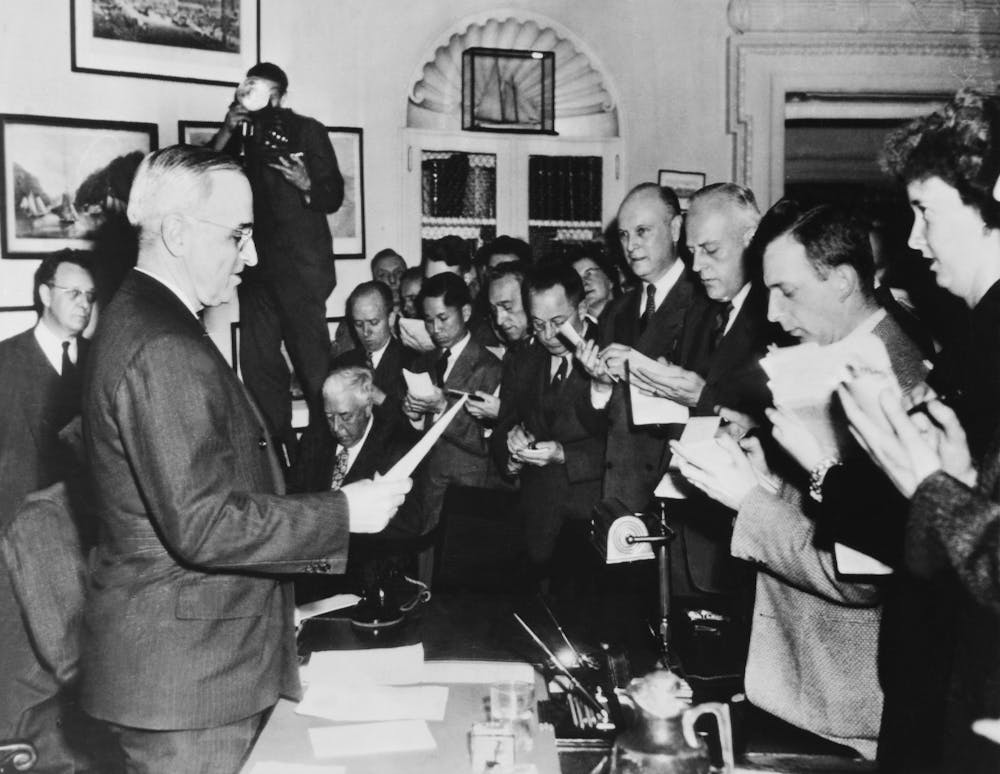
U.S. President Harry Truman at a desk in the White House, surrounded by reporters

President Harry Truman gives his first White House press conference, on April 17, 1945. Keystone-France/Gamma-Keystone via Getty Images

Dodging questions – or not

The first reason to avoid a press conference is that reporters may accuse the president of dodging questions. And viewers are likely to believe the allegations – regardless of what the president actually said. The tendency of political journalists to accuse presidents of deflecting questions has increased in recent decades and has become fairly common.

During the 2020 campaign, Biden was accused of dodging questions by numerous media outlets. A campaign spokesperson was even accused of dodging a question about Biden dodging questions.

I ran an experiment testing the effects of a journalist’s accusing politicians of evasion.

The voters in the study all saw the same questions and answers. For half of the voters, though, I edited the video to insert the journalist accusing the politician of dodging in an answer.

Voters who saw the journalist making the allegation believed the politician indeed dodged. Voters who saw the identical interview without the allegation of evasion thought the politician gave adequate answers.

What’s more: The politician shown in the experiment had not actually dodged. Voters seem to believe a reporter and disbelieve a politician.

No good answer

A second reason to avoid press conferences is that questions will tend to be unanswerable. As has been documented by decades of data, journalists frequently ask about divisive or controversial topics, and they word their questions in tricky ways.

There is no politically advantageous answer to such questions. Based on my research, journalists covering the White House tend to ask about topics that divide the country – such as abortion or gun control – for which any direct answer would offend some group of voters.

You can’t win

A third reason is that even if a question is not divisive, and the president answers it, many voters will still think the president is being deceptive.

I ran an experiment in which I filmed an interview of a politician either dodging or answering a journalist’s question. Regardless of what the politician actually said, Republican voters thought the politician was deceptive when he was a Democrat, and vice versa for Democratic voters.

Simply by having a party label, a president’s press conference will likely be skewed through a partisan lens no matter what he says.

President George W. Bush speaking to the press.

President George W. Bush got defensive during his final press conference, on Jan. 12, 2009. Saul Loeb/AFP via Getty Images

TMI – too much information

A final reason for a president to avoid giving a press conference: The more the public gets to know a president, the more they dislike him.

My own research has revealed why a president might become more unpresidential the more he holds press conferences. The more a politician’s words inevitably diverge from voters’ feelings and experiences, the less presidential he will seem to them.

Altogether, presidents probably will lose stature by holding a press conference. Journalists hold the upper hand, asking questions that pose a rhetorical minefield and wielding the power to accuse the president of evasion. And voters will tend to believe journalists’ criticism of the president even if a president honestly answers their questions.

Of course, if what the president is aiming for is not strategic expediency but simply fulfilling an obligation to be held accountable in his role, then the country wins when he holds a press conference – and in that way he does, too.


This story substantially updates a story originally published on March 19, 2021.

David E. Clementson, Assistant Professor in the Grady College of Journalism and Mass Communication, University of Georgia

This article is republished from The Conversation under a Creative Commons license. Read the original article.

Christian health nonprofit that let people “opt out of Obamacare” saddled members with debt and ruin

ProPublica is a Pulitzer Prize-winning investigative newsroom. Sign up for The Big Story newsletter to receive stories like this one in your inbox.

Bonnie Martin kept the bleeding secret for as long as she could. Her sisters, boyfriend and sons knew nothing of her illness until suddenly, during a family gathering in October 2018 at a diner in Annapolis, Maryland, she began hemorrhaging.

A tumor had burst through the wall of her uterus. Doctors performed an emergency hysterectomy and removed what cancer they could reach. She needed multiple rounds of chemotherapy and radiation, expensive stuff. As her family grew fearful, Martin walked that fine line between resilience and denial — she’d beat this, she said. She focused instead on fun things ahead, a trip to Ireland with her boyfriend and sisters, for instance, and a Rolling Stones concert.

Luckily, or so Martin thought, she had placed her trust — and her money — in Liberty HealthShare. Liberty is what’s known as a health care sharing ministry, a nonprofit alternative to medical insurance rooted in Christian principles. Hundreds of thousands of people rely on such organizations for basic health coverage. They promise no red tape, lower costs and compassion for the sick. Although Martin wasn’t religious, she found comfort in Liberty’s pledge to “carry one another’s burdens.”

Martin received treatment that pushed her cancer into remission. But 18 months later, it returned, this time in her lungs. She was dying.

Liberty covered her bills at first, but then, without warning or explanation, the payments stopped. Suddenly, she faced $10,000 in unpaid charges. Her whole life, she’d had pristine credit. Now creditors called constantly and sent harassing letters.

Martin refused to accept that her cancer was terminal. She was going to survive, and when she was rid of it, she needed those bills paid. She spent hours pleading over the phone with Liberty, straining to focus as the toxic drugs she was taking sapped her energy. Martin’s long, auburn curls fell out, and her memory was slipping.

Martin forwarded the overdue notices to Liberty, writing on one in pen, “WHY HAS THIS NOT BEEN PAID?” In emails Martin’s family shared with ProPublica, she pleaded, “I am asking for your help and compassion. Help me, I don’t know what else to do. … I CANNOT deal with this stress and fight cancer. You say you are a ministry and want to help people. THEN HELP!!!”

Martin died in July 2022 at age 63. Liberty never settled the bills that she had begged them to pay.

What Martin didn’t know when she joined Liberty was that she was sending her money to members of a family with a long and well-documented history of fraud.

For generations, members of the Beers family of Canton, Ohio, have used Christian faith to sell health coverage to more than a hundred thousand people like Martin. Instead they delivered pain, debt and financial ruin, according to an investigation by ProPublica based on leaked internal documents, land records, court files and interviews. They have done this not once but twice and have faced few consequences.

Patriarch Daniel J. Beers, 60, lies at the center of the family network. He was a leading figure in a scheme in the 1990s involving a health care sharing ministry that fraudulently siphoned tens of millions of dollars from members, court records show. Two decades later, he played a key role in building Liberty into one of the nation’s largest sharing ministries, several of the nonprofit’s current and former employees told ProPublica.

Four years after its launch in 2014, the ministry enrolled members in almost every state and collected $300 million in annual revenue. Liberty used the money to pay at least $140 million to businesses owned and operated by Beers family members and friends over a seven-year period, the investigation found. The family then funneled the money through a network of shell companies to buy a private airline in Ohio, more than $20 million in real estate holdings and scores of other businesses, including a winery in Oregon that they turned into a marijuana farm. The family calls this collection of enterprises “the conglomerate.”

Beers has disguised his involvement in Liberty. He has never been listed as a Liberty executive or board member, and none of the family’s 50-plus companies or assets are in his name, records show.

From the family’s 700-acre ranch north of Canton, however, Beers acts as the shadow lord of a financial empire. It was built from money that people paid to Liberty, Beers’ top lieutenant confirmed to ProPublica. He plays in high-stakes poker tournaments around the country, travels to the Caribbean and leads big-game hunts at a vast hunting property in Canada, which the family partly owns. He is a man, said one former Liberty executive, with all the “trappings of large money coming his way.”

Despite abundant evidence of fraud, much of it detailed in court records and law enforcement files obtained by ProPublica, members of the Beers family have flourished in the health care industry and have never been prevented from running a nonprofit. Instead, the family’s long and lucrative history illustrates how health care sharing ministries thrive in a regulatory no man’s land where state insurance commissioners are barred from investigating, federal agencies turn a blind eye and law enforcement settles for paltry civil settlements.

The Ohio attorney general has twice investigated Beers for activities that financial crimes investigators said were probable felonies. Instead, the office settled for civil fines, most recently in 2021. It also required Liberty to sever its ties to some Beers family members.

The IRS has pursued individual family members for underreporting their income and failing to pay million-dollar tax bills. But there’s no indication that the IRS has investigated how several members of one family amassed such substantial wealth in just seven years by running a Christian nonprofit.

The agencies’ failure to move decisively against the Beers family has left Liberty members struggling with millions of dollars in medical debt. Many have joined a class-action lawsuit accusing the nonprofit of fraud.

After years of complaints, health care sharing ministries are now attracting more scrutiny. Sharity Ministries, once among the largest organizations in the industry, filed for bankruptcy and then dissolved in 2021 as regulators in multiple states investigated its failure to pay members’ bills. In January, the Justice Department seized the assets of a small Missouri-based ministry, Medical Cost Sharing Inc., and those of its founders, accusing them of fraud and self-enrichment. The founders have denied the government’s allegations.

Those leading the Beers family enterprise have already moved on to its next health care venture. This time, it involves a bank in the Ozarks that family members hope will generate millions of dollars each year. Business filings lay out plans that would further shield sharing ministries from oversight.

Two weeks after Martin’s death, ProPublica reporters traveled to Canton to sit down with Brandon Fabris, chief operating officer of one of the family’s companies that has received tens of millions of dollars from Liberty. Dan Beers had declined the meeting.

Ten minutes into the interview, though, Beers parked his Ford F-150 Platinum edition in front of the building, blocking the driveway. He marched into the vast foyer with its cathedral windows, turned right past the receptionist and barged into the conference room as if, well, he owned the place.

Wearing worn jeans, Beers delivered a beefy handshake, sank into a chair, pushed his silver hair back and grinned. For the next two hours, he waved away suggestions that he was the mastermind behind everything.

“I’m just not smart enough to do it,” he said, brushing his goatee with his hand. “I’m not the kingpin here.”

Beers and Fabris acknowledged that Liberty failed to pay medical bills for its members but said it was because the ministry’s fees weren’t high enough. The pair confirmed many of the details ProPublica had uncovered about how the family got rich from Liberty members, but they denied any legal wrongdoing.

“There’s profit,” Beers said. “Absolutely there’s profit.”

“Nobody’s here to not make money,” Fabris said.

Attorneys representing Beers, his sons Danny and Ronnie, Fabris and his father, Tom, disputed ProPublica’s finding that they controlled or influenced the sharing ministry. Liberty’s contracts with the family-run businesses were legal, “arm’s-length” transactions, they said, and they performed work for the nonprofit at market rates or better. ProPublica sent dozens of detailed questions to members of the Beers and Fabris families and their lawyers but did not receive answers.

ProPublica repeatedly asked Liberty and members of the Beers family to provide the ministry’s contracts with the businesses, but all declined. The family members’ attorneys cited the confidentiality of the contracts, while Liberty officials said they could not release the documents because of the ongoing litigation.

During the interview in Canton, Beers joked that regulators and creditors and law enforcement have been chasing him for alleged misdeeds “since birth.” One after another, Fabris added, they’ve all come up short.

“Nobody can catch Dan Beers,” he said.

The Brotherhood Blueprint

To understand the rapid rise and fall of Liberty HealthShare and the devastation it wrought for thousands of members, it helps to understand the family’s first foray into the business of health care sharing ministries.

Health care sharing ministries have existed since the early 1900s, primarily among Mennonites and the Amish. The idea was simple: Members chip in what they can to help cover a neighbor’s costs when someone breaks a leg, say, or falls ill. It was the financial equivalent of a potluck dinner, with everyone contributing something to the table and sharing the spread.

Few outside those communities knew or cared that health care sharing ministries existed. They were tiny, didn’t advertise for new members and posed no threat to corporate insurance. Most importantly, no one envisioned making money from a ministry.

This would all change with Dan Beers’ uncle and mentor, an Ohio preacher named Bruce Hawthorn.

In the mid 1960s, Hawthorn founded the Barberton Rescue Mission, serving men struggling with alcoholism, in a rundown brick hall along a dirt road just outside of Canton. As the Akron Beacon Journal would note, the townsfolk snickered at the irony. The building had previously been a nightclub called the Lazy L Ranch, which a local sheriff described as “a notorious one-stop tavern and bordello.” (As an homage, or perhaps an inside joke, the phrase “Lazy L” would surface again and again, tucked into the name of many Beers family enterprises.)

The mission was a shoestring operation, sustained by small cash donations. In the fall of 1981, though, tragedy would transform Hawthorn and lead to the creation of the modern health care sharing ministry.

Hawthorn was driving his family to Michigan when a truck broadsided the car, killing his wife and 4-year-old daughter and seriously injuring three older children. Hawthorn faced tens of thousands of dollars in medical bills. When he spread the news in the mission’s newsletter, his followers responded by mailing him handwritten prayers — and money, often in the form of cash folded into cards and letters. The outpouring continued for weeks and covered the family’s expenses.

Hawthorn had an epiphany. Could he build on this sort of generosity? Maybe he could serve as an intermediary, connecting people who’d never met but who might have nodded their heads from a pew to the edict of Galatians 6:2: “Bear ye one another’s burdens.”

The next year, Hawthorn launched the Christian Brotherhood Newsletter, which charged subscribers a fee, originally $75 a month. He called it a “share,” but it was functionally what insurance calls a premium. A subscriber with a medical bill would write to the Brotherhood, and other subscribers would receive instructions to send money directly to the person in need. More than 90% of the subscription fees went toward health care expenses, with the mission taking the rest to cover administration and publishing costs.

After a decade of slow growth, the Brotherhood decided to expand and began partnering with independent “sponsors,” paying them cash incentives for every new subscriber they brought into the organization. The more people they recruited, the more commissions they made. By the early ’90s, the Brotherhood had added tens of thousands of members, making it a nationwide purveyor of something that looked a lot like health insurance. Dan Beers began working in the nonprofit’s marketing department, helping to sell its coverage.

The Brotherhood wasn’t following the few laws that applied to sharing ministries, and state regulators started to notice. Arkansas’ attorney general warned citizens that the nonprofit had “all the earmarks of a phony con job.”

Hawthorn hired a lobbyist to fight back. Insurance companies pool customer premiums to offset costs. The Brotherhood argued that its health plan was not insurance because members had individual control of their funds. Any crackdown, they insisted, amounted to religious persecution. By 1994, 10 states had effectively exempted health care sharing ministries from oversight. Beers’ uncle had created an entire industry for an insurance-like business that was unregulated. And now the family was free to exploit it.

In the early days of the Brotherhood, the ministry handled little of the money because members sent payments to one another through the mail. But this changed in 1995, when the Brotherhood began directing many members to send their monthly fees to a bank account that Beers and Hawthorn had set up under the name of Beers’ wife, Theodora. The nonprofit wasn’t just pooling money; Beers and Hawthorn now had control of members’ fees.

The day after opening the account, Beers and a cousin started a business called Benevolent Health Systems, which the Brotherhood soon hired to negotiate with hospitals and doctors to lower bill amounts. In return, Beers claimed his business would pocket 15 cents of every dollar saved.

But Ohio financial crimes investigators later found no correlation between Benevolent Health Systems’ revenues and the services it provided to the Brotherhood. In late 1997, Beers began automatically transferring $55,000 a week from the Brotherhood to Benevolent Health Systems, according to bank records reviewed by state investigators. In three years, Beers’ firm collected at least $23 million from the charity.

Hawthorn also raided the Brotherhood’s funds to reward himself and his relatives, using money intended to cover members’ medical bills to buy an airplane, a tour bus and several Honda Gold Wing motorcycles, court records show. During the early 1990s, Hawthorn directed the nonprofit to purchase hundreds of acres of ranchland along the Tuscarawas River, north of Canton. The ranch became a family compound as Hawthorn signed over houses and wooded parcels to relatives through complex transactions. County property records show that Beers and his wife received a 5,000-square-foot house on the estate and paid nothing for it.

“A Criminal Enterprise”

A few directors on the nonprofit’s board began to question the way Hawthorn was spending the organization’s funds on gifts to friends and family, court and law enforcement records show. The board, however, was unaware that in the Brotherhood’s annual disclosures to the IRS, the ministry hid the money it was paying directly to Benevolent Health Systems.

With subscribers’ fees going elsewhere, medical bills began to go unpaid. Members complained, and many left, shrinking the flow of cash. Brotherhood officials acknowledged a backlog of $15 million in overdue bills from 1997 alone. Beers and Hawthorn blamed subscribers. “The problem we have is that the giving by the partners has not kept up with the climb in bills,” one issue of the newsletter said.

Responding to complaints from inside the Brotherhood, the Ohio attorney general’s charity division launched an investigation in March 1997. After two years, investigators had compiled a dossier, obtained by ProPublica, that detailed “acts of theft, theft by deception, money laundering and conspiracy.” The dossier reveals that state forensic accountants recommended 65 felony counts of fraud and theft against Beers — offenses that carried the threat of yearslong prison sentences. The Brotherhood organization “is a criminal enterprise,” state investigators wrote, and top executives were “engaging in a pattern of corrupt activity.”

By law, the attorney general’s office had to refer the criminal case to prosecutors in Summit County, where the Brotherhood was based. In April 2000, the Ohio attorney general sent the dossier to the county prosecutor, seeking criminal fraud charges against eight of the Brotherhood’s executives, including Beers; Theodora; Beers’ brother-in-law Randy Abel; and Hawthorn. Theodora Beers declined to answer questions, and Abel did not respond to requests for comment.

No charges were ever filed.

Christine Croce was an assistant criminal prosecutor in Summit County and part of the team on the Brotherhood case. Multiple police agencies were investigating the charity in 2000, she said, working to flip witnesses, gather evidence and secure search warrants. But Croce’s boss lost his reelection bid that fall, and many high-level prosecutors were forced out, including Croce. “I couldn’t tell you where the investigation went awry,” she said, “or why it stopped.”

(Michael Callahan, the county prosecutor who lost his office, did not respond to requests for an interview. James Pollack, a spokesperson for the Summit County Prosecutor’s office, said that no public records from the Brotherhood investigation remain in its possession, and no one there knows why the case languished.)

The attorney general’s office, however, continued to pursue a civil case against Beers, Hawthorn and their wives. When it went to trial in 2004, jurors unanimously held Beers liable for fraud and unjust enrichment. He and Benevolent Health Systems were ordered to pay $9.6 million in damages to the Barberton Rescue Mission. Hawthorn was also hit with a $4.6 million judgment. The jury did not find Theodora Beers or Hawthorn’s wife liable; the state did not name Abel as a defendant.

The Christian Brotherhood Newsletter foundered, its members saddled with millions of dollars in medical debt.

Hawthorn died in 2012 without ever paying. Beers dodged the judgment for almost 20 years but negotiated a new settlement with the charity, paying it $210,000 early last year. The verdict “doesn’t mean what we did was wrong,” he told a local newspaper the day the jury read its finding.

Over the next decade, Beers continued to find himself at the center of allegations of fraud, though on a smaller scale. He lost his family’s home to creditors and was convicted of bouncing a $50 check written to “cash” at a grocery store. He was convicted of a felony, motor vehicle theft, and sent to prison for several months. (Beers later persuaded a judge to expunge the felony conviction and seal records from the case.) While he was incarcerated, Theodora divorced him; she and their seven kids moved in with one of his brothers-in-law.

After his release, Beers returned to Canton, talking his way into small construction jobs. Beers lost several lawsuits accusing him of running an array of scams between 2007 and 2013, according to Ohio court records. A former landlord accused him of owing more than a year in back rent and, when he was evicted, of stealing window coverings, a riding lawn mower and a paddle boat.

Louis Smith, a property manager in the Akron area, hired Beers to install carpet, replace roofs and make other renovations. Beers convinced Smith to pay him upfront, then left most of the work unfinished. Smith won a $46,000 judgment against Beers but said he wasn’t paid for another five years.

“That guy,” Smith said, “he’s slicker than grease.”

Reboot

In the wake of the Christian Brotherhood Newsletter scandal, a group of health care sharing ministries formed a trade organization. By 2008, the Alliance of Health Care Sharing Ministries had convinced five additional states to pass laws shielding ministries from regulation.

An even bigger coup came in 2010 with the passage of the Affordable Care Act. The act required that all Americans carry health insurance — a provision called the individual mandate — or face a fine. But with help from Republican Sen. Charles Grassley of Iowa, a conservative lobbyist working for the Alliance managed to slip in an exemption, which gave anyone who belonged to a health care sharing ministry a pass on the mandate.

The exemption — 200 words in a 900-page bill — didn’t just save the industry. It propelled it. Health care sharing ministries now offered a legal and financially attractive alternative for consumers. They drew thousands of members who were opposed to President Barack Obama’s hallmark legislation, but they also appealed to many more who wanted a better deal than what they could find on the new insurance marketplace. Before Obamacare, maybe 40,000 people belonged to health care sharing ministries. Four years later, the Alliance boasted that the number of people enrolled in ministries had jumped to a million.

Beers and his family seized on the opportunity, incorporating Liberty HealthShare as a nonprofit in 2014. (Although called “Liberty,” it was actually a combination of two nonprofits, Gospel Light Mennonite Church Medical Aid Plan and the National Coalition of Health Care Sharing Ministries.) It had all the makings of a Hollywood reboot — the old Brotherhood crew getting back together for a new but familiar caper, only this time with some kids and novel technology thrown in.

Liberty’s CEO was Dale Bellis, Dan Beers’ close friend and business partner and the former communications director for the Brotherhood. Bellis and Beers are also connected through marriage; Bellis’ sister was married to Beers’ uncle.

Beers’ sister, Drudy Abel, another Brotherhood alum, was Liberty’s vice president; she later became CEO and a member of its board of directors. Abel did not respond to requests for comment.

Then there was Beers himself, who was as involved in Liberty as he was in the Brotherhood, according to interviews and documents.

Fabris, the leader of one of the family’s companies, lives with Abel’s daughter and is a longtime friend of Beers’ sons, Danny and Ronnie. They all live on neighboring parcels of the family ranch.

Liberty resembled the Brotherhood in another way: It soon began contracting out services to companies owned and operated by family members and friends.

Liberty outsourced bill negotiations to a company called Medical Cost Solutions LLC, which was owned by Liberty CEO Bellis before he sold it to Fabris’ father. Between 2015 and 2021, the ministry paid at least $35 million to Medical Cost Solutions, but the true amount is likely higher. Liberty masked payments that were going to the company by reporting that those millions of dollars were spent on members’ medical costs, ProPublica found by comparing internal accounting records with IRS filings from 2017 to 2019.

Liberty also contracted with a firm called Cost Sharing Solutions to bring in new members. The company was owned by Brandon Fabris and Danny and Ronnie Beers. Between 2015 and 2021, Liberty paid $105 million for its marketing services, according to the nonprofit’s IRS disclosures.

Medical Cost Solutions and Cost Sharing Solutions derived all of their revenue from Liberty, Fabris told ProPublica.

In an interview last fall, Bellis said Liberty awarded exclusive contracts to Cost Sharing Solutions and Medical Cost Solutions solely because they were the best options. Bellis said the board had used an open bidding process and considered other companies, but he was unable to name them.

Both Beers and Fabris said they never worked for Liberty, but interviews, photos, emails and other records reveal the two were key figures in Liberty’s founding and growth. Former employees told ProPublica that Beers attended Liberty executive meetings and had access to the ministry’s bill processing offices, which held members’ private medical information. When an executive voiced concern about how much Liberty was paying to Cost Sharing Solutions, Beers later approached him and yelled at him for raising questions, according to a complaint filed with Ohio fraud investigators.

Fabris was an official at Liberty at the same time as he helped determine how much it paid to Cost Sharing Solutions, his own company, records show. Emails from 2014 to 2017 identified Fabris as a Liberty employee. In one 2014 message to firms selling coverage plans, Bellis, the CEO, wrote, “If you have any questions in regards to the changes to the compensation structure please contact: Brandon Fabris.” Bellis included Fabris’ Liberty HealthShare email address.

Fabris said he kept Cost Sharing Solutions “at arm’s length” from the nonprofit.

Beers and Fabris also traveled to pitch the ministry to churches, fraternal organizations like the Loyal Order of Moose and conservative groups like the Conservative Political Action Coalition, or CPAC. The men urged audiences to join Liberty and make money selling coverage to their friends and flock, according to interviews, records and photographs obtained by ProPublica. Liberty spent more than $200,000 a year between 2017 and 2021 to be a top sponsor at CPAC, vaulting the sharing ministry and its chief executive to the main stage of the high profile conservative political event. Bellis was given a prime speaking slot in 2018, following Fox News host Laura Ingraham. At the next year’s conference, then-President Donald Trump famously hugged a U.S. flag as he took the stage for his keynote address, with a large Liberty logo to his right.

Craig Berens, a sales consultant in Michigan, said he worked closely with Beers and Fabris and connected them to the Christian Coalition of Michigan as part of a membership drive. “Oh yeah, he was my pipeline to Liberty,” Berens said, referring to Fabris. “Him and Dan Beers were at the top of the organization.”

When ProPublica presented its findings to Beers and Fabris, their lawyers responded. Rick Arnold, the family’s longtime attorney, and Laura Mills, who is representing the family in the class-action lawsuit, said the relationship between Liberty and the two companies did not constitute a conflict of interest under IRS standards.

“Just because you’ve got a family member on a board and you may have a vendor does not mean that’s an improper transaction, as long as those people recuse themselves, make it known as well,” Arnold said.

Beers and Fabris’ sales efforts were an extraordinary success. Liberty enrolled 50,000 members in its first two years, more than the entire industry had covered before the Affordable Care Act. Marketing flyers from that era show Liberty urging people to “join the movement” and “opt out of Obamacare.” Money came flooding in as Liberty offered cheap plans — about $160 a month for an individual and $400 a month for families.

Between 2015 and 2021, Liberty collected at least $1.9 billion in revenue, according to tax filings and internal audits. But ProPublica found that Liberty did not report more than $1 billion of those payments to state and federal tax agencies on its financial balance sheet. Instead, Liberty noted it had possession of hundreds of millions of dollars in an obscure text field tucked deep in its tax filing each year. This pot of money, the nonprofit said, was under the control of its members.

Nonprofit experts told ProPublica that the practice was dubious at best and potentially illegal. “If they have the discretion to redirect the money, then it’s revenue,” said Marcus Owens, former director of the IRS’s nonprofit division.

An attorney representing members of the Beers family did not directly respond to questions about Liberty’s accounting practices.

Echoing a strategy used by the Brotherhood, Liberty recorded its finances in two ways. One was the company’s bank account, which showed actual transactions — member fees received, medical providers paid. Only a small number of executives and staff could see those transactions, including Drudy Abel, according to interviews with former Liberty employees.

The second way was designed for Liberty members’ eyes. The company developed in-house software that purported to show members’ individual accounts and track their personal medical bills and monthly payments, according to Fabris. He called these “hypothetical accounts.” In other words, this software created a facade; it tracked accounts that didn’t exist and reflected transactions that may or may not have been completed.

The hypothetical accounts accomplished two things, according to current and former employees. They gave the appearance that Liberty was sending far more money to medical providers than it was, and they gave Liberty cover from regulations. If Liberty was pooling members’ funds into bank accounts, insurance commissioners could argue that the company was selling insurance. The software, however, made it look as if each person had an individual account. In reality, Liberty controlled every dollar.

The Conglomerate

With money from Liberty flowing into Cost Sharing Solutions and Medical Cost Solutions, corporate filings show Danny and Ronnie Beers and Fabris created a dizzying array of businesses, real estate holding companies and shell companies — entities that conduct no business but hold assets and move money.

The family reclaimed much of the Beers family compound that had been lost in the collapse of the Brotherhood. One of the newly formed shell companies, Ohio Lazy L Ranch Ltd., paid $4.2 million for 140 acres of Hawthorn’s old ranch. This included a 4,000-square-foot house that overlooks the expanse of rolling hills where Beers made his new home. The family formed additional shell companies and over the next two years spent $6 million for neighboring parcels, including a wedding venue and a commercial horse stable.

Other Lazy L businesses popped up: Lazy L Ranch Trucking, Lazy L Ranch Meats, Lazy L Ranch Cattle and Lazy L Ranch Leasing.

Danny Beers launched Dan’s Wholesale Carpet in an old brick building down the road from the ranch and then opened four more locations around Canton and Akron in two years.

After the family acquired a popular chicken restaurant, Beers explained to the local newspaper how the businesses all fed off one another. The wedding venue ordered cakes from the bakery. The butcher shops got cattle from the ranch. “My son wanted a place he could sell steaks,” Beers said, “so we bought a restaurant.”

The family acquired a one-quarter interest in Tapawingo Lodge, a hunting and fishing camp in Alberta, Canada, through Next Level Adventures LLC, which is registered to Ronnie Beers. Next Level’s mailing address, however, is Dan Beers’ home. The lodge’s promotional website shows multiple photos of Beers family members.

Through a common arrangement that kept their names out of public records, family members purchased a controlling stake of Ultimate Air Charters, a boutique airline that specializes in shuttling passengers from Canton to gambling locales such as Atlantic City. (Ultimate Air Charters recently made headlines when Florida Gov. Ron DeSantis used the company to shuttle immigrant families to Martha’s Vineyard in Massachusetts.)

In Oregon, Fabris and his father purchased an 80-acre vineyard outside of Medford for $1.8 million. The hillside property had produced syrahs and pinot noirs. Fabris decided to grow a different crop. He hired a local contractor to tear out the grape vines, dig lines and run electrical wiring and conduits to power an industrial marijuana farm. There are now five greenhouses and a 16,000-square-foot metal barn tucked into that valley.

In all, the Beers family set up at least 35 companies in six states in seven years. The full extent of their holdings is likely greater, but it can’t be determined because transaction details between private businesses aren’t typically made public.

A Chorus of Complaints

In its first two years, Liberty gained a reputation for paying most bills promptly, bringing in new members and hundreds of millions of dollars in fees. Then, beginning in late 2016, that reputation began to fall apart. Liberty started rejecting claims and lowballing doctors, leading some to return checks, which Liberty staff stuffed in boxes and stacked in a storage room, according to several former employees directly involved. Internal data and records obtained by ProPublica show that at least 50 hospitals refused to work with Liberty’s bill negotiators to settle unpaid charges. A memo from June 2017 shows Utah’s Intermountain Healthcare system, one of the largest in the western United States, refused to negotiate with the ministry and its billing contractor, leaving many members to fend for themselves.

At the same time, Liberty stopped reimbursing members for charges they paid out of pocket. This led to a massive backlog in bills, with both members and health care providers waiting months and years to be paid, if they were paid at all.

ProPublica spoke at length with nearly a dozen current and former employees familiar with Liberty, Cost Sharing Solutions and Medical Cost Solutions. They confirmed that the spending binge on the conglomerate drained money from member funds.

In Colorado, David Chalman joined Liberty in 2016 because he disliked Obamacare, hadn’t had any previous health issues and ran his own small business. Two years later, he suffered a heart attack, which left him with a stent above his right ventricle. After many months of calls and letters, Liberty eventually paid for that. But then, in 2018, while driving to a job outside of Cañon City, he turned to his son and said, “I think I’m having another heart attack.”

Thinking the stent might have failed, he and his son rushed to a rural clinic, where a doctor called for a helicopter to transport him to a hospital in Pueblo. The flight, an aortic valve replacement and checkups cost more than $150,000.

As Liberty instructed all its members to do, he told the hospital he would pay out-of-pocket and then submitted the bills to Liberty. The ministry never sent him money, the bills were referred to a collection agency, and Chalman’s credit score dropped from 750 to 600. Due to the supply chain chaos wrought by the pandemic, Chalman’s windshield repair business went under. He then hoped to buy a truck and become a commercial driver, but no banks would give him a loan because of his credit rating.

Still, fear kept him paying into Liberty. Until the end of 2022, he paid his $400 a month share because he worried that, if he left, Liberty would never reimburse him. Dozens of current and former members told ProPublica they felt stuck in this predicament, as Liberty executives had said in newsletters that the organization prioritized paying new bills for current members. “I’ve thought about suing, but the lawyers don’t know what to do,” Chalman said. “They’re not an insurance company.”

ProPublica contacted nearly 300 current and former Liberty members and spoke with more than 70 who described extended periods of stress, harassment by bill collectors and financial ruin.

Heidi Dunfield of Salt Lake City said that after Obamacare costs “went sky high,” she signed her family up with Liberty. One year, she had more than $10,000 in bills sent to collections after her husband was seen for back problems and her daughter broke two limbs. Dunfield said she fought for months, calling Liberty repeatedly to get reimbursed. She is still waiting.

Like hundreds of other Liberty members, she found a Facebook group where users shared complaints and raised questions about the people behind the ministry. She sifted through court records and found the Brotherhood case and the Ohio attorney general’s allegations of theft and money laundering. How, she asked, was this ministry any different?

“It became almost like a second job,” she said. “So I started looking into it and realized that it was kind of a family that was just scamming people. It was kind of genius in a way.”

In South Dakota, Marilyn Breck needed a colonoscopy and cancer screening. The charge came to about $20,000, which Liberty never paid even after she went through months of submitting claims and paperwork. Breck said she couldn’t stop the bill from going to collections and wrecking her credit because she was in the middle of a divorce and had lost her job.

“My daughter and I — we were going to the food bank to get food, so I couldn’t deal with Liberty anymore or the collections company,” said Breck, who now lives with her mother in a mobile home in Florida. “It really made a big impact in my life.”

Citing health privacy laws, current Liberty executives declined to comment on individual members’ bills.

It is not a coincidence that many of Liberty’s members ended up in collections. It was part of a strategy by Liberty to reduce medical bills, according to interviews and social media statements by current and former billing staff.

While many hospitals and doctors stopped negotiating with Liberty, collection agencies did not. Medical Cost Solutions, Liberty’s billing contractor, found it could convince those agencies to close out cases for pennies on the dollar.

Members have complained to the Better Business Bureau, state insurance departments and their state attorneys general. Many found their way to the Ohio attorney general’s office, which has fielded hundreds of complaints from consumers living in 44 states. The complaints are unambiguous. More than 40 people told the Ohio attorney general that they’d been forced into collections. More than a dozen complaints specifically referred to Liberty as a “shell game” or a “fraud.”

“I believe this company is a total PONZI SCHEME,” reads one complaint, from Georgia. “Shameful that a company as deceitful as this portrays itself as a Christian-based company. As a Christian myself, this façade is deplorable.”

The complaints and scathing online consumer reviews contributed to a decline in members and income. By 2017 that reduction in revenue, sources said, had further strained Liberty’s ability to pay its obligations.

Another blow to revenue came later that year when Republican lawmakers in the House and Senate effectively eliminated the individual mandate. This wiped out health care sharing ministries’ primary selling point. When the change took effect in 2019, many people who had bought into the insurance alternative found they no longer had reason to stay.

There is no national data showing how much health care sharing ministries spend on members’ medical bills. However, as scrutiny of sharing ministries increased in recent years, some states have begun to require financial disclosure. Data published by the Massachusetts’ insurance board shows that Liberty spent about 56 cents of every dollar it took in from members in that state on medical expenses in 2019 and 2020, a figure that would be scandalous if it were an insurance company. The federal government requires insurance companies to spend at least 80 cents of every dollar on direct care.

“Remarkably Similar to the Brotherhood”

Dr. John Hunt became Liberty’s chief medical officer in 2017. He joined the ministry in the hope of serving a Christian alternative to a health care system he viewed as rigged against consumers. He soon learned he’d misplaced his faith. Hunt was disturbed to find that nearly all of Liberty’s top executives had worked at the Christian Brotherhood Newsletter, and he saw that Dan Beers, the person at the center of that scam, was clearly involved in running Liberty.

Hunt pressed his bosses for details about Liberty’s contracts with Cost Sharing Solutions and Medical Cost Solutions, arguing they constituted a clear conflict of interest and had to end. Bellis, Liberty’s CEO, rebuffed him, he said, and denied the arrangements were inappropriate. Bellis declined to answer ProPublica’s questions about Hunt, citing the civil lawsuit.

In late November 2017, Hunt wrote a three-page memo detailing what he knew as well as what he suspected about Liberty’s finances and sent it to the Ohio attorney general’s office.

“Large sums of money are going to the friends and family that in my opinion are excessive and should be examined,” he wrote. Liberty followed “a pattern that is remarkably similar to the Brotherhood,” he wrote, “except that I expect that Dan Beers (of Brotherhood fame) will assert that he is not currently involved.”

Hunt’s letter added urgency to the growing number of complaints the Ohio attorney general had received from Liberty members. A month after receiving Hunt’s whistleblower memo, the attorney general’s charity section opened an investigation into Liberty and its contracting companies for potential self-dealing and fraud.

Court records indicate the attorney general’s office investigated how the Beers family network had obtained funds for the 700-acre ranch, the chain of carpet stores, the airline, the marijuana farm and more. Fabris told ProPublica that the family cooperated with the state’s lawyers.

The attorney general refused to release files from its investigation into Liberty, Cost Sharing Solutions and Medical Cost Solutions, citing a state law that makes charity investigations confidential. Unlike in its earlier probe of the Brotherhood, there is no evidence the attorney general’s office asked other law enforcement agencies for help securing records or witnesses. The office refused to answer questions regarding Liberty and whether it had investigated potential crimes.

What is clear is the state’s attorneys didn’t even entertain the argument that Dan Beers wasn’t involved in running Liberty. In April 2021, the attorney general opened settlement talks with Beers, his sons Danny and Ronnie, and the Fabrises. Seven months later, a deal was struck, with that group agreeing to pay $6.4 million to the state, most of it intended to help Liberty members with their medical expenses. (The family has not yet made the $540,000 payment that was due in January. An attorney for Fabris and Beers said they are renegotiating the payment schedule.) That figure appears to have done little for members who were sent into debt by the ministry’s failure to reimburse them, and it’s far less than the fines levied against the Brotherhood nearly two decades earlier.

The attorney general wrote in the settlement that it believed the three organizations had broken state law. None of the defendants admitted wrongdoing.

As the two sides finished settlement talks, the IRS put a lien on Danny Beers’ house for $1.2 million in unpaid federal income tax. Records indicate he had $3.6 million in taxable income in 2019. Danny Beers paid the debt in full and had the lien removed three weeks later.

The extent to which the IRS has examined the family’s sudden wealth, if at all, is unknown. The IRS denied ProPublica’s request for records related to any investigations of Liberty, Cost Sharing Solutions, Medical Cost Solutions or any member of the extended Beers family.

As part of the settlement, Liberty’s new board severed any relationship with the Beers family. The nonprofit now has a new board of directors and new management.

Once again, Beers was kicked out of the health share he helped build.

A group of Liberty members have banded together in a class-action lawsuit that names Liberty and some of the Beers family. That case is led by the sisters of Bonnie Martin, who unsuccessfully fought Liberty over her unpaid bills. The defendants have filed a motion to dismiss, which is pending.

The new Liberty CEO, Dorsey Morrow, told ProPublica that the organization is chipping away at its massive backlog of unpaid bills to make its members whole. Numerous members continue to file formal complaints to the state of Ohio and express frustration on social media about unpaid bills. Morrow said he and a new team are doing all they can to avoid the worst-case scenario: Liberty going into bankruptcy and never paying people’s bills.

Morrow confirmed that Liberty no longer works with Cost Sharing Solutions; severing those ties is a central part of the strategy to save the sharing ministry. It now performs the work in-house or uses other vendors for the services the Beers family company previously provided.

Immediately, he said, Liberty achieved “significant savings.”

The nonprofit’s contract with Medical Cost Solutions is set to end in May.

The Bank

In early 2018, as the Ohio attorney general’s office began its investigation, Danny and Ronnie Beers and Brandon Fabris and his father paid $7.3 million to buy Farmers State Bank, a small chain that served rural communities at the foot of the Missouri Ozarks. Brandon Fabris told ProPublica that the group pulled together the available cash in the conglomerate’s various accounts to cover the cost.

The bank is the linchpin of the family’s next business venture.

They renamed the chain LimeBank and applied for federal approval to take control. The filing included a letter from Liberty’s board committing to shift the nonprofit’s money to LimeBank.

Red flags went up immediately. An official at the Federal Reserve Bank of St. Louis read an article about the Brotherhood civil trial and asked the applicants if they had any connection to Dan Beers. The agency redacted most of the application records before releasing them to ProPublica; the documents do not include responses from Beers or the Frabrises.

The Federal Reserve typically approves or denies ownership changes within 60 days, according to its website. It examined the LimeBank purchase for much longer — 441 days — before signing off. The agency declined to answer ProPublica’s questions about the application.

In their filings, the Beerses and the Fabrises explained that the bank would use special software to create accounts for Liberty’s members, track their funds and make thousands of transfers every day to pay bills.

For the first time, Liberty would follow the letter of the law and not pool funds together, like an insurance company does. Instead of using “hypothetical accounts,” the health care sharing ministry would give individual members real bank accounts.

However, there was a catch: Members would have to sign power of attorney for the account over to Liberty. Again, the nonprofit would control their money.

Liberty was supposed to be only the beginning. The application details plans to sell the service to all sharing ministries, which now claim a combined 865,000 members and $1 billion a year in revenue.

The plan was simple. Liberty would open an account for each member. LimeBank would charge $16.50 for every new account and then a $6.50 monthly fee on every existing account, several former bank employees told ProPublica. Liberty’s membership alone in 2019 would have generated more than $7 million a year in bank fees.

Fabris filed for a U.S. patent on the software that was designed to manage multiple health care sharing ministries through one bank. But the Beerses’ in-house technology never functioned properly and has been scrapped, the former LimeBank employees said.

Liberty had planned to shift its money to the bank in late 2021, but the Ohio attorney general’s office blocked the move in its settlement with the nonprofit.

The Federal Deposit Insurance Corp., the agency that insures people’s bank deposits, is currently examining LimeBank’s sharing ministry division to determine whether it follows federal rules intended to protect account holders’ money, former employees said.

Meanwhile, the bank has lost a slew of key executives. Midway through 2021, Fabris fired Thane Kifer, who’d led the bank for more than a decade, and replaced him with Lee Keith, Missouri’s former top bank official. Keith had approved the Beerses’ acquisition as state finance commissioner. Keith resigned in July 2022, just a year after he took the job. John Kopecky, LimeBank’s chief financial officer, left at the same time because he said he was uncomfortable with his new bosses’ disregard for bank regulations.

Kifer declined to comment. Keith did not respond to ProPublica’s interview requests.

Michael Elliott, LimeBank’s security officer whose job was to monitor for money laundering, also quit in 2022. Elliott said he did not witness illegal activity while working for the Fabrises and the Beerses, but he wanted out nonetheless.

“They have a very unique way of running things, a very unique business model,” Elliott said, “and I did not feel comfortable continuing in the role for which they hired me.”

How Do You Pay Your Bills, Dan?

During the interview at Cost Sharing Solutions’ headquarters in Canton last summer, Dan Beers acted like the man in charge.

As he settled into his chair, Brandon Fabris caught him up.

“They’re asking about our conglomerate — me and the boys,” Fabris said, referring to Beers’ sons, Ronnie and Danny.

Wearing a polo shirt emblazoned with the Lazy L Ranch logo, Beers nodded.

For the next two hours, Beers answered questions and provided details about numerous businesses and transactions he claims he had nothing to do with. At times, he’d slip and take credit, saying “we,” only to correct himself and attribute all the success to his children — “they.”

Multiple times, when a question was posed to Fabris, Beers interjected. Asked about a real estate deal that effectively transferred close to a million dollars from Liberty to Cost Sharing Solutions, Beers said, without offering any evidence, “The documents are wrong.” County property records show that when Cost Sharing Solutions sold the building that is now Liberty’s headquarters, the nonprofit paid nearly $1.6 million. Just two weeks before that deal, Cost Sharing Solutions had bought the building for $650,000.

Asked if he had a bank account in his name, Beers responded, “I do. Maybe. Yeah, I do have a bank account.”

Beers was more assertive when he spoke at a 2019 event sponsored by CPAC. In a video from that conference, Beers described how he’d ascended from convicted felon to a magnate overseeing “23 businesses.”

He misspoke at that conference, he now claimed.

“I was referring to our family — not me,” he said. “I don’t own a single company.”

He corrected himself to add that he owns Dan Beers Construction Company. A search of Ohio business filings revealed no business with that name.

ProPublica has it all wrong, he said. He’s just a father to some savvy and successful kids who took an old idea — the health care sharing ministry — and evolved it with software and a banking solution. With the bank they purchased in the Ozarks, they’re about to grow the conglomerate even more. They’re not hiding anything.

“I can’t even send an email, dude,” Beers said. “They’re a technology company. Try to pin that one on me, you’re going to fail miserably on that one.”

While he seemed unfazed by most of the exchange, it was the simplest of questions that agitated Beers.

How do you pay your bills, Dan?

“How do I pay my bills?” he responded. “I get paid.”

By whom?

“I get paid by a lot of people.”

By?

“Just different entities that I work for.”

Who do you work for?

“I work for myself.”

Asked about the many similarities between Liberty’s funneling of cash to family companies and the activities of the Christian Brotherhood Newsletter, which investigators had alleged two decades earlier constituted conspiracy and money laundering, Beers rejected the question.

“There’s no money laundering,” he said. “Zero. It’s not even worth discussing. There’s no money laundering.”


In the affable “Call Me Chihiro,” a former sex worker provides friendly bento comforts to all

A lovely, low-key drama about benevolence and loneliness, “Call Me Chihiro,” is as charming as its title character. Chihiro (Kasumi Arimura) is a former sex worker who is now taking orders at a bento shop in a small Japanese town. She is first seen petting a cat, which illustrates her caring nature. When she happens upon kids teasing a homeless man (Keiichi Suzuki), she defuses the situation and offers the stranger food as well as a bath. He silently thanks her for her generosity.

Chihiro is unfailingly nice and polite — she practically kills folks with her kindness — and this is what makes the film’s characters (as well as viewers) appreciate her and her good will. Director/cowriter Rikiya Imaizumi does not see his story as a morality play or as a redemption tale (though one could certainly read it those ways); rather he is showing the impact one compassionate individual has on everyone she meets. 

Chihiro reads people well, and her skill to bring others out of their shells and make them feel less lonely is endearing. It may be a talent she developed in her past — her colleague Nagai (Toshie Negishi) claims her sex work is why she flirts with the male customers at the bento shop — but she is putting her skill to good use.

As this leisurely paced film shows, she has a disarming way of connecting with folks. Okaji (Hana Toyoshima) is a schoolgirl who secretly takes pictures of Chihiro, and is intimidated by her at first, but Chihiro befriends Okaji and using a treasure map to introduce her to another student, Bechtin (Itsuki Nagasawa), who shares Okaji’s love of manga.

Chihiro also visits Tae (Jun Fubuki), the wife of the bento shop owner, who is in a hospital receiving care for blindness. As she and Tae fold origami and talk, their conversations are touching. One especially poignant scene that occurs late in the film, has both characters sitting in a car, evaluating their lives. 

Furthermore, Chihiro’s exchanges with Basil (Van), a friend from her past, and Utumi (Lily Franky), her boss from her work in a massage parlor, provide convivial moments that are tender and intimate.

Perhaps Chihiro’s most meaningful friendship is with Makoto (Tetta Shimada), a young boy who initially teases and fights with Chihiro. She sees his acting out as a need for attention and calms him with food. Eventually she has Okaji help Makoto with his schoolwork. Alas, Makoto’s mother, Hitomi (Yui Sakuma), does not welcome Chihiro’s charity, and berates her for it. Chihiro’s response is to bow and apologize — such is her considerate disposition. While viewers understand the motivations of each character’s behavior, the film wisely never overplays these scenes. The delicate emotions are rendered without melodrama or excess.

Much of “Call Me Chihiro” unfolds episodically, with the action mainly consisting of the characters meeting, eating and talking. Food is often Chihiro’s way into developing a friendship. Her joy at eating pickled plums or bamboo shoots is effusive, and she is almost always providing a bento meal for a character. (All the food throughout the film looks appetizing.) However, some of the more dramatic scenes feature Okaji dining with her family where the mood is tense. When Chihiro shares some food with Okaji, she senses her friend’s discomfort and explains that even the best cooking can be tasteless if not served in a pleasant environment. 

This concept is one Imaizumi takes to heart. “Call Me Chihiro” is a bright film and it has such an affable quality (like its protagonist), it is hard not to fall under its spell. When Chihiro expresses an idea shared from one of her former clients — “We are all aliens from different planets” — it is sweet, and it reflects the very diverse group of individuals orbiting her in this seaside town. They all come together – for a meal of course – in one of the film’s most relaxed hangout scenes.


Want a daily wrap-up of all the news and commentary Salon has to offer? Subscribe to our morning newsletter, Crash Course.


However, despite all the gracefulness in the film, Chihiro’s character is a bit underdeveloped. There is a hint from Basil that someone from Chihiro’s past is looking for her, but this is mentioned once and never brought up again. It could be Chihiro’s estranged brother, whose conversation with her reveals something about her family. There are only a few scenes depicting Chihiro’s backstory, with one, involving a woman (Miwako Ichikawa), that fills in a few blanks, but these scenes also raise as many questions as they answer.

Likewise, a contemporary sequence has Chihiro entering a restaurant where a customer is berating the staff provides an awkward moment before Chihiro picks up another diner for sex. While Chihiro claims that she does not want love, this aspect of the film and her character, could have been explored more. Her loneliness may be palpable when she gazes at the moon in one scene, but mostly Chihiro comes off as well-adjusted because of her many friendships; one may quibble that she is the most unjaded former sex worker in cinema history.

As Chihiro, Arimura gives a sensitive performance, and she is ably supported by the uniformly strong ensemble cast, although some characters, like Bechtin, are underwritten.

Overall, Imaizumi creates a nice vibe that allows the film to calmly float along while it emphasizes the value of human connections. “Call Me Chihiro” is like a warm hug that embraces viewers who will easily come to care for and connect with its easygoing characters.

“Call Me Chihuro” is currently streaming on Netflix.


In defending “Dilbert” cartoonist, Elon Musk calls media “racist against whites & Asians”

Elon Musk took to Twitter to defend cartoonist Scott Adams, whose once-popular comic strip “Dilbert” was dropped from hundreds of newspapers following his recent racist remarks.

In last week’s episode of Adams’ YouTube show, “Real Coffee with Scott Adams,” Adams repeatedly claimed that Black people were members of a “hate group” or a “racist hate group” in response to a poll from the conservative firm Rasmussen Reports that revealed only 53% of Black American respondents agreed with the statement, “It’s OK to be White.” Adams added that he would no longer “help Black Americans” and advised white Americans “to get the hell away from Black people.”

On Sunday, Musk, who currently owns Twitter, replied to a thread that defended Adams, who is white, saying, “The media is racist.”

“For a *very* long time, U.S. media was racist against non-white people, now they’re racist against whites & Asians,” Musk wrote. “Same thing happened with elite colleges & high schools in America. Maybe they can try not being racist.”

Musk also agreed with another tweet in the reply thread that said, “Adams’ comments weren’t good. But there’s an element of truth to this . . . it’s complicated. Mainly we’ve leaned into identity with predictable results, and power today is complicated. We were on the right path with colorblindness and need to return to it.”


Want a daily wrap-up of all the news and commentary Salon has to offer? Subscribe to our morning newsletter, Crash Course.


In a Saturday episode of his show, Adams clarified his prior statements, asserting that “everyone should be treated as an individual” without discrimination. 

“But you should also avoid any group that doesn’t respect you, even if there are people within the group who are fine,” he added.

Adams’ long-running comic, which satirizes white-collar office culture, has so far been discontinued by The Los Angeles Times, the San Antonio Express-News, the USA Today Network, the Plain Dealer in Cleveland and other publications that are part of Advance Local media, according to The Hollywood Reporter. Distributor Andrews McMeel Universal also announced that it’s severing ties with the cartoonist, reports NPR

Adams has been a vocal supporter of Donald Trump and is no stranger to controversy, including once questioning the death toll of the Holocaust.

“I am disturbed”: Locals alarmed over plan to inject toxic Ohio wastewater underground in Texas

Residents and officials in Harris County, Texas have expressed alarm since learning that contaminated water used to extinguish a fiery train crash in East Palestine, Ohio has been transported more than 1,300 miles to a Houston suburb for disposal.

Houston’s Coalition for Environment, Equity, and Resilience tweeted Thursday: “We are disturbed to learn that toxic wastewater from East Palestine, Ohio will be brought to Harris County for ‘disposal.’ Our county should not be a dumping ground for industry.”

The Norfolk Southern-owned train that derailed and ignited near the Ohio-Pennsylvania border on February 3 was carrying vinyl chloride and other carcinogenic chemicals. After ordering evacuations, authorities released and burned hazardous materials from several tanker cars to avert a catastrophic explosion. Hundreds of thousands of gallons of water used to put out the flames have been collected and trucked to Texas Molecular, a private company in Deer Park that specializes in injecting hazardous waste underground.

“There has to be a closer deep well injection,” Deer Park resident Tammy Baxter told ABC13 on Wednesday night. “It’s foolish to put it on the roadway. We have accidents on a regular basis. Do they really want to have another contamination zone? It is silly to move it that far.”

ABC13 reported that Baxter “first heard that the waste may be transported to the city she lives in from a video circulating on social media.” After calling the mayor’s office in Deer Park—one of 34 communities in Harris County—”she expected a return phone call dispelling the rumor. Instead, it was confirmed.”

“I am disturbed,” said Baxter. “I am shook by the information.”

The Texas Commission on Environmental Quality told ABC13 that Texas Molecular “is authorized to accept and manage a variety of waste streams, including vinyl chloride, as part of their [Resource Conservation and Recovery Act] hazardous waste permit and underground injection control permit.”

George Guillen, a biology and environmental science professor at the University of Houston-Clear Lake, told the local news outlet that deep well injection is a typical practice that poses minimal risks to the health of current Deer Park residents.

“This injection, in some cases, is usually 4,000 or 5,000 feet down below any kind of drinking water aquifer,” said Guillen, who also serves as the executive director of the Environmental Institute of Houston. “Could it come up someday? Yes, maybe, but hundreds of years from now or thousands of years from now.”

But he shared Baxter’s concerns about the dangers of transporting toxic wastewater hundreds of miles across the country.

So too did U.S. Rep. Sheila Jackson Lee (D-Texas), a member of the House Homeland Security Committee who represents Harris County. She told KHOU11 that the Ohio Environmental Protection Agency (EPA) contracted a company to move contaminated liquid from the East Palestine derailment site to Deer Park, some 1,350 miles away.

The Ohio EPA said Thursday that more than 1.7 million gallons of toxic wastewater have been removed from the disaster zone, where nearly 44,000 animals, most of them small fish, have died over the past three weeks.

“Of this, 1,133,933 gallons have been hauled off-site, with most going to Texas Molecular,” said the agency. “A smaller amount of waste has been directed to Vickery Environmental in Vickery, Ohio.”

Harris County Judge Lina Hidalgo said at a Thursday night press conference that Texas Molecular had received roughly 500,000 gallons of wastewater since the middle of last week, from up to 30 trucks per day.

According to The Houston Chronicle, “Texas Molecular president Frank Marine in a statement Thursday said the company is keeping the city of Deer Park and Harris County updated on water management efforts related to the Ohio derailment fire.”

Hildago, however, said she first learned that hazardous waste from East Palestine is being disposed of in Deer Park from a journalist on Wednesday, “not from a regulatory agency, not from the company,” a fact she called “unacceptable.”

She said the amount of toxic wastewater, and the length of time it had been moving through Harris County, was unknown to her and other county officials until Thursday.

As the Chronicle reported: “Hidalgo said there was no law requiring her office to be informed about wastewater but said she was upset local officials were kept out of the loop by a ‘fundamentally broken’ system. She said her office had been in contact with the company, the U.S. Department of Transportation, the [U.S.] Environmental Protection Agency, the Texas Commission on Environmental Quality, and outside industry and environmental experts.”

“This is a wake-up call,” Hidalgo said. “It doesn’t look like any regulations necessarily were broken by the fact that nobody told us. But it doesn’t quite seem right.”

“The government officials have readily provided the information they have, but what we’re learning is that they themselves don’t seem to have the full information. I’m still not sure why,” Hidalgo continued. “I’m not clear on who has the full picture of what is happening here and that is a problem.”

“There are many things we don’t know that we should know,” she added. “That doesn’t mean that something is wrong, but it’s worth noting.”

Per the Chronicle: “Hidalgo said she wanted more information about the material being injected into the wells and how it could affect other material already injected in the wells or surface water. She also said she wanted clear information about how the water was being moved from Ohio to Texas and what precautions were being taken to protect it. Finally, she also wanted information on why the water was taken to Texas instead of wells closer to Ohio.”

As The Associated Press reported, Hildago noted that “Harris County has around 10 injection wells capable of receiving hazardous commercial waste, making the area one of the few places where the materials could be disposed. But she said there are similar facilities in Vickery, Ohio, and Romulus, Michigan, that also could handle the wastewater and are located closer to the crash site.”

“There may be logistical reasons for all of this. There may be economic reasons. Perhaps Texas Molecular outbid the Michigan facility,” said Hidalgo. “It doesn’t mean there’s something nefarious going on, but we do need to know the answer to this question.”

Deer Park Mayor Jerry Mouton, for his part, told residents on Thursday that they need not worry about the safety of their drinking water.

“It goes through a water treatment plant and there’s no possible scenario where there’s any contamination to do with industry,” said Mouton.

Watergate prosecutor can’t understand why Trump wasn’t indicted the moment he left the White House

A former Watergate prosecutor questioned why former President Donald Trump has not already been charged with crimes as legal experts expect him to face potential indictments in multiple investigations.

Former Watergate prosecutor Jill Wine-Banks said on MSNBC Sunday that the Justice Department must hold Trump accountable for “all of his crimes” since losing the election, including for his role in the Jan. 6 Capitol riot and the Mar-a-Lago classified documents scandal, but “that does not take away from the crimes that he may have committed before that.”

The former prosecutor said she was particularly surprised that Trump was not charged in connection to campaign finance violations that former Trump fixer Michael Cohen pleaded guilty to in 2018.

“It has always been strange to me that he was not indicted as soon as he left the presidency,” she said. “Because he was named in the indictment of Michael Cohen, as the ‘Person Number One.’ It was said that the crime was committed for the benefit of ‘Person Number One.’ And that was clearly him.”

Former U.S. Attorney Barb McQuade said the recent revelations by the Fulton County, Ga. special grand jury suggest that it is “highly likely that Donald Trump will be charged.”


Want a daily wrap-up of all the news and commentary Salon has to offer? Subscribe to our morning newsletter, Crash Course.


McQuade cited interviews by grand jury forewoman Emily Kohrs, who said that the panel recommended about a dozen indictments. Asked whether Trump was among them, Kohrs told The New York Times, “You’re not going to be shocked. It’s not rocket science.”

McQuade said she expects a different grand jury to be impaneled by next month that will determine whether to charge those recommended for indictment by the special grand jury.

Fellow former U.S. Attorney Joyce Vance agreed that we are “officially on Georgia-watch,” predicting that the regular grand jury may be impaneled as soon as this week and it is “entirely possible that this could be the week to expect the world to turn upside down.”

“The first signal we’ll probably get—you’ll be in a crowded restaurant, or at work, or on a train, or in the gym, and suddenly everyone’s phone will start blowing up all at once,” she wrote on her Substack blog. “Reporters tend to stalk the clerk of court’s office in person and online when they know a big case is close. We’re in that sweet spot, although it’s important to keep in mind that we could remain there for awhile.”

“Of course, it’s not certain that anyone, let alone Donald Trump, will be indicted,” Vance added. “But Fani Willis, the Fulton County district attorney, certainly seems to be giving off all the signals that she means business here.”

Experts alarmed over Florida GOP bill that would “result in a regime of censorship” at colleges

A new Florida Republican education bill would turn Gov. Ron DeSantis’ vision for higher education into reality by limiting diversity efforts, removing course offerings in subjects like Critical Race Theory and Gender Studies and forcing state colleges and universities to shut down diversity programs.

House Bill 999 filed by Representative Alex Andrade, R-Pensacola, would prohibit public colleges from funding any projects that “espouse diversity, equity, and inclusion or Critical Race Theory rhetoric” and also proposes that the board of trustees remain in charge of all faculty hiring. 

“Each constituent university may initiate a post-tenure review of a faculty member at any time with cause,” the bill says. 

It also calls for the rewriting of university mission statements and gives the board the power to review and provide revisions for university statements. 

Critics have called the bill an attack on higher education and described it as a tool to appease the national conservative base.

DeSantis and Andrade are making a scapegoat of universities and DEI initiatives by using them as an opportunity to expand power, authority and political points, said Jeremy Young, the senior manager of free expression and education at PEN America.

“In short, it is a political power grab over the way universities are structured and function, and will result in a regime of censorship,” Young told Salon.

In early January, DeSantis’ budget office required all universities to provide detailed information on what they spend on diversity, equity and inclusion programs. By the end of the month, he held a news conference announcing changes that reflect those proposed in Andrade’s bill.

“In Florida, we will build off of our higher education reforms by aligning core curriculum to the values of liberty and the Western tradition, eliminating politicized bureaucracies like DEI, increasing the amount of research dollars for programs that will feed key industries with talented Florida students, and empowering presidents and boards of trustees to recruit and hire new faculty, including by dedicating record resources for faculty salaries,” DeSantis said.

The bill also says that state universities are “prohibited from using diversity, equity, and inclusion statements” and rhetoric as part of their hiring process, including as part of applications for employment, promotion and tenure.

Not only does the bill limit majors and minors in Critical Race Theory, Gender Studies, or Intersectionality, but also proposes the exclusion of these subjects being taught as part of any course offering. 

Earlier this month, the National Black Justice Coalition along with dozens of other civil rights groups sent a letter to the College Board CEO David Coleman, calling on him to stand up to DeSantis and his Department of Education’s effort to censor the newly created AP African American Studies course.

The letter demanded that if Coleman couldn’t challenge DeSantis’ political attacks on children’s education, then he should step down and allow for new leadership that does not cave to such pressure. 

“Our very young democracy could very quickly resemble totalitarian regimes that we’ve critiqued over time,” NBJC executive director David Johns told Salon. “The privileges that so many of us take for granted, as Americans, to enjoy the freedom of speech and the freedom of debate, ability to gather in public spaces and protest – each of those things are right now being attacked in the state of Florida.”

Referring to DeSantis as a “failed former history teacher,” Johns added that DeSantis is aware of what he is doing.

The legislation that the governor is introducing is also causing people to respond preemptively, even before it has been codified. 

“We saw a lot of this with regard to the ‘Don’t Say Gay,'” Johns said. “Librarians and media specialists were pulling all the books out of the library because they didn’t want to trip over intentionally vague laws.”

If this education bill turns into law, its implications will have a ripple effect throughout the country, and especially negatively impact Black children, Johns said. 

“We already are sending signals to children that we don’t value them, but suicide rates for Black youth have doubled in the last two decades,” he said.


Want a daily wrap-up of all the news and commentary Salon has to offer? Subscribe to our morning newsletter, Crash Course.


On top of this, it will also result in a “brain drain of Florida faculty leaving the state,” Young added. “A law this draconian” can also result in Florida institutions losing their accreditation status as their commitments to diversity and to independence from political oversight are undermined.

“Loss of accreditation status would result in the loss of all federal funding for student financial aid, which would essentially bankrupt the schools,” Young said. “Other states would see these negative consequences and refrain from introducing or passing a bill of this type, but there is certainly the possibility for copycat legislation in other states as well.”

After Florida’s ban on a proposed Advanced Placement course on African American studies, the departments of education in at least four Republican-led states have questioned whether the course is in compliance with laws that restrict lessons about race and racism, according to Education Week.

Arkansas, North Dakota, Mississippi, Texas, and Virginia, are among the 18 states that have passed “anti-CRT” laws, which impose restrictions on lessons about race and racism.

But even outside of Republican-led states, there are educators who are “reticent to teach Black history,” Johns said, referring to a conversation he had with a coalition of social studies teachers throughout the country.

“There are already institutions that are closing programs, shifting positions, and otherwise cowering to these attacks that, to me, are clear threats against democracy,” Johns added.

The broad desire to restrict open conversation in universities is a problem that affects our democracy, Young said. 

“Our democracy requires public education that creates spaces for free and open dialogue between people who are very different from one another,” he added. “College campuses are one of the last bastions of open inquiry in the United States where people from very different backgrounds can meet each other and interact in formal settings with open conversation and dialogue and inquiry, and learn about people different from them. And if students in Florida are unable to learn about people who are different from them, they’re going to grow up and become voters and leaders who lack awareness of the world in which they lead, and that will undermine the functioning of our democracy. So it’s a very serious threat.”

Echoing a similar sentiment, Johns said that such Republican-led efforts will also impact non-Black people, who continue to enjoy different privileges that haven’t been targeted yet.

“If they are coming for us tonight, they might come for you in the morning,” Johns said. “People who often sit on the sidelines and watch politics happen to other people… he is coming for you.”

Move over fried fish, pepper and egg is the supreme Lent sandwich

When I begin to get antsy from early-in-the-year cabin fever, there are certain signs that I look for as indications that spring is really about to return: when the relative drab silence of winter is no longer just punctuated by an occasional whipping howl of wind off the lake, but by the light tittering of sparrows, lean from the cold; when the grape vines that are knotted and slung over the fences in my neighborhood begin to pop with buds; and when Chicago delis, diners and sandwich stands begin to advertise pepper and egg sandwiches. 

As the name would suggest, it’s a no-nonsense sandwich. 

Eggs that have been whipped and salted are scrambled over a flash of heat in a puddle of olive oil, melted butter or sometimes both. They’re then adorned with hunks of seasoned, roasted green bell peppers whose slightly charred skin gives way to a bittersweet center. This mixture is then stacked high on bread. A French loaf is classic, but I can’t pass up a sesame deli roll if it’s on the menu. Some places offer add-ins, like mozzarella cheese or cherry peppers, but I’d argue that that’s gilding the lily. A pepper and egg sandwich is simultaneously unremarkable and transcendent in its simplicity — a statement that’s perhaps fitting given its religious origins. 

The sandwich is believed to have been developed by Italian immigrants who came to Chicago in the late 19th or early 20th century. The city had, and still has, a large Catholic population and, at that point in time, devout Catholics abstained from eating meat on Fridays. By the 1960s, this spiritual requirement was amended and believers would still abstain from eating meat, however only on Fridays between Ash Wednesday and Easter, the 40-day period known as Lent. 


Want more great food writing and recipes? Subscribe to Salon Food’s newsletter, The Bite.


In addition to being very Catholic, Chicago was also an incredibly meat-centric town. As poet Carl Sandberg wrote in 1914, it was the “Hog Butcher for the World,” rich in slaughterhouses and meatpacking plants. This presented a problem for many restaurant owners who saw business slow down significantly on early spring Fridays. That’s when the pepper and egg sandwich migrated out of the domain of home cooks and onto menus. 

To this day, joints that are focused on fare like Italian beef (like Luke’s, Ferro’s and Al’s #1) and hot dogs (Portillo’s and The Dog Stop) for the other 235 days of the year also offer pepper and egg sandwiches. It’s not a Chicago-specific dish, of course — I’ve stumbled into a few New York City bodegas that will whip them up, as well as Italian delis dotting the East Coast. However, they don’t seem as closely related to Lent in other cities. 

I was born here, but moved to Louisville for about ten years. There, fish fries reigned supreme and I grew to love how the malty smell of beer, for both battering and drinking, seemed to swell in the city right before Friday rush hour. Yet, I never regarded it as the harbinger of spring in the way that I do pepper and egg sandwiches. When I moved back to Chicago in the dead of winter last year, I eagerly awaited for restaurants to start advertising their advent. 

After all, even if I’ve shed some of my Catholic school teachings, these sandwiches — in their buttery, salty and slightly pungent splendor — taste like home.

“Loser”: Trump melts down at Paul Ryan on Truth Social over presidential snub

Former House Speaker Paul Ryan, R-Wis., plans to boycott the 2024 Republican National Convention if former President Donald Trump wins the GOP nomination. 

Ryan told local news outlet WISN-TV that he would only attend the 2024 nominating convention if the party’s voters nominate someone other than Trump.

“It depends on who the nominee is. I’ll be here if it’s someone not named Trump,” he said. “I’m not interested in participating in that, no. Even in Wisconsin,” where the event will be held.

Ryan also predicted that Trump would ultimately fail to capture the nomination in the 2024 primaries.

“The reason I don’t think he’ll be our nominee because we’re going to lose with him,” he said. “He cost us the House in ’18, he lost the White House in ’20, he cost us the Senate in ’20, he cost us the Senate again in 2022, and he cost us probably a good dozen House seats in 2022. This is a lesson we don’t need to repeat again.”

Trump has repeatedly attacked Ryan, a frequent critic, accusing him of being a “RINO,” or Republican in name only.

“Back in my day a ‘RINO’ was somebody who was more moderate versus conservative,” Ryan told WISN. “I’m a conservative. Today, a RINO is how much fealty you pledge to Donald Trump. I’m very low on that.”

The former president responded to Ryan’s digs by lashing out at his former ally on Truth Social.

“Paul Ryan is a loser, Mitt Romney could have won without him,” Trump wrote. “I won twice, did much better the second time, and was 233 Wins out of 253 Races in the Midterms. Paul Ryan is destroying Fox, and couldn’t get elected dogcatcher in the Republican Party!”


Want a daily wrap-up of all the news and commentary Salon has to offer? Subscribe to our morning newsletter, Crash Course.


Ryan, who served as House speaker from 2015 to 2019 and collaborated with Trump to pass the Tax Cuts and Jobs Act of 2017, has been staunchly opposed to Trump’s reelection, arguing that Trump’s shenanigans have blighted the integrity of the Republican Party and directly contributed to its electoral losses in recent years. 

Shortly after Election Day in 2022, Ryan told WISN that “Trump’s kind of a drag on our ticket.

“I think Donald Trump gives us problems, politically,” he said at the time. “We lost the House, the Senate, and the White House in two years when Trump was on the ballot, or in office. I think we just have some Trump hangover. I think he’s a drag on our office, on our races.”

Ryan doubled down on his comments in an interview with the Washington Post last week, calling Trump a “proven loser.”

“I think what happened in my party is people got intimidated by the politics. And Trump, who has chosen to engage in demagogic entitlement populism, has led a lot of people away from being responsible and from doing the right thing,” said Ryan, a staunch fiscal conservative. “I think his unelectability is his Achilles’ heel, and that in and of itself is going to be a unifying argument to move on from Trump,” Ryan added.

The Biden White House, meanwhile, called out Ryan for backing plans to cut Medicare and Social Security.

“What do Donald Trump and Paul Ryan have in common? Both ran on Medicare cuts and tax giveaways for rich special interests, then they both lost to Joe Biden,” White House spokesman Andrew Bates told the Post, adding that the proposals on the right threaten the “earned benefit programs that middle class Americans pay into throughout their entire working lives.”

The next deadly pandemic is just a forest clearing away — but we’re not even trying to prevent it

ProPublica is a Pulitzer Prize-winning investigative newsroom. Sign up for The Big Story newsletter to receive stories like this one in your inbox.

Generations ago, families fleeing tribal violence in southern Guinea settled in a lush, humid forest. They took solace among the trees, which offered cover from intruders, and carved a life out of the land. Their descendants call it Meliandou, which elders there say comes from words in the Kissi language that mean “this is as far as we go.”

By 2013, a village had bloomed where trees once stood — 31 homes, surrounded by a ring of forest and footpaths that led to pockets residents had cleared to plant rice. Their children played in a hollowed-out tree that was home to a large colony of bats.

Nobody knows exactly how it happened, but a virus that once lived inside a bat found its way into the cells of a toddler named Emile Ouamouno. It was Ebola, which invades on multiple fronts — the immune system, the liver, the lining of vessels that keep blood from leaking into the body. Emile ran a high fever and passed stool blackened with blood as his body tried to defend against the attack. A few days later, Emile was dead.

On average, only half of those infected by Ebola survive; the rest die of medical shock and organ failure. The virus took Emile’s 4-year-old sister and their mother, who perished after delivering a stillborn child. Emile’s grandmother, feverish and vomiting, clung to the back of a motorbike taxi as it hurtled out of the forest toward a hospital in the nearest city, Guéckédou, a market hub drawing traders from neighboring countries. She died as the virus began its spread.

Emile was patient zero in the worst Ebola outbreak the world has ever seen. The virus infiltrated 10 countries, infected 28,600 people and killed more than 11,300. Health care workers clad head to toe in protective gear rushed to West Africa to treat the sick and extinguish the epidemic, an effort that took more than two years and cost at least $3.6 billion. Then, the foreign doctors packed up and the medical tents came down.

This has long been the way the world deals with viral threats. The institutions we trust to protect us, from the World Health Organization to U.S. agencies like the Centers for Disease Control and Prevention, focus on responding to epidemics — fighting the fires once they have begun, as if we could not have predicted where they would start or prevented them from sparking.

But looking back, researchers now see that dangerous conditions were brewing before the virus leaped from animals to humans in Meliandou, an event scientists call spillover.

The way the villagers cut down trees, in patches that look like Swiss cheese from above, created edges of disturbed forest where humans and infected animals could collide. Rats and bats, with their histories of seeding plagues, are the species most likely to adapt to deforestation. And researchers have found that some bats stressed out by habitat loss later shed more virus.

Researchers considered more than 100 variables that could contribute to an Ebola outbreak and found that the ones that began in Meliandou and six other locations in Uganda and the Democratic Republic of Congo were best explained by forest loss in the two years leading up to the first cases.

It is now clear these landscapes were tinderboxes for the spillover of a deadly virus.

We wondered what the world had done to keep disaster from striking again. Had global health leaders channeled money into stopping tree loss or deployed experts to help communities learn how to sustain themselves without cutting down the forest?

To get a sense of the current risk of spillover from deforestation at these sites, ProPublica consulted with a dozen researchers for its own analysis, which was unprecedented in its quest for specific, real-world findings. Using a theoretical model developed by a team of biologists, ecologists and mathematicians, we applied data on tree loss from historical satellite images taken between 2000 and 2021 — the most recent year available — and tested tens of thousands of infection scenarios.

The results were alarming: We found that the same dangerous pattern of deforestation has increased around Meliandou in the past decade, putting its residents at a greater risk of an Ebola spillover than they faced in 2013, when the disease first ravaged their village.

We ran the model for five other epicenters of previous Ebola outbreaks in Uganda and the Democratic Republic of Congo. In four of the locations, that telltale pattern of tree loss got worse in the years since those outbreaks, raising their chances of facing the deadly virus again.

“I think this is very powerful,” said Raina Plowright, a professor of disease ecology at Cornell University and senior author of the model, who reviewed ProPublica’s findings. “Even though we know the fundamental driver of these outbreaks, we have effectively done nothing to stop the ignition of a future outbreak.”

ProPublica traveled to Meliandou, where on the ground, a stark picture emerged. It’s not just that the same conditions remain that primed Meliandou to kindle the worst Ebola outbreak in history.

We found they’ve gotten worse.

It takes a half-hour to walk from the homes of Meliandou through the forest to the denuded mountainside where each family is assigned a plot of land to farm. The cacophony of village life gives way to the hum of insects as residents trek up the dirt path, some balancing basins of water on their heads. Not even the children are exempt from the work it takes to clear the ground for planting. It goes on from dawn to dusk, every day but Sunday, heedless of the heat. You know you’re close to the farms when you start to hear the sound of metal striking the earth.

One day last summer, a 7-year-old boy beat a piece of scrap metal between two rocks, forming it into the head of a hoe, then raced up the slope to join other young workers. Jiba Masandouno, the village chief, followed them, sprinkling rice seed where the land was freshly bare.

These are not the terraced rice paddies that rise like stairs for giants in postcards from Asia. Farming here is very time consuming and difficult, with steep slopes prone to erosion. Many farmers in the U.S. use controlled irrigation, mechanization, fertilizers and products to kill pests and disease. In Meliandou, everything is done by hand, and farmers are at the mercy of the weather and depleted soils, with no room for error. If a field produces a decent harvest one year, they’ll plant it again the next. If it doesn’t, the farmers cut down or burn another patch of forest.

The majority of emerging infectious diseases originally came from wildlife. Many might picture places with caged animals as the spots most primed for a novel virus to spread to humans. After all, one of the leading theories about the origin of COVID-19 is that the virus jumped to humans at a market that sold wild animals in Wuhan, China, and health authorities now are worried about the pandemic potential of a bird flu that swept through a mink farm in Spain last fall. But scientists have shown that land-use change, especially clearing forests for agriculture, is the biggest driver of spillover.

In Borneo, deforestation has brought macaques closer to humans; researchers believe that’s seeding outbreaks of what’s known as monkey malaria. In Australia, the clearing of eucalyptus trees pushed bats closer to homes and farms, spurring the spread of the brain-inflaming Hendra virus. And Nipah, another virus that causes the brain to swell, killed more than 100 people in Malaysia in the late 1990s, after slash-and-burn agriculture forced bats closer to hog farms, and the virus jumped first to pigs and then to humans. That horrific outbreak was fictionalized in the movie “Contagion.”

Researchers have also found that it’s not just the amount of forest cut down but the pattern of deforestation that matters. Models have shown that the more patchy a forest gets, the more edges are created at the borders of clearings where virus-carrying animals can come into contact with humans, until so much forest is cut down that it can’t sustain wildlife anymore. The theoretical model we worked with encapsulates this concept to assess risk by considering the amount of “edge” produced by deforestation. Cutting one big chunk out of a forest would create less edge than cutting out many holes.

The chance of spillover is higher where people and animals overlap, which the model assumes is along the edge of cleared forest patches. We estimated the size of these “mixing zones” within a radius of 20 kilometers, or about 12.5 miles, from Meliandou. Experts told us this was a reasonable distance for a person there to cover on foot or bicycle. We found that as the forest around Meliandou got more fragmented, the mixing zone area increased sharply, by 61% from 2013, the year the epidemic began, to 2021.

While the model does not calculate the absolute risk of spillover — factors like population density and human behavior are not considered — it shows that the potential for an outbreak starting has increased due to growing patchiness of the surrounding forest. (For more details, read our methodology.)

Last summer, the mountainsides around Meliandou were dotted with light green rice shoots punctuated by tree stumps. The elders there reminisced about the lush forest they grew up in. They hated to see it shrinking, but they said the trees were a necessary sacrifice. The 2021 harvest was meager, so the village did not have money from rice sales to buy fertilizer or pesticide for the crop planted in 2022. Fearful of famine, they cleared more of the forest for farming. Some families also supplement their income by chopping down even more trees to make charcoal they can sell.

Despite the billions spent on recovery from the outbreak that began here, no one has helped the farmers adopt methods that could lessen their risk of spillover.

ProPublica shared with rice farming experts photos of the Meliandou villagers at work and asked what could be done to help them grow food without constantly clearing more of the forest. Mamadou Billo Barry, a retired researcher with the Agronomic Research Institute of Guinea, said those subsistence methods yield only about 1 metric ton of rice per hectare. In neighboring Mali, where the environment is kinder to rice growers, average yields are 4 to 6 metric tons per hectare with potential for 10. What’s more, 75% to 80% of the cultivated land in Africa is degraded; in Meliandou, the fragile soil can lose essential nutrients and organic matter after a year or two of planting.

Experts said that one way to improve the soil’s fertility is to plant cover crops, which add nitrogen to the soil, are left to decay in the fields and slow soil erosion. Erika Styger, a professor of tropical agronomy at Cornell University, said the villagers could divide the fields into sections and rotate what’s planted in each area — rice one year, cassava the next — then let that section rest with cover crops for several years. This, along with targeted fertilizer application, could increase the organic matter in the soil and gradually triple or quadruple their yields compared with what they’re harvesting now.

The bigger expense would be to support an agricultural specialist to build trust with the farmers and figure out what works best so they can avoid clearing more of the forest. A program in Madagascar, which set out not to prevent spillover but to save trees, has succeeded in doing this.

The world has produced more than 40 reports on what went wrong during the epidemic that began in Meliandou and how to avoid similar disasters in the future. Yet Barry, the Guinean farming expert, said the authors of those reports never asked him or his colleagues for advice.

But the link between farming and health is always on the mind of Masandouno, the village chief, whose brow seems permanently furrowed in an expression of concern. As he strides up and down the slope, flinging handfuls of rice seed, he is aware that any excess crop can be sold to pay for medications. He remembers neighbors who have died in recent years of appendicitis and hernias and during childbirth, unable to afford going to the hospital because their harvest was too bare. He knows that villagers, especially children, catch rodents in the forest to fill their bellies, despite the fact that rats in Guinea can carry Lassa fever, which can cause deafness and death.

“We are suffering,” Masandouno said with a tired gaze. “The government has forgotten us. The international community has forgotten us.”

The failure to imagine ways to prevent spillover is rooted in who gets a chance to weigh in when it’s time to make policies and spend money to protect the world from the next big one.

After the Ebola epidemic, Suerie Moon, co-director of the Global Health Centre at the Geneva Graduate Institute, helped lead one of the more influential studies of what needed to change to avoid another epidemic. The 2015 report focused on preparing for and responding to outbreaks, she said, because that was the expertise of the people in the room, including policy wonks fluent in global crises, infectious disease epidemiologists and a representative from Doctors Without Borders, the nonprofit that sent medical workers to the epicenter of the outbreak. Experts in agriculture, conservation and ecology — those most attuned to the forces that drive spillover — were not present, and they are largely excluded from conversations about how to spend pandemic prevention money.

Though the research tying deforestation to outbreaks has piled up since then, the mindset hasn’t changed. The Biden administration’s pandemic preparedness plan, published in September 2021 after COVID-19 had ripped across the globe, identified five areas for action — all of which focused on responding to an outbreak that has already begun. And the International Health Regulations, established by the WHO to govern how the U.S. and nearly 200 other countries address infectious threats, are “largely built on the assumption that disease outbreaks cannot be prevented, only contained and extinguished,” Moon and her co-authors wrote in an article calling for more investment in prevention.

The U.S. has invested in preventing spillover, but its most notable projects haven’t attempted to stop the kind of deforestation that can lead to outbreaks.

In 2009, the U.S. launched what became a 10-year, $207 million project called PREDICT to serve as an early warning system for contagions emerging from the wild. The idea was to identify possible threats and give the world a head start in responding if one of those pathogens jumped to humans. The project discovered 949 novel viruses extracted from bats and other wildlife, trained thousands of people to do disease surveillance and strengthened more than 60 labs across Africa and Asia. Though it assessed risks of deforestation, PREDICT wasn’t designed to stop tree loss. After Ebola burned through West Africa, the program searched for wildlife that transmit the virus and, to help communities reduce their risk, created and distributed a picture book called “Living Safely with Bats.”

Despite its emphasis on virus hunting, PREDICT didn’t identify the coronavirus that sparked the COVID-19 pandemic. And one of its core partners became embroiled in controversy for collaborating with researchers at the Wuhan Institute of Virology in China on risky experiments that manipulated coronaviruses to gauge their spillover potential, using a grant from the National Institutes of Health.

A federally funded successor program called Stop Spillover briefly considered planting trees in one Ugandan district to entice bats away from homes to prevent Ebola and a related virus called Marburg. But potential problems emerged, among them that bats pollinate the cacao crops that villagers rely on for income and drawing them too far away could hurt the harvest. Instead, the program has focused on decreasing contact between people and bats, partly by teaching residents how to keep the creatures and their excrement out of food, water and homes.

Whether it’s Ebola or COVID-19, the way the world responds when viruses ricochet across the globe has a predictable rhythm. In public health circles, this is known as the “cycle of panic and neglect.” At the end of every major outbreak, nations panic and vow to do what’s needed to do better the next time. But after the shock fades, so too does the commitment. The pot of money often winds up far smaller than what was initially recommended, leaving various groups to fight over the scraps.

After the Ebola epidemic, the world invested in virus-testing equipment and training scientists so that African countries could identify contagions as soon as cases popped up. Guinea’s lab infrastructure has improved dramatically; elsewhere, capacity dwindled as resources faded. Dr. Marcel Yotebieng, a New York City infectious disease researcher who often works in the Democratic Republic of Congo, said he often arrives to find equipment in need of maintenance due to a lack of sustained funding. At a lab where he does HIV testing, samples from infants have been known to sit for two years.

There are signs the cycle is repeating now in the denouement of the COVID-19 crisis. G20 countries last year agreed to set up a global fund for pandemic prevention, preparedness and response. The World Bank and the WHO estimate that $10.5 billion is needed annually, and the fund is expected to run for eight years. But as the world focuses on returning to pre-pandemic life, countries and major philanthropies so far have pledged just 15% of the original goal.

At first, it looked like prevention might finally get its day. In a report last fall, staff at the World Bank championed investments in preventing spillover, including suggestions for curtailing deforestation in biodiversity hot spots around the globe. But the World Bank announced in December that the first round of money in the Pandemic Fund will go to the usual things: disease surveillance, laboratories and hiring public health workers.

The jockeying for money began early. Experts convened at the request of the WHO acknowledged that deforestation was leading to more collisions between humans and wildlife, but last June, they argued that spending much of the fund on spillover would be a waste of money. The “almost endless list of interventions and safeguards” needed to do so, they said, was so vast, it was akin to “attempting to boil the ocean.”

Scientists warn that this defeatist attitude is setting our world up for another catastrophe. Studies have shown that spillover events are increasing. In Guinea and other parts of Africa, new roads are being built every day, making it easier for someone to travel from a remote village to a major city. The chances of a spark igniting a multicountry blaze is higher than ever.

The experts convened by the WHO are not wrong about the gargantuan effort it would take to reduce the chances of spillover worldwide. Some researchers have estimated that putting a dent in global deforestation alone would cost up to $9 billion a year, but they argue that the expense would be a drop in the bucket compared with the hundreds of billions of dollars in economic losses from outbreaks each year, not to mention the cost of lives lost.

Nobody knows how many other Meliandous are out there, swaths of forest pocked with enough holes, and shared by enough people and wildlife, for a virus to break into humanity. But we do have a rough sense of where these places might be. The World Bank and the United States government have funded heat maps that can be used to target such places for long-term research and resources.

Instead of worrying about doing everything everywhere, the international community could have started small. A medical desert frequented by disease-carrying bats, Meliandou could have been a testing ground, a chance to make an outsized impact.

A visitor would think that the world invested heavily in Meliandou. At its entrance, a long-departed aid group erected a sign that boasts of the village’s recovery, listing accomplishments including “community resilience to epidemic diseases, the sustained resumption of education, community protection of vulnerable children, the restoration of social cohesion and economic recovery.”

Those who live there consider the sign a bitter joke. Though the group helped them build a school, there’s still no running water or electricity. Etienne Ouamouno, whose toddler Emile was the first to die, is tormented by the reality that, should one of his surviving children get sick today, Meliandou remains just as ill-equipped to help.

Before the disease struck, Ouamouno was known in the village as a charismatic young man, someone the elders said they could count on to lead work projects. But there is only so much pain someone can take. “Emile was everything to me,” he said, a long-awaited son after four daughters. He lost two children in eight days. Then his pregnant wife began to bleed. The midwife shooed him out of the house. Grasping for hope, Ouamouno thought that perhaps the stillbirth could mean his wife, his childhood sweetheart, would be spared. But, he said, “I learned from the cries of the women that my wife had also died.”

Ouamouno became “like a fool,” he said, tempted to run but with nowhere to go. He felt abandoned by everyone. His neighbors shunned him, terrified that they would be next. They only called on him to help bury their dead. Then, the foreign aid groups who promised all sorts of help moved on as Ebola spread into more populous towns.

Today, his resting face is grim; his demeanor, anxious and withdrawn. He didn’t make it to the village chapel on a Sunday last summer as the preacher said, “God is the only one who can give us support when we are abandoned by all.” He didn’t participate in the moment of silence the congregation held that day for their dead, as they have every Sunday in the nine years since Ebola arrived. Ouamouno wanted to hear nothing more about the virus that destroyed his life. He disappeared into the forest, heading to his farm.

If Ebola or another deadly disease emerges from that forest today, it will fall to Catherine Leno to spot it. The 25-year-old midwife, with a sweet voice and a warm, motherly demeanor, is the sole health care provider for Meliandou and also sees patients from more than 20 neighboring villages. The job comes with serious risks: One of her predecessors died of Ebola. Her clinic has three patient beds and a birthing room with a bare mattress, stirrups and a single IV pole. There are a couple of solar-powered lights, which Leno uses sparingly. Outside is the only bathroom in Meliandou, an outhouse with tiles placed around two holes in the ground.

When patients arrive, they wash their hands in the same bucket. Leno weighs them, takes their temperature and jots details of each visit by hand in a record book with a tattered yellow cover. Medication is stacked in a wooden cabinet: malaria treatments, one kind of antibiotic and common remedies for fever, dehydration and stomach troubles, as well as medicines to control excess bleeding in childbirth. She obtains the medicines on credit from Guinea’s Health Ministry, sells them to patients, then pays back the ministry at the end of the month. Leno said she picks drugs that she knows people can afford, eschewing treatments that are more effective but more expensive. She worries they will expire in her cabinet if patients can’t pay for them, leaving her on the hook for the bill.

Magassouba N’Faly, the former head of the hemorrhagic fever lab in Conakry, a full day’s drive away from Meliandou, told ProPublica he was optimistic that Guinea could respond quickly to a new outbreak of Ebola or other infectious diseases. There are 38 infectious disease treatment centers now, he said, one for each district, stocked with personal protective equipment and syringes. Guinean health authorities were able to intervene quickly when lab workers in 2021 detected a case of Marburg virus, a cousin of Ebola. “For our country, we are quite ready to respond to anything,” N’Faly said. Though he still works as a technical adviser to the lab, last summer a new director was installed after a military coup.

Leno’s clinic looks nothing like the new treatment centers — she has no such PPE. During a visit to the clinic last June, there weren’t even any masks in her cupboard; the ones she distributed to villagers earlier in the COVID-19 pandemic were used up long ago. “We’re not prepared,” she said. “If I have certain equipment, I can try my best to a certain level, but if not, I will call for an ambulance.”

The ambulance from Guéckédou can take up to an hour to arrive, slowed by the jolting dirt road. Sometimes it doesn’t come, and Leno’s only option is to take the patient herself, calling a motorbike taxi to carry her and a patient together into town — potentially setting off the same chain of transmission that allowed Ebola to tumble unannounced into the more populous areas of the country.

One thing in Meliandou has changed. The hollowed-out tree is gone, set ablaze by the community. Its decayed stump has been swallowed by the forest. But the bats remain. Hundreds of them return to Meliandou every fall after the rainy season. They found a new tree, this one even closer to the residents’ homes. It towers by the entrance to the village, a few paces off the dirt path, just opposite the sign that promises that after Ebola, everything got better.

How “The Company You Keep” maps the anatomy of a dangerous, network-friendly sexual thrill

“Relationships. What a racket.”

“A shell game to conceal who you really are.”

“It’s exhausting, isn’t it? Lying to each other all the time.”

“Not just lying to each other – lying to ourselves, really.”

This is the way “The Company You Keep” sets up Charlie Nicoletti (Milo Ventimiglia) and Emma Hill (Catherine Haena Kim), as they sit at a chic hotel bar trying to forget their respective terrible days. Charlie’s fiancée robbed him blind and vanished; he plans to lick his wounds in the honeymoon suite. Emma is polished and exhausted and just discovered her lover is cheating. All she wants is to be left alone with a dirty martini, which makes her a magnet for a random married sleazeball.

She quickly wields her talent for sizing up men like a scythe, cutting him off at the knees, or maybe a few inches higher, before he can further ruin her solace. But then there’s Charlie, who pipes up for a moment – not to try out a line, but to empathize. She narrows her eyes at him, reading only pain. His heart has been shattered too.

The Company You KeepCatherine Haena Kim and Milo Ventimiglia in “The Company You Keep” (ABC/Eric McCandless)
Only then do we witness this exchange, understanding that it’s really a negotiation. Foreplay. 

What strikes a person about this opener and everything that comes afterward is how evenly matched these romantic leads are written. Since love is a lie, then maybe the safest thing they can do is be openly dishonest.  By the time they allow one bubble of truth to break the surface of their reverie – he admits he’s a criminal, she tells him she’s CIA – they’re too far gone. 

Ventimiglia, fresh off “This Is Us,” is the name meant to close the sale on “The Company You Keep.” Kim may be lesser known to network audiences, but it’s her energy that makes the first two episodes of the ABC drama sizzle. Charlie and Emma’s push and pull is about the danger of desiring too much while expecting the worst, and he wants more than she’s telling herself she’s ready to give.  

He may be the match, but she’s the striker. One without the other is simply a splinter and cardboard.

Someone once said that the key to making a fictional couple click is in finding one person everyone wants to be and matching them with someone everyone wants to do. “The Company You Keep” makes me appreciate how tough that is to pull off, because it’s tough to say who’s who. He may be the match, but she’s the striker. One without the other is simply a splinter and cardboard. Ventimiglia and Kim emit the type of screen heat that flushes the cheeks, capable of powering a show through whatever rocky plot shoals it might catch on as it finds its way, and the scripts have a few clunks, as most new shows do.

None of it has to do with any lopsided effort devoted toward inflating Charlie’s suaveness on the part of the show’s executive producers Julia Cohen and Phill Klemmer. Ventimiglia is natural as a shaggy fox who cleans up well and maybe realizes Kim’s Emma is too good for him.

Elegant Emma does too, and Kim plays that insinuation in a way that makes us secure that she has the upper hand. She’s the friend who works too hard and deserves better, a vicarious designation we can place on her since, given the demands of her job, she has no apparent platonic relationships besides ones she works with. (Even her family doesn’t know what she does.) Though she may be tossing care the wind, she’s very much in control. 

The Company You KeepMilo Ventimiglia in “The Company You Keep” (ABC/Scott Everett White)

Last week ABC aired Ellen Pompeo’s final episode as a “Grey’s Anatomy” series regular after 19 seasons of playing Dr. Meredith Grey, although she’ll still appear in future episodes.  Careerwise, Meredith leaves Seattle on a high note, as Grey Sloan’s Chief of Surgery, a long way from the unsure intern from 2008.

But it’s the how of our meet-cute with Meredith and her great love Derek Shepherd (Patrick Dempsey) that’s germane here. Our first glimpse of Meredith shows her reassembling herself after a drunken one-night stand with a stranger passed out on her floor: Derek. Before we see his face, we drink in his bare (yet shapely!) ass, which makes it all the more awkward when Meredith shows up for the first day of her internship to realize that Derek is her superior.

They get over that, but it set an uneasy standard for romantic fantasy in terms of their power differential.  Early “Grey’s” coincides with the “Desperate Housewives” era, a campy primetime frappé in which Eva Longoria’s bored supermodel gets her kicks by seducing the teenage help. These were two of ABC’s primetime tentpoles in the aughts, but “Grey’s” advanced the chemistry code of two characters that belonged together but, according to many rules, shouldn’t have been.

Charlie and Emma are a good bad match too, but it’s somehow more equitable. Charlie’s a good guy from a kind-hearted family that isn’t entirely decent, from the law-abiding definition of the word. Charlie grifts with his parents Fran (Polly Draper) and Leo (William Fichtner), and his hardened sister Birdie (Sarah Wayne Callies).  

Emma’s family styles itself to be the Asian American Kennedys, with her well-connected parents Joseph (James Saito) and Grace (Freda Foh Shen) driven to win their son David (Tim Chiou) a congressional seat. A person could impale themselves on their uprightness, the commanding Grace hopes.

The Company You KeepFreda Foh and James Saito in “The Company You Keep” (ABC)

Charlie and Emma are a product of another age that’s somehow both looser and more prudish. That could refer to the present or a quarter century ago. “The Company You Keep” is adapted from a Korean format, but moves with the sultriness of Steven Soderbergh’s “Out of Sight.”

That 1998 classic set the bar for steamy understatement by pairing Jennifer Lopez and George Clooney, and its erotic setup is nearly identical to the one that ensnares Charlie and Emma: Two people meet at a hotel bar and while sharing a glass of bourbon, devise a way to temporarily halt their inexorable plunge toward disaster.

“What would it be like if we met, if we could take a time out?” Clooney’s Jack Foley haltingly proposes to Lopez’s Karen Sisco. They do, and it’s gorgeous, aphrodisiac and so, so devastating. They know how this ends, and so do we.

In The Atlantic, culture critic Sophie Gilbert mounts a robust defense for rekindling the classic love scene as opposed to what we overwhelmingly have now in movies and TV, which is either its utter negation or an emphasis on showing flesh instead inviting viewers to fantasize. Intimacy that’s thoughtfully depicted on film reminds us that we’re alive, Gilbert posits. “Without filmed explorations of romantic love and erotic desire, modern sex becomes largely defined by porn, which is as alien to real human experience as the ‘Mission: Impossible — Fallout’ London-rooftop scene is to my daily commute,” she writes. 


Want a daily wrap-up of all the news and commentary Salon has to offer? Subscribe to our morning newsletter, Crash Course.


“The Company You Keep” premiere makes her point by spinning up Charlie and Emma’s bartop chat to a hotel room encounter that launches at the door with a ravenous make-out session, only to have Charlie stop it cold asking Emma if she’s hungry. “I’m starving,” Emma says, which isn’t quite a double entendre.

We all deserve a good time, and for however long this show lasts.

They order a messy burger and pass out, wake up in the morning, and after an awkward, sober exchange, get drunk again on each other. In the daylight, and all day. But here’s the thing: the most intimate, tight shots are devoted to slow, deep kissing. These erotic-yet-PG-rated slices are crushed between conversations about the secret to the perfect negroni, considerations of whether to steal slippers, a swim, a shared bubble bath and more eating – pasta this time.

Thirty-six hours of delicious carnality that is completely inbounds of FCC regulations makes a viewer realize what’s been missing: a tryst that’s less about showcasing Charlie’s masculinity than it is dedicated to satisfying Emma. Watching her fall into Charlie’s arms, and into the bed of his hotel suite . . .  and its standalone tub . . . and its private pool . . . it all hits like a mini vacation.

The Company You KeepCatherine Haena Kim in “The Company You Keep” (ABC/Scott Everett White)

In the second episode, they fit into each other’s lives where and when they can, which is a lot less glamorous than their hotel paradise. They’re still hungry, only now they’re getting it on in the back seat of Charlie’s van, which is both innocent and for Emma, a little risky. Good for her for getting hers.

From here comes the real test of Ventimiglia and Kim’s chemistry – specifically its stamina, and how long of a wick the audience will give their flame until the writing related to short and long cons firms up, kicking the plot engine into second gear.

Romantic comedies are peaking in popularity right now, so why not a sexy drama with a side of capers? We all deserve a good time, and for however long this show lasts, we can savor these two giving it to us and each other, while leaving plenty to the imagination.

“The Company You Keep” airs Sundays at 10 p.m. on ABC and then streams on Hulu.


House Democrats rip MAGA Republican for “blatantly racist” attack on Rep. Judy Chu

Democratic U.S. lawmakers and Asian-American and Pacific Islander advocates joined Rep. Judy Chu in condemning Congressman Lance Gooden on Friday after the MAGA Republican—who took part in an effort to overturn the last presidential election—cast aspersions upon the California Democrat’s loyalty to the United States.

Gooden (Texas) appeared Wednesday on FoxNews‘ “Jesse Watters Primetime” and suggested Chu—who chairs the Congressional Asian Pacific American Caucus—should be kept from seeing certain classified materials and investigated for defending Dominic Ng, a Chinese-American banker appointed by the Biden administration to the Asia-Pacific Economic Cooperation’s Business Advisory Council.

“I question her either loyalty or competence,” said Gooden. “If she doesn’t realize what’s going on then she’s totally out of touch with one of her core constituencies.”

Earlier this month, The Daily Caller—a far-right news site known for platforming xenophobes and white supremacists—published an article in which Gooden is quoted urging the FBI to “immediately launch an investigation” into Ng’s alleged links to the Chinese Communist Party.

“Rep. Gooden’s comments on Fox News questioning my loyalty to the USA is absolutely outrageous,” Chu, the first Chinese-American woman elected to Congress, said in a statement reported by NBC News. “It is based on false information spread by an extreme, right-wing website. Furthermore, it is racist. I very much doubt that he would be spreading these lies were I not of Chinese-American descent.”

Chu’s Democratic colleagues took to Twitter to condemn Goodman’s remarks as “racist.”

“Insinuating that Chair Chu is disloyal to the United States because she is Chinese-American is categorically wrong,” the Congressional Asian Pacific American Caucus (CAPAC) said in a statement. “This type of racist targeting and profiling of Chinese-Americans by right-wing extremists is not only xenophobic, it is incredibly dangerous.”

“After centuries of being targeted for not being ‘American enough’ and viewed with suspicion based on looking ‘foreign,’ this type of insinuation and fear-mongering only further endangers our communities,” the caucus added.

Rep. Mark Takano (D-Calif.) tweeted that “baseless, xenophobic, and blatantly racist attacks against Rep. Judy Chu by extreme MAGA Republicans are right out of their anti-American playbook.”

“Rep. Chu is an exceptional public servant and leader,” he added. “House GOP leadership: It’s past time to hold your conference accountable.”

Taking aim at Fox News for airing Gooden’s “xenophobic and racist” attack, Rep. Adam Schiff (D-Calif.) asserted that “we cannot allow anti-Asian bigotry to go without condemnation.”

Some observers noted that Gooden’s remarks came just days after the anniversary of President Franklin D. Roosevelt’s infamous executive order authorizing the concentration camp imprisonment of Japanese-Americans living on the West Coast—largely due to baseless concerns regarding their loyalty.

“More than 120,000 Japanese Americans were incarcerated because of false claims of disloyalty because of their ethnic origin,” tweeted Heart Mountain Wyoming Foundation, an interpretive center at the site of one of the World War II concentration camps. “The U.S. government apologized for it. Now the same kind of false claims are being made again.”

On Friday, Gooden doubled down on his remarks, accusing both Chu and House Minority Leader Hakeem Jeffries (D-N.Y.)—who published a statement defending the congresswoman—of “playing the race card in a sick display of disloyalty to our nation.”

Gooden is a member of the so-called “Sedition Caucus” of nearly 150 Republicans in Congress who attempted to subvert the 2020 U.S. presidential election in service of former President Donald Trump’s “Big Lie” that the contest was stolen.

“I strongly disagree”: Fox News host calls out bosses for banning him from covering Dominion lawsuit

Fox News anchor Howard Kurtz said Sunday that the conservative network barred him from covering the $1.6 billion defamation lawsuit filed against the company by Dominion Voting Systems.

“Some of you have been asking why I’m not covering the Dominion Voting Machines lawsuit against Fox involving the unproven claims of election fraud in 2020, and it’s absolutely a fair question,” Kurtz said during his “MediaBuzz” weekly news segment. “I believe I should be covering it. It’s a major media story, given my role here at Fox.”

“But the company has decided that as part of the organization being sued, I can’t talk about it or write about it, at least for now,” he added. “I strongly disagree with that decision, but as an employee, I have to abide by it. If that changes, I’ll let you know.”

Fox finds itself embroiled in the lawsuit with Dominion after repeatedly airing false statements that the voting company was part of an extensive conspiracy to elect President Joe Biden. Trump lawyer Sidney Powell even directly alleged that Dominion voting machines “flipped” votes from Trump to Biden, an accusation which Fox Corporation Chairman Rupert Murdoch referred to as “terrible stuff damaging everybody,” according to a recent Dominion filing.

Earlier this month, a revealing court filing by Dominion cited a slew of internal emails and texts from top Fox News executives and hosts privately condemning baseless false election claims the network aired. They also expressed concern for the “stock price” of the network and the potential to anger former President Donald Trump if the fraudulent allegations were called into question. 

Dominion said in the filing that the damning messages are evidence of Fox executives and employees’ knowledge of the untenable election claims they were airing. “Not a single Fox witness testified that they believe any of the allegations about Dominion are true,” Dominion stated in the filing. “Indeed, Fox witness after Fox witness declined to assert the allegations’ truth or actually stated they do not believe them, and Fox witnesses repeatedly testified that they have not seen credible evidence to support them.”


Want a daily wrap-up of all the news and commentary Salon has to offer? Subscribe to our morning newsletter, Crash Course.


A Fox spokesperson said in a statement that Dominion “mischaracterized the record, cherry-picked quotes stripped of key context, and spilled considerable ink on facts that are irrelevant under black-letter principles of defamation law.”

Legal experts have observed that the disclosures will make it difficult for Fox to defend against the lawsuit on First Amendment grounds.

First Amendment and Constitutional Lawyer Floyd Abrams told CNN that Fox has “a tough case.”

“One of Fox’s major problems here is that they had people on the air again and again and again, who were saying that these voting machines were phony, that they were built for fraud, that they were purposely created for fraud,” he said. “And at the same time, and right after those things are being said, more senior people at Fox are saying, “The person that’s saying that is a liar.’

“So it makes it really difficult — maybe not impossible — but really difficult for Fox to defend on the grounds that, ‘We’re just journalists interviewing people,'” Abrams added. “It makes it an unusual case, too. Evidence of that sort rarely comes up in a libel case.”

War in Ukraine accelerates global drive toward killer robots

The U.S. military is intensifying its commitment to the development and use of autonomous weapons, as confirmed by an update to a Department of Defense directive. The update, released Jan. 25, 2023, is the first in a decade to focus on artificial intelligence autonomous weapons. It follows a related implementation plan released by NATO on Oct. 13, 2022, that is aimed at preserving the alliance’s “technological edge” in what are sometimes called “killer robots.”

Both announcements reflect a crucial lesson militaries around the world have learned from recent combat operations in Ukraine and Nagorno-Karabakh: Weaponized artificial intelligence is the future of warfare.

“We know that commanders are seeing a military value in loitering munitions in Ukraine,” Richard Moyes, director of Article 36, a humanitarian organization focused on reducing harm from weapons, told me in an interview. These weapons, which are a cross between a bomb and a drone, can hover for extended periods while waiting for a target. For now, such semi-autonomous missiles are generally being operated with significant human control over key decisions, he said.

Pressure of war

But as casualties mount in Ukraine, so does the pressure to achieve decisive battlefield advantages with fully autonomous weapons – robots that can choose, hunt down and attack their targets all on their own, without needing any human supervision.

This month, a key Russian manufacturer announced plans to develop a new combat version of its Marker reconnaissance robot, an uncrewed ground vehicle, to augment existing forces in Ukraine. Fully autonomous drones are already being used to defend Ukrainian energy facilities from other drones. Wahid Nawabi, CEO of the U.S. defense contractor that manufactures the semi-autonomous Switchblade drone, said the technology is already within reach to convert these weapons to become fully autonomous.

Mykhailo Fedorov, Ukraine’s digital transformation minister, has argued that fully autonomous weapons are the war’s “logical and inevitable next step” and recently said that soldiers might see them on the battlefield in the next six months.

Proponents of fully autonomous weapons systems argue that the technology will keep soldiers out of harm’s way by keeping them off the battlefield. They will also allow for military decisions to be made at superhuman speed, allowing for radically improved defensive capabilities.

Currently, semi-autonomous weapons, like loitering munitions that track and detonate themselves on targets, require a “human in the loop.” They can recommend actions but require their operators to initiate them.

By contrast, fully autonomous drones, like the so-called “drone hunters” now deployed in Ukraine, can track and disable incoming unmanned aerial vehicles day and night, with no need for operator intervention and faster than human-controlled weapons systems.

Calling for a timeout

Critics like The Campaign to Stop Killer Robots have been advocating for more than a decade to ban research and development of autonomous weapons systems. They point to a future where autonomous weapons systems are designed specifically to target humans, not just vehicles, infrastructure and other weapons. They argue that wartime decisions over life and death must remain in human hands. Turning them over to an algorithm amounts to the ultimate form of digital dehumanization.

Together with Human Rights Watch, The Campaign to Stop Killer Robots argues that autonomous weapons systems lack the human judgment necessary to distinguish between civilians and legitimate military targets. They also lower the threshold to war by reducing the perceived risks, and they erode meaningful human control over what happens on the battlefield.

a soldier crouches on the ground peering into a black box as to small projectiles with wings are launched from tubes on either side of him

This composite image shows a ‘Switchblade’ loitering munition drone launching from a tube and extending its folded wings. U.S. Army AMRDEC Public Affairs

The organizations argue that the militaries investing most heavily in autonomous weapons systems, including the U.S., Russia, China, South Korea and the European Union, are launching the world into a costly and destabilizing new arms race. One consequence could be this dangerous new technology falling into the hands of terrorists and others outside of government control.

The updated Department of Defense directive tries to address some of the key concerns. It declares that the U.S. will use autonomous weapons systems with “appropriate levels of human judgment over the use of force.” Human Rights Watch issued a statement saying that the new directive fails to make clear what the phrase “appropriate level” means and doesn’t establish guidelines for who should determine it.

But as Gregory Allen, an expert from the national defense and international relations think tank Center for Strategic and International Studies, argues, this language establishes a lower threshold than the “meaningful human control” demanded by critics. The Defense Department’s wording, he points out, allows for the possibility that in certain cases, such as with surveillance aircraft, the level of human control considered appropriate “may be little to none.”

The updated directive also includes language promising ethical use of autonomous weapons systems, specifically by establishing a system of oversight for developing and employing the technology, and by insisting that the weapons will be used in accordance with existing international laws of war. But Article 36’s Moyes noted that international law currently does not provide an adequate framework for understanding, much less regulating, the concept of weapon autonomy.

The current legal framework does not make it clear, for instance, that commanders are responsible for understanding what will trigger the systems that they use, or that they must limit the area and time over which those systems will operate. “The danger is that there is not a bright line between where we are now and where we have accepted the unacceptable,” said Moyes.

Impossible balance?

The Pentagon’s update demonstrates a simultaneous commitment to deploying autonomous weapons systems and to complying with international humanitarian law. How the U.S. will balance these commitments, and if such a balance is even possible, remains to be seen.

The International Committee of the Red Cross, the custodian of international humanitarian law, insists that the legal obligations of commanders and operators “cannot be transferred to a machine, algorithm or weapon system.” Right now, human beings are held responsible for protecting civilians and limiting combat damage by making sure the use of force is proportional to military objectives.

If and when artificially intelligent weapons are deployed on the battlefield, who should be held responsible when needless civilian deaths occur? There isn’t a clear answer to that very important question.


James Dawes, Professor of English, Macalester College

This article is republished from The Conversation under a Creative Commons license. Read the original article.

Donald Trump’s false start

Donald Trump announced his 2024 presidential campaign over three months ago. The lackluster announcement kick-off event was held at his Mar-a-Lago beach club in front of a small crowd of people, many of whom were reportedly trying to get out of the room halfway through his speech, but security refused to allow it. Some of his most loyal insiders didn’t attend at all, notably, including offspring Don Jr. and Ivanka while the networks, including Fox News, cut away part way through his rambling “low-energy” spiel. Everyone agreed that this announcement didn’t come close to the bedazzled golden escalator pageant of 2016.

So was that the best the great political impresario could do these days?

At the very least it seemed quite clear that he was out of practice. The two years he’d spent ruminating over the Big Lie and attempting to play kingmaker from afar had left him rusty. People were blaming the defeat of the midterms on his endorsements of election denier MAGA candidates and the whispers of “loser, loser, loser” were getting louder. It almost seemed as if he was … depressed, something I don’t think anyone has seen before.

I had assumed that in order to get his energy up he would jump right into his patented rallies. He’d done a few during the midterm campaign for his endorsees but they seemed a bit desultory as well. He never does well when he’s forced to talk up someone other than himself. But he hasn’t done any since his announcement. Instead, he’s been holding smaller events in early states like New Hampshire and South Carolina and appearing as he did this past week at the site of the toxic train derailment in Ohio. It’s almost as if he’s running a regular old presidential campaign. Is Donald Trump actually doing something different this time?

For quite a while he’s been putting out videos announcing his various policies for an agenda that Niall Stanage of the Hill reported he cleverly plans to call “Agenda47” since yes, he would be both the 45th president and the 47th if he were to win another term. These videos are typical Trumpian bombast, not unlike the announcements he would make in the 2016 campaign when he would call a press conference to announce, for instance, that he was calling for a “total and complete shutdown of Muslims entering the United States until we can figure out what the hell is going on.”

Here’s an excerpt of one in which he’s discussing education policy, evidently intent upon one-upping Florida Governor Ron DeSantis:

 That’s reminiscent of Trump’s famous Central Park Five full page ad in which he called for the death penalty and more policing in the wake of the arrest of five young men who later turned out to be innocent. He’s made it clear that one of his top issues is going to be crime and punishment with calls for an expansion of the death penalty to include drug dealers and the use of the federal government in all manner of issues that are actually under state and local jurisdiction.

He’s also put out videos promising radical energy and immigration policies and has taken up the hot new cause of banning “ESG” investing which stands for investing which takes into account environmental, social and governance concerns. None of them are what you would call a real agenda or a plan. They are more like threats. But it’s interesting that he’s doing it at all. He’s rolling out an agenda in a formal format and putting the videos on his website and his social media platform Truth Social. It remains to be seen if he’s going to start using Facebook and Twitter again now that his ban has been lifted but unless he does, these pronouncements aren’t going to get wide circulation. You have to wonder why they haven’t done that yet.

His forays to New Hampshire and South Carolina couldn’t have been more conventional. He gave speeches to smaller crowds and hob-nobbed with local endorsers. And last week’s trip to Palestine Ohio was downright homespun which is not Trump’s usual style at all. He has always thought these personal interactions with the voters were beneath him. Recall what he said in the 2016 campaign:

Don’t forget that when I ran in the primaries, when I was in the primaries, everyone said you can’t do that in New Hampshire, you can’t do that. You have to go and meet little groups, you have to see — cause I did big rallies, 3-4-5K people would come . . . and they said, “Wait a minute, Trump can never make it, because that’s not the way you deal with New Hampshire, you have to go to people’s living rooms, have dinner, have tea, have a good time.”

I think if they ever saw me sitting in their living room they’d lose total respect for me. They’d say, I’ve got Trump in my living room, this is weird.

That’s vintage Trump. He truly believes that people wouldn’t respect him if he was a regular guy, even though he loves a Big Mac and fries just like they do. But in Ohio last week, while Trump didn’t appear in anyone’s living room he did do the next best thing. He went to Mcdonald’s.

That’s Trump’s way of saying that he’s one of them. Trump Jr. went out of his way to claim that, “no one probably eats more of it, per capita, than Donald Trump and it was nice seeing his father “just sitting there at McDonald’s. It was DJT at his best.” Trump Jr’s fiance Kimberley Guilfoyle weighed in on the former president’s “authentic” eating habits as well, rattling off everything he likes to eat at Mcdonald’s including “of course, the fries.”

But there was no more ecstatic supporter than Fox News celebrity Tucker Carlson:

“It’s real,” says Carlson. Sure it is. Trump often pops by the local Mcdonald’s and orders himself and you know he always buys a round of cheeseburgers for the house.

According to the Hill, many of his advisers and allies are thrilled that he’s being more low-key and running a more conventional campaign (at least by Trump standards). He spoke behind a lectern and used some big words when he spoke about the train derailment which I guess shows that he’s evolved.

So, does all this mean that Trump has finally smoothed out all his rough edges and is going to run a regular, run-of-the-mill campaign against Ron DeSantis and the gang? Not bloody likely. He posted a “Viewership Report” on Truth Social allegedly proving that 178 million people watched his little Ohio visit, which is so absurd it’s got to be a joke. He’s obviously dying to get back to his big rallies so I wouldn’t count on many more of these more intimate settings. They’re just too small for that colossal ego.

Jimmy Kimmel hits back over report that Trump White House pressured Disney to censor his jokes

Former President Donald Trump had his staff pressure Disney to crack down on late-night host Jimmy Kimmel’s show, according to Rolling Stone.

Trump in early 2018 was “so upset by Kimmel’s comedic jabs that he directed his White House staff to call up one of Disney’s top executives in Washington, D.C., to complain and demand action,” according to the report.

Disney is the parent company of ABC, which airs “Jimmy Kimmel Live!”

Trump aides placed at least two separate phone calls at the time to convey the “severity of his fury with Kimmel,” former administration officials told the outlet. Aides pushed Disney to “rein in” Kimmel and said that Trump felt Kimmel had been “very dishonest and doing things that [Trump] would have once sued over,” a former official told Rolling Stone.

One target of the White House’s failed campaign to censor Kimmel was former Disney lobbyist Richard Bates.

Word of the pressure campaign spread and other administration officials who had nothing to do with it began to hear from their contacts at Disney who expressed confusion at the requests.

“At least one call was made to Disney [that I know of],” a third former official told the outlet. “I do not know to who[m], but it happened. Nobody thought it was going to change anything but DJT was focused on it so we had to do something…It was doing something, mostly, to say to [Trump], ‘Hey, we did this.'”

Kimmel mocked the report on Twitter, calling it “another perfect call” in a reference to Trump’s defense of calls that have gotten him in legal jeopardy in the past.


Want a daily wrap-up of all the news and commentary Salon has to offer? Subscribe to our morning newsletter, Crash Course.


The report underscores Trump’s efforts to use the power of the White House to target his critics and late-night hosts.

In 2017, then-FCC Chairman Ajit Pai launched an investigation into CBS host Stephen Colbert after he mocked Trump during a monologue. Pai, who was appointed by Trump, suggested that Colbert’s remarks were “obscene” and vowed to take “appropriate action.” The FCC ultimately did not take any action despite announcing that it had received thousands of complaints about the broadcast.

Trump at the time raged at Colbert, claiming that his 2015 appearance on his program was the “highest rating he’s ever had.”

“You see a no-talent guy like Colbert. There’s nothing funny about what he says,” he told Time in 2017. “And what he says is filthy. And you have kids watching. And it only builds up my base. It only helps me, people like him. The guy was dying. By the way they were going to take him off television, then he started attacking me and he started doing better. But his show was dying.”