Spring Sale: Get 1 Year, Save 58%

This unusual course examines rap lyrics about Reagan and the 1980s

Unusual Courses is an occasional series from The Conversation U.S. highlighting unconventional approaches to teaching.

Title of course:

“Rap, Reagan and the 1980s”

What prompted the idea for the course?

Actually, it was Donald Trump’s Make America Great Again movement. People seemed shocked by his campaign slogan. But it wasn’t the first time in the U.S. that an entertainer had acted as a populist politician to win the allegiance of working-class white voters who feared losing their socioeconomic status. That distinction more rightly belongs to Ronald Reagan, who used the phrase first in his 1980 campaign.

Many of my students, who came of age during the Obama administration, enjoyed the 2016 song by YG and Nipsey Hussle titled “FDT,” which is an acronym for “F*** Donald Trump.” The song’s lyrics criticize Trump for campaigning for the White House by trying to breed resentment against immigrants from Mexico. I realized then that, just as today’s rappers are weighing in on politics, I could teach a course about how rap artists in the 1980s – and even afterward – dealt with the politicians from that era, chief among them President Reagan.

What does the course explore?

It uses hip-hop as a tool to understand the sociopolitical, economic and cultural factors that affected the lives of Black youths during the 1980s – the era of “Reaganomics.” That’s the name given to Reagan’s economic policies, which called for deregulation of the markets, widespread tax cuts, less spending on social programs and more spending on the military.

For instance, we use Grandmaster Flash and the Furious Five’s classic 1982 hit “The Message” to examine the disappearance of middle-class factory jobs from American cities during a period of globalization and cuts to public school funding.

The group rapped:

My son said, Daddy, I don’t wanna go to school
‘Cause the teacher’s a jerk, he must think, I’m a fool
And all the kids smoke reefer, I think it’d be cheaper
If I just got a job, learned to be a street sweeper

Students also examine the crack cocaine epidemic of the 1980s through the lyrics of Too $hort’s “Girl That’s Your Life” from 1983, N.W.A’s “Dopeman” from 1987, and Killer Mike’s 2012 song “Reagan,” which holds the Reagan administration complicit in creating the crack cocaine epidemic.

Raps Killer Mike:

Just like Oliver North introduced us to cocaine / In the 80s when them bricks came on military planes.”

Why is this course relevant now?

It allows students to see the effects of the loosely regulated market economy of Reagan’s America, which led to profound wealth gaps.

To get a sense of the implications of the Reagan 1980s, I also have students listen to Kendrick Lamar’s “Ronald Reagan Era,” which came out in 2011 and deals with the flow of drugs, crack cocaine in particular, into Lamar’s native Compton, California, and Los Angeles during the late 1980s. The song also illuminates how drugs negatively affected his neighborhood and childhood. Lamar was born in 1987.

What’s a critical lesson from the course?

As various rap artists have pointed out, the violence that takes place in urban communities is directly connected to the world of politics.

As a group called Above the Law, part of a coalition of artists called the West Coast Rap All-Stars, stated in the 1990 song “We’re All in the Same Gang“:

violence don’t only revolve from drugs and thugs and gangs that bang; most times it’s a political thang.

A key lesson is that much of the praise for Reagan, a revered figure in the conservative movement, did not always match the effects of his policies. For instance, modern economists have questioned the purported benefits of the Laffer curve, which is an economic analysis that shows the relationship between tax rates and tax revenue, and which was used to support the Reagan tax cuts. Reagan also embraced “trickle-down” economics, a theory that tax breaks and other benefits for business will ultimately help everyone, but economists say these benefits rarely, if ever, reached the most marginalized.

What materials does the course feature?

What will the course prepare students to do?

The class prepares students to communicate their points of view to the public in creative and concise ways, much as rappers do in their songs. Specifically, they must write 16 bars. They also critically evaluate readings, songs and albums by doing a “5-Mic Review” in the way of the groundbreaking rap magazine The Source. Finally, they do a group project that involves constructing a soundtrack for a movie or a hip-hop playlist.

Stefan M. Bradley, Professor of Black Studies and History, Amherst College

This article is republished from The Conversation under a Creative Commons license.

Palin looks to “white suburban women in grocery stores” to make changes during midterms

During an interview with Newsmax on Friday, former GOP Alaska Gov. and House candidate Sarah Palin championed white suburban women in grocery stores as change makers during the midterm elections. 

“Four days left until the election,” host Eric Bolling said in the intro to the segment with Palin. “The left is on the ropes. They’re scared, and they should be. The red wave is real, and it’s coming.”

Referencing a recent Wall Street Journal article citing data indicating that white women are swinging Republican more and more, Bolling asked Palin to weigh in with her views on the matter.

“It doesn’t surprise me,” Palin said. “White suburban women, they’re the ones in the grocery stores. They’re the ones out there making sure their kids are safe walking to school and getting home. And they see that the trajectory we are on in our country, it’s not good, it’s going down, and something has to change.”

According to The Wall Street Journal article referenced by Bolling, Republican pollster Tony Fabrizio gathered data showing that “54% of white suburban women think the U.S. is already in a recession and 74% think the economy is headed in the wrong direction.”

“It’s absolutely true that these women have shifted their gaze more on the economy than abortion,” Democratic pollster Molly Murphy said in a quote to WSJ regarding the stats. “A majority are feeling financial strain in this economy.”


Want a daily wrap-up of all the news and commentary Salon has to offer? Subscribe to our morning newsletter, Crash Course.


“We’re not embracing the status quo. We want a change,” Palin said on Friday. 

When Bolling points out that white suburban women were the reason Trump was elected in 2016, Palin lit up.

“White suburban women, well, most women in general, we’re not stupid,” Palin said. “We do see that the Biden and Pelosi policies are creating the havoc that we see across our country, and that includes the problem we’re facing with crime . . . and again, white suburban women, we want change.” 

Watch a clip from the segment here:

Beatles “Revolver” album artist Klaus Voormann: I wanted “to capture their faces, tell mini-stories”

In celebration of the Beatles’ remixed “Revolver” album being released, cover designer Klaus Voormann joined host Kenneth Womack for a special bonus episode of “Everything Fab Four,” a podcast co-produced by me and Womack (a music scholar who also writes about pop music for Salon) and distributed by Salon.

Voormann, a German artist, musician and record producer, is a true Beatles insider who first met the band in 1960 when they were performing in Hamburg on the Reeperbahn. As he tells Womack, he came across them when he heard music “coming from a basement window” of the Kaiserkeller nightclub in the entertainment district. He went inside the club, and the next group to perform was the Beatles. “Their sound was fresh, it was new and raw,” says Voormann. “I thought it was fantastic.”

Along with photographers Astrid Kirchherr and Jurgen Vollmer, he became friends with the band members, with Voormann even sharing a flat with George Harrison and Ringo Starr at one point. He recalls them being an “incredible bunch of people,” with the Liverpudlians having “such a Scouser attitude and cheekiness about them. They’d talk about anything and not hold back.”

LISTEN:

Subscribe today through Spotify, Apple Podcasts, GooglePodcasts, Stitcher, RadioPublic, Breaker, Player.FMPocket Casts or wherever you’re listening.

In 1966, a few years after the Beatles had become a household name, they needed a cover for their forthcoming album. As Voormann says, he got tapped to work on the design because “John [Lennon] called me.” From there, he had to “wrack his brain for what to do” because the music on this new album was so different from the band’s “Love Me Do” days. He ultimately decided on a collage, asking the four of them to send him any photos they had of themselves, of any quality, and let him do the rest. “I wanted to capture their faces, to tell mini-stories,” he explains. The entire tale of the cover is available in his beautiful graphic novel, “Birth of an Icon.”

In the decades since the release of “Revolver,” Voormann says he’s had “millions of people” ask him to sign the cover art (which won a Grammy award) for them. And as a bassist and producer himself, he’s had quite a storied career apart from being its designer as well. But as he says, the biggest blessing was getting to know the Beatles. “In those early days, I couldn’t wait for them to get famous. Each one of them was so fantastic, and this was just a glimpse of what was to come … to witness that was just amazing.”

Listen to the entire conversation with Klaus Voormann on “Everything Fab Four” and subscribe via SpotifyApple PodcastsGoogle, or wherever you’re listening.


Want a daily wrap-up of all the news and commentary Salon has to offer? Subscribe to our morning newsletter, Crash Course.


“Everything Fab Four” is distributed by Salon. Host Kenneth Womack is the author of a two-volume biography on Beatles producer George Martin and the bestselling books “Solid State: The Story of Abbey Road and the End of the Beatles” and “John Lennon, 1980: The Last Days in the Life.” His latest project is the authorized biography and archives of Beatles road manager Mal Evans, due out in 2023.

Fentanyl in high school: A Texas community grapples with the reach of the deadly opioid

KYLE, Texas — The hallways of Lehman High School looked like any other on a recent fall day. Its 2,100 students talked and laughed as they hurried to their next classes, moving past walls covered with flyers that advertised homecoming events, clubs, and football games. Next to those flyers, though, were posters with a grim message warning students that fentanyl is extremely deadly.

Those posters weren’t there last school year.

Right before this school year started, the Hays Consolidated Independent School District, which includes Lehman, announced that two students had died after taking fentanyl-laced pills. They were the first recorded student deaths tied to the synthetic opioid in this Central Texas school district, which has high school campuses in Kyle and Buda, a nearby town. Within the first month of school, two more fatalities were confirmed.

At least one of the four students who died from a fentanyl overdose was a student at Lehman High School in Kyle, Texas.At least one of the four students who died from a fentanyl overdose was a student at Lehman High School in Kyle, Texas. (Colleen DeGuzman/KHN)The reaction from school officials, employees, students, and parents has been intense, mixing heartbreak and terror with anger and action. The community, it seems, is ready to fight back. The school system has prioritized its existing anti-drug educational campaign. Students are wrestling with their risky behaviors and peer pressure. And parents are trying to start difficult conversations about drugs with their children.
They are “taking the bull by the horns,” said Tim Savoy, the school district’s chief communications officer.

But there are also questions about whether those efforts will be enough.

The overdose problem facing the district, which is just south of Austin and about an hour northeast of San Antonio, mimics a nationwide trend. More than 107,000 people in the U.S. died of drug overdoses in 2021, according to the Centers for Disease Control and Prevention, a record. Most of those deaths — 71,238 of them — involved fentanyl and other synthetic opioids. The Drug Enforcement Administration has warned that fentanyl is increasingly finding its way into “fake prescription pills” that are “easily accessible and often sold on social media and e-commerce platforms.”

The police chief in Kyle, Jeff Barnett, said that’s a problem in his area. “You could probably find a fentanyl-laced pill within five minutes on social media and probably arrange a meeting within the hour” with a dealer, Barnett said.

The fentanyl threat has made high schoolers more susceptible to getting ahold of the lethal pills. They might believe they are using party drugs that, though illegal, are not — on their own — nearly as deadly as fentanyl.

Kevin’s parents explain with grief heavy in their eyes that after their son’s death, they learned from his friends that he was struggling to sleep. After taking pills he thought were Percocet and Xanax, he didn’t wake up, his parents said.

The kids are “not intentionally buying fentanyl,” Jennifer Sharpe Potter, a professor of psychiatry and behavioral sciences at UT Health San Antonio, said in testimony during a September hearing before the Texas House of Representatives. They don’t know that it’s in the pills they buy, she added, describing the problem as the “third wave of the overdose crisis.”

Seventeen-year-old Kevin McConville, a Lehman student who died in August, appears to be one of this wave’s victims. In a video the district produced, Kevin’s parents explain with grief heavy in their eyes that after their son’s death, they learned from his friends that he was struggling to sleep. After taking pills he thought were Percocet and Xanax, he didn’t wake up, his parents said.

Stories like that have led the school district to issue the following warning on its website: “Fentanyl is here. We need to talk about fentanyl. And fentanyl is deadly.” It’s 100 times as potent as morphine and 50 times as potent as heroin, according to the DEA, and 2 milligrams is potentially lethal.

The district launched a “Fighting Fentanyl” campaign — which enlists city police and emergency medical services personnel. There’s a “HopeLine” to which students can anonymously send information about classmates who may be taking illicit drugs. Starting in sixth grade, students are required to watch a 13-minute video that underscores how dangerous and deadly fentanyl is and explains how to identify when a classmate may be overdosing.

“We’re recruiting students to help us be the eyes and ears if they’re at a party or at a friend’s house,” Savoy said.

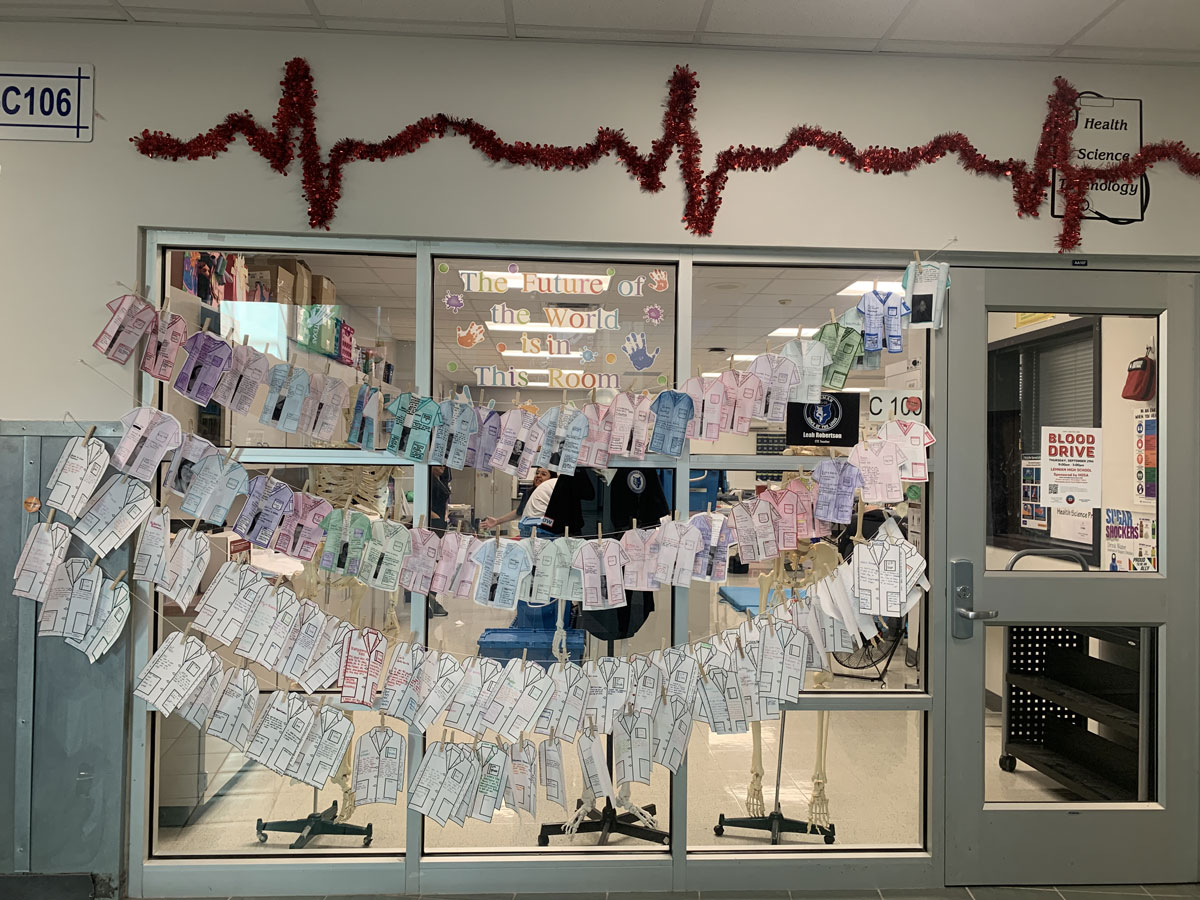
Student artwork is on display at Lehman High School in Kyle, Texas, in front of its healthcare department.Student artwork is on display at Lehman High School in Kyle, Texas, in front of its healthcare department. (Colleen DeGuzman/KHN)The school system also hopes to raise students’ awareness of the risks they face. Any pill — no matter what it is — that didn’t come from a pharmacy cannot be trusted: “It’s like playing Russian roulette,” Savoy said.

The message may be resonating. Sara Hutson, a Lehman High senior, said sharing over-the-counter pills such as Tylenol and Motrin used to be common, but she no longer considers it safe. Her trust is gone.

But other students aren’t as cautious. Lisa Peralta shared in a Facebook post in September that her daughter, who is in seventh grade, admitted to eating an “anxiety gummy” her friend gave her. “I’m scared because my daughter is a follower,” the Kyle resident wrote. “I just don’t trust that she won’t do it again if she feels pressured.”

No matter how clear the district and parents make their messages, Savoy worries they may never be enough because students are so adventurous. “It’s just the teenage mindset,” he said. “They think, ‘We’re invincible; it’s not going to happen to me.’ But it is happening to us in our community.”

Still, the feelings of unease and grief are sometimes palpable. Students have been fighting more at school, said Jacob Valdez, a Lehman sophomore who knew two of the students who died. That might be happening, he added, because “everyone is just angsty.”


Want more health and science stories in your inbox? Subscribe to Salon’s weekly newsletter The Vulgar Scientist.


The tension is not limited to middle and high school students. It’s also become very real for parents of elementary school kids, since the DEA warned the public in August about fentanyl-laced pills that look like brightly colored candies. The Hays school district is also hanging warning posters geared toward younger students.

Jillien Brown of Kyle said she is worried about her daughters, 5-year-old Vivian and 7-year-old Scarlett. “We told them that there’s some scary things going on, that people are getting very sick and they’re dying from taking what they think is candy or medicine,” Brown said. “We use the word ‘poison,’ so like when Snow White bit the apple.”

But the conversation must be ongoing, Brown said, because the day after she talked to her daughters, “some little kid on the bus gave them a candy and they ate it.”

Similarly, Kyle resident April Munson, a former elementary school teacher, considers it all “gut-wrenching.” She showed her 9-year-old son, Ethan, pictures of the multicolored “rainbow fentanyl” pills. “It’s a hard conversation to have, but hard conversations are often the most important ones,” she said. “And, really, you can’t afford to have elephants in the room.”

And even as parents and the school officials attempt to prevent fentanyl from striking again, another reality check comes.

Last year, the school district started stocking in every school a supply of the overdose reversal drug naloxone, also known as Narcan. So far this semester, despite all the community has gone through, it has been used to save four more students, Savoy said. In one case, Savoy said, first responders had to use three doses to revive a student — the fentanyl “was that strong,” he said.


KHN (Kaiser Health News) is a national newsroom that produces in-depth journalism about health issues. Together with Policy Analysis and Polling, KHN is one of the three major operating programs at KFF (Kaiser Family Foundation). KFF is an endowed nonprofit organization providing information on health issues to the nation.

Elon Musk’s Twitter takeover is a disaster. How much longer will the platform hold?

There are few guarantees in this life. But, this I know: There will be death, taxes, and the not-so-infrequent Elon Musk shit-post

Having fired four senior executives and dissolved its board of directors, and now laying off thousands of employees, Twitter’s new owner, chief executive and now sole director hasn’t exactly been a study in stability. After spending months trying to scuttle the $44 billion deal to acquire the social media giant and within days of frog-marching CEO Parag Agrawal and CFO Ned Segal out of the building presumably without their pre-negotiated, multi-billion dollar payouts, Musk returned to his favorite pastime — trolling.

A mere 72 hours after he strolled into Twitter HQ and pronounced himself “Chief Twit,” the billionaire posted a tweet that advanced baseless allegations about the recent home invasion and hammer attack on the husband of House Speaker Nancy Pelosi. “There is a tiny possibility there might be more to this story than meets the eye” when it comes to the attempted murder of 82-year-old Paul Pelosi, he said less than dutifully. His cultists were alight in glee. The facts poking us all in the eye is that the assailant was a right-wing conspiracy-addled QAnon adherent, who had never met his victim and was actively targeting the Speaker for a not-so-friendly kneecapping if she didn’t cop to rigging the 2020 election and other flavors of ridiculousness. 

But common decency be damned. Gotta get these jokes off, amirite? 

In the end, the joke appears to be on Musk who paid nearly double the company’s value to take it private in a gambit to control the world’s largest public square. Promising to make it profitable, not to mention $1 billion now due to investors annually, Musk is scrambling for ideas. Among them are monetizing video, verification and direct messaging. None of those efforts will bring the kind of revenue necessary to save the platform. And now, after an uptick in racist and antisemitic vitriol, advertisers and users are running for the exits. 

I’ve had a lot to say about a lot of things, some of which were not always entirely welcomed by my minders at cable news networks that once employed or booked me.

Two years after Jack Dorsey launched Twitter, to the chagrin of my children and I am sure generations to come, I logged onto the online communications app and snagged a username. Luckily, aside from the several who likely regret sharing a name with a foul-mouthed, prone-to-fisticuffs, progressive firebrand and Ina Garten groupie like myself, there aren’t many Goldie Taylors in the world. At the time, in 2008, the system was home to around 300,000 posts per day. My opening salvo was akin to shouting “hey y’all” during Super Bowl half-time. Now, some 14 years later, I’ve contributed several hundred thousand tweets about everything from F1 racing and the vagaries of beltway politics to the glories of home-pulled pasta and my unrequited adoration for Larry Wilmore. 

Along the way, I picked up an exalted blue check for the low, low price of free-99 and — almost as inexplicable as my taste in men — a little over 170,000 follows, which is less of an accomplishment than it is evidence of an obsession with information and a platform on which to work out my political machinations in public. I’ve had a lot to say about a lot of things, some of which were not always entirely welcomed by my minders at cable news networks that once employed or booked me. I’ve been wrong about some things and, at least in my estimation, right about a lot more. Let’s just say I’ve never met a proverbial prisoner worthy of a cell, so I took none. I’ve engaged in brickbats with troll farms and tilled a bit of soil myself, unleashing quips on political ne’er-do-wells from sunup to sundown and sometimes beyond. I’m nobody’s snowflake and politics ain’t beanbag, but I have been threatened, doxxed and rendered all but helpless as anonymous users went after my children and posted screenshots of my home and office.

Like most people who engage in such things, and I assume like Musk, I simply wanted my voice to matter. Finding community and disagreement in a space in which talking to strangers might be more welcome than at, say, my local coffee shop is particularly alluring peregrination. After all, the nice lady who runs the dry-cleaning operation down the way from my house doesn’t want to hear my latest hot take and is impervious to the hour’s trending topics. She is unfamiliar with “doomscrolling” and her life, I’m willing to bet, is all the better for it. 

Like most people who engage in such things, and I assume like Musk, I simply wanted my voice to matter.

Now, a dozen-odd years and miles of self-deprecating asides, food porn, policy jousts, throwback pics and acts of linguistic jiu-jitsu later, it appears I may need to find another outlet for my diatribes — comedic, insightful, delicious, churlish or otherwise. It wouldn’t be the first time I weighed leaving Twitter. However, something about this moment feels different. 

Musk, shit-posting and compensation raiding aside, can be forgiven for not knowing how to manage this particular kind of business, one in which his only experience is as a user (I am a proud Delta frequent flier, but ain’t nobody about to let me pilot a passenger jet) and even for his soon-to-be failed attempts to cut his way to profitability. The platform, according to some now former employees, is “built on sticks,” reported NBC News correspondent Ben Collins, and could literally “fall down.” 

The moderation team has been nearly obliterated ahead of a plan to monetize verification in a way that is sure to give rise to imposters. It will open up direct messaging to celebrities, politicians, journalists and others to anybody willing to fork over eight bucks. And video? Think porn hub. 

Twitter has a history of complicated relationships with demonstrably bad actors, but if Musk’s latest screeds and corporate decisions are any indications, the self-proclaimed “free speech absolutist” intends to create the very “hellscape” he claims to eschew. Taking the company private with no oversight beyond Musk’s proclivity of the day has already made it more prone to vitriol and hate speech. The targeted racist attacks and disinformation ramped up within minutes of the announcement. There is even the potential of reversing the ban on former President Donald Trump whose well-documented track record for ginning up violence is in plain view.

If Musk’s latest screeds and corporate decisions are any indications, the self-proclaimed “free speech absolutist” intends to create the very “hellscape” he claims to eschew.

“Not taking an absolute stand against political violence signals to deranged people that there is no moral standard against that violence, that we are just floating along on a vast sea of carnage that is indiscriminate and random and there’s nothing anyone can do about it, so go ahead, fire away,” my friend Michael Tomasky wrote in The New Republic.

Is it then reasonable for me to worry about the future of the platform in the hands of a man whose seemingly only devotion is to his own checkbook, who is flinging open the proverbial gates to the Barbarians? Well, yes. Am I willing to fork over $240 (or any money) a year to keep my verified account in hopes that the already weak safety protocols will hold up? Hell to the nawl.

Ultimately, the jury is still out for me. But, at least for now, I’ve put my account on hiatus. As long as Musk inhabits the corner office, I may never return.

A new tax credit for biogas could be a boon to factory farms

When Maria Payan’s son was screened for cancer, she knew he had to leave home. 

The Payan family lived in Delta, Pennsylvania, a rural community of fewer than 1,000 people near the southern edge of the state, bordering Maryland. Payan, a Pennsylvania native, said she wanted her son Michael to grow up in a small, idyllic community like she did when she was young, making Delta an attractive place to raise a family. 

Then the farm across the road changed hands and became a concentrated animal feeding operation, or CAFO, home to thousands of poultry and cattle, churning out a steady supply of manure and animal waste. 

“It just changes your entire life,” Payan told Grist. “Kids can’t play outside. You have to call them inside with the level of stench because you understand it’s not just odors.”

The proliferation of CAFOs across the country has harmed the quality of life for neighboring small communities for decades, with environmental groups now suing the Environmental Protection Agency over the agency’s failure to regulate groundwater pollution stemming from factory farms. 

When a farm produces massive amounts of animal waste, the waste must go somewhere. Generally, farms have pits of manure that hold the waste, uncovered and outdoors, which increase methane emissions and contribute to more ammonia in the air, as well as pollution from nitrates and phosphorus. The waste also contains hydrogen sulfide, a chemical that causes a strong odor and inflammation in the eyes, skin, and lungs.

Some of these massive farms cash in on fuel from this waste, known as biogas.

When food and animal waste are deprived of oxygen, which occurs in landfills and manure lagoons, a natural process known as anaerobic digestion occurs. Bacteria consume the waste products and eventually release methane, a widely used natural gas. The process occurs on farms inside air-tight containers known as digesters. 

These digesters capture methane that would otherwise be emitted into the atmosphere, making biogas one avenue to reduce methane emissions. The burning of methane does release carbon into the atmosphere, but the use of biogas for energy now allows the nation to cut the equivalent of carbon dioxide emissions equivalent to taking 1.3 million cars off the road in a year.

The energy production process causes farmers to enclose or cover manure pits, but just because the manure isn’t visible doesn’t mean it isn’t causing problems.

In rural areas, well water is a primary source of drinking water for residents, and nitrate contamination from animal waste has been linked to a variety of cancers as well as infant death and miscarriages.

Payan said she remembers seeing her son’s body covered in red, irritated wounds after taking a shower, which exposed him to the chemicals found in the region’s groundwater. 

The Payan family moved to Sussex County, Delaware soon after to get away from CAFO pollution, but the industry has exploded throughout the region. Payan, who now works with the Socially Responsible Agriculture Project, said a “gold rush” of more massive farms is popping up in Delaware, with facilities affecting the quality of life for families in this rural county, which has a large Black and Latino population. 

“It’s got to stop. We can’t just do business as usual,” Payan said.  

But based on this year’s historic climate legislation package, biogas is set to boom. 

Maria Payan, formerly of Delta, Pennsylvania, stands next to the Delta farm her family moved away from after its operations began polluting the community. Payan, who participated in the documentary “Right to Harm,” now advocates against factory farms and biogas in the northeast region. “Right to Harm” / Hourglass Films

The Inflation Reduction Act, signed into law this past August, includes a sweeping $369 billion investment in various clean energy technologies and credits for consumers to purchase greener technologies. One of those industries is biogas, an energy source that captures methane emissions from large-scale farms. Biogas facilities, which are billed as a “renewable energy source” in the industry, will receive various tax credits and investments from this legislation, prompting industry leaders to look into expanding and constructing facilities across the country. 

“It’s almost giddy,” said Timothy Baye, professor of Business Development and State Energy specialist at the University of Wisconsin. “It’s like waking up not expecting Christmas and finding a Christmas tree.”

Animal waste, like cow manure, and agriculture have been identified as significant contributors to the planet’s warming temperatures, with agriculture accounting for 24 percent of global emissions of carbon, methane, and other gasses. Over 100 countries have signed a pledge to cut global methane emissions by 30 percent by 2030. Methane emissions also come from the fossil fuel industry and have seen historic rises in recent years.

The biogas industry has grown exponentially over the past two decades, primarily thanks to California’s Low Carbon Fuel Standard, which was adopted in 2006. The standard created a market for “low-carbon and renewable alternatives” to gasoline and diesel, driving new biogas operations around the country. According to the EPA, electricity generated from biogas more than doubled between 2010 and 2020.

The IRA will give tax credits of up to 30 percent — the same investments given to large clean industries like solar and wind — to biogas facilities built by the beginning of 2025. In addition, this legislative package will also invest roughly $2 billion in the United States Department of Agriculture’s Rural Energy for America Program, or REAP, which provides loans and grants to farmers and businesses in the energy efficiency and renewable energy sector, which includes biogas facilities. 

In October, a bipartisan group of Senators from across the Midwest and Great Plains sent a letter to the EPA, urging more pathways for “electricity generated from biogas” to be brought to the energy market. 

Apart from the IRA, the Biden administration has made biogas a focal point of its clean energy goals, with the planned creation of new public-private partnerships to encourage more biogas facilities as a part of its Methane Emissions Reduction Action Plan

“The biggest impact that the IRA has had on the industry is it has started to levelized the playing field among different renewable energy technologies,” Patrick Serfass, executive director of the American Biogas Council, told Grist. 

Serfass said the industry is at a similar moment that both wind and solar were years ago. When a windfall of federal funding helped those sectors in years past, the industries exploded. Since then, he said those involved in the renewable energy sector have looked to Congress to create a “more fair marketplace” for biogas plants to compete in selling and making renewable energy. 

“(The IRA) has helped to get more biogas systems developed, and if you care about reducing carbon emissions and producing renewable energy, then that’s a really good thing,” Serfass said. 

States with large agricultural sectors are likely to see an increase in biogas facilities, but biogas is not just dependent on animal manure. Landfills and wastewater treatment plants also make up a large portion of the industry. California, Texas, and North Carolina have the biggest potential to make biogas, as estimated by the National Renewable Energy Laboratory.

This month, a $25 million loan project in Stanislaus County, California, which includes the city of Modesto, was approved. The funding, part of REAP, will provide loans for dairy farms in the region to construct six biogas facilities to connect to a local ethanol plant. Additionally, the loans will also fund natural gas pipeline projects, commonly used in the biogas industry as a way to move the created gas from farms to a refinery without the need for large tanker trucks and costly shipping. 

Communities that already live with large animal farms and biogas facilities could be a cautionary tale for regions that are expanding or building more digesters. In counties across southeastern North Carolina, predominantly Black and low-income communities have been fighting against the state’s massive hog industry-turned biogas producers for years.

Dr. Sacoby Wilson, a leading expert on environmental justice for rural and agricultural communities, said biogas investments may help decrease methane emissions, but neighboring residents are still exposed to a variety of compounding health hazards. 

“They’re not getting the co-benefits that supposedly come from capturing methane, burning methane, or digesting waste,” Wilson told Grist.

Wilson said that biogas is not a clean energy source. While he appreciates the Biden administration’s recent advancements and commitments to environmental justice, the massive funding push for biogas inside the IRA is “one step forward and two steps back.” 

He said there should be more significant investments in solutions to the source problems of methane emissions, such as massive agricultural operations that have grown across the country, rather than propping up an industry that relies on destructive practices. 

“Why not invest in sustainable, regenerative agriculture?,” Wilson said, “which will actually be more beneficial to local communities, to the local economy.”

Agriculturally focused states are seeing increased pushes for more manure digester facilities. Greenleaf, Wisconsin, an unincorporated community less than 20 miles south of Green Bay, is now home to a massive digester facility. The new facility claims to be among the largest in the nation, converting nearly a million gallons of manure into methane daily. The gas produced here will be pumped into a national pipeline system and used to fuel natural gas vehicle requirements in states on the other side of the country, like California and Oregon. 

Early this year, the prospect of a new digester in Rock Valley, Iowa, was heralded as a sustainable solution for nearby farming communities in the northwest corner of the state. But soon after it opened, the facility leaked 376,000 gallons of manure into nearby waters

“What we’re seeing is essentially factory farm, biogas, and anaerobic digesters being used in tandem with large factory farm operations, which obviously is raising a lot of concern and opposition from communities,” John Aspray, a Food & Water Watch senior organizer in the state, told Grist.

The Bloody Run Creek, also in the northern part of the state, has experienced increased farm run-off from a digester-turned-large animal operation in recent years. Iowa is now seeing an increase in digesters, with nine new facilities granted permitting last year and seven existing ones approved for expansion. State legislators have tried to curb nitrate pollution from agriculture by proposing a ban on new CAFOs, but just last year, state officials incentivized the creation of more digesters at large-scale farms with state funding. 

“It’s not going to revolutionize agriculture in a way that makes it more sustainable,” Aspray said. “These are a false solution to climate change.”

Hillary Clinton’s 2016 strategist: We learned about conventional wisdom the hard way

Next week’s midterm elections are a type of laboratory for American democracy. It appears that the results will be highly concerning, and perhaps disastrous. Emboldened and propelled by Donald Trump’s attempted coup of 2021 — and his impending 2024 campaign — Big Lie supporters and other anti-democracy candidates may win numerous key races across the country.

The belief that elections are fraudulent or fake if Republicans do not win has become an article of faith for the American right and the “conservative” movement. In a blatant effort to delegitimize America’s democracy, Republican candidates are openly announcing that they will refuse to accept the midterm results — before most votes have been cast and before any have been counted.

The potential for right-wing political violence is so significant that President Biden felt compelled to address the nation on Wednesday evening about how American democracy, and the literal safety of the American people, are imperiled by “MAGA Republicans” and their supporters. Many voices in the media expressed boredom or exasperation with this message

The Age of Trump has made many of the analytical tools used by pollsters, pundits, journalists and other political professionals increasingly unreliable or useless. Honest observers admit, at least, that we have no certain idea what will unfold after next week’s election. The situation is so fluid and confusing that it is reasonable to envision a scenario in which Democrats actually maintain control of the House and the Senate, or a “red wave” in which Republicans win both chambers by a decisive margin.  

How are the American people responding to this democracy crisis? Public opinion polls have repeatedly shown that in the aggregate they care more about “the economy” than about “democracy” — two ambiguous abstractions. Generally speaking, that’s good news for Republicans, and is likely to drive forward their revolutionary and reactionary campaign to end American democracy.

In an effort to find some clarity about the upcoming midterms and what the outcome will mean for American democracy, I recently spoke with Joel Benenson, the founder and CEO of the Benenson Strategy Group and one of the world’s leading political and corporate strategists. Benenson was a strategist for Barack Obama’s victorious 2008 and 2012 presidential campaigns. He was also the chief strategist for Hillary Clinton’s ill-fated 2016 campaign.

In our conversation, Benenson explained his view that the most important factor in understanding elections and campaigns is a candidate’s ability to relate to the needs, worries, and concerns of the average voter (or to be perceived as doing so). Winning elections, he argues, is about a candidate connecting with voters on the level of shared values and a common narrative. He cautions that too many Democrats have convinced themselves that “working-class” voters do not vote for Democrats because they are deluded about their own “self-interest.” That kind of simplification or incomprehension, he says, can be fatal.

Benenson reflects upon his experience with Hillary Clinton’s 2016 campaign and on why Trump was able to win that election thanks to a toxic combination of the Clinton campaign’s self-inflicted wounds, the failures of the news media and a populist moment of rage against “elites” and “the system.”

Democrats are approaching the 2022 midterms, he says, by amplifying the most dangerous and extreme Republican candidates and placing too much emphasis on Donald Trump. He says he is hopeful, however, that the Supreme Court’s recent decision to overturn Roe v. Wade will mobilize Democratic voters. Whatever happens next week, he warns, the Republican Party will remain immensely dangerous to the health of American democracy into the indefinite future.

How are you making sense of all the tumult and confusion of the Age of Trump, the democracy crisis, and the midterms? So much of this is unprecedented.

I get asked frequently: Why do people vote against their self-interest? In reality, they’re not voting against their self-interest. They’re just defining their self-interest on different terms than you think they should be. If you ask a working-class person, “Why aren’t you voting for Democrats? They’re the ones who are standing up for working class people,” the premise may be true but in the end you have to talk to voters in a way that resonates with them. There are things that these white working-class voters don’t like about Democrats, however unfair that judgment may be. Too much of the conventional wisdom about campaigns and elections is focused on approval ratings, the economy, the unemployment rate, and metrics of that nature.

In the end what matters is what is going on in people’s daily lives. How are they feeling? What are their struggles, their frustrations? Do they feel like they have done everything right and are still being treated unfairly by the system? My journalistic background has been a tremendous asset for me in my political work, because there are so many pollsters who are just number-crunchers. If you think about what journalists do, we’re trying to uncover the story. We can use legitimate research techniques, whether it’s qualitative, through focus groups or polling. But to be successful as a candidate, you need to make a connection with voters without catering to them. How can you connect your values to theirs? When a candidate can do that, we see the strongest campaigns.

There is at least six decades of political science and other research showing that the American voter is not very sophisticated. In your experience, is that true? How does that impact your approach to politics?

Your job as a candidate, or someone advising a party or campaign, is to understand the values, the frustrations and the pain points that the average voter is bringing to the table.

Never underestimate the American voter. It doesn’t matter how sophisticated they may or may not be, as determined by you or me or some other expert. Your job as a candidate, or someone advising a party or campaign, is not to preach to the sophisticated voter. Your job is to understand the values, the frustrations and the pain points that the average voter is bringing to the table. You’ve got to meet them where they are. Again, you should not cater to voters. But if you as a candidate are not going to connect with what matters in their lives — and even more so how the story of your life resonates with their experiences — what you say is going to fall on deaf ears. 

One of the common errors we see among the Democrats, and too many among the media class, and liberals and progressives more generally, is this narrative about how “working class” and independent voters do not understand what their “real” interests are, and that they have somehow been bamboozled by “culture war” issues. When I talk to white liberals on this issue, I say that these voters know exactly what they are voting for. They just define their interests differently from yours. Their rationality is not your rationality, and you had best accept that fact.

That is true. As I said earlier, do not presume that voters are defining their self-interest in the same terms that you are. For example, let’s consider the Republican Party and evangelical Christians. As a group, their interests are not driven by economics. Instead, right-wing evangelicals are driven by their faith and religion. To be clear, I do not believe that we should cater to them in a pluralistic democracy and government. They should not be the driving force in our country. But you do need to understand what evangelical Christians are voting for in order to fully understand our politics right now.

What we missed was how much of an anti-establishment moment we were living in. Trump’s voters felt like the establishment had been failing them economically, politically and culturally.

I’m also not saying that the Democrats need to change their policies to try to win over conservative Christians. However, you can understand the different types of things, the multiple types of self-interest, that are operative among a given group of voters. Then you can craft a way to communicate your message to them.

I tell the politicians that I work with that, in the end, presidential elections are about big things and not small things. They’re about the future, not the past. They’re about the lives of the voters, not your personal biography. That doesn’t mean that your life story is unimportant. But you have to connect your biography to how the voters think about their own lives and experiences.

Why does Donald Trump have such enduring popularity and power? Is he a savant? Is it his consultants and media people? Is he able to mine rage and hatred in a way that the Democrats can’t stop? What do Trump and his inner circle understand about American politics and public opinion that too many others do not?

Donald Trump met a moment. There was a story that was on the front page of the New York Times toward the end of 2016. The headline and lede were basically that voters saw Trump as a big risk who may be worth it. What we missed during Hillary Clinton’s campaign was how much of an anti-establishment moment we were living in. This was happening around the world with Boris Johnson, Viktor Orbán, other populist leaders who were outside of the traditional establishment. That was Trump. That’s his appeal. Trump’s voters and many others felt like the establishment had been failing them economically, politically and culturally. Moreover, this sense of upset and resentment was focused on both Republicans and Democrats.

Remember, Trump did not win the popular vote. A common narrative we heard was that the polls were wrong. That’s not true. The polls were national polls, and Hillary Clinton basically won them by the predicted margin. Unfortunately, we had a campaign that decided to stop polling in Pennsylvania, Michigan and Wisconsin, the three states in the so-called blue wall for Democrats in the Electoral College. Even worse, they decided to stop polling on Labor Day. Congratulations, you lost the presidential election!


Want a daily wrap-up of all the news and commentary Salon has to offer? Subscribe to our morning newsletter, Crash Course.


In the end, Trump benefited from being of that moment and from running against a candidate who embodied so much of what many Americans were angry about. She was a very strong candidate with great credentials. But Hillary Clinton had been a fixture in Washington for two and a half decades. If you are in an anti-establishment moment, the bomb-thrower who says he is going to shake things up becomes very attractive to voters. They didn’t care about Trump’s résumé. That was the dynamic in the 2016 presidential campaign. Many politicos, like myself, did not grasp what was happening at the time.

Hillary Clinton basically told the truth about Trump’s voters being a “basket of deplorables.” Her truth-telling on the disaster that would afflict the country if Trump won has been vindicated. Having said, her truth-telling may not have been the smartest political move. As they say, history will have the final judgment.

In the last week of the campaign, a video comes out with Donald Trump bragging about grabbing women by their genitals. What was the biggest story in the last week of the campaign? Hillary’s emails. Anytime Hillary Clinton’s emails were in the news it was going to be a bad week for us. Even though Hillary’s emails were a non-story that had been known for months, it became the focal point of the news media’s coverage during the last week of the campaign. The story was not Trump, for all intents and purposes, sexually assaulting women. There are things you can control in campaigns, and other things you can’t. I hope journalists and editors look back at their choices during the 2016 campaign and reconsider what they did and how Trump’s behavior and that hot-mic audio were more important than Hillary’s emails. 

Hillary did warn people about Trump. But her mistake was the language she used. Calling the white working class a “basket of deplorables” was a big mistake. That made Hillary into a representation of those elites they were angry at.

Hillary did warn people about Trump. But her mistake was the language she used. You should never characterize voters that way. Let’s be clear: there were mistakes made in that campaign. How do you stop polling in three states that are essential to your victory? It was absurd. I’m not going to try to convict the campaign, but I am also not going to absolve it of its mistakes. The “deplorables” comment gave Trump and the Republicans lots of fodder.

If Donald Trump was appealing to the so-called white working class — a group of people who have a sense of aggrievement that elites looked down upon them — calling them a basket of deplorables is a big mistake. That comment makes Hillary into a representation of those elites they are angry at. As a strategic matter, make the campaign about Trump, show that he is the deplorable one.

What do you think about the Democrats’ current strategy of boosting the most extreme pro-Trump Republican candidates in certain key races, as a way weakening them with undecided or independent voters?

I do not believe that playing that kind of tactical game is how you win elections. The way to win is by having a strategy that defines very clearly why you are the better person for that job. Find the voters you need to win the election and then persuade them to your side.

There is an old idea that public opinion is a chorus or thermometer of the public mood. In the aggregate, what has American public opinion been saying these last few months?

What that chorus is telling us is that we the voters are going to align with the candidates who are addressing the issues that affect our lives the most and issues we care the most about. We are going to back those candidates who seem to be on our side and fighting for the same things we are concerned about. The vote on women’s reproductive rights in Kansas, which is a red state, was very instructive. Among independents especially, there are some issues where Republicans have gone too far to the right. These are things like guns — we have had too many mass slaughters in this country. What Democrats have to do is to continue to state their case on abortion choice, on taxes, on making the rich and corporations pay their fair share. The vast majority of the public supports the Democrats on these issues. In addition, more swing voters are where Democrats are when it comes to the economy.

The Republicans are captive to the more extreme wing of their party on so many issues that the American people care about. Democrats should be exploiting that fact and presenting a clear option to those voters they can win over — and those voters exist. But can the Democrats do it consistently? Can they focus their message and outreach in a disciplined way? There is one huge obstacle for the Democrats, and that is how reapportionment favors the Republicans. The Republicans control more state legislatures and governor’s houses than do the Democrats. They have a serious structural advantage that the Democrats have to overcome.

Conventional wisdom is that the Republicans are much better storytellers than the Democrats. As a function of that, they are also better at the practical work of winning elections and getting their policies put in place. What do today’s Republicans, and especially the Trump movement, understand about emotions and how to manipulate them that Democrats do not?

I disagree with the premise. The Republicans have created a secure base. They don’t play to the middle much anymore. They do an excellent job of that — they have a very strong connection with evangelical Christians, for instance. In addition, the Republicans win at the state and congressional levels because they focus so much attention there. By comparison, on the national level the Republicans have done much worse, in terms of winning the presidency.  

In terms of messaging, should Trump and all the harm he has done be the focal point of Democratic messaging? Trump and the Republicans are an existential threat to American democracy and society. Shouldn’t that be foregrounded by the Democrats?

Unless and until Donald Trump is a candidate, keep him out of it. There is no reason to bring him into it. The challenge right now, and where the focus should be, is on the Republicans. Trump is not on the ballot for the Senate or Congress in 2022. If we start talking about Trump, it looks like Joe Biden is afraid of Trump. He’s not a presidential candidate yet, and he may never be.

Will the Dobbs decision be the game-changer for the midterms that many observers are predicting?

Unless and until Donald Trump is a candidate, keep him out of it. If we start talking about Trump, it looks like Joe Biden is afraid of him. He’s not a candidate, and may never be.

It is going to be a very powerful dynamic in the values debate. Dobbs is putting Republicans on defense. A Republican-controlled Supreme Court made the decision to end Roe v. Wade. You cannot ignore that vote in Kansas. The Republicans are going to lose a lot of voters over abortion rights. The Dobbs decision is not going to win the Republicans any new supporters. They already have that base vote.  

What is your general sense of the midterms at this point?

Historically, over the past four decades first-term midterms have not been good for the president’s party — with one exception, which was for George W. Bush in 2002, after the 9/11 attack. That is the political law of inertia: Every action has an equal and opposite reaction.  But I also caution not to read that dynamic as a determinative or final verdict on the incumbent. For example, Democrats lost big in 2010, and in 2012 Barack Obama became only the seventh president in history to be elected and re-elected with more than 50% of the vote both times.

If the Democrats somehow manage to do better than expected, meaning that they hold the House and the Senate, what lessons should they learn? Likewise, what if they lose, as many or most are predicting? What are the lessons there?

If Democrats do better than expected, I would say this: Be rigorous in analyzing and understanding where and why Democrats won and what differentiated them from Democrats who lost, and assess why that happened. Focus in on the structural, cultural or other issues that Democrats can use to win more going forward. Contrast those winning results with where we lost seats we expected to win. Do an honest assessment of why that happened and what adjustments you can make in terms of issues or candidates in those districts or states without compromising on core Democratic values.

Likewise, if the Democrats end up doing worse than expected, do a similar diagnosis. Contrast the winners and losers, their approach and issues, to assess what worked in those tough districts and what didn’t.

Imagine that you are a doctor of democracy and politics. How would you diagnose American democracy right now? How is the patient doing? 

The patient is struggling because it’s fighting off multiple viruses at the same time. These viruses are insidious and there are many of them. The Republican Party is contributing much more to the illness than to the remedy. What we have to do as Democrats is to highlight that fact: The Republicans are making American democracy and society sicker. 

Does Herschel Walker really think he could beat Mike Tyson in a fight?

As a Pro Bowl NFL running back in 1988, Herschel Walker thought he could beat boxer Mike Tyson, who at the time was the undisputed world heavyweight champion.

Walker’s view was recounted by former Dallas Cowboys teammate Michael Irvin, who was promoting TradeZing, an investor website, Fox News reported.

Irvin described meeting Walker after was drafted by the team in 1988.

“One of the first things Herschel said to me was, ‘Mike, you know, I really think I could beat Mike Tyson,'” Irvin said.

“This was when Mike Tyson was hitting you in the head, and your whole body just exploded,” Irving explained. “I said, ‘Dude, why you talking like this? What is this? Some death wish? What are you talking about?’ But he was dead serious.”

“He looked at me and was like, ‘I’m telling you, Mike, I can beat him.’ He believes he can do [anything] and beat everybody at everything,” Irvin added.

The following year, in 1989, DJ Jazzy and the Fresh Prince, also known as Will Smith, released the single, “I think I Can Beat Mike Tyson” from their third studio album, “And in This Corner…” The music video for the song featured Tyson, promoter Don King, and comedian Chris Rock. Over three decades later, Smith would slap Rock at the 94th Academy Awards.

Walker, who has also claimed he has a better résumé than former President Barack Obama, is challenging Sen. Raphael Warnock (D-GA).

Twitter employees warn that the platform will be unreliable during midterms

Since acquiring Twitter in later October, Elon Musk hasn’t been shy about firing people. The Tesla CEO has fired some of Twitter’s top executives as well as the company’s entire board of directors, and more firings and layoffs are expected.

Twitter, according to NBC News’ Ben Collins, is in a state of chaos — and employees, Collins warned, fear that the chaos could make Twitter an unreliable source of information on Election Night, November 8.

Collins, during an MSNBC appearance on Friday, November 4, explained, “The most important thing Twitter employees want to stress is that the company is a nightmare right now, and that you cannot work there — and the website is built on sticks, and it might fall apart. It’s a house of cards. If it falls apart by Tuesday, we’re in trouble in terms of getting election information out there.”

Collins went on to say that Twitter has “cut the moderation staff so severely” that “there is no way they are going to catch up in time” if “lies” and disinformation are posted on Election Night.

“So, using Twitter as a trustworthy source of information on Tuesday is going to be a nightmare,” Collins warned. “That’s what people inside of Twitter…. are warning about. They go and talk to Elon, who is deeply out of his depth, objectively, and they don’t know what’s going to happen next week during the United States elections…. I don’t mean to sound the alarm quite so severely here, but this could be really bad.”

Watch below:

Jeff Bezos sued for alleged mistreatment of housekeepers

Jeff Bezos, founder of Amazon, has been hit with a civil suit by a former housekeeper who alleges that she, and others employed to work at his properties, suffered harmful and discriminatory treatment. 

According to Mercedes Wedaa, who was hired in the fall of 2019, she was instructed to perform her duties “without being seen,” and was often denied access to bathrooms for such an extensive period of time that she would often contract painful urinary tract infections. In addition to the physical harm endured while working for Bezos, she alleges that his subordinates showed discriminatory favoritism for the white workers staffed at his properties over those of other ethnicities, according to NBC News

“Employers discriminated against Plaintiff because of her race, forced Plaintiff to work long hours without rest or meal breaks, exposed Plaintiff to unsafe and unsanitary work conditions, retaliated against and wrongfully terminated Plaintiff’s employment,” according to Wedaa’s attorney, Patrick McGuigan.

This is not the first time that Bezos and his affiliations have been accused of such things. In 2021, 20 employees of his Blue Origin rocket ship company alleged that “numerous senior leaders have been known to be consistently inappropriate with women,” according to ABC.  That same year, a manager at Amazon.com Inc sued for discrimination alleging that the company “hires Black people for lower positions and promotes them more slowly than white workers,” according to Reuters


Want a daily wrap-up of all the news and commentary Salon has to offer? Subscribe to our morning newsletter, Crash Course.


Named as defendants in the suit filed by Wedaa are Bezos himself, along with Zefram LLC and Northwestern LLC, two companies that manage his properties. 

“For about 18 months, in order to use a bathroom, Plaintiff and other housekeepers were forced to climb out the laundry room window to the outside,” the suit details. “Then, run along the path to the mechanical room, through the mechanical room and downstairs to a bathroom. This toilet was used by both men and women, for example grounds staff used it too.”

According to the suit, it wasn’t unusual for Wedaa and other employees at the properties to be forced to work 14-hour shifts with no breaks. 

Nigella Lawson is going on tour — here’s where you can see her live

Packed with thoughtful, personal essays and easygoing recipes, Nigella Lawson’s latest cookbook, “Cook, Eat, Repeat: Ingredients, Recipes, and Stories,” landed on U.S. shelves in April 2021 — and now, she’s hitting the road to celebrate it.

Known for her several cooking shows, books, and other projects, “Eat, Cook, Repeat” is Lawson’s 12th cookbook. Centered on the ways in which home cooking is deeply personal, she rejects prescriptive, rigid attitudes towards food in favor of an intuitive approach. With playful, eclectic chapters (think: “A Loving Defense of Brown Food” and “A is for Anchovy”), this book is one home cooks will reach for again and again.

Throughout the month of November, Lawson will be visiting 16 cities to “share the rhythms and rituals of life spent in the kitchen.” Some very special guests will also be popping in along the way — like Dan Souza in Boston, Ina Garten in Brooklyn, and many, many more. See below for the full list of tour dates, and head to Fane to purchase tickets in your city.

  • November 7, 2022 – Boston, MA: Emerson Colonial Theatre
  • November 9, 2022 – Brooklyn, NY: Kings Theatre
  • November 10, 2022 – Philadelphia, PA: Kimmel Cultural Campus
  • November 12, 2022 – Santa Barbara, CA: Granada Theatre
  • November 13, 2022 – Seattle, WA: Benaroya Hall
  • November 14, 2022 – San Francisco, CA: Sydney Goldstein Theatre
  • November 16, 2022 – Santa Rosa, CA: Luther Burbank Center
  • November 17, 2022 – Dallas, TX: DMA Arts and Letters Live
  • November 18, 2022 – Salt Lake City, UT: Eccles Theater
  • November 19, 2022 – Overland Park, KS: Midwest Trust Center
  • November 21, 2022 – Minneapolis, MN: Hennepin Theater Trust
  • November 22, 2022 – Austin, TX: The Long Center
  • November 23, 2022 – Toronto, Canada: Massey Hall
  • November 26, 2022 – Irvine, CA: Irvine Barclay Theatre
  • November 27, 2022 – Houston, TX: The Cullen Theater
  • November 29, 2022 – Canton, OH: Stark Library

“Shocked and horrified”: Alarm as Netanyahu set to form Israel’s most right-wing government ever

People around the world have expressed concerns about Israelis empowering indicted former Prime Minister Benjamin Netanyahu to form the nation’s most far-right government in history since Israel held its fifth election in less than four years on Tuesday.

“If you are shocked and horrified by this growing, emboldened Israeli fascist movement, ask yourself how you’ll commit to opposing Jewish supremacist ideology, policies, and institutions in days and years ahead,” Simone Zimmerman, co-founder of the American Jewish group IfNotNow, tweeted late Wednesday. “Fighting fascism, authoritarianism, and racism everywhere is our only hope.”

The results were confirmed Thursday. Netanyahu’s party, Likud, secured 32 seats in the Knesset, Israel’s parliament, followed by outgoing Prime Minister Yair Lapid’s Yesh Atid with 24 seats. The bloc breakdown, as Haaretz reported, is 64 seats for the Netanyahu camp and 51 for the current coalition.

“The election’s biggest surprise is the resounding success of the radical right-wing Religious Zionism coalition,” Mitchell Plitnick, president of ReThinking Foreign Policy, wrote Wednesday for Responsible Statecraft, stressing that party leaders Bezalel Smotrich and Itamar Ben-Gvir will have “enormous influence in the coalition politics of the next Israeli government.”

The far-right alliance, which won 14 seats, “was put together from several smaller lists, including Otzma Yehudit (‘Jewish Power’), Noam, which fights for conservative ‘family values,’ the National Union-Tekuma and Jewish Home,” Middle East Eye explained.

The other parties that won some of the 120 seats were: National Unity Party (12), Shas (11), United Torah Judaism (7), Yisrael Beitenu (6), Hadash-Ta’al (5), the United Arab List (5), and Labor (4). Haaretz noted that “left-wing party Meretz was just a few thousand votes short of making it into the next Knesset, ending a three-decade-long era of political representation.”

Netanyahu—who has been charged with accepting bribes, breach of trust, and fraud but denied any wrongdoing—will soon have four weeks to form a government.

The Associated Press highlighted that Netanyahu will have to work with Smotrich, “a West Bank settler who has made anti-Arab remarks” and aspires to lead Israel’s Defense Ministry, and Ben-Gvir, “a disciple of a racist anti-Arab rabbi,” Meir Kahane.

As the AP detailed:

Ben-Gvir says he wants to end Palestinian autonomy in parts of the West Bank and until recently hung a photo in his home of Baruch Goldstein, an American-Israeli who killed 29 Palestinians in a West Bank shooting attack in 1994. Ben-Gvir, who seeks to deport Arab legislators, says he wants to be put in charge of the national police force.

Religious Zionism has promised to enact changes to Israeli law that could make Netanyahu’s legal woes disappear and, along with other nationalist allies, they want to weaken the independence of the judiciary and concentrate more power in the hands of lawmakers.

“Netanyahu has never led a coalition with such ideological cohesion,” Yousef Munayyer, a senior fellow at the Arab Center Washington D.C., tweeted of Israel’s longest-serving prime minister, warning of a “stable, unified, right-wing religious nationalist government” that will pursue an “extra racist agenda.”

Aida Touma-Suleiman, a Knesset member for Hadash, told The New York Times: “These are difficult days… This isn’t the ordinary, classic right that we know. This is a change—in which a racist, violent right-wing threatens to turn into fascism.”

IfNotNow said in a series of tweets Wednesday that “as Jews, we’re repulsed by the results of the Israeli election. But we’re not surprised. We need to recognize how we got here. The victory for Kahanists is the product of an apartheid regime that suppresses the rights of Palestinians on both sides of the green line.”

“Itamar Ben-Gvir and other Kahanists only became the third largest party in Israel with the support of Jewish-Israeli leaders across the political spectrum who prefer empowering Jewish ultranationalists and fascists to partnering with Palestinians,” the group continued. “Those right-wing leaders confirmed what we already know: For them, Jewish power means trampling on freedom and equality to uphold a system of supremacy and exclusion.”

The U.S. group Jewish Voice for Peace (JVP) declared that “Israeli elections make clear the truth that Palestinians have always known: The Israeli state isn’t just founded on Jewish supremacy, it depends on it.”

Hagai El-Ad, executive director of the Israeli human rights group B’Tselem, said that “with today’s rise of the racist ‘Jewish Power’ party, the quiet part of Israel’s regime of Jewish supremacy over Palestinians has never been louder. To date, the world was mostly silent in the face of this 21st century reality of apartheid.”

“No one should be allowed to continue pretending that the ugly reverberations of Israel’s decadeslong subjugation, disenfranchisement, and oppression of Palestinians hasn’t reached their ears,” he argued. “Global silence was, and remains, complicity. It underwrote today’s political outcome. That silence must now—ever so belatedly—be replaced with action, effective consequences, and accountability.”

Some observers specifically focused on the United States, a key ally that provides Israel with billions of dollars in military aid each year.

“The inclusion of far-right Jewish supremacists in Israel’s governing coalition will add to the ongoing narrative shift that is making it increasingly difficult for folks to continue to make excuses for Israel’s war crimes and human rights violations,” Tariq Kenney-Shawa, U.S. policy fellow at the Palestinian think tank Al-Shabaka, told Al Jazeera.

Beth Miller, political director at JVP Action, told Al Jazeera that the election results serve as a “moment of exposure” for Israel’s “Jewish supremacist” policy as well as an “escalation” in an already unjust system of “apartheid,” a term increasingly used by human rights advocates.

“Israel shouldn’t be separated from the rise of far-right authoritarianism and fascism across the globe,” Miller said. “At the same time, the U.S. has a long-standing history of always turning its head the other way whenever the Israeli government is carrying out systemic human rights violations.”

“Now, what that means is that we’re in a moment of reckoning here in the U.S.,” she added.

In his piece for Responsible Statecraft, Mitchell made the case that “the power and influence Ben-Gvir, Smotrich, and other far-right figures will inevitably wield” in the new government “should provoke a reassessment in Washington’s approach to diplomacy with Israel, particularly regarding the Palestinians.”

However, Mitchell also expressed skepticism that President Joe Biden—who on Wednesday night delivered an impassioned speech about rising authoritarianism in the United States, just days before the midterm elections—will make any major changes to the U.S. relationship with Israel:

Indeed, U.S. inaction has only made conditions for progress worse. It has effectively allowed the issue of Palestinian rights, let alone prospects for a resolution of the conflict, to be swept from view. Even Palestinian citizens of Israel, who hoped for progress last year when, for the first time in Israeli history, a party that represented some of their community was part of the governing coalition, now find themselves in a very dangerous position with openly racist parties in control of their government. Millions more Palestinians under occupation were, of course, denied the vote and must now prepare themselves for more assaults by settlers and Israeli soldiers.

This is not a time to hope things get better. The Biden administration must make it clear to Israel that all Palestinians are entitled to basic human rights. The Israeli right has long made a point of “standing up” to its patron in Washington. This new government is certain to lean heavily on that idea. It will be crucial for Biden to stand up against that, though his track record offers little hope that he will.

In an early signal of the Biden administration’s position, a spokesperson for the U.S. State Department, Ned Price, told reporters Wednesday that “we hope that all Israeli government officials will continue to share the values of an open, democratic society including tolerance and respect for all in civil society, particularly for minority groups.”

After the election results were confirmed Thursday, the U.S. ambassador to Israel, Tom Nides, tweeted that during a “good call” with Netanyahu, “I congratulated him on his victory and told him I look forward to working together to maintain the unbreakable bond.”

An ankle monitor apparently isn’t stopping convicted scammer Anna Delvey from hosting dinner parties

In the Netflix series “Inventing Anna,” Julia Garner, who plays the titular fraudster Anna Delvey, aka Anna Sorokin, delivers a line that perfectly encapsulates how the character thinks of herself: “I work for my success. I earn my accomplishments. Pay attention: Maybe you’ll learn how to be smart like me. I doubt it, but you can dream.”

The real-life Delvey, who was arrested for defrauding New York socialites and financial institutions out of more than $200,000 after posing as an European heiress and later served nearly four years behind bars, has subsequently found herself under house arrest after overstaying her visa in the U.S. 

But an ankle monitor alone apparently isn’t enough to deter Delvey’s quest to live out her American dream. It appears as though she’s found a new recipe for success: a shady-sounding, at-home dinner series.

As Eater reported on Thursday, though Delvey is required to wear said ankle monitor and avoid social media while under house arrest, it hasn’t stopped her publicist from sending emails about an “invite only” dinner series that will be held at her fifth-floor walk-up in the East Village.

Per an email obtained by the publication, “each dinner will welcome 10 – 12 VIP attendees, including well-known founders, influencers, media, and celebrity talent friends.” Moreover, the monthly “salon series” will focus on topics including “collective experiences across industries” and “social good movements.”

Though Delvey’s publicist confirmed to Eater that the dinners would be free to attendees, is there a possibility she may stand to profit from the unticketed events? While that remains unclear, like Delvey’s ankle bracelet, there may already be one potential clue to monitor.


Hungry for more great food writing and recipes? Subscribe to Salon Food’s newsletter, “The Bite.”


Despite the fact that Delvey apparently had a reputation for criticizing others for appearing “poor” if they couldn’t pay for an item (a character trait that was caricatured in “Inventing Anna” to hilarious effect), her publicist reportedly already seems to be soliciting “table settings, general table decor, alcohol [and] items for gifting” from food and beverage brands — on a donation basis, of course.

As of now, there’s no reported start date for Delvey’s dinner series.

“Weird: The Al Yankovic Story” treats the indulgent, clichéd rock biopic genre like the joke it is

Weird Al Yankovic probably suspects that some will sit down to watch “Weird: The Al Yankovic Story” with the belief that it’s an honest biopic.

Some folks clearly don’t know enough about Yankovic’s expertise as a satirist as well as parodist, alongside his world-class accordion-playing skills. He may be the biggest-selling comedy recording artist of all time, with hits in each of the last four decades, but Weird Al’s genius extends beyond simply changing the lyrics of popular tunes to be funnier.

Over the last decade, he’s used both his musical and critical chops to take swings at political lunacy and the accelerated decline of social graces thanks to social media and instantaneous communication, on top of generating online content, directing videos and writing children’s books.

Hence, any Weird Al Yankovic contribution to the rock and roll biopic genre, a constituent of filmmaking that takes itself far too seriously, should be expected to zealously lampoon its clichés and indulgences. Yankovic and his “Weird” co-writer and director Eric Appel have a surfeit of tropes served up in recent cinematic hits to choose from, guaranteeing that people will find his origin story has plenty in common with that of any rock star interesting enough to have a movie made about them.

His highly public tumble into substance abuse looks a great deal like Jim Morrison’s onstage crack-up in “The Doors.” Much like Johnny Cash (“Walk The Line“), this Weird Al had an abusive father who, like the Elton John of “Rocketman,” misunderstood his humor and affection for loud tropical-patterned shirts.

This is a highly falsified, frequently hilarious “history.”

“Your father and I had a long talk,” Mary Yankovic (Julianne Nicholson) tells little Al after he demonstrates an affinity for making up funnier lyrics to famous songs, “and we agreed it would be best for all of us if you just stop being who you are and doing the things you love.”

Nevertheless, she secretly buys him an accordion which he plays like the genius he is. And the rest, as they say, is a highly falsified, frequently hilarious “history.”

Weird: The Al Yankovic StoryWeird: The Al Yankovic Story (Photo courtesy of Roku)

Somehow all of this seems plausible for the few minutes or so that “Weird” plays it straight before dialing up the absurdity meter to a full bizarro boil that propels us into an alternate universe where Weird Al, played by Daniel Radcliffe, is one of the most famous rock stars on the planet.

Radcliffe’s post-“Harry Potter” career has taken on a wonderfully unexpected direction via comedies like this one, including his turns as powerfully flatulent corpse in “Swiss Army Man” and unwilling action hero in “Guns Akimbo.” For a movie like this to work, it requires an actor who isn’t merely playing against type but is utterly serious about pushing satire as far as its membrane will stretch.

Radcliffe is a perfect choice. He captures the sly intellect of Yankovic’s style through a seriously committed performance that edges towards buffoonish sweetness when it needs to, which only sells the surreality of “Weird” more effectively.

Starting by showing young Al’s mother chiding him for listening to Dr. Demento (Rainn Wilson) on the radio, the movie establishes Yankovic’s renegade oddity as a product of rebellion. His vindictive father wishes his son would simply give up — before he’s even gotten started in life — and work with him at a factory that makes … who knows what? As far as anyone can tell, its primary product is amputees and disability claims.

Somehow, though, Al finds a way to believe in himself, finding inspiration in the mundane — bologna sandwiches, rocky road ice cream — to rise from being a secret whiz at the devil’s squeezebox to becoming one of the most successful rock stars of our time.

Just when we think we’re watching a fairly standard send-up of rock star flicks, “Weird” transforms into an entirely different type of flick that involves Pablo Escobar (“Broad City” alum Arturo Castro).

Weird: The Al Yankovic StoryWeird: The Al Yankovic Story (Photo courtesy of Roku)

“Weird” began as a Funny or Die trailer released in 2010 starring Aaron Paul as Weird Al and featuring, among other stars, Mary Steenburgen and Gary Cole as his doubting parents. But Radcliffe is a better choice to play him — he has the ability to radiate a geniality like his subject’s, similarly crystallized in the scenes the actor shares with Yankovic, who plays a skeptical record label executive.

A few of the stranger details in the movie are based in truth although not recreated to the letter, which is part of the gag.

Evan Rachel Wood shows up as a hilarious succubus version of Madonna, part of a deep bench of stars collaborating to create a world where the likes of Pee-wee Herman and Wolfman Jack (Jack Black) have as much pull in the record industry as Clive Davis, and where Weird Al is important enough to merit an intimate profile by Oprah Winfrey (Quinta Brunson). (Winfrey did feature Yankovic on an episode of “AM Chicago” in 1984, but he didn’t wear his platinum records around his neck or live in a tacky gilded mansion.)


Want a daily wrap-up of all the news and commentary Salon has to offer? Subscribe to our morning newsletter, Crash Course.


Indeed, a few of the stranger details in the movie are based in truth, although not recreated to the letter, which is part of the gag.

Yankovic nods at this in the original song he wrote for “Weird” that plays during the end credits. “If it’s in a movie, it’s gotta be true!” he sings in one verse, following that a few lines later with, “Yeah, that’s how it all went down bro/ We proof-checked every fact.”

“Weird” can be messy, which is to be expected of a movie about a musician and comedian for whom nothing is off-limits — except, maybe, the work of artists who refuse to play along with his parodies. But its disorder is essential to its goofiness and to its mission of turning a mad blend of facts into a wild fabrication.

By the end, it should be obvious that this is more of a tall tale than a biography, and that’s fine. The reality of a rock star’s story is often more sobering than the fantasy built around them. Whether that’s true of Yankovic may be revealed in another work. He’s in control of this one, and we’ll happily laugh along.

“Weird: The Al Yankovic Story” debuts on the Roku Channel on Friday, November 4.

Twitter adds fact-check disclaimer to new boss Elon Musk’s tweet whining about advertisers fleeing

New Twitter owner Elon Musk on Friday announced that the site has seen a “massive drop in revenue” after a growing number of companies stopped advertising on the platform following his $44 billion purchase.

Musk in a tweet blamed “activist groups” for the advertiser exodus.

“Twitter has had a massive drop in revenue, due to activist groups pressuring advertisers, even though nothing has changed with content moderation and we did everything we could to appease the activists,” he wrote in a tweet. “Extremely messed up! They’re trying to destroy free speech in America.”

Shortly after it was posted, Twitter added a fact-check disclaimer to the tweet to add additional “context” to Musk’s claim.

“Readers added context they thought people might want to know,” the disclaimer said, adding multiple links to reports of advertisers “suspending or canceling ad buys over concerns with Twitter platform direction, especially as related to content moderation.”

The disclaimer has since been removed from the tweet, though it was not immediately clear why.

Several high-profile companies, such as General Mills and Volkswagen, confirmed to CNN that they would be putting a pause on their Twitter advertisements due to concerns with Musk’s ownership of the social media platform.

“We have paused advertising on Twitter,” said General Mills spokesperson Kelsey Roemhildt in a statement to CNN. “As always, we will continue to monitor this new direction and evaluate our marketing spend,” the spokesperson said.

Volkswagen Group also confirmed in a separate statement that their brands — Audi, Porsche and Bentley — were advised to “pause their paid activities on the platform until further notice.” 


Want a daily wrap-up of all the news and commentary Salon has to offer? Subscribe to our morning newsletter, Crash Course.


Toyota, a direct competitor with Musk’s company Tesla, previously told CNN that they were “in discussions with key stakeholders and monitoring the situation,” and Pfizer and Mondelez also announced that they would be halting ads on Twitter, according to reporting from The Wall Street Journal.

Interpublic Group, the parent company of giant consumer brands like Unilever and Coca-Cola, also recommended that clients pause advertising on the platform, according to the report.

Many of the concerns over Musk’s-Twitter come after his promises to reevaluate content moderation policies, reverse indefinite bans on people like former President Donald Trump, and lay off thousands of employees. In a controversial decision, Musk announced that he would get rid of the current account verification system, and allow people to buy their way to a blue badge — which increases the risk that brands may be impersonated by scammers online.

Who are the Californians bankrolling election deniers?

Despite being solidly Democratic for decades, California contributes more money to the GOP than any state other than Florida. This election cycle, much of that funding is going to members of one of the GOP’s most extreme clubs: election deniers.

Election denial is a spectrum that includes everything from conspiracy theories regarding Antifa or Venezuela switching votes to unfounded concerns about the reliability of mail-in ballots. The effect is often the same: undermining trust in the democratic process. For the purposes of this article, a candidate is considered an election denier if they’ve made unsubstantiated claims of significant voter impropriety, objected to or refused to acknowledge Joe Biden’s 2020 electoral victory, or cast doubt on the ability to gauge the legitimacy of elections. This cycle, most Republican nominees for House, Senate and key statewide offices are election deniers.

Some Republican donors simply may be looking to further their own economic agenda by supporting small government and limited regulation, but Nancy MacLean, historian and author of “Democracy in Chains”, considers them responsible for the GOP’s anti-democratic movement.

“Donors who are far to the right of ordinary Republicans on questions of political economy are proving willing to weaponize prejudices in order to get base voters out to the polls,” MacLean says. “Donors have now shown they will leverage disinformation to animate that base that gets more and more ‘loony right’ with things like QAnon, the attack on the Capitol, and election denial.”

According to Bob Stern, the former president of the Center for Governmental Studies and co-author of the Political Reform Act of 1974, it should come as no surprise that many of those donors call the Golden State home.

“California has always been known as the ATM for the rest of the country,” Stern says. “During races, you see all the presidential candidates, a lot of Senate candidates, and some House candidates coming out to California.”

When candidates do visit, they’re welcomed by a robust fundraising ecosystem that has raised more than half a billion dollars this cycle, which is still a far cry from the almost $1.7 billion raised in 2020. That’s because midterm races don’t attract as much attention as presidential ones do. Though there’s less money this year, each dollar is more influential.

“A $5,000 contribution means a lot more in a local race than it does in a federal race,” Stern says.

California’s top GOP donors are making use of that during this cycle by spreading out their donations to dozens of Senate and House candidates across the country.

After Capital & Main cross-referenced Federal Election Commission data with statements made and actions taken by candidates, California’s biggest funders of election deniers become clear. In total, seven California donors whose individual political contributions totaled more than $1,000,000 gave at least $100,000 to election-denying candidates’ campaigns or single-candidate committees. Notably, everyone on this list also donated to PACs that subsequently donated to other election-denying candidates, but for the purposes of this article, only direct contributions are included in the count. Every donor was contacted for comment, but none responded.

Peter Theil

Peter Thiel is an entrepreneur who co-founded PayPal in 1998. He now serves as partner at the venture capital firm Founders Fund and is chairman of Palantir Technologies, a data analytics software company he founded less than a year after selling PayPal for $1.5 billion. Palantir has been used by government agencies including the FBI, NSA, DHS, ICE and the CIA (which was the company’s first outside investor). Palantir has also been mired in controversy for its alleged involvement in human rights violations

Thiel has played an active financial role in politics for over a decade. But over the last two years, the former member of Donald Trump’s transition team has taken an even more active role in pushing his political agenda.

During Senate primaries, Thiel contributed $15 million each to single-candidate committees supporting J.D. Vance in Ohio and Blake Masters (Thiel’s longtime friend and employee) in Arizona. Both candidates deny the legitimacy of the 2020 presidential election and will face off against their Democratic opponents in two of this year’s most competitive Senate races.

Since Thiel’s bankrolling of Masters, the Arizona candidate has done an about-face on his 2020 election claims and tentatively accepted the results. While Masters and other candidates have changed their positions regarding rigged elections, some have hypothesized that the switch is merely opportunistic. That’s because extremism doesn’t pack the same electoral punch after primaries are over.

Geoffrey Palmer

Geoffrey Palmer is a real estate developer, attorney, competitive polo player, and the owner of G.H. Palmer Associates, a real estate company he founded in 1978. Palmer’s real estate projects have made him one of the wealthiest people in the city, but they’ve also landed the L.A. native in hot legal water. In 1991, Palmer was charged with 15 counts of laundering campaign contributions.

Palmer’s campaign contributions didn’t stop there. During the 2021-2022 election cycle, Palmer has donated more than a quarter of a million dollars to election-deniers like Monica De La Cruz, a Trump-endorsed candidate running in Texas’s most competitive House race. In a Twitter video posted just days after the 2020 election, De La Cruz decried “a blatant discrepancy” and voter fraud as responsible for Donald Trump’s (and her own) electoral defeat.

Michael Hayde

The CEO of Western National Group, Michael Hayde has helped develop over 40,000 multifamily units since joining the firm in 1971. Alongside former Orange County Sheriff Brad Gates, Hayde founded Drug Use Is Life Abuse, a nonprofit that teaches young people how to protect themselves against drugs and gangs. Hayde also serves as the treasurer and finance committee chair for United Way, an international network of over 1,000 nonprofit fundraising affiliates.

Like his wife, Western National Property Management President Laura Khouri, Hayde has donated thousands of dollars to election-denying candidates, like Madison Cawthorn. Cawthorn was one of more than 120 House GOP members who voted to overturn the 2020 election. The congressman also predicted “bloodshed” if voter fraud occurred in future elections. In May, the Trump-endorsed representative lost his primary in the wake of mounting scandals.

Laura Khouri

Laura Khouri has worked for Western National Group since 1985. She now serves as the property management company’s division president, overseeing operations on 23,000 properties throughout Southern California, Colorado and Nevada. Khouri is also married to WNG coworker and fellow megadonor Hayde.  

In addition to her role at WNG, Khouri served until last year as chairman of the board for Laura’s House, a nonprofit dedicated to supporting women and children who have endured domestic abuse. Her 2021-2022 election donations show a marked departure from that support, however.

Khouri donated thousands of dollars to more than 30 Republican candidates who voted against the Violence Against Women Reauthorization Act of 2021, which aims to provide grant programs for critical services for abuse survivors, increase support for underserved populations and close gaps in federal sex crimes statutes. Most of those candidates also rejected the legitimacy of the 2020 presidential election.

Donald Friese

Donald Friese is the former chairman and CEO of C.R. Laurence, which manufactures and distributes products for the glass industry. As a young man, Friese moved to Los Angeles after a three-year tour in the Army with “$125 in his pocket” and started working in a C.R. Laurence warehouse. Over time, he amassed total ownership of the company and eventually sold it in 2015 for $1.3 billion. Since retiring in 2018, Friese has spent much of his time with his family’s foundation, which helps low-income families, unhoused individuals and veterans.

Since the 2020 election, Friese has funded more than 40 election-denying candidates, like Yvette Herrell. Herrell objected to counting Joe Biden’s electoral votes from Arizona and Pennsylvania and voted against a commission to investigate the January 6th Capitol riot. Herrell also introduced legislation that would provide asylum to anti-vax Canadian truckers, even though she has personally introduced legislation that would reinforce Title 42, a federal law that drastically limits asylum seeking.

Barbara Grimm-Marshall

Barbara Grimm-Marshall is the founder and CEO of the Grimm Family Education Foundation, a nonprofit dedicated to improving health and education opportunities in Kern County, the second most agriculturally valuable county in California. Until December of 2020, she was also the co-owner of Grimmway Enterprises, the world’s largest carrot producer, and Cal-Organic Farms, the largest organic vegetable producer in the country. 

In 2017, she was recognized by then-House Majority Leader Kevin McCarthy for her work with her education nonprofit just months after donating thousands of dollars toward his candidacy. McCarthy later urged Agriculture Secretary Sonny Perdue to appoint Grimm-Marshall to a government committee that oversees the trade of fruits and vegetables. The current House Minority Leader continues receiving campaign donations from Grimm-Marshall, even after voting to reject the 2020 election results.

Though less than 10% of her contributions went directly to election-denying candidates, most of Grimm-Marshall’s donations went to more benign-seeming groups that fund the same kinds of anti-democratic nominees. Almost half of her donations this cycle went to Take Back the House 2022, whose roster of beneficiaries is mostly made up of candidates who denied the legitimacy of the 2020 election. Kevin McCarthy benefitted from the committee to the tune of over 3.8 million dollars, making him its largest individual beneficiary.

Palmer Luckey

Palmer Luckey is the founder of Oculus VR, a virtual reality company that was acquired by Facebook for $3 billion in 2014. Next, Luckey founded Anduril Industries, a defense contractor that creates AI technology and autonomous systems that patrol land, sea and air. Since the Trump administration, Anduril has been equipping towers along the Mexico–United States border with technology that tracks migrants using AI, a project that some members of Congress call inhumane and likely to cause an increase in migrant death rates.

It’s not difficult to see similarities between Luckey and Thiel — both tech entrepreneurs became wealthy at a young age, sold their companies for billions, then started defense-oriented companies that have partnered with the U.S. government to execute controversial projects, and funded the campaigns of election-denying candidates.

But whereas Thiel concentrated his efforts primarily on two candidates, Luckey spread out his contributions among dozens of election-deniers, like Lauren Boebert in Colorado. Boebert not only voted to overturn the 2020 election, but has also suggested anti-democratic sentiments like opposition to the separation of church and state. Boebert’s claim that “the church is supposed to direct the government” echoes the growing sentiment within the GOP that the United States should be a “Christian nation.”

Trump spent the night raging on Truth Social after judge ordered monitor to oversee his company

Former President Donald Trump lashed out on Truth Social after a judge agreed to appoint an independent monitor to oversee the Trump Organization.

Prosecutors in New York Attorney General Letitia James’ office warned last month that the Trump Organization may try to avoid accountability by transferring financial assets out of state, noting that the company formed a “Trump Organization II” in Delaware on the same day that she filed a $250 million fraud lawsuit.

“The appointment of an independent monitor is the most prudent and narrowly tailored mechanism to ensure there is no further fraud or illegality,” said New York Supreme Court Justice Arthur Engoron on Thursday.

Engoron also prohibited the Trump Organization — as well as the former president, Donald Jr., Ivanka and Eric Trump — from transferring any non-cash assets without providing at least two weeks’ notice to the court and James’ office.

Trump swiftly responded to the news with a rant on his social media site, Truth Social.

“A Radical Left Lunatic Judge in New York City, who controls a newspaper dedicated largely to defaming me, who was appointed, & is controlled by, my worst political enemies, & whose purpose was to just do preliminary motions & preparatory work on a case brought by the corrupt and highly partisan Attorney General of New York State prior to being routinely sent to the Commercial Division of the Supreme Court, is refusing to let go of the case,” he wrote in the post. “[Engoron] is a partisan disaster. A Rigged & Corrupt System!”

James responded in a statement of her own, noting that “time and time again, the courts have ruled that Donald Trump cannot evade the law for personal gain.”

“Today’s decision will ensure that Donald Trump and his companies cannot continue the extensive fraud that we uncovered and will require the appointment of an independent monitor to oversee compliance at the Trump Organization,” she said.


Want a daily wrap-up of all the news and commentary Salon has to offer? Subscribe to our morning newsletter, Crash Course.


Trump spent Thursday evening raging over the ruling on both Truth Social and at a rally.

“The New York State Court System is being ridiculed all over the World! You have a Corrupt, Racist, Weak on Crime Attorney General, Letitia ‘Peekaboo’ James, who campaigned on ‘I will get Trump, even though she knew NOTHING about me,'” the former president wrote on Truth Social

“Then you have a highly political, biased Judge, who is totally controlled by my worst enemies. His rulings and manner are SICK,” Trump added. “He gave his quick hearing, & ridiculous decision, right before Midterms – A No No! He’s worse than Peekaboo, and a real ‘Trump Hater.'”

Trump during a rally in Sioux City, Iowa, on Thursday night also claimed Engoron’s decision is a form of “communism,” and an example of the “weaponization” of the Justice Department.

“Just moments ago, a radical left lunatic judge in New York City who is totally controlled by my worst enemies in the Democrat Party—who was given his position at the request of the out-of-control attorney general who has led violent crime in New York rage in the state, including murders, robberies, rape and drugs and levels never seen before—started a process of property confiscation that is akin to Venezuela, Cuba or the old Soviet Union,” Trump said to the crowd.

“It’s communism, what’s going on around our country,” he claimed. “They’re weaponizing the Justice Department. They’ve weaponized things that were not supposed to be weaponized.”

MSNBC legal analyst Lisa Rubin disputed these assertions, explaining that Engoron’s ruling “doesn’t hand over anything Trump owns to the government.”

What Trump calls “communism looks to others of us like justice,” she wrote on Twitter. “The AG is not redistributing his wealth; she’s preventing Trump from faking it–and now from transferring it–without accountability.”

“This will further delay accountability by months”: Experts split as DOJ mulls Trump special counsel

Justice Department officials have considered appointing a special counsel to oversee investigations into former President Donald Trump if he runs again, according to CNN.

Trump, who has hinted at a third campaign but hasn’t formally declared his candidacy, remains under investigation for retaining sensitive government documents at his Mar-a-Lago home and his efforts to overturn the results of the 2020 election ahead of the Jan. 6 attack on the Capitol.

Top aides to Trump have been looking at the third week of November as an ideal time to announce his candidacy and have specifically discussed Nov. 14 as a launch date, two sources told CNN.

Investigators have remained busy in the weeks leading up to the midterm election, using grand jury subpoenas and secret court battles to compel testimony from witnesses involved in both investigations. At the same time, the Justice Department has been careful to not take any overt actions that may have political consequences. 


The DOJ recently added new prosecutors to the investigations, including national security expert David Raskin and prosecutor-turned-defense lawyer David Rody, who specialized in conspiracy and gang cases, according to CNN. 

Federal investigators are planning to move forward with the prospect of indictments of Trump’s associates after the midterms, CNN reported. But if Trump declares a run for presidency, it could spark a political firestorm and generate criticism about the department’s ability to enforce the law in a nonpartisan manner.

Attorney General Merrick Garland and his team have considered creating a layer of protection for the department and appointing a veteran prosecutor that would be in charge of running the day-to-day investigation, The New York Times reported. However, any decisions related to charging Trump would still be made by Garland and the department’s senior leadership.

Some legal experts criticized the DOJ for not appointing a special counsel sooner.


Want a daily wrap-up of all the news and commentary Salon has to offer? Subscribe to our morning newsletter, Crash Course.


“DOJ should have appointed a special counsel two years ago,” Richard Painter, a former top White House ethics lawyer, wrote on Twitter. “No man – not a president and not a former president – is above the law.”

Others argued that the moment had already passed for the DOJ to appoint a special counsel in the cases.

“The news that DOJ is mulling the option… I urged 8 months ago is welcome, but I no longer think a special counsel is needed to assure the public that a decision by Garland to prosecute Trump would be independent of presidential politics,” tweeted Harvard Law Professor Laurence Tribe.

Former federal prosecutor Richard Signorelli noted that some legal experts called for such an appointment in January 2021.

“This will further delay accountability by months,” he predicted.

But former U.S. Attorney Harry Litman pointed out that the move “would make it very hard” for Trump to fire the special counsel “in the catastrophic event that he were to run and win.”

Former federal prosecutor Renato Mariotti argued that the appointment “would be a good move.”

Mariotti called for a special counsel days after the 2020 election in a Politico op-ed, arguing that “any prosecution of Trump, no matter how fair, will draw criticism from Trump’s supporters in an already-divided nation.”

“I believe it is the best approach even if Trump does not announce a run,” Mariotti tweeted on Thursday. “It is important for the public to have confidence that any prosecutorial decision regarding Trump was made without politics playing a role.”

Watchdog group CREW wants to disqualify Trump under 14th Amendment if he runs for president again

Citizens for Responsibility and Ethics in Washington told former President Donald Trump on Thursday that if he tries to return to the White House or runs for any other political office in 2024, the D.C.-based watchdog will, using the 14th Amendment’s anti-insurrectionist clause, attempt to disqualify him for fomenting last year’s deadly right-wing riot at the U.S. Capitol.

“By summoning a violent mob to disrupt the transition of presidential power… you made yourself ineligible to hold public office again.”

“Should you seek or secure any future elected or appointed government office including the presidency of the United States,” CREW president Noah Bookbinder wrote in a letter sent to Trump, “we will pursue your disqualification under Section 3 of the 14th Amendment based on your engaging in the insurrection that culminated on January 6, 2021.”

As the letter explains, “Section 3 of the 14th Amendment provides that no individual who engages in insurrection or rebellion against the Constitution—after having previously taken an oath to support it—shall hold any federal or state office (unless Congress, by a vote of two-thirds in each house, removes such disability).”

The letter continues:

CREW believes you are barred from holding office under Section 3 of the 14th Amendment because you engaged in insurrection against the Constitution you swore to defend. On January 20, 2017, you stood on the West Front of the United States Capitol, placed your left hand on the Bible, and swore a sacred oath to “preserve, protect, and defend the Constitution of the United States.” On January 6, 2021, an insurrection that you incited culminated in a violent attack on the same hallowed grounds, where Congress was meeting to certify the Electoral College results of the 2020 presidential election pursuant to the 12th Amendment and the Electoral Count Act, 3 U.S.C. § 15. By summoning a violent mob to disrupt the transition of presidential power mandated by the Constitution after having sworn to defend the same, you made yourself ineligible to hold public office again.

“The evidence that Trump engaged in insurrection is overwhelming,” Bookbinder said in a statement. “We are ready, willing, and able to take action to make sure the Constitution is upheld and Trump is prevented from holding office.”

There is precedent for using Section 3 of the 14th Amendment—originally adopted to disempower members of the Confederacy who engaged in the slaveholding states’ treasonous insurrection against the Union—to hold accountable those who participated in Trump’s coup attempt.

As CREW noted:

In September, a New Mexico judge ordered Otero County Commissioner Couy Griffin be removed from office, following a lawsuit brought by CREW and others, ruling that the attack on the Capitol was an insurrection and that Griffin’s participation in it disqualified him under Section 3 of the 14th Amendment. That decision marked the first time since 1869 that a court has disqualified a public official under Section 3, and the first time that any court has ruled the events of January 6, 2021 an insurrection.

In his letter to Trump, Bookbinder wrote that “CREW is resolved to restore the fundamental expectation that sustains our democracy—that the American people elect their leaders and that government leaders accept those results.”

“If you seek elected or appointed office despite being constitutionally disqualified under Section 3 of the 14th Amendment for engaging in insurrection,” he added, “we and others loyal to the Constitution will defend it.”

Trump supporters may lose “millions” as Truth Social merger faces financial ruin

On Thursday, Matthew Sheffield of The Young Turks reported that supporters of former President Donald Trump are facing the prospect of collectively losing millions of dollars they invested into Digital World Acquisition Corp. (DWAC), the special purpose acquisition company, or “blank check” firm that has sought to purchase the former president’s Truth Social platform to take it public, as DWAC faces its liquidation deadline with little progress on completing the deal.

“In a call with investors, Patrick Orlando, the chairman and CEO of the struggling shell company announced that DWAC was going to reconvene on Nov. 22,” said the report. “It was an ominous sign that Digital World had failed to receive authorization from 65% of shareholders to continue the company’s existence, despite months of trying. Under the terms of DWAC’s incorporation, the company was supposed to merge with a private firm within one year’s time or dissolve and reimburse its investors at a rate of about $10 per share.”

“Liquidation appears more likely to be DWAC’s fate as Trump himself appears increasingly uninterested in the company (or its stockholders) as it has struggled to defend itself from a criminal investigation that executives engaged in prohibited insider trading and a separate inquiry from the Securities and Exchange Commission about allegations of illegal contact between DWAC officers and the leadership of Trump Media and Technology Group (TMTG),” said the report.

According to the report, many Trump supporters are set to take a haircut after purchasing DWAC at $90 a share.

“In remarks posted on Truth Social after the latest postponement, members of the site expressed increasing frustration with DWAC’s leadership,” the report continued. “‘We are all in the dark and have no idea what’s going on after multiple extensions,’ one member wrote. ‘I agree this is BS!’ another user replied. ‘I love Truth Social but I can honestly say that I’ve never seen anything like this in my life! Guess our stock is fixin to drop lower on the news!'”

Truth Social, which was founded to be an alternative to Twitter after the former president’s ban from that site for his role in inciting the January 6 insurrection at the U.S. Capitol, has been facing other problems. The co-founder of TMTG has alleged violations of securities laws and improper pressure to transfer shares to former First Lady Melania Trump. And Orlando himself faces a fraud lawsuit by a former executive at DWAC, who alleges he was improperly pushed out of the deal.

An epidemic of fentanyl misinformation: How politicians fail to understand the synthetic opioid

Illicit fentanyl, a powerful opioid that is driving overdose deaths in North America, is a major public health crisis — and some policymakers believe the drug is so deadly, it should be reclassified and put into the same category as nuclear bombs and mustard gas.

As the U.S. midterm elections edge closer, calls to label fentanyl a “weapon of mass destruction” (WMD) have emerged from both Democrats and Republicans. In June, Rep. Lauren Boebert (R-CO) introduced the “Fentanyl is a WMD Act,” a short, two-paragraph bill that directs the Department of Homeland Security (DHS) to “treat illicit fentanyl as a weapon of mass destruction.”

The draft legislation, which has nine Republican co-sponsors, hasn’t gone far in Congress yet. But in the same month, Rep. Tim Ryan (D-OH) introduced a similar bill with more specifics. Ryan’s bill would empower the federal government to “go after international trafficking syndicates and root out illicit manufacturers and traffickers to take action to stop fentanyl from reaching the border.” It, too, has stalled in Congress, with only one Democratic co-sponsor.

Neither bill has much detail as to how DHS would go about doing so, nor do they cite any evidence that such a label would actually do anything to address skyrocketing overdose deaths. Nearly 110,000 people died from drug overdoses in the 12-month period ending in May 2022, according to estimates from the Centers for Disease Control and Prevention. Harsh punishments already exist for fentanyl, which has played an outsized role in these deaths, but is often not the only drug involved.

Nonetheless, demands to change fentanyl’s definition have intensified, with a growing number of Republicans using the framing to attack Pres. Biden and other Democrats. Sen. Ted Cruz (R-TX) claimed in September that drug cartels are “exploiting President Biden’s open borders,” while “Hillbilly Elegy” author James David Vance, a Republican candidate in the Ohio Senate race, has pushed conspiracy theories that fentanyl is being deliberately used to target and kill “MAGA voters” and their kids.

The Biden Administration has responded, with Dr. Rahul Gupta, Director of the White House Office of National Drug Control Policy (ONDCP), saying this at a September 23rd press conference: “The threat of illicit fentanyl is serious for our nation and across the globe. This is the reason that simply designating it—or any drug—as a ‘WMD’ would not provide us with any authorities, capabilities, or resources that we do not already have and are already applying to this problem.” Regardless, this proposed strategy doesn’t seem to be going away soon.

“Fentanyl is not a weapon,” Marino said. “Fentanyl is already a restricted drug, and in medicine we deal with shortages on necessary and invaluable medicines like fentanyl frequently just because the DEA can arbitrarily restrict production and supply of any controlled substance if they want.”

So what would labeling fentanyl a WMD actually do? The Department of Homeland Security defines a weapon of mass destruction as “a nuclear, radiological, chemical, biological, or other device that is intended to harm a large number of people.” Does it really make sense to confine this drug to the same category as chlorine gas and anthrax?

First, this is not a new idea. In 2019, DHS floated labeling fentanyl in WMD, according to an internal memo obtained by Task & Purpose; for whatever reason, the agency never changed their position. DHS, ONDCP, the Drug Enforcement Administration (DEA) and the Department of Defense did not respond to Salon’s request for comment.

Those who work in health care, however, are deeply dismissive of the idea. Dr. Ryan Marino, a medical toxicologist, emergency room physician and addiction medicine specialist at University Hospitals Cleveland Medical Center told Salon that this idea doesn’t pass “the sniff test” and would only complicate things for medical providers.

“Fentanyl is not a weapon,” Marino said. “Fentanyl is already a restricted drug, and in medicine we deal with shortages on necessary and invaluable medicines like fentanyl frequently just because the DEA can arbitrarily restrict production and supply of any controlled substance if they want.”

For example, the DEA controls how much Adderall can be produced every year, with the agency partially to blame for the current nationwide shortage. Labeling fentanyl a WMD could result in similar supply chain chokeholds.

“Opioids have been demonized a lot,” Marino said. “This makes it even worse and impacts one of the most valuable drugs we have to treat pain, sedation and anesthesia.”

First synthesized in 1960, fentanyl was developed as a powerful alternative to morphine. It is considered a Schedule II controlled substance, which means that the DEA feels it has “a high potential for abuse,” but still has medical benefits in some contexts. Drugs in Schedule I, like LSD, cannabis and heroin, also have “a high potential for abuse” but “no currently accepted medical use.”


Want more health and drug policy stories in your inbox? Subscribe to Salon’s weekly newsletter The Vulgar Scientist.


Fentanyl is used safely in hospitals around the country every single day. This is the difference between pharmaceutical fentanyl and illicit fentanyl, the latter often deceptively sold on the street as heroin or other drugs. “Fentanyl” in this context is really a soup of different substances, some like xylazine that aren’t even opioids, but also a cocktail of chemically related drugs called fentanyl analogs.

Some fentanyl analogs are actually less potent than fentanyl or heroin, but outside of drug checking services, users have no idea what they may be getting. Other analogs, like carfentanil, are so potent they are used to tranquilize elephants and are 10,000 times more potent than morphine. However, aside from occasional clusters, carfentanil is rarely found in street drugs these days.

While only a few grains of fentanyl can be deadly, that’s not typically how the drug is encountered on the street. Unevenly mixed with cutting agents into powders or fake pills, its purity can vary widely, with such unpredictability being a major factor in its lethality. A dose someone took the day before may be widely more potent than a dose taken today. However, naloxone, an opioid overdose reversal drug, seems to still work against these analogs just like other opioids.

“The fentanyl that we have on regular people in the U.S. is not pure by any means. It’s often mixed with a lot of stuff,” Claire Zagorski, a licensed paramedic, program coordinator and harm reduction instructor for the PhARM Program at the University of Texas, told Salon. “All of the deaths that we’re seeing in overdoses attributed to fentanyl are just because of an unregulated supply and because fentanyl is showing up into more and more substances.”

The sharp rise in fentanyl trafficking can be attributed to the Iron Law of Prohibition, which posits that increased drug penalties will encourage the development of more potent products that can more easily be hidden for smuggling. 

Zagorski said in “no way” is fentanyl a WMD. “It’s a little irritating calling it a weapon of mass destruction, particularly for those of us who remember 9/11 and all of the panic around that,” Zagorski said. “It places fentanyl in the same group as bioterrorism agents and bombs and things like that. … I feel like if they wanted to go down this terrorism route, it would just be fuel to the fire. It would be so bad and just completely against what we know makes sense from a public health standpoint.”

Many of those calling for fentanyl to be labeled a WMD cite a horrific incident on October 23rd, 2002, in which some 50 Chechen terrorists, armed with Kalashnikov rifles and grenades, stormed the Dubrovka Theater in Moscow. The rebels took nearly 1000 people hostage, demanding the withdrawal of Russian troops from Chechnya. Russian security forces surrounded the theater for around four days, ending the standoff by pumping a noxious gas into the theater.

The toxic fumes incapacitated the armed militants, who were all executed, presumably while unconscious. As for the hostages, hundreds were hospitalized and more than 130 died. Many questions remain about the crisis, with differing accounts describing the gas used as carfentanil, or a mixture of carfentanil and remifentanil, another potent fentanyl analog.

“There seems to be this belief that drug sellers are like cackling evil villains,” Zagorski said. “When really, they’re just business people that are responding to the context that they’re doing business in.”

However, “The identity of the aerosol has never been officially disclosed,” according to a 2020 review in the journal ACS Chemical Neuroscience, with other drugs like benzodiazepines and halothane being implicated. So far, only one study has been able to strongly link carfentanil to the attack, and it only had a sample size of three. The way in which the hostages were treated after being knocked unconscious undoubtedly played a role in their outcomes, as some were denied medical care for hours and doctors were never told what gas had been used on the victims.

“People will argue about the Moscow Theater Hostage Crisis, and to those people I would love to see their evidence on how to weaponize fentanyl. There is none,” Marino said. “That’s just a non-sequitur because it’s an unrepeatable event.”

Zagorski agreed, describing the theater siege as a “James Bond-level scenario” that’s “tremendously unlikely” to repeat itself. “If someone did want to do something like that to harm a bunch of Americans, it would be a lot easier to use something else than fentanyl,” she said.

As tragic as this incident was, experts argue it doesn’t remotely resemble what drug use or even drug trafficking is like. More than 90 percent of illicit fentanyl is seized at legal ports of entry, not alleged gaps in the border wall. And it is smuggled most often by U.S. citizens, not migrants or asylum seekers. Fentanyl can easily be shipped through the mail, so even closing the border would likely do little to stop the flow of the drug into the states.

“I think a lot of the panic that we’re seeing now is almost an inadvertent argument for safe supply,” Zagorski said.

The sharp rise in fentanyl trafficking can be attributed to the Iron Law of Prohibition, which posits that increased drug penalties will encourage the development of more potent products that can more easily be hidden for smuggling. For example, during the Prohibition Era, distilled spirits like moonshine dominated the market, because it was easier for bootleggers to transport than beer or wine. In other words, the fentanyl flood has less to do with some diabolical master plan orchestrated by China or Mexico, and more to do with simple economics.

“There seems to be this belief that drug sellers are like cackling evil villains,” Zagorski said. “When really, they’re just business people that are responding to the context that they’re doing business in.”

The misinformation surrounding fentanyl and its (lack of) potential as a WMD fits neatly alongside myths that fentanyl is so deadly merely touching it can cause an overdose (not possible) or that “rainbow fentanyl” is being marketed to kids or slipped inside their Halloween candy (also not happening.) That hasn’t stopped right wing pundits from slinging these rumors in an attempt to paint Democrats as soft on crime or something akin. Maybe fentanyl isn’t a weapon of mass destruction, but it’s clearly a weapon of mass disinformation.

But if fentanyl is so deadly it should be categorized alongside Agent Orange and hydrogen cyanide, then perhaps it makes sense for policymakers to offer an alternative: a regulated supply of opioids and other drugs with known purity. This model, called “safe supply,” has been trialed in some countries like Canada and Switzerland, with growing evidence that removing the variability of illicit drug use can drastically reduce fatal overdoses.

“I think a lot of the panic that we’re seeing now is almost an inadvertent argument for safe supply,” Zagorski said. “People just don’t realize that that’s what they’re really advocating for.”

Twitter hit with class-action labor lawsuit amid advertiser exodus just days after Musk takeover

Just a week after completing his takeover of Twitter, billionaire Elon Musk was hit with a class-action lawsuit Thursday over his attempt to fire roughly half of the social media company’s employees—a move that workers say violates California and federal laws requiring at least 60 days of notice for mass layoffs.

The lawsuit was filed in a federal court in San Francisco shortly after Twitter employees, who are not unionized, began receiving emails late Thursday notifying them of the sweeping job cuts. Some learned they were among those losing their jobs when they were unable to access the company’s communication channels.

“It appears that he’s repeating the same playbook of what he did at Tesla.”

“Numbers dwindling down in the [Slack] channels last hour, people dropping like flies,” one employee told The Washington Post on the condition of anonymity, fearing retribution from Musk, the self-proclaimed champion of free expression who has a long record of cracking down on workers’ speech.

Under the federal Worker Adjustment and Retraining Notification (WARN) Act, companies with more than 100 employees must provide at least 60 calendar days of advance notification for mass layoffs. California has its own version of the WARN Act with similar requirements.

“We filed this lawsuit tonight in an attempt to make sure that employees are aware that they should not sign away their rights and that they have an avenue for pursuing their rights,” Shannon Liss-Riordan, the attorney who filed the lawsuit Thursday, told Bloomberg.

“We will now see if he is going to continue to thumb his nose at the laws of this country that protect employees,” Liss-Riordan said of Twitter’s new owner and CEO. “It appears that he’s repeating the same playbook of what he did at Tesla.”

As Bloomberg noted, “Liss-Riordan sued Tesla Inc. over similar claims in June when the electric-car maker headed by Musk laid off about 10% of its workforce.”

“Tesla won a ruling from a federal judge in Austin forcing the workers in that case to pursue their claims in closed-door arbitration instead of in open court,” the outlet added.

Prior to finalizing his $44 billion purchase of Twitter—a buy-out financed in part by a prominent Saudi billionaire—Musk suggested he wanted to eliminate 75% of the company’s 7,500-employee workforce. Through a holding company, Saudi Arabia has a major stake in the now-private social media company.

After seizing control of Twitter, Musk swiftly dissolved the board of directors and fired top executives, including the former CEO. One worker compared Musk’s erratic and dictatorial management style to that of former President Donald Trump.

“We’re all working for the Trump White House,” the worker said.

Oprah Winfrey snubs Oz in Pennsylvania Senate endorsement after helping launch his TV career

Oprah Winfrey lives in Chicago, not in Philadelphia, Pittsburgh or Harrisburg. But during an online townhall on Thursday, November 3, Winfrey made it clear that if she did live anywhere in Pennsylvania, she would be voting for Democratic Lt. Gov. John Fetterman — not Dr. Mehmet Oz — in the Keystone State’s 2022 U.S. Senate race.

Oz owes much of his success as a television doctor to Winfrey, who hasn’t had a lot to say about the Pennsylvania Senate race or Oz’s campaign. But during the townhall, she told attendees, “I said it was up to the citizens of Pennsylvania. But I would tell you all this: If I lived in Pennsylvania, I would have already cast my vote for John Fetterman for many reasons.”

In response, Fetterman tweeted, “WELCOME TO #TEAMFETTERMAN, @Oprah!!” and added, “If you agree with @Oprah, then chip in to help us win this race.”

Fetterman and Oz are competing for the U.S. Senate seat presently held by conservative Republican Sen. Pat Toomey, who decided not to seek reelection. With the midterms elections less than a week away, polls released in early November are showing a close and volatile race. A Marist poll released on Friday, November 4 showed Fetterman with a 6 percent lead over Oz, yet a poll by GOP pollster the Trafalgar Group released the same time showed Fetterman trailing Oz by 2 percent. And a Fox News poll released on November 3 showed Fetterman with a 4 percent lead.

Johnny Depp’s cachet comeback with Savage X Fenty: A disheartening sign of #MeToo backlash

Savage X Fenty, Rihanna’s acclaimed lingerie brand, has some explaining to do. 

The brand’s upcoming “Savage X Fenty Vol. 4” fashion show is spotlighting Johnny Depp, who will make a “cool and chic” cameo on the runway along with a star-studded guest list that includes “Black Panther: Wakanda Forever” actor Winston Duke, “Abbott Elementary” Emmy winner Sheryl Lee Ralph and Marvel’s “Shang-Chi” star Simu Liu.

Per IndieWire, the disgraced actor will be the first male celebrity in Savage X Fenty history to be a featured “star” modeling the brand’s men’s collection in an event that will be streamed on Prime Video on November 9.

Enlisting Depp for a prestige spot like this was bound to be controversial, given his recent legal troubles. It appears to run contradictory to the ethos of the brand, which has long promoted diversity, inclusivity and female empowerment. To celebrate Depp — accused of domestic violence by his ex-wife Amber Heard, and having lost a libel suit over being labeled a “wife beater” (the article in the British tabloid The Sun was deemed “substantially true” by a UK court) — with such a prominent role in the Savage X Fenty show feels off. It’s also left some fans wondering why Rihanna — whose ex-boyfriend Chris Brown pleaded guilty to assaulting her in 2009 — would look to align her brand so prominently with an alleged abuser. 

By choosing to work with Depp, the brand is contributing to a disheartening wave of backlash to the #MeToo movement, essentially raising a middle finger to survivors of domestic and sexual violence. Time and time again, we’ve seen powerful, problematic men in entertainment continue to be rewarded by their industries with little regard for those harmed. It’s an all-too-familiar tale at this point

Earlier this year, Depp got off easy in his six-week-long defamation trial with Heard. A seven-person jury ultimately determined that Heard had acted with “malice” in a 2018 op-ed for The Washington Post, in which she details personal accounts of abuse but refrains from explicitly naming Depp as her abuser. Heard was awarded $2 million in compensatory damages for her counterclaim of defamation, while Depp was awarded $10 million in compensatory damages and $5 million in punitive damages for his.

Regarding his professional life, Depp previously explained how the former couple’s history of legal battles has impacted — and continues to impact — his career, and testified that it was practically “done” from “the second the allegations were made against me.” In December 2018, Depp was dropped from the sixth installment of “Pirates of the Caribbean.” Two years later, he was forced to exit the “Fantastic Beasts” movies and was replaced by Danish actor Mads Mikkelsen.


Want a daily wrap-up of all the news and commentary Salon has to offer? Subscribe to our morning newsletter, Crash Course.


Despite the blows, Depp’s public acclaim, ardent fanbase and stacked résumé have all afforded him some comfort and stability. That wasn’t the case for Heard, who is much younger and less established in Hollywood than her former partner. And now, months after the trial, that still holds true as Depp furthers his comeback while Heard is left to struggle with the professional and financial burden their court case dropped into her lap. 

Not too long after the conclusion of the Depp/Heard trial, the actor was back at work. In August, Depp made a brief yet bizarre cameo at the MTV Video Music Awards as the MoonPerson, the show’s official mascot. He also toured alongside musician Jeff Beck prior to releasing their joint-album “18” in the summer. And there is a string of projects lined up for the future as well, including the directing of a biographical drama about Italian artist Amedeo Modigliani and a return to the big screen in 2023 with the French biographical film “La Favorite,” in which he plays King Louis XV.

Given all of this, Depp’s involvement with the “Savage X Fenty Vol. 4” fashion show isn’t so much surprising as it is infuriating.