Spring Sale: Get 1 Year, Save 58%

TikTok users flock to China-based “RedNote” as ban looms

An impending ban on TikTok has driven some users to try a new alternative. Xiaohongshu, or RedNote, has quickly become a favorite stand-in for the social video platform, with an estimated 170 million monthly users in the U.S.

The Chinese-language social media platform skyrocketed to the top of the Apple App Store and the No. 3 spot on Google’s Play Store on Monday, just under a week before a law passed last spring banning TikTok takes effect on Jan. 19.

The video-sharing platform boasts 300 million monthly active users, per the BBC, and has raised hundreds of millions in capital from Chinese investors. The app layout is similar to Pinterest, and contains features found on TikTok like livestreaming, direct messaging and e-commerce.

On RedNote, “tiktokrefugee” is a top trending term, with nearly 60,000 posts from users speaking English and Chinese. Users say they found the platform because they were disappointed with other TikTok rivals, including Elon Musk’s X and Meta’s Facebook and Instagram, all of which have added short-form video content features in recent years.

“I joined because the options in the US are now limited to YouTube and Facebook/meta/Insta, and I want nothing to do with Zuckerberg!” Tristan Bouchard, a 32-year-old musician from Massachusetts told Salon in a direct message on the platform.

Another user likened joining to a protest over the ban on TikTok – an increasingly important hub for entertainment, political content and online shopping – telling Salon they joined “because the American government made a mistake banning TikTok.”

“It’s a violation of our free speech, so I went here where my speech will be heard,” the user said, wishing to remain anonymous but echoing similar concerns about Meta’s rival platforms.

The irony of ditching TikTok for a China-based replacement, days after government attorneys argued the app was a “powerful tool” for the Chinese government, is not lost on all users. 

“If you are a national security official for the United States this morning, and you thought this whole story couldn’t get any crazier, like ‘I’ve been warning Americans to stay off of TikTok because it’s maybe Communist China’s attempt to surveil us,’ and instead of just getting off TikTok they just go straight to the source,” one user said in a TikTok video.

We need your help to stay independent

RedNote could pose its own national security concerns, too. In 2022, Taiwan banned government officials from using the app alongside TikTok concluding that both apps “endanger national information security.” But these threats haven’t discouraged some U.S. users. 

"I don't have anything that China doesn't, and if they want my data that bad they can have it,” one RedNote user from Utah told the BBC.

Bouchard echoed the statement, noting he was "not apprehensive about China having my data" compared to Meta or other companies.

But users may be able to stay on TikTok, at least for a short term. Though justices on the Supreme Court did not seem convinced by the social media company’s free speech case in oral arguments last week, there is a bipartisan push to delay or stop the ban.

Sen. Ed Markey, D-Mass., introduced a bill on Monday to extend TikTok’s sale deadline by 270 days, keeping the app afloat until October. President-elect Donald Trump has similarly voiced sympathy for the platform, filing an amicus brief with the high court in support of the app after previously trying to ban it.

Though ByteDance, TikTok's owner, has expressed skepticism about a sale, which would also keep the app afloat, the Chinese government is reportedly considering selling the app to an American like X owner Elon Musk.

“I remain focused on recovery”: Kate Middleton is in remission from cancer

Kate Middleton, Princess of Wales, announced on Tuesday that her cancer is in remission — a year after mounting intrigue into her health triggered a rare response from the royal family.

“It is a relief to now be in remission and I remain focused on recovery. As anyone who has experienced a cancer diagnosis will know, it takes time to adjust to a new normal,” Middleton said in a statement. 

Middleton, the wife of Prince William, extended her “heartfelt thanks" to all those "who have quietly walked alongside William and me as we have navigated everything.”

Middleton’s hidden battle with the disease sparked a social media frenzy last year when the public took note of her extended absence from royal events. “Where is Kate Middleton?” became an inescapable question for the royal family, facing two bouts of cancer from Middleton and King Charles III. 

Amid mounting speculation, the Princess of Wales announced her diagnosis last March in a video released by the royals, breaking her silence and prompting a critical reckoning on the expectations of medical privacy for the future queen consort of England.

Middleton returned to royal duties in September of last year after completing chemotherapy. The Princess of Wales’ treatment journey inspired her to take up a post alongside her husband as Joint Patron at The Royal Marsden, a prominent hospital and cancer research facility in the UK.

“My hope is, that by supporting groundbreaking research and clinical excellence, as well as promoting patient and family wellbeing, we might save many more lives, and transform the experience of all those impacted by cancer,” Middleton said.

How will Hollywood and the entertainment industry recover from the Los Angeles wildfires?

Just one week has passed since wildfires began ravaging Southern California, but in seven days time, the destruction caused to hundreds of thousands of Los Angeles residents is sobering and incalculable. The fires are raging at a particularly precarious time for L.A., a city heralded worldwide as the epicenter of Western entertainment. Those in the industry and all who keep up with it know January as the official start of the entertainment awards season. Typically, this is when Hollywood holds its most glitzy parties and nominee luncheons for the in-crowd, while a slew of sprawling awards shows dot the calendar almost every weekend until the Oscars ceremony in March.

The delays are a critical opportunity to consider just how much effort it takes to craft the media we watch, and how easy it can be to take the comfort we derive from that entertainment for granted.

But tragedy doesn’t cherry-pick who or what it affects. The wildfires’ devastation is far-reaching, and the ripples of their catastrophe have disrupted all of Hollywood, and in turn, awards season. Huge productions have shut down, nomination announcement dates and awards ceremonies have been moved or put on hold and big premieres have been canceled entirely. While it’s unfortunately hard to predict when the fires will cease to the point that Los Angeles can safely look forward again, there’s no doubt that we'll be seeing the effects of this disaster for months to come. 

What does that mean for those lucky enough not to be personally affected by the wildfires, who closely follow awards season or rely on their favorite shows and highly anticipated films to brighten up their new year? Well, that’s a question with no simple answer. Like the writers in actors strikes in 2023, Hollywood hitting pause will put some of your favorite entertainment on pause, too. And though delays may be vexing, they’re also a critical opportunity to consider just how much effort it takes from all of those above and below the line to craft the media we watch, and how easy it can be to take the comfort we derive from that entertainment for granted.

Shortly after the fires broke out, Amazon MGM Studios announced that it was canceling the premiere of “Unstoppable,” Prime Video’s new biopic about wrestler Anthony Robles that stars Jennifer Lopez and Jharrel Jerome. It was the first notable Hollywood cancellation as the industry scrambled in the wake of the wildfires, but a string of others followed as destruction grew. Apple TV+ scrapped the premiere of “Severance” Season 2, Universal canceled the premiere of “Wolf Man” and several awards season events like the BAFTA tea and cocktail parties celebrating “Saturday Night” and “Emilia Pérez” were postponed or halted altogether.

There is also a bevy of running productions that stopped in their tracks. “Abbott Elementary,” “NCIS,” “Loot,” and “Jimmy Kimmel Live!” are just four of the wildly popular series that have had to halt production. After winning multiple Golden Globes in the Jan. 5 ceremony, “Hacks” co-creator and star Paul W. Downs referenced an early call time the next morning in his acceptance speech. Mere hours after that call time rolled around, the show’s production was shut down. 

Such a vast assortment of television series being affected by these disastrous conditions means that a wide range of viewer demographics are about to see their favorite programming interrupted, and with them, a host of people who work on those shows will face yet another industry work stoppage. Thousands of below-the-line workers and creatives — those on the technical crews and production teams — were already hobbling back after the pandemic and the strikes suspended work for months at a time. Now, the fires present another unpredictable setback and heaps of new challenges to grapple with. 


Want a daily wrap-up of all the news and commentary Salon has to offer? Subscribe to our morning newsletter, Crash Course.


While the entertainment industry has been known to expand and contract according to economic conditions, the events of the first half of the 2020s have been unprecedented. “Survive ‘Til ’25” became a mantra adapted by those across the industry, hoping to recoup the losses of the last four years. But with the fires persisting throughout Hollywood and L.A., the idea of survival looks a whole lot different than it did just a few weeks ago. In the final days of 2024, the Los Angeles Times checked in with below-the-line workers the paper had profiled six months earlier. The piece was meant to be a state of the union for an industry and its workers ahead of a pivotal year. Now, the story reads like a grim harbinger of what was to come. 

In a separate Los Angeles Times story, producers and editors weighed in on how the fires are halting production, making clear that this is an ongoing catastrophe that affects both above and below-the-line workers in Hollywood. And though few release schedules for affected television shows have been impacted, more postponements along those lines are likely not far off. And if those release schedules are upset, the landscape of available entertainment will look different for some time. Los Angeles accounts for a relatively small percentage of United States-based film and television production but with the amount of prominent, well-rated television shows that are shot within the city, mounting noticeable recovery will take time. “Euphoria” and “Power” producer Gary Lennon noted in the same Los Angeles Times story that he thinks production will resume the moment it’s safe to continue, and that there will be no shortage of people who need the work. However, the sizable reach of the wildfires means that workers will face stiff competition regarding jobs.

The conversation about how Hollywood can directly assist those in its ranks affected by the fires is a more prickly one, especially as the industry tries to decipher whether awards season can proceed. The Critics Choice Association pushed back the date of its awards ceremony from Jan. 12 to Jan. 26, while the Producers Guild of America and the Academy have both delayed the date they’ll announce the nominees for the PGA Awards and the Oscars, respectively. Within the time of writing, the Academy pushed the Oscar nominations from its first rescheduled date of Jan. 19 by a few more days to Jan. 23 and Universal Music Group has canceled all of its Grammy-related events. Whether any of those dates will hold is a matter of the course nature takes, but that hasn’t stopped awards season devotees and those in the entertainment industry from expressing their aggravation.

Shortly after the PGA delayed their awards nominations, several X users voiced their confusion in response. “They can literally just release a statement with nominations, it’s not that hard,” one user wrote. Some speculated that the delay could result in awards shakeups given that no film campaigns have been properly suspended. Others, like critics Brandon Lewis and Kenzie Vanunu, have decried the continuing worry about whether or not awards season will move forward as planned. “As someone who loves awards season, it can wait,” Lewis wrote on X.

The things like feel-good television and awards shows that bring us hope, joy and a little time to switch our brains off are now directly tied to our collective anxiety. 

“Hacks” star Jean Smart echoed these sentiments on Instagram last week, shortly after taking home her own Golden Globe for her performance in the show’s third season. “With ALL due respect,” Smart’s statement began, “during Hollywood’s season of celebration, I hope any of the networks televising the upcoming awards will seriously consider NOT televising them and donating the revenue they would have garnered to victims of the fires and the firefighters. 

Smart’s words reflect the opinion of many both in and outside the entertainment industry, who see the glamour of awards season persisting in the face of mass wreckage as tone-deaf. Another side of the conversation happened in the comments section of Smart’s post. Makeup artist Benjamin Puckey wrote, “I completely understand the desire to support those affected by the fires, but awards season provides essential work for so many.” Puckey noted fellow makeup artists as well as “drivers, stylists, riggers, and countless others behind the scenes” who would be affected by an all-out cancellation of the Oscars and other ceremonies — especially in a period when paid jobs are critical for those who have lost their livelihoods and homes in the fires. Talent producer Kate Tuckwood agreed, saying, “Those ‘below-the-line’ rely on awards season financially to get us through the year.” Makeup artist Lilly Keys added: “Many artists in our community have already lost their homes to the fires, and their livelihoods are tied to this short but vital period. If we don’t work during these critical months, we don’t earn.”

It’s evident that the wildfires aren’t just causing ongoing destruction, they’re also dividing Los Angeles’ most notable industry. In times of strife and disaster, the discussion around what is and is not ethical becomes all the more complex. Where is entertainment’s place when tragedy strikes, and is it in poor taste to forge on? We use entertainment as a form of relief in dark moments, and yet, the things like feel-good television and awards shows that bring us hope, joy and a little time to switch our brains off are now directly tied to our collective anxiety. 

Social media isn’t exactly the go-to place to find relief from that worry, much less a nuanced dialogue about it. Yet, social media has been an essential way for those who work in Hollywood to highlight the intricacies of this unprecedented moment in history, and remind us that the entertainment we love has countless hands that aid in its construction. There is no straightforward answer to where the entertainment industry will go from here, or even whether it can recover after being hit with so many setbacks in such a short amount of time. But with Netflix and Comcast pledging to each donate $10 million to relief efforts, and stars like Jamie Lee Curtis and Beyoncé kicking in millions of their own, those within the industry have already committed to helping Los Angeles prosper again. And for those who love entertainment, seeing the Oscars go forward as a partial telethon could make celebrating Hollywood’s biggest night far less odious. If we already have our phones in our hands, doomscrolling while reading about the fragile state of entertainment, we should at least have a way to kick in a few bucks while we’re at it.

Michelle Obama will not attend Trump inauguration

Former first lady Michelle Obama will not attend the inauguration ceremony of President-elect Donald Trump, marking the second time this month that she will be absent from a recent gathering of former U.S. leaders and their spouses. Former Presidents Barack Obama, George W. Bush and Bill Clinton have said they would attend, along with former first ladies Laura Bush and Hillary Clinton, who was also Secretary of State.

“Former President Barack Obama is confirmed to attend the 60th Inaugural Ceremonies. Former first lady Michelle Obama will not attend the upcoming inauguration,” said a statement from the Office of Barack and Michelle Obama.

Michelle Obama was also absent from last week's funeral service for former President Jimmy Carter, where her husband and Trump were seated next to each other and appeared to enjoy each other's company despite their political animosity. The public feud between the two presidents began in 2011, when Trump questioned Obama's U.S. citizenship and claimed that he was actually born in Kenya.

The former first lady recalled in her 2018 memoir how she was shocked and offended by the so-called "birther" campaign, and along with her husband campaigned against Trump in the 2016, 2020 and 2024 presidential elections. In the latest election, Michelle Obama warned that women's lives would be at risk under a second Trump presidency.

No explanation was given for her absence at either the Carter funeral or Trump's inauguration.

Donald Trump Jr. joins betting-market startup Kalshi as adviser

Donald Trump Jr. has joined Kalshi, the betting platform that predicted his father's reelection, as an adviser.

Trump Jr. said he "immediately knew I had to contribute to their mission" when Kalshi called Trump's win hours before the media did.

Kalshi successfully challenged the U.S. Commodity Futures Trading Commission's ban on election betting in October. Americans then used the platform to legally bet $100 million on the presidential race. Kalshi attracted about $1 billion in overall bets on the election.

The court ruling reopened the door for election betting, a common practice in American races until the turn of the 20th century. The CFTC has appealed the ruling. 

Kalshi has countered the appeal, saying that only Congress has the authority to ban election betting. 

Trump, whose second term begins Monday, hasn't named a new CFTC chair.

Prediction markets want to expand election betting in the U.S. after gaining traction in 2024. Experts have said the Trump administration's return to power could help.

Presidential race bettors put even more on Polymarket, a crypto-based platform banned in the U.S. Its CEO, Shayne Coplan, told CNBC he received election-night calls from Mar-a-Lago, where the Trump campaign was tracking his victory on Polymarket.

Days later, the FBI raided Coplan's New York City home and seized his electronics — part of an investigation into Polymarket allegedly accepting trades from U.S.-based users, Bloomberg reported. Coplan suggested the raid was politically motivated. 

Trump Jr. has partnered with other businesses since the election. He joined the advisory board of drone-maker Unusual Machines in November, and the board of directors of e-commerce company PublicSquare in December, CNBC reported.


The majority of protein powders may contain alarming amounts of lead and cadmium, per investigation

A new report has found that several brands of store-bought protein powders contain high levels of lead and cadmium. Plant-based, organic and chocolate-flavored products, in particular, had the highest levels. 

The Clean Label Project, a nonprofit organization focused on food transparency and proper food labeling, conducted over 35,862 individual tests on notable contaminants, including lead, cadmium, arsenic, mercury and bisphenols (BPA, BPS). “These chemicals, known for their potential to harm human health, can enter protein powders through environmental exposure, agricultural practices, and packaging materials,” the report specified.

A total of 160 products from 70 of the top-selling brands, which represent 83% of the protein supplements market, were tested.

Organic protein powders were found to contain three times more lead and twice the amount of cadmium compared to non-organic products, per the study. Plant-based protein powders (typically made from soy, rice and peas) showed three times more lead than whey-based alternatives. And chocolate-flavored powders contained four times more lead than vanilla-flavored powders.

Additionally, a whopping 47% of products exceeded California Proposition 65 thresholds for toxic metals. The law, also known as the Safe Drinking Water and Toxic Enforcement Act of 1986, “protects the state’s drinking water sources from being contaminated with chemicals known to cause cancer, birth defects or other reproductive harm,” according to the California Office of Environmental Health Hazard Assessment. It also requires businesses to inform state consumers about exposure to toxic chemicals.

According to the US Environmental Protection Agency, no level of lead consumption is safe for both children and adults. As for cadmium, increased exposure has been linked to different types of cancer, bone demineralization, kidney and reproductive dysfunction, cardiovascular disease and diabetes, according to the U.S. Food and Drug Administration.

The study found that 77% of plant-based protein powders tested over Prop 65 thresholds for lead. 79% of organic protein powders tested over thresholds for lead, while 65% of chocolate protein powders tested over thresholds.

“This report aims to spark an important conversation about the safety of protein supplements and empower consumers to make more informed choices, while urging manufacturers to prioritize ingredient purity,” the study explained.

Protein powder is one of the most profitable products within the health and fitness industries in the United States. In 2023, the protein supplements market size was valued at $9 billion and is expected to grow from $9.88 billion in 2024 to $22.58 billion by 2032.


Want more great food writing and recipes? Subscribe to Salon Food's newsletter, The Bite.


The latest findings come just a few months after high levels of heavy metals were found in multiple dark chocolate products. A 2024 study published in Frontiers in Nutrition tested 72 “consumer cocoa-containing products” and reported that 43% of those products contained lead and 35% contained cadmium.

“This indicates that heavy metal contamination — in more than half of products tested — may not pose any appreciable risk for the average person when consumed as a single serving; however, consuming some of the products tested, or more than one serving per day in combination with non-cocoa derived sources heavy metals, may add up to exposure that would exceed the Prop 65 [maximum allowable dose level],”  the study authors wrote. They added that “organic” products often contained higher levels of both lead and cadmium.

We need your help to stay independent

When it comes to protein powders, experts said that consumers shouldn’t stop using them altogether, but they can take a few precautions.

Jaclyn Bowen, executive director of the Clean Label Project, told CNN that protein powders made from peas are a better option because they contain the lowest levels of heavy metals. “If you don’t have any dietary restrictions, the data suggests that whey-based or egg-based, vanilla-flavored protein powders will have the least amount,” she added.

Bowen also recommended reaching out to specific brands and asking them about contaminant levels in their products.

Bye bye, Birkin? Gen Z leans into the dupe economy

Within the realm of MoneyTok — financial content on TikTok — a popular trend is the "dupe economy." As the phrase implies, it's a shopping phenomenon in which young consumers buy knock-offs or less expensive versions of designer brands. 

From cosmetics to athleisure to designer handbags, Gen Z is proudly donning $40 handbags that would typically cost $500, or an $8 foundation that shares comparable ingredients to its $80 premium counterparts. Walmart's lookalike version of the luxury Hermès Birkin bag sold out after going viral on TikTok. The "Wirkin" costs between $60 and $100, compared to the Birkin's starting price tag of $10,000.

The dupe economy is so prevailing that TikTok videos with the #dupe hashtag had racked up nearly 6 billion views as of fall 2023. 

While knock-offs of designer brands aren't new, the dupe economy is about embracing saving money through buying cheaper versions. No longer does someone need to feel sheepish about getting a less expensive imitation. According to some TikTok influencers, dupes may be comparable in quality and made of the same materials or ingredients as the pricier versions. 

Surge in dupe culture 

What's driving dupe culture? For one, younger consumers such as Gen Z are experiencing a deep sense of financial anxiety. According to a recent Ernst Young report, less than a third of Gen Z (31%) feel financially secure. Further, more than half (52%) are very or extremely worried about not having enough money.

Louis Guajardo, a certified financial planner at Moonshot Planning, said Gen Zers feel they're falling behind where their parents were at the same age. Food prices have increased 28% since 2019, outpacing inflation, and  student loan debt continues to mount. Per Pew Research, 25% of adults ages 18 to 39 carry student debt, and the median load varied between $20,000 and $24,999 in 2023.

We need your help to stay independent

"With less disposable income and growing financial pressure, Gen Z has embraced online trends focused on finding bargains and duplicates of expensive products as a way to cope with their economic reality," Guajardo said.

The dupe economy is also fueled by several drivers rooted in TikTok's algorithm. The algorithm prioritizes engagement over follower count, said Gary Wilcox, a professor in communication in the Stan Richards School of Advertising and Public Relations at the University of Texas at Austin. Using a short, visually engaging format allows even small creators to spread trends like dupe discoveries to large audiences."

Propelled by the TikTok algorithm 

Another factor? Rather than traditional celebrity endorsements, the authenticity of peer recommendations and TikTok's trend-driven nature can make trends like the dupe economy gain traction quickly. 

"Gen Z has embraced online trends focused on finding bargains and duplicates of expensive products as a way to cope with their economic reality"

"The platform also thrives on simplistic visual comparisons, allowing users to see side-by-side demonstrations of how cheaper products can outperform more expensive ones," Wilcox said. "Social evidence or proof, in the form of user-generated content and glowing reviews, accelerates the spread of the dupe economy, creating a cycle where participants feel empowered to seek out and share high-quality, less-expensive products." 

Making the most of the dupe economy 

Saving money through engaging in the dupe economy can be a great way to return more money to one's wallet. Here are a few ways Gen Z can make the most of their cost-saving ways: 

Budget. If you don't already have one, creating a spending plan using the money you potentially saved so you can stretch your money further. Having a clearer idea of your cash flow lets you be more intentional with your spending. This can help you make steady progress toward your financial goals. 

Set up an emergency fund. Ideally, you'll want to set aside anywhere from three to six months of basic living expenses. By living within your means, you can save for an emergency more easily. 

Contribute to tax-advantaged accounts. Another way you can use "extra money," or any money you have left over after living expenses, debt and emergency savings, is to contribute to a Roth IRA or employer-sponsored 401(k)s, Guajardo said.

"Most people can agree on one thing: they would like to pay less in taxes," he said. "Utilizing these tax-advantaged accounts is a great way of doing this. Not only can it help minimize your tax bill, but it's also a great way to start saving for retirement." 

"Whether you save the money to a high-yield savings or investing account, getting the money 'away' from your checking account can help you keep more of your money"

Consider investing the money saved by buying a dupe. To help you be in a better financial position, consider investing the money saved by buying a dupe, said Thomas Arasz, a certified financial planner and lead financial adviser at Bmore Financially Fit. "Whether you save the money to a high-yield savings or investing account, getting the money 'away' from your checking account can help you keep more of your money."

A space for positive money talk 

Beyond promoting trends like dupe culture, which helps young consumers live within their means, TikTok plays a key role in generating positive conversation among Gen Z about money, Wilcox said. It provides a platform where financial topics can be discussed openly, creatively and in an easily understandable way. 

Unlike traditional media, TikTok fosters an environment of peer-driven content, where users share their personal experiences and financial strategies in relatable and simplistic ways, Wilcox explained. 

"These 'conversations' create a sense of community around money matters, where Gen Z can openly discuss everything financial, often in a way that avoids the formal — and many times intimidating — language associated with financial advice from companies," Wilcox said. "TikTok helps normalize conversations around money by making financial knowledge feel accessible, empowering and relevant to the challenges Gen Z faces today." 

Albertsons focuses on strategy after failed Kroger merger

Following the collapse of its planned merger with Kroger, Albertsons Companies is doubling down on its strategy to grow market share and customer loyalty in the increasingly competitive grocery industry, Chief Executive Vivek Sankaran said last week.

The announcement comes as the Boise, Idaho-based grocer reported strong third-quarter earnings, exceeding Wall Street expectations. Albertsons posted net income of $400.6 million, or 69 cents per share, compared with $361.4 million, or 62 cents per share, in the same quarter last year. Adjusted earnings totaled 71 cents per share, beating analysts’ average estimate of 64 cents.

Sankaran emphasized that the company remained focused on its "Customers for Life" strategy, which prioritizes loyalty growth, fresh food offerings and omnichannel access, even during the lengthy antitrust review of the proposed $24.6 billion Kroger deal. That process ended last month when federal and state regulators blocked the merger, prompting Albertsons to sue Kroger for alleged breach of the agreement.

“While we are disappointed the merger was terminated, we never stopped investing in our business,” Sankaran said during a Jan. 8 call with analysts.

Albertsons has identified four key priorities: driving customer engagement through digital connections, enhancing value, modernizing technology and improving operational efficiency. The company also plans to leverage cost-saving initiatives, including technology upgrades, to generate $1.5 billion in savings over the next three years.

“Over the last two years, we have invested heavily in our core business, developed new sources of revenue and strengthened our capabilities through the rollout of new technologies,” Sankaran told analysts. “We have retained our best talent and even added and strengthened talent in critical positions. Our Customers for Life strategy is working. We have added loyalty members, digitally engaged customers, omnichannel households and increased transaction counts.”

He continued: “Our stores are operating more effectively and efficiently as our new technologies take hold, and we are proactively managing our costs. Our productivity programs, both old and new, are creating fuel for investments and are an offset to inflationary headwinds.”

We need your help to stay independent

For the quarter ending Nov. 30, 2024, Albertsons reported revenue of $18.77 billion, up 1.2% year over year, driven by a 2% increase in identical sales. Pharmacy sales jumped 13%, while digital sales surged 23%. 

Membership in Albertsons’ loyalty program, “for U,” rose 15% to 44.3 million.

“We believe all of this puts us in a strong position to continue to transform the business and adapt to an ever-changing consumer landscape,” Sankaran said. “We also know that we must elevate our performance to compete with the very best in our industry. We are energized by that challenge and see a path to doing so.”

Sharon McCollam, president and chief financial officer, described the company as stronger now than before the merger process began. “Our results reflect the operational benefits of strategic investments,” she said.

Sankaran, meanwhile, highlighted efforts to adapt to inflationary pressures by enhancing the company’s private-label offerings and working with vendors to optimize pricing in select categories. Albertsons also plans to grow its retail media revenue and improve its in-store and digital experiences.

“Our productivity programs are creating fuel for investments and mitigating inflationary headwinds,” Sankaran said.

The company increased its quarterly dividend by 25% to 15 cents per share and announced a $2 billion share repurchase program, underscoring its commitment to shareholder returns. Despite challenges, Sankaran expressed confidence in the grocer’s future. “We are energized by the opportunity to elevate our performance and compete with the very best in the industry,” he said.

"Our productivity programs are creating fuel for investments and mitigating inflationary headwinds."

Albertsons’ renewed focus on customer-centric strategies positions the company to navigate an evolving consumer landscape, Sankaran added, signaling a fresh chapter for the grocery giant, even as the fallout from the failed merger continues to unfold in the courts.

In December, Albertsons filed a lawsuit against Kroger for alleged breaches of their merger agreement. The suit, filed in Delaware’s Court of Chancery accuses Kroger of “willful breach of contract and breach of the covenant of good faith and fair dealing arising from Kroger’s failure to exercise ‘best efforts’ and to take ‘any and all actions’ to secure regulatory approval of the companies’ agreed merger transaction.”Albertsons is seeking billions in damages, arguing that the failed deal caused significant financial harm to the company and its shareholders.

Kroger, meanwhile, dismissed the claims as “baseless and without merit,” saying the company went to “extraordinary lengths” to advance the merger and characterizing the lawsuit as a deflection of Albertson’s own “multiple breaches,” as Salon reported. 

Albertsons operates 2,273 stores, 1,732 pharmacies, and 405 fuel stations under banners such as Safeway, Jewel-Osco, Shaw’s and Acme, spanning 34 states and Washington, D.C.

Carrie Underwood and the Village People to perform at Donald Trump’s inauguration

President-elect Donald Trump secured some bigger names to perform at his inauguration this time around. 

In 2017, Trump and his team struggled to book any significant musical acts but they've taken things up a notch, landing former "American Idol" winner and country music star Carrie Underwood for the Jan. 20 ceremony, singing "America the Beautiful." 

In a statement on Monday, Underwood said, "I love our country and am honored to have been asked to sing at the inauguration and to be a small part of this historic event. I am humbled to answer the call at a time when we must all come together in the spirit of unity and looking to the future."

Underwood has kept her political views quiet for years, stating in 2019, "I try to stay far out of politics if possible, at least in public, because nobody wins."

Rounding out the entertainment portion of the event, Victor Willis, the surviving founding member of the Village People, agreed to perform their hit “Y.M.C.A.”

In the past, Willis has expressed appreciation for Trump's use of the song at rallies, stating, “The financial benefits have been great," but in a Facebook post on Monday, Willis said Vice President Kamala Harris was the group's “preferred candidate” for the 2024 election. 

“We know this won't make some of you happy to hear, however, we believe that music is to be performed without regard to politics,” Willis wrote. “Our song Y.M.C.A. is a global anthem that hopefully helps bring the country together after a tumultuous and divided campaign where our preferred candidate lost.”

Another singer, Christopher Macchio, will join the stage to sing the national anthem and “O America,” his manager confirmed to The Washington Post.

The artist is also set to perform during Saturday's firework festivities and on Tuesday morning after the inauguration during a morning prayer service at Washington National Cathedral, his manager said.

TikTok to Elon Musk? China considers how to keep the app in the U.S.

With TikTok's days in the U.S. numbered, the Chinese government is discussing options to keep it in America that include a potential deal with Elon Musk, according to media reports.

Chinese officials are considering whether Musk could acquire the app's U.S. operations if it is banned, Bloomberg and the Wall Street Journal reported, citing unnamed people familiar with the talks. Musk would still run X, the social media platform formerly known as Twitter that he acquired in 2022, per the reports.

Musk and Chinese officials have not commented on the reports. A TikTok spokesperson told CNBC: “We can’t be expected to comment on pure fiction.” 

The Supreme Court appears poised to uphold a federal law that requires TikTok's parent company to sell it to a non-Chinese company by Sunday or effectively be banned in the U.S. Justices on Friday heard TikTok's argument that the law violates the First Amendment. The U.S. government said the law addresses a national security risk from a foreign-owned app that can track and collect data on its 170 million American users. 

Musk and President-elect Donald Trump have opposed banning TikTok. Trump, whose next term begins Monday, asked the Supreme Court last month to delay a ban so he can negotiate a way to save the app. 

It's a turnaround for Trump, who tried to ban TikTok in his first term through an executive order that cited national security concerns. He told CNBC last March he still considers TikTok a threat but that young people "will go crazy without it" and that banning it would empower Facebook, which he said he considers "an enemy of the people."

Following his reelection in November, Trump said he had "a warm spot in my heart" for the app, which he used as a way to reach younger voters.

Media outlets reported that his change of mind came around the same time he met with Jeff Yass, a major Republican donor with financial ties to TikTok's parent company ByteDance. Trump said they didn't discuss the company, per The New York Times.

Trump met in December with TikTok CEO Shou Chew, The Associated Press reported. TikTok executives also reached out to Musk, the Wall Street Journal reported.

Jack Smith rebuts Trump’s claims of “exoneration,” details campaign to overturn the 2020 election

Special counsel Jack Smith's final report on Donald Trump’s attempts on and before January 6 to overturn the 2020 election states that the case against the president-elect would’ve been strong enough to convict him if he hadn’t won his re-election bid.

“But for Mr. Trump's election and imminent return to the Presidency, the Office assessed that the admissible evidence was sufficient to obtain and sustain a conviction at trial,” Smith wrote.

Trump and his allies unsuccessfully fought to block the report’s release. A second volume of Smith’s report, concerning Trump’s retention of classified documents, has been at least temporarily blocked by Judge Aileen Cannon.

The 137-page final report lays out alleged schemes by Trump to pressure state officials in Michigan, Georgia, Arizona and other states to change election results, send fake slates of electors to Congress, abuse the Department of Justice's credibility to bolster his election subversion campaign, pressure then-Vice President Mike Pence to illegally stop the electoral count certification and ultimately encourage a mob of his supporters to march on the U.S. Capitol.

Smith wrote that his office “stands fully behind” its findings but acknowledged DOJ’s policy against indicting or prosecuting sitting presidents. Despite a lack of accountability for the president-elect, the report’s release contains a startling and detailed look at Trump’s plans to hold onto power at any cost.

Smith’s report alleges that Trump was fully aware that his voter fraud claims weren’t true, noting that “some of the highest-ranking officials in his own Administration, including the Vice President, told him directly that there was no evidence to support his claims.”

Per the report, Trump acknowledged that his attorney Sidney Powell’s false claims about voting machines were “crazy” before he spread them.

His co-conspirators, too, kept pushing without evidence. When Arizona House Speaker Rusty Bowers asked Rudy Giuliani for evidence of election fraud, Trump's former attorney “conceded to the Arizona Speaker at an in-person meeting a week later that ‘we don't have the evidence, but we have lots of theories.’”

The report lays out a vast case against Trump, alleging significant misuses of his position while omitting “evidence uncovered regarding Mr. Trump's misuse of presidential power” in light of the Supreme Court’s ruling that he enjoys immunity for "official acts."

But Trump’s pressure campaign on state legislators is laid out meticulously, as is his plan to put pressure on Pence, which the report portrays as actions he took as a private citizen.

In the weeks following the 2020 vote, after Trump’s own Attorney General William Barr admitted no widespread fraud had occurred, the then-president “considered appointing…a Justice Department attorney who worked on civil matters to be the Acting Attorney General… [who ]was willing to use the Justice Department to spread Mr. Trump's lies and pressure targeted states to overturn election results.”

The report alleges that Trump told DOJ officials to “just say that the election was corrupt and leave the rest to me and the Republican congressmen.”

Finally, when other schemes to subvert the vote didn’t work, Trump “made one more attempt to retain power” on Jan. 6, the report found. Trump admitted the day before the attack that his supporters were “angry” and ready to “go by very different rules” due to his fraud claims, but still told a crowd to “fight” and march to the Capitol. 

As rioters breached the Capitol building, the special counsel report alleges that the then-president sat back and watched the proceedings unfold on TV, dismissing the concerns of aides and refusing to ask rioters to leave for over two hours while they interrupted the electoral certification process.

The special counsel’s office navigated an “unprecedented” prosecution during Trump’s third campaign for president, following the DOJ’s “election year sensitivities policy.” In a final letter to Attorney General Merrick Garland, Smith called Trump’s allegations of a politically motivated prosecution “baseless” and his attempts to block the report “disingenuous.”

Ultimately, Smith categorically rejected “claims that dismissal of his criminal cases signifies Mr. Trump's ‘complete exoneration.’”

“The Department's view that the Constitution prohibits Mr. Trump's indictment and prosecution while he is in office is categorical and does not turn on the gravity of the crimes charged, the strength of the Government's proof, or the merits of the prosecution-all of which the Office stands fully behind,” Smith wrote in a Jan. 7 letter, two days before his resignation.


FBI did not interview woman who accused Pete Hegseth of sexual assault, senator says

Senate Democrats said Monday that an FBI background check on Pete Hegseth, President-elect Donald Trump's nominee for secretary of defense, is missing information on sexual assault allegations that have fueled much of the opposition against him.

The FBI background check, which followed parameters set by the Trump transition team, may have defied standard protocol by not including interviews with Hegseth's ex-wives or the woman who accused him of sexual assault in a hotel room in 2017, according to senators on the Armed Services Committee.

Hegseth has insisted that the encounter with the woman was consensual. No charges were brought, and Hegseth later paid an undisclosed amount of money as part of a confidential settlement. 

“There are significant gaps and inadequacies in the report, including the failure to interview some of the key potential witnesses with personal knowledge of improprieties or abuse,” Sen. Richard Blumenthal, D-Conn., told The New York Times after being briefed on the report's contents by a source who had access. At the Trump transition team's insistence, only the chair and ranking member of the Armed Services Committee were allowed access to the full report.

The FBI background check was commissioned by the Trump transition team, which as the client is generally able shape the investigation's progress and choose or veto which officials the bureau may interview. Details over what exact instructions they provided are unknown. Sources familiar with the check told the Times that the FBI had a perfunctory conversation with Hegseth's second ex-wife, but did not follow up nor respond to her multiple attempts to provide more information.

The Hegseths married in 2010 but divorced seven years later after Mr. Hegseth had a child with his "Fox & Friends" producer. Before the divorce was finalized, his mother wrote a stern email accusing him of abusive treatment of women — an email she has since disavowed.

Trump Organization not pledging to ban private foreign deals

As Donald Trump began his first presidential term eight years ago, the Trump Organization issued an ethics agreement that said it would halt any new international real estate deals. That pledge is missing from the company's latest agreement, media outlets report.

The Trump family only agrees to "no new transactions with foreign governments" in its ethics pledge released Friday, The New York Times reports. Ethics lawyers told the newspaper the agreement is insufficient, pointing to the company's plan to host a golf tournament in April at its Trump National Doral resort in Miami. The event, sponsored by LIV Golf, a new league created and financed by the Saudi government, will generate hundreds of thousands of dollars in revenue, per The Times.

Presidents are legally exempt from federal conflict of interest laws but are subject to a clause in the Constitution that prohibits federal officials from accepting anything of value from foreign government sources, The Times reports.

“If the president receives any profits or benefits from foreign governments — not just new deals — then he is in violation of the Constitution. The money flow has to stop on Jan. 20," Richard Painter, a former White House ethics lawyer under the George W. Bush administration, told the newspaper.

The Trump Organization backed away from numerous foreign deals after Trump won the 2016 election, CNBC reports, but Eric Trump, the company's executive vice president, recently told The Wall Street Journal he got “very little credit for it.” 

The Trump Organization is planning several developments in the Middle East as a part of a global expansion, according to its website, including residential, hotel and golf projects in Oman, residential developments in Saudi Arabia and a hotel project in Dubai.

The company's ethics agreement says William A. Burck will serve as its outside lawyer, reviewing property transactions, leases, loans and any transactions with federal or state governments, per The Times. Trump will have “limited access” to the company’s financial information and receive only “general business updates” while president. 

The Trump Organization will offer discounted rates to members of the U.S. Secret Service and other government agencies that use the company’s hospitality properties, CNBC reported. Trump's family was accused in his first term of overcharging the federal government after it racked up hefty Secret Service bills.

“The Trump Organization is dedicated to not just meeting but vastly exceeding its legal and ethical obligations during my father’s Presidency,” Eric Trump said in a news release.

Trump's business deals have raised questions not addressed in the ethics agreement. They include World Liberty Financial, a crypto business he and his sons launched last year with Steve Witkoff, a friend and inaugural committee co-chair who has been named special Middle East envoy. An entity affiliated with Trump, DT Marks DEFI LLC, is entitled to receive 75% of the business' revenues, according to World Liberty Financial's website. Trump has tapped Paul Atkins to lead the Securities Exchange Commission, the federal agency that regulates the crypto industry and Wall Street.

In mid-November, the Financial Times reported another potential deal. Trump Media — the parent company of Trump's social media platform, Truth Social — was in talks to buy Bakkt, a crypto trading firm previously led by Kelly Loeffler, another co-chair of his inaugural committee. Trump has since transferred all of his $4 billion stake in Trump Media, which owns Truth Social, to a revocable trust overseen by his son Donald Trump Jr. Ethics experts say the move doesn't go far enough, since the trust is not blind or independent. A spokeswoman for the president-elect has said he "didn't get into politics for profit."

Earlier this month, Trump announced that DAMAC Properties, a Dubai-based real estate firm led by billionaire Hussain Sajwani, is investing billions of dollars to help the U.S. government build data centers. DAMAC and the Trump Organization opened a Trump-branded golf course at a development in Dubai in 2017, a deal that was struck before Trump won his first term. 

London-based publication Arabian Gulf Business Insight reported in December that DAMAC has secured the rights to build a Trump Tower in Abu Dhabi, citing sources familiar with the matter. Neither Damac nor the Trump Organization have confirmed or commented on the agreement.

In November, Sajwani told BloombergTV his relationship with the Trump Organization goes back over a decade and could expand further.

“We’re open to any new project, depends on the circumstance and the market,” said Sajwani.

Mark Zuckerberg’s gaslighting can’t hide the truth for Donald Trump

When Meta CEO Mark Zuckerberg announced his company’s shameful decision to end fact-checking on its Facebook and Instagram platforms last Tuesday, he defended his decision in a five-minute video, claiming that it represented a return to the company’s “founding values.” In truth, Meta’s bottom line and Zuckerberg’s well-known tendency to accommodate himself to the prevailing political winds are the only values his decision serves.

It will be cheered by authoritarians everywhere and be especially welcome at MAGA headquarters in Mar-a-Lago. An aide to President-elect Trump made that clear when they proclaimed that Zuckerberg is now “speaking Trump's love language.” Not coincidentally, the new Meta policy followed quickly on the heels of Zuckerberg’s powwow with the president-elect the day before he announced the end of fact-checking.

That would be bad enough, but Zuckerberg’s announcement, clothed as it was in his entirely muddled musings about free speech, was an attempt to gaslight the public while opening the spigots for those who want to use social media to drown the modern world in a cesspool of mis- and disinformation. We need to see through his free-speech blather. 

As the great student of totalitarianism Hannah Arendt explained, freedom and democracy depend on being able to tell the difference between facts and falsehoods. Zuckerberg has made it clear that Facebook and Instagram will no longer offer help in that endeavor. In doing so, he chose sides in the ongoing political struggle to chart America’s political future.

Early in his speech, Zuckerberg revealed his preferred side when he made the entirely false but very Trumpian claim that “Governments and legacy media have pushed to censor more and more.” He added the complaint that “After Trump first got elected in 2016, the legacy media wrote nonstop about how misinformation was a threat to democracy.” He said that Meta tried in good faith to address those concerns without becoming the arbiters of truth.” But, as Zuckerberg put it, “The fact-checkers have just been too politically biased and have destroyed more trust than they've created, especially in the US.” 

And if that weren’t enough to signal Zuckerberg’s obeisance to MAGA world, he also announced that Meta would be “relocating trust and safety and content moderation teams from California to Texas.” The move, Zuckerberg assured his listeners, “will help remove the concern that biased employees are overly censoring content… I think that will help us build trust to do this work in places where there is less concern about the bias of our teams..”

Yes, that’s Texas, which is not generally known as a bastion of freedom or the place where bias goes to die.

The new era Zuckerberg is promising feels like an older era when freedom meant the absence of regulation and a “let the buyer beware” approach in economics and politics.

Despite his almost laughable claim about the Lonestar State, Zuckerberg conceded that his policy changes would mean “we're going to catch less bad stuff.” He made clear his willingness to pay that price in the name of “giving people a voice” and “restoring free expression.” 

That’s gaslighting 101.

The Facebook and Instagram changes include “simplifying” content policies by removing certain restrictions on topics like immigration and gender,” and “Changing enforcement approach for policy violations…to focus… only on illegal and high-severity violations.” “The community asked to see less politics…, but it feels like we're in a new era now, and we're starting to get feedback that people want to see this content again.”

According to materials obtained by The Intercept, the content users will now be free to post on Facebook and Instagram, includes “derogatory remarks about races, nationalities, ethnic groups, sexual orientations, and gender identities, That is one reason why the new era Zuckerberg is promising feels like an older era when freedom meant the absence of regulation and a “let the buyer beware” approach in economics and politics. That was great for the powerful and not so much for the rest of us.  

Without naming him, Zuckerberg promised to imitate what Elon Musk had done on X by introducing a “more comprehensive community notes system.”  The Washington Post explains that that system involves “shifting the onus of containing falsehoods on some of the world’s largest social networks to ordinary users… who will do the work without pay or training.” “On X,” the Post reports, “any user can request to join Community Notes. Once accepted, they can suggest a note on any post they argue is incorrect or needs more context. Notes that receive enough backing from contributors with ‘different perspectives’ are displayed publicly.”

We need your help to stay independent

Such an approach asks us to believe that in the online world, an effective “marketplace of ideas” ensures that good ideas will drive out bad ones and that truth triumphs over falsehood. The metaphor of a “marketplace of ideas” is routinely trotted out by people like Zuckerberg to defend abdicating responsibility for doing what they can to ensure that freedom and democracy thrive.

We know neither works well if speakers with millions of online followers spew false information while those who would try to correct them have few. In addition,  the marketplace of ideas can’t work well in the online world where “individuals are … in their own echo chambers … such that counterspeech may be of limited effect.”

Moreover, Furman University Professor P.L. Thomas gets it right when he says, “Technology has created a sort of bastardized marketplace of ideas on social media sites…, (where) any and everything as if all information has the same value or credibility.” In that world, Thomas argues, people only trust “their” evidence and “languish in a perversely post-modern Frankenstein world of no facts matter—unless they are mine.” 

In this new world, Thomas says, “Posting it makes it so.” And once posted, as the 18th-century theologian Thomas Francklin warned, “Falsehood will fly, as it were, on the wings of the wind, and carry its tales to every corner of the earth; whilst truth lags behind; her steps, though sure, are slow and solemn, and she has neither vigour nor activity enough to pursue and overtake her enemy…”

Because of that, fact-checking is more important than it has ever been. Done right, it doesn’t prevent anyone from expressing an opinion. It just stops them from backing up their opinions with false information. 

Of course, fact-checking is neither a cure-all for social media problems nor an unproblematic good. It has a complex and not entirely unproblematic history.


Want a daily wrap-up of all the news and commentary Salon has to offer? Subscribe to our morning newsletter, Crash Course.


Publications like The New Yorker started fact-checking in 1927 “following the publication of an egregiously inaccurate profile of the poet Edna St. Vincent Millay.” It quickly became a way to exploit cheap female labor at a time when there were few opportunities for women.

Henry Luce once called Time’s fact-checkers “a modern female priesthood.”

Beyond its problematic social history, even “A perfectly checked article… can still be fundamentally wrong about its assumptions or conclusions.” In addition, fact-checking can create an environment where “the accumulation of verifiable minutiae can become an end unto itself.”

Finally, a 2020 study of the psychology of fact-checking found that “any individual fact checker’s personal or political biases can influence what they confirm as genuine, and what they even deem worthy of checking in the first place.” 

In the end, however, none of that sealed the fate of Meta’s fact-checking enterprise. It was sealed when fact-checking in the mainstream press entered the political world, with publications like the Washington Post investing a lot of time and energy to keep a running total of lies told by President Trump. That’s why Zuckerberg could be confident that ending fact-checking on Facebook and Instagram would be welcomed in Trump’s world. 

Trump confirmed that at a news conference the same day Zuckerberg made his announcement.  “Trump — who in the past has derided Zuckerberg, threatening the CEO with prison,” The Washington Post said, “praised the move, saying, ‘I think they’ve come a long way.’” 

When asked whether he thought Zuckerberg was changing policy in response to Trump’s past threats, the president-elect replied, “Probably.” 

Welcome, Mark Zuckerberg, to Donald Trump’s America. In that America, all of us must remember Arendt’s wisdom: “Freedom of opinion is a farce unless factual information is guaranteed and the facts themselves are not in dispute.” None of Zuckerberg’s gaslighting can hide that truth.

The “weather whiplash” fueling the Los Angeles fires is becoming more common

It’s supposed to be the rainy season in Southern California, but the last time Los Angeles measured more than a tenth-inch of rain was eight months ago, after the city logged one of the soggiest periods in its recorded history. Since then, bone-dry conditions have set the stage for the catastrophic wildfires now descending upon the metropolis from multiple directions.

This quick cycling between very wet and very dry periods — one example of what scientists have come to call “weather whiplash” — creates prime conditions for wildfires: The rain encourages an abundance of brush and grass, and once all that vegetation dries out, it only takes a spark and a gust of wind to fuel a deadly fire. That’s what happened in Los Angeles County this week, when a fierce windstorm fueled the Palisades and Eaton fires, which as of Wednesday night had killed at least five people, destroyed more than 2,000 buildings, and forced tens of thousands of people to evacuate their homes.

The kind of weather whiplash that fueled the fires is only becoming more common, and not just in the United States. A new analysis in the peer-reviewed academic journal Nature Reviews Earth & Environment has found that rapid shifts between heavy rain and drought (and vice versa) are becoming more intense — and the trend is unfolding faster than climate models have projected. Across the world’s land area, weather whiplash within three-month periods has increased by 31 to 66 percent since the mid-20th century, according to the research. That means that most places around the world find themselves getting both wetter and drier in quick succession, a dangerous combination that can lead to landslides, crop losses, and even the spread of diseases.

“The volatility of wet and dry extremes is this sort of emerging signature of climate change,” said Daniel Swain, a co-author of the paper and a climate scientist at the University of California, Los Angeles. “This year, unfortunately, I couldn’t have asked for a better poster child for this process than Southern California.”

Swain, along with researchers across the United States and in Switzerland, analyzed a flurry of recent research on what they refer to as “hydroclimate volatility” and developed a way to measure how it might get worse in the future. They found that the swings between very wet and very dry weather are rising exponentially for each passing fraction of a degree the globe warms.

“I do think this is a big part of the reason why it feels like climate change has accelerated,” Swain said.

"The volatility of wet and dry extremes is this sort of emerging signature of climate change."

To understand why wet and dry periods are becoming more extreme, it can help to think of the atmosphere as a kitchen sponge that’s becoming more and more absorbent as it warms. When you wring out this more powerful sponge, it sends down heavier rains than before. On the other hand, when the sponge dries out, it has even more capacity to suck up moisture from the soil and plants below, parching the landscape and turning it into tinder. The paper’s authors coin a new phrase for this phenomenon: the “expanding atmospheric sponge effect.” Jim Stagge, who runs the Hydrologic Extremes Research Laboratory at The Ohio State University and was not involved in the new research, called it “a clever analogy” and said the paper’s evidence was generally convincing.

The volatile swings between wet and dry patterns aren’t unfolding uniformly across the world. The Mediterranean, for example, is getting less rain on average, whereas the eastern United States is getting distinctly wetter, according to Swain. While the expanding atmospheric sponge effect is happening everywhere, changes in regional weather patterns are either countering some of its effects or else amplifying them. The regions experiencing the biggest whiplash include a broad swath of land from northern Africa through the Arabian Peninsula and into South Asia, as well as high latitudes in Canada and Eurasia, the research found.

Adapting to a future that’s both wetter and drier presents a unique social challenge. For instance, it would be easy to get tunnel vision and focus on preparing for water scarcity, only to accidentally make a town more vulnerable to flooding in the process, Swain pointed out. Flexibility is key to successful interventions, according to the new paper. Some options include expanding natural floodplains and removing impermeable pavement from cities — approaches that allow the soil to absorb more rainfall, lessening flood risk, and at the same time stockpiling water underground for future use.

While extreme weather like that highlighted in the new research gets the most attention, it’s also worth noting what the world is seeing less of as the climate changes: the moderate weather of the past. Light rain, the study observes, is becoming less common nearly everywhere.

“When it rains, it pours,” Swain said. “Literally.”

This article originally appeared in Grist at https://grist.org/science/los-angeles-fires-weather-whiplash-research/.

Grist is a nonprofit, independent media organization dedicated to telling stories of climate solutions and a just future. Learn more at Grist.org

“There will be no rebuilding”: Bracing America for the implementation of Project 2025

Donald Trump’s victory in the 2024 election was an extreme failure for the United States as both a nation and a country. He has open contempt for democracy and the Constitution. He is publicly promising and threatening (and putting in place the means) to rule as the country’s first elected dictator on “day one.” Trump, like other such autocrats and authoritarians, means what he says both literally and figuratively.

A country consists of a defined territory and borders, founding documents, laws and institutions. The United States failed to protect its democracy by putting an autocrat and his larger authoritarian populist movement and cadre of kleptocratic allies in control of its governing institutions — including Congress. This is a great failure of the United States as a country.

A nation consists of shared values and ideas, myths, narratives, stories and a sense of shared community and identity (and perhaps even destiny) that tie together a people. One of the tenets of America as a nation is a belief in American Exceptionalism. Be it a “shining city on a hill” or “the world’s greatest democracy,” Trump's return to power further undermines America's self-image of greatness. The United States has now been brought down to the level of being common, and just another of many examples across the centuries, of how a failing and sick democracy succumbs to demagogues, strongmen and authoritarians and their false promises of renewed greatness and easy solutions to complex problems.

To that point, the international democracy and human rights advocacy and watchdog organization Freedom House gave the United States 83 points in its annual ranking of freedom around the world. This is similar to countries such as Croatia, Panama and Romania. Mongolia and Argentina, for example, scored higher than the United States.

In total, the 2024 election and the Trumpocene embody a moral crisis and civic collapse for the United States. Donald Trump is a damning indictment of the country’s political culture.

"I think on the Republican side, there is no morality right now," former Republican Rep. Adam Kinzinger explained to Salon in a recent interview:

Is there room for it? Yes. I think there is still morality in the Democratic Party. One of the things that I've appreciated over the last four years is my new alliance with liberals, and what I call this is an alliance to defend democracy….. That's where we're at now. I think there is still morality left in the Democratic Party, and I think there has to be morality. Otherwise politics just becomes an exercise of power, which it generally is — but I still think it's driven by good people who go into it for the right reasons.

For many Americans — especially those White Americans who believed in the many lies of America’s inherent greatness and goodness, and that authoritarianism and fascism are something “over there” and not something with centuries of history in the United States in the form of such regimes as American Apartheid and Jim Crow, White on Black chattel slavery and other great crimes against nonwhite people — Trump’s return to power is shocking, unbelievable and a type of epistemic crisis. 

James Baldwin spoke to these feelings in his 1965 essay “White Man’s Guilt”:

People who imagine that history flatters them (as it does, indeed, since they wrote it) are impaled on their history like a butterfly on a pin and become incapable of seeing or changing themselves, or the world. This is the place in which it seems to me, most white Americans find themselves. Impaled. They are dimly, or vividly, aware that the history they have fed themselves is mainly a lie, but they do not know how to release themselves from it and they suffer enormously from the resulting personal incoherence.

In an attempt to make better sense of our collective emotions (and tumult and upset) in these days before Trump’s return to power, reflect on the previous year and the election and what may come next, I recently spoke to a range of experts.

Cheri Jacobus, a former Republican, is a political strategist, writer and host of the podcast "Politics With Cheri Jacobus."

In retrospect, we all should have been more keenly aware of the fact that we are a 50/50 nation in modern presidential elections. The country is split down the middle. Not only does it make it "easier” or more "necessary" to cheat with the Electoral College but places our democracy and elections in severe jeopardy. Whoever the nominee of each party, and no matter their crimes, indictments, sins, lies, theft, treason, or apparent mental illness, they are a coin toss from the presidency from the get-go.

Once Merrick Garland allowed and facilitated Trump to skate on the worst acts imaginable not only against individuals but against our democracy and national security we were in deep trouble. The minute Trump was able to announce he was running for president it was clear it was to avoid prison. And Merrick Garland knew it. And enabled it. 

"There will be no rebuilding. There will only be mass looting of our tax dollars, greasing of palms, favors to help the rich get richer, the poor get poorer and the destruction of the middle class, further ensuring we cannot fight back. "

It also meant Trump was the presumptive nominee of the GOP, thus placing the nation in unprecedented danger AT THAT MOMENT.  We failed to fully grasp it at the time.  

Talk of a Biden landslide and later a Harris landslide was foolish. A razor-thin close race was already baked in at that moment.  And so was the cheating, just as it was in 2016 when Trump and Putin's cheating worked and in 2020 when it did not, largely due to the pandemic and mailed-in ballots. It is nearly impossible to cheat unless the race is close, and in America, it has been close for many presidential elections.

Regrettably, few of us treated it as such or recognized the impact of the moment.  We held onto the illusion (delusion?) that our democracy was intact, even though our Department of Justice and Merrick Garland had already by that time, ensured it was not. It was already slipping through our fingers like we were trying to hold onto a handful of water.  "Disappearing" Trump's many crimes effectively took them off the table as impactful campaign issues for persuadable voters.  

Since Election Day, we've seen our institutions that we already knew were floundering, now openly selling out to the coming fascism and the authoritarian Trump regime, with MSNBC's Joe Scarborough and Mika Brezinski groveling their way down to Mar-a-Lago to kiss the ring and beg for mercy and with ABC News and George Stephanopoulos settling a defamation case brought by Trump. The case was extremely winnable for ABC News, yet they groveled their way to Trump to beg for mercy — and, of course — access.

Trump and his administration and agents and other enablers will crash the Biden economy — one of the best in decades — to "rebuild" it again — except they will only keep the first half of the promise. There will be no rebuilding. There will only be mass looting of our tax dollars, greasing of palms, favors to help the rich get richer, the poor get poorer and the destruction of the middle class, further ensuring we cannot fight back.  

Randolph Hohle is a professor of Sociology at SUNY Fredonia and author of "Racism in the Neoliberal Era" and "American Housing Question: Racism, Urban Citizenship, and the Privilege of Mobility." He studies the nexus of racism and political economy.

As I look back on 2024 and what transpired with the election, more and more I feel disgusted with the Democratic Party. The party elites are afflicted with hubris and incompetence. It’s not often that I agree with Kellyanne Conway when she lambasted the Harris campaign for thinking endorsements from Dick Cheney and Elizabeth Cheney are a good thing while they leave so many winning political issues on the table (e.g., healthcare).

"I’m concerned that Republicans will implement Project 2025 and that it is going to trigger a recession similar to that of the early 1980s."

Biden no longer has the cognitive capacity to work anywhere, especially as president. He wouldn’t step aside. The Democrats didn’t hold a primary because party elites believed they knew better than the voters. They made it easy for Trump.

We need your help to stay independent

As for the outcome of the election, there is more clarity in hindsight. I think mainstream political analysts downplayed this notion of a “vibecession” because GDP growth (which was 3.1% in October 2024) was really good. The problem is we don’t feel GDP growth in everyday life. What we do feel is the impact of high interest rates on our credit cards, home equity loans (if you have one). We feel the Fed’s intended outcome is to increase interest rates to slow down job growth. Trump owns the domain of feelings politics: anger, resentment, outrage and even joy from revenge and winning.

I’m concerned that Republicans will implement Project 2025 and that it is going to trigger a recession similar to that of the early 1980s. I’m also bracing myself for having the news cycle revolve around Trump again. It’s mentally exhausting to follow and track the administration with the non-stop drama.

As for these being the “good times”? I agree.  The Biden administration did some good things with the Inflation Reduction Act and the CHIPS and Science Act. There are some good long-term investments in those acts. I don’t think we will see good policy for a while. Even if it’s just hyperbole, Trump’s obsession with immigration and the border is not a productive economic policy and doesn’t do anything for working people. Allowing the Big Tech robber barons to dictate a regulatory environment over AI, quantum computing, and energy won’t be good for the country. This is going to be a long four years.

Dr. Justin Frank is a former clinical professor of psychiatry at the George Washington University Medical Center and the author of "Trump on the Couch: Inside the Mind of the President."

2024 was a year of sudden hope that was just as suddenly dashed when Trump won re-election. The sudden hope was the almost ecstatic reaction to Biden’s decision not to run for reelection. While there wasn’t a lot of time to mount a campaign, Harris, I thought, did pretty well and surely won the enthusiasm of many people — just not enough, it turns out. As a psychoanalyst, it reminded me of the incredible gap that often exists between fantasy and reality, and how powerful fantasies and wishes distort and color genuine perception. 

Trump’s return was surprising to me despite my full awareness of his very dangerous personality and mind. I was less aware of his ability to connect with so many people since I always felt his bluster was easy to see through. As the folk wisdom suggests, you can fool all of the people some of the time and some of the people all of the time, but you can’t fool all of the people all of the time. What was missing was the word “enough” – you can fool enough of the people enough of the time to get elected. And I don’t think it was just fooling people; Trump ran against a Black woman — meaning Harris already had two strikes against her when she came up to bat, but still almost won. I usually am much more mindful of America’s deep-seated racism and misogyny, but I lost sight of it along the way in the summer of 2024 and into the election. So I couldn’t believe the people who predicted a Trump victory. I’m also aware of the strength of “wishing makes it so” which led to my own denial of the genuine racism and sexism that looms so powerful in the privacy of the voting booth. 

As I think about Inauguration Day, my first feeling is non-feeling. Apathy is a danger that has always been unfamiliar to me both as a psychoanalyst and as a political activist. But this time I feel resigned to bad news on a regular basis and don’t have the energy to respond to each Trump transgression. I will try to focus on those individuals and groups who are trying to do good work in defense of American democracy and human decency.

If we devolve into the nightmare that Trump’s return to power will mean for the country, we must try to keep a larger perspective. This means maintaining our relationships with friends and family and the larger community. We should strive to find those happy times amidst what will be so much darkness and pain.

It must be one we can put into a larger perspective. That perspective is not about “good times” but about healthy times with people who can keep their visions and ability to think and speak alive and well. Those happy times will be the fuel for us to endure.

Peter McLaren is Emeritus Professor of Education at University of California, Los Angeles. He is one of the architects of critical pedagogy and the recipient of numerous international awards for this work in education. He is the author of over forty books and his writings have been translated into twenty-five languages.

As I reflect on 2024, it remains nearly impossible to articulate the maelstrom of emotions that consumed me—a tumult of fear, anger, and despair, clashing relentlessly and offering no clear resolution. My friends, my colleagues, and I cast our votes for Harris, driven less by enthusiasm than by a profound disdain for the Democratic Party’s mishandling of crises, particularly in the Middle East. Yet the alternative — a vote for Trump — was utterly unthinkable as if only the most gullible or willfully ignorant could embrace the venomous rhetoric and unrelenting chaos he embodied. Trump’s candidacy and victory embody the decay of democratic norms in America. I was confident Harris would not just win but achieve a landslide in the popular vote, though the specter of the Electoral College still loomed like an ever-present shadow, injecting uncertainty into even the most hopeful predictions.

I clung to the belief that the majority of Americans would understand the stakes — that electing Trump again would mean dismantling the architecture of democracy and reassembling it into something menacing and unrecognizable. Surely, I thought, voters could see the obvious: Trump was a fascist. But then, like a lightning bolt, it struck me —most Americans simply didn’t care. The realization was crushing, a bitter truth about the apathy of my adopted country. Since immigrating to the U.S. in 1985 and becoming a citizen in 2000, I've believed in the resilience of the American electorate and its capacity to discern the dangers of demagoguery. By 2024, that belief was shattered. Surely, by now, they should have seen through Trump. But they hadn’t — or worse, they had, and it didn’t matter. And my native Canada looks like it is tilting right. A recent poll reveals that Canadians view Donald Trump more favorably than Justin Trudeau, according to the Abacus Data poll.

When Trump emerged as president-elect, a wave of horror swept over me, intensified by the moral cowardice of prominent liberals who capitulated to his orbit of oligarchs — trading resistance for complacency in a brazen betrayal of Timothy Snyder’s urgent warning: “don’t obey in advance.” Even more unsettling is the drift of self-proclaimed leftists toward the gravitational pull of right-wing populism, foolishly believing they could forge alliances with figures like Trump and the right-wing libertarians and techno billionaires who preside over a new feudalism in some shared crusade against “the establishment.” They seem blind to the destructive forces they legitimize in the process.

With Trump’s personalist rule and its cronies and incompetent nominees to run the administration and the looming betrayal of Ukraine by Trump in its war for survival and freedom against the Russian invaders, it feels as though the country stands on the brink of an uncharted precipice, every concession, every acquiescence, nudging us closer to the abyss. In the face of this chaos, I find myself desperately searching for any fragile foothold, any sense of stability, though none seem to exist. I haven’t felt this unmoored since the dark days of 2016.

When Trump spoke of a publicly televised trial for Liz Cheney over the January 6 report, my mind raced to darker places, conjuring the ghost of Roland Freisler, the venomous voice of the People's Court in Nazi Germany. The words seemed to echo from a shadowy past, where justice was twisted into a theater of cruelty, where the gallows were strung with piano wire on meat hooks.  Of course, such horrors thankfully won’t occur in Trump’s administration. But can’t you see them slinking through the corridors of Trump’s mind? 

It’s impossible to ignore Trump’s rise to the most famous poem in the English language, Yeats’s The Second Coming, looming over this moment in history, its prophetic lines reverberating with unsettling clarity. Trump’s rise appears as a chilling fulfillment of Yeats’s apocalyptic vision — a stark warning of what unfolds when history veers toward chaos and when the best lack conviction and the worst are consumed by passionate intensity. Trump, the “rough beast slouching toward Washington,” embodies the unraveling Yeats foresaw — a figure of disruption whose ascent marks a profound fracture in the democratic order. “Things fall apart; the center cannot hold,” Yeats declared, and the nation’s once-sturdy institutions now falter under the weight of authoritarian ambition and widespread complicity. The “widening gyre” foretells the polarization of society, the centrifugal forces tearing the collective fabric into ideological extremes. Meanwhile, “the blood-dimmed tide” surges forward in a deluge of disinformation, corruption, and violence, threatening to submerge justice and truth in the murky waters of a Trump-led America.

I won’t watch the Inauguration. I’m sure Trump will bask in his glory, proclaiming the crowd size is the largest in presidential history. And later I’ll follow stories about how world leaders sucked up to Trump. And there will be emails from friends and colleagues worldwide offering their condolences to me for having to live through more Trump years and offering their solidarity which I will appreciate.

Progressives plan wave of Democratic primary challenges ahead of 2026 midterm elections

As a power struggle engulfs the Democratic Party, a leading progressive organization, the Justice Democrats, announced a new candidate recruitment campaign targeting both open seats and incumbents and deep-blue congressional districts.

In a statement Tuesday, Alexander Rojas, the group's executive director, said that the organization is launching a campaign to recruit working-class Americans to run for office.

“To be the party of the working class, we need more working class leaders in power," he said. “Leaders like the elected Justice Democrats in Congress have shown us another way of doing politics is possible and represent the promise of uniting our fractured nation into a multiracial democracy where everyone thrives and no one is left behind."

The Justice Democrats launched during President-elect Donald Trump’s first term in 2017 and initially garnered attention for helping to elect members of the “Squad,” like Reps. Alexandria Ocasio-Cortez, D-N.Y., Rashida Tlaib, D-Mich., Ayanna Pressley, D-Mass., and Ilhan Omar, D-Minn., in the 2018 midterms. Indeed, the group emerged as an antagonist of entrenched centrist Democratic leadership by primarying members like former Rep. Joe Crowley, the then-chair of the House Democratic Caucus, in the Bronx district now represented by Ocasio-Cortez. 

The announcement comes amid a power struggle over the future direction of the Democrats in the wake of a crushing defeat in the 2024 election, which saw the party perform better with the richest third of Americans than the poorest third of Americans for the first time since the early 1960s.

“It’s time to end the era of career politicians and the corrupt campaign finance laws that keep them in power. Our mission is clear: we must usher in a new generation in the Democratic Party, led for and by the working class, to take on billionaires and corporate power,” Rojas said. 

We need your help to stay independent

The announcement also comes against the backdrop of a Democratic Party with a vacuum in leadership at the top and no clear consensus on how best to deal with the incoming Trump administration.

A large portion of the national party has already begun to capitulate to parts of Trump’s agenda, with 48 House Democrats voting to pass the Laken Riley Act, a bill that would force immigration officials to detain undocumented immigrants who have been accused of theft of over $100. It would also allow state attorneys general to sue to force the federal government to arrest and detain specific undocumented immigrants. Six Democratic senators have endorsed the measure as well.

The first concrete development in the future of the party is set to come in early February, with the election of a new chair of the Democratic National Committee. Two of the leading contenders for the position are Ben Wikler, the party chair from Wisconsin and an unabashed progressive, and Ken Martin, the party chair from Minnesota who entered the race with the endorsement of 100 of the 448 DNC members who vote in the chair election. 

It’s MAGA’s problem now

During the 2024 presidential campaign and after, a recurrent theme among the commentariat was that liberal Americans shouldn’t be, well, mean to Donald Trump supporters. This admonition applied to words as well as sticks and stones; there were just certain things liberals shouldn’t say to, or about, Trump’s familiars. Foremost among these was any hint that proposing to elect a man with 34 felony convictions who had attempted a coup might signal a shortage of smarts, at least when it comes to politics. This, apparently, would be a very not-nice thing to do.

 “[T]he liberal impulse has been to demonize anyone at all sympathetic to Donald Trump,” Nicholas Kristof intoned in The New York Times, imploring liberals not to “belittle” voters eager to send a sociopathic ignoramus back to the White House. Quoting the Harvard philosopher Michael Sandel, he then sighed that “scorn for people with less education [is] ‘the last acceptable prejudice’ in America.” In other words: Hey, all you smarty-pants liberals — you’re the real bigots here! Take that!

I have searched unsuccessfully for any other way to describe people able to gaze upon the human wreckage that is Donald Trump and conclude that he is fit for any office that doesn’t have bars.

Well, I try — really, really try — to be nice to everybody. And I would never say that all Trump voters are stupid. Quite the contrary, actually; in many cases, I have no difficulty understanding why people would vote for this viper. If you are an oligarch who wants to turn the federal government into your valet (like, say, Elon Musk), then it makes perfect sense for you to support Trump, an oligarch wanna-be who will help you loot the treasury as long as you line his pockets and fawn over him. If, on the other hand, you are an oligarch who just wants the government to cut your taxes and let you poison the planet (like, say, the Koch Brothers), then, again, a vote for Trump is completely rational. Alternatively, you may not be an oligarch at all, just an average joe who loves Trump because he hates the same people you hate. In none of these cases would I say people are behaving stupidly. Despicably? Sure. But stupidly? Nah.  

But then we have voters like the ones in this Times piece from early December. Asked for one word to describe Trump, their choices include “common sense,” “compassion,” and “patriotism.” Keep in mind that they are talking about a man who suggested ingesting bleach could help cure COVID, put migrant children in cages, and tried to steal an election. Later, a truck driver says that Trump “believes in Christ,” while a lacrosse coach tells us that he “runs this country like a business,” though he does allow that it’s “tough for some people to see that.” Yeah, I confess to getting hung up on small details like the eight trillion dollars Trump added to the national debt. As for Trump the apostle of Christ, well, this brings to mind the words of the Duke of Wellington: “If you can believe that, you can believe anything.”

And this, in sum, is the problem. We’re not talking here about thinking that Mitt Romney’s views on marginal tax rates were incrementally better than Barack Obama’s, or, alternatively, that Ronald Reagan’s vigilance toward the Soviet Union was a better bet than Walter Mondale’s more dovish approach. These positions moved, more or less persuasively, within the space of rational discourse; perceptive, well-informed people could profitably debate them. But seeing Trump as a compassionate Christian, or as a brilliant businessman and avatar of common sense, signals an epistemic collapse so profound that it removes the opinion from the sphere of rationality and into that of pure, unfiltered credulity. There is simply no way for a person whose cognitive faculties are operating efficiently to hold these views. 

This is a strong statement, and I don’t want to be misunderstood. To be crazy when it comes to politics is not to be crazy in any global way. Most of the people in the Times piece are, I’m sure, perfectly competent in other areas of life — they hold down jobs, raise kids, socialize with friends, etc.. I’m sure, also, that they are perfectly nice people. But when it comes to politics they are willfully ignorant. There — I said it. I have searched unsuccessfully for any other way to describe people able to gaze upon the human wreckage that is Donald Trump and conclude that he is fit for any office that doesn’t have bars. It’s not a close call — it’s the only call.

Trying to evade this fact makes it more, not less, difficult to understand what is happening in our politics. What we’re dealing with is nothing short of a crisis of political rationality — including the possibility, suddenly very urgent, that rationality may no longer be a concept of any relevance in politics. It is an explosion of irrationalism not seen in the West since the 1930s. Remember how that ended?

And it comes in many guises. A more subtle variant is to attribute the choices of working-class Trump voters to economic motives alone. Stranded in the blasted industrial heaths whose defunct smokestacks once sustained whole communities, they feel neglected, bitter, and vengeful — and Trump is their retribution. An excellent recent example of this approach is Jonathan Weisman’s “How Democrats Lost the Working Class,” which also appeared in the Times. His argument, put simply, is that Democrats in the late ’80s and early ’90s succumbed to the market triumphalism that attended the fall of the Soviet Union, dropping their advocacy of economic justice in favor of a corporate-friendly regime of globalization, low taxes, and deregulation. Now, a generation later, the results are in — shuttered factories, withered towns and cities, and a working-class so steeped in despair that suicide seems preferable to living.

We need your help to stay independent

Weisman’s article is deeply reported and researched. (Like Kristoff, he is a superb reporter.) But it lacks important context. Economics does not come to us unmediated; like everything else, it is embedded in narrative, in story. And a vital part of the story here, only nodded at by Weisman, is how the Democratic retreat from economic justice was largely driven by their sense of what voters themselves wanted. It was a response to Reagan’s electoral dominance and to George H.W. Bush’s demolition of Michael Dukakis in 1988. The lesson learned was that “the era of big government is over,” or at least you’d better say it is if you want to win elections. Bill Clinton and the Democratic Leadership Council did not emerge from a vacuum; they were creatures of an economic discourse that had been captured by Republicans and overwhelmingly endorsed by American voters. In large part, it was the white working-class — “Reagan Democrats” — who ratified the first wave of the neoliberalism that their children and grandchildren now decry. 

This fact explains an important mystery about our politics. About two-thirds of noncollege white voters supported Trump in 2024. About two-thirds of nonwhite noncollege voters supported Harris. If we assume that both groups experience roughly equal levels of economic distress, then we have an obvious question to answer: Why did they respond to it so differently in the voting booth? The answer, I’d say, is that they accept radically different explanations of that distress. Nonwhites mostly see themselves as oppressed by corporate power and racial bigotry, and they see the government as the only institution of sufficient scale to stand against these forces. Whites mostly see themselves as oppressed by corporate power and elite derision, and they see the government as complicit in both. Their only hope for dignity, they think, lies in an outsider, a strong man (and yes, it has to be a man), a smasher who will destroy a rotten system and resurrect the industrial glory of their fathers and grandfathers. The smokestacks will reignite, The Other will be tamed, and life, and America, will be great again.

The widespread acceptance of this narrative among the white working class is a failure of understanding — of rational criticism as applied to economics and politics. Pretending it isn’t a failure — that we don’t need more facts, more intelligence, more insight from voters — isn’t tolerance or compassion. It is, in its own way, an insidious form of condescension. And it is disastrous for any hopes we might have for a decent and livable politics.

Hottest year on record also marks a major failure to achieve international climate goals

2024 was a grim milestone in the history of our planet. Not only was it the hottest year in recorded human history, for the first time Earth’s average global temperature reached 1.5º C above pre-industrial levels. While it may seem like an arbitrary number, scientists who spoke with Salon agree: This is a warning sign for humanity that will be reflected in more disasters like hurricanes and wildfires.

The 1.5º threshold was established in 2015 during the Paris Climate Accords, with almost 200 nations agreeing to phase out fossil fuels and thereby keep the planet’s warming below 1.5º C above levels prior to the industrial revolution. Beginning in the 18th century, that period of rapid technological progress was marked by a surge in burning fossil fuels.

The scientific consensus is that climate change is the result of these industrial activities. Dr. Juan Declet-Barreto, a senior social scientist at the Union of Concerned Scientists (UCS), told Salon that he and his colleagues perceive the warming as a long-term trend and that extreme weather events like the ongoing Los Angeles wildfires will only get worse “if policymakers continue to be derelict in their responsibility to address the climate crisis.”

“The fossil fuel industry has a leading role in creating this hell that is causing death, destruction and misery all over the planet — and at home as we can tragically see unfold in front of us in Southern California,” Declet-Barreto explained.

"The fossil fuel industry has a leading role in creating this hell that is causing death, destruction and misery all over the planet."

Some scientists reacted to the news by saying it merely confirmed their darkest suspicions about our planet’s trajectory. Dr. Kyla Bennett, director of senior policy at the activist group Public Employees for Environmental Responsibility, told Salon that she and most other scientists paying attention expected humanity to blow past the 1.5º goal. Many people want to believe they can continue their carbon-intensive lifestyles without consequences, from vacationing using airplanes and eating meat and dairy to generally engaging in mass consumption.

“It is a myth perpetuated by the very corporations profiting from these purchases,” Bennett said. “Renewable energy is not a silver bullet; not only are they themselves environmentally destructive, but they will only result in more energy consumption. Indeed, in 2023, CO2 [carbon dioxide] emissions reached a new record high of 37.4 billion tonnes, despite the explosion of solar and wind.”

Bennett argues that climate change is not the underlying problem, but rather a symptom of “ecological overreach.”

“We live on a planet with finite resources, and there are too many of us using too much,” Bennett said. “We are trying to solve the wrong problem: we have a resource consumption problem, not a fossil fuel problem. And I fear we, as a species, will never be ready to admit that and deal with it head on.”

Dr. Michael E. Mann, a professor of Earth and Environmental Science at the University of Pennsylvania, identifies the problem squarely as one of excessive fossil fuel use, albeit exacerbated by natural phenomena like El Niño.

“The wildfires out west and the devastating floods back east this past fall are a reminder of the damaging and deadly impacts climate change is already having,” Mann said. “It will all get worse if we continue to extract and burn fossil fuels.”

Prof. Joeri Rogelj, director of research at the Grantham Institute – Climate Change and Environment, Imperial College London, explained in a statement that the 1.5 degree threshold was established to limit human suffering. The news here therefore is not merely one involving scientific statistics; global warming has serious real-world consequences.

“A single year with temperatures 1.5° C above preindustrial levels does not mean we’ve reached 1.5° C of global warming,” Rogelj said. “However, it does mean we’re getting dangerously close.”

He added, “The Paris Agreement sets limits to global warming not out of convenience but out of the necessity to limit harm to and suffering of people. Even if we surpass 1.5° C in the long term, these reasons don’t change. Every fraction of a degree — whether 1.4, 1.5 or 1.6°C — brings more harm to people and ecosystems, underscoring the continued need for ambitious emissions cuts.”

The Los Angeles wildfires are the latest example of this crisis, with experts agreeing that climate change exacerbated the fires by first flooding the area, allowing tons of plants to spring up followed by unnaturally warm and dry conditions that created perfect fuel when the Santa Ana winds hit. As climate change worsens, weather will swing between extremes like an out of control pendulum. Even though California’s wildfire season typically runs from May through November, experts say the region is now experiencing a mid-January series of wildfires amidst the unusual and unnatural changes to the regional environment.


Want more health and science stories in your inbox? Subscribe to Salon's weekly newsletter Lab Notes.


"There is a lot of disinformation and misinformation being put out there by the fossil fuel industry."

“Some people are grasping for excuses as to why the fires are happening, playing the blame game,” Bennett said. “The blame lies squarely at the feet of fossil fuel companies and corporations pushing consumption of stuff. But for climate change, the fires in LA would not be what they are.”

As a member of the Union of Concerned Scientists, Declet-Barreto said “there is a lot of disinformation and misinformation being put out there by the fossil fuel industry. It is imperative for the public and policymakers to pay attention to the climate science that has unequivocally established that fossil fuel extraction and burning is the driving force behind the climate crisis.”

Two Just Stop Oil activists spray paint '1.5 Is Dead' on the gravestone of Charles Darwin in Westminster Abbey on the 13th of January 2024, London, United Kingdom. Alyson Lee, 66, a retired teaching assistant from Derby and Di Bligh, 77, from Rode, wrote '1.5 Is Dead' using chalk paint as a reference to the newly published figures stating that 2024 was the hottest year on record. (photo by Kristian Buus/In Pictures via Getty Images)
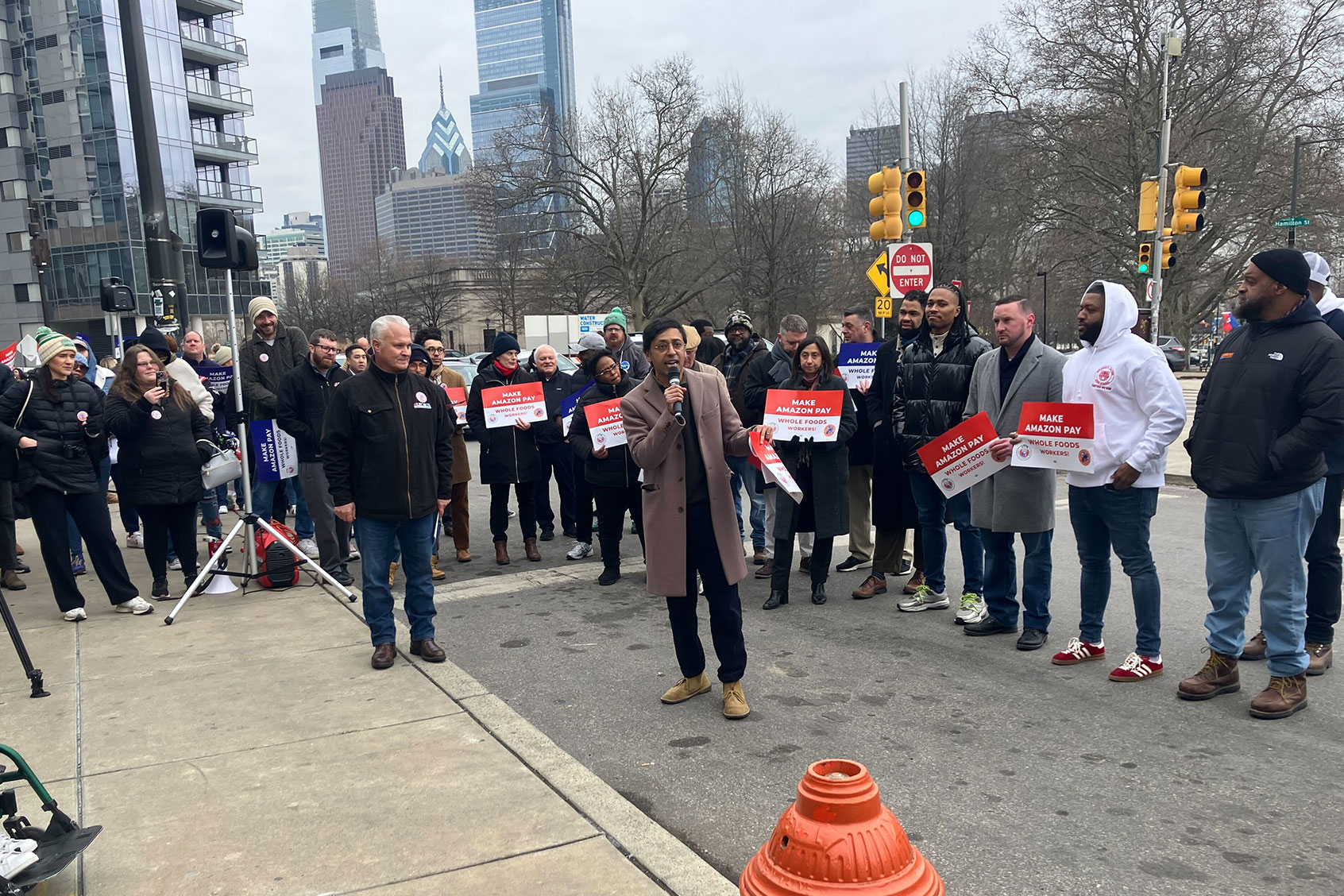
In reference to passing the Paris threshold, on Monday the activist group Just Stop Oil painted on Charles Darwin’s grave in Westminster Abbey “1.5 is dead.” Just Stop Oil explained in a statement that “we have passed the 1.5 degree threshold that was supposed to keep us safe. Millions are being displaced, California is on fire and we have lost three quarters of all wildlife since the 1970’s.”

“What's really going on,” Just Stop Oil co-founder Roger Hallam told Salon in October “is the extraction of resources by the global elites, and the global elites are involved in a universal suicide project for humankind. We don't need to talk about the climate, we don't need to talk about change. What we need to talk about is power and criminality and evil. What we're talking about is a death project, and that's what we should call it.”

People are fleeing abortion bans states: report

A new analysis has found tens of thousands of people, likely young folks, who live in states with strict abortion bans, are fleeing. The working paper, which is not yet peer-reviewed, was published by the nonprofit National Bureau of Economic Research. It found that since the Supreme Court overturned Roe v. Wade via the Dobbs decision in June 2022, states with near-total abortion bans have lost more than 36,000 people per quarter. People who lived in single-person households were more likely to move out of the abortion-ban states. The researchers looked at change-of-address data from the U.S. Postal Service. 

“The effects are more prominent for single-person households than for family households, which may reflect larger effects on younger adults,” the researchers wrote. The researchers said they also found “suggestive evidence” of people leaving states that were “hostile” towards abortion in other ways. 

Since Dobbs, which gave states the right to ban abortion, many states have gone above and beyond to further clamp down on access to abortion care. According to KFF’s dashboard, 12 states have completely banned abortions. Six states restrict abortion access between 6 and 12 weeks of gestation. Four restrict access between 18 and 22 weeks. In contrast, 14 states have enshrined reproductive rights, including abortion access, into their state constitutions.

The new research suggests that these states will face long-term economic consequences as a result of their hostile attitude toward abortion. 

"Over a 5-year period if these numbers are sustained it would be roughly equivalent to a loss of almost 1 percent of their population compared to if no ban was implemented in their state and they protected abortion instead," Daniel Dench, one of the researchers, told Salon via email.

Dench emphasized that their analysis method accounted for "any differences in underlying migration trends present before the abortion bans occur."

"As a result, we can say that these are causal estimated effects of abortion bans on net out-migration (those leaving minus those entering)," he said. Notably, there were no details about demographics such as race, gender and marital status. "There are still many unanswered questions about how the bans are affecting business formation, employment, and wages."

10 grim revelations from the shocking Neil Gaiman sexual abuse allegations exposé

Neil Gaiman is arguably one of the most popular writers of the 21st century.

The prolific author has created the mystical worlds of "The Sandman," "Good Omens," "Anansi Boys," "American Gods" and "Coraline." Not only have these works existed on the page but they've been adapted for the screen too, bringing Gaiman's most popular works to people all over the world on platforms like Netflix and Prime Video.

But Gaiman's legacy has been called into question since allegations of sexual assault have been leveled against him. In an exposé by Lila Shapiro for New York Magazine, new and old allegations of pervasive sexual abuse are shared by numerous women. Shapiro's reporting follows the news that broke from Tortoise Media last summer that Gaiman had been accused of sexual assault by numerous women. Their six-part podcast called "Master: the allegations against Neil Gaiman" detailed those allegations from five women. Now, those women have come forward to speak on the record at length, sharing the fullest extent of their experiences with Gaiman, who maintains his innocence. 

In the lengthy exposé, those women exposed alleged abuse from Gaiman which usually started as innocent interactions with his fans and employees. Here are some of the most shocking claims:

01
Gaiman allegedly got into a bathtub with a young nanny and then sexually assaulted her
A 22-year-old New Zealander, Scarlett Pavlovich, was invited by Gaiman's wife and musician, Amanda Palmer, to stay on the couple's estate on Waiheke Island as a nanny. When Palmer wasn't around, Gaiman invited Pavlovich to a bath which she was allegedly pressured into. She recalled him asking, "Why don’t you have a bath in the beautiful claw bathtub in the garden? It’s absolutely enchanting." In her account, Gaiman said he needed to make a work call and Pavlovich didn't want to be bored while she waited for pickup time for Gaiman's child.
 
Moments after she began her bath, Gaiman allegedly showed up naked and got into the tub. Gaiman is then said to have made small talk with Pavlovich before telling her to stretch her legs out and “get comfortable.”
 
She said to New York Magazine that she told him she felt uncomfortable with her body but he responded "It’s okay — it’s only me. Just relax. Just have a chat. Don’t ruin the moment."
 
She recalled at that point she felt “a subtle terror.” Pavlovich then claimed that Gaiman sexually assaulted her after she repeatedly rejected his advances. He allegedly told her, "Amanda told me I couldn’t have you" and that when his wife set that boundary, he "knew he had to have her."
02
Gaiman's nanny was suspicious of him, Googling past allegations
After the alleged incident with Gaiman, Pavlovich said she sat in the shower for an hour and cried. While she was in bed, she began to search the internet for any clues that may illuminate Gaiman's behavior. She said she Googled “Me Too” and “Neil Gaiman" but nothing came up. The only disparaging stories about the writer were on how he broke COVID lockdown rules in 2020.
03
There are similarities between Gaiman and his "Sandman" character Madoc
Since the reporting of sexual assault allegations against Gaiman in 2024, people have drawn parallels between the writer and one of his characters. One of Gaiman's most popular works, "The Sandman," focuses on a writer named Richard Madoc. Madoc struggles to find inspiration after the success of his first book — that is until he is given a gift from another author: a woman who has been locked away for 60 years. In "The Sandman," Madoc rapes the woman, Calliope, one of the Nine Muses, until his career thrives yet again. 
 
At a certain point, Madoc even calls himself "a feminist writer" just like Gaiman. The character and his author have both also won a litany of major awards for their literary works. Gaiman is also a well-respected figure in the literary world, jumping from numerous genres like comics to fantasy and even children's books, similar to Madoc.
04
Gaiman allegedly wanted women to call him "master"
 
In his affairs with women, Gaiman is said to have had a specific request. After winning the top prize for his novel "American Gods" at the World Horror Convention, Gaiman allegedly slept with a woman named Brenda.
 
She recalled as they were hooking up that “he seemed to have a script."
 
She further explained, “He wanted me to call him ‘master’ immediately.” He also demanded that she promise him her soul. “It was like he’d gone into this ritual that had nothing to do with me.”
05
Most of the allegations leveled against Gaiman are from women who were in their 20s
In the New York Magazine investigation, Shapiro talked to many women who alleged sexual misconduct allegations against Gaiman. 
 
Shapiro found that most of the women were in their 20s when they met Gaiman. "The youngest was 18. Two of them worked for him. Five were his fans," Shapiro wrote. But one exception was alleged forcible kissing when Gaiman was in his 20s. Most of the claims are from when Gaiman was in his 40s in various countries like the U.S., the U.K. and New Zealand.
06
Gaiman allegedly paid a woman $60,000 for therapy
Katherine Kendall was 22 when she met Gaiman. After volunteering for one of his events in 2012, the pair allegedly kissed and had a flirty, email and Skype correspondence.  
 
Months later at a reading, Gaiman is said to have suggested that Kendall and two other girls wait for him on his tour bus. From here, Gaiman reportedly said to Kendall, "Kiss me." But Kendall said she was panicked. When Gaiman rolled off of her, Kendall recalled him saying, "I’m a very wealthy man and I’m used to getting what I want."
 
In a recorded phone call, Gaiman gave Kendall $60,000 to pay for therapy in an attempt “to make up some of the damage.”
07
Gaiman is allegedly interested in BDSM
 
Another accuser, Kendra Stout, met Gaiman when she was 18 and alleges that they would also correspond through email and eventually through video calls. Years after their initial meeting, she says that Gaiman flew her out for a date in Orlando.
 
Back in his hotel room, Gaiman allegedly shared his sexual kinks with Stout. She recalled, “He talked at length about the dominant and submissive relationship he wanted out of me." Stout said she was not interested in BDSM and Gaiman never asked what she liked in bed. She stated that there were never any "safe words" or "limits" and he asked her to call him "master" even though she didn't like it.
 
According to the podcast "Master," Gaiman's position was “sexual degradation, bondage, domination, sadism, and masochism may not be to everyone’s taste, but between consenting adults, BDSM is lawful.” 
 
The writer also declined Shapiro's request to speak on the record but through an attorney, he responded to some claims. 
08
Gaiman and his second wife, Amanda Palmer, were allegedly open about their affairs
 
During the early parts of the pair's marriage, Gaiman and Palmer allegedly encouraged each other to have affairs. Shapiro interviewed five of Palmer's friends who said the couple really upheld honesty in their relationship. Shapiro wrote, "They found that sharing the details of their extramarital dalliances — and sometimes sharing the same partners — brought them closer together."
 
In 2012, Palmer allegedly met a 20-year-old fan at a concert, who she would reportedly later have a sexual relationship with. This led to Palmer allegedly taking naked photos of the fan and sending the photos to Gaiman. Later, Palmer is said to have introduced this fan to her husband. The fan says she then began correspondence with Gaiman and that he flew her out to his home in Wisconsin. 
 
The fan said there wasn't a “blatant rupture of consent” with Gaiman but that he pressed her to do sexual things that hurt and scared her. She said she feels Palmer gave her to him “like a toy.”

We need your help to stay independent

09
Gaiman's nanny was called a slave by Gaiman's son
After a week with the Gaiman family, Pavlovich shared that Palmer and Gaiman's son had begun to address her as a "slave" and ordered Pavlovich to call him “master.”
 
Shapiro wrote that "Gaiman seemed to find it amusing. Sometimes he’d say to his child, in an affable tone, 'Now, now, Scarlett’s not a slave. No, you mustn’t.'"
10
Pavlovich filed a police report accusing Gaiman of sexual assault
 
In 2023, Pavlovich filed sexual assault claims against Gaiman. Police told Pavlovich that they would need Palmer’s cooperation for the case to move forward against Gaiman.
 
Pavlovich told Shapiro, “I said to them, ‘She’s a public feminist, and she knows what happened. She’ll want to protect me. I’m sure she’ll speak.’”
 
However, when the police contacted Palmer, she declined to talk to them. Gaiman also did not speak with the police, but he provided a written statement. According to New Zealand officials, the "matter has been closed."
 
Meanwhile, Palmer and Gaiman are in the fifth year of a contentious divorce and custody battle. Since the sexual assault allegations, some of Gaiman's projects have been paused or canceled. "Good Omens," which was renewed for the third and final season, will end with a 90-minute episode. "The Graveyard Book" has been paused by Disney and "Dead Boy Detectives" has been canceled by Netflix even though the second season of "The Sandman" is set to premiere on the streamer this year. However, "Anansi Boys" is coming to Prime Video soon.

Jack Smith report into Trump and election subversion to be released after Judge Cannon’s ruling

U.S. District Judge Aileen Cannon, a Donald Trump appointee who shut down a case into his retainment of classified documents, is giving up on blocking former special counsel Jack Smith’s report into Trump’s efforts to subvert the 2020 election on Jan. 6.

In a Monday ruling, Cannon rejected a bid from Trump employees and former codefendants Walt Nauta and Carlos de Oliveira to block the Jan. 6 report, effectively echoing a higher court ruling on Friday allowing its release once an injunction expires on Tuesday.

Attorneys for Nauta and de Oliveira may still appeal their battle to block the release to the Supreme Court, but as it stands, the report may finally see the light of day.

The report, which Smith and Attorney General Merrick Garland say is finished after the office ended its prosecution of Trump, is expected to lay out a case against the president-elect. Prosecutors in Arizona have already requested the findings, claiming Smith’s investigation could advance their own against eleven “fake electors” who conspired to overturn state results.

Cannon initially blocked both reports but conceded on Monday that “nothing in Volume One [the Jan. 6 portion] of the Final Report…directly or indirectly refers, relies, or bears in any respect upon any evidence or argument relevant to any of the charges alleged against Defendants Nauta and De Oliveira.”

As for Smith’s second report on Trump, detailing Trump’s alleged attempts to hoard classified documents after his presidency inside his Florida home, Cannon set a hearing on blocking its release on Friday afternoon, just four days before Trump is set to take office and likely shut down the reports.

Legal experts say Cannon didn’t have jurisdiction over the Jan 6 report anyway – or potentially even the classified documents report – but Monday’s ruling makes it easier for Garland to navigate the challenges to releasing the report on Trump’s election overturn attempts.

Fiber may help protect your gut from overgrowth of harmful bugs, as per new study

Our body isn't just human — it's home to trillions of microorganisms found in or on us. In fact, there are more microbes in our gut than there are stars in the Milky Way. These microbes are essential for human health, but scientists are still figuring out exactly what they do and how they help.

In a new study, published in Nature Microbiology, my colleagues and I explored how certain gut bacteria can protect us from harmful ones – a group known as Enterobacteriaceae. These bacteria include species such as Escherichia coli (E coli). This is normally harmless in small amounts but can cause infections and other health problems if it grows too much.

We found that our gut environment — shaped by things like diet — plays a big role in keeping potentially harmful bacteria in check.

To reach this conclusion, we analyzed over 12,000 stool samples from people in 45 countries. Using DNA sequencing technologies, we were able to identify and quantify the microbes detected in each sample. We found that the gut microbiome composition of people with Enterobacteriaceae was fundamentally different from those without.

By analyzing these microbes and their genes, we could accurately predict (about 80% of the time) whether someone had Enterobacteriaceae in their gut. This showed us that the types of bacteria in our gut are closely tied to whether harmful species can take over.

Digging further we discovered two groups of bacteria: those that thrived alongside Enterobacteriaceae (so-called "co-colonizers") and those that were rarely found together ("co-excluders").

One type of co-excluder bacteria, called Faecalibacterium, stood out as particularly important. It produces chemicals called short-chain fatty acids by breaking down a variety of fibers in our diet. This in turn can stop harmful bacteria like Enterobacteriaceae from growing.

The presence of these fatty acids was one of the strongest signals we observed between co-excluders and co-colonizers. They have also been previously implicated in a wide range of health benefits, such as reduced inflammation and improved gut function.

Another intriguing observation from our study was that co-colonizers (bacteria that live alongside Enterobacteriaceae) were more adaptable. They had diverse abilities to break down different nutrients and were able to survive in environments that also suit Enterobacteriaceae.

This was especially surprising as previous studies in mice have argued that bacteria that eat the same types of foods and nutrients would have a hard time living together in the gut. This again pointed to the fact that the gut environmental conditions (nutrients, pH, oxygen level) are the main factors that determine whether a person is going to be colonized or not by Enterobacteriaceae in their gut.

More effective than probiotics

Our findings could lead to new ways to prevent and treat infections without antibiotics. For example, instead of killing harmful bacteria directly (which can also harm good bacteria), we could boost the co-excluders or create diets that support their growth.

This strategy may be more effective than taking probiotics directly, as new bacteria added to the intestinal tract have been previously shown to only live for a limited period in the gut. We could also target specific pathways that harmful bacteria use to survive, making them less of a threat.

While our research provides new and important insights, there's still a lot to learn. Many regions, including parts of South America and Africa, are underrepresented in microbiome studies. This limits our understanding of how gut bacteria vary across different populations.

Also, while our study highlights important patterns and interactions, we don't yet fully understand the causes and mechanisms behind these relationships.

Future research will integrate additional tools, such as metabolomics (studying chemicals microbes produce) and transcriptomics (studying how genes are activated), to create a clearer picture of how the gut ecosystem works for our health benefit.

In addition, the next steps should focus on designing studies to test whether specific types of diets (for instance, high fiber v low fiber) affect the incidence of potentially harmful bacteria and other diseases in the long term. By better understanding how microbes interact and communicate in our gut, we can develop more precise, non-antibiotic therapies to protect against infections in the future.

Alexandre Almeida, Principal Investigator, University of Cambridge

This article is republished from The Conversation under a Creative Commons license. Read the original article.

Workers say Amazon is now deploying its union-busting “science” at Whole Foods

PHILADELPHIA — At Whole Foods’ flagship location in the city of brotherly love, management tried to lure workers away from a union rally on Monday by offering up no-cost hoagies and bags of chips. Just outside, however, their colleagues — joined by about a dozen elected officials — warned that there is no such thing as a free lunch.

“We work here and can’t even shop here,” Mase Veney, a Whole Foods employee, said just steps from his employer’s front door. Flanked by legislators and organizers with United Food and Commercial Workers Local 1776, including dozens of rank-and-file members marching up and down the sidewalk, Veney and other workers argued that parent company Amazon — which reported a net income of $15.3 billion in its last reported quarter, up more than 50% from the year before — can afford more than just the occasional treats.

Last November, a majority of workers at this sprawling Whole Foods location, as much an Amazon delivery hub as a grocery store, expressed interest in forming a union. An election is now scheduled to take place on Jan. 27. If the UFCW campaign is successful, it will be the first Whole Foods in the country where employees will be represented by a union.

Amazon, which acquired Whole Foods Market in 2017 for about $13.7 billion, is not relying on carrots (or other treats) alone. Pro-union workers — motivated in part by a desire to push back against Amazon’s imposition of warehouse-style metrics — said they have faced intimidation tactics since going public with their organizing drive, the company having multiple sticks at its disposal.

Leeya Girmay said she can’t pay her bills with free snacks. She and other workers were recently denied a raise that Whole Foods had offered to staff at other regional locations — federal labor law allows Amazon to do so, in part to avoid the appearance of influencing an upcoming election — and the company, she said, has not been subtle about what it wants to happen later this month.

“Let me tell you, Amazon has this union-busting process down to a science,” Girmay said. There’s the “free food and fake smiles,” she said, but it’s paired with an air of menace: “They’re posting anti-union propaganda on every inch of wall space in the store backroom; they replaced all our store leadership and team leads with Whole Foods union-busting pros; [and] are using strangers to monitor us and incite fear.”

Nikil Saval addresses Whole Foods workersState Sen. Nikil Saval addresses workers at a Whole Foods in Philadelphia, Pennsylvania. (Photo by Charles Davis)The anti-union campaign has included team meetings at work and even text messages received after hours, Girmay said, speaking as members of Whole Foods’ security team ― their faces concealed by balaclavas — guarded the store’s entryway.

Other workers said that some of their pro-union colleagues have been terminated in recent weeks, seemingly in retaliation for their outspokenness. One employee, offering only her first name, Piper, said she had worked at the location for three years and seen it become progressively worse, from a workers’ rights perspective. That, she said, has brought workers together.

We need your help to stay independent

“I’ve seen that my struggles are not just mine alone,” she said. “[There are] countless stories of unfair treatment, unrealistic expectations and pushing us harder and harder every day,” she continued, urging her fellow workers to be skeptical of any kindness ― including strategically deployed junk food — the company offers between now and election day.

“I encourage workers to ask themselves, ‘Why is leadership so friendly, out of nowhere?’” she said, and to remember that snacks cannot make up for a lack of living wages and adequate health care. “It’s insulting to think that this is what we want,” she said. “We want a union.”

Whole Foods, asked for comment, pointed to a statement that it previously provided to Salon when the union campaign was first made public, asserting that the grocer is “committed to listening to our Team Members, making changes based on their feedback, and treating all our Team Members fairly in a safe, inclusive working environment.”

Philadelphia elected officials appear united in skepticism, the broad coalition that came out in support of Whole Foods workers on Monday a testament to the power of organized labor in the city: among the dozen or so politicians in attendance were progressives, like Councilmember Jamie Gauthier and state Rep. Malcolm Kenyatta, as well as state Rep. Amen Brown, a conservative-leaning Democrat who has raised tens of thousands of dollars from groups linked to Jeffrey Yass, a Republican mega-donor and ally of President-elect Donald Trump.

State Sen. Nikil Saval, representing the left flank of the Democratic Party, urged workers to stay strong in the face of management’s intimidation, portraying the fight as part of a large battle for democracy in the workplace and indeed the country as a whole.

“It is the fundamental cornerstone of our democracy, and I’m so grateful to you for fighting for that,” Saval said. “They’re going to take you into rooms and try to tell you that this isn’t worth it; that this is hurting things … And do you what that is? That is bulls**t, right? Total bulls**t.”