Ryan Brown
The pill without a prescription?
One expert says birth control should be offered over the counter, but in the meantime, we've got other options
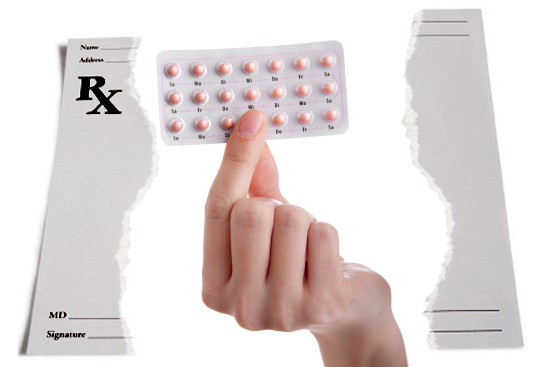
Female hand holding contraceptives against a white background I come from a generation of pill poppers. We take them at work, at school, on trains, in public bathrooms, before we go to sleep or with breakfast, under the eyes of parents, friends, significant others. For many young women like me, the birth control pill is so ubiquitous that it neither induces shame nor carries any shock value. And yet, access to the pill remains uneven, and some 3.1 million pregnancies in the United States each year are unintended. In a thoughtful New York Times Op-Ed, Kelly Blanchard, president of the nonprofit Ibis Reproductive Health, proposes a novel solution: make the pill available over the counter.
To anyone who has ever missed a pill because she couldn’t get to the pharmacy in time, or for women whose access to a doctor is sporadic or nonexistent, this is exactly the kind of holy-shit-why-did-no-one-think-of-this-before idea that we’ve been waiting for. As Blanchard points out, 50 years of use has proved that hormonal birth control meets the standards for OTC distribution: you don’t really require a doctor’s expertise to tell you if you need the pill (are you sexually active? Do you not want a baby? Check, check), you can’t become addicted, the side effects are mild and even the most severe are less dangerous than those of some medications already available over the counter.
But as Blanchard notes, selling the pill over the counter would probably drive up the price, throwing up another barrier to poor women who already struggle to afford birth control. She argues that Medicaid should pledge to cover the pill over the counter — a solution that is important but sadly distant.
If the FDA does approve the pill for over-the-counter use, it will probably take years, and as we wrote earlier, debates over the pill’s safety – and its morality – will likely stalk the race all the way to the finish line. In the meantime, though, American women do have another, oft-ignored option at their disposal, a birth control option that’s less expensive, safer and more effective than the pill: the intrauterine device.
The IUD, essentially a small metal rod inserted into the uterus to prevent sperm from fertilizing an egg, is the wunderkind of the birth control world. A woman need visit a doctor only once in the process — to have the device inserted — and protection can last up to 12 years. Because there’s no upkeep or chance of missed dosages, IUDs rank with sterilization and vasectomies (oh yeah, and that old standby, abstinence) as the most effective forms of birth control. Plus, they’re covered by Medicaid in several states and many family planning clinics will foot the $500 bill for low-income patients (although even if they don’t, 12 years of protection for that price comes out to about $3.50 a month).
IUDs have gotten a bad rap in America, where they’re often still associated with an older model called the Dalkon Shield, which was yanked from U.S. markets in 1976 after it caused uterine infections and sterility in thousands of women and killed dozens. Today’s models carry no such risk, and indeed are used by 85 million women worldwide, but in the U.S. we remain haunted by the ghosts of IUDs past — only 2 percent of women practicing contraception in this country use one.
That’s incredibly unfortunate, especially given the hurdles women currently have to clear to get access to the pill. If birth control is still the priority we’ve claimed it was for the last 50 years, we should be pushing IUDs — or at least disseminating the information to let women know what else is out there. The next birth control revolution will be one not only of access, but of options — over and behind the counter, hormonal and non-hormonal, swallowed, inserted, injected, imbibed. Give women choices; they can take it from there.
The politics of the World Cup
Why'd Glenn Beck hate soccer even before the U.S. got robbed of a win? An expert explains the game's hidden message
The US team celebrates after scoring during a 2010 World Cup match against England Soccer is a simple game: Twenty-two men kick a ball around for 90 minutes, and the referee always wins. When Malian referee Koman Coulibaly erroneously pulled back a soaring 86th minute goal by American striker Maurice Edu in today’s U.S.-Slovenia match, the move drew instantaneous ire from the supposedly sleepy soccer backwaters of the United States. In a second, a nail-biting comeback from a 2-0 deficit to a 3-2 victory was reduced to the bland territory of a 2-2 tie. But the World Cup, like many things in life, has a curious habit of completely ignoring the laws of fairness. Sometimes a bumbled call, a lucky goal or a tiny blunder is all it takes to change the direction of a game — and reroute the hopes of an entire nation.
Continue Reading CloseRemember the Women’s World Cup?
Buzz around the U.S. men's team brings to mind the female players who showed us in '99 what women's sports could be
United States midfielder Brandi Chastain celebrates her winning penalty kick to defeat China 5-4 at the Women's World Cup soccer final between the two countries July 10 at the Rose Bowl. The United States women's national soccer team were named Sportswomen of the Year (1999) by Sports Illustrated magazine.
FP/FMS/AA(Credit: © Reuters Photographer / Reuters) If you’ve been casually following the current World Cup from the U.S., chances are you’ve heard a lot about two things: Shakira’s soul-crushing tournament anthem, “Waka Waka,” and the U.S.-England showdown this past weekend. If American commentators are to be believed, that game — much like the Shakira song, I hope — is the kind of thing that happens only once in a generation. The Wall Street Journal’s Matthew Kaminski went so far as to declare that the face-off was “the most anticipated soccer match in American history.”
Continue Reading CloseFDA: New “morning-after pill” is safe
Despite evidence that ellaOne is effective, it faces major challenges before being stocked in pharmacies
Last week we reported on a new, more effective emergency birth control option making its way toward U.S. pharmacies. This morning, the Food and Drug Administration took another step forward when they released a set of documents showing that the morning-after pill ulipristal acetate—which moonlights under the name “ellaOne” in Europe—consistently prevents pregnancy without unexpected side effects.
Continue Reading CloseThe political zoo
Slide show: The most awkward encounters between politicians and the animal kingdom
It was supposed to be a run-of-the-mill press conference on the wasteful subsidies of mohair goat farms, but events took a grisly turn Thursday as Rep. Anthony Weiner was nicked in the finger by one of the goats he had brought to Washington for the event. “I got a little bit too comfortable,” Weiner told the New York Daily News of his encounter with Lancelot the goat. “The damn thing slipped out of neutral at the worst time.”
Continue Reading ClosePage 4 of 4 in Ryan Brown