Spring Sale: Get 1 Year, Save 58%

Celebrity buddy breakups are a lot like ours

Her romances may have been overanalyzed to death, but the very public, one might even say performative nature of Taylor Swift's relationship with her girl squad has long provided ample fascination for the gossip press and an unnerving amount of creative fodder for her lyrics. But lately, the once-tight bond between the Grammy winner and bestie Blake Lively appears to be cracking under the weight of the "It Ends With Us" debacle. And while the problems of blonde millionaire celebrities may seem a world away from the personality dramas going on within your own group chat right now, the fraught dynamics of female friendship — and the most effective methods of working through them — share a substantial amount of DNA. I've studied conflict resolution and survived enough of my own breakups to know that navigating the terrain when friends fall out is one of the hardest negotiations in life.

When, for whatever reason, close friends experience a rupture, there are a few different paths for reconciling. If the friends are in communication and willing, they could, for example, seek an interest-based approach. In this process, parties focus on the problem and what their proposed solutions are, over personalities. This type of negotiation can be effective during a classic friendship pain point when, formerly in sync, friends find their personal and professional paths diverging, leading to feelings of neglect. One person may, for example, be focusing on buying back the master recordings of her first six albums, while the other is enmeshed in rearing her four children with Deadpool.  

One person may be focusing on buying back the master recordings of her first six albums, while the other is enmeshed in rearing her four children with Deadpool.

Swift and Lively have been friends for a decade, long enough to have shared and outlasted the iconic Rhode Island Hiddleswift era. The two have cheered each other on via their social media accounts, and strategically pap walked through multiple girls' nights out. Swift has been a godmother to Lively's three daughters, James, Inez and Betty, and used their names as inspiration for the love triangle narrative of "Folklore." But now, Swift remains at the top of her game. Lively, on the other hand, is still struggling under the reputational damage of the "It Ends With Us" fiasco, while her "Another Simple Favor" film has earned only a lukewarm response. 

In an interest-based negotiation, friends might acknowledge that their positions involve different priorities and time constraints, but they share a mutual interest in nurturing the relationship. They might then set compromises like doing some activities with the kids and some away from the family.

Blake Lively and Taylor Swift hanging out in NYC, 2023. (Gotham/GC Images/Getty Images)

Or maybe a friendship falters because one person is mired in a bitter conflict and expects a show of support, while the other doesn't want to be put in the middle of it.

This past winter, "It Ends With Us" director and costar Justin Baldoni's team released a purported text from Lively in which she appeared to be flexing her powerful connections. "If you ever get around to watching 'Game of Thrones,' you’ll appreciate that I’m Khaleesi, and like her, I happen to have a few dragons," it floridly read. "My dragons also protect those I fight for. So really, we all benefit from those gorgeous monsters of mine. You will too, I can promise you." 


Start your day with essential news from Salon. Sign up for our free morning newsletter, Crash Course.


Then in a May court filing, Baldoni's attorneys alleged that Lively had asked Swift to delete text messages between them, and that her attorney “demanded that Ms. Swift release a statement of support for Ms. Lively, intimating that, if Ms. Swift refused to do so, private text messages of a personal nature in Ms. Lively’s possession would be released." (Lively's camp swiftly and firmly denied the accusation.) Baldoni's team also briefly subpoenaed Swift, whose song "My Tears Ricochet" appears on the "It Ends With Us" soundtrack, though the subpoena was withdrawn earlier this month. It's difficult to parse out what, if any, part of Baldoni's allegations are true, but it would seem that Lively has been instrumental in dragging Swift into her fight. And Swift, with her lengthy track record of queen bee energy, can't be pleased with the implication that she's just the Drogon to someone else's Daenerys.

If you've ever experienced the phenomenon of one friend going through a crisis while the other doesn't want to get involved, you know how awkward it can become and how personal everything feels.

The alleged cooling between the women has not reached the point of thinly veiled song lyrics, though a source "close" to Swift told People recently that "their friendship has halted" because "Taylor wants no part in this drama." While the private interactions between the two women can't be known, Swift's presence in the dispute has gone conspicuously unremarked on by the singer. In all the lawsuits and countersuits, even as Lively's fellow sisters of the traveling pants have voiced their support for her, Swift has excluded herself from this narrative, apparently preferring the company of other members of her squad. The two once inseparable pals have not been seen together in months.

In a dispute like this, where there are other parties involved and sides taken, feelings inevitably run deep. If you've ever experienced the phenomenon of one friend going through a crisis while the other doesn't want to get involved, you know how awkward it can become and how personal everything feels. A transformative negotiation approach could work well in such a scenario. In this model, the objective isn't coercion; it's recognizing, as one of my professors once put it, our need for autonomy as well as connection. It's healthy boundary setting.

We need your help to stay independent

Two friends, for example, could talk about how the outside problem is affecting their relationship with each other and then set parameters around the external disagreement. Perhaps they'd decide to limit their conversations around the topic, or one person might offer to listen when the other needs to vent, but remain neutral within the larger friend group. The key is acknowledging the value of the relationship, even when expectations of what the parties involved should ask of each other differ.

The hardest, weirdest, most confusing and dramatic relationships of a woman's life are with her female friends. From their earliest shared Lunchables through debauched bachelorette parties right up to the Golden Girls years, women bond with intensity. And when they fall out, they fall out just as hard, sometimes for good. Of course, not everyone who comes into our lives is meant to stay there forever. Some friendships, even long-term and close ones, end just as surely as some marriages do. And while moving on is healthy, breakups are rough, especially when there are extended families, wider friend groups and professional networks affected in the fallout. I feel most for Lively's daughters in all of this, caught in the tumult of grown-up friction. But then, they're girls. They no doubt already know that sometimes friends work it out, and sometimes they're never ever getting back together.

“He should be deported”: Bannon warns Trump to “get ahead” of Elon before he can “steal” 2028 race

Former White House aide Steve Bannon is proposing a dramatic escalation in the intra-MAGA feud that burst into public view on Thursday. Bannon, still a close ally and informal adviser to President Donald Trump, called on the president to kick his adviser-turned-rival Elon Musk out of the country.

“They should initiate a formal investigation of his immigration status, because I am of the strong belief that he is an illegal alien, and he should be deported from the country immediately,” Bannon told the New York Times on Thursday. Bannon also told the Times that the Trump administration should suspend Musk’s security clearance, pending an investigation into the Tesla CEO’s alleged heavy drug use and his reported effort to obtain a classified China briefing from the Pentagon. 

Speaking on his War Room podcast on Thursday, Bannon elaborated that Trump had to “get ahead” of Musk, because otherwise the billionaire would work with Democrats to impeach the president, “steal” the 2028 election from him and put him in prison. Bannon has often made the case that Trump should and will run for an unconstitutional third term in office. 

“As sure as the turning of the Earth, if those progressives rub up on him and say, ‘Hey, they’re never going to buy the Teslas’ – they rub up on him, he’ll write a $500 million check for Hakeem Jeffries,” Bannon said on War Room.  

Bannon also suggested that the federal government should temporarily seize Musk’s businesses. 

Bannon has long-running animosity toward Musk. In a February interview, he called the South African tech mogul a “parasitic illegal immigrant.” 

Watch Bannon’s remarks here: 

“Bad trips” can have surprising benefits

Ciddy was anticipating a fun trip when he took LSD by himself. He had tried it before and had a transformational experience in which he felt his body ascend above the Earth’s atmosphere and witness the formation of a new universe over the course of what felt like thousands of years.

Except, this time, the psychedelics subverted his expectations and instead presented him with a distressing memory he had repressed for years: In high school, he had felt so hopeless about the state of the world and his place in it that he had tried to kill himself.

“At first, my mind tried to push back and avoid words like ‘suicide,’” Ciddy, who is using a pseudonym to protect his privacy, told Salon in a phone interview. However, he said he was grateful at the time to be able to recognize he was avoiding the topic and accept that in order to “confront the reality that was being presented.”

Psychedelics like LSD or psilocybin “magic mushrooms” have been shown to be very safe and effective in treating many conditions like depression. However, they can carry some risk: Certain people with a genetic predisposition to psychosis can increase the risk of that happening during a psychedelic trip, and a small percentage of people using psychedelics may be affected by hallucinogen persisting perception disorder, in which hallucinations not related to psychosis continue long after the trip.

These substances can also sometimes produce challenging experiences, sometimes referred to as a “bad trip,” which are relatively understudied and can lead to significant psychological distress, said Dr. David S. Mathai, a psychiatrist at Baylor College of Medicine.

“The early quantitative, industry-focused research is really studying these more as medicines that alleviate symptoms without considering some of the challenging experiences like ontological shock, shame or these different evaluations of self that become activated,” Mathai told Salon in a phone interview. “I think these need to be a part of how we think about the safety profile of psychedelics, and I don’t think they are to be taken lightly.”

“The kind of growth that people ultimately find can be beneficial … It is very much akin to a kind of post-traumatic growth.”

It’s estimated that about 10% of users will at some point in their psychedelic career report a challenging psychedelic experience, which can affect them for weeks, months or even years afterward. These experiences may involve frightening and anxiety-ridden experiences like hallucinations, or things like the dissolution of the ego, which can be disorienting and lead to a feeling of dissociation with oneself.

“Ontological shock and existential crisis is one of the most prevalent symptoms and the most long-lasting,” said Dr. Dave Luke, a psychology professor at the University of Greenwich who works with the Challenging Psychedelic Experiences Project. “One of the biggest challenges we see is that the experience is so mind-blowing and metaphysically challenging to [people’s] prior world view that it really destabilizes them for quite a long time.”

Although these experiences can lead to significant psychological distress, there are ways to minimize their effects. In many cases, people actually report that a so-called “bad trip,” ended up being beneficial for their healing, said Eirini Argyri, a PhD candidate at the University of Exeter who also works with the Challenging Psychedelic Experiences Project.

Sometimes people experience anxiety, panic and feeling disconnected from their sense of self, but what makes it a “bad trip” depends on the individual’s resources, support and integration of the experience, Argyri said.

“It can be that a bad trip is even considered traumatic but then the person finds that after months or even years, sometimes they manage to find some meaning and from going through these challenges, they transform the bad trip into a learning experience,” Argyri told Salon in a video call.


Want more health and science stories in your inbox? Subscribe to Salon’s weekly newsletter Lab Notes.


These challenging experiences are more common when taking psychedelics alone or with friends, but challenging psychedelic experiences have also been reported in the clinically recommended setting with a psychiatrist present. In one study published in May, the most bad trips occurred with psilocybin and ayahuasca, although these substances are more commonly studied overall.

Still, substances that are smoked like 5-MeO-DMT (also known as toad venom) or salvia may also lead to a challenging experience because their effects happen so rapidly and feel overwhelming, said Dr. Andrea Jungaberle, a psychotherapist, anesthesiologist and emergency medicine physician at the OVID Clinic in Germany and co-founder of the MIND Foundation, an European non-profit promoting psychedelic research. On the other hand, these experiences are also shorter in length than something like LSD, which can last 12 hours or more. This could present different challenges due to how long the trip is, she explained.

In a 2016 study from John Hopkins University of about 2,000 people who reported a past negative experience when taking magic mushrooms, more than 10% said their worst “bad trip” had put themselves or others in harm’s way. The majority of participants also said the experience was one of the top 10 biggest challenges of their lives. Yet the majority also said those experiences were meaningful and worthwhile, with half of the people who said it was ultimately positive saying it was the single most valuable experience in their life.

Last month, Argyri co-authored a qualitative study of people who had gone through challenging experiences found some people gained more compassion for others in the process and wanted to give back after their experience.

“Whatever bubbles up will bubble up, and if difficult things need to be processed, I think the surest way into a difficult experience is avoidance.”

Still, these experiences can be traumatizing or retraumatizing. In the qualitative study, more than half of the 26 participants either explicitly reported their experience as traumatic or described experiencing symptoms of post-traumatic stress disorder. Though it’s not always the case, this can lead to suffering that can ultimately resolve in growth, Argyri said.

“The kind of growth that people ultimately find can be beneficial,” she said. “It is very much akin to a kind of post-traumatic growth.”

In another 2022 study of about 600 people who had experienced a challenging psychedelic experience, problems persisted for over a year. And in some cases, people can react to these experiences in a similar way as they do to a traumatic event, with flashbacks, intrusive thoughts and emotional instability, Jungaberle said.

“People can perceive this as damaging, especially if it happens in a context where they didn’t expect anything like that to happen,” Jungaberle told Salon in a video call.

However, in the 2022 study, these difficulties lasted a shorter time if participants reported being more aware of the dose of the psychedelics they were taking, and fewer difficulties were reported among people who took them under a guided setting.

Sometimes repressed memories can return during a psychedelic experience, and this can be overwhelming, Jungaberle said. However, resisting anxieties or difficult experiences can make the experience more distressing than letting them come up and observing them without judgment, she explained.

“I sometimes liken it to the experience of watching a muddy puddle,” Jungaberle told Salon in a video call. “Whatever bubbles up will bubble up, and if difficult things need to be processed, I think the surest way into a difficult experience is avoidance.”

Sometimes, thought loops that occur during the challenging psychedelic experience can take root in a person’s mind. In the study published in May, people reported having “no-exit” thought patterns that they have “fried their brain” or done something that can’t be undone, especially with these ontological experiences of “losing oneself.”

“If they don’t have the right kind of social environment to start to untangle what has actually happened, that belief that emerges during the experience can keep them stuck into thinking they’ve really done something,” Argyri explained. “Guilt and shame can be associated with that and can exacerbate their anxiety and all sorts of other difficulties around that.”

Guilt and shame can make these experiences difficult to verbalize or talk about, Mathai said. In a study Mathai co-authored that was published in February of about 680 adults who planned to use psilocybin outside of the clinic, nearly 70% said they felt shame or guilt during their experience. Those who could work through those feelings reported improved psychological well-being after the experience.

“We did find that the group with the highest ratings of well-being… actually was the group that had challenging experiences that they felt like they were able to work through in a very constructive way,” Mathai said. “The ratings for that group were higher than a group that didn’t have significant experiences of shame or guilt at all.”

However, close to 30% of people in the study experienced more shame after the experience. Shame is a self-conscious emotion, meaning it has a lot to do with how we see ourselves. It may come up in psychedelic experiences because these substances uniquely affect how we relate to ourselves, Mathai said. Loosening these rigid ideas about our identities can be painful, but also helpful, he explained.

“One way I think of that [is related to there being] these really entrenched ideas about identity that have been resistant to change,” Mathai told Salon in a phone interview. “There is an opportunity for that rigidity to soften and for there to be new ideas about the self, but sometimes that involves what has been described in psychedelic literature as this sort of confrontation with self in ways that can be painful.”

Ultimately, psychotherapy is about this same confrontation with self, although if these confrontations come on too strongly with psychedelics it may be too overwhelming to process, he said.

Still, part of that guilt and shame may stem from the legality of psychedelics, which are banned in most places. In Argyri’s qualitative paper published last month, about one-fifth of participants said that legalizing or decriminalizing psychedelics would have reduced the stress and anxiety they felt about their situation.

Ciddy has tried LSD and psilocybin several times and experienced a few of what he would consider bad or negative trips. The first time he tried psilocybin, he became paranoid that his friend had called the police to tell them he was taking an illegal substance.

“I saw these cop cars going by and I was like ‘Oh my God, they’re going to arrest me because I’m doing this illegal Schedule I narcotic,’” he said.

Relatively little literature exists citing “bad trips” within Indigenous communities, where substances like psilocybin, ibogaine and ayahuasca have been traditionally used for hundreds, if not thousands of years.

If a “bad trip” is a Western phenomenon, it could be because leaders in the Indigenous community who administer these substances undergo extensive training to help guide people through them, and many Indigenous communities in general have these substances deeply embedded in their society. It may also be that “good trips” do not exist along with “bad” ones because this binary way of thinking is also Western.

These communities support the person going through the experience, which is seen as a part of a ritual process, infused with meaning, that can support the growth of the individual, Argyri said. In Western cultures, that is lacking, she added.

“If you experience talking to trees or other entities, it is so out of the ordinary and often pathologized … that people might be afraid to talk about these experiences and become stigmatized,” Argyri said.

Still, in addition to taking psychedelics in a supportive setting, it’s also important to be in a headspace where you are mentally prepared to take them, Argyri said. Allowing time to process the experience afterward is also important to reduce the likelihood of a negative experience, she explained.

Nevertheless, “bad trips” can still occur, even if a person has set up everything they can for it to not happen, Luke said.

We need your help to stay independent

“People do have bad trips for all kinds of reasons and it is not necessarily about having resistance or anything like that,” he added. “Normalizing bad trips is important … and generally we need better education around this.”

For this reason, many practitioners are advocating for a harm reduction approach to psychedelics that focuses on meeting people where they are and minimizing risk.

“It is important not to put the responsibility on the individual for doing something wrong if they find themselves struggling,” Argyri said. “What’s more important than the difficulties arising is supporting people feeling stuck in the aftermath to help them see that there is a way through.”

For Ciddy, confronting the repressed memory of his suicide attempt in high school was just the beginning of his healing process. It took many months for him to be able to verbalize the realization he had. But he decided to start going to therapy, where he was able to sort through all of the thought patterns and childhood experiences that led to that experience.

“With some of my negative and positive experiences with LSD, I was able to bring certain things to the forefront and work on them in the ways that I knew how,” he said. “But it was only when I went to therapy that I was able to integrate it in a way that was a little bit less intense and make everyday changes.”

Elon Musk suffers one of the largest wealth losses ever as Trump feud escalates

Tesla CEO Elon Musk’s fallout with President Donald Trump on Thursday resulted in the second-largest wealth loss ever, according to the Bloomberg Billionaire Index. 

The feud started earlier this week when Musk harshly criticized Trump’s “big, beautiful bill,” but it escalated when the president fired back during a White House meeting on Thursday and accused his former adviser of only opposing the legislation because it would eliminate electric vehicle tax credits.

Musk’s very public response on his social media platform X included accusing Trump of “ingratitude” and claiming that his name appeared in the so-called “Epstein files.”

Trump eventually threatened to cancel Musk’s federal contracts, writing on Truth Social: "The easiest way to save money in our Budget, Billions and Billions of Dollars, is to terminate Elon's Governmental Subsidies and Contracts."

At the end of it all, Musk’s wealth had suffered an estimated $34 billion hit, according to Bloomberg, just shy of the largest single-day wealth loss, which was also suffered by Musk in November 2021. Despite the massive loss, Musk remains the world’s wealthiest person, with an estimated $334.5 billion fortune.

Tesla, Musk’s electric vehicle company, closed the day down 14.3%, representing an almost $150 billion loss in market value.

From Musk’s perspective, the damage might not be done, according to Bloomberg. 

“As big of a loss as Musk took on Thursday, it might not encompass the full hit to his wealth since it doesn’t reflect any damage to the value of his private enterprises — an increasingly important source of his net worth,” the outlet reported.

Musk turns the GOP’s devotion to billionaire tax cuts into a trap

It seems like only a couple of days ago that I was writing about President Trump and his former BFF Elon Musk's apparent falling out. Actually, it was a couple of days ago, but even though I was pretty sure that the famous bromance was on the rocks, due to all the vicious, anonymous back-stabbing by administration figures, I had no idea it was going to blow up as spectacularly as it did on Thursday.

I won't go into the details because I'm sure you've heard all about it. The upshot is that Musk is apparently upset by Trump's unwillingness to do everything he wanted, which convinced Trump to finally listen to the people around him and ease his "special government employee" out of the federal government. Unfortunately for Trump, Musk didn't want to go quietly. He worked himself up into a frenzy about the "One Big Beautiful Bill," undoing his measly work at DOGE and began a crusade on X to kill it. It attracted a torrent of whining from Trump at a White House event with the German chancellor on Thursday, followed by an afternoon of Musk tweeting furiously in response. It continued until Trump finally threatened to cancel Musk's government contracts. Musk shot back with a threat to leave the astronauts stranded on the International Space Station and then blew up the MAGA universe by claiming that Trump won't release the Epstein files because he's in them.

I have no idea if they will patch things up but I do know that Donald Trump lives for revenge, so if I were Elon Musk, I'd watch my back in any case. But setting aside the soap opera aspects of the break-up, the catalyst for MAGA's big catfight was the budget bill that's currently sitting in the GOP-controlled Senate — and Musk isn't the only one who's got a very big problem with it. In fact, virtually no Republican in Congress likes the president's signature legislation, but they were forced into doing something they know is a loser because Trump insisted that they put the whole kitchen sink into one bill instead of passing a popular immigration and defense bill early and then spending the rest of the year negotiating what was always going to be a heavy lift to pass their precious tax cuts for the weallthy and cuts to popular programs.

Musk's involvement in all this may seem odd but he demonstrated his willingness to jump into the fray back in December when, you'll recall, he managed to kill a delicately negotiated bipartisan continuing resolution demanding that the government shut down until Donald Trump was inaugurated. Trump had signed off on the bill (Speaker Mike Johnson, R-La., would never have dared agree without his blessing) and was out of the loop when Musk fired his first salvos on X, but quickly jumped in behind him, pretending it was his idea.

Republicans have convinced themselves that if they can just appease the hardcore budget cutters, they can snow the American people about these massive cuts by lying to their faces and saying that no one will be affected.

This was Musk's first foray into real political leadership, and he won. He saw the power of his X feed and the clout he could muster to influence the deficit hawks with whom he shares a deep commitment to razing the federal government (except the parts from which he benefits, of course.) They landed on an agreement to keep the government open for a couple of months, but it required Johnson to make a side agreement that would couple a future $1.5 trillion increase in the nation’s borrowing authority with a $2.5 trillion cut in net mandatory spending. The stage was set for this monstrosity that Trump fatuously insisted be officially named the "One Big Beautiful Bill Act."

Johnson also promised to get a bill passed by Memorial Day and he managed to do it by having the committees hastily put together a sloppy wish list in the middle of the night and getting it to the floor before anyone could see what was in it. With Donald Trump leaning heavily on anyone who looked wobbly, the Republicans passed the bill with just two House members voting against it and two more voting present. One suspects that more than a few of those who took that vote, particularly in the frontline purple districts, did so holding their breath in hopes that the Senate would water down some of the worst aspects.

We need your help to stay independent

It hit the Senate with a thud. The deficit hawks are apoplectic at the cost of the bill, which every non-partisan analyst, including their own Congressional Budget Office, estimates will add $2.4 trillion to the deficit, while the "populist" Republicans, such as they are, are nervous about the 16 million people losing their health insurance. In fact, they're all so discombobulated by this thing that some of them are making monumental political gaffes trying to deal with it. A case in point is Iowa Senator Joni Ernst with her notoriously clumsy "we're all going to die" comment and even worse follow-up.

Even some of the staunch Trump allies in the House are expressing regret at having voted for it.

Apparently, the Republicans have convinced themselves that if they can just appease the hardcore budget cutters, they can snow the American people about these massive cuts by lying to their faces and saying that no one will be affected.


Start your day with essential news from Salon.
Sign up for our free morning newsletter, Crash Course.


On Thursday, NBC reported that they are now talking about cutting Medicare and saying that Trump has signed on:

Senate Republicans said that they discussed the issue during a closed-door meeting and that it also came up with Trump when Republicans on the Senate Finance Committee met with him Wednesday.

“What the president made clear is [he] does not want to see any cuts to beneficiaries. But to go after, he repeated over again — the waste, fraud and abuse, the waste, fraud and abuse,” Sen. Steve Daines, R-Mont., said.

Keep in mind they are calling the cuts to Medicaid "waste, fraud and abuse" as well, but it's going to result in tens of millions of people losing their health care. Now they're going to try that dirty trick on Medicare recipients, while refusing to even consider not slashing taxes on billionaires like Elon Musk.

Republicans are known to favor the rich and everyone knows they are champing at the bit to cut the safety net programs. It seems Trump's found a way to abandon his pledge not to do that by realizing that his docile GOP potted plants will eagerly back his lie that they aren't doing it when they obviously are.

But Social Security and Medicare are different. They are not called the third rail for nothing. Missouri Sen. Josh Hawley, a Republican, isn't right about much but he's right about this:

“In 2004 President Bush got re-elected and promptly tried to privatize Social Security, and Republicans didn’t win the popular vote for 20 years,” Hawley said. “So if you don’t ever want to win an election again, just go fiddle around with people’s Medicare that they’ve worked hard for, paid into.”

All for the love of billionaire tax cuts. If they do this, they are going to wish Musk had succeeded in killing the bill. 

Trump’s fight with Musk reveals MAGA’s biggest delusion

He'd never admit it publicly, but I'm betting Donald Trump is regretting that he relaxed the White House rules about drug testing. 

As I predicted last week, Elon Musk's vow to leave politics behind did not last long. But I confess I had no idea that he would come back to the fold by taking swings at his beloved daddy replacement, Trump. It seems, however, that someone told Musk in recent days how much his businesses, which rely heavily on government subsidies, will be screwed by the president's already imperiled budget bill. So now the tech billionaire has become fixated on killing the bill. Musk kicked off his crusade Tuesday by tweeting that Trump's bill is a "disgusting abomination," and has been on a tear since, rallying his supporters to oppose the bill and making room for more Republicans on Capitol Hill to start pulling back support. As he and Trump snipe at each other publicly, the efforts to pretend this is a friendly disagreement are falling apart. 

The atheistic world of pseudo-intellectualism that Musk and his minions come from was always going to have friction with the Christian nationalists who actually run the MAGA-ified GOP.

Even if Musk fails in his efforts to kill Trump's bill, this battle is exposing a deeper truth that the White House can't hide: The MAGA coalition is fragile and some of the differences are starting to tear at the seams less than half a year into the second Trump term. Trump's slim win in 2024 was no doubt due in large part to Musk, and not just the eye-popping quarter-billion-plus Musk spent to push the old man's orange carcass over the finish line. It's because Musk and other influential figures, especially those associated with Silicon Valley or who pretend to be former liberals, were able to convince a chunk of more secular, largely male voters to throw their lot in with the Christian nationalist base that is the backbone of the MAGA movement. But while these two groups joined together based on a shared animosity towards racial minorities and women, it was always a far more uneasy alliance than Musk or Trump wanted to admit. And now it's getting shakier as two narcissistic billionaires are at odds. 


Want more Amanda Marcotte on politics? Sign up for her free newsletter, Standing Room Only.


Speaker of the House Mike Johnson, R-La., lies all day about everything, but he was probably telling the truth when he sneered that "the EV mandate is very important to" Musk. Tesla sales have been crashing since Musk joined the MAGA movement, meaning he needs government subsidies for electric vehicles more than ever. But while I have no doubt Musk is way more concerned about his bottom line than about government spending — his ostensible reason for hating the bill — his anger would be impotent if it didn't tap into existing tensions between the newfangled technofascist wing of the GOP and more traditional Republicans. 

"The Silicon Valley tech world does not like this bill," Tim Miller of The Bulwark explained on his podcast Wednesday. It's not just Musk, but many wealthy leaders who are deeply invested in the energy and tech areas that President Joe Biden's administration invested so heavily in. They stabbed Democrats in the back as a thank-you for that money, and now are shocked they are being similarly betrayed by the Republicans they joined up with. 

I don't think Musk and Trump were actually fighting when Musk ostensibly "left" last week — even as Trump was assuring reporters his billionaire buddy was going nowhere — but there's no doubt this conflict is disrupting their months of narcissistic codependency. On Thursday, Trump got angry and accused Musk of having "Trump derangement syndrome" on camera. It was during the same event that he lamented that the Allies prevailed on D-Day, suggesting the 78-year-old was in one of his increasingly common moments of uninhibited honesty. 

Trump suggest that Elon has "Trump derangement syndrome"

[image or embed]

— Aaron Rupar (@atrupar.com) June 5, 2025 at 12:11 PM

This conflict was brewing for reasons that run deeper than Musk and Trump's competing egos or Silicon Valley's dependency on government funding, which their leaders disparage. The atheistic world of pseudo-intellectualism that Musk and his minions come from was always going to have friction with the Christian nationalists who actually run the MAGA-ified Republican Party.

The most recent sign I've seen that there's trouble in fascist paradise came late last month, from a YouTube video that, at first blush, seems like it's not related: Jordan Peterson's ill-fated effort to "debate" 20 atheists at once. Peterson is a former psychology professor remade into a MAGA culture warrior, and was a huge player in radicalizing a lot of young, secular men to the right for years before Musk got into the game. But he, like Musk, has been feeling pressure lately to fully MAGA-ify by openly embracing Christianity. Last July, Musk and Peterson even did an interview together where they talked up being a "cultural Christian," creating the space for people who don't believe in God or Jesus to support Christian nationalists in their theocratic goals. 

But Peterson's stint on the zoo-like faux-debate show "Jubilee" exposed how untenable the Christians-who-don't-believe stance may be. Initially, it was billed as "1 Christian versus 20 atheists," but then one of the atheists outed Peterson, by simply asking Peterson a simple question: "Am I not talking to a Christian?"

Peterson started yelling diversions and using other tactics to avoid answering the question. He did it again with another atheist by trying to nitpick what the word "believe" means when asked if one "believes" in God. It's all very funny, because it's obvious Peterson doesn't believe in God or Jesus, but also wants the cultural cachet of being a Christian on the right. 

This matters because Peterson is up there with Musk for representing the more secular, nerdy wing of MAGA, which also happens to be comprised of some of the most fairweather Trump supporters. These are those young men who voted for Biden in 2020 and switched to Trump in 2024, helping Trump barely win the election. With the help of Musk and Peterson, they convinced themselves they can buddy up with people who believe in demon possession and think porn should be banned, all without risk to themselves.

Ultimately, the college-educated, secular nerds convinced themselves the rest of MAGA are dumb sheep who are easy to control. They underestimate their new allies, though. On Thursday, Musk complained that Trump was showing "ingratitude," claiming Trump would have lost the election without his support. (Which is probably true!) 

👀

[image or embed]

— The Tennessee Holler (@thetnholler.bsky.social) June 5, 2025 at 12:48 PM

This budget fight exposes how delusional that "we can handle the sheeple" attitude always was. It's not about religion, per se, but the culture clash between the Musk fanboys and the Christian nationalist debate is driving much of this. Musk and his acolytes envision a technofascism that sucks all the money out of social services and puts it into the tech industry, even as it pursues goals typically disliked by the Christian right, such as clean energy production. Meanwhile, the Christian right wing of the party, while happy to pass huge cuts to Medicaid and Obamacare, is largely leaving untouched Social Security or Medicare, which their working-class and aging base depends on. The techbro fascists may hate the liberals they live next door to, but at the end of the day, they're still part of the urban, atheistic, educated class that the MAGA movement demonizes. That difference was not going to be papered over forever. 

Trump’s new budget bill hides an assault on hospice

President Trump’s “big beautiful bill,” which passed the House with almost unanimous Republican support on May 22, mandates $500 billion in cuts to Medicare. This is a cruel assault on some of the most vulnerable Americans that will strip them of vital health care services. It will also take an axe to hospice, which relies on Medicare reimbursement to function. Since 1982, when Medicare first began covering hospice, Americans have turned to it for essential end-of-life services that address the specialized needs of the dying and allow for death with dignity. 

Our current system doesn’t always run perfectly and would benefit from greater funding and support. I know this because when my mother was 99.5 years of age and less than six months away from her death, medical staff at our local hospice agency determined she was not, in fact, dying soon enough. Presumably adhering to Medicare guidelines, they callously discontinued our hospice services. The abrupt cessation of care prompted my debilitated mom’s eviction from an assisted living facility. The chaotic aftermath necessitated medicine, schedule and equipment adjustments for her and delivered a massive blow to me, her primary caregiver. 

Fewer resources means this financially draining and emotionally wrenching situation will become more common — perhaps even the norm. The shifting demographics make the picture even bleaker. The U.S. is a rapidly aging population, with the number of Americans ages 65 and older expected to more than double over the next 40 years. At a time when we should be buttressing hospice services, our government is threatening to starve them. 

According to the Office of the Inspector General, “About 1.7 million Medicare beneficiaries receive hospice care each year, and Medicare pays about $23 billion annually for this care.” Hospice is an interdisciplinary service that provides everything from pain relief to spiritual support to medication management to dietary consulting to mobility equipment to bereavement counseling. While the price tag may sound hefty and our current administration would like us to believe that public services are an unbearable financial burden, an investigation published in the Journal of American Medical Association Health Forum found that hospice saves Medicare money. 

At a time when we should be buttressing hospice services, our government is threatening to starve them.

Research shows that hospice significantly benefits dementia and cancer patients at the end of their lives. On May 19, 2025, the Journal of the American Geriatrics Society published a study of 51,300 assisted living residents that concluded, “Higher frequency of hospice staff visits was associated with better perceived hospice quality. Policies supporting greater hospice staff engagement, including nonclinical staff, may enhance end-of-life care experiences for assisted living residents.” The report matters because the findings illuminate the humane need for both clinical and nonclinical treatment that provides for medical and emotional support as life ends.

We all heard President Trump campaign on promises to protect Medicare, but Richard Fiesta, executive director of the advocacy group Alliance for Retired Americans, describes the ongoing national budget scene as “an all-out assault on Medicare and Medicaid that will hurt older Americans in every community across the country.” And Shannon Benton, the executive director of the Senior Citizens League, another advocacy group, now warns that the potential Medicare cuts could lead to lower reimbursement rates. This would be disastrous for millions of Americans and would threaten to eradicate end-of-life care as we know it. 


Want more health and science stories in your inbox? Subscribe to Salon's weekly newsletter Lab Notes.


Despite common belief, hospices are not run by volunteers. Volunteers might become part-time visitors or assistants for a variety of tasks, but hospice administrations are led by professionals who are evaluated on financial performance and organizational viability. Palliative care is free to recipients and families and available at all income levels, but hospices are businesses, and they must raise sufficient funds through donations, gifts, bequests and reimbursements to compensate employees, repay loans, cover operating costs, and plan for exigencies. Simply put, much of that money comes from Medicare. 

Specialized care for the dying was introduced to the U.S. in 1963, when Yale University’s then dean Florence Wald invited Dame Cicely Saunders of the U.K. to participate in a visiting lecture at Yale. At that time Saunders said, “We will do all we can not only to help you die peacefully, but also to live until you die.” Four years later, in 1967, Saunders created St. Christopher’s Hospice in the U.K. Later, in 1974, Florence Wald founded Connecticut Hospice in Branford, Connecticut — America’s first hospice.

We need your help to stay independent

Within five years and after several national conferences, the U.S. Department of Health, Education and Welfare acknowledged that hospices provided alternative care programs for Americans losing their lives to terminal illnesses. Federal hospice regulations were drafted. In 1982, Medicare added hospice care to its benefits, and in 1985, Medicare hospice coverage became permanent. With that, the U.S. recognized the right of its citizens to die with dignity. Forty years later, our government has signaled that a rollback of that right may be on the horizon.

Eventually, my mother died in a highly regarded long-term care complex without hospice support and with no prescribed opioids. It was an unnecessarily excruciating death that exacerbated my and my family’s grief. The trauma we suffered was destabilizing and healing from it was slow and difficult. If Trump’s Orwellian-named “big beautiful bill” passes the Senate, I fear our experience will have been an ugly preview of what is to come.

“Made no money, had no benefits”: Companies are selling people on cheaper perks

After I read the report that led to this story, I put out some feelers on social media, asking folks to tell me about their job benefits — specifically, if their company’s description of its benefits would match an employee’s description of those same benefits. The key takeaway from the report, published by Prudential Financial, is that people and their employer largely don’t see eye-to-eye on how “modern” today’s workplace benefits are; while 86% of companies call their benefits packages modern, only 59% of their employees would agree. And while nearly all employers said they care about employee well-being, just over two-thirds of people believe their bosses care about their lives outside work

“The survey results don't surprise me at all,” Lauren Schneider, a 31-year-old working in public relations in State College, Pennsylvania, told Salon. “Most companies offer benefits that look impressive on paper, but don't address real daily stress.”

Schneider works for an online employee benefits platform, describing her benefits as, no surprise, “genuinely great”: one of the more lavish perks is a $1,000 monthly stipend that employees can apply to the company’s health insurance, or take as a lump sum to use “however we want.” She joined the company three years ago, after nearly a dozen jobs in broadcast journalism, social media and corporate communication. “I made no money and had no benefits,” she said. “It took a long time to get to this point."

In her previous roles, she said, “Companies still had the same (attitude) of, ‘OK, here’s your 10 days off. Maybe you’ll get to use them — that’s on you — but if you take time off, we’ll make you feel bad about it anyways. And here’s your health insurance, and that comes out of your paycheck. So, congratulations.”

Companies, and the people they employ, have rarely been more disconnected on the benefits of benefits. In 2023, benefits satisfaction among U.S. workers hit a 10-year low, with just 61% of American workers saying they’re happy with their benefits. Also that year, the insurance giant MetLife surveyed nearly 6,000 benefits administrators and full-time employees, finding that the gap between companies’ perception of employee satisfaction, and true employee satisfaction, had swelled from 3% to a whopping 22% in the last five years. The following year, the hiring website Indeed published a report on what it called an “undeniable trend” in its surveys and research. 

We need your help to stay independent

“The Great Resignation may be over, but the record number of people quitting their jobs in 2021 and 2022 has been replaced by a gap between what job seekers want and what employers provide,” the report states. It goes on to say that such discrepancies “have surfaced so frequently in Indeed’s surveys and research that it’s become an undeniable trend we’re calling the Great Disconnect — a chasm between job seekers and employers as they find themselves at odds over remote work, pay, diversity and inclusion, and more.”

If you're feeling a knee-jerk reaction to blame younger workers for expecting too much from their jobs, consider that over the past 20 years, the average benefits package has changed significantly. Companies across the board have been beefing up softer perks like professional development and wellness incentives, while cutting more costly — and valuable — financial benefits. Between 1996 and 2016, employees have lost out on substantial financial perks, with benefits like relocation assistance, mortgage assistance, employee credit union membership, pensions, stock purchase plans and health care premium flexible spending accounts offered less frequently. That’s according to a 2016 report from the Society for Human Resource Management that measures how corporate benefits have changed over the last 20 years.

The SHRM report also found that professional development and wellness benefits are more common today, but noted that some wellness benefits are being phased out: onsite flu vaccinations, health coaching and access to a 24-hour health care line are less common today, compared to increases in perks like a standing desk, company fitness competitions and nap rooms.

In the Prudential report, employers and employees were given a list of workplace benefits and asked whether each benefit was “expected” in a benefits package. Employers were in agreement on needing to provide some benefits, like dental insurance, which 70% of executives said was expected, or vision insurance, which 66% said would belong in the package. But just 33% of employers thought company-matched retirement saving plans would be expected, compared to 45% of employees. For a health savings account, 33% of employers said they’d expect to provide it, compared to 41% of workers who said they’d expect to receive it. 

Conversations with my mostly millennial friends revealed a mixed bag of benefits satisfaction, and what each of them expects from their employer. A friend in his early thirties, who I’ll call Alex, lives in Chicago and works in digital media. He said he’s largely satisfied with his benefits, but was quick to note that, “a lot of the great benefits that I have come from my union, and the protections it offers me.” Before his current job, he worked at an events company, where benefits were standard — health insurance, a 401(k) account and two weeks’ vacation — but regularly worked 60 or more hours per week, without overtime pay. At the law firm before that, he only received basic health benefits. 

Another friend, Veronica, 33, described the benefits she gets at a civil engineering firm in Houston as “better than the jobs I had right out of college, but by no means progressive.” The company offers flexible leave, a stock purchase plan, retirement savings, employee discounts, vaccinations and more. Her company would likely describe itself as being on “the cutting-edge of benefits,” she said. “But ultimately, I think what they cover should be standard.” In one jarring moment of corporate detachment, the company’s website lists one benefit as “exposure to world-class projects,” which give individuals the opportunity to “keep your mind stimulated.”

And Chris, 32, described his benefits as being “pretty good, actually.” Chris works in customer service at a publicly traded tech company in New York; his benefits include full-coverage health insurance through a major provider, a monthly meal stipend, gym membership reimbursement, subway credits and a subscription to the Calm app. 

When I asked him how many times he’d used Calm, he grimaced. “Once,” he said. “I logged in, connected to my account and never went back to it.”

“Devastating”: Mahmoud Khalil describes missing the birth of his son in new legal filings

Detained Palestinian activist Mahmoud Khalil described what it was like to miss the birth of his son in new legal filings describing his detention and speaking out about the charges against him. 

The Columbia graduate has been held in a Louisiana detention facility for months, fighting the Trump administration's attempts to deport him over his support of pro-Palestinian causes. In one of the many filings supporting Khalil's request for an injunction that would grant his release, he said missing his son's birth was one of the "most immediate and visceral harms" he'd suffered.

"Instead of holding my wife’s hand in the delivery room, I was crouched on a detention center floor, whispering through a crackling phone line as she labored alone," Khalil wrote. "When I heard my son’s first cries, I buried my face in my arms so no one would see me weep."

Khalil shared that his ongoing detention did him “dignitary and reputational harm" and put him through "personal and familial hardship." He also worried that his arrest would do "severe damage" to his "professional future." Still, the activist rarely sounded more pained than when he described being away from his wife and child.

"To not be able to see them, hold them, speak with them freely, enjoy everything I imagined our first days as a family would be like, is devastating," he wrote.


Start your day with essential news from Salon. Sign up for our free morning newsletter, Crash Course.


Khalil has a green card and is married to an American citizen. That did not stop Immigration and Customs Enforcement agents from arresting him in March. Khalil was able to hold his infant son for the first time last month, meeting with his wife and child over the objections of the Trump administration. A federal court in New Jersey found late last month that Khalil would probably succeed in his case against the administration, saying the justification for his detention was "likely unconstitutional."

Whether that court will grant an injunction and allow for Khalil's release remains to be seen.


“Please noooooo”: Ye implores Trump, Musk to reconcile

Ye is hoping to prevent the unraveling of Tesla CEO Elon Musk and President Donald Trump’s relationship. 

The controversial rapper formerly known as Kanye West waded into the white-hot feud between POTUS and the one-time head of DOGE, encouraging them to call a truce in a post to X.

"Broooos please noooooo," he wrote. "We love you both so much.”

Musk and Trump's tiff began last week, when the former Trump adviser told CBS News last week that he was "disappointed" with Trump’s “big, beautiful bill.” Musk continued to whale on this week, calling the bill a “disgusting abomination and encouraging voters to oust any Republicans who supported it.

The spat got worse on Thursday after Trump made his first public comments on Musk’s critiques, saying he was “very disappointed in Elon.” In a post to Truth Social, Trump speculated about the end of his relationship with the billionaire, saying that Musk “just went CRAZY!” The president then threatened to terminate Musk’s contracts with the federal government. 

"The easiest way to save money in our Budget, Billions and Billions of Dollars, is to terminate Elon’s Governmental Subsidies and Contracts," he wrote. 

For his part, Musk accused Trump of being named in the case files of late sex offender Jeffrey Epstein

"Time to drop the really big bomb: [Donald Trump] is in the Epstein files," he wrote. "That is the real reason they have not been made public. Have a nice day, DJT!"

It’s around this time that Ye jumped in, imploring the once-inseparable pair not to fight. and throwing in an emoji of two people hugging for good measure. Ye is a long-time Trump supporter who has courted controversy in recent years by sharing antisemitic theories and songs. He most recently showed his support for Trump on Sunday. 

"F**k anybody who don’t love Trump," he wrote. "You’re dumb." 

Tesla stock tanks amid Trump, Musk spat

Tesla stock fell on Thursday amid President Donald Trump and Elon Musk’s continued public feud. 

Trump made his first public comments on Musk’s meltdown in the Oval Office on Thursday, saying that the billionaire's hatred of the bill was for selfish reasons.

"Elon’s upset because we took the EV mandate, which was a lot of money for electric vehicles and they’re having a hard time with electric vehicles and they want us to pay billions of dollars in subsidies," he said. "I'm very disappointed because Elon knew the inner workings of this bill better than almost anybody sitting here. Better than you people. He knew everything about it. He had no problem with it." 

Musk responded "whatever" to a video of Trump’s comments on X. 

Yahoo! Finance reported that Tesla stock fell as much as 8% just after Musk’s post went up. Forbes reported that by 3:25 p.m. ET, the stock had fallen around 17%. Forbes estimates that Musk’s net worth decreased by more than $17 billion amid the stock decline. The tumble comes weeks after the electric vehicle maker experienced a 22% stock market jump, despite weak sales, after Musk announced his departure from the federal government. 

Tesla’s share price is down 29% since Trump’s inauguration in January.

“Ridiculous and false”: Biden pushes back against autopen investigation

Former President Joe Biden responded to President Donald Trump's recently launched investigation into Biden's alleged cognitive decline, calling the probe "ridiculous" and a "distraction." 

"Let me be clear: I made the decisions during my presidency," Biden said in a statement shared Thursday. "Any suggestion that I didn't is ridiculous and false."

The former president alleged that the investigation into his mental acuity and use of an autopen was a ruse to distract from the "disastrous legislation" Republicans hope to push through Congress.

In an order issued on Wednesday, Trump instructed Attorney General Pam Bondi to open an investigation into Biden's term and whether specific actions were signed into law improperly. The investigation is tasked with finding "whether certain individuals conspired to deceive the public about Biden's mental health and unconstitutionally exercise the authorities and responsibilities of the President."

Trump's inquiry makes good on months of raging about Biden's last days and comes on the heels of a book by CNN's Jake Tapper that accuses White House staff of taking part in a cover-up of the president's declining health. While the investigation is ongoing, Trump seems less than clear about what it is he's actually looking for. 

In an Oval Office interview today, Trump said he had found no evidence of Biden's supposed decline. 

"I've uncovered the human mind," Trump said, after being pressed on the issue. "I was in a debate with the human mind."

“SOS”: Detained Cuban immigrants spell out protest inside detention center

Detained Cubans demonstrated inside the Krome Detention Center in Miami, Florida, on Thursday, spelling out “SOS,” “CUBA” and “LIBRE” using their bodies and towels.

Video captured by a news helicopter showed the detainees protesting President Donald Trump’s mass deportation efforts in the detention center's courtyard.

South Florida's NBC6 reports the men kneeled, clapped their hands together, and waved their shirts at the passing helicopter. A relative of one of the detainees told the outlet that they were demonstrating against a transfer to a Texas detention facility and eventual deportation.

Cruel conditions have been reported at the detention center. The wife of one detainee who was briefly held at Krome said the center had "hundreds of people living under two tents." Her husband was transferred to Miami's Federal Detention Center, which she claims is making it difficult for detainees to speak to lawyers and forcing inmates to spend most of the day in cells. 

“The conditions of the federal building (are) insane,” she said.


Start your day with essential news from Salon. Sign up for our free morning newsletter, Crash Course.


Two detainees at Krome have died while in custody since Trump assumed office in January. Despite the medical examiner’s office determining that they died of natural causes, an investigation from the Miami Herald found evidence of what experts called “questionable medical care” for the two immigrants. 

House Rep. Debbie Wasserman Schultz, D-Fla., visited Krome in May. She called what she saw there “very troubling.”

Harness the best of summer’s fresh produce in this lush corn and squash chowder

Crookneck squash (or yellow squash) is what we refer to when we say we are having squash for supper. All the other types get double names, like butternut squash or acorn squash, but not the yellow kind with the bulbous bodies and thin curving necks. They are just squash, and they are abundant right now in backyard gardens and farmers markets.

If you plant squash in the summer, you know what a bounty only a couple of seedlings yields. The plants spread out and run wild with large green leaves and magnificent five-pointed, edible, yellow blossoms. Its leaves are like umbrellas shielding the delicate skinned, daffodil-colored fruit from the sun. Yes, I did say fruit.

Botanically speaking, squash has seeds, so it is one of those vegetables-that-are-actually-fruits, like tomatoes, cucumbers, avocados and the like. Calling squash a fruit wears me out a little, but, okay botanists, with your genus-species-variety nomenclature, I concede: by definition, squash is indeed a fruit.     

Squash (yellow squash) looses flavor as it matures and its skin gets thick and bumpy. You want to harvest them young, when they are only a couple inches in diameter by no more than 5” to 6” long and the skin is still smooth and tender. Invariably, some go unseen, hidden beneath those great leaves I mentioned. And the ones undiscovered and left behind will be the size of a wooden bat in only a few days time and will taste only marginally better than one, so make sure to go for the little guys.  

Squash is the standout in this chowder, which is surprising because it is paired with freshly shucked, cut from the cob, absolutely divine, sweet corn. Although squash is certainly loved, I think most of us take it for granted, certainly by the end of the season when we all have more than we know what to do with.

Summer corn, on the other hand, is revered.

With names like Silver Queen, Silver King and Devotion, Baldwin County, Alabama (where I live) is the king of sweet corn. People drive from neighboring towns and beyond for it, and everyone I know, myself included, stays half drunk on it from Memorial Day to mid-July. It is a delicacy.   

I do not remember life before corn and squash. Their tastes are embedded in my earliest memories. I have others, like Grammy’s peas, her strawberries, her fig preserves—I was raised on what came out of her garden on Woodson Ridge in north Mississippi, just outside of Oxford. I grew up on the produce she grew all year round, thanks to her canning.

My sister and I, along with our four cousins, spent many afternoons throughout the summer with our grandmother shelling bushels of peas and shucking corn. Hours were marked by peals of screams following every uncovered worm wriggling in the corn silks, and each of us proudly showing off our inky fingertips from pressing out purple hull peas from their pods. We laughed and listened to Grammy tell stories about when our dad and our aunt and uncle were little.

With no screens or cell phones to take our attention, we ‘worked’ outside in the back of a pickup under a shade tree with a big fan that kept the gnats away.  We took a break when Grammy said it was time to “go watch the World Turn,” which was the soap opera, As The World Turns, that aired during the hottest part of the day, but we were back at it after lunch.  

We need your help to stay independent

Maybe it is because there is always such an abundance of squash that it does not pain me to discard the middle bit, where the seeds are, that can often taste bitter and do nothing but add water, reduce the flavor and add a less than ideal texture to any squash dish. I know plenty of folks who include it all without a minute’s hesitation, but we always left that part out. 

I cut up squash using the same method I watched the grownups use when I was young: Holding each squash in hand, I snip off both tough ends with my paring knife and slice the neck into small rounds. As I get to the thicker part, I slice into it more like I do with an apple and avoid getting too close to the seeds. 

This chowder is one of the freshest, most summer-glorifying soups you can imagine. I make many versions of it during these weeks of prolific corn and squash harvests, and despite our days getting warmer, it never makes me hot. It is always refreshing.  

As soon as you can get your hands on this season’s finest produce, you should give it a try.  

Squash and Corn Summer Chowder
Yields
4 to 6 servings
Prep Time
30 minutes
Cook Time
20 minutes

Ingredients

1 large sweet onion, chopped

1 1/2 pound yellow crookneck squash

2 ears of corn, shucked, silks removed

4 to 5 garlic cloves, chopped

1 to 2 fresh jalapeños, seeded, halved & sliced very thin

3 to 4 tablespoons olive oil 

1 teaspoon ground cumin, divided

2 teaspoons salt, divided

Garnishes: Corn kernels (from a third ear of corn), squash, jalapeño, red bell peppers, sour cream, cilantro, a swirl of olive oil, crispy bacon—choose some or all. 


Directions

  1. Place chopped onion in a soup pot with a swirl of olive oil, a pinch of salt and 1/2 cup of water. Over medium heat, cover mostly and bring to a low simmer. Reduce heat and steam cook onions while preparing squash and corn. Check on them often as you want them translucent. Uncover once most of the water evaporates, stir in chopped garlic and turn off heat.  
  2. Remove stem ends and tips from squash, then slice. I discard seedy middle parts.  
  3. Prepare corn: Over a large bowl using a sharp knife, slice downward on the cob to remove just half the thickness of the kernels, then do the other end. Make a second pass to remove the rest of the kernel closer to the cob. Optional: “Milk” the cobs once kernels are removed by squeezing remaining juices into the bowl. (If using a third ear of corn for garnish—which I recommend—make sure to set that quantity aside).
  4. Over medium heat, add a swirl of olive oil to the pot of cooked onion along with chopped squash, corn (all but what is set aside for garnish), 1/2 teaspoon cumin and 1 teaspoon salt. Cook and stir about 2 to 3 minutes until all is well combined. 
  5. Add 2 cups water and bring to a low simmer. Cook until squash is very soft, then turn off heat.
  6. Use an immersion blender to puree the soup, adding additional water if needed. 
  7. Return to heat and add sliced jalapeño to taste and (optional) chopped red bell peppers, saving some for garnish. Cook over low heat about 5 to 7 minutes until peppers soften, but retain some texture.
  8. Adjust seasonings: add remaining cumin and additional salt to taste. 
  9. Allow soup to rest 10 to 15 minutes before serving. 
  10. Reheat to desired temperature when ready to serve.

“There’s a limit on blatant corruption”: Raskin demands Hegseth return Trump’s Qatari jet

Rep. Jamie Raskin warned Defense Secretary Pete Hegseth that he could face millions in fines if he didn't return a Qatari luxury jetliner gifted to the Trump administration.

In a letter sent Wednesday, the Maryland Democrat and member of the House Oversight Committee said Hegseth could be "on the hook" for the full cost of the airliner, some $400 million. Raskin said the gift's acceptance "flies in the face" of the Constitution "and and more than 200 years of practice by past presidents." The representative wrote that "common sense" should have shown Hegseth that accepting the gift was against the law.

Hegseth accepted the luxury jetliner from the Qatari government in May. Donald Trump has said he intends to use the plane as Air Force One, and Pentagon officials ensured that the aircraft would be fit with the proper security measures. Democrats argue that it would cost Americans upward of $1 billion and would require the Air Force to “cut corners” in its attempts to bring the civilian plane up to snuff quickly. 

There have been signs that Trump officials and the Qatari government knew they were wading into murky waters. Before finalizing the deal, Qatar officials insisted on a memorandum of understanding specifying that the Trump administration pursued what Raskin calls a "persuasion campaign” to solicit the gift.

Democrats aren't alone in their criticism. Senator Ted Cruz, R -Texas, expressed his concerns about the gifted jetliner. In his letter, Raskin mentions that other rightwing figures, such as podcaster Ben Shapiro, are dissatisfied with the President’s actions. 

“Even within the current administration, there’s a limit to how much blatant corruption and self-dealing the American people can witness without demanding that someone face the consequences,” Raskin wrote. 

The representative laid out two courses of action for Hegseth: return the plane or get congressional approval for the gift. He went on to warn that Hegseth might not be as safe as he seems.

"Remember—the President’s legal advisors who shield you for now may not be in their positions before the statute of limitations runs out for you," he wrote, "or before another Attorney General with more respect for the Constitution and the rule of law takes office."

“Trump is in the Epstein files”: Musk drops “big bomb” on president as war of words continues

Elon Musk said President Donald Trump was named in the case files of late child sex offender and financier Jeffrey Epstein on Thursday.

The former head of the Department of Government Efficiency said that delays in releasing information around the notorious accused sex trafficker were entirely meant to save face for Trump, who was a known associate of Epstein's.

"Time to drop the really big bomb," Musk wrote on X. [Donald Trump] is in the Epstein files. That is the real reason they have not been made public. Have a nice day, DJT!"

Epstein was facing charges of sex trafficking when he died in his jail cell in New York City's Metropolitan Correctional Center in 2019. His death was ruled a suicide, and the case against him was dropped. 

Right-wing conspiracy mongers and Republican elected officials have made a good bit of hay out of the idea that the so-called "Epstein files" would reveal a list of his clients and thereby expose a ring of rich and powerful people soliciting underage girls.

The idea that someone involved in a criminal trafficking operation would keep a ledger or list of their crimes seems silly on its face, but that hasn't stopped the Trump administration from garnering press by sharing binders full of Epstein info with notable conservative influencers. Those same influencers turned on the release when the files were found to be nothing more than publicly available information.

Musk has spent the last several days disparaging the president on social media. The billionaire has railed against a Trump-supported spending bill that is forecast to add trillions of dollars to the national deficit, quickly torching the goodwill he earned over months on the campaign trail and in Trump's inner circle.

“Such ingratitude”: Musk escalates feud with Trump as president responds to “big, beautiful” tirade

President Donald Trump finally fired back at former White House adviser Elon Musk on Thursday, following a week of public bashing of Republican priorities from the billionaire CEO.

During a meeting with German Chancellor Friedrich Merz at the White House, Trump said he was “very disappointed in Elon” and “surprised” by his comments. Trump accused Musk of suffering from “Trump Derangement Syndrome” and suggested that he was jealous of no longer being an Oval Office insider. 

“Elon and I had a great relationship,” Trump said. “I don’t know if we will anymore.” 

Reports had surfaced on Wednesday that Trump was privately “furious” with the tech mogul, but his remarks on Thursday were his first public comments since Musk called the president’s One Beautiful Bill Act a “disgusting abomination.”

Musk has spent the last several days targeting Trump's spending bill on his social media platform X. The Tesla head has been reposting old posts from the president’s account that criticized the rising national debt, following a Congressional Budget Office analysis that suggests the bill will add trillions to the deficit.

"Where is this guy today?" Musk wondered. "Was he replaced by a body double!?"

Musk took issue with the president’s assertion that his former adviser had known the content of the spending bill and was quite supportive until he realized that he would cut subsidies for electric vehicles. The Tesla CEO said he had not been shown the legislation “even once,” telling Trump to keep the EV incentive cuts as long as they “ditch the MOUNTAIN OF DISGUSTING PORK in the bill.”

In a fit of pique, Musk argued that Trump would have lost the Presidential election without his significant financial contributions, accusing the president of "ingratitude" for the hundreds of millions of dollars he injected into Republican campaigns in 2024.

How we learned to love the evil rich

“Dynasty,” the 1981 version, opens with sweeping God’s-eye views of mountains, a forested estate and construction workers building temples to industry — all that the show's protagonist, Blake Carrington, lords over. Our first glimpse of Carrington shows him at work in his massive study. We meet his wife-to-be and former secretary, Krystle, at her bachelorette party taking place inside her modest apartment.

Blake has his driver drop off a pair of whoppingly huge diamond earrings, just because. Before she opens the velvet box, a friend blithely mentions that the closest she’s gotten to Krystle’s future husband was when his limo drove through a picket line. She says this with a sense of awe, marveling at how much closer Krystle will be to this wonderful, romantic overlord.

More than four decades and several Kardashian spinoffs later, “Dynasty” is an adorable throwback, and the Carringtons' $200 million fortune is laughable. Today’s titans make that by simply breathing. No joke: In 2024, Yahoo Finance placed Jeff Bezos’ average hourly earnings at around $8 million, dependent on the fluctuating value of Amazon stock.

Wealth’s visual signifiers have transformed, too. These days, the rich try to blend in with the rest of us poors. In “Sirens,” the billionaire lord of the Cliff House, Peter Kell (Kevin Bacon), enjoys relaxed button-down shirts, smoking joints and hanging with the help.

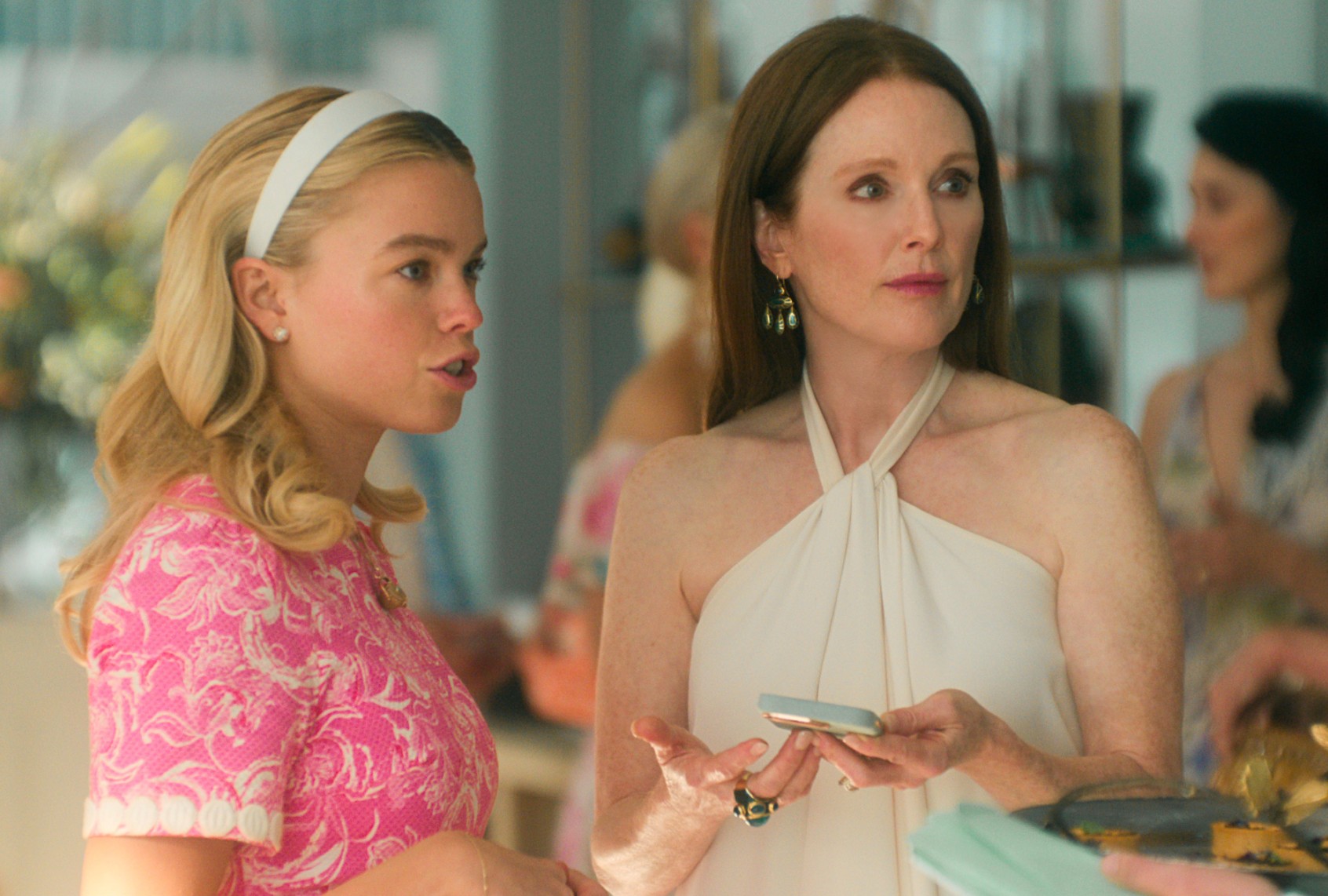
Julianne Moore as Michaela and Kevin Bacon as Peter Kell in "Sirens" (Macall Polay/Netflix)

Peter's wife, Michaela (Julianne Moore), is a stylistic contrast, gliding through the property in draping fashions suited to the goddess she’s styled herself to be. Michaela, who goes by the pet name Kiki, brushes each interaction with a positive affirmation and a smile, leaving it to her assistant Simone (Milly Alcock) to execute her wishes with fierce pecking and claw swipes.

In the Kells' seaside domain, the world bends to Michaela’s will. Peter is nowhere to be found when the story begins, but Kiki’s hangers-on are in full force, addressing her in unison and uniformly singing her praises. Simone is right there with them.

When Simone's foul-mouthed sister Devon (Meghann Fahy) shows up at the residence's front door without notice, Simone immediately shifts into triage mode. Devon is a wreck with two DUIs and a sex addiction — coping mechanisms she developed to dull the ache of being broke, desperate and saddled with a father (Bill Camp) who is sliding into dementia.

Meghann Fahy as Devon in "Sirens" (Macall Polay/Netflix)But Simone is less concerned about all that than how her sister looks. Devon's a disheveled, sweaty wreck storming the gates of the Kells’ orderly Elysium precisely when Michaela’s garden party is kicking off, the first of several she's planned for that weekend. She’s a remnant of a déclassé life that Simone wants to leave behind.
The title of "Sirens" refers to Devon and Simone's version of an SOS and, of course, it also evokes the mythical figures famous for luring sailors to their deaths with their otherworldly voices. Devon believes she can see through the pretty waves obscuring deadly rocks in her sister's path because she assumes rich people are exploitative. When a drunk townie intimates that Michaela murdered the first Mrs. Kell, Devon believes her.

The simple precision of Fran Lebowitz describing Donald Trump as “a poor person’s idea of a rich person” conjures the president’s addiction to tacky, gilded décor in eight words. But ideas are bigger than one tasteless lug with a thing for golden toilets. They’re a broad tapestry made out of thousands of messages and images.

Modern ideas of wealth are simultaneously ostentatious and low-key. Not long ago, owning a sprawling suburban mansion showed the world that you’ve made it. Nowadays, real money walls itself off from the disgruntled 99%.

Lebowitz’s quote instantly calls to mind countless small-screen depictions of the gaudy excess that '80s-era primetime soaps like "Dynasty" sold us. “Sirens” updates that collage portrait, casting the modern billionaire not as gauche but reserved, a misunderstood figure we should trust.

Showrunner Molly Smith Metzler adapted the five-episode limited series from her 2011 play “Elemeno Pea,” which views class warfare through the green glasses of Devon’s envy. For her Netflix version, Smith Metzler tweaks the plot to toy with our unconscious ideas of upper-class power dynamics.

Milly Alcock as Simone and Julianne Moore as Michaela in "Sirens" (Netflix). It's Michaela, not Peter, who holds the community’s moneyed congregation in the palm of her hand. Her cadre of worshippers assigns to her a mystical power to transform lives, but the truth is mundane. Michaela once had a thriving career in law until she met Peter. He persuaded her, a professional persuader, to surrender her career to be his full-time mate. In exchange, he surrenders his first marriage.

The perks of being Mrs. Kell are substantial. There’s endless money, the management of a stunning coastal property and the ability to devote days to her passion for rescuing injured raptors. Everyone wants to know Kiki. Only Simone is convinced that she does.

Peter, meanwhile, tries to project regular guy normalcy despite being born to money. It’s his wife who thinks she’s too good for everyone else, you see.

Modern ideas of wealth are simultaneously ostentatious and low-key. Not long ago, owning a sprawling suburban mansion showed the world that you’ve made it. Nowadays, real money walls itself off from the disgruntled 99% with compounds that, like Cliff House, are only accessible by inconvenient transport like ferries, helicopters or private planes.

Julianne Moore as Michaela "Kiki" Kell in "Sirens" (Macall Polay/Netflix)If you’re someone like Elon Musk, creating a bespoke community made up of you and your family is the dream. Musk envisions his Austin, Texas villa and surrounding acres as a place to house the wombs that have borne his 11 (at least) children, enabling him to (theoretically) spend time with them efficiently. Rich men can afford to support lots of progeny they never have to see.

Michaela has no children. Instead, she transforms the Kells’ estate into a nature preserve where she hosts opulent galas and nurses injured hawks. But Michaela’s true charity work involves rehabbing lost people like Simone, a young woman who attended Yale on a scholarship, dropped out of law school and comes to devote herself to Kiki. Simone is also a Trojan Horse. If Michaela hadn’t opened her home to her, Devon and their dad would never have invaded their exclusive peace.

We need your help to stay independent

“Sirens” is a simple story that distracts the audience from recognizing the real villain, if we even choose one. It unfolds along the same lines as “The Perfect Couple” and “Nine Perfect Strangers,” both of which feature Nicole Kidman playing patrician enigmas — a trend that began with her turn in "Big Little Lies." Fahy also appears in “The Perfect Couple” and the second season of “The White Lotus,” which have in common the overt takeaway that the rich cannot buy their way out of misery.

Subconsciously, these shows coax us into accepting certain inhumane behaviors as the inevitable spoils of being part of the 1%. The White Lotus resort chain attracts horrible people. The family in “The Perfect Couple” is unbearably selfish.

“Sirens” is a simple story that distracts the audience from recognizing the real villain, if we even choose one.

The Kells’ staff despise their boss and barely hide their disdain for Simone even as they fulfill each ridiculous command to the tiniest detail. But as Simone conveys to Devon, Michaela’s world is a paradisical bubble. She and the staff could find less demanding work, but why? The world beyond Cliff House is so ugly.

One of the surest ways modern billionaires distinguish themselves from the rest of us is by routinely trading their wives for fresher models. It’s an old cliché that never goes out of style, along with the assumption that the new wife has it better.

But as reports about actual rich people divorcing show, nobody is safe from being cast out from Olympus. The cult of wealth makes people interchangeable, women especially. Rupert Murdoch famously ditched his fourth wife, Jerry Hall, via email. (“Jerry, sadly, I’ve decided to call an end to our marriage,” his breakup note allegedly read. “We have certainly had some good times, but I have much to do.”)

Whenever the public deems to think about these things, it’s rarely the ex-wives who are celebrated. Bezos’ first wife, MacKenzie Scott, may be an exception, a perk of emerging from her divorce as one of the wealthiest people on the planet. Then again, she didn’t star in a highly publicized and produced trip into space, a reward Bezos gifted to his fiancée, Lauren Sánchez.


Start your day with essential news from Salon. Sign up for our free morning newsletter, Crash Course.


Kiki’s fatal mistake, besides failing to pop out a baby, was demanding that Peter cut off contact with the kids from his first marriage because they hate her. At least, that’s what one of the world’s richest men says — a guy who flies around the globe and has a reputation for exercising substantial power in all other matters.

Ancient myths are rife with stories of gods sacrificing scapegoats to maintain their rank in the divine order. Peter reminds us of his place by erasing Michaela’s social identity in the time it takes for Simone to change into her silver gown.

Meghann Fahy as Devon and Kevin Bacon as Peter Kell in "Sirens" (Netflix)“Don’t you look beautiful in that dress I had made for you?” Michaela whispers moments before she’s replaced, mid-party. Their confrontation takes place in the kitchen, that supposedly wifely domain.

This final turn is less consoling or condemnatory than darkly revealing about our assumptions about Michaela, who's portrayed as a controlling fury for most of the story. But in the end, who doesn’t deserve what they get? Peter presents himself as a simple man who only wants the golden life he has the means to fund. Simone demonstrates enough loyalty to win him to her side.

But it's Peter who assigns Michaela and Simone their status and always holds the power to elevate or ruin them. At least the staff never has any illusions about where they stand. Yet so many of the people watching still do.

One day, any of us could be in their position, whispers this fantasy, and who is to say we’d behave any differently? Maybe this explains why a plurality of Americans embrace this modern poor man's idea of rich men, agreeing when they declare they’ve earned the life they construct around them, including the right to make others pay for it.

"Sirens" is now streaming on Netflix.

Your pasta dish needs hollandaise

At its best, hollandaise is pure alchemy — with nothing more than butter, lemon, egg yolk, salt. It’s silky, indulgent, and just acidic enough to feel like magic on the tongue.

But let’s be honest: you probably think you already know hollandaise. The brunch workhorse. The Eggs Benedict standby. The sauce you maybe attempted once and never tried again.

And yet — hollandaise has range. Yes, it’s temperamental. Yes, it will turn on you if you rush it. But get past the fussiness, and what you’ve got is a sauce that’s endlessly remixable: spicy, frothy, airy, even salad-dressing-adjacent.

The basics

I didn’t actually try hollandaise until culinary school, but when I did, I was transfixed. I loved its viscosity, that rich, luxurious texture that clung to everything it touched, enveloping everything it's heaped over. But the best part? The zing. That bright shot of lemon that cuts through all the butterfat like sunlight through fog. 

Just after I graduated, I decided — for reasons I still don’t fully understand — to make hollandaise at a friend’s house. It wasn’t a special occasion. We weren’t even particularly hungry. I just needed to show her. I set up a double boiler, had a pot ready to poach eggs, and started barking friendly sous chef orders across the kitchen.

And then, five minutes in: disaster. The emulsion broke. Little scrambled egg bits floated in what should have been a smooth, glossy sauce. I was irate. We still ate it, spooned over toasted English muffins with poached eggs, but I couldn’t get past the texture.

The next time I made it, I got it right. And ever since, I’ve sworn I’d never serve a broken hollandaise again.

So: learn from my mistakes. Making hollandaise at home can be fussy — but once you’ve mastered the basics, it becomes one of those low-effort moves that feels genuinely impressive.

There are a few ways to make hollandaise — some chefs swear by a blender or even the microwave — but I still use the double boiler method I learned in school. It gives me the most control, and that matters when you’re coaxing egg yolks into something glossy and stable. Here’s the deal: hollandaise is an emulsion, which just means you’re blending two things that don’t naturally want to mix (in this case, egg yolks and melted butter).

Start by whisking a few yolks with some lemon juice in a bowl over gently simmering water — you want steam, not direct heat. Once they’re slightly thickened, slowly drizzle in warm, melted butter while whisking constantly. If the butter goes in too fast, or the mixture gets too hot, the eggs can seize and scramble. But keep your whisk moving, and you’ll feel it: the moment the sauce thickens, holds, and gleams just slightly. That’s when you know you’ve got it.

Transform the flavor

At its core, hollandaise is all about balance. The classic version leans on butter for richness and lemon juice for brightness. And when it’s done well, that combination doesn’t need much else. A pinch of cayenne, maybe, or a dash of white pepper, just to keep things lively. It’s luxurious, but not heavy. The lemon lifts it.

But here’s where things get interesting: that lemon doesn’t have to be the only source of acidity. Hollandaise is built to carry flavor — not mask it, but elevate it. You can fold in yuzu juice or rice vinegar for a different kind of brightness. Add a spoonful of miso for depth, or swap in a bit of smoked paprika and lime for something that hints at patatas bravas.

On a recent episode of  “Top Chef,” the contestants were challenged to modernize a classic dish from a particular culture — with mixed results. Chefs Lana Lagomarsini and Vinny Loseto took on “Chicken Kama Sutra,” a dish made with chicken braised in a cashew gravy spiced with saffron. It appears on the menu at Dil Se, a well-regarded Toronto restaurant that, along with others, was highlighted in the episode as a source of inspiration. Whether the dish is actually rooted in traditional Indian cuisine is an ongoing matter of online debate. 

We need your help to stay independent

But still, their attempt to pair it with a spiced hollandaise was intriguing, even if the execution fell flat. I imagine they may have leaned on warming spices like cumin, turmeric, and cardamom, which are obviously not often thought of as companions to hollandaise. What their dish lacked in finesse, it offered in potential: a reminder that hollandaise, for all its French culinary pedigree, is more of a canvas than a mandate.

Even the texture is flexible. Want to make it feel lighter? Whip in a little extra air with an immersion blender or fold in crème fraîche for something closer to a mousse. Want it funkier? Try blue cheese and hot sauce for a wing-night hollandaise that somehow works — as long as you keep the proportions delicate, not bulldozed. The trick is knowing the sauce’s nature: it's velvet, not sludge. Even the boldest flavors need to play nice.

Hollandaise isn’t just for asparagus and Eggs Benedict. Once you start thinking of it as a base — not a relic — the possibilities multiply.

Use it anywhere

Once you’ve nailed the technique, hollandaise is yours to play with — and to use far beyond the brunch plate. It’s not just for Eggs Benedict and steamed asparagus. Think bigger.

Spoon it over roasted potatoes. Swirl it onto a plate beneath crispy chicken breasts or charred broccoli. Use it like aioli: spread onto a turkey sandwich, stirred into a chicken salad, or thinned with lemon juice and olive oil for a creamy, citrusy dressing. Toss it with fresh lobster chunks, enrobe cutlets with hollandaise and bread crumbs before frying, or make the most luscious broiled oysters you've ever had. Why not swap pasta sauce for a mascarpone-enriched hollandaise? Or whip it airy with crème fraîche or corn purée?

Technique may be the heart of hollandaise, but imagination is its secret weapon. Let it surprise you.

Classic hollandaise
Yields
2 to 3 servings
Cook Time
10 minutes

Ingredients

2 to 3 egg yolks

2 to 3 lemons, juiced

2/3 cup butter, melted*

Kosher salt

Cayenne, if desired 


Directions

  1. Set up your double boiler: you want a medium-sized pot or saucepan with about an inch or two of water, and then a heat-proof bowl which fits snugly atop the pot. Be super careful here with sizing: you want the steam of the boiling water to warm the bottom of the bowl, but you don't want the bottom of the bowl to actually touch the water. If you need to go through your entire bowl and pot repertoire, do so! I promise it'll be worth it.

  2. Whisk the yolks and lemon juice in the bowl until they've slightly changed color, to something a bit paler, and there's some clear froth.

  3. While whisking, slowly (and I mean slowly) drizzle in your butter in a very thin stream.

  4. Take your time here, genuinely – you don't want to rush at all. It should take a good few minutes.

  5. Once the sauce has considerably thickened up a bit and it takes some more elbow grease to run your whisk through it, add salt and another squeeze of lemon juice and taste.

  6. Once the hollandaise is perfected to your liking, flavor, tweak, or customize however you see fit.


Cook's Notes

We used clarified butter in culinary school, so feel free to make or buy that (or ghee), but plain melted butter definitely gets the job done, too.

“Prejudice and bigotry”: Trump’s latest travel ban targets Haiti and Africa

President Donald Trump issued a new travel ban on Wednesday night. It will bar people from 12 countries from entering the country, while partially restricting those from seven others. 

The order, expected to go into effect next week, will fully ban individuals from Afghanistan, Myanmar, Chad, the Republic of Congo, Equatorial Guinea, Eritrea, Haiti, Iran, Libya, Somalia, Sudan and Yemen. The countries that will have their travel limited are Burundi, Cuba, Laos, Sierra Leone, Togo, Turkmenistan, and Venezuela.

The ban contains certain exemptions for visa holders, lawful permanent residents and others. 

After a series of legal challenges, Trump implemented a similar travel ban during his first term in office. Planning for a new ban had reportedly been underway since the start of the second administration as part of a larger war on immigration. 

The administration is claiming the latest ban is a product of national security concerns. Trump said in a video that the antisemitic attack in Boulder, Colorado, last weekend “underscores the danger posed to our country by foreign nationals not properly vetted, as well as those who come here as temporary visitors and overstay their welcome.” 


Start your day with essential news from Salon. Sign up for our free morning newsletter, Crash Course.


Critics pointed out that the perpetrator of Sunday’s attack was from Egypt, a country not included on Trump’s list. Democrats were also quick to condemn the announcement, calling it bigoted and unproductive. 

“Make no mistake: Trump’s travel ban will NOT make America safer,” wrote Sen. Ed Markey, D-Mass., on X. "We cannot continue to allow the Trump administration to write bigotry and hatred into U.S. immigration policy.”

“From his first Muslim Ban, Trump’s travel bans have always betrayed … the ideals and values that inspired America’s founders,” added Rep. Don Beyer, D-Va. “Trump’s use of prejudice and bigotry to bar people from entering the U.S. does not make us safer, it just divides us and weakens our global leadership.”  

The incredible shrinking president

On Friday, Elon Musk and Donald Trump seemingly broke up amicably in the White House's Oval Office. It was like watching a married couple say, “We love each other, but we can’t live together.” Trump took a swipe at Musk by referring to him as an immigrant, and Musk responded by taking a swipe at Trump as he discussed “the majesty” of the Oval Office. Otherwise, it was all smiles. Trump even said he’d have Elon back from time to time, like they were sharing a timeshare or something.

But Trump’s breakups always get messy, so by Tuesday, Musk was referring to Trump’s “One Big Beautiful Bill” as a “disgusting abomination” and urged Republicans to vote against it. 

House Speaker Mike Johnson admitted that he tried to call Elon, but Musk ghosted him. I understand that. What’s the point of talking to Johnson? He doesn’t think for himself and Musk already knows what Trump thinks.

Meanwhile, the Democrats were attacking Musk’s alleged drug use, and in effect defecating on the one person who apparently doesn’t always kiss Trump’s  . . .  ahem, ring. 

Musk’s criticisms of the bill came after the nonpartisan Congressional Budget Office said that the “One Big Beautiful Bill” will add $2.4 trillion to the national debt over 10 years. The Trump team’s response on Wednesday was to send out two press releases — one, labeled “Most Essential Piece of Legislation in the Western World,” quotes seven tweets by Deputy Chief of Staff Stephen Miller in support of the bill. The other press release, labeled “Mythbuster,” argued that claims the “One Big Beautiful Bill” adds to the deficit or increases spending are a hoax. In other words, facts be damned. Trust Trump.

Of course, he’s the guy who said in the Oval Office Friday that gas was at $1.99 a gallon nationwide. 

So, what does Trump think now of Elon, the deficit, the CBO claims and his “one big beautiful bill”? I can’t tell you. Until after dusk on Wednesday, no one had seen Donald Trump in public since Sunday following a golf outing. Early Wednesday evening, reporters got a statement — but it wasn’t from Trump.

Following a meeting with the president, Republican Senators John Thune, John Barrasso and Mike Crapo spoke at the stakeout area. They carried neither surprises nor news of any breakthroughs on that Big Beautiful Bill. Thune said they had “a very positive discussion about the path forward,” adding that everybody is moving “in the same direction” and agreed that “failure is not an option.” Barrasso said they left the meeting with Trump “committed to a safe and prosperous America and that’s what this bill is about.” He said they told the president that “the American people trust Republicans more than Democrats” on the economy. Crapo called it “a very robust and healthy discussion” and contended “we have very strong unity.” He said any suggestion that the bill will increase deficits is “absolutely wrong.” Turns out they spoke quite a bit and said very little. There’s an easy punchline there. Take it.

After living through the first Trump administration and seeing how wild covering it on a daily basis was, I can tell you the second administration is so bad it makes the first Trump administration look nearly competent.

Trump finally appeared on the portico of the Blue Room after 7 p.m. on Wednesday to welcome new interns to what the White House described as a “soiree” on the South Lawn. I don’t know why, but I picture White House press secretary Karoline Leavitt behind this.

Trump walked onto the portico overlooking the South Lawn like a Generalissimo from a Banana Republic. His mass of young interns assembled and rushed to hear him from below as he watched with amusement from his balcony above the action. He played his greatest hits from his stump speech, never addressing Musk, tariffs or the executive orders he issued Wednesday banning immigrants from Harvard, banning travel to the U.S. from a dozen countries and calling for an investigation into former President Joe Biden, his cognitive abilities and the use of an auto pen. 

The highlight of his 14-minute appearance was when Trump said, “When I do good, you do good.” It’s always about him, isn’t it? But the biggest tell was when he said he was such a great president that in four months, we now have a “country in love with itself.” Trump beamed with pride.

Of course, we have heard from Trump on social media talking about some of the tough issues. His latest rant was a warning for Ukraine after he said he spoke to Vladimir Putin. Putin, apparently stunned by Ukraine’s attack on Russian airfields over the weekend, said “very strongly” to Trump that he will “have to respond to the recent attack.” I guess Putin needed a press secretary and Trump stepped in.

Maybe he took his breakup with Musk harder than we thought. Maybe that explains why his recent public appearances have been fewer than his golf outings.

We need your help to stay independent

Deputy Chief of Staff Stephen Miller appears to have stepped up as the twisted strategist and face of the administration, while Chief of Staff Susie Wiles is the chief tactician. Trump said from the White House Portico Wednesday that even members of the military bow before her. “They’re scared of her. They’re afraid,” he said. 

Wiles lurks in the shadows, thriving in the gray mist of the White House. Stephen Miller flirts with notoriety, obviously loves it, and so far has been far more successful than others who have courted Trump. He never challenges anything Trump says publicly. He and Pep Secretary Leavitt have also learned the best way to survive is to “smile and wave, boys,” in front of the boss. Compliments help.

That’s why Musk is out and Miller is still in. After all, if your five-year-old can give you a black eye, you’re not the kind of alpha male Trump wants on his staff. He needs the man with spray hair in a can.

The real reason for Musk’s black eye? Well the ongoing rumor is that Musk shoved Secretary of the Treasury Scott Bessent, who may or may not have retaliated with a fist to the face. As they say, that is merely speculation. Wiles has been notoriously silent on the matter, as has Miller. Only Leavitt has spoken to it, saying the president has hired some people who are “passionate” about their work.

Whoever punched Musk is a hero to millions. And now that he’s gone, in a divorce that seemed cordial until Musk used the “Big Beautiful Bill” as toilet paper, it seems Musk probably won’t come around from time to time. Then again, Trump loves to keep his reality show options open.

For now, it is Wiles and Miller leading the MAGA faithful as they pull the Trump wagon through the slaughterhouse of what used to be the GOP as if the “Bring out your dead” scene in "Monty Python and the Holy Grail" was a documentary.

Trump is never questioned about why he spends so much time on the golf course, nor is he questioned about his mounting lies, nor has he ever been held accountable for anything in his life. It’s really a fascinating study of humanity. Some believe that God is personally guiding Trump. I, for one, have more arcane and mundane concerns. For example, what’s up with Trump reposting a seriously twisted conspiracy theory that Biden was executed in 2020 and replaced by a combination of AI, clones, robots, body doubles and a homeless meth addict the Democrats dragged out of a ditch in Missouri. Just kidding. My brother-in-law is still in Missouri.

How long can we put up with this? After living through the first Trump administration and seeing how wild covering it on a daily basis was, I can tell you the second administration is so bad it makes the first Trump administration look nearly competent. Today, Trump does whatever he wants, based on whatever he is being told by Wiles and Miller — the choke points for information.

It is next to impossible to find the remnants of the GOP capable of serving its constituents. They’ve chased out all of their sane members. The latest is Joe Walsh. The former Tea Party congressman from Illinois made it official this week: He’s now a Democrat. For him, it boiled down to picking a side. “My former party is a threat to this country. We have to be Democrats, period, to keep our country.”


Start your day with essential news from Salon.
Sign up for our free morning newsletter, Crash Course.


Democratic voters, so far, have embraced him, he says, with very little negative feedback. “I was the Tea Party’s son of a bitch and I think the Democratic Party needs more son of a bitches,” he said. “This is a big tent. There used to be southern Democrats and conservative Democrats and progressives. We differ on some things, but we all agree to respect the Constitution. And we need to fight for our country.” 

Trump’s time off the center stage, even for the briefest of time, allows the country to see in stark detail the true horror show behind him. Trump has a far stronger understanding of the media and how to manipulate and exploit it than any other politician since Ronald Reagan. Trump’s true strength is in the management of his appearances and his narrative. 

No one else in his administration has that ability. 

Witness Joni Ernst. The Republican senator recently called up the spirit of Ebenezer Scrooge. Her comments about Medicaid cuts during an Iowa town hall sparked a spectator to shout, “But people are going to die,” To which Senator Ernst remarked, “We are all going to die.” Sounds a lot like Scrooge: “If they would rather die, they had better do it, and decrease the surplus population."

Afterward, she doubled down by doing a TikTok video in a cemetery and claiming if you want to live forever, follow Jesus. It was billed as a “tongue-in-cheek” production. 

“Joni Ernst has all the bedside manner of a cat in a blender,” political commentator John Fugelsang said. “’We’re all going to die?’ That’s not an answer to a healthcare crisis — that’s what your creepy uncle says on Christmas after his fourth Jaegermeister.”

Fugelsang, who hosts a political show on SiriusXM and is the author of the newly published book “Separation of Church and Hate,” says Trump, and his closest disciples suffer from a biblical malady; hypocrisy is their hubris. 

“Because nothing says ‘compassion’ like kicking grandma off Medicaid while boasting of your piety, with human graves as props. Why worry about your cancer diagnosis, friends, when you can just accept Jesus and prepare to meet Him real soon,” Fugelsand said. “Jesus welcomed the stranger and cared for the least of us. Joni's is a trickle-down MAGA Jesus, and her idea of the gospel is to hand you a shovel and say, ‘Dig your own grave’.” 

Of course, there are many who aren’t as critical of Ernst’s “tongue-in-cheek” performance. Many of them also claim to be fans of Pete Hegseth, the Secretary of Defense, whose greatest claim to fame and qualification for his job other than his outrageous tattoos (if you say it in Randy Rainbow’s voice, you’d understand), is his luddite impersonation of a television anchor on Fox Television. His homophobic response to renaming the U.S.N.S Harvey Milk (the second of a new class of oilers) because Milk was the first openly gay elected official in California is petulant, cartoonish and vintage 1930s if you lived in Dusseldorf. 

Milk was no Admiral Nimitz, but maybe he could have been if he had had the chance. He joined the United States Navy during the Korean War. He served aboard the submarine rescue ship USS Kittiwake (ASR-13) as a diving officer. He later transferred to Naval Station, San Diego, to serve as a diving instructor. In 1955, he resigned from the Navy at the rank of lieutenant, junior grade, forced to accept an "other than honorable" discharge and leave the service rather than be court-martialed because of his homosexuality.

To change the name of the ship for no reason other than Milk’s sexual orientation dishonors hundreds of thousands, if not millions of similar Americans over the years who have served their country with honor as far back as the Revolutionary War. 

So far, Trump doesn’t seem all that eager to rein in his minions. That could change tomorrow. But, for the first time since he took office, right now he seems content to sit in the background and watch his clown car roll past him.

No one in the press with access to the president has asked Trump about his sparse number of recent public appearances, and I won’t speculate as to why they’ve occurred without verified facts. I will say his appearance on the portico was too reminiscent of the episode “Little Dictator” on "Gilligan's Island” for me — though I could see Trump playing Gilligan.

But, if Trump’s current scarcity of public appearances continues with only one or two chances a week to see “proof of life,” it probably won’t be long before Jake Tapper prepares his next mea culpa tour for whatever reason.

“The intern in charge”: Meet the 22-year-old Trump’s team picked to lead terrorism prevention

ProPublica is a Pulitzer Prize-winning investigative newsroom. Sign up for The Big Story newsletter to receive stories like this one in your inbox.

When Thomas Fugate graduated from college last year with a degree in politics, he celebrated in a social media post about the exciting opportunities that lay beyond campus life in Texas. “Onward and upward!” he wrote, with an emoji of a rocket shooting into space.

His career blastoff came quickly. A year after graduation, the 22-year-old with no apparent national security expertise is now a Department of Homeland Security official overseeing the government’s main hub for terrorism prevention, including an $18 million grant program intended to help communities combat violent extremism.

The White House appointed Fugate, a former Trump campaign worker who interned at the hard-right Heritage Foundation, to a Homeland Security role that was expanded to include the Center for Prevention Programs and Partnerships. Known as CP3, the office has led nationwide efforts to prevent hate-fueled attacks, school shootings and other forms of targeted violence.

Fugate’s appointment is the latest shock for an office that has been decimated since President Donald Trump returned to the White House and began remaking national security to give it a laser focus on immigration.

News of the appointment has trickled out in recent weeks, raising alarm among counterterrorism researchers and nonprofit groups funded by CP3. Several said they turned to LinkedIn for intel on Fugate — an unknown in their field — and were stunned to see a photo of “a college kid” with a flag pin on his lapel posing with a sharply arched eyebrow. No threat prevention experience is listed in his employment history.

Typically, people familiar with CP3 say, a candidate that green wouldn’t have gotten an interview for a junior position, much less be hired to run operations. According to LinkedIn, the bulk of Fugate’s leadership experience comes from having served as secretary general of a Model United Nations club.

“Maybe he’s a wunderkind. Maybe he’s Doogie Howser and has everything at 21 years old, or whatever he is, to lead the office. But that’s not likely the case,” said one counterterrorism researcher who has worked with CP3 officials for years. “It sounds like putting the intern in charge.”

In the past seven weeks, at least five high-profile targeted attacks have unfolded across the U.S., including a car bombing in California and the gunning down of two Israeli Embassy aides in Washington. Against this backdrop, current and former national security officials say, the Trump administration’s decision to shift counterterrorism resources to immigration and leave the violence-prevention portfolio to inexperienced appointees is “reckless.”

“We’re entering very dangerous territory,” one longtime U.S. counterterrorism official said.

The fate of CP3 is one example of the fallout from deep cuts that have eliminated public health and violence-prevention initiatives across federal agencies.

The once-bustling office of around 80 employees now has fewer than 20, former staffers say. Grant work stops, then restarts. One senior civil servant was reassigned to the Federal Emergency Management Agency via an email that arrived late on a Saturday.

The office’s mission has changed overnight, with a pivot away from focusing on domestic extremism, especially far-right movements. The “terrorism” category that framed the agency’s work for years was abruptly expanded to include drug cartels, part of what DHS staffers call an overarching message that border security is the only mission that matters. Meanwhile, the Trump administration has largely left terrorism prevention to the states.

ProPublica sent DHS a detailed list of questions about Fugate’s position, his lack of national security experience and the future of the department’s prevention work. A senior agency official replied with a statement saying only that Fugate’s CP3 duties were added to his role as an aide in an Immigration & Border Security office.

“Due to his success, he has been temporarily given additional leadership responsibilities in the Center for Prevention Programs and Partnerships office,” the official wrote in an email. “This is a credit to his work ethic and success on the job.”

ProPublica sought an interview with Fugate through DHS and the White House, but there was no response.

The Trump administration rejects claims of a retreat from terrorism prevention, noting partnerships with law enforcement agencies and swift investigations of recent attacks. “The notion that this single office is responsible for preventing terrorism is not only incorrect, it’s ignorant,” spokesperson Abigail Jackson wrote in an email.

Through intermediaries, ProPublica sought to speak with CP3 employees but received no reply. Talking is risky; tales abound of Homeland Security personnel undergoing lie-detector tests in leak investigations, as Secretary Kristi Noem pledged in March.

Accounts of Fugate’s arrival and the dismantling of CP3 come from current and former Homeland Security personnel, grant recipients and terrorism-prevention advocates who work closely with the office and have at times been confidants for distraught staffers. All spoke on condition of anonymity for fear of reprisal from the Trump administration.

In these circles, two main theories have emerged to explain Fugate’s unusual ascent. One is that the Trump administration rewarded a Gen Z campaign worker with a resume-boosting title that comes with little real power because the office is in shambles.

The other is that the White House installed Fugate to oversee a pivot away from traditional counterterrorism lanes and to steer resources toward MAGA-friendly sheriffs and border security projects before eventually shuttering operations. In this scenario, Fugate was described as “a minder” and “a babysitter.”

DHS did not address a ProPublica question about this characterization.

Rising MAGA Star

The CP3 homepage boasts about the office’s experts in disciplines including emergency management, counterterrorism, public health and social work.

Fugate brings a different qualification prized by the White House: loyalty to the president.

On Instagram, Fugate traced his political awakening to nine years ago, when as a 13-year-old “in a generation deprived of hope, opportunity, and happiness, I saw in one man the capacity for real and lasting change: Donald Trump.”

Fugate is a self-described “Trumplican” who interned for state lawmakers in Austin before graduating magna cum laude a year ago with a degree in politics and law from the University of Texas at San Antonio. Instagram photos and other public information from the past year chronicle his lightning-fast rise in Trump world.

Starting in May 2024, photos show a newly graduated Fugate at a Texas GOP gathering launching his first campaign, a bid for a delegate spot at the Republican National Convention in Milwaukee. He handed out gummy candy and a flier with a photo of him in a tuxedo at Trump’s Mar-a-Lago estate. Fugate won an alternate slot.

The next month, he was in Florida celebrating Trump’s 78th birthday with the Club 47 fan group in West Palm Beach. “I truly wish I could say more about what I’m doing, but more to come soon!” he wrote in a caption, with a smiley emoji in sunglasses.

Posts in the run-up to the election show Fugate spending several weeks in Washington, a time he called “surreal and invigorating.” In July, he attended the Republican convention, sporting the Texas delegation’s signature cowboy hat in photos with MAGA luminaries such as former Cabinet Secretary Ben Carson and then-Rep. Matt Gaetz (R-Fla.).

By late summer, Fugate was posting from the campaign trail as part of Trump’s advance team, pictured at one stop standing behind the candidate in a crowd of young supporters. When Trump won the election, Fugate marked the moment with an emotional post about believing in him “from the very start, even to the scorn and contempt of my peers.”

“Working alongside a dedicated, driven group of folks, we faced every challenge head-on and, together, celebrated a victorious outcome,” Fugate wrote on Instagram.

In February, the White House appointed Fugate as a “special assistant” assigned to an immigration office at Homeland Security. He assumed leadership of CP3 last month to fill a vacancy left by previous Director Bill Braniff, an Army veteran with more than two decades of national security experience who resigned in March when the administration began cutting his staff.

In his final weeks as director, Braniff had publicly defended the office’s achievements, noting the dispersal of nearly $90 million since 2020 to help communities combat extremist violence. According to the office’s 2024 report to Congress, in recent years CP3 grant money was used in more than 1,100 efforts to identify violent extremism at the community level and interrupt the radicalization process.

“CP3 is the inheritor of the primary and founding mission of DHS — to prevent terrorism,” Braniff wrote on LinkedIn when he announced his resignation.

In conversations with colleagues, CP3 staffers have expressed shock at how little Fugate knows about the basics of his role and likened meetings with him to “career counseling.” DHS did not address questions about his level of experience.

One grant recipient called Fugate’s appointment “an insult” to Braniff and a setback in the move toward evidence-based approaches to terrorism prevention, a field still reckoning with post-9/11 work that was unscientific and stigmatizing to Muslims.

“They really started to shift the conversation and shift the public thinking. It was starting to get to the root of the problem,” the grantee said. “Now that’s all gone.”

Critics of Fugate’s appointment stress that their anger isn’t directed at an aspiring politico enjoying a whirlwind entry to Washington. The problem, they say, is the administration’s seemingly cavalier treatment of an office that was funding work on urgent national security concerns.

“The big story here is the undermining of democratic institutions,” a former Homeland Security official said. “Who’s going to volunteer to be the next civil servant if they think their supervisor is an apparatchik?”

Season of Attacks

Spring brought a burst of extremist violence, a trend analysts fear could extend into the summer given inflamed political tensions and the disarray of federal agencies tasked with monitoring threats.

In April, an arson attack targeted Pennsylvania Gov. Josh Shapiro, a Democrat, who blamed the breach on “security failures.” Four days later, a mass shooter stormed onto the Florida State University campus, killing two and wounding six others. The alleged attacker had espoused white supremacist views and used Hitler as a profile picture for a gaming account.

Attacks continued in May with the apparent car bombing of a fertility clinic in California. The suspected assailant, the only fatality, left a screed detailing violent beliefs against life and procreation. A few days later, on May 21, a gunman allegedly radicalized by the war in Gaza killed two Israeli Embassy aides outside a Jewish museum in Washington.

June opened with a firebombing attack in Colorado that wounded 12, including a Holocaust survivor, at a gathering calling for the release of Israeli hostages. The suspect’s charges include a federal hate crime.

If attacks continue at that pace, warn current and former national security officials, cracks will begin to appear in the nation’s pared-down counterterrorism sector.

“If you cut the staff and there are major attacks that lead to a reconsideration, you can’t scale up staff once they’re fired,” said the U.S. counterterrorism official, who opposes the administration’s shift away from prevention.

Contradictory signals are coming out of Homeland Security about the future of CP3 work, especially the grant program. Staffers have told partners in the advocacy world that Fugate plans to roll out another funding cycle soon. The CP3 website still touts the program as the only federal grant “solely dedicated to helping local communities develop and strengthen their capabilities” against terrorism and targeted violence.

But Homeland Security’s budget proposal to Congress for the next fiscal year suggests a bleaker future. The department recommended eliminating the threat-prevention grant program, explaining that it “does not align with DHS priorities.”

The former Homeland Security official said the decision “means that the department founded to prevent terrorism in the United States no longer prioritizes preventing terrorism in the United States.”

Kirsten Berg contributed research.

 Pam Bondi’s “shocking” strategy should cost her

The Attorney General of the United States is considered the nation's top lawyer. As head of the Department of Justice, Pam Bondi leads the nation's largest law office. No federal precedent, and nothing in her oath of office, exempts her from the code of ethics, federal pleading rules, or the rule of law all attorneys swear to uphold. 

Bondi’s public statements defy impartiality

Lawyers who work for the government have a duty to seek justice, whether facts lead to acquittal or conviction. For that reason, they are expected to avoid public statements displaying partiality because such statements undermine public trust in the legal system. The American Bar Association directs in Rule 3.6 that:

A lawyer who is participating… in the investigation or litigation of a matter shall not make an extrajudicial (outside the court) statement that … will be disseminated (publicly) and have a substantial likelihood of materially prejudicing an adjudicative proceeding in the matter.

In other words, try your case in court, not on TV. Only supported facts of evidence are allowed in a courtroom; demagoguery and assertions of opinion unsupported by admissible evidence are not allowed. That is why judges have frequently admonished Trump attorneys that statements to the press are not evidence. 

Despite the clarity of the ABA rule, Bondi has consistently argued pending cases on TV.  Pressing Trump’s legal positions on Fox News, Bondi has repeatedly lied to half the nation that it is up to Trump to decide what the law requires. Every first-year law student knows that the judicial branch, not the executive, decides what the law is. If that were not the case, a president could write his own laws, as Trump and Bondi are trying to do.

We need your help to stay independent

Bondi appears more committed to defying the courts, including the Supreme Court, on Fox News than she is to upholding the law, painting the illegal seizure of migrants in “Trump is your savior” rhetoric jarring to the ears of any real lawyer. 

Bondi intentionally misstates the law and misconstrues orders

In April, the U.S. Supreme Court directed the Trump administration to facilitate the return of Kilmar Abrego Garcia, who was deported to El Salvador without a constitutionally required process. Under Bondi’s supervision, the DOJ argued that it doesn’t understand plain English, urging that the term “facilitate” is limited to “removing any domestic obstacles that would otherwise impede the alien’s ability to return here.” 

The word “domestic” does not arguably appear anywhere in the order. SCOTUS ordered the Government “to ‘facilitate’ Abrego Garcia’s release from custody in El Salvador and to ensure that his case is handled as it would have been had he not been improperly sent to El Salvador.” 

Rather than respect the plain language of the order, Bondi’s strategy is to play games to either render the ruling null or to challenge the court’s authority. As an example of the latter, the Justice Department filed an emergency motion to stay the Abrego Garcia order from U.S. District Judge Paula Xinis, aggressively challenging the court’s authority by pleading that, “The federal courts do not have the authority to press-gang the President or his agents into taking any particular act of diplomacy.” 

The Appellate Court was triggered. Without waiting for the plaintiffs’ response, the Fourth Circuit Court of Appeals issued a sharp rebuke, written by a Reagan appointee, calling the government’s pleading “shocking.” 

The government is asserting a right to stash away residents of this country in foreign prisons without the semblance of due process that is the foundation of our constitutional order. Further, it claims in essence that because it has rid itself of custody that there is nothing that can be done. 

This should be shocking not only to judges, but to the intuitive sense of liberty that Americans far removed from courthouses still hold dear.

Bondi’s team abuses pleading rules

Federal pleading rules require attorneys to certify that the legal contentions they assert are warranted by existing law or a reasonable argument for modifying the law, and that the factual contentions have evidentiary support. Rule 11 states that a court may impose sanctions on any attorney responsible for violating the pleading rule, including supervising attorneys. 

None of the facts surrounding migrants’ El Salvador deportations have been pled with evidentiary support, which means Bondi has either allowed — or directed — attorneys under her supervision to file unsupported pleadings. Nor can her “shocking” strategy be deemed a reasonable argument to modify the law. 


Start your day with essential news from Salon.
Sign up for our free morning newsletter, Crash Course.


Not only is Bondi authorizing her attorneys to file unsupported pleadings, but she has also punished staff for making accurate statements to the court. In April, she directed the dismissal of Erez Reuveni, a career immigration lawyer, for acknowledging to the court that Garcia had been deported to El Salvador in error. Shortly thereafter, a 10-year veteran of the same unit resigned, and said in an email obtained by the NYT that he could not “with clean conscience” defend the department’s actions under Bondi, claiming they ran counter to the law, Constitution and “basic principles of fairness and humanity.”

Bondi has turned the DOJ into Trump’s personal law firm

Bondi’s latest ethical transgression has not yet made it to court, but it likely will. 

Last week, Bondi declared that, under the Foreign Emoluments Clause, Trump can legally accept a “flying palace 747 jumbo jet” as a gift from Qatar, a country that has directly funded Hamas terrorism

Qatar's financial and political ties to Hamas have long been known. In a legal memorandum, Bondi concluded that the gift was “legally permissible,” apparently reasoning that because the gift is not officially conditioned on any official act, it does not constitute bribery. No such limiting language appears in the Constitution; Bondi just put it there.  Bondi's analysis also concluded that the gift complies with the law because the plane is not being given to an individual, but rather to the United States Air Force and, eventually, to the presidential library foundation, where Trump will then make personal use of it.  Pity the DOJ lawyer Bondi will force to sign that bad faith legal jujitsu when it ends up before a judge.

After Trump leaves office, the 747 would be transferred to the Trump Presidential Library. This is plainly a $400 million gift from a foreign government to Trump himself, perhaps meant as a “tip” following Trump’s private $5.5 billion Trump International Golf Club deal with Dar Global and Qatari Diar, a company created from Qatar's sovereign wealth fund in 2005.  It's painfully obvious to anyone outside the Fox News bubble that Trump, who has not divested from his private ventures, is using the Oval Office to enrich himself, aided by unethical counsel. 

Follow the dirty money  

Former federal prosecutor Paul Rosenzweig observed that Bondi’s actions have radically transformed and politicized the DOJ, transmuting it “into Trump’s personal law firm,” which is “a rejection of the founding principle of the rule of law.” 

Although four years feels interminable, Trump is not a permanent fixture, and he will be out of office while Bondi still needs her law license. Bondi seems not to care, suggesting she has no intention of practicing law after Trump’s departure.  Perhaps she intends to return to lobbying, where she previously earned over $100,000 a month lobbying for Qatar. (Can you say conflict of interest?)

Bondi has already met the threshold of bad faith for disbarment. An attorney who trashes the rule of law must know that eventually she will be barred from practicing it.

Historian Federico Finchelstein: Trump’s “abuse of the law fits an old autocratic pattern”

The Age of Trump wrapped itself in the flag of false patriotism while simultaneously destroying America’s sacred civic myths about its national greatness and the permanence of its democracy. This paradox has left many Americans dizzy as they are forced to confront the harmful consequences caused by their belief in a country that never existed. 

President Ronald Reagan famously talked about a “new day in America” as he encouraged the American people to shrug off their old cynicism and to embrace a new optimism. So many Americans believed that their country was truly “a shining city on the hill” and a beacon of democracy and freedom for the world. There is also the common belief in the fundamental decency and goodness of the American people and that such “universal values” would make the likes of President Trump and other such demagogues an impossibility, as they were judged to be incompatible with the national character and temperament of the American people.

In total, the ascent of the Age of Trump and the authoritarian fake populist MAGA movement has revealed the hollowness of these myths and narratives. So, where do the American people go from here as the authoritarian tide continues to rapidly rise in their country?

"Donald Trump and his 'team' started very aggressively, but they also made many mistakes"

Federico Finchelstein is a leading expert on fascism, populism and dictatorship and professor of history at the New School for Social Research and Lang College in New York City. He is the author of seven books on fascism, populism, Dirty Wars, the Holocaust and Jewish history in Latin America and Europe. Finchelstein’s most recent book is “The Wannabe Fascists: A Guide to Understanding the Greatest Threat to Democracy.”

In this conversation, Finchelstein explains how Donald Trump and his forces represent what he describes as “wannabe fascism” and the specific type of danger that such autocrats and aspiring tyrants pose to a failing Western democracy. Finchelstein also reflects on the danger caused by how “respectable” elites and other mainstream voices in the political class and news media were and continue to normalize Trumpism because they are not (yet) being targeted in the same way as undocumented people and other marginalized communities.

At the end of this conversation, Federico Finchelstein warns that Donald Trump and his forces have moved at a very fast rate to consolidate power, but that their victory is not guaranteed — especially if pro-democracy Americans and their leaders finally decide to commit themselves earnestly instead of being bystanders who are mostly looking away.

How common or distinct is America’s experience with democratic backsliding and democracy collapse as compared to other countries?

This belief in exceptionalism is both American and part of a global history. All countries have a myth of their own uniqueness. America’s experience with the erosion of democratic beliefs and experiences is quite common at the level of everyday practice. Intolerance, racism and violence have always been part of modern global history, this country included. However, at the federal level, Trumpism represents a change from previous norms and administrations. It is way more disruptive. Extreme forms of populism that are oriented towards fascism are now at the helm of the most powerful country in the world. Trumpism is more anti-democratic than its predecessors, and it also exerts a big influence outside of the United States. Trumpism is toxic for democratic life here in the United States and around the world.

Donald Trump has now been back in power for more than 100 days. Are things as you expected? Better? Worse?

I am not shocked by the extremism of Trumpism. But the Trump administration has failed in many ways, and yet it will keep trying to degrade American democracy as much as it can. A troubling question is, how will Trump and MAGA escalate their attacks on democracy and the rule of law to remain in power? I am very pessimistic in this regard. It is always more dangerous when totalitarians rule in the face of imminent defeat. Trump has clearly not yet achieved that level of power — I emphasize "yet". This explains why Donald Trump and his administration and forces more broadly are not as bold as they could be in terms of advancing Trump’s goal of destroying constitutional democracy.

Where are we in the story of the Age of Trump and his return?

We do not have the wisdom of hindsight that future historians will have. My own view, an educated guess of sorts, is that we are in the middle, at least, of Trump’s radicalization towards fascism.

The American people were repeatedly warned about the calamity that would befall the United States if Donald Trump were put back in power. Why didn’t they listen to the warnings?

Many people do not care about the harm that Trumpism is causing democracy. Many of the Trump followers are hardcore, diehard believers in fascism in its varied forms and the quest for total domination that is fueled by hatred. But many other Trump supporters, a majority of them, are just hoping for a better economic situation. It is dubious that Trump’s policies will create that outcome. And of course, those Trump supporters have ignored or otherwise put aside many of the most troubling dimensions of Trumpism, such as racism, nativism, sexism and wanton cruelty.

We need your help to stay independent

At some point, the Trump supporters who are not the diehards and de facto cultists will recognize that they voted against their own interests. This is part of the history of fascism and dictatorship. Unfortunately, history shows us that such realizations often come very late in the game after there has been a lot of suffering inflicted on the country.

The centrists, institutionalists and other establishment voices were very wrong about Donald Trump and his MAGA authoritarian populist movement’s rise to power. These errors began in 2015, continued in the years to follow, and were fully exposed when so many of these “respectable voices” continued to claim that there was no way Donald Trump could win in 2024. Per their logic, “the American people would never do such a thing!” Alas, here we are. What does that dynamic look like in other countries when the so-called respectable voices are so wrong? Are they discredited when the autocrat-authoritarian takes power, and with widespread popular support?

One of the key problems is how Trumpism is enabled by normalization. This represents the opposite of understanding the reality and facts of what is happening. Many scholars and pundits on the center as well as the right and the left denied the fascist dimensions of Trumpism. They kept trying to locate Trump as part of an older continuity and tradition of American presidents and other leaders. Trump is separate from that democratic tradition. These pundits, scholars and other public voices had a range of responses to being so wrong. Some of them recognized their mistake, but just want to move on and not have to explain their error and how they arrived at such incorrect conclusions. Others are telling the American people not to worry that much about Trump because it won’t get that bad, and that Trump is not the real problem or danger anyway. The real problem and danger is that liberal democracy itself is flawed. That, too, is not entirely correct.

"Intolerance, racism and violence have always been part of modern global history, this country included. However, at the federal level, Trumpism represents a change from previous norms and administrations. It is way more disruptive."

I have a different perspective. When I was a kid, I lived under a gruesome dictatorship in Argentina. As a historian but also as a citizen, I never forget the key difference between an imperfect democracy and a total dictatorship. It is always fascinating to observe how these normalizing views are presented from a place of privilege and far away from the obvious victims of repression and demonization. If you never interact with the victims, it is harder to notice the change. 

Is America now in the grips of authoritarianism? If so, what type? Moreover, why were so many in the news media and political class afraid to use the “f-word,” i.e., fascism, when it was readily apparent years ago that Donald Trump and his anti-democracy movement fit that definition.

In my own work, I describe the Age of Trump and this version of authoritarian populism as “wannabe fascism.” Wannabe fascism is an incomplete version of fascism, it is characteristic of those who seek to destroy democracy for short-term personal gain but are not fully committed to the fascist cause. As I explain in my books, the more we know about past fascist attempts to deny the workings of democracy, the more alarming these wannabe fascists appear.

There have been many public discussions of the so-called authoritarian’s playbook and how Donald Trump and his agents are following it very closely. What are some specific examples?

Some of them are learned in the ways of fascism, others, like the leader himself, are intuitively antidemocratic, but the effects are the same, namely, the irrational rule of a leader who would like to rule as a king or dictator. The examples are many and they range from deportations for racist/and or other authoritarian ideological reasons, attacks against the press, attempts to destroy the independence of universities, the replacement of legality with manipulations of the law in the name of the leader and the attacks against idea and the practice of anti-racism and in favor of diversity. And last but certainly not least, are the events of Jan. 6 and the larger attempt to usurp democracy.

Historian Ruth Ben-Ghiat recently warned that the speed of Donald Trump and his forces’ attacks on democracy and civil society is more like a coup than autocratic capture. Do you agree?

My friend and colleague Professor Ben-Ghiat is absolutely right! This is not a gradual process. It is unclear, yet, exactly what type of authoritarian end goals they want or will be able to reach. Do they want a full-on fascist dictatorship? An elected populist autocracy? Traditional tyranny? What is clear is that Donald Trump and his MAGA forces and their allies want to leave constitutional democracy behind.

I don’t want to be too strict with path dependency. But was there a moment(s) when Trump’s return to power could have been stopped? Or was this democracy crisis and now the rise of naked fascism and authoritarianism more probable than not?

What I focus on is that the architects and visionaries who did the intellectual work never faced justice for their role in the events of Jan. 6 and the larger attempt to nullify the results of the 2020 election. This is a key ingredient of the success of Trumpism. Without the link between history and justice, democracy cannot properly function or expand. The opposite happened, and we can now see the horrible consequences of these mistakes.

The news media and free press are supposed to function as the Fourth Estate and the guardians of democracy. How would you assess the American mainstream news media’s performance in that regard?

The mainstream American news media continues to normalize Trumpism when it is labeled or framed as a “conservative” or “center-right” movement. Trumpism is radical and revolutionary. We are witnessing a new ultra-right populist phenomenon in the form of Trumpism and MAGA that is close to fascism. The extremism must be emphasized when discussing it so that the American people understand the dire reality that they are facing. The American news media need to put more history and context into their discussions of the Age of Trump and the attacks against democracy. This would also involve interviewing and otherwise featuring more scholars and other real experts.

In your conversations with colleagues in higher education, what is the environment like now, given the Trump administration’s attacks?  

There is, of course, the desired and planned chilling effect. There are attacks on media and universities, legal firms, judges, and others across civil society and the country’s democratic and governing institutions. As I see it, what is even more troubling and deeply concerning is how the American people, the majority, are becoming increasingly numb to the abnormal behavior of Trump and his allies. Expert voices and others who have a trusted platform must continue to sound the alarm to wake the American people up from their complacency about Trumpism and the extreme danger it represents to the nation.

Going beyond language and concepts, what are some practical, day-to-day things that the average American can do to defend democracy and civil society?

It is critically important to be informed and alarmed about the extreme dimensions of Trumpism. In practice, we all need to continue reading independent media accounts of what is going on. We need to defend the independence of institutions and the separation of powers.


Start your day with essential news from Salon.
Sign up for our free morning newsletter, Crash Course.


I think it is important to oppose anti-democratic attempts by defending key dimensions of democracy and not giving up out of frustration and exasperation. This involves voting but also convincing others to do so. It also involves clearly and peacefully expressing one’s own positions in conversations, in the streets and on social networks. History demonstrates that the worst thing we can do vis-à-vis wannabe dictators is being silent and apathic.

What are some books, articles, creative work, films, movies, etc. that you recommend to those Americans who are trying to make sense of Trump’s rise to power and the ascendant authoritarianism and fascism in this country?

I would recommend novels such as "It can't happen here” or the recent movie about Trump and his relationship to Roy Cohn. The works of Hannah Arendt on totalitarianism and obedience are essential readings as well, especially her classic book On the Origins of Totalitarianism. I would also recommend the analysis of Nazi language by Viktor Klemperer, The Language of the Third Reich.” I also believe that the works of Latin American writers such as Jorge Luis Borges or Roberto Bolaño are of key importance in understanding the logic of fascism. I would recommend movies like the Argentines' “The Official Story” and “The Secret in their Eyes” to understand how important it is to know the links between history and legality when confronting propaganda, demonization and violence. I also think the second season of the Star Wars series “Andor”, starring Diego Luna, offers an excellent portrayal of the authoritarian manipulation of the truth through lies and propaganda. It is really well done and quite entertaining as well! The graphic novel "Persepolis" by Marjane Satrapi is also an excellent representation of how the Iranian dictatorship distorts the lives of an entire population. The novel focuses on the life of a young woman who resists in her own way. As different from the United States as all these cases are, there are still troublesome connections. The United States is becoming more and more like those real and fictional contexts where fascism and dictatorship are part of the picture, and a government wants its people to be less diverse and less tolerant of others.

As you see it, what is the most disturbing aspect of Trump’s return to power during these first four months?

For fascists, what the leader wants is more legitimacy than legality, because while the former was the result of a cult of heroism and leadership principle, the latter was regarded as artificial and even boring. For example, this meant that everything Hitler wanted was legitimate and beyond the rule of law. This was the rationale for Jan.6 and Trump’s arguments that he is above the law and that the courts should not have co-equal power to interfere with his actions as president. These actions take place in the context of lies and propaganda; one helps the other. Fascists, and wannabe fascists, imagine that all actions in defense of the law and democracy are part of a conspiracy against them. Donald Trump and his allies’ abuse of the law fits an old autocratic pattern, one that has been given a new life in America.  

I hate applying sports analogies to politics, especially given a situation as serious as the Age of Trump. But who is “winning right now? Trump and his “team”? Or the other team? (the institutions and democracy, the “Resistance,” civil society and the norms, etc.)

Donald Trump and his “team” started very aggressively, but they also made many mistakes. These mistakes include their approach to the economy and the rule of law. The apparent corruption will also not be forgotten by many American citizens. The apparent corruption and using public office to make money embodies the heart of the extremist politics of Trumpism and other forms of extreme populism and wannabe fascism. At this point, it is too soon to conclude how well Trump and his “team” are playing the “game.” There is another side to this “game” that must be included. The other “team” is those Americans who believe in democratic institutions and if they are going to go on the offense and get involved in the “game” instead of mostly looking the other way.