Spring Sale: Get 1 Year, Save 58%

How much forest did we lose in 2020? Like, a Netherlands’ worth

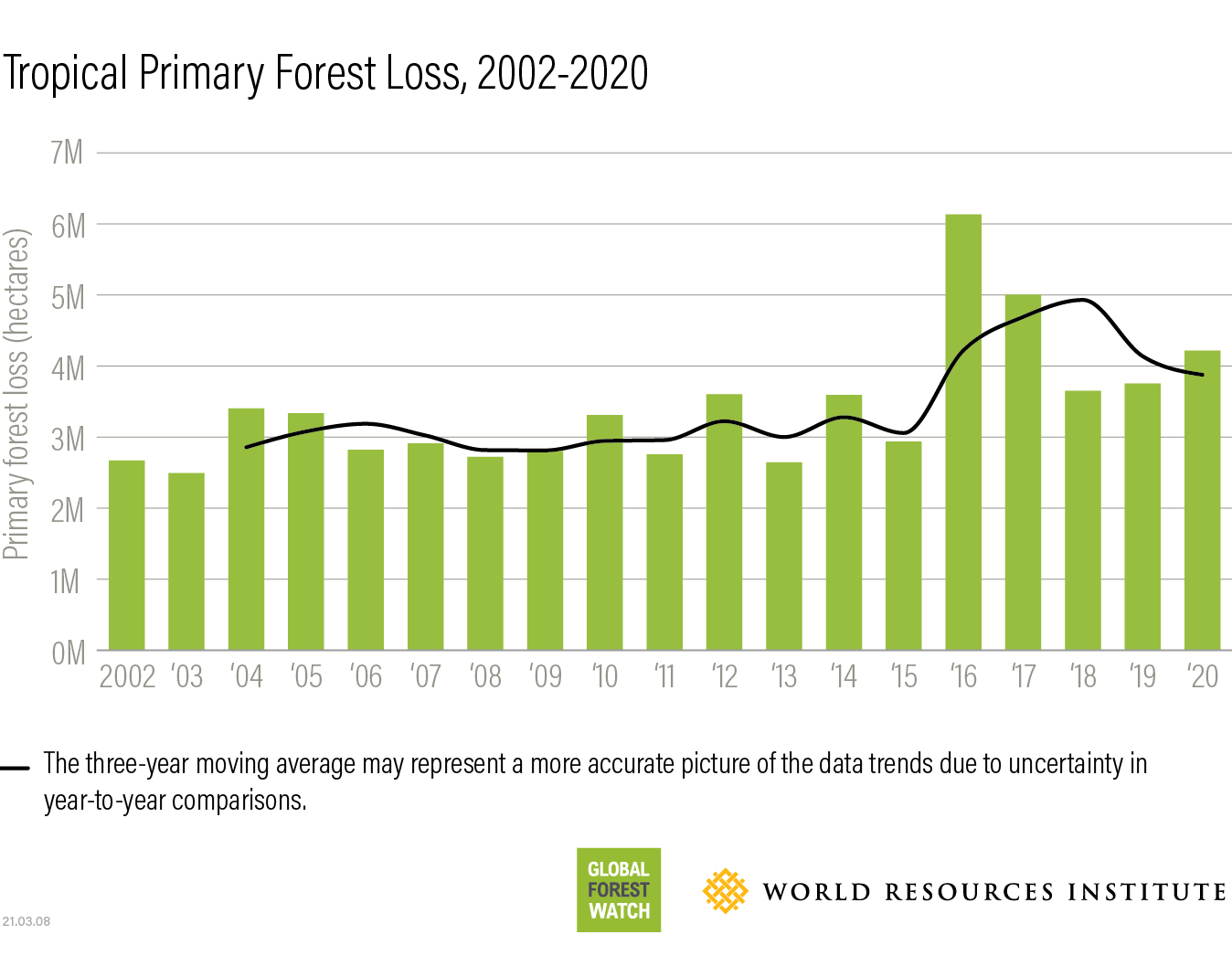
Despite all the dire warnings, corporate pledges, and tree-planting promises, forests keep falling at an alarming pace. In a report out Wednesday morning, experts tallied up all the acres of the most important forests lost in 2020 and found that it amounts to an area the size of the Netherlands.

“Those dense forests can be hundreds of years old and store significant amounts of carbon. Losing them has irreversible impacts on biodiversity and climate change,” said Rod Taylor, director of the forest program at the nonprofit World Resources Institute, which produced the report with Global Forest Watch. The two organizations have been monitoring the world’s forests for 20 years with satellite images.

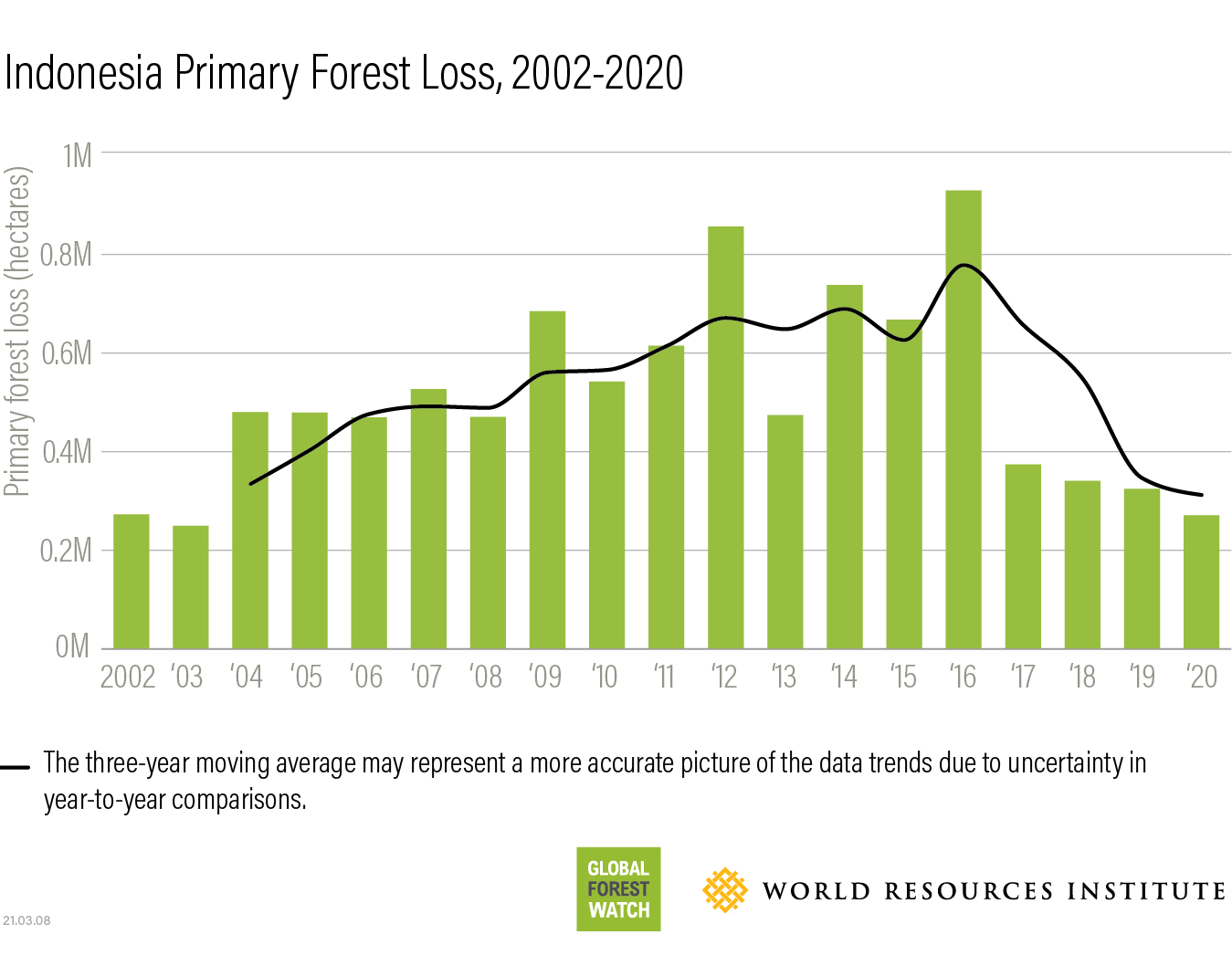
These tropical old-growth forests that WRI focused on don’t go through regular cycles of harvesting and regeneration, like those managed by timber companies. In a better world, the 4.2 million hectares of primary tropical forest that fell this year would have remained standing forever. Levelling them resulted in the release of some 2.6 gigatons of carbon dioxide, according to the report, equivalent to twice the annual emissions from automobiles in the United States.

WRI / Global Forest Watch

Weather has become a driving force in forest loss. In places where weather was abnormally hot and dry last year, like Australia, Brazil, Bolivia, Germany, and Russia, forest fires flared and tree-cover loss spiked. The swampy Pantanal region in west-central Brazil lost nearly a third of its tree cover after a drought. In contrast, the numbers improved in Canada and Indonesia, where the weather was cooler and wetter.

It’s clear that forests are growing more vulnerable to severe weather as the climate warms, said Francis Seymour, an WRI fellow. “I mean wetlands are burning!” she exclaimed. “Nature has been whispering this risk to us for a long time, but now she is shouting.”

But there was some cause for hope: Indonesia, which has been among the top three deforesters for the previous 19 years, dropped into fourth place in 2020. That’s after four years of declining tree-cover loss.

Indonesia had good luck with the weather, with unusually heavy rains last year. Falling prices for palm oil during the pandemic relieved economic pressure to clear forests for palm plantations. But some of the credit should also go to the government, which took decisive action after devastating fires in 2016 and 2017 to squelch deforestation, Seymour said.

WRI / Global Forest Watch

Cargill, the Singapore-based Wilmar International, and other big corporations involved in the palm oil trade have promised to freeze out plantations that bulldoze forests, but there are still bad actors. Palm oil prices have rebounded this year, which might make it tough for them to keep their promises. “I think this year and the next two to three years will be a real test to see if Indonesia can maintain its performance in reducing deforestation,” said Andika Putraditama, sustainable commodities and business manager, at WRI Indonesia.

In Africa last year, deforestation seemed to be primarily driven by small-scale farmers moving from one spot to the next rather than big corporations with big plantations. Trees are falling to farmers just growing food to feed their families, or woodcutters harvesting fuel for cooking. So in central Africa, keeping trees upright requires  improving agriculture practices, rather than restricting farming. People have been expanding into forests because they don’t have the basic resources, like fertilizer, to keep renewing existing farmland, said Elie Hakizumwami, WRI’s country manager for the Democratic Republic of Congo.

Dark comedy “Made for Love” is a “Black Mirror”-lite tale of bad romance turned sociopathic

Sometimes, parts of a TV show are charming enough to distract you from its faults . . . or the plot’s subtext.

HBO Max’s “Made For Love” is such a case, a feather-light black comedy about a disillusioned wife attempting to escape her smothering husband. Its premise has taken a thousand and one shapes over the years by way of sitcoms, Lifetime women-in-peril flicks or dystopian trifles.

Alissa Nutting’s 2017 novel inspired this fast-paced tale, which is energized by winning performances from Cristin Milioti and, further into the season, Ray Romano. Nevertheless “Made For Love” never manages to ascend beyond something more than conventional buddies-on-the-run comedy within the four episodes made available to review.

Milioti is engaging enough to buy forgiveness despite the show’s shortcomings until you’re well into the season. A lot of passable half-hour shows coast on the charisma of such stars, and to the credit of “Made For Love” there’s also more going for it besides the names at the top of its credits. But at first it’s tough to discern what’s hounding Milioti’s Hazel Green, introduced when she emerges from the ground in the middle of the desert, dripping wet and flipping off a building in the distance.

How did she get there? What made her so angry? Why is she wearing a green sequined dress unsuitable for wilderness hiking?

Enter the overly employed time-jumping trope known as in medias res, with the writers dropping us into the midst of Hazel’s first major anxiety before yanking us backward to recapitulate the 24 hours leading up to it. This glimpse into the near past shows Hazel living in a virtual Elysium called The Hub created by her husband, tech bazillionaire Byron Gogol (Billy Magnussen). The presumably happy couple hasn’t left The Hub in 10 years. It’s also the base of operations for Byron’s tech company Gogol – yes, like Google – which manufactures an array of devices and employs a cadre of sycophants.

Byron is on the verge of debuting his greatest innovation, a chip called Made For Love that syncs two minds into one, when Hazel realizes she’s had it with a life structured by optimization. No one could blame her, since her every waking move is guided by an Alexa-type device, and her husband insists she submit star ratings on all of her mundane experiences so he can track their quality . . . including her orgasms.

What she doesn’t know until she makes her escape is that Byron has already installed Made For Love into her brain. That means she can run from him, but he can see where she is, where she’s going and everything she does.

Hazel’s situational predicament reflects the devil’s bargain offered by technological innovation and optimization: in exchange for an easy life Hazel loses her freedom, privacy or even her space for independent thought. She only understands this once she physically attempts to opt out.

Seeing “Made For Love” as such a metaphor invites us to appreciate it as a clever twist on the “woman on the verge” narrative, and Milioti’s appeal plays into this quite well.  She’s portrayed women reminiscent of Hazel recently in “Palm Springs” and a couple of years ago in the “Black Mirror” episode “USS Callister”, where her incel tormentor robs her character of her agency and her genitals.

Milioti pours a portion of that anger into Hazel here while also presenting to us a woman made to rediscover the larger imperfect world while examining her own flaws, and her trembling vacillation between fight or flight dread in the opening episodes makes a satisfying shift over to exhausted and livid resolve once she completely grasps her situation.

This visceral aspect of Milioti’s performance also makes “Made For Love” translate as a story about stalking and physical violation. In their marriage Hazel is less of a wife and a partner than a controllable device through which Byron receives pleasure and satisfaction; her rage and horror at realizing he meant their marriage vows as an agreed upon set of terms and conditions is jaw-slackening but also fitting. To normal humans the marriage contract is a set of agreed upon guarantees and permissions forged and guided by feelings and sentiment.

But if you don’t have a heart or soul, they are a set of parameters to be interpreted to the extent of what a person can get away with. In the case of Byron and Hazel, that means he feels free to submit his wife to an invasive medical procedure to placate his ego. Depending on the type of person that you are it may be tough to find the light side of this even with all the biting punchlines and dark physical humor surrounding it –but no judgment!

One of those repeating gags involves Hazel’s aggressive defense against Byron’s head of security Lyle (Dan Bakkedahl), the main one pursuing her after she escapes. Lyle keeps on coming with Terminator-like determination even though he plainly feels all the pain she inflicts on him, which is not insignificant. Bakkedahl’s comedic brilliance serves him well in these scenes.

Meanwhile Romano’s Herbert, Hazel’s father, provides contrasting commentary on how easily people can replace flesh and blood relationships with synthetic ones. Hazel turns to her widower father after a decade without contact and discovers a man who lost his wife to cancer and has found solace and a partnership with a life-sized sex doll he’s named Diane.

Through Romano’s sensitive portrayal, we’re made to see the difference between good and bad relationships comes down to the care one partner shows towards another, and by extension, the people in their larger community. Herbert is the opposite of the man his daughter married, who may be a genius in the usual ways but shows himself to be an ignoramus when it comes to basic human interaction.

Nutting is an executive producer on the series, and through showrunner Christina Lee realizes Byron as an obvious stand-in for any tech titan unburdened with a soul or a conscience. Magnussen endows his character with the requisite Mark Zuckerberg-esque artificiality we’ve come to expect from billionaire tech bros, making Byron a creature of perpetual tension even when he puts on a happy face. There’s never a time where the actor’s performance isn’t wholly disconcerting, even in pathetic moments, such as when Byron’s fawning assistant (Caleb Foote) has to explain to him what a donut hole is.

Of course, Byron doesn’t take pains to hide his sociopathy. Early on he watches violence erupt as people fight to get their hands on the latest Gogol release, lamenting that there weren’t more injuries. Rioting is a type of data point, you see – and data is a firm way to measure consumer passion for a product.

This augments the frazzled humanity in Hazel, a woman whose frustration and anger Milioti expands as wide as her shocked gaze as the tangible threads of her reality fall together beyond her flawless prison.

All of this conspires to make “Made For Love” watchable even though the story itself is ultimately forgettable. For all that it purports to say and do (and despite potentially triggering aspects of Hazel’s great escape) the story comes off as a standard narrative about our inability to outrun the choices we’ve programmed into our lives, realized as a succession of road trip legs.

Beyond this isn’t much profundity save whatever meaning we assign to the people navigating it, which gives it about the heft of a cinematic or a sim. And that’s a fine distraction for a week or two, but not worth any long-term emotional commitment.

“Made For Love” debuts with three episodes Thursday, April 1 on HBO Max. The season continues with three episodes on April 8 and concludes with two episodes on April 15. 

How much ham per person is just right?

When it comes to planning the ham for Easter dinner (or any meal where a large-format pork will be the hero), a number of questions present themselves almost immediately: Where should I buy the ham? What type of ham should I buy? Bone-in or boneless? How much ham per person? and so on. Odds are your holiday meal will be a bit smaller this year than it has been in years past, but these questions remain just as important when serving your household of three as they were when you were hosting 20. So, let’s break it down.

How much ham per person?

The best rule of thumb for ham is to plan about 1/2 pound per person when picking a bone-in ham (it’s heavier) and 1/3 pound if boneless. Look, at the end of the day, some people will eat more than expected, some will eat less — it’ll even out. If you’re making a lot of side dishes, err on the smaller side; if you texted your roommates “ham party at 3 p.m. on Sunday,” consider buying more.

Buying the ham

Once you’ve decided how many people you’re serving and have a vague idea of how much ham you want, head to the store. Consider whether you want to buy a fresh ham (totally raw, with pale pink flesh), cured (brined dry or wet, with pinker flesh; might be ready to eat or may require some cooking — they’ll be marked), or smoked and cured (same as a cured ham, with the addition of a smoky flavor). Hams can be bought whole, halved, or spiral-cut (meaning presliced), and either boneless or bone-in; bone-in and smoked tends to have the most flavor. Plus, you can amp up all that hammy goodness with your own glaze.

To cook or not to cook

Some cured hams, like prosciutto you’d put on a sandwich, are edible the moment you take them out of the package. Same goes for some of the big guys, too. For example, meat manufacturer D’Artagnan has a smoked, bone-in ham half that’s fully cooked and “can be served cold, at room temperature, or heated, with or without glaze.” (Though I’d still recommend foil-wrapping the ham and heating it up in the oven at 300°F, until it registers 140°F on a thermometer.) For two winning recipes, read on.

Okay, so how the heck do I cook ham?

If going from raw, check out the glazed ham recipe from community member Kayb (winner of Your Best Baked Ham contest); for a lower lift, try Food Editor Emma Laperruque’s apricot and Dijon-glazed spiral ham (aka precooked!) recipe.

Eating the ham

I’ll be honest: I think sliced ham on a plate is fine, but it won’t tear me away from the appetizers. A ham sandwich bar, on the other hand, absolutely will. Lay out potato buns, pickles, all the mustards you can find, mayo, Swiss cheese, apricot or strawberry jam (yes, jam! on ham! try it!), and a pile of sliced ham for one of the best sandwiches this side of a PB&J.

And for all those leftovers . . .

You probably can’t eat a whole ham, but why make a small portion if going through the whole ordeal? Considering that there are so many salty, fatty, porky recipes for leftover ham, you really shouldn’t not do up the large-format meat.


Meet the “vaccine angels,” volunteers who spend their free time helping others find vaccines

Samona Taylor has a weird nightly routine. Just before midnight, she pulls up six tabs on her browser, each open to a different chain pharmacies’ website. Then she proceeds to answer the “threshold questions” to unlock appointment availability for the coveted COVID-19 vaccine.

But Taylor, 49, isn’t trying to get an appointment for herself. She’s booking them for other people — strangers, friends of friends, and people who are acquainted with those she’s helped before. By day, Taylor is a lawyer. At night, the self-described “night owl” is moonlighting as a “vaccine angel” — someone who, without any financial incentive, helps set up and arrange vaccination appointments. While she considers herself to be a “volunteer,” Taylor is not volunteering for any organization. Rather, she’s part of a growing movement of people spending their free time helping others book vaccine appointments.

And she is very effective at what she does: Taylor estimates that she’s helped about 25 people book vaccine appointments now.

Once her browser tabs are loaded, Taylor studies slips of paper scrawled with medical information for each of her clients. Usually this includes their eligibility, birthday, how far they’re willing to drive, and full name. From the dim light of her monitor, she copies it into the questionnaire.

Then, she waits. 

“I’m either waiting for a bot notification that there’s been a release of vaccines,” Taylor told Salon. “Or I’m waiting for 12:01am, and I hit F5 [refresh] on the city that I’ve pre-selected and, boom, appointments.”

As Taylor described, many vaccine hunters have built bots, small pieces of software that tweet or text when appointments are available at vaccination sites. If no appointments are released by the bots, she stays up until 2 in the morning refreshing the pages.

“Between 1:30am and 2am there’s an abundance of appointments, because nobody’s awake,” Taylor said. “And by 2am I’m done.”

Though the confirmation emails are set to go out to her clients, Taylor also collects screenshots just in case. Then, she goes to bed.

She has been doing this about every night for the last two and a half weeks now.

“It’s just become sort of a habit,” Taylor said.

She wakes up to an email inbox full of thank-you notes in the morning.

According to data from the Centers for Disease Control and Prevention (CDC), at least 29.4 percent of the country’s population has received one dose of one of the three COVID-19 vaccines, as of March 31st. A mere 16.4 percent of Americans are fully vaccinated, and yet within that demographic, there are inequities in terms of how the vaccines have been distributed. According to a brief from health advocacy nonprofit Kaiser Family Foundation, whites are consistently more likely to have been vaccinated compared to people of color.

Indeed, there are plenty of barriers to getting vaccinated, which may be contributing to the racial and ethnic disparities. Some of the biggest barriers are time and tech literacy. And many Americans do not have the luxury of time nor the understanding of computers that the vaccine angels have.

While Taylor “works” evenings, others have made being a vaccine angel into a full-time job, like 33-year-old Grace Powers. After Powers was laid off from her tech job as a project manager in San Francisco, she wanted to do something to give back to her community.

“I decided to look into the vaccine process because I didn’t qualify at the time, but I was just curious about how everything was going. . . the eligibility criteria, just the ins and outs of it,” Powers, who is a social worker by trade, told Salon. “And I realized how convoluted it was, and realized that people will probably need help with this, and I kind of went from there.”

Since January, Powers has booked appointments for nearly 200 people.

Powers said her day starts around 10am, on Facebook, which she keeps open in a tab all day. In her other browser tabs, she keeps a number of websites for pharmacies and healthcare providers’ appointment pages. 

But in addition to helping people book appointments, Powers helps them navigate the “murky” waters of eligibility, something that changes often.


Want more science stories in your inbox? Subscribe to Salon’s weekly newsletter The Vulgar Scientist.


“I tend to focus on seniors a lot, people over 65,” Powers said. “Or if they’re working a full-time job — it’s people that have a lot of other things going on, or may not be as tech savvy, or really don’t have the time to constantly refresh website screens,” she added. “Or if somebody wants to do it themselves, I will point out when appointments are available and link them to the booking site.”

Powers estimates she spends between eight to ten hours a day doing this.

“I don’t charge anybody by any means — this is absolutely a grassroots collective effort, and it’s our responsibility to help our community,” Powers said. “In terms of payment, I had one person, a friend of mine in Michigan offered to pay me, and I said ‘no,’ of course.”

While Powers started out doing this of her own volition, she’s now volunteering with Vaccine Fairy, a volunteer-run organization that solicits volunteers to help people book vaccine appointments. Powers is also involved in the Facebook group San Francisco Covid-19 Vaccine Help, a support group for those who are seeking vaccine appointments and those who want to help others find them.

Software engineer Mukesh Aggarwal is among those helpers who are using their professional skills to help others get vaccinated. Aggarwal told Salon he personally experienced the difficulty of booking an appointment while trying to find availability for his parents.

“I wondered, if it’s hard for me, a computer engineer, how hard it could be for other people too?” Aggarwal said. He wrote a piece of code that scans multiple websites and then notifies people when appointments are available through a Telegram channel, Bay Area Vaccine Notifications. The channel now has over 10,000 subscribers. 

Each vaccine angel Salon spoke with said they had no plans of monetizing their work — they were all happy to give back to the community.

As with Aggarwal, Beth Stanley, a 38-year-old in San Francisco, got started helping others when she experienced the difficulty of getting an appointment herself. As a parent of a child with health issues, she qualified a bit earlier for the vaccine than most.

“It was really hard to navigate,” Stanley said of the vaccine appointment system. “Once I was able to get shots for my household kind of handled, I wanted to help other people.”

As a vaccine angel, Stanley’s schedule has shifted: she says she considers herself to be on call at “Moscone o’clock,” a reference to the Moscone Center, a major convention center in San Francisco that is also a mass vaccination site. Moscone o’clock, Stanley said, is the time of day, generally between 4 and 6 pm Pacific Standard Time, when the Moscone Center releases vaccine appointments.

Unlike the others who book appointments themselves, Stanley tags others in the aforementioned Facebook group, which she also moderates. Stanley then alerts members to open appointment slots and also answers questions. 

“It’s basically real-time tech support with the Moscone appointments right now,” Stanley said. “A lot of people have problems with the site and I try to answer all their questions as quickly as possible. It’s pretty time sensitive to get it done right.”

Kemp admits on tape that law restricting access to voting has “nothing to do with potential fraud”

Georgia Gov. Brian Kemp (R) admitted on tape that much of the election bill he recently signed into law “has nothing to do with potential fraud.”

Kemp made the statement after critics accused white Republican men of gathering behind closed doors to sign a bill that disenfranchises minority voters who predominately cast ballots for Democrats.

In an interview with WABE radio, Kemp insisted that President Donald Trump’s charges of voter fraud had nothing to do with the law.

“A lot of this bill is dealing with the mechanics of the election,” he insisted. “It has nothing to do with potential fraud or not.”

“I’ve heard a lot of the Democrats say this year the elections have consequences. And they certainly do,” the governor added, referring to Republican control of the legislature.

Kemp also lashed out at boycotts of his state over the election law.

“It’s unfortunate. And it’s not fair to be boycotting businesses because of a so-called voter suppression bill that is not in Georgia,” he said.

Experts have pointed out that Kemp’s admission that the election law is not about fraud could come back to haunt him in court.

Listen to the entire interview here.

The joy of April Fools’ Day: Why your brain enjoys pranking (and being pranked)

The cat may not have intended to prank the professor, but that was how it came across in the moment. As we began our late night Zoom call, the cunning kitty pulled off an unexpected photobomb by jumping into the frame and absolutely refusing to leave. I relished the coincidence. We were talking about April Fools’ Day, after all, and photobombing is one type of prank… even if that wasn’t what her cat intended.

“It’s not in any way affection or love,” Dr. Giselinde Kuipers, who teaches sociology at the Belgian university KU Leuven, told Salon as her feline friend swished his tail in her face. “He thinks he owns this chair and comes to inform me and to push me out.”

Kuipers, who also wrote the book “Good Humor, Bad Taste: A Sociology of the Joke,” laughed with me at her cat’s impertinent behavior, which in its own way speaks to the best part of the April Fools’ Day spirit. When you pull a prank on someone, by necessity you have to laugh at their expense. The best kinds of pranks are those which connect people in a good-natured way — in the case of Kuipers and myself, how we both like animals and were amused by her cat’s brazen interruption of our interview. The worst pranks, by contrast, are those that leave one party feeling humiliated, frightened or inferior.

Both types of pranks, however, stem from the same basic impulse: A desire to playfully assert dominance over a target by making them the butt of a joke.

“It’s a form of superiority,” Kuipers explained, recalling how the English philosopher Thomas Hobbes famously argued that humor is a method of psychologically benefiting from others’ shortcomings or misfortunes. “There are many people who have said that humor is not exactly a form of aggression, but maybe more like a form of superiority. So I’m sensing the laughter very often also has to do with feeling better in some way than another person.” Pranks are distinctive because the comedy involves real people, not fictional characters, and requires planning.

“You organize the situation in such a way that you will feel superior to others,” Kuipers observed. “You’re basically preparing to do something that someone else really cannot know, and then you will feel superior to them.”

Folklorist Moira Marsh, the subject librarian for folklore at Indiana University Bloomington and author of the book “Practically Joking,” also told Salon that pranking is defined in large part by the fact that the prankster or pranksters need to devote considerable thought into crafting their intended joke. That, she added, is another appealing element of pulling off a practical joke.

“A big part of it, I think, is that good practical jokes are an opportunity for a good deal of creativity,” Marsh told Salon. “They take planning. They take knowledge of a situation, knowledge of the person you’re targeting. Sometimes the planning is extremely elaborate.” Because the payoff of being able to laugh is so rewarding, this also makes them fun.

“It’s important, psychologically, to have time for play,” Marsh explained.

Another appeal of pranking — especially when it’s encouraged on occasions like April Fools’ Day, a holiday that has been celebrated around the world for centuries — is that it gives people an opportunity to subvert the power dynamics that normally define their lives.


Want more science stories in your inbox? Subscribe to Salon’s weekly newsletter The Vulgar Scientist.


“If you are a younger person, you have license to play jokes on your teachers, your elders, your parents,” Marsh explained. “You have the added thrill of a temporary role reversal or temporary power inversion. For a kid to be able to, for a little while, get the upper hand over an adult, it flips the usual relationship. It flips the usual power dynamic. That’s thrilling and enjoyable.”

An additional benefit to playing a prank is that, when it’s done affectionately, it creates a sense of kinship between everyone involved.

“Superiority is not necessarily mean,” Kuipers pointed out. “You can celebrate cultivating temporary forms of hierarchy without it being malicious.” Once the prank has been completed, “if you do it in generous way and you’re not mean about it, it can actually help forge a bond.” Kuipers compared this to the practice of holding comedy roasts: Because the target is willing to laugh at themselves, and the overall environment is friendly, it can create a positive feeling for everyone involved.

Marsh also said that affectionate pranking can create a feeling of “solidarity.” By contrast, malicious pranking exists for the purpose of establishing that the target or targets are not wanted — that the people pulling the pranks are part of an in-group, and their victims are part of the out-group.

“If the target is someone that you don’t really want to be a part of your in-group, then you’re going to choose jokes where you think your targets are going to find it very difficult, if not impossible, to laugh along when they find out about it,” Marsh explained. “Or you’ll play jokes on targets that they never know about, but everybody else does. That creates a divide.”

Dr. Kathleen Vohs, a marketing professor at the University of Minnesota who co-authored a paper about how people react to feeling duped or taken advantage of (particularly in economic exchanges), elaborated on the harmful psychological consequences of being made to feel like a fool.

“Those occur when the prank is costly in some way — e.g., if the person who got scared opening the fake box of crackers spills coffee all over their clothes just before heading to work,” Vohs told Salon by email. “Or if they think the prank reflects negatively on them. For instance a person who’s sensitive about their weight probably wouldn’t appreciate a prank involving their clothing size.”

She added, “In those cases, people tend to get mad or angry. When the prank is costly, it’s not so innocuous and hence not so funny because they need to be the ones to deal with the consequences.”

Trump Organization CFO Allen Weisselberg’s financial documents subpoenaed by prosecutors: report

The New York Times reported Wednesday that Trump Organization CFO Allen Wiesselberg’s financial records are being examined by state prosecutors in Manhattan as part of the investigation into former President Donald Trump.

According to the report, people familiar with the matter say that the prosecutors are looking at the personal gifts that Weisselberg and his family received from Trump

“In recent weeks, the prosecutors have trained their focus on the executive, Allen H. Weisselberg, in what appears to be a determined effort to gain his cooperation,” the report explained. “Mr. Weisselberg, who has not been accused of wrongdoing, has overseen the Trump Organization’s finances for decades and may hold the key to any possible criminal case in New York against the former president and his family business.”

Manhattan district attorney Cyrus Vance is looking into whether Trump and the Trump Organization falsified financial documents to score loans from banks or to pay lower taxes.

It’s unknown if Weisselberg would cooperate with prosecutors about the inner workings of the Trump Org. but if investigators find financial improprieties in his financial data, Vance could use it to get a cooperation agreement.

Weisselberg has been part of the Trump family’s financial side since he worked for Fred Trump, Sr.

There are two dozen properties for which that the Trump Org. didn’t give internal documents and ledgers when subpoenaed last year, the sources told The Times.

“The ledgers offer a line-by-line breakdown of each property’s financial situation, including daily receipts, checks and revenues,” the report explained. “The prosecutors could compare those details against the information the company provided to its lenders and local tax authorities to assess whether it fraudulently misled them.”

Read the full story at The New York Times.

Trumpers on the rehab trail: Does America just want to forget this happened?

Nothing good emerged from Donald Trump’s regime, which combined any number of malevolent tendencies: authoritarianism, white supremacy, neofascism and anti-human ideology. Destruction and political sadism were its instruments and its goals. It was also massively corrupt, a carnival of greed, corruption, self-dealing and fraud.

As part of a coordinated campaign of terror, the Trump regime put nonwhite immigrants and migrants in concentration camps where women and girls were sexually abused. Women in some of Trump’s camps were also subjected to forced hysterectomies. The regime also stole migrant and refugee children away from their parents, literally disappearing them into a labyrinthine bureaucracy. Many of these children will never be reunited with their families.

Trump and his movement went so far as to attempt a coup to overturn the results of the 2020 presidential election, culminating in the infamous assault on the Capitol on Jan. 6. Trump was impeached for the second time (which is unprecedented in American history) because of his role in these events. Of course, his Republican collaborators and possible co-conspirators in the U.S. Senate refused to convict him.

The Trump regime’s response to the coronavirus pandemic led to the deaths of more than 550,000 people, through a mix of negligence, incompetence and cruelty. As many as 400,000 of those people would likely be alive if the Trump regime had acted responsibly and in the public interest.

These democidal acts were part of a much larger pattern of behavior: The people of Puerto Rico were largely abandoned by the Trump regime in the aftermath of Hurricane Maria. The regime also attempted to harm Americans it deemed to be “disloyal,” meaning Democrats and others who do not support hm.

Where are the consequences? Where are the investigations? Where and when are the public hearings? Where is the truth committee? Why have Donald Trump and members of his regime not been prosecuted and tried for crimes against humanity?

There will be no such punishments or accountability beyond the merely performative and ceremonial — if we even get that much. Republicans in Congress, unsurprisingly, are obstructing any such efforts — they are largely determined to continue with Trump’s mission, and in any case were collaborators and co-conspirators in the Trump regime’s crimes.

What about the Democrats? The party leadership does not want the “distraction” of proper hearings and accountability for the crimes and evil of the Trump regime. In their eyes such proceedings would only distract energy and attention from enacting their legislative agenda. President Biden wants “unity” and “bipartisanship.” He is crafting himself as the next Lyndon Johnson or Franklin D. Roosevelt with his own version of the Great Society and New Deal.

The mainstream news media wants a return to “business as usual,” which in practice means that they can return to the obsolete habits and norms that helped to encourage and then normalize Trump’s neofascist regime and assault on American democracy.

The elite consensus, in other words, is clear: The Age of Trump needs to be disappeared, thrown down the memory hole, so that America and the world can go back to “normal.” Organized forgetting is a collective project: most Americans are cooperating because they believe (or at least hope) that it will make the trauma and pain of the Age of Trump go away.

Instead of accountability, ignominy and public shame, former officials of the Trump regime are on a rehabilitation tour, being repackaged as “reasonable” and “respectable” people, insider “experts” who will have lucrative careers as right-wing spokespeople and media personalities.

In one of the most noxious examples, Stephen Miller, a white supremacist and professional hate-monger, is now presented on Fox News and elsewhere as an “immigration expert.” In a marginally just world — one in which the United States was a mature and morally sound culture instead of a pathocracy — Miller would now be standing trial for crimes against humanity at the Hague. Instead, he is further polluting the country’s public sphere and discourse.

And then there is Dr. Deborah Birx, she of the fashionable scarves. Birx was formerly one of the most respected public health experts in the world. Then, in February 2020, the Trump regime made her the White House “coronavirus response coordinator.” In effect, her role was to provide cover and legitimacy for the Trump regime’s irresponsible, incompetent, and lethal response to the coronavirus pandemic. It is now known that matters were even more dire than was widely understood, in terms of the spread and lethality of COVID-19 and its variants. Likewise, the Trump regime’s response was even more incompetent than most people could have imagined.

Instead of sharing this information with the American people and the world, Birx chose to be silent. By doing so, she became a collaborator and enabler of the Trump regime’s evil. She shares responsibility for the deaths of hundreds of thousands of people. Birx’s defense is a common one among collaborators in fascist, authoritarian and other such regimes: “If I left or spoke out matters would have been even worse. I was a moderating influence.”

There were many public voices who anticipated this moment, in which America stands at a crossroads, facing a decision about accountability and responsibility for the crimes and misdeeds of the Trump regime and its allies.

In an interview with Salon last March, historian David Perry warned:

We’re in a moment in which the corruption of the government is running so deep and so wide and in so many different ways that there is not going to be any one pathway out of it. To look forward and not back will just enable people to continue to steal and will enable distrust in institutions.    

In America, we need to have a system that is dedicated to exposing the truth. This process of truth-telling must be based upon some principles: “These are the things that happened. Here are the records. Here are the documents. Here are the things we know that have been altered, that we’ve been able to track down.” Consider how the Trump administration changed the photo of his 2016 inauguration. That was only discovered by happenstance.

How many other things have been changed that the American people and the world do not know about? And that they won’t know about unless dedicated resources and investigators go through receipts, go through emails, look at images and check for documents? How will we know? The American people and the world must know the truth.

Historian Jill Lepore, on the other hand does not want a post-Trump truth and reconciliation commission, calling that a “terrible idea.” In an October 2020 column for the Washington Post she wrote:

In the end, the strongest argument against either criminal trials or a truth tribunal, should Biden win, is that it would let the Democratic Party and every other institution that is not the Republican Party off the hook for driving the nation into a flaming cauldron. The left is keen to blame the right. But what the nation needs, pretty urgently, is self-reflection, not only from Republicans but also from establishment Democrats and progressives and liberals and journalists and educators and activists and social media companies and, honestly, everyone….

No commission can demand that each of us tell the truth about ourselves and reconcile ourselves to one another. Meanwhile, as for people you disagree with, and probably hate, let them stand undisturbed as monuments of the safety with which error of opinion may be tolerated, where reason is left free to combat it.

In a July 2020 essay for the Atlantic, Anne Applebaum reflected on the Trump regime’s collaborators and questions of accountability:

The price of collaboration in America has already turned out to be extraordinarily high. And yet, the movement down the slippery slope continues, just as it did in so many occupied countries in the past. First Trump’s enablers accepted lies about the inauguration; now they accept terrible tragedy and the loss of American leadership in the world. Worse could follow. Come November, will they tolerate — even abet — an assault on the electoral system: open efforts to prevent postal voting, to shut polling stations, to scare people away from voting? Will they countenance violence, as the president’s social-media fans incite demonstrators to launch physical attacks on state and city officials?

Each violation of our Constitution and our civic peace gets absorbed, rationalized, and accepted by people who once upon a time knew better. If, following what is almost certain to be one of the ugliest elections in American history, Trump wins a second term, these people may well accept even worse. Unless, of course, they decide not to.

In a November 2020 column for the Washington Post, historian Samuel Huneke offered this lesson about denazification in Germany and its lessons for a post-Trump America:

What can we learn from Germany’s rocky path of denazification? To state the obvious, the United States is not Nazi Germany. The Trump administration, for all that it has done, has not committed genocide or launched a transcontinental war of aggression. The crimes of Nazi Germany were of a different magnitude than those of President Trump. Nonetheless, the questions that confronted Germans in the 1940s and 1950s are parallel to those we confront today: how to make sure future governments never commit such crimes again — or worse.

The postwar German experience of denazification suggests a twofold approach. On the one hand, we must hold those who have committed crimes accountable, allowing justice free rein, even if its targets are the ex-president, his family or former Cabinet secretaries. Congressional inquiries, too, may serve a valuable role in uncovering wrongdoing and suggesting structural reforms. On the other hand, the Biden administration must be careful to avoid talk of collective guilt, for which there is no judicial remedy and which can serve only to alienate those who might yet return to the democratic fold.

We must also bear in mind that denazification was a process that took decades and was never truly complete. Trials for wrongdoers were a necessary component of staving off future calamity. But just as denazification provided only a basis for future democratic development, so would trials of Trump officials be only a starting point for the social and political reforms we so urgently need, reforms that will also require our politicians to confront this country’s legacy of racism with greater clarity than ever before. Like Germany in 1945, we have an opportunity to reimagine our society. The Biden administration should seize it.

In total, the decision not to hold the Trump regime and its allies accountable for their crimes is an illustration of why America’s elites are experiencing a legitimacy crisis. The United States is a two-tiered society: There is one set of rules for the rich and powerful and another set of rules for everyone else.

Trumpists are allowed to cause destruction, pain, death and misery without consequences. Even worse, many of them, including Ivanka Trump, Jared Kushner and other members of the regime’s inner circle became (even more) fabulously wealthy because of the ways they abused their power and literally ran the White House and the federal government as a personal bank and influence-peddling operation.

By comparison, many millions of poor, working-class and (formerly) middle-class Americans are now unemployed because of the pandemic. Many Americans who are lucky to still have jobs are not earning a living wage: Indeed, wages have been stagnant for 40 years and opportunities for upward economic and social mobility are increasingly rare.

Elites can fail in America and be rewarded — and in many cases be promoted upwards. Elites are also subsidized by the public purse through bailouts, tax write-offs, public subsidies, outright tax theft and manipulation of the tax code in their collective interest. The average American is told to “sink or swim” in a winner-take-all economy and society. As has frequently been observed, neoliberalism amounts to “socialism” for the rich and free markets and survival of the fittest for everyone else.

In other examples of a profoundly unequal American society, many tens of thousands of poor and working-class people are stuck in jail because they cannot afford bail, even at modest amounts. Rich people routinely break the law and are allowed to walk free.

Even the seditious and treasonous events of Jan 6. reveal the contradictions of American society and questions of justice. Trump’s followers who assaulted the Capitol are being hunted down by the full force of federal law enforcement and the national security state. Many of those traitors and terrorists will be sent to prison, as they should be. But the ringleaders and coup plotters in the Trump regime and Republican Party — who inspired, commanded and perhaps even helped coordinate the attack on the Capitol — will in all likelihood never be punished.

The experience of living in a two-tiered society fuels rage, on both the left and the right, against a political, social and economic system that is manifestly unfair. Such rage is the fuel for populism, be it the fake authoritarian white supremacist and nativist populism of the right-wing or the real “we the people” outrage at injustice found among progressives and liberals.

Both the Democratic and Republican parties are viewed with distrust if not outright disdain by a large portion of the American public. They are deemed, not altogether unfairly, to be inheritors and protectors of a corrupt system in which the interests of corporations and rich and powerful individuals are prioritized over those of the American people.

Ultimately, one outcome is all but guaranteed if members of the Trump regime and their allies are not held responsible and punished for their crimes and other wrongdoing. American neofascism will be further empowered toward a renewed attack on multiracial democracy, the Constitution and the rule of law. Why should it be otherwise? If there is no punishment and accountability for the Trump regime and its allies, then their crimes were just a test run for what lies ahead.

Former GOP chair Michael Steele on saving his party after Trump: “Terraform” it, or destroy it?

Michael Steele is a man without a political party. True, Steele served as chair of the Republican National Committee from 2009 to 2011 and still considers himself a Republican. But as he discussed recently on “Salon Talks,” unless things change, Steele and other more moderate Republicans grasp that they don’t belong in this iteration of the GOP, which is increasingly embracing white nationalism and appears untroubled by the use of violence to achieve its political goals.

I asked Steele a simple question he’s heard many times before: What is the future of the Republican Party? The MSNBC political analyst bluntly analogized the current GOP to a cancer patient. If the patient wants to get better and seeks treatment, that’s one thing. But as Steele put it, today’s GOP appears to be rejecting “treatment,” and instead allowing the “cancer” of bigotry to metastasize throughout the party. 

The only course correction Steele sees happening will come after GOP suffers horrific political defeats. Then perhaps it will be reborn and led by Republicans like him, who still believe in the core conservative principles that attracted him as a young man to the party of Lincoln. He seemed deeply troubled, in our conversation, by his apparent powerlessness to prevent the party he still loves from slipping into white nationalism, conspiracy theory and flat-out grift, citing the ascent of Rep. Marjorie Taylor Greene as an obvious example. 

This should be of concern to all Americans. We only have two major political parties, and it impacts all of us, regardless of our political views, if one of these two parties fully morphs into a white nationalist movement that uses the type of violence we saw on Jan. 6 as a tactic to acquire and retain power. Watch my “Salon Talks” interview with the former RNC chair below or read the following transcript, lightly edited as usual for clarity and length.

Years ago, when you were RNC chair, if I asked you what the GOP stood for, you could tell me. I say this sincerely: From your point of view, what does today’s Republican Party stand for?

Right now it stands for whatever Trump wants it to stand for. The party leadership has given itself over to a very small faction of the base, that sort of drives the overall narrative. When you look at it from a policy side, you see how we’ve walked away from long-term alliances, our friends and allies abroad. We’ve turned our enemies into our buddies and our buddies into our enemies. When you look at domestically what we’ve done on the economic front, a party that once stood for some level of fiscal balance and conservatism has now gone hog-wild.

That’s kind of been the narrative for some time. This is nothing necessarily new with Donald Trump, in terms of government spending. We saw it under the Bush years, and of course the backdrop for that was terrorism and 9/11. In this instance, it’s tax cuts for the wealthiest Americans. I like a good tax cut, but I prefer that tax cut be placed in the hands of people who actually need it, and can make the most of it, which of course is the middle class. We’ve walked away from the middle class. We beat our chest with great bravado about being out there for workers, but that’s not necessarily our narrative.

The party right now is all over the map. It has no central moorings, no foundational idea. In fact, it has no platform that we can put out in front of the country and says, “This is what we philosophically orient toward. These are the things that matter and what we want to pursue.” I think it makes it very difficult to engage the country around governing principles when you have not governed, and you have no principles that you can really put in front of them that don’t sound like Donald Trump.

I can sense the rudderlessness of the party, as it goes from Dr. Seuss to immigration and back to cancel culture. In the past month we’ve seen things that perhaps, with different Republican leadership, would have led to a pushback. We saw Rep. Paul Gosar from Arizona as a keynote speaker at a white nationalist conference. We saw Sen. Ron Johnson of Wisconsin tell us point blank that he was not worried about the Trump supporters who were carrying Confederate flags and other images of Nazis and white supremacy, and then Rep. Chip Roy from Texas waxed poetically about lynchings. He may or may not have said something inappropriately, that he didn’t mean it that way, but we saw little pushback from the leadership of the GOP. There was a time when Paul Ryan would at least push back a little on Donald Trump. Now I don’t hear it.

Even through the three examples that you gave, I wouldn’t even mitigate against those. Those were consistent with what we’ve seen — the party’s recent embrace of white nationalism, sort of this fake populism that’s born out of the Southern strategy of Richard Nixon in the 1960s. Ken Mehlman when he was chairman, myself when I was chairman, declared that was an anathema to the party’s basic philosophy and ideas. What we’ve been pushing has been pushed aside for an embrace of this. So having those members of Congress and senators go out and say these things, it’s just an affirmation of that.

To your point about the broader response of the party leaders, no, they’re not going to push back against that, because they don’t want to get primaried. They don’t want a nasty soundbite from Donald Trump, or a member of the Trump family or Lindsey Graham or somebody who’s going to side against them. They don’t want to see what happened to Liz Cheney and others who stood on principle and supported taking down the insurrectionist acts of certain members of our community and leaders in our party. They find themselves in this very uncomfortable space where you have a Marjorie Taylor Greene and you’ve got a Gosar. You’ve got others out there saying and doing things, and the leadership is feckless. They’re inept. They have been emasculated in many ways because they are not willing to risk that leadership, nor are they willing to risk their elective position, to go against those who are undermining the very fabric of who we are as a country, because there’s more value in grifting off of that, raising money.

You look at the moment Ron Johnson says this stuff, he goes out and plays the victim, and he sends out a fundraising letter. Marjorie Taylor Greene, the same thing. The party has become one big grift in many respects. That’s unfortunate, because that’s not who we are. But we’ve been in that space for 21 years now. This goes back to the 2000 election. You can almost pinpoint those transformative moments in the ’80s and ’90s, as well. So, there’s a history here that is in many respects an ongoing march by the party, and it’s going to end in a not so happy place. When it does, it will resolve itself, and out of that will be born a new effort, a new party or something different. We will terraform the party in such a way that we free ourselves of this ugliness and right ourselves, or we give into it completely.

I wonder what the legacy of Trump is going to be. Is it the idea that if you’re a Republican you can say whatever pigheaded thing you want, because there’s really no penalty in your party? In fact, it might make some in your base, the more extreme ones, send you money. You might get more Twitter followers. You might get booked on Fox News or Newsmax. It seems that’s potentially the legacy that Trump left us. Do you agree with that, or was that there before Trump?

It was there before Trump, in many respects. Trump just knew how to animate it, to bring it to life, to make use of it. But, actually, I’ll take it one step further. I think in order for us to get to a different level of discussion, I’m prepared to set Trump aside. I’m tired of talking about him. I’m tired of talking about the future of the party. You can talk about the future of a cancer patient. If that cancer patient, wants to have a future free of cancer, then all right. But if they give up and give in to the thing that is killing them, there’s not much more you can do. There is no further conversation you can have.

In many respects, all of us, particularly those inside the party, have to wait and see how this plays itself out. It will define itself. It will tell you what it is or what it wants to be. Then, as Maya Angelou says, accept it. Don’t try to fight against it. Don’t try to change it, if it doesn’t want to be changed. I am past the point in the discussion of trying to figure out the future. I don’t have that crystal ball. The only thing I can do is wait and see what the leadership does, what the base does, such as it is, what actions Trump takes, how people respond to it, and to see exactly what this party is going to be. In the meantime, what I and many others will continue to do, is put in front of it those Lincoln ideals that drew me in as a 17-year-old kid, many years ago, to this principle, understanding that the words in our Constitution apply to everyone. As a party, what we conserve is that fight, that power, those rights. All the other stuff is just ancillary, whether you’re pro-this or anti-that, whether you’re up or down on this policy.

If you’re not about the foundational idea — what we’re seeing happening in the voting space, by states like Georgia and Arizona. where Republicans in those states are trying to disenfranchise people. That’s antithetical to the very founding ideas and principles laid out in the Constitution, even though they were written by men who did not include me in that conversation at the time. Well guess what? I’m in it now, and dammit, you’re not going to take me out of it, Republicans in Georgia and Arizona — that’s the fight. I’m waiting to see how that plays out, because that will tell you whether or not this party is of a mind to move off this or they just embrace it and go deeper into it, in which case then we know what we’ve got in front of us.

There was a new Monmouth Poll last week that asked Americans if they think white nationalism is a problem in the United States. Sixty-four percent of all Americans said yes. That actual number was actually dragged down by Republicans, because only 38 percent of Republicans thought it was a problem. When you just put independents and Democrats, you’re way over 70 percent of Americans who think it’s a problem. Sixty-two percent of Republicans don’t think white nationalism is a problem. Either they don’t believe it exists — like Tucker Carlson, who calls it a hoax — or they’re down with it, or whatever, they don’t really care. Everything’s fine with their life.

That’s because a lot of them are white. A lot of them have embraced this, and look, the thread that’s kind of driving this narrative is this decision that was made at some point in this evolution to just stick it to Democrats. If the Democrats are for something, they’re going to be against it, because they want to stick it. They want to screw Democrats. They want to defeat Democrats. This, for me, kind of goes back to how our politics devolved into a red versus blue, us versus them, “They’re our enemy,” with Democrats going from being our opponents to being our enemies.

When you have that kind of transformation in the political dialogue, you’ve now gone to a level of ugliness. That kind of poll makes sense, in that regard, because a lot of that is this idea that, well, you’re just pushing back on white folks, because you don’t want to recognize how we’ve been disadvantaged. This whole mindset is just turned upside down and that’s what makes this discussion that much harder, because we want to inject our political biases into the conversation. When you do that, you’re going to see this kind of result. It’s just reflective of how broken the politics have become.

I don’t know how you get around that, other than to go through it. You just got to go through it, and the country has to state declaratively — and this could mean the end of the party, in one sense, that we don’t want you governing anything until you get on the page with 70 to 80 percent of the American people, who see white nationalism as a problem. You send us Marjorie Taylor Greene as your nominee, guess what? You’re not getting elected. I think that’s the space we’re kind of moving into now, which sets up 2022, as a particularly interesting battleground, I would say almost on par with 2020. Which was important for a whole lot of reasons That we know.

While 2020 was about the election of one man, 2022 is about the election of an idea, an ideology, because there are a lot of candidates carrying this particular water into those fights. How does the nation respond on a congressional level, on a statewide level, on a state legislative level, to candidates who espouse that white nationalism is OK, white people are victims, Black lives don’t matter? In fact, Blacks shouldn’t even be allowed to vote in Atlanta, Philadelphia, Detroit, etc., because we don’t like the way they vote. To help make that point, we’re going to pull back on the privilege, on the right to vote in these areas. So that’s going to be an interesting narrative for the Republicans to defend, and an interesting one for the country to decide that they reject it or not.

I’m not as optimistic that white nationalism isn’t a winning strategy, given the demographic change happening in this country. There might be more white people who don’t admit it in polls.

I agree.

That’s what concerns me, that the GOP is not going to fade away and die. It’s going to grow. Polls have even showed some Republicans and numbers I’ve never believed to be true. There was an AEI poll, from the American Enterprise Institute, which is right wing, that showed 56 percent of Republicans said it’s OK to use force to stop the decline of the traditional American way of life. Where are we going?

What is the “traditional American way of life”? See, that’s what we need to peel back because the traditional way of American life is very different for me and you than it is for some white guy from Alabama, who is hearkening back to a time that, quite honestly, was not good for any Americans. This idea of, “We want to return to the way America used to be,” well, when I hear that, what that says to me is what you want to return to segregation. You want to return to lynching. We’ve heard a member of Congress say, “Hey, that’s OK, because that’s how we enforce the rule of law.” What are you saying when you hear that and when you say that? That’s what we need to drill down on, because when you just ask that question generically, people have this red, white and blue, star-spangled kind of view of America. Well, America has never been that. It’s an idea on a postcard, but it has never been the lived experience of Asians, African-Americans, Jews, lesbians and gays, etc., in this country.

If Donald Trump were criminally charged, prosecuted and went to jail before 2022, how do you think that impacts the midterm election? Because it could happen. In New York, he’s being investigated. In Georgia, he’s being investigated. We’ve heard they are looking into him on the federal level. Do you think it helps the GOP if Trump is in prison. Does he become this martyr?

I think anything that happens to Donald Trump, by the system, by the “deep state,” sets him up to be a martyr and he’ll make himself to be a martyr. Look, the man is out there trying to create his own social media platform. Let us not fool ourselves. There will be a bazillion people who will sign onto that platform. Let’s not act surprised when it happens. Let’s not start wringing our hands again because, like you’ve just said, there are a whole lot of people who line up with Donald Trump and are down with what he says and what he’s done. How do we know that? Well, 7 million more of them voted for him in 2020 [than in 2016].

You can’t sit back and pretend that somehow this is an aberration. It is not. It is part of the natural course of things, and so to your point about anything, legally or otherwise, that befalls Donald Trump: He will wear it like the best victim could ever wear it. He will milk it and make the most of it, and he will drive dollars and drive supporters and ultimately drive votes behind it.

Mitch McConnell is threatening scorched earth against Democrats if they end the filibuster. What do you think?

You better listen to McConnell.

You think he’s being sincere?

Of course he is. I mean, he was sincere after they got control of the Senate and Merrick Garland’s nomination came up. He warned Harry Reid that’s what he was going to do. He made it very clear. “I’m all about the judiciary, and I’m going to do everything I can to reshape it for conservatives and undermine it for Democrats.” Now he’s just broadened the warning. He’s saying, not only is it not just the judiciary, it’s going to be everything else.

That’s not to say, however, that Democrats don’t have a strategy they can employ, and that they should cower in the corner and fear the man who presumably should have no power, but  does. They can still go in and play the game in a way that — look, pick and choose your battles. You don’t have to eliminate the filibuster, period. You can just eliminate it on certain votes.

Stacey Abrams has talked about an exception for voting rights or civil rights.

Yeah, exactly. So, there’s a way to do it, and then use that to pivot off to build the narrative for why you need to have more than 50 votes in the Senate in 2022. Give us a Senate that will support the policies that 70 percent of the American people want. We’re not the party saying no. We’re not the party saying, “You can’t recover from COVID.” We’re not the party saying, “You can’t have shovel-ready jobs in your community.” We’re the party that’s trying to work with workers in unions, so America can rebuild itself. We’re not the party standing in the way of those things. So give us the Senate that will allow this president to do the things that clearly you like him doing, Republicans, independents and Democrats out there across the country. Make the case.

When you talk to Republicans who are not Trumpists, where do you see yourselves in the future? Do you have a decent chance of fighting and changing this party and pulling it back?

It’s a good question. It’s one that a lot of us are grappling with. There are a lot of conversations being had in that regard. You fight the battle in front of you. Can’t fight the one that’s behind, that’s done. We either won or lost. In some cases, we won, and in others we lost and we lost big. Right now the battle in front of us is over what this party will be. Is it the party of Lincoln, or is it the party of Trump? For me, it’s a very straightforward question to ask. I’d like it to be the party of Lincoln. But if others prevail, and say, “No, we want Trump and Trumpism,” then guess what? Brother picks up his bag and moves on. Look, you can only stay so long in a place you’re not wanted.

At the end of the day, they’ve made it very clear. There is no going back to Lincoln-style philosophies and policies that are oriented around the freedom of individuals, and the rights of citizens. Instead it’s sort of this hodgepodge of whatever Donald Trump feels on the day he wakes up. So, OK, that’s the choice you’ve made as a party. It will fracture. It will break. It will re-shatter and reform, or shatter and reform into something else, and the rest of us will move on. Some have already moved on. I may have told you, well over a year ago, that I look at it as someone coming into my house and breaking my furniture, writing on my walls, and threatening my family. So, do I leave or do I stay? I stay as long as I can, and to the extent that they get the upper hand, OK, I collect my family and I go.

In a nation where we only have two major parties, all of us have to be concerned about where the GOP is going because it impacts our entire nation. If it becomes truly a white nationalist party embracing violence going forward, that affects all of us.

Yeah, it does. And I think an important thing about that, Dean, is the fact that more and more Americans are now open to the idea of expanding and broadening the opportunities for the creation of more than two parties. I think more and more Americans need to embrace that. I have advocated that since I was a county chairman. Why? Because I love the idea of competition. It gives you a chance to hone your thinking and reasoning skills around the philosophy that you articulate for, and it gives you a chance to declaratively say, “This is what we stand for. This is what we believe.” When you can no longer do that with the embrace of the American people, then it’s time for the American people to look at other alternatives, and those alternatives are there. Now it’s just a matter of how they take shape and form.

There are Republicans who are actively pursuing those alternatives. I’ve been in those conversations and will remain in those conversations. There are Republicans who are also actively trying to do what I call terraforming the current party. That is tearing up this old dirt, that has grown incapable of bearing good fruit, and laying down some new seeds. If we are unsuccessful in that, then we will have someplace else to go. There is a lot of traction and traffic going on right now in this space, and I think that’s a good thing for the country in the long run.

Why hasn’t Biden fired Sebastian Gorka from Trump-appointed education post?

Sebastian Lukács Gorka, the infamous Nazi pin-wearing former Trump “deputy assistant for strategy” turned right-wing talk radio host who hawks fish-oil pills, was appointed to a post at the National Security Education Board by former President Donald Trump. That wasn’t especially surprising. But it’s difficult to explain why, after 60-plus days in power, the Joe Biden White House has yet to toss Gorka out or replace him, although it has clearly attempted to hose out Trump leftovers.

Gorka was appointed to the somewhat obscure board position by the former president in July of 2020, and according to both the board’s web page and Gorka’s LinkedIn profile, he remains at the institution.

“The 14-member National Security Education Board was established as part of NSEP, prescribed in the National Security Education Act of 1991,” the government advisory board’s website states. “The National Security Education Board provides strategic consultation, as outlined in 50 U.S.C 1903. Oversight for the National Security Education Program is provided by the National Security Education Board, which meets ‘to review and make recommendations based on program mission and objectives,'” the website further outlines

Reached for comment by Salon, Gorka appeared disgruntled by this reporter inquiring whether he had been contacted about a potential dismissal, and whether he plans to leave his post voluntarily. This reporter and Gorka have crossed paths before in other contexts, while chronicling criticisms of Gorka’s dubious credentials and scholarly work for Mediaite or covering Gorka’s feud with conspiracy theorist Alex Jones at CPAC over being described as a “gay whale.” 

“SALON? Failed again? Loserboy,” Gorka told Salon in an email on Wednesday afternoon. The former Trump adviser proceeded to tell Salon, “Don’t bother answering. BLOCKED.” It remains unclear whether the Biden White House plans to remove Gorka from his post, as the White House did not respond to Salon’s requests for comment on the matter. 

CNN reported on the question of Trump holdovers at the beginning of February:

Battle lines are forming across Washington as the Biden administration grapples with how to handle dozens of Trump loyalists the former President installed after the election. Over the past two weeks, the new administration has made an effort to remove a number of Trump appointees across various government agencies and boards. While some have gone quietly, others have not, raising questions about the legal authority President Joe Biden holds in removing his predecessor’s appointees, and how successful he will be in rooting out people he doesn’t want.

Gorka, who was born in London to Hungarian parents and spent his young adult years in Hungary after the fall of communism before moving to the U.S. in 2008, was among the most controversial characters of Trump’s administration, thanks to his ties to far-right politics and his “laughable” 2.3L EcoBoost Mustang, which he has been known to park on sidewalks. “During the decade and a half Gorka spent in Hungary, he was enmeshed in a web of ultraright, anti-Semitic and even Nazi-like parties, politicians and media outlets,” Rolling Stone has reported. Why Biden didn’t have him chucked out by his second day in office remains a mystery.

Note: This story has been updated to clarify reporting on the criticisms of Gorka’s credentials. 

World Health Organization gets closer to figuring out where COVID-19 came from

The World Health Organization (WHO) released a 120 page report on Tuesday which argues that the COVID-19 pandemic most likely began at animal markets, though President Joe Biden’s administration raised questions about its conclusions.

The report, which was the product of a massive investigation from the international non-governmental organization, asserts that SARS-CoV-2 — the coronavirus which causes COVID-19 — likely did not spread widely before December 2019; it also dismisses the possibility that the outbreak began at the Wuhan Institute of Virology, a theory known as the lab leak hypothesis. Rather, WHO traces the pandemic to markets that sold animals, both dead and alive, noting that “many of the early cases were associated with the Huanan market, but a similar number of cases were associated with other markets and some were not associated with any markets.”

The report describes how there were early cases not associated with the Huanan market, but added that milder cases which have yet to be identified may ultimately link the Huanan market to some of the more mysterious initial infections.

“No firm conclusion therefore about the role of the Huanan market in the origin of the outbreak, or how the infection was introduced into the market, can currently be drawn,” the authors write. 

As the WHO’s Peter Ben Embarek told the scientific journal Nature, “we could show the virus was circulating in the market as early as December 2019.” He added that there will be more investigations, pointing out that “a lot of good leads were suggested in this report, and we anticipate that many, if not all of them, will be followed through because we owe it to the world to understand what happened, why and how to prevent it from happening again.”

The WHO foreshadowed its conclusions in mid-March when another member of its investigative team, disease ecologist Peter Daszak from EcoHealth Alliance, told NPR that the international public health organization believed southern Chinese wildlife farms were the most likely source of the outbreak. As Daszak explained at the time, “They take exotic animals, like civets, porcupines, pangolins, raccoon dogs and bamboo rats, and they breed them in captivity.” He added that the Chinese government had promoted wildlife farming as a way to economically revitalize rural communities but announced it would stop wildlife farming for food in February 2020. The government then shut down the infected farms and sent instructions to citizens on how they could dispose of animals in ways that did not spread the disease.


Want more science stories in your inbox? Subscribe to Salon’s weekly newsletter The Vulgar Scientist.


Not everyone is happy with the WHO report. Shortly after the United States joined 13 other countries in releasing a joint statement criticizing the report, White House press secretary Jen Psaki told reporters on Tuesday that Biden has doubts about whether it is reliable.

“I think he believes the American people, the global community, the medical experts, the doctors — all of the people who have been working to save lives, the families who have lost loved ones — all deserve greater transparency,” Psaki told reporters at the press conference, arguing that the Chinese government had not been sufficiently open to questions about the pandemic’s origins. Secretary of State Antony Blinken voiced similar criticisms last week, telling CNN that “we’ve got real concerns about the methodology and the process that went into that report, including the fact that the government in Beijing apparently helped to write it.”

Others have also expressed concerns about the report. In mid-March, Charles Schmidt of MIT Technology Review described Daszak as “a longtime Wuhan Institute of Virology collaborator” and reported that some of his sources believed Daszak had a conflict of interest because he had received grant funding to conduct research at the Chinese lab from the National Institutes of Health. Josh Rogin, a Washington Post columnist who wrote the book “Chaos Under Heaven: Trump, Xi, and the Battle for the 21st Century,” argued on Monday that the report is “fatally flawed” because the Chinese government received an advance copy of the report and controlled how investigators could examine Wuhan, whose laboratories “hold the world’s largest collection of bat coronaviruses.”

There are also medical experts who have defended the report and China’s handling of the virus. Eddie Holmes, a virologist at the University of Sydney in Australia, told Nature that the report effectively lays out what we can confirm about the early days of the pandemic and added that “there was clearly a lot of transmission at the market. To me, looking at live-animal markets and animal farming should be the focus going forward.”

Trump lashes out at Joe Biden for “cruel and heartless” plan to create jobs by taxing the rich

Former President Donald Trump criticized his successor Joe Biden in a written statement on Wednesday, claiming the current U.S. president’s infrastructure plan is an “attack on the American Dream.”

“Joe Biden’s radical plan to implement the largest tax hike in American history is a massive giveaway to China, and many other countries, that will send thousands of factories, millions of jobs, and trillions of dollars to these competitive Nations,” the ex-president said. “The Biden plan will crush American workers and decimate U.S. manufacturing, while giving special tax privileges to outsourcers, foreign and giant multinational companies.”

As a presidential candidate, Trump had vowed to implement sweeping infrastructure programs. But he failed to deliver on his promises once he got into the White House.

Biden’s infrastructure plan would follow the $1.9 trillion American Rescue Plan signed into law earlier this month, which was aimed at helping the world’s largest economy recover from the damage done by the Covid-19 pandemic.

Biden, who took office in January, vowed to pass a second bill aimed at improving infrastructure in the United States and creating jobs, and US media reported that would likely be divided up into two proposals costing a total of $3 trillion.

“We’ll use taxpayers’ dollars to rebuild America. We’ll buy American products, supporting millions of American manufacturing jobs, enhancing our competitive strength in an increasingly competitive world,” Biden said in the January speech announcing the two plans.

But Trump attacked proposed tax increases on the wealthy to pay for the infrastructure program, claiming it “is a strategy for total economic surrender.”

“Joe Biden’s cruel and heartless attack on the American Dream must never be allowed to become Federal Law. Just like our southern border went from best to worst, and is now in shambles, our economy will be destroyed!” Trump concluded.

You can view Trump’s full statement below via Twitter:

Sarah Palin has “bizarre” symptoms after testing positive for COVID-19

After testing positive for coronavirus, Sarah Palin is urging others to take the virus seriously and to wear masks, People magazine reports.

“As confident as I’d like to be about my own health, and despite my joking that I’m blessed to constantly breathe in the most sterile (frozen!) air, my case is perhaps one of those that proves anyone can catch this,” she told People.

Palin said that her ordeal began when “one of my daughters awoke to having lost her sense of taste and smell [and] immediately had a positive COVID test, then was quarantined in isolation.”

“I then observed symptoms in my son Trig, who curiously is the most enthusiastic mask-wearer, and after our numerous negative tests over the year, he tested positive,” Palin said. “Children with special needs are vulnerable to COVID ramifications [Trig was born with Down syndrome], so with a high fever he was prescribed azithromycin, which really seemed to help, and I increased amounts of vitamins I put in his puréed food.”

She went on to say that she’s had some “bizarre” symptoms from the virus including loss of taste and smell.

“I strongly encourage everyone to use common sense to avoid spreading this and every other virus out there,” she said. “There are more viruses than there are stars in the sky, meaning we’ll never avoid every source of illness or danger . . . But please be vigilant, don’t be frightened, and I advise reprioritizing some personal time and resources to ensure as healthy a lifestyle as you can create so when viruses do hit, you have at least some armor to fight it.”

QAnon fans flock to Matt Gaetz’s defense, despite claims of sexual misconduct

Far-right QAnon belivers, while they claim to be against the sex trafficking of children, have quickly come to the defense of Rep. Matt Gaetz, R-Fla., following The New York Times report that the Department of Justice has opened an investigation over Gaetz’s alleged sexual relationship with a 17-year-old girl whose travel expenses he paid.

QAnon supporters claim to believe in an event called “The Storm,” scheduled for a constantly-receding future date, which would bring about mass arrests of Democrats who have taken part in the trafficking of children. There is absolutely no evidence to support any aspect of that belief. “While the Storm is at the center of the QAnon narrative, it’s also flexible enough to fold in just anything that makes the news,” Daily Beast reporter Will Sommer noted in a QAnon explainer

“Anything to ruin a reputation and cast doubt,” one QAnon support wrote on Telegram, following the news breaking about Gaetz on Tuesday night. “Set up. Got to love the crap they pull with these unarmed [sic] sources,” another wrote. “This is a smear by [Nancy] Pelosi,” added a different QAnon follower. “The left is trying really hard to get Gaetz out of Congress, sounds more like their [sic] panicking!!!” another penned in the large group chat of believers. “I believe Matt,” QAnon fan Laura Miller wrote, adding, “He will weather the storm. 3 unnamed sources?? Can you say hearsay???”

QAnon promoter Liz Crokin, who was recently featured in the new HBO documentary series “Q: Into the Storm,” wrote on Telegram, “Gee, I can’t imagine why the Deep State would want to frame Rep. Gaetz.” 

Other screenshots of QAnon followers speaking among themselves in group messages have since have made their way to Twitter. 

Logan Strain, who co-hosts QAnon Anonymous, a podcast that debunks the lies espoused by QAnon adherents, under the pseudonym Travis View, says believers are backing Gaetz’s claim that he is the victim of an elaborate scheme to extort him and his family. “The majority of QAnon followers I’ve seen on Telegram, Gab, and other platforms buy into Gaetz’s accusation that he is the victim of blackmail. They also often believe that these accusations are the product of a smear campaign,” Strain told Salon. “Since Gaetz has been a staunch Trump ally, and QAnon followers still believe that Trump is the savior of mankind, they’re willing to give him the benefit of the doubt.”

QAnon researcher Mike Rothschild, author of the new book “The Storm is Upon Us: How QAnon Became a Movement, Cult, and Conspiracy Theory of Everything,” Mike Rothschild says the conspiracy theorists, who claim Democrats are running a secret sex trafficking rings, are “believing the blackmail story” being told by Gaetz. “So far, the big promoters are all over the place, but I’m seeing a lot of ‘the deep state framed him’ and unthinkingly believing the blackmail story,” Rothschild told Salon. “They also don’t get that the investigation started during the Trump administration and think it’s Biden (or his handlers) trying to take out a potential 2024 threat.” 

“Matt Gaetz has spun news of the investigation, at least partially, as a fight happening between him and the deep state. That’s something Trump often did when he found himself amid a scandal, to the roar of his supporters,” Jared Holt, a resident fellow at The Atlantic Council’s Digital Forensic Research Lab, told Salon on Wednesday afternoon. “One would think that a community like QAnon that’s supposedly concerned with sexual crimes against children would rejoice at news of the Gaetz investigation, or that they might be more curious as to the details, but much of the community seems more excited about a clash with the deep state.”

NBC News reporter Ben Collins, after looking into the QAnon messages boards on Tuesday night, tweeted, “For some reason, QAnon people are refusing to take their dream scenario coming true — a sitting congressman being investigated for child trafficking — at face value. They love Gaetz’s inscrutable double agent story because it sounds like 5D chess.” 

“For three and a half years, QAnon followers have been waiting for a child sex-trafficking scandal involving high-profile lawmakers to be uncovered, and the alleged existence of a vast ring of elite child abusers lies at the center of the QAnon belief system,” VICE News noted on Wednesday. “But QAnon’s unhinged fantasies were based on Democratic and liberal Hollywood elites orchestrating a global child sex trafficking ring — not on allegations that an ultra-conservative MAGA Republican and staunch ally of QAnon messiah Donald Trump was having sex with a teenager and paying for her travels.” 

Note: This story has been updated to reflect reporting by the Washington Post that Travis View is a pseudonym used by podcast host Logan Strain.

Judge voids Trump campaign non-disclosure agreement he used to silence employees

A federal judge on Tuesday voided a Trump campaign non-disclosure agreement, ruling that it was too vague to be legally enforceable.

U.S. District Court Judge Paul Gardephe, a George W. Bush appointee, ruled that the Trump campaign cannot enforce its overly broad NDA against Jessica Denson, a former Hispanic outreach director who was ordered to pay nearly $50,000 after she filed a sexual discrimination and harassment lawsuit against the campaign in 2017 and criticized Trump on social media. Though the ruling only applies to Denson, her attorneys argued that it invalidates every campaign NDA.

“As to the scope of the provision, it is — as a practical matter —unlimited,” Gardephe wrote in his decision, ruling that the terms were invalid under New York contract law. “Accordingly, Campaign employees are not free to speak about anything concerning the Campaign. The non-disclosure provision is thus much broader than what the Campaign asserts is necessary to protect its legitimate interests, and, therefore, is not reasonable.”

The judge ruled that a non-disparagement agreement barring criticism of Trump, his family and his businesses was likewise unenforceable.

“The provision applies not only to President Trump and his family members — including unnamed spouses, children, and grandchildren,” he wrote, adding that Trump is also “affiliated with more than 500 companies, and his family members may be affiliated with yet more.”

“The Campaign’s past efforts to enforce the non-disclosure and non-disparagement provisions demonstrate that it is not operating in good faith to protect what it has identified as legitimate interests,” the decision said. “The evidence before the Court instead demonstrates that the Campaign has repeatedly sought to enforce the non-disclosure and non-disparagement provisions to suppress speech that it finds detrimental to its interests.”

Denson filed a workplace discrimination and harassment lawsuit against the campaign in 2017, seeking $25 million in damages. She alleged that she was “subject to a hostile work environment and experienced sex discrimination, and that after she complained, high-ranking persons in the campaign retaliated against her.”

The Trump campaign brought the case to arbitration, arguing that the suit violated Denson’s NDA.

A state court ruled that Denson’s claims fell outside of the scope of her NDA and allowed the case to move forward, according to Politico. Denson filed a separate federal lawsuit seeking to invalidate her NDA but a judge dismissed that complaint, ruling that such efforts had to go through arbitration. Denson did not participate in the arbitration case brought by the campaign, but the arbitrator ruled that she had violated her agreement and ordered her to pay nearly $50,000 in damages and legal fees, though that was later overturned by a New York court.

Denson ultimately filed a class-action lawsuit on behalf of all Trump campaign aides who were forced to sign the vague NDAs. The suit argued that the NDA effectively violates employee rights to “redress workplace misconduct.”

“Any person who has ever signed the Form NDA, whether or not he or she has entered into government service, subjects himself or herself to grievous financial penalty for the mere act of engaging in constitutionally protected criticism of the sitting President of the United States,” the lawsuit said.

Gardephe did not rule on the other cases but agreed that “it is difficult if not impossible for Denson or another campaign employee to know whether any speech might be covered by one of the broad categories of restricted information.”

Denson’s attorneys told Politico that they believe the judge’s ruling effectively voids all NDAs issued by the Trump campaign.

“The court ruled point by point, almost entirely in our favor,” attorney David Bowles told the outlet.

The suit was backed by Protect Democracy, an advocacy group that launched in opposition to Trump but describes itself as nonpartisan.

“From our perspective, it’s really not about politics,” John Langford, an attorney for the group, told Politico. “No one should have to give up their free speech rights or swear allegiance to a candidate forever just to get a job with or volunteer on a campaign.”

A Trump adviser left open the possibility that the campaign may try to appeal the ruling.

“We believe the court reached the wrong decision and President Trump’s lawyers are examining all potential appeals,” the aide told the outlet.

Denson told Politico she was “overjoyed” by the court ruling, predicted that many other former aides who were “terrified to speak out” may come forward.

“Just the terms of the NDA were wildly restricting and it completely stifled public debate, truthful public debate about the Trump campaign and presidency, so this is a massive victory,” she said. “NDAs like this are part of the reason why we ended up with a Donald Trump candidacy and presidency in the first place.”

Trump has required employees to sign similar agreements for decades, including at the White House despite arguments that such agreements for public employees were unconstitutional. The Justice Department even assisted Trump’s efforts, filing a lawsuit last year against Stephanie Winston Wolkoff, a former aide to first lady Melania Trump, over a tell-all book. The DOJ ultimately dropped the suit after President Joe Biden took office.

Trump also used lawyers paid by the campaign and the Justice Department to go after former aides who criticized him, like former White House adviser Omarosa Manigault Newman and former campaign adviser Sam Nunberg, according to The New York Times.

“The campaign has been using this to beat up campaign workers for years,” Bowles told the outlet. “Our position is now these things are illegal.”

Trans Day of Visibility offers chance for community to stand in solidarity and support

Visibility within the transgender community is often a Catch-22, especially for trans people of color, or those living in rural, conservative areas. Hiding one’s identity can be a damaging experience and increase feelings of isolation, stigma and shame. But standing out as a trans person can make someone a target for discrimination or violence.

As a trans man who studies transgender health and well-being, I believe Trans Day of Visibility – celebrated annually on March 31 – is an important day that allows community members to come together and find support and solidarity by knowing they are not alone.

A celebration’s history

Trans Day of Visibility acknowledges the contributions made by people within the transgender, nonbinary and gender-diverse communities (hereafter referred to as “trans” to encompass anyone who doesn’t identify with their sex assigned at birth).

TDOV has been marked annually since 2009. Before then, the only day of recognition the trans community had was Transgender Day of Remembrance – a day of mourning held on Nov. 20 to commemorate trans people who have died in the previous year.

Trans Day of Visibility, then, is an attempt, as the trans community puts it, to “give us our roses while we’re still here.”

Rachel Crandall, a transgender activist from Michigan, organized the first Trans Day of Visibility. By 2014, the day was being celebrated internationally.

In 2015, I along with other local trans activists in Omaha, Nebraska, hosted the first of several annual events for our local community. It featured panels, Q&As and support groups for family members, trans people themselves and cisgender, or cis, people – which refers to people who identify with the sex they were assigned at birth – who wanted to learn how to be better allies to the trans community. Some of us wore T-shirts that said “Ask Me I’m Trans” on the day of the event to facilitate dialogue between the trans and cis communities.

Fighting stigma

Visibility as a transgender person is not a one-size-fits-all approach for people within the trans community. Some people may embrace visibility while others, for comfort, safety or other deeply personal reasons, may not feel comfortable being visibly trans.

After all, threats of violence within the trans community are not uniformly distributed. Trans women of color are most at risk, as they often face multiple forms of discrimination including transphobia, racism, classism, misogyny and misogynoir – the unique misogyny that Black women face. Because of job discrimination, roughly 20% of trans people engage in the underground economy, including commercial sex work, and may confront additional transphobic discrimination as a result of their work.

Trans Day of Visibility is an attempt to break these cycles of violence and discrimination against trans people.

Celebrating trans people during a pandemic

To say this past year has been difficult for the trans community would be an understatement. During this period, trans people have been largely unable to provide in-person support to one another, and those who have had physical changes can’t fully celebrate those changes with friends.

Furthermore, the past year has seen an escalation in legislation that targets trans people with sports bans and attempts to limit access to health care. Over 20 states introduced at least one anti-trans bill in 2020. That kind of coordinated policy campaign against a very small community – estimated to be less than 1% of the U.S. population – sends a very specific message to the trans community that we are not welcome.

It’s a message I believe could be counterbalanced if we could gather in support of one another. I can attest that there’s something powerful about being in a room full of trans people. The love, support and understanding is unlike anything I’ve experienced. But because of the continuing global pandemic, most Trans Day of Visibility celebrations will be held virtually, as they were last year.

For example, the National Center for Transgender Equality, the largest nonprofit group advocating for trans rights, will host an online awards ceremony honoring trans leaders. At the University of Nebraska at Omaha, we’re hosting Dominique Morgan, a Black trans singer/songwriter, in a night of music and storytelling.

Trans Day of Visibility focuses on trans people but is not exclusive to the trans community. Allies of the trans community can also take part by reaching out to a trans friend and sending their support. Those who live in a state that is trying to enact anti-trans legislation can write to their state legislator to oppose those bills. Within their social circles, allies can be visible and vocal supporters of trans people.

Jay A. Irwin, Associate Professor of Sociology, University of Nebraska Omaha

This article is republished from The Conversation under a Creative Commons license.

Fox News gets more Trumpian: Hiring of Lara Trump and Kayleigh McEnany raises ethics questions

Fox News is becoming even more ardently pro-Trump, with a series of new hires.

Over the past two days, the conservative cable news giant signed on Lara Trump, the daughter-in-law to former President Donald Trump, as a contributor and promoted former Trump White House Press Secretary Kayleigh McEnany to a co-hosting gig for one of their day-time programs, “Outnumbered.” With the revolving door of Trump allies and even Trump family members making their way into Fox News, questions have arisen about the ethical standards the former Trump officials will be held to by their new employer.

The former Trump White House Press Secretary originally joined Fox News at the beginning of March, despite negotiations for the job taking place throughout January, which was halted following the events of the January 6th Capitol siege. In a statement released on Tuesday, Fox News Media CEO Suzanne Scott praised the former Trump flack who had a sticky relationship with the truth and profusely misled the press. “Kayleigh’s unique background in politics and law coupled with her experiences confronting women’s health challenges and life as a new mom will add robust insight to ‘Outnumbered‘ — we are delighted to welcome her back to Fox News where she began her media career,” Scott wrote. With McEnany taking the high-powered Outnumbered co-hosting slot, media critics have plenty of fair questions to ask centered around whether or not the former outspoken Trump official will continue to deceive viewers of the news channel. 

The fresh hires for the conservative network didn’t stop with McEnany, as Lara Trump shared the news on Monday during a cable hit that she had become a new member of the Fox News “family.” Lara Trump signed on with Fox News in the same way McEnany did by first becoming a contributor. Many of the Fox News contributors, mostly partisan hacks, include names such as Dan Bongino, Leo Terrell, and Ben Domenech. “I’m so excited, first of all, to be joining the Fox family,” Lara Trump stated on Fox & Friends early Monday. “I sort of feel like I’ve been an unofficial member of the team for so long. You guys know, it was kind of a joke over the past five years; I would come there so often that the security guards were like, maybe we should just give you a key.”

Speaking about the potential ethical conflicts arising from her hiring, as she weighs running for the U.S. Senate in North Carolina, the Donald Trump daughter-in-law claimed as those decisions are made, “all the rules” will be followed. “Fox has been very generous with me. They have said, look, if that’s something that you ultimately decide to do, they’re going to work with me on that front and make sure that everything, all the rules are followed, and we do everything properly. So thank you to the Fox team for allowing me to have the possibility that that’s in the future,” Lara Trump stated. 

While there might be muddy waters around Lara Trump signing with the network, the Trump family member is already a frequent flyer on Fox News, making the shift to being a contributor a rather small upgrade. But the media watchdog organization Media Matters for America says that Lara Trump has already shown more than enough reasons why they shouldn’t trust Trump. “Lara Trump pulled down a six-figure annual salary for her campaign work that was routed through private companies to skirt federal disclosure requirements. She hosted a campaign web series that repeatedly featured Fox contributors — in possible violation of network policies — and repeatedly promoted QAnon conspiracy theorists. From August 2017 through last week, she made 106 weekday Fox appearances, according to Media Matters’ database; 29 of them came on sometime Trump political operative Sean Hannity’s program,” the media watchdog organization Media Matters for America reported. 

Fox News continues to bring on board more pro-Trump pundits, in the wake of facing increased rating competition from Newsmax TV following the 2020 election and potentially finding a rival cable news network started by Donald Trump…the network has only one way to go, to please their audience, and that is further to the political right. 

Fox News throws Kevin McCarthy’s attacks on Eric Swalwell back in his face after Gaetz allegations

Fox News host Dana Perino on Wednesday put House GOP leader Kevin McCarthy (R-CA) on the hot seat over revelations that Rep. Matt Gaetz (R-FL) is being probed by the FBI for potential sex trafficking charges.

While appearing on Fox News,McCarthy was reminded by Perino of his past statements that Rep. Eric Swalwell, D-CA, should be removed from the House Intelligence Committee after revelations that a suspected Chinese spy had infiltrated his office.

“So by that same logic, will you take any action to remove Matt Gaetz from the Judiciary Committee while he’s under investigation by the DOJ over whether he had a sexual relationship with a 17-year-old and paid for her to travel with him?” she asked.

However, if the accusations of sex trafficking a minor are true, he agreed that “we would remove him” from his committee assignments.

Perino also asked McCarthy if he could explain why Gaetz was the only Republican to vote against an anti-sex trafficking bill in 2017.

“No, I have no idea whatsoever why he would vote against that,” he replied. 

Watch the video below. 

Capitol Police officers sue Donald Trump over injuries sustained at Jan. 6 riot

As a result of the Jan.6 insurrection, two U.S. Capitol Police officers say they suffered serious physical and emotional injuries and are now suing former President Donald Trump over his role in inciting the mob of his supporters who attacked officers during the storming of the U.S. Capitol Building. 

Officers James Blassingame and Sidney Hemby filed the lawsuit on Tuesday arguing that Trump “inflamed, encouraged, incited, directed and aided and abetted” the insurrection. Both officers claim that they have suffered “physical and emotional injuries” as a result of the Capitol riots.

“[Blassingame] is haunted by the memory of being attacked, and of the sensory impacts — the sights, sounds, smells and even tastes of the attack remain close to the surface,” the complaint says. “He experiences guilt of being unable to help his colleagues who were simultaneously being attacked; and of surviving where other colleagues did not.”

The document goes on to suggest Trump’s rhetoric at the “Save America Rally” likely influenced rioters’ actions. Just before the angry mob headed to the U.S. Capitol, the former president encouraged them to “fight like hell” to contest the election results.

Hemby and his fellow officers say they were chased up the steps of the Capitol’s East Front and pressed against doors there as rioters broke through barriers, according to the complaint. He was “crushed against the doors” in an effort to stop the mob from getting inside the building.

“[T]hey struck him with their fists and whatever they had in their hands,” the complaint states. “Things were being thrown at him, and he was sprayed with chemicals that irritated his eyes, skin and throat.”

The officers, who both live in Maryland, are seeking compensatory damages of at least $75,000 apiece and punitive damages of an unspecified amount. The Justice Department has said dozens of police officers were hurt during the hours of violence and are pursuing criminal cases against many of the rioters. Capitol Police Officer Brian Sicknick was one of five people who died in connection to the attack. 

The complaint comes after Trump was impeached (for the second time) on charges of incitement of insurrection and the lawsuit is the first to be brought against the former president by Capitol Police officers.

Kevin McCarthy suggests Matt Gaetz could lose committee seats as Democrats demand his resignation

The Republican leader of the House of Representatives, Kevin McCarthy of California, told Fox News on Tuesday that Republicans would support removing Rep. Matt Gaetz, R-FL, from his committee assignments if allegations that he traveled and had a sexual relationship with an underage girl are proven true. 

“Those are serious implications. If it comes out to be true, yes, we would remove him if that’s the case,” McCarthy told Fox News. “But right now Matt Gaetz says that it’s not true and we don’t have any information. So let’s get all the information.”

Members of Congress were quick to react to a bombshell New York Times report that Gaetz has been under a DOJ investigation that began under former Attorney General Bill Barr’s watch. Immediately following the allegations, Gaetz appeared on Fox News with host Tucker Carlson to tell his side of the story, which casts him as the victim of an elaborate $25 million extortion scheme carried out by the very agency investigating him: the DOJ.

“I have not had a relationship with a 17-year-old. That is totally false,” Gaetz told Carlson in a Tuesday night interview. “That is false and records will bear that out to be false.”

Gaetz specifically fingered former DOJ official David McGee as the mastermind of the scheme. McGee apparently intimidated the congressman with “false” allegations in order to “squeeze” money out of him and his family. “There was a demand for money in exchange for a commitment that he could make this investigation go away along with his co-conspirators,” explained the Florida congressman.

“That was one of the weirdest interviews I’ve ever conducted,” Carlson said in a follow-up.

Gaetz’s tall claims drew a spectrum of reactions from both the press and his fellow lawmakers on Capitol Hill, some of whom expressed skepticism toward his testimony.

Rep. Ted Lieu, D-Calif, called for Gaetz to be suspended from the House Judiciary Committee until the DOJ reaches a conclusive outcome. “He should not be sitting on a Congressional Committee with oversight over the DOJ while the Department is investigating him,” Lieu tweeted immediately following the story. Asked about the allegations on Fox News, McCarthy said that while Gaetz would not be removed while the DOJ investigation, he would support doing so in the case that Gaetz is found to have acted inappropriately. 

But Gaetz’s fellow right-wing Republicans in the House Freedom Caucus, namely Reps. Marjorie Taylor Greene of Georgia and Jim Jordan of Ohio were quick to jump to his defense. 

https://twitter.com/mtgreenee/status/1377274541345546243

https://twitter.com/JohnJHarwood/status/1377279028944584708


Business Insider published a report featuring interviews with a dozen current and former GOP and White House sources commenting on Gaetz’s reputation within Congress. One White House staffer told Insider they “feel a little vindicated” by the allegations made against Gaetz because he is “the meanest person in politics.”

“Good riddance,” a former Trump aide reportedly said of Gaetz. “It sounds like he let whatever BS power he thought he had go to his head and he thought himself above the law.

Many on Twitter specifically took aim at how Gaetz called the teenage girl with whom he allegedly traveled a “17-year old woman.”

“Using the phrase ’17 year old woman’ should tell you everything you need to know about Matt Gaetz,” tweeted Zara Rahim, former Director of Communications at Vogue. Feminist author Jessica Valenti echoed, “Note that he says ’17-year old woman.” Teenagers are girls, not women.”

Others on Twitter poked holes in Gaetz’s story, which some noted felt eerily rehearsed in his interview.

“The supposed DOJ official extorting Matt Gaetz was David McGee, a career guy in DOJ who served as a 1st AUSA. Not someone in a position to extort,” argued Los Angeles Times columnist Harry Litman. 

Remarkably, the investigation is not the only time Gaetz has taken heat over sex trafficking. Back in 2017, Gaetz was the sole member of Congress to vote against an anti-human trafficking bill that allotted the federal government to more money to fight human trafficking throughout the U.S.

“WeWork had all of the bad red flags”: How a visionary sales pitch turned into yoga-babble

WeWork, co-founded by Adam Neumann and Miguel McKelvey, was designed to provide flexible shared office space for startups, freelancers, and others entrepreneurs. Neumann, who was the public face of the company, insisted “We” — and the emphasis was always plural — “want to make the world a better place — and make money doing it.” He gave employees stock options, suggesting they had equity in the company.

For many of the employees and clients of WeWork, Neumann was charismatic and brilliant, and he sold them, not unlike a cult leader, on the benefits of collective energy and having a purpose in their work. He also helped create WeLive, which took the office environment home, creating a “co-living” space, which looked not unlike a college dormitory, and “WeGrow,” a private school, spearheaded by Neumann’s wife Rebekah, a cousin of Gwyneth Paltrow

“WeWork: Or the Making and Breaking of a $47 Billion Unicorn” is filmmaker Jed Rothstein’s (“The China Hustle”) shrewd portrait of Neumann, a man whose ambitions, hubris, and greed exceeded his capital and reality. The documentary shows how Neumann become the largest lessee in New York City, but denied that WeWork was a real estate company. He spent money as fast as he could borrow it, getting a $4 billion injection from Softbank’s Masayoshi Son when needed. Unfortunately, Neumann postponed his IPO, and questions about WeWork sent the business into a bankruptcy in a matter of weeks. 

The overvalued company was flailing behind its positive messages. After the IPO failed to launch, Neumann stepped down from WeWork — but don’t feel bad, he failed upward and got a $1.7 billion payout. Most employees who left WeWork got low self-esteem issues, and a begrudging feeling of schadenfreude. 

Salon spoke with Rothstein about his compelling new Hulu doc.

What appealed to you about Adam Neumann. And by that, I mean, how would you have been seduced by him as so many others were? 

He was charismatic and presented a vision of change and purpose. It wasn’t just come sit at a desk and process deals. It was that you are going to be part of something that was going to change the world and make the world a better place. That’s a very compelling pitch. I’m sure if I had come across it at the right time, it would have been pretty compelling, to me too.

Your film is a cautionary tale of hubris, ambition, and greed, and I love that your documentary exposes this hypocrisy of how “We” became “I.” 

When Adam sees this, if he hasn’t seen it already, I hope he would like it. To me, the story is of a guy who has a big vision, and gets a lot of people to follow it, and then kind of loses his way. He gets greedy and makes some very selfish choices in the end. And there might be people who hate him for that — and maybe justifiably so. But I don’t think it is a story of a bad, evil person, or a one-dimensional character out to scam people. I think it’s more nuanced and complicated than that. I hope that if he sees it, he would feel that.

Do you think Neumann could have done something right to make WeWork work?

Yes, I do. At the end of what became his journey with WeWork, there were all of these red flags in the S1 [SEC form] that were not illegal, but perceived as self-dealing or bad corporate governance: having the company buy the trademark from you for $6 million; having office locations you own be leased back to company; having the leadership succession plan so his wife would choose his successor. There are things that when a company goes public, institutional investors would look at and see these red flags and they might expect a young company have some of these. But WeWork had all of the bad red flags. There were people inside the upper echelons of WeWork who probably encouraged him to unwind some of those before he went public, and if he had been a little more temperate, the media would not have had such a feeding frenzy on their efforts to go public. When things did unwind, he had put himself in a position to have the leverage over Softbank to extract an enormous amount of money. More consideration could have been “we” as to the “me” when things washed up on the rocks from their first efforts to go public. 

A credit indicates that Adam and Rebekah declined participation. How actively did you chase them?

Very. We spoke with their rep extensively and urgently, and over a good period of time. At a certain point I thought it was possible they might, but they didn’t.

What about Miguel McKelvey? He seems conspicuously absent from the narrative. What is his story? 

Miguel was important in forming the idea of what WeWork became and especially important in envisioning the physical spaces, bringing light in the space, making them much more pleasant offices to be in than a lot of the earlier version of coworking spaces. We focus more on Adam because he was the public face of the company, though Miguel did appear. Adam was much more involved in the elements of the story that drove WeWork up to its delirious heights and brought it down so quickly. Those meetings and relationships really hinged on Adam, so he became a more central focus to the story. From speaking to people who were at WeWork, Miguel’s title near the end was Chief Community Officer. He was keeper of the flame of the original idea. Interestingly, he stayed at WeWork until June of 2020. He did not leave when Adam left. 

This is very much a “follow the money” story, only in some cases, there was no money to follow. Can you talk about how you pieced the narrative together? 

Every story like WeWork’s has multiple threads and multiple narratives. It was important for us to understand what was the special sauce — why did this thing come together? This wasn’t a Madoff thing where he just made stuff up. There were office spaces; people did rent them. In the garden years, they were growing fast, and did these things that created an esprit de corps. But what were the inflection points where things changed? Perhaps the biggest one is when Masayoshi Son invests $4 billion and says, “Go crazy.” That changes the nature of the business. They have enormous cash to play with, but also enormous expectations put upon them. It opens up pressures to grow and achieve certain financial benchmarks, and that’s where you begin to see cracks in the fantasy tale. How do you tell that part of the story? What are the pieces of evidence that show that is happening? We found stories from people like Justin Zhen and Johanna Strange. Johanna was an employee and Justin was a member, but they began to see that the story being told was not what was really going on. But it’s a big complicated story. Maybe that’s not the whole thing, but it leads us in a direction to look at other elements of what became an increasingly divergent path between what they were preaching and what was really going on. That split between the “me” and the “we” encapsulated in Adam in his personal story and reflected in the company itself. That’s why I like financial stories. When all this money is on the line, it clarifies things. It’s a story about how people behave. Money makes the decision points happen and injects the drama. 

Yes, your film, “The China Hustle” did that. 

The impetus behind that film informed this one. The guys in “The China Hustle” started making so much money that they asked questions about why they were able to make so much money. They asked, “How is this company so much more profitable than every other company of this type?” When they couldn’t get answers, that’s when they dug into it more, they determined they were shams and they began to short them. With WeWork, you had a huge chunk of New York Real Estate firmament and a huge chunk of the savvy investors in Wall Street and Silicon Valley, and smart reporters enamored of WeWork and Adam. There were lots of reason to get on the train, because it seemed like a great path to be on. But a few people started saying, “Is this a tech company? How is it a tech company? Aren’t you just renting real estate and slicing it up into smaller pieces of real estate?” When they asked these basic questions, the answers got more filled with yoga-babble and talk about community, and different standards of calculating money. Not asking those simple questions, [explains] why something can spin up so big and collapse as rapidly as it did. They didn’t have answers to some of those questions.  

So what lessons are learned here?

In a way, the system worked. Sometimes you make a film like “China Hustle” and the moral is we have to change the system. This story is why do we keep encouraging these super-heroic founders to emerge and save us? Adam is going to reimagine work and living and school. And it’s going to be worth $47 billion even though no one can quite figure out how the rental math works that way. We want these heroes to save us from ourselves. But it’s not bad to encourage visionaries, but we need to have a system that encourages them to walk the walk a little more. With WeWork, we can say the financial system at some level, worked. The S1 process required this revelation of the numbers. It didn’t add up, and investors who were not excited by the communal “we,” and solving problems beyond the world of office space, were interested in, “Is this a good investment or not?” It didn’t add up. That saved the losses from being socialized to the broader market. I would argue the staff members and people who worked there in expectations of these payoffs, suffered and emotionally, people who bought into something that turned out not to be what they were sold by Adam.  

How did you assemble the film and footage and select the interviewees to help tell the story?

I knew WeWork had filmed a lot of its own story and put it up on social media sites and its members did too. I wanted to tell the broader experience of all the participants in the WeWork phenomenon. It was a blessing to stitch together this quilt. It gives us a great scope. You can see how the physical plant of WeWork grew and changed, and you see how Adam and others involved grew and changed. I was happy to tell the story through all of this footage. 

I was especially fascinated by testimonies of folks like August Urbish who bought into the WeLive idea. What observations do you have about him and his experience?

August was very moving. The WeLive story was important for me to include. I didn’t know much about it before I got involved in the film. It was a new and interesting dynamic, and it was the most thoroughgoing manifestation of the WeWork idea. You are living the “We” life. August was working in a WeWork, and living in a WeLive. His whole life was in this community, and that seemed like a totalizing expression of all the ideas that Adam and Rebekah and Miguel were putting forward. What’s it really like when someone goes all in as August did? His experience is the most delicate and subtle form of heartbreak. When he talks about realizing one day that it’s weird to go out to other places because no one wants to leave the building, and his other friends from before visit only once because it’s too weird. Those are cult-like characteristic. I don’t want to say it’s a cult. There’s a psychological element to being in the group and forming an exclusion of people and things not in the group. August realized that there was a cost to that, and he didn’t want to pay it anymore. What could the WeWorld have become if it had gone into full flower? To me it is like a stress test that puts the ideas behind it into a harsher light. They work as business slogans, but when you are really trying to build a complete community of people living inside this philosophy, what holds up and what doesn’t? 

You made this film during COVID. What are your thoughts about the impact of the pandemic on places like WeWork?

I would bet that WeWork and other companies like WeWork will be very well positioned when we come out of COVID. I don’t buy that everyone wants to work at home forever. There are things about having a work community and workspace — especially if you have kids and don’t have a big house, or it’s hard to focus and concentrate. People will want to return to offices, but the way we work, and the rigor of 9-5, will be transformed. I imagine we will have more coworking spaces, whether you are a small company or an enterprise company. Big companies will be happy to shed be rid of long leases. They can be networked and have space-flexible leases. [WeWork] was prescient about the need for more flexibility in the workspace and they will strangely be fortunate in ways they couldn’t have anticipated when we come out of the pandemic. I think ultimately, we will all be happier for it. We want to work together and see people, and have this community, and not have it be structed the same way it always was. Even if you live alone, psychologically, it is nice to have a separation. If Adam had been smarter about it, he could have held on through this. I’m sure he’ll have a second act somewhere.

“WeWork: Or the Making and Breaking of a $47 Billion Unicorn” premieres Friday, April 2 on Hulu.

Fox News made Matt Gaetz a GOP star. Now he’s trying to take Fox News’ Tucker Carlson down with him

I’m not a fan of pro wrestling so I have never watched two grown men simultaneously try to throw each other out of the ring. But having watched the entire interview Fox News host Tucker Carlson held with Rep. Matt Gaetz, R-Fla., on Tuesday night, I now see the appeal. No one grabbed anyone by the shoulders — the two were not even in the same room — but it was nonetheless a riveting pas de deux of insinuation and attempted blackmail. It was a rare moment of comeuppance for two of the most ridiculous, yet sinister, figures in American politics, and impossible to look away from. 

It was, in other words, great TV. And that is what Fox News is good at, turning politics into a campy wrestling match, devoid of meaningful content but full of stock characters locked in asinine conflicts. The network’s instinct for good TV has elevated figures like Gaetz, a spoiled mediocrity who, in another time, would simply be a faceless grifter warming the congressional seat Daddy bought him, at least until the feds caught up to him. In our era, though, his combination of bottomless self-confidence and a rich kid-honed skill at being a remorseless bully turned him into an aspirational figure for the Fox News audience, a role model for the trigger-the-liberals crowd. 

But, as Carlson learned  — with a chagrin he struggled to hide under his standard furrowed-brow fake concern face — the problem with prizing sociopathy in the people you elevate as figureheads is that often they turn their predatory gaze upon you. This is exactly what happened last night, when Gaetz, who the New York Times reports is under investigation in a federal sex trafficking probe involving a 17-year-old girl, decided that if he’s going down, his buddy Tucker was coming with him. 


Want more Amanda Marcotte on politics? Subscribe to her newsletter Standing Room Only.


“You and I went to dinner about two years ago, your wife was there, and I brought a friend of mine, you’ll remember her,” Gaetz said, rambling on about how his female friend was now supposedly being “threatened” by the FBI in a “pay-for-play scheme.” 

Carlson quickly denied remembering any such female friend and acted confused. The audience, however, picked up on what Gaetz was laying down. 

Not that anyone should pity Carlson, who, along with the rest of the wretched propaganda network he works for, brought this on. They’re the ones who turned Gaetz into a star, bringing this hairsprayed Donald Trump sycophant on-air at every opportunity. In her September 2019 profile of Gaetz for Mother Jones, Stephanie Mencimer reported that in “the past year, he has appeared more than 70 times on the network, and Sean Hannity has campaigned for him in Florida.” Gaetz’s presence on the network has not let up since then. Turn on Fox News any time, day or night, and you might catch the congressman spewing an endless stream of zany lies through lips set in a perpetual smirk. As never-Trump GOP consultant Steve Schmidt told Mencimer, “Being a sober, serious statesman is not the path to cable news stardom for members of Congress.” 

The saga that brings Gaetz to this moment is a complex one. Rachel Maddow of MSNBC laid out the background Tuesday night, detailing a sordid tale of Gaetz’s close political ally, Joel Greenberg, a Florida tax collector who was investigated for corruption last year and then got hit with an array of charges, including sex crimes involving at least one minor. Now Gaetz himself is apparently under investigation. While the details of the investigation are still vague, notably, Gaetz went out of his way on Carlson’s show to deny that “there were pictures of me with child prostitutes,” a detail that is definitely not in the New York Times’ reporting. 

Hours before the New York Times piece was published, Gaetz appears to have leaked stories that he is considering resigning from Congress to take a job at right-wing cable channel Newsmax. When the story hit, Gaetz pivoted to a confusing explanation, which he first offered on Twitter and then on Carlson’s show, about allegedly being blackmailed by “a former DOJ official.” Whether that is true or not, it is worth noting that being the target of blackmail is hardly exonerating. On the contrary, it’s generally understood that it’s easier to blackmail the guilty than the innocent since innocent people typically have less to hide. 

Whatever the truth of the matter is, however, it is the least surprising thing in the world that Gaetz, whose main personality trait is “chaos troll”, would be caught up in something like this. Recklessness has been central to his brand from the get-go. His love of stunts and getting into trouble is why Fox News turned him into a star. Fox producers know that their audience is a sea of frustrated Twitter trolls who only wish they had Gaetz’s impeccable talent at being the worst. The Tampa Bay Times, his local newspaper, called Gaetz an “entitled ne’er-do-well.” It’s made him a villain to liberals, but a hero to the Fox News audience, oriented as they are around the singular goal of “owning” the liberals


Want more Amanda Marcotte on politics? Subscribe to her newsletter Standing Room Only.


Indeed, Gaetz is just one of many camera-thirsty jackasses who, pumped by the Fox News style of politics-as-pro-wrestling, are jockeying — with great success — to be the public face of the Republican Party. Trump, of course, is the most obvious, but the Republican caucus in the House of Representatives is now replete with people that Ben Mathis-Lilley of Slate described as “America’s local ding-dongs and loose cannons,” such as QAnon huckster Marjorie Taylor Greene, Hitler vacation home enthusiast Madison Cawthorne, and firearm fetishist Lauren Boebert. These elected representatives aren’t interested in the boring work of governance, so much as they are what you might call “asshole influencers,” here to shape the aspirations of people whose only political ideology is spite. 

But, of course, the danger in elevating terrible people is they aren’t particularly grateful to you for it.

Fox News made Gaetz, and this is how he thanks them, by trying to drag down their biggest star with him. It certainly was must-see TV, and no doubt Fox News producers are swooning for the ratings that Carlson’s on-air humiliation garnered. But it was also a reminder that you can’t drag politics down into the gutter without some sewage splashing on your expensively tailored suits. Carlson will probably survive this (though we can’t say the same about Gaetz). Still, it was good to enjoy, if only for a moment, the Fox News host getting a strong taste of what he’s been dishing out to the rest of the country for years. 

Rep. Matt Gaetz under investigation for sexual relations with teenager — he claims extortion

On Tuesday night, The New York Times reported that the Department of Justice is investigating Rep. Matt Gaetz, a Florida Republican known as a flamboyant supporter of former President Trump, over an alleged sexual relationship with a 17-year-old girl Gaetz purportedly paid “to travel with him.” But the story only got stranger from there, with Gaetz appearing on Tucker Carlson’s Fox News primetime show to respond to the allegations, claiming that a former Justice Department official was behind an elaborate scheme to extort Gaetz and his family for $25 million. 

Three anonymous sources told the Times that the probe was launched in the final months of Trump’s presidency. “Investigators are examining whether Mr. Gaetz violated federal sex trafficking laws, the people said. A variety of federal statutes make it illegal to induce someone under 18 to travel over state lines to engage in sex in exchange for money or something of value. The Justice Department regularly prosecutes such cases, and offenders often receive severe sentences,” the Times report continued

After the Times report was published, Gaetz sent out a flurry of tweets and later appeared on Carlson’s cable show. “What is happening is an extortion of me and my family,” the Florida congressman told Fox News’ superstar host, before claiming that “a person demanded $25 million in exchange for making horrible sex trafficking allegations against me go away.”

“I know that there was a demand for money in exchange for a commitment that he could make this investigation go away, along with his co-conspirators,” Gaetz continued. “They even claimed to have specific connections inside the Biden White House. I don’t know if that’s true; they were promising that Joe Biden would pardon me. Obviously, I don’t need a pardon.” Gaetz denied any wrongdoing on the primetime show and claimed that unnamed people had been “smeared to try to take them out of the conversation.” Asked specifically about the 17-year-old girl by Carlson Tuesday night, Gaetz claimed the “person doesn’t exist,” and the allegation was “totally false.”

Gaetz went on to claim that David McGee, a former Department of Justice lawyer, was behind the extortion plot. McGee was formerly an assistant U.S. attorney in the Northern District of Florida and lead attorney at the DOJ’s Organized Crime Task Force lead attorney, and since 2005 McGee has worked at a private law firm in Florida. In a Tuesday night interview with The Daily Beast, McGee said that Gaetz’s claim was “completely, totally false,” adding: “This is a blatant attempt to distract from the fact that Matt Gaetz is apparently about to indicted for sex trafficking underage girls.” 

Earlier on Tuesday afternoon, in an interview with Axios, Gaetz sounded “shaken” after the New York Times story went live. When asked by Axios about what underlying facts may have led to these allegations, Gaetz said: “I have definitely, in my single days, provided for women I’ve dated. You know, I’ve paid for flights, for hotel rooms. I’ve been, you know, generous as a partner. I think someone is trying to make that look criminal when it is not.”

Notably, during the interview with Tucker Carlson Gaetz attempted multiple times to rope the Fox News host into the allegations being leveled against him by referring to an occasion when the two had dinner together. “I’m not the only person on screen right now who’s been falsely accused of a terrible sex act,” the Florida congressman stated. “You were accused of something you did not do, so you know what this feels like.” Carlson then replied, “You just referred to a mentally ill viewer who accused me of a sex crime 20 years ago. And, of course, it was not true. I never met the person.”

Gaetz then proceeded to enlist Carlson in his defense. “You and I went to dinner about two years ago, your wife was there, and I brought a friend of mine; you’ll remember her,” Gaetz continued. “And she was actually threatened by the FBI, told that if she wouldn’t cop to the fact that somehow I was involved in some pay-for-play scheme that she could face trouble. … And so I do believe that there are people at the Department of Justice who are trying to smear me, you know. Providing for flights and hotel rooms for people that you’re dating who are of legal age is not a crime. And I’m just troubled that lack of any sort of legitimate investigation into me would then convert into this extortion attempt.”

Carlson’s responded by stating: “I don’t remember the woman you are speaking of or the context at all, honestly.”

Following the Gaetz interview, Carlson returned from a commercial break and reacted to the segment with an astonished demeanor. “You just saw our Matt Gaetz interview. That was one of the weirdest interviews I’ve ever conducted,” he said. “That story just appeared in the news a couple of hours ago, and on the certainty that there’s always more than you read in the newspaper, we immediately called Matt Gaetz and asked him to come on and tell us more. Which, as you saw, he did. I don’t think that clarified much, but it certainly showed this is a deeply interesting story and we’ll be following it.”

You can watch the entire interview in full below, via YouTube. 

In his continued sparring with Fauci, Sen. Rand Paul oversimplified the science

“Sorry Dr Fauci and other fearmongers, new study shows vaccines and naturally acquired immunity DO effectively neutralize COVID variants. Good news for everyone but bureaucrats and petty tyrants!”

— Sen. Rand Paul in a tweet, March 21, 2021

That Sen. Rand Paul of Kentucky often disagrees with infectious-disease expert Dr. Anthony Fauci is well known.

Recently, the pair clashed at a Senate hearing when Paul, a Republican, argued against mask recommendations for people who have had covid-19 or have been vaccinated against it.

At the hearing, Fauci, President Joe Biden’s chief medical adviser, pushed back against Paul’s characterization of wearing masks as “theater.” Continued caution is advised, Fauci said, as scientists study the new variants now circulating in the U.S. and other countries.

Paul, an eye doctor by training, continued the squabble a few days later, calling out Fauci in a tweet, pointing to a study that he said “shows vaccines and naturally acquired immunity DO effectively neutralize COVID variants.”

The tweet linked to a study published online at the JAMA Network, a family of specialty medical journals.

We reached out to Paul’s office for additional sources for his tweet but did not receive a reply.

So, we asked the experts: Are covid variants effectively neutralized by vaccines or natural immunity conferred on people who recover from the illness?

In short, the research cited by Paul does show good blood levels of neutralizing antibodies against at least some of the current variants following infection or vaccination. But they’re not the whole story.

Mehul S. Suthar, an author of the study Paul cited, said the results are encouraging but should not be seen as all-encompassing: “Our interpretation is that our study looks at one aspect of immune response, antibodies.”

Small Samples. Big Questions.

Neutralizing antibodies are important because they can block the ability of a virus like the one that causes covid to infect cells. But the body also has other defenses. T cells, for example, can be spurred by infection or vaccination, Suthar said, although the study was not designed to look at those.

For the study, researchers gathered blood samples from 40 people who were in the hospital with covid or had recovered from it. From the National Institutes of Health, they also received blood samples drawn from 14 people who had gotten both doses of the Moderna vaccine, said Suthar, an assistant professor at Emory University’s vaccine center.

Then they ran tests on those samples against the original SARS-CoV-2 virus and three variants, including the one dubbed B.1.1.7, which first appeared in the United Kingdom and is now circulating widely in the U.S.

They wanted to know: Did antibodies produced by being infected or vaccinated neutralize B.1.1.7?

“We are lucky with B.1.1.7 that our antibodies appear to work well against this virus,” Suthar said.

However, as with any study, there are caveats. For one thing, the results were based on a small number of samples. And the analysis did not include other variants of concern, such as the ones that emerged in South Africa and Brazil, which limits the ability to draw broad conclusions.

Finally, antibodies are just one measure of potential protection against disease. Laboratory research measuring antibodies indicates that some immunity is created by both illness and vaccination, but the strength and longevity of that protection — the effectiveness in the real world — is a separate question. That’s partly because the ideal level of neutralizing antibodies needed for protection is not known and other immune protections, such as T cells, aren’t measured.

Also, in the real world, other factors — such as the variant a person is exposed to, and the presence of other mitigating factors, including masks and good ventilation — can make a difference.

“Part of the reason that real-world data are so important is looking at the whole picture of immunity,” said Gigi Gronvall, a senior scholar at Johns Hopkins Bloomberg School of Public Health. “Also, with the level of community transmissions of disease, I would be concerned that there will be more variants that emerge.”

Nuance Matters

Paul’s tweet — taking aim at what he sees as an overcautious approach by public health experts — doesn’t capture that type of nuance, nor does it reference studies on the other emerging variants.

“Blanket assertions made by non-scientific experts are not going to help,” said Gronvall.

Dr. Jesse Goodman, professor of medicine and a specialist in infectious diseases at Georgetown University, agreed.

“It’s wrong to declare victory and say there’s no problem with variants and that everyone previously infected will be fine,” said Goodman, who served as chief scientist of the Food and Drug Administration under the Obama administration.

Viruses naturally mutate as they replicate. So it’s not surprising that the coronavirus has done so. Several variants have emerged, including home-grown ones from California and New York.

Lab tests on blood samples from vaccine trial participants in South Africa showed lower levels of neutralizing antibody production, possibly related to the variant circulating there.

How big a difference the lower levels measured in those samples make isn’t yet known.

Levels are still high and could “effectively neutralize the virus,” Fauci wrote in an editorial published Feb. 11 in JAMA.

Even so, clinical trials used to test covid vaccines before they were approved for emergency use showed lower efficacy when tested in areas where the South African variant was circulating.

“We expect vaccines and prior infection to offer significant protection against variants that are closely related,” said Goodman. “But as they become more genetically different — like the South African one — that protection could go down.”

The main goal of the vaccines is to prevent hospitalization and death, and all the vaccines in use in the U.S. appear to substantially reduce the risk of hospitalization and death from covid, according to research.

“Even if the current vaccines may not be perfect, they do appear to prevent more severe outcomes,” Goodman said.

Don’t assume, as Paul’s tweet implies, that recovering from covid or getting vaccinated means zero risk of infection.

For one thing, reinfection is rare but can occur.

Goodman pointed to a recent study conducted in Denmark showing that a small percentage (0.65%) of people who tested positive for covid in the spring fell ill again.

“People should not presume that even if they had the vaccine or were previously infected that there’s no future risk,” Goodman said.

Even though no vaccine is 100% effective, Gronvall at Hopkins said not to use that as an excuse to avoid inoculation.

“The vaccines appear to be great,” she said. “Get one when you can.”

Our Ruling

Paul is correct that the JAMA study showed vaccination or previous infection appeared, based on a small sample of people, to help neutralize the virus. However, he left out important details that make his position an oversimplification of a complicated issue.

The study considered only one variant — the one that emerged in the U.K. — and did not include an analysis of other types now circulating, or the potential for additional variants that could emerge. Also, the type of antibody studied is just one factor in protecting against disease, and just what those levels of neutralizing antibodies measured in a laboratory experiment may mean in the real world is not known.

So, for those reasons, we rate the senator’s statement Half True.

Source List:

Telephone interview with Mehul S. Suthar, assistant professor at the Emory Vaccine Center, March 22, 2021

Telephone interview with Gigi Gronvall, senior scholar at Johns Hopkins Center for Health Security and associate professor in the environmental health and engineering department at Johns Hopkins Bloomberg School of Public Health, March 23, 2021

Telephone interview with Jesse Goodman, professor of medicine at Georgetown University and former chief scientist of the Food and Drug Administration, March 24, 2021

JAMA Network, “Neutralizing Antibodies Against SARS-CoV-2 Variants After Infection and Vaccination,” March 19, 2021

CNN Politics, “Masks Are Not Theater, Fauci Tells Sen. Rand Paul in Hearing Exchange,” March 18, 2021

The New England Journal of Medicine, “Neutralizing Activity of BNT162b2-Elicited Serum,” March 8, 2021

The New England Journal of Medicine, “Serum Neutralizing Activity Elicited by mRNA-1273 Vaccine,” March 17, 2021

Yale Medicine, “Comparing the COVID-19 Vaccines: How Are They Different?,” updated March 25, 2021

Fast Company, “Can I Get Covid-19 Twice? New ‘Lancet’ Study Offers Insight on Reinfection Rates,” March 22, 2021

JAMA Network, “SARS-CoV-2 Viral Variants — Tackling a Moving Target,” editorial, Feb. 11, 2021

This story was produced in partnership with PolitiFact.