Help keep Salon independent

“If she said ‘Vote for Trump,’ he’d win”: Maher says “cult leader” Swift can sway election

Bill Maher is a little bit frightened by Taylor Swift's power. 

In a recent episode of his “Club Random” podcast , he compared the pop star's ability to drive her fans to register to vote to the sway that a charismatic cult leader holds over their followers.

Maher was speaking with comedian Nikki Glaser, who boasted of having seen Swift 18 times in 15 months, comparing her “Eras Tour” stops to religious experiences. Maher was unsettled and tried to offer a counterfactual to Swift's debate-night endorsement of Kamala Harris.

“If she said ‘vote for Trump’ then he'd win,” Maher said, adding that Glaser’s fanaticism was “disturbing.” 

“I know, but she didn’t, so I’m okay with it,” Glaser replied. “I’m okay with her power, as long as she’s on the right side of things.” 

Maher went on to say that Swift's power over her legions of fans was eerily similar to another blonde.

“Trump, that’s a cult, but so is this,” Maher said. “It is a cult. Maybe a cult leader can be a source for good and not evil and I think she genuinely is. I have no reason to put her down.”

The pair also credited Swift with boosting civic engagement at a pivotal moment. Swift's endorsement drew praise from Harris — who called her an "incredible artist" — and two separate responses from Trump, who said he "hate[s]" the "I Can Do It With A Broken Heart" singer in an all-caps Truth Social rant.

“Elections that we have now are so close, razor-sharp,” Maher said of her endorsement. “Right there, could be the difference.”

Trump ally running for Senate in Pennsylvania calls for bombing Mexico as part of war on drugs

David McCormick, the GOP nominee for Senate in Pennsylvania, voiced his support for using the U.S. military to unilaterally strike targets deep inside Mexico as part of the war on drugs, claiming that it would help limit the transport of fentanyl.

“I’m not saying we’re going to send the 82nd Airborne Division to do a jump into Mexico,” McCormick, an army veteran and ex-hedge fund CEO, told the Associated Press. “What I’m saying is the combination of special operations and drones, I think, could eradicate the manufacturing facilities, kill the distribution networks and do a real dent in what is a terrorist activity.”

McCormick's call for military intervention in Mexico follows similar calls from other Republicans, including former President Donald Trump and vice presidential nominee, Sen. JD Vance, R-Ohio. McCormick, who said the U.S. should not seek Mexico's approval before launching raids on its territory, did not respond to Salon's request for comment.

Trump already proposed attacking Mexico while he was in office, only to be shut down by administration officials. But now there's a much larger chorus of Republicans keen on taking drastic action, ostensibly intended to curb the flow of illicit drugs. Any military action would have the potential to increase migration and have an unpredictable impact on security in Mexico.

Mexico tried similarly heavy-handed tactics on its own in the 2000s, resulting in 60,000 dead and 230,000 people displaced while the cartels remained in power.

A military operation by the U.S. to curb drug trafficking in Colombia also largely failed, at great human and material cost. But that has not stopped McCormick from citing that effort as a model to follow in Mexico.

The Republican has also explicitly argued against seeking prior approval for what would be an infringement on Mexico's sovereignty.

“The time for negotiating with the Mexican government to get their DEA on this is gone,” McCormick told an audience in September. “We’ve got to get tough on it. And that’s what I would do.”

Former Mexican President Andrés López Obrador, in response to similar calls for a U.S. war in Mexico, said in 2022 that his government would not "permit any foreign government to intervene in our territory, much less that a government's armed forces intervene." A rift with Mexico, the U.S.'s largest trade partner, would likely damage both countries' economies and put an end to cooperation on stemming the flow of migrants into the U.S.

The Senate hopeful has also said that he would like to see U.S. military assets used "selectively and thoughtfully," but that has proven historically difficult to put in practice.

Trump hesitated to give disaster aid to California, until advisors showed him voter data

Former President Donald Trump attempted to stop aid from reaching Californians impacted by natural disasters due to the state's Democratic leanings, a new report claims.

According to E&E News, Trump had to be convinced to send federal disaster aid to California in 2018, when the state was plagued with deadly wildfires that killed more than 100.

Former Trump resiliency policy director Mark Harvey told the outlet that Trump was worried about sending aid to the deep-blue state until he pulled voter data showing that Trump had more support in Orange County, California than Iowa.

“We went as far as looking up how many votes he got in those impacted areas … to show him these are people who voted for you,” Harvey told E&E. “There’s no empathy for the survivors. It is all about getting your photo-op, right? Disaster theater to make him look good.”

Another former Trump official, Olivia Troye, said she fielded calls from panicked local officials to whom Trump had denied aid. Troye said she sometimes had to enlist Vice President Mike Pence’s help to sway Trump.

The revelations into Trump’s politicized disaster relief strategy come as he accuses the Biden administration of leaving conservatives behind in the response to Hurricane Helene response, a claim that FEMA has denied.

“I am a child of God”: Pro-Trump clerk Peters sentenced for voting machine tampering

Tina Peters was sentenced to nine years in prison on Thursday. 

The former county clerk from Colorado believed that the 2020 election had been stolen from Donald Trump. In 2022, she allowed a man associated with MyPillow CEO Mike Lindell to access the Mesa County elections systems. For that breach, she was found guilty on three counts of attempting to influence a public servant, one count of conspiracy to commit criminal impersonation and one count of  violation of duty, among other charges. 

"I was just trying to do my job," Peters told District Judge Matthew Barrett during her sentencing hearing, adding that she was "appalled" by characterizations of her around the trial. 

"I've often said God doesn't like people messing with his kids. And I believe I'm a child of God," Peters said. "It was important for someone to stand up and I've chosen to do that."

Peters went on to request that she not be sentenced to prison time, as lingering injuries require her to sleep on a "magnetic mattress." Judge Barrett was not swayed, ultimately sentencing her to eight-and-a-half years plus time served. Before sharing her sentence, the judge noted that Peters very clearly still believes she was correct in letting pro-Trump allies access the voting machines in her care. 

"You're as defiant as a defendant that this court has ever seen," he said. 

Earlier in the hearing, Judge Barrett angrily refused to follow along with Peters' conspiratorial beliefs. 

"Whatever [the machine] tabulates, is whatever it tabulates," he said, pushing back on the idea that he agreed with the idea that the 2020 election was stolen from Donald Trump. "It's insulting to me for to put that into a record that I believe something to be true."

Wendy’s is celebrating SpongeBob’s 25th anniversary with an all-new Krabby Patty burger

SpongeBob SquarePants — the cheery sea sponge who lives in a pineapple under the sea — turned 25 this year and to celebrate, Wendy’s is collaborating with Paramount to release a real-life rendition of the iconic Krabby Patty.

The Wendy’s Krabby Patty Kollab features the Krabby Patty Kollab Burger and an all-new Pineapple Under the Sea Frosty. Wendy’s Krabby Patty spoof is a quarter-pound burger topped with two slices of melted American cheese, lettuce, tomato, pickle, onion and a special Krabby Kollab sauce. As for the Pineapple Under the Sea Frosty, the dessert is made from a Vanilla Frosty blended with a Pineapple Mango-flavored purée.

“In a world of people cutting corners, Wendy’s is known for quality in everything we do — from our fresh, famous food to collaborations with brands that our fans love,” Lindsay Radkoski, U.S. chief marketing officer for The Wendy’s Company, said in a statement to Food & Wine. “So, it makes sense that two of the most iconic squares in pop culture are teaming up to bring a taste of this unique, limited-time experience to life for fans of all ages!”

The limited-edition menu items will be available for purchase across the United States, Canada and Guam starting Oct. 8. Spongebob fans based in Panorama City, California, can try the menu offerings early on Oct. 7 and Oct. 8 via an “immersive Wendy’s drive-thru experience,” according to Food & Wine. Consumers nationwide will be able to order the new items at their local Wendy’s, at the drive-thru or through the Wendy’s mobile app next Tuesday.

News of Wendy’s Krabby Patty Kollab made headlines back in August after several media outlets obtained what appeared to be an internal memo sent by Wendy's corporate offices to several restaurant locations.

“He has zero, nothing”: Legal experts say Trump has “no factual defense” against Jack Smith filing

The evidence in special counsel Jack Smith’s mammoth filing in Donald Trump’s election interference case as “utterly damning,” legal experts told Salon, but the Supreme Court could intervene yet again to aid the former president.

Smith’s much-anticipated filing on Wednesday provided the most complete picture of the case against Trump. The special counsel described Trump’s campaign to overturn the election results as “private” after the Supreme Court shielded him from charges related to the core functions of the presidency.

“He extensively used private actors and his campaign infrastructure to attempt to overturn the election results and operated in a private capacity as a candidate for office,” Smith wrote, adding that Trump’s actions were part of a quest to “advance his own self-interest and perpetuate himself in power, contrary to the will of the people.”

Although much of the filing covered ground that had already been publicly known, the filing did include new details. For instance, Smith lays out former Trump advisor Steve Bannon’s involvement, including that Trump allegedly spoke to Bannon on Jan. 5, just hours before Bannon predicted that “all hell is going to break loose” the next day.

The filing also describes a push by campaign staffers to “create chaos” at election facilities in places like Philadelphia and Detroit. The filing describes a staffer saying “make them riot” in reference to protesters at a Detroit vote counting center and upon learning that an incoming batch of ballots leaned towards supporting President Joe Biden.

Prosecutors further disclosed that Trump planned to “fight like hell” in the election regardless of the results, with a staffer telling prosecutors that he overheard Trump telling his daughter, Ivanka, and his son-in-law Jared Kuhner that “It doesn’t matter if you won or lost the election. You still have to fight like hell.”

Hofstra University law professor James Sample told Salon that the filing was “thorough, detailed, and — in a world where objective facts mattered — would be utterly damning.” Sample noted, however, that Trump might still find refuge at the Supreme Court, depending on how the court decides to interpret it own ruling on presidential immunity.

“But Trump’s delay tactics, ably assisted by the Supreme Court have thwarted legal justice,” Sample said. “Now only the voters can prevent a scenario in which Smith’s filing is but the prologue to a national Shakespearean tragedy.”

Ty Cobb, a former White House attorney under Trump, agreed that he wasn’t surprised by the strength of the evidence presented and added that the filing confirmed “how powerful the evidentiary record will be of Trump’s crimes and the fact that he has zero, nothing, there is no factual defense.”

“I think the most interesting thing to me is the confirmation of Bannon’s extensive involvement pre-January 6 and over the course of the intense part of Trump’s resistance to the result,” Cobb said. “This is a pleading that is just fact after fact after fact. These are actual emails, actual texts, actual statements, from multiple witnesses, none of whom had incentive to turn on Trump.”

We need your help to stay independent

Cobb said that despite Trump being unable to mount a defense based on the evidence, he was sure the case would end up back at the Supreme Court. “I’m not sure that the Supreme Court will agree with Smith that these are all unofficial acts,” he said, noting that, in his opinion, “they could easily torch all the Pence stuff.”

“That makes the case more difficult but I don’t think it kills it,” Cobb said. “They created this mess and it’s up to them to clear it up.”

Bennett Gershamn, a professor of law at Pace University, characterized the behavior described in the filing as “evil, immoral, and criminal” but questioning whether the Supreme Court might rule consider much of Trump’s efforts an official act.

“The upshot of Smith’s extensive report is that Trump clearly knew that he lost the because everybody around him told him he lost, but he nonetheless used every means he could think of to remain in power,” Gershman said. “Applying the Supreme Court ruling, the biggest question is whether Trump was acting as president when he sought to undo the election or was he acting as a candidate for the presidency.”

In terms of new information presented in the filing, Gershman pointed toward details describing the team Trump assembled to overturn the election results.

“I suppose the most relevant new facts in the filing are the multitude of non-governmental private individuals whom Trump by fraud and coercion tried to steam-roll to undo the results of the election,” Gershman said. “Note proof that Trump excluded White House counsel from critical meetings.”

Barbara McQuade, a former attorney for the Eastern District of Michigan, told Salon that, in her mind, there is “no doubt, this case will land in the Supreme Court in its upcoming term.”


Want a daily wrap-up of all the news and commentary Salon has to offer? Subscribe to our morning newsletter, Crash Course.


McQuade said that she sees the alleged activity of Trump as “clearly outside the scope of a president’s official duty,” adding that the legal “gray area” likely arises in Trump’s communications with former Vice President Mike Pence.

McQuade noted that “the Supreme Court said that communications between the president and vice president are presumptively official conduct, subject to a rebuttable presumption by the prosecution.” 

“Here, the prosecution argues that the two were communicating in their roles as running mates, and not as members of the executive branch,” McQuade said. “That argument makes sense to me, but the Supreme Court may disagree.”

Looming over the entire case is the fact that the prosecution of Trump for his attempt to overturn election results will almost certainly be nixed if he wins the presidential election this year, though it’s not clear whether the revelations from Wednesday’s filing will have any impact on the presidential race.

“The filing is a reminder of why judges and juries so consistently find Mr. Trump guilty and/or liable in case after case: because jurors, unlike the public, can’t choose willful blindness over voluminous evidence,” Sample said. “Tragically, when it comes to Trump, a huge swath of the electorate makes the opposite choice. Which is to say that politically, many of the people who most need to read this document, never will. And legally, if Trump wins the election, he will ensure that no jury ever confronts Smith’s mountain of evidence.”

Pink Floyd is selling the proverbial farm to Sony in a $400M cash-out on their music and name

Pink Floyd will be $400 million richer now that the band has agreed to sell their recorded music and name-and-likeness rights to Sony Music.

The British band comprised of members Roger Waters, David Gilmour, Nick Mason, the late Richard Wright and Roger “Syd” Barrett are known for their pioneering genre-bending as progressive and psychedelic rock musicians.

Beloved for their albums "Wish You Were Here," "The Dark Side of the Moon" and "The Wall," Pink Floyd's music has become ingrained in the rock genre. This deal with Sony will include the lion's share of their material, amounting to one of the largest sign-overs in recent years. 

As confirmed to Variety, the band took a while to reach a middle ground in the deal, which comes after decades of feuding between Waters and Gilmour. 

For years, Pink Floyd's catalog had been under consideration with a whopping asking price of $500 million. The band was reportedly close to nailing down a deal but infighting stalled negotiations. Variety also reported that the band's main tension centered on Waters' controversial statements on Israel and Ukraine in the recent past, which have scared off buyers and held off the official closing of the deal.

As The Guardian points out, Waters fueled controversy after being complimentary towards Vladimir Putin during an interview with the Berliner Zeitung, in which he said, “The invasion of Ukraine by the Russian Federation was illegal. I condemn it in the strongest possible terms. Also, the Russian invasion of Ukraine was not unprovoked, so I also condemn the provocateurs in the strongest possible terms.”

This led Waters to lose out on a solo record deal and devalued the band's catalog by about $100 million.

Last year, Gilmour's wife, novelist Polly Samson, told Waters on X, "You are anti-Semitic to your rotten core."

We need your help to stay independent

Waters has denied any claims that he is antisemitic and called the comments “incendiary and wildly inaccurate.”

Gilmour himself told Rolling Stone that the catalog sale no longer was rooted in financial reasons and hoped “to be rid of the decision making and the arguments that are involved with keeping it going,” which he described as “my dream.”

Sony Music has dropped large sums of money on securing some of rock music's largest stars from Bruce Springsteen, Bob Dylan and Queen. Earlier this year, Queen snagged the title for largest in history at $1.2 billion. Springsteen's sale was listed for $550 million and Dylan's for $300 million — Pink Floyd's sale sits right in the middle of the two rockers.

Selling off music catalogs is what The Associated Press calls "big business." It is reported that about two-thirds of all music streamed is a part of a music catalog and streaming accounts for 84% of the revenue in the music industry.

Melania Trump says she supports abortion rights in new memoir, publisher demands cash for interview

In her memoir, “Melania,” Donald Trump’s wife asserts that she supports women’s reproductive rights, including the right to abortion, The Guardian reported

In her book, set to be released Oct. 8, Melania Trump wrote: “It is imperative to guarantee that women have autonomy in deciding their preference of having children, based on their own convictions, free from any intervention or pressure from the government."

Melania Trump's purported support for a women's right to make choices about her body comes as her husband, the Republican nominee for president, is struggling to win over voters angry over his role in the overturning of Roe v. Wade. The GOP candidate has tried to strike a more moderate tone on abortion, even as he backs state-level bans, although anti-abortion activists have said they believe he's still their "fighter."

While the former first lady has been scarcely seen in public as of late, she remains a vital campaign operative as Trump struggles to garner the support of women voters in the 2024 elections. In a video last month, she spoke about the attempted assassination of her husband and implied there was an elite conspiracy to have him killed.

However, in her book, excerpts of which were obtained by The Guardian, Melania Trump stakes out a position on abortion rights at odds with her own husband and his party.

“Why should anyone other than the woman herself have the power to determine what she does with her own body? A woman’s fundamental right of individual liberty, to her own life, grants her the authority to terminate her pregnancy if she wishes," the book states. “Restricting a woman’s right to choose whether to terminate an unwanted pregnancy is the same as denying her control over her own body. I have carried this belief with me throughout my entire adult life."

It is unclear what Melania Trump intends with this October intervention in the world of politics. But CNN suggested Thursday that money could be a main driver, reporting that the former first lady's publisher demanded a $250,000 payment in exchange for an interview about the book.

Here’s how to remove some persistent pollutants from your drinking water at home

Many substances harmful to human health are finding their way into our drinking water.

These include the so-called 'forever chemicals,' per- and polyfluoroalkyl substances (PFAS). A group of fluorinated chemical compounds, they are resistant to degradation, bioaccumulate in tissues, and are highly mobile in the environment.

Widely used as non-stick coatings, stain repellents and surfactants, among other industrial applications, PFAS have become a major environmental and health concern over the last 10 to 20 years.

PFAS can now be detected almost anywhere using the right analytical equipment. This has raised concerns about the health effects of current exposure levels.


Multiple exposures

Our exposure to PFAS comes from drinking water, air, food and, to a lesser extent, absorption through skin. Although it is difficult to reduce exposure by the airborne route, more frequent cleaning of the house can help to minimize the inhalation of dust containing PFAS. However, this route of exposure requires further research.

Significant levels of PFAS can also be found in food and food packaging. As long as regulation in this area remains limited, it will be particularly difficult to try to reduce our exposure to PFAS by changing our eating habits, unless it becomes clear what food is less contaminated or if a large portion of the products available in the grocery shop are contaminated.

Drinking water remains the easiest source of PFAS to treat when we seek to reduce our overall exposure to these substances. Termeh Teymoorian, a doctoral student in chemistry at the Université de Montréal, is working on PFAS in water. She is co-supervised in her doctoral thesis by Sébastien Sauvé, a professor in environmental chemistry at the Université de Montréal and a specialist in emerging contaminants, and Benoit Barbeau, a professor at Polytechnique Montréal and co-holder of the Industrial Chair in Drinking Water.

We recently published an article in Frontiers in Environmental Chemistry in which we evaluate the effectiveness of domestic water filters in eliminating PFAS.


Drinking water treatment

The most effective way to treat drinking water is to modernize treatment plants to eliminate PFAS, thereby guaranteeing safe drinking water for everyone, whatever their socio-economic status. This modernization effort is all the more essential given that conventional water treatment is often ineffective in eliminating these substances. However, specific treatments for PFAS can be costly and time consuming to implement.

Consuming bottled water, while an easy solution, is not necessarily affordable for everyone. When compared to tap water, bottled water also has a significant ecological footprint, particularly due to the transport and disposal of containers.

Boiling water is not an effective way to destroy PFAS. In some situations, bringing water to a boil does reduce PFAS concentrations in the water very slightly, but it transfers some of their volatile components into the air, so the problem is displaced rather than solved.


Residential treatment options

For domestic water treatment, installing a filter at the main kitchen sink (point-of-use or POU treatment) is the most cost-effective option. Treating all the water in the house is unnecessary and more expensive. Baths and showers are not significant sources of PFAS exposure.


Residential treatment options include:

1. Nanofiltration and reverse osmosis systems

These systems, if certified to eliminate PFAS, are considered effective. However, their effectiveness depends on the quality of the water and the contaminants present. Under-sink systems are more expensive at the time of initial purchase and require periodic replacement of the cartridge or membrane, usually once a year. A plumber may be necessary to install it, and it requires space under the sink.

2. Pitcher-type filters

These methods are simple, relatively cheap and quick to set up. However, conventional pitchers are often ineffective at removing PFAS, especially the newer, shorter-chain compounds. Effectiveness varies according to the characteristics of the water and the types of contaminants.

Pitcher filtration performance

We tested the performance of different brands of pitcher filters in an independent evaluation of their ability to remove PFAS using tap water from two Canadian municipalities.

The full results are available online in our study, but are summarized below:

  • Zerowater pitchers: Certified by the National Sanitation Foundation (NSF) to remove PFAS, our tests showed over 96 per cent removal after 160 L of filtration for both types of water tested.

  • Clearly Filtered pitchers: Certified by the Water Quality Association (WQA) for the elimination of PFAS, with an elimination rate of over 96 per cent after 160 L of filtration in our tests.

  • Aquagear pitchers: Although deemed effective according to a test carried out by an independent laboratory, our tests showed a lower elimination rate of 60-77 per cent.

  • Brita Elite filter jugs: These jugs are neither designed nor certified to eliminate PFAS. The tests carried out show elimination of only 20-48 per cent, and partial tests have shown inferior performance for the conventional Brita filter.

The choice of residential treatment to remove PFAS from tap water depends on the user's preferences. Pitcher filters are simple, but their long-term cost can be higher than that of adsorption or reverse osmosis filters installed under the sink. To eliminate PFAS correctly, it is important to choose certified products for their elimination.


Sébastien Sauvé, Professeur en chimie environnementale, Université de Montréal; Benoit Barbeau, Professor, Polytechnique Montréal, and Termeh Teymoorian, PhD student in chemistry, Université de Montréal


This article is republished from The Conversation under a Creative Commons license. Read the original article.

“Hold Your Breath”: Sarah Paulson is stellar in Hulu’s paranoiac Dust Bowl horror film

It’s 1933. The Oklahoma Panhandle is ravaged by dust storms and droughts so insidious that its occupants are forced to shelter inside, leaving them alone with nothing but a steady, seeping film of particulate matter and their thoughts. 

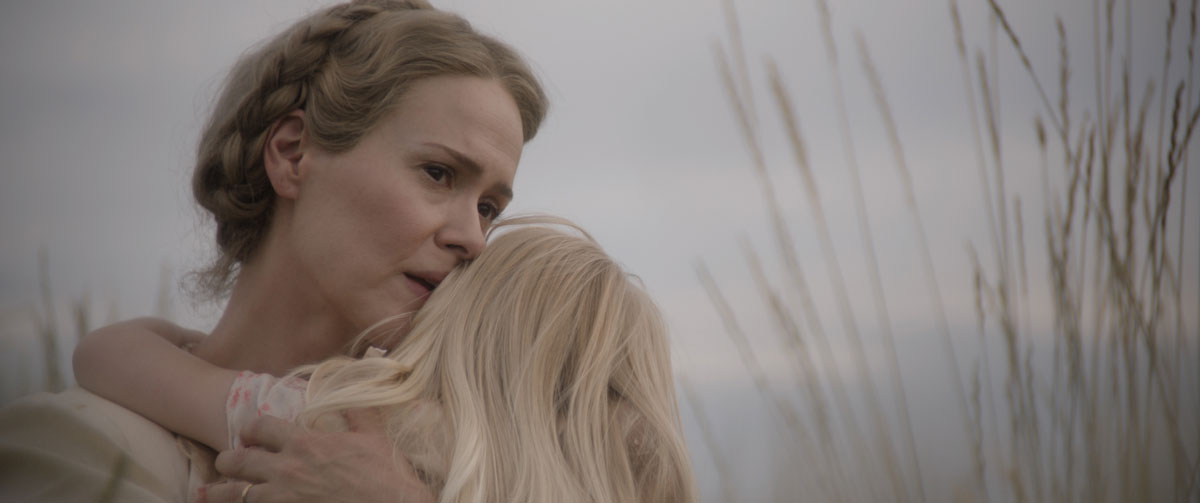
This tension defines the crux of “Hold Your Breath,” a psychological thriller, and the feature debut from Karrie Crouse and Will Joines. Helmed by a lead performance from the reigning scream queen and "American Horror Story" alumn, Sarah Paulson, the film, which premieres on Hulu on October 3, is perfectly positioned to offer a novel take on gothic horror, down to its muted palette and stifling, isolated atmosphere. Instead, “Hold Your Breath” struggles to find narrative footing, leading the plot to meander into predictable territory that is made largely redeemable by Paulson’s Margaret, the steadily unraveling matriarch of a blonde, plaited brood of girls. 

Left alone to care for her daughters Rose (Amiah Miller) and Ollie (Alona Jane Robbins), who is deaf, while her husband is away on a job meant to improve the family’s financial circumstances, Margaret finds herself in a constant state of worry. It’s not long after the death of her third daughter from scarlet fever, a tragedy that leaves her feeling tethered to her homestead despite her family’s dire circumstances — their cow has stopped producing milk, their only form of sustenance — amid an increasingly hostile environment. She oscillates between needlework with a group of women from town and tending to her daughters at home — it’s a humdrum life that feels creepingly claustrophobic, even without the adverse climate that leaves them trapped indoors. 

Shots of sparkling specks of dust floating in the air are cut alongside frames of Margaret’s tightly drawn face — between trembling hands, jerky expressions, darting eyes and her iconic horror howl, Paulson is exceedingly masterful at the whole, “trying and failing to keep my cool” housewife bit. She pops sleeping pills to help her abate night terrors and bouts of sleepwalking that have plagued her since her daughter’s death. It’s hardly a subtle form of goading the viewer when Margaret candidly admits that these terrors made her “do things” (wink wink.)

The omnipresent dust is compounded by a pall of death that has settled over the town. Margaret’s needlework sessions are injected with fear when rumors of “The Drifter,” a mysterious killer who supposedly “melted into the dust,” enter the ladies’ gossip circle. This report dovetails neatly with “The Grey Man,” the ominous subject of a scary story in a book Rose reads to Ollie at night. The tale of The Grey Man is contrasted with a quaint, recurring bedtime memory Margaret tells Rose and Ollie to help them sleep amid the screaming wind. “Tell us about the wheat,” Rose implores her mother, who then recounts times of abundant and lush harvest, with blades of wheat so high that they mimicked the movement of a rollicking sea, so dense that the girls could play hide-and-seek in them. “It was perfect,” Margaret reminisces. 

Hold Your BreathSarah Paulson in "Hold Your Breath" (Photo Courtesy of Searchlight Pictures)Margaret's mind is plunged into further chaos when Ollie claims to have seen The Grey Man holed up in the family’s barn. Though she’s initially reluctant to give credence to Ollie’s claim, Margaret does eventually come upon a stowaway “man of the cloth” (though he’s more dirty and unkempt than grey), played by “The Bear”’s Ebon Moss-Bachrach. Though it is an understandable and ostensibly intentional segue, meant to patch up any lingering questions about whether the Drifter-Grey Man hybrid is real or merely a hazy fable, this subplot comes off as superfluous — especially since a diligent viewer will come to see that, for once, it isn’t a man that Margaret and her girls should be wary of. 

When this relationship sours and the preacher, Wallace, reveals himself to be a con man, Margaret’s maternal instinct to protect her daughters — no matter the cost — intensifies tenfold, and she resorts to touting a shotgun at all times. She pathologizes her daughters’ every move, resulting in some serious moments of tension. As she recedes from the townsfolk congregation, shoving cloth in every nook and cranny of her modest home in an effort to fend off the infiltration of ever-persistent dust, the rumor mill begins to whirr: it’s clear that Margaret’s psychological state is in peril. 

What's even more clear is the direction the film is headed in. Though Paulson’s performance as the paranoid mother, left alone with a gun and all the grit she can muster, is entirely convincing, her superb acting is undercut by “Hold Your Breath”’s formulaic plotline. You don’t need to be a horror aficionado to know that no Grey Man or Drifter is going to do this family more harm than Margaret eventually will, though she doesn’t even realize it. From her fitful nights of sleep to her metastisizing fear of the dust, it’s easy to deduce her inevitable role in what’s to come.


Want a daily wrap-up of all the news and commentary Salon has to offer? Subscribe to our morning newsletter, Crash Course.


By this point, it’s also hard to ignore the film’s overreliance on jump scares and booming sound in favor of a nuanced plot. Quick cuts to Margaret slamming furniture to bolster the house’s security or thunderous banging on the door are almost too ubiquitous to “Hold Your Breath.” However, the film’s wide-shot visuals — which range from their home enveloped in a misty haze to dust swallowing the land whole — and portentous, tinkling soundtrack work extremely well in fomenting a nonstop feeling of suspense. While the film’s plot may register as scattered and all too easy to predict, it renders its viewers immobile with nerves from start to finish, a feat largely accomplished by these thoughtful auditory and aesthetic details. 

Like flecks of dust, its granular details, combined with Paulson’s expertise, engender an undeniably jittery atmosphere. “Hold Your Breath”’s most terrifying moments come in the last 15 minutes or so of the broader 94, a strategy that would be effective — especially alongside Paulson’s inimitable ability to do her thing so well — if what preceded it hadn’t been so jumbled. It could certainly be argued that this lack of cohesion is a deftly wielded film tactic, meant to mirror Margaret’s steadily deteriorating mental state. Still, though, it’s a difficult aspect of the film to reconcile.

While certainly not a negative first foray into the genre, Crouse and Joines’ “Hold Your Breath” is hard to designate as an impactful horror film. Ultimately, the dust that suffuses Margaret and her family materializes more successfully than the film’s ability to deliver something new.

"Hold Your Breath" is streaming now on Hulu.

JD Vance is wrong about climate science, experts say. It isn’t “weird,” it’s overwhelmingly accurate

During Tuesday night's vice presidential debate between Sen. JD Vance (R-Ohio) and Gov. Tim Walz (D-Minn.), Vance dismissed climate change as "weird science," skeptically characterizing the scientific consensus about burning fossil fuels as "this idea that carbon emissions drive all the climate change." Top climate scientists were unimpressed with Vance's posturing.

"How many more wakeup calls do we need? How many more Hurricane Helenes? The longer we ignore climate change the worse it will be."

These included University of Pennsylvania climatologist Dr. Michael E. Mann, who wrote to Salon that he could not "stomach Vance's constant lies and the lack of fact-checking," from CBS debate hosts, adding that "the reality is that the world's scientists say that carbon emissions cause climate change. Trump has dismissed climate change as a hoax. Denial of the threat to our civilization posed by climate change, alone, is disqualifying for the Trump-Vance ticket."

"What he said was just completely wrong, but not a surprise," Glenn "The Hurricane" Schwartz, said. He has 50 years of experience as a meteorologist, becoming one of The Weather Channel's first "hurricane specialists" in the 1980s. Analogous to the fictional tornado chasers in "Twisters," Schwartz chased hurricanes and other extreme storms in real life.

Schwartz added that there are three facts about climate change which cannot be denied: "Number one, carbon dioxide is increasing, which increases the temperatures of the earth. Number two, it's us doing the increase. Number three, things will keep getting worse unless we start producing those alternative energies. That determines whether you're a denier or not. If you can't agree with that, which the science has been there for 150 years and even Exxon knew about it 40 years ago, and when their scientists predicted it practically perfectly and then hid it for 40 years, then you're a denier."

An expert from a federal science agency, who spoke to Salon on the condition of anonymity to avoid professional reprisals, particularly objected to the implications in Vance's description of climate science as "weird."

We need your help to stay independent

"Climate science is not at all 'weird,'" the expert said. "It's fascinating and interesting and salient. We have tons of data coming in from satellites. We have improvements and understanding from the models. We have tests and evaluations and calibrations and all the things that you want in a science. We have predictions that have come true. We have hypotheses that have been tested and conclusions that have stood the test of time. It's not at all weird!"

Indeed, the consensus among experts seems to be that Vance's intention behind the "weird" diatribe was to casually disregard the legitimacy of climate science altogether. According to Dr. Mark Serreze, the director of the National Snow and Ice Data Center (NSIDC), this is a glib approach that humanity can not afford at this juncture in its history.

"Climate change is very real and we are the cause of it," Serreze said. "How many more wake-up calls do we need? How many more Hurricane Helenes? The longer we ignore climate change, the worse it will be."


Want more health and science stories in your inbox? Subscribe to Salon's weekly newsletter Lab Notes.


"Vance is a denier. Trump is a denier. What can you say? It's that simple."

One of the debate moderators, Norah O'Donnell, fact-checked Vance in real time, pointing out that "the overwhelming consensus among scientists is that the Earth’s climate is warming at an unprecedented rate.” She then asked Vance if he agreed with Trump's mischaracterization of climate change as a "hoax," which he avoided answering.

"JD Vance, while a smooth talker, stayed true to his pattern of lies and obfuscation," Serreze said. "He's more dangerous than Trump, another climate change denier."

Dr. Peter Kalmus, a climate scientist at NASA's Jet Propulsion Laboratory, who emphasized his opinions are his own, likewise criticized Vance by saying he "clearly doesn't understand science and he's being willfully ignorant. Idiots like Vance and Trump, thinking they know more than an entire scientific community, dangerously contribute to the tragedy of irreversible global heating. Carbon dioxide and methane are driving global overheating, this is basic physics." At the same time, Kalmus also felt Walz put in a weak showing.

"Walz did a terrible job talking about climate in this debate," Kalmus said. "Fossil fuels are the cause, period. The fossil fuel industry has been lying and blocking action for decades, period. All the storms and floods and fires and heat waves and crop failures will become more frequent and intense until we phase out fossil fuels, period. That's the physics. It's irrefutable and pointless to argue with it. And we have a viable solution: solar and wind and batteries. Let's create millions of great jobs and do this."

Good cheese is seasonal

While standing in the dazzling fluorescence of the modern supermarket, one can spot an astounding array of culinary wonders: plump strawberries nestled in plastic cartons, waxy apples as crisp in September as in April and, on the refrigerated shelves in the back, a staggering assortment of cheeses. There’s crumbly, saline feta stored in squat disposable tubs; orange-tinged cheddar slices, ranging from mild to sharp, in slim plastic sleeves; and selection upon selection of uniformly grated and shredded varieties, each hermetically encased in crinkling, resealable bags. 

The contemporary supermarket is, in many ways, a marvel of modern science fiction. Thanks to a sprawling global supply chain, refrigerated cargo ships, controlled-environment greenhouses and the introduction of artificial ripening techniques, American shoppers have gradually become untethered from the natural cycles of the earth. 

As we push carts through these air-conditioned aisles, it’s easy to forget the usual constraints of time and geography — and to overlook that good cheese, like apples or strawberries, is still very much a seasonal product (though to fully appreciate that, you might have to back away from the supermarket dairy section). 

While the exact origins of cheesemaking remain shrouded in mystery, its practice is inextricably linked to the domestication of milk-producing animals, primarily sheep — a process that, according to the National Historic Cheesemaking Center in Monroe, Wisconsin, began 8,000 to 10,000 years ago. Some historians and archaeologists suggest that cheese may have been discovered by accident; in ancient times, milk was commonly stored in containers crafted from animal stomachs. Rennet, an enzyme naturally present in the stomachs of ruminants, would prompt the milk to coagulate, separating into curds and whey, thus laying the groundwork for modern cheese production.

Remarkably, while the Cheesemaking Center notes that many beloved cheeses today, such as Cheddar, Swiss and Parmesan, are relatively recent innovations — most appearing within the last 500 years — the allure of cheese was equally strong among our ancestors. “The art of cheesemaking is referenced in ancient Greek mythology, and evidence of cheese and its production has been discovered in Egyptian tomb murals dating back over 4,000 years,” they write. 

This brings to mind the 2018 discovery of a 3,200-year-old piece of cheese in the tomb of Ptahmes, a high-ranking Egyptian official from the 13th century BCE. Made from a blend of sheep and goat's milk, this ancient delicacy likely resembled chevre in its consistency when fresh. However, it also contained traces of brucellosis bacteria, an infectious disease associated with unpasteurized milk — a stark reminder of the deep connection between cheese, milk and the rhythms of seasonality. 

We need your help to stay independent

Historically, cheesemaking has been an activity tied to the ebb and flow of nature. Many dairy farms schedule calving to occur in late winter or early spring. This timing ensures that cows, sheep and goats are at their peak milk production when the pastures are carpeted with fresh grass, herbs and wildflowers. These grazing animals absorb the character of the plants they consume, which is then imparted into the milk they produce. 

It’s a phenomenon the French have long championed with the concept of “terroir” — the idea that the taste of a product is intrinsically tied to the land from which it originates. While the term is most often used in the States when describing a wine’s provenance, it’s fitting for cheese, too. “Everywhere that cheese is made has native flora and fauna which will impact the cheese, both in the milk and in the aging,” Chris Osborne, cheesemaker at Blackberry Farm, told Wine Enthusiast in 2020. 

Autumn actually serves as a prime time to experience the terroir of cheese, as varieties made from spring milk and then aged begin to grace store shelves, though not necessarily at Big Box grocers. Take Cabrales, a blue cheese crafted by rural dairy farmers in Asturias, Spain, which captures the verdant essence of grazing cows thriving in lush pastures. Then there’s Comté, with its smoky, umami-rich notes that deepen as the cheese matures, revealing the rich flavors of the spring milk that form its foundations. The decadent Brillat-Savarin, a triple-cream delight, embodies the vibrant foraging of cows, while Spring Cheddar — made from the milk of cows that have grazed spring pastures — is subtly sweet and lightly herbaceous. 

"Historically, cheesemaking has been an activity tied to the ebb and flow of nature"

Together, these cheeses encapsulate the terroir of their respective origins, allowing diners to savor the fleeting beauty of seasonal flavors long after spring has passed. 

Eventually, when the fall turns to winter, grazing becomes sparse. Soon, farm animals are brought indoors for the seasons where the wildflowers and herbs they spent the spring eating are replaced by hay and feed. This, too, has an impact on the flavor of milk and the types of cheeses that are produced from it. In the colder months, cheese production slows, and the cheeses that do emerge often bear heavier, heartier profiles, like the nutty intensity of an aged Gruyère or the rich creaminess of a winter Brie.

As agriculture industrialized, cheesemaking followed suit, fundamentally altering its relationship with the agricultural cycle. This shift allowed manufacturers to standardize processes, prioritize efficiency and utilize pasteurization and mass distribution, resulting in a dairy aisle that rarely reflects seasonality. Instead, shoppers encounter an illusion of uniformity, where Cheddar, Gouda, and Brie line the shelves year-round, seemingly indifferent to the changing weather outside.

Yet some cheesemakers are pushing back against this trend, returning to small-batch production that honors the natural seasonality of milk. The knowledgeable staff at local cheese shops — or even the Murray’s counter at the grocery store — are eager to guide you through their curated selections.

While the modern supermarket, where mozzarella tastes the same in February as it does in July, is undoubtedly a triumph of human ingenuity, it also serves as a reminder of how far we have drifted from the origins of our food. So, the next time you reach for a wedge of cheese, take a moment to consider the season in which it was made, the grass on which the cow grazed or the weather in the pasture. In doing so, you might just taste a little more of the world than the vacuum-sealed plastic suggests.

Correction: A previous version of this article stated that Brillat-Savarin is a sheep's milk cheese. It is a cow's milk cheese.

“You still have to fight like hell”: Trump wanted to overturn the 2020 election even if he “lost”

After it became clear that President Joe Biden won the 2020 election, former President Donald Trump told family members that they should continue to "fight like hell" regardless of the results, according to a court filing by special counsel Jack Smith that was unsealed Wednesday.

"It doesn't matter if you won or lost the election," he said following his November 2020 defeat, according to a witness who overheard the remark. "You still have to fight like hell."

Trump made the comment to "his wife, daughter and son-in-law," according to Smith's filing. The conversation took place on Marine One, per Smith, long after the "defendant had begun spreading false fraud claims" about the election.

Fighting like hell is a refrain that Trump has often used to direct his supporters during and after the 2020 election, especially in the context of resisting a legitimate democratic process that experts have long confirmed saw close to zero successful fraud.

Trump might also have been referring to members of his inner circle, including former Vice President Mike Pence and several campaign and party officials, who were increasingly viewed as obstacles to retaining his grip on the White House after they pushed back against his baseless claims of fraud. When his supporters stormed the Capitol on Jan. 6 and endangered Pence, Trump allegedly reacted with a nonchalant: "So what?"

"The defendant disregarded [redacted] and Pence in the same way that he disregarded dozens of court decisions that unanimously rejected his and his allies' legal claims, and that he disregarded officials in the targeted states — including those in his own party — who stated publicly that he had lost and that his specific fraud allegations were false," the filing said.

Trump is evidently furious at Judge Tanya Chutkan's decision to unseal the filing, which reveals a trove of other damaging stories concerning his efforts to not only cast doubt on the election but directly pressure officials to throw out votes for President Joe Biden. Within minutes of the filing's release, Trump took to Truth Social to rage against "Harris-Biden regime" and its alleged attempt to "INTERFERE IN THE 2024 PRESIDENTIAL ELECTION."

Ex-Trump aide Cassidy Hutchinson says she is a conservative who is “proud” to vote for Kamala Harris

In an interview with MSNBC's Lawerence O'Donnell on Wednesday, Cassidy Hutchison, a former aide to Donald Trump, endorsed Vice President Kamala Harris and said her former boss was a threat to democracy who should not be returned to power.

“Donald Trump and JD Vance cannot be trusted with the Constitution. They cannot be trusted to uphold our rule of law and they can't be trusted to enact responsible policy,” Hutchinson said. “That in and of itself is disqualifying."

Hutchinson, who recently authored a book on her experience in the Trump White House, "Enough," also had harsh words for Trump's running mate, Sen. JD Vance, R-Ohio.

"I try not to climb inside the minds of people who seem like they have very frightening thoughts and JD Vance is one of those individuals," she said.

According to the former aide, whose explosive Jan. 6 testimony detailed Trump’s involvement in the U.S. Capitol riot, it is "scary" as a conservative to come out against the Republican ticket. But she said it was time to put country over party.

“I am really, really proud as a conservative to have the opportunity to vote for Kamala Harris and Tim Walz in this election,” she told O’Donnell. “Policy is important.”

Harris would at least be open to discussing what is best for the country instead of what is best for her personally, Hutchinson said.

“I think it's so important that we get past this period of Donald Trump for America to begin healing,” she concluded.

Trump says he would deport Haitians “back to their county” regardless of their current legal status

Donald Trump claimed on Wednesday that if elected president he would revoke the the legal status of Haitian immigrants and send “them back to their country,” CNN reported.

During an interview with NewsNation, the former president, who continues to lie that Haitian immigrants are eating pets in Springfield, Ohio, affirmed his stance to a reporter who asked: “So you would revoke the temporary protected status?”

“Absolutely,” the former president responded, adding in the same breath: “Yeah, I’d revoke it and I’d bring them back to their country.”

Trump then falsely accused legal Haitian immigrants of destroying Springfield, Ohio, disregarding local officials and business leaders who say they have revitalized the once economically depressed town.

“Springfield is such a beautiful place. Have you seen what’s happened to it? It’s been overrun, you can’t do that to people. They have to be removed,” the GOP presidential candidate said.

Although many Haitian immigrants are protected under President Joe Biden’s humanitarian parole and TPS programs, which allows them to work and pay taxes, Trump and his allies continue to spread false information about them to “create a story,” as Sen. JD Vance put it, that can frighten voters.

In reality, it is these false claims that have endangered Springfield residents, leading to bomb threats and school shutdowns in recent weeks. Haitian immigrants say they also now live in fear due the former president's campaign against them.

John Amos’ daughter says she found out about her father’s death through the media

The late John Amos' daughter shared this week that she learned of her father's passing through the media. 

In a statement posted on Instagram, Shannon Amos wrote on behalf of her family: “We are devastated and left with many questions about how this happened 45 days ago, learning about it through the media like so many of you."

The legendary actor best known for his roles in "Good Times" and "Roots," died in Los Angeles on Aug. 21 at 84, which was announced by his son K.C. on Oct. 1.

It's been stated in various reports by media outlets that while there was no autopsy done on Amos, the actor died from congestive heart failure. The official death certificate also found Amos was cremated nine days after his passing.

"This should be a time of honoring and celebrating his life, yet we are struggling to navigate the wave of emotions and uncertainties surrounding his passing," Amos' daughter furthered in her statement. "Still, there is some semblance of peace in knowing my father is finally free."

The Amos children have reportedly faced difficulties as they fought each other over their father's care and acting legacy. K.C. and Shannon bitterly argued, which led to Shannon accusing K.C. of elder abuse, a claim K.C. denied.

In a Hollywood Reporter profile, Shannon stressed that K.C. had been isolating their father from his friends and family and became the authority on John's affairs.

In an interview with People Magazine last year about the family's battles and Shannon's accusation, John said, “Right now, it is somewhat acrimonious, but never mind what you might read or hear about in the paper or on this medium or that medium platform. Suffice it to say we are still family, and we love each other, and that’s the bottom line."

https://www.instagram.com/reel/DAmTuS4x6ug/?igsh=MzRlODBiNWFlZA%3D%3D

“So what?”: Trump shrugged off threat to Mike Pence’s life, according to latest Jack Smith filing

As the situation at the U.S. Capitol on Jan. 6, 2021, deteriorated and security personnel had to bundle former Vice President Mike Pence out of the way of rampaging insurrectionists, former President Donald Trump allegedly gave a nonchalant "so what?" according to a bombshell court filing by Special Counsel Jack Smith released Wednesday by Judge Tanya Chutkan.

The 165-page document details the Jan. 6 attack by pro-Trump insurrectionists as well as the vain attempts by Pence, party and state leaders, campaign officials and some of Trump's own lawyers to warn him that continuing to spread false claims about a stolen election would be futile at best and disastrous at worst. 

Prosecutors reconstructed interactions Trump had with his inner circle, including an episode where an aide rushed to the dining room to find Trump watching events of Jan. 6 unfold on TV while posting commentary on his phone. When the aide told Trump that security measures were being taken to protect Pence from the mob, "the defendant looked at him and said only, ‘So what?’” the filing alleges.

Trump appeared to score a big win this summer when the Supreme Court ruled that Trump was immune from prosecution for "official acts" as president. But prosecutors argue that Trump was acting as a private citizen when he conspired to overturn the 2020 election results, noting the president has “no official role in the process by which states appointed and ascertained their presidential electors.”

Within minutes of the document being unsealed, Trump stormed onto Truth Social with a multi-episode rant falsely alleging that it was the Democrats who were trying to rig the election by conspiring with Smith to hurt his standing with voters. Unlike corroborated stories in Smith's filing about Trump pressing governors and election officials to overturn unfavorable election results, there is no evidence of Democrats attempting any interference with the legal process.

“HELL BENT” on clinging to power: Trump engages in mad projection over new Jack Smith court filing

Former President Donald Trump is furious over a damning 165-page court filing from special counsel Jack Smith released Wednesday that further details his role in the Jan. 6 insurrection.

Within minutes of Judge Tanya Chutkan releasing the document, Trump sent out a string of Truth Social posts claiming that the filing was a plot concocted by Democrats to steal the election, a claim he repeated during a two-minute diatribe on NewsNation.

The Truth Social series began with a preface in which he declared that the Jan. 6 case would end in "COMPLETE VICTORY FOR “PRESIDENT DONALD J. TRUMP" just like "THE FULLY DEBUNKED RUSSIA, RUSSIA, RUSSIA, IRAN, IRAN, IRAN, UKRAINE, UKRAINE, UKRAINE, 51 INTELLIGENCE AGENTS, SPYING ON MY CAMPAIGN, IMPEACHMENT HOAX NUMBER ONE, IMPEACHMENT HOAX NUMBER TWO, OR ANY OF THE OTHER SCAMS, THIS ILLEGAL ACTION TAKEN BY THE JUSTICE DEPARTMENT, INCLUDING THEIR RAID ON MAR-A-LAGO."

Trump then moved on to his unsupported thesis that the filing was an attempt by the "Harris-Biden regime" to "INTERFERE IN THE 2024 PRESIDENTIAL ELECTION" and reverse the momentum he has from "dominating the Election cycle."

"Deranged Jack Smith, the hand picked Prosecutor of the Harris-Biden DOJ, and Washington, D.C. based Radical Left Democrats, are HELL BENT on continuing to Weaponize the Justice Department in an attempt to cling to power," he raged, calling the entire case "a Partisan, Unconstitutional, Witch Hunt, that should be dismissed, entirely, just like the Florida case was dismissed!"

After a one-and-a-half hour break, Trump returned to Truth Social with his contention that the amorphous entity appearing to consist of the Biden administration, the Harris campaign, the Democratic Party and the Department of Justice was "guilty of the Worst Election Interference in American History" and in doing so was "trying to DESTROY OUR DEMOCRACY, allowing millions of people to enter our Country illegally."

But Trump struck a defiant note against the forces he sees arrayed against him, reassuring his followers once again that "THEY WILL FAIL, AND WE WILL SAVE OUR NATION!"

The former president then singled out the "DEPARTMENT OF INJUSTICE," which he said should not have done anything with his pending cases 60 days before the election but "DISOBEYED THEIR OWN RULE IN FAVOR OF COMPLETE AND TOTAL ELECTION INTERFERENCE. I DID NOTHING WRONG, THEY DID! THE CASE IS A SCAM, JUST LIKE ALL OF THE OTHERS, INCLUDING THE DOCUMENTS CASE, WHICH WAS DISMISSED!"

Smith's filing — coming this late in 2024 only because the former president's legal team repeatedly sought to delay the case —includes Trump's reaction to news that former Vice President Mike Pence had been moved to a secure location in the U.S. Capitol ("so what?") and his alleged declaration to his wife Melania and daughter Ivanka that “it doesn’t matter if you won or lost the election. You still have to fight like hell.”

A Trump campaign spokesperson, apparently fuming over his boss being portrayed in such a light, told Reuters that "his entire case is a partisan, Unconstitutional Witch Hunt that should be dismissed entirely, together with ALL of the remaining Democrat hoaxes."

The documents case in Florida, which was dismissed by the Trump-appointed Judge Aileen Cannon, is currently being appealed by Smith. The prosecution alleges that Trump improperly hid scores of classified national security documents in his Mar-a-Lago resort after leaving office.

Later on Wednesday evening, Trump took his case to NewsNation, calling Smith a "deranged person" who "lost the big documents case, that was the biggest of them all.”

"This was a weaponization of government and this is why it was released 30 days before the election,” he said. “And it’s nothing new in there, by the way, nothing new. They rigged the election. I didn’t rig the election. They rigged the election.”

Trump-Vance plan for mass deportations would be “devastating” to the economy, report finds

“Mass deportation now!” has become the rallying cry of former President Donald Trump’s 2024 campaign. While spreading lies about immigrants and crime rates, Trump and his running mate, Sen. JD Vance, R-Ohio, have repeatedly promised to forcibly remove millions of immigrants now living in the United States, including those who currently enjoy legal status, promising the “largest deportation operation in American history” if elected this November

Trump and Vance have spoken little about how exactly they would deport upwards of 13 million people, a massive undertaking that would require building infrastructure to house and transport detained immigrants, or what it would cost taxpayers. Asked about the GOP's deportation plans during the vice presidential debate on Tuesday, Vance said only that they would first deport immigrants with a criminal record, refusing to answer a question about whether he would separate parents who entered the country illegally but whose children are U.S. citizens.

A new report from the American Immigration Council (AIC), a nonprofit advocacy group, suggests there's good reason for the Trump-Vance campaign to avoid talking specifics, finding that a mass deportation, no matter how it’s carried out, would exact a devasting toll on all Americans, not just those targeted for removal.

“Should any president choose to pursue mass deportation, it would come at an extraordinary cost to the government while also devastating the economy,” Jeremy Robbins, executive director of AIC, said in a statement. “It’s critical that policymakers and the American public understand what this would involve: tens of billions of tax-payer dollars, already-strained industries devastated, millions of people locked up in detention, and thousands of families torn apart causing widespread terror and chaos in communities across the country."

According to the AIC report, a one-time mass deportation of undocumented immigrants, which would also be the single largest law enforcement operation in American history, would cost taxpayers no less than $315 billion. That's a "highly conservative" estimate, however; an operation this big would also entail the “incalculable” cost of detaining and housing millions of people, potentially creating a humanitarian catastrophe. To put it into perspective, the entire incarcerated population across the country is 1.9 million people, according to Prison Policy Initiative.

“There is simply no reality in which such a singular operation is possible,” the report reads. Indeed, no matter how it's done, deporting so many people would drive up the national debt or require new taxes.

According to the report, if a future Trump-Vance administration sought to deport one million people a year, instead of aiming for the entire immigrant population all at once, it would cost taxpayers about $88 billion annually — twice the budget of the National Institutes of Health and four times the budget of NASA. That figure doesn’t include hiring costs for the tens of thousands of government employees and law enforcement agents that would be required or a  “myriad of other ancillary costs necessary to ramp up federal immigration enforcement operations to the scale necessary.”

Aside from the budget costs, mass deportation would also be a huge hit to the American workforce. In 2022, nearly 90% of undocumented immigrants were of working age and 75% of that population worked, accounting for 4.8% of the American workforce. Undocumented immigrants are the backbone of the economy, often taking on the jobs that native-born Americans don’t want: cleaning, roofing, washing dishes and working in slaughterhouses.

Trump's deportation plan would devastate the construction and agriculture industries, in particular, with each losing one out of every eight workers they currently employ. The hospitality industry would lose about one in 14 workers, exacerbating the already significant labor shortage since the pandemic. 

The country would also lose over a million entrepreneurs, the sum impact resulting in a "disruption to services that have become an integral part of community life and provide local jobs for Americans," the report found. “For example, if a shortage of construction workers prevents a house from getting built, the businesses that would be furnishing that house—from kitchen appliances to bedframes—lose business, too. Without field workers to pick crops, truckers have no goods to transport, and farmers have no need to buy new farm equipment.”

The report closes with a comparison, noting the opportunity cost of spending billions of dollars on deportations and pointing out the same sum could build over 40,000 new schools, 2.9 million homes and cover the cost of college tuition for 5 million people.

Gen Z, younger millennials more financially stressed, survey says

Americans across all age groups are experiencing money stress, according to the American Psychological Association's (APA) 2023 Stress in America survey. But Gen Z and younger millennials are feeling the pinch the most and have the highest rates: 82% of survey respondents in the 18 to 34 age group said money is a significant stressor. The driving forces behind the financial stress have a lot to do with factors out of their control. 

A changing world 

COVID-19 turned the world we knew upside down. The “new normal” is no longer new and everyone is dealing with the aftermath, even if our main coping mechanisms are denial and amnesia. Despite efforts to “move on,” the APA’s survey notes that every age group demonstrates signs of collective trauma. 

“The psychological damage or stress that comes from being cut off from friends, potentially family, the whole world shifted. And generally, there's this overall feeling of 'I'm not safe' or 'My safety isn't guaranteed,'” said Nathan Astle, certified financial therapist and founder of Financial Therapy Clinical Institute.  

The APA survey found that health-related stressors tied with money (both 82%) as the top sources of stress for the 18 to 34 age group. At the confluence of these stressors, data from the Nationwide Retirement Institute 2023 Health Care Costs in Retirement Survey show that 24% of Gen Z and 22% of millennials surveyed are postponing or delaying medical care because of high inflation. 

An uncertain future 

While financial stress is rampant across all generations, Gen Z and millennials face an economic reality far different from their parents or grandparents. 

The narrative of “Just work harder!” or “Pull yourself up by the bootstraps” simply doesn’t apply to everyone. 

“School is four times as expensive as it was for our parents. Houses are twice as expensive, adjusted for inflation. The dream we were fed doesn't match with our actual economic realities,” said Astle.

It’s no longer a matter of simply being cash-strapped in college or graduating into the next phase of life. “As a generation … it’s not just that, ‘oh you know, like the poor college days’, it's like ‘I genuinely don't think that there's a future for me.’ And I think that's a different type of financial stress that's more lingering,” said Astle.

High cost of living 

Based on the APA survey data, 58% of 18 to 34-year-old respondents who reported money as a significant stressor say paying for essentials is causing them stress. Shelter, food, and transportation already take up a large part of anyone’s budget. But for younger generations, especially those just entering the workforce and earning money, making ends meet is harder to do. 

We need your help to stay independent

A 2024 report by Bank of America on The State of Gen Z’s Financial Health reports that 52% of Gen Z says they’re not making enough money to live the life they want and the cost of living is one of the major challenges they face. To make it work, 54% of respondents report receiving financial assistance from family, friends and the government. 

Housing costs and inflation have had a pernicious effect on Americans’ financial well-being. The sticker shock on costs of goods is far from imagined and there’s a stark difference between pre-COVID and now. The Bureau of Labor Statistics (BLS) Consumer Price Index (CPI) inflation calculator shows this very clearly. 

To have the same purchasing power as $100 in January 2019 you’d need $124.96 in July 2024. That’s nearly a 25% increase in five and a half years.  

For context, $100 in January 2014 had equal buying power as $109.69 in July 2019, an increase just shy of 10%.

As of the second quarter of 2024, the average sale price of houses sold in the United States stood at $501,700, according to data from the Federal Reserve Bank of St. Louis. That’s a significant spike from five years prior when the average price was $376,700 in the second quarter of 2019. 

The oldest of Gen Z was born in 1997 when average house sales were just $175,400 at the end of the year.  

Dealing with this financial house of cards means navigating a world where traditional financial advice doesn’t apply. What worked for their parents and grandparents won’t necessarily work for them at all, despite their best efforts. 

“I think there's a certain level of very understandable cynicism there, which also leads to this financial stress. Not just like ‘What's going on with my money?’ but just the general feeling of ‘Will things get better?’” said Astle.

With such a tenuous foundation, it’s no wonder Gen Z and younger millennials lead the pack when it comes to financial stress. No one is a fortune teller and can predict the future. But we know that building a fortune in the future will be much harder. 


JD Vance is laying the foundation: He aims to lead the post-Trump GOP

If you watched Tuesday’s vice presidential debate hoping for something like a WWE SmackDown event, then you were probably left disappointed. However, if you wondered what fascism on novocaine looks like, or what a political “prevent” defense versus a blitz looks like, you might have enjoyed yourself.

Republican vice-presidential candidate JD “Smokey Eyes” Vance and Democratic vice-presidential candidate Tim “Coach” Walz squared off in a CBS News event deemed the undercard event of the century. Expectations were low and interest relatively high. Still, all you could do was sigh.

With a serious tone and knitted brows, Norah O'Donnell and Margaret Brennan moderated the debate, which ran for 90 minutes at the CBS Broadcast Center in New York. While the ghost of Walter Cronkite was probably wretched in anticipation of the event, which studio heads boasted would feature no fact-checking from the moderators, early in the debate the journalists abandoned that vow after Vance refused to drop the obvious and dangerous lie about Haitian immigrants in Springfield, Ohio, which he’s propagated for weeks.

“And just to clarify for our viewers, Springfield, Ohio, does have a large number of Haitian migrants who have legal status, temporary protected status,” Brennan made clear. Vance complained about the fact-checking. “Margaret, the rules were that you were not going to fact check and since you’re fact-checking me, I think it’s important to say what’s actually going on,” he protested. A few seconds later, they cut Vance’s mic after he continued to talk.

The telling fact was that Vance, in complaining about being fact-checked, openly admitted he wanted to get away without being called on his lies — and expected to do so.

Of course, there was plenty of criticism of the moderators from Trump supporters about that, but Walz supporters also criticized the moderators after they asked Walz about his misleading statements regarding a 1989 visit to China. “I’m a knucklehead sometimes,” he said as he stumbled to explain his claim that he was in Hong Kong during the Tiananmen Square massacre.

Trump followers told me they were pissed. Democrats who wanted a smackdown were equally upset. Their groans and moans could be heard across the nation. Both of them missed the point that Vance threw Trump under the bus.

But then the moderators asked Vance a more serious question regarding a time when Vance called Trump “America’s Hitler.” The answer from Vance was telling on many fronts. He, of course, shot the messenger. “I was wrong, first of all, because I believed some of the media stories that turned out to be dishonest fabrications of his record.”

If Vance is to be believed, he had been living under a rock, poked his head out one day and read some horrible things about Trump and, as a conditioned response, he believed them. He never independently verified anything he heard and never engaged in critical thinking. He just believed. That alone should disqualify him from being a vice presidential candidate. We need critical thinkers. But, more importantly, inasmuch as the facts make clear that Trump is exactly the monster we know him to be, this also shows that Vance is firmly from the Roy Cohn school of politics: He always attacks, denies responsibility for everything and always claims victory. The difference? Vance tries to do it with a smarmy smile.

Those two questions, juxtaposed against each other, underscore one of the greatest problems in today’s politics. Trump partisans were screaming that the moderators were too tough on Vance while the Democratic partisans moaned in agony about “false equivalence.” As a reporter, I saw something different. The moderators sought to bring out criticisms against each candidate and allow them to answer questions about those criticisms. It is obvious that one candidate had a lot more to answer for than the other, and the moderators trusted the American voting public enough to see the difference.

We need your help to stay independent

Vance was gracious. Walz was gracious. They shook hands more than once. They smiled at each other. They agreed with each other on some issues. Walz never blitzed Vance. Vance never really challenged Walz. Trump followers told me they were pissed. Democrats who wanted a smackdown were equally upset. Their groans and moans could be heard across the nation. Both of them missed the point: Vance threw Donald Trump under the bus. Trump would never agree, about anything, with people he claims are destroying America and the First Amendment, and who are communists, baby-murderers and mental defectives. Trump is one step away from calling Democrats witches who’ve cast evil spells and are intent on burning down the country he aims to “Make Great Again.” JD Vance said we live in a beautiful country; Trump claims we live in a “hellscape."

A group of undecided voters in Pennsylvania mentioned that it looked like we were “watching a sequel to ‘The Nice Guys,’" with the audience voting to decide who was Russell Crowe and who was Ryan Gosling. This kinder, gentler nature made quite an impression on highly partisan viewers — few of whom were happy to see it.

Admittedly it was hard to digest Vance showing empathy for Walz’s children, who had to suffer from the results of a school shooting, especially after Vance's recent remark that school shootings are just a “fact of life.” He also obfuscated the facts on health care, reproductive care and which party brought down the cost of prescription medication. His stock answer to nearly every question was a variation of “It’s all Kamala Harris’ fault.” 

Few seemed to have bought into it. But, Vance had an audience of one in mind, he hit his mark and smiled. Thus it went for the majority of the debate. And while Walz adhered closer to reality than Vance, it was mostly a vanilla debate — until the end.


Want a daily wrap-up of all the news and commentary Salon has to offer? Subscribe to our morning newsletter, Crash Course.


O’Donnell began the final question by saying, “Let’s talk about the state of democracy,” before she leveled Vance with this direct question: “Sen. Vance, you have said you would not have certified the last presidential election and would have asked the states to submit alternative electors. That has been called unconstitutional and illegal. Would you again seek to challenge this year's election results, even if every governor certifies the results?"

Vance tried to slip the noose, but couldn’t. He wanted to speak of the future and the “inflation crisis caused by Kamala Harris,” but would not answer the question. When Walz was given a chance to address it, he first said he enjoyed the night’s debate (bringing groans from Democratic supporters) but then showed the blitz. He said that on this particular issue, “we are miles apart,” before hammering home the point. “This was a threat to our democracy in a way that we had not seen. And it manifested itself because of Donald Trump's inability to say — he is still saying he didn't lose the election.”

Vance, like Trump, will say anything. The difference? He’ll smile as he does it.

Walz then turned directly to Vance: “I would just ask that: Did he lose the 2020 election?”

“Tim, I'm focused on the future,” Vance stammered before an ineffective attempt to deflect. “Did Kamala Harris censor Americans from speaking their mind in the wake of the 2020 COVID situation?” Vance shot back.

“That is a damning non-answer,” Walz declared.

“He lost the election,” Walz said of Trump. “This is not a debate. … Will you stand up? Will you keep your oath of office even if the president doesn't? And I think Kamala Harris would agree. She wouldn't have picked me if she didn't think I would do that, because of course that's what we would do. So, America, I think you've got a really clear choice on this election of who's going to honor that democracy and who's going to honor Donald Trump.”

With that, they went to a commercial break, and you could hear the sarcophagus slam shut on Vance’s smiling fascism. 

That was the moment that mattered most. It was a leisurely, friendly and smiling walk into a trap. All night long it seemed amiable, and Walz — the former high school defensive coach — sat back in a prevent defense. In the end, though, he nailed the one thing that separates Trump and his minions from everyone else: They do not respect our democracy.

For those who, for whatever reason, are still on the fence about the presidential race, that may be the moment that matters most. “How can I be sure he’ll respect my vote,” an undecided voter told a CNN reporter later. That is the question, indeed. 

There's one question I would have loved to see the moderators ask: Why did Trump need a new running mate?

Walz embraced the “nice guy” image during the debate as a strategy. He was a gentleman, a gun-owning, football-coaching, Midwest regular guy who presented a completely different image of manhood from the toxic masculinity of Trump and Vance. It worked. Some Democrats believed it worked too well and that Walz didn’t go after Vance as he should. But Walz wasn’t trying to reach the faithful. He was trying to convert the faithless by showing a different image than one presented by MAGA, while at the same time driving home the fundamental differences between fascism and democracy. He went a long way in showing how valuable he’d be as a vice president.

At least he did according to the dozens of undecided voters I spoke with. A source close to Walz, who spoke to me on the condition of anonymity, said his team were on the fence about the strategy. “But I think it worked," this person said. "I think we threaded a needle and I think we won the debate. We’re very happy about that, but only time will tell. We still have several weeks before Election Day and this election is too close to call.” Even so, as the Walz source admitted, “Sure, there were things he could have beaten Vance up about, but that’s not what he chose to do. I think it was the right choice.”

Vance, on the other hand, was off the stage for less than five minutes before Trump began sending emails and posting on social media how his boy had busted up Walz and toed the company line. Trump, as usual, was missing the point.

What the MAGA godhead failed to understand is that there's a reason Vance didn’t burn hot at the debate either. He wanted to put a kinder, gentler face on Project 2025, the GOP’s fascist tendencies and its desire to destroy organized labor, health care and the economy. In short, Vance was trying to show that if Trump loses — which is increasingly likely — then he, at just 40 years of age, is the heir apparent in the Republican Party. Vance has a long-term plan in mind — to be the fascist of the future— and he may have played his hand successfully.

Vance made a night of politely blaming Harris for every known problem in the universe — and tried to take credit for lowering prescription drug prices. If Vance had kept on going, I think he would have tried to blame Harris for athlete’s foot, halitosis and gingivitis while taking credit for the theory of relativity and breaking the sound barrier — well, except that he still denies "weird science."

As we cruise into the last few weeks of the campaign, the die may be cast for 2024, but JD Vance is just getting started.

His timing couldn’t be better — at least for himself and perhaps for the GOP. Special counsel Jack Smith unloaded an October surprise late Wednesday in his ongoing federal election case against Trump. According to one document in his massive filing, one private political adviser described Trump’s plan three days before Election Day in 2020: “He’s going to declare victory. That doesn’t mean he’s the winner, he’s just going to say he’s the winner.”

Vance, like Trump, will say anything. The difference? He’ll smile while he does it.

Congress knew banning TikTok was a First Amendment problem. It did so anyway

Congress knew full well back in March that U.S. TikTok users engage in constitutionally protected speech on the app, and that banning it is an inadequate way to protect Americans’ privacy, according to a previously classified transcript. Yet Congress and President Joe Biden banned TikTok in April anyway, choosing political expediency over the hard work of passing and enacting the comprehensive consumer privacy legislation this nation so desperately needs.  

The government submitted this partially redacted House Energy and Commerce Committee transcript Sept. 4 as part of the lawsuit over the federal TikTok ban; the U.S. Court of Appeals for the District of Columbia heard arguments in the case Sept. 16. The transcript shows lawmakers and law enforcement officials in a March 7 executive briefing recognized that Americans’ speech on TikTok is protected by the First Amendment — the same recognition a federal judge had made last November when it blocked Montana’s TikTok ban from going into effect.  

Lawmakers and officials didn’t make any particularly new points at the briefing about the dangers of TikTok, and repeatedly characterized their fears as hypothetical. The transcript is replete with references to the possibility of the Chinese government using TikTok to manipulate content that Americans see, perhaps to shape or alter their views on foreign and domestic issues.  

For example, a Justice Department official voiced concern that TikTok users’ public and private data could go to the Chinese government, which could use it in ways that could be harmful to tens of millions of young people who might later pursue careers in government, in human rights, or any field that could put them at odds with the Chinese government’s agenda.   

But there is no indication from this transcript’s unredacted portions that this is actually happening.  

Rather than grandstanding like this, Congress should spend its time considering the privacy and free speech arguments offered by the ban’s opponents.

Worse, this Justice Department official went on to express concern “with the narratives that are being consumed on the platform,” the Chinese government’s ability to influence those narratives, and the U.S. government’s preference for “responsible ownership” of the platform through divestiture.  

That’s essentially just another way of saying our government wants to shut down speech that it deems politically dangerous — and that’s not something the Constitution allows. 

Rep. Tim Walberg, R-MI, even suggested that “certain public policy organizations” that oppose the TikTok ban should be investigated for possible ties to ByteDance, TikTok’s parent company. Of course, the right to criticize the government's actions and policies — like an ill-conceived ban on a popular speech platform — is at the heart of First Amendment protections. 

Rather than grandstanding like this, Congress should spend its time considering the privacy and free speech arguments offered by the ban’s opponents. 


Want more health and science stories in your inbox? Subscribe to Salon's weekly newsletter Lab Notes.


First, the First Amendment should subject bans like this one to extraordinarily exacting judicial scrutiny, the finest judicial microscope there is, and one this law is unlikely to survive. This is true even with foreign propaganda, which Americans have a well-established First Amendment right to receive. And it’s ironic for the Justice Department to argue that banning an app that people use for self-expression — a human right — is necessary to advance human rights around the world. 

Second, if Congress wants to stop the Chinese government from potentially acquiring data about social media users, it should pass comprehensive consumer privacy legislation that regulates how all social media companies collect, process, store and sell Americans’ data.  

A strong federal law on data privacy must prohibit companies from targeting ads to a person based on their online behavior; must not preempt even stricter state laws; must ensure people have a private right of action to sue the corporations that violate their statutory privacy rights; must prohibit companies from processing a person’s data except as strictly necessary to provide whatever goods or services they asked for; and must prohibit companies from processing a person’s data without obtaining informed, voluntary, specific, opt-in consent. And if someone declines to waive their privacy rights, companies must be prohibited from refusing to do business with them, charging a higher price, or providing lower quality.  

We need your help to stay independent

Without such a data privacy law, foreign governments and adversaries can still acquire Americans’ data by stealing it, or by using a straw purchaser to buy it from the myriad data brokers who prey on our personal information every day.  

It’s especially jarring to read that a foreign government’s potential data collection supposedly justifies banning an app, given Congress’s recent renewal of an authority — Section 702 of the Foreign Intelligence Surveillance Act— under which the U.S. government itself collects massive amounts of Americans’ communications, a warrantless digital dragnet which the FBI immediately directed its agents to abuse yet again

It’s long past time for Congress to drop these square-peg, round-hole approaches to Americans’ privacy and online expression and instead pass comprehensive privacy legislation offering Americans genuine protection from the invasive abuses of our data. 

Jack Smith shows his cards just in time: January 6 case looks like the winning hand against Trump

Jack Smith’s latest filing in the election interference case against Donald Trump contains explosive reminders and bombshell revelations about the former president’s conduct following his 2020 election loss that would have made even Niccolo Machiavelli blush. In his famous 16th-century book "The Prince," Machiavelli lays out an ultra-pragmatic, no-holds-barred account of how to succeed in politics. Reading it, like Smith’s 165-page response to Trump’s claim of presidential immunity, is not for the faint at heart. Smith, like Machiavelli, pulled no punches. 

Smith has exposed the truth of what Trump did and, in so doing, punches holes in Trump’s deceptions and delusions.

“A man who wishes to make a profession of goodness in everything must necessarily come to grief among so many who are not good,” Machiavelli cautioned his readers. “Hence it is necessary for a prince wishing to maintain his position to know how to do wrong, and to make use of it or not according to necessity.”

Whatever else it is, Smith’s filing is not short on details.

Smith’s filing suggests that Trump surely knew “how to do wrong” in his quest to “maintain his power” despite a democratic decision to oust him from the Oval Office. As Smith puts it in simple straightforward prose, Trump “resorted to crimes to cling to power.” 

Coming one day after the vice presidential debate, the filing is a devastating rebuttal of Republican Sen. JD Vance’s Orwellian effort to turn the horrible and violent events of January 6 into just another step in the peaceful transfer of power. “On January the 20th, what happened?” Vance said during the debate in an effort to push past the violent Capitol riot on Jan. 6, 2021. “Joe Biden became the president. Donald Trump left the White House.”

This accounting was, as the New York Times observes, “short a few details — the violence, the deaths and injuries, the alleged criminal scheming, the ‘Hang Mike Pence’ of it all.”

Whatever else it is, Smith’s filing is not short on details. As a result, it makes an important contribution to our collective understanding of how close we came to losing our democracy and of Trump’s central role in the coordinated efforts carried out by the sycophants, courtiers, and corrupt lawyers who did his bidding. Reading it is like returning to the scene of a disaster. We are invited to relive the trauma. Sometimes that is what being a citizen in a democracy demands —especially so in the age of Trump.

It turns out that being such a citizen also is not for the faint at heart.

Smith’s filing follows on the monumental report of the January 6 Committee, Smith’s August 2023 indictment of Trump for his role in January 6 and the superseding indictment handed down one year later. His latest filing is the work of a wizard of legal craftsmanship. Smith carefully weaves his way through the intricacies of the Supreme Court’s infamous decision about presidential immunity

That decision seemed at the time it was handed down like a get-out-of-jail-free card for Donald Trump. But despair not. What the Supreme Court giveth, Jack Smith could take away. 

To those who thought that the immunity decision would leave Smith nothing to prosecute, his new filing asks in essence “What can be retained?” The answer: Just about everything.

As the filing states, “The defendant asserts that he is immune from prosecution for his criminal scheme to overturn the 2020 presidential election because, he claims, it entailed official conduct.”

“Not so,” Smith insists.

“Although the defendant was the incumbent President during the charged conspiracies,” Smith explains, “his scheme was fundamentally a private one. Working with a team of private co-conspirators, the defendant acted as a candidate when he pursued multiple criminal means to disrupt, through fraud and deceit, the government function by which votes are collected and counted — a function in which the defendant, as President, had no official role.”

Donald Trump, don’t rest easy.

We need your help to stay independent

Smith makes clear that the charges, which could very well land Trump in jail, are not going away. He reveals powerful evidence to show “the defendant’s and co-conspirators’ knowingly false claims of election fraud.” He claims that “They used these lies in furtherance of… a conspiracy against the rights of millions of Americans to vote and have their votes counted.”

And then delivering a body blow to Trump’s immunity claim, Smith asserts, “At its core, the defendant’s scheme was a private criminal effort. In his capacity as a candidate, the defendant used deceit to target every stage of the electoral process… ”

As Smith details that scheme, he offers gems on almost every page. Let me note a few highlights, starting with what we learn about former Vice President Mike Pence’s grand jury testimony. Pence seems to have mounted a campaign to flatter and cajole Trump into giving up on his lies about the 2020 election and accepting defeat. On page 13 of the filing, Smith recounts the steps that Pence took. 

At a “private lunch on November 12….Pence reiterated a face-saving option for the defendant: “don’t concede but recognize the process is over.” Four days later, Smith notes, “Pence tried to encourage the defendant to accept the results of the election and run again in 2024, to which the defendant responded, ‘I don’t know, 2024 is so far off.”’ Not to be deterred, Pence tried again on   December 21, when he “‘encouraged’ the defendant ‘not to look at the election ‘as a loss — just an intermission.’”

But Trump turned the Machiavellian tables on Pence. As Machiavelli warned, the ruler must not be taken in by flatterers. And this time, Trump was not taken in. 

“The defendant disregarded,” Smith says, “Pence in the same way that he disregarded dozens of court decisions that unanimously rejected his and his allies’ legal claims, and that he disregarded officials in the targeted states—including those in his own party—who stated publicly that he had lost and that his specific fraud allegations were false.”

On January 6, when Trump learned from an aide that Pence had to be hustled to a secure location in the Capitol as the mob he dispatched chanted “Hang Mike Pence,” the former president showed his callous ruthlessness when he responded, “So what?”

Shocking, but not surprising. Machiavelli would be smiling. 

Smith arrays these facts in a narrative driven by the need to convince Federal District Court Judge Tanya Chutkin that what Trump did was not done in his capacity as president, but rather as a candidate for office. Smith contends, after scrupulously parsing the Supreme Court’s immunity decision, that Trump’s conduct  “was not official, and, in the alternative, that the Government has rebutted any presumptive immunity for any of the remaining conduct that the Court finds to be official.”

Whatever Chutkin ultimately decides, Smith’s filing comes at a crucial time, with little more than a month before Election Day. It should help Americans decide whether to trust their fate to Machiavelli’s disciple, this time seemingly unleashed by the Supreme Court.

“Pro-life” identity politics: GOP’s sudden support of abortion shows it was never about policy

Before Dobbs v. Jackson Women's Health, the Supreme Court decision that ended abortion rights, it was a truism in the Beltway press that Americans were "bitterly divided" on abortion. Driven by polls that mostly asked people if they are "pro-life" or "pro-choice," journalists portrayed Republican voters as strongly opposed to abortion for moral and religious reasons. So it's quite the shocker to see recent polls show that a plurality — and in many cases, the majority — of Republicans plan to vote for abortion rights in various state ballot initiatives this November. 

Polls show "GOP support for abortion rights measures outpacing states that had similar ballot measures in recent years," Aaron Blake of the Washington Post wrote Monday. Just a couple of years ago, state polls showed Republicans only backing abortion rights by 14-18%, he reports. Now "2024 ballot measures show Republican support between 28 and 54 percent" supporting abortion rights. 

As these polling changes demonstrate, their actual policy preference has started to eclipse what used to move them: culture war nonsense.

It turns out that "pro-life" conviction was only an inch deep.

What's going on here isn't especially confusing. Prior to Dobbs, calling yourself "pro-life" was a low-cost way for Republican voters to tell a story where they are morally upright heroes while casting feminists, urban liberals, college kids, and racial minorities as oversexed heathens. When abortion is legal, it's easy to condemn other people's abortions as a matter of "convenience" or say they're "using it for birth control" or employ other euphemisms for promiscuity, while quietly believing the abortions you and your friends get are justified. 

We saw this shell game in action during Tuesday night's vice presidential debate, when Donald Trump's running mate, Sen. JD Vance of Ohio, talked about a friend who had an abortion. "She felt like if she hadn't had that abortion, that it would have destroyed her life because she was in an abusive relationship," he said, falsely implying that he is fine with keeping these kinds of abortions legal. In reality, as the fact-checkers lamely noted, both current and proposed abortion bans, which Vance has backed wholeheartedly, do not make exceptions based on the reason a patient seeks an abortion. 


Want more Amanda Marcotte on politics? Subscribe to her newsletter Standing Room Only.


It was an outrageous lie by insinuation, but why he lied is not mysterious. Vance understands that his voters want to hear a pretty story where people like themselves will get to have abortions, but those other people — imagined to be "sluts" and "welfare queens" — will not. The problem for him and Trump, as this polling shows, is that the cold, hard reality of abortion bans is hard to ignore, now that they're law and not just an abstraction. Post-Dobbs, "abortion" isn't just a way for MAGA voters to gloat about their self-defined moral superiority. Instead, they realize that the bans apply to MAGA and non-MAGA alike. It's shifted from cheap identity politics to real-world impacts. As these polling changes demonstrate, their actual policy preference has started to eclipse what used to move them, which was culture war nonsense.

Republican politicians win by keeping their base voters focused on phantasms and symbolic, ego-driven identity politics, rather than real world issues. It's why Trump and Vance are laser-focused on immigration. It's not just that it has no material impact on their base voters, but because it doesn't. For the average MAGA voter, stories about Haitian immigrants eating cats feel like a low-stakes way to wallow in a sense of racial superiority. Many of them don't even pause to consider how these ego-fluffing lies harm real people. To them, "Haitians" are a largely imaginary group — like the "sluts" of anti-abortion mythology — that they can feel safe hating, without considering the consequences. But suppose Trump is successful in deporting millions of people from the workforce, which economists believe would trigger an economic depression. It's safe to say these voters would not enjoy that outcome. 

We can see this tension playing out in the battle over union endorsements. Regarding the brass tacks of policy, the difference between Democrats and Republicans is vast. President Joe Biden has been regarded by experts as the most pro-worker president since FDR. He's aggressively defended unions, made organizing much easier, and sent law enforcement after companies for union-busting and other shady tactics. Trump, on the other, can barely conceal his contempt for workers, and especially for unions. He praised Elon Musk for firing workers for going on strike, which is illegal. He bragged about cheating workers out of overtime pay, which is also illegal. This is why United Auto Workers endorsed the Democratic ticket, with the president Shawn Fain calling Trump a "scab.

But while UAW did the right thing, the same cannot be said of the Teamsters, who refused to endorse this election. The Teamsters are whiter and more male than other unions, and subsequently 60% of their members are voting for Trump instead of Vice President Kamala Harris. It's easy for white, male union workers to live in the world of fantasy politics, where they're more focused on protecting their ego against admitting a Black woman could be president, rather than the real world, where the white male candidate is coming for their job protections. They are, in the internet parlance, in the "effing around" period. But if Trump gets elected and unleashes Project 2025's plans to dismantle organized labor in the U.S., it will be a finding-out season. But, as Republican women learned after the Dobbs decision, by the time you get there, it's too late to stop it. 

Democrats are often accused by the pundits of being the ones who practice "identity politics," usually when they note the real world impacts of sexism, racism, and homophobia on real people. But what Republicans do is pure identity politics, a politics about ego and identity that is disconnected from material implications. Their propaganda apparatus encourages white people to wallow in sick urban legends about cat-eating immigrants, which creates the temporary thrill of feeling superior without doing anything substantive to improve their lives. Or to complain about imaginary "loose" women who use abortions as "birth control." Or to get mad about "cancel culture" or make-believe slights from liberals.

As long as they aren't feeling palpable consequences for their votes, it is more fun and satisfying for some voters to live in the constant ego-reinforcement chamber of GOP propaganda. It's a cheap thrill, to be told you're morally, intellectually, and physically superior to various "others," simply by being part of the MAGA tribe. On abortion, reality has eclipsed fantasy, as the polls show. Unfortunately, Trump's neck-in-neck race with Harris shows that far too many Republican voters have not yet received their wake-up call.