Help keep Salon independent

Harris-Walz ticket sharpens contrast with Trump-Vance on health care

STILLWATER, Minn. — Vice President Kamala Harris’ selection of Minnesota Gov. Tim Walz as her running mate is making health care a front-burner issue in the final sprint to the November presidential election.

Walz, a 60-year-old former high school teacher and football coach, has a record of supporting left-leaning health care initiatives during his two terms as governor and while serving in the U.S. House of Representatives from 2007 to 2019. He also leads a state central to the health care industry: Minnesota is home both to the nation’s largest health insurer, UnitedHealth Group, and one of its most prestigious hospital systems, the Mayo Clinic.

Republicans have seized on his record to portray the Harris-Walz ticket as extreme on health care, while Democrats say Walz’s efforts to lower drug costs and preserve abortion access are mainstream positions that appeal to swing voters. Either way, his selection thrusts health care center stage as an election issue, underscoring the primacy of the nation’s battle over abortion access as well as voters’ deep angst over spiraling health care costs.

Many of Walz’s stances dovetail with those of Harris.

He has fought for abortion access, signing legislation to codify abortion rights in the state, and in March toured a Planned Parenthood clinic with the vice president.

He supported congressional legislation empowering the federal government to negotiate drug prices in Medicare, a health insurance program for seniors and the disabled. The Biden administration on Aug. 15 released new, reduced prices for 10 drugs in the program that stem from the negotiations between the government and drugmakers. The lower costs will kick in in 2026.

As governor, Walz signed legislation in 2020 to cap out-of-pocket insulin costs to $35 a month for eligible residents with an urgent need for the medication. Two years later, President Joe Biden did the same for all Medicare patients.

Early in the covid-19 pandemic, Walz mandated that masks be worn in most indoor public spaces. He extended an executive stay-at-home order in 2020, which led former President Donald Trump to post “LIBERATE MINNESOTA!” on X, the social platform then called Twitter.

“He has common sense when it comes to issues and policy,” said Andy Slavitt, a former UnitedHealth executive and former administrator of the Centers for Medicare & Medicaid Services. “He’s not an ideologue. He’s an independent thinker who cares about people who don’t have resources,” said Slavitt, who served as a senior adviser to the Biden administration’s covid response team.

"Walz has been articulate and passionate about his experience with IVF, and that connects with people on both sides of the aisle."

Walz also has championed fertility treatments, sharing his personal story of how he and his wife, Gwen, relied on them to conceive. Because in vitro fertilization is under increasing threat by some abortion opponents, despite its broad popularity, his firsthand knowledge of fertility challenges is adding political muscle.

“Walz has been articulate and passionate about his experience with IVF, and that connects with people on both sides of the aisle,” said Christoper Sheeron, founder and president of Action for Health, a national nonprofit advocacy organization.

Republicans in Minnesota say Walz’s health care positions will work against the Democratic ticket. They criticize his 2021 covid vaccination or regular testing requirement for state employees, his support of legislation codifying abortion rights, his backing of recreational marijuana legalization, and a bill he signed to expand public health coverage to some immigrants lacking legal residency.

“Under Gov. Walz, we saw one of the most radical, far-left agendas in the country. While Americans are searching for unity, Walz has a record of implementing extreme policies that only divide us further,” the Republican leader of Minnesota’s state Senate, Mark Johnson, said in a statement. “He has put our state on a path to government-run health care and championed restrictive health care mandates that limit Minnesotans’ access to life-saving care.”

Minnesotan Tracy Mitchell said that before Walz’s selection she was leaning toward backing former President Donald Trump in November because she believed he would do more to lower her health care costs.

The announcement cemented her decision: She’s voting for Trump.

“I have three kids, and health care gets expensive,” Mitchell, 38, of Ham Lake, said while visiting Stillwater, Minnesota, with her family. She is the director of program operations for a mental health care clinic.

“The way he handled covid, and in terms of health care, I think he is too extreme,” she said.

Still, Democrats express hope that a greater focus on health care will give them an advantage in the election, tapping into voter concerns about pocketbook issues in swing states.

Forty-eight percent of Republicans or adults who lean Republican said health care affordability is a very big problem in the country, according to a May poll by the Pew Research Center. Sixty-five percent of Democrats or adults who lean Democratic agreed.

The concern tops illegal immigration, the federal budget deficit, gun violence, and drug addiction.

Three in 4 adults said they are very or somewhat worried about being able to afford unexpected medical bills, based on a poll done in January and February by KFF, a health information nonprofit that includes KFF Health News.

“Republicans have always suffered because they talk about health care in economic terms,” said William Pierce, who is a senior director at APCO Worldwide, a global advisory and advocacy firm, and a former GOP congressional aide. “Democrats talk about it as a personal issue. The selection of Walz gives them a greater opportunity to push it harder.”

Walz’s counterpart on the GOP ticket, Ohio Sen. JD Vance, has less experience with health care issues. But he has sought to show concern about rising costs and barriers to care.

During a recent visit in Eau Claire, Wisconsin, Vance said the government must do more to preserve health care access in rural America.

In a July 2017 op-ed published by The New York Times, well before he ran for the Senate as a Republican, Vance expressed support for some provisions of the Affordable Care Act and criticized the GOP push to repeal the law because, he said, the proposal “withdraws its supports for the poor.”

Since joining Trump’s ticket, Vance has aligned his views with Trump’s on the ACA — a law Trump tried and failed to repeal while president.

“The difference is between those defending the ACA and those who would repeal it; the choice of Walz makes that contrast as clear as ever,” said Anthony Wright, the executive director of Families USA, a nonpartisan organization focused on health care access and affordability.

Vance has backed letting the federal government negotiate Medicare drug prices — a rare point of agreement on health policy with Democrats.

Like Trump, he opposes gender-affirming care for transgender minors. But he has taken firmer positions than the former president on abortion — a vulnerability Democrats have sought to exploit. Public support of abortion rights has increased since the Supreme Court struck down Roe v. Wade in 2022 and many Republican-led states moved to impose strict bans.

Both the Democratic and Republican campaigns are drawing fresh scrutiny of their positions on health care. California Lt. Gov. Eleni Kounalakis’ super PAC, Californians for Choice, released an ad this month saying Vance supports a nationwide abortion ban, “stripping away our freedom.”

Like Trump, Vance has recently said states should decide specific abortion policies, but he previously supported outlawing abortion nationwide.

Trump’s campaign, meanwhile, has labeled Walz “Tampon Tim” because of a state law he signed requiring menstrual products to be available to “all menstruating students in restrooms regularly used by students in grades 4 to 12, according to a plan developed by the school district.”

A recent Trump campaign ad called Walz “too weird. Too radical.”

But Walz’s addition to the ticket has energized Democratic voters with health care concerns such as Angel Palm, 32, a life coach for people with disabilities who lives in Fridley, Minnesota.

“My son is autistic and has medical costs. It’s so important,” she told KFF Health News. “I’m so stoked.”

KFF Health News is a national newsroom that produces in-depth journalism about health issues and is one of the core operating programs at KFF—an independent source of health policy research, polling, and journalism. Learn more about KFF.

Subscribe to KFF Health News' free Morning Briefing.

“Jonah’s made love to many couches”: Julia Louis-Dreyfus on “Veep” characters resembling GOP members

Julia Louis-Dreyfus on a recent episode of "The Late Show With Stephen Colbert" set the record straight regarding any potential conflations of her "Veep" character and the actual Vice President of the United States.

“Let me explain to you: On 'Veep,' I played a narcissistic, megalomaniac sociopath, and that is not Kamala Harris,”  Louis-Dreyfus said of her character, Selina Meyer, on Monday.

“It might be another candidate in the race," she offered, in what was likely a jest about former president Donald Trump.

Louis-Dreyfus candidly told Colbert that she felt Trump's running mate, Sen. JD Vance, R-Ohio, was most like Meyer's former White House liaison, Jonah Ryan (Timothy Simons). The former "Seinfeld" actor added that she was sure "Jonah's made love to many couches," a joking nod to a rumor that Vance has had intimate relations with a couch. 

As noted by Entertainment Weekly, "Veep" (which debuted on HBO 2012), has seen a significant revival since President Joe Biden announced he was withdrawing from the presidential election, with the show's first season gaining 350% in viewership in July. 

Speaking to the outlet at Comic Con last month, Louis-Dreyfus said the show's resurgence has been a "wild thing to witness.”

"I'm delighted," she added. "I'm happy people are getting a kick out of it. And I know that Kamala Harris is — big time."

A more varied diet would help the world’s economy as well as its health

More than 75% of the food consumed in the world today comes from just 12 plant and five animal species. The over-dependence on this small selection, which includes rice, maize and wheat, damages the environment and human health, and it makes our globalized food system vulnerable to shocks. But on top of all this, it also has negative economic impacts.

Our recent paper shows why crop diversity is the key to the transformation of the food system. We suggest that a diversity-based system can provide multiple benefits for the health of people and planet and distribute the financial profits more equitably.

As opposed to industrial monocultures, farms that grow a variety of crops and trees are better for the environment because they increase the richness of non-farmed species, improve nutrient cycling and carbon sequestration, and support the livelihoods of farmers.

For example, a 2023 study of agroforestry in east Africa suggested that unlike monocultures that produce only cereal grains, multi-crop systems support livelihoods by producing firewood, construction material, timber, medicinal plants and other non-wood forest products in addition to food.

These farms also often support alternatives to conventional agriculture, adopting farming practices that include regenerative farming and permaculture (that is, sustainable land-use).

A 2021 report looking at regenerative farming in Africa found that this form of agriculture could add more than US$15 billion (£11.7 billion) to the African economies per year by 2030, increasing to US$70 billion by 2040 (one fifth of the current agricultural GDP of sub-Saharan Africa). The same report found this could create more than a million full-time jobs by 2030, and nearly 5 million jobs by 2040.

The current global trade in food commodities such as corn, rice, soybean, sugarcane and wheat is now controlled by a small number of big companies. They have influence on all aspects of the food system including production, processing, packaging and transport.

Viewing food as a profitable investment rather than a source of sustenance has introduced serious inequalities. One consequence is foreign direct investment in developing countries displacing small-scale farmers, which contributes to inequalities in land ownership and exacerbates food insecurity.

Diversity for health

Food and health are closely interconnected and modern medicine is increasingly recognizing the connections between the so-called "gut-immune-brain axis".

A study of UK adults showed that consumption of ultra-processed food is associated with increased risk of metabolic diseases such as cancer and heart disease. Yet two thirds of the calories consumed by adolescents in the UK come from industrially produced and ultra-processed food.

If the food system is able to deliver "real food", made up of a variety of minimally processed ingredients, that will probably lead to better health outcomes. This again can have profound economic benefits, as a greater variety of food sources improves the gut microbiome, promoting better physical and mental health, and reducing the burden on healthcare providers.

Our research is exploring pathways for transforming the food system so that environmental concerns, nutritional needs and cultural traditions are prioritized.

We suggest that diversity needs to be introduced at all levels in the food system. Diversifying the plant and animal species from which our food comes is certainly a sensible starting point, but diversity needs to become the key principle in how we organize the entire food system.

Production and processing

Land that grows a wider range of crops will also support a broader range of farming practices including agroforestry, permaculture and regenerative farming.

Such farmland will support a greater diversity of habitats, and richer varieties of non-farmed species. Varied farming landscapes can promote more local and regional food economies founded on a wide variety of seasonal produce typically grown on small-scale family farms. These tend to provide economic benefits to a larger section of the community.

Trade and transport

The diversity of food products will require a diversity of food processing and packaging technologies run through local enterprises.

The storage, distribution and transport of a wider variety of crops, vegetables, fruits and meat products will also require an infrastructure that supports more local businesses as opposed to large supermarkets dependent on globalised supply chains.

Global trade in high-value food commodities needs to be better regulated, with particular focus on inequalities in land ownership, unequal access to markets, and industrial monopolies marginalising small-scale producers, processors and distributors.


Consumption and nutrition

Food production, processing and supply that puts the emphasis on local and regional economies will also benefit consumers. More diverse sources of food can improve the diversity of the gut microbiome.

In contrast, the industrialized food system has made food cheap and abundant, but it comes at a cost to the environment and human health. Locally produced and seasonal food can be more expensive, but with support from governments to regulate prices and to promote local and regional food economies, food could remain affordable.

Governments need to see food as integral to the public sector economy, alongside things like healthcare and environmental protection.

Ultimately, a diversity-based food system could provide environmental benefits, reduce climate vulnerabilities, and improve health and wellbeing. But it could also transform local and regional food economies and provide secure access to nutritious products to some of the most food-insecure people in society.

Shonil Bhagwat, Professor of Environment and Development, The Open University and Emmanuel Junior Zuza, Senior lecturer, Royal Agricultural University

This article is republished from The Conversation under a Creative Commons license. Read the original article.

RFK Jr.’s running mate admits he may drop out to “join forces” with Trump to hurt Harris

Robert F. Kennedy Jr.’s running mate Nicole Shanahan revealed in a Tuesday interview that the campaign may drop its bid and “join forces” with former President Trump, as the independent candidate’s campaign contemplates its next moves, Axios reported

What the Silicon Valley attorney described as "not an easy decision," carries significant weight because recent polling shows that RFK Jr.’s presence in the race is harming Trump more than it’s affecting Harris.

Shanahan’s admission comes after RFK Jr. faced significant legal woes with ballot access after a judge disqualified him from the New York state’s ballot because he falsely claimed residency. 

Kennedy’s running mate also told the Impact Theory podcast that the campaign might consider staying in the race to win more than 5% of the popular vote and establish itself as a formidable alternative to the Republican and Democratic parties — hence, building on ballot access for the 2028 election. 

"There's two options that we're looking at and one is staying in, forming that new party, but we run the risk of a Kamala Harris and Walz presidency because we draw votes from Trump," Shanahan told interviewer Tom Bilyeu, NBC News reported. "Or we walk away right now and join forces with Donald Trump … and explain to our base why we're making this decision."

Kennedy himself hasn’t declared exact plans, however, he did post on X Tuesday saying: "as always, I am willing to talk with leaders of any political party to further the goals I have served for 40 years in my career and in this campaign." 

In a leaked phone call during the Republican National Convention, the former president told Kennedy that he’d “love” it if the independent candidate could “do something” with his campaign. 

“Mind-blowing”: Maya Rudolph on what it means to have played Kamala Harris on “SNL”

Longtime "Saturday Night Live" personality Maya Rudolph may be slated to reprise her infamous character parodying Vice President Kamala Harris, just in time for the thick of election season. 

During a recent appearance on "Jimmy Kimmel Live," guest host RuPaul asked Rudolph if "Kamala" would be making a return to the popular sketch comedy series. 

"Interesting that you brought this up, because no one has asked me," Rudolph jested. "I've never experienced something like this in any of the work I've done. This has been such a tremendous, exciting time for me that feels so much bigger than me or anything I've ever done. I've played her on the show before, but the minute it was announced that she was running I think I was home watching 'The Bear' and it was announced that I'd confirmed doing 'SNL.' I was like, 'I did what?' Everybody's just ready for it!"

Rudolph in 2020 won an Emmy Award for her portrayal of the Vice President, who is now the Democratic nominee in the 2024 presidential election. 

"I would never have believed you if you'd said one day you're going to be playing the presidential candidate. To think that I had anything to do with this by association is mind-blowing," Rudolph told RuPaul. "I spent so many years on 'SNL' watching other people play presidential candidates and thinking there's no one that resembles me in the race. To think that we're here now, and to think that I'd ever be close by association, is incredible."

Regarding whether she would indeed return as Harris, Rudolph said, "I mean, I don't know. We'll see!"


“Deliberately designed to deceive”: Experts say Taylor Swift could sue Trump over fake endorsement

Taylor Swift could bring a lawsuit against former President Donald Trump for posting her image and falsely accepting her endorsement — but legal experts told Salon that the issue raises questions about free speech and Trump's reputation for hyperbole.

In a Monday post on Trump's social media network, the Republican presidential nominee shared four images that included pictures of women in "Swifties for Trump" t-shirts and an A.I. image of Taylor Swift that read: "Taylor wants you to vote for Donald Trump."

Trump wrote on the post: "I accept!"

University of Michigan law professor Jessica Litman said Swift could bring a false endorsement claim under section 43(a) of the Lanham Trademark Act, or a right of publicity claim for commercial misuse of her name and face under state law.

"In practice, there’s not much to be gained by filing suit," Litman said. "The news media has reported that Swift did not in fact endorse Trump, and while Mr. Trump may have believed that the endorsement images were genuine, nobody else seems to have believed that."

Litman said Trump would likely argue that his post was protected by the First Amendment as core political speech since "he always argues that" and "there’s a good chance that a court would agree."

Meanwhile, Stanford Law School professor Mark Lemley said the matter "seems quite an easy case for Swift to win under the right of publicity."

"While the First Amendment generally gives politicians wide berth to lie, the court has been much more restrictive of First Amendment freedoms when IP rights are at stake," Lemley said. "And these posts were deliberately designed to deceive people about Swift's endorsement of Trump, which is at the core of why we restrict uses of people's name and likeness."

Harvard Law School professor Rebecca Tushnet said Tennessee's own law provides a broad "right against images like this."

"There's a question about whether the political context means that Trump would have free speech rights," Tushnet said. "And it's just genuinely unsettled whether he would. Especially since when it comes to Trump it is standard for people to say: 'Well you can't believe anything he says.' To a certain extent is he fooling anyone? The deepfakes generally do the most damage when they fool people. If Donald Trump is not someone you can take seriously, then maybe he's not fooling anyone."

We need your help to stay independent

Tushnet said Tennessee's law may be "too broad" but said it's possible Trump's free speech would trump a claim by Swift over the false endorsement and use of her likeness.

It's possible he could argue it's a political cartoon, for example, she said.

"I think part of the issue here is we have a general idea of what we don't like but it's very hard to define things that should violate someone's right and things that are essentially political cartooning," Tushnet said. "If you have a political cartoon that no one believes is representing a fact, then you can definitely do that. If a reasonable person would not believe that Taylor Swift was really endorsing, is there really any difference between this and a political cartoon?"

Tushnet said some false endorsement cases involving politicians have involved the use of a musician's actual song.

"Don Henley in a political ad, people might think that Don Henley endorsed the politician," Tushnet said. "Here it's not really Taylor Swift, as opposed to playing a Don Henley song."

Swift hasn't taken a stance on the 2024 race. She didn't endorse a candidate in 2016 either.

In 2012, Trump tweeted thanks to Swift for taking a photo with him and called her "fantastic" and "terrific."


Want a daily wrap-up of all the news and commentary Salon has to offer? Subscribe to our morning newsletter, Crash Course.


And in 2016, photoshopped images of Swift in a MAGA hat circulated online.

Trump said he liked her "music about 25% less now" in 2018 when she endorsed two Democrats in the U.S. midterms.

Swift discussed speaking out more often about politics in her January 2020 documentary Miss America.

She ended up endorsing the Biden-Harris ticket in 2020. 

In May 2020, Swift tweeted about Trump: "After stoking the fires of white supremacy and racism your entire presidency, you have the nerve to feign moral superiority before threatening violence? ‘When the looting starts the shooting starts’??? We will vote you out in November."

And in August, she tweeted again her opposition to his candidacy: "Trump’s calculated dismantling of USPS proves one thing clearly: He is WELL AWARE that we do not want him as our president. He’s chosen to blatantly cheat and put millions of Americans’ lives at risk in an effort to hold on to power."

Trump fumes on Truth Social that “Comrade Kamala” will “NOT do” the Fox News debate he’s demanding

Former President Donald Trump claimed on Monday that Vice President Kamala Harris will not agree to a third debate on Fox News.

“Comrade Kamala Harris has just informed us that she will NOT do the FoxNews Debate on September 4th,” the former president wrote on his Truth Social platform. Instead, the Republican presidential nominee said, he will hold a “Tele-Town Hall, anchored by Sean Hannity, for Fox.”

Both candidates have since agreed to participate in an ABC News debate on September 10. Trump has also said he agreed to an NBC News debate on September 25 while Harris' campaign has said it is open to a second debate in October. Both campaigns have agreed to a vice presidential debate between Minnesota Gov. Tim Walz and Ohio Sen. JD Vance, R-Ohio, on October 1.

“Assuming Donald Trump actually shows up on September 10 to debate Vice President Harris, then Governor Walz will see JD Vance on October 1 and the American people will have another opportunity to see the vice president and Donald Trump on the debate stage in October,” Michael Tyler, campaign communications director, told the Hill in a statement.

Trump, who was previously reluctant to agree to debate Harris after she replaced President Joe Biden on the ticket, claimed that Harris did not want to debate him.

"I am not surprised by this development because I feel that she knows it is very difficult, at best, for her to defend her record setting Flip-Flopping on absolutely everything she once believed in," he wrote on Monday.

Applebee’s customer arrested and charged with disorderly conduct over an “All You Can Eat” deal

A customer dining at an Applebee’s in Portage, Indiana, was arrested following a “verbal disturbance” concerning the restaurant chain’s “All You Can Eat” deal, according to an arrest report obtained by Today.

The Portage Police Department was dispatched to an Applebee’s located at 6211 US Highway 6 around 8:38 p.m. on Aug. 2. According to the report, dispatchers warned that they heard “multiple females screaming” and “threatening people.” The first officer to arrive at the scene said he came across a group of three adults, including a 28-year-old woman who was arrested, along with “several juveniles,” per Today.

One member of the group told the officer that things got heated after an Applebee’s manager informed the group that the chain’s “All You Can Eat” deal was not valid for an entire table if ordered by one person. Instead, each person would have to pay $15.99 for their own meal special.

Applebee’s limited-time deal — which was announced on July 29 — includes an order of Boneless Wings, Applebee’s Riblets, or crispy Double Crunch Shrimp served with Endless Fries for just $15.99. The deal specifies that the price is per person.

According to the report, another heated argument took place shortly after the manager served the table an updated check, prompting the manager to call the police. The woman, who was later arrested and charged with disorderly conduct, reportedly argued with a separate couple who walked out of the restaurant amid the dispute. The officer said that at this time, the woman “became very loud and disorderly, attracting the attention of other patrons due to her behavior.”

The woman, left unnamed, was ultimately arrested after the officer attempted to quiet her (in one instance, placing a hand over her mouth) and warned her twice about a disorderly conduct charge.

Another member of the group paid the bill in full after realizing the menu said the deal was per person.

Phil Donahue showed how feminism and open-mindedness are crucial for democracy

My mother cried when I told her that Phil Donahue died. Her mother (my grandmother) was an avid viewer of his daytime talk show, and my mom also considered the conversations that he hosted essential viewing. In the 1990s, my mother and her best friend attended a Donahue taping in Chicago. My mom was fond of recalling for friends and family how the host “winked at her.” “He did so much for two generations of women,” my mother said through her tears, explaining that his program took women seriously as an audience, offering them not cooking tips and fashion advice, but substantive discussions on politics, race, gender, psychology, and the arts. “He gave women a voice and he evolved with them,” she added.

"He did so much for two generations of women. He gave women a voice and he evolved with them."

Phil Donahue died at the age of 88 after suffering from what his family called a “long illness.” According to the announcement, he was surrounded by his wife of 44 years, actress and feminist icon Marlo Thomas, his children, grandchildren and “beloved golden retriever.” There are many women who will mourn Donahue. He first began hosting a talk show in his hometown of Dayton, Ohio in 1967, eventually moved to Chicago, and then New York, winning 20 Emmy Awards and a Peabody before going off the air in 1996. 

With an audience of predominantly women on the airwaves and in the studio, he cultivated an aggressive and flashy style – interrogating guests on a variety of subjects, never shirking from controversy. His first guest after going national was Madlyn Murray O’Hair, who was the founder of American Atheists, and years before it became international scandal, he featured guests who suffered sexual abuse at the hands of Catholic priests. When marriage equality was only an LGBT activist dream, he televised a same-sex wedding ceremony, and he also lost advertisements over broadcasting an abortion. In 1992, he hosted a Democratic primary debate between Bill Clinton and Jerry Brown. The guests who made the most recurring appearances were Ralph Nader, Jesse Jackson and Gloria Steinem, but he also gave the daytime spotlight to radical intellectuals, like Noam Chomsky, who typically had trouble booking segments on mainstream television. 

By no fault of Donahue’s, he rarely receives the credit he deserves for broadening public discourse. The genre that he helped create would descend into the cultural sewer shortly after he left the airwaves. Maury Povich conducted more paternity tests than a medical laboratory, and Jerry Springer went from serving one year as mayor of Cinicinnati to hosting a program full of brawls, mean-spirited mockery of the poor, disabled and transgender – with hollering audiences blissfully unaware that their behavior typified what would become known as “trash TV.” 

Reflecting on Donahue’s 29-year run, it is difficult to believe that he managed to survive in a culture rushing for advertisement revenue and appealing to a common denominator so low that it makes pro wrestling look like a night at the Chicago Shakespeare Theatre. It has become routine to lament how political partisans cannot break out of their “media silos,” creating an “epistemic crisis” in which voters exclusively receive information that reinforces their biases. Donahue sat across the table from David Duke and Louis Farrakhan; Phyllis Schlafly and Andrea Dworkin; Ayn Rand and Angela Davis.

His best qualities were those that are critical for a well-functioning democracy: open-mindedness and curiosity. It was due to those qualities that, as he phrases it in his excellent memoir, “My Own Story,” he “stumbled into success.” 

He explained that it was due to the intelligence of the women in his audience and their zeal to amplify their experiences and analysis, that he attempted to elevate the ambition of the talk show. He transformed it from a superficial variety hour to a forum of thoughtful, incisive and robust debate surrounding the most important issues in the news and most intimate topics of a person’s life. 

His best qualities were those that are critical for a well-functioning democracy: open-mindedness and curiosity. 

Describing the kind of woman he met on a regular basis in his audience, he wrote, “She is millions of American women who grew up with their legs crossed and their minds closed by a culture that featured loud, intimidating men and silent, obedient women, who wash and can and sew and pray . . . When she dies, she will leave a society that had more than 60 years (sometimes a lot more) to take advantage of her talent and failed to do so.”

Phil Donahue argued that the relegation of women to roles of docility was a crime in itself, but that it also was “killing our society, because we are failing to realize the potential contributions of at least half of the people who live in it.” 

In a chapter that amounts to feminist manifesto, Donahue praises the daughters and granddaughters of the women who suffered in silence under the cult of domesticity – the young women who would engineer the “most dramatic shift in mores that has befallen women in history.” 

With a woman seeking the presidency of the United States, women occupying gubernatorial and mayoral seats across the country, from New York to Arizona, and from Philadelphia to Los Angeles, and with women rising in all of the professions, we are living in the world that Donahue predicted, and we are accruing the benefits of the women’s liberation movement.

Donahue’s important, mass media contribution to that movement was almost accidental. He spent his formative years in a conservative, Catholic household, and as a student at Notre Dame University, he harbored the political and theological assumptions of his upbringing. As he explains with honesty and verve in his memoir, it was only through the work of journalism – meeting and interviewing people of wildly different beliefs and backgrounds, learning stories unlike any those he would hear in the dormitories of Notre Dame – that he began his long transformation into a proud liberal, outspoken feminist and freethinking agnostic. 

One of his conversion stories involved him sitting on the board of a civil rights organization in Chicago. When Black board members began a discussion on where they should acquire furniture for a youth center, Donahue suggested Goodwill. “We give to Goodwill,” one Black woman shot back to a humiliated Donahue. He was not afraid to look foolish as he learned, and as he learned, he taught his audience. 

The arc of Donahue is the opposite of a radicalization story. It is the chronicle of how an open mind acts as natural light for personal growth and fertilizer for social movements. 

American television audiences not only evolved because of the insight that Donahue’s program provided, but he evolved with them. 

We need your help to stay independent

His return to television, as a primetime political talk show host for MSNBC in 2002, acts as an allegory against how the corporate conquest of media demolished the open forums of the variety that Donahue excelled at creating. 

It was only through the work of journalism . . . that he began his long transformation into a proud liberal, outspoken feminist and freethinking agnostic.

At the height of pro-war hysteria following the terrorist attacks of Sept. 11 – while the Bush administration, with an often supine Democratic Party, violated civil liberties in the name of public safety – Donahue shoved the propagandists for war and expanding national security state against the wall. He also interviewed opponents of the Iraq War.

"Donahue" was the highest rated on MSNBC. Then, he was fired. Given his success, prestige, and ability to attract A-list guests, his abrupt termination in 2003 was, initially, a source of bewilderment. Then, an internal MSNBC memo leaked to a media criticism website. The memo warned of the risks facing the network if, because of Donahue, it “became home of the liberal antiwar agenda at the same time that our competitors are waving the flag.” 

Over the course of Donahue’s career, as he became more willing to explore opposing ideas and the full breadth of the American experience, the television media turned more restrictive, narrow, profit-obsessed and cowardly. His daytime success and primetime failure illustrates the American media’s metamorphosis – a metamorphosis that inflicts immeasurable damage on public debate, and the democracy that it is supposed to enhance. 

Following his departure from MSNBC, Phil Donahue co-directed a documentary with Ellen Spiro, "Body of War." It documents the catastrophe of combat as visited upon Tomas Young, an Army Veteran who after taking gunfire in Iraq, lost the use of his body from the chest down. The title doubles as a description of Young’s paralysis and the Congressional chambers that voted to authorize President George W. Bush’s use of “pre-emptive force” against Saddam Hussein. 

While cable news was “waving the flag,” Donahue and Spiro offered a profound and tragic illustration of the life-and-death consequences of crude nationalism. 

The arc of Donahue is the opposite of a radicalization story.

Those who use their hands to salute the flag immediately after tying blindfolds around their eyes violate the values that they claim to uphold. The story that Donahue was most fond of telling from American history on his own program, in his book, and in interviews captured the essence of genuine patriotism. As he explained to Oprah Winfrey:

One of the Supreme Court stories I love is about Jehovah's Witness kids who wouldn't salute the flag in the 1940s. It was against their religion because they pay homage to no one except God. So there were schoolchildren in a classroom who wouldn't pledge. People threw stones at these kids and even burned down a Kingdom Hall in Kennebunk, Maine. The Supreme Court said they had to salute the flag. Three years later, the Court reversed itself — but in those three years, thousands of Jehovah's Witnesses were brutally beaten. In the final Supreme Court decision, Justice Robert Jackson said, "If there is any fixed star in our constitutional constellation, it is that no official, high or petty, can prescribe what shall be orthodox in politics, nationalism, religion, or other matters of opinion . . ." Majority ruled. Then nine old guys looked down over that mahogany bench and said to those Jehovah's Witness children: You obey your parents. That makes me a proud American.


Want a daily wrap-up of all the news and commentary Salon has to offer? Subscribe to our morning newsletter, Crash Course.


Anyone who watched even a few minutes of a Donahue show remembers that he had a storytelling style of charm and drama. He used the tactics of a thespian – wild gesticulations, theatrical shifts in cadence – to animate into life the stakes of his subject matter. Even a textual reproduction of the Jehovah’s Witness story demonstrates why it was a permanent part of his historical canon. It is a juggernaut advancement of the strength that welcomes vulnerability, love of country that encourages dissent and pride that accepts the possibility of weakness.

These were also the values of Phil Donahue’s journalism, liberalism and feminism. In “My Own Story,” his admission of insecurity is a declaration of solidity in disguise: “Imagine how threatening it is to a former altar boy finding himself, 30 years later, in the company of women who are not only smart but eager for power."

Even as he felt threatened, he asked interesting questions and listened to unforgiving answers. The Donahue show has ended, but the inquiry continues. 

Reviving the coast: Chef Dean Neff on the magic of North Carolina’s sustainable culinary renaissance

In everything from live music to the restaurant industry, North Carolina has had a bit of a renaissance in recent years. Dean Neff, chef-owner of Seabird in Wilmington, NC, says "We have an incredible diversity in this area – from farmers to foragers and fishers. That makes for a really dynamic place to be cooking."

In addition to North Carolina, Neff – who was most recently one of only five finalists for the James Beard Foundation's "Outstanding Chef" award nationwide – is especially passionate about sustainability and seafood. Neff was also a semifinalist for a regional Best Chef award for his former restaurant PinPoint in 2019, as well as for Seabird in 2023. 

Seabird, which is only a few years old, is run in conjunction with Neff's wife, Lydia Clopton. According to the official website, the pair originally met when working at Chef Hugh Acheson's restaurant in Athens, Georgia, until "the salt water beckoned them to North Carolina's coast," with Neff as co-owner/chef and Clopton as co-owner. Now, at Seabird, the duo "honor the seasons and the seaside food culture so unique to Wilmington."

Recently, Salon Food had the opportunity to chat with Chef Neff and were fortunate to discuss farmers, fishers and foragers, sustainability and local ingredients, working closely with his wife, why he cooks and what's next for North Carolina, for Seabird and and for Neff, specifically.
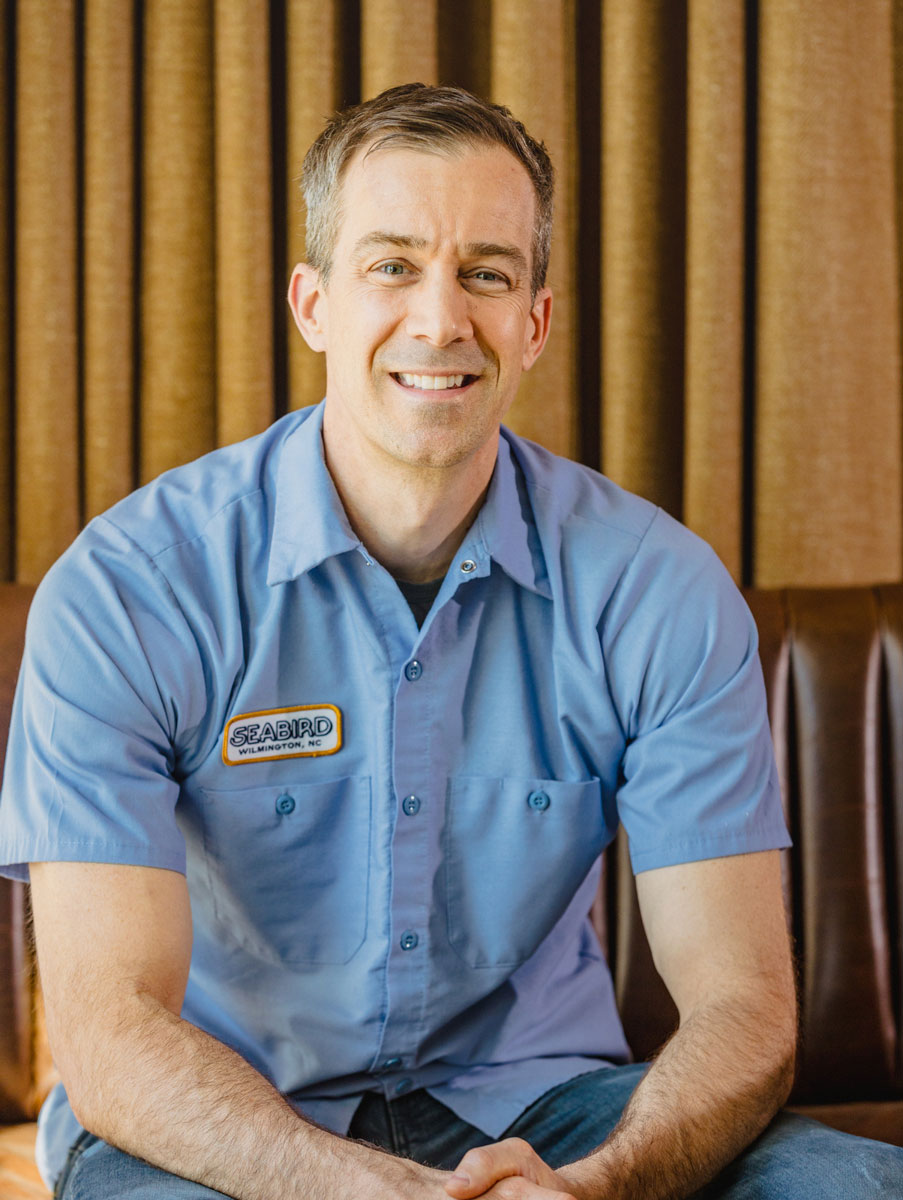
Chef Dean NeffChef Dean Neff (Baxter Miller)

The following interview has been lightly edited for clarity and length.

The Seabird menu is stunning! I'd eat every single item with reckless abandon. Are there any particular dishes you’re especially proud of? Or one that is immensely popular?

 I’m really proud of our Catfish & Oyster Pie. It’s a great example of taking an idea from somewhere else and making it relevant to the NC coast. I took inspiration from a friends’ fish pie recipe. Vic is British and this recipe is from her sister in London. We used this idea and made it local to Wilmington using oysters, NC catfish, smoked cream infused with celery, cabbage and citrus. We added a potato pastry crust on top and baked it in a bowl that was handmade for us by an incredibly talented ceramicist, Leanne McQueen. We serve it with a ton of fresh herbs to tear into it and add a freshness. It’s a hearty, comforting dish and has been on our menu since opening day.

 “As sure as the changing tide, Seabird’s menu will push the conversation forward on procuring local seafood and celebrate the seasonality while finding the best methods in fishing, aquaculture and farming. The food will be creative, seasonal, fresh and uniquely Wilmington.” What exactly does that mean? 

We work with local farmers, fishers and foragers and are always open to what they bring us each day. We leave it to them to dictate the menu, rather than demanding  what we need in the absence of knowing what they’re finding in the marsh, ocean and pasture. We really are letting them drive our menu at Seabird. And we’re open to different ingredients that are every bit as fun as the common ones. We intentionally leave room in our process to highlight those ingredients, because those are the ones that give Seabird a sense of place and make it so unique to Wilmington.

It’s all about being true to the stories and food that are brought to us. We think of food as a way of having conversations with people and learning more about the community. For example, Ana Shellem is a coastal forager, who regularly brings us these gorgeous wild mussels and recently discovered tulip snails . . . as a result, we’re now talking to our guests about this ingredient that no one has seen before and it invites conversation about Ana and her work as a coastal forager.

Lori Feezor, of Preservation Point, brings us Cucuzza squash, micro tomatoes and different types of hibiscus. She’s able to grow what she wants and what’s exciting and meaningful to her and we’ll buy anything she’s growing. So we end up sharing all types of rare herbs, sheep's sorrel, unusual peppers and so much more with our guests.
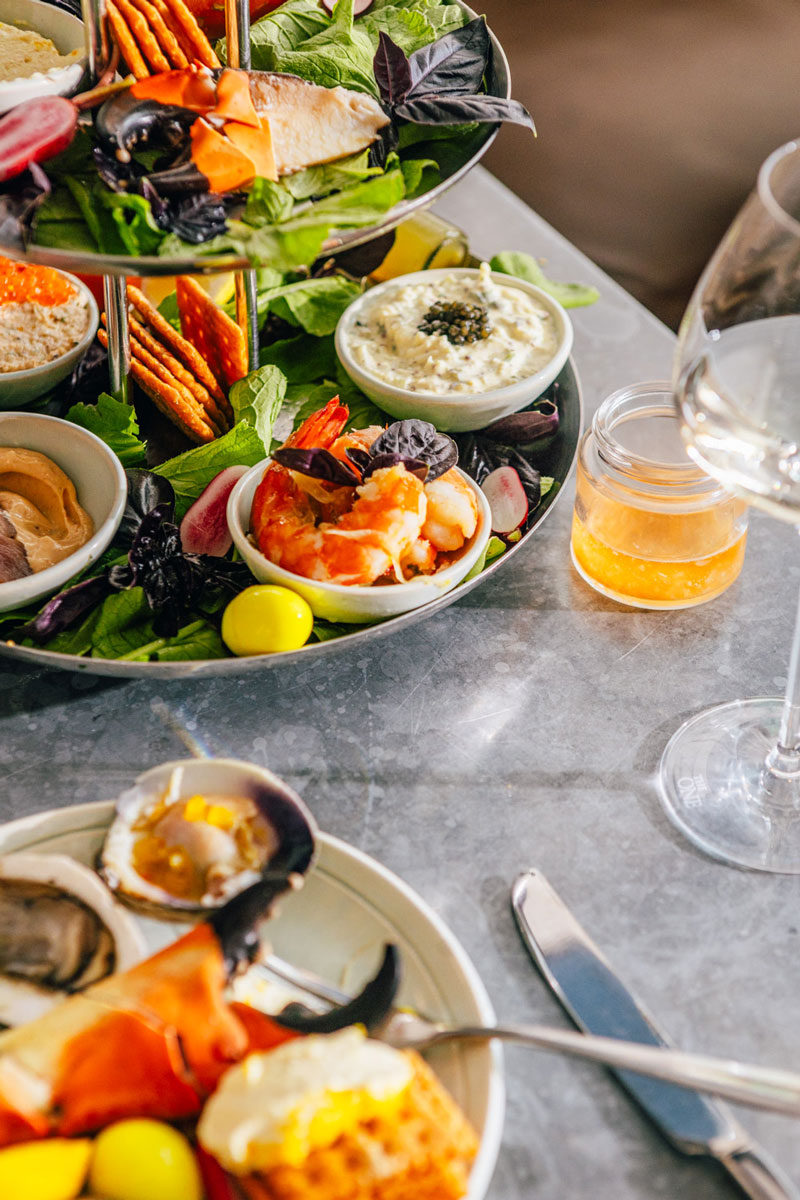
Seafood tower, SeabirdSeafood tower, Seabird (Baxter Miller)


Want more great food writing and recipes? Subscribe to Salon Food's newsletter, The Bite.


Congrats on the James Beard nomination! How validating was that?  

What it solidified is what it means to be a community restaurant and to be representing a community. It made me feel really grateful for all the relationships we have with everyone we work with. It’s about our guests, our team, our farmers, fishers, foragers, as well as about our food bank, farmers' markets and contractors. It’s about all the many people who contribute to what do on a daily basis. It’s about all of us working together.
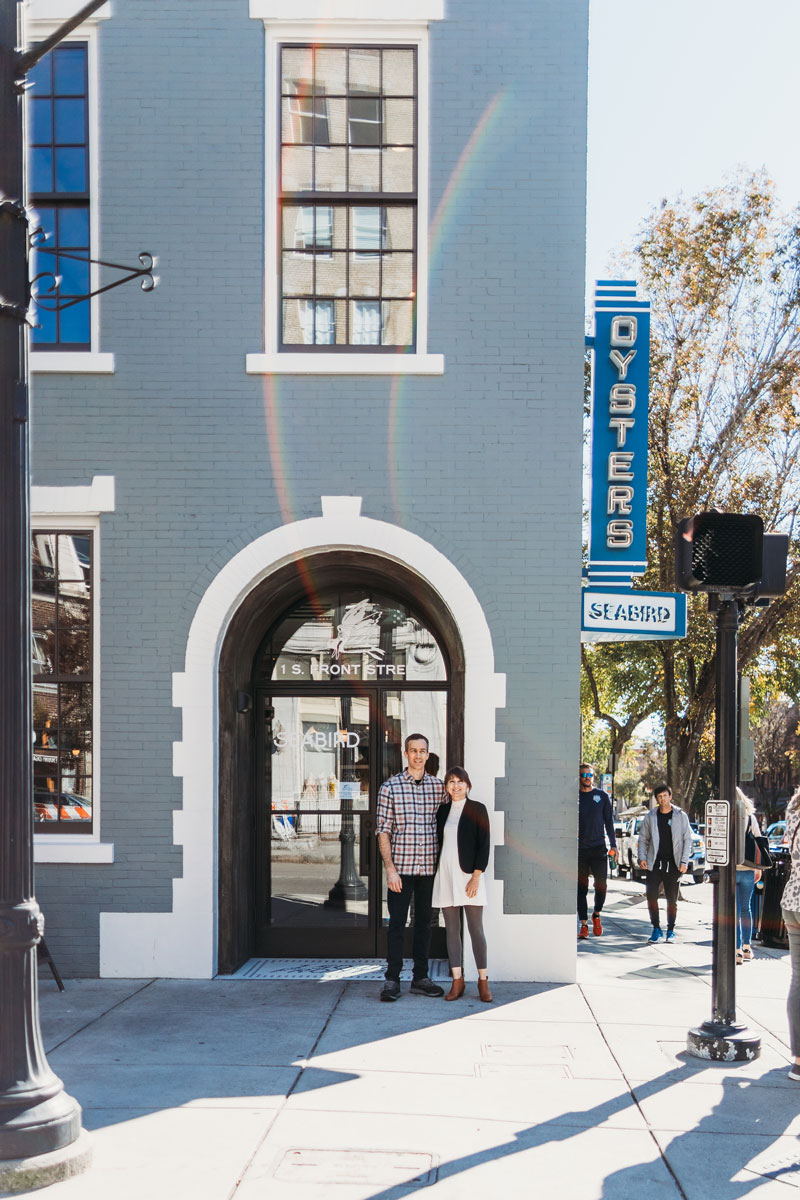
Dean Neff & Lydia CloptonDean Neff & Lydia Clopton (Mallory Cash) 

What is it like working so closely with your wife, Lydia?  

This work in our food community is really important to us and our relationship. The more closely we can work together, the better. It’s so important for us to both be involved. We’re more in sync with each other if we’re both involved in all aspects of the business and that brings us together and connects us. It takes so much of our time and bandwidth, so if you’re not bringing your family in, then you’re not seeing your family as much. She is a part of it and our boys are, too. We met through food and have always been connected through food. She is really smart about so many aspects of this business; she’s a sounding board for me. 

Do you have a number one favorite ingredient to work with?  

Tuna is so versatile and fun to work with. There are so many different things you do with it. And it's so satisfying  to eat! It takes smoke well. It’s great for low and slow cooking, as well as raw preparations, as well as poaching in olive oil, such as in tonnato. And sometimes, but less often, we sear it. It’s always on the menu in one or more preparations! We mostly use yellowfin tuna. On rare occasions, we get bluefin tuna that’s been sourced sustainably from our trusted fish purveyors and partners, and with that fattier tuna, we’re able to do some different things. Working with people that you trust and  know about where your fish is coming from is critical to ensuring we’re working sustainably. We work with Locals Seafood for most of our tuna.

What’s next for you and for Seabird? 

At Seabird we will continue to focus on sustainable seafood and all the fun ways we can put that on the plate.

What’s next for me? I’m looking at growing our business and expanding into new things. And  doing it in a way that’s going to help us think about our entire time and support careers for our team and their future.  We’re looking at Wilmington in the near future and maybe other areas down the road.
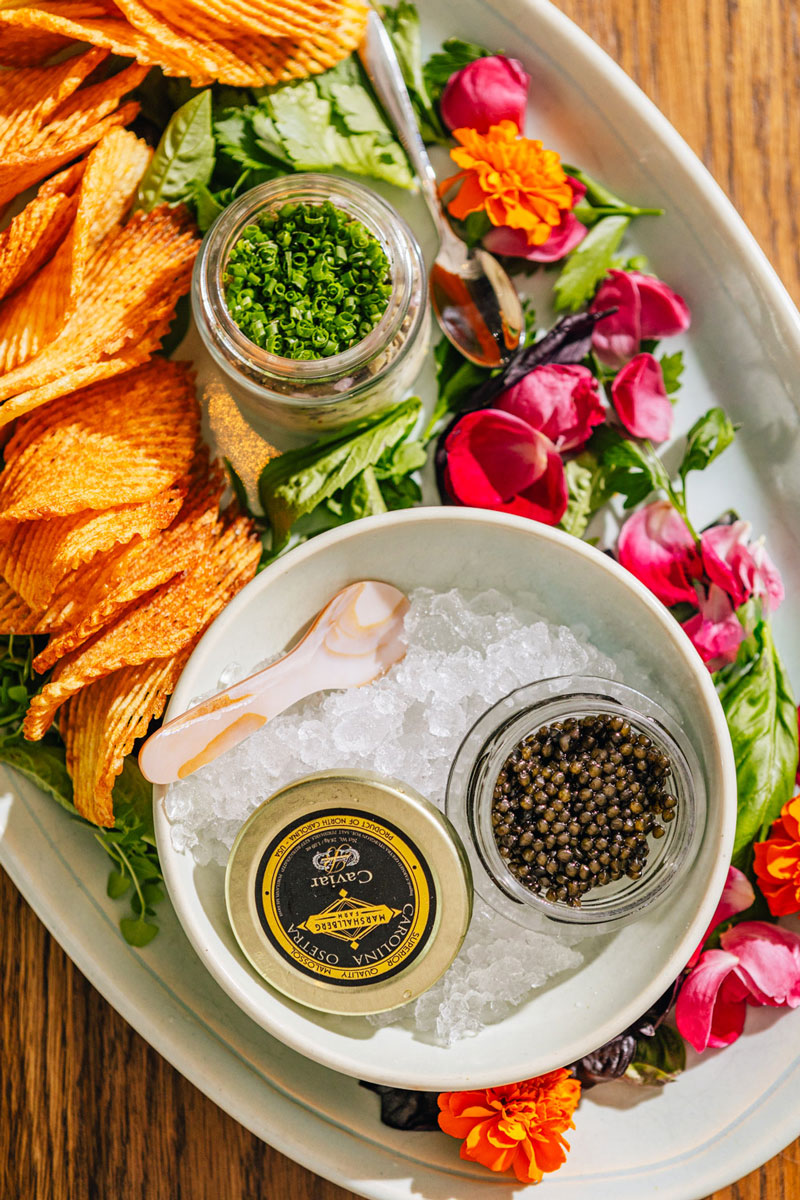
 Caviar service, SeabirdCaviar service, Seabird (Baxter Miller

Tell me a bit about your history in the industry? 

I’ve created a career in independent restaurants. Through that, I’ve been able to work with a lot of great chefs and smaller farmers, foragers and fishers. Those connections and relationships build on each other. And I’ve had the opportunity to work on a small enough scale that we were able to work with really exciting ingredients. That is part of the inspiration and has kept me cooking as long as I have. And it was incredibly beneficial to have had those experiences early on.

Getting a business degree gave me more confidence about opening a business on my own and being a community focused business. Volunteering in our community for organizations that meant something to us has been a big part of our business. Being with independents, all the while working with these community organizations, gave me perspective on where I wanted to go and how I wanted to model my version of an independent restaurant in the future.

I recognized the importance of relationships and that this was the first part of opening a restaurant, especially as someone new to a community. Meeting the people involved in the organizations which make sure people in the area are fed and nurtured. Meeting people passionate about hospitality, food, beverage. Meeting the people at the farmers markets. All of these experiences from 5 and Ten in Athens with Hugh Acheson to Rhubarb in Asheville with John Fleer informed my goals and then we were able to bring that to Wilmington and create that for ourselves and our business here. 

Why do you cook? What stands out for you as a formative moment that got you into cooking or food at large? 

I don’t think there’s any one moment. It’s something that’s been part of my soul always. Something I’ve always done. Ever since I was very young, I wanted to be in the kitchen. I remember obsessively learning to fry chicken at 7 years old and failing. But I always felt comfort in cooking. It’s the way I express love. It’s my language. It's where I’m comfortable. Now even when I go home for Thanksgiving, I can’t stay out of the kitchen. I prefer to be in the kitchen, always. 

Seabird interiorSeabird interior (Doug Young) What is your favorite cooking memory?           

I recently had a pretty special experience with friends, cooking on the barrier islands, off the coast of North Carolina. We went out on the boat together and were able to forage and harvest ingredients in the marsh and ocean and then pulled up to a barrier island and set up our portable grill and made really fresh dishes with the mussels, fan clams and nepales we’d found. It reminded me of being a little kid, when we used to do this with our family on Tybee Island, near Savannah.

And a few years ago, we started a ritual of making strawberry rhubarb pie with our boys. We’ve been doing it every Spring. We go and pick the berries and rhubarb with our boys who are 2 and 4 years old and then make the pie with them each year. We’re hoping this will be something we keep doing with them. And this year, our pie was just so amazing. It’s fun and simple but you get your hands dirty and it gives them something they can really focus their intense energy on. My son James said it was the best pie he’s ever had. And I agreed.

 Corn and coconut soup, SeabirdCorn and coconut soup, Seabird (Doug Young)

What’s your biggest tip for cutting down on food waste? 

One unique tip is the power of cooking and storing ingredients in olive oils and other fats. From mushrooms to tuna and chicken legs. We preserve them with a little salt & spices and cook & preserve it in olive oil. You can keep this in the fridge. Confit’ing is the technique and it's so versatile, but not well known or used. We also use chicken fat, duck fat and coconut oil. 

We need your help to stay independent

How do you practice sustainability at Seabird? 

The number one way is working with producers who are also practicing sustainability.  Finding the people who you trust who are doing things for the right reasons. Being able to communicate the information and stories and processes to our guests so they understand why – for instance, tilapia farming is different than farming sturgeon in NC. Why our catfish farmers' practices are different and much better now than they used to be. There are so many new ways of farming, like aquaculture.

There are a lot of preconceived, bad ideas about seafood farming. It’s important that we can speak to why we are not serving flounder and have speckled sea trout instead. And why we know farmed oysters are now of high quality. Being able to communicate this, but also being open to constantly learning and being aware because new practices and ways of thinking are constantly evolving. It’s a process, it’s a journey and you have to keep learning.

Communication with our team about their needs and goals is also incredibly important. We work hard to maintain business hours that aren’t too long and unsustainable for our team. We’re always trying to find ways to be better at this. We have communication channels open so we really know what our team thinks. It’s important to always be working to create a great culture for our team.  It’s up to us to set the intention, but it's not for us to say exactly what that culture is. It’s up to our crew to create that. As a business owner of just one restaurant, we’re going to be more sustainable as we grow and have multiple opportunities for our team to grow and thrive.

You've had some amazing accolades over the years. What's next for you, in an ideal world? 

Ideally, we will continue to strive for finding ways of being in this business and cooking that includes our family more. That could involve farming or cooking classes.  Finding new business ventures that will be even more inclusive.

I’m always thinking about a business that is experience-based where we’re bringing together farming, a bake shop and having experiences in food based around that and based around our family spending time together. I’m thinking of our kids as they grow and how to have those experiences for our family.
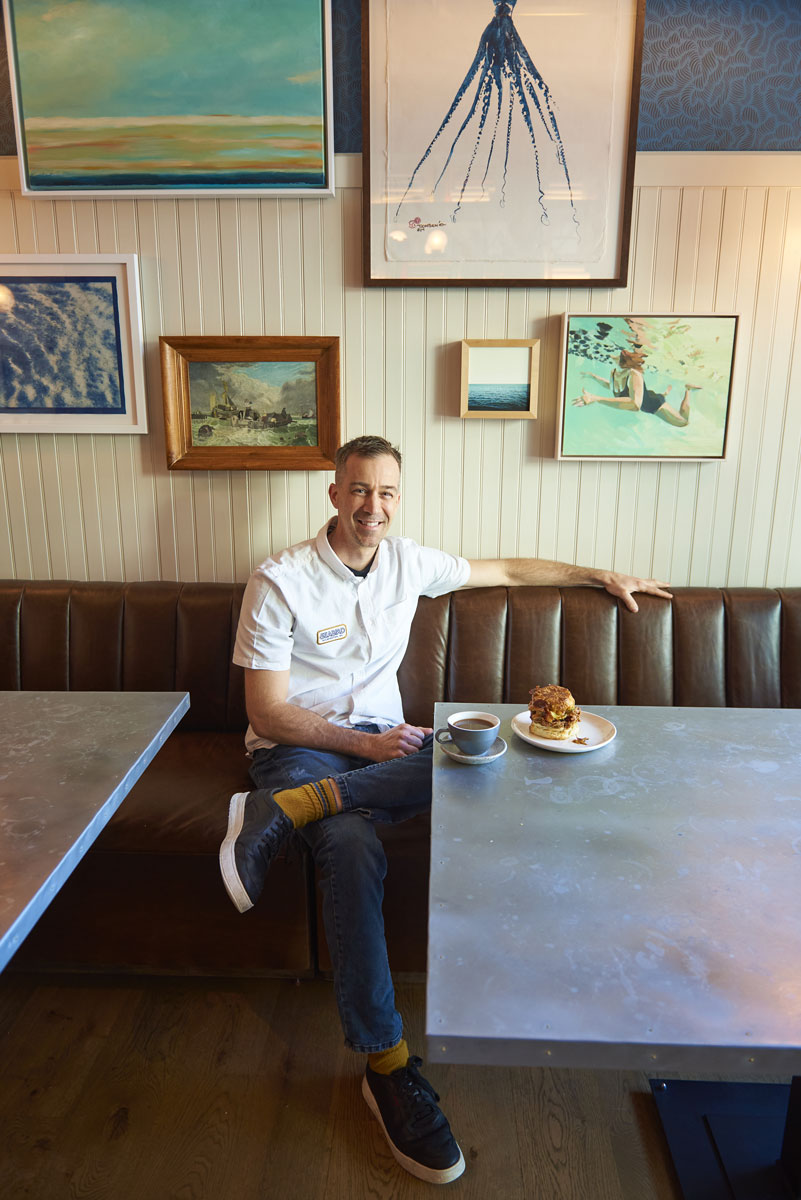
Chef Dean NeffChef Dean Neff (Doug Young)

How have you seen the North Carolina food scene grow in recent years? It seems to be becoming a real "hot spot," if you will.

North Carolina’s oyster farms are a great example of how vibrant our food scene is now. In 2014 when we moved here, there were about 3 to 5 oyster farms in the region; now there are more like 70! People have discovered Wilmington through our ingredients. It’s been eye-opening for chefs and travelers.

We have an incredible diversity in this area – from farmers, to foragers and fishers. That makes for a really dynamic place to be cooking.

Wilmington seems to be the center of that in NC. And this state is large and it offers a lot of diversity from the east to the west. Asheville has always had such a rich and self-sustaining food scene made up of brewers, cheese makers and farmers. In Wilmington, it's the fishing scene that is so diverse and wonderful.

Trump complains it’s “not fair” that he has to face Kamala Harris instead of Joe Biden

Former President Donald Trump is still fuming that Vice President Kamala Harris replaced President Joe Biden as the Democratic nominee.

"The Democrats staged the first ever 'Coup' in America," Trump claimed on Truth Social. "Crooked Joe Biden was told, 'Sorry Joe, you’re losing to Trump, BIG, and you can’t beat him – You’re Fired.' So now, for the first time in American history, I’ll have to beat TWO Candidates, the second being a Radical Left Marxist, Comrade Kamala Harris. It’s not fair, perhaps even another form of Election Interference, but the good news is that she should be easier than to beat than Crooked Joe in that the USA will never allow itself to become a Communist Country. THE DEMOCRATS ARE, 'A THREAT TO DEMOCRACY?'"

Trump has repeatedly used similar language since Biden dropped out of the race. 

“They deposed a president," he said at a Pennsylvania rally on Saturday. "It was a coup of a president. This was a coup.”

"His default is, ‘Well, this couldn’t possibly be legal. This is a coup. This is wrong,’ even though there are no facts to back that up," Elizabeth Neumann, a former senior official in Trump's Department of Homeland Security, told The Washington Post, warning that Trump and his supporters are setting up the “next version of ‘Stop the Steal.’”

“They’re latching on to this, that what the Democrats just did, that’s a coup,” added former Rep. Joe Walsh, R-Ill. “This is what I hear all day. That was the attack on democracy. That’s what they’re going to do to push back on the legitimate charge that Trump tried to overthrow an election four years ago. I come from MAGA world. It’s working. They believe it.”

Worried Republicans fear Trump’s “nuclear explosion” will cause Georgia GOP voters to “sit it out”

Former President Donald Trump’s ongoing feud with Georgia Gov. Brian Kemp could put his chances of winning the crucial swing state of Georgia in jeopardy, GOP members told Politico. 

Trump’s dislike of the Georgia governor stems back to the 2020 election, when President Joe Biden won the historically red state by just 12,000 votes and broke a nearly 30-year Republican hold on the state. 

Trump tried to get officials to overturn the results of the election, but Kemp fought back – putting him squarely on Trump's enemies list.

Since then, things have escalated both behind the scenes and in public. Earlier this year, Kemp skipped a Trump fundraiser. His wife Marty told a local news station that she’d vote for her husband for president instead of Trump come November, Politico reported. 

The comments reportedly irked Trump, but to his party’s relief he refrained from talking about it in public. Trump’s aides urged him to rekindle things with the Georgia governor, worried that the feud would hurt his chances of winning Georgia if it continued. 

But instead of making amends, Trump unloaded his thoughts on Kemp at an Atlanta rally in August.

The former president was supposed to focus on attacking Vice President Kamala Harris and the Democratic party, The Washington Post reported. Instead, he went after his own party member.

In his signature tone, Trump called Kemp “Little Brian,” suggested Kemp wanted Republicans to lose the election and said Georgia would fare better if Kemp weren’t the governor. 

“He’s a bad guy, he’s a disloyal guy and he’s a very average governor,” Trump added. 

The comments immediately concerned Trump’s advisers and other GOP members. Kemp is liked in Georgia and he’s had two decisive victories as governor, even with Trump’s opposition in 2022. 

“I think what it does is it puts more pressure on the Trump organization in the state when you’re essentially operating without any help from the incumbent governor,” an anonymous Georgia GOP operative told Politico. 

"The segment of the activist class that is loyal to the governor — it’s completely going to either sit it out or actively hope the president loses,” said another GOP operative, calling Trump's attacks on Kemp a "nuclear explosion" that threatens the party's chances.

Georgia is expected to be a crucial battleground state in the 2024 election. Trump currently leads Harris in Georgia 46-50, according to a recent New York Times/Sienna College poll, but it remains an unpredictable race. 

We need your help to stay independent

Insulting a popular governor only causes more division within the Republican Party and harms Trump’s chances of winning the state in November, Republican strategist Eric Tanenblatt told Politico. 

“To win in the upcoming election, Republicans need to present a united front and prioritize future-focused policies,” he said. 

Bobby Saparow, Kemp’s former campaign manager, said Kemp’s campaign infrastructure is crucial to a GOP win in Georgia in November. 

“The bases are solidified. We’re fighting over a very small sliver of voters in the middle. That’s the reason Brian Kemp is the most important Republican to the general election in Georgia in November,” Saparow told The Post.

Kemp, who said he was not invited to the rally, responded to Trump’s comment on X. 

“My focus is on winning this November and saving our country from Kamala Harris and the Democrats – not engaging in petty personal insults, attacking fellow Republicans, or dwelling on the past,” he wrote. “You should do the same, Mr. President, and leave my family out of it.”

Though the two men have not spoken since the 2020 election, Kemp has for the most part refrained from speaking ill of Trump. At the Republican National Convention in July, Kemp said he would support the GOP ticket this fall.

Blood sugar fluctuations after eating play an important role in anxiety and depression

The proverbial "sugar high" that follows the ingestion of a sweet treat is a familiar example of the potentially positive effects of food on mood.

On the flip side, feeling "hangry" – the phenomenon where hunger manifests in the form of anger or irritability – illustrates how what we eat, or don't eat, can also provoke negative emotions.

The latest research suggests that blood sugar fluctuations are partly responsible for the connection between what we eat and how we feel. Through its effects on our hormones and our nervous system, blood sugar levels can be fuel for anxiety and depression.

Mental health is complex. There are countless social, psychological and biological factors that ultimately determine any one person's experience. However, numerous randomized controlled trials have demonstrated that diet is one biological factor that can significantly influence risk for symptoms of depression and anxiety, especially in women.

As a family medicine resident with a Ph.D. in nutrition, I have witnessed the fact that antidepressant medications work for some patients but not others. Thus, in my view, mental health treatment strategies should target every risk factor, including nutrition.

The role of the glycemic index

Many of the randomized controlled trials that have proven the link between diet and mental health have tested the Mediterranean diet or a slightly modified version of it. The Mediterranean diet is typically characterized by lots of vegetables – especially dark green, leafy vegetables – fruit, olive oil, whole grains, legumes and nuts, with small amounts of fish, meat and dairy products. One of the many attributes of the Mediterranean diet that may be responsible for its effect on mood is its low glycemic index.

The glycemic index is a system that ranks foods and diets according to their potential to raise blood sugar. Thus, in keeping with the observation that blood sugar fluctuations affect mood, high glycemic index diets that produce drastic spikes in blood sugar have been associated with increased risk for depression and to some extent anxiety.

High glycemic index carbohydrates include white rice, white bread, crackers and baked goods. Therefore, diets high in these foods may increase risk for depression and anxiety. Meanwhile, low glycemic index carbs, such as parboiled rice and al dente pasta, that are more slowly absorbed and produce a smaller blood sugar spike are associated with decreased risk.

How diet affects mood

Many scientific mechanisms have been proposed to explain the connection between diet and mental health. One plausible explanation that links blood sugar fluctuations with mood is its effect on our hormones.

Every time we eat sugar or carbohydrates such as bread, rice, pasta, potatoes and crackers, the resulting rise in blood sugar triggers a cascade of hormones and signaling molecules. One example, dopamine – our brain's pleasure signal – is the reason we can experience a "sugar high" following the consumption of dessert or baked goods. Dopamine is the body's way of rewarding us for procuring the calories, or energy, that are necessary for survival.

Insulin is another hormone triggered by carbohydrates and sugar. Insulin's job is to lower blood sugar levels by escorting the ingested sugar into our cells and tissues so that it can be used for energy. However, when we eat too much sugar, too many carbs, or high glycemic index carbs, the rapid increase in blood sugar prompts a drastic rise in insulin. This can result in blood sugar levels that dip below where they started.

This dip in blood sugar sparks the release of adrenaline and its cousin noradrenaline. Both of these hormones appropriately send glucose into the bloodstream to restore blood sugar to the appropriate level.

However, adrenaline influences more than just blood sugar levels. It also affects how we feel, and its release can manifest as anxiety, fear or aggression. Hence, diet affects mood through its effect on blood sugar levels, which trigger the hormones that dictate how we feel.

Interestingly, the rise in adrenaline that follows sugar and carbohydrate consumption doesn't happen until four to five hours after eating. Thus, when eating sugar and carbs, dopamine makes us feel good in the short term; but in the long term, adrenaline can make us feel bad.

However, not everyone is equally affected. Identical meals can produce widely varying blood sugar responses in different people, depending on one's sex, as well as genetics, sedentariness and the gut microbiome.

And it's important to keep in mind that, as previously mentioned, mental health is complicated. So in certain circumstances, no amount of dietary optimization will overcome the social and psychological factors that may underpin one's experience.

Nevertheless, a poor diet could certainly make a person's experience worse and is thus relevant for anyone, especially women, hoping to optimize mental health. Research has shown that women, in particular, are more sensitive to the effects of the glycemic index and diet overall.

Depression affects hundreds of millions of people worldwide. So doctors are taking a close look at ways to lower the risk of depression, including diet.

Unfortunately, simple solutions, such as swapping sugar for artificial sweeteners, are not an option. Research has shown that among all processed foods, artificial sweeteners and artificially sweetened beverages are most strongly associated with depression.

Optimizing mood with food

The most obvious way to stabilize blood sugar levels is to decrease sugar and carbohydrate intake. However, this is not the only way. Research has proven that simple changes can drastically mitigate volatile blood sugar fluctuations. Some strategies to stabilize blood sugar and optimize mood include:

  • Make low glycemic index carbohydrates such as parboiled rice, whole grain bread and al dente pasta dietary staples and be mindful of how many high glycemic index carbohydrates you consume. I give my patients this guide to increase their awareness of the glycemic index of various carbohydrates.

  • Eat carbohydrates earlier in the day such as breakfast or lunchtime, as opposed to later in the day, like dinner or, worse yet, as a nighttime snack. Our hormones follow a circadian rhythm, and carbs eaten earlier in the day produce a smaller blood sugar spike compared with carbs eaten later in the day.

  • Avoid eating carbohydrates on their own, such as snacking on a box of crackers or downing a bowl of rice. Always strive to combine carbohydrates with proteins such as beans, nuts, meat and fish, or with healthy fats such as olive oil and avocado. The combination of nutrients slows down the digestion of carbohydrates and thereby produces a smaller blood sugar spike.

  • Eat carbohydrates at the end of the meal, after eating vegetables and protein first. Just changing the order in which foods are eaten can drastically lower the blood sugar spike that comes after.

  • Eat a salad dressed with olive oil and vinegar prior to eating carbohydrates. The combination of vegetables, acid from the vinegar and fat from the olive oil, all work together to slow carbohydrate absorption and minimize the resultant blood sugar spike.

Mary Scourboutakos, Family Medicine Resident and Nutrition Expert, Eastern Virginia Medical School

This article is republished from The Conversation under a Creative Commons license. Read the original article.

“Extremely dangerous”: Economists say Trump’s inflation plan could badly backfire on workers

Donald Trump told voters during a speech last week that he would bring prices back to pre-COVID levels if elected, drawing heavy skepticism from economists who have studied his proposals.

“Prices will come down,” Trump said last week. “You just watch: They’ll come down, and they’ll come down fast, not only with insurance, with everything.” 

The GOP presidential candidate claimed he’d cut the price of gasoline, cooling bills, and electricity across the economy — “Prices will come down and come down dramatically and come down fast,” he promised.

Justin Wolfers, an economist at the University of Michigan, told CNN that while this is probably exactly what the American wants to hear it is not possible. “Unquestionably, this is what people want to hear. And unquestionably, this is unrealistic,” he said.

He explained that Trump isn’t trying to slow the rate of inflation by increasing prices at a gradual, and possibly realistic pace, which is something that the Federal Reserve has already been successfully executing over the last two years. What Trump seems to be describing is, instead, deflation. 

“The way to bring about deflation would be to create a massive recession. That would cause businesses to start cutting prices,” Wolfers said. “This is extremely dangerous and feeds on itself."

First of all, if Americans know that their purchases will be cheaper next month, then they will refrain from buying items today. And the consequent widespread price plunges would cause a negative feedback loop — “It’s very hard to get out of a deflationary spiral,” Wolfers said.

Conversely, Kamala Harris’ economic plan also promises to lower high costs, like fighting price gouging on food, lowering the cost of insulin, and combating the housing shortage. However, the vice president has refrained from promising voters a widespread price drops, which would be unrealistic according to economic experts. 

We need your help to stay independent

Experts warn overall prices are not going to go back to pre-COVID levels and we shouldn’t want them to, let alone be promised that. 

Mark Zandi, chief economist at Moody’s Analytics who served as GOP Sen. John McCain’s advisor in 2008, told CNN that broad price declines would be “unrealistic and undesirable.” He added: “A deflationary environment would be a prescription for a very weak and recessionary economy.” 

A better aspiration would be to try and keep inflation, which has slowed considerably this year, stable at about 2%, and increase wages at a solid pace. “If wages continue to outpace inflation, the sting of higher prices becomes less painful with each passing month,” said Zandi.

However, if prices are cut, then businesses would have to start cutting wages which would completely negate the relatively cheaper goods and services. “Bringing down prices sounds really exciting if I get to keep my current wage. But you don’t,” Wolfers told CNN.

“This is the story of Donald Trump”: Harris campaign rolls out “Law and Order” parody at DNC

The Democratic National Convention kicked off in Chicago on Monday with a new ad that riffed on Donald Trump's criminal convictions, underscoring the sharp delineation between the former president and Vice President Kamala Harris, a former prosecutor. Harris previously served as San Francisco district attorney and California state attorney general before arriving in Washington, D.C. to serve in the Senate and later as President Joe Biden veep.

The ad, which played as an introduction to a speech by Rep. Jamie Raskin, D-Md., parodied the television crime drama, "Law and Order."

“In the criminal justice system, the people are represented by two separate yet equally important groups: the police who investigate crime, and the district attorneys who prosecute the offenders," a narrator said, the words overlaid by a similar track to the iconic series set in New York. 

“This is the story of Donald Trump,” the narrator continued, before alluding to several of the ex-president's high-profile legal quagmires. "His entire life, Trump has believed he's above the law. That no one would ever dare hold him accountable. He lies. He rips off workers. He sexually abuses women. He cheats in business. He cheated on his wife with a porn star, and paid her off so the American people wouldn't find out during an election."

"But in the criminal justice system, ordinary Americans have had the courage to find him accountable, time and time again. For the first time in history, we have a convicted felony running for president. And to take on this case, we need a president who has spent her life prosecuting perpetrators like Donald Trump."

"He tried overturning Georgia's free and fair election," the narrator added, followed by audio of Trump's now infamous 2020 phone call to Georgia Secretary of State Brad Raffensperger, in which the former president said he wanted to "find 11,780 votes" to overturn his loss of the state in the election. 

"He's tried to escape any responsibility for instigating the January 6 attack on our Capitol," the ad observed. "And if elected, Trump has promised to overturn laws that would keep him accountable and exact retribution on anyone he considers an enemy, even warning of a 'blood bath' if he doesn't get his way. So, we the people have a chance to render our own verdict on Donald Trump. We are the jury he most fears. When we vote this November, we vote for justice, accountability, and the rule of law that keeps America free."

We need your help to stay independent

Harris can be heard at the conclusion of the ad yelling to throngs of her supporters, "Do we believe in freedom?" The reference aligned closely with another freedom-related Harris campaign ad unveiled Monday, featuring Beyoncé's 2016 song "Freedom." Actor Jeffrey Wright narrates over patriotic images from D-Day, the Dust Bowl era, the Statue of Liberty, and an array of American families. “What kind of America do we want?” Wright asks. “One where we’re divided, angry, depressed? C’mon! We’re Americans! Fascism? We conquered it. The Moon? Landed on it. The future? Building it. Freedom? Nobody loves it more.”

MSNBC host Rachel Maddow in May dedicated an entire segment of her show to unpacking for her viewers how Trump and his fervent base of supporters could pose imminent threat to democracy. 

"What you’re seeing here is actively and currently damaging the rule of law right now, because people are being intimidated and terrorized," Maddow said. "People who work in the legal system as these alleged crimes are adjudicated there are being harassed, threatened with firing, and intimidated and threatened. And it is happening in all the criminal cases that surround Trump.”

"This is damage to the rule of law and it is here already," the MSNBC host added. "When participating in the adjudications of alleged crimes by a political figure and his followers bring you death threats — the rule of law has been bent, the rule of law has been broken."

A majority of people in the UK want taxes imposed on ultra-processed foods, new study finds

A recent poll has found that a majority of people in the United Kingdom want taxes imposed on companies that make either junk foods or ultra-processed foods (UPFs) to combat the country’s obesity crisis.

In a survey conducted by Ipsos for the Health Foundation — an independent charity — 58% of participants said they supported a tax on corporations that produce foods high in sugar or salt, with some of the revenue to be used to buy fresh fruits and vegetables for low-income families, The Guardian reported. Fifty-three percent of the participants said they supported a tax on corporations that produce UPFs, including sugary cereals, pizza, processed meats and mass-produced bread. Those participants also supported the use of some of that tax revenue to help low-income families improve their diet.

“The new government should be emboldened by this type of polling and understand that this [idea] is something that does enjoy broad support and is likely to lead to important health benefits,” Adam Briggs, a senior policy fellow and public health expert at the Health Foundation, told The Guardian. “The public are basically saying: it’s time for tough action.”

Out of a sample size of 2,136 UK adults, 19% said they were opposed to taxing junk food producers. Twenty percent of participants said they were unsure. Twenty-four percent of participants said they were opposed to the idea of taxing UPF manufacturers, while 21% said they did not know.

Within the UK, an estimated 98 billion pounds per year — or $127 billion — is spent on combatting the longstanding obesity crisis. England’s National Health Service (NHS) spent 6.5 billion pounds to treat illnesses linked to obesity, such as heart disease, cancer, type 2 diabetes and joint problems.  

In April 2018, the UK introduced its sugar tax, which currently focuses on soft drinks that are produced in the UK or imported into the country. Better known as the soft drinks industry levy (SIDL), the tax remains one of the flagship policies of the nation’s 2016 childhood obesity strategy. It has encouraged many companies to reformulate their drinks and reduce the sugar content of their products, thus benefiting overall consumer health.

A study published in the Journal of Epidemiology and Community Health found that the amount of sugar consumed by children from soft drinks halved three years after the UK enforced its SIDL. Researchers looked at responses to the annual UK National Diet and Nutrition Survey between 2008 and 2019. Nearly 8,000 of those responses were from adults, while 7,656 were from children. Researchers found that the daily sugar intake for children fell by about 4.8 grams in the year after the tax was introduced. For adults, it was 10.9 grams.

Briggs advocated for a similar style of sugar tax to be placed on sweets, cakes, cookies, biscuits, sugary breakfast cereals, sweetened yogurts and chips. He said that same tax should then be imposed on packaged meals and pizzas, which contain high amounts of salt.


Want more great food writing and recipes? Subscribe to Salon Food's newsletter, The Bite.


Findings from the recent poll come amid growing, global calls for further taxation on unhealthy food products. Within the US, 73% of the food on grocery store shelves is ultra-processed. Despite that high percentage, there have been no nationwide bans or taxes placed on such foods to prevent their rising sales. Four states — Arizona, California, Michigan, and Washington — have already enacted laws preempting local taxes on sugar-sweetened beverages. Several states have also considered passing similar legislation.

As UPFs continue to threaten the health of consumers all over the world, Carlos Monteiro — the Brazilian epidemiologist who coined the term ultra-processed foods — has pushed for stricter regulations on such foods. Ahead of the annual International Congress on Obesity, Monteiro called for tobacco-style warnings to be placed on UPFs. In a statement to The Guardian, he added that UPFs should also be banned from schools and health facilities and taxed.

Colombia became one of the first nations in the world to tax UPFs via its new “junk food law,” which went into effect last year. The tax was initially set to 10% and has risen to 15% this year. It is expected to reach 20% in 2025.

Perdue Foods recalls 167,000 pounds of frozen chicken after customers find “strands of metal wire”

Perdue Foods, Inc. has issued a recall of approximately 167,000 pounds of frozen chicken nuggets and tenders because the products may be contaminated with metal fragments, the U.S. Department of Agriculture’s Food Safety and Inspection Service (FSIS) announced late last week.

The affected products were produced on March 23 and distributed nationwide to retail locations and sold online directly to consumers. The recall includes the following items: Perdue Simply Smart Organics Breaded Chicken Breast Nuggets; Perdue Chicken Breast Tenders; and ButcherBox Organic Chicken Breast Nuggets. These products all have a “best by” date of March 23, 2025.

After Perdue received multiple consumer complaints reporting metal wire embedded in chicken products, the company alerted FSIS, which initiated the recall. According to a report from the Associated Press, the company later  “determined the material to be a very thin strand of metal wire that was inadvertently introduced into the manufacturing process.” In a prepared statement, Jeff Shaw, Perdue’s senior vice president of food safety and quality, added that Perdue decided to recall all impacted packages “out of an abundance of caution.”

While the items were shipped to retail locations nationwide and sold online directly to consumers, to date, there have been no confirmed reports of illness or injury associated with the consumption of these products. FSIS and Perdue Foods advise consumers who have purchased these items to refrain from eating them and either discard them or return them to the place of purchase for a refund.

“Are you kidding me?” Fox News guest fumes over Kamala Harris eating a bag of Doritos

During a Friday appearance on Fox News,  Elisabeth Hasselback, who previously occupied the “conservative chair” on “The View” and served as co-host of “Fox & Friends,” critiqued Vice President Kamala Harris. Not for her policies, not for her political record — but for her choice of an election night snack. 

In a campaign email sent earlier that week, Harris recounted how she felt the night Donald Trump was elected in 2016. “It was election night for me as well,” Harris wrote. “It was incredibly bittersweet. When I took the stage for my acceptance speech — to represent California in the Senate — I tore up my notes. I just said, ‘We will fight.’ Then I went home and I sat on the couch with a family-sized bag of nacho Doritos

“I did not share one chip with anybody,” Harris continued. “Not even Doug. I just watched the TV with utter shock and dismay. Two things are true eight years later: I still love Doritos and we still have not stopped fighting.”

All things considered, it’s a relatively standard campaign email copy since using food as a shortcut to relatability is a common political tactic from candidates on both sides of the aisle (have you seen Trump’s steadily growing Tic Tac routine?). However, to Hasselback, it was indicative that Harris is not fit to lead the country. 

“You just talked about Kamala Harris supposedly eating a bag of Doritos, so emotionally charged after hearing this,”  she said to host Sean Hannity. “That’s the commander-in-chief, potentially, that’s the emotional response of the leader of the free world is to binge-eat a bag of Doritos? Are you kidding me?”

She continued: “Can you imagine Putin, how he deals with things? Chugging down a bag of Sour Patch Kids because he’s depressed about something not going his way? Or back in the day, Soleimani — what is he binging on Funyuns?”


“He should try reading it”: Raphael Warnock calls out Trump for hawking $60 Bibles

Sen. Ralph Warnock, D-Ga., slammed Donald Trump's use of religion during his speech at the Democratic National Convention in Chicago on Monday night. 

Warnock, who is a Baptist pastor, began his remarks by sharing his mother’s history picking cotton and tobacco in Georgia.

“But because this is America, the 82-year-old hands that used to pick somebody else’s cotton and somebody else’s tobacco picked her youngest son to be a United States senator,” Warnock said to the crowd.

He went onto criticize Trump’s use of Christianity in his campaign, specifically referencing a fundraising push in which Trump was selling $60 “God Bless the USA” Bibles named after Trump-supporting musician Lee Greenwood’s song.

“I saw him holding the Bible and endorsing a Bible as if it needed his endorsement,” Warnock said. “He should try reading it!”

“It says do justice, love kindness, and walk humbly with your God. He should try reading it,” Warnock said as the crowd cheered.

Georgia is expected to be a crucial battleground in the 2024 election. In 2020, President Joe Biden flipped the historically Republican state in one of the closest results of the 2020 election. Trump currently leads Harris in Georgia 46-50, according to a recent New York Times/Sienna College poll.

Later in his speech, Warnock condemned Trump’s part in the attack on the U.S. Capitol on Jan. 6 and the former president’s anti-democratic rhetoric.

“The lie and the logic of January 6 is a sickness. It is a kind of cancer that then metastasized into dozens of voter suppression laws across our country,” he said. “We must be vigilant tonight because these anti-democratic forces are at work right now all across our country.”

Warnock concluded his speech with a unifying message: “We are all God’s children! And so, let’s stand together, let’s work together, let’s organize together, let’s pray together, let’s stand together, let’s heal the land.”

“Two-bit union buster”: Fired-up AOC says “Trump would sell this country for a dollar”

Representative Alexandria Ocasio-Cortez, D-N.Y., didn’t hold back during her speech at the Democratic National Convention on Monday, simultaneously offering her full endorsement of Vice President Kamala Harris and blasting Donald Trump as a “two-bit union buster."

The congresswoman, who was greeted with cheers, “ AOC! AOC!” ensured the convention crowd that Harris will be a voice for working Americans, unlike the former president. 

“America, when we knock on our neighbor’s door, organize our communities, and elect Kamala Harris to the presidency on November 5, we will send a loud message that the people of this nation will not go back,” Ocasio-Cortez said. “We choose a new path and open the door to a new day: one that is for the people and by the people.”

Ocasio-Cortez — who has been one of the few on the left to be critical of the Biden administration's handling of the Gaza war — claimed the vice president was “working tirelessly to achieve a ceasefire in Gaza.” 

Ocasio-Cortez recalled how prior to her rise to Congress when she defeated a 10-term Democratic incumbent in 2018, she worked as a bartender and waitress for six years.

“Chicago, we have to help her win because we know that Donald Trump would sell this country for a dollar if it meant lining his own pockets and greasing the palms of his Wall Street friends,” Ocasio-Cortez said. “I, for one, am tired of hearing about how a two-bit union buster thinks of himself as more of a patriot than the woman who fights every single day to lift working people out from under the boots of greed trampling on our way of life.”

“I gave my best to you”: Joe Biden passes the torch in emotional DNC speech

President Joe Biden on Monday gave a heartfelt goodbye at the Democratic National Convention in Chicago.

Speaking to a packed crowd, it was several minutes before Biden could even begin his speech because the cheers and chants were so loud.

After being introduced by his wife Jill and his daughter Ashley, Biden was visibly emotional. The crowd erupted in chants of “We love Joe,” and “Thank you Joe,” as the president thanked the crowd nearly a dozen times before beginning his address.

Throughout the speech, Biden listed his accomplishments and reiterated his support for Vice President Kamala Harris, stating his belief in her ability to beat Republican nominee Donald Trump in November.

Biden, who stepped down from the Democratic ticket in July, went on to praise Harris throughout his speech. 

“Selecting Kamala was the very first decision I made when I became our nominee and it's the best decision I made my whole career,” he said. “She's tough, she's experienced, and she has enormous integrity,” he added.

Before Biden spoke, Harris herself made an unannounced appearance on the DNC stage where she praised the president for his service. 

“Joe, thank you for your historic leadership and for your lifetime of service to our nation and for all you continue to do,” Harris said. “We are forever grateful to you.”

In his nearly hour-long speech, Biden also clarified that he was not angry at people who said he should step down, and made it clear the focus was on beating Trump in November.

“We saved democracy in 2020, and now let’s save it again in 2024,” he said.

As many attendees in the crowd were openly emotional, Biden concluded his nearly 50 year career as a civil servant with a sincere goodbye.

“What shall our legacy be, what will our children say, let me know in my heart when my days are through, America, America, I gave my best to you,” he said,

"For 50 years, like many of you, I gave my heart and soul to our nation,” the president added before the crowd erupted in cheers once more.

DNC crowd chants “lock him up” as Hillary Clinton blasts Trump’s felony convictions

Former Secretary of State Hillary Clinton smiled and nodded as the crowd at the Democratic National Convention in Chicago chanted “lock him up,” on Monday, when she called out former President Donald Trump's felony convictions.

The chant is a spin on the former president’s “lock her up,” catchphrase during his 2016 campaign events, that he frequently exploited to attack his opponent’s record back when he promised to put her in prison over her use of a private email server in office.

Clinton during her speech at the United Center brought up Trump’s conviction on 34 felony charges earlier this year.

While she tried not to immediately respond to the symphony of “lock him up,”  — following her mocking comments about Trump falling asleep during his Manhattan trials — and talk over the three-beat chant, the crowd only got louder and so she gave in —she stood at the podium silently smiling. 

“As a prosecutor, Kamala locked up murderers and drug traffickers. She will never rest in defense of our freedom and safety,” Clinton said. “Donald Trump fell asleep at his own trial and when he woke up, he made his own kind of history—the first person to run for president with 34 felony convictions.”

Although the former first lady lost to Trump in 2016, the crowd greeted her remarks about Harris’s historic candidacy with cheers.

"The future is here," Clinton said. "I wish my mother and Kamala’s mother could see us. This is our time, America. This is when we stand up. This is when we break through!"

Her remarks prompted Harris’ running mate, Minnesota Gov. Tim Walz, to mouth “wow,” and for his wife, Gwen, to tear up.

Can we avoid 1.5º of global warming? Probably not and our best case scenario is 1.6º, scientists say

When almost 200 nations signed the Paris climate agreement in 2015, they pledged to keep Earth's average temperature to no greater than 1.5 degrees Celsius above pre-industrial levels.

Now a recent study in the journal Nature Climate Change reveals that the 1.5 degree threshold is effectively out of reach at this point, and 1.6 degrees is the best humanity can likely hope to achieve. Climate change is spiraling out of control and emissions from burning fossil fuels aren't dropping fast enough. The researchers arrived at this conclusion after modeling different emission scenarios through 2023, one that included "alternative scenarios with institutional, geophysical and technological feasibility constraint."

The scientists learned that even within all but the most ambitious projections regarding limiting greenhouse gas emissions, humans still fail to fall below the 1.6 degrees Celsius threshold. Given the feasibility constrains involved in those more ambitious agendas, however, the scholars also argue those outcomes remain very unlikely.

"Accelerated energy demand transformation can reduce costs for staying below 2º C but have only a limited impact on further increasing the likelihood of limiting warming to 1.6 °C," the authors write, alluding to the need to transition to carbon neutral energy technologies.

Speaking to Salon last month — when it was announced that humanity had reached 1.5 degrees Celsius above pre-industrial levels for 13 consecutive months — one climate change expert emphasized that this benchmark carries significant in real-world consequences.

"A year above 1.5C is unprecedented in human history," Dr. Ken Caldeira, an atmospheric scientist at the Carnegie Institution for Science's Department of Global Ecology, said. "Nevertheless,  it is important to remember that each carbon dioxide emission causes another increment of global warming and so each emission avoided is an increment of global warming avoided."

“Silly memes”: Mark Robinson claimed history of settlers killing Natives was “exaggerated”

North Carolina Lt. Gov. Mark Robinson, a Republican running to be governor of the red-tinted battleground state, often claims mixed-race Native American descent. But that has not stopped the candidate, known for making incendiary remarks that have embarrassed some fellow party members, from casting doubt on the European role in destroying Native American society, condemning sports teams' efforts to get rid of racially insensitive names and passionately defending Christopher Columbus.

In a series of social media posts from 2015 onwards, Robinson complained about posts he saw from other people that described a settler-colonial genocide in which huge numbers of indigenous peoples were displaced, forcefully assimilated and killed from the Hudson Bay to the Strait of Magellan, calling them "ludicrous" and "VERY historically inaccurate." 

"It would seem that a Nation that is as blessed as we are would be too busy giving THANKS on Thanksgiving to have time to make silly memes and ludicrous posts about how we 'killed the Indians,'" he groused, calling anyone who would post such information an "IDIOT" and "INGRATE."

While it is impossible to determine exactly how many people were killed over the centuries and by what means, including armed violence, exposure from displacement, induced starvation and disease, the present-day result of colonization is a reduction of Native American land in the present-day United States to around one to two percent of the country's landmass and the annihilation of the Native American population to the point where, according to some estimates, their numbers still have not recovered past pre-Columbian levels.

In one post, Robinson attempted to turn someone's claim that "the white man will fail" because "injustice will bring destruction" on its head, asking if what the poster suggested was true, "what 'injustice' did the 'Indians' commit to cause their 'destruction' by their land being 'stolen' and being 'murdered by the millions?'" When confronting criticism of Columbus for his role in violently uprooting indigenous societies, Robinson mocked naysayers as "People Who Can’t Cross Town Without A Cellphone, AC, And GPS” who could not compare in greatness to a man "Who Crossed The Ocean In A Wooden Boat With No Running Water And No Electricity."

Robinson blamed the education system for popularizing information about indigenous suffering, accusing colleges in particular of misleading students with "exaggerated claims" that "don't teach our true history" in a 2018 podcast interview. The lieutenant governor, outspoken in his desire to put a conservative stamp on North Carolina's schools, set up a task force in 2021 to investigate "indoctrination" in schools in what many legal experts said at the time was a violation of state law.

His advice to people who post about the genocide of Native Americans: "go read a book."

"Nothing cracks me up more than when someone who writes at a third grade level tries to 'educate' people about a history they don't know themselves," he wrote in a 2016 post.

We need your help to stay independent

Robinson did not specify which books he would recommend. One of the first accounts of the colonization of the Americas came from the Spanish priest Bartolomé de Las Casas, who wrote in "A Short Account of the Destruction of the Indies" about how soldiers killed indigenous peoples en masse across modern-day Mexico and Central America, forcing survivors to labor in the mines or till the land under appalling conditions. More recent scholarship has produced works like "An American Genocide: The United States and the California Indian Catastrophe, 1846-1873" by UC Berkeley professor Benjamin Madley, which covers a methodical slaughter by state and federal officials that reduced the state's Native population from 150,000 to 30,000 in the space of two-and-a-half decades.

There's also Robinson's book, a memoir titled "We Are the Majority, The Life and Passions of a Patriot," in which the author writes that his paternal grandmother may have been a "Blackfoot Indian, so the story goes," though he also notes that "none of this is substantiated" and that he "knows very little." The claims of indigenous ancestry appear to be less unequivocal on social media posts from 2015 in which he calls himself an "African-Irish-Continental Native-American" and sees a "REAL African, Indian, Irishman" when he looks in the mirror.

If Robinson sometimes seems unsure about the veracity of his ancestral claims, he is apparently very sure that sports teams changing their names and logos to something less offensive to Native Americans is a grave threat to freedom. When the Washington Redskins rebranded as the Washington Commanders in 2014, Robinson made the old logo his Facebook profile picture and declared that “No Longer Will We Allow Our Freedom, That Was Paid For With The Blood Of Those Who Loved This Country, To Be Taken Away From Us By Those Who Love Neither Freedom Nor The God From Which It Comes.”

He also found a way to bring "murder" into the debate, though he was talking about abortion, not genocide. "How Can A Bunch Of People Who Don’t Bat An Eye Over The Murder Of Infants Get So Upset About The Name Of A Sports Team?” he wrote in 2021, referring to the Cleveland Indians changing their name to the Cleveland Guardians.

The Robinson campaign was not available for comment.