Spring Offer: Get 1 Year, Save 58%

Why “salmon sperm facials” have enchanted Kim Kardashian and Jennifer Aniston

On a recent episode of "The Kardashians," Kim Kardashian revealed that she tried a new beauty protocol using the reproductive goo of a fish, casually sharing with People "I got a salmon sperm facial with salmon sperm injected into my face."

She isn’t the only celebrity to put salmon semen on her face with the intent of improving skin quality. In August 2023, Jenifer Aniston shared that an aesthetician got her into salmon sperm facials, too. For decades, there has been a strange fascination in the world of beauty with putting sperm on a person’s face.

Part of this practice stems from the long-held myth that spermine — an antioxidant and anti-inflammatory agent found in sperm and cells in the human body — is good for the skin. However, limited research suggests there might be something to salmon sperm after all.

Technically called salmon PDRN, (which stands for polydeoxyribonucleotides), the fishy ingredient is extracted from the sperm cells of chum salmon or salmon trout. According to a 2017 study in the journal Frontiers in Pharmacology, the manufacturing process “represents a new advancement in the pharmacotherapy” and guarantees the absence of active proteins and peptides that could cause immune reactions. However, several of the study authors do declare holding patents on various therapies employing PDRN technology.

To get into more detail, Dr. Sophie Shotter, an aesthetics doctor, told Salon via email that PDRN is a “gel substance” that contains DNA fragments that are derived from “salmon gonads.”

"It is derived from salmon sperm, rather than actually being salmon sperm."

“It is different from polynucleotides, which include a mixture of DNA and RNA and the PNs can provide a little more structural support and potentially last a little longer,“ Shotter said. “It is derived from salmon sperm, rather than actually being salmon sperm.”

That seems like an important distinction to make. Shotter added that salmon have been selected because the DNA fragments are compatible with humans. Of course, it’s only natural to be curious about how things are extracted. Shotter said that salmon sperm “is harvested from salmons without harming them.” It’s then filtered, purified and sterilized to create a product that can be injected. As detailed by National Geographic, it is a common practice in salmon hatcheries to harvest salmon sperm, which requires a scientist to squeeze a salmon in the right spot — also known as abdominal massaging. 

The procedure of getting a salmon-sperm facual itself lies between getting injected with filler and just getting a facial. A needle filled with the salmon PDRN is injected into a person’s face via “microneedling.”


Want more health and science stories in your inbox? Subscribe to Salon's weekly newsletter Lab Notes.


According to research published in the journal Pharmaceuticals in 2021, PDRN has helped improve the healing of wounds in human skin and decrease inflammation. The procedure has been popular for years in South Korea. 

“There is scientific evidence emerging for PNs and some good peer-reviewed publications, although I am sure there will be much more to come,” Shotter said. “It is being lauded for its regenerative effects, and regenerative treatments are so enormously popular now because they are stimulating our body to work harder.”

In 2010, a study published in the International Journal of Cosmetic Science found that the DNA in salmon sperm increased skin elasticity, collagen levels and production of hyaluronic acid compared to controls. Another study in 2017 found that DNA derived from salmon sperm helped repair cellular damage, and diminished inflammation, with scientists suggesting it could be used in sunscreen and moisturizers.

Shotter added salmon sperm is very “biocompatible,” and “has the potential to effect impressive changes in the skin without changing the face’s shape and structure.” This, she said, makes it suitable for almost everyone. 

“This doesn’t mean, in my opinion, that it replaces other treatments,” she said. “But it is an incredible adjunct, particularly for treating areas which have previously been challenging with injectables such as the eye area.”

We need your help to stay independent

Improving your skin isn’t the only potential benefit for salmon sperm either. A report in the New York Post earlier this spring claimed that salmon sperm was being used as “a non-surgical treatment intended to rejuvenate the vagina and increase sexual arousal.”

It has potential in the textiles industry as well, with the potential to help scientists collect human DNA on cotton swabs while researchers in China have developed a bioplastic alternative using salmon sperm. The new plastic required 97 percent fewer carbon emissions than polystyrene plastics.

“To the best of our knowledge, our reported DNA plastics are the most environmentally sustainable materials of any known plastics,” Dayong Yang, of Tianjin University, who led the research, said in 2021.

However, not everyone is hopeful about salmon sperm. Recently, PETA (People for the Ethical Treatment of Animals) asked people to “keep the salmon in the sea” and their “beauty routines cruelty-free.” So while some evidence suggests this sperm-derived treatment can have broad utility, it clearly isn't vegan.

Judge denies motion to dismiss fraud charges against George Santos

A federal judge has denied George Santos’ motion to dismiss part of a fraud case against him that sent him home from Congress.

Santos, who pleaded not guilty to 10 charges – now up to 23 counts ranging from wire fraud to making false statements to the Federal Election Commission – in October 2023, failed to clear the legal standard for dismissal, U.S. District Judge Joanna Seybert said. 

The former Queens and Long Island representative faced scrutiny when previously undisclosed and often conflicting details of his past emerged. Still, federal prosecutors took note of allegations that he stole the identities of donors, misled them about his and members of his staff’s identity, and stole campaign funds. 

Santos, who used campaign funds on personal expenses including Botox and OnlyFans subscriptions, has maintained a public image, appearing in Cameo videos and on numerous podcasts and TV shows since his stint in Congress ended.

The congressman, who reportedly even defrauded his colleagues, saw the motion to dismiss some of the charges “denied in its entirety” by Judge Seybert. 

The rejected claims – including a charge to drop an aggravated identity theft stemming from Santos overcharging donors without their permission – mean Santos is slated for a September trial.

Santos was expelled from Congress late last year, despite the best attempts of 112 of his Republican coworkers who voted to shield him from accountability. Democratic Rep. Tom Suozzi won a special election in February to replace him.

Santos, who had previously suggested he was open to a plea deal, said that a deal was “not on the table” after his expulsion from Congress, per the Hill.

Watch a CNN fact checker parse “so many” lies in Trump’s “remarkably dishonest” RNC speech

Donald Trump’s rambling 90+ minute remarks at the Republican National Convention were widely panned as a train wreck of divisive rhetoric, anti-immigrant smears, and self-aggrandizing drivel. Still, to nobody’s surprise, they were also full of lies.

CNN fact checker Daniel Dale couldn’t even get through all of the falsehoods from the “remarkably dishonest” address in the 2-minute time slot Jake Tapper gave him.

“I could go on for a while, but I don’t have time because there were so many,” Dale said, correcting Trump’s lies that he created world peace, that Democrats stole the 2020 election, that crime is going up, that the U.S. had the worst inflation its ever had, and other false statements.

Dale also drew attention to the newer MAGA lies, which come paired with a fascinatingly tone-deaf joke on the fictional Hannibal Lecter, that undocumented migrants are “coming from mental institutions and insane asylums.”

“His own campaign has been unable to provide proof for that. I certainly haven’t found any myself,” Dale said. “It just went on and on and on in terms of falsehood, just like the speech went on and on and on itself.”

Though mainstream media attempts to fact-check Trump have slowed since his first presidential campaign, he still drops falsehoods at a blistering pace, most recently amplifying the “Big Lie” on election integrity in his RNC speech. 

The network’s decision to check the former president’s lies is a departure from its decision to leave fact-checking behind during the first presidential debate, allowing Trump to spew at least 30 false claims without contest.

Watch Dale’s full attempt to parse through the dense stack of lies here:

JD Vance pushed an anti-LGBTQ, anti-DEI questionnaire on diplomats as a senator

Ohio Senator and Republican Vice Presidential candidate JD Vance tried to bulldoze qualified diplomatic officials’ nominations if he thought they were too "woke" to serve, a new report shows.

According to the Washington Post, Vance pressed would-be diplomatic appointees on their stance on LGBTQ+ rights, representation, and commitment to DEI hiring practices, subjecting qualified candidates to his “anti-woke” screener before advancing their nominations. 

“Where, if anywhere, do you believe it is not appropriate to ‘celebrate and prominently support local and regional Pride celebrations?’” a question in Vance’s screener read, also asking candidates if they would support State Department goals like providing gender dysphoria resources and increasing gender-neutral bathroom availability.

Per the Post, Vance used the screener to block dozens of hirings for key posts in the Middle East, Africa and Latin America.

JD Vance’s stances on abortion and divorce are already a liability for the Trump campaign, but so-called “anti-woke” and anti-LGBTQ+ ideology is commonly seen as a losing electoral strategy, only driving out the most extreme segment of Republican voters.

Vance — whose foreign policy chops are widely criticized — was accused by diplomats of dissuading top candidates to serve his political and ideological goals. 

“It puts career diplomats in a bind to be asked to go on the record commenting on how they would support policies that are favored by the current administration but may not be by the next,” Barbara Stephenson, a former Panama ambassador, told the Washington Post.

Vance, who once asked on the Senate floor why U.S. embassies were “taking a hotly contested issue” abroad by displaying pride flags, released a number of the holds he brought in April after extensive conversations with the State Department, but permanently blocked at least one nomination.

“It was so, so brave”: Simone Biles’ doc director on the gymnast pulling out of Tokyo Olympics

Quitter. 

It's not the word you would expect to be associated with one of the greatest athletes of all time. And yet, in the summer of 2020, it was uttered across the country. 

After suffering from a bout of "the twisties" — a disorienting sensation in which one's brain and body don't align during a mid-air move — during the 2020 Olympics in Tokyo, Simone Biles, the most decorated Olympic gymnast of all time, elected to bow out of the competition. Rather than receiving support amid her troubles, however, Biles became the subject of a vitriolic campaign of media mudslinging. A barrage of tweets, podcast episodes, and opinion pieces about her Tokyo experience circulated, many of them dedicated to scrutinizing her performance at the 2020 Games and her "abandonment" of her teammates. 

Then came Biles' 2021 testimony before the U.S. Senate, in which she and her former teammates recounted the sexual abuse they suffered at the hands of former team doctor, Larry Nassar, as part of an examination into the shortcomings of the FBI's investigation of the disgraced physician. "To be clear, I blame Larry Nassar and I also blame an entire system that enabled and perpetrated his abuse," Biles told the Senate at the time, per CNN. "USA Gymnastics and the United States Olympic and Paralympic committee knew that I was abused by their official team doctor long before I was ever made aware of their knowledge." In "Simone Biles: Rising," Netflix's docuseries about Biles' life and career, she explicitly refers to her twisties at Tokyo as a "trauma response" to the abuse she endured and its subsequent fallout. 

Though Tokyo has faded in the background somewhat as the world readies for the upcoming summer games in Paris, a number of Biles' naysayers have lingered. At 27, she will become the oldest female gymnast the U.S. has sent to the Olympics since the 1950s. And yet, the standout talent remains undeterred. After winning the Olympic trials last month, Biles told the Associated Press that her haters will “still say like, ‘Oh my gosh, you’re going to quit again? Or are you going to quit again?’ And like, and ‘If I did, what are you going to do about it? Tweet me some more?’” 

“Like I’ve already dealt with it for three years," she added. "But yeah, they want to see us fail."

"She's got more tools in her toolkit now for handling those challenges," Katie Walsh, director of "Simone Biles: Rising," told Salon. "And I think it's the process she's gone through in the last couple of years that will allow her to rise above all of that criticism this time around."

For Walsh, the series wasn't merely about underscoring Biles' uncontested athleticism — she wanted to show the "human being" who holds the weight of all the medals.  

"I know for her [Simone], she wants to be looked at and viewed as a full human and not just this amazing gymnast you've come to really expect to be perfect at all times," Walsh said. 

Check out the full interview with Walsh, in which she shares the importance of giving the audience a sense of Simone's "entire self," how she tried to put Simone's needs first when it came to talking about the Nassar ordeal, and her excitement about accompanying the Olympian to Paris this summer.

The following interview has been edited for length and clarity. 

How did the conversations to make a docuseries about Simone begin, and what made you want to tell her story in the first place?

Well, I mean, she's such a compelling human to take a longer and deeper look at just because not only her abilities as an athlete and what she's able to accomplish on the floor, but also what she's accomplished outside of competition, both as an advocate for mental health, for survivors of sexual abuse, even for children that have been raised in the foster care system. She has used the experiences in her life to create a positive message for people who are going through similar experiences in their own lives. 

And how did those conversations start? Did you approach Simone at first or did it evolve in a different way?

"She wants to be looked at and viewed as a full human and not just this amazing gymnast you've come to really expect to be perfect at all times."

Yeah, so Simone and I have been working together in various projects for the last five years. So we already had a relationship and a rapport established, which benefited this project so much because we weren't starting from square one. When she decided to come back last summer, the conversations began there. And, you know, I know it was something she really had to think about because it takes a lot of time and a lot of emotional and mental energy in a year that's very busy already. But it was important to her to give people a window into her entire self. We all see her on the floor as the G.O.A.T. and the greatest ever. But we all don't get to see and have the privilege of getting to know Simone, the human being. And I know for her, she wants to be looked at and viewed as a full human and not just this amazing gymnast you've come to really expect to be perfect at all times.

The series begins at a difficult time in Simone's career after she pulls out of the Tokyo Olympics. Why did you decide to start there?

So that, to me, is really the springboard into the series. And it's her "why," you know, this next chapter in her career that I don't think she necessarily thought was going to be part of her career — going into Tokyo. That was likely what she was projecting to be the end of her career. And then when she developed the twisties and had so many struggles with her mental health in Tokyo, it really reshaped both her message and her "why."And the way that she continued on with her career was because of that and because she wanted to prove to herself, that she could come back and she could do it again.

I think for an athlete who is so good at and used to being in control of her own body, not having that control is very disorienting. And I think regardless of whether she wins a bunch of medals in Paris, for her just to be there and showing up and proving to herself that she can do it again was really the big goal. So starting in Tokyo, where everything kind of unraveled was really also the beginning of this next chapter for us. And then with the series and the two episodes you've seen, what we're trying to do is peel back the layers to her story and further develop the experiences in her life that have led and shaped her into the person she is and how all of those experiences create context for what happened in Tokyo. And I think when you have a broader understanding of her past and all of the things that she has been through in her life, it shines a different light on what happened in Tokyo and makes you have just a much more like kind of full 360 view of what that experience was and why it happened.
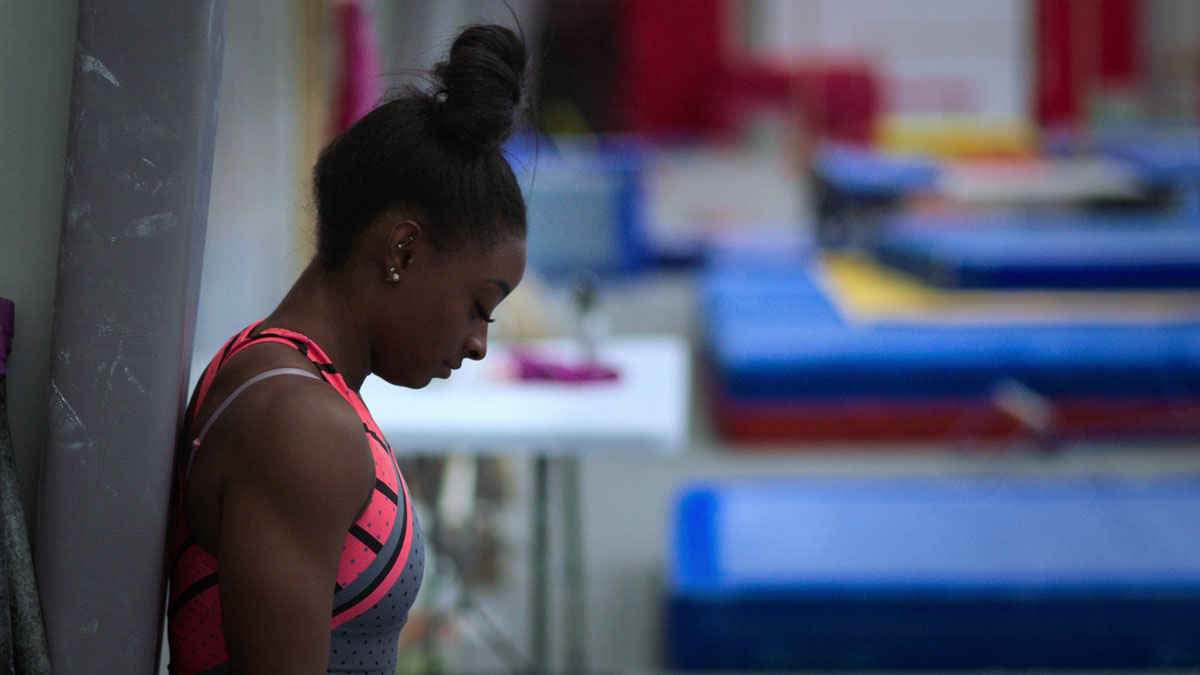
Simone Biles RisingSimone Biles Rising (Netflix)Absolutely. There are scenes that show Simone's family rooting for her at home while she struggles in Tokyo because of the COVID-19 restrictions. How important was it for you to show the importance of the connection between community to an athlete's physical performance? Because I think that's something that people who maybe aren't in the athletic community don't understand.

Yeah. And for Simone personally, it's such a big part of her success. I mean, she has this wonderful support system that goes with her to every competition. I mean, when she travels, she rolls deep. Like, there's 15, 16 people there. It's not just her mom and dad. And I think it's one of the many things that we learned about humanity during COVID, was the importance of connection and community. It's easy to just look at what's happening on the field of play through — just sort of with blinders on, just seeing that one experience in isolation.

At one point we see the video of Kerri Strug from the 1996 Olympics in Atlanta when she performs a vault despite being severely injured. Why was it important to hear from other voices in gymnastics — like former Olympians Dominique Dawes and Betty Okino — specifically regarding the way certain harsh attitudes in the sport have evolved?  What do you feel those voices brought to the conversation?

So I'm a big fan of history. And I think bringing little history pods to this film provides context for someone's experience. You know, [Simone's] life is not in a vacuum. Her experience in gymnastics is not in a vacuum. It's all built on the building blocks of what came before her. And so whether that's the culture of gymnastics or the way that injuries were looked at or viewed in the past versus the way they are now or the history of women of color in the sport, I think all of these experiences and all of these moments just provide greater context for understanding Simone's experience and how she's moving through her career. And the decisions she makes and the experiences she's had have shaped her career, but also been part of the broader culture of gymnastics.

This series touches on the Larry Nassar sexual abuse scandal, which Simone was unfortunately a survivor of. She notably calls what happened in Tokyo a "trauma response" to that experience, to the abuse. What were the challenges in asking Simone about such a deeply traumatic experience?

Yeah, so I was very mindful of how we talked about that and when we talked about it. And I've worked with a number of survivors specifically in the Larry Nassar case, going back to 2018. So I'm aware of how triggering and how emotionally taxing having that conversation truly is. We collaborated and spoke together about the best times to have that conversation. The benefit of this project is we've been working on it for a whole year. And so having a good understanding of her schedule and the rhythm of the gymnastics competitive season, we tried to do those bigger, emotional, heavy-lift conversations earlier in our time together, before she was really in the thick of competing. And that way, we're not trying to have those kinds of conversations and then she's having to go compete two weeks later. So it was a lot of paying attention to the timing and just communicating and working together to make sure that we find the right space and that if she needs her own support system there, she has that. So just working with her and putting her needs first.
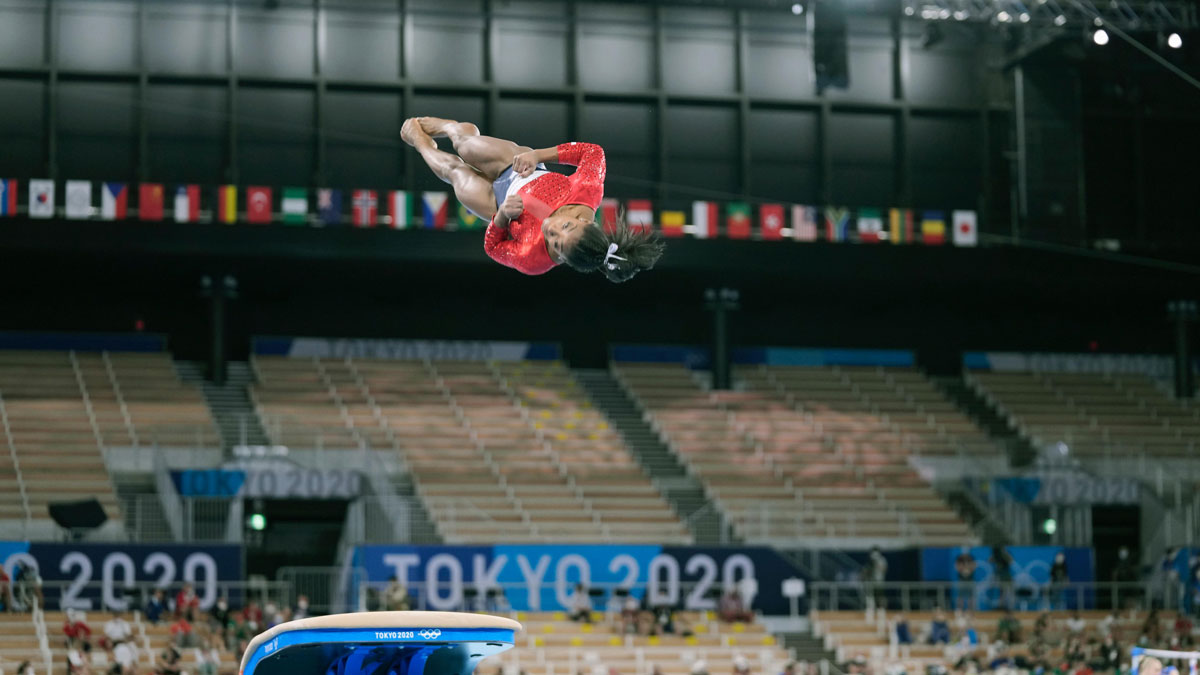
Simone Biles RisingSimone Biles Rising (Netflix)"Simone Biles: Rising" emphasizes the extremely dangerous side of having the twisties like Simone did in Tokyo. How important was it to you to emphasize the precariousness of the sport?

"I give her a ton of credit."

Yeah, I mean there's so much judgment after what happened to her in Tokyo and so much judgment that was based on not fully understanding the gravity of the situation and how the sport works. And so we really wanted to set that record straight and make sure that the audience had an understanding of really just how intense that was, because when you're watching it — if you don't know a ton about gymnastics, even if you do, she still lands on her feet. You're like, "OK, she made a mistake." But the reality is that the reason she landed on her feet is because she is just so good that she was able to find her feet in that moment, whereas 99% of gymnasts probably wouldn't have landed on their feet and would have been hurt much worse physically in that moment.

So I think trying to explain and unpack what the twisties is and why it is so dangerous was really important. I give her a ton of credit. She knows her body so well to be able to make that decision in the heat of the moment to withdraw from a competition that is as big as the Olympic Games. It takes someone with an intensely strong sense of character and understanding of their own body to be able to do that in the moment and not just like go off the adrenaline of the event. It's when you understand what was really going on and how dangerous it could have been — I think you develop a greater appreciation and admiration for what she was able to do in that moment and the decision she made because it was so, so brave. 

At one point participant and journalist Céline Nony talks about how the twisties almost bring about a greater stigma because they're invisible. It can't be seen like you can't see it the same way you can see a broken leg or a fractured leg or something like that. So I think that sort of clarification was very, very useful for the viewer.

The series and you just touched on this briefly, but it discusses the pressures that Black women gymnasts have faced in the sport. How did you decide sort of which things to show in regard to that conversation and how much of this narrative you wanted to really bring into the series itself?

It's to contextualize her experience. Simone has done so much to open doors and create spaces for future generations of young girls of color in this sport. And she is part of a lineage of other gymnasts who have done that and did that for her. And I felt it was important to not just honor that and showcase and shed a light on those women that came before her.

Some of the earlier women mentioned like Lucy Collins and Diane Durham — they never got their view in the sport and the accolades that they deserved. And I wanted to make sure that they were a part of this. And then Dominique Dawes and Betty Okino, both, who played such an important role in showing young athletes like Simone what's possible for them. And obviously, then that continues to Gabby Douglas, who, as the first Olympic all-around champion and a woman of color — just such an incredible history that she made in that day, but also showing the struggles and the criticism that she faced, I think helps create a greater context for what Simone's also gone through.
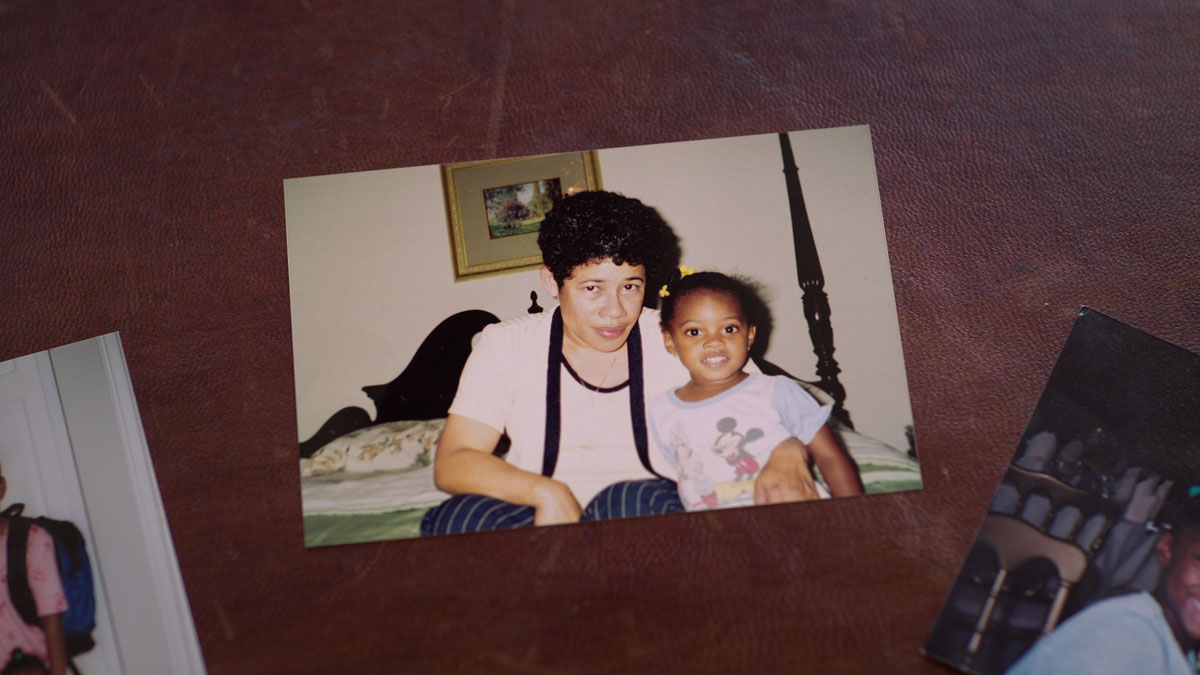
Simone Biles RisingSimone Biles Rising (Netflix)Simone talks about how her parents, who are technically her biological grandparents, helped repair her and her sister's trauma after being in the foster care system and how that experience of having the odds sort of be against her as a kid in the foster care system almost inspired her to do some of the big things that she's done. What were the conversations that led to including that aspect of Simone's life, and what specifically did you want to say about it?

Well, families come in all shapes and sizes, right? And for Simone, she's certainly had different experiences, different family struggles along the way. And the experiences that she had in foster care, those experiences of not really knowing what was coming next and what to expect as a young child — that's something that stays with you. And I think it's part of her story. It's also, I think, part of her motivation. You know, she said in the film, "When people question if you can succeed when you come out of the foster care system, I wanted to prove that you could."

That's how she approaches so many challenges in her life, with like the, "You don't think I can do this? Watch me," kind of attitude, which is what makes her this great athlete and champion that she is. So I felt like it was an important part of her story to understand, just in building and understanding her character and the strength of her character and why she approaches the challenges of today the way she does. I think it all routes back to those early childhood experiences.

When Simone dropped out of Tokyo, as we've already discussed, she faced a litany of naysayers who accused her of abandoning her team and being a quitter. This series shows her actually reading some of those nasty tweets out loud. Simone — who won the Olympic trials — recently stated that she moved past Tokyo three years ago, and if her critics haven't, that's on them. How do you feel about this still lingering tension after having directed this series and now ahead of Paris?

Well, I think especially for Simone and all young athletes, social media has become a voice that's constantly in your head. It's really impossible to avoid. And a lot of people are account critics, right? And they're at home just tapping away.

Yeah, Simone says at one point, something like, "You guys can't even do a cartwheel." That was so funny.

Yeah, so we wanted to bring in — I think especially when you're discussing mental health and mental health in a young athlete or any young person for that matter, social media plays such a big part in that conversation.  And I know it's something that Simone has really worked on making a better environment for her. And it's a challenge because it's everywhere and it's hard to get away from it. So I thought it was important to bring that into this film and to address social media and weave it in with the greater conversation of mental health. There are always going to be critics, right? People are going to talk about Tokyo. It's inevitable, especially right now, as we head into Paris. But, she's got more tools in her toolkit now for handling those challenges. And I think it's the process she's gone through in the last couple of years that will allow her to rise above all of that criticism this time around.

Speaking of rise, can you speak about the decision to name the series "Simone Biles: Rising"? It seems to come from her tattoo, the Maya Angelou poem, "And Still I Rise," which Simone said speaks specifically to her ability to constantly rise to the occasion, both in her career and her life.

"She is still rising above all of the criticism."

The title was one of the easiest and fastest decisions we made, which is not typically the case, I would say.  I don't know if we'd even started filming with her yet, but I knew about her tattoo.  And just thinking about her story and all that she has risen above, from foster care to sexual abuse to mental health challenges, everything she does on the gymnastics floor, all the advocacy she does outside of the floor.  It was such a natural fit that she is still rising above all of the criticism and what we just talked about. She's rising above all of this and she's here doing this for herself despite of all of those challenges that have been in her life throughout her life. So it just was such a natural fit, it worked so perfectly, and the fact that obviously it means so much to her personally. If you don't love it you don't have a tattoo. She loves it for a lifetime. So it felt like such a great fit. I don't know if you saw today that the trailer came out with Viola Davis.

I did, it was so impactful.

It was fun to think that one day I was just driving to the grocery store and that title came to my mind. So then seeing Viola Davis reading excerpts from that poem to these beautiful images of Simone . . . it's such a pinch-me moment personally. And I'm so grateful that it has all come together the way it has.

How will the final two episodes of the series differ from the first two? What will you focus on and what do you want viewers to take away from it as a whole?

If the first two episodes are really based in Simone's why, I think this is like very much the now and the what's next. The interesting thing about this series that what we're discussing today is that we don't know how it ends. It's exciting and it's so cool to be on this journey with her in real time. I leave for Paris on Saturday. And the Olympics — I'm with her for the whole duration of the games and the second two episodes will be steeped heavily in that Olympic experience. So we'll get to see how it all unfolds from her behind the scenes, beyond what you see on the actual coverage of the games. We'll have a much greater understanding of her experience throughout the whole Olympic Games from being there on the ground with her.

The first two parts of "Simone Biles Rising" are streaming on Netflix.

Trans woman falsely identified as Trump shooter in far-right smear

Far-right social media users spread an image of a transgender woman, falsely positioning her as Thomas Matthew Crooks, the would-be assassin of former President Donald Trump.

Per Erin Reed, a reporter on LGBTQ+ issues, the now-deleted post on X purported that the trans woman, who Reed identified as Rose, was another photo of Crooks — a claim that conspiracist Alex Jones quickly amplified, along with crypto influencer Matt Wallace, who boasts nearly 2 million followers.

Gaps in X’s content moderation allowed the post to spread across the platform, gaining at least 7 million views and countless more through quote-tweeted posts, before its removal.

Rose, who was notified of the image after her friend sent her a post on Facebook, was reportedly alarmed by the false comparison.

“I’m just an artist, I enjoy drawing and writing, and occasionally playing video games. I’m literally the most average random person,” Rose told Reed. “A lot of people just went along with it simply [because] I’m trans.”

Trump, whose plans to ban gender-affirming care, restrict funding for medical facilities that treat trans patients, and ban trans people from serving in the military have garnered criticism from LGBTQ+ advocates, was targetted by Crooks, a cisgender white 20-year-old male whose motives are unknown, but who was a registered Republican described as “conservative” by those who knew him.

The far-right has previously been quick to falsely blame tragedies on trans individuals, including Arizona Congressperson Paul Gosar’s 2022 lie that the Uvalde shooter was a “transsexual leftist illegal alien.”

The viral baseless conspiracy theory comes amidst an uptick in acts of violence against trans people, and countless legislative and judicial attempts to roll back LGBTQ+ rights from right-wing officials.

“The View”: Trump’s “meandering” RNC speech would have spelled hospitalization for Biden

"The View" hosts on Friday scrutinized former president Donald Trump's speech during the final night of the event, referring to the long-winded monologue in which the former president called for unity in the wake of his near assassination attempt as "performative" and "meandering."

“If Joe Biden had been up there giving that speech, many white coats would have interrupted him and carted him off and put him in a padded wagon,” host Ana Navarro said of the long-winded oration. “I thought today I would wake up and the TV would be full of doctors talking about Donald Trump’s cognitive decline. I thought it would be full of Republicans hanging their heads in shame like Democrats did [after Joe Biden’s debate performance].

“What we saw yesterday was a replay of Trump’s 90-minute constant rallies. It’s too bad the bandage was just over his ear — it should have been over his mouth!” Navarro continued. 

Co-host Sunny Hostin claimed that she felt Trump's near-death encounter “would change him.” 

“He did invoke God a lot and I thought he would be changed, but [the speech] felt so performative to me,” she added. 

“The choice [in November] could not be more simple," Navarro argued. "It is between a good, frail, old man, surrounded by a steady, experienced team, or a crazy, loco, old man surrounded by a bunch of criminals and hooligans.”

Meghan McCain doubts Biden’s COVID diagnosis, citing “egregious” health lies

Meghan McCain, who once called President Joe Biden a “truly decent” politician, is sharing her personal theories about his health and political future, as he recovers from a COVID-19 infection.  

In a Friday episode of her “Citizen McCain” podcast, the former “The View” cohost unpacked recent developments surrounding calls to oust the president from the race, including his diagnosis with COVID.

Biden tested positive on Wednesday for the virus, canceling a campaign event that evening and self-isolating in his Delaware home.

But McCain, whose father, John McCain, was a long-time colleague of then-Senator Joe Biden, isn't buying it. 

“I don’t even know if at this point I believe President Biden has COVID. I think there is a trust deficit with the American public, certainly with me, and the Biden administration’s candidness and transparency regarding Biden’s health,” the podcaster said, explaining her theory on the president’s motives. “I don’t—I don't know if I believe he actually has COVID. It may just be an excuse for him to step down gracefully.”

McCain added that her “instincts, sources, [and] friends” told her that “Biden’s days are numbered as the candidate,” with her guest, Ben Ferguson, speculating that Biden was only staying in the race to protect his son Hunter.

McCain’s comments towards the president — the candidate who didn’t slam her father as “a war hero who was captured” — hinged on Americans’ supposed doubt in his health.

“I think the reason why President Biden and his team are in the predicament that they are in is because they lied egregiously at a level of maleficence we’ve never seen,” she said.

Experts fear GOP’s post-shooting Trump idolization could have “incredibly dangerous” effect

Chants of "fight, fight, fight!" — though brief — peppered the final night of the Republican National Convention in Milwaukee Thursday, with attendees pumping their fists as GOP nominee Donald Trump solemnly recounted the attempt on his life during his acceptance speech.

The crowd took inspiration from the now-indelible image that came to characterize the deadly shooting at Trump's Butler, Pa., rally on July 13: the former president, face bloodied and contorted, forcing his arm through the cover of Secret Service agents and pumping his fist while mouthing the words, "fight, fight, fight!" with the nation's flag flying overhead. 

"It's just the perfect shot for his message. It conveys things about presumed power, about patriotism, about defiance, strength in the literal face of adversity that is much more difficult to do with words," said Erik Bucy, Texas Tech University's endowed chair of strategic communication who focuses on political communication. "Everybody immediately understands what's going on with that photograph, and whether you like him or you hate him, he does convey strength and resilience in that moment."

But even as supporters rally around Trump following the harrowing attempt on his life, their hailing of the image and adoption of the accompanying chant distills a message that political communication and authoritarianism experts say plays into the heavily polarized nature of politics. That seemingly vast political divide — in part, cultivated through much of Trump's own rhetoric over the years — only widens with such iconography and rings as a cause for concern in the face of political violence, they said.

"Together with Trump’s chanting of 'fight,' the resulting framing is one of conflict, of heroism, of war," argued Yotam Ophir, a University at Buffalo associate professor of communication whose research subjects include media effects and extremism. "The 'fight' chants and the heroic visual framing are capable of fanning, not cooling down, the flames," he continued.

The image "works perfectly for the Republican platform" in its longtime portrayal of President Joe Biden as "weak and old," Ophir told Salon — a position that's more widely held amid the mounting pressure for the president to drop out of the 2024 race following his disastrous debate performance and lackluster subsequent interviews. Similarly, the photograph offers Republicans the opportunity to "shift attention away from policy questions around abortion or Project 2025" to place greater focus on the "character of the candidates," which "leads to political cynicism among voters," Ophir said.

The "'fight, fight, fight' chant is consistent with a sort of message that we've been getting from the Trump Republican Party for some time now — this idea that you have to take back the country, that they're fighting against a Democratic Party and a leftwing cabal that is trying to steal elections, change the country, all these kinds of things," added Sheri Berman, a Barnard College and Columbia University professor of political science whose research focuses include democracy and authoritarianism.

"I think this builds on this very divisive, polarizing imagery that has really fed the Trump version of the Republican Party since 2016, frankly, and has only intensified since the 2020 election," she told Salon. 

The chants first took center stage when Trump made his first public appearance following the assassination attempt Monday at the RNC. Delegates greeted the soon-to-be GOP nominee with thunderous applause and calls of "fight, fight, fight!" — their fists raised to punctuate each word. In the days afterward, attendees even took to wearing bandages over their ears in solidarity with Trump, with one Arizona delegate proclaiming it "the newest fashion trend." 

Toward the end of his speech exalting his father's fighting spirit in the face of a near-death experience, second son Eric Trump even led the crowd in chanting their new rallying cry, declaring the senior Trump's action will be remembered as "one of the most courageous in American politics." 

These behaviors, Bucy told Salon, are indicators of the "rally effect" that can arise when a president or former president has to navigate a crisis, such as the boost to a 90 percent approval rating former President George W. Bush received in the wake of 9/11. In Trump's case, the assassination attempt represents a "very personalized crisis," the rallying response to which Bucy expects to intensify and have "lasting resonance" at least in the short term. 

That Trump had sound enough mind in the heat of the shooting to perform for his base in such a way was "extraordinary" in its own right, Bucy said. But it's also a reflection of the former president's ability to lean into the United State's mediatization of politics — which shifts the "conventional notion of politics" as a discussion about policy, shared values and the country's direction to a "space of media logic" where the foremost goal is to "maintain attention" on a candidacy — a tool Trump's pulled out in the face of other challenges over the years to rouse his supporters.

We need your help to stay independent

During the moments photographers were allowed to document his criminal hush money trial in New York each day, Trump would don a stern and angry look for the cameras but relax his expression when they left, according to The Associated Press. The glare in his Atlanta mug shot, taken last year after his arraignment on charges alleging he conspired to overturn the results of Georgia's 2020 election, soon found its way onto T-shirts, posters and other memorabilia, encouraging his supporters to shovel more money into his campaign.

He also arranged a dramatic return to the White House after testing positive for COVID-19 in 2020 and receiving treatment from Walter Reed National Military Medical Center, the AP notes. He climbed the South Portico steps and removed his mask upon reaching the balcony, American flags flanking him, giving two thumbs-up to the helicopter as it flew off into the sunset. 

New York Times reporter Maggie Haberman, in her book "Confidence Man," wrote that the former president had considered a more dramatic return, in which he “would be wheeled out of Walter Reed in a chair" and "would dramatically stand up, then open his button-down dress shirt to reveal” another shirt with a “Superman logo beneath it.”

The imagery around the assassination attempt, then, takes the right's idea of Trump as a "Superman for the people, or a crusader against so-called mainstream media" and gives it a "real image" and "real force," Bucy said.

For his part, Trump said that, after seeing the crowd at his Saturday rally hadn't left, he felt he had to project strength and assure them he wasn't badly injured.

“The energy coming from the people there in that moment, they just stood there. It’s hard to describe what that felt like, but I knew the world was looking, I knew that history would judge this and I knew I had to let them know we are OK,” he previously told the Washington Examiner.

Taken with Trump's populist stance, the message he conveys to his base with the "fight, fight, fight!" chant is one that encourages them to "continue the fight against the entrenched elites or against whoever might be responsible for targeting them," Bucy argued. In so doing, Trump also draws on the notion that he's an underdog due to his move from celebrity to politician that's become a key theme of his campaigns and rhetoric, a point Bucy notes, reads as "farcical" given the former president's billionaire status and lifelong proximity to political elites. 


Want a daily wrap-up of all the news and commentary Salon has to offer? Subscribe to our morning newsletter, Crash Course.


In a slight departure from his usual rhetoric, Trump's nomination acceptance speech Thursday night called for unity between all Americans, no matter their races or political affiliations, as he reflected on the attempt on his life. But he quickly returned to his rhetorical roots, couching the blame for the country's political polarization in the left's labelling of him as a threat to democracy — which the far-right has claimed led to the deadly shooting — and accusing Democrats of launching politically motivated prosecutions against him. 

"In the aftermath of this assassination attempt, Republicans have really attempted to make an equivalence between the Democrats' claim that Trump is a threat to democracy. There's no doubt in my mind, and I think in the minds, I can say, of almost all political scientists, that Trump and the party under him have, in fact, threatened democracy in some very significant ways. I think pointing that out is totally legitimate because it is empirically verifiable," Berman said, noting that though Democrats have also gone against democratic norms and institutions, "there's a difference, however, in that the Republicans under Trump have done so in a much more consistent and systematic way."

Bucy said that, while he wouldn't say Trump is a "really strong populist, let alone a fascist" as far as his presidential policy outside of executive orders went, the populist theme Trump and others align themselves with being "really divisive" and "very aggressive in its language" has set the stage over the years with "enough rhetoric and verbal threats" that "we're starting to see actual physical threats" and political violence. The 2017 shooting at the Republican Congressional Baseball team's practice that injured Rep. Steve Scalise, R-La., and the 2011 shooting of former Rep. Gabby Giffords, D-Ariz., also serve as other harrowing examples, he said. 

When considering the idea of violence, the lauding of the Trump image and accompanying chant "kind of offer a very uncomfortable continuation of the Jan. 6 iconography," Bucy said. "The people who don't see anything wrong with that, or who reveled in it, or who think they were the victims only acting out against their oppressors, well, now they have another kind of small, isolated case, but this time against Trump."

What the "gradual but now complete rehabilitation" of the Jan. 6 attack on the Capitol did was transform the politically violent event into a kind of "legitimate resistance," seen in how the Republican Party first condemned the actions before members of the far-right faction began to see the participants as "heroes," Berman explained. Political polarization, then, transforming into the "legitimation of or justification of violence" or even the "demonizing of opponents" is a cause for concern, she said.

"That is an incredibly dangerous thing," Berman said. "Any kind of legitimation of violence in politics is an anathema to democracy, and it tends to metastasize."

Instead of "celebrating" or extolling Trump as a hero in the aftermath of the "awful low-point" for the country that was the assassination attempt, "Americans should resist the temptation and not get dragged into extremism and political polarization," Ophir said, adding: "As hard as it may be, we need to use this moment to come together as a nation and fight extremism, not one another."

“A ticket we can win on”: Jeffries backs Biden despite private urges to quit

House Minority Leader Hakeem Jeffries — the top Democrat in the House — backed the Biden-Harris presidential ticket in a recent radio interview.

“President Biden, as I've said repeatedly, is our nominee,” Jeffries said in an interview with WNYC’s Brian Lehrer. “He is one of the most accomplished American presidents in our history and he has the vision, I believe the ability, the capacity, and the track record to make a case to the American people that will result in us being successful in November.”

Jeffries, who privately urged Biden to step aside earlier this week citing polling challenges, has since backed down.

“The ticket that exists right now is a ticket that we can win on,” the minority leader told Lehrer. “There, of course, is work to be done. And that, in fact, is the case because we are an evenly divided country.”

Jeffries joins representatives including Alexandria Ocasio-Cortez in publicly backing the president amidst friendly fire on his campaign. The New York congresswoman took to Instagram Live to slam her colleagues who took private stances against Biden’s candidacy without a backup plan.

Other House Democrats have vehemently pushed back on the efforts to oust Biden, while just over 30 of the 213 members of the caucus have voiced their opposition to the candidate after his widely panned debate performance.

According to the White House, Biden told Jeffries during the pair’s conversation that he wouldn’t leave the race.  

“The president told both leaders he is the nominee of the party. He plans to win, and looks forward to working with both of them to pass his 100 days agenda to help working families,” Biden spokesman Andrew Bates said in a statement to the Washington Post.

CORRECTION: An earlier version of this article referred to Jeffries as "reversing course." The headline has been edited to better reflect his lack of public calls against President Biden's candidacy. 

“Their plans are extreme”: Kamala Harris takes on JD Vance, Project 2025 and GOP claims of “unity”

Vice President Kamala Harris told supporters gathered at her campaign event in Fayetteville, North Carolina, that the convention speech delivered this week by Sen. JD Vance, R-Ohio, this week was “a compelling story — and it was not the full story,” The New York Times reported.

Harris wasted no time in addressing the brass tacks, condemning former President Donald Trump and his pick for vice president, claiming they will undermine the middle class and eviscerate the rights of women and minorities. In her first campaign appearance since Vance formally accepted his position on the Republican ticket, Harris took direct aim what she described as an extremist agenda.

“Frankly, what’s very compelling is what he didn’t talk about on that stage. He did not talk about Project 2025, their 900-page blueprint for a second Trump term. He did not talk about it because their plans are extreme, and they are divisive,” she said of Vance, PBS News reported.

President Biden, Harris said, is someone who will “fight” for the common people, noting that he comes from a middle-class background in Scranton, Pennsylvania, and “he has never forgotten where he came from.”

The vice president warned against the dangers of a Trump-Vance administration for reproductive rights, social programs, as well as health care and education policies pursued by the the Biden-Harris administration. She also critiqued Republican claims that they are genuinely in favor of "unit."

“In recent days, they’ve been trying to portray themselves as the party of unity,” Harris said. “If you claim to stand for unity, you need to do more than just use the word. You cannot claim you stand for unity if you are pushing an agenda that deprives whole groups of Americans of basic freedoms, opportunity, and dignity."

“Pass the torch”: Progressive and moderate Democrats join forces in asking Biden to go

Democrats from California, Wisconsin, Texas and Illinois joined forces Friday to write a joint letter to President Joe Biden asking him to step down from the presidential race and “pass the torch to a new generation of Democratic leaders.”

The representatives acknowledge Biden’s accomplishments, noting his decades of “public service and patriotic leadership.” However, they argue that the best chance to defeat Donald Trump and ”save our democracy” would be to let someone else finish the job.

The lawmakers — Jared Huffman, D-Calif., Marc Veasey, D-Texas, Chuy Garcia, D-Ill., and Mark Pocan, D-Wis. — wrote that the widespread concerns regarding the president’s age and health are indeed warranted and worth taking seriously. They argue that, fairly or not, Biden will not be able to assuage concerns.

“We believe the most responsible and patriotic thing you can do in this moment is to step aside as our nominee while continuing to lead our party from the White House,” the letter states.

The union of these lawmakers is notable. Veasey, a moderate, is the first member of the Congressional Black Caucus to ask Biden to drop out of the race. Garcia, Huffman and Pocan are considered progressives, with the latter having previously served as co-chair of the Congressional Progressive Caucus.

U.S. Sen. Martin Heinrich, D-N.M., also issued a statement Friday urging Biden not to run for reelection, KOB News reported. The senator praised Biden for being “one of the most accomplished presidents in modern history,” and complimented him for his years of public service and leadership, but said it was time to go for the good of the country.

“The return of Donald Trump to the White House poses an existential danger to our democracy. We must defeat him in November, and we need a candidate who can do that,” Heinrich wrote. 

Also Friday, Rep. Zoe Lofrgren, D-Calif., an ally of former House Speaker Nancy Pelosi, D-Calif., added her name to the list of 20-plus Democrats publicly calling on Biden to drop out.

In a letter addressed to Biden, she asked Biden to "allow another Democratic candidate to compete." If he decides not to, Lofgren said she would still support his candidacy.

"Unfortunately," she added, "I greatly doubt the outcome will be positive and our country will pay a dreadful price for that."

Bud Light loses number one spot, slips to No. 3 beer brand following consumer boycott

Bud Light is no longer the nation’s most popular brand of beer. 

According to new sales data, Bud Light fell to third place in U.S. beer sales more than a year after consumers boycotted the brand over its campaign with transgender influencer Dylan Mulvaney.

In second place is Michelob Ultra — also owned by the same parent company, Anheuser-Busch — and in first is Modelo Especial — the official beer sponsor for Team USA in the Olympics. The latter claimed the top spot as the No. 1 selling beer at grocery and convenience stores across the country back in May 2023.

In the four weeks ending July 6, Bud Light represented 6.5% of beer dollar sales in stores nationwide, according to an analysis of NielsenIQ data from Bump Williams. Modelo Especial represented 9.7% of beer dollar sales, while Michelob Ultra represented 7.3%.

“While dollar sales aren’t quite back into the ‘positive’ yet, the declines for the brand have improved dramatically and retailer support continues to improve week after week,” the consulting firm’s CEO Bump Williams told USA TODAY.

Anheuser-Busch said in a statement that Bud Light “will always be a mainstay of our iconic portfolio.”

 “Millions of consumers choose Bud Light every day and we continue to invest in partnerships with the NFL, UFC and renowned musicians,” the company added.

The problem with “Cobra Kai” is “Star Wars”

The world was very different when "Cobra Kai" premiered in 2018.

What was then a fallow '80s movie franchise got revived by YouTube Red, a brand name which no longer exists. Initially, its creators Jon Hurwitz, Josh Heald and Hayden Schlossberg plied whatever warmth Gen X still held for "Karate Kid" rivals Daniel LaRusso (Ralph Macchio) and his one-time bully Johnny Lawrence (William Zabka) into a fable about a Reagan-era villain atoning for his past missteps.

This continuation aspired to do more than simply depict Daniel and Johnny grappling with ancient history and their juvenile rivalry's ripple effect on local teenagers. The first and second seasons are light parables that take on toxic masculinity, the weight of fatherhood and healing traumatic personal legacies.

In linking a family story about two middle-aged men set on reclaiming their past glory and a passel of teenagers figuring out how to attain their first taste of it, "Cobra Kai" demonstrated a four-quadrant, all-ages draw not unlike the kind that made "Stranger Things" a hit. The difference is that this title directly links to the '80s instead of simply channeling its memories and mood.

As such, when the creators called "Cobra Kai" and the films that inspired it "their 'Star Wars,'" they meant to convey their passion. Invoking George Lucas' multi-generational appealing space opera indicated a level of seriousness about world-building and expansion. Again, that was in 2018.

As "Cobra Kai" embarks on its sixth and final season — words which leave me simultaneously relieved and stunned that it lasted this long – we might view this goalpost differently without judging Hurwitz, Heald and Schlossberg too harshly. They couldn't have known that likening their show to "Star Wars" would age like blue milk.

They couldn't have known that likening their show to "Star Wars" would age like blue milk.

"Cobra Kai" premiered a year and a half before Disney+ debuted and "The Rise of Skywalker" hit theaters, two developments that changed the value of "Star Wars" as a creative benchmark. To start, the ninth and final movie in the Skywalker saga operates with a structure emblematic of the franchise's inability to innovate or end satisfyingly.

In a similar vein, the "Star Wars" TV extensions suffer from an unwillingness to abandon well-traveled canon and ideate fresh approaches. "Andor" and "The Acolyte" are exceptions, with the former praised by serious critics — but not all, as it's still an easily dismissible "Star Wars" joint — and the latter winning more over as the season progressed.

The "Cobra Kai" creators draw from two simpler and dissatisfying aspects of "Star Wars" lore: the movie's heavy reliance on the fairy tale good and evil binary, as well as a movie plot configuration that boils down to the heroes blowing up the same apocalyptic engine over and over again.

The '80s Lucas films and the recent three cannot quit their Death Stars. Those war machines keep coming back, each slightly more deadly than the last. When J.J. Abrams picked up the torch for the seventh, eighth and ninth movies, he tasked their rebels with blowing up one the size of a dwarf planet.

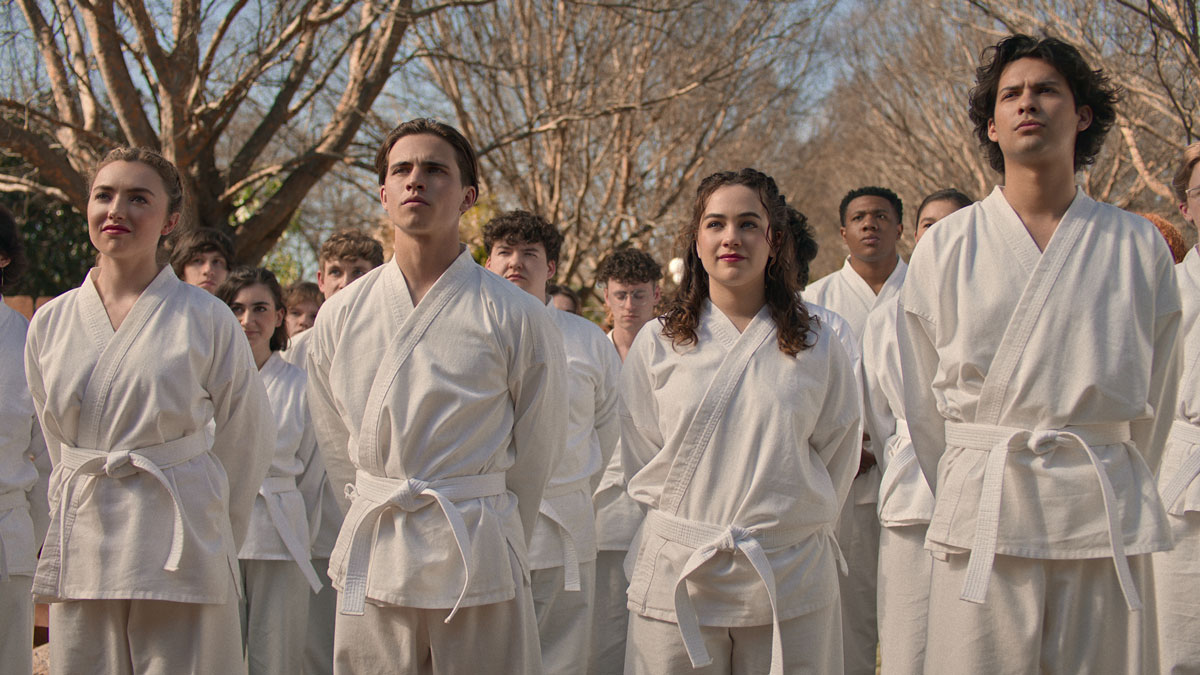
Cobra KaiPeyton List as Tory Nichols, Tanner Buchanan as Robby Keene, Aedin Mincks as Mitch, Mary Mouser as Samantha LaRusso, Khalil Everage as Chris and Xolo Maridueña as Miguel Diaz in "Cobra Kai" (Courtesy of Netflix)
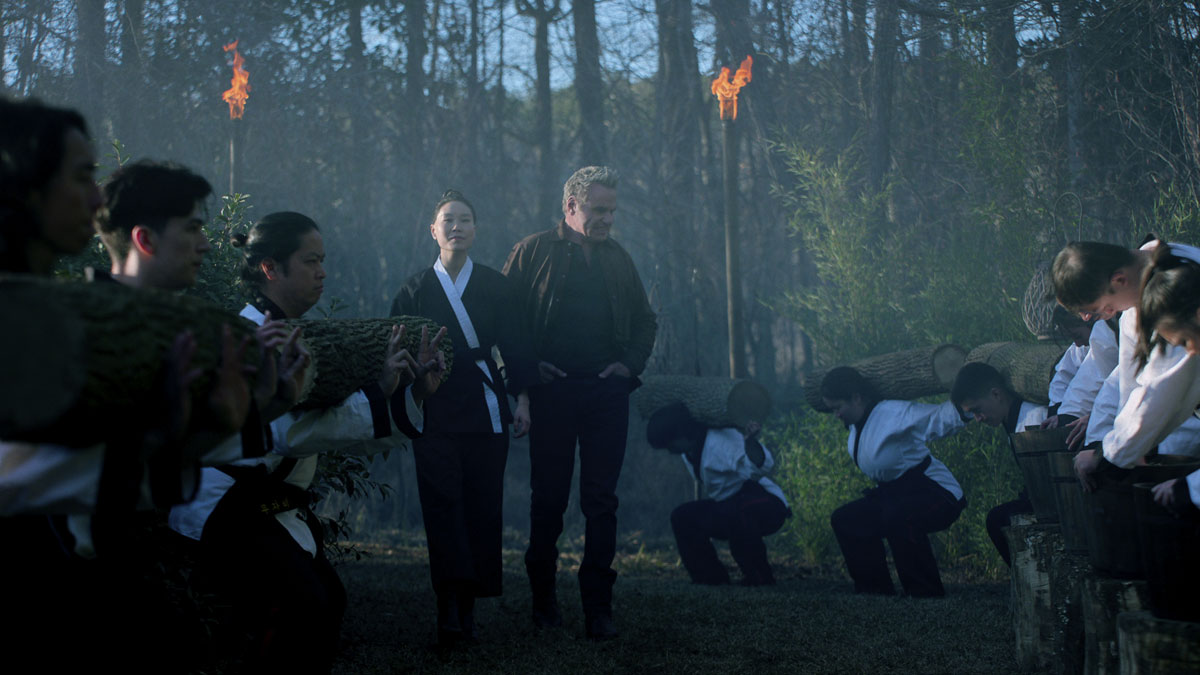
"Cobra Kai" retrofits this concept to fit its franchise by making its "Under-18 All-Valley Karate Tournament" the equivalent of those climactic dogfights. It's a move that only works so many times.

In this last season, we find the "Cobra Kai" senseis and their pupils preparing for an international vacation to the (entirely made up) Sekai Taikai. The series bills it as a karate world championship, but it sounds a lot like the underground kumite from 1988’s "Bloodsport," minus the deaths (we assume).

But who knows? Martin Kove's John Kreese is still in this thing, having escaped from prison, thanks to the medical personnel's inability to distinguish melted Jell-O from blood.

We need your help to stay independent

Sit with that detail for a moment, then take in the fact that he somehow escapes to Korea to hook up with his sinister hard master, whose granddaughter Kim Da-Eun (Alicia Hannah-Kim) surfaces in Season 5. Continuing the show's eye-rolling practice of cavorting through mystical Asian stereotypes, Master Kim's students train in a forest and, in 2024, he still lives in a hut. 

This is a Yoda inversion you see, and in case you didn't get the memo, Kreese is sent on a mission that ends in a dark cave. 
Along with digging up old characters from the films, Kreese foremost among them — as well as Yuji Okumoto's Chozen, one of the wiser carryovers from its "Karate Kid II" redux — the show continuously reheats Daniel’s and Johnny's rivalry. This keeps happening long after they unite to defeat their common enemy.

Since apples don't fall far from trees, Johnny's first student and soon-to-be stepson Miguel (Xolo Maridueña), along with his formerly estranged son Robby (Tanner Buchanan), switch back and forth between Johnny's "way of the fist" and Daniel's gentle continuation of Mr. Miyagi's teachings.

Cobra KaiAlicia Hannah-Kim as Kim Da-Eun and Martin Kove as John Kreese in "Cobra Kai" (Courtesy of Netflix)In this way, every season's arc redefines what it means to succumb to the dark side. Somebody always tumbles into evil on this show; it's merely a matter of who and when.

"Cobra Kai" isn't alone in following the "Star Wars" storytelling map. Jason Sudeikis similarly envisioned "Ted Lasso" seasons playing out like "A New Hope," "The Empire Strikes Back" and "Return of the Jedi," down to having a gentle character turn heel in its second season before redeeming himself in time for the big finish.

Since we know what to expect, nothing leading up to the "twists" in "Cobra Kai" is surprising. Exciting the audience means showing the young characters punch through their problems at — among many places — arcades, Daniel's home, school and, this season, in a frat house.

"Cobra Kai" isn't alone in following the "Star Wars" storytelling map.

The final run is the series' longest yet, supersized from the usual 10-episode order to 15, set to be released in a trio of five-part doses. (The first is out now, with the second arriving Nov. 15 and the third coming on a yet-to-be-announced date in 2025.)

Expanded and split seasons used to be an indulgence reserved for groundbreaking prestige series like "The Sopranos" and "Breaking Bad."

Nowadays, streamers like Netflix do it as a matter of chumming their content streams and expanding the shelf life of a show's viewer engagement. It's a cheap play, though, to wring the last juice out of a silly yet winning story about a man in the throes of a midlife crisis attempting to reclaim his youth by opening a strip mall dojo.


Want a daily wrap-up of all the news and commentary Salon has to offer? Subscribe to our morning newsletter, Crash Course.


"Cobra Kai" evolved beyond that modest premise very quickly by making us curious as to whether Zabka's stuck-in-the-past Johnny would ever rise to meet the moment, reflecting a question much of its audience has about their fellow citizens. That was enough to sustain it for a few seasons. Three should have been enough. Even "Ted Lasso" got that part right.

Sadly, this show chooses to grasp at approximating an '80s saga it never was going to match instead of remaining true to what made it great in the first place and stepping off the mat when it made sense. This makes us anticipate the ending for all the wrong reasons.

The first five episodes of the sixth season of "Cobra Kai" are currently streaming on Netflix.

AOC blasts colleagues who are “too scared” to publicly say what they think about Biden

Rep. Alexandria Ocasio-Cortez, D-N.Y., took to Instagram live Thursday evening to make a a fervid argument in favor of President Joe Biden staying on top of the Democratic ticket, Business Insider reported.

In a nearly hour-long session, the progressive lawmaker expressed her support for Biden despite the party’s dissonance over his candidacy after the presidential debate in June.

The New York congresswoman warned against forcing Biden to step down, detailing potential legal challenges from Republicans to a hypothetical nominee’s ballot access. "I have not seen a scenario, an alternative scenario, that I feel does not set us up for enormous peril," she said, Mediaite reported. That particular warning comes despite legal experts noting that Democrats do not formally pick a nominee until the convention next month, meaning Biden himself is not on the ballot yet.

Ocasio-Cortez went on to condemn her colleagues who have been leaking information to the press, which she said is weakening Biden’s position. “To me, I think that’s, and I’m sorry — I’m going to say it because it’s after midnight — that’s bullshit,” she said. 

She explained her comments weren’t pointed at those who were making public statements with their name on it. “I’m talking about people who are too scared to say what they want to say in public, but somehow not afraid to say what they want to say to a journalist so long as they promise not to use their name," she said. "That’s a bunch of horseshit!”

Addressing the murmurings that Vice President Kamala Harris might be a possible alternative to Biden, Ocasio-Cortez argued that there was no guarantee that the Democratic Party would support her.

“If you think that there is consensus among the people who want Joe Biden to leave that Kamala, that they will support Kamala, Vice President Harris, you would be mistaken,” she said. “A lot of them are not just interested in removing the president. They are interested in removing the whole ticket.”


“Hot Ones”: Donald Glover bids adieu to Childish Gambino moniker while feasting on spicy wings

In anticipation of the release of his new album “Bando Stone & the New World,” Donald Glover sat down with Sean Evans on this week’s episode of “Hot Ones” to enjoy a platter of increasingly spicy chicken wings.

The “Mr. & Mrs. Smith” star spoke about his stage name Childish Gambino and why he decided to retire the moniker for good: “A collaborator of mine, fam and I, we talked about the death of Superman a lot . . . I always knew Childish Gambino was like a character and on some level I wanted it to end. I almost feel like Childish Gambino is like the boss from ‘The Office,’ like, ‘That stuff worked 10 years ago.’ All that stuff worked, but now it’s like a different thing. It’s like, ‘Oh it’s a little sad, but it’s like, wow, the cycle kinda continues, which is great, I think.’”

Glover came up with the name “Childish Gambino” after using an online Wu-Tang Clan name generator in college.   

“The Childish Gambino story from the Wu-Tang Clan [that] RZA told me, it’s a story of a child turning into a boss,” Glover explainer later in the episode. “This last sunset walk is for the fans. This is for you.”

Elsewhere in his interview, Glover likened eating hot wings to taking hallucinogenics. “This does feel shamanic,” he said. “It feels pretty intense already. I feel like I’m about to do ayahuasca.”

Glover credited his “Community” co-star Joel McHale for building up his spice tolerance. In an attempt to get in shape for a shirtless scene during the show’s first season, McHale followed a strict diet consisting of strong coffee and eggs. McHale would put hot sauce to flavor his eggs and encouraged Glover to do the same.

We need your help to stay independent

“I started putting hot sauce on everything and then we started getting into, like, a thing with each other and I realized that must have boosted my tolerance,” the actor and rapper recalled. He also gave a special shoutout to McHale for (in a way) preparing him for his “Hot Ones” appearance.

Glover held on strong until the Da’ Bomb Beyond Insanity, which boasts a heat score of 135,600 Scoville heat units (SHU). When Evans asked Glover to name his proudest achievement as a grower of fresh produce, the “Atlanta” alum could barely focus on the question due to his mouth being on fire.


Want more great food writing and recipes? Subscribe to Salon Food's newsletter, The Bite.


Glover persevered through the second-to-last sauce, High River Sauces’ Peppers Up!, which has a Scoville rating of 700,000 SHU. “It’s making me laugh, [Da’ Bomb] was so painful. This s**t is crazy,” he told Evans. Glover also conquered the infamous wings of death, which are smothered in The Last Dab: Xperience (2,693,000 SHU).

“Here’s the key to the last one — by this point, you know it’s going to be OK. That’s what’s crazy about it,” he said. “It does feel like OK [at the beginning], then you get to something where you’re like, ‘I can’t do this’ and then you get through it and you’re like, ‘Oh, I can do f**king anything.’”

Watch the full episode below, via YouTube:

Hunter Biden asks judge to toss conviction, citing Aileen Cannon’s ruling on special counsels

Hunter Biden is trying to pull a Trump card and have his criminal conviction on gun charges thrown out and another case of tax evasion dismissed, citing a recent controversial ruling that declared special counsels to be unconstitutional.

Special counsel David Weiss secured Biden’s conviction in Delaware federal court last month on charges that he lied about his illegal drug use when buying a gun. Weiss is also pursuing the tax case against Biden, in which he has pleaded not guilty and is scheduled to go to trial in September, USA Today reported.

In a legal filing, Biden's attorneys citing a ruling by U.S. District Judge Aileen Cannon, who dismissed special counsel Jack Smith’s classified documents case against Donald Trump this week after affirming the former president’s claims that Smith's appointment and funding violated the Constitution, USA Today reported.

President Joe Biden’s son maintains that Cannon’s ruling is  reason enough to dismiss special counsel Weiss’s cases against him, NBC News reported.

“Based on these new legal developments, Mr. Biden moves to dismiss the indictment brought against him because the Special Counsel who initiated this prosecution was appointed in violation of the Appointments Clause as well,” the filing reads. “The Attorney General relied upon the exact same authority to appoint the Special Counsel in both the Trump and Biden matters, and both appointments are invalid for the same reason.”

Is the backlash against Biden ableist? Experts weigh in

President Joe Biden was widely criticized for a lackluster debate performance in his first face-off with former President Donald Trump last month — he flubbed his words, trailed off mid-sentence and appeared to stare off into space. In response, The Economist argued that the president should withdraw from the electoral race with a story that used an image of the presidential seal attached to a walker.

Some of the coverage of the 2024 U.S. elections "has been raising alarm bells among disability advocates."

While the magazine stated "Mr. Biden deserves to be remembered for his accomplishments and his decency rather than his decline," at least one prominent group of disability rights advocates feared the publication's illustration suggests that being old and/or disabled means that a person is unqualified to run a country.

"People with disabilities are not a punchline," a spokesperson for the National Disability Rights Network (NDRN) said in a statement about the magazine's cover.

In light of recent reports that Biden is seriously considering dropping out of the 2024 election following his weak debate performance and subsequent discouraging poll numbers, the ongoing debate about ageism and ableism may be literally shaping the history of the American presidency. Instead of Biden's presidency being a landmark moment inspiring disabled and elderly Americans that they can achieve anything, it instead appears to be an inflection reinforcing that prejudices against those groups is still strong enough to determine a president's future.

"Whatever the editors of The Economist thought they were doing here, they failed spectacularly," the NDRN said. "People with disabilities are not a punchline. Mobility aids like walkers, canes and wheelchairs are not prisons that confine us or barriers that limit us. They are not a sign of weakness, but of strength."

The Economist did not respond to Salon's request for comment. Since then — and after interviews were conducted for this story — New York Magazine published a cover of their "Health issue" depicting Biden and Trump both standing on the scale in their underwear as if awaiting a doctor's checkup. In a post on X, the magazine said the issue was planned before Biden revealed that he had contracted COVID this week.

To demonstrate its point about ableism, the NDRN listed politicians from both parties who, in recent history, have risen to high office while being disabled: Republicans like former President Dwight D. Eisenhower (who was dyslexic) and current Texas Gov. Greg Abbott (who is in a wheelchair) and Democrats such as former President Franklin Roosevelt (also in a wheelchair), former President John F. Kennedy (who lived with chronic pain) and sitting Supreme Court Justice Sonia Sotomayor (who has diabetes).

These powerful men and women are not alone. Millions of Americans are elderly, disabled or both. Perhaps this is why, when the collective conversation about aging and disability uncritically assumes that people who flub their words, trail off mid-sentence or stare off into space are "incompetent," some of those who support disability rights pause.

Given that Biden is 81-years-old and has a disability — he was born with a stutter — at least some of these criticisms may be rooted in social prejudices about disability and age. Maria Town, president and CEO of the American Association of People with Disabilities, told Salon that both The Economist's cover and the backlash against Biden fuel these prejudices without thinking about their historical accuracy.

"Abraham Lincoln had depression," Town said. "James Madison was epileptic. Franklin Roosevelt was paralyzed. John F. Kennedy had Addison's disease, ulcerative colitis and chronic pain. George Washington, Woodrow Wilson, Dwight Eisenhower and Thomas Jefferson were all known to have learning disabilities. Ronald Reagan and Bill Clinton both had/have hearing impairments. And Joe Biden has a stutter, a disability that can affect his speech. I hope all of those examples can disabuse our nation of the idea that the presence of a disability alone can or should be disqualifying for a president."

Town defined ableism as "anything that is discriminatory towards people with disabilities based on societally-assigned value to a person's body and mind based on perceptions of their health, capabilities, intelligence and more. These perceptions are often incorrect, and are harmful to people with disabilities. Ableism is also harmful to non-disabled people."

The Economist is far from alone in worrying activists. Progressive media outlets like The Mary Sue and politicians like Rep. Steven Horsford, D-Nev., (chair of the Congressional Black Caucus), expressed concern about the dialogue permeating the media about Biden after the debate. Ashley Glears, a chapter associate at The Arc, a nonprofit organization serving people with disabilities, said the coverage in general "has been raising alarm bells among disability advocates. It can inadvertently perpetuate harmful stereotypes about disability in politics. People should be mindful about how they may be reinforcing myths and stereotypes that hinder meaningful inclusion for the 61 million Americans living with disabilities."

The key to avoiding prejudice, according to Glears, is to focus on the candidates' policies and avoid assuming that traits associated with age and disability are automatically disqualifying.

"Criticizing President Biden for his speech or behavior can be seen as ableist if it targets perceived cognitive issues rather than his policies," Glears said. "Ableism involves discriminating against people based on disabilities, so focusing on his mental abilities can reinforce negative stereotypes about disabled individuals."

Yet despite these concerns with the discourse around Biden's age and disability, Dr. Louise Aronson, a professor at the University of California — San Francisco's Division of Geriatrics, said the current conversation about Biden has still been "partly beneficial."

"We should be having more discussions about aging and disability at all ages," Aronson said, before adding that the current dialogue is "mostly harmful since people have conflated old age with disability and disability with incompetence." Aronson argued that, going forward, the media should understand that "old age increases the risk for disability, but a person can be old and fully able; most elders are, although our abilities change as we age."


Want more health and science stories in your inbox? Subscribe to Salon's weekly newsletter Lab Notes.


The current dialogue is "mostly harmful since people have conflated old age with disability and disability with incompetence."

Even the word "disabled" can itself be problematic, according to Dr. S. Jay Olshansky, a sociologist at the University of Illinois at Chicago. Olshansky, who specializes in demographics and gerontology, warned that while many people see the term "disabled" as neutral, there is still a risk of it being unintentionally pejorative and stigmatizing.

Olshansky said Biden may not be disabled at all, but simply experiencing normal and innocuous signs of aging.

"It is not a definitive indication that there is a loss of judgment," Olshansky said. "It is not a definitive indication that there is dementia. The public is not capable of drawing definitive, accurate conclusions based on watching videotape of interviews. You have to actually have a physician review the patient and review the medical records, so neither I nor the general public is capable of rendering this judgment."

More broadly, experts are concerned that as the public reflexively jumps from seeing a person display infirmity or disability to accusing them of mental incompetence, they perpetuate stereotypes which harm everyone who has a disability or is elderly.

"It's not fair to disqualify someone from being president just because of traits like speech flubs or moments of distraction," Glears said. "The ability to be president should be judged on overall performance, including policies, experience and decision-making — not just on isolated traits."

Discrimination against people with disabilities or older people is often invisible, but "deeply harmful," Glears added. "Even if unintentional, the general public can reinforce the flawed belief that there's only one 'correct' way for bodies and minds to function. I hope that people will be vigilant about how their criticisms might suggest that disabled or older people are not qualified simply because they have a disability."

This does not mean that people cannot ask pertinent questions about a candidate's mental and physical fitness. The key is to determine whether a politician's disability is like that of Soviet Premier Vladimir Lenin, who became literally incompetent after suffering a series of strokes starting in 1922, or like that of Sen. John Fetterman, D-Pa., who retained his intellectual abilities after his own stroke in 2022.

Olshansky's argument is that the way to both dispel prejudice and alleviate legitimate public concerns about competence is for candidates to be transparent about their medical histories. Without said medical histories, the public should "be reluctant to draw definitive conclusions. I would much prefer that those conclusions be drawn by professionals who are capable of evaluating in person."

Indeed, Aronson said no one can ethically or legally diagnose a person without seeing them as a patient and doing an appropriate work up.

"I am not qualified to judge competence for the presidency; that’s why we have a democratic process," Aronson said. When it comes to the behavior that Biden displayed during the debate, "they do concern me as an ordinary citizen and trained geriatrician because the presidency is a high-risk position and this degree of variability in function poses risks during the position's frequent need for optimal communication and negotiation."

We need your help to stay independent

At least one disability rights activist — Phyllis Vine, a historian and journalist who wrote the book "Fighting for Recovery: An Activists' History of Mental Health Reform" — does not feel Biden's traits during the debate are fair game. Instead, Vine told Salon that Biden's "record, his leadership, and his vision for the future are what he should be judged on."

"What he displayed was someone coming under attack as if on a battlefield," Vine said. "And his performance was not what it would have been had he been in conversation with a reasonable or qualified person who was as serious about learning, listening and governing on behalf of the American people."

Regardless of what Biden decides to do about his political future, activists seem to agree America has taken a step backward in its overall understanding of the facts that age and disability are not inherently disqualifying.

"It's far past time for a new national conversation about what we actually mean when we say someone is 'qualified' or 'not qualified' for a job," Town said. "There are lots of people who have perfect mobility and speech who would be terrible as president of the United States. I'm not here to say whether or not Joe Biden is the right person for the job right now, but what I can say is there is absolutely a less ableist, more accurate and meaningful way to conduct this conversation."

“Yes he’s old, but he can do the job”: Biden campaign insists he can win, but the end may be near

Don’t believe the mainstream media and the shaky science of the polling industry, the president’s ally told supporters. It’s still early — the “real campaign” won’t even begin until August — and the same people convinced by public opinion surveys today were the ones, back in 2016, “touting Hillary Clinton and predicting Trump would be … taking the Republicans down to defeat.”

That ally was former Republican House Speaker Newt Gingrich, writing in 2020 to chide “analyst after analyst” looking at the present data and trying to make supporters of Donald Trump “panic or collapse in despair.” They were wrong before, he argued, and “are simply following the same wrong patterns” today.

It’s once more the 2016 election all over again, at least the way some close to the current occupant of the White House see it. The Democratic establishment is making the same mistake it made nearly a decade ago, the narrative goes, when party elders, up to and including Barack Obama, discouraged Joe Biden from running for president and handed the country to an enemy of the U.S. Constitution. What makes it worse today is that Obama is joined in his short-sighted treachery by former House Speaker Nancy Pelosi, D-Calif., reportedly busy “working the phones” to get Biden out of the race, and Senate Minority Leader Chuck Schumer, D-N.Y., who reportedly told Biden to his face that he ought to step aside.

Here we go again, a source close to Biden told NBC News Thursday night.

“Can we all just remember for a minute that these same people who are trying to push Joe Biden out are the same people who literally gave us all Donald Trump? In 2015, Obama, Pelosi, Schumer pushed Biden aside in favor of Hillary; they were wrong then, and they are wrong now,” the Biden ally said, arguing that one of the lessons of 2016 is that “polls are BS.”

A softened version of that argument was made Friday morning by Biden’s 2024 campaign director, Jen O’Malley Dillon. Appearing on MSNBC’s “Morning Joe,” she brushed off reports that Biden, currently isolating at his beach home in Delaware as he recovers from COVID-19, is now more receptive to calls that he step aside and pass the baton to Vice President Kamala Harris.

“Absolutely the president’s in this race,” she assured viewers. “Yes he’s old, but he can do the job and he can win.”

And what about all the polls that suggest he won’t? While not dismissing them outright, O’Malley Dillon suggested looking back at the last midterm elections and the Republican “red wave” that never materialized.

“We had extraordinary elections in 2022, despite what the polling was saying at this point as well,” she said.

If the Biden campaign truly believes that, it’s as much a cause for alarm as the president’s confused debate performance. At this point in the race, it was Republicans predicting a “red wave,” not the polls: the GOP enjoyed just a 1.7% lead over Democrats on July 19, 2022, based on the 538 average of surveys that asked voters which party they wanted to control Congress. In November of that year, Republican candidates for the House of Representatives went on to win the popular vote by 2.8%.

If there’s a lesson from 2022 it’s this: that historical precedent — the opposition party always making huge gains in a midterm; the incumbent president almost always winning reelection — may not tell us much about politics in 2024.

As for 2016, at this point in the race the 538 average had Hillary Clinton up 2.7% on her opponent; after being hit by “her emails,” a Russian hack of the DNC and an election-eve letter from FBI Director James Comey suggesting she was a crook, Ciinton won the popular vote by 2.1% but lost the race.

We need your help to stay independent

There may well be reason for skepticism of polling, which in 2024 suggests an historic number of voters might split their tickets — backing a Democrat for Senate but not the presidency — and that Trump is now far more popular with young voters of color, but the lesson of 2016 and 2022 is not that they should be ignored.

Few outside Biden’s inner circle appears to be buying the spin on those elections, with nearly two-thirds of rank-and-file Democratic voters now saying they want another candidate. It’s possible the president himself no longer buys it either.

“We’re close to the end,” another source close to Biden told NBC News on Thursday, echoing what Pelosi has reportedly been telling other House Democrats: that the president may exit the race as soon as this weekend. Other sources told The New York Times the same thing, while cautioning that no formal decision has been made.

The Biden campaign is publicly denying that. A campaign email sent Friday morning asserted that there was no alternative to staying the course: “In a few short weeks, Joe Biden will be the official nominee.”

But out of public view, CNN reported Thursday night, even “many senior-most officials inside the White House and the Biden campaign privately believe at this point that the president does need to drop out.”

In private, too, is where many Democrats have been making their argument that Biden should step aside. That they are being made public now is a sign that those who made them believe their private nudges need some teeth if the current drama is ever to come to a close.

One of those entreaties, made public Thursday, came from Rep. Jamie Raskin, D-Md., a member of the Congressional Progressive Caucus who helped lead the congressional investigation into the Jan. 6 insurrection. In a four-page letter to the president, dated July 6, Raskin lauded Biden’s legislative accomplishments and credited him with saving democracy in 2020. But he also made an analogy to baseball — to a star pitcher who doesn’t want to leave the mound after a long outing, despite the data suggesting it’s time to go, and ultimately costs their team the game.

“There is no shame in taking a well-deserved bow to the overflowing appreciation of the crowd when your arm is tired out,” Raskin wrote, “and there is real danger for the team in ignoring the statistics.”

“Largest IT outage in history” grounds planes and knocks key services offline globally

A global technology outage disrupted banks, hospitals, airlines, emergency services, and media outlets on Friday, affecting companies and services worldwide, The Associated Press reported.

Cybersecurity firm CrowdStrike — the source of the sudden disruption — said that the reason for the outage is not a security or cyberattack. Rather, the culprit is a routine software update for Microsoft Windows gone wrong. 

“CrowdStrike is actively working with customers impacted by a defect found in a single content update for Windows hosts,” the company said in a statement, NPR reported. Mac and Linux operating system customers were not affected, the company claimed.

Services at airports in the U.S., Europe, and Asia, took a hit as airlines lost access to check-in and booking services, as travelers had to temporarily abandon their summer vacation plans to join long lines at airports. Delta Airlines, United Airlines, and American Airlines all had to ground flights, NPR reported. 

News outlets in Australia were pushed off air for hours. Banks in South Africa and New Zealand reported outages to their payment systems, websites and apps. Hospitals had issues with their appointment systems, AP News reported. And in some U.S. states including Alaska and Ohio, 911 phone lines were down.

Crashed computer screens displayed “it looks like Windows didn’t load correctly” messages on blue screen — which is sometimes called “blue screen of death,” NPR reported.

“This is clearly a major black eye for CrowdStrike,” Wedbush analyst Dan Ives told NPR.

Troy Hunt, a known cybersecurity researcher, labeled the technology disruption “the largest IT outage in history,” CNBC reported

Since the debacle unfolded, CrowdStrike’s CEO George Kurtz has said that the company is “actively working with customers impacted by a defect fund in a single content update for Windows hosts.”

“This is not a security incident or cyberattack. The issue has been identified, isolated and a fix has been deployed,” he wrote on X.


“We’re never gonna let that happen again”: Trump’s RNC speech confirms plans for a Big Lie 2.0

I said a couple of weeks ago that if President Biden decided to withdraw from the race it would be awesome if he would do it on the night Donald Trump accepted the GOP nomination. That didn't come to pass last night during the final night of the Republican National Convention (RNC) in Milwaukee but the political media still spent the whole day speculating that it was about to happen, which no doubt irritated Trump almost as much since he always wants to be the center of attention — even when his opponents are doing his job for him.

When Trump says "we're never going to let that happen again" he means we're never going to let Democrats win again. 

It's obviously helpful to Trump that the Democrats are fighting each other over the fate of their presidential candidate just three months from the election. Still, the drama around Biden potentially withdrawing from the race has stepped on Trump's martyr storyline even as he's ostentatiously sporting a bizarrely large bandage on his right ear and cynically playing the sympathy card. But he made up for it with a smarmy opening to his acceptance speech in which he gave a mournful minute-by-minute recitation of the assassination attempt. At one point he indulged in some truly embarrassing schmaltz by kissing the helmet of the fireman who was killed at that rally in Butler, Pennsylvania on Saturday. It all just seemed …. weird. One suspects he's been talking about this nonstop since it happened and is still understandably obsessed.

That part of the speech was reportedly written by Trump and I think it was evident. He's been dying to share the dramatic story of his allegedly brave reaction to the terrifying experience and this was his chance to take as long as he wanted to do it. (Brushing it off and saying "Honey I forgot to duck," as Reagan did, isn't exactly his style). Unfortunately, he also had to talk about other stuff. It was a major political event after all. And despite the billing of the speech as a call for unity, the rest of it was a flat rendition of his usual rally speech although he did curtail the profanity, eschewed the crude impressions of his political opponents and managed not to insult too many Republicans seeing as it was the RNC and all.

If social media is any indication, the speech seemed to shock many observers who have forgotten that Trump lies constantly and is incoherent and ignorant even when he's at his best. And he was certainely not at his best. Despite the long-winded delivery of all his greatest hits going back to 2016, he's definitely lost a step. 

MSNBC's Chris Hayes astutely described what we all saw last night:

"This is not a colossus, this is not the big bad wolf, this is not a vigorous and incredibly deft political communicator. This is an old man in decline who's been doing the same schtick for a very long time and it's really wearing thin."

The substance, to the extent there was any, was delusional and frightening. From bragging that when he was president he "could end wars with a phone call" to the endless lies about his accomplishments while in office, he assiduously avoided speaking specifically about 98% of his agenda as laid out in Project 2025 and his own Agenda 47. But he did say one thing that caught my attention and should catch the attention of every American. After admonishing Joe Biden for saying he's a threat to democracy earlier in the speech, Trump said in passing, "we had that horrible, horrible result that we'll never let happen again, the election result, we're never gonna let that happen again."

We need your help to stay independent

One might think that was just another example of Trump's cognitive decline. But that was actually a very straightforward comment and one that is backed up by ample evidence. The Republicans who are backing Trump (virtually all of them) have a fully developed plan to ensure that if the Democrats win in November, they will contest the results regardless of any evidence of fraud. When Trump says "we're never going to let that happen again" he means we're never going to let the Democrats win again. 

And he's not talking about getting out the vote. Trump has been quoted repeatedly telling his troops "we don't need votes":

We got more votes than anybody’s ever had. We need to watch the vote. We need to guard the vote. We need to stop the steal. We don’t need votes. We have to stop — focus, don’t worry about votes. We’ve got all the votes. I was in Florida yesterday — every house has a Trump sign. Trump, Trump, Trump, Trump. We have to guard the vote.

The New York Times took a long look at the Republican plan this week and it's not good news. 

Trump’s allies have followed a two-pronged approach: restricting voting for partisan advantage ahead of Election Day and short-circuiting the process of ratifying the winner afterward, if Mr. Trump loses. The latter strategy involves an ambitious — and legally dubious — attempt to reimagine decades of settled law dictating how results are officially certified in the weeks before the transfer of power.

At the heart of the strategy is a drive to convince voters that the election is about to be stolen, even without evidence. 

The article quotes numerous GOP officials who say that fair elections are impossible under the current laws so they have set out to challenge and change them in the swing states that are decisive in our bizarre electoral college system. Most concerning is their plan to give local elections officials the power to hold up certification of the vote. 


Want a daily wrap-up of all the news and commentary Salon has to offer? Subscribe to our morning newsletter, Crash Course.


Certification was never a matter of contention before 2020, having always been seen as a largely ceremonial non-partisan part of the process. But Republicans and their allies have decided this is a useful tactic to disqualify results that don't go their way. In some states, like Georgia, they've even empowered right-wing activists who are now members of the election boards to "investigate" voters to determine if the votes are legal. In Nevada, a similar law has already caused chaos in primary elections which are still in limbo due to board members contesting the results. These cases are wending their way into the courts, delaying the certifications. 

At the RNC this week, Chris LaCivita, Trump's campaign manager, made it clear that they don't plan to accept any loss or concede the race even after the votes are counted:

Donald Trump Jr. says it more plainly even than that:

This is the assault on democracy that the Biden campaign is talking about. It's not just rhetorical. They are literally assaulting the democratic process by changing laws at the local and state levels that will make it possible for them to contest the certification of the election results all the way up until January 6, 2025, and, apparently, beyond. 

Trump is beatable, as demonstrated by that bizarre performance at the RNC. He is not a well man. It's clear that he and his team know this, which is why they are pulling out all the stops to contest the results of an election that hasn't even happened yet. These are not the actions of a confident campaign. But keep in mind that this now goes way beyond Trump and his massive ego. He's shown the Republicans the weaknesses in the system and they're going to exploit them. As he said, "we're never going to let that happen again." This is a problem that will exist long after 2024 — whether Trump gets back into the White House or not. 

“Unity” broke down at the Republican National Convention long before Donald Trump took the stage

MILWAUKEE — Donald Trump is the world's most famous liar. So when he called for "unity" after his close encounter with an assassin's bullet, the safest assumption should have been that he was lying, exploiting his own attempted murder to bamboozle the press into downplaying his swing voter-alienating violent radicalism. And yet, too many journalists fell for it.

"After assassination attempt, Trump and Biden seek calm, unity," a Reuters headline read ahead of the start of the Republican National Convention (RNC). 

It was all spin. The reality, as folks on the ground at Milwaukee's Fiserv Forum can attest, is that the real theme of this week's GOP convention was captured in a popular chant, often directly led by members of the Trump family: "Fight, fight, fight!"

Trump started cashing in on the threatening slogan immediately

(Although the site claims that these sneakers "are not designed, manufactured, distributed or sold by Donald J. Trump," ABC News quickly discovered he owns the company selling the sneakers.) 

Trump's strategy to create the illusion of being "sober" and "moderate" when he took the stage Thursday was simple: Be painfully boring. After a lengthy bout of self-pity over getting nicked by a bullet, he attempted to deflect accusations of ignoring the guy who actually died by literally kissing the man's uniform. It was a disgusting move, but smart play. It is likely to be the headline story from the truly terrible speech that followed. 

The speech was written and loaded into the teleprompters but it was hard to tell. Trump hit all the hateful talking points about immigrants, "woke" people, and Hannibal Lecter. But it was so boring, it's unlikely to make much of a ripple. Even the crowd that was ready to worship him could barely work up the energy to care after nearly 90 minutes. 


Want more Amanda Marcotte on politics? Subscribe to her newsletter Standing Room Only.


Trump may have buried his hate under the tedium of his speech. But the rest of the convention, like the "fight fight fight" sneakers, told the uglier truth. The transparent dishonesty of the "unity" talk was reflected in the interviews Salon had with delegates and other Republicans attending the convention. Most of them seemed to understand they were expected to talk positively about "unity," but when pressed on what the word means to them, things swiftly got weird. 

Former North Carolina congressman Madison Cawthorn told Salon unity is about "bringing all Americans together." He then denounced "the academic elite" and people "infected with Trump Derangement Syndrome in the coastal elite cities" as obstacles to unity.

Former North Carolina congressman Madison Cawthorn told Salon unity is about "bringing all Americans together." He then denounced "the academic elite" and people "infected with Trump Derangement Syndrome in the coastal elite cities" as obstacles to unity. To achieve unity, he suggested ideological sorting. "Pick a state that represents your values," the Republican advised liberals, and conservatives could live separately in "deep south Alabama."

"We as Americans have a lot more in common than we have differences, and I'd like us to focus on that rather than things that separate us," an attendee from New Jersey told us, suggesting "taking down the heat a little bit" in the political discourse.

I then asked him about the "Women for Trump" T-shirt he was wearing.

"I'm a cis-attracted trans lesbian," he answered with a laugh. "That's how I identify."

"Americans are exhausted right now," another Trump supporter told Salon. She identified Trump as the leader who will return Americans "to getting along, shaking hands, hanging out at barbecues, not having divisive arguments with our friends and family." When asked why she thought Trump was the leader to make Americans get along and not fight anymore, she said, "He's been through so much, the lawfare and the attacks and the venom."

A delegate from Montana identified unity as getting on the Trump bandwagon "instead of on the Democrat bandwagon." If they don't vote Trump, he warned, "we might not have any more chances if Biden gets in and does his purges like Stalin did." 

The insincerity of the "unity" talk was regularly demonstrated by the speakers. On Tuesday, Donald Trump Jr. was giving interviews claiming his father was "changed" by the shooting and will do "his best to moderate." This gentler tone did not last long. By Wednesday night, Jr. was leading the packed auditorium in a chant of "Fight, fight, fight!" 

We need your help to stay independent

I witnessed his brother, Eric Trump, doing the same outside the stadium doors. 

Trump's running mate, Sen. JD Vance, R-Ohio, seemed like he wanted to use his speech to prop up the gentle-face mask of the GOP, mostly by telling stories of his tough-but-loving grandmother, and highlighting that he "married to the daughter of South Asian immigrants to this country." Said wife, lawyer Usha Chilukuri Vance, even introduced her husband by claiming, "he adapted to my vegetarian diet." The effort to portray the GOP as a tolerant and inclusive party was undercut, however, by the confusion and irritation that rippled through the crowd. Republicans are not used to hearing vegetarianism spoken of positively, rather than condemned as a conspiracy of testicle theft by the commie Marxist antifas. 

But the crowd at the RNC still loved Vance, despite hearing he may eat tofu because they know all this peace-and-love talk is just a put-on for the cameras. The real Vance built his reputation with the MAGA by being a trollish jerk who shames women who leave abusive husbands and, despite being only 39 years old, clings to the ancient misogynist stereotype of "miserable cat ladies." 

As John Ganz explained in his newsletter, Vance's speech was boring and family-oriented, surely, but mainly to distract from the terrifying underlying message of blood-and-soil nationalism. He flagged this passage: 

You know, one of the things that you hear people say sometimes is that America is an idea. And to be clear, America was indeed founded on brilliant ideas, like the rule of law and religious liberty. Things written into the fabric of our Constitution and our nation. But America is not just an idea. It is a group of people with a shared history and a common future. It is, in short, a nation.

As Ganz notes, this passage opposes the idea that "America is an idea, a creed, a set of self-evident propositions," which are the basis of the Constitution and the Declaration of Independence. Despite Vance's wife's background, he's asserting an ethno-nationalist ideology, one that cannot be separated from the ugly notion that only white Christians are "real" Americans. The cruelty and racism of this surfaced in his tone a few times, such as when he argued that citizens shouldn't have to "compete" with "people who shouldn’t even be here." 

On Thursday, Tucker Carlson offered a snappier version of Vance's wordplay fascism. Without coming out and denying President Joe Biden won the 2020 election, Carlson repeatedly found ways to deny Biden's legitimacy. He asserted that the presidency is merely a "title" that is "bestowed by a process of some sort that can be subverted." (The crowd oohed and aahed at his daring.) "I can call my dog the CEO of Hewlett Packard. It doesn't mean she is." 

So what makes a president legitimate, Tucker, if not winning an election? He asserted Trump is already "the leader of a nation," proved by the "divine intervention" of the assassin's bullet missing him. A leader is not "a title" and it's certainly not the result of being named by the people. The leader is "organic" and "the bravest man." Trump, therefore, "became the leader of this nation" last weekend, "months before the presidential election."

Hulk Hogan offered a dumber and far more entertaining take on the same theme. He repeatedly insisted that the only "real Americans" are "Trumpicans." To his credit, however, the pro wrestler probably had the clearest vision of "unity" of anyone at the convention. "Unity" is about creating an in-group of right-wing white Christians that have the rights and freedoms of citizens. The rest of us — the majority of Americans — are excluded from "unity." 

Joe Biden’s leadership test: An American legacy in jeopardy

Joe Biden is still the president of the United States. Americans do not have a king or queen, but they do have a president. The presidency is much bigger and more important than the person who occupies it.

As president, Biden has stood as a type of national father figure; the embodiment of the country’s idealized values and ideals. These feelings of respect for President Biden are felt deeply by his supporters and others who admire and respect him, and what he has accomplished in the horrible aftermath of his predecessor, the convicted felon, coup plotter, and aspiring tyrant Donald Trump. So Biden’s defeat in the CNN debate, and the cascading siege from all sides he's faced since, is a type of emotional and psychic injury not just to Biden but millions of Democrats who believe in his quest to protect democracy. The president has now been made fully mortal and vulnerable.

Time is a luxury that President Biden, the American people and our democracy do not have.

On Wednesday, it was announced that Biden has COVID. On Thursday, Republicans held their coronation for aspiring dictator Trump at their convention in Milwaukee, where he delivered the longest acceptance speech in history. In contrast, Biden's illness is one more reminder of how it feels as though fate is conspiring against him. 

After surviving an attempted assassination attempt at his rally in Butler, Pennsylvania on Saturday, Trump is now viewed by his MAGA followers as singularly protected by “god”, in essence anointed, and some type of immortal martyr. That horrific event and what it means for a nation where political violence is becoming normalized has served as a trauma bond between Donald Trump and his MAGA devotees. The loss of personal identity to the Great Leader and movement is so extreme that Trump's MAGA people are now wearing bandages on their ears in an act of hero worship, and as an expression of a desire to be similarly "anointed" by fate and destiny.

On this, historian Ruth Ben-Ghiat explains in her newsletter how, “Trump had always told his devoted followers that the “enemies” were not going after him, but rather going after them, and he was ‘just standing in the way.’ This awful assassination attempt will seem to validate that claim, especially since a person attending the rally was killed by the shooter.”

Trump's fighting spirit is likely entrancing to many other Americans outside of the Republican Party and the MAGAverse as well. As David Sirota compellingly argues in a new essay at The Lever, "Crazed and Howard Beale-ish as they may be, Republicans’ primal screams at least seem like proof of life in a dying world. Democrats, by contrast, don’t seem alive at all, and not just because they have been led by an octogenarian who drifts in and out of consciousness….The Democrats’ current brand contrast could not be more tone deaf to the times. Where Trump fist pumps after getting shot and his minions instantly blame their opponents for the violence, Democrats reflexively stand down and apologize."

For many people, the concerns about President Biden’s age and what it means for his capacity to function effectively—and for his overall health and mortality—are deeply personal if not immediate. Most, if not all human beings, will experience physical and mental decline as they age. This is perfectly normal and a fundamental part of the human experience. Such public discussions about President Biden’s frailty trigger the anxieties (what experts describe as mortality salience) that many people have about their own aging and independence, and of loved ones and other people they care for who will also be weathered and eventually defeated by time.

In a recent essay at the Washington Post, Maura Judkis deploys the analogy of taking away a beloved elder’s car keys because it was becoming dangerous for him to drive:

Say you have a beloved elder relative — a proud patriarch used to calling the shots — who is showing signs of decline. He’s slower, frailer than he used to be. Your relative might lose his train of thought; another person’s relative might get stuck in verbal cul-de-sacs of nonsense. (Again with the loopy rant about dying by electrocution versus dying by shark, Grandpa?)

Say you’re in the car with him — this is a hypothetical, of course — and he’s not really noticing the speed bumps. He blew through a stop sign. On one particular trip late last month he drove through a red light into a fender bender. No one was hurt. Maybe he was just tired, and this was a one-off? But he’s a little bruised up, and so is his ego, because afterward, the family had the Big Talk, to ask: Is it time to take the car keys away from Grandpa?

Some relatives think so. Others disagree. Grandpa has, historically, been a really good driver. He has been driving for, say, 54 years — big, cross-country trips, sometimes on challenging roads. He’s driven ancient Hondas and fancy Porsches. He insists he is still capable of driving. Just maybe not at night?

But so much is at stake: his safety, our peace of mind, the greater good. It’s a tough spot, for anyone. For everyone. Some families ignore their relative’s decline; some families obsess over it. How should we, as a countr — er, a family — have this conversation?

At the Atlantic, David Frum offers some powerful writing about President Biden and his and our national dilemma:

The great frustration of Biden’s life must be getting the presidency so late. He sought it in 1988, and again in 2008. He wanted it in 2016. Had he gained the Democratic nomination that year, the country might have been spared the Trump presidency, and Biden might now be completing his second term—uncontroversially aged by the office, but still recognizably himself. Instead, the presidency came to him when he still possessed the vigor and skill to do the job, but while the strength to gain and keep it was ebbing from him. At his press conference, he reminded me of an athlete who still knew where to aim the shots, but who could no longer muster the force to send them home….

If Biden loses to Trump, the nation Biden believed in does not outlive him. A different America replaces it, one where the presidency can be contested by violence, with judicially conferred immunity for an attempted seizure of power. Collective security will be junked, with American military power at risk of being hired by whichever dictators pay bribes to the president and his family.

Biden’s career has been based on the clear-eyed calculus of political risk. But just as the clarity of his presence is fading with the passage of time, so also does the clarity of his perception seem to be degrading. He remembers what he was, and he wants to hold that former being forever. But time has no mercy for human yearning. It takes, and it does not give back.

To my eyes, this reads like it hurt Frum to write these words – or perhaps that is just me projecting.

We need your help to stay independent

Documentary filmmaker Michael Moore spoke with CNN’s Abby Phillip about President Biden and if he should cede the nomination to Vice President Kamala Harris or another Democrat, who presumably would have a better chance of defeating Donald Trump and saving the country’s democracy. Moore, as is his way, told some uncomfortable truths. 

This isn’t about being loyal to Joe Biden. This isn’t about being grateful as I am for his three-and-a-half years of what he’s done. I’ve said he’s probably the most progressive president we have had in my lifetime. He has done so much – so much good that I don’t want to diminish any of that. But you don’t let somebody keep playing anything or doing anything just because they’ve done 30 or 40 or 50 years of great stuff. It’s about how are you doing it now? And can you do it now?

Moore then explained what he believes must happen next to save the country’s democracy:

I will insist, everybody watching me right now, that if Biden is the candidate on the ballot, every single one of us has to get out there and vote and vote for him in November. And you have to bring five people to the polls with you because I’m telling you this is the only way Trump can win Michigan, or, I think, the majority of the swing states. He’s going to have to count on people being so depressed, the depressed vote, staying home, or showing up like Michiganders did in Democratic districts in 2016.

I mostly agree with Michael Moore.

I will support President Biden no matter what. Donald Trump is not an option. Even If President Biden is substantially diminished by his age and other factors, he still believes in America’s democracy and its institutions, and he will have advisors and other people around him who will do that work. If President Biden decides to step down, his replacement would also be someone who would defend democracy and freedom against the neofascist onslaught. 

Public opinion polls and other data show that many millions of Americans feel the same way: Donald Trump and his MAGA movement and the larger antidemocracy movement must be kept away from the White House. President Biden’s age or other health concerns are of secondary concern and importance to achieving that goal. A new poll from the AP-NORC also shows that a majority of Democrats now want President Biden to step aside and let a new candidate lead the party and defeat Donald Trump and the Republicans in the 2024 Election. Are these deeply felt beliefs or a fleeting blip and reflection of how the mainstream news media and other public voices and elites in the Democratic Party have piled on President Biden with the goal of shaping the public mood with the goal of forcing him to step down? And at this point do the causal arrows even matter if Biden's political obituary has already been written—by members of his own party and other supporters?

President Biden and his advisors need to decide, very soon, if not immediately, if they are going to move forward with his candidacy. The assassination attempt on Donald Trump has delayed this decision. The appearance of national unity and Biden’s steady leadership was judged to be more important than deciding what to do about his political future. That moment, a week that feels like much longer, in a society in crisis where time feels broken, has now passed. The Republicans and Donald Trump have not paused. The convention and his coronation will only give them more momentum. Indecision is a path to defeat in a political or any other type of battle.

It is now being widely reported that senior members of the Democratic Party, including Nancy Pelosi, Chuck Schumer, and Hakeem Jeffries have counseled President Biden to drop out of the race. Barack Obama and Bill and Hillary Clinton also do not support President Biden remaining the party's nominee. As Axios summarized on Thursday, "The private message, distilled to its bluntest form: The top leaders of his party, his friends and key donors believe he can't win, can't change public perceptions of his age and acuity, and can't deliver congressional majorities….Don't underestimate how badly some Democrats simply want a ticket that can win in Pennsylvania, Michigan, and Wisconsin. Win those, and Democrats likely win the presidency. Lose them, they're toast."  

Time is a luxury that President Biden, the American people and our democracy do not have. There will in all probability not be another opportunity to stop Donald Trump and the Republican fascists after they take power in 2025. 

Why do abortion “exceptions” rarely include mental health?

As more states move toward more restrictive gestational limits on when a person can have an abortion or not, medical “exceptions” have become the norm. While they often create more confusion than clarity, frequently missing from exceptions are those for mental health. More often than not, the exceptions are focused on physical health only. 

According to KFF, 14 states have near-total abortion bans. Many more have restrictions with gestational limits in effect. While exceptions vary, only one state, Alabama, explicitly includes mental health conditions as a legal exception. However, in this case, the exception specifically requires a psychiatrist to diagnose the pregnant person with a “serious mental illness” and document that the person will engage in behavior that could result in their death or the death of the fetus due to their mental health condition.

Other states, like Georgia, Florida and Idaho, explicitly exclude mental and emotional health. Tennessee’s law states: “No abortion shall be deemed authorized … on the basis of a claim or a diagnosis that the woman will engage in conduct that would result in her death or substantial and irreversible impairment of a major bodily function or for any reason relating to her mental health.”

Yet a recent report released by the Centers for Disease Control and Prevention analyzing maternal deaths between 2017 and 2019 found that pregnant and postpartum people were more likely to die from mental health-related issues than any other cause. In fact, mental health conditions accounted for 23 percent of pregnancy-related deaths with an identified cause. Hemorrhage and heart-related conditions came next, each accounting for about 13 percent. Notably, the report found that "over 80% of pregnancy-related deaths were determined to be preventable."

“Mental health is a real crisis for many people, in the same way that physical health is,” Laurie Sobel, the associate director of Women's Health Policy at KFF told Salon. “The bans, in general get in the way of people being able to access the health care they need, whether it be physical or mental health services.”

"It's one stigma on top of another: abortion is stigmatized, mental health is stigmatized."

The explicit exclusion speaks to how stigmatized mental health conditions are in the United States and how especially in the abortion debate, mental health is rarely taken seriously. 

“It's one stigma on top of another: abortion is stigmatized, mental health is stigmatized — and [if] you need an abortion for a mental health issue, you're just adding stigma on stigma,” Sobel told Salon. “So it's most challenging for people in that situation to access care, and as we've already said, most of the bans have no exception for mental health at all. But at some point, mental health becomes physical health, but the physical health exceptions aren’t clear either.”

Antonia Biggs, an associate professor and social psychologist at UCSF's Advancing New Standard in Reproductive Health Program agreed. 


Want more health and science stories in your inbox? Subscribe to Salon's weekly newsletter Lab Notes.


“I would agree that it is rooted in a stigma that we have related to mental health, where it's not seen as a serious condition that can affect people,” Biggs said. “But there's a problem in trying to legislate which reasons for abortion are okay.”

Indeed, despite some states having exceptions for rape and incest, a January report concluded that these exceptions fail to provide reasonable access to abortion for survivors — in part because these exceptions often require survivors to report the incident to law enforcement. Experts have also long warned that “health-saving exceptions” rarely work as intended. When it comes to mental health conditions, it’s worth noting that some medications to treat psychosis or bipolar disorder, such as lithium, have an increased risk of birth defects, although the risk is considered relatively low and scientists aren't sure what causes it. Nonetheless, while clinicians are advised to discuss the need for effective contraception during treatment, unexpected pregnancies do occur even when contraception is used. 

Overall, Biggs said mental health had been a divisive part of the abortion debate in a myriad of ways. For instance, the myth that abortion can worsen mental health is frequently spread by anti-abortion advocates. But that isn’t true, Biggs said, who worked on the Turnaway Study, a longitudinal study examining the effects of unwanted pregnancy on women's lives which found that abortion isn’t linked to mental illness — though being denied one might.

“The experience of being denied an abortion and having to confront the fact that now you are going to carry this unwanted pregnancy to term is incredibly stressful and anxiety-provoking,” Biggs said. “We also have huge long-term impacts on people's lives due to abortion denial, people are more likely to live in poverty, to be financially insecure, and economic impacts extend to their children, who are also more likely to live in poverty.” 

We need your help to stay independent

The study also found that there were “serious physical adverse physical health consequences of being forced to carry that unintended pregnancy to term,” Biggs said.

Studies following the Dobbs decision continue to show that living in states in which tighter abortion restrictions have been enacted are more likely to report elevated levels of mental distress. While the lack of mental health exceptions speaks to a bigger problem in our society, ultimately, experts say it’s not up to lawmakers to decide which circumstances are allowed to terminate a pregnancy or not. 

“Every circumstance is so unique, it's not the place of the courts to legislate and decide which reasons are acceptable or not,” Biggs said. “I don't think that the courts have the capacity or the expertise to decide every nuanced scenario that might be accepted that they would consider acceptable.”