Spring Offer: Get 1 Year, Save 58%

The politics of Dr. Ruth Westheimer

In 1984 Lifetime was only a few months old when it launched “Good Sex! With Dr. Ruth Westheimer.” It was apt programming for a basic cable network that specifically targets women, an audience segment accustomed to speaking frankly about sex, although mainly in whispers and with trusted confidantes.

Westheimer broke that discussion wide open with a weeknight talk show where she spoke unabashedly and non-judgmentally about all facets of getting it on. Her Germanic accent and infectious giggle eased tensions or misgivings concerning whether one’s proclivities were “normal” or “healthy,” and the answer was almost always affirming. In Dr. Ruth's view anything is fair game as long as the activity is consensual, doesn't hurt anyone or involve minors.

Westheimer, who died Friday, July 12 at age 96, credited her diminutive stature and unsexy appearance for helping millions to be more receptive to her advice. She considered herself old-fashioned and endorsed relationships over casual intercourse, although in any circumstance she prioritized treating sex as a joyful endeavor, along with using prophylactics. Those qualities made the famous sexologist an attractive guest for Johnny Carson and David Letterman, who had her on many times during her 1980s heyday.

She was a fellow late-night luminary, after all. Her radio show “Sexually Speaking” launched in 1980 as a 15-minute radio segment on New York City’s WYNY-FM before expanding to an hour. By 1985, radio stations in 45 cities broadcast her show, often slotting it after 10 p.m.

That meant you didn’t need a cable subscription, which was still a luxury in the early ‘80s, to access Westheimer’s wisdom. Her radio show democratized access to her version of "sexual literacy," as she called it, although one regret she voiced later in life was that some of her listeners were as young as 12, if not younger.

Then again, for many teenagers and pre-teens in the 1980s, Westheimer’s show supplemented the bare basics of sex ed taught in school, if it was even part of the curriculum. Callers asked questions about all manner of bedroom-related issues and bewilderments — erotic fantasies, marital aids, performance-related dysfunctions and more. Using clinical language, Westheimer dispensed guidance in a friendly and understanding manner, sprinkling in one of her irresistible titters when appropriate.

Only one area of conversation remained off-limits. “From the start, I never went on television to talk about politics,” she says in the 2019 documentary “Ask Dr. Ruth.”

Westheimer’s reason for this was sound. “Somebody who talks about sex as much as I do has to stay away from politics,” she observed in the documentary, so as not to give anyone seeking her counsel a reason to distrust her.

Haranguing avowedly apolitical celebrities to weigh in on progressive or conservative stances is nothing new, although campaign season raises the heat on a star’s refusal to identify with one party or the other.

Related to this is the claim that said person’s mere presence in some spheres counts as a political act, although such responses tend to be seen as avoidant in times of cultural upheaval.

But in Westheimer’s case, it fits.

Her Lifetime series, which was eventually retitled “The Dr. Ruth Show,” was the first of its kind on TV and wildly popular, averaging 2 million viewers weekly at the peak of its 450-episode run.

Its debut coincided with the rise of the evangelical Christian church’s influence on politics, a whiplash response to the sexual revolution and feminist gains of the 1960s and 1970s. In 1984 the Republican party’s platform came out against the proliferation of sex education and sex and violence in the media, according to a 2012 timeline on BillMoyers.com. The GOP, led by then-president Ronald Reagan, also called for a “human life” amendment to the Constitution and pressed for “legislation to make clear that the Fourteenth Amendment’s protections apply to unborn children.”

Within that climate, Westheimer used her fame to present reproductive health as a pillar of healthcare. One archival clip from a TV episode featured in "Ask Dr. Ruth" shows her counseling a woman wracked with guilt over choosing to end a pregnancy that happened despite her using protection.

Instead of responding with empty soothing words, Westheimer concisely explained that her unexpected pregnancy was the result of a contraceptive failure. She made the unthinkable make sense by providing a mechanical reason that it happened. “So don't blame yourself for not being responsible,” she said.

“Somebody who talks about sex as much as I do has to stay away from politics."

In the opening moments of "Sexually Speaking," Westheimer took care to let listeners know that she was not a medical doctor, and her radio appearances should not be considered therapy. "I am here to educate," she would say.

Even so, her media work had an impact beyond entertainment. Throughout her life Westheimer remained adamant that sex is a private matter and reproductive choice was not for politicians to determine. This was a revolutionary position in the United States and elsewhere. The Telegraph recounts that her appearance in a debate at the Oxford Union, and against the motion that “This house believes there is too much talk about sex,” coincided with the fall of the Berlin Wall in 1989.

The Telegraph wrote that she drew a record 2,000 undergraduates while nine watched the wall come down on TV in a nearby room. Among the issues she presented to these students was her dismay that abortion had been politicized. “I will be terribly upset if abortion becomes illegal,” she said then, “because before abortion was legalized, only women with money could obtain an abortion. It would be a terrible state of affairs.”

Dr. Ruth is fondly remembered as a pop culture icon, inspiring board games and making cameo appearances in commercials and movies, and inspiring a 2013 play, "Becoming Dr. Ruth," that ran off-Broadway. But her national TV platform, which she held for seven years via various shows, including one directed toward teens, helped reframe some of our thinking about bodily autonomy and acceptance regardless of a person’s sexual orientation.  

We need your help to stay independent

She was married three times, first to an Israeli soldier with whom she moved to Paris in 1950, where she earned a psychology degree. After five years their marriage ended, and she soon fell in love with a man she married after unexpectedly becoming pregnant.

They emigrated to New York in 1956, but divorced after the birth of their daughter Miriam.

Westheimer became a working single mother devoted to her education, studying at night to gain a master’s degree in sociology from the New School for Social Research in 1959. She'd eventually earn a doctorate in education from Columbia in 1970. In between securing her graduate degrees, she met and married her third husband, Manfred Westheimer, in 1961, with whom she had a son, Joel. Their 36-year union ended with his death in 1997.

But the time she spent working at a Planned Parenthood clinic in Harlem set her on the path to international renown. Speaking with the clinic’s clients piqued her interest in human sexuality, inspiring her to study under Dr. Helen Singer Kaplan at New York Hospital-Cornell University Medical Center.

In the eyes of those who knew her, Westheimer’s empathy was informed by her life experiences. Westheimer never assigned blame or responsibility to any group for any external force that posed a peril to society. This was especially important when HIV was being erroneously and dangerously characterized as a “gay” disease. She wouldn’t countenance efforts to bring up that viewpoint in discussion, often interrupting the broaching of such suggestion before it could begin. She knew what it was like to be a member of an ostracized community.

Throughout her life Westheimer remained adamant that sex is a private matter and reproductive choice was not for politicians to determine.

Born Karola Ruth Siegel in 1928 in Frankfurt, Germany, Westheimer recalled her early childhood being a happy one. That ended when she was 10 after Nazi forces and civilian mobs loosed violence against the Jewish populations in Germany and Austria on Nov. 9, 1938, an event known as Kristallnacht. Westheimer’s father Julius was among many Jews taken by the Nazis.

In 1939 her mother Irma and her grandmother arranged for her to be among the 100 Frankfurt children sent by train to Switzerland as part of the mass humanitarian effort known as the Kindertransport. Westheimer's parents perished in the Holocaust sometime after 1941, which is when the letters from her family stopped coming to her in Heiden refuge. What was originally intended to be a temporary home for displaced children became an orphanage.

Following the Allied liberation of Europe in 1945, the 17-year-old Westheimer moved to British-controlled Palestine and joined the Haganah, the military unit that eventually became the Israeli Defense Forces, as a sniper. But she never saw combat, since she was injured when her kibbutz was bombed, sustaining serious wounds to her feet.

“I’m a Zionist who believes that every person has to have a country of their own,” she told Interview in 2018, going on to add, “. . . but I wouldn’t touch a gun today — not since Columbine.”

Identifying herself thusly carried different connotations after Oct. 7, 2023, when Hamas militants killed about 1,200 people, mostly Israelis, and took more than 250 people hostage in an attack that launched the Israel-Hamas War. Two days afterward she posted this statement on X: “As someone who was severely wounded in Israel's 1948 War of Independence, of course I stand with Israel today. But those wounds also help me to identify with all the dead and wounded on both sides. This is a terrible tragedy which sadly won't end soon.”

To date Israel’s bombings and ground offensive in response to that massacre has killed at least 38,000 Gazans, most of them women and children, according to Gaza’s health ministry.

This wasn’t the first time she made a public statement concerning a politicized matter not related to sexual health. During a question and answer session at the 2019 Sundance Film Festival, she once again reminded the audience that she doesn’t do politics. “However, these days I do stand up to be counted that I’m very, very sad when I see children being separated from their parents,” a Vice report quoted her saying.  “What kind of society are we in that we permit that?”


Want a daily wrap-up of all the news and commentary Salon has to offer? Subscribe to our morning newsletter, Crash Course.


Long after her radio and TV shows ended, and after inspiring series like Oxygen’s “Talk Sex With Sue Johanson” and MTV’s “Loveline” with Dr. Drew Pinsky and Adam Carolla, Westheimer wrote columns for national publications and continued teaching classes and seeing patients at her private practice until she no longer could.

She survived a stroke in September 2023, but by then was well on her way to being named the nation’s first state-level honorary Ambassador to Loneliness by New York Gov. Kathy Hochul.

At the end of her life, this was the position that most aligned with Westheimer’s views on happiness and health. Westheimer wasn't just a believer in a good sex, but in positive relationships and strong interpersonal bonds. Observing the unhealthiness of our nation’s divisions and how much of it resulted from our years-long epidemic of separation from each other, that also counts as a political act.

“Don’t just sit there and suffer,” she says in a voiceover at the start of “Ask Dr. Ruth.” “Don’t fake it. Don’t be unhappy and frustrated. But do something about it.”

“Ask Dr. Ruth” is currently streaming on Hulu.

Leaked video: Trump caught trying to recruit RFK Jr. by echoing his vaccine conspiracy theories

A video leaked on X shows a phone conversation between Robert F. Kennedy Jr. and Donald Trump in which the GOP nominee expressed his shared concerns regarding vaccines. 

RFK Jr.’s son posted and later deleted the video in which Trump appears to repeat his old claims that childhood vaccines can be dangerous to babies, a belief that, in addition to being false, falls directly in line with RFK Jr.’s conspiracy theory that such vaccines can lead to autism, Axios reported.

Trump told Kennedy that he would “love” for him to “do something" with his campaign because “it would be so good for you and so big for you."

"Something's wrong with that whole system. And it's the doctors, you find," Trump told Kennedy regarding the vaccines.

Expressing his concerns specifically for infants, Trump continued: “When you feed a baby, Bobby, a vaccination that is like 38 different vaccines, and it looks like it's meant for a horse, not a you know 10 pound or 20 pound baby,” 

He added: "And then you see the baby all of a sudden starting to change radically. I've seen it too many times. And then you hear that it doesn't have an impact."

Trump had met with Kennedy on Monday, just a couple of days after his attempted assassination to seek out an endorsement from the independent candidate, Politico reported, though Kennedy’s campaign denied he would leave the race.

"We're going to win," Trump told the independent presidential candiate during the phone call.

After the video was made public, RFK Jr. took to X to apologize to the former president.

"When President Trump called me I was taping with an in-house videographer," he wrote. "I should have ordered the videographer to stop recording immediately. I am mortified that this was posted. I apologize to the president."

Richard Simmons’ cause of death is under investigation

Richard Simmons' cause of death is currently being investigated, People Magazine reported.

The late exercise guru died on Saturday, one day after he celebrated his 76th birthday. It was reported that Simmons' housekeeper made a call to 911 after discovering him unresponsive in his home. 

Initial police statements said there was "no foul play," however, the Los Angeles Medical Examiner’s Office said that Simmons' cause of death has since been deferred. This means that an investigation and testing will be conducted to make a determination. It typically can take about three months to declare a cause of death.

Before his death, Simmons had been the subject of online speculation about his physical health and mental well-being. The popular fitness expert had been absent from the public eye since 2014, with many alluding to an alleged disappearance including a viral 2017 podcast "Missing Richard Simmons." After leaving the public eye, Simmons also had a string of hospitalizations. 

Earlier this year, Simmons told his fans on Facebook that he was dying. He later clarified, "Sorry many of you have gotten upset about my message today. Even the press has gotten in touch with me. I am not dying." He also revealed that he had been diagnosed with skin cancer.

Simmons recently told People Magazine, "I am grateful that I'm here, that I am alive for another day."


New Jersey Senator Bob Mendendez found guilty on all counts in alleged bribery scheme

A Manhattan jury has found Sen. Bob Menendez, D-N.J., guilty on all counts Tuesday following two months of trial and a little over two days of deliberation.

Menendez, 70, had been charged with accepting gifts in exchange for political favors. An FBI raid in 2022 uncovered nearly $150,000 worth of gold bars and more than $480,000 in cash, the Associated Press reported. Prosecutors accused the senator of using his office to protect the business interests of his corrupt donors, as well as disrupt efforts to investigate them and their relations with the government of Egypt.

At trial, lawyers for Menendez, who pleaded not guilty, argued that the senator's wife, Nadine Menendez, was to blame for accepting gifts, which they argued were kept in her closet. She has been charged separately, although on Tuesday the federal judge presiding over her case announced that the trial would be delayed indefinitely, NBC News reported.

Menendez's previous federal bribery trial, in 2017, ended with a deadlocked jury. At the time, he was accused of providing political favors for a donor who had showered him with gifts.

The senator, who previously insisted he would run for reelection this fall as an independent, faces the prospect of years behind bars.

“Bone chilling”: Authoritarianism expert alarmed at RNC crowd reaction to bandaged Trump appearance

An authoritarianism expert expressed alarm Monday at the aggressive reactions from the crowd at the Republican National Convention when a bandaged Donald Trump entered the arena on Monday.

Just days after Saturday's assassination attempt, Trump entered the convention with a bandaged ear as people in the crowd chanted “fight” and pumped their fists in unison.

The scene was captured on video by radio host and Salon contributor Dean Obeidallah and shared on X. “Bone chilling to see at #RNCConvention people chanting ‘Fight’ in unison with one arm punching in the air. Instantly conjures up rallies from 1930s Germany. There is no other way to put it,” he wrote.

The "fight” chant and fist pump is the same gesture Trump made to the crowd while being ushered off-stage by the Secret Service after last Saturday's assassination attempt.

Authoritarian expert Ruth Ben-Ghiat, a history professor at New York University, was quick to condemn the scene.

“You know what to do, Americans. We can avoid this nightmare. Never become resigned or fatalistic. That’s what they want,” she wrote on X.

Ben-Ghiat is the author of “Strongmen: Mussolini to the Present,” and has previously warned of the threat to democracy should Trump be elected for a second term.

In an interview with The Guardian on Saturday, Ben-Ghiat compared Trump’s rise to that of both Adolf Hitler and Benito Mussolini. She said that almost all authoritarians present democracy as “the real tyranny” and they their own, inimitable platform “as the way to free the people.”

“Any aggression that Trump does is because he’s the defender of freedom, and the Democrat represents real tyranny,” Ben-Ghiat said. “So it’s very seductive rhetoric, but it’s an inversion, so that democracy becomes the threat and tyranny and fascism, or whatever we’re calling Trumpism, becomes freedom, and that is how in history, we’ve gotten into situations where mass repression is hailed as something positive."

After Saturday’s rally, politicians across Washington, including President Joe Biden, have called on Americans to “cool the political temperature.”

On Sunday, Trump called on people to “stand united” and show “our true character as Americans” in a Truth Social post.

But Ben-Ghiat says such rhetoric from the former president is also concerning.

“The pivot delusion/propaganda point has returned! Sorry but Trump’s idea of unity is everyone behind him or else,” Ben-Ghiat commented on X. “He tells his own supporters that if they vote for him and die ‘it will be worth it.’ No pivoting out of that.”

Dry-aged meats are a culinary classic. Why not dry-aged fish?

In March 2017, I visited my brother in Washington, D.C. and we visited The Dabney, a then-two-year-old restaurant that had been garnering lots of high praise.

We were dropped off by an Uber or Lyft in the oddest, most unassuming area — essentially within an alley of some sorts, and only a few steps away was a large, wooden door next to a sign that read the name of the restaurant. I was intrigued by this and after walking inside and being immediately greeted with the smell of the large hearth as we were led to our table, I knew the experience would be a very pleasurable one.

After that trip, I wrote on a post on my Instagram that ". . . if you happen to come in contact with me within the next few weeks, prepare to hear me wax poetic about this restaurant for an inordinate amount of time. One of the best dining experiences I've ever had, @jjlthedabney  . . . masterful." 

Now, seven years later, I had the opportunity to talk to the owner of that Instagram handle, Chef Jeremiah Langhorne, now uber-decorated with a countless amount of accolades, from Michelin to James Beards to the Washingtonian (which named it the #1 restaurant in DC in 2023) and more. Since that visit in 2017, Langhorne has opened Petite Cerise and The Dabney Cellar, and has continued to operate The Dabney, which retains its star from the Michelin Guide.

Langhorne and I spoke about dry-aged fish, his rooftop herb garden, the long-time dishes that remain on the Dabney menu, his next steps and much more. 

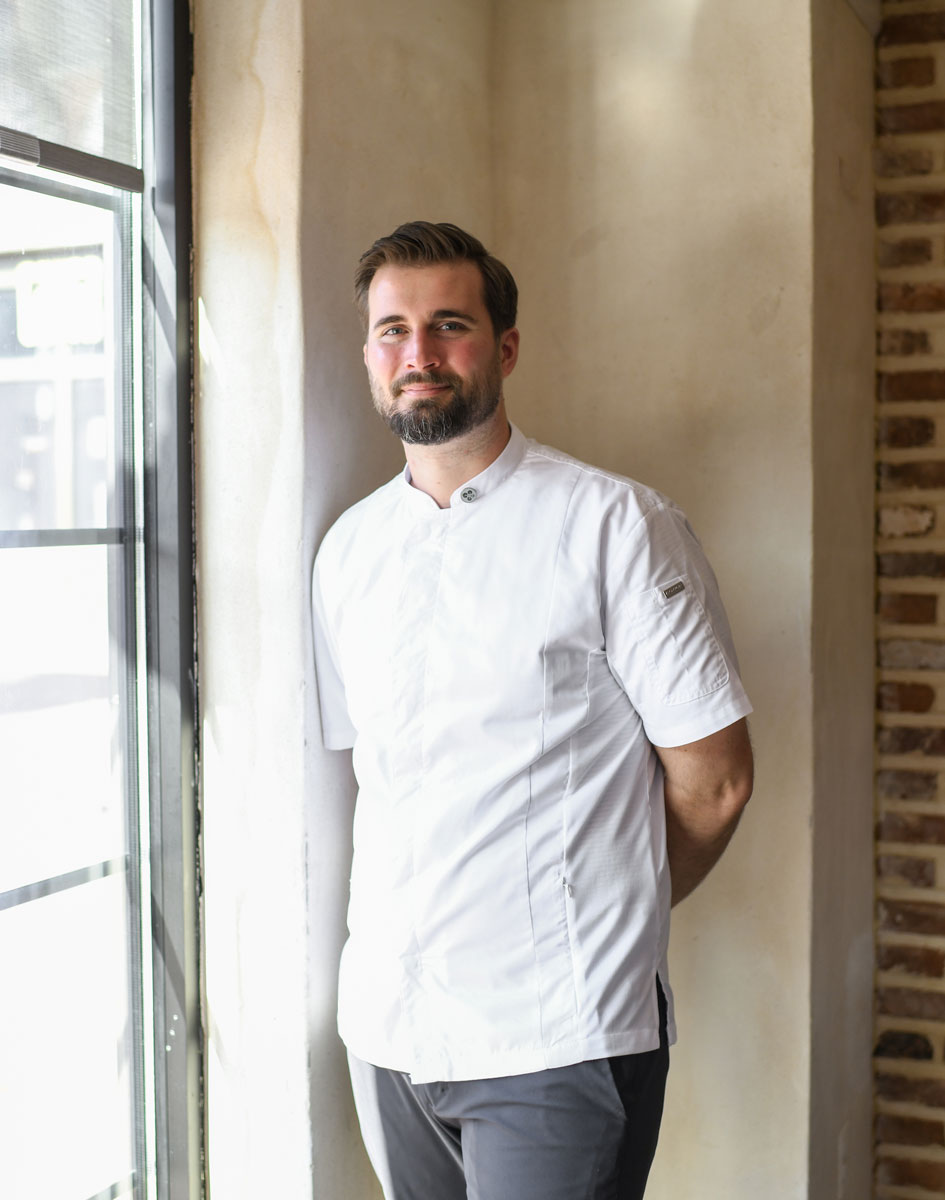
Chef Jeremiah LanghorneChef Jeremiah Langhorne (Bonjwing Lee)

The following interview has been lightly edited for clarity and length.

Hi! I know you've had some real stalwart dishes on the menu for quite some time  I seem to recall that the catfish slider was a real standby favorite? 

Yes, the Sweet Potato Roll with Fried Chesapeake Catfish, Preserved Ramp tarter is a longtime favorite and is still available. It’s by request in the dining room. The main reason it was created was to give us a way to permanently keep Chesapeake Blue Catfish on our menu. They are incredibly invasive and we should be pulling as many out of the bay as we can. The good news is, they are also incredibly delicious with a clean sweet flavor and wonderful texture if prepared correctly.


Could you talk a bit about the dry aged fish offerings, please? I'm so fascinated by that idea. How did the idea come up? How exactly does it work? 

I cooked in Charleston, SC for seven years and experienced incredible fishermen and quality. When I moved to DC, I wanted that same high-quality fish. Unfortunately, many restaurants here were sourcing fish from huge purveyors through a massive commercial process that compromised quality.

I began looking for small fishermen to work with to get direct access to the docks and the boats the fish were coming in on. Luckily a former employee and friend Phil Valiant became that guy. Over the past six years, we’ve been working on building a network of watermen that will give the specific care and procedures to the fish that we’re looking for.

Dry-aging fish is not a new technique, but the Western world has been slower to adopt it because we’re typically more profit and convenience-oriented than quality-oriented. I'm a huge food nerd and enjoy studying what other chefs and cultures are working on globally. The first place I looked was at Japanese cuisine. They are masters of fish. The information was helpful, but I didn't make progress until I came across a chef named Josh Nihland from Australia. He opened a restaurant called St Peter with the sole purpose of reimagining the way we look at fish. The quality of the fish he cooks is evident. He was using similar techniques that I could relate to. I wanted our fish at The Dabney to be that quality. We dug into the dry-aging process  to concentrate flavor and improve texture.

When you dry-age fish,  the fish is first caught and bled.  This means the fish is killed,  the blood is drained and the guts are removed immediately. The fish is then rinsed in seawater and stored until the boat returns to shore. Next, the fish is taken directly to us. We try to get them on the same day. Then we cut the scales off using an incredibly sharp knife, the pockets of skin the scales sit in can hold water and breed bacteria growth. Once the scales are removed, the skin is patted dry. The fish is then hung in refrigeration with plenty of airflow for 7-9 days depending on the species. If you’ve removed all the parts that typically make a fish go bad then the fish will come out with beautifully dry skin that puffs like crackling when cooked and will have a dense flavor texture that is unlike any fish you’ve had before.

We now treat all our fish like this at The Dabney. We are certainly not the first to do this and I believe that more chefs will continue to adopt dry-aging with time. It's going to take a lot of time to become mainstream but if quality is your goal It’s just better in every way. 

Aged Speckled Sea Trout, pumpernickel, lovage, potato and buttermilkAged Speckled Sea Trout, pumpernickel, lovage, potato and buttermilk (Kimberly Kong)

What does "The Dabney" mean? 

The Dabney is an old family name.


How do you differentiate between Dabney and Dabney Cellar?

At The Dabney we use a tasting menu to showcase the amazing products of the Mid-Atlantic region through wood fire cooking and culinary technique. The Dabney Cellar is meant to be a simple bar that focuses on celebrating the products of this region that stand alone and don’t need any technique. For example, the beautiful local cheese, or country hams, as well as oysters and other amazing products. The vibe is very casual and was built to be a place we would want to spend an evening hanging out with friends over a bottle of wine. 


What are the staples of Dabney? Its ethos, recurring dishes, etc.

Despite the menu changing daily, the ethos of The Dabney is consistent.

The Dabney continues to pay tribute to the wonderful farmers, watermen and purveyors of the mid-Atlantic region who provide some of the best and most unique products in the country.  We celebrate these ingredients by preparing them in a large wood burning hearth not only for its uniqueness and depth of flavor, but to give a nod to the area’s historic food culture while growing and creating something new.


I just saw on your website that you hosted immersive grilling classes on July 4 — how fun! What gave you that idea? 

I wanted to connect with our guests more. I love cooking over a wood fire and I feel like there are a lot of backyard BBQs going wrong. Hopefully, we can help teach our guests about cooking over embers and have a great time while we do it. Teaching is a passion of mine and we plan to continue the classes.

We need your help to stay independent

Tell me about Petite Cerise? The menu is beautiful and seems a bit lighter or more casual than The Dabney

That’s exactly right, Petite Cerise fulfills a couple of goals and dreams of mine.

First, I’m a big fan of France, the food, the people and the culture. I love it. My wife and I travel there pretty often. Their passion for food and life is incredible. I wanted to create a restaurant that could showcase true French cooking and a commitment to seasonality, quality and classic techniques.

At the same time, we knew we were evolving at The Dabney. As the format and price of the menu increased there to allow us to give our guests the best possible experience, I still wanted to have a very reasonable place where we could wow our guests with great food and value. We just launched our new $58 four-course prix fixe menu at Petite Cerise focused on the south of France. I want to over-deliver for our guests and bring back that connection and feeling of getting a great experience. 


Interior of The DabneyInterior of The Dabney (Bonjwing Lee)

I remember really loving the visual/aesthetic design of the menu and I'm glad it still has such an interesting look with the center "main" focus and the other offerings extending out around it.

The aesthetic is very important to us. The newest menu is based on old menus from the 18th and 19th century from grand dinner parties. 


How much of the produce from the rooftop garden is used in the dishes?

The rooftop is used exclusively for herbs. We grow anywhere from 25 to 65 different varieties depending on the season and always find a way to use it all.


In another interview, I read that you said “it takes a long time to get good at cooking.”I love the simplicity of that comment. Could you speak to that a bit? 

Of course, we currently live in a world that’s very much based on instant gratification, everyone wants everything now. Cooking is a craft and is not something you can just be amazing at in a year or two. Cooking is bottomless, there's no way to learn it all. Allowing yourself to take the time to truly learn from and refine your technique over the years is very important. It’s crucial to know you won’t get there overnight. It’s a lifelong process of learning and evolution.


Want more great food writing and recipes? Subscribe to Salon Food's newsletter, The Bite.


The website says "we know the names and faces of the people who grow our produce and provide our proteins." What's it like to cultivate those relationships throughout the mid-Atlantic region? 

It’s wonderful, challenging, joyful and everything you could imagine. We’ve built amazing relationships with our farmers, fishermen and other purveyors. For example, I’ve worked with Casey and Stacey from Fireside Farm for almost 10 years, and the same with Clay Trainum from Autumn Olive Farms. We’re always looking for new folks to work with. The pandemic unfortunately caused many of them to move on to other endeavors or places so it’s a constant process, but we wouldn't have it any other way. 


Interior of The DabneyInterior of The Dabney (Bonjwing Lee)

I know the hearth is a massive component of the Dabney, and as far as I can tell, practically every single dish you put out. Can you talk to me a bit about it?

The reason we built the hearth was simple: I wanted The Dabney to be the embodiment of the Mid-Atlantic region. A place born from the region's culinary history but also a leader in its future. As I studied the culinary history of the Mid-Atlantic, I realized that just about every book  had recipes for cooking in a hearth so if we wanted to truly understand the cuisine here we had to have a hearth. 


Final note — not a question  but I love the location of the restaurant, the entrance. It's been years, but all of that still sticks with me, as does the tremendous food and service, of course. I remember having sugartoads and loving that phrase!

Sugartoads is a great name. They call them that because they are ugly as toads, but sweet as sugar!!!! 

Donald Trump hasn’t called the family of a man killed at his rally

The wife of Corey Comperatore — the man who lost his life to a bullet possibly intended for Donald Trump — has yet to hear from the former president, she told the New York Post on Monday evening.  

The 50-year-old former fire chief was killed at the rally in Butler, Pennsylvania, on Saturday when he tried to shield his wife and daughters from the gunfire. His spouse, Helen Comperatore, said that her husband was her “hero,” telling the Post that his last words to his family were “get down!”

She confirmed that while she hadn’t heard from Trump, President Joe Biden had indeed reached out. However, she refused to take the call.

"I didn't talk to Biden. I didn't want to talk to him," she said. "My husband was a devout Republican, and he would not have wanted me to talk to him."

She added that she didn’t blame Biden for her husband’s death, but she was voting for Trump and was not very involved in politics, Business Insider reported.

"I don't have any ill-will towards Joe Biden," she told the Post. "He didn't do anything to my husband. A 20-year-old despicable kid did."

Some Republicans do not hold the same beliefs as the former fire chief’s wife. Sen. J.D. Vance, R-Ohio, who was confirmed as Trump’s running mate at the Republican National Committee convention that kicked off on Monday, immediately blamed Biden for the attempted assassination of Trump, despite the perpetrator being a registered Republican.

Although Trump hasn’t called any victims — two men were also critically wounded — he has extended his condolences via Truth Social posts. His team also shared a link to a GoFundMe “authorized” by the former president, which as of Tuesday morning had raised $4.8 million for the victims’ families.

“I cannot believe this is real”: Maddow stunned senator read wrong speech at Republican Convention

MSNBC's Rachel Maddow was taken aback on Monday upon learning that a Wisconsin senator inadvertently read an incorrect speech during the opening night of the Republican National Convention in Milwaukee.

Sen. Ron Johnson, R-Wis., on Monday night delivered a speech that was littered with inflammatory and divisive language, despite bipartisan requests to subdue political rhetoric following the assassination attempt on former President Donald Trump that took place over the weekend during a rally in Pennsylvania. 

Since the Saturday shooting, many Republicans have leveled blame at President Joe Biden and Democrats, alleging that they created a frenetic political environment that stirred animosity that "led directly to Trump's attempted assassination," in the words of Trump's running mate, Sen. J.D. Vance, R-Ohio. Although the shooter's motives remain unknown at this time, he was a registered Republican and "definitely conservative," per a former classmate.

"Today's Democratic Party is not the party of our parents and grandparents," Johnson claimed in the speech. "That party cared about workers and people struggling to get by."

“Now they are the party of open borders, reckless spending, weaponized government, and weakness on the world stage," he continued. “This fringe agenda includes biological males competing against girls and the sexualization and indoctrination of our children.”

"Today's Democrat agenda — their policies — are a clear and present danger to America, our institutions, our values, and our people," Johnson said. "Democrats have forgotten American families. They have abandoned the hardworking middle class. But with president Trump and Republicans, those forgotten Americans are forgotten no more. Republicans are the party of opportunity, liberty, and prosperity for all. We proved we know how to make life better for all Americans, and we can do it again with a secure border, smaller government, less regulation, and lower taxes."

We need your help to stay independent

He continued, "Republicans understand that Americans don't want welfare — they want work. They don't want woke equity — they want God-given equality. They want the promise of our founding documents — the right to pursue happiness. That's what Republicans will deliver. We've repaired the damage caused by Democrats before and we will do it again. We will complete the mission president Trump first articulated in 2016 to make America great again."

After MSNBC aired the clip, Maddow cited a report from PBS Newshour that Johnson said after his speech that the teleprompter had fed him an old speech instead of the update that called for unity.


Want a daily wrap-up of all the news and commentary Salon has to offer? Subscribe to our morning newsletter, Crash Course.


"His response was that his speech that he just delivered at the RNC was not the speech he meant to give," Maddow clarified. "It was all a big misunderstanding. The teleprompter loaded the old version. The new one called for unity, but they didn’t put that one in there. So, he just gave the old one.”

“He couldn’t ad-lib some unity?!” asked co-host Joy Reid.  

"I cannot believe this is real," Maddow said.

“Well, first of all, we have all read from teleprompters,” former White House Press Secretary Jen Psaki noted. “And if something comes up in the teleprompter that Rachel Maddow would read that says, like, ‘I love Donald Trump and he’s the best representative of our democracy,’ you probably would stop and not read it.”

Rural hospitals built during baby boom now face baby bust

OSKALOOSA, Iowa — Rural regions like the one surrounding this southern Iowa town used to have a lot more babies, and many more places to give birth to them.

At least 41 Iowa hospitals have shuttered their labor and delivery units since 2000. Those facilities, representing about a third of all Iowa hospitals, are located mostly in rural areas where birth numbers have plummeted. In some Iowa counties, annual numbers of births have fallen by three-quarters since the height of the baby boom in the 1950s and ’60s, when many rural hospitals were built or expanded, state and federal records show.

Similar trends are playing out nationwide, as hospitals struggle to maintain staff and facilities to safely handle dwindling numbers of births. More than half of rural U.S. hospitals now lack the service.

“People just aren’t having as many kids,” said Addie Comegys, who lives in southern Iowa and has regularly traveled 45 minutes each way for prenatal checkups at Oskaloosa’s hospital this summer. Her mother had six children, starting in the 1980s, when big families didn’t seem so rare.

“Now, if you have three kids, people are like, ‘Oh my gosh, are you ever going to stop?’” said Comegys, 29, who is expecting her second child in late August.

These days, many Americans choose to have small families or no children at all. Modern birth control methods help make such decisions stick. The trend is amplified in small towns when young adults move away, taking any childbearing potential with them.

Hospital leaders who close obstetrics units often cite declining birth numbers, along with staffing challenges and financial losses. The closures can be a particular challenge for pregnant women who lack the reliable transportation and flexible schedules needed to travel long distances for prenatal care and birthing services.

The baby boom peaked in 1957, when about 4.3 million children were born in the United States. The annual number of births dropped below 3.7 million by 2022, even though the overall U.S. population nearly doubled over that same period.

West Virginia has seen the steepest decline in births, a 62% drop in those 65 years, according to federal data. Iowa’s births dropped 43% over that period. Of the state’s 99 counties, just four — all urban or suburban — recorded more births.

Births have increased in only 13 states since 1957. Most of them, such as Arizona, California, Florida, and Nevada, are places that have attracted waves of newcomers from other states and countries. But even those states have had obstetrics units close in rural areas.

"It’s an essential service, and we needed to keep it going and grow it."

In Iowa, Oskaloosa’s hospital has bucked the trend and kept its labor and delivery unit open, partly by pulling in patients from 14 other counties. Last year, the hospital even managed the rare feat of recruiting two obstetrician-gynecologists to expand its services.

The publicly owned hospital, called Mahaska Health, expects to deliver 250 babies this year, up from about 160 in previous years, CEO Kevin DeRonde said.

“It’s an essential service, and we needed to keep it going and grow it,” DeRonde said.

Many of the U.S. hospitals that are now dropping obstetrics units were built or expanded in the mid-1900s, when America went on a rural-hospital building spree, thanks to federal funding from the Hill-Burton Act.

“It was an amazing program,” said Brock Slabach, chief operations officer for the National Rural Health Association. “Basically, if you were a county that wanted a hospital, they gave you the money.”

Slabach said that in addition to declining birth numbers, obstetrics units are experiencing a drop in occupancy because most patients go home after a night or two. In the past, patients typically spent several days in the hospital after giving birth.

Dwindling caseloads can raise safety concerns for obstetrics units.

A study published in JAMA in 2023 found that women were more likely to suffer serious complications if they gave birth in rural hospitals that handled 110 or fewer births a year. The authors said they didn’t support closing low-volume units, because that could lead more women to have complications related to traveling for care. Instead, they recommended improving training and coordination among rural health providers.

Stephanie Radke, a University of Iowa obstetrics and gynecology professor who studies access to birthing services, said it is almost inevitable that when rural birth numbers plunge, some obstetrics units will close. “We talk about that as a bad event, but we don’t really talk about why it happens,” she said.

Radke said maintaining a set number of obstetrics units is less important than ensuring good care for pregnant women and their babies. It’s difficult to maintain quality of care when the staff doesn’t consistently practice deliveries, she said, but it is hard to define that line. “What is realistic?” she said. “I don’t think a unit should be open that only delivers 50 babies a year.”

In some cases, she said, hospitals near each other have consolidated obstetrics units, pooling their resources into one program that has enough staffers and handles sufficient cases. “You’re not always really creating a care desert when that happens,” she said.

The decline in births has accelerated in many areas in recent years. Kenneth Johnson, a sociology professor and demographer at the University of New Hampshire, said it is understandable that many rural hospitals have closed obstetrics units. “I’m actually surprised some of them have lasted as long as they have,” he said.

Johnson said rural areas that have seen the steepest population declines tend to be far from cities and lack recreational attractions, such as mountains or large bodies of water. Some have avoided population losses by attracting immigrant workers, who tend to have larger families in the first generation or two after they move to the U.S., he said.

Katy Kozhimannil, a University of Minnesota health policy professor who studies rural issues, said declining birth numbers and obstetric unit closures can create a vicious cycle. Fewer babies being born in a region can lead a birthing unit to shutter. Then the loss of such a unit can discourage young people from moving to the area, driving birth numbers even lower.

In many regions, people with private insurance, flexible schedules, and reliable transportation choose to travel to larger hospitals for their prenatal care and to give birth, Kozhimannil said. That leaves rural hospitals with a larger proportion of patients on Medicaid, a public program that pays about half what private insurance pays for the same services, she said.

Iowa ranks near the bottom of all states for obstetrician-gynecologists per capita. But Oskaloosa’s hospital hit the jackpot last year, when it recruited Taylar Swartz and Garth Summers, a married couple who both recently finished their obstetrics training. Swartz grew up in the area, and she wanted to return to serve women there.

She hopes the number of obstetrics units will level off after the wave of closures. “It’s not even just for delivery, but we need access just to women’s health care in general,” she said. “I would love to see women’s health care be at the forefront of our government’s mind.”

Swartz noted that the state has only one obstetrics training program, which is at the University of Iowa. She said she and her husband plan to help spark interest in rural obstetrics by hosting University of Iowa residency rotations at the Oskaloosa hospital.

Comegys, a patient of Swartz’s, could have chosen a hospital birthing center closer to her home, but she wasn’t confident in its quality. Other hospitals in her region had shuttered their obstetrics units. She is grateful to have a flexible job, a reliable car, and a supportive family, so she can travel to Oskaloosa for checkups and to give birth there. She knows many other women are not so lucky, and she worries other obstetrics units are at risk.

“It’s sad, but I could see more closing,” she said.

KFF Health News is a national newsroom that produces in-depth journalism about health issues and is one of the core operating programs at KFF—an independent source of health policy research, polling, and journalism. Learn more about KFF.

Subscribe to KFF Health News' free Morning Briefing.

Arizona became the model for school voucher programs. Then they blew a huge hole in its budget

ProPublica is a Pulitzer Prize-winning investigative newsroom. Sign up for The Big Story newsletter to receive stories like this one in your inbox.

In 2022, Arizona pioneered the largest school voucher program in the history of education. Under a new law, any parent in the state, no matter how affluent, could get a taxpayer-funded voucher worth up to tens of thousands of dollars to spend on private school tuition, extracurricular programs or homeschooling supplies.

In just the past two years, nearly a dozen states have enacted sweeping voucher programs similar to Arizona’s Empowerment Scholarship Account system, with many using it as a model.

Yet in a lesson for these other states, Arizona’s voucher experiment has since precipitated a budget meltdown. The state this year faced a $1.4 billion budget shortfall, much of which was a result of the new voucher spending, according to the Grand Canyon Institute, a local nonpartisan fiscal and economic policy think tank. Last fiscal year alone, the price tag of universal vouchers in Arizona skyrocketed from an original official estimate of just under $65 million to roughly $332 million, the Grand Canyon analysis found; another $429 million in costs is expected this year.

As a result of all this unexpected spending, alongside some recent revenue losses, Arizona is now having to make deep cuts to a wide swath of critical state programs and projects, the pain of which will be felt by average Arizonans who may or may not have school-aged children.

Among the funding slashed: $333 million for water infrastructure projects, in a state where water scarcity will shape the future, and tens of millions of dollars for highway expansions and repairs in congested areas of one of the nation’s fastest-growing metropolises — Phoenix and its suburbs. Also nixed were improvements to the air conditioning in state prisons, where temperatures can soar above 100 degrees. Arizona’s community colleges, too, are seeing their budgets cut by $54 million.

Still, Arizona-style universal school voucher programs — available to all, including the wealthiest parents — continue to sweep the nation, from Florida to Utah.

In Florida, one lawmaker pointed out last year that Arizona’s program seemed to be having a negative budgetary impact. “This is what Arizona did not anticipate,” said Florida Democratic Rep. Robin Bartleman, during a floor debate. “What is our backup plan to fill that budget hole?”

Her concern was minimized by her Republican colleagues, and Florida’s transformational voucher legislation soon passed.

Advocates for Arizona’s universal voucher initiative had originally said that it wouldn’t cost the public — and might even save taxpayers money. The Goldwater Institute, a conservative think tank that helped craft the state’s 2022 voucher bill, claimed in its promotional materials at the time that the vouchers would “save taxpayers thousands per student, millions statewide.” Families that received the new cash, the institute said, would be educating their kids “for less than it would cost taxpayers if they were in the public school system.”

But as it turns out, the parents most likely to apply for these vouchers are the ones who were already sending their kids to private school or homeschooling. They use the dollars to subsidize what they were already paying for.

The result is new money coming out of the state budget. After all, the public wasn’t paying for private school kids’ tuition before.

Chris Kotterman, director of governmental relations for the Arizona School Boards Association, says that Arizona making vouchers available to children who had never gone to public school before wasn’t realistically going to save the state money.

“Say that my parents had been gladly paying my private school tuition, because that’s what was important to them — that I get a religious education. That’s completely fine,” Kotterman said. “But then the state said, ‘Oh, we’ll help you pay for that.’”

“There’s just no disputing that that costs the state more money,” he said, critiquing the claims of the Goldwater Institute and others who’d averred that this program and ones like it around the country would not be costly. “That’s not how a budget works.”

Inspiring a “National Movement”

Heading into this fall, which will bring both a new school year and an election that stands to remake American education, ProPublica is going to be examining the complexities, lessons and failures of the nation’s first universal school voucher program as a model for where the whole system seems headed. Arizona’s program “set the standard nationally” and “inspired a national movement,” according to leading voucher advocacy groups; it is “the nation’s school-choice leader,” per the longtime conservative columnist George Will.

For decades, voucher initiatives, including in Arizona, had only served small subsets of students. Often, eligibility was limited to certain poor students from failing public schools, whose families could use a voucher to switch them into a potentially better private school.

In Arizona, for example, vouchers as of 2011 were available solely to students with disabilities, to make sure that their families could afford a range of personalized education options. The program was then expanded to students who had lived in foster care and to Native American students before, gradually, the money started going disproportionately to wealthier households.

Because these measures were initially narrow in scope, some studies found that they had no negative impact on state and local budgets — studies that voucher advocates continued tocite even as states started considering providing vouchers to every parent who wanted one, which is a far more costly undertaking.

Universal voucher efforts, beginning with Arizona’s universal Empowerment Scholarship Account program in 2022, allow parents to spend public money not just on private school tuition but also on recreational programs for their kids like ninja warrior training, trampoline park outings and ski passes, or on toys and home goods that they say they need for homeschooling purposes. (The average ESA award is roughly $7,000.)

In a statement to ProPublica, a spokesperson for Arizona’s former Republican Gov. Doug Ducey, who signed the universal voucher program into law, said that “not only does Gov. Ducey have no regrets about ESA expansion, he considers it one of his finest achievements and a legacy accomplishment. And what he’s most thrilled about is that Arizona’s ESA expansion was followed by 11 other states doing essentially the same thing. Arizona helped set off an earthquake.”

Voucher proponents have long pointed out that private school parents have a right to and could be sending their children to public school at taxpayers’ expense. So providing them with what is often a smaller amount of taxpayer money in the form of a voucher to help them pay their private school tuition is, the argument goes, a net savings for the public.

This is similar to arguing that the public should help pay for car drivers’ gas because if they didn’t drive, they might use public transportation instead, which would be a cost to taxpayers.

Ducey’s spokesperson, Daniel Scarpinato, did not acknowledge that the net cost of universal vouchers has been far higher than voucher supporters originally promised. Instead, he reiterated that “universal ESA costs are basically revenue neutral.” The reasoning: Overall enrollment in Arizona public schools has been slightly down — ever since many parents withdrew their kids during the pandemic — creating some savings in the education budget that could be seen as offsetting the new voucher spending.

Ducey, as well as Matt Beienburg, the Goldwater Institute’s director of education policy, blamed Arizona’s budget crisis on current Democratic Gov. Katie Hobbs, pointing out that she signed a 2023 budget that spent down what was then a surplus instead of keeping the money in reserve for a possible moment like this. (The 2023 budget was passed with bipartisan support.) Ducey did not answer a question about whether he’d had a long-term plan to pay for ballooning voucher spending, beyond relying on that one-time surplus.

In an email, Beienburg maintained that Arizona’s current budget mess wasn’t caused by vouchers; he blamed, among other issues, state revenue recently being lower than anticipated. (The Goldwater Institute in 2021 collaborated with Ducey to write and pass a tax cut that reduced income taxes on the wealthiest Arizonans to 2.5%, the same rate that the poorest people in the state pay, which is the leading cause of the decline in revenue.)

Dave Wells, research director at the Grand Canyon Institute, said that none of the competing budget trends that Ducey and the Goldwater Institute pointed to mean that Arizona can actually afford universal vouchers, at least not without making severe, harmful budget cuts.

“They chose to make ESAs universal and that has made the budget situation much worse,” he said. “We still had a budget shortfall and budget cuts. The cost is still the cost.”

“It Isn’t Funded”

Now that vouchers in Arizona are available even to private school kids who have never attended a public school, there are no longer any constraints on the size of the program. What’s more, as the initiative enters its third year, there are no legislative fixes on the table to contain costs, despite Hobbs’ efforts to implement some reforms. “I have not heard them agree to anything that is a financial reform of the program at all,” said Sen. Mitzi Epstein, the Democratic minority leader of the state Senate, referring to her Republican colleagues.

Arizona doesn’t have a comprehensive tally of how many private schoolers and homeschoolers are out there, so it remains an open question how much higher the cost of vouchers could go and therefore how much cash should be kept on hand to fund them. The director of the state’s nonpartisan Joint Legislative Budget Committee told lawmakers that “we’ve never really faced that circumstance before where you’ve got this requirement” — that anyone can get a voucher — “but it isn’t funded.”

Most importantly, said Beth Lewis, executive director of the public-school-advocacy group Save Our Schools Arizona, only a small amount of the new spending on private schools and homeschooling is going toward poor children, which means that already-extreme educational inequality in Arizona is being exacerbated. The state is 49th in the country in per-pupil public school funding, and as a result, year after year, district schools in lower-income areas are plagued by some of the nation’s worst staffing ratios and largest class sizes.

Spending hundreds of millions of dollars on vouchers to help kids who are already going to private school keep going to private school won’t just sink the budget, Lewis said. It’s funding that’s not going to the public schools, keeping them from becoming what they could and should be.

Experts: Cannon issued “first court decision of Project 2025” — but it may be “blessing in disguise”

Two Trump-appointed judges, both asked to consider whether a special counsel can investigate the former president and his allies, have now produced two wildly different outcomes — a sign, perhaps, of how reactionaries on the federal judiciary have been emboldened over the years and now feel at liberty to rule as they wish.

Six years ago, U.S. District Judge Dabney Friedrich, appointed by former President Donald Trump in 2017, ruled that the appointment of special counsel Robert Mueller had not exceeded his authority by prosecuting associates of the man who appointed her, adding that his original appointment to the position “does not violate” the Constitution nor its “core separation of-powers principles.” Three other federal judges who considered that exact question ruled the same.

Yesterday, though, U.S. District Judge Aileen Cannon, appointed by Trump in 2020, ruled the opposite: that the appointment of special counsel Jack Smith, who filed charges against the former president for hoarding state secrets at Mar-a-Lago, was a clear and direct violation of the country’s founding document — indeed, a “substantial separation-of-powers violation.” Although Attorney General Merrick Garland exercises ultimate control over Smith, Cannon wrote that only Congress could authorize and fund an investigation led by an independent prosecutor.

Here, at last, was a conservative judge seeking to curtail the power of the unitary executive (even as another special counsel continues to pursue legal action against the current president’s son). But while Cannon cited a recent opinion issued by conservative Supreme Court Justice Clarence Thomas, many legal experts accused her of ignoring decades of legal precedent to dismiss a case that she was accused of intentionally delaying for more than a year, ensuring that Trump would never stand trial in a case widely considered the strongest against him.

“She stands alone,” Andrew Weissmann, a former federal prosecutor who worked on Mueller’s Russia investigation, commented on MSNBC. Monday’s ruling, he said, stands “in distinct contrast to all the other cases that have dealt with this,” noting that, in addition to his son, President Joe Biden has himself been interviewed by a special counsel, Robert Hur, with no other court ever ruling against his authority.

But Weissmann welcomed the clarity Cannon has now provided — and grist for Smith to appeal her decision to the very court that twice overturned her before.

“What she is doing in many ways is putting in writing what she has done de facto in this case,” he said. “She has delayed this case at every step. The one difference now is, by making this ruling in writing, not just slowing the case to a complete standstill, which has been her wont, this can go to the 11th Circuit.”

Smith’s office has already said he intends to do just that.

We need your help to stay independent

“The dismissal of the case deviates from the uniform conclusion of all previous courts to have considered the issue that the Attorney General is statutorily authorized to appoint a Special Counsel,” a spokesperson said in a statement. “The Justice Department has authorized the Special Counsel to appeal the court’s order.”

The 11th Circuit Court of Appeals could do more than just reverse Cannon.

Barbara McQuade, a former U.S. attorney who teaches law at the University of Michigan, told The Washington Post that Cannon’s dismissal of the case may actually be welcomed at the Justice Department.

“This ruling may be a blessing in disguise for Jack Smith,” she said, noting he can not only appeal her decision but “ask the court to replace Cannon as the judge on this case.”


Want a daily wrap-up of all the news and commentary Salon has to offer? Subscribe to our morning newsletter, Crash Course.


That’s the positive: that while the case may not go to trial before November, it was never going to under Cannon — and at least under a different judge it might be a fair fight.

The more negative: Cannon’s decision shows that there is a pro-Trump coup of sorts taking place in the federal judiciary.

Rather than dwell on Cannon’s mangling of the law, Harry Litman, a former U.S. attorney who writes for the Los Angeles Times, argued that it’s best to put the decision in a political context.

“It’s more useful and illuminating to think of the dismissal as the first court decision of Project 2025, in which the rule of law takes an unabashed back seat to the preeminent principle of loyalty to Trump,” Litman wrote, referring to the Heritage Foundation's far-right plan for a second Trump administration. That’s the only way to read the efforts by Cannon (and the Supreme Court, frankly) to twist the Constitution in such a way as to benefit one man who has called for terminating the country’s founding document, he continued: “that this is entirely a matter of loyalty, not law.”

Elon Musk may give $45 million a month to a pro-Trump super PAC

Elon Musk — who is currently the world’s richest man with a net worth of $250 billion — has claimed that he will commit about $45 million a month to a new pro-Trump super PAC, the Wall Street Journal reported, a story that the Tesla CEO appeared to confirm later in a post on X.

America PAC was formed in June and is focused on registering and voters and getting them to the polls. The group's theory is that Democrats have historically enjoyed better “get out the vote” operations, with President Joe Biden’s campaign having already dedicated large sums to on-the-ground efforts in swing states.

The group’s backers include Palantir Technologies co-founder Joe Lonsdale, the Winklevoss twins, former U.S. Ambassador to Canada Kelly Craft, and her husband, Joe Craft, the chief executive of coal producer Alliance Resources Partners.

A Monday campaign finance filing revealed that America PAC received $8.75 million in contributions for the three months ending on June 30. Musk, who often makes promises he does not fulfill, will begin making his donations in July. 

In March, Musk tweeted that he had no intention of picking a side in this year's electron. However, the billionaire has grown closer to the GOP nominee over the last few months. He made his intentions clear after Saturday’s rally shooting, writing on X: “I fully endorse President Trump and hope for his rapid recovery.”


“You should be ashamed”: Seth Meyers blasts Republican “conspiracy theories” about Trump shooting

Seth Meyers had choice words for Republicans blaming Democrats after the assassination attempt on former President Donald Trump.

The "Late Night" host responded to incendiary social media posts from Trump's new running mate Sen. J.D. Vance, R-Ohio, and Rep. Mike Collins, R-Ga., essentially placing blame on President Joe Biden for the shooting.

Shortly after the shooting on Saturday, Vance said on X, "Today is not just some isolated incident. The central premise of the Biden campaign is that President Donald Trump is an authoritarian fascist who must be stopped at all costs. That rhetoric led directly to President Trump’s attempted assassination.”

Collins also pointed the finger at Biden saying state attorneys "should immediately file charges against Joseph R. Biden for inciting an assassination."

However, Meyers blasted those politicians: "At a time when things are bad, you are choosing to enflame the national mood at a dangerous moment rather than show the leadership and basic decency it would take to calm things down. You should be ashamed. Please stop," he urged.

"You're also wrong. Engaging in the work of democracy and peaceful persuasion is the opposite of inciting violence. It's what we need more of, not less," Meyers said. "Accurately describing the dangers of autocracy and warning against attempts to dismantle our democracy have nothing to do with political violence."

He continued: "Speaking plainly about the specter of our authoritarianism is not only our democratic right, it's our civic duty. We must all continue to do it."

The comedian also told his audience that his show serves as a way to combat rising authoritarianism.

"We must all reject violence and safeguard democracy that project is ongoing and never-ending. It's more important than ever," he said.

We need your help to stay independent

While there are calls to "forgo politics" in moments of political violence, Meyers said that “non-violent exchange of ideas and the peaceful resolution of disputes” are “more important than ever.”

But mostly, the ways the U.S. can combat continuous acts of political violence is through “an inclusive politics of compassion, empathy, and community, that’s what we must recommit to now,” Meyers said.

With a final last jab at Republican politicians, Meyer concluded, “What we don’t need are the opportunistic purveyors of paranoia, suspicion and fear, who have already rushed to fill the void with incendiary conspiracy theories and lies.”

"Late Night with Seth Meyer" airs every weeknight at 12:35 p.m. ET on NBC

Neighbor saw Trump signs in front of Thomas Matthew Crooks’ home before shooting

Investigators still don’t know why Thomas Matthew Crooks, a registered Republican, tried to assassinate former President Donald Trump, despite accessing his phone, car and home.

FBI officials spent Monday morning speaking with neighbors and those that knew Crooks, a 20-year-old who lived in Bethel Park, Pennsylvania, Pittsburgh’s WTAE reported.

Authorities have also accessed Crooks’ phone and social media accounts, but say they have not found anything online that points to a motive.

“This guy is one of these almost invisible people that are out there,” former FBI profiler Gregg McCrary told NBC News. “They’re not on social media. They’re not screaming or yelling about this or that. They’re ruminating about it internally — whatever it might be. And they just decide to do this, which scares the hell out of all of us in law enforcement.”

Crooks graduated from Bethel Park High School in 2022 and later attended Community College of Allegheny County. He worked as a dietary aide at a Bethel Park nursing home. 

Despite once donating $15 to a pro-Democratic Party political action committee in January 2021, Crooks later registered as Republican. Neighbors said they saw pro-Trump signs in the Crooks’ front-yard as recently as a few months ago.

“There absolutely was MAGA-supporting signs for a while,” one of Crooks’ neighbors, Kelly Little, told WTAE. She described him as "a quiet, normal kid."

Some of Crooks’ high school classmates also described him as “conservative” and expressed their shock at Saturday’s assassination attempt. 

“I would almost put money on the fact that I probably had seen him wear a Trump shirt or something along the lines of that beforehand, which is why this is so shocking to me,” Paige Updegraff told Pittsburgh public radio station WESA.

“He definitely was conservative. It makes me wonder why he would carry out an assassination attempt on the conservative candidate,” another classmate, Max R. Smith, told told The Philadelphia Inquirer.

Bye, bye Aileen

Judge Aileen Cannon ran her courtroom in Fort Pierce, Florida, like a massage parlor for one of Jeffrey Epstein’s best friends, and on Monday she wrapped up her special service when she dismissed all charges against Donald Trump in his trial for stealing and mishandling classified documents and obstructing the government’s attempts to recover them.  Trump initially faced 31 felony counts of violating the Espionage Act, five counts of conspiracy to obstruct justice, and one count of making false statements. Cannon dismissed the case on procedural grounds, without ever considering the mountain of incriminating evidence against Trump: 

  • More than 100 top-secret documents, including one containing nuclear secrets, were seized by the FBI in a search of Trump’s hotel/club/residence, Mar-a-Lago, in Palm Beach, Florida in August of 2022. 
  • Another tranche of more than 30 classified documents Trump had turned over to the Department of Justice in response to a subpoena. 
  • Surveillance video shows Mar-a-Lago employees moving boxes containing classified documents from room to room in Mar-a-Lago a day before DOJ officials showed up to serve the subpoena. 
  • Testimony from Mar-a-Lago employees that the boxes of classified documents were moved at the behest of the former president.

The list goes on, but you get the picture. Days before he left office in 2021, Donald Trump illegally removed from his White House residence hundreds of boxes of government property. He then spent more than a year and a half resisting attempts by the government to recover the material, in violation of laws against obstructing justice. And he induced others to help him in the scheme.

In November of 2022, Jack Smith was appointed special counsel to investigate and potentially prosecute Donald Trump in the classified documents case. The case landed in the court of a Florida judge Trump appointed to the bench, Aileen Cannon. Almost immediately, Judge Cannon began a four-on-the-floor, pedal-to-the-metal campaign of stalling and obstructing the attempts of Special Counsel Jack Smith to investigate Trump. She granted a motion to appoint a “special master” to go through not only the classified material seized by the FBI but all the material he took from the White House. The ostensible reason for the special master was to examine the material to see if any of it was subject to either executive or attorney-client privilege. While the order was in effect, neither the FBI nor the special counsel was allowed to even look at the evidence in the investigation. Smith appealed to the 11th Circuit Court of Appeals, and in late December, Cannon’s order was overturned.

One massive irony in Cannon’s ruling is that it throws into question the appointment of other special counsels, including that of Robert Hur, who is prosecuting the son of the president, Hunter Biden.

Trump was charged in June of 2023, and another flurry of delaying motions was unleashed by Trump’s defense, allowing Judge Cannon to take weeks and then months to consider individual motions, one by one, and to schedule individual hearings on each motion.  She would take weeks to consider Trump’s motions and the special counsel’s replies, and then weeks to schedule the hearings, and she would take more weeks before issuing her rulings on each delaying motion.

It was during this process that Trump’s defense team made a motion to dismiss the charges based on its theory that the special counsel was improperly and unconstitutionally appointed, thus the prosecution he brought was unconstitutional as well.

It was no surprise to legal experts today when Judge “I’m Delaying Just As Fast As I Can” Cannon dismissed the charges, especially since Justice Clarence Thomas, in a footnote to the court’s decision finding that Trump is immune from prosecution for official acts he took as president, put forth his theory that the special counsel was unconstitutionally appointed.  Justice Thomas’ theory had nothing to do with the presidential immunity case, but it was inevitable that it would be noticed by Judge Cannon and used as a rationale to dismiss the charges against Trump in the classified documents case which she did Monday in a 93-page ruling that Smith’s appointment “violates the appointments clause of the United States Constitution.” Cannon even went along with the motion made by Trump that the funding of the special counsel’s office was unconstitutional because it violated the “role of Congress in authorizing expenditures by law.”

As the New York Times reported on Monday afternoon, Cannon’s ruling “flew in the face of previous court decisions reaching back to the Watergate era that upheld the legality of the ways in which independent prosecutors have been named.”  That wouldn’t bother Cannon, however, because most of what she has done over the last two years in the classified documents case has been not only unusual but unprecedented, including hearing oral arguments from third parties who filed outside briefs supporting Trump motions that included the one she ruled on today.


Want a daily wrap-up of all the news and commentary Salon has to offer? Subscribe to our morning newsletter, Crash Course.


One massive irony in Cannon’s ruling is that it throws into question the appointment of other special counsels, including that of Robert Hur, who is prosecuting the son of the president, Hunter Biden, meaning that the charges against him may be dismissed as well.

The Department of Justice has already authorized Smith to appeal Cannon’s ruling to the 11th Circuit, which would make its third appeal to that court since November of 2022. The 11th Circuit, as it has before, will probably slap down Cannon’s ruling and order the case to be reinstated.  The special counsel is bound to include in its appeal an argument that Judge Cannon be dismissed from the case. If the 11th Circuit approves that motion, a new judge will be appointed to the case.  He or she will no doubt take a month or two to get up to speed on the case.  Previous delaying motions filed by Trump are still pending, so the judge will have to rule on those before a trial date can be set. 

But, if the 11th Circuit overturns Cannon’s ruling, Trump will doubtlessly appeal to the Supreme Court, and we already know what they think about his standing before the law.

And then, of course, there is the election, which will determine who will be the next President of the United States. If Trump wins, he will without a doubt dismiss the special counsel and have his new Attorney General – he might appoint Aileen Cannon; stranger things have happened – dismiss the classified documents charges against him…yet again.

Round and round Aileen Cannon has gone down there in Florida, and round and round we go as the clock ticks toward Election Day in November, and where it stops, nobody knows.

“Shift spouses like they change their underwear”: J.D. Vance decried divorce — but now loves Trump

MILWAUKEE — As recently as 2021, the newly announced Republican candidate for vice president, Sen. J.D. Vance, R-Ohio, had harsh words for Americans who divorce, including those who did so to leave abusive marriages. Divorcees, Vance argued, are quitters who ruin their children's lives. 

"This is one of the great tricks that I think the sexual revolution pulled on the American populace, which is the idea that like, 'Well, OK, these marriages were fundamentally, you know, they were maybe even violent, but certainly they were unhappy. And so getting rid of them and making it easier for people to shift spouses like they change their underwear, that's going to make people happier in the long term," Vance told the audience at Pacifica Christian High School in Southern California. 

The 39-year-old Vance went on to argue that kids "who grew up in my generation" ended up with "family dysfunction" because couples are no longer "doggedly determined to stick it out." The "Hillbilly Elegy" author held up his grandparents as role models, because they "were together to the end," despite "an incredibly chaotic marriage."


Want more Amanda Marcotte on politics? Subscribe to her newsletter Standing Room Only.


But while Vance may sneer at women who prefer safety rather than "’til death do us part," he conveniently has no quarrel with Donald Trump, who has been divorced twice, has children with three women and a lengthy history of chronic adultery. Vance glowed with excitement at the Republican National Convention in Milwaukee Monday evening as delegates chanted his name. The freshman senator's months of bowing and scraping had paid off, when the thrice-married Trump, famous for bragging about sexual assault, named Vance his running mate. 

In 2024, when Trump received 34 felony convictions for paying hush money to one of the many women he's committed adultery with, Vance whined, "it’s a disgrace to our judicial system."

In 2021, Vance lamented the supposed loss of the "recognition that marriage was sacred." In 2024, when Trump received 34 felony convictions for paying hush money to one of the many women he's committed adultery with, Vance whined, "it’s a disgrace to our judicial system." It appears that the holy nature of marriage couldn't compete with the opportunity to spend another four years of his life kissing the feet of a man he once said he "can't stomach." 

On a surface level, this pairing of Trump's open disregard for basic marital morality with Vance's sanctimony is just an extension of the larger incoherence that characterizes this year's Republican National Convention. It's certainly whiplash-inducing to be here, where attendees swing wildly between showy displays of Christian piety and vulgar and even threatening language toward fellow Americans who disagree with them politically. The shame that usually accompanies hypocrisy was abandoned years ago by this crowd. 

But perhaps that's because it's not really hypocrisy that drives the MAGA movement. It's an attachment to traditional hierarchies that allow such appalling double standards to flourish. Violence from Republicans, such as on January 6, is acceptable because it's enforcing the social order they support. But the attempted murder of Trump is beyond the pale because it's an assault on the only leader they accept as legitimate. 

It's not really hypocrisy that drives the MAGA movement. It's an attachment to traditional hierarchies.

In that light, it's not hard to see what holds Vance's seemingly disparate views together. It's not a faith in marriage, but an allegiance to male domination.

While he was carefully gender-neutral in his 2021 comments, the larger context suggests Vance's grievance is with women. No-fault divorce is the result of years of feminist organizing. Women initiate 70% of divorces. And while there are certainly male victims of domestic abuse, the vast majority of people who need to escape violent marriages are women. Vance can play all the word games he likes, but when he's deriding "people" for not having good enough reasons for ending marriages, there's little doubt it's women he's mostly thinking of. It's usually women who are being chastised in these right-wing laments about divorce. Women have always been the ones expected to suffer adultery, abuse, or just plain unhappiness to hold a marriage together. Divorced men like Trump don't get rebuked, especially by the Christian right, even when it's their adulteries and abuses that caused the divorce. Ultimately, the blame is placed on the wives for not working harder to save the marriage. 

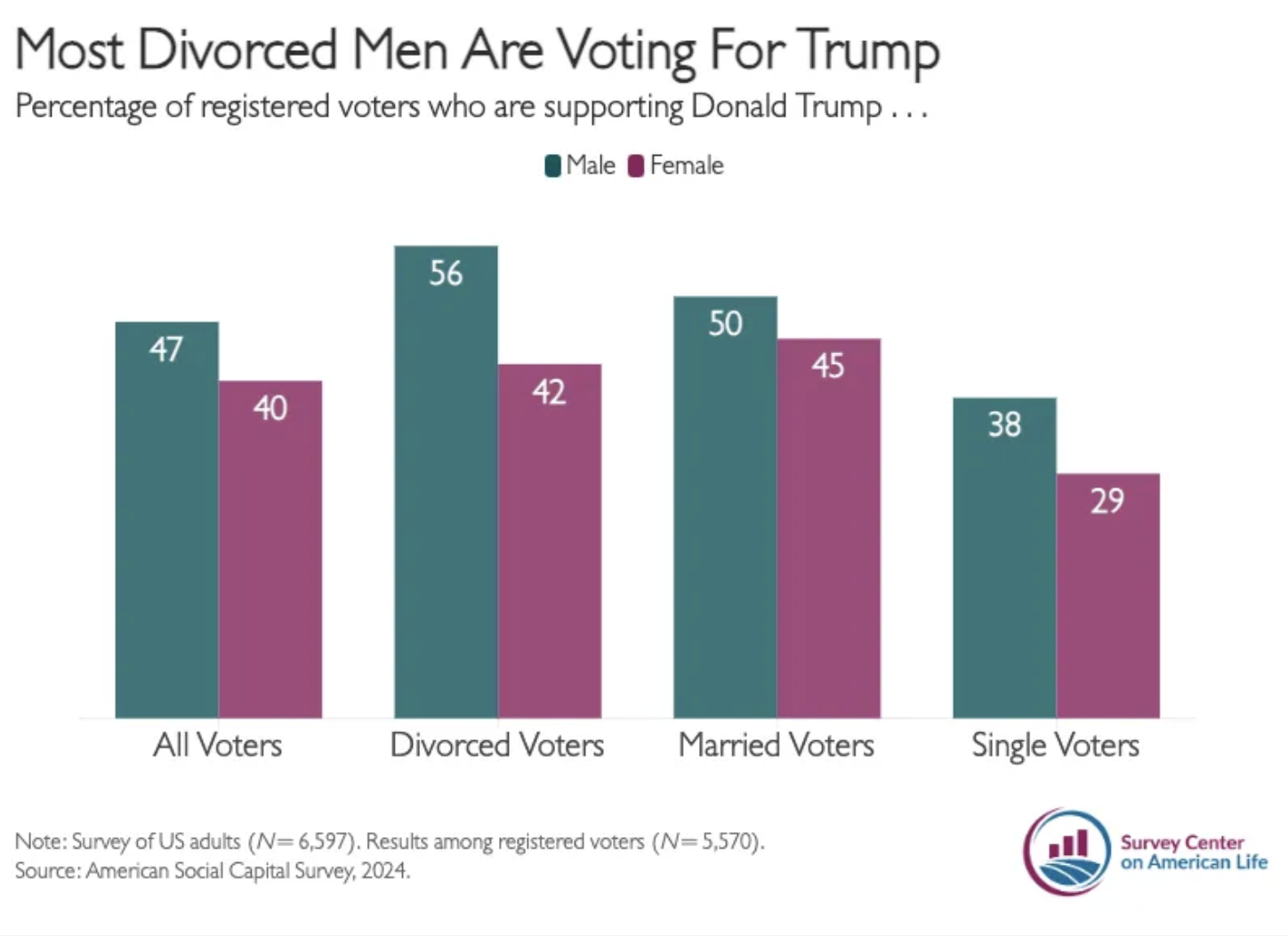
This sexist double standard explains why Trump's biggest base of support is divorced men, as pollster Daniel Cox demonstrated last week

In his slightly jokey response to this report, Jonathan Last of The Bulwark wrote, "There is a particular type of mental break," which he calls "Divorced Dude Energy," which he feels explains "the way some middle-aged men went cuckoo for Trump." Many, even most divorced men are not like this, he hastens to add. Still, we've all seen these cases where "a seemingly normal guy’s marriage breaks up and suddenly he’s a different person. Angry. Resentful. Superior. Kind of agro."

We need your help to stay independent

Cox tries to bothsides the issue, writing, "Men and women who have ever been hurt or mistreated by the opposite sex more readily make their pain public, and their personal grievances become politicized." But this explanation makes no sense, as divorced women are more likely to make sensible political choices. It's mostly men lining up behind a violent fascist who brags about sexual assault. Divorced women aren't voting to take away men's rights. The majority of divorced men are backing a man who successfully ended abortion rights, and whose new running mate wants to force all pregnant women to give birth. 

The appeal of Trumpism to men with Divorced Dude Energy isn't that mysterious: They like the Christian right worldview that Vance is peddling, where a woman is expected to hold a marriage together, no matter how great the cost to her. The phenomenon Last describes makes sense if one assumes, correctly, that sexist societies like ours produce men who have an easily bruised sense of entitlement. For a man who is bitter over a divorce, there's a sense of validation in joining forces with other men who are also angry at women. 

Divorced Dudes of the sort Last describes will not hear Vance's lament about divorce and feel insulted. They will take it in the spirit intended: As an attack on their ex-wives for leaving them. That's also why Trump likely doesn't care. He knows that when Vance criticizes divorced people, he means divorced women. 

The Supreme Court’s immunity decision is the gift that keeps giving to Donald Trump

Another day, another miraculous escape from serious jeopardy for Donald Trump. Like a Secret Service agent shielding their protectee from danger, Judge Aileen Cannon threw herself in front of a legal bullet heading Trump's way in the Florida classified documents case, throwing the whole thing out after slow walking the case for months

The fact that Cannon would do so is not surprising given her allegiance to the man who appointed her and her already well-documented history of erecting roadblocks for the prosecution, in what looked like a slam dunk case against the former president. What is remarkable is how she did it and what it means — not just for the former president, but for the rule of law in this country.

As the New York Times notes, Judge Cannon “ruled that the entire case should be thrown out because the appointment of the special counsel who brought the case, Jack Smith, had violated the Constitution.” To do so, she twisted or ignored precedent,  misconstrued statutes and cast into the dustbin of history decades of practice.

The Washington Post calls attention to the utterly idiosyncratic and arbitrary quality of Cannon’s Monday ruling by reminding us that other courts already have “rejected arguments similar to the one that Trump’s team made in Florida about the legality of Smith’s appointment.” But whether the decision is idiosyncratic and arbitrary or not, it is clearly another step toward a kind of “presidential dictatorship” in which the president, during and after his term of office, is insulated from any form of legal accountability, other than impeachment.  

That Judge Cannon took her cues from Justice Clarence Thomas’ concurrence in the recently decided presidential immunity case shows how the world of MAGA judging works. It depends on networks of loyalists using their judicial power to protect former president Trump and, while doing so, steamrolling America’s constitutional framework.

Before looking more closely at Cannon’s decision, let's recall a little bit of the history and practice of special counsels in the United States.

To do that, we need to recall what happened during Watergate when Richard Nixon fired Archibald Cox in what came to be known as the Saturday Night Massacre. At the time, Cox was what was then called a “special prosecutor,” He had been appointed by Attorney General-designate Elliott Richardson and was charged with investigating Watergate, the cover up, and Nixon's involvement in both. On October 20, 1973 Nixon not only forced the dismissal of Cox, but he also accepted the resignations of Richardson and Deputy Attorney General William D. Ruckelshaus. In addition, he abolished the office of the special prosecutor itself.

Five years later Congress, then controlled by the Democrats, passed the Ethics in Government Act. That act gave statutory authorization for the creation of the Office of Special Prosecutor.

Special prosecutors were to be appointed by a special panel of the United States Court of Appeals for the District of Columbia. They would have the authority to investigate allegations of misconduct by federal officials, up to and including the President of the United States. The act gave them a blank check and an unlimited budget to do their work. It also said that they could be dismissed only by the Attorney General for “good cause.” 

Right from the start, critics worried about the independence of the special prosecutor and how it fit with the constitutional system. Judge Cannon makes a lot of those criticisms in her opinion.

But, in the 1988 case of Morrison v Olson, the Supreme Court upheld the constitutionality of the Ethics and Government Act and the Special Prosecutor’s Office which it created. Eleven years later, the Ethics in Government Act expired. In its wake, the Office of Independent Counsel was replaced with the Office of Special Counsel, And between then and now special counsels have been used repeatedly

But neither that history nor those practices mattered to Judge Cannon. She took it upon herself to adopt one of the right-wing legal establishment’s most far-fetched arguments. 

In 1999, The Federalist Society laid out what seemed at the time like a cry in the wilderness. It called Special/Independent Counsels “one example of a dangerous trend whereby functions of one branch have been taken away and given to another branch, or to an entity that does not fit within one of the three delineated branches found in the Constitution.”

It saw them as part of what it called “a steady erosion of the strict separation of powers between the three delineated branches of government” and called the Special Counsel a “fourth branch” of government.

As Supreme Court Justice Brett Kavanaugh noted years ago,  Justice Antonin Scalia was, during his career on the Supreme Court,   the most enthusiastic and vociferous carrier of this critique. Enter Justice Thomas, who on July 1 picked up the baton in the right-wing effort to undo the constitutional status of independent counsels. As the Washington Post explained, “Thomas argued both that the special counsel’s office needs to be established by Congress and that Smith needed to be confirmed by the Senate.” He used his concurring opinion to the immunity ruling to ‘highlight another way in which this prosecution may violate our constitutional structure.’”

And teeing up the issue for Judge Cannon, Thomas urged lower courts to explore this issue. And explore she did, holding two hearings on Trump’s challenge to the assignment of special counsel Jack Smith. 

We need your help to stay independent

Yesterday, Cannon ruled that the special counsel was not what she called a “principal officer” of the government. But she ruled, contrary to precedent, that   Smith’s appointment violated the Constitution’s Appointment Clause.  

Congress, she said, is “empowered to decide if it wants to vest appointment power in a Head of Department…. But it…did not so here.” As a result, Jack Smith should have been appointed by the president, subject to senatorial confirmation and removal by the president.

She also found that because the Special Counsel was not subject to a fixed or set budget, Congress’s power to authorize and appropriate money was violated

As Judge Cannon put it, “The Court is convinced that Special Counsel Smith’s prosecution of this action breaches two structural cornerstones of our constitutional scheme — the role of Congress in the appointment of constitutional officers, and the role of Congress in authorizing expenditures by law.” 

Along the way, the judge reviewed the history of special counsels and noted that what she called the “lack of consistency” in that history “makes it near impossible to draw any meaningful conclusions about Congress’s approval of modern special counsels like Special Counsel Smith.”

Cannon noted that “the title ‘special counsel’ is of fairly recent vintage. Special-attorney-like figures bore many titles throughout the decades. In the Court’s view,” she said, “this is not an insignificant semantic detail.”

Throughout her opinion, Cannon played fast and loose with precedents that have upheld the constitutionality of operations like Smith’s, finding in each instance that none of them were sufficiently definitive to rely on. And she offered a master class in how not to construe statutes.

The opinion is, as columnist David French says, “a long exercise in the use of structural and historical arguments to argue that the words in the Constitution, case law and the relevant statutes do not quite mean what they seem to so clearly say.”

Finally, like her colleagues on the Supreme Court in the immunity case, Cannon studiously ignored the immediate context. You would barely know that Trump was charged with stealing classified documents from reading what she wrote. 


Want a daily wrap-up of all the news and commentary Salon has to offer? Subscribe to our morning newsletter, Crash Course.


Not surprisingly, Former President Trump has already registered his approval, saying of the news, “I’m thrilled.” Moreover, Justice Scalia is surely crowing in the afterlife, and Justice Thomas will be so pleased that he may be tempted to give Cannon a ride in his RV.

However, Americans dedicated to preserving our constitutional Republic have no reason to be thrilled or to crow. As George Washington Law Professor Paul Berman observes, Cannon’s decision, “if upheld on appeal would end all federal cases against Trump.” It would “remove the ability to have Special Counsels in the future who have the ability to investigate presidential misconduct at all because that president would always have the power to hire and fire such counsels. 

"This,” Berman says, “is yet another step toward making the president above the law”

Put simply, Cannon’s decision is astonishing. But it should serve as a wake-up call to voters. When they choose the president in November, they need to remember that they are giving that person the power to nominate federal judges who, like Cannon, may feel greater loyalty to the president who appoints them than to the Constitution that they take an oath to uphold. That should inform the choice they make on Election Day.

Sea level rise causes local extinction of rare cactus, an omen for conservation efforts

As out-of-control heat cooks our planet, shattering temperature records for the last 13 consecutive months, it melts polar ice and raises sea levels. Most people are familiar with how this works, but we typically only think of the consequences of sea level rise as threatening to drown Miami, for example. But extinction is also a factor, as evidenced by recent news that the United States has suffered its first-ever local extinction as a result of sea levels rising. The victim is the iconic 20-foot tall Key Largo tree cactus (Pilosocereus millspaughii).

The prickly behemoth — encased in light green skin and sporting cream-colored, garlic scented flowers — was first discovered in 1992, according to the study published in the Journal of the Botanical Research Institute of Texas. From an initial population of more than 150 stems in the Florida Keys, the once-thriving Key Largo tree cacti began dwindling due to salt water intrusion, soil depletion, intensified hurricanes and unusually high tides, all of which are either caused or exacerbated by global warming. As a result, the Key Largo tree cactus is now locally extinct from both the Florida Keys and the United States as a whole, though other related cacti are indigenous to Cuba and the Bahamas.

Key Largo tree cactus flowerThe Key Largo tree cactus was initially found growing in the United States in 1992 at a single site. That population has since been lost to a combination of rising sea levels and increasingly intense storms. (Photo courtesy of Susan Kolterman)

Even worse, the scientists who chronicled the Key Largo tree cactus' extinction are now predicting that this is only foreshadowing future local extinctions as part of the ongoing sixth mass extinction driven by human activity.

2023 study published in the journal Proceedings of the National Academy of Sciences found that humans have caused as many extinctions over the past 500 years as would have occurred without them over 18,000 years. Similarly, a 2021 study in the journal Communications Earth & Environment reported that the average predicted extinction rate for freshwater animals and plants today is three orders of magnitude higher than it was 66 million years ago, when the dinosaurs famously went extinct during the so-called Cretaceous–Paleogene extinction event.

"This is the first of many losses likely to be suffered in the coming decades."

One of the primary culprits behind these mass extinctions is climate change, in which the planet overheats because humans burn fossil fuels that pump greenhouse gases into the atmosphere. Among other things, climate change melts Earth's ice caps and thus causes sea levels to rise.

As for the Key Largo tree cactus, "This is the first of many losses likely to be suffered in the coming decades," research botanist Jimmy Lange told Salon. "Much of the unique Keys flora are found at relatively low elevations, even for the Keys. This situation is confounded by decades of habitat loss, degradation and other factors like invasive species that threaten the integrity of these terrestrial ecosystems. Luckily, there are so many great land managers, NGOs and [government] agencies working together to preserve these unique habitats and the natural resources they support."

Though this extinction is ominous for other flora and fauna in ecologically precarious regions, Lange also notes that the Key Largo tree cactus has intrinsic value of its own. Its loss in the United States is irreplaceable.

Staff removing cactus tree green materialStaff from Fairchild and the Florida Department of Environmental Protection removed all remaining green material in 2021 after it became clear the population was not going to survive. (Photo courtesy of Jennifer Possley)

"I remember the first time I hiked out through the mangrove swamp and into the dense brush where this population occurred and being amazed by the sheer size of the stand," Lange said. "Dozens of large stems towering above the shrub canopy, covered in large tufts of hair. It was quite the site to behold. It speaks to the treasure that is the Florida Keys flora, where so many unique plants, many at the northern extent of their tropical range, make a home on the rocky substrate formed by ancient coral reefs during periods of much higher sea level."


Want more health and science stories in your inbox? Subscribe to Salon's weekly newsletter Lab Notes.


"Apart from species like this that are found in other parts of the tropics, many plants and animals are endemic (found nowhere else) to the Keys."

Lange added, "Apart from species like this that are found in other parts of the tropics, many plants and animals are endemic (found nowhere else) to the Keys."

This is not to say that the Key Largo tree cactus is incapable of a comeback in the United States. Quite to the contrary, Jennifer Possley — the director of regional conservation at the Fairchild Tropical Botanic Garden — hopes that it can be revived.

“We have tentative plans with the Florida Department of Environmental Protection to replant some in the wild,” Possley said in a statement. The conservationists became aware of the need for major restoration efforts over the past decade, as one natural event after another took a recorded toll on the cactus population. This included Hurricane Irma, a category 5 storm that created a 5-foot surge as it swept across southern Florida in 2017. Because the highest point on Key Largo is only 15 feet above sea level, large portions of the island were flooded for days after the storm. Exceptionally high king tides in 2019 likewise flooded large portions of the island for months, and by 2021 only six Key Largo tree cactus stems remained alive.

We need your help to stay independent

To salvage the plants that at this point were obviously doomed, a team of scientists allowed the plants to flower and fruit before saving as much green material as possible, to replant it in greenhouses or outdoor controlled settings. So while technically the plant isn't extinct on the same level as a Tyrannosaurus rex, it is still severe and can negatively impact ecosystems.

These are the patchwork efforts made by local scientists to protect their ecosystems from global warming — but they know that, while they may win a few battles, they are losing the larger war.

"People should get out and experience the unique ecosystems of the Florida Keys while they can," Lange warned. As the study notes in its abstract, "The other cacti in the region, and all rare plants in the Florida Keys, are threatened with a similar fate."

New study reveals the icy, cold climate of Mars’ past, with implications for life

If life exists on alien worlds, scientists expect that the worlds in question would have certain basic properties. There would be carbon, an element essential to the creation of organic molecules. The world will include enough water for the life to flourish, and the environment will stay within an acceptable range of temperatures (-15º C to 115º C). Even if those conditions do not currently exist on any known worlds, scientists hope life may have been present on certain planets in the past.

One such planet for which people harbor hope is Earth's red next-door neighbor, Mars. Yet according to a recent study in the journal Communications Earth and Environment, Mars does not quite meet the standards necessary to have supported life in its past — at least, not like anything on Earth.

Upon examining materials discovered by NASA's Curiosity Rover in Mars' Gale Crater since 2011, the scientists compared those soils with analogous materials on Earth. The Gale Crater soil and rocks provide a record of Mars' climate from between 3 billion and 4 billion years ago, which is roughly the same time when life appeared on Earth. They also contain unique structures — what one scientist described as "X-Ray amorphous materials like Jello," a "soup of different elements and chemicals that just slide past each other" — which make it possible to establish what external conditions existed while they were formed.

Yet according to the researchers — who used X-ray diffraction analysis and transmission electron microscopy to examine both the Gale Crater samples and samples from the Tablelands of Gros Morne National Park in Newfoundland, Northern California’s Klamath Mountains, and western Nevada — the geological records are not promising for past life.

Although the subarctic conditions of Newfoundland did yield materials chemically analogous to those in Gale Crater, this did not happen in the warmer climates like California and Nevada. This means that the unique structures could have only been formed when the temperatures on Mars were much colder than Earth-based life can endure.

“It’s this double standard”: Faye Dunaway doc director on the legendary actor’s unfair reputation

Faye Dunaway is a legend. Her iconic roles as Bonnie Parker in “Bonnie and Clyde,” Evelyn Mulwray in “Chinatown,” as well as her Oscar-winning performance as Diana Christensen in “Network” cemented her career. But Dunaway also developed a reputation. She had some difficulties with director Roman Polanski on “Chinatown,” and was fired from the play “Tea at Five.” Of course, Dunaway is perhaps most associated with her chilling portrayal of Joan Crawford in the camp classic, “Mommie Dearest” — an exacting performance that “ruined” her career; she struggled to find meaty roles thereafter.

"I’m glad you see it as a redemption story. To some extent it is."

HBO's celebratory showbiz documentary, “Faye,” directed by Laurent Bouzereau, showcases Dunaway as the seminal 1970s screen actress she is, and touches on some of her “issues,” including her alcoholism and her bipolar disorder. Using extensive and candid interviews with Dunaway, along with her adopted son Liam, Bouzereau hopscotches through Dunaway’s childhood and career, landing on the highlights — her famous morning after Oscar photo, taken by Terry O’Neill, who would later become her husband — and the lowlights, including the aforementioned “Mommie Dearest.” 

The documentary includes only brief clips from some of her key ‘70s films like “The Towering Inferno,” “Three Days of the Condor” and “Eyes of Laura Mars,” but it does features a segment on “It Had to Be You,” Dunaway’s ill-fated TV sitcom. 

“Faye” also includes interviews with her “Barfly” costar Sharon Stone, Mickey Rourke and others, who discuss Dunaway’s impact and legacy. The documentary plays almost like a redemption story, justifying her searing performances by the effort and pain that went into them, including her Maria Callas in “Master Class,” a stage production Dunaway tried, but failed, to direct as a feature film. 

Salon spoke with director Laurent Bouzereau about Dunaway, “Mommie Dearest” and his approach to making “Faye.”

Let me ask a question you ask in the film: What comes first to mind when you think of her? What do you recall about seeing her? 

What I recall is “The Towering Inferno.” That was the first movie I saw her in, and I was very impressionable at the age. Not only the movie, but I never forgot her. I never forgot the shot of the elevator doors closing in on her as she goes down the elevator on the side of the tower. I was petrified something was going to happen to her, and from that moment on, I was hooked. I had seen an extraordinary actress who expressed so much in a film that had so many movie stars including Steve McQueen and Paul Newman. She stood out to me. From that moment on I followed everything she did. “The Towering Inferno” was the first movie poster I ever bought. It’s a “pinch myself” moment to get a chance to tell her story in a very intimate and personal kind of way. That’s what comes to mind — the discovery of her and the power of an actor.

But you didn’t really feature “The Towering Inferno” in “Faye”!

We had that shot! I talked about it with Faye, and there was nothing really all that insightful about her appreciation of it. [She said], “I just dropped by for a couple of scenes.” She was funny about it. We did talk about Steve McQueen, particularly “The Thomas Crown Affair,” which essentially relies on style and not so much on plot. It’s a beautiful film, with a great score, and Faye has a different hairdo and outfit in every scene she appears in. 

You illustrated her story with photos and film clips. You also have interviews with Dunaway, but also her son, friends, writers/scholars and costars. Why did you take this approach for a documentary on Faye Dunaway? 

"I have seen male actors behave far worse than she does."

I had Faye Dunaway, which was pretty amazing. I didn’t have that privilege when I was doing the story on Natalie Wood. I wanted to embrace Faye. I wanted each person coming in the story to be symbolic of other people. I couldn’t get certain directors because of schedules, but I was glad I got Jerry Schatzberg, who not only directed Faye [in “Puzzle of a Downfall Child” in 1970], but they went out together. James Gray symbolizes another generation of filmmakers embracing someone like Faye. I wanted Sharon Stone picking up baton from Faye in the '80s, and '90s. Then Mickey Rourke or Mara Hobel, who shared the screen with her in completely different films [“Barfly” and “Mommie Dearest” respectively]. I wanted to get a nice diversity of people who experienced different sides of her. What is it like to share the screen with her, or socialize with her as an up-and-coming actor? What is it like to direct or date her? And what is it like to be her son? Liam [O’Neill] was a close friend of ours and he ignited the whole project. We talked about a doing a film about his dad, who passed away. Liam said, “I have so much footage and photos, it would be great to do something on my mom.” We had dinner and convinced Faye — and continued convincing her . . .

“Faye” feels like a redemption story. What was the intent with this documentary? 

I’m glad you see it as a redemption story. To some extent it is. She is opening up in a very real and contemporary way, and is very accessible. The curiosity awakens in young people who don’t know who she is, and they visit or revisit her films and realize the power that she holds. For me, that’s the hope. The intent is “Don’t forget someone like this.” I’m a storyteller. I’m not a reporter. I was intrigued by her story, and I feel there is a lot to learn from her. She is quite an inspiration. Folks should go down the rabbit hole and discover more. 

How did you work with Faye on the film? Was she just the interview subject or did she review what would be discussed in advance? Did she have any creative control about what to include, or what was off-limits?

She was extremely aware that I, meaning me and my producers, had final cut. At the same time, I didn’t want her to feel that I’m going to do a film that is not something she is going to like. I wanted to be truthful. I told her the camera is going to be constantly running, so when she’s acting up — and I wanted to open the film with that — she knew that was being recorded. There was no hidden agenda. I had her son remind her of that. I wanted to capture moments that may trigger something extraordinary. I didn’t want miss out on that.

This is the opposite of what she is used to; there is no script. 

Dunaway is seen being “fussy” early on in your documentary. Her reputation for being “difficult” has preceded her in her late career. Dunaway claims her toughness generated results, and one quote in the film indicates that if she wasn’t in so much pain, she would not be as good as she is. What are your thoughts about her diva-like persona?

I respect that. I have seen male actors behave far worse than she does. I think she gets a bad rep because she’s a woman. They can’t wait to build you up and they can’t wait to tear down. She was so far up maybe that’s what happened. Her reputation preceded her over her work. I don’t know what it is about her that caused that kind of reputation. I’ve seen it and been on receiving end of it on several occasions. That was part of the challenge and excitement of telling her story. Despite the reputation, and obstacles, and mood swings, it was tough. But if it wasn’t tough, we wouldn’t be talking about it. It would be another vanity project. 

“Faye” includes discussions of Dunaway’s alcoholism and bipolar disorder, as well as her love of Blistex. What surprised you about the film’s subject?

[Laughs] Everything surprised me! I was surprised she has a different persona when the camera starts rolling and she knows she has to work. She is a consummate professional and she wants to master the camera and her relationship with the camera is very impressive and very stressful. You meet somebody different than if you are socializing and having dinner. 

Dunaway absolutely invested her full self in her iconic roles, and Elia Kazan tells her that “feeling” is her strength. She did her best work with demanding directors like Arthur Penn, Sidney Lumet and Roman Polanski, but was sabotaged by Frank Perry, who did not rein her in making “Mommie Dearest”? She plays characters who are larger than life but says, “That’s not me.” What observations do you have about her roles and career? 

She is an incredible performer, but she is very much a director’s actor. She relied on a friend of hers, William Alfred, a playwright, and they would dissect the roles together. I knew Sidney Lumet and Arthur Penn years ago and I talked with them, and they all said she was extraordinary. Yes, there is the famous “hair” story of “Chinatown,” [recounted in “Faye”]. I didn’t remember any director saying she’s a nightmare. They said she’s a force on the set. If you are not an equal, and if you are intimidated by that force, it is over. Frank Perry had done a movie [“Doc” in 1971] with her before “Mommie Dearest.”  Maybe she felt more isolated in “Mommie Dearest,” in that she was carrying the whole film by herself and there was not that exchange happening. You look at the films Perry was doing in that era, “Monsignor” with Christopher Reeve and Geneviève Bujold, and that movie sucks. The actors are borderline embarrassing in it. Then he made “Compromising Positions,” which is not memorable. He was not a director who was on her side. I think he was a director who potentially lost control. 

“Mommie Dearest” was a setback, followed a few years later by “Barfly,” which was an attempt at a comeback. Then she made an ill-fated effort to bring “Master Class” to the screen. What are your thoughts about her up and down career? Was Faye her own worst enemy after her string of hit roles? Was her being a “tough woman” threatening? 

"She is an incredible performer, but she is very much a director’s actor."

That is a double standard that is hopefully on its way to be a thing of the past. I saw “Mommie Dearest” when it came out in France, and I knew nothing about it. I went because it was Faye. and I thought, the movie was really awful. For someone like me. who loves Brian De Palma, and Spielberg, and cinematographers like Vilmos Zsigmond, it was like watching a Hallmark movie. It’s flat and completely ridiculous. I did not like that film, and I was really shocked when it became a cult classic. People are laughing at it than appreciating it. I don’t think it’s good cinema.

The thing that is mesmerizing to me is that around the same time, you have Warren Beatty and Dustin Hoffman making “Ishtar,” and you don’t see them being interviewed and someone saying, “Let’s talk about ‘Ishtar’” the way that each time Faye is interviewed, they bring up freaking “Mommie Dearest.” I don’t know what it is. It’s this double standard. Maybe because she made it such a big deal for herself, that she has invited [criticism]. 

“Faye” shows how she tries to reshape her career, producing and directing, but she took a lot of roles that were more to keep working than up to her standards. What are your thoughts on her legacy? Your film is now contributing to that. 

Her legacy is giant. If you only have “Bonnie and Clyde,” “The Thomas Crown Affair,”  “Chinatown,” “Network” and “Eyes of Laura Mars” — and I would include “Mommie Dearest” because it is the antithesis of everything she had done — she will be remembered for those roles. I hope that this film can be remembered as part of her legacy in the sense that it was her attempt at explaining herself and her journey. She dedicated herself to her art form. That is powerful, and that comes across strongly. She had such passion in discussing those roles. 

"Faye" is streaming on Max.

Goodbye, ‘soy boys.’ Hello, swole vegans

Over the past two years, Gigi Balsamico has won first place at more than a dozen strongman competitions in the eastern United States: Maidens of Might, Rebel Queen, War of the North, Third Monkey Throwdown. These events typically involve six to eight weight-lifting challenges on which competitors are scored based on criteria like the amount of weight they can handle and how many reps they can do. 

Last month, Balsamico came out at the top of her weight class at Delaware's Baddest. There, she hoisted four 100- to 150-pound sandbags onto her shoulders after completing six reps of a 315-pound dead lift. As the pièce de résistance, she harnessed herself to a Chevy Silverado — which itself was attached to a food truck trailer — and dragged it 40 feet in 40 seconds.

Balsamico is also a vegan of 11 years. It's an identity she's vocal about, out of a desire to push back on the notion that you need to eat meat to be strong. When she was a vegan-curious teenager, it gnawed at her that giving up animal products could mean sacrificing sports.

"I thought I was going to shrivel away to nothing," Balsamico told Grist. Her Italian, sports-loving family had always eaten meat and dairy. "That's what was always said to me, that you would basically get so skinny and die."

But Balsamico's love for animals compelled her to question these concerns. As a child, tending to neglected horses at a family friend's farm prompted her to wonder why people didn't see all animals as beautiful, each with its own unique personality. Horses, cows, sheep, dogs: "It was so apparent to me that there was no difference," she said.

Meanwhile, veganism was at the beginning of a surge in popularity — concerns over the cruel conditions of factory farming, as well as the impacts of animal agriculture on the climate and environment, were helping to bring the marginalized diet closer to the mainstream. Although estimates vary, peer-reviewed research suggests that the chickens, cows, pigs, and other animals humans raise for meat and dairy contribute up to 20 percent of the planet's overall greenhouse gas emissions.

Balsamico cut out all animal products from her diet at the age of 14, justifying the decision to her parents in a "39-minute PowerPoint" on the health benefits of plant-based eating. The weight lifting came a couple of years later, mostly out of curiosity: "I just wanted to see if I could do it," she said. And she could — in 2022, she began winning first place for her age and weight class in every strongman competition she entered, racking up a streak of victories that she has yet to break.  

"I haven't had meat in 11 years of my life, and I can pick up 700 pounds on my back," she told Grist. Balsamico now coaches other aspiring athletes at a gym in Pittsburgh, and is affiliated with an international team of vegan strength competitors called PlantBuilt

Balsamico and her teammates are just a few of the many plant-based athletes who are using their "swole" bodies and competition results for social change, showing on social media and through word of mouth that you don't have sacrifice "gains" — slang for muscle mass gained through diet and exercise — in order to eat a diet that protects animals and the environment. One block of tofu at a time, they're defying expectations about what's possible without animal protein — and weathering unsolicited criticism from those who insist, against all evidence to the contrary, that "soy boys" are inherently weak.

Eating fewer animal products — especially beef — is one of the most effective actions that people can take for the planet. Researchers have found that eating a plant-based diet is one of the four individual lifestyle choices that have the biggest impact on emissions, along with living car-free, avoiding air travel, and having one fewer child. An Oxford University study examining the reported food intake of more than 55,000 people found that the diets of people who eschewed all animal products generated one-quarter the greenhouse gas emissions of those who ate a lot of meat. 

Nutritionists say a vegan diet can be healthy for most people, as long as they take supplements to ensure adequate intake of certain micronutrients that are hard to find in plant foods, like vitamin B-12. James Loomis, medical director of the Physicians Committee for Responsible Medicine, a nonprofit that promotes plant-based diets, said non-animal foods are more than adequate sources of protein. Contrary to popular belief, he said, the idea that plants can't deliver all of the essential amino acids is "complete mythology." 

Veganism is a tougher sell for strength athletes, who have higher protein needs than the average population. Whether plant- or animal-based, dietary protein is the only way to get the amino acid building blocks that can grow and maintain muscle mass. But due to what some nutrition experts call "bro science" — a cocktail of personal experience and information gleaned from social media — strength athletes often believe that the only way to fulfill these requirements is through large servings of eggs, yogurt, chicken, dairy-based protein powder, and other high-protein animal foods.

Carol Johnston, an associate dean and professor at the Arizona State University College of Health Solutions, said it may be easier to absorb protein from these animal foods. Nonathletic "regular Joe" vegans could be at risk of deficiency if they don't compensate by eating a slightly greater amount of plant protein. But for protein-obsessed strength athletes, she said there's no reason they can't swap out whey, yogurt, and steak and build muscle on their plant-based counterparts.

"They just need to consume extra protein" compared to omnivores, Johnston said. Most serious athletes know this, she added. "There are a lot of pro athletes who are vegan and they perform just as well as the nonvegans. That's because they take a lot of care with their diet, they know how to maneuver through their nutritional needs."

According to Loomis, "reasonably active" people should be getting about 0.36 grams of protein per pound of body weight each day. Most people don't need to worry about hitting this target, he said, as long as they're eating a diverse diet of unprocessed foods. Athletes need more calories overall, and therefore their protein intake should scale up — to about 0.55 to 0.73 grams per pound for endurance athletes who are less concerned about building huge muscles, and to 0.68 to 1 gram per pound for strength athletes like powerlifters. Beyond a certain limit, the body can't store excess protein, Loomis told Grist, and some studies suggest that too much can promote the growth of cancer cells. (It may be, however, that this relationship only applies to animal protein.)

Most of the plant-based strength athletes Grist spoke to reported trying to consume between 0.68 and 1 gram of protein per pound of body weight per day. For someone who weighs 200 pounds, that would be 136 to 200 grams of protein per day. For context, a block of extra-firm tofu has about 40 grams of protein, and a typical serving of vegan protein powder has about 20 grams. 

Those foods both play a prominent role in the diets of the vegan athletes Grist spoke to. Protein powder, which can be blended into smoothies or stirred into oatmeal, represents a fairly low-effort way to up one's daily intake. Katie Chetcuti, a vegan fitness coach with more than 45,000 followers on Instagram, said she uses a barley, rice, and lupin bean-based protein powder from the brand Fyta. Other athletes named Orgain, PlantFusion (a sponsor of PlantBuilt), Vedge, and TB12 as their preferred brands. Bradie Crandall, a powerlifter with PlantBuilt who uses the social media handle Vegan Hercules, said he saves money by mixing an admittedly "chalky" blend of unflavored pea and rice protein powders, which he buys in bulk. He blends his powder into post-dinner protein shakes, along with orange juice, mixed fruit, and beets, which he says help improve blood flow.

Beans are another popular staple — especially among a small but passionate circle of vegan strength athletes who subscribe to a whole food, plant-based diet that emphasizes the importance of dietary fiber. (Americans are much more likely to be deficient in fiber than in protein.) 

But others center their diets around plant-based products designed to taste like meat. Chetcuti said these can serve as a one-to-one replacement for more conventional proteins: an Impossible burger instead of a beef patty, for instance, or soy-based chicken substitutes instead of chicken breasts.

"Vegan nutrition is really not that different from nutrition for other athletes," she said — you just take the meat, eggs, and milk, and swap them out for high-protein plant-based lookalikes.

There are plenty of options available for those who look for them, and more products are being introduced all the time. Balsamico said she's come to love plant-based jerky, faux steak cutlets from the brand Meati, and a more old-school product called textured vegetable protein: defatted soy flour pellets that mimic ground beef. She also makes her own protein-rich foods — for example, strawberry shortcake muffins with added protein powder, or mini quiches made from a blend of silken tofu and a mung bean-based egg substitute called Just Egg.

Across the board, the athletes Grist spoke with said their diet has improved their athletic performance, especially their ability to recover quickly between workouts. Ashley Kitchens, a registered dietitian and competitive CrossFit athlete on the PlantBuilt team, said she's felt "unstoppable" compared to her meat-eating training partners, who take longer to recover from intense gym sessions. Robert Rogers, who spent 12 years as an omnivorous weight lifter before switching to a plant-based diet in 2020, thinks he looks "10 times better" than he did five years ago. "I can do more pushups and pull-ups, I'm leaner, I'm more cut."

Ashley Kitchens of the PlantBuilt team of vegan athletes, left, lifts a barbell during a strength competition. Vegan athlete Robert Rogers, right, works out in his backyard in Richmond, California. Photos courtesy of Ashley Kitchens, Robert Rogers

But better performance and aesthetics are often seen as side benefits. Most of the people Grist spoke to said they're vegan primarily out of concern for animals or the environment, and that this concern is what motivates their advocacy. Some learned about the brutal conditions animals face in factory farms, and said they didn't want to contribute.

Crandall said veganism "wasn't even a choice" for him. He recently completed his doctorate in chemical and biomedical engineering, but while doing sustainability research as an undergraduate, he felt ethically compelled to ditch animal foods after learning about their contribution to climate change. "I felt guilty. I wanted to be able to sleep at night," he said. "I'd been spending all day working in the lab to reduce CO2 emissions." To then go home and eat meat just "didn't feel right."

He believes others would feel the same way if given the right information.

"I think there's a lot of people that, once they have the capacity for empathy and knowledge of our food system, they're going to want to go vegan," Crandall said. "They just need to know that by doing that they can still compete at a very high level — they can still be strong, they can still build muscle. I want to make that very clear to them."

Having role models can be an important confidence booster for the vegan-curious athlete, for whom scrutiny can feel inescapable. 

Since as early as the 19th century, critics have derided people who choose not to eat meat as "odd" or even "half-crazed." In 1907, one researcher at Yale expressed surprise that so-called "flesh-abstainers" could keep up with or outperform their meat-eating counterparts in movements like deep knee-bending and leg-raising. 

In the 1970s — at a time when vegetarianism was more exotic than it is today — professional critics blamed the injuries of NBA superstar Bill Walton on his vegetarianism. And when he was performing well, it was in spite of his diet. "The vegetarian tiger played as if he had dined on red meat all week," a Time Magazine article said in 1974.

The same goes for modern vegan athletes. When Carolina Panthers quarterback Cam Newton was sidelined by a sprain in his left foot in 2019, the media implied that his slow recovery was diet-related; one sports nutritionist told The Charlotte Observer that he would "immediately" feel better if he ate animal protein.

Vegan athletes are "under a microscope," Crandall said. "If you're not performing at tip-top shape at all times, people are going to say that it's because of your diet."

When Crandall tore his meniscus in the lead-up to a recent powerlifting competition, he said people online blamed it on his veganism. (He still won the competition.) Chetcuti said she gets similar comments — "If you weren't vegan, you'd be stronger" — or more toxic ones focused on her physique.

Perhaps the other most significant barrier to the adoption of veganism among athletes is the equation of meat with strength, power, virility, and other qualities typically seen as masculine. Refusing animal products is seen as "weaker, homosexual, and unmanly," according to vegan and vegetarian respondents to a 2023 survey. Crandall said that, as a young man, he was wary that veganism would cause others to perceive him as feminine. Balsamico said she gets the sense that some of the male clients she works with would think it too "girly" to eat a tofu salad sandwich. 

"If you don't eat meat, you're a p-ssy — that's the vibe that people are putting out," Chetcuti added.

In the U.S., some historians link these perceptions back to the late 19th and early 20th centuries, when once-common expressions of American masculinity — war, expansion of the Western frontier — began to decline. Food helped fill the void, as dietary advice and corporate advertisers cast meat-eating as a symbol of status, power, and domination. Foods like salad and Jell-O were seen as dainty and understood to be women's cuisine. 

Today, Rogers said fears around veganism seem strongest among those on the political right, who feel their masculinity is under threat or that policies to reduce meat consumption are an affront to their personal freedom. Democrats want to "take away your hamburgers," they say, and force Independence Day barbecuers to "throw back a plant-based beer with your grilled Brussels sprouts."

"They see it as maleness under attack," Rogers told Grist.
There is research to support this hypothesis — and more broadly to support the conclusion that people dislike vegans and vegetarians because of their resistance to entrenched social norms. One 2015 study found that people had more negative feelings toward vegans and vegetarians who were motivated by animal rights and the environment, compared to those motivated by personal health. A separate analysis from 2022 described how Australian men perceive plant-based burgers as a "symbol of eliminated freedom."

In the absence of a political transformation, many vegan athletes aim to present a different reality and, as Crandall put it, "transcend these arbitrary labels" of masculine and feminine. Ben Berman, a New York City vegan who began a serious weightlifting regimen last year, said he's trying to reappropriate the epithet "soy boy," historically used to emasculate vegan and vegetarian men. One of his favorite shirts bears the phrase — he said he hopes to one day be muscular enough for people to look at him and say, "Oh, that's what a soy boy looks like."

Balsamico said she's resilient in the face of unkind online conduct. In addition to sharing vegan training tips at her Pittsburgh gym, she likes bringing vegan snacks to social gatherings — an innocuous but effective way to pique the curiosity of nonvegan friends and community members. "I don't want people to ever feel that I'm pushing stuff on them," she said. 

It's a strategy that is notably different from the one that radical veganism might call to mind: masked activists standing in a public square, confronting passersby with enlarged photographs of the cruelty that transpires on factory farms. 

Not that there's no alignment between those vegans and the plant-based strength athletes of Instagram. "I definitely have my moments of being a crazy vegan," Chetcuti said. "I'll show you slaughterhouse videos, I have them on my phone if you want to see them." 

But overall, her theory of change is less about shocking people into action than leading by example. "It's much more inspiring for me to be a regular-ass person," she said, "to be a fitness coach, to be an athlete."

This article originally appeared in Grist at https://grist.org/arts-culture/meet-the-jacked-vegan-strength-athletes-defying-stereotypes/.

Grist is a nonprofit, independent media organization dedicated to telling stories of climate solutions and a just future. Learn more at Grist.org

"This story was originally published by Grist. Sign up for Grist's weekly newsletter here."

Nutrition conference highlights more bad news about ultraprocessed foods

Each week, it seems as though additional (bad) news about ultaprocessed foods is made public. This week is no exception.

As reported by Korin Miller with Food & Wine, a new study found that "people who ate higher amounts of ultra-processed foods were 10% more likely to die from all-cause mortality during the follow-up period of 23 years compared to people who ate minimally processed food." The study was presented last month at the Nutrition 2024 conference and traced 500,000 people over the course of three decades. "While the study participants who ate more ultra-processed foods were more likely to have a higher body mass index (BMI) and lower overall diet quality, some ultra-processed food fans had a normal weight — and still had a higher risk of death," Miller adds.

As Salon Food has noted many times, ultraprocessed foods can vary a ton — from protein bars to diet soda, from cold cuts to packaged bread — and often contain "additional ingredients like artificial colors and flavors, preservatives, and other ingredients to preserve their texture and longevity. Many packaged foods fall into this category." Ultraprocessed food consumption is linked with lots of chronic illnesses and ailments, such as Type 2 diabetes, dementia, heart diseases and various cancers, as per Miller, who also lists other studies conducted within the past few years that all seem to reiterate the same main conclusion: we should be eating far less ultra-processed foods than we currently are, to put it bluntly.

Conversely, Miller notes that some technically ultraprocessed foods, like liquid egg whites, raisins and unsweetened raisins are actually quite "good for you," so it's challenging to generalize too much. 

Pink passion: Rosé on the rise as millennials dictate new wine codes

Every July in New York City, thousands of partygoers gather on the lawns of Randall's Island Park for a huge "Pinknic". A regular event since 2016, the two-day festival brings together foodies, musicians, chefs and more, all dedicated to celebrating the summer with a fresh glass of rosé wine in hand. "Save water, drink rosé", banners read, and the participants do.

Not just a New York phenomenon, rosé has found admirers across the United States, and it's official: The second Saturday in June is National Rosé Day. Once an afternoon afterthought, rosé has become a red-white-and-blue favorite: In just a few years, Americans have become the second-largest consumers of rosé in the world – after the French.

In 2017 alone, rosé sales in the United States jumped 53% and the trend continues, partly driven by millennials.

One power couple that was way ahead of the curve was Brad Pitt and Angelina Jolie. While they've since divorced, in 2011 the two rosé lovers found common cause and bought the Domaine Miraval in France's Var region. They continue to jointly own the chateau and vineyard, which produces 2 million bottles of rosé a year, and it's anything but plonk. At a June 2019 charity auction in Nice, a magnum of Muse de Miraval was snapped up for 2,600 euros (2,960 dollars), a record.


Once dismissed, now cherished

How can this global success be explained, and what does the sudden passion for rosé reveal?

Once upon a time, rosé wine was regarded as second-rate, and not even worthy of the interest of oenologists. Even as late as the 1980s, it still wasn't considered a "serious" wine. This is a consequence of its modest origins, and a series of cultural contributions and transitions.

In antiquity, the Phoenicians brought techniques for making a light-bodied wine to Marseilles. Under the Roman Empire, it was known as vinum clarum (clear wine) in Latin, and spread to Bordeaux, then as now a major wine-growing region. After the 1152 marriage of Eleanor of Aquitaine to Henry Plantagenet, the Duke of Normandy and future King Henry II, Bordeaux wine began to flow north to England. Initially called clairet, it became known as claret and scored its first international success, becoming the most consumed wine in Britain until the 19th century. But while rosé was certainly popular, the pedigree wasn't there – it was a drinking wine above all.

Another reason that rosé may have had a hard time getting respect is that it never received the monastic imprimatur, authorization given by the Catholic Church, nor were they ever "consecrated" to serve as sacramental wine. They're therefore absent from the liturgy and the Eucharist. Indeed, sacramental wine is traditionally red, by analogy with the blood of Christ. The Church saw vinum clarum as a profane wine, and its consumption was not imbued with Christian symbolism, nor attached to any table ceremony.

Rosé thus became a popular beverage, almost pagan, and acquired values in opposition to those of red and white wine, which were associated with the nobility and clergy. In the 17th century, when Louis Le Nain painted Peasant Meal (1642), the characters in the painting conspicuously drank a glass of "clear wine" or rosé.


The "codes" of rosé wine

How rosé wine is perceived and enjoyed today is, in a sense, a direct result of this long and ever so slightly disreputable history. Rosé celebrates youth, the present, the joy of the moment. Despite the high prices that some bottles can fetch, it's anything but snobbish. Rosé is free from tradition and can be enjoyed cool or cold, with or without ice. By comparison, red wine is traditionally decanted and allowed to breath and warm up slowly to room temperature (unless you're Diane Keaton, of course).

The codes of rosé and red wine. Author provided

Because rosé breaks free from the traditional codes of French wine, it delights millennials all over the world. Rosé can be enjoyed during meals or not, at home or outside, at a picnic or in a café. It can be mixed into cocktails, with or without alcohol. It has jumped out of the traditional glass bottle and can be packaged in all forms – even a soda can. Hello Kitty, the Japanese pop-culture icon, has teamed up with an Italian winery to create a sparkling rosé, Château Kitty.

If rosé were software, it would be open source. Each person or each culture can appropriate and transform it in his or her own way.


More than a color, pink is an emotion

The success of rosé wine owes much to its light rosy tone. In French, the term for pink is rose, which refers to both a color and the flower – the Latin rosa. The use of the word rose to designate a color is recent: the dictionary of the Académie Française ignored it completely until its 1835 edition.

In French, the color now referred to as rose was once known as incarnat, from the Latin word for flesh. It's the color of health, fresh cheeks blushing under the effect of emotion. It referred to a range of tones on the spectrum between pink and reddish-orange.

In paintings of the late Middle Ages, the color pink is associated with specific themes – the fountain of life or of youth and of paradise. In the 18th century, it came to refer to the sensitive, the inner, to the "feeling of self" and to the body. Intimate emotions, the happiness of being and a certain form of naturalness were painted in pink.

The 1759 portrait of Madame de Pompadour by François Boucher is one of the most beautiful examples, richly embodying all of these themes.


Surfing the pink wave

The pink we see today has taken up these historical meanings and aligned them with the values of the millennials: It embodies spontaneity, freshness, insouciance, individual freedom. It signals the importance of emotions, well-being and health. This is made explicit by one of the terms for rosé, blush wine – to become red/pink with emotion.

Today rosé wine is surfing on this wave of pink. Nothing escapes it: food, fashion, design, cosmetics, even politics. Rosé wine, "ruby chocolate", pink salt from the Himalayas…

In October 2016, the site Fashionista featured an article titled: "61 reasons why you will probably, definitely wear pink next spring". They were right on the money, as Gucci, Balenciaga and Calvin Klein all dedicated their spring-summer 2017 collections to the color.

Welcome to millennial pink

There's even a new pink, millennial pink – neither male nor female, it's gender fluid. It's also an affirmative, self-assertive color, as embodied during the 2017 Women's March protests that took place across the United States in response to the election of Donald Trump.

American artist and singer Janelle Monáe, muse of millennials, sees pink as a source of life, the origin of the world and its future. The video and lyrics of her song "Pynk", from the album Dirty Computer (2018), express the sensitivity of our time on the themes of incarnate pink: paradise, emotion, interiority…

Pink like the paradise found

Pink when you're blushing inside, baby

Pink is the truth you can't hide, maybe…

… Pink like the skin that's under, baby

When the album was released, a cocktail called "Pynk" was created in Los Angeles. The recipe: rosé, Aperol, gin and grapefruit juice – a perfect way to celebrate summer.

Janelle Monáe, "Pynk" (2018).

This article was translated from the original French by Leighton Walter Kille.

Richard C. Delerins, Anthropologue, Co-directeur du Food 2.0 LAB Paris, chercheur associé au CNRS (ISCC), ESSEC

This article is republished from The Conversation under a Creative Commons license. Read the original article.

Trump picks Ohio Senator J.D. Vance as his running mate

Donald Trump announced Monday that his 2024 running mate will be Sen. J.D. Vance, R-Ohio, a pick that comes as the Republican National Convention gets underway in Milwaukee.

In a post on Truth Social, the former president said Vance was "best suited" to serve as vice president, citing his Ivy League education and best-selling work, "Hillbilly Elegy," which was both a book and Netflix movie.

The former president had narrowed his search for a vice president to just three candidates: Vance, Gov. Doug Burgum, R-N.D. and Sen. Marco Rubio, R-Fla.

Though Vance once identified as a “Never Trump Guy,”  he has emerged as a MAGA champion since running for office in 2022.

The former venture capitalist, before entering politics, had became a go-to commentator on poverty and unemployment in America’s rust belt. He has slowly but surely rebranded into a controversial right-wing politician, a position solidified when he ran for the Senate with Trump’s endorsement.

Throughout this election season, Vance has been one of Trump’s strongest supporters, participating in campaign and funding events.

When it comes to policy, Vance backs Trump’s radical stance on immigration and has said that, without stricter control on the Mexico-U.S. border, “we don’t have a country anymore.” Vance also opposes abortion and recently argued against the need for exceptions for rape and incest.

Vance also opposes U.S. support for Ukraine.

We need your help to stay independent

Following Saturday’s assassination attempt on Trump, Vance falsely accused the Biden administration for inciting the violence, which was carried out by a 20-year-old registered Republican.

“The central premise of the Biden campaign is that President Donald Trump is an authoritarian fascist who must be stopped at all costs,” he wrote on X. “That rhetoric led directly to President Trump's attempted assassination.”

Both Rubio and Burgum were notified they would not be selected as on Monday before the announcement.

Like Vance, Burgum had previously rejected partnering with Trump. But after dropping out of the GOP presidential race in December, Burgum became a fierce advocate for the former president.

Of the three candidates, Rubio has had perhaps the tumultuous relationship with Trump, calling him “the most vulgar person to ever aspire to the presidency” back when they battled for the Republican candidacy in 2016.

But the former rivals had worked closely with one another in recent years and Trump endorsed Rubio this primary season. After Rubio spoke at a Trump rally on Tuesday, Trump, who in 2016 took to calling Rubio “Little Marco," described the Florida senator as “certainly one of the people that we’re looking at" as a V.P. candidate.