Spring Offer: Get 1 Year, Save 58%

Evan Corcoran quits Trump’s legal team, could be prosecution witness in classified documents case

As Donald Trump awaits trial over his handling of classified national security documents, his longtime attorney, Evan Corcoran, is leaving the former president's legal team. Citing multiple sources, CNN reported late Thursday that the departure is a significant blow to Trump, as Corcoran could be called as a key witness against him should the long-delayed trial go forward.

According to the indictment filed last year, Trump and associates conspired to hide boxes full of classified documents in Mar-a-Lago, his private club and residence in south Florida, and ignored demands to return them to the National Archives. Trump himself faces 40 felony charges, punishable by up to 20 years in prison.

In the lead-up to the indictment, Corcoran appeared before an investigating grand jury to discuss his conversations with Trump after a district judge ruled that his personal notes and voice memos were not subject to attorney-client privilege.

Corcoran's notes were invaluable to prosecutors, providing a "road map" to build the case.

"These are contemporaneous renditions of what was going on," Catherine Ross, a constitutional law professor at George Washington University, told Salon at the time.

At trial, Trump's former attorney could be asked to discuss an attempted cover up. According to his own notes, when Corcoran found 38 classified documents at Mar-a-Lago and discussed his finding with Trump, the former president fretted over what to do with them. The two discussed storing them in a hotel room, with the former president allegedly making a "plucking motion" that Corcoran recorded as a directive to remove any especially incriminating documents from the pile.

Corcoran later recused himself from representing Trump in the case, though he continued to perform other legal work for the former president. If and when the trial begins after months of delay and logistical issues, Corcoran will likely have to stand as a witness for the prosecution, led by special counsel Jack Smith. Given his working relationship with the former president, that testimony could be extremely damaging.

Corcoran's depature follows the exit of other Trump lawyers, including Jim Trusty and John Rowley. That leaves the former president with a team of attorneys who are relative newcomers who did not interact with the Justice Department in the lead-up to Trump's indictment.

“Problematic”: Trump’s $175 million bond could be “very difficult” to collect due to Cayman ties

When former President Donald Trump couldn't find anyone to issue him a $464 million bond to appeal his civil fraud conviction, a New York appeals court granted him a lifeline, telling the Republican candidate to come back with a bond of just $175 million. A few days later, he did just.

Ever since, however, questions have been raised about the company that issued the bond — led by a billionaire Trump supporter who specializes in subprime auto loans — and whether New York Attorney General Letitia James will even be able to collect what's owed should Trump's conviction be upheld. For one, the company's balance sheet suggests it might not have enough surplus cash to make good on its promise.

On Friday, The Daily Beast reported on another reason for concern: that while the bond's issuer, Knight Specialty Insurance Company, is technically based in the United States, its parent company calls the Cayman Islands home. Former financial regulators say that's concerning.

The financial details are complicated, but the gist is this: the bond's issuer is itself insured by the similarly named but island-based parent company — and since that island is a notorious tax shelter for the rich and powerful, that parent does not have to divulge key financial data, like whether it has enough cash on hand to cover a sudden $175 million bill.

“The Caymans are widely recognized as a ‘secrecy jurisdiction,’" Tom Grober, a forensic account, told The Daily Beast. "If you called the regulator in the Caymans and asked, ‘Can you tell me if Knight reinsurance has enough to cover these claims?’ Their laws require total confidentiality. Why?"

Dave Jones, a former California insurance commissioner, told the outlet that the $175 million bond was already "problematic" in the extreme. It's connection to a foreign jurisdiction just makes it worse.

“What the New York AG must be thinking is, ‘What recourse do I have in Cayman Island courts? If I get a judgment against the bond, even if I sue the reinsurer, can I enforce that judgment in a Cayman Island court? Maybe, maybe not,’" Jones said. "It raises a whole other level of complexity."

Jones has already raised some questions about the bond, suggesting she's far from convinced the issuer will be able to come up with the money, despite assurances from the owner that he collected a cash collateral. A hearing on the matter is scheduled for April 22.

What’s the source of our national bad vibes? You get exactly one guess

If there's one thing that characterizes this election season so far, it's that the country remains as polarized as it's ever been in recent history, and "both sides" are highly agitated and upset. But nobody seems to be able to figure out exactly why. Is it inflation, the divisive nature of media, the unending pandemic, the fact that we all spend too much time doomscrolling or something else? There are plenty of theories but no consensus.

The most common explanation is that the economy is bringing everyone down. It's hard to explain why people are so negative about it, since the numbers are actually highly robust, with the best job market since the 1960s and rapidly rising wages, especially for people in the middle and working classes. For the first time in decades, economic gains are flowing to them instead of just to the uppermost 1%.

Here's Sen. J.D. Vance, R-Ohio, lying about this on Fox News along with a graph showing the reality (which Fox viewers will never see):

Inflation is often cited as the main reason for Americans' dissatisfaction, mainly because only older folks have ever experienced this kind of sharp rise in prices before (the last period of severe inflation was in the late '70s and early '80s) so it came as a shock along with the pandemic. Maybe people expected that when inflation eased prices would go back down to where they were before, but that's not how it works — and it wouldn't be a good thing if it did. Deflation would mean those wage gains and new jobs disappearing as well. Still, people remember that the price of eggs was a whole lot lower before 2020, and they're angry about it? But is that enough to cause this overwhelming sense of despondency across the culture at large?

The economic discontent expressed by many Americans these days has been called a "vibecession," defined by economics Substacker Kyla Scanlon as "a disconnect between consumer sentiment and economic data" in which "people feel bad about the economy, despite the economic metrics telling them that the economy is doing OK." As this chart points out, most people feel pretty good about their own personal finances. They just think everyone else's are getting worse:

That disconnect isn't just about economics. Gallup routinely polls people about their sense of personal satisfaction and their views on the direction of the country, and the same weird phenomenon shows up on those questions. In a recent poll, 78% of Americans say they're satisfied with the way things are going for them personally, a proportion that has held more or less steady for two decades, but only 20% express satisfaction with the direction of the country.

The constant drumbeat of stories about widespread dissatisfaction and despondency and it created a negative feedback loop: Even if people felt pretty good about their own lives, they were depressed by what they perceived as everyone else's despair.

That might lead us one to take a hard look at the media, since that's largely where people get their views of how the country is doing as a whole. I think it's fair to say that the "vibecession" was pushed pretty hard in the mainstream press for the first two years of Joe Biden's presidency, and that view has only recently become more balanced. Add that to a constant drumbeat of stories about widespread dissatisfaction and despondency, and it created a negative feedback loop. Even if people felt pretty good about their own lives, they were still depressed by what they perceived as everyone else's despair.

Another plausible explanation, of course, is that the whole country just went through a once-in-a-lifetime trauma that caused the deaths of well over a million people from COVID-19. Psychiatrists George Makari and Richard A. Friedman published an essay in The Atlantic last month arguing that we're all dealing with unprocessed grief:

Almost overnight, most of the country was thrown into a state of high anxiety — then, soon enough, grief and mourning. But the country has not come together to sufficiently acknowledge the tragedy it endured. As clinical psychiatrists, we see the effects of such emotional turmoil every day, and we know that when it’s not properly processed, it can result in a general sense of unhappiness and anger — exactly the negative emotional state that might lead a nation to misperceive its fortunes.

I'm sure that has contributed to the general atmosphere of doom and gloom that seems to define this feel-bad era. How could it not? But it's hard to imagine how Americans could have come together to acknowledge what happened when we couldn't even rally ourselves as a country in the midst of a major global crisis. We pretty much fell apart.

We need your help to stay independent

And that brings me to my own personal hypothesis about what's bringing everyone down: it's "that guy," our national obsession, Donald Trump. From the moment he won the election in 2016, the entire country has been in a state of high anxiety. Recall that even in victory, Trump's supporters were angry and aggressive, and he immediately doubled down on his hostile rhetoric toward his opponents, further stoking that rage. The other side reacted with the massive women's marches that took place all over the world right after Trump's inauguration, which made the MAGA troops even angrier.

From that day until the Capitol insurrection on Jan. 6, 2021, there was never a day in which the country wasn't on high alert because of what the president was doing, whether it was a source of unmitigated joy for his followers or a trigger for barely contained panic for everyone else. Scandal after scandal, bizarre embarrassing behavior in foreign capitals and reckless, half-baked, inhumane policies were received by roughly half the population as brilliant creative destruction and by the other half — well, actually, by a majority — as incipient or actual disaster. All of that culminated in a presidential performance during the pandemic that was like something out of a surreal horror film and, of course, a riotous mob storming the U.S. Capitol.


Want a daily wrap-up of all the news and commentary Salon has to offer? Subscribe to our morning newsletter, Crash Course.


When Trump finally and begrudgingly flew off to exile in Mar-a-Lago, I think most people — including, perhaps, some of his followers — breathed a sigh of relief. There was a sense that, as a nation, we could all take a break. But Trump never went away. The angst and unease has never let up, for eight long years, and it's taken a toll.

Trump and the right-wing media spend all day, every day, working his supporters and enabliers into a frenzy over one thing or another. Trump has made his crimes into a spectacle, with him as the star of a great passion play: the Christ or Mandela figure of modern-day America. He has somehow convinced far too many people that unless Donald Trump is elected president again, America is doomed. Most other people — a battered and bruised majority — either don't want to hear about it anymore or lives in terror of Trump's return.  

Yes, America is in deep distress right now, but there's no real mystery about what's causing it. It's largely because of Donald Trump and what he unleashed after he came down that golden escalator in 2015. It's not going to get any better until he is finally defeated or otherwise leaves the stage. Until then it's likely to get much worse. 

Latest “masculinity influencer”: Another dudebro guiding followers into deeper loneliness

Andrew Tate may be facing a mounting number of international charges for alleged sex crimes, but this doesn't mean we've seen the end of "masculinity influencers" who make big bucks by preying upon the the insecurities of young men. On Tuesday, Ben Terris of the Washington Post profiled Nick Adams, a self-described "Alpha Male" who wins over young men with an is-he-kidding shtick focused on the ever-present threat of emasculation supposedly posed by everything from liberals to girlfriends to salmon entrées at restaurants. 

Like most similar marketers of so-called masculinity, Adams targets young men's fears of loneliness or failure — which are no doubt both real and prevalent — with the false promise that embracing aggressive misogyny is the key to achieving your dreams. Adams has evidently cashed in because he's good at employing faux-irony in order to push his message. Terris, who has an eye for telling details, zeroes in on excellent examples of the "jokey but serious" rhetoric.

In one of his swears-they're-true stories, for instance, Adams described lecturing a date: "You are the supporting cast, I am the main character. I am a king, and I expect to be treated like it."

In a story praising the value of screaming at women: "I exploded on her, issuing a correction that rattled her to her core. After that her apology was, shall we say, more enthusiastic."

He advises not allowing a female partner any say in how to decorate her own home, except maybe permitting "a small area for her to do her scrapbooking or host her sewing machine." Much like someone giving their dog a doghouse, I thought. 


Want more Amanda Marcotte on politics? Subscribe to her newsletter Standing Room Only.


As Terris documents, Adams likes to sow confusion over how serious he is about any of this, telling Terris at one point that he's playing "a character," but then contradicting himself: "This is not a character. This is not a bit. It's not trolling." The ambiguity is strategic. To his followers, the core message comes through loud and clear — misogyny rocks, and will get you laid — but Adams can deflect at least some criticism by pretending it's all just an elaborate joke. 

This is a common tactic on the far right and in the MAGA movement, exemplified by Adams' hero, Donald Trump. For instance, Trump recently posted an image of Joe Biden being kidnapped on Truth Social. When critics pointed out the violent implications, Trump's apologists pretended it was just a joke, even though the legacy of Jan. 6 suggest it very much is not. But it's pretty much inarguable that Adams' followers are sincerely misogynistic. They love Trump, whose sexual assault of E. Jean Carroll was very much not a comedy bit. 

These "influencers" claim they're here to help young men address two major concerns we've heard so much about: Loneliness and fear of failure. But the "advice" they offer, as anyone who isn't redpilled can see, is likely to backfire.

There's a different kind of irony at work when it comes to the psychological damage done to the audiences of Adams and other masculinity influencers. These guys market themselves as self-help gurus who are here to help young men address two major concerns we've heard so much about: Loneliness and fear of failure. But the "advice" they offer, as anyone who isn't redpilled can see, is likely to backfire. In the name of being "alpha," Adams encourages his followers to be rude, annoying and even abusive, especially to women. But behaving like an unpleasant jerk, rather than being a secret to the good life, is a good way to shut yourself out of both jobs and dates. Keep that up long enough, and you might not have any friends left either.

It's hard to square the conflicting messages young men get in a sexist society: On one hand, women are lesser beings, but on the other, you need to put some effort into pleasing them if you want to get dates. These "alpha" influencers step in with an appealing message: Guess what, guys, you don't have to choose! If you bully women and assert your dominance, women will supposedly swoon because they secretly desire to yield to aggro dudes. It's true that some women, thanks to economic dependence, mental health issues or a diminished sense of self, will stay in relationships with men who belittle or abuse them. But on the whole, this is not a highly effective strategy for attracting female partners. In fact, even abusive men often understand this, which is why so many of them play the Prince Charming role until their victim is too invested to walk away easily.

Linguist Adam Aleksic wrote this week in the Washington Post about how terms imported from far-right "incel" message boards — such as being "pilled" (persuaded) or "maxxing" (maximizing) — have morphed and spread into common online slang. As Aleksic notes, the vast majority of Gen-Z folks who adopt these terms are doing so ironically, to invoke a "shared mockery of incel ideas." But I perceive a noticeable minority of young men do exactly the opposite: use this supposed irony as a shield to explore antisocial ideas, while pretending it's all just a game. We saw an awful lot of that during the Trump presidency, as many white people started experimenting with "ironic" racism, until some of them wound up storming the Capitol, which really wasn't ironic at all.  

(I'm not saying you should stop using "pilled" when you're talking about tacos or TV shows. As Aleksic says, most people do so in good spirits. But it's useful to be alert to the unavoidably porous nature of speech and identity, which is often exploited by the far right.) 

The "alpha" shtick promoted by con men like Adams isn't just self-defeating in the arena of romance, but in most other areas of life as well. Unless one is pursuing a career as a MAGA influencer, being a loudmouthed jerk tends to backfire in the long term. Most employers, customers and other normal people prefer to work with those who can play nice with others, and don't want to argue constantly over what's "just a joke." Being intensely competitive in social situations is a good way to alienate potential friends as well as romantic partners — and the steaks-and-cigars diet mock- recommended by "alpha" influencers doesn't quite work with the muscled, gym-rat image they offer up as the masculine ideal. 

But while that kind of advice does little or nothing to help the young men who imbibing it, it certainly serves the goals of Adams and his ilk. Male alienation is their bread and butter. Young men who are successful at work and dating are a lot less likely to turn to "alpha" gurus for guidance. Ensuring that their target audiences stays frustrated allows these influencers to keep their claws in them. It's not unlike the way cult leaders work when they instruct followers to adopt eccentric behaviors and beliefs that drive them away from friends and family. Eventually, the only support network they've got left is the cult, and they're basically trapped. The internet has empowered shady actors like Nick Adams to employ those same tactics on a much larger scale. While most well-adjusted and normal people will see right through these characters, they reach enough vulnerable people to build a following, even without the direct, one-on-one contact that traditional hustlers use to snag their marks. 

Trump’s so-called “Virtues”: More threats of violence against his enemies

Last weekend, Donald Trump issued a new barrage of threats against Americans who decline to vote for him or who otherwise resist the resurgence of the MAGA movement.

This came in the form of a new video repeatedly shared on Trump's personal disinformation platform, Truth Social. Titled “Trump’s Virtues Part II,” it extols the virtues Trump notably lacks, basically declaring that the manifestly corrupt and multiply-indicted ex-president should be followed and obeyed unquestioningly and implying that dissent is unpatriotic because Trump is a warlord facing a state of emergency. This video was reportedly created by Tom Klingenstein, partner in a Wall Street investment firm and board chairman of the Claremont Institute, who is waging what he calls a personal “war” against “the existential threat of the woke regime.”

Hardly any of the agenda-setting news media devoted any significant coverage to this propaganda video. I found no obvious mention of it in the New York Times or Washington Post, for example. That reflects a much larger pattern of the American press neglecting its basic responsibilities in the Age of Trump.

Salon columnist Heather Digby Parton quoted an extended excerpt from the video's narration: 

We shouldn’t much care whether our commander-in-chief is a real conservative, whether he is a role model for children or says lots of silly things, or whether he is modest or dignified. What we should care about is whether he knows we are in a war, knows who the enemy is, and knows how to win. Trump does. … 

His policies are important, but not as important as the rest of him. Trump grasps the essential things. He understands that the group quota regime is evil and will not stop until it destroys America. He is a fighter — bold, brave, and decisive — who has confidence in himself and his country. …

His enemies hate him with an indescribable fierceness. “Another Hitler,” they say, “elect him and he will be a dictator.” We should take this hysteria as reason for hope. The America-haters rightly fear that he and his party are on the threshold of a successful counterrevolution. …

Trump hates his enemies every bit as much as they hate him. His enemies are America’s enemies."

In a post on X/Twitter, former federal prosecutor Joyce Vance described the video as “an utterly astonishing message for a candidate for the presidency to embrace. And, just a clue, it's not about virtues":

It starts with a command — even if you can't stand Trump, you must get behind him. Has any candidate ever run like that? It gets worse. GOP voters shouldn't care if he's a conservative, a role model for children, or modest & dignified … The tone & pacing of the video carries an echo of WWII fascism that makes me feel queasy. The important message Trump endorses about himself? "He knows we're in a war. He knows how to win." Who is the enemy? It's us. You and me. It's Democrats. It's anyone who doesn't support Trump, anyone who is [the] Other. Believe him when he tells us who he is before it's too late.

Another former federal prosecutor, Barbara McQuade, described Trump’s video in a post on X as a "a master class in disinformation tactics. Demonizing and scapegoating others, embodying every man yet claiming to be godly in ability, exploiting patriotism, portraying the most extreme parts of the left as equal to the whole, and suggesting that desperate times call for desperate measures."

Trump's latest propaganda video reveals much more than evidence that he is a bad person who does bad things. That framing has been embraced by the professional centrists and careerists of mainstream media.

Seen in a larger context, Trump’s sharing of this dangerous propaganda becomes even more ominous. Trump has repeatedly demonstrated his affinity for violence, his God complex and his antipathy for democracy. Numerous mental health professionals have argued since 2015 that he is an apparent sociopath, if not a full-on psychopath.

Furthermore, Trump’s pathological behavior does not exist in a vacuum: Public opinion polls show that a large percentage of Americans believe that Trump was chosen by God and has the status of a prophet or messiah. Trump's admiration for Vladimir Putin, Kim Jong-un and Xi Jinping is well-known; as former White House chief of staff John Kelly has reported, Trump has even spoken highly of Adolf Hitler.

Trump has repeatedly threatened political enemies and rivals with violence, imprisonment or death. He has a clear pattern of referring to Black and brown people, especially immigrants or those with immigrant roots, as "vermin," "snakes" or subhuman "animals." It is reasonable to describe that as eliminationist language, which legitimates or encourages genocide.

Dahlia Lithwick of Slate recently interviewed national security expert Juliette Kayyem about Trump’s use of "stochastic terrorism" and the likely scenarios for right-wing political violence surrounding this year's presidential election Election Day. Kayyem said there were "three periods" of time that especially concern her: 

Now until November. This we know already because we’ve been promised it, which is going to be violence or the threat of violence as the extension of the electoral process. That’s going to focus on election workers, judges, and others. We’re already seeing this; he’s already trying to do this. We’re not seeing anything organized—it’s the randoms. The randoms can be scary, but it’s not a movement that is unmanageable. So that just means greater efforts to protect courthouses and judges. It involves federal, state, and local law enforcement agencies, including intelligence-sharing, including threat assessments. Now, the good news is this is likely confined to six states. It’s going to be Arizona and North Carolina and Georgia and Michigan and a few other swing states.

Period two is between Election Day and when [a winner] is called. If it’s not called the first day, that’s going to be insane. Biden is in charge of the federal apparatus; governors have their own law enforcement statuses, and we’d better be ready for that. We’d better be ready to take states to court that are using state law enforcement in violation of due process and the protection of laws of equal access. We need Biden to own this.

The third period is [about] who wins. So let’s say it’s Trump. Do the institutions hold? I doubt it. I think that this is a once-in-a-lifetime election, a once-in-a-nationtime election. If Biden wins, then we have to anticipate that Trump only has two narratives left. One is: He’s in jail. The other is: He’s the victim. He’s going to pick the latter. The one way that you create this narrative is to create a lot of mayhem. And that scenario, we’re not talking about enough. I know it’s hard for people to imagine, but Biden could very much win. Trump continues to be Trump, and the only thing he has is to bring it all down, right? 

Trump's latest propaganda video reveals much more than further evidence that he is a bad person who does bad things. That framing is embraced by the professional centrists and careerists of mainstream media as a way to rationalize their failure to pay consistent and close attention to Trump and his allies’ increasingly dangerous behavior. To many in the media, Trump's pathological behavior is no longer "news"; everyone who matters already knows about it. That is a false, self-serving and deeply irresponsible assumption, which only serves to smooth Trump's potential path to dictatorial power.


Want a daily wrap-up of all the news and commentary Salon has to offer? Subscribe to our morning newsletter, Crash Course.


As Dan Pfeiffer recently explained in his newsletter The Message Box, most of the American media "have yet to accept the reality that this is not a normal election between a Republican and a Democrat":

Donald Trump and his enablers represent an extraordinary threat to democracy. This industry, which prizes objectivity above all else, is incapable of accurately covering an election where one candidate is a normal politician and the other is a dishonest, corrupt insurrectionist. To accurately portray events would make the press out to be biased and they would rather stumble into autocracy than take a side.

There is another dimension to Trump’s repeated threats of violence and chaos that merits closer attention.

Aspiring authoritarians and autocrats use a variety of means to train and socialize the public, including media and cultural elites, into compliance and submission. The threat of severe negative consequences such as violent retribution, coupled with the promise of positive rewards for loyalty and “patriotism,” is one of the most important such tactics. In effect, Trump is authorizing his MAGA followers to act on his behalf, and to do their utmost to ensure his return to power. 

Ignoring or avoiding Trump’s dangerous behavior will not stop it. In a better world, the American news media would fulfill its basic obligation to report on Trump’s escalating threats in a consistent and accurate fashion. To this point, that mostly has not happened. It is not too late for media decision-makers to change their approach and stand up for democracy, but it seems increasingly unlikely they will ever do so. 

Social media is a lifeline for mental health, not a curse, according to CDC’s own data

The “sharp uptick in depression, anxiety, loneliness and suicide among young people is directly tied to the wide distribution of smartphones,” declares a typical press splash on psychologist Jonathan Haidt’s newly-released book. U.S. Surgeon General Vivek’ declares that Generation Z’s “mental health crisis” is “in part caused (by) their constant exposure to social media,” another reads amid a daily frenzy of panic condemning teens and screens.

In fact, top authorities barraging lawmakers and the public with a panicky, ill-founded crusade are distorting vital information and ignoring the real issues underlying teens’ mental health and how they use social media.

Let’s begin right at the source: the Centers for Disease Control’s massive, 116-question 2022 survey of 7,000 teenagers that defined and documented the teenage “mental health crisis” – the one almost everyone cites (or, rather, miscites). The full survey is readily downloadable for analysis. Yet, none of the relentlessly alarmist authorities, including Haidt and Murtha, appear to have done so – and, as a result, they may be endangering teens even more.

The one CDC finding the alarmists balloon into a larger campaign citing superficial, correlation-equals-causation “studies” is that teens who go online regularly (one to four hours a day) or frequently (five or more hours a day) report poorer mental health and more sadness than do teens who rarely or never go online (less than one hour a day) – with girls the most affected.

Unfortunately, these same professional and academic authorities omit or flatly falsify the important complexities the entire CDC survey and similarly reliable, comprehensive surveys and meta-analyses show. So what does the data really say about the link between social media and teen mental health?

Fact 1: Social media use is associated – overwhelmingly – with greater teenage safety
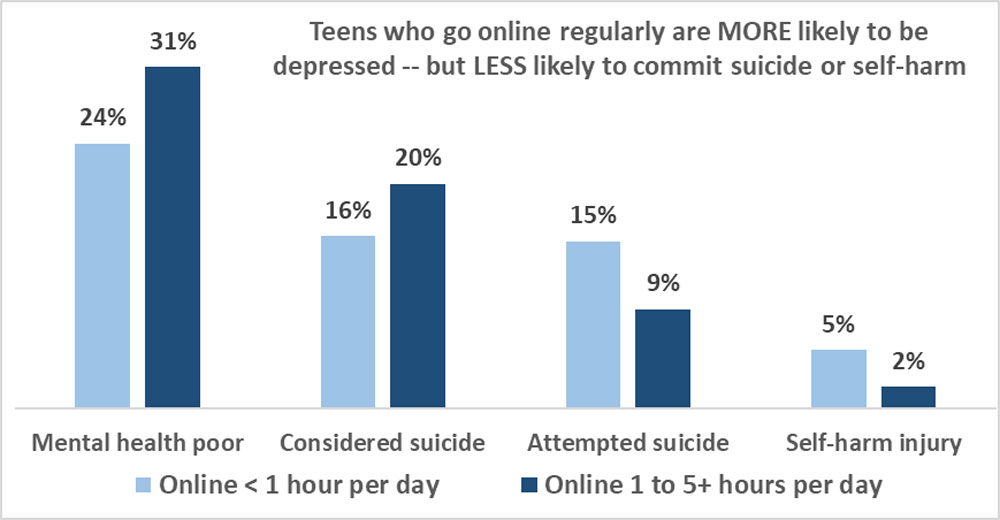
Graph Juvenile and Criminal JusticeGraph showing the relationship between teen online activity frequency, and the rate of suicidal ideation and self harm (Courtesy of Center on Juvenile and Criminal Justice)

Analysis of the full CDC survey reveals a completely different picture, beginning with a fascinating paradox. Figure 1 shows that the same online teens who report being more depressed then go on to report fewer suicide attempts and many fewer  hospitalizations for self-harm than do rarely-online teens.

Three to four times more teens are bullied at home by grownups than are bullied online or at school.

That seemingly contradictory finding for social-media-using teens – more depression, less suicide – invites scrutiny by conscientious social scientists. The reason few did is suggested by the disturbing factor the CDC survey really associates with teen depression: violent (injurious) and psychological abuses by parents and household grownups, reported by an alarming 55% of teens, including 58% of teens under age 16, 63% of girls, and 74% of the LGBQ teens.

Three to four times more teens are bullied at home by grownups than are bullied online or at school. Teens bullied at home are many times more likely also to be bullied elsewhere – a reality authorities ignore.


Want more health and science stories in your inbox? Subscribe to Salon's weekly newsletter Lab Notes.


While teens who regularly or often go online are 41% less likely to attempt suicide and 62% less likely to be hospitalized for self-harm than rarely-online teens, teens regularly abused by parents/adults are nine times more likely to attempt suicide and 20 times more likely to suffer injuries from self-harm compared to non-abused teens.

So obsessed are the most publicized authorities with social media that they overlook far more important issues. Teens whose parents lost jobs during the pandemic are 34% more likely to suffer poor mental health, 55% more likely to suffer parental abuse, 55% more likely to attempt suicide and 140% more likely to self-harm compared to teens with employed parents. In families where parents lost jobs, twice as many girls as boys reported poor mental health and frequent abuses.

Standard mathematical regression analysis of the CDC survey shows parental abuses are associated with 13 times more teen depression than superficially blamed on social media. Even the most prominent social-media-blamers like psychology professors Jean Twenge and Haidt acknowledge the effect of social media on teens’ happiness is “small”, which large-scale meta-analyses also support.

Yet, authorities persist in insisting social media must be the big culprit. It’s as if researchers studying the causes of lung cancer arbitrarily decided to exclude the biggest factor — smoking tobacco — and instead crusaded against a superficial low-level correlation like listening to country music. After all,older rural white people suffer the highest lung cancer rates.

Fact 2: The virtual world is not more dangerous than the real world

The “virtual universe… is more dangerous in many respects … than the physical world,” Dr. Haidt declares. But the nirvana many authorities assume teen life would be if unsullied by screens is the diametric opposite of teens’ reality.

Have health authorities, condemning the much-publicized increases in suicides and drug overdose deaths by adolescents over the last decade, analyzed what actually drives those tragedies?

With startling consistency, the CDC survey shows that teens who are not online are the ones most at risk of suicide, self-harm, being raped, pharmaceutical abuse, other drug abuse (especially heroin), fighting, weapons carrying, unprotected sex, school and dating violence, getting fewer than seven hours of sleep a night and missing school due to fear. A few risks, like cigarette smoking, binge drinking and marijuana use are similar among teens regularly or frequently online as among non-online teens.

Fact 3: The most troubled teens are those who benefit most from social media

Teens who report being depressed, bullied by parents or LGBQ (what the CDC categorizes as lesbian, gay, bisexual, and/or questioning sexuality) are much less likely to attempt suicide, self-harm or other risks if they are online regularly or frequently compared to their counterparts who rarely/never go online.

LGBQ teens who are online are 45% less likely to attempt suicide, 54% less likely to suffer self-harm injury, 20% less likely to get fewer than seven hours of sleep a night and much less likely to be raped, binge-drink, abuse pills, try heroin, fear going to school, etc., compared to those rarely or never online. The greater online safety of teens abused by parents and household adults is similar.

Fact 4: Social media connects teens with others who help them

The table shows that nearly all the rarely-online teens who consider suicide actually go on to attempt suicide and one-third suffer self-harm, compared to fewer than half and 10%, respectively, of teens who go online regularly or frequently. Why are online teens of all ages and genders less likely to suffer serious outcomes than their non-online counterparts?

We don’t know exactly, but there are indications. The CDC and Pew Research surveys report teens (particularly younger, abused and depressed individuals) often go online to connect with people, such as “family, friends, or other groups” who “can support them through tough times,” as Pew noted. That’s one reason why more online hours is crudely associated with more teen depression – a classic case of “correlation does not mean causation.”

Fact 5: Over 700,000 parent-aged adults died from soaring overdoses and suicides from 2011 through 2021 as teen “depression” rose – also ignored by authorities

Have health authorities, condemning the much-publicized increases in suicides and drug overdose deaths by adolescents over the last decade, analyzed what actually drives those tragedies?

Might that mass parent and adult self-destruction make teenagers more depressed?

From 2011 to 2021, deaths from suicide and overdose rose from 2,337 to 3,532 for ages 16 to 19, and from 544 to 1,052 for ages 10 to 15. Suicides and drug overdose deaths among adults of parent ages (30 to 59) soared even more, from 49,676 in 2011 to 96,522 in 2021 – exactly the period teens were becoming more depressed. During the 2011-21 period, suicides and overdoses claimed a staggering 722,000 grownups ages 30 to 59 – roughly equivalent to the entire population of Denver disappearing.

Might that mass parent and adult self-destruction make teenagers more depressed? Compelling studies strongly implicate parents’ abusiveness, mental health and drug and alcohol problems for harming teens’ mental health and fostering suicide and other risks. While the CDC did ask about parents’ abuses and unemployment (both strongly connected to more teen depression, suicide attempts and self-harm), surveys haven’t asked about grownups’ drug/alcohol, mental health, sexual abuse and related issues.

Bizarrely, today’s authorities, led by the Surgeon General, seem completely uninterested in how these glaring parent and adult crises might affect teens. No, they insist the problem is low-association villains like TikTok, Facebook, Instagram and smartphones.

Fact 6: Teenage unhappiness relates to larger social conditions

Four times more liberal than conservative teens use social media to organize and activate, Pew Research finds. Girls, in particular, have dramatically brought down their crime, unplanned pregnancy and school dropout rates and are flooding universities and job sectors in record numbers. These are hardly signs of depression. Young liberals are also much more likely to be informed about global events such as climate change. What we term “depression” and “unhappiness” seem to motivate them to action.

We need your help to stay independent

Conservatives aware of these facts must be delighted at the help of liberal politicians in cutting off their young liberal base from social-media communications, information and expression. Gleeful conservatives, exploiting the official myth that teens who report being sad, depressed and anxious must be “mentally ill,” pronounce “children with liberal parents more likely to suffer mental health problems.”

A rough test of the claim that “conservatives are mentally healthier than liberals” is that during the period in question, 2011 to 2021, suicide rates among 10 to 19-year-olds rose 1.6 times faster to levels 1.3 times higher in Republican-controlled states than in Democrat-controlled states, a trend most affecting white teens. This is yet another indication that the “depression” teenagers report today is connected much less to suicide or mental illness than to larger social issues only now being assessed.

Current discussion tells us more about authorities’ mental state than teens’

Repeated panics over young people’s mental health have surfaced every few years over the past century, featuring condemnations of dime novels, nickelodeons, jazz, horror comics, reefer madness, drug lyrics, Hollywood this or that, rock’n’roll, rap, video games and now social media. Many authorities have always found it more satisfying to point accusing fingers at popular culture and cast themselves as heroic rescuers with cries of “the children!” than to confront distressing family and social conditions. Then, we wonder why the United States can’t seem to solve its globally disgraceful social and health epidemics.

Notable exceptions exist. In a 1936 speech to young people, President Franklin Roosevelt, dismissing experts proclaiming 1930s youth as “lost” to anxiety, depression and lassitude, declared that young people were right to be unhappy. Ridiculing the “two or three or four new panaceas in every day's papers” to cure young people, FDR welcomed the young “measuring the present state of the world out of your own experiences” and actively challenging its flaws.

Such dynamic affirmations are impossible to imagine today, in which the mental state of leading authorities is more obviously in question than that of young people. Far from being a “mental health problem,” young people’s unhappiness around the world may be the instigator of critically-needed social change.

“No great loss”: Ron Goldman’s family react to the death of O.J. Simpson

Following the news that O.J. Simpson died at 76 from prostate cancer, the family of Ron Goldman — stabbed to death along with Nicole Brown Simpson — took some time to publicly react to the death of the man who will forever be linked to their family member's murder, acquitted or not.

In a statement from Ron's dad, Fred Goldman, and his sister, Kim Goldman, they write, "The news of Ron's killer passing away is a mixed bag of complicated emotions and reminds us that the journey through grief is not linear. For three decades we tirelessly pursued justice for Ron and Nicole, and despite a civil judgment and his confession in 'If I Did It,' the hope for true accountability has ended. We will continue to advocate for the rights of all victims and survivors, ensuring our voices are heard both within and beyond the courtroom. And despite his death, the mission continues; there's always more to be done."

Having fought for justice in the murder of his son for years, Fred Goldman phrased the above a little firmer in a quote to NBC News on Thursday, saying, “It’s no great loss to the world. It’s a further reminder of Ron’s being gone."

The Goldmans’ attorney, David Cook, issued an additional quote on the family's behalf, saying, “O.J. died without penance." Adding that the family is still owed more than $100 million as part of a previous judgment, which they hope to recoup from Simpson's assets. 

Michael J. Fox says fame in the ’80s required talent, unlike today

When Michael J. Fox became a household name with his breakout role as Alex P. Keaton on the NBC sitcom "Family Ties" — which ran from 1982 to1989 — he and other actors who came up alongside him didn't have social media as a tool to help boost their fame, ensuring an open tap of information flowing into a 24-hour news cycle. They had to rely on something different. 

In a recent interview reflecting on the heyday of his career, Fox compares '80s fame to the fame of present day, saying things were tougher back then because they had to rely on skill to make and keep them famous where, now, a viral TikTok can do it.

Speaking to PEOPLE, Fox recalls being referred to as ‘80s famous, saying, "We were different. We were tougher. We didn’t have social media, we didn’t have any of that c**p. We were just famous. Left to our own resources. And it was an amazing time." And when asked to weigh-in on whether or not it was harder to be famous back then, he replied, “Well, you had to be talented. That helped.”


Trump wants debates with Biden to start as early as possible — and he wants more of them

Ramping up to the grand finale this election year, a proposed debate schedule has been laid out for Donald Trump and Joe Biden to go head-to-head on key policy issues, with the first debate set to take place on Sept. 16, the second on Oct. 1, and the last to take place on Oct. 9. But in a letter drafted by Trump’s co-campaign managers on Thursday, they're pushing to get these going a bit sooner, with additional debates added on to give voters a chance to hear everything they need to hear before pushing buttons at the polls. 

“While the Commission on Presidential Debates has already announced three presidential debates and a vice-presidential debate to occur later this year, we are in favor of these debates beginning much earlier,” Trump’s co-campaign managers Susie Wiles and Chris LaCivita said in their letter, highlighting their concern that the proposed calendar “simply comes too late" when factoring in the number of Americans who will be voting early.

Wiles and LaCivita added that moving things up will “ensure more Americans have a full chance to see the candidates before they start voting, and we would argue for adding more debates in addition to those on the currently proposed schedule.”

During the Republican primary debates, Trump sat on the bench, but now that the finish line is in sight he says he's willing to debate Biden “anytime, anyplace and anywhere,” starting “now,” according to NBC News. 


For the first time since 1972 someone’s landing on the Moon — and they aren’t an American

For the first time since 1972, an astronaut is expected to set foot on the Moon — and for the first time in history, that astronaut isn't an American. As reported by USA Today, President Joe Biden and Japanese Prime Minister Fumio Kishida announced in a Wednesday press conference that the widely international team behind the Artemis lunar landing mission will see Japanese astronauts take a historic step on the surface of our nearest celestial neighbor. 

Emphasizing the two nations' long-held ties in science and education, Biden told reporters "Those ties stretch up to the Moon, where two Japanese astronauts will join future American missions, and one will become the first non-American ever to land on the moon.”

The two leaders met at the White House during Kishida's official Washington visit. While several countries and private companies are currently collaborating with NASA on its Artemis mission, Japan will reportedly be the one to provide and maintain a pressurized rover to support astronauts living and working on the moon. Astronauts are expected to be able to travel further distances and conduct research work for longer periods on the lunar surface with the help of the pressurized rover. The White House also recently instructed NASA to create a lunar time zone, to make such missions more cohesive.

Astronauts Neil Armstrong and Buzz Aldrin on Apollo 11 became the first humans to walk on the moon on July 20, 1969. American astronauts Gene Cernan and Harrison Schmitt — on Dec. 14, 1972 via Apollo 17 — were the last humans to set foot on the moon, concluding the Apollo moon mission. The Artemis mission not only aims to return astronauts to the surface, but to coordinate a long-term plan to use the moon as a potential base for further missions to space, including missions to Mars. While the Moon is a major target for our advancement in space, some experts have said that we are already trashing our nearest neighbor, which could be another indicator of the Anthropocene era.

Control of Wisconsin Supreme Court will be up for grabs after liberal justice’s surprise retirement

One year after a closely-watched election tipped the Wisconsin Supreme Court towards a 4-3 liberal majority, the impending retirement of a liberal justice, Ann Walsh Bradley, is teeing off another battle for control of the state's highest court.

Bradley announced Thursday that she will not run in the April 2025 election for another 10-year term, NBC News reported.

"My decision has not come lightly," Bradley wrote in a statement. "It is made after careful consideration and reflection. I know I can do the job and do it well. I know I can win re-election should I run, but it's just time to pass the torch."

The Wisconsin court's ideological balance has enormous ramifications for a range of issues, including abortion access and redistricting. Conservatives long held the reins of legislative and judicial power in Wisconsin until the most expensive state Supreme Court campaign in U.S. history elevated liberal justice Janet Protasiewicz to the bench in April 2023. Her victory was followed by GOP threats to impeach her.

The new liberal majority (the court is technically nonpartisan) promptly ruled that the GOP gerrymander of Wisconsin's state legislative maps was unconstitutional. New, compromise maps that were agreed to by the legislature and Democratic Gov. Tony Evers provide Democrats with an opening to make gains in the state legislature, where they have struggled to gain control despite recently winning a skew of statewide elections.

With the last Wisconsin Supreme Court election as precedent, gerrymandering and reproductive rights will almost certainly be at the forefront of a bitter and expensive 2025 election. Former Republican Attorney General Brad Schimel announced last year that he intends to run for a seat on the highest court. With Bradley's retirement, many others are likely to join the competition.

“Increasingly desperate”: Experts say Trump’s repeated delay bids “trying the patience” of judges

Donald Trump's attorneys have vaulted three efforts this week aimed at pushing back the former president's trial on charges alleging he covered up a sex scandal ahead of the 2016 election. After two failures, the most recent bid — a last-minute civil action against presiding Judge Juan Merchan filed Wednesday— promptly followed suit.

Just hours after filing, appellate court Judge Ellen Gesmer rejected Trump's request seeking a delay while the appeals court reviews several of Merchan's rulings, according to The New York Times. The decision allows Trump to have his lawsuit heard by a full five-judge appellate panel, which could pause the trial if they rule differently but not until after it begins Monday, The Hill notes.

Following the episode, "I would say he does look increasingly desperate, but he knows he's going to lose," Loyola Law School professor Laurie Levenson told Salon, speculating that Trump might be trying to "make some kind of record" for another purpose. 

Part of Trump's efforts "is designed for the judges who handle the courtrooms," Levenson added. "He's going to lose there, but he can take snippets out of this and use it for his media and the court of public opinion and to sort of set up an argument that it's been an unfair proceeding."

While stalling is one of the former president's go-to legal tactics across his four criminal cases and other legal battles, his effort to delay the Manhattan trial by taking legal action against a judge and bombarding an appellate court with a week's worth of eleventh-hour delay tactics is a bold move, the Times notes.

Trump's rapid-fire efforts to delay suggest the presumptive Republican nominee is "fearful," especially as election polls indicate his possible conviction "could have an impact on his 2024 presidential campaign" and his standing with voters, David Schultz, a Hamline University political science and legal studies professor, told Salon.

Defendants "almost never" mount appeals before a trial, with a court "maybe" getting just one like Trump's pretrial, Schultz explained, emphasizing that courts instead prefer to address any problems that arise later. The swift rejections of Trump's slew of motions to delay makes clear he is "trying the patience" of the appeals court, he said.

"Trump is getting away with an incredible amount because he's ex-president and he's wealthy," Schultz argued, adding: "I think almost any other attorney representing almost any other client would be warned at this point against bringing any more frivolous motions and facing possible sanction."

Trump's Wednesday civil action against the judge — a special proceeding referred to as an Article 78 that's used to challenge New York State agencies and judges — included a request that the appeals court stay the case while it considers whether to remove Merchan, whom Trump's legal team argues has a conflict of interest because of his daughter's work as a Democratic political consultant, from the trial.

We need your help to stay independent

Experts previously told Salon that Merchan's daughter's work does not present a conflict, and the judge has previously declined to step down from overseeing the case, citing a judicial ethics panel reaching a similar conclusion last year.

Their first bid this week to delay the Manhattan case — which will be the first of his four criminal cases to go to trial — was "more traditional," the Times notes, in asking to delay while the judges consider his request to change the venue to Staten Island, where Trump 2016 and 2020 election victories. That effort, which, if granted, would have postponed the trial indefinitely, was denied Monday.

The second was a separate Article 78 action against Merchan the same day, which saw Trump's lawyers asking the appeals court to delay the trial as it mulled his request to overturn his gag order. An appeals court judge declined the request.

Still, the former president and his legal team are poised to indulge in requesting further delays as the walls close in on the trial, experts predicted.

"It’s hard to imagine what other far-fetched tactics they might try but if they can find any claim that might be stretched to apply here we can be sure they will use it," Catherine J. Ross, a George Washington University constitutional law professor, told Salon.


Want a daily wrap-up of all the news and commentary Salon has to offer? Subscribe to our morning newsletter, Crash Course.


One of the last tactics Trump could pull out is firing his lawyers, Norman Eisen, a Brookings senior fellow and CNN legal analyst, told the network Wednesday, pointing out however that it's "been tried before in New York and rejected."

Schultz speculated that Trump may seek to appeal the case to the Supreme Court, either on First Amendment grounds — based on his lawyer's claim during Tuesday's emergency hearing that Trump's ability to campaign is "protected under the First Amendment" — or by attempting to tie it in with the high court's presidential immunity case, in which it will hear oral arguments later this month. 

While the latter scenario is "unlikely," Schultz said, the former would be an "incredibly strange argument to make" predicated on a claim about rights to campaign "that's about as frivolous as it possibly could be in terms of arguments."

Levenson agreed, insisting that should Trump try to appeal to the Supreme Court, the justices will not take the case. Even if they did, she said, "I don't think he would win."

Instead, she sees a potential for the change of venue request to become "the most plausible basis for a legal argument" as the court, starting next week, navigates selecting a jury that will allow Trump to have a fair trial.

"I don't think we can say now that there are no more avenues for him to seek delay," Levenson added. "There are no more obvious avenues, but I don't know that we can say there are no more avenues." 

Even with the range of increasingly obscure possibilities at delaying the trial available to him, Ross said Trump's "chances for success seem to be slim to none." If Trump's lawyers had "a strong claim, they would have used it already," she argued, noting that the courts "are onto their game."

The New York court system is "making it clear" to the former president that he's "like any other defendant": he will face a trial starting Monday and can raise any grounds for appeal after trial concludes if he has grounds to do so, Schultz added. 

"He's had several bites of the apple at this point," he said, adding: "He's O for three. The Court of Appeals is saying, 'Just do the trial.'" 

Your family and friends will be head over heels for these two scrumptious shrimp appetizers

Shrimp Butter is so easy that I take it for granted.

With only a few staple ingredients and a meager half-pound of shrimp, you have an appetizer that pays you back in spades for what you put forth to make it. It is simple, luscious and satisfying, like fresh, warm bread slathered with whipped butter, only more heavenly because of the shrimp.

It is an elegant, old-fashioned recipe that has stood the test of time.

Its soft pastel, barely-there shade of coral-pink makes Shrimp Butter a perfect addition to a bridal or baby shower menu, but it adds grandness to any table regardless of the occasion. Served individually as part of a bread course in butter-pat dishes accompanying warm sourdough or crusty French loaves, or put out as a self-serve spread with crackers; it is always a hit.          

Cheesy Shrimp Canapés, on the other hand, are dazzling and have a little more to say. They are rich and tempting with an incredible aroma when they come out of the oven. Served warm or at room temperature, they are a celebrated star at any cocktail party. 

Made with cooked shrimp, creamy, nutty Gruyere (or Swiss) and lemony hollandaise, this masterpiece mixture is distinctive and heavy on pizzazz. Once it is spooned atop little bread platforms and baked to bubbling, the resulting bites are what dreams are made of. From high brow gourmands to picky grandmothers, these beauties are nothing if not universally appreciated.   

And, as if I have not bragged on them enough, they are not messy! These enticing hors d’oeuvres stay put when you pick them up and do not fall apart, crumble or drip onto your party dress when you bite into them. (The secret is to use thin bread and a small spoon.)

A general note for both recipes: If you have a local seafood shop that will do so, pick up shrimp that have been seasoned and steamed. Our local markets do this while you wait. If you need to cook the shrimp yourself, bring to boil enough salty water to cover (also add a few shakes of Creole seasoning, if desired), then add shrimp. Boil for 4-5 minutes or until shrimp curl into a “c” shape. Rinse in cold water.

Cheesy Shrimp Canapés
Yields
20-30 appetizers
Prep Time
20 minutes
Cook Time
12 minutes

Ingredients

1/2 pound headless shrimp  boiled, peeled, deveined 

*1/2 cup hollandaise sauce, divided 

1/2 cup shredded Gruyere cheese (or Swiss cheese)

2 tablespoons chopped pimentos (or roasted red peppers) 

Baguette or cocktail bread, thin sliced and lightly toasted

Paprika

*See Cook’s Notes for my favorite hollandaise recipe that takes minutes to whip up and will keep in the refrigerator for several days.


Directions

  1. Preheat oven to 350F. Cut shrimp into small pieces and add to a mixing bowl.

  2. To shrimp, add 5 to 6 tablespoons hollandaise (reserving 2 to 3 tablespoons), plus the shredded cheese and chopped pimentos.

  3. Stir together gently, then spoon onto thin slices of lightly toasted baguette or cocktail bread.

  4. Do not overload the bread slices with large mounds of shrimp mixture.  

  5. Next, dot remaining hollandaise equally on top of each. 

  6. Lightly dust with paprika.

  7. Bake at 350F for 10-12 minutes or until bubbling hot.

  8. Serve immediately. 


Cook's Notes

Hollandaise Sauce:

4 egg yolks, room temperature

3/4 teaspoon salt

1/2 teaspoon dry mustard

1 tablespoon mayonnaise

1 stick of butter, melted

1/3 cup hot water

1/4 cup lemon juice, or more to taste

You can use a double boiler over low simmering water, or you can place a large cup, like a glass measuring cup, in the simmering water — either works. Mix yolks, salt, mustard and mayonnaise and while whisking constantly, drizzle in melted butter, then add hot water. Cook until thickened then add lemon juice.

We need your help to stay independent

 Shrimp Butter
Yields
pint
Prep Time
10 minutes

Ingredients

1 pound headless shrimp that have been cooked, peeled, deveined

1/2 cup butter, close to room temperature

1 8-ounce package cream cheese, close to room temperature

4 tablespoons mayonnaise

1/2 to 1 teaspoon garlic salt

1/8 cup minced onion

Juice of 1 lemon

Paprika to sprinkle on top

Optional garnishes: parley, sliced lemon and/or save a few whole shrimp to place on top when serving.


Directions

  1. For a creamier spread: Place butter, cream cheese, onion, mayonnaise, lemon juice and garlic salt in a food processor and mix to combine in short pulses, scraping down sides as needed. Chop shrimp into small pieces and add them to food processor and pulse a few more times. It should still have texture but be relatively smooth.

  2. For a chunkier dip: Beat cream cheese and butter until smooth thin stir in lemon juice and garlic salt. Make sure the onion is very tiny minced, then stir in. Chop shrimp small and add them in.

  3. Both versions should rest in the refrigerator after being made. When ready to serve, chilled or at room temperature, place in a decorative bowl surrounded by assorted crackers for a self serve appetizer.

  4. Adjust salt before serving if you are using unsalted crackers, toast points, or bread.    

Why YouTube shouldn’t have removed the suicide warning from the “Joker: Folie à Deux” trailer

YouTube on Thursday removed the trigger warning it previously affixed to the trailer for the forthcoming "Joker: Folie à Deux" a day earlier though it's not entirely clear why.

The nearly two-and-a-half-minute teaser for the Warner Bros' musical film dropped Tuesday, showing the return of actor Joaquin Phoenix as Arthur Fleck — a mentally unwell street clown who becomes the Joker — meeting his female counterpart and lover, Harley Quinn (Lady Gaga) at Gotham's Arkham Asylum. As of Wednesday morning, prior to viewing the trailer, viewers were presented with a discretionary message, warning that the clip "may contain suicide or self-harm topics," per NBC. Viewers were then prompted to click a message reading, “I understand and wish to proceed.”

The scene of the trailer in question, it seemed, showed Harley Quinn making a finger gun pointed at her head before pulling the "trigger." 

“I’m nobody. I haven’t done anything with my life like you have,” the villain says as she pretends to shoot herself.

Upon reading the initial reports that the trigger warning had accompanied the trailer, I was pleasantly surprised. While I hadn't been personally affected by any of its content, I could understand why a gun-like gesture, seemingly innocuous to some, might have serious implications for others. 

But by Wednesday afternoon, YouTube had pulled the warning. “We determined that our systems applied the warning interstitial incorrectly,” a YouTube spokesperson told Variety. “The trailer remains available on YouTube without a warning.”

We need your help to stay independent

It's worth keeping in mind the dark and disturbing subject matter of the first "Joker" film, released in 2019. The movie heartrendingly chronicles the downward spiral of Fleck, a socially awkward, impoverished man who lives with his abusive mother. Plagued by misfortune and a litany of compromising and humiliating situations, Fleck eventually succumbs to a life of crime as the Joker. 

Sean Durkin's "The Iron Claw," a 2023 sports drama about a real-life American family, had the opposite problem. The trailer advertised a lighthearted, rustic flick about a group of brawny brothers with a generational affinity for wrestling. Ultimately, however, depictions of multiple suicides figured as the focal point of "The Iron Claw," with several of those portrayals contributing to potential risks, per experts who spoke to Salon. 

Given that research and data have shown that fictionalized on-screen depictions of suicide can lead to an increase in suicidal ideation or suicide outright, disclaimers about potentially graphic content could undoubtedly be useful in mitigating potential risks. 

While the difficult themes the "Joker" explores (which Folie à Deux will likely delve into as well) don't detract from the film's documented success, and perhaps only contribute to it, the social and mental struggles the Joker endures could easily be reflected in any number of viewers. Everyone internalizes content subjectively and contextually. What doesn't affect one person could be catastrophically influential to another. 

What's the harm, then, in including a trigger warning? Wouldn't it be better to stave off potential damage incurred by sensitive content than to leave it to chance? Creating a metric for measuring what qualifies as "triggering" certainly presents its own set of obstacles; however, if the biggest ostensible challenges are reading a message for a few additional seconds before bypassing it with the click of a button, there's really no reason why such warnings shouldn't be more liberally applied.

If you are in crisis, please call the 988 Suicide and Crisis Lifeline by dialing 988, or contact the Crisis Text Line by texting TALK to 741741.


“They’re not talking to the working class”: Meghan McCain slams “View” hosts about “rot in media”

Meghan McCain left "The View" three years ago, but can't seem to let it go. Since the end of her tenure at the flagship ABC daytime talk show, the former political commentator continues to reveal more of her behind-the-scenes experiences. This time, McCain chose to call out her former colleagues for being out of touch with working-class people. 

McCain took to her podcast "Meghan McCain Has Entered the Chat" to address her long-standing beef with the show and its co-hosts. In Tuesday's episode of her podcast, McCain recalled a moment to her listeners during her tenure at the ABC show, "I was in a particularly heated Hot Topics meeting. I remember yelling at the meeting that, 'Some of you' or 'All of you are going to have to start interacting with people who don’t make $100,000 a year or more."

She continued, telling some of her co-hosts, "'You have to interact with someone who makes minimum wage on some level or another.'"

The daughter of the late Arizona Sen. John McCain said that her "experience working in much of corporate media" was watching wealthy TV commentators "live in $20 million Upper West Side mansions or apartments" and "take their Teslas to the Hamptons or Sag Harbor on the weekend with their family and then they come back."

"That is their life every day. Part of the rot in media is because they’re not talking to the working class," she stated.

McCain did not call out any of her former co-hosts by name, but the show's lead moderator and Hollywood veteran Whoopi Goldberg's net worth is an estimated $60 million. Other hosts like Sara Haines and Joy Behar have made jokes about Goldberg's wealth. McCain could have also been making a jab about co-host and attorney Sunny Hostin who wrote the novel "Summer on Sag Harbor." Sag Harbor, which McCain referenced in her podcast, is a town in the Hamptons.

This isn't the first time that McCain has publically aired out her grievances with "The View." As the first host who left on her own, McCain has had plenty to say about the workplace culture and environment on the ABC show. In a podcast interview last month, McCain that she was cast as “the enemy” because the entire show is “leftists.” 

Moreover, McCain said that her former co-hosts “hate conservatives and men,” both on and off camera. Mostly, McCain felt like she was “punished” for representing the conservative opinion in the show, especially after Donald Trump's presidency and the pandemic.

Despite saying she no longer wanted to talk about her tenure at "The View," in another interview in January, McCain called co-host and Republican Ana Navarro, “a surrogate for the Biden campaign. A literal surrogate."

McCain departed the daytime talk show following several viral on-air arguments with her co-hosts. But the last straw for McCain was an incident with Behar. After she had just returned from maternity leave, Behar told McCain on air "Nobody missed you, we didn't miss you, you shouldn't have come back."

"The View" has not responded to a request to comment, Entertainment Weekly reported.

Biden says he’s “considering” Australian request to drop charges against Julian Assange

Julian Assange, the WikiLeaks founder currently held in British custody, may soon find some reprieve. After five years of living under a U.S. indictment that charges him with 17 counts of violating the Espionage Act, The Guardian reported that President Joe Biden is weighing a request by the Australian government to drop the case.

“We’re considering it," Biden told reporters Thursday.

The U.S. government has repeatedly sought Assange's extradition so that he could stand trial for his role in obtaining and leaking hundreds of thousands of classified State Department cables and military documents in 2010. The Wall Street Journal reported last month that the U.S. Justice Department is considering a deal in which Assange, an Australian citizen, would plead guilty to mishandling classified information, a less severe charge than espionage. Under the current charges, Assange could face up to 175 years in prison.

In 2019, U.S. officials said that in publishing state secrets, Assange had exposed confidential human sources "to the gravest of dangers." Federal prosecutors initially pursued Assange on hacking charges in 2018; an expanded indictment a year later added the 17 espionage counts. Several press freedom groups and human rights watchdogs maintain that prosecuting Assange would have a chilling effect on journalists seeking to expose government wrongdoing.

In February, the Australian parliament, with support from Prime Minister Anthony Albanese, voted to call on the U.S. and U.K. to allow Assange's return to his home country. Biden's latest signals have given Albanese some hope that the pressure is working. "I'm increasingly optimistic about an outcome, but one certainly has not been delivered yet," he said in an interview with Sky News Australia. "We'll continue to argue the case at every opportunity that we have."

Drinking apple cider vinegar may help with weight loss but its health benefits are overstated

Each morning at breakfast, my partner gives me orange juice that tastes more sour than expected. One day, she explained that she adds apple cider vinegar to improve my health.

As a former primary schoolteacher she swears by the stuff. She tells me she kept apple cider vinegar in the staff room so that when children became ill with diarrhea and vomiting, she could take it immediately to protect her from the illness.

I was sceptical about yet another immune-boosting miracle ingredient. Apple cider vinegar is a natural product made of fermented apple juice that has gone sour. Apparently, the best stuff is cloudy and has sediment, known as the "mother", because it is relatively unfiltered – this is where the good bacteria lives. Without the mother, there's unlikely to be much benefit to taking apple cider vinegar.

But is there any real benefit in the first place? I decided to turn medical sleuth and investigate whether apple cider vinegar is as good for health as it sounds. There isn't as much scientific evidence to support its popularity as a health tonic as some influencers might like to think.


Claim: disinfectant properties

Vinegar has a long history as a surface decontaminant and perhaps this is why salad dressings contain vinegar – as well as adding flavour, it may kill micro-organisms on raw vegetables.

But does apple cider vinegar's decontaminant qualities translate to the human gut? Our stomachs produce acid, which acts as a natural barrier to infection, so how can adding more acid help?

Research suggests that apple cider vinegar delays stomach emptying so perhaps increased time in contact with stomach acid might account for the claimed protective effect against enteric infections.


Claim: weight loss and management of type 2 diabetes

There are plenty of anecdotal claims that apple cider vinegar can aid weight loss, supported by limited evidence from several small studies. A randomised controlled trial published in early 2024 showed significant reductions in weight and waist size of 120 overweight and obese young people. There were also reductions in serum triglycerides – blood fats that can raise the risk of heart disease if levels are too high – and cholesterol over the three-month follow-up period.

A systematic review from 2020, however, found evidence of only marginal benefits citing  "insufficient evidence". Another subsequent systematic review from 2021 – looking at dietary supplementation with acetic acid from all vinegar types – found evidence of significant reductions in fasting blood glucose, particularly in individuals with type 2 diabetes. The study also showed benefits in reducing serum triglycerides and cholesterol.

So how might these effects work? Apple cider vinegar is thought to cause weight loss through its effect on delay of gastric emptying. This increases a sense of fullness and reduces appetite. Reduced calorific intake will lead to weight loss – but how are the metabolic effects on blood glucose and lipids mediated?

Blood glucose levels are controlled by the pancreatic hormone insulin. In type 2 diabetes there is a reduction in sensitivity to insulin which in turn leads to a reduced uptake of glucose by cells. There is some evidence that apple cider vinegar – and other sources of acetic acid – improves insulin sensitivity so it's possible that there are some benefits for those with this condition. Since high blood glucose levels are associated with high serum lipid levels, the associated reduction in blood glucose levels caused by improved insulin sensitivity should improve in blood lipid profiles as demonstrated in literature reviews.


Claim: reduces risk of heart disease

Raised blood lipids are a risk factor for cardiovascular diseases such as myocardial infarction and stroke. Can apple cider vinegar consumption reduce their incidence? Well, I'm afraid there's no scientific evidence that vinegar consumption of any kind reduces cardiovascular morbidity and mortality in those with or without diabetes. For those without diabetes, the benefits of vinegar consumption on blood lipid levels are less clear, as suggested in this study from 2013.


Claim: cancer treatment and prevention

One of the more outrageous claims of benefits of daily apple cider vinegar consumption is that it may prevent or treat cancer. A frequently quoted case-control study from China found that an increased consumption of vinegar was associated with a reduced incidence of esophageal cancer. What some popular internet sources who cite this study don't say is that eating beans and vegetables was also found to be protective, as well as was eating a diet with a normal salt intake and drinking water from a tap. There are always multiple confounding factors when claims are made concerning cancer and we must always be on our critical guard.

Should I continue to take my apple cider vinegar adulterated orange juice each morning? The evidence suggests that it will help with my waistline and my weight so I'll put up with the sour taste for a while longer.

Stephen Hughes, Senior Lecturer in Medicine, Anglia Ruskin University

This article is republished from The Conversation under a Creative Commons license. Read the original article.

“Unindicted coconspirator” in Trump case under investigation for role in 2020 “fake elector” scheme

One of Georgia's top elected Republicans is now under investigation for his role in a "fake elector" scheme that aimed to steal the 2020 election for former President Donald Trump.

In a two-sentence press statement, the Prosecuting Attorneys' Council of Georgia, which provides legal support to district attorneys across the state, announced that its executive director, Peter J. Skandalakis, "or his designee," would lead an investigation into Lt. Gov. Burt Jones.

Jones was identified as "Unindicted Co-Conspirator Individual 8" in Fulton County District Attorney Fani Willis' indictment of Trump and others for 2020 election interference, per reporting by the local Fox TV affiliate. But Willis herself was barred from prosecuting him after a judge ruled she had a conflict of interest, the outlet noted, prompting calls for Skandalakis to take over the case.

Jones is accused of helping to organize the fake elector plot, which aimed to replace Georgia's actual electors with an alternate and illegitimate slate of pro-Trump partisans. That scheme, which was assisted by key members of Trump's reelection campaign, came after the former president lost the state by more than 12,000 votes.

Jones, who was elected as a state senator in 2020 before seeking the lieutenant governor's office in 2022, has proclaimed his innocence.

“I’m happy to see this process move forward and look forward to the opportunity to get this charade behind me,” he said in a statement Thursday, as reported by The Atlanta Journal-Constitution.

Unpacking the legal shockwave of a Civil War-era abortion law upheld by Arizona Supreme Court

For the last year and a half, women in Arizona could legally access an abortion up to 15 weeks of pregnancy. It wasn’t “optimal,” Scottsdale-based OBGYN Dr. Julie Kwatra told Salon, but at least for a vast majority of people seeking an abortion, they could access it in their state.

But this week, everything changed. On Tuesday, the Arizona Supreme Court upheld a 1864 law some are condemning as "draconian" — passed long before Arizona even achieved statehood — that will ban nearly all abortions in the state. The decision effectively supersedes the lower court’s ruling on a 15-week ban that happened in 2022. While the state’s highest court put the decision on hold for 14 days, and sent it back to the lower court to consider “additional constitutional challenges,” as it stands the law going into effect is likely imminent.  

“Whether it's in 14 days or 60 days because of some legal wrangling, we're not sure when it actually goes into effect, but it will go into effect,” Kwatra said, who also serves as legislative co-chair for the American College of Obstetricians and Gynecologists. “We just don't know exactly when.”

When the law does go into effect, it will have grave consequences for all pregnant women in the state as well as healthcare providers like Kwatra. Specifically, the law says anyone who “provides, supplies or administers to a pregnant woman, or procures such woman to take any medicine, drugs or substance, or uses or employs any instrument or other means whatever, with intent thereby to procure the miscarriage of such woman, unless it is necessary to save her life, shall be punished by imprisonment in the state prison for not less than two years nor more than five years.” There is no mention of an exception for rape or incest.

In other words, there is a mandatory two-year prison sentence for anyone providing an abortion or who “procures” the “miscarriage” of a “woman.” Such a strict change in access to care is causing anger and shock among both providers and patients, Kwatra said.

"It feels cataclysmic from that end, and what I'm feeling for my patients is just a lot of anger."

“For both providers and patients, I think it is the shock of how fast things can change and knowing that the practice of medicine has to change overnight and for patients, knowing that something that was available to them is completely unavailable to them overnight,” she said. “It feels cataclysmic from that end, and what I'm feeling for my patients is just a lot of anger.”

Phoenix-based criminal civil rights lawyer and constitutional law expert Robert McWhirter told Salon the highest court’s ruling will take effect after the stay. Anyone deemed to provide an abortion and any doctor that participates in an abortion will face criminal charges. He added that the law has a seven-year statute that can complicate the situation in the future. Arizona Attorney General Kris Mayes said in a statement “no woman or doctor will be prosecuted under this draconian law in this state,” as long as she is an attorney general. 


Want more health and science stories in your inbox? Subscribe to Salon's weekly newsletter Lab Notes.


“Even if there's Democratic politicians in power now, if a Republican politician gets in and wishes to choose to enforce that statute, they've got seven years. If something gets committed now they can prosecute it seven years from now,” McWhirter said. “So you're not gonna get prosecuted under Kris Mayes as attorney general. But after she leaves office, you could still get prosecuted for what you did whilst Kris Mayes was attorney general.”

David S. Cohen, a professor of law at Drexel Kline's School of Law, emphasized to Salon that the “conclusion” of this story “has yet to be written."

"The doctor has one interpretation and some county prosecutor has a different opinion, and there you go, you’re going to be charged."

“We’ve got the attorney general saying I'm not going to prosecute, we've got the governor saying we're going to wait 45 days to implement this, and we've got the case being remanded to the trial court for constitutional claims,” Cohen said. “Patients deserve to know that this law is not going into effect immediately and continuing to be challenged.”

Cohen added that Planned Parenthood will provide abortion care up to 15 weeks of pregnancy throughout May. Like similar laws that have nearly banned abortions in other states, the ambiguity of interpreting the law is expected to affect care in life-or-death situations, despite there being an “exception for the life of the mother.”  

“It’s kind of hard to know what that means,” McWhirter said. “The doctor has one interpretation and some county prosecutor has a different opinion, and there you go, you’re going to be charged.”

McWhirter said the law doesn’t protect termination of pregnancy if a fetus has a fatal fetal anomaly, unless the pregnant woman’s life is clearly in danger. 

Kwatra said as far as she understands, she will legally be able to treat ectopic pregnancies, in which a fertilized egg implants and grows outside of the uterus in the abdomen, and has zero chance of survival. She will be able to provide standard care for miscarriage management, too.

We need your help to stay independent

“But in general, we know there's a really good chance that this is going to delay or deny care to patients that need it,” she said. “Where we hit the gray areas is women who come into the hospital with a wanted pregnancy, but they have an infection or ruptured membranes and as an OBGYN, we're having to deliver them with the fear of criminalization and causing an abortion.”

“Life of the mother,” Kwatra said, is a “vague construct.”

“It’s not well defined, obviously, as it was from 160 years ago,” she said. “And we should not be operating under that same law.”

Notably, a majority of people in Arizona want to protect access to abortion, previous polls have shown. Cohen said what the Arizona Supreme Court did was highly “anti democratic” and that the idea it has any reflection of what people or Arizona want today is “completely far-fetched.”

McWhirter said the Supreme Court’s opinion suggests that Civil War-era law reflects the “will of the people,” but that’s wrong. 

“No woman could vote and no woman was in the legislature that passed that statute, and the majority of persons of color could not vote. “So to say that this reflects the will of the people is just wrong.”

Apples are the only thing that can save me from over-eating

A few apples a day can keep the guilt away . . . or whatever mom used to say. 

I don't want to act like I have discovered a foolproof plan, and no, you will not shed an "Ozempic amount" of pounds by following me; however, I have found a natural way to curb your appetite while still being able to enjoy some of your favorite foods in moderation. 

I love food and I know this is something that we expect all hungry and greedy people like me to say, but my story goes deeper. There's something extremely satisfying about that first bite into a burger with the perfect temperature, buttery golden eggs fried just right, or that last slice of cheesy, greasy pizza. I could literally go out to eat at a restaurant every day of the week if it weren't so expensive.

Having this kind of appetite is not sustainable, though, especially if you want to avoid being stretched across the hospital bed with a blood pressure of 300 over 200. So, what do we do?

Many people feel like the answer is forcing yourself to love unseasoned salmon and lettuce for your three meals a day. And sure, you may be able to get through a week or so, but you will get so bored that I guarantee you'll run right back towards that greasy pizza — and there's nothing wrong with that, outside of forgetting the reason why you tried clean eating in the first place.

Food is good and we deserve delicious meals just like we deserve to be healthy; I think this can be done in moderation. I had this conversation with my mother, who is also on a health journey. 

For context, my mother is pretty healthy for a woman in her early 60s. She moves around well, takes long walks when the weather is nice and is relatively small — she can even fit into her clothes from decades ago.

We need your help to stay independent

"Hey, what's your secret, ma?" I asked, complimenting her size, during our last extensive food conversation. 

She gave me a long, dense answer, talking about fiber and bowel movements, and yes, I'm going to spare you. Not because I black out and instantly transform into an immature child anytime a person starts talking about feces, but apples. Apples was her point and the answer. 

"I don't have a datasheet or publishable statistics, but I noticed that I didn't eat as much during the first week. "

My mother's secret is apples. She started eating two or three apples daily and was less hungry and maintained the same amount of energy, if not more. 

So, I tested her theory. I don't have a data sheet or publishable statistics, but I noticed that I didn't eat as much during the first week. My wife and I have been notorious for eating dinner at 9:00 and 10:00 at night, but on the days I've had two or more apples, I found it very easy to wait until the next day. Knowing this, I decided to start eating an apple with every meal. It doesn't matter if I'm eating something healthy like that unseasoned salmon or that pasta dish that is deserved after having long weeks — I always started with one apple. 

I have been doing this for about two weeks now and notice that I cannot eat as much. Yes, I can have steak frites and pizza and whatever, but if I have an apple first, I will only be eating a portion of my main course. If I eat that apple first, I won't be demolishing a whole burger — only half (and maybe a few fries.) 


Want more great food writing and recipes? Subscribe to Salon Food's newsletter, The Bite.


The beauty of this is that the apples are easy to carry around as I keep a bowl in my house and a bag with three or four of them in the car. So even when I'm mobile and have to eat on the run, I always have an apple available. You can do this with celery, cucumbers and other vegetables, too. 

I challenge you to eat an apple or a few pieces of celery before you eat that burger and I guarantee it will be harder to finish. Dessert may not even be an option! Now that's moderation. 

I understand that this may not be the most practical thing in the world to try, but I loaded up on apples and I'm going to continue this journey because I'm eating a lot less, still enjoying the food that I love and I feel great.

The enduring feminist legacy of Hole: 30 years later, must we still “Live Through This”?

Decades after its April 1994 release, Hole's iconic album "Live Through This" remains a poignant testament of enduring relevance to feminist discourse. As the album commemorates its anniversary, BBC Sounds is offering up eight hours of "Courtney Love's Women," a deep-diving interview series reflecting on many of the female musicians who have inspired her work over the years. It will be interesting to hear how Love lays bare the web of influences that helped spawn "Live Through This," and it's equally important to plot Love's own point in that web as a foremother of the feminist creative juices that flow into our present time over the 30 years since the release of that album. With its raw emotion, unapologetic lyricism and unbridled energy, "Live Through This" not only revolutionized the alternative rock scene but also served as a rallying cry for feminist expression.

One of the most striking aspects of "Live Through This" is its unabashed portrayal of female experience that certainly shared in the raging sentiment of the times.

At its core, the album embodies the spirit of riot grrrl, a feminist movement that emerged in the early 1990s, advocating for gender equality, challenging societal norms and empowering women through do-it-yourself activism that treated the music industry as a site of cultural production that was begging for significant disruption. Hole, led by the fearlessly complicated Courtney Love, became synonymous with this movement in using their music as a platform to confront issues such as sexism, abuse and the complexities of female identity.

Love would probably still disagree with this characterization, as she did in the lyrics to “Rock Star” that explicitly made fun of riot grrrl by arguing that their template for activism was just as guilty of cookie-cutter sameness as the crass commercialism the movement was hoping to defy: “Well I went to school in Olympia, ya, ya, ya / And everyone’s the same.” There was also that time at Lollapalooza when Love punched Bikini Kill’s singer Kathleen Hanna in the face, as inflicting physical harm on a fellow revolutionary isn’t an especially good look for the cause.

Despite Love’s insistence on the hard-rocking uniqueness of Hole compared to other female-fronted bands of the 1990s, whether it was riot grrrl style feminism or not, one of the most striking aspects of "Live Through This" is its unabashed portrayal of female experience that certainly shared in the raging sentiment of the times. Tracks like "Violet," "Miss World," and "Jennifer's Body" delve into themes of trauma, self-destruction, and the pressures of conforming to societal expectations.

"Violet," captures the raw essence of anguish and defiance, with Love's vocals oscillating between haunting whispers and fierce screams, embodying the struggles of navigating abusive relationships and asserting autonomy. "Miss World" confronts the toxic standards of beauty and the commodification of femininity, exposing the internalized self-loathing experienced by many women with lines like “Now I’ve made my bed, I’ll die in it.” "Jennifer's Body" stands as a visceral anthem of reclaiming power, with its searing guitar riffs and unapologetic lyrics challenging traditional notions of female passivity and victimhood. Love's lyrics are pretty much always simultaneously confrontational and vulnerable, offering a glimpse into the tumultuous landscape of womanhood.

The Gurlesque club

Fast-forwarding to the 21st Century, Love might prefer that "Live Through This" be viewed as a precursor to the Gurlesque poetry movement, which emerged in the early 2000s. Gurlesque poetics is characterized by a subversive blend of the grotesque and the feminine, mirroring the album's exploration of femininity through a lens of defiance and subversion. Both mediums challenge traditional notions of femininity, reclaiming the female body and experience from patriarchal scrutiny.

Writer Arielle Greenberg, co-editor of the genre-defining and thus aptly named "Gurlesque" poetry anthology (Saturnalia Books, 2010), couldn’t agree more. Of the "Live Through This" album cover, she says, “The triumphant beauty queen, with her skeezy bouquet, awkward tiara and mascara smudged all over her face, is a good representation of what the Gurlesque embodies: a performative hyper-femininity (to the point of absurdity), a mash-up of the sublime and the grotesque, a basking in the archetypes/stereotypes of girlhood.” She credits Love as one of her inspirations for this poetic movement and for some of her own work, calling the "Live Through This" lyrics “furious and funny, feverish and sarcastic” and concluding that even “the name of the band is likewise an embodiment of the Gurlesque’s Fourth Wave feminist ‘agenda’: brash and obscene, it reclaims rape culture slang and centers the gynocentric as a point of pride.”

Affective outcomes

Another take on Hole’s contribution to the current wave of feminist thinking might connect "Live Through This" with Lauren Berlant’s affect theories, which really took off in 2008 with "The Female Complaint" and then were cemented in 2011 as a thrilling academic avenue with "Cruel Optimism" (both Duke University Press). Berlant was a highly regarded cultural critic, and although they never directly commented on Love’s work, it’s easy to see how their theories apply. Berlant emphasizes the importance of understanding how people negotiate and experience power dynamics within the broader cultural landscape, proposing a nuanced approach that considers the affective dimensions of gendered subjectivity — i.e. the ways individuals internalize and respond to social norms and expectations. In "Live Through This," Love delivers raw and unapologetic lyrics that confront trauma, sexuality and agency. 

Love's raw emotional intensity fosters a sense of camaraderie and connection among listeners.

The album's opening track, "Violet," sets the tone with its defiant chorus: "Go on, take everything, take everything, I dare you to." Here, Love asserts her autonomy in the face of attempts to diminish her worth, echoing Berlant's emphasis on the negotiation of power within intimate relationships. Throughout the album, Love's lyrics navigate the complexities of female desire and self-expression. "Miss World" encapsulates the tension between conforming to traditional gender roles and rejecting them. In songs like "Doll Parts" and "Jennifer's Body," she explores themes of objectification and agency, challenging conventional notions of femininity and sexuality. Berlant's framework helps us understand these songs not as simple expressions of rebellion, but as nuanced reflections of the affective tensions inherent in gendered identity formation.

Furthermore, the album engages with Berlant's concept of gendered subjectivities, which emphasizes the fluid and performative nature of identity. Love's persona oscillates between vulnerability and defiance, embodying the contradictions and complexities of female experience. This fluidity is evident in tracks like "Jennifer's Body" and "Gutless," where Love adopts different personas to explore the multiplicity of feminine identity and challenge essentialist notions of womanhood. This gives rise to new possibilities for belonging, where the album’s themes of solidarity and sisterhood can be seen through Berlant's lens of affective attachments. Love's raw emotional intensity fosters a sense of camaraderie and connection among listeners, inviting them to empathize with her struggles and find solace in collective resistance. Songs like "Softer, Softest" evoke a sense of shared experience and mutual support with lines like “I’d give you anything / And I know that you won’t tell on me,” underscoring the importance of community in navigating patriarchal oppression.

The album’s exploration of trauma and resilience very obviously engages with Berlant's concept of cruel optimism, too. The gist is that people often cling to fantasies of fulfillment and happiness, even when these fantasies are ultimately unattainable or harmful. Hole’s album grapples with the aftermath of personal and collective trauma, channeling both anger and vulnerability into the music. Songs like "She Walks on Me" confront the violence and objectification faced by women, while also acknowledging the complexities of survivorship, as in the deployment of the lyric – eight times in a row, each one inflected just a little bit differently – that forms the album’s title during "Asking for It": “If you live through this with me / I swear that I would die for you.”

"Live Through This" offers a visceral exploration of gendered subjectivity and affective relations as Love confronts the complexity of womanhood in a patriarchal society. She challenges listeners to reckon with the intersections of power, desire, and resilience. In doing so, she creates a space for resistance and solidarity that is true to Berlant’s affective project, inviting listeners to live through the contradictions and complexities of lived experience.

“Do it for the kids, yeah”

In today's sociopolitical climate, the approach of "Live Through This" remains as relevant as ever. In an era marked by ongoing struggles for social justice surrounding gender and sexuality, the onslaught of legislative and court battles to preserve reproductive rights, and the #MeToo movement’s respectability blowing hot and cold, the album's themes of absolute endurance and f**k-all-this punk attitude resonate freshly and deeply with today’s audiences. Love's unapologetic embrace of her own contradictions and vulnerabilities serves as a powerful reminder of the strength inherent in owning one's truth, especially in the face of systematic adversity.

Speculating on Courtney Love's intentions for the album in today's context is both intriguing and complex. Love, known for her outspoken activism and unapologetic persona, would likely want "Live Through This" to continue inspiring listeners to challenge societal norms and confront injustice. In a world where feminism is often co-opted and commodified, Love would probably emphasize the importance of maintaining authenticity and staying true to one's convictions.


Want a daily wrap-up of all the news and commentary Salon has to offer? Subscribe to our morning newsletter, Crash Course.


Moreover, Love would want the album to serve as a catalyst for conversations surrounding mental health, addiction and the complexities of fame. She and the rest of the band have repeatedly grappled with these issues in the public eye, with Love being the most vocal about the need for destigmatization and empathy, as in this typically smart and wide-ranging 20-questions interview in Interview Magazine in 2019. Love is able to delve into personal struggles with femininity, motherhood and societal expectations, while simultaneously addressing universal themes of oppression and resistance. Through "Live Through This" she continues to shed light on the darker corners of the human experience for the next generation of young listeners, urging her audience to confront their own demons with ferocious bravery and a biting sense of humor. Hole created something that’s more than a nostalgic gem of a self-aware album: it’s a manifesto for the gutsy, the screwed up and the savagely feminist, even if “feminist” isn’t her favorite f-word.

Freshly purged RNC peddles 2020 election lies in robocall to voters

Thousands of voters across the United States received a call in recent days in which newly-installed Republican National Committee co-chair Lara Trump claimed Democrats were planning to rig the 2024 election, CNN reported.

The scripted robocall repeated a host of false claims, all of which were previously rejected by courts that reviewed allegations from former President Donald Trump.

"We all know the problems. No photo IDs, unsecured ballot drop boxes, mass mailing of ballots, and voter rolls chock full of deceased people and non-citizens are just a few examples of the massive fraud that took place," the call said. "If Democrats have their way, your vote could be canceled out by someone who isn't even an American citizen."

Around 145,000 such calls were placed, according to CNN. It suggests that under Lara Trump, the former president's daughter in law, the RNC will lean in to election lies, which did not feature prominently in its messaging following the Jan. 6 insurrection. In his drive to consolidate power as the GOP's presumptive nominee for president, Trump has re-anchored the party to his preferred messaging and installed loyalists in key positions.

In March, Trump's handpicked co-chairs, Lara Trump and Michael Whatley, purged more than 60 RNC staffers across the political, communications, and data departments. Applicants seeking to fill some of those vacant positions have been asked whether or not they agree with the false claim that the 2020 election was stolen, according to a CNN report.

At the state level, Republican lawmakers have also passed a host of measures aimed at addressing the mirage of mass voter fraud, including restrictions on voting that critics say is aimed at suppressing support for Democratic candidates.


“The View” hosts had to evacuate because of a fire on the “Tamron Hall Show”

"The View"'s hot topics got even hotter on Wednesday. The show's hosts were a part of the news after its New York City studio was forced to evacuate when a fire broke out on the neighboring "Tamron Hall Show" set. Hall said that the fire started in the studio's kitchen as a grease fire. No crew members or workers were injured. ABC's flagship daytime talk show poked fun at the incident by having its hosts walk out to their table to Billy Joel's "We Didn't Start the Fire."

Whoopi Goldberg shared with the audience how the hosts responded to the fiery incident, "This morning, we had to evacuate the studio because there was a fire that we did not start. We don't know how it started, we don't know what started it."

Another host Ana Navarro added "I was coming in from the airport and it was a Hot Topics meeting, so I pressed the Zoom link thinking I'd find all of you on the Zoom, and it was dark, empty, and [an] alarm [going off], flashing lights." 

Photos showed the audience Joy Behar wearing sunglasses as the show's staff filed out onto the street. Another photo had Goldberg standing on a curb nearby.Alyssa Farah Griffin joked, "Once I saw that all the hosts were fine, I was like, 'Where is my glam team?' Leave [producer] Brian [Teta], but as long as hair and makeup is safe!" 

"I grabbed my purse," Goldberg quipped.

O.J. Simpson dies at 76 after a battle with cancer, family announces

O.J. Simpson, the All-American football legend who was accused of and ultimately acquitted of killing his ex-wife and her friend, died on Wednesday, according to an announcement from his family. He was 76. On Thursday morning, Simpson's family posted a statement on social media, saying, "On April 10th, our father, Orenthal James Simpson, succumbed to his battle with cancer."

The statement continued, "He was surrounded by his children and grandchildren. During this time of transition, his family asks that you please respect their wishes for privacy and grace." 

Known as "The Juice," Simpson was a prolific college athlete, winning the Heisman Trophy in 1968 when he played at the University of Southern California. He seamlessly transitioned into a record-breaking pro-football career, playing in the NFL for teams like the Buffalo Bills and San Francisco 49ers. As a star player in the '60s and '70s, Simpson was eventually inducted into the Football Hall of Fame, clenching the title as one of the greatest running backs of all time.

Simpson's star became so bright he even dabbled in acting. He snagged roles in "Roots," "The Klansman" and "The Towering Inferno." In a rags-to-riches story, Simpson had cemented himself as a celebrity athlete.

Then, in 1994, Brown's ex-wife Nicole Brown Simpson and her friend Ron Goldman were brutally murdered and Simpson was considered a prime suspect. The case became a pop culture sensation after Simpson attempted to evade arrest from first-degree murder charges by fleeing in a white Bronco, resulting in a now infamous 60-mile car chase through Los Angeles and Orange Counties. 

The trial was eventually labeled by many as "the trial of the century" and served as one of the first widely sensationalized "true crime" cases in 20th century America. The case sparked critical conversations on celebrity, wealth, race and the criminal justice system in Black and white communities all over the country.

Eventually, Simpson was acquitted of the murder charges, but in 1997, he was found responsible for both victims' deaths in a lawsuit filed by their families. He was ordered to pay $33.5 million in damages. However, Simpson still maintained his innocence, even selling a book titled "If I Did It," which gave a fictionalized account of the murders he denied committing. 

In 2007, the former athlete had another brush with the law that eventually ended with Simpson in prison. He was arrested for stealing sports memorabilia and collectibles from a Las Vegas hotel room, claiming that the items were taken from him first. However, a jury found him guilty of armed robbery and kidnapping. He was sentenced to nine years in a Nevada prison. He was released in 2017, the New York Times reported.

Just last year, Simpson shared on his social media that he had been diagnosed with prostate cancer.

Since Simpson's acquittal and subsequent armed robbery imprisonment, the former athlete's story has been subject to numerous cultural adaptations, namely the Emmy and Golden Globe-winning Ryan Murphy limited series, "The People v. O. J. Simpson: American Crime Story."

Simpson is survived by his five children.