Spring Offer: Get 1 Year, Save 58%

“There are two Americas”: Joy-Ann Reid on the legacy of civil rights icons Medgar and Myrlie Evers

Black America has always had a complicated “love story” with America, MSNBC host Joy-Ann Reid told me in our recent "Salon Talks" conversation. “It is difficult," Reid said, "because you understand the country has never loved us, right?” Her new book "Medgar and Myrlie: Medgar Evers and the Love Story that Awakened America" focuses on that relationship, by way of the love story between civil rights activist Medgar Evers and his wife Myrlie Evers-Williams, tragically cut short in June 1963 by a white supremacist's bullet. Medgar Evers was shot dead in his own driveway in Jackson, Mississippi, as he returned home from registering voters.

Reid tells us not just the relatively familiar Medgar Evers story, but also explores how his activist career impacted Myrlie — who is still with us today, at age 90 — and their relationship. Reid interviewed Myrlie Evers-Williams and others who knew them for this book, and even discusses such painful subjects as family quarrels over the persistent and justified concern that Medgar was risking his life, and the couple teaching their children what to do if they heard gunshots outside, fired by the hardcore bigots who would stop at nothing to preserve white supremacy.

One big takeaway Reid hopes readers will bring from "Medgar and Myrlie" is that the struggle for equality for all Black Americans and others is far from over — as are the threats of violence from those who support white supremacy. Reid told me she has been subject to countless threats and angry emails filled with “the N-word” from “people who actually weirdly signed their name in the email.” She defiantly added, “You accept that as part of the platform that you are blessed with, and you're so thankful you can speak for not just your people but this country, and to make this country a better place.”

We also discussed the 2024 election and the startling fact that Donald Trump could attempt a coup, incite the Jan. 6 attack, and at this moment remains free and is a leading candidate for president. Reid contrasted this with how difficult it was to bring Medgar Evers' killer to justice, noting that it took “30-some-odd years it took to convict Byron De La Beckwith, when everyone knew that he assassinated Medgar Evers in front of his own house and in front of his kids, and bragged about it for 30 years.” In contrast, Black Americans accuse of crimes are swiftly prosecuted — even when they're innocent. As Reid put it, “There are two Americas.”

Despite that brutal double standard, Reid is eager to protect our fragile democracy from Donald Trump. “The threat of autocracy is real," she said. "This is a young country; there's really no guarantee.” Reid said she believes her role in the media is to call that out as loudly as possible, while reminding all of us of the painful and complicated “love story” between our nation and her own community.

You can watch my full "Salon Talks" discussion with Reid here or read a transcript from our conversation below, lightly edited for length and clarity. 

First and foremost, you describe this book as a love story. What drew you to this and why did you want to make the love story the focus?

The thing that made me want to write the book is Myrlie Evers-Williams. I had interviewed her before on “AM Joy,” but remotely. Finally in 2018, I got a chance to interview her in person. We flew out to California, and that was my first time actually meeting her. We had this conversation after the segment that struck me and it stayed with me for more than a year, before I really decided what to write. 

She started talking about Medgar, and she said, in her beautiful deep resonant voice, "Medgar Evers was the love of my life." But she was talking about him in such a present way that I was like, "Ms. Myrlie, he's been dead for more than 60 years. You're still talking about him like you're a giggly schoolgirl. This is incredible." She still is deeply in love with this man, and I've never really seen somebody with that intensity. Yeah, I love my husband. We love our spouses, we love our people, but she is so intense with it. I said to her, "You should write about this. I know you've written wonderful biographies, and you should write about this." She said, "I've written so many books." 

A year or more went by and I was trying to decide what to write. I was at lunch with my book agent and I just thought to myself, "I don't want to write another Trump book right now. I did that." Wonderful, bestseller. Happy about it. But I wanted to write about something that I would actually enjoy as a human being. This love story just struck me as something people needed to know, that you couldn't be a great civil rights leader in that era without something to hold you down and ground you, and love is a great grounding.

There was something else, though. In the early part of the book, you said the book is a love story, not just about two Black people in Mississippi, but the story of a higher love: what it took for Black Americans to love America and fight for it. There's such a complicated relationship between Black America, loving this country, and being so dehumanized through time. How do you navigate that? How do people navigate that in your community?

It is difficult because you understand the country has never loved us. I mean, it was legal to kill Black people up until probably the 1970s. You did not see white people, particularly in the South, convicted for killing Black people. It was like "The Purge." White people knew that they had the ability to let off steam by lynching a man, woman or child who was Black simply for sassing a white woman, reckless eyeballing, basically looking at a white person in a way they didn't like. Even a child could treat an adult man as if they were a child and call them by their first name. You wouldn't be called “Mr.” or “Mrs.” You'd be called “boy,” “girl,” whatever. 

Myrlie Evers-Williams "still is deeply in love with this man. I've never really seen somebody with that intensity."

The indignity of being Black in this country has made it very difficult to love America, and yet you had more than 100,000 Black men sign up to fight in World War II, and Medgar Evers was one of them. He goes off at 18 years old, inspired by his brother having done the same thing. He and his brother were very close. He would do whatever Charles would do. He signs up at 18 and he risks his life the way every white man did on Omaha Beach. He's on Omaha Beach with them. He's in the Red Ball Express, a segregated unit. They're the Transportation Corps, but they're still risking their lives with the white men. They're all ostensibly fighting fascism. 

After taking that risk, he comes home, goes back to Decatur, Mississippi, and he's told to sit at the back of the bus. In his uniform. And he says, "You know what? No. I'm not going to do that. I've shown my love for this country just like every white man that wore this uniform, and I'm going to be treated just like every white man that wore this uniform." He, as he said, took the “beating of his life.” They dragged him off the bus and beat him, but he said he was a different man after that.

He is the genesis for the civil rights movement in certain ways. I think Emmett Till's killing, and then you have Medgar Evers. From your point of view, how important was he in this story, that trajectory that got us finally to the Civil Rights Act and the Voting Rights Act?

I think he's pivotal. It was Emmett Till's story that inspired the Montgomery bus boycott, Dr. King's first big act of civil rights activism, but Emmett Till's story would not have been a national story had it not gone to trial, and it would not have gone to trial were it not for Medgar Evers. Because it was Medgar who, as field secretary for the NAACP, went out into the Mississippi Delta and compelled these terrified sharecroppers, including Emmett Till's uncle, to testify against these white men, which was a lynchable offense in Mississippi. You could be lynched for speaking up against a white man in court. He got them to testify, which is how the case even became a case. He brought out three witnesses and then had to quickly put them on a train to Chicago after they testified, get them out of there, because they would've been killed. But he inspired the bravery of people to do the unthinkable, speak out against a white man in court. 

Now, those men were acquitted, wound up selling their story, et cetera, but that case and it being in Jet Magazine inspired millions of young Black people in the South to say, "No more." One of those people was John Lewis, who was the same age as Emmett Till and was one of the young people who said, "No more." Medgar Evers was the person who was training those young people how to do civil rights work. He was the person who was putting them in these NAACP youth committees where they were teaching them how to deal with police, how to march properly, how to fold your arms when you're being beaten with batons. He was the one training them. 

One of the people who took that training is James Chaney, who, in his first act of civil rights activism, pinned an NAACP sticker on his lapel in high school and got expelled for it. Five years later, as a 20-year-old, he's with [white activists] Andrew Goodman and Mickey Schwerner when they are lynched in Mississippi, which causes the North to have to deal with civil rights. He is going to testify for the Civil Rights Act. He's been sending telegrams to John F. Kennedy, as the field secretary. Kennedy finally says, "I'm going to do it." When Medgar Evers is assassinated, hours after Kennedy gives his landmark TV speech saying, "I'm going to do this bill," the first person he hands a copy of that bill to is Myrlie Evers, who comes to the White House, to see a fellow World War II veteran, like her husband. He hands her a copy of that bill.

What I found really interesting is that Medgar was aware of how to use the media to get the story out. That's something every minority community understands. You can have all the achievements you want internally, but Medgar understood that you had to tell the story. It seems so ahead of the times to have that awareness, and he did.

Yeah, he did. He actually published a newspaper. The Mississippi Free Press was a paper that he started with an interracial group of men and women, including John Salter. He's actually Indigenous but presented as white, so he was able to operate as a white man in Mississippi. They started this newspaper because Medgar was so outraged that when he was a kid, when he was 11, he and his brother saw their first lynching, of a man named Willie Tingle, who his father knew. He had sassed a white woman, was lynched and shot full of holes, and his bloody clothes were left in the Decatur fairgrounds for a year. The Klan dared anyone to remove them because they wanted everybody Black to understand: This is what could happen to you if you speak up in any way.

"You cannot expect that a young woman who was a 1950s housewife, who literally married a man she thought was going to be an insurance salesman, would just accept that … we're going to have our house firebombed and we're going to have death threats."

What outraged Medgar, even more than just the brutality, was the fact that no one said anything. There was no church service, there were no marches, there were no protests. He thought the silence was a sign of complete, not complicity, but of terrified acquiescence to a kind of enslavement, and he was not having it. His understanding and belief, including in the Emmett Till case, was that if you're going to lynch our people and you're not going to convict them in court, you're going to be forced to reckon with it and deal with it and read about it.

You make it clear how important Myrlie was, and not just their love story, but the way she even challenged him, at one point asking, "Who do you love more? The movement [or me]?" Why was it important to share that? 

Because I think people need to understand is that these men weren't cast off a marble statue. They're marble statues now, they've got statues to them, but they were actually real men, regular guys in their 20s and 30s who had 20-something young wives. In addition to being civil rights leaders, they were husbands, fathers. Medgar was the fun dad on the block who was throwing footballs with all the kids. He was living an actual life. You cannot expect that a young woman who was a 1950s housewife, who literally married a man she thought was going to be an insurance salesman, would just accept that with this insurance you're going to sell civil rights and we're going to have our house firebombed and we're going to have death threats. That every time she picked up the phone, they were saying, "I'm going to come and shoot you, shoot your family, shoot your kids." 

That's not the life she signed up for. I think it's important for us to be real about it, and I really respect it. We did over six interviews, one in person, most on the phone. She was real with it. She told you, "I was not in favor of this. I did not want him applying to University of Mississippi Law School. I did not want him risking his life. I wanted my husband home. I was in love with him and I wanted him home." That's honest. We hear a little bit more now about Michelle Obama's reluctance about Barack Obama running for president, or Alma Powell's insistence that Colin Powell not do it. The reluctance is part of the story, and I wanted to humanize the movement by showing its love, its tension, its arguments, its pain, its depression. That's what people actually went through in this movement.

You have a whole chapter on how to be a civil rights widow.

Yeah, it's my favorite chapter in the book.

It’s very interesting. Myrlie went on to do a lot of great work and even ran for office, but also became friends with Coretta Scott King and Betty Shabazz, Malcolm X's widow. Why is it your favorite chapter? 

It's my favorite chapter because it's the chapter where I could really explain to you the difficulty and challenge of being a woman in that situation, and in Myrlie Evers-Williams' case, of being the first nationally known civil rights widow, the first to have to write this template. Think about it: You're a woman, you're a Black woman, and it's the 1960s, so what do you have to be? You can't be loud, you can't be angry. You have to be pretty. You have to dress appropriately. Your children have to be perfect. They have to look perfect. They can't cry. They can't scream. 

"[Myrlie] wrote a template that she could share with Betty Shabazz when it happened to Betty, she could share with Coretta when it happened to Coretta, and they became what I call the original group chat."

Anything you do, as Black people, we're so over-judged. You know, as a Muslim, you understand. Everything that you do is over-judged and people will overcorrect to find something negative about you. They would have taken any opportunity to denigrate Medgar and say it was his own fault that he was dead. And in fact a lot of the white newspapers did. They said, "This is his fault. He shouldn't have been stirring up the Blacks. Let the Negroes be quiet. If he had not stirred them up, he wouldn't be dead. It's his own fault." She knew that's what they wanted to do, so she was trying to navigate with no template and no one to show her what to do, because no one else had dealt with this, except maybe Mamie Till. There had been plenty of other civil rights widows in the state of Mississippi, but none of them had a TV camera in their face because they were only known locally. She was the first one who walked out to Dan Rather in her face and cameras. 

She wrote a template that she could share with Betty Shabazz when it happened to Betty, she could share with Coretta when it happened to Coretta, and they became what I call the original group chat. They had to have each other's backs because they were on a world stage grieving, and they were single moms in the '60s, struggling, depressed, angry, but also having to be perfect.

You had to do so much research for this book. I know you knew the history before, but what was it like to put it all together and see the way that Black people through time have been treated? There's a quote from James Baldwin, who was a friend of Medgar's, from 1961 where he says, "To be a Negro in this country and to be relatively conscious is to be in the state of rage almost all of the time." Has it changed that much? If you're aware and you see injustice and you wonder how does it continue? Either directed against the Black community, or the double standard where white people in power like Donald Trump are treated vastly different than everyone else.

To be a Black person in 2024 in America is to be in a state of complete perplexed confusion about what is wrong with a country that hates your history, that to this day can't admit even the basics of what was done to your ancestors, that can't accept any responsibility for the lack that has carried through the entirety of your existence in this country, and that thinks 60 years of relative freedom is enough. "Now, Blacks, please get out of Harvard. Now, Blacks, you can't get any more loans. You can't even give each other loans of $20,000 unless you give them to white men who get 99% of funding for their businesses. We want 100."

We need your help to stay independent

And to find out that literally Barack Obama's two terms as president are your reparations, and Juneteenth, which you already celebrated anyway, is your reparations. Yet you built this country. You literally, physically, built this country, and yet the attitude toward you from a lot of your peers and your fellow citizens is: Just shut up and be grateful. It's infuriating, and that is why James Baldwin is my favorite writer. He is, to me, the greatest writer in American history. He's speaking a truth that still exists. He's been long gone, but it's still true.

When you read James Baldwin or Malcolm X … I'm like, "Wow." The courage to do that at a time where you could be killed for those words without any recourse whatsoever, it's a different level of courage than today, where maybe you can lose a job. 

"I would always tell my students, 'None of these men, Medgar, Malcolm or Martin, lived to be the age Kobe Bryant was when he died.'"

It's so true. To be honest with you, one of the things I hope that people get out of this book is the idea of courage. I used to tell my students when I used to teach a class at Syracuse, and I taught a class at Howard, I would always tell my students, "None of these men, Medgar, Malcolm or Martin, lived to be the age when Kobe Bryant was when he died." He was 41. Medgar was 37. He was the first and the youngest to die. He died five years before Dr. King, two years before Malcolm X. He was the first to lose his life, before Goodwin, Schwerner and Chaney, so he was the first to take this journey.

He also knew this journey was coming. He knew he wouldn't live long. He knew he wouldn't be an old man. And the fact that they had the courage to do that, but people today don't have the courage to accept a mean tweet that's not even on Twitter anymore because it's on a platform nobody except the media reads. … The fact that yes, you will get death threats. You and I have both been there. You get, I mean, rape threats, on my end. You get the N-word. I've been called the N-word so many times by people who actually weirdly sign their names in the email, which is really strange. You want me to know your job and your name and everything, and you're fine with that? But you accept that as part of the platform that you are blessed with, and you're so thankful you can speak for not just your people, but for this country and to make this country a better place. The fact that people with money, people who can afford full-time security guards, won't speak up against that man who wants to be an autocrat, that's shameful.


Want a daily wrap-up of all the news and commentary Salon has to offer? Subscribe to our morning newsletter, Crash Course.


My last two questions are about this election. First of all, putting aside everything else, the fact that Donald Trump attempted a coup more than three years ago, incited a terrorist attack and walked free — there's no accountability at all.

That's the tip on this one.

I'm not even kidding, it's intellectually difficult for me to comprehend that this is where we are as a nation. The debate is, "Should he be on the ballot?" when the debate should be, "What prison cell should he be in today?" How do we have this lack of accountability. How did we get here?

It is incredible to me. Having just written a civil rights book about the 30-some-odd years it took to convict Byron De La Beckwith, when everyone knew that he assassinated Medgar Evers in front of his own house and in front of his kids, and he bragged about it for 30 years, and it still took that long to bring him to justice, and it only happened because finally there was an interracial jury with women on it, and that we had to have literal change in who could be on a jury, I am not surprised that it is taking so long for Donald Trump to come to justice. But it is sad, and it is a sad statement on our country's judiciary system that the scrubs who busted into the Capitol are cooling their heels in jail.

Enrique Tarrio is finding out that in fact he is Black, and Black Lives Matter, because he's in jail, and Donald Trump and Mark Meadows and Rudy Giuliani are playing golf. On this day that you and I are talking, we just found out after weeks of waiting that voila, the appeals court says Donald Trump cannot in fact take SEAL Team Six and kill his political opponents. It took them weeks to answer that question. There are two Americas.

Last thing about the media. We're in the 2024 cycle. What are the challenges in covering Trump, but not normalizing Trump? And also not elevating Trump where it’s like he's president of the United States. If you watch the media, it's Trump, Trump, Trump, Trump and then Biden. I'm like, "Who's president? Oh, that guy's president?" Does it fall on Biden to get more press? Is it that corporate media understands, they're a for-profit business, we're not pretending, we know what it's about, Trump's good for business, so they're just going to keep covering him? Where's the push and pull? What's the right route?

It is a challenge because we have to balance, we have to state the threat, and the threat is very real. The threat of autocracy is real. This is a young country, there's really no guarantee. Sudan couldn't remain a country, there's no reason why we should have to remain a country that is not an autocracy. You have to balance stating the threat, and the media does have responsibility to do that, and Joe Biden is not necessarily the threat, so I think people sort of gravitate toward that.

Just to bring it back to sort of the Medgar of it — I'm trying to think like him now, I'm trying to bring him into my head, if you don't state a problem, no one knows the problem. The reason he went into the newspaper business was because no one was stating the problem. Right now, Trump is the problem, so we have to talk about it. It is on the Biden side to get their story and their narrative out. It's not our job. We have to state the problem, and right now, the problem is that we have a certain percentage of our country that wants to live in a dictatorship and will say so on TV.

Hobby Lobby-funded Jesus Super Bowl ads can’t hide the hate that fuels the Christian right

Of the many weird, cringeworthy, or confusing ads to run in the Super Bowl on Sunday, one stood out as especially eyeroll-inducing: a footwashing ad from the "He Gets Us" campaign. The commercial flashed a series of images of people washing another person's feet, with most offering an attention-grabbing role reversal of oppressor and oppressed: A cop washing a young Black man's feet, a white woman serving a migrant, and, for the one that made me guffaw the loudest, an anti-abortion protester kneeling before a presumed patient of a family planning clinic. "Jesus didn't teach hate," reads the tagline as an INXS cover plays. "He washed feet." 

The funders of the ad were obscure to the audience, leaving open the question: Are the people behind this simply naive? Are they the last remaining liberal Christians, trying to convince Donald Trump-obsessed evangelicals to stop the tidal wave of hate? Or is this ad a bait-and-switch, trying to lure unchurched people in with a phony message of love and acceptance, only to push them into joining up with the MAGA movement?

There's no point in phony suspense here: It's option number three. Jesus may have been against lying, but his wealthiest self-appointed champions in American society do not hesitate to use deceit to build up their army of MAGA Christianity. 


Want more Amanda Marcotte on politics? Subscribe to her newsletter Standing Room Only.


As many journalists have carefully detailed, the "He Gets Us" campaign is funded in large part by the Green family, who owns Hobby Lobby. Their life mission, besides getting rich by selling cheap tchotchkes, is to push their brand of far-right Christianity on the country. The Green-funded group that ran the "He Gets Us" ads last year has funneled money into anti-LGBTQ hate groups and organizations opposing women's rights. The family has funded initiatives to put religious propaganda into public school classrooms, demanded the right to fire people for being gay, passed off forgeries as the "Dead Sea Scrolls," stole antiquities from Iraq, and, of course, refused to comply with COVID-19 pandemic restrictions for fear of losing profits. They also successfully sued to block their employees from using their own health insurance to cover contraception. 

Despite their opposition to birth control, however, Hobby Lobby isn't too keen on women who have babies, either. When a Hobby Lobby employee fell pregnant in 2010, she alleges she was fired for asking for time off to have the baby. Losing your job is the Christian "compassion" the people behind the Super Bowl ads have on offer. 

The Greens have been upfront about their donations to the "He Gets Us" campaign, but other donors remain anonymous. That's only the tip of the iceberg when it comes to the layers of deceit the campaign is using in order to lure unsuspecting people with the appealing but false promise of love and acceptance offered in the ads. The group behind the ads, for instance, is the newly formed Come Near. The far-right Servant Foundation ran it last year. This shift in management not-so-coincidentally allows the campaign to further conceal its funding and leadership because its tax documents aren't yet publicly available. 

The sleaziness gets even worse if one goes to the "He Gets Us" website. On the FAQ sheet, they claim "Jesus loves gay people and Jesus loves trans people." That could lead queer people to falsely believe that they will find affirmation from this group. In reality, as the anti-LGBTQ donation record suggests, this is that game right-wing Christians play where they say "loving" queer people means telling them they are sinners who need to give up their "lifestyle."

"This is that game right-wing Christians play where they say 'loving' queer people means telling them they are sinners who need to give up their 'lifestyle.'"

The site also offers a chance to be "connected with someone near you who can help you learn more about Jesus and his life or get plugged into a group where you can bring your questions about life and faith." But when I clicked the link, it did not draw up a searchable list of churches or Bible study groups a person could research on their own before reaching out. Instead, the user is asked to fill out a form and told someone will reach out to them. That is a giant red flag. There's no way for a user to know who this information is going to. Instead, they're going to be contacted by a person whose affiliations and agenda are hidden and who is likely to use high-pressure sales techniques to manipulate a person who was lonely enough to click these links in the first place. 

This has all the hallmarks of what psychology experts call "spiritual abuse," which is where a person's longing for faith or higher meaning is used as a weapon to control them. I've been interviewing experts on this topic for an upcoming investigative report, and repeatedly, they emphasize that high-control religions often use bait-and-switch techniques to bamboozle vulnerable people. First the person is subjected to "love bombing," where they are repeatedly told they are safe and cared for now that they've joined this community. Once they've become emotionally dependent on the church or group, however, they are bullied and degraded. If they're queer, they're told they're going to hell unless they try (and invariably fail) to change who they fundamentally are. If they're female, they're told that their duty is to give up on their ambitions and even self-esteem, in order to be a "helpmeet" for a man. 

We need your help to stay independent

There can be little doubt that is exactly the switcheroo that is going on here, which is why there are so many layers of obfuscation around who is behind the "He Gets Us" campaign. For someone who sees the ads and isn't aware of the malicious politics of the people behind it, the packaging is quite appealing. It's easy to see how queer people, young women, or progressives could think this is the faith community for them, only to find out long after they've been recruited that, no, it's actually just the same right-wing Christianity they've been avoiding. The tactic is to get them in so deep that, by the time they figure that out, they're too afraid of losing community to leave. 

Evangelicals claim to believe in the "truth and the light," and yet here they are, using duplicitous techniques borrowed from the world of con artists. But this is sadly not surprising, in an era where white evangelicals have convinced themselves they're at war with the larger culture. The framework of "holy war" creates permission to violate all sorts of moral codes. Over 60% of white evangelicals back Trump's Big Lie about the 2020 election, and nearly one-third say they believe political violence is justified to get their way. (Odds are that the real number is much higher, but there's a reluctance to admit as much to a pollster.) White evangelicals feel entitled to use lies and violence in order to gain political power. So of course they are fine with using deception to trick more people into becoming warriors for MAGA Christ. 

“Trump is not an option—they are done with him”: Are “persuadable” Republicans the new #NeverTrump?

Like a mob boss running an extortion racket, in a speech on Saturday Donald Trump signaled to Vladimir Putin that if Russia invaded Western Europe and attacked the NATO alliance, the U.S. under Trump's leadership would do nothing to stop it.

“You didn’t pay, you’re delinquent?’ No, I would not protect you. In fact, I would encourage them to do whatever the hell they want. You got to pay. You got to pay your bills.”

Trump continues to show that he is manifestly unfit for the presidency, boasting again over the weekend that he is going to unleash his own Nazi-like Gestapo force on “day one” of his presidency (what some have described as “Trump’s Kristallnacht”) in 2025 to invade “blue” parts of the country to forcibly detain and deport hundreds of thousands of black and brown undocumented residents. To accomplish such a goal will require gross violations of the law, the Constitution, and civil and human rights. The Trump regime’s reign of terror will also be an act of massive violence and civil disorder – which Dictator Trump and his agents likely desire as a pretext to invoke martial law.

By the conventional wisdom any of these (and the many other) examples of such perfidy and betrayals of American democracy, and the country’s interests and well-being more generally should disqualify Trump from public office. In total, all of them should have resulted in Trump being exiled from American public life.

"Are we, as a country, still in denial? We are the frog being boiled slowly."  

Meanwhile, the American economy is extremely robust because of the Biden administration’s stewardship and leadership. The stock market is at historic highs. The labor market is strong. By political measures, such as the Democratic Party’s wins in midterm elections as well as on the state and local level, Biden should be trouncing Trump. Instead, high-quality public opinion polls consistently find Trump and Biden in a virtual tie.

The Trumpocene has broken these old norms and expectations. Of course, so-called conventional wisdom ceased to apply more than seven years ago with Trump’s victory in 2016. The American mainstream news media and political class have mostly refused to adapt to this new world and the end of normal politics.

In an attempt to gain some clarity about this increasingly bewildering “longest election ever," what the early public opinion polls mean and how many political observers are deeply concerned that the 2024 election is increasingly feeling like a repeat of the disastrous 2016 election, I recently asked a range of experts for their thoughts and suggestions.

Cheri Jacobus is a political strategist, writer, ex-Republican, and host of the podcast "Politics With Cheri Jacobus." 

We are in for a roller coaster ride between now and November. That we are still in this uncharted territory regarding Trump is frightening, and an indication that our institutions are weaker than we suspected in even our darkest moments. The Pollyannas among us should be summarily silenced at this late stage in the game.

Attorney General Merrick Garland has let us down, allowing Trump and the worst of his crew to skate, placing us in this untenable position where Trump is to be the GOP nominee for president. Our "trust" in a Trump-corrupted Supreme Court indicates we still don't want to accept that our highest court has been co-opted and corrupted, as Clarence Thomas is still there while his wife escapes justice as Garland looks the other way. Our media still enables Trump for clicks and ratings, and those getting rich and/or TV famous in that cottage industry that "fighting" Trump has built, are very much OK with it all; Trump is still good for business.

The good news is that Joe Biden's team, while in an uphill struggle against these forces they should never have to face, are inching ahead. He defies conventional wisdom fairly regularly, most recently in South Carolina where he outpaced polling by 30+ points, winning 98% instead of coming in with 60-something percent the polling predicted.  

I still believe there are more persuadable voters out there than conventional wisdom suggests. We saw some anecdotal evidence of this in New Hampshire where some GOP primary voters indicated if Nikki Haley were not the GOP nominee, they would vote for President Biden, or simply not vote for president at all in November. But Donald Trump is not an option — they are done with him. 

We need your help to stay independent

Every traditional method and manner of building a Biden win, predicting a Biden win is heavily in his favor, including and especially his stellar record of results, but the persistent knocking down of the guardrails of any and all protections of our democracy continues. I fear we are becoming numb and even accustomed to this, rather than properly alarmed. I fear Vladimir Putin long ago identified the cracks, fissures, and weakness in our various institutions that comprise those guardrails, and is consistently several steps ahead of us while we are repeatedly whiplashed. Media. Supreme Court, Federal bench. Post office. Twitter. Ukraine (that 2016 RNC platform language forced by Trump/Putin team). Putin-friendly Mike Johnson as Speaker. So many things that in retrospect truly seem like connected dots, and should make us concerned that we are not willing or able to connect the dots in advance and get ahead of this.

Are we, as a country, still in denial? We are the frog being boiled slowly.  

David Pepper is a lawyer, writer, political activist, and former elected official. His new book is "Saving Democracy: A User's Manual for Every American".

I’ve always believed it would be Trump versus Biden. And that’s what it will clearly be. 

It won't only be the longest election of all time, but viewed differently—it’s the longest attempted insurrection of all time. At the outset, the clear motivation for Trump to run again was to avoid the accountability he would otherwise face for his actions around January 6, and other alleged cases and crimes. Running has helped him pay the legal bills to defend it all. Winning, he thinks, gets him immunity and the pardon power. He doesn’t even hide lately that that’s what he craves. And now an entire party is all-in on that cause, including potential vice presidential choices, making clear they would have done the opposite of Mike Pence on January 6. 

The most consistent data point has been the overperformance of Democrats since the middle of 2022, largely due to a more energized turnout and the far-right careening into extremism. From Kansas in August ’22 (the special election over abortion access), to November 2022 (not just federal races, but Democrats flipping several statehouses and election deniers losing Secretary of State and Governor races in numerous states), to the big victories in Ohio in August and November 2023, to the Virginia Statehouse in 2023, Democrats have built up a winning streak all across the country, and at multiple levels. Heck, even Moms of Liberty candidates losing 70% of their races in 2023 was a part of this trend. Remember, these are the years where Democrats are supposed to be losing—because they are in the White House. Those statehouse slips defied a half-century of precedent. These aren’t just polls; they are actual outcomes. And the consistency of these results tells us something is happening beneath the surface that is largely being lost as we ogle a faux-GOP primary and polls that are all over the map.

I don’t think anyone knows what will happen. This is indeed an unprecedented time—a battle royale for democracy at all levels. No one who cares about democracy should take it—or anything—for granted. They should count on Trump and anti-democracy forces in states to have studied where they fell short in 2020 and 2022, learning from it, and yes, doing anything to win beyond even what they’ve done before.

But they should also take note of the winning streak I described above.  It is real, and it defies history. And it's a result of tireless work by grassroots activists and candidates at all levels, and a realization by a broad swath of voters that the current far right is too extreme for America and their community. Similar, tireless work and effective messaging will be needed to protect democracy in 2024.

Mark Jacob, former Chicago Tribune metro editor and current author of the Stop the Presses newsletter at stopthepresses.news.

Most people who will vote in November are not paying that much attention to politics right now. It’s time for people who care – and who know that the risk of us losing democracy are real – to get active, support candidates, get on volunteer lists, and hone their arguments for when they will matter most this fall.

I’d advise everyone to protect their mental health by ignoring the polls. I think it’s going to be a close election, probably closer than in 2020. My best guess now is that Trump will go down again, but there’s no cause for overconfidence. 


Want a daily wrap-up of all the news and commentary Salon has to offer? Subscribe to our morning newsletter, Crash Course.


We should be worried about what will happen and if this could be a repeat of 2016 — and we should use that worry as motivation.

Hundreds of things that could affect the presidential race will happen before Election Day. There’s no predicting those. The overriding message that Americans of good will need to keep focusing on is that one candidate believes in democratic principles and the other one threatens to tear down our system to feed his cult of personality. Our children’s and grandchildren’s lives will be greatly affected by the actions we take this year.

Rick Wilson is a co-founder of The Lincoln Project, a former leading Republican strategist, and author of two books, "Everything Trump Touches Dies" and "Running Against the Devil: A Plot to Save America from Trump – and Democrats from Themselves".

I’d rather be in President Biden’s position than Trump’s. President Biden is climbing in the polls, the economy is doing well, Biden has passed some of the most consequential legislation in history, and Trump is – of course – facing prison over 91 criminal counts. Democrats need to celebrate the successes of Biden’s term and stop the bed-wetting. 

This will be a long election simply because we know who the candidates are in February. Trump’s congressional cult members are going to screw with the budget process and the border in order to help Trump’s chances.

"The most consistent data point has been the overperformance of Democrats since the middle of 2022, largely due to a more energized turnout and the far-right careening into extremism."

We have months and months of attacks and recriminations to come from a desperate Trump and his MAGA hordes who know the only way they can win is to make this election about something – anything – other than Biden’s success as president. Democrats need to buckle up and stay engaged and not get frustrated. President Biden will win this election if everyone comes out to vote and gets their friends and family to do the same.

The economic indicators show the excellent job President Biden has done to turn the nation around after Trump absolutely destroyed the economy with his mishandling of COVID. We consistently see solid job numbers month over month, oil production is at the highest it’s ever been by any nation in history, and manufacturing is opening up across the country due to the CHIPS Act. These are the numbers that matter to voters when it comes time to vote.

Trump’s trials are all signal – from now through the election they will remain a constant reminder of his culpability in the January 6 attack on the Capitol.

The age issue is nothing but noise by prognosticators who are trying to obtain cable news contracts. The reality is that Trump is showing signs of impairment with his erratic behavior and inability to remember details. The ultimate decision point is how they each handled the job. Every single indicator shows that President Biden has been one of the most successful presidents in history. 

Let’s make no mistake, this will be a close election and will come down to several key swing states. But again, I'd rather be Biden than Trump. The economy is going in the right direction and people are starting to be appropriately terrified of what a second Trump term could look like. No matter the outcome, Trump is an unpopular figure who will not win the majority of the vote nationwide.

It's up to Biden and the Democrats to show the distinction between the two: Another Biden term that continues building on its economic and foreign success, or a rage-filled Trump administration that will rip away individual rights, punish people who disagree and empower our enemies by wrecking America’s standing in the world.

You’re no “snowflake”: Why treating a child as special can have catastrophic consequences

We all want our children to feel good about themselves. Confident, well-adjusted children turn into confident, satisfied and successful adults. But in the quest for the perfect way to raise a child, some parents end up creating little princes and princesses, rather than resilient kids who can weather the storms of life and be kind in the bargain. 

You’ve all seen them. The parent who asks her precious middle school child what he wants for breakfast, prepared to be a short-order cook set to provide bacon and eggs to waffles, omelets to Nutella on toast, and delivers it to him in front of his video game. Then there’s the trophy room dad, the one who has repurposed his study to be a childhood accomplishment shrine. These parents endlessly boast to their friends and acquaintances, and they can make you feel like you’re doing everything wrong as a parent.

It might just seem like an annoying cliché. However, not everyone realizes the damage the “you’re so special” messages create for a child over time. Contrary to what parents intended, treating a child as special comes at a high cost.

Much of this probably seems like common sense to you, but there has also been research showing that treating your child as “special” can create life-long problems. 

So what do we know about the risks of raising a “special” child?

Over years of investigation into the subject, evidence has come to light that children seem to acquire narcissism, in part, by internalizing parents’ grandiose views of them. In short, when little Bobby is treated by his adoring mother like a young King Charles, he’ll start to think of himself as the king of the world and come to expect royal treatment. This rarely ends well.

A now known-to-be misguided parenting philosophy has led many to think treating the child as “special” will raise their self-esteem like a thermometer on a hot day.

Such special treatment interferes with the development of a healthy self-concept. It creates an inflated sense of self — one that is built on a belief that the child is “better than” others. This then spills over into a sense of entitlement — a firm belief that they deserve special treatment. The consequences of an inflated sense of self are numerous. Friendships, office relationships and marriages are all damaged by this superior and selfish approach.

For many decades, a now known-to-be misguided parenting philosophy has led many to think treating the child as “special” will raise their self-esteem like a thermometer on a hot day. Tragically, the “specialness” paradigm actually builds negative qualities — selfishness, entitlement, and inconsideration. And ironically, children don’t actually feel “good” about themselves as they are showered with generalized messages of specialness. Regrettably, they end up with the notion that they are better than everyone else.


Want more health and science stories in your inbox? Subscribe to Salon's weekly newsletter Lab Notes.


I remember a parent at one of my lectures who asked, “Aren't you anti-exceptionality, Dr. Little?” I replied: “I'm not against exceptionality. I'm opposed to superiority.” Appreciating your child and having pride in your child’s accomplishments and skills — these reactions of the caregiver do not result in narcissism. In fact, showing this kind of parental warmth is an important part of creating positive self-esteem and a stable self-concept. It actually protects against selfishness and self-centeredness. 

But what if your child has a special talent? How can you deal with that?

Many children do, in fact, possess exceptional abilities. Recognizing, valuing and celebrating their actual skills and talents, whatever the level of proficiency, is an important role for parents. Helping children learn their math facts or improve their ball handling skills is valuable. Such parenting encourages mastery and persistence, and fairly recognizes achievement — both ordinary and extraordinary alike. Treating your child as “special” is different. Emphasizing their exceptionality, over-investing in their accomplishments, or making plans for their future fame is the problem.

So where’s the line between treating a child warmly and treating a child as “special”? 

Focusing on the child’s specific competencies and effort, rather than the ever-shifting playing field of “how do I stack up,” is key.

When you treat a child as loved but not “better than,” the child builds a healthy, realistic sense of self. The foundation of a healthy self relies on real competencies and grows out of mastery and accomplishment. This healthier attitude is best seen in praise that focuses on the child’s effort, rather than competition with others. The parental comment “You’re the smartest girl in seventh grade” can become “I’m seeing all that hard work you’ve put into your math homework every week pay off. Way to go!” Focusing on the child’s specific competencies and effort, rather than the ever-shifting playing field of “how do I stack up,” is key. Treat a child as valued and loved, not special.

Parental warmth, as opposed to parental overvaluation, helps a parent guide their child in several important ways. 

  • It teaches kindness and caring, which contribute to a healthy model of love and relationships.
  • It allows the child to build a healthy self-concept based on actual strengths and weaknesses.
  • It encourages the development of empathy and the ability to put the needs of others first. 
  • It contributes to a sense of security and contentment, feelings which translate into confidence and resilience.
  • It takes away the justification for mistreating others, which lessens the temptation to bully or belittle.
  • It allows the child to explore the consequences of their actions versus insulating them from their impacts.
  • It lessens the risk of perceptual distortion. Children learn to see the world accurately, not simply in the context of their own needs or biases. 
  • It helps the child feel a part of a group and be a more valuable team member. This can decrease the loneliness often seen in children raised to be “special.”
  • It reduces demands for special treatment and encourages the development of the equal and fair power-sharing seen in healthy relationships. 

When viewed this way, it seems obvious that you should raise your child with warmth and acceptance, rather than with a view and treatment that encourages specialness. However, it seems to be harder and harder in today’s society to resist the currents pushing parents into the not-so-healthy paradigm. Why is that?

We need your help to stay independent

It’s complicated. Part of the problem is parental insecurity fueled by “better than” parents with “better than” children. Parents can feel pretty anxious when they hear about all the accolades a “special” child receives at their daughter’s school. They might think their recent success getting their child to finally clean her closet or learn how to scramble an egg now seems pretty insignificant in comparison to those parents who have just posted on social media about their child’s invitation to play at Carnegie Hall.

It's also hard to ignore the pervasive cultural influences that steer your child and your family in the wrong direction. More so than ever, modern western societies support cultural systems that value competition, beauty, wealth, power, and perfection. Being “at the top” of any field, snagging the spot as “the best” player, and being splashed on a magazine cover as one of the “most beautiful” or “most talented” people in the world is de rigueur. To make everything just that much harder, children given unfettered access to smartphones are at the mercy of a social media machine that pumps these narcissistic messages into children on an hourly basis. Raising resilient children with a healthy self-concept has never been more challenging. 

Since you can’t just snap your fingers and make social media and other cultural messaging disappear, how in the world do you resist this? 

First, embrace warmth, rather than “better than” messages. Don’t focus on molding your kid into a super-child who will be the next gold medalist at the Olympics or the toast of Broadway. Value your child as they are. Recognize that you are a “good enough” parent, and they are a “good enough” kid. Exercise moderation in parenting and in establishing family values in daily life. Then, talk to them about the malignant messaging they encounter in movies, TV, billboards, and on social media. Engage their critical thinking skills and encourage self-reflection as they navigate their childhood and develop their own values. One of the most important lessons you will teach them in childhood is to assure them they are loved as they are.

Beyoncé is primed and ready to dominate country music even if it is a genre that shunned her

Giddyup! Beyoncé's going country. In her nearly three-decade-long career as a member of girl group Destiny's Child and a mega-pop star, nobody has ever been able to nail down the Houston-born singer.

As the singer embarks on releasing her eighth album on March 29, the powerhouse only reinforces that she will always be a million steps ahead of her musical peers and fans who theorize about her next strategic move. During Sunday night's Super Bowl, the artist dropped a costly, self-referencing Verizon commercial, in which she announced, "OK, they ready — drop the new music. I told y’all the ‘Renaissance’ is not over."

https://www.instagram.com/p/C3Os7bUxELf/?hl=en

Both songs are starkly different from the reclamation of Black queer house-infused disco heard in "Renaissance."

Soon after the commercial aired, a teaser trailer for a new album dropped on Beyoncé's Instagram, in which she is seen in the Lone Star State, driving in a taxi with a license plate that reads "Texas Hold ‘Em," revealing the album title "Renaissance Act II" and a late March release. However, that wasn't the only gift the singer left for her fans. Two new songs, "16 Carriages" and "Texas Hold 'Em," also dropped minutes after the teaser was posted.

https://www.instagram.com/p/C3Ot8xfRIaA/?hl=en

Both songs are starkly different from the reclamation of Black queer house-infused disco heard in "Renaissance." People online began to theorize that "Renaissance," will be told in three parts and Beyoncé's "claiming all the music that was once created by Black artists. She's reminding everyone, we did that s**t first."

However, this isn't the first time the singer has dipped her toe in the country music pond. Her innovative, genre-bending 2016 album "Lemonade" features the country song "Daddy Lessons." The singer even performed the song with the progressive and controversial country band the Chicks at the CMA Awards. The performance was met with strong backlash from conservative country music fans to the point that the CMA's social media accounts scrubbed the performance from all platforms.

She has become the first Black female artist to top the Apple Music U.S. Country charts.

Beyoncé is probably well aware of the implications and vitriol awaiting a Black pop star pivoting to country but that doesn't hold her back from rightfully going back to her Southern roots. "Texas Hold 'Em" is the most traditional country song out of the two singles and is a homage to the singer's deep ties to Texas. The uptempo, banjo-heavy song is infectious, and it's not difficult to imagine dancing a two-step to it. Beyoncé has never sounded more southern as she sings, "It's a real-life boogie and a real-life hoedown."

The song also features immaculate banjo and viola playing by Black country musician, Rhiannon Giddens, who has been credited for highlighting that the banjo was played by Black people before it was popularized by white country artists. In true country music fashion the song's subtle whistles, woo-hoos, claps and general call-and-response production even further highlight the proud Texan in the singer.

She sings:

There's a tornado (There's a tornado)
In my city (In my city)
Hit the basement (Hit the basement)
That s**t ain't pretty (That s**t ain't pretty)
Rugged whiskey (Rugged whiskey)
'Cause we survivin' ('Cause we survivin')
Off red-cup kisses, sweet redemption, passin' time, yeah

In "16 Carriages," the singer takes a more vulnerable and reflective approach to her venture into country music in an Americana-styled ballad. For a genre known for its appeal to working-class people and storytelling devices — Beyoncé nails it. She also features the legendary Black roots musician Robert Randolph on steel guitar. 

The song builds and builds with an electric guitar that matches the singer's mezzo-soprano and four-octave vocals that merge into the heavy country production backed by drums and banjos. She sounds angelic and pensive when she speaks about her experience as a teen star, leaving home at 15 and watching her parents' marriage disintegrate.

Beyoncé sings:

Sixteen carriages drivin' away
While I watch them ride with my dreams away
To the summer sunset on a holy night
On a long back road, all the tears I fight

At fifteen, the innocence was gone astray
Had to leave my home at an early age
I saw Mama prayin', I saw Daddy grind
All my tender problems, had to leave behind

After the release of the two singles on Sunday, Beyoncé has already broken records. She has become the first Black female artist to top the Apple Music U.S. Country charts. As country music radio is historically difficult to break into due to white conservative gatekeepers in Nashville, her legion of fans are campaigning for Beyoncé's new music to get fair airplay on the radio. 

The racial reckoning in country music has created a long-standing schism within its ecosystem. The old-guard industry supports artists like the late Toby Keith and Jason Aldean who have written and performed songs that have racist dog whistles to lynching and police brutality, appealing to the larger tense political climate fueling our culture wars.

We need your help to stay independent

This establishment has been unable to accept the influx of progressive Black country artists dominating the predominantly white and conservative genre. Even when Black musicians like T-Pain are behind the scenes songwriting, country's exclusionary and racist atmosphere has driven them away. Even popular white country artists like Maren Morris have decided to altogether leave the genre behind because the music has turned into a "toxic weapon in culture wars."

Despite the constant battle, Black artists are still reclaiming what has been historically tied to their ancestral roots. There has been an influx of popular artists ranging from the likes of Kane Brown, Allison Russell, Lil Nas X, Brittany Spencer, Joy Oladokun and Giddens, who are redefining what country music looks and sounds like. Even Black queer folk artist Tracy Chapman is receiving her flowers for "Fast Car," receiving her first No. 1 hit, 35 years after its release because a white country singer, Luke Combs covered the iconic song.

While Beyoncé cannot fix what's irretrievably broken in country music — nor should it be her or any other Black artists' responsibility to do so — what her exploration in the genre can do is give us all a new appreciation for music Black people have long been told doesn't love us back.

MAGA threat to public libraries exposes Trump’s movement to “Make America Grotesque Again”

When my mother died in 2000, I inherited all her books. Sadly, after several moves and downsizings over the decades, her collection had shrunk. Still, it remains considerable and impressive in its own way. Her legacy to me included some special volumes like a first edition of Frederick W. Taylor’s The Principles of Scientific Management, a famed codification of time-management practices and an origin point for concepts that helped shape work in the last century — and this one, too.

Oh, and there’s also a first American edition of E.M. Forster’s novel Howards End. On the flyleaf, she inscribed this note: “Stolen by Suzanne Gordon.” As the bookplate on the cover’s interior indicates, it was indeed stolen from (or at least never returned to) The Free Library of Philadelphia. When did this bit of larceny occur? It would certainly have been after she married my dad in 1949, when she acquired his surname Gordon, so probably sometime in the 1950s. The good news is that the Philadelphia library still has several copies of Forster’s book on its shelves today, along with audio books and film DVDs of the work. The bad news is that it’s among the many books on the American Library Association’s list of most frequently banned classics.

Of course, the all-American penchant for banning books didn’t begin in the Trump era. Just ask almost anyone who lived through the Red Scare days of the 1950s (not to speak of the first Red Scare of 1917-1920). But the last few years have seen a remarkable acceleration of attempts to keep certain books off the shelves of public and school libraries. The American Library Association reports an almost four-fold increase in the number of banning attempts between 2003 (458) and 2022 (1,269), most of that increase coming between 2020 and 2022. That this new passion for book banning coincides with the rise of Donald J. Trump, MAGA Republicanism, and Florida Governor Ron DeSantis’s failed “anti-woke” presidential campaign is no accident.

The Most Benign Institution

Name any public institution — the U.S. military, say, or a county welfare office – and it’s bound to have its negative aspects. Maybe you appreciate that the military is one of the most racially integrated bodies in the country. At the same time, perhaps you’re distressed by its recent turn to U.S. universities as a locus for the development of A.I.-powered autonomous lethal weaponry. Perhaps you appreciate that your county welfare office helps people get access to benefits they’re entitled to like SNAP (formerly food stamps) and health insurance. At the same time, you may not admire the mental and emotional burden the welfare system places on people working to secure those benefits or the racial animus and disrespect they may encounter in the process.

I’d like to argue that there is, however, one institution that’s almost entirely benign: the public library. As I wish one could say about our medical system, it does no harm (though many right-wingers disagree with me, as we shall see).

What could be more wonderful than a place that allows people to read books, magazines, and newspapers for free? That encourages children to read? That these days offers free access to that essential source of information, entertainment, and human connection, the Internet? It’s even a place where people who have nowhere to live — or who are regularly kicked out of their homeless shelters during daylight hours — can stay dry and warm. And where they, too, can read whatever they choose and, without spending a cent — no small thing — use a bathroom with dignity.

Free public libraries first appeared in this country in the late 1700s or early 1800s, depending on how you parse that institution’s defining characteristics. It’s generally agreed, however, that the first dedicated, municipally funded public library in the world opened in 1833 in Peterborough, New Hampshire. A century earlier, Benjamin Franklin had founded the Philadelphia Library Company, a private, subscription-based outfit, funded by members who paid annual dues.

While members of such libraries would indeed pay annual dues or even buy shares in them, circulating libraries — some operated by publishing companies, others as stand-alone profit-making businesses — charged the public rent on specific volumes. At a time when books were very expensive, circulating libraries made them available to people who couldn’t afford to own the ones they wanted to read. Such libraries were especially attractive to female readers, the main audience for the expanding universe of fiction in the eighteenth and nineteenth centuries.

Private-Public Partnerships

I’m lucky to live less than a block from a branch library located in a classical-style two-story stone building. With almost floor-to-ceiling deep-set windows, thick walls, and a hushed interior, the Mission branch of the San Francisco Public Library is an island of peace in the choppy waters of my vibrant neighborhood. In many ways, the Mission is contested territory. Here, the children and grandchildren of Latin American immigrants compete for cultural and commercial space with a new group of migrants — the tech workers who love the Mission District for its edginess, but whose comparatively high earnings are pushing up rents for older residents and, in the process, sanding off some of those edges.

Still, the library serves us all without fail. It has children’s story hours, a bank of Internet-connected computers, and shelves and shelves of books, including a substantial selection of titles in Spanish. Many mornings, I see snaking lines of tiny kids waiting for the library to open so they can listen to stories and exchange last week’s books for a new selection.

Public branch libraries as we know them might never have existed if it weren’t for the munificence of a single obscenely rich private donor. Like more than 2,500 others built worldwide, my branch is a Carnegie library. It was constructed in 1916 with funds provided by the Scottish-American robber baron and steel magnate Andrew Carnegie. Like every community seeking Carnegie money, San Francisco had to satisfy his specific requirements. It had to demonstrate the need for a public library. It also had to guarantee that it would provide an appropriate building site, salaries for a professional staff, operating funds once it was open, services for free, and (perhaps most importantly) use public money (in addition to any private donations) to support the library. Carnegie believed that communities would only value and maintain their libraries if they were collectively supported by taxpayers. He also thought that libraries belonged in local neighborhoods where potential readers would have easy access to them, so early on he stopped funding the main libraries in cities in favor of neighborhood branches.

Almost 1,700 of these, along with about 100 university libraries, were built in the United States with his money between 1886 and 1929. He also funded them around the world from Canada and Great Britain to Mauritius, Fiji, and New Zealand, among other places. In the Jim Crow South, Carnegie did nothing to oppose racial segregation but did at least apply the same approach and standards to the construction of libraries in Black neighborhoods of segregated cities as in white ones.

In an age when today’s robber barons are investing their money in fantasies of personal survival, whether through cryogenic freezing or riding out climate change in luxurious private bunkers in New Zealand or Hawaii, it’s hard not to have a certain nostalgia for Carnegie’s brand of largesse. I don’t know whether Peter Thiel’s New Zealand “apocalypse insurance” redoubt will still be there a century from now, but my library is already more than 100 years old and I wouldn’t be surprised if it were still offering whatever the equivalent of books might be, assuming no ultimate apocalypse has occurred, 100 years from now.

Threatening the Benign Institution

You might think that an apparently harmless public good like a library would have no enemies. But in the age of Trump and his movement to Make America Grotesque Again, there turn out to be many. Some are “astroturf” outfits like the not-even-a-little-bit-ironically named Moms for Liberty. M4L, as they abbreviate their name, was founded in 2021 in Florida, originally to challenge Covid-era mask mandates in public schools. They’ve since expanded their definition of “liberty” to include pursuing the creation of public school libraries that are free of any mention of the existence of LGBTQ people, gender variations, sex, or racism. In effect, the freedom they are seeking is liberation from the real world.

You won’t be surprised to learn that M4L supported Florida Governor Ron DeSantis’s 2022 and 2023 “Don’t Say Gay” laws, which outlaw any discussion of sexual orientation or gender identity in public schools, while making it extremely easy for parents or other citizens to demand the removal of books they find objectionable from school libraries. Copycat laws have since been passed in multiple states, including Tennessee where a school district banned MAUS, the bestselling Pulitzer Prize-winning graphic novel about the Holocaust, from its curriculum, thanks to eight now-forbidden words and a drawing of a naked mouse. (In doing so, it also drove the book back onto national bestseller lists.)  

One Florida school district chose to play it especially safe, not limiting itself to removing commonly banned books like Push by Sapphire, the 1970s anti-drug classic Go Ask Alice, and Ann Frank’s Diary of a Young GirlAccording to CBS News, “Also on the list are ‘Merriam-Webster’s Elementary Dictionary,’ ‘The Bible Book,’ ‘The World Book Encyclopedia of People and Places,’ ‘Guinness Book of World Records, 2000,’ ‘Webster’s Dictionary and Thesaurus for Students,’ and ‘The American Heritage Children’s Dictionary.’” I guess the book banners don’t want to risk kids encountering any words they disapprove of in a dictionary.

Contemporary book-banning efforts extend beyond school libraries, where reasonable people might differ (a little!) about what books should be available to children, to public libraries, where book banners seek to keep even adults from reading whatever we choose. EveryLibrary, an anti-censorship organization, keeps a running total of active “legislation of concern” in state legislatures that relates to controlling libraries and librarians. They maintain a continually updated list of such bills (the number of active ones changed just as I was exploring their online list). As of today, they highlight 93 pieces of legislation moving through legislatures in 24 states as varied as Idaho and Rhode Island.

In 2024, they are focusing on a number of key issues, including “bills that would criminalize libraries, education, and museums (and/or the employees therein) by removing long-standing defense from prosecution exemptions under obscenity laws and/or expose librarians to civil penalties.” In addition to protecting libraries and their employees from criminal prosecution for stocking the “wrong” books, they are focusing on potential legislation that could restrict the freedom of libraries to develop their collections as they wish, as well as bills that would defund or close public libraries altogether. Sadly, as those 93 active bills indicate, in all too many states, libraries are desperately under attack.

Legislation pending in Oklahoma offers an interesting example of the kinds of bills moving through statehouses around the country. The proposed “Opposition to Marxism and Defense of Oklahoma Children Act of 2024,” unlike some bills in other states, is not concerned with excising specific offerings from Oklahoma’s library shelves. Rather, it focuses on a key organization, the American Library Association (ALA), which, since 1876, has existed to promote and support librarians. One of the ALA’s most important activities is the accreditation of library schools, where future librarians study their craft.

Oklahoma’s “Opposition to Marxism Act” would outlaw all cooperation with the ALA, including a previously existing requirement that public librarians have degrees from ALA-accredited library schools. In this context, “opposing Marxism” means opposing the main professional organization for librarians and its Oklahoma affiliate. I imagine this has something to do with the ALA’s support for “Equity, Diversity, and Inclusion,” which any MAGA adherent will assure you is just another code word for Marxism.

Like Mother Like Daughter?

I’ve loved libraries since I was a small child. I used to regularly ride my bike to our local branch and return home with a basketful of books. With my mother’s permission to borrow books from the adult section, I had the run of the place. She brooked no censorship in my reading life (although I do remember her forbidding me to see the movie West Side Story because she thought it would be too sad for me).

I seem to have inherited my mother’s regrettable tendency to hold onto library books past their due dates. Or at least I blame her for that terrifying evening when I was perhaps 10 years old and heard the doorbell ringing. My mother called me downstairs to greet the two people on our doorstep. They were probably college kids but, to me at the time, seemed all too grown-up. They were there on a mission: to reclaim seven overdue library books. Fortunately, I knew where in my messy bedroom each one could be found and was able to round them up in a few minutes.

These days, I wouldn’t be surprised if some of my overdue books reclaimed that night wouldn’t even be found on library shelves in some states. (After all, I do remember that my mother introduced me to E.M. Forster when I was still pretty young.)

The tendency to hold onto books past their due date has, alas, continued to this day. Just this morning I received an email reminding me that I needed to return one that was squirreled away in my backpack. So, off I trundled to my neighborhood library, silently thanking Andrew Carnegie and the good people of San Francisco that I still have a library to go to and promising myself not to let any MAGA-minded fools take it away.

Republicans who ousted Kevin McCarthy complain “very wealthy folks” are pulling their donations

A CNN report published Sunday details how a group of House Republicans are taking heat politically and financially for leading the coup that saw former Rep. Kevin McCarthy, R-Calif., ousted from the speakership in October. 

The report noted that conservative Reps. Nancy Mace, R-S.C., and Bob Good, R-Va., have "arguably received the most incoming fire," as each politician faces "serious threats" to their primary reelection. CNN also reported that Rep. Matt Rosendale, R-Mont., who recently joined the Senate race in his state, is likewise being buffeted by certain Republican sentiment for his vote to boot McCarthy.

GOP sources close to the situation told CNN that an external Republican spending group and McCarthy himself have readied plans to be involved in the races against both representatives. Good came under fire for aligning himself with Florida Governor Ron DeSantis instead of former President Donald Trump, ahead of DeSantis' official bid for the 2024 presidential race, which he has since dropped.

Two Washington D.C.-based center-right-leaning groups, the Main Street Caucus and Republican Governance Group, have let go of Mace, with one House Republican telling CNN, "She really wants to be a caucus of one. So we obliged her."

Broader discontent with Mace has ostensibly been mounting for some time — it was recently reported by The Daily Beast that the entirety of Mace's D.C. staff had turned over since November 1, 2023, alleging a "toxic" workplace and "abusive" behavior by the congresswoman.

At Trump's Nevada caucuses watch party in Las Vegas, McCarthy told  CNN, “If you’ve watched, just her philosophy and the flip-flopping, I don’t believe she wins reelection. I don’t think she’ll probably have earned the right to get reelected.”

As CNN noted, neither Mace nor Good seems particularly concerned about their declining popularity; likewise, neither has vocalized remorse for voting McCarthy out. 

“I’m too busy working for the Lowcountry and helping elect President Trump to worry about Kevin McCarthy’s puppet,” Mace said, speaking about one of her primary opponents. “The D.C. swamp doesn’t want me back — too bad. I don’t work for them, I work for the people of the 1st Congressional District and no one else.”

Speaking about his own primary opponent, Good did not seem fazed by the notion that his vote on McCarthy could potentially jeopardize his reelection. “I think he should bring McCarthy to campaign for him down in the district,” Good said.

Rep. Tim Burchett, R-Tenn., also told CNN that some "very wealthy folks" had decided to stop funding him after he voted against McCarthy, after initially "catching grief" for backing him in January 2023. 

We need your help to stay independent

“They’ve been very kind to me in the past, and I hope that we can mend the fences,” Burchett said. “I can get them back in the fold. But if I don’t, I’m still friends with them. I’m not vindictive.” Speaking about the potential for facing blowback from McCarthy come the August primary, Burchett said, “He’s got to do something with that $17 million he has, so it’ll be eight of us that probably feel the brunt of that. I knew exactly what I was doing. I knew I’d get opposition because of it. I still think it’s the right thing to do.”

CNN's report added how the group of eight House GOPers have effectively become "persona non grata" on Capitol Hill, describing how they've united in solidarity to defend each other against continued criticism. Conservative Rep. Andy Biggs, R-Ariz., told CNN that he knew the decision to oust McCarthy "a risk,” adding: “But I’m gonna be doing everything I can to help Bob and Nancy. You know, Nancy and I don’t agree a lot. But we do agree on other issues. And I think she tries to represent her constituents.” 

Rep. Matt Gaetz, R-Fla., who spearheaded the "Gaetz Eight's" coup, told CNN that “McCarthy couldn’t beat us in Washington, DC, on his home turf, where he has all the king’s horses and all the king’s men. He thinks he’s going to beat us on away games?”


Want a daily wrap-up of all the news and commentary Salon has to offer? Subscribe to our morning newsletter, Crash Course.


McCarthy's allies have meanwhile been quietly scheming strong primary opponents to challenge the group, with Politico and sources close to the situation reporting that Republican political consultant Brian Walsh has headed the charge. Though McCarthy is not currently in direct cahoots with his allies, CNN reported that a number of GOPers anticipate that he will use his abundance of financial resources to target Mace and Good. 

“If I’m those folks, one of the things that would scare the crap out of me more than anything else is an unhinged McCarthy,” one Republican lawmaker told the outlet. “The guy’s the most prolific fundraiser, you’ve got a massive group of donors across the country that are pissed off about what’s happening, and you’ve got these boneheads that have caused it.”

However, as CNN noted, current House Speaker Mike Johnson, R-La., has thus far exhibited no signs of wavering support for the Gaetz Eight, and plans to donate to Rep. Rosendale's Senate campaign. 

“The speaker has committed to sending a contribution to Congressman Rosendale, as he has for other House colleagues and friends, but he has not made any endorsements in Senate races,” said Greg Steele, the communications director for Johnson’s political team. A spokesperson for the Republican National Committee, which CNN observed has a policy of safeguarding the conference's members, said, “We are an incumbent-driven organization and support all House Republican incumbents call."

“Unusual and irresponsible”: Expert says Judge Cannon seems to be “willfully aiding” Trump strategy

Former President Donald Trump arrived at the federal courthouse in Fort Pierce, Florida, Monday to attend a closed-door hearing in the classified documents criminal case where he is facing charges for taking classified documents with him after he left the White House.

U.S. District Judge Aileen Cannon, who was appointed to the federal bench by Trump, may experience heightened pressure as a result of the former president's presence in the courtroom, where she has to deliberate on whether prosecutors from special counsel Jack Smith's office should be authorized to withhold or redact specific classified documents slated for disclosure during discovery, legal experts say.

The hearing is being held in a Sensitive Compartmented Information Facility or SCIF where prosecutors and the defense team will have separate sessions to make their arguments in front of the judge. Trump’s lawyers are poised to ask for access to classified evidence that has not yet been disclosed to them, CNN reported. However, prosecutors and intelligence agencies plan to withhold this evidence, potentially providing only summaries due to its sensitive nature.

Certain classified information can be discussed only in a SCIF since it’s a room that has been “designed and reinforced” in a way that “prevents electronic eavesdropping,” former U.S. Attorney Barb McQuade, a University of Michigan law professor, told Salon. Trump's presence in the hearing would be “noteworthy” since defendants typically do not participate.

“Here, however, Trump is a unique defendant in that he had lawful access to this information at the time he received it while president of the United States,” McQuade said. “The question here is whether he unlawfully retained it after his presidency ended, and whether he obstructed the investigation.”

In other words, he already knows the content of these documents, and so discussing it with him today will not create any additional compromise of that information, she added.

The Trump legal team is likely to base some of Trump’s trial defenses on the assertion that the classified documents he was accused of retaining no longer qualified as "national defense information," as defined in the Espionage Act, when he was found with them in 2022, sources told The Guardian. To support this argument during the trial, the Trump legal team will argue that they require a significant portion of the classified documents to remain un-redacted so they can provide the information within a broader context, the sources added.

“Judge Cannon’s agreeing to let Trump and his lawyers view these documents privately, with her but without prosecutors present, is highly unusual and irresponsible,” Bennett Gershman, a former New York prosecutor and law professor at Pace University, told Salon. 

The meeting includes viewing highly classified materials, some of which may involve national security matters. 

Trump and his lawyers viewing these documents “needs to be made as secure as possible to prevent disclosure and dissemination,” Gershman said. 

Cannon initially ordered Smith's team to file a set of documents on the public docket, ABC News reported. However, the special counsel in a motion recently urged the judge to reconsider this ruling, citing concerns that it could expose potential witnesses to risks of threats, intimidation and harassment due to the disclosure of their names.

"These risks are far from speculative in this case," Smith wrote in his filing. "Witnesses, agents, and judicial officers in this very case have been harassed and intimidated, and the further outing of additional witnesses will pose a similarly intolerable risk of turning their lives upside down."

Given the nature of these documents, including the identities of government witnesses, the “risk of threats and intimidation” to these witnesses is “very real and deeply concerning” to the government, Gershman explained. The decision by Judge Cannon to permit this type of meeting is “irresponsible and clearly serves the interests” of Trump.  

The ex-president’s lawyers will have access not only to confidential materials, but virtually the prosecution’s entire files, including sensitive materials about witnesses, their identities and what they said, he continued. 

“Also, in a closed-door session with a judge who has already made many unduly favorable rulings for Trump, the defense may be able to influence the judge as to which documents they feel are prejudicial to their case, or even helpful to their case, which the judge likely may agree with,” Gershman said.

We need your help to stay independent

While Trump can attend the hearing, his co-defendants in the case, Walt Nauta and Carlos de Oliveira, are not allowed to be there as they lack security clearance. Nauta, Trump's valet, and de Oliveira, a former maintenance worker at Trump's Mar-a-Lago Club, were charged with obstruction for their alleged efforts to conceal the classified documents from government officials. 

After Cannon is done hearing arguments from Trump and his two co-defendants on their defense theories of the case, Smith will present arguments to the judge excluding the presence of the former president’s legal team.

The problem is the hearing is “one-sided,” Gershman said. The prosecutors won’t be in the same facility at the time Trump and his lawyers view the materials so if Trump “inadvertently” says something “incriminating,” nobody will know about it except his lawyers and the judge.


Want a daily wrap-up of all the news and commentary Salon has to offer? Subscribe to our morning newsletter, Crash Course.


The trial is currently set for May 20, but ongoing disagreements among the parties may push back this date, according to ABC News. Trump's legal team has sought to delay the trial for several months, arguing in a court filing last year that the exceptional circumstances of the case warrant no urgency in speeding up the proceedings.

"Trump's strategy is twofold,” former federal prosecutor Neama Rahmani told Salon. “Delay until after November in the hope that he wins the presidency. And pressure the government to admit classified documents in their unredacted form in the hope that they decide not to move forward with certain categories of evidence. This is a defense strategy known as 'graymail.'”

The longer these side issues over documents and continued litigation take, the longer the delay in starting the trial, Gershman explained. That’s “clearly” the strategy of the defense, and it appears Judge Cannon is “willfully aiding that strategy.”

Megyn Kelly gets roasted after complaining about inclusion of Black national anthem at Super Bowl

Conservative media personality Megyn Kelly slammed Andra Day’s rendition of “Lift Every Voice and Sing,” also known as the Black national anthem, which was performed during the Super Bowl pre-game ceremony.

“The so-called Black National Anthem does not belong at the Super Bowl. We already have a National Anthem and it includes EVERYONE,” Kelly, who hosts Sirius XM’s “The Megyn Kelly Show” wrote on social media.

The post spurred critics to clap back at Kelly, with many advising her to stick to her “lame political takes” and accusing her of racism. “The so-called Blonde Journalist does not belong judging who and how we celebrate being Americans at the Super Bowl. Stick to lame political takes thanks,” wrote one user on X. Salon correspondent Brian Karem wrote, “How to declare your racism in a tweet.”

Kelly also made jabs at Usher’s halftime show, writing, “Not into Usher or this halftime show — however I do appreciate that my kids haven’t had anyone’s vag exposed to them on screen as they innocently wait for the football to start. (Hi J-Lo, Shakira.)”

 “Truly can’t fathom being this miserable a person,” one user wrote in a quote tweet, while another simply said, “We don’t give a damn @megynkelly.”

Kelly’s comments came amid wild right-wing conspiracy theories suggesting Taylor Swift's relationship with Travis Kelce is a political ploy. Many conservatives also claimed that Swift and the National Football League rigged the outcome of the game in an attempt to endorse Joe Biden for reelection.

The children in “True Detective: Night Country” may be the ones who suffer the most

At first glance, a person can be forgiven for mistaking Ennis’ police department as a family operation upon meeting police chief Liz Danvers (Jodie Foster)  in “True Detective: Night Country.” She treats her junior officer Peter Prior (Finn Bennett) less like a subordinate than the son in line to inherit the ice kingdom, a familiarity that rubs Prior’s father Hank (John Hawkes) the wrong way.

Only when Hank implies their working relationship might be inappropriate might we realize they’re not related. Peter, whom everyone calls Prior, views Liz as a mentor, following her orders with the grudging duty one reserves for a parent. He has little such respect for his abusive father, and that only amplifies Hank’s resentment toward both.

Prior doesn’t understand why that is any more than he gets why referring to Danvers as the manhunter from Mike Nichols’ 1967 classic “The Graduate” is an insult.

“Who’s Mrs. Robinson?” Prior asks. Danvers doesn’t grace him with an explanation, which keeps the joke sharp and ensures the trust she’s built with Prior remains intact. Their working relationship benefits both. He badly wants to be extraordinary at his job, restoring some of the glory he enjoyed as his high school’s hockey champion. Danvers enjoys pushing the kid around as she molds him into a – you can say it out loud– true detective.

But Prior’s tragedy is his willingness to sacrifice everything to please his boss/mother, regardless of the damage that does to him and his marriage. He’s more concerned about being a good employee/son than a present father to his young child, in the same way that Danvers is more devoted to her job than paying attention to her stepdaughter Leah (Isabella Star LaBlanc).

Not long after Prior’s wife Kayla (Anna Lambe) kicks him out, forcing him to move in with Hank, Leah moves in with her out of anger with Danvers, who views Leah’s involvement with the local protests of Silver Sky Mining Company as mere adolescent rebellion.  

Leah’s in no position to judge Prior, bonding with him while she’s in lockup after participating in a protest that got ugly and forced Evangeline Navarro (Kali Reis) to stop a fellow state trooper from beating her.

Isabella Star Leblanc in "True Detective: Night Country" (HBO)From her holding cell, Leah lets Prior know that both she and Kayla see the thoughtful boy beneath the mask of the hardnosed cop he’s trying to be.  “Don’t let Liz ruin that guy, OK?” Leah says, offering him her hand. “She’s not good with people she cares about.”
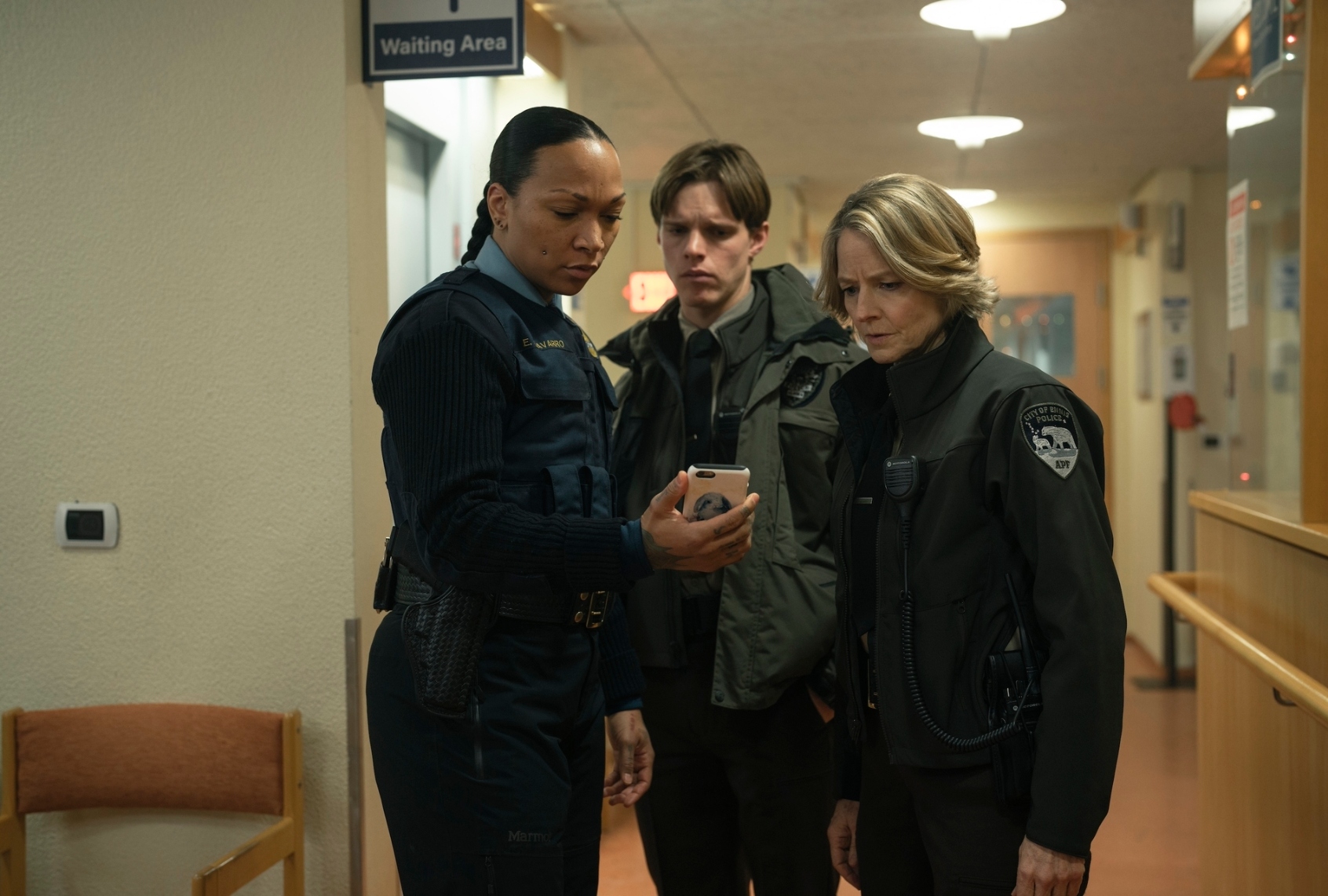
The way of “True Detective” is to show how everything is connected.

“True Detective: Night Country” juggles several subplots as Danvers and Navarro get closer to linking the main mystery to the years-old murder of Annie K (Nivi Pedersen), a community activist. With the story’s culmination looming the secondary themes also take on a sharper focus.

Along with the central case, “Night Country” interrogates facets of womanhood. And it’s impossible to do that realistically without integrating parenthood into that conversation.

Navarro is tortured with concerns that the psychological malady that claimed the lives of her mother and sister is taking hold of her, too. She finds comfort in bonding with Rose Aguineau (Fiona Shaw), a mother figure guiding her in dealing with loud spirits.

Danvers, meanwhile, poorly navigates her fractured relationship with Leah, her bond with Prior, and her refusal to properly grieve her young son’s loss, which seems recent enough for those who know her to wonder why she doesn’t talk about it.

The damage by Silver Sky mine relates to this journey, too. Danvers has a mother’s reasons for punishing Leah for her vandalism. Professional ones too; the police chief’s stepdaughter painting “Murderers” across the doors of the town's largest employer doesn’t reflect well on her.

Viewing your boss as a parental figure is an awful idea.

But in the three months leading up to the murders, Leah tells Liz, there were nine stillbirths in the villages. The mine is poisoning the town’s water. Annie, a midwife, was close enough to a Tsalal scientist and to the community’s heart to make the circumstances of her death in those ice caves Danvers and Navarro are searching for suspicious, at least.

Leah and Danvers’ relationship stumbles the outskirts of this, with Danvers unable to explain why she doesn’t want Leah to get the traditional facial tattoos that are her birthright, or how that also connects to her memories of Anna and other lost women – or, perhaps, her own harrowed relationship with motherhood.

The way of “True Detective” is to show how everything is connected, even that which can’t be explained. We now know that those recurring spirals have a non-mystical meaning. They’re warnings to stay away from places where the ice threatens to swallow you whole.

Issa Lopez and her “Part 5” co-writers Katrina Albright, Wenonah Wilms and Chris Mundy also convert this into a metaphor for another threat to Danvers and Navarro. They’re very close to figuring out what drove a group of scientists stationed at the Tsalal research facility onto the ice in subzero, dead-of-winter weather, unclothed.

They’ve also discovered that the missing scientist romantically linked to Annie, Raymond Clark (Owen McDonnell), is hiding in some ice caves that aren’t officially mapped. But when they head out to the entrance, which is on Silver Sky land, they find it’s been sealed shut. How convenient.

We need your help to stay independent

But it's not the ice threatening to devour them. Another case dating back to when Danvers and Navarro were paired on the same force suddenly resurfaces, a three-year-old domestic violence call to the Wheeler household that Danvers deemed as a murder-suicide.   Except there was no suicide, as several key characters unearth – including Danvers’ work son Prior, and her boss with benefits Captain Connelly (Christopher Eccleston).

Sky’s top executive Kate McKittrick (Dervla Kirwan) summons Danvers to the mine’s offices, where Connelly is waiting, to show her video footage of her and Navarro trespassing on the mine’s property.  Danvers explains they were following up on a police business which, of course, McKittrick doesn’t want.

What the executive doesn’t know is that Prior has discovered a direct financial tie between a founding financial partner of Silver Sky and Tsalal, which means that the mine is bankrolling the research station and compelling them to generate false pollution data. Instead of listening to her, Connelly throws the Wheeler case in Danvers’ face as a warning to go no further.

Since Connelly knows, that means Hank Prior knows – which means Prior has been digging, and Hank broke into his son’s computer.

Kali Reis, Finn Bennett and Jodie Foster in "True Detective: Night Country" (HBO)In the end the bond Danvers forged with Prior at the expense of her relationship with Leah saves her life. Viewing your boss as a parental figure is an awful idea but when your co-worker is your abusive, bitter father, a person might understand why Prior would trust Danvers more than his own parent.


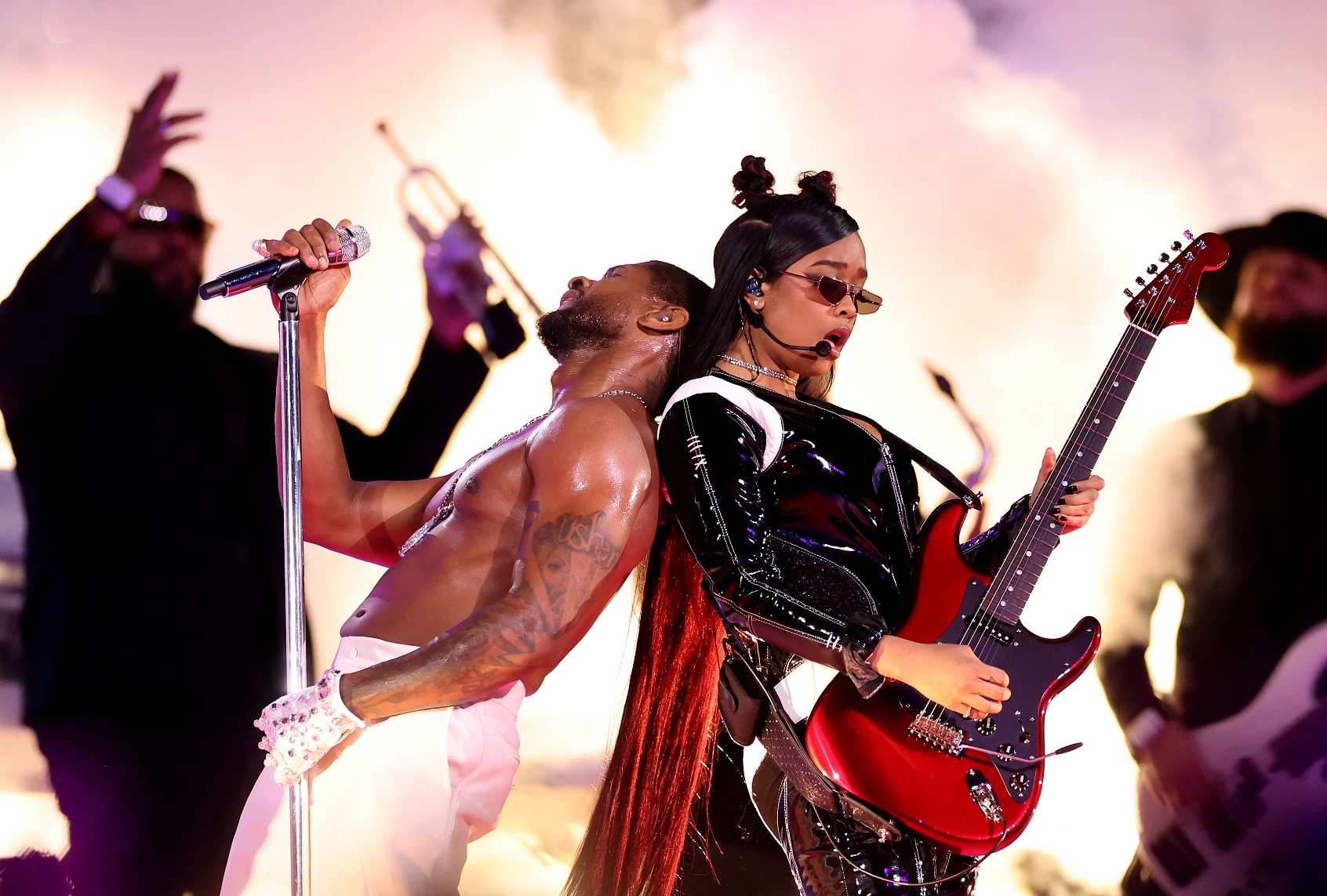
Want a daily wrap-up of all the news and commentary Salon has to offer? Subscribe to our morning newsletter, Crash Course.


And McKittrick is unaware of that when she bypasses Connelly to offer Hank Danvers' job if he kills Otis Heiss. Once Danvers figures out that Hank snooped into Prior’s work, she hands Prior the key to the shack behind her house, cognizant to avoid any Mrs. Robinson implications, and tells him he can’t stay with his dad anymore.

By then Danvers has made a deal with Heiss to show her Clark’s alternate entrance to the ice caves in exchange for a heroin fix he can fulfill at her house.  But Hank follows them there, talks his way inside, takes Danvers’ gun, and shoots Heiss twice.

The gunshots bring Prior into the living room through the back door, in time for him to see Hank turn his gun on Danvers.

Danvers tells him to lower the gun, advising “Prior . . . think.”

Hank, meanwhile, advises Prior to help him. “Blood is blood,” Hank says, moving to shoot their boss. But Prior is faster on the trigger because he did think, as Danvers taught him.

Navarro shows up moments after the tragedy, and the three agree that Danvers needs to head out with her at that moment. A winter storm is raging, which means nobody will be watching them. Prior takes it upon himself to clean up and follow Navarro’s instructions to take Heiss and Hank’s bodies to Rose, trusting her to help him make them vanish. Because these mothers can’t help but protect their children, including the surrogates who return the favor.

New episodes of "True Detective: Night Country" air at 9 p.m. Sundays on HBO and stream on Max. 


Marlee Matlin slams CBS for not showing ASL performers at Super Bowl: “I am absolutely SHOCKED”

Marlee Matlin called out CBS for not showing deaf performers, such as Shaheem Sanchez (pictured), during its Super Bowl telecast Sunday. The big game featured several ASL performers during the pre-game and the halftime show, but none of them received significant airtime.

“I am absolutely SHOCKED at CBS for introducing the deaf performers at today’s Super Bowl and then not showing even one second (or more) of their performance . . . as has been tradition for the last 30 years,” the Oscar-winning deaf actor wrote on social media. “WHY!?”

https://x.com/MarleeMatlin/status/1756826300600455388?s=20

Matlin’s “CODA” costar Daniel Durant performed the national anthem (which was sung by Reba McEntire) while Anjel Piñero performed “America the Beautiful” (which was sung by Post Malone) during the pre-game. Sanchez performed “Lift Every Voice and Sing” (which was sung by Andra Day) in addition to Usher's halftime show. CBS had shared on X a landing page on its website that featured a livestream of its ASL performers.

CBS previously came under fire for the same reasons for last year's Super Bowl. “The inclusion of three deaf artists at the Super Bowl is a kick in the right direction, but the network's treatment of their performances? It was less than superb,” wrote Alison Stine for Salon. Although ASL performers Justina Miles, Troy Kotsur and Colin Denny all received overwhelming praise for their performances, they were difficult to find onscreen for the deaf audience at home. A YouTube link promised viewers access to the sign language performances, but the link was mislabeled, the feed was glitchy and the broadcast contained no captions.

“Insane levels of racist misogyny”: Don Jr. ripped for Super Bowl post mocking Michelle Obama

Donald Trump Jr. faced strong condemnation for a post he shared on Sunday, comparing former first lady Michelle Obama to an ex-NFL player.

Trump Jr. took to his personal Instagram account to share an image of former Pittsburgh Steelers linebacker Levon Kirkland, which was overlaid with the text, "I found this rare Michelle Obama rookie card." Trump Jr. captioned the post, "Just a little Super Bowl nostalgia. LOL," adding, "Deer [sic] fact checkers I'm told that this is a joke, so please treat it accordingly though personally I am not 100% sure."

Trump Jr.'s post seemed to draw upon a baseless conspiracy theory that Obama is actually a man or transgender woman, with several GOP legislators circulating it across social media in January, according to Newsweek. Many social media users sharply criticized the former president's son for the post, with journalist Aaron Rupar calling out its "insane levels of racist misogyny." 

Bob’s Red Mill founder, Bob Moore, dies at 94

Over the weekend, Bob Moore, the founder of the natural food brand Bob's Red Mill, died at the age of 94. According to Nathan Diller at USA Today, Moore died of natural causes and "peacefully passed away at home."

"It is with heavy hearts that we share the news that our Founder, Bob Moore, left this world today, Saturday, February 10, 2024," the company posted in an Instagram statement. "He was 94 years old and full of the same love for wholesome foods as the day he founded Bob’s Red Mill. Bob’s passion, ingenuity and respect for others will forever inspire the employee owners of Bob’s Red Mill, and we will carry on his legacy by bringing wholesome foods to people around the world. We will truly miss his energy and larger-than-life personality."

Moore co-founded the company with his wife, Charlee — who died in 2018 — in 1978, primarily serving customers in the Portland, Oregon vicinity. The idea was, according to the company, originally "inspired by Charlee’s desire to feed their children nutritious foods." Now Bob's Red Mill sells products worldwide. 

“Bob’s legacy will live on forever in all of us who had the opportunity to work with him and is infused into the Bob’s Red Mill brand," Bob's Red Mill current CEO Trey Winthrop said. "He did everything in his power to leave us on a strong path forward. All of us feel responsible and motivated to preserve his old-world approach to unprocessed foods; his commitment to pure, high-quality ingredients; and his generosity to employee owners and educational organizations focused on nutritional health.”

Moore is survived by his sons, daughters-in-law, grandchildren and great-grandchildren.

Can eating nothing but meat actually be healthy? The real dangers and upsides of restrictive diets

The scales of trends always seem to seek balance. As more Americans than ever are leaning their diets in a more plant-based direction, inevitably, so the carnivore diet rises.

A recent feature in Discover explored the pros and cons of existing solely on animal products — and raised the eternal questions around the wisdom of intensely restrictive diets. For everyone who's grown up with — and struggled with — the tyranny of food pyramid and the notion that abundant, expensive variety is the key to good health, could whittling your grocery list way down instead be a better option?

The carnivore diet is exactly like it sounds — just meat, fish, poultry, dairy and eggs. You can, in some cases, jazz things up with certain spices, but that's it. Kind of makes Whole 30 look like the Golden Corral.

It's just the latest restrictive diet in a history of wellness trends that's taken us from cabbage soup to grapefruit to raw food to fruitarianism to weight loss shakes and juice cleanses. And like its predecessors, there may be at least some short term benefits. As Christopher Gardner, director of nutrition studies at the Stanford Prevention Research Center, told Discover, "One of the main things they’re doing on that carnivore diet is they’re getting rid of all their added sugar and refined grain. That is 40 percent of the American diet, and getting rid of that has got to do good things for your health." And I'll admit that when a friend of mine told me not long ago that she'd embarked on a carnivore diet, I was intrigued by her glowing energy and enthusiasm. I also somehow wanted to beg her to eat an orange. 

For the omnivorous among us — and the Catholic school survivors — the thought of putting anything off limits immediately makes it all just that much more appealing. But restrictive diets can be helpful for people looking to readjust their relationship with food. Josh Schlottman, a certified personal trainer and a nutrition coach, says that in certain situations, "Highly restrictive diets like the carnivore diet can be beneficial for a few reasons." For example, he says, "It’ll first help eliminate bad foods you would otherwise eat with a more lenient diet. If you’re only allowed to eat certain foods, eating junk foods won’t be an option." In the meantime, he says, by "eliminating foods that could possibly negatively affect you" you may discover underlying food sensitivities and gut issues. Finally, he says that for some people, restriction is simpler than calorie counting, and that "While some people like the option of eating their favorite foods, you could still be eating foods that negatively affect your body despite being low-calorie."

We need your help to stay independent

Total Shape fitness coach Benedict Ang also acknowledges that "One potential benefit of these plans is the quick initial weight loss they often promise. For individuals looking to shed pounds rapidly for a specific event or goal, these plans can provide a sense of immediate gratification. Additionally, some people find that strict dietary structures help them develop discipline and control over their eating habits."

But, he warns, "The promises made by these plans need to be critically examined. Most often, they claim rapid weight loss, sometimes even in a matter of days. It's essential for individuals to recognize that such drastic changes are often unsustainable and may lead to the loss of muscle mass and essential nutrients. Plus, these plans may not promote long-term lifestyle changes, potentially resulting in a cycle of yo-yo dieting." Significantly, he also points out that there's an emotional and psychological side to consider. "Such diets may contribute to the development of disordered eating patterns and a strained relationship with food," he says. "Social and psychological implications must not be overlooked either, as these plans may lead to feelings of isolation, frustration, and an unhealthy fixation on food."

"The thing is, losing weight isn't about deprivation or perfection."

Alanna Kate Derrick, a certified personal trainer, endurance sports nutrition coach and senior contributor at Gold BJ, advises healthy skepticism and common sense before starting any new diet. "These super restrictive plans grab headlines because they seem to deliver jaw-dropping transformations," she says. "What's often left out though are the struggles and health risks that come with extreme calorie cutting, off-limits food groups, or complicated rules. The thing is, losing weight isn't about deprivation or perfection. It's about progress through developing lifestyle habits you can actually enjoy long-term. This prevents the rebound weight gain that happens when people inevitably return to normal eating after a restrictive diet."

"My advice?" Derrick asks. "Be wary of any plan eliminating entire food groups or requiring complicated phases and points systems. Not only can this lead to nutritional deficits, but it isn't practical for real life. The most successful path is finding simple, sustainable changes and providing enough calories, protein, fruits, veggies, and treats so you stick with it. Rather than imposing rigid, off-limits rules that often trigger feelings of deprivation, it’s wise to take an intuitive approach and choose nourishing foods that satiate your body’s true needs. This empowers you to discover sustainable habits you can genuinely enjoy long after reaching your goals. That’s the ticket to lasting success." Ro Huntriss, Chief Nutrition Officer and RD at the wellness and intermittent fasting brand Simple, likewise offers the insight that "How you maintain weight loss is just as important as losing it in the first place. These types of plans don't often offer a sustainable way to maintain weight loss long-term and there is a risk of regaining the weight quickly once the plan is stopped." She adds that "Highly restrictive diets can also lead to social isolation, so it is important to consider how intense and restrictive diet plans would fit in with your work, social or family life."

And while all restrictive diets have their drawbacks, the carnivore diet presents unique concerns. Tricia Best, a registered dietitian at Balance One, says that "The carnivore diet may be harmful to gut health." She explains, "The diet lacks fiber, which is important for promoting the growth of beneficial gut bacteria and maintaining a healthy digestive system. Without sufficient fiber, gut bacteria may feed on the mucus lining of the gut, which can lead to inflammation and damage to the intestinal lining. The high protein content of the diet can increase levels of certain bacteria that produce harmful byproducts such as ammonia and hydrogen sulfide. These byproducts can irritate the gut lining and cause inflammation. Finally, the high fat content of the diet can also disrupt the balance of gut bacteria and contribute to gut inflammation."

It can be intriguing to declutter one's diet, to seek to spark joy by going intensely minimalist. I definitely never want to do the math on how many portions of lean protein and how much fiber I'm still "supposed to" consume each day. So I can understand the appeal of saying, screw it, I'm just eating steak and nothing but steak — even without the implied promise of better fitting jeans. 

But Hailey Gorski, a Santa Monica registered dietitian who specializes in weight loss, puts it in perspecirtve. "Strict diets can result in deficiency of essential nutrients such as vitamins, minerals, fiber, and other nutrients that are crucial for long term health," she explains. And ultimately, she says, while these plans "can create rapid weight loss," she advises, "If you create lasting changes, you'll get lasting results. Lasting changes allow for more flexibility and empowering food decisions. Temporary changes lead to temporary results." 

An earlier version of this story attributed a quote by Alanna Kate Derrick to Ro Huntriss. It has since been corrected.

RFK Jr. apologizes to his family for Super Bowl campaign ad — but promotes it on social media

Robert F. Kennedy Jr. on Sunday apologized for a campaign ad run by a political action committee supporting him during Sunday's Super Bowl that pulled from the 1960 campaign for his uncle, former president John F. Kennedy.

Kennedy, who is an independent, issued the apology following condemnation of the ad — which was disseminated by American Values 2024 — from his cousins Mark and Bobby Shriver, sons of Eunice Kennedy Shriver.

"I'm so sorry if the Super Bowl advertisement caused anyone in my family pain," Kennedy wrote on X/Twitter on Sunday night. "The ad was created and aired by the American Values Super PAC without any involvement or approval from my campaign. FEC rules prohibit Super PACs from consulting with me or my staff. I love you all. God bless you."

Despite Kennedy's apology, however, the ad is still pinned to his account as of Monday afternoon.

As Mediaite noted, the ad sampled the "Kennedy For Me" theme that JFK used in his own campaign.

"My cousin’s Super Bowl ad used our uncle’s faces- and my Mother’s," Bobby Shriver tweeted on Sunday night. "She would be appalled by his deadly health care views. Respect for science, vaccines, & health care equity were in her DNA. She strongly supported my health care work at @ONECampaign & @RED which he opposes." Mark Shriver concurred with his brother's assessment, writing, "I agree with my brother @bobbyshriver simple as that." Kennedy is known for his strong anti-vaccine views and advancement of various conspiracy theories. 

The Democratic National Committee on Friday filed a Federal Election Commission complaint against Kennedy's campaign and the American Values 2024 PAC, claiming that Kennedy is improperly benefiting from the PAC's efforts to see him on state ballots. The Kennedy campaign is "in the process of accepting a $15 million unlawful in-kind contribution by coordinating their efforts to get him on the ballot," DNC legal counsel Bob Lenhard said on a call Friday announcing the FEC complaint, per NBC News. "Rather than doing that hard work itself, using money raised in compliance with the candidate contribution limits, the campaign is taking a shortcut, outsourcing what is otherwise a core campaign function to a super PAC," Lenhard added. In response, American Values 2024 co-chair Tony Lyons said "the DNC wants to deny millions of people their basic constitutional voting rights in a relentless onslaught against democracy. This FEC complaint is just another of desperate DNC tactic to defame Kennedy, vilify him and drain his campaign funds. The American people are too smart to be fooled by these political games." Kennedy in his own statement claimed that the DNC "is in no position to assert morality over anyone — they refused to have a primary and have worked against the will of the people in the past few elections."

How to buy sustainable salmon: An expert guide to navigating the nuance of eco-labels

We've all been there. You're in the supermarket freezer aisle trying to make sense of the different labels on seafood products. You know the oceans are in trouble and you're trying to do the right thing, but the information is confusing and seemingly contradictory.

One packet of salmon fillets has a smiling dolphin logo on the back. Another, a less-smiley bright blue fish logo. You pull out your smartphone and open the sustainable seafood app your friend told you about, only to become more confused by its traffic light ratings. In the end, you just pick any product that the label assures you is sustainable.


Making sense of salmon sustainability

Salmon is one of the most consumed seafoods globally. It's a rich source of protein, key micronutrients and fatty acids. But with so many different products on the shelf, it's hard to know which ones harm the environment and fish stocks the most.

Both wild-caught and farmed salmon can be sustainable, but determining the environmental impact of a fillet isn't simple. Both can present significant social and environmental problems. Wild-caught salmon can be overfished or sourced from vulnerable fish populations. But while salmon aquaculture can reduce the pressure on wild stocks, it's no panacea.

Farmed salmon producers often face scrutiny for overcrowding, parasites and pollution, with escapees from open-net pens feared to endanger local wild populations. The fish meal used to feed farmed salmon presents further problems, as it often originates from wild-caught fish that aren't always taken at sustainable levels.

These challenges are expected to be exacerbated by shifting climates: higher water temperatures and reduced rainfall can enable the growth of pathogens and increase the susceptibility of fish populations to disease.

Many certification schemes, eco-labels, rankings and guides exist to signpost salmon sustainability. For wild-caught salmon, the Marine Stewardship Council provides the gold standard, assuring that it has been sourced from fisheries managed according to rigorous environmental standards. For farmed salmon, a tick of approval from the Aquaculture Stewardship Council is considered the most thorough certification, indicating responsible aquaculture practices.

One of us (Laurence Wainwright) has researched eco-labels for five years, finding that these two certification schemes are currently the most scientifically sound, evidenced-based standards for seafood sustainability – including salmon.

Other seafood sustainability schemes offer some assurances of sustainability, but are often not nearly as rigorous. Schemes for farmed salmon such as the Soil Association's organic standard have recently faced criticism for having standards that are perceived by some as not going far enough – or potentially even misleading customers by certifying some Scottish salmon farms as organic.

To a consumer, an "organic" label generally signifies that a product has been grown from organic feed and produced without the use of chemical pesticides or antibiotics. Farmed salmon can be organic, if raised and fed correctly.

A Soil Association spokesperson stated: "Organic farms must follow strict rules to minimize impacts on the environment and animal welfare, and when problems occur, they must prove they are taking action in order to use the organic logo." The Soil Association's aquaculture standards are currently under review following a 60-day consultation and an update to its standards is due later in 2024.

According to fish conservation charity WildFish, some badges of sustainability in salmon aquaculture can mask details of unregulated salmon supply chains – with certifications rarely being lost even when conditions are breached. According to its 2023 report, some UK farms have been permitted to use wild-caught fish for feed and to use toxic chemicals for parasite control, without losing their organic certification. This is controversial: such ambiguity and lack of transparency only hinders the salmon aquaculture industry.

In terms of wild-caught salmon, it is our strong opinion that it is never legitimate, under any circumstances, to call it organic. Not only is this misleading but it defies scientific evidence and undermines the meaning of the term organic.


Which salmon should you buy?

When buying salmon or ordering it at a restaurant, look for key information on the labels or ask staff about the sourcing of their fish.

  • How, and from where, was it caught or farmed? Either can be sustainable, but the devil is in the detail.

  • If farmed, what was it fed – and from where did this feed originate? The feed should be from a sustainable source of fish and perhaps even certified itself.

  • If wild-caught, is there minimal by-catch associated with it?

  • Which species of salmon is it? Whether Atlantic, chinook, sockeye, pink, coho or chum, sustainability depends on a variety of factors so there is no hard-and-fast rule. But there are better and worse options: this guide from Seafood Watch is very useful.

  • Which eco-labels does it have? Certifications from the Marine Stewardship Council and Aquaculture Stewardship Council are best.


The scale of salmon

While it's best to choose locally sourced fish where possible, many salmon-loving populations live far from the hotspots of salmon production. Sushi salmon in Japan, for example, may have travelled 17,000 km from Norwegian or Chilean farms. And an estimated 52% of emissions from the production of 1 kilogram of farmed salmon in Norway comes from its air transport to China for consumption.

The need to mitigate the carbon footprint of salmon production will only increase as the world ramps up decarbonization efforts. With an increasing global population, pressure on the already over-exploited wild salmon stocks is set to intensify.

Salmon farming or aquaculture currently bridges this gap between supply and demand, accounting for 70% of the salmon available for consumption. As the fastest-growing food production system, the salmon farming industry is projected to reach a value of US$37 billion (£29 billion) globally by 2027.

We need to fundamentally change our relationship with seafood if we are to preserve this wonderful natural food resource. We don't have to stop eating salmon but we must make smarter decisions, both at the fish counter and within seafood supply chains.


Imagine weekly climate newsletter

Don't have time to read about climate change as much as you'd like?

Get a weekly roundup in your inbox instead. Every Wednesday, The Conversation's environment editor writes Imagine, a short email that goes a little deeper into just one climate issue. Join the 30,000+ readers who've subscribed so far.


Laurence Wainwright, Departmental Lecturer and Course Director, Smith School of Enterprise and the Environment, University of Oxford and Natasha Lutz, PhD in Disturbance Ecology and Machine Learning, University of Oxford

This article is republished from The Conversation under a Creative Commons license. Read the original article.

Ex-prosecutor: Court may “politely recuse” Judge Cannon after Jack Smith calls out “clear error”

Special counsel Jack Smith in a recent court filing cited case law that Judge Aileen Cannon, the MAGA-appointed federal judge overseeing Donald Trump's Mar-a-Lago classified documents case, previously worked on as a way of reminding her why she should rule against the former president.  

As Trump's team of attorneys continues to paint his criminal case as a Biden-administration-led, politically motivated "witch hunt," they've also asked the Cannon mandate Smith and his team of prosecutors to turn over the trove of evidence they have against Trump, despite the fact that the defense team has already received more than a million pages of evidence, per The Daily Beast.

As Trump's legal team's strategy to delay the trial becomes increasingly apparent, Smith's filing pointed toward a case from Cannon's past, recalling how she worked to establish boundaries around such tactics. 

The Daily Beast noted that Cannon, while serving as a federal prosecutor for the Department of Justice in South Florida in 2015, worked on a sting operation in which two men were convicted after trying to loot a phony stash house. One of the men appealed his conviction, arguing that he was the victim of "unfair prosecution" because the majority of stash house sting operations see Black and Hispanic people apprehended. In 2021, Cannon's former team won the case when the 11th Circuit Court of Appeals emphasized the need for a "demanding burden" to make such a claim. Though she was already acting as a judge, Smith's citing of the aptly named U.S. vs. Cannon is meant to underscore Trump's own claim of "selective prosecution" in his documents case. “A request to discover such material is, instead, ‘governed by well-settled and binding precedent in [Armstrong] and [Jordan,]” prosecutors wrote. 

Though lawyers often cite past cases, as The Daily Beast pointed out, Smith's "decision to point Cannon to her own case also sends a message — and not one meant for Trump’s lawyers or even the American public paying close attention to the historic case."

"Smith’s choice to cite case law that Cannon actually worked could be viewed as a reminder to the judge that she knows better than to side with Trump on this — especially on such a narrow topic as bias-alleging document requests," The Daily Beast's Jose Pagliery wrote.

“She worked on almost no cases. She had very little courtroom experience. To find a case that actually she worked on and that resulted in a published opinion is in itself improbable,” Catherine Ross, a professor emeritus at George Washington University Law School, told the Daily Beast. “It’s a brilliant maneuver, and particularly with a judge who had so little trial background,” she said.

“It’s not quite the same as confronting a judge with an opinion they wrote or joined,” Ross added. “I don’t think selective prosecution comes up often. There are very few people who can pass the laugh test on claiming that. I think they have her locked in a pretty tight spot—if she were a normal judge.”

Smith's team last week accused Cannon of making a "clear error" by granting Trump's motion to unredact portions of their motions in discovery despite the Justice Department's concern about the safety of witnesses in the case. 

Smith's filing claims that "discovery material, if publicly docketed in unredacted form as the Court has ordered, would disclose the identities of numerous potential witnesses, along with the substance of the statements they made to the FBI or the grand jury, exposing them to significant and immediate risks of threats, intimidation, and harassment." The filing adds that threats have already “happened to witnesses, law enforcement agents, judicial officers, and Department of Justice employees whose identities have been disclosed in cases in which defendant Trump is involved.”

Former U.S. Attorney Harry Litman warned that Cannon put herself "in a box of her own making" with the order.

We need your help to stay independent

"Remember, we have this ongoing drama with her," Litman told MSNBC of Cannon's odd rulings seeming to push Trump's trial until after the 2024 presidential election. "She's been slow-walking the case and she had these early sort of debacles that the 11th Circuit reversed."

"We've been wondering will she make another clear misstep that would give Smith the wherewithal to say maybe it's time to recuse her," he added. 


Want a daily wrap-up of all the news and commentary Salon has to offer? Subscribe to our morning newsletter, Crash Course.


Former federal prosecutor Andrew Weissmann, who served on special counsel Bob Mueller's team, likewise claimed that Cannon could be facing an imminent recusal by the 11th Circuit Court of Appeals.

"So now there is this issue, with respect to divulging the name of someone who is under investigation, which could interfere with a criminal investigation. We don't know about the underlying facts of that so it is somewhat guesswork," Weissmann told MSNBC. 

"What I can tell, you as a — I have been in a prosecutor for many years — that does not get disclosed when you are doing an investigation," he added. "To me, it is so reminiscent of the same problem she had during the investigation. So, if she continues this route, it will be interesting to see whether Jack Smith gets to the 11th Circuit and whether they sort of politely recuse her, essentially, which happens when the circuit hears the case and basically says 'When we send this back, we think that the better course is for a different judge to hear it.'"

The “diabolical plan to assassinate Lincoln”: Watch this exclusive feature for Apple’s “Manhunt”

For Abraham Lincoln's birthday on Feb. 12, we once again take a look at the president whose life – and death – changed America. But this time, it's through the lens of true crime.

Apple TV+'s upcoming series "Manhunt" examines the intense 12-day search for John Wilkes Booth after he shot Lincoln at Ford's Theatre on that fateful day in 1865. Tobias Menzies ("The Crown," "Outlander") stars as Edwin Stanton, Lincoln's Secretary of War who steps up after the assassination and directs the search for John Wilkes Booth (Anthony Boyle) and his accomplices. Not only does the series shine a light on Booth's multiple co-conspirators who helped to shield him, but also on who was instrumental in capturing him. 

"It was a multi-level diabolical plan to assassinate Lincoln," notes Patton Oswalt in a "Manhunt" featurette exclusive to Salon. In the series, Oswalt plays Det. Lafayette Baker while sporting an impressive beard.

The series is an adaptation of James L. Swanson's New York Times bestselling and Edgar Award-winning nonfiction book "Manhunt: The 12-Day Chase for Lincoln's Killer." Using rare archival materials such as obscure trial transcripts and Lincoln's own blood relics, the story of intrigue and betrayal creates a sense of urgency as the search for the killer is broken down hour by hour. 

Joining the aforementioned cast are Hamish Linklater as the ill-fated President Lincoln, Lili Taylor as Mary Todd Lincoln, Matt Walsh as Dr. Samuel Mudd, Lovie Simone as Mary Simms, Will Harrison as David Herold and Glenn Morshower as Andrew Johnson. Watch the full featurette below.

"Manhunt" premieres on Apple TV+ on Friday, March 15 with two episodes and rolls out a new episode weekly through April 19. 


Donald Trump and Tucker Carlson gave Putin exactly what he wants

As we all know, the biggest story in the world is the breaking news that President Joe Biden is old. Sure 9/11 was something of a big deal and the war in Iraq and the global pandemic required all of our attention for a time, but this is the most important news of our lifetime, maybe anyone's lifetime and there's no telling when, or if, the nation will ever recover. Still, it's probably important to at least pay a tiny bit of attention to other things happening in the world just in case they might also be affected by Biden's age in some way.

In fact, we probably should be just a little bit curious about what former Fox News celebrity Tucker Carlson was doing in Moscow last week interviewing Russian president Vladimir Putin. Carlson has demonstrated his affinity for Putin for years now and is commonly extolled on the Russian state television channels as a model American with all the right ideas. Back in March of 2022, Mother Jones obtained a copy of a Kremlin memo with talking points for the media:

“It is essential to use as much as possible fragments of broadcasts of the popular Fox News host Tucker Carlson, who sharply criticizes the actions of the United States [and] NATO, their negative role in unleashing the conflict in Ukraine, [and] the defiantly provocative behavior from the leadership of the Western countries and NATO towards the Russian Federation and towards President Putin, personally,” advises the 12-page document written in Russian. It sums up Carlson’s position: “Russia is only protecting its interests and security.” The memo includes a quote from Carlson: “And how would the US behave if such a situation developed in neighboring Mexico or Canada?”

(People like Carlson used to be called "useful idiots.") Russian state media has followed those instructions and for the past two years has featured Carlson's commentary regularly. It's therefore not all that surprising that he would be granted the coveted interview with Putin.

As it turns out the interview ended up mostly being a twisted history lesson from Putin with Carlson sitting there like a potted plant with a feigned fascinated expression on his face. The point of Putin's tutorial was to explain why Russia has every right to invade Ukraine and anywhere else he might fancy. Putin went to great pains to explain why it was the victims of WWII who made Hitler do what he did, specifically the people of Poland, whom Putin blamed for balking at Hitler's invasion of its country. The entire thrust of the conversation was a very thinly veiled threat to invade Poland. The Polish government certainly heard it that way. The foreign minister posted this on Friday:

He's right. It isn't the first time. Putin been saying it for years now and it's one reason why the NATO alliance has not only been more unified than ever, but they've also welcomed Finland — another country that shares a border with Russia and is definitely on Putin's wish list. Sweden has also applied for membership but is still being held up by Russia-friendly Hungary under the leadership of authoritarian dreamboat, Viktor Orban. (There is some hope that this last impediment will be lifted in the near future.) These are countries that had long resisted joining the alliance but moved quickly to do it when Putin expanded his invasion of Ukraine in 2022. They see the writing on the wall.

There's been a ton written about the right's attraction to Putin for reasons that range from affinity with his macho whiteness and adherence to "traditional values" (homophobia and misogyny) to an appreciation of his willingness to crack down on dissent. He's their kind of guy. And we know that the man who leads their party, Donald Trump, admires him greatly because he says so all the time. When Putin invaded Ukraine in 2022, Trump was very impressed:

Here’s a guy who’s very savvy … I know him very well. Very, very well. By the way, this never would have happened with us. Had I been in office, not even thinkable. This would never have happened. But here’s a guy that says, you know, ‘I’m gonna declare a big portion of Ukraine independent’ – he used the word ‘independent’ – ‘and we’re gonna go out and we’re gonna go in and we’re gonna help keep peace.’ You gotta say that’s pretty savvy.”

We need your help to stay independent

He pays lip service to the idea that Putin is so afraid of Trump that he would never make a move without his permission but the truth is that Trump not only doesn't care that Putin invaded a sovereign country, he is actively hostile to Ukraine, which he has been persuaded to hate for a variety of reasons many of which were likely put in his head by Putin himself.  And he's been opposed to the NATO alliance for years, mainly because he never understood what it does and why the U.S. should be a part of it. He even admitted it on the trail once back in 2016, saying "I said here’s the problem with NATO: it’s obsolete. Big statement to make when you don’t know that much about it, but I learn quickly.”

As it turns out the interview ended up mostly being a twisted history lesson from Putin with Carlson sitting there like a potted plant with a feigned fascinated expression on his face.

Whatever Trump may have learned came up against his unwillingness to ever admit he was wrong so he transformed his critique to the only thing he understands: money. He has repeatedly threatened to pull out of NATO because the other countries aren't "making their payments" as if they're members of Trump's Mar-a-Lago beach club in arrears on their membership dues rather than a mutual defense alliance in which each country has agreed to spend a certain amount on its national defense.

Over the weekend he went further, however, and said something truly dangerous and unhinged:

This kind of loose talk is dangerous and stupid coming from a man who was once president of the United States and is running again. People believe him when he says something like that, not because they can't take a joke or don't know that he's full of hot air, but because it's entirely believable that he would do exactly that. Everyone knows he doesn't care about America's allies and he has made it clear over and over again that he sees no real benefit to them beyond a possible payout. He posted this on Sunday:

That's a meaningless demand indicating that even after four years as president, Trump is still as shallow and vacuous as he was the day he was inaugurated. It's no doubt a coincidence that he made these comments within days of the Carlson interview with Putin. I find it hard to believe that Trump slogged through that tedious conversation or understood what Putin was talking about. But you can bet that Putin heard Trump and rubbed his hands together with glee. If only the American people heard him just as clearly.

IDF rescues two hostages while killing dozens of Palestinians in Rafah

Israeli forces raided an apartment building in the besieged and overcrowded Gaza city of Rafah early Monday and rescued two hostages in an operation that killed dozens of Palestinians, including children.

The freed hostages were later identified as 61-year-old Fernando Simon Marman and 70-year-old Louis Har. A spokesperson for the Israel Defense Forces (IDF) said that both were in good medical condition. The Associated Press reported that "heavy airstrikes that provided cover for the operation killed at least 67 Palestinians."

The operation marked just the second time in more than four months of war that the IDF managed to rescue people taken captive during the Hamas-led attack on southern Israel in early October. Since then, Israel's military has killed more than 28,000 people in the Gaza Strip, including several Israeli hostages.

More than 100 hostages are still being held in Gaza, according to Israeli authorities.

The IDF launched a wave of airstrikes on Rafah during Monday's operation, heightening concerns for the city's trapped and terrified civilian population. Around 1.4 million people are believed to be in the city, most of them having sought refuge there during Israel's assault on other parts of the Gaza Strip.

"Can anyone tell us where to go so we don't die? So our limbs aren't torn apart? So I don't lose anyone?" said one mother in Rafah as the city came under attack. "Where do we go, tell me? Someone answer me and tell me where to go."

On Friday, ahead of an expected ground assault on Rafah, Israeli Prime Minister Benjamin Netanyahu instructed the IDF to craft a plan to forcibly "evacuate" civilians from the city, which is located on Gaza's border with Egypt. Reuters reported that Egypt has "sent about 40 tanks and armored personnel carriers to northeastern Sinai within the past two weeks as part of a series of measures to bolster" its border with Gaza.

Meinie Nicolai, director-general of Médecins Sans Frontières, said in a statement Monday that "Israel's declared ground offensive on Rafah would be catastrophic and must not proceed."

"As aerial bombardment of the area continues, more than a million people, many living in tents and makeshift shelters, now face a dramatic escalation in this ongoing massacre," said Nicolai. "Nowhere in Gaza is safe, and repeated forced displacements have pushed people to Rafah, where they are trapped in a tiny patch of land and have no options."

"The needs are overwhelming, and the situation requires a safe humanitarian response at a much larger scale," Nicolai continued. "We call on the government of Israel to immediately halt this offensive, and to all supporting governments including the United States, to take concrete action to bring about a complete and sustained cease-fire."

Last week, Netanyahu rejected a Hamas proposal that called for a four-and-a-half month cease-fire and the release of Israeli hostages as well as Palestinians held in Israel. A week-long pause in November led to the release of more than 100 hostages.

Following Monday's operation, Netanyahu signaled that Israel's military assault on Gaza will continue, even as the country faces genocide charges on the world stage and growing internal skepticism over the government's approach, which has created one of the worst humanitarian catastrophes in modern history.

"Fernando and Louis, welcome home," Netanyahu said in a statement. "I salute our brave fighters for the daring action that led to their release. Only continued military pressure, until total victory, will bring the release of all our hostages. We will not miss any opportunity to bring them home."

Speaking anonymously to The New York Times last month, senior Israeli military leaders argued that "the dual objectives of freeing the hostages and destroying Hamas are now mutually incompatible."

"A drawn-out battle intended to fully dismantle Hamas would most likely cost the lives of the Israeli hostages held in Gaza," the military leaders said, according to the Times. "Most of the remaining hostages are thought to be held by Hamas cells that are hiding within the subterranean fortress of tunnels that extends for hundreds of miles beneath the surface of Gaza."

The Wall Street Journal recently reported that U.S. and Israeli officials believe that up to 80% of Hamas' tunnels remain intact after months of relentless Israeli bombing. One aid group has estimated that around 90% of those killed in Israeli airstrikes since October 7 were civilians.

In a call with Netanyahu on Sunday ahead of the Israeli military's latest round of bombing, U.S. President Joe Biden "reaffirmed his view that a military operation in Rafah should not proceed without a credible and executable plan for ensuring the safety of and support for the more than one million people sheltering there," according to a White House readout.

Trita Parsi, executive vice president of the Quincy Institute for Responsible Statecraft, wrote late Sunday that "as usual, Netanyahu ignored Biden's meek requests since they're not backed up with real pressure."

"How many more civilians will have to die, how much more regional escalation will have to occur, before Biden gets serious?" Parsi asked.

Woman who opened fire at Joel Osteen’s megachurch killed by police

Sign up for The Brief, The Texas Tribune’s daily newsletter that keeps readers up to speed on the most essential Texas news.


A female shooter opened fire on Sunday afternoon at pastor Joel Osteen’s Lakewood Church in Houston, which has one of the nation’s largest congregations. She was fatally shot by off-duty officers. No one else at the church died.

The woman, between the ages of 30 and 35, entered the church at 1:53 p.m. wearing a trench coat and a backpack and carrying a long rifle, Houston police Chief Troy Finner said during a Sunday press conference after the shooting. A young child who police said was approximately 4 to 5 years old accompanied her.

The woman began shooting upon entering the church. Two off-duty officers shot the female shooter, who died on scene, according to authorities. The child was also shot and is in critical condition at Texas Children’s Hospital, but officers were unclear about how the child was injured. Another 57-year-old man — unassociated with the shooter — was shot in the leg and is being treated.

The shooter threatened that she had a bomb, so officers searched her vehicle and backpack but did not recover any explosives, police said. They continued a search of the church, which seats more than 16,000 people, on Sunday afternoon. Officers also said the shooter was spraying an unidentifiable substance, prompting officers to call upon the Houston Fire Department and hazmat units. Fire Chief Samuel Peña said they found “nothing of concern.”

Law enforcement did not identify the shooter’s motive or her identity. She entered the church minutes before the start of the 2 p.m. Spanish-language service.

“It’s unfortunate that on the day we want to attend church and watch America’s No. 1 sports event, we find ourselves gathered here to respond to this tragedy,” Houston Mayor John Whitmire said during the press conference. “We want Houstonians to know they are being protected by their first responders.”

Whitmire thanked first responders for their collaboration. Officers from the Harris County Sheriff's Department, Houston Fire Department and Houston Police Department were on scene. The two off-duty agents who shot the shooter were from the Texas Alcoholic Beverage Commission and the Houston Police Department.

Lakewood Church is about 6 miles outside of downtown Houston in the former arena for the Houston Rockets. The nondenominational, evangelical Christian church attracts people from across the country both in person and online.

Osteen, known for his best-selling books and as a televangelist, said at the press conference that he was devastated and “in a fog.”

“We don’t understand why these things happen, but we know God is in control,” Osteen said. “We are going to pray for the little 5-year-old boy and the lady that was deceased, her family, and the other gentlemen."

Gov. Greg Abbott said he had been in contact with Whitmire and offered state resources, including Department of Public Safety officers and Texas Rangers.

“Our hearts are with those impacted by today’s tragic shooting and the entire Lakewood Church community in Houston,” Abbott said. “Places of worship are sacred.”

Several mass shootings have occurred in U.S. houses of worship in recent years, including the November 2017 shooting at the First Baptist Church of Sutherland Springs. Twenty-six people were killed and 20 others were wounded when a gunman opened fire on parishioners in the rural town east of San Antonio.

In December 2019, a man shot and killed two people during a church service at West Freeway Church of Christ in White Settlement, a suburb of Fort Worth. A church member shot and killed him in seconds. A Texas law passed in response to the Sutherland Springs shooting allows licensed handgun owners to carry those weapons in places of worship. The White Settlement church formed a volunteer security team in response to that law.

The Sutherland Springs shooting occurred just months before a school shooting in Santa Fe, Texas, which prompted Abbott to host a series of discussions to identify solutions to gun violence. Lawmakers heard from statewide leaders, school officers and law enforcement, with some proposing universal background checks and policies to keep guns away from people who “pose an immediate danger.”.

But year after year, lawmakers have largely rejected measures that would limit access to guns, instead focusing on enhancing school security and adding more mental health services. Last year, lawmakers filed a slate of gun control bills as they convened for the first time since the Uvalde school shooting in which an 18-year-old gunman shot and killed 19 students and two teachers. The vast majority of those bills stalled, including a measure that would have raised the age to purchase a semi-automatic rifle from 18 to 21 that Uvalde families spent months pushing.


This article originally appeared in The Texas Tribune at https://www.texastribune.org/2024/02/11/shooter-megachurch-joel-osteen-houston/.

The Texas Tribune is a member-supported, nonpartisan newsroom informing and engaging Texans on state politics and policy. Learn more at texastribune.org.

The media making Donald Trump’s threats personal

As a personal rule, I do not usually write recaps or reviews of TV news programs. There is an entire machine for the 24/7 news machine to amplify itself and to which I do not need or want to contribute. But in that seemingly endless firehose of news content where one “crisis” flows into the cacophonous noise of the next, is it any wonder that a large percentage of Americans tell pollsters that they are exhausted by politics and current events? There are important moments that are lost and that matter in ways that even the hosts, producers and writers may not realize or understand.

A recent episode of MSNBC's "The Last Word with Lawrence O’Donnell" was one such example.

In an attempt to evade responsibility for his many crimes against democracy and society, Donald Trump and his attorneys are claiming that he is above the law. Per their arguments and fantasies, Trump can order his political opponents – and anyone else for that matter – murdered without being held accountable under the law. They also claim that Trump can sell pardons and engage in other corrupt acts without fear for being arrested or held responsible by the law. In their fascist and autocratic reasoning, somehow, to be held responsible under the law like any other person in American society would make it impossible for a president (meaning Donald Trump and his Republican fascist successors) to do their job.

O’Donnell’s public teaching on his Tuesday show also signaled to what political scientists and other experts know from public opinion data, focus groups, and other research about the values and beliefs that are driving Trumpism.

These claims are not just legal maneuverings. Trump, as shown by his promises to be a dictator on "day one" of his presidency, channeling Hitlerian threats, claims that he is chosen by god and Jesus Christ to be a type of prophet of MAGA vengeance and restoration does believe these things. Public opinion polls have consistently shown, including a new one from the UMass Amherst, that a large majority of Republican and other Trump voters endorse Trump’s claims to dictator status and want him to take such power when/if he wins the 2024 election.

In his 8-minute-long monologue and act of public teaching, Lawrence O’Donnell described the verdict as a thundering endorsement of Judge Tanya Chutkan, who is presiding over Trump’s trial in Washington DC for crimes related to the Jan. 6 coup attempt and the larger plot to end democracy:

But the proof that Judge Chutkan bears no judicial prejudice against Donald Trump whatsoever came today, in the form of a court of appeals opinion in an order that affirmed every single word Judge Tanya Chutkan wrote in her 48-page opinion, in December [in response to] Donald trump's claim of immunity for any crimes he committed while president. Judge Chutkan's opinion said that the presidency, quote, “does not confer a lifelong get out of jail free pass.” There were many winners today, when the court of appeals opinion was issued. Special prosecutor Jack Smith and his brilliant legal team, the framers of the Constitution with Alexander Hamilton being specifically quoted in the opinion supporting criminal prosecutions. The American people who believe in the rule of law were very big winners today, and the people who believe in Donald Trump were once again, like Donald Trump himself, big losers today. But, the individual biggest winner of the day was judge Tanya Chutkan, whose work was studied line by line and word by word by Donald Trump's lawyers, who tried to rip it apart in arguments to a three judge panel of the court of appeals, and each of those judges, including a conservative Republican appointed judge, who has hired law clerks who are members of the Federalist Society — unanimously agreed that Judge Chutkan was right in every word she wrote, every word.

We need your help to stay independent

Trump’s legal battles are also much greater than deciding if a corrupt ex-president will be held accountable for his crimes: these proceedings (and the 2024 election) are a national civics lesson and test of how enduring America’s multiracial pluralistic democracy will be and how much progress we have made towards being a true we the people democracy or if instead the country will collapse backward into a new Jim and Jane Crow plutocracy and system of fake democracy and competitive authoritarianism. Ultimately, the American democratic project is an experiment, an ongoing one, and will it endure or not?

In the literal personhood and symbolic power of Judge Chutkan (and the other black and brown members of law enforcement and the courts who are holding Trump and his MAGA cabalists responsible for their obvious crimes – including the Capitol police officers on Jan. 6 who saved the country from Trump’s MAGA attack force) – we see a black person, a black woman, an immigrant from Jamaica who not too long ago in American history would be written out of the polity as a type of anti-citizen and Other, the basis upon which and against and upon white (male) citizenship and white herrenvolk democracy and the racial state would be defined.

For those of us who believe in the American democratic experiment and its promise and potential, especially the children and heirs of the Black Freedom Struggle and civil rights movement and other rights revolutions and activism of the 1960s and 1970s, to see Judge Chutkan in this role is exhilarating even as the stakes involved for our safety and futures are terrifying.

For Trump, his MAGA people, neofascists, authoritarian populists and the larger “conservative” movement and white right and those others who are in that orbit, this is all so disturbing and enraging. For them, it is an impossibly wrong thing (both as expressed consciously, i.e. “we believe in traditional values," and in the subconscious and semi-quiet thoughts that serve as the real root of their resentment and rage at “political correctness” and “those people” “who don’t know their place” and whatever other myriad forms frustrated white entitlement and privilege may take) to see a white man like Trump (who in their minds is somehow a stand-in for people like them) being held accountable by those who they deem to not be “real Americans” and “patriots." Because what does MAGA “Make American Great Again!” really mean if not “What America White Again!”?


Want a daily wrap-up of all the news and commentary Salon has to offer? Subscribe to our morning newsletter, Crash Course.


Lawrence O’Donnell spoke to this in the following way:

Donald Trump has many bad days ahead of him, as criminal defendant Trump. None will be more painful than the days he spends in Winston Chutkan’s daughter’s courtroom. Winston Chutkan told the New York Times that when he won a scholarship to go to high school in Jamaica, quote, “I wore shoes and experienced indoor plumbing for the first time in my life.” Winston Chutkan worked very hard, did very well in high school. He went on to become an orthopedic surgeon, one of Jamaica's most prominent physicians.

When his daughter Tanya arrived in Washington from Jamaica at age 17 to attend George Washington University, she fell in love with the city, and has lived here ever since, except for her for three years as a distinguished student at the University of Pennsylvania Law School, where she was an editor of the law review. Tanya's younger sister and brother both followed in their father's footsteps and became physicians.

Tanya Chutkan served as a public defender in Washington D.C., where she married another public defender and had two children. She then became a highly compensated member of a large Washington law firm. President Obama appointed Tanya Chutkan to a federal judgeship in 2014. Her appointment was confirmed by the United States Senate, 95 to nothing. She told her sister then, “I have never been so excited to receive a pay cut.”

Tanya Chutkan knows that Donald Trump thinks her blood is poison, and that her children's blood is poison. Donald Trump says that immigrants like Tanya Chutkan are poisoning the blood of America, a phrase that Donald trump has lifted directly from Adolf Hitler…..

O’Donnell’s public teaching on his Tuesday show also signaled to what political scientists and other experts know from public opinion data, focus groups, and other research about the values and beliefs that are driving Trumpism and the larger neofascist movement and global right in its campaign against multiracial pluralistic democracy. These factors include hostile sexism, racism and white supremacy (of course), racial resentment, nativism, social dominance behavior, and a type of collective anxiety about social change in the form of death anxieties (what social psychologists have termed “terror management theory”, the dark triad of personal types, and collective narcissism and other forms of mass pathology.

Here O’Donnell takes these concepts and personalizes them by describing Trump’s mind and emotions, which for the corrupt ex-president must be like a real-life horror movie he cannot escape:

So, the day is going to come when Donald Trump stands trial, in Judge Chutkan's courtroom, where every day he will be looking up at a judge, who he has publicly and personally insulted by calling her a racist and hurling other insults at her.

And he will be looking up at a judge who he has accused, along with every other immigrant who Donald Trump didn't marry, of poisoning the blood of America. And every day Donald Trump sits in that courtroom, looking up at Judge Chutkan, he will be looking at her with raging hatred that he will not be allowed to express in that courtroom. And he will be looking at her in abject fear, which he will admit to no one….

Four weeks ago, Donald Trump sat in the court of appeals hearing room, looking up at the three women judges who heard this case. Judge Karen Henderson, Judge Florence Pan, and Judge Michelle Childs. There was no legal reason for him to be in the room. Donald Trump is of course profoundly stupid, but still not stupid enough to think that his eyes or his hair or his makeup or his red necktie would intimidate those judges. And surely, the dark, twisted coils of Donald Trump's brain were still able to process the obvious fact that these three women had complete control over him, in this proceeding.

America’s mainstream news media has largely failed in the Age of Trump and beyond in its responsibilities and obligations to engage in sustained pro-democracy journalism that educates, informs, and empowers citizens by holding the powerful responsible and then telling the public not just what is important and how they should think about it but then what to do about it.

Lawrence O’Donnell’s commentary on Tuesday was a bright exception to that pattern of failure (as was his conversation several days ago with historian David Blight about Trump being disqualified from office per the Constitution). As the 2024 election approaches the American people need more of this type of news coverage-public civics education and teaching. But given how the news media and larger attention economy has trained the American people to spectacle and distraction, do enough of them even have the capacity to understand and the attention span necessary to process it? The answer to that question and what it reveals about America’s civic culture and democracy (and what it demands of them) will weigh heavily on Election Day and then what comes next.

Sorry, Swifties: Super Bowl LVIII belonged to Usher and Beyoncé

There’s a nice symmetry between last year’s Super Bowl reveal of an expectant Rihanna, and this year's, featuring a shirtless Usher doing his sweaty best to get America pregnant.

Not that we’re complaining. After a run of Super Bowl halftime shows designed to give conservatives apoplexy, what with your kneeling Eminems and your scandalizing J. Los, Super Bowl LVIII’s only desire was to make love up in this club. This was the sweet center of a performance lineup meant to pull everyone onto the dancefloor, starting with Andra Day singing "Lift Every Voice and Sing," and Post Malone strumming his way through “America the Beautiful” to Reba McEntire performing the National Anthem.

Day and her backup singers were live on the mic, as was Usher, atypical for most Super Bowl showcases. But this was an intentional choice on the part of Jay-Z, whose Roc Nation produced the halftime extravaganza once again. Under the mogul’s supervision, each year’s entertainment choices have been aligned with the nation’s cultural and political vibe. Tapping Usher as this year’s headliner functioned as a celebration of Black performance and artistry at its height and an invitation to shake off the tension.

Usher also gets a promotional boost for his ninth studio album “Coming Home,” his first studio effort in almost eight years released the Friday before the Big Game.

His halftime performance, though, was a trip through his greatest hits and the old days of block parties, funk and R&B spectacles. In a performance that opened with “Caught Up” and “U Don’t Have to Call,” Usher did the most and much more – breaking out elaborate footwork on midfield turf, which is not easy. Nor is singing live through aerobically challenging moves, taking a break only to introduce Alicia Keys playing a few bars of “If I Ain’t Got You” before transitioning into "My Boo."

Usher is one of those artists whose songs everybody knows regardless of whether you’ve bought his albums.

At its height, and after gyrating through a verse or two of “Confessions,” Usher brought forth an HBCU-style marching band and drumline in formation, spelling out his name. There were acrobats and dancers, and H.E.R. making her guitar growl as if to call forth Prince’s spirit, along with a riser-flexing rendition of “Yeah!” with Ludacris and Lil Jon exhorting the crowd to their feet.

Usher and H.E.R. perform onstage during the Apple Music Super Bowl LVIII Halftime Show at Allegiant Stadium on February 11, 2024 in Las Vegas, Nevada (Ezra Shaw/Getty Images)If you were curious as to why his Las Vegas residency at the Park MGM’s Dolby Live has been extended several times and credited for breaking up Keke Palmer’s relationship with a partner who isn’t worthy of her, now you know. The man knows how to hit it from a distance. Heck, even the stage – with its larger center round flanked by a pair of runways and smaller circles – could be interpreted as a symbol for a devil’s threesome.
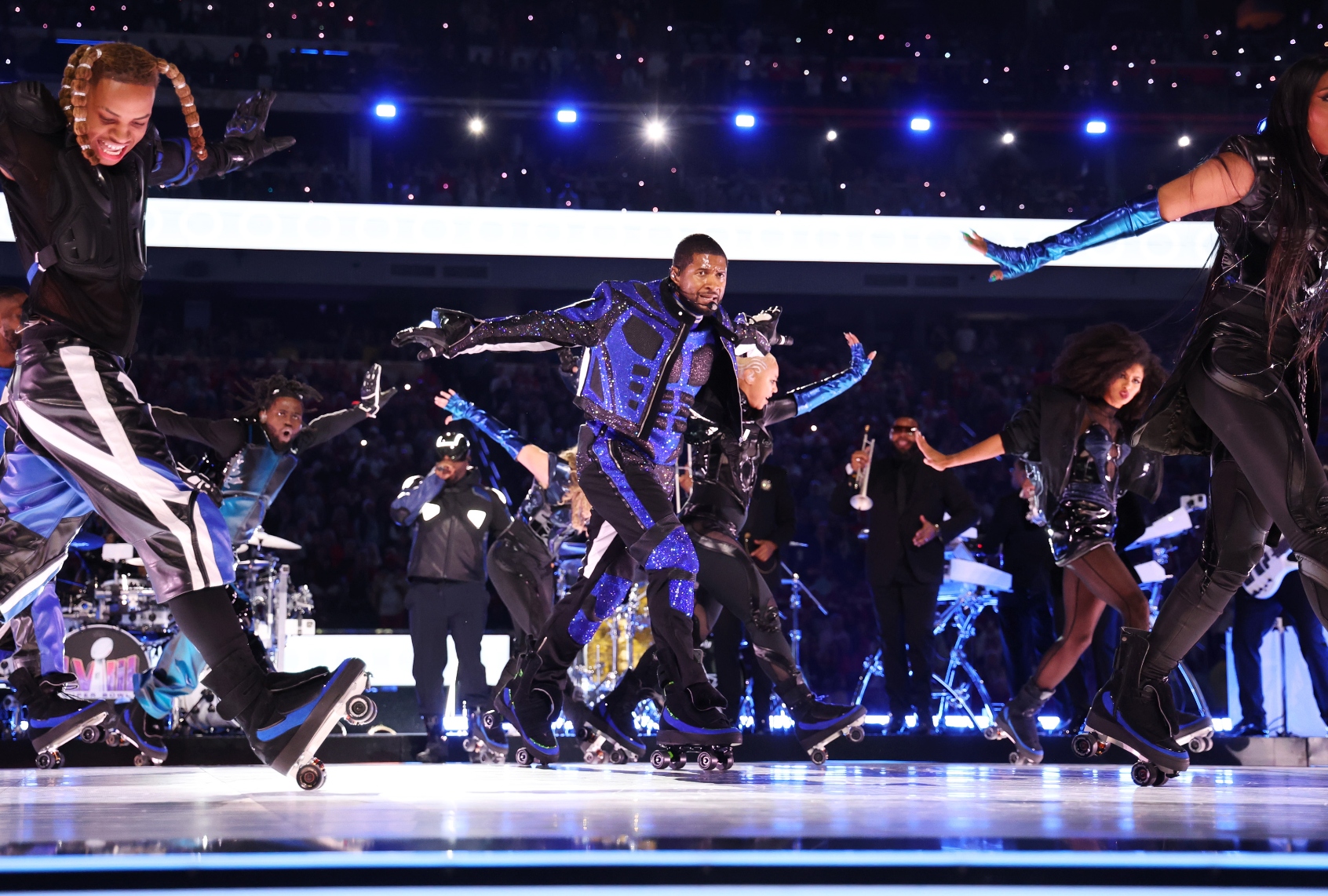
As for what Usher’s banger of a performance signals from a broader cultural perspective, that’s a matter of how we came to this Super Bowl. His Vegas show and this stage of his career are designed as tributes to Black music and party culture, along with an R&B revival. His muscular showmanship and athletic movement reminded us that he’s still an explosive live presence.

We need your help to stay independent

He’s also a politically agnostic crowd pleaser drawing influence from the old school – those large-scale performances with multiple outfit changes, each more cinematically grand than the next. By the time Usher and his crew were on skates, he’d served winking reminiscences of both Earth Wind & Fire performances and “Tron” along with paying tribute to Atlanta, where his singing career began.

There was also the implicit invitation for multigenerational uplift. As some joked online, the first few bars of “Yeah!” is pretty much a trigger for Millennials to bust out their best prom moves. Usher is one of those artists whose songs everybody knows regardless of whether you’ve bought his albums. He’s also a singer who appeals to and caters to Black women, drawing them to the Big Game where other acts might not.

Usher performs onstage during the Apple Music Super Bowl LVIII Halftime Show at Allegiant Stadium on February 11, 2024 in Las Vegas, Nevada (Ezra Shaw/Getty Images)But he’s also the intersection point in what one might describe as the perfectly constructed four-quadrant Super Bowl, with Post Malone hitting the younger Millennials and Gen Z crowd and Reba pleasing people’s grandparents.


Want a daily wrap-up of all the news and commentary Salon has to offer? Subscribe to our morning newsletter, Crash Course.


Although much was made of this being the Taylor Swift Super Bowl, which may yet be demographically proven, the pop superstar who used the game’s massive audience to drop new music was not the “Eras” superstar but another – Beyoncé. Queen Bey starred in a Verizon commercial with Tony Hale that concluded with, “OK, they ready — drop the new music. I told y’all the ‘Renaissance’ is not over.”

Shortly afterward a video went live on her Instagram announcing the country-themed Part II of her “Renaissance” album would come out on March 29, dropping two singles, “Texas Hold ‘Em” and “16 Carriages” as appetizers. This was also a calculated plan on Jay-Z’s part; the Carters and Usher have been friends for decades.

https://www.instagram.com/reel/C3Ot8xfRIaA/

Running these teasers in the wake of Usher’s super soul circus amounted to a party favor for an audience starving for something sparkly and distracting to make us feel good for a change. Every election year is defined by episode after episode of terrible political and social theater. This had none of that. It was simply a fierce, meticulously designed show made for throwing our hands up with a yeah (yeah!), ok (ok!), and a beat we could all dance to for a few elated minutes.

Do we simply not care about old people?

The covid-19 pandemic would be a wake-up call for America, advocates for the elderly predicted: incontrovertible proof that the nation wasn’t doing enough to care for vulnerable older adults.

The death toll was shocking, as were reports of chaos in nursing homes and seniors suffering from isolation, depression, untreated illness, and neglect. Around 900,000 older adults have died of covid-19 to date, accounting for 3 of every 4 Americans who have perished in the pandemic.

But decisive actions that advocates had hoped for haven’t materialized. Today, most people — and government officials — appear to accept covid as a part of ordinary life. Many seniors at high risk aren’t getting antiviral therapies for covid, and most older adults in nursing homes aren’t getting updated vaccines. Efforts to strengthen care quality in nursing homes and assisted living centers have stalled amid debate over costs and the availability of staff. And only a small percentage of people are masking or taking other precautions in public despite a new wave of covid, flu, and respiratory syncytial virus infections hospitalizing and killing seniors.

In the last week of 2023 and the first two weeks of 2024 alone, 4,810 people 65 and older lost their lives to covid — a group that would fill more than 10 large airliners — according to data provided by the CDC. But the alarm that would attend plane crashes is notably absent. (During the same period, the flu killed an additional 1,201 seniors, and RSV killed 126.)

“It boggles my mind that there isn’t more outrage,” said Alice Bonner, 66, senior adviser for aging at the Institute for Healthcare Improvement. “I’m at the point where I want to say, ‘What the heck? Why aren’t people responding and doing more for older adults?’”

It’s a good question. Do we simply not care?

"It’s really hard to give old people their due when you’re terrified about your own existence."

I put this big-picture question, which rarely gets asked amid debates over budgets and policies, to health care professionals, researchers, and policymakers who are older themselves and have spent many years working in the aging field. Here are some of their responses.

The pandemic made things worse. Prejudice against older adults is nothing new, but “it feels more intense, more hostile” now than previously, said Karl Pillemer, 69, a professor of psychology and gerontology at Cornell University.

“I think the pandemic helped reinforce images of older people as sick, frail, and isolated — as people who aren’t like the rest of us,” he said. “And human nature being what it is, we tend to like people who are similar to us and be less well disposed to ‘the others.’”

“A lot of us felt isolated and threatened during the pandemic. It made us sit there and think, ‘What I really care about is protecting myself, my wife, my brother, my kids, and screw everybody else,’” said W. Andrew Achenbaum, 76, the author of nine books on aging and a professor emeritus at Texas Medical Center in Houston.

In an environment of “us against them,” where everybody wants to blame somebody, Achenbaum continued, “who’s expendable? Older people who aren’t seen as productive, who consume resources believed to be in short supply. It’s really hard to give old people their due when you’re terrified about your own existence.”

Although covid continues to circulate, disproportionately affecting older adults, “people now think the crisis is over, and we have a deep desire to return to normal,” said Edwin Walker, 67, who leads the Administration on Aging at the Department of Health and Human Services. He spoke as an individual, not a government representative.

The upshot is “we didn’t learn the lessons we should have,” and the ageism that surfaced during the pandemic hasn’t abated, he observed.

Ageism is pervasive. “Everyone loves their own parents. But as a society, we don’t value older adults or the people who care for them,” said Robert Kramer, 74, co-founder and strategic adviser at the National Investment Center for Seniors Housing & Care.

Kramer thinks boomers are reaping what they have sown. “We have chased youth and glorified youth. When you spend billions of dollars trying to stay young, look young, act young, you build in an automatic fear and prejudice of the opposite.”

Combine the fear of diminishment, decline, and death that can accompany growing older with the trauma and fear that arose during the pandemic, and “I think covid has pushed us back in whatever progress we were making in addressing the needs of our rapidly aging society. It has further stigmatized aging,” said John Rowe, 79, professor of health policy and aging at Columbia University’s Mailman School of Public Health.

“The message to older adults is: ‘Your time has passed, give up your seat at the table, stop consuming resources, fall in line,’” said Anne Montgomery, 65, a health policy expert at the National Committee to Preserve Social Security and Medicare. She believes, however, that baby boomers can “rewrite and flip that script if we want to and if we work to change systems that embody the values of a deeply ageist society.”

Integration, not separation, is needed. The best way to overcome stigma is “to get to know the people you are stigmatizing,” said G. Allen Power, 70, a geriatrician and the chair in aging and dementia innovation at the Schlegel-University of Waterloo Research Institute for Aging in Canada. “But we separate ourselves from older people so we don’t have to think about our own aging and our own mortality.”

The solution: “We have to find ways to better integrate older adults in the community as opposed to moving them to campuses where they are apart from the rest of us,” Power said. “We need to stop seeing older people only through the lens of what services they might need and think instead of all they have to offer society.”

That point is a core precept of the National Academy of Medicine’s 2022 report Global Roadmap for Healthy Longevity. Older people are a “natural resource” who “make substantial contributions to their families and communities,” the report’s authors write in introducing their findings.

Those contributions include financial support to families, caregiving assistance, volunteering, and ongoing participation in the workforce, among other things.

“When older people thrive, all people thrive,” the report concludes.

Future generations will get their turn. That’s a message Kramer conveys in classes he teaches at the University of Southern California, Cornell, and other institutions. “You have far more at stake in changing the way we approach aging than I do,” he tells his students. “You are far more likely, statistically, to live past 100 than I am. If you don’t change society’s attitudes about aging, you will be condemned to lead the last third of your life in social, economic, and cultural irrelevance.”

As for himself and the baby boom generation, Kramer thinks it’s “too late” to effect the meaningful changes he hopes the future will bring.

“I suspect things for people in my generation could get a lot worse in the years ahead,” Pillemer said. “People are greatly underestimating what the cost of caring for the older population is going to be over the next 10 to 20 years, and I think that’s going to cause increased conflict.”

KFF Health News is a national newsroom that produces in-depth journalism about health issues and is one of the core operating programs at KFF—an independent source of health policy research, polling, and journalism. Learn more about KFF.

Subscribe to KFF Health News' free Morning Briefing.