Spring Sale: Get 1 Year, Save 58%

“A lasting impact”: Dolly Parton to receive honorary Oscar at 2025 Governors Awards

Dolly Parton is set to receive an honorary Oscar at the Governors Awards in November

The 79-year-old country star will be recognized for her humanitarian work, receiving the statuette alongside Tom Cruise, choreographer Debbie Allen and production designer Wynn Thomas. 

Academy of Motion Picture Arts and Sciences President Janet Yang praised Parton in a statement, saying she had made a "lasting impact" on the world.

"Beloved performer Dolly Parton exemplifies the spirit of the Jean Hersholt Humanitarian Award through her unwavering dedication to charitable efforts," she said.

Parton founded her Tennessee-based nonprofit Dollywood Foundation in 1988, two years after partnering with a nearby theme park to create Dollywood. The organization focused on educational success for the children of Tennessee, eventually expanding its mission with the wildly popular Imagination Library, which delivers books to young children.

Though the "Jolene" singer has never won an Oscar, she has starred in films and been nominated by the Academy twice. Her song "9 to 5," from the Parton-starring movie of the same name, was nominated for Best Original Song in 1981. She netted another nom with "Travelin' Thru," a composition for the 2006 film "Transamerica."

“Unconscionable and unforgivable”: Gibson hasn’t been absolved of antisemitism by former costar

Mel Gibson might be making movies again, but that doesn't mean all of Hollywood has forgiven him.

Jason Isaacs, who starred in "The Patriot" with Gibson, said he still can't consider Gibson a friend thanks to his infamous antisemitic rant in 2006. Isaacs, who is Jewish, revealed his animosity toward the Aussie actor in an interview with Vulture.

“He’s said and done some things that are unconscionable and unforgivable,” he told the outlet.

Isaacs told the magazine that his feelings about Gibson are complicated. 

"He was very charming personally, and he’s intelligent and self-deprecating," he said. "I’m not saying I forgive Mel."

"The White Lotus" star gave Gibson a pass in person when the pair met at a charity event. Isaacs said that Gibson overwhelmed him with a litany of his troubles.

"I hadn’t seen him since that terrible antisemitic outburst when he got stopped by the police," he said. "I went, 'Rabbi Gibson, how are we?' He came up and he said, 'I was really drunk, man. I was trying to get him to hit me or shoot me or something. I’m having a terrible time.'"

In the moment, Isaacs found it tough to stay mad.

"He proceeded to unload some very personal things. He’s not my friend, but — maybe to my eternal shame — I forgave him instantly because he was there making himself vulnerable," he said.

Still, Isaacs doesn't believe a full absolution of Gibson's sins is appropriate.

"You can’t forgive everything from everyone," he said. "I have no idea what to do about him. But if he knocked on my door tonight and said, 'Look, my hotel’s canceled. Can I stay?' I’d say, 'Yes,' probably."

Since his return to the screen, Gibson has spent time sharing conspiracy theories about the Los Angeles wildfires and becoming an official appointee of the Trump administration.

“This is not our war”: Lawmakers launch bipartisan effort to block Trump from starting war with Iran

Lawmakers are hoping to pass legislation that limits President Donald Trump’s authority to bring the United States into war with Iran.

Rep. Thomas Massie introduced a resolution on Tuesday, that would prohibit U.S. forces from engaging in hostilities against Iran unless specifically authorized by Congress. The Kentucky Republican has since been joined by 15 other members of the House of Representatives, all Democrats. 

“This is not our war. But if it were, Congress must decide such matters according to our Constitution,” Massie posted on social media earlier this week.

"No war in Iran. It’s time for every member to go on record. Are you with the neocons who led us into Iraq, or do you stand with the American people?” Rep. Ro Khanna D-Calif. said in a post to X.

Progressive Reps. Ilhan Omar of Minnesota and Alexandria Ocasio-Cortez of New York both replied to Massie’s post saying they would support the resolution.

Virginia Senator Tim Kaine is pushing a similar bill in the upper chamber.

“It is not in our national security interest to get into a war with Iran unless that war is absolutely necessary to defend the United States,” Kaine said in a statement on Monday. "I am deeply concerned that the recent escalation of hostilities between Israel and Iran could quickly pull the United States into another endless conflict.”

Sen. Bernie Sanders, I-Vt., introduced legislation that blocks the use of federal funds for an unauthorized conflict with Iran. Seven senators have expressed their intention to vote for Sanders’ “No War Against Iran Act.”


Start your day with essential news from Salon. Sign up for our free morning newsletter, Crash Course.


The legislation comes as Trump appears ready to increase America's role in the war. On Tuesday, he demanded Iran's surrender and issued veiled threats to the ayatollah. 

Chef Anne Burrell, beloved Food Network star, dies at 55

Anne Burrell, the exuberant Food Network host whose infectious energy and signature spiked platinum hair made her a standout in food television, died Tuesday at her home in Brooklyn, according to a report from People Magazine. She was 55.

Her family confirmed her death in a statement to the publication, writing: “Anne was a beloved wife, sister, daughter, stepmother, and friend — her smile lit up every room she entered. Anne’s light radiated far beyond those she knew, touching millions across the world. Though she is no longer with us, her warmth, spirit, and boundless love remain eternal.”

Burrell rose to prominence as the host of “Worst Cooks in America,” where she guided culinary novices with both humor and rigor. A graduate of the Culinary Institute of America, she first appeared on “Iron Chef America” before headlining her own Emmy-nominated show, “Secrets of a Restaurant Chef,” in 2008. Over the years, she became a fixture on the Food Network, known for her bold teaching style and deep love of Italian cuisine.

Born in Cazenovia, N.Y., Burrell credited her mother’s home cooking and Julia Child as early influences. Before turning to the kitchen, she studied English and communication at Canisius College. She later trained at the Italian Culinary Institute for Foreigners and worked under Lidia Bastianich at Felidia in New York.

She was also an author and philanthropist, publishing two cookbooks and serving with organizations including City Harvest and the Juvenile Diabetes Research Foundation.

Burrell is survived by her husband, Stuart Claxton, whom she married in 2021, and his son, Javier, as well as her mother, siblings and several nieces. 

“I feel so lucky to be able to share my true passion in life with others,” Burrell often said. That passion made her one of the most memorable personalities in American food media.

“His life is in jeopardy”: R. Kelly hospitalized for overdose, attorney alleges murder-for-hire plot

R. Kelly was hospitalized for a reported overdose over the weekend. 

Per his attorney, the former R&B megastar was removed from solitary confinement at a North Carolina prison and taken to Duke University Hospital. A filing on Tuesday alleged that Kelly had been administered a dose of his medications that was well over the suggested limit. Kelly's attorneys have previously claimed that officials with the Board of Prisons are intentionally trying to kill the convicted sex trafficker.

"Bureau of Prisons officials administered an amount of medication that significantly exceeded a safe dose and caused Mr. Kelly to overdose, putting his life in jeopardy," attorney Beau Brindley wrote.

Brindley claims that his doctors recommended surgery for blood clots during Kelly's hospital stay, but were overruled by prison officials. 

"Within an hour, officers with guns came into his hospital room and removed him," Brindley told the court.

Kelly has been in solitary confinement since Brindley filed an emergency motion last week, claiming that his client was the target of a murder-for-hire plot.

“Federal officers have solicited the murder of R. Kelly because he intends to expose the corruption underlying his federal prosecutions. We have filed our motion to make sure that they fail,” Brindley shared in a statement last week. "The only thing that can protect Mr. Kelly behind the prison walls now is the fact that now the world is watching. And we will call on the courts and President Trump to help put an end to the corruption that now threatens Mr. Kelly's life."

Kelly unsuccessfully appealed his 30-year sentence on racketeering and sex trafficking charges earlier this year. An appeals court upheld his 2021 convictions and supported the case made by prosecutors against the serial abuser.

"Enabled by a constellation of managers, assistants, and other staff for over 25 years, Kelly exploited his fame to lure girls and young women into his grasp," the court wrote in its decision. "Evidence at trial showed that he would isolate them from friends and family, control nearly every aspect of their lives, and abuse them verbally, physically, and sexually."

“He’s a mess”: Trump mocks Walz after shooting of Minnesota Democrats

President Donald Trump mocked Tim Walz on Tuesday, calling the Minnesota governor "a mess" after several state-level Democrats were targeted in a politically motivated shooting.

Reporters aboard Air Force One asked the president if he'd reached out to Walz following the fatal shooting of State Rep. Melissa Hortman. Per CNN reporter Kaitlan Collins, Trump called the gesture a waste of time. 

“I’m not calling him. Why would I call him? I could call and say, ‘Hi, how you doing?’ The guy doesn’t have a clue," he said. "He’s a mess. I could be nice and call, but why waste time?”

Walz's camp shared a statement on the president's brush-off, saying that it was not the time to score points off your political enemies. 

"Governor Walz wishes that President Trump would be a president for all Americans, but this tragedy isn’t about Trump or Walz," his office shared. "It’s about the Hortman family, the Hoffman family, and the State of Minnesota, and the Governor remains focused on helping all three heal." 

Following his unsuccessful bid for the vice presidency last year, Walz has been a vocal critic of both Trump and his own party. As the Trump admin has run roughshod over the administrative state and done away with due process, Gov. Walz has had little time for smug recriminations from Democratic Party apparatchiks. He's argued for doubling down on protecting minorities and meeting Trump 2.0's authoritarianism with force, not "sternly worded letters."


Start your day with essential news from Salon. Sign up for our free morning newsletter, Crash Course.


“I think there needs to be a more robust Democratic Party,” he told attendees of a Center for American Progress event earlier this month. “We have to have a robust strength of morals, value sticking up for those less fortunate — that's why I think it's a mistake to focus just on economics and allow trans children to get bullied.”

“This is fascism”: New York City Democrats speak out after Brad Lander’s arrest

Lawmakers are reacting to NYC Comptroller and mayoral candidate Brad Lander’s arrest on Tuesday. Lander was arrested while escorting someone leaving an immigration hearing at 26 Federal Plaza and later charged with assaulting and impeding law enforcement.

In a post on X, Zohran Mamdani wrote: “This is fascism and all New Yorkers must speak in one voice. Release him now.”  

Lander and Mamdani, a fellow NYC mayoral hopeful, cross-endorsed one another just a few days ago. 

Alexandria Ocasio-Cortez reacted in a post on Bluesky. ”ICE just arrested Brad Lander, the NYC Comptroller and one of the leading candidates for Mayor, without grounds,” she wrote. “He asked ICE for their warrant – well within his legal rights. This is political intimidation.” 

Ocasio-Cortez endorsed Lander earlier this month, telling the New York Times that she would rank him third in the June 24 Democratic primary for NYC mayor. 

Lander’s wife, Meg Barnette, wrote from his account that his team is “monitoring the situation closely.” 


Start your day with essential news from Salon. Sign up for our free morning newsletter, Crash Course.


Reactions came in from representatives across the country. 

Rep. Greg Casar, also responded, calling Lander’s arrest “outrageous” and demanding Lander’s immediate release. 

In a post on Bluesky Rep. Maxwell Frost wrote, “These ICE goons are completely out of control.”

As the condemnations flooded in, a Department of Homeland Security spokesperson, Tricia McLaughlin, announced that the Trump administration was pursuing federal charges against the Democratic politician.

"New York City Comptroller Brad Lander was arrested for assaulting law enforcement and impeding a federal officer," McLaughlin said. "No one is above the law, and if you lay a hand on a law enforcement officer, you will face consequences."

“UNCONDITIONAL SURRENDER”: Trump threatens Iran, ignores US intelligence findings

Messages shared by President Donald Trump and his inner circle on Tuesday suggest that Washington may soon provide more direct support for Israel’s war against Iran. Trump and his allies are rushing to frame the moment as one of historical significance.

In a private text shared by Trump on Truth Social, U.S. Ambassador to Israel Mike Huckabee praised the president in near-biblical terms. 

“The decisions on your shoulders I would not want to be made by anyone else. You have many voices speaking to you, Sir, but there is only ONE voice that matters. HIS voice,” Huckabee wrote. “No President in my lifetime has been in a position like yours. Not since Truman in 1945.” 

“You did not seek this moment. This moment sought YOU,” he added.

On Truth Social, Trump continued his stark warnings to Tehran, calling for their “UNCONDITIONAL SURRENDER” and warning that the Iranian Supreme Leader that the United States knows where he is located. 

“We are not going to take him out (kill!),  at least not for now. But we don’t want missiles shot at civilians, or American soldiers,” he wrote. “Our patience is wearing thin.” 

On X, Vice President J.D. Vance offered a detailed defense of Trump’s approach, responding to “crazy stuff on social media,” likely referring to criticism over the administration’s approach to the war from parts of the MAGA movement, including former Fox News host Tucker Carlson.

Vance argued that Trump had shown remarkable consistency in his opposition to Iran ever acquiring a nuclear bomb and that Iran had enriched uranium far beyond the necessary levels for a civilian nuclear program.

But Vance’s account conflicts with recent U.S. intelligence assessments.


Start your day with essential news from Salon. Sign up for our free morning newsletter, Crash Course.


A CNN report on Tuesday revealed that American intelligence does not currently assess Iran to be on the verge of producing a nuclear weapon. The U.S. intel report concluded that Iran is not actively pursuing such a weapon and was up to three years away from being able to “produce and deliver one to a target of its choosing,” raising questions about the urgency of the threat that Trump and his allies have emphasized. The report also states that to seriously damage certain Iranian nuclear facilities, Israel will require direct U.S. involvement.

Trump has dismissed his own administration’s intelligence reports, saying that, in his view, Iran was “very close” to having a nuclear weapon. 

East LA resists ICE, 1 taco at a time

On June 6, the Trump administration doubled down on its immigration crackdown, ordering U.S. Immigration and Customs Enforcement (ICE) to detain and deport migrants across the country. Those measures have only intensified within Southern California, where detainees reportedly endure parched throats and mounting fear — with little food or water to sustain them. In the wake of the aggressive immigration sweeps, protests have broken out around downtown Los Angeles, prompting President Donald Trump to retaliate by authorizing the deployment of 2,000 California National Guard troops. These demonstrations reflect a growing resistance from communities directly impacted by the raids. On June 9, U.S. military officials confirmed that 700 Marines were also deployed to guard federal agents and buildings.  

The ongoing raids have terrorized undocumented immigrant workers at Home Depot, car washes and factories and farms. Food vendors, namely workers at taquerias and fruit stands, have also been targeted en masse.

Jason Devora, owner of Jason’s Tacos, captured the devastating impact in a tense Instagram video, revealing how swiftly federal agents emptied his taco truck by taking his employees.

“This is not a joke; they just took all of my employees. All of them,” Devora, who can’t be seen in the video, is heard saying while pacing around his truck. “Wow. They took all of my employees within two minutes,” he added.

“They [ICE] don’t ask anything…They snatch you like a dog,” Devora told L.A. TACO, explaining that two of his employees had volunteered to work that day despite getting the week off. “They rope them up, and if you try to run, they run 10 – 15 cars deep, and they cover every corner. They busted my clients who were ordering. The streets ain’t safe, that’s all I gotta say.”

Amid the turmoil, several Los Angeles area food businesses have closed their doors out of fear. Angel's Tijuana Tacos took to Instagram last week to announce that its brick-and-mortar taqueria in Anaheim is the only location that will remain open for the time being. The remaining 15 locations — which are predominantly taco trucks and taco stands, according to Men's Journal — will stay closed until further notice.

“Anaheim is our only location open. ALL other locations will be closed until further notice. We hope to see you soon. Stay safe everyone,” the taco chain wrote in a caption to its more than 430,000 followers.

Brothers Cousins Tacos, best known for their street tacos and mulitas, announced on Saturday that they will close their doors until further notice. Same with Birria El Jaliciense, a taco pop-up that operates only on the weekends, and Tacos El Venado.

As protests continue throughout Los Angeles and spread across the country, local community members and restaurants have rallied in support by donating proceeds to organizations that are assisting immigrant workers. Long Beach-based Mexican restaurant El Barrio Cantina is donating all of its sales made through its Órale! Menu to Órale, an immigrant-led movement fighting to end the criminalization of immigrant communities. Additionally, Taqueria Frontera partnered with CIELO, an Indigenous women-led non-profit, to support immigrant families with food, legal aid and mental health resources. And this past weekend, Carnitas El Gordo Panzon donated homemade food to families and individuals affected by the raids.


Want more great food writing and recipes? Sign up for Salon’s free food newsletter, The Bite.


Tito Rodriguez (a.k.a. the “Hood Santa”), known for giving back to thousands of families in Long Beach and the Los Angeles area through his nonprofit Local Hearts Foundation, provided groceries for impacted families scared of leaving their homes following the ICE raids.

“We’ve all felt hunger…But most of us born here have never feared stepping outside our door,” he wrote on Instagram. “Today, we showed up with groceries for families hiding, starving, and scared after the ICE raids. This isn’t justice. This is cruelty. Thank you to the Singers for helping us feed our people in a time of terror.”

On Reddit, several users offered alternative acts of solidarity for those looking to protect their local communities outside of protesting.

“I think a good strategy instead of protesting could be many people standing guard at the taco trucks and stands,” said user u/Comfortable-Twist-54. “It would need to be coordinated with the stands to be effective. But strategy is really needed because clearly they are using strategy against us.” Another user, u/Giggle_Mortis, proposed “coordinated buyouts.”

“[I]f we can pay people's rent/expenses they can stay home,” they said.

Brad Lander, NYC comptroller and Democratic mayoral candidate, arrested by federal agents

Federal agents detained Brad Lander on Tuesday at a New York City immigration court. Lander, NYC comptroller and mayoral candidate, was attempting to escort someone attending their hearing. 

In video of the incident, Lander is heard asking: “Since you have no authority to arrest U.S. citizens, where are you taking me? And with what authority?” Lander repeatedly asks agents: “Do you have a judicial warrant?” 

In a Bluesky post, Gwynne Hogan, a reporter for local news outlet The City, wrote that Lander was arrested by masked agents and taken into an elevator. One member of his NYPD security detail joined. 

Lander was in the NYC immigration court at 26 Federal Plaza on Tuesday, where ICE agents were apparently making arrests.

According to AMNY, Lander and members of his team were walking arm-in-arm with a man whose immigration case had just been dismissed. AMNY reported that agents from ICE, the FBI and the Treasury Department — all masked — were attempting to arrest the man.

Lander is heard saying, “I’m not obstructing," while agents attempted to detain him. 


Start your day with essential news from Salon. Sign up for our free morning newsletter, Crash Course.


Members of Lander’s staff repeatedly asked where the mayoral candidate was being taken, but received no answer from agents.

“A blueberry in a bowl of tomato soup”: One Democrat’s plan for beating Joni Ernst in deep-red Iowa

Iowa state Rep. JD Scholten has launched a challenge against Sen. Joni Ernst, R-Iowa, after she mocked constituents who were concerned about people dying from the GOP’s planned cuts to Medicaid, saying, “We’re all going to die.”

Scholten, a minor league baseball pitcher for the Sioux City Explorers, is pitching himself as a “Lina Khan Democrat,” hoping that the former FTC commissioner’s brand of antitrust populism can help him flip a seat in the Midwest.

Scholten, a state representative in his second term, has run for federal office twice before, once against Rep. Steve King, R-Iowa, where he nearly flipped the seat, and once against Rep. Randy Feenstra, R-Iowa, when Feenstra won more decisively.

Scholten, however, sees a big opportunity for Democrats to back parts of the Midwest, and not just because Republican senators don’t seem to care if their constituents die because of their budget. Scholten tolwd Salon that Democrats need to be willing to acknowledge the reality of an ongoing “agricultural recession” and push their campaigns beyond the suburban focus that has dominated the party’s strategy in recent years.

This interview has been edited for length and clarity.

I wanted to start out by asking you what the reaction to Sen. Ernst's comments and her apparent disregard for the lives of people on Medicaid has been in Iowa and among your constituents.

Even before her comments — the comments stem from Medicaid cuts — there were rallies against that. On the ground, people didn’t like the bill, and that's why it got brought up in that town hall. And then ever since that happened, there's just been an enormous reaction across the state. I mean, it's broken through more than I've seen anything here in Iowa politics in a long time. People on the ground called her "Joni Hearse"; Raygun T-shirts are selling out … it's just crazy what the reaction’s been.

So it’s safe to say people are thinking about it?

Yeah, so here's the thing. I play professional baseball and my teammates are 20 years younger than me. These are dudes who aren’t that linked to politics, and so it was interesting for them to come up to me. They just saw Iowa and politics and saw it go viral and asked me, “What’s up with this?"

In your district, how are people feeling about his bill beyond Sen. Ernst’s comments on it. Especially when it was in the House, we saw a lot of organizing around it.  I'm wondering, do you still see that energy? How are people feeling at this moment … especially with everything that's been happening in Los Angeles?

So I would say a couple of things. One, here in Sioux City, we have 25 different Head Start programs, and the impact on them would be devastating, and the impact on Sioux City if those were to get cut would be devastating. The bigger issue that will impact every Iowan, whether you're on Medicaid or not, [is] it's going to close nursing homes, and rural OB-GYNs … are already stressed, and it's going to add more stress. This is going to impact all of us.

There are a ton of protesters coming out every single day. They’re the most vocal protesters we’ve had over my entire term, my two terms down in the capital. 

You’ve been described as a "Lina Khan Democrat." I was hoping you could say what that means to you and why you think this style of politics is right for winning a seat in Iowa, which a lot of people might assume is maybe allergic to more progressive politics.

We have a long history of progressive politics, and it goes back to one of my political heroes, Berkeley Bedell, in the late 70s, early 80s. He ran an early 80s reelection poster that said, “The 1% controls your government. Does the 99% have a chance? How do we save our democracy?” A "Lina Khan Democrat" to me is someone who’s willing to take on corporate power and look out for consumer interest and everyday American interests. And so yeah, I proudly wear that badge.

I have a Substack called “You’re Probably Getting Screwed” that I’ve run for probably three years now and we have a weekly newsletter about economic populist issues. 

Do people bring these up to you when you’re speaking to your constituents, issues like corporate power?

Yeah, in different ways. I mean, the reality is we have a GoFundMe health care system that's broken. We have a GDS system that's broken, and a Dollar General economy that’s broken, and so people in one form or another bring this up to me all the time. 

When I was running for Congress, talking to farmers the second time I ran, I had farmers who would always vote for me and farmers who would never, and they didn’t push back one time when it came to this type of stuff.

Let me ask you a slightly parallel question. I've been reporting on some of the WelcomeFest stuff out of Washington. I'm wondering if people in Iowa talk to you about "abundance," and if that's something that they're excited about?

No one in Iowa talks to me about "abundance." I've seen the argument on social media. I think there's room for it, but at the same time, when you don't talk about corporate greed and the corporate influence on a lot of this stuff, I think you're missing the point.  So if you had to choose between abundance or populism, I'd lean on the populist side. I really haven't had any constituents or anything talk to me about it, but I know that there's a debate out there.

We need your help to stay independent

I'm just trying to take advantage of this opportunity to ask people who are outside of Washington, DC about this current and Democratic politics.

Well, we do need to build things, and we do need to push our Democratic base to be that guiding light for a lot of us. I will just say, as a state legislator, watching other states pass bills that pass through the legislature, I know Governor Newsom and Governor Polis both had bills … on the reining in the corporate practice of medicine a little bit and making sure that private equity isn't taking over a lot of that. And then there was a private equity bill in Colorado, too, in both of those [states] they passed the legislature, but the governor vetoed those bills. And so like to me like that, that's the frustration I have when I see that's what we are fighting and that’s why I’m trying to make sure that the economy works for everyone, not just a few.

In terms of policies, I'd be interested in two things. One, I'm curious which policies people in your district come to you in terms of wanting the government to fix or wanting the government to address, most frequently, and which ones stand out to you? And on the other side, I'm wondering what you think is a Democratic policy that the whole party could run on, that could win over a state like Iowa, where Democrats have struggled for a long time?

So the first part of the question, what is brought up to me is health care. I think the fact that we're the wealthiest country in the world and we don't have universal health care is a moral stain on this country. You look at Canada, how they got universal health care: it was Saskatchewan farmers in the 1950s because they didn't have it through their employers. I know a lot of Democratic people who like to talk about rural broadband. That’s not doing anything for a lot of folks. I mean, if they get broadband, that’s great, but that’s not the game changer that Democratic consultants think it is. If they got health care, that's the game changer. 

You know, the thing that also farmers bring up — a lot of farmers and ranchers bring up — [is] input prices.  So when it comes to trade, this trade war right now and everything … The same multinational corporations that sold Iowa soybeans to China are now down to Brazil, selling Brazilian soybeans to China, and here we are without a good chunk of that market share.  

Agriculture is the perfect industry to show the example of what we need ot do and be like a Lina Khan Democrat and add more competition. Add more competition. Since COVID, we all wanted to know where our food comes from, and the fact that 50% of our fruit comes from outside the country, 40% of our vegetables, like when a lot of that could be grown [here], it’s a choice that we import this stuff.  In order to be a secure nation, we have to be a food-secure nation, and that’s an issue we can really run on. And healthier foods, cheaper food, that's something that could benefit all of us.

This is a bit of a tangential question. In New York, we've got a mayoral candidate running on government-run or government-managed grocery stores. I’m wondering if you think that's something that could work, even in a place like Iowa. I'm not sure what the food situation is like in this state, but I wouldn't be surprised if there were areas of the state where it was hard to find, you know, a good grocer or a good supermarket.

Oh, definitely. Ninety percent of the food I would use is imported. And like here in Sioux City, you have agriculture as far as the eye can see, and as far as you can drive in every direction, and we don't have a farm-to-market or farm-to-table restaurant. We don't have any co-op or anything of the sort. And so to me, it's a level of frustration, because it's like, for me, I'm a professional athlete. I try to eat healthy, but our everyday grocery store is stocked with things that nutritionists say you should try to avoid. So, as far as government-run, I don't know, but I think there's maybe a private-public partnership that we should do, or incentivize a lot more regional food, I think that would go a long way more than just a government grocery store.

In terms of a policy that can unite Democrats in 2026 and 2028, you talked at length about health care. Would you know something like Medicare for all or a public option be something you see as a marquee policy, and you know, is there another policy that you think would be a winner for Democrats based on the conversations you have with your constituents? 

I'm not a purist when it comes to Medicare-for-all. The goal is to get universal health care, however we get there. I think having a public option is the first step, but like, we have to get there as a country. It’s so insane that we don’t have that here already, and we’re failing as a country because of that. 


Start your day with essential news from Salon. Sign up for our free morning newsletter, Crash Course.


Just to reiterate, you see this as the policy for Democrats to run on or is there something else you see? I'll talk to other people, from a different strain in the party, who’ll talk about things like raising the top marginal tax rate.

Maybe like putting Medicare for 55, lowering the age, or taxing carried interest for private equity. We have to, in Iowa, acknowledge that the economy isn't working for us. It just came out that we got ranked last in the economy, or 50th or 51st in the nation. So like there's, there's a level of frustration out here. There are pockets in Iowa City that are doing really well, but most of Iowa hasn’t bounced back from the 2008 economic crisis.

We have a lot of manufacturing towns that have lost jobs. Those used to be union jobs. That's part of the reason why Iowa has shifted red, you know. And I think that's something that Democrats need to do more to address than they have been doing, more than just to win those [races], but to help those people.

There are so many Iowans who were promised to see their life if they lived where they wanted to, where they grew up, and worked at the local factory. That's just not the reality anymore. We don't have that in common anymore.  And I think that's part of the pent-up frustration. I think that's why a lot of people decided to vote for Trump. That’s why we’re here.

What do you think Democrats at large would learn from Iowa in terms of making the economy work for everyone? And also, maybe speaking to people like you mentioned, who feel left behind in the modern United States economy. Recently, Democrats have focused their efforts in suburban areas in a way that hasn't totally worked out. And maybe, you know, 2026, could be an opportunity to look elsewhere for inspiration in their message.

I think you're exactly right. We have to find ways to bring people into our coalition. And if you get out there and talk to people and get out of your comfort zone a little bit, and that's the problem is right now, there’s no one there to deliver that message.

I'm the only Democrat in 42 counties in northwest and north central Iowa. I consider myself a blueberry in a bowl of tomato soup. I have to talk to Republicans. I don't have a choice; every public forum, everything I do and every other legislator is a Republican.  So how do we find ways to talk to their voters, to get people into our coalition?

I just think there's so much opportunity in 2026 because people are frustrated. The reality is that we're an agricultural economy in recession, and that is not being strong enough. John Deere has laid off people.  A bunch of manufacturers in the state of Iowa have laid off people. And so you add that with the fact that the average age of a farmer is north of 58 years old — when they die off, there’s going to be a land transfer, whether it's the next generation or selling their land to somebody else who's going to own that land. And is it going to be venture capitalists or private equity, Bill Gates, or is it going to be your neighbors down the road?

We have a huge turning point right now and a crossroads, right now in our economy, and Democrats have such a big opportunity, because their rural schools are not getting better, they’re consolidating. The rural hospitals are consolidating. The rural nursing homes are consolidating. The OB-GYN, you have to drive an hour to get regular checkups, and most of them are in urban and suburban areas.

Thinking about you know, farmers, maybe union workers or ex-union workers, I'm wondering what you see as the block in communicating with these people. I think a lot of people on the left will say Democrats have lost trust with these people, going back to kind of Clinton's policy and the NAFTA era. I think a lot of people in the center of the party are ready to blame socially liberal values, whether it's on immigration or on transgender participation in sports. As someone who represents, as you said, "a blueberry in a bowl of tomato soup," I'm wondering what you see as the key disconnect and connecting with these voters.

I think it's finding where the voters are at. I think that's a huge problem we have. A lot of our campaigns are run by folks who are not from Iowa. There are not too many people who tell you to go on rural radio. The numbers may not be massive in these counties, but usually, one county has one radio station, and most of the businesses and the farmers all have that object. So like, what are we doing to match that? A lot of these radio stations have what I call propaganda during the day and then sports at night.

 And so what are we doing to counter that, Democrats and the Democratic party, that to me is how things have really shifted in the last 12 years. A lot of counties went Obama, Obama, then Trump, Trump, Trump. I think Iowa leads the nation in those counties that shifted.  That's a huge part of it, and the rise of misinformation on social media.  So you add that all together, that's where we’ve got to combat a lot of this stuff, and get out there and find ways to communicate with these voters, because just going up on TV is not getting it done.  A lot of these digital ads are not getting it done.  

And, I think you're exactly right, a lot of people got frustrated after NAFTA. I think there are a lot of rural folks who are hoping for an antitrust movement with Obama, and that didn't happen.  And so we have to go out and prove like, hey, there's a new breed of Democrats here. We're trying to fix the economies that work for everybody. I think that's a message that we can really win on in 2026.

What do you think about the party brand in this context, thinking about the relative success of a candidate like Dan Osborne?  I'm wondering what can be done under the "D" label to get people to even hear you out in these spaces?

I’ve had hundreds of meetings where I stopped in a coffee shop, talked to folks if they like what I had to say. And then they asked me, "Are you Democrat or Republican?" And first of all, it hurts that they had to ask. But second, when I say Democrat, that look on their face, and just like, “Oh, we're not with you” type of things. And it's not a place where many people have pronouns on their business cards. You know, it's just that's the reality of living in places like this, in a lot of places.

I think if you're … you're not just a Democrat, or just like the run-of-the-mill Democrat, I think you have a chance in a lot of these places. Looking at our race, I think a huge part of why I outperform … [is] we brand in a way that's different than the national Democrat. Whether it's my antitrust stuff or my baseball stuff, it's something that we can use to get our foot in a lot of doors, and I wish more Democrats were like that here in Iowa.

Dakota Johnson isn’t a bad actor, she just knows how to play the game

In this one life, we are called to make investments in ourselves to advance our livelihoods. For some, this might mean learning a new language or taking a coding class. For Dakota Johnson, investing in herself meant saying yes to the job that meant she’d be ridiculed for a decade over how she said the word “buttplugs.” 

Ever since her sexually inexperienced “Fifty Shades of Grey” character inquired about sex toys in a ridiculous scene from the franchise’s first movie, Johnson’s merits have been a staple of public debate. The daughter of Melanie Griffith and Don Johnson, and the granddaughter of Tippi Hedren, Johnson is a nepo baby three times over, and the public does not like to see nepo babies succeed so easily. But is having to say the word “genital clamps” with complete and total earnestness not the very definition of paying your dues? “Fifty Shades” was not only Johnson’s first leading role, but her first movie in a major (and majorly derided) franchise, developed from a massively popular book series. And while her naivete might’ve been evident, that was also the point. Johnson’s character, Anastasia Steele, is wide-eyed and unassuming. But with a few smaller parts and a lifetime of Hollywood adjacency under her belt, Johnson herself was experienced enough to pull off Anastasia’s dolting ignorance. The films might not have been sold as acting showcases, but for Johnson, they were the indisputable making of a movie star. 

Fifty Shades of GreyDakota Johnson and Jamie Dornan in "Fifty Shades of Grey" (Universal Pictures)

In “Materialists,” Johnson combines movie-star flair and quiet skill for a performance dynamic enough to silence her cynics, so long as they approach it with an open mind.

Contrary to public opinion, a movie star does not have to be a good actor, and even the greatest actors aren’t born to be movie stars. Though there is plenty of space for crossover, a specific set of criteria separates the two. A decent actor needs both naturalism and performance skill. Their arsenal demands complete vulnerability and unassailable empathy, allowing them not just to inhabit someone entirely different from themselves, but live inside the character. A movie star, on the other hand, can get away with phoning it in, coasting on their charisma and magnetism as far as it’ll take them.

Throughout her career, Johnson has fallen into the middle of this Venn diagram (though many would argue she sits firmly in one circle or the other). For 10 years, people have debated whether Johnson has talent, wit, charisma and screen presence; whether she can lead a movie or whether she’s its kiss of death. It seems that with each new role, the conversation surrounding Johnson is recycled. But the dialogue has never been more apt than it is with her latest film, “Materialists,” which deals in the intangible qualities we place worth into — the same ones that implacable viewers have disputed when it comes to Johnson’s work. As Lucy, a New York matchmaker, Johnson’s character has turned the intangibles into her trade. It’s Lucy’s job to sift through a person’s attributes, both real and imagined, legitimately important and completely superfluous, to determine their compatibility with one of her clients. But when Lucy has trouble matching a client that doesn’t fit into any specific niche, the film twists into a metatextual commentary that echoes the way Johnson is treated as someone who is a good actor, but a better movie star. The legitimacy of her abilities has been constantly assessed and analyzed, and when one of her films is a failure, the blame typically rests on Johnson’s shoulders. But Johnson isn’t box office poison; she’s its saving grace, and in “Materialists,” Johnson combines movie-star flair and quiet skill for a performance dynamic enough to silence her cynics, so long as they approach it with an open mind.

Dakota Johnson and Chris Evans attend A24's "Materialists" premiere at DGA Theater on June 07, 2025, in New York City. (Arturo Holmes/Getty Images)

That’s more easily said than done, given that, in just one weekend, “Materialists” has turned into one of the year’s most polarizing films. The movie delighted some critics but alienated others, along with audiences who were expecting the rom-com that the film was marketed as. Everything from writer-director Celine Song’s screenplay to Lucy’s canonical salary and a trenchcoat she wears during one sequence has become the fodder of critique. Some find the film’s dissection of the economics of dating to be incisive, while others think it’s outdated and cold. And at the center of it all, once again, is Johnson, whose presence is either dreadful or the film’s best feature, depending on who you ask. 

Perhaps it doesn’t help Johnson’s case that her previous role in a widely released theatrical film was 2024's universally ridiculed “Madame Web,” in which Johnson plays the titular character, who transforms from an EMT into a superhero after a horrific accident. For whatever reason — and it certainly can’t be that anyone was expecting a late-stage superhero movie to be good — audiences were surprised that the film about a clairvoyant cousin of Spider-Man was awful. But if you can look past all of the ludicrous plotting and the atrocious dialogue, “Madame Web” is one of the most hysterical theatrical comedies to come about in years, led by a prosaic Johnson, sleepwalking her way to a big fat check. Throughout the film, she seems increasingly aware that there is no redeeming this steaming pile of superhero schlock and decides to lean into the absurdity. Johnson’s natural movie star charisma pushes the film past the limits of nonsense and into sheer camp, transcending its dead-on-arrival status to make the film into a burgeoning cult classic. Show me a person who would rather watch another superhero flop like the 2011 “Green Lantern” movie, and I’ll show you a liar and a misogynist!


Start your day with essential news from Salon. Sign up for our free morning newsletter, Crash Course.


Jokes aside, the sheer, car-wreck watchability of “Madame Web” is a testament to Johnson’s allure. Her choices are strange and reserved, keenly offsetting bursts of personality when the scene or situation calls for it. In the “Materialists” press tour, Johnson is more freely magnetic, sitting for another “Vanity Fair” lie detector test and answering cheeky, rapid-fire questions with her co-star, Pedro Pascal, for “Vogue.” She’s quick-witted and intelligent, tossing out jokes with such an unassuming naturalism that you don’t realize she’s lobbed another punchline into the air until it lands on your head so close to the first. It’s not that Johnson can’t translate this charisma into her films, but rather that it looks different in a narrative setting. 

“Materialists” is partially about what is considered a “good” performance in your line of work when it comes to pleasing a picky audience, despite having proven yourself several times over. In both Hollywood and matchmaking, it seems, you’re only as good as your last effort, no matter how many examples of stellar work you have to show. 

Every character Johnson plays is some extension of herself (and any actor who says otherwise about their own roles is lying), and in “Materialists,” she cleverly supplies a controlled, calculating performance that is as fitting for Lucy as it is natural for Johnson. Not a good actor? This is a woman who so convincingly lied about adoring limes in a video for “Architectural Digest” that no one knew she was telling a straight-faced fib until she revealed she’s allergic to limes over a year later. That winking version of Johnson doesn’t look so different from Lucy, who spends her days convincing her clients that she’s going to find them the love of their life, despite working with nothing but a little charm and a whole lot of hope.

Song recently told Variety that she knew Johnson was right for the role both because of “how funny Dakota is” and because “she has this shell to protect herself.” Lucy is the same way, moving through the world with an air of utter confidence to pull prospective clients, and keeping up that facade so they never see her sweat. If Lucy doesn’t seem certain of her abilities, they’ll take their time and money elsewhere, going back to dating the old-fashioned way by paying $19.99 a week for Hinge+. Lucy also knows that people talk, and that if she can’t find a particularly fastidious client like Sophie (Zoë Winters) a good match, her reputation could be on the line. Suddenly, “Materialists” becomes about what is and is not considered a “good” performance in your line of work when it comes to pleasing a picky audience, despite having proven yourself several times over. In both Hollywood and matchmaking, it seems, you’re only as good as your last effort, no matter how many examples of stellar work you have to show. 

Melanie Griffith, Dakota Johnson and Don Johnson (Krista Kennell/Variety/Penske Media via Getty Images)For Lucy and Johnson alike, it’s not enough to be good, or even great. A nepo baby must prove themselves over and over again, much in the way that Johnson’s mother, Melanie Griffith, had to do in the 1980s, after most of Griffith’s early roles reduced her to a sex symbol. Given where Johnson broke through, asking to be taken seriously even as Anastasia Steele in the glorified supermarket erotic pulp that is “Fifty Shades” — which, admittedly, is an opportunity many young, nameless actors would kill for — it seems not much has changed in the decades since. And while being consistently wary of nepotism isn’t a bad thing, an unwillingness to impartially engage with an actor’s performance is. Even if the film didn’t present a fascinating thematic parallel to Johnson’s career, she’d still be perfectly suited for a movie like “Materialists,” which demands its lead to inhabit Lucy’s droll cynicism. That quality is harder than it looks to replicate with ease, but Johnson has been armed with it ever since her first “Fifty Shades” interviews, where she had to dance around the fact that men like Matt Lauer were asking her about simulating kinky sex onscreen. What was once perceived as awkwardness, we now know to be Johnson’s strong suit, delivering viral moment after viral moment, such as the now-infamous shoot-down, “That’s not the truth, Ellen,” that has come to be closely tied with the downfall of Ellen DeGeneres and her career. She doesn’t suffer anyone’s foolishness because she doesn’t have to, and that confidence is precisely what aligns her with the classic image of a movie star, the kind of actor that we can’t help but watch, even when their movie is falling off a cliff. If Johnson didn’t have star quality, her presence in a film wouldn’t launch a thousand arguments each time a new one is released. 

Maybe the true measure of Johnson’s prowess isn’t whether she fits into a particular niche, but her ability to stand out and make herself the most talked-about aspect of any movie she’s in, bad or good. Some actors want success, while others perform for the love of the art. But a true movie star can do both without letting on which one they enjoy more. As Lucy comes to understand, we’re all trying to sell our value to strangers, even if we don’t always realize it. But Johnson has cleverly weaponized her nepo baby status, using it to stay in the cultural conversation long enough to prove herself with each new film — or at least the ones she actually cares about. Whether the movie itself is a bomb or a blockbuster doesn’t matter; if Dakota Johnson is starring in it, people will talk about it either way.

“You need to take responsibility”: Sen. Mike Lee confronted over Minnesota assassination posts

Sen. Mike Lee, R-Utah, is facing blistering criticism for a series of inflammatory social media posts responding to the shootings of Minnesota lawmakers Melissa Hortman and John Hoffman and their spouses.

The shootings, allegedly carried out by Vance Boelter, killed Hortman and her husband and left Hoffman and his wife hospitalized.

Democratic leaders in Minnesota and others condemned Lee’s rhetoric, which included referring to the violence as “what happens … when Marxists don’t get their way” and a meme captioned “Nightmare on Waltz Street,” a misspelled attack on Minnesota Gov. Tim Walz.

“This is the watershed moment where things need to change,” said Rep. Kelly Morrison, D-Minn, calling Lee’s rhetoric “dangerous and harmful.” 

Sen. Tina Smith, D-Minn., confronted Lee directly in the Capitol, telling him: “You need to take responsibility and accountability for what you are saying and doing out there in the social media world.”

Smith later told Brian Tyler Cohen she had to “chase after him a bit” and that Lee appeared stunned by the confrontation. “I wanted him to hear from me directly how painful that was,” the senator said to CNN. “This is not a joke.”

Sen. Amy Klobuchar D-Minn., said she also planned to confront Lee. “There was no Father’s Day for [Hortman’s] children,” she said on MSNBC’s Morning Joe. “This is not a laughing matter, and certainly what we are seeing in increasing violence and this evil man who did this, this is not a joke.” 


Start your day with essential news from Salon. Sign up for our free morning newsletter, Crash Course.


“Senator Lee’s heinous lies have only made the pain that Melissa’s loved ones and colleagues are going through even worse,” added Richard Carlbom, chair of Minnesota’s Democratic–Farmer–Labor Party, in a statement to Utah News Dispatch. “Using Melissa’s murder to spread these lies is an act of evil that will cement his legacy as one of the most dishonorable senators in American history.” 

Comedian Jon Stewart joined in on The Daily Show on Monday night, recounting a past meeting with Lee during advocacy for 9/11 first responders. After an NYPD officer recounted surviving the towers' collapse, Stewart recalled Lee responding, “Hah, I bet you’ve got a lot of stories.” The group left the office asking, “What the f**k is wrong with that guy?” Stewart said. 

Vance Boelter, the suspected gunman, was arrested Sunday following what officials described as the largest manhunt in Minnesota history. He is charged with murder and attempted murder. Police say Boelter maintained a “hit list” of Democratic elected officials.

Lee's office did not respond to requests for comment.

What Mavis Staples can teach us about resisting Trumpism

On Sunday, June 8, I sat in a gentle rain at the Chicago Blues Festival with thousands of others, waiting for Mavis Staples to take the stage. At 85, Staples is an icon, with songs that include “Why? (Am I Treated So Bad),” “For What It’s Worth,” “Freedom Highway” and “Long Walk To D.C.” As part of The Staple Singers, she helped provide the soundtrack for the civil rights movement in the 1950s and 1960s, as well as the long Black Freedom Struggle. We must see legends like Staples while they are still with us. We are losing so many of them so fast

The Staples Singers’ music helped people keep marching when it was hard. Those songs taught lessons about how to resist the terror of Jim and Jane Crow and its many forms of evil; they were a literal cadence for people to march toward justice, and they reflect the centrality of music to Black Americans as a source of cultural resistance, struggle, triumph and joy in the face of oppression. As Cornel West said in a 2012 interview, “The blues is an autobiographical chronicle of a personal catastrophe expressed lyrically and endured with grace and dignity. Meaning what? Meaning that the blues are all those who are willing to look unflinchingly at catastrophic conditions.”

In Chicago, the rain stopped, and Mavis Staples walked out onto the stage. The audience clapped and whooped and hollered. 

She welcomed the crowd with her song “City in the Sky.” Then she launched into the freedom anthem “I’m Just Another Soldier,” singing, preaching and teaching at the same time:  

You know I’m just another soldier in the army of love
I’m just another soldier in the army of love
Hut two three four; crying sometimes as I go
I’m just another soldier in the army of love

Now hate is my enemy; I gotta fight it day and night
Love is tha only weapon with which I have to fight
I believe if I show a little love for my fellow man
Then one day I’ll hold the victory in my hand

During these dire times, America needs many such soldiers.

Next to me, an Asian brother jumped up and down to the music like he was “catching the spirit” at a tent revival somewhere in Mississippi. For a moment, I thought he was going to fly away up into the sky. 

Near him was an older white sister, smiling, nodding and clapping along. I immediately recognized her as a long-in-the-fight hope warrior, an old hippie or other anti-war peace-and-justice type who was reliving her youth. I would not be surprised if she had some personal stories of marching in places like Selma and Birmingham, singing those same songs. She was “good white people” who had found lots of “good trouble” in her life. I wanted to thank her.

To my right were two older Black women. One was seated in a walker; the other was in a wheelchair. But not for long. Staples literally got the sick and infirm to stand up. 

Before the concert, I had made a promise to myself: I would not look at the news on my phone during the show. I needed a haven from the oppressive energy of Trumpism, from what was happening in Los Angeles and around the country. Predictably, I broke that pledge.

Before the concert, I had made a promise to myself: I would not look at the news on my phone during the show. I needed a haven from the oppressive energy of Trumpism, from what was happening in Los Angeles and around the country. Predictably, I broke that pledge. No matter the power of Staples’ words and voice, my mind could not help drifting westward.

Trump is using his personal “Battle for Los Angeles” to expand his autocratic rule and nakedly authoritarian campaign to end multiracial democracy. He has federalized the California National Guard to assist Immigration and Customs Enforcement (ICE) in mass deportation efforts — and to help put down protests that may arise in response. On Sunday night, he made it clear: The target of these high-profile raids are Democratic-led cities and blue parts of the country. This move is central to Trump’s plan to seek political retribution for those who dissent and, more broadly, to take away the American people’s civil rights and freedoms. The Germans call this “synchronization,” or “gleichschaltung.”

CNN recently reported that Trump’s deployment of federal troops in Los Angeles was not, as too many in the mainstream news media had dutifully parroted, spontaneous. In reality, the administration has been planning for months to use the military as part of its mass deportation — and larger authoritarian — campaign.

In a new essay, Rick Wilson, co-founder of the pro-democracy organization the Lincoln Project, boldly warns that the future of American democracy is imperiled by Trump’s escalating and largely unprecedented use of military power in Los Angeles and, potentially, across the country:

The military is not a domestic police force. It is not a tool of partisan vengeance. It is not a weapon to be brandished at political enemies.

But Donald Trump doesn’t care. He wants to blur that line. Erase it. Smash it. Because if the only thing between him and ongoing, eternal power is American democracy, then American democracy is what must die.

And it won’t die with a bang. It’ll die with a bullet, fired by a Marine who was never meant to be there in the first place.

This is what authoritarianism looks like. Not in jackboots and armbands, but in curated TV clips using old footage, policy memos, press conferences, and armed deployments justified by lies.

Michael Waldman, the president and CEO of the Brennan Center for Justice at New York University School of Law, echoes Wilson’s alarm. “For years,” he writes, “we have warned against the danger of an unchecked president turning the military against American civilians… The situation in Los Angeles is bad. What might come next could be worse.”

On Saturday, at more than 2,000 locations across the country, 4 to 6 million people said “enough.” The “No Kings” protests offered a stark contrast to Trump’s military parade and de facto birthday celebration that took place the same day in Washington, D.C. In advance of the parade, he warned that any protesters who attempted to disrupt the spectacle would face “very heavy force.” As it turned out, heavy force was unnecessary. Conditions in D.C. were cloudy and rainy. Parade organizers were forced to start the event early to avoid the worst of the weather, and attendance was embarrassingly lowThe Independent’s Richard Hall described it as “something closer to a medium-sized town’s July 4th celebration.” 

During an interview with MSNBC, retired U.S. Army Brigadier General Steve Anderson was less generous. “It was a colossal waste of time, effort and money we don’t need,” he said. “That’s not who we are; we don’t do these kind of things. We don’t march down the streets like that. We prove ourselves and our value as an army, our strength as an army through our actions, not parades. That’s something that dictators do.”

We need your help to stay independent

During her performance, Mavis Staples performed her iconic song “Freedom Highway.” As she sang, I couldn’t help but think that to get through the next 1,300-odd days — and potentially longer, if Trump “wins” a third term — the American people will need to internalize Staples’ loving command to “march for freedom’s highway / march each and every day.”

Political scientist Erica Chenoweth, co-author of “Why Civil Resistance Works,” has argued that if just 3.5 percent of a country’s population actively and peacefully opposes the government, the protesters can begin to force some concessions. The No Kings protests were a good start on the long march to end the Age of Trump. But the highway promises to be long and difficult. Detours and roadblocks will demand much more than just showing up for a few hours on a day in June. The march looks to be perilous.

Do the American people have the heart, soul and bravery for this freedom struggle? They, and the world, will soon find out.

“No Kings” should be just the beginning

The huge decentralized turnout for Saturday's No Kings rallies has shown that grassroots power can be a major force against the momentum of the Trump regime. The protests were auspicious, with an estimated 5 million people participating in 2,100 gatherings nationwide. Activists are doing what the national Democratic Party leadership has failed to do – organize effectively and inspire mass action.

What we don’t need now is for newly activated people to catch a ride on plodding Democratic donkeys. The party’s top leadership and a large majority of its elected officials are just too conformist and traditional to creatively confront the magnitude of the unprecedented Trumpist threat to what remains of democracy in the United States.

Two key realities are contradictions that fully coexist in the real world: The Democratic Party, led by the likes of Sen. Chuck Schumer and Rep. Hakeem Jeffries, is in well-earned disrepute, having scant credibility even with most people who detest Trump. And yet, Democratic candidates will be the only way possible to end Republican control of Congress via midterm elections next year.

Few congressional Democrats have been able to articulate and fight for a truly progressive populist agenda — to directly challenge the pseudo-populism of MAGA Republicans.

Few congressional Democrats have been able to articulate and fight for a truly progressive populist agenda – to directly challenge the pseudo-populism of MAGA Republicans. Instead, what implicitly comes across is a chorus of calls for a return to the incremental politics of the Biden era.

Awash in corporate cash and milquetoast rhetoric, most Democratic incumbents sound inauthentic while posturing as champions of the working class. For activists to simply cheer them on is hardly the best way to end GOP rule.

With top-ranking Democrats in Washington exuding mediocrity if not hackery, more and more progressive organizers are taking matters into their own creative hands, mindful that vocal reframing of public discourse can go a long way toward transforming public consciousness and the electoral terrain. The Occupy Wall Street movement did it early in the 2010s. Bernie Sanders' presidential campaigns did it later in the decade. The Black Lives Matter movement did it several years ago.

In contrast, playing follow-the-leader by deferring to the party hierarchy is a trip on a political train to further disaster. The kind of leadership now exemplified by Schumer and Jeffries amounts to the kind of often-devious partisan maneuvering that dragged this country into its current abyss, after protracted mendacity claiming that President Biden was fit to run for re-election.

This year, as Senate minority leader, Schumer has repeatedly disregarded the views of his party’s voters. He caused a firestorm of outrage from Democrats in March after voting for Trump’s spending bill, while the president said it was a “smart move” that “took guts and courage.” This month, Schumer released a hawkish video aiming to prevent a nuclear deal with Iran.

House Minority Leader Jeffries has signaled zeal to curry favor with corporate billionaires, contrary to the wishes of the Democratic base. A week after Trump’s second inauguration, Jeffries made a beeline for Silicon Valley, where he reportedly “said Democrats were reaching toward the center.”

Today, realism tells us that the future will get worse before it might get better – and it can only get better if we reject fatalism and get on with organizing. Republicans are sure to maintain control over the federal government’s executive branch for another 43 months and to retain full control over Congress for the next year and a half. While lawsuits and the like are vital tools, people who anticipate that the court system will rescue democracy are mistaken.

The current siege against democracy by Trump forces will be prolonged, and a united front against them will be essential to mitigate the damage as much as possible. The need is to engage in day-to-day pushback against those forces, while doing methodical groundwork to oust Trump’s party from the congressional majority in 2026 and then the White House in 2028.

But the need for a united front against Trump should not blind us to the political character of aspiring politicians. Widely touted as the Democratic Party’s next presidential nominee, Gov. Gavin Newsom is a cautionary case in point. Outside of California, few are aware that he has repeatedly vetoed state legislation that would have helped domestic workersfarm workersundocumented immigrants and striking workers.

Last weekend, under the breathless headline “Newsom Becomes a Fighter, and Democrats Beyond California Are Cheering,” The Hill senior political correspondent Amie Parnes wrote that he “is meeting the moment, Democrats say” – “he’s punching back, and he’s going on offense.” Newsom provided clarity when he said in a June 10 speech, “If some of us can be snatched off the streets without a warrant – based only on suspicion or skin color – then none of us are safe. Authoritarian regimes begin by targeting people who are least able to defend themselves, but they do not stop there.”

We need your help to stay independent

Yet touting Newsom as a working-class hero would be a tough sell. He signaled his elitist proclivities months ago when he sent prepaid phones to 100 heads of major corporations along with notes inviting them to use the speed-dial programming to reach him directly. “If you ever need anything, I’m a phone call away,” Newsom wrote to a tech firm CEO. No such solicitude has gone to advocates for the millions of Californians in desperate economic straits while he pushes to slash the state’s social safety net.

That’s not what economic populism or social justice looks like. And it’s hardly the kind of orientation needed for the Democratic Party to regain support from the millions of working-class voters whose non-voting or defection to Trump last fall put him back in the White House.

Progressive populist agendas – such as enhanced Medicare for all, increases in Social Security benefits, higher taxes on the wealthy, free public college tuition, and measures against price-gouging – appeal to big majorities of working people and retirees. But the Democratic Party is mostly run by people who want to remain on the neoliberal pathway that led to Trump’s electoral triumphs. In mass-media debates over how the party might revive itself, it’s an approach that still dominates.

In effect, the Democratic establishment keeps insisting that the way to get out of the current terrible situation is the same way that we got into it in the first place – with the party catering to corporate America while fueling wars with an ever-bigger military budget and refusing to really fight for people being crushed by modern capitalism.

But people can unite to lead so that leaders will follow, and justice can prevail. The imperative is to work together and make such possibilities come true.

Expert: Trump cuts will make misinformation problem even worse

Research on misinformation and disinformation has become the latest casualty of the Trump administration’s restructuring of federal research priorities.

Following President Donald Trump’s executive order on “ending federal censorship,” the National Science Foundation canceled hundreds of grants that supported research on misinformation and disinformation.

Misinformation refers to misleading narratives shared by people unaware that content is false. Disinformation is deliberately generated and shared misleading content, when the sharer knows the narrative is suspect.

The overwhelming majority of Americans – 95% – believe misinformation’s misleading narratives are a problem.

Americans also believe that consumers, the government and social media companies need to do something about it. Defunding research on misinformation and disinformation is, thus, the opposite of what Americans want. Without research, the ability to combat misleading narratives will be impaired.

The attack on misleading narrative research

Trump’s executive order claims that the Biden administration used research on misleading narratives to limit social media companies’ free speech.

The Supreme Court had already rejected this claim in a 2024 case.

Still, Trump and GOP politicians continue to demand disinformation researchers defend themselves, including in the March 2025 “censorship industrial complex” hearings, which explored alleged government censorship under the Biden administration.

The U.S. State Department, additionally, is soliciting all communications between government offices and disinformation researchers for evidence of censorship.

Trump’s executive order to “restore free speech,” the hearings and the State Department decision all imply that those conducting misleading narrative research are enemies of the First Amendment’s guarantee of free speech.

These actions have already led to significant problems – death threats and harassment included – for disinformation researchers, particularly women.

So let’s tackle what research on misinformation and disinformation is and isn’t.

Misleading content

Misinformation and disinformation researchers examine the sources of misleading content. They also study the spread of that content. And they investigate ways to reduce its harmful impacts.

For instance, as a social psychologist who studies disinformation and misinformation, I examine the nature of misleading content. I study and then share information about the manipulation tactics used by people who spread disinformation to influence others. My aim is to better inform the public about how to protect themselves from deception.

Sharing this information is free speech, not barring free speech.

Yet, some think this research leads to censorship when platforms choose to use the knowledge to label or remove suspect content or ban its primary spreaders. That’s what U.S. Rep. Jim Jordan argued in launching investigations in 2023 into disinformation research.

It is important to note, however, that the constitutional definition of censorship establishes that only the government – not citizens or businesses – can be censors.

So private companies have the right to make their own decisions about the content they put on their platforms.

Trump’s own platform, Truth Social, bans certain material such as “sexual content and explicit language,” but also anything moderators deem as trying to “trick, defraud, or mislead us and other users.” Yet, 75% of the conspiracy theories shared on the platform come from Trump’s account.

Further, both Trump and Elon Musk, self-proclaimed free speech advocates, have been accused of squelching content on their platforms that is critical of them.

Musk claimed the suppression of accounts on X was a result of the site’s algorithm reducing “the reach of a user if they’re frequently blocked or muted by other, credible users.” Truth Social representatives claim accounts were banned due to “bot mitigation” procedures, and authentic accounts may be reinstated if their classification as inauthentic was invalid.

In the foreground, a hand hold a smartphone with the word 'censored' writtern on it, while the word 'censored' is seen on a white wall in the background.

Research shows that conservatives are more susceptible to misinformation than liberals. klevo/Getty Images

Is it censorship?

Republicans say social media companies have been biased against their content, censoring it or banning conservatives unfairly.

The “censorship industrial complex” hearings held by the House Foreign Affairs South and Central Asia Subcommittee were based on the premise that not only was misleading narrative research part of the alleged “censorship industrial complex,” but that it was focused on conservative voices.

But there isn’t evidence to support this assertion.

Research from 2020 shows that conservative voices are amplified on social media networks.

When research does show that conservative authors have posts labeled or removed, or that their accounts are suspended at higher rates than liberal content, it also reveals that it is because conservative posts are significantly more likely to share misinformation than liberal posts.

This was found in a recent study of X users. Researchers tracked whose posts got tagged as false or misleading more in “community notes” – X’s alternative and Meta’s proposed alternative to fact checking – and it was conservative posts, because they were more likely to include false content than liberal posts.

Furthermore, an April 2025 study shows conservatives are more susceptible to misleading content and more likely to be targeted by it than liberals.

Misleading America

Those accusing misleading narrative researchers of censorship misrepresent the nature and intent of the research and researchers. And they are using disinformation tactics to do so.

Here’s how.

The misleading information about censorship and bias has been repeated so much through the media and from political leaders, as evident in Trump’s executive order, that many Republicans believe it’s true. This repetition produces what psychologists call the illusory truth effect, where as few as three repetitions convince the human mind something is true.

Researchers have also identified a tactic known as “accusation in a mirror.” That’s when someone falsely accuses one’s perceived opponents of conducting, plotting or desiring to commit the same transgressions that one plans to commit or is already committing.

So censorship accusations from an administration that is removing books from libraries, erasing history from monuments and websites, and deleting data archives constitute “accusations in a mirror.”

Other tactics include “accusation by anecdote.” When strong evidence is in short supply, people who spread disinformation point repeatedly to individual stories – sometimes completely fabricated – that are exceptions to, and not representative of, the larger reality.

Facts on fact-checking

Similar anecdotal attacks are used to try to dismiss fact-checkers, whose conclusions can identify and discredit disinformation, leading to its tagging or removal from social media. This is done by highlighting an incident where fact-checkers “got it wrong.”

These attacks on fact-checking come despite the fact that many of those most controversial decisions were made by platforms, not fact-checkers.

Indeed, fact-checking does work to reduce the transmission of misleading content.

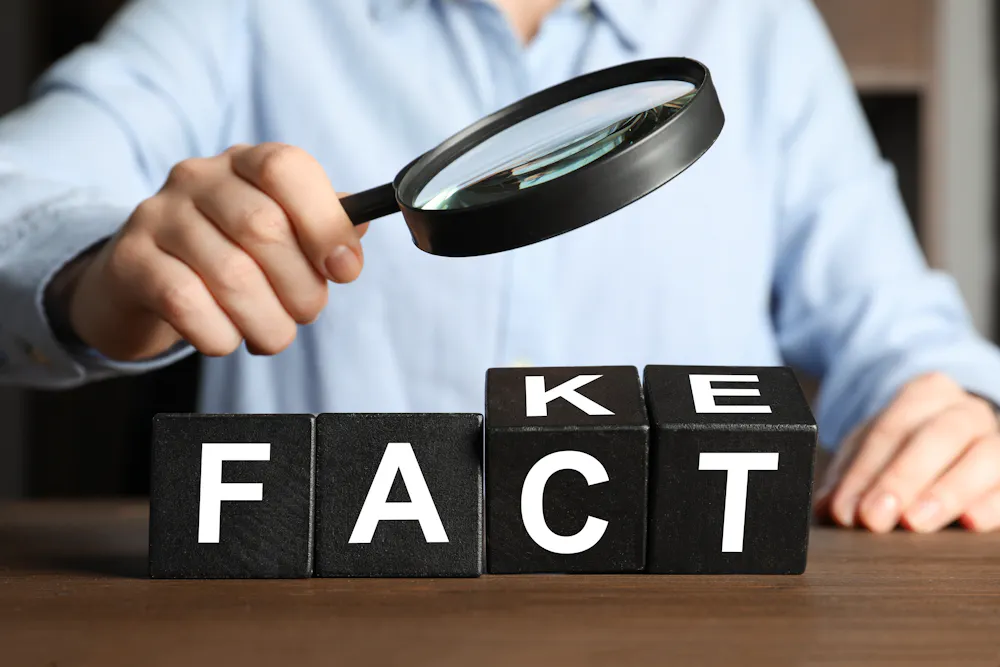
A person hold a magnifying glass over block letters that spell out the word fact.

Research shows little bias in choice of who is fact-checked. Liudmila Chernetska/Getty Images

In studies of the perceived effectiveness of professional fact-checkers versus algorithms and everyday users, fact-checkers are rated the most effective.

When Republicans do report distrust of fact-checkers, it’s because they perceive the fact-checkers are biased. Yet research shows little bias in choice of who is fact-checked, just that prominent and prolific speakers get checked more.

When shown fact-checking results of specific posts, even conservatives often agree the right decision was made.

Seeking solutions

Account bans or threats of account suspensions may be more effective than fact-checks at stopping the flow of misinformation, but they are also more controversial. They are considered more akin to censorship than fact-check labels.

Misinformation research would benefit from identifying solutions that conservatives and liberals agree on.

Examples include giving people the option, like on social media platform Bluesky, to turn misinformation moderation on or off.

But Trump’s executive order seeks to ban that research. Thus, instead of providing protections, the order will likely weaken Americans’ defenses.


H. Colleen Sinclair, Associate Research Professor of Social Psychology, Louisiana State University

This article is republished from The Conversation under a Creative Commons license. Read the original article.

“Evacuate Tehran!”: Trump sends frightening warning to Iran on Truth Social

Donald Trump's calls for "peace" between Iran and Israel lasted for a long weekend. 

The president seemingly bought Israeli Prime Minister Benjamin Netanyahu's explanation for his country's "preemptive" strike on nuclear sites and population centers, crowing on Truth Social on Monday that the attack was a result of Iran's nuclear ambitions. 

"Iran should have signed the 'deal' I told them to sign. What a shame, and waste of human life," he said. "Simply stated, IRAN CAN NOT HAVE A NUCLEAR WEAPON. I said it over and over again!"

The president closed his message with a frightening warning. 

"Everyone should immediately evacuate Tehran!" he wrote.

The rant seemed to be prompted by criticism from Tucker Carlson. The former Fox News host has been loudly pressuring MAGA conservatives to wash their hands of the Israel-Iran conflict. During a stop by the podcast of former Trump adviser Steve Bannon, Carlson worried that Trump would bring about the "end of the American empire."

"I’m really afraid that my country’s gonna be further weakened by this," he said.

Trump made fun of Carlson's ouster from Fox News in response, saying "let him go get a television network and say it so that people listen."

"Somebody please explain to kooky Tucker Carlson that IRAN CAN NOT HAVE A NUCLEAR WEAPON!" he added on social media.


“Never seen discrimination like this”: Judge orders Trump admin to restore cancelled NIH fund

A federal judge has ordered the Trump admin to restore several grants from the National Institutes of Health that were cancelled as part of the president's anti-DEI initiatives. 

In a ruling on Monday, U.S. District Court Judge William Young found that Trump's cuts to programs were "void and illegal" and accused the administration of engaging in obvious discrimination against minorities and LGBTQ+ people. Young, who was appointed by former President Ronald Reagan, called the reasoning behind the Trump administration's cuts "appalling."  

"I am hesitant to draw this conclusion, but I have an unflinching obligation to draw it – that this represents racial discrimination. And discrimination against America’s LGBTQ community. That’s what this is. I would be blind not to call it out. My duty is to call it out," Young said in his ruling.  "I’ve sat on this bench now for 40 years. I’ve never seen government racial discrimination like this."

Young was unsure of his authority to overturn executive orders. However, he demanded that the research funds that would have been granted to the plaintiffs be restored. Young chastized the Trump administration directly, saying that what they were attempting was unconstitutional from a legal perspective and despicable from a moral one. 

“You are bearing down on people of color because of their color,” Young said. “The Constitution will not permit that… Have we fallen so low? Have we no shame?”

“Turning up the propaganda hose to full blast”: Carlson attacks Fox News in Bannon interview

Former Fox News host Tucker Carlson blasted his former employer on Monday, criticizing their decision to offer a show to broadcaster Mark Levin. 

Speaking to former Trump advisor Steve Bannon on his "Bannon’s War Room" podcast, Carlson said that Levin was "screechy" and "not a calming presence." He suggested that Levin received his position due to pressure from Fox News host Sean Hannity.

"Levin’s the funniest because he’s terrible on TV, and again, I never had any problems with him at Fox. He kind of controls Hannity in this weird way. I never understood what that was about. I never really cared to learn,” Carlson said. "Sean pushed, and they gave him some kind of weekend show that nobody watched.” 

Carlson said that Levin's show was like "listening to your ex-wife scream about alimony payments" and suggested that he's seeing increased airtime because Fox News is trying to lay the groundwork for American intervention in the Israel-Iran conflict.

"What they’re doing is what they always do, which is just turning up the propaganda hose to full blast and just trying to, you know, knock elderly Fox viewers off their feet and make them submit to where you want them to," he said.

On Friday, Carlson accused Levin, Hannity, and Rupert Murdoch of being “warmongers” for pushing President Donald Trump to involve the U.S. in the escalating conflict between Israel and Iran. On Monday, Carlson cautioned the Trump administration against choosing a side. 

"I’m really afraid that my country’s gonna be further weakened by this. I think we’re gonna see the end of the American empire,” he said.

Trump responded to Carlson while speaking to reporters on Monday, calling the former agenda-setter irrelevant. 

"I don’t know what Tucker Carlson is saying," he said. "Let him go get a television network and say it so that people listen."

“The stuff of nightmares”: Minnesota shooting suspect Boelter charged with first-degree murder

Federal prosecutors have leveled six new charges against Vance Boelter, the suspect in the murder of a Minnesota lawmaker and her husband.

Boelter is charged with two counts of stalking, two counts of firearm offenses, and two counts of first-degree murder. Police allege that Boelter fatally shot State Rep. Melissa Hortman and her husband at their home on Saturday. He also wounded State Sen. John Hoffman and his wife at their home. Both victims were Democrats, and the attacks are thought to be politically motivated.

"Boelter planned his attack carefully," acting US Attorney Joe Thompson said at a news conference on Monday. "He researched his victims and their families. He used the Internet and other tools to find their addresses and names, the names of the family members. He conducted surveillance of their homes and took notes about the location of their homes." 

"It is no exaggeration to say that this is the stuff of nightmares," Thompson added.

Boelter made his first appearance in federal court on Monday and was read the charges against him. His next hearing is scheduled for June 27. Boelter will remain in custody until then. 

Hennepin County Attorney General Mary Moriarty is also seeking first-degree murder charges against Boelter.

"I want to assure our community and all those who are grieving that we will seek justice and accountability for the victims of these heinous crimes," Moriarty said in a press conference.

Moriarty called out the political tensions in the United States, saying they tend to lead to violence. She called the current level of polarization unsustainable.

"We cannot continue on this way," she said. 

Hennepin County Sheriff's Office said that they are still seeing high levels of concern from residents.

"This continues to have a chilling impact on our community as we are still receiving calls asking for extra presence in our communities," the office said in a post on X. "We are here to serve and protect and will go where needed. Most importantly, the long process of healing can begin."

The Band’s secret weapon, Richard Manuel, finally gets his due

The Band famously concluded the first act of their unparalleled story with "The Last Waltz," their much-heralded swan song at San Francisco’s Winterland Ballroom on Thanksgiving Day in 1976. By that juncture, they were already the stuff of musical legend, having served as Bob Dylan’s backup group, performing at Woodstock and releasing a pair of time-eclipsing albums in "Music from Big Pink" (1968) and "The Band" (1969).

As Stephen Lewis’ "Richard Manuel: His Life and Music, from the Hawks and Bob Dylan to The Band" powerfully reminds us, they were truly the sum of their parts. The Canadian-American roots rock group was a delicate musical fusion that included Robbie Robertson on guitar, Levon Helm on drums and lead vocals, Rick Danko on bass and violin, Garth Hudson on keyboards and saxophone and Manuel, last but certainly not least, on piano and organ. 

Much has been made of Manuel’s March 1986 suicide at age 42. By that point, The Band was playing two-bit theatres and dance halls — a far cry from their stature more than a decade earlier — and Manuel’s alcohol and drug abuse had returned with a vengeance. In his biography, Lewis wisely opts to steer a wide berth around such instances, preferring to devote his book’s precious real estate to stories about how Manuel lived and worked, as opposed to the last tragic hours of his existence in a Winter Park, Florida, motel.

The finest rock-and-roll biographies are defined by their capacity for losing the reader inside the music. With his Manuel biography, Lewis succeeds magnificently in transporting us into the musician’s world. We are treated to the stirring imagery of Manuel taking the microphone behind such Band classics as “I Shall Be Released” from "Music from Big Pink" and, later, “The Shape I’m In” from "Stage Fright" (1970). 

In his biography, Lewis devotes his book’s precious real estate to stories about how Manuel lived and worked, as opposed to the last tragic hours of his existence in a Winter Park, Florida, motel.

Lewis sagely places his narrative squarely on Manuel’s shoulders, affording the reader the experience of strolling in the musician’s footsteps at key moments in The Band’s career. In one instance, Lewis trails Manuel as he “walked out the front door of Big Pink, cracked a beer, and strolled down to the pond and followed the game trails around the water’s edge. The area was magical, the days endless. On some heady afternoons, Richard wandered as far as the rocky pine-dotted slopes of Overlook Mountain, climbing while buzzing on Catskill air, fueling his creative hearth. He’d lounge in the sun, dozing, often residing in the space between sleeping and waking, the same place inhabited by the songs bouncing around in his head.”

In the book’s most memorable instances, Lewis takes us into the heart of the studio as the music is being created. Take the section during the recording of "Music from Big Pink" when The Band was bringing the American roots classic “The Weight” to fruition. Lewis focuses his narrative on Manuel’s distinctive backing vocals — lyrical flourishes that, in many ways, make the song. As Lewis writes, “Richard’s “improvised vocals decorat[ed] the song’s periphery: wordless melodic sounds that appear in the moment and then disappear into the song’s framework, an assortment of off-mic falsetto asides, a lacy shawl draped over the three-part-chorus harmonies.”


Start your day with essential news from Salon. Sign up for our free morning newsletter, Crash Course.


But as every student of rock surely knows, it’s the chorus that drives “The Weight” into otherworldly greatness. In that moment, Lewis writes, “Richard’s voice plays the spectral mysterioso, the voice that sounds like everyone’s in the band yet is completely his own.” When the chorus finally lands—“Take a load off, Fanny”—it’s Manuel who punctuates the song’s vocal stylings. “Richard can be heard last and highest in the vocal queue,” Lewis writes. “When the group reaches the word ‘and,’ his falsetto harmony part is distinct. He replies to the line ‘Put the load right on me’ just a second late, with a fervent ‘meeee’ more of a soulful moan. His vocal addendum is a wax stamp finalizing the rough-hewn collection of distinct voices.”

With "Richard Manuel: His Life and Music, from the Hawks and Bob Dylan to The Band," Lewis affords the musician the epitaph that he has long since deserved, a moving tribute to the group that was always irredeemably the sum of its parts.

Catch Ken Womack in conversation with author Stephen T. Lewis at Rough Trade in NYC on Monday, June 23rd at 6:30 p.m. ET. 

“That was a mistake”: Trump says ousting Russia from G7 led to war in Ukraine

President Donald Trump threw a wrench in global leaders' plans to get on the same page about wars in the Middle East and Europe on Monday.

Ahead of a meeting of the Group of Seven, Trump told reporters that ousting Russia from the talks in 2014 was a "very big mistake," adding that there would not be a conflict between Russia and Ukraine if President Vladimir Putin was still welcome at the summit. 

“The G7 used to be the G8. Barack Obama and a person named Trudeau didn't want to have Russia in, and I would say that was a mistake," Trump said. "I think you wouldn't have a war right now if you had Russia in…Guess it didn't work out that way."

Trump was misremembering on several fronts. The reason for Russia's removal was the country's annexation of Crimea, the inciting incident of the war between Russia and Ukraine. Former Canadian Prime Minister Justin Trudeau wasn’t leading Canada at the time. This isn’t the first time that Trump has placed blame for Russia’s removal from the G7 on Trudeau and Obama. He's also been an advocate of allowing Russia back into the fold.

"You spend so much time talking about Russia, and he's no longer at the table," Trump complained on Monday.

The summit includes leaders from Canada, France, Germany, Italy, Japan, the European Union, and the United Kingdom. The talks are expected to focus on the current conflict between Israel and Iran. U.S. officials have shared that Trump doesn't intend to sign a joint statement from the group calling for de-escalation of hostilities between the two countries. 

Trump spoke with Putin on Saturday and is expected to meet with Ukrainian President Volodymyr Zelenskyy this week.

Tomato and egg already love each other. Join in

There wasn’t much to speak of in the fridge — the tail end of a steak, a clutch of cherry tomatoes slumping into themselves, a carton of eggs with two survivors rattling in the corner — but I had butter, garlic, a nub of feta, and that particular kind of summer decisiveness that comes not from planning, but from hunger and heat and a desire to be done. I cubed the steak and browned it hard in my cherry red Dutch oven, watching it cast off its fat and leave behind a savory varnish on the enamel.

Then in went the sliced garlic and tomatoes, the pan deglazed with a few generous pats of salted butter.

The tomatoes burst. The garlic softened. I stirred the steak back in, let it all mingle, then ladled the mixture into two bowls and crowned each one with a feta-fried egg — a crisp-edged, runny-yolked thing, its base freckled with melty brine.

I didn’t need to taste it to know it would work, especially spooned onto olive oil–kissed sourdough. Tomato and egg is a culinary truth, one of those elemental pairings that shows up across cultures not because anyone decided it should, but because it just makes sense. You see it everywhere. Once you start looking.

In China, there’s the beloved tomato-egg stir-fry, which is quick, soft-scrambled and just sweet enough to make the dish feel round-edged and soothing. In North Africa and the Levant, it’s shakshuka: eggs poached in a rich, spiced tomato sauce that hisses when it hits the pan and settles into something molten and slow. Italy has uova al purgatorio (eggs simmered in arrabbiata, roughly translated to “eggs in purgatory”) while Mexico gives us huevos rancheros, with fried tortillas and tomato-chile salsa. Even in the American South, there are riffs. One of my favorite lazy breakfasts, picked up from childhood summers in the Carolinas, was a bowl of cheesy grits topped with tomato gravy and a lush, freshly burst egg yolk.

Of course, not every dish bridges cultures so easily. Some foreground our differences — the textures we prize, the sweetness we expect, the ways we learn to eat. In many East Asian cuisines, there’s an appreciation for bounce and resistance, what Americans might describe as “toothsome” or mistake for undercooked. In the U.S., sweetness shows up everywhere — even in places it doesn’t strictly belong. But tomato and egg? 

It transcends. There’s something elemental about the combination that makes it universally appealing, even as the forms shift from table to table, home to home. 

We need your help to stay independent

At the core, it’s chemistry. Tomatoes bring acid and glutamates, the backbone of umami. Eggs bring fat, protein and a mellow, velvety savoriness. Together, they strike a balance: sharp and soft, bright and rich. The pairing satisfies on a level deeper than craving — almost architectural, like a well-engineered bridge. (I didn’t always think of tomatoes as savory until years ago my friend Jonathan, a chef, gave me a chilled glass of tomato consommé — clear, faintly golden. I expected delicacy. Instead, it was pure umami: tomato distilled to its essence, clean and resonant and utterly structural. I’ve never thought about them the same way.)

Part of the magic is how simple these dishes tend to be. With the chemistry already working in the cook’s favor, tomato and egg needs little else to become dinner. It’s cheap. It’s fast. It’s almost impossible to mess up, which may be why it’s often the first dish a kid learns to make.

While poking around, I found an essay from the Yale Daily News — an ode to the cafeteria’s surprisingly good tomato-egg stir-fry. The writer called it “a taste as simple as Commons’ tomato-eggs to bring me home,” and described the dish with such tender awe it felt like a diary entry. She interviewed the team behind it and discovered that it was born from memory: a Chinese cook recreating the first dish she ever learned to make at nine years old, guided not by formal training but by feel.


Want more great food writing and recipes? Sign up for Salon’s free food newsletter, The Bite.


It stuck with me, the idea that tomato and egg isn’t just a pairing, but a comfort script. A conversation between ingredients that already know how to take care of you.

And right now, that feels like a gift. It’s the season of dinner dread — when the sun’s still hot at 7 p.m., your patience is wilting and the idea of turning on the oven feels vaguely threatening. But tomato and egg already love each other. You don’t have to make them work. It’s a shortcut to flavor, to dinner, to that gentle sense of relief that comes from eating something simple and satisfying. Let it be a game, not a task. Call it fridge-foraged shakshuka. Call it “Chopped: June Edition.” Whip up pappa al pomodoro and slide a poached egg on top like a wink. Simmer Indian egg curry while the fan hums in the background. Make biscuits studded with sun-dried tomato and goat cheese, then crown them with slow-scrambled eggs. Dinner, solved.

Tomato and egg: elemental, eternal, and ready when you are.

“The real wild card is Amy Coney Barrett”: The Supreme Court case that could eviscerate trans rights

With the arrival of June comes the first true glimmers of a patently American summer: vibrant Pride parades, weekend barbecues, festivals galore — and the looming release of the Supreme Court's most contentious rulings. Among this year's slate is a landmark case on gender-affirming care for minors that will have sprawling implications for transgender youth and adults, alongside the potential to upend decades of anti-discrimination law.

U.S. v. Skrmetti concerns Tennessee's 2023 gender-affirming care ban, which prohibits physicians from providing medical treatments like hormone therapy or puberty blockers to minors seeking to transition. During oral argument in December 2024, the Biden administration argued that a patient's birth-assigned sex determines what treatment the law prohibits or allows; for example, providing someone assigned female at birth with estrogen therapy is not prohibited under the law, while providing that treatment to a child assigned male at birth is.

The state, on the other hand, argued that the law doesn't determine what treatments are allowed based on sex or transgender status but instead on the reason why someone seeks the treatment; a child could seek puberty blockers to treat precocious puberty but not to delay puberty while they make sense of their gender identity.  

Though the Trump administration has since notified the Supreme Court that it thinks the ban does not violate the Equal Protection clause, it has nevertheless urged the justices to decide the case. The Supreme Court will determine whether transgender Americans have a constitutional protection from discrimination and, if so, whether it's on the basis of sex or under a new protected classification of transgender identity. 

A decision is expected by the close of the judicial session at the end of the month. 

No matter how the justices decide, the case will be far-reaching, impacting access to health care for trans youth, trans Americans' protections against discrimination and, potentially, the foundation of equal protection doctrine. If December's oral argument was any indication of its thinking (legal experts say it isn't always), the highest court's ruling stands a good chance of unleashing greater harm onto a community of less than two million people already facing broad legislative attacks at the state level and targeted executive actions at the federal

But Rutgers University law professor Katie Eyer, who specializes in anti-discrimination law, takes a slightly more optimistic view. The leading scholar in LGBTQ+ employment rights, social movements and constitutional change told Salon that, while four of the conservative justices seemed likely to vote against the plaintiffs, Justice Amy Coney Barrett's thoughtful questioning — and Justice Neil Gorsuch's opinion expanding Title VII anti-discrimination protections based on sexuality and gender identity in Bostock v. Clayton County — indicate it's still possible the plaintiffs could prevail.

Even if the Supreme Court ultimately rules in favor of Tennessee, she added, the LGBTQ+ community has survived these attacks before — and reversed them. 

This conversation has been edited for length and clarity.

I understood the state to be arguing that they're basing the denial of care on the purpose or the use of said medical care, such as to alter a child's gender presentation or help the child transition, versus slowing precocious puberty. Is that accurate? Can you break down in plain terms what all that means? 

You're absolutely right. Their full argument is that this law does not distinguish based on sex or transgender status, but instead the distinction is based on medical use. The problem with that argument is that is just not what the statute does. The statute doesn't specify that you even need a medical use for these types of treatments. To give an example, outside the context of a trans youth receiving hormone therapy, hormone therapy could be used for no medical purpose in the state of Tennessee. The most concrete example of that is that a cisgender child in Tennessee can still get a breast enhancement for no medical purpose. The law does not address that. It does not prohibit it. So although they frame the argument in those terms, that's not actually what the law says. You saw some pushback on that, certainly from the progressive judges at oral argument, pointing out that that's not actually what the law here says.

What is the question at the heart of this case that the justices are set to decide? During oral argument, there was a broader range of conversation happening than what I understood to be the actual centerpiece of the case.

I'll just underscore the quintessential question of what could happen to these bans on gender-affirming care for transgender minors. But many of the ways that the court could decide the case would also have much bigger implications for equality law, not just for LGBT people, but for all sorts of groups. That's part of the reason you felt such a wide array of discussions at oral argument: Justice [Ketanji Brown] Jackson bringing up things like the potential implications for interracial marriage. That's because some of the arguments being made by the state here are arguments that could resurrect a type of argument that the court rejected 50 or 60 years ago, during the end of Jim Crow.

On the most general level, there are two big-picture issues they're going to have to address. One is, does this type of discrimination — either because it's sex discrimination or because trans people also get some special protection — get a higher level of scrutiny? And then they might or might not decide the bottom-line question of whether the law is valid. So if they say the courts have to take a closer look, there's a possibility they won't actually apply that closer-look standard themselves; they'll just send it to the court of appeals to say, "Take a closer look under this higher standard." That's actually what the plaintiffs asked them to do, send it back to have them reassess.

I want to know what the stakes of this case are for trans youth, and even trans adults, before we get into the broader applications. 

The stakes are obviously enormous for transgender youth and transgender adults, and that's for a few different reasons. First and most obviously, whatever the court decides will profoundly impact access to gender-affirming care. The stakes of the case have gone up even since the court granted review. President [Donald] Trump has attempted to nationalize what was previously a state-by-state attack on gender-affirming care for trans youth. So he issued an executive order that directs the federal government, as much as they can, to go after this issue. It's important to note that the key issues here — there's no reason that they would be different for trans adults compared to a trans minor. So if the court says no closer look is required of this law, that you get just a deferential type of review where the state doesn't have to prove its reasons, that same reasoning would apply to adult care as well. Another key factor about the executive order that we saw is them already pushing into legal adulthood, right? So they covered folks under age 19. It's quite clear that the end game is to try to reduce access to or eliminate access to this care for everybody.

The implication just for access to health care would be very large. Obviously, in the converse, if they rule for the LGBT side of the case, that would have big implications for access to health care for those who are currently unable to access it. Although, again, simply saying the closer look has to be provided doesn't actually determine the outcome. You still have to look at what the government's reasons are. It just becomes a situation in which they have to prove that they have a good basis for it, and courts that have looked at the evidentiary basis have said they don't. They said that the government can't prove its good reason here.

Then the bigger picture is that most of the ways the court could decide the case — not all of them, but most of them — would have bigger implications for all the other laws targeting transgender people right now. Most of the things that the court might say would also have implications for the transgender military ban, or the laws that allow teachers to misgender children, that requires them to out them to their parents, or the ban on trans athletic participation. … They could write it narrowly in a way where it doesn't reach those other issues, but most of the ways they could decide the case would also have implications for those other issues as well.

Returning to what you mentioned earlier about those broader implications beyond trans youth and trans adults, in what ways will this decision ultimately manifest? I'm thinking about what you just said in terms of the implications for these broader laws, but also of the questions about access to gender-affirming health care and sex discrimination cases in general.

Sex discrimination, and in fact, depending on how they write it, it would potentially affect all groups, including race discrimination, anything else that's protected by equal protection. The arguments for the plaintiffs' side of the case, for the trans side of the case, are fairly conventional applications of existing equality law. So if the court ruled in favor of the trans side of the case, relatively little is likely to change about equality law. The converse is not true. They would have to make some new law in order to rule against the transgender plaintiff here, and in particular, to say no higher level of second-look review applies here. There are a few different ways they could do that, some of which would have much narrower impact, some of which would have much [broader impact]. One possibility is, essentially, they could just make a carve-out for health care and say, "Health care is just different because sometimes you need to focus on identity in health care. We are not going to give this closer-look review when health care is at issue." That would be a carve-out that would affect other groups as well. It would mean that there was a free path for the government when they are targeting health care that might involve a particular group.

The Sixth Circuit, which is the court below, in rejecting the sex discrimination argument, basically said, "Because both boys and girls are subject to the same limitation, that's not sex discrimination. Both groups are burdened equally. So this isn't inequality." For legal scholars and those who know about legal history, this argument is super alarming. That is the basic premise on which the legal defense of Jim Crow and bans on interracial marriage rested. So the argument was, it's not inequality because Black people and white people are subject to the same restrictions. They're both subject to segregation. They both can't marry each other. The court repudiated that very clearly at the end of Jim Crow, and that's why you saw things like Justice Jackson raising the race context at oral argument, basically because that argument in this context is to say, this is in fact discrimination because both boys and girls can't get access to this.

If they embrace it broadly, right, it would have huge implications and very concerning implications. Even if they embrace it just for sex, it would also have serious and, to many people, very concerning implications. For example, you could characterize a rule that men and women both have to dress consistently with the norms associated with their sex as applying equally. Right? Men have to wear pants, women have to wear skirts, and the courts couldn't look at that closely. That doesn't make any sense to most people, right? But that's the nature of the argument that's being made here. As long as both groups get some burden put on them, it's OK.

The other issue is about this issue of whether trans folks should be considered, on their own, the type of group that gets a closer look when they're subjected to discrimination. The state response to that argument has essentially been that the Supreme Court hasn't done this in a long time, and it should officially say it's never going to do so again That obviously also would have implications. That wouldn't be such a big deal for groups that already have protection, but it would create a scenario in which no group in the future could have access to the idea that government discrimination against them is suspicious and should get a closer look by the courts. That really, I think, is both anti-democratic — why should we say it's the end of time for the idea that new groups might need protection? — and also just doesn't have any principal basis in the law.

The most radical thing they could do, which I did not see many signs of at oral argument, would be to take a turn towards originalism, which is something that we've seen across a lot of other areas of constitutional law. That would be a very radical outcome. The court has not followed originalism in equal protection law ever since Brown v. Board of Education. Because it did not necessarily support desegregation, they cut loose from an originalism approach. I don't expect the court to take a hard turn to originalism in this case, but that would be one other thing to look out for, whether they sort of clean up any language and adopt history as more of a metric for equality law. Part of the reason I mention this is that was another thing we actually saw in the Sixth Circuit's opinion, language to this effect that the parties should have briefed sort of history and tradition, this type of originalist background, even though, that's not currently a part of the Supreme Court doctrine.

I know oral argument isn't always an indicator of how the justices may rule, but given all the anti-trans attacks we've seen in recent years — I'm thinking particularly of those anti-trans ads in last year's presidential campaign, the influx of anti-trans legislation at the state level, these early executive orders from the Trump administration, combined with oral argument — what kind of decision are you expecting?

Let me start by saying what the conventional wisdom is, which is to say that the trans side of the case is likely to lose. I've heard maybe 95% of commentators say that was their belief about how the case is likely to turn out. My own view is that that is still the most faithful press, but that there is a significant possibility that we might see a trans victory in this case. I alluded to some of the reasons earlier, but in short, I think we can expect the three progressives to rule for a secondary level of scrutiny. I think there is a real possibility — though not a certainty — that Justice Gorsuch, who authored the Bostock opinion, will also believe that heightened scrutiny is appropriate here. And then the real wild card is Amy Coney Barrett. Again, her questions at oral argument were not decisively in favor of the trans side of the case, but they were genuine and reflected a meaningful engagement with the question of whether transgender people should get this closer, second look, type of review. 

If you look not just at the moment that existed at the time of oral argument but what's transpired since then, it's hard for me to imagine that any person with eyes and ears and an even-handed, sensible approach to this could not see why such second-look review is appropriate here. The whole idea is supposed to be that where there are groups where we are worried that discriminatory passions are a piece of the mix, that we don't just take the government's word that it is acting based on benevolent motives. Given the issues that Justice Barrett was wrestling with at oral argument, and given the animus that we've seen in some of the Trump executive orders, certainly my hope is that Justice Barrett will recognize that this is a type of group where we have reason to think at least that type of second-look review is appropriate.

This opinion is either coming during Pride or capping off a month of celebrating LGBTQ+ identity and cultures and bolstering the fight for equality and liberation. Given what you just said and the moment that we're in — where trans and queer communities across the country are experiencing attacks from both the federal and state level, and we're also seeing this weakening of diversity, equity, inclusion policies in so many different areas — what will this decision mean for people?

That's a great question. I mean, if the court issues any sort of ruling in favor of the transgender side of the case — even if that's just, you know, this needs closer look review, and we're going to send it back — that would be an enormous victory and an enormous light of hope. It has been fairly dark for the LGBTQ community. There are people who are leaving the country right now because they do not feel safe who are members of the transgender community. Such a decision would be truly meaningful if, in fact, it comes out in favor of that side of the case. Obviously, the converse is also true. I think a statement from the Supreme Court at this particular moment of "There's nothing to see here. We don't even need to take a look at the evidence to know that this is OK," would have, I think, devastating emotional impact for many in the LGBTQ community.

That being said, I'll also say the LGBTQ community, as you may know, is incredibly resilient and creative. It has faced really low moments like this before. I think, for example, of Bowers v. Hardwick in 1986 at the height of the AIDS crisis. The Supreme Court says it's fine to criminalize gay sex and make gay people presumptive criminals. They don't believe that gay people have families. Obviously, it was a devastating decision, but the community regrouped. They regrouped around activism, and they regrouped legally. Less than 20 years later, they managed to get that opinion overturned. And a couple of things we've seen in this moment — I'm thinking about Florida banning rainbow lights for Pride on the bridges  and people just recreated it. This is a resilient, creative community, and I don't expect that this will be the end of the road. I'll put it that way.