Stephanie Zacharek
“The Bounty Hunter” chains its stars to the bed
Forget crackling chemistry. Jennifer Aniston and Gerard Butler seem to be tolerating each other at best
Gerard Butler and Jennifer Aniston in "The Bounty Hunter." “The Bounty Hunter” has brought me no closer to knowing whether I find Jennifer Aniston mildly appealing or mostly unbearable. By now I’ve at least learned that she’s an actress who can’t be easily written off. She’s given surprisingly multi-shaded performances in pictures like David Frankel’s unapologetically emotional “Marley & Me,” but she’s also been deeply underwhelming — just too cute by half — in movies like “The Break-up.” I’ve adopted a “show me” policy when it comes to Aniston’s movies: I’m open to the possibility of surprise, but I know I’m more likely to get a passable level of inoffensive mediocrity.
And so with “The Bounty Hunter,” the Jennifer Aniston mystery deepens — well, just a little. Aniston plays New York reporter Nicole Hurley, who works for a paper called the Daily News. (You know this movie is pure fiction when you see that the office she works in is actually populated, with busy, productive newspeople who still have jobs.) Nicole is hot on the trail of a big story involving a suicide that may actually be a murder. But she’s also facing a felony charge, and she further complicates the situation by missing her court date. The bounty hunter assigned to haul this lawbreaking cutie-pie into jail is none other than her own ex-husband, Milo Boyd (Gerard Butler), a former detective who now shuffles around in a half-shaven state, working hard to be charming in an “Aw, shucks — who, me?” kind of way.
In their post-divorce state Milo and Nicole can’t stand each other, and he really rubs her the wrong way when he chucks her into the trunk of his car. That’s how the movie opens, and it’s a vaguely promising beginning: You can see that the director and the screenwriter — respectively, Andy Tennant and Sarah Thorp — have tried to inject some verve and wit into this thing. The goal, clearly, was to give us an old-fashioned romantic caper-comedy with lots of crackle between the leads and one or two amusing second bananas or bit players. (My heart leaped with joy when the wonderful, diminutive comic actress Carole Kane showed up as a country innkeeper, though her role is barely a smudge.)
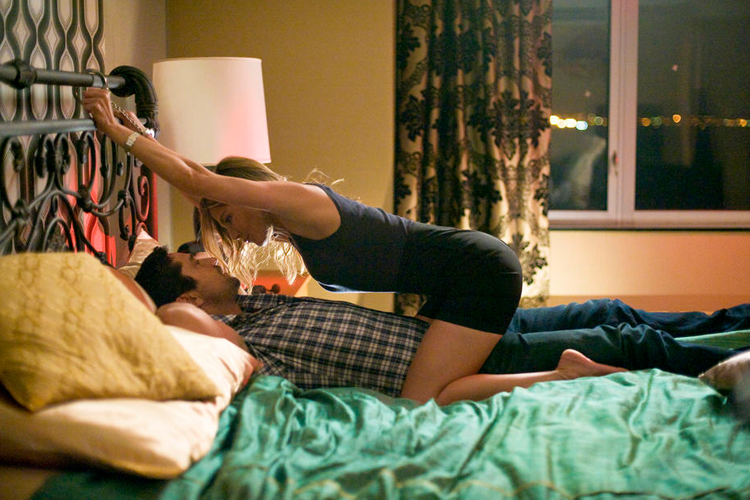
But even though Tennant has a few reasonably entertaining pictures to his credit — among them the 1998 “Ever After,” in which Drew Barrymore plays a completely charming Cinderella — he fails to give “The Bounty Hunter” the energy it needs. The plot is overly tangled and knotty, and its resolution is dealt with in a hasty verbal explication. Those sins might be excusable, if there were at least some chemistry between the two leads. But Butler and Aniston appear to be tolerating each other at best. Their characters go through the motions of conning one another, but their hearts just aren’t in it. On two separate occasions, one handcuffs the other to a bed — whether that’s supposed to be a fear-of-commitment metaphor or a feeble effort to add some kinkiness to the proceedings, the gag just feels tired and worn out.
Regardless, Aniston has her game face on. She may be uninspired in “The Bounty Hunter,” but she’s doing her damnedest to keep the picture’s wobbly wheels spinning. I find myself once again unable to come up with anything particularly damning or complimentary to say about Aniston. This performance, like so many others she’s given, at least has a perfunctory glow about it. She doesn’t just sleepwalk her way through these half-baked roles, she actually works at them, and her gumption, at least, is admirable.
But what’s Butler’s excuse? I’ve been told that Butler is a sex symbol, the kind of guy who turns 99 percent of the female population into crazed chicks out of the old Hai Karate ads. But if he’s throwing off any heat, it’s failing to reach me. Butler’s smile isn’t cute or sexy; it’s just kind of a doughy smirk. There’s nothing smoldering behind his exaggerated swagger; at best, it speaks of “You know you want it!” entitlement. I concede that Butler generally looks artfully rumpled, if you like that sort of thing. Still, my ambivalence about Aniston notwithstanding, I think she deserves better. “The Bounty Hunter” is a comedy of remarriage that makes divorce look like a state of grace.
“Greenberg”: Ben Stiller is cruel, crazy — and compelling
Noah Bambauch's latest yuppie drama is as self-conscious as anything he's done but far more open
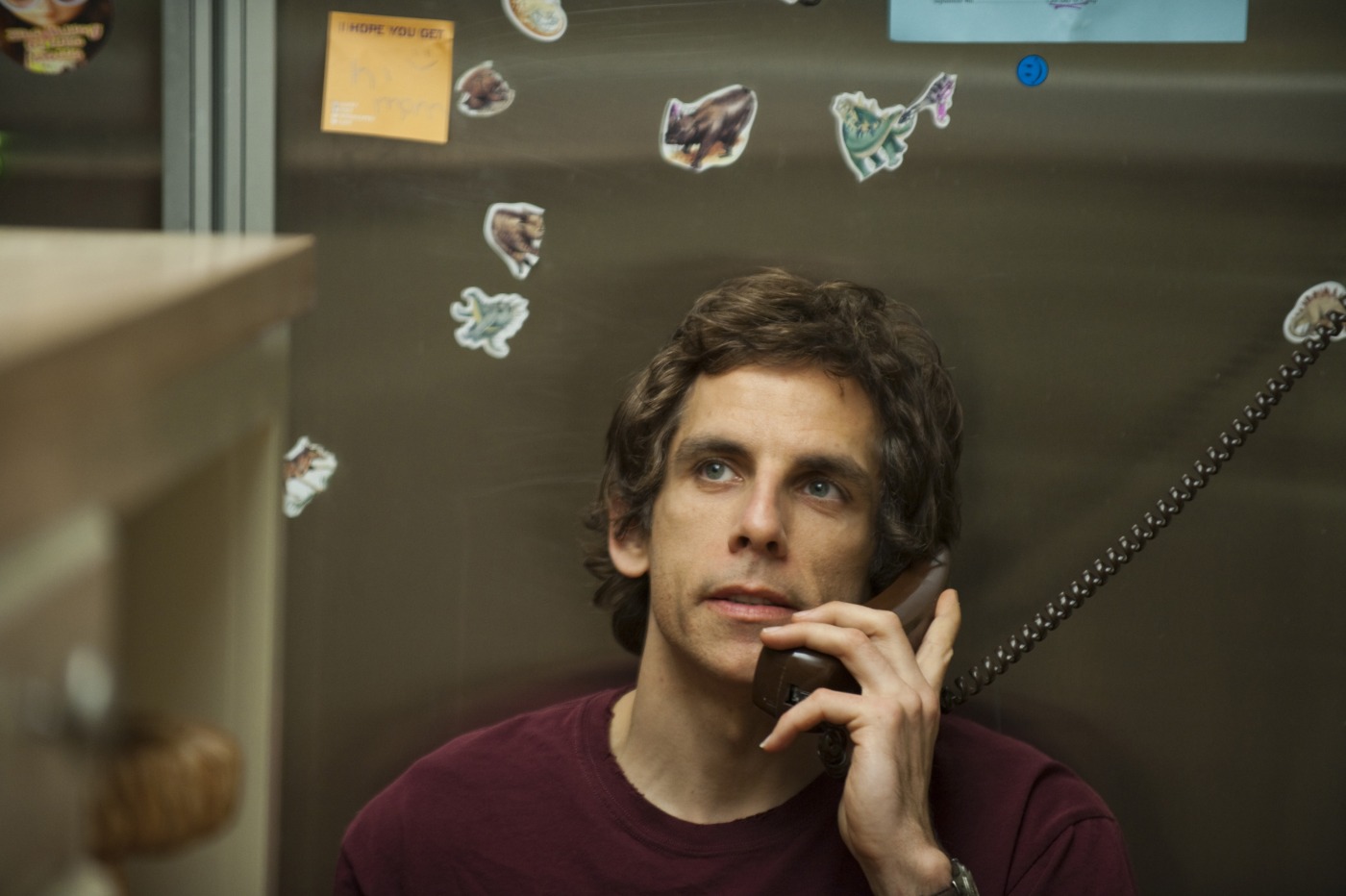
Ben Stiller in "Greenberg." In Noah Baumbach’s “Greenberg,” Ben Stiller is the Roger Greenberg of the title, a fortyish lost soul who’s just done a stint in a New York mental hospital and who has just decamped to his brother’s tony digs in L.A., for a few weeks house- and dog-sitting. Greenberg is a gaunt ghost of a figure, with shadowy eye sockets and exhausted, unblinking eyes — his pupils are constantly on red alert. He spends his days building a doghouse for his brother’s family dog, a low-key German Shepherd named Mahler, and trying to reconnect with old friends that he’s clearly alienated with years’ worth of erratic behavior. He writes cantankerous letters to American Airlines, Starbucks and the New York Times, first etching them out in longhand (like a crazy person) and then typing them neatly before packing them off in their crisp envelopes (like a crazy person who knows how to appear sane). Socially awkward and so self-involved that other people’s lives seem like an inconvenience to him, Roger Greenberg is everything most of us don’t want to be.
Continue Reading Close“Our Family Wedding”: Say, “I do!”
It may look cliched, but this culture-clash comedy is an example of what's missing from mainstream American film
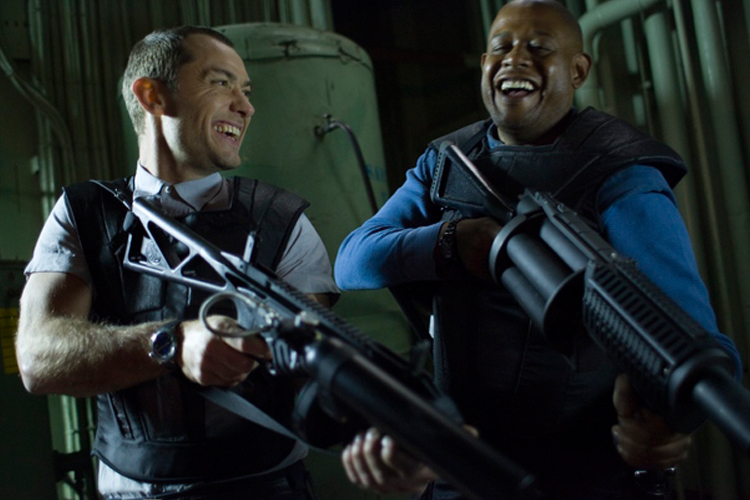
America Ferrera and Lance Gross in "Our Family Wedding." Rick Famuyiwa’s “Our Family Wedding” is one of those movies — like those made by Tyler Perry — that are not supposed to need critics, which is barely a problem, since most critics who consider themselves “serious” won’t bother to see it anyway: It’s the kind of picture that, on a newspaper at least, is generally doled out to a second or third stringer, or a freelancer. Many of those who do write about it will likely use words like “clichéd” and “formulaic” to show they’ve seen it all before. This is, after all, a culture-clash comedy in which a young couple who have decided to marry, Lucia Ramirez and Marcus Boyd (America Ferrera and Lance Gross), must introduce each other to their respective families. Lucia’s parents, played by Carlos Mencia and Diana-Maria Riva, don’t yet know that their daughter’s boyfriend is black. Coincidentally, Marcus’ father (Forest Whitaker) has just had his car towed by Lucia’s father, and the two have spent some time exchanging mild racial epithets.
Continue Reading Close“Green Zone”: Matt Damon’s Iraq war thriller
The "Bourne" star reteams with director Paul Greengrass to play a soldier on a futile mission to find WMD
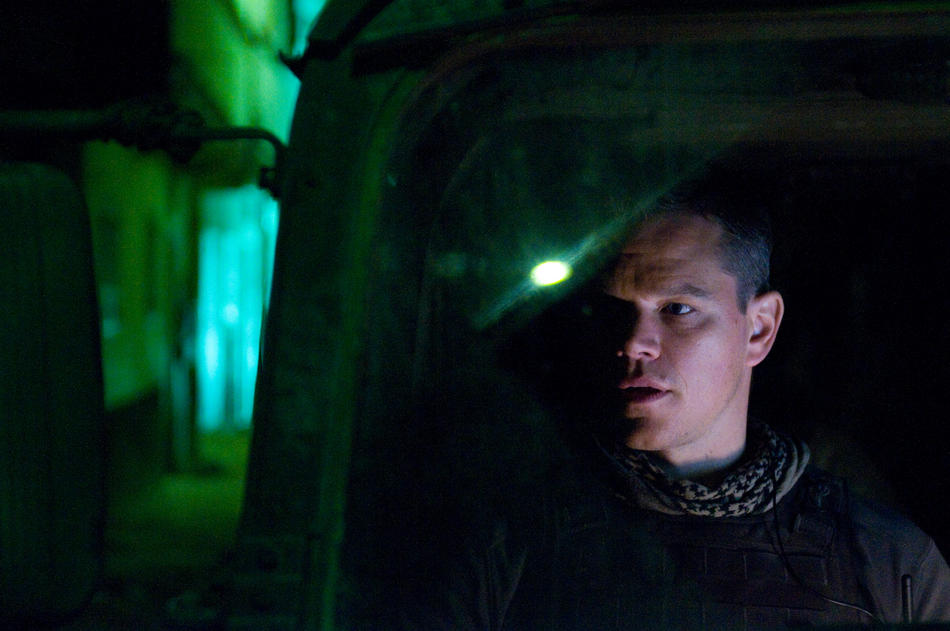
Matt Damon as Chief Warrant Officer Roy Miller Early in “Green Zone,” a fictional movie teased from the tangle of facts, almost-facts and squelched facts surrounding the search for weapons of mass destruction in the early days of the Iraq war, Matt Damon, as a soldier in charge of finding those WMD, has one line of dialogue that sums up the heartsickening reality of the whole enterprise. During a briefing in which a couple of higher-ups announce with bravado that someone they completely trust has told them exactly where the WMD are located, Damon’s Chief Warrant Officer Roy Miller speaks up with the demeanor of a polite schoolboy: “There’s a problem with the intelligence, sir.” Damon and his team have already checked out many of the sites at which those WMD were supposedly stashed and come up with zilch. (One of the alleged locations has turned out to be a toilet factory.) He’s not being disrespectful; he’s merely pointing out a fact.
Continue Reading CloseOscar’s biggest stars: Look closer
Slide show: We zoom in on the nominated performances to find out what makes them great -- or not so great
In the weeks leading up to this year’s Academy Awards, I put the spotlight on each of the 10 performances nominated in the best-actor and best-actress categories in a series called “Oscar 2010: The Performances.” My aim was not to predict who would win, or even to make pronouncements about whom I want to win (though reading between the lines is always encouraged). I wanted to spend a little time looking under the hood of each of those performances, to get a sense of what might be going on there. My methods were highly unscientific, my views wholly subjective. My hope was to get closer to the heart of what makes a good performance good or, when applicable, a bad one bad. At the very least, this series offered a few snapshot assessments of what it is about actors that keeps us going to the movies in the first place, a small window into the pleasure that actors, at their best, are capable of bringing us.
The following slide show offers excerpts of each essay, along with a link to the original.
Jeff Bridges’ redemption song
How the actor turned the stock tale of a has-been crooner into an Oscar-nominated marvel
In “Crazy Heart” Jeff Bridges — who has never won an Oscar, despite the pleasure he’s given audiences in a film career that’s spanned more than 40 years — gives a performance that’s so comfortably lived-in, it makes you forget there’s even such a thing as technique. All performances consist of two basic components: the things an actor does consciously and — usually the magic ingredient — the things that emerge as the result of not trying. With Bridges’ performance here, as with perhaps nearly every performance he’s ever given, it’s impossible to locate the seams between the two. Bridges may be acting, but he always makes it look like living.
Continue Reading ClosePage 2 of 223 in Stephanie Zacharek