Spring Sale: Get 1 Year, Save 58%

“It’s beneath you”: Jon Stewart flames Donald Trump’s cologne ad featuring Jill Biden

Jon Stewart is presenting a hopeful demeanor about the incoming transfer of power between President Joe Biden and President-elect Donald Trump, but that isn't stopping the comedian from roasting Trump for his new fragrance advertisement that includes an image of First Lady Jill Biden.

On Monday's episode of "The Daily Show," Stewart highlighted how the U.S. awaits "hopefully a more humbled and mature leader." But that statement was undercut by Trump's first network television interview post-election were the president-elect said he would like to see members of the Jan. 6 committee go to jail.

"Or not!" Stewart joked. 

The comedian explained how the incoming president was on tour around Europe, "continuing the long American tradition of not waiting for the inauguration to become president and head overseas and meet with allies and remind everybody how f**king weird he is about shaking hands."

The show then played various clips of Trump shaking hands with European leaders like French President Emmanuel Macron and Prince William of Wales. But what was the most eye-catching during Trump's European tour was his interactions with First Lady Jill Biden.

Stewart explained, "Now normally the first lady Melania [Trump] would have been there to say to Donald, 'sit up!' But in another stroke of weirdness, Trump was apparently traveling with his predecessor's wife, attending the opening of the Notre Dame cathedral with Jill Biden."

He continued, "It was a rare moment of conciliation, one that would have given this country hope, had it not immediately been undermined by the returning president releasing an actual cologne ad belittling and sexualizing said moment.

We need your help to stay independent

In Trump's Truth Social post, he wrote, "Here are my new Trump Perfumes & Colognes! I call them Fight, Fight, Fight, because they represent us WINNING. Great Christmas gifts for the family." Attached to the post was also a photo of Jill and Trump together with the caption, "A fragrance your enemies can't resist!" The perfumes and colognes are selling for nearly $200.

"You f***ing won. You won. You don't have to push merch anymore. I find it hard to believe I'm saying this, but it's beneath you," Stewart said.

Fast-forward to the 10:50 minute mark to start on Trump's European tour shenanigans.

"The Daily Show" airs Monday through Thursday at 11 p.m. ET on Comedy Central and streams on Paramount+.

Rupert Murdoch loses bid to change his family trust

A Nevada probate commissioner has ruled against Rupert Murdoch’s attempt to alter his inviolable family trust to give his oldest son Lachlan Murdoch control of his media empire, in an effort to preserve Fox News’ conservative slant

According to a sealed document obtained by The New York Times, Murdoch’s family trust gives each of his four children equal control over the company after his death — which worried Murdoch, as two of his children are known to have less conservative views. 

Murdoch, 93, and Lachlan sought to amend the trust by consolidating Lachlan’s leadership over the company. Fox News and News Corp have been under Lachlan's leadership since his father stepped down last year. 

Murdoch called upon a provision that allowed him to make changes to the trust if it were in the best interest of its beneficiaries, arguing there may be financial repercussions should Fox News shift away from conservatism.

Murdoch and Lachlan only notified the other Murdoch children— James, Elisabeth and Prudence — of the proposal just days before the trust’s representatives were scheduled to vote. 

Edmund J. Gorman Jr., the commissioner who ruled against the change, wrote in his 96-page opinion that Murdoch “demonstrated a dishonesty of purpose and motive.”

“The effort was an attempt to stack the deck in Lachlan Murdoch’s favor after Rupert Murdoch’s passing so that his succession would be immutable,” Gorman wrote, calling Murdoch’s actions a “carefully crafted charade.”

A lawyer for Murdoch told The New York Times that Murdoch and Lachlan were disappointed in the ruling and intended to appeal. A spokesperson for James, Elisabeth and Prudence told The Associated Press they welcome the ruling and hope that their family can “move beyond this litigation to focus on strengthening and rebuilding relationships among all family members.”

Chipotle confirms incoming price increases, primarily due to inflation

As Salon’s Joy Saha reported last week, Chipotle has confirmed a price increase. Saha noted that several of the chain’s key ingredients, including avocados and sour cream, have been “hit hard by inflation.” The company says the price hike is intended to “offset the costs of raw ingredients.”

Dee-Ann Durbin of the Associated Press reported that Laurie Schalow, Chipotle’s chief corporate affairs officer, confirmed the restaurant chain is implementing a 2% price increase nationwide. However, Durbin noted that the increase will affect only about 20% of Chipotle’s 3,500 U.S. locations.

This adjustment follows a period of leadership changes, with Chipotle’s former chairman and CEO leaving in September to take the top job at Starbucks.

Meanwhile, Jennifer Williams of The Wall Street Journal reported that despite single-digit inflation for its ingredients, Chipotle executives are considering further price increases while aiming to remain attractive to cost-conscious consumers.

This news comes after earlier complaints about portion sizes. In May, social media star and food critic Keith Lee criticized the lack of chicken in his burrito bowl, saying Chipotle’s “portions been crazy low.” In response, the chain promised to “re-coach” employees to ensure more consistent portion sizes.

“I don’t remember 20 days”: Jamie Foxx opens up about near-fatal brain bleed and stroke

Jamie Foxx is ready to open up about the medical emergency he experienced last year that left him hospitalized for more than a month.

In a new Netflix special released Tuesday called “Jamie Foxx: What Had Happened Was," the Oscar-winning actor discussed his brain bleed that led to a stroke, CNN reported. Last year, Foxx was hospitalized for having an undisclosed health crisis while he was filming a movie in Atlanta. His daughter, Corrine Foxx posted a statement sharing that her father had "medical complications" and asked people to keep him in their thoughts as he recovered.

“It is a mystery. We still don’t know exactly what happened to me," he said in the special.

“April 11, I was having a bad headache and I asked my boy for an aspirin. And I realized quickly that when you’re in a medical emergency, your boys don’t know what the f**k to do,” he said. “Before I could get the aspirin I went out. I don’t remember 20 days.”

When the actor's family admitted him to a hospital, a doctor said he was having a brain bleed that had led to a stroke and that he would die without surgery. Following the operation, Foxx was told that he might make a full recovery "but it’s going to be the worst year of his life."

After the immediate aftermath of the stroke and surgery, Foxx's family kept him out of the public eye so he could continue his recovery. The actor would soon go on to do rehab where he would make a full recovery. In a 2023 health update, the star told his followers, “You’re looking at a man who is thankful . . . finally startin’ to feel like myself . . . It’s been an unexpected dark journey . . . but I can see the light.”

“Jamie Foxx: What Had Happened Was" is now available to stream on Netflix

UnitedHealthcare killing reignites criticism of insurance industry

When I saw the news of UnitedHealthcare CEO Brian Thompson’s stunning killing in Manhattan on Wednesday, my mind immediately went to the television show “Mr. Robot,” Sam Esmail’s dark, dramatic FX thriller series that had nothing to do with health care

“Mr. Robot,” which aired from 2015 to 2019, starred Rami Malek as Elliot, a reclusive hacker who spends the show’s first season attempting to hack Evil Corp., a mammoth conglomerate that owns the bulk of the world’s consumer debt. The end goal: purging everybody’s financial records with the company, effectively erasing the world’s debts and freeing individuals from an exploitative behemoth.

We don't know for certain whether the motives of this fictional vigilante enacting his vision of justice against corporate behemoths reflect those of Luigi Mangione, the suspect who allegedly gunned down Thompson in front of a Midtown hotel. But on Monday, police charged Mangione with second-degree murder after they found him in Pennsylvania carrying a gun, a fake ID and a handwritten manifesto that criticized health care companies for putting profits above care, The New York Times reported. Bullet casings at the scene of the shooting reportedly had three words engraved on them: “deny,” “defend” and “depose,” which could refer to a tactic health insurers have been described as using to deflect claims. 

Thompson's death — and the largely unsympathetic online reaction to it — has reignited a national conversation around rising medical costs, claim denials by the country’s largest private insurers and Americans' resentment toward them.

The industry has pushed back against the social media vitriol. UnitedHealth Group CEO Andrew Witty, who leads the parent company of UnitedHealthcare, urged employees in a video message to "tune out that critical noise that we're hearing right now. It does not reflect reality." 

"Our role is a critical role," he said. "And we make sure that care is safe and appropriate and is delivered when people need it. And we guard against the pressures that exist for unsafe care or for unnecessary care to be delivered in a way which makes the whole system too complex and ultimately unsustainable."

Rising premiums and profits, more claim denials

Frustrations with the insurance industry are nothing new, and they aren't limited to social media.

In 2023, The Commonwealth Fund, a nonprofit health care research foundation, surveyed 7,873 American adults about their ability to pay for health care. The findings showed that many Americans, “regardless of where their insurance comes from, have inadequate coverage that’s led to delayed or forgone care, significant medical debt, and worsening health problems,” according to the Fund's report. “While having health insurance is always better than not having it, the survey findings challenge the implicit assumption that health insurance in the United States buys affordable access to care.”

"The survey findings challenge the implicit assumption that health insurance in the United States buys affordable access to care"

The criticism has played out in Congress as well. Earlier this year, a U.S. Senate committee investigating Medicare Advantage plans found that UnitedHealthcare denied requests for nursing care to patients recovering from falls and strokes three times more often than it did for other services, while Humana denied at a rate 16 times higher. Those companies, along with Aetna’s parent company CVS, “were intentionally denying claims for this expensive care to increase profits,” according to The New York Times. UnitedHealthcare's rate of denials from skilled nursing homes increased by a factor of nine during the same time period, 2019 to 2022, according to the Senate commmittee. The company did not respond to the Times' request for comment on denial rates.

Health insurance companies aren’t required to disclose the number of claims they deny, so tracking down data on those rates can be difficult. ValuePenguin, a consumer finance comparison site, published an analysis on the major companies' denial rates, based on publicly available claim denials and appeals data from the Center for Medicaid and Medicaid Services. UnitedHealthcare was reported as having denied 32%, or roughly one-third, of in-network claims — the highest rate among companies indexed. 

In 2023, the families of two deceased UnitedHealthcare beneficiaries filed a lawsuit in the U.S. District Court for Minnesota against the company, alleging it knowingly employed an artificial intelligence algorithm to disproportionately deny claims made by patients for care determined necessary by their physicians. The AI system used by UnitedHealthcare in those instances is reported to have a 90% error rate, CBS News reported. The case is still ongoing, and UnitedHealthcare filed a motion earlier this year to have it dismissed, arguing that the court does not have jurisdiction over complaints that may have violated federal law.  

UnitedHealthcare has also increased the cost of its premiums. In 2023, the company’s premiums rose by 12% over 2022, according to The Wall Street Journal, which noted that total operating costs also increased at nearly the same rate. In 2024, the company expected premium increases between an average of 9.9% and 14.9%. 

Profits have steadily risen in recent years. UnitedHealth Group reported a net income of $22.3 billion in 2023, $20.6 billion in 2022, $17.3 billion in 2021, $15.4 billion in 2020 and $13.8 billion in 2019, according to Forbes. The publication reported that insurance companies' profits soared during the pandemic as more people stayed home and did not seek medical care, leading to fewer claims. 

Americans’ growing medical debt 

Higher premiums and denied claims leave the individual covering the full cost of their claim, if they can afford it. It can also put more individuals at risk of incurring medical debt, which has been on the rise in recent years. 

Between 2010 and 2020, medical debt usurped nonmedical debt as the largest source of Americans’ debt in collections, according to a study published in the National Library of Medicine. That study found that roughly 17% of individuals in the U.S. — nearly one in five Americans — had medical debt sent to debt collectors in 2020.

Collectively, Americans are carrying an estimated $220 billion in medical debt, according to the Peterson-KFF Health System Tracker. Between 2017 and 2021, the average amount of medical debt Americans owe increased by 50%. During that same time period, Americans in the lowest 20% of earnings brackets carried medical debt exceeding their annual income.

Social media's lack of sympathy

Online reaction to Thompson's death has been severe and widespread. “Social Media Has Little Sympathy for Murdered Health Insurance Exec,” declared Rolling Stone as platforms bubbled over with brutal jokes and contempt for UnitedHealthcare. In the days that followed, many shared their personal grievances with the company and other insurance giants, describing denied claims under dire circumstances. 

"The jokes about the United CEO aren’t really about him"

“The jokes about the United CEO aren’t really about him,” journalist Ken Klippenstein posted on X. “They’re about the rapacious healthcare system he personified and which Americans feel deep pain and humiliation about.”

Witty, leader of UnitedHealth Group, said in his video message: "People are writing things we simply don't recognize [that] are aggressive, inappropriate and disrespectful."

"The mission of this company is truly to make sure that we help the system improve by making sure we help the experience with individuals get better and better," he said. "There was nobody who did more to try and advance that mission than Brian Thompson."

UnitedHealthcare has since removed its executive leadership page from its website. Other insurance providers, including Elevance, some state-level Blue Cross Blue Shield plans, Centene and CVS, have edited or removed portions of their executive leadership pages. 

Michael Tuffin, president and CEO of America's Health Insurance Plans, a professional organization for health insurance professionals, posted on LinkedIn: "The people in our industry are mission-driven professionals working to make coverage and care as affordable as possible and to help people navigate the complex medical system. We condemn any suggestion that threats against our colleagues — or anyone else in our country — are ever acceptable."

“The more curious the eater”: Meet the museum leader who believes food can open up the world

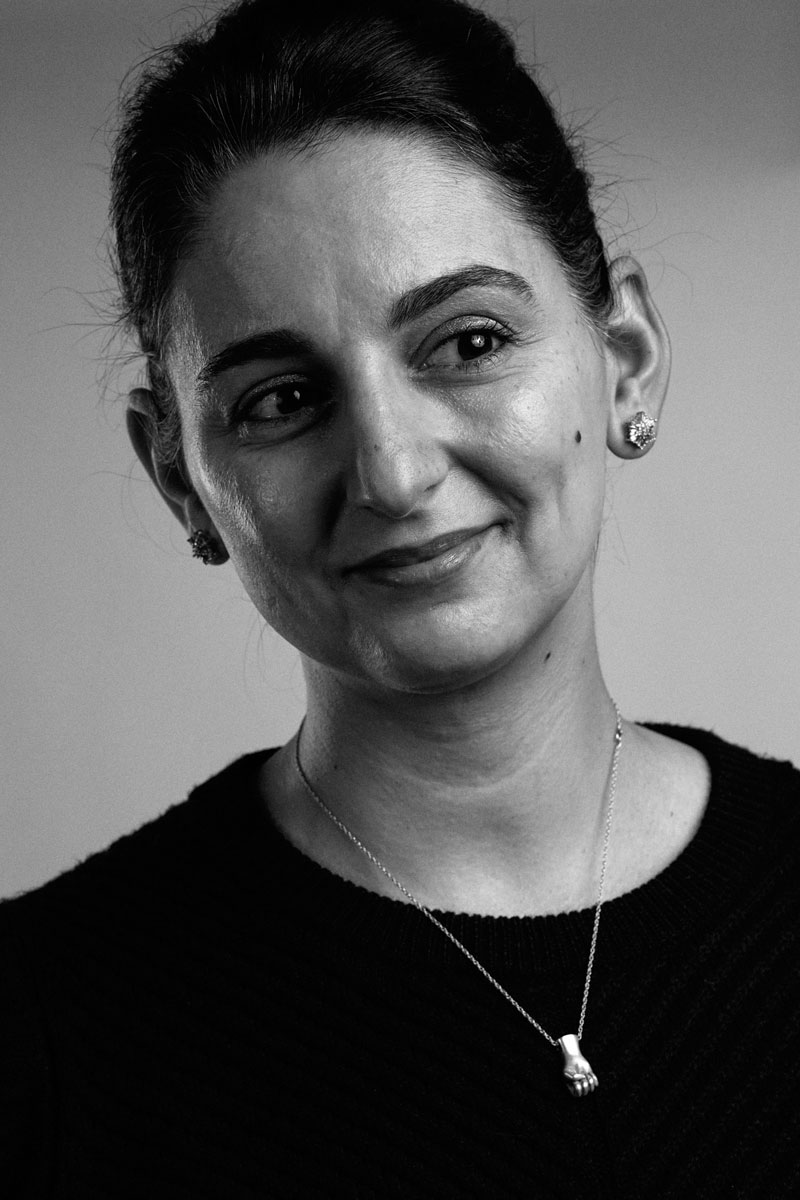
Nazli Parvizi, president of Brooklyn's Museum of Food and Drink (MOFAD), credits her cultural roots and background with shaping her passion for food and food history.

Parvizi, a proud Iranian and self-described "salt fiend," holds a degree in food anthropology — a major she essentially designed herself. Reflecting on the power of food to spark interest, she told me, "I think there's a real lack of curiosity about the world these days. Whether that's due to fear or lack of access to education, I don't know. But there's something about food that makes people curious. And the more curious the eater, the more the world opens up to them."

Under Parvizi’s leadership, MOFAD hopes to inspire that curiosity, encouraging visitors to explore its fascinating exhibits. Salon had the privilege of speaking with Parvizi about her upbringing, culinary preferences, path to MOFAD and more. You can read the first part of our conversation here.

The following interview has been lightly edited for clarity and length. 

Nazli ParviziNazli Parvizi (Photo by Hugo Ahlberg)

How did you first become involved with MOFAD?

I became involved with MOFAD in the middle of COVID. I was recruited for the job while I was living in California, longing to move back to NYC.  MOFAD had been without an executive director for eight or nine months. Our show, African/American: Making the Nation's Table, the first large scale survey of 400 years of African American food contributions to the American culinary narrative, was due to open at the end of March 2020. Of course that didn’t happen and the show sat under dust covers for two years.  MOFAD had transitioned very successfully to virtual programming, but had lost its home in Williamsburg and was trying to survive like every other cultural institution.

So I came in in the middle of all that in order to keep it going and open the show, which we were able to do in February of 2022, find us a new space and get us back on our feet again.

I read that you graduated with a food anthropology degree. Could you speak a bit about that and how it influences your work at MOFAD?

I graduated with a degree in food anthropology, which didn't really exist at the time. I went to the anthropology department at Barnard and asked them if I could take every class and put a food focus on it. They were incredibly lovely and accommodating and said I could.

So I basically created my own major, at a point where it was fairly fledgling degree. And for me, I think food has always been a way of communicating and a way of having conversations with people who I don't always feel comfortable approaching or don't know how to approach.  Anthropology requires a lot of field work and a lot of interviewing and I always felt awkward approaching total strangers. I mean — I still do. But somehow, going up to someone and asking them what they had for breakfast? What did you have for lunch? It’s just an easier way of approaching people. People really put down their guard and their defenses when you start talking about food. And so for me, food anthropology was just a way of discovering the people around me who I wouldn’t have had the guts to approach otherwise.

My degree in food anthropology greatly influences my work at MOFAD. I think for us, the subjects we are interested in – human behavior, science, history, colonialism, etc. we just examine these subjects through the lens of food. I think  MOFAD definitely has a distinct voice. But we also deeply believe that as an organization that straddles cultural institutions, the hospitality world and the food world, we want to practice radical hospitality and we understand not everyone agrees with us, not everyone thinks the same way we do. And it’s easy to understand that because it’s easy to understand that no two people eat alike. Our goal first and foremost is to educate and make people curious and get them to question what they are eating, to think about how it’s made, how it’s grown, who is making it, where it’s packaged, etc. We just think that food is a really approachable way of learning about ourselves and the people around us.

I think there's a real lack of curiosity about the world these days, whether that's because of fear or lack of access to education, I don't know. But there's something about food that makes people curious. And the more curious the more curious the eater, the more the world opens up to them.


Want more great food writing and recipes? Subscribe to Salon Food's newsletter, The Bite.


How did your Iranian upbringing influence your food preferences, your identity, your culture? 

I think my Iranian upbringing has so much to do with my food preferences, my identity and obviously, my culture. 

I immigrated to the states when I was give years old and was raised by a single mom in a pretty small Irish Catholic town near Worcester, MA and we pretty much ate, you know, three meals a day inside my home — we rarely went out to restaurants. And you know, my mom never followed trends, never followed diets — I grew up eating lots of greens, beans, whole milk, real butter and everything scratch made — everything she espoused holds true and has been proven to be the best way of eating.

Iranian food, I think, is just particularly nourishing and wonderful — it’s shaped my idea of what food should taste like and how I cook. I don't actually cook a lot of traditional Iranian food. I think it's really time consuming — but I think you can tell I'm Iranian by the food I make and how I prepare it — but mostly because of how I love to host and feed people. Iranians are the most hospitable people you will ever meet and we take so much pride in how we welcome guests – strangers or loved ones — into our homes. 

The flavor profiles of how I cook, the intense sourness, the incredible herbiness are all really influenced by my background.  In terms of my identity — I think being Iranian and being an immigrant, especially an immigrant growing up in a town of 13,000, where there weren't a lot of kids who looked like me or had home lives like mine certainly shaped who I am today. Like most immigrant kids — you become really adept at code switching and I actually think it’s a privilege to be both an insider and an outsider and to understand both points of view – it helps me navigate the world and connect with so many people I would be able to otherwise.

Visitors at the Museum of Food and DrinkVisitors at the Museum of Food and Drink (Courtesy of MOFAD)

 What would you say are your three most used ingredients? 

My three most used ingredients are, without a doubt — and this is probably very indicative of my Iranian upbringing — vinegar or lemons, herbs and salt:  I have an undying need for very sour food. I think Iranian food is deeply sour. So any souring agent, whether it's tamarind or pomegranate paste or lemons or vinegar is so vital in anything I cook.

I'm an absolute salt fiend. I find most food is under seasoned. I carry salt with me, but it is to me the most important ingredient I use. And then herbs, you know? I eat herbs by the handful. I don't think that they are a garnish. I think parsley is an incredible herb. I don't put a sprig on it. I put bunches and bunches of it in my food and in my cooking. So, those are probably the three things that you see the most in my  cooking. But when I asked my staff what ingredients they associated with me – they answered with pandan (my favorite flavor) and mayonnaise. It’s always lovely to be known.

We need your help to stay independent

What is your favorite cooking memory? 

My favorite cooking memory is a really early memory of when I was somewhere between one and two years old. We had a cook when I was growing up in Tehran and I really loved him. My parents would entertain a lot and I had a habit of getting underfoot, so what our chef or my mom would do was get one of our giant rice pots and plant me in it, so I couldn't really get out of it and I would just stand there in the pot on the floor watching him and my mom cook and get  ready for the 50 people coming over for a party that night. There was something about being in the middle of the hubbub of the kitchen, sitting inside a giant rice pot and watching the hustle and bustle that just really resonates with me to this day and maybe that's why I love a party and why I love entertaining.

What’s your biggest tip for cutting down on food waste? 

My biggest tip for cutting down on food waste is to learn how to make soup.  I just did it today. My staff often works at my house and I went through the fridge, I had a couple carrots that were starting to bend, one or two zucchini that were getting a little soft on the ends,  half an onion, kale that was going to yellow in a day or so – you know, everything where some of it was good, some of it was getting past its due, but, when you put it all together in a soup, it's just so nourishing and so good. And so quick! I cooked up a bunch of beans in the pressure cooker while the veg were sweating and in 20 minutes, we had the most nourishing lunch.

And, you know, even the ends and butts and skins of all those veg can go into a separate pot to make broth, but I really think that making soup is just such an easy skill to master and my top recommendation for cutting down on waste.

What's next for you? For MOFAD?

What's next for me and what's next for MOFAD,  we will continue our current exhibition, Flavor, while creating more dynamic programming at our space. DUMBO still feels like a new space, but we are doing our best to make sure that people know that we're there as it’s been 3 years since we’ve had our own space. In the new year — look for more MOFAD programming in DUMBO and in partnership with other organizations.

We are not trying to be a best kept secret by any means, we welcome everyone to stop by. Our small, but mighty, team is there to welcome folks in on Thursday through Sundays from 12 to 6.

Florida lawmaker abruptly switches to GOP shortly after winning election as Democrat

Florida state Rep. Susan Valdes switched her party registration from Democrat to Republican on Monday, bolstering the GOP’s largest-ever majority in the House, The Tampa Bay Times reported.  

“In the House, I have long known that no one has a monopoly on good ideas,” Valdes wrote in a statement posted on X. “I will not waste my final two years in the Florida Legislature being ignored in a caucus whose leadership expects me to ignore the needs of my community.”

A former Hillsborough County School Board member, Valdes first ran for House as a Democrat in 2018 and was elected to represent District 64, outside of Tampa. 

Until Monday, Valdes, who is the daughter of Cuban immigrants, was a lifelong Democrat. There was little to no indication of her move to switch parties, the Tallahassee Democrat reported. She has been openly critical of Florida’s leaders for using an “autocracy playbook” and “implementing dangerous proposals, using their power to serve themselves and their cronies but not the rest of us,” she wrote in a 2023 op-ed. 

Valdes also attended a Kamala Harris watch party and is critical of President-elect Donald Trump’s stance on immigration. 

“I have spent my adult life to give a voice to the people of my West Tampa home. I have done so as a Democrat partly out of habit- and partly because I believed Democrats were the party most concerned with the families I represent,” Valdes wrote in the statement.

“I want to roll up my sleeves and work. I want to be part of solving problems for West Tampa. I’m tired of being the party of protesting when I got into politics to be part of the party of progress,” she wrote, adding that she won’t agree with her fellow Republican House members on every issue.

For Democrats, Valdes’ switch is a troubling move and yet another loss for the party in an overwhelmingly red state. The Florida GOP now has a 86-34 majority in the House.

“Rep. Valdes was elected by her constituents as a Democrat to fight for our shared values here in Tallahassee and has consistently and publicly shared that she feels the Republican Party does not adequately represent her constituents or her beliefs,” House Democratic leader Fentrice Driksell wrote in a statement on X. "It is sad that she has elevated her own needs above the needs of her district."

Republicans, including Gov. Ron DeSantis, have celebrated Valdes’ decision and welcomed her to the party.

"Welcome to the GOP, Rep. Valdez," DeSantis wrote on X. 

“We all know Susan as a fierce advocate for her community, and a person of uncommon common sense. She will be a great asset to our Republican team,” Speaker Danny Perez, R-Miami, said in a statement.

Luigi Mangione charged with murder in Manhattan after police uncover manifesto, online history

Luigi Mangione, the suspect in the killing of UnitedHealthcare CEO Brian Thompson, was charged with murder on Monday after he was stopped at a McDonald's in Altoona, Pa.

The 26-year-old has been charged in Manhattan with second-degree murder, as well as two gun charges and forgery, online court documents show. 

Mangione was traveling through Pennsylvania on a Greyhound bus on Monday and was recognized at a McDonald's. He was taken into custody by local police and had a firearm, fake I.D. and a handwritten manifesto that criticized healthcare companies.

The manifesto has not yet been released publicly, but law enforcement officials told The New York Times it criticized UnitedHealthcare for prioritizing profit over healthcare. Mangione in the document took responsibility for the killing and wrote that he acted alone. 

“To save you a lengthy investigation, I state plainly that I wasn’t working with anyone,” he wrote. He added that companies “continue to abuse our country for immense profit because the American public has allowed them to get away with it,” officials told The Times. 

A Baltimore, Md., native, Mangione comes from a wealthy upbringing and graduated from the University of Pennsylvania. Friends described him as “normal” and a “smart person,” the BBC reported

He most recently lived in a co-living surf community in Honolulu, Hawaii., where he suffered from painful back issues that impacted his everyday life, sources told The Times. Mangione later returned to the East Coast to seek medical care. His online history and GoodReads account show that Mangione’s back injury and treatment attempts were a significant source of distress in his life. 

One of his pinned quotes on Goodreads reads “It is no measure of health to be well adjusted to a profoundly sick society.”

Mangione was in regular contact with his family and friends until six months ago, when he stopped communicating with them, The Times reported. His family released a statement through Mangione's cousin, who is a Maryland state delegate.

“Our family is shocked and devastated by Luigi’s arrest,” Nino Mangione said in a written statement signed by The Mangione Family. “We offer prayers to the family of Brian Thompson and we ask people to pray for all involved.” 

Investigators are looking for additional evidence that links Mangione to the murder.

Trump eyes election denier Kari Lake as ambassador to Mexico: report

President-elect Donald Trump is eyeing Kari Lake to be his ambassador to Mexico, Semafor reported Monday.

An unwavering MAGA supporter who has described herself as “Trump in heels," Lake has no diplomatic experience and has built much of her political persona around calls to close the southern border. 

Border security was central to Lake’s losing Senate campaign against Rep. Ruben Gallego, D-Ariz., often describing immigration to the U.S. as an “invasion.” Much like Trump, Lake pushed for finishing the wall on the U.S.-Mexico border and mass deportations of undocumented immigrants.

She is a staunch election denier and maintains that Trump won the 2020 election. Despite losing a 2022 race for Arizona governor, Lake has never officially conceded and has undergone multiple court attempts to overturn the results, all of which have been denied.

Her nomination would add yet another loyalist without relevant experience to Trump’s Cabinet and would likely worsen Trump’s already hostile relationship with Mexico. Last week, Trump threatened to place a 25% tariff on goods from Mexico and Canada unless they secured their shared borders with the US. 

Mexican President Claudia Sheinbaum said the country would retaliate with tariffs of its own if Trump follows through. “We negotiate as equals, there is no subordination here, because we are a great nation,” she told the Associated Press. 

If Lake is nominated ambassador to Mexico, she would be responsible for all communications with Sheinbaum’s administration regarding the proposed tariffs, as well as border security, immigration, fentanyl imports and other issues.

Remembering Donald Trump’s last political abduction racket

It is one of the everlasting quirks of humankind’s time on this earth that many of the bad ones, the ones who are responsible for the deaths and misery of millions, are not big, famous, showy generals, or the elected or unelected leaders of nations, but rather milktoasty little functionaries who sit at desks and execute their ugly, murderous plans out of sight of the public. They are not elected to office. They don’t earn rank during long military careers and time in battle.  They are, evermore, contemptible miscreants like Stephen Miller, little people who are given power because their morals match the lying, heartless, fascist men who appoint them.

Miller went on Fox News’ “Sunday Morning Futures” and told slavering host Maria Bartiromo that on Inauguration Day, his master, Donald Trump, plans to “issue a series of executive orders that seal the border shut and begin the largest deportation operation in American history.” 

Do you recall what else happened back in 2017 and 2018 and 2019 when Donald Trump began his first “round up” of undocumented migrants?

It’s a crime against the decency and the English language that the words “deport” and “deportation” are flung around so blithely, not only by Trump and his hand-puppet, Stephen Miller, but by the mainstream media. What those words describe is the kidnapping, imprisonment, and trafficking of human beings under cover of an executive order that is not a law, but the administrative whim of one man, Donald Trump. When Donald Trump sits down at the Resolute Desk on Inauguration Day and signs a piece of paper put in front of him by Stephen Miller or some other White House functionary, he will not be signing into law a bill that has been passed by the Congress. He will be photo-opping a campaign promise that will be challenged by lawsuit within hours, but in the meantime, lives of immigrants will be upended, and people will die, as they did the last time Trump rounded up undocumented immigrants and stuck them in cages on the Texas border with Mexico. 

Remember that? The mainstream media hasn’t reminded you what happened back then, so I will. NBC News reported on May 29, 2019: “At least seven children are known to have died in immigration custody since last year, after almost a decade in which no child reportedly died while in the custody of U.S. Customs and Border Protection.” One case was that of a teenage migrant who died of the flu. The flu. That’s how careful Trump’s border agents were when they detained migrants in hastily constructed camps along the border the last time. NBC reported that in late 2018, a seven-year-old child “succumbed to a rapidly progressive infection that shut down her vital organs.” This was after CPB agents sent her on a 90-mile bus ride from one CPB location to another, even though she was showing symptoms of vomiting and dehydration.  In the eight months following the death of the seven-year-old child, several more migrant children died while being held in facilities that had concrete floors and thin mats to sleep on.

So, let’s have a show of hands: How many readers who have children allowed them to sleep overnight someplace where all they had was a thin mat laid on a concrete floor, and the lights were left on all night? I have three children.  I’ve never sent one of them to a summer camp or a sleepover at a friend’s house where they would be treated like that.

Why was this done to migrant children in 2018 and 2019 during Trump’s first term in office? Because Donald Trump and Stephen Miller didn’t see brown-skinned migrant children as human beings. They saw them then and see them now as among the ten million “undocumented immigrants” they plan on “deporting,” starting, as Miller and Trump and the rest of them have said, on “day one.”

Do you recall what else happened back in 2017 and 2018 and 2019 when Donald Trump began his first “round up” of undocumented migrants? CPB agents “mistakenly” detained and imprisoned several American citizens. A brother and sister who were crossing the border to attend school in San Ysidro, California, were arrested by CPB agents. The nine-year-old girl was held for 32 hours because she “provided inconsistent information during her inspection” at the border crossing and did not look like the picture on her passport, agents claimed. She was nine years old and she had a valid U.S. passport, for crying out loud. That is what justified this frightened little girl being held overnight in some CBP lockup on the border. Her 14-year-old brother was initially charged with human trafficking and sex trafficking when he was arrested with his sister. He had to sign some sort of phony document asserting that she was his cousin, not his sister, in order for the two of them to be released.

That is how efficient the Customs and Border Patrol officials were in dealing not only with immigrants who did not have proper citizenship papers, but with citizens of the United States who had brown skin. Donald Trump promises this time around to arrest and deport the children of migrants who were born in this country and thus have American citizenship, as well as their undocumented parents. He also promises to sign an executive order canceling birthright citizenship, which is found in the 14th Amendment to the Constitution. 

In July 2019, Trump claimed that immigrants being held at the border in makeshift detention facilities “are very happy with what’s going on because, relatively speaking, they're in much better shape right now than compared to the unbelievable poverty” in the countries from which they came.

We need your help to stay independent

That is what “deport” and “deportation” meant the last time Trump was in office, and I haven’t even scratched the surface of what happened at the border when children were separated from their parents. The Department of Homeland Security reported in June of 2018 that 1,995 children had been separated from their parents during a six-week period that spring. By January 2019, a Health and Human Services report said that 2,737 children had been held in federal custody apart from their parents. “Because of poor record keeping” the exact number was not known, but it was thought to be “several thousand higher.” In October 2020, just before Trump lost the election, the New York Times reported that 5,500 children had been separated from their parents by the Trump administration.

Let’s take a moment to consider what that actually means. Little children and teenagers, many of whom had traveled more than 1,000 miles to reach the Mexican border with the United States, were forcibly taken from the custody of their parents and held in makeshift facilities without being told what was happening to them, or why, or where their parents were. Many of these children did not have identification. In at least one facility, it was reported that 10-year-old girls were taking care of toddlers who may or may not have been related to them. Some of the children were shipped off to foster parents, who were paid money by the federal government to hold the children. Some detained and separated children still have not been reunited with their parents six years later. 

There are reports that some of the separated children were forcibly and illegally treated with antipsychotic drugs in order to keep them docile. At least one child under drugs fell down repeatedly, hitting her head. She had to be transported by wheelchair, she was so disoriented. Another child, a girl, tried to open a window in one of the detention facilities. She was grabbed by guards, shoved against the wall and choked. She fainted to the floor. Two guards held her down while a doctor forcibly injected her with an antipsychotic medication.

In 2018, a federal judge found that forcibly medicating children without the permission of their parents violated child welfare laws. Between 2014 and 2018, the Office of Refugee Resettlement received 4,556 complaints of child sexual abuse or harassment of migrant children. The Office of Refugee Resettlement sounds like it’s part of the United Nations. No, it is a part of the Department of Health and Human Services created by the U.S. Refugee Act of 1980. 


Want a daily wrap-up of all the news and commentary Salon has to offer? Subscribe to our morning newsletter, Crash Course.


So, dear readers, our government already has an office, established by a law passed by Congress, to deal with the chaos that is certain to result from Trump’s “plan” to deport 10 to 15 million undocumented immigrants. Or maybe Elon Musk and Vivek Ramaswamy will decide that the Office of Resettlement of Refugees is part of the “deep state” and move to shut it down, so we won’t have any department of our federal government with experience and expertise in dealing with the kinds of problems Trump and Miller and the rest of their fascist crew are about to create.

But all we’ve talked about so far is the children. What of the adult migrants who will be swept up in this nightmare?  What will that look like?

Imagine that you are a Haitian migrant living in, say, Springfield, Ohio. We already know there are a lot of Haitian migrants with temporary protected status living in the midwestern town, many of them for years. So, as a Haitian husband and wife, you rent an apartment, or maybe even a little house. Maybe you have established a small business, like a laundromat or a Haitian restaurant. You have a couple of children. In your house or apartment, you’ve bought living room furniture, such as a sofa and chairs and a coffee table and maybe side tables, and you have a kitchen table and chairs where the family eats its meals. There are two bedrooms with beds and dressers for the parents’ and children’s clothes, and closets where you hang coats and shirts and pants, and you have at least one bathroom with towels and toiletries, and maybe there is a little laundry room with a washer and dryer you saved up to buy.  In the kitchen, you have the usual array of plates and bowls and glasses and knives and forks and spoons and cooking utensils like spatulas and serving spoons and ladles, and in the cabinets, you have pots and pans and frying pans and maybe a waffle iron and a coffee maker where you can brew strong Haitian coffee.

One day, a van pulls up and a number of men get out and they knock on your door and show you a piece of paper, and the next thing you know, you and your wife are in flex-cuffs, your cell phones have been taken from you, and you’re told that more CPB officers are at the school detaining your two children in the same manner. You are put into the van, where you find several other confused and frightened Haitian couples. You are driven to a large building that you recall was once a Walmart. You are hustled inside and put into chain-link cages and your cuffs are removed and you’re handed aluminum foil “blankets” and told to sit down and await orders. You ask where your children are because you know that when they left for school that morning, they did not take any identification, because you’ve been there in Springfield for three years, and kids don’t need ID cards to attend school. You are told not to worry about it, your kids are being “taken care of.”

Your little house or apartment? Gone. All the possessions you spent two or three years buying with the money you earned working at a chicken plant or the laundromat or the restaurant you established? Gone. The sofa cost $750 of your hard-earned dollars. Gone. The dress you bought for your 9th grader’s upcoming graduation from middle school?  Gone. Your son’s new soccer shoes? Gone. The necklace and locket you gave your daughter for Christmas? Gone.  Your son’s new video game console he got for Christmas from his grandmother? Gone. The new flatscreen television where the whole family watched soccer games streaming from Britain and France and Spain and Brazil?  Gone.

You have the clothes on your back. You don’t know where your two children are. Your house or apartment and your business are gone. You are in the midst of what Stephen Miller calls “the largest deportation operation in American history.” 

You have been arrested and imprisoned and stripped of your belongings and access to your money. You have been earning a living and paying taxes and living in America as a migrant with protected status, but no longer. In the America of Stephen Miller and Donald Trump and “border czar” Tom Homan, you are a criminal. There are thousands and thousands just like you.

Food heist: Thieves nab $32,000-worth of pies baked by a Michelin-starred chef

Food heists seem to be on the rise in England, whether intentional or not.

Tommy Banks, a Michelin-starred chef and restaurant owner based in England, recently took to Instagram to share an unsettling incident: his work van, along with around "$32,000 worth of meat pies" inside, had been stolen, according to CBS News. As Banks explained in his post, "the guys had loaded up the van with stock… and left it plugged in overnight." He added, "I’m guessing the thieves didn’t realize they were stealing 2,500 pies along with the van!"

Banks appealed to the thieves, urging them to "drop off the pies somewhere… so we can at least give them to people who need food and they aren’t wasted." He didn’t hold back his frustration, calling them "thieving pieces of s**t" and wishing them "no presents this Christmas." Banks also highlighted the urgency, noting that the pies were quickly approaching their expiration date, adding, "time is running out for these pie hostages."

According to BBC’s Emily Johnson, the stolen pies included varieties such as "steak and ale pies, turkey and cranberry pies, and butternut squash pies."

This isn’t the first high-profile food heist in recent months. Back in October, about 49,000 pounds of cheese—valued at around $390,000—was stolen from Neal’s Yard Dairy in London, as reported by Duarte Dias with CBS News.

In his "final pie update," Banks shared some sad news: "The van has been found with fake plates on it by the police but is badly damaged and will almost certainly be written off. The pies are on the van but have been damaged and not refrigerated, so they are also written off unfortunately."

When facts no longer matter: 3 key steps to return to civil dialogue

Donald Trump will become the next president of the United States on Jan. 20, 2025. Although some have deluded themselves into thinking the contrary, there will be no deus ex machina moment to stop this from happening. As Trump and his representatives and agents have explicitly detailed and promised, on “day one” they will launch a political project that will cause severe harm to tens of millions of Americans and other people who live in this country. In the doublespeak and doublethink of autocrats and authoritarians, the Trumpists describe this project as "Making America Great Again."

There are approximately 245 million voting-eligible people in the United States. In the 2024 election, approximately 77 million voted for Donald Trump and 75 million voted for Kamala Harris. The remaining 90 or so million did not vote in the general election.

To borrow from the truism and warning, one-third of the public decided to harm the other third while the remaining third looked on. Although many of them have tried to convince themselves that no such thing will happen, the two-thirds of the American voting public who directly supported Trump or who tacitly gave their support to him by not voting (or supporting some other candidate) will also be made to suffer both directly and indirectly from his administration’s policies.

To that point, during a Sunday interview on the venerable TV news program “Meet the Press,” Trump was direct as he told the host that his mass deportation plan will almost necessarily involve removing American citizens from the country as a form of human collateral damage.

As I write this, Alex Garland’s film “Civil War” is playing in the background on the television. As the “event” and “very important” movie of 2024 and these years of worsening democracy crisis and tearing at the seams of American society, it is on multiple times every day. Garland has made much better films such as “Annihilation." For all of the obligatory fawning from the critics, “Civil War” is rather uninteresting and predictable and a reminder of far better films about journalists in a time of war and conflict such as “Salvador” and “The Killing Fields." However, “Civil War” is redeemed by one scene where the character played by the always impressive Jesse Plemons is committing war crimes and then pauses to ask the protagonists, “What type of American are you?” Plemmon’s character then shoots “the wrong type” of American dead (the victim is from Hong Kong).

I do not believe that Garland’s “Civil War” will come to America — anytime soon. The film is a dramatic depiction and exaggeration of the decades of deep polarization, rage at the elites and “the system” that put Trump, as the country’s first elected authoritarian, back in the White House. I sincerely hope I am correct as there are many examples of societies across the world that have fallen apart far faster and more suddenly than the experts and other reasonable observers thought possible at the time. Collapse can happen that fast.

"I think our differences are not too far apart to find a healthy consensus again. We all have a harm-based moral mind, and we’re all concerned about protecting ourselves. One big problem is that we go about our political conversations the wrong way."

As I asked in a previous essay here at Salon, have the day-to-day relationships and shared sense of community, norms, reality and meaning that make a healthy society and democracy possible been broken beyond repair? Or are these divides greatly exaggerated and there is much more that ties the American people together than divides them and in the end that may be their salvation?

Dr. Kurt Gray is a professor of psychology and neuroscience at the University of North Carolina at Chapel Hill, where he directs the Deepest Beliefs Lab and the Center for the Science of Moral Understanding. Dr. Gray’s findings have been featured in the New York Times, The Economist, Scientific American, Wired and NPR’s "Hidden Brain." He is the co-author of the book “The Mind Club: Who Thinks, What Feels and Why it Matters.” His new book is “Outraged: Why We Fight About Morality and Politics and How to Find Common Ground.”

In this conversation, Dr. Gray explains how white racial resentment drove support for Donald Trump and the MAGA movement — and how many liberals and progressives underestimate the power that white victimology and its fictions such as “reverse racism” hold for many white Americans. He also highlights how polarization and divides between conservatives and liberals reflect deeper differences in our understanding of the relationship between politics, public policy, harm and morality.

Gray shares how engaging in political conversations with Trump and MAGA voters to find “common ground” is not an act of surrender by Democrats, liberals, progressives and others who believe in democracy. Instead, such conversations and dialogue are an important way of humanizing and empathizing with our fellow Americans to try to find a healthy way forward as a society after such a historic and damaging presidential election.

This is the second part of a two-part conversation.

You are a social psychologist. What are you seeing in the Age of Trump and his return to the White House that the mainstream news media and political class are not — or perhaps even more pointedly are refusing to see or are in denial about?

I think many left-wing people, especially progressive academics, don’t fully appreciate just how much the racial justice movement has alienated some white Americans, particularly conservatives who see Black and white Americans as mostly equally vulnerable to harm. A study conducted right around the election found that one strong predictor of White Americans voting for Trump was their agreement with the statement, “People these days can’t speak their minds without someone accusing them of racism." 

"The human mind cannot help but focus most on our own feelings of suffering. Other people’s pain requires empathy and perspective-taking, but our own pain is obvious to us."

There is ample evidence for racial bias in American institutions. A paper by my colleague Julian Rucker finds that people vastly overestimate how much progress society has made toward racial economic equality. But there is also ample evidence that people need to think of themselves as good people and that the world is just. So, when progressives argue that white people have achieved success because of unearned privileges or by capitalizing on evil institutions, they bristle. 

White conservatives are especially likely to resent the accusation that they are privileged — even if it’s statistically true — because most of them don’t feel particularly privileged. Instead, they feel threatened. These feelings stem from both the present situation and fears about the future. The economic future of white men without college is continuing to look bleak, and soon enough, white people will be the minority in America. These trends cause further fear when people have the (erroneous) zero-sum mindset, where one group's gain is another group's loss.

One of the most important, yet neglected aspects of the Age of Trump and the decades that got us to this point is how conservatives and liberals think about and understand questions of pain and harm, care and concern in divergent ways. What do we know about this empirically?

Questions about pain are always complicated. The human mind cannot help but focus most on our own feelings of suffering. Other people’s pain requires empathy and perspective-taking, but our own pain is obvious to us. In fact, it’s impossible to ignore our own pain when it’s there. So, statements like “I feel your pain,” are in one sense the best way to showcase your empathy to someone you’re talking with — but things get very complicated when their “pain” is not physical suffering but instead their concern about some other person’s or group’s pain. 

Because the pain of others is largely invisible to you, it’s very easy to disagree about which people are suffering, especially when we ourselves feel like we are suffering. Of course, statistics show that people from minoritized groups are more likely to suffer violence or misfortune, but when it comes to perceptions of other people’s pain, we are less swayed by statistics than by the stories we hear. If a conservative person hears a story on Fox News of a woman who deeply regrets her abortion, they will believe that pro-choice policies cause suffering.

What do we know about political personality types and their relationship to these understandings of pain and harm in terms of politics and society? More broadly, how different (or not) are conservatives and liberals in terms of their values?

It’s easy to assume that liberals and conservatives have deeply different values. Jonathan Haidt’s “The Righteous Mind” goes further to argue that liberals and conservatives have different “moral foundations.” While it’s true that liberals and conservatives might use different keywords in their speeches (e.g., conservatives are more likely to emphasize “liberty”), many studies show that, if you go beyond this rhetoric, these differences in values largely disappear (e.g., liberals care deeply about the “liberty” of women when it comes to reproductive rights). 

Beyond exaggerating liberal/conservative differences in values, these theories miss the deeper truth: all our moral judgments are grounded in concerns about harm. When we condemn a behavior, it’s because we see it as causing harm. When we condemn a person, it’s because we see them as harmful. Studies on moral cognition (what happens in people’s minds when they make moral judgments) support the idea that we all share a harm-based mind.

We need your help to stay independent

Although we might all agree that an act like abortion or immigration involves harm, the problem comes when we disagree about who the real victim is. These disagreements about the real victim drive moral disagreement. With immigration, conservatives worry about the US citizens harmed by cartel members who entered the country illegally. But liberals worry about the families fleeing violence who are separated from their children at the border.

In other research, we have shown that a lot of disagreement about hot-button issues comes down to how much you think people are (or are not) equally vulnerable to harm. Progressives tend to split the world into two camps, the vulnerable oppressed and their invulnerable oppressors, which are most determined by your social groups. On the other hand, conservatives tend to overlook group-based differences and see the world in terms of individuals who are all equally vulnerable to harm.  

It’s these different “assumptions of vulnerability” that drive policy disagreements like affirmative action and Black Lives Matter versus All Lives Matter. If you see Black people as much more vulnerable to harm than the police, it makes sense that you would more exclusively emphasize their suffering. But if you perceive all people as equally capable of suffering, it makes more sense for you to support all lives matter.

I receive many emails from various civil society groups that want to bring Democrats, liberals, MAGA Trump voters, Republicans, and “conservatives” together to find common ground. As I see it, there is nothing to discuss. Trying to find compromise when the other side views politics and political life and society as a zero-sum game and in doing so rejects democracy and pluralism is an act of surrender.

I disagree that “coming together” is an act of surrender. America is a pluralistic democracy that requires civil conversation and working together to achieve common aims. It’s fair to argue that some elites have demonstrated an obvious lack of moral character. It’s also clear that some elites are “conflict entrepreneurs” (in the words of journalist Amanda Ripley) who are trying to incite division to gain further influence and profit. But I cannot believe that most of the 77 million people who voted for Trump are themselves “fascists” who are unworthy of conversation. 

Coming together for mutual understanding not only humanizes conservatives to liberals but also showcases how progressives are not the out-of-touch, America-hating, coastal-elites caricature painted by conservative pundits. 

I get it: it’s easier to “bridge divides” when you’ve won, to be magnanimous when you don’t feel threatened. But I think the quest to understand the other side is essential for those who have lost too. I try to think of the individual human beings behind every vote, and I want to understand them. The vast majority of people are trying to protect themselves, their families, and their country from harm. And though I may not personally agree with the moral convictions of many people, I — like many people — would like a less divided country and I would like to feel less outraged.

Are we “the Americans” more alike than different in this era? Can those differences be handled constructively and perhaps even productively? Or are those differences so extreme that it will be very difficult if not impossible for us as a nation to find a healthy consensus again?  

I think our differences are not too far apart to find a healthy consensus again. We all have a harm-based moral mind, and we’re all concerned about protecting ourselves. One big problem is that we go about our political conversations the wrong way. In one study, we ask Americans: Imagine you’re having a conversation with a political opponent; what would make you respect them? 

Respondents usually mentioned “facts and statistics,” believing that conversations focused on facts would provide obvious common ground. But the problem is that facts no longer seem true — or at least seem easily summoned to support your partisan views. 

Instead, our data show that telling personal stories, especially those focusing on personal experiences of harm, is one of the best ways to connect across our differences. By sharing stories of suffering and feelings of vulnerability, we can better see that our “opponent” is also motivated to protect themselves from harm, which helps us see them as more human. Sharing these stories also helps people on the other side see us as more human, and that’s an important step to move through a divisive election.

Looking forward, what are some concrete suggestions, what are some things that everyday people can do that will help to renew and heal our political community and civil society? Are our tribes fixed and immutable?

There are many organizations trying to make America more pluralistic and increase the civility of conversations about politics, race, and religion (many of these organizations are part of The New Pluralists and The Listen First Coalition). I've worked with one organization, Essential Partners, who are pioneers in this space and have learned from them three steps for having better conversations across differences. These steps spell CIV, the start of CIVil conversations.

C: Connect. Before you talk about politics just talk with someone about their lives. Or better yet, ask them questions. Especially deep questions about who they are and their hopes and dreams. Studies find that people actually like deep conversation with strangers, so feel empowered to ask someone about their first love or the last time they cried. 

I: Invite. We all love to be invited to parties, but no one likes being forced. Same with discussions of politics. Don't say "How could you vote like that??" Instead: "I know you voted differently from me and am really interested in understanding your thoughts and feelings — your story — behind your choice."

V: Validate. It's hard to share your beliefs with another person. It makes you vulnerable. So once someone shares their story with you, you should validate, by thanking them and trying to put their beliefs (and perceptions of harm) into your own words. This does not mean you must agree with them. You can stay fast to your convictions while trying to understand someone.

Across these CIV steps, the main goal is to strive for understanding. We all might try to win when it comes to elections, but in everyday conversations, striving to "win" is a recipe for losing — losing respect, losing friends and family. Instead, truly trying to understand someone is essential for renewing society—and for building diverse coalitions and creating allies to create change.

Trump’s criminal state: MAGA’s jailhouse-to-White House pipeline is bigger than corruption

Last Wednesday, Donald Trump announced the appointment of Peter Navarro as a senior counselor for trade and manufacturing during the second Trump administration. Ordinarily, appointments to posts as obscure as that one would hardly have caused a ripple. But Navarro is no ordinary appointee. He is the latest addition to the rogues gallery of felons and ne’er do wells who will populate the White House, the Trump Cabinet, and other posts starting on Jan. 20. 

As Yahoo News reminds us, Navarro “was sentenced to four months in prison after a federal jury convicted him of refusing to comply with a subpoena from the congressional committee investigating the Jan. 6, 2021 attack on the U.S. Capitol.”

As the famous political theorist Hannah Arendt described it, the criminal state exists early on the path to totalitarianism.

It is unusual for executive branch officials to get in hot water for ignoring congressional subpoenas. But, prosecutors explained that Navarro’s “wholesale non-compliance with the lawmakers’ demands put him far afield from the back-and-forth other former officials typically have had with lawmakers over their participation in congressional probes.”

Navarro, released from prison barely four months ago, epitomizes Trump’s jailhouse-to-White House pipeline. Of course, Navarro is not alone in traversing that path.

Before discussing Trump’s rogue gallery and the jailhouse-to-White House pipeline, we want to explain why it matters and what it means for America’s democratic future. Much of the commentary on Trump’s appointments has focused on questions of their competence or what it would mean for the jobs they are being asked to do or the agencies they are being asked to lead. 

Those are valid concerns. But there is another harm in Trump’s effort to construct a criminal state.

We want to call attention to the messages it sends to Americans, how it coarsens our civic life, encourages cynicism, and prepares the way for Trump’s distinctive brand of strong man rule.

Others who served time in prison and will have prominent government positions include Charles Kushner, the father of his son-in-law Jared Kushner, as ambassador to France. In 2005, Kushner went to prison after “pleading guilty to 18 counts of tax evasion, witness tampering and making illegal campaign donations.” 

According to MSNBC, as part of his scheme, the ambassador-designate “hired a prostitute to coax his brother-in-law — who’d agreed to testify against him — into a motel room and then sent a video recording of the sexual encounter to Kushner’s sister, all in the hopes of keeping him silent.” MSNBC quotes Chris Christie who led the prosecution of Kushner who called what Kushner did “one of the most loathsome, disgusting crimes that I prosecuted.”

None of that deterred Trump from pardoning  Kushner during his first term or rewarding him with a plumb ambassadorial appointment in his new administration.  

 As the first convicted felon ever to be elected president, Trump wants to create a government of and for people who, like Navarro and Kushner, will go “far afield” and even commit “loathsome, disgusting crimes” to do his bidding and aid his effort to bring American democracy to its knees. That is also why he wanted to make Matt Gaetz, who was the subject of a Justice Department sex-trafficking investigation last year and a House Ethics Committee's investigation into allegations sexual misconduct and illicit drug use, among other things, attorney general of the United States. 

While Gaetz has not been charged with a crime, he is no poster boy for civic virtue.

That is why we would not be surprised to see Gaetz turn up in the Trump administration after the dust settles.  For that matter, how long can it be before Steve Bannon, another ex-convict facing a criminal fraud trial in New York, returns to a prominent place in Trump’s orbit?

We need your help to stay independent

Keeping track of those with criminal records and reputations for underhanded ethics whom Trump is appointing is a Sisyphean task. But others are worthy of mention.

None more so than Pete Hegseth, whose nomination to be Secretary of Defense is hanging by a thread. Hegseth’s track record makes Gaetz look like a boy scout. His record, which includes a 2017 allegation that he committed a sexual assault, is so troubling that even some MAGA stalwarts in the Senate, like Iowa’s Joni Ernst,  are pushing back.

Like Gaetz, Hegseth seems to have walked up to the edge of criminality. He apparently got close enough to pass Trump‘s qualifications test.

The New Yorker’s Jane Mayer quotes Justin Higgins who “vetted Hegseth for under-secretary roles in the first Trump Administration,” and  says that Hegseth “’was likely chosen because he seems willing to say and do anything Trump wants.’” It hadn’t hurt, Higgins added, that Hegseth belittled some war crimes.” 

In addition, Mayer reports that “Hegseth was forced to step down by both of the two nonprofit advocacy groups that he ran…in the face of serious allegations of financial mismanagement, sexual impropriety, and personal misconduct.”

“Financial mismanagement, sexual impropriety, and personal misconduct” sounds like it could be a description of Trump himself. 

There is, of course, nothing wrong with giving people second chances after they have paid their debt to society. But, everyone Trump has nominated or appointed thinks they owe no debt to society. Each of them contends or is portrayed by Trump’s transition team as a victim of a political prosecution or a left-wing smear campaign. Typical was the way Trump characterized  Navaro as “a man who was treated horribly by the Deep State, or whatever else you would like to call it.”

Welcome to the Alice in Wonderland world of Trump’s criminal state where up is down, criminals are victims, and soon-to-be-pardoned insurrectionists are “hostages” or “patriots.”


Want a daily wrap-up of all the news and commentary Salon has to offer? Subscribe to our morning newsletter, Crash Course.


Our point is simple. There is no better way to construct a criminal state than to appoint criminals and “ne-er do wells” to positions of power and to pretend that they are something else. And most importantly, there is no better way to undermine democracy and the rule of law than by making criminals our political leaders. 

What Supreme Court Justice Louis Brandeis wrote almost one hundred years ago best captures this danger. “In a government of laws, the existence of the government will be imperiled if it fails to observe the law scrupulously. Our Government,” Brandies said, “is the potent, the omnipresent teacher.”

“For good or for ill,” he continued, “it teaches the whole people by its example. Crime is contagious. If the Government becomes a lawbreaker, it breeds contempt for law; it invites every man to become a law unto himself; it invites anarchy.”

If Brandeis is right, when crimes are as quickly redescribed in the self-serving ways that Trump does, those in power are invited to ignore the law, commit crimes, and call them something else. Crimes so reinscribed become the basic building blocks for constructing a world in which crime becomes meaningless, in which the common sense understanding of the distinction between the lawful and the lawless is erased, and with it, the distinction between reality and illusion. 

Such is the criminal state that prepares the way for authoritarianism. As the famous political theorist Hannah Arendt described it, the criminal state exists early on the path to totalitarianism. “[I]t must behave like a tyranny and raze the boundaries of man-made law.” 

As Arendt understood, the criminal state eliminates one of the final barriers to absolute rule. It prepares the citizenry to accept anything from the government and turned into a passive and lonely mass,  and fearful of the consequences of stepping out of line.     

In the end, the promotion of criminals to places of power is a feature, not a bug, in Trump’s appointment strategy and one important step toward ending American democracy.

Expert: Project 2025 plot to turn U.S. state media into RT-style propaganda would backfire

Within Project 2025, a document laden with calls to slash government agencies and programs dedicated to American state media abroad stands out, with the authors of the document deeming their mission “noble” and calling on new political control over Cold War-era initiatives.

The Project 2025 section on media agencies is split into two parts. The shorter part focuses on the Corporation for Public Broadcasting and accuses the Public Broadcasting Service (PBS) and National Public Radio (NPR) of being “leftist broadcasters” and contributing to a “tyrannical” situation while calling for their defunding.

The more substantial section, however, focuses on the United States Agency for Global Media, an agency founded in 1999 to serve as a supervisory body for America’s more famous state media enterprises, like Voice of America and Radio Free Europe.

All told the Agency for Global Media is a nearly billion-dollar media project supervising six networks, including the previously mentioned networks as well as the Office of Cuba Broadcasting, Radio Free Asia, the Middle East Broadcasting Networks and the Open Technology Fund.

The Heritage Foundation’s Mora Namdar, who authored the section on the Agency for Global Media, takes an interest in infrastructure investments for radio stations and reducing redundant agencies but she spends the bulk of the document accusing the agencies of “joining the mainstream media’s anti-U.S. chorus and denigrating the American story—all in the name of so-called journalistic independence” and prescribing solutions.

Namdar specifically attacks the agencies for publishing stories that included criticism of President-elect Donald Trump during the first administration, which she calls “typical mainstream media talking points assailing the President and his staff.” She goes on to attack a Voice of America White House correspondent, likely Steve Herman, for posting content she considers “personally insulting” to Trump during his first administration.

The 2020 investigation into Herman erupted into a debacle of its own when political appointees were accused of violating the agency’s “Firewall,” which is supposed to prevent political appointees from tampering with the agency's journalistic standards. 

Trump’s appointee to lead the Agency for Global Media, Micahel Pack, a one-time associate of Steve Bannon, had repeated issues with violations of the Firewall throughout his short tenure at the top of his agency, targeting employees for removal based on their political beliefs, later claiming to The Federalist that he was there to “drain the swamp.” He was also found to have spent $1.6 million in a no-bid confidential contract with a Virginia law firm to investigate executives. John Adams, a senior partner at the law firm, clerked for Justice Clarence Thomas and had overseen the McGuireWoods contract with the agency

We need your help to stay independent

Namdar goes on to complain about media outlets publishing “near-daily criticisms of Trump Administration appointees” at the agency and elsewhere attacking the Firewall for, at least ostensibly, forbidding political appointees from controlling the “direction of content in any way.” 

The cure to what Namdar sees as problems is to eliminate the agency’s Firewall, giving political appointees more “oversight” over who gets to work at the United States' state-funded media apparatus both domestically and abroad. The Trump administration dismantled the Firewall in October of 2020, though President Joe Biden’s administration saw it restored.

Namdar also draws out a plan to give the White House’s National Security Council and State Department more direct control over the Agency for Global Media, noting that Voice of America “was most effective before and during the Cold War when it was under the direct supervision and control of the War and State Departments.”

This would not represent the first time an administration has attempted to exert increased influence over America’s state media apparatus. Early in the Reagan administration, Charles Wick, an associate of former President Ronald Reagan, had pushed to imbue Voice of America with an even tougher anti-Soviet slant

As with the American Intelligence Community and other federal agencies, however, there is an open question as to whether increased top-down control over staffing could be used to install Trump loyalists and whether these institutions will be used in the interests of the United States or the interests of those in power.


Want a daily wrap-up of all the news and commentary Salon has to offer? Subscribe to our morning newsletter, Crash Course.


Nick Cull, a propaganda expert and a professor at the University of Southern California Annenberg, told Salon that potential attempts to instill an overt political agenda at the Agency for Global Media would be a mistake. 

“We don’t know what’s going to happen but I would certainly say that the stage is being set for a fight and the journalists will be very aware of the stakes,” Cull said. “If we’re returning to the Cold War, the great insight was that you don’t politicize your broadcasting. Audiences have great spin detectors.”

While Cull noted problems and inefficiencies at the agency, like the overlap of certain programs or past personnel scandals, he cautioned that attempts to turn American state media into something like RT, formerly Russia Today, would likely backfire. Instead, he advocated for these agencies to be a vehicle for journalism that advocates for democracy.

“When they argue equivalence, to the extent they argue equivalence, we are put on the back foot,” Cull said. “It should be that our media is substantially different.

Book review: Bringing the universe into ever-sharper focus

The phrase Pillars of Creation became popular in 1995 when it was used to describe a striking deep space photograph taken by the Hubble Space Telescope. The pillars are enormous formations of interstellar gas and dust in a star-forming region of the Eagle Nebula in the Serpens constellation, thousands of light years from Earth. At the time, Hubble represented the state of the art in imaging the universe, and the photograph a prime example of Hubble's powers.

But even before Hubble delivered its first images to humanity (famously compromised due to a flawed mirror that was corrected on a later servicing mission) after its 1990 launch, plans were already under way for its successor, originally dubbed the Next Generation Space Telescope but ultimately named for former NASA administrator James Webb.

After many delays, budget crises, and political battles, the James Webb Space Telescope finally followed Hubble into space in December 2021, and by the time it began to open its multifaceted, infrared-detecting eyes in mid-2022, it was already clear that it was not only going to be a worthy successor to the Hubble but surpass it in ways far beyond expectations — a fact brought home by Webb’s updated take on Hubble's famous "Pillars of Creation" image. Science writer Richard Panek's “Pillars of Creation: How the James Webb Telescope Unlocked the Secrets of the Cosmos” lays out the brave new world of the just-dawned Webb era and how the instrument is already opening fresh astronomical and cosmological vistas.

Early in the book, Panek cites a 1936 quote from American astronomer Edwin Hubble: "The history of astronomy is a history of receding horizons." As the man whose work a century ago was key in pushing back those horizons and showing that the universe is far bigger and grander than we thought, Hubble's words set the appropriate stage for Panek's tale. The Webb is just the latest example of how humanity's view of the cosmos has been expanding steadily with each new seeing tool, beginning when Galileo first turned a telescope on the skies in 1609. As ever-newer instruments push the horizons of astronomy ever farther out in space and ever further back in time, old questions are answered while new ones arise. "For the past four hundred years, each generation of astronomers has inhabited a new universe," Panek writes.

The Webb certainly supersedes Hubble in every respect. For starters, it's the largest space telescope ever sent into space, just under 70 feet long fully deployed and with a much larger 18-segment primary mirror (over 21 feet in diameter compared to Hubble's just under 8 feet) with more than six times the light collecting area — so large that it was launched folded up like an origami sculpture and unfurled in space. And unlike Hubble, which was placed in low Earth orbit to make it accessible for maintenance, the Webb lies much farther away, orbiting the sun about a million miles beyond Earth around what's called the second Lagrange point (or L2, to be precise), a spot where the gravitational forces of the Earth and sun are in balance and also keep the craft in an ideal spot to maintain an optimal temperature for operation.

Richard Panek lays out the brave new world of the just-dawned Webb era and how the instrument is already opening fresh astronomical and cosmological vistas.

Webb’s four astronomical instruments observe in the near- to mid-infrared part of the electromagnetic spectrum, allowing it to see much farther in space and further back in time than Hubble. And those are only a few of the superlatives the instrument evokes.

Panek allows that his book isn't trying to be a comprehensive account of the over three-decade, somewhat tortuous history of the Webb's conception, development, design, construction, and long-postponed launch; the political battles of budget, scheduling, administration, and international partnerships; the naming controversies over the telescope; or even all the science that the Webb is making possible. Instead, his aim is to provide a big-picture perspective of it all, to inspire an appreciation of "the human investment of intellectual and physical (and emotional) labor over the past four decades, and of the science that Webb has been producing at a nearly incomprehensible rate and in a nearly indigestible volume."

His approach is to start each of the book's six chapters with the people involved in a particular facet of the Webb saga — its planning, a particular research project, a problem looking to be resolved — before delving into explaining the science involved, and finally putting it all into broader context to demonstrate the value and significance of Webb's advances.

Each chapter also expands the reach of Webb's horizons, from its observations and discoveries close to home in our solar system (like detailed pictures of Neptune's ring system), to exoplanets (including the possible detection of the biomarker molecule dimethyl sulfide in the atmosphere of exoplanet K2-18b), to farther out in our own galaxy and beyond (such as a link between supernovae and interstellar dust), and finally to the earliest history of the universe (dark energy, dark matter, and a possible revision of cosmology's model of the universe).

It's an effective strategy, though it may seem somewhat scattershot to those looking for a deeper dive into the intricacies of the Webb's story. But it's largely successful in creating an awareness of the scientific and engineering marvel that the telescope represents, and why the Hubble, though it still soldiers bravely on beyond all expectations, is no longer top dog on the astronomical pile.

The book also features a color insert of some striking Webb images, with detailed descriptions. Panek's style is brisk, breezy, and rather lighthearted, perhaps sometimes a little too much so, but it makes for a quick and entertaining read that won't scare off those whose eyes glaze over at arcane technical details while pleasing more scientifically comfortable readers looking for a good overview of the mission. He uses novelistic touches to tell the story — snippets of dialogue here or a participant's ostensible thoughts there — gleaned from his interviews with the key players, which give the book a humanistic feel instead of a dry historical stuffiness.

The story of the James Webb Space Telescope is still in the very early stages of its planned official 10-year mission and hoped-for 20-year lifespan, and no doubt there are yet many wonders it will show us in the decades ahead. Yet, just as Webb was first conceived even before Hubble was launched, so Webb’s eventual successor — possibly called the Habitable Worlds Observatory, possibly something else — is already being imagined for the future generations of astronomers who may now still be in grad school or just gazing at the moon through their backyard telescopes.

The horizons of discovery never end — they just keep on expanding. As Panek notes, while whatever follows the Webb will “probably provide answers to questions nobody had thought to ask,” and the specific answers to those questions will vary, one question always remains the same: “What's next?”

This article was originally published on Undark. Read the original article.

“It’s about the cruelty”: Experts worry SCOTUS trans rights case could “creep into other areas”

The Supreme Court last week appeared likely to support a contentious Tennessee law banning gender-affirming care for minors after more than two hours of oral argument in one of the most pivotal cases for transgender rights in the nation's history. 

Most of the conservative justices signaled concerns, with the court questioning state legislatures that have approved bans on hormone therapy and puberty blockers as well as the possibility of a young person regretting gender-affirming medical treatment in the future. Those sentiments raised alarm about what it could mean for transgender Americans if the court sides with the Tennessee law and denies the potential for sex discrimination, anti-discrimination law experts said.

If the court were to conclude that "this is not sex discrimination, that will have enormous impact, not just in the transgender field, but in all sex discrimination litigation," Ruth Colker, a law professor at Ohio State University specializing in constitutional law and LGBTQ rights, told Salon. "There's a lot more at stake in terms of the whole field of sex discrimination."

The case, U.S. v. Skrmetti, concerns Tennessee Senate Bill 1, which banned access to gender-affirming care for minors in the state. The law, which the Sixth Circuit Court of Appeals allowed to take effect after a lower court blocked it, allows for children whose gender identity aligns with their sex assigned at birth to receive hormone therapy or puberty blockers for conditions like precocious puberty. At the same time, the law bars children whose gender identity differs from their birth-assigned sex from receiving those same treatments to transition.

U.S. Solicitor Gen. Elizabeth Prelogar, who represented the Biden administration and the trans youth it filed the suit on behalf of, argued Wednesday that such a distinction between recipients of those treatments is sex-based and thus opens the law up to consideration on a higher standard of review per the anti-discrimination protections of the Constitution's Equal Protections Clause.

Referred to as "intermediate scrutiny," that higher standard of review would require the state to provide greater justification for the sex-based distinction in the law to ensure it doesn't violate the 14th Amendment's anti-discrimination provision.

"We think it would be sufficient for the Court to recognize that a law that on its face says you can't have medications inconsistent with sex is a sex classification," Prelogar told the justices, requesting that they "send this case back and have the Sixth Circuit do the heightened scrutiny analysis in the first instance.”

But the state of Tennessee, represented by state Solicitor Gen. J. Matthew Rice, argued that the law doesn't draw a sex-based line, instead barring access to hormone therapies and puberty blockers based "entirely on medical purpose" of the treatments. The court, he argued, should affirm the Sixth Circuit's ruling and allow the decision on gender-affirming care legislation to be made by "politically accountable lawmakers."

"Will Congress decide to get into the game and ban this treatment nationally for both youth and possibly adults as well? Those are scary thoughts."

The justices appeared split along ideological lines as they pelted the attorneys with questions about the merits of the case and the medical evidence both for and against gender-affirming care — a focus Colker argued wasn't relevant to the scrutiny question they are meant to resolve. 

The court's three liberal justices seemed more accepting of the argument that SB1 made a classification based on sex. They also sympathized with the mental and emotional toll gender dysphoria had on trans youth and seemed to align in favor of the trans challengers' who advocated for heightened constitutional protections.

"When you're 1% of the population or less, [it's] very hard to see how the democratic process is going to protect you," Justice Sonia Sotomayor told Rice during the proceedings. "Blacks were a much larger part of the population, and it didn't protect them. It didn't protect women for whole centuries."

Meanwhile, the conservative flank of the high court appeared ready to all but endorse the Sixth Circuit's lower standard evaluation of the Tennessee ban. Chief Justice John Roberts and Justice Brett Kavanaugh raised concern over whether the issue of deciding on gender-affirming treatments for minors fell within their constitutional authority. The justices suggested the decision should be left to legislatures rather than determined by the courts.

Throughout the proceedings, Kavanaugh raised concerns about how the court's decision in the case would impact legislation and litigation related to trans Americans' participation in sports. He also frequently described the issue at hand as asking the court to weigh the harm to one group of individuals — minors who suffer under the ban because they would benefit from treatments — against the harm to another group — those who, if the law is stricken, would receive treatments they later regretted.

“How do we, as a court, choose which set of risks is more serious in deciding whether to constitutionalize this whole area," he asked Prelogar, who acknowledged the "small number that will regret this care" while countering that experiencing such regret can happen with "any other medical care." 

Colker said in a phone interview that Kavanaugh's focus was "frustrating" because he neglected to acknowledge that the Equal Protection clause is "clearly implicated."

"The way he asked that question is like he thought there'd be this handbook where you go into the index and look up transgender and see, 'Oh, yes, the Constitution specifically says X, Y, Z about transgender [status]," she said. "That's not the way the Constitution works."

We need your help to stay independent

Justice Samuel Alito's questioning also focused heavily on "detransitioners," or those who regret receiving gender-affirming treatments, alongside the issue of whether transgender identity was immutable, an aspect of a group's characteristics that the court often considers when determining if that group should receive more legal protection.

"I think that the record shows that the discordance between a person's birth sex and gender identity has a strong biological basis and would satisfy an immutability test," countered Chase Strangio, an ACLU attorney supporting the petitioners who became the first known transgender person to make oral arguments before the highest court.  

Jessica Clarke, a USC Gould professor of anti-discrimination law with a focus on sex, gender and sexuality, told Salon that the oral argument has a "performativeness" to it that she found "discouraging." She singled out Alito's questioning in particular as primarily "making political points" and his concern with "gender fluidity" as "jarring."

"Gender fluidity is a word you hear conservatives use," she said, adding: "Conservatives are often concerned about people who change their gender identity, and this is a worry because, if you think society is built around binary genders, gender fluidity seems very destabilizing."

Conservative Justice Neil Gorsuch remained silent throughout Wednesday's proceedings, a twist Clarke found notable given his previous rulings in favor of trans rights. In 2020, Gorsuch authored the majority opinion for Bostock v. Clayton County, a landmark 2020 decision that Title VII of the 1964 Civil Rights Act protects LGBTQ Americans from workplace discrimination on the basis of sexual orientation and gender identity. 

At one point during the proceedings, Justice Ketanji Brown-Jackson said she was "suddenly quite worried" and "nervous" about the implications of her conservative colleagues' questions about their authority to address the issue before them.

"I had understood that it was bedrock in the Equal Protection framework that there was a constitutional issue in any situation in which the legislature is drawing lines on the basis of a suspect classification, that it's a constitutional question that is being raised when that is happening as a threshold matter," she said. "And then you may get into why is it happening, what is the justification.”

Throughout the hearing, Jackson drew parallels between U.S. v. Skrmetti and the 1967 Loving v. Virginia case, which held that the state's anti-miscegenation laws were unconstitutional. In that case, the court ruled that the laws made a racial classification subject to higher standards of review by outlawing interracial marriage under the Equal Protection Clause even if it had applied to all races equally. Prelogar agreed that the Tennessee gender-affirming care ban before the court had a sex classification that works similarly to the distinction in Virginia's anti-miscegenation law.  

“If, instead, we're just sort of doing what the state is encouraging here in Loving, where you just sort of say, 'Well, there are lots of good reasons for this policy and who are we as the Court to say otherwise,' I'm worried that we're undermining the foundations of some of our bedrock equal protection cases,” Jackson said.


Want a daily wrap-up of all the news and commentary Salon has to offer? Subscribe to our morning newsletter, Crash Course.


The justices' line of questioning during oral argument left the impression that the court is more likely than not to side with Tennessee; the decision appears to no longer be a matter of whether they will, but how, experts said.

But Clarke cautioned that, though she's not optimistic, the justices' questions aren't always indicative of their leanings on the constitutional problem they must answer, nor are they completely predictive of the final outcome.  

"It's dangerous to read too much into questions that justices ask in oral argument because sometimes they do change their minds and sometimes they ask for questions for reasons other than trying to make points," she said.

Still, Clarke added that she's "worried" that the logic that comes from the Supreme Court's decision in the case is "creeping into other areas and allowing legislatures to do more and more to enforce regressive, sometimes religious views about the appropriate behavior and conduct and appearance of men and women."

Against a virulently anti-trans social and political landscape, a Supreme Court decision in U.S. v. Skrmetti, which is expected by July 2025, in favor of Tennessee could also have broader impacts on the trans community as a whole, Colker argued. 

"There's nothing to stop a state from banning this kind of medical treatment for all transgender people. There's nothing special about youth," she said, adding: "Will we start seeing more and more of these restrictions for adults, and then will Congress decide to get into the game and ban this treatment nationally for both youth and possibly adults as well? Those are scary thoughts."

Transgender Americans were pulled to the center of this year's presidential election as more than $200 million in ads attacking Democratic candidates over their support of issues affecting the community flooded the airwaves. PBS News Hour reported that President-elect Donald Trump's campaign and pro-Trump groups spent upwards of $38 million on anti-trans ads in the final stretch of the election cycle in October. 

Meanwhile, the community's rights and freedoms remain in flux and at risk of further rollbacks as state legislatures ramp up the number of proposals aiming to curtail youth access to gender-affirming care, limit participation in sports and restrict bathroom usage by sex assigned at birth. According to Trans Legislation Tracker, more than 650 anti-transgender bills, including 274 carried over from 2023, are under consideration in state legislatures this year. 

Twenty-six states have passed bans on gender-affirming care for trans youth, and some states have considered banning care for trans people up to 26 years of age, according to the Human Rights Campaign.

The threat of national anti-trans policies also looms in the wake of Trump's win. The president-elect made promises to prohibit minors from obtaining gender-affirmation surgeries on his first day in office, and his campaign platform proposed striking Medicare or Medicaid eligibility from healthcare providers offering gender-affirming care to youth. 

The implications of a ruling in favor of Tennessee could also extend to sex discrimination cases at large if the logic that biology rules the day prevails, Colker added. Trump Defense Secretary nominee Pete Hegseth's openly stating that women shouldn't serve in combat roles makes that concern much greater, she noted. 

"It's part of the broader path of cruelty," Colker added of the harm anti-trans legislative efforts like Tennessee's have on the community. "It's like abortion, it's about the cruelty."

Alleged UnitedHealthcare assassin praised Elon Musk for battle against “woke mind virus”

On Monday afternoon, police announced that they had arrested a person of interest in the investigation into the killing of UnitedHealthcare chief executive Brian Thompson, who was shot outside his hotel in midtown Manhattan last week. 

According to police, Luigi Mangione was arrested around 9:15 a.m. in Altoona, Pennsylvania with a ghost gun and suppressor that New York Police Commissioner Jessica Tisch said was “consistent with the weapon used in the murder.”

While some have portrayed Mangione as “anti-capitalist,” his social media profiles show him retweeting talks by right-wing billionaire Peter Thiel, praising Elon Musk, and liking critiques of conservatives for their failure to understand the Unabomber's comments on “the decay of traditional values.”

Police also say that Mangione was arrested with writings that suggest he harbored “ill will toward corporate America.” The New York Post has separately characterized Mangione as an “anti-capitalist,” citing “law enforcement sources” and other sources portraying the suspect as someone who hated the medical community due to past treatment of his relatives. 

While police have not made whatever writings were found on Mangione public, his own post-history suggests that he’s not so clear cut of an “anti-capitalist.”

One of Mangione’s final posts was a retweet of a video of Thiel discussing how many of the “great startups seem to be run by people who seem to be suffering from a mild form of Asperger's.” In another retweet, Mangione reposted a statement praising Musk for his “commitment to long-term civilizational success.” The post was in reference to a post by Musk, claiming that he was in “a battle to the death with the anti-civilizational woke mind virus.”

We need your help to stay independent

He reposted another tweet, which was a link to an article calling TikTok “The Smiling Tiger” and making the argument that the short-form video app is an “accelerant” in a Chinese plot to get Western liberal capitalism to destroy itself. 

“Slowly but steadily it could turn the West’s youth—its future—into perpetually distracted dopamine junkies ill-equipped to maintain the civilization built by their ancestors,” the article retweeted by Mangione reads.

In one post on X, Mangione responded to a post claiming that people had replaced GOD by “worshipping at the DEI shrine, using made-up pronouns like religious mantras, and firing professors for saying men can't get pregnant.” In his response, Mangione recommended an article from The Telegraph’s Madeline Grant claiming that atheists now worshipped “intolerant new gods” while attacking Scotland’s 2021 anti-hate crime law.

In another post, Mangione advocated for increasing birth rates in Japan by banning sex toys marketed towards men and by replacing internet cafes with athletics to revitalize “traditional Japanese culture.”

This is only the tip of the iceberg in terms of Mangione’s tweets and retweets, which include self-help threads, long posts about the “Great Fall” of the Roman Empire, and vox populi interviews in which a reporter asks people whether men are important in society.


Want a daily wrap-up of all the news and commentary Salon has to offer? Subscribe to our morning newsletter, Crash Course.


One consistent throughline in Mangione’s online presence is his opposition to smartphones. In another post, he retweeted a link to an article on Bari Weiss’ conservative news site, The Free Press, proscribing a “fix” for children using their phones. One of his favorite books on GoodReads was “How to Break Up with Your Phone: The 30-Day Plan to Take Back Your Life” by Caterin Prince.

“This little book packs a punch,” Mangione wrote.

Other books on his GoodReads profile include Ted Kaczynski's "Industrial Society and Its Future," David Goggins’s "Can't Hurt Me: Master Your Mind and Defy the Odds," and Timothy Ferriss’ self-help book "The 4-Hour Workweek: Escape 9–5, Live Anywhere, and Join the New Rich."

On his GoodReads profile, Mangione left a review praising Kaczynski's book earlier this year, including a passage from it that he said he found interesting. 

“We're animals just like everything else on this planet, except we've forgotten the law of the jungle and bend over for our overlords when any other animal would recognize the threat and fight to the death for their survival. 'Violence never solved anything' is a statement uttered by cowards and predators,” the quoted excerpt in the review reads.

His review on GoodReads also included a section on quotes that Mangione liked. In one of these quotes, Kaczynski claims that “conservatives are fools” but only because “it never occurs to them that you can't make rapid, drastic changes in the technology and the economy of a society without causing rapid changes in all other aspects of the society as well, and that such rapid changes inevitably break down traditional values.”

Ted Cruz calls suspected UnitedHealthcare CEO shooter proof leftism is a “mental disease”

In response to the news on Monday that police in Pennsylvania apprehended 26-year-old Luigi Mangione, the prime suspect in the killing of UnitedHealthcare CEO Brian Thompson, Sen. Ted Cruz, R-Texas, is using him as an example of "leftist" views being a mental illness.

In a post to X made shortly after Mangione was identified, Cruz shared an article by the New York Post and wrote, "Leftism is a mental disease. The suspected murderer, an Ivy League graduate, 'subscribed to anti-capitalist and climate-change causes, according to law enforcement.' And the murderer has been widely celebrated by leftists online. Tragic & sick." 

In the wake of Mangione's arrest in Altoona, Pa., a rush of information on the suspect's background has been circulating online, with The New York Times reporting that he attended high school at the Gilman School in Baltimore, where he was an athlete and the valedictorian of his graduating class in 2016, delivering a speech describing his class as “coming up with new ideas and challenging the world around it.”

With the only prior criminal activity linked to Mangione being a citation for trespassing in Hawaii, the suspect's online presence shows a split in his path, with a Goodreads review he left on Ted Kaczynski's manifesto referring to the Unabomber as an "extreme political revolutionary," and friends and loved ones expressing concern for him on social media a month prior to the shooting of Thompson, according to The Daily Beast

None of this, however, backs up Cruz's statement.

"Person of Interest in the UHC CEO killing Luigi Mangione is being painted as left-wing by the New York Post but his X account shows someone whose thinking is shaped by the Online Right," writes journalist Ari Drennen in a post to X.

The “Deadpool & Wolverine” Golden Globe nomination category says a lot about the state of movies now

By now somebody in my position, which is to say those who analyze popular culture for a living, should know better than to write off the Golden Globes. Admittedly my bias is a product of viewing them from the TV side of the gift bag, in that those nominations factor less, if at all, into Emmys races. The Globes mean more to moviegoers with an eye toward the Oscars – an audience segment that isn’t what it used to be.

Or that was the case before last year’s batch of industry glitter fests, kicked off by one of the Globes’ worst telecasts earning it its biggest live audience since 2020 with more than 10 million viewers. (Adding in streams, that number swelled to 16 million, according to GoldenGlobes.com.)  

One might credit the “Barbenheimer” phenomenon for the uncharacteristic interest in the show since the one-two punch of “Barbie” and “Oppenheimer” became the best boost to happen to the post-pandemic theatrical space since “Top Gun: Maverick.”  The closest the top 2025 nominees lists have to recapturing that magic is “Wicked,” nominated for best music or comedy motion picture alongside “Emilia Pérez,” “Anora,” “Challengers,” “A Real Pain” and “The Substance.”

The drama motion picture category holds less charisma, with “Dune: Part Two” being the biggest popular culture conversation piece on the list, and “Conclave” holding a distant second place. (Maybe.) Of the others, there’s “The Brutalist,” “Nickel Boys,” “September 5” and the title that describes most of the moves in these top races for most Americans: “A Complete Unknown.”

That bit of snark isn’t meant to critique these nominee selections which look fairly thoughtful. (Here’s where I confess I haven’t seen most of the drama picks, but that’s what holiday downtime is for!) If anything this list of nominees may boost the profiles of these movies, around half of which are based on original screenplays.

Given the current theatrical feature environment that counts as a small miracle – and it also explains the utility, if not necessity, of the cinematic and box office achievement slot, in which the mirthfully mid “Deadpool & Wolverine” has a shot at winning a major award that isn't a leg lamp.

Now in its second year, this relatively new category may become the latest harbinger of all that's right and wrong with the movie business, an industry increasingly hostile to true originality. If the top movie categories are primarily populated by cinematic art that we should be supporting, this one is a lineup of what the masses are actually forking over their hard-earned money to see.  

Nobody will gasp at learning that most of the films in this race top Box Office Mojo’s domestic list of highest-grossing films for 2024, including “Inside Out 2” (No. 1), “Deadpool & Wolverine” (No. 2), “Wicked” and “Beetlejuice Beetlejuice” (No. 4 and No. 6, respectively). The rest sit firmly in the Top 20, including “Gladiator II,” “Twisters,” and “Alien: Romulus.”  Most of those movies are either sequels or revivals. Only “Wicked” and “The Wild Robot” buck those designations, and they’re adaptations of established properties (not to mention "Wicked" is a prequel of a known property). Between them, “Wicked” boasts wider renown, which makes “Wild Robot” the true “it’s an honor just to be nominated” pick.

As was the case last year, when “Oppenheimer” was lumped into this category alongside “The Super Mario Bros. Movie,” “John Wick: Chapter 4,” Mission: Impossible – Dead Reckoning Part 1,” two Marvel properties, and a Taylor Swift concert film but lost out to “Barbie,” the cinematic and box office achievement slot also spells out what may be ailing the movie business in the long run.

Nobody should be in the business of pooh-poohing anyone’s notion of a good time, especially when that fun pulls people off their couches and into communal spaces. These movies were built for broad appeal, whether via nostalgia or overt, easy fan service, and the public rewarded that bait with financial returns.

We need your help to stay independent

Beneath all that, however, is a nagging sense of stagnation and addiction to redux that’s kept modern cinema captive at the spot where the soundtrack CD is skipping. “Gladiator II” and “Alien: Romulus” are Ridley Scott properties that heavily retread ground covered in the original conceits that inspired them. “Romulus” even has characters quote catchphrases uttered by other characters they’ve never met.  

If the top movie categories are primarily populated by art that we should be supporting, cinematic and box office achievement is a line-up of what the masses are actually forking over their hard-earned money to see.  

“Deadpool & Wolverine” and “Beetlejuice Beetlejuice” plug more into the moviegoers’ memory of what’s come before than building their universes toward something new. But then, that’s been the case with Marvel for a couple of decades now. The title of “Twisters” pretty much says what it has going for it. Seeing that “Wicked” and “The Wild Robot” made the cut is a kind of relief. After all, “Despicable Me 4” made a lot more cash.

In this regard the TV nominees are a useful barometer: they may not contain many hints about how the 2025 Emmys nods may shape up, but the best comedy category is a roundup of what the aftermath of an overreliance on revivals, reboots and remakes can look like.

The Bear” racked up the most TV nominations with five total mentions – one for best comedy and the others covering the usual suspects in individual categories (Jeremy Allen White, Ayo Edebiri, Ebon Moss Bachrach and first-time Emmy winner Liza Colón-Zayas). Arguments over its suitability of comedy categories continue apace, I’m sure, although I hope the same is being said about “The Gentlemen.”

Regardless, the FX hit is an entirely original story with a fresh storytelling approach.

The same is true of “Hacks,” which has an incredible season, the always sharp “Abbott Elementary,” and crowd pleasers “Nobody Wants This” and four-time nominee “Only Murders in the Building.” Viewers flock to these shows and enthusiastically return for new seasons of the established titles, and only one smacks of a nostalgia play: "The Gentlemen," although it satisfyingly course-corrects from the abysmal movie on which it's based.

Even the ones that seem to be in the drama race take a fresh approach to a previously established format – namely “Mr. & Mrs. Smith” and “Shogun,” the second of which transforms its ‘80s miniseries predecessor into a rich exploration of Japanese history. (I've yet to see “The Day of the Jackal,” an adaptation of a Frederick Forsyth novel that became of film in 1973.)


Want a daily wrap-up of all the news and commentary Salon has to offer? Subscribe to our morning newsletter, Crash Course.


The best drama competition is rounded out by the popular political thriller “The Diplomat” and spy drama “Slow Horses” along with “Squid Game,” which won’t be released to the public until the last full week of December.

Taken together these nods let us know that while some entertainment hasn’t completely broken free of its reliance on the past, and certainly isn’t beyond risking acts of sacrilege – that “Harry Potter” HBO series had better slap! – the idea of pushing the medium forward isn’t entirely dead. 

It only takes a few paradigm-shifting movies or TV series to change the course of what gets produced and placed in theaters, meaning we may see the day that more nods in cinematic and box office achievement match up with genuinely creative films. Until then, a lot of us probably have a few best movie nominees to catch up on.

The 82nd annual Golden Globe Awards, hosted by Nikki Glaser, airs live at 5 p.m. PT/8 p.m. ET Sunday, Jan. 5, 2025  on CBS and streams on Paramount+.

The Golden Globes snubbed Jonathan Bailey for his scene-stealing “Wicked” performance

"Wicked" shows no signs of slowing down.

The movie musical adaption of the hit 2004 Broadway musical just snagged four Golden Globe nominations on Monday morning. The tale of enduring friendship between a young Elphaba (Cynthia Eviro) and Glinda (Ariana Grande) has garnered two nominations for its star Erivo and supporting actress Grande. "Wicked" was also nominated for best musical or comedy and in the cinematic and box achievement category. But one name notably left off the nominations list was supporting actor Jonathan Bailey, who was submitted for his role as the swoon-worthy Prince Fiyero but was overlooked for actors in the category like Jeremy Strong ("The Apprentice") and Kieran Culkin ("A Real Pain.")

When Fiyero is first introduced, the air in "Wicked" feels charged and unpredictable.

You may know Bailey for his buzzy performances as the tortured rake Anthony Bridgteron in the Netflix smash hit "Bridgteron." Or in the Showtime miniseries "Fellow Travelers" which focused on the queer romance between Washington political staffers Hawk Fuller (Matt Bomer) and Tim Laughlin (Bailey) in the height of 1950s McCarthyism through the 1980s AIDS epidemic. The portrayal earned him an Emmy nomination last year and a Critics Choice win this year.

But the British actor has dazzled audiences once more with his version of Fiyero in "Wicked," in which he easily dances, sings and acts his way across the big screen.

Bailey's onscreen magnetism may have something to do with his traditional theatre training in his native country the U.K. At a young age, Bailey was an actor in the Royal Shakespeare Company and appeared in West End productions like "Les Misérables." Since then, the actor has been in productions like "Othello," "King Lear," and "The Last Five Years" and even won a Laurence Olivier Award for his performance in the West End revival of "Company." But that's not all — Bailey plans to return to the stage in 2025 to star in Shakespeare's "Richard II" in London.

While Bailey was learning choreography for the "Dancing Through Life" number, the actor also juggled shooting his lead roles in "Bridgerton" and "Fellow Travelers."

This background in theater has given him practice with projecting his personality and why he is so charismatic onscreen. When Fiyero is first introduced, the air in "Wicked" feels charged and unpredictable. The audience isn't sure if he's about to be a typical suave heartbreaker. But with Bailey's characters, there's always something more under the shiny, beautiful surface.

We need your help to stay independent

That something more explodes in musical numbers like "Dancing Through Life" where the triple threat flies off walls and dances on books, charming Glinda and Shiz University's students — well, except the notoriously hard-to-crack Elphaba. (Later in the movie, he shows glimmers of his vulnerability and unintentionally wins over Elphaba.)

WickedJonathan Bailey as Fiyero in "Wicked" (Universal Studios)In the PG-rated movie, Bailey nevertheless oozes sex appeal in "Dancing Through Life" as he stares down Glinda and intimately dances with her. He breaks all the rules while swinging on ladders and climbing up walls – while continuing to look good the whole time. Bailey told the Today Show that it took "over a week to shoot the whole sequence. So you work as hard as you can. You train as hard as you can with the choreographer and the singing teachers so you can then sustain that for 10 days."

While Bailey was learning choreography for the "Dancing Through Life" number, the actor also juggled shooting his lead roles in "Bridgerton" and "Fellow Travelers." He told The Hollywood Reporter, "I think it was 32 days in a row where I didn't have one day off. And I flew back and forth four times. I'd go from Hawk's house in the '60s at the cabin [in 'Fellow Travelers'], go straight to the airport, sleep on the plane, go straight to a regency ball, sleep there, then go straight to 'Wicked' to be learning choreography."

This isn't an easy feat for some actors but each of Bailey's performances is so starkly singular from the other that audiences would have no idea they were filmed within the same time frame. Bailey's multi-faceted and versatile skills have garnered him praise from audiences, his first ever entry on the Billboard Hot 100 for "Dancing Through Life" and he also is set to star in the blockbuster film series, "Jurassic World Rebirth" alongside Scarlett Johansson in July 2025. Maybe all of Bailey's hard work and dedication should have been enough to snag him a Golden Globe nomination this year. But even without that recognition, Bailey has captured our hearts in whatever time period, love story or dance number he masterfully gallivants into without a worry. The truth is we'd all watch Bailey do anything on our screens.

European satellites launched to create an artificial eclipse

A pair of satellites astronomers hope can create an artificial eclipse were launched from a site in India last week. Beginning in 2025, each satellite will cause a periodic eclipse that lasts for six hours, much longer than the few minutes caused by natural eclipses.

In addition to conducting this experimental maneuver, the so-called ESA's Proba-3 mission will observe a slice of the Sun's ethereal corona difficult to perceive from Earth. The pair of satellites are currently orbiting Earth in lockstep with each other, but eventually will separate in a highly precise and technical procedure. Each satellite is smaller than a compact car but stuffed full of probes and other sensors. The larger one, known as the Coronagraph spacecraft, will explore the Sun’s corona, or outer atmosphere, while the smaller spacecraft Occulter will take a voyage through the same region with special navigation sensors and low-impulse thrusters that will allow the Coronagraph to do its job.

Specifically, the Occulter spacecraft will be positioned at the exact correct distance for a 4.6-foot (1.4-meter) disk mounted to Proba-3's Occulter spacecraft to obscure the surface of the Sun, blocking the star's glare and casting a shadow 3 inches (8 centimeters) onto the Coronagraph satellite. By doing this, the scientists hope to learn more about the super-heated gases that comprise the solar corona.

The mission has two objectives: Take photographic images of the corona once every two seconds, which will help scientists search for small-scale fast-moving plasma waves that could be super-fueling the corona's hellish temperatures; and also seek evidence of plasma jets which could play a role in accelerating the solar wind, or a cloud of solar particles emitted by the Sun at speeds of up to 1.2 million mph (2 million km/hr).

TikTok wants potential ban paused until Supreme Court can review case

TikTok, facing a ban in the U.S. after losing a legal battle on Friday, wants to stay long enough for the Supreme Court to consider its fate.

The app asked a federal appeals court on Monday to bar the Biden administration from enforcing a law that could lead to a ban until the Supreme Court reviews its challenge to the statute, The Associated Press reported. The federal appeals court has declared the statute constitutional.

The law requires TikTok’s China-based parent company ByteDance to divest its stakes in the social media company or face a ban. TikTok has said it will shut down by Jan. 19 if the law is not declared unconstitutional. 

That means more than 7 million Americans who use TikTok to advertise and sell products stand to lose up to $1.3 billion in revenue per month, according to the app. Thirty-nine percent of those users say access to TikTok is “critical” to their business, TikTok’s president of global business solutions Blake Chandlee said in a court filing.

Chandlee said the businesses contributed $24.2 billion to the U.S. gross domestic product in 2023, with another $8.5 billion added by TikTok’s own operations.

It's not clear whether the Supreme Court would take the case. Attorneys from the Department of Justice are urging the federal appeals court to reject the app's request, according to ABC News, claiming “critical national-security interests.” 

President-elect Donald Trump, who tried to ban TikTok during his first term, has more recently promised to "save TikTok."

What to know about nonstick cookware

When you need a frying pan to cook fluffy omelets, a skillet to brown mushrooms, or a sheet pan for baking an afternoon treat of chocolate chip cookies, it’s tempting to reach for something nonstick. The pots and pans tend to be inexpensive compared to stainless steel or cast iron, and they are designed to be easy to clean, a time saver in general, but especially when cooking sticky, delicate foods like eggs or fish. You likely have some questions, though, about exactly how those nonstick pots and pans are made and whether they’re safe. Maybe you’ve read an article about PFAS (or perfluoroalkyl and poly-fluoroalkyl substances), so-called forever chemicals, and you remember something about those being used in nonstick pans. Or maybe you saw the recent Food52 announcement about bidding farewell to PFAS-based chemically coated nonstick, or the many social media ads for direct-to-consumer nontoxic, nonstick cookware, and are wondering if those pastel-colored pans are preferable to their plain Jane black-and-gray predecessors.

“There’s a lot of confusing claims out there,” says Marty Mulvihill, a green chemist and cofounder of safe-technology investor Safer Made. “The challenge is getting all the information you need as a consumer to really make a judgment.”

What makes cookware nonstick?

What typically makes a pot or pan nonstick is a special type of slippery coating. Years ago, that coating was a type of PFAS (or forever chemical) called perfluorooctanoic acid, or PFOA; after safety concerns about PFOA arose, it was banned from cookware in Europe in 2008 and phased out in the United States in 2015. The new nonstick cookware — including many of the millennial-chic options marketed aggressively on Instagram — is made with a variety of coatings. These include PEEK, a type of high-performance plastic; ceramic (often combined with a layer of silicon-derived polymer for extra release); and the most common, polytetrafluoroethylene (PTFE) — a polymer made with next-generation PFAS chemicals that are linked to the same issues as PFOA.

Some PFAS are also hiding in other types of cookware, such as air fryers, that most of us may not consider a potential source. Indeed, consumer demand for PFAS-free nonstick products has changed manufacturer behavior a little (as noted above), but it hasn’t really solved the problem. Instead, some manufacturers are putting PFAS- or PFOA-free claims on pans that are using more obscure, less-regulated PFAS and other chemicals — essentially the cookware equivalent of wolves in sheep’s clothing.

What’s wrong with forever chemicals?

PFAS are a class of chemicals often referred to as “forever chemicals” because they never break down completely. There are nearly 15,000 per- and polyfluoroalkyl chemicals, and for decades, their use has been widespread in everything from nonstick cookware and stain-resistant carpets to refrigeration systems.

“They’re really good chemicals in the sense that they do stuff that sounds great. They’re nonstick, they’re water resistant — and that’s amazing,” says Pauli Ojea, the program manager for Toxics Reduction and Healthy Communities at the San Francisco Environment Department, which recommends people use stainless steel or cast-iron pans when cooking to avoid PFAS. But as Ojea also adds, “They’re really, really bad because they stick around forever, and that’s what’s so challenging. We need as a society to ask ourselves if these uses are worth it.”

Since PFAS use is so widespread, products containing them — like straws, coffee cups, takeout containers and more — are difficult to avoid. In fact, even if you have never come in contact with a PFAS-containing product (highly unlikely), PFAS have been contaminating our environment and water supply for decades. They leach into the soil from landfills, have been spread on farms in fertilizer sludge, and eventually end up in waterways. At least 45 percent of U.S. tap water is estimated to contain one or more types of the forever chemicals according to the U.S. Geological Survey. While there is still a lot that scientists don’t know about the side effects of PFAS, study after study links them to a broad range of deleterious health impacts, including infertility, congenital disabilities, developmental delays and increased risk of some cancers. It’s also thought that they can damage plant health by changing cell structure, and increasingly scientists are learning about the chemicals’ negative effects on wildlife.

The production of PFAS-coated pans also exposes factory workers to those chemicals, and the wastewater from factories like those are what contaminates waterways, landfills and, in some cases, farmland. Further, the disposal of pans poses significant dangers to the environment and, by extension, every living thing in it. (More on these topics in greater detail below.)

I already own a nonstick pan. Now what?

Many of us have heard various forms of cautionary chatter around nonstick cookware. Avoid it if it’s scratched. It will sicken you or your pets. Never use metal utensils, which can nick the coating. And keep it away from high heat. How accurate are these admonitions?

Although a scratched pan is not a dangerous pan — ingesting bits of coating, while unpalatable, won’t make you ill — the marred coating will reduce the nonstick qualities of the pan. And it’s true that using metal utensils will only worsen the pan’s condition.

500°F: The temperature at which PFAS begin to release toxic fumes that can lead to Teflon flu.

However, the main personal health risk in using the pans comes with overheating them. At high temperatures (above 500°F/260°C), PFAS release toxic fumes that can lead to Teflon flu (aka polymer fume fever), which America’s Poison Centers describe as a flu-like illness that causes fever, chills, muscle aches, headaches, fatigue, nausea and respiratory symptoms. Although it’s hard to confirm cases of Teflon flu, in 2023, America’s Poison Centers reported 267 suspected cases of it; so far in 2024, there have been 156 reported suspected cases, which the Centers say is an increase from recent years. The inhaling of fumes from overheated nonstick cookware is also particularly deadly to pet birds.

Knowing that these pans are problematic, you may be tempted to toss any lurkers in your cupboard. Experts are mixed on whether or not you should. From the perspective of personal health, if the pan was made after 2015 (when PFOA was phased out), and you’re not using it at high temperatures, it’s likely safe to keep cooking on it. If it’s in good condition and still retains its slippery properties, you can and should keep using it. And that’s because the disposal choices aren’t great: Most unwanted nonstick cookware goes into the landfill, where it remains… forever. While recycling the pans is an option, it too presents obstacles. As Ojea explains, “It is not impossible to separate the PFAS chemicals or the PFAS coating from the metal and do scrap metal recycling. But most people are not going to call their scrap-metal recycler to figure it out, so unfortunately, they probably go to a landfill, and that is something that’s a concern for sure.” What’s worse, even pans that do get recycled release their PFAS into the environment in the process.

Ojea notes, “Landfills have been a source of groundwater contamination, and of course, pots and pans are not the only pieces of that. It’s why we need to turn off the tap in the first place.”

How do we phase out PFAS for good?

In this case, turning off the tap means curbing consumer demand and holding manufacturers accountable. “[PFAS are] a really problematic class of chemicals found in so many different products,” says Ojea. “We want to help drive folks away from using products containing these chemicals and drive industry away from manufacturing products that contain them so that they don’t wind up in our water systems, our bodies and our environment.”

Several states are taking action to move manufacturers in the right direction. The California Safer Food Packaging and Cookware Act AB 1200 requires cookware companies to include a list of intentionally added PFAS chemicals on their websites as of January 1, 2023, and on product labels as of January 1, 2024. In Connecticut, Colorado and Vermont, cookware with intentionally added PFAS chemicals will be banned from sale beginning in 2026. “Increasing the transparency, I think, will really help not only consumers make a more informed choice — because right now it’s pretty confusing — but it will also drive safer options in the marketplace,” says Mulvihill.

In November 2024, popular online retailer and lifestyle website Food52  announced it was moving away from PFAS-coated nonstick cookware. In partnership with one of the “Instafamous” cookware brands, Our Place, they launched a titanium pan that is marketed as nonstick thanks to patterning created in the cladding process (where high pressures are used to fuse layers of the pan). But it’s still not clear exactly what the pan is made of.

“This may be possible, but I want to learn more. If it is possible to press these three layers of steel, aluminum, titanium and create the pattern in the titanium, that is very impressive and maybe a safer manufacturing process,” says Mulvihill. “It is great to hear that Food52 is not carrying any PFAS-coated cookware; moves like this from retailers put pressure on manufacturers to make safer alternatives.”

Some cookware manufacturers are pushing back against the regulations, though. In 2024, several brands formed the Cookware Sustainability Alliance, an organization that says its goal is to “educate and advocate for consumer safety, sustainability and the materials used in cookware, such as fluoropolymers like polytetrafluoroethylene (PTFE) nonstick coatings.” In May of 2024, the alliance called on the governor of Connecticut to veto a state bill banning the sale of cookware with intentionally added PFAS chemicals. He didn’t. They were, however, able to help defeat bills that would have banned PFAS chemicals in cookware in California and New York.

How to get unstuck from nonstick

It’s understandable that nonstick is tempting, especially when you’re inundated with colorful ads claiming nontoxicity (most of this new cookware is ceramic — more on those below). But when investing in (or gifting) new pans, it’s wise to seek other options. Mulvihill says the best advice he can give to those concerned is not to use coated pans; he avoids them. If nothing but nonstick will do, Mulvihill thinks the PEEK pans and ceramic are better health-wise. “I tell people that if you really want to use a nonstick pan, try to find one that is either ceramic or a PEEK pan. Try to find out what is actually in the pan, and don’t rely on the PFOA-free or other kinds of claims unless it’s fluoroethylene free. Then, only cook things at lower temperatures. Don’t put [the pan] in the oven, don’t bake things in it, don’t do high-heat searing.”

Now that you understand the stakes, here’s a cheat sheet to the types of pots and pans you might encounter in the marketplace.

LOWER-RISK NONSTICK — PLUS SOME ALTERNATIVES

PEEK nonstick cookware: Most “traditional” nonstick is made with PTFE. Another type of nonstick cookware that is increasingly on the market is coated with PEEK. It’s a type of high-tech plastic that is scratch resistant and sometimes billed as tough enough to withstand metal utensils. However, PEEK is still a type of plastic — worth noting if you’re trying to avoid plastic or are wary of the climate-warming effects of fossil fuels.

Ceramic nonstick cookware: A popular new class of nonstick cookware, these candy-colored ceramic pans — such as the Instagram-famous Always Pan — are often marketed as nontoxic. That’s because they contain neither PFOAs (in keeping with the 2015 phaseout) or PTFE. That said, consumers should investigate the composition of the coatings, which are typically silicon based. While manufacturers frame silicon-based coatings as better for the earth and humans, there’s little research to support their claims since the coatings are relatively new. And the lifespan of ceramic nonstick tends to be three years or less (in some cases, markedly shorter); if you have to replace a pan every few years, it’s not the most environmentally friendly option.

Safer, more sustainable options: The safest, most sustainable cookware option are high-quality pans made from carbon steel, stainless steel and cast iron that will last a lifetime.

While carbon-steel pans do need to be seasoned, they are virtually indestructible. Plus, once they are seasoned, the pans are basically nonstick.

Like carbon-steel pans, non-enameled cast iron needs to be seasoned, but it is also virtually indestructible. New ones are pricey, but you can often find very cheap vintage ones that simply need a bit of clean-up.  Cast-iron pans do tend to be heavy, though. There are also enameled cast-iron pans that you don’t need to season, however, while you can put them in the oven and use them at high heat, the enameled coating does mean you can’t use metal utensils and must be careful not to scratch the surface.

Stainless steel pots and pans are another good option. They tend to be more expensive than nonstick (as are the other options) but they will last longer. They’re also versatile and you can achieve that easy-release beloved in nonstick by adding sufficient oil or fat before you cook your food.


Taylor Swift’s Eras Tour banked billions, but she didn’t keep it all

Over the past two years, Taylor Swift performed 149 concerts across five continents, earning a record-breaking $2 Billion on her Eras Tour, which closed out with one final show in Vancouver on Sunday night.

After untold hours of singing, dancing, costume changes and friendship bracelet organizing, one would think that all that's left to do is pile stacks of cash into a makeshift beanbag chair and sleep for the remainder of 2024, which may very well be on the itinerary, but Swift cut into that pile to make sure her crew was all set up first.

According to People, Swift issued bonuses to her full staff — including truck drivers, caterers, dancers and musicians — amounting to $197 Million, on top of their regular salaries, ensuring that she's not the only one who has an extra great Christmas to look forward to after trekking across the world for night after night of sold-out shows.

Before her final bow to end the tour on Sunday, Swift made sure her fans were shown appreciation as well, telling the crowd, "We have toured the entire world. We have had so many adventures. It has been the most exciting, powerful, electrifying, intense, most challenging thing I've ever done in my entire life . . . I want to thank every single one of you for being a part of the most thrilling chapter of my entire life to date — my beloved Eras Tour.”

USA Today writer Melissa Ruggieri described the final show as "one of the most memorable excursions in pop music history," featuring "no guests. No extra songs. Just Swift in the spotlight, swapping love with her fans like a musical friendship bracelet."