Spring Sale: Get 1 Year, Save 58%

Why the 2020 election could end even “crazier” than the Bush-Gore Florida recount

One of the most nail-biting presidential elections in U.S. history came in 2000, when Americans were unsure whether Democratic Vice President Al Gore or Republican Texas Gov. George W. Bush won Florida’s electoral votes. In an article for The Atlantic, four reporters (Ena Alvarado-Esteller, David A. Graham, Cullen Murphy and Amy Weiss-Meyer) take an in-depth look at the 2000 election and the Gore-Bush recount in Florida and explain why the 2020 presidential election is likely to be even more “chaotic.”

“Twenty years ago this fall,” the reporters recall, “the United States was plunged into 36 days of turmoil as lawyers, judges, political operatives and election workers grappled with the uncertain result of the presidential contest in Florida. Whoever won the state would win the presidency. In the end, after start-and-stop recounts and the intervention of courts at every level, Texas Gov. George W. Bush, the Republican candidate, was declared the victor, edging out Vice President Al Gore, the Democrat.”

Although Gore won the popular vote in 2000, Bush won more electoral votes — including Florida’s — and was sworn in as president in January 2001. Democrats, in fact, have won the popular vote in six of the United States’ last seven presidential elections (1992, 1996, 2000, 2008, 2012 and 2016). But Bush won both the popular vote and the electoral vote in 2004, defeating Democratic nominee John Kerry and making him the only Republican to win the popular vote in a post-1980s presidential election in the U.S.

For their article, The Atlantic’s reporters interviewed more than 40 people — both Republicans and Democrats — who were involved in the 2000 election, from GOP strategist Karl Rove to former Democratic Sen. Joe Lieberman, Gore’s running mate. And the journalists offer a comprehensive analysis of what went down during the weeks in which Americans were unsure whether Bush or Gore would be the next president of the United States. But as “crazy” and “chaotic” as that election was, the reporters emphasize, 2020’s presidential election is shaping up to be even worse.

“Today, at a time far more polarized than two decades ago, not just one, but every state, faces potential challenges to the integrity of its electoral process,” Alvarado-Esteller, Graham, Murphy and Weiss-Meyer explain. “In many states, the balloting technology is antiquated. And in many states, registering to vote has deliberately been made harder, especially for the poor and people of color. A continuing shift toward widespread voting by mail — accelerated by the COVID-19 pandemic — seems likely to provoke lawsuits based on discredited claims that the practice spurs voting fraud.”

To make matters worse, they add, election officials are voicing concerns about “whether the U.S. Postal Service can handle the expected volume and return marked ballots to election officials in time for them to be counted in November’s national elections.”

The reporters note, “On August 13, in an interview on Fox News, President Donald Trump declared his opposition to providing the financially troubled USPS with additional funding, giving as an explicit reason a desire to hamper mail-in voting, which he had previously said ‘doesn’t work out well for Republicans’…..  On August 14, The Washington Post reported that the Postal Service had informed 46 states and the District of Columbia that it could not guarantee that mailed-in ballots could be delivered in time to be counted.”

Sketchy darknet websites are taking advantage of the COVID-19 pandemic — buyer beware

Underground markets that sell illegal commodities like drugs, counterfeit currency and fake documentation tend to flourish in times of crisis, and the COVID-19 pandemic is no exception. The online underground economy has responded to the current crisis by exploiting demand for COVID-19-related commodities.

Today, some of the most vibrant underground economies exist in darknet markets. These are internet websites that look like ordinary e-commerce websites but are accessible only using special browsers or authorization codes. Vendors of illegal commodities have also formed dedicated group-chats and channels on encrypted instant messaging services like WhatsApp, Telegram and ICQ.

The Darknet Analysis project at the Evidence-Based Cybersecurity Research Group here at Georgia State University collects data weekly from 60 underground darknet markets and forums. My colleagues Yubao Wu, Robert Harisson and I have analyzed this data and found that three major types of COVID-19 offerings have emerged on darknet markets since late February: protective gear, medications and services that help people commit fraud.

Darknet website product page showing COVID-19 antibody test

If it’s an in-demand COVID-19 commodity, chances are it’s available on darknet markets. Screenshot by David Maimon, CC BY-ND

Using these darknet markets is risky business. First, there’s the built-in risk of becoming the victim of a scam or buying counterfeit products when purchasing products from underground vendors. There are also health and legal risks. Inadvertently buying ineffective COVID-19 protective gear and dangerous remedies from unregulated sellers could physically harm buyers. And purchasing information and services with the aim to defraud people and the government is a criminal offense that carries legal penalties.

Personal protective equipment

Several vendors have added protective gear such as face masks, protective gowns, COVID-19 test kits, thermometers and hand sanitizer to their list of products for sale. The effectiveness of this protective gear is questionable. Underground vendors typically do not disclose their products’ sources, leaving consumers with no way to judge the products.

Darknet website product page showing protective gown

COVID-19 protective gear is a common product type on darknet e-commerce sites. Screenshot by David Maimon, CC BY-ND

One example of the uncertainties that surround protective gear effectiveness comes from one of the encrypted channel platforms we monitored during the first few days of the pandemic. Vendors on the channel offered facemasks for sale. Demand for facemasks was very high at that time, and people around the world were scrambling to find facemasks for personal use.

While governments and suppliers faced difficulties in meeting demand for facemasks, several vendors on these platforms posted ads offering large quantities of facemasks. One vendor even uploaded a video showing many boxes of facemasks in storage.

Given the global shortage of facemasks at the time, our research team found it difficult to understand how this vendor in Thailand could offer so many for sale. One disturbing possibility is that they sold used facemasks. Indeed, authorities in Thailand broke up an operation that washed, ironed and boxed used facemasks and supplied them to underground markets.

Treatments

Darknet vendors are also selling medications and cures, including effective treatments, like Remdesivir, and ineffective treatments, like Hydroxychloroquine. They’re are also selling various purported COVID-19 antidotes and serums. Some vendors even offer to sell and ship oxygen ventilators.

Darknet website product page showing Hydroxychloroquine pills

Darknet markets offer ineffective and potentially dangerous COVID-19 therapies, including hydroxychloroquine, which studies have shown is not an effective treatment. Screenshot by David Maimon, CC BY-ND

Using COVID-19 medications purchased on darknet platforms could be dangerous. Uncertainties about the true identity of medication manufacturers and the ingredients of other cures leaves patients vulnerable to a wide array of potentially detrimental side effects.

DIY fraud

Government efforts to relieve the financial stress on individuals and businesses from the economic impact of the pandemic has led to a third category of products on these markets. We have observed many vendors offering to sell online fraud services that promise to improve customers’ financial circumstances during this crisis.

These vendors offer to either support customers in putting together fake websites that allow them to lure victims into disclosing their personal information, or simply provide stolen personal information. The stolen information can be used to file for unemployment benefits or obtain loans. Some vendors go a step further and offer support in the fraudulent benefits application process.

COVID-19-related fraud could have grave consequences for individuals whose identities have been stolen and used to apply for government benefits or loans, including the loss of future government assistance and damage to credit scores. Fraudulent requests for COVID-19 relief funds filed using stolen personal information also puts additional strain on federal, state and local governments.

Digging up the data

The size of the online illicit market of COVID-19 essentials is unknown. We aim to collect enough data to provide an empirical assessment of this underground economy.

There are several challenges to understanding the scope of the COVID-19 underground market, including measuring the magnitude of the demand, the extent supply meets that demand and the impact of this underground economy on the legitimate market. The unknown validity of darknet customers’ and vendors’ reports about the products they purchased and sold also makes it difficult to assess the underground market.

Our systematic research approach should allow us to overcome these issues and collect this data, which could reveal how online underground markets adjust to a worldwide health crisis. This information, in turn, could help authorities develop strategies for disrupting their activities.

David Maimon, Associate Professor of Criminal Justice and Criminology, Georgia State University

This article is republished from The Conversation under a Creative Commons license. Read the original article.

Revisionist history: Republicans rewrite the recent past with convention

In accepting the Republican Party nomination Wednesday night, Vice President Mike Pence accurately recounted the history of Baltimore’s Fort McHenry, and how a failed British bombardment in 1814 helped inspire Francis Scott Key to write “The Star-Spangled Banner.”

Pence’s claims about the Trump administration as well as his attacks on Democratic presidential nominee Joe Biden, on the other hand, were sometimes misleading, incomplete or wrong.

As the number of Americans who have lost their lives to COVID-19 neared 180,000, he spent part of his speech recasting the Trump administration’s handling of the coronavirus response, offering sympathy to “the families who have lost loved ones and have family members still struggling with serious illness” and saluting the “doctors, nurses, first responders, factory workers, truckers and everyday Americans, who put the health and safety of their neighbors first.” He optimistically reported that the U.S. is “on track to have the world’s first safe, effective coronavirus vaccine by the end of this year.” His live audience was mostly unmasked.

Our partners at PolitiFact did a wide-ranging fact check on Pence’s complete speech. Here are the highlights related to the administration’s COVID-19 response:

“President Trump marshaled the full resources of our federal government [to deal with the coronavirus] from the outset. He directed us to forge a seamless partnership with governors across America in both political parties.”

Revisionist history. After declaring a national emergency over the health crisis on March 13, Trump directed governors to order their own ventilators, respirators and supplies, saying the federal government is “not a shipping clerk.” Governors say the disjointed response left states bidding against one another and the federal government for access to critical equipment.

New York Gov. Andrew Cuomo said it was akin to competing on eBay with all the other states plus the Federal Emergency Management Agency. Maryland Gov. Larry Hogan, a Republican, pleaded for better coordination to ensure that supplies were distributed based on need.

As late as July, some governors were calling on the feds for help and not getting what they needed. There were shortages of testing supplies, as well as personal protection gear. Washington state asked for 4.2 million N95 face masks. It received a bit under 500,000. It asked for about 300,000 surgical gowns. It got about 160,000.

“Before the first case of the coronavirus spread within the United States, the president took unprecedented action and suspended all travel from China.” 

Pence’s timeline is wrong, and Trump didn’t ban “all” travel from China; there were exemptions.

Here’s the correct timeline:

  • Jan. 21: The Centers for Disease Control and Prevention confirmed the first U.S. case of the new coronavirus, a patient in Washington state who had traveled from Wuhan, China.
  • Jan. 30: The CDC confirmed the first instance of person-to-person spread of the new coronavirus in the United States. It involved a couple in Illinois, one spouse who had traveled to Wuhan and one who had not traveled.
  • Jan. 31: The Trump administration announced a ban on travelers from China, exempting a number of categories of people, including U.S. citizens and lawful permanent residents. It took effect Feb. 2. Trump’s proclamation acknowledged that the virus “has spread between two people in the United States, representing the first instance of person-to-person transmission of the virus within the United States.”

According to The New York Times, about 40,000 people traveled from China to the United States in the two months after Trump announced travel restrictions, and 60% of people on direct flights from China were not U.S. citizens.

“As we speak, we’re developing a growing number of treatments, known as therapeutics, including convalescent plasma, that are saving lives all across the country.”

This requires context. Days before Pence’s speech, the Food and Drug Administration authorized the use of convalescent plasma for the treatment of hospitalized COVID-19 patients. This treatment involves isolating COVID-19 antibodies from the plasma of people who have recently recovered from the virus and injecting the antibodies into patients in the early stages of the illness.

Although the Trump administration has said this treatment shows encouraging early findings, the data they shared was based on a Mayo Clinic preliminary analysis that has not been peer-reviewed. Clinicians and researchers have urged caution, maintaining that more research is necessary before a survival benefit is proven. They also question the timing of the authorization — which came on the eve of the Republican convention.

Before Pence took the mic

Throughout the evening, speakers referred to the novel coronavirus as “the China virus” or something the “Chinese communist regime unleashed on the world.” Kellyanne Conway, a former special adviser to the president, commended Trump for “taking unprecedented action to combat this nation’s drug crisis.” Our PolitiFact partners fact-checked a range of these statements. Here’s one related to health policy:

“I can tell you that this president stands by Americans with preexisting conditions.” — Kayleigh McEnany, press secretary

McEnany was sharing her personal story of having a preventive mastectomy to minimize her risk for breast cancer, which was prevalent in her family. Trump called to see how she felt after her surgery and, she said, has since continued to be a source of support.

However, the support he provided her has not translated into supporting legal protections for people who have preexisting conditions from being excluded from health plans or charged higher rates. In fact, we rated a claim by Trump in which he said he was the person who saved preexisting conditions as Pants on Fire. He got a False rating for saying he would protect those with preexisting conditions.

The Affordable Care Act, which was signed into law by President Barack Obama in 2010, put in place these protections. Trump has supported overturning the ACA. In 2017, Trump supported congressional efforts to repeal the ACA. The Trump administration is now backing the efforts to overturn the ACA via a court case. He has also expanded short-term health plans that don’t have to comply with the ACA.

Jon Greenberg, Louis Jacobson, Samantha Putterman, Amy Sherman, Paul Specht, Miriam Valverde and KHN reporter Victoria Knight contributed to this report. All photos courtesy of the Associated Press.

Kaiser Health News (KHN) is a national health policy news service. It is an editorially independent program of the Henry J. Kaiser Family Foundation which is not affiliated with Kaiser Permanente.

I’m a public defender. I don’t want my elderly client to die in prison from coronavirus

Ironic as it seems, COVID-19 is a constant threat to the 73-year-old life of the man I’ll call Jake Green, yet it’s also his best shot at release from an unjust prison sentence. Mr. Green’s case will forever be lodged in my mind because it stands at the intersection of so many issues in the justice system: aging individuals in prison, victims’ rights, domestic violence, firearms, overcharging, pretrial incarceration, mandatory sentencing, parole eligibility — and now, COVID-19 running through prisons. Simply put, I don’t want him to die in prison. But I’m not having much luck getting him out. 

I met Mr. Green in May of 2019. He is one of the most unique people I’ve represented in my 17-year career as a public defender in Baltimore City. In case you were wondering, because some folks do, we PDs are “real lawyers.” We have the exact same schooling as every other attorney. The difference is that we don’t pick our clients. They come to us randomly. They are indigent folks, people without incomes or people stuck in jail who qualify for our services. I just get the file and go from there — no matter the charges, be it drugs or murder. 

I volunteered for my office fresh out of law school and really liked my colleagues — smart, blunt, open-minded folks willing to buck the system — but what has made me stay are the unchanging systemic hurdles that my clients face. Are we stretched thin at times? Sure. But most private attorneys are, too — and they have to run all over the state chasing dollars while we don’t. In my office, our lawyers try the majority of the criminal cases in the city. We know our way around a courtroom. I’ve found that when you stand up for your clients in court you quickly earn their respect and dispel any lingering negative stereotypes.  

Mr. Green was one of over a hundred or so clients whose cases I handled at some point over the last year. He is a 73-year-old man without a prior criminal record. His craft is millwork. He has used his hands over the years to do all sorts of home improvement and residential renovation work, but was always best at wood work. So when he moved to Maryland from his native North Carolina more than 30 years ago, Mr. Green found jobs as a cabinetry contractor. He scored some larger-scale projects for big home builders around the state, but also established a shop in the heart of Mount Vernon in Baltimore City, where he has always done custom work.

In recent years, as he’s aged, Mr. Green’s work has slowed (the cluttered, unkempt appearance of his workshop reflects that) and his income is largely based on social security checks. Mr. Green is a proud Native American of the Lumbee Tribe. He was raised in Native culture and still carries on its traditions. He was even arrested for my case while wearing a Lumbee reunion shirt. Mr. Green is an avid hunter who participates in state-sponsored deer and bear hunts. Mr. Green has a loving family including a daughter, Karen, who lives in North Carolina. He has a longtime girlfriend of over 30 years with whom he shared a house in Maryland up to his arrest. His longtime girlfriend’s daughter considers Mr. Green a stepfather. Everyone just calls him “Jay.” And no one I spoke with believed that he would ever intentionally shoot someone. 

In our case, Mr. Green was convicted of first-degree assault, the use of a firearm during a crime of violence and reckless endangerment. We had a jury trial last October. In January, the trial judge sentenced him to five years without parole, dating back to May of 2019. His sentence is a mandatory minimum sentence because of the gun charge. He got the minimum and nothing more, but it is still extremely problematic for many reasons.  

The incident involved an alcohol- and crack-induced tryst between my client and his girlfriend of over five years. (Mr. Green also had another girlfriend, with whom he had a 30-year relationship.) Mr. Green and Girlfriend Number 2 were hanging out at his workshop in Baltimore, where they would rendezvous. He was prone to imbibe (as was she). They started arguing and fighting. They might have been there for several hours before the actual fight, but their inebriated memories of the incident are a bit foggy. My client keeps a hunting shotgun, a Ward’s Western Deluxe model, in his shop for protection. (We are talking Montgomery Ward, the department store.) It is legal. He’s been robbed before so he has it there for protection. At some point during the argument (during which my client was admittedly drinking, and she admittedly smoked crack), she says he grabbed the gun and threatened her. The weapon went off, but hit her in her shin because it was pointed down at the time of firing. My client’s contention — which her injuries and her medical records support — is that the gun was loaded with birdshot. However, the State would not concede the point, despite the victim just having pellet wounds rather than missing an entire limb. 

The girlfriend says my client initiated the fight by pushing her and smacking her phone down, which Mr. Green denies. The girlfriend also hid the fact that she smoked crack from everyone until she told us in a meeting before trial and then conceded as much, along with drinking, on the witness stand. She also agrees that she has psychological problems. She and Mr. Green didn’t connect with the police after she was shot. She called her family, who drove her a couple of blocks up the street to the hospital. My client walked up and met them there. Hospital staff summonsed Baltimore police because it was a shooting. The cops found out my client was there and went to talk to him, with body cameras on. He was still drunk, but by all means coherent, and he admitted to accidentally shooting her. He even offered to take the police to the gun. Instead, he was arrested and has been incarcerated since. The victim has essentially recovered. 

Where to begin with all of the issues? First, the victim in the case, his girlfriend, did not want the case prosecuted. She said as much before the trial, which we argued during a bail review hearing to no avail. She reiterated this during the trial — in front of the jury — and at the sentencing, to the judge as our witness. She actually met with me and my investigator on several occasions to prepare the case. Yet, the State insisted on prosecuting. (Mr. Green’s girlfriend is Black.) It’s really interesting when the State takes a position like this when their default stance is to push a victim’s rights agenda. So many times, I’ve heard the refrain that the state has to “see what the victim wants.” Maryland legislators even made it a prerequisite to criminal sentencing that a victim — and that term is often made broader than just an individual, by prosecutors and judges — gets to weigh in. The now ubiquitous, nationwide court victim impact statement was referred to in a 2018 New Yorker article by Jill Lepore as a “signal victory” for the victim’s movement, born out of an unlikely marriage between feminism and conservatism. Yet, when it came time for sentencing several months after the trial, our victim was not offered up by the state to make an impact statement. However, she consistently kept in touch with me for updates on how Mr. Green was doing, and I had to bring her in as a defense witness to speak to the judge. 

Second, the case was overcharged by the prosecutor as a second-degree murder, which immediately makes a defense extremely difficult to argue to a jury knowing that higher counts make a compromise verdict more likely: Jurors think that they are sparing Mr. Green by not convicting him on the murder charge, but have no idea that first-degree assault still carries 25 years, and the gun charge has a minimum sentence attached. (We were OK with the misdemeanor assault charge, but the weapons and murder charges seemed excessive.) To say that Mr. Green intended to kill is a joke.

Contrast my client’s charges with those of prominent police murder cases and the way they are charged. For instance, it’s pretty hard to watch the video of George Floyd’s killing with a knee and not question why first-degree murder isn’t the top count. Along the same lines, the left-field theory of a second-degree, rough-ride killing of Freddie Gray similarly stunned those of us familiar with the justice system in Baltimore. We know that if our clients — men like Mr. Green, or the typical young Black men I represent — had been accused, the case never would be under-charged like that. It would be first-degree all the way — or in Mr. Green’s case, second-degree instead of just assault. 

Third, the prosecution was unrelenting; they classified the case as one of domestic violence. The state wants to determine what is best for a victim in all domestic scenarios, in a paternalistic sort of manner. So, despite the victim not wanting the case to go forward, or to put my client in jail, the state did not care. University of Maryland School of Law Professor Leigh Goodmark astutely refers to domestic violence as the “third rail of criminal justice reform.” In my experience, non-domestic violence cases similar to Mr. Green’s have hopes of working out, but domestic violence has achieved its own category of untouchability. Professor Goodmark noted in her New York Times article that giving these types of cases special statuses hasn’t reduced such crime. Coming down so hard on a one-time incident fueled by drugs and alcohol doesn’t serve as a deterrent. This is retribution on the part of the state, pure and simple. But for whom, when the victim doesn’t want it? To question the logic behind such heavy-handed prosecutions is essentially blasphemy —especially when raised by a scary male defense attorney like me. 

Fourth, the state would not offer anything less prior to trial than a plea of three years for a felony. My client had no criminal record in his 73 years — not the 30 spent in Maryland, nor prior to that in North Carolina. He’s even served as a juror for a murder trial. He’s lived in the same house (with his other girlfriend) almost the entire time he’s lived in Maryland. The longtime girlfriend, her daughter, and my client’s own family all knew of the charges and the affair, and still completely supported him. The victim’s family has also been helpful to us during the trial, knowing that we were trying to get my client out. Mr. Green didn’t see much difference in three years versus five at his age. He’d have taken probation, which makes sense for the crime and the circumstances. 

Either way, we lost the trial. My arguments were only so effective without being permitted to say to the jury, “this is stupid” or “Dick Cheney did worse with a shotgun” or to outright explain to them which counts could instead get Mr. Green home.

The judge had no option on the mandatory sentence for the firearm charge, which is why mandatory sentencing is so problematic. It removes discretion from the equation and, with this charge, lumps all firearm offenses together without taking into account each particular defendant and incident. However, the judge could have ordered the sentence served on private home detention. We set that up, but the judge said no. It’s rarely done, but so is sentencing a 73-year-old to prison in a case like this.

The judge could have let my client out on an appeal bond, which does happen sometimes. Again, the victim testified for us at the sentencing hearing, which is a total anomaly. Juxtapose my client, an average nobody, to Michael Gentil, a former Baltimore cop coincidentally on trial and convicted of the same gun offense in the same courthouse only the week before Mr. Green. Both received the same mandatory five-year sentences without parole. However, Gentil’s judge allowed the police officer to go on home detention while his appeal works its way through the courts, while Mr. Green sits in prison. Gentil is at home now. Meanwhile, we’ve got an aging individual with legitimate appellate issues incarcerated while COVID-19 lurks. Don’t tell me that’s not a slap in the face. 

Mr. Green has been in jail for 14 months. My client has not felt well in a long time. There are dozens of documented COVID cases in his prison and someone has even died there. Recently, he was hospitalized (a false alarm, apparently) and he had to be quarantined for about three weeks. Now, he’s right back in general population, living in a dorm unit with bunk beds set only a couple of feet apart. The inmates each have one mask, which they have to keep clean themselves. But mask wearing is not enforced while in the dorm.

Mr. Green was a smoker for years and has hypertension and high blood pressure. He is falls under the CDC’s classifications for high risk individuals. So I filed a motion to modify his sentence to home detention or to release him pending his appeal, which is what we wanted before. The state — despite Baltimore City State’s Attorney Marilyn Mosby’s public statements on releasing vulnerable individuals — will not agree. Our trial judge is not hearing motions because courts are severely limited in function. I went to a telephone hearing without my client, with a stand-in prosecutor and a new judge, in which our motion was essentially denied. That was before my client was hospitalized. After that, I refiled the motion with a statement from the victim, who calls me about once a week in support, but again, the trial judge shut us down with an emailed ruling. 

COVID-19 has forced judges to reconsider holding our clients pretrial in many circumstances that never got second looks before, yet often merited them. I’ve had multiple clients released on home detention over the past several months  — which they must pay for, but it’s better than jail — and a couple who have been released to the community. And guess what? Nothing bad has happened. Taking that into account only reinforces a new level of cold justice for Mr. Green. The victim, his girlfriend, says she wants to write the judge to ask for his release because she’s worried about his health. 

Mr. Green is ineligible for Governor Hogan’s ordered release of vulnerable inmates because of the classification of his charges as violent. These types of classifications never explore the facts or circumstances of a case, or take into account what the victims want. They simply go by the superficial label of the offenses, and Mr. Green’s are prohibited. There’s no compassionate release possible with the charges either. The modification is our only shot at this point. Without the virus, we’d have nothing. My client is still in good spirts because that’s his nature, but I find this extremely frustrating and pointless. Everyone wants him out, but the state and court won’t agree. As prison conditions with the virus and my client worsen, all we can do is just keep filing motions. 

Social distancing and sex work in the pandemic: “You have to have access to resources”

Hunter, 30, was born and raised in Santa Fe, New Mexico, and has lived in Albuquerque for the past 12 years. She was working four jobs prior to the COVID-19 pandemic, and each job has been impacted differently as a result of the quarantine. The most immediate shift was losing her most lucrative job dancing at a strip club two nights a week. She maintains her job as an educator and seller at a sexuality resource shop although she no longer meets customers in the store or in the classroom because all sales and classes now take place online. While her third job as a phone sex operator continues, she is actively seeking to increase what had been a small fourth revenue stream from her internet adult content.

* * *

I started noticing my own anxiety about coronavirus in January. It was occupying more and more of my brain space. I was doing a lot of, Oh, you’re just overreacting—that kind of self-talk. Toward the end of February, I was like, No, you’re not. That’s when I started to trust my instinct a little bit more, especially because a lot of the work I do is very high contact.

Before the pandemic, I had four-ish jobs. My highest-contact jobs are that I’m a stripper and a dancer. I worked Friday and Saturday nights, which are the high-traffic nights. That typically means arriving around 8 to 10 p.m. and staying till around 3 a.m. and coming into very close physical contact with hundreds of people. And, people are feeling free and intoxicated so they’re trying to put their mouths on you, which happens all the time. So, I’m hearing about the pandemic and I’d go into the club and immediately I’m thinking about all this contact with dancers and patrons — physical contact is just built into the industry of being a dancer.

I also work at a sex toy shop in Albuquerque. We are a health- and education-focused business, so we encourage people to come in and pick up the toys and touch them and use the lube sample and rub it around and smell it and taste it. We encourage people to sit and ask us questions because for so many people that’s what helps them feel safe. I was in the store meeting with my coworkers and doing in-person events multiple times a week. I teach a lot of our classes with 10 to 18 people in our classroom. And, I’d go out to bars and do outreach. So, my sex shop job also had me coming into contact with lots of people.

Because of dancing I was able to work at the store. The store is an emotionally fulfilling job, but it doesn’t fill my bank account. I could do the store job that I love for $13 an hour because dancing pays $25 to $50 an hour. So, my highest-contact, riskiest job was also the one paying most of my bills. That was a stark realization for me. 

I was lucky that I was doing content creation and phone sex because I’m relying much more heavily on those now. I definitely have seen an uptick in people signing up for my OnlyFans page. OnlyFans is a subscription-based fan site similar to Patreon, but it allows adult content. I do webcam modeling and custom orders for amateur adult video. I recycle the content across multiple platforms — OnlyFans, ManyVids, APClips, and a few others.

I am non-monogamous, meaning I have multiple partners, and I have a partner that I have a house with and build a life and family with. We are raising his kids part-time. It’s challenging and little bit scary to do that and not feel like a liability or a risk to my partner or our family because of how people react to the fact that I do sex work. I have an Instagram and I have to make sure the kids won’t find me.

Some of my other partners live in New Mexico, some outside of New Mexico. I typically tell people my job is my primary partner. I have a sweet crew of people who support me — partners who take my pictures, give me feedback on my website, and I feel lucky that I have multiple humans that help me be me on the internet in this really fun way.

I’ve done Instagram Live strip shows that were really fun a couple of times. I did it with some other folks, but of course Instagram is not particularly friendly to adult content, so you have to be really careful. You can put your payment service in the comments of the Instagram Live, but you’re definitely not going to be making several hundred dollars in an evening like you would at a strip club doing lap dances or dancing on the stage. I think I made $20 on Instagram Live.

Online sex work is not easy money, either. You have to build up a body of work, content, and that means you have to have access to resources. This is a big barrier to entry for a lot of people. You have to have the time to do it, a nice camera phone, a tablet, or laptop, and a really good internet connection to upload videos. You need some knowledge about how to edit videos and photos. The people who make a living out of this have those things or have someone else who does it for them. Trying to record content, and edit, post, and market it — that all takes hours.

The biggest thing is that you have to have a following. I see a lot of people saying, “Oh, we’ll just move online,” and it’s really not that simple. You don’t make an OnlyFans page and immediately get 50 subscribers. Building up a following is very challenging, and you have to dedicate a lot of time, energy, and skill to it. I’ve been doing OnlyFans for years, but intermittently.

Making adult videos for people to buy online is legal, but there are some downsides to it. Other adult platforms have started out working with sex workers, but when they become more mainstream, they boot sex workers off their platform. Also, sex work is looked down upon, and can limit my opportunities for housing, employment, et cetera. Not all landlords want sex workers in their apartments. I do not expect privacy in this work. It’s realistic to expect it, but it’s not a reality right now.

I loved giving lap dances because it’s a really fun way to engage in a connection. I think of the strip club as a kind of funhouse, or a ride you go on at a carnival. You pay a token, you go in, and you know what you get in there is not real life, but it’s really fun to hang out where you can be flirtatious in whatever way feels good. I had one guy come in who was like, “I’ve never held somebody’s hand before.” And so I just sat on his lap and held his hand. That was a sweet moment where I got to connect with someone. I worry pretty extensively that people aren’t getting their physical touch needs met. I think there are very real consequences of people not having that sort of touch.

Of course, there’s a lot of things that happen in the strip clubs — themes and behaviors — that are not positive. People have tried to bring weapons, people get into fights, people over consume substances — it’s a rowdy party for five to seven hours. People trying to grab me while I’m dancing on stage or giving a lap dance. It’s not my job to manage the crowd; it’s my job to entertain them. The bouncers manage and where I dance, I feel very supported by the bouncers. I can’t say how many times a night people try to take me home. They’ll say, What time are you done here? What are you doing afterwards? My favorite response is, Going the f**k to sleep. Even taking a Lyft to or from the club is very risky. The driver starts waggling eyebrows at me.

I feel very fortunate that I still have work, and that I’m able to work from home. I definitely miss being able to go out and hug people. I’m a very physical touch-oriented person when I’ve established that that’s OK to do within certain contexts. I had a friend drop off some masks to my house the other day and I was like, “Hi, I can’t hug you. I miss hugging people.”

I just want people to pay attention and take the pandemic seriously. I want people to think it’s a big deal. I’m finding that going out of the house is becoming more and more challenging because of the anxiety and seeing how other people are acting in the world. I see people gathering in groups and not wearing masks. I see them making fun of people who are concerned about the virus and then not adhering to social distancing. I’ve never done well with having things around my neck and face so wearing masks is hard. And I still do it.

From chartreuse to vermouth: David Lebovitz’s cocktails will take you on a sensory journey to France

From café express in the morning to a Suze & Tonic at apéro, the beverage prospects in France are not only endless but also legendary. Perhaps more important than the beverage itself is whom you grab it with. Good friends grab a drink at cafés, which the esteemed chef David Lebovitz more fondly refers to as the living rooms of Paris. Since moving to France in 2004, Lebovitz has come to love the café culture in France, which he chronicles in his ninth cookbook.

“Drinking French” is what the world needs right now. In a time when most of us aren’t able to travel far from home, the recipes in this witty and downright fun cookbook immediately transport readers to a street side café in Paris. Though you may not be able to hop the next flight to the City of Light right now, your wildest fantasies of dipping pastries into café au lait can come true in the comfort of your own home. 

“My book came out during lockdown. And a lot of people sort of took to the book. It was very interesting. I started doing these Instagram Live apéro hours,” Lebovitz told Salon Food in a recent interview. “And I realized that people still wanted to travel, and they wanted to feel like they were somewhere else.”

“You know, a lot of people were buying different spirits from my book, ordering online, having them delivered,” he continued. “And once again, I realized people are traveling. They’re traveling in their mind — and that’s what cookbooks do. And also, that would be my tip for coffee. Get a French coffee cup or some coffee bowls.”

If you appreciate a good cocktail, you’ll want to snag a cocktail shaker, too. In addition to serving up fun, Lebovitz shares a comprehensive overview of French drinking culture. From coffee to cocktails, we cover everything you need to up your beverage game at home in our two-part discussion. Click here to read part one of our interview, or click here to watch it on video

One thing you discuss in the book is bar syrups, such as simple syrup. You can mix a syrup up and have it in the fridge for about two weeks. What sort of things like that should we have on hand if we’re going to host a cocktail party?

Well, you should generally always have simple syrup on hand, which is just basically a sugar syrup. But you know, there are some very interesting ones in the book. If you want to make a lot of your guests happy, and you want to be very popular and you want them all to post pictures on Instagram, everybody loves the rosemary gimlet in the book. You just make a rosemary simple syrup, and you shake it up with lime juice and gin. And for some reason, whatever’s in that drink I invented  it makes people love the drink. And my partner loves the drink. He’s French, and that’s all he wants to drink. He thinks it’s a common bar drink. We’ll go into a bar, and he’s like, “I’ll take a rosemary gimlet.” And the bartender’s like, “We don’t have that here.”

But having that rosemary syrup  you can make it in advance, and make those gimlets for your friends. This is a spiced tangerine syrup in the book, which is a basis for a really nice spritz. It’s also the basis for a drink called the grapefruit rosé, which you can make into a tangerine rosé, which is sort of a champagne-based cocktail in a coupe that’s made with spiced tangerine syrup. I put some Sichuan pepper in it, so it gives it that liveliness in the mouth, and you get that fruit tangerine flavor. You’re nodding  I hope you have the book over there so you can make it today. 

RELATED: From café au lait to cocktails, David Lebovitz offers a master class in French drinking culture 

I’ll be making it later. Speaking of the book, how I first came to your work is through food. This is your first cocktail book, correct? You talk in the book about how you really started to get into cocktails. Would you share how the book came about?

A couple of things happened. More cocktail bars started opening in Paris, and you know, and they were good cocktail bars. I mention a lot of great cocktails were invented in France. But in the ’60s or ’70s, if you ordered a cocktail in Paris, it was horrible. You had to go to like a hotel, and it would be a terrible drink. It just wasn’t good.

And then a bunch of young people started opening real cocktails bars, so I started going to cocktail bars and discovering all these French spirits. Things like Chartreuse, Vermouth, Suze and so forth. And I was like, “Oh, OK.” And I started tasting all these things and meeting new people, and I saw this movement happening.

RELATED: A sip of David Lebovitz’s L’embrassadeur is the next best thing to being embraced by the warm sun

And then I started making cocktails at home, and I kind of realized . . . I’ve been a baker most of my life. And I thought, you know, these bartenders that I was always afraid of — these people behind the bar who are shaking things up and stirring, and doing all the flipping bottles over and so forth  they’re basically doing what I do, which is mixing different ingredients to come up with something even better but still with the distinct flavors of those ingredients. So I started inventing cocktails at home, and I realized that nobody had really written a book that talked about this French tradition of drinking.

There’s books on rum. There’s books on wine. There’s books on cognac. But no one sort of brought them all together to the same party, so to speak. And I just was so fascinated by what every bottle . . . You know, you go to a café — you’ve been to Italy a lot. All those bottles behind the bar? It’s not just Campari. There’s a history behind that Campari, Vermouth Bianco and so forth. And I started just  I wanted to write about these histories.

And the book got a little out of control. It’s not a super thick book, but it ended up being 30% longer than it was originally intended to be. Also, because my editor  I still remember her note. Julie, if you’re watching  “Hello, I like you.” She said, “Well, originally, you said it was only going to be 15 cocktails, and you turned in 50 recipes.”

RELATED: How the signature cocktail at Paris’ Combat bar got its name

As we were saying earlier, one of the things I miss the most right now is the ability to travel. I know we can’t come to France right now, but when the time is ready, do you have any favorite bars that you’d like to recommend that we try?

I always hate to say that, because then I can’t get inside. I did that with one of my favorite restaurants. They’re like, “No, we don’t have any tables.” I’m like, “How about next weekend?” They’re like, “Nope, we’re booked.” I’m like, “This is David.” They’re like, “Uh-huh, we got . . . Yeah, uh-uh.”

But when I was doing my Instagram Lives, I wanted to feature some French bartenders and one of them is Margot Lecarpentier. She has a bar called Combat, and I love her style of making drinks. They’re very simple, but interesting and French. Not at all snobbish. There’s no speakeasy there, no curtain you have to go through — it’s just out on the street. She has the most amazing cocktail shake ever, and she was such a popular guest that I had her on my show twice.

RELATED: Click here to buy a copy of “Drinking French” by David Lebovitz

And then, when we could go out [after quarantine], I went to the bar, where she showed me how to shake a cocktail. I ended up hitting the ceiling, because she does this thing. And it’s like, “Whoa.” And the ceiling is low. I’m a big American, and she’s a little French woman. So I hit the ceiling, but I would say go to Combat.

Another bar that’s very interesting is Copper Bay. They also have a bar in Marseille, so there’s a connection between the two cities. And it’s sort of a nautically-themed cocktail bar. And they’re very nice there, as well. Very friendly, open. It’s interesting, because being sort of a middle-aged man  a dorky, 61-year-old guy  my barometer about a good bar is if I go in there, and they’re nice to me. Because the nice places? They just go right to the hip people. And I’m like, “No, me.” So if they’re nice to me, it’s a good bar.

And when we do go to a bar there, you had some French slang in here. Are there any essential words that we should know, to be ready to pull out?

I gained sort of a vocabulary of French slang for café drinks like coffee, and some of them are sort of on the risky side. You throw them out there. I thought it was kind of funny to put them out there, because people wouldn’t realize that. But, if you use the word petit a lot in French . . . Years ago in France, a woman said to me, “Oh, you’re American.” She goes, “You have that petit accent when you speak French.” And I was so proud of myself. I was like, “Oh, I finally speak French with a French accent.” And then I realized a few weeks later the French say petit everything. Like, “Let’s have a petit café. Let’s go have a petit cocktail. Let’s have a petit pause.” (That’s a little pause before going to have a drink.) Everything is petit, petit . . . And so, just throw petit in front of everything you ask for.

Great, and speaking of Combat, forgive me, because my French is terrible. But we featured the lovely drink 

Quatresse.

You can find the recipe here. I wanted to ask you two quick questions in closing: One is fun, and one is a little more serious. 2020 has been a year, from the pandemic to I’m sure you keep track of politics back in the states, even though you’re in Paris. If 2020 were a cocktail 

Do I need a drink with this?

If 2020 were a cocktail, what would it be?

I think for me, it would be a Manhattan, because it’s no nonsense. It keeps you grounded. It’s something I always want. There’s been so much happening this year, and I hate to say terrible things have happened, because a lot of good is coming out of this, in a way. Though now that I say that, then you see bad stuff. So it’s like, “Help!” But I always feel grounded with a Manhattan. It’s earthy, it’s kind of the best of who we are, it’s got bourbon, it’s from Kentucky. A really good American-made product. Vermouth from France — the best of France is in this traditional drink from the French Alps. You know, and so forth. So I would say a Manhattan. A martini’s not bad either  because it’s so American to have a martini — but I’m kind of into Manhattans.

I like that. And now, a favorite question of mine to ask the chefs who we speak with at Salon: Why do you cook? I like to cook, because it connects me with my family roots. My grandmother’s an immigrant from Mexico. You’re a professional chef, but why do you cook?

Well, if I had any Mexican in me, I would cook all the time, because I love Mexican food. So was the question why do I cook?

Yes.

Now I’m thinking of Mexican food. You know, I was a restaurant cook for many years. So for me, cooking was a job. It was a way to make a living. It was a way to find a family. I was part of a restaurant family for many years. But I’m also am in love with ingredients. I am so . . . That was how I got my job at Chez Panisse. I was being interviewed by Alice Waters, and she was asking all these questions. People had said, “Oh, tell her this, and she wants to hear this.” And I said, “I love salad.” I said, “I love greens.” And I didn’t know that she was just a fanatic about salad greens, as well. I got hired.

Same with liquors and all these  I just, I love falling in love. Right now, there’s cherries at the market, and I just buy like five pounds of cherries. Everyone’s like, “What are you going to do with them?” Like, eat them? I can’t help it. That said, I do buy tortillas in New York, and I bring them back to Paris. I get these ones that are made in upstate New York, and they’re kind of expensive. But they’re excellent, so it doesn’t bother me.

Click here to purchase a copy of “Drinking French: The Iconic Cocktails, Apéritifs, and Café Traditions of France, with 160 Recipes.”

The Trump-radical Republicans’ convention message: “It’s all wonderful!”

Donald Trump blames the sudden appearance of the COVID-19, and the stubborn effects it has created, for blowing the country’s economic success – and for damaging his promised American Greatness.

As a result, we’ve seen an endless parade of announcements to forego safety concerns to go back to work, of would-be treatments and vaccine possibilities, of re-opening efforts that run aground anew as disease spreads.

A basic Republican message in the Republican National Convention this week is that but for the pandemic, Trump had this country on a roll—without mentioning that the roll had begun under his predecessor. Return him for another four years, wink away the pandemic and all that’s ahead is more economic greatness.

Sure, we had low unemployment, and lots of industries seemed to be doing well, though it was unbalanced and hard for lots of people at the lower end of the economy. The sentiment hardly addresses millions out of work.

In any case, it seems horribly unrealistic to just assert that everything is about to bounce back and keep growing. What will emerge is something new that will take a lot of new plans and promises, not the same old ones—regardless of who wins the election.

Now, even that statement belies a lot of anguish in the system: At its best, the successful Trump economy has been tilted heavily toward those already pretty well off – the wealthy, corporations, financial markets and developers.

So, the natural Trump policy has been to cut taxes, regulations and boost private investment and profits that eventually result in more jobs all through the system. Limit health care to those with jobs, cut food stamps and social services and incent those left behind to take underpaid jobs or part-time work to qualify for health care.

Axios.com published a list of Trump economic promises from four years ago that is a useful gauge of progress – or not. The simple truth here is that we might judge Trump’s delivery on those promises even without the effects of the pandemic.

What Trump promised

It’s a fair question if Trump is seeking another four years since his vague promise is to make more of those achievements in the future. He wants to drop payroll taxes and capital gains taxes, for example, make his tax cuts permanent and repeats never-fulfilled promises for a middle-class tax cut, child-care tax credits, and more economic war on China.

Here is some of what Axios reported:

  • Trump vowed to “double our growth and have the strongest economy anywhere in the world.” He promises to grow the economy by 4% per year, though in reality, the U.S. economy grew by an average of 2.5% during Trump’s first three years, topping out at 3% in 2018 and falling to 2.2% for 2019.
  • Trump said he would reduce the national debt, and eliminate it entirely within eight years. Even before the pandemic, it increased.
  • Trade was an important set of promises. Trump did renegotiate NAFTA, a bilateral trade agreement with South Korea, and pulled out of the Trans-Pacific Partnership. There is disagreement about whether the changes were as extensive as described. Trump promised to decrease the trade deficit, but the national trade deficit has been larger in each of Trump’s first three years in office than it was for 2016, per the U.S. Census Bureau. Trade deficits with both Canada and Mexico grew substantially, while the trade deficit with China decreased slightly.
  • Tariffs on Chinese imports and the end of theft of American trade secrets have proved more difficult than promised. After two years of tit-for-tat tariffs and stalled trade negotiations, the Trump administration signed a “Phase 1” trade deal earlier this year short of the administration goals.
  • Trump said he would “bring back” U.S. manufacturing jobs. U.S. manufacturing jobs rose from 12.36 million in 2016 to 12.87 million in 2019. It’s unclear how many of those jobs came back from overseas, though overall, as of July, there were fewer Americans employed in the manufacturing industry than in 2015. The Institute for Supply Management’s manufacturing index rose and is now contracting.
  • Despite promises to put miners and steelworkers back to work, the U.S. coal mining industry gained just 200 net jobs between 2016 and 2019. The number of U.S. steel and ironworker jobs increased by 10.3% in that time. A promise that Apple would start manufacturing here has not come about.

And, so?

Nor has the country been drawing promised foreign investment, nor improved climate control measures, nor appreciably increased the ranks of the middle-class. Poverty numbers are up, hunger is up, health coverage is down. The stock market, which Trump often uses as a measure of success, has proved much more volatile.

I’m one who believes that the president of the United States may be a powerful office, but it may not have full control over whether the economy improves overall. There are too many other factors, from weather to markets to, as we now see, pandemics.

But since these economic matters are the fundamental reason to support Trump in particular, and his Republican supporters, it seems useful to know that the promises are a lot more hit-and-miss than Trump will own.

Pandemic surely has at least temporarily reversed some of Trump’s promised economic advancements.

But overall, there is plenty of objective evidence that the promises – even if they were aimed at creating a certain kind of success that leaves many behind – have not been as good as advertised.

As usual, be careful about what you say you support.

Trump’s law and order campaign is “falling flat” in the Midwest: report

On Saturday, writing for The Guardian, columnist Art Cullen argued that President Donald Trump’s push to scare Midwestern voters with a “law and order” anti-crime message is tone deaf and ignores the bigger problems they face.

“One hundred fifty bushels per acre should be the ballpark crop yield around Storm Lake, Iowa, which is in severe drought along with much of the Corn Belt,” wrote Cullen. “That’s a 25% yield chop off expectations. It makes farmers itch to start harvesting before the paper-dry corn falls to a freak wind. A hurricane-like derecho wind flattened 14 million acres in the Tall Corn State just a couple weeks ago. This, as corn prices are at their lowest point in a decade.”

Meanwhile, “The cicadas of late August called children back to school where vulnerable teachers and staff awaited them. Most come from meatpacking households – Latino, Asian and African – whose breadwinners were ordered into close working quarters in April by a President who demanded slower virus testing. We were among the hottest spots in the land.”

“Trump simply must win Iowa and Wisconsin,” wrote Cullen. “So he cast a convention against this backdrop of anxiety and fear – godless looters are coming for yours – and roped in our governor, former Wisconsin Governor Scott Walker, and Senator Joni Ernst of Iowa to play in the tragedy. Few were inclined to listen. When the corn calls, you are too busy removing fallen trees from your machine shed. Trump dropped into the Cedar Rapids airport for an hour shortly before the convention to promise assistance after the derecho pulverized our Second City. After he left, he approved homeowner and business relief for just one of the 27 counties the governor had requested.”

Ultimately, Cullen wrote, Midwesterners need disaster relief, economic stimulus, and a plan for containing COVID-19 — none of which is solved by a campaign focusing on fears about crime and lawlessness.

“Farmers are anxious. Latinos are afraid. Unemployed machinists are frustrated. That prized demographic, suburban women in Urbandale next to Des Moines, are encouraging the school board to sue the governor over her in-person school orders,” wrote Cullen. “Even some of those farmers are wondering about Trump as they dig into a harvest so meager that wraps up as they vote. An ill wind blows for incumbents.”

You can read more here.

T’Challa forever: We lost Chadwick Boseman but not the symbolism of what he represents

Hollywood is lousy with stars. Within its manufactured firmament there are levels – celebrity, public figure, A-lister, several grades lesser.

Only a precious few will ever be considered icons, and fewer still become symbols. Being one is not a prerequisite for becoming the other, but not every icon ascends to represent something greater than themselves or a part in a movie.  

Hence when the news of Chadwick Boseman’s death broke on Friday, masses of us understood that this loss was substantial, that this one’s going to bruise. The actor was synonymous with King T’Challa, the Black Panther. But before that he’d embodied other celebrated icons – James Brown in the 2014 release “Get On Up” and Jackie Robinson in 2013’s “42.”

Boseman’s death coincides with Major League Baseball’s observance of Jackie Robinson Day – a celebration traditionally held on April 15 that happened to be postponed this year along with the official baseball season, due to the coronavirus pandemic.

Symbols tend to be marked with coincidences that add to their legend. Then again, this could be one of those mysterious happenstances that fades into interesting trivia further down the road. What matters in the aching now of this loss is the consideration of what Boseman himself represented not only in becoming T’Challa but by way of the other roles he’s played, including a young Thurgood Marshall in 2017’s “Marshall” or even his messianic Vietnam War squad commander Stormin’ Norman in Spike Lee’s “Da 5 Bloods” from earlier this year.

In all of these parts Boseman radiates a gentle, firm, principled righteousness. Many successful actors are blessed with a hero’s mug, but Boseman is one of a very few who naturally exudes goodness and strength, who embodies proud Black resilience. All of this echoes in his wake.

And while we’ll never know if another actor would have made a similar impact in “Black Panther,” we do know that Boseman won millions of hearts in that role. We know this for the simplest and sweetest of reasons: Boseman and T’Challa are the only figures worthy of a bit that aired during the February 28, 2018 episode of “The Tonight Show Starring Jimmy Fallon” in which everyday folks lined up to thank him for his work in “Black Panther.”

Except it wasn’t him they were thanking in what was supposed to be a recorded video segment. It was a movie poster of his likeness.

Make no mistake, the bit starts out awkwardly. “Darren here,” says the first man after being directed by an assistant to speak his heart to Boseman’s . . . official movie photo. “Just want to say thank you so much for making ‘Black Panther.’ I can’t express how much it means to me and the community and my family. Thank you from the very bottom of my heart for all that you’ve done, for really being the hero that we really need in a time like this.”

There was more to the segment, thank goodness. Boseman was waiting nearby, viewing the testimonials on a screen before popping out from behind a curtain to greet Darren and others who came after him.

Watch the interactions closely and you’ll notice no hint of swagger on Boseman’s part or even a mote of movie star distancing between himself and his admirers. The exchange isn’t one of superstar and supplicant but a meeting of equals. He emerges from hiding, and they mark their delighted shock with a squeal or a laugh or speechlessness. After that comes a genuine embrace.

And the messages are fundamentally alike in that the gratitude is directed at Boseman’s willingness to become a symbol.

“I cannot tell you how much it means to have you step into the role as our King and be holding it with such grace and poise and joy,” one woman says. 

“This movie made me realize our stories need to be told,” another woman offers. Then comes Kwabena Abboa-Offei, who shares that his father from Ghana. “He’s a scientist,” he says, adding, “My mother, my sisters [are] brilliant African American women. So basically everything that represents me was honored in this movie.”

The morbid fact about symbols is that most earn that mantle in death whether they wanted it or not. Boseman, to our great fortune and benefit, wore it in life like that hero’s suit, close as a second skin but not tightly enough to chill his humanity.

Then think of how young he was, how many more heroes he had to play and people he had yet to inspire. He was 43 years old. Still on his way to the mountain’s peak.

That 2020 has taken so much and so very many people from us is a depressingly common refrain in a dirge with verses between choruses that keep getting shorter. Sustaining this loss in the midst of a revolution where the worth of Black life still must be affirmed and the insistence on recognizing our greatness has grown louder is especially painful.

Symbols spark movements and keep their flames lit. This movement has many but the Black Panther and the dream of Wakanda looms large with people of all ages, children in particular. Some will argue that Boseman’s superhero is corporate creation, but I don’t think that gives the man his proper due.

According to a statement posted on Boseman’s Instagram account, he had been diagnosed with Stage III colon cancer in 2016, which had progressed to Stage IV. That means between chemotherapy treatments and surgeries he filmed multiple Marvel movies in which he appears as T’Challa: “Black Panther,” “Captain America: Civil War,” “Avengers: Infinity War” and “Avengers: Endgame,” in addition to “Marshall,” “Da 5 Bloods,” “21 Bridges” and the film adaptation of August Wilson’s “Ma Rainey’s Black Bottom,” debuting on Netflix later this year and expected to place him in contention for an Oscar.

This is not the output of a typical human being grappling with a terminal illness. This is what someone does when they’re aware of the legacy they’re leaving and what that will mean to the millions to whom it is bequeathed. It seems to me that this is the striving of an energetic person looking out at the broader significance of what his work means to the world and soldiering on until he couldn’t anymore.

Symbols are precious to us because they shore up our sense of identity, of the best of who we are and can be. Boseman’s family is mourning the loss of a loved one they knew best, while millions of strangers mourn the departure of a person with whom we connected through our screens.

For millions of children and adults who before Boseman had never experienced “a great American superhero movie with . . . people that look like me,” as participant in that Fallon video put it, losing him is nevertheless legitimately devastating. But the tremendous solace movies and television offer is that they grant our symbols immortality, granting us access to their inspiration whenever we need it.

In this moment, this loss hurts. But for people yearning for a superhero and a champion to call their own, what Boseman gave to the world is forever. 


W. Kamau Bell on Kamala Harris, Black conservatives & why he’s happy Herman Cain is ghost-tweeting

W. Kamau Bell is a stand-up comedian, writer, podcast host, and author. He is also the host of the Emmy Award-winning television documentary series “United Shades of America” on CNN, which is now in its fifth season.

In the series, Bell has applied his quick wit, intelligence, humor, fair-mindedness, curiosity, and generosity of spirit to such topics as immigration, the color line, ethnic identity, poverty, anti-racism, religion and public life, and the diverse regional experiences of what it means to be an “American.”

In his journeys across America, Bell has spoken to Ku Klux Klan members and other white racial terrorists in an effort to show America and the world the depth of their hatred and the danger it represents – while also providing an opportunity for such hate-mongers to repent. He has journeyed to the U.S.- Mexico border in an effort to humanize and demystify the country’s debates over what to do about the refugees and migrants from Latin and South America and other countries who are journeying to America for safety and the opportunity to make a better life.

He’s also highlighted how the struggle for women’s full reproductive rights is part of a much larger battle for women’s full civil and human rights. This is especially true for poor, working class, undocumented, and non-white women.

Then things changed.

In a very short amount of time, Donald Trump’s pandemic upended, even more than his regime had already done, day-to-day life in America. Over the course of a few weeks, the country was placed under quarantine and lockdown. The United States is now a pariah nation (literally, as Americans are not welcome abroad) with at least 180,000 dead from the pandemic, and a president and his allies who lead a death cult that is actively sabotaging coronavirus relief efforts for personal and political gain.

During this season of death, the United States has been shaken by the police-killing of George Floyd. Several months later, the country is still experiencing the aftershocks from the protests and people’s uprising against social injustice that were sparked by that horrific event in Minneapolis.

The United States economy teeters on the edge of a second Great Depression. Entire sectors of the economy such as the entertainment industry remain largely shuttered and tens of millions of people in the United States are unemployed. The real number of unemployed is much higher than official reports suggest.

Bell’s new animated YouTube series “Talk Boring to Me” attempts to make sense of these months of tumult, confusion and upheaval by educating viewers about the deeper issues of social inequality facing American society and what they can do about them. 

In a conversation with Salon, Bell explains why people with public voices and platforms must go beyond mere awareness-raising about social injustice and should take the next steps of providing an action plan for the public. He also reflects on how as compared to Black and brown people, white privilege and class privilege have made it more difficult for many white Americans to adapt to the challenges of the coronavirus pandemic, the country’s economic calamity, and the reality that they are living under a fascistic regime.

Bell also shares his concerns about an America that is simultaneously struggling with white supremacy, anti-intellectualism, a war on science and empirical reality by so-called “conservatives,” and the devastation of the coronavirus pandemic.

The following has been lightly edited for clarity and length.

We have the pandemic, Trump’s escalations and chaos, the conventions, Kamala Harris, and so many other terrible as well as exciting things happening all at the same time. How are you feeling? How are you navigating it all?

The things we as a country needed to do to end the coronavirus have been pretty clear – despite what some people would suggest. But there is so much going on in addition to the pandemic. I overall feel fine, but I also feel like it’s one thing to have to battle America’s racism. But I also do not want to fight science with all of these people denying the reality of the coronavirus. Can we pick one? I can’t do both. Can we agree on science and disagree on racism, or agree on racism and disagree on science? But we as a society cannot do both.

How are you staying productive and level?

I have always felt more like the guy who did not have a career than the guy who has a career. Therefore, I am always looking for the next opportunity. If one project gets canceled, then I should probably be prepared. As a result of those sensibilities I have definitely kept myself busy during the quarantine and lockdown.

One of my favorite comedy movies of all time is “Groundhog Day.” I never thought I would actually get to live it. Every day is a little bit different based on how you make it, but it also, for me, feels very much the same. But there is always more work to do. That could be doing a promo for “United Shades of America” or getting the next season of the show ready. I also have other projects as well such as my new YouTube series “Talk Boring to Me.” But at some point, a person has to relax for their own health and sanity. I need to forgive myself for not working all the time.

Different people, because of the upbringing and life circumstances, have a higher tolerance level and ability adapt to the pandemic, Trumpism, and his surreal America where anything that can happen seems to be actually happening – and usually for the worst. I am a member of the Black working class. I was taught to be prepared for anything and that as Black folks nothing should surprise us. But I see many white brothers and sisters, especially the so-called “middle class,” who seem to be unable to navigate this moment of challenge and death. Where are their coping and life skills? Naivete and privilege have blinded them to reality in too many ways.

Being Black in America can prepare you for the COVID pandemic, but also being Black in American means you get hit harder by the COVID pandemic. If you are Black and see this country honestly, for what it is, then you know that the United States of America does not have your back. If you are Black and honest with yourself that is true no matter how big you are, no matter how rich you are, no matter how successful you are.

When the pandemic first hit there was a great amount of disinformation. Black folks quickly realized that this disease is also coming for us.

Of course, the virus is coming for Black folks. Why? Because we live in America, and that is how it works. Whatever hurts America hurts Black people even more. Living with that knowledge and life experience makes dealing with the lockdown and all the economic and social problems caused by the pandemic a bit easier for Black folks. But that knowledge and life experience also makes it more frustrating when you realize that the leaders of the United States right now do not even care about white folks either in terms of their dying and getting sick from the pandemic. Normally America’s leaders care about the white folks. Not this time. They don’t even care about white folks either.

What did you see when you watched the video of George Floyd being killed by that police officer and then the protests and uprising in response to that evil?

What happened to George Floyd was horrible. But I do not know if that killing was any worse than the killings of Eric Garner or Philando Castile. We still don’t know what really happened to Sandra Bland.

I feel like what happened to George Floyd hit so many people so hard because we were confined to our homes because of the coronavirus pandemic. We were all in our homes watching the news, trying to figure out what was happening with COVID. And for the first time in months, the news announced, “We have a breaking news story that’s not about COVID.”

Black people were not surprised by what happened to George Floyd. Plus, Black people did not need to see the video because we know such horrible things with police brutality and murder happen all the time.

But for white people it is different. Many white people did not watch the Eric Garner video. They didn’t watch the Tamir Rice video. They didn’t read the stories about Sandra Bland. They heard about it, and maybe even the ones who are our quote unquote “allies” responded with, “That sounds so sad.” But in the end many white people did not really take in the full meaning of what is happening with police brutality against black people.

With George Floyd it was the first time they ever really felt the impact of one of these videos of police abusing and killing Black people. For centuries Black people have been abused by the country’s police. And during that same time, we have been trying to get justice. Perhaps, all these videos and how the George Floyd video was seen everywhere helped some white people to wake up and realize that “Oh my God. America’s broken.” Yes, it is. That is exactly what Black America has been trying to tell you for so long. For me, every reaction to these videos and what comes afterwards – even if it is looting or violence – is just Black America saying, “We don’t know how to get your attention.”

When you look at the George Floyd protests and uprising how would you try to capture that moment and turn it into a teachable moment that can create broader change? To keep that momentum?

When you do the work, you have to feel like it’s going to have an impact. Those of use invested in doing the work to improve society by raising awareness and encouraging positive change also have to keep updating our approaches.

For the new YouTube series “Talk Boring to Me” it was very important that we had a call to action. Don’t just watch the series and learn. Learning is the least of what you can do. The series has to be a conduit to other actions. Go vote. Go support local organizations by volunteering or donate money. Do something with this new knowledge.

How are you navigating this onslaught of events in the Age of Trump and the 24/7 news cycle? So many important things are happening, but the mainstream news media is not focusing. It is on to the next thing. There is no memory from yesterday on most issues.

We should still be talking about Trump and Ukraine. We should be talking about George Floyd. We should be talking about a president in the form of Donald Trump who publicly admits to sabotaging the coronavirus relief efforts, a decision which is literally killing people.

We should also still be talking about how Donald Trump basically invited his friend to his own death at the Tulsa rally. I am glad that Herman Cain is ghost-tweeting because it reminds us that he passed away and that Trump was responsible for his death. Trump had a rally, encouraged people not to wear masks, and now Herman Cain is dead – and he is supposed to be Trump’s friend. Trump does not even care about his dead friend. Everything in this news media cycle is just moving too quickly.

In terms of process with “United Shades of America” for example, an idea has to be pitched to the network. If the network is not interested, then for obvious reasons I cannot proceed. Sometimes it does take a couple of years for the network to say “okay” and that is often a function of the news cycle changing.

I’ve wanted to do a reparations episode for years. Then suddenly, when the Democratic Party presidential candidates are being asked about reparations for white on Black chattel slavery, the network approved the episode.

What are your thoughts on Kamala Harris? Why is the very fact of her humanity as a Black woman making white conservatives so enraged so fast?

Kamala Harris is almost the epitome of why Black folks often struggle to have nuanced discussions in front of white folks about Blackness. There are many nuanced discussions to be had about Kamala Harris. This includes her record and if she is sufficiently liberal and progressive. Other Black folks want to talk about how she is the child of immigrants and her connections to what it means to be Black in America. Kamala Harris is going to be the victim of racist attacks no matter what. And those attacks have nothing to do with her record or proposed policies. And then of course Newsweek published a birther article questioning if she is even eligible to be vice president.

Kamala Harris exemplifies how complicated it is to be a thoughtful Black person in America in public because you always have to deal with the blunt force trauma of racism in the middle of trying to have more nuanced conversations and debates.

With Kamala Harris and the 2020 Election, Black Lives Matter, and these discussions on race and social justice, Black and brown conservatives – especially Black ones – are going to make a lot of money from their hustle and professional “best Black and brown friends for white racists” routine. Black female conservatives are going to find themselves especially in demand to attack her. They are all going to get paid lots of money.

They are not actually going to be rich beyond belief because there is not that much money out there for them. That’s the funny part about being a Black conservative. Consider all of the Black conservatives throughout these recent years.

Do any large number of them have a full-time job where you can go, “They’re making money from that one thing on TV, or in the news media more generally, from being a Black conservative.” Tucker Carlson gets the full-time job. Laura Ingraham gets a full-time job. Allen West? Herman Cain? Did they have a TV show on Fox? Candace Owens? She pops up in various places. You would think that a Black woman who is young and with such a vibrant voice would have a full-time job somewhere where she and other ones can show up every day and do their Black conservative thing. They are hustling for gigs. Even Dinesh D’Souza, where is his Fox News TV show? The full-time gigs go to the white conservatives not them.

Trump’s, the Republican Party’s, and the White Right’s racism more generally is so very dated. They are literally recycling arguments from Jim Crow about “outside agitators” “invading” “the suburbs.” Do they have any new ideas? Can we get a better class of white supremacists and other racists in America?

No. I do not believe that they have any new ideas. All they’re trying to do is be a distraction. And do we really need a better class of racists? I don’t know. They got Donald Trump in office which they consider to be quite the victory.

Nobody could have told me when I was a kid that when Martin Luther King Jr. got his holiday that the United States would end up in this place with Donald Trump. The right-wing has now claimed racism and anti-intellectualism and being anti-science. It is all such a confusing and nasty stew. There is nothing to debate with these people about reality. This version of the right-wing just creates enough confusion to advance their agenda. At some point it became permissible to not shame racists. We as a country have now stopped shaming racists into not talking. They have been allowed to thrive in a way that they weren’t allowed to thrive for in the decades between the murder of Martin Luther King Jr. and Donald Trump declaring he was running for president.

Given your public voice, you must get many requests to debate Trumpists and other racists. And of course, there is all this talk about the “marketplace of ideas” and “free speech.” Your thoughts?

I used to get all those offers to debate such people. It is not my job to debate them. That is part of the right-wing grift and hustle. They want me to debate them because they will make $500 and I will make $500. But thank God, I don’t need $500 that bad.

Trumpism is a cult. White supremacy and racism are a type of religion and cult as well. I have no interest in debating such people or otherwise converting them be being decent and good human beings. That is not my job as a Black person in America. How have you managed those questions and choices for yourself?

I am not interested in converting a virulent racist. But there is also a huge swath of white people who are on the fence where I feel like, “Come to this side of the fence over here with me.” For example, we can perhaps win over the white suburban who see these videos such as what happened to George Floyd and have a moment of realization about police brutality and why Black Lives Matter is important. That is the demographic that Biden and Harris need to defeat Donald Trump. They need those white women who voted for Trump last time and now, for whatever reasons, are the same white women who showed up at the Women’s March.

Those are the people who are worth having a conversation with. But it must be a conversation that leads to action. If there is no action, the conversation does nothing. That is why I have created different spaces to have these types of conversations such as “Talk Boring to Me,” “The United Shades of America,” and my other projects.

Watch “Talk Boring to Me” on YouTube. “United Shades of America” airs Sundays at 10 p.m. ET on CNN with a special airing of two back-to-back episodes Sunday, Aug. 30 at 9 p.m.

Proving “a different world is possible,” ExxonMobil dropped From Dow Jones after 92-year run

Climate campaigners on Tuesday marked a major milestone in the fight to eliminate the use of fossil fuels and transition to a green energy economy as ExxonMobil was dropped from the S&P Dow Jones Industrial Average after nearly a century.

The oil giant, the oldest member of the Dow, was replaced on the index by software company Salesforce as more than 100,000 people were displaced by wildfires raging across California, a third year of global Fridays for Future climate action protestskicked off, and the Republican Party was rebuked for failing to even mention the planetary emergency on the first night of its national convention.    

The finance world, 350.org executive director May Boeve said, has been forced to “[wake] up and [cut] ties with these climate criminals.”

“Big Oil has fallen,” Boeve said. “Our job is to make sure they don’t take us down with them. Fossil fuel companies like Exxon knew and lied for decades about the main cause of the devastating impacts we’re now experiencing across the globe: from fires, storms, and floods to droughts and rising seas… We are rising up to make polluters pay for their destruction.”

Bill McKibben, co-founder of 350.org, credited climate campaigners who have spent decades educating the public about the climate crisis and the dangerous effects of extracting fossil fuels from the Earth, and demanding a transition to renewable sources of energy like solar and wind power. 

In April, oil prices fell below $0 per barrel for the first time on record, prompting calls by climate action advocates to nationalize the oil industry rather than continuing to prop it up.

Meanwhile, the solar and wind sectors have grown at a rapid rate in recent decades, with job growth in the renewable field outpacing oil. 

“Exxon’s deep fall today is another powerful reminder of how fossil fuels are too volatile to be the basis of a resilient economy,” said Boeve. “It is past time for Exxon to recognize that it is not only one of the most responsible for the climate crisis, but also that its assets are quickly becoming stranded as we move towards more sustainable, resilient, and regenerative economic systems, based on renewable, accessible, and just energy sources.”  

A poll taken last year by Business Insider found that a majority of Americans favored transitioning away from fossil fuels and toward renewable energy sources, and aligned with other recent findings by Gallup.

Seven oil companies have downgraded their assets by at least $87 billion in the last nine months, while more than 1,200 institutions representing more than $14 trillion in assets have committed to fossil fuel divestment. 

“None of this is to say Exxon is officially done for or that it doesn’t still hold massive power,” wrote Brian Kahn at Earther. “A company worth $175 billion with its tentacles latched onto the Republican Party is still a formidable foe. But it does show a different world is possible. Fingers crossed the Dow Jones can get Chevron out of there next.”

Democrats launch contempt proceedings against Mike Pompeo

The Democrat-controlled House Foreign Affairs Committee announced Friday that it is launching contempt proceedings against Secretary of State Mike Pompeo over his “alarming disregard” for the law and ongoing defiance of subpoenas for documents in two separate investigations.

Rep. Eliot Engel (D-N.Y.), chairman of the House Foreign Affairs Committee, said in a statement that Pompeo “seems to think the office he holds, the department he runs, the personnel he oversees, and the taxpayer dollars that pay for all of it are there for his personal and political benefit.”

“From Mr. Pompeo’s refusal to cooperate with the impeachment inquiry to his willingness to bolster a Senate Republican-led smear against the president’s political rivals to his speech to the [Republican National Convention] which defied his own guidance and possibly the law, he has demonstrated alarming disregard for the laws and rules governing his own conduct and for the tools the Constitution provides to prevent government corruption,” said Engel, who was defeated by progressive educator Jamaal Bowman in New York’s June primary.

Engel said his panel had “no further option but to begin drafting a resolution finding Secretary Pompeo in contempt of Congress” after the nation’s top diplomat refused to hand over records related to the impeachment proceedings against President Donald Trump.

The New York Democrat also pointed to Pompeo’s withholding of documentspurportedly related to Democratic presidential nominee Joe Biden—records that the secretary of state has already given to two Republican-led Senate committees. In a statement announcing a subpoena for the documents last month, Engel accused Pompeo of turning the State Department “into an arm of the Trump campaign.”

“After trying to stonewall virtually every oversight effort by the Foreign Affairs Committee in the last two years,” said Engel, “Mr. Pompeo is more than happy to help Senate Republicans advance their conspiracy theories about the Bidens.”

Acting Assistant Secretary of State Ryan Kaldahl informed Engel in a letter (pdf) Thursday that Pompeo does not intend to comply with the subpoena.

Following Engel’s announcement of the contempt proceedings, Rep. Ilhan Omar (D-Minn.), a member of the House Foreign Affairs Committee, tweeted Friday that “you don’t get to repeatedly defy congressional subpoenas and undermine the Constitution with no consequences.”

The contempt proceedings come as Pompeo is also under investigation by Rep. Joaquin Castro (D-Texas)—vice chair of the House Foreign Affairs Committee—for addressing the Republican National Convention this week while on a taxpayer-funded trip to Jerusalem.

“The Trump administration and Secretary Pompeo have shown a gross disregard not only of basic ethics, but also a blatant willingness to violate federal law for political gain,” Castro said in a statement Tuesday. “Congress has a responsibility to stand up for the rule of law and hold them accountable for this corrupt behavior.”

Trump’s FDA “grossly misrepresented” data on blood plasma’s benefits in treating COVID-19 patients

A recurring theme during the opening night of the 2020 Republican National Convention was that President Donald Trump saved hundreds of thousands of American lives because of his quick and efficient response to the coronavirus pandemic — a claim that Trump critics are denouncing as absolutely absurd in light of how deadly COVID-19 has been in the United States. One of Trump’s recent claims, made at a news conference on Sunday, August 23 — the day before the convention got underway — is that his administration’s emergency approval of blood plasma for coronavirus patients in hospitals reduced the number of deaths by 35%. But scientists, according to New York Times reporters Katie Thomas and Sheri Fink, find that figure to be misleading.

At the August 23 news conference, three people touted that 35% figure: Trump, Health Secretary Alex Azar and Dr. Stephen M. Hahn, commissioner of the Food and Drug Administration. Trump described the 35% figure as “tremendous,” while Azar told reporters, “I don’t want you to gloss over this number” and Hahn insisted that 35 out of every 100 hospitalized COVID-19 patients “would have been saved because of the administration of plasma.”

But scientists, Thomas and Fink report in the Times, “were taken aback by the way the administration framed this data, which appeared to have been calculated based on a small subgroup of hospitalized COVID-19 patients in a Mayo Clinic study: those who were under 80 years old, not on ventilators and received plasma known to contain high levels of virus-fighting antibodies within three days of diagnosis.”

Moreover, the Times reporters add, the 35% figure “was not in an analysis conducted by the Mayo Clinic that has been frequently cited by the administration.”

Dr. Walid Gellad of the Center for Pharmaceutical Policy and Prescribing at the University of Pittsburgh, told the Times, “For the first time ever, I feel like official people in communications and people at the FDA grossly misrepresented data about a therapy.”

According to Gellad, it is a “big problem” if Trump and his officials are “starting to exaggerate data.”

Dr. Robert Califf, who served as FDA commissioner under President Barack Obama, also took issue with the 35% figure when, on August 23, he tweeted:

Dr. Eric Topol, a professor of molecular medicine at Scripps Research in La Jolla, California (a San Diego suburb), told the Times that convalescent plasma has not shown the benefit in treating COVID-19 that Hahn described and stressed, “He needs to come out with that — and until he does, he has no credibility as an FDA commissioner.”

The debate over COVID-19 distancing: how far is far enough?

As communities began considering whether to reopen schools this fall, the American Academy of Pediatrics faced a challenge. The professional organization supports in-school teaching as the best way for kids to develop and learn. But one of the best ways to prevent the spread of Covid-19 is to stay away from infected people. That left members of the organization with conflicting imperatives as they mulled what sort of advice they ought to give school administrators — and with no clear science on what “a safe distance” really means.

Since early January, the World Health Organization has been calling for separation of at least one meter (a little more than 3 feet). The Centers for Disease Control and Prevention, meanwhile, has been recommending nearly twice that distance — 6 feet or more.

When the AAP issued its guidance in late June, followed by an update last week, it recommended that desks be placed at least 3 feet apart, but noted that 6 feet would be ideal. (Face coverings are called for either way.) According to the AAP, “schools should weigh the benefits of strict adherence to a 6-feet spacing rule between students with the potential downside if remote learning is the only alternative.” The guidance recommends a distance of 6 feet for teachers and staff — the CDC’s wider berth.

Some studies have shown that younger children don’t transmit the virus as readily, and space is at a premium in many of the nation’s crowded schools. And with the AAP’s stated goal of having students physically present in class, enforcing 6 feet of space would be a real challenge for many school systems, especially given the camaraderie among K-12 students. Indeed, some reopened high schools where students have been photographed crowding together have already closed again due to outbreaks.

Mountains of existing research on viruses similar to SARS-CoV-2 were available to the AAP, as well as fresh studies on the new virus, some of which haven’t yet been published in peer-reviewed journals. The group had to weigh staffing and space practicalities and what parents and communities would accept. It’s the same information that’s available to policymakers, business owners, family reunion planners, and pretty much everyone else trying to negotiate the new normal. None of it is definitive.

And it turns out that questions about distancing don’t end at 6 feet. In the past few months, environmental scientists, physicists, engineers, epidemiologists, and others have become increasingly vocal with concerns that the virus might be transmitted through smaller droplets that can reach as far as 26 feet on violent exhalations like coughs and sneezes. The droplets can slow down, dry out, and hang in the air for hours. (No matter what distance they support, pretty much everyone weighing in on distance recommends that people wear face masks when out in public and close to others who might be potentially infected with SARS-CoV-2.)

Scientists describe the risk as a continuum from high to low; few believe the risk is high at 26 feet. But the conundrum facing health agencies and lawmakers in the absence of a consensus on just how far away is far enough is both difficult and consequential. Pediatrician and historian Howard Markel of the University of Michigan, one of the people who started the discussion of physical distancing 15 years ago, said different messages from policymakers can make it tough for the public. He said lack of precision is bound to make people worried about why there’s no one single answer.

* * *

The idea of keeping infected people away from healthy ones shows up in the Bible and in the writings of Muhammad, and has played out on a grand scale through centuries of quarantines. When the 19th century brought the discovery of microbes as agents of disease, scientists learned that infection could spread through the air, propelled by coughing and sneezing, or even through just speaking or breathing.

In the 1930s, American scientist William F. Wells wrote that pathogens could ride out on people’s breath in two forms. The larger form, today often called “droplets,” are subject to gravity. They fall to the ground within a few feet. The tinier aerosols can float in the air, riding air currents. (There’s some debate within the scientific community over the vocabulary of particles in the air, but we’ll use droplets and aerosols here.)

So if large droplets are a distinct category from small aerosols, and if a bacterium or a virus spreads mostly on the large droplets, and if the large droplets fall from the air within just a few feet, then it makes sense to keep just a few feet apart from other people, with about 3 feet versus 6 feet being a key question.

“Air that is hot and moist comes out of the lungs carrying a continuum of droplet sizes, spanning [from] large invisible drops to invisible mist,” said Lydia Bourouiba, who studies fluid dynamics and infectious diseases at the Massachusetts Institute of Technology. “When you are exhaling, sneezing, coughing, singing, or talking, the air that you are exhaling is carrying all of these drops.”

To know for sure how far an infectious virus like SARS-CoV-2 can travel, you’d have to expose volunteers to infected people at various distances under various conditions, and see what happens. That’s been done with some of the viruses that cause the common cold. But it can’t be done for SARS-CoV-2, given its potential lethality.

Still, public health agencies have to issue advice for Covid-19, even in the absence of complete data or consensus. The CDC issued general guidelines in 2007 for pandemic flu, calling for social distancing for everyone, without specific distances. It wasn’t a popular suggestion. “When we were recommending for the first time social distancing measures as a last ditch effort, as a nuclear option, there were people saying we would ruin the world,” said Markel.

In 2017, the CDC committed to large droplets for pandemic influenza, with a new set of guidelines specifying at least 3 feet for community settings such as schools and workplaces. For its Covid-19 guidelines, the CDC increased its recommendation to 6 feet or more.

An earlier study of the first SARS coronavirus infection on an airplane had found that people three rows away from the index patient (7.5 feet) were at risk. And the CDC referenced a paper by Wells that specified that droplets traveled about 6.6 feet down (though it was not clear about how far out). Several studies in the early 2000s suggested the large droplets landed about 3 to 5 feet away.

The World Health Organization, meanwhile, settled on close-in droplet transmission in a Jan. 5 communication with member states, even before Wuhan, China was locked down.

In the pandemic’s early stages, the WHO asked an international group of researchers led by Derek Chu of McMaster University in Canada to consider the questions of distancing, masks, and eye protection. The researchers reviewed 172 studies of SARS-CoV-2 and other coronaviruses in health care and public settings. In a June 1 article in The Lancet, they concluded that “a physical distance of more than 1 meter (just over 3 feet) probably results in a large reduction in virus infections.” For every 3 feet more, the relative effect “might” increase as much as two times.

The Chu study didn’t look closely at the question of whether aerosols could carry the virus as well or whether droplets could travel further, other than to note that some studies of air samples from patients’ rooms had found viral material, but others had not, and that there was no evidence yet showing that the viral material found was viable enough to cause an infection.

* * *

For now, both the CDC and WHO guidelines presume transmission is primarily through large droplets. That assessment is opposed by a number of researchers who believe that finer particles that can dry up and stay in the air for hours must be considered.

Part of their reasoning comes from epidemiological studies of Covid-19 outbreaks. One non-peer reviewed study posted in late April described an incident in Guangzhou, China, where the virus spread to three families at separate tables in a poorly ventilated restaurant; only those in the airstream of the index patient were affected, suggesting the airborne virus could travel some distance. (A note of caution: Studies that have not been peer-reviewed should not be considered to be established information.)

Another study posted in mid-July (and also not yet peer-reviewed), reported on what happened on the Diamond Princess cruise ship early in the Covid-19 outbreak. Nineteen percent of the 3,711 passengers and crew became infected, apparently from a single passenger from Hong Kong. It’s unlikely that all the victims passed within a few feet of each other. Using computer models, the researchers determined that the primary mode of transmission was aerosols.

And several studies have suggested that viruses similar to SARS-CoV-2 might spread beyond 6 feet.

Studies like these led the Center for Evidence-Based Medicine (CEBM) at the University of Oxford to conclude in an analysis that fine aerosols can transmit infection across distances longer than just a few feet. The CEBM scientists also considered physical experiments in which the virus remained stable in air for hours, and even migrated across rooms, though the evidence that the virus is capable of infection is indirect. The analysis noted evidence from Bourouiba that small droplets in a sneeze or cough can travel in fine mists up to 6 to 8 meters (20 to 26 feet). While the researchers admit the evidence is limited, they noted that, “there is no direct evidence that it is not spread this way.”

In fact, many scientists share a growing concern about aerosols — and by extension, about the adequacy of current precautionary warnings. In early July, 239 scientists published an appeal to the medical community, directed primarily at the WHO, warning that there is a real possibility that tiny droplets could carry the virus beyond a couple of meters, to “room scale.”

The WHO has yet to offer a full explanation regarding its decision to opt for a guideline of just over 3 feet, and the agency didn’t respond to a request from Undark seeking further explanation. But following the scientists’ appeal, WHO officials said they’d been considering the issue and released a detailed brief noting that while there’s evidence that droplets of other respiratory viruses can turn into aerosolized particles and travel farther, aerosol transmission hasn’t been shown yet for SARS-CoV-2. And it suggested that studies showing that SARS-CoV-2 samples spewed out of high-powered jet nebulizers and lasting three to 16 hours in the air might not reflect what happens in the real world.

There are others who are waiting for more evidence as well. John Conly, a member of the WHO’s advisory group on guideline development for Covid-19 and a professor at the University of Calgary, hasn’t seen convincing evidence of cultivatable virus in aerosol samples yet in quantities high enough to cause infection. “If we don’t have cultivatable, infection-competent virus in the air samples, how can we decisively conclude that it is in the small aerosols?” he asks. “The weight of the scientific evidence at this point would not support airborne [transmission] as a predominant route.” He is, though, open to the possibility: “Not to say that it could not have occurred.”

Meanwhile, evidence for aerosolized spread has continued to accumulate. Joseph Allen, an associate professor of exposure assessment science at the Harvard T.H. Chan School of Public Health, said scientists have been warning about it for months. “It’s not like at 6 feet everything drops or 3 feet everything drops off,” he said.

In early August, a University of Florida team said they had measured viable virus — that is, virus capable of reproducing — in air collected 6.5 to 16 feet away from two hospitalized patients with Covid-19. Their paper has yet to be peer reviewed, and no one knows if the concentration of the virus in the air was high enough to infect people, but the study suggests the possibility that far-flung aerosols might be a problem.

Distance should be looked at in combination with other factors, not in isolation, said Bourouiba. Air changes, occupancy, length of exposure, indoor vs. outdoor, whether it’s a health care setting with infected patients or not, all are important. “An indoor space usage for an extended amount of time with poor ventilation, even sitting more than 6 feet apart would not be sufficient,” she said. “If you are in a big park with air flow and winds and everybody wearing a mask, then 6 feet could be OK.”

Linsey Marr, a civil and environmental engineer at Virginia Tech, wrote an opinion piece recently in The New York Times supporting the idea that the aerosolized virus is infectious. But, she wrote, “accepting these conclusions wouldn’t much change what is currently being recommended as best behavior.” What makes the concept of aerosolization important is that it highlights the importance of opening windows, improving indoor airflow, and making sure masks fit properly, she noted.

* * *

Science is usually a piecemeal process until the mosaic reveals the full picture. No one can say for sure how much riskier 3 feet is than 6 feet. And while evidence is accumulating that the virus travels farther, no one can say for sure how quickly the risk drops. Even once the risks are better understood — they no doubt will be, with time — acceptable risk is a value judgement.

Markel, the pediatrician and historian, prescribes erring on the side of caution, and patience with evolving rules. “We don’t have a lot of experience with this. We’re learning as we go along.”

The AAP had to figure out where caution begins, in a situation where the evidence is low and the consequences are high. Schools that can’t achieve the recommended distance may decide to remain closed — or reopen, then end up sending students home again — leaving parents with difficult decisions about childcare and home schooling. Already, many school districts are opting to begin the school year remotely or offer a combination of virtual and in-person learning.

“This is not a risk-free world,” said Mobeen Rathore, a pediatrician and AAP spokesperson. “This is tough for parents, this is tough for teachers, and this is tough for all of us who worry and care about kids.”

But one thing is certain: Keeping some sort of distance is crucial. “I keep telling anyone who will listen to me that we are not going to have safe, but safer, schools,” Rathore said.

* * *

Joanne Silberner is a Seattle-based reporter who covers global health, mental health, medical research, and climate change. Her work has appeared on NPR and in STAT, Discover, Global Health Now, and the BMJ, among other publications.

This article was originally published on Undark. Read the original article.

Don’t waste your money trying to beat Mitch McConnell: Play “democracy moneyball” instead

There’s no question that democracy itself is on the ballot in 2020, as Barack Obama argued in his Democratic convention speech. But it’s not just a matter of getting rid of Donald Trump or appealing to voters “to embrace your own responsibility as citizens – to make sure that the basic tenets of our democracy endure.” Those basic tenets are themselves inadequate. Trump did not come out of nowhere. He was the result of prolonged democratic dysfunction. If that underlying dysfunction isn’t dealt with, an even more destructive Trump-like figure js virtually inevitable in the near future. 

One glaring facet of that dysfunction is the centuries-old practice of gerrymandering, which was brought to new heights by Republicans in the 2010 cycle, as former Salon editor David Daley described in “Ratf**ked: Why Your Vote Doesn’t Count” (Salon author interview here). Indeed, the Election Integrity Project’s report on the 2018 elections stated that its panel of 574 experts judged issues involving district boundaries as “the most problematic issues of electoral integrity in America.” 

One leader in combating that dysfunction is the Princeton Gerrymandering Project, which is “a gerrymandering team the way that cancer researchers are against cancer,” in the words of founder Sam Wang, a Princeton neuroscientist who also founded the Princeton Election Consortium. Wang was speaking at a recent town hall called “Redistricting Moneyball 2020.” 

As with the original “moneyball” concept, made famous by Michael Lewis’ book, the idea is to use smart statistics to identify undervalued prospects as a way of leveraging the power of small donors. 

“The original Moneyball concept can be easily translated to elections,” PGP team-member Connor Moffatt explained. “Each baseball team has a limited budget just as each citizen has a fixed amount of time and resources they are willing to invest in politics. Baseball teams are trying to win games whereas in elections political parties are trying to gain governing power.” 

Next comes an intriguing parallel: “Baseball has superstars that are overvalued and politics has races that are high-profile and overvalued.” The most obvious example is the Senate race in Kentucky between Majority Leader Mitch McConnell and Democrat Amy McGrath, which as Moffatt says, is attracting more financial resources “than the leverage would warrant.” 

What does he mean by that? Kentucky is a solid red state and most polls have McGrath well behind. Democrats are pouring money into the race because they dislike McConnell so intensely — but that’s not a smart use of resources. “If McGrath wins,” says Moffatt, “it’s likely that the national save for Democrats is so large they’ll have already flipped the Senate. So the best way for either party to influence whether Mitch McConnell is Senate Majority Leader in 2021 is to invest in seats closer to the majority-control tipping point.” 

Finally, and most importantly, is the question of “undervalued gems,” which in baseball means players whose true value is not obvious. Those exist in politics too, Moffatt said. “There are Texas State House races that have the potential to influence multiple congressional districts over the next decade.” 

What’s more, those races overlap considerably with the “Texas Nine” congressional districts that political scientist Rachel Bitecofer has highlighted as prime targets for flipping in her 2020 forecast. That’s not even considering the psychological and strategic impact of accelerating the shift of Texas from solid Republican territory to a purple or even a blue state. Texas, in short, is loaded with undervalued gems in this election cycle. 

Of course, the McConnell/McGrath example brings something else to the fore — the passionate, irrational side of politics that can never be eliminated, but only complicated or offset. Visceral hatred for a figure like McConnell — who literally stole a Supreme Court seat for conservatives and has repeatedly boasted of his anti-democratic intransigence — is always likely to motivate some people. All the more reason, then, for those with cooler heads to seek a more rational approach. The moneyball approach also transforms poll-tracking from a passive and potentially demobilizing activity into its exact opposite: An active way to engage in the electoral process, drawing on a key metric of electoral moneyball: voter power. 

“Voter power is defined as the ability of one or a small group of voters to move the probability of one of three important questions,” Wang explained in an early August PEC post. These questions are:

  • President: providing tipping-point support to get Biden or Trump above 270 EV. 
  • U.S. Senate: providing tipping-point support to get 50 Democratic-plus-independent seats.
  • State legislatures: providing tipping-point support to gain control of one chamber of the state legislature, in states where this would lead to bipartisan control over redistricting. 

“In all cases,” Wang wrote, “voter power tells you where to put your efforts as a citizen. It’s what we are calling the ‘Moneyball 2020’ approach.”

For example, at the time I’m writing this, the U.S. Senate race in Montana, between incumbent Republican Steve Daines and Democratic Gov. Steve Bullock, has maximum voter power: It’s a close race in a small state, and if Bullock wins that’s likely to mean Democrats win control of the Senate. By convention, the race with the most voter power is set to 100, with all others calibrated against it. You can see the full list of Senate races, margins and voter power here.

The situation with “redistricting moneyball” is quite a bit more complicated. In this case, as Wang told me afterwards, “It depends on the closeness of chamber control, how many voters there are per district, and how close the tipping-point districts are.” But before we explain that any further, it’s helpful to recall why this is even necessary in the first place. 

Wang came to focus on gerrymandering by accident — through his own mistake, actually. A neuroscientist by day, he’d been analyzing polls since 2004, blogging at the Princeton Election Consortium, but in 2012 he messed up. “I made a prediction error,” he explained in the town hall. “I correctly said that the House was in play. I correctly said that Democrats were likely to win more votes at a national level and then I made an incorrect prediction … that therefore Democrats were likely to take control of the House.”  

His blog readers “are really smart,” Wang noted — “string theorists, economists, financial traders, social scientists” — and they pushed back.”They said, ‘No, you’re crazy. You haven’t paid attention to the redistricting that happened in 2010.’ They were right and I was wrong.” That led Wang to write a New York Times op-ed,  “The Great Gerrymander of 2012,” and from that, the project was born. 

In that first op-ed, Wang offered two proposals to fix the gerrymandering problem. First, “nonpartisan redistricting commissions in all 50 states,” and second, adopting “a statistically robust judicial standard” for identifying partisan gerrymandering. At the time, Wang noted, Justice Anthony Kennedy was on record as being open to that idea, “if a clear standard could be established.” 

A little over two years later, Wang published a law review article, “Three Tests for Practical Evaluation of Partisan Gerrymandering,” and a second op-ed, “Let Math Save Our Democracy,” explaining how one such standard worked, and arguing that statistical tests in general could be used in a number of different ways to weed out meritless cases or to supplement other mandates such as geographical compactness, or to help balance them with other requirements, such as compliance with the Voting Rights Act. 

Others advanced other test methods as well, and Wang co-authored an amicus brief discussing and analyzing some of them in the North Carolina gerrymandering case that eventually came to the Supreme Court, only to be rejected in June of 2019.

“This was clearly a bitter disappointment,” Wang said in the town hall.

“At the time I thought, ‘This is terrible! What are we going to do about it?'” But, he recalled, an early member of the gerrymandering group named Brian Remlinger told him, “Sam it’s really time for us to start working on individual states. It’s time for us to discover our inner federalist,” which led to a third New York Times op-ed, “If the Supreme Court Won’t Prevent Gerrymandering, Who Will?” in which Wang discussed a variety of available approaches. (“You can tell that I’m a good academic because I can turn these bad moments into publications,” he joked.) Summing up, he concluded, “Putting all federalist routes together — courts, voter initiatives, laws and elections — I estimate that reform is actually possible in the vast majority of states, even without the Supreme Court’s help.”

And so the most recent evolution of the project was born. Wang described a number of different paths, represented in a color-coded map of the states — some with independent citizens’ redistricting commissions, some with advisory commissions, some (like Virginia) where redistricting reform is on the ballot, and others where court challenges are possible via racial gerrymandering arguments. 

All of this Wang referred to as “wearing our white hats … our nerd outfits.” But in other cases, especially where there is divided government, he has called for “a brute force raw political power approach to getting fairness” by getting “as many people as possible to put both political parties at the table” and let them fight it out, whether by donating to races or by volunteering to get out the vote, and so on. Wang’s team identified six states, where this “raw power” approach might work: Texas, Florida, North Carolina, Minnesota, Connecticut and Kansas.  

So this is where “redistricting moneyball” comes in. It’s inherently more complicated than U.S. Senate moneyball for at least three reasons. First, there are a lot more seats that could at least possibly be in play, and second, there’s a lot less statistical information available about the much smaller electorates involved. In the town hall, Moffat and another PGP staffer, Jacob Wachspress, explained how a model was constructed to compensate for those problems.

They began by creating a model to predict the margins of victory in state legislative races — ranging from toss-up (0 points) to safe (>20 points) and uncontested. That data was derived from five factors: statewide election results in each district, incumbent popularity, quality of challenger, campaign finance reports and demographic trends. 

They supplemented that model with an “internal foundations model” using four components to predict winning margins: presidential election results within the district, the incumbent’s past performance, 2016 statewide presidential election results and 2020 statewide presidential election forecasts. This internal model has improved the accuracy of the estimates, but modeling individual races — even thousands of them — is only the first step.

Next, Wachspress explained, they modeled the uncertainty around those margins “to find the chance that both parties will have a say in the redistricting process.” There were three sources of uncertainty: the individual district race level, statewide shifts between parties and density-specific shifts. For example, “there’s significantly more uncertainty in the ratings based on whether districts are in rural, suburban or urban areas,” he noted. That model produced, for example, this “heat map” for North Carolina, a state where the governor plays no role in redistricting.
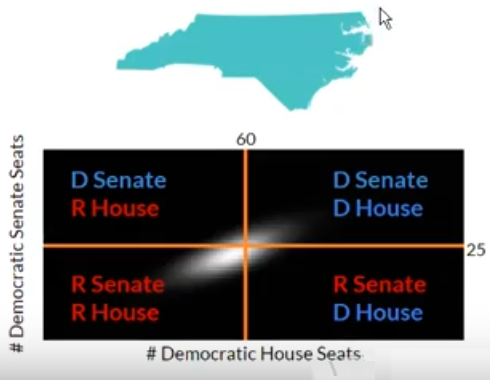
 

The most likely outcome is Republican control of both chambers (lower left quadrant), and thus another egregious partisan gerrymander. (It was the previous North Carolina GOP gerrymander that the Supreme Court refused to consider.) The most likely remedy is Democratic control of the House (lower right quadrant). So that’s where the project’s attention is focused for North Carolina. Here, raw voter power is the amount that adding one more Democratic vote in a given House race would impact the probability of bipartisan control — and thereby a more balanced redistricting process. 

In addition to all the other variables, Wang told me that voter power “depends most of all on how close a chamber is to the edge of control.” In that respect, he sees state legislatures in Texas, Minnesota and Kansas as being “right on the edge.”

That shows up in the voter power scores themselves. Texas has the most congressional districts, so it’s not surprising that it’s got the highest voter power ratings. It has 11 State House districts with voting power of 70 or more, compared with just two that are 50-plus in Minnesota, and three in Kansas. There’s a lot more at stake in Texas, simply because of how much more mischief can be done in redistricting the Lone Star State to favor Republicans at a time when its electorate is clearly shifting. The most valuable legislative seat in the country, in terms of voter power is the 112th Texas House district, just northeast of Dallas, with a voter power rating of 100, followed by two more suburban districts, the 26th (outside Houston) and the 66th (north of Dallas) with ratings of 93 and 91. 

The Democratic candidate for the 112th district, Brandy Chambers, was a participant in the PGP town hall. So, naturally I was interested in her district and her race. She came within two points of winning in 2018, and is running again to unseat five-term incumbent Angie Chen Button. Chambers’ website accused the GOP legislature of being “focused on fringe issues,” and I asked her to elaborate.

“When Texas was suffering a CPS [Child Protective Services] crisis and public school funding was drowning, the leadership in Austin prioritized bathroom bills and laws intimidating immigrants,” she replied. “I’ve talked to people all over our district and not one person said, ‘Please more tax breaks for yacht owners and no to lifesaving and billion dollar saving Medicaid expansion.’ No voters asked for more than a dozen pieces of anti-LGBTQ legislation.” 

“My opponent votes against local control, neighborhood schools, property tax reform, public safety, wage-theft prevention, and private family planning,” Chambers said. “She works for special interest donors. I will work for the people.”

While some specifics may vary (“wage theft prevention” is important, but probably made Chambers’ list because she’s an employment law attorney), those broad themes surely echo in thousands of other races nationwide, along with other issues her website highlights, including climate change and criminal justice reform. She also includes fair redistricting maps (“Politicians shouldn’t pick their voters”), which as an issue remains more muddled. 

As Wachspress noted in his presentation, both parties have “announced campaigns to target close state legislative chambers in key redistricting states” and claim that fair redistricting was their concern. But their “choices of targets plainly show that their goals are not so noble”: Democratic targets include Pennsylvania, for example, while Republican targets include Texas. In each case, their own party’s governor — who is not up for election in 2020 — holds veto power over the process, meaning that only one party is in position to potentially draw unfair maps. 

“If partisans are the only people investing in these races, then there’s just as much organization on the pro-gerrymandering front as on the anti-gerrymandering front,” Wachspress said. “In order to tip the scales toward fair redistricting, people have to be willing to organize for both parties depending on the political landscape of a given state.”

That may sound overly noble in these deeply divided times — and it’s not strictly true. PGP, is explicitly nonpartisan and devoted to fighting gerrymandering by either party. That makes sense: A majority of all voters, across party lines, oppose partisan gerrymandering. So PGP enables the ordinary citizen to take a proactive role, but doesn’t tell you what to do — it simply makes the potential impacts clearer and more readily comparable. But since Republicans have been far more organized in their partisan gerrymandering, there are more available targets, with higher stakes, for Democratic activists to focus on. 

There are other groups out there offering similar guidance, such as the Future Now Fund, which provides a more broad-brush approach, multi-issue framework for working to flip or defend state legislatures. Or Swing Left with its Super State strategy (including a focus on redistricting), which I wrote about as part of my 2020 preview in early 2019. There are also state-level efforts, such as Flip the Texas House. You can use PGP’s “redistricting moneyball, in combination with any or all of these other guides, or all on its own. 

The point is, you have options and you can find information. You can decide what battles matter most to you, and prioritize them on your terms, based on much better evidence and better data than hand-waving promises from politicians and misleading media narratives. And we can all count on the Princeton Gerrymandering Project to keep on developing new tools to help citizens fight for fair representation in the next big wave of redistricting battles that’s just ahead.


For second time, federal judge finds Texas is violating voter registration law

A persistent Texas voter, twice thwarted when he tried registering to vote while renewing his driver’s license online, has for the second time convinced a federal judge that the state is violating federal law.

In a 68-page ruling Friday, U.S. District Judge Orlando Garcia of San Antonio found that Texas continues to violate the federal National Voter Registration Act by not allowing residents to register to vote when they update their driver’s license information online.

Garcia found that DPS is “legally obligated” to allow voters to simultaneously register to vote with every license renewal or change-of-address application, and ordered the state to set up a “fully operable” online system by Sept. 23. The Texas attorney general’s office did not immediately respond to a request for comment, but the state is likely to appeal the ruling.

It’s the second time Garcia has sided with the voter, former English professor Jarrod Stringer. Garcia’s first ruling was overturned on appeal on a technicality.

The National Voter Registration Act requires states to let residents complete their voter registration applications when they apply for or renew their driver’s licenses. But Texas officials have staunchly opposed any form of online registration.

The Texas Department of Public Safety follows federal law when residents visit a driver’s license office in person. But Texans who try to register while using the state’s online portal are instead directed to a blank registration form they must fill out, print and send to their county registrar.

“DPS encourages Texans to use its online services to renew their driver’s license and change their address because it is easier and more convenient,” Garcia wrote. “It cannot, at the same time, deny simultaneous voter registration applications when those online services are used.”

Garcia has said this before. In 2018, he ordered the state to implement what would be its first system for online voter registration. A federal appeals court overturned that order in late 2019 because Stringer and his two co-plaintiffs had ultimately reregistered to vote, and the court decided the case was moot because they were no longer being harmed.

Although the appellate court tossed the case, Judge James Ho of the 5th U.S. Circuit of Appeals wrote in the decision that Stringer’s lost vote was a right he “will never be able to recover.”

“As citizens, we can hope it is a deprivation they will not experience again,” Ho said.

But just 10 days after the admonishment, Stringer again was unable to update his voter registration along with his driver’s license after a move to Houston. Stringer and other frustrated Texans opened the latest chapter of the online voter registration fight by filing a second lawsuit in January.

On Friday, Garcia found that Texas had “offered no factual or legal argument that would justify denying the simultaneous voter registration to which Mr. Stringer is legally entitled.”

“As Defendants have admitted, there are no technological barriers to compliance and corrective measures would not be costly,” Garcia wrote. “Uncontested expert testimony shows that a compliant DPS system would very likely lead to great efficiency, less human error, a massive saving in costs, and increased voter registration.

The issue has become an albatross for Texas Republican officials trying to fend off any form of online voter registration.

At least 1.5 million Texans use the state’s online driver’s license portal a year, according to Stringer’s lawyers, though it’s unclear how many also attempt to reregister to vote. The coronavirus pandemic, which forced Texans to seek out many DPS services online instead of in person, “further underscores that the state has no plausible rationale that I could even imagine to appeal the case,” said Mimi Marziani, president of the Texas Civil Rights Project, which is representing Stringer.

“The court has been incredibly clear now over several years that the state is violating federal law,” Marziani said. “And they have no justification for doing so.”

The Texas Tribune is a nonprofit, nonpartisan media organization that informs Texans — and engages with them — about public policy, politics, government and statewide issues. 

Netflix’s stunning new Paralympics doc “Rising Phoenix” erases stigma through visual elegance

“Rising Phoenix,” which is now streaming on Netflix, traces the history of the Paralympic Games from its origin as a rehabilitation activity for disabled British World War II veterans, and is now a global event. This retrospective is punctuated by absolutely gorgeous footage and interviews from the more recent games, as well as languid, slow-motion sports shots of featured athletes like Italian wheelchair fencer Bebe Vio and American archer, Matt Stuzman, who uses his foot to hold his bow. 

Directed by Ian Bonhôte and Peter Ettedgui, “Rising Phoenix” also focuses on the career of Tatyana McFadden, one of the Paralympics’ most decorated athletes. She is a wheelchair sprinter who has won 17 medals, while also driving change for other disabled athletes in America. McFadden, who executive produced the documentary, helped spearhead the Fitness and Athletics Equity for Students with Disabilities Act, which gives students with disabilities equal opportunities to participate in school athletics programs. She also was a vocal advocate for equal pay among Olympic and Paralympic athletes. 

McFadden spoke with Salon about how athletes with disabilities are portrayed in film, erasing stigma through the visual elegance of “Rising Phoenix,” and why now was the best time for this documentary to debut. 

Tell me about the inspiration behind the title — obviously it was Bebe Vio’s nickname, but what were you wanting to signal to viewers? 

Yeah, it’s such a powerful name. It’s very catchy, for one, and then it is the nickname for one of the athletes. There is this idea that you burn, you die, you burn again and then you live. So, I think when you’re looking at all these stories, all these athletes go through a struggle in their life, a very significant struggle. 

It may seem like it’s a burning point, a dying point, but then they relive through sports. Sports is the reason. So, I think that’s why the name was just awesome. It kind of resonated, you know, with all the athletes — not just the one because of her nickname. 

Speaking of power, I was really struck by some of the strong visuals presented in the film — swimmer Ellie Cole’s gorgeous slow motion scenes underwater, your scene in the fields, the cheetah that is filmed running. What were you hoping to accomplish aesthetically with these images? 

It’s beautiful. You want to find elegance within the storyline, and Ian and Peter, they also did the documentary “McQueen” on Netflix. They have a certain style when it comes to elegance. You know, you’re right — when you are looking underwater, you think “Oh, that’s just beautiful.” Or the cheetah, that brings a kind of funny toughness and coolness, but also there is the elegance of when the cheetah is running and the runner has cheetah blades — those are his running legs — on. 

And then there’s myself in the cornfields. Motion picture can speak a lot of words, right? So, I think that was the purpose of the film directors. It’s really classy and it grabs the eye.


Well, and I don’t feel like we necessarily always see Paralympic athletes depicted in that way. Do you agree?

Yes, I do. I do. I actually got a few questions like, “Oh, is it too elegant?” And I was like, “No, it is not.” When people think of a disability, they don’t think of elegance. When they think of athletes, they don’t necessarily think of elegance either. But people are stunned by how beautiful it is and how beautifully it is captured as well, so it is also about breaking that stigma.

It’s funny, when the directors went, “Oh, we want you to wear something really beautiful for this and we have an idea of how we want to capture it — we’re doing it with all the athletes,” and  was like, “Why?”

And the directors were like, “Well, we want to bring a sense of elegance to the film.” You know, we could do kind of the whole “rah rah” and the toughness of it, but there’s something really beautiful about every single person in the film. And we want the world to see that people with disabilities are beautiful. 

When we first started filming, I was like, “Hey, we have a lot of stigmas to break here . . . to push the boundaries of the Paralympic sports.” I knew the athletes would need to be talked about in a certain way and interviewed in a certain way, so [Bonhôte and Ettedgui] were very open to honest discussions and they’re great. They listened and understood completely. 

To that end, there are two concepts that sort of run parallel in this series. Bebe Vio talks about wanting to know people’s stories because they are illuminating, but then you have Jonnie Peacock who said that in preparation for the Paralympics it was refreshing to focus on sport, not story. How did you make sure you balanced those two desires in this documentary? 

Exactly. So, every athlete has a different viewpoint, of course, but I think in this film you saw the sports side through filming — camera angles, their muscles, the specific designs and showing highlights of the game. 

But when you had the athletes talk, they were able to express their stories about how sports allowed them to become the person that they are. It’s important because we want to be seen as an athlete first, right? Yes, I have a disability and I am very proud of that, but oftentimes I’m going through the airport and people will automatically see my disability first and they will say, “Oh, well, you’re very inspiring for being out today.” I think this film allows people to see the athlete first. 

Of course the incredible stories and journeys are important as well, so I think this film portrayed that and I think the directors did a great job respecting everyone’s requests and they did a beautiful job portraying it. 

You definitely want to highlight the sports aspect of it though, I mean, I don’t have the flexibility to do bow and arrow. Matt Stutzman does it with his feet and he has a Guinness World Record for doing it for three football fields’ length. So you know, an able-bodied person could not do that. And every athlete had to figure out how they were going to get back to playing their sport, how to shoot a bow with your feet and teeth, how to run with a prosthetic leg, Ellie [Cole] had to learn how to swim again. 

Speaking of her, Ellie Cole has this fantastic quote:  “In the Olympics all the bodies look the same, and in the Paralympics, none of the bodies look the same.” Do you have thoughts on that quote? 

It’s true. It’s 100% true. Everyone was really quite different, and I think that’s the coolest thing. Because when you talk about diversity today and you talk about pushing for equality, that’s everything that we are talking about in this film. The Paralympics pretty much highlights all of that. I’ve always believed that life isn’t about what you don’t have, it’s about what you do with the gifts you are given. 

I think once people watch this, they will be more drawn to the Paralympics because they don’t have to sit there and compare themselves to others. I think the Paralympics already kind of breaks that stigma so, I think Ellie is spot-on with that quote. 

Could you tell me a little bit about the topic of pay equality between Olympic medal winners and Paralympic athletes? Because there was a pretty large discrepancy up until recently, right? 

Yeah, a big, big, big one. So that has been a huge change for Team USA. Tokyo will be the very first Games that I’ll be going into with equal pay. I wasn’t grandfathered in the last Games. But in my 16 years of competing, I’m finally going to go in with equal pay for Tokyo 2021. So, you can see the journey that these Paralympic athletes have gone through and we love what we do and we’re not in it for the pay at all. But we were paid $4,000 for a gold medal, and now I think [Olympic] gold medals are now at $35,000 or $30,000.

So, that’s huge. I’ve been very fortunate and blessed to have all the support I received, but it was not easy. You’re pushing your body to the limits and trying to stay on top of the game and bring home medals and you’re not even getting equal pay for it. So yeah, it was hard. I think what was also really hard  was that the Paralympics weren’t celebrated before when we came home. In 2004, when I came home at 15 years old, I was like, “Well, I guess it’s not a big deal because people aren’t celebrating.” I didn’t really think of myself as a professional athlete. 

Now that I’m getting equal pay and sponsorship, I really think of myself as a professional athlete, so we’ve come a long way — a long, long, long way. 

One of the fears that is expressed is that if Rio dropped the ball on the Paralympics, then the momentum and progress the movement has had would be lost. Is there a similar fear with the postponement of Tokyo? I’m sure you’re monitoring that, so what progress have you seen to keep that ball rolling despite the uncertainty of the world?

Yeah, so I think the film is going to help. There was this question with it, “Okay, should we wait? Have the film come out a little later and closer to the Paralympics?” And we decided to keep the same timeline because it is a perfect time. People are thirsty for sports and they’re thirsty for some education. People have time to watch it and really get into the history of the Paralympics and start researching athletes that are involved.

So, I think it is perfect, and I think it allows athletes to use their platforms even more on social media to talk about the Paralympics and their sport. I’m so happy the film is out now. 

“Rising Phoenix” is currently streaming on Netflix. 

Opposition to Obamacare becomes a political liability for Republican incumbents

In the 2014 elections, Republicans rode a wave of anti-Affordable Care Act sentiment to pick up nine Senate seats, the largest gain for either party since 1980. Newly elected Republicans such as Cory Gardner in Colorado and Steve Daines in Montana had hammered their Democratic opponents over the health care law during the campaign and promised to repeal it.

Six years later, those senators are up for reelection. Not only is the law still around, but it’s gaining in popularity. What was once a winning strategy has become a political liability.

Public sentiment about the ACA, also known as Obamacare, has shifted considerably during the Trump administration after Republicans tried but failed to repeal it. Now, in the midst of the COVID-19 pandemic and the ensuing economic crisis, which has led to the loss of jobs and health insurance for millions of people, health care again looks poised to be a key issue for voters this election.

With competitive races in Colorado, Montana, Arizona, North Carolina and Iowa pitting Republican incumbents who voted to repeal the ACA against Democratic challengers promising to protect it, attitudes surrounding the health law could help determine control of the Senate. Republicans hold a slim three-vote majority in the Senate but are defending 23 seats in the Nov. 3 election. Only one Democratic Senate seat — in Alabama, where incumbent Doug Jones is up against former Auburn University football coach Tommy Tuberville — is considered in play for Republicans.

“The fall election will significantly revolve around people’s belief about what [candidates] will do for their health coverage,” said Dr. Daniel Derksen, a professor of public health at the University of Arizona.

The Affordable Care Act has been a wedge issue since it was signed into law in 2010. Because it then took four years to enact, its opponents talked for years about how bad the not-yet-created marketplace for insurance would be, said Joe Hanel, spokesperson for the Colorado Health Institute, a nonpartisan nonprofit focused on health policy analysis. And they continued to attack the law as it took full effect in 2014.

Gardner, for example, ran numerous campaign ads that year criticizing the ACA and, in particular, President Barack Obama’s assertion that “if you like your health care plan, you’ll be able to keep your health care plan.”

But now, Hanel said, the ACA’s policies have become much more popular in Colorado as the costs of health exchange plans have dropped. Thus, political messaging has changed, too.

“This time it’s the opposite,” Hanel said. “The people bringing up the Affordable Care Act are the Democrats.”

Despite Gardner’s multiple votes to repeal the ACA, he has largely avoided talking about the measure during the 2020 campaign. He even removed his pro-repeal position from his campaign website.

Democratic attack ads in July blasted Gardner for repeatedly dodging questions in an interview with Colorado Public Radio about his stance on a lawsuit challenging the ACA.

His opponent, Democrat John Hickenlooper, fully embraced the law when he was Colorado governor, using the measure to expand Medicaid eligibility to more low-income people and to create a state health insurance exchange. Now, he’s campaigning on that record, with promises to expand health care access even further.

Polling Data

Polling conducted by KFF for the past 10 years shows a shift in public opinion has occurred nationwide. (KHN is an editorially independent program of KFF, the Kaiser Family Foundation.)

“Since Trump won the election in 2016, we now have consistently found that a larger share of the public holds favorable views” of the health law, said Ashley Kirzinger, associate director of public opinion and survey research for the foundation. “This really solidified in 2017 after the failed repeal in the Senate.”

The foundation’s polling found that, in July 2014, 55% of voters opposed the law, while 36% favored it. By July 2020, that had flipped, with 51% favoring the law and 38% opposing it. A shift was seen across all political groups, though 74% of Republicans still viewed it unfavorably in the latest poll.

Public support for individual provisions of the ACA — such as protections for people with preexisting conditions or allowing young adults to stay on their parents’ health plans until age 26 — have proved even more popular than the law as a whole. And the provision that consistently polled unfavorably — the mandate that those without insurance must pay a fine — was eliminated in 2017.

“We’re 10 years along and the sky hasn’t caved in,” said Sabrina Corlette, a health policy professor at Georgetown University.

Political Messaging

Following the passage of the ACA, Democrats didn’t reference the law in their campaigns, said Erika Franklin Fowler, a government professor at Wesleyan University and the director of the Wesleyan Media Project, which tracks political advertising.

“They ran on any other issue they could find,” Fowler said.

Republicans, she said, kept promising to “repeal and replace” but weren’t able to do so.

Then, in the 2018 election, Democrats seized on the shift in public opinion, touting the effects of the law and criticizing Republicans for their attempts to overturn it.

“In the decade I have been tracking political advertising, there wasn’t a single-issue topic that was as prominent as health care was in 2018,” she said.

As the global health crisis rages, health care concerns again dominate political ads in the 2020 races, Fowler said, although most ads haven’t explicitly focused on the ACA. Many highlight Republicans’ support for the lawsuit challenging preexisting condition protections or specific provisions of the ACA that their votes would have overturned. Republicans say they, too, will protect people with preexisting conditions but otherwise have largely avoided talking about the ACA.

“Cory Gardner has been running a lot on his environmental bills and conservation funding,” Fowler said. “It’s not difficult to figure out why he’s doing that. It’s easier for him to tout that in a state like Colorado than it is to talk about health care.”

Similar dynamics are playing out in other key Senate races. In Arizona, Republican Sen. Martha McSally was one of the more vocal advocates of repealing the ACA while she served in the House of Representatives. She publicly acknowledged those votes may have hurt her 2018 Senate bid.

“I did vote to repeal and replace Obamacare,” McSally said on conservative pundit Sean Hannity’s radio show during the 2018 campaign. “I’m getting my ass kicked for it right now.”

She indeed lost but was appointed to fill the seat of Sen. Jon Kyl after he resigned at the end of 2018. Now McSally is in a tight race with Democratic challenger Mark Kelly, an astronaut and the husband of former Rep. Gabby Giffords.

“Kelly doesn’t have a track record of voting one way or another, but certainly in his campaign this is one of his top speaking points: what he would do to expand coverage and reassure people that coverage won’t be taken away,” said Derksen, the University of Arizona professor.

The ACA has proved a stumbling block for Republican Sens. Thom Tillis of North Carolina and Joni Ernst of Iowa. In Maine, GOP Sen. Susan Collins cast a key vote that prevented the repeal of the law but cast other votes that weakened it. She now also appears vulnerable — but more for her vote to confirm Brett Kavanaugh’s nomination to the Supreme Court and for not doing more to oppose President Donald Trump.

In Montana, Daines, who voted to repeal the ACA, is trying to hold on to his seat against Democratic Gov. Steve Bullock, who used the law to expand the state’s Medicaid enrollment in 2015. At its peak, nearly 1 in 10 Montanans were covered through the expansion.

As more Montanans now face the high cost of paying for health care on their own amid pandemic-related job losses, Montana State University political science professor David Parker said he expects Democrats to talk about Daines’ votes to repeal cost-saving provisions of the ACA.

“People are losing jobs, and their jobs bring health care with them,” Parker said. “I don’t think it’s a good space for Daines to be right now.”

Kaiser Health News (KHN) is a national health policy news service. It is an editorially independent program of the Henry J. Kaiser Family Foundation which is not affiliated with Kaiser Permanente.>

5 epic failures of Donald Trump that illustrate the U.S.’s decline

For all of his bombast, under the leadership of Donald J. Trump the United States has actually grown more and more to resemble a developing nation.

As it happens, the onset of the pandemic tore the mask off all of the rot that had been festering just below the surface of U.S. politics and society. Donald J. Trump, backed by his Republican Party, is the very face of this decline, which manifests itself in five epic failures.

Failure 1: The great giveaway to the rich

The first reason that the United States is rapidly transforming itself into a developing nation is that its President has made one particularly well-calculated move: He has been able to harness the rapacious greed that is at the heart of Republican politics and simultaneously trample on the tepid moderation that is inherent in Democratic politics.

This had already fully manifested itself prior to the extraordinary fiscal interventions related to the pandemic. Soon after Trump took office in 2017, the United States already embarked on a course of fiscal profligacy. 

It successfully enacted tax cuts that baked trillion-dollar deficits into the U.S. economy for as far as the eye can see.

As a consequence, U.S. federal debt has become unsustainable without the Fed’s printing press — which has pushed past the limits of rational monetary policy. 

More and more, the United States’ fiscal and monetary accounts have come to resemble those of poorly managed developing nations.

Instead of following long-accepted socio-economic practices, President Trump uses lies and illusion to create a febrile web of illicitness — part oligarchy, part plutocracy and part kleptocracy — that is characteristic of so many developing nations.

Living from paycheck to paycheck

This has manifested itself more and more in income disparities that leave the vast majority of Americans barely able to hang on from paycheck to paycheck, while a privileged few reap the rewards of a system rigged in their favor — again a characteristic of developing nations. 

In fact, if the United States were a developing nation and did not play a central role in the governance of the world’s multilateral institutions, it surely would have come under scrutiny by the International Monetary Fund for pursuing policies and practices that have in the past forced intervention.

Failure 2: Police it like it’s Baghdad

This past summer, the United States was literally torn apart by racial strife that often resulted in rioting. The root cause of this strife was the pervasive level of systemic poverty that besets so many Americans living in inner cities.

But if poverty was the cause, an out-of-control police force, facile in the use of strongarm tactics, was the spark. Simply, the United States’ inner-city police forces often stop just short of the tactics used by police in many developing countries.

Forget for a moment that African Americans are 2.8 times more likely to be killed by a policeman than an American of European lineage. The reality is that American cities are being subjected to a form of policing that cannot be found in any other developed country in the world.

Supporting police brutality

And, here’s the kicker. President Trump, with broad support from his Republican party, comes down squarely on the side of police brutality. 

More importantly, Trump has managed to cadge together an extra-legal police force from units connected to the Department of Homeland Security, which for various reasons seems doggedly loyal to the President.

Under his “law and order” mantra, the most lawless of U.S. Presidents mimics the actions of tinpot dictators cracking down on civil unrest in places like Azerbaijan or Cambodia.

Failure 3: A failing U.S. healthcare system

And then there’s the Trump Administration’s handling of COVID 19. Suffice to say that President Trump presides over a nation reeling from the physical, emotional and economic trauma of a raging pandemic by virtue of promoting snake oil — in this case hydroxychloroquine.

But aside from the President’s mindless antics, the coronavirus has unmasked a new reality for all Americans to see. The so-called “greatest health care system in the world” is proving to be every bit as inefficient and ineffective as health care systems in the world’s poorest countries. 

Despite all the vast amounts of money spent, the U.S. health care system leaves millions of Americans unserved or underserved. 

One need only look at the substantially higher COVID 19 death rates among people of color in the United States’ largest cities. It constitutes a callous disregard for human life that aligns more closely with Kinshasa than with Berlin, Paris or even Beijing.

President Trump has not only failed utterly to take the steps necessary to repair the system, which he had so stridently promised in the last Presidential election, he has use the office of the President to chip away at key elements of the existing system.

Gutting the Affordable Care Act

Amazingly, he is in the courts trying to eliminate coverage for pre-existing conditions, a popular facet of the Affordable Care Act that he promised to protect. 

Again and again, while doing nothing to improve the plight of the United States’ disenfranchised, the President callously focused on tearing the system further apart. 

Meanwhile, as in so many developing nations, wealthy Americans are completely unfazed. They have access to some of the world’s best research hospitals. 

Failure 4: The extraction economy

The United States’ National Weather Service is currently predicting the possibility of approximately 20 named storms coming ashore in the United States this hurricane season. 

Such a violent hurricane season does not come as a surprise to anyone who closely follows the impact of global warming on the U.S. ecosystem.

Devastation from climate events, whether brush fires in California, heat waves in the Southwest, inundations in states bordering the Gulf of Mexico and tornadoes sweeping through the Southeast, has become a staple of U.S. news reports. 

Death and physical deprivation have become commonplace — with victims of climate change largely left to fend for themselves.

So far, 2020 is on track to become the hottest year on record in the United States, with dozens of U.S. cities setting all-time records for high temperatures. But then, nine of the 10 hottest years on record globally have occurred in the past ten years.

Denying the undeniable

There is no longer much ambiguity in these weather patterns. Nor is there any ambiguity in the statistics that measure them. They dovetail precisely with the direst of climate predictions. 

And yet, the current President of the United States, with the full backing of the Republican Party, denies climate change and presses forward in promoting the unrestricted extraction and use of fossil fuels.

Within the Trump Administration, environmental problems are not confined to climate change. Since taking office, the Administration has orchestrated a systematic gutting of environmental regulation overall.

Favoring extraction industries every step of the way, Trump — again with the full backing of the Republican Party — has placed the country’s water systems, wetlands and wilderness areas at extreme risk. 

It puts in place an environmental infrastructure common to developing rather than developed nations.

This pattern of denial and deceit puts the United States on track to increase rather than reduce its dependence upon natural resource development, making the United States a target for all the corruption that extraction industries bring with them. 

The United States aside, environmental degradation at the hands of extraction industries is a characteristic common in many developing nations, which base their ongoing development on the exploitation of their natural resources.

Failure 5: Crumble in the infrastructure jumble

Extraction is one side of the coin. The other side is the state of the United States’ infrastructure. 

As is the case in so many developing nations, U.S. infrastructure has been widely neglected, despite President Trump’s extravagant campaign promises in the last election.

The lack of adequate infrastructure became most evident with recent storms — Hurricane Isaias in the northeast and the derechos in the Midwest — when above-ground power grids were devastated along with crops.

Few if any developed nations maintain above-ground power grids as the United States still does. 

And the decrepit state of the U.S. electrical grid does not even address the jumble of problems with crumbling roads, bridges, rail lines and waterways.

Maintaining a sound infrastructure is a collective national endeavor. It is therefore especially telling — and tragic — that any sense of nationhood has been totally abandoned by President Trump and his Republican cohort in the U.S. Congress in favor of prosperity for the privileged few.

Instead of pouring precious federal resources into national restoration, money in the form of tax cuts is channeled to a new made-by-Trump kleptocracy overseen by legions of lobbyists. 

Corruption in Washington

Corruption in Washington, D.C. is akin to the kinds of corruption one finds in places like Lagos or Kabul — albeit on a more sophisticated level.

Instead of foreign entities bribing local officials as happens in developing nations, U.S. companies bribe U.S. officials in the U.S. federal capital city, as well as state capitals. 

In the meantime, the United States’ crumbling infrastructure looks more and more like what one would find in other developing countries.

The transformation is underway

The five epic failures of the contemporary United States under the Trump regime are:

1. Out-of-control U.S. fiscal and monetary policies

2. The rise of the police state

3. An inadequate and ineffective health care system

4. A rapidly degrading environment and 

5. A deteriorating infrastructure.

These failures are also among the classic characteristics of a developing nation. It cannot satisfy any American, regardless of partisan stripe, that they constitute five epic failures for the Trump Administration.

Failure 6? Shredding democracy

These five epic failures are bad enough. But they would exclude one more characteristic of developing countries that actually represents the Trump Administration’s biggest failure — or rather deliberate act of brazenness: It is Donald Trump’s assault on democracy itself.

The fact is that the President seeks to put in place a form of government that is no longer anchored in the basic principles of democracy. It has become detached from the tenets that shape duly elected governments in other developed nations.

Like despots in so many developing countries, Trump governs more and more by decree in the form of executive orders. In so doing, he bypasses almost entirely the people’s elected representatives in the Congress, which itself has grown increasingly dysfunctional.

Attacking the election

And as the next presidential election approaches, Trump busies himself casting doubt on its legitimacy and throws up impediments within the U.S. Postal Service that are aimed at suppressing the vote, a tactic common in the most corrupt developing nations. 

In fact, the polarization that one currently sees in U.S. politics and society, which is stoked to a fever pitch each and every day by a President determined to hold onto power at any cost, inches the United States toward a potentially cataclysmic level of civil strife, the contours of which already became evident this past summer.

And yet, a large cross-section of the U.S. electorate seems content to tag along for this ride in reverse toward a Great Leader — the very notion the founding father of the United States wanted to avoid. 

Most astonishingly, like pre-pubescent children sitting in the back seat of the car during a long ride, they happily ask one question over and over: “Are we there yet? Are we there yet?”

This article is republished from The Globalist: On a daily basis, we rethink globalization and how the world really hangs together.  Thought-provoking cross-country comparisons and insights from contributors from all continents. Exploring what unites and what divides us in politics and culture. Follow us on Facebook and Twitter.  And sign up for our highlights email here.

Social Security fund would run out of money in 3 years if Trump eliminates payroll tax: SSA analysis

President Donald Trump claimed he would eliminate the payroll tax if he is reelected — but an analysis by the Social Security Administration found that such a move would cause the Social Security Trust Fund to run out of money by 2023.

Trump recently signed a memorandum that would temporarily stop the collection of payroll taxes, which is a 12.4% tax split evenly between employees and employers that funds the Social Security and Medicare trust funds. Only Congress can cut taxes, however, so the payroll tax savings would still have to be repaid by next year’s tax deadline — though Trump said he would push to forgive the deferred taxes if he is reelected.

Trump went a step further earlier this month, vowing not just to forgive this year’s payroll tax but eliminate it entirely.

“If I’m victorious on November 3rd, I plan to forgive these taxes and make permanent cuts to the payroll tax. I’m going to make them all permanent,” he said during a news conference at his Bedminster, N.J. golf course. “…In other words, I’ll extend beyond the end of the year and terminate the tax. And so we’ll see what happens.”

The claim prompted alarm on Capitol Hill. Senate Minority Leader Chuck Schumer, D-N.Y., Sen. Bernie Sanders, I-Vt., and Sen. Ron Wyden, D-Ore., sent a letter to the Social Security Administration questioning how permanently eliminating the tax and making no other changes would impact the viability of the Social Security Trust Fund.

“While we would not be supportive of this hypothetical legislation, we would like to be aware of its potential implications,” they wrote.

Stephen Goss, the chief actuary at the Social Security Administration, told the senators in his response that the hypothetical cut would cause the Social Security Disability Insurance Trust Fund to be depleted by mid-2021 and the Social Security Trust Fund reserves “would become permanently depleted by the middle of calendar year 2023, with no ability to pay… benefits thereafter.”

Goss noted that past temporary payroll tax reductions did not affect the trust fund reserves because the Treasury Department authorized automatic transfers from its General Fund, which Treasury Secretary Steven Mnuchin vowed to do for the deferred taxes, but it is unlikely to extend beyond that.

If the payroll tax is eliminated, Congress would have to replace the funds with about $1 trillion in tax increases. Social Security benefits for retired workers average about $1,500 per month, and “these amounts could be completely eliminated” without alternative sources of funding, Forbes reported.

“While benefits scheduled in the law… are obligations, such obligations can only be met to the extent that asset reserves are available,” Goss wrote.

Democrats cited the analysis to warn that Trump’s promise would “completely decimate Social Security.”

“The Social Security Administration has made it clear: eliminating the payroll tax, as Trump has proposed, would bankrupt Social Security and prevent seniors and people with disabilities from receiving the benefits they have earned,” Sanders said in a statement. “Defunding Social Security may make sense to the billionaires at President Trump’s country club, but it makes zero sense to me. Instead of dismantling Social Security, we must expand it so that every senior can retire with the dignity they deserve.”

House Speaker Nancy Pelosi, D-Calif., vowed to oppose any attempt to eliminate the payroll tax.

“The new analysis today shows the swift potential devastation of President Trump’s reckless call to ‘terminate’ the payroll tax: shattering the sacred promise of Social Security,” she said in a statement.

Advocacy groups sounded the alarm as well.

“If Donald Trump is re-elected, Social Security will cease to exist before the end of his second term,” Nancy Altman, president of Social Security Works, told CNBC in response to the analysis.

Trump’s advisers have attempted to walk back his comments.

“There is no plan to eliminate Social Security taxes,” top White House economic adviser Larry Kudlow told reporters at the White House. “I don’t know where that idea came from. It’s not true.”

“When he referred to ‘permanent,’ I think what he was saying is that the deferral of the payroll tax to the end of the year will be made permanent,” he told CNN. “It will be forgiven. The tax is not going to go away.”

“That isn’t what the president said at all,” host Dana Bash responded. “He said the opposite.”

Social Security advocates are alarmed at the deferral as well, noting that using the Treasury’s General Fund undermines how the program is supposed to work.

“They’re not a handout. They’re not an entitlement,” Dan Adcock, the director of government relations and policy at the National Committee to Preserve Social Security and Medicare, told CNBC. “That’s why even under those circumstances we are so strongly opposed to this.”

It is highly unlikely that Congress would entertain the idea of undermining the Social Security program given that even Republicans opposed Trump’s repeated calls to cut the payroll tax temporarily amid the pandemic. “A majority of Senate Republicans didn’t want a payroll tax cut,” NBC News reported last month.

Analyses have found that two-thirds of the benefits of a payroll tax cut would go to the richest 20% of Americans while the poorest 20% of Americans would get just 2% of the benefits. It would do nothing to help the tens of millions of people out of work.

Trump called for the payroll tax deferral after negotiations with Democrats broke down, but the fate of that deferral is still up in the air.

The memorandum called for the Treasury Department to start deferring taxes starting on September 1, but that appears highly unlikely since the department has not produced guidelines for employers or payroll processors to defer the taxes.

“The deferral isn’t going to be in place for September 1st,” Pete Isberg, president of the National Payroll Reporting Consortium, the payroll industry’s trade association, told The Washington Post.

Because the deferral is voluntary, the language in the memorandum “raises the prospect that you have to get information to 100 million people,” Isberg said, and then ensure the tax is only deferred for employees who want it.

About 30 industry groups, led by the US Chamber of Commerce, called the proposal potentially “unworkable.”

“Therefore, many of our members will likely decline to implement deferral, choosing instead to continue to withhold and remit to the government the payroll taxes required by law,” the groups said in a letter to Congress and the White House.

The groups said that the deferral would be “unfair to employees to make a decision that would force a big tax bill on them next year.”

“We hope Congress and the Administration come together on a path that supports workers instead of burdening hard-working Americans with a large tax bill next year,” the letter said.

Experts say that Trump’s order is unlikely to have much impact as a result.

“There’s a lot of unresolved questions about the implementation of this deferral, [and] some of the unresolved questions are quite basic,” Garrett Watson, a senior policy analyst at the Tax Foundation, told NBC News. “When would the deferred tax be owed back? There isn’t a date specified. There are many options here that have to be clarified. The other big thing that’s hanging over a lot of this is whether or not this deferral will turn into a meaningful reduction in tax liability owed.”

Companies and employees that choose to opt for the deferral could have big headaches come tax time next year.

“You don’t want to be in a position where you have to withhold months worth of payroll taxes from employees all at once,” Eric Toder, the co-director of the Urban-Brookings Tax Policy Center, told NBC. “That would create a horrible problem for people.”

A dictator on downers: Slow-motion mass hysteria at the Republican convention

I would have loved to have been a fly on the wall as Donald Trump’s dosage-tuning was done by a team of crack drug-doctors in an anteroom of the White House before he gave his Big Speech on Thursday night. Hand me that penlight, Tom. I want to give his pupils another quick check. His anisocoria looked a little pronounced when we hit him with the last dose a while ago … look right, Mr. President … now look left for me … that’s good … uuuhhh … just as I thought. We better hit him with another two cc’s before we give the OK to push him out there. If we don’t get him tuned up just right, he’ll never make it down those steps from the back portico…

Were you watching the last night of the Republican National Convention on Thursday night? It looked like a Nuremberg rally on Nembutal. Whatever they gave him before he took the stage overlooking the back lawn of the White House, they managed to get max-automaton out of him. Holding onto the podium like he was on the deck of a pitching ship at sea, Trump droned through 70 minutes of his acceptance speech like a seventh-grader giving a book report on “Great Expectations” in English class. He had that strange singsong delivery he does when he’s reading off a teleprompter: sentence … pause … phrase … pause … now comes the big applause line and they clap and it says I can look at the audience and give them a smile and point to someone ..

Early in the speech, he uttered this gem in the exact same depressed, soulless tone and delivery he used when he assured his audience that his brother, Robert, was “looking down” on him from heaven: “In the new term as president, we will again build the greatest economy in history, quickly returning to full employment, soaring incomes and record prosperity.” He sounded like he believed it about as much as he believed Melania would share his bed that night and he’d get lucky. He looked like he was going to burst into tears, the future looked so bright. It was like watching somebody on acid trying to wrangle their way through a bad trip, his face contorted in mid-zone between agony and ecstasy, belief and despair. 

But in the words on the teleprompter, everything was peachy-keen. Everything he has done for four years has been perfect. Jobs? The jobs that have disappeared by the tens of millions since March? Why, they’re up! Income? Income that’s plummeted since businesses closed by the thousands and federal unemployment payments ended? Income is up! Pandemic? The virus that has sickened millions and killed more than 180,000 as schools open and outbreaks at colleges multiply? What pandemic? The wall? The wall that’s being scaled with ladders and sawn through with $50 Home Depot battery powered saws? The wall that got blown down in a stiff wind a few weeks ago? The wall that Steve Bannon will be going to jail for? We built 300 miles of it! Our borders are more secure than they’ve ever been! Health care? You mean the coverage for pre-existing conditions we’ve been trying to kill in a federal lawsuit for the last couple of years? We’re for it! 

The crowd clapped on cue, occasionally rising slowly to its feet to deliver a dispirited standing ovation. No social distancing. Few masks. They looked doomed by peer pressure into behaving like good little Republican replicants, like the well-dressed first-class passengers on the Titanic lining up for the lifeboats but trying not to make it obvious as they push the women and children out of the way to get the last seat. 

The only thing that seemed to turn them on at all were the premonitions of doom. Joe Biden, good old “Uncle Joe,” whom everyone has been watching glad-hand his way through a political career as the Democrats’ house centrist, is the most dangerous radical in America, “a Trojan horse for socialism.” He and the “Democrat party” will “confiscate your guns” and “demolish the suburbs.” All of the nation’s problems are Democrat problems. The 10 most dangerous cities in the United States are “Democrat cities,” Trump had tweeted Thursday morning when he probably should have been rehearsing his terminally dull speech, but wasn’t. 

Racism? What racism? Just look at all of our Blacks! The Republicans had apparently scoured the country for safe, presentable people of color for months, and every one of them made it to the podium over the last four days. Ben Carson, the Republican answer to Al Sharpton, was there of course. Nikki Haley appeared to assure everyone wearing a rep tie or a power-bow and heels that “America is not a racist country.” Someone apparently found former NFL great Herschel Walker wandering around Dallas in a daze and hauled him in for a Monday night appearance to assure everyone, “Growing up in the Deep South I’ve seen racism up close. I know what it is, and it isn’t Donald Trump.” I would have loved to have seen the Trump campaign focus groups that produced their appeal to minority voters at the convention. Let’s see … how do we do this without pissing off the Confederate vote? I’ve got it! We’ll put them in coats and ties and get them to praise the police! That’s the ticket!

The plan for victory the Trump campaign has apparently come up with could be called the QAnon key. Whip up a lot of mass hysteria over make-believe conspiracies and exaggerated terrors and then claim fake victories. Obama spied on my campaign! Biggest crime in history! Russia hoax! Comey’s lies! Mueller didn’t find a thing! They’re out to get me! They even tried to impeach me! But I beat ’em! COVID? Another hoax! All those bad numbers are deep-state CDC lies from too much testing! Global warming? Don’t pay attention to that flooded living room you’re standing in! You’re wading down your driveway in a Democrat city! Democrat wind brought that oak tree down on your roof! It was a Democrat hurricane! We’re going to send in  FEMA with coffee and donuts!

The Republican Party famously omitted a platform from their convention this year, but pompadour boy-toy and Florida Republican congressman Matt Gaetz was there on the convention’s opening night to warn that Democrats want to “disarm you, empty the prisons, lock you in your home and invite MS-13 to live next door.” All you’ve got to do is throw in the murder of Seth Rich and the pizza joint pedophile ring, and you’ve got the Republican Party platform in full. 

See, that’s the thing about our QAnon president. Almost nothing he said on Thursday night was based in fact. No one bothers to believe him anymore, not his White House staff, not his congressional enablers, not even the puppet-jointed poohbahs who nod along when he calls into “Fox & Friends.” 

That’s because it’s not about Donald Trump anymore. A slow-motion mass hysteria has taken over what used to be a sober, if misguided, political party. They don’t care that 180,000 have died. They don’t care that thousands are being evicted from their homes and thousands more can’t feed their families. They don’t care that the most populous state in the Union is burning to the ground. They don’t care if cops kill 100 more unarmed Black men and women. They don’t even care that their own “base” is doing a lot of the dying in the pandemic. 

Here’s where we’re at, folks: It’s all about revenge. Republicans would vote for a squirrel in a hair-sprayed blonde wig if the squirrel promised them a fall football season and swore he would “own the libs.” They want revenge for the ’60s. They want revenge because the “libs” got laid more than they did in college. They want revenge because Obama had Dylan and Mick Jagger and Willie Dixon and Carole King in the White House, and all they’ve got is Kid Rock and Ted Nugent. They want revenge because we have more fun than they do. They want revenge because love is stronger than hate, and we believe in love. 

Wear a mask. Love the one you’re with. Get out and vote. 

Trump accepts the nomination from the White House lawn, portraying a nation in crisis

Donald Trump delivered his second Republican Party acceptance speech from the White House on Aug. 27, shattering the norm that presidents do not campaign at the public’s expense, and describing a nation in crisis.

Trump spoke of internal enemies intent on destroying the American way of life and offered himself as the nation’s only protection against widespread rampaging violence.

It was a speech meant to draw a stark contrast between Trump’s view of America and what he portrayed as his Democratic opponent Joseph Biden’s view of America.

I’ve been analyzing Trump’s rhetoric since 2015. I wrote about Trump’s appeal to authoritarian voters at his 2016 nomination acceptance speech in my new book, “Demagogue For President: The Rhetorical Genius of Donald Trump.”

This year’s speech was a repeat performance.

Trump repeatedly tried to create a sense of urgency about his reelection, calling this the “most important election in the history of our country.”

Trump said that “if the left gains power, they will demolish the suburbs, confiscate your guns, and appoint justices who will wipe away your Second Amendment and other Constitutional freedoms.”

“No one will be safe in Biden’s America,” Trump warned.

Biden borrowed from Trump’s playbook, tweeting out a response to the speech.

“A wicked nation”

The months long protests against police violence and systemic racism against African Americans, the movement to pull down Confederate monuments, and even The New York Times’ 1619 Project provided the background for Trump’s attack on Biden’s view of America and his defense of his own record in office.

Trump claimed that “Joe Biden and his party repeatedly assailed America as a land of racial, economic and social injustice.” He told his audience that “in the left’s backward view, they do not see America as the most free, just, and exceptional nation on earth. Instead, they see a wicked nation that must be punished for its sins.”

In so doing, Trump’s speech rejected the concerns that a majority of Americans have about systemic racism while it offered solace to those Americans who think that the movement has gone too far.

Trump spoke in stark terms about the choice facing Americans in November. “This election will decide whether we will defend the American Way of Life, or whether we allow a radical movement to completely dismantle and destroy it,” he said.

And Trump promised to be the nation’s hero. He said that he would protect “the patriotic heroes who keep America safe,” while his opponents would “stand with anarchists, agitators, rioters, looters and flag-burners.”

He quoted one of his own memes, saying he is the only thing standing between vulnerable Americans and what he calls the nation’s dangerous enemies within. “Always remember,” he said, “they are coming after me, because I am fighting for you.”

Trump’s Republican nomination acceptance speech didn’t reach across the aisle to draw in the support of Democrats or Democrat-leaning Independents. It wasn’t a speech for all of America – it was a speech designed to appeal to Trump’s base and terrify them into voting for him. That’s authoritarian.

Jennifer Mercieca, Associate Professor of Communication, Texas A&M University

This article is republished from The Conversation under a Creative Commons license.

Yale psychiatrist: Trump’s convention lies and fear-mongering may “provoke a lot of violence”

A Yale psychiatrist who has sounded the alarm on President Donald Trump’s mental health for years warns that the party’s attempt to stoke fear in the electorate at the Republican National Convention could lead to violence against the president’s opponents.

The convention featured an unprecedented number of false claims and downright lies, unhinged conspiracy theories, and hours of racial fear-mongering. Bandy X. Lee, a forensic psychiatrist at Yale School of Medicine who taught at Yale Law School, told Salon that the stoking of fear was so coordinated that pushing back could provoke a violent response.

Lee has studied violence for years. She is the author of the textbook “Violence,” editor of “The Dangerous Case of Donald Trump: 37 Psychiatrists and Mental Health Experts Assess a President,” and president of the World Mental Health Coalition, which recently issued a “Prescription for Survival Refill” and is releasing a new collection of statements, conference transcripts, and columns called “Documents.” She recently interviewed Mary Trump at her new website about the president’s mental health.

Lee said that the American Psychiatric Association, which warned against mental health professionals offering their opinions of the president’s mental health, had denied the public a full view of what is happening in the White House. 

“The public has been deprived of expert knowledge for too long, as it misunderstood and normalized serious pathology to a level of profound danger,” she told Salon. “Professional institutions should not function as lackeys of the government but do their public function. I have criticized from the very start the way the American Psychiatric Association intervened to mislead the public into believing that they cannot hear from mental health experts about the mental health of a president. Imagine the American Bar Association prohibiting all legal professionals from commenting on societally relevant legal matters, unless they personally represent the public figures and obtain consent from them to speak about them. It is absurd, and it is about time we stop treating mental health issues so differently and esoterically, when science demands the exact opposite.” 

Other experts suggest a cautious, precedent-setting approach. “I think the same way that candidates have their physical health scrutinized, they could have their mental health scrutinized,” Amy Barnhorst, a psychiatry professor and the vice-chair for clinical services at UC Davis, told Salon in January. “But we have to ask ourselves: What would we do with that information?” 

Lee spoke to Salon about the convention and how it could affect the electorate heading into November. 

As a psychiatrist who has been sounding the alarm on this presidency for years, what were your takeaways from the convention? Did anything surprise you? 

It has not been surprising, but impressive in how well-orchestrated and coordinated the convention was, starting with holding the event on the White House lawn. No breach of rules or actual harm matters, as long as there is impression management, which is the key to psychological conditioning, manipulation and control. Republicans understand this power of the mind and use it perversely. Democrats do not even inform themselves of it to achieve their political goals, let alone protect the population, as we learned from our attempts to obtain consultation. This election will be more difficult than 2016, since Donald Trump has infected his followers with his symptoms, by sheer duration in office. He will also no doubt use the full powers of the presidency now to choreograph his remaining in office, regardless of the means — and I believe people realize by now that there is no limit to what he will do to “win.”

Many of the speakers described a very different presidency than we’ve seen, one that successfully accomplished many things and beat back the coronavirus. Kamala Harris said the goal of the convention was to “soothe Trump’s ego.” Do you think that’s accurate? 

That would be the most minimal description, falling far short of what the situation demands. Politics, without grounding in reality, seems to have become a circular enterprise that has to do with nothing but power: this side impeaching only because the other side has in the past, or hesitating with a valid intervention “in case” it backfires. Journalists need to offer grounding in facts, and experts must give evidence based on the best available knowledge. Politics should be based on facts and evidence. Our system is unusual in that we do not have freestanding scholarly advisory boards or other means for scientists and other intellectuals to give independent input into governance. This was criticized in the 1970s, and now it is far worse: experts convene only when politicians invite us, for their purposes, and the end result for mental health is that administrations that need consultation the most will be the least likely to seek it. 

The president and other speakers repeatedly lied throughout the event. How does that affect the psychology of the overall electorate, to have a four-day stream of lies broadcast by all the major networks for four straight days? 

This has now become a societal phenomenon. We do not think of mental symptoms as infectious, but they are potentially far more so than Ebola or coronavirus, since you do not need physical contact for the symptoms to transmit to millions, as long as you have emotional bonds. The end result is dramatic, as we now see before our eyes. 

In our individual-oriented culture, not even psychiatrists consider this phenomenon sufficiently, but contagion is well-documented in the literature, and especially my colleague at the World Health Organization, Dr. Gary Slutkin, has long advocated approaching violence as a contagious disease. [Editor’s note: Other experts have pushed back on this model.]

It is rather a mistake to believe that mental symptoms cannot transmit, when we have set up the perfect conditions for it. Those who do not succumb also generally grow exhausted and acquiesce. The good news is, like the pandemic, we can contain it if we intervened intelligently and scientifically. 

How can Democrats counter Trump’s lies? Is it possible to counter this non-stop narrative with facts and reality? 

When lies are of a pathological degree, they may arise from delusions, which means they are resistant to facts and reality—all you will likely do is arouse defensive “doubling down.” This is what you see with the growing detachment from reality and embracing of conspiracy theories like QAnon.  As evidence of the president’s incapacity and criminal-mindedness mounts, increasingly outlandish explanations are necessary to hold onto cherished fixed beliefs: such as that the person one supports is a savior figure who can do no wrong. Donald Trump is masterful at cultivating and stoking this need, since his presidential—or more importantly his psychic—survival depends on it.  This level of denial can be dangerous, as challenging it could provoke a lot of violence. 

How to intervene? The situation has gotten so serious, we are at a point where we need specialists. You would not order heart surgery by a politician, just because it is occurring in another politician, would you? And so why do we attempt to tackle a serious mental health problem politically? To help, my colleagues and I have issued a “refill” to our “Prescription for Survival.”  People will see that what we issued in March of this year, when we had about 1,000 COVID-19 deaths, is all the more applicable now. 

This interview has been lightly edited for length and clarity.

Rachel Maddow fact-checks Trump’s RNC speech: “A lot of it was wrong — factually wrong”

President Donald Trump offered a long-winded and factually absurd address to the Republican National Committee Convention on Thursday.

Immediately following the speech, MSNBC’s Rachel Maddow gave a fast fact-check of some of the untruths Trump claimed in his speech.

“I think it might be helpful if I just did like a real quick speed-read, auctioneer fact check just on some of the top lines,” Maddow said. “This was more than an hour-long speech by the president. We think this is the second-longest acceptance speech ever given by an american president, topped only by the other one that he gave in 2016.”

“There was a lot and a lot of it was wrong — factually wrong,” Maddow noted.

She then fact-checked Trump on his false claimed there are “lifesaving therapies” for COVID-19 and America’s “disastrously failed testing system.”

“When the president said we have pioneered the fatality rate, he was blundering there, but he might have been correct in that blunder,” she noted.

“Joe Biden does not support abortion at the time of birth. The New York police department has not endorsed Donald Trump’s re-election. There have not been 300 new miles of wall built,” she continued.

“It was Barack Obama who signed the Veterans Choice Act,” she noted. “Our troops are not coming home.”

“Joe Biden has not promised to abolish the production of energy in the United States. Joe Biden will not bulldoze the suburbs,” she noted. “This talk about pre-existing conditions in terms of whether or not people can get health care, the Republican Party and the Trump administration explicitly is in court right now fighting to abolish the protections for people who have pre-existing that were part of the Affordable Care Act that’s going to be before the Supreme Court exactly one week after the election on November 10th. They are fighting to abolish protections for people with pre-existing conditions.”