Help keep Salon independent

Kamala Harris brings in over $540 million in donations, breaking fundraising record, campaign says

Kamala Harris’ campaign has raised $540 million since it launched in July, her campaign announced on Sunday.

The vice president's campaign manager, Jen O’Malley Dillon, wrote in a memo that the money raised is “the most for any presidential campaign ever.” Of the total raised, $82 million was donated during the Democratic National Convention last week.

“Just before Vice President Harris’ acceptance speech Thursday night, we officially crossed the $500 million mark,” O’Malley Dillon wrote in the memo.

This is one of several fundraising records broken by Harris’ campaign since President Joe Biden dropped out of the presidential election in July. In the first 24 hours of launching her own bid, Harris raised $81 million, which her campaign said was the highest such fundraising haul ever raised by a presidential candidate. 

Though the official numbers cannot be confirmed until the campaign files its next campaign finance report, the Harris campaign says that the stated sum points to an enthusiasm for the Democratic candidate “spreading far and wide throughout the battleground states that will decide this election.” 

Harris and her running mate, Minnesota Gov. Tim Walz, will look to build on their momentum from the DNC this week as they head out on a bus tour of Georgia, a key battleground state. 

While Harris presently enjoys a narrow lead in most national polls, surveys suggest it remains a close race in several swing states. According to a New York Times/Sienna College poll from before the convention, Harris leads Trump in Arizona and North Carolina, while Trump leads Harris in Nevada and Georgia.

We need to talk about Andy: The best “Alien: Romulus” character has glitches

A strong opening weekend box office take for “Alien: Romulus” proves how eager we are to see Ridley Scott’s franchise return to its roots. As for its indelibility, that’s up for debate. “Romulus” could relaunch the saga for the next generation or it might be a passing enthusiasm.

But that classic “one thing we can all agree on,” as it were, is David Jonsson’s outstanding rendition of Andy, the outdated android programmed to protect Rain Carradine (Cailee Spaeny), our gutsy protagonist.

Andy joins the longer history of a franchise wherein the androids are often at odds with Isaac Asimov’s classic Three Laws of Robotics.

Rain considers Andy to be her brother. Without him, she would be entirely alone in a mining colony whose management is fine with working the population to death. Without Andy, a so-called “synthetic person,” we get the sense that Rain wouldn’t experience much humane treatment at all.

Mainly that is because Andy gives Rain someone or something to care for. Andy looks like a human adult but behaves like an awkward, stammering middle-schooler eager to ingratiate himself with his peers by telling toothless jokes straight out of a Scholastic pun manual.

Once Andy boards a derelict space station and interfaces with its programming, the rules change. Suddenly he is functionally better equipped to survive than the humans who brought him along. Now they’re a drag on him, not the other way around. Rain’s well-being is barely an afterthought.

Andy joins the longer history of a franchise wherein the androids are often at odds with Isaac Asimov’s classic Three Laws of Robotics, the foremost being robots “may not injure a human being or, through inaction, allow a human being to come to harm.”

Since Ellen Ripley survived her first xenomorph encounter way back in 1979, Scott has used this to critique our reliance on technology and our assumed dominance over it through his androids. His prequels “Prometheus” and “Alien: Covenant” introduce Michael Fassbender’s David 8 as ur-synthetic in this corporate-controlled universe, a robot that self-actualizes to develop such a disdain for humans that he propagates the galaxy with the ultimate destroyer.

On the other end of the scale are Lance Henriksen’s Bishop and Winona Ryder’s Call — robots so human and empathetic that they make most of the flesh-and-blood people around them look unprincipled.

Jonsson’s Andy fluctuates along that spectrum, stopping short of David’s contempt and sadism in his upgraded self, but never approaching Bishop’s level of humanity. He’s smarter, stronger, colder and emotionless in his calculations.

Andy will not, for instance, hold the way open for his human allies fleeing a horde of scuttling terrors. The best he’ll do is trust they know he’s computed their running speed against the rate of the closing doors to ensure the humans make it in the nick of time. He’s less outrightly murderous than Darwinian.

Fede Álvarez and Rodo Sayagues’ script implies that Rain is better off with a slightly broken version of Andy, one that prioritizes Rain’s safety but lacks the brains or will to ensure it until his circuited hand is forced.

This makes Jonsson’s entry within another “Alien” legacy more fraught, in that this is a filmic universe that features Black men (played by a roster of impressive actors that includes Yaphet Kotto, Charles S. Dutton, Gary Dourdan, Ricco Ross, Al Matthews and Idris Elba) in support roles to white women. That includes one whose knack for surviving one of the galaxy’s most lethal species makes her a symbol of feminist ferocity and a pop culture icon.

Here’s where I remind you of the spoiler alert at the top of this article, since reading into what Jonsson’s character brushes against (if not entirely represents) means revealing his fate.

To know the “Alien” mythos is to know what happens to most of those whose paths cross with that of Sigourney Weaver’s Ellen Ripley: the survival rate is generally very low. Kotto’s Parker died terribly, but so did everyone else on the Nostromo except for Ripley and the starship’s cat Jonesy.

There is no way to consider any movie sequel to be completely divorced from previous chapters’ racial optics.

The same is true for all the others portrayed by other Black actors in the series, although in the third movie Dutton’s Dillon offered himself up as bait to make sure the xenomorph died shrieking. “Alien 3” came out in 1992, part of a decade that yielded the cinematic trope of “the sacrificial negro.”

At least Andy survives. He’s also the best-written character in “Alien: Romulus” in terms of his psychology and emotionality. Rare are the characters who emerge on the other side of a story in which they betray a vulnerable figure – for entirely logical reasons, mind you – and still be loved by the audience.

Nevertheless, his personality arc is somewhat constructed on problematic architecture.

At the beginning of “Romulus,” Andy’s gentle grin and occasional glitches explain Rain’s protectiveness toward him. His pliant nature makes him a bullying magnet, including by Rain’s friends. Even the kinder ones who persuade her and Andy to join them on a scavenging run to what looks like an abandoned space station treat him as expendable. That’s what he was built to be.

Andy is a recognizable type within the white savior realm: a Black man with extraordinary potential who can only flourish under the shelter and care of a white person who takes him in as “family.”

This remains the case when Andy encounters the slimy remains of Rook, the derelict vessel’s android science officer who looks exactly like Ash, the series’ first android traitor introduced in 1979’s “Alien.”  Thanks to the late Ian Holm’s face being digitally superimposed over that of Daniel Betts, we’re primed to recognize that Rook is up to no good.

Sure enough, Rook’s chicanery begins with him lording his digital seniority over Andy, reminding him while overwriting his programming that while he is the most state-of-the-art synthetic, Andy is an obsolete model made for physical labor. Ahem.

In this exchange and others, though, there may be an unspoken commentary rustling beneath what’s said and seen, hinting that Álvarez and Sayagues may be aware of what they’re conveying through Jonsson’s character.
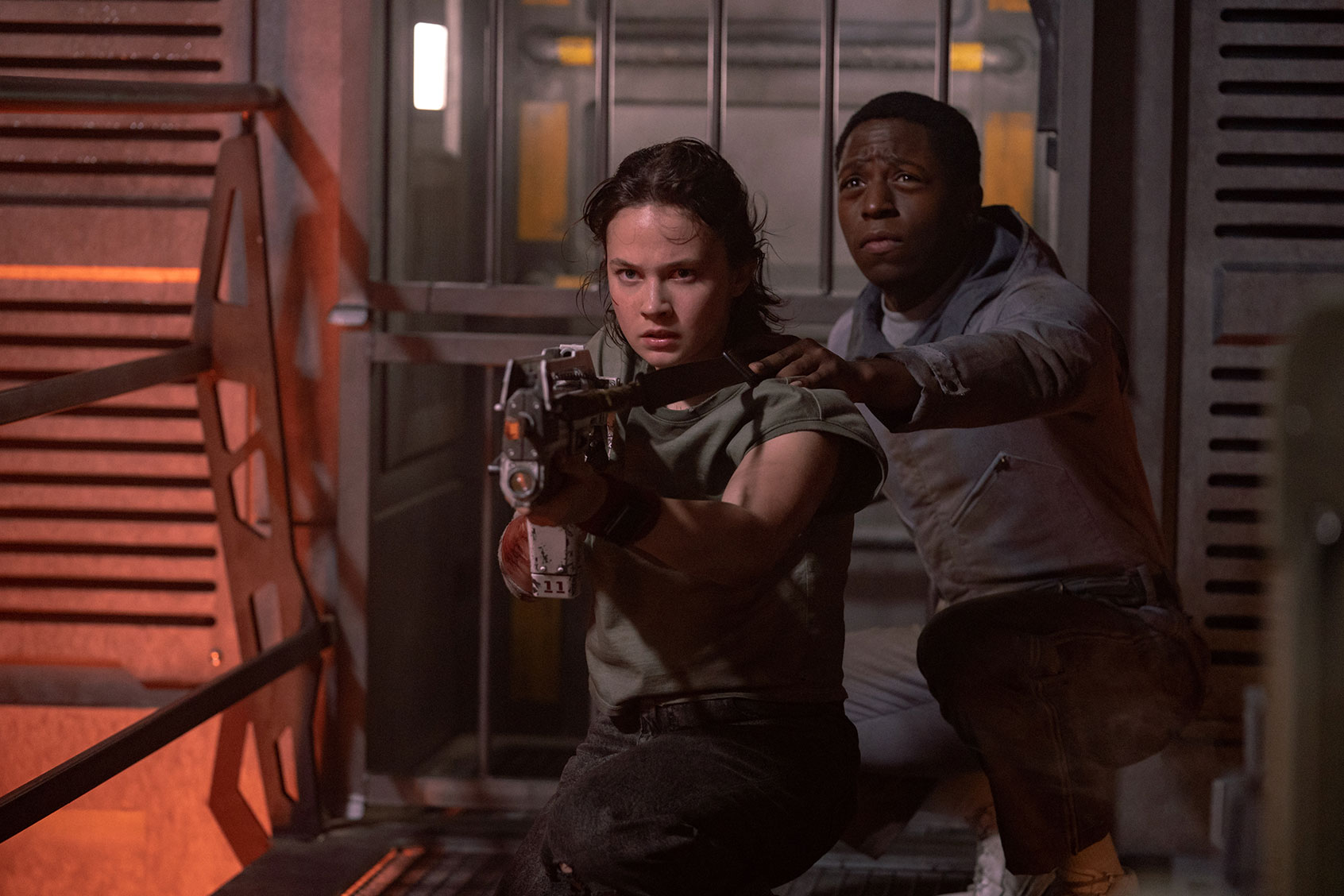
Alien: RomulusCailee Spaeny as Rain Carradine and David Jonsson as Andy in “Alien: Romulus” (Photo courtesy of 20th Century Studios/Murray Close)

When Andy’s told he can’t accompany his human teammates, including Rain, to the promised land they’re seeking, he seems momentarily confused, hurt possibly, until he lands on the obvious. If that’s what’s best for her, then he’s OK with being cast on the scrap heap.

Andy 2.0 is not so forgiving. Before he abandons his original directive entirely, an effect of it being overwritten by other programming, he warns Rain that she won’t see him like a child anymore. Not long after that, he begins acting without sentimentality, making decisions on who or what has the best chances.

It’s a safe bet that some of you are reading this and wondering what Andy’s or Jonsson’s melanated complexion has to do with any of this. Fair enough. Jonsson probably took on this role for the same reason any actor would accept a role in one of the most resilient film series in cinema, let alone one that offers the challenging versatility written into Andy.

However, there is no way to consider any movie sequel to be completely divorced from previous chapters’ racial optics. Especially with “Alien,” a franchise where a decision to cast a woman in a role originally written for a man made it iconic.

Imagine how different “Aliens” would have been if Ross, who played Pvt. Frost but originally read for the part of Corporal Hicks, had gotten that role instead of Michael Biehn, one of Weaver’s main co-stars. It may not have altered the parental dynamic that Hicks and Ripley shared but it may have changed other assumptions we projected on those two characters. Remember, this movie came out in the mid-1980s when interracial relationships between Black men and white women weren’t usually foregrounded in action blockbusters.

Andy’s survival contradicts a genre habit of deeming Black characters to be expendable which appears to be intentional on the part of Álvarez and Sayagues. If it is accidental, it’s still commendable that the android’s personality fluctuations look like a conversation with that cinematic cliché.

The credit for pulling that off is as much due to Jonsson’s presence as it is to the script. His thoughtful and riveting performance ensures that we never stop pulling for Andy, even after he dooms the crew’s most vulnerable but least interesting member.

Where the bottom falls out is the last-minute decision for Rain to pull a Jonesy, just like Ripley, and go back for Andy after he’s incapacitated and reverted to his childlike personality.

This is in keeping with the “Alien” yen for leaving no cat or Newt behind.

And, the whole “return to hell’s maw” move has been pulled enough before to justify Rain choosing the survival of her organic self over her synthetic support buddy, if only to do something – anything – differently from past films.

This also would have robbed Rain and Spaeny of the chance to channel the heroine the audience knows that she’ll never meet, yanking on our nostalgic heartstrings.

The only way to have come out on top here would have been to design an original endgame. Álvarez and Sayagues didn’t do that, choosing the safer path of homage. Instead of playing out the sacrificial stereotype, the writers revert to the savior archetype.

Jonsson has endeared Andy to the audience enough for future writers to expand his potential to shift course from an old story told too many times.

If “Romulus” represents the start of a new branch for the franchise, perhaps whoever determines its next chapter can draw on the confidence of knowing they don’t have to elevate another Ripley clone. Jonsson’s successful performance proves the audience is ready to see someone like him refuse to die so that the usual suspects can live. Andy is Rain’s best chance for a future. It’s up to her to keep up.

Trump lashes out on Truth Social after Fox News cut him off to air “Gutfeld!”

Former President Donald Trump appears to be angry at reports that Fox News abruptly hung up on him as he rambled about Vice President Kamala Harris' convention speech and his "success" in the election campaign. The interview, during which Trump talked over attempted interjections by hosts Bret Baier and Martha MacCallum, was cut short at the 10-minute mark in order to kick over to a live edition of "Gutfeld!"

“That wasn’t my fault, Donald Trump!” host Greg Gutfeld joked. “He’s still talking, by the way."

Trump did not see anything funny about the incident. In a post on Truth Social on Sunday morning, he insisted that Fox reached out to him first and reiterated his negative review of Harris' speech. "Bret Baier of FoxNews called me, I didn’t call him, just prior to the Kamala Convention speech, and asked me if I would like to critique her after she is finished. I agreed to do so!" he wrote. "I thought it was nonspecific and weak, with no fracking, crime, inflation or anything else of interest even mentioned. Delivery was a C+, with far too many and speedy 'thank you’s' at the beginning. It was 'WEIRD!'"

The former president then attacked "gilted" New York Times columnist Maureen Dowd for writing that he called Fox first, a claim that he said was "WRONG!!!"

"I don’t have to make calls to go on TV, or anything else — They call me! It’s called Ratings, I guess, and I’m the 'Ratings Machine!'" he boasted.

Several journalists expressed bemusement at Trump's apparent fixation on who called who first.

"What’s on Trump’s mind this AM 10 weeks before the election?" wondered Washington Post reporter Josh Dawsey.

"I was soooooo not making the calls, or seeming desperate and pathetic or anything! Don’t report that I was desperate! (Also who gilted Maureen? They sprayed her w gold paint?)" mocked Talking Points Memo founder Josh Marshall, referring to the James Bond book and movie "Goldfinger" and Trump's use of a word resembling "gilt," which describes the act of covering a surface with a thin layer of gold or silver (he probably meant to say "jilted").

“Weird obsession with crowd size”: Obama’s DNC dig about Trump “got under his skin,” reporter says

There were many speeches and attacks on Donald Trump at the Democratic National Convention last week, but one jab from former President Barack Obama really got under Trump’s skin, New York Times reporter Maggie Haberman told CNN.

“This is a 78-year-old billionaire who hasn’t stopped whining about his problems since he rode down his golden escalator nine years ago,” Obama said to the crowd in Chicago. “The childish nicknames and crazy conspiracy theories and weird obsession with crowd size,” he added, using both hands to make a suggestive gesture. 

Trump is “very reactive” to both Barack and Michelle Obama and both of their speeches at the DNC “got under his skin,” Haberman told CNN’s Wolf Blitzer.

"What you also saw were comments that I think were designed to bait Trump," Haberman noted. "That was one of them."

Trump and the Obamas have a historically combative relationship, with Trump having been a leading promoter of false claims that the Democrat was not born in the United States. In her own speech at the DNC, Michelle Obama said Trump did “everything in his power” to make Americans fear her and her husband.

“His limited and narrow view of the world made him feel threatened by the existence of two hardworking, highly educated, successful people who also happened to be Black,” she told the crowd. 

Many DNC speakers took aim at the Republican nominee and Haberman said they were “pretty focused’ in their messaging.

“We heard it over and over again from the Obamas, from the vice president, from others that, you know, he is a rich guy who cares about his rich friends,” she said. 

Jabs at the former president were made in the hopes that he would react aggressively, she added.

“The more that Trump reacts self-destructively, the better Democrats feel it is for them,” Haberman said.

Sabrina Carpenter comes up with her spiciest “Nonsense” outro yet while on “Chicken Shop Date”

After conquering the infamously spicy wings of death on “Hot Ones,” Sabrina Carpenter is back for more chicken, this time on “Chicken Shop Date.” The widely popular YouTube interview show — created and hosted by Amelia Dimoldenberg — features celebrity interviews framed as awkward dates in a series of London chicken shops. 

While enjoying a bucket of nuggets and crisps, Carpenter revealed that her first experience with the word “wanker” took place right in the capital of England: “The first time I came to London, someone on the street ran past me and yelled, ‘F**kin’ wanker,’ and I was like, ‘Someone called me a wanker. I feel like I really lived the London experience.’”

The “Espresso” singer also revealed that she has to “brave through” drinking an actual espresso. 

“It’s not like I like them because of how they taste. I like them because of how they make me feel,” Carpenter said, before telling Dimoldenberg that she gives off “decaf energy.”

“You just have to find your double shot…in another person,” the singer joked. “It’s not me. I don’t think I give double shot. I think I give, like, single shot.”

In between some clever quips and mild flirting, Carpenter revealed that she would date a barrister over a barista (“I think baristas flirt too much”), said she doesn’t fall in love that easily anymore (“When I was younger, I fell in love very easily and now I fall in love…with some more knowledge”) and shared what she did for Valentine’s Day this year (“I was given chocolate. And I ate it. That was my day”).

The pop star, who released her highly-anticipated album “Short n' Sweet” on Friday, is best known for coming up with a series of witty and viral outros while performing her hit tune “Nonsense” live. Carpenter had the pleasure of hearing an outro written by Dimoldenberg herself during the tail-end of their date.  

“Went to London ’cause I had a hot date / The food was average, but the company was great / Four plus four, me and Amelia ate,” the host sang before coming to an awkward pause because she struggled to come up with an ending line.


Want more great food writing and recipes? Subscribe to Salon Food's newsletter, The Bite.


Carpenter told Dimoldenberg that she would’ve done “something really crazy for the second line” but refrained from sharing it on camera.

Eventually, Dimoldenberg got it out of her: “Later, I’m going to get my p**sy ate.”

Watch the full interview below, via YouTube:

When wine became warfare: The Duke of Burgundy’s crusade against the “evil and disloyal” Gamay grape

On July 31, 1395, the Duke of Burgundy declared a war of annihilation on an "evil and disloyal" enemy and invader: a purple, acidic grape known as "Gamay."

According to the ordinance issued by Philip the Bold, Gamay not only threatened the livelihoods of honest vignerons who used higher-quality grapes, but also ruined Burgundy's reputation for fine Pinot Noir wines with its bitter taste and apparently harmful effects on public health. In order to safeguard the esteemed Pinot Noir and the well-being of Philip's people, the ordinance declared, all Gamay vines were to be cut down within a month and completely uprooted by the following Easter: "ripped out, eradicated, destroyed, reduced to nought … forever."

If the language of the edict seemed needlessly vindictive, perhaps it was because this war was personal to Philip, a keen economic steward who had worked assiduously to develop Burgundian wine production. As a younger son to King John II of France, Philip had received Burgundy as a compensation prize while his elder brother Charles V succeeded to the throne. With royal authority now disintegrating under the latter's mentally unstable son Charles VI, the ambitious Philip sought not only to rule his appanage as an effectively independent duke, but also to outshine all other fiefdoms in power, riches, and magnificence.

In this competition, Philip understood that wine, with the trade revenue and prestige it brought to him and his duchy, was a most valuable currency.

In the Late Middle Ages, Burgundian Pinot Noir was rapidly establishing itself as a superior variety of wine, but a series of natural and human-borne calamities threatened all that had been achieved over the past few centuries of cultivation. With the Hundred Years' War against England came soldiers reaving and burning through the countryside, while the Black Death followed swiftly thereafter, striking Burgundy in 1348 and again, with even greater severity, in 1360.

Recovery was slow, and by the 1390s, an anxious Philip sensed the arrival of another sort of plague. The Gamay grape, taking its name from a small village in the hills around Beaune, had sprouted in large numbers across Burgundian vineyards, yielding on average three times more wine per acre and ripening two weeks earlier than Pinot.

High yields were not problematic in and of itself, but the fecundity of an apparently inferior grape relative to Pinot was unacceptable to the duke, who feared that Gamay vines would take over arable land that could otherwise be used for Pinot or other crops deemed more valuable. Some vignerons, Philip complained, "left in ruin and devastation the good places where the said good wine might have grown" in order to "get the greatest quantity of the said bad wines." He also denounced the use of organic fertilizer for grapes, charging it with passing on nasty flavors, and sellers who allegedly mixed hot water with Gamay wine to hide its bitterness, only for the drink to later revert to its original state and become "quite foul."

"Ripped out, eradicated, destroyed, reduced to nought … forever."

This "bad wine," according to Philip, was "of such a nature that it is very harmful to humans, such that a number of people who have used it in the past have been affected by serious illnesses, we have heard; because the said wine that is made from the said vine, of its said nature it is full of a very great and horrible bitterness." While Gamay wines can certainly leave a bitter aftertaste, Philip's assertion over its ill-effects on health — one that he never tested himself, for he had only "heard" of such effects — were based on a misconception that bad-tasting wine was not just unpleasant, but also dangerous to its customers, in contrast to the ordinance's description of Pinot Noir as "most suitable for nourishing and sustaining human beings." Nevertheless, in a world where wine was identified by provenance rather than grape variety, the pronounced effect of Gamay's proliferation was that no one now respected or sought after Burgundian wine, which Philip feared was becoming defined by that "foul" plant in place of the esteemed Pinot grape. "Our said land and our said subjects have been greatly damaged and harmed and are at present being even more so, unless we provide a remedy," he complained.

That remedy was an order for the destruction of all Gamay vines within a month. Because Philip issued the ordinance at the end of July, vignerons would have to cut down their own harvest just as the grapes were beginning to ripen. Most poorer vignerons, more concerned about feeding and sheltering their families than the lofty ambitions and tastes of a royal prince, appreciated the Gamay for its easy harvest and high yield, which offered a reprieve that the temperamental and needy Pinot could not provide.

While Philip threatened a heavy fine for infractions, the prospect of losing much of their 1395 vintage would ruin Gamay growers who could not have foreseen the new orders. It's probable that many of them, staying true to the healthy medieval tradition of popular resistance against unjust laws, disobeyed Philip's ordinance, preferring to risk a fine than guarantee their own ruin.

We need your help to stay independent

Philip claimed in the ordinance to receive support from “many bourgeois [townspeople] and others of our good towns of Beaune, Dijon, and Chalon and their environs" who benefited from the influx of revenue and goods that came with selling good wine, but the actual reaction told an entirely different story. On August 9, 1395, the municipal council of Dijon, the largest city in the duchy proper (not counting the Flemish possessions of Philip's wife), denounced the ordinance as a violation of their civic privileges and refused to publish or implement it. The duke responded by throwing the mayor in prison and appointing a governor to take control on the pretext of dealing with the alleged Gamay-and-water malpractice, possibly violating Dijon's original charter that gave its own citizens responsibility for supervising the city's economic life.

If the duke thought his heavy hand would stabilize Burgundy's wine sector and move the region towards prosperity, he was wrong. The destruction of Gamay vines, which had emerged as a natural response to the already-declining productivity that Philip sought to reverse, plunged the region into a recession. Productivity fell ever more steeply, speculation in wine sales collapsed, and poverty gripped a population shorn of their precious trade. Few places were struck more severely than Beaune, the birthplace of Gamay, where records show a drop in the annual local wine monopoly bid from 65 livres in 1394 to just 27 livres in 1400.

Within that same time period, the proportion of financially solvent households in Beaune dropped from 41% to 13%. The Burgundian vineyards would eventually grow back after decades of re-cultivation, by which time commerce had fallen into the hands of foreign merchants and Burgundy had become a backwater in its own namesake polity (a modern label, of course) compared to the trade-enriched Low Countries, which Philip and his descendants acquired through strategic marriages.

Still, the ordinance may have accomplished some of Philip's objectives. While the ordinance targeted Gamay, the political independence of cities like Dijon and Beaune also fell victim to its enforcement, a possibly intended effect for a ruler seeking to extend his authority. And by imposing prototypical measures designed to address quality control and shape economic output, Philip resembled the head of a modern administrative state using the powers at hand to sketch out the boundaries and character of what would eventually become the official Vin de Bourgogne regional appellation (AOC).

Scatterings of Gamay survived in reduced form, with many of its vines exiled to Beaujolais, an area south of the duchy. There, warmed by golden summers and nurtured by granite-flecked soil, the hated grape re-emerged in triumph, producing a cheerful, elegant variety of wine that, when released and consumed at a young age, shed the bitterness that so offended the ducal tongue. While Beaujolais red remained a cherished table wine for the locals over the next several centuries, its redeeming qualities eventually earned it worldwide popularity and a long-awaited appellation in 1936, followed by a 2011 re-classification as AOC Bourgogne Gamay under the broader Burgundian appellation.

Fortunately for Philip, he did not live to see his defeat at the hands of a grape.

60% of American baby foods fall short of global nutritional guidelines, study finds

Feeling confident with the baby food you're purchasing? You may want to re-check those nutrition labels.

A new study published in the journal Nutrients has found nearly 60% of foods for babies and toddlers sold in major American retailers did not meet international nutritional guidelines set forth by the World Health Organization. Additionally, nearly 100% of the products had “at least [one] claim on-pack that was prohibited under” the WHO’s guidelines, “with some products displaying up to 11 prohibited claims.”

"Of all the products in the study, 70% did not meet WHO’s guidance on protein content and 25% failed to meet calorie recommendations, the researchers found. One in five baby or toddler foods contained salt levels above the organization’s suggested limits," wrote Sandee LaMotte of CNN 

Furthermore, nearly 25% of products contained "added or hidden sweeteners, with 44% of the baby and toddler foods exceeding WHO's recommendations for total sugars."

Dr. Elizabeth Dunford, an adjunct assistant professor of nutrition at the University of North Carolina at Chapel Hill, told CNN: “Research shows 50% of the sugar consumed from infant foods comes from pouches and we found those were some of the worst offenders." 

According to LaMotte, sales of baby food pouches have risen by 900% in the past 13 years. 

“These findings highlight that urgent work is needed to improve the nutritional quality of commercially produced infant and toddler foods in the United States,” the study researchers wrote. “The high use of prohibited claims also suggests the need to regulate the type and number of claims allowed on-pack.”

Food industry executives push back on Kamala Harris’ plan to fight “price gouging,” corporate greed

Democratic presidential nominee Kamala Harris is planning to enact the first-ever federal law against corporate price gouging in the food and grocery industries, much to the frustration of some major corporations and food executives. 

In a speech made last Friday, Harris promised to crack down on “excessive prices unrelated to the costs of doing business” by food suppliers and grocery stores, including those involved in big mergers and acquisitions. Harris noted that amid the rising cost of groceries — which have gone up by 25% between 2019 and 2023, faster than other consumer goods and services, according to the U.S. Department of Agriculture (USDA) — several food companies are raking in more profits. Foods like bread are now about 50% more expensive than before the COVID-19 pandemic, Harris said.

The current vice president specified that she is looking to target businesses that are illegally hiking up prices and not “playing by the rules.” Harris added that competition within the food industry is ultimately necessary to help bring down the high cost of food nationwide.

However, food companies begged to differ, arguing that price hikes are imperative due to high inflation which has caused the costs of labor and raw materials to increase greatly.

“We understand why there is this sticker shock and why it’s upsetting,” Andy Harig, vice president of Tax, Trade, Sustainability & Policy Development at the Food Industry Association (FMI), told the Wall Street Journal. “But to automatically just say there’s got to be something nefarious, I think to us that is oversimplified.”

In response to Harris’ plan, the National Grocers Association said, “The proposal calling for a ban on grocery price gouging is a solution in search of a problem,” adding that its members are also reeling from inflation in the same vein as consumers.

Harris’ focus on corporate price gouging comes a few months after President Joe Biden called out so-called “shrinkflation” — the phenomenon of items shrinking in size, quantity, or, even, quality while their prices remain the same — during his annual State of the Union address to Congress. 

“Too many corporations raise prices to pad the profits, charging more and more for less and less,” the president said. Biden previously called out shrinkflation in anticipation of the Super Bowl and asked companies to “put a stop to this” in a game day commercial.

“Some companies are trying to pull a fast one by shrinking the products little by little and hoping you won't notice,” he said. “I'm calling on companies to put a stop to this.”

Despite his criticisms of high food prices, Biden failed to wield executive power to target food retailers and major corporations at the center of the issue, per the request of several progressives. Food prices have surged by more than 20% under the Biden-Harris administration, compelling Republicans to claim that “Bidenomics” has failed the American people.

Former president Donald Trump, at a rally in Pennsylvania, called out Harris’ recent proposal: “After causing catastrophic inflation, Comrade Kamala announced that she wants to institute socialist price controls.”

“Prices will come down,” Trump proclaimed to voters during a speech last week addressing his return to the White House. “You just watch: They’ll come down, and they’ll come down fast, not only with insurance, with everything.”

“Prices will come down and come down dramatically and come down fast,” he added, specifying that deflation — a term he refrained from using himself — would happen across the economy.

Such massive price drops would ultimately be more harmful than beneficial, many economists have decried. In conversation with CNN, Justin Wolfers, an economist at the University of Michigan, decribed Trump’s pledge as “unrealistic.”


Want more great food writing and recipes? Subscribe to Salon Food's newsletter, The Bite.


“The way to bring about deflation would be to create a massive recession. That would cause businesses to start cutting prices,” Wolfers said.

Economists have also criticized Harris’ plan, saying it could create more problems for consumers. Many even likened it to the wage and price controls imposed by Richard Nixon in the early 1970s. 

“This is not sensible policy, and I think the biggest hope is that it ends up being a lot of rhetoric and no reality,” Jason Furman, a top economist in the Obama administration, told the New York Times. “There’s no upside here, and there is some downside.”

According to the United States Department of Agriculture, prices for all food are predicted to increase 2.2% in 2024. Food-at-home prices (defined as grocery store or supermarket food purchases) are expected to increase 1% while food-away-from-home prices (defined as restaurant purchases) are predicted to increase 4.3%.

In 2025, prices for all food are predicted to increase 2%, with food-at-home prices expected to increase 0.7% and food-away-from-home prices expected to increase 3%.

“Proving them wrong”: After raising minimum wage, California has more fast-food jobs than ever

Last year, California Gov. Gavin Newsom signed the state’s fast-food minimum wage increase into law, which meant that employees at fast-food restaurants in the state went from making $15.50 per hour to $20 per hour. While the decision was lauded by many labor activists as part of broader efforts to improve working conditions and address wage disparities, some economists and fast-food industry members expressed concern over how the law would impact restaurants’ operating costs, which could result in reduced hours for workers or even job cuts.

However, according to new state and federal employment data, California’s fast-food industry has added jobs every month this year — including 11,000 new jobs since the wage increase officially went into effect in April.

According to a release from Newsom’s office last week, since raising worker wages, every month this year has seen consistent fast food job gains, and nearly each month has seen more jobs than the same month last year. For instance, in May of 2023, there were 742,600 fast-food workers in the state; a year later, there were 743,300 workers. 

“What’s good for workers is good for business, and as California’s fast food industry continues booming every single month our workers are finally getting the pay they deserve,” Newsom said in a written statement. “Despite those who pedaled lies about how this would doom the industry, California’s economy and workers are again proving them wrong.”

RFK Jr.’s sister accuses him of trying to “set fire to my father’s memory” with Trump endorsement

Kerry Kennedy, Robert F. Kennedy Jr.'s sister, has rebuked her brother for endorsing former President Donald Trump, characterizing the latter as an "inexplicable effort" to undermine their father's legacy.

“I’m outraged and disgusted by my brother’s gaudy and obscene embrace of Donald Trump. And I completely get out and separate and dissociate myself from Robert Kennedy Jr. in this flagrant and inexplicable effort to desecrate and trample and set fire to my father’s memory," Kennedy said on MSNBC's "Inside with Jen Psaki" on Sunday, reiterating that she is supporting Vice President Kamala Harris and Minnesota Governor Tim Walz.

Her father, Kennedy said, "would have detested almost everything Donald Trump represents' if he was alive today." Trump is "a threat to most basic freedoms that are core to who we are as Americans, the right for women to control our bodies, the right to live in communities safe from gun violence, to love who you love."

Robert F. Kennedy, her and RFK Jr.'s father, served as U.S. Attorney General in former President John F. Kennedy's administration and nearly clinched the 1968 Democratic presidential nomination before his assassination that June. While he took actions to fight poverty and support civil rights for Black Americans, Kennedy faced accusations of political opportunism, particularly over his late opposition to the Vietnam War when running for president.

When RFK Jr. ended his presidential bid last Friday, the former presidential candidate was polling in the mid-single digits. In dropping out, he cited his worry that staying in the race would hurt Trump more than Harris, who reportedly rejected an offer from him for an endorsement in exchange for a cabinet position. RFK Jr. said that he had several phone conversations with Trump prior to his endorsement; his running mate, Nicole Shanahan, suggested that he could join a Trump administration as Secretary of Health and Human Services.

While RFK Jr. was running, Kerry Kennedy repeatedly criticized his campaign as dangerous for the country. After he dropped out, she and other members of RFK Jr.'s family released a statement that criticized him for his endorsement of Trump, calling it “a betrayal of the values that our father and our family hold most dear.”

Target’s $24 billion food and beverage business is only going to get bigger

Target’s food and beverage sales have increased nearly $9 billion over the past four years to become a $24 billion business — and according to Brian Cornell, the company’s chairman and chief executive officer, there is still room to grow. As reported by Food Business News, Cornell discussed the possibilities during an Aug. 21 analyst call regarding fiscal 2024 second-quarter results. 

“We think we have significant opportunity for growth in that space, led by the unique combination of great national-brand partnerships and some really strong owned brands that are connected with the consumer,” Cornell said. “So we think we’re still in the early days of building out our food business.”

In May, Target announced plans to lower the everyday price of thousands of popular products, which benefited the food and beverage category. 

“On the frequency side of our assortment, both our food and beverage and essential categories saw traffic growth in the quarter, as consumers are responding to our offerings in an environment where they are focused on value,” he said. “Over the summer, we reduced our prices on about 5,000 frequently purchased items in many markets, and we saw an acceleration in both our unit and dollar sales trends in these businesses.”

According to chief commercial officer, Rick Gomez, the company will continue to emphasize affordability in the next quarter, while also introducing “a ton of new products,” including those that leverage well-loved seasonal flavors. “I’m talking about pumpkin spice, apple, pecan pie,” Gomez said during the call. “That will continue to fuel growth.”

Food and beverage represented about 23% — or nearly $24 billion — of Target’s fiscal 2023 sales.

“He’s now terrified of debating her”: Trump’s debate flip-flop is a sign Harris has him figured out

Donald Trump is not feeling great. This year alone he’s been found liable by a jury for sexual assault, convicted by another jury on 34 felony counts of fraud, and shot at by a young registered Republican at a campaign rally, the one previously safe space where the president could comfortably rant and complain to certain applause. Then he had to spend a week at home watching Democrats pull off their convention without a hitch, just a month after an unprecedented switch at the top of the ticket.

The former president’s own campaign is publicly predicting that Vice President Kamala Harris will now surge in the polls (after already leading, nationally, by an average of about 3.6%). In a similar situation, the current president and his team decided it was time to debate, saying a televised contest would “reset” the race; the subsequent performance cost Joe Biden the Democratic nomination.

Perhaps that’s why Trump himself is doubting his own commitments.

“Why would I do the Debate against Kamala Harris on that network?” Trump posted on social media Sunday night, complaining about an ABC News interview with Sen. Tom Cotton, R-Ark., and panel discussion earlier that day, saying the former was “biased” and the latter full of “Trump Haters.” The Republican nominee filled the rest of his post with tedious name calling — “Crooked,” “Marxist” — and attacks on the insufficiently fawning journalists of ABC.

“They’ve got a lot o questions to answer!!!” Trump posted just after 10 p.m. Eastern. “Why did Harris turn down Fox, NBC, CBS, and even CNN? Stay tuned!!!”

The former president already agreed to debate Harris on Sept. 10, which was originally slated to be the second of two televised confrontations with Biden. He did so after previously trying to pull out of the event when Harris became the presumptive Democratic nominee, initially claiming the debate was off because Biden was out of the race and then trying to move it to the friendlier waters of Fox News, a media platform that was forced to pay out $787 million after admitting that it cynically aired what its knew to be MAGA lies about the 2020 election.

It is possible, even likely, that Trump will still show up next month, not wanting to miss an opportunity to be on prime-time television (Harris has previously said she would appear whether her opponent did or not). What his evening anger suggests, however, is that the 78-year-old knows he’s not the favorite — not in the race, and not even on TV, the platform that made him a reality star.

“He has to appreciate she is charismatic and charming on television in a way he fancies that he is,” Washington Post columnist David Ignatius commented Monday morning on MSNBC. “The camera loves Kamala Harris,” he continued. “She’s learned in the cadence of her speeches, the way she presents herself, to be a formidable TV presence. Donald Trump knows TV. He’s smart enough to know he’s got a problem here.”

We need your help to stay independent

The Harris campaign, in turn, knows that it benefits from voters being reminded of what Trump is like, not just when he goes off script but when he gets flustered. As Politico reported Monday, it not only wants Trump to show up on Sept. 10, but it wants people to hear literally everything he has to say.

“We have told ABC and other networks seeking to host a possible October debate that we believe both candidates’ mics should be live throughout the full broadcast,” Harris campaign spokesperson Brian Fallon told the outlet, which noted that hot mics were the norm in previous years, including in 2020, when the Trump campaign insisted on them. This time around, the Harris campaign — clearly goading the former president, as it would like to do on TV — is claiming Trump’s team is trying to shield him from the public by having the candidates’ microphones muted when they are not talking.

“Our understanding is that Trump’s handlers prefer the muted microphone because they don’t think their candidate can act presidential for 90 minutes on his own,” Fallon told Politico. “We suspect Trump’s team has not even told their boss about this dispute because it would be too embarrassing to admit they don’t think he can handle himself against Vice President Harris without the benefit of a mute button.”

Speaking Monday on MSNBC, Jaime Harrison, chairman of the Democratic National Committee, urged Trump to show the public how he really feels, saying it’d be a “huge disappointment for the American people” if he pulled out of the Sept. 10 debate. But he also suggested Trump, not just his team, is now wary of letting voters see the contrast between the two candidates, contrasting Harris’ support for reproductive and other freedoms with the hard-right Project 2025 agenda for a second Trump term.

“This former president is so scared to get on the debate stage,” Harrison charged. “But I guess if I had his positions, I’d be scared to let the American people know what they were as well.”


Want a daily wrap-up of all the news and commentary Salon has to offer? Subscribe to our morning newsletter, Crash Course.


The push for hot mics is a pivot from the cautious Biden campaign, which seemed to fear Trump steamrolling their candidate — and appearing more energetic and forceful — more than than it saw an advantage in letting an elderly man continue to rant and rave when his time was up. With the Democratic candidate now a 59-year-old former prosecutor, letting Trump talk (and talk) is no longer a concern.

“The Harris team wanting to unmute Trump’s debate mic so that he can interrupt her suggests they may have finally learned the lesson liberals until now have not: the key to beating Trump is not muzzling him, but letting voters hear him unfiltered so they remember whey they dislike him,” Yair Rosenberg, a columnist at The Atlantic, posted on social media Monday. Past efforts to limit public viewing of Trump’s outbursts, whether online or on the debate stage, “just sanitizes his image for the public,” Rosenberg argued, “making him look more reasonable that he is.”

Radley Balko, a reporter who previously covered criminal justice issues for The Washington Post, likewise credited the Harris campaign with having "figured out" Trump. The Republican nominee may well pose a threat to democracy, at home and abroad — lauding dictators like Vladimir Putin while calling for the "termination" of the U.S. Constitution — but that is perhaps a better point to be made by analysts, Balko suggested, allowing Trump to "project strength."

Calling him a "weird" old man who only cares about himself? "It's driving him nuts," Balko wrote on social media. "And it's why he's now terrified of debating her."

Aides schedule events to “keep Trump busy” so he’s not “golfing all day and stewing”: report

As Vice President Kamala Harris gains momentum following the Democratic National Convention, some of former President Donald Trump’s advisors worry he’s losing focus and spending too much time out on the golf course, The Washington Post reported

Though Trump usually spends August at his Bedminster home golfing, sources told The Post they did not want the former president just “watching the convention every night, getting angry, and then just golfing all day and stewing.” 

Trump’s team scheduled several campaign events to counter the attention from the DNC and to “keep Trump busy,” The Post reported.

“The stakes for Trump this election are arguably the highest they’ve ever been. His criminal cases don’t go away if he loses. Yet he seems to be phoning it in, running a remarkably low-energy, undisciplined campaign,” former White Houses spokeswoman Alyssa Farah told the Post.

Trump's allies have advised him to focus on the economy, immigration and inflation, but Trump has repeatedly strayed from talking about policy issues at events. He instead has continued to personally attack Harris, most recently attempting to brand the Democratic nominee as a communist.  At a packed event in Glendale, Ariz. on Friday, Trump decided on the nickname “Comrade Kamala.”

At another campaign event in Las Vegas that was supposed to focus on the economy, Trump instead repeatedly mocked Harris for thanking the crowd at the DNC. Throughout the week, Trump continued to complain about President Joe Biden withdrawing from the presidential race, something he hasn’t let go of since it was announced over a month ago.

“I spent $100 million fighting against a man that won in their party, and we had a debate and the debate was good for me. And then all of a sudden they take him out and they put somebody new in that never got a vote,” Trump told reporters.

This week, Trump will campaign in Michigan and Pennsylvania, while Harris and her running mate Tim Walz will campaign in Georgia as both candidates fight for swing state votes.


GOP protection racket crumbles: Republicans now have cover to come out as anti-Trump

Someone once asked me who I thought would be the Democratic equivalent of Donald Trump would be. My answer: Kanye West. He's world-famous, extremely wealthy, narcissistic, unstable, politically ambitious, lacks any self-awareness and is manifestly unfit — except it turned out that he's actually a right-wing anti-semite. I might have answered Robert F. Kennedy Jr. at one time, except he's now endorsed Donald Trump. I'm sure there must be some truly crazy lefty out there who would be a bridge too far for many Democrats but that combination of authoritarianism, pathological character flaws, overwhelming ignorance and demagogic talent seems to inevitably drift toward the right these days.

That is not to say that voters aren't always subject to emotional attachment to their leaders in both parties. In recent decades, Republicans practically worshipped Ronald Reagan and Democrats were head over heels for Barack Obama. There was even a time when even George W. Bush was practically deified.

Still, the Trump phenomenon is different from those examples because he is so unfit for office that it has shaken many Americans' belief in democracy. How could our system allow such a person to dominate our political culture for more than eight years and be within striking distance of the presidency again after having been roundly defeated in the last election?

I thought about that as I watched the Democratic convention last week and a small group of Republicans and former Republicans took the stage to speak out against their former president and exhort their erstwhile comrades to vote for Kamala Harris instead. It wasn't the first time members of the opposing party spoke at a convention. I think of Jeane Kirkpatrick, a Democratic foreign policy expert who drifted into the right wing with those other Democratic apostates known as the neoconservatives. At the 1984 Republican National Convention, she gave the keynote speech, calling the Democrats the "Blame America First crowd" for their alleged lack of patriotism. Back in 2004, former Georgia Gov. Zell Miller, a Democrat, also gave the keynote speech at the GOP convention to re-nominate President George W. Bush and Vice President Dick Cheney. It was brutal. Still in the throes of the Iraq war, he condemned John Kerry and the Democratic Party as weak on national security.

2024 wasn't the first time that Republicans spoke at a Democratic convention either. In 2020 former GOP Govs. John Kasich of Ohio and Christine Todd Whitman of New Jersey gave speeches exhorting voters not to vote for Donald Trump. This year we heard from former Illinois Congressman Adam Kinzinger, former Trump press secretary Stephanie Grisham. former Georgia Lieutenant Gov. Geoff Duncan and a few others as well.

Whether it's because they have Fox News brain rot and are convinced that Antifa is the greatest threat America faces, as Bill Barr does, or that loyalty to the GOP brand is paramount, as McConnell does, they are simply incapable of reacting seriously to the threat.

But it seems to me that the big difference between these GOP apostates and the Democrats who left the party to join the Reagan Revolution or back George W. Bush is the fact that the Democratic apostates left their party over policy differences. They didn't like what they saw as the leftward ideological drift of the Democrats so they moved over to the Republicans, There were plenty of voters who went that way too, especially during the Reagan years.

But the Republicans who've spoken at the last two Democratic conventions have done so almost exclusively out of disgust with Donald Trump, personally, and his lack of ideological principles. It's true that there was some talk about the Democrats being better on foreign policy with support for Ukraine and opposition to authoritarian tyrants like Putin and Kim Jong Un, but for the most part, their entreaties to vote for Harris were simply based upon the need to defeat Trump because of his bad character, criminality and dangerous unfitness. Some even went so far as to say that Harris needs to be elected in order to save the Republican Party from the MAGA cult.

These people represent the Never Trump faction which has set ideology aside for the moment in order to create a popular front to defeat Trump. Some of them are openly endorsing Kamala Harris, telling their followers that she is preferable to Trump in some ways on issues but mostly arguing that policy differences just don't matter at the moment because the threat of Trump is so dire.

We need your help to stay independent

But they aren't the only Republicans who know the threat exists. Former Attorney General Bill Barr knows that Trump tried to overturn a legitimate election. Senate Minority Leader Mitch McConnell understands that Donald Trump was a disaster as president. Former South Carolina Gov. Nikki Haley made it clear that she thinks Donald Trump is unfit to hold office. Yet they are all voting for him anyway. Whether it's because they have Fox News brain rot and are convinced that Antifa is the greatest threat America faces, as Bill Barr does, or that loyalty to the GOP brand is paramount, as McConnell does, they are simply incapable of reacting seriously to the threat.

Saying they will write in someone else's name, as former Vice President Mike Pence and former Trump National Security Adviser John Bolton, are saying they will do is a silly affectation. And those others who have written books and given interviews spilling the beans from the inside on what an utter catastrophe Trump's first term was and yet are refusing to step up and publicly endorse Harris or even go on TV to condemn Trump, the only reasonable explanation is that they are, as The Bulwark's Tim Miller writes, "chickenshit." Apparently, they can't be bothered.

Miller calls out people like former White House Chiefs of Staff Gen. John Kelly, former defense Sec. Gen Jim Mattis, former Director of National Intelligence Dan Coates. Former Trump National Security Advisor H.R. McMaster, it should be noted, is currently pushing his new book declaring that Russian President Vladimir Putin had Trump wrapped around his little finger. (Yet he went on TV this weekend and absurdly claimed that he believes that writing his book will persuade Trump not to let Putin do that in the future.) As Miller writes:

There are two options for president. On the one hand you have a woman who just presented herself as a mainstream Democrat who plans to respect and uphold the fundamental American political traditions at home and abroad.

On the other you have a candidate who you have acknowledged is the most flawed person you have ever encountered, a danger to the country, and an existential threat to our system of government—a convicted criminal, an abuser of women, and a moron. How in God’s name do you justify silence in the face of that choice? This is not a close call!

It is not a close call.

I don't know if I will ever be faced with a situation like this. But I would like to think that if some famous loon were to capture the imagination of Democratic voters and he or she threatened the future of the nation, I would have the guts to oppose him or her and throw my lot in with the saner other party. Anyone's first responsibility should be to stop a dangerous demagogue and argue about ideology and policies later. If you don't do that, as Trump himself likes to say, "you won't have a country anymore." 


Want a daily wrap-up of all the news and commentary Salon has to offer? Subscribe to our morning newsletter, Crash Course.


6 facts about Althea Gibson, the first Black U.S. Open winner

It’s the end of August, which means the U.S. Open is underway at the Bille Jean King National Tennis Center in Flushing Meadows, Queens, in New York. As the only Grand Slam tournament to be played every year since its inception, the U.S. Open retains a singular quality.

But it’s not merely the tournament's longevity that has cemented it as special over the years — it’s the players. As such, it’s important to revisit one of the most pioneering figures to grace the U.S. Open's grounds, the trailblazing Althea Gibson. Gibson made history in 1957 as the first Black American to win the U.S. Open title, paving the way for other standout Black U.S. female tennis players like the Williams sisters, Zina Garrison, Chanda Rubin and now younger stars such as Coco Gauff, Naomi Osaka, and Sloane Stephens.

Fans based in the U.S. can tune in to watch the U.S. Open — which runs from Aug. 26 through Sept. 8 — on the ESPN channel or on the ESPN app.

If you’re interested in learning more about one of the most legendary characters in the history of the Grand Slam, read on to find out a few key facts about Gibson and her revolutionary athletic career. 

01
Gibson's passion for tennis started with ping pong
Born in 1927 in Silver, South Carolina, Gibson moved with her parents — who were sharecroppers — northward to Manhattan’s Harlem neighborhood as part of the Great Migration in 1930. As a child and teenager, Gibson was not particularly fond of school; however, she had a strong affinity for sports. Her fascination with ping pong ultimately spurred her interest in tennis. In a 1984 interview, Gibson shared, “It was paddle tennis that started it all.”
 
One summer morning, while out with a friend, Gibson "saw two bats and a ball on the paddle tennis court" outside her parents' home at 143rd Street between Adam Clayton Powell and Malcolm X boulevards (which was renamed Althea Gibson Way in 2022 on what would have been the athlete's 95th birthday.)
 
"And, from that moment on, we were the block paddle tennis court occupiers," Gibson said in the interview. "We would get up in the morning, as soon as they laid that court out, we were the first ones on, we stayed on, and we challenged anybody on the block to play us. Nobody would, so weirdly that's how I got started in tennis, through paddle tennis."
02
A metaphorical lightning strike at Gibson's debut

Gibson was 23 years old when she entered the public tennis scene in the summer of 1950 at the U.S. Nationals Championships at the West Side Tennis Club in Forest Hills, Queens, making her the first Black athlete to play in a U.S. national tennis competition. According to the U.S. Open’s official website, a thunderstorm halted Gibson’s second-round match against three-time Wimbledon champion Louise Brough. When a bolt of lightning struck one of the ornamental stone eagles atop the stadium, Gibson reportedly said, “It may have been an omen that times were changing.” 

03
She met Queen Elizabeth II at Wimbledon
In the summer of 1957, Gibson, then 29, became the first Black player to win the Wimbledon singles title at the All England Lawn Tennis and Croquet Club in London, England.
 
The Queen, who The Washington Post reported was in attendance at the tournament for the first time as monarch, awarded Gibson the Venus Rosewater Dish, a silver tray engraved with the names of previous Wimbledon winners. 
 

“At last, at last,” Gibson said, per an excerpt from a 2023 biography of the tennis player by author Sally H. Jacobs.


“My congratulations,” the Queen responded. “It must have been terribly hot out there.”


“Yes, Your Majesty,” Gibson said, “but I hope it wasn’t as hot in your box. At least, I was able to stir up a breeze.”

04
Making history on her home turf

Shortly after her Wimbledon victory, Gibson returned home to a ticker tape parade in New York City, becoming the second Black American after Jesse Owens to be honored in that way. 


A month later, she won the U.S. National Championship (the precursor of the U.S. Open) against her old nemesis Louise Brough. "Winning Wimbledon was wonderful", she wrote at the time, "and it meant a lot to me. But there is nothing quite like winning the championship of your own country." The milestone would not be repeated by a Black female tennis player until 43 years later when Serena Williams won the first of her six U.S. Opens.


She repeated her Wimbledon and U.S. National singles titles victories in 1958, and was named Female Athlete of the Year by the AP for both 1957 and 1958. 


All this glory also arrived with other firsts as she became he first Black woman to appear on the covers of Sports Illustrated and Time.

05
Gibson's post-tennis Hollywood career

Gibson had a prolific career on and off the court. After retiring from amateur tennis in 1958, Gibson turned toward the professional field and the entertainment industry. She began singing, even releasing a jazz record, “Althea Gibson Sings,” through Dot Records in 1959. Her vocal talent saw her invited to perform two tracks off the album on “The Ed Sullivan Show.” That same year, Gibson starred alongside John Wayne in John Ford’s Civil War-era western film “The Horse Soldiers.”

06
A pivot to a new sport

After struggling to make significant headway in tennis, Gibson ultimately turned to golf. In 1963, she became the first Black golfer in the Ladies Professional Golf Association (LPGA.) "The siren song of golf was barely audible to me when I retired from amateur tennis," Gibson wrote in her 1968 autobiography, "So Much to Live For," per ESPN. "But it was never completely out of hearing, and soon it was to grow so loud that I would not be able to resist its seductiveness."

Despite never winning an event throughout the 14 years she played, Gibson’s inaugural appearance in the sport came at a meaningful juncture, during the civil rights movement of the 60s. "If I made it, it's half because I was game enough to take a lot of punishment along the way and half because there were a lot of people who cared enough to help me," Gibson observed in an earlier memoir, "I Always Wanted to Be Somebody."


“Run up the score”: Maximizing Harris’ campaign momentum may be the only way to stop Trump’s steal

The last eight or so weeks in the United States have been a whirlwind, one that is both frightening and exhilarating. In so many ways the American people have been on an amusement park ride that is being controlled by a sadistic madman.

This is especially so for the country’s news media and responsible political class. These weeks from President Biden being demolished by Donald Trump at their first and only debate, to an assassination attempt on Trump’s life and then his coronation as a fascist god-king at the Republican National Convention (in less than a week’s time), President Biden stepping aside and handing the torch to Vice President Kamala Harris and her ascent at this week’s DNC in Chicago where she formally became the party’s presidential nominee, and now being tied with or ahead of Donald Trump in the polls has been one of the most eventful in modern American history.

The Democratic National Convention and the Republican National Convention were two different political and moral universes (if not realities) and visions of America’s past, present, and future. 

Kamala Harris, her vice-presidential running mate Gov. Tim Walz, and the Democrats presented a multiracial, pluralistic, America that is stronger and enriched by its diversity. Trump and his vice-presidential choice JD Vance and the Republican fascists want to “Make America Great Again” by restoring America’s herrenvolk regime and a White Man’s Republic fueled by White rage, White grievance mongering, and White revenge against the Other.

Kamala Harris and the Democrats are, at least for now, “happy warriors” who appear to have finally realized that they must directly confront Trump and his MAGAfied Republican Party personality cult if they are to have any chance of victory in November—and most importantly saving American democracy from the global neofascist tide. Trump and the Republicans are driven by rage, conspiracism, and willful ignorance and lies. Collectively, Donald Trump’s many obvious and apparent emotional, mental, and intellectual pathologies and shortcomings are now theirs as well.  

As compared to the Democrats, their convention was oddly low energy and deflating. Like other political observers, I was expecting some version of Leni Riefenstahl's “Triumph of the Will” and Donald Trump to even more fully channel Hitler and the Nazis in Milwaukee. Instead, it was aspiring Dictator Trump, his cultists wearing a patch on their ear like the Dear Leader, and professional wrestler Hulk Hogan (who last week echoed Donald Trump’s racist attacks on Kamala Harris), musician Kid Rock, and CEO and president of the UFC Dana White.

Last week’s Democratic National Convention in Chicago was also a reminder of how deep their political bench is, from Kamala Harris who is “only” 59 years old to the various speakers and celebrity guests. With President Biden having made the selfless and wise decision to step aside as the party’s nominee, it is now energized and looking to the future. The Republicans by comparison look and feel, for lack of a better description, old and tired.   

As Salon’s Brian Karem described it, the Democratic National Convention in Chicago was like a “political Woodstock” where the attendees and speakers made joyful noise. The Republican National Convention in Milwaukee was something else entirely. Salon’s executive editor Andrew O’Herir described it as an “anti-party in a ghost town.”

To make better sense of this week’s Democratic National Convention, the political terrain and momentum going forward, our emotions in this tumultuous time, and what may happen next with the 2024 election and Harris-Walz versus Trump-Vance, I recently spoke to a range of experts.

Steven Beschloss is a journalist and author of several books, including "The Gunman and His Mother." His website is America, America.

Kamala Harris’ fierce and authoritative speech Thursday night was a powerful exclamation point to four days of uplift and optimism, sober assessments of the opposition and touching assertions of shared values like community and caring, decency, kindness and dignity for all people. This was a clear, joyful and direct rejoinder to the darkness and cruelty that drives the Republicans and their nominees. I believe it did the hard and necessary work to expand the pool of voters and continue the momentum for the vice president and her utterly likable running mate, Tim Walz. For all those not compelled by the joyfulness and exuberance of the last month, Harris’ serious speech addressing national security, the dangers of a felonious nominee who prefers autocrats and dictators, the responsibility of this generation to democracy, and the privilege of being American made the idea of “Madam President” thoroughly real. She made clear that she’s more than ready to assume the presidency.

Now will come a new torrent of lies and vicious assaults intended to damage the Democratic ticket. But I’m encouraged by the fact that Trump’s efforts to paint Harris and Walz as dangerous, wild-eyed radicals have failed thus far. The more serious danger is Trump saying out loud that he doesn’t need to get more votes, the Republicans just need to stop Democrats from cheating. This plan to deny the election’s outcome once again could not be more clear. It’s why massive turnout and an overwhelming defeat of Trump and Vance is so critical. The growing enthusiasm reflected in rising poll numbers — aided by Michelle Obama’s command to all Democrats to not stay on the sidelines and “do something” — gives me real optimism that a Democratic victory and the eventual demise of MAGA is achievable.

David Pepper is a lawyer, writer, political activist, and former elected official. His new book is "Saving Democracy: A User's Manual for Every American."

Given where things were in late June, and the chaos of July, what those who planned and executed the DNC pulled off is truly impressive. The convention showed America a united party, effectively introduced Kamala Harris to a national audience, contrasted her vision to the dark and toxic vision of Trump, Vance and Project 2025, and spoke directly to undecided and swing voters. 

I have always felt optimistic about the multi-year winning streak for democracy and freedom that has taken place since Dobbs. Ever since the decision, Democrats and pro-democracy allies have scored victory after victory up and down the ballot, and in red states and blue. The challenges Biden faced, which were accentuated by the debate performance, threatened to interrupt that streak. But with the handoff of the baton to Kamala Harris, and the selection of Tim Walz, the momentum that had already been growing at the grassroots level has only grown stronger. The hope is that more than two years of pro-democracy and pro-freedom momentum keeps building. That is happening at the moment.

At the same time, we know that Trump fears that an election loss means that he will lose his freedom due to his actions around January 6 and stolen documents. If he was willing to break laws to overturn an election result in 2020, he has even more incentive to behave badly this time. 

I don’t fear this as much as I accept that it is the reality we face. Which means two things for those who care about democracy and freedom: 1) be prepared and vigilant in every way, knowing that there is likely nothing Trump won’t do to avoid his fate if he loses; and 2) set a goal of winning decisively, so that states are sufficiently out of reach that any attempt to thwart the results is in vain before it even begins.

Put another way: I have no doubt he will be calling around “looking” for votes this time as well.  But force him to ask for 100,000 votes as opposed to 11,000.

In short, run up the score. 

Dr. Jennifer Mercieca is a historian of American political rhetoric. She is a professor in the Department of Communication and Journalism at Texas A&M University and author of several books including "Demagogue for President: The Rhetorical Genius of Donald Trump." 

I've been impressed with a lot of things about the Democratic National Convention and the Harris-Walz campaign, but the way they've defined "America" unapologetically and in Democratic terms and with Democratic policy has been outstanding. This campaign has reclaimed "freedom" and "patriotism" and the rule of law and placed them alongside an ethics of care. They speak about the American Dream with conviction, and we've seen the Democratic Party proudly and joyfully waving the American flag. Harris and Walz have urged us to care for our neighbors and they've promised that they care for people like us, not the rich corporations.

The joy and enthusiasm have been inspiring. This message marks a crucial shift in American political discourse since 9/11 when the Republican Party laid claim to "patriotism" and the flag and used it to define Democrats out of the national imagination. The extreme right has been defining what "America" is and which policies are and are not "American" for decades. Allowing Republicans to define what is and is not "America" and "American" has essentially allowed them to lay claim to the nation. Democrats hadn't engaged in the battle to define "America" because they've been ambivalent about what "America" is, what it means, what practices are or not “American.” That has been a weakness. While the right has claimed the power to define "America," they've also claimed that the nation has been taken from them. It has done this by appealing to "tradition" or "real America" or "heartland" or similar essentialist claims. Democrats are now finally laying claim to "America" and "American values" and the "American Dream" and explaining how they and their policies are American and will help all Americans and will help America to become even more American. This is a very exciting shift in national identity.

I feel much more confident about the state of democracy in America than I have in months. The Harris-Walz ticket seems to be the right fit for the moment, and they've got enthusiasm on their side as well as an army of volunteers. They're incredibly organized to defend democracy and their operation so far has been nearly flawless.

My fear is that Trump supporters are not open to changing their mind about him and believe his conspiracy lies about the election. I'm very concerned that his state-level plot to disenfranchise voters (through voter purges, election lawfare, and refusing to certify results) will reverse the will of the people and install the Trump regime back to power. Most authoritarian regimes use what scholars call "competitive authoritarianism" to retain power—they offer the appearance of competitive elections, but the outcome is always pre-determined. It's a little hard when Trump doesn't control the federal apparatus of power, but he does control enough states to do an authoritarian coup through the legal system.

Hal Brown is a clinical social worker and was one of the first members of the Duty to Warn group. He has extensive expertise in working with multiple personality disorder (now called dissociative identity disorder) and police stress.

I feel far better about the Democrats not only winning the presidency and both houses of Congress today than I did before Kamala Harris took the torch and ran with it. She’s won the drag race but now she shows every sign of winning the Indianapolis 500. Having watched the entire Democratic National Convention Tuesday night, I was struck by how it was it was a masterful tour de force display of diversity and American democracy at its best. This was in stark contrast to the RNC vanilla malevolent milkshake noise machine. Trump can pretend to be a “real person” who is “relatable” to his base. However, Kamala Harris and Tim Walz are truly sincere and do not perform like Trump. They don’t have to tell lies and fictions like the Republicans do to portray Trump as having genuine positive feelings for his supporters—a group he clearly has contempt for. Kamala Harris and Tim Walz not only feel empathy for their supporters, but they feel it for all people.

I was pleased to see that Fox News was carrying the Democratic National Convention and can only hope for those who watched it that the Democratic National Convention opened the minds of at least some of the racists, bigots, antisemites, LGBTQ bashers, and the other haters out there so they would get the message that their abhorrence and fear of people not like them is wrong. It may be aspirational wishful thinking on my part, but perhaps some of them would realize these “others” are their fellow Americans and brethren. All this inspires hope for me. What I fear is that the Republicans will open a Pandora’s Box of dirty tricks to try to overturn a Democratic win. This of course includes using the right-wing extremist justices on the Supreme Court to overturn the will of the American people and put Trump back in office.  

“Simply put, they are out of their minds”: Kamala Harris won’t let Republicans hide their misogyny

CHICAGO — Despite much of the press carrying Donald Trump’s water by accepting his feeble attempts to pretend to be “moderate” on abortion, he showed his true colors again last week.

In an interview with CBS News, the GOP candidate insisted he had “no regrets” about ending abortion rights by appointing three justices hand-picked by the Federalist Society to overturn Roe v. Wade. Vice President Kamala Harris immediately pounced. Trump declared this “without even a moment’s hesitation,” Harris told the crowd Tuesday night at her raucous Milwaukee rally, which was piped into the equally exuberant Democratic National Convention (DNC) in Chicago. Harris continued the theme in her nomination acceptance speech Thursday night in Chicago. 

"And get this. Get this. He plans to create a national anti-abortion coordinator, and force states to report on women’s miscarriages and abortions," Harris said of her GOP opponents. "Simply put, they are out of their minds."

Republicans keep trying to deny the accusation, whining and insisting that it's the Democrats who are "radical." But in the process, Republicans act so weird that it just underscores how obsessed they are with controlling women's bodies. 

It's not news that the Harris campaign is going hard on the reproductive rights issue this election, forefronting both the ongoing health crisis caused by abortion bans and warning the public the Republicans are just getting started. It's also not a mystery why — the issue is still at the forefront of voter minds, especially of those Democratic base voters Harris needs to energize. Even during the state roll call,  delegation leaders spoke repeatedly about the need to protect women's rights. Texas brought forward Kate Cox, who was denied care for a failing pregnancy, to announce joyfully that she is expecting again. In Salon's conversations with delegates at the DNC, abortion and other reproductive rights were the issues people brought up more than any other. Multiple people cited the hostility Trump's running mate, Sen. JD Vance of Ohio, has expressed publicly over a dozen times towards childless women, who he's deemed "miserable cat ladies" and "sociopaths."  

But it's also true that, as with the accusation that MAGA leaders are "weird," highlighting Republican extremism on reproductive rights works as excellent bait. Republicans keep trying to deny the accusation, whining and insisting that it's the Democrats who are "radical." But in the process, Republicans act so weird that it just underscores how obsessed they are with controlling women's bodies. 


Want more Amanda Marcotte on politics? Subscribe to her newsletter Standing Room Only.


To highlight their efforts to extend reproductive health services even as Republicans criminalize such care, Planned Parenthood parked a mobile clinic outside the United Center in Chicago during the convention. It's part of a larger effort to relieve abortion access networks helping patients traveling from states where it's banned. The clinic provided eight abortions and nine vasectomies over the two days it was parked there. Unsurprisingly, Republicans reacted with levels of hysteria that evoked 17th-century Puritan witch-hunters.

"25 babies lost their lives so far this week thanks the DNC's sponsoring of a Planned Parenthood abortion van," lied Charlie Kirk of Turning Point USA on Twitter. He accused Democrats of having a "depopulation agenda" that is "Sick. Cruel. Evil."

In reality, zero babies were killed, the DNC did not "sponsor" the clinic, and — as the many speeches exalting how reproductive health care helps people build happy families shows — Democrats love children. They just want babies born to parents who are prepared to care for them. But perhaps the biggest lie is the one implied: Patients were tricked by Democrats into abortion. In reality, of course, women make the decision on their own and then reach out to clinics. Kirk also ignored the nine vasectomies, as his "women are idiots" argument falls apart in the face of proof that men also make reproductive health care decisions. 

Kirk's lies are just a hint of how much Republicans were melting down during the DNC over women asserting their rights. Rep. Marjorie Taylor Greene, R-Ga., posted the lie that Harris "will make abortion up to the day of birth the law." (Medical experts say this is not a real procedure.) Sen. Mike Lee, R-Utah, denied that Republicans are out to restrict contraception or that abortion bans have hurt patients experiencing miscarriages. Both are true and well-documented. Women who have been denied emergency treatment of miscarriages told their stories from the DNC stage, which means that Lee was falsely accusing these innocent women of lying. Trump ally Laura Loomer tweeted that "Democrats are doing human sacrifice." All just proving, over and over, that Republican leaders are exactly the weird, obsessed liars that Harris and Walz say they are. 

Trump's meltdown is perhaps the weirdest. He's been frantically posting, in his incoherent way, on Truth Social. During his extended tantrum, he wrote, falsely, "Everybody, Democrats, Republicans, Liberals, and Conservatives, wanted Roe v. Wade TERMINATED." He also wrote, "I TRUST WOMEN, ALSO, AND I WILL KEEP WOMEN SAFE!" (As a reminder, Trump was found liable in court for sexually assaulting journalist E. Jean Carroll. Two separate juries found he was lying when he denied his violent crime against a woman.) 

When the fish are eager to bite, it's wise to keep re-baiting the hook. At the DNC, Democratic politicians spoke with Salon about efforts to protect contraception — and to create a record of Republicans voting against birth control access.

"We will not stand idly by as our fundamental rights are threatened," Sen. Tammy Baldwin, D-Wis., explained to Salon that she continues to push the Right to Contraception Act. It's necessary because, as she pointed out, Justice Clarence Thomas openly invited far-right Christian groups to challenge legal birth control in court, hinting that the GOP-dominated Supreme Court is open to destroying that basic right as well. By bringing up this bill, Baldwin proved that a misogynist fringe controls Republicans. Given the chance to affirm that Americans have a right "to obtain contraceptives and to engage in contraception," all but two Republicans voted against it

During the DNC, Democratic state senator Ghazala Hashimi recounted her battle to enshrine the basic right to prevent pregnancy Virginia. She introduced a state-level version of the Right to Contraception Act, only to see Republican Gov. Glenn Youngkin — who often pretends to be a moderate — veto it in May

"It really is very misogynistic," Hashimi told Salon. "They have a clear perception of women as second-class citizens" she added, saying the MAGA right is "taking us in a very extreme and very dangerous direction." Hashimi said she's spoken in private with Republican members of the state legislature who "want to support this bill," but "they are terrified at the prospect of being primaried from the right." 

They should be worried. As much as Sen. Mike Lee may deny Republicans are coming after birth control, the pattern is clear. Democrats offer Republicans one chance after another to vote for birth control rights, and every time, Republicans vote against it. Increasingly, major MAGA leaders are admitting out loud that they are coming for birth control. Kirk, lying as usual, claimed the birth control pill "screws up female brains." Peter Thiel, the far-right billionaire who bankrolled Vance's political career, has been heavily funding propaganda networks to spread disinformation about contraception. Elon Musk has also been spreading lies meant to discourage women from using birth control — or at least justify the anger that his incel-tinged audience has towards women. Vance's comments about "cat ladies" must be understood through this anti-contraception lens. One in 4 women will have an abortion at some point in life, but contraception use is near-universal. Over 99% of sexually experienced women have used birth control. 

This is why Republicans want to keep quiet about their war on birth control access. They're already getting hammered politically over the abortion bans, which are opposed by 85% of Americans. Contraception is even more popular, with only 6% of Americans saying it's morally wrong. Yet, as all these examples show, many of the most famous faces of MAGA can't help themselves. When provoked, they say what they think, which is that no method women use to control their childbearing is acceptable. It's smart that Harris is baiting them. She'll keep setting her trap until November. 

Long COVID is a “public health crisis for kids,” experts say

For years, public health experts have said that COVID-19 infections in children are “mild.” According to the U.S. Centers for Disease Control and Prevention (CDC), the most common symptoms of COVID in kids are a fever and cough. While some children with the coronavirus are admitted to the ICU and there are pediatric deaths, studies have found that underlying medical conditions including obesity, diabetes, cardiac and lung disorders, increase the risk of severe outcomes.

This research has contributed to how COVID is managed in schools. However, a new study in the Journal of the American Medical Association sheds light on the effect a coronavirus infection can have on children over a longer period. While many people recover quickly from COVID, some don't, experiencing symptoms that can last for months or years. This condition, known as long COVID, not only affects adults but also children. The new research helps us understand the extent kids experience these debilitating conditions — and how we can treat it.

“This is one of the first large-scale national studies to do research related to long COVID across the entire lifespan, with a particular focus on children and understanding the differences in long COVID in different aged children,” Dr. Rachel Gross, an associate professor in the Departments of Pediatrics and Population Health at NYU Langone and the study's principal investigator, told Salon.

In the study, led by the National Institutes of Health’s RECOVER Initiative, researchers asked caregivers to tell them about the symptoms that their children or teenagers had been experiencing more than four weeks after a coronavirus infection. For some children in the study, that meant symptoms their symptoms went on for three months after their COVID infection. For others, it was up to two years. Researchers looked at the symptoms in those children with persisting symptoms and compared them to children who had never been infected with the coronavirus in the past. They then identified similarities in the prolonged symptoms and found they were distinguishable based on age. 

"These are the children with the highest burden of symptoms."

“In school-aged children, we heard commonly that children were experiencing trouble with their memory, focusing, headaches, having trouble sleeping, and stomach pain,” Gross told Salon. “And in the teenagers, we were hearing about symptoms related to fatigue and pain, having body or muscle or joint pain, being very tired or sleepy, having low energy, as well as having trouble with memory and focusing.”

A unique symptom the researchers saw in the teenage group was changes in or a loss of smell or taste. Additionally, researchers found clusters of symptoms that are unique to school-aged children and teenagers. The first were symptoms that affect every organ system in the body.

“These are the children with the highest burden of symptoms,” Gross said, adding that caregivers described these children as having a “lower quality of life and more impact on their overall health.” “The second type of long COVID we also saw across both the ages was predominantly characterized by fatigue and pain.”


Want more health and science stories in your inbox? Subscribe to Salon's weekly newsletter Lab Notes.


Studies estimating its prevalence in pediatric populations are limited and conflicting, estimating up to 25% of children infected with the SARS-CoV-2 virus could go on to develop long COVID. A study published in 2024 estimated that up to 5.8 million young people have long COVID.

“This is a public health crisis for children,” Gross said. “We know that child health is so critically important for how children grow and even as they become adults, that chronic illness during childhood and adverse experiences during childhood greatly affects the adults that they can become.”

Gross said the U.S. will see the “long-term impacts of experiencing long covid In childhood for decades to come.”

Dr. Dean Blumberg, chief of pediatric infectious diseases and associate professor in the Department of Pediatrics at the University of California, Davis, told Salon he agreed long COVID is a “public health crisis” for children. 

“Some of these kids with long COVID, they are severely affected, they can't do their normal activities, they fall behind school, they can't go to school,” Blumberg said. “And then in this study, they highlighted a lot have had some neurocognitive effects, and that really interferes with with learning.”

For Blumberg, the takeaway from this study, he told Salon, is a “call to arms to increase vaccination rates,” which among children, he said are “abysmal.” 

According to a recent KFF survey, while both flu and COVID vaccines are recommended for school-aged children, flu vaccination rates were over three times higher than COVID vaccination rates. While COVID-19 vaccines are recommended by the Advisory Committee on Immunization Practices in the pediatric immunization schedule, they aren’t required for school attendance. According to one study published in the journal Pediatrics, vaccination the risk of an acute infection, but it is less clear whether it protects against long COVID. The latest COVID vaccines were approved by the Food and Drug Administration last week, which the CDC recommends for any six months or older.

We need your help to stay independent

Now, researchers will be tasked with figuring out why long COVID affects children differently based on their age. When it comes to adults, some studies have shown that subsequent COVID infections increase a person’s risk of getting long COVID. The CDC estimates that one in 13 adults in the United States currently have long COVID symptoms. 

Gross told Salon she hopes this research raises awareness for both healthcare providers, as well as schools and educators, that “long COVID in children is not rare.”

“That they are likely to have children experiencing these prolonged symptoms within their healthcare systems and their schools,” Gross said. “And that many of the symptoms that I've described, trouble with memory and focusing, headache, trouble sleeping, these are symptoms that you know can impact a child and their schooling.”

“American women are not stupid”: Warren isn’t buying that Trump would veto a federal abortion ban

During his appearance on "Meet the Press" on Sunday, JD Vance told host Kristen Welker that Donald Trump has “explicitly” said that he would veto a federal abortion ban if a bill were to be passed by Congress.

“I can absolutely commit that,” Vance said. “Donald Trump’s view is that we want the individual states and their individual cultures and their unique political sensibilities to make these decisions because we don’t want to have a nonstop federal conflict over this issue.”

And to this, Elizabeth Warren is calling BS.

In a "Meet the Press" interview of her own, Warren pointed back to Trump and Vance's previous comments and actions to the contrary, saying, “American women are not stupid, and we are not going to trust the futures of our daughters and granddaughters to two men who have openly bragged about blocking access to abortion for women all across this country." 

After Welker pointed out that it seemed Warren wasn't buying Trump and Vance's spin on this, she stomped down even harder, saying, “Don’t buy it? Just read it. JD Vance actually sent a letter last year to the Department of Justice to enforce the Comstock Act. And remember he did that, and then Donald Trump picked him to be his vice president. The only way that we’re going to protect access to abortion is to have a Democratic Congress send a bill to Kamala Harris. She will sign it into law, and then we will restore a right to half the population in this country, and no longer will a woman have to go into an emergency room and be told she’s not near enough death to get the medical treatment that she needs."

Watch here:

The “Wizard of Oz,” “Twisters” and my lifelong fascination with tornadoes

On a recent weekend afternoon, stuck in the doldrums of midsummer’s haziness, I turned to a familiar pastime activity and began to sift through bins of old photographs. After grabbing an arbitrary stack from a plastic bin in my parent’s basement, I found myself smiling at images of my family trick-or-treating during some early 2000s Halloween. My parents — my dad as an ancient Roman gladiator and my mom as a court jester — exuded all the jauntiness of young parents from where they stood, frozen in time, on opposite ends of a plastic Little Tykes wagon they used to lug us around for such occasions. 

I was dressed as Dorothy, the young Kansan and main character of “The Wizard of Oz,” the 1939 film starring Judy Garland adapted from L. Frank Baum’s book of the same name. My mom had set my dark hair in braids, my dad had spray painted a pair of old tap shoes ruby red, and my dog, Buzz, was coincidentally a Cairn terrier, the same breed as Dorothy’s canine companion, Toto. I was a “Wizard of Oz” devotee as a child. Like the color purple and chicken noodle soup, it was one of my uncontested favorites as a child. But not for any of the reasons you’d think.

As I reflect on that Halloween and “The Wizard of Oz,” which turns 85 this month, I realize a more accurate representation of my love for that film would have been to dress up, not as Dorothy, but as a tornado. 

As far back as I can remember, I’ve been obsessed with tornadoes. For some people, it’s UFOs or scarab beetles or landing a spot as a guest on a talk show. For me, it was swirling funnels of clouds and debris. 

The full-fledged fascination took off sometime around the age of 10 or 11 after my mom returned from a business trip in Texas with a special souvenir for me: a tornado in a bottle. Set against a backdrop of violet lightning and rolling green hills, white particles contained in a small plastic tube transformed into a miniature twister when shaken in a clockwise motion. But before that, I had always been entranced by the sepia-toned footage of a twister snaking its way toward Uncle Henry and Aunt Em’s farm. While I loved the bright, velvety colors of the Lollipop Guild, Glinda’s bubblegum gown, and the quiet field of poppies Dorothy and her friends stumble upon before reaching Emerald City, what my still-toddling mind really cared about was the tornado. I was perfectly content to rewind the VHS tape for footage of it rather than watch the rest of the movie.

I had always been entranced by the sepia-toned footage of a twister snaking its way toward Uncle Henry and Aunt Em’s farm.

A voracious reader from an early age, I spent much of my free time during holidays and summer vacations in the weather section at my local library, a stack of books about tornadoes at my side. As I grew older and was introduced to the internet, I began consuming clips and documentaries produced by storm chasers and meteorologists. Tornadoes have long occupied a consistent spot among the varied YouTube content I’ve binged over my adult life.

My preoccupation with them even stoked interest in disaster-related subgenres for me to explore. I’ve also sought out information about and cultural portrayals of earthquakes, tsunamis and the infamous 1912 sinking of the RMS Titanic. While teenaged me was a huge fan of '90s-era Leo DiCaprio, his portrayal of Jack Dawson in James Cameron’s “Titanic” was hardly the only reason I return to that movie year after year. One of my favorite New York trivia tidbits is that the Jane Hotel in Manhattan’s meatpacking district — which formerly housed a now-shuttered nightclub that was once a late-night haunt during my college days — housed survivors of the Titanic until the end of the American Inquiry into the ocean liner’s sinking. 

Perhaps even more intriguing than my deep interest in tornadoes is my equally pervasive fear of them. They frequently plague my nightmares. Staggeringly high, bluish-black columns of force, touching down in droves in an abstract town or city my subconscious mind has created. I recognize that tornadoes and the like are situations steeped in death and tragedy. That’s certainly not why I find myself drawn to them.

Are we bad people for being so enamored with tornadoes?

I found solace in the fact that there are people out there who are as beguiled by tornadoes as I am. A Reddit thread I found affirmed that “there are literally dozens of us.” I suspect the number is even larger, and that there are more bashful tornado-obsessed folks hiding in the shadows of their peculiar hyperfixation. Still others, like me, shared their yearslong tornado-themed dreams. ”I’ve had nearly weekly tornado dreams since I was really, really young,” one user wrote. “I seek out tornado videos every chance I get. I'd love to see one up close, if I knew I could be safe.” Regarding that last observation, I’ve always felt the same; but it’s a sentiment saturated with guilt. 

Part of the hesitation around bringing something like a prolonged and intense interest in something like tornadoes has to do with its broader ethical implications. Are we bad people for being so enamored with tornadoes? Unlike those directly affected by their destructive nature, we storm-seek from behind a screen, safe to watch these bruise-colored beauties unfurl across the Great Plains at a distance, after they’ve already wreaked havoc on communities. Our engagement with them is largely retroactive when they’ve been chronicled by a journalist or scientist for how many lives they claimed and how many homes they razed. A similar framework applies to series and cinematic depictions of serial killers.

At a fundamental level, tornadoes — and seismic storms more broadly — are transfixing visual phenomena. Be it divinely ordained or spurred by science, it’s hard to avert our gaze from these natural disasters because of their sheer magnitude.

However, as is often the case, there’s a seeming psychological explanation for why we can’t turn away from tragedy. Dr. John Mayer, a clinical psychologist at Doctor on Demand, told NBC in 2017 that part of the reason can be attributed to humans’ innate survival instincts, which “act as a preventive mechanism to give us information on the dangers to avoid and to flee from.

"Witnessing violence and destruction, whether it is in a novel, a movie, on TV or a real life scene playing out in front of us in real time, gives us the opportunity to confront our fears of death, pain, despair, degradation and annihilation while still feeling some level of safety," Mayer continued. Once we know we are safe from harm, we continue engaging with a disaster or dangerous situation “as a way to face our fears.”

It’s part of why some women find true crime to be both binge-worthy and comforting — as psychiatrist Dr. Jean Kim told Cosmopolitan in August of last year, women may view consuming true crime as a way to confront their own fears. “Maybe there's something about trying to see what's going on and prevent it from happening to us,” she says. “There’s this kind of vicarious participation too, in something that's kind of horrifying and forbidden, and maybe for some reason — I'm not sure why — we're drawn to watching and participating in that, for better or worse.” As writer Kate Tuttle explained in a 2019 op-ed for the New York Times, “When women are connected to crime, we’re much more likely to be victims or survivors. Perhaps our fascination with these stories stems in part from wanting to learn from them. If a woman escaped her attacker in this particular way, we think, perhaps I could too.”

According to other experts, it’s not merely our sense of fight-or-flight that finds us engrossed by danger. Thomas Henricks, Ph.D., a Professor of Sociology Emeritus at Elon University, wrote in a 2022 article for Psychology Today that our fascination with televised catastrophes could assist in emotional processing, foster a sense of solidarity and community, and grant us permission to revel in “the splendor of production,” i.e., provide us with a scintillating story. 

Though I find that final point somewhat reductive, I also see its merit. It gives credence to why I was so eager to see Lee Isaac Chung’s recently released film, “Twisters,” starring Glen Powell and Daisy Edgar-Jones. I suspected that the acting would be serviceable (it was). But I knew the tornadoes would be epic (they were).  Each vortex had its own disposition and energy, starting and ending with two variations of the most deadly and destructive types of tornadoes, EF5's. 

“Each of the six tornadoes in the film has its own sonic personality,” wrote The Washington Post’s Sonia Rao in an explainer published earlier this month. “The first and final storms are presented as killers, and the team layered a low, throbbing pulse onto the audio track to contribute a sense of menace.” 

While the inherent desire to learn about entities deemed conventionally dangerous seems to have much to do with our ability to engage in the danger without actually experiencing it, I’d still relish the opportunity to safely witness a tornado first-hand, as morbid or insane as that might sound. If that doesn’t pan out, however, I know my curiosity will remain satiated by continuing to get my fill of EF 1-5’s from the comfort of my bedroom or the silver screen.

Bernie Sanders says he’ll do everything he can to help Kamala Harris win the election

Sen. Bernie Sanders (I-Vt.) — who made an appearance on day two of the Democratic National Convention — is backing the Harris-Walz campaign hard, saying in a recent interview that he intends to do everything in his power to see to it that they win the election in November.

Weighing in on Harris' chances during an appearance on ABC News’ “This Week,” Sanders made his thoughts on the subject very clear, saying, “I think the vice president now has a very good chance to win it. She’s certainly going to win the popular vote by millions of votes, and I think she has a great chance to win many of the battleground states. And I intend to do everything that I can to see that she wins."

Based on what he experienced firsthand at the DNC, Sanders went on to say that he thinks people are growing “tired and fatigued” with Donald Trump's whole deal — made worse by his saddlebags, JD Vance and, now, a full endorsement from Robert Kennedy Jr. — but has been frank in admitting that he "had not initially endorsed Harris for president, stating he wanted first to see more specific commitments from her on issues important to the working class," as The Hill points out. But now, he's all in, viewing her economic plan as “strong” and “progressive.”

Keeping an eye on Harris' stance on the Israel-Hamas war in Gaza, Sanders made sure to bring that up, saying, “I think, in all fairness to the vice president,  she’s been the candidate for all of one month. And it’s been a hell of a month. You have to organize the convention, select a vice presidential campaign, get out on the campaign trail. So, they are still working through their policies.”


Goodbye, brat summer. Hello, demure fall

Modesty is in its peak era . . . but not in the way you think. The word demure is the new word of the season after TikToker Jools Lebron popularized it in a viral video that garnered 6 million views and over 600,000 likes within about two weeks. In it, she shows off her natural makeup look, saying, “See how I come to work? Very demure. I do my makeup, I lay my wig, I do a little braid, I flat iron my hair, I do chichis out, I do viral vanilla: very demure, very mindful.”

Demure didn’t just fall out of a coconut tree.

Now people can’t stop saying demure in both apt and ironic settings. Going through airport security with electronics already out of the bag? Very cutesy, very demure. Not blowing up when responding to drama? Very demure, very mindful. Sitting in the middle seat of a crowded train and not man-spreading? Very . . . wait for it . . . demure. 

The word is so popular even brands and celebrities have started using it. Netflix tweeted a scene from “Gilmore Girls” where main character Rory asks for a club soda and her grandma responds, “So demure. Isn’t she so demure?” Penn Badgley jumped on the bandwagon, filming himself on set of the next season of “You” while repeating Lebron’s quotable line, “See how I come to work? Very demure.” Even the White House couldn’t resist, posting a photo of President Joe Biden with the caption, “[Canceling] the student debt of nearly 5 million Americans through various actions. Very mindful. Very demure.”

The trend may seem like it came out of nowhere, but the rise in pointing out modesty and mindfulness makes sense alongside a growing celebration of authenticity and humble success stories. 

The shifting attitude towards brat created the perfect environment for a new word — its exact opposite — to enter the lexicon.

Demure didn’t just fall out of a coconut tree. It exists in the context from which it came: the fall of Brat Summer. To understand the current demure rise, we first have to understand what killed brat. Charli XCX popularized the word through her latest album of the same name, where brat came to symbolize a lifestyle of being messy, partying and all things hedonistic. The perfect examples are the viral photos from the pop star’s own birthday: washed-out candids of tongues out, cigarette bouquets and sweaty bodies en masse. The photos prompted comparison to the indie sleaze era, aka the early aughts’ peak hipster era, for the way it can pass as an old photo that Cobra Snake (who was at the party) would have taken. But with virality comes criticism. People started critiquing the photo’s indie sleaze revival because the carefree feeling proffered by Charli and the throwback era felt inauthentic in 2024. “This is a completely manufactured industry bday party,” said one comment under the photos. Others lamented the ways indie sleaze was co-opted from an authentic spirit to a marketing ploy, and how indie sleaze’s untroubled partying can never happen in 2024 when rent is that high, the drugs are more laced, and everyone’s concerned with getting their Instagram shots rather than having fun.

It doesn’t help that the brat ethos was already being criticized for similarly losing its spirit to marketing. Shortly before Charli’s birthday, Pitchfork declared brat summer dead. This came right after Charli tweeted, “Kamala IS brat,” prompting the Vice President’s team to quickly make new marketing graphics with brat’s signature neon green to capitalize on this support. Suddenly, brat was political, marketable and being used to court Gen Z voters with pop culture references to distract from the fact that many young democrats have been explicit in their demands to see a ceasefire in Palestine. This was the record scratch in the middle of the party: Brat had gone too far. Like the indie sleaze photos, what had once felt like an authentic ethos has become a marketing campaign ripe with co-option. 

The shifting attitude towards brat created the perfect environment for a new word — its exact opposite — to enter the lexicon. Whereas brat was about being loud and messy, demure is about being classy, considerate and, as Lebron elaborates, authentic. In an interview with CBS, the TikToker explained her meaning of demure: “It's being mindful and considerate of the people around you, but also of yourself and how you present to the world.” As a self-described plus-size transgender woman, Lebron faces certain preconceived perceptions. As she told CBS, she struggled with her own self-confidence and came to embrace herself more through making TikToks. By making content online, she found solidarity with a lot of other girls like her. Calling herself demure and cutesy — words not often ascribed to women who are fat or trans — is her being a touch tongue in cheek. Demure fall, then, is about being mindful of those around you and true to yourself.

Demure has gotten so popular that Lebron has her own curated “Very Demure, Very Mindful” collection on Netflix. Now she can use the meme's popularity to fund her transition. In a recent TikTok, she tearfully spoke about how she feels about this bout of fame: “I feel so overwhelmed. I feel so grateful, don't get me wrong, but everything’s happening so fast.” See how she responds to fame with authenticity and gratefulness? Very demure, very mindful.

The virality of “demurity,” as Lebron would say, makes sense when looking at the authentic stories that surround celebrities that found fame this year. Charli XCX, for example, speaks about this heavily in “Brat,” another reason why the transition from her era to demure isn’t so random after all. In the album, the singer opens up about not reaching the level of fame she wished for at this point in her life and feelings that her career is inconsequential. Part of the album’s success was the pop star's vulnerability about her relationship to fame and her choice to continue making music for her versus mainstream success.

Roan's hustle and humble rise to fame is part of the reason people celebrate her.

The other pop star to climb the charts this summer is equally vulnerable about not making it. Chappell Roan released her billboard-topping debut album “The Rise and Fall of a Midwest Princess” last year, but it didn’t make viral numbers until her NPR Tiny Desk Concert in March of this year. After, it felt like her success came overnight but in actuality it was about seven years in the making. At 17, Chappell signed with Atlantic Records when she moved from hometown in Missouri to Los Angeles to record with the label. In 2020, the record label dropped her when her single “Pink Pony Club” didn’t reel in the numbers they expected. 

We need your help to stay independent

Roan returned to Missouri in defeat, doing some sporadic gigs in between working at a drive-through coffee shop. The hopelessness and defeat is captured on the album’s 13th track “California.” (“Thought I'd be cool in California/I'd make you proud/To think I almost had it going/But I let you down.”) By the end of 2020, she got out of the slump and decided to move back to Los Angeles to make music as an indie artist, finally signing with Amusement/Island Records in 2023 to release her album. Even still, it would be half a year until that album truly took off.

Like Charli, Chappell sang and spoke candidly about the feeling of “not making it.” She told the Guardian that she “felt like a failure” when Atlantic dropped her, and that when she did shoot her shot again in Los Angeles it came out with doubt and a caveat: “I was like: I have no money, but I’m gonna push through; if nothing happens by the end of next year, it’s a sign I need to move back home.” Her hustle and humble rise to fame is part of the reason people celebrate her. “One of the things that makes Roan’s story so compelling is how long it took her to get here,” wrote Constance Grady in Vox. Even with her newfound fame, Chappell has remained down to earth, speaking about boundaries between herself and fans, wanting to “pump the breaks on fame,” and turning down invitations for leading roles because “actors are so f**king scary” and “the industry is so scary.”

In a sea of nepo babies, these modest rises to acclaim stand out. While no one would say Charli or Chappell’s public personas appear modest, the authentic way they rose to fame, the way they humbly hustled to get where they are? Very demure, very mindful. Perhaps the word had not yet entered the viral lexicon at the time, but when they rose to stardom, their demurity was already being celebrated.

We see this even with our next midwest princess: Democratic vice presidential nominee Gov. Tim Walz. Walz is dubbed everyone’s midwestern dad for his wholesome energy, his background as a teacher (so humble!), his not owning stocks, equity or even a home (so modest!),  and the way his son, Gus Walz, tearfully cheered him on during the Democratic National Convention (“That’s my Dad!”). He’s so down to earth, both The New York Times and former President Barack Obama described him positively in relation to his flannel shirts. “You can tell those flannel shirts he wears don’t come from some political consultant — they come from his closet, and they’ve been through some stuff,” said Obama. Walz’s wife, First Lady of Minnesota Gwen Walz, was likewise likened to a person who’s too busy being a real person to have enough time for luxury maintenance, or  “a high-school teacher who’d just dismissed her last rowdy class of the day” according to The Cut. They cited her “frumpy cardigan, shapeless above-the-knee shift” and, get this, “‘demure’ makeup.” 


Want a daily wrap-up of all the news and commentary Salon has to offer? Subscribe to our morning newsletter, Crash Course.


If Harris is brat, Walz’s inextricable midwesterness, dad vibes and quaint style is so demure. And clearly, the people are starting to think so, too. One of the top comments under Walz’ latest TikTok (yes, he recently joined) says, “respecting our neighbor’s choices . . . very demure, very mindful, very considerate.”

It’s no surprise the Harris-Walz camo hat — which drew comparisons to Chappel Roan’s camo hat merch — sold out in 30 minutes. The demure trend tells us people want demurity, leaders and celebrities that are honest and authentic, that earned their spot instead of being born into it. As brat warns us, internet lingo and fun trends never stay on the internet — they become marketing buzzwords, a cycle demure is both reacting against and born from. The only question is: will the trend resist brat’s marketization or will this thirst for authenticity be used as a campaign turned back against us?

Cucumber craze: How the humble vegetable became a viral sensation

There’s this running misconception that the cucumber is the antithesis of glamorous within the world of vegetables. Sure, it’s no zucchini — which was once hailed as alluring in Meghan Markle’s recipe for a “filthy, sexy” zucchini pasta sauce. Nor is it a juicy hunk of a beefsteak tomato or a pleasantly plump eggplant. The cucumber may not be conventionally posh or sexy (if you can even describe a vegetable as so), but it manages to outshine its counterparts — in more covert than overt ways.

Recently, cucumbers have taken the Internet by storm thanks to a viral TikTok trend. Popular home chef Logan “Cucumber Boy” Moffitt shared his favorite way to enjoy an entire cucumber. The recipe itself is quite simple: Moffitt first uses a mandoline to slice a whole cucumber in a container, then mixes it with various sauces, seasonings, MSG and toppings before shaking the concoction in a plastic container until it's all blended. The saucy cucumbers are enjoyed straight out of the container with chopsticks.  

Moffitt’s recipes, which have racked up millions of views, include everything from creamy kimchi cucumbers and egg salad sandwich cucumbers to wasabi-ginger cucumbers and peanut-soy cucumbers. His most popular recipe to date has over 20 million views and tastes like a New York smoked salmon-avocado bagel, per Moffitt.   

@logagm


Best way to eat an entire cucumber

♬ original sound – Logan

“Sometimes you need to eat an entire cucumber,” he frequently tells viewers before making his flavored cucumbers. “Let me show you the best way to do it.”

Since the beginning of his cukes series, Moffitt has inspired countless online users to try the recipes for themselves and make their own renditions. Recipe developer and lifestyle influencer Hajar Larbah, who goes by the handle moribyan on TikTok, made Buldak Carbonara-flavored cukes using an entire packet of Buldak Cream Carbonara sauce, sesame oil, soy sauce, parmesan cheese and fresh green onions.

Compared to most TikTok food trends (think baked feta cheese pasta, nature’s cereal and sleepy girl mocktail), the flavored cukes have been defying the usual online trend cycle. Moffitt’s first video was made in early July and is still a social media hit, even amid a “multi-state outbreak” of salmonella tied to contaminated cucumbers. 

The outbreak was traced back to two produce wholesalers based in Florida, Bedner Growers, Inc. and Thomas Produce Company, although a report from the Centers for Disease Control (CDC) noted that “these growers do not account for all the illnesses in this outbreak.” The CDC suspected that the number of sick people in the outbreak is much higher than reported because many people “recover without medical care and are not tested for Salmonella.” Additionally, “recent illnesses may not yet be reported as it usually takes 3 to 4 weeks to determine if a sick person is part of an outbreak,” the agency specified.

We need your help to stay independent

Because the produce wholesalers’ growing and harvesting seasons are now over, “there is no product from these farmers on the market and likely no ongoing risk to the public,” the CDC wrote. That means that Moffitt can continue his cukes series and home cooks are good to take part in the trend.       

Cucumbers are undoubtedly enjoying their well-deserved time under the spotlight. And while many are just beginning to understand the versatility of the grocery staple, the fact of the matter is that they’ve always been that vegetable. On the health front, cucumbers are packed with beneficial nutrients and antioxidants. They are also high in soluble fiber, which promotes healthy metabolism, and water, making them great for hydration.


Want more great food writing and recipes? Subscribe to Salon Food's newsletter, The Bite.


On the culinary side, cucumbers contain a low flavor profile which makes them easy to manipulate in a myriad of recipes, whether it’s a side dish, simple snack or full-fledged meal. There’s Martha Stewart’s sautéed cucumbers (yes cucumbers can be sautéed!), which is deliciously coated in butter, salt and fresh dill. There’s Anna Tobias’ cucumber and cashew nut curry, in which chunks of fresh cucumbers are paired with cashew nuts and a spiced coconut milk base. There’s also this cold cucumber soup with yogurt and dill, courtesy of Food & Wine.

Even though U.S. demand for fresh cucumbers has been on the rise since the 1970s, cucumbers have largely remained a lowly and underrated produce item. Moffit’s recipes have opened up new possibilities for cucumbers that stray away from basic raw salads and simple vegetable and dip pairings.

In an interview with CNN, Moffit, who first went viral for making homemade kimchi and cold noodles, said he hopes his “stress-free” and “simple” recipes are inspiring for all kinds of cooks regardless of skill level. Even when peak cucumber season passes, Moffitt said he’ll continue to enjoy the vegetables to his heart’s desire.

“We’re going to disagree”: JD Vance comments on RFK Jr.’s endorsement on “Meet the Press”

Just days after Robert Kennedy Jr. spoke of his endorsement of Donald Trump at a rally in Glendale, Arizona — which launched a plethora of online chatter and memes regarding Vance now being more of a #3 than a #2 in Trump's eyes — Vance commented on Kennedy's buzzy new attachment to the campaign, during an appearance on "Meet the Press."

When asked by host Kristen Welker if he had any hesitation about accepting Kennedy's endorsement, Vance said, "No," but followed up with what could point to the contrary.

"We're gonna disagree on issues," Vance said. "There are things that Robert Kennedy said that I disagree with. I'm sure there are things that I've said that he's gonna disagree with. But I think what his endorsement represents is that Donald J. Trump's Republican party is a big tent party . . . What RFK's endorsement really shows is that the Kennedy Democrats are actually more at home in the Republican party of Donald Trump."

To that last point, it should be noted that following Kennedy's endorsement of Trump, a vast majority of his family members — including his cousin, Jack Schlossberg — made near-immediate statements expressing their disappointment in him for aligning with team MAGA, calling it a "betrayal."   

Veering away from the topic of Kennedy, Vance made a point to highlight one thing he does share in common with him, which is the belief that many of the safety protocols during the COVID-19 pandemic were "crazy." 

Watch here: