Help keep Salon independent

Utah orders all schools to ban 13 books, including works by Margaret Atwood and Judy Blume

The Utah State Board of Education has ordered schools to remove 13 books, including works by Judy Blume, Rupi Kaur, Sarah J. Maas, Margaret Atwood and other authors, for content they deem to be pornographic or indecent under a new state law. 

Free speech advocates say this the first statewide book ban as, traditionally, schools and libraries have decided which books are appropriate for children giving due consideration to their literary or artistic value, ABC News reported

The edict issued Friday comes after the passage of a law requiring state education agencies and local school boards to prioritize “protecting children from the harmful effects of illicit pornography over other considerations,” The New York Times reported.

Gov. Spencer Cox, a Republican, signed the bill, H.B. 29, into law this past March. It requires all schools to remove a book if school officials from at least three school districts, or two school districts plus five charter schools, deem that a book constitutes “objective sensitive material.” 

The first set of banned materials includes Judy Blume’s "Forever," is a coming-of-age book that touches on sexuality, Margaret Atwood’s "Oryx and Crake,"a post-apocalyptic novel that has been frequently subjected to banning, and Rupi Kaur’s book of poetry, "Milk and Honey," which is about "violence, abuse, love, loss, and femininity," ABC News reported.

"The Board is committed to following the law and the list will be updated if and when needed," a spokesperson for the state Board of Education said in a statement to ABC News.

Many groups have spoken up against the banning of these books.

"Allowing just a handful of districts to make decisions for the whole state is anti-democratic, and we are concerned that implementation of the law will result in less diverse library shelves for all Utahns," a program director for PEN America's Freedom to Read initiative, Kasey Meehan, told ABC News.

In the face of falling revenue, Starbucks quietly discontinues its value meal

When Starbucks decided to get in on the so-called “value menu wars” this summer, the accompanying promotion was introduced with quite a splash — and perhaps understandably so. The Seattle-based global coffee giant hasn’t offered anything akin to the combo-meals that make up so much of the classic fast-food domain since 2009. Launched in June along with hundreds of headlines highlighting the deal, the Pairings Menu included a hot or iced coffee or tea with a croissant for $5, or a breakfast sandwich with a coffee or tea for $6. Customers also had the option to swap in a Double Smoked Bacon or Impossible breakfast sandwich for $7.

While the Pairings Menu was originally cast as a limited-time offer – as Starbucks never indicated a specific end date in its marketing materials – it seemed possible the promotion was actually a trial period to determine if a value meal would become a permanent fixture for the coffee chain.

After all, in the face of economic uncertainty and increasingly vocal customer discontent regarding climbing fast-food prices, it seemed like every chain was pivoting to value meals, from Taco Bell’s $7 Luxe Cravings Box (packed with a Chalupa Supreme, Beefy 5-Layer Burrito, Double Stacked Taco, chips and nacho cheese sauce and a medium drink for about half the typical menu cost) to McDonald’s $5 Value Meal, which includes four items: a McChicken or McDouble, four piece chicken nuggets, fries and a drink.

New quarterly sales numbers for Starbucks may reflect that consumer fatigue. As reported by the Associated Press last week, Starbucks sales dropped 3% globally at stores open for at least a year this quarter, while traffic at U.S. stores declined 6%.

Ex-CEO Howard Schultz has vocally attributed this dip to the fact that he believes the company needs to refocus on coffee instead of an increasingly complex and colorful array of frappuccinos and bubble tea-inspired drinks that can run north of $9. That is where the Pairings Menu was supposed to come in; it was a way to bring financially overextended customers back in for the basics.

However, less than a week after Starbucks CEO Laxman Narasimhan’s latest earnings call with analysts last  Wednesday, the company quietly discontinued its value meal.

We need your help to stay independent

Users of the Starbucks app on Tuesday began to notice the Pairings Menu was no longer available on the platform. Meanwhile, the landing page for the promotion was directing visitors back to the Starbucks homepage. Some took to r/Starbucks, the subreddit dedicated to the chain, to express their disappointment and see if it was possibly a temporary glitch. “The Pairings Menu has left the building,” one Reddit user grimly posted

“Oof, I was hoping the app just needed to update,” another user commented. “They’re gonna lose some business from me on this one. I love taking my dog and getting a pup cup, but that pairing menu was saving me [$3] per order. I won’t go back to paying more.” 

Some subreddit members who identified themselves as Starbucks employees reported that the promotion had, indeed, been discontinued. “So fun that they did it with no warning to customers so multiple people got really mad at me about it yesterday!” one such user wrote. “I have never had to bring a supervisor into a conversation that many times.”

I visited two Chicago-area Starbucks on Thursday afternoon to ask employees if their locations still had the Pairings Menu. Staff at both locations said they were no longer offering the meal, and one barista added that employees were instructed to guide customers towards other options. “No Starbucks is doing it anymore,” he said. “Isn’t it a shame? It was a good deal.”

"No Starbucks is doing it anymore. Isn’t it a shame? It was a good deal."

Later that evening, a representative from Starbucks corporate confirmed to Salon the promotion had been discontinued.

“Starbucks has a long history of surprising and delighting our customers with periodic offers and promotions such as Double Star Days, Buy One Share One offers, 50% off beverages and more,” a Starbucks spokesperson wrote via email. “Starbucks Pairings were a limited time offer, and we look forward to continuing to create value for our customers through compelling offers. The Starbucks app continues to be the best place for the most current Starbucks deals.” 

The promotion wasn’t without its detractors. Fox Business, for instance, collected a handful of customer complaints about the relative value (or perceived lack thereof) of the deal for an article headlined: “Starbucks 'Pairings Menu' panned: 'Where's the meal?'” However, some staff members in r/starbucks have simply attributed the discontinuation of the menu to bad timing.

“They made an enormous mistake launching Pairings over the summer, when our business is always at its lowest,” one store supervisor wrote. “If they had waited for fall launch and school to start back up, it would have been one hell of a success.”

For now, it looks like Starbucks may be refocusing on delivery in the next quarter. In June, the chain announced it would begin delivery via GrubHub in select markets in Pennsylvania, Colorado and Illinois, with national availability anticipated in all 50 states across the U.S. by this month.

Editor's Note: The original version of this story included a quote about the Pairings Menu that had been erroneously attributed to Starbucks CEO Laxman Narasimhan. The quote has been removed, and the story has been updated with additional context.

In some cities, second thoughts about gunshot detection sensors

More than seven years ago, when the city of Chicago began its broad deployment of acoustic technology to identify and locate gunfire in high-crime neighborhoods, supporters promoted the system — which uses acoustic sensors, GPS software, and machine learning algorithms to alert the police in real-time — as an effective way to reduce handgun violence.

At that time, more than 90 cities had adopted the technology developed more than 25 years ago by a San Francisco Bay area firm called ShotSpotter. Today, more than 160 cities are using the ShotSpotter technology, according to its parent company, now called SoundThinking.

But from the beginning, critics have questioned ShotSpotter’s actual impact on handgun violence, its accuracy, and the reliability of SoundThinking’s closely guarded, proprietary data. Now a growing number of cities — including Chicago, believed to be one of ShotSpotter’s largest markets — are having second thoughts or abandoning their commitment to the strategy.

Brandon Johnson, who was elected mayor of Chicago in 2023, vowed during his campaign to curb some mass surveillance tools such as speed cameras and gunshot detection technologies. Johnson has described the ShotSpotter system as expensive and ineffective.

In late May, the City Council voted to take control of the contracting process for the city’s ShotSpotter system from the mayor’s office, effectively keeping the technology in place until at least November, when the contract is set to expire. But the council also ordered the Chicago Police Department to collect more data on ShotSpotter’s effectiveness before the contract is renewed. “We haven’t seen gun violence go down as a result of this system,” Jessie Fuentes, an alderperson, said during the meeting, according to the Chicago Sun-Times. “We only get reports of the sound detected.” 

“The mayor ran on a platform and he believes that he is doing what he should,” Tom Chittum, SoundThinking’s senior vice president of forensic services, said in an interview with Undark. “But I think our view is removing ShotSpotter from Chicago would be a tragic mistake that would just result in more lost lives in a city that's already suffered too much gun violence.”

In 2017, when Chicago began expanding ShotSpotter into about half of the city’s neighborhoods, mostly in Black and Hispanic communities with higher rates of firearm violence, there were very few independent studies on gunshot detection technology in general and none on Chicago’s s system.

"Our view is removing ShotSpotter from Chicago would be a tragic mistake."

Since then, there has been a steady stream of research into the technology’s effectiveness. According to a 2024 analysis by an interdisciplinary research team at multiple institutions including Northeastern University and the University of Tampa, the system has had “no effect” on both fatal and non-fatal shootings.

Researchers have reached similar conclusions in several other cities, including Kansas City, Missouri; Portland, Oregon; and Durham, North Carolina, where officials recently voted to end the city’s gunshot detection pilot project.

Meanwhile, an audit conducted by the New York City Comptroller in June found that ShotSpotter “is overwhelmingly inaccurate and leads officers to spend hundreds of hours each month investigating nonexistent shots,” according to The New York Times.

“Unsolved homicides and non-fatal shootings are exceptionally damaging to public safety and the community's trust of police,” Ajenai Clemmons, a University of Denver public policy professor whose research focuses on police-community relations, wrote in an email to Undark. “If there are better strategies and tools for solving these cases, then money should be shifted there rather than to a technology that is expensive to install and maintain, whose benefits remain unclear, and whose effects would always need to be paired with changed officer behavior in order to work.”


The ShotSpotter system uses a battery of microphones and sensors installed high above street level to record, identify, and locate the source of potential gunshots. The sensors are usually on rooftops, the sides of buildings, or on top of streetlights or utility poles. They are trained to recognize the two distinctive audio signatures of gunfire. The first is the muzzle blast from the bullet exiting the chamber. The second audio signature is the distinctive waveform.

The technology determines the location of the gunfire — usually within several feet — using readings from three or more sensors. Algorithms use the speed of sound to determine the difference in “arrival” times.

A statement SoundThinking public relations manager Jerome Filip provided to Undark, which he asked be attributed to the company, described ShotSpotter as a “vital tool in modern policing” that’s designed to supplement the 911 reporting system. “In more than 80% of all shooting incidents, 911 calls do not come in, leaving victims without necessary aid from first responders. ShotSpotter picks up where 911 leaves off, enhancing police response to shooting incidents, aiding in evidence collection, and ultimately saving lives.”

According to a 2024 analysis by an interdisciplinary research team, gunshot detection technology has had “no effect” on both fatal and non-fatal shootings in Chicago.

One notable study of ShotSpotter’s effectiveness in Chicago was conducted by the MacArthur Justice Center at Northwestern Pritzker School of Law, and assessed ShotSpotter dispatches in the city between July 2019 and April 2021. Eighty-nine percent of the notifications did not lead police to evidence of any gun crime. And about 86 percent of notifications led to no criminal charges at all. There were more than 40,000 total unfounded ShotSpotter deployments during that period.

That report was not peer reviewed, but two others that were have appeared this year focusing on the ShotSpotter programs in Chicago and Kansas City, both of which launched their programs in 2012.

The Chicago study, which analyzed about 85,500 gunfire events between January 2008 and December 2019, was led by Eric Piza, a professor of criminology and criminal justice at Northeastern University. It is believed to be part of the largest research project on gunfire detection technology to date. The researchers wanted to determine the impact of gunfire locators on officers’ responses and searches, ballistic, and evidence collection, and on gun violence and crime overall.

The Kansas City research, which was also led by Piza and published in Criminology & Public Policy, examined about 11,500 gunfire events located by sensors in Kansas City through the end of 2019.

“What we found in both cities was that the police response to reports of gunfire seemed to have improved following the installation of ShotSpotter,” Piza told Undark.

He added that in both cities, districts that used ShotSpotter saw increases in the collection of ballistic evidence and the recovery of illegal firearms. And while the police in both cities also spent more response time at ShotSpotter locations as opposed to 911 calls, none of this activity led to a reduction in crime.

“Gun violence victimization did not reduce in either Kansas City or Chicago following the installation of ShotSpotter,” said Piza. “We also found that shootings were no more likely to be solved in either Kansas City or Chicago following the installation of ShotSpotter.”

Piza said he was surprised by some of the results. He assumed that there would be a higher clearance rate for shootings. “And we just didn’t find that.”

While the police in both Chicago and Kansas City spent more response time at ShotSpotter locations as opposed to 911 calls, none of this activity led to a reduction in crime.

Clemmons, the University of Denver public policy professor, wrote that “despite its rigorous method, this study echoed the results of many previous studies of gunshot detection technology (GDT) — that it seems to have no effect on serious gun crime.”

“Without a positive impact on gun violence prevention, the next best benefit we could hope for would be improvements in clearance rates of violent gun crime cases,” wrote Clemmons, who was not involved in either study. “What we still need to know is whether the increased number of guns recovered by police translates into more cases solved and more shooters charged.”


Many cities are struggling to assess the costs and benefits of the technology.

Cleveland recently expanded the technology across the entire city, but other cities like Seattle, Washington and Dayton, Ohio have abandoned their programs.

City officials in Durham voted in March to reject a three-year contract extension for ShotSpotter after an evaluation from the Wilson Center for Science and Justice at Duke University School of Law. The study raised questions about ShotSpotter’s accuracy and impact on crime, even as it found the technology more than doubled the number of gunfire notifications, reduced police response times by more than a minute, and resulted in increased arrests. The study, which was not peer reviewed, concluded that it was unable to determine if the technology had prevented or reduced crime.

“At the end of the day we can’t say with great confidence that there were shootings that were prevented as a result of the ShotSpotter installation,” said Philip Cook, a Duke University economist and criminologist, and author of the study. Even so, he added, “The possibility of taking a minute or two off the response time would mean the difference between life and death for a victim who's bleeding out on the scene.”

Other cities, including Houston — the nation’s fourth-largest city — are rethinking the merits of gunfire detection. John Whitmire, the city’s mayor, recently described the technology as a “gimmick” with no impact on the city’s serious gun violence epidemic, according to ABC 13 Houston. The news station found that only 5 percent of ShotSpotter notifications over nearly two years led to an arrest.

Researchers and policy analysts like Clemmons emphasize that policing technologies cannot work in a vacuum. “Whether it's body-worn cameras, CCTV, or an Apple Watch tracking your heart rate, changes in policies, procedures, and — most importantly — practices must accompany any tool in order for it to make a meaningful difference,” she wrote in an email to Undark. “Then the question becomes: if you're making all of these other changes to the way you're doing things, what is the value-add of the technology?”

This article was originally published on Undark. Read the original article.

“I call complete B.S.”: Trump made up a story about nearly dying in a helicopter crash

During a rambling news conference at Mar-a-Lago on Thursday, former President Donald Trump leveled his usual attacks against his political opponents but also shared a wild anecdote about nearly dying in a helicopter crash with Vice President Kamala Harris’s former beau, California politician Willie Brown.

As Trump told it, the pair were on a helicopter that had to do an emergency landing. His tale also included the convenient detail that Brown, former speaker of the California State Assembly, trash-talked his ex-girlfriend, Harris, some three decades after they stopped dating.

Nothing Trump said is true, according to an investigation by The New York Times.

The first problem: It was Jerry Brown, the former governor of California, and not Willie Brown on the helicopter. 

Jerry Brown, who left office in 2019 looks nothing like Willie Brown, who served as mayor of San Francisco from 1996 to 2004; the former is white while the latter is Black.

Speaking to the Times, Willie Brown said there was no chance Trump was telling the truth: “You know me well enough to know that if I almost went down in a helicopter with anybody, you would have heard about it!”

California Gov. Gavin Newsom said Trump appeared to mix up his politicians, while also lying about what happened on the helicopter.

“I call complete B.S.,” Newsom said. “I was on a helicopter with Jerry Brown and Trump, and it didn’t go down."

Newsom said he rode with Trump in a helicopter when the former president came to California to look at damage from the 2018 Camp Fire. He confirmed, contra Trump, that there was never an emergency landing nor any risk of a crash. However, the former president did repeatedly bring up the possibility of a crash, according to Newsom.

Jerry Brown also denied the story through a spokesperson: “There was no emergency landing and no discussion of Kamala Harris.”

Trump told the false story during a rambling and at times incoherent press conference. When a reporter asked if he was aware of Kamala Harris' previous relationship with Willie Brown, he claimed to have had a close relationship himself with the 90-year-old politician.

“Well, I know Willie Brown very well,” Trump responded. “In fact, I went down in a helicopter with him.”

“We thought maybe this was the end,” the former president continued. “We were in a helicopter, going to a certain location together, and there was an emergency landing. This was not a pleasant landing. And Willie was — he was a little concerned. So I know him, but I know him pretty well. I mean, I haven’t seen him in years. But he told me terrible things about her."

GOP tries new attack on Walz, accusing a history teacher of having an “unusual” interest in China

Minnesota Gov. Tim Walz's relationship with China began when he taught English and American history in the southern city of Foshan more than 30 years ago. Since then, he has frequently criticized the Chinese government over its violent repression of pro-democracy campaigners, but that hasn't stopped Republicans from trying to falsely paint Vice President Kamala Harris' running mate as an apologist for tyranny.

"Communist China is very happy with @GovTimWalz as Kamala's VP pick. No one is more pro-China than Marxist Walz," wrote Donald Trump foreign policy advisor Richard Grenell on X.

Sen. Tom Cotton, R-Arkansas, said that Walz owed American an explanation "about his unusual, 35-year relationship with Communist China."

It's a play the GOP hopes will resonate with the increasing number of Americans who view China as "the enemy," though the charges may fail to stick to Walz's rather conventional, if not especially hawkish views on the US-China relationship. Walz previously backed Hong Kong's pro-democracy protests, earning praise from leading activist Jeffrey Ngo; sat on a committee focused on scrutinizing human rights violations in China; urged China to "ensure the preservation of traditional Tibetan culture"; dand expressed the need "to stand firm" on China's maritime expansion into the South China Sea.

At the same time, he said in a 2016 interview, there are "many areas of cooperation that we can work on." Unlike the sometimes fevered tone that now accompanies talk of the US-China rivalry, Walz suggested at the time that the two countries could cooperate on issues of global import, such as trade and climate change. He has also spoken warmly of his experience with the Chinese people after multiple visits largely centered on education and cultural exchange.

“If they had the proper leadership, there are no limits on what they could accomplish,” he told Nebraska newspaper The Star-Herald in 1990. “They are such kind, generous, capable people. They just gave and gave and gave to me. Going there was one of the best things I have ever done.”

We need your help to stay independent

Walz visited China for the first time in 1989 to teach in Foshan through Harvard University's WorldTeach program. His arrival coincided with the 1989 Tiananmen Square protests and government crackdown, an event that he said left a lasting impression. “It was my belief at that time that the diplomacy was going to happen on many levels, certainly people to people, and the opportunity to be in a Chinese high school at that critical time seemed to me to be really important,” Walz later said in congressional testimony.

In the following years, Walz returned to China almost every summer with students he taught in Nebraska and Minnesota, even spending his honeymoon there with his wife Gwen, who helped him set up a company to facilitate the travel.

Walz's comments about China policy before the Trump presidency represented the prevailing attitude at the time, which was considerably less hostile, one international relations expert told NBC News.

“Walz’s approach to China-related issues on the campaign trail will probably be less directly related to his earlier experiences and much more reflective of whatever broader approach to foreign policy and U.S.-China relations that Vice President Kamala Harris adopts,” Austin Strange, an assistant professor of international relations at the University of Hong Kong, told the outlet.

Finally, you can stream the majesty of George Harrison’s Concert for Bangladesh

Long before the triumph of Live Aid in 1985 there was the Concert for Bangladesh. Comparatively modest in scope, the historic August 1971 concerts marked perhaps George Harrison’s finest moment, a paradigm shift in which rock music — that bastion of counterculture and rebellion — rallied around a humanitarian cause. 

For the first time in our digital age, the Grammy Award-winning triple album "The Concert for Bangladesh" will be available on streaming platforms across the globe, affording generations of listeners with the opportunity to enjoy the majesty of Harrison, Ravi Shankar and friends as they ushered in a new era in rock. At the time, Harrison was riding high in the wake of the Beatles’ dissolution, having achieved a worldwide fame of his own on the wings of his "All Things Must Pass" LP and the blockbuster hit “My Sweet Lord.”

The crisis that served as the concerts' catalyst came to Harrison’s attention via Shankar, the famed Indian classical musician and the guitarist’s most esteemed mentor. While working with Harrison on the soundtrack for "Raga," Shankar related his distress over the news out of Bangladesh, where more than seven million refugees had been devastated by cyclones, torrential rains and a resulting cholera epidemic. Meanwhile, more than 250,000 Bengalis had been slaughtered at the hands of the Pakistani army, resulting in a humanitarian disaster of epic proportions. “I was in a very sad mood,” Shankar recalled, “having read all this news, and I said, ‘George, this is the situation. I know it doesn’t concern you, I know you can’t possibly identify.’ But while I talked to George he was deeply moved,” (Nicholas Schaffner, "The Beatles Forever").

Resolved to use his celebrity to bring some measure of relief to the Bangladeshis, Harrison spent some six weeks assembling a supergroup of musicians to perform a pair of benefit concerts that August at New York City’s Madison Square Garden. The event was billed as “George Harrison and Friends,” with special guests including Ringo Starr, Shankar, Bob Dylan, Eric Clapton, Billy Preston, Leon Russell and Badfinger.

We need your help to stay independent

Given the buzz that accompanied the events’ origins, the Concert for Bangladesh sold out quickly, leaving many fans heartbroken that they weren’t able to score tickets. In those early post-Beatles days, rumors abounded about a possible Beatles reunion, although John Lennon and Paul McCartney declined to participate — Lennon because of his self-described “paranoia” and McCartney because he couldn’t fathom participating in an event being promoted by the group’s notorious manager Allen Klein. But their absence hardly dampened the concerts' overarching goodwill.

Lucky ticket holders were treated to one classic song after another, with Harrison performing such Beatles classics as “Here Comes the Sun,” “Something” and “While My Guitar Gently Weeps,” and Dylan matching him tune for tune with “A Hard Rain’s a-Gonna Fall,” “Blowin’ in the Wind” and “Mr. Tambourine Man.” Harrison was awed by his fellow rockers’ generosity of spirit, later observing that “the musicians were great. I mean they completely put down their own egos to play together and to do something because the whole vibe of that concert was that it was something bigger than the lot of us.”


Want a daily wrap-up of all the news and commentary Salon has to offer? Subscribe to our morning newsletter, Crash Course.


The two groundbreaking concerts, followed by a chart-topping album and documentary release, focused much-needed global attention on the crisis in Bangladesh. While the concerts themselves netted $250,000 in relief funds, by the 1980s, Harrison’s efforts had resulted in more than $12 million in UNICEF-administered aid. For rock music, a genre so often maligned for its eccentricity and excess, Harrison’s vision was truly a harbinger of greater things to come.

Stream / purchase The Concert for Bangladesh"here. All net proceeds (after taxes), will be donated to the George Harrison Fund for UNICEF at the U.S. Fund for UNICEF. For more information visit www.georgeharrisonfundforunicef.org. The U.S. Fund for UNICEF does not endorse any brand or product. 

Donald Trump isn’t fun anymore: How Kamala Harris stole the show — and extinguished his flame

Donald Trump is in a bad way.

His campaign has completely lost its bearings with the withdrawal of Joe Biden and the ecstatic reception of the Kamala Harris-Tim Walz ticket among the Democratic faithful. He is so upset about losing Biden as his opponent that he's even taken to posting freaky fan-fic on his Truth Social platform, hopefully suggesting that Biden is going to storm the convention and take back the nomination:

What are the chances that Crooked Joe Biden, the WORST President in the history of the U.S., whose Presidency was Unconstitutionally STOLEN from him by Kamabla, Barrack HUSSEIN Obama, Crazy Nancy Pelosi, Shifty Adam Schiff, Cryin’ Chuck Schumer, and others on the Lunatic Left, CRASHES the Democrat National Convention and tries to take back the Nomination, beginning with challenging me to another DEBATE. He feels that he made a historically tragic mistake by handing over the U.S. Presidency, a COUP, to the people in the World he most hates, and he wants it back, NOW!!!

Some of that is a classic "I know you are but what am I" Trump set up to rationalize a loss in November. He's going to say the Democrats staged a coup and usurped the Constitution by replacing Joe Biden on the ballot. It's laughably absurd but it will soothe him to say it and give his followers something to hang on to. But it's also obvious that he just can't wrap his mind around the fact that he has to run against Kamala Harris and Tim Walz. It's so confusing to him that he can't even leave Mar-a-Lago anymore. While the Democratic nominees are barnstorming the country with Trump's VP choice JD Vance trailing behind them with pathetic, cringe-inducing stunts, Trump himself is doing just one rally this week — in an irrelevant deep red state that he will certainly win. 

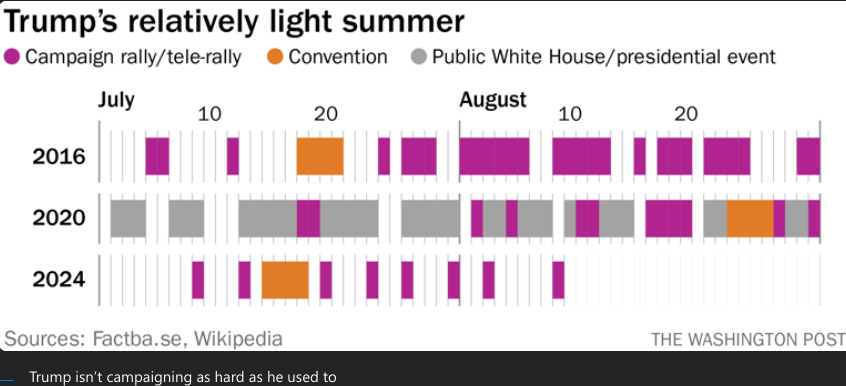
Philip Bump of the Washington Post has the numbers showing how much he has slowed down:

Trump is holding far fewer rallies than he did in 2016 and has held far fewer public appearances than he did in 2020, the two previous times he sought the presidency.

A review of Trump’s activities in July and August of those previous years shows the difference. From July 1 to Aug. 10, 2016, Trump held 22 rallies, including six days on which he held multiple rallies. Over the rest of August, he added 15 more rallies. This year, he’s held seven rallies with another scheduled for Friday in Montana.

One might guess that he is still spooked from the assassination attempt and fears being back out there but he wasn't campaigning much even before that. He just doesn't seem to think he needs to do it because, as he tells his people, he believes that the votes are already there and the main job of the campaign is "election integrity" which translates to suppressing the Democratic vote and contesting the results if he loses. 

Nonetheless, he's obviously agitated over Harris's massive small donor fundraising haul over the past couple of weeks which he knows very well is indicative of tremendous enthusiasm for their ticket. (He's drained his own small donors dry over the past eight years.) And polls showing her taking the lead are driving him to distraction. 

We need your help to stay independent

According to his former communications director, Stephanie Grisham, he's decided to take matters into his own hands:

Re: Trump’s self-announced press conference today at 2 pm: He’s panicking. I’ve seen this play many times. He thinks his team is failing him & no one can speak better/“save” his campaign/defend him but him. He hates the coverage Harris is getting & thinks only he can fix it.

The questions at the presser couldn't be heard because of the poor production at Mar-a-Lago, but from what we could tell the reporters were extremely polite and demanded no follow-ups which was nice for him. Some of the questions sounded like they might have even been asked by members of his own staff. For instance, when an unidentified reporter threw him a red meat question about whether former San Francisco mayor Willie Brown dating Harris back in the 1990s had helped her career, Trump told a wild tale about almost dying in a helicopter with him and that Brown had told him "terrible things" about Harris and was "not a fan." (This is not the first time Trump has made these crude suggestions about her.)  

Willie Brown told the New York Times, however, that he's never been in a helicopter with Trump and that he never disparaged Harris to him. It seems that Trump had mistaken Willie Brown with former California Gov. Jerry Brown who did take a helicopter flight with him and Gov. Gavin Newsom to inspect fire damage a few years back. They didn't speak of Kamala Harris and the helicopter was never in any danger but Newsom recalls Trump incessantly wondering if it might crash. 

Oddly, no members of the media are angrily demanding to see Trump's medical records despite the fact that he appears to be having major memory problems and possibly even delusions. 

After declaring that reproductive rights are no longer an issue because he'd "sent it back to the states" which he insists was the desire of liberals and conservatives for 50 years (total nonsense) there was this straightforward question about whether Trump planned to have the FDA ban mifepristone. He answered with a bizarre mishmash of words about "supplementing" with something "open and humane" and people voting on it that made no sense whatsoever.

Reporter: There are other things the federal government could do, not just a ban. Would you direct your FDA [Food and Drug Administration], for example, to revoke access to mifepristone? That’s one of the things that’s been discussed.

Trump: Sure, you can do things that will supplement. Absolutely. And those things are pretty open, and humane, but you have to be able to have a vote, and all I want to do is give everybody a vote, and the votes are taking place right now as we speak.

Reporter: Is that something you would consider?

Trump: There are many things on a humane basis that you can do — outside of that, but you also have to give a vote, and the people are going to have to decide.


Want a daily wrap-up of all the news and commentary Salon has to offer? Subscribe to our morning newsletter, Crash Course.


Recall that he told Time Magazine he has “pretty strong views” about abortion medication Mifepristone and would be making an announcement “probably over the next week.” That was on April 30. There's been no announcement since. This latest gibberish is all we have to go on.

And then there were the crowds. Trump simply could not stop talking about the size of his crowds, complaining that the press was undercounting them and even declaring that his January 6 crowd was bigger than Martin Luther King's famed March on Washington. Over and over again he kept bringing it up, apropos of nothing, as if on a loop. It is a long-standing obsession of his that seems to be getting worse. 

He did make some news by saying that he had agreed to debate Harris on ABC, a matchup which he had earlier backed out of. He also announced a debate on NBC and on Fox News but he got the dates all mixed up and according to the Harris campaign they've only agreed to the original debate on ABC on September 10. Perhaps others will happen as well but despite Trump's apparent desperation to have them, nothing has been set. 

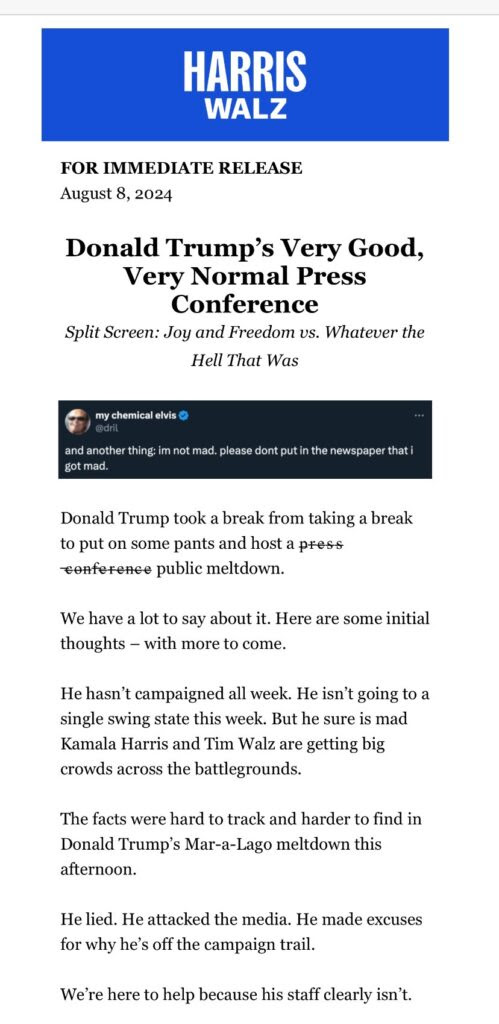
All in all, it was another Trump trainwreck, perhaps one of his worst but certainly not unprecedented. However, this time, the opposition is taking no prisoners. The Harris campaign put out a very sharp (and hilarious) response: 


He was dour and angry and frankly is starting to look a whole lot older, just in the past few months. He's not enjoying himself and it shows and compared to the excited crowds greeting Harris and Walz this week this sad, pathetic appearance seemed almost funereal. Donald Trump isn't fun anymore. 

I think he's considering for the first time that he might lose again and he is not psychologically equipped to deal with that reality. Sure, he'll fight it and tell his supporters that it was stolen and perhaps even incite more violence. But deep down he knows he might actually lose just as he knows deep down that he lost in 2020. There's a look of panic in his eyes right now. If he fails this time he might just break apart at the seams. 

“Not just weird, but creepy”: JD Vance’s stalker moves show the Trump campaign is fully out of ideas

Democrats are calling MAGA leaders "weird" and Donald Trump does not like it.

"They’re the weird ones. Nobody’s ever called me weird. I’m a lot of things, but weird I’m not," the former president recently whined on a right-wing podcast, a space that allows him to vent without the hours of hair and makeup he needs to be visible in public.

While Trump unconvincingly denies that he's weird, his running mate, Sen. JD Vance of Ohio, appears to be leaning into the "weird" charge. As his boss camps out at Mar-a-Lago, Vance has been tailing Vice President Kamala Harris around the country while she introduces her running mate, Gov. Tim Walz of Minnesota, to the nation. Vance shows no sign of interest in refuting the rumors of his weirdness, instead acting like an unsavory creep everywhere he goes. When asked by a reporter what makes him smile, Vance let out a fake laugh, before weirdly insisting, "President Trump in particular has the best sense of humor." This is the same Trump who recently demanded,  "Don't laugh under any circumstances" at Harris. Vance also pretends to be the presidential candidate at times, even trying to challenge Harris, not Walz, to a debate. 

But what makes this all the weirder is Vance seems determined to prove correct the allegation that he's "stalking" Harris.  On Wednesday, Vance pulled an unsettling stunt. He spotted Air Force Two on a Wisconsin tarmac and chased it down in a faux attempt to "confront" Harris. Thankfully, she had left the airport already, avoiding questions about whether it was time to file for a restraining order. But his behavior did create another round of reminders that JD Vance is a nosy creep. Recall that he has even demanded that local police have access to women's medical records so they can know if patients are or may be pregnant — and can use state force to keep them that way. 


Want more Amanda Marcotte on politics? Subscribe to her newsletter Standing Room Only.


As journalist Edward Isaac-Dovere said on CNN, the stunt was "not just weird, but creepy." The whole debacle just underscores how, as Vance admitted to donors, the decision of President Joe Biden to quit the race so Harris could take over has felt like a "sucker punch" to the Trump campaign, one that they are still reeling from. Of course, even that language is childish and weird, as it feeds off Trump's rich kid-bellyaching about how unfair it is that he can't pick his political opponent. When Trump chose Vance, Biden was still in. As Atlantic reporter Tim Alberta wrote, the choice "was borne of cockiness, meant to run up margins with the base in a blowout rather than persuade swing voters in a nail-biter."

Now that Trump is facing a more formidable opponent, it would be smart of the GOP candidates to pivot to "normal." But Trump, an already weird dude who has grown stranger with age, can't do it.

Or put more bluntly: Vance was chosen to appeal to the creeps and weirdoes. Now that Trump is facing a more formidable opponent, it would be smart of the GOP candidates to pivot to "normal." But Trump, an already weird dude who has grown stranger with age, can't do it. It seems neither can Vance, who spends way too much time with Holocaust deniers and Pizzagate conspiracy theorists to remember what "normal" even sounds and looks like. 

Meanwhile, Harris is starting to rise in the polls, leading Trump nationally, although by slender margins no one should take for granted. Yet the Trump campaign seems stuck in the strategy they had been counting on for months against Biden: demoralize Democrat voters so they stay at home while turning out the dirtbag vote with an overtly misogynist, trolling-based campaign. Rep. Matt Gaetz, R-Fla., explained the theory that they could get creepy dudes of every race with these tactics: "For every ‘Karen’ we lose, there is a ‘Julio’ and a ‘Jamal’ ready to sign up for the MAGA movement."

Frankly, it wasn't the worst theory — at least while Biden was still the candidate. The robust audiences for toxic masculinity influencers like Jordan Peterson and Joe Rogan prove there is a substantive constituency of gross dudes out there. Biden was struggling to get his base of voters, especially younger ones, enthused. So absolutely, Trump could win with an intense "get out the vote" effort aimed at turning out bitter divorced men, while counting on low turnout from his opponent's likely voters.

Since the Harris switch, the Trump campaign appears to be in deep denial. As reporter Dasha Burns told MSNBC on Thursday, Trump's campaign staff told her they thought, "This is an election that is still about President Biden." That's clear in how they just swapped the word "Harris" in for "Biden" without changing much else in commercials and speeches. Trump has even taken to posting elaborate fantasies on Truth Social claiming Biden will crash the Democratic National Convention "to take back the Nomination, beginning with challenging to another DEBATE."

Centering the campaign around the creepy-and-weird vote was surprisingly effective against Biden, whose age-related issues made it difficult for him to call this out, much less push back on it. In that vacuum, normal people were tuning out altogether, because the election seemed grosser and sadder by the minute. The election had the same vibe as an internet forum that is becoming so overrun with trolls who regular users can't even stand to be in the room with anymore. Replacing Biden with Harris — and especially with her cheerful bulldog of a running mate, Walz — changes the dynamic considerably. By labeling MAGA as "weird," Harris and Walz have started to exact an actual price from Trump, Vance, and their acolytes for behaving the way they do. And that price is starting to show up in the polls. 

But having committed to total creepiness as a campaign strategy, Trump and Vance seem stuck. Appealing to regular people seems too hard for them, so instead they keep returning to the tactic of cheap trolling to delight ugly people: Calling female athletes "men." Making fun of Harris for being biracial. Doubling down on the "miserable cat ladies" line. And now chasing Harris around on a tarmac like a weirdo trying to hand her an envelope containing a pair of her stolen underwear. No doubt these tactics delight people most of us would cross the street to avoid. But it's hard to imagine it will do much to turn the ship around for the Trump campaign. 

Kamala Harris has clearly gotten under Donald Trump’s skin

A brush with death can change a person. They can choose to become a better person and to count their second chance at life as a blessing, an opportunity to engage in critical self-reflection and a mark of good fortune to be repaid to others. Alternatively, a person can be indifferent to how Fate smiled upon them and to continue living life as they had before. Perhaps the worst outcome is when a person faces their own mortality and sees their luck as a mark of their greatness if not immortality, fueling their egomania and the worst aspects of their personality.

After an attempt on his life several weeks ago in Pennsylvania, Donald Trump chose the third option.

An assassin’s bullet barely missed his head. Trump was supposedly a changed man after such a horrible experience, one who would “unite” the country and “heal” its division and acrimony. Trump, a man who rarely, if ever, attends church, also said that he was blessed by God and protected by an act of divine intervention. “It was God alone who prevented the unthinkable from happening. We will FEAR NOT, but instead remain resilient in our Faith and Defiant in the face of Wickedness.”

There were members of the news media who, even after nine years of experience with Donald Trump and his lies and demagoguing, uncritically accepted Trump’s declarations that he was now changed for the better. Not surprisingly, some of these public voices also said, at various points during Trump’s first regime, that he was finally “presidential” and was “rising to the demands of the office.” Such public voices have little to no credibility left.

In a Wednesday post on Twitter, Wajahat Ali, who is a columnist at the Daily Beast, directly called out such Trump-enablers in the news media: "Again, every single pundit and reporter who said Trump was a changed man after he survived an assassination please resign. Just leave this profession. Many of you are wealthy or have access to wealth. Go do something else. You're not made for this moment."

Of course, Donald Trump had no intention of becoming a better man. Trump’s charade lasted only a few days before his fascist-religious coronation at the Republican National Convention and his acceptance speech where he reverted to his ugly true form and attacked the Democrats and his other “enemies.”

At a rally in Minnesota last week, Trump reveled in his awfulness like it was a superpower that he had temporarily lost and now has back:

I want to be nice. They all say, ‘I think he’s changed. I think he’s changed since two weeks ago. Something affected him. No, I haven’t changed. Maybe I’ve gotten worse. Because I get angry at the incompetence that I witness every single day.

In all, Donald Trump, because of his temperament, personality and mind is unable to act differently. Trump only knows how to attack. He appears incapable of human empathy or concern for others.

When President Biden decided to pass the torch to Vice President Kamala Harris, Donald Trump only became more enraged and horrible in his speech, threats, and other behavior. It is being reported that Trump has been raging in private, as the momentum, at least for now, appears to have shifted to the Democrats in the upcoming election. Trump’s public statements and other behavior strongly suggest that he is experiencing some type of existential crisis at the thought of having to do political battle against a highly intelligent Black South Asian woman who is also a former prosecutor and attorney general.

Trump’s niece Mary Trump, who is a trained mental health professional, made this observation in a recent essay on her site The Good in Us about her uncle’s apparent state of mind and how he is now “terrified”:

Donald hates being laughed at….Donald also hates women (especially strong women) and minorities, so you can see why current Vice President and presidential candidate Kamala Harris terrifies him to the point of incoherence. He says she’s 'crazy.' His childish nickname for her is 'laughing Kamala' because she feels joy, and joy is something he has never experienced and doesn’t understand. Faced with the reality that he is now running against a vibrant, intelligent, experienced woman who is fully two decades younger than he is, Donald spent Sunday and Monday flailing, trying to find an angle of attack that would stick.

Donald Trump is remarkably honest and transparent in his own devious way. To that point, longtime observers of Trump have concluded his behavior appears to be driven almost completely by the id and his other most core and primal instincts. Because of this dynamic, Donald Trump’s fundraising emails and other communications are a powerful lens, literally, into his state of mind and thinking—as well as the collective psyche and emotions of the MAGA people who are devoted to him.

We need your help to stay independent

Last Friday, Donald Trump sent out the following email to his MAGA people about his rally the next day in Atlanta. Its language and meaning should frighten any person who cares about the present and future of American democracy and the well-being of the country and its people.

24 HOURS UNTIL WE UNLEASH HELL

At this time tomorrow, Crooked Kamala’s worst nightmares come true.

When I take the rally stage in DEEP BLUE Atlanta to a packed house with THOUSANDS of MAGA Patriots, she won’t be able to hide from the truth any longer:

We’re making a BIG play for every city left behind by her DANGEROUSLY LIBERAL AGENDA!

STAND WITH TRUMP

The silent majority is BACK, and with it comes the END of the tyrannical Biden-Harris regime.

TODAY begins America’s liberation from the sick political class that hates our country.

So before I step on stage, I’m calling on ALL THE FORGOTTEN MEN AND WOMEN of this once great country to rise up and declare: I WILL ALWAYS STAND WITH TRUMP!

STAND WITH TRUMP

Tomorrow I step on stage and deliver Open Border Czar Kamala Harris the WORST defeat of her failed political career.

But right now all I can think about is Friend!

YOUR SUPPORT is the ONLY reason I’m still standing, and your support will be the reason we peacefully TAKE BACK THE WHITE HOUSE TOGETHER!

Please, join with me today. 

With you by my side, WE WILL MAKE AMERICA GREAT AGAIN!

The elite agenda-setting American news media, again, has not extensively covered this most recent example of Donald Trump’s rapidly escalating threats and incitements to political violence and mayhem.

On Monday, Donald Trump, the supposedly reformed and peaceful leader who only wants “unity” sent out another email to his MAGA people—this time celebrating his slogan-threat-command to “Fight! Fight! Fight!”

THIS IS A MESSAGE FROM DONALD TRUMP

FIGHT! FIGHT! FIGHT!

MAKE AMERICA GREAT AGAIN.

CLAIM TRUMP FIGHT SHIRT

This is the shirt you’ve all been waiting for. Seriously. All the others are just knockoffs.

I’m releasing a very SPECIAL and very LIMITED run of these while supplies last.

So if you want to get your hands on this ONE-OF-A-KIND shirt, order now and my team will ship these to your home ASAP

CLAIM TRUMP FIGHT SHIRT

Together, we will peacefully take back the White House and Make America Great Again!

Donald Trump’s new “Fight! Fight! Fight!” t-shirt features the now iconic image of him, fist raised in the air in defiance, following the attempt on his life in Butler, Pennsylvania. The t-shirt is black. The image of Trump and the American flag is white. In total, the t-shirt is evocative of the fascist MAGA “no quarter shall be given” flag or a version of the skull worn by the comic book vigilante anti-hero now turned villain the Punisher.

Tuesday morning, Kamala Harris announced that she chose Minnesota Gov. Tim Walz as her vice-presidential pick in the 2024 election. Trump responded with more violent and apocalyptic language, sending out a fundraising email stating that Walz would “unleash hell on Earth.”

Later in the day, Trump would continue with his threatening and menacing emails about Harris (and now Walz), telling his MAGA followers that she will “destroy this country” and “is coming for you next”:

KAMALA HARRIS IS COMING FOR YOU NEXT!

Now that Kamala Harris has chosen Tim Walz to be her VP, this ticket is DANGEROUSLY LIBERAL for America.

First, she DECIMATED San Francisco as the ORIGINAL MARXIST PROSECUTOR.

Then, she LAID WASTE to California as the single most DANGEROUSLY LIBERAL Senator.

And as we speak, she’s preparing to finish the job and DESTROY THIS COUNTRY.

Crooked Kamala thinks she’s got us on the ropes, but the MAGA revolution is only just getting started.

In total, Trump’s fundraising emails and other communications, again, reflect how and his agents are master propagandists who have a deep understanding of the fears, anxieties and general emotions (which include hopes and dreams) of their MAGA people. Specifically, Trump and his propagandists are using stochastic terrorism and related techniques to emotionally train and condition the MAGA people and his other followers into committing acts of political violence and destruction in the name of “the movement”. This is the logical end goal of Trump’s repeated use of apocalyptic language such as “unleash hell.” That language also has multiple valences and meanings. Yes, Trump is commanding his followers to commit such actions against their shared “enemies.” But he is also telling his followers the lie that Kamala Harris, Tim Walz, and the Democrats and “the Left” are going to unleash hell against them. By that logic, Donald Trump is their only protector and savior—which is why he must be made into a dictator to “save” them from the evil forces that are going to hurt them, their families, and (sacred) communities. In keeping with how radicalization into political extremism usually takes place, the resulting violence against the “enemy” is understood to be defensive and a last option—and therefore legitimate and perhaps even honorable and just—in what is an existential struggle for survival.

Donald Trump’s MAGA people and other cultists are listening to his commands very closely. An apparent Trump follower was recently arrested in Virginia for making repeated threats to kill Kamala Harris and other leading Democrats. Political scientists and other experts in national security and law enforcement have compiled data that shows that there are many thousands of Trump-MAGA followers and other right-wing extremists and malign actors who are willing to commit acts of political violence to remove the Democrats from power and to put Trump and his MAGAfied Republicans in control of the country. These people will be the foot soldiers for a Trump dictatorship and permanent state of emergency that will include massive political violence and “revolution” against “the Left” and the other “enemies” of “MAGA” as outlined by Project 2025, Agenda 47, and elsewhere.


Want a daily wrap-up of all the news and commentary Salon has to offer? Subscribe to our morning newsletter, Crash Course.


At last Saturday's rally in Atlanta, Donald Trump made his threats of political violence and destruction against Vice President Harris and the country’s democracy and civil society even more starkly clear. “She was the worst border czar, she was the worst czar in history….Kamala’s radical ideas belong in a San Francisco commune filled with far left freaks, but they do not belong in the White House. They do not belong in the United States of America. This November, Georgia is going to tell Kamala that we will not let her turn America into a communist country.”

What will happen to these “far left freaks”? Will they be deported, put in the Trump regime’s planned concentration camps or will something even worse happen to them? The lack of an answer and specifics by Trump and his propagandists is a signal of the danger.

Trump, echoing his vice-presidential running mate, Sen. JD Vance, R-Ohio, and Rep. Marjorie Taylor Greene, who spoke at the same event, went even further in his incendiary threats, basically accusing Harris of being responsible for any crimes—especially murder—committed by an “illegal immigrant” from Latin or South America in this country. Here are Trump’s actual words about the tragic murder of Laken Riley, which took place in Athens, Georgia in February: “Kamala is responsible for the death as though she was standing there watching it herself.”

Donald Trump and his propagandists and other agents are engaging in a highly coordinated messaging campaign to depict Vice President Kamala Harris, like the other leaders of the Democratic Party (and its voters and supporters), as a monster. And what does one usually do with monsters and other horrors? You slay them.

In America, both historically and in the present, such imagery and threats—especially against Black and brown people—all too often are not metaphorical, they are literal.

Which VP pick truly upholds family values? Experts say it’s Tim Walz all the way

Donald Trump’s nominee for Vice President, Sen. JD Vance (R-OH), has become infamous for criticizing miserable “childless cat ladies.” In a resurfaced statement from 2021, Vance stated that the country is run by childless women who are unhappy due to their life choices. Alongside these comments, Vance has tried to position himself as an advocate for heterosexual parents with biological children.

Vance later tried to walk back his comments, which have been described as misogynistic and insulting, saying they were taken out of context. “The left has increasingly become explicitly anti-child and anti-family,"  he told Fox News' Trey Gowdy in July. “This is not a criticism and never was a criticism of everybody without children — that is a lie of the left. It’s a criticism of the increasingly anti-parent and anti-child attitude of the left."

Nonetheless, as Vance has voiced his concerns about people not having enough children, yet most recently skipped the vote in Congress to pass a $78 billion tax-cut package that would have expanded the child tax credit, a bill which would have benefited an estimated 16 million children nationwide. (Republicans who voted against it expressed concerns that it would disincentivize people from working.)

In contrast is Democratic Vice Presidential candidate Tim Walz, who as governor of Minnesota has been on a mission to make the state, in his words, "the best in the country to have kids." Walz enacted a law that enshrined “reproductive freedom” into Minnesota’s state constitution. He signed a paid family and medical leave law due to go into effect in 2026 that will give workers 12 weeks at 90 percent of their pay to care for a newborn or sick family member. He launched a $316 million grant program to increase pay for childcare workers and an additional $6 million to expand childcare businesses in Minnesota. In 2023, Walz expanded the state’s childcare credit to $1,750 a year, making it the highest in the country. That same year he passed a bill that made free lunch at school available to all Minnesota students. 

"When we look at Tim Walz's record, it's more than just rhetoric about working families — he's delivered."

Republicans have long branded themselves as the “pro-family” party, but for those following policies that actually benefit American families, they see a disconnect between rhetoric and action. When it comes to a VP pick who’s better for parents in the United States, experts say Walz is the more “family-friendly” candidate. 

“When we look at Tim Walz's record, it's more than just rhetoric about working families — he's delivered,” Ravi Mangla, a spokesperson for the Working Families Party, told Salon in a phone interview. “As governor with a narrow one-seat majority, he passed paid family leave, expanded child tax credit, made record investments in public education — we know that he backs up his words with action.” 

In contrast, when looking at Vance, Mangla said, Vance has “a very thin record to show.”


Want more health and science stories in your inbox? Subscribe to Salon's weekly newsletter Lab Notes.


As a senator, J.D. Vance also voted against the Right to IVF Act, which would have protected the accessibility and affordability of in vitro fertilization (IVF) nationwide. For Walz, IVF is “personal,” as he’s said. Walz and his wife went through years of fertility treatments to finally have their two children. Walz is a supporter of maintaining access to IVF. 

“Most of his talk about helping working families is just that: it’s talk,” Mangla said. “It's not backed up with anything that's been delivered, and when you look at his Senate votes, he's repeatedly voted against bills that would help working families, like legislation to make childbirth more affordable, or his outspoken criticism of IVF, which has allowed so many families to be able to to have children and have the families that they want.” 

Daphne Delvaux, an employment attorney and founder of The Mamattorney, told Salon, Vance does not “walk the walk.”

“Parents across the nation are struggling keeping up with expenses and are living paycheck to paycheck,” Delvaux said. “The child tax credit would have lifted at least half a million children above the poverty line.”

"It is precisely because he invested in families that the state is so strong; his record speaks for himself."

Notably, Project 2025, the controversial right-wing political initiative pushed by the Heritage Foundation — which Vance has praised — suggests the solution to a lack of paid family leave is the “Working Families Flexibility Act.” Basically, it would serve as a way to incentivize workers in the private sector to work overtime to accumulate paid-time off that could be applied toward paid family leave.

“If an individual worked two hours of overtime every week for a year, he or she could accumulate four weeks of paid time off to use for paid family leave, vacation, or any reason,” Project 2025 states. Despite their emphasis on “restoring” the American family, there is no call for a “paid family leave” in Project 2025’s 900-page vision.  

Delvaux said it’s significant that Walz positioned Minnesota "as an economic powerhouse" because it "cuts against the argument that family-supporting policies raise costs and ruin the economy,” Delvaux said. “In fact, it is precisely because he invested in families that the state is so strong; his record speaks for himself.”

The contrast between how Vance and Walz approach family-centered policies speaks to the differences between the two political parties. But despite Project 2025’s plan to restore the American family as the “centerpiece” of American life and to “protect children,” Republicans only appear to support a specific definition of a family. 

“Republicans count themselves as a party of freedom, yet have such a narrow idea of what a family can be or look like, or who's included in that family,” Mangla said. “It is really at odds with one another.”

In September 2023, polling from the left-wing think tank Data for Progress found that 53 percent of women voters said they would consider cutting their work hours if they lost access to childcare. Executive director of the group, Danielle Deiseroth, told Salon the organization’s polling on policies to improve access to childcare, and lower its cost, is really popular — and not just among women, but men, too.

“Many Americans, and American women especially, are not only tasked with the cost, the time, of childcare, but many of these women are also tasked with caring for elderly relatives or other relatives, too,” Deiseroth said. “This is a huge factor to folks — finances and feelings towards these big-ticket items that impact their lives right now.”

We need your help to stay independent

In 2023, Republicans introduced their “Parents’ Bill of Rights,” but it mostly focused on COVID-19 school closures and book bans, which isn’t aligned with these “big-ticket” items that voters care about. 

“Republicans’ ‘family-focused policies’ are trying to tell families how they should raise their kids and live their lives,” Deiseroth said, pointing to policies around restricting access to abortion, birth control, reproductive care, medical care for transgender youth and policing library books. “Versus Democrats’ plans, which are about giving you the freedom to make choices, to do what you want with your own body, to raise your kids in the way that you deem fit.”

Deiseroth added Data for Progress polled Vance’s favorability in the Rust Belt recently. 

“Which you think would be JD Vance's strongest footing,” Deiseroth said. “He has an unfavorability rating that's worse than Trump in those states.”

Special counsel asks for 3-week delay on immunity roadmap in Trump’s Jan. 6 case

Special counsel Jack Smith is asking for a three-week delay to come up with a joint motion to proceed in the federal case against Donald Trump, pushing back a Friday deadline to outline each side’s path forward in the prosecution of the former president’s role on January 6.

D.C. District Court Judge Tanya Chutkan had previously scheduled an August 16 hearing to clarify a path forward after the Supreme Court ruled her court must discern between official, protected acts Trump took as president and unofficial, unprotected acts, finally allowing the case to move forward.

Per the special counsel’s office, the team needs more time to understand the “new precedent set forth last month” by the top court, which granted presidents sweeping immunity over “official acts,” without clearly defining those powers.

"Although those consultations are well underway, the government has not finalized its position on the most appropriate schedule for the parties to brief issues related to the decision," Smith's office said, according to ABC News.

Trump’s legal team did not object to the motion, which in some ways indicated that Smith’s office was partially uncertain about how to move forward in the case over Trump’s 2020 and 2021 actions.

Smith’s delay comes in a years-long stretch of delays imposed by other forces on the case investigating Trump’s election subversion attempts, and after federal judge Aileen Cannon tossed a separate case prosecuted by his office.

The delay to late August makes it unlikely that any proceedings, including hearings on the acts Trump took, would take place ahead of Trump’s September 18 sentencing in New York in a separate case.

Newsom sweeps LA homeless encampment with a sense of urgency

California Governor Gavin Newsom ordered the removal of a homeless camp in Los Angeles on Thursday, demanding more urgency from local partners as he took part in the demolition.

In a state-owned underpass beneath Interstate 10, Newsom tore down campsites, signaling to Los Angeles Mayor Karen Bass — who championed a less destructive approach to housing individuals — that he would use the state’s power to crack down on the issue.

Newsom also told reporters that he would be “redirecting money” away from counties like Los Angeles that took less aggressive stances.

“We'll send that money to counties that produce results,” Newsom said, per local KCRA correspondent Ashley Zavala.

The sweep comes two weeks after an executive order cracking down on so-called “homeless encampments,” which line some sidewalks in cities like Los Angeles and San Francisco. The move was heralded by a bipartisan selection of California politicians, who said the time had come.

But some progressive Californians have blasted Newsom for the order, citing a lack of housing alternatives for unhoused Californians.

“Gov. Gavin Newsom’s plan to displace and dispossess unhoused people, even though the state does not have enough housing, is a cruel tactic that only masks the problem,” the ACLU of Northern California wrote in a statement on the initial order.

Newsom’s actions were enabled by the Supreme Court’s June decision to allow municipalities to criminalize homelessness, specifically its overturning of a doctrine banning a sweep unless unhoused individuals were provided sufficient shelter bed space.

In a phone call with the New York Times, Bass said she hadn’t spoken to the governor, but that she was not necessarily critical of the sweep today, adding that she’d have joined him if she weren’t in Paris preparing for Los Angeles’ 2028 Olympic Games.

“I know he’s frustrated with a lot of cities that do not address the problem, but Los Angeles is one of the cities that does address the problem. For the first time in years, homelessness in Los Angeles is down,” Bass said.

Harris speaks briefly to reporters and reveals plans for a full interview soon

Departing a rally in Michigan on Thursday, Kamala Harris spoke briefly to reporters on the tarmac, saying she hopes to schedule her first full interview as the Democratic nominee for president soon.

Harris, who’s had to bring together a campaign and select a running mate on an unprecedentedly tight timetable, hadn’t answered press questions before making time on the Michigan runway, but it made a statement, following JD Vance's attempt to diss her for ignoring the press just one day prior.

On Wednesday, Vance walked to confront pool reporters outside Harris' plane, making mention of her lack of press spots thus far. 

“I’ve talked to my team. I want us to get an interview scheduled before the end of the month,” Harris said outside Air Force Two, per the Hill.

En route to Arizona to continue a streak of rallies in key swing states alongside running mate Tim Walz, Harris defended Walz when asked about Senator Vance’s attacks on his National Guard service record.

“I praise anyone who has presented themselves to serve our country. And I think that we all should,” Harris said.

Among other topics, Harris fielded questions on the presidential debate on ABC, which Trump had previously backed out of, before misspeaking during a press conference and ultimately confirming his attendance via a statement.

“I’m glad that he’s finally agreed to a debate on September 10th. I’m looking forward to it,” Harris said. “I hope he shows up.”

Kanye compares abortion to the Holocaust, in a recently released interview

Kanye West blamed Jews for his mental health hospitalization and likened abortion to the holocaust in a recently released interview from 2022, amid speculations on his present mental health.

In the interview, which Candace Owens made public for the first time on Wednesday, posting it to her YouTube account, West espoused the same type of antisemitic hate-fueled rhetoric that he’d used in several other appearances during that period, resulting in Adidas, Twitter, and others cutting ties.

In a preface for the interview, Owens, who was fired from conservative media company The Daily Wire in March, claimed that her employer kept her from releasing the interview until now.

West, also known as Ye, claims to have investigated the “Jewish abortion rate” and falsely claimed that 50% of Black deaths were abortion deaths, defending his antisemitic comments by attempting to re-frame them as things he was “envious of.”

West compared the holocaust to abortion in a portion of the interview, discussing an offer to visit the Holocaust Museum in the wake of backlash over his hateful remarks. 

“I want you to go to our Holocaust Museum, Planned Parenthood, like we’re still in the Holocaust. Six million Jewish people died in the Holocaust, over 20 million darker Jews, Black people, have been aborted,” he ranted.

West then blamed his “Jewish doctor” for his bipolar diagnosis, adding that his “Jewish trainer” leaked the diagnosis to the “Jewish media” and “put [him] in hospital.”

Ye, who was accused earlier this week by far-right influencer and former Yeezy employee Milo Yiannopoulos of being addicted to nitrous oxide at the hands of his dentist, also tried to explain away his “death con 3 on Jewish people” tweet as the result of drinking.

Elsewhere in the interview, he mentions Vice President Kamala Harris, calling her a part of the Black Lives Matter movement’s “scam.”

“When I saw Kamala was running for office, and they showed this picture of her as a child, I saw my mother in that picture. I wanted to vote for her, I almost forgot I was running,” the rapper said. “So when I see the George Floyd video, the way they captured it, the way it sounds, it hits me.”

But West had a change of heart on the vice president, telling Owens, “You are what Black people want Kamala to be.”

How a mylar balloon left New Orleans without clean water for days

A mylar balloon struck a power line near a crucial water treatment plant, putting much of New Orleans under a boil water advisory on Tuesday night.

The Carrollton Water Treatment Plant went offline for a brief moment on Tuesday after the strike, just long enough to trip pumps offline and create a pressure crash before backup pumps could be brought online, local station Fox 8 News reported.

Per the New Orleans Sewerage & Water Board, pressure loss caused by the power outage at the treatment plant put nearly all of the city's 380,000 residents under the required threshold, triggering a precautionary boil water advisory. 

As of Thursday, the board has lifted the advisory in the city’s West Bank, while the East Bank’s was extended, with two out of 90 water samples testing positive for coliform bacteria. Nearly 250,000 residents in the East Bank are still under advisory.

Under the boil advisory, officials recommend washing hands with bottled or boiled water and avoiding drinking water from the tap without boiling until more conclusive testing can be conducted, which is expected later Thursday night.

The incident, spurred by one rogue metallic balloon, underscores a deep vulnerability in the city’s water infrastructure. In other cities, infrastructure failures have caused days or weekslong water failures, prompting boil orders for hundreds of thousands.

A 2022 Jackson, Mississippi outage at the O.B. Curtis Water Treatment Plant left nearly 150,000 residents without access to clean drinkable water.

COVID surges in Olympic Village: Noah Lyles reveals positive test after bronze finish

Already facing worms in their food and dangerous bacteria levels in the Seine River, athletes are now experiencing a COVID-19 surge during the Paris Olympic Games. 

After taking home a bronze medal in the men’s 200-meter sprint, American runner Noah Lyles revealed he’d tested positive for COVID two days ago.

Lyles, who won the gold medal in the 100-meter event earlier in the week, left in a wheelchair on Thursday after pushing through the effects of the virus during his race, joining a tally of at least 40 athletes to test positive since the games began last month.

“I woke up early, about 5 a.m. on Tuesday morning, and I just was feeling really horrible. I knew it was more than just being sore from the 100,” a masked Lyles told NBC. “Woke up the doctors and we tested and unfortunately it came up that I was positive for COVID.”

Lyles, who added that he concealed his diagnosis to maintain an advantage over opponents, quarantined at a nearby hotel ahead of the race, though the Paris Games have dropped any official requirements for COVID testing or mitigation strategies.

“You never want to tell your competitors you’re sick,” Lyles said. “Why would you give them an edge over you?”

As Scientific American noted, Paris athletes are no longer required to mask or avoid contact with others if ill, and many have opted to proceed as normal, despite infectious disease doctor Peter Chin-Hong’s assessment that the games provide “picture-perfect ways to spread” the virus.

Outside of the Olympic Village, COVID-19 infection levels have reached recent highs, with wastewater tests putting many U.S. states in the “high” infections category. Experts previously told Salon that we could be experiencing a “summer COVID bump.” 

Wendy’s gets ahead in the ongoing “value meal wars” with a limited-time-only $1 Frosty deal

Shortly after announcing its value meal deals, Wendy’s is awarding its consumers with another bombshell offer, this time involving its beloved Frosty.

From Monday, August 5 through Sunday, September 15, the fast-food chain is offering a $1 Frosty deal at restaurants nationwide. The $1 promo includes any flavor Frosty, including the Classic Chocolate Frosty and the Triple Berry Frosty, which Wendy’s said will be available only for a few more days.

In addition to the new deal, customers who currently hold a MyWendy’s account on the Wendy’s app or its website can earn Rewards that can be redeemed for free food and drinks. For each $1 spent — including on each discounted Frosty — customers can earn 10 points. Points are added automatically by placing a pickup or delivery order with the Wendy’s app or website. They can also be added by scanning the QR code in the Wendy’s App at the counter or pickup window when placing an order. Customers who earn at least 200 points can trade them for some of their favorite menu items in the Wendy’s Rewards Store.

At this time, Wendy’s hasn’t announced what flavor of Frosty will succeed the viral Triple Berry Frosty. The chain has previously released seasonally-themed Frostys, including Pumpkin Spice and Peppermint flavors, along with more classic options, like the Vanilla Frosty.  

Until then, customers should enjoy all the $1 Frostys they can get their hands on.

Thwarted attack at Taylor Swift concerts planned to kill “as many people as possible”

Reports have shed light on the arrest of two teenagers allegedly involved in drafting a terror plot to take place at a Taylor Swift concert in Austria, resulting in the cancelation of three Swift concerts for safety precautions.

During a press conference on Thursday, Austrian law enforcement officials stated that one of the men confessed that the plan was to “kill as many people as possible outside the concert venue," The New York Times reported. After the arrest of a 19-year-old man and a 17-year-old boy, authorities said that the older suspect, who was radicalized online by the Islamic State group and al-Qaida, had given police a detailed account of his plot to kill concertgoers using explosives and weapons. 

In addition to the explosives, authorities searched the older man's home and found timers, machetes and knives. Police also said the 17-year-old suspected accomplice had recently begun a job as an events service working at the Ernst Happel Stadium, where Swift was set to perform. He was arrested at the stadium on Wednesday. Another teen was brought in for questioning, who authorities said was not an active part of the plot but knew of the details. Authorities also said since the suspects are in custody, there is no longer an immediate threat.

Following the exposure of the thwarted attack, Swift's three sold-out concerts were canceled Wednesday, a blow for Swift's Austrian and global fans, who The Associated Press had reported spent thousands of euros on travel and lodging in Vienna. The concert's organizers said that the stadium was expecting about 65,000 Swifties and 30,000 people gathered outside the area which is where the suspected planned to attack. According to Austria’s interior minister, the plan was to be executed on Thursday or Friday.

Despite the legion of upset fans, Austrian Chancellor Karl Nehammer stood by the decision to cancel Swift's concerts. Nehammer said that the arrests of the suspects happened too close to the scheduled concert dates.

“I understand very well that those who wanted to experience the concert live are very sad,” Nehammer explained. “Moms and dads are looking after their daughters and sons, who were full of enthusiasm and anticipation for this concert. But it’s also important that in such serious moments as now, it’s inevitable that safety comes first.”

Concerts have been at the center of violent attacks in Europe before. In the U.K. a suicide bombing at a 2017 Ariana Grande concert in Manchester, England, killed 22 people. Earlier this year, four men killed 100 people at a concert venue in Moscow. The New York Times reported that these attacks "were carried out by men who were inspired by or linked to the Islamic State."

While three of Swift's shows have been canceled, she will still scheduled to perform in London at Wembley Stadium on Aug. 15-20, which will be the last concerts on the international leg of the Era tour before she makes her return to North America, Variety reported.

We need your help to stay independent

London Mayor Sadiq Khan told Sky News he understands the precautions Austria had to take but added, “We’re going to carry on. . . . We have a huge amount of experience in policing these events, we’re never complacent. Many lessons were learned after the awful Manchester Arena attack."

Additionally, U.K. police will increase security, and law enforcement will continue to evaluate intelligence. Swift and her representatives have not commented on the plot or canceled shows except for an affiliated account reposting that the shows had been canceled in Austria.

Several years ago after the Manchester bombing, Swift said in a piece for ELLE that an attack during one of her concerts was "my biggest fear." She wrote, "I was completely terrified to go on tour this time because I didn’t know how we were going to keep 3 million fans safe over seven months."

When will astronauts on ISS finally come home? Maybe not till next year, NASA says

For the last two months, NASA astronauts Barry “Butch” Wilmore and Sunita “Suni” Williams have been onboard the the International Space Station far longer than originally expected. What was initially planned as an eight-day trip could now stretch into next year, as NASA announced today that the agency is considering keeping the astronauts in space until February 2025.

Safety issues with the Boeing Starliner, which marked its maiden voyage with this mission, have delayed the return home. Specifically, mid-flight helium leaks and jammed thrusters required weeks of testing to make sure a problem didn't become dangerous. And more testing is still necessary to understand

While no plans are solid yet, SpaceX may be the company that brings them home, using one of their Dragon capsules that is slated for launch later this month.

“Our prime option is to return Butch and Suni on Starliner,” Steve Stich, manager of NASA’s Commercial Crew Program, said Wednesday in a news briefing, according to NBC News. “However, we have done the requisite planning to make sure we have other options open, and so we have been working with SpaceX to ensure that they’re ready to respond.”

A final decision will be made by mid-August.

Trans voters more enthusiastic about voting for Harris than before

Transgender voters are more enthusiastic about the presidential race than ever since Vice President Kamala Harris and Minnesota Governor Tim Walz took over the Democratic ticket, praising the duo's record on LGBTQ+ rights. 

Since President Biden’s decision to bow out of his reelection campaign, the number of transgender Americans who were enthusiastic about the 2024 race has more than tripled, per a survey conducted by LGBTQ+ health platform Folx Health.

The November election is an especially important one for trans voters, with 89% of surveyed trans-Americans predicting a major impact on nationwide access to gender-affirming care. Additionally, 1 in 5 respondents told Folx that they’d lost access to healthcare in the past year due to conservative-led anti-LGBTQ+ policy.

“I am fearful of another Trump presidency. I feel my life and the lives of others are at stake. I wonder daily if I need to prepare to flee or hide,” one respondent told Folx.

Trump, who has launched attacks on transgender care and described Walz as being “heavy into the transgender world,” rolled back trans rights in his first term and has promised further assaults in campaign stops.

But trans voters aren’t just fearful of another Trump term, they’re also embracing Harris and her running mate’s record on queer issues. 

Trans journalist Erin Reed wrote in a post to X that Walz was “one of the most protective governors towards trans people, even protecting those coming from across state lines.”

“For LGBTQ+ people, Walz was possibly the best pick that could have been made in terms of track record. He had a narrow majority in Minnesota and still pushed forward with hard-hitting policy protecting LGBTQ+ people,” Reed wrote.

79% of participants in Folx’s study said they believed Harris would meet the needs and concerns of the transgender community, echoing the sentiments of transgender advocacy groups, many of whom lined up to endorse Harris.

“I have a lot of fear about what will happen to me, my partner, and our way of life if conservatives come to power broadly,” a survey participant told Folx. “I have to hope that Harris (who I presume will be the Democratic nominee) and that voters will defeat Trump.”

Chemical used in rocket fuel and explosives is widespread in food products, Consumer Reports finds

A new report published Wednesday by Consumer Reports discovered that perchlorate — a chemical commonly used in rocket fuel, missiles and explosives — is also found in various food products, particularly those often consumed by babies and children.

The advocacy group looked at 196 samples of 63 supermarket products and 10 fast food items, which were chosen because prior scientific research suggested these foods may contain perchlorate. They also analyzed the type of packaging each food came in.

Approximately 67% of the samples had measurable levels of perchlorate, ranging from levels of just over 2 parts per billion (ppb) to 79 ppb. Overall, children’s foods had the highest levels, averaging 19.4 ppb. Baby food, fast food and fresh fruits and vegetables also contained elevated amounts of the chemical.

As for packaging, foods in plastic containers had the highest levels of perchlorate, averaging nearly 54 ppb, followed by foods in plastic wrap and paperboard.

Consumer Reports’ findings come decades after perchlorate was first identified as a contaminant in water and food. In 2003, the Environmental Working Group found perchlorate in nearly 20% of supermarket samples tested, often at high levels. Two years later, the Environmental Protection Agency (EPA) established a safe exposure level, which they called an “official reference dose,” for perchlorate of 0.7 micrograms per kilogram of body weight per day. That safety dose has been disputed by many food safety experts who claim the level is still unsafe and should be lowered. In comparison, the European Food Safety Authority has set a daily intake of less than half that amount, at 0.3 micrograms per kilogram of body weight per day.

Perchlorate has been linked to potential brain damage in young children along with thyroid and hormone production problems in adults.

How sustainable is your weekly grocery shop? These small changes can have big benefits

You might think eating more sustainably requires drastic changes, such as shifting to a vegan diet. While a plant-based diet is undeniably good for the Earth, our new research shows modest changes to your eating habits can also have significant environmental benefits.

We assessed how food products on Australian supermarket shelves stack up against key environmental indicators, such as carbon emissions and water use.

We found swapping the most environmentally harmful foods for more sustainable options within the same food group, such as switching from beef burgers to chicken burgers, can significantly reduce carbon emissions – by up to 96% in some instances.

The last thing we want to do is take the pleasure away from eating. Instead, we want to help consumers make realistic dietary changes that also help ensure a sustainable future. So read on to find out which simple food swaps can best achieve this.


Informing sustainable diets

The environmental impact of foods can be estimated using an approach known as a life-cycle assessment.

This involves identifying the "inputs" required along the food supply chain, such as fertiliser, energy, water and land, and tracking them from farm to fork. From this we can calculate a product's "footprint" – or environmental impact per kilogram of product – and compare it to other foods.

Most studies of environmental footprints focus on the raw ingredients that make up food products (such as beef, wheat or rice) rather than the packaged products people see on shelves (such as beef sausages, pasta or rice crackers). Of the studies that do focus on packaged foods, most only consider a fraction of the products available to consumers.

What's more, a lot of research considers only the carbon emissions of food products, excluding other important measures such as water use. And some studies use global average environmental footprints, which vary significantly between countries.

Our research set out to overcome these limitations. We aligned environmental footprints with the products people find on supermarket shelves, and covered a huge range of food and beverage products available in Australia. We also included many environmental indicators, to allow a more complete picture of the sustainability of different foods.


What we did

Key to our research was the FoodSwitch database, which compiles food labelling and ingredient data from images of packaged food and beverages. It covers more than 90% of the Australian packaged food market.

We combined the database with a mathematical method that sums the environmental impact of ingredients, to quantify the footprint of the product as a whole.

From this, we estimated the environmental footprint of 63,926 food products available in Australian supermarkets. We then simulated the potential benefits of making "realistic" switches between products – that is, switches within the same food category.


Our findings

The results show how making a small dietary change can have big environmental consequences.

For a shopping basket composed of items from eight food groups, we simulate the benefits of swapping from high-impact towards medium- or low-impact food products.

Our analysis assumes a starting point from the most environmentally harmful products in each food group – for example, sweet biscuits, cheese and beef burger patties.

A shift to the medium-impact foods for all eight items – such as a muffin, yoghurt and sliced meat – can lead to at least a 62% reduction in environmental impact. Shifts towards the most sustainable choice for all items – bread, soy milk or raw poultry – can achieve a minimum 77% reduction.

This analysis ends at the supermarket shelves and does not include additional food processing by the consumer. For example, raw meat will usually be cooked before human consumption, which will expand its environmental footprint to varying degrees, depending on the method used.

See the below info-graphic for more detail. The full results are available in our study.


What next?

Many people are looking for ways to live more sustainably. Insufficient or complex information can fuel confusion and anxiety in consumers, leading to inaction or paralysis. Consumers need more information and support to choose more sustainable foods.

Supermarkets and retailers also have an important role to play – for example, by giving sustainable products prominent shelf placement. Attractive pricing is also crucial – particularly in the midst of a cost-of-living crisis when it can be difficult to prioritise sustainability over cost.

Government interventions, such as information campaigns and taxing high-impact products, can also help.

Food labelling is also important. The European Union is leading the way with measures such as the eco-score, which integrates 14 environmental indicators into a single score from A to E.

Apps such as ecoSwitch can also empower consumers.

The diets of people in developed nations such as Australia exert a high toll on our planet. More sustainable food choices are vital to achieving a sustainable future for humanity. We hope our research helps kick-start positive change.

Michalis Hadjikakou, Senior Lecturer in Environmental Sustainability, School of Life and Environmental Sciences, Faculty of Science, Engineering & Built Environment, Deakin University; Carla Archibald, Research Fellow, Conservation Science, Deakin University; Özge Geyik, Visitor, School of Life and Environmental Sciences, Deakin University, and Pankti Shah, PhD student, Deakin University

This article is republished from The Conversation under a Creative Commons license. Read the original article.

Trump, in rambling presser, says he won’t “recalibrate” amid massive momentum swing

Donald Trump delivered an hour-long rambling press conference on Thursday, telling reporters that he has no plans to recalibrate his strategy in the wake of polling upheavals and demanding debates against Harris, despite past attempts to back out of an already-set ABC News face-off. 

Answering questions at his Mar-a-Lago resort in Florida, the former president made his first public appearance since Vice President Kamala Harris selected Tim Walz as her running mate on the second anniversary of a federal raid to re-capture classified documents that Trump retained after his term.

“Our country right now is in the most dangerous position it’s been in,” Trump opened in his doom-and-gloom remarks. “You could end up in a depression of the 1929 variety,” he said, adding that the country was “very close to that.”

Trump, seemingly failing to find his words, charged Walz as a “radical left– uhh– man,” later saying the Minnesota governor was “heavy into the transgender world.” 

Despite a sparse rally schedule this week, Trump called the presser amid Harris’ surge in the polls. Recent counts have Harris up nationally by three points, while she took the edge in several key swing states. Asked if the momentum swing would affect his electoral strategy, Trump denied it.

"I haven't recalibrated strategy at all, it’s the same policies,” he said, before attacking a reporter who asked why he backed off the campaign trail in recent days.

Trump shared details of a potential NBC debate on September 10, as well as debates on Sept. 25 and his hopes for a Fox debate on Sept. 4, flipping the script on the ABC debate he’d previously agreed to on the 10th. Per an ABC News statement shared by reporter Brian Stelter, Trump misspoke and was recommitting to that ABC News debate. The network now expects the former president's attendance.

On policy questions, Trump argued that abortion has been “very much tempered down” as a campaign issue and likely wouldn’t be a top concern for voters, instead attacking Harris personally.

After defending January 6th rioters and calling their deadly attempt to keep President Joe Biden from being officially certified as the winner of the 2020 race a peaceful protest, Trump doubled down on his claim that “the presidency was taken away from Joe Biden.”

“We’re leading, I’m not complaining,” Trump said, before arguing that Democrats should have conducted a primary race instead of selecting Harris.

Elsewhere, he made the wild claim that nobody has ever spoken to crowds bigger than he has, not even Martin Luther King.

Many immediately pointed to Trump's rambling, unfocused comments and answers as a sign of the 78-year-old's cognitive decline, including conservative political commentator S. E. Cupp.

"Trump’s not OK," Cupp wrote in a post to X. "Without the laugh and clap track of his rallies, his incoherent rambling seems even more unhinged, panicked, and desperate."

Olympic swimmers try to “flush out” Seine bacteria by drinking Coca-Cola

Some Olympic swimmers are turning to drinking cola as a surprising part of their workout regimen.

The Seine River, the site of a number of athletic events at the Paris Games, has raised water quality-related concerns — namely, E.coli and fecal matter — for months, despite the fact that the French city spent $1.5 billion to de-pollute it. The marathon swim test, meant to allow Olympians to preview the marathon swimming course, was canceled on Tuesday by the World Aquatics, per the Associated Press. 

To mitigate the risk of bacterial infection, some athletes have taken to drinking Coca-Cola after swimming in the river. “There’s no harm in drinking a Coke after a race,” New Zealand triathlete Ainsley Thorp told The Wall Street Journal. “If you Google it, it says it can help.”

“We will often have a Coca-Cola afterward just to try to flush out anything inside of us,” Australian swimmer Moesha Johnson said. “I just do what I’m told by the professionals around me.”

However, Dr. Maria Abreu, president of the American Gastroenterological Association, was somewhat skeptical about the cleansing powers of the popular beverage brand. Given that a healthy gut is more acidic than Coke, Abreu said, it's unlikely that the soda would be able to eliminate any unwanted bacteria. “These are young, athletic people,” the doctor shared, according to PEOPLE. “They’re going to be healthy people whose stomach acid is going to be nice and robust.”

While Coke's bacteria-ridding capabilities are still more or less up for debate, the soda can be useful for a post-competition sugar rush. "My coach advised me to [drink Coca-Cola] to restore those glycogen levels immediately," American swimmer Katie Grimes shared.