Spring Offer: Get 1 Year, Save 58%

Who is afraid of Donald Trump’s 34 felony convictions? Joe Biden

Donald Trump’s historic status as the first former president and presumptive major party presidential candidate to be convicted of a felony was a gift to President Biden in the first presidential debate. Did Biden show the courage to use it to his advantage Thursday night?

The early consensus appears to be “no.”

President Biden and his campaign advisors convinced themselves that using Trump’s felony conviction as a weapon against him would somehow discredit the jury’s guilty verdict and perhaps backfire on Biden. His campaign was also of the mind that Trump’s felony conviction is so historic that it would be a type of earthquake that would shift the fundamentals of the 2024 election against Trump. They were wrong.

In essence, President Biden and his spokespeople and advocates really did not need to do anything because Trump’s criminality and the threat he represents to the nation is so obvious. They also reached a preliminary conclusion that the electorate is so polarized that Trump’s status as a felon may not peel away any of his voters, and that undecided and independent voters in the battleground states would not necessarily be moved by a more aggressive posture that emphasized the corrupt ex-president’s wanton criminality.

Writing at Politico, Lauren Egan, Eli Stokols and Ben Johansen summarized this several weeks ago as:

It’s a political gamble to leave such fodder on the floor. And not every Democrat is thrilled by it.

But Biden aides are betting that they don’t actually need to talk about, let alone remind, the electorate about Trump’s personal drama and legal problems. If they do, the thinking is it just bogs Biden down with an issue that they fundamentally do not think moves voters.

Everything about Biden’s past 24 hours was choreographed to project that line of thinking. He did not reshape his Thursday afternoon as the verdict came down. When he did speak about Trump at the White House on Friday afternoon, he did so only briefly. To the dismay of some, he actively chose to give comments on the situation in Gaza — the very topic that is ripping apart the Democratic coalition — rather than address the substance of Trump’s guilt (he did accuse Trump of recklessly attacking the justice system).

Biden aides say that the president’s approach today is the one they will adopt going forward. They’re not foreclosing the possibility that they incorporate the verdict into some of their political pitch. But no one in Wilmington is currently reshaping their 2024 playbook around this. They have a preternatural belief that a steady, sober approach — while maybe not satisfying for the more blood-thirsty partisans — can and will work. They point to 2020.

One Biden campaign official raised recent polling that found a majority of Americans believe Trump committed a crime. “Labeling him a ‘convicted felon’ again and again doesn’t advance the ball,” the official said. Instead, “you use it as another piece of evidence in a larger pattern of behavior,” so the guilty verdict is “the proof point, not the message.”

The 2024 election is not normal. The United States and its people face an existential threat from Donald Trump and his neofascist MAGA movement and a Republican Party that is in thrall to it a political crime boss and aspiring dictator. For the Democrats and President Biden to not use Trump’s status as an unrepentant felon (one who is bragging about his conviction and using it as a badge of honor and to rally his followers) and enemy of democracy and human society is an act of extreme incompetence.

After a near-universally panned opening first quarter of the debate, Biden finally decided to go on the offense against Trump, convicted felon and Public Enemy Number One. In an essay at Politico, Elena Schneider, Lauren Egan and Lisa Kashinsky report details from the Biden campaign that may explain the hesitation:

President Joe Biden’s campaign had been restrained in its attacks on Donald Trump’s New York criminal conviction for weeks until the campaign said internal polling and focus groups showed the verdict turned off voters.

The result, hitting TV sets across the country on Monday, was the campaign’s unleashing of its sharpest attack ad yet, depicting Trump as a “convicted criminal who’s only out for himself.” And the campaign says it’s just the start. Biden advisers say they plan to hammer Trump over the coming weeks — aiming to both set up a favorable narrative ahead of next week’s debate and keep Trump’s felony conviction top-of-mind for voters who haven’t yet fully tuned into the election.

“We’ve seen in polling since the conviction that the more the conviction is front and center in voters’ attention, the worse it is for Trump,” said a Biden campaign pollster granted anonymity to describe internal polling because they were not authorized to do so publicly.

The pollster said their research concluded that Trump’s conviction could effectively be used in a broader depiction of Trump as being self-centered and unwilling to take responsibility for his actions.

The first real barrage against convicted felon Donald Trump and the Republican political crime family and MAGA movement was a new pre-debate ad Time Magazine describes as

"In the courtroom we see Donald Trump for who he is,” the ad’s narrator states as black-and-white photos of Trump in court appear on screen. “He’s been convicted of 34 felonies, found liable for sexual assault, and committed financial fraud.”

The ad concludes by casting the election as a stark choice “between a convicted criminal who’s only out for himself and a president who’s fighting for your family.” It’s a theme the Biden campaign is hoping to sear into the minds of voters ahead of the June 27 presidential debate, particularly as Biden’s approval ratings last week reached the lowest point in his presidency.

The ad marks a strategic shift for Biden, who had so far largely avoided direct attacks on Trump’s legal troubles. Biden’s campaign began engaging on the topic by holding a press conference outside Trump’s courtroom in the final days of the trial.

Michael Tyler, communications director for the Biden campaign, described Trump in a statement on Monday as someone “who will do anything and harm anyone if it means more power and vengeance for Donald Trump.

This new campaign ad is part of a new 50-million-dollar ad blitz in the battleground states. The Biden campaign and its allies also held 1,600 events in the days before the first presidential debate.

We need your help to stay independent

After Thursday's performance, it is clear the 2024 election will be a very close one. Trump leads President Biden in the key battleground states where a small number of voters will decide the election and the future of the country’s democracy. In all, the public opinion polls show that Trump’s felony conviction has marginally hurt him among “traditional” Republican voters as well as independents. However, it has little to no effect on his base voters and may have actually made him more popular among the MAGA political cultists. If fundraising is a measure of enthusiasm, then Trump’s MAGA people and other followers are energized by his felony conviction. Last month, Donald Trump outraised President Biden, 141 million to 85 million dollars.

In what is unbelievable and stunning for members of the news media and political class, a large percentage of the American public are still not paying close attention to the 2024 election and are willfully ignorant about Trump’s criminal cases and felony convictions.

Via email, I asked political scientist M. Steven Fish, who is the author of the new book “Comeback: Routing Trumpism, Reclaiming the Nation, and Restoring Democracy's Edge,” for his assessment of the new Donald Trump the Convicted Felon campaign ad:

The fact that Biden even did an ad on Trump’s felonies may be remarkable, since the pathologically risk-averse, poll-driven White House messaging team hesitated to even highlight Trump’s convictions. As Reuters reported: “They wanted to see polls and voter feedback before reacting strongly.” Apparently, their polls counseled reacting, but not strongly.

The White House calls the ad “Character Matters,” but it punts on contrasting the men’s prodigious differences in character. It does strongly characterize Trump as a criminal, but rather than really lean into casting Biden as the law-abiding, Constitution-protecting model of personal rectitude that he is, it follows the description of Trump’s feloniousness with a characterization of a president “who’s been working, lowering healthcare costs and making big corporations pay their fair share…a president who’s fighting for your family.” A spot that should be strictly about personal integrity, values, and devotion to law and order treats Biden as little more than an advocate for lower prescription drug prices and fairer tax policies.

Democratic Party operatives apparently don’t know another way. Day after day, they recite the same bromides about the same handful of policies in exactly the same way. There’s no evidence that this approach is moving the needle for Biden, but if the only thing you know how to do is prattle about policies, doing the same thing over and over again and expecting a different result — the definition of insanity — is all that’s left as a course of action.

Republicans have very high message discipline where they echo and amplify their talking points and narrative in unison. By comparison, the Democrats and liberals and progressives are scattershot and very uncoordinated. Going forward, President Biden and the Democrats and their supporters in the news media and across the political space must use a consistent set of labels and themes when talking about President Trump and the Republicans and the 2024 Election.

Trump is a convicted felon. Trump is a coup plotter who hates democracy and is an enemy of freedom. Trump is a sexual assaulter as confirmed by a court of law. Donald Trump is channeling Hitler and hates America’s freedoms. Donald Trump supports America’s enemies such as Vladimir Putin. Donald Trump wants to take away a woman’s right to control her own body. Donald Trump is an aspiring dictator and a fascist. Whenever Donald Trump and the Republicans are mentioned, this is the language that should be used.

President Biden and his campaign are wise to frame the 2024 election as a battle over character and values and the future of the nation. But will Biden's campaign and their spokespeople and other messengers have the courage to follow through 100 percent all the time against Donald Trump and his movement or will they instead grow weak and defer to the silliness of “when they go low, we go high” that helped Trump take power in 2016? We will soon find out.
Two decades ago, Republicans chose to attack environmental regulations. Now we’re paying the price

When the Supreme Court ruled against the Environmental Protection Agency (EPA) on Thursday, June 27, it incurred the ire of many analysts. At issue in the case of Ohio v. EPA was whether the agency can implement a plan to limit cross-state air pollution via the Clear Air Act while affected states challenge its legality. By ruling that the EPA lacks this power, the Supreme Court — according to University of Michigan law professor Rachel Rothschild — "reflects two longstanding trends in his environmental law jurisprudence: deep skepticism of agency experts and emphasis on state authority over environmental protection." California Democratic Party Executive Committeewoman Christine Pelosi was more blunt, tweeting that "polluters pay big money, win big rulings."

"Polluters pay big money, win big rulings."

While it is bracing for the Supreme Court to act like this, it is sadly not a new trend. Both of these trends — denying scientific expertise and siding with "big money" over common sense — began in the early 21st century, when powerful political leaders realized humanity's excessive release of greenhouse gases was dangerously overheating the planet.

More than 20 years ago, a historic battle within the White House over how to classify carbon dioxide had profound reverberations that humanity still feels today in the form of climate change worsening and science denialism increasing. It took place during the height of the George W. Bush Administration, when the head of the Environmental Protection Agency (EPA) was a famously moderate Republican, former New Jersey governor Christine Todd Whitman, who eventually left the agency out of frustration.

If the saga of human-caused climate change could ever be boiled down to a single moment, one that foreshadowed the dark future that lay ahead, it was the dramatic story that culminated in Whitman's resignation.

Whitman understood that carbon dioxide needs to be regulated as a pollutant, and anti-environmentalists could hardly argue that she felt this way because she is a tree-hugging hippie. Descended from a dynasty of New Jersey Republicans, she had worked for the Republican National Committee and helped found the Republican Leadership Council (then known as the Committee for Responsible Government). As New Jersey's governor she had a reputation as a centrist, and when Whitman agreed to be Bush's EPA head, she did so from the understanding that the Texas governor had characterized himself as a fellow moderate, particularly on environmental issues.

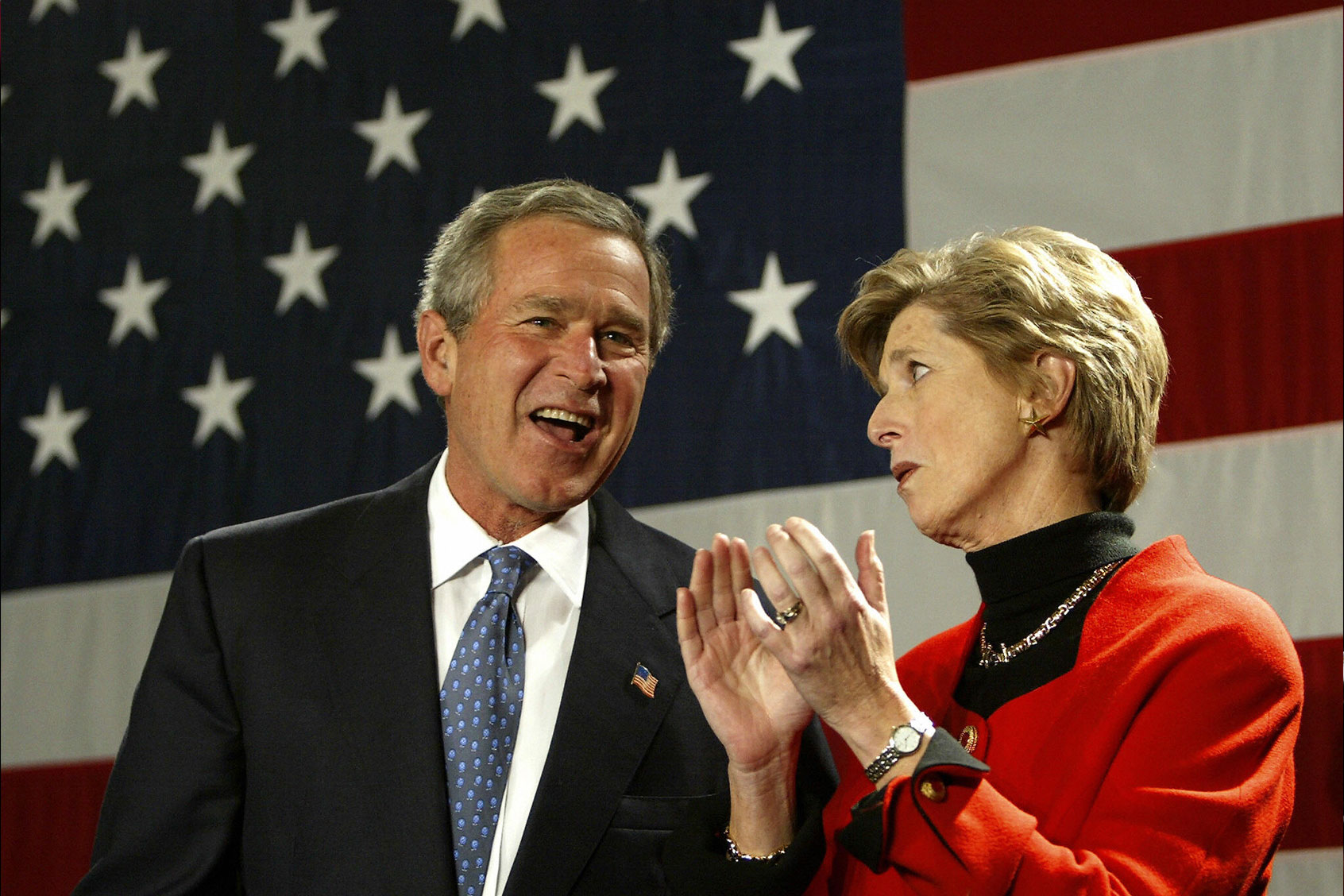
George W Bush; Christine Todd WhitmanUS President George W. Bush is introduced by his former head of the EPA, former New Jersey Governor and current New Jersey State Chair Christine Todd Whitman, during a Bush-Cheney 2004 fundraising reception in Whippany, New Jersey. (PAUL J.RICHARDS/AFP via Getty Images)
Being a moderate included an ability unusual in politicians — namely, to admit to their own mistakes. Whitman did this years after leaving the EPA by apologizing for incorrectly claiming the air around Ground Zero was safe to breathe after the Sept. 11th terrorist attacks. When she departed the EPA, environmentalists criticized Whitman's tenure by alleging she was too pro-business, as well as too willing to delegate powers to the states.

However, criticisms also came from her own party because she did things like follow scientific data. As Whitman told Salon, among individuals like Cheney "there was just a questioning of the science, of how real is this, and aren't we being a little Chicken Little?"

Whitman was adamant about heeding her science advisers' warnings about climate change, who insisted that carbon dioxide emissions were overheating the planet. Whitman's stance on that issue — and, as a consequence, about air pollution overall — is what would ultimately lead to her decision to leave the Bush administration.

"As governor, [Bush] had put a cap on carbon, and it was in his campaign platform," Whitman told Salon. He made it clear from the beginning that he would not take bolder steps, such as joining the Kyoto Protocol, an international treaty limiting greenhouse gas emissions by extending the 1992 United Nations Framework Convention on Climate Change. At the same time, Whitman "made sure with the White House that it was okay to say that, while we weren't endorsing Kyoto, we would be regulating carbon. But when I got back, that was when the pushback happened."

Cheney took a letter up through Capitol Hill that had been composed by senators opposed to regulating carbon emissions. California had been in the throes of widespread brownouts due to an energy crisis when Bush took office in 2000, and continued to grapple with that crisis during his first year in 2001. People worried there would be blackouts. Bush set up an energy task force and assigned Cheney as its chair.

"It was evident from the very beginning that the focus was on the EPA and regulation," Whitman recalled. "They tried to take the Clean Air Act enforcement away from the agency and give it to [the Department of Energy], which obviously I pushed back on, and they did not do it. But [Cheney] was still not a big fan, shall we say, of regulating the energy industry."


Want more health and science stories in your inbox? Subscribe to Salon's weekly newsletter Lab Notes.


"[Cheney] was still not a big fan, shall we say, of regulating the energy industry."

Yet the Cheney-Whitman feud over energy regulation didn't end there. As Whitman explained, it wasn't easy implementing the Clean Air Act to regulate carbon dioxide pollutants because it made an exemption for emissions caused by routine maintenance, repair and replacement for businesses trying to comply with reforms. Under Bush's predecessor, President Bill Clinton, the EPA had "pulled in a lot of the small power companies that had been doing things they thought were the right way. Actually, they had been; it was the big guys who were gaming the system. So we needed to have a definition of what was routine."

Whitman recalled the next two-and-a-half years, going "back and forth on numbers, on what the scientists could come up with that was reasonable, which would capture the bad actors but recognize those small guys that were just repairing or replacing and weren't secretly increasing their output, which is what a lot of the big guys were doing."

Unfortunately for environmental protection efforts, the two sides couldn't come to an agreement and matters eventually reached a climax.

"Finally, the administration handed me a set of numbers and they said, 'This is where we should set it,'" Whitman said. "I went back to the agency and said to our scientists, 'Can you justify this in any way? And they said, 'No.' So I went back to the administration and said, 'Look, this is your policy, your administration, I can't see this regulation and I can't enforce it. So you need somebody there who will.' And that's what happened."

Whitman was replaced by another former Republican governor, Mike Leavitt of Utah, who served for an additional two years.

"The reason I left was over the Clean Air Act and a definition within that, but also I was getting to the point where I was losing more than I was winning, and certainly climate change was one of [those issues]," Whitman said. Her setbacks did more than harm the environment in the immediate sense — they also helped normalize the outright denial of climate science within the mainstream Republican Party.

As University of Pennsylvania climatologist Michael E. Mann previously told Salon, "in terms of like the party's official stance being the rejection of environmental science — climate science, ozone depletion, what have you — that really hit its stride during the George W. Bush years. That is the transition when Dick Cheney and the energy industry took over energy and environmental policy for the George W. Bush presidency. That's where they really veered sharply in the direction" of outright denialism. 

Michael Oppenheimer, a Princeton University professor of geosciences and international affairs, elaborated on the ecological consequences of this denialism.

"From the a point of view on the climates issue alone, it is not only that was there no progress; there was regression," Oppenheimer told Salon, pointing to the spike in carbon dioxide emissions that occurred since the advent of the 21st Century. As long as Bush deferred to Cheney on energy policy, which he did through his entire eight years in office, the pro-science and centrist approach of people like Whitman was subordinated by the belief that environmentalists stood in the way of energy industry profits. The situation did not change until Bush was succeeded by President Barack Obama in 2009. At that point, Obama could appoint EPA leaders who supported regulating carbon dioxide and could fall back on a recent Supreme Court case, 2007's Massachusetts v. EPA, which argued that the EPA was required to regulate greenhouse gases (GHGs) under the Clean Air Act.

"Obama benefited from the Supreme Court having made the decision in Massachusetts v. EPA, which gave the federal government the authority, without even changing a word, within Clean Air Act to control carbon dioxide, initially from motor vehicles and later across the whole economy," Oppenheimer said, adding that both this and subsequent Supreme Court and lower court decisions "validated efforts by California and other states to regulate greenhouse gas emissions as air pollutants and applied that finding first to automobiles, and later to electric power plants and other human made sources. For this and other reasons, particularly the declining price of natural gas, U.S. emissions of CO2 and total GHG emissions peaked in 2007 and began to fall, partly because industry anticipated more state and federal regulation now that CO2 was classified as an air pollutant."

We need your help to stay independent

Yet when President Donald Trump took office, these Obama regulations were either weakened or completely reversed. Now the Biden Administration is in the process of restoring these regulations, in a somewhat different form, Oppenheimer explained, "While at the same time pairing the rules with ample subsidies and tax breaks with the goal of electrification based largely on carbon-free generation."

"Other countries took note, particularly when the U.S. and China signed a bilateral agreement in 2014 with specific emissions targets," he continued. "This helped create the international consensus that developed the Paris Agreement in 2015. Since then, many countries, but not all, have put serious plans to cut GHG emissions in place, even if implementation has been slower than the original intent indicated in those commitments."

In his opinion, Oppenheimer said that without "the state actions to treat CO2 as an air pollutant, the 2007 [Supreme Court] decision, and the subsequent Federal regulations, much of the progress since 2007 on U.S. emissions, and to a lesser extent on turning around the growth of global emissions, would not have occurred."

Death warmed over: Trump vs. Biden is frighteningly predictable

No pleasantries as President Joe Biden and former President Donald Trump skipped a traditional handshake, beginning the debate with a discussion of inflation, as opening statements were not an option.

Hosts Jake Tapper and Dana Bash of CNN went straight into questions, asking Biden what he would say to Americans who felt worse off under his presidency financially, despite rising wages.

“We had an economy that was in free-fall,” Biden said. “It was terrible. What we had to do was try to put things back together again.” 

Biden laid out his plan to build new housing and cut costs for Americans in a second term after overseeing a period of intense inflation, stumbling over his words before allowing Trump a chance to rebut.

“We had the greatest economy in the history of our country. We have never done so well . . . The only jobs he created were for illegal immigrants, and ‘bounceback jobs,'" Trump said of the more than 15 million jobs created during the Biden administration.

Turning the discussion to the national debt, Tapper asked the former president about his plan to add a 10% tariff to consumer goods, with Trump claiming that the move wouldn't raise prices, despite economic data suggesting otherwise. He attacked inflation under Biden instead, despite his inflationary plan.

“We’re like a third-world nation. Between going after his political opponent . . . all of the things he’s done . . . we’ve become like a third-world nation,” Trump said, before attacking millions of immigrants inside the United States.

On abortion, Trump, who appointed three of the justices who ended the right to abortion at a federal level, said that the Supreme Court "approved the abortion bill," referring to an emergency order to block an Idaho law that banned intervention if a mother's life was at risk. But he couldn't answer whether he would bring national abortion protections in the case of "exceptions" like rape or incest.

Trump again parrotted his claim that "everybody wanted" to destroy Roe v. Wade and kick abortion decisions back out to the states.

"Right now, the states control it. That's the vote of the people," Trump said. "I believe in the exceptions for rape, incest, and life of the mother. Some people don't."

Biden volleyed, saying that it was "a terrible thing, what you've done," to gut abortion protections.

"I support Roe v. Wade," Biden said. "If I'm elected, I will restore Roe v. Wade."

Trump responded to this by falsely claiming that his opponent supported ripping a baby out in the ninth month of pregnancy.


Want a daily wrap-up of all the news and commentary Salon has to offer? Subscribe to our morning newsletter, Crash Course.


Asked about immigration, Biden touted an uptick in security at the border during his term but emphasized that he wanted to push for more border patrol.

"I really don't know what he said at the end of that sentence," Trump said, ripping into Biden's stumble over his words. He went on to champion the "safest border in American history" at the end of his term, before claiming that "people are dying."

Pressed on his domestic deportation squad proposal, Trump dodged the question and instead brought up a purported crime uptick related to immigration. 

"They're killing our citizens at a level that we've never seen before," Trump said. "We have to get them out fast, because they're destroying our country."

Never answering the question, Trump, who previously publicly disrespected war heroes like John McCain for their service, then slammed Biden as "anti-military."

"My son was not a loser or a sucker," Biden said. "You're the sucker."

Trump rebuffed the claim that he called veterans suckers and losers.

Asked about Russia's invasion of Ukraine, Trump claimed that Biden was responsible for many deaths.

"Our veterans and soldiers can't stand this guy," Trump said of his opponent.

Trump also claimed that the Hamas attack on Israel wouldn't have happened under his leadership, a claim to which Biden rebutted, "I've never heard so much malarkey in my life."

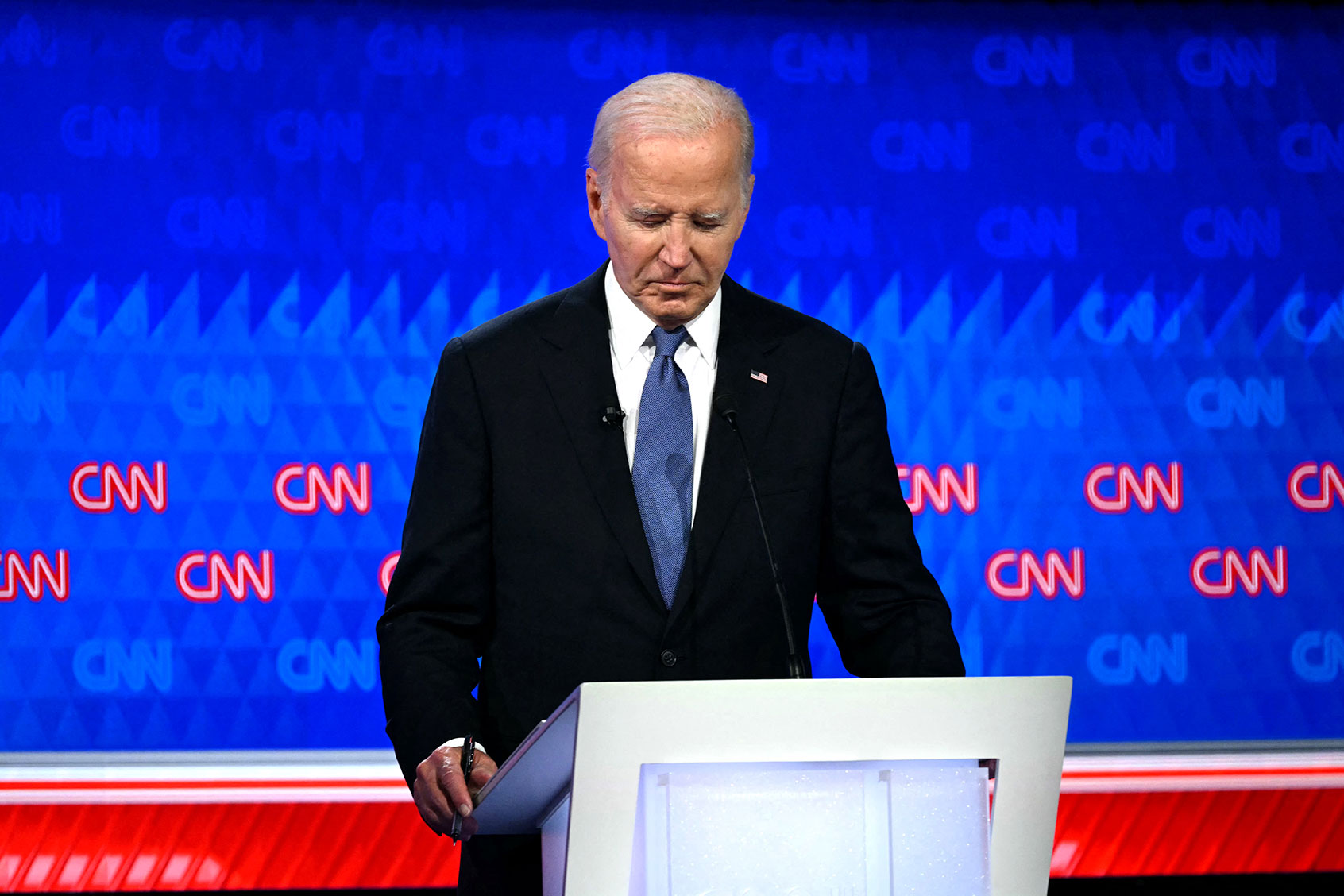
Joe BidenUS President Joe Biden looks down as he participates in the first presidential debate of the 2024 elections with former US President and Republican presidential candidate Donald Trump at CNN's studios in Atlanta, Georgia, on June 27, 2024. (ANDREW CABALLERO-REYNOLDS/AFP via Getty Images)On the humanitarian crisis in Gaza created by Israel's war effort, Biden outlined his three-phase solution to end the conflict, blaming Hamas for the continued killings.
"I'm the guy that organized the world against Iran," Biden said. "We saved Israel. We are the biggest producer of support for Israel of anyone in the world."

Trump repeated his proclamation that the U.S. should "let them [Israel] finish the job," rather than endorse a ceasefire plan of his own.

On his criminal conviction, Trump was unflinching and defiant on the verdict issued by a Manhattan jury.

“When he talks about ‘convicted felon,’ his son is a convicted felon,” Trump said. “This man is a criminal. You’re lucky. I did nothing wrong. We have a system that is rigged.”

“The idea that you have the ability to seek retribution against every American just because you are president is wrong,” Biden said, blasting reports that Trump would seek "retribution" against political opponents before bringing up Trump's reported moral deficiencies and pattern of sexual abuse.

“You have the morals of an alley cat,” Biden said, bringing up Trump’s sexual assault of E Jean Carroll and relationship with porn actress Stormy Daniels.

“The public knows it's a scam,” Trump said, accusing Biden of political weaponization of the justice system.

Biden responded, reminding voters of the reason he gave ahead of the 2020 election for his decision to run.

Trump smugly shook his head and grinned as Biden detailed the political violence of white supremacists in Charlottesville, Virginia, and later said he “made up” the story of his decision to run for president.

“It’s a nonsense story. He knows that,” Trump said.

Asked what he would do to combat the opioid crisis, Trump dodged another answer, instead claiming that Biden was “paid by China.”

Re-directed by Tapper, Trump instead discussed the border and supposed drug trafficking, rather than addiction.

In response, Biden brought up aspects of his bipartisan infrastructure deal, which was killed by House and Senate Republicans at the behest of Trump, which would’ve scanned more fentanyl moving across the border

Asked about the crucial age issue, Biden recalled charges at the beginning of his career that he was too young, and asked that voters focus instead on the pair’s record.

“Look at the record. Look at what I’ve done,” Biden asked of voters. “The idea that, somehow, we are this failing country, I’ve never heard a president talk like this before.”

Trump, 78, brought up his cognitive test results — and his golf accolades — in response to questions about his own age.

“I'm in as good a shape as I was 20, 25 years ago,” Trump said.

But Biden’s age was unavoidable, with reactions pouring in on the president’s signs of age on the debate stage. 

Political commentator Chris Cillizza reacted, like many, to Biden’s verbal trips and meanders.

“It’s hard to imagine this debate starting worse for Biden,” the CNN alum wrote on X.

Equally hard to avoid was Donald Trump’s record of election denial.

Trump refused to accept the results of the 2024 election, citing debunked reports of fraud in the 2020 race again.

“You continue to promote this lie,” Biden rebutted.  “There’s no evidence of that at all . . . you’re such a whiner.”

After a brutal 90 minutes, the duo headed into closing statements, with Biden going first.

“We’ve made significant progress from the debacle that was left by President Trump in his last term,” Biden said.

Going toe-to-toe on policy proposals, Biden touted his economic record and blasted his opponent’s plans. 

“He now wants to tax you more by putting a 10% tariff on everything that comes into the United States,” he said, repeating his proposals on childcare, lead pipe removal and tax relief for lower-income families.

“We got it down to, $15, excuse me, $35 for insulin, instead of $400. No more than $2,000 for every senior no matter the prescription they need.

“He doesn’t do anything. All he does is make our country unsafe by allowing millions and millions of people to pour in,” Trump shot back.

“We have the Palestinians and we have everybody else rioting all over the place,” Trump said of peaceful protests against the Israeli bombing of Gaza. “You talk about Charlottesville? This is 100 times Charlottesville. 1000 times.”

While a white supremacist terrorist killed one in the Charlottesville march, nobody has died as a result of pro-Palestinian demonstrations in the United States.

“They don’t respect you,” Trump said.

Trump championed the tax and regulation cuts he pushed in office, before concluding, saying: “We’re in a failing nation, but it’s not going to be failing anymore.”

Melania absent from debate, as Jill Biden takes central campaign role

Former First Lady Melania Trump is not attending the presidential debate against President Joe Biden, further signaling the distance between her and her husband’s campaign, as she opts to stay out of the public eye.

Melania — who was absent for the entirety of her husband’s criminal trial — has made scant public appearances, and even fewer alongside her husband, since he won a primary race to become the Republican nominee for president.

In a pattern of keeping answers on his wife’s absence short, Donald Trump told Fox and Friends earlier in June that “she’s fine.” 

“I think it’s very tough on her, but she’s fine,” he said, referring to his criminal conviction days earlier.

Melania was reportedly not very fond of her time as First Lady, during which she half-heartedly promoted anti-bullying initiatives and begrudgingly kept up White House traditions, like putting up its Christmas decorations.

Donald Trump, who has apparently lost the public support of his wife and daughter Ivanka since his last term, is struggling to make inroads with women voters, who supported Biden over Trump by more than an 11-point margin in 2020.

His appointment of Supreme Court justices who overturned Roe v. Wade, and his support of restrictive national and local abortion bans, have been especially salient attack angles from the Biden campaign.

First Lady Jill Biden, present in Atlanta, has played a central role in her husband's campaign.

“I know Joe is ready to go,” the First Lady told a group of the president’s supporters in Virginia earlier in the day, starkly contrasting Melania’s absence in the Trump campaign.

Uvalde cops, who stood idle as 21 died, charged with child endangerment

Families could get some justice now that criminal charges have been brought against a pair of Uvalde shooting responders who took over an hour to jump into action.

The police chief of a Uvalde, Texas, school district and an officer who worked at Robb Elementary School have been charged by a Texas grand jury with abandonment and child endangerment after their botched response to a mass shooting at an elementary school left over 20 dead.

Uvalde Consolidated Independent School District Police Chief Pete Arredondo and Robb Elementary school resource officer Adrian Gonzales were charged on Thursday, Uvalde District Attorney Christina Mitchell told Uvalde Leader-News, who expected Arredondo to surrender later that day.

The shooting, which devastated the Texas community, killed 19 children and 2 teachers as law enforcement took more than 77 minutes to enter the building where a gunman unloaded an AR-15.

The indictments come despite a controversial city finding that cleared officers of wrongdoing in March, which found that officers acted in “good faith,” contrary to federal and state analyses. 

After civil charges against the city came to an end in May, with families settling for a $2 million payout and agreeing to turn their efforts to more responsible parties, officials went after the responsible officers, while a legal rep for the victims' families said they would pursue the Texas Department of Public Safety for its role.

A January Department of Justice report that attributed several deaths to a lack of urgency from law enforcement detailed the “cascading failures of leadership, decision-making, tactics, policy, and training” within the department, as well as individual failures in judgment.

Donald Trump’s niece to campaign for Biden

Donald Trump’s niece, Mary Trump, will join the Biden campaign in the “spin room” after the Atlanta presidential debate, doubling down on her sharp criticism of her uncle.

The "Too Much and Never Enough" author, who made waves with her scathing condemnation of her uncle during the 2020 election cycle, was tapped by the Biden campaign to speak out against the former president.

“For my whole life I have witnessed my uncle’s narcissism and cruelty,” Mary Trump said in a statement, per USA Today. “His sense of inferiority has always driven his jealousy and his pathological need to dominate others, and this is information that is crucially important for the American people to have in advance of the most important election of our lifetimes.” 

Trump's niece, who made an appearance on CNN hours ahead of the debate to tease her spin room spot, speaks candidly of her uncle beyond a partisan level, recalling personal and familial memories that she says outline the character that makes him unfit for office. 

“I’m in Atlanta tonight to remind everyone who Donald is as a person and how he would rule as a president because the stakes are far too high for us to get this wrong,” she said.

Mary Trump joins Rep. Jasmine Crockett of Texas, Rep. Robert Garcia and Gov. Gavin Newsom of California, and Georgia Sen. Raphael Warnock as the Biden surrogate team tasked with unpacking the president’s debate performance to media outlets immediately after the event.

Speaking as a psychologist, she previously begged supporters of the then-president to keep him out of office for not just the sake of the nation, but his own.

“If you really care about this person, the last place you would want him to be is in the Oval Office, because it's having a serious adverse effect on him, on his mental stability and on his physical health," she told Salon in 2020.

Ahead of a Biden-Trump rematch, her advice to voters remains constant: don’t vote for my uncle.

“We cannot afford to allow Donald Trump anywhere near the levers of power again,” Mary Trump added in the statement.

What to expect in the first presidential debate of 2024

As Donald Trump and Joe Biden sit in a deadlock in polls of the 2024 election, millions of Americans are preparing to watch the first debate ahead of the November contest.

Most Americans plan on watching the televised debate, per an AP-NORC poll, with half of voters viewing the event as important to the candidates’ chances.

The June debate is the earliest in an election cycle that one has come in recent memory, typically falling in the six weeks leading up to the election. 

The candidates, each a rounding error from 80 years old, have battled age in the court of public opinion, with Biden’s being a central messaging point for the Trump campaign. But Trump’s recent gaffes, moments of brain fog, and misremembrances are closing a gap in Americans’ perception of the candidates’ mental acuity. 

When the camps agreed back in May, some novel rules — such as the absence of a studio audience, muting microphones, and no opening statements — drew attention. Though the Trump campaign agreed in mere hours to the CNN-hosted discussion, surrogates spent the week ripping moderators Jake Tapper and Dana Bash apart and complaining of a rigged conversation ahead of time.

The Biden campaign spent the week deep in preparation mode, with the president escaping to Camp David to spar with his lawyer, Bob Bauer, who sat in for Trump.

The debate, the first time the two candidates have squared off since an October 2020 showdown in which Trump had COVID, will be an opportunity for the candidates to share their vision for the next four years, or, more likely, examine the pair’s records as president.

Expect Trump to launch attacks on Biden's administration policy, such as the president’s handling of an influx of immigrant arrivals at the U.S.-Mexico border, an inflation crisis that pushed Biden’s early-term approval downward, and conflicts in the Middle East.

But Trump typically uses the debate stage to battle imaginary foes, as well. Expect barbs at his criminal conviction in New York by 12 Manhattan jurors, which Trump has lambasted as political persecution, and attacks against the previous election’s integrity, despite the former president’s hot-mic admission that he lost.

Biden, whose campaign has made democracy a key issue after Trump’s efforts to subvert the results of the 2020 election and subsequent attacks on the legitimacy of American elections, is likely to push his opponent on his conspiracy theories and rebuke his support of political violence as his opponent battles January 6 criminal charges.

Trump, who took the morning to whine about “Biden people” appearing on Fox News, joins just a handful of candidates in U.S. history to vie for a rematch after losing the 2020 election.

Tune in to the first general presidential debate of 2024 at 9 p.m. Eastern time.

“The Bachelor” producers admit failing Black leads but plan to rectify issues for “The Bachelorette”

In a twist of events, "The Bachelor" franchise's producers are taking accountability for how the flagship ABC dating reality television show has handed racism that former contestants and leads have faced in the past.

Executive producer Claire Freeland said in an interview with the Los Angeles Times published Wednesday, “It’s hard to say out loud, that people of color didn’t see themselves represented, that they did not see ‘The Bachelor’ franchise as a safe place.” 

Freeland added, “[The franchise] didn’t have a Black lead in this franchise for 15 years, and that’s inexcusable. It created a vicious cycle, and it’s taken a lot of work to get back to a place where we feel at least we’re working for the positive.”

"The Bachelor's" glaring diversity and race issues came to a head in 2020 after casting the first Black Bachelor in Matt James. During the season, photo of front-runner Rachel Kirkconnell leaked, showing that in 2018 she had participated in an antebellum-themed party, which many saw as glorifying the period of slavery in the South. The backlash was swift. Then long-time host Chris Harrison was interviewed by "Extra" reporter and former Bachelorette Rachel Lindsay about the photo, in which his response was criticized as minimizing its racist implications. Harrison was then later fired.

Despite the franchise's missteps in 2020, producers had continually insisted it had evolved. But that was called into question earlier this year when at the Television Critics Association press tour, NPR TV critic Eric Deggans asked the franchise’s bosses, “Why does the show find it so difficult to handle race issues?” 

Freeland attempted to answer by addressing where the franchise is now instead of the past. But Deggans pressed, “That doesn’t really answer the question. Why has ‘The Bachelor’ struggled to deal with race, particularly when Black people are the stars of the show?”

Freeland, Bennett Graebner and Jason Ehrlich did not answer his follow-up question. Deggans responded, “I guess we have our answer.”

“I’m going to be really frank — we let Matt down,” Graebner said in the LA Times story. “That season went wrong on so many levels. We did not protect him as we should have. The finale of that season was the darkest day I’ve had on this franchise. Here was this great Black man, and we should have been celebrating his love story. Instead, what we saw was a man burdened and overwhelmed by issues of racism. It was really sad for me personally.”

The producers have said that it is a “priority” to cast a Black Bachelor again. While they did not share specific details and whether the issues during James' season would be rectified, LA Times reported.

Graebner continued that production “didn’t have the same resources then that we have now.”

We need your help to stay independent

As a new season of "The Bachelorette" will premiere on July 8, the franchise welcomes its first Asian-American lead in Jenn Tran, a Vietnamese-American woman. Already, producers are hoping to head off the problems that they faced with Matt James' season. Two licensed therapists are on set, and one is a therapist of color. They've also stated that they have hired a diversity and inclusion consultant who is available to producers and cast members.

However, despite the historic casting, there has been a lack of Asian-Americans in Tran's cast of suitors. Producers acknowledged the lack of Asian representation in the franchise. 

“That’s on us. We didn’t do what we needed to do. Our hope is that they will see Jenn and realize this is a safe space. We’re not saying it will solve and fix everything. But it is a step,” Freeland said.

This season Freeland said Tran doesn't shy away from discussing pressing issues the show usually avoids: race and faith. “We had extensive discussions with Jenn prior to filming. She is proud of her Vietnamese culture, and she wanted to know if she could speak about that. We told her we wanted her to be her most authentic self.”

“Yoko hugged me”: Rosanna Arquette recalls how the Beatles were a big part of her growing up

Actor, activist and filmmaker Rosanna Arquette joined host Kenneth Womack to talk about her Bohemian upbringing, favorite Beatles song, friendship with Paul McCartney and much more on “Everything Fab Four,” a podcast co-produced by me and Womack (a music scholar who also writes about pop music for Salon) and distributed by Salon.

Arquette, known for such films as “Pulp Fiction,” “After Hours” and “Desperately Seeking Susan,” is a member of the famous show business family sharing the same name (along with siblings Richmond, Patricia, Alexis and David). As she told Womack, they were brought up by a “poet and actress” mother and “actor and musician” father. “We lived a very unconventional life,” she said. “Abbie Hoffman once slept on our living room floor.” She even met Dr. Martin Luther King when she was only six years old, since her mother was also a social activist.

Their family moved around the U.S. a lot when Arquette was young, including spending time on a commune, but the one constant was music. “Music was always, always around,” she explained. “We had a lot of musician friends, and I always gravitated to people in music. They made me feel safe. And the Beatles were for sure a big part of that. Even at five I would sit and listen to ‘Sgt. Pepper.’ At nine it was ‘Revolver.’ The Beatles were just a big part of me growing up.”

LISTEN: 

That love of music would eventually lead Arquette to film backstage interviews at the long-running Coachella Festival, where she “talked to everybody. I talked to Sir Paul. No one said no.” She counts McCartney and his family among her friends, as well as a few members of John Lennon’s, too. “Yoko [Ono] and Sean are in my ‘All We are Saying’ documentary . . . I actually met her and John when I was a child in New York City. Yoko hugged me and said sweetly, ‘Have a nice life.’ I never forgot that.” On a more somber note, Arquette also never forgot where she was when she heard of Lennon’s death. “I was in LA at a restaurant called Figaro’s. I got on a red-eye and flew to New York and stood in front of that building for the 10 minutes of silence.”

Currently, Arquette is still busy acting, directing and producing, and her passion for her family and social justice burns as brightly as ever – as does her love for the music she grew up with. “It was much more poetic,” she said. “The lyrics meant something. Paul – even though he was part of that era – he appreciates the young bands and the young artists coming up, he enjoys shepherding people. The next generations, that’s really what it’s all about.”

Listen to the entire conversation with Rosanna Arquette on “Everything Fab Four” and subscribe via Spotify, Apple, Google or wherever you’re listening.

“Everything Fab Four” is distributed by Salon. Host Kenneth Womack is the author of a two-volume biography on Beatles producer George Martin and the bestselling books "Solid State: The Story of Abbey Road and the End of the Beatles” and “John Lennon, 1980: The Last Days in the Life.” His latest book is the authorized biography of Beatles road manager Mal Evans, “Living the Beatles Legend,” out now.

“Enormous implications”: Legal experts say Alito’s abortion dissent signals a “gathering storm”

Supreme Court Justice Samuel Alito’s dissent in a Thursday ruling on an Idaho lawsuit over a federal emergency medical treatment law opens the door to more attacks on abortion access as well as Congress’ own spending power, legal experts say.

In a dissent authored by Alito and joined by Justices Clarence Thomas and Neil Gorsuch, the conservative justices argued that the Emergency Medical Treatment and Active Labor Act (EMTALA) requires hospitals participating in Medicare to “stabilize both ‘the woman’ and ‘her unborn child.’”

The dissent also focused on another key aspect of how the federal government has enforced its policies nationwide: relying on the Constitution's Spending Clause to justify its authority to attach conditions to federal grants.

In a separate concurrence, Justice Amy Coney Barrett said that lower courts should address the Spending Clause issue. She wrote that the Idaho petitioners "raised a difficult and consequential argument" about whether Congress can "obligate recipients of federal funds to violate state criminal law." 

"To me, that's a gathering storm," New York University Law professor Melissa Murray told Salon.

Following the overturn of Roe v. Wade in June 2022, the Biden administration sent guidance to hospitals nationwide reminding them of their obligation to offer stabilizing care, including medically necessary abortions, under EMTALA.

The Supreme Court’s one-line order Thursday allowed Idaho to continue prohibiting abortions except to prevent a pregnant patient’s death – even though the federal government argued EMTALA preempted Idaho’s law and requires Medicare-funded hospital care to provide essential emergency care. The court said it had “improperly granted” its decision to review the Ninth Court’s decision agreeing with the U.S. government before the appeal went through the U.S. Court of Appeals.

Meanwhile, in the much more populous Texas, a federal appeals court in January allowed the state to ban emergency life-saving abortions despite EMTALA.

Alito’s dissent represented a “complete disparagement of concern for women’s health, for pregnant patients’ health," said Maya Manian, professor of law at American University Washington College of Law.

She pointed to a sentence where he put quotations around the phrase the “‘health’ of a pregnant woman.”

She said the quotations made it seem as if health is “sort of a phony concern.”

Alito defended Idaho’s law – which only allows abortions to prevent the death of the pregnant patient – by arguing that that law does not “require that the risk of death be particularly immediate.”

Manian said Alito is arguing that pregnant people’s lives should be left up to the states: “It's really striking the emphasis on protecting the unborn child and the deemphasis of the pregnant patients.”

Nicole Huberfeld, a Boston University School of Law professor and co-director of the BU Program on Reproductive Justice, said Alito was “grasping at straws” in the dissent.

“Justice Alito’s dissent is his own version of EMTALA that has nothing to do with law's actual history or meaning,” Huberfeld said.

EMTALA, signed by Reagan in 1986, took aim at the practice of patient dumping – when hospitals dump patients who are Black, who can’t pay or are “undesirable” in some other way, according to Huberfeld. 

“The idea was, if you take Medicare funding as a hospital and you have an emergency room, then you can't turn people away, no matter who they are, no matter what state you sit in,” Huberfeld said. “Congress enacted this law because there were so many egregious examples of hospitals dumping patients.”

Huberfeld said that hospitals would turn away patients in labor: “And either the pregnant person or the fetus died, or both.”

Hospitals “would say: ‘Well, it’s a danger to the fetus, that’s not necessarily a danger to the pregnant person,’” Huberfeld said.

She said Congress amended the law to ensure hospitals counted labor as a medical emergency.

“It had nothing to do with whether or not an abortion might be necessary to address a medical emergency,” Huberfeld said. “In fact, it didn't need to be, because at the time, abortion was constitutionally protected.”

She said Congress left the decision about what an appropriate treatment would be for a medical emergency to the treating healthcare provider. 

“And it did so because there's no way Congress could possibly enumerate all of the instances of what would be necessary for any given medical emergency,” she said. 

We need your help to stay independent

EMTALA defines an appropriate transfer to a medical facility as in which “the transferring hospital provides the medical treatment within its capacity which minimizes the risks to the individual’s health and, in the case of a woman in labor, the health of the unborn child.”

The law also allows transfers in certain cases where a physician certifies that “the medical benefits reasonably expected from the provision of appropriate medical treatment at another medical facility outweigh the increased risks to the individual and, in the case of labor, to the unborn child.”

And it defines an emergency medical condition as one that places the “health of the individual (or, with respect to a pregnant woman, the health of the woman or her unborn child) in serious jeopardy.”

In the dissent, Alito argues that those definitions mean that EMTALA “obligates Medicare-funded hospitals to treat, not abort, an ‘unborn child.’”

He said the law doesn’t mention abortion: “Just the opposite is true: EMTALA requires the hospital at every stage to protect an ‘unborn child’ from harm.”

In footnote 3, Alito also cites the little-known Dictionary Act – a part of the federal code that provides definitions for laws.

In 2002, Congress passed the Born-Alive Infants Protection Act, which amended the Dictionary Act to define “the words ‘person’, ‘human being’, ‘child’, and ‘individual’, shall include every infant member of the species homo sapiens who is born alive at any stage of development.”

That bill also tweaked the federal code to state that the definition of an individual can’t be used to deny “any legal status or right applicable to any member of the species homo sapiens at any point prior to being ‘born alive.’”

The government cited the Dictionary Act’s definition of an individual in filings last year, arguing that EMTALA “carefully distinguishes between ‘the individual’ (denoting the ‘pregnant woman’) and her ‘unborn child.’”

“Accordingly, in the context of emergency medical conditions arising during a pregnancy, the individual to whom EMTALA creates obligations — and allows to choose whether to proceed with treatment – is the pregnant woman,” wrote Solicitor General Elizabeth Prelogar in a November 2023 filing.

In the footnote of his dissent, Alito pointed to the Dictionary Act’s “prior to being born alive” language.

“Thus, the Act itself provides no support for the government’s position,” Alito wrote. 


Want a daily wrap-up of all the news and commentary Salon has to offer? Subscribe to our morning newsletter, Crash Course.


Legal experts said Alito’s reading of the federal law is incorrect and runs counter to its text, legislative history and context.

They said there's no evidence that EMTALA was enacted or amended to prevent abortions.

“The originalism of Congress' intent was that women should not suffer during their pregnancies, that women should be stabilized if they were in a crisis associated with their labor,” said Michele Bratcher Goodwin, Georgetown professor of constitutional law and global health policy. “And it was enacted at a time in which abortion was lawful as a broad federal matter.”

Murray said the idea behind EMTALA was to protect pregnant people who required care for both themselves and a viable fetus. 

“It wasn't an effort to try and entirely take off the table the idea that stabilizing care might include an abortion in a case of miscarriage or pregnancy that was no longer viable,” she said.

Manian said EMTALA also addresses pre-viability — "when there's no chance of saving a fetus in that case, and you're just trying to protect the pregnant patient's health."

Manian and Huberheld also said Alito’s dissent and reading of EMTALA is the latest example of his raising the pro-life movement’s arguments for fetal personhood.

Huberfeld said Alito was using “social movement language” about the unborn that’s detached from the actual history of EMTALA.

“He's trying to find ways to articulate why he thinks an unborn child as he puts it, or a ‘baby’ as he also puts it should be prioritized over the life of the patient,” she said.

The anti-abortion rights movement for decades has advocated for fetal personhood and for the Supreme Court to define a fetus as a human being. Alito raised concern about the "unborn child" in oral arguments over the EMTALA case earlier this year.

Murray said the Supreme Court ruling overturning Roe, Dobbs v. Jackson Women's Health Organization, had “lots of Easter eggs that sort of gesture toward the idea that fetal personhood is on the table and or should be on the table.”

Goodwin said Thomas laid “seeds in the soil” for years in his dissents hoping they would blossom into the Dobbs ruling.

And she said Alito’s dissent could have a similar impact down the line.

“What these justices have done in these cases, where even if there's not the reach of a substantive decision … has nonetheless been a kind of signaling to parties that might take up the kinds of arguments that they are laying out,” Goodwin said. “It’s likely that there may potentially be some sympathy to the kind of argument or the framework making its way through a legislative system or through a judicial system, where the justices recognize their own arguments and are more amenable to their very own arguments.”

Alito and conservative justices have long pushed the idea of fetal personhood – dating back to the Hobby Lobby case that allowed privately-held companies to deny contraception coverage to employees with a religious exemption, according to Goodwin.

“Justice Alito, dating back to the Burwell v. Hobby Lobby case, has been in many ways bleeding into American jurisprudence that which seems to be clearly a part of what is his personal life, because it’s certainly not deeply rooted in American Constitutionalism,” she said.

Goodwin said Alito and other justices have “contorted” themselves to insert their own private beliefs into jurisprudence.

“It's not actually based on the kinds of methodologies that the court has typically aligned itself, or the kind of rule of law practice that has been revered for centuries with the court,” Goodwin said. “But instead it becomes a kind of chaotic mismatch in order to do what some would argue is outcome determinative jurisprudence.. To look at what the outcome should be based on his ideological or partisan views, and then backfilling the opinions in ways that seem far less credible because of what they ignore.” 

Goodwin noted that in Dobbs, Alito failed to mention the nation’s relatively high rates of maternal mortality – instead only mentioning maternal mortality rates at the time of Roe.

“That’s an inconvenient fact, so Justice Alito doesn’t mention it,” she said.

Huberfeld also drew attention to Alito’s arguments against how Congress for decades has structured our healthcare laws by using its spending power to attach conditions to the receipt of federal funds. 

Alito wrote that such conditions “must be ambiguous” under Supreme Court precedent.

“And in any event, Idaho never consented to any conditions imposed by EMTALA and certainly did not surrender control of the practice of medicine and the regulation of abortions within its territory,” he wrote. 

Huberfeld said such arguments could have wide-ranging impacts on programs from Medicare, to Medicaid, to the Children’s Health Insurance Program.

“There are arguments being made that when Congress uses its spending power to enact a law that states don't necessarily have to pay attention to that, that their laws are not preempted by spending power laws,” she said. “Justice Barrett's concurrence is open to that argument, and Justice Alito’s dissent is open to this argument. So there are six justices who are open to this idea.”

Murray said there's a broader skepticism about Congress' authority on the court, which she said has narrowed how Congress can use the Commerce Clause.

"As the Court has sort of narrowed Congress's ability to enact legislation under more traditional vehicles like the Commerce Clause or section five of the 14th Amendment, there's really been an over reliance on the spending plan and conditioning federal grants to the states as a means of affecting certain policy outcomes," Murray said. "Now I think the court is sort of saying, 'Okay, well, how can we limit that too?'"

"I think it'll come up again and in other context, not just abortion," Murray said. "I think that's a broader issue about this sort of power play between the political branches and the court is arrogating authority to itself."

Huberfeld said that Alito, Gorsuch and Thomas’ dissent invite more litigation for advocates to try to limit Congress’ spending power. 

“And that has enormous implications for how most social programs work in the United States,” she said.

Legal experts told Salon that the court should have used Thursday’s ruling to hold that EMTALA preempts any conflicting state laws.

“There are just punts until after the election,” Manian said. “And we know who's going to benefit by punting on these cases, especially if the court ultimately holds against those challenges seeking to protect the party seeking to protect abortion rights.”

Murray pointed out that both Justice Alito and Justice Ketanji Brown Jackson noted that the court's Thursday decision "was really about political expediency and not wanting to make a decision on this question at a time when it would be politically inconvenient or would make abortion a bigger issue in electoral politics."

Emma Roberts says young women have it harder in “nepo baby” discourse

Emma Roberts thinks the “nepo baby” charge isn’t quite fair to young women in the industry.

The “American Horror Story” star weighed in on the term during Bruce Bazzi’s “Table for Two” podcast on Tuesday, lending her unique perspective to the subject of entertainers who benefit from family members’ fame. 

“People like to say, ‘Oh, you know, you have a leg up because you have family in the industry,’” Roberts said of charges that “nepo babies” have it easier. “But then the other side to that is, you know, you have to prove yourself more . . . If people don’t have a good experience, maybe, with other people in your family, then you’ll never get a chance.”

Roberts, the daughter of actor Eric Roberts and the niece of “Pretty Woman” star Julia Roberts, got her acting debut at nine years old alongside A-listers Johnny Depp and Penelope Cruz in “Blow,” and has hardly had trouble breaking into the industry, but she argues that her path isn’t the story audiences crave.

“Everybody loves the kind of overnight success story, and if you're not the girl from the middle of nowhere that broke into Hollywood, you know, there's kind of an eye roll,” Roberts shared.

The actress went on to ask why stars like George Clooney, nephew of 50s superstar Rosemary Clooney, seemingly get a pass on their family connections.

“The point is, young girls, I feel like, get it harder with . . . everything with the with the nepo baby thing,” she told Bazzi. “I don't really see people calling out you know, sons of a famous actress. Not that they should be called out. I don't think anyone should be called out wanting to follow their dreams.”

Roberts also noted that the label flattens the behind-the-scenes rejections actresses face.

“People only see your wins because they only see when you’re on the poster of a movie. They don’t see all the rejection along the way,” she told Bazzi.

Roberts is far from the first star to call out the label: Gwenyth Paltrow, daughter of Blythe Danner and goddaughter of filmmaker Steven Spielberg, once argued that entertainers get more undue scrutiny for following in the footsteps of their parents than other professionals.


“Ridiculous”: Judge Cannon accepts Trump lawyers’ request for attorney-client privilege hearing

Judge Aileen Cannon on Thursday granted Donald Trump's lawyers a hearing on attorney-client privilege, further delaying the former president's classified documents case. This is true to form for the Trump-appointed judge, who has been criticized for entertaining even the most frivolous requests from Trump's legal team and playing into his strategy to hold off a trial until after the election.

This time Trump's lawyers requested a hearing over whether prosecutors improperly breached attorney-client privilege when they obtained evidence from Trump's ex-lawyers, part of a larger effort to suppress evidence that could incriminate their client. While defense lawyers are normally shielded from testifying about conversations with their client, the crime-fraud exception holds that they can be compelled to do so if prosecutors show that their legal services abetted a crime.

Beryl Howell, then-chief judge of thee U.S. District Court for the District of Columbia, agreed with special counsel Jack Smith that the exception applied, ordering testimony from two of Trump's lawyers and directing another attorney, Evan Corcoran, to surrender audio files containing notes about conversations he had with Trump. Smith's team has relied on those recordings to help pin Trump on charges of obstructing federal investigators; if Cannon sides with Trump's lawyers, that evidence could be dismissed.

The fact that Cannon granted a hearing at all, despite the exception already being upheld by a federal judge, dismays prosecutors and legal experts.

"The decision to hold an evidentiary hearing after a hearing on legal arguments? Hard to see that as anything other than sheer delay," Joyce Vance, a former U.S. prosecutor, posted on X. "Ridiculous."

At the same time, Cannon denied a request by Trump's lawyers to obtain a so-called Franks hearing, in which they could try to show that the search of Trump's Mar-a-Lago resort was based on allegedly false information from the Justice Department. Cannon ruled that none of the alleged misinformation or omissions by the Justice Department had any bearing on whether federal agents had grounds to search the property.

That at least was a sound call, Vance argued. The standard for such a hearing is very high and "Trump wasn't close," she said.

“Why does Fox News put on so many Biden people?”: Trump rants on Truth Social ahead of debate

Former President Donald Trump has spent some of his last few hours before the first debate of 2024 by complaining about his opponent's coverage on Fox News.

Tonight's debate — scheduled at 9 p.m. EST and airing from CNN's Atlanta studios — seems to be far from the forefront of Trump’s mind as he spent the morning expressing his deep discontent at the conservative media outlet. In an all-caps post on his website, Truth Social, the former president blasted anchor Dana Perino.

Perino's sin was interviewing Michael Tyler, the communication director for President Joe Biden’s reelection campaign. Perino did not lob any soft balls, at one point rejecting Tyler’s claim that Trump was personally responsible for the economic damage caused by COVID-19, asking: “Would President Biden have kept businesses open during the pandemic?”

Trump didn’t seem to notice, taking offense at Tyler receiving a platform in the first place. 

“WHY DOES FOXNEWS PUT ON SO MANY BIDEN PEOPLE, LIKE MICHAEL TYLER, COMMUNICATIONS DIRECTOR FOR BIDEN, WHO SPEWED LIES WITH VERY LITTLE PUSHBACK?” he wrote. “AMAZING!!!”

Perhaps what Trump took offense to was Perino's manners. “You represent your boss very well and make a good case," she told Tyler.

As for Trump, the former president spent the rest of his morning raging about his competition: “JOE BIDEN IS A THREAT TO DEMOCRACY, AND A THREAT TO THE SURVIVAL AND EXISTENCE OF OUR COUNTRY ITSELF!!!”

Marilyn Monroe’s home is named a cultural landmark and saved from being razed

Marilyn Monroe's home has been saved from destruction, formally reversing a permit obtained by the current owners of 12305 West 5th Helena Drive in Brentwood, Calif., to have the home demolished. 

Monroe, star of films such as "Gentlemen Prefer Blondes," (1953), "The Seven Year Itch," (1955) and "Some Like It Hot" (1959), was living at the Los Angeles home at the time of her death by barbiturate overdose in 1962. She had purchased it that same year for $75,000.

The L.A. City Council voted unanimously on Wednesday to designate the home as a historic cultural monument. Shortly after owners Glory of the Snow Trust were issued the permit in September, the council temporarily suspended the demolition. “We have an opportunity to do something today that should’ve been done 60 years ago," said Councilwoman Traci Park in a speech made ahead of the vote, per the Los Angeles Times. "There’s no other person or place in the city of Los Angeles as iconic as Marilyn Monroe and her Brentwood home.

“To lose this piece of history, the only home that Monroe ever owned, would be a devastating blow for historic preservation and for a city where less than 3% of historic designations are associated with women’s heritage,” she added. 


“I’m sad for Milwaukee”: Local business owners complain that the upcoming RNC is already “a failure”

Milwaukee has accomplished something rare: winning bids to host a major party convention during two presidential elections in a row. In 2020, they were supposed to host the Democratic National Convention, but the outbreak of COVID-19 scotched the event. Now, in 2024, Milwaukee residents are worried that the Republican National Convention, set to take place from July 15 to 18, will also be a disappointment, according to The Recombobulation Arena, a Milwaukee-based online publication.

Cities typically clamor for the privilege of hosting a party's convention, anticipating that the incoming crowd of politicos and journalists will have a positive economic impact. One Milwaukee-based business owner earlier posited that the RNC could infuse $200 million into the city's economy, a claim later touted by Republican National Committee officials as well. Now, less than a month before the RNC, business owners and officials say they are not seeing the economic promise in reality.

“We were sold a storyline of how this is going to go, and basically it didn't go anything at all like the storyline that we were sold,” Gary Witt, president and CEO of the Pabst Theater Group, told The Recombobulation Arena.

Iconic Milwaukee venues like the Pabst Theater and Riverside Theater in downtown, as well as the Vivarium and The Fitzgerald in the city's East Side, will likely remain empty during the convention, according to Witt. He added that Pabst Theater Group heard the same dismal prospects from "everyone else in town." The blame, he said, lies entirely with the RNC for overpromising and underdelivering.

There’s no one taking responsibility to try to make it any better. They’re now backing away from it and trying to say, ‘we never promised you anything,'” he continued, characterizing RNC planning as "underwhelming" and "a failure."

As hopes for an RNC boon dwindle, some businesses and venues are pivoting to other events. The Rave, cutting its losses, will now host a concert featuring the band Thirty Seconds to Mars, with venue co-owner Leslie West telling the Milwaukee Journal Sentinel there’s been “silence” on booking for the RNC.

We need your help to stay independent

Restaurants also have to contend with the prospect of losing business as the convention puts much of the city off limits to regular customers seeking to avoid RNC attendees, who appear to be uninterested in booking private events. Lupi & Iris, a finalist for best new U.S. restaurant by the James Beard Foundation in 2023, closed its books for reservations for the week of the convention, but changed course once they realized no surge in business was forthcoming.

"There are not as many inquiries as hoped, and in general terms, there is not a lot of excitement around the convention," a spokesperson from Lupi & Iris told The Recombobulation Arena. "I’m sad for Milwaukee. We really wanted this. We really wanted to shine. We were really excited to host these events.”

Gregory León, a James Beard finalist, chef and owner of Amilinda in downtown Milwaukee, expressed similar concerns. "I have a feeling this is going to be a business killer,” he said, adding that, like Witt, he was told that the reservations would come flooding in.

Witt posited that the impending nomination of Donald Trump might have been a factor in causing their woes.

"The RNC is having a difficult time, I think, getting funding for a lot of their events, because once their candidate was announced — and this isn’t me saying this as my political choice — he is known for being divisive, and that’s created a difficulty in them raising money,” he said. “And last time I checked, conventions are built by other people’s money, so if people aren’t willing to give money, then they're going to have a hard time hosting events in town.”

So they had a debate in the UK: Better or worse than ours? Actually, both

Things that are a lot like each other: The downbeat moods of the British and American electorates, faced with bitter political division, perceived national crisis and impending national elections that won’t solve any of that.

Things that aren’t like each other at all: The nature — and the duration! — of the election campaigns in the two countries, and the two pairs of major candidates vying to lead the Western world’s most storied democracies. (I could use scare-quotes around that last word, but at least for the moment, and for the sake of argument, I won’t.)

There was a debate on Wednesday evening, and while I have no ability to see the future, I’ll make the bold prediction that it bore little or no resemblance to the one CNN will host in Atlanta on Thursday night between Joe Biden and Donald Trump, people with whom you may be familiar (and of whom, quite likely, you are heartily sick). 

This one was in the English city of Nottingham, between Rishi Sunak, the Conservative Party’s almost-certainly-outgoing prime minister — a definite historical curiosity, as the first nonwhite person to hold that office and quite likely the wealthiest — and Keir Starmer, the anodyne, Clintonesque leader of the opposition Labour Party, who will almost certainly be the prime minister a bit more than a week from now. I know, right? One can only gaze across the pond in wonder and longing at the merciful brevity of a U.K. election campaign, which runs six weeks from start to finish. Does that mean I’m about to tell you that the Starmer-Sunak debate was a model of small-D democratic probity, decency and civility, and that we unwashed, unschooled, gun-crazed ex-colonials still have a lot to learn from Mother England? It does not.

OK, sure, maybe a little: To be fair, Sunak and Starmer did not accuse each other of being radical Marxists or fascists or white supremacists or “groomers,” nor of weaponizing the justice system, suffering from senile dementia or being on drugs. Although the onstage atmosphere in Nottingham was “spiky” and “shouty,” in the words of BBC commentator Laura Kuenssberg, and there’s clearly no love lost between these guys, they did not engage in personal attacks of any kind — unless you count accusing each other of dissembling about their policies and programs, which strikes me as well within accepted boundaries (and, in both cases, clearly true). 

Technically speaking, both British candidates are young enough to be Trump or Biden’s kids (although I don’t believe either of them is). Indeed, Rishi Sunak is 10 years younger than Hunter Biden. As for the drugs, given Starmer’s wooden, mumbling, committedly noncommittal performance, maybe his staffers should have dosed him with some. 

The most striking thing about the debate between Rishi Sunak and Keir Starmer, at least from the point of view of a disgruntled Yank leftist (ahem), was how insignificant their differences appeared to be. 

That brings us, perhaps, to the biggest single difference between these trans-Atlantic scenarios: The outcome of the U.K. general election is seen as a foregone conclusion, after 14 years of largely chaotic and/or catastrophic Tory (i.e., Conservative) rule under five prime ministers — those would be David Cameron, Theresa May, naughty-schoolboy-gone-wrong Boris Johnson, couldn’t-outlast-a-head-of-lettuce Liz Truss and now Sunak — a post-Brexit economic crash made much worse during the pandemic, a migrant crisis on a larger and less controllable scale than anything the U.S. has witnessed, and a general sense of impending social or political collapse. For nearly half that era of Tory dominance, Labour veered sharply left under the leadership of unrepentant Bernie-style socialist Jeremy Corbyn, who was forced to quit after Johnson's massive post-Brexit election victory in 2019 and has since literally been expelled from the party altogether. 

Starmer spoke in bland, lawyerly generalities during Wednesday’s debate because, first of all, that’s who he is and what he does, but also because his only task is to remain standing through next Thursday’s election. (Yes, the British election is happening on the Fourth of July, and yes, many people on both sides of the Atlantic have noted the “ironic” coincidence, except that it’s really not ironic because it doesn’t mean anything.) One major British pollster has calculated the odds of the Tories holding their current parliamentary majority at 1 percent, and London bookmakers seem to think that’s optimistic. Washington Post reporters put down five-pound bets on both parties earlier this week: If Labour wins, their payout will be £5.15. If the Tories pull off a miracle, it’s £255.

Viewed from a pseudo-neutral perspective and judged purely on performance, Sunak had a strong debate: He was clear, forceful, energetic and relentlessly on-message, repeating over and over that Britons should not “surrender” their independence, their economy, their borders or their sons and daughters to the poorly-defined, tax-and-spend policies of Labour. He sounded a lot like a pre-Trump Republican presidential candidate, which is no accident: Sunak’s closest approximation to a winning strategy is to turn this election into an American-style contest of personalities, given that his opponent is pretty much a stiff. 

If anyone believed the Tories had a hope in hell, Sunak might have given them a shot. In the real world, he’s just hoping to limit the damage: In his closing statement, he actually said, straight into the camera, that he understood why voters didn't much like him or his party. Media pundits and pollsters are currently pondering how large a majority Labour will win in the 650-seat House of Commons, and at this point, anything less than 450 will be viewed as at least a mild disappointment. The Conservatives could fall from their current 365 seats down into double digits, almost certainly their lowest total ever and potentially not much more than Reform UK, the anti-immigrant party led by far-right firebrand (and Trump superfan) Nigel Farage.

So if this near-certain whopping victory by what is still generally considered a center-left party sounds like good news to American liberals burdened by nearly a decade of Trump-induced anxiety, I would like to temper that excitement just a bit. On one hand, the next chapter on the British right will almost certainly involve the ouster of Sunak and other so-called moderates and the final conquest of the Tory party by quasi-Trumpian radicals like Farage. On the other, the most striking thing about the Sunak-Starmer debate, from the point of view of a disgruntled Yank leftist (ahem), was how insignificant their differences appeared to be. 


Want a daily wrap-up of all the news and commentary Salon has to offer? Subscribe to our morning newsletter, Crash Course.


Both candidates agreed that uncontrolled immigration across the English Channel needed to be stopped, and all you can say about their policy proposals is that Starmer promises to be more humane than Sunak (who literally wants to ship unauthorized migrants to Rwanda). Both went startlingly deep on J.K. Rowling-style anti-trans “feminism,” arguing for “woman-only spaces” defined by biological sex, while differing on how stringently to enforce such things by law. No one in the BBC spin room after the debate even brought up this question, which seems to have become a widely accepted consensus view. 

Keith Brown of the Scottish National Party described the debate as a “great fraud on the public,” acidly observing that neither Starmer nor Sunak had mentioned Scotland (or Wales or Northern Ireland, the other problem provinces) or had uttered the words “Brexit” or “austerity,” the twin gargoyles that hang over this election. Brown was in a sour mood, since the SNP has been plagued by internal scandal and external crisis and its goal of a fully independent Scotland seems further away than ever, but he got off the best line of the evening: The Tories are going to lose, he said, but conservatism will still win. 

“You are just proving that gender is socially constructed”: Drag queen slams Marjorie Taylor Greene

Drag queen and activist Brigitte Bandit has officially set the record straight after Rep. Marjorie Taylor Green, R-Ga. wrongly accused the person assigned female at birth of being a man. 

Following Brigitte's recent appearance on CNN to discuss lobbying efforts for the installment of protective measures for the LGBTQ+ community in light of anti-queer legislative efforts, Green on X/Twitter implied that the drag star was a man and part of a larger group that poses a threat to women and children.

"No, what’s scary is men pretending to be women reading gender cult lying books to our children, provocatively dancing nearly nude in public spaces, and taking over our bathrooms, sports, and private spaces," the conservative congresswoman wrote on Tuesday in response to Brigitte's interview. 

Brigitte responded to Greene's erroneous statement the following day. "Hi Marjorie! I’m Brigitte and I’m the queen in the clip," she tweeted. "I’m born female and not a man. You are just proving that gender is socially constructed and have no idea what you’re talking about and why you should have no say in our lives."

Speaking to Entertainment Weekly, Brigitte confirmed that she was assigned female at birth, though she identifies as non-binary. "I would like to add that while MTG and other Republicans continue to vilify drag performers with lies and blatant misinformation like this tweet, real issues affecting our American women and children go ignored," Brigitte said.

"I have never been accused of being a threat until I put on a wig and a little extra makeup," she continued. "We must stop targeting drag performers and start targeting the real issues if we really want to protect women and children. Queer people must stop being used as scapegoats for the issues they choose to allow to persist and even amplify with their rhetoric."


“I had the cameras rolling”: What lost footage of Biggie and other rap greats tells us about hip-hop

Watching Peabody Award-winning director dream hampton’s new documentary film "It Was All A Dream" brought me straight back to my life in the early 1990s. During that time, neighborhoods like east Baltimore where I was raised were dealing with the effects of the crack epidemic. Young men and fathers were being snatched from their homes and put into overflowing prisons. For many, what was left were hardworking mothers and grandmothers – powerful matriarchs who traded everything they had for our survival.

Those women deserve credit for our existence. Fathers, uncles and big brothers were present in some households, but they felt scarce as many were denied opportunity, and then sucked up the underground economies, which often has only two destinations: the cemetery or the penitentiary. My dad struggled with addiction during my adolescent years, and I've also had multiple family members killed. I had to learn to shoot a jump shot on my own, gain an understanding of chivalry and dating etiquette on my own, and figure out those soft skills needed to gain employment on my own. And while a host of different community members chipped in to ultimately help me understand these things, I'd be remiss to not acknowledge hip-hop as being my biggest teacher.

Honestly, I wouldn't have made it without rap music. Lyricists like KRS-One taught me to be proud of my skin color, and before Ice Cube was making Disney movies, he was exposing kids like me to racist policies pushed by American presidents. Tupac helped us understand why the system is the way it is and offered ways to advocate for the women who bear the burdens of poverty. 

The brilliant mind behind Lifetime's "Surviving R. Kelly" docuseries, hampton has her own story about how hip-hop shaped her world. In fact, some of rap’s most celebrated minds were her friends, including her Brooklyn neighbor, The Notorious B.I.G. “I just happened to be in New York in the early '90s when my neighbors were these people,” hampton explained. “Right when this is what was popping, I just happened to land in the center of this beautiful storm.” A film student at NYU and a writer at the time, hampton also had a camera. She filmed her friends hanging out, making music and exchanging ideas about the world. And she witnessed hip-hop's golden era as it unfolded working at The Source magazine.

As a journalist, hampton covered legendary acts like Snoop Dogg and Jay-Z. In the Village Voice, she wrote a gloriously sad but necessary essay after Tupac’s murder, writing, “Doctors had to carve open the THUG LIFE tattoo printed jailhouse-style across his torso to remove his shredded lung." hampton uses the words from many of her articles as the narration for "It Was All A Dream." The film is a collection of never-before-seen footage of Biggie, Guru, Snoop Dogg and Warren G, all from her personal archive — found in her storage unit 30 years after it was filmed.

Watch my "Salon Talks" episode with dream hampton here or read a Q&A of our conversation below to hear more about her friendship with Biggie and how she looks back on hip-hop and its complexities now as someone who has made impactful change on the industry as a documentarian.

This conversation has been lightly edited for clarity and length.

The film takes place between '93 and '95. It’s raw and nostalgic. It took me into my middle school and high school days, but it's a story of hip-hop. So many viewers are going to transport back to where they were when Biggie was alive, laughing and joking and making music. So you collected the footage back then and decided to release the film now?

Yes, there's a huge gap between when I recorded it: 30 years. I had a documentary class at NYU. I was a film student. Never went to J-School, fell into writing when I became the photo editor of The Source. I was at The Source for 18 months when I was 19. Thirty years later, I emptied out my storage space and I say, "What can we do with this footage?”

In my last few projects, I have been considering this question of how we remember things, what lights and nostalgic glow. That's what “It Was All a Dream,” the title, is about. More than my name or Biggie's song, “Juicy,” I chose that title because we've put a glow, like a retroactive glow on that era, and it is soft in our memories.

It has this space. It has become the '60s, '70s. That was what that represented for us if you're Gen X or older millennials. But there was also a truth to it, and I'm glad that I captured some of that truth that I had the cameras rolling because I had this documentary class at NYU.

The most powerful part of the film is your voice. It is a visual memoir of your worldview at the time. It is poetic. As a young filmmaker coming from Detroit and then working at The Source, what were some of your biggest surprises about coming into hip-hop culture at 19 years old at that transformative time?

KRS-One, it doesn't define things for me. Hip-hop isn't a culture, it's a genre of music in Black culture. But in terms of people who love that genre, one of the things that was surprising to me about say, coming to New York in 1990, was how regional stuff was. I grew up in Detroit, listening to music. I learned about sex from Too Short and Prince. I was listening to Eazy-E. That was one of the first videos that meant something to me.

Was that "Boyz n the Hood"?

Well, "Boyz n the Hood," but “We Want Eazy” was the one where he broke out. 

"We were all dancing to this music … Loving parts of it, but it was necessary to do some disrupting too."

That was hard.

[In Detroit] we just weren't married to New York. I loved Special Ed. I loved Rakim — changed my life. I ran away from home to see Run D.M.C. perform. My mother told me that I couldn't go. I was 12, and when she went to work, I took the bus downtown to Hart Plaza to see Run D.M.C. perform.

So what I was surprised about when I got to New York was how in their own bubble they were. At one point, there were only five or six of us in the office. I was the only woman, but I was also the only non-East Coaster. They were either from Philly, DC or New York, and so they were just siloed. I was really surprised.

When I did those stories like Snoop and Tupac — and I wasn't a staff member when I did those stories — but when I did those profiles, which are two career-defining profiles for me back then, it was only because no one in the office wanted to do it. They were like, "Brenda's Got a Baby," whatever. I was like, "No, no, no. You don't understand. Tupac is way bigger than whatever song he has out now." They were like, "Yeah, you go to LA and do it then.”

Snoop, same thing. “The Chronic” had come out and there was this weird way . . . It would become impossible once “Doggystyle” came out. But there was this weird way where New York was trying to resist “The Chronic,” which wasn't happening anywhere else in the country. It was a wild time to see that regionalism.

Being in The Source offices was the first time I heard a white person use the n-word. I almost got kicked out. It was like an MC, and I got into a fight with them. And I was looking around the office like, "You all OK with this?”

That's crazy.

New York is permissive in a way that Detroit isn't back then. And I get that this was the hip-hop movement was multiracial always.

Being the only woman, obviously, can be difficult, but in the film, we see you challenging misogyny. It didn't matter if you were talking to Biggie or Guru. You constantly told the truth in the film. You said that your mother and her friends sucked their teeth at you, bewildered at your loyalty to a genre bent on your destruction. I was like, damn, how were you able to navigate that world?

That [quote] was from an article that I wrote for Spin Magazine. It was called “B****es Are So Much More Than Hoes and Tricks.” The narration that you talked about earlier is me reading articles from that era, which was a brilliant idea that my two co-producers came up with, David Feinberg and Sallome Hralima.

What it is though is evidence that we were always talking back to this genre. I don't need to present myself as evidence. We have Roxanne Shante at 12 years old. You want to make a song about street harassing a sister? We're trying to walk down the damn street. I'm a 12-, 13-year-old who's about to read you grown men, right? So this is literally the beginning of women in hip-hop is us, "Talking back," as bell hooks would say.

At the time I'm 19, I'm reading bell hooks. I'm a budding baby Black feminist. I'm kind of throwing all my ideas out at these men trying to see what sticks. In my friendship circles we're having reading groups. We're trying to read books like “Aint I A Woman?” and Paule Marshall and Audrey Lorde. And so it's just a conversation that we were having and I just happened to be having it on camera.

I think it's brave to be a person who calls people out on that.

At my big age, I'm realizing that most people are conflict averse.

I’m running toward conflict. 

But you know what? It's exhausting. And I'm not looking to turn up all the time at all. I'm here to just be at a party also. We were all dancing to this music. We were all consuming it, loving parts of it, but it was necessary to do some disrupting too. And it still is.

You talk about men needing the check man, which is 100% true. And when I was watching it, I was thinking, I was like, "Wow." I was wondering if there was anyone in the industry who you were around that just got it and that you didn't really have to fully explain these things to?

The majority of men I know, they actually don't want all of this yapping at home. Chris Rock has a whole thing, "F**k me, feed me . . ." Even the Black feminist men I know, they haven't evolved beyond these kind of patriarchal privilege.

The roles, the privilege.

Exactly, it is a privilege. And to give that up? We talk about white folks all the time, and we've gone viral. And it's already cemented in the conversation, at least if you're on Twitter, that Black men are the white people of Black people.

People don't give up privilege in America in general. It's currency.

It's power. And even if it's only in the domestic space of your own home. One of the mistakes women make too is that we'll comport ourselves into the girlfriend role even when that's not even on the horizon. We have conversations in our own spaces that may be more honest. And sometimes we don't give that to men. A, because they don't want to make space for it. B, because we know that that makes us less attractive to them. It's like an instinct that we just know. But I just don't give a f**k. I don't need to be desired by people that I have absolutely no desire for.

I've just not been interested in those games and I'm not interested in marriage. So then that wipes a whole thing clean for me. Then I can have the relationship that I want to have, which is one for me of wanting to exchange ideas. When Jay-Z turned 50, I sent him a text, "Happy Birthday. It's been really fun exchanging ideas with you for 25 years," because that's what we've been involved in. So that's a long way of answering your question about it's not just men in the industry. It's men in my life. 

How do you look at yourself now as a director? You were making this as a film student and now you have all of these different films and projects in the world. Any harsh critiques of yourself?

Yeah, I'm a Virgo, so last night [at the Tribeca Film Festival premiere] I was like, "Oh my God, the sound dropped out here. Oh my God, there's a Black thing." I called the team this morning. They want to be hung over in celebratory mode. I was like, "I have eight notes of things that . . . we need to fix this.” That's me as a director constantly. It's the same thing as being a critic, wanting to get things, not perfect, but wanting to push it to where it's supposed to be.

One of the things that I also took away from the film personally, and this is in connection to some of the earlier pieces that I wrote myself, is a lot of us, when we lose our older brothers and our fathers to the streets, when we're little kids we don't really get the opportunity to know them or see them in their element. You provided that for a whole lot of people. People who had dads that was Biggie's age, for example. You provided that moment for Biggie's son, Chris, with this film. What was that experience like?

I get choked up thinking about it.

We have tissue.

[Laughing] No, I got makeup done once for the day, has to last all day. Big was so proud to be a father. This is true of him and Tupac. When I think about Tupac and Prince too — they’re all three Geminis, by the way — but when I think about Tupac and Prince, I think about them having some sense maybe of producing a lot of work because maybe they just knew that it was going to be over. 

"It wasn't like he wrote down his lyrics, but he was a storyteller. He did that Slick Rick thing of taking on different voices, but not changing his voice."

Biggie's not as much work with but that double album and making it a double album. I remember thinking, "Oh, this could be two albums. You should break it up or whatever. Why are you all doing 20 songs on life after death or whatever?" But now I understand. And it was the same thing, "Why are you rushing to marry Fay? You just met her nine days ago." Literally, that's what happened.

I remember I was in New York and they had met at some photo shoot. I go to Detroit, he calls me. This is when you call people at home. He says, "Yo, I married Faith." I just hung up on him. "What are you talking about? I'm sleeping. Are you high?" Right. And he left me this long message, "I expect you of all people to understand.” I'm like, "I'm not mad at you. I just don't understand why did you wife her? Why, you're not going to be monogamous?"

That's why he called you after the fact because if he would've called you before . . .

I might've talked him out of it. No, but it was the right thing, right? She was the right person to be the co-executor of his estate. When I think of the different people that he was messing with at the time, the right person to be CJ's mom.

And Biggie missing out on CJ and T’yanna . . . yes, he's a legend, yes, posthumously, he is known worldwide . . . but, right? But I think that what he would've wanted more was to get to know his children.

He was a genius. "I Got a Story to Tell . . .” This is high literary work.

That was our relationship, was a lot of reading. I remember when in Ntozake Shange's, “The Love Space Demands,” book of poetry came out and Crack Annie was in that. And I was like, "Yo, you have to read it." I read it on the train and I couldn't wait to get off at Clinton, Washington, and I went straight to Fulton and was like, "Yo, babe, read this." And I would give him my articles to read. It wasn't like he wrote down his lyrics, but he was a storyteller. He did that Slick Rick thing of taking on different voices, but not changing his voice. But having different characters inside of his story.

We're living in a time where we're seeing the biggest moguls being taken down. Your work has contributed to that in a major way. I know diehard R. Kelly fans that would not get off of him until they actually saw your docuseries, “Surviving R.Kelly.” How has your world been after you put out such a powerful piece of work that has changed so many lives?

I know that it's true that there's been some shifting, but it's this Sophian struggle. I think that the blowback to me too, just like the White Lodge to Obama was greater than, Obama was not a radical. He wasn't a disruptor.

A moderate centrist at best.

A moderate centrist who got blocked by Congress and so didn't get a lot done. Jodi Kantor of course, takes on Weinstein first. And I didn't think about all the work that was done around the church. I think the work that Julie [Brown] did down in Miami at the Herald around Epstein. Jim DeRogatis, of course, was on R. Kelly forever. And so there's this work that's being done and it's pushing up and maybe there's a kind of breakthrough and it feels like a bigger moment than it is, but the truth is that we're in the blowback era. 

Russell Simmons, as soon as he gets accused, hashtag is out, ”Not me." He mounts this rigorous defense and a smear campaign against his most visible accuser, Drew Dixon. And that smear campaign was largely successful. You know what I'm saying? I think about Oprah pulling out of Sundance a couple of days before Sundance on that film. And about how we don't even have a conversation about Russell or Afrika Bambaataa in the 50th anniversary.

I think there was kind of line drawn like, "You all have R. Kelly and Bill Cosby. That's enough." And then by the time Johnny Depp and Amber Heard comes around then we're just right back into what Jodi and Meg called, he said, she said.

The truth about gender and sexual crimes and assault and violence as a culture is that it's largely, rape in particular, is largely under-reported. 110% of women experience sexual harassment. What are we going to do? I'm walking down the street. I'm about to go into a frigging police station and be like, "Yo, 11 people just harass me on my way into work." Right? I am not a carceral feminist. I don't think that these questions and solutions and changes are going to happen inside of our non-existent justice system.

And I am not wildly imaginative in terms of solutions when it comes to this stuff either. So I know that there are people who are committed to the work of transformative justice and restorative justice, and I am constantly reading their work. People like Miriame Kaba, Prentis Hemphill. I'm reading their work all the time to try to see a way forward. bell, of course, is writing about this early with all about love and a lot of her work around masculinity. You all are going to have to take up leadership in this work. It's the only thing, actually, it’s the only thing that's going to change it. 

“Surviving R. Kelly” was six episodes. If an MC as big as say, Jay, or anyone, Kanye, whomever, had done two lines about R. Kelly, literally 20 seconds, it would have had a bigger effect. You know what I'm saying? I remember Jay one Tuesday was like, he's over throwbacks, button up and the entire city is wearing oxfords.

The worst fashion eras in Negro history, walking around with big a** button-up shirts on and jeans.

Reebok classics, which I loved right before HOKAs, they were the most comfortable shoe ever. They were perfect with a tennis skirt. He had some throwaway line, and all of a sudden Reebok classics. So what I did in six hours, could have been done in 20 seconds by an MC. 

And that work gets undone quickly too. Like Kanye can have multiple people accused in the moment of terrible crimes — gender and sexual crimes, and he'll just have them on stage. No words necessary. Here's me with Marilyn Manson, with whomever. There's this solidarity around patriarchy. There's this doubling down around patriarchy because patriarchy is foundational. It predates hip-hop. I always say, we didn't learn that women ain't s**t but b***es and hoes from the B-side of “Gin & Juice.” We learned about it from the Book of Genesis.

Who would Biggie side with in the Drake and Kendrick beef if you all was having a conversation right now?

I hope that me, Big would be tapped out, right? I just produced a thing in Detroit and I was like,"Jack White's my favorite flipping guitar player, but John Mayer is kind of the heir of Stevie Ray Vaughan,” so I want different conversations actually.

But I don't know what Big would think . . . Hopefully, he wouldn't be still walking around in COOGI. I know some of these brothers are in their velour suits still, and those are the ones that are in trouble right now. You still think that you're in some era. You're releasing press releases from that era, actually.

I think for me, it's not really about the music. It's more about the people who I was around in my life that I just don't have access to anymore. It's that shared memory around the music.

It’s the nostalgia. I just happened to be in New York in the early '90s when my neighbors were these people. Right? When this is what was popping. I just happened to land in the center of this beautiful storm.

“I could’ve died”: Six of the most heartwrenching moments from “I Am: Celine Dion”

Celine Dion is one of the most prolific pop vocalists of our time. So what happens when she can no longer command the voice that made her into an international best-selling artist?

This is the struggle Dion has been privately living with for more than a decade and publicly since she revealed her diagnosis of the rare neurological disorder called stiff-person syndrome in 2022. The illness has resulted in the singer postponing her Las Vegas residency in 2021 and eventually canceling her tour in 2022. Prime Video's documentary "I Am: Celine Dion" directed by Irene Taylor Brodsky pulls back the curtain from Dion's celebrity image, giving audiences a glimpse of what it is like to live with stiff-person syndrome while being a mother and one of the most famous singers in the world.

In this intimate behind-the-scenes look at the singer's life, audiences experience the challenges Dion faces as she undergoes rehabilitation treatments to combat the muscle spasms associated with SPS. The singer has mostly stayed outside of the public eye as she spends most of her week on “athletic, physical and vocal therapy.” The documentary illuminates Dion's private and public fight to gain control over her body and most importantly the voice that has gotten her this far.

Here are some of the most heart-wrenching revelations about Dion's life and experiences with stiff-person syndrome.

1
SPS has affected her singing for over a decade
At the beginning of the documentary, Dion reveals, "Seventeen years ago I started to experience some voice spasming. This is the way it started. I woke up one morning and I had my breakfast. After having my breakfast my voice started to go up. It freaked me out a little bit."
 
Dion explains that as a singer normally if your voice is tired it goes half a key or one note down. She experienced the opposite. It prohibited her from doing sound checks before a performance for too long. "But if you don't warm up long enough, you can hurt yourself. So I was scared. I didn't know what to do.
 
"It's in the muscle. It's in the tendons. It's in the nerves. You can't see anything because it's not seeable," she says about stiff-person syndrome. "Last year I got to a point where I couldn't walk anymore. I was losing my balance a lot. It was hard to walk. A lot of pain and I can't use my voice yet. Music — I miss it a lot but also the people — I miss them."
 
Further into the documentary, Dion describes many incidents where her voice would go out and she would "cheat," describing that she would either tap her microphone like there was an issue, run off stage for a quick change or stop a show altogether. "The lie is too heavy now," Dion says.
2
Dion comes from a large musical family
The documentary travels back to Dion's roots, which began in Charlemagne, Québec. The singer grew up with 13 siblings and loving parents who encouraged their children to pursue music as their own musical interests took a backseat. Archival footage shows the family singing, dancing and partying together. Dion's mother played violin and met her father through music.
 
"My dad worked but my mom made it happen. But sometimes there was nothing left in the fridge. She never told us, 'We have nothing to eat tonight.' We only felt love affection, attention, music. I have that in me. This is my foundation," Dion recalls.
3
Dion's late husband is honored
It's been eight years since Dion's husband René Angélil passed away at 73 from cancer. The documentary highlights that Dion remembering her late husband through their. Archival footage of one of her performances of "All By Myself" is intercut with videos and photos of the couple that were together for 28 years.
 
Later, she displays a necklace she's wearing that has various charms attached to it.
 
"My husband offered this to me. It was owned by Maria Callas. She's definitely one of the most amazing opera singers in the world. I hope she gives me some strength. I think she will," she says.
4
Dion has to recalibrate her relationship with her voice
"Before SPS, my voice was the conductor of my life. I was following it," she says. "'You lead the way. I follow you.' I was OK with that because I was having a great time. When your voice brings you joy, you're the best of yourself. 'You can be the leader. My ego is not that big. If you want to take that role — take it I don't care. I'm having a good time here.'"
 
Then Dion demonstrates how her voice cracks, further showing the difficulties singing with SPS. "That's what happens and it's very difficult for me to hear that and to show this to you. I don't want people to hear that," she says through tears.
 
She continueds "I think I was very good. I think I had some stuff that was amazing. But there's been moments where I had to go to the studio and I knew they wanted Celine Dion. Who is Celine Dion? Celine Dion is the one who sang 'All by myself anymore' the highest note ever and whatever. She's the best."
5
Dion reveals prescription drug use to deal with SPS while performing
At a certain point, while Dion was still performing regularly, her voice began to give out and she needed something to help alleviate the pain but also something that would allow her to perform at such an intense level. "I need my instrument and my instrument was not working," she says.
 
"So we started to elevate the medicine. There's a longevity in the drug, you know? And when your adrenaline kicks in, when you hear the crowd, 'Celine! Celine! Celine!' Twenty minutes later, it was gone. From my dressing room, getting backstage, saying good luck to everybody."
 
She continues, "But then I feel a spasm and my voice goes up. The medicine was burned out. It was gone. I was to 80 milligrams to 90 milligrams of Valium a day. That's just one medicine. I don't want to sound dramatic but I could've died.
 
"I was taking those medicines because I needed to walk. I needed to be able to swallow. I needed medicine to function. One more pill. Two more pills. Five more pills. Too many pills. Show must go on," she explains.
6
Celine has a spasmodic attack that leads to full-body rigidity
There are two medical emergencies audiences see through the documentary. One is very brief at the start of the documentary and the other is an excruciating five minutes of Dion suffering through an SPS flare-up. After a successful recording session, Dion heads to her physical therapy but then notes that her foot is spasming. 
 
This immediately escalates and Dion's condition worsens, leading to her body freezing up. Her therapist places her on her side as she begins to cry. The singer appears to be in some sort of distress or pain before she is given two doses of nasal spray which helps her relax her muscles.
 
Her therapist says, “If she goes back into spasm, then we’ll do a 911” call. However, the medication slowly brings Dion back. Director Irene Taylor told Salon that Dion experienced the attack for 50 minutes. "I could have given you 50 minutes of it and instead, I gave you five. So she was experiencing it for 50."
 

The director explained, "The first time she saw it was in an edited form in the film that I showed her. And she specifically said, 'Don't take one second away.' So we kept it in."

"I Am: Celine Dion is available to stream on Prime Video 

Michelle Obama snubs Biden campaign amid private “frustration”: report

Former First Lady Michelle Obama has not been vocal about her support for President Joe Biden’s reelection in recent months and sources close to her say it stems from "frustration" over the Biden family's treatment of Hunter Biden's ex-wife, Kathleen Buhle, sources told Axios.

Buhle and Hunter Biden announced they were separating in July 2015 amid reports over the latter's drug addiction and apparent infidelity. That same year, Biden's son Beau died of cancer and Hunter began dating his widow, Hallie. Biden and Buhle, who share three children, finalized their divorce in 2017. This is the time the dynamics between the Obamas and Bidens changed. 

A spokesperson for Michele Obama, Crystal Carson, assured Axios that she supports Biden’s re-election  — despite her widely known distaste for partisan politics — and said “she is friends with Kathleen and with the Bidens. Two things can be true.” 

Throughout this year, former President Barack Obama has willingly been expressing his support on social media and at fundraisers.

In the fall of 2017, Barack Obama attended a fundraiser in Wilmington, Delaware for the Beau Biden Foundation where Hunter was seen hand-in-hand with his brother’s widow — whom he allegedly cheated on Buhle with. Michelle did not attend alongside her husband and the former president privately described the Biden family dynamics at the fundraiser as “weird shit,” according to a person aware of his comments.

Meanwhile, the former first lady’s relationship with the outcast Buhle only blossomed since their early beginnings during the Obama administration. Michelle mentioned Buhle in her 2022 book, “The Light We Carry,” where she wrote: “My friend Kathleen and I keep regular morning dates to walk by the river.”

Michelle might still rise to the occasion with five months left on the campaign trail. Top White House aide Anita Dunn and Michelle Obama’s top aide, Melissa Winter, reportedly shared a lunch recently to discuss specific ways the Biden campaign can involve the former first lady.

“Power grab”: Sotomayor warns that alarming SCOTUS ruling is “part of a disconcerting trend”

The Securities and Exchange Commission (SEC) lost some of its power after the Supreme Court issued a ruling Thursday invalidating the agency’s internal system used to pursue civil fraud penalties, a decision that prompted liberal Justice Sonia Sotomayor to read her dissent aloud from the bench, The Hill reported.

The 6-3 decision, with conservatives in the majority, states that the SEC’s in-house administrative courts, which have been the agency’s major tool for enforcement, are unconstitutional. This outcome hurts not just the SEC's regulatory enforcement efforts but potentially those of other federal agencies, the Biden administration warned. 

In writing for the majority, Chief Justice John Roberts said that making defendants go through the SEC’s in-house system instead of federal court violates their Seventh Amendment right to a jury trial.

But the court's liberal justices view the decision as part of a broader assault on the federal government's ability to regulate.

"Make no mistake: Today’s decision is a power grab," Sotomayor declared in a rare dissent from the bench.

“Today, for the very first time, this Court holds that Congress violated the Constitution by authorizing a federal agency to adjudicate a statutory right that inheres in the Government in its sovereign capacity, also known as a public right,” Sotomayor said. “According to the majority, the Constitution requires the Government to seek civil penalties for federal securities fraud before a jury in federal court.”

Sotomayor was joined in her dissent by fellow Justice Elena Kagan and Justice Ketanji Brown Jackson.

“Today’s ruling is part of a disconcerting trend: When it comes to the separation of powers, this Court tells the American public and its coordinate branches that it knows best," Sotomayor said.

Republican Farm Bill would weaken pesticide protections and put communities at risk

The House Committee on Agriculture’s draft of the 2024 Farm Bill would weaken protections against pesticides, potentially harming communities and simultaneously benefit some of Big Ag’s most notorious pesticide companies, critics say.

The Farm Bill is a package of legislation passed every five years that funds everything from crop insurance to food stamps. In May, the House Committee on Agriculture released their $1.5 trillion draft of the bill, which is set to be renewed in September. From SNAP cuts, to limiting animal welfare protections, the proposed bill has drawn a wealth of criticism from advocacy groups and local officials. 

Most recently, critics are sounding the alarm over language in the bill that could prevent states’ abilities to regulate pesticide use and prevent individuals from taking legal action against pesticide companies.

Right now, the U.S. Environmental Protection Agency (EPA) sets the federal regulations for pesticide use and exposure and all states must abide by these regulations. But states and municipalities can implement stricter pesticide regulations as they see fit – and they often do.

For example, in April, California banned the use of Paraquat, a weedkiller that’s been used on fields since the 1960s and has been linked to increased risk of developing Parkinson’s disease. It is banned in over a dozen countries.

According to research by the Environmental Working Group (EWG), over 40 states restrict pesticide use near schools and playgrounds as children are more susceptible to the health risks that come with pesticide exposure. Across the country, over 4,000 elementary schools are located within 200 feet of a field where pesticides may be applied, the EWG found. 

If the House Farm Bill were to pass, local authorities couldn’t do anything to regulate this, beyond what’s already included in the EPA’s federal regulations.

“This would undo the original intent of the landmark U.S. pesticide laws, which were intended to be the floor for pesticide regulations, allowing states and localities to pass additional regulations meant to protect their citizens and account for local circumstances,” the EWG said.

A group of local officials recently wrote a letter to the House Committee on Agriculture, expressing their concern over weakened pesticide regulations in the farm bill and the potential implications. 

We need your help to stay independent

“It is critical that local governments have the ability to exercise their democratic rights in order to safeguard the health of their residents and the unique local environments they call home. We urge you to oppose federal pesticide preemption in the Farm Bill to protect public health and the environment,” they wrote in the letter.

The World Health Organization (WHO) has previously called exposure to hazardous pesticides “a major public health concern.” Pesticide exposure can cause a vast array of acute and long-term health complications including increased risk of cancer, brain and nervous system damage, infertility and liver and kidney damage.

Farmworkers are particularly vulnerable to the harmful effects of pesticide exposure. An estimated 5.1 billion pounds of pesticides are applied to crops each year, exposing farmworkers to harmful chemicals with little protection. According to a report by Farmworker Justice, “pesticide exposure causes farmworkers to suffer more chemical-related illnesses than any other workforce nationwide.”

The many harms associated with pesticide exposure have resulted in lawsuits and litigation against pesticide. Last year, Bayer was ordered to pay over $1 billion to people who were exposed to glyphosate and later developed a type of blood cancer. 

But language included in section 10204 of the Farm Bill shields pesticide companies from lawsuits like these that seek compensation for the harm caused by pesticide products. 

As Civil Eats reported, this is no coincidence. Companies like Bayer, and CropLife American have been lobbying against individuals’ abilities to sue over harm caused by their chemicals. Over 300 Big Ag industry groups are supporting their efforts

“Litigation has already revealed that companies have spent decades covering up harm,” Daniel Hinkle, the senior state affairs counsel for the American Association for Justice told Civil Eats. “This is an effort to not only cut off the ability of farmers, farmworkers, and groundskeepers to hold the companies accountable, it’s an effort to prevent the public from ever learning about the dangers in the first place.” 

The current farm bill is set to expire on Sept. 30, but with the presidential elections taking place just over a month later, many doubt there will be a full passage of the farm bill in 2024.  

House Minority leader Hakeem Jeffreys, D-N.Y., said the bill is “dead on arrival,” when it comes to garnering enough Democratic support to pass. Still, critics are adamant that all aspects of the bill that weaken pesticide protections be eliminated immediately.

Food’s climate footprint was once again MIA at global talks

Last week, the leaders of the world's seven biggest economies convened in Italy to discuss several pressing global issues during the annual gathering known as the G7 summit. They agreed to lend Russia's frozen assets to Ukraine, pushed for a ceasefire in Gaza, and pledged to launch a migration coalition.

Those discussions, which concluded Saturday, came right on the heels of the annual Bonn Climate Change Conference, which sets the foundation for the United Nations' yearly climate gathering. In Bonn, Germany, an enduring dispute over who should provide trillions of dollars in climate aid to poor nations once again ended with little progress toward a solution, dominating the agenda so much so that dialogues on other issues often reverted back to financial debates.  

Government heads at both conferences barely addressed what may be one of the most pressing questions the world faces: how to respond to the immense role animal agriculture plays in driving climate change. This continues a pattern of evasion around this issue on the international stage, which advocates and scientists find increasingly frustrating, given that shrinking the emissions footprint of global livestock production and consumption is a needed step toward mitigating climate change.

"We're seeing, essentially, the cow in the room being ignored," said Stephanie Feldstein, population and sustainability director at the Center for Biological Diversity. "We're seeing these kinds of vague references to needing to shift diets, but still a refusal to call out animal agriculture as the leading cause, by far, of agricultural emissions, as well as other forms of environmental destruction in food and agriculture systems." 

Although estimates vary, peer-reviewed studies have found that the global food system is responsible for roughly one-third of human-caused greenhouse gas emissions. Animals raised for consumption generate 32 percent of the world's methane emissions, and agriculture is the largest source of anthropogenic methane pollution. Methane is the second most abundant greenhouse gas after carbon, and it's 80 to 90 times more powerful than carbon in its first 20 years in the atmosphere. This is why many scientists believe that aggressively curbing humanity's methane pollution would be the fastest way to slow planetary warming. And methane isn't the only environmental problem associated with meat and dairy. Even though animal agriculture provides 17 percent of the world's calories, it accounts for 80 percent of global agricultural land use and 41 percent of global agricultural water use, which translates into an outsize impact on biodiversity

Despite the mountain of evidence establishing a connection between the food we eat and climate change, the subject has only recently begun to pop up at international conferences. The big breakthrough came at last December's U.N. climate conference, COP28, where more than two-thirds of countries in attendance, including the U.S. and the European Union, pledged to take steps to reduce the colossal climate footprint of food systems. Around the same time, the U.N. Food and Agricultural Organization, or FAO, unveiled its first-ever installment of a roadmap for transforming the global food system to limit warming to 1.5 degrees Celsius (2.7 degrees Fahrenheit). 

However, the FAO roadmap came under criticism because its slate of proposed solutions almost entirely omitted the need to reduce human consumption of meat and dairy. Some researchers later asked the FAO to retract its report, alleging that it misrepresented their work by minimizing reduced meat intake as a way to cut agricultural emissions.

The failure of delegates at COP28 to directly address the causal relationship between meat consumption and climate change was just repeated by G7 nations and the Bonn climate conference attendees. These failures show how "incredibly politically charged" this issue is in multinational gatherings dominated by countries with very high rates of meat and dairy consumption, said Martin Frick, who heads up the World Food Programme's Berlin office. 

"We are moving in the right direction, but we are not moving fast enough," said Frick. "Unless we are really serious about food, and look at it from a systems approach, ask ourselves the hard questions and give ourselves the hard answers, I don't see how we can fix climate change." 

Still, some do see progress. 

"Only six months ago, 159 governments at world-leader level made a commitment to incorporate food into their climate plans," said Edward Davey, senior advisor of the Food and Land Use Coalition based at the World Resources Institute. The COP28 pledge includes incorporating the climate footprint of food into each country's "nationally determined contribution," or NDC — a specific emissions target required by the Paris Agreement

Countries are expected to submit new NDCs by next February, and Davey said those updates will indicate whether those countries are taking the pledge seriously. 

Until then, how the topic surfaces in international gatherings is the next best benchmark. "I wanted to see that food was genuinely getting its moment in the sun in the climate talks," said Davey. "And I think what we saw was that the Bonn talks were largely focused on finance, and less on particular sectors." 

Food was not entirely absent from the G7 summit agenda. At the gathering in southern Italy, Italian prime minister Giorgia Meloni announced the launch of the Apulia Food Systems Initiative, a climate and food policy aimed at investing in resilient food systems for poorer countries. It commits an undisclosed amount of funding to strengthen agricultural climate adaptation, with most aid allocated across the African continent, where climate change is intensifying food insecurity. The initiative will back a U.S. State Department-led crop research effort, a project to create more resilient coffee supply chains, and technical support for implementing the COP28 food and agriculture pledge into countries' NDCs.

Unsurprisingly, it does not include any projects to decarbonize animal agriculture. "Livestock is clearly a very good example of what wasn't tackled directly, in the sense that there is no mention of livestock, per se," said Francesco Rampa, head of the think tank European Centre for Development Policy Management's sustainable food systems team, who assisted the Italian G7 presidency in developing the initiative. Rampa is quick to add that this is because the Apulia plan is structured to help poor nations that have negligible emissions from animal agriculture, and not higher-income countries with sizable contributions — like the G7 countries themselves.

Past G7 food initiatives have faced criticism for limited clarity and accountability around finance pledges, for not reaching small farmers, and for failing to facilitate a transition to more sustainable and equitable food systems in the places they aim to aid. Multiple experts told Grist they don't expect the new Apulia pledge to buck that trend. 

"I'm skeptical of the ability of the international community to act in a way, with the urgency, that this whole issue requires," said William Dietz, director of research and policy at the Global Food Institute at George Washington University. "We've got a generation of leaders like Nero who are fiddling while the world is burning." 

Correction: Due to an editing error, this story originally misstated the warming power of methane relative to carbon dioxide.

This article originally appeared in Grist at https://grist.org/food-and-agriculture/foods-climate-footprint-was-once-again-mia-at-global-talks/.

Grist is a nonprofit, independent media organization dedicated to telling stories of climate solutions and a just future. Learn more at Grist.org

"This story was originally published by Grist. Sign up for Grist's weekly newsletter here."

Hungry as ever, “The Bear” is still the excellent TV dish everyone wants to devour and discuss

Any show endeavoring to depict a restaurant as something more singular than a mere assembly of odd characters shows employees sitting down to share a meal before service. This is called family meal, a practical tradition that bonds and nourishes the crew before they head into the fray that is feeding the public. 

That duty brings its own pressure, as we know from watching Jeremy Allen White’s Carmy Berzatto struggle endlessly to keep his inner turmoil from breaking loose on “The Bear.”  

This happens at inopportune moments, most of them entirely preventable. In that process, if Carmy had slowed down to listen to his partner Sydney (Ayo Edebiri) and others, he wouldn’t have gotten locked inside the kitchen’s walk-in during his bistro’s soft opening. But Carmy’s purposefully cultivated family steps in to steer the night through disaster, delivering a triumphant first night and second season closing.

Season 3 picks up the morning after with Carmy alone again, and entirely inside his head, hypnotically capturing us within the pull between Carmy’s afflictive past and the empty yearning of his present.

Its soundtrack is variations on a theme, a round that doesn’t fundamentally change but adds and subtracts bass notes, and a hazy electronic chorus sighing an ode to desires beyond reach. Later in the season when he describes a buzz in his brain, we know it sounds seductive and a little painful.  

Every season “The Bear” forces family to take on meaning and portent beyond whatever is on the menu, which is series creator Christopher Storer’s way of inviting us to intimately sense, marinate and feel the story. 

Easy enough. For us, the strangers bringing our expectations through a restaurant's door, what happens in kitchens is a mystery. All we experience is the result of a chef's magic, ranging from the commonplace, like the beans your favorite neighborhood pub seasons just so, to the once-in-a-lifetime sorcery expected by those dining at Michelin-starred establishments.

The opening episode illustrates the new season’s ambitions by traveling through Carmy’s memories as he quietly neatens a place that is mostly cleaned up. He’s all heart, and heartbroken, having driven away the woman he loves, Claire (Molly Gordon), by blurting out words he didn’t mean but are entirely honest.

Carmy’s quiet, serious front masks a juxtaposition between peacefulness and noise, order and chaos. That’s in him, and in all of us. It heats this kitchen. 

Carmy’s serious front masks a juxtaposition between peacefulness and noise, order and chaos, simple unmitigated love and burning, biting and scarring obsession. That’s in him, and in all of us. It heats this kitchen. 

Carmy’s yen for order and structure grows pathological when he scrawls a list of "non-negotiable"s that makes Syd and cousin Richie (Ebon Moss-Bachrach) recoil. They’ve already proven their capabilities; now, here comes the guy whose brain exploded talking about “vibrant collaboration” and “no excuses.”  

The BearEbon Moss-Bachrach as Richie in "The Bear" (FX)Some of his demands are in progress, and others are “kinda banana town,” as Fak (Matty Matheson) puts it. Like changing the menu every day. (“Nat, vibe’s weird!” Fak yells — he said it, and we see it.) At random moments, the lights start flashing, usually to interrupt people yelling. Various characters wonder aloud if they’re having a stroke.
Thanks to Carmy’s insistence on using the best ingredients, the newly launched ship is taking on water to the distress of Nat (Abby Elliott) and Unc (Oliver Platt). But Carmy won’t listen. He isn’t hearing much of anything over the self-loathing and doubt blasting in his brain. 

We need your help to stay independent

For everything and everyone in “The Bear,” success is life and death, hinging on the understanding that it’s all the same thing. Opposites make the whole.  

Great shows move the audience to consider art’s power naturally, without forcing it into the plot. The third season arc explores the folly and magic inherent to inspiration and process, as I mentioned, but also dreams, hauntings, and legacy. 

And, hunger. Always hunger. 

Perhaps because the public nurtures a horniness for White’s tousled-haired chef and a fervor for Edebiri’s empathetic yet tough-minded Syd constantly reminding us that dealing with such geniuses can be equally fulfilling and draining, the show’s glamor hasn’t worn off yet.

There are only so many times and ways a critic can hail a show for continuing to top itself. To say “The Bear” does not do that in its third season isn’t an indicator of failure, though, but a proposal that we realign our thinking about it to consider the newest episodes as part of a successful continuum. 

The BearAyo Edibiri as Sydney in "The Bear" (FX)Every season refreshes the usual gripes over FX’s choice to release all its episodes at once and violent arguments as to whether “The Bear” should considered a comedy when it feels like a drama. (It’s also reliably under an hour each episode. Whatcha gonna do?) 

The newest episodes are part of a successful continuum. 

But Storer, who either writes or co-writes seven out of the season’s 10 episodes, integrates comedic grace notes into every episode. The cameos are spot-on. One in the fifth episode straight up made me smile and laugh out loud.

Concurrent with those lighter moments are passages in just about every new episode that made me well up, especially those that emphasize art’s value and the ways it enhances the human experience. 

The writing and acting are flavors working in concert together in a way that argues in favor of binging it.

In any other show, we’d call that pairing character development. Here it takes on other considerations.  Carmy is a mood colored by fury and more of that hunger. His main drive to open a restaurant, at least at first, was to honor his late brother Michael (recurring guest star Jon Bernthal). But his obligation to Syd and Michaels’ old crew at the Beef, including the staff's pastry chef Marcus (Lionel Boyce), sous-chef Tina (Liza Colón-Zayas), and his sister Nat, aka Sugar, forces him to set harder-to-hit target.

Perfecting recipes is an ongoing quest for balance, demanding constant fine-tuning. “The Bear” makes this real by weighing heightened stress with boisterous humor and palate-cleansing silence. The A-plot still revolves around Carmy, but as the show has gone on the writers have evolved what that focus means while increasing the screentime and focus on the rest of the ensemble.

Ultimately that realignment of what everyone else means to Carmy ensures White’s stress-blinking chef still seizes the show’s focus, stacking the actor’s award show reels with blood-pressure elevating emotion.


Want great food writing and recipes? Subscribe to Salon Food's newsletter, The Bite.


Now “The Bear” asks us to consider how our compulsion to enable people like Carmy enforces the myth that genius requires accommodating terrible behavior. If this leg of the Berzatto Chef’s Tour shows that the torturous quest for precision might uncover brilliance, arrogance, and pain, it also reminds us that others, like Syd, have a right to shine too.

Along with that are its usual close contemplations of what family means – none of which pushed our face into the stew as forcefully as last season’s “Fishes,” I’ll grant you. But along with marking time through the pregnant Nat’s due date drawing nearer, these new chapters examine that through an episode devoted to Liza Colón-Zayas’ Tina, the personification of the place’s grit. 

We don’t follow her on a fantasy excursion, which lets us know what a luxury that Copenhagen trip was for Boyce’s Lionel, but through the harsh realities of what it means to be a middle-aged Latina in the job market that, like the rest of the world, is youth obsessed.

Working with Michael and later, Carmy, allows her to see more possibilities for herself, which is its own luxury. But that's also why Syd still desires a Michelin star, and the training she and Carmy invest in Tina, Marcus and the rest makes them want it too. Marcus, reeling from a massive loss, decides if he’s going to give his life to this dream it needs to work. 

“Take us there, Bear,” he tells Carmy with an intensity Boyce infuses with a determination and grief that sauces this show, making it that much easier to devour. We may regret taking in all 10 episodes at once; we always do. Never because it leaves a bad taste, but because the proportion of bitter to sweet is just right.   

All episodes of "The Bear" are streaming on Hulu.