Spring Offer: Get 1 Year, Save 58%

Trump’s war on cities backfires: Attack on Milwaukee may be too far for MAGA

Donald Trump went to Capitol Hill on Thursday to meet with congressional Republicans. It was his first trip there since the January 6 insurrection. 

While there, he received plaudits from his now loyal supporters including some who used to be his severe critics. The former president also discussed his policy positions and shared reflections on a variety of subjects, including the likelihood that Taylor Swift will support him. And, according to the New York Times, Trump “falsely claimed that former Speaker Nancy Pelosi’s daughter once told him that he and her mother might have been a good match.”

Some of those who heard Trump’s remarks reported that he made disparaging remarks about the city of Milwaukee, where the Republican Party will have its National Convention in July. He allegedly called the largest city in Wisconsin, a battleground state Trump lost by fewer than 50,000 votes, a “horrible” place.

His attack left Republicans from the Badger State in a tizzy trying to clean up Trump’s mess, as ABC News reports:

Republican U.S. Rep. Derrick Van Orden, who represents western Wisconsin, said Trump was talking about the “terrible or horrible” crime rate in the city.

“He was directly referring to crime in Milwaukee,” said Van Orden, who told The Associated Press he was sitting just feet from the former president.

He said Republicans in the room concurred. “They’re like, yeah, crime is terrible.”

U.S. Rep, Scott Fitzgerald, also from Wisconsin, told WISN-TV in Milwaukee that Trump was referring to election integrity.

“That’s where the comment came from, that Milwaukee’s just terrible," Fitzgerald said. "What he was talking about was the elections in Milwaukee, their concerns about them.”

But Republican U.S. Rep. Bryan Steil, who represents southeast Wisconsin, disputed that Trump made the comment.

“I was in the room," Steil posted on X. "President Trump did not say this. There is no better place than Wisconsin in July.”

And Republican U.S. Rep. Tom Tiffany, who represents northern Wisconsin, said he never heard Trump call Milwaukee a “horrible city.”

While his campaign spokesman, Steven Cheung, said that Trump’s comments about Milwaukee were “falsely characterized,” he acknowledged on X that Trump had indeed criticized the city over its “terrible crime and voter fraud” problems.

This insistence that crime is “terrible” in Milwaukee fits in with the former president’s campaign strategy which emphasizes the crime problem and promises that if Trump is returned to the Oval Office, he will lead a “tough on crime” administration. Numerous commentators have noted the gap between the claims Trump is making about crime and the facts about America’s crime problem.

But it is important to remember that what Trump is saying about crime and “horrible” places like Milwaukee is part and parcel of his broader effort to create a portrait of American cities as out of control bastions of “woke” values. He hopes  to profit from a deep rural/urban split that characterizes American politics. This effort is key to his “divide and conquer” approach to the 2024 campaign.

Responding to his comments about Milwaukee, Democratic Representative Gwen Moore, whose district includes most of that city, called out the former president for using her city in that way. “Once he's settled in with his parole officer,” Moore said, “I am certain he will discover that Milwaukee is a wonderful, vibrant and welcoming city full of diverse neighborhoods and a thriving business community." 

Milwaukee’s mayor Cavalier Johnson joined Moore in responding to Trump. He described Milwaukee as a “splendid city.”  

And he got it right when he said “It’s very clear to me that Donald Trump just does not like cities. He does not like cities. And so, for us, for voters here in Milwaukee, I think the message is pretty clear. You heard it from the man himself.”

Before saying more about Trump’s politically motivated war on urban America, let’s look at what he says about the crime problem.

As Professor Glenn C. Altschuler notes, “At his campaign rallies, Donald Trump often declares that ‘crime is rampant and out of control, like never before.’ He claims that the nation’s capital is a “nightmare of murder and crime. People from Georgia go down to Washington now and they get shot.” In New York City, ‘you go right outside and people are being mugged and killed all day long.’”

“If elected president in 2024,” Altschuler continues, “Trump says he will close the border with Mexico, deport millions of undocumented immigrants living in the U.S., send the National Guard to clean up crime-ridden cities and withhold federal government grants to municipalities that do not adopt tough law enforcement procedures.”

Trump has also tried to blame President Biden for what he portrays as America’s crime problem. In February he told the Conservative Political Action Conference that President Biden had presided over a spike in “bloodshed, chaos, and violent crime.” 

We need your help to stay independent

Last month he blamed the president for what he described as the “plunder, rape, slaughter and destruction” of American communities.

The facts do not support Trump’s claims about crime in America. As NBC News explains, “The crime picture Trump paints contrasts sharply with years of police and government data at both the local and national levels.”

FBI statistics released this year, as NBC News says, “suggested a steep drop in crime across the country last year. It's a similar story across major cities, with violent crime down year over year in Chicago, New York and Washington, D.C.”

This is also true in Milwaukee where “homicides have decreased 39% – down to 23 from 38 this time in 2023. Property crime is down 11%. Auto thefts are down 10% – down to 1,295 from 1,431 this time in 2023.”

Despite these facts, Trump knows he is playing to a receptive audience. Earlier this month a Pew poll found that Trump and Biden supporters have starkly different views of the crime problem and how to deal with it. 

They disagree on how much of a problem crime is in this country, with Trump supporters thinking it is a much more serious problem than Biden supporters. In addition, the former are much more likely to say that “the system is not tough enough” on criminals.

National polls also show that “More Americans also trust Trump over Biden on the handling of crime (41%-28%).”

Exaggerating the urban crime problem has long been part of Trump’s political playbook. Doing so is a way of signaling his disdain for cities and the diverse ways of life that one finds there. 

As The Atlantic’s David Graham puts it, “Trump’s disdain for American cities is one of his most consistent personality traits….Pick a major city, and there’s a good chance you can find him denigrating it.”

Graham highlights examples such as what Trump said in 2019: “We can’t let Los Angeles, San Francisco and numerous other cities destroy themselves by allowing what’s happening.” That same year he called Baltimore a “disgusting, rat and rodent infested mess.”

So, it should not be surprising that Milwaukee now finds itself in Trump’s crosshairs.

The former president knows that he is not going to win in places like Milwaukee, so it costs him little to call it “horrible” or to blow its crime problem out of proportion. He is channeling what Ohio State University Professor Steven Conn calls a long-standing “anti-urban tradition” in American life.

A century ago, Conn says, Americans were not “enthusiastic…. about cities filling up with Catholics from Italy and Poland, Jews from Russia and Lithuania, and African-Americans from Mississippi and North Carolina. Many,” he says, “recoiled in horror at all this heterogeneity.”

Trump knows that many still do. To borrow from what former Republican Vice Presidential candidate Sarah Palin said in 2008 they believe that small towns are the “real America,” the “hardworking, very patriotic,…pro-America areas of this great nation.”

Trump’s comments about Milwaukee are a reminder that he shares Palin’s view. That is why he has been and remains the candidate of rural America and why his idea of making America great again depends on pitting one part of the country against another.


Want a daily wrap-up of all the news and commentary Salon has to offer? Subscribe to our morning newsletter, Crash Course.


Tim Scott stands by his vote to certify 2020 election

On July 15th — during the Republican National Convention — Donald Trump is expected to announce his running mate, so potential Republicans on the list might be wise to watch their words.

One such Republican, Senator Tim Scott of South Carolina, paid no heed to Trump’s possibly exacting and mysterious selection process. Scott said on ABC News’ “This Week” that he stands by his vote to certify the 2020 election, despite Trump’s claims that it was rigged against him.

"I will stand by that decision and the next decision to certify the fact that Donald Trump will be the next president of the United States," Scott said.

Speaking to host Jonathan Karl, Scott was asked about Trump’s remarks regarding the Jan. 6 defendants, and asked to react to a clip of Trump supporting the rioters, Mediaite reported.

“The J6 warriors, they were warriors,” Trump says in the clip. “But they were, really, more than anything else, they’re victims of what happened. All they were doing is protesting a rigged election.”  

Karl asked Scott if he agreed with Trump.

“Anyone who attacks an officer, whether on the Capitol grounds or anyplace else in the country, should serve time,” the Senator replied. But he added that “nonviolent folks who sat outside, who actually simply protested” were the ones who were being harshly treated, going on to claim that Biden is “the greatest threat to democracy today.”


Trump says Biden should take a cognitive test like he did, but can’t remember doctor’s name

During his speech at a convention of Turning Point Action in Detroit this weekend, Donald Trump suggested that Joe Biden should take a “cognitive test,” which would have been quite the jab if he hadn’t confused the name of the doctor who’d administer the test in his very next sentence.

A big part of preemptive GOP nominee Trump’s campaign has been playing up President Biden’s age — 81 years — as a hindrance to effectively performing his duties for a second term. But now it seems it is Trump  who just celebrated his 78th birthday on Friday  who is the one fumbling his words. 

The doctor who the former president was trying to refer to in his speech is Texas Republican Rep. Ronny Jackson, a White House physician who was part of Trump’s presidency  referred to with his characteristic conviction as Doctor “Ronny Johnson.”

“He doesn’t even know what the word ‘inflation’ means. I think he should take a cognitive test like I did,” Trump said of Biden. 

“Doc Ronny Johnson. Does everyone know Ronny Johnson, congressman from Texas? He was the White House doctor and he said I was the healthiest president, he feels, in history. So I liked him very much indeed, immediately.”

Back in 2018, Jackson told reporters that Trump took the cognitive test on his own accord. The test, called the Montreal Cognitive Assessment, is designed to detect mild cognitive impairments like early signs of memory loss, NPR reported

The cognitive assessment entails remembering a list of spoken words; listening to and repeating a list of random numbers backward; naming as many words that begin with a specific letter, say "B," in a minute; drawing a cube accurately; and describing ways in which two objects are alike, NPR reported.

It is curious how such an ability to recall a list of, say groceries, would aid President Biden in defining “inflation” better.


“She’s liberated from decoration”: How “Bridgerton” freed Penelope, from her hair to her corset

"There are other parts I've been dreaming about."

It's a "Bridgerton" rite of passage for each season's central couple to engage in impassioned and explicit lovemaking. Former wallflower Penelope Featherington (Nicola Coughlan) gets her chance following a long-awaited confession of love by her longtime crush Colin Bridgerton (Luke Newton), in which he enumerates her various charms while they both gaze at her in a full-length mirror.

He pulls a pin to unbind her hair, unfastens her dress and then unlaces her corset, which Penelope holds up on her body – drawing the tension out – before letting it fall dramatically to the ground. She stands proudly naked under his gaze.

"Will that get caught in Colin's collar? Is it going to smear her lipstick all over the cheek?"

Even though the corset is only displayed for a few seconds, that's enough for us to see it in all of its glory. Rose-gold and artfully boned, the corset is simple yet sculpted, with color-matched ribbons as ties. Although undergarments are often hastily set aside in such scenes, this is not meant to be hidden. In fact, the gorgeous garment is featured twice more in the season, as Penelope prepares for her wedding day.

"The envision corset is something that the audience sees, so it's made to be beautiful," costume designer John Glaser tells Salon. 

Those devoted to historical accuracy (probably shouldn't be watching "Bridgerton," but we digress) may notice that Penelope's disrobing is far more efficient than one would expect from the usual buttoned-up Regency attire.

"A person at this time would have layers and layers under their clothes for modesty, and this show, we don't do that because we're not historically accurate," acknowledges Glaser. "When we see someone take a dress off, it has to be quick and it has to be clean. It has to be pretty. So we want to get right to the point.

"The dress would be unhooked, and instead of a chemise – which is like what you're wearing [directly underneath] and then a corset – we get right to the corset," he continues. "We want to see the laces down the back so they can undo the laces. And it is very beautiful. It's not always historically accurate, but it's the right shape."

"Bridgerton" costuming: Penelope's corset (Liam Daniel/Netflix)George Sayer, costume assistant for women's clothes, adds, "The '50s shape is sexier, but we've got an amazing corset maker, Stephen Williams, and he made an envision corset for Penelope for that scene. With regards to the dress, we haven't got all the usual underpinnings because it would ages to film, and I think the audience would get bored."

And even though Penelope spends much of that scene unclothed, she has other considerations when it comes to her appearance. She still has to look flawless. This is Jane Austen's Regency era after all, and it would not do for the 'Ton to see this young, unmarried woman with tousled locks or smeared rouge. Even her alter ego, gossip columnist Lady Whistledown, would not let that go unmentioned. Hair and makeup designer Erika Ökvist kept this in mind when deciding on products and styles that would hold up to the actions in that scene.

"Will that get caught in Colin's collar? Is it going to smear her lipstick all over the cheek?" she said. "You then have to choose products and techniques that would work with what they physically have to do as well. So it takes quite a lot of thought process because it has to look good from the beginning until the end. It's a lot of planning, but the most important thing, really is to make the actors feel secure, especially in a scene like that, which is very vulnerable."

"Bridgerton" behind the scenes with Nicola Couglan (Netflix)
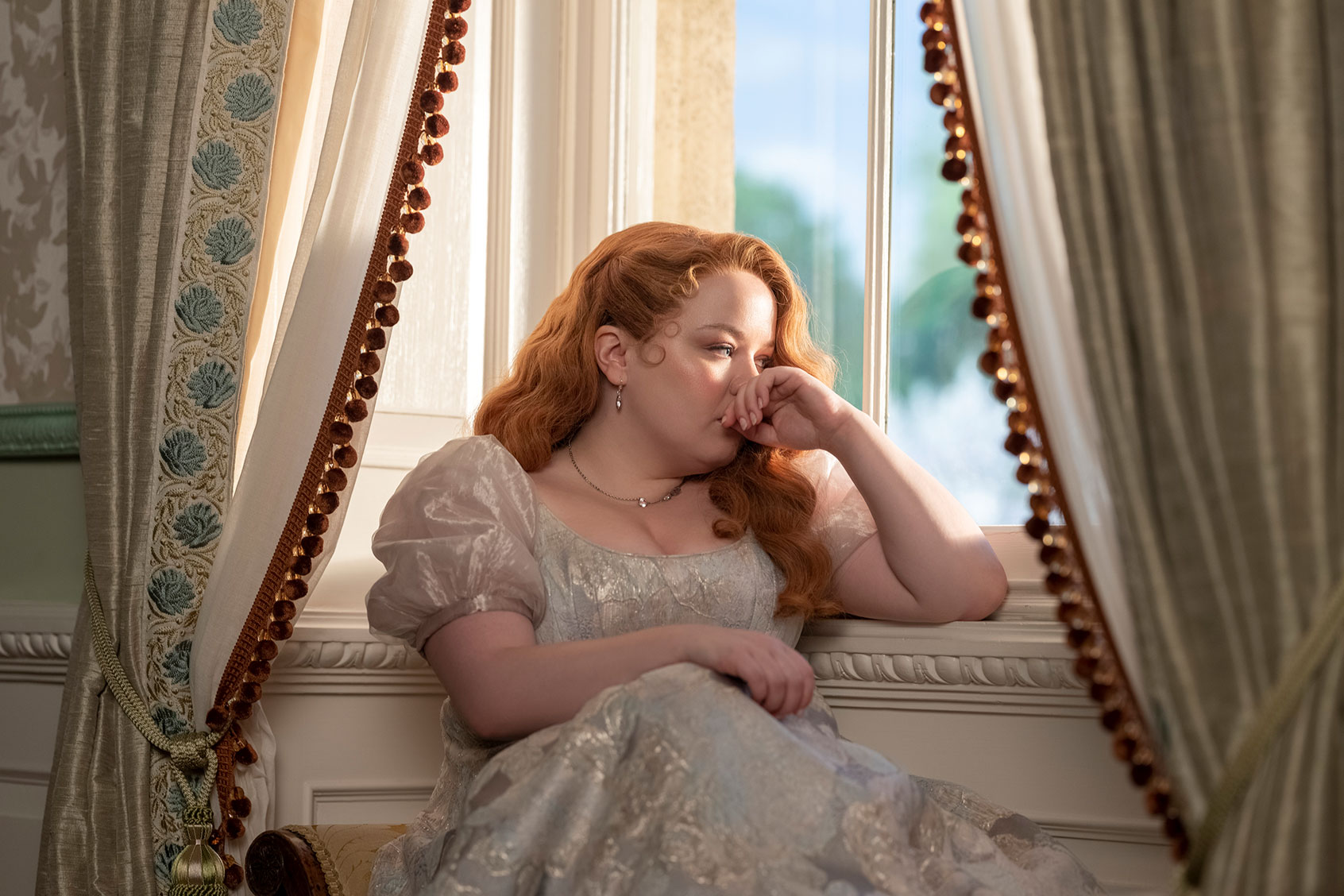
The love scene isn't just significant for Penelope and Colin's relationship, but it's also the culmination of Penelope evolving into her own woman, one who eventually squares away Whistledown with her wallflower persona. As a young woman with a brain struggling to establish herself in a society that only sees her as a possible future mother, she needs to find the real-world confidence she displays in her clandestine writing. This begins with seeking to separate herself from her mother's penchant for dressing the Featherington flock in bright citrus hues and torturing their red locks into tightly coiled updos.

"We . . . pushed her in the 1950s so that she could have a waist and a shape."

Penelope's first attempt at a makeover takes place at one of the early balls of the season, when she makes a grand entrance in a dark emerald gown. While she turns heads with her transformation, the shade comes off as a bit somber and matronly. In this instance, the ensemble doesn't quite work, which is reflected in how Penelope still comes across as fairly awkward. She babbles instead of conversing calmly with possible suitors, and ends up having her dress ripped by resident mean girl Cressida (Jessica Madsen).

"George [Sayer] always says that that situation didn't go so well because the dress is also influenced by the modiste, so it's a dark color that she's never worn," says Glaser. "It's completely different than anything that she has."

Later, Penelope starts to wear more subtle shades in cool hues: seafoam green, robin's egg blue, pale lavenders and mauves, with some blush tones thrown in for good measure. 

"She now chose the softer colors because they complement her as an actress," says Glaser. "But it's also good for the character, because it allows the character to still be a wallflower, allows her to travel into the Bridgerton world, the Featherington world and Colin's world. And another reason is since she is in every scene, if we used a strong color palette, you would get tired of it. You really want her story and her character to be the forefront."

A direct result of this palette shift is how it softens the way Penelope's bright red hair appears. Knowing your colors makes a difference.

"The reason why it looks more refined is because in Season 1 she's wearing a lot of yellow, and yellow brings out red," Ökvist explains. "Now she's wearing greens and blues. And what's the opposite of red? It is greens and blues. So it diffuses the red in her color. What you're wearing up against your face really, really matters. And so the costume department really used dresses that were super flattering to her skin tones." 

BridgertonNicola Coughlan as Penelope Featherington in "Bridgerton" (Laurence Cendrowicz/Netflix)As Penelope starts to embrace fitting into her own skin, she physically looks more relaxed and comfortable. Her hair is looser, with several tendrils cascading down and fewer adornments.

"The most important thing is that Nicola feels secure, happy and supported," says Ökvist. "So we will go with a hairstyle that she would like and love. She really likes having a lot of the hair down. And when an actor feels secure then they can do their best job. So that is number one. Always make the actors feel secure."

"She looks really soft and feminine at the same time. I think the kids call it 'snatched.'"

That ease is reflected in her attire, which seems to shy away from the boxy, straight silhouette that was popular at the time. Instead, Penelope's figure is shown off with less restrictive necklines, more bouffant sleeves and fuller skirts. Penelope is inspired by fashion trends from Paris, a city that Colin raves about after romancing women from there.

"There's a couple things that work in our favor is that we could move her timeline up to 1820, a little more fashion-forward because of the Paris look, which was a slightly different shape," says Glaser. "We took that historical research and pushed her in the 1950s so that she could have a waist and a shape, a short dress, which is more flattering to her body because she was more mature and sexier and not so young and childlike."

"She looks really soft and feminine at the same time. I think the kids call it 'snatched,'" adds Ökvist. "We needed the round softness, a feminine look, so it wasn't too angular. I think that the old Hollywood look really portrays that."

While Penelope's shape is womanly, her makeup serves to highlight her inexperience and excitement when it comes to young love. "Especially in 'Bridgerton,' we want that kind of flustered, newly kissed look, so we work a lot with blushes," says Ökvist. "Everybody's got maybe two or three different color blushes layered on top of each other." 

We need your help to stay independent

All of these slight tweaks to her look create an enhanced, empowered version of Penelope, one very different from what the audience has seen in previous seasons. "I think you can see that towards the end, especially the understated elegance, is the one that is almost timeless," Ökvist says. "The icon look, the one where you can't really pinpoint what she was wearing but all you remember is that she looked great. And that's when you wear the look, and the look doesn't wear you, which is a very mature way of being glamorous."

Penelope's appearance parallels her emotional journey. By the end of the season, she takes her fate into her own hands and unmasks herself as Lady Whistledown in front of the Queen and the entire 'Ton. And she's finally accepted for herself.

"Her clothes are now part of her. They're not restricting her. They're part of her. She feels like less is more. It's like her personality, her character, is liberated," says Glaser.

"She takes the front row. She's liberated from decoration and bright colors. It's allowing her to be in the forefront. She's not hiding behind anything. She's now exposed herself — emotionally maybe, she's not hiding behind anything now."

“House of the Dragon” returns but lacks the storytelling fire to make us care who gets burned

About two years have transpired between the first season of “House of the Dragon” and the second, long enough to either sharpen our hunger for what we've been missing or make us realize we’d forgotten it entirely.

For a lot of us, I suspect it’s a bit of both, much in the way that enough of us watched the first season to make it a gargantuan ratings hit while never precisely landing on why we kept on watching.

Some people are purely in it for the dragons and violence, and if that describes you, rejoice: each new episode this season  is spiked with viciousness, with the fourth finally serving up the fire and blood George R.R. Martin’s prequel book promises. But the same setbacks that dogged the first season haven’t been sufficiently improved enough to revive the heated affection we once felt for its HBO predecessor.

A main complaint about Season 1 concerned its tight focus on court intrigue and slow-motion table-setting to justify its existence. What's the point? From the moment it was announced we knew what the main draw would be: dragons, dragons, dragons, battling to the last wyrm flying.

But the emotional wallop of bloody war is only effective in measured doses. And war is what these chapters of Westerosi history promise. 

Tom Glynn Carney in "House of the Dragon" (HBO) (HBO)There’s also the unruly sprawl of the Targaryen line and its allies and vassals to contend with, requiring a bit of reminding as to who is who and who did what. There are entire Wikis dedicated to purpose, and you'd be wise to have a couple of those resources handy as you watch. (Everything is a multi-screen experience these days, amirite?) Nevertheless, here's a cursory summary for anybody who doesn’t have the time to study or 10 hours to spare on a Season 1 rewatch. 
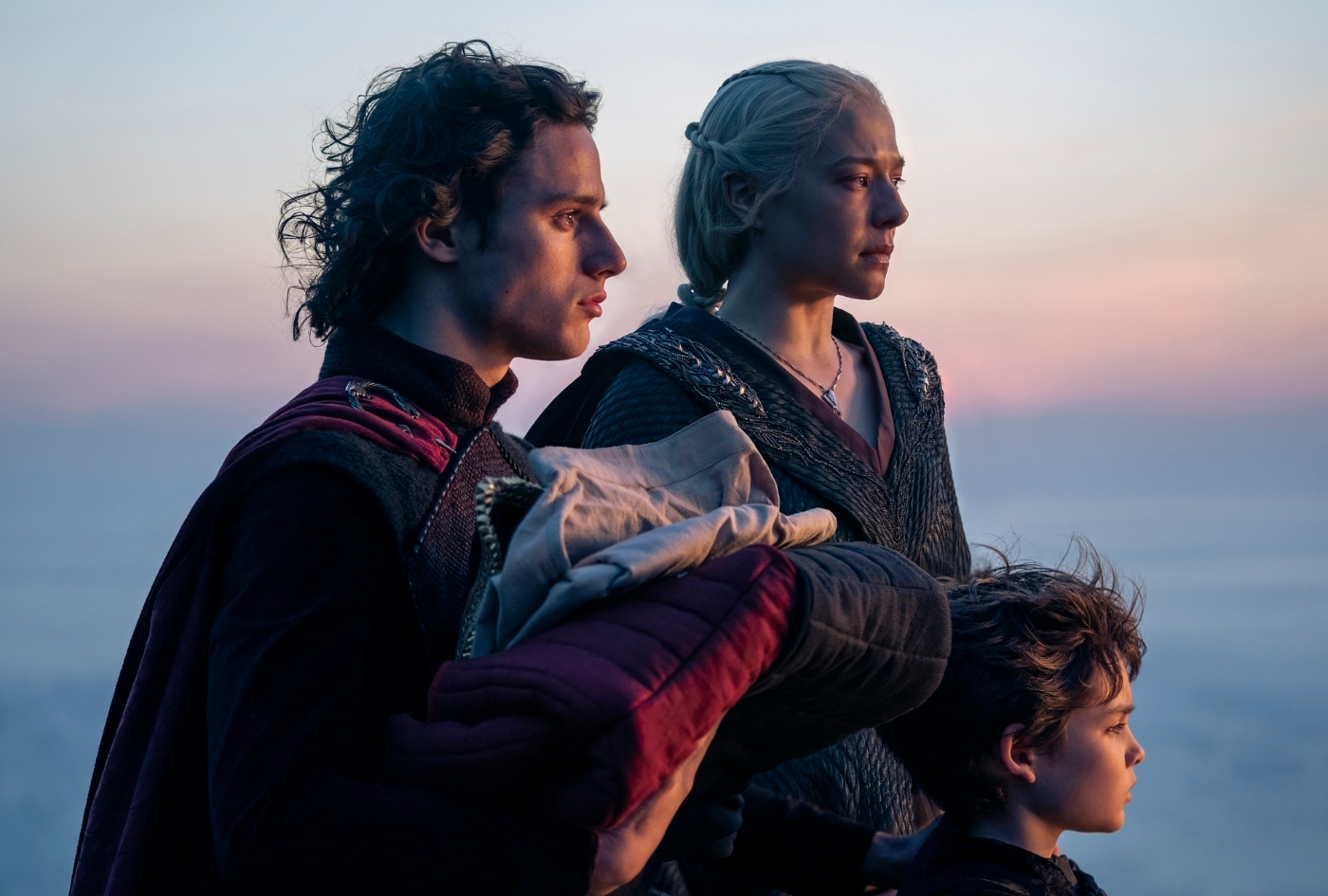
Some 172 years pre-Daenerys, the Targaryen dynasty ruled the realm more or less peacefully until the death of King Viserys I. Before Viserys grew too frail for his judgment to be disputed, he named his daughter Rhaenyra Targaryen (Emma D’arcy) as his heir. 

Rhaenyra’s ex-best friend Alicent Hightower (Olivia Cooke) married Viserys, bore him two sons, and had a vicious falling out with Rhaenyra. Their rift leads Rhaenyra and her retinue to leave King’s Landing for the Targaryen seat of Dragonstone, which is where she is when she receives news of her father’s death and that Alicent has claimed the throne for her son Aegon (Tom Glynn-Carney), Rhaenyra’s’ half-brother. 

This world has more dragons to show off, but less of the natural magic that made “Game of Thrones” a satisfying weekly destination.

This divides the House into two factions: the Greens, named for the house color of the Hightowers, and the Blacks, which refers to one of the colors of House Targaryen – although some believe it refers to the dark hair of Rhaenyra’s illegitimate sons.

A few snipes, jabs and bullying sessions later, Aegon’s brother Prince Aemond (Ewan Mitchell) is riding his dragon Vhagar, the largest in the realm, when Vhagar chomps Aemond’s tiny nephew Lucerys and his dragon mid-flight. The news coincides with Rhaenyra miscarrying another child in as grotesque a manner as TV can dream up.

Harry Collett, Emma D'arcy and Oscar Eskinazi in "House of the Dragon" (HBO) (HBO)Nevertheless, a few optimists in the realm (and maybe in the audience) wonder whether peace can be salvaged from this wreckage. That quandary dominates the small councils on Dragonstone and King's Landing. Rhaenyra’s bloodthirsty prince consort and uncle-husband Daemon (Matt Smith) itches to deliver vengeance, while Rhaenyra’s cousin Rhaenys (Eve Best) counsels caution and patience. Alicent and her father Otto Hightower (Rhys Ifans) do what they can to rein in Aegon, who can't accept that his hold on the Iron Throne is tenuous. 

We need your help to stay independent

Nearly everyone who matters is spoiling for a scrap, the audience most of all. Teasing out that tension leads to a Wagnerian opera’s worth of agonizing about what could, should, might and ought to happen, interrupted by singular, brutal acts that make violence on a massive scale inevitable. 

That portends fiery mid-air conflagrations between legends that show up in “Game of Thrones” as skulls and bones. Provided we can bring ourselves to feel for the people riding those magnificent monsters or dodging their fire, that may be enough to sustain these eight episodes. But that's the weak spot in this show’s arsenal. Since we're never afforded significant views into each of these player's motivations or moral triggers, too many of these Targaryens and Velaryons and Greens and Blacks and Strongs and whatevers are expendable.

The emotional wallop of bloody war is only effective in measured doses. And war is what these chapters of Westerosi history promise. 

A few core performers expend enough energy and heat to make their work worth savoring. Mainly this refers to D’Arcy and Cooke, whose characters' grief and grievance cage them along with their relative powerlessness. 

But despite the palpable ache and regret these actors rip out of themselves, their queens are also relegated to the periphery of the action, ceding domination to one-note figures. Smith's range is limited to the extremes of rage and fuming sadism, although oddly enough his work enabled me to appreciate the dimension Mitchell lends to Aemond's brooding and malevolence. 

Olivia Cooke and Ewan Mitchell in "House of the Dragon" (HBO) (HBO)At the same time, it's still a struggle to care about anyone else. Two very nice and noble men, for example, are drawn into a horrendous confrontation  that ends miserably for both them, with one going out while weeping. But regardless of their efforts the best I could muster at the end of their sweaty, bloody passion play was, "Ouch."
Again: the subpar writing deserves the blame for that, not the performers. This world has more dragons to show off, but less of the natural magic that made “Game of Thrones” a satisfying weekly destination. I’m not talking about the sorcery in Essos, but the extensive dives into the humanity and foibles of each character that strengthened the audience’s bond with them. “Game of Thrones” scripts are also enriched with humor and heart, yet this “House” holds little if any of either. 


Want a daily wrap-up of all the news and commentary Salon has to offer? Subscribe to our morning newsletter, Crash Course.


Still, it also spotlights Best making the most of what she’s given by speaking volumes in her restrained expressiveness. But aside from her dragon rider, Cooke’s disillusioned queen mother, and D’Arcy’s disempowered ruler, few of the drama’s most consequential characters carry enough meat on their bones to inspire our investment in their survival. Even Fabien Frankel’s easy-on-the-eyes Criston Cole has little to work with besides sex and anger. You may be shocked at how quickly that combo becomes tiresome. 

Terrible things occur in service of Alicent and the Greens or Rhaenyra and the Blacks, including a barbaric act in the premiere that solidifies a point of no return. But a combination of thinly embroidered character interiority and the assumption that we know where all this is headed makes each encounter feel like a roadside attraction on a precisely mapped highway. 

“House of the Dragon” has already been renewed for a third season, and we may find that the back half of this one finds ways to remedy the diluted storytelling leaving us cold. The fourth episode fuels that hope even as the action within drains whatever dregs of assurances are left for the realm.

Season 2 of "House of the Dragon" premieres at 9 p.m. Sunday, June 16 on HBO and on Max.


Trump criticizes US aid to Ukraine, promises to “have that settled” if reelected

It has long been known that preemptive GOP nominee, Donald Trump, has had plans to curb or altogether end the U.S. support to Ukraine. He reaffirmed his plans on Saturday. 

Earlier in March, Hungarian Prime Minister Viktor Orbán said in an interview that Trump told him his plans to cease the U.S. military aid to Ukraine to help end its conflicts with Russia, NBC News reported

The former president sang a similar tune at a campaign rally in Detroit this weekend. Trump criticized the scale of the U.S. aid for Ukraine and promised that if he is reelected in November he will “have that settled,” Politico reported

Trump went on to criticize Ukraine’s capital, Kyiv’s efforts to secure U.S. support to defend the country against Russia and called Ukrainian President Volodymyr Zelenskyy “the greatest salesman of all time.”

Meanwhile, Ukraine’s Western allies have been working double time to ensure that Kyiv’s long-term assistance is secure — especially, with the possibility of Trump’s reelection looming.  

Just last week, the Biden administration extended long-term security guarantees to Ukraine following congressional approval in April for over $60 billion in aid

“He just left four days ago with $60 billion, and he gets home, and he announces that he needs another $60 billion,” Trump said of the Ukrainian President at the campaign rally. “It never ends.”

NATO countries, last week, also moved ahead with a “Trump-proof” plan for the alliance to take over for the U.S. to continue sending out aid to Ukraine, Politico reported. 

On Saturday, Vice President Kamala Harris unveiled a $1.5 billion aid package for Ukraine at a two-day peace summit in Switzerland — focused primarily on the energy sector and humanitarian assistance.  

“I will have that settled prior to taking the White House as president-elect,” Trump said of the steady stream of U.S. aid going to Ukraine.


Processed foods are hiding in plain sight — and that could be a big public health problem

Every five years since 1990, the United States Departments of Agriculture and Health and Human Services collaborate upon and publish a new edition of the Dietary Guidelines for Americans, which are intended to provide everyday citizens with evidence-based recommendations on diet to promote health and reduce the risk of chronic diseases. Through the decades, the advice offered in the manual has steadily changed along with advances in our understanding of modern nutrition. 

For instance, take the food pyramid. First introduced within the guidelines in 1992, the original pyramid had a base of whole grain-heavy foods like bread, pasta, cereal and rice — for a recommended six to 11 servings a day — and then ascended level-by-level, from vegetables and fruits to dairy and protein, before peaking with fats, oils and sweets at apex. 

In 2005, the guidelines shifted to the MyPyramid, which took the original icon and tweaked it; instead of horizontal levels, there were vertical, colored bands that represented the various food groups, like blue for milk products and orange for grains. The left side of the pyramid had been replaced with a staircase being ascended by a simple stick figure. The change was meant to both encourage exercise and the concept of more individualized nutrition plans, but critics complained the rendering was too complex and not intuitive enough regarding the recommended proportionality of food groups, which led to the eventual rollout of MyPlate in 2011. 

This was then eventually superseded by the current guidelines, which instead promote the idea of healthy “dietary patterns” across the various stages of one’s life. 

Through all the evolutionary stages of the Dietary Guidelines, much of the advice offered has been based primarily on nutrients, or what types of foods and food groups people should prioritize in order to achieve a balanced diet. However, as evidence about the harms of ultra-processed foods are growing, there’s a very real possibility the upcoming Dietary Guidelines, which will be released in 2025, will also issue recommendations about how much processed food Americans should be consuming. 

This is a big deal because growing research also shows that, for most Americans, processed foods are hiding in plain sight — and that could be a big public health problem. 

“Unprocessed or minimally processed foods are whole foods in which the vitamins and nutrients are still intact,” writes dietician Katherine D. McManus for Harvard Health Publishing. “The food is in its natural (or nearly natural) state. These foods may be minimally altered by removal of inedible parts, drying, crushing, roasting, boiling, freezing, or pasteurization, to make them suitable to store and safe to consume. Unprocessed or minimally processed foods would include carrots, apples, raw chicken, melon, and raw, unsalted nuts.” 

She continued: “Processing changes a food from its natural state. Processed foods are essentially made by adding salt, oil, sugar, or other substances. Examples include canned fish or canned vegetables, fruits in syrup, and freshly made breads. Most processed foods have two or three ingredients.” 

We need your help to stay independent

Some foods are highly processed or ultra-processed, which as McManus puts it, means they are “made mostly from substances extracted from foods, such as fats, starches, added sugars and hydrogenated fats.”  They may also contain artificial colors, preservatives and stabilizers to change their shelf-life, color or texture. A lot of what most Americans would consider to be junk food — packaged cakes, potato chips, soft drinks — are ultra-processed, but so are a lot of items that people might think of as otherwise healthy, like some granolas, vegetable straws, fruit snacks and even the wave of nutrient-focused boxed mac-and-cheeses that has recently flooded supermarkets. 

In fact, while exact percentages can vary, studies suggest that around 60 to 70% of the foods available in typical American supermarkets fall into the category of ultra-processed. However, most shoppers couldn’t identify those products. According to a September 2022 survey conducted by the International Food Information Council (IFIC), about 76% of Americans are unfamiliar with what qualifies as an ultra-processed food. More specifically, 66% of people said they’d never heard the term “ultra-processed,” while 10% said they were unsure.

In an interview with Health, Bonnie Liebman, the Director of Nutrition for the Center for Science in the Public Interest (CSPI), said the results aren’t surprising because the concept of ultra-processed foods is still relatively new. “Most Americans don’t know precisely which foods count as ultra-processed because researchers have only recently started looking at whether highly-processed foods can cause harm,” Liebman said. 

In the ensuing two years, however, more and more research has come out connecting the consumption of ultra-processed foods to various health issues. As the Washington Post reported earlier this year, a new review “show[s]  that diets high in ultra-processed food may be harmful to many body systems” after researchers linked those foods to more than 30 health conditions, including heart disease, diabetes and anxiety. 

"76% of Americans are unfamiliar with what qualifies as an ultra-processed food."

This gap between the knowledge of what ultra-processed foods are and their potential health impacts is troubling, which is potentially one of the reasons the upcoming Dietary Guidelines may clearly address the processing levels of foods for the first time. Per the 2025 Dietary Guidelines Advisory Committee, the group is using three scientific approaches — data analysis, food pattern modeling and systematic reviews — to examine the evidence on health and nutrition. As part of Step 1, HHS and USDA developed a list of proposed scientific questions to inform the committee’s work, and one of the first questions is: “What is the relationship between consumption of dietary patterns with varying amounts of ultra-processed foods and growth, body composition, and risk of obesity?” 

While the committee has been deliberating, the lobbying campaign by the food industry has already started, reports the Washington Post.

“At least a half dozen food industry trade and lobbying groups have written letters to HHS urging the government to be cautious about issuing a recommendation on ultra-processed foods,” The Post’s Anahad O’Connor wrote in November. “They say that industrial processing makes food safe, convenient, and affordable, and they argue that there’s no accepted scientific definition for what exactly constitutes an ultra-processed food.” 

However, many nutrition experts say there is sufficient evidence about the effects of ultra-processed foods for the Dietary Guidelines to issue recommendations on the topic. 

“I think there’s sufficient evidence to recommend a reduction in calories from ultra-processed foods,” Marion Nestle, an emeritus professor of nutrition, food studies and public health at NYU, told the Washington Post. “I wouldn’t say don’t eat them at all — that makes no sense. But ultra-processed foods belong in a category of, ‘Don’t eat too much of them.’”

Kate Middleton celebrates her family with touching Father’s Day post

Following the glitz and glamour of The Princess of Wales Kate Middleton's appearance on Saturday at an annual military parade to celebrate the king’s official birthday called Trooping the Color — her first public appearance since the announcement of her cancer diagnosis in March — she's shared a touching photo, taken herself, which offers a rare view of what a low-key Father's Day looks like for the royal family. 

In the photograph, Prince William and their children — Charlotte, Louis and George — are dressed in casual clothes for a day on the beach, facing the ocean with their backs to the camera. The picture might have been taken near their country home in Norfolk, which is a couple hundred miles from London, Deadline reported. The caption reads: “We love you, Papa. Happy Father’s Day. G, C & L.”

Having stayed out of the public eye while receiving treatment, Kensington Palace shared a video of Middleton this weekend, seeming to be in good spirits and good health in a white dress with black trim by Jenny Packham and a coordinating hat by Philip Treacy, ABC News reported.

We learned earlier this year that Middleton was undergoing chemotherapy treatment after her January surgery that revealed cancerous tissues. A statement released Friday was the first update since the video — she shared her gratitude for “the kind messages of support and encouragement over the last couple of months.”

“I am making good progress, but as anyone going through chemotherapy will know, there are good days and bad days,” she wrote. “On those bad days, you feel weak, tired and you have to give in to your body resting. But on the good days, when you feel stronger, you want to make the most of feeling well.”

She added that while she is not “out of the woods yet,” she’s allowing her body some grace to heal.

As any royal event is not without a bit of controversy, The Daily Beast reports that there's already been chatter following Middleton's Trooping the Color appearance centering on Meghan Markle "showing her up" with the "big reveal" of her newest American Riviera Orchard products just hours before. Markle's camp tells the outlet that the social media promotion for the line was not intentionally posted to interfere with Middleton's return to the public. 


Annalee Newitz on the sci-fi roots of the current “psyop” war

The "culture wars" raging around us with white-hot intensity are better understood as psychological warfare. So argues journalist and science-fiction author Annalee Newitz in their new book “Stories Are Weapons: Psychological Warfare and the American Mind,” a sweeping look back at how we got into this heightened state of war and how we might be able to escape it. 

The avalanche of lies, disinformation, demonization and conspiracy theories ushered to center stage by Donald Trump was hardly his own creation and shows little sign of letting up, even if Trump himself appears somewhat diminished. To gain a foothold to make sense of it all — to “stop feeling the dread” and gain a deeper perspective — Newitz turned to history, especially to World War II and the early Cold War era, when the practice of psychological warfare was formalized as a permanent facet of American military doctrine, and also further back to the "Indian wars" of the 19th century, which "created a uniquely American paradigm for psychological operations" and also called forth a powerful counternarrative of resistance — the Ghost Dance.

As both a science journalist and a speculative novelist, Newitz is ideally suited to the task. Paul Linebarger, author of the foundational textbook “Psychological Warfare,” also became a prominent science fiction author under the pseudonym Cordwainer Smith. He wasn’t even the first to mix those worlds, though he remains the quintessential example. World-building — creating resonant, believable alternative realities — is central to both sci-fi and psyops. At least in his first edition Linebarger saw ending psychological warfare as integrally connected to waging it. He dropped that from the second edition, as the Cold War looked less and less as if it had a definite or foreseeable end, but it signals the intellectual kinship Newitz shares with him, as well as with other key figures like psychologist William Moulton Marston, the creator of Wonder Woman.

Salon interviewed Newitz by Zoom. This transcript has been edited for clarity and length. 

In your preface, you talk about turning to history, researching American ideological conflicts of the past 200 years to make sense of our current state of intense cultural conflict. Then you describe visiting the Hoover Institute archives to explore the personal papers of Paul Linebarger, the author of the classic Cold War handbook “Psychological Warfare” as well as a corpus of quirky far-future science fiction, under the pen name Cordwainer Smith. Why start with him? 

That's a really good question. Partly, it was where my interests started. I came to it through having known Cordwainer Smith's work as a science fiction writer, which I'd been interested in for a long time. Looking into his background I discovered he also had this other career working in intelligence with the military. Then I discovered the book "Psychological Warfare" and started reading that. I wanted to structure the book by starting in the Cold War and then kind of doing a record-scratch and going all the way back to the very beginning of the nation. There were two reasons: One is that people in the United States are familiar with psyops and psychological warfare being used during the Cold War, so no one would be shocked or surprised to learn more about it. I wanted to bring readers into a familiar world before defamiliarizing it, and saying, "Actually, you guys, this has been going on much, much longer." 

But the other thing is that the Cold War is a period that's very important in the United States for psychological warfare. That's when the military, particularly the Army, decides to have an ongoing group devoted to psychological operations. Before that, there were ad hoc groups put together for a specific war, and then they would be disbanded when the war was over. But after World War II, the Army was like "No, we need ongoing psychological operations expertise." That's really the moment when the field gets professionalized and institutionalized. So what we know today as psychological warfare in the United States really does grow out of that moment. Which isn't to say that the 19th century and 18th century aren't incredibly important. They are, but they represent a different phase. 

Chapter 1, "The Mind Bomb," deals primarily with early Cold War psyops, from World War II through the 1960s, though with some stage-setting: Freud's identification of the unconscious, and what followed. You write that Linebarger's work "depended on the  idea that psyops campaigns would always be overshadowed by the threat of nuclear annihilation." Yet as you describe, they took on a wide variety of forms, and the awareness of psyops in the popularized form of "brainwashing" became part of American culture at that time. It's a complex, multi-strand story. so What's the most important takeaway for readers, in terms of what follows?

"We see political leaders, cultural and community leaders, using the same exact strategies that we had been using against our adversaries in World War II, against groups of Americans who are being scapegoated and demonized."

There's a couple of threads I found really intriguing. One I've already talked about: the idea of professionalizing psychological warfare, and the idea that you could have a full-time job as a psy-warrior. That's happening throughout the 20th century, partly thanks to fields like public relations and advertising, where you get this professionalization of what would once have been referred to as flimflam or scamming. It's become a professional job, and so does psychological warrior. So that's one piece of it. 

The other piece is what we see in the 1950s, during the Cold War, with the brainwashing scare, but also the Red Scare, the HUAC hearings, the Lavender Scare hearings, All of that is an example of how psychological warfare strategies spill over into the realm of domestic cultural politics. If we take Linebarger seriously, if we take the military definition of psychological war seriously, it is a practice that is intended to be aimed at a foreign adversary, not something that Americans are supposed to use against each other.

These are weaponized messages. They are intended to demoralize, intended to be full of lies and threats. But during the 1950s, in the Cold War, we see political leaders, cultural and community leaders using these same exact strategies that we had been using against our adversaries in World War II, using them against groups of Americans who are being scapegoated and demonized. So that's an incredibly important shift in the understanding of how psyops should be used and, again, that's the world we live in today.

Chapter 2 deals primarily with the 19th-century "Indian wars," which you call "a period of violent myth-making," saying, "Many of the psychological weapons developed during the Indian Wars became prototypes for the professional psyops products deployed during the 20th century and beyond." Central to this era was the "last Indian" myth, which served to obscure what was going on, both physical violence and cultural annihilation. Talk about how that worked, and also how Native Americans responded with their own psyop, the Ghost Dance? 

The thing I think is interesting about that period in U.S. history, which encompasses hundreds of wars with thousands of tribes and nations and confederacies of group of tribes and nations, is that we see the U.S. government doing what it did during the Cold War, which is to say waging total war while at the same time also engaging in cultural warfare. One of the pervasive cultural myths that you see coming out of pop culture, as well as the government, is this idea that Indigenous tribes and nations will naturally go extinct to make way for white settlers. 

"One of the pervasive cultural myths that you see coming out of pop culture is this idea that Indigenous tribes and nations will naturally go extinct to make way for white settlers."

These myths borrow from both science and mythology. There's definitely a strand of social Darwinism in this idea that some groups just naturally go extinct, which of course is not how natural selection works. We’re all human, so that isn't the proper window to look at this. But we also see this popularity, partly based on James Fenimore Cooper's 1830s novel "The Last of the Mohicans." It's basically a meme about the claim that indigenous people are dying out, there's only one left from this huge tribe, and of course we know this is a myth. Even today, there's tons of Mohicans walking around who can tell you, "Hello, we're still here!" But it's a very powerful myth because it justifies westward expansion for the nation, justifies the selling of real estate in the West where the U.S. government had promised Indigenous nations that they could continue living. But if they've disappeared, then white settlers feel justified going out there and buying land and settling down. 

But the other part of the of the psychological operation here that's very powerful is that it works against Indigenous people to undermine their sense of self: “Oh, you think you're Indigenous, you think you're part of the Mohican nation and tribe, but actually you don't exist." This is a big strand in how culture war works in the United States. We're seeing it now with the way that trans people are being treated, especially trans teenagers, just being told, "You just can't be trans. I'm sorry — even if you think you are, you can't be. That's just not a thing." 

And what about the Ghost Dance?

There was never a last Mohican. Many tribes and nations resisted very successfully, and by the late 19th century you see this incredible resistance movement — both the military resistance, of course, and also a cultural resistance movement known as the Ghost Dance. It takes off among the Plains nations and tribes, and what it is — it's a dance, it's a song, it's a spiritual belief, it's a political movement. It has different forms depending on what tribe or nation you're in. There are actually recordings you can listen to on the Smithsonian website of a couple of different examples of how people engaged in Ghost Dances. 

What the Ghost Dance tells is a story about what happens to North America when the white settlers go away. It's an alternate future of of this land: All the industry, all the Western farming practices roll up like a poster and underneath is the land as it was before farming and roads and Western-style cities. The buffalo return. Today we would call it a kind of utopian vision. It grows out of a long, long history of Indigenous philosophy and politics, but it was an incredibly effective form of resistance because it was a story of Indigenous survival. It was a story that Indigenous people told to each other, and it was incredibly threatening to the U.S. government.  

It was not associated with war or violence, but it was portrayed that way and was outlawed. This is ultimately how Sitting Bull, one of the great leaders of Indigenous resistance to the U.S. government, is shot and killed by cops on the Pine Ridge reservation. He's allowing his people to do the Ghost Dance and he's been engaging in the Ghost Dance, and he's refusing to obey the government. So it becomes this symbol of of resistance. You can see how that type of resistance, which is decentralized —it's taking place all over the place, it involves music and singing as well as meaningful political engagement —  becomes a model of resistance in the United States up until today. 

In Chapter 3, "Advertisements for Disenfranchisement," you deal with psyops in recent elections, once again with some earlier stage-setting. What do you have to say that is often missed by other people who've written about this?

This is probably the part of the book where most people will be familiar with the territory, about what now gets called Russian election meddling online during 2016, and of course this continues up into the present. Now we have AI election meddling and that kind of thing on social media. One thing I like to point out is that a lot of that so-called meddling, a lot of the propaganda that came in 2016, mostly from Russia, came through the form of buying ads on Facebook. So it goes right back to the early history of psyops in the United States, where we see people coming out of the field of advertising, coming out of public relations, and going into psychological warfare as a profession. That relationship between advertising, propaganda and psyops continues to be very relevant today.

In Chapter 4, "Bad Brains," you distinguish between military psyops and culture-war psyops, which "have two goals: convince your audience that some of their fellow citizens are the enemy and convince the enemy that there is something deeply wrong with their minds." A prime example of that is the culture war focused on the brains of Black people, particularly the resurgence of discredited "race science" in the 1990s with the publication of "The Bell Curve." How does the psyop perspective help to clarify what's going on?

Part of the idea for this chapter came from a comment that N.K. Jemisin, the science fiction writer, made a number of years ago, that white supremacy is a psyop. I just thought that was a great observation and incredibly true. What we see with the "Bell Curve" psyop is a strategy that goes all the way back to the Indian wars where you have a psyop aimed both at your adversary and also your allies. Because remember, the "last Indian" myth is intended to convince white settlers that it's cool to go take over other people's land, because they're gone. But it's also intended to undermine the morale of Indigenous people by telling them they don't exist. 

The Ghost Dance "was an incredibly effective form of resistance because it was a story of Indigenous survival. It was a story that Indigenous people told to each other, and it was incredibly threatening to the U.S. government."

So the same idea comes into play with the "Bell Curve" myth, which is that it's aimed mostly at white people. It's intended to convince white people that Black people are mentally inferior, and therefore it's no big deal if they don't have Black people as colleagues or it just makes sense that there are few Black people in professional, middle-class technical or scientific jobs. It's calling on the ideas of race science, eugenics and social Darwinism to reassure white people that programs aimed at diversifying workplaces, diversifying science, diversifying astronauts, whatever area you like, those efforts will never succeed because there are these groups — including Black people — who are inherently biologically inferior. So that's the psyop as it works for white people. 

Black people know this is a lie, so it doesn't really work as well aimed at the Black community. But to the extent that it does work, it's about undermining people's faith in their ability to be heard or taken seriously. If you're Black and you are in, say, the field of science — which is an area that I write about a lot — and there's this myth out there that Black people have inferior intelligence, it makes it three times harder to get taken seriously in the field. It becomes yet another barrier to success. But because it's a myth, a story, it's very diffuse. It's hard to go to the HR department and say, "People are treating me like I'm dumb." That's not the kind of complaint that gets taken seriously. So it's a very effective psyop at undermining Black excellence. And it's been very harmful. It's the story that approaches people, gets into their face and says, "Sorry, you think you're thinking great thoughts, but actually you're not." So it's a perfect way of of undermining Black sovereignty and Black ideas. 

In Chapter 5, “School Rules," you write about the effectiveness of calling someone a criminal, especially one as odious as a pedophile, and the long history of that attacking the LGBTQ community, particularly in and around education. How does that illuminate what's taking place right now? 

This is one of the most relevant chapters in terms of the contemporary culture war because we are in a phase where politicians like Ron DeSantis or any number of other hard-right leaders are calling LGBTQ people "groomers," which is just the modern word for what in the '50s was called "sex deviants." It's a class of criminality: A groomer is someone who's trying to molest children, trying to engage in child sexual abuse. 

So again, it's the oldest trick in the book. It's a psyop that works against LGBTQ people, but also is aimed at non-LGBTQ people, at straight people, to convince them that there should never be LGBTQ people in any organization that they're in, particularly if there are children around. It convinces straight people that LGBTQ people are beyond the pale, and it works to undermine the effectiveness of LGBTQ people on the job. It is a way of terrorizing queer people. So many teachers and librarians who are queer right now are receiving death threats. People have had to quit their jobs because they're being harassed so much, because this idea that you're a child sexual abuser brings out that kind of mob mentality, people showing up at your door with pitchforks. 


Want a daily wrap-up of all the news and commentary Salon has to offer? Subscribe to our morning newsletter, Crash Course.


It's a very old psyop that goes back to the 1930s. J. Edgar Hoover, who was director of the FBI for many years, coined the idea of the "sex criminal," by which he meant anyone who is LGBTQ. And whenever you have a myth that goes back three or four generations, it's easy to reawaken it, because people feel like they've heard it before. So it may be incredibly clichéd to try to demonize LGBTQ people by calling them criminals, but it's a formula that's worked over and over. Ultimately the goal is to make LGBTQ people unemployable. It means taking away people's ability to survive.

In the next chapter, "Dirty Comics," you start to turn the corner and tell a much more upbeat story. This is the story of William Moulton Marston, the creation of Wonder Woman and its continuing impact, surviving through the 1950s comic-book panic up through today. What lessons does this chapter have about how to fight back? 

The Ghost Dance reimagines the land that the United States is on as decolonized. It's a beautiful utopian myth, a powerful one. Wonder Woman is also kind of a decolonization story. It's a story about a world where women have as much or more power than men, politically, intellectually, socially. Wonder Woman was invented by William Moulton Marston, who was a psychologist and a feminist. He says overtly in many places that he considered Wonder Woman to be propaganda, that we needed a female hero who was also peace-loving. She was not just a strong woman, she was antiwar in many of her incarnations. He, I think rightly, believed this character would provide hope to women who were being told to stay in the home, who were being told that their brains were inferior, just the way Black people have been told. 

"Ron DeSantis and any number of other hard-right leaders are calling LGBTQ people 'groomers,' which is just the modern word for what in the '50s was called 'sex deviants.'"

I call Wonder Woman a "culture bomb" to recall some of what we talked about earlier with the actual bomb, how the atomic bomb was really key to the effectiveness of Cold War psyops. But you can also have a culture bomb, like Wonder Woman — and Wonder Woman could not be stopped. The character was so popular that DC Comics never wanted to get rid of her because she was such an audience favorite. 

One of the things that gave me pleasure in writing this book was that I got to interview Vita Ayala, who is a comic book writer and editor. They live in New York, they're Puerto Rican and they grew up thinking that Wonder Woman was Puerto Rican, because of how she dressed and she uses Spanish sometimes. So they were telling me when I interviewed them, "You know, at one point my mom finally told me, 'Honey, she's like a Greek myth.'" 

But I think for people like Rita who are now comic book creators and editors in their own right, Wonder Woman has remained a symbol and she's a changing symbol. She can be a force for feminism, she can also be a force for women of color and for reimagining different kinds of women in different ways, how women can take power in the world.Vita Ayala worked on a Wonder Woman comic that basically had a theme of abolishing prisons, and it's a great new way of thinking about Wonder Woman's pacifist nature, and how Wonder Woman would never want there to be prisons. So Wonder Woman as a culture bomb is testimony to how effective a story can be, just the way the Ghost Dance was for Indigenous people in the 19th century all the way through today. 

In Chapter 7, "History Is a Gift," you introduce the U.N.'s three-step post-conflict peacekeeping process: disarm, demobilize, reintegrate, and apply it to psychological warfare. Most importantly, you write that reintegration involves "a process of rebuilding our history so that it reflects the perspectives of everyone who lives in the United States." Can you describe what this means, with the example of the Coquille tribe in Oregon?

This is part of the book where I am trying to think through what it means to undo a psyop. So I wanted to revisit the scene of the crime in the 19th century, where the U.S. government is not just stealing land from Indigenous nations, but also terminating the status of many tribes that had been recognized. These termination programs  took place throughout the 19th and 20th centuries, where the government would decide that a tribe or nation didn't qualify for recognition anymore. They would lose their sovereignty, they would lose land, they would lose their special relationship with the government, and that could be crushing. This is economic and social and cultural destruction. 

Jason Younker, who is a Coquille chief, told me this incredible story about one way a psyop can be undone, which is by creating a publicly accessible archive of historical documents showing the history of the Coquille and the Coos tribe and several other tribes in southwestern Oregon. When he was a scrappy young grad student, studying anthropology at the University of Oregon, the Coquille chief at that time said "Listen, you have to go be an anthropologist and help us find information about the history of our tribe," because they had been terminated and they did not have status in the eyes of the government. 

His tribe had a story that the reason why they had lost status was that there was a map that representatives of the government had made showing where the Coquilles' traditional land was, but the map had been lost. Without that map, they couldn't prove to the government that they deserved tribal status. So he and several grad students and their professor got a small grant from the Smithsonian and National Archive in Washington to look for any documents that anthropologists working with the War Department had stored about the Coquille tribe. Because the U.S. government believed there would be so little information, they were like, "We'll make free copies of everything that you find." 

So they went in and they found 60,000 documents, including the map that had been lost, which showed very clearly the Coquille ancestral lands in southwest Oregon, the Coos lands, a bunch of other tribes around there. So Jason Younker said to me, "You know, I've had this weird experience of having been terminated and recognized all in the same lifetime." The government had denied his existence as a Coquille person, and then had acknowledged it, and now they have this incredible archive which is housed at the University of Oregon in Eugene, which proves their existence. So there's nothing like having receipts. To me, it was a great story about undoing, just in a small way, part of the horrible damage that has been done to Indigenous tribes. It's a small thing, but I think it really matters. It's psychologically very powerful.

The last two chapters go further into the topic of creating peace. Tell us about what that means — creating psychological peace instead of war?

Part of creating psychological peace now is about reinvigorating a public sphere where people are able to listen to each other. That can be very technical, if you're talking about social media or social platforms. We need groups of people who are devoted to trust and safety, who are labeling misinformation, who are keeping tabs on abuse and trying to prevent abuse, not because they are partisan but because they want people not to be mobbed and drowned out. 

I conclude by talking about how we need a new mental model for the public sphere. I offer the library as a model, because I think the library is a perfect example of a place where you can go, you can be in community, you can learn many perspectives, whether they are propaganda or history, and no one is trying to shove it down your throat. You're able to go and learn and make your own decisions. Librarians are there to help you answer questions — not to give you answers, but to give you the tools to answer those questions. Right now, we imagine the public sphere sphere as a theater of war, and I want to recommend that we start thinking about it as a library, where we listen to each other and no voice is louder than another voice, and we do reach disarmament and peace and we learn to negotiate again. 

Finally, what's the most important question I didn't ask? And what's the answer? 

I think the most important question is, how do we find communities of people where we can have open debate and discussion without psyops, without violent threats, without lies? I think we're all working on that now, we're trying to find those spaces. I think part of the breakup of social media into these smaller areas is about that, trying to find places where we can have conversations. There's all kinds of new news sources coming into existence, often worker-owned cooperatives like 404 Media, like Defector. I think that's where the hope lies, is places where we can disagree, we can argue, but we don't lie and threaten each other.

I’m grateful for my dad’s unabashed sense of self as the ultimate girl dad

"It's a boy!"

For some unknown reason, perhaps owing to the shock of becoming a new parent in a matter of seconds, this is what my dad uttered the moment I first saw daylight in the late winter of 1998.

As the oldest, I set the scope of my dad’s parental expectations. For just about a year and a half, he was a girl dad. Though my dad would get a boy on the second go around, my brother would be his only male child among four other girls. Once my brother entered the scene, and as we grew older, the playroom had to be brought to balance. 

My mom and dad have also held largely inverted conventional gender roles.

Ever supportive but somewhat fatigued by my relentless childhood propensity for festooning my younger brother in gauzy tutus, itchy boas and plastic mules, my dad elected to buy him a toy from his own youth: a G.I. Joe action figure. With his sinewy arms, square jawline and camo-print outfit, the little dude had all the makings of a stereotypically masculine plaything. The only problem? He was a gunslinger. 

“That’s a war doll!” My mother was aghast at the sight of my brother, no older than four or five, holding a toy fitted with plastic weapons. When she demanded that G.I. Joe be promptly returned, my dad quickly capitulated, wanting to respect my mom’s wishes and realizing he had inadvertently allowed his sense of nostalgia to cloud his judgment. Several hours later, my dad returned with G.I. Joe’s replacement: a Malibu Ken doll, the perfect complement to my Barbie Dreamhouse. Ken was sun-kissed and equally chiseled as his combative predecessor, and his surfboard was a welcome substitution for the army-green bazooka. It was certainly less of a choking hazard. 

It’s heartwarming if not altogether comical to reflect on the ways my dad’s own lifestyle aligns with Ken’s. His closet is interspersed with swatches of pink, and, if capitalism was dead, his lifelong tenure as a Jersey Shore resident and interstitial surfer would make “beach” his natural job choice.

I find myself turning to the doll-swap memory often. It’s certainly something of a synaptic snag. But more than that, it encapsulates the flexibility my dad has with fatherhood and his definition of masculinity.

My dad is a big guy, both in appearance and personality. He’s incredibly strong. His early adulthood was characterized in part by picking heavy things up and putting them down, be they weights at the gym or bundles of lumber and stacks of pavers from his landscaping side hustle. He loves brawny celebrities like Chris Hemsworth and Zac Efron and has binged their respective health-guru television series. He loves Disney World. He has an affinity for ludicrously spicy food and could list every player on the Yankees, Knicks and Giants stretching back decades. He has a few tattoos. He enjoys Titos with a twist of orange rind and books with gritty, intense characters. He loves anything to do with ancient Rome and has since long before men contemplating the that lost empire became an internet trend. He is a capital F family man. He blesses himself when he drives past our local parish, but he’s not an overly religious guy. He loves a cigar on the front porch on summer evenings while Frank Sinatra croons in the background. He knows someone anywhere he goes; I’ve never encountered a more gregarious person. His impassioned and often hyperbolic way of interacting with the world and those around him is one of my favorite things about him.

A superficial scan might slot my dad among Herculean-muscled carnivores who yearn for nights of brews with The Boys. People are often surprised to hear that my dad is a years-long vegetarian. Or that he’s not great on the grill but is a dynamo baker. All of this seems incongruous with much of what they know about him. But while my dad certainly has clearly delineated interests – many of which harmlessly tend toward gender normativity – he’s never been precious about what he likes or how he presents himself to the world. 

My parents have always embodied fairly equal domestic responsibilities, sharing the bulk of cooking and cleaning in our household as much as they can. In many other ways, however, my mom and dad have also held largely inverted conventional gender roles. My mom has predominantly held the position of breadwinner, a role that was amplified when my siblings and I were young. In the early to mid-2000s, she worked long days on Wall Street as a stock exchange trader. My dad, in turn, stayed home with us to act as a stay-at-home dad and Cinderella in one, a persona that allowed him to lean into his obsessive cleaning habits. My household has always had an unspoken rule that you don’t leave a cup unattended for more than two minutes, lest you want Dad to put it in the dishwasher. 

I look back on the times I, as an ignorant third grader, was jealous of my friends' Lunchables and school-bought cardboard pizza. I cringe at the shame I once held for the deep garlicky smell that slashed through the seams of my brown paper bag. Girthy meatballs, leftover from our weekly Sunday sauce, smashed together between two slices of Italian bread is just about as good as a lunch as a 10-year-old could ask for. From the time my siblings and I started school through our high school graduations, my dad woke up at an ungodly hour to assemble homemade lunches for us, often adding a small note with a hand-drawn heart inside. 

I would squeeze my eyes shut and hold my breath as he laid waste to the crown of my head with engulfing aerosol hairspray fumes.

He even finessed the precarious art of doing little girl's hair. My sisters and I waited like a row of unshelled Russian nesting dolls outside the bathroom for our turn to have Dad slick our unruly frizz to our skulls with his Brylcreem before diving into the hair Caboodle – a rainbow-colored cornucopia teeming with sparkling accessories – for items to wrangle our locks with. His go-to ‘do was The Fountain, a simple yet classic half-up half-down look that created a sort of sprouted seedling meets Cindy Lou Who effect. As he dragged a brush through my hair, sweeping it upward, Dad’s pale blue eyes glimmered with a dogged focus, like a cooking show contestant adding the final garnishes to their plate. 

I would squeeze my eyes shut and hold my breath as he laid waste to the crown of my head with engulfing aerosol hairspray fumes that left my hair glistening, crunchy and utterly fabulous. 

My dad grew up as one of two boys, in a hyper-masculine and hyper-toxic space. My paternal grandmother, who I have heard was a kind and lovely woman, passed away from breast cancer when my dad was a teenager. My dad’s father — a strikingly handsome and deeply selfish person who shared the image and likeness of Paulie Walnuts — was largely absent from his life. From my vantage point, their relationship was founded upon a shared interest in football and not much else. Towards the end of my grandfather’s life, he moved in with my family, infuriating my sisters, mom and me on a regular basis with misogynistic and antiquated commentary. I recall one early morning as he tsk-tsked while watching my dad make sandwiches for my younger sisters, complaining that it shouldn’t be his job. 

Thankfully, despite his coming from a home where gender lines were starkly drawn and masculinity was often weaponized to belittle women, my dad never assumed these habits. Parenting mostly girls has inherently led him to learn a great deal over the years, ever-revolving his perspective to ensure that he accommodates the fullest extent of a woman’s that his straight, male whiteness can allow. 

Perhaps one of the most immediate and important ways he has done this is through his rearing of my brother and the golden rule he instilled in him: always listen to women. And especially, my mother. 

This principle was not merely dedicated to my mom’s instructions to complete chores. Of the many things my dad appreciates about my mom, her immense intellect arguably reigns paramount. It’s always been the case that when my brother — or any of us for that matter — acted defiantly or challenged our mom’s logic that Dad would simply reexplain what she had said and succinctly advise him to listen. Amid murmurs that Gen-Z men are skewing more ideologically conservative and less influenced by feminist values, this example of generational male progressiveness can’t be overstated. 

In the summer of 2022, Jim Harbaugh, the head coach of the University of Michigan’s football team, told an ESPN writer something that my dad — and many other people — found rather shocking. Apparently, Harbaugh had told his players and staff members the “same thing” that he told his own children – that if they experience an unplanned pregnancy, they should "go through with it” because he and his wife would take the baby.

My dad was gobsmacked at Harbaugh's farcical offer. Take all the babies?! Impossible. Though he's always been one for embellishment, my dad couldn't entertain the preposterousness of a scenario in which women might reluctantly endure an unwanted pregnancy only to be comforted by the knowledge that they could shuck their kid off to some football-themed foster home setup. 

Of the many social justice hills my dad finds himself sitting atop, reproductive rights is one he will consistently die on. Once an ardent east-coast fan of the Block M’s Big House, my dad renounced all future support for Michigan’s historically decorated NCAA Division I program until it was unfettered by Harbaugh’s pro-life fundamentalism. For a bonafide football junkie, my dad’s decision was almost surprisingly swift. And yet, it was true to his overzealous style of doing and saying things, an M.O. some might even call impetuous.

My dad’s pro-choice stance has everything to do with my sisters and me. It has absolutely nothing to do with us, too. Pigskins and trophies aside, I’d qualify that knowledge as a true and legitimate win.

My parents chose not to learn the sex of their first four kids until we were born. When my mom got pregnant with the youngest of us, we pleaded with our parents to know. No one was more frantic than my brother, then a beleaguered 11-year-old in desperate want of a brother.

Nearly foaming at the mouth with anticipation, we squirmed in our car seats as my parents turned to us with shining eyes.

"The next Ferrigine child is . . . A GIRL!"

My brother was like a mortally wounded animal, his body twitching in death throes as he wailed in utter defeat.

I remember huffing momentarily to myself — it was of little consequence in the end, but another brother would have been a fun addition to the party mix.

"Don't worry!" My dad called to my brother with a smile from where he was punching at the seats in the recesses of our Honda minivan.

"You're going to love her."


Marjorie Taylor Greene speaks of Jan. 6 with a fondness at Turning Point Action’s Michigan event

Turning Point Action's Michigan event pushed all the big MAGA buttons on Saturday, with promotions for "rebellious and unapologetic" bottled water, a grand finale tirade from Trump on bringing back "the auto country," and a high-volume address from Marjorie Taylor Greene, who looked back at the events of Jan. 6 with a fondness.

Making her way to the stage in a glittery dress while ominous music played over the house speakers — as though about to wrestle rather than speak about "defeating the Communist Democrats" — Greene kicked things off with a warm "Oh, I love you" to attendees, steering them right into the storm from there.

Pointing out a group of men seated in front of her holding signs reading "Socialism sucks," she made mention of that as being "her first campaign slogan," smiling with all of her teeth and then breaking that smile to present to the crowd a "bigger fight" that has been weighing on her mind. 

"November 4, 2020, is when the real Civil War in this country started," she said. "They stole the election. They stole it." 

Receiving cheers for that, she doubled down by getting into the topic of Jan.6 and the attack on the Capitol building with the same enthusiasm as someone cooking up a hot dog on the 4th of July. 

"I'm proud that I objected to Joe Biden's electoral vote," she continued, shocked at what happened afterward.

"There was nothing wrong with protesting the election on January 6," she said. "And anyone who wants to continue to shame us for January 6 can go to Hell."

Watch here:


How I learned to stop worrying and love the Garfield

I love the classic newspaper comic character Garfield – from his lazy feline attitude, to his love for lasagna, to his petty hatred for a cute gray kitten named Nermal, If the goal of entertainment is to bring people closer together, Garfield is our society’s Monday-hating glue. It’s my enormous love for that wonderful sarcastic cat that brought my girlfriend and I to the Motel 6 near the Los Angeles airport at 10:30 p.m. on a Saturday night. We were checking into the hotel’s only Garfield Suite, a hotel room filled with Garfield merchandise and elaborate decorations to promote "The Garfield Movie." Just as I was about to sign my name, I heard the Motel 6 employee say the words, “Oh no, we double-booked the Garfield room.” 

I looked up and saw two cash registers over, a hotel guest covered in Garfield arm tattoos. My girlfriend and I were adorned in elaborate Garfield shirts. Both parties had arrived at the check in desk at the same time with valid bookings for the same Garfield movie tie-in hotel room. The stressed staff had no idea how to resolve the quickly escalating situation. It was that moment that I’d learned just how far I’d go for Jim Davis’ greatest creation.

* * *

I devoured it like Garfield gorged on lasagna.

When I first met Garfield, I was a young kid growing up on the Tulalip Indian Reservation in Washington State. I was at a Scholastic Book Fair. My two obsessive interests were cute cats and the color orange. My 7-year-old eyes fell on a “Fat Cat Three Pack” featuring Garfield, who was orange, cute and cuddly in ways that my below-the-poverty-line upbringing was rarely allowed to be. He was everything I wanted, and with one look at his sour feline face I was hooked. I begged my mom to buy the book for me. Even though it meant we’d be eating store brand generic cereal for the next month, she caved. 

Joey Clift Garfield SuiteJoey Clift and Garfield, a reflection (Photo by Matt Mazany)

I read that Garfield book at least a hundred times. His constant complaining, love for coffee and abuse of the overly loyal Odie burned into my young memories. It became the start of my Garfield obsession. Channel-flipping on a weekday afternoon, I landed on the cartoon series "Garfield and Friends" and couldn’t believe it. Of course he was more than a comic strip! I devoured it like Garfield gorged on lasagna. I collected Garfield stuffed animals, books, anything of my new orange feline best friend that I could find.

But as I got older, my tastes changed. The things I’d grown up loving became too pure for my sardonic teenage brain. My focus shifted from the Monday-hating orange cat, toward weirder, darker offerings like Gary Larson’s "The Far Side," "The Simpsons" and "Late Night with Conan O’Brien" – but like a shadow, Garfield still followed me.

I made my comedy fandom a career, moved from the Tulalip Reservation to Los Angeles and dove into the local comedy scene with both feet. I performed at some of the biggest improv and sketch comedy stages in the country and eventually graduated to television comedy writing. I even received an Emmy nomination, a Webby Award win and credits writing for many fun and silly cartoons that are not unlike the "Garfield and Friends" series I loved growing up.

In my adult life, I hadn’t forgotten about Garfield, but as someone who writes jokes for a living, my feelings about him changed. I’d grown to despise the larger-than-life cat from Muncie, Indiana. Garfield was a comedy from a simpler time, where hating dieting and loving lasagna were good enough jokes to base an entire comic strip around. Like Garfield himself, the strip was comedically lazy and an example of the bland mainstream offerings that many of us in the alternative comedy scene pushed against. Instead of reading classic "Garfield," my favorite Garfield content were parodies created by fans. From Lasagna Cat’s surreal live action Garfield inspired videos, to Lumpy Touch’s videos reframing Garfield as a horror movie villain, to "Garfield Minus Garfield," a comic strip that edited the titular orange cat from the series and in the process, painted Garfield’s owner Jon Arbuckle as an even sadder maniac.

Dumb Jons & NermalsDumb Jons & Nermals (Photo courtesy of Joey Clift)

I became an authority on him, which, as a Garfield denier, became as cruel a joke as a Monday without naps.

I even created my own viral Garfield parody content. Like the time I changed my Twitter handle to Garfield Official and used it to hijack an official Garfield Twitter Q & A by answering all of the fan questions before the actual official Garfield account could. The stunt was deeply frustrating for the Garfield social media team, but a hit among Twitter users and Garfield fans, receiving media coverage from The AV Club and The Daily Dot. Or the time I tried to get Paws, Inc. to give me the Garfield license for a Garfield pen and paper RPG I called “Dumb Jons & Nermals,” which was a great idea in practice, but Paws was worried it would compete with other Garfield board game projects they were working on. Then there’s the time I built a campaign to increase my social media followers over the pandemic in exchange for filming myself eating lasagna with my bare hands like Garfield. It turns out, throwing lasagna isn’t the most efficient way to eat, and only a fraction of the airborne cheese dish made it into my mouth. Afterwards, it took several showers to wash the marinara smell out of my hair.

Eventually, I posted about Garfield so much that to a lot of the people, I became an authority on him, which, as a Garfield denier, became as cruel a joke as a Monday without naps. My phone and social media blew up with texts and tags whenever any weird Garfield news would drop, and most holidays, my friends and loved ones gifted me merchandise or art inspired by the almighty orange cat.

At first, the gifts and mentions were ironic, and an easy way for my friends and followers to have a laugh, but it slowly became something more. Then one day, when I guested on a live recording of a popular NPR series, a fan approached me after the show and gave me a Garfield sweater she’d hand sewn into a ribbon shirt. When my grandmother passed away a few years ago, my uncle sent me a few of her old things to remember her. At the top of the package was a well-worn Garfield stuffed animal absolutely infused with the smell of cigarettes that my grandmother must have owned since the 1970s.

Select items from Joey Clift's Garfield memorabiliaSelect items from Joey Clift's Garfield memorabilia collection, including the cigarette-stained Garfield (center front) owned by his grandmother (Photo courtesy of Joey Clift)

Garfield has been around for 46 years, and he means a lot of different things to a lot of different people. From older folks who remember him with fond nostalgia, to millennials and zoomers who spend their time creating ironic Garfield memes, to young kids discovering Garfield for the first time. In my life, I’ve been all of those things. I’m a visible Garfield fan, often posting on social media about him and even wearing a custom Garfield bolo tie to fancy Hollywood parties. In the process, I’ve become a conduit for people’s love of the ever-present funny monotone kitty. 

I used to view Garfield with a Monday’s worth of disdain.

Ask anyone of any age how they feel about Garfield, and they’ll have an opinion or a memory and honestly, that’s kind of beautiful. Whether you love him or hate him, he sticks to us like a '90s suction-cupped Garfield plushie hanging from a minivan window. And, in a lot of ways, Garfield is a self-care icon who lived his best life on his terms, which, as many of us are focusing on ourselves whilst surviving a global pandemic, is more relevant than ever.

* * *

So, we stood in the lobby of the Motel 6 near the Los Angeles airport a few weeks ago: my girlfriend Goldie Chan wearing a vintage 1970s Garfield sweater and I in a knockoff Garfield t-shirt with “F**k Mondays” printed on it in old English. With our bellies full of Olive Garden lasagna – in a polite, but quickly escalating showdown with a tattooed Garfield fan over a fully rented out hotel suite we both had valid bookings for – I saw tears in the other fan’s eyes.

Joey Clift and his girlfriend Goldie Chan in Hollywood Motel 6 Garfield SuiteJoey Clift and his girlfriend Goldie Chan in Hollywood Motel 6 Garfield Suite (Photo by Matt Mazany)
At that moment, it wasn’t about who was right. It was about our mutual love for a comic character from our youth, that we were expressing by booking a stay in a limited availability hotel room brand tie-in decked out in Garfield merchandise like the “Garfield House” sketch from "I Think You Should Leave."

I gave them our booking in exchange for a few photos of my girlfriend and I in the Garfield-themed room. We left, hotel-less, and complimented the guest’s Garfield tattoos on the way out of the Motel 6 lobby.


Want a daily wrap-up of all the news and commentary Salon has to offer? Subscribe to our morning newsletter, Crash Course.


As we left the hotel at around midnight, blasting Lou Rawls' song “Here Comes Garfield” from the speakers of my Toyota Corolla Hybrid, we were sad that we’d missed our opportunity to stay in a suite themed after Garfield, but we were also happy. Happy that by giving up the room, we’d brought a Garfield fan the same joy that Garfield had given us. 

Though we lost the hotel room, that’s not the end of this adventure. After posting about our story on social media, many friends and followers rallied to our side. Motel 6 even reached out, offering us a free weekend stay in their Hollywood Garfield suite, the only one in the country with an immersive experience. And that’s where I find myself right this second, wearing a Garfield cardigan, a plate of lasagna at my side and in a hotel room absolutely covered in orange fur and Garfield memorabilia, writing about my time with the orange kid.

Joey Clift Garfield SuiteJoey Clift, writer and lasagna eater (Photo by Matt Mazany)

I used to view Garfield with a Monday’s worth of disdain, but now, he’s my deep, multi-layered lasagna, with infinite levels of cheese, marinara sauce and personal meaning. Today, I’m grateful to live in a world where I, and billions of people around the world can appreciate Garfield and all of his amazing and hilarious friends. Except for Nermal. He’s the worst.

5 “House of the Dragon” facts to remember before the show returns

It's been more than a year and a half since we were last in Westeros watching all the action that underpinned House Targaryen's impending Dance of the Dragons — a civil war stemming from a battle over the hotly contested rights to the Iron Throne. 

HBO's "House of the Dragon" traces nearly 20 years, predominantly chronicling the infighting between Houses Green — led by Aegon Targaryen (Tom Glynn-Carney) and his mother Alicent Hightower (Olivia Cooke) in King's Landing — and Black, led by Rhaenyra Targaryen (Emma D’Arcy) from Dragonstone. Adapted from George R.R. Martin's 2018 fictional history book, "Fire and Blood," the series is set roughly 200 years before the events of "Game of Thrones" and approximately 170 years before the birth of the Breaker of Chains, the Mother of Dragons, the Khaleesi-turned-cold-blooded killer, Daenerys Targaryen. 

After the chronically ailing King Viserys (Paddy Considine) dies, former childhood best friends Rhaenyra — the king's daughter and named heir — and Alicent — daughter of the Hand of the King, Viserys' second wife, and mother to four of his offspring — spar over royal succession. By the first season finale, the two factions were teetering on the brink of war. The series returns  Sunday, June 16 and will dive headlong into that conflict.

"House of the Dragon's" initial season was rife with weaving plotlines, incestuous relationships, immolation by dragon fire and a plethora of silver-haired people to keep track of. All that, in addition to the 18th months since that season last ended, may make for some confusion when revisiting Westeros. Never fear. Salon will remind you of the key plot points to make reentry smoother:

01
King Viserys marries Alicent HIghtower, Rhaenyra's childhood best friend
The King faces pressure to remarry after his wife Aemma Arryn dies in childbirth to produce more heirs (specifically, male ones.) Ser Otto Hightower (Rhys Ifans), Hand of the King, carefully positions his young daughter and best friend of Princess Rhaenyra, Alicent, to ascend the role of queen consort when he routinely sends her to call on the grieving king. The king finds a companion in Alicent, and the two wed, producing four children: Aegon II, Helaena (Phia Saban), Aemond (Ewan Mitchell), and Daeron, who has not yet been explicitly named in the show.
 
The marriage causes a seemingly irreparable rift between the two girls as Alicent effectively becomes Rhaenyra's stepmother and directly challenges her claim to the throne through her children. Once Viserys dies, their already fraught relationship continues to fragment as each lays claim to the throne.  
02
Rhaenyra is in a relationship with her uncle, Daemon Targaryen
This one was a slow burn. Midway through the first season, Daemon (Matt Smith) brings his young niece, with whom he maintains a flirty rapport, to a brothel in Flea Bottom at night, the beginning of his seduction of her. While the two don't wholly consummate their intimacy that evening, they remain very close over the years. 
 
After the death of his first wife, Rhea Royce (Rachel Redford), the ever-volatile Daemon marries Lady Laena Velaryon (Nanna Blondell) with whom he shares two children. Rhaenyra, meanwhile, weds Laenor Valeryon, although the parentage of their three sons is a long-running subject of skepticism, as many believe them to be fathered by Sir Harwin Strong (Ryan Corr), since none of the kids bear the platinum Targaryen hair.
 
When Daemon and Rhaenyra's respective spouses supposedly die (Laenor fakes his own death), they finally tie the knot and go on to have two more sons together.
03
Two interpretations of Viserys' dying words cause the battle for the throne
As Viserys falls in and out of lucidity on his deathbed, he mutters the name "Aegon," which his wife Alicent interprets as the king's support for their son to become his successor in place of his named heir, Rhaenyra. The only problem? That's probably not what he meant.
 
Viserys, in his milk-of-the-poppy addled semi-consciousness, appears to believe himself to be speaking with his daughter and not his wife. In this interpretation, he's referring to Aegon's Dream, a prophecy seen by Aegon the Conqueror, that he shared with Rhaenyra in her youth. He tells her that Aegon “foresaw the end of the world of men. It is to begin with a terrible winter, gusting out of the distant North. Aegon saw absolute darkness riding on those winds and whatever dwells within will destroy the world of the living . . . if the world of men is to survive, a Targaryen must be seated on the Iron Throne.”
 
This plot point appears to resonate with the Long Night, the battle between man and White Walkers that takes place at Winterfell in the final season of "Game of Thrones."
 
Once Viserys dies, Alicent swiftly moves to see her reluctant son Aegon seated on the throne, which is where we will find him when the show returns.
04
Rhaenyra appoints herself as queen
 
Though Viserys beseeched the lords of Westeros to pledge fealty to Rhaenyra early in season 1, her being a woman leaves them sharply divided.
 
Years later, Viserys' cousin Princess Rhaenys (Eve Best) — whose very legitimate claim to the throne was previously snubbed by him — informs Rhaenyra about her father's death and Aegon II's assumption of the Iron Throne. The news jolts Rhaenyra so deeply that she goes into premature labor with her and Daemon's daughter, Visenya, who is stillborn. The pair holds a funeral for their late daughter before Rhaenyra hosts her own coronation, declaring herself to be the rightful queen.
 
 
05
Aemond Targaryen and Lucerys Velaryon have a deadly confrontation
The closing moments of the finale were one for the ages when it came to shock value. Rhaenyra sends her second-born son Lucerys (Elliot Grihault) to negotiate an allyship from House Baratheon. Upon arriving at Storm's End, Lucerys finds his cousin Aemond (Ewan Mitchell) – who lost one eye to Lucerys in a brawl as children – is already there to do the same. Lucerys comes up short, as Aemond and the Greens have offered Lord Borros Baratheon (Roger Evans) a much more fortuitous alliance: a marriage between Aemond and his daughter. 
 
As the cousins depart on their respective dragons — Aemond riding the ancient behemoth Vhagar and Lucerys commanding the significantly smaller Arrax — Aemond hurtles through a storm-stricken sky, chasing after his cousin to scare him and exact payback for blinding him as a child. A rattled Arrax spews a brief tunnel of fire at Vhaghar before Lucerys navigates him into a calm clearing, seemingly on their way home. But Aemond loses command of Vhaghar, and mere seconds later, the elder she-dragon emerges from the clouds to eliminate Lucerys and Arrax with one snap of her jaws.

Bending chaos into conversation: CNN builds a framework for “smooth” presidential debates

The Jake Paul vs. Mike Tyson boxing match was recently rescheduled for Nov. 15 at the suggestion of Tyson's medical team following the news of his ulcer flare-up, but fans of bloodsport won't have to wait that long for an epic fight.

On June 27, President Joe Biden and former President Donald Trump will face off in the first of two scheduled CNN debates moderated by Jake Tapper and Dana Bash, and, such as in any other grudge match, careful consideration is being taken by the organizers, and numerous rules and stipulations are being put in place by the network, to ensure that everything goes smoothly. Well, as smooth as possible. 

Having dodged previous debates, Trump's "Anytime. Anywhere. Anyplace" bravado in recent weeks has caused an already established air of tension to build, ramping up to his one-on-one with Biden. As Trump is known for erupting into wild tangents whenever he's handed a microphone, CNN is hoping to have an easy fix that will, hopefully, allow Biden to get a word in: The mute button.

According to The New York Times, the network's rules for the debates are as follows: 

  • No opening statements.
  • Biden and Trump will each have two minutes to answer questions — followed by one-minute rebuttals and responses to the rebuttals.
  • Red lights visible to the candidates will flash when they have five seconds left, and turn solid red when time has expired.
  • Each man’s microphone will be muted when it is not his turn to speak.
  • They will be barred from huddling with advisers while off the air.
  • The candidates will appear without a live audience and at lecterns determined by a coin flip.

Looks reasonable all written out like that, but once the cameras are rolling . . . it'll likely be "game on."

As NYT points out, "The Biden operation is blocking off much of the final week before the debate, after he returns from Europe and a California fund-raising swing, for structured preparations." While Trump "has long preferred looser conversations, batting around themes, ideas and one-liners more informally among advisers." The reading between the lines there hints at what many are already hip to, which is that a mute button will do little to keep Trump from Trump-ing. 


Scientists have found a use for cocoa pod scraps. It could change the future of chocolate

When it comes to talking about chocolate, the words “healthy” and “sustainable” largely aren’t choice descriptors. But that may soon change, thanks to a group of Swiss scientists who reinvented the sweet treat as a more nutritious and eco-friendly product.

In a May study published in the peer-reviewed journal Nature Food, researchers at ETH Zürich repurposed the cocoa pod, which contains cocoa beans, the dried and fully fermented seeds of the cacao tree. When cocoa beans are harvested, cocoa pod husks — the outermost shell that constitutes up to 75% of the cocoa pod — are often discarded. Instead of tossing the cocoa pods, researchers preserved them, specifically extracting the endocarp — the innermost layer of the husks that surround the cocoa beans and pulp — then drying and milling it to create a powder (ECP). That powder was subsequently mixed and heated with cocoa pulp juice concentrate (CPJC) to create a fibrous gel that could replace the sugar in chocolate.

Because cocoa pod husks are rich in antioxidants, pectin, minerals, dietary fiber and proteins, the gel includes several health benefits, scientists explained. The gel touts more nutritional value than powdered crystalline sugar, which is what’s traditionally used in making chocolate.    

“It [chocolate made using the gel] also has comparable sweet taste as traditional chocolate while offering improved nutritional value with higher fibre and reduced saturated fatty acid content,” the study noted.

In addition to being healthier, the chocolate produced with the fibrous gel comes with environmental benefits along with new revenue opportunities for farmers in cocoa-producing regions. The study found that in a lab, the new chocolate production method used six percent less land and water than conventional chocolate production. However, the former did increase planet-heating emissions by 12% because the process of making ECP required an extra drying step that used significant amounts of energy. The study suggested alternate drying methods, such as microwave drying or utilizing solar energy instead of diesel and grid energy, that lessened the environmental impacts observed in factory production.

Researchers ultimately came to a promising conclusion: “A cradle-to-factory life cycle assessment shows that large-scale production of this chocolate could reduce land use and global warming potential compared with average European dark chocolate production. The process also provides opportunities for diversification of farmers’ income and technology transfer, offering potential socio-economic benefits for cocoa-producing regions.”

In recent years, high demands for cocoa have spurred widespread environmental issues and poor labor practices. A 2017 report from Mighty Earth — a global advocacy organization centered on conserving at-risk regions — found that the world’s major chocolate companies (like Nestlé, Cadbury, and Mars) continue to purchase cocoa grown through the illegal deforestation of national parks and other protected forests. In the Ivory Coast and Ghana, the mass destruction of forests is primarily being fueled by growing demands within the chocolate industry. Collectively, both nations produce a combined 2.6 million tons of chocolate, which accounts for 60 percent of the world’s supply. 

Per Mighty Earth’s report, Ghana lost 7,000 square kilometers of forest, or about 10 percent of its entire tree cover, between the years 2001 and 2014. Approximately 25 percent of that deforestation was linked to the cocoa industry, the report specified. Similarly, the Ivory Coast — which at one point, was densely covered by forests — lost seven of its 23 protected areas to cocoa production. Less than 11 percent of the country remains forested, and less than four percent remains densely forested, according to Ivorian government statistics and maps.

We need your help to stay independent

The report explained that producing conventional chocolate requires several steps: cocoa beans are first purchased by middlemen called “pisteurs,” who transport the beans to villages and towns across a specific cocoa-growing region. The beans are then sold to another group of middlemen called “cooperatives,” who sell them to cocoa traders, who ship the beans to major chocolate companies across Europe and North America.

Although many chocolate corporations have implemented ethical chocolate standards in the past decade, deforestation rates remain high while cocoa farmers’ wages remain low. Some smaller cocoa businesses have found ways to sustainably produce cocoa and prioritize their workers. And even though major corporations claimed to follow suit in prioritizing sustainability, several big names were recently caught doing the contrary.


Want more great food writing and recipes? Subscribe to Salon Food's newsletter, The Bite.


Back in January, Rainforest Alliance and the Hershey Company were sued for “false and deceptive claims about child labor, labor practices, and deforestation,” according to a report in Sierra, the official magazine of the Sierra Club. The class action lawsuit, filed in the US District Court Northern District of Illinois, claimed that Rainforest Alliance’s certification standards are incapable of ensuring that Hershey’s chocolate products (both organic and inorganic) are ethically sourced or sustainable. The suit further accused Rainforest Alliance of misleading consumers via its ecolabels, which are placed on products that are made without child labor. In 2018, the Rainforest Alliance joined forces with UTZ, a company that has been found to supply cocoa using child labor. Even before the merge, cases of child labor at Rainforest Alliance-certified farms were documented. Hershey Company currently sources its cocoa from both the Ivory Coast and Ghana, where approximately 1.56 million children are working on cocoa farms, per the Department of Labor.

The complaint added that “Rainforest Alliance is paying well below the necessary living income to farmers for its certified cocoa.” It also called out the organization for utilizing an “assess and address” model that fixes specific issues only after they’ve been made public.

Sustainable chocolate standards and methods, like the one presented by researchers at ETH Zürich, hope to remedy the cocoa supply chain, ensuring ethical standards and the fair treatment of workers are commonplace within the greater industry.

“As the world races towards a more circular and sustainable economy, innovative technologies in the food sector are required,” the study noted. “Food utilization needs to be maximized so that associated environmental burdens can be reduced.”

Fans are accusing Taylor Swift of intentionally blocking Charli XCX from a #1 debut

Despite delivering Charli XCX her largest debut yet, “Brat” will come in at #2 on the U.K. album charts, blocked by “The Tortured Poets Department,” which will spend a sixth week atop the charts as Swift’s “Eras Tour” makes its way to the country.

Fans expressed suspicion at the timing of an announcement from Swift on the release of six U.K.-only album variants, on sale for the five hours remaining on album sales tracking for the week. Sales for the additional variants, which included voice memo demos and live versions of previously released songs, gave Swift the edge, the Official Charts said.

“Taylor Swift is releasing new versions of her snoozefest album only in the U.K. because Charli is predicted to go #1 there,” one X user wrote.

“Why is Taylor Swift threatened by Charli XCX?” another user asked. “[I love you] but you are on top of the world let Charli have her moment.”

Swift fatigue seems to be growing online after her “The Tortured Poets Department” exploded to truly historic heights, selling over 1.4 million copies on its first day. Some critics have gone as far as to make a website to capture the mind-boggling number of album variants (it currently sits at 58 permutations).

“I’m so over this woman,” one X user reacted to the announcement. In TikTok comments, fans call out Swift’s “greed” and question her defensiveness in the face of success by other female artists. 

The incident has been compared to a similar album variant rollout last month, when Swift’s album locked Billie Eilish’s “Hit Me Hard And Soft” out of the top spot, boosted by digital album sales including previously unheard voice memo demos, and garnering a similar fan reaction online.

“Brat,” which currently sits at a 95/100 on review aggregation site Metacritic and earned the title of #1 project of 2024 so far, also employed a deluxe edition to boost its spot in the charts, “Brat and it's the same but there's three more songs so it's not,” which featured the fan-favorite “Spring Breakers.” The album is expected to make a top-5 debut on the U.S. Billboard charts.

Swifties and Charli’s fans alike also took notice of a name-drop in the track “360,” which references Gabriette Bechtel, fiancee of Swift’s ex Matt Healy, the alleged subject of several “Tortured Poets” tracks. Charli is also engaged to Healy’s bandmate, George Daniel. 

“High intensity training for the mind”: A neurosurgeon explains why we dream

I woke up exhausted this morning. It’s not that I didn’t get a good sleep — I did. It was just an incredibly busy one, full of running, climbing and at one point flying across a room. As I opened my eyes to the new day, it took a few moments to realize that I had not, in fact, spent a night engaged in intense, impossible physical activity. “Our brains are not resting when we sleep,” explains Rahul Jandial, MD, PhD, whose latest book is “This Is Why You Dream: What Your Sleeping Brain Reveals About Your Waking Life.”

In it, Jandial, a Los Angeles neuroscientist and neurosurgeon, explores why the brain stays active even as the rest of the body is dormant, makes the case for nightmares, unlocks the health signals our sleeping minds may be trying to tell us and reveals the new science of how to potentially give ourselves a more interesting, aware dream life. I talked to Jandial recently via Zoom about the mystical, sometimes “transcendent state” of dreaming, and why you can’t do math when you’re asleep.

This conversation has been edited and condensed for clarity.

You open this book with the evolutionary case for our dreams. Why do we need to dream?

The answer is based on neurodevelopmental biology. The fundamental principle of neurons, neural tissue, is that either you use it or you lose it. When we look at brain activation, brain electricity and glucose utilization, our brains are not resting when we sleep. In fact, the electricity can be seen as equivalent. The question then is, what is going on with the brain activation? Imagination and emotion are being liberated, meaning those neurons are activated. They’re using up glucose, they're sparking electricity through neurotransmitters that typically aren't during waking life. 

"My big theory is that it's high-intensity training for the mind."

My big theory is that it's high-intensity training for the mind so we're not constrained by just the limited parts of our brain we use during the day. It keeps our thinking creative, and it keeps us adaptive as a species. When you look at the waking brain and the dreaming brain, it's quite different areas, and they don't overlap much. My best guess, based on those principles, I think is a new and fresh look to dreaming, that it is not a restful state. It is vibrantly active.

Some of us always remember our dreams and seem to experience them very vividly, while other people say they never dream. They never think about their dreams; they never remember their dreams. Do you think our dreams then are having the same impact on us in relation to our waking selves?

The way to tackle that is to look at the dreaming pattern throughout life. We’ve all had a nightmare, we’ve almost all had an erotic dream at some point. We know what a dream is. They arrive as a universal experience. Clearly, we remember some dreams. Nightmares, in particular, by definition, wake you up and sear you with that memory. I feel like in adulthood we get this variety of dream recall.

"The dreaming brain turning into waking brain is not a crisp moment."

Those people who recall vivid dreams versus those who don't, they have the same brain electricity and the same brain glucose utilization between them. So I think the dreaming process is churning, no matter what the memory. The dream recall varies. And that residue you were talking about is very important. The dreaming brain turning into waking brain is not a crisp moment. There are a few seconds of lingering transitions, called sleep exit. That's an area where you can hold onto a dream memory. People can cultivate this a bit. You can recall your dreams more. Not always, not every time. But just to know that that capacity is there, albeit limited, is fascinating to me. It bookends the sleep entry period, going from waking brain to dreaming brain. There are a few minutes there were people like Salvador Dali said they extracted interesting ideas. So while the recall is variable, the dreaming process is happening robustly in all of us.

I would imagine that there is some correlation around being awakened mid-dream as opposed to awakening in a different sleep cycle.

I didn't find too much about that. Conceivably, a third of our lives is spent dreaming. Towards the end, when we wake up, the dreams tend to be more vivid, the REM cycle also changes. What's fascinating to me about that is that the dreaming process is not something we choose. Sleep is not something we choose. Sleep insists. If you skip a day of sleep. as I did in surgical training, often the next day when you sleep, the REM cycles and the dreaming reports shift to earlier and harder. That's a big statement.

When you're asleep, your body temperature is about the same, a little cooler, the EKG on your heart releases a few sparks that we're familiar with. Inside the skull, it's throbbing with heat, electricity and brain waves. The brain is making us sleep. And what does the brain do when we sleep? It dreams. The most vibrant activity it does is dream. When you look at any system like that, that's not an incidental feature like an appendix. That is a massive process, universally applied across mammals, across other species. I think it's what a collection of neuronal tissue needs to be most adaptive, to be to have that clarity during the day. It's not that the brain is revved down like a computer screen and you click the keyboard and it comes up. It's at that electrical level that dreaming provides the brain a certain rest, almost, that gives us clarity when we wake up. Those are the big concepts that I'm seeing. 

It speaks to an intersection that a lot of us are not always comfortable with. You can't just stay in the science realm here. This is philosophical, what you're talking about here.

When they asked me to prepare this book, I said, “I just need to have one permission — that where there will be gaps of knowledge, I want to say, “I believe. Could it be? I wonder? Wouldn't it be an elegant hypothesis?” I want to be upfront with people. There's no way to say that nightmares arrive in kids to cultivate their sense of self versus other. I can tell you that they arrive at the same time as another capacity called theory of mind, where it becomes, “Somebody smiling doesn't always mean some goodwill for me.” When I put those things together, it's an invitation to people to think about, why do we have to tell Johnny, ’It was only a dream?” That invites the thought that waking thought and dreaming thought before nightmares arrive are blurred. Why do nightmares cluster in families? Falling dreams and teeth falling out dreams don't. I wonder if those universal processes that come through families show where there's a cognitive inheritance, like risk-taking.

To do this as a brain surgeon adds a certain rigor to it. There are people who are dismissed for bringing in feelings of supernatural or transcendent states, and they’re made to sound fringe. What I'm trying to say is, look, lucid dreaming sounds fringe? Lots of science for that. I'm trying to shed light that some of these universal experiences are actually science-based. 

We know that we think differently. Some of us think more in words and some of us don't. Some of us think more visually, some of us don't. It makes me wonder about the ways in which we think in our waking lives are reflected in the way that we process or experience our dreams.

When we look at thousands of dream bank reports, nightmares are universal. Math is very rarely reported. The big major change in the waking brain and the dreaming brain is the executive network, not one spot, but a collection of structures, a symphony that is dampened, allowing for illogical jumps and movie-like scripts. It makes sense with what we know about the dreaming brain’s activation and deactivation. The dreaming brain does not calculate, does not do reason.

[Dreams] tend to be hyper-visual, hyper imaginative. It's a hyper emotional brain at a top speed your waking brain can't get to. That’s why you wake up sometimes with the residue of that feeling, “That just happened.” It starts to make sense why the emotional dreams have a residue. In the dreaming brain/mind, there’s very little calculation. Movement, falling, running feel real, because those neurons in the motor strip are actually firing, generating that electricity we can measure. It's just that they’re not sending the signals down to your body. Dreams are thoughts, experiences from a brain in a different tapestry of activation. That's how people want I want people to think about it. It’s 24 hours in your head. 

And thinking and dreaming are not the same. That's a really important distinction. 

Thinking is directed, with the executive network on task. Adrenaline is up. The dorsolateral prefrontal cortex is looking outward, looking for the signal and the noise. The dreaming brain is executive network dampened, adrenaline dampened. Then your internal imaginative mental workspace is liberated, and that divergent thinking isn't trying to achieve a goal. It's bouncing around. It's ricocheting; it’s making looser associations. And maybe when we wake up, or a week later, we have an aha moment during the day. It's not from the triple espresso. It's from this dreaming process that is loosening the associations by design. I think that's the most romantic, big way of thinking of it.

Let's talk about nightmares. You talk in the book about the purpose that dreams can serve us, and you make that distinction between people who are processing PTSD and the kinds of nightmares that all of us experience day to day. Why do we have nightmares?

Big question. When I was telling people I was writing a book on dreams and dreaming, the first thing they were asking was, “Surely nightmares have to be a glitch or a mistake?” 

Nightmares can be understood by breaking them down into age groups, pediatric and adult. Pediatric ones arrive universally. They may cultivate the sense of self versus other. They prompt us to teach our children that what you're thinking and experiencing in this state is not reality. That's a big thing to teach kids, and then they almost always fade. There are very few nightmare disorders in children. To me nightmares in children are cultivating the mind in some way. They arrive and they dissipate over a pattern of a few years.

In adults, they can come in PTSD flashbacks, which is a bad experience memory on a loop. Then there's the adult nightmare that occasionally happens. It's a byproduct I think of the imagination network. The lessons that I found there are that for people who don't have nightmares, if new nightmares arrive, they're persistent, they get worse, that's something to pay attention to. Nightmares there may be the warning signs for things, like they are for Parkinson’s. There are literature studies coming out for lupus and autoimmune diseases. The first alarm is a change in the dreaming pattern, specifically nightmares. 

Nightmares serve a function in children. In adults, that may be our earliest warning bell for some changes that are happening. Not always, but potentially. I would say maybe they should be considered a vital sign like temperature, blood pressure, something that something that patients should report, particularly in the mental health space. 

You talk in the book about how not just nightmares, but dreams in general can be telling us something about our health. We don't talk to our doctors about this. 

Until now. Now we know dreams are not random. They're our brains in a different mode. Dreams are a knock on the window from our hyper-emotional, hyper-imaginative brain state. That doesn't mean every dream has to make sense. They're going to be symbolic. They're not rational. But dreams are a fundamental process. So the next dream I have, I might not be so quick to forget it or think it's completely insignificant.  

You talk about lucid dreaming, and how small a percentage of people, it seems, can actually really do it. But all of us can do things to maybe have a more pleasant experience when we close our eyes at night. What’s going on, and what are the limitations? 

The best example for that is something called imagery rehearsal therapy, rescripting your nightmares. Even if that happens only occasionally and only in some people, what a concept, that you can redirect the product of your imagination, that you're not just a victim of your nightmares, and that reimagining can actually change the electricity and the neurotransmitters and the pharmacy of your own brain. 

Lucid dreaming is interesting. To be clear, lucid dreaming is the return of awareness within a dream, not asleep entry, not asleep exit. The most rigorous science by dreaming is actually about lucid dreaming. Here's what I’ve found — consistent reports show a third of people do it. It doesn't mean all night long, it’s a fragile state.

Here are four quick tidbits of proof on it. With surface electrodes, we can prove if somebody's asleep, you can't fake that. People go to sleep labs and use left-right, left-right eye communication to communicate wirelessly. Then there's Galantamine, an acetylcholine drug for dementia. Patients who take come in saying they're lucid dreaming. If we double the dose, they're lucid dreaming more. Dose-dependent escalation shows cause and effect, and that it's a biochemical process. You take a pill, and you lucid dream more, so it's not just reporting. The third thing is that people in the scanner show that [in lucid dreaming] the executive network comes back online a little bit, because people are starting to do Morse code eye movements to do simple math. As a little bit of awareness comes in within your dream, a little bit of math capacity seems to come back. That’s strong science storytellingt. And then the last piece is with the left-right eye method to cultivate lucid dreaming, the one that's called MILD. They had a bunch of people use the technique, come into the sleep lab and prove with their eye movements that they could lucid dream more. It reminds us all that's not crisp — awake, asleep, awake, asleep.

How has writing this book and doing this research changed how you look at your own dream life, and how you understand dreaming? 

The exploration of dreaming left me with things that were revelatory. Sleep entry and sleep exit are the application that I can extract better ideas, more creative ideas. Sleep entry, I can extend it. Sleep exit, I always wake up slowly and try not to go on Instagram and write a few notes. I know there's an interesting way of thinking I have there. I get a lot of ideas that sleep exit — good ones and bad ones — but that's really my idea generator.

That said, two other revelatory things. One is dream enactment behavior. Men in their fifties, if they act out their dreams, almost invariably develop Parkinson's later. The physical withering of the brain and mind, its first warning flare is a changing dreaming pattern. Within that, please look up paradoxical kinesis. When people have Parkinson's and their movements are rigid and the speech is stifled, and they act out their dream, their movements are fluid and their speech is loud and clear. The dreaming mind in Parkinson's removes the physical symptoms of the body. That makes no sense. 

The second thing is that the one or two minutes after our heart stops, that last gush of blood in our carotids and vertebral to our brain, the brain doesn't whimper to death, like a liver or a heart. The brain with that last gush of blood somehow knows. It explodes with neurotransmitters, and a burst of electrical brainwaves that look like a massive dream and memory recall. That's a measurement. We've got people whose hearts show nothing one minute afterwards. Measurements. That's not my opinion. That explosion of brainwaves happens in the minute or two after the cessation of electrical activity on EKG. How beautiful is that? That our brain’s last act is to go out with a salvo of experience and emotion and feeling?


Shortly after the Big Bang, conditions were perfect for life. Did aliens emerge long before us?

It’s a little mind-boggling to think about, but there was a time when no stars existed in the universe. The earliest stars, galaxies and black holes came into being in a wondrous period called “cosmic dawn,” some 250 to 350 million years after the Big Bang.

All sorts of ingredients of our universe were popping into existence at that time: stars, galaxies, black holes. Given all the components were there, could that short list include life itself? Could aliens have popped up much earlier in the universe’s 13.8 billion year history?

The question of how life first came into existence has exercised scientists and philosophers for millenia. In a 2016 book on the subject, Sean Carroll describes how Jan Baptist van Helmont, a 17th Century chemist, thought that “the way to create mice from nonliving materials is to place a soiled shirt inside an open vessel, along with some grains of wheat.” After about twenty-one days, the wheat would supposedly have turned into mice. 

“If for some reason you wanted to make scorpions rather than mice, he recommended scratching a hole in a brick, filling the hole with basil, covering with another brick, and leaving them out in sunlight.”

As Carroll goes on to say, “if only it were that easy.” One interesting angle on the question might be to go back not to the early years of Earth, but further — to those earliest millions of years after the Big Bang, when gravity essentially turned on the lights, pulling “us” out of the dark ages of a hot, dense and boring early universe into a cooler, more complex reality.

"One hundred million years after the Big Bang, there were pockets of enriched material that could have led to planets and life as we know it, potentially,"

Avi Loeb, director of the Institute for Theory and Computation at the Center for Astrophysics co-operated by Harvard University and the Smithsonian, and a theoretical physicist focused on cosmology and astronomy, told Salon that with some creative thinking, it might be possible to find evidence that life started far, far earlier than the earliest evidence we have for it on Earth.

“I would say one hundred million years after the Big Bang, there were pockets of enriched material that could have led to planets and life as we know it, potentially,” Loeb said.


Want more health and science stories in your inbox? Subscribe to Salon's weekly newsletter Lab Notes.


After all, that’s when the essential elements that make up life first appeared in our universe. Rooting around just in our solar system, we’re already finding evidence of the building blocks of life in unexpected places. In December, scientists studying findings from the Cassini mission (which sent a space probe to Saturn and its system in 1997, wrapping up in 2017) uncovered evidence of hydrogen cyanide on Saturn’s moon Enceladus. So if we’ve already found water, carbon dioxide, methane, ammonia and hydrogen gas on Saturn’s icy moon — which scientists predict are some of the crucial elements necessary for life to spring into being — would it be possible for them to create life much earlier in our universe’s evolution? 

Saturn's moon EnceladusSaturn's moon Enceladus (Universal History Archive/Universal Images Group via Getty Images)

The life-giving elements emerged gradually after the Big Bang, about 380,000 years after the explosion, when the universe cooled enough for hydrogen atoms to form. For the next fifty to a hundred million years, space was completely dark, with hydrogen atoms spread across the universe, a gas that was eventually cleared – or ionized – by the ultraviolet light of the first generation of stars.

And then came the epoch of reionization, which lasted until about 100 billion years after the Big Bang, with new elements like carbon, oxygen, nitrogen and iron released from those first, massive stars,.They quickly exploded, giving way to a second generation formed around those heavy elements and others like cobalt and nickel, sulfur and silicon. Neutron stars merge to produce gold and uranium. The universe is full of stuff.

The region of habitability

But that’s not all you need to spark life. What about an atmosphere? Can’t forget the thing that lets us breathe and stay unbaked from solar radiation. For liquid water to exist — so as to have the chemistry necessary for life in a form we might recognize — you need external pressure. It can’t be done in a vacuum. Given the necessary pressure, you need a certain temperature.  So the whole concept of a “habitable zone” for life is a Goldilocks one: in Loeb’s words, “Just the right distance [from a star], not too close so that it’s too hot, and not too far from the furnace so the surface freezes.”

Earth, however, has always – human-caused global heating aside – had a tendency to freeze, being a little outside the optimal position with respect to our own sun.

The clever Youtube channel Kurzgesagt produced speculation about whether the life that exists on Earth might not in fact have originated way, way back and far, far away, some time during the cosmic dawn and in some other part of the universe, draws in part on Loeb’s theorizing about the early post-Bang universe. Basically, considering the requirements for a habitable zone conducive to life, Loeb realized that you can get around the requirement of being close enough to a star to be optimally warmed. You’ve just gotta go back in time. Because back then, the universe was not just smaller. It was hotter, too.

“In the early universe, that temperature requirement could have been met when the universe was just fifteen million years old,” Loeb said. “And that would allow liquid water to exist, or [an adequate temperature could be achieved] when it was about seventy-five million years old or so, when liquid methane or ethane would have existed just like in Titan.”

“It’s just the temperature of the entire universe because it’s filled with the radiation background, or the cosmic microwave background […] so you don’t need the object to be close to a star to attain this temperature. It would have been everywhere.”

Life as we don’t know it

When you think about the building blocks of life, typically you need water. But there are potentially other solvents that could do the job: methane or ethane, for example.

After all, why assume that, if there’s life out there in the vast, unknown reaches of the universe, it follows the same contours as ours? Sure, the laws of physics place certain constraints on the pre-conditions for life – but there’s no reason to be so anthropomorphic, or terramorphic, about it.

Loeb cited the Dragonfly mission, currently scheduled by NASA to launch in 2028 to explore Saturn’s largest moon, Titan (as well as Enceladus, which is Saturn’s sixth-largest moon, another candidate for life in our solar system is Jupiter’s moon, Europa).

Loeb describes the Dragonfly mission as a fishing expedition. Literally: looking for alien fish.

“You go there and you look for fish, and if there is something moving and alive, that would be amazing,” Loeb said. “Because not only would we realize that life exists elsewhere, but also that it could take very different forms. Of course, I would not recommend putting these fish in restaurants on Earth and eating them, because it might not be good for our stomachs. But you can imagine — I mean, we just don’t understand how life emerged on Earth with its complexity and definitely not in other liquids.”

If we were to come across life based on solvents other than water, Loeb explained that “would open up a whole new frontier of biology to understand what happens in methane and ethane. And maybe it will lead to some important insights about life.”

It’s actually not just the temperature but a temperature gradient that seems to be needed to kickstart the initial reactions needed, but Loeb argues that under the surface of an object like a planet, you can get higher temperatures where liquids might hide, as we believe they do on Europa and Enceladus, for example, which are frozen on the surface due to their great distance from the sun, but which conceal liquid oceans buried under the ice.

“I mean,” said Loeb, “your life is as boring as you are, if you don’t have imagination.”

To be fair, though, Loeb has been accused of having a little too much imagination before, in particular when he was quick to suggest that ‘Oumuamua’, a mysterious, highly reflective space rock (or chunk of space ice) briefly pulled by the sun’s gravity into our inner solar system in 2017, might in fact be an artifact from an extraterrestrial civilization. But while Dr. Catherine Neish, associate professor in Planetary Surfaces at the University of Western Ontario, and a co-investigator on the Dragonfly mission, might not be looking for fish on Titan, her expedition will, she hopes, turn up at least the building blocks of life: amino acids. What she’s really interested in is prebiotic goo, the stuff from which life first arose – and which she can mimic with lab-created analogues (non-identical copies) of the kind of chemicals found in the haze in Titan’s organic chemical-rich atmosphere. During her PhD work she discovered that when you mix such chemicals with water, “you can make some really interesting products that are of a biological or prebiotic nature.”

“You take methane, nitrogen, you spark it with electricity, you make these haze analogues,” she told Salon in an interview, referring to Titan's thick, gassy atmosphere. “So no oxygen in there. It should be just carbon, nitrogen, hydrogen, those three elements. But then if you add them to water, they can react to form more interesting biological molecules. I was especially interested in amino acids and nucleotides which make up proteins and nucleic acids.”

While water is frozen most of the time on the surface of Titan, where it’s around -288.67º F on a balmy day, there are certain environments even there where you can heat up the rock enough that liquid water could exist – and thus the oxygen (part of the H2O molecule) that we need to have a hope of life. One of those environments would be the kind that exists after a comet strikes the moon’s surface, melting it, resulting in transient liquid water at the bottom of the impact crater it creates.

“You know, how far could you get towards life?” That’s the question Neish asked with the highly interdisciplinary research she conducted (working with chemists) for her PhD in Planetary Sciences, concluding that it wasn’t all that difficult to make prebiotic molecules like amino acids in such environments. Back when she graduated in 2008, actually going back to Titan to look for life there — whether Loeb’s hypothetical alien fish or a nice string of amino acids — seemed about as unrealistic as going back in time in search of the perfect cosmic microwave background to incubate life.

We need your help to stay independent

But then in 2016, Neish got word that Titan had been added to the NASA New Frontiers Program. And, a proposal and a long selection process later, Neish and her team are working on a plan to look for evidence of prebiotic chemistry in the wild, on an impact crater on Saturn’s moon.

“In the lab we have these experiments running for days, weeks, months at the most. Whereas Titan, these experiments have been happening for billions and billions of years. So you know, just how advanced can you get with prebiotic chemistry in a natural environment?” Neish asked.

It’s not just a hope of finding life on Titan that either scientist is thinking of, but the hope such a find on Titan might represent complex and interesting life one day being discovered elsewhere in the universe. And not just after the Big Bang, but in a galaxy far, far away.

“There’s so many mysteries about the environment in which life arose on Earth,” said Neish. “Because that Earth doesn’t exist anymore. So we can go to other planets like Titan and maybe it’s more representative of what the chemistry was on the early Earth, a billion years ago. And so by learning about what steps do we need to take to originate life, it tells us more about how life came to be here on Earth, but also elsewhere in the universe, on other planets.”

“No lawful ability”: Experts pour cold water on Trump and Johnson’s scheme to “subvert” conviction

Former President Donald Trump stopped in Washington, D.C., Thursday to rally Republican lawmakers behind his 2024 candidacy and look ahead to the 2025 legislative agenda. But before his first visit to Capitol Hill since his Jan. 6, 2021, remarks on the Ellipse and the subsequent Capitol riot, Trump roused the highest-ranking Republican in Congress with an audacious demand.

In a phone call to House Speaker Mike Johnson, R-La., in the days after his felony conviction in New York, the former president began to roll out a campaign to wield the powers of Congress against the Democrats he charges with "weaponizing" the justice system against him, Politico reports.

"We have to overturn this," Trump told Johnson during the call, characterized by Trump's lingering anger over his conviction and frequent F-bombs, according to sources who have heard accounts of the exchange from the speaker. 

Trump's reported aim to "enlist House Republicans" in efforts to have his conviction overturned "not only shows the former president lacks a basic undertaking of how our system of government works, but it also demonstrates his continued disrespect for our criminal justice system," Temidayo Aganga-Williams, a former federal prosecutor and senior counsel to the House Jan. 6 Committee, told Salon.

"Trump had his day in court and the jury rendered its fair verdict," said Aganga-Williams, a white collar partner of Selendy Gay PLLC in New York. "Trump can appeal his verdict through normal channels, but instead he is looking to subvert norms."

Trump, both the nation's first former president to be charged with a crime and its first to be convicted, was found guilty late last month of 34 felony counts of falsifying business records after prosecutors alleged he sought to unlawfully conceal an alleged sex scandal with an adult film actress from voters ahead of the 2016 presidential election. He has denied wrongdoing and the affair allegations, continuing to rail his prosecution post-verdict as "rigged."

The presumptive GOP nominee's sentencing is scheduled for July 11, just days before the Republican National Convention in Wisconsin. Legal experts previously told Salon that, as a first-time offender of a low-tier felony, the former president is likely to avoid jail time. 

"Our system of justice is one that can be trusted, regardless of what Trump says," Aganga-Williams said. "The former president isn't a victim of our system, he's rightfully being held accountable by the system."

Former federal prosecutor Neama Rahmani told Salon that the reported exchange between Trump and the speaker was reminiscent of Trump's 2020 call to Georgia Secretary of State Brad Raffensperger in the wake of the election, pressuring the state official to "find 11,780 votes" needed to overturn his electoral defeat in Georgia.

Unlike Raffensperger, however, Johnson sympathized with the former president's aggravation. He was the most high-ranking Republican leader to attend Trump's Manhattan trial and assailed it as an "illegitimate sham" that's "all about politics" outside the courthouse, continuing the criticism of Manhattan District Attorney Alvin Bragg's case he took up before he won the speaker's gavel.

One person familiar with the conversation told Politico that Johnson didn't need much convincing. The former attorney already thought the House could play a role in alleviating Trump's legal woes, and the duo have spoken about the matter a number of times since.

We need your help to stay independent

In actuality, the House can't do much, legal experts said. Congress has "no lawful ability" to actually get the former president's conviction overturned, according to Barbara McQuade, University of Michigan law professor and former federal prosecutor.

It's a "separation of powers issue as well as a federalism issue," Rahmani explained. The federal government doesn't have any authority over the states other than what is authorized by the Constitution, and in this case, such authorization couldn't exist because it applies to two separate branches of government.

"You're talking about the federal legislative branch trying to tell the state executive branch what to do," he said. 

The status of Trump's conviction, then, is "a matter for New York State courts, not Congress," McQuade told Salon. Trump has already vowed to appeal.

Most of what Congress could do is "retaliate against Alvin Bragg" by way of cutting federal grants and funds awarded to state and local prosecutors, and demanding the D.A. "testify about how he is using grant money in his work," McQuade added.

But Johnson doesn't appear to have the backing needed to deliver for the former president within the scope of Congress' duties either, Politico notes. Within the party's slim majority in the lower chamber, swing-district members run skittish while GOP efforts to impeach President Joe Biden have all but died out. 

A Wednesday contempt vote against Attorney General Merrick Garland just barely passed, and a series of proposals aimed at what Republicans call "rogue prosecutors," namely those investigating Trump, appear to lack traction among members. 

Wednesday afternoon also saw House Republican leaders whipping a bill from Rep. Russell Fry, R-S.C., that seeks to permit presidents charged at the state level to move those cases to the federal court — a move that would effectively strip the power of officials like Bragg and Fani Willis, the Fulton County district attorney handling Trump's Georgia prosecution. Fry's bill, filed in April 2023 and reported by the Judiciary Committee last September, is only now being prepped for possible floor consideration.


Want a daily wrap-up of all the news and commentary Salon has to offer? Subscribe to our morning newsletter, Crash Course.


The speaker has also discussed the possibility of using the appropriations process to target special counsel Jack Smith's cases against Trump with Judiciary Committee chair and faithful Trump ally Jim Jordan, R-Ohio. 

None of these proposals have the votes needed to pass, Politico notes. Senior appropriator Rep. Mike Simpson, R-Idaho, called the notion of slashing Smith's funding was "stupid."

“I don’t think it’s a good idea unless you can show that [the prosecutors] acted in bad faith or fraud or something like that,” he told the outlet. “They’re just doing their job — even though I disagree with what they did.”

“We accuse Democrats of weaponizing the Justice system. That’s exactly what we’d be doing,” added another skeptical senior Republican granted anonymity to speak without fear of right-wing backlash.

Still, Johnson's leadership remains steadfast in its goals. Fry — who told Politico he has not yet spoken to Trump about his proposal — aims to educate his GOP colleagues in the chamber on the legal precedent, arguing that, if federal legislators, executive officials and judges can already legally attempt to have their local cases moved to federal court, the president should too.

“In my experience so far, the more [House members] have heard about it, the more comfortable they are with it,” he said. “It’s not a unique concept.”

The federal removal Fry describes, however, comes with its own caveat, McQuade noted. 

"Federal removal already exists, but only for crimes committed while in office within the scope of official duties," she said. "To strip state courts of jurisdiction for crimes committed outside of federal office would be a violation of states’ rights."

Even if Trump-allied Republican lawmakers put forth their best efforts with his other trials, nothing can be done to assist the former president with his conviction, especially with his sentencing weeks away, Rahmani and McQuade said.

"Frankly, it's too late. He's been convicted. He's going to be sentenced on July 11 and there's going to be a judgment," Rahmani said. "There's no law that's going to pass the House, pass the Senate — controlled by Democrats — and be signed into the law by Biden that's going to help Donald Trump."

"All they can do is use the political process to undermine public confidence in the conviction," McQuade added.

Aganga-Williams said that House Republicans won't find success in trying to "obstruct" remaining Trump prosecutions in "any material way" because they lack the political power.

Instead, "these efforts will contribute to the continued erosion of faith in our institutions," he argued. "These attempts to interfere suggest to the American people that these prosecutions are not supported by the evidence and that's simply not true. Our system may not be perfect but it is good and it has been more than fair to Trump."

Anti-Blackness is inherent in our immigration system, Biden’s executive order makes it worse

President Biden’s recent executive order severely limiting access to asylum for people seeking safety at the U.S.-Mexico border further imperils those fleeing dangerous conditions and betrays Biden’s campaign promises to restore asylum. This anti-immigrant executive action resembles failed immigration policies that only worsen a dire situation that already leaves migrants seeking asylum in continually perilous conditions – especially Black migrants who are the most unlikely to attain asylum while also being the most likely to need asylum in the first place.

The horrific immigration system under Donald Trump and the effects it is still having during the Biden administration were wreaking havoc in the asylum process thus far. Biden’s newest inhumane policies gutting asylum will only fuel the extreme prejudice already predominant in our immigration system. 

Black immigrants experience anti-Blackness at every step in the migration and asylum process as they flee violence and oppressive conditions in search of safety. In the Uncovering Truth Report published two years ago, the data shows that Black migrants experience abuse and disturbing patterns of racist and violent incidents at a disproportionately higher rate than non-Black migrants while in U.S. Immigration and Customs Enforcement (ICE) detention. 

The report found that despite Black migrants only accounting for six percent of the total ICE detention population today, 28 percent of all abuse-related reports came from Black migrants. The report also reveals through a Freedom of Information Act request that despite Black migrants only making up four percent of the total ICE detention population during 2012-2017, they made up 24 percent of all people in solitary confinement. And in one of these instances of solitary confinement at Stewart Detention Center, a 27-year-old Black Panamanian migrant, Jeancarlo Alfonso Jimenez Joseph, was found unresponsive after spending 19 days in solitary confinement.

Additionally, Freedom for Immigrants – an organization that provides non-governmental, independent oversight of the U.S. immigration detention system – reported that over 53 percent of their most high-intensity and life-threatening cases that required their intervention during that six year period were for Black migrants. 

We need your help to stay independent

Black migrants experience racism within detainment, but also via the way in which they are detained. Last summer, over 100 Mauritanians and other African asylum-seekers were detained by ICE at Adelanto detention center in California at a time when other non-Black asylum-seekers were released to their communities. The prejudice experienced by these Black asylum-seekers was furthered by the Biden administration's failure to provide language rights to those who spoke African indigenous languages.

Expedited hearings also disproportionately impact Black migrants who require time to get information from home countries required for their asylum cases. Black asylum-seekers often have complex claims for protection, and the time allotted under expedited schemes result in arbitrary forced-return to the countries they fled. The lack of time allotted for these complex asylum cases will only continue to harm Black migrants as they are designed to allow the U.S. to evade the responsibility to provide asylum protections. 

Recently, we saw a situation in which a queer Senegalese asylum-seeker who entered the U.S. was detained by ICE in California and was not released with the others who were processed with him. Instead this asylum-seeker was held without bond in spite of efforts to have him released and get the support he needed to pursue his asylum claim. He was then expelled back to Senegal using these unfair and unjust expedited hearings aimed to prevent migrants from the opportunity to receive asylum. 

It is important to note that the immigration policy Biden is putting forth this year echoes a 2018 effort by President Trump to block migration that failed miserably and put us in the situation we are in today.

Instead of moving away from draconian policies that only mimic the United States' criminal enforcement system that funnels Black migrants into the immigration detention and deportation system, Biden is choosing a craven embrace of failed Republican immigration policies that disproportionately endanger Black migrants.

We do not need a more restrictive, more inhumane immigration system. We need an immigration system that respects the right to mobility and the rights and dignity of people seeking refuge in this country. Biden needs to use every action in his power to address the serious flaws in the immigration system in a way that is more humane and actually solves the crisis by providing pathways to citizenship, strengthening our asylum system, creating an inclusive immigration system that fights anti-Blackness, and ending the detention of migrants. 

Right’s crusade against antisemitism: It’s a blatant effort to silence Jewish voices

According to legend, the 13th-century Catalan rabbi and author Jonah ben Abraham Gerondi once appealed to Christian authorities to burn the books of his contemporary Maimonides, considering those works heretical. Less than a decade later, he saw the Christian authorities burning copies of the Talmud in the same square and swore to travel to Maimonides’ grave to seek repentance. Whether or not the story is apocryphal, it is a good reminder: It is wise to use caution when asking outsiders, potentially antisemitic ones at that, to resolve internal disputes. A Christian willing to burn the "Guide for the Perplexed" will just as easily burn the Talmud. It is wise to remember this, too, when throwing charges of antisemitism around too loosely. 

Last December, Russian-American journalist Masha Gessen created a small stir when they were awarded the Hannah Arendt prize for political thought by Germany’s Heinrich Böll Foundation. The prize was almost withdrawn, thought ultimately awarded, after Gessen’s New Yorker article, “In the Shadow of the Holocaust,” drew charges of antisemitism, due to its comparisons of Gaza, even before the current wave of hostilities in Israel, to Jewish ghettoes before World War II. 

This is not the first time something like this has happened. In 2020 the Cameroonian philosopher Achille Mbembe faced a similarly cold reception when he drew charges of “relativizing the Holocaust.” Gessen documents — and critiques — a number of previous incidents, resulting from Germany’s overly restrictive understanding of antisemitism, which can be traced back to the International Holocaust Remembrance Alliance’s widely accepted definition of antisemitism, which lists comparing Israeli policy to the Nazis as an example. 

That such comparisons are often enough made by Jews, and go back to the time of Israel’s foundation, doesn’t seem to dampen the zeal with which the charges are made. There is no denying that comparisons between Israeli and Nazi policy can be made by antisemites, of course, and often are. Nor should we rule out the possibility that the all-too-common practice of comparing everything bad to the Nazis can, in these cases, be supported by an underlying antisemitism. And yet to simply ban such comparisons altogether — as Gessen’s article itself shows — is absurd. More, it may well itself be antisemitic. 

The German antipathy to “relativizing the Holocaust” draws on the idea that the Holocaust is a unique event: Nothing like it has occurred before or since, and to compare anything else to it cheapens the enormity of the horror perpetrated by the Nazis. But this thought does not sit easily with the phrase “never again,” popularized among Jews after the Holocaust. 

That phrase’s meaning is controversial. Some think it applies only to the Holocaust. But such an interpretation defeats the force of the injunction. First, of course, even this interpretation does not quite fit with the idea that the Holocaust is fully unique: That is, if nothing like it ever has occurred before or could possibly occur in the future, if all comparisons are illegitimate, then “never again” is true by definition, not an imperative. In most metaphysical views I am familiar with, exactly the same events cannot recur; in most of the remaining views of metaphysics, all events recur in exactly the same way by necessity. In either case, the injunction has a semantic meaning — the words do say something clear — but no practical meaning at all. 

Here we use the trauma from the greatest evil from our past to call other Jews, as Jews, to come to their moral senses; we ask them to honor the meaning of “never again.”

Alternatively, “never again” might mean something like, “We must never again allow something like this to happen to Jews.” But such an interpretation is morally blind and shallow. In practice, it would mean that after the Holocaust, Jews would have learned only one thing: that extermination of their family and kin should be prevented. But few human beings are so perverse that they do not already realize that extermination of their family (and possibly themselves) would be a bad thing. People who already know this do not need to learn the lesson from the Holocaust. To insist that this is the lesson Jews learn from the Holocaust is either to say that Jews are particularly morally dense (an antisemitic slur if ever there was one) or that the Holocaust offers no lessons at all, and those who say it does under this interpretation are deliberately lying to conceal their true agenda. On this interpretation, the moral force of the injunction is hollowed out. 

This is why liberal Jews tend to give the phrase a much wider meaning: “Never again” leverages the evil of the Holocaust to fight against other, similar abuses, whoever its victims are. This creates a uniquely Jewish form of moral and political critique. Tal Becker, defending Israel — ironically enough — against charges of genocide before the International Court of Justice at The Hague, seemed to suggest that Israel agrees with this interpretation, at least officially, opening with the claim that, “For some, the promise of ‘never again for all peoples’ is a slogan. … For Israel, it is the highest moral obligation.” 

We need your help to stay independent

I do not mean, of course, that only Jews have good reason to oppose genocide; I tend to think that all human beings do, whether or not they accept that fact. Nor do I mean that Jews, in their role as victims, have a special victim card to play that is inaccessible to others. Instead, I mean that Jews, precisely because so many of us were touched by the Holocaust, as well as the sort of virulent antisemitism that allowed it, and that sometimes still breaks out in its wake, may be especially well-positioned to compare — and condemn — similar evils. 

In our current cultural milieu, in which one’s identity is sometimes used to determine the veracity of a person’s moral claims or, even worse, to establish their right to make such claims at all, “never again” gives Jews a particularly powerful moral argument. And such an argument is all the more powerful when aimed by Jews at Israelis — or at least at Israeli Jews. For here we use the trauma from the greatest evil from our past to call other Jews, as Jews, to come to their moral senses; we ask them to honor the meaning of “never again,” and certainly not to act as its perpetrators. 

Whether the charge is relevant, or to what extent, is a separate question. The point is that it comes from a depth in the cultural memory of a people, which gives it the force of the most powerful form of Jewish critique available. This may be especially true for secular Jews: Both Jean Amery and Isaac Deutscher noted that in the wake of the Holocaust, they experienced their Jewishness as a sense of obligation to stand with the oppressed. 

To accuse someone like Gessen of antisemitism for daring to draw the comparison is to attempt to silence that distinctly Jewish form of critique. It is, in effect, to rob Jews of their own moral voice. Perhaps that attempt at Jewish erasure from the moral community belongs among the IHRA’s examples. 

We see the same pattern repeating, perhaps even more brazenly, as House Republicans have taken up campus antisemitism as their cause. At first, they probed how they could use antisemitism as a wedge to attack higher education, which Republicans have long viewed as a liberal indoctrination chamber, and have more recently attacked for diversity, equity and inclusion, or DEI, initiatives. Their initial volley, led by Rep. Elise Stefanik, R-N.Y., drove three women university presidents into a trap over their unwillingness to prioritize charges of perceived antisemitism over free speech. Two of them — the presidents of Penn and Harvard, the latter a Black woman frequently attacked as a “diversity hire” — were soon gone from their positions. 


Want a daily wrap-up of all the news and commentary Salon has to offer? Subscribe to our morning newsletter, Crash Course.


Imagine decapitating two of the most powerful and wealthiest academic institutions on the planet; Republicans had correctly calculated the power that accusations of antisemitism could give them. As student protests demanding protection for Palestinians spread across the country — and the world — police have been called in with increasing frequency. Far beyond simply taking on the perceived penchant for progressivism on college campuses, Republicans sense an even more powerful weapon: Now charges of antisemitism can be used to attack protesting students, while simultaneously fanning those same protests and manipulating the narrative to make Democrats appear as the party of social disorder (never mind that the protests are often aimed at Biden), while also undermining Democrats before the November election (because the protests are often aimed at Biden). 

Never mind that the first student protest encampment taken down by police was co-founded by Jewish Voices for Peace and endorsed by If Not Now. Sensing blood in the water, Republicans like House Speaker Mike Johnson, who is widely seen as a Christian nationalist, can step in and insist that “Antisemitism is a virus and because the administration and woke university presidents aren’t stepping in, we’re seeing it spread.” It’s clear what the priorities are, and it won’t matter to Johnson, or to Stefanik, how many Jewish students and organizations are caught in their benevolent defense of Jews. 

In what would, in earlier times, have been called a new low, Johnson, along with a handful of other Republicans (including Sen. Ted Cruz of Texas, Rep. Nancy Mace of South Carolina and Arizona Senate candidate Kari Lake), blamed the protests on George Soros’ financing, effectively relying on an antisemitic conspiracy theory to demonstrate supposed concern about antisemitism. This may be a minority view, but its brazen antisemitism has received little serious pushback. No one has been ejected from a governing body. The Democrats are still tacitly supporting Johnson against attacks from the far right, as their best chance (so far) to keep the government running for the rest of the year.

What is an attempt to weaponize antisemitism, if not antisemitism? Once again we perceive here a denial of the Jewish moral voice, coupled with mass arrests of Jewish organizers and protesters.

But when the House under Johnson votes to punish protesters by telling the Department of Education to make federal funding contingent on schools’ adherence to the IHRA’s definition of antisemitism, no one should be fooled. Both the ACLU and J Street came out against the bill, the latter’s president calling it an attempt to force “votes that divide the Democratic caucus on an issue that shouldn’t be turned into a political football.” Some members of Congress called the bill an attempt to weaponize antisemitism

But what is an attempt to weaponize antisemitism, if not antisemitism? Once again we may perceive here a denial of the Jewish moral voice, coupled with mass arrests of Jewish organizers and protesters, under the guise of genuine concern for Jews. But it is more than that — it is a denial of Jewish agency altogether. Whatever Jews may want, believe or fear, these moves by lawmakers are not intended to respond to those concerns. They are intended to exploit Jewish fear in order to weaken universities, undermine diversity initiatives, intimidate protesters and silence critics of Israeli policy, Jews being among the most prominent of these. 

None of these are goals Jews should support; all are goals that Jews, as Jews, have good reason to resist. Those convinced by a handful of incidents — and by certain interpretations of widely repeated slogans at protests — that antisemitism is widespread and rising on college campuses might seem to have no good options. Either they accept, or actively seek, assistance from politicians who pretend to share their concerns, though doing so may well be worse in the long term, or they resign themselves to antisemitism growing unchecked around them. It may be wise to keep in mind that antisemitism appears in different guises, and some of the most malicious of those may masquerade as opposition to antisemitism. It may be equally wise to remember that Jonah ben Abraham Gerondi did not have to wait long to see reason to repent, and learned to see his supposed adversary as a teacher.

The curse of Cassandra: We could see the future — but no one listened

A few days ago, my partner and I went in search of packing tape. Our sojourn on an idyllic (if tick-infested) Cape Cod island was ending and it was time to ship some stuff home. We stopped at a little odds-and-ends shop and found ourselves in conversation with the woman behind the counter.

She was born in Panama, where her father had served as chief engineer operating tugboats in the Panama Canal. As a child, she remembered celebrating her birthday with a trip on a tug from the Atlantic to the Pacific oceans, sailing under an arch of water produced by fireboats on either side.

“But that all ended,” she said, “with the invasion. It was terrifying. They were bombing Panama City. The Army sent my family back to the U.S. so we wouldn’t be killed. I’ve never been back.” She was talking, of course, about the 1989 invasion of Panama ordered by President George H.W. Bush to arrest Manuel Noriega, that country’s president. For years, Noriega had been a CIA asset, siding with Washington as the Cold War played out in Central America. He’d worked to sabotage the Sandinista government in Nicaragua and the FMLN guerillas in El Salvador who opposed a U.S.-supported dictatorship there. And he’d worked with Washington’s Drug Enforcement Agency while simultaneously taking money from drug gangs.

That a CIA asset was involved in the drug trade could hardly have come as a surprise to that agency, given its own long history of cooperating with drug merchants, but when journalist Seymour Hersh broke the story of Noriega’s drug connections, the U.S. decided to cut him loose and hard-line neoconservatives like Elliot Abrams, one of the architects of the Contra war in Nicaragua, began pushing for an invasion. Abrams himself would resurface in the second Bush administration, where he would become a cheerleader for some of the worst crimes of the Global War on Terror. He would bob up yet again like some kind of malevolent cork in Donald Trump’s administration. And then, in July 2023, perhaps in a fit of bipartisan amnesia, President Joe Biden would nominate him to serve on his Advisory Commission on Public Diplomacy.

My partner and I told this woman that we remembered the invasion all too well. In fact, we’d joined a group of demonstrators occupying Market Street in San Francisco to protest it. But, I added, “Lots of people in this country don’t even know that there was an invasion, or that hundreds of civilians died.”

She nodded. “Nobody here knows about that. I’ve never met anyone who does. It was just one crook fighting another and Panama got in the way.” As we prepared to leave, she asked us, “Do you mind if I give you a hug?” We didn’t mind. We were honored.

The curses of Cassandra

Speaking with that woman reminded me that those of us paying attention had a pretty good idea what the invasion of Panama would look like. After all, we’d followed the 1983 invasion of the small Caribbean island of Grenada. We knew civilians would die. You could say that we predicted the obvious before it happened, but no one in power seemed to believe us and, after it happened, no one seemed to care.

Reflecting on those moments brought to mind the Trojan prophet Cassandra, doubly cursed by the god Apollo both in her ability to foresee the future and in the fact that no one would believe her. She predicted the bloody and ultimately pointless Trojan War, but no one listened to her. The truth is that neither Cassandra in Troy nor those of us predicting the obvious outcomes of America’s follies today really need divine gifts to see the future. All it takes is a little attention to history and the present moment.

Neither Cassandra in Troy nor those of us predicting the obvious outcomes of America’s follies today really need divine gifts to see the future. All it takes is a little attention to history.

As I started to write this piece, however, something bothered me, like a student raising an insistent hand in the back row of the classroom of my mind. Wait, I thought, haven’t I written this before? And it turns out that, in a way, I did — back in 2021, on the 20th anniversary of the 9/11 attacks. At the time, I focused on the rehabilitation of Sen. Eugene McCarthy, the Minnesota Democrat who had made a lonely run for president in 1968 on a platform opposing the American war in Vietnam. In those days, opposing that war was considered naïve at best, treasonous at worst. Today, almost everyone in this country who even remembers Vietnam considers it a historic mistake, if not a moral catastrophe.

In that piece, I also pointed to editorials 20 years after 9/11 celebrating Rep. Barbara Lee of California, the only member of Congress to vote against the Authorization for the Use of Military Force, or AUMF, in the wake of those attacks. That AUMF authorized the use of “all necessary and appropriate force against those nations, organizations, or persons [the president] determines planned, authorized, committed, or aided the terrorist attacks that occurred on September 11, 2001.” It permitted the 2001 invasion and disastrous 20-year occupation of Afghanistan and served as legal cover for the equally disastrous 2003 invasion of Iraq. In 2021, press outlets that had once excoriated Lee for her vote were praising her for her courage and foresight. I imagine that, 20 years later, that praise was small comfort to her or any of the thousands of Cassandras who predicted that the U.S. would fail in Afghanistan — as it once had in Vietnam — or to the millions who knew (because the evidence was all around us) that Iraq had no weapons of mass destruction, and so filled the streets of the world to protest that illegal and ill-judged war.

I ended the piece with a meditation on three young “Cassandras” — climate activists Greta Thunberg of Sweden, Vanessa Nakate of Uganda and Martina Comparelli of Italy, who had traveled to Glasgow for the 2021 U.N. Climate Change Conference. “Your pressure, frankly, is very welcome,” Italy’s then-prime minister Mario Draghi told them. “We need to be whipped into action. Your mobilization has been powerful, and rest assured, we are listening.”

We need your help to stay independent

“For the sake of the world,” I wrote then, “let us hope that this time Cassandra will be believed.”

You’re probably not surprised that the world has not acted to forestall the future foreseen by those young Cassandras. Today, Italy has a far-right prime minister, Giorgia Meloni, who complains to other European right-wingers about the “ultra-ecological fanaticism” she considers a threat to her country’s economy. Meanwhile, just like the 10 months before it, April 2024 was globally the hottest on record, a trend that shows no sign of abating. In fact, as I write this, temperatures topping 127°F (another record) present a threat to human life in India and Pakistan.

Nor have our own right-wing politicians been willing to recognize the truth of the crisis humanity faces. Consider, for example, the Republican governors of Florida and Texas — two states recently ravaged by heat and extreme weather — who not only have refused to recognize the climate reality in front of them, but have actively prevented measures that could mitigate global warming’s effects on working people in their states. Both governors have, in fact, signed laws prohibiting local governments from requiring employers to implement heat-safety measures for their workers. Not to mention the brazen quid-pro-quo meeting Donald Trump had with top oil executives where he demanded a billion-dollar bribe for his election campaign, in return for wiping out Biden-era climate regulations.

What else did we know?

Well, there’s Palestine.

I’ll admit to having felt a surge of hope when Israel and the Palestine Liberation Organization signed the 1993 Oslo Accord. That long-ago agreement between then-Prime Minister Yitzhak Rabin and PLO chief Yasser Arafat began a lengthy, ultimately fruitless series of negotiations over the fate of the Gaza Strip and the West Bank, areas seized by Israel in the 1967 Six-Day War.

I remained hopeful, but I should have known better.

Hanan Ashrawi (long one of my personal heroes) did know better. In 1991, she’d been part of the Palestinian delegation to what came to be known as the Madrid Conference, convened by Spain at the behest of President George H.W. Bush to try to find a way forward for the Palestinians and Israel. Other attendees represented the governments of Israel, Jordan, Lebanon and Syria. What Ashrawi, a brilliant politician, scholar and activist, didn’t know was that the process would also spawn secret talks between Israel and the PLO from which she and other Palestinian leaders would be excluded. Those talks culminated in the Oslo Accords (named for the city where they were negotiated).

In truth, it took no Cassandra-like clairvoyance to see what would come of the Oslo agreements. Twenty years earlier, Prime Minister Ariel Sharon had made Israeli intentions perfectly clear.

Ashrawi immediately spotted a fundamental problem with those accords, embodied in their first product, a letter of “mutual recognition” between the state of Israel and the PLO. “When I saw the letter, I was furious,” she told +972 Magazine in September 2023. Why? Because while the PLO formally recognized the state of Israel, and Israel, in turn, recognized the PLO as the official representative of the Palestinian people, the letter said nothing about the establishment of an actual Palestinian state. It did, however, allow the PLO’s leadership to return from exile, something they had long desired.

In that interview, Ashrawi also said:

“I told Yasser Arafat that this agreement does not give him the basis for sovereignty or genuine access to the right to self-determination, that this is a functional administrative agreement… He was furious: ‘What, do you want an alternative leadership? Do you want the PLO not to return? That’s the whole point.’ I said the goal is for you to return freely, as a sovereign leadership.”

“One hates to be a Cassandra,” she added, “but unfortunately, I was 100 percent right.”

Unlike Arafat, Ashrawi had been living under the Israeli occupation and understood how it worked. Not having experienced the occupation in person, the exiled PLO leadership, she understood, simply couldn’t imagine Israel’s true intentions.

In truth, it took no Cassandra-like clairvoyance to see what would come of the Oslo agreements. Twenty years earlier, then-Prime Minister Ariel Sharon had made Israeli intentions perfectly clear, explaining his plans for the occupied territories this way: “We’ll make a pastrami sandwich of them. We’ll insert a strip of Jewish settlement in between the Palestinians and another strip of Jewish settlement right across the West Bank so that in 25 years’ time neither the U.N. nor the U.S., nobody will be able to tear it apart.”


Want a daily wrap-up of all the news and commentary Salon has to offer? Subscribe to our morning newsletter, Crash Course.


Another major feature of Oslo was the creation of the Palestinian Authority, the entity empowered (and funded) by Israel to administer the occupied territories alongside the Israeli Defense Forces. This, too, Ashrawi had resisted when, “way back in the 1980s,” the Israelis offered a similar arrangement “and we refused; we said we are not collaborators. I remember telling the military governor at the time that we are quite capable of running our lives, but we will not work under you.” When the PLO agreed to the formation of the Palestinian Authority in 1993, Ashrawi understood all too well that the new entity’s institutional survival, and (not incidentally) the jobs of its many employees would eventually come to depend on how well it served the occupation.

It’s not surprising then that, drawing on the insights of people like Ashrawi, some of us predicted a version of Israel’s endgame for Gaza back in 2005 when Sharon’s government announced its plan to “disengage” from that strip of land, granting to the Palestinian Authority the duty to run what has since come to be known as the world’s largest open-air prison.

And when did we know it?

This capacity to predict the future is beginning to feel a bit déjà-vu-ish. Right now, it’s not too hard to foresee the approaching catastrophe in Gaza. Indeed, at my own university and across the country and the world, even in Israel, students are desperately trying to prevent a genocide already in progress. While the “grownups” debate the legal definition of genocide, those young people continue to point to the murderous reality still unfolding in Gaza and demand that it be stopped before it’s too late.

Many media outlets continue to treat the 2024 election as just another contest between two legitimate political parties. The reality is entirely different.

There are enough dangers looming right in front of us that you don’t need second sight to realize how bad it is. In addition to the clear and present dangers of climate change, not to mention the potential for a new global pandemic, there’s another foreseeable horror looming over this country, which, despite blaring sirens and flashing lights, the mainstream media seems unable to quite believe is real. Ignoring the clanging alarms, many media outlets continue to treat the 2024 election season as just another contest between two equally legitimate political parties.

The reality is entirely different. In this year’s presidential election, we are facing the potential elevation of a genuine instrument of fascism. I think it’s appropriate to characterize Donald Trump as an “instrument” of other people’s ideology, because I suspect that he personally has neither the knowledge nor the attention span to elaborate any political theory or coherent plan for the future. His previous presidency was, in fact, marked by chaotic, instinctive stabs in the direction of whatever target presented itself – or was presented to him by those seeking to influence his decisions. The world is probably lucky that the people surrounding Trump then were a greedy, self-serving lot.

We wouldn’t be that lucky in a second Trump presidency. It doesn’t take a prophet to imagine what such a regime might look like. All you have to do is dip into the 887-page "Mandate for Leadership" the Heritage Foundation has prepared for his future presidency. It lays out an explicit vision of an authoritarian government serving the interests of the wealthy, one likely to unfold under the auspices of Project 2025, a step-by-step plan to replace our democratic government apparatus with Heritage-vetted-and-trained political functionaries.

We don’t need Cassandra to predict that future. All we need to do is pay attention to what’s right in front of us right now.

Donald Trump celebrated his 78th birthday by charging followers to wish him well

Donald Trump turned 78 years old on Friday, surrounded by loyal fans (who he charged to be there) for a campaign rally in West Palm Beach, Florida.

 77 was a big year for the candidate — he clinched the Republican nomination for president a third time, racked up 34 felony convictions, and lost his right to serve as a business executive in his home state of New York.

While Trump would prefer his advanced age go unnoticed, crowds of supporters have been singing “Happy Birthday” to him all week.

“You know, there’s a certain point at which you don’t want to hear ‘Happy Birthday,’” Trump reportedly told a Las Vegas crowd last weekend, with a mug on his face. “You just want to pretend the day doesn’t exist.”

If elected, Donald Trump, like his opponent, would be the oldest person to ever be inaugurated as president. While many outlets have focused on Biden’s age, and gaffes, Trump’s mental fitness and health issues have also drawn media attention, especially after spending six weeks falling asleep in court almost daily.

President Joe Biden wished the former president a happy birthday on X, poking fun at his opponent’s age and his own.

“Take it from one old guy to another: Age is just a number,” Biden wrote alongside a comparison between the two candidates’ records.

It wasn’t the first time Biden jabbed Trump on the age issue, quipping about their three-year gap back at the 2024 Correspondents’ Dinner.

“Of course, the 2024 elections are in full swing and, yes, age is an issue,” he said. “I’m a grown man, running against a six-year-old.”

Others celebrated Trump on his special day, including NBC’s Jimmy Fallon, who gifted the former president with a scorching roast during his monologue.

“Down at Mar-a-Lago, they’re planning a big party with candy ankle monitors and a bouncy jailhouse,” the “Tonight Show” host joked.

Alex Jones must liquidate personal assets to dig out of Sandy Hook hole

Alex Jones must sell off his personal assets in order to make the families of murdered students in the Sandy Hook Elementary School shooting whole, after he repeatedly defamed them and challenged facts on the tragedy.

A Texas bankruptcy judge ruled Friday that Jones could liquidate his assets, rejecting a plan to liquidate Jones’ company, Free Speech Systems, which owns InfoWars. Earlier this month, Jones agreed to liquidate personal assets by converting his bankruptcy filing to Chapter 7.

Jones, the far-right influencer and host of “Info Wars,” infamously referred to the devastating mass shooting as a “false flag” and claimed that “no one died.”

The 2012 shooting in Sandy Hook, Connecticut killed 26 people, including 20 children. Jones was first sued in 2018 for the false statements. As of September of last year, the families had yet to see any owed payments from Jones. 

He owes more than $1.5 billion from multiple separate lawsuits to the victims of his lies, who faced death threats and psychological harm due to Jones.

Jones will now have to hand over his assets to a trustee, including his $2.8 million Texas home, though the integrity of his company was spared. Per Judge Christopher Lopez, it was not in the best interest of creditors, including the Sandy Hook families, to tear Free Speech Systems apart, though he noted the unusual span of time that its bankruptcy case has dragged on, according to the Associated Press.

Jones has spread conspiracies and misinformation for more than three decades, defaming not just Sandy Hook victims but Parkland shooting victims too, as well as making false statements about a D.C. pizza parlor, which was the victim of a conspiracy-driven shooting.

Jones also financed and allegedly coordinated parts of the January 6 attacks on the U.S. Capitol, failing to make an immunity deal with federal prosecutors.