Spring Offer: Get 1 Year, Save 58%

“That makes him a mark”: Experts warn Trump could get desperate as his fraud appeal appears doomed

Former President Donald Trump faces long odds if he tries to appeal the fraud ruling against him, legal experts say.

New York Judge Arthur Engoron last week hit Trump with a $355 million judgment that could swell to more than $450 million once interest is added. Trump attorney Alina Habba told Fox News on Monday that the former president plans to appeal the ruling but is “prepared” to post the bond, which is the full amount and an additional percentage, within 30 days.

CNN legal analyst Norm Eisen predicted Trump’s appeal would go “poorly.”

"The judge backed up his legal findings of fraud by the Trump Organization, Mr. Trump, and others, with a mountain of evidence and very sound legal reasoning,” he said Monday.

"You can't say your home is about 30,000 square feet when it's about 10,000 square feet," he continued. "And the same kind of disparities are found on Trump's Seven Springs estate, Mar-a-Lago, 40 Wall Street, and on and on. The judge dropped the most controversial and problematic finding on his final order, and that was the corporate death penalty, yanking the certificates of doing business in New York. What's left is bulletproof."

Engoron in his Friday ruling reversed his earlier decision to impose the so-called “corporate death penalty,” which would have revoked Trump’s business licenses in the state and dissolved his company. Trump instead faces a three-year ban from serving in a controlling position in a New York business.

MSNBC legal analyst Danny Cevallos said the judge likely did that to make “this more appellate proof.”

"In other words, by reducing the punishment, he makes this a more palatable decision to an appeals court,” he said. “Had he kept on with the corporate death penalty, as it is called, an appeals court, the appellate division second department or highest court in New York, the Court of Appeals, may have concluded that this was just too harsh a penalty."

The judgment, along with the $83.3 million a jury ordered Trump to pay defamed writer E. Jean Carroll last month, has raised questions about how Trump, who spent the weekend hawking $399 sneakers, would raise the funds to pay.

Trump biographer Tim O’Brien told MSNBC on Monday that money troubles are nothing new for the former president.

"This problem was there in 2016 when Trump was elected. Trump was trying to get a real estate deal done in Moscow while he was running for president,” O’Brien said, noting that Trump went on to do favors for the Saudis in office before his son-in-law “got billions” from the Saudis after leaving office.

"Trump has always been a human billboard. He's been willing to sell his name and his voice to anyone who will put a bag of cash on his desk,” O’Brien said. "That is fine when you are a self-promoter and a serial bankruptcy artist, who has never been able to operate a business very effectively. It's a world of difference when you become president."

We need your help to stay independent

O’Brien predicted that Trump is “going to be scrambling to pay his bills” after the “massive judgments” against him.

“That makes him a mark,” he said. “When you have a president that is a mark, it's bad for public interest."

Former longtime Trump Organization executive Barbara Res predicted that Trump would try to cash in on the judgments against him.

“I think in his heart he believes, one, he’s gonna get away with it, and two, he can make money off of this somehow, getting more fundraising, more people to feel sorry for him,” Res told MSNBC.


Want a daily wrap-up of all the news and commentary Salon has to offer? Subscribe to our morning newsletter, Crash Course.


Former longtime Trump fixer and Trump Organization Vice President Michael Cohen predicted that Trump would have to “start liquidating assets” in order to pay an “enormous amount of money he does not have.”

“I don’t care what anybody wants to write in any newspaper, regardless of what their credentials may be, unless he’s gonna show you that his bank account has more than a half a million — he doesn’t have $400 million of cash on hand,” Cohen told MSNBC.

Trump’s plan to disappear millions

What do you think would happen if one day you looked out your window and saw a box truck pull up and park outside your house, and a bunch of armed men wearing windbreakers got out and knocked on your door and presented you with a piece of paper and then put you in the truck and took you away?  Or worse still, they put you and your entire family in the back of the truck and took all of you away?

Do you think any of your neighbors would come out of their houses and ask the men with the truck what’s going on, who are they, and why are they taking you and your family away?  Would anyone on your block call the police? 

If someone called the police and they bothered to show up – the likelihood of which is another issue entirely, of course – what do you think they would do?  Would the police step in and interfere with the men bundling you and your family into the back of the truck?  Would they ask to see the authority by which the men in the truck are acting?  Would the police demand to know where you are being taken or with whom they can get in touch to confirm your whereabouts and legal status?

Or would the truck simply drive away with you and your family in the back without anyone knowing where you had been taken or for what reason? 

There is a term for what I have just described: being disappeared.  It’s a term that has been used in certain South American countries and in Northern Ireland and probably elsewhere, but stuff like that isn’t supposed to happen in the U.S. People here aren’t just grabbed off the streets or from their houses and taken away.

Or are they?  

Two weeks ago during a live interview on Fox News with Sean Hannity, Curtis Sliwa and a bunch of his Guardian Angels tackled a man on a New York City street and made what amounted to a citizen’s arrest, accusing him of being “a migrant guy” who was guilty of shoplifting.  It turned out that the man was a U.S. citizen who lived in the Bronx and was not guilty of anything at all.  Sliwa’s assault squad aren’t government agents, but they acted like they were on live television, and when the truth came out about the man they “arrested,” Hannity didn’t correct his original broadcast lies.

If they can disappear our neighbors, how long do we wait for them to come for us.

In 2019 outside of Houston, Texas, an American citizen was arrested and detained at the South Texas Detention Complex by US Customs and Border Protection (CPB) and Immigration and Customs Enforcement (ICE) even though he was carrying a Texas state identification card, a wallet-size copy of his birth certificate showing he was born in Parkland Memorial Hospital in Dallas, and his Social Security card.  He was held in a small room with only one toilet along with about 60 other men for three weeks before a lawyer hired by his mother could secure his release.  And there have been other instances of American citizens being swept up in ICE and CBP raids.

And now we have the leading presidential candidate for one of our two political parties promising at his rallies and on his social media platform, Truth Social, to “Stop the Invasion, Seal the Border, and Rapidly Begin the Largest Deportation Operation in History.”  Aides to this candidate, who is openly espousing a fascist agenda if elected, have spoken openly of “rounding up” ten million undocumented immigrants and keeping them in special detention facilities that will be built by the United States Military near the border with Mexico before being deported.  The roundup will include families with small children.  One of the candidate’s close aides, Stephen Miller, has said there will be no attempt made to keep families together while in detention pending deportation.

This is a major part of Donald Trump’s campaign for president.  One of his biggest applause lines at rallies is his promise to carry out immigrant “roundups.” It’s right up there with the chants of “lock him up” that regularly break out when Trump calls Joe Biden “the most corrupt president in history” and promises to “go after” him and his “corrupt family” if elected. 

We need your help to stay independent

The question at this point is what would happen if Trump wins the election and starts to carry out his threats.  Would he bother with passing an American version of the Nuremberg laws that authorized the seizure of businesses and property and possessions of the class of people rounded up by the Nazis – Jews and homosexuals and political opponents and university professors and writers and intellectuals and other undesirables such as Roma people and the impoverished and homeless?  Or would Trump sit down on “day one” as he has promised to do and sign executive orders giving the force of law to the promises he has made?

Will the men with their trucks show up at the doors of houses and apartments wearing jackets bearing the letters for immigration enforcement, CPB and ICE?  Or will the men and their trucks be unmarked and unidentifiable, save for the paperwork they carry giving them the authority to disappear people who live down the hallway or across the street from us?

If they can disappear our neighbors, how long do we wait for them to come for us, bearing papers with other charges, such as sedition or obstruction of spurious “governmental proceedings” that have been invented specially for the purpose of arresting political opponents?

The death of Alexi Navalny in a Siberian prison should run chills down all our spines.  He is not the only political opponent of Vladimir Putin who is being held on charges of fomenting anti-government unrest, but he was the most prominent, and because of his fame, we know his fate.  We knew of his attempted murder by poison, we learned of his defiant return to Russia, we learned of his phony arrest and kangaroo court trial and imprisonment, and now we have learned of his death.


Want a daily wrap-up of all the news and commentary Salon has to offer? Subscribe to our morning newsletter, Crash Course.


Several hundred Russian citizens have been arrested for attending makeshift memorials for Navalny or simply placing flowers on an agreed upon spot in Moscow to mark his passing.  We should be asking ourselves right now, this minute, how many people would show up to protest the arrest of one of those whom Donald Trump has threatened to “go after.”  If Trump gets in office and federal law enforcement officers are sent to the home of anyone with the last name “Biden,” who will be there to stop them?  Will people put their bodies between a Donald Trump authoritarian state and the rule of law?

This is not something we should be treating as a fantasy or a bad dream.  We should already be working to get out the vote to beat Donald Trump and his fascist agenda in November, but we should also be planning for arrests without warrants, detention without readily available records so that people can be disappeared into a bottomless bureaucracy, and a propaganda machine that labels any sort of opposition to Trump as equivalent to treason. 

Donald Trump and Republicans are not a political party. They are a fascist movement determined to bend the rule of law so that it applies to us but not to them.  The words “detention camps” should chill us the way Navalny’s death does. 

We don’t want to be the ones standing across the street watching the truck pull away with “there but for the grace of God goes I” on our lips.  We don’t want to one day be saying, “never again.” 

We should stand up and shout “never in the first place” before it begins.  Paraphrasing Ben Franklin, this is our country,  if we can keep it, but only if we’re not disappeared.

Hitting Trump’s pockets is only the first step

You won’t like Donald Trump when he gets angry – and right now he is very, very angry. If you were fined the equivalent of more than 400 million dollars for business fraud and other financial crimes, as Trump was by a New York judge on Friday, you would be very angry too.

On his Truth Social disinformation platform, Trump has been raging, claiming that he is a victim of a “witch hunt” by anti-white “racists” who want to destroy him and by extension his MAGA people.

Recall the embarrassment of “It’s Mueller Time!”? And "We have Trump's tax returns!"

Trump will need much more money from his followers to pay off this mountain of fines, penalties, and legal fees. “[He's] looking at financial ruin and losing the family empire his father built because he’s an inept businessman whose ego is bigger than his ability," Rick Wilson, co-founder of the pro-democracy group The Lincoln Project, told me via email, neatly summarize Trump's new reality. "Now he needs to find hundreds of millions of dollars just weeks before he starts his criminal trial where he faces real prison time. Trump’s totally exposed, and he knows it.”

To that point, on Friday, Trump sent out a fundraising email announcing that he will be “addressing the nation!” via a special “President Trump Emergency Broadcast”.

STAND WITH TRUMP

#1 They want to destroy me.

#2 They want me LOCKED AWAY.

#3 THEY WANT ME ERASED FROM EXISTENCE!

After today’s sham ruling by a Democrat judge, the radical left thinks they scored a victory.

They think they can celebrate, but after they see how STRONG you react today, they’ll regret EVER coming after us.

Right here, right now, we need the biggest response in HISTORY!

Before the day is over, I’m calling on ONE MILLION PRO-TRUMP Patriots to chip in and say, I STAND WITH PRESIDENT TRUMP!

Only your action at this moment will leave them reeling.

Only YOU could show them just how big of a mistake they just made.

Please, PLEASE stand with me today.

WE WILL MAKE AMERICA GREAT AGAIN!

Here, Trump, the master propagandist and political cult leader, conflates his being punished for breaking the law with an attack on his followers. As a dictator in waiting and de facto political crime boss whom his followers love precisely because he will be an instrument or tool for their revenge, rage, retribution, and acts of destruction against those they deem to be “the enemy," Trump is continuing to threaten anybody who believes in the rule of law and democracy.

And while most of the media attention has been on Trump’s more high-profile trials, he is now facing other legal peril as well from civil lawsuits filed against him for his role in the Jan. 6 coup plot and attack on the Capitol, as CNN reports:

Civil lawsuits seeking to hold Donald Trump accountable for the January 6, 2021, US Capitol attack can move forward after the former president declined to ask the Supreme Court to decide whether he is shielded by presidential immunity.

A federal appeals court in December cleared the way for three lawsuits brought against Trump by Democratic lawmakers and US Capitol Police officers to proceed, unanimously holding that not everything a president does or says while in office is protected from liability.

Trump faced a Thursday deadline to seek the Supreme Court’s review of that decision, but his legal team declined to turn to the high court….

In the civil immunity matter, the plaintiffs in the three underlying lawsuits have all seized on Trump’s speech on January 6, alleging that his words led to the subsequent attack on the Capitol.

The lawmakers claimed in a pair of lawsuits that they were threatened by Trump and others as part of a conspiracy to stop the congressional session that would certify the 2020 presidential election. They argue Trump should bear responsibility for directing the assaults.

The police officers said in their suit that they were hit by chemical sprays and objects attendees threw at them because Trump inspired the crowd.

The unfortunate reality is that Friday’s 355-million-dollar judgment against Donald Trump (and the E. Jean Carroll verdict for more than 80 million dollars before that), as well as his still upcoming criminal and civil trials will only serve to fuel his followers’ fantasies of persecution – which means they will further embrace even more political violence, terrorism, and thuggery as necessary means of self-preservation.

We need your help to stay independent

On Friday, a certain cable news network was broadcasting the equivalent of a block party (or as my mother would say, “it was like Christmas in July!”) in how it covered Judge Engoran’s decision against Trump. I found this network’s celebratory and breathless tone to be troubling, as it was representative of a much larger pattern of premature exuberance among the professional centrists, institutionalists, and too many liberals and assorted hope peddlers who have long proclaimed that “the walls have been closing in” on Trump. Recall the embarrassment of “It’s Mueller Time!”? And "We have Trump's tax returns!" Yet, Donald Trump is still walking free, controlling the Republican Party, leading or tied with Biden in the polls, and all the while escalating his threats of violence, “bedlam” and ending the country’s multiracial pluralistic democracy.

There is rich white man’s justice in America and there is justice for everyone else.

As someone who has made a literal career out of understanding how to manipulate the law to his advantage, Friday’s 355-million-dollar ruling against him is just the beginning of what will be a long process of justice and accountability (which itself is dependent on Trump not winning the upcoming election and taking power as a dictator).

In an excellent essay at Salon on Friday, Thomas Moukawsher warns:

And if you think Trump at least faced the music in his New York civil fraud case with Justice Arthur Engoron’s ruling ordering Trump to pay $355 million in penalties, think again. The case is far from over. Trump will stall the case, diddle the docket, drag out the appeal, appeal from the appeals court, and, if he becomes cornered resort to another trick he has considerable experience with—he will declare bankruptcy.

It doesn’t have to be this way, but deeply engrained formalism in court plays right into Trump’s hands.  When in doubt, judges delay. When there is a claim, however frivolous and intentionally dilatory, it must receive the same slow service as every other claim at the courthouse window.  While the idea of due process is the constitutional promise of a meaningful hearing at a meaningful time, too many judges prefer the appearance of fairness that long delays promise but don’t deliver. Too many times, justice delayed is justice denied, but judges in our contemporary system simply aren’t set up to do it any other way, and Trump and other courthouse cognoscenti know how to exploit it.

I have been of at least two minds about Trump’s criminal and civil trials and what they mean (or not) for the country’s democracy crisis and the growing reality of a 21st-century American fascist order. Donald Trump should be held responsible under the law for his many crimes against democracy and punished to the maximum extent allowed. This includes a very long prison sentence and being barred from office per the 14th Amendment. However, I am also deeply worried that these civil and criminal trials against Trump for financial fraud, hush money and stealing classified documents are sideshows and distractions from what should be the main focus: putting him and his confederates on trial for the crimes of Jan. 6 and the larger plot to end democracy.

At the American Prospect, the always insightful Harold Meyerson echoes my concerns:

Will no one rid us of these meddlesome prosecutors?

The announcement today that the trial of Donald Trump for paying hush money to Stormy Daniels will begin on March 25th means that the only Trump trial that actually matters—the one in which he’s been charged for inciting the January 6th insurrection to overturn the outcome of the 2020 presidential election—cannot begin until late spring at the earliest.

Numerous polls have shown that a decisive share of voters who currently support Trump’s candidacy would switch their vote or not vote at all if he’s convicted of a crime before Election Day. I think that’s only credible, however, if he’s convicted of his January 6th insurrection offense.

Consider the consequences of his conviction in the other three cases. In the New York trial now set for next month, Trump is accused of shoveling cash to Stormy to ensure she’d shut up about their trysts. This has been all over the media for most of the past decade; I think it only confirms not only what Trump’s critics think of him but what his supporters—who acknowledge he’s a flawed servant of the Almighty—think of him as well. 


Want a daily wrap-up of all the news and commentary Salon has to offer? Subscribe to our morning newsletter, Crash Course.


There is also the very real if not almost certain possibility and outcome that Donald Trump, a man who publicly admires dictators, tyrants, and other enemies of the United States could sell or otherwise share the country’s vital secrets that he hoarded during his time as president.

At Vox, Abdallah Fayyad outlines this scenario:

But Trump isn’t just one of the country’s richest men, with an estimated net worth in the low billions; he’s also running to serve a second term as president of the United States. And for any candidate for public office — let alone the presidency — being cash-strapped while owing such significant amounts of money could be a serious liability.

“It’s pretty scary from an ethics perspective,” said Virginia Canter, the chief ethics counsel at the Citizens for Responsibility and Ethics in Washington, a nonpartisan watchdog group that has chronicled Trump’s abuses of power and filed lawsuits against him….

The fact that he has so many entanglements with big businesses and other nations leaves plenty of room for things to go awry. That’s why a 2020 New York Times exposé uncovering his staggering debt during his first term wasn’t just embarrassing for Trump, who has a tendency to claim he’s richer than he actually is. It also raised fears about how his debt could implicate national security.

As the former head of the Justice Department’s National Security Division told Time magazine in 2020, “For a person with access to U.S. classified information to be in massive financial debt is a counterintelligence risk because the debt-holder tends to have leverage over the person, and the leverage may be used to encourage actions, such as disclosure of information or influencing policy, that compromise U.S. national security.”

As Trump campaigns for a second term, his personal finances are becoming increasingly relevant, especially now that he has to pay hundreds of millions of dollars in damages from the two civil lawsuits.

And with his criminal cases still looming, things could get even worse for him. His debt “makes him prime for corruption and really exploiting his office for his own personal gain,” Canter said.

My greatest worry and anxiety about Trump and his legal saga are that he and the MAGA movement and the Republican fascists and the other “conservatives” need to be resoundingly defeated by the American people at the ballot box — repeatedly. Putting Trump in prison and/or forcing him off the ballot does not accomplish this goal. Moreover, such an outcome may instead fuel a type of neofascist Lost Cause narrative, which in the end will be a Pyrrhic victory for America’s pro-democracy forces.

With that qualifier having been noted, Judge Engoran’s 355-million-dollar judgment against Donald Trump is an important reminder that the fascists and other demagogues and autocrats are just human. People like Donald Trump and his successors and pretenders are not gods or immortals, and they most certainly are not forever. (“the thousand year Reich” only lasted 12 years) Such movements and leaders can be defeated and brought down. Such dangerous leaders and other pathocrats want us to surrender to learned helplessness and be in awe of their power. We must not surrender to it.

****

I often wonder what would happen if Donald Trump and the MAGA movement just disappeared one day. Perhaps whoever (or whatever sentience) is running this damned infernal simulation has decided to rewrite it again like we are in the Matrix, or the Mad Titan Thanos snapped his fingers and the Trumpocene is gone, blinked out of existence.

But that would just leave a huge void, as Trump and what he represents and embodies has occupied so much space in our recent history and collective consciousness and experience that even if he is gone the gravity and its pull and impact would still be with us. Trauma is not wished away. What monstrosity will then fill that void? We will be finding out likely sooner than later.  

Trump and Trumpism are us, the worst of us "we the Americans" — no matter how many people want to deny that fact because it frightens and unsettles them. As I have told many people during these last seven years, look in the mirror and you will see some of Donald Trump and Trumpism staring right back at you. Ultimately, Donald Trump is not the problem; he is a symbol of much larger forces and problems in American society and life. 400-million-dollar plus judgments, prison sentences, and/or elections will not solve those deep cultural and institutional problems. They can, however, be a start —if we the Americans are willing to do the hard work that comes afterwards.

“A man will say he’s a feminist but he doesn’t wipe the counters”: Lyz Lenz on the beauty of divorce

The public discourse right now is being hijacked by one of those periodic temper tantrums over the existence of unmarried women. Mainstream media churns out a seemingly endless number of articles complaining that women allegedly refuse to get married, and pitying men left alone by those stubbornly single ladies. Republicans have started to question the longstanding tolerance of no-fault divorce laws, arguing that it's wrong to let women end marriages because they're unhappy. Pop star Taylor Swift has become a hate object on the right simply by being publicly happy while single in her 30s. 

So there's no better time for a book like "This American Ex-Wife: How I Ended My Marriage and Started My Life," by feminist author Lyz Lenz. In this breezy but thought-provoking book, Lenz demolishes the standard view that divorce is a tragedy, especially for women. Instead, she shares the dirty little secret many ex-wives come to know: Divorce can be freedom. The harried and sexless divorced mother stereotype is used to scare women, Lenz argues, but for many, reality looks much different with more free time, more control over life, and, blessedly, a cleaner house. 

"We've been here before. If forcing women to get married solved our social problems, we wouldn't be here again."

Lenz spoke to Salon about her new book, how she came to learn divorce is a beautiful thing, and why we shouldn't be afraid of it.


This interview has been edited for clarity and length

The timing on your book is fortuitous because we're in the middle of a media pressure campaign, demanding that more women get married. Even the Washington Post editorial board begged women to get married, even to men who voted for Donald Trump

I love the piece you wrote on that, by the way. Brad Wilcox now has this book coming out. David Brooks is on it. Everybody's like, just get married. It's fine.

There are a lot of cultural factors at play here. This isn't the first time, right? You can go back to Jimmy Carter and the Moynihan report. Even in the 1920s, there were high-profile flapper divorces and, everybody's like, oh my God, society is crumbling. Women just need to get married. We've been here before. If forcing women to get married solved our social problems, we wouldn't be here again. But there are a growing number of women opting out of marriage altogether, and even opting out of the dating pool. It's highly destabilizing to people who make policy and look at trends. And it's like, my dude, just fund a social safety net.


Want more Amanda Marcotte on politics? Subscribe to her newsletter Standing Room Only.


One of the biggest segments of divorce is gray divorce. All these retirees who were told if you just stick it out, then you'll be happy in the end. They're getting to the end and they're not happy. They're saying, this is not how I'm gonna spend my one wild and precious life. We were also forced to see it in the pandemic. All those Rube Goldberg contraptions we used to make our marriages equal, like hiring a house cleaner, the nanny, and family who lives close by, were stripped away. All of a sudden women were forced to stay in their homes with their kids and their partner who supposedly loved them. But he was like locking himself in the office, doing Zoom work, while you're doing homeschooling and managing the kids and, like, also doing your own work and also cooking for everybody.

Instead of reckoning with inequality, we're trying to push women back into a position of servitude. You see that with like the rollback of reproductive rights. It's also tied to the gender reactionary politics that says a trans woman is not a woman. We want to shove women back into a box, and that box is a heterosexual lifestyle. We know that that just doesn't work.

"Marriage is where the personal hits the political in a way that's hard to avoid."

Ironically, if we were truly serious about marriage, we would be making divorce easier to access. Studies show in societies where divorce is easier, family life gets better. Women make more money. Kids are more likely to stay in school. There are lower rates of domestic violence. If you wanted better relationships and a better society, you would give women a choice.

But that's not what we're doing, right? We're telling women that men are sad and nobody's having babies. So just get married.

On your podcast, you interview women about getting divorced or being an ex-wife. You also play phone calls and letters from women telling their divorce story. Anecdotally, how much did the pandemic break up people's marriages?

It's actually hard to get good data on divorces. We're just bad at tracking it. But, anecdotally, talking to divorce lawyers and talking to women: It broke a lot of women. Even for women for whom marriage is traditionally a fine institution — upper middle class white women, they're marrying upper middle class white men, they have money — even those women hate every minute. People are also realizing we don't have a lot of time on this Earth.

We're just now starting to see the ripple effects. People who were unable to move out in 2020 are finally moving out. A lot of people who message me say the pandemic made them see they were always gonna be unequal. That their hopes and dreams were never gonna be as important as his.

A lot of your book is focused on the issue of housework and the unequal sharing of it. Your ex-husband frankly sounds like a slob. Why does housework weigh so heavily on marriages?

It's one of those little things that we think we can make equal. Then you get into the marriage and realize, oh, this was not equal at all. It's a good example of the dishonesty of pro-marriage rhetoric. You're told marriage is just two people building a home and a life together. But the work of the home is a stark example of the inequality in what was supposed to be a partnership.

Being married to a man adds seven hours of labor to a woman's week. That's seven hours of labor that he is not doing. It's just such a stark statistic. Marriage is where the personal hits the political in a way that's hard to avoid. We think that we're so egalitarian. A man will say he's a feminist and he doesn't wipe the counters. You can say you support women,  but you've never picked up a f—king vacuum. It doesn't matter what you say, because in your home, you're still benefiting from the unpaid labor of a woman.


Want more Amanda Marcotte on politics? Subscribe to her newsletter Standing Room Only.


I've had so many discussions over the years with men who just refuse to take this seriously. They write it off like petty bullshit, to worry about who does more vacuuming. But there's so much psychic damage that it does to women.

It's a loss of time if you're constantly picking his socks out of the couch. I write about in my book how my ex would take the trash from the trash can, and instead of taking the trash outside to the bins, he would leave it on this bench in the kitchen. He would claim he'd get to it late. He would never get to it later. So who does that work when he "forgets?" It was me, always me, coming in and being hit with the smell of rot and garbage. Sometimes it would fall, and there would be trash on the floor. We would have these fights and he would say, it's just a bag of trash, let it go. I cannot let it go. You show complete disregard for me as a person because you're not thinking about who has to do this.

"He was like locking himself in the office, doing Zoom work, while you're doing homeschooling and managing the kids and, like, also doing your own work and also cooking for everybody."

It's these tiny violences. It's not the big things. I talked to so many women and, yes, big things can and do destroy marriages. But I wanted to write a book about how he wasn't violent. He wasn't Charles Lindbergh, with a second family in Germany. I wanted to write about the ways these small violences, like not paying attention to housework, leaving that bag of trash, really add up. The trap in the dishwasher doesn't empty itself. The laundry doesn't fold itself. That bag of trash doesn't get taken out to the trash can by itself. That is a person who does that, and I am that person. Like you said, it takes this psychic toll.

I am not going to spend my life training a man to see me as a human being. I'll talk to women and they'll say, my husband didn't do that either, but then I trained him after 20 years. And I'm like, he is a man, not a golden retriever. I want to do other things with my life than train a grown man to wipe the counters.

You know, being a single mom is great. Being divorced is amazing. When I went into it, I thought I was going to be miserable and hairy, but I had no other choice because I didn't want the rest of my life to be that trash bag on the bench. I got out and I realized I have more free time because I'm not doing all that labor. My house is cleaner. I have two dogs! One is a giant Alaskan Malamute who eats an entire box of shredded wheat and then shits on the floor. Still, my house is cleaner with this wolf in my house.

We're told marriage is hard work. But who's doing that work? If it was both doing the work, then maybe. But who's hiring the babysitter, hiring the therapist, reading the books about how to better communicate, making the date night plan, and making sure we have clean clothes for the date? I don't think any relationship should be predicated on my inequality. Call me crazy.

It's funny because there's a long tradition in American discourse of treating marriage like it's a burden on men. "Take my wife, please" jokes. Now that women can say no to marriage, everything has changed. Now we hear about the poor men being so lonely. We're asked to worry about what will happen to men without women. 

I don't know, go to f—king therapy like the rest of us.

I always think about Batman. Gotham is low-key, like, "we hate you." But he like will not quit because his parents got murdered. If Batman was a woman, he would have just gone to therapy and been fine. Like, you wouldn't have to terrorize an entire city. Just get some help, Batman. Stop making everybody's life miserable.


Want more Amanda Marcotte on politics? Subscribe to her newsletter Standing Room Only.


But yeah, there's this myth that women want marriage and the men don't. Like Toby Keith, saying he should have been a cowboy. Like a John Wayne man who refuses the pathetic woman who wants to make him settle down. And it's like, actually, women don't want that anymore. And now that, you know, women are like, no thanks, men are like, wait a minute. Who will wash my socks? I don't know. Make an app, my man. I truly don't care.

"We're told marriage is hard work. But who's doing that work?"

Women opting out, women being free, women being liberated, women saying, hey, this doesn't work for me and you can't make me choose it? It's deeply destabilizing. Our tax base is predicated on one man, one woman, two children, and a "Live Laugh Love" sign on your suburban house. That is how we have organized our society. When women say, "no, thank you," it it gets us where we hurt. Men say, "we're so lonely." Well, you might be lonely because you suck to be around.

I date occasionally and nothing destabilizes these men more than when I say, hey, really enjoying our time together, but I never wanna get married ever again. It just blows their f—king mind. They'll be like, what? I'm like, yeah, I'm the f—k boy now, buddies.

There was a conspiracy for centuries to not only make sure that men had wives, but we all had to pretend like they were doing us a favor by marrying us. 

There is this idea that, well, I have to stick with this man because there's nothing better out there. It still permeates women's choices today. But you know what's better? Your bed, a vibrator and a glass of wine.

It's a source of fascination to me and, I can tell you from our readership interest, quite a few people: This whole trend online of "trad wives." What do you make of it?

Well, it's a reaction. Progress and backlash always happen hand-in-hand. Thank you, Susan Faludi. We're coming out of a time where women have made historic gains. 2017 was a watershed year for politics. We saw more women get elected. We saw women take to the streets. There was the growing #MeToo movement. Men were held accountable in a way that we had never seen before. So it shouldn't surprise us, when a few years later, women's rights are being taken away. That there's this movement in the culture to say, "Don't you want to be blonde and pretty and have seven children and bake bread all day?"

It's setting up this false idea of what is attainable and what is possible. It's making women feel that if they don't need it, they have somehow failed as a woman. It's also a reaction to LGBTQ politics. Like, queer people can't define what a woman is. A woman is a "Live Laugh Love" sign on the wall in a home in Waco, Texas with seven children. It sets up this false nostalgia for an idea of a wife that has never existed. If women were so happy with that life in the 1950s. we wouldn't have had the second wave of feminism. That way of life famously made women so miserable. We had huge societal upheaval because of it.

One question came to me while I was reading your book. You live in Iowa. I'm a native Texan, but I moved to New York many years ago and I live in Philadelphia now. When I lived in a red state, divorce was really common. I just knew so many people who were divorced. Now I live in a blue area, and I barely know anyone who's divorced. Statistics back this up — divorce is more prevalent in red states. Do you have thoughts on this?

You can't ideologically bootstrap your way out of bad marriages. That said, I don't think divorce is a sign of failure or a bad thing. I think it's a sign of success to say this is not working for me, and I don't want it anymore.

I think a huge part of it is people in blue states just don't get married in the first place and there's no need to get divorced.

That's the future liberals want: A taco truck on every corner and nobody getting married. I mean, I love that. But yeah, people wait until they're older to get married. When you make those choices out of a position of strength rather than a position of fear, of course, those relationships last longer. A girl in a red state who gets married because she got knocked up by some failson and then couldn't get an abortion? Of course, it's going to be a miserable marriage and of course they're gonna get divorced. Like, what did you think was gonna happen? But when a woman can come into a relationship with confidence, money, and options, she's more likely to make better choices in the long run.  Men, too.

I imagine, too, that if women can divorce you pretty easily, men might act a little bit better in marriages.

Which kind of sucks. But if that's what it takes.

Yulia Navalnaya, wife of dead Putin opponent Alexei Navalny, vows to continue fight

The Feb. 16 death of Alexei Navalny, the Russian opposition leader, has sparked global controversy. Now his widow, Yulia Navalnaya, has vowed to continue the fight for a “free Russia,” encouraging supporters to even more stubbornly oppose Russian President Vladimir Putin. The public figure and former Russian ambassador accused Putin of killing her husband after he died suddenly in an Arctic prison earlier this month, saying “I want them to know that they will be punished for what they have done with our country, with my family, and with my husband.”

Navalnaya, who has been labeled by Russian tabloids as the “First Lady” of the Russian opposition, reiterated those comments on Monday. In a 9-minute video posted to YouTube, she declared her duty to continue her late husband’s work.

"I want to live in a free Russia, I want to build a free Russia," Navalnaya said in the video, promising to reveal Navalny’s alleged killers and urging others to stand next to her. "I ask you to share the rage with me. Rage, anger, hatred towards those who dared to kill our future." Over the weekend, more than 400 Russians have been detained related to protests against Navalny’s death. The Kremlin has denied any involvement in Navalny’s death.

NASA’s Voyager 1 probe could soon go silent forever

A space probe nearing its 50th birthday has stopped contacting Earth and soon communications could be ceased entirely. Launched by NASA in 1977, Voyager 1 is one of the longest continually-running spacecraft in human history and the first human-made objects to escape our Solar System. It is still zipping away from us, approximately 15.1 billion miles (24.3 billion kilometers) away from us.

But on November 14, 2023, NASA engineers reported that Voyager 1 has stopped talking to us thanks to a pesky computer glitch. This has disabled the craft’s ability to send back telemetry data, which gives an overview of the overall health of the vehicle. While Suzanne Dodd, Voyager project manager at NASA's Jet Propulsion Laboratory, stressed that they haven’t given up yet, she told Ars Technica that it would be “the biggest miracle if we get it back.”

But as the timeline lengthens from when Voyager 1 ghosted us, NASA engineers are also planning for a somber goodbye. "Even though we know the end could come at any time, it's never easy to lose a spacecraft. Especially one like Voyager 1,” Bruce Waggoner, the Voyager mission assurance manager, told Space.com.

Dapping: The overlooked Black celebration that has a long, life-saving history

The Super Bowl last week was filled with cultural moments that blew people away. Usher provided one of the more entertaining halftime shows in recent memory. Beyoncé announced on a Verizon commercial she’s releasing new music . . . and of course, the NFL couldn’t get enough shots of Taylor Swift at the big game

However, there’s one act of the culture that took place that is hardly ever noticed these days, but is nevertheless a cultural touchpoint in the mainstream: the dap. 

Dap is a customary salutation or greeting amongst Black people. It’s a clasping of hands that can morph into additional hand exchanges and/or a bro hug. It’s a Black community tradition first examined in Linguist John Baugh’s 1978 work, “The Politics of the Black Power Handshakes,” where he noted that “insiders” used the “Black power handshake” amongst their trusted friends, while outsiders were greeted with the “standard handshake,” usually determined by which “norm satisfied the immediate social requirements.”

The best example of this is the famous "Key & Peele" skit of President Obama reserving dap for skin folk and kinfolk alike while extending the standard handshake for white folks. 

Hand gestures, and even verbal expressions – to note the arrival or departure of Black people or simply an acknowledgment of being seen in a society where we’re often invisible – were originally deemed low-brow or unprofessional by white folks. But the Super Bowl for example, like the NFL and NBA drafts where Black draftees and white commissioners share emphatic dap is proof that the dap has hit the mainstream. This was especially apparent at the Super Bowl trophy podium. 

Everyone is giving dap nowadays. 

It’s a sacred art with a history deserving of acknowledgment.

I’ve personally even seen white people giving dap to each other. And when white people give dap to Black folk, we generally welcome it—to the extent that some of us even bestow a level of kinship upon white folks who dap. That may be going a bit too far, but I digress. 

Most people assume dap is a common, everyday kind of greeting. To some degree, it is. But truthfully, it’s a sacred art with a history deserving of acknowledgment. The dap is Black history.

It could be assumed to be rooted in hip-hop culture; as hip-hop as the gold “dookie rope” chain adorned by iconic artists including Run DMC, Roxanne Shante, LL Cool J, Biz Markie, Slick Rick, Salt-N-Pepa, Eric B. and Rakim, and Big Daddy Kane. But the history of dap goes back further.

Dap can be traced back to the 1960s, with a rooting in the need for solidarity among Black soldiers during the Vietnam War. Black soldiers created dap as a way to protect each other from racist violence. Such violence came in the form of several unfortunate cases of Black soldiers reportedly being shot by white soldiers during combat. According to a Black private in the Marines, “In 1962, a black GI was shot in the back in Korea by a white man. After that the dap developed so that no Black dude would ever have to worry again.”

That, in addition to the racism Black soldiers encountered, was the reason behind creation of the salutation. 

The Black power salute, the raised fist in a show of strength and fearless, was put on display for the world at the 1968 Olympics by Tommie Smith and John Carlos at the medal stand. The salute was a defiant statement against the systemic oppression of Black people in the U.S. and marked a defining moment in the history of civil rights activism. The U.S. military saw it as a threat and banned its use. The dap, which is believed to be an acronym meaning "dignity and pride" was formed as a substitute for the Black power salute. 

At its core, dap means, “I’m not above you, you’re not above me, we’re side by side, we’re together.” However, the military saw dap as a threat, suggesting it was a symbol of Black insurrection. The use of dap was banned throughout the military just like the Black power salute. Nevertheless, Black soldiers defied the order because dapping saved Black lives.

Dap was primarily used by Black soldiers in Southeast Asia, Europe, Japan, Puerto Rico, Okinawa and Hawaii; rarely was it used on military posts in the United States. Properly executing dap, or the lack of doing so, exposed Black informants and signaled to Black soldiers, which white soldiers they could trust. Therefore, it was vital if not mandatory for Black servicemen to learn how to dap. 

But because Dap was outlawed by the U.S. military, soldiers who used dap were punished. It’s estimated that hundreds of Black soldiers stationed overseas, in Japan, Puerto Rico, Southeast Asia, Europe and even Hawaii, were punished by the army between 1962 and 1975. 

Those punishments included taking on extra duties, prison time or dishonorable discharge. Nevertheless, the practice survived those attacks born from misconceptions due to white fragility. After the Vietnam War, dap served as therapy after the war with Black patients who resisted medical treatment because they did not trust white medical care personnel. The military would bring in Black G.I.s fluent in the dap to dap with these men to build their trust up to accept treatment from white doctors and staff. 

Again, dapping is Black history. But dap goes back even further than the 1960s; it dates back to West Africa, where most African Americans trace their origins. 

According to Columbia Journalism School professor Howard French, in his book "Born in Blackness: Africa, Africans and the Making of the Modern World, 1471 to the Second World War," dapping can trace its DNA to West African handshakes. 

When the Portuguese arrived at Elmina (in Ghana) in the 15th century, they met with a local king named Kwamena Ansa. He was covered in gold all over—a marker of political and spiritual power, in addition to commerce. Ansa, as he approached the Portuguese, was met by one of his subordinates where they exchanged a hand greeting to show him respect

Ansa took his (his subordinate's) hand briefly, releasing it so as to ‘touch his fingers and then snap the one with the other, saying in his language, bere, bere, which in ours means peace, peace.’ As any visitor to West Africa can attest, this finger-snapping handshake survives as an emphatic form of greeting even today.

In "A Voyage to the River Sierra-Leone," trader John Matthews during the late 18th century noted that friends in this region had various expressions when greeting each other, including a process in which they would “shake hands, and snap the finger and thumb.” 

It would seem like a lot of time passed between the 15th and 18th centuries to the 20th and 21st centuries. How can one be too sure that the DNA of dapping transferred between Africans of the continent and Africans of the diaspora

By way of the Middle Passage.

The Middle Passage was the portion of the triangular trade between Europe, Africa and the Americas, where kidnapped Africans were taken to the Americas for sale to be enslaved. It’s believed that those Africans arrived in the New World with nothing but despair, but that’s not true. 

For example, Africans arrived in the New World with food, rice, corn and true yams grown off the coast of West Africa. What Black people call yams are sweet potatoes — a substitute. Okra, watermelon and black-eyed peas made the trip as well. Africans also arrived with ancestral knowledge and ways of knowing to cook and prepare those foods in various ways. 

The same is true of handshakes. According to African American and African Diasporic Studies professor Tyler D. Parry

Handshakes were arguably easier to preserve since they did not require external equipment, just the ability to maneuver one’s wrist and fingers. However, handshakes were likely specific to one’s ancestral ethnic group. If one was unable to find individuals who shared the same ancestral ties in West Africa, replicating a specific salutation surely proved difficult. Consequently, enslaved friends likely recreated or reimagined their ancestral salutations and modified them within their new circumstances.

The linkages between modern dapping and African handshakes aren’t a coincidence. Its cultural transmission was born from trauma to facilitate solidarity and safety, just as it was during the Vietnam War. 

It’s a recognition of who Black people are to one another versus who we are seen or portrayed as.

Today, groups like The DAP Project celebrate dap as the love language that it is. It’s a love language when I dap my friends. It is when I dap my kids. It was when I dapped my dad. I’m unsure if it’s thought of in that way on the NFL or NBA draft stage or while receiving the Vince Lombardi trophy. Ta-Nehisi Coates shared that the place where dap is most likely to be transmitted to other ethnicities is in athletic competition.

Proof of that is Super Bowl MVP Patrick Mahomes, who shares dap with numerous teammates and with opponents after games. 

It’s too bad that love for Black people isn’t as easily transmitted. Thus, the dap endures.

Black people contend daily within an anti-Black society. We’ve seen our right to vote challenged with laws and court decisions. Police brutality continues, the school-to-prison pipeline still exists, and lawmakers fight to deny the teaching of our history. Maintaining a sense of community in the face of it is how Black people continue to fight against white supremacy at every turn. 

Dap is more than a handshake. It’s a recognition of who Black people are to one another versus who we are seen or portrayed as within the social structure. Dapping is a mechanism of trust and safety; physically, intellectually, and emotionally. Everyone may dap because it's fetishized as cool or because it's socially acceptable. But for us, the dap transmits the love Black folk have for each other we fail to receive from the world with every clasp of the hands and snap of the fingers. 

From Africa to Americana.

“The Sopranos” helped save my sweet mom’s life

"The Sopranos" turned 25 this year, stirring memories of the groundbreaking HBO series that made fictional mob boss Tony Soprano, played by the late James Gandolfini, a TV icon. I know I’ll never forget the very first time I heard “Someone’s gonna get whacked tonight!” Especially since it came from my sweet 80-year-old mom. 

I pressed the phone closer to my ear. “What’d you say, Mom?”

“Someone’s gonna get whacked tonight. On 'The Sopranos.' It’s a little gruesome,” she confessed, "but they really pull you in.”

I’m not sure what surprised me more: My own mother going gangster, or the sudden excitement in her voice.

“Wait, where are you seeing 'The Sopranos'?” 

“On TV. It comes on after 'The View.'”

It was a bit disconcerting to think my normally soft-spoken mommy was watching a show I thought too violent to watch myself. 

“And you’re OK watching it?” I asked.

“I have to close my eyes sometimes. Have you seen it? It’s getting real good. I think Christopher’s going to make his bones tonight.”

Looking back, I credit the show with contributing to the extended length and quality of my mom’s life after what would’ve presumably been a debilitating diagnosis.

A laugh escaped me then. I couldn’t help it. Good for Christopher, I thought, good for him "making his bones," whatever the heck that meant. Anything that made my mom sound so happy back then was gold to me. 

Just two weeks prior, during a routine chest X-ray, they’d noticed a suspicious bulge where a suspicious bulge shouldn’t be, sitting on her aorta. The thing about aneurysms, Dr. Google said, was they tend to grow over time, leading to stroke or instant . . . good God.

Mom used to dance in the kitchen when I was growing up, making up her own moves to songs she’d record off the radio using the little cassette player she carried around the house. I’d watch, entranced and entertained, peering over my PB&J as she’d pop in a cassette and then spin around or rock back and forth. Her favorite was “My Guy” by Mary Wells. She’d really rev up the engine then, shaking her hips and tapping a wooden spoon in the air, still damp from stirring her homemade spaghetti sauce. 

Mom also spent much of my childhood lying on her bed, obsessing for hours about the latest life event to test her fragile nerves. Big stuff, little stuff, it didn’t matter. Her anxiety had a way of leveling the playing field: Making the “wrong” move at her bridge game became as triggering as finding out her firstborn, my oldest brother, had Type 1 diabetes.

Soon after being told about the aneurysm, she’d taken to her bed again, depressed and afraid to leave the house, lest something happened.

Then she met Tony. 

She’d fallen asleep on the couch watching "The Andy Griffith Show" reruns. When she woke up hours later, Andy and Barney had been replaced with a balding guy holding a gun to the temple of a guy with a full head of hair, to hear her tell it. It startled her when the gun went off. The blood spattered. But for that shocking, magical moment, she forgot all about her sorrow. She kept watching.

"And if we do nothing?” Mom asked. “Will I just go out in a blaze of glory?"

Of course, being a sudden fan of the show made her a bit of a wild card in public. Mom never took up swearing or dropped any F-bombs, but she’d often repeat some adults-only phrases that Tony would say while failing to use her indoor voice. Noisy malls were fine. Movie theaters, less so. The center, red-leather booth at the Ruby’s Diner that we liked to frequent? Fuhgeddaboudit.

Barely a week after the initial diagnosis, we were back for the consult with her heart doctor. More bad news. Any surgery to reduce or remove the aneurysm would be risky considering its proximity to her spinal cord. The chance of paralysis was high.

“And if we do nothing?” Mom asked. “Will I just go out in a blaze of glory?”

Doc’s eyebrows went up.

“She’s been watching 'The Sopranos,'” I explained.

The eyebrows went down. “Actually, these things, when they resolve, tend to be quick and painless,” he said before quickly moving on. “The good news is the aneurysm is small enough to forestall surgery.” 

They would check it again in a few months with another X-ray. Meantime, she was told to keep her blood pressure down — that was key. 

As was keeping up with “The Sopranos.” Looking back, I credit the show with contributing to the extended length and quality of my mom’s life after what would’ve presumably been a debilitating diagnosis. Instead, inspired by Tony’s survival-at-all-cost attitude, she dutifully took her blood pressure meds, walked laps around her small condo for exercise, and even vicariously benefited from Tony’s therapy sessions — “He has panic attacks, too,” she told me — with Dr. Jennifer Melfi, played by Lorraine Bracco.

Three months in, we went in for the follow-up chest X-ray. 

Two days later: “It appears to have grown.” 

They did a CT scan just to make sure. Later that night, the phone rang. It was her doctor’s office asking me to please bring my mom in the next morning to hear the results.  

We arrived early. I guided Mom into the waiting room and grabbed the last two empty seats in a row of cushioned chairs, sitting her on the end to ensure her shy tush would only have to touch her daughter’s. She’d been quiet on the drive over. Me, too. 

“So, what’s going on with Tony and the guys?” I asked, playing my ace.

She brightened. “Well, let’s see. Last night one of the guys got mad because another guy said his wife was fat.” She gave me a telling glance over her glasses. “You don’t say something like that to a mobster.”

“I imagine not.”

“So then the guy — the one who said the other guy’s wife was fat, wanted to—” She glanced around then whispered, “You know.”

“Whack him?” 

She laughed and patted my knee, eyes sparkling. Then just as quickly, they turned sad. “I’m sorry you have to go through all this again.” 

I knew what she was talking about. Years back, we’d lost my dad too soon, too fast to pancreatic cancer. We’d gone from shock to grief in zero to 60 days, give or take. There had been many waiting room vigils then, too.

I covered her hand with mine. “All what? You mean hearing your 'Sopranos' stories and catching stink-eye from everyone in the room?” I flashed her a devilish grin. “Wouldn’t miss it for the world.” Then I went back to reading my magazine, blinking back tears.

The inner door opened and the doctor himself called us in, guiding us through his office and into a smaller, darker room save for the lightboards across one wall. 

He pulled three X-ray sheets free from their manila envelope and posted them against the glowing panels. An assortment of strange white shapes stood out against the black backgrounds. Mom and I stared at the array, two stargazers searching for answers. 

Doc pulled a pen from his shirt pocket and outlined the outer edge of a fuzzy, misshapen splotch about the size of my thumb. There it was. The silver bullet.

He held the radiologist’s report in his hand. I held my breath. 

“CT scans can show us so much more than a chest X-ray,” he began. “Which is a good thing, because in this case, it looks like it hasn’t grown after all.”

I heard the words but didn’t move, afraid even the slightest motion would scare the good news away. Mom stood just as still next to me. Seeing no response, he said it again. This time joy broke through. 

“Hear that?” I said, laying an arm across my mother’s shoulders and hugging her close. “It hasn’t grown.” I kissed the top of her head, her silky white hair felt feather soft against my lips. 

A few days later I rang Mom’s doorbell to announce my arrival for our weekly grocery run. Her door flew open, and who appeared but Dancing Mom, beckoning me with swaying arms into the living room.

“It’s 'The Sopranos,'” she said as she twirled around once, twice for good measure. Sure enough, there on the TV screen was her buddy Tony smoking his cigar and steering his way through Jersey during the show’s opening credits. Mom rocked her hips to the theme song and stirred the air with an imaginary spoon. She even threw in a knee twirl — balancing herself on an end table first, thank God — for good measure. I tossed down my coat and keys and happily joined in. Vons could wait.

The aneurysm did finally catch up with Mom, but not until five well-lived years later. Until then, we savored every moment, every laugh, every hug, lest it be our last. Truth is, we’re all living on borrowed time and would be advised to treat each waking day as a gift. Danger lurks, but so does grace.

As for that much-talked-about "Sopranos" finale, she never saw it. 

At the time, Mom said she didn’t want to know how it ended. Me neither, actually; there was something jinxy about it. Besides, Mom was doing so well. Even the aneurysm seemed to be behaving. Better to go out for ice cream instead.

But thanks to the anniversary of the show's first season, I kept seeing Tony’s face front and center on the Max menu, double-dog daring me to come on, watch the end, already! What—was I a wuss?

Yes. Yes, I was; afraid it’d be too emotional without Mom sitting next to me, telling me when to close my eyes. (Which turned out to be the scene when Phil’s head encountered his wife’s car, by the way. You’re welcome.)  

Eventually, though, Tony’s stare wore me down. So I watched it, killing a box of Kleenex in the process, missing her so much.

During the final season of her life, my Mom had lived vicariously through a fictional TV character, notorious mob boss Tony Soprano, and in some ways, she’d died that way, too. The day before, my husband and I took her to Ruby’s Diner again where she enjoyed a tall glass of vanilla shake, mercifully oblivious of what the next day would bring.  

Thankfully, when the gun in her chest finally went off, it was as quick and painless (I want to believe) as her doctor had predicted. No blaze of glory or violent, final scene. For Tony, either. Only the reward of a silent, peaceful end. One second, there is life; the next, it’s gone, cut to black.

Except I’m sure for my brave, dancing mom, instead of darkness, there was light.

“The Book of Clarence,” Romans and the civically engineered death

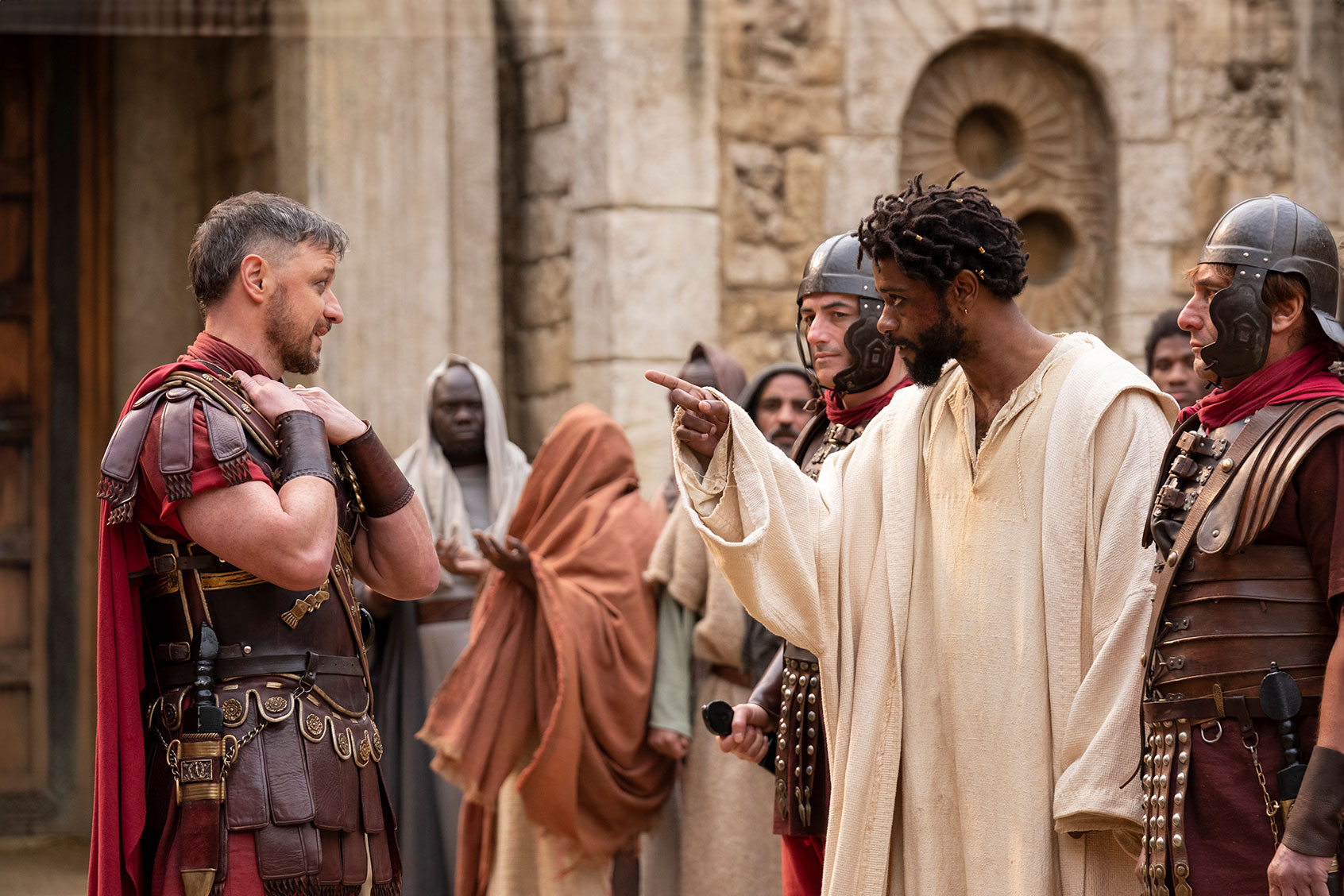
Jeymes Samuel’s "The Book of Clarence" centers the strained relationship between twin brothers Clarence and Thomas (both played by LaKeith Stansfield). Clarence is a street pharmacist who, abandoned by his twin for the rumored Messiah, decides to pull a messianic hoax of his own. Each brother struggles under the weight of Roman occupation. Thomas retreats from the world, following a messiah at the expense of his relationship with his own mother and brother. Clarence courts trouble, borrowing money he can’t repay and selling products the Roman government can’t tax. 

My brother’s lungs were formed in West Louisville.

In Samuel’s color-conscious casting of Black citizens of Jerusalem and the white Roman soldiers who police them, it’s hard to miss that the Roman soldiers grip their breastplates like contemporary police officers grip their vests. If that similarity wasn’t enough, Clarence’s mother hits the nail on the head when she screams, “They always take our babies!” as the Romans whip her son, marching him up the Hill of Golgotha to a premature death. I struggled through the brutal crucifixion scene, resentment for the Romans bubbling up each time Samuel brought another mourner into the camera’s frame — Clarence’s mother, his best friend, a neighborhood rival, the girl he loved. His twin brother Thomas. It was easy to transpose that resentment from these fictional, historical figures to the bad actors who stole my big brother’s last breath on a cross of labored breath built years before we were born.

By the time the credits rolled and my friend asked me what I thought of the movie, my resentment threatened to turn into an impotent hatred for men long gone. “I liked the movie. Mine is a critique of the gospel,” I said. “Give me a gospel where the Romans die!”

* * *

The Romans who crucified my brother are already dead and gone. They were not police officers or soldiers. They were Louisville’s city planners, working in tandem with Harland Bartholomew, a Massachusetts-born urban planner who redlined West Louisville in 1914, equating blight with Blackness and limiting its spread in the city. In so doing, he made my great-grandparents, implants from Athens, Alabama, sitting ducks for a chemical industry that chose to settle in Bartholomew’s “blight” areas,  shaving years off the lives of residents. The West End of Louisville, where my kin spread out and settled, is still one of the most polluted areas in the city. According to The Courier Journal, “Neighborhoods near the [chemical] industries are twice as likely to have either asthma or high blood pressure, four times more likely to have COPD, seven times more likely to have heart disease; and four times more likely to have poor physical health.”

My brother’s lungs were formed in West Louisville, where he toddled on plump baby legs toward all the people who loved him. Our family later moved to Shively, an adjacent, only slightly less polluted suburb. He left for college and cleaner air in Lexington, Ky., and he lived there well after he was diagnosed with heart failure in 2004. My brother didn’t move back to Louisville’s West End until 2012. His health began a rapid decline. I’d like to think his trusted team of Lexington heart specialists would have cautioned him against moving to one of the most toxic neighborhoods in Kentucky had they known the history of redlining in our city. His early death was civically engineered.    

The Book of ClarencePontius Pilate (James McAvoy) and Clarence (LaKeith Stanfield) in "The Book of Clarence" (Legendary Entertainment)

"The Book of Clarence" depicts the ordinary nature of civically engineered death. When Clarence hangs on the cross, we see hundreds of crosses sprawled out over the hill behind him. Jesus’ crucifixion (not shown on screen) is just the most widely published. This brutal, personal enforcement of social dominance is where the Roman occupation analogy may stretch too thin. Over-policing and capital punishment are two forms of military occupation that Western culture recycles but what of chemical warfare disguised as industrial revolution? Who is the Roman conqueror when air is the cross?

The question sent me scrambling for Howard Thurman’s "Jesus and the Disinherited," the book Dr. Martin Luther King, Jr. reportedly carried at all times. Thurman, born in 1899, was a theologian, preacher and mystic who positioned Jesus as a Palestinian Jew practicing his faith under Roman occupation. By drawing parallels between Jesus and the “disinherited” —  America’s descendants of enslaved Africans struggling to survive Jim Crow — "Jesus and the Disinherited" grandfathered the images of Samuel’s film. 

Chemical warfare is just one tactic used against bodies like mine in this country.

Thurman was the grandson of an enslaved woman who could not read the Bible for herself. He read the scriptures to her, skipping over Paul’s letters because of the way her captor had used them against her. "Jesus and the Disinherited" is an homage to the God concept she crafted while living under siege. What would Thurman say about the short distance between his grandmother’s and my brother’s vulnerability to racially constructed environments? 

I know this: Thurman would caution against my demand for a gospel based on some “fundamental sense of justice” that leaves dead Romans in its wake. He would recognize hatred in this wish. “Hatred, in the mind and spirit of the disinherited,” Thurman writes, “is born out of great bitterness that is made possible by sustained resentment which is bottled up until it distills an essence of vitality, giving to the individual in whom this is happening a radical and fundamental basis for self-realization." For Thurman, hatred is the real threat of occupation because it disguises itself as common sense and self-protection, then spreads through the disinherited as the cancer it becomes. Chemical warfare is just one tactic used against bodies like mine in this country. Thurman prioritizes a more fragile site of subjection: the soul.  

In some realm I sense but do not see, Thurman intercepts my daydreams about time traveling to Harland Bartholomew’s childhood home and smothering him in his crib. Had I managed such a trip to the year 1889, another post-Reconstruction born white baby would have risen to engineer the same outcome. Knowing Bartholomew’s name and reputation is just a convenient way to focus the angriest edge of my grief; a planned environment is too elusive an enemy for an imagination that wants revenge. Thurman cautions against such uses of imagination. “Hatred,” Thurman reminds me, “tends to dry up the springs of creative thought in the life of the hater, so that his resourcefulness becomes completely focused on the negative aspects of his environment.” 

What if this environment is what killed the hater’s brother? I ask Thurman in this sensed, invisible realm. 

The environment may have killed him, but how did he live before he died? Thurman responds, pulling my imagination away from Bartholomew’s house and toward all the space my brother occupied on this side. 

* * *

My paternal grandmother nicknames my brother “Jive Turkey” in the late '70s for the way he is a smooth talker, angling to get what he wants and making you laugh along the way. By the time I’m born, the nickname has been shortened to “Turk.”

I am four and plucking a $10 bill from the birthday card I have just opened when Turk winks at me, counts out five $1 bills. He says, “How about I trade you five for one?” The adults crack up and stop him before I jump at the deal; he will play this game with my little brothers and me until we are old enough to know the difference and cut him off at “How about . . .” 

He threw the first of many extravagant backyard birthday parties just weeks after his diagnosis, naming the series a “Celebration of Life.” For 12 years, he playfully cajoled invitees into road trips by reminding us that, in his condition, nobody knew which party would be his last. 

My big brother joined Omega Psi Phi Fraternity, Incorporated in the Spring of ’92 and made himself a legend. “I think I was so young that I just became the frat, and it became me,” he once told me when I was wondering why he loved the crowds that made me skittish at his celebrations of life. 

For six months, the Jewish Hospital lobby looks like a celebration of life. It is full of his fraternity members, cycling in and out of the ICU two brothers at a time. In the hospital room and the waiting room, they laugh as if death doesn’t isn’t lurking, giving all their jokes the weight of last words.

I remember the words my brother spoke on a rare visit when we were the only two people in the room and we still thought we’d get to go home. “Tell me something fun. I’m so bored in here,” he said, flexing his fingers and flipping channels on the wall-mounted tv. 

“I wish I had something to say,” I admitted. “I don’t do anything but work.”

“Is that what you want?” he asked, leaving the question between us to follow me over the years, find me on this page, and make me repeat it for myself. How have I held space in the shadow of my brother’s death? How do I want to hold space in light of my brother’s life? 

I’ve been trying to adequately convey this light for six years now, but I keep tripping into the shadows of gone too soon. I collected those efforts into a manuscript I tried, and failed, to get published. I know two reasons why "A Gospel of Gone Men" didn’t sell: 1) A gospel is good news, and there’s no good in gone; and 2) The title was disingenuous, as the men I wrote about kept finding ways to show me their still-here-ness. 

I feel my brother nudging me now — away from those pages, toward a new story about a life too expansive to end at the body’s last breath. I feel him reminding me that I have just turned a comedy into a meditation on untimely death, and that such rumination misses the magic of Samuel’s comedic gospel. At the end of the day, laughter is the space we hold for and with ourselves. It’s the space no Roman can police. It’s the space no engineer can contain.  


John Oliver offers Clarence Thomas $1 million a year to resign from Supreme Court

A late-night comedian has offered a stunningly generous severance package for an associate justice on the U.S. Supreme Court, should they resign within the next 30 days. John Oliver, host of HBO's “Last Week Tonight,” devoted the bulk of his Sunday night program to alleged conflicts of interest on the Supreme Court, highlighting many of the ways in which justices can receive gifts and cash without legal consequence.

Oliver underscored the long history of Associate Justice Clarence Thomas’ relationship with billionaire Republican donor Harlan Crow and other wealthy benefactors who have showered Thomas with free trips in private jets and other extravagant gifts, while Thomas failed to disclose any of it. Then, Oliver made the offer to one-up these contributors, offering Thomas "one million dollars a year for the rest of your life if you simply agree to leave the Supreme Court immediately and never come back,” Oliver said, adding, "HBO is not putting up the money for this. I am personally on the hook.”

To sweeten the deal, Oliver is also throwing in a giant motorcoach worth $2.4 million, which may be extra enticing to Thomas, who has a famous affection for his own high-end vacation vehicle. Oliver says he spoke to several legal experts to ensure that this offer does not break the law.

How an $18 Big Mac meal became a symbol for economic anxiety — and what that means for Democrats

Every few weeks since late fall, receipts for an $18 Big Mac meal from a Connecticut rest stop go viral online — with social media users lining up with their own staggering drive-thru receipts and searing comments, many of which communicate something along the lines of the title of a similarly-viral TikTok video, “McDonald’s has gotten too cocky.” 

Inflation has been a hot-button issue since the early days of the pandemic, stoked both by supply chain disasters and international conflict, but now consumers are desperate for relief. In decades past, fast food has been a reliable source of hot and cheap meals, but even the price of value meal basics are on the rise. In some locations, a single McDonald’s hash brown costs over $3, while comedian Kevin Fredericks recently released a video bemoaning the seeming lack of a dollar menu. “We used to be a proper country,” he lamented. “$4.29 for a McChicken? $3.19 for just a cheeseburger not even a McDouble cheeseburger, just a cheeseburger? This ain’t no McValue! These are just McPrices, these are just regular McPrices.”

McDonald’s CEO Chris Kempczinski has recently come out and said the company would be focusing on affordability in the next quarter. However, in the meantime, that $18 Big Mac meal has become both a symbol of consumer anxiety — as well as an unexpected economic flashpoint with which Democrats will have to contend in the upcoming election cycle. 

It’s not just McDonald’s, of course. Fast food menu prices across the industry rose consistently throughout the pandemic. As reported by CNET, data from Pricelisto, a website that tracks menu prices for United States fast food chains, shows that menu prices were up about 13% from 2021 to 2022. Wendy’s and Chick-fil-A were both on the higher end of price increases, with a respective 35% and 15.6% increase over the previous year’s prices. 

In 2023, the numbers only continued to climb; a report from the National Restaurant Association shows that menu prices in September rose by 6%  over the same period in 2022. 

It’s worth noting that while McDonald’s franchisees set their own prices, there are a few factors underpinning the larger surge. The cost of commodity goods — including beef cattle and grain, the basic ingredients of a burger — rose globally. Supply chain disruptions during the pandemic meant that certain drive-thru staples, like paper napkins, coffee cups, straws and to-go containers, were low on the ground and even more expensive for chains to procure. Additionally, the price of minimum-wage labor, which has supported the fast-food industry for decades, is finally on the rise. 

“Even though we’re pushing through pricing, the consumer is tolerating it well,” Kempczinski said in an October analyst call regarding the rising prices on the menu in the U.S., which increased by as much as 10% in 2023. 

However, as CNN Business reports, the burger chain is now reporting “weaker-than-expected sales at its US stores,” and a key reason why seems to be that the chain is losing customers — particularly customers making less than $45,000 a year, which has historically been a key demographic for the fast-food industry — due to pricing. “We actually saw that cohort decrease in the most recent quarter,” Kempczinski said in an earnings call on Feb. 5. 

We need your help to stay independent

“You're seeing that eating at home is becoming more affordable,” he continued. “That I think is putting some pressure from a IEO [Informal Eating Out] standpoint on that low-income consumer.”

Data about customer attitudes reflects Kempczinski’s assertion. The State of Personal Finance in America survey — which was taken in the second quarter of 2023 — reveals that as essentials have become more expensive, 31% of those who responded reported cutting back on non-essential activities like dining out. 

Unease about the current state of the economy goes deeper than just tightening up expenses; per the survey, approximately approximately 49% of Americans report that financial concerns heavily impact their well-being, with 2 out of 5 Americans having experienced anxiety attacks due to money stress. Fifty-nine percent are specifically anxious about affording inflated prices. 

The Republican Party has been quick to politicize rising fast-food prices, tying them to pushes for a higher minimum wage. For instance, as Vox reported, in June 2021, the National Republican Congressional Committee (NRCC) — the body responsible for electing a GOP House majority — released “an official statement blaming Joe Biden’s ‘socialist stimulus bill’ for the fact that Chipotle was raising its menu prices by 4 percent in order ‘to cover the cost of increased employee wages.’”

As Allison Morrow wrote last year for CNN Business’ Nightcap newsletter, the fact that Republicans are spinning Big Mac prices as political fodder — and that social media has become an echo chamber for disgruntled customers —is becoming “ an increasingly nettlesome problem for Democratic political strategists and economists who have so far failed to deliver the message that the economy is actually doing great.” 

"You're seeing that eating at home is becoming more affordable."

“Despite the inflation hangover keeping prices elevated, the economy, by almost any measure, should be one of the biggest feathers in President Joe Biden’s cap over the past three years,” she wrote. “But American voters  keep telling pollsters that they aren’t feeling all the good news that economists are seeing in the data.” 

Publications, including the New York Post and Washington Examiner, have linked the high cost of a McDonald’s meal to “Bidenflation” (or as the Examiner put it, “McFlation: Big Mac's price soars in Biden's economy”). As such, it’s growing more and more possible that questions regarding Big Macs will be on the debate menu this year, but in the meantime it looks like McDonald’s customers could have some relief. 

In last week’s earnings call, CEO Chris Kempczinski indicated the company would be broadening the options on their D123 menu — named for its $1, $2 and $3 options.


“House of Cards” once seemed too cynical — those were innocent times

What seems like an eon ago, I wrote a book called "The Deep State." I conceived it as a Baedeker’s Guide to how the political machinery of Washington functioned through lobbying, political contributions and influence peddling: a nuts-and-bolts look at how institutions like the military-industrial complex, Wall Street and Silicon Valley generally got their way. 

It analyzed how we lurched into the Iraq nightmare, the way Wall Street and the Bush administration co-engineered the 2008 financial meltdown, and how the Tea Party “revolt” was Astroturfed by a few billionaires. All these actions, I repeatedly emphasized, happened in plain sight of the voters whose interests were harmed by them.

It was emphatically not a tale of deeply laid conspiracies, covert assassinations, the Federal Reserve planting microchips in us or alien autopsies at Area 51. The closest thing to the Illuminati or Freemasons in the book was the Ivy League, which has a remarkable record as a credentialing shop for gargoyles like Ted Cruz, Mark Zuckerberg or Josh Hawley.

Like Henry Frankenstein, I had created a monster. Although the term “deep state” had been around before, suddenly every whack-job with an extra chromosome glommed onto the phrase as a blanket descriptor for his own paranoid fantasies. Now it has become wingnut coin of the realm: the reason for stolen elections, Jewish space lasers and pedophile rings grounding freighters in the Suez Canal. I can only speculate that the degradation of ideas into bizarre caricatures of themselves is the result of fantastic cultural misunderstandings, like the belief among French film critics that Jerry Lewis was a cinematic genius.

The term “deep state” had been around before, but suddenly every whack-job glommed onto the phrase as a blanket descriptor for his own paranoid fantasies. Now it has become wingnut coin of the realm.

At the time I was writing the book, a TV drama ostensibly about politics became an entertainment phenomenon. "House of Cards," which ran for six seasons on Netflix, beginning in 2013, was about a politician who made his way to the top through ruthlessness, back-stabbing and even murder. I described it in the book as a kind of Hollywood fantasy about the amorality of Washington, albeit in a crucially decontextualized way. It was as if the screenwriters had taken the plot formula for crime dramas like "CSI" or "The Wire" and shoehorned it into an upscale setting, with Senate cloture motions replacing drug busts in a West Baltimore ’hood.

I wrote at the time that whatever one might think of seedy, amoral political hacks, I was not aware during my time as a congressional staffer of elected officials stalking the halls of the Capitol or the adjacent Metro station looking for inconvenient witnesses to bump off. The evil that real politicians did was the far more prosaic legislative activity performed in full view of the American people.

Well, that was then. In present circumstances, there is no way that "House of Cards" could be as popular, quite apart from the fact that lead actor Kevin Spacey’s real-life misadventures might repel a significant potential audience share. And my own contemporary analysis of the show’s flaws, while reasonably accurate then, does not stand the test of time.

We need your help to stay independent

All popular entertainment is at some level a form of escapism made superficially plausible by an intriguing plot, good acting and realistic dialogue. People don’t kick back and divert themselves by binge-watching the all-too real. Diversion was what "House of Cards" offered — escapism that gave viewers a little thrill, hinting that their worst fears about how society is organized just might be true. It was a diversion in the way that horror movies are: a simulated world in which you willingly suspend disbelief even while you know it’s not real. 

The writers even had a little fun with this convention by having the protagonist-villain, Frank Underwood (played by Spacey), occasionally break the fourth wall and address the viewer directly about his schemes. It was a nod and wink signaling that you, the viewer, were clued in and presumably above the on-screen shenanigans.

The real failing of "House of Cards" that now renders it an antique was not that its depiction of politics was overly cynical, but that it was too naïve by half. At the time of its production, birtherism had already blossomed like a toxic plant, the parents of children murdered in the Sandy Hook school shooting were being mocked and harassed as crisis actors, and Republicans “knew” that Obamacare included death panels that could decree involuntary euthanasia. Yet "House of Cards" focused on the machinations of politicians in the manner of the 1962 film "Advise and Consent" rather than the real story that was brewing in the collective id of Republican voters.

By the time of Barack Obama’s second term, the quiet parts were beginning to be spoken out loud, and then acted upon. There was no longer any need for a psychopath to be furtive about his dastardly designs. Concealing a murder? How quaintly bourgeois. Soon we would see a president on live television openly incite a mob intent on murdering the vice president and speaker of the House. He, and millions of followers, would go on to deny what had happened before their own eyes, and the entire legal system was flummoxed. Politicians and court officials now must routinely hire security to protect them against bodily harm, or give up office altogether. 

The world has turned upside down. Since 1963, the Kennedys, a political dynasty of the type miniseries producers churn out family sagas about, have usually been subjects rather than authors of conspiracy theories, from the "grassy knoll" of 1963 to a family member supposedly faking his own death. Now the scion of the bloodline, the purportedly ’roided-up Robert F. Kennedy Jr., is running for president on the strength of his claim that COVID-19 is "targeted to attack Caucasians and Black people. The people who are most immune are Ashkenazi Jews and Chinese." And he’s a Kennedy financed by right-wing money. What scriptwriter could have dreamed up that plotline? 


Want a daily wrap-up of all the news and commentary Salon has to offer? Subscribe to our morning newsletter, Crash Course.


It is not just that current events are too implausible to make believable fiction. Popular entertainment not only diverts viewers; it habitually flatters them. Challenging the audience too directly is a good way to lose ratings. Thus, the covert character of Frank Underwood’s nefarious deeds tacitly supported the idea that the voting public was unaware of his behavior and would be outraged if they found out. I too once believed that the chronic defects of our political system were a product of public ignorance, apathy or complacency.

But the initial invasion of Iraq was wildly popular, and even after it settled into a squalid quagmire, George W. Bush managed to win re-election. Extending health care to the uninsured may have been a long-overdue policy improvement for a supposedly developed country, but no sooner was the Affordable Care Act passed than the American people voted in one of the biggest congressional landslides in history to let Tea Party candidates run the House of Representatives.   

The audience-flattering message of American pop culture since "Mr. Smith Goes to Washington" is that good will triumph over evil because of the innate virtue and common sense of the people. It ultimately derives from the delusion of American exceptionalism.

One of the better films about politics is Elia Kazan's 1957 "A Face in the Crowd," from a screenplay by the blacklisted writer Budd Schulberg. It brilliantly casts Andy Griffith against type as a petty grifter who rises first as an advertising pitchman, then as a political adviser to oligarchs, and finally as a proto-Rush Limbaugh with a huge audience. His nasty, authoritarian personality becomes more and more evident to his associates as his ambition fixes on the White House. His denouement arrives when he accidentally tells his audience over a hot mic that they’re a bunch of witless, contemptible rubes; they turn on him and his popularity evaporates. 

That is the audience-flattering message of American cinema at least since Frank Capra's "Mr. Smith Goes to Washington": Good will eventually triumph over evil because of the innate virtue and common sense of the people. It is not just an entertainment trope; holding the American people blameless for the atrocities of politics is the stock in trade of the news media as well. It has its psychological roots in works like Carl Sandburg’s "The People, Yes," and ultimately derives from the delusion of American exceptionalism.

Donald Trump’s public utterances about his fan base being “uneducated” or “losers” have led to no obvious diminution of their support, which tarnishes some of the credibility of "A Face in the Crowd," at least from the standpoint of the present. The fact that after two years of intense publicity, a majority of Republicans has somehow contrived to remain unaware of Trump’s massive legal troubles is not, as I once might have thought, a sign of ignorance. It is an act of mass self-hypnosis that makes one blink in astonishment. These are times that have become impossible to satirize.

Truth is undeniably stranger than fiction, but we crave the comfort of escapist tales, plotted on a level that is comprehensible to us. During World War II there appeared a cartoon, I believe in The New Yorker: A mousy, James Thurber-esque little man is in front of a newsstand. The newspapers on display feature screaming headlines from the contemporary battlefronts: TERRIFIC TANK BATTLES RAGE IN FRANCE; THOUSAND BOMBER RAID ON BERLIN; YANKS STORM PACIFIC STRONGHOLDS. The little man approaches the news vendor and says, “Action Stories, please.”

“True Detective: Night Country” leaves us in a place between the truth of crime and feminine mystery

Winter is a woman, stunning, just and cruel. She blankets the land in glitter to give the flowers and grass time to sleep. She slows decay and gives cover to sinners charged with noble dirty work.

Earth’s varied peoples call her by many names – Chione, Perchta, Skadi, Yuki-onna, to name a few. Also beast, b***h and other epithets hitting back at her meanness.

But winter is a mother who commands and demands respect. Surrender to her and she’ll embrace you in warmth before lulling you to sleep forever. Disrespect her, and she’ll twist you up in her frigid uncaring.

Winter is a time for stories, too – the pretty ones persuading children to believe in magic, and masterful, spooky epics like “True Detective: Night Country,” through which Issa López seduces us to contemplate the many realities crossing Ennis, Alaska, an ancient place plundered by industry where the ice keeps the dead but doesn’t silence them. From the start López kept reminding us, through her prickly police chief Liz Danvers (Jodie Foster), to question everything. All the while she correctly suspected we probably wouldn’t ask the right ones.

In the premiere, for example, when Evangeline Navarro (Kali Reis) answered an assault call at the local seafood processing plant, there was no reason to wonder why a matron called Bee (L’xeis Diane Benson), spoke on behalf of her younger co-worker Blair Hartman (Kathryn Wilder). Blair had moved in with Bee to escape her abusive partner, who came to her workplace seeing red. Bee stopped him from hurting Blair by knocking him out with a metal bucket. When the man comes to and lurches toward the woman, Navarro arrests him, not his assailant.

And it was Bee, the secret queen of Ennis, who discovered what really happened at Tsalal – that the men working there dug too far into the ice and, believing their scientific discovery held higher importance than the lives of Ennis’ townsfolk, compelled the mine to poison the water and the land.

Bee didn’t know about that crime. Raymond Clark (Owen McDonnell) confessed it once Navarro and Danvers beat him into submission and tortured him with the piercing wails of his dead lover Annie Kowtok (Nivi Pedersen) playing on a loop until he gave up everything.

The women put together the evidence, true detectives to the core.

This is how they finally solved Annie’s murder. But the womenfolk in town were way ahead of them. Six years later after her murder, Bee found the same underground lab and the star-shaped weapon used to stab Annie to death. How? Because she was the facility’s cleaning lady. And if there’s one behavior that’s as predictable as the seasons, it’s that men who think they’re better than everyone else will always ignore the help.

What’s true of the Tsalal scientists stands for the cops. A fellow maintenance worker at the police station pulled Annie K’s file and took photos of the autopsy report.

True Detective: Night CountryTrue Detective: Night Country (Michele K. Short/HBO)The women put together the evidence, true detectives to the core. Then, rifles in hand, they stormed Tsalal station, rounded up the scientists at gunpoint, herded them into a truck, and drove them onto the sea ice to run naked into the subzero December darkness. If Blair, who's missing two fingers on her right hand, hadn't left behind a telltale handprint nobody would have known the truth.

This still doesn't explain the corpsicle horror. Simple death by exposure would have left peaceful bodies that looked as if they were slumbering, as a veterinarian consultant observes in an earlier episode. Bee, however, knows why these men died screaming, and why she and the other women left their clothes nearby, as she tells Danvers and Navarro when they arrive at her house to question her and Blair. 

If “she” wanted to take them, she would, Bee said. “If not, their clothes were there for them. They’d be half-frozen, but they’d survive. But they didn’t though. I guess she wanted to take them.”

Bee calmly adds, “I guess she ate their f**king dreams from the inside out and spit their frozen bones.”

But it’s just a story, Bee concludes. One of many.  

Another, told from Clark’s perspective, is that Annie found the caves beneath the facility where the team was engaged in their true work. She realized the extent of the harm they’d wrought and destroyed it. Anders Lund (Þorsteinn Bachmann), the temporary survivor of the so-called “corpsicle,” caught her, snapped, and stabbed her more than 30 times with an implement that made those star-shaped wounds. The rest of the scientists held her down.  

Not her lover Raymond, he alleged to his captors. “I would never hurt her,” he told Navarro and Danvers. This, however, is fiction. The audience sees Annie flit back into consciousness and struggle with Clark, who finishes her off by smothering her with his t-shirt.

For all its flirtations with the unexplainable, “True Detective” always lands on the side of a crime's circumstances being mundane and entirely human. Navarro and Danvers may have kept hearing whispers on the wind warning them that “she’s awake,” as did Clark, who insisted that Annie had been hiding in the ice caves forever:  “Before we were born, after we die . . . Time is a flat circle, and we are all stuck in it!” But these crimes are acts of male anger and hubris, and female vengeance.

López might have been having some fun with that obvious reference to Rust Cohle’s famous free-associating, one existential obsessive responding to another echo. Or she might have at last explained what that means. Everything that has happened before will again. Actions have consequences we’re constantly forgetting. When Bee makes her mysterious reference to “she” and “her,” it’s understood she’s referring to something eternal that shouldn’t be messed with.

Maybe it’s winter. Maybe it’s Mother Earth, which the Tsalal scientists eagerly despoiled by urging the mine to increase its poisonous waste output to soften the permafrost and enable them to extract the microorganisms they source with less damage and faster. If that increased cancer rates and stillbirths among the locals, what did that matter?

True Detective: Night CountryTrue Detective: Night Country (Michele K. Short/HBO)Thus Bee is secure in what she and the rest of Ennis’ women accomplished – a group of vigilantes nobody would suspect, who trickled into Bee’s home, one by one, as she tells the cops everything now that justice has been done.

Besides, as she clarifies to Navarro, she and the other women didn’t kill the men. “Honey, they did it to themselves. When they dug in her home in the ice. When they killed her daughter in there,” Bee said, before repeating one of this season’s recurring motifs: “They woke her up.”

Danvers is content to let that stand, having dealt with enough d**ks to take a cosmic win when she gets one. Captain Connelly (Christopher Eccleston) already accepted the false results in the Anchorage forensics report, letting its explanation of a slab avalanche killing the scientists to stand.

We need your help to stay independent

López's framing proposes they rumbled maternal forces that refused to allow their transgressions to stand. Annie was a midwife, and midwives help women transform into mothers. To find the truth, then, Danvers and Navarro had to face the spirits they're pushing away — the former's son, and latter's mother. 

“Part 6” opens with Danvers and Navarro seeking rebirth, piercing through virgin ice to gain entry to the caves, traversing slick tunnels, and falling into darker places before finding the lab. Above it are the spiraling bones one of Danvers’ sources and conquest saw in Annie’s gruesome video and identified whale bones. But the skull attached to those remains looks more like that of an ancient serpent.

While they’re in the caves, the barrier between the living world and the dead gets thinner, affecting Navarro – and Danvers, perhaps more so.  

Holden, her dead son, keeps reaching out to Danvers through strange signs, including a broken hubcap materializing from nothing. Then a disassociating Navarro tells Danvers she can see Holden. The power goes out too, driving both women over the edge, nearly joining Clark in their madness. He runs out into the winter storm that covered their approach and freezes, like the other scientists.

Navarro walks into the storm too, although she takes herself to be in the spirit world. There, she finally allows her mother to reach out in comfort, revealing the Iñupiaq name she never knew.

Danvers pursues, falling through a thin patch when she thinks she sees Holden under the ice. She nearly drowns, but Navarro pulls her back. It’s a hellish, necessary baptism that results in Danvers finally accepting that Holden is still with her and that she should mourn him.

True Detective: Night CountryTrue Detective: Night Country (Michele K. Short/HBO)Through Danvers’ memory, we also see what happened in the Wheeler murder-suicide case that wasn’t. Navarro shot William Wheeler in the head – but she may have been compelled to do it. Whether you buy that depends on how much you believe in Ennis’ supernatural factors.

Or it could come down to one’s faith in these women, which brings around Peter Prior (Finn Bennett) to their side.  He was closest to finding out their secret before taking part in patricide, a crime the universe doesn’t easily excuse.

Connelly’s bureaucracy wouldn’t either, as Navarro and Danvers know. Prior, having seen enough horror to foul a good man’s soul for all eternity, agrees with them; after all, his father was about to kill his boss to get a promotion. So while Navarro and Danvers are spelunking, he cleans his father’s brains off a mirror and pulls a tooth out of the wall.

Somehow he finds the wherewithal to stop at his house and mend his marriage on his way to get rid of the body, which Rose (Fiona Shaw) helps Prior with by burying him at sea. “I guess you’re thinking the worst part is done. It’s not,” Rose warns him. “What comes after, forever . . . that’s the worst f**king part.” Now he’s in the Night Country too. Forever.

That’s not such a terrible proposal for us, though. López departs “Night Country” on solid ground, leaving enough tantalizing trimmings to make us want more. (She even explains the oranges: they’re messages from Navarro’s mother, who peeled them in one long spiraling strip. A flat circle.)

As for who left Annie’s tongue in the lab and why, “That’s not part of our story,” Bee insists.

The “Night Country” epilogue picks up on May 12, the first long day of the year, as Danvers claims to have no answers about Hank’s disappearance or why Clark was found frozen to death in the same manner as his colleagues. “Some questions just don’t have answers,” she alleges, although we know these do.


Want a daily wrap-up of all the news and commentary Salon has to offer? Subscribe to our morning newsletter, Crash Course.


Then it's revealed that Evangeline Navarro has disappeared too. We see her walking onto the ice on a sunny day like she hinted she might. Before she does, she leaves Holden’s toy polar bear for Danvers along with a recording on her phone of Clark giving a detailed confession outlining Tsalal’s role in poisoning Ennis. (She also returns Qavvik’s toothbrush.)

Someone leaked the video; Danvers claims she doesn’t know who. As a result, though, the mine has shut down. And Danvers and Leah are, at last, happy together.

True Detective: Night CountryTrue Detective: Night Country (Michele K. Short/HBO)Danvers tells her questioners that this town existed long before the mines, before Ennis was called Ennis and Alaska was named Alaska. “I’m just going to show up and do my job every day like we always do,” she tells her investigators, who press her again about Navarro’s whereabouts, adding there have been reported sightings.

Danvers answers, “Let’s put it this way. I don’t think you’ll find Evangeline Navarro out there on the ice.” This is a triumph, the last sign that Navarro, whose Iñupiaq name translates to “the return of the sun after the long darkness,” is at peace. The scene cuts to Danvers at a lakeside cabin taking in the serene landscape from its deck as Navarro walks into view, just out of her reach. Whether she’s really there, or not there doesn’t matter. The two of them are present as they are – a mother and a daughter. Sisters.

“This is Ennis,” Danvers concludes. “Nobody ever really leaves.”

All episodes of "True Detective: Night Country" are streaming on Max.

How the loneliness crisis is fueling “stan culture”

Last weekend, the Super Bowl made history by being the most watched broadcast since the 1969 moon landing

Yes, it was quite the nail-biter of a game, but it’s unlikely that everyone tuned in to watch football. Some wanted to see Usher’s halftime show. Others were there for the commercials. But many (myself included) were there to watch Taylor Swift cheer on her boyfriend Travis Kelce during one of the most exciting games of his career. 

Since Swift and Kelce have gone public with their relationship, it’s brought to light the power of superfans and so-called “stan culture.”  While the word “stan” was once synonymous with obsessed and slightly stalkerish people — thanks to rapper Eminem coining the term in his song "Stan," about a fan who took idolizing him too far — it’s taken on a new identity in the era of social media.

Stan culture is one where superfans feel they have a sense of belonging, a community to share their interests with — like a celebrity’s music — and one where they feel closely connected to their idol. Taylor Swift has the Swifties, who clearly turned out to support Kelce’s big game in a way to support Swift. Lady Gaga has the Little Monsters. Justin Bieber’s fans are called the Beliebers. Nicki Minaj has the Barbz. And of course, Beyoncé has the BeyHive. And this phenomenon is hardly limited to the West, as any K-pop stans will tell you about their deep love for boy group BTS.

In the 1990s and early 2000s, celebrity culture was centered around tabloid gossip. Celebrities themselves had little agency over their own public narratives. But since the birth of social media, they are finally able to connect with fans more intimately and directly. This strategy makes it feel almost as if we, the public, are their friends. Conveniently, this is happening in a time when more American friendships are wilting.

According to the May 2021 American Perspectives Survey, Americans have fewer close friendships than they did in the past. They talk to their friends less often than before, and they rely less on their friends for support. Could it be that stan culture is the result of us replacing in-person friendships with the mirage of celebrity ones? In other words, are we filling the gaps with celebrities because we’re actually lonely? 

“It can really feel like we're having a conversation or we personally know these people. Even when we've never met them before in our lives, and they have no clue who we are.” 

“Maybe this whole Swiftie phenomenon is in part due to the fact that COVID happened, and a lot of people weren't getting their social needs met,” said therapist Tasha Seiter. “It's so important for us to feel like we're part of a tribe, to have that kind of belonging, and when it's around someone who everyone knows about and is well-liked by a lot of different people, it makes people feel like they're not alone and like they're understood by someone.”

Seiter said it’s also possible that for many super fans, they feel so misunderstood in their daily lives that a song that relates to what they’re going through relates to them in a very different way. She added that when it comes to music, the human brain is activated in a similar way that it would be in a social situation. 

“Our brain doesn't understand recorded music, our brain hasn’t evolved quickly enough to really even process the idea of recorded music,” she said. “It thinks that what we're watching is live.”


Want more health and science stories in your inbox? Subscribe to Salon's weekly newsletter Lab Notes.


The same can happen while watching a video a celebrity made on social media. The way in which they talk to the camera in a snippet of a video, the way a friend would, is bound to make us feel closer to them. 

“It can really feel like we're having a conversation or we personally know these people,” she said. “Even when we've never met them before in our lives, and they have no clue who we are.” 

Prior to the pandemic, loneliness was an epidemic. But many believe the COVID-19 pandemic only worsened it. Last year, U.S. surgeon general Vivek Murthy released an advisory calling attention to the public health crisis of loneliness

“Real relief from loneliness requires the cooperation of at least one other person, and yet the more chronic our loneliness becomes, the less equipped we may be to entice such cooperation.”

Unfortunately, the treatment of loneliness is more complex than just finding more in-person friends. According to the late John Cacioppo, a researcher and author at the University of Chicago, loneliness is a “subjective experience” that results from a discrepancy between one’s actual social connections and their desired social connections. It’s a perceived gap between quality and quantity.

It also creates a “Catch-22” that’s hard to break. “Real relief from loneliness requires the cooperation of at least one other person, and yet the more chronic our loneliness becomes, the less equipped we may be to entice such cooperation,” he wrote in his book "Loneliness: Human Nature and the Need for Social Connection." If people don’t receive the connection they are looking for, he added, it can trigger depression, hostility, despair and impaired skills in social perception, which can lead to unhealthy attempts to mask the pain by seeking pleasure in whatever commodity, or person, is easily available. Like, perhaps, a celebrity? 

Certainly there is a dark side to stan culture. One that is obsessive and not always nice — hence the so-called “stan wars” in which celebrities themselves have had to intervene to put an end to harassment.

Carla Marie Manly, a clinical psychologist and author of "Joy From Fear: Create the Life of Your Dreams by Making Fear Your Friend," told Salon she does see a connection between a rise in loneliness in society and stan culture. She said when people are satisfied with their internal world, and their close relationships, they are less likely to seek out “external fulfillment.”

“The more people feel isolated from themselves, isolated from their community, it becomes a vicious cycle, because they feel more isolated,” Manly said. “They tend to retract, stay in their homes and become obsessed with some things whether it's drugs, alcohol or fandom culture.” 

Manly emphasized that humans have a natural need for connection, and need it to survive. It’s critical to have people around us to connect with and feel safe. But putting the energy into connecting with a celebrity isn’t going to satisfy that need, she said. 

We need your help to stay independent

“No matter how talented they are, or how wonderful they are, they really can't get back to you on a one-on-one level, and that’s what humans need,” she said. “They are not able to receive the same quality of interaction as their psyche really wants.”

Keeping this in mind, and aside from the really obsessive side of stan culture, is there a downside to being a superfan, psychologically? Manly warned it can lead to maladaptive daydreaming, which is when a person excessively daydreams for hours at a time. She added that with celebrities being online all the time, at least they make it look as if they are, it can also affect how we approach our real connections. 

“In one sense, the really obsessive part leads people to believe that relationships can be available 24/7,” she said. “But that’s not how real human relationships are.”

“War starts to rumble on”: “All Creatures Great and Small” star on the personal demands of WWII

"Where you need to be is in the air dropping bombs on your enemy. That is the support your family needs."

This is the advice that 1940s veterinary surgeon James Herriot (Nicholas Ralph) receives from his Royal Air Force commander FO Woodham (Sam Retford) on the Season 4 finale of "All Creatures Great and Small," which are based on the books by Alf Wight. James has requested temporary leave from training upon learning that his pregnant wife Helen (Rachel Shenton) may give birth soon. Oh yeah, and it's also Christmas. 

This year has been a test for James in ways he did not expect. The season began in spring 1940 with goat shenanigans and the demands of lambing, a typical time in the Yorkshire Dales for the denizens of Skeldale House. It was the period of what is referred to as the "Phoney War," the early months of World War II

"As the series continues, of course, the war starts to rumble on," Ralph said in an interview with Salon. "The Battle of Britain happens. And it's late summer into autumn, which is a massive point in World War II. And, of course, James has signed up to the RAF as well."

While James and his fellow Skeldale vet Tristan Farnon (Callum Woodhouse) had enlisted with the best intentions at the end of last season, James hadn't foreseen how married life would change his circumstances and mindset.

"They're in Skeldale, they've got their own little world, and they're about to start a family, at which point James gets called up," said Ralph. "And not only that, but a lot of men signing up and going off, you will know of men not returning, you'll know of men who have been killed in action. So the stakes are just so much bigger for James when he gets called up. It's a huge dilemma of heart and mind."

"They were just an absolute team, James and Helen were."

Nevertheless, James does his duty, which finds him training three counties over when he learns of Helen's precarious condition from a phone call and has his request for leave denied. Desperate to see his wife, James makes the surprising decision to go AWOL by stowing away in the back of a supply truck. Although he's caught and returned to base, once he fulfills a crucial duty, Woodham relents and allows James to visit home. That's when James learns that Helen has given birth and he gets to see his son for the first time. While he's overcome with emotion, he's also out of his element, not having dealt with human babies in his line of work. 

"There's a similarity to [the books] in the episode we filmed when he's holding little Jimmy," said Ralph. "He said, 'He's a funny looking thing, isn't it?' And then Helen says, 'Oh I suppose every foal that comes out is beautiful.' And that line is true to life. That's what James Herriot said for real, which I think was very funny.

"[In the books,] he talks about this smushed face, it's bright red, and some of the afterbirth still being there," Ralph continued. "He said, 'He looks like he's going through some inner turmoil," which is brilliant. He's at the midwife's house, and Helen's had the baby, and he actually asked to see another [baby]. He sees the one next door, looks down at this little baby and he thought, 'Oh, that's alright. Jimmy is fine because this one was even worse.'"

Check out the rest of the interview with Ralph who discusses driving vintage cars, brucellosis, working with birds of prey and ferret roulette.

The following has been lightly edited for length and clarity.
All Creatures Great and SmallAll Creatures Great and Small (PBS)James has this whole plan he's going to train this young vet who will help out in his absence. Could you discuss working with James Anthony-Rose who plays new vet Richard Carmody, and specifically what it's like to teach him to drive in that vintage car? Is it a functioning vehicle?

James thinks [Richard Carmody] is going to be a mini him and it's going to be brilliant. He'll take him under his wing, train him up. Turns out he's a mini Siegfried [Samuel West]. They end up getting on like a house on fire, and James kind of feels left at the side a little bit and becomes the kind the butt of the jokes. Richard Carmody, we see him flourish. He's very, very booksmart, but not so good on the practical side of things, at which point tending to  the horse that got loose, Siegfried and James come back together. Then you you see that they really need one another, which is lovely. 

"These books transcend time and place."

Teaching James Anthony-Rose to drive was interesting because the actor himself doesn't drive. We had to have a stunt double in to do some of the driving and then the rest of the time was on a low loader. Those period cars are fully functioning. I drive them all the time. The little blue one is a Vauxhall, and the green one with the soft top is a Rover. The blue one, Sam always laughs about it, because it's the same age as his mum. It's roundabout 90 years old. There's obviously a lot of patchwork and upkeep. The interior, the seating, the dash, just everything is of the period. It's a lot of fun. I mean, the gearstick wobbles as much in gear as it does when you're in neutral. So you just throw it in a general direction and hope something sticks. The Rover on the other hand, very smooth to drive, lovely to drive. 

Do they go very fast? 

They do go a bit of a lick. You can get up to 40 miles per hour in that car where the wheels are six inches wide. It's a real workout driving that car.  There's obviously no power steering, and there are wooden padded brakes. But if you want to brake you have to brake 30 yards before the place you want to stop. You'd be better off braking like a Flintstone car, just digging your feet into the dirt. If you could, you probably stop quicker.

Something that came about with Richard Carmody is the the diagnosis for brucellosis. And that was a scary moment because of the concept of zoonosis where the disease can jump from one species to another. What did you learn about that? 

I wasn't aware of it beforehand. I mean, I knew about brucellosis because I did the audio books, so I'd come across that, but I didn't know that zoonosis part about it jumping from species to species. I was kind of learning it as James was learning it, which was really, really frightening very much so because vets could get brucellosis. 

In the books, James actually does catch brucellosis in the end. I think the final book – I just did the audiobooks – that was a brilliant chapter when he's almost delirious. He's in bed with a really high fever and he starts singing old Scottish tunes from home that are sung by these classical Scottish singers who are tenors. They've got these massive high bits, and he's like, "The high bits just came to me, and I was singing, and it's amazing." At this point, both the kids are born, Jimmy and Rosie, and they're at the door, just creasing themselves with laughter. James is in bed singing, obviously doing a terrible job, but to him and his delirium thinking it's just the most wonderful singing. There's a lot of fun to be had with that later on.

James does get called up. What sort of things did you learn about what it meant to enlist and get called up for the RAF? How far is he from home when he goes to training on the base?

He's three counties away. Yorkshire is the biggest county in the UK and England, so it's actually quite far away. We know that James ends up being called to the bombers, so I learned a lot about that. In about 51% of bomber crews, personnel didn't come back. So it's less than half, a less than 50% chance you would return. Another 25% were injured in training and in action. The odds against you coming back in one piece is high, staggeringly high. In the Lancaster bombers, those planes roughly managed about six missions on average before they were they were taken down. So it's really not great stats.

You'd be learning about that during training, you would be seeing men not coming back, as we had in the Christmas episode of the young man that James gets to know because like himself, he's got a young family, a couple of kids. That really is like a sledgehammer to the chest for James. I think when you're doing basic training, it's almost like you're miles away from being in on missions. And that reality really sinks in for him in that moment. Also during the Battle of Britain, they fast-tracked recruits through the process so you can be in the sky I think six months from arriving for basic training.

As a result of that, James goes AWOL and tries to get back to Darrowby by sneaking into the back of a truck. Was that you who hopped into the truck?

That was me. The first take I got in, and it was good. The second one, I got in but kind of slithered over it like a slug. And the third one was that one, which I thought was quite quite good. It's actually higher than it looks on screen. It was actually quite a leap to get up there with all that gear on, the four layers and the big trench coat and the big boots I had to wear. So I was actually I was chuffed about that. 

Can you take us inside James's head when he does go AWOL? Did a lot of trainees go AWOL or at least try like James did?

I don't think that many [tried] to be honest, especially at that point in training. Again, this is true to life. This is something that Alf Wight, James Herriot being his pen name, did. It's in the books. He had been AWOL twice actually: once just to see Helen, and then the second time when he knew roundabout the time that she was due to give birth.

It just speaks of the their bond and their connection. We had spoken about an hour with their [real-life] kids, Jim and Rosie. And they just talk about that bond; they were just an absolute team, James and Helen were. They didn't really argue, they always had each other's backs. it just speaks of that connection that they have because James is somebody who [usually] follows the rules. In the earlier seasons, he was trying to do his best trying to impress Siegfried, trying to keep his job. For James to decide to go AWOL, he could have ended up in military prison. In that moment, I think it's almost instinctual. I don't think thinking is really coming into it too much. It's impulsive. 

Why do you think the officer Woodham relented and even personally delivered James to Darrowby, especially after giving that big speech about keeping focused and hard-hearted?

I think he could probably see within James that burning desire. He's also managed to get the bird flying, which is good. And it is Christmas, and his wife is pregnant. So yeah, it's probably a combination of all those things, really. Maybe about the Christmas spirit as well.
All Creatures Great and SmallAll Creatures Great and Small (PBS)Speaking of the bird, James is instructed to use his skills as a vet to get the kestrel Georgie, flying again after she injured the feathers in her wing. What can you tell me about the role of these birds during wartime?

It's the mascot of the base there, one of those kind of slightly superstitious things, like you might wear the same pair of pants when you go up for a flight. I had my own things when I played football as well.  For the guys, it comes at a time when there has been a plane down the night before. The morale is kind of low. So just to have that mask on, have that bird fully fit and well and taking flight is a little good luck thing before before the missions. I think for the men it is really big. Yeah. So thankfully, James was able to help the bird out.

You've worked with so many animals on the show over four seasons, but the kestrel is new. What was it like working with and handling the bird? I'm not sure of the bird's real name but in the show it was called Georgie.

"Working with [animals] brings a whole new focus to the set."

That was a bit of art imitating life that week in that I was away up in Elvington at the RAF Aerodrome museum. So everything is as it was during World War II. You're just completely transported back in time. It was amazing. And then especially when everyone was in the costumes, and you're surrounded by 30 extras, that was absolute incredible being there. Like James, I left the rest of the cast back in Harrogate and filming there. I was away for a week, so I did miss the miss them. 

So the day before we started filming out there, I spent just the afternoon with the animal handlers and Grace, the little kestrel. It was just incredible. I love birds of prey. I just think they're so majestic. She was just brilliant. We were doing little calls. For one of the shots, she had to hover at a certain spot. So you'd let her fly off and then you'd have food in a slingshot. And then you would call the bird and point above you to the spot that you want to do to hover at. You would do this call and point, call and point and then she would swoop down and hover at the point that you are pointing at, and then you fire up the food for her to catch. That's how they had her hover at that one point for one of the opening shots when she's hovering and then it turns into the biplane.

Are there any other tips that you learned about handling a bird of prey or kestrel?

Your arm has to be at a 90-degree angle, like this. And it should be on your hand, and you need a loose grip. Then you always have the bird looking into the wind because if you don't, she'll always try to maneuver to look into the wind. That's when they're ready, they're primed and then they'll set off. If you try to carry the bird with its back to the wind, it will actually fall off your hand and be upside down and flapping around. You always have to move yourself. So normally, you're walking backwards into the wind a lot of the time.

James fixes the kestrel's wing using a toothpick in the hollow shaft of the feather as a termporary measure. Would that actually work? Was that in the books? 

Now I have to be careful what I say here, but I don't recall it from the book. I am going through them quite thoroughly. I think that's one of the ones from our on-set vet Andy Barrett, who we consult with over scripts and things like that. Thankfully for us and for James in that scenario it worked.
All Creatures Great and SmallAll Creatures Great and Small (PBS)Right now, we're still waiting to hear if there will be a fifth season, which I don't doubt we'll hear about soon. In the meantime, can you reflect on how the show carries on the legacy of Alf Wight and his vision?

The books have been translated into 45 different languages and sold 50 million copies plus worldwide. This the reach is global. The show now is in every continent, and, and then lots and lots and lots of countries within those continents. It all comes down to the material because they're so steeped in truth and love, not only for the animals, but for one another. The characters and the relationships within are so three dimensional. There's so much truth to it, and people can relate to it. I think he's a real humanist, Alf Wight was.

That's why these books transcend time and place in the way that they do so, with the wonderful Yorkshire Dales and these fantastic characters. These eccentric characters still come across who still they still exist as well. We were working at a farm without with a farmer there and somebody said, "You know, if you picked him up and put him in the show, nobody would believe you." Because he was just this proper eccentric guy, a lovely guy. They're so quirky, some of the characters, and but they're still truthful.

Speaking of colorful characters who seem unbelievable, what can you tell me about the ferret roulette? Was that in Alf Wight's books?

That was something that was added, but it was brilliant fun and obviously researched from that period. It's another one of these kinds of pub games where the dealer always wins it seems. We did that for real as well. It was a real ferret. Also when when he got loose going across the square across Grassington, across Darrowby, we did that for real as well. That took a few attempts. One time he went over that way, the next time he went over over to his right and then finally he got going the right way.  Working with animals is a complete joy, even when you're working with those bigger, intimidating animals: the bulls, the horses and the cows. Working with them brings a whole new focus to the set. Everybody's really on their toes. There's a different kind of energy and a calmness and a focus.

Can you reflect on this ongoing gift that "All Creatures Great and Small" had been, especially during the time when a lot of people needed the show?

It's absolutely incredible. At the start of the year, we were out at the L.A. Zoo, doing a screening of the first episode, and we met some fans. That was the absolute highlight of the trip. It just so many people with just lovely things to say. And such a wide demographic as well, people that came down to say hi and get a picture. Lots of different stories about how it came at a certain time for them if somebody was maybe unwell or they were struggling personally. It's just the thing that gets the whole family together, and you'll have three generations sitting down and watching the same television show. That's something we're incredibly proud of.

We get messages all the time as well on social media. I did a video recently. A woman's daughter got in touch and told us about how her mum had terminal cancer, and she's a massive "All Creatures" fan. She's a massive fan of the books and everything and now a massive fan of this series. When they get together, the family, they put that on because it makes her smile. So I sent them a little video message.

It came out at a time when we were all stuck inside and we didn't know what was going on.So they'd have that kind of escape out to the Yorkshire Dales with these characters and this community in having the onus on your neighbor and this kind of gentle, warm drama with laughs. Since then, you know, we've had a wonderful time making four seasons and and we'd love to do more. It's is a real treat and continues to be.

Besides hopefully more "All Creatures," what's next for you?

A couple of jobs unfortunately were affected by the strikes, because they're both American-led things. But there will be some things coming out this year. It's a TV series, so look out for me in that. Then hopefully in the spring or the summer, I'll go on all these things that were pushed because of the strikes.

The desert “erases people:” Volunteers try to count migrant deaths, but the true number is unknown

When Battalion Search and Rescue discovered the scattered, skeletal remains of another body in the desert at Organ Pipe National Monument earlier this year, founder James Holeman followed usual protocol, noting GPS coordinates and taking photos, as well as marking the area with fluorescent orange tape to help law enforcement later retrieve the unidentified remains. The site is among over 100 sets of human remains Holeman has found during almost six years volunteering and eventually leading search and rescue groups for migrants on the U.S.-Mexico border.

A report from Holeman lists the remains found at this particular site, “including cranium, mandible, femur, ribs, vertebrae and more.” The report also mentions two cell phones, clothing, a lighter, hygiene items and a backpack.

According to U.S. Customs and Border Protection, 8,050 people have died illegally crossing the Southwestern border between fiscal year 1998 and 2020. Although Border Patrol hasn’t publicly reported on the number of migrant deaths since fiscal year 2021, Salon obtained CBP’s most recent report on unidentified remains, which lists a total of 895 reported migrant deaths during fiscal year 2022. Despite Border Patrol’s restrictive policies for reporting remains, this is an all-time high.  

Although it is unclear why this report has not yet been made publicly available on the CBP website, Border Patrol’s record-breaking numbers of migrant encounters have meanwhile remained current, with information already available for January 2024. Given news reports of 3.2 million migrant encounters at the border last year, the documented number of people known to have died seems likely to be a significant undercount.

The bones in the desert tell another story.

Battalion Search and Rescue US-Mexico BorderCrosses left to mark the locations where the remains of migrants who died trying to cross into the United States through the harsh conditions of the Sonoran Desert. (Photo courtesy of Battalion Search and Rescue)
I accompanied Battalion Search and Rescue on a recent 32-mile hike through Growler Valley in south-central Arizona to comb the desert for human remains. Our search covered less than 1% of the approximately 650 square mile area, which itself represents only one small section of the Tucson corridor, one of the most active and deadly known areas for border crossings. During the three-day hike, we discovered seven sets of skeletal remains that forensic anthropologists later identified as human.

The group is named for the historic San Patricio Battalion, a regiment of Irish soldiers that defected during the Mexican-American War after facing anti-immigrant prejudice from their U.S. commanding officers. Battalion Search and Rescue is one of several volunteer organizations in the Southwest dedicated to recovering the remains of migrants, as well as occasionally providing lifesaving aid.

"You wouldn’t find bodies like this outside of a war zone."

“We find human remains. We report them to the local law enforcement [and] we occasionally deal with the medical examiner's office. Every step of the way we encounter resistance, intimidation, pushback, lack of cooperation, zero resources,” Holeman explained to a group of volunteers at the beginning of the hike. Volunteer groups are prohibited from gathering remains on behalf of law enforcement, as this would be considered tampering with a crime scene. However, Holeman has previously reported human remains only to find them again, still unrecovered months later.

“I know of at least half a dozen cases in this area since I've been doing this where they have not retrieved the remains after they were reported,” Holeman said. “Migrant remains receive a completely uneven response.”

“You wouldn’t find bodies like this outside of a war zone,” volunteer Brock Irish commented over walkie-talkie, one of several tools used by the group to keep in formation and from losing each other when searching areas sometimes hundreds of yards apart, along with high-visibility clothing, GPS and safety whistles. Irish is a former Marine, one of several military veterans in the group, including Holeman, as well as Neza, who joined the Mexican army at age 16 before immigrating to the United States. Although he’s now a U.S. citizen today, Neza says he crossed the border illegally multiple times when he was younger, although not through dangerous desert corridors like Growler Valley. When Neza’s brother died in the U.S., his family was originally asked to pay $14,000 to have the body sent back to Mexico City. (Neza requested that his last name not be used in this article.)

Battalion Search and Rescue US-Mexico BorderVolunteer Brock Irish documents GPS coordinates of human remains at a site in Growler Valley. (Photo courtesy of Levi Stallings)

“I incinerated him for $600 and drove all the way down to Mexico,” Neza said, explaining that the experience made him want to reunite other families with the remains of lost loved ones. “Seeing that happiness in my mom, I found a group doing this and I kept coming.”

Other volunteers on the hike include Aidan Auel, an Eagle Scout who works in Nogales at a shelter for migrants, and Abbey Carpenter, a former teacher who estimates that 99% of her past students were undocumented immigrants.

“The first time I came out, it was just emotional to see the trash, bottles and backpacks and bodies,” she said. “Those were my students.”

A 2021 study from the University of Arizona based on information collected from the Pima County Medical Examiner's Office concluded that almost half of the remains found have been identified as people age 29 or younger.

Dora Rodriguez is a survivor from a 1980 tragedy at Organ Pipe National Monument. While fleeing the civil war in El Salvador, 13 members of Rodriguez’s group died of exposure while crossing the border, including three of her younger sisters.

“The first time I came out, it was just emotional to see the trash, bottles and backpacks and bodies. Those were my students.”

Rodriguez recounted her experiences at a recent church service in Silver City, New Mexico, commenting on the numbers of dead.“Our people have been pushed to the most remote areas finding safety, and that’s why our numbers in the borderlands in the Arizona area are over 5,000 people — and these are only the people that have been found.”

Border Patrol officials did not respond to Salon’s questions, including emailed inquiries about how CBP collects and publishes data on migrant deaths. A page on the CBP website explains the difference between official statistics and numbers of migrant deaths reported by outside groups: “While CBP works hard to track this information as fully and accurately as possible, these data are not all encompassing. These numbers may differ from other organizations that track similar data.”

By Rodriguez’s estimate to the Silver City congregation, the real numbers “are probably five times more.”

Humane Borders mapping coordinator Mike Kreyche maintains and updates the Migrant Mortality Map, the most comprehensive public database created for keeping track of sites where remains have been found near the U.S.-Mexico border. Working with limited information, the project only accounts for remains found within Arizona.

“That’s a death march through there,” Kreyche told Salon, specifically referring to Growler Valley. “It seems that every time people go out there, they find evidence of deceased migrants.”

Crossing the U.S. border through Growler Valley requires migrants to walk through at least 60 miles of harsh desert. The wild landscape is littered with abandoned objects like backpacks and empty water bottles, as well as materials found from the nearby Goldwater Bombing Range. This includes high-caliber shells and large metal markers with flared edges sticking out of the ground that the group refers to as “darts,” which have been dropped from aircraft during military exercises. On our first night camping in the desert, a Border Patrol surveillance drone flew buzzing overhead in the middle of the night.

Along with the nearby bombing range and the threat of being detained by Border Patrol, other hazards in Growler Valley include rattlesnakes and cholla cactus.

Furthermore, simply walking that far, with inadequate footwear and insufficient water, can be deadly. “Many are dying of blisters — this is the No. 1 cause of death in the desert,” Rodriguez explained to the Silver City congregation. Left unable to walk, stranded migrants may die within a few hours.

“The desert, by design, erases people,” Holeman said. “Give it 10 years, you’re scattered, dragged down in a coyote den.”

The majority of the Battalion’s discoveries are skeletal remains. After approximately nine months in arid environments like the Sonoran Desert, the human body will completely skeletonize. Large bones like skulls and femurs can remain intact for hundreds of years.

The Pima County medical examiner’s office in Tucson investigates more migrant deaths than any other single agency in the U.S. Greg Hess, the county’s chief medical examiner, sees greater numbers of deaths across all demographics as the weather gets warmer. “A lot of what we see is just related to the weather. If we have a really hot and dry year, we're going to find more remains because the risk of people dying is higher,” he said.


Want more health and science stories in your inbox? Subscribe to Salon's weekly newsletter Lab Notes.


During the middle of summer in Growler Valley, daytime high temperatures may exceed 110° F for weeks at a time. The lack of a clear number of officially reported migrant deaths make it impossible to know how the warming environment may have changed the fatality rate, but hotter temperatures are the single largest factor affecting death rates from month to month.

“We don't see big changes in response to stuff people want to talk about — federal policy, panic about the border, things like that,” Hess said.

Although the number of remains brought to the Pima County Medical Examiner’s Office remains relatively consistent, officially recorded migrant deaths have a history of changing, depending on how data collection policies change.

"You can’t look at death certificate data and find this population. It doesn't exist."

Between 2015 and 2019, Border Patrol accounted for less than half of the human remains reported by Pima County. During that period, remains were only officially reported when they were found by Border Patrol agents. Remains found by any other entities in the Tucson sector weren't officially counted — even after being brought to the medical examiner’s office. Today, the CBP website lists “discovery of deceased individuals by other agencies” as not reportable, as well as “remains discovered by CBP personnel.” CBP policies currently state that the agency only reports data on migrant border crossing fatalities during specific cases when officers are present at the time of death.

The process of keeping official records changed in response to the 2019 Missing Persons and Unidentified Remains Act, which requires CBP to make annual reports on the number of migrant deaths. CBP has not released a public report on migrant deaths since fiscal year 2021, and did not respond to Salon’s questions about that apparent failure to follow the law.

CBP’s 2023 congressional report, obtained by Salon, accounts for 142 migrant deaths in the Tucson sector, while during the same fiscal period the Pima County medical examiner reported 179, suggesting that even by the most recent CBP reports, a serious undercount continues. According to CBP’s congressional report, fiscal year 2022 was the most lethal year on record for migrants. No report of migrant deaths during fiscal year 2023 has yet been made.

An April 2022 report by the Government Accountability Office found that “Border Patrol has not collected and recorded, or reported to Congress, complete data on migrant deaths, or disclosed associated data limitations.”

There are many reasons why a migrant’s body may fail to be recorded by Border Patrol.

Battalion Search and Rescue US-Mexico BorderVolunteer Brock Irish signals location to other members of the Battalion searching a half mile away. (Photo courtesy of Levi Stallings)

A body found near the border “goes through multiple hands,” explained Kreyche. “Somebody finds the remains, they report it to authorities, and that could be the sheriff's office, that could be the Border Patrol. It could be the tribal police, it could be a ranger in the National Park Service or the national forest. Sometimes the sheriff's deputy will be coming out to collect the remains, sometimes somebody from the medical examiner's office is called out. So there's a lot of ways for data to get passed on incorrectly.”

Recovering remains found in the desert is outside of CBP jurisdiction and always conducted by local law enforcement, even in cases where reports are made directly to Border Patrol. Along with multiple layers of reporting conducted before official counts are made, the number of migrant deaths is difficult to study even from an outside medical perspective.

“There’s nothing in the standard U.S. death certificate that would let you pull out the circumstance under which one of these people died,” Hess said, explaining the lack of medical records for border crossing deaths. “That's not a checkbox. You can’t look at death certificate data and find this population. It doesn't exist.”

Groups like Battalion Search and Rescue help local law enforcement find remains that would otherwise go uncounted by Border Patrol. Still, volunteers understand their efforts are far from giving a complete recording of the true number of people who have died crossing the border.

We need your help to stay independent

Riding in a pair of pickup trucks after our hike through Growler Valley was over, the group returned to nearby Organ Pipe National Monument, where remains had been found a week earlier within a quarter-mile of the road. Holeman’s truck is painted in inverse Border Patrol colors: teal with a white stripe in the middle. A flag waving from the back overlays stars and stripes onto a red, white and green tricolor, with the Mexican coat of arms depicting a golden eagle devouring a rattlesnake in its center.

At first, volunteers could not find the remains using headlamps as the evening grew darker. Perhaps they had been fully collected. But on closer examination of the site, a single long, thin human bone was found. Despite official recovery, the remains of someone who died here had not been fully retrieved.

“You can walk right by stuff,” said Holeman earlier during the hike. “Can you imagine if there was a concerted effort?”

Although remains found by volunteer groups like Battalion Search and Rescue are not officially counted by Border Patrol under current policies, any recovered by law enforcement and brought to the Pima County medical examiner will be added to the Humane Borders Migrant Mortality Map, with a red marker listing name, gender and cause of death whenever possible. But it is often impossible to identify people who have died in the desert, or the exact circumstances of their death. Kreyche remains acutely aware of the large gaps in mapping data.

“Nobody really knows how many we don’t know about,” he said. “We don’t know what we don’t know.” 

“We are worse than a third world country”: Trump claims his “persecution” will lead to demise of US

Donald Trump, the former president and current frontrunner in the Republican nominating contest, sharply criticized a judge's order for him to pay a $355 million penalty after being found liable of conspiring to inflate his net worth.

The legal setback came after Trump was ordered to pay $83.3 million to columnist E. Jean Carroll, who successfully sued Trump for defamation. The rulings, according to Trump, amount to political persecution, and have the potential to turn the U.S. into a "third world country."

"If this persecution of political opponents continues, no one will want to do business in the United States of America any longer," Trump said Saturday at a campaign rally in Waterford Township, Mich. "We will truly become a third world country . . . We are already, in many ways, if you look at our border. We are worse than a third world country."

The courts, however, weren't the only example of the alleged demise of the U.S. cited by Trump. As he railed against incumbent President Joe Biden, whom he baselessly claimed was being controlled by fascists, Trump also called out the country's airports.

"We're like a third world nation. Look at our airports," Trump said. "Look at our airports. I mean, how bad are the airports?"

Trump "immediately unleashed an angry tirade against the country’s legal system" and dedicated the "first 15 minutes" of his address to the issue, Politico reported.

You can watch a clip of Trump's address below via Twitter:

Jon Stewart returns “The Daily Show” to old times. His successor may be a retrofit, too

By every metric that matters – standing ovations, media orgasms and, above all, Nielsen ratings – Jon Stewart’s return to “The Daily Show” is a smashing success. His first Monday back drew nearly 930,000 viewers in live same-day ratings, the show’s biggest audience since March 2018 and the highest-rated in the 25-54 age demographic since 2017.

Critics weren’t merely overjoyed but relieved to see Stewart slide right back behind the desk as if he never went anywhere.

“Miracle of miracles, Stewart has not lost the ability to be our guy, to act as the collective release valve for anger too studied for stand-up and too frank for news media,” Charles Bramesco wrote in his review for The Guardian.

“It doesn’t matter how many hosts 'The Daily Show' has had. It is Jon’s job,” said W. Kamau Bell in his newsletter. “Sort of like if Johnny Carson came back from the dead and wanted his job back as host of ‘The Tonight Show,’ Jimmy Fallon would haaaaaaaave to step aside.”

That is the highest of compliments and possibly true. Carson proved that spending 30 years hosting the same show ensured that everyone who followed him would struggle if not fail to live up to the standard he set. “The Daily Show” turns 28 this year, and Stewart served as its host for more than half of its existence. He also left at a drastic turning point in American politics, the news media and the public’s relationship with objectivity.

And yet, who didn’t grin a little when he opened his second series premiere in vintage “Daily Show” Stewart fashion with, “Now, where was I?”

If you are reading this, you have no doubt read that opening line already, or watched it live, along with the highlights of his 20-minute, commercial-free monologue during which he took jabs at the advanced age of both presidential candidates and himself.

Pulling his classic “Meet me at Camera 2” move, Stewart motioned its operator to zoom in for a close-up, saying “Look at me. Look what time hath wrought. Give the kids a treat of the lunar surface here. Look at this. I'm, like, 20 years younger than these motherf**kers.

“. . . And if you’re thinking, ‘Oh, well 20 years isn't that long,’ this is me 20 years ago,” he added, pointing to a photo of himself looking downright boyish behind the “Daily Show” desk in 2004.

The success of Stewart’s glorious return after more than eight years away from the host's chair, and following his muted departure from his Apple TV+  show "The Problem with Jon Stewart," was never in question. Every contemplation of “The Daily Show” has related its problems to Stewart’s exit.

Trevor Noah, who was the right host to steer us through Donald Trump's presidency, could never match Stewart in some people’s minds. (Nor did he try to.) After he left, most of the celebrity guests who cycled through the show’s chair tried to bend the show to their schtick instead of conceding to what its correspondents have long known, which is that Stewart molded its structure and tone. 

The best anyone could do was to freshen up the place with a few coats of paint and maybe knock down a half wall to open up the floorplan a little.

Just when we thought “The Daily Show” was ready to do the serious work of rebranding to fit the times, it went with a rewind. 

Once the Monday buzz wore off and we all returned to sobriety, a few folks began to wonder whether Stewart’s tried and true strategy of attacking all bad politics was out of fashion. Instead of gunning only for the worst – as in, Trump and the MAGA Republicans – he went after Joe Biden for foregoing the traditional pre-Super Bowl network interview yet again to make his TikTok debut, where he claimed to have a secret fetish for Travis Kelce’s mother – her chocolate chip cookies, specifically.

“Fire everyone. Everyone,” Stewart deadpanned after the damning clip played. “How do you go on TikTok and end up looking older?

This swipe has a touch of “Physician, heal thyself” to it, which Stewart and “The Daily Show” acknowledge in the segments that followed Stewart reintroducing the show’s longstanding correspondents.

Michael Kosta, Desi Lydic and Ronny Chieng pretended to be posted up inside a diner, with Dulcé Sloan fake reporting from its parking lot, a vantage from which she observed, “This is the same s**t all over again. It’s just a reboot! We need more than just the same show with an older yet familiar face . . . They already had this job.” Ha! Because, see, she might not be talking about Trump and Biden, right?

“Now these old white dudes gotta come back and reclaim it? Like, come on, sir," Sloan continued. "Go do something new. It’s so desperate. Like, let someone else run the show.”

We all get the joke. Just when we thought “The Daily Show” was ready to do the serious work of rebranding to fit the times, it went with a rewind. Why not? Vinyl LPs are in again. Plus, with so much of the nation set on rolling back hard-earned sociopolitical gains, maybe the person who woke up Gen X and elder Millennials to prior administrations' outrages is the right one to reactivate them now.

If Stewart seems angrier and more combative now than he was in the past . . . well, aren’t we all? And as I recall his surliness at the height of the George W. Bush years, from whence that 20-years-ago photo he showed was exhumed, I’m not sure he’s changed all that much.

Some have posited this will be the fatal flaw in this experiment. Stewart might not have budged from his consensus that one side of the aisle isn’t much purer than the other, but some progressives expected “our guy” to play along with that tune. Can you blame them? The clips of "our guy" playing in the latest "Daily Show" ads are nearly a decade old. Politics moved differently then.

We need your help to stay independent

But let’s slide that stew to the backburner and pose a question Stewart raised, only to address the show’s strategy for the next nine months: What the f**k are we doing here, people? 

To remove all doubt: Stewart’s first night back was highly enjoyable. His jabs at the geriatric status of the candidates topping both sides of the ticket were dead center. So what if he pulled most of his jokes from headlines other late-night hosts digested some time ago? Chalk that up to him establishing his second administration’s platform, letting us know that he didn’t intend to let Biden’s sins slide, regardless of how repugnant the alternative may be.

But less attention was paid to the show's first selection to fill the "Daily Show" host chair on Tuesday, Wednesday and Thursday: Jordan Klepper.

The Daily ShowKiller Mike and Jordan Klepper on "The Daily Show" (Comedy Central)Klepper is astute and capable, one of the two current “Daily Show” contributors who is a holdover from Stewart's reign. The other, Lewis Black, predates Stewart. He’ll get his turn behind the desk soon, Comedy Central assured us in a press release.

Neither is a full-time correspondent, which hints at how producers may be thinking about the best way for Stewart to hand the reins to an eventual successor. Sliding Klepper into the slots following Stewart's first week back gives Klepper the best odds of riding the Great One's ratings spike, along with granting the show something of a bulwark against rating erosion. Theoretically. 

A recent Variety story gauged the success of Stewart’s Mondays-only strategy by likening it to what MSNBC has with Rachel Maddow, another once-a-week talent and the network’s biggest star. But it found that the ratings bump Maddow produces on Mondays doesn’t carry through the Tuesday, Wednesday, Thursday or Friday telecasts in the same timeslot. That may have something to do with other personalities' inability to duplicate Maddow’s singular appeal.

Stewart, though, has time to persuade his faithful to accept whoever is chosen to take over as a full time host. He’s signed on as an executive producer along with his manager James Dixon through 2025, making these the earliest of early days in this part of a process that’s already dragged on for too long.


Want a daily wrap-up of all the news and commentary Salon has to offer? Subscribe to our morning newsletter, Crash Course.


Behind all the applause and celebration of the conqueror’s return, the truth is we’re still witnessing the celebrity hosting phase of “The Daily Show.” Said celebrity simply happened to find himself suddenly unemployed, yet still very popular with his base. (And wealthy.) He's the temporary winner in a contest that might have ended if the show decided to take a chance with in-house favorites Desi Lydic or former correspondent Roy Wood Jr.

But Klepper is not entirely inside the building either. He had a weekly "Daily Show" spinoff for a short time, then helmed a docuseries. During Noah’s era, Klepper dropped regular field reports from Trump rallies where he displayed masterful crowd work skills by tangling the MAGA faithful in their webs of ignorance.

Behind the desk, Klepper deftly juggles both the show’s signature fake news snark and the standard host’s avuncularity. He’s also another white guy in long late-night parade of white men. Circling back to Bell likening Stewart’s GOAT status to that of Johnny Carson, let’s not forget that Carson: a) has been very dead for longer than the nation's 18-year-old voters and comedy consumers have been alive, and b) was 66 years old when he retired. That’s five years older than Stewart is right now.

Future weeks of Stewart Mondays and TBD hosts at the helm for the rest of the week will likely produce some pattern that may inform the direction of “The Daily Show.” 

But if the show's own Indecision 2023 and the raging success of Indecision 2024’s nascent stages tell us anything, it’s that we may be too entrenched in the familiar to allow it to fully reinvent itself and plunge into the future with someone new.

Counterpoint: who cares? Jon Stewart is back — big time! It’s like he never left. Perhaps he never will.

"The Daily Show" airs at 11 p.m. Mondays through Thursdays on Comedy Central and streams on Paramount+.


The best thing you can do for your cooking is leave your food alone

A few years back, I was attending an after-work hangout with some colleagues back at one of their apartments. I recall a colleague of mine was standing at the stove, making meatballs.

Now, it was not my kitchen, not my meatballs and not my stove, so I kept quiet, but I watched with a twitching eye as she repeatedly moved the meatballs with her tongs and her spoon. And when I say repeatedly, I mean legitimately every two to three seconds. It was maddening. The meatballs were falling apart in the pan, there was not nearly enough fat in the pan for the meatballs to cook in, and worst of all, there was no way for the meatballs to get that deep brown, crisp crust that every good meatball must have. 

I think back to this moment every once in a while because it cemented something that I hadn’t thought of prior to it: People love moving their food around as it cooks. Now, don't get me wrong, sometimes this is necessary. Pasta is a prime example. But when cooking most proteins or vegetables, that just isn't the case, which is why I've realized that one of the best things you can do for your cooking — is leave your food alone. 

When you’re incessantly playing with your food as it cooks, you’re depriving it well-earned time for the surface area of the food — no matter what it is  from browning and crisping in direct contact with the fat and the hot pan itself. Stop doing that!

We need your help to stay independent

I get it: Some people get spooked about their food not cooking through entirely, of food poisoning, of undercooked meat and so on and so forth. But in many instances, flipping or moving your food every 15 seconds isn't helping assuage those concerns at all. If anything, the preferable approach here would be to crisp and brown the heck out of whatever you're cooking before throwing it in the oven for five or ten more minutes to ensure the center is fully cooked through.

One of my all-time favorite chicken cooking techniques comes from the Battersby cookbook, "Battersby: Extraordinary Food from an Ordinary Kitchen" by chefs Joseph Ogrodnek and Walker Stern, as well as writer Andrew Friedman (the restaurant itself closed in late 2018, just days after my first visit there). 

Ogrodnek and Stern's recipe for "Pan-roasted chicken with summer fruit panzanella" — which is probably one of my favorite recipes I’ve ever made  requires a very particular process for the chicken that requires lots of patience. As the book instructs:

“Season the chicken breasts all over with salt and pepper. Heat a cast-iron skillet until very hot and add 2 tablespoons of the olive oil. Ad the breasts, skin-side down. When the oil begins to shimmer again, 8 to 10 minutes, add the butter, thyme, and garlic to the pan. Baste the chicken with the melted butter for 2 to 3 minutes. Transfer the pan to the oven and cook until cooked through . . .  8 to 10 minutes more . . . Remove the pan from the oven and return to the stovetop over medium-heat heat. Turn the beasts over and cook for 1 minute, then transfer the chicken beasts to a cutting board and let rest for 5 minutes."

Generally, I almost never abide by the precise instructions of a savory recipe. The first time I made this recipe, though, I did just that. And now every time I’ve made it since, I follow these intricate instructions to a T. 


Want more great food writing and recipes? Subscribe to Salon Food's newsletter, The Bite.


In this instance, and in many cooking instances, the patience is the key. It’s fascinating to think that the challenging aspect here might be to do nothing, but that’s entirely the point.

The end result of this method is the most jarringly moist, juicy chicken with a skin that is crispy like you’ve never, ever had. It is genuinely stupendous and my favorite way to cook skin-on, boneless chicken breasts. Also, the salad that’s served alongside is mind-bogglingly good, but that’s a conversation for another day. 

As my coworker showed, it’s tempting to shift and move and turn your food, but seriously, don't mess with it so much. Put the tongs down. Read a few pages of a book. Go cuddle with your dog. Put on some music. Scroll through the site-formerly-known-as-Twitter. Whatever! Just step away from the stove for a minute, let your food acquaint itself with the cooking vessel and give yourself a lil’ break (and can’t we all use one of those?). In so many instances, there's just no need to stand at the stove nursing it, so . . . just stop doing it. 

Trust me. Your food will be immensely better. You'll exercise some patience. And you’ll get be able to get off your feet for a moment. It’s a win-win. 

“He doesn’t have it”: Michael Cohen predicts Trump will have to “start liquidating” his assets

Michael Cohen, the former personal lawyer for Donald Trump, has predicted that his old boss will have to "start liquidating" his assets.

The comments came one day after the judge overseeing Trump’s New York civil fraud trial ordered the former president to pay a $355 million penalty.

"What else is he supposed to do at this point?" Cohen asked MSNBC host Ali Velshi on Saturday. "There is a now a judgment against him for over $500 million, not including the $88.6 million he’s going to owe to E. Jean Carroll. It’s an enormous amount of money that he does not have."

The sum that Trump owes will increase to more than $400 million with interest, according to The New York Times. The newspaper reported Friday that the "penalty of nearly $355 million plus interest" had the potential to "wipe out his entire stockpile of cash."

The report aligned with this weekend's forecast from Cohen, who was once known as Trump's "fixer." Only last month, a New York jury in a separate trial ordered Trump to pay $83.3 million to longtime columnist E. Jean Carroll, who successfully sued him for defamation.

"I don’t care what anybody wants to write in any newspaper, regardless of what their credentials may be, unless [Trump's] going to show you that his bank account has more than a half a million, he doesn’t have $400 million of cash on hand."

"He doesn’t have it," Cohen added. "They’re going to have to start liquidating assets."

Trump, for his part, has vowed to appeal the ruling, as well as predicted his success.

You can watch the full interview below via YouTube:

Republicans return to Antebellum era theories to justify Trump’s civil war push

Back in 2019, when then-candidate Joe Biden was campaigning on the promise of restoring “normalcy” to American politics after three years of almost daily scandal and chaos in the White House, he made a prediction that would regularly come back to haunt him after becoming president. “The thing that will fundamentally change things,” said the former vice president at a campaign event in New Hampshire, “is with Donald Trump out of the White House. You will see an epiphany occur among many of my Republican friends.” 

This was a remarkable statement coming from the man who had served eight years as vice president under President Barack Obama, whose administration faced unprecedented levels of Republican obstructionism throughout most of his two terms. But it was also consistent with the former veep’s lifelong faith in bipartisan cooperation. Biden’s view of politics had been shaped by the nearly four decades he spent in the Senate, where he frequently worked with his Republican colleagues on bipartisan legislation (for better or worse). As a creature of the world's “greatest deliberative body,” Biden had always seen politics as an art of the possible, with compromise — not conflict — extolled as the highest principle. As journalist Franklin Foer elaborates in his acclaimed book on Biden’s presidency, The Last Politician, politics for Biden is the “means by which a society mediates its difference of opinion, allowing for peaceful coexistence.” By this definition, it is an “ethos that requires tolerance of competing truth” and a “set of rules whereby the side that fails to prevail in democratic decision-making accepts its defeat.” 

For some Americans, the 2024 election has come to represent a “final battle,” as the former president has ominously framed it.

One could hardly find a more antithetical vision of Biden’s politics than the one currently held by most Republicans, who — contra to Biden’s prediction — have yet to rediscover their long-lost commitment to bipartisan compromise. Indeed, if the past three years have shown us anything, it is that Republicans hardly need Donald Trump in the White House to push them towards anti-democratic extremes. 

For Republicans in the age of Trump, politics has degraded to something akin to war. It is a matter of “friends” and “enemies,” to borrow the famous distinction made a century ago by the “crown jurist” of Nazi Germany, Carl Schmitt. According to that notorious critic of liberalism, who many on the so-called “New Right” have come to embrace in recent years, the political represents “the most intense and extreme antagonism” between adversaries who seek to “negate” each other’s “way of life.” In the Schmittian view of politics, then, there is no way to forestall a “decisive bloody battle” (despite the efforts of liberals to transform politics into “everlasting discussion”). Post-Trump Republicans have effectively adopted Schmitt’s “friend-enemy” distinction as their own, while abandoning any previous commitments — tenuous as they were — to democratic compromise. 

The attempt by Trump and his allies to overturn the 2020 election was the clearest example yet that a growing number of Republicans no longer grant any legitimacy to their political opponents or to America’s electoral system. After January 6, some anticipated a reckoning inside the GOP. In the days that followed the capital riot it was widely assumed that Trump and his allies had finally gone too far and would now face real consequences for their actions — in this case a concerted attempt to block the peaceful transfer of power. But the subsequent normalization and trivialization of January 6 on the right shows that there is no going back to how things were before Trump. Indeed, the practical coronation of the former president as the 2024 Republican candidate confirms that Republicans have gone all in on Trump and his personal crusade against American democracy.

We need your help to stay independent

The sheer degree to which Trump has captured the Republican Party became all the more clear earlier this month when Republicans torpedoed a bipartisan deal on border security that had been negotiated in the Senate for months. That deal, which was tied to Ukraine funding, represented major concessions from Biden to the right on immigration — concessions that angered many of those to Biden’s left. The border deal would have vastly increased funding for immigration enforcement, reduced the number of accepted asylum seekers from already low levels, and expedited the deportation process. But in the end, it was the right that blew up their own deal when it was effectively vetoed by their presumptive nominee in a flagrant attempt to keep chaos at the border alive. 

“A Border Deal now would be another Gift to the Radical Left Democrats,” declared Trump, acknowledging that prolonging the border crisis was a winning strategy for his campaign. Rather than voting for a bill that would have dramatically cracked down on the border and increased the number of agents, House Republicans instead chose to impeach the Secretary of Homeland Security, Alejandro Mayorkas, in a political stunt that marked the first time a Cabinet member has been impeached since 1876. 

The collapse of the border deal came against the backdrop of an unfolding crisis in Texas, where state officials have refused to allow federal immigration agents access to a section of the border along the Rio Grande. After the Supreme Court ruled that Texas had to give federal border agents access in late January, the Lone Star state’s governor Greg Abbott issued a defiant statement in which he invoked long-discredited constitutional theories employed by Southern secessionists in the lead up to the Civil War. Declaring that the federal government had “broken the compact” between the states by failing to protect them from “invasion” — in this case, illegal immigration — the right-wing governor proclaimed that Texas had “supreme” authority that “supersedes any federal statutes to the contrary,” putting forward a modern spin on the concept of nullification. As Stephen Vladeck, a legal scholar at the University of Texas School of Law, observed in the Houston Chronicle, Abbott’s argument has “eerie parallels” to the Antebellum-era idea that “states have the right to ‘nullify’ federal laws that they believe are unconstitutional, whether or not the courts agree with them.” It also rests on a blatant misinterpretation of the Constitution. To justify his claims of “supreme” power, the governor cited an obscure clause that was actually intended to limit state powers, while offering a specious definition of “invasion” that was refuted by James Madison over two centuries ago.

Abbott’s embrace of Antebellum-era constitutional theories might have once earned him universal condemnation, but in 2024 it earned him almost unanimous praise from his fellow Republicans. In a joint statement issued shortly after Abbot’s, 25 Republican governors expressed their support for his defiance of both the Biden administration and the Supreme Court. Echoing their Texas counterpart, the governors accused the Biden administration of abdicating its “constitutional compact duties to the states.” Multiple governors have even sent some of their own troops and personnel to support the Texas governor in his standoff with the feds, which is currently ongoing. 

The crisis alongside the Texas border is just the latest instance of Republicans looking back to the Antebellum era for precedents to justify their increasingly atavistic behavior. Back in November, for example, Republican Senator Markwayne Mullin cited the notorious 1856 caning of the Republican abolitionist Charles Sumner in the senate chamber as a precedent for him challenging Teamsters president Sean O’Brien to a fistfight during a committee hearing. “Well, we looked into the rules, and you know, you used to be able to cane,” remarked the Oklahoma senator, who also pointed approvingly to the numerous duels of former president Andrew Jackson. “Maybe we should bring some of that back,” he mused. The vicious assault of Sumner by a slave-owning congressman — which nearly killed the Massachusetts senator — was not, in fact, deemed acceptable at the time, and triggered a national firestorm. But it was  largely supported by the slave-defending Southern Democrats who would lead an insurrection just a few years later. 

With this kind of embrace of violence in the highest legislative body in the land, it is no wonder that political violence has surged over the past decade. Since 2016, the United States has undergone the “biggest and most sustained increase in political violence since the 1970s,” with the overwhelming majority of deadly attacks coming from far-right extremists. Both acts and threats of violence soared after the 2020 election, and with the Republican presidential candidate openly running on a campaign of “retribution,” one can expect more violence in the year ahead. 

For some Americans, the 2024 election has come to represent a “final battle,” as the former president has ominously framed it. When politics devolves into an existential struggle between two warring sides, it is only a matter of time before things become violent — and no democratic system can long withstand the strains of political violence. The great danger in 2024 is not that it will be the “final battle,” however, but the first of many more devastating conflicts to come. The latest confrontation between Republican-led states and the Democratic-led executive branch shows that we have entered a new — though hardly unprecedented — chapter in the country’s history. Three years into his presidency, Joe Biden’s “friends” in the Republican Party are nowhere to be found.

Can evangelical Christianity be saved? I still believe — but only if it dumps Trump

In my own personal life, I have an aversion to accepting advice and even to human touch. I react in similar ways to both of these expressions. If someone touches my arm, intending only kindness, I tend to scratch it off, as was observed by a past partner.  If someone pushes their advice into my life, I often do the same: Scratch it off. Another friend once told me that the only way to get me not to jump in a puddle was to tell me to jump into it. At age 47, I'm not much involved with jumping into puddles — but if someone told me not to do it I must admit I probably would.  

Dealing with this element of my own intimate human experience can help explain the love affair between Donald Trump and American evangelicals. Trump is the "bad boy" that many liberals have been warning Christians about — and now, the more dangerous he seems. the more they like him.  

Another way to look at this is that someone only ends an unhealthy relationship if they can come to that conclusion on their own. Evangelicals will never dump Trump because of some clever argument by Rachel Maddow, or a brilliant takedown by Bill Maher. Such a breakup, if it ever happens, must come from within the evangelical movement itself.  

The impetus for a breakup also cannot come from the more progressive or leftist elements of the Christian church. Most of the Christian left has no backbone or force when it comes to speaking out against their evangelical brethren. There is an understandable reluctance to condemn people they feel connected to by faith, and who they hope to redeem. But in fact, by watering down their attacks on evangelical philosophy they lose the respect of the evangelical fellowship they wish to win back.

I have read a great deal about the Civil War and it's clear how divided the Christian faith was 160 years ago around the issue of slavery. Far too many were willing to espouse a perversion of Christian theology that justified the brutal enslavement of human beings. Yet the Christian church in the North played a central role in the abolitionist movement and the Underground Railroad, providing a consistent ethical and moral clarity in arguing that Black people needed and deserved freedom and full citizenship. What I'm saying is that in every generation Christians face a choice. That's as true now as it was then.

Both sides in the 1860s believed they were following the gospel of Jesus Christ faithfully. But some chose to support oppression, murder, rape and genocide, while others fought for equality and sought to express forgiveness, repentance, love and grace.

We need your help to stay independent

The only way we will ever see that kind of change today is from a movement from the evangelical church itself. But there's a big problem: Evangelicals must do something that, so far, most simply do not want to do. They must reject the last 50 years of political posturing, at least, embraced and endorsed by the evangelical church and its leadership. They must reject the very foundations of the political agenda that has provided the evangelical church with so much power, even as its absolute numbers in society have continued to decline. 

My appeal is to the fellowship of evangelical believers, some of whom know that they must now reject the teachings of their pastors and turn away from shallow, self-destructive reasoning. I want cheaper groceries and cheaper gas as much as the next working-class, unemployed former evangelical minister — but I am not willing to sacrifice my morals, or what I regard as my true faith, to get them.

As Christians, we believe that one day we must all face judgment before our creator. What will we tell him about the decisions we made during this dark time in America? "We loved you, Lord, and we loved our neighbors — but we forgot about that part for a while because inflation made us uncomfortable and we thought that foreigners were taking over our country."

As Christians, we believe that one day we must all face judgment before our creator. What will we tell him about the decisions we made during this dark time in America?

In their hearts, believers don't think that will go over well with Jesus, who was tortured to death by cynical politicians who gloated as he died, and yet offered them — and the rest of us — unconditional forgiveness. Jesus embraced the poor, the sick, the foreigner, the hungry, the imprisoned and the oppressed. That's not my opinion — go read his words for yourself.

Sooner or later, evangelicals must save their own souls by standing up for a better America and a better version of the Christian faith. That might be painful for some individuals, but the true nature of our faith is to love others and to do more for them than we do for ourselves.  

In all honesty, I can understand the contrarian viewpoint embraced by many evangelicals more than most people do. Even now, I can feel the temptation to enjoy Trump making fools of the "liberal media" and those that would mock my Christian faith. That spiteful approach may be the way of the world, but if the Christian faith is to persevere it can only do so by rejecting the current American culture of spite, vengefulness and selfishness.  


Want a daily wrap-up of all the news and commentary Salon has to offer? Subscribe to our morning newsletter, Crash Course.


At risk of repeating myself, the Christian faith is based on love, forgiveness and grace. Without those elements then it is something else entirely, and no longer preaching the message of Christ. Rejecting Donald Trump and what he stands for is nowhere near the end of the fight to save the Christian faith in America, but it's a good place to start. If evangelical Christians really want to save this country and redeem the message of Christ — as I believe most of them do — they must begin by renouncing the Antichrist who has led them so far into darkness.

America is the last global superpower — but the ride’s almost over

I was born on July 20, 1944, almost two years after Joe Biden arrived on this planet and almost a year before You Know Who, like me, landed in New York City. The United States was then nearing the end of the second global war of that century and things were about to look up. My dad had been the operations officer for the 1st Air Commandos fighting the Japanese in Burma and, by that July, the tide had distinctly turned. The era that Joe Biden, Donald Trump and I would enter feet first and naked would quickly become an upbeat one for so many Americans — or at least so many white Americans in the midst of a war economy that would, in some sense, carry over into a growing peacetime economy. Of course, World War II would end dramatically with the dropping of two new weapons, atomic bombs, on the Japanese cities of Hiroshima and Nagasaki, signaling, though few fully grasped it at the time, that we humans would soon be capable not just of making war in a big-time fashion, but of all too literally destroying humanity.

The “peacetime” that followed the devastation of those two cities and the killing of at least 100,000 Japanese civilians in them would, for the next 46 years, be stoked by what came to be known as the Cold War. In it, a nuclear-armed America and a soon-to-be-nuclear-armed Soviet Union, as well as its “commie” — the term of the time — allies, faced off against each other globally. (Estimates done for the Joint Chiefs of Staff in 1961 suggested that a full-scale U.S. nuclear attack on the Soviet Union and Communist China would then have killed between 200 million and 600 million people.) Both sides would rush to create vast nuclear arsenals able not just to obliterate the U.S. and the Soviet Union, but the planet itself, while, in the course of the next three-quarters of a century, seven other countries would, cheerily enough, join the nuclear “club.”

Two of the countries waging war at this moment, Russia and Israel, are nuclear powers. And today, more than 78 years after those atomic bombs were dropped on Hiroshima and Nagasaki, with perhaps 1,700 nuclear weapons deployed (most of them staggeringly more powerful than those first atomic bombs), the U.S. is in the midst of a multi-decade “modernization” of its nuclear arsenal to the tune of at least $1.5 trillion and possibly far more.

All in all, consider that quite an inheritance from that childhood of mine.

We kids grew up then amid what I came to call a “victory culture” — and what a potentially devastating culture that proved to be! Doesn’t the very thought of it leave you with the urge to dive under the nearest desk (something that, in my youth, was called “duck and cover” and that we kids practiced at school in case a Russian nuclear bomb were to go off over New York City)? Yes, there would indeed be a certain amount of ducking and covering of all kinds during that 40-odd year-long Cold War with the Soviet Union. After all, for the U.S., it involved a deeply unsatisfying war in Korea in the early 1950s and a bitter disaster of a war in Vietnam in the 1960s and early 1970s, fearsome anti-communist crusades at home, and Washington’s support across the planet not just for democracies but for quite a crew of autocrats (like the shah of Iran).

Still, domestically the U.S. became a distinctly well-off land. In the 1960s, the civil rights movement grew to challenge the racial hell that was the inheritance of slavery in this country and, by the end of the Cold War, Americans were generally living better than ever before.

Of course, a grotesque version of inequality was already starting to spiral out of control as this country gained ever more billionaires, including a fellow named — yes! — Donald Trump who would be no one’s apprentice. But in all those years, one thing few here would have imagined was that American-style democracy itself might, at some moment, prove increasingly out of fashion for a distinct subset, if not a majority, of Americans.

If I had told you…

Now, let’s take a leap from the end of the Cold War in 1991 to the present moment and the question is: What are we headed for? Sadly, the answer (no given, but certainly a possibility) could indeed be an all-American version of fascismbrownshirts included, should Donald Trump be re-elected in a chaotic November to come, including — absolutely guaranteed! — a contested election result (and God knows what else) if he isn’t.

Honestly, tell me that you even believe this world we’re supposedly living in exists!

As I approach 80, I find just being in it increasingly unnerving. Wherever I look, nothing seems to be faintly working right. It doesn’t matter whether you’re talking about our secretary of defense disappearing as this year began (yes, at my age I can empathize with an older guy who doesn’t want to share information about his prostate cancer, but still…); the increasingly extreme and disturbingly fascistic — a word I once reserved for Francisco Franco, Benito Mussolini, Adolf Hitler, and the war my father fought in — bent to what’s still called the “Republican” Party; the utter madness of one whale of a guy, Donald Trump, and the possibility that such madness could attract a majority of American voters in 2024; the urge of “my” president, that old Cold Warrior Joe Biden, to bomb his way into a larger, far more disastrous war in the Middle East (and who cares whether that bombing is faintly “working” or not?); oh, and (to make sure this is my longest paragraph ever) when some of that bombing is being done to “protect” American troops in Iraq and Syria (not to speak of those who recently were wounded or died in — yes! — Jordan), who cares why in the world our soldiers are stationed there in the first place; not to speak of the all-too-unstoppable human urge to set parts of our globe aflame with war after war (and don’t forget the way those wars throw staggering amounts of greenhouse gases into the atmosphere, so that it isn’t just Afghanistan or Iraq or Ukraine or Gaza burning but, in some sense, our whole planet); and, of course, the fact that we humans seem bent on all too literally heating this world to the boiling point in a fashion that, historically speaking, should (but for all too many of us doesn’t) seem beyond devastating. I mean, give us credit, since 2023 was the hottest year by far in human history and yet, some years down the line, it may seem almost cool in comparison to what’s coming.

And consider that paragraph — possibly the longest I’ve ever written — my welcome mat to the 2024 version of our world. And welcome, as well, to a country whose leaders, in 1991 when the Soviet Union collapsed, felt distinctly on top of this planet of ours in every imaginable sense. They saw the U.S. then as the ultimate superpower (or perhaps I mean: THE ULTIMATE SUPERPOWER!!!), a power of one and one alone. After some rugged years on the foreign policy front, including that disastrous war in Vietnam that left Americans feeling anything but triumphant, victory culture was back in a big-time fashion. And that, unbelievably enough, was only a little more than three decades ago. Yet today, while the Biden administration pours weaponry into Israel and bombs and missiles into Yemen and elsewhere in the Middle East, who would claim that the United States (or any other country for that matter) was the “lone superpower” on this planet?

We need your help to stay independent

In fact, in 2007, with this country’s post-9/11 wars in Afghanistan and Iraq already dragging on disastrously, I wrote a new introduction to my book on victory culture and it was already clear to me that “perhaps when the history of this era is written, among the more striking developments will have been the inability of a mighty empire to force its will or its way on others in the normal fashion almost anywhere on the planet. Since the Soviet Union evaporated, the fact is that most previously accepted indices of power — military power in particular — have been challenged and, in the process, victory has been denied.”

In historical terms, that should be seen as a remarkably swift fall from grace in a world where this country hasn’t been able to win a war in living memory (despite having something like 750 military bases scattered across the globe and a near-trillion-dollar “defense” budget that leaves the next 10 countries combined in the dust). These days, in fact, the former lone superpower seems in danger of coming apart at the seams domestically, if not in an actual civil war (though there are certainly enough weapons of a devastating kind in civilian hands to launch one), then in some kind of a strange Trumpbacchanalia.

Today, while the Biden administration pours weaponry into Israel and bombs and missiles into Yemen and elsewhere in the Middle East, who would claim that the U.S. (or any other country) was the “lone superpower” on this planet?

Yes, if we were in 1991 and I told you that, in an election season 32 years later, the very phrase “civil war” would no longer just be a reference to a distant historical memory of the Blue and the Gray, but part of everyday conversation and media reportage, you would have laughed me out of the room. Similarly, if I had told you that a strange yellow-haired man sporting an eerie grimace, a former 14-season TV apprentice (rocked by divorces and bankruptcies), would have won the presidency and then, three years after leaving office, be back at it again, reveling in the mere 91 criminal charges outstanding against him in four cases (not to speak of two civil trials) and campaigning on a promise of a one-day dictatorship on his first day back in office when he would, above all else, just “drill, drill, drill,” you would undoubtedly have thought me mad as a hatter.

If I had told you then that North Korea — yes, North Korea! — might have a missile that could reach the United States with a nuclear weapon and that its ruler (the man President Trump first called “a sick puppy” and later a “great leader”) was threatening his southern neighbor with nuclear war, would you have believed it? If I had told you then that the U.S. was fervently backing its ally Israel, after its own version of 9/11, in a war in Gaza in which staggering amounts of housing, as well as hospitals and schools in that 25-mile strip of land were being destroyed, damaged or put out of action, more than 27,000 Palestinians (including thousands of children) slaughtered, 85% of the population turned into refugees and perhaps half of them now in danger of starvation, would you have believed me? I doubt it. If I had told you that, more than 22 years after its own 9/11, my country would still be fighting the “war on terror” it launched then, would you have believed me? I doubt that, too.


Want a daily wrap-up of all the news and commentary Salon has to offer? Subscribe to our morning newsletter, Crash Course.


If I had told you that, in 2024, the two candidates for president would be 81 and 77 years old (keep in mind that the oldest American president previously, Ronald Reagan, left office at age 77); that one of them would look ancient wherever he went and whatever he did, while the other, on the campaign trail, would begin slurring his words while mixing up his Republican opponent with the former Democratic House leader, what might you think? (Oh, and don’t forget that the leader of the Senate Republicans, Mitch McConnell, is almost 82 and last year froze twice while speaking with reporters.)

Honestly, could you have ever imagined such an ancient version of an all-American world — the world of a distinctly disintegrating superpower? And yet given how we humans are acting, the U.S. could well prove to be the last superpower ever. Who knows if, in a future that seems to be heading downhill fast in an endless blaze of heat, any country, including China, could become a superpower.

Kissing it all goodbye?

In all those years past, the one thing few could have imagined was that democracy itself might begin to go out of fashion right here in the U.S. of A.

Of course, the question now is: What are we headed for? And the answer could indeed be an all-American version of fascism, should Donald Trump be re-elected this year, or an unimaginably chaotic scene if he isn’t.

And by the way, don’t blame Donald Trump for all of this. Consider him instead the biggest Symptom — and given that giant Wendy’s burger of a man, the word does need to be capitalized — around!

Imagine this: In a mere 30-plus years, we’ve moved from a world with a “lone superpower” to one in which it’s becoming harder to imagine a super anything on a planet that’s threatening to go down in a welter of wars, as well as unprecedented droughts, fires, floods, storms and heat.

And if Donald Trump were to be elected, we would also find ourselves in an almost unimaginable version of — yes! — defeat culture (and maybe that will have to be the title of the book I’ll undoubtedly never write after I turn 80 and am headed downhill myself).

But don’t make me go on! Honestly, you know just as well as I do that, if the man who only wants to “drill, drill, drill” ends up back in the White House, you can more or less kiss this country (which already happens to be the biggest oil producer and natural gas exporter around) and possibly this planet goodbye. And if he doesn’t … well, you may have to kiss it goodbye anyway.

And that would be defeat culture, big time.

Nikki Haley is worried that Trump will use RNC as a piggy bank for his court fees

Speaking to CNN anchor Kaitlan Collins on Friday, Republican presidential candidate Nikki Haley expressed her fears of a not too distant future in which Donald Trump drains the RNC of funds by putting his hand out for legal fee assistance.

After Trump's daughter-in-law, Lara Trump, was endorsed by the former president to take on a leadership role at the committee last week, vowing that "every penny" at the RNC would go toward helping him, Haley is one of many Republicans who fear that Trump is working to pad his own pockets, especially if he's re-elected.  

"My biggest issue is I don't want the RNC to become his legal defense fund. I don't want the RNC to become his piggy bank for his personal court cases," Haley said. "We've already seen him spend $50 million worth of campaign contributions toward his personal court cases."

Pointing out that "the RNC is practically broke now as it is," Haley went on to say that if the RNC is focused on Trump's legal fees, "that doesn't help us win any seat in the House, in the Senate, or anything else."

"He's trying to control the RNC after the fact that he tried to get me out of the race so that he could be the presumptive nominee," she said. "All of that is so that he has an arm to pay his legal fees. That's the fear that every Republican should have."