Spring Sale: Get 1 Year, Save 58%

Analyst on Don Jr.’s “stunning” testimony: “I cannot overstate how damaging these admissions are”

Donald Trump Jr. returned to the witness stand in his and his father's civil fraud trial Thursday, testifying that he doesn't recall the details of several documents he was shown in court, but that the Trump Organization's accountants and accounting firm, Mazars USA, would be better acquainted with the specifics, NBC News reports. He explained that he relied on the accounting team, which included former Trump Org CFO Allen Weisselberg, and would ask relevant parties if the information in the documents were correct before authorizing them. 

When asked about a 2017 loan document from Deutsche Bank on which he signed as "attorney in fact," Trump Jr. said he didn't recall signing it, adding, “I’m sure I've signed dozens of these in my time as trustee.” He also testified that he did not "have anything to do" with the organization's statements of financial condition. Donald Bender, who worked at Mazars and compiled the Trump Organization's financial statements, blamed the inflated values in the statements on information he got from the Trumps during his testimony earlier in the trial. Conservative attorney George Conway called Trump Jr.'s claims "ridiculous" because "Management representation letters are called management representation letters for a reason: They contain representations made ?? ?????????? and it’s the ??????????? who are entitled to rely upon them."

"I cannot overstate how damaging these admissions are for Trump Jr., as pleasant and relatively yawn-inducing as this review of financial documents sounds," MSNBC legal analyst Lisa Rubin tweeted. Rubin added: "Not only does the AG take issue with the veracity of those representations, but the fact that Trump Jr. signed it, after this investigation is underway, without having more than a cursory discussion with the same accountants to whom the representations were made is stunning." 

Actually, I don’t need (or want) intermissions during long movies

In the last few years, moviegoing has become a larger-than-life experience, and a part of that theater experience has felt like films seem to have increasingly grown longer and longer . . .

Some moviegoers have said this about Martin Scorsese's newly released masterful Western epic "Killers of the Flower Moon." The film is a three-hour and nearly 30-minute-long vicious tale of the Osage murders at the hands of greedy white men in 1920s Oklahoma who are trying to steal their oil money. Its runtime is not unusual for Scorsese as his last film "The Irishman" is also three and a half hours long. 

But in the case of "Killers of the Flower Moon," its lengthy, bladder-busting runtime is causing independent theaters in the U.S. and overseas in the U.K. to include intermissions. According to the British theater chain, Vue, the break they've implemented during "Killers of the Flower Moon" has been a success with moviegoers. Vue chief executive, Tim Richards said that they've "seen 74% positive feedback from those who have tried our interval.”

Meanwhile, in the states, a Colorado theater that also had an intermission was told by the film's studio representatives that the intermission violates their licensing agreement.

This has ignited a larger discussion online on whether intermissions should be widely implemented for longer films. However, I don't believe films like "Killers of the Flower Moon" need an intermission and, while this may be an unpopular opinion, I'm actually against them in most cases.

One of the biggest reasons people argue that intermissions are needed is because they need to go to the bathroom. And to that, I say: Please, do not hold your pee during a long film. I urge you to go to the bathroom at any time because ultimately nobody really cares that much. Sure, it may be the slightest bit distracting from time to time when someone gets up to go to the bathroom during an engaging scene, but ultimately it won't ruin the entirety of the movie-watching experience.

Do not be scared to be perceived as the person who goes to the bathroom during a film because we have all been there. If you need a break — take it. 

When I was watching "Avatar: The Way of Water," I knew I wasn't going to make it through the full three hours without having to use the bathroom during one of the hundreds of fight scenes in the film. Funnily enough, when I came back from the bathroom, they were still fighting. So I promise you, you really won't miss that much if that's what you're worried about. Reddit cinephiles also suggest using the app RunPee, which tells you the best time to run and pee during a film so you don't end up missing the most crucial parts.

One common argument in the pro-intermission column is that three-hour movies simply require breaks because people need breaks from long movies. I find that argument to be flimsy at best because why even go see a long movie in a theater if you already know you will need a break from it? If you know a film that long is being shown at a theater, maybe you should wait until the film is released on streaming so you can watch it in chunks. Is it normal to want to get up after sitting for a few hours? Absolutely, but does that mean you should go to a three-hour-long Scorsese film? I vote nah. Sometimes it's easier to pick your battles instead of fighting to change a well-oiled machine that seems to be working for most moviegoers.

I may not be the biggest fanatic of three-hour-long movies, but I go to see them in the theater because I want that immersive moviegoing experience. I watched "Killers of the Flower Moon" this past Sunday and, yes, I did become tired after the second hour of the film. Yes, I did close my eyes for a short break to collect myself. But that's OK, because it's a long movie. Nobody is denying that. Let's be real, I did it for "Oppenheimer," too. But does that mean I need an intermission for a break to get a snack or go to the bathroom? Honestly, no. I never felt the need to get up out of my chair and take myself out of the insanely intense and heightened atmosphere that Scorsese masterfully crafted in this film. 

We need your help to stay independent

If we are discussing the moviegoing experience entirely, some say that intermission will only increase the audience's positive experiences at theaters. Intermissions will further prepare the audience to be more engaged in the film. To that, I argue that it will actually do the opposite — it has the potential to be detrimental to the moviegoing experience. Firstly, wouldn't an intermission just make a three-hour moving-watching experience even longer? Secondly, filmmakers are against it because it may have the potential to alter their artistic vision for their films. To me, an intermission would interrupt the rhythm and flow of a perfect film like "Killers of the Flower Moon." Directors, like Scorsese, have specific visions for how a film should be seen and if they don't want intermissions we have to respect their artistic vision, because maybe they know what they're talking about.

But most importantly, a film like "Killers of the Flower Moon" deserves and requires an audience to be engaged in its brutal story of the massacre of the Osage people from start to finish. It's hard for me to justify breaking up the film during scenes like when its main character Mollie Burkhart (Lily Gladstone) realizes she is not safe because her entire family is being picked off, one by one, by greedy, murderous white men who turn out to be closer to her than she realizes. The film is not meant to be palatable for an audience: it’s supposed to shake you to the core. An intermission would only allow us to remember it's a film and not reality – and it was very much the Osage people’s reality.

So ultimately, I don't think intermissions are necessary to enjoy a lengthy moviegoing experience. The experience is entirely subjective and what works for me might not work for you. But I would urge you to keep in mind that seeing a film like "Killers of the Flower Moon" demands the totality of your attention span. So if you don't have the stamina for a three-and-a-half-hour-long film, it's OK to wait until it's available to stream. You don't need to pee yourself to say on Letterboxd that you conquered a nearly four-hour-long Scorsese film in a theater.

My grandma’s 3-ingredient orange pecans are a beloved family recipe with a bright burst of flavor

We don’t have too much in common with California along the Gulf Coast, but from October to December, we do — at least in terms of our rich bounty of fruit.

By mid- to late October, nearly every yard along any route taken is blooming in shades of crisp, lemon yellows to deep, rich pumpkin oranges with endless types of juicy, sweet globes of what some of us call edible sunshine. In almost neon shades, a multitude of spherical citrus shines through the intense green leaves of the trees upon which they hang so heavily.

These beautiful sights, along with clearer, even bluer than usual, seemingly endless skies mark the beginning of our most wonderful time of the year: fall. 

From limes and Meyer lemons to numerous varieties of mandarin oranges, we're blessed with fruit. Persimmons, grapefruit, kumquats and perhaps the most delectable and elusive of all the mandarins: the tiny, seedless kishus — all of these little lovelies thrive in our climate. Try not to be jealous as you come up with more and more ways to use your overflowing farmer’s box full of turnips and the like, and I'll try not to brag as I join my neighbors happy dancing in appreciation of citrus season.

We have a sour lemon and a Meyer lemon, two satsumas, a lime and a grapefruit tree in our backyard, but the satsumas come in first, with the rest following into December. The satsumas are glorious: the sweetest gift after such a long, hot summer.  

As soon as they're ready to pick, my little community goes a little satsuma-wild: Five o’clock cocktails from G&T’s to spritzers get jazzed up with splashes of fresh squeezed juice, while homemade vinaigrettes, morning smoothies, muffins and cookies get their fair share as well.


Want more great food writing and recipes? Subscribe to Salon Food's newsletter, The Bite.


Satsumas make everything better . . . including my grandmother’s Orange Pecans

Frannie, my maternal grandmother, made these mouthwatering candied pecans throughout my life. Recently, Jim, my mom’s only sibling and Frannie’s only son, unearthed a recipe card she mailed to him Christmas of 1991 with her recipe for Orange Pecans all written out.

Between my uncle holding on to all the family recipes he has managed to acquire over the years and my doing the same, the two of us now have quite the catalog. Our personal collections grew exponentially these last few years when Frannie passed away late in 2020 at the age of 97 and my mom just two years later. Despite being thrilled to have their recipes more accessible now, it's bittersweet to see mom’s and Frannie’s hand-written cards, most with smears, oil stains and other marks of splatter from years of use.

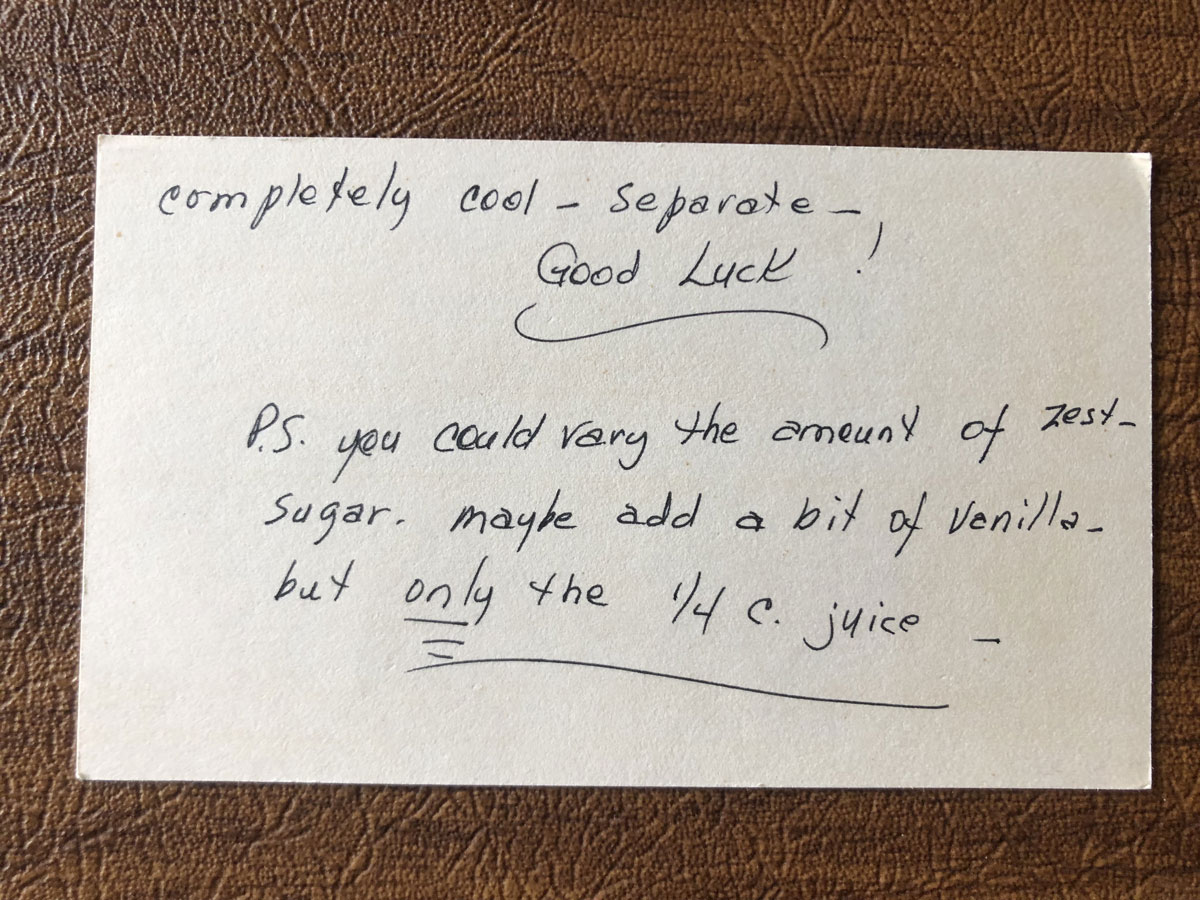
Grandma Frannie's Orange Pecans recipe card, backGrandma Frannie's Orange Pecans recipe card, back (Photo courtesy of Bibi Hutchings)This one of Frannie’s for Orange Pecans not only has the usual measured ingredients and directions, but also a little note of encouragement. “Good Luck,” she writes to Jim, with a flourish at the end.  

These pecans look as festive as they are delicious. The texture from the zest and syrup makes them appear as though they are wrapped in soft, fuzzy sweaters. (At least that is what I thought when I was a kid.)  They taste bright like sunshine and are irresistibly scrumptious. I'm betting they will be the freshest “candy” you will ever put into your mouth.  

As much as I would like to tell you that I reduce the sugar when I make these, I can’t . . . because I don’t. They're so good that I can only bring myself to use a light hand when measuring out my sugar, but I pretty much adhere to the recipe as written. Truth is, you need the proper ratio of juice and sugar for the syrup to boil into the right thickness so that the pecans get coated just right. Other than using a measure-for-measure alternative sweetener, which I have never done when making Orange Pecans, you wouldn't get the same result if you just haphazardly reduced the sugar.

We need your help to stay independent

Plan on the fact that you won't be able to resist eating them and eating them and eating them. And they're rich — so rich that I can make myself nearly sick from not being able to stay out of them. Needless to say, I only have them around when I can share with plenty of people. They're perfect for this time of year and make the prettiest gift simply placed in a cellophane bag and tied with a ribbon.

From start to finish — counting the time for me to walk out and pick a satsuma off my tree (I can't help but brag) — I can have these Orange Pecans ready in less than 10 minutes. They're seriously quick and easy.

They cool in a jiffy and are ready to serve almost as fast as you make them. My family loves them, my extended family loves them and my friends and neighbors do, too. And they will be just as delectable when you make them — even if you don’t have fresh satsuma juice from a satsuma picked from you very own satsuma tree in your very own backyard like I do.

Frannie's Orange Pecans 
Yields
3 cups
Prep Time
5 minutes
Cook Time
5 minutes

Ingredients

  • 3 cups raw pecans
  • 1 1/2 cups sugar
  • 1/4 cup fresh squeezed orange juice
  • Orange zest

Directions

  1. Place the sugar and orange juice in a saucepan over low-medium heat.

  2. Bring to a low simmer and add the orange zest, then the pecans.

  3. Stir constantly and “cook” the pecans until the sugar mixture has completely coated them all and none is left.

  4. Turn out onto a nonstick surface to cool before breaking apart.


Cook's Notes

– Satsuma, tangerine or clementine juice works, too. The choice of juice is absolutely up to you.

– Use as much orange zest as you like, but only use 1/4 cup of juice. For reference, I generally use the majority of zest scraped from one whole satsuma, which is about the size of a tangerine.

– It's optional to add a little vanilla, but I have never done it. Vanilla is written as an option on my grandmother’s recipe card, but the amount isn't specified.

“Now and Then”: Listen to the Beatles’ final song, revived by using AI

The Beatles have officially released what is being described as their final song. Titled “Now and Then,” the latest track was produced from a demo of John Lennon’s songs, which he had originally recorded in 1977. 

When it came to recording “Now and Then,” the trio struggled to complete the song from the demo due to poor audio quality. “When we started ‘Now and Then,’ it was very difficult because John was sort of hidden in a way,” Starr said in a short film released Wednesday alongside the song. 

“On John’s demo tape, the piano was a little hard to hear," added McCartney. "And in those days, of course, we didn’t have the technology to do the separation . . . We kind of ran out of steam a bit, and time. ‘Now and Then’ just languished in a cupboard.”

McCartney and Starr decided to revisit “Now and Then” after director Peter Jackson and his team introduced McCartney to AI, which allowed the pair to isolate and enhance Lennon’s vocals. McCartney and Starr recorded new parts for the song and added the late George Harrison’s guitar parts from their original 1995 session.

“My dad would’ve loved that, because he was never shy to experiment with recording technology,” Sean Ono Lennon said in the short film. “He would’ve loved that.”

A music video for “Now and Then” is slated to be released Friday, Nov. 3, at 10 a.m. ET.

Listen to the full song below, via YouTube:

Legal experts warn Judge Aileen Cannon is “setting up to give Trump another fat delay” in docs trial

U.S. District Judge Aileen Cannon on Wednesday signaled that she may delay the start of Donald Trump's classified documents trial in South Florida, pointing to the former president's other criminal cases as well as the volume of evidence his lawyers have to review.

Trump's trial in the federal case, which alleges he willfully retained national security documents at his Mar-a-Lago resort club after leaving office and obstructed government efforts to retrieve them, is currently scheduled for May 20, 2024. But, according to The Associated Press, Cannon appeared ready to agree with Trump's attorneys' request to postpone the trial, noting that she “has a hard time seeing how realistically this (current schedule) would work” despite prosecutors' push to maintain the scheduled start date.

The Florida case, brought by special counsel Jack Smith, is one of four criminal cases Trump is facing that could see a trial in 2024. The other criminal case Smith brought against the former president over his alleged plot to overturn his 2020 electoral defeat, is slated to begin in March in Washington, D.C.

A parallel Georgia trial, in which Trump is charged with conspiring to subvert the election in the state, and trial for a New York case accusing Trump of falsifying business records to cover up a hush money payment to an adult film actress could begin in the next year, but neither has a set date. The former president is currently on trial in a civil case in New York alleging business fraud.

On Wednesday, Cannon highlighted the 1.3 million pages of evidence that prosecutors have given to the defense along with thousands of hours of security video captured at Mar-a-Lago. She questioned if Trump's attorneys would have enough time to review the evidence in the next six months.

“I am not quite seeing a level of understanding on your part to these realities,” Cannon told Jay Bratt, a prosecutor on Smith's team.

Bratt told Cannon that Trump's attorneys have been pushing from the beginning to have the trial delayed until after the 2024 election, where he aims to win back the White House. He explained that because of defense motions to delay the D.C. trial and dismiss the charges, there is a chance that the trial will be postponed, adding that Cannon “should not let the D.C. trial drive the schedule here.”

Bratt went on to note that his team has provided the defense with a directory of the Mar-a-Lago documents to aid their preparation and informed them of the portions of security video they plan to play at trial, footage prosecutors have said shows boxed being moved in and out of a storage room at the property in an attempt to hide them from investigators. 

Trump lawyer Todd Blanche told Cannon that she and prosecutors need to be realistic about the schedule, particularly since the classified materials can only be read in specific government rooms with heightened security. 

“It has been extremely difficult to have access,” he said.

Cannon then declared that she would make a decision on the trial date in the coming days. 

In an effort to reach Cannon ahead of that decision, according to Politico's Josh Gerstein, Bratt submitted a filing early Thursday morning furthering his argument to keep Trump's trial in the case on the current schedule.

In the filing, Bratt informs Cannon that Trump's lawyers asked the judge overseeing his D.C. case for a stay until the issue around presidential immunity is resolved. He added that Trump and his attorneys "failed to disclose" their planned motion to stay at Wednesday's hearing, 

"Defendant Trump’s actions in the hours following the hearing in this case illustrate the point and confirm his overriding interest in delaying both trials at any cost," Bratt wrote.

Legal experts questioned Cannon's apparent inclination to delay the D.C. trial online with many noting that with the current schedule, there is more than enough time for review ahead of the start date.

"Special counsel Jack Smith estimated trial time in the DC case at 4 to 6 weeks. As scheduled, there is plenty of time," former U.S. attorney Joyce Vance wrote on X, formerly Twitter. 

"The Manhattan DA's case, set for late March, might have to be moved if the DC case isn't finished in time, but even if moved back a few weeks instead of rescheduled for later, could be complete in time for the MAL start date," she added. "Judge Cannon is intent on finding reasons to delay."

We need your help to stay independent

"Judge Cannon should not be focused on the DC trial date as a reason to delay hers," Randall Eliason, a George Washington University law professor, tweeted. "There's a good chance the DC date will be pushed back due to an interlocutory appeal on the presidential immunity motion."

CNN legal analyst Norman Eisen told host Wolf Blitzer that he believes the trial could still happen before the 2024 presidential election, adding on X that "there's no reason to push Trump's to after the election."

"The Mar-a-Lago documents case is not an unusually complex one, and we've seen national security cases — like the Paul Manafort case — move on as fast or even faster timetables," Eisen said during the CNN appearance. "The judge, if she relaxes that May deadline, she could move it to the summer.


Want a daily wrap-up of all the news and commentary Salon has to offer? Subscribe to our morning newsletter, Crash Course.


"It is important to get that trial in before the presidential season starts in earnest. She'll know more about whether Donald Trump is or is not the candidate of the Republican party by then, so I do think it is possible to get it in," he continued.

"If you compare Judge Chutkan, Wolf, she's brooking no delay, she's not accepting these excuses," Eisen added, referring to U.S. District Court Judge Tanya Chutkan, who's presiding over Trump's D.C. case. "She's pushing that case forward, the federal Jan. 6 case, for March, and that is the way to manage a trial docket in my view." 

Other legal experts criticized Cannon for entertaining a delay in the trial schedule. 

"Judge Cannon setting up to give Trump another fat delay, & doing it w/ side swipes at the government. 'I’m having a hard time seeing how this work can be accomplished realistically in this period of time,'" former U.S. Attorney Harry Litman tweeted, quoting Cannon. "Even setting aside possible bias, her trial management skills are poor."

"Trump’s documents/obstruction/espionage case may very well suffer death by a thousand Cannon continuances," said Glenn Kirschner, a former federal prosecutor.

Dutch stamppot is the butteriest, most comforting way to eat mashed potatoes

Boom, it's fall. At least, that's how it's going here in the Netherlands, where the change of seasons has been as abrupt as it has been welcome. Immediately on the heels of a European heatwave I believe was designed by Satan himself, I awoke one morning this week to crisp air and a flutter or orange and yellow leaves in my path. And after subsisting almost entirely on poke bowls and salad lately, I feel eminently ready for what the Dutch excel at — the coziest, most comforting meals, suitable for long nights and a climate that has twelve different words to express how much you hate the weather.

We need your help to stay independent

While the Dutch pride themselves on a multitude of soul warming foods, thanks in no small part to the country's diverse cultural and culinary influences, you can't go wrong with its national dish, stamppot. A relative of the Irish colcannon, English bubble and squeak, and Indian aloo palak, this is the kind of humble, stick to the ribs food just made for when the temperature dips. Buttery mashed potatoes are mixed with loads of dark leafy greens and onions, then served alongside smoky, salty sausage. How can something so simple have such a perfect balance of flavors and textures? Just trust me, it's an international classic for a reason.

For my lazy version, I cut the potatoes small so they cook quickly, sauté kale in the same pan as the kielbasa, and use green onions so they don't need any cooking at all. The whole business takes about a half hour from start to finish, and is perfect for having friends over on a chilly night. I wouldn't discourage you from enjoying this with a good quality Dutch beer here. And if you have saved room, apple tart is a fitting and traditional dessert.


Hungry for more great food writing and recipes? Subscribe to Salon Food's newsletter, The Bite.


* * *

Inspired by The Spruce Eats and Eating Europe

Comforting Dutch stamppot 
Yields
 2 – 4 servings
Prep Time
 10 minutes 
Cooking Time
 20 minutes 

Ingredients

  • 1 1/2 pounds of red or white potatoes, cut into small chunks
  • 2 green onions, sliced
  • 1 bag of sliced, prewashed kale, chard or similar hearty greens (or one head, rinsed and washed and cut)
  • 1/4 – 1/2 cup of whole milk, depending on how you like your potatoes
  • 3 tablespoons of butter, or more if you like
  • 1 kielbasa or similar smoked sausage, sliced
  • Salt and pepper to taste

Directions

  1. Bring a large covered pot of salted water to a boil while you clean and cut your vegetables.

  2. Boil the potatoes until fork tender, about 15 – 20 minutes.

  3. While the potatoes are boiling, heat a tablespoon of butter in a large skillet. Sauté the kielbasa until just warmed and a little browned. It won't take long.

  4. Remove the kielbasa from the pan. Sauté the kale in the remaining butter and fat until wilted.

  5. Drain the potatoes. Return to the pot, then add the green onions, milk and the rest of the butter, more if you like. With a potato masher, ricer, or hand mixer, mash the potatoes. Stir in the kale and add salt and pepper to taste. Add more butter if you feel like it.

  6. Spoon the potato mixture to a large serving dish, and serve accompanied by the sausage.


Cook's Notes

Some variations of stamppot include sauerkraut mixed in with the potatoes, which sounds amazing.

Salon Food writes about stuff we think you'll like. While our editorial team independently selected these products, Salon has affiliate partnerships, so making a purchase through our links may earn us a commission.

“We have been here before”: Heather Cox Richardson on how to save our republic

In her new book "Democracy Awakening," historian and author Heather Cox Richardson warns of the autocratic threat posed by today’s GOP and shares approaches she believes can preserve our republic. This is where we find ourselves as a nation, thanks to Donald Trump and his MAGA movement. 

I recently spoke with Richardson for Salon Talks. As many readers will know, she is also the author of the popular daily newsletter Letters From an American. As a historian, Richardson says saw warning signs early in Trump’s first presidential campaign as he adopted the "strongman" persona. From there, he “turned his intellectual and rhetorical strategy into a movement” that leaned heavily into both racism and sexism and became what we now know as MAGA. 

That movement, Richardson explained, did not come out of nowhere. Rather, Trump is simply the current figurehead after nearly a century of “a concerted movement to overturn the concept that the government should work for ordinary Americans.” 

Richardson also discussed her concerns about the GOP’s efforts to rewrite American history, saying,“If you conceive of American history, or any country's history, as being perfect in the past, it deliberately serves authoritarians.” That allows people like Trump, or for that matter like Ronald Reagan, to vow to make America “great again” based on a fabricated history that serves their political purposes. That stands “in contrast to a small-D democratic vision that says, ‘Our country actually has always been a work in progress. It is always changing, and it is inclusive of every voice,’” Richardson said.

In the end, though, this much-beloved historian is optimistic that our republic will withstand its current test: "We have been here before.” But Richardson counsels that each of us will need to work, individually, and all together, to preserve our democracy. If we don't, we could well lose it.

Watch my "Salon Talks" with Heather Cox Richardson here or read a transcript of our conversation below, lightly edited for length and clarity.

I saw you make an interesting point in a recent interview: Historians just don't tell us what happened, you tell us why it matters. Why is that your philosophy?

There's a really important distinction between journalists, who tell you what happened and that's their job and they do a very good job at it, and historians, who look at that information and use it to make observations about the way societies change. That's what history does: We take a look at how societies change, whether it's great men or political movements or economics. We take a look at all the things that happen on the ground and put it in a much larger context to draw conclusions about what it says about societal change, which of course is what we're all ultimately interested in.

We're living through a unique time in history. How does that impact you? Do you have a sense of that?

Absolutely. It is unique in many ways that I hope we'll talk about, but one of the things I think people like about my newsletter is that I always have history in mind. When the news hits me every day, I literally sit there at night and say, "If I were a graduate student in 150 years, what would I want to know about what happened today?" Because that's literally how some of my books were. I would say, "What happened 150 years ago on this date?" and pray that somebody had kept a diary. Well, I'm keeping that diary.

In your book, you map the trajectory of the modern day conservative movement. You have the Southern strategy and Nixon, through Reagan and through today. Is there a through-line, where you see the rise of authoritarianism that is more organic and that people missed? Or is what Trump is doing something new?

I'm laughing a little bit because it's sort of a grab bag of everything if you put it that way. The book tries to look at how we got here, where "here" is, and how we get out. That through-line — quite unexpectedly, that's not the book I intended to write — is the way that the modern-day conservative movement, which is not inherently intellectually conservative, it's actually quite radical, has used language and history to convince Americans to give up on democracy. 

"The book looks at how we got here, and how the modern-day conservative movement, which is actually quite radical, has used language and history to convince Americans to give up on democracy."

The Trump years are a little bit different in that he becomes a strongman very quickly and turns that intellectual and rhetorical strategy into a movement. The end of the book is how we reclaim both language and history to get out of that. But yes, the people who think that Trump happened from nowhere and is the sole cause of our current malaise are completely missing the previous hundred years, in which there was a concerted movement to overturn the concept that the government should work for ordinary Americans.

I think a lot of us thought that it was so ingrained in both the Republican and Democratic parties that the government should regulate business and protect a basic social safety net and promote infrastructure and protect civil rights, that we didn't think it was going anywhere. You still hear it nowadays when people are like, "They're never coming for Social Security," and people like me and you are sitting there saying, "They are literally writing documents saying, 'We're coming for Social Security.'" The answer to that, among a number of people, is, "Well, they don't really mean it." Where do you go with that?

When was the first time you saw signs in Trump that troubled you beyond normal politics. Not just the racist stuff but stuff that was actually a threat to our democratic republic?

Well, I should confess, I don't watch television. So for me, a lot of what he was doing was, from the beginning, theoretical. You could see all the pieces. So I was very concerned from the very beginning, but in a different way than perhaps many people were, because I have never thought that Trump was a politician. He has always been, to me, a salesperson, and what he was doing, I thought and I still think, was to become a mirror of a certain population. 

That population in 2016 did in fact want better economic policies. People forget that Trump called for better and cheaper health care, for bringing back manufacturing, for closing the loopholes that were making rich people not pay taxes; for all the sorts of more moderate economic reforms that in fact Joe Biden has put into place. He had all that, but he also had racism and sexism in a big way. That mirror being held up to that population was a huge red flag, because it was very clear he was not going to be a traditional Republican at that point, which already had me concerned because they were deliberately building an oligarchy. So that from the very beginning seemed to me to be a real problem.

You touch on another thing that we're seeing today, which is how authoritarians want to rewrite history. Can you share, as a historian, why authoritarians would want to rewrite history in a version that helps them?

"I have never thought that Trump was a politician. He has always been to me a salesperson, a mirror of a certain population."

This is a really interesting point, and that is it's not simply a question of saying, "I want you to learn my history." If you conceive of American history, or any country's history, as being perfect in the past, it deliberately serves authoritarians, because what that says is that we could go back to that past if only we follow these certain immutable laws. They're either divine laws or laws that are handed down by nature — I know how to do that and my enemies don't. They're trying to mess up those divine laws. So if we believe that the past was great and we can make America great again — which by the way was a Reagan phrase before it was a Trump phrase — if only we follow these universal laws for our country. What that says is that I alone know how to do that. It's a really authoritarian vision.

In contrast, a small-D democratic vision says, "Our country actually has always been a work in progress. It is always changing, and it is inclusive of every voice, not just John Adams." The idea that we are always finding new things, we're always looking at society differently because of the moments in which we live, we are always thinking about different ways to move society forward, that is a vision that is inclusive of all of our past, all of our present, but also our future. It's much more exciting than saying we should all go back and wear pointy hats.

Do they want to clean up the sins of the past so they can sell it better to people? Because we have right now numerous Republican-controlled states enacting critical race theory bans and book bans, and they're rewriting things that supposedly cause anyone to feel anxious or uncomfortable in school — which I felt all the time! I couldn't ban subject matter because of that.

Don't start me on math. [Laughter.]

Is this consistent with authoritarian movements through history?

It is in alignment with other authoritarian movements in other countries for sure, and actually political theorist Hannah Arendt talks a lot about this in “The Origins of Totalitarianism.” But just to be clear, they're not cleaning up the American past, the bad parts of American past. They're saying, "There aren't bad places in the American past." That in fact, things like enslavement or race riots, we could just make this whole list, were just about a few bad actors and the reality was always this trajectory toward a triumphant future. That really deeply serves this concept that my people are the chosen people, and everybody else is trying to mess us up.

It's remarkable.

Intellectually, it's actually quite cool. Unfortunately we're living through it.

After Jan. 6, if you had told me that two and a half years later, Trump is the leading Republican candidate, his supporters love him and that that's where we are as a nation, I would not have believed you. I'd be like, "There's no way." What did I miss about my fellow Americans that they were predisposed to accept an authoritarian, even if they don't understand the academic definition? I'm not being snooty about it. They just like him. They don't care what it means. 

"They have internalized Donald Trump to the point that he can't be ripped away. My comparison is always to Bellatrix Lestrange in the Harry Potter books. The worse Voldemort is to her, the tighter she clings to him."

Well, I think it's more than that they like him and don't care. I think he is part of their identity at this point, that they have internalized him to the point that he can't be ripped away. My comparison is always to Bellatrix Lestrange in the Harry Potter books. The worse Voldemort is to her and her family, the tighter she clings to him. And again, authoritarian scholars talk about this, that once you have started to poison your own soul by buying into somebody who's abusing others, you can't turn away from that without admitting that you are the problem.

I think what both of us missed was not our fellow Americans, and I really feel viscerally about this. It was the leadership of the Republican Party. They absolutely had that moment to call him out, and they didn't. They legitimized him. When Kevin McCarthy went and paid homage to him, and when Mitch McConnell voted to acquit in the second impeachment trial and then tried to give that speech saying, "Oh, now he can go in front of the courts" — I mean, the senators in the Republican Party could have stopped him anytime they wanted, from 2015 on, and they didn't do it. That to me is the big story. And now I'm afraid their moment has passed. They're no longer relevant to this discussion because that population has taken on a fury and a power of its own that they can no longer control.

Where does the role of the media come in, especially post-Jan. 6? 

I always hate to criticize the media because it's a very hard job, as you and I both know. But there is, I think, a lack of understanding of the fact that there has been a concerted effort since the 1980s to push the idea that in order to be fair, you have to present two sides as if they are equal. That is a real issue for me, obviously, because they're not equal right now. 

As we are recording this, we are coming up on a possible government shutdown, and that is often covered as a Congress problem or a Biden problem. It is literally the Republicans in the House of Representatives who cannot get their act together. It doesn't make it more fair to say, "Oh wait, we have to put the Democrats in this as well." Or to put the fact that Trump is an authoritarian opposite the fact that Joe Biden is three years older than him. Those things are not equal! So I wish the media would be better about recognizing not only that this is a big issue, where we are historically, but also that people really want to know that. I mean, the argument is that this won't sell papers, but I disagree. I think people are interested in where we are in this moment.

Is your sense as a historian that our current media is not equipped to deal with the rise of an authoritarian movement, arguably a fascist movement, on U.S. soil? Is it so ratings-driven that they just don't care? 

I don't know the answer to that. I'm not part of that world at all. I am a consumer of it and concerned about it. I will say one of the things that I think is interesting right now is, and I think this is arguable, but I don't find Trump interesting anymore. I write every night, and many times it would be easy to write about his latest antics, and I'm just bored. Remember, every once in a while you'd have a shock jock who got thrown to the top of the ratings because he said stuff nobody could believe. There comes a point when it's just the same thing again and again.

"I don't find Trump interesting anymore. I write every night, and many times it would be easy to write about his latest antics, and I'm just bored."

If you watch closely, as obviously I do, you are seeing the rise of very good writers outside the mainstream media who are really grappling with these issues. A number of outlets are taking on people who are writing in a very different way than their compatriots have been. I take a little bit of hope from that. 

As I think I said on Twitter the other day, if it's comforting to you people, I think there's actually money in this to cover these issues, because I think we're all bored with what Trump is doing. We've got the 2025 Project, which has gotten coverage but not nearly as much as it should. To go back to what we were talking about before, they are telling us what they're going to do in that project, which says, "We want Trump or someone like him to destroy our nonpartisan government and replace it with loyalists who will enforce Christian nationalism."

Deep down, I wonder if there are Americans who believe that whatever we call it, authoritarianism or fascism, can’t actually happen here. I don't know how to reach people who are busy in their lives. They're not pro-Trump; they're just busy in their lives. They don't read your newsletter, which they should. They don't read my articles. The third part of the book is called "Reclaiming America," and that's the key thing. How do we do that?

I think a lot of people are paying attention who weren't before. To go back to what you said before, are there people who recognize that this could happen? Yes, there are a lot of them who want it to happen, because the whole idea of the evangelical movement has been to replace our democracy with a theocracy, and that's exactly what they're being promised. 

Many, many years ago, I was a waitress in Oklahoma, and I was the only one on the floor who wasn't an evangelical Christian. This was the world they wanted, and this was two generations ago. So this is deeply ingrained in a number of people who want that. They are a minority, and a shrinking minority. The trick is to make sure other people who don't want that are waking up to it, and I think they are.

Look at the labor movement that is suddenly coming out of nowhere. Look at young people turning out screaming for Vice President Kamala Harris. I'm a big fan of Kamala Harris, but she is the vice president. Who turns out for the vice president? By definition, their role is to ascend to power under really bad circumstances. The number of people who are supporting grassroots movements, pushing back against book banning, running for local offices, running for school boards, showing up to all sorts of meetings to organize voters. I mean, I think that there is a movement underway. It's one I wouldn't have articulated as recently as two months ago, but it certainly seems to be the case.

President Biden is, according to reports, going to make protecting democracy one of the themes of the 2024 campaign. Intertwined in that, too, is the idea of reproductive freedom and academic freedom. I think sometimes people just think of democracy as being able to vote, but it's much broader than that.

Well, yes, it is. First of all, Biden has made this point really since the Unite the Right rally in 2017. I mean, that's what woke him up and say, "I got to get back in the game." That in itself is very interesting. So many of these things we just assumed were going to stay in play. Academic freedom? Yet of course there's been that faction on the right that has been trying to get rid of that since 1951, when William F. Buckley Jr. wrote “God and Man at Yale: The Superstitions of 'Academic Freedom,'” the idea that that was not a good thing, that we needed to get rid of that and force people to embrace Christianity and what he called free-market capitalism or individualism. Now that has been embraced by a major political party. 

A lot of people have not been willing to recognize that. Some still aren't. When we talk about Trump saying that if he gets back in power, he's going to use the power of the presidency to punish and imprison his enemies, I've a number of people say, "He doesn't really mean that." When the former chair of the Joint Chiefs of Staff, Gen. Mark Milley, came out recently and said, "Yes, I expect I will go to jail," that was a moment, and I think maybe people are starting to recognize that, yeah, they really did mean it. And I think the Dobbs vs. Jackson Women's Health decision really emphasized that. They really did mean they were going to get rid of reproductive rights.

We're in a dark period, but also a hopeful period. In your book you give us that third chapter about what we can do, looking back to the founders. Are you optimistic personally?

I'm optimistic, first of all, because we have been here before, and we have the American people. What's that saying: The American people finally do the right thing after they've tried everything else? If you had looked at America in 1853 when only white men could vote, you would have seen a country that was rapidly increasing human enslavement, not only through the South, but also in the West and soon to be national, on the principle that the United States would become a leader in a global movement to push an extractive economy, based on human enslavement.

By 1854, they managed to push that across the United States with the Kansas Nebraska Act. By 1856, there's a political party that decimates the other two political parties in the North to stand against that idea. By 1859, you have Abraham Lincoln rising and talking about the ideology of that party to recenter the Declaration of Independence. By 1861, he's in the White House, and in 1863 he gives the Gettysburg Address, which rededicates the nation to a new birth of freedom based on the Declaration of Independence and the idea that everybody must be treated equally before the law and have a right to a say in their government. In less than a decade, we go from the idea that a few rich guys should control everybody else to the idea that government should work for ordinary Americans and everybody should be treated equally. I mean, that's truly amazing.

In this moment, we have plenty of things on the negative side in this moment, but we still have Black Americans, people of color, and women who do actually still get to have a say. So I do not see this as insurmountable. I really don't see it as insurmountable.

That's important. What can people do as we the people in this fight against authoritarianism and preserving our democratic republic?

Well, people always talk about voting and giving money to candidates, and all that is true, but I believe that the way you change society is by changing the way people think. One of the things that people who disagree with the takeover of our government by the Christian nationalists or by authoritarians can do is talk about the principles of democracy. Talk about caring about being treated equally before the law. Talk about, and this was a big one for me, the fact that our police officers should not break someone's back when they arrest them. 

Take up oxygen. Defend our democracy by taking up oxygen and talking about the things that you believe in, because that's really how you change minds on a one-to-one basis with people that you know. The idea of big movements is great, but we know as political scientists that the way you really change people's minds is when people they care about talk to them about things that are important to them.

GOP’s proposed IRS cuts in Israel aid bill would slash federal revenues by $27 billion: CBO

The Congressional Budget Office on Wednesday said the Internal Revenue Service funding cuts that Republicans proposed as part of a supplemental aid package for the Israeli military would reduce federal revenues by $26.8 billion and add $12.5 billion to the deficit over the next decade.

The CBO's estimates undercut the notion that IRS cuts would "offset" the costs of sending Israel more weaponry and other military assistance.

It is widely known that every $1 invested in IRS enforcement efforts yields at least several dollars of increased revenue. Thanks to funding boosts from the Inflation Reduction Act, the agency has collected $160 million in back taxes from millionaires so far this year.

Analysts and Democratic lawmakers argued that the GOP's proposed $14.3 billion in IRS cuts would hamper the agency's ability to pursue rich tax cheats, thus lowering federal revenue.

"Republicans never miss a chance to protect their billionaire donors," Senate Budget Committee Chair Sheldon Whitehouse, D-R.I., said in response to the CBO estimates, noting that the IRS cuts would nearly double the GOP bill's total cost.

Rep. Don Beyer, D-Va., a member of the House Ways and Means tax subcommittee, said Wednesday that "it is extraordinarily cynical for Republicans to try to exploit an international crisis to help wealthy tax cheats avoid paying their taxes."

"The United States Congress should not fund violations of U.S. and international law."

The CBO's estimate of the Republican bill's deficit impact is far lower than the number put forth by IRS chief Daniel Werfel, who told The Washington Post on Wednesday that the GOP legislation would cost taxpayers $90 billion.

The House GOP's package, which the chamber's rules panel is set to mark up on Wednesday, includes roughly $14 billion in largely military aid for Israel, in line with President Joe Biden's request earlier this month. But the Republican legislation leaves out other funding that the president asked for, including military aid for Ukraine and disaster relief.

House Speaker Mike Johnson, R-La., responded dismissively to the CBO's findings, saying he was "not surprised" by the agency's estimates.

"Only in Washington when you cut spending do they call it an increase in the deficit," said Johnson.

The push for additional military assistance for Israel has garnered overwhelming bipartisan support in Congress, but some progressive lawmakers and advocacy groups have argued against providing unconditional aid as Israeli forces continue to carry out mass atrocities in Gaza, such as the deadly bombings of the enclave's largest refugee camp over the past two days.

"Make no mistake: these human rights abuses are being carried out with U.S. weapons, U.S. funding, and with 'no red lines,'" Rep. Ilhan Omar, D-Minn., wrote Wednesday in response to the refugee camp attack. "And now we are set to vote on an additional $14 billion with no restrictions or conditions. The United States Congress should not fund violations of U.S. and international law."

“Strongly undermines any claim”: Experts say damning NY trial doc could blow up Trump’s D.C. defense

New York Attorney General Letitia James' team on Wednesday revealed a document in court during Donald Trump's $250 million civil fraud trial that some legal experts say indicates the former president was aware he lost the 2020 election and planned to return to life as a private citizen. The document, according to The Messenger's Adam Klasfeld, shows Trump "restored himself" as trustee of the Trump Organization on Jan. 15 2021, just days before he left office.

"This document could be hugely important to Jack Smith and Fani Willis: it would show that Trump knew, at least as of 1/15/21, that he had not won the election and was returning to his private life & business," former federal prosecutor Andrew Weissmann, who served in special counsel Robert Mueller's office, wrote on X, formerly Twitter. Weissmann elaborated on the document's value during an MSNBC appearance, explaining that, to him, it's evidence that Smith can use because it aligns with what a number of Trump aides have said about times when the former president acknowledged his electoral defeat. "It's very important to Jack Smith because one of the allegations with support is that the former president actually knew he lost. This would be a good document to support that theory," Weissmann concluded. 

The document "[s]trongly undermines any claim that Trump really believed he had [won] (which doesn’t matter anyway, as many, inc me have explained)," Harry Litman, a former U.S. attorney, tweeted. "This is not a guy who’s planning to be president in a week. Not to mention, business first. This will be an important document in several settings."

MTG rages at “vaping groping Lauren Boebert” and “Colonel Sanders” Chip Roy as MAGA feud explodes

Rep. Marjorie Taylor Greene, R-Ga., lashed out as House Freedom Caucus members on Thursday after nearly two dozen Republicans voted to shoot down her attempt to censure Rep. Rashida Tlaib, D-Mich. Greene went after the 23 Republicans who voted to kill her resolution, which Greene forced a vote on over Tlaib’s criticism of Israel. “Our country is in the worst crisis in it’s [sic] history in every category and the Democrats are full blown communists and Republicans can’t even censure Rashida Tlaib,” Greene wrote in a post on X, formerly Twitter. “Conservatives on this list hide behind excuses with their white wigs on and quote the constitution.”

Rep. Chip Roy, R-Texas, a fellow MAGA Republican and member of the far-right House Freedom Caucus, criticized Greene’s “feckless resolution” as “deeply flawed” and filled with “factually unverified claims” — including Greene’s claim that Tlaib led an “insurrection.” We “should not continue to perpetuate claims of 'insurrection' at the Capitol and we should not abuse the term now,” Roy said in a statement.

Greene fumed at Roy, complaining that he “voted to kick me out of the freedom caucus, but keep CNN wannabe Ken Buck and vaping groping Lauren Boebert and you voted with the Democrats to protect Terrorist Tlaib.” Roy shot back at Greene, telling The Hill’s Mychael Schnell that Greene should “go chase so-called Jewish space lasers if she wants to spend time on that sort of thing.” Greene fired back again on X/Twitter: “Oh shut up Colonel Sanders, you’re not even from Texas, more like the DMV. Chip Roy’s career exist of working for politicians, working for campaigns for politicians, and being a politician himself. Unity Party all the way! Which is why you will never hold anyone accountable.”

Far-right MAGA theocrats: Most dangerous threat to America

The world inches closer to a war that only psychopaths want to see.

On Tuesday the FBI issued a warning that the chance of staged terrorist attacks in the United States has grown since the war began in Gaza. In the White House briefing later that day, Fox News reporter Peter Doocy asked National Security Council spokesman John Kirby: “Has the White House considered the possibility that a terrorist could be in the country right now after crossing the southern border?”

Obviously they have, or the FBI wouldn’t have issued the warning. The question remains, however, what our government response would be to such an attack. That has already been discussed at the highest levels in our government, and the public has a right to know what that reaction would be.

So, although I wasn’t called on, as Kirby left the stage I interrupted to ask the only question I thought mattered: “John, wait a minute. Before you leave: If Hamas terrorists attack the U.S., would the U.S. put boots on the ground in the Middle East?”

Kirby stopped his retreat from the stage, and press secretary Karine Jean-Pierre let him answer. Kirby was succinct: “I won't speculate about that, Brian. We’ll obviously do what we have to do to protect our troops and our people.” 

On that same day, Senate Majority Leader Chuck Schumer showed up at the White House with a bipartisan group — Sens. Todd Young, R-Ind., Mike Rounds, R-S.D. and Martin Heinrich, D-N.M. — to talk to President Biden and help steer a congressional response to the threat posed by SKYNET … sorry, I mean AI. It’s a bipartisan effort, but there are both Republicans and Democrats who remain opposed.  

Bipartisanship, once seen as a laudable goal on many issues, is now sneered at by most remaining members of the Republican Party. Working with Democrats, for them, is like choosing death over a slice of cake. (Apologies to Eddie Izzard.)

Most Republicans are so dismayed at the prospect of working with Democrats that they want to scuttle efforts to fund the war in Ukraine, virtually isolating Senate Minority Leader Mitch McConnell, who seems to be nearly alone on an island calling for aid to continue. It’s a rare display of common sense from the 81-year-old Kentuckian, whose primary focus is on political power. 

Bipartisanship was once seen as a laudable goal. But for most remaining Republicans, working with Democrats is like choosing death over a slice of cake.

"No Americans are getting killed in Ukraine,” McConnell said. “We're rebuilding our industrial base. The Ukrainians are destroying the army of one of our biggest rivals. I have a hard time finding anything wrong with that. I think it's wonderful that they're defending themselves — and also the notion that the Europeans are not doing enough. They've done almost $90 billion, they're housing a bunch of refugees who escaped. I think that our NATO allies in Europe have done quite a lot." 

Few Democrats have said it any better, and it spelled out exactly what the stakes are for the U.S. in the ongoing war in Ukraine. Remember that Vlad “The Impaler” Putin has clearly suggested that he wants to get the old Soviet Union band back together — Ukraine is just the first stop in a quest for global hegemony.

Fellow Kentucky Sen. Rand Paul said that McConnell was “out of touch” with his party's base while Missouri Sen. Josh Hawley chided McConnell for siding with Democrats — and that was before Homeland Security chief Alejandro Mayorkas gave Hawley a tongue-lashing on border issues later that afternoon. It looks like Putin still has a few fans in the GOP.

We need your help to stay independent

In the House, those would likely include newly-minted House Speaker Mike Johnson (and that still sounds like a Bart Simpson prank call to Moe’s Bar), who took on McConnell directly, pushing to unlink aid to Israel from aid to Ukraine.  

While the world burns, Johnson and the MAGA wing of the Republican Party — which seems to have swallowed the evangelical movement while also embracing it (a T-1000 morphing into Sarah Connor is just about the right image) — is embracing the darkest verses of the Bible, apparently pushing for apocalypse with an enthusiasm only rivaled by Saul’s slaughter of Christians before he changed his name to Paul.

I’m waiting for Mel Brooks to break out into song: “Let all those who wish to confess their evil ways and accept and embrace the true church convert now or forever burn in hell — for now begins the Inquisition!”

The House of Representatives, now run by Johnson, offers a discount version of the apocalyptic orgasm the holy rollers have dreamed of for years. They’ve renewed the Inquisition and seem determined to convert the U.S. into a theocracy run by people who will thump you with the Bible, but haven’t read much of it. 

Lord, how they love to preach fire and brimstone. But the Sermon on the Mount and the Beatitudes? Forget it. Matthew 25:40: “Whatever you did it for one of the least of these brothers and sisters of mine, you did for me”? Not a chance. They’ve embraced only the Old Testament angry God and the apocalyptic parts of Revelation brought on by ergot poisoning. 

They want no separation of church and state. They want an isolationist country surrounded by walls and dedicated to the proposition that the First Amendment guarantees them the right to worship any way they want — while forcing the rest of us to worship the way they choose.


Want a daily wrap-up of all the news and commentary Salon has to offer? Subscribe to our morning newsletter, Crash Course.


While the Age of Enlightenment led men — after hundreds of years of bloody crusades — to give up on state religions and was a direct inspiration for our Bill of Rights, modern Republicans seem hellbent on returning to the Middle Ages, driven there by the first Christian nationalist House speaker.

The First Amendment's establishment clause prohibits the government from making any law “respecting an establishment of religion.” That not only forbids the government from establishing an official religion, but also prohibits government actions that unduly favor one religion over another.

Rep. Jamie Raskin of Maryland, a constitutional scholar, says there was a solid reason for this much-debated and carefully written clause: “The framers taught us that the biggest threat to religious freedom comes from theocrats who try to establish their own sect over everyone else. That’s why we have two religion clauses in the First Amendment.”

None of that matters to the Republicans. They revel in their own chicanery. They despise free thought and independence, and are happy to play games with a government shutdown — the modern equivalent of fiddling while it all burns. Stay tuned. Nov. 17, the next shutdown deadline, is just around the corner. 

On a day the Republicans were mired in their own gamesmanship, an Israeli air strike targeting a Hamas commander in the densely-populated Jabaliya refugee camp in northern Gaza left catastrophic damage and killed hundreds of people, according to medics and eyewitnesses.

Children were seen carrying other children away from the blast zone. “It felt like the end of the world,” one surviving witness said.

That is our world today. It took an asteroid the size of a modern city to wipe out the dinosaurs. People, being smarter than dinosaurs, have figured out how to destroy everything all by ourselves. Climate change is slowly creeping up on us and we are killing each other at an increasing rate. It took a Category 5 hurricane to kill 40-odd people in Acapulco last week. We killed that many in two mass shootings in the U.S. in about the same amount of time — and spared the property. Pogo was right: We have met the enemy and he is us.

Donald Trump faces 91 felonies in four different jurisdictions, while facing civil sanctions in New York that could cost him a large chunk of his financial empire. He is effectively also on trial in Colorado as that state tries to ban him from the ballot next November. I spoke with Michael Cohen on Wednesday morning, a few days after he testified in Trump’s civil trial in New York. He believes Trump could lose as much as $600 million to $700 million in that case, essentially leaving him broke.

Joe Biden is in danger of becoming the 2024 equivalent of Jimmy Carter — a one-term president who will be admired after he leaves office far more than when he held it.

Joe Biden’s popularity continues to shrink faster than unemployment, threatening to make him the 2024 equivalent of Jimmy Carter — a one-term president who will be admired after he leaves office more than he ever was while holding it. Part of that is Biden’s fault. Part of it is because of people like Mike Johnson, who claim we don’t live in a democracy and that Gawd oversees our government.

You might think that all this would be serious food for thought in the news. But people are so tired of thinking about life on the razor’s edge that most news seems about as palatable as raw sewage — which is an all too accurate metaphor.

Our problem in the press is that we have so few people with the experience and education to handle the serious issues facing us. 

So whether it is a possible world war, stochastic terrorism, Christian theocracy, climate change, Donald Trump, our own government or something else unforeseen, for most people it is a time of trepidation and terror.

As Biden left the stage in the East Room on Monday, after about 15 minutes talking about artificial intelligence, he circled around to his standard stump speech, the one where he defines America with one word, “possibilities,” and says he remains hopeful that the best is still ahead.

He has said this for three years, and I only wish more people would listen. Instead, at the end of the day, as the world spins out of control, people want bread and circuses to keep them from contemplating the horrors that we ourselves have created.

Bring on Mel Brooks:

The Inquisition, what a show!
The Inquisition, here we go!
We know you're wishin' that we go away
So come on, you Muslims and you Jews
We got big news for all of youse
You better change your point of views today
'cause the Inquisition's here and it's here to stay!

UPDATE: The headline to this article has been changed since it was first published.

Dinosaurs might have been more cannibalistic than previously thought, study finds

From The Silence of the Lambs to Yellowjackets, when it comes to the human species, cannibalism is fodder for horror films. Yet outside of the human world, cannibalism — which is the act of consuming another individual of the same species as food — is a bit more common, and less taboo.

To date, cannibalism in dinosaurs has been thought to be rare and has only been previously seen in theropods like T. rex and Majungasaurus. According to a new study published in the journal PLOS ONE, some carnivorous dinosaurs might have evolved to feast on the giant carcasses of dead dinosaurs, strengthening a theory supported by many paleontologists that sauropod corpses were a major source of food for large carnivorous dinosaurs like the allosaurus.

“We wanted to know what would be better for these big dinosaurs for carnivores, whether it's better for them to hunt or scavenge in an environment where there were big, big sauropods everywhere,” Cameron Pahl, a research associate at Portland State University, told Salon. “Some of these dinosaurs were the largest dinosaurs that ever lived. Just based on the calories alone, one dead sauropod would have enough calories to feed 20 or 30 allosauruses for several months.”

To test their hypothesis, Pahl created a computational model to virtually simulate the dinosaur ecosystem. In this virtual simulation, carnivore dinosaurs were given traits to improve their hunting capabilities while simultaneously receiving energy from protein sources, like living prey. Despite having widely available living prey, it was actually more beneficial to the carnivores to scavenge off the carcasses of sauropod carrion than hunt new prey. Pahl determined this by measuring the reproductive fitness of the carnivores.

"Just based on the calories alone, one dead sauropod would have enough calories to feed 20 or 30 allosauruses for several months.”

“The ones that found the big dead sauropod and ate them for several weeks, survived long enough to have babies,” Pahl said. “Whereas dinosaurs that were hunters, they struggled to stay alive, they struggled to reproduce — there's an evolutionary fitness cost to hunting environment.”


Want more health and science stories in your inbox? Subscribe to Salon's weekly newsletter Lab Notes.


Those who scavenged off the carcasses of sauropod carrion were twice as likely to have reproductive success. Getting into more detail, the researchers theorized that the carnivores waited until a bunch of sauropods died in the dry season. Their deaths were usually caused by dehydration, exhaustion and starvation.

“The​​y just had to wait around until the die off happened and then they could eat as much as they wanted, store the fat in their tails, and wait for the next cycle,” he said.

In the study, the authors emphasized that virtual models are “oversimplified abstractions of complex systems.” But their study further supports their theory that sauropod carrion played a significant role in feeding the dinosaur kingdom, and that allosaurus were in fact cannibals.

“Recent papers about allosaurus cannibalism are pretty interesting because it means, I think, they did not care if they were scavenging sauropods or anything, even other allosauruses, they were fine with it,” he said.

We need your help to stay independent

Pahl said this is another example of how some of the biggest questions about dinosaurs remain unanswered. For example, how did they get most of their food? How did they get so big? What were their lives really like?

“Obviously, sauropods aren’t alive today and we can’t directly observe them,” Pahl said. “But there were so many sauropods in that environment, just one drought probably produced enough dead bodies that it was better to be a vulture than it was to be a lion; my research is pretty strong and the support for the hypothesis is also pretty strong.”

Legal experts: NY AG “set up” Don Jr. on witness stand — and now he could be criminally prosecuted

Donald Trump Jr. on Wednesday testified in the fraud trial that threatens to bring his family company down and deflected responsibility for the financial statements that led New York Attorney General Letitia James to file a $250 million fraud lawsuit against his family and business.

Trump Jr., testified that he relied on longtime accounting firm Mazars USA to prepare the company’s financial statements, arguing that he had no significant knowledge of the accounting standards known as the Generally Accepted Accounting Principles (GAAP), according to The Washington Post, which noted that the trial has shown evidence that the Trump Organization’s financial statements did not comply with those standards.

“I know nothing about GAAP — I leave it to my accountants,” Trump Jr. said. "I rely on their opinions and their assessments to make those decisions."

But CNN legal analyst Norm Eisen argued on Wednesday that Trump Jr., who took over the company along with his brother Eric after their father was elected president, “can’t pass the buck completely, he has some legal responsibility to make sure they’re accurate.”

“We've seen a ton of evidence that they were not accurate," he said. "So I think today, New York State set him up. He was already visibly uncomfortable with some of the questions. We're going to see the payoff tomorrow. Probably not so good for Trump Jr. or for the Trump family's standing in this case."

Trump Jr. is expected to resume his testimony on Thursday, followed by Eric Trump.

Fellow CNN legal analyst Elie Honig, a former federal prosecutor, noted that Trump Jr. “did not try to argue” that the inflated valuations at the heart of the lawsuit “were actually accurate.”

“He tried to argue, ‘I didn't really know about them, I wasn't part of this.’ He tried to distance himself from the actual valuations,” Honig said.

"Donald Trump Jr. would have had the option of taking the Fifth Amendment," he said. "This is a civil case, but he still could say, I refuse to testify because my testimony could be used against me. He's decided not to do that, and so now as a result, everything that he's testifying to is fair game for prosecutors to consider. Prosecutors have looked at this case. They have chosen not to charge it as a criminal case thus far, but that could change based on Donald Trump Jr.'s testimony, so there's an inherent risk in taking the stand here."

Former federal prosecutor Kristy Greenberg told MSNBC that the Trumps’ “M.O.” appears to be to “just point the finger at somebody else, whether it’s the CFO, whether it’s the accountant, whether it’s the lawyer, anybody that doesn’t have the last name Trump.” But Trump Jr. ultimately “signed these statements of financial condition and said that they were accurate.”

“You can’t have it both ways,” she added. “If he was on ‘The Apprentice’ right now, you’d be fired.”

Judge Arthur Engoron, who is presiding over the trial, already found the Trump family and company liable from persistent fraud, an order he put on hold after Trump’s appeal. The trial will determine the scope of the sanctions.

"This isn't going to help," conservative attorney George Conway said of Trump Jr.’s testimony, adding, "The judge can take findings and say, 'I don't believe that he didn't remember that. I don't believe that he was relying on the accountants. The story doesn't make any sense.'"

We need your help to stay independent

Conway told MSNBC that while the Trump Organization can appeal any ruling, the process could take “a couple of years” to pan out in the appellate courts.

“But there's already been an interim receiver appointed. They basically can't move assets around, can't hide them — they're stuck,” he said. "That's one of the reasons, I think, why he is so mad. Donald is upset and showing up at the trial every day. Basically, he's in financial handcuffs already. Who is going to loan money to these people? They're going to go out of business."


Want a daily wrap-up of all the news and commentary Salon has to offer? Subscribe to our morning newsletter, Crash Course.


Trump himself is expected to testify next week. Engoron also ordered Ivanka Trump, who was exempt from the lawsuit, to testify but she has appealed the ruling.

Eisen predicted that “she’s unlikely to be successful in that appeal.”

"It is true that she was dismissed from the case because her management responsibilities in these businesses came outside of the statute of limitations,” he said. “But she still has firsthand evidence about these gaps in the valuation, where they shift. Sometimes there are many times the actual value of the properties shifts. The judge and the state are entitled to that testimony.

"She also could be potentially a very damaging witness against her father and her brothers and the Trump Organization," Eisen added. "And I think she is going to be forced to testify."

Democrats unveil “most comprehensive plan ever” to address plastics problem

As plastic litter builds up in the environment, polluting landscapes and poisoning ecosystems, U.S. lawmakers have unveiled their “most comprehensive plan ever” to tackle the problem.

Three Democratic members of Congress on Wednesday introduced the Break Free From Plastic Pollution Act of 2023, a sweeping bill to reduce plastic production and hold companies financially responsible for their pollution. Previous iterations of the legislation were introduced in 2020 and 2021, but this year’s version includes stronger protections for communities that live near petrochemical facilities, more stringent targets for companies to reduce their plastic production, and stricter regulations against toxic chemicals used in plastic products.

“Our bill tackles the plastic pollution crisis head on, addressing the harmful climate and environmental justice impacts of this growing fossil fuel sector and moving our economy away from its overreliance on single-use plastic,” Representative Jared Huffman of California said in a statement. Huffman co-sponsored the bill with Senator Ed Markey of Massachusetts and lead author Senator Jeff Merkley of Oregon.

As U.S. demand for fossil fuel-powered heating, electricity, and transportation declines, fossil fuel companies are pivoting to plastic and are on track to triple global plastic production by 2060. Meanwhile, plastic pollution has reached crisis levels as litter clogs the marine environment and microplastics continue to be found on remote mountain peaks, in rainfall, and in people’s hearts, brains, and placentas. Plastic production also releases greenhouse gas emissions and other pollutants that disproportionately affect marginalized communities.

Like the bill’s earlier versions, Break Free 2023 would establish a nationwide policy of “extended producer responsibility,” or EPR. Under this policy, plastic companies would pay membership fees to a centralized organization that’s responsible for meeting targets around post-consumer recycled content and source reduction — reducing the production of plastic. The bill also retains proposals to ban certain single-use plastic products, implement a national system offering people deposits for recycling their beverage bottles, increase post-consumer recycled content in plastic bottles, and place a moratorium on new or expanded petrochemical facilities, pending a federal review of their health and environmental impacts. 

The bill would also phase out a list of “problematic and unnecessary” types of plastic and plastic additives, including polyvinyl chloride, a kind of plastic whose main ingredient is a human carcinogen.

The new bill, however, sets more specific targets for source reduction. By 2032, it would require plastic producers to reduce the amount of plastic they make by 25 percent — by weight, as well as the number of plastic items — and then halve it by 2050, in line with nation-leading requirements set in California last year. The bill would also phase out a list of “problematic and unnecessary” types of plastic and plastic additives, including polyvinyl chloride, a kind of plastic whose main ingredient is a human carcinogen, and ingredients added to help plastics break down whose health effects are poorly understood.

To mitigate some of the harms of plastic production, Break Free 2023 folds in environmental justice requirements from a separate bill introduced in Congress last December, the Protecting Communities From Plastic Act. These include greater communication and community outreach requirements for petrochemical companies that want to open a new factory for plastic production or chemical recycling, in the event that the moratorium on new petrochemical facilities is lifted.

This is the third time that a version of the plastics bill has been introduced in Congress, and it faces unlikely odds of passage. “Sadly, the makeup of Congress has not changed significantly over the course of Break Free being introduced, and we’re not set up well to move this bill at this time as a comprehensive package,” said Anja Brandon, associate director of U.S. plastics policy for the nonprofit Ocean Conservancy. 

But there are other ways for the bill to make an impact. Smaller sections could be turned into their own federal bills, or they could influence policies at the state and local level. Merkley has been exploring a separate bottle deposit bill that could draw from the Break Free proposal. Brandon also pointed to proposed bans on specific products like single-use plastic cutlery and plastic foam foodware, which would be easier to pass on their own than as part of the whole Break Free package.

The Plastics Industry Association, a trade group representing U.S. plastics companies, said in a statement that the new bill was “even worse and less collaborative” than the previous versions, adding that it would “negatively impact the American economy” and lead to more greenhouse gas emissions, since plastics are lighter than some alternative materials and require less fuel to transport. “Instead of one-sided proposals that don’t move us forward, we need to work together to craft sound policy that will actually help our environment,” Matt Seaholm, the organization’s president and CEO, said in a statement, although he didn’t specify which kind of policy the group supports.

Brandon, with Ocean Conservancy, invited the plastics industry to collaborate with the nearly 100 organizations that are backing the Break Free bill. “It’s time for them to get on board,” she said. “The onus is on those companies and those producers of this waste to join us at the table and be a part of the solution.”

This story has been updated to clarify that Senator Jeff Merkley was the lead author of the new bill.

This article originally appeared in Grist at https://grist.org/politics/democrats-unveil-most-comprehensive-plan-ever-to-address-plastics-problem/.

Grist is a nonprofit, independent media organization dedicated to telling stories of climate solutions and a just future. Learn more at Grist.org

From 9/11 to Benjamin Netanyahu: The world is learning that toxic masculinity can’t keep us safe

In his Oval Office address following the Oct. 7 attacks, President Joe Biden, while not addressing Benjamin Netanyahu by name, nonetheless issued an unmistakeable word of caution to Israel's prime minister: "When America experienced the hell of 9/11, we felt enraged as well, and while we sought and got justice, we made mistakes. So I caution the government of Israel not to be blinded by rage."

No one who knows anything about Netanyahu has been surprised that he's ignored Biden's words of caution. He used the Hamas attack on Israeli citizens as a pretext to unleash a nightmarish amount of violence on Palestinian citizens while giving bloodthirsty speeches to justify these actions. It couldn't be clearer that Netanyahu, whose tenure has been increasingly weighed down by ugly corruption scandals and a threat of criminal sanction, is hoping for a repeat of what President George W. Bush enjoyed in the aftermath of 9/11: A surge in approval polls, boosted by a "rally 'round the flag" effect.

Bush certainly didn't hold back from his own hyperbolic rhetoric during that era — remember his infamous "axis of evil" speech? It worked for him, at least for a time, with his approval ratings soaring from 51% just before the attacks to above 85% after 9/11. He benefited in no small part from plain old sexist prejudice, the kind that causes people to conflate chest-thumping displays of toxic masculinity with competence and strength. But as the years dragged on, it became harder for Americans to convince themselves that tough words meant Bush knew what he was doing. On the contrary, he got the country embroiled in a pointless war in Iraq while failing to deal with the actual terrorist organization that destroyed the World Trade Center. It wasn't until President Barack Obama, whom Republicans repeatedly tried to smear as effeminate, that the U.S. finally killed the man responsible for 9/11, Osama bin Laden


Want more Amanda Marcotte on politics? Subscribe to her newsletter Standing Room Only.


Biden's words may be gentle but he is no doubt aware that Netanyahu's toxic masculinity makes for a fragile ego. So far, his argument seems to have traction in the U.S. and Israel. Whatever the Israeli prime minister hoped to gain from the Hamas-led massacre, he is not getting the uncritical submission to his strongman play-acting that he seems to have expected. Polling shows up to 4 out of 5 Israelis blame Netanyahu for the security failures that led to Hamas terrorizing Israeli citizens. As Zack Beauchamp at Vox wrote Tuesday, "There is a general sense among Israeli analysts that Netanyahu is nearing the end of his political rope." Indeed, while Netanyahu likes to brag about how tough he supposedly is, he's proved himself quite the wimp. As Beauchamp notes, Netanyahu "faced so many hostile questions from reporters" Saturday, at his first press conference since the attack, that "he left early — only answering seven of the 12 questions he was slated to take."

As feminists have long argued, that's one of the most maddening aspects of toxic masculinity: It dupes people into confusing big talk for real action.

The American press has not extended its general support of Israel to Netanyahu either. On Sunday, the New York Times published a devastating exposé of how Israeli security forces failed to stop an assault that left 1,400 Israelis dead. "The most powerful military force in the Middle East had not only completely underestimated the magnitude of the attack," the reporters wrote, "it had totally failed in its intelligence-gathering efforts, mostly due to hubris and the mistaken assumption that Hamas was a threat contained."

As feminists have long argued, that's one of the most maddening aspects of toxic masculinity: It dupes people into confusing big talk for real action. Authoritarian men like Netanyahu — or like Donald Trump — love to preen about how strong and powerful they supposedly are. It's all a lie, of course, and they often expose themselves as cowards who cringe away from real challenges. But what's alarming is that sexism tricks large swaths of the public into voting for them, supporting them or otherwise putting their trust in men who brag loudly but fail to show any real competence. 

In the U.S., the loss from that misplaced faith in toxic masculinity is almost too great to think about.

Machismo won't save us — and in fact, it often makes things worse.

Bush beat Al Gore in the 2000 election by painting the former vice president as an effeminate nerd. Bush's failures to protect people are legion, from 9/11 to Hurricane Katrina to gun violence to the way he set the fight against climate change back decades. Misogyny, of course, wasn't just a major reason for Trump beating Hillary Clinton in 2016, but likely the deciding factor. Trump went on to mishandle the pandemic making the death toll much higher than it need be. To cap off a disastrous presidency, he instigated a violent attack on the U.S. Capitol in an attempted coup. 

Feminists have long detailed how it's wrong to equate masculinity, especially toxic masculinity, with safety. For instance, the myth of chivalry is constructed around the idea that men need power over women in order to protect us. But, as feminists point out, what we're being "protected" from is male violence that only exists because men have so much power over women. Rape usually happens at the hands of a man the victim knows. Domestic violence is a far greater source of danger to women than strangers. Toxic masculinity isn't shielding us from danger. It's the reason we're not safe. 

We need your help to stay independent


Netanyahu's political problems are due to his own failings as a leader over the years, of course, but I also suspect it's because much of the rest of the world is starting to figure out what feminists learned long ago: Machismo won't save us — and in fact, it often makes things worse. And it's not just the Israeli public that is taking a dim view of Netanyahu's capacity to handle this situation. A lot of centrist American pundits who have unfortunate histories of credulity towards saber-rattling are openly derisive towards him. Jennifer Rubin of the Washington Post, who had once been a big time Iraq War booster, compared Netanyahu to Trump, whom she loathes. Sounding like a once-hated peacenik, she writes, "They dehumanize and demonize any opposition and cannot display a modicum of empathy."

Joe Scarborough, the former Republican congressman-turned-MSNBC host who cheered on the Iraq War, has also been scathing when he talks about Netanyahu, arguing that the Israeli prime minister is "responsible" for what happened. Which, since some people are still trying to argue this, is absolutely true. It's not just the intelligence failures. It's that Netanyahu has repeatedly propped up Hamas because he cynically believed doing so would derail Palestinian efforts at freedom and equality. 

This shift in the worldview of centrist, even conservative, types is noteworthy. Many people who used to scoff at feminist criticisms of toxic masculinity now have shifted their skeptical eye towards the chest-beating politicians themselves. They see these men how feminists always did: Braying assholes who cannot be trusted.  Perhaps it's because Trump is a cowardly buffoon and a sexual predator, exposing toxic masculinity for what it is. Or maybe it's Trump plus watching Bush fail so miserably, while a skinny nerd like Obama ran a relatively competent administration, tan suit and all. Maybe they, too, feel soothed by Biden's more "feminine" style of leadership, which is heavy on empathy and diplomacy, while shunning the overheated tough guy rhetoric favored by Republicans. 

Whatever the reason, here's hoping the shift is permanent. We've lived too long in a world where male leaders can hide their own incompetence by talking like they're characters in a John Wayne movie. Mistaking toxic masculinity for skillful leadership has led to one disaster after another, from pointless wars to preventable terrorist attacks to the spiraling climate change crisis. It's long past time humanity leveled up and started valuing intelligence, kindness, and calm over the masculinity theatrics of overcompensating jerks. It won't do much for the Israelis or Palestinians right now, as both are still subject to Netanyahu's gross mishandling of this situation, which will lead to a lot of unnecessary death and suffering. Still, the sooner people figure out that toxic masculinity is poison, the sooner we can get humanity on a road that may, one day, lead us to something that's actually safer. 

A constant threat of MAGA-on-Republican violence: The GOP’s devotion to Trump has sabotaged Congress

In the Age of Trump, there has been an increase in right-wing violence and terrorism. This includes obvious examples such as the Jan. 6 coup attempt, mass shootings and other acts of violence. The growing dangers of right-wing political violence also include increasingly open and direct calls for a second civil war, a sustained insurgency to remove President Joe Biden from office, threats against election workers who refuse to betray democracy, harassment of law enforcement and other people who are trying to hold Trump and his followers responsible for their crimes against democracy. Since Trump's election, Republicans have rushed to pass laws that permit and encourage right-wing vigilantism and other types of violence against left-wing protesters.

Today’s Republican Party and the larger “conservative” movement are trying to impose “a state of exception” on American society, where intimidation, thuggery, violence and terrorism are “acceptable” means for them to get and keep power. They believe that a “state of exception” is necessary — if not ideal — because the American right’s political project has been rejected across a range of issues by a majority of the public.

A belief in the legitimacy of such violence is animated by a very dangerous lie and assumption that once unleashed such acts can be targeted and directed like some type of smart bomb or shaped charge against the left. In the real world, the explosions and resulting shrapnel and destruction are rarely confined to one area and often hurt and kill friends and foes alike. The Republican fascists – and “mainstream” conservatives are imperiling themselves when they encourage and unleash violence and other anti-democratic forces against their perceived enemies on the left. 

In his essential book “The Anatomy of Fascism," political scientist Robert Paxton provides this important context:

Fascist violence was neither random nor indiscriminate. It carried a well-calculated set of coded messages: that communist violence was rising, that the democratic state was responding to it ineptly, and that only the fascists were tough enough to save the nation from antinational terrorists. An essential step in the fascist march to acceptance and power was to persuade law-and-order conservatives and members of the middle class to tolerate fascist violence as a harsh necessity in the face of Left provocation. It helped, of course, that many ordinary citizens never feared fascist violence against themselves, because they were reassured that it was reserved for national enemies and ‘terrorists’ who deserved it.

We need your help to stay independent

The Republican Party’s recent struggle to elect a leader in the House of Representatives is a preview of how the normalization of right-wing political violence in the Age of Trump and beyond will, and is, being turned against “conservatives” and other members of the GOP who are judged to be insufficiently loyal to Trumpism and the neofascist cause. The New Republic’s Alex Shephard explains:

As Jim Jordan and his allies attempted to whip speaker votes last week, they kept running into a familiar refrain from their skeptics: The brass-knuckle tactics they were deploying were causing Jordan’s critics and their families to receive a slew of vicious messages—including death threats.

The Pynchonesque-ly named Iowa Representative Mariannette Miller-Meeks reported that she had received “credible death threats and a barrage of threatening calls” after switching her vote to oppose Jordan on a second speaker ballot. Georgia’s Drew Ferguson changed his vote after Jordan wouldn’t “calm down the hysteria” surrounding his nomination. Nebraska’s Don Bacon revealed his wife had grown so fearful after a barrage of intimidating calls that she had started sleeping with a loaded gun. On Friday, CNN aired a voicemail that the wife of one unnamed congressman received from a caller that threatened she would be “fucking molested” if she didn’t convince her husband to back Jordan.

Jordan may have publicly decried these threats, but his association with an effort to use threats and intimidation as an explicit political tactic—and as a means of cajoling fellow Republicans to get in line behind him—is the clearest sign yet of just how central such tactics have become for mainstream Republicans. Indeed, while they failed to have their intended effect, it’s abundantly clear that the Republican Party remains as comfortable with radical elements promising violent retribution as Donald Trump was during his effort to overturn a legitimate election.

As summarized by Mediate, in his new book, outgoing Sen. Mitt Romney, R-Utah, warns that the political violence and thuggery embraced by some of Trump’s followers has already sabotaged the ability of Congress to follow through on its most basic responsibilities:

Senator Mitt Romney (R-UT) revealed to biographer McKay Coppins that the threat of physical violence effectively kept many elected Republicans from voting to impeach or convict President Donald Trump, even though they wanted to.

Coppins is doing the media rounds to promote his new biography Reckoning and chatted with Brian Stelter for a thoughtful interview, which Vanity Fair published on Thursday.

NYU Journalism professor Jay Rosen flagged one particular passage on social media, writing:

“Read this paragraph and tell me that the 2024 election can be responsibly reported using the same tools and terms in use for every national election.”

The passage in question reveals that many Republican members of Congress wanted to vote to impeach or convict the former president but that the threat of political violence by Trump supporters effectively kept them from doing what they thought was right. Stelter writes:

“One of the biggest revelations to me in my conversations with Romney was just how important the threat of political violence was to the psychology of elected Republicans today,” said Coppins, who recalled Romney telling him “story after story about Republican members of Congress, Republican senators, who at various points wanted to vote for impeachment—vote to convict Trump or vote to impeach Trump—and decided not to, not because they thought he was innocent, but because they were afraid for their family’s safety. They were afraid of what Trump supporters might do to them or to their families.” That “raises a really uncomfortable question,” Coppins said, which is “how long can the American project last if elected officials from one of the major parties are making their political decisions based on fear of physical violence from their constituents?”

Violence is a type of “anti-politics” because it subverts the dialogue, consensus, compromise, and shared understanding of facts and reality. The importance of mutually agreed upon institutions, norms and values (“a rules-based order”) that a healthy democracy depends upon is undermined by violence. 

Violence is a type of “anti-politics” because it subverts the dialogue, consensus, compromise, and shared understanding of facts and reality.

So if taken to its logical conclusion, such a state of affairs necessitates that a political strongman or some other type of autocrat, dictator, or warlord is installed as a way of bringing order to chaos. This is the world that today’s Republican fascists and the larger white right are trying to create in America and around the world.

In the following interview Yale University historian Joanne Freeman, who is the author of "The Field of Blood: Violence in Congress and the Road to Civil War," shares a warning about political violence in the Age of Trump and its larger implications for America’s future:

In some ways, discovering that our polarized present has some precedent is reassuring, and indeed, before and after the 1850s there were other such times.  But “The Field of Blood” also reveals an extreme version of some of the problems that we’re experiencing today—and therein lie some lessons.

Extreme polarization; splintering political parties; distrust in national institutions; rampant conspiracy theories; a powerful new technology of communication — the telegraph; an increasingly dysfunctional Congress: this cluster of problems drove Americans not only to distrust their government, but to distrust each other, and with no outlet for the popular will, and the simmering problem of slavery dividing the nation, the end result was violence.

Of course, we’re not on the cusp of civil warfare. But it’s worth noting that the impact of allowing the national “we” to crumble can be mighty, and that discord and dysfunction on the national stage can break down the bulwark of public opinion that supports republican governance.

By welcoming and encouraging right-wing political violence and other thuggery in the Age of Trump and beyond, the Republican Party has normalized and institutionalized such antidemocratic forces — and they are coming for them first.

Donald Trump is very fond of the poem and song “The Snake," which he often recites at his political cult meetings as a warning about how “illegal immigrants” and refugees are going to poison and destroy (White) America. Of course, Trump has twisted and distorted the poem’s original meaning for his own nefarious purposes. But Trump is actually telling on himself and warning the Republican Party and the “conservatives” who support him about his and the neofascist MAGA movement’s true nature and plans. In reality, Trump and his MAGA people and other supporters are the snake who is going to bite and make lethally ill whoever is naïve and foolish enough to help them. That is what fascists do. It is their inherent nature.

This billion-dollar plan to save salmon depends on a giant fish vacuum

Series: Broken Promises: Salmon Disappear From the Pacific Northwest

Before building dams on the Columbia River, the U.S. guaranteed the tribes of the Pacific Northwest salmon forever. But the system it created to prevent the extinction of salmon has failed, and a way of life is ending.

To free salmon stuck behind dams in Oregon’s Willamette River Valley, here’s what the U.S. Army Corps of Engineers has in mind:

Build a floating vacuum the size of a football field with enough pumps to suck up a small river. Capture tiny young salmon in the vacuum’s mouth and flush them into massive storage tanks. Then load the fish onto trucks, drive them downstream and dump them back into the water. An enormous fish collector like this costs up to $450 million, and nothing of its scale has ever been tested.

The fish collectors are the biggest element of the Army Corps’ $1.9 billion plan to keep the salmon from going extinct.

The Corps says its devices will work. A cheaper alternative — halting dam operations so fish can pass — would create widespread harm to hydroelectric customers, boaters and farmers, the agency contends.

“Bottom line, we think what we have proposed will support sustainable, healthy fish populations over time,” Liza Wells, the deputy engineer for the Corps’ Portland district, said in a statement.

But reporting by Oregon Public Broadcasting and ProPublica casts doubt on the Corps’ assertions.

First, some leading scientists have said the project won’t save as many salmon as the agency claims.

A comprehensive scientific review in 2017 concluded that the use of elaborate fish traps and tanker trucks to haul salmon, as the Corps proposes, will “only prolong their decline to extinction.”

The Corps’ effort to keep its dams running full-bore is a story of how the agency continues to double down on costly feats of engineering to reverse environmental catastrophes its own engineers created.

Moreover, many of the interests the Corps says it’s protecting maintain they don’t need the help — not power companies, not farmers and not businesses reliant on recreational boating.

The Corps’ effort to keep its dams running full-bore is a story of how the taxpayer-funded federal agency, despite decades of criticism, continues to double down on costly feats of engineering to reverse environmental catastrophes its own engineers created.

The only peer-reviewed cost-benefit analysis of the Willamette dams, published in 2021, found that the collective environmental harms, upkeep costs and risks of collapse at the dams outweigh the economic benefits.

Congress has weighed in, twice calling on the Corps to study shutting down hydropower, which would free up more water for salmon. The agency blew its first deadline last year and now says it will perform an “initial assessment” to help decide whether to do the study required by law.

Emails obtained by ProPublica and OPB show that as Corps officials hashed out how to handle the mandate from Congress, they proposed actions that could increase public support for preserving hydropower. The Corps is now finalizing a plan that would continue electricity generation for the next 30 years.

“How can you finalize a long-term plan if you don’t know whether or not you’re going to continue hydro?” said former U.S. Rep. Peter DeFazio, D-Ore., who pushed for legislation ordering the Corps to study ending hydropower.

“They’re doing that without the study and the information they need,” he added.

The debate and the consequences of the decision are real for the Confederated Tribes of the Grand Ronde, who have fished the Willamette for thousands of years.

Democrat Val Hoyle and Republican Lori Chavez-DeRemer, who now represent portions of DeFazio’s former district, said in separate written statements that it was urgent for the Corps to finish its study and no decisions on the Willamette should be made until that happens.

There is a simpler way to protect fish: opening dam gates and letting salmon ride the current as they would a wild river. It costs next to nothing, would keep the Willamette Valley dams available for their original purpose of flood control and has succeeded on the river system before. This approach is supported by Native American tribes and other critics.

The Corps ruled it out as a long-term solution for most of its 13 Willamette River dams, saying further reservoir drawdowns would conflict with other interests.

The debate and the consequences of the decision are real for the Confederated Tribes of the Grand Ronde, who have fished the Willamette for thousands of years. Grand Ronde leaders said they’ve met with the Corps seven times to spell out potential alternatives to building giant fish collectors and maintaining hydropower.

“They always feel like they can just build themselves out of problems. And this is really something that we don’t need to build,” said Michael Langley, a former tribal council member for the Grand Ronde.

The tribes have also said generating electricity at the dams doesn’t pencil out for anyone. By the Corps’ own estimates, the cost of hydropower over the next 30 years will outstrip revenues from electricity customers by more than $700 million.

The tribes filed a letter with the Corps in February that included a pointed summation: “Killing salmon to lose money deserves a deeper analysis.”

“Tooth and Nail”

Many of Oregon’s most populous and valuable places, like downtown Portland, would spend parts of the year underwater if not for dams.

Congress ordered the Army Corps to build the system during the 1940s, ’50s and ’60s to hold back floodwaters in Oregon’s fertile Willamette Valley. Towns sprouted up in the security of 300-foot walls. Lawmakers approved additional uses for the dams. The rivers they impounded provided places for people to drive power boats as well as deep pools of water to spin hydroelectric turbines. Today, eight of the 13 dams generate power.

Hernandez admonished the Corps for having “fought tooth and nail” against better measures for fish, foot-dragging that the judge said had pushed the fish closer to the edge of extinction.

But the monumental structures caused harm, too. Salmon evolved to swim and spawn in cold, free-flowing rivers that the dams choked into warm, stagnant lakes, full of bass and other invasive predators. Salmon need to get to the ocean and back, but the dam walls blocked their path. Whirring turbines bashed fish that attempted to scoot past.

In 2021, after salmon numbers on the Willamette reached historic lows, a federal judge said the fish’s recovery had been stymied far too long.

U.S. District Judge Marco A. Hernandez admonished the Corps for having “fought tooth and nail” against better measures for fish ever since it was first sued over the issue in 2000, foot-dragging that the judge said had pushed the fish closer to the edge of extinction.

Gates in the dam walls can provide a passage for young salmon to pass downstream, but they’re usually too deep underwater for the little fish to find because they stay near the surface. Those that do dive down to the deep gates can get the bends and die. The judge ordered the Corps to drain several reservoirs to levels lower than any since the dams were built.

Scientists had observed that whenever reservoir levels dipped seasonally, more fish passed through dams. Knowing this, Corps biologists had been experimenting with draining a reservoir known as Fall Creek until it nearly replicated the original river channel.

The drawdown worked. It moved salmon quickly and safely past the dam and eliminated many of the invasive predators dwelling in the reservoir. At virtually no cost, the Corps increased the number of adult fish that returned tenfold, surpassing what biologists thought possible.

The Corps has argued that there are limits to this approach. Fall Creek’s openings are more fish-friendly than those at other dams. And Corps officials worried draining many dams all at once might trade one hazard for another, such as by leaving too little streamflow for fish.

But Hernandez ruled that the weight of the evidence showed drawing down reservoirs was “the most effective means for providing safe fish passage” and “necessary to avoid irreparable harm” to salmon. He ordered the Corps to try partial drawdowns at three other dams. Then he set a 2024 deadline for the Corps to have a new long-term plan to save salmon, which he expected to go even further than his order.

Tribes and environmentalists cheered the judge’s ruling as a long-overdue remedy.

But the Corps had its own ideas.

Building a Better Fish Trap

In 2022, the Corps released a draft of the document the judge had ordered: a 5,782-page environmental impact statement for Willamette dam operations.

At the two dams that threaten salmon the most, the Corps would build complex structures called floating fish collectors.

Versions built elsewhere resemble industrial buildings atop the water, loaded with fish pens, electrical equipment and water pumps. The idea is for fish to mistake the whooshing current created by the pumps for the river’s flow and get lured into the trap.

Collectors that Corps envisions for Detroit and Lookout Point dams would cost a combined $622 million. In addition, the Corps would spend $432 million on an enormous water-cooling device at Detroit. Other money would buy smaller fish traps and habitat restoration.

The Corps first tried a kind of floating fish collector on the Willamette in the 1950s but declared it a failure.

As salmon populations dwindled into the 21st century, the Corps decided to try again, building a small collector on an offshoot of the Willamette. To track the baby fish they were trying to entice, biologists implanted nearly 1,500 with microchips and released them behind Cougar Dam.

Eight found their way into the collector.

The agency ended the experiment ahead of schedule.

Floating collectors at other dams in the Northwest have shown better results. But at the location biologists consider most comparable to the Corps’ Willamette dams, it’s been a struggle. The fish collector on southwest Washington’s Lewis River captured just 3% of the Chinook salmon it was targeting, a peer-reviewed study found. The dam’s owner reported success rates as high as 33% in later years.

“You don’t have to be a rocket scientist to go back and look at how these structures performed in other locations to see that there’s been some challenges,” said Greg Taylor, the Corps’ supervisory fish biologist.

For this reason, the Corps did propose deep and sustained drawdowns at Cougar and Fall Creek dams.

But the number of fish helped would be relatively small because of these dams’ locations. By contrast, the dams where the Corps wants to try fish collectors wall off about 70% to 100% of the area where fish hatch. The Detroit and Lookout Point dams block rivers that once supported some of the valley’s most abundant fish runs.

The Corps didn’t consider these dams good candidates for a drawdown because of the way they were built and because Corps officials viewed their operations as too crucial to justify it.

So agency leaders commissioned a study of previous fish collector builds to devise improvements. They arrived at a plan for collectors five times as wide and five times as powerful as any ever evaluated. The structures at Detroit and Lookout Point would take a decade to complete.

The National Oceanic and Atmospheric Administration, which must approve the Corps’ actions before it can proceed, said in a statement its scientists “are confident that collectors can be effectively applied” as the Corps optimizes their design.

Big uncertainties remain, though.

Supersizing the collectors for better performance makes sense in theory, according to U.S. Geological Survey biologist Tobias Kock, who led the 2019 study. But because what the Corps is proposing is so much bigger than anything Kock and his colleagues looked at, he told OPB and ProPublica, “we don’t know how well that performance prediction’s going to work.”

The most successful floating collector in Kock’s study captured roughly 60% of Chinook salmon, on a reservoir with far more favorable conditions than on those the Corps owns. The Corps, meanwhile, estimates its supersized fish collectors will capture between 80% and 95%.

The Corps’ environmental impact statement acknowledges its numbers are a guess. It says the collectors the agency contemplates “have yet to be successfully implemented and there is considerable risk and uncertainty about the realized effectiveness of these structures.” In a September statement to ProPublica and OPB, Corps officials went further, calling their projected success rates “overestimates.”

University of California, Davis researchers Robert Lusardi and Peter Moyle published a 2017 study in the journal Fisheries warning that the kind of trap-and-haul programs the Corps has proposed “should proceed with extreme caution.”

Lusardi said in an interview that their success rates are artificially inflated and that removing young salmon from the river stresses them, increasing their risk of dying before they find their way home to spawn as adults.

“Transportation of fish, whether it’s juveniles or adults, has a really seismic effect on the fish themselves,” Lusardi said.

Rich Domingue, a former NOAA hydrologist who provided expert testimony for environmental groups that sued the Corps, said these flaws and others biased the Corps’ analysis in favor of preserving hydropower.

Instead, Domingue said, the Corps should be drawing down more reservoirs and closely monitoring the results, “rather than spending billions over decades in a high-risk gamble.”

“Human Error Fixing Human Error”

At the heart of the Corps’ push to find a technological fix for dams is its claim that people throughout the Willamette Valley cannot live without the hydropower, recreational boating and irrigation that the dams make possible. The trouble is, it’s hard to find people in the Willamette Valley who feel the same way.

Even the hydropower industry opposes the Corps’ plan to continue with hydropower.

Ending power generation on the Willamette would be “the best for consumers, the best for fish, and the best for taxpayers,” wrote Scott Simms, executive director of the Public Power Council, and Mark Sherwood, head of the Native Fish Society, in a joint 2021 letter published in the Eugene Register-Guard.

Records newly obtained by OPB and ProPublica via the Freedom of Information Act show the federal government’s hydropower agency for the region, the Bonneville Power Administration, also wants the Corps to do away with hydropower on the Willamette.

Bonneville, which pays roughly half the costs of operating Willamette dams, urged the Corps last year not to spend hundreds of millions of dollars to keep turbines running when cheaper solutions exist. The streams feeding the Willamette are wildly inefficient at producing electricity compared with dams on larger rivers, costing up to five times as much to light a home.

Similarly, farmers in the lush Willamette Valley are far less dependent on water stored in reservoirs than their counterparts in the high desert of eastern Washington, Oregon and Idaho, where current farming practices would be impossible without the irrigation that dams and reservoirs supply. The valley gets drenched with 50 inches of rain a year. Draining reservoirs each fall would have a marginal impact on water supplies downstream, according to the Corps’ own analysis.

The Oregon Water Resources Department said the drawdowns already happening under the court injunction have not undermined anyone’s ability to irrigate with water from the Willamette and its tributaries.

“It has no negative impact on me,” said Bob Schutte, owner of Northern Lights Christmas Tree Farm just downstream of two reservoirs that are already being drained each fall.

Lagea Mull runs the chamber of commerce for Sweet Home, a town that sits on a major route to Foster and Green Peter reservoirs. Mull said residents there want salmon to thrive and have adapted to the temporary drawdowns the judge ordered in 2021.

“When the dams came in, that was a massive change to the area,” said Mull, who knows people whose homes are now at the bottom of the reservoirs. “So now this is just another change.”

Linn County Commissioner Will Tucker is among the most vocal with concerns about draining reservoirs. But as a lifelong Willamette Valley resident, he also cares about the salmon.

“If it recovers the salmon,” he said of drawdowns, “it's the right thing to do.”

Tucker wants the Corps to help offset what he worries would be the biggest impact, to the river’s recreation economy. More than 2.5 million people take their power boats or kayaks or inner tubes out on the Willamette River system annually. Visitors inject enough money into marinas, restaurants and shops to keep some towns afloat all year.

But the Corps estimates the kind of limited drawdowns it studied and ruled out would leave boat launches high and dry only at the tail end of the boating season, reducing visits by about 7% and spending by $1.3 million.

One business owner, Dawn O’Donnell, has already adapted her boat rental shop to the shorter season brought by court-ordered drawdowns. She delivers kayak and paddle boards to lakes that haven’t been affected.

Still, she is skeptical that anything the Corps does can actually help salmon to recover.

“It’s kind of like human error fixing human error, after human error, after human error,” O’Donnell said. “How can we make it right now that we’ve ruined it?”

A View of the River

For the past two years, the Corps has been developing a response to the court order, in which Hernandez stated it was “abundantly clear” the agency needed to change its operation of Willamette Valley dams.

Yet top Corps officials openly acknowledge that they never intended to veer very far from the status quo. Preserving dam uses like hydropower generation and water storage was the goal of its court-ordered environmental impact statement.

Wells, the deputy district engineer for the Corps in Portland, said in an interview that the work that went into the document “isn’t really a planning process for us to change the way we operate.”

As long as the law authorizes uses like hydropower and boating, the Corps has to find ways to preserve them, she said, adding that future needs for the water storage that reservoirs offer will only grow as the climate warms.

“The people that work here are really trying hard to think of what the best ways are to tackle this really tough problem in the space we have,” Wells said.

One internal email obtained by OPB and ProPublica under the Freedom of Information Act reveals how the Corps hoped to build support for staying the course.

Kelly Janes, a Corps planner assigned to the congressional request for a study into ending hydropower, suggested to colleagues that the Corps produce a series of videos and perhaps a podcast showing that hydropower has many benefits. These might generate public comments in support for hydropower that the Corps could forward to Congress.

“The public and Congress are only hearing one side of the story from the Public Power agencies who think hydropower in the Willamette is no longer profitable and Environmental groups who believe that hydropower deauthorization could be a silver bullet for the endangered species issues at our dams,” Janes wrote colleagues in April.

Asked to explain the Janes email, Corps officials denied they were trying to shape public opinion about hydropower. They said they wanted to make sure the public understood the complexities of hydropower and how integrated it is into their dams.

As for why the Corps is locking in a 30-year plan that preserves hydropower before studying an end to it as Congress ordered, the agency cited a looming deadline from Hernandez, the federal judge, and said the Corps has done the best it could in the time allotted.

"They’re so wound up in their models and what they’re doing, like they can’t see the forest through the trees.”

Former employees and scientists who’ve worked closely with the Corps say its officials are afraid to change because drawing down reservoirs and eliminating hydropower would call into question the agency’s usefulness in the Willamette Valley.

“They don’t like to be seen as an agency that can’t execute,” said Judith Marshall, who spent six years as an environmental compliance manager for the Corps.

Marshall, whose work included projects in the Willamette Valley, filed a complaint with the federal Office of Special Counsel in 2017 alleging the Corps ignored obligations under federal environmental laws.

“They’re some of the smartest people I’ve ever encountered,” Marshall said, but “they’re so wound up in their models and what they’re doing, like they can’t see the forest through the trees.”

From her office in downtown Portland — with a sweeping view of the Willamette and the mountains beyond it — Wells mused on the possibility the Corps might someday take a broader look at what the region really needs from its dams and whether it should allow the river to run more naturally.

“Maybe that’s where this is all going in the future,” Wells said.

For now, the Corps has a $1.9 billion fish plan to finish.

Are Republicans “tough on crime”? That was always a myth — now it’s dangerous

Since the 1968 presidential campaign of Richard Nixon and especially since Ronald Reagan, the Republican Party has engaged in grievance politics, fearmongering and criminalizing the identities of nonwhite people. Behind the rhetoric of “law and order,” the GOP has successfully weaponized the law against the weak, the powerless and the marginal on behalf of white people, the powerful, and other privileged classes. 

When it comes to the rhetoric and practice of “law and order,” as I argue in my forthcoming book “Indicting the 45th President,” the primary differences between the GOP of old and the Trumpian party of today is that the latter has sought to weaponize the law against law enforcement itself, especially the Department of Justice and the “deep state.” Perhaps nothing exemplifies this more than the 147 Republican House members who voted not to certify the 2020 election.

After the three-week hunt for the next House speaker, Republican memberss unanimously voted for Rep. Mike Johnson of Louisiana, who has been called “a Biblical literalist, an unapologetic Christofascist who wants to impose a White Christian theocracy on American society.”  Johnson’s rise from obscurity materialized after Rep. Tom Emmer of Minnesota, only a “moderate” in relative terms, abandoned his bid only hours after winning the internal party nomination because Donald Trump issued a fatwa against him for having voted to certify the election. Johnson, on the other hand, played a leading role in the effort to overturn the 2020 election. Now the Trumpian majority in the House and the party of lawlessness and disorder can keep the Big Lie alive as a political tool, to defend the former president and his 2024 candidacy from his 91 felony charges while they go after President Biden’s imaginary “crime family” as well as very real federal and state judicial bodies. 

With the exception of the four presidential races in this century (in 2004, 2008, 2012 and 2020) that have followed various high profile white-collar and corporate crimes, Republicans have consistently and disingenuously played the “crime card,” regardless of whether street crime was high and rising, as in the 1960s, 1980s and early 1990s, or was comparatively low during the 2000s and thereafter. Meanwhile, corporate crime scandals have unfolded under Republican rule, involving such now-infamous entities as Adelphia Communications, AIG, Arthur Andersen, Bear Stearns, Dynegy, Enron, IndyMac, Lehman Brothers, Theranos, Washington Mutual and WorldCom, not to mention the massive Trump corruption during his tenure in the White House. In short, the Republican playbook has always been to falsely depict Democrats as “soft” on crime and overly lenient on punishment. 

Despite the abundance of evidence to the contrary, these mythic beliefs have hardened in the minds of both Republicans and Democrats. A recent NBC News national poll found that 46% of Americans believe that Republicans will do a better job on crime, while only 20% favor Democrats. As for “protecting our constitutional rights,” the poll also found that Republicans were favored, 43% to 35%. Perhaps most alarming, the parties were even on “protecting democracy,” with 37% favoring Democrats and 36% Republicans. 

Social reality, and especially the contrast between "suite crime" and "street crime," can help demystify the enduring myth that the GOP is the party of "law and order."

The social realities with respect to both crime in general and the contrast between “suite crime” and “street crime” can help demystify the belief that the GOP is the party of “law and order.” To begin with, both parties have for the most part been soft on white-collar and corporate criminals and favored lenient punishment for those convicted. On occasion, the Democrats have attempted to regulate if not control securities crimes, for example after the Wall Street implosion with the Dodd-Frank Act in 2010. Meanwhile, when it comes to street crimes, which can be understood as crimes of the powerless, since the 1980s both parties have favored harsh law enforcement tactics and severe criminal penalties. 

One year out from the 2024 elections, Republicans are already playing the crime card against Democrats, even though FBI official crime data reveals, year in and year out, that both property crimes and personal crimes are generally worse in red states. In 2020, for example, the average murder rate was 40% higher in Trump-voting states than in Biden-voting states. 

As Kylie Murdock and Jim Kessler write in a report for Third Way: “The rate of murders in the U.S. has gone up at an alarming rate. But, despite a media narrative to the contrary, this is a problem that afflicts Republican-run cities and states … more than the Democratic bastions.” In the 25 states that voted for Trump in 2020, the murder rate has exceeded the murder rate in the 25 Biden states during every single year from 2000 to 2020. “Over this 21-year span, this red state murder gap has steadily widened from a low of 9% more per capita” in 2003 and 2004 to 44% more per capita in 2019, “before settling back to 43% in 2020.”

Historically, the myth that the GOP is the party of “law and order” has worked for two primary reasons. First and foremost, both Republicans and Democrats, as already noted, have largely ignored “suite” crimes, as if they do not matter or do not exist, while effectively identifying “street” crime as the only crime problem in America.  

Concurrently, liberal and progressive Democrats have periodically embraced “best practices”  such as the First Step Act, which had bipartisan backing and was signed into law by Donald Trump in 2018. Unsurprisingly, the FSA has been judged to have little value and does not apply to 90 percent of the inmates in America. Most evaluations have concluded that the act has had marginal impact, and now a chorus of activists calls for three additional pieces of legislation that “would not only improve the effectiveness of federal inmate rehabilitative programming but also bring greater fairness to the federal sentencing scheme.” 

We need your help to stay independent

Whatever effect these laws might have for some incarcerated people, I do not believe any of them will materialize as law before the 2024 election, despite bipartisan support. They do represent a hypothetical first step in returning the federal prison system and its crime prevention and control policies to those of the 1940s through the 1960s, which were far more effective than the harsher policies put in place in the 1980s and ‘90s — which remain the governing framework of law enforcement and crime control across all 50 states. 

My larger point is that for the past 50 years, our two major parties have both been light on “suite” crime and postured as tough on “street” crime, although the former are understood by all serious scholars to be far more costly and dangerous to the welfare of society. 

For example, the bipartisan supermajorities in Congress that passed the Comprehensive Crime Control Act of 1984 (signed by Reagan) and the Violent Crime Control and Law Enforcement Act of 1994 (signed by Bill Clinton) were conspicuously silent about the epidemic of white-collar and corporate crime epitomized at the time by the savings and loan scandals. Those draconian laws not only resulted in mass incarceration of poor and nonwhite people, they also radically altered the directions of those more enlightened crime control policies put into practice when Lyndon Johnson signed the Omnibus Crime Control and Safe Streets Act of 1968.

The bipartisan supermajorities in Congress that passed the crime bills of 1984 (signed by Reagan) and 1994 (signed by Bill Clinton) were conspicuously silent about the epidemic of white-collar and corporate crime.

To state it clearly, those two national pieces of “crime control” legislation are primarily responsible for our repressive systems of criminal justice. Over the past several decades, a rich and growing body of empirical evidence shows that U.S. policies on street crime prevention and criminal control display an exceptional penchant for punitive punishment when compared to our own past practices or to those of other developed nations. As Lila Kazemian wrote in a 2022 journal article:

The imprisonment rate in the United States is approximately four times higher than the average rate in Europe, and nearly eight times higher than in the Netherlands and Germany. American prisons are estimated to hold 40% of individuals sentenced to life worldwide and 83% of those sentenced to Life Without the Possibility of Parole (LWOP). Data suggest that the average sentence length imposed in many U.S. states is more aligned with the criminal justice policies of less developed nations (Latin American countries specifically) than those of more industrialized countries.  

Bipartisan strategies of crime control appear similar to bipartisan strategies on social welfare and immigration. From a criminogenic framework these policies are catalysts for crime, and often counterproductive to their alleged goals. Since the mid-1990s, U.S. immigration policy has been based on strategies of “prevention through deterrence.” Making it more difficult to seek asylum or separating family members, for example, was intended to drive down the number of immigrants seeking entrance. That might work to some degree, but the reasons causing people to leave their home countries have not changed, so the increased risks and costs have led to unintended consequences, most notably fueling organized crime activity on the U.S.-Mexico border. Smuggling human cargo has become a highly lucrative industry, up there with selling and buying drugs and weapons. 

As U.S. policies have pushed migrants to remain in other countries, and as these strategies have relied on third countries like Mexico for enforcement, official corruption in those nations has exploded. Meanwhile, the U.S. has done next to nothing to halt the flow of guns south to Mexico and Latin America, while Mexico has been doing little to impede the flow of opioids northward to meet U.S. demand. The paradox here is that increased enforcement in either direction, or unilateral U.S. intervention in Mexico — as endorsed by Trump and many other Republicans — would only enhance the political power of criminal cartels against the Mexican state.  


Want a daily wrap-up of all the news and commentary Salon has to offer? Subscribe to our morning newsletter, Crash Course.


The more Republican crime policies change, the more they remain the same. On political and governmental crime, “law and order” Republicans have consistently been on the wrong side of the law. Even putting aside Donald Trump’s historic record for corruption, obstruction of justice and attempted insurrection, we must not forget the ongoing pattern of criminal actions by GOP presidents and their administrations: Nixon and Watergate, Reagan and Iran-Contra, George W. Bush and Abu Ghraib. 

There was indeed some modest accountability for the perpetrators of Watergate and Iran-Contra, along with pardons for the men at the top of those criminal pyramids. But there were zero prosecutions for those responsible for Abu Ghraib and other war crimes in Iraq and Afghanistan, approved and authorized by Bush, Dick Cheney, Donald Rumsfeld and numerous legal advisers. Only military grunts serving as prison guards and carrying out direct orders were prosecuted and held to account for these crimes.  

One big difference between Trump and his GOP predecessors is that they were eager to conceal their criminality. He revels in it.

One primary difference between Trump and his Republican predecessors is that the latter were eager to conceal their lawlessness and criminality while Trump commits many of his crimes in plain sight. Part of Trump’s gaslighting brilliance has been his ability to get leading Republicans either to go along as accomplices or to look the other way as enablers. They know, after all, that any disloyalty to Trump can result in a sentence of political exile or death, as in the case of former Rep. Liz Cheney.

While political campaigns feature selective and conflated cherry-picking about crime, and often bipartisan agreements about crime control, there is almost never any tangible recognition or substantive public discussion about controlling white-collar, corporate or governmental crime.

Bipartisan normalization of the crimes of the powerful, and the institutionalized non-enforcement of any relevant laws, serve to reinforce the illusion that “suite” crime is not a problem. Actual prosecutions of corporate criminals have declined steadily ever since the 2004 re-election of George W. Bush.

According to an analysis of Justice Department data by the Transactional Records Access Clearinghouse, a nonprofit data-gathering organization at Syracuse University, “business prosecutions fell to a record low in fiscal year 2022 even as there appeared to be no shortage of wrongdoing — from healthcare fraud to large-scale price fixing.” For example, more than 4,000 federal white-collar prosecutions occurred last year. Of those, less than 1%, or just 31 defendants, were businesses or corporate entities. That was “the lowest number of criminal prosecutions of business entities” since TRAC began tracking white-collar crime during the Reagan administration. 

Is it any wonder that the party of “law and order” is running, for a third time, a consummate crime boss as its presidential candidate — a narcissistic sociopath who has violated laws of every conceivable category? Even facing four criminal indictments, Donald Trump is still giving law enforcement and the U.S. Constitution the middle finger, while continuing to swindle his supporters out of millions. 

“If you come for me, you best not miss”: Santos gloats after vote to expel shakes out in his favor

The motion to expel Rep. George Santos, R-N.Y., from Congress failed on Wednesday evening, with 182 Republicans and 31 Democrats voting in favor of letting him stay and 24 House Republicans and 155 Democrats voting to get him out of there, according to The Washington Post. Fifteen Democrats and four Republicans voted "present."

Following the vote, Santos posted an image of himself wearing a gold crown to X (formerly Twitter), with the phrase "If you come for me, you best not miss" superimposed over it, along with the message, "Tonight was a victory for due process not me. This was never about me, and I’ll never let it become about me. We all have rights under this great Constitutional Republic and I’ll fight for our right to uphold them till my last dying breath."  

The push to expel was initiated last week by Rep. Anthony D’Esposito R-N.Y., after Santos pleaded not guilty to 10 new federal charges which include: conspiracy to commit offenses against the United States, wire fraud, aggravated identity theft, access device fraud, false statements to the Federal Election Commission and falsifying records to obstruct the commission.

Nick LaLota, who spoke on the House floor on Friday in favor of the move to oust, commented on its failure saying, “the consequences and precedents of not expelling him for his lies and fraud has the potential to do far more damage to this institution.” 


Brooke Shields suffered a grand mal seizure after drinking too much water

Brooke Shields had a frightening experience in September when she was rushed to the hospital after suffering a grand mal seizure in New York City, only a week prior to the opening of her one-woman show. According to a recent interview with Glamour, she said over-indulging in water was the cause.

“I was preparing for the show, and I was drinking so much water, and I didn't know I was low in sodium," she told the magazine's writer. "I was waiting for an Uber. I get down to the bottom of the steps, and I start evidently looking weird, and [the people I was with] were like, ‘Are you OK?’” From there, Shields said "everything went black," she fell headfirst into a wall and started frothing at the mouth.

“The next thing I remember, I'm being loaded into an ambulance. I have oxygen on, and Bradley f**king Cooper is sitting next to me holding my hand,” she told Glamour. Cooper had just happened to be nearby and available to be called upon for assistance when Shields' husband was unable to get there in time. 

“I thought to myself, This is what death must be like. You wake up and Bradley Cooper's going, 'I'm going to go to the hospital with you, Brooke,' and he's holding my hand," Shields recalled. "And I'm looking at my hand, I'm looking at Bradley Cooper's hand in my hand, and I'm like, ‘This is odd and surreal.’”

According to Shields, her doctor's advice was to “eat potato chips every day," as she was desperately low on sodium at the time. 

“I leave it to my accountants”: Trump Jr. keeps things vague in fraud trial testimony

Donald Trump Jr. — the first of Trump's children to testify at the Trump fraud trial in New York — gave a breezy performance in the courtroom on Wednesday, answering questions pertaining to his knowledge of the Trump Organization's financial dealing's in a manner that could be perceived as vague.

When asked by The New York attorney general’s office if he was familiar with accounting standards, such as the generally accepted accounting principles (GAAP), he responded that "his knowledge of GAAP was limited to what he learned in 'Accounting 101' during college in the 1990s, according to CNN.

“I know nothing about GAAP — I leave it to my accountants,” Trump Jr. said. "I rely on their opinions and their assessments to make those decisions." 

Along those same lines, when asked to detail his involvement in "producing so-called statements of financial condition, documents with allegedly inflated valuations that the state says were central to the fraud scheme," as written out in CBS News' coverage of his testimony, Trump Jr. said, "I know that I signed off on a document that Mazars prepared with intimate knowledge, and as a trustee, I know that I have to trust people with intimate knowledge of these things . . I trusted Allen Weisselberg, my CFO, and Mazars, a top five accounting company . . . These people had an incredible intimate knowledge and I relied on them." 


Fire-smart farming: How the crops we plant could help reduce the risk of wildfires

Destructive wildfires continue to threaten lives, property and the environment throughout the world.

Around 10% of all fires globally occur on agricultural land, causing damage to crops, infrastructure and nearby native vegetation.

But what if the properties of the plants grown on agricultural land could be harnessed to help mitigate fires?

Our research tested this idea and found that many common crops and pastures are low in flammability and could be used to redesign agricultural landscapes to help suppress wildfires.


Food crops, fires and biodiversity

Globally, 38% of the land surface is used for cropping or grazing. Agricultural produce is a key commodity of many countries.

Agricultural fields are a major source of wildfire, either through the escape of fires lit deliberately for agricultural purposes (stubble burning) or through accidents (ignited from machinery use). There is a clear need to better mitigate fires in agricultural landscapes.

Agricultural landscapes are also very important for native biodiversity. Diversification of agricultural systems could not only help mitigate wildfires, but also aid food production and promote biodiversity conservation.

However, to do this, we first need to understand the flammability of different crop species.

Crop and pasture species are likely to vary widely in their flammability. For instance, in Brazil, pineapple crops were much better at stopping fires than peanuts or grazing legumes. In Canada, a pasture mix of yarrow, white clover and Rocky Mountain fescue experienced less intense and slower-moving fires than those that burned through nearby grasslands.

A modelling study has even suggested that planting "edible fire buffers" of bananas might be useful to mitigate fires in California.

While these mostly field-based studies have been very useful, we still needed to compare the flammability of a wide range of crop and pasture species to identify which ones could be planted to help mitigate fire hazards. To do this, we turned to our "plant BBQ" method.

Testing plant flammability.


Testing crop flammability

Our plant BBQ, based on an Argentinian design, measures the flammability of shoots and whole plants up to 70cm in length. Results from this technique were correlated with the observations made by fire managers when attending fires.

This is an approach used widely around the world, including in New Zealand, New South Wales, Queensland, South Africa, the United States and Brazil.

For our study, we identified 47 different plant species or varieties that commonly occur on farms in New Zealand's Canterbury region. These included many crop and pasture species grown in temperate regions around the world, such as cereal crops (wheat, oats, barley, popcorn), forage crops (beet, kale, sweetcorn, rapeseed), fruit crops (apples, olives, pears, blueberries, raspberries), grazing herbs (chicory, plantain), various pasture grasses (cocksfoot, ryegrass) and pasture legumes (clovers, lucerne), vegetables (bell pepper, snow peas, potato, onion, squash) and several wine grape varieties.

So, what did we find?

First, many species found on farms are low in flammability. Indeed, 24 (51%) of the varieties we tested did not ignite at all. These included many vegetable crops, pasture species (lucerne, clovers, some grasses) and wine grapes.

Second, there were also species with comparatively high flammability. As expected, cereal crops such as wheat and oats, which brown off late in their life cycle and retain a lot of dead material, were relatively highly flammable.

Unexpectedly, fruit crops, such as pears and two apple varieties, had the highest flammability. Raspberries had similar flammability to wheat and oats.

These results show there is large variation in the flammability of species found on farms. This suggests that planting fire-retardant crop and pasture species could be a useful tool to strategically redesign agricultural landscapes to help mitigate wildfires in an increasingly fire-prone world.


Fighting fire with food

How might we use these findings to mitigate wildfires in agricultural landscapes? First, we should recognize some caveats to our work. While our plant BBQ method likely provides good estimates of whole-plant flammability, many other variables will determine fire behaviour in the field. This includes weather and topography.

Hence, these findings should be tested using experimental burns of crops in paddocks. Modeling could help here, too. It is also important to repeat our testing in different locations, with different agricultural practices and across seasons to determine how these factors affect flammability.

With this knowledge on comparative plant flammability we can start to redesign agricultural landscapes.

This graph shows how a mixed-cropping system could be used to mitigate fire at a hypothetical farm on the Canterbury Plains

This figure shows how a mixed-cropping system could be used to mitigate fire at a hypothetical farm on the Canterbury Plains. Author supplied, CC BY-SA

Green firebreaks comprised of low-flammability native species could be planted around the farm perimeter and around particularly important assets such as houses. Crops with higher flammability could be embedded among other paddocks planted with low-flammability crops.

Given the expanding use of the plant BBQ technique globally, we expect that such research can readily be conducted elsewhere, including in the tropics and other regions at risk of wildfires.

Tim Curran, Associate Professor of Ecology, Lincoln University, New Zealand; Md Azharul Alam, Postdoctoral Research Fellow, Lincoln University, New Zealand; Tanmayi Pagadala, Resource Management Planner, Lincoln University, New Zealand, and Thomas Maxwell, Senior Lecturer in Grazing Lands Ecology, Lincoln University, New Zealand

This article is republished from The Conversation under a Creative Commons license. Read the original article.

Trump lawyer claims “unfair” treatment after judge “snapped” at attorney during cross-examination

Judge Arthur Engoron “snapped” at Trump lawyer Jesus Suarez just 15 minutes into a three-hour cross-examination for asking redundant questions during the former president’s fraud trial, according to ABC News. "I see why this is going to take two or three hours. Some questions become three or four more questions," Engoron told the attorney as he interrupted the cross-examination to request he shorten his questions.

The exchange prompted a protest from Trump attorney Chris Kise, who accused him of treating the defense team differently than the attorney general’s team. "You never give them speeches. You never limit their questions," Kise said. "I think it's unfair."

Kise argued that the cross-examination of the state’s only expert witness was particularly important since it likely to help determine the judge’s calculation of Trump’s potential fine. "This witness is the only witness they have that even hints … about ill-gotten gains," Kise said. Engoron “refused to back down,” according to the report, telling the attorney: “I stand by my rulings and statements.”


Expert: Trump’s use of Forbes list instead of financial docs may be used to “show intent to deceive”

Former President Donald Trump relied on a Forbes article to “prove” his net worth when placing a bid to buy the NFL's Buffalo Bills – a decade-old business move that came under scrutiny during his New York civil fraud trial on Tuesday.

K. Don Cornwell of Morgan Stanley testified in court that Trump distributed printouts from Forbes regarding the highest-paid entertainers to affirm his financial standing to Buffalo Bills executives after claiming a net worth of over $8 billion in an offer letter. The former president refused to disclose financial statements to bankers involved in his $1 billion bid for the football team in 2014.

The lawsuit brought by New York Attorney General Letitia James accuses Trump of committing massive fraud in New York for years by repeatedly inflating Trump’s wealth by hundreds of millions of dollars to get better terms for loans and insurance policies while building his real estate empire. Cornwell’s testimony offered a glimpse into how the former president has crafted a perception of wealth through his public image.

It goes to show that Trump would go to great lengths to prove his net worth, even if it wasn't an official financial statement, Laurie Levenson, a law professor at Loyola Marymount University, told Salon.

“In fact, it showed that he steered away from personal financial statements and someone has to ask, ‘why?’” Levenson said. “The AG will argue it is because he knew that he had created a reputation about his worth that might not be supported by the actual numbers. So, yes, that might be used to show intent to deceive people by using whatever sources he could to do his transactions.”

Out of the 86 parties that were contacted to potentially bid on the Bills, Trump was one of six who made it to a final bid, according to a Morgan Stanley document shown at trial, ABC News reported. But, when Morgan Stanley attempted a close review of Trump's bid, the former president declined to provide his financial statements. 

“We feel it is premature to sign the consent release forms until such time as we know that Mr. Trump is the final bidder," then-Trump attorney Michael Cohen said in an email shown in court Tuesday.

Instead, Trump, who was the star of NBC’s "The Apprentice" at the time, handed out a Forbes magazine list to support his bid during a management presentation with Bills' leadership, according to Cornwell. Ultimately, Trump lost his bid for the football team to billionaire Terry Pegula, who outbid him by $400 million.

While Cornwell’s testimony may not rise to the level of admissible evidence in terms of demonstrating fraud, it does, however, corroborate the prosecution's position of Trump's motive to inflate his assets, Tre Lovell, entertainment and libel law attorney, told Salon.

“Sending over an article in a magazine would never replace the pre-requisite due diligence required by the banks to review personal financial statements, and thus it would not be reasonable to rely upon the article in making such a determination," Lovel said.

We need your help to stay independent

It's “pretty clear” that Trump wanted people to think he was richer than he really was when applying for loans and making proposals for deals so it's not surprising that he would also use articles that appear to verify his wealth, Gregory Germain, Syracuse University law professor, told Salon.

“What the AG needs to present is evidence that someone believed his misstatements, relied on them, was harmed because of their reliance on his misstatements, and that he was unjustly enriched as a result,” Germain said. “Without evidence of reliance, causation and harm, there is no connection between the false information and his alleged unjust enrichment.”

In the cross-examination, Cornwell acknowledged that Trump's prior lawsuit against the NFL and his involvement with casinos stood in the way of his chances of success. In an email he wrote to colleagues in April 2014, then-Morgan Stanley executive said Trump had “little chance” of being approved by the NFL, but his “strong show of support” wouldn’t “hurt” the process.


Want a daily wrap-up of all the news and commentary Salon has to offer? Subscribe to our morning newsletter, Crash Course.


Even though Cornwell’s testimony may not be “directly relevant” with respect to the submissions to the banks for loans,” it does support the “prosecution's contention” of Trump's motive to inflate assets, Lovel explained. 

Regarding the fraud allegations, the applications submitted to the bank regarding asset valuations and the custom and practice in the real estate industry with respect to “puffing up” financials are of greater relevance, he added.

But Germain said that developers and promoters “regularly puff their net worth,” and “puffing” does not show fraud.  “Fraud requires reliance, causation and damages, and that evidence is entirely missing so far,” he added.

While Trump's ongoing civil fraud lawsuit unfolds in New York, state courts in Colorado and Minnesota are hearing oral arguments this week from individuals seeking to bar Trump from running for the White House again under the U.S. Constitution’s “insurrection” clause – becoming the only case with the potential to directly shape the 2024 election.