Spring Sale: Get 1 Year, Save 58%

Showdown in Nevada: Democratic establishment targets progressive party chair

To understand the current fierce attacks on the progressive leadership of the Nevada Democratic Party, it’s helpful to recall the panicked reaction from political elites three years ago when results came in from the state’s contest for the presidential nomination. Under the headline “Moderates Hustle to Blunt Sanders’ Momentum After Nevada Win,” the Associated Press reported that “Bernie Sanders’ commanding Nevada caucus victory made him a top target for his Democratic rivals and a growing source of anxiety for establishment Democrats.” 

Such anxiety spiked for Nevada’s establishment Democrats a year later, in early March 2021, when a progressive slate, headed by activist Judith Whitmer, won every officer seat in the state party, stunning its entrenched leaders. As she explained at the time, “what they just didn’t expect is that we got better and better at organizing and out-organizing them at every turn.”

At the eleventh hour, seeing the progressive writing on the wall, the sore losers-to-be had siphoned $450,000 out of the state party’s treasury, transferring the loot to the Democratic Senatorial Campaign Committee, which was safely under the control of corporate-aligned operatives. After Whitmer’s victory became clear, all the employees of the Nevada Democratic Party greeted the newly elected chair by immediately quitting.

Bloviating predictions of disaster quickly ensued. But Nevada’s Catherine Cortez Masto, widely seen as the nation’s most vulnerable Democrat in the Senate, won re-election last November. So did each Democratic member of the U.S. House. And Democrats control both chambers of the state legislature. (The only major loss was the governor’s seat.) Whitmer cites nearly 2 million “direct voter contacts,” increased rural turnout and “wins in deep red territories.”

With her two-year term as state party chair about to expire, Whitmer is running for re-election as part of a progressive slate, while old-guard forces ousted by party delegates two years ago are on the attack under the banner of the ironically named “Unity Slate.” The Nevada Democratic Party’s central committee will vote on March 4. 

The Unity Slate candidates “work for corporations and Republican-backed lobbyists,” Whitmer said, adding that if elected “the Unity Slate would work in an echo chamber to only serve the most funded politicians in our state, and only support the status quo’s agenda.”

The Unity Slate’s corporate ties are underscored by sponsors of its Sapphire PAC, which recently reported taking donations totaling $10,000 from Southwest Gas as well as $5,000 from NV Energy. Whitmer charged that acceptance of such funding from utility corporations “screws over the same voters we’re working hard to fight for as the so-called Unity Slate turns a blind eye to rising costs that impact our community’s most vulnerable.”


Want a daily wrap-up of all the news and commentary Salon has to offer? Subscribe to our morning newsletter, Crash Course.


Whitmer said on Monday that her opponents “have the audacity and brazenness to run a registered lobbyist” on their Unity Slate as the candidate for second vice chair of the state party. She added that he “lobbies for an anti-union company fighting against our largest hardest-working union,” referring to the Culinary Union — which days ago “tweeted against his company,” the lobbying law firm Brownstein Hyatt Farber Schreck.

Nevada’s Judith Whitmer has been a leader in pushing to ban dark money in Democratic primaries, which she says is “used to silence the voices our party most needs to hear.”

Nationally, Whitmer has been a leader in efforts to reform the Democratic National Committee. In early February, the DNC resolutions committee refused to act on a motion she co-authored to ban dark money in party primaries. “Time and time again, we’ve watched ‘dark money’ used to silence the voices our party most needs to hear,” Whitmer said. When “strong Democratic candidates willing to speak truth to power” have messages that “can be drowned out in a flood of untraceable expenditures,” she pointed out, “many candidates are questioning why they should even run.”

Three years ago, during the lead-up to the hard-fought Nevada caucuses for delegates in the presidential nomination race, the wide gap between powerful union officials and rank-and-file workers was thrown into sharp relief. The hierarchy of the powerful Las Vegas-based Culinary Workers Union bashed Bernie Sanders for championing Medicare for All, but workers and their families overwhelmingly voted for Sanders. Now, the state AFL-CIO leadership is backing the “unity” slate against progressives.

The Nevada showdown comes right after notable progressive breakthroughs this winter in two other western states: Shasti Conrad won election to become chair of the Washington Democratic Party. Yolanda Bejarano, a leader of Communications Workers of America and a member of Progressive Democrats of America, won election to chair the Arizona Democratic Party.

Methodical organizing at the grassroots makes such progress possible. That’s what happened in West Virginia, where last summer activists wrested control of the state Democratic Party away from Joe Manchin, the archetypal big-money-talks Democratic senator.

Now, powerful forces are doing all they can to prevent the re-election of Judith Whitmer as chair of the Nevada Democratic Party. It’s a classic battle between top-down corporate money and bottom-up progressive activism.

Should politicians be made to take mental competency tests?

In an interview with CBS News that aired on Wednesday, Former Vice President Mike Pence spoke out against comments made by Republican presidential candidate Nikki Haley in which she expressed the view that political candidates should be made to take mental competency tests.

Speaking to political correspondent Caitlin Huey-Burns, Pence vocalized his opinion that it should be left up to U.S. citizens to determine who is with it enough to hold office.

“Look, I think the American people can sort that out, I really do,” Pence said in a quote obtained from The Hill. “I mean, the long and unbroken history of this country proves again and again, the wisdom and common sense and judgment of the American people.”

The issue of competency tests was broached by Haley during a rally last month in her home state of South Carolina.  

“In the America I see, the permanent politician will finally retire,” Haley said during that rally. “We’ll have term limits for Congress and mandatory mental competency tests for politicians over 75 years old.”

Sen. Bernie Sanders, who is 81-years-old presently, agrees with Pence that these tests would be out of line, calling them “absurd.”

During a segment of “Face the Nation” taped shortly after Haley first made her comment, Sanders said “We are fighting racism, we’re fighting sexism, we’re fighting homophobia — I think we should also be fighting ageism.”


Want a daily wrap-up of all the news and commentary Salon has to offer? Subscribe to our morning newsletter, Crash Course.


“There are a lot of 40-year-olds out there who ain’t particularly competent,” Sanders said. “Older people, you know, you look at the individual. I don’t think you make a blanket statement.”

Pence, when asked in Wednesday’s interview whether or not he though Biden is “mentally and physically well to serve as president,” replied that his issue with the president is not competency in relation to age but rather his “administration’s failed policies.”

Stephen Colbert gives us a peek at a “de-wokeified” Disney World under Ron DeSantis

On Tuesday’s episode of “The Late Show with Stephen Colbert,” a comedic video short allowed viewers to take a peek at what Disney World in Orlando would look like if Florida Gov. Ron DeSantis had his way.

On Monday, a bill was signed by DeSantis that effectively places the municipal services and development of the special zone encompassing the park within his control. As NPR highlights in their coverage of the bill, this appears to be “retaliation for a growing feud between Disney and the governor, which hit a tipping point last year when DeSantis said Disney ‘crossed the line’ by opposing an education bill that restricts classroom discussion around gender identity and sexual orientation.”

“The corporate kingdom finally comes to an end,” DeSantis said during a news conference on Monday. “There’s a new sheriff in town, and accountability will be the order of the day.”

In the video shown on “The Late Show,” we’re given an idea of the changes this new “sheriff” could potentially enforce, and one of them involves anatomically correct Disney characters roaming throughout the popular tourist destination.

“We here at Disney Parks have received our marching orders and are thrilled to announce updates to our newly de-wokeified Magical Kingdom,” the video intros, debuting the following changes:

01
The Hall of Presidents
This will no longer include parts of American history DeSantis’ supporters don’t want to talk about.
 
“I’m Abraham Lincoln, and I established the Department of Agriculture. That’s it,” the new Lincoln animatronic is shown saying within the attraction.
02
The Animal Kingdom
Guests will now be able to hunt the animals, rather than just watch them from behind barricades.
 
But’s that not all . . . 
03
Disney characters
To make it overtly apparent which gender each of the park’s characters is, costumes have been updated with realistic genitalia.
04
Ethnic groups
“We don’t talk about Bruno because he was forced on to a plane and shipped off to Martha’s Vineyard,” says the video’s voiceover, showing a clip from the Disney film “Encanto.”

Want a daily wrap-up of all the news and commentary Salon has to offer? Subscribe to our morning newsletter, Crash Course.


05
It’s A Straight World After All
“It’s a straight world after all. It is wrong to watch RuPaul,” rings out the new theme song for the revamping of this nostalgic water ride. 

Watch below:

You can now vote for Trader Joe’s newest product, which will be on store shelves this summer

Trader Joe’s knows that their loyal customers love new products and online surveys. So, they’ve combined them both in their Scent-sational Candle Contest, which allows customers to choose which new candle scent they’d like to see in stores soon! 

The contest comes after the retailer’s successful 14th Annual TJ’s Customer Choice Awards, in which more than 18,000 respondents voted for their TJ’s faves in nine different categories. Within the “Favorite Household Product” category, TJ’s Scented Candles took home the top prize for the fourth year in a row. So, in response, TJ’s created the candle contest to give fans more delectable scents to enjoy.

“This got us thinking: if you love contests . . . and you love candles . . . then why not let you, our customers, vote on which Scented Candle you’d like to sniff next?!” TJ’s wrote. “You are, after all, Trader Joe’s product experts, and we trust your olfactory opinions implicitly.”

https://www.instagram.com/p/CpLvIJ-ucrT/


Want more great food writing and recipes? Subscribe to Salon Food’s newsletter, The Bite.


TJ’s scented candles are made with a paraben-free, soy-wax blend that’s infused with seasonal fragrances, like Peony Blossom, Cedar Balsam, Honeycrisp Apple, Vanilla Pumpkin and more. The candles also include a lead-free cotton wick that burns for up to 20 hours. Each candle comes in a tin with a lid, making them perfect gifts and is available for less than $5.

The current scents to choose from include Rhubarb, Warm Vanilla, Gardenia, Eucalyptus and White Tea. Per TJ’s, each scent was collectively introduced in last year’s TJ’s 12 Days of Scented Candles advent calendar.

Voters can make their selection on Trader Joe’s website from now until Monday, March 6 at 9 a.m. The winner will be announced on TJ’s Instagram on Monday, March 13th.

Never forget? 9/11 heroes are still fighting for health care after years of government lies

New York labor unions are at the forefront of the latest drive to secure permanent funding for the 9/11 World Trade Center Health Program, which is set to run out of funding without Congressional action.

The renewed full-court press comes as the post-9/11 death toll from exposure to the World Trade Center toxic air has well surpassed the 2,600 people that died at that site on the day of the attack. Today, tens of thousands of first responders and civilian survivors are being treated for at least one life-altering chronic disease, often several, by the World Trade Center Health program.

“Responders and survivors shouldn’t have to lie in bed at night just wondering if Congress is going to do its job, if our country is going to fulfill its promise,” Ryan Delgado, the NYS AFL-CIO’s chief of staff told reporters at a Feb. 28 Washington D.C. press conference. “I work for the New York State AFL-CIO, and I represent 2.5 million union members and 3,000 unions. Our members died working in that building that day. They rushed in when others ran out. They worked and lived in the surrounding communities, and they worked on the pile for days, weeks, months, and years in the rebuilding efforts as well.”

Back in December 9/11 World Trade Center advocates were dealt a setback when the full $3.7 billion appropriation needed was reduced to just $1 billion during the negotiations over the $1.7 trillion Omnibus spending bill rushed through Congress before the Democrats lost control of the House of Representatives.

STILL PAYING A PRICE

FDNY Lt. James McCarthy, is president of the Uniformed Fire Officers Association, which represents 7,000 active and retired members who he told reporters all responded to the WTC on 9/11. On that day, 343 members of the FDNY. Currently, well over 300 members have died from their occupational exposure in the weeks and months that followed.

“More people are going to die from the FDNY than died on September 11 — that is happening now,” McCarthy said. “As far as we are concerned, what we think in the FDNY — the firefighters and the fire officers — cancer is inevitable. We are going to get sick. We are just hoping it’s not as serious. That’s why we need this funding. That’s why we need healthcare because we know we are going to get sick…we are dying every day. We are getting sick every day; thousands of people have been diagnosed with cancer. We need medical monitoring. We need prescription drugs. That’s why we are here.”

“We are in the second month of the year 2023, and already we have lost nine members of the FDNY to World Trade Center-related illness. Think about that for a minute,” Edward Kelly, the president of International Association of Fire Fighters told reporters. “We’ve been walking these halls for decades and many of those we walked with like our pal Ray Pfeiffer — who actually rolled in the end because he needed a wheelchair. They fought for what was right just like we did on 9/11 and 9/12. We have one simple ask of Congress. Do the right thing; make sure our nation is there for those who were there for our nation.”

In addition to the tens of thousands of first responders and construction workers who worked for several months at the 16-acre site, there were close to 20,000 New York City public school students and thousands of teachers as well as support staff ordered back into dozens of schools in the contaminated zone.

Tens of thousands of college students attended schools like Pace University and the Borough of Manhattan Community College in the WTC hot zone.

After the 9/11 World Trade Center attack, the EPA offered reassuring statements that the air was “safe” to breathe — even though it did not have sufficient data “to make such a blanket statement” when their “air monitoring data was lacking for several pollutants of concern, including particulate matter and polychlorinated biphenyls (PCBs),” according to the EPA’s Inspector General. 

“Furthermore, The White House Council on Environmental Quality influenced, through the collaboration process, the information that EPA communicated to the public through its early press releases when it convinced EPA to add reassuring statements and delete cautionary ones,” the EPA Inspector General wrote, adding that “over 25-percent of the bulk dust samples that EPA had collected…showed the presence of asbestos above the 1-percent threshold used by EPA to indicate significant risk.”

A GENERATION AT STAKE

Sen. Kirsten Gillibrand, D-N.Y., one of the bill’s lead sponsors, said the 9/11 Responder and Survivor Health Funding Correction Act was needed with the growth of the program due in part because thousands of the survivors were children at the time of their toxic exposure.

“Children, firefighters, construction, and recovery workers, first responders— these people are now dealing with conditions like cancer, chronic respiratory disease, chronic pulmonary obstruction disease, PTSD, anxiety, and depression,” Gillibrand said. “Today more people have died from 9/11 health conditions than died on the day of the attacks. Congress created the World Trade Center Health Program in 2011 to provide medical treatment and monitoring for many of these people but the formula used to calculate how much money would be needed will not keep pace with anticipated costs.”

“But still, far too many have gotten sick, and we need to add resources. And they say, ‘why do you need more money?’ Damn simple — because more people are getting sick,” Senate Majority Leader Chuck Schumer told reporters. “We have found more and more people are suffering different diseases from the stuff they breathed in. What do we say to them? Too late. Too bad. NFW as we say in Brooklyn — that ain’t happening. So, we are going to keep working because every time they have thrown a log in our path, we have found a way around it.”

Mariama James and her family lived in lower Manhattan on 9/11.  She told reporters she has lost both of her parents to their World Trade Center-certified conditions.

“Responders and survivors in the tri-state area and around the country, some of whom were children and babies at the time of the September 11 attacks, are suffering not just because of those attacks, but also because our own government lied to us and put us all in jeopardy when the EPA said the air was safe to breathe,” James said. “Residents were told we shouldn’t be concerned and that we should simply clean toxic dust coating every surface of our apartments with a wet rag.”

James continued. “Children were made to return to school when the area still looked like a war zone. People like my mother were told to return to work, in her case to that notorious Deutsche Bank building on the World Trade Center site that the press were calling a vertical Superfund site. My entire immediate family has been traumatized and made sick. My children and I, including the baby I was carrying in my womb that day, developed conditions we never had prior and are now certified as 9/11 related. We were promised treatment through 2090. Now, fund it.”

Gillibrand’s bill would also make responders to the attack on the Pentagon and the Shanksville, Pennsylvania crash site of United Airlines Flight 93 eligible to participate in the 9/11 WTC Health Program.

RESPONDED BUT LEFT OUT

“On Sept. 11, 2001, Nate Coward, was 20-years-old and on active duty with the U.S. Army at Fort McNair in Washington D.C. He was part of the search and rescue at the Pentagon after it was attacked.

Coward told reporters that as a consequence of his participation he had to be “medically retired from the Army at the age of 23” and had “trouble breathing—severe pain and a host of other ailments.

“I spent years working with the VA to have my illnesses certified as related to the Pentagon to no avail,” he said. “By the spring of 2007, at the age of 26, I was determined by the VA to be permanently and totally disabled, though I still struggled to get the VA to acknowledge my sarcoidosis as related to my service at the Pentagon. Many years later, I learned about the World Trade Center Health Program and discovered they were accepting Pentagon responders.

The disabled veteran was accepted by the World Trade Center Health Program in 2016. They certified several serious illnesses and injuries from his service at the Pentagon on 9/11, only to be told in 2021 by the World Trade Center Health Program “they had made a mistake.”

“According to the program, some active-duty military, like myself and some civilians are not eligible to be enrolled,” Coward said. “The men and women of the armed services should not be put at disadvantage or excluded from proper healthcare because they volunteered to serve their country.”

Rep. Dan Goldman, D-N.Y., lived in lower Manhattan and told reporters he was at home when he watched the second plane slam into the WTC. The recently-elected Congressman also referenced the Environmental Protection Agency’s representation right after the attack and collapse of the World Trade Center, that the air was “safe to breathe.”

“I also won’t forget the promises that were made to the survivors and especially the first responders that Ground Zero…was safe from toxins. But now, twenty years later, we know that promise was false and we are still dealing 20 years later with the fallout — the medical fallout of that false promise,” Goldman said. “That’s why the James Zadroga 9/11 Health and Compensation Act was such a critical and just piece of legislation.” 

Goldman continued. “We have a choice now between funding health healthcare for those who sacrificed their lives in defense of our nation or letting them go without the funding to pay for their medical care. It is a simple choice. Do we support those who defended our country that day and the weeks following, or do we abandon them?”  

John Feal, a long-time 9/11 WTC Health Program advocate and participant, has made multiple trips to Washington over the last 20 years to lobby on behalf of first responders and survivors in the exposure zone.

“Nowhere in this bill does it say that there are over 25,000 people with a certified cancer,” Feal said. “By 2025 there will be 35,000 people with a certified cancer. Nowhere in this bill does it say we double those that died that day. We shouldn’t have to fight. We were…..lied to 20 years ago when they said the air was safe to breathe. We are coming down here — wrap your arms around this people — we are coming down here fighting for health care when we were lied to. Does that make sense?”

Feal continued. “There’s no win here. But there can be justice by getting this done now. Don’t wait until 2027.”

NY GOP SUPPORT

The bill has attracted bi-partisan support which will be vital with the House now under GOP control.  

Rep. Andrew Garbarino, R-N.Y., one of the bill’s lead sponsors, acknowledged the presence of Jamie Atkinson at the press conference who was only 19-years-old on Sept. 11, 2001 when he responded to the World Trade Center site as a member of the Bayville Community Ambulance Corps. Atkinson is now the Deputy Coordinator of the Suffolk County Department of Fire and Emergency Services.

“Like so many Americans he did not hesitate to answer the call and headed to Ground Zero to help with the clean-up and rescue efforts,” Garbarino said. “Today he is fighting a very rare stage IV cancer, has had numerous major surgeries, chemotherapy, and has had organs removed. The cost of his medical care is in the millions. We need to fix the shortfall for Jamie and the tens of thousands like him who rely on this program.”

Rep. Anthony D’Esposito, R-N.Y., a retired NYPD detective, said he wanted to see more from his colleagues than ‘Never Forget’ rhetoric.

“There’s hundreds of thousands — millions of Tweets, Instagram posts, Facebook, T-shirts, bracelets [saying] ‘Never Forget,'” he said. “I urge all of my colleagues on both sides of the aisle — this isn’t a Republican issue. It’s not a Democratic issue. It’s not a New York City issue. This is an American issue and what we owe to these great Americans who have died and are dying.”

BY THE NUMBERS

According to a CDC fact sheet, the shortfall in the program, which as of last year had 110,000 participants, was partially the result of a “significant” spike in the number of first responders and survivors who have enrolled for the annual screening and health care.

The program’s costs also substantially increased due to “the number of cancer cases it certifies and treats,” according to the CDC.

“Of the approximately 65,000 WTC Health Program members with at least one certification, almost 24,000 (more than 36 percent) have at least one cancer certification,” the agency disclosed. “The complexity of treating cancer, especially with other comorbidities, and an aging membership in general, has increased the Program’s health-care costs beyond what was previously estimated.”

Under the program, first responders are guaranteed free screenings for life, while civilian survivors must exhibit symptoms of a 9/11 disease or condition for enrollment. While close to 90 percent of the tens of thousands of first responders are enrolled in the WTC Health Program, less than 10 percent of the hundreds of thousands or residents, commuters and students signed up.

“At the time the Program was implemented [July 2011], there were approximately 56,000 responders and 5,000 survivors enrolled from prior programs,” according to the CDC. “In the first five years [July 2011 – September 2016], the Program enrolled an additional 9,000 responders and 5,000 survivors; compared to the past 5 years, during which the Program has enrolled approximately 16,000 responders and 20,500 survivors.”

Chris Christie predicts an indictment for Trump before 2024 primary

Former Governor of New Jersey Chris Christie believes former President Donald Trump will be indicted in at least one of the several open investigations into him prior to the 2024 primaries. 

The Republican lawmaker joined Hugh Hewitt for an interview on Wednesday, and said he doesn’t believe the former president’s legal team will be able to dismiss the case against him in Georgia over the jury foreperson’s conduct.

However, he also added that he has “a hard time believing” that Trump will be indicted for trying to pressure Georgia Secretary of State Brad Raffensperger to find more votes to swing the state in his favor during the 2020 election. 

“This is a very difficult case to make off the phone call,” Christie began. “Now I don’t know what their other evidence is. That’s supposed to be the beauty of the grand jury system. And it is so far in this case that you don’t know what all the specific other evidence may be. But based upon what I know publicly, I think it’s a tough case to bring against the former president based upon the information we now know.”

The conversation then shifted to the topic of Special Counsel Jack Smith, with Christie claiming that Trump would remain legally vulnerable for his part in the Capitol riots and obstruction of Congress. 

He also predicted that neither Trump nor President Joe Biden will be prosecuted for keeping classified documents at their private properties. 


Want a daily wrap-up of all the news and commentary Salon has to offer? Subscribe to our morning newsletter, Crash Course.


When asked whether Trump would be indicted before the 2024 primary debates, Christie answered that it will happen, and while he doesn’t know how badly these legal troubles will affect the former president, he did say Trump’s campaigning will backfire.

“I think the most likely place it will happen is New York,” Christie predicted. “And I think it’s the least harmful matter to him. If in fact all they’re looking at is the Stormy Daniels payments, I think that Letitia James has made it clear that she’s a political prosecutor, and that what she wants to do, and that she promised during the campaign, that she was going to go get Donald Trump. And I think she probably will.” 

“But I don’t think that would do much harm to him,” he continued. “So I think in terms of the likelihood of indictment, I’d put New York first, the special counsel second, Georgia third. But in terms of the seriousness of the peril for the president, I’d put the Special Counsel above either of those.”

Hewitt then asked Christie if he expects an indictment by July, to which he responded: “I expect that New York probably would act. I don’t know whether the special counsel will act by that time, but my guess is that New York would act by that time.”

“Can someone run for office and do debates and give interviews when they’re under indictment and not make their situation worse?” Hewitt asked.

Christie responded that it would be “impossible for them not to make the situation worse” but that “given the limited nature of the New York case, I don’t know that he’s going to be getting a whole lot of questions about the Stormy Daniels situation anyway.” 

“I think it seems to me a pretty cut and dry situation. And I don’t know that he’d make his situation markedly worse,” he explained. “But every time you open your mouth, as you know in this kind of situation, you run the real risk of it adding complications to a case where you could lose your liberty.”

“That’s why defense lawyers always rightfully tell their clients to keep quiet, because you don’t need to make that situation more complicated,” Christie concluded. “Because your liberty is at stake.”

“Astonishing”: Former FBI officials stunned that agents tried to shut down Trump Mar-a-Lago probe

Some FBI officials tried to prevent last year’s search of Mar-a-Lago and even sought to shut down the investigation into classified documents found in former President Donald Trump’s possession entirely before they were overruled by the Justice Department, according to The Washington Post.

DOJ prosecutors and FBI agents in July feuded over how to handle the classified documents Trump took home to Mar-a-Lago before the unprecedented search of the property in August, according to the report. 

Prosecutors at the time claimed that new evidence showed Trump was knowingly hiding secret documents at his private club in Florida, urging FBI agents to conduct a surprise raid. However, two senior FBI officials who would have been in charge of the search tried to push back on the plan, believing it was too combative, and instead sought to get Trump’s permission to search the property, four sources told the Post under the condition of anonymity. 

While the prosecutors ultimately got their way in the matter, it was one of several previously unreported cases of intense arguments between two parts of the Justice Department regarding just how aggressively they should pursue a criminal investigation against a former president. 

The FBI on Aug. 8 conducted an unprecedented court-approved raid, collecting over 100 classified documents, including one describing the nuclear capabilities of a foreign government.

In May, FBI agents in the Washington field office tried to slow the probe, telling prosecutors that they needed to proceed with caution considering the sensitive nature of the matter, the sources told The Post. Some of the agents even tried to shut down the criminal investigation altogether in June after Trump’s attorneys claimed all classified records had already been turned over, according to the people with knowledge of the discussions. 

However, a senior law enforcement official told the Post that closing the probe was never discussed by FBI leadership, nor would it have ever been approved. 

The clash began due to worries among officials that no matter what they did in their investigation of a former president, they would face intense scrutiny from people both inside and outside the government. But according to people familiar with the discussions, agents and prosecutors focused on very different aspects of the investigation. 

While federal prosecutors argued they needed to take an aggressive approach to secure some of the country’s most sensitive information that they believed Trump was intentionally hoarding, FBI agents believed that they should take a more cooperative approach with the former president. Both sides were aware that Trump was likely to publicly attack the integrity of the investigation, the sources told The Post. 

Prosecutors argued that the FBI was failing to treat Trump like any other government employee who has not been truthful about classified records that could threaten national security. 


Want a daily wrap-up of all the news and commentary Salon has to offer? Subscribe to our morning newsletter, Crash Course.


This is not the first time the FBI and the Justice Department have clashed — they often disagree about how aggressively they should pursue witnesses and evidence, but these are often temporary arguments that are resolved. 

The Mar-a-Lago case stands out both for its focus on a former president, and because it has been closely monitored at every step by senior Justice Department officials, including Attorney General Merrick Garland who said he “personally approved” the search of the property.

While it’s not clear how the investigation could have unfolded if the two sides decided differently, legal experts say that it is unlikely agents would have recovered the items collected during the FBI raid of Trump’s estate. 

Those with inside knowledge of the probe told the Post the infighting held up the search for months, which led to prosecutors rushing to reach a decision on possible charges. However, others say the internal discussions were necessary to ensure officers had enough evidence to execute the search, sources told The Post. 

Jay Bratt, the prosecutor leading the Justice Department’s counterespionage work, tried to get a warrant from a judge for an unannounced search at Mar-a-Lago to quickly recover sensitive documents that he believed Trump was still knowingly hiding. 

Bratt and other senior national security prosecutors, including Assistant Attorney General Matt Olsen and top counterintelligence official George Toscas, met with FBI agents in an FBI conference room about a week before the raid. 

Prosecutors brought a draft search warrant to the meeting and argued that the FBI had to search Mar-a-Lago as soon as possible, people with knowledge of the conversation told The Post. They claimed the search was the only safe way to recover the sensitive documents that witnesses claimed were still at the private club. 

However, Steven D’Antuono, the then-head of the FBI Washington field office, was adamant that his agents should not do a surprise search, sources told the outlet.

D’Antuono said that he would only conduct the raid if he was ordered to, two sources said. Two others said that he did not refuse to do the raid, but rather repeatedly argued that it should be a consensual search agreed to by the former president’s legal team. 

Bratt raised his voice multiple times in the meeting and emphasized that they could no longer trust Trump and his team, according to the report.

D’Antuono and some other FBI officials contended that it would look bad for agents with “FBI” on their jackets to be pictured raiding a former president’s home, according to the sources.

Alan Kohler Jr., the FBI’s top counterintelligence official, disputed the argument, asking senior FBI agents how bad it would look if they didn’t act on the news and government secrets continued to be hidden at Trump’s club.

D’Antuono admitted that they likely had sufficient probable cause to search the residence but continued to urge that they should work with Trump’s lawyer, Evan Corcoran, to conduct the search without a warrant. 

But prosecutors and some FBI officials had been wary of Corcoran, believing that appealing to him would lead to word spreading through Trump’s circle, giving him or his team time to hide or destroy evidence, sources told the outlet. 

Prosecutors were on edge until the day of the raid, as they continued to hear dissent from FBI agents in the Washington field office, according to the report. They also said that prosecutors heard some FBI agents wanted to call Corcoran once they got to Mar-a-Lago and wait for him to join them in the search, which prosecutors said would not work.

In the days leading up to the search, prosecutors received a request from FBI headquarters to stall the search for another day, according to the Post. Their request came because they planned to announce the news that charges were being brought against an Iranian for plotting to assassinate former national security adviser John Bolton, and didn’t want the Mar-a-Lago raid to overshadow the news. 

But the sources claimed that after months of fighting with FBI agents, prosecutors were exhausted, and would not delay for any reason. The search proceeded as scheduled. 

The FBI attempted to conduct the search in a less confrontational manner by doing it while Trump was in New York instead of Palm Beach. They also alerted the Secret Service of their plan a few hours before the search to prevent any law enforcement conflict, and wore white polo shirts and khakis instead of their traditional blue and yellow jackets. 

Legal experts say this is an unprecedented case in the history of the relationship between two wings of the Justice Department. 

Peter Strzok, a former FBI official who served at the bureau for 26 years, called the report “astonishing” and said he had never seen a case like this in his career. 

“In 20 years of working cases involving classified information, I never – not once – encountered prosecutors who wanted to get a search warrant and reluctant – even refusing! – agents,” he wrote on Twitter. “The other way around, sure.”

Former FBI Special Agent Asha Marie Rangappa added that the “FBI has a problem, and it’s coming from inside the house.”

“This extensive piece once again makes clear a simple fact: the FBI, traumatized from the Trump era assaults on it, treated Trump with kid gloves,” wrote national security attorney Bradley Moss.

John Sipher, a national security expert and longtime CIA official, said the report shows that “Trump’s bullying and attacks on public servants have had an effect.”

“Agents are afraid to do their job,” he wrote.

Former federal prosecutor Michael Stern, called the report “disturbing.”

“It tells us what we feared,” he added, “Trump keeps getting away with it because law enforcement keeps letting him.”

Election lawyers alarmed over Georgia GOP “suppression” bill voted on “in the middle of the night”

The Georgia Senate Ethics Committee passed a version of an elections omnibus bill Tuesday night that includes a last-minute ban on absentee drop boxes and would expand the ability of Georgia residents to challenge the eligibility of other voters.

Some of the changes included in the roughly 20-page bill would ban non-citizens from working in elections, add more risk-limiting audits, allow counties to use paper ballots filled out by hand instead of by voting machines if approved by the State Election Board and could disqualify voters from voting based on an allegation that they had changed their address.

A Republican majority on the committee approved the substitute to Senate Bill 221, which could receive a vote in the full Senate within days.

Lawmakers and the public had access to the bill for only about 10 hours before the vote, and even then, several amendments were crafted in real-time or after lawmakers and legal counsel for the committee questioned certain language included in the substitute.

“Georgia is trying to enact a new omnibus voter suppression law in the middle of the night,” Democratic election lawyer Marc Elias warned on Twitter, vowing to file a lawsuit if the bill is approved.

Several voting rights experts and advocates have criticized the bill for appeasing conspiracy theorists and imposing more unnecessary challenges on voters. 

“What we need to do in Georgia is to make the voter experience better and make the lives of our local elections officials better,” said Vasu Abhiraman, senior policy counsel at ACLU of Georgia. “Local elections officials are struggling in the current system. They have to deal with these constant changes that come down the pike, an environment of disinformation, low pay, long hours, and that’s why we see a whole bunch of turnover in the system.”

Abhiraman, who testified at the hearing, criticized the bill’s ability to challenge the change-of-address data, which he said targets out-of-state college students and people who relocate a lot – which mostly includes people of color and lower-income voters. 

The voter challenge provision would essentially provide a “recipe to file challenges that will assuredly disproportionately” affect people who are younger, lower income and live in urban counties, he added.

“The bill opens the floodgates to voter challenges saying that anybody who files a national change of address request with the post office that they would be eligible to be challenged here,”  Abhiraman said.


Want a daily wrap-up of all the news and commentary Salon has to offer? Subscribe to our morning newsletter, Crash Course.


Last fall, Gwinnett County, the second-largest county in Georgia, had more than 37,000 voter registrations challenged by a group of election deniers. Election staffers were tasked with reviewing these challenges, consulting attorneys and scheduling hearings for the public in the weeks leading up to the election.

“All these officials have been telling the legislative legislature that folks need to get a handle on these challenges and make sure that you limit them so that we don’t see so many baseless challenges that commandeer our resources, and the bill went in the opposite direction,”  Abhiraman said.

The legislation also calls for the outright elimination of absentee ballot drop boxes, which could create more barriers for voters. 

Prior to the 6 p.m. meeting, one of the changes proposed in the bill included requiring counties to set up video surveillance of drop boxes that would be publicly available. 

Bartow County elections supervisor Joseph Kirk testified that the newest proposal would create a safety risk for voters because of harassment and threats amplified by attacks on the 2020 election.

Near the end of the meeting, committee vice chair Sen. Rick Williams offered a new amendment completely banning drop boxes without offering any discussion or public comment on the issue. This was approved by five Republicans before the meeting abruptly adjourned.

A 2021 election law rewrite already severely restricted drop boxes and required them to be inside early voting locations. Voting rights advocates criticized the committee’s impulsive decision to ban drop boxes altogether on a whim. 

“These recommendations should really be coming from election offices and the state board of elections, not the legislature and not this committee,” said Aunna Dennis, the executive director of Common Cause Georgia.

She added that there are other provisions in the bill that attack voters who are experiencing housing discrepancies, including people who temporarily relocate, college students and people experiencing homelessness since they are required to register to vote by using the address of their county’s courthouse.

“You shouldn’t be targeted because of your social economic status,” Dennis said. “You shouldn’t be targeted because of the life situation that you’re going through at that point in time. So this bill is just inequitable … It’s really only tried to give accessibility to balloting options to people who are privileged to not have hurdles or challenges when it comes to voting”

Williams said during the hearing that college students should ensure that they only change their addresses temporarily when they are at school so that they are not challenged.

“If they’re smart enough to go to college, they’re smart enough to make a phone call” to the elections office when they relocate, Williams said.

However, a temporary address is only valid for six months for the U.S. Postal Service, which is shorter than the time most people will spend in college, pointed out Fair Fight deputy executive director Esosa Osa.

Georgia Republicans made an effort to push their proposal in a rushed and non-transparent way, Osa added. 

“When you schedule meetings for either 6 p.m. or 7 a.m., when you limit testimony, you do that because you know you have a bad bill,” Osa said. “Georgia Republicans know this bill is bad and they know they can’t justify it and so their anti-democratic solution is to push it through in the rushed and least transparent way possible. They are pushing it through with typos, they are pushing it through with incorrect statutes, they are rewriting the wrong parts of the law. They’re pushing through a bill that they know very well violates federal law. You do that when you’re embarrassed.”

This attack on democracy is not just happening at the Georgia legislature, Osa said. It’s also happening at the local level where “anti-democratic forces” are creeping into our local elections.

How an anti-abortion law firm teamed up with a disgraced Kansas attorney to dispute 2020 election

ProPublica is a Pulitzer Prize-winning investigative newsroom. Sign up for The Big Story newsletter to receive stories like this one in your inbox.

For decades, lawyers at the Thomas More Society have backed provocateurs and long shot causes in hopes of winning severe restrictions on abortion in the U.S.

As others in the anti-abortion movement distanced themselves from clinic protestors accused of trespassing, vandalism and sometimes violence, the Thomas More Society defended them in civil and criminal court. The legal nonprofit once sided with a Wisconsin pharmacist who refused to fill a birth control prescription on religious grounds.

More recently, the Chicago-based organization has embraced a far different but equally divisive undertaking — relentlessly questioning the integrity of elections. Leaping into the 2020 “Stop the Steal” frenzy, which was consistently discredited, the Thomas More Society aggressively pursued scores of lawsuits and complaints across the country.

Yet for all the scrutiny given to election denialism and its champions — including Rudy Giuliani, Mike Flynn and Sidney Powell, former advisers to President Donald Trump — the significant role played by the Thomas More Society has received little attention.

One of its strategists, Phill Kline, tried to convince state legislatures in swing states to hold off on certifying Joe Biden’s electors, a maneuver that drew the notice of the House Jan. 6 committee. Kline is the former attorney general of Kansas whose law license was suspended indefinitely a decade ago by the state Supreme Court over ethical violations. Interviews and records examined by ProPublica show how closely aligned Kline has been with the Thomas More Society.

With the overturning of Roe v. Wade, the fight over abortion is increasingly playing out at the state level and local elections for legislators and judges have taken on added weight. “That’s why it’s doubly important for pro-life advocates to ensure the integrity of state and local elections,” one of the group’s attorneys wrote in an op-ed last summer.

Thomas More’s role in the push to change election law should not be underestimated, say abortion rights groups familiar with the legal society’s tactics and record.

An examination by ProPublica of Thomas More’s 2020 election-law initiative shows it helped fuel skepticism over President Joe Biden’s victory and the fairness of elections in numerous states.

The legal machinations haven’t led to big victories in court so far, and in fact Thomas More’s efforts have sometimes drawn ridicule from the bench. In one such rebuke, a judge concluded that the real goal of a Thomas More attorney’s request was “the undermining of a democratic election for President of the United States.”

But these persistent legal challenges mirror the approaches used in the fight over abortion: Never stop pushing for the cause in court or legislatures. Play the long game.

Ilyse Hogue, former president of NARAL Pro-Choice America, does not doubt the willingness of the Thomas More Society or other anti-abortion forces to stick with a strategy for years, even decades, until they’re successful.

“One win erases a dozen losses,” she said. “We saw that time and again on abortion.”

Other anti-abortion groups have likewise become more involved in influencing voting laws. The Election Transparency Initiative is a project, in part, of Susan B. Anthony Pro-Life America, which works to elect anti-abortion lawmakers. The initiative, established in early 2021, targeted federal voter rights legislation for defeat. In recent months, it successfully lobbied Ohio lawmakers to enact a strict voter photo ID law.

Through its efforts, the Thomas More Society raised its profile in Republican circles and broadened its appeal beyond its foremost cause of outlawing nearly all abortions. Contributions to the Thomas More Society jumped 82% between 2019 and 2020 to nearly $17.4 million, financial documents filed with the IRS show. (The organization does not release the names of its donors.)

Initially, the group — which is run by staunch Catholics and named for a Catholic saint and lawyer — focused on defending people in the anti-abortion movement. Its most well-known cause was the decades long defense of Joe Scheidler, founder of the Pro-Life Action League, against the National Organization for Women.

NOW accused him and others of conspiring to close down clinics through extreme measures, including blockades and mob violence; it sought a permanent injunction forbidding the groups from engaging in illegal conduct. Lawyers for Thomas More made three trips to the U.S. Supreme Court in the clash, ultimately winning a 2006 decision in which the court held that the protests couldn’t be barred under extortion or racketeering statutes.

Lawyers for the society, in recent years, also have brought legal action opposing vaccine mandates, gay marriage and transgender rights. Then came Trump and an obsession among his followers with proving that he lost due to election fraud, and a new mission emerged.

Alliance Leads to New Strategy

Long before the Thomas More Society and Kline joined together on election law, they had a different kind of relationship. Kline was a client.

Kline needed help in Kansas, beginning in about 2010, fighting professional misconduct charges arising from his investigation of abortion clinics as attorney general and later as a county district attorney. The state Supreme Court ultimately suspended his law license indefinitely in 2013 for 11 violations of professional conduct rules, including misleading a judge and grand jury.

Kline considered the case against him to be political and denied acting unethically. Throughout the struggle, he had a key ally from Chicago: attorney Tom Brejcha, president of the Thomas More Society. According to a 2014 press release, the Thomas More Society underwrote Kline’s appeal of his suspension. The U.S. Supreme Court declined to consider it.

“We’ve known Phill Kline. He’s been a client of ours for a long time. We respect him terribly, ” Brejcha said in a 2020 webinar.

Kline, who now teaches law at the evangelical Liberty University, told ProPublica he approached the society in 2018 about working together to publicize alleged election vulnerabilities. “He brought it to us. We adopted it,” Brejcha is quoted saying in the Catholic publication Our Sunday Visitor.

At the time, the integrity of voter rolls was very much in the news. Early in 2018, Trump had disbanded a controversial White House commission he’d set up to investigate voter fraud after numerous state election agencies refused to supply requested voter information. The president made baseless claims that millions of ballots were cast illegally in 2016, causing him to lose the popular vote.

At the society, Brejcha and Kline agreed on a contract that covered 2018 through 2021, Kline said. They called their initiative the Amistad Project, a reference to an 1839 mutiny aboard a slave ship of that name. References to slavery are common in the anti-abortion movement, where the historical denial of personhood to Black people is likened to not treating a fetus as a person. Kline had already been working on a project called The Amistad Journey in his anti-abortion efforts and later incorporated a for-profit company by that name in January 2020, listing his home as its principal office.

An IRS form shows the Thomas More Society paid Kline’s firm more than $1.4 million in consulting fees in 2020. Kline said the fees were for the full length of the contract and helped cover hundreds of thousands of dollars in expenses, including payments to contractors he employed.

The society declined repeated requests from ProPublica for an interview or to answer specific questions. It provided a three-page memo, however, highlighting some of its strategic initiatives and stating: “The core traditional values that the Thomas More Society fights to protect — the right to life, family values, and religious liberty — can be preserved only if elections are fair and secure.”

In the 2020 webinar, Brejcha described the society’s crossover into election lawyering as “a natural progression” of its work opposing what it considers government abuse of religious freedom, such as the forced closing of churches during COVID-19 lockdowns. “We are nonpartisan, we’re bipartisan, but we want the laws to be enforced so that the democratic process is not distorted and destroyed,” he said.

As director of the election project for Thomas More, Kline couldn’t argue the legal cases himself because of his ethical violations in Kansas, but he oversaw investigators and analysts, hired litigators and devised strategies.

Together, the society and Amistad moved aggressively. They targeted cities, counties, county commissioners, mayors, governors and election officials for legal action, focusing on key states Trump lost in 2020 — Michigan, Wisconsin, Pennsylvania, Georgia and Minnesota.

Asked whether his work regarding elections had any relationship to his moral objections to abortion, Kline said in an email to ProPublica, “Only in the general sense that any unjustified disparate treatment under the law represents an assault on the inherent value of the individual.”

One of the Amistad Project’s chief arguments in 2020 was that election officials in swing states adopted pandemic-related measures — such as the use of drop boxes for absentee ballots — that disproportionately aided turnout in Democratic strongholds. The society contended that those local governments placed their “thumb on the scale” by accepting tens of millions of dollars in private grants for election administration from a nonprofit backed by Facebook founder Mark Zuckerberg. The money was awarded to communities across 47 states to pay for more staff, training, equipment and outreach to voters on how to safely cast their ballots.

“We have a corporate oligarchy that’s trying to control this election process,” Kline alleged on former Trump strategist Steve Bannon’s “War Room” podcast on Dec. 14, 2020.

After receiving complaints unconnected to the Amistad Project, the Federal Election Commission reviewed the grants last year and determined that Zuckerberg did not violate campaign finance laws, concluding that the grants were awarded to many jurisdictions and did not suggest any partisan motive.

A Litany of Judicial Criticism

In case after case over the Zuckerberg grants, judges found no merit in the arguments presented by lawyers associated with Kline and Thomas More. They were subjected to often stinging rebukes.

In tossing one of the Amistad Project’s suits in Wisconsin, U.S. District Judge William C. Griesbach wrote that they offered “only a political argument” and “their brief is bereft of any legal argument” that would support their claim.

Another Wisconsin judge, in state court, rejected the Thomas More Society’s lawyer’s characterization of the grants as “election bribery,” calling the assertion “ridiculous.”

Likewise, a federal judge in Iowa ruled in a case brought by the Thomas More Society that “the record contains no evidence” supporting accusations that the grants “pose an actual risk of shaping the outcome of any election or of favoring any particular party or candidate.”

Kline said he strongly disagreed with the judges’ opinions and believed the cases were valid.

In Wisconsin, the uproar over the grants became a central element of a taxpayer-funded, partisan review of the 2020 election, led by Trump supporter Michael Gableman, a former state Supreme Court justice. Erick Kaardal, a Thomas More Society attorney, worked closely with Gableman, who was appointed by the speaker of the state Assembly, a Republican.

Much of Gableman’s final report, released in March 2022, echoed the society’s assertions about private election grants and one of its other chief concerns: the validity of some votes from nursing homes. The state Assembly speaker later shut down the inquiry and Gableman got a job with the Thomas More Society.

Despite the court losses, the society considers its assault on the Zuckerberg funds to be a major success because it “blazed the trail” for two dozen states to ban private funding of election administration, according to the memo Thomas More provided.

The organization also considers its efforts to ban ballot drop boxes in Wisconsin a success. It did not win through court action, but as increasing attention was paid to the drop boxes, the state Supreme Court ruled their use unlawful. Five cities embroiled in suits brought by Thomas More then abandoned their support for the boxes and the cases were dismissed.

In a slew of related legal actions in Wisconsin and other states, the Thomas More Society also raised the possibility that some nursing home residents had been able to vote despite having been declared mentally incompetent; challenged signature verifications for absentee ballot applications; and questioned COVID-19 restrictions that limited some large gatherings, such as campaign crowds, but not others, such as Black Lives Matter protests.

Kaardal filed at least 18 administrative complaints with the Wisconsin Elections Commission, beginning shortly before the 2020 election. Two are still pending and the others were denied, dismissed or withdrawn, according to the commission.

Kaardal also filed at least seven lawsuits against the agency, beginning just before the 2020 election. Only one is still pending; the rest were voluntarily dismissed or ended in defeat, according to the commission.

He did not respond to requests for comment.

One Democratic member of the bipartisan elections commission thought the Thomas More Society “nitpicked issues” in the midst of a deadly pandemic.

Said Mark Thomsen: “My overall sense is they filed things that were redundant and repetitive and served no legitimate purpose, in my mind, other than trying to wear down the staff and waste precious resources.”

Trying to Overturn the 2020 Results

Plenty of names associated with Trump’s efforts to overturn the 2020 results are well known by now. Kline’s is not one of them.

But records and interviews show he played a prominent role, working largely behind the scenes, in attempting to stall the certification of Biden’s victory.

In the weeks leading up to the Capitol insurrection, Kline led a group of investigators and litigators working out of a northern Virginia hotel, trying to prove that unlawful activity had influenced the election.

In a Dec. 1, 2020, press conference, Kline talked about Amistad’s efforts to uncover fraud, saying it had attorneys “in virtually every swing state that are working on our behalf.”

Trump’s legal team was making similar efforts, and that team included Jenna Ellis, a former Thomas More Society attorney. Kline told ProPublica that the Amistad Project did not coordinate with Trump’s group, and the Jan. 6 committee revealed no evidence to the contrary.

But records do show Kline and the Trump camp communicated with each other. Former New York City Police Commissioner Bernard Kerik told the committee that Kline briefed Giuliani on an allegation about a postal truck carrying completed ballots across state lines, a claim that was later debunked by postal inspectors working with the FBI.

“Amistad shared the results of its investigations and analysis with numerous organizations who requested it, including the media,” Kline told ProPublica.

Kline pushed hard on the idea that state legislatures could ask Congress to delay the electoral certification to allow for time to investigate whether laws were faithfully followed.

The Amistad Project produced an eight-page report titled “Set in Stone?” in which it argued that the “only Electoral College deadline specifically required by the Constitution is noon on January 20,” which is Inauguration Day. The memo stated that all other deadlines — including the Jan. 6 date for certifying election results — were established long ago in federal law for ease of travel and are “largely not relevant to a time when electors do not have to ride horses to Washington, D.C. to vote.”

“For the sake of American democracy and to strengthen our fraying social fabric, it is preferable to address the fraud issues before determining who is the next President. The investigations will be rigorous and continue whether or not the Electoral College vote is held December 14,” the report states.

In late November 2020 in Michigan, which Biden won, Amistad attorney Ian Northon petitioned the state Supreme Court to take control of all ballots to allow for a “constitutionally sound audit of lawful votes” and give the state Legislature time “to finish its constitutionally-mandated work to pick Michigan’s electors.”

The state’s high court refused. Northon then tried to help a set of unauthorized Republican electors enter the Michigan state Capitol on Dec. 14, 2020, to sign documents purporting to certify Trump the winner. They were blocked by police.

Talking to reporters that day, Northon said: “I’m representing a charity called the Amistad Project, it’s a 501(c)(3), and it’s affiliated with another charity called the Thomas More Society out of Chicago. We filed several preelection lawsuits on election integrity.”

But Kline and Northon told ProPublica that Northon was not, in fact, working for Amistad at that moment. Northon said that he was called to the state Capitol by several lawmakers who were clients and were locked out of the building. They had previously joined an Amistad suit he handled. “I tried to help them talk to the police,” he said in an emailed response. “That does not mean I was acting on behalf of Amistad, I wasn’t.”

On Jan. 2, 2021, Kline hosted a conference call with 300 state legislators in an “attempt to disseminate purported evidence of election fraud,” according to a subpoena issued to him by the Jan. 6 committee.

The briefing included Giuliani; John Eastman, the attorney behind the theory that Vice President Mike Pence could reject the Electoral College results; White House trade adviser Peter Navarro; economist John Lott; and Trump, who reportedly told the lawmakers they were more important than the courts and had the power to change the results.

That evening, Kline sent an email to participants on the call encouraging them to sign on to a joint letter to Vice President Mike Pence urging him to postpone the counting of the electoral vote. The letter asked for at least 10 days.

Jan. 6 committee records show Kline asked those willing to sign the letter to reply to a woman who worked for a communications firm founded by Mark Serrano, a paid consultant to Trump’s 2020 campaign. Serrano had touted legal efforts supported by Thomas More on Bannon’s podcast, in December 2020, when he talked about a lawsuit in Washington, D.C., regarding “the ecosystem that caused this fraud on a massive level to take place.”

Bannon applauded that action. The judge, however, was not as pleased.

U.S. District Judge James E. Boasberg later fumed that Kaardal, the Thomas More Society attorney, filed in the wrong court and failed to even serve the complaint to his adversaries in the suit. The judge also expressed shock at the scope of the request — to have numerous state and federal election laws declared unconstitutional and an injunction issued that would prevent Pence and Congress from ratifying the electoral votes in key battleground states.

In denying the request, Boasberg ruled that it relied on “a fundamental and obvious misreading of the Constitution.”

“It would be risible were its target not so grave: the undermining of a democratic election for President of the United States.”

“It Was a Big Scam”

In its final report, the Jan. 6 committee did not cite the Thomas More Society or the Amistad Project by name. But it lumped Kline in the same bucket as Giuliani, Powell, Eastman and Trump attorney Cleta Mitchell — saying that in response to Congressional subpoenas, none offered any proof of widespread fraud.

“Not one of them provided evidence raising genuine questions about the election outcome,” the report states. “In short, it was a big scam.”

Though subpoenaed, Kline did not testify before the committee, a congressional source confirmed. The committee, which had a Democratic majority, was disbanded this year as Republicans reclaimed control of the House.

Kline told ProPublica that he gave the committee over 12 gigabytes of data, including 107,563 pages of documents, in response to the subpoena. “I do not believe the committee reviewed these materials, as they declined to schedule an interview with me, where I was happy to discuss the materials,” he said in an email.

He added that he agrees with the committee’s assessment that there was not sufficient proof of fraud to overturn the election. “That generally is the case, but that doesn’t mean there’s not evidence that requires further investigation and effort and I believe there is.”

The society and Kline no longer have a formal contract. The society’s election integrity initiative is now headed by its Executive Vice President Thomas Olp.

In January of last year, Brejcha wrote that his group will continue to work with and support Amistad but touted “decisive new initiatives.”

“Rest assured,” he added, “we mean to press this cause of election integrity to the hilt, as is our trademark.”

Going forward, the team plans to work on various election fronts, including preventing ineligible people from voting, according to the memo the society provided to ProPublica. The memo expressed concerns that noncitizens and other people who don’t have the right to vote might sway a close election, even though there is no evidence that demonstrates widespread voter fraud in modern elections. In Wisconsin, the Thomas More Society is also challenging the ease of obtaining absentee military ballots.

Kline, meanwhile, is aligned with the American Voters’ Alliance, a nonprofit led by his daughter, Jacqueline Timmer. It is pushing “model legislation” to states that would radically alter how elections are handled.

The 23-page blueprint calls on legislatures to set up bipartisan standing committees that would issue a report recommending whether to certify election results. These panels would have the power to investigate elections, determine whether laws were broken, force local officials to fund forensic audits “by disappointed candidates,” stay election results when appropriate and even place localities into receivership to ensure elections are run properly.

Kline told ProPublica that U.S. elections are “among the least transparent and accountable in the world.”

“So far,” he said, “the proper steps have not been taken.”

Did evolution occur before life even existed? New study sheds light on how amino acids “evolved”

How life emerged on Earth is among the most significant mysteries in science. Though it remains an open question in biology, scientists have some pretty promising theories as to how a chemical soup eventually generated complex, cellular life some 3.7 billion years ago. But a theory is more than just a good guess — it needs to explain the available evidence, and it also needs to be testable.

Scientists believe that amino acids existed in great abundance in the Earth’s early years, and that these pieces contributed to create the first cell.

There is ample data suggesting that single-celled organisms slowly emerged from the random assemblage of chemicals floating around in water. For instance, we can see signatures of ancient life in the form of microbial mats, which are sheets of dead, fossilized microbes that form in sediment or on the surfaces of rocks. We can estimate their age with radiometric dating, and chemical analysis, which gives us a sense of when life began.

We can even test this theory, using experiments that simulate our best estimates of what an ancient Earth was like. In 1952, the Miller-Urey Experiment, for example, simulated the conditions of Earth’s early atmosphere by passing electrical sparks through a mixture of gases (primarily methane, ammonia, and hydrogen). The experiment produced several organic compounds, including amino acids, which are the building blocks of proteins. Indeed, scientists believe that amino acids existed in great abundance in the Earth’s early years, and that these pieces contributed to create the first cell. 

Amino acids are like the letters in an alphabet, while proteins are like words. With enough proteins, you can form “sentences” — in this case, biological pathways that are a little like microscopic Rube Goldberg machines that allow life to do, well, everything.

Proteins are not considered alive by most biologists. They are large, complex molecules made up of long chains of amino acids, which are essential to the structure and function of all living organisms. So where do you draw the line between unliving protein and living organism? It comes down to those pathways, governed by the grammar of biology, which we call DNA.

In other words, understanding how life started means figuring out how DNA formed in the first place. And understanding what Earth looked like prior to the emergence of life — and what kinds of amino acids and proteins were swirling around — means that we are one step closer to understanding how life emerged.

Even though hundreds of different amino acids may have been present on the early Earth, all living things rely on only about 20 of these compounds.

Now, a new study in the Journal of the American Chemical Society suggests that evolution began long before life emerged and that proteins swirling around in the primordial soup selected for preferable traits. In other words, there was a sort of Darwinian selection effect taking place (even prior to the emergence of life) among the un-living proteins and amino acids in the primordial soup. 

This idea explains why, even though hundreds of different amino acids may have been present on the early Earth, all living things rely on only about 20 of these compounds. So why did these specific amino acids get picked?

“You see the same amino acids in every organism, from humans to bacteria to archaea, and that’s because all things on Earth are connected through this tree of life that has an origin, an organism that was the ancestor to all living things,” Stephen Fried, a Johns Hopkins chemist who co-led the research with scientists at Charles University in the Czech Republic, said in a statement. “We’re describing the events that shaped why that ancestor got the amino acids that it did.”

While there are 20 amino acids that are important, increasing evidence suggests ancient life first arose using just 10. To test this, the experimenters created several different libraries of various amino acids combinations and then screened them for two things: their solubility and secondary structure propensities. It sounds complicated (and it is) but these terms simply relate to the proper shapes of proteins.

Protein shapes and how they fold are pretty critical to their function. This determines how they interact with other molecules and their environment. Think of them like a sheet of origami paper that can be folded into many different patterns.

So by testing which libraries had the best solubility and structure, the researchers could conclude that proteins were evolving and driving natural selection before even forming living things. Over time, the proteins that were the best shape for biochemical processes were incorporated into the fundamental cycles of life.


Want more health and science stories in your inbox? Subscribe to Salon’s weekly newsletter The Vulgar Scientist.


“Protein folding was basically allowing us to do evolution before there was even life on our planet,” Fried said. “You could have evolution before you had biology, you could have natural selection for the chemicals that are useful for life even before there was DNA.”

“To have evolution in the Darwinian sense, you need to have this whole sophisticated way of turning genetic molecules like DNA and RNA into proteins. But replicating DNA also requires proteins, so we have a chicken-and-egg problem,” Fried added. “Our research shows that nature could have selected for building blocks with useful properties before Darwinian evolution.”

Of course, the more we study how life formed on our planet, the better we can estimate how life on other planets may form. Amino acids are abundant in asteroids, suggesting the conditions for alien lifeforms to spawn exist in other corners of the universe.

“The universe seems to love amino acids,” Fried said. “Maybe if we found life on a different planet, it wouldn’t be that different.”

From “Knock at the Cabin” to “The Last of Us,” what it means when the apocalypse no longer frightens

As a horror fan, I’ve seen my share of zombies. Some are fast, some are slow. Some infect via blood or bites. Some zombie viruses can be transmitted to dogs, even bears. Devoted to the genre, I’m always excited by a different take. The swarming zombies of “World War Z” for example, and how they worked together to form zombie ladders. Or the mushroom zombies of HBO’s popular “The Last of Us.” That’s different, right? Fungus blooming out of the brains of the infected like one of Padmé Amidala’s hairdos. 

But here’s where “The Last of Us” breaks away from the likes of “28 Days Later” or “Dawn of the Dead” (the original or the remake): HBO’s monsters aren’t scary. Or maybe it’s us who have changed. 

I felt the same way watching “Knock at the Cabin,” M. Night Shyamalan’s latest film. Billed as horror, it feels more like a newsreel, as four armed strangers break into the cabin of a vacationing couple and their young child and say they are there to prevent the apocalypse, signaled by catastrophic events as familiar to us as they are terrible, including illness. 

Three years on, though the pandemic still rages, many people have pandemic fatigue. We have apocalypse fatigue too. We’ve been there, seen that, are living through it, and we no longer turn to these stories for scares but for something else: hollow comfort and cold recognition.

In “Knock at the Cabin,” the four intruders, led by the always-wonderful Dave Bautista as Leonard, storm into the isolated rental cabin of Eric (Jonathan Groff ), Andrew (Ben Aldridge) and their young daughter Wen (Kristen Cui). Leonard and the others (Rupert Grint as Redmond, Nikki Amuka-Bird as Sabrina and Abby Quinn as Adriane) say they are there because they have been called to demand a sacrifice from the family, seemingly chosen at random. Eric, Andrew or little Wen (though her life never really seems in danger) must offer themselves as that sacrifice in a set amount of time, or the world ends. So-called proof of the strangers’ claims? A series of disasters, which the group witnesses on TV. (Luckily the cabin has cable!)

But the unfolding events of the apocalypse? They just aren’t frightening enough. A tsunami? We know that. A plague? Been there. In a review on Roger Ebert, Nick Allen writes, “M. Night Shyamalan should probably just stay away from the apocalypse . . . the threat of violence in this immediate scenario is specifically numbed,” and adds, “‘Knock at the Cabin’ creates one anticlimax after another.” 

Clickers don’t look frightening. They look, frankly, adorable, like a savory Stay Puft Marshmallow man.

The tension isn’t there. Neither is the terror. In its place, is a stale déjà vu feeling. “Did I just do a commercial?” Daddy Warbucks famously says in “Annie.” Did I just watch a documentary? I thought at the end of “Knock at the Cabin.” 

The true monsters are often humans but that isn’t exactly the case in “Knock at the Cabin” either, where the strangers are doing their best, even if their best is very misguided, possibly delusional. One of the dads is the only skeptic here, and it’s hard not to side with him. I mean, earthquake? Is that the best you’ve got? We’ve got snow in Southern California now. We’ve got Ohio suffering possibly the worst environmental disaster in history. We had a quake devastating Turkey-Syria just days ago. It wasn’t the first and it unfortunately won’t be the last disaster.

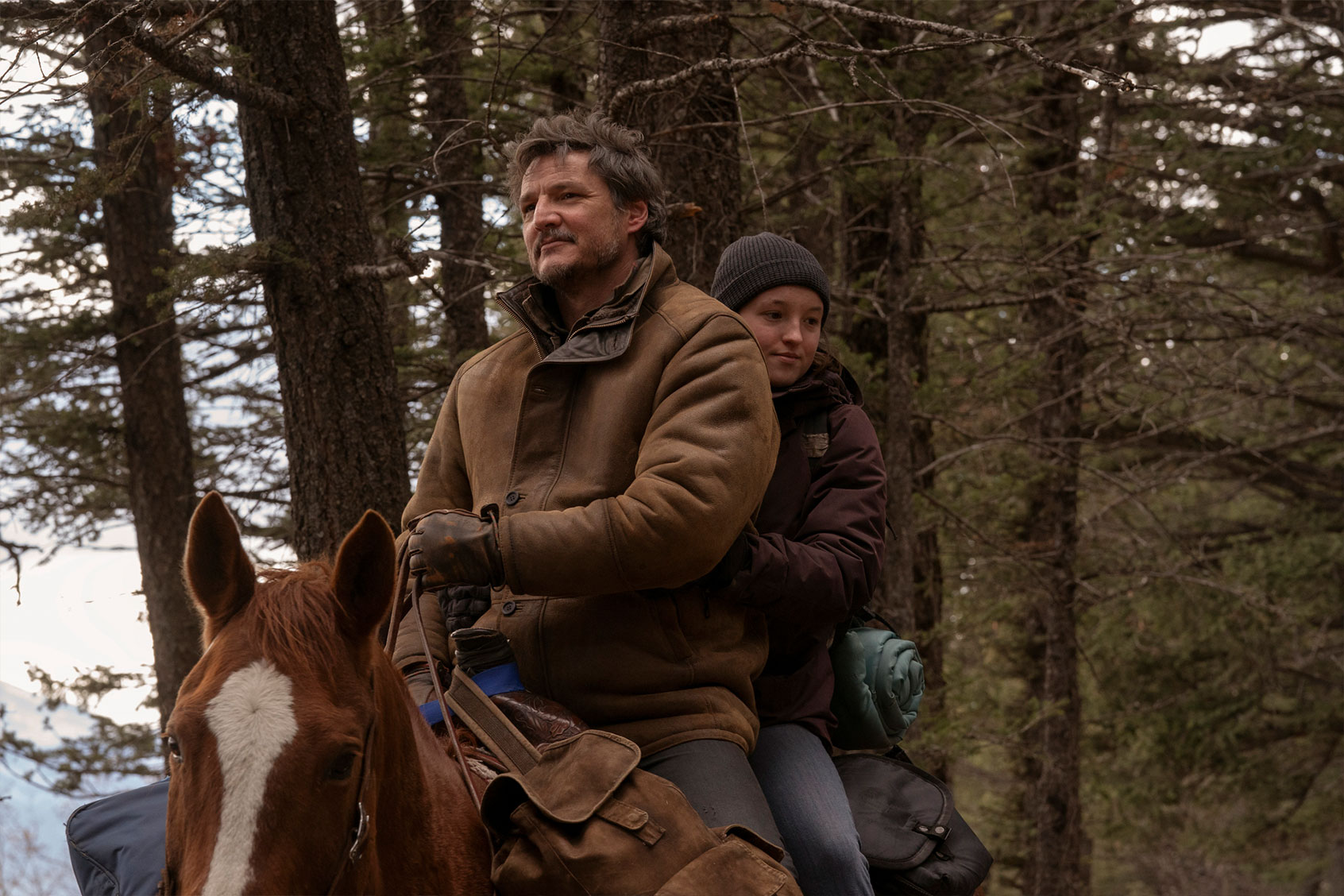
The Last Of UsPedro Pascal and Bella Ramsey in “The Last Of Us” (Photograph by Liane Hentscher/HBO)Though the show is beloved, a similar low intensity runs through “The Last of Us,” where the monsters are, to put it bluntly, funny-looking. It must be hard to look menacing when your head resembles the nice, frilly side of an oak. I love the outdoors, so this is a comforting image for me: something mossy with mushrooms growing on it, a natural ledge where a frog might perch.

We turn to fiction for different reasons, for escape (and that includes the horror type of escape), but also for recognition.

Multiple viewers, including a writer at Vulture, have raised the question: Why don’t “The Last of Us” heroes just eat the mushroom monsters? Squirt some butter on them and knock them into a campfire, sprinkling on some wild onion or thyme? Even the clickers – massive creatures, more mushroom than human – don’t look frightening. They look, frankly, adorable, like a savory Stay Puft Marshmallow man (and you could eat him).

What keeps viewers watching if not for the thrills and scares promised? This was put to the test in the last episode, where we finally see how Ellie (Bella Ramsey) receives the bite that defines her. But because we know she’s not going to die, she’s not going to turn; she’s immune, it feels weirdly low-stakes. The threat of death is everywhere in the show but as it’s not a real threat for the main character, it’s not real for us either, not as real as the threats outside our own door.


Want a daily wrap-up of all the news and commentary Salon has to offer? Subscribe to our morning newsletter, Crash Course.


We turn to fiction for different reasons, for escape (and that includes the horror type of escape), but also for recognition. We want to picture ourselves in stories, and right now, we’re living in a world just as wild in many ways as the likes of “Knock at the Cabin” or “The Last of Us.” Just as apocalyptic, just as sometimes hopeless-feeling. No, we don’t have monsters biting us (yet), but we have a virus that sickens, disables or kills many while leaving others – like Ellie – untouched. And we have a world just as ravaged as the one in the film. More so, because an individual sacrifice won’t make a dent.

But just because they’re not scary stories doesn’t mean we don’t want them. We just want something different from them now. We see ourselves and our current lives in them, and maybe that’s why we keep watching. Not to be sacred, to be seen.


“Dairy Pride” and “soy boys”: The heated identity politics of non-dairy milk

On Feb. 22, the U.S. Food and Drug Administration (FDA) made a recommendation that shook the dairy industry. For several years, the federal agency has been drafting guidelines to “help ensure appropriate labeling of plant-based products that are marketed and sold as alternatives to milk.” 

These include products like soy, oat, almond and pea milks, which the FDA collectively refers to throughout the draft as PBMAs, or “plant-based milk alternatives.” Prompted by pushback from members of the dairy industry, as well as the politicians who represent them, regarding plant-based products being labeled as “milk,” the FDA issued a notice in 2018 soliciting comments from the public to gain insight into how consumers understood the word. 

The agency received more than 13,000 comments.

“After reviewing these comments and conducting focus group studies with consumers, the FDA determined that consumers generally understand that PBMA do not contain milk and choose PBMA because they are not milk,” the FDA wrote in a press release

For that reason, the agency recommends that PBMA’s can use the term “milk” in their labeling and marketing; although, it is recommending they include a “voluntary nutrient statement” that conveys how the product compares with milk based on the USDA’s Food and Nutrition Service fluid milk substitutes criteria. 

“These statements will help consumers make informed dietary choices when it comes to understanding certain nutritional differences between plant-based products that are labeled with ‘milk’ in their names and milk,” the release said. 

This industrial and governmental consternation over the use of a single word crystallizes the way in which plant-based milks themselves have been adopted as both political metaphor and a cultural shorthand. Put another way, sides have been drawn in the Great “Milk” Debate and the FDA’s decision marks a win for one. 

***

As mentioned, the FDA’s proposed guidance comes after years of outcry from major dairy producers, who say that the term “milk” should be reserved only for animal-based foods and dairy products.

Take for example the National Milk Producers Federation (NMPF) — a non-profit organization that works to advance dairy producers and their cooperatives — which refers to plant-based milks as “plant-based beverages” or, simply, “plant-based.” Earlier this month, the NMPF urged the FDA to reconsider its definition of “milk,” underscoring the importance of dispelling “the lie of plant-based beverages masquerading as ‘milk.'”

“Until the FDA enforces its own standards of identity for milk by getting dairy terms right – reserving them for the real thing to distinguish them from the nutritionally deficient concoctions that hide behind milk’s health halo – the lie of ‘healthy’ plant-based ‘milk’ is likely to persist,” the organization wrote. “And as we’ve seen, that lie is proving difficult to eradicate.”

“Until the FDA enforces its own standards of identity for milk by getting dairy terms right – reserving them for the real thing to distinguish them from the nutritionally deficient concoctions that hide behind milk’s health halo – the lie of ‘healthy’ plant-based ‘milk’ is likely to persist.”

Similarly, the Wisconsin Farm Bureau Federation (WFBF) slammed plant-based alternatives for using the label “milk” to tout health benefits that they don’t contain:

“Consumers choose milk because it is a trusted term associated with quality and nutrition. This trust has been built over generations of Wisconsin dairy farmers who take pride in producing a quality product with regulations that reflect that quality,” said WFBF President Kevin Krentz, per The Center Square. “Plant-based milk alternatives are not milk. They aren’t held to the same regulations and therefore should not be labeled as milk.”

Wisconsin Senator Tammy Baldwin further claimed that plant-based producers are “deceiving consumers” and urged for the passage of the Dairy Pride Act, a 2019 bill that combats “the unfair practice of mislabeling non-dairy products using dairy names.”

“America’s dairy farmers work hard to produce second-to-none products with the highest nutritional value, and plant-based products should not be getting away with using their good name,” Baldwin said in a letter to the FDA this week. “Since the FDA is failing to enforce its own definitions for dairy terminology and stop imitation products from deceiving consumers, we will be reintroducing our DAIRY PRIDE Act to stand up for America’s dairy farmers and the quality products they make.”

***

Amidst the industry backlash over what to call the plant-based alternatives, the products themselves have been gradually adopted into the lexicon of the “culture war,” largely by members of the far-right. For instance, in 2020, Rachel Hosie broke down the origin of the insult “soy boy” for The Independent. She points to two Urban Dictionary definitions of the term: 

Slang used to describe males who completely and utterly lack all necessary masculine qualities. This pathetic state is usually achieved by an over-indulgence of emasculating products and/or ideologies.

And: 

The average soy boy is a feminist, nonathletic, has never been in a fight, will probably marry the first girl that has sex with him, and likely reduces all his arguments to labeling the opposition as ‘Nazis’.

Where exactly “soy boy” originated is unclear. Some suggest it first appeared on 4Chan, while The Daily Dot posits that it was started by Mike Cernovich, a far right social media personality, who used it to insult people on Twitter. Meanwhile, James Allsup — a white supremacist podcaster and YouTube commentator — claimed that he actually invented the insult. 

“For the men who use terms like … soy boy, being called anything related to femininity is the ultimate insult,” Hosie wrote. 

Let’s be clear, it’s an objectively really dumb insult, and one that has been “reclaimed” if you will by both consumers and brands — as evidenced by the barista-favorite Happy Happy Soy Boy Milk from Happy Happy Foods. But there’s something deeper, too, to be extrapolated from the perceived femininity of choosing to drink soy milk instead of dairy. Conservative politicians, including Missouri Senator Josh Hawley and author J.D. Vance, and are increasingly vocal regarding their concerns that “traditional manhood” is under attack. 

“The left want to define traditional masculinity as toxic,” Hawley said in an address to the National Conservatism Conference in 2021. “They want to define the traditional masculine virtues, things like courage and independence and assertiveness, as a danger to society.”

He continued: “The problem with the left’s assault on the masculine virtues is that those self-same qualities, the very ones the left now vilify as dangerous and toxic, have long been regarded as vital to self-government.” 

This binary that Hawley sets up — in which the political progress of historically marginalized groups is interpreted as an assault on tradition, instead of as a collective win — underlies the online politicization of soy milk. Using milk as a metaphor, plant-based alternatives aren’t just personal choices, they’re a threat to traditional dairy. 

This isn’t really a surprise. As Salon Food has reported, health foods, including plant-based products, have long been positioned as “othered” in both pop culture and American culture in general. 

This perception was cemented during the countercultural movement during the 1960s and 1970s. As author Jonathan Kauffman wrote in his book “Hippie Food: How Back-to-the-Landers, Longhairs, and Revolutionaries Changed the Way We Eat,” many young Americans were rebelling against the increased industrialization in the U.S., including within the military, by changing how they ate. 

“The idea that my personal food choices — what I buy, what I consume — can have these larger political impacts on global hunger, the environment and capitalism, it was a huge shift.”

Pre-industrial food sans cans and plastics, like organic vegetables, sprouted grains and soy protein became touchstones of the movement. 

“The idea that my personal food choices — what I buy, what I consume — can have these larger political impacts on global hunger, the environment and capitalism,” Kauffman said in an interview with CUESA. “It was a huge shift.” 

As researchers wrote in the article “Palatable disruption: the politics of plant milk” for the academic journal “Agriculture and Human Values,” how true this remains in practice is a contentious topic in an age of increasingly industrialized food systems. 


Want more great food writing and recipes? Subscribe to Salon Food’s newsletter, The Bite.


“We examine the politics of plant milk by developing the concept of palatable disruption, which posits that people are encouraged to care about the environment, health, and animal welfare enough to adopt [plant-based] mylks but to ultimately remain consumers of a commodity food,” they wrote. “Our analysis is not meant to be dismissive but to urge caution against any implicit assumption that plant-based offers food futures that are better for the environment, health and animal welfare.” 

That said, the researchers point out that there are other options for those who want to be more conscientious about how they purchase plant-based milks, like buying from local producers or co-ops. And as more Americans cut back on meat in dairy — just as a reported one in four have endeavored to do, according to a 2020 Gallup poll — the necessity and viability of those options will hopefully increase. 

In the meantime, perhaps making plant-based alternatives seem a little less alternative is a worthwhile start. For those who feel otherwise, the FDA has opened up a 60-day window for electronic comments on the draft guidance.


Insects are vanishing worldwide – making it harder to grow food

Over the past 20 years a steady trickle of scientific papers has reported that there are fewer insects than there used to be. Both the combined weight (what scientists call biomass) and diversity of insect species have declined. Some studies were based on sightings by amateur entomologists, while others involved scientists counting the number of bugs splattered on car windshields. Some collected flying insects in traps annually for years and weighed them.

In the past six years, this trickle has become a flood, with more and more sophisticated studies confirming that although not all insect species are declining, many are in serious trouble. A 2020 compilation of 166 studies estimated that insect populations were on average declining globally at a rate of 0.9% per year. But the declines are uneven. Even within the same environments, populations of some insect species have waned, while others have remained stable and still some others increased. The reasons for these differences between insects are unknown, though evidently some are more resilient than others.

Until recently, much of the evidence has been drawn from protected areas in Europe and to a lesser extent North America. So what is the picture like elsewhere? A new study offers fresh data on the seasonal migrations of insects in east Asia. These insects, many of them pest species, fly north in spring every year to take advantage of the new growing season and fly south in autumn to escape the cold.

A progressive fall in the enormous numbers of these migrants indicates that insect declines are indeed a global problem.

Millions of migrating insects

Between 2003 and 2020, scientists from the Chinese Academy of Agricultural Sciences in Beijing caught almost three million migrating insects from high-altitude searchlight traps on Beihuang Island off the coast of northeast China. A further 9 million insects were detected from radar records. In all, 98 species were identified and counted, most of which were either plant-eating crop pests or insects that are their natural enemies – predators and parasites. Over the whole 18-year period, the yearly tally of all identified insects fell by 7.6%, a steady downward trend of 0.4% a year.

Insect declines clearly are occurring on a large scale in Asia, just as they have been in Europe and North America. It seems reasonable to assume that the causes are the same. Although we don’t know for certain what those causes are, it seems likely that they operate all over the world.

The study also showed that pest insects such as the black cutworm moth, whose caterpillars attack a wide variety of vegetable crops, are as strongly affected by the global decline of insects as non-pest species such as bees and butterflies that were the subjects of most of the previous European and American studies.

We are so used to considering insects as pests that it is tempting to think that, in a world with fewer of them, agriculture might prosper as never before. This new study reveals why that is not the case. The researchers used detailed entomological records from the past to construct a complex food web showing how each of the insect pest species caught in the searchlight traps can be eaten by several kinds of insect predators and parasites, often termed “natural enemies”. As an example, black cutworm caterpillars are eaten by green lacewings, among others.

The researchers compared how fast 124 pests had declined alongside each of their natural enemies. Over the 18-year study, the abundance of natural enemy species fell at a rate of 0.65% a year, while the plant-eating prey did not decrease in number at all, on average. This suggests that beneficial natural enemy species are more likely to decline than the pests that they feed on. As a result, farmers must either tolerate lower crop yields or use even more chemical insecticides to control pests, leading to still worse declines.

Although it is tempting to point a finger at pesticides, bright streetlights or climate change, insect declines almost certainly have multiple causes that overlap.

The most frequently named suspect is agricultural intensification. This term covers a multitude of sins. Farm mechanization, the eradication of hedges, crop mono cultures, the increased use of chemical fertilizers and regular applications of pesticides are all intended to produce fields without weeds, pests or diseases. Only a reduced range of wild plants and animals can survive in the narrow field margins and neighboring roadside verges that remain. Another way of putting it is that farmers have made fields unwelcoming to most insects.

Intensification is designed to ensure that as much as possible of the farm ecosystem’s energy flow is diverted into growing crops and livestock for human consumption. It has been estimated that 24% of all plant growth annually is now appropriated by humans and this rises to a staggering 69% on cropland. These figures roughly doubled over the 20th century. It’s no wonder that insects don’t do well in landscapes such as these and farmland occupies almost 40% of the land.

Why you’ll miss bugs

Insects are by far the most numerous of all animals on Earth. The estimated global total of new insect material that grows each year is an astonishing 1,500 million tons. Most of this is immediately consumed by an upward food chain of predators and parasites, so that the towering superstructure of all the Earth’s animal diversity is built on a foundation of insects and their arthropod relatives.

If insects decline, then other wild animals must inevitably decline too. There is already evidence that this is happening. In North America, insect-eating bird species experienced an average decline in population size of almost ten million over the past 50 years, while those for which insects are not essential prey did not decline at all. In Europe, parallel declines of insectivorous swallows, house martins and swifts have all been linked to insect declines.

While it’s true that a few insects are a menace to humans (disease-carrying mosquitoes come to mind), the vast majority of insects are friendly: they pollinate crops, provide natural pest control, recycle nutrients and form soil by aiding the decomposition of dead animals and plants. All these processes will slow down if insects become scarce. The economic value of these services is incalculable – agriculture could not continue for long without them.

Our insect friends are being crowded out. Somehow, we must find ways to make more room for them.


Don’t have time to read about climate change as much as you’d like?

Get a weekly roundup in your inbox instead. Every Wednesday, The Conversation’s environment editor writes Imagine, a short email that goes a little deeper into just one climate issue. Join the 10,000+ readers who’ve subscribed so far.


Stuart Reynolds, Emeritus Professor of Biology, University of Bath

This article is republished from The Conversation under a Creative Commons license. Read the original article.

Do people with autism feel pain more acutely? Study sheds light on a little-discussed phenomenon

There are many aspects of autism spectrum disorders that remain, for lack of a better word, mysterious. As someone who is on the autism spectrum himself, I can personally attest to such enigmatic realities as the double empathy problem, which describes how autistic and non-autistic people fundamentally differ in how they communicate. People on the autism spectrum sometimes have hard-to-explain physical disabilities in addition to communication issues, and statistics prove that men are more likely to develop autism than women.

“Once a sensation is painful, the intensity of these pains might be higher in autistic adults compared to their non-autistic peers,” Moore explained.

And there is the autism-pain problem. As a child, I used to run and hide under the bed whenever I heard a train passing by because the stimuli made me feel uncomfortable. For other autistic people, the problem involves a tendency to be more agitated than usual by physical pain such as being given shots or dealing with routine injuries. 

Earlier this month, a study by Israeli researchers in the scientific journal PAIN illuminated this under-explained aspect of autism: Why autistic people seem to be more sensitive to pain, whether it’s hypersensitivity to lights and sounds or an unusually acute response to literal physical pain.

After conducting an experiment with 52 adults who were either high-functioning autistic (HFA) or neurotypical, the largest reported sample for a study on pain in autism in the world, the scientists concluded that there are two factors at play in autism: “an increase of the pain signal along with a less effective pain inhibition mechanism.”

Yet the researchers also added that much more work will need to be done to understand the exact neurological mechanisms that cause autistic people to experience pain more acutely. Indeed, more broadly, scientists need to understand why the experience of pain is so inherently subjective from person to person.

“People certainly feel pain in different ways and to different degrees,” Michelle D. Failla, PhD, Research Assistant Professor at The Ohio State University College of Nursing, told Salon by email. (Failla was not involved in the Israeli study.) “There is variation in how much people feel and express pain that can be related to general individual variation across people, but also different life experiences, medical conditions, gender, race, and many other factors. People also can experience pain differently at different times in their lives – so it can change even by the situation for each person.”


Want more health and science stories in your inbox? Subscribe to Salon’s weekly newsletter The Vulgar Scientist.


“We also see differences in pain responses in some other neurodivergent populations.”

When it comes to studying the specific problem of autism and pain, the tricky part is ascertaining exactly how much of a role the autism disorder itself plays in the pain sensation. Dr David Moore, who studies pain psychology at Liverpool John Moores University (and was likewise not involved in the Israeli study), wrote to Salon that he and his colleagues have compared pain thresholds between autistic and non-autistic people. While they have not found evidence of differences when it comes to literal pain thresholds — “the intensity required for a person to report that a sensation is painful” — this is not the case when it comes to how intensely people perceive their pain once it has been registered.

“Once a sensation is painful the intensity of these pains might be higher in autistic adults compared to their non-autistic peers,” Moore explained. “This might suggest that once a pain is perceived that suffering is more acute for autistic people.” He also noted that autistic people who are more likely to experience conditions like joint hypermobility and gastrointestinal problems, which exacerbate their discomfort.

“We also have reason to suspect that autistic people are more likely to need management within tertiary chronic pain clinics suggesting the greatest levels of care are more likely to be required,” Moore told Salon.

Autism is not alone among neurological and developmental conditions that seem to cause an increased subjective response to pain. Nouchine Hadjikhani, a professor in the Department of Psychiatry and Neurochemistry at the University of Gothenburg, told Salon that conditions like fibromyalgia have been linked to heightened pain sensitivity, especially in women. Overall, Hadjikhani lamented the insufficient amount of research into how pain is felt by different demographic groups. This research could be very useful.

In terms of why autistic people seem to feel pain more acutely, Hadjikhani says that “it that has not been proven and shown directly, but it really seems like this is because the autistic brain has an imbalance between excitation and inhibition, it’s more susceptible to process signals with more intensity compared with the brains of typical people.” 

Failla concluded, based on her research, that while autistic people may experience pain more strongly in certain ways “reflected in different brain responses to pain,” there is also evidence of the opposite.

“We see that other autistic people may experience pain less strongly at some times,” Failla wrote. “We also see differences in pain responses in some other neurodivergent populations, but there isn’t enough research to definitively say how much this is linked to neurodivergence yet. We continue to work on this in our research.”

“I am going to make it painful”: Neb. Dem vows to filibuster all bills to defeat anti-trans crusade

A Nebraska state lawmaker has vowed to filibuster every bill in the legislative session if Republicans don’t immediately withdraw two bills seeking to ban abortion and gender-affirming care.

Nebraska state Sen. Machaela Cavanaugh (D-Omaha) promised to obstruct any legislation from moving forward until the bills are retracted late last week in a speech on the state’s unicameral legislative floor.

The anti-abortion measure would ban almost all abortions in the state after a supposed “fetal heartbeat” is detected — a phrase that physicians specializing in reproductive health say is inaccurate, as the sound generated by an ultrasound early on in pregnancy doesn’t actually indicate that a heart has developed within an embryo. The anti-trans bill would ban physicians in the state from providing transgender youth with gender-affirming care, which can often be life-saving.

“If this legislature collectively decides that legislating hate against children is our priority, then I am going to make it painful; painful for everyone” in the legislature, Cavanaugh said in her speech. “Because if you want to inflict pain upon our children, I am going to inflict pain upon this body.”

“I have nothing, nothing but time,” Cavanaugh went on. “And I am going to use all of it.”

Republicans in state legislatures across the U.S., including in Nebraska, are increasingly introducing legislation that targets LGBTQ youth, barring them from participating in sports and restricting what kinds of treatment they can receive from their doctors, among other measures. One tracker notes that, in 2023 alone, lawmakers have introduced anti-trans proposals in at least 38 states across the country.

Cavanaugh acknowledged that her stance will “annoy” some people. “I want you to genuinely be frustrated to all get out with me,” she said.

The Nebraska lawmaker stressed her dedication to her promise, noting that, after a filibuster last week, she slept on the floor of her office before attending committee hearings 20 minutes later.

“You can not stop me. I will not be stopped,” she said.

Cavanaugh reiterated her promise in a Monday night interview with MSNBC’s Rachel Maddow.

“I’m just going to practically make sure that my colleagues have to make a choice about what it is they want to do, what our job is. Is our job to legislate hate, or is our job to govern and work on tax cuts and work on the economy?” Cavanaugh said. “So I’m forcing their hand.”


This article is licensed under Creative Commons (CC BY-NC-ND 4.0), and you are free to share and republish under the terms of the license.

Experts: Supreme Court conservatives appear ready to strike down student debt cancellation program

The U.S. Supreme Court heard oral arguments on Feb. 28, 2023, regarding a multistate lawsuit to block the Biden administration’s student loan debt cancellation program. The Conversation asked John Patrick Hunt, a law professor at the University of California, Davis, and Celeste K. Carruthers, an economics professor at the University of Tennessee, what’s at stake and what clues the court has given as to how it may rule on the matter.

What’s the case about?

Hunt: The conflict is about whether the Biden administration can cancel some student loans owed to the federal government. The administration in 2022 announced plans to cancel up to US$10,000 in student loan balances for borrowers who earn under $125,000 per year ($250,000 if married), as well as an additional $10,000 for borrowers who were lower-income Pell Grant recipients when they took out their loans.

Those opposed to the policy focus on four main arguments:

  • It does not address the underlying problem of high cost for higher education.
  • It encourages irresponsible borrowing.
  • It primarily benefits college-educated people who are better off, on average, than the rest of the U.S.
  • It is unfair to people who do not have student loans, either because they did not take them out or because they repaid them.

Arguments for cancellation include:

  • The student loan system is irredeemably broken.
  • Many borrowers are suffering financially and need relief, especially because of the COVID-19 pandemic.
  • It is unfair to make students borrow for higher education to begin with.

Two groups of plaintiffs have sued to block the program: six Republican-led states and two borrowers who would not receive forgiveness. The legal issues in the states-led case are narrower than the broad arguments set out above.

The main ones are whether the administration’s plan harms any of the plaintiffs and whether the relevant law – the HEROES Act of 2003 – gives the administration the power to carry out the plan.

What’s at stake and for whom?

Carruthers: As proposed, under the cancellation plan the U.S. Department of Education would forgive some or all student loan debt held by about 40 million borrowers. The Congressional Budget Office estimates that about $430 billion in loans would be canceled under the plan.

Borrowers eligible for loan cancellation are those who took out federal college loans before July 2022 and who meet the income requirements. Researchers at the New York Federal Reserve estimate that the plan would erase all college debt for 40% of federal borrowers.

Resolving the plan’s legal challenges will not only determine if these balances can be canceled as proposed, but also when and whether borrowers have to start making normal payments again. Required loan payments were put on hold in March 2020 as part of the CARES Act, and the pause has been extended multiple times since then. In November 2022, the Biden administration extended the pause again to some point in the future, after the Supreme Court decides the case.

Has the court indicated how it will vote?

Hunt: The justices typically do not state how they will vote at oral argument, but the questions they ask can give some clues. Based on the questions the justices asked in the states-led case, it seems likely that the court will reject the administration’s program.

The first issue before the court is whether any plaintiffs have been harmed. If not, the lawsuit will be thrown out.

As a law professor, I believe the plaintiff with the best case for harm is probably the state of Missouri. The administration admits that cancellation will harm a nonprofit corporation created by the Missouri government called the Missouri Higher Education Loan Authority, or MOHELA. MOHELA earns revenue from servicing federal student loans, and the plaintiffs argue that loan cancellation will harm it by reducing this revenue.

It is not clear whether this translates to harm to Missouri itself, but only one conservative member of the Supreme Court, Justice Amy Coney Barrett, asked questions about whether harm to MOHELA is harm to Missouri. Because none of the other five conservative justices asked critical questions about Missouri’s standing, it seems likely that the court will conclude that Missouri is harmed and can sue.

The second question, answered only if there is a plaintiff who has been harmed and can sue, is whether the law authorizes the program. Generally, the three liberal justices’ questions indicated that they believe the program is authorized, and the six conservative justices’ questions indicated the opposite.

On the conservative side, only Barrett and Justice Brett Kavanaugh asked questions that seemed to express any doubt about the state plaintiffs’ case. Kavanaugh has historically frowned on the aggressive use of bureaucratic power, making it more likely, I believe, that he may rule against the government in this case. And Kavanaugh’s vote could be crucial. If he and his fellow conservatives on the bench – Justices Samuel Alito, Neil Gorsuch, John Roberts and Clarence Thomas – find the program illegal, they will form a majority ruling even without Barrett.


John Patrick Hunt, Professor of Law, University of California, Davis and Celeste K. Carruthers, Professor of Economics, University of Tennessee

This article is republished from The Conversation under a Creative Commons license. Read the original article.

Community supported fisheries prove seafood can be local, too

In the earliest days of the pandemic, as global supply chains faltered, Americans found ways to source fruits, vegetables, meat and dairy from local producers. Farmers’ markets were swarmed, families flocked to u-pick operations and community supported agriculture operations (CSAs) saw a spike in demand for the first time in years.

People also rediscovered the local fishers hiding in plain sight, giving local seafood operations a “pandemic bump.” “For about six months it was completely off the charts,” says University of Maine marine policy professor Joshua Stoll. He’s also the co-founder of the Local Catch Network, which offers “resources and services to help foster and catalyze innovative [seafood] business models,” he says, to its 2,000 or so members. (It also offers a local seafood finder.)

These include about 200 small family fishers looking to expand their operations by supplying local schools or food banks, for example; or forming co-ops to pool marketing and processing resources; or starting community supported fisheries (CSFs), which follow the CSA model in delivering locally caught fish to local folks who sign up for a season’s share (although models differ).

That pandemic bump has flattened but demand for local fish remains higher than it was previously. The better news: federal funding “that was put in place around supply chain resilience is just coming online and those programs are becoming established,” Stoller says. And perhaps best news of all: “Five years ago, the idea of buying fish on the internet — people would laugh you out of the room. But for those [fishers] who are doing novel community-based distribution models, that’s a permanent change that creates new opportunities.”

CSFs build community

Those community-based models aren’t without their challenges. USDA has tracked where and how land-based farm foods are sold, “which has been fundamental to building the case that local and regional food systems are important,” Stoller says. But there’s been no corollary for fisheries, which is why Local Catch Network has embarked on a two-year project to track impacts of direct seafood marketing practices among 40,000 seafood harvesters. For the first time there will be national data on the importance to communities of things like CSFs and although Stoller can’t yet share numbers, he says there are currently thousands of independent direct-to-consumer seafood businesses across the U.S. — likely just a whiff of what’s to come.

One such is Local Catch member Fishadelphia. Founded in 2018, it offers annual and monthly memberships of either filets or whole fish, picked up by customers every other week at one of 18 locations in South Philadelphia; there’s also an option to pay extra, to subsidize a membership for someone who can’t afford it. Fishadelphia works primarily with three family seafood operations in New Jersey; whatever their given week’s abundant fresh catch happens to be is what turns up in CSF bags. Customers currently number around 150 although this fluctuates, since you can sign up — or cancel — anytime.

As strategist Feini Yi explains, similarities to the average CSA stop here. Fishadelphia has a broader mission, which grew out of founder Talia Young’s desire to support her own Chinese-American and other under-resourced communities. After-school clubs at two high schools in low-income neighborhoods teach students about sustainable seafood as well as fish-related entrepreneurship and business skills; kids work on marketing and social media content and run their own fish pick-ups. The clubs also provide a mechanism for expanding the CSF. Kids become excited about fish and loop in their family, friend, church networks, “which is one strategy that we have to reach communities of color” for subsidized memberships, says Yi. Many of them have strong traditions working with whole fish, which saves fishers time and money on breaking catch down to filets.

The fish sold through Fishadelphia includes well-known species like tuna or scallops and what Yi calls underutilized: species like dragon fish, dogfish, monkfish, skate and when those aren’t available, clams and oysters. “We serve a middleman function, but we are bringing consumers to these fishermen that they definitely would not be able to access otherwise,” Yi says. Meanwhile, at events that introduce Fishadelphia customers to producers, she sees that fishers “are starting to realize, maybe we can learn from Fishadelphia about how to educate and market these local species to a more local audience.” That helps achieve what Local Catch’s Stoller calls a relational food system, building trust though personal interaction.

Making CSFs more economically sustainable

One limiting factor for Fishadelphia — and one they’re aiming to change — is that selling only fresh-caught seafood makes their model vulnerable. “If there are only two species because of the season or there’s a Nor’easter and the boats can’t go out, there aren’t that many options” to pack up in CSF bags, says Yi.

Selling frozen fish would help. This is the model embraced by Port Orford Sustainable Seafood in Oregon. Founder Aaron Longton has been building and tweaking his model since 2009. At the moment, it’s got a few prongs; he sells some fish to large buyers; he has an online shop where anyone within a four-state radius can order fish for shipping; and he runs a CSF. Members sign up for an annual subscription, then select what they want from the catch from about 40 local dayboats —halibut, lingcod, octopus, cabezon, for example. “I had a friend with a CSA and one time he got a whole box of kohlrabi. We’re not going to give you a box of kohlrabi,” says Longton in explaining his pick-and-choose rationale.

Every two weeks Port Orford makes drop-offs that alternate between a Southern and a Northern route, so each of 400 customers gets a CSF box once a month. Because of this and “because we have intermittent opportunities to fish,” Longton says, “we can’t really chase the fresh market like Big Seafood can with their giant ships that are harvesting around the clock all the time. We blast freeze all our catch then we hold it in the inventory.”

Tyson Rasor is Fisheries and Food Systems Program Manager for environmental nonprofit Ecotrust, which oversees a nationwide Local Catch Network program called Scale Your Local Catch that offers support and networking opportunities to fishers; Port Orford briefly participated in a precursor to it. Rasor says there’s stigma around frozen fish because “Consumers see [it] as having less quality,” even if it’s often fresher than the “fresh” fish on offer in supermarket cases that may have been frozen and defrosted by the retailer.  As it turns out, consumers can’t tell the difference in taste tests between flash frozen and fresh, he says. Frozen fish also allows fishers to “aggregate, store, then start to distribute in way that actually works for them.”

Rasor says that while community seafood distribution models are a way for smaller fishers to expand their businesses, they often need a lot of help in figuring out how best to market themselves (which is where Ecotrust comes in). And although they often have the mindset of competitors, many of them share “values-aligned” reasons for getting a CSF up and running —  “I want my seafood to be sold locally to my local community, I want to get better prices to the people that I fished with,” Rasor says — and are starting to recognize they can benefit when they work together.

Port Orford’s dayboats all fish with hook and line, so there’s none of what Longton calls “indiscriminate bycatch carnage” from other gear types, like the trawl nets often used by commercial fishing enterprises. Longton has long been involved with conservation and stewardship of local waters and he works to increase the price of the fish he buys and sells. This, he says, is a “pain in the ass to corporate buyers,” but it also helps ensure that he can pay a $14.50 hourly starting wage to his processing workers where Big Fish might pay $9. “We’re putting more money into the community, not just through purchasing fish at a higher price, but also paying our employees a better rate,” he says.

When asked what benefit it is to him to sell mostly locally, mostly to members of his community, Longton doesn’t waver: “Having people look us in the eye and thank us for what we do.”

Rejecting Lori Lightfoot, Chicago picks progressive to face school privatizer in mayoral runoff

Chicago voters rejected Democratic Mayor Lori Lightfoot’s bid for a second term on Tuesday, elevating progressive Cook County Commissioner Brandon Johnson to face conservative candidate Paul Vallas — an ardent school privatization advocate — in an April 4 runoff.

Johnson, a longtime educator and organizer, advanced to the runoff with roughly 20% of the vote after a grassroots campaign centered on expanding resources for Chicago’s public schools and taxing the rich to boost affordable housing, public transportation, healthcare, and other priorities.

“Today, we are on the verge of creating a new Chicago,” Stacy Davis Gates, president of the Chicago Teachers Union, said in a statement applauding Johnson’s campaign. “It’s a Chicago for the many, not the few — a city where the unhoused can access affordable and sustainable housing, where our public schools are fully funded and provide the support students need, and where our young people can play in safe, welcoming, and thriving communities.”

Vallas, though, is seen as the frontrunner, having received 34% of the vote on Tuesday in his second bid for mayor.

U.S. Rep. Chuy Garcia, D-Ill., received less than 14% of the vote in Tuesday’s contest, under Lightfoot’s 17%.

The former CEO of Chicago Public Schools, Vallas is a longtime proponent of school privatization, having expanded charter schools and other privatization schemes in his home city as well as in Philadelphia and post-Hurricane Katrina New Orleans.

Far from shying away from his record — which has drawn vocal criticism from lawmakers and officials from the areas where he’s attacked public schools — Vallas has pledged to build on it if elected mayor of Chicago.

Maurice Mitchell, national director of the Working Families Party—which is backing Johnson—said late Tuesday that “the contrast in this runoff could not be clearer.”

“In one corner, we have a classroom teacher and union organizer with deep community roots,” said Mitchell. “In the other corner, we have conservative Paul Vallas, who is backed by the Trump-supporting Fraternal Order of Police and has never come across a public school he didn’t want to gut.”

Following Tuesday’s vote, Johnson—who has described his opponent’s approach to education as “morally bankrupt”—tweeted that “if tonight is proof of anything, it’s proof that anything is possible.”

“It’s proof that we can build a Chicago as big and generous as its promise,” he continued. “And it’s proof that City Hall can truly belong to the people. Tonight is just the beginning. Thank you, Chicago.”

To defeat Vallas, Johnson will have to overcome a likely torrent of opposition spending from dark money organizations that have taken an interest in the race to lead the United States’ third-largest city.

As the Chicago Tribune reported last month, groups spent “hundreds of thousands of dollars in the final weeks of the race for mayor” while “hiding where that money is coming from.”

One dark money organization, the Chicago Leadership Committee, has “spent more than $165,000 on TV and digital ads for Vallas’ mayoral bid,” the Tribune reported.

“There’s no question even more dark money will flood this election in the coming weeks,” Mitchell warned. “The right wing sees our movement gaining momentum and will do everything possible to stop us. But tonight is more proof that organized people can beat organized money. Brandon Johnson has always had the backs of working families, and in April, we’ll have his.”

Gaetz flustered after Pentagon official calls him out for citing Chinese “propaganda” to his face

Rep. Matt Gaetz, R-Fla., on Tuesday unknowingly cited Chinese propaganda to justify cutting aid to Ukraine during a House Armed Services Committee hearing. 

Gaetz, who recently introduced a resolution proposing the termination of U.S. military and financial aid to Ukraine, cited and entered on the record a report from Chinese Community Party-controlled news outlet, The Global Times. 

The Washington Post reported that the Global Times was designated as a propaganda outlet by former President Donald Trump’s administration. 

Gaetz during the hearing questioned Undersecretary of Defense Colin Kahl on whether the far-right nationalist Azov Battalion in Ukraine was “getting access to U.S. weapons.”

“Not that I’m aware of, but if you have information, happy to hear it,” Kahl told Gaetz.

Gaetz responded by submitting into the Congressional record the Global Times’ article to support his assertion that the Azov Battalion was “getting stuff as far back as 2018.”

“I’m sorry, this is the Global Times from China?” Kahl asked.

“No,” Gaetz initially said, before conceding: “Well it might be. Yeah, it might be, yeah.”


Want a daily wrap-up of all the news and commentary Salon has to offer? Subscribe to our morning newsletter, Crash Course.


“As a general matter, I don’t take Beijing’s propaganda at face value,” Kahl replied.

“No, no, just tell me if the allegation is true or false,” Gaetz insisted.

Kahl explained that he didn’t have any evidence one way or another to respond to the claim and reiterated that he does not accept Beijing propaganda “at face value.”

“Fair enough, I would agree with that assessment,” the Republican lawmaker said. 

Tennessee GOP governor backing anti-drag bill confronted with photo of him in drag

Republican Tennessee Gov. Bill Lee is on the defense as he tries to explain away a recently surfaced high school yearbook photo of him wearing women’s clothing, calling attempts to conflate the image with assailed drag shows in red states “ridiculous.” 

While answering questions from reporters about a recently proposed bill that would heavily restrict drag performances, an activist asked Lee if he recalled “dressing in drag in 1977.”

“What a ridiculous question that is,” Lee responded. “Conflating something like that to sexualized entertainment in front of children, which is a very serious question.”

This is not the first time photos from the Tennesse governor’s past have stirred debate. In 2019, Lee admitted regret for participating in “insensitive” “Old South” fraternity parties and dressing in a Confederate Army uniform when he attended Auburn University. 

The Republican governor is set to sign the legislation, which passed in a GOP-dominated legislature last week, to outlaw “adult cabaret performance” on public property or “in a location where the adult cabaret performance could be viewed by a person who is not an adult.” The bill defines an “adult cabaret performance” as “a performance in a location other than an adult cabaret that features topless dancers, go-go dancers, exotic dancers, strippers, male or female impersonators who provide entertainment that appeals to a prurient interest, or similar entertainers, regardless of whether or not performed for consideration.”


Want a daily wrap-up of all the news and commentary Salon has to offer? Subscribe to our morning newsletter, Crash Course.


Lee’s press secretary, Jade Byers, said in a statement that the bill “specifically protects children from obscene, sexualized entertainment, and any attempt to conflate this serious issue with lighthearted school traditions is dishonest and disrespectful to Tennessee families.”

The bill comes after a months-long, GOP-led campaign to publicly demonize LGBTQ+ friendly spaces and events as dangerous. The Washington Post reported that House Bill 9 is one of at least 26 bills introduced by Republicans in state legislatures to curb drag events.

Lee also confirmed that he will advance legislation banning transgender youth in Tennessee from receiving gender-affirming healthcare, with House lawmakers voting 77-16 on the bill last week. 

Ron DeSantis lacks the appeal of Donald Trump — but is he the second coming of Richard Nixon?

There is some new polling out this week on the nascent Republican primary which shows that former president Donald Trump has gotten a little bump in the last month or so.

An Emerson poll shows Trump leading Florida Governor Ron DeSantis, 55% to 25%, while the Yahoo News/YouGov poll shows him over DeSantis, 47%-39%. DeSantis had been leading Trump by 4 points last month. The GOP polling firm Echelon Insights, meanwhile, has Trump at 46% and DeSantis 31% and the big kahuna, Fox News, has Trump over the Florida governor, 43%-28%. It would appear that at the moment that despite all the DeSantis hype, Trump is still the favorite among GOP primary voters.

To further illustrate that point, here’s a classic moment this week from Fox News, which is clearly trying to push DeSantis’ candidacy:

It’s still not obvious to the GOP establishment, which includes the right-wing media, even after all this time that their voters really do like Donald Trump. Some obviously like him more than others. The “Always Trumpers” appear to make up about 30% of the party, a substantial bloc. But the rest of the party at least sort of likes him too, even if they might wish he’d cause less trouble. DeSantis is more of an idea at this point, maybe even a backup in case Trump gets impossibly snarled in legal trouble or keels over. But no one should kid themselves that GOP voters no longer like Trump.

DeSantis hasn’t declared yet but he’s clearly running. He’s recently been traversing the country giving speeches in blue states obviously trying to get national press and raise his profile beyond the hardcore right-wing media audience that sees him on Fox News. To that end, he’s also published the obligatory campaign book, “The Courage To Be Free,” and has set out on the requisite book tour.

The book looks like it’s going to be a bestseller, but I will be shocked if more than 10% of those who buy it can get through more than a few chapters before they relegate it to the bookshelf or the garbage can. It’s a really tough read, so boring that it makes you look longingly at that huge tome on the history of the federal reserve you’ve been avoiding for years now. As Jennifer Szalai memorably quipped in her devastating review in the New York Times:

For the most part, “The Courage to Be Free” is courageously free of anything that resembles charisma, or a discernible sense of humor. While his first book was weird and esoteric enough to have obviously been written by a human, this one reads like a politician’s memoir churned out by ChatGPT.

Chat GPT would likely be more entertaining. That’s because, by all accounts, this boring book is an accurate reflection of the man himself. He’s a dour, withdrawn, cold automaton who many people who know him really can’t stand. Not only does nobody want to have a beer with him, but they are also downright hostile to being in the same room with him. In a profile for the Atlantic, Mark Liebovitz quotes a former Florida lobbyist saying, “I’d rather have teeth pulled without anesthetic than be on a boat with Ron DeSantis.” In another profile by Dexter Filkins in The New Yorker, an anonymous politician says, “Ron’s strength as a politician is that he doesn’t give a fuck. Ron’s weakness as a politician is that he doesn’t give a fuck.”

He seems nice, doesn’t he?


Want a daily wrap-up of all the news and commentary Salon has to offer? Subscribe to our morning newsletter, Crash Course.


Ron DeSantis is anything but a happy warrior. In fact, he doesn’t appear to like human beings very much at all which seems to me to be an odd characteristic for a politician. But it isn’t unprecedented. DeSantis doesn’t go into much detail in his book about anything personal but he does make a point of saying that his parents were originally from Ohio and Pennsylvania and therefore imbued in him “rust belt values” even though he grew up in Florida. He came from a middle-class home, excelled in school and went to Ivy League schools by dint of his own hard work — and he makes quite a big deal about how he didn’t fit in with all the prep school rich kids. He spends a great deal of time railing on the elites and how he felt their scorn and proudly says that he left the liberal academy more conservative than he went in. It’s hard to tell if his sense of grievance about all that is contrived to make himself more attractive to the Republican base or if he really feels it. 

Nixon, like DeSantis, had great resentment toward the so-called elites and it colored his worldview in toxic, distorted ways.

The contrast between him and Trump is quite interesting. Trump doesn’t really like to mingle with average people except when they are paying customers at one of his properties. The way people react to Trump is like fans in the presence of a celebrity — they think he’s glamorous and exciting (for some reason.) And Trump feeds on the crowd’s love. DeSantis could not care less about them.

As I was slogging through his dull assault on literature it came fully into focus that despite all his whining about “woke” (a word which must come up 635 times) culture war grievances and hostility to the press, he’s not like Trump at all. He’s much more like another disgraced Republican president: Richard Nixon.

Like DeSantis, Nixon had a naturally introverted, withdrawn personality. Nixon, like DeSantis, had great resentment toward the so-called elites and it colored his worldview in toxic, distorted ways. Those distortions led him down the path of immorality and corruption that culminated in his infamous disgrace. This attitude is not healthy for a political leader.

There’s no reason at this point to believe that DeSantis is as deeply corrupt as Richard Nixon. But then when Nixon first ran for president people didn’t know that about him either (although there were certainly hints of it.) When he ran again eight years later he had honed his skills at exploiting the culture war issues of that time — which included a real war—- and he won narrowly in a three-way race. Four years later he was re-elected in one of the most monumental landslides in American history proving that even a person who nobody on Earth would ever want to have a beer with can win the presidency. So don’t count DeSantis out. He may not have the inexplicable appeal of Donald Trump but he might just be the second coming of Richard Nixon.  

Night skies are getting 9.6% brighter every year as light pollution erases stars for everyone

For most of human history, the stars blazed in an otherwise dark night sky. But starting around the Industrial Revolution, as artificial light increasingly lit cities and towns at night, the stars began to disappear.

We are two astronomers who depend on dark night skies to do our research. For decades, astronomers have been building telescopes in the darkest places on Earth to avoid light pollution.

Today, most people live in cities or suburbs that needlessly shine light into the sky at night, dramatically reducing the visibility of stars. Satellite data suggests that light pollution over North America and Europe has remained constant or has slightly decreased over the last decade, while increasing in other parts of the world, such as Africa, Asia and South America. However, satellites miss the blue light of LEDs, which are commonly used for outdoor lighting – resulting in an underestimate of light pollution.

An international citizen science project called Globe at Night aims to measure how everyday people’s view of the sky is changing.

            A number of panels showing different numbers of stars.            The Globe at Night survey asks users to select which panel – each representing different levels of light pollution – best matches the sky above them. (The Globe at Night, CC BY)             

Measuring light pollution over time

Relying on citizen scientists makes it much easier to take multiple measurements of the night sky over time from many different places.

To provide data to the project, volunteers enter the date and time, their location and local weather conditions into an online reporting page anytime an hour or more after sunset on certain nights each month. The page then shows eight panels, each displaying a constellation visible at that time of year – like Orion in January and February, for example. The first panel, representing a light-polluted night sky, only shows the few brightest stars. Each panel shows progressively more and fainter stars, representing darker and darker skies. The participant then matches what they see in the sky with one of the panels.

The Globe at Night team launched the report page as an online app in 2011, just at the beginning of widespread adoption of LEDs. In the recent paper, the team filtered out data points taken during twilight, when the Moon was out, when it was cloudy or when the data was unreliable for any other reason. This left around 51,000 data points, mostly taken in North America and Europe.

The data shows that the night sky got, on average, 9.6% brighter every year. For many people, the night sky today is twice as bright as it was eight years ago. The brighter the sky, the fewer stars you can see.

If this trend continues, a child born today in a place where 250 stars are visible now would only be able to see 100 stars on their 18th birthday.

Causes, impacts and solutions

The main culprits driving increasing brightness of the night sky are urbanization and the growing use of LEDs for outdoor lighting.

            Two pictures of the constellation Orion with one showing many times more stars.            The more light pollution there is, the fewer stars a person can see when looking at the same part of the night sky. The image on the left depicts the constellation Orion in a dark sky, while the image on the right is taken near the city of Orem, Utah, a city of about 100,000 people. (jpstanley/Flickr, CC BY  )          

 The loss of dark skies, both from light pollution and also from increasing numbers of satellites orbiting Earth, threatens our ability as astronomers to do good science. But everyday people feel this loss too, as the degradation of dark skies is also a loss of human cultural heritage. Starry night skies have inspired artists, writers, musicians and philosophers for thousands of years. For many, a star-filled sky provides an irreplaceable sense of awe.

Light pollution also interferes with the daily cycle of light and dark that plants and animals use to regulate sleep, nourishment and reproduction. Two-thirds of the world’s key biodiversity areas are affected by light pollution.

Individuals and their communities can make simple changes to reduce light pollution. The secret is using the right amount of light, in the right place and at the right time. Shielding outdoor light fixtures so they shine downward, using bulbs that emit more yellow-colored light instead of white light and putting lights on timers or motion sensors can all help reduce light pollution.

The next time you are far away from a major city or another source of light pollution, look up at the night sky. A view of the roughly 2,500 stars you can see with the naked eye in a truly dark sky might convince you that dark skies are a resource worth saving.


Chris Impey, University Distinguished Professor of Astronomy, University of Arizona and Connie Walker, Scientist, National Optical-Infrared Astronomy Research Laboratory

This article is republished from The Conversation under a Creative Commons license. Read the original article.

“Snowflake” Marjorie Taylor Greene defends demand for national divorce: “We want our own safe space”

Rep. Marjorie Taylor Greene, R-Ga., on Tuesday defended her call for a “national divorce” by arguing that conservatives need their own “safe space.”

Greene last week drew backlash from both Democrats and Republicans after calling to separate the country “by red states and blue states” and suggesting the Democrats that want to move to red states should be banned from voting for five years.

Greene during an interview with Fox News’ Sean Hannity insisted that she was not calling for secession, complaining about critics who accused her of trying to incite a “civil war.” Greene claimed that she merely wants to reduce the size of the federal government and give more power to the states “to be the identity they want to be.”

Greene on Monday claimed that she was “attacked” by a woman and her adult son in a restaurant. The man “started yelling ‘F you’ as loud as he possibly could over and over,” Greene told Hannity on Tuesday.

“The division in our country has gotten to a dangerous point — to the point that I experience it on a daily basis,” Greene said. “Being attacked in public is no fun… We’re fed up. We’re fed up with Democrat policies. We’re fed up with the woke ideology being shoved down our throat and we’re tired of our children being brainwashed into these same ideas.

“We want our own safe space,” Greene added. “And we deserve it.”

Rep. Ilhan Omar, D-Minn., mocked Greene’s call for a “safe space.”

“Republicans ridiculed ‘safe spaces’ and called people ‘snowflakes’ this coming from one of their leaders is literally hilarious,” Omar tweeted.

“Sounds like a snowflake to me,” tweeted comedian Jason Selvig.

“Beyond parody,” wrote podcast host Brian Tyler Cohen.

Greene during the interview claimed that her restaurant incident was the result of Republicans being treated like “second-class citizens,” blaming rhetoric from the likes of former presidential candidate Hillary Clinton and Rep. Maxine Waters, D-Calif.

“There is no line the [Democrats] will not cross,” she said. “It is disrespectful, they are insane, they are crazy and it needs to stop right now.”


Want a daily wrap-up of all the news and commentary Salon has to offer? Subscribe to our morning newsletter, Crash Course.


Greene’s critics countered that the congresswoman has engaged in similar behavior, citing her harassment of Parkland school shooting survivor David Hogg before her congressional stint. Greene in 2018 followed Hogg as he walked to the Capitol building, demanding his stance on gun rights.

“He’s a coward,” Greene says in the video. “He can’t say one word because he can’t defend his stance.”

“I was attacked and screamed at in 2018 by an insane woman named Marjorie Taylor Greene,” Hogg tweeted on Tuesday. “She had no respect for the privacy of me as an 18 year old school shooting survivor or my staff. She was self righteous, insane, and completely out of control.”

Other critics also cited Greene’s antics at the State of the Union, when she heckled President Joe Biden and called him a “liar.”

Biden himself called out Greene over the incident on Tuesday, before jokingly making a sign of the cross.

“I’m gonna be good,” Biden said, suggesting he was resisting the urge to say more.

A “runaway” supermassive black hole is hurtling through the universe at incredible speeds

In human culture, our young typically reach a moment in life when they choose to leave their homes and forge out on their own. Do stellar objects like black holes feel the same yearning for independence? 

“This has been predicted for more than 50 years, that these black holes could once in a while be ejected from galaxies.”

For the last 50 years, astronomers have speculated that some supermassive black holes might “run away” from their home galaxies given the right conditions. Now, astronomers believe they have discovered a strong candidate for a supermassive black hole that has done just that, according to new research published on the preprint server arXiv.org, which has been accepted for publication in The Astrophysical Journal. 

“This has been predicted for more than 50 years, that these black holes could once in a while be ejected from galaxies,”  Pieter van Dokkum, a professor of physics and astronomy at Yale University, told Salon. “There have been some candidates already, and this is also just a candidate until we are 100 percent sure that it is a black hole, but it’s a good one and it’s also the only one so far that has been found really outside of the galaxy where it’s already been fully ejected.” 

Black holes are relatively common in the universe. Indeed, many stars faintly larger than our sun will end their lives as black holes. Contrary to popular belief, they aren’t terrorizing objects that “suck” matter in indiscriminately — rather, they behave just like any other star-size object, albeit with an event horizon past which no matter may escape. If our sun were to suddenly be replaced by a black hole of the same mass, the planets in our solar system would continue to orbit comfortably in the same positions.

But supermassive black holes are something much more rare. Typically having the mass of hundreds of millions or billions of suns, such objects form the centers of just about all observed galaxies. These massive objects appear to eat stars and other stellar debris with alarming regularity. Just this week, astronomers observed a massive cloud of gas orbiting very close to our galaxy’s supermassive black hole, which is predicted to swallow the gas cloud by 2036.

The incredible amount of mass that supermassive black holes possess means that they are typically gravitationally bound to billions of stars. Occasionally, galactic centers might have two or more supermassive black holes orbiting each other in close proximity. Finding one that escaped from its parent galaxy would be an odd discovery indeed. 

Dokkum and his colleagues have the Hubble Space Telescope to thank for this peculiar discovery, as the massive observatory caught a bright streak of light when astronomers were observing the dwarf galaxy RCP 28, which is about 7.5 billion light-years from Earth. In a follow-up observation, astronomers found that the streak appeared to measure more than  200,000 light-years long, which is twice the width of the Milky Way. It also appeared to trail a black hole that is estimated to measure 20 million times the mass of the Sun, and is moving at 4,500 times the speed of sound away from its home galaxy. 

Indeed, the immense speed was a big clue to astronomers that this was in fact a supermassive black hole. 


Want more health and science stories in your inbox? Subscribe to Salon’s weekly newsletter The Vulgar Scientist.


“The main thing is that we could estimate how fast it’s going — 1,600 kilometers per second — and that it’s hard to come up with anything else that would move that fast,” Dokkum said. “We see these dots at the tip of this long trail of stars, and it’s just hard to come up with anything else.”

“During their final plunge, [gravitational] waves are emitted in a preferred direction giving the remnant black hole a kick in the opposite direction, like the rocket effect.”

Dokkum emphasized something like this has never been seen before and it’s certainly “unique.”

In 2007, Harvard astronomer Avi Loeb published a paper in the journal Physical Review Letters, predicting observable signatures of a runaway supermassive black hole, such as speed. Typically, supermassive black holes reside at the center of a galaxy. For example, Sagittarius A* is located at the center of the Milky Way galaxy.

“But when two galaxies merge their black holes come together and eventually coalesce to become a single black hole through the emission of gravitational waves,” Loeb told Salon. “During their final plunge, [gravitational] waves are emitted in a preferred direction giving the remnant black hole a kick in the opposite direction, like the rocket effect.”

This can cause the black hole to recoil at speeds of thousands of kilometers per second. 

“Another recoil mechanism is when a third black hole joins the merger, making the system unstable and kicking the lightest black hole out,” Loeb said. “Just as with humans, three-body systems are unstable.”

Loeb told Salon that the most recent paper shows “exciting evidence for a recoiled supermassive black hole moving at a speed of 1600 kilometers per second through the gas of its host galaxy.”

“At that speed it will escape from its host galaxy into intergalactic space in the future. The ejection occurred nearly 39 million years ago,” Loeb said. “At this time, the black hole creates a wake in the gas and induces star formation in that wake.”

The next step is to confirm that the object is indeed a runaway supermassive black hole. Once confirmed, astronomers will investigate how it can run at such incredible speed. 

 “There is also evidence for a pair of black holes, implying a three body system as the source of the ejection,” Loeb said.