Spring Sale: Get 1 Year, Save 58%

How narcissism became everyone’s obsession

It's a testament of our time that one of the best movies of 2025, HBO's "The Mountainhead," has a "Dr. Strangelove" level of absurdity in its plotting, and yet feels almost understated in its satire of the ridiculousness of our era. (Short spoiler warning.) It follows four tech bros over a day in which the entire world literally falls into chaos and civil war, due to the release of disinformation-sowing social media tools, with the implication that millions of people are killed in 24 hours. But our billionaire protagonists — played by Steve Carell, Jason Schwartzman, Cory Michael Smith, and Ramy Youssef — are only interested in leveraging the situation to gather more money, power, and status for themselves. Throughout, the characters routinely name-drop philosophers and authors they've obviously never read while indulging bizarre fantasies of living forever and ruling the universe as benevolent dictators. 

Still, "The Mountainhead" can't compete with reality. After all, an allegedly ketamine-addled Elon Musk callously cut life-saving aid for hundreds of thousands of people by destroying USAID, all while continuing to claim he's humanity's savior because he will someday colonize Mars. (He will not.) The movie works only because it's ruthless in its portrayal of the ego delusion that fuels so much of Silicon Valley's C-suites, as the tech industry enters its snake oil phase. Writer and director Jesse Armstrong never indulges the urge to humanize his narcissistic main characters by giving them secret soft sides or limits on their self-regard. At one point, the Musk stand-in character even asks if other people are real, and concludes they are not. 

They will continue to back Trump for the same reason that audiences line up to see Tom Hiddleston play Loki in the movies: The unreality of social media allows them to feel that real life is just a fun, if sadistic, fantasy. 

Everywhere you look online these days, people are talking about narcissism. TikTok is replete with advice, most of it questionable, on how to tell if someone is a narcissist. The subreddit /raisedbynarcissists has over 1 million members. Social media in general is a place where accusations of the disorder fly wildly, and often unfairly. But it wasn't always like this. A decade ago, narcissism was a little-discussed personality disorder, especially compared to more stigmatized diagnoses, like sociopathy or borderline personality disorder. I'd say many people weren't even aware that it is a psychological condition. Even still to this day, the word "narcissist" gets misused to describe people who are merely snobbish or egotistical. Still, there's value in all this discourse. It's raised awareness that narcissism is a real psychological disorder, and helped a lot of people make sense of abuse or other relationship issues they've dealt with in the past. 


Want more Amanda Marcotte on politics? Sign up for her free newsletter, Standing Room Only.


The immediate and obvious impetus for this trend is Donald Trump living the narcissist's dream of being an inescapable presence for the past decade. I am not a psychologist and cannot diagnose anyone. However, there is no denying that, regardless of what checklist of narcissistic traits you pull from whatever medical website, Trump fits every one to a comical degree. (This is also the case with sociopathy, which often comes along with narcissism.) For instance, narcissists insist they need the biggest or best of everything, and Trump insists he deserves a free private jet from Qatar because the one provided by the U.S. government isn't as "impressive.

Helpful checklist in graphic form. my.clevelandclinic.org/health/disea…

[image or embed]

— Amanda Marcotte (@amandamarcotte.bsky.social) June 6, 2025 at 1:20 PM

Trump routinely claims to be perfect. "I don’t really believe I’ve made any mistakes," Trump declared in April. During his first campaign, he claimed he was a Christian, but he has never asked for God's forgiveness. When later asked why not, he clarified that because he believes he doesn't make mistakes. He's called himself a king and a messiah. He frequently brags about his looks in a way that is utterly out of touch with reality, calling his body "perfect." His supporters laugh at this, as if he's joking, but if you pay attention to his tone when he says these things, it's clear he is not kidding. 

But it isn't just Trump. The omnipresence of narcissists at the levers of power in our country is the direct cause of so much of our current political misery. Musk's messianic self-regard is not unique to him, but seems to be a quality binding the tech leaders who have taken a hard turn to the right in recent years, such as Mark Zuckerberg, Peter Thiel and Marc Andreessen. Liberals are right to be worried about this phenomenon because narcissists aren't just annoying, they're dangerous, especially when they have power and money. 

And yet there is little doubt that these dudes have sucked millions of Americans into validating their delusion self-regard. Trump's loyal supporters speak of him as if he were a messiah, often literally claiming God sent him to save them. Musk has an army of blind loyalists online, mostly young men who buy into the myth that he's a super-genius, not seeing that his only real skill is being a B.S. artist who takes credit for other people's work. These men's power depends on persuading millions to believe the narcissist's view of himself. It's a trick used by nearly every cult leader. 

YouTube essayist Lindsay Ellis released an intriguing video in 2021 about why narcissists are often such popular characters in movies and TV shows, with examples like Loki in the Marvel movies or Lucille Bluth in "Arrested Development." Narcissists are fun to watch in fiction because they act out in ways that most of us would occasionally like to do, if we weren't hobbled by concerns like empathy for others or facing accountability for our actions. We get a vicarious thrill from watching the narcissist run roughshod over people's feelings or exploit others without shame. But, as she notes, these characters are almost always villains. If they have a face turn towards the good, they get rewritten as people who have empathy — not narcissists at all, just people with high but non-disordered levels of self-centeredness. 

But the fun that movie audiences have with narcissistic villains goes a long way towards explaining the hold that men like Musk and Trump have over their fans. That they're evil is why their supporters love them. Their followers enjoy the fantasy of being able to treat people with shameless cruelty, without fear of reprisal. When Musk hops on Twitter to defame people with wild accusations, his fanboys thrill. When Trump mocks disabled people or victims of violence at his rallies, his audiences lap it up. Ordinary folks can't treat people like these two, for fear of being fired, sued or shunned. But they get a taste of the sadistic fantasy by rooting for the villains. 

In the face of rising fascism, an internet maxim about the right's incoherent ideology, known as Wilhoit's Law, has become a cliché: "There must be in-groups whom the law protects but does not bind, alongside out-groups whom the law binds but does not protect." It's the politicized version of narcissism, where you're always the boss and also the victim, and everyone else is but an audience or an enemy. 

Social media, unfortunately, makes the situation worse. It puts a gloss of entertainment on behavior that is not fictional. When Musk destroys life-saving programs or Trump deports innocent people to put them in foreign torture prisons, it's mediated for their followers through their screens and online jokes and memes. Many of them might not find it so fun to watch an innocent person be tortured if they had to see it with their own eyes. But watching Trump and Musk do it from afar makes it feel like a TV show. We see this in the increasing number of stories about Trump voters freaking out when family members or friends get deported. It's fun for them when they see it on Twitter, but in real life, it's harder to swallow. Yet they will continue to back Trump for the same reason that audiences line up to see Tom Hiddleston play Loki in the movies: The unreality of social media allows them to feel that real life is just a fun, if sadistic, fantasy. 

We need your help to stay independent

As for the rest of us, I think the fascination with narcissists isn't just about surviving an era where we're terrorized by them; it is also about our egos. The fear of being narcissistic understandably haunts so many of us in an era of social media, where the ability to get attention is treated as the measure of a person's worth. How many followers do you have? How many views can you make money for our tech overlords by increasing the engagement on the free content you provided on their platform? It creates a very real worry that we're becoming so self-obsessed we're losing touch with our humanity. 

On one hand, people shouldn't worry that they will develop clinical narcissism, which has causes other than "I spend too much time on Instagram." On the other hand, one doesn't need to be a narcissist to hurt people with your ego. Former president Joe Biden isn't a narcissist — he clearly has empathy for other people — but he does have an ego so large it veers into self-delusion. And that unwillingness to see his own weaknesses caused immeasurable harm, by convincing him to stay far too long in a campaign he could not win. 

Politics probably pushed Biden too far in the ego direction. For the rest of us, there is a real danger from the incentives towards egotism on social media. It is making us more callous and less thoughtful to others. It allows us to rationalize cheating and lying, which is why ordinary people who don't have psychological disorders all too often gleefully share disinformation. Social media was meant to connect people to each other, but it's encouraging people to turn inward in ways that harm them and others. It's probably why voting for Trump got easier for some folks after they spent way too much time online. So yeah, it's good to hate on narcissism. Maybe it will convince more of us to try a little harder to be less self-obsessed. 
“World-class hater”: ABC’s Moran suspended for saying Stephen Miller is full of “bile”

ABC News has suspended senior correspondent Terry Moran after the Trump administration complained about Moran calling Stephen Miller a “world-class hater.”

In a since-deleted post to X, Moran made the case that the White House deputy chief of staff is the engine of President Donald Trump‘s more stomach-churning actions, providing the animus that drives Trump’s second term.

“The thing about Stephen Miller is not that he is the brains behind Trumpism,” Moran wrote on Saturday. “That’s not what’s interesting about Miller. It’s not brains. It’s bile. Miller is a man who is richly endowed with the capacity for hatred. He’s a world-class hater.”

Moran went on to say that Miller’s hatred can be seen “just by looking at him.”

“His hatreds are his spiritual nourishment,” Moran wrote. “He eats his hate.”

White House Press Secretary Karoline Leavitt called for Moran to be suspended on social media and during stops on Sunday talk shows. ABC quickly bowed to the Trump administration’s wishes, saying Moran violated the network’s standards and has been suspended.

“ABC News stands for objectivity and impartiality in its news coverage and does not condone subjective personal attacks on others,” they shared in a statement. “The post does not reflect the views of ABC News and violated our standards — as a result, Terry Moran has been suspended pending further evaluation.”

It’s not the first time the network has rolled over under pressure from Trump. The network settled a defamation lawsuit with the president earlier this year, handing over $15 million to the man with the highest “actual malice” threshold imaginable.

That case was brought after anchor George Stephanopoulos said Trump had been found “liable for rape” in the cases of E. Jean Carroll. Even though the judge in the case found that there is no difference in everyday speech between the sexual abuse Trump was found liable for and rape, ABC backed down with an offer of a settlement and an apology.

Bait and switch: The long hunt for a great shark movie

Deliver the money shot. Is that so hard? Apparently, for many working in the sharksploitation subgenre — or, “shark movies,” as they’re more colloquially known — a little audience service is out of the question. “Jaws” will be 50 years old this summer. In the five decades following Steven Spielberg’s groundbreaking masterpiece, most sharksploitation has been chopped up and diluted into chum, tossed into the water by careless, filmmaking fishermen. Most of these films are tired, run-of-the-mill ocean thrillers that recycle the same beats of better movies that have come before. And they expect me to gobble up that bait, like some sort of fool? Now I know how sharks feel as their oceanic ecosystems are corrupted, leaving some to rely on whatever food they can find.

That sounds a bit glib, comparing my love of shark films to the very real and immediate threats of shark endangerment. But if you’ve jumped into these tepid waters anytime over the last decade or so, you know that shark horror is in dire straits. “Jaws” was not the first of its kind; it just perfected the creature feature formula, where audiences are teased and titillated by glimpses of what they fear, before being treated to a gratuitous scare that rewards them for their patience. This has, for some odd reason, fallen by the wayside. (Probably the cost of decent CGI, and because no one is willing to get off their a** and build a massive, practical, frequently malfunctioning animatronic shark, like that’s so hard!) Now, it’s like pulling teeth to get a shark film with more than one decent creature shot — the 300 razor-sharp teeth of a great white, to be exact.

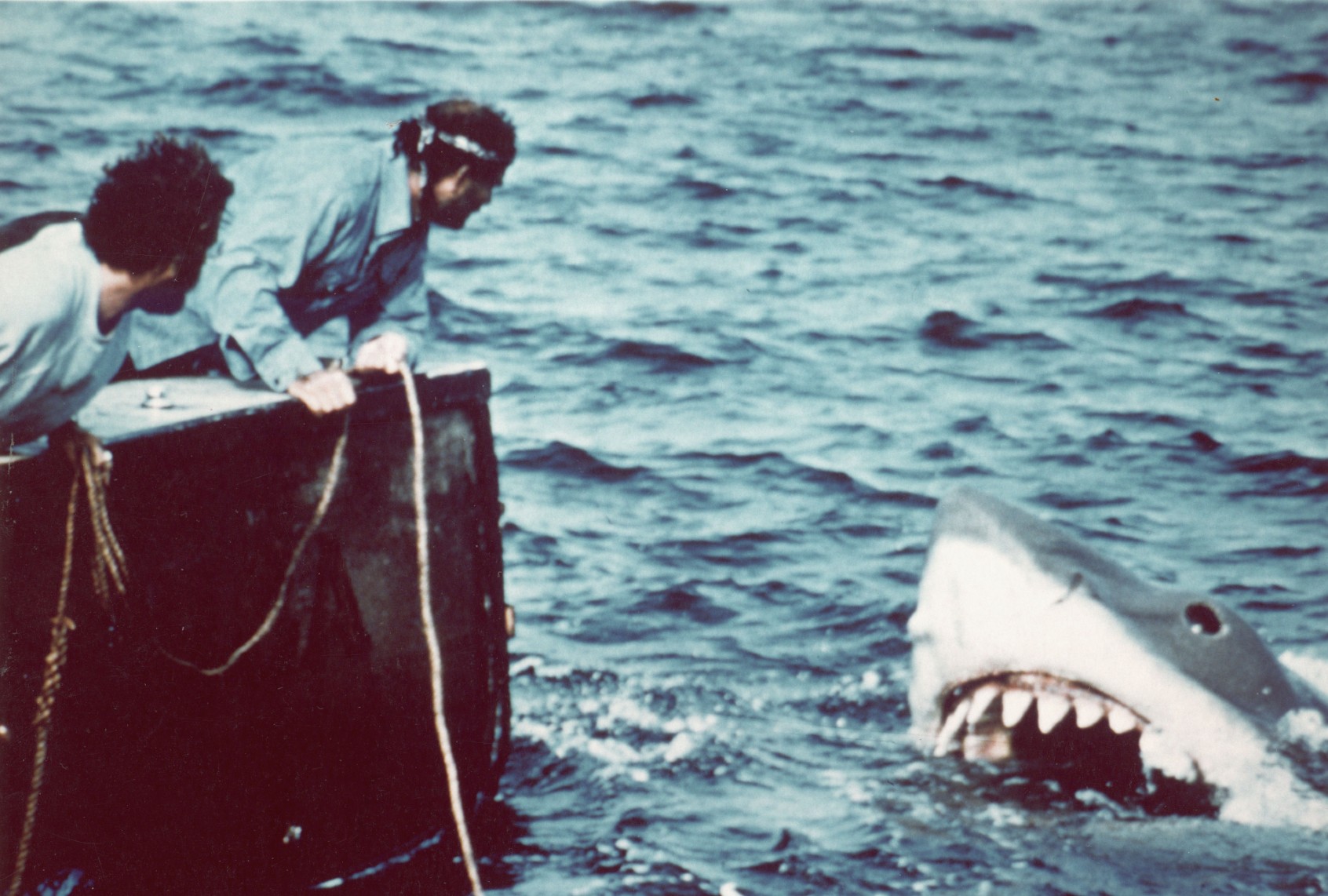
Richard Dreyfuss and Robert Shaw in a scene from “Jaws,” 1975 (Universal Pictures courtesy of Getty Images)

A film will rarely meet all three criteria that I’ve concluded make a good shark film, which makes the discovery of a new contender all the more thrilling. As it turns out, there is hope for shark cinema yet, even in this overfished landscape, and it’s coming from an unexpected place: Cannes.

But fellow shark movie connoisseurs know that it’s not enough to wait for a good film to come along. We must be dogged and relentless, wading through the worst of the worst in search of greatness. In my lifelong quest, I’ve developed a working rubric that any shark film worth its salt(water) must meet, using it to weed out the guppies from the megalodons. A film will rarely meet all three criteria that I’ve concluded make a good shark film, which makes the discovery of a new contender all the more thrilling. As it turns out, there is hope for shark cinema yet, even in this overfished landscape, and it’s coming from an unexpected place: Cannes.

The air of prestige and haughty pretension that surrounds even the mere mention of the Cannes Film Festival might not conjure the words “shark movie” in your mind. But the Director’s Fortnight, an independent sidebar showcase where films outside of the Cannes competition premiere, offers a glimpse at worthy films that might not have the same razzle-dazzle as the festival proper. It was at the Fortnight where Sean Byrne’s “Dangerous Animals” became the first shark film to ever screen during Cannes, and this unconventional locale is quietly befitting of the movie’s atypical premise and exciting execution. And even if the words “shark-loving serial killer” don’t speak to you, “Dangerous Animals” effortlessly checks every box of what a terrific, post-“Jaws” shark movie can and should be.

“Dangerous Animals” hooks all the shark movie tropes that audiences want to see along one extended fishing lure, before twisting that lure into a knot, forcing expectations to collide and shatter. Even if you’re not a sharksploitation expert, the film effectively preys on the average moviegoer’s knowledge of the subgenre to make plenty of room for fresh surprises. Set largely on the tourist boat where amateur instructor Bruce (Jai Courtney) gives unsuspecting travelers the chance to swim with sharks for a deadly price, the film is claustrophobic and innately stressful. Even if Bruce were a good guy, his general business practice would be frightening enough. But when Bruce stabs a young traveler and throws him back into shark-infested waters after a dive, taking the man’s companion captive, it’s clear that we’re in for a wild ride that’s not afraid to take the tension further than most of its contemporaries.

Jai Courtney in “Dangerous Animals” (Courtesy of Mark Taylor/IFC/Shudder)

Given that the bar for shark entertainment is hovering just inches from the ground, one might not think it would be difficult for a sharksploitation film to thrill its audience effectively. After all, how can a movie about a shark — or more sharks, possibly of some mutant or prehistoric variety, depending on the film — terrorizing people not be fun, right? I used to be part of that group, too. There was a time I thought that all I needed to enjoy a shark movie was popcorn, a Diet Coke, a healthy lust for life and a puff from a THC vape before heading into the theater. That is, until I saw “The Meg,” Jon Turteltaub’s 2018 shark thriller that takes Jason Statham’s typical land-locked action to the depths of the deep blue. There was no way a movie about a prehistoric megalodon reaching the surface wasn’t going to be the cinematic event of the summer. Sorry, “Hotel Transylvania 3”!

How wrong I was. After more than an hour of the 113-minute movie, I could feel myself drifting. Where the heck was Mrs. Megalodon, and why did anyone involved with the making of this movie think it was a good idea to spend so much time on a chemistry-deficient love story between two humans (who, last I checked, are not sharks), rather than delivering carnage and shots of blood-stained water? The people are here for the red water, Turteltaub! The experience was an epic disappointment that couldn’t even be turned around when Meg did finally appear, no matter how hungry she was.


Start your day with essential news from Salon. Sign up for our free morning newsletter, Crash Course.


But this massive “Meg” misfortune did have one great outcome: It made me think critically about what was missing from what should’ve otherwise been a slam dunk, and forced me to watch all media, not just sharksploitation, more consciously. I don’t want to credit my career to “The Meg,” but I can, at the very least, say it inspired my shark movie rubric, which I believe to be the simplest yet most effective standard by which any shark film can be judged.

There are three straightforward questions to ask when evaluating a shark movie. The first is, “Do we, the viewer, receive gratuitous shark shots?” This is what we’re here for, after all, and any shark movie that isn’t willing to make proper use of its leading lady is a no-go. But there is also a delicate balance that anyone helming sharksploitation must consider: Show too much shark too early, and you risk losing the audience’s interest; show the shark too late, and the experience is colored by how bored the viewer was up until their first glimpse of a dorsal fin.

“Dangerous Animals” (IFC/Shudder)

The second question on this foolproof rubric is, “Does the shark movie have a necessary degree of camp that both reveres and respects that it is, indeed, a shark movie?” Even if a filmmaker is trying to fall on the serious side, they have to know that any shark movie will be held against the gold standard of “Jaws.” They should play with the tropes Spielberg created, but not actively fight against them; bonus points if the film uses actual, scientific facts about the shark instead of just turning them into a bloodthirsty killing machine, though there is a time and place for that, too. And the final, most important question in the rubric is also its most basic: “Is the shark movie genuinely frightening?” Though most shark encounters happen because curious sharks meet terrified humans, our fear of sharks is still primal, and even the silliest of movies should be able to get one good scare out of these torpedo-shaped vertebrates.

“Something in the Water” dares to ask the bold question no other shark movie has asked: “What if a shark attacked you and you were also a lesbian?” The answer is decidedly less fun than it should be. No lesbian I’ve met would ever make such thoughtless, impractical decisions — ever, but certainly not around sharks.

But if we consider the last decade of shark movies — or at least the ones lucky enough to have a budget that consists of more than $400 and a prayer — meeting this relatively uncomplicated criteria has been a challenge. We were in good shape with 2016’s “The Shallows”; Blake Lively playing a doctor named Nancy who has a passion for surfing when she’s not stitching up patients is great, solid groundwork to build upon. The movie checks all the boxes: Director Jaume Collet-Serra gradually builds to gratuitous shark imagery; the film understands its inanity by acknowledging that a great white swimming in shallow waters is a natural anomaly; and it makes great use of its limited-space conceit to deliver on chilling, memorable shark horror.

And then came “The Meg” and its slightly less dour sequel, “Meg 2: The Trench.” And honey, we were in the trenches, alright! These films are criminally boring, as in, I believe there should be legal ramifications for making movies where Jason Statham wears a wetsuit and hunts giant, brutal, prehistoric predators so exhausting and utterly predictable. Though the sequel dialed up the amount of actual shark content, the rest of the plot is too threadbare to hold the film together between shark shots. The “Meg” movies make the classic mistake of assuming that, just because audiences are into shark horror, they’ll stand for whatever putrid pigswill these films call a narrative. Fool me once, shame on you. Fool me twice, shame’s still on you. I won’t apologize for having an open mind and a curious spirit.

The ShallowsBlake Lively in “The Shallows” (Columbia Pictures)

More recently, we’ve had “Under Paris” and “Something in the Water,” a pair of 2024 shark horror films with a wide chasm of quality between them. “Something in the Water” dares to ask the bold question no other shark movie has asked: “What if a shark attacked you and you were also a lesbian?” The answer is decidedly less fun than it should be. The film drags out its human plotlines and keeps the shark mostly underwater for the entire runtime. And besides that, no lesbian I’ve met would ever make such thoughtless, impractical decisions — ever, but certainly not around sharks. “Under Paris” fares far better, turning the foolishness dial up so far it breaks. Somehow, a shark is loose in the Seine, and it’s about to breed a ton of baby sharks. Oh mon dieu et sacré bleu! This is obviously not good, and forces the French to put down their pastries to find a solution before it’s too late. Spoiler alert: they don’t, and the film boasts one of the most vicious shark bloodbaths I’ve seen yet. It’s killer, it’s campy and it’s crawling with sharks; check, check, check.

“Dangerous Animals” arrives hot on the heels of “Under Paris,” boasting major bite. The film is part psycho kidnapping horror, part shark thriller and part tribute to Madonna’s “Ray of Light.” A young woman named Zephyr (Hassie Harrison) is taken captive by Courtney’s Bruce, whose name is seemingly a tribute to the one Spielberg and co. gave the animatronic shark in “Jaws.” Bruce is a shark devotee, and as such, is a student of their traits and habits. He knows sharks aren’t inherently dangerous to humans, but keeps the ones around his boat steadily fed, ensuring they’ll expect a snack whenever they’re swimming close to a vessel. Bruce drugs his hostages, rigs them to a crane and films them being lowered into the water, capturing their inevitable demise on tape in horrific snuff films.

But Zephyr is as worldly as Bruce is, meaning that she’s a cunning foil to his long-running string of untraceable serial murders. At times, Bryne and screenwriter Nick Lepard turn out such an effective cat-and-mouse game that you’ll forget there’s an even bigger predator waiting just off the starboard side of the boat. “Dangerous Animals” keenly analyzes the weak points in modern sharksploitation, avoiding spots where most films of its ilk stumble. It’s not a perfect movie, and there are a few too many almost-escapes for this connoisseur. But “Dangerous Animals” meets all of the rubric criteria for not just a great shark film, but a fantastic time at the theater during the summer movie season. If “Jaws” could keep a whole generation out of the water, “Dangerous Animals” has the potential to do the same for water-based tourist traps. Maybe going on a sketchy shark swim isn’t as common as simply taking a swim in the ocean. But in this era of shark movies, you have to take the good where you can get it.

“Dangerous Animals” is in theaters and streaming on Shudder June 6.

On “Poker Face,” a tender moment between takeout orders

In an era of ghost kitchens and gig app anonymity, it’s easy to forget that food delivery used to be, well, kind of intimate. You had a place. You had a person. Maybe they knew your usual order. Maybe they handed you your bag with a little eye contact and a smile. It wasn’t groundbreaking — just human. Which is exactly what makes the new episode of “Poker Face,” titled “One Last Job,” feel so unexpectedly tender: it sneaks a quiet love story into the middle of a heist, starring a delivery girl, a lonely man and a very well-timed order of samosas.

Set just days before Black Friday in a big-box appliance store called SuperSave, the episode follows Kendall, an action movie-obsessed employee with dreams of Hollywood, and Charlie Cale (Natasha Lyonne), the show’s signature sleuth, who stumbles into a murder while working as a delivery driver at a local Indian restaurant.

But beneath the flashy genre trappings — the safecracking, the double-crosses, the getaway plans gone sideways — “One Last Job” is about something sweeter and much more grounded: the small, persistent rituals that remind us what it means to be part of a community.

Kendall (Sam Richardson) is a longtime employee in SuperSave’s appliance section, but really, he wants to be a screenwriter. His latest script, also called “One Last Job,” outlines the perfect safe robbery and he’s proud enough of it to show it to his boss, Bill (Corey Hawkins), a man who’s not just Kendall’s supervisor, but is a longtime friend and maybe his only real fan. Bill thinks the writing is good. Good enough, in fact, that he fires Kendall on the spot — a tough-love nudge toward chasing his writing dreams.

This, naturally, backfires. Hurt and unmoored, Kendall links up with a scuzzy thief named Juice (James Ransone) and pitches him the same plan from the script: rob SuperSave’s safe the day after Black Friday when it’s flush with cash. It’s a classic heist-plot move — the script that becomes real, the guy who gets in over his head — but what makes this episode special is that it isn’t really about Kendall. It’s about Bill. And it’s about Charlie. And it’s about the takeout.

“One Last Job” Season 2 Episode 7 — Pictured: (l-r) Natasha Lyonne as Charlie Cale, Geraldine Viswanathan as Jenny (Sarah Shatz/Peacock)
By the time the heist is underway, Charlie, who’s recently arrived in town and taken a job delivering for a local Tandoori restaurant, has found herself making regular stops at SuperSave. Not to shop, but to drop off dinner for Bill. He keeps ordering — modest, comforting meals: two vegetable dishes, one lamb, garlic naan, chicken tikka. He seems like a creature of habit, especially after placing multiple orders in the same week following a spark during his first conversation with Charlie.

“Guess he really loves naan?” Charlie, already a little smitten, says to Jenny (Geraldine Viswanathan), the restaurant’s rom-com-obsessed hostess. Jenny starts reading the pattern like a love story. Ordering from the same place repeatedly just to see the delivery girl? And calling to check if she’s working? He’s interested.

We need your help to stay independent

To give Charlie a little flirtatious boost, Jenny slips in a free order of samosas. “Hot guys love samosas,” she says with a knowing smile. Sure enough — the night Charlie delivers them, Bill asks if she’d like to join him for dinner the next night, instead of just dropping off the food.

It’s such a small gesture, really. The samosas, the second helping of naan, the kind of slightly bashful dinner invitation that arrives not with a flourish, but with a container of lamb curry. Still, it lingers. That moment. It reminded me of something I’ve been thinking about recently: how comparatively intimate food delivery used to be.

There was a time — and it wasn’t even that long ago — when ordering in meant calling the restaurant directly. You’d ask for the usual. Someone behind the counter might recognize your voice. Maybe the delivery guy knew your dog’s name or how you liked your hot sauce on the side. Sometimes they’d come by in the middle of a snowstorm, plastic bags looped over each arm like ornaments, and you’d feel a little flutter of guilt and gratitude as you tipped in crumpled bills. It wasn’t dramatic or profound. But it was real.

Now, dinner shows up in the backseat of a Prius. Sometimes the bag has your name sharpied on it, sometimes it doesn’t. The driver might hand it to you or just leave it outside your gate. There’s no eye contact. No casual chit-chat. No sense that this was something exchanged between two people who live in the same city, maybe even the same zip code. It’s all been optimized into invisibility.

“It is a little sad, isn’t it? One more quiet thread snipped in the broader unraveling of neighborhood-ness. Of the small, repetitive exchanges that used to stitch a life together.”

This isn’t a tragedy. No one’s making a fuss about it. But it is a little sad, isn’t it? One more quiet thread snipped in the broader unraveling of neighborhood-ness. Of the small, repetitive exchanges that used to stitch a life together.

Of course, in today’s landscape of app-based convenience, even the slightest hint of familiarity can start to feel suspicious. It’s one of the quiet, strange side effects of having stripped so much human context out of something as personal as food delivery. When a person pierces the veil — when a face becomes familiar, or a name repeats itself — it doesn’t necessarily feel comforting. Sometimes, it just feels off.

About nine months ago, someone on Reddit posted in a delivery driver forum with the title: “Getting the same delivery driver multiple times, and it’s getting weird?” They’d been ordering wine through DoorDash and one night experienced a longer-than-usual wait time.

“When the guy finally took the order and arrived I tipped him $10 on a fairly small order,” the poster wrote. “The next time he was the dasher again. I tipped the same because it felt weird not to? And he sent me a message saying thanks, which was nice. I just did another order and this time he picked it up even though he looked pretty far away?”

He showed up and started chatting about the wine. Not in a creepy way, necessarily, just conversational. Friendly. And again, a thank-you message followed. This time, with their name. And a heart emoji.

“I just wanted to go back to cleaning the house,” the Redditor wrote. “It feels weird and like if I order again he will take it? Or am I overreacting.”

The replies were practical: A chorus of DoorDashers chimed in to clarify how the system works: drivers don’t select customers — the algorithm does. He likely didn’t know who he was picking up for until after the order was assigned. Maybe he just remembered the tip. Maybe he was trying to keep that tip coming. One user noted that the algorithm probably kept routing him the order because he’d been tipped well. Another added that most drivers couldn’t even see a customer’s full name and that the heart emoji, while unprofessional, was probably nothing more than a clumsy gesture of appreciation.

The original poster softened, too. They joked about sending their mastiff to the door next time. They admitted the driver didn’t give them bad vibes, just weird ones. That the heart emoji wasn’t scary, exactly. Just unfamiliar.

And that’s exactly it. The context is gone — there’s no shared understanding of what a regular delivery relationship is supposed to look like anymore. So the line between kindness and discomfort has blurred. Familiarity, once a sign of something warm and real, now arrives looking like a red flag.

Maybe that’s what makes the samosas and the dinner invitation that followed in this week’s episode of “Poker Face” feel so quietly radical. Not because they’re grand, but because they cut through the fog. A human gesture, tucked inside a system now designed for efficiency, anonymity and speed.

At one point in the episode, Bill tells Charlie that he actually loves working at SuperSave. Not because it’s necessarily glamorous, but because, to him, it’s a kind of modern town square.

“People want to gather,” he says. “People want ritual. People want connection.”

“Wouldn’t describe it as a fistfight”: White House speaks on Musk, Bessent scrap

White House Press Secretary Karoline Leavitt disagreed with the characterization of a fight between former Trump adviser Elon Musk and Treasury Secretary Scott Bessent.

During a stop by “Sunday Morning Futures” on Fox News, Leavitt pushed back against reports that Musk “body-checked” Bessent. Host Maria Bartiromo asked Leavitt “how rough this got,” teeing up the presidential spox to hand-wave away a scrap just outside the Oval Office.

“I certainly wouldn’t describe it as a fistfight, Maria. It was definitely a disagreement,” Leavitt said. “I was not there. I didn’t witness it with my own eyes. I heard about it through secondhand reporting. But again, we’ve moved on from that. The president has moved on from that.”

Musk’s rage at the Trump administration hasn’t been contained to his Cabinet. Since leaving his post at the Department of Government Efficiency, the tech billionaire has railed against the president and Republicans in Congress over their support of a massive spending bill.

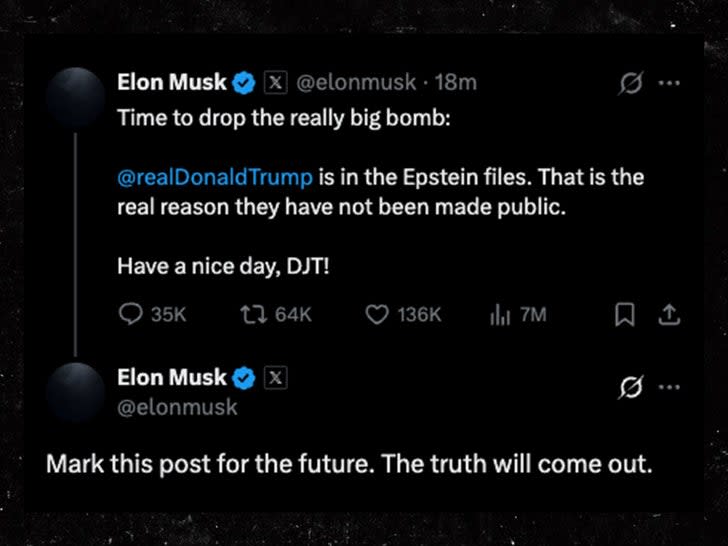
The feud between Donald Trump and Musk escalated to the point that Trump is reportedly planning to sell a Tesla he purchased from the automaker earlier this year. That quick turnaround came after Musk accused Trump of being an associate of alleged sex trafficker Jeffrey Epstein in a since-deleted post to social media. Musk’s call-out was less a revelation and more of a reiteration of publicly known facts, but it was clearly enough to get the president’s attention.

The tiff with Trump has done severe damage to Musk’s net worth, as the value of shares in Musk-owned companies has plummeted with each new volley of insults.

“Purposefully inflammatory”: Newsom criticizes Trump deploying National Guard amid LA ICE protests

California Gov. Gavin Newsom sharply criticized President Donald Trump‘s decision to deploy National Guard troops to Los Angeles on Saturday, calling the action “the wrong mission” in a post to social media.

“The federal government is moving to take over the California National Guard and deploy 2,000 soldiers. That move is purposefully inflammatory and will only escalate tensions,” Newsom wrote on X. “LA authorities are able to access law enforcement assistance at a moment’s notice. We are in close coordination with the city and county, and there is currently no unmet need. The Guard has been admirably serving LA throughout recovery. This is the wrong mission and will erode public trust.”

The president approved the deployment of 2,000 members of the National Guard amid ongoing protests of Immigration and Customs Enforcement raids in the Los Angeles area. The power to deploy the state’s National Guard typically rests with the governor, but the president does have the rarely used authority to circumvent the state’s top executive. The White House said on Saturday that Trump’s actions were “essential to halting and reversing the invasion of illegal criminals into the United States” and blamed “California’s feckless Democrat leaders” for failing to “protect their citizens.”

“President Trump has signed a Presidential Memorandum deploying 2,000 National Guardsmen to address the lawlessness that has been allowed to fester. The Trump Administration has a zero tolerance policy for criminal behavior and violence, especially when that violence is aimed at law enforcement officers trying to do their jobs. These criminals will be arrested and swiftly brought to justice,” White House Press Secretary Karoline Leavitt shared in a statement.

Trump praised the work of the National Guard in Los Angeles on Saturday night, even though they had not yet been deployed in the city.

“Great job by the National Guard in Los Angeles after two days of violence, clashes and unrest,” he wrote on Truth Social. We have an incompetent Governor (Newscum) and Mayor (Bass) who were, as usual… unable to handle the task.”


Congress wanted a report on sex abuse in youth sports — then they buried it

The problem of sexual abuse in youth sports is more like a DNA marker than an acknowledged crisis. Consider the fate of the official player in this game with the tools to address it: last year’s report by the Commission on the Future of the U.S. Olympic & Paralympic Committee. In the dance of inaction that is our legislative branch these days, the recommendations of the commission have been benched by the very coaches who drafted them for their rosters. (In 2015, a Government Accountability Office audit of federal legislation governing sports abuse turned into a turgid book report that was universally ignored.)

The latest blip confirming long-proposed reforms held in a permanent holding pattern was the April sacking of Ju’Riese Colón, CEO of the U.S. Center for SafeSport. Colón was the second boss of the agency, which was set up in 2018 to adjudicate claims of abuse by coaches in Olympic sports national governing bodies. Her predecessor, Shellie Pfohl, quit in the middle of her three-year contract.

For Colón, the last straw was news that a SafeSport investigator, Jason Krasley, had been arrested twice at his previous job as a vice officer in Pennsylvania – once for stealing money from a drug bust and once for rape and sex trafficking.

During the ritual expressions of disappointment and outrage from congressional oversight figures, there wasn’t a peep of reference to the commission’s 277-page report, “Passing the Torch: Modernizing Olympic, Paralympic, & Grassroots Sports in America.”

Following years of study, interviews, solicitation of public comments and hearings, the commission, which included famous former Olympic stars female and male, proposed an overhaul of America’s youth sports system. Specifically, the commission urged Congress to gut the 1978 Ted Stevens Olympic and Amateur Sports Act to get the Olympic Committee out of the business of running youth sports programs at the grassroots level. Additionally, the commission recommended federal funding of the SafeSport center, which has been plagued by corruption and case backlogs, to get it out from under the malign financial support and influence of the Olympic bodies.

A few major newspapers gave the report a couple of polite paragraphs last winter. For its part, the New York Times didn’t even tell its readers that such a report had been published.

The commission, which included famous former Olympic stars female and male, proposed an overhaul of America’s youth sports system. The New York Times didn’t even tell its readers that such a report had been published.

In January 2024, a group of senators, led by Maria Cantwell, a Washington state Democrat who then chaired the Senate Commerce, Science and Transportation Committee, upbraided Colón in a lengthy letter bemoaning the shortcomings of SafeSport. And on March 20, 2024, Sen. John Hickenlooper, D-Colo., who then chaired the Subcommittee on Consumer Protection, Product Safety and Data Security, held a hearing entitled “Promoting a Safe Environment in U.S. Athletics.” Colón testified. So did commission co-chair Dionne Koller, a sports law specialist at the University of Baltimore. However, notice of the hearing didn’t even mention the commission report, released two weeks earlier.

Reporting on all this congressional kabuki theater is the equivalent of what in swimming is called a trials and finals meet. It’s a two-stage process, at least. I started with Cantwell. After all, she had sponsored the commission’s enabling legislation and appointed some of its members, including co-chair Koller.

(Koller hasn’t spoken on the record about the commission’s failure to penetrate public consciousness. Sources close to commission members have told me that they hope their report will have an impact across time and guide eventual toothful reforms.)

We need your help to stay independent

Cantwell’s office punted my query to Tricia Enright, a Commerce Committee staffer. She said the “leads” on the youth sports safety issue were Sens. Richard Blumenthal, D-Conn., and Jerry Moran, R-Kan. In 2019, as chair and ranking member (respectively) of the consumer protection subcommittee, they introduced the legislation for the commission.

“Our consumer team was consistently in touch with stakeholders on the progress of this bill,” Enright said. Blumenthal and Moran “have been clear they are leading any legislation in the Senate for further reform –  that bill has yet to be introduced.”

I then went to Blumenthal, with the note that Cantwell was deferring to him on this issue. Blumenthal replied through communications director, Maria McElwain, who turned around these 150 words of insalata caprese:

Keeping athletes safe is a nonnegotiable priority — and meeting that challenge requires a commitment from all stakeholders, including the National Governing Bodies. SafeSport is tasked with an immense, difficult, and delicate responsibility — to adjudicate cases of abuse and help correct decades of imbalance in a system that protected predators instead of athletes. SafeSport hasn’t always gotten it right, and I have been critical when I felt the Center was not taking strong enough action in response to athlete concerns. A lack of communication, particularly with survivors, paired with slow response and resolution times have led athletes to lose trust in the Center — and that lack of trust has a material impact on the Center’s ability to do its job and keep abusers out of sport. That is why I am working with Congressional colleagues, athletes, survivors, and NGBs on reforms. I look forward to urgently proposing and enacting these changes.

To follow up, I asked whether Blumenthal specifically supported the two pertinent recommendations of the congressional commission. If a response ever arrives, I’ll let you know.

Blumenthal is well-versed in the two-step of grandstanding without follow-through. (To be fair, so are many politicians of all parties.) He got elected to the Senate in 2010 over Linda McMahon, erstwhile CEO of Connecticut-based WWE, the pro wrestling company. Blumenthal had been the state’s attorney general for years, and during the Senate race his office launched an investigation of WWE’s abuse of independent contractor categories, a tactic that both blocks full benefits for employees and robs government coffers at all levels of payroll taxes. But as soon as he won the election, the WWE audit was dropped. If he’s done anything about independent contractor abuse while serving in the Senate, I don’t know about it.


Start your day with essential news from Salon. Sign up for our free morning newsletter, Crash Course.


What I do know is that in 2017, when Donald Trump nominated McMahon as head of the Small Business Administration, Blumenthal made sure he was photographed smiling with her at her confirmation hearings. McMahon’s importance in 2010, it seems, had nothing to do with operating a scofflaw corporation; it was simply because she was a Republican opponent. McMahon has refused to go away; under Trump 2.0 she is what passes for secretary of education.

On the problem of youth sports sexual abuse, Cantwell, Blumenthal, et al., are just the latest reminder that when it comes to stemming crimes committed in the name of the flag-waving USOPC and its feelgood TV content-producing national sport governing bodies, reticence about taking on the Olympic brand is bipartisan. In 2014, Rep. George Miller of California, House Democrats’ self-appointed “lead” on the issue, sent a letter to the FBI that might read today as if ChatGPT had written it. The  bureau virtually laughed it off. After Miller retired, his successor, Rep. Jackie Speier, D-Calif., did exactly nothing before she, too, retired.

The stopwatch on lane 3 tells us that Republicans don’t appear to care at all about the existence of platforms for sexual predation on young people, fortified by the Olympic movement. In lane 4, Democrats are doing much better: At least they pretend they do.

We’re offloading mental tasks to AI. It could be making us stupid

Koen Van Belle, a test automation engineer who codes for a living, had been using the artificial intelligence large language model Copilot for about six months when one day the internet went down. Forced to return to his traditional means of work using his memory and what he had decades of experience doing, he struggled to remember some of the syntax he coded with. 

“I couldn’t remember how it works,” Van Belle, who manages a computer programming business in Belgium, told Salon in a video call. “I became way too reliant on AI … so I had to turn it off and re-learn some skills.”

As a manager in his company, Van Belle oversees the work of a handful of interns each year. Because their company has limits on the use of AI, the interns had to curb their use as well, he said. But afterward, the amount and quality of their coding was drastically reduced, Van Belle said. 

“They are able to explain to ChatGPT what they want, it generates something and they hope it works,” Van Belle said. “When they get into the real world and have to build a new project, they will fail.”

Since AI models like Copilot and ChatGPT came online in 2022, they have exploded in popularity, with one survey conducted in January estimating that more than half of Americans have used Copilot, ChatGPT, Gemini or Claude. Research examining how these programs affect users is limited because they are so new, but some early studies suggest they are already impacting our brains.

“In some sense, these models are like brain control interfaces or implants — they're that powerful,” said Kanaka Rajan, a computational neuroscientist and founding faculty member at the Kempner Institute for the Study of Natural and Artificial Intelligence at Harvard University. “In some sense, they're changing the input streams to the networks that live in our brains.”

In a February study conducted by researchers from Microsoft and Carnegie Mellon University, groups of people working with data worked more efficiently with the use of generative AI tools like ChatGPT — but used less critical thinking than a comparator group of workers who didn't use these tools. In fact, the more that workers reported trusting AI’s ability to perform tasks for them, the more their critical thinking was reduced. 

Another 2024 study published last year reported that the reduction in critical thinking stemmed from relying on AI to perform a greater proportion of the brain work necessary to perform tasks in a process called cognitive offloading. 

"In some sense, these models are like brain control interfaces or implants — they're that powerful."

Cognitive offloading is something we do everyday when we write our shopping list, make an event on the calendar or use a calculator. To reduce our brain’s workload, we can “offload” some of its tasks to technology, which can help us perform more complex tasks. However, it has also been linked in other research to things like having a worse memory.

As a review published in March concluded: “Although laboratory studies have demonstrated that cognitive offloading has benefits for task performance, it is not without costs.” It’s handy, for example, to be able to rely on your brain to remember the grocery list in case it gets lost. So how much cognitive offloading is good for us — and how is AI accelerating those costs?

This concept is not new: The Greek philosopher Socrates was afraid that the invention of writing would make humans dumber because we wouldn’t exercise our memory as much. He famously never wrote anything down, though his student, Plato, did. Some argue Socrates was right and the trend is escalating: with each major technological advancement, we increasingly rely on tools outside of ourselves to perform tasks we once accomplished in-house. Many people may not perform routine calculations in their head anymore due to the invention of the calculator, and most people use a GPS instead of pulling out a physical map or going off physical markers to guide them to their destination. 


Want more health and science stories in your inbox? Subscribe to Salon's weekly newsletter Lab Notes.


There is no doubt these inventions have made us more efficient, but the concern lies in what happens when we stop flexing the parts of the brain that are responsible for these tasks. And over time, some argue we might lose those abilities. There is an old ethos of "use it or lose it" that may apply to cognitive tasks as well.

Despite concerns that calculators would destroy our ability to do math, research has generally shown that there is little difference in performance when calculators are used and when they are not. Some have even been critical that the school system still generally spends so much time teaching students foundational techniques like learning the multiplication tables when they can now solve those sorts of problems at the touch of a button, said Matthew Fisher, a researcher at Southern Methodist University.

On the other hand, others argue that this part of the curriculum is important because it provides the foundational mathematical building blocks from which students learn other parts of math and science, he explained. As Fisher told Salon in a phone interview: "If we just totally get rid of that mathematical foundation, our intuition for later mathematical study, as well as just for living in the world and understanding basic relationships, is going to be off.”

Other studies suggest relying on newer forms of technology does influence our brain activity. Research, for example, has found that students’ brains were more active when they handwrote information rather than typing it on a keyboard and when using a pen and paper versus a stylus and a tablet. 

Research also shows that “use it or lose it” is somewhat true in the context of the skills we learn. New neurons are produced in the hippocampus, the part of the brain responsible for learning. However, most of these new cells will die off unless the brain puts effort and focus into learning over a period of time. People can certainly learn from artificial intelligence, but the danger lies in forgoing the learning process to simply regurgitate information that it feeds us.

In 2008, after about two decades of the public internet, The Atlantic published a cover story asking "Is Google making us stupid?" Since then, and with the emergence of smart phones and social media, research has shown that too much time on the internet can lower our ability to concentrate, make us feel isolated and lower our self-esteem

One 2011 review found that people increasingly turn to the internet for difficult questions and are less able to recall the information that they found on the internet when using it to answer those questions. Instead, participants had an enhanced ability to recall where they found it.

“The internet has become a primary form of external or transactive memory, where information is stored collectively outside ourselves,” the authors concluded.

People can certainly learn from artificial intelligence, but the danger lies in forgoing the learning process to simply regurgitate information that it feeds us.

In 2021, Fisher co-authored research that also found people who used internet searches more had an inflated sense of their own knowledge, reporting exaggerated claims about things they read on the internet compared to a control group who learned things without it. He termed this phenomenon the “Google effect.”

“What we seem to have a hard time doing is differentiating where our internally mastered knowledge stops and where the knowledge we can just look up but feels a lot like our knowledge begins,” Fisher said.

Many argue that AI takes this even further and cuts out a critical part of our imaginative process. In an opinion piece for Inside Higher Education, John Warner wrote that overrelying on ChatGPT for written tasks “risks derailing the important exploration of an idea that happens when we write.”

“This is particularly true in school contexts, when the learning that happens inside the student is far more important than the finished product they produce on a given assignment,” Warner wrote.

Much of the energy dedicated to understanding how AI affects our brains has been focused on adolescents because younger generations use these tools more and may also be more vulnerable to changes that occur because their brains are still developing. One 2023 study, for example, found junior high school students who used AI more had less of an ability to adapt to new social situations.

Another 2023 paper also found that students who more heavily relied on AI to answer multiple choice questions summarizing a reading excerpt scored lower than those who relied on their memory alone, said study author Qirui Ju, a researcher at Duke University. 

“Writing things down is helping you to really understand the material,” Ju told Salon in a phone interview. “But if you replace that process with AI, even if you write higher quality stuff with less typos and more coherent sentences, it replaces the learning process so that the learning quality is lower.”

To get a better idea of what is happening with people’s brains when using large language models, researchers at the Massachusetts Institute of Technology connected 32-channel electroencephalograms to three groups of college-age students who were all answering the same writing prompts: One group used ChatGPT, another used Google and the third group simply used their own brains.

Although the study was small, with just 55 participants, its results suggest large language models could affect our memory, attention and creativity, said Nataliya Kos'myna, the leader of  the “Your Brain on LLM” project, and a research scientist at the MIT Media Lab.

We need your help to stay independent

After writing the essay, 85% of the group using Google and the group using their brains could recall a quote from their writing, compared to only 20% of those who used large language models, Kos'myna said. Furthermore, 16% of people using AI said they didn’t even recognize their essay as their own after completing it, compared to 0% of students in the other group, she added.

Overall, there was less brain activity and interconnectivity in the group that used ChatGPT compared to the groups that used Google or their brains only. Specifically, activity in the regions of the brain corresponding to language processing, imagination and creative writing in students using large language models were reduced compared to students in other groups, Kos'myna said.

The research team also performed another analysis in which students first used their brains for the tasks before switching to performing the same task with the large language models, and vice versa. 

Those who used their brains first and then went on to try their hand at the task with the assistance of AI appeared to perform better and had the aforementioned areas of their brains activated. But the same was not true for the group that used AI first and then went on to try it with just their brains, Kos'myna said.

“It looks like the large language models did not necessarily help you and provide any additional interconnectivity in the brain,” Kos'myna told Salon in a video call. “However, there is potential … that if you actually use your brain and then rework the task when being exposed to the tool, it might be beneficial.”

Whether AI hinders or promotes our capacity for learning may depend more on how we use it than whether we use it. In other words, it is not AI that is the problem, but our overreliance on it. 

Van Belle, in Belgium, now uses large language models to write social media posts for his company because he doesn’t feel like that is where his skills are most refined and the process can be very time-consuming otherwise.

“I would like to think that I would be able to make a fairly decent LinkedIn post by myself, but it would take me an extra amount of time,” he said. “That is time that I don't want to waste on something I don't really care about.”

These days, he sees AI as a tool, which it can be — as long as we don't offload too much of our brain power on it.

“We’ve been on this steady march now for thousands of years and it feels like we are at the culmination of deciding what is left for us to know and for us to do,” Fisher said. “It raises real questions about how best to balance technology and get the most out of it without sacrificing these essentially human things.”

Is “centrism” making a comeback? OK, sort of — but blink and you’ll miss it

Who wasn’t mesmerized by last week’s epic, if profoundly embarrassing, catfight between Elon Musk and Donald Trump? No one, that’s who. I browse a lot of random publications from all over the world, and the online feud between the president of the United States and the richest person on the planet (along with the associated memes: “high-agency males going at it”!) was front-page news in Finland, Italy, Kenya and Argentina, just for starters.

So I’m not here to tell you that the Musk-Trump throwdown was some kind of calculated distraction or, as in the vivid imaginations of some right-wing influencers, a 5D-chess gambit meant to force the “Big Beautiful Bill” through the Senate and compel the release of the so-called Epstein files. Seriously, can you believe the stupidity of the times we live in? I recently read a lengthy book extract about the devastating impact of the asteroid that struck Earth 66 million years ago, wiping out nearly all life for millions of years after that, and found myself wondering whether that would be such a bad idea.

But “the girls are fighting” — no disrespect to girls, or to fighting! — definitely obscured a handful of disconnected but related events whose consequences might last a lot longer. Much of the Elon-related pseudo-news emerged from one of Trump’s hair-raising Oval Office encounters with a foreign leader, in this case newly-elected German Chancellor Friedrich Merz. Before that meeting devolved into chaos, it had in fact already gone off the rails: Trump clearly assumed that Merz must be sad about the Nazis losing World War II, and seemed mildly puzzled to learn otherwise.

MERZ: Tomorrow is the D Day anniversary, when the Americans ended a war in Europe TRUMP: That was not a pleasant day for you? This is not a great day MERZ: This was the liberation of my country from Nazi dictatorship

[image or embed]

— Aaron Rupar (@atrupar.com) June 5, 2025 at 12:15 PM

There’s certainly room for historical cynicism about postwar Germany and the role of Merz’s center-right party, the Christian Democratic Union, in laundering the reputations of many former Nazis or collaborators. But please don’t try to convince yourself that Trump knows anything about that. He is simply too ignorant, and too small-minded, to imagine a scenario in which you’re glad your country didn’t conquer all of Europe, or to understand that the avowed purpose of the CDU, over its eight decades of existence, has been to rehabilitate Germany as a modern democratic state, free of antisemitism and ultra-nationalism.

Merz put a brave face on this moment of grotesquerie, because that’s his job; the European media was justifiably horrified, because that’s theirs. But there was an intriguing undertow below all this that wasn’t readily discernible; bear with me for a minute while we work through it.

As I wrote here a few weeks ago, Merz is in an unlikely position and he knows it: He’s a finance-capital multimillionaire from the Catholic aristocracy who emerged from an indecisive federal election as the accidental leader of European democracy. In more innocent times he was described as the most pro-American politician in Germany. Now, with Trump back in the White House, Britain self-exiled from the EU and French President Emmanuel Macron fading into irrelevance, Merz more than anyone else is tasked with charting the course of European independence and fending off the continent-wide rise of the far right.

WelcomeFest featured a full-on declaration of war on the Bernie/AOC left and “the groups,” a codeword used to denigrate social justice movements of many varieties without quite naming them.

Merz’s electoral victory over the somewhat-fascist AfD — the object of transatlantic mash notes from JD Vance and Elon Musk — coupled with recent wins by center-left parties in Canada and Australia, suggested something of a global “centrist” comeback. (Let’s agree to set aside the question of whether that deliberately meaningless word actually means anything.) This wasn’t entirely an illusion, and for those with a candle burning in the window for democracy, it was a sign of hope. The grandiose overreach of the second Trump regime has clearly fueled a normie backlash in many parts of the world, pumping new life into mainstream political parties that had seemed to be in terminal decline.

As it happens, Merz’s visit to Washington coincided with a strange only-in-2025 event taking place in a nearby hotel basement: WelcomeFest, a day-long series of speeches and events billed as the “largest public gathering of centrist Democrats.” (There’s that word again!) I wasn’t there, and reports from the no-doubt-riveting scene were decidedly mixed. It sounds like a blend of entirely reasonable debate about how Democrats can craft a broadly popular message and a full-on declaration of war on the Bernie/AOC left and “the groups,” a codeword used to denigrate social justice movements of many varieties without quite naming them. The groups in question would seem to include LGBTQ activists, the climate justice movement, police and prison reformers or abolitionists, and anyone who utters the word “Palestine.”

As Aída Chávez of The Nation reports, pundit Matt Yglesias — pseudo-intellectual poster boy for this entire phenomenon — still thinks it was a bad idea for Democrats to give a crap about Kilmar Ábrego García’s illegal deportation to El Salvador. Pollster David Shor told Sen. Elissa Slotkin of Michigan, according to David Weigel of Semafor, that “voters really hate electric cars.” Slotkin, who clearly hopes to be the Democrats’ centrist savior in 2028, politely demurred: What voters actually hate is too much regulation, blah blah blah. Talk of “abundance” was abundant — speaking of meaningless catchphrases of the moment — and deployed to attack labor unions and to suggest that left-wing rhetoric about oligarchy and corporate power was strictly for the kids’ table.

So is this the centrist moment? Is neoliberalism back from its remarkably brief and partial ideological exile, under the inspiring and all-unifying banner of not being quite as bad as Trump? Are we about to witness the end of the end of the end of history? I’m sorry for posing such dumb questions, especially since the answer to all of them is “kind of.”

In domestic politics, the agenda of WelcomeFesters like Yglesias, Slotkin, Rep. Ritchie Torres of New York and Rep. Marie Gluesenkamp Perez of Washington is clear enough: They want to party like it’s 1992. They want to make sex less fun, freedom less free and state repression more repressive, on the endlessly disproven hypothesis that surrendering your principles, cowering in fear and giving hateful people most of what they supposedly want might win the next election. I try to avoid overt editorializing in this space, but as my Uncle Fred would have said: F**k that for a game of darts.


Start your day with essential news from Salon. Sign up for our free morning newsletter, Crash Course.


More specifically, the centrist vanguard wants to use the Democratic Party’s post-Kamala crisis to cancel the 2020 peace treaty between Joe Biden and Bernie Sanders and return to the time-honored ritual of punishing and purging the left. God knows there’s enough blame to go around for the failures of the 2024 Harris campaign, but the not-so-hidden message here is a thoroughgoing rejection of the former president that basically all these people claimed to adore until about this time last year: Biden was too old, too stubborn and too woke, and led us into this disaster.

The agenda of “centrists” like Matt Yglesias and Ritchie Torres is clear enough: They want to party like it’s 1992. They want to make sex less fun and freedom less free, on the endlessly disproven hypothesis that that might win the next election.

On the global stage, there are already signs that the centrist renaissance may be a transitory phenomenon, not much more than “kicking the can down the road,” as Armida van Rij of Chatham House wrote last week in Foreign Policy. Poland’s presidential election ended in a narrow victory for far-right nationalist Karol Nawrocki, a conspicuous Trump ally in one of Europe’s largest and most strategically important countries. Poland is deeply divided along lines of class, culture and geography (not entirely dissimilar to America’s), and Nawrocki’s win shouldn’t be simplistically understood as a referendum on Trumpism, even if DHS fembot Kristi Noem — without the slightest idea of where she was or what she was doing there — showed up to campaign for him. This is likely to mean several more years of political paralysis, midway between authoritarianism and democracy, along with increasingly fraught relations with Ukraine, Poland’s eastern neighbor.

Meanwhile, the Dutch government has collapsed (once again) after anti-immigrant agitator Geert Wilders pulled his newborn far-right party (and his impressive pompadour) out of an already wobbly conservative coalition, clearly hoping to win a greater share of power in an October election. It’s entirely possible, as many analysts believe, that Wilders has overplayed his hand and that the migrant crisis is no longer the dominant issue in European politics, largely thanks to Trump 2.0.

But Wilders’ chaos-agent antics, along with the Polish result and the startling gains made in recent British local elections by Nigel Farage’s gleefully shambolic Reform UK, should make clear that reassuring reports about the global demise of the Trump-style far right — politics is healing itself! — have been exaggerated.

“Centrist” leaders like Merz, Macron and British Prime Minister Keir Starmer have repeatedly tried to triangulate themselves toward some democracy-salvaging consensus by repackaging the right’s most seductive ideas and offloading all remaining vestiges of left-flavored economic populism. Whether that’s hard-headed realpolitik or deep-seated cynicism and corruption is up for debate, but it should sound familiar to anyone acquainted with the 40-year trajectory of the Democratic Party. Look how well that has worked.

How to crush a nation’s soul: The Nazi crusade against “degenerate” art

In July 1937, artist Marc Chagall discovered that his paintings were enjoying a star turn in a singularly unexpected venue — an exhibition organized by the Nazi Party in Munich, the birthplace of its political fortunes. Chagall’s work often addressed explicitly Jewish themes: In one such painting, a bearded rabbi takes a pinch of snuff in ochre-yellow surroundings, his wry eyes looking in the direction of the viewer but not necessarily at them. How one is meant to interpret this painting, or the artist’s intent, is not clear.

Adolf Ziegler, the Nazi functionary charged with overseeing the exhibition, perceived no ambiguity. He provided the supposed answer for “The Rabbi” and every other artwork displayed alongside it. “Look around you at these monstrosities of insanity, insolence, incompetence and degeneration,” he declared in his opening address. “I would need several freight trains to clear our galleries of this rubbish … This will happen soon.”

But through the end of November that year, at least, this “rubbish,” served as a useful prop for the Third Reich’s campaign to excise society of its corrupting elements and usher in a new era in which art represented the superior virtues of the German nation, as the Nazis saw it. The “Degenerate Art Exhibition,” as it was unsubtly named, drew an audience that eventually exceeded two million visitors.

It featured 650 works confiscated from German museums and judged by a panel to represent “decadence,” “weakness of character,” “mental disease,” “racial impurity” and other hallmarks of Weimar-era modernity. The exhibition included an entire room dedicated to the “Revelation of the Jewish Racial Soul” and featured paintings by and about the ethnic and religious group whom the Nazis largely blamed for Germany’s supposed moral and material decline.

That room and others also included works whose subject matter offended reactionary Nazi sensibilities for other reasons, such as Otto Dix’s “The Trench”: a gruesome tangle of human remains, discarded weapons, leaking brain matter and faces, suspended in agony in the aftermath of an artillery bombardment, with a soldier’s body propped up by a tripod of fixed bayonets high above the carnage. In another of Dix’s works, the drypoint “War Cripples,” disfigured veterans return home, many of them with limbs missing — a common sight across Germany after World War I. (Dix was himself a combat veteran.)  Such depictions of war, the curators wrote in the exhibition catalogue, were tantamount to “military sabotage.”

“Here, the ‘art’ enters the service of Marxist propaganda for conscientious objection,” the catalog essay continued, referring to the practice of resisting conscription on moral grounds, even under threat of punishment by the state. Dix’s art was deemed an “insult to the German heroes of the Great War.” Elsewhere in the exhibition, one could visit the “Insanity Room,” which displayed abstract paintings. The Nazis were not fans. “In the paintings and drawings of this chamber of horrors, there is no telling what was in the sick brains of those who wielded the brush or the pencil,” the catalog explained.

Otto Dix’s art was deemed an “insult to the German heroes of the Great War.” Elsewhere in the exhibition, one could see abstract paintings in the “Insanity Room.” The Nazis were not fans.

Once the point had been made, some of these artworks were burned. Others, however, fell into the hands of collectors, including a number of high-ranking party officials. The Nazi penchant for playing the role of art critics and connoisseurs, combined with the party’s aim of attaining complete control over all aspects of German life, resulted in a far more heavy-handed effort to twist the form and spirit of art to political ends than the scattered bleating characteristic of today’s culture wars. In this campaign, the Nazis styled themselves as saviors, rather than mere destroyers, of culture. “You artists live in great and happy times. Above you the most powerful and understanding patron the Führer loves artists, because he is himself one. Under his blessed hand a Renaissance has begun,” proclaimed propaganda minister Joseph Goebbels.

Art, as the Nazis understood it, was to be the reference point by which the German master race recognized its own superiority, and must be used to serve its ends. “True art is and remains eternal,” Hitler once said. “It does not follow the law of fashion. Its effect is that of a revelation arising from the depths of the essential character of a people.”

Indeed, Nazi artists spared no effort in ferreting as much inspiration as they could from the pre-modern and mythic German past — the wars of the Nibelungen, the medieval Reich, the Teutonic crusades in the Baltic, the Protestant Reformation — and making extrapolations about the timelessness of German virtue. The Nazis even infringed on cultural prerogatives claimed by Benito Mussolini’s fascist Italy, citing Germanophile philosopher Houston Steward Chamberlain’s claim that the German people, by right of Aryan blood passed down from the Greeks and Romans, were destined to revive the “lost ideal” of classical beauty.

Revival was indeed the operative word. The Nazis held that German society had become diseased by the advent of modern art — meaning not just works that questioned or contradicted Nazi policy, but any kind of art bearing the hallmarks of modernity: visually distorted Expressionist paintings, atonal music unfettered by a central key, edifices of the Dada movement that defied aesthetic logic. As such, it was their mission to expunge such art from the public memory.

We need your help to stay independent

Even before seizing national power in 1933, the Nazis implemented test cases on the state level. In 1930, the Nazi Party chief in Thuringia and state Minister of Education and the Interior, Wilhelm Frick, issued orders to remove 70 Expressionist paintings from the Schloss Weimar museum, fire the director of another museum for displaying modern art in its exhibitions, and ban all pacifist or antiwar books and films, including Erich Maria Remarque’s legendary World War I novel “All Quiet on the Western Front.”

The sources of modern art, according to social critic Max Nordau, were decadent, corrupted societies whose artists, afflicted with “degeneration” as a form of mental illness, could only produce work reflecting their degenerate selves. But what the Nazis seized upon most fervently – although they certainly didn’t admit to inspiration from Nordau, who was both Jewish and a Zionist — was his claim that an individual’s mental deformity lay in the presence of physical deformities like “multiple and stunted growths in the first line of asymmetry, the unequal development of the two halves of the face and cranium… etc.,” and his prescribed solution: “Characterization of the leading degenerates as mentally diseased: unmasking and stigmatizing of their imitators as enemies to society; cautioning the public against the lies of these parasites.” Here was the framework by which the Nazis attacked modernists not just as purveyors of low-quality creations, but also as perverted, dangerous and, whenever applicable, racially inferior. Artistic works that eschewed the so-called Nordic ideal of beauty, in subject or in style, were likewise condemned for undermining German high culture.

Nazi architect Paul Schultze-Naumburg later pushed Nordau’s theory of degeneration further down the slippery slope, arguing that it was not social conditioning that produced such despicable degenerates, but race, and in particular race-mixing. Only racially pure artists could produce art that embodied classical ideals, he argued, while their racially-mixed colleagues could create only disorder and monstrosity. Nazi leaders like racial theorist Alfred Rosenberg embraced Schultze-Naumburg’s theory as a magnificent insight. Nordau, who had declared that composer Richard Wagner — perhaps the Nazis’ most venerated cultural icon — possessed a “greater abundance of degeneration than all the degenerates put together with whom we have hitherto become acquainted,” would no doubt have disagreed.

Nazi architect Paul Schultze-Naumburg argued that it was not social conditioning that produced such despicable degenerates, but race, and in particular race-mixing. Only racially pure artists could produce art that embodied classical ideals.

While Nordau’s distaste for Wagner – whose operas were embraced by Hitler with quasi-religious fervor – was not “racial” in nature and may have been inflated by the composer’s notorious antisemitism, questions over what qualified as degenerate art illustrated how nebulous the concept was. Goebbels and Rosenberg squabbled over whether some forms of modern art should have a place in the new Germany, with the former taking great pains to keep Expressionist artists such as avowed Nazi Emil Nolde in the political fold and dispel criticism that Nazi cultural policy was overly reactionary. “We National Socialists are not unmodern; we are the carrier of a new modernity, not only in politics and in social matters, but also in art and intellectual matters,” Goebbels argued. “To be modern means to stand near the spirit of the present Zeitgeist. And for art, too, no other modernity is possible.”

In the first year of Nazi rule in Germany, the Expressionists continued to enjoy Goebbels’ patronage. And in the battle for practical control of the party’s cultural policy, Goebbels, a far more consummate politician and organizer than the pedantic Rosenberg, appeared to seize the upper hand; in September 1933, Goebbels founded the Reich Chamber of Culture, which all working German artists were required to join, Aryan certificate in hand. (Its members, of course, were all artists whom Goebbels considered to be loyal Nazis and sufficiently “Nordic” in ethnicity and character.) But the next year, Hitler himself declared that all forms of modern art were degenerate and had no place in his Germany, which would not “be befuddled or intimidated” by modernist “charlatans.” Rosenberg received an even harsher rebuke from Hitler, who preferred Greek and Roman classicism to Rosenberg’s neo-Gothic aesthetic and denounced “those backwards-lookers who imagine that they can impose upon the National Socialist revolution, as a binding heritage for the future, a ‘Teutonic art’ sprung from the fuzzy world of their own romantic conceptions.”


Start your day with essential news from Salon. Sign up for our free morning newsletter, Crash Course.


With the party’s cultural doctrine now clear, artists who previously enjoyed Nazi patronage suddenly found themselves stripped of official sanction and saw their art torn from museum walls. Ernst Ludwig Kirschner, an Expressionist painter who privately disdained the Nazi regime, sought to assure Nazi authorities that he was “neither a Jew nor a Social Democrat,” but was expelled from the Prussian Academy of Arts anyway. The aforementioned Emil Nolde, who had condemned the paintings of “half-breeds, bastards, and mulattoes” in his 1934 autobiography, could not stop government officials from removing 1,052 of his works from museums, the most of any artist in Germany. Some of his paintings, in fact, wound up in the 1937 Degenerate Art Exhibition, alongside Dix’s antiwar compositions and Chagall’s rabbi.

The mass removals were codified in 1938 by the sweeping Degenerate Law Act, which declared that “products of degenerate art that have been secured in museums or in collections open to the public before this law went into effect… can be appropriated by the Reich without compensation.” Nazi officials, on the other hand, were happy to be compensated for unloading undesirable works of art to foreign collectors. Those that couldn’t be sold abroad or hidden within officials’ palatial homes were consigned to the bonfires. In 1939 alone, 4,000 paintings met such a fate.

Artists who complained too much about any of this, or who were suspected of defiance, soon faced worse fates. Shortly after his disgrace, Expressionist painter Max Pechstein received teaching offers from schools in Mexico and Turkey, but Nazi authorities refused to grant him an exit visa and left him to languish in rural Pomerania until the end of the war. In 1939, Dix was thrown in jail over an improbable accusation that he was involved in an assassination attempt against Hitler. Max Beckmann fled to the Netherlands in 1937, only to watch German tanks enter Amsterdam in 1940. In a desperate bid to preserve “degenerate” art he had produced in exile, Beckmann hid his “Departure” in the attic and wrote on the back of the canvas: “Scenes from Shakespeare’s ‘Tempest.‘” He came under police surveillance, but was not arrested.

More conformist artists, on the other hand, enjoyed much more flattering official reviews. Just blocks away from the infamous Degenerate Art Exhibition, Nazi officials staged a competing show, the “Great German Art Exhibition,” whose centerpiece was an enormous canvas featuring Hitler on horseback and in immaculate plate armor, gazing toward the future and carrying a Nazi flag. For all of Hitler’s obsession with aesthetics, art had become politics by other means. Degeneracy had not been replaced by morality, wrote artist Oskar Schlemmer, but by “tried and true purveyors of kitsch.”

People are pretending to work — but watching them more makes things worse

We’ve all heard the phrase “fake it till you make it,” but in today’s workplace, a growing number of employees are faking it just to get through the day.

According to Resume Now’s new Ghostworking Report, 58% of employees say they regularly pretend to be working. Another 34% do so occasionally. These aren’t isolated moments of distraction — they’re reflections of a deeper disconnect between employees and the environments they work in. From walking around with a notebook to keep up appearances, to scheduling fake meetings for a break from endless tasks, workers are finding quiet ways to reclaim time and preserve energy in a system that demands constant visibility.

Even more telling: 92% of employees have searched for a new job during work hours. That statistic doesn’t point to laziness. In reality, it signals dissatisfaction, disconnection and a lack of trust that the current job will offer growth, recognition or long-term stability.

The real cost of looking busy

Many workplaces still treat productivity as something that can be observed, tracked or measured by activity rather than results. If you’re responding to messages quickly, present in every meeting and online all day, you’re seen as productive — even if that time is filled with shallow tasks or redundant check-ins.

For employees, this creates pressure to constantly perform. It’s not just about doing the work anymore; it’s about proving that you’re working. When that kind of validation becomes more important than impact, people burn out. The day becomes a performance. And eventually, employees begin ghostworking just to survive it.

This performative culture exists both remotely and in-office, with 47% of employees saying they waste more time working from home and 37% reporting that they waste more in the office. The problem isn’t where people work. It’s how they’re expected to operate under systems that prioritize face time and control over trust and purpose.

We need your help to stay independent

Ghostworking isn’t the problem — it’s the signal

The Ghostworking Report highlights the strategies workers use to manage this constant pressure:

  • 23% have walked around the office with a notebook to appear busy
  • 22% have typed randomly to look engaged
  • 15% have held a phone to their ear without being on a call
  • 12% have scheduled fake meetings to avoid real work

While these might be viewed as signs of disengagement, they’re actually adaptations. Workers are managing unreasonable expectations, burnout and unclear priorities the only way they can: by creating pockets of mental space within rigid structures.

Most striking of all, nearly one in four employees have edited their resumes on the clock, and about 20% have taken recruiter calls during work hours. These actions make it clear that ghostworking isn’t about avoiding effort — it’s about planning an exit from roles that no longer serve their well-being or goals.

Monitoring and oversight miss the mark

In response to perceived drops in productivity, many employers turn to surveillance. Strategies like screen tracking, mouse monitoring and requiring activity logs are on the rise in many workplaces. Our survey found that 69% of employees say they would be more productive if their screen time were monitored, but this doesn’t reflect enthusiasm for oversight. It reflects fear. Workers understand the expectations placed on them and know how to play the game. But that doesn’t mean the game is working.

Surveillance may create short-term bursts of activity, but it rarely leads to meaningful, sustainable performance. It can also erode trust and increase stress, making it even more likely that employees disengage emotionally, even if they’re technically present.

If companies want to improve focus and reduce ghostworking, the solution isn’t to watch harder. It’s to listen more.

What workers need to re-engage

At its core, ghostworking is a response to misalignment. When workers understand their role, feel connected to their team and see how their work matters, they rarely pretend to be busy. They don’t need to.

If companies want to improve focus and reduce ghostworking, the solution isn’t to watch harder. It’s to listen more

To reduce ghostworking, employers should consider shifting the way work is structured and experienced. But this shift should be driven by a desire to support employees, not to extract more from them.

Here are four strategies that start with listening and end with shared trust:

Clarify roles and remove roadblocks. Many workers waste time not because they want to, but because priorities are unclear or processes are broken. Give employees clear goals and invite them to shape how those goals are reached. When people have ownership, they take initiative.

Address what’s draining, not just what’s time-consuming. Disengagement often stems from constant interruptions, unnecessary meetings and performative tasks. Invite workers to share what parts of their day feel energizing versus what feels like noise. Then act on that feedback. When employees have input into how time is spent, they’re more likely to stay focused and fulfilled.

Focus on outcomes, not optics. Trust employees to manage their schedules and workflows. Measuring performance based on output, rather than activity logs or availability, gives workers the autonomy they need to do their best work without needing to “look busy” all day. As more roles prove effective outside traditional office settings, it’s worth recognizing that productivity isn’t tied to physical presence. Being in an office doesn’t automatically mean work is getting done.

Foster psychological safety. Employees need to know they can speak up without fear. Create space for open conversations about burnout, bandwidth and barriers to focus. When people feel heard, they’re far more likely to re-engage with the work itself.

These are not simply productivity hacks. They’re structural and cultural shifts that show employees that their worth goes beyond the work they produce.

If you’re ghostworking, you’re not alone

f you’ve found yourself pretending to work, zoning out or job-searching during the day, take a moment to reflect without judgment. Are you overwhelmed? Underchallenged? Disconnected from your team or unsure of what success looks like?

Sometimes ghostworking is a response to burnout. Other times it’s a signal that you’ve outgrown your role or that the workplace isn’t providing the support or flexibility you need

Sometimes ghostworking is a response to burnout. Other times it’s a signal that you’ve outgrown your role or that the workplace isn’t providing the support or flexibility you need.

Start by identifying what’s missing. Is it recognition? Is it alignment with your values? Is it room to grow?

Then, when you’re ready, take small steps toward change:

  • Have an honest conversation with your manager about what’s draining your energy.
  • Reconnect with tasks or projects that align with your strengths.
  • Quietly begin exploring roles that better fit your goals and needs.

There’s no shame in needing more from your workday. And there’s power in recognizing when it’s time to advocate for yourself or plan your next move.

Ghostworking doesn’t reflect a failure of work ethic. It reflects a failure of workplaces to provide clarity, autonomy and purpose.

When we treat it as a red flag instead of a flaw, we open the door to better conversations about what workers need to thrive. We start to rebuild trust. And we move away from a culture of scrutinizing and pressuring toward one where people are supported, valued and empowered to show up fully, not just pretend.

McDonald’s Snack Wrap is back

Let’s be honest: when you’re craving something to eat, it’s usually not a salad or a green smoothie. The scent, speed and affordability of fast-food draw millions into drive-thrus every day.

Most people have a go-to order — maybe a Big Mac, a Whopper, Animal Fries, or Frosty. That’s why, when a favorite item disappears, fans don’t stay quiet. Social media lights up with disappointment. There are entire Reddit threads and TikTok accounts devoted to mourning discontinued menu items, like Wendy’s salad bar, KFC’s potato wedges and the days of actual dollar menus.

Occasionally, fast food giants give in. McDonald’s rotates limited-time items like the McRib and the Shamrock Shake. Others, like the Unicorn Frappuccino (Starbucks), Grimace Shake (McDonald’s) or Mac ‘n’ Cheetos (Burger King), had their viral moment — and probably deserve to stay in the past.

Taco Bell made headlines in 2022 after an online campaign — boosted by Doja Cat — led to the return of its Mexican Pizza. Now, fans are still campaigning for the Seven-Layer Burrito, gone since 2020.

Not to be outdone, on Tuesday, McDonald’s announced the return of its beloved Snack Wrap, a simple chicken, cheese, lettuce and sauce combo rolled in a tortilla. The original was discontinued in 2016, but after years of online demand—and a hint from the McDonald’s president last December — the chain confirmed it’s coming back, with a twist. A “reinvented” Snack Wrap will hit menus nationwide on July 10, 2025.

Some things are just worth the hype.

Elon deletes Epstein tweet, sort of

Elon Musk appears to be walking back one of his more explosive claims in an ongoing online feud with Donald Trump.

On Saturday morning, Musk quietly deleted a post on X (formerly Twitter) in which he directly stated that Trump’s name appears in the Jeffrey Epstein files. While that post is gone, several reposts remain up on Musk’s account echoing the same allegation through the words of others.

(Screenshot – Elon Musk X post)

The now-deleted post capped off a dramatic week for Musk on the platform he owns. Earlier, he publicly slammed the “Big Beautiful Bill Act,” calling it a betrayal of American taxpayers. The commentary sent ripples through conservative circles, with figures like Rep. Marjorie Taylor Greene admitting she hadn’t even read the bill before voting in favor.

By Thursday, Musk escalated his attacks, targeting Trump directly by resurfacing the former president’s old tweets and pointing out contradictions in his current positions. What began as criticism of a piece of legislation quickly turned into a personal, highly visible spat between two of the most influential figures in Republican politics.

The Epstein reference marked the lowest point in the exchange until Musk backtracked by deleting it. Still, the damage may be done, as there are many screenshots still circulating online.

On Friday, Musk launched a poll asking users if they wanted a new political party aimed at the less extreme majority, and then spent the day proposing this new party for the American people – the “American Party.”

As of Saturday morning, Musk has yet to post again.

Whether this is a cooldown or a calm before the next storm remains to be seen.

“And Just Like That” is having a fashion crisis

As in “Sex and the City,” the fashion featured in “And Just Like That” is its own storyteller. A dress, a color palette, or an accessory becomes an auxiliary narrator, revealing a character’s state of mind or confidence. As such, glimpsing Seema Patel (Sarita Choudhury) encased in pastel florals and plastic pearls during the second episode of Season 3, “The Rat Race,” was disconcerting.

Next to pals like Carrie (Sarah Jessica Parker), especially in certain moments to be picked apart shortly, Seema radiates chic without fail. Her style is as solid and stark as she is, favoring designer hardware, monochrome outfits and neutrals.

She’s the least likely to compromise her happiness, too. In the view of expert matchmaker Sydney Cherkov (Cheri Oteri, in a magnificent guest spot), that’s why Seema is alone.

“I need you to do everything I ask you to do, starting with . . . how you dress,” Sydney says, before reading what the silver and gold collars, muted lamé fabrics and python prints in Seema’s Instagram photos subliminally communicate to the observer.

“Metallics read cold,” says Sydney, “And animal prints read . . . predator.”

“So what do you want me in? Pastels?” Seema retorts. Miserably, yes.

Sarita Choudhury and Cynthia Nixon in “And Just Like That” (Craig Blankenhorn/Max)

A few scenes later, Seema meets up with a bargain bin Richard Branson at a restaurant. Following “the Sydney Cherkov way,” she wears a lilac blouse that telegraphs meek, demure energy. He takes this as a green light to order for her and talk about himself nonstop.

Seema pretends to listen attentively until neither she nor we can take it anymore. Pulling off her fake pearls, Seema confesses that her clothing isn’t really her and that it makes her feel like “the Easter bunny’s side piece.” Then she fully reverts to herself, informing the guy that she hates the cabernet and “basic” dessert he ordered.

At this, her date smiles broadly. “I actually really admire your honesty,” he coos. “There’s nothing sexier than an honest woman.” This is also a lie. The man excuses himself from the table, never to return – thank God. That leaves Seema free to be her impeccably clad self. Sydney insists Seema’s style will doom her to eternal singledom. From what we’ve seen, that’s a fine way to live in Manhattan.

Seema cosplaying a garden society matron certainly isn’t the worst vision this show has served. Two episodes into the third season of “And Just Like That,” we’ve already survived some of the show’s highest fashion crimes imaginable. There’s that “head in the clouds” gingham catastrophe, Maryam Keyhani’s showstopping $600-and-change confusion that Carrie wore on a stroll with Seema through Washington Square Park in the premiere.

These choices cross the line dividing baffling and a cry for help. If fashion is a storyteller, what are these eyesores trying to tell us?

Coming in hot at No. 2 in the worst lewks pageant is the neckpiece worn by Nicole Ari Parker’s Lisa Todd Wexley, a chain of rattan spheres resembling a child’s art project. Since LTW and Charlotte (Kristin Davis) send their children to one of Manhattan’s top private schools, it’s possible that one of her kids’ teachers provided supplies from World Market’s needless coffee table centerpiece section.

But even that was merely funny, whereas Carrie’s bonnet made me scream “Why?!” at my TV. I was far from alone. “Carrie and Seema took a walk in the park to discuss Seema’s problems, and not ONE of those problems was, ‘I am currently being seen in public with a woman wearing a ten-gallon hot water bottle on her head,” joked Fug Girl Heather Cocks and Jessica Morgan in a Substack post. “Seema got out that great tote and real grown-up lady clothes, and Carrie looks like she’s cosplaying Holly Hobbie.”

Parker claimed responsibility for this terrorist attack on our eyeballs, by the way.

Christopher Jackson and Nicole Ari Parker in “And Just Like That” (Craig Blankenhorn/Max). “Saw the hat, wanted it on my head,” she told USA Today, going on to credit executive producer and showrunner Michael Patrick King for allowing its appearance. King co-signed her saggy sunhat with a description provided to EW that could be interpreted as shade: “It’s perfect, as if some beautiful, fashionable Hindenburg suddenly dropped on her head.”
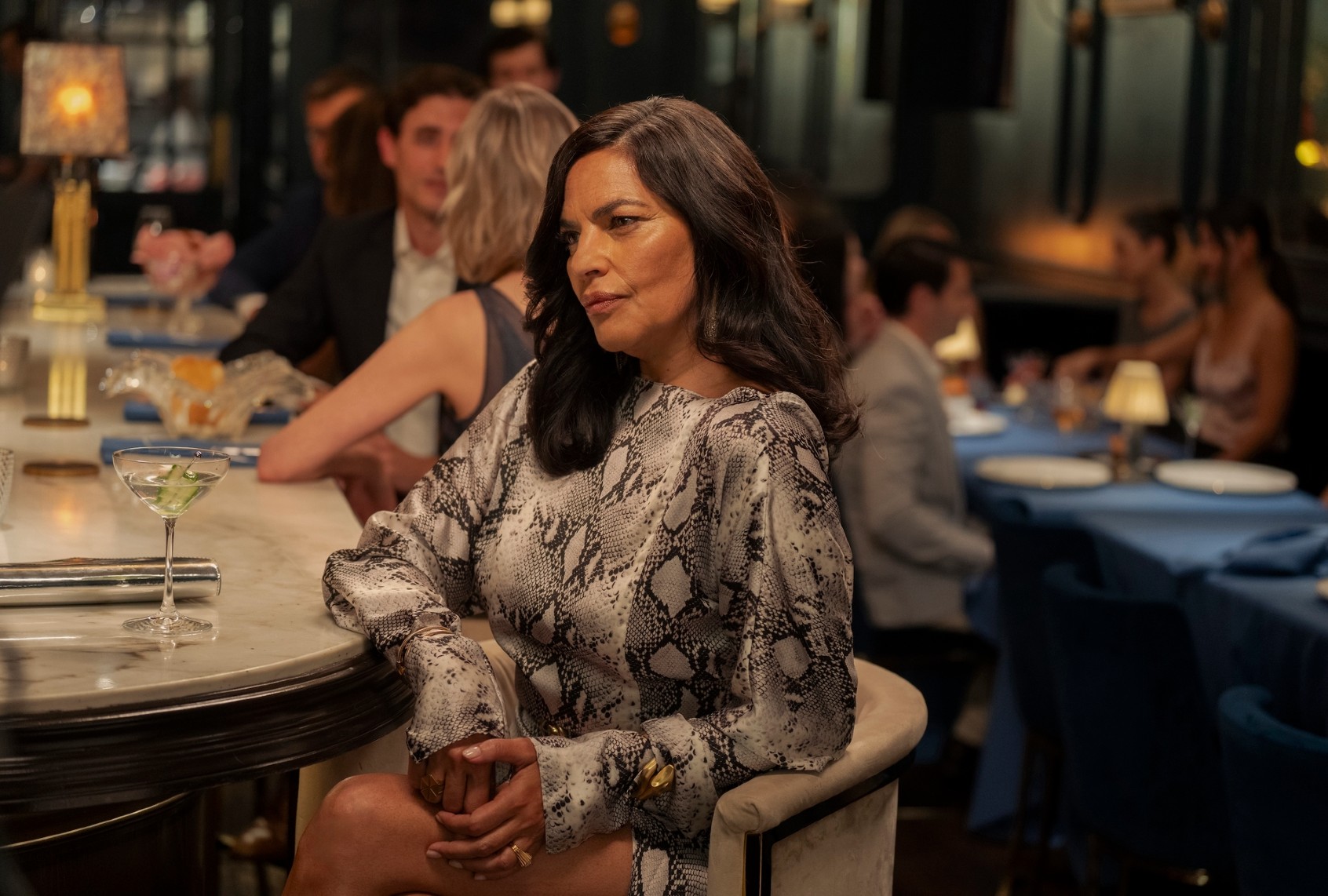
We kid because we love. We also kid because these choices cross the line dividing baffling and a cry for help. If fashion is a storyteller, what are these eyesores trying to tell us?

There comes a time in everyone’s life, and almost certainly the lives of women, when we abandon the race to stay on trend and cultivate a more lasting style. That could mean anything from comfort and utility to adventure and opulence. Seema’s clothing, she says, is meant to scream “baller” from the moment she steps out of her Mercedes.

But that’s not necessarily how others see it. To her, black, white and taupe are timeless, elegant choices. To the writers behind a painfully accurate “Saturday Night Live” commercial for the non-existent store “Forever 31,” they’re stripes in “the bummer rainbow.”

The parody ad imagines couture for 30-something women as roomy, boxy, drab and sexless. Then again, the fashion industry has always lowered the bar for women older than 30, assuming (somewhat correctly) that we prioritize psychological and physical comfort and practicality. The natural next stop is caftan glam and “fun!” prints beloved by aunts who live for blended drinks. Chico’s, in other words.

Stepping above means spending more on finer tailoring and materials, but wealth doesn’t necessarily immunize people from the otherworldly allure of chunky jewelry. Lisa Todd Wexley proves that in every episode. Most of the time, we don’t notice because she can wear that style, as opposed to the style wearing her.

Aside from that neck wreath made of hippie Christmas ornaments, LTW generally resides in the same area of sartorial consistency as Charlotte and Seema. LTW and Mrs. Harry Goldenblatt spent the second episode cornering an exclusive college consultant, Lois Fingerhood (Kristen Schaal), out of fear that their school’s guidance counselor was leaving their kids behind.

We need your help to stay independent

Charlotte is always tightly seamed and belted, while Lisa, a filmmaker, wears bright colors and straddles the line between adventurous pop art flair and polished affluence. Her only flirtation with a fashion don’t in this episode was to don a white pearl-bangled suit that could hold its own in a duet with Dolly Parton.

Then we have Miranda, who is finally settling into a new sexual identity but can’t quite figure out how to date, and that shows up in what she wears. In “The Rat Race,” she flirts with a chatty restaurant server making tableside guacamole, who, like her, hate-watches a reality show called “Bi Bingo.”

The fashion industry has always lowered the bar for women older than 30, assuming (somewhat correctly) that we prioritize psychological and physical comfort and practicality.

This guilty pleasure’s messy contestants don’t know what they want or what they’re doing. The same can be said for Miranda’s wardrobe. In one moment, her clothing says, “I enjoy an orderly office.” In the next, she’s tossing a grey vest that looks like it was woven out of a major depression over a shirt featuring disparate patterns battling for supremacy.

I am a lone voice and certainly not a fashion expert; my style is guided by whether I need to leave the house and, if so, what’s clean. So I reached out to Molly Rogers and Danny Santiago, the costume designers for “And Just Like That,” for their insights. Sadly, they couldn’t get back to me in time for this story.

I also extended requests to the hosts of Prime Video’s “Wear Whatever the F You Want,” famed TV stylists Clinton Kelly and Stacy London, presuming they could illuminate the philosophy behind these, um, let’s call them bold swings. Their open-mindedness is in their show’s title, right? Alas, London was unavailable, and Kelly replied through his publicist that he doesn’t watch “And Just Like That.” Hmm.

Sarita Choudhury in “And Just Like That” (Craig Blankenhorn/Max). Therefore, like every other woman navigating midlife, we’re left to figure out this quandary for ourselves. Fortunately, Patricia Field, the costume designer who made “Sex and the City” a style influencer long before Instagram, left a few breadcrumbs to follow.
“Fashion is art,” Field tells my colleague Mary Elizabeth Williams in a 2023 episode of Salon Talks. “. . .What paintings and fashion have in common, in my mind, is that it tells the story of the time. And it’s either a happy time or it’s an unhappy, depressing time. And you see it in the way people dress.”

By Field’s definition of fashion’s purpose, Carrie’s odd accessories are signs that Carrie has found her groove again.

The hat might have offended some, but otherwise, it’s a silly delight on par with the second season’s pigeon purse and that impractical tutu that defines “Sex and the City.”


Start your day with essential news from Salon. Sign up for our free morning newsletter, Crash Course.


Carrie’s creativity sparks trends. The tutu — it’s a tulle skirt, actually – was Field’s way of presenting an alternative to sweatpants. Women still wear them, which she told Williams she’s happy to see.

Carrie’s clothes speak of her bravery and individuality, for the most part. But they also reveal a weakness for committing to terrible ideas, like a long-distance relationship with Aidan (John Corbett), in which he’s determined the terms of communication.

“The Rat Race” is a nod at Carrie’s discovery that her courtyard’s garden is infested with vermin, forcing her to tear it out and start over. She starts to share those details with Aidan in a text but thinks better of it after his brusque rejection of her recent attempt to initiate phone sex.

He shows up to her Gramercy Park apartment unannounced, which isn’t at all controlling, to let Carrie know that maybe he was freaking out a bit (ya think?) about his communication requirements. After he leaves, she sends a lengthy text about a table that she’s eyeing online. He doesn’t see fit to weigh in beyond offering a thumbs-down emoji.

The table, by the way, is nothing to scream about. Neither are any of the fits Carrie shows up in. The rats really do steal the show . . . well, not quite. Carrie hires a gardener named Adam (Logan Marshall-Green) to redesign her greenspace, drawn to his talent for transforming empty outdoor canvases into verdant works of art.

Adam is a T-shirt and jeans guy whose laid-back style tells us he’s ready to get dirty. That’s enough to raise our curiosity about the surprises waiting offstage in this fashion parade from which we can’t turn away.

“And Just Like That” streams Thursdays on Max.

In “Invention,” conspiracy is the glue that holds a family together

Alice fell down the rabbit hole. That’s how the saying goes, at least. But Alice wasn’t pushed; she didn’t even trip. In Lewis Caroll’s original children’s novel, Alice is so fascinated by the sight of a white rabbit retrieving a pocket watch from his waistcoat that she leaps to her feet to go after it, choosing to follow the rabbit into his burrow. The funny thing about this part of the story is that, until the rabbit takes out his watch, Alice is unfazed by the sight of the hare. A rabbit in full formal attire, prattling on about his tardiness? Stranger things have happened.

But the watch, that pesky timepiece, something about it sparks Alice’s attention, so much so that it draws her into a portal to another place. This other world looks a lot like hers, but something about it is different. Everyone is acting very peculiar and things don’t make perfect sense. But no matter how unnerving that is, Alice remains fascinated. She forges forward on her quest into the unknown, desperate to understand her new reality. No use trying to fight it. Things may never go back to normal.

A feast for the curiosity-starved brain, “Invention” is the kind of revelatory work that inspires and unnerves in equal measure, a distinctly modern masterpiece that maps the rabbit hole in a way only cinema can.

Something similar is happening to Carrie Fernandez at the outset of “Invention,” a staggering new film made in close collaboration between director Courtney Stephens and actor-filmmaker Callie Hernandez. (Hernandez stars in the movie as a fictionalized version of herself — hence the character’s proximity to her own name.) After the death of her father, a doctor-turned-holistic healer, Carrie follows the rabbit down a hole to a more contemporary version of Wonderland, one that looks more like Massachusetts in its bucolic autumn. Here, Cheshire cats and mad hatters have been bumped for odd shopkeepers and pot-smoking venture capitalists. Carrie seeks truth in a place where there is none, wading through the muck of conspiracy that tinged the late period of her father’s life to find something tangible to hold onto after being cast adrift.

Across just 78 minutes, Stephens and Hernandez study the point where personal grief and the collective mourning of the once-idealistic version of America overlap. Their intersection is beguiling, a knockout experiment in form that questions everything and finds few answers. A feast for the curiosity-starved brain, “Invention” is the kind of revelatory work that inspires and unnerves in equal measure, a distinctly modern masterpiece that maps the rabbit hole in a way only cinema can.

Picking up her father’s remains from a Massachusetts funeral home, Carrie begins her journey through the mundane bureaucracy of grief. She’ll take the black, plastic box that’s issued by the crematorium; that’s fine. It’s the cheapest option for an urn, and with the mountain of small debts and promissory notes from her father’s estate that have fallen into Carrie’s lap, something simple and inexpensive would be a nice change of pace. Woven throughout this prelude and the rest of the film is footage from Hernandez’s father’s archives; spots on local Texas public access television and new-age health videos extolling the properties of vitamins or infrared-beaming glasses. In the earliest of these tapes, her father — sporting a nametag reading “John,” though he’s referred to mostly in the film as “Dr. J” — stands proudly at a seminar, where the instructor asks him to tell the crowd something he likes about himself. “I like my ability to connect with people on a one-to-one level,” he replies.

Callie Hernandez as Carrie in “Invention” (Courtney Stephens/Mubi)As Carrie soon finds out when she begins to untangle the mystery of his estate, her father was all too good at forging these kinds of relationships. A number of his former cohorts have claims against the estate for money he owes them, mostly from a series of failed holistic healing devices he concocted over the years. The patent for one of these gadgets — a large, electromagnetic, vibrational wand — is Carrie’s only inheritance. Despite the product being recalled by the FDA, the estate’s executor (James N. Kienitz Wilkins) tries to convince Carrie of its potential value. But Carrie is less interested in the patent’s worth than what it might be able to tell her about her dad, something she doesn’t realize until she speaks to an old acquaintance of her father’s who runs an antique shop in town. The store’s owner, Tony (Tony Torn), invested and lost some money on the device. And as Tony tells her about his experience, Carrie looks over to see the shop’s repairman fixing an old grandfather clock. Now that Alice has seen her pocketwatch, all that’s left to do is follow the hare.

Start your day with essential news from Salon. Sign up for our free morning newsletter, Crash Course.


The subsequent expedition is filled with offbeat personalities who help Hernandez and Stephens construct their myth, before poking the bricks out one by one, in ways both droll and achingly sad. A woman who swears the healing device has cured her debilitating TMJ ponders whether unseen forces killed Dr. J. (“He was doing really revolutionary work,” she asserts with enough conviction to stir suspicion in both Carrie and the viewer.) The device’s manufacturer insists that he and Carrie get on their knees to say a prayer together. A backer with deep pockets posits that the device never would’ve been recalled with his powerful connections at the FDA. None of their experiences add up to one complete picture, yet they are all deeply compelling. And even more than that, Carrie just admires sitting with these people, hearing them talk. The loose ends won’t tie themselves together, but they’ll hold just long enough for Carrie to feel connected to a part of her father she couldn’t always figure out.

Like conspiracy so often does, Stephens and Hernandez blur reality just enough to muddy their audience’s perception. But the film’s meta moments are not a deconstruction of the form, so much as they are a mirror. As much as it indulges in fantasy, filmmaking should reflect real life, even if the art form can’t always make sense of it.

Everyone Carrie meets in this passage through her grief is desperate to discover something greater than themselves, a power that will stop time’s ravages forever. Everyone is aging, losing money, and feeling lost and entirely directionless in a country that has deferred its fabled dream to prioritize wealth and power. “Capitalism,” Carrie says to the antique store’s clerk, Sham (Sahm McGlynn). “Everyone’s just trying to make a buck.” Even those who are still alive are forced to spend parts of their existence inadvertently bereaving the death of a life they were promised. Is it any wonder that people want to believe some governing hand is silently controlling it all? Or, perhaps more importantly, is that really so untrue?

Stitched throughout “Invention” are audio clips recorded during the film’s production, of Hernandez and Stephens telling their actors about what’s fact and what’s fiction. “Is it true?” one asks Hernandez as she tells them about the 528 hertz sound frequency her father asked her to play while he was dying in the hospital. “That’s true,” she replies.

Callie Hernandez as Carrie in “Invention” (Courtney Stephens/Mubi). Like conspiracy so often does, Stephens and Hernandez blur reality just enough to muddy their audience’s perception. In a feebler, curious state, falsehoods can take root while truth slips through our hands, and vice versa. But these meta moments are not a deconstruction of the form, so much as they are a mirror. As much as it indulges in fantasy, filmmaking should reflect real life, even if the art form can’t always make sense of it.

In the end, life is absurd. There is no rationalizing or interpreting to be done. Life is short, and even if it’s well-lived, its brevity is both beautiful and cruel. The spools of thread Carrie unravels eventually end. The energy dissipates. The device turns off. The rabbit hole Alice fell into spits her out of Wonderland and back into reality.

But, oh, what fantastic beings she met along the way. All the stories she heard, the minds she peered into. Didn’t they all feel like they brought a greater truth into reach?

In a scene shot in an “Alice”-themed corn maze, a young boy tries to explain the ending of Lewis Carroll’s story to Carrie. “It never tells if this was a dream or if it actually happened,” he says to her. Hernandez herself is just as coy, slipping in enough truth to snare the viewer and keep them mesmerized against a chilly, bare synth score. Even if it was a dream, it felt so real. Now, shaken from a reverie, reality collides with illusion at the languid pace of a stream. In Rafael Palacio Illingworth’s remarkable cinematography, the fabric of one image burns into another. A shot of a book titled “The Healing Messages of Water” lingers long enough for us to read that it was also a New York Times bestseller. We buy into the fantasy because it gives us a little bit of hope, no matter how fleeting. But even if the hope goes, that microscopic inkling — the one that convinces us even fiction might have some truth to it — lingers. It’s what keeps us moving through life, talking to strangers, searching for someone whose energy meets ours so we can connect on a one-to-one level.

“Invention” streams on MUBI July 4, and can be seen this summer at Vancouver Cinematheque, New York’s Anthology Film Archive and Toronto’s Hot Docs Ted Rogers Theater.

Luxe egg flights: Brunch’s new bizarre flex

In his 2020 cookbook “How To Dress An Egg: Surprising and Simple Ways to Cook Dinner,” Ned Baldwin, the chef and owner of New York City’s Houseman Restaurant, shared the story of his aptly named bestselling dish: the dressed egg.

Shortly after opening Houseman, Baldwin was thinking about putting oeuf mayonnaise — a classic hors d'oeuvre featuring hard-boiled eggs topped with seasoned mayonnaise — as a dish on the menu. He had some of the ingredients already on hand, but as he was going down the stairs to where the food processor was to make the mayonnaise, Baldwin recalled changing his mind.

“Midway down the stairs, I asked myself, ‘Why does this need to be mayo? I can dress the eggs with those ingredients and leave out all the extra fat,’” Baldwin said in his cookbook, which was co-authored with Peter Kaminsky.

“That night we served the hard-boiled eggs with a piquant herbaceous dressing that is somewhere at the intersection of gremolata, chimichurri and paradise,” he continued. “We liked it so much that in our kitchen shorthand, it quickly became ‘egg candy,’ and thus it is called today.”

Almost a decade later, Baldwin’s “egg candy” concept has received newfound attention via a viral brunch trend on TikTok. Called “egg flight,” the trend swaps out wine or beer for hard-boiled eggs that are cut in half and adorned with various toppings from smoked salmon, capers and chili crisp to peanut butter and jelly (on the more extreme end). Its popularity is credited to Alice Choi, a food blogger better known as @hipfoodiemom1 on TikTok. Her now-viral video, posted on June 29 of last year, garnered 1.6 million views.

@hipfoodiemom1


Egg flight!!!! My pickled red onions recipe is linked in my bio and the video is pinned to the top of my page

♬ original sound – Alice Choi

“I think this caught on because it’s like making a deviled egg but much easier,” Choi told TODAY.com. “You don’t have to mess with removing the yolks, mixing them with mayo and mustard and then piping it back into the egg white.”

Choi has been creating high-protein, egg-focused snacks since 2022, but it wasn’t until she started slicing and topping her hard boiled eggs that the idea of “egg flights” came into fruition. The trend itself garnered significant online attention during an unlikely time. Egg prices have been on the rise since 2022, when U.S. officials confirmed a highly pathogenic strain of avian influenza (H5N1) in a commercial flock. Last June, a flock of approximately 103,000 turkeys in Cherokee County, Iowa, was reportedly infected with bird flu, per the Iowa Department of Agriculture and Land Stewardship. Another outbreak was reported amongst a flock of about 4.2 million egg-laying chickens in Sioux County, Iowa. In December, a patient in Louisiana was hospitalized with a severe case of H5N1 bird flu, the Centers for Disease Control and Prevention (CDC) confirmed. Since April 2024, there have been a total of 61 reported human cases of H5N1 bird flu within the U.S.

“Eggs are one of the primary drivers of food inflation,” wrote Patrick Thomas and Jesse Newman for the Wall Street Journal. “The index for eggs was up 37% from a year ago, according to the latest Labor Department figures, and the average retail price of a dozen large eggs increased nearly 14% to $4.15 in December.”

We need your help to stay independent

High prices coupled with the lack of available, fresh eggs have forced certain establishments to either place limits or a surcharge on egg purchases. Back in February, Waffle House implemented a temporary surcharge of 50 cents per egg at its nearly 2,000 restaurant locations across 25 states. “The continuing egg shortage caused by HPAI (bird flu) has caused a dramatic increase in egg prices,” the restaurant chain said in a statement to CNN. “Customers and restaurants are being forced to make difficult decisions.” Additionally, a Trader Joe’s in Merrick, New York, limited customers to one dozen eggs per person while Costco warned customers about product cuts or delays. Sprouts and Kroger also reported limits on egg sales at some locations.

“When you look at the price of eggs, they haven’t gone up in [approximately] 40 years. In the 1980s, a dozen eggs averaged about one dollar per carton,” explained Lisa Steele, a fifth-generation chicken keeper, author of “The Fresh Eggs Daily Cookbook,” and host of the American Public Television/CreateTV series “Welcome to My Farm.”


Want more great food writing and recipes? Sign up for Salon’s free food newsletter, The Bite.


When asked about rising egg prices, Steele pushed back on the fear-mongering: “A typical dozen eggs is about a pound and a half of eggs. When you start comparing that to a pound of chicken, fish or steak, it kind of puts things into perspective. Ounce for ounce, eggs really aren't that expensive, even at $8 a dozen, which now, they’ve dropped back to a more reasonable price.”

According to the U.S. Bureau of Labor Statistics, the average price for a dozen Grade A eggs went down to $5.12 in April after reaching a record $6.23 in March. “It was the first month-to-month drop in egg prices since October 2024,” The Associated Press reported. The average price of eggs, regardless of size, also fell 12.7 percent.

Despite the reprieve, retail egg prices reportedly remain near record highs. The average price for a dozen large eggs in April was 79% higher than the Bureau of Labor Statistics reported exactly a year ago. At that time, the price averaged $2.86 per dozen.

In recent months, eggs have undergone a sort-of rebranding from breakfast staple to hot commodity. So much so that some are humurously referring to eggs as “chicken caviar” to signify their status as a newfound luxury food item. A few are also making memes of so-called “chicken dealers” whose illicit product of choice are cartons of eggs as opposed to hard drugs.

Steele’s second cookbook, which is due out in May 2026, will once again focus on eggs, this time with an array of recipes that “make people think outside the box.” That includes egg casserole variations and a twist on a traditional bacon and egg sandwich that includes sriracha aioli, she shared as teasers.

“I feel like people do eat a lot of eggs still, even with the high prices, and they’re just looking for different ways to do so,” Steele said.

Indeed they are, as the “egg flights” trend has shown.

Trump loyalty is now part of job application

More than six million Americans are still looking for work, according to the latest data from the U.S. Bureau of Labor Statistics. Amid ongoing economic uncertainty, the federal government remains one of the country’s most active employers, with open roles for nurses, actuaries, physicists, engineers and IT professionals listed at USAJobs.gov.

But prospective applicants may notice something different about the application process in 2025. Alongside typical questions about experience and qualifications, some federal job forms now ask about an applicant’s alignment with presidential policy priorities, raising concerns about political screening in what are supposed to be nonpartisan civil service roles.

Under guidance issued by the Chief Human Capital Officers Council (CHCOC), part of a broader federal hiring overhaul, applicants may be asked to explain how they would help implement specific executive orders or initiatives. One question currently being used reads:

“How would you help advance the President’s Executive Orders and policy priorities in this role? Identify one or two relevant Executive Orders or policy initiatives that are significant to you, and explain how you would help implement them if hired.”

This directive is connected to an executive order President Donald Trump that emphasizes “merit-based” hiring over previous diversity, equity, and inclusion (DEI) considerations. The administration stated that these changes are intended to root out political bias and ensure a more ideologically aligned workforce.

Critics argue that these practices resemble loyalty tests, particularly as questions of commitment to the Constitution and the President's policies appeared in job applications. Earlier this year, multiple government agencies experienced layoffs of employees who were seen as insufficiently aligned with current leadership, even in traditionally apolitical roles.

Historical parallels have been raised. During the McCarthy era in the 1950s, public servants and private citizens alike were pressured to prove their loyalty to the U.S. government to root out suspected communists. Accusations and investigations often targeted personal beliefs rather than actions, leading to widespread firings, blacklisting and surveillance.

Civil service roles in the U.S. were originally designed to serve the Constitution and the public, not individual officeholders. Federal employees take an oath to uphold the Constitution, a foundational distinction meant to separate American governance from monarchic or authoritarian systems.

Whether the latest hiring guidelines are a temporary shift or a lasting transformation of the federal workforce remains to be seen. For now, job seekers interested in federal positions may want to prepare answers not just about their skills but about their stance on presidential policy.

“The Goonies” is still a guide to surviving hard times

Forty years after its release, "The Goonies" has proven to be more than a nostalgic romp through booby traps and pirate ships—it’s a blueprint for collective survival and solidarity, perhaps even more applicable in 2025 than when it first debuted. Beneath its awkward stereotypes and slapstick humor from 1985 lies powerful messaging about what it means to belong, to resist, and to imagine abundance in the face of systemic scarcity—offering a refreshingly radical reminder that when we band together, our combined differences can be a force strong enough to rewrite the ending. This is a story not just about a pirate ship full of treasure, but about the kind of community capable of finding it.

The definition of a goonie is just someone who is cast out by society because they’re different. Mikey, played by a young Sean Astin, thinks of the locally legendary pirate, One-Eyed Willy, as the original goonie. Among Mikey’s crew: Data (Ke Huy Quan), the inventive problem solver; Chunk (Jeff Cohen), the big-bodied klutz; Andy (Kerri Green), the love interest; Stef (Martha Plimpton), the wisecracker; and Mouth (Corey Feldman), the foreign language aficionado with a penchant for sarcasm, Mikey’s big brother Brand, played by Josh Brolin, is the goonie who gets the girl after being derided by a country club douche for Andy's affection for most of the film.

Corey Feldman, Sean Astin, Ke Huy Quan and Jeff Cohen in a scene from "The Goonies," 1985. (Warner Brothers/Getty Images)
When we band together, our combined differences can be a force strong enough to rewrite the ending. 

That snobby competitor, Troy (Steve Antin), happens to be the son of the equally douchey banker who is going to foreclose on Mikey and Brand’s parents’ house because they can no longer afford to pay the mortgage. Class consciousness is evident throughout the movie, both in the goonies’ ability to make the most out of the meager resources at their disposal and in their imaginative leap of faith that One-Eyed Willy’s buried treasure really is out there somewhere. No infighting about who will get what if the treasure is real. Everybody climbs aboard this unlikely adventure just to save Mikey’s house.

The looming home foreclosure is not just a narrative device; it’s a symbol of systemic dispossession, of a profit-driven world where communities are expendable. The kids’ refusal to give in to that fate mirrors the kinds of community resistance that have been bubbling up more in recent years—tenants’ unions fighting evictions, neighbors rallying to preserve public spaces, young people organizing against the hollowing out of their towns. "The Goonies" suggests there’s a form of wealth that can’t be measured in dollars: the wealth of knowing your neighbors and daring to come together with them for a shared purpose.

The primary obstacle to the goonies’ endeavor is that the location of the treasure may be beneath a secluded and long-empty house where a trio of felons — Mama Fratelli (Anne Ramsey) and her two bumbling sons — have taken up residence to evade the FBI. When the goonies discover their hiding place, the Fratellis plot to snuff out this loose end, causing them to literally dig deeper into the house with the criminals hot on their trail. The Fratellis operate according to a classic scarcity mindset, hoarding and manipulating, constantly undermining each other. Their fear-based leadership mirrors the behavior of real-world extractive villains like bankers foreclosing on homes and billionaires profiting off crises, whereas the goonies embody a fundamentally different ethic of trust, creativity and abundance.

"The Goonies" suggests there’s a form of wealth that can’t be measured in dollars.

In this multi-layered wild goose chase, Chunk makes a further discovery that turns the tide of the story: there’s a third Fratelli brother, Sloth (John Matuszak), named for his neurodivergence and physical variations that include his enormous size and facial structure. The goonies quickly sense that Sloth is one of them and that his so-called deformities can be turned into assets. And Sloth's not the only one whose differences are ultimately understood as the greatest of gifts. Each of the goonies applies those very elements of their character that make them an outcast, and the combined value of these skill sets is what makes them powerful enough to find the long-lost treasure as a group. 

Despite no adult or authority figure believing in their mission, the goonies triumph. They refuse to give up their own potential or acquiesce to a narrative that portrays their strengths as weaknesses, so they succeed in manifesting a treasure that nobody even thought was real. Cue that priceless look on every adult’s face when the goonies are reunited with their families as the entire pirate ship resurfaces to float joyously in the distance. This incredible win is not just one of youthful adventure or cleverness; "The Goonies" is a story about reimagining power and possibility from the margins. It isn’t the typical hero’s journey led by a singular chosen one, but a collective effort. This is a decentralized coalition of kids pooling their oddities, improvising solutions, and building solidarity in real time. They form a kind of mutual aid pod driven not by individual glory, but a shared sense of responsibility to one another and their neighborhood.

Anne Ramsey, Jeff Cohen, Ke Huy Quan, Corey Feldman and Sean Astin in a scene from "The Goonies," 1985. (Warner Brothers/Getty Images)
It’s also a quietly radical vision of abundance. The buried treasure, while real in the end, isn’t hoarded or privatized. It’s accessed through collaboration, not conquest, and there’s no betrayal in the face of temptation. In fact, the treasure only becomes attainable because every single goonie brings a different, essential gift to the table. Data’s gadgets, Chunk’s loyalty, Mouth’s Spanish fluency, Sloth’s strength and Mikey’s unshakeable hope all link up together to form a mosaic of community resilience. The lesson here is that any future worth fighting for is one where everyone’s weirdness matters.

That ethic resonates strongly in today’s tough times. The goonies’ journey isn’t just a nostalgic throwback; it’s a map for how we might really face collective peril. We’re not going to be saved by lone heroes or distant institutions. We’re going to have to save each other. We’re going to need to share tools, look out for our neurodivergent neighbors, fight like hell to keep our homes and stubbornly believe in each other’s gifts. The real treasure is not the gold—it’s the community that forms in the process of seeking it. As "The Goonies" turns forty, its message lands with renewed urgency. In an era where many feel cast out or left behind, the film offers a thrilling, heartwarming reminder that a better world is possible, but only if we build it together. Goonies never say die, not because they’re invincible, but because they refuse to go it alone.

“Just three people” took on Ohio education law — and sparked a movement

Some Ohio colleges and universities fell in line before Senate Bill 1, the “Advance Ohio Higher Education Act,” even passed through the state legislature. And when it finally did in March, it had a chilling effect. Universities shirked diversity, equity and inclusion programs to comply, and the silence from once-outspoken opponents was striking. Those early signs of kowtowing were bad indicators that the members of Youngstown State University’s faculty union just couldn’t get behind. 

“There was such passion against SB 1 whenever it was being pushed through the legislature, so why isn't that passion still there?” Mandy Fehlbaum, a sociologist and the grievance chair for YSU’s chapter of the Ohio Education Association, recalled wondering in a phone interview. “Some people were saying, ‘Oh well, we worked so hard. Now we're tired, and we just have to accept it.’ And like, no, we don't have to accept it.” 

So they set out to reverse it.

While other education unions are weighing legal action to overturn the law, which aims to overhaul the state’s higher education system, Fehlbaum, YSU-OEA president Mark Vopat and union spokesperson Cryshanna Jackson Leftwich chose to go political. They began an effort in April to get a referendum on the November ballot, starting with gathering signatures from the 1,000 registered Ohio voters necessary to have their petition certified to the secretary of state. They collected over 6,200 signatures from registered voters in just over a week and certified the petition in early May.  

Now, the petition committee is taking on its greater challenge: gathering more than 250,000 signatures in at least 44 of the state’s 88 counties by June 25 — just two days before the law is set to take effect. If their grassroots cause is successful, the law will be paused until Ohioans vote in the general election on whether SB 1 remains law or is ultimately repealed.

“There were three of us that said we are fed up, three individuals… who said, ‘We want to do the right thing, and we want to do something,’” Jackson Leftwich, who also serves as a political science professor at YSU, told Salon. Sometimes you just have to do something, she added. “You can stop or fight against [something] — and you might not always win, but you can make your voice heard. You can have some opposition. You can give these people some pushback to make them think twice.”

“This bill… at least in my experience, in my 20-plus years at Youngstown State and higher ed, it just dismantles what higher ed's supposed to be."

Republican Gov. Mike DeWine signed the bill into law on March 28, less than 48 hours after it hit his desk. The legislation, a 42-page revival of previous legislation taken from model bills devised by the conservative National Association of Scholars, implements regulations on classroom discussions on “controversial beliefs,” including climate policy, marriage, immigration and electoral politics. It also strikes diversity, equity and inclusion programs, policies and scholarships as well as related spending; prohibits faculty strikes; and blocks unions from negotiating tenure among other provisions.  

Proponents of the bill, including Republican sponsor state Sen. Jerry Cirino, argue that it enhances freedom of speech and academic freedom, promotes intellectual diversity, and “installs a number of other worthwhile provisions,” including establishing post-tenure periodic review and banning political and ideological litmus tests in hiring, promotions and admissions decisions. 

“Our Founders treasured diversity of thought so highly they made free speech our very first guaranteed right,” Cirino said in a January news release announcing the bill’s introduction. “It’s time to bring that right back to campus.”

But that’s where the petition committee’s qualms come in. They argue the legislation is actually a censorship bill, replete with union-busting measures and a vague maze of anti-DEI stipulations that stymie students’ access to social support, financial resources and needed accommodations. Meanwhile, course regulations said to bolster diversity in thought place professors in a confusing bind over the content they can teach and problematic ideas they must entertain in class. 

“Students who want to hold views like, ‘Slavery was good,’ — I shouldn't have to take class time to seriously entertain certain ideas like that,” Vopat, a philosophy professor , told Salon.

“We realize we are underdogs in this, but we are doing our best to put a concerted effort there, and I think that it's very feasible we'll be able to do it.”

Vopat, Fehlbaum and Jackson Leftwich also flagged other glaring issues. The law, they argued, effectively ends tenure by folding tenure policy into the purview of each public institution's board of trustees. Plus, it requires the inclusion of a question about whether a professor creates an unbiased classroom environment on student evaluations, the answer to which they fear could spur investigations into faculty as the law regulates discussion of controversial subjects. Altogether, they say the law has the potential to drive students away from Ohio's public universities.

“This bill… at least in my experience, in my 20-plus years at Youngstown State and higher ed, it just dismantles what higher ed's supposed to be,” Vopat added in a phone interview. It makes the university into a business where profit is king and faculty are “just replaceable.”

The term-limited governor’s signature began a 90-day timeline for any interested Ohioan to launch an effort to challenge the legislation. After consulting with other education unions and hearing nothing about a ballot referendum in the works, Vopat, Jackson Leftwich and Fehlbaum — with the support of YSU-OEA’s executive committee — decided that they would be the ones to take up the charge. 

Their effort felt like a race against time, one that Vopat said they knew from the beginning they wouldn’t be able to win alone. They drafted the initial petition language, had it reviewed by a former YSU student-turned-lawyer and sent calls out to their network of unions to set the process in motion. 

As more and more people requested access to it, their work to certify the petition to stay SB 1 and get the law on the ballot gained momentum. In just 10 days, they obtained 6,253 signatures across 423 part-petitions, according to the Ohio SB 1 petition website

While Vopat said he initially pegged the ballot referendum a “long shot” and a “Hail Mary,” he now regrets that characterization. 

“Now, I think we're actually in the game, like there's time, because once we announced, we've had a huge groundswell of support. I mean, it was shocking how many people,” Vopat told Salon.

We need your help to stay independent

Since their petition was certified on May 5, the group has secured a cohort of more than 1,500 volunteers statewide to help with signature gathering and garnered the backing of more than a dozen organizations, including Blue Ohio, Indivisible and the Ohio Democratic House Caucus. They’ve also fundraised just under $40,000 and founded the Labor, Education, and Diversity ballot issue political action committee to support the referendum effort. 

All of the money they’ve raised thus far goes toward materials, mainly printing the 18,000 petitions and counting currently in circulation across the state. While Fehlbaum said the process has presented a “steep learning curve” — relying on volunteer help, navigating the particulars of scanning each copy of the petition and starting a PAC for the first time — she, Vopat and Jackson Leftwich have been blown away by the support their effort has received from Ohioans thus far. 

Fehlbaum, who leads the petition committee’s outreach and organizing arm, declined to share exactly how many signatures they’ve collected since certification because the organizers don’t want the numbers to encourage their opposition to push harder. Fehlbaum did say, however, that they’ve collected signatures in 82 of Ohio’s 88 counties — blowing one of the requirements out of the water — and saw huge returns from Memorial Day weekend. Pride events throughout June and Juneteenth present other ripe signature-gathering opportunities they hope to capitalize on. 

“It's an uphill battle for sure,” Fehlbaum said, describing the challenge of informing voters about the bill and their petition. “We realize we are underdogs in this, but we are doing our best to put a concerted effort there, and I think that it's very feasible we'll be able to do it.”


Start your day with essential news from Salon. Sign up for our free morning newsletter, Crash Course.


Ohio’s public academic institutions have been rolling out changes to comply with the law as the state closes in on the deadline for SB 1 to take effect. Much to the dismay of its students and faculty, Ohio State University was ahead of the curve, announcing diversity office closures and staffing cuts in February in compliance with federal directives to slash DEI programs and in preparation for a then-progressing SB 1. In late April, the University of Toledo discontinued nine undergraduate majors — including Africana studies, Asian studies, disability studies, Spanish and Women’s and Gender Studies — to adhere to SB 1’s low conferral rate requirements. 

Ohio University also announced a week later that it was sunsetting its Division of Diversity and Inclusion, which housed its Women, Pride and Multicultural Centers, and established six working groups to implement the law’s new requirements. The southeastern Ohio institution also generated backlash when it paused a Black Alumni Reunion event in an apparent reaction to the bill.    

Jackson Leftwich, Vopat and Fehlbaum see these changes in a broader context. The state’s upending of Ohio colleges through SB 1, they said, is a microcosm of the Trump administration’s battle against higher education, cowing public and private universities into compliance with anti-DEI, anti-immigration and anti-protest measures or slashing funding from institutions that refuse.

“If the federal level held strong, then the state couldn't get away with it, because people could file federal lawsuits against the state,” Jackson Leftwich said. “But the state sees the weakness in the federal government, and so they're like, ‘We can get away with doing the wrong thing.'”

But Vopat said he also sees possibilities for nationwide change in that connection. He hopes that seeing their effort to protect higher education — no matter how successful it ends up — will show other Americans that they have the power to fight back, too. 

“I'm hoping that people realize that there is a chance that you can do this, that there are other people who feel the same way — that things have gone too far — and [that] we need to pull back and stop some of these things that are happening, not only in Ohio, but in Florida, Indiana, other places across the country.”

Some animals seem to appreciate music. What does that mean for human evolution?

Ronan the sea lion can dance to a lot of different songs, but there is something about “Boogie Wonderland,” by Earth, Wind and Fire that really gets her going.

It didn’t take more than a few days for Peter Cook, a marine mammal sciences professor at the New College of Florida, to train Ronan to bop her head to music. Using fish as a reward, he taught her the movement. Then he taught her to move when a metronome played. Over the course of the next two months, he gave her a fish every time she synchronized her head bops to the beat of the music. Once that clicked, she could do it 60 times in a row within a couple of days, he said.

Before long, she was able to do this with music recorded live in a studio with natural fluctuations, complex instrumentation and syncopation, meaning different beats were emphasized in different measures, Cook explained. And it wasn’t just Earth, Wind and Fire that got her moving, but also the Backstreet Boys and other rock songs.

“Once she understood the task, she seemed to be able to transfer that knowledge over to even complex musical types of stimuli, which do have things like meter,” Cook told Salon in a phone interview. “The thing is, we're just not sure how she thinks about or understands things like meter, syncopation or anything like that.”

Historically, many thought that humans were the only animals that could recognize an external beat and synchronously move to it. But in 2007, Snowball the cockatoo went viral for dancing to the rhythm of the Backstreet Boys. Then, in 2013, Ronan the sea lion similarly acquired world fame for moving her head rhythmically to the beat of music. 

These two case studies are part of a growing field of research set on trying to understand which animals have the capacity to be musical, providing clues on how and why music evolved in humans.

In 1871, Charles Darwin wrote: "The perception, if not the enjoyment, of musical cadences and of rhythm is probably common to all animals.” Darwin suggests that if music gives us pleasure, it has an evolutionary purpose. And if all animals share a common ancestor, it could be something that is evolutionarily shared. But that isn't easy to investigate.

“We have this problem in studying the origins of musicality … Music doesn't fossilize,” said Henkjan Honing, a professor of Music Cognition at the University of Amsterdam. “Cross-species work is a way of resolving that problem because the assumption is that if you share a certain trait with a genetically close species, then the common ancestor might also have had that particular skill.”

In a way, all animals make rhythms, whether in the form of fireflies flashing, birds chirping or even a tiger pacing back and forth. Some of these rhythms are influenced by pure physiology: Walking, swimming and having a heartbeat are all rhythmic. Yet defining what constitutes music is challenging because it is inherently subjective. Plus, we don’t know if animals experience music as music, or if that is our own human experience we are projecting onto them.

We don’t know if animals experience music as music, or if that is our own human experience we are projecting onto them.

In one study released last month, eastern and western chimpanzees — which are two different subspecies — were observed in the wild to have distinct drumming patterns. These patterns are short, structured and rhythmic, but they are thought to be used more for communication purposes than for music, said study author Vesta Eleuteri, who studies the evolution of social cognition and communication at the University of Vienna.

“Some chimpanzees drum with isochrony [occurring at the same time], but we didn't find evidence of other core musical rhythms that are present in humans,” Eleuteri told Salon in a video call.

Musicality generally implies that animals have control over the rhythm they are making and use it flexibly. One way to determine if an animal is musical is to see if they have the ability to identify a note's pitch in relation to other notes. Another way, which has been studied more, is to see if they are capable of synchronizing to beats in a rhythm, Honing said. 


Want more health and science stories in your inbox? Subscribe to Salon's weekly newsletter Lab Notes.


Human children have been shown to do this before they can walk or talk, though it’s unclear whether this ability is learned or innate. Children aren’t perfectly synchronized to the beat at younger ages and they improve over time, suggesting that it could be something that is socially learned. On the other hand, one 2009 study found evidence in baby’s brains that they were detecting rhythmic patterns as young as seven months old, which could indicate that this ability is already functional at birth.

Nevertheless, in a study published in May, Ronan the sea lion was shown to perform better than adult humans when tasked with moving in sync to a beat. Although Ronan doesn’t perform this task outside of her training sessions on her own, she does get a fish regardless of whether or not she moves to the music in training sessions, indicating she is voluntarily moving to the beat, Cook said. 

It’s unclear what motivates Ronan to perform this activity, but Cook said sea lions are kind of like the Border Collies of the sea and can quickly learn new tasks. As such, it could have something to do with mastering a task, he explained.

“I think she enjoys the cognitive challenge and the opportunity to sort of master something and then practice that mastery,” he said. “I just don’t know if it’s about groove the way it is with humans.”

Looking at similarities and differences between our closest living relatives, primates, can provide clues into whether music shares a common ancestral origin. In humans, if we are walking or typing and listening to music, we naturally sync up to the rhythm. In studies conducted by Yuko Hattori, an assistant professor at Kyoto University’s Primate Research Institute, chimpanzees were able to synchronize their movement to a variety of rhythms. Similar findings were also reported in another study with a bonobo, in which the bonobo was also able to synchronize its drum beats to a human in the experiment. 

Movements from primates in these studies are not as precise as humans, but one hypothesis used to explain the origins of music could help explain the differences. It suggests that in humans, our ability to move in time with a beat stems from vocal learning. It could be that humans’ ability to refine that beat synchronization evolved along with our vocalization abilities, Hattori said.

“The monkeys are a more distant evolutionary distant species, and so perhaps that there is some gradual development in the course of primate evolution,” Hattori told Salon in a video call.

This hypothesis could explain why birds like Snowball and humans can move to a rhythm, although it raises questions about Ronan the sea lion’s ability to move to the beat. Sea lions don’t naturally adapt their calls to external stimuli in the wild, although seals do, which share an evolutionary root with sea lions more than 20 million years up the ancestral tree. However, it could be that this shared ancestor is related to some degree of vocal learning in sea lions.

It’s rare to get a brain scan of chimpanzees or sea lions due to ethical reasons, so what is happening neurologically when these animals move to the music is also unknown. However, experiments in birds like the zebra finch help provide some answers as to why this species sings.

Although zebra finches sing their own songs and do not move to external rhythms, they do at some point learn those songs from other zebra finches, so there is some degree of learning and internalization related to music.

In one 2017 study, Ofer Tchernichovski, who studies animal behavior at Hunter College, and his team set up an experiment in which birds had to get an unpleasant air puff in order to reach a peep hole where they could see a singing bird. What they found was that males were always willing to “pay” to hear any song, whereas females were only willing to hear the song if they were presented with the song of their mate. When females were presented with the song of her mate, dopamine levels went up.

“The thing is, the females are not very sensitive to songs, so this was exactly the opposite of what we thought,” Tchernichovski told Salon in a video call. “What we think is that for females, the song is really about sex, whereas for male zebra finches, it’s more social.”

Another study released earlier this year found dopamine activity increased in young zebra finches when they sang songs that were closer to their eventual adult song versions compared to when they sang songs that deviated further away from them. 

Other studies have shown male zebra finches “self-evaluate” their songs when practicing alone with songs they sing better activating the dopamine system more than songs they sing worse. However, when singing for females, their dopamine system is activated by a social response based on the cues they receive from the female.

Studies show that the dopamine system in humans is also activated when we listen to music. In one study, people listened to their favorite music while under an fMRI machine. In anticipation of that moment, the dopamine system was activated in the brain.

We need your help to stay independent

Furthermore, studies have also shown that musical training in adolescence increases empathy and prosocial behaviors. In other words, it brings us together — which we see when we clap to the beat at a concert or sing the lyrics to popular songs. One 2014 study found infants were more likely to help someone if that person rocked them synchronously versus whether they did so out of rhythm. 

“One of the theories that is important for the origins of musicality is that it could be a way of social bonding, of increasing the social cohesion of the group,” Honing said. “You see the same thing with Snowball: He likes to dance when his owner is there … She always dances with him, and that’s what the bird likes.”

“Enjoyment is the key,” Honing added. “If you get pleasure out of something, that means it's important biologically, so it might be an adaptation.”

Wake me up when we’re not in a recession — the economy has felt broken for decades

Some top economists are anticipating a recession. And while a certain degree of such economic criticism can be understood as partisan, both on the part of academics and consumers, statements from the Federal Reserve chairman reflect a more cautionary outlook.

However, for regular Americans who are politically independent and make around or below median income, the status of the economy is a much less important question than long-running trends of economic well-being. From the perspective of most Americans, either a recession is coming or has already started, because the running consensus for normal people is that the economy is bad —and maybe more importantly, has been bad for a while.

Nearly all long-run economic polling data or qualitative study on economic well-being conclude that most Americans exist in a nearly permanent state of economic dissatisfaction, though not always in an outright crisis. For most people, the economy is primarily characterized by some mix of low wages, costly bills and a dwindling supply of good jobs and opportunities.

A chorus of survey data consistently reports that Americans view the economy as getting continuously worse, with those findings often extending as far back as the data sets have existed. There is no shortage of alarming statistics to validate those concerns: Wages have been mostly stagnant, the cost of living continues to rise, small businesses are disappearing, medical debt is increasing, the median age of homebuyers continues to rise and higher education now often requires mortgage-level debt. For those without savings, retiring comfortably seems tenuous, with many seniors choosing to work part-time and younger families delaying parenthood due to economic concerns. And this is without any mention of the more recent and specific concerns like the rising gig economy or the effects of technological advancements.

While some statistics paint a more optimistic picture — especially when the data is carefully selected and narrowly framed — it is important to centerpiece that most people evaluate the economy in broad, intuitive terms. For many, questions about the economy are much less about the exact statistics that a field expert will focus on, like the year-over-year marginal changes in log-scaled disposable income, and much more about fundamental questions: Is this the life that I hoped for? Am I better off than my forefathers? Can I comfortably afford a home, a family and the dreams of my children? Is the future getting brighter or darker? The well-being of the economy is evaluated holistically and continuously over the life cycle, not quarterly and technical.

We need your help to stay independent

The economic well-being of ordinary people ought to be a central concern of the economics profession. Yet, despite the importance of this issue, there is no universally accepted metric that fully captures its complexity, and in practice many economists are often much more focused on narrow questions that can infer causation, publish well and advance tenure. While many assume economists are primarily focused on addressing these holistic affordability challenges, the reality is that this area often remains underexplored. Many economists continue to rely on topline macroeconomic indicators, despite privately acknowledging that affordability challenges — such as high rent, expensive child care and rising daily costs —remain central personal concerns.

Economic well-being should at least measure whether individuals of average incomes can afford to live securely, purchase homes, raise families and retire with dignity

The economy is often assessed at the aggregate level, with statistics like gross domestic product, instead of a distributional focus that characterizes the experience at the low-end or for the broad swath of people in the middle of the income distribution. Though hard to define, economic well-being should at least measure whether individuals of average incomes can afford to live securely, purchase homes, raise families and retire with dignity. 

The recent interest in recessions, and by extension most contemporary economic evaluations, is informed by some degree of partisanship, but most Americans are somewhat independent and their concerns over affordability are longstanding. For normal people, the prospect of a recession is secondary to questions over personal finance. For most families, the state of the economy is not captured in GDP figures or trade deficit data; it is a more sentimental understanding, more related to the trade-off between rising grocery prices and piano lessons for your kid. It is your wife having to take up a second shift to pay for daycare, the inability of your mother to retire and the degree of stress about the order in which a family pays bills to avoid late charges.

Economists and policymakers need to appreciate that most Americans have long concluded that wages are too low, bills are too high and good jobs are too hard to find. Whether there is a recession misses the larger point: The economy is bad.

“Lost his mind”: Trump planning to sell Tesla after falling out with Elon Musk

President Donald Trump dismissed the idea of reconciling with Elon Musk in the near future on Friday morning, telling ABC News in a phone interview that he’s “not particularly” interested in speaking with the Tesla CEO. 

“You mean the man who has lost his mind?” Trump said when asked about reports of a scheduled call with the tech billionaire later that day, saying that Musk was interested in speaking, even if the president was not.

The feud between the president and his former adviser exploded into view Thursday, sending shockwaves through the MAGA movement. The ABC News report says that Trump mostly seemed calm about the back-and-forth and preferred shifting the conversation to other topics. But one adviser told the network that the president was “bummed” about the situation Thursday.

The dispute between the two men started as a disagreement over a spending bill, but quickly devolved as Musk claimed that Trump would have lost the election without his support, agreed with a social media post calling for the president’s impeachment and claimed that Trump’s name appeared in the so-called Epstein files. Trump fired back by calling Musk “CRAZY” and threatening to revoke his federal contracts. 

Among the casualties of the falling out — which also includes billions of Musk’s personal wealth — may be the red Tesla Model S that Trump purchased earlier this year to publicly signal his support for Musk. Trump is planning to sell the car now, according to the New York Times, citing a White House official speaking on condition of anonymity. 

Despite a small jump on Friday afternoon, Tesla stocks are still down roughly 13% this week. 

Christianity still haunts cinema in a world shaped by Christian power

Vice President and sentient gravy stain JD Vance was jokingly credited with the death of Pope Francis in April, as evidenced by numerous memes and comedic riffs still circulating. It’s a rash indictment; in pop culture’s haste to identify Francis’ killer, the possibly fatal prescience of Edward Berger’s "Conclave," a film about the nuts, bolts and holy smokes involved in the election of a new pope, was overlooked. Did Vance’s handshake send Francis to the hereafter, or Berger’s creative hubris? 

It’s the plain old unsexy truth that a cerebral stroke and subsequent cardiac arrest killed Pope Francis, not Vance’s touch or Berger’s cinema. Think of "Conclave" as a mixed blessing: it’s a wonderful movie, structured around an ensemble whose work is equal to any other seen in 2024’s offerings, notably Ralph Fiennes, Lucian Msamati, a perfectly unctuous John Lithgow and Isabella Rossellini, delicate with her sassiness; it is also instructive of how the church, as a universal body, responds to a pope’s death, and why their passing is consequential to those outside the faith (or who simply have none).

Whether one identifies as an atheist, Jew, Buddhist, Muslim, Hindu, or subscribes to countless other forms of spiritual worship, our world is shaped by Christian thought. Christianity enjoys appallingly outsized influence, certainly; it’s the largest religion in the world, but comprises just a third of the global population, meaning the far-right Christofascists weaseling their way into elected office in developed nations intend to legislate according to a doctrine that swaths of their constituents don’t follow. If you live in the United States, where 62% of adults identify as Christian, and if you don’t attend church on Sundays or any days, you’re nonetheless subject to policies promoted by looney tunes Bible-thumpers who pray over Donald Trump, quite arguably the most irreligious man to set foot in the White House since Thomas Jefferson.

Dan Stevens in "The Ritual" (XYZ Films)
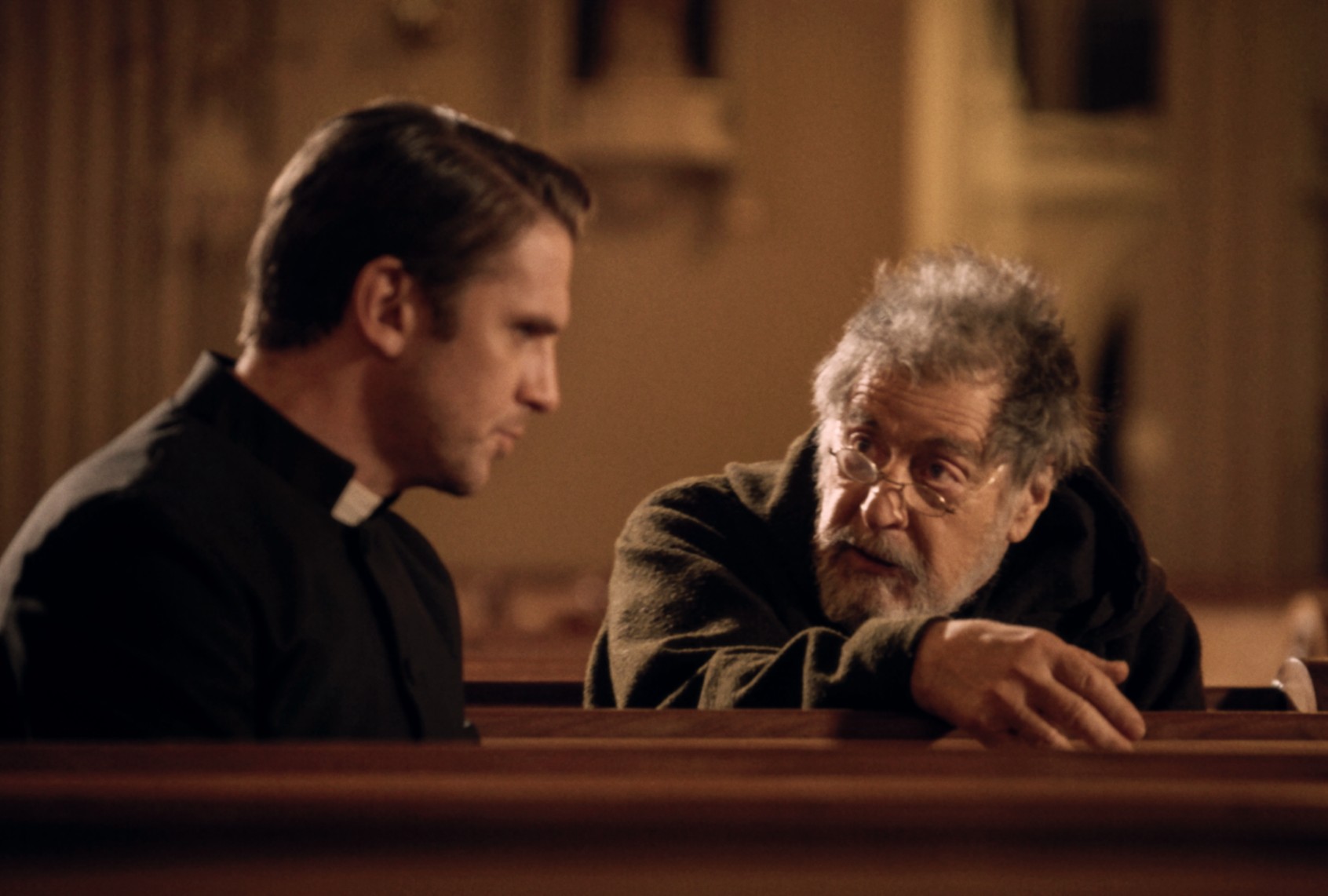
For that reason alone, "Conclave" is resonant, though besides the matter of personal meaning, it’s a solid theopolitical thriller. Amusingly enough, the film’s success, and the fact of its production, provide only thin evidence of Christianity’s presence in our lives; movies like it come around only every so often, and make a splash in pop culture but rarely. (Look back to 2015’s "Spotlight" for a salient recent example.) Better proof of Christianity as an immovable societal cornerstone can be found in horror cinema, particularly within its religious subgenre, which broadly comprises films concerned with the Good Book and the rites, parables and dogma contained within its pages. Even in the 2020s, marked by a decline in the United States’ Christian population, as well as similar dips in the United Kingdom and Europe, horror still equates “religion” with “Christianity.” 

Dan Stevens and Al Pacino in "The Ritual" (XYZ Films)

Horror still equates “religion” with “Christianity.” 

Consider 2024’s religious horror slate: Michael Mohan’s "Immaculate," Arkasha Stevenson’s "The First Omen," Joshua John Miller’s "The Exorcism," Lee Daniels’ "The Deliverance," Max and Sam “Brothers of Robert” Eggers’ "The Front Room," Scott Beck and Bryan Woods’ "Heretic." Each is designed around Christian faith like it’s the rug that ties the room together; each falls somewhere on the spectrum of “great” to “watchable trash,” too, which appropriately feels downright miraculous. To this number we can now add David Midell’s new film "The Ritual," carrying through last year’s religious horror sub-theme with a janky docu-realism affect; Midell borrows the aesthetics of workplace sitcoms like "The Office," favoring contrasty lighting and shaky handheld camerawork in recreating Anna Ecklund’s decades-long bout of demonic possession in the early 1900s. 


Start your day with essential news from Salon. Sign up for our free morning newsletter, Crash Course.


"The Ritual" does not identify Anna by that pseudonym, of course. It’s an historical film, and uses her real name, Emma Schmidt (Abigail Cowen), alleged to have endured her condition starting at age 14 until 46, the year of her final exorcism by Father Theophilus Riesinger (Al Pacino); per the film’s promotional materials and subtitles, Emma’s is the best-documented case of demonic possession in 20th century history. Midell latches onto that historical angle, which reads as an intentional creative decision as well as a moral one; if Emma’s ordeal is more thoroughly annotated than others’, a modicum of respect is owed to the record and to her suffering, whether it was a consequence of human ignorance or the genuine article in mankind’s long tradition of misdiagnosing behavioral health maladies as infernal.

Al Pacino and Abigail Cowen in "The Ritual" (XYZ Films)

Reason aside, Midell fumbles the approach; each night that Theophilus and his comrade in divine arms, Father Joseph Steiger (Dan Stevens), administer a new section in the rite of exorcism to Emma, the film abruptly jump cuts to postmortem conversations where, for instance, Joseph communicates his doubts to Theophilus that the woman needs an exorcism at all, or where they and the nuns assisting them experience awful visions in their bed chambers. The technique breaks the film’s faux-authentic spell: when the story leaps forward in time without considering details like architecture, whatever mild power the material holds instantly wanes. (The layout of the movie’s location is such an afterthought that when Joseph appears on sets other than Emma’s chamber, he seems to practically have teleported to them.) 

Proof of Christianity as an immovable societal cornerstone can be found in horror cinema, particularly within its religious subgenre, which broadly comprises films concerned with the Good Book and the rites, parables, and dogma contained within its pages.

If there is any choice more capable of reminding the audience that "The Ritual" is one more demonic possession movie in a long line of movies, based on real events and just as anonymously crafted (a’la "The Devil Inside" and "The Vatican Tapes"), Midell doesn’t make it. Credit where due, though: the script, which he wrote with Enrico Natale, packs food for thought into a low-key speech, delivered by Pacino 17 minutes in, about the peril of division. Contextually, the monologue is faith-based. “I know this is all unusual, this aspect of our calling,” Theophilus tells Joseph and their assembled team of nuns, including Sister Rose (Ashley Greene). “It will be like entering a foreign land to you.” If his words literally refer to exorcism’s particularities, they subtextually wrestle with faith as a notion, and trickle into broader political life, too. 

A divided collective will fall, Theophilus concludes. In one way, he’s right: discord in the American electorate yielded Donald Trump 2.0, which in turn has yielded one travesty after another in his 130-plus days in office. If we can’t find common ground to stand on with each other–ideally, that fascism is bad and its practitioners must be corralled in the far corners of suitable wastelands–then we all pay the consequences. But "The Ritual" centers so much on Joseph’s disbelief in Theophilus’ absolute belief in Emma’s possession, and in the existence of demonic power, that the film almost functions as a dialogue about the rationality of Christian faith itself. Is Theohilus right to permit Emma’s deterioration without the benefit of a medical (read: scientific) examination? Do demons exist? Or is Theophilus acting in actual bad faith, so convinced by his preferred mythology that he’s unworried about any harm the rites of exorcism inflict on Emma? And how does a man like Joseph, an authority figure in the church but on a lower rung than Theophilus, conduct himself under those circumstances?

Francis contended with formulations of these questions throughout his papacy. Being a progressively minded sort compared to his peers, the new pope, Leo XIV, inevitably will tackle those same questions as he begins his papacy. In some ways, Leo is the successor Francis deserves, likewise an advocate for social justice, whether championing migrants’ rights or women holding leadership roles in the Catholic Church, but less accepting of LGBTQ+ communities. As such, he has already been made a lightning rod for right-wing culture war tantrums–the exact kind of division Theophilus warns against in "The Ritual." Under these circumstances, and as the current representative of religious horror, the relevance of its plot is appreciable. Nonetheless, it’s a sin that the film itself falls so short of its moment.

“I don’t want to see my parents fighting”: Fox News struggles to cope with Trump-Musk explosion

The cracks in the MAGA alliance are beginning to show, and Fox News isn’t quite sure how to patch them. The conservative outlet appeared to be in damage control on Thursday as the rift between Donald Trump and Elon Musk continued to deepen.

Many of the network's prominent commentators tried to cope with the situation, downplaying the public clash, describing it as a predictable outcome of a relationship between two powerful individuals and urging the two men to reconcile.

“Sometimes, guys fight,” said Jesse Watters. “Guys sometimes will punch you in the face, and the next night you’re having a beer. Sleep with your girlfriend, and you patch things up.” 

“These guys are like roommates,” he added. "They’re just blowing off steam.”

Greg Gutfeld also reached for metaphors when he urged the two billionaires to “knock it off.” 

“It’s like, I don’t want to see my parents fighting," Gutfeld said. “I like Batman and Robin. I don’t like Spy vs. Spy.”

He also praised Trump and Musk for airing out their grievances transparently for everyone to see. 

We need your help to stay independent

Sean Hannity sought to strike a similarly conciliatory tone, saying that just last week the two men were “best friends,” and that the dispute ultimately came down to a disagreement over a piece of legislation. 

“You have the president of the Free World; the richest guy on earth, one of the strongest guys on earth,” Hannity added. “Conflicts? They’re kind of predictable … they disagree on policy.”

Hannity predicted that Musk and Trump would work it out  


Start your day with essential news from Salon. Sign up for our free morning newsletter, Crash Course.


Other Fox figures didn’t shy away from the implications of the very public breakdown.

“This is not a story that anyone was looking for,” Will Cain said. “Hard to see a path forward for these two to repair their relationship." He called the feud “a big, ugly battle,” and lamented the consequences for the country. 

Laura Ingraham, typically a Trump defender, urged the former president to pull back.

“Musk is his own person,” she said. “Threatening to pull [his] government contracts—that’s not wise, when five minutes ago you were of course hailing Musk’s work in helping rescue the stranded Americans in space.”