Spring Sale: Get 1 Year, Save 58%

How the abortion rights landscape changed in 2024

In June 2022, the U.S. Supreme Court overturned the landmark ruling Roe v. Wade in the Dobbs decision, ending the federal enshrinement of abortion rights in America. The repeal of Roe has significantly changed the landscape of reproductive care access across the country and 2024 marked numerous noteworthy changes.

Since Dobbs, which gave states the right to ban abortion, many states have gone above and beyond to further clamp down on access to abortion care. As of the end of December 2024, according to KFF’s dashboard, 12 states have completely banned abortions. Six states restrict abortion access between 6 and 12 weeks of gestation. Four restrict access between 18 and 22 weeks. In contrast, 14 states have enshrined reproductive rights, including abortion access, into their state constitutions.

As I’ve reported for Salon this year, the direct and indirect effects of abortion bans and restrictions impact far more than just people who can get pregnant. From putting pressure on care in states where abortion remains accessible to inflicting trauma and grief on those who are forced to travel to access care, here’s how the reproductive rights landscape changed in 2024, post-Dobbs.

01

More people stockpiled abortion pills

2024 began with the anticipation that the Supreme Court would invalidate the FDA’s approval of mifepristone, one of two drugs used in medication abortions. That didn’t happen, but it did bring attention to how people were stockpiling abortion pills in the wake of Roe being overturned. In the U.S., a medication abortion is usually prescribed when a woman is pregnant. However, the idea of a so-called “advance provision,” is akin to keeping Tylenol around for a fever but instead keeping abortion pills nearby for pregnancy.


While mifepristone was able to retain approval this year, the Supreme Court did leave the door open to future challenges to abortion drugs. More recently, there have been reports of states stockpiling abortion pills, too, in anticipation of the incoming second Trump presidency. Specifically, there are concerns that a Trump-Vance administration could leverage the Comstock Act, an 1873 anti-vice law that bans obscene articles being used for abortion from being mailed. As explained by KFF, a literal interpretation of this could mean that material to produce all abortions would be prohibited from being sent, which could affect other medical care, like miscarriage management, and stop medication abortion from being sent. This would effectively be another form of a nationwide abortion ban.

02

Interest in permanent contraception increased

Immediately after the Supreme Court overturned Roe v. Wade, Google saw the highest volume of searches for “vasectomy” in the past five years. In 2023, preliminary data found a significant uptick in vasectomy consultations. According to the International Journal of Impotence Research, there was a 35 percent increase in vasectomy consultation requests and a 22.4 percent increase in actual vasectomy consultations after the Dobbs decision. Notably, the men seeking vasectomies were younger than before, and a higher number of men without children requested information about the procedure. In 2024, new research found that despite all the attention on male vasectomies post-Dobbs, the rise in tubal sterilizations among females was twice as high as the increase among vasectomies in males.


“This increase is likely reflecting the fear or anxiety among young people about restricted access to abortion and potentially restricted access to contraception down the road,” lead author Jacqueline Ellison, an assistant professor in the Department of Health Policy and Management at the Pitt School of Public Health, told Salon earlier this year. 


A study published later in 2024 found that the fallout of the Dobbs decision wasn’t only affecting what contraceptive methods patients were seeking, but also how some doctors were responding and counseling their patients in return. Researchers stated that the Dobbs decision had “profoundly” impacted providers’ contraceptive counseling and care.


Want more health and science stories in your inbox? Subscribe to Salon's weekly newsletter Lab Notes.


03

The tragic, yet foreseeable, consequences of overturning Roe v. Wade were revealed

Pro-abortion activists warned before and after the Dobbs ruling that abortion bans would kill women. This year, multiple news outlets reported on several tragic stories about how this happened. Specifically, ProPublica reported multiple stories of women who died from abortion bans. It was the first time these deaths were deemed “preventable” by a state committee of experts in maternal health.


In one story, a woman named Amber Nicole Thurman, a 28-year-old mother, died less than a month after Georgia passed its abortion law after waiting 20 hours to get treatment for a rare complication from taking an abortion pill. A 10-member committee set up to examine maternal mortality cases deemed she would have likely lived if doctors had used the protocols that had been in place before the Georgia law made them a felony.


Another story involved a woman named Candi Miller, a 41-year-old mother of three, who had been told by doctors that "having another baby could kill her." Miller had lupus, diabetes and hypertension. She took abortion pills ordered online when she found out she was pregnant, and, like Thurman, had an incomplete abortion. In pre-Dobbs Georgia, this would be a manageable problem, because she could go to the emergency room and walk out in a few hours. Instead, it became a death sentence. She died in bed, afraid and in pain. The state committee that reviewed her case maintained that it was also “preventable.”


As Salon reported earlier this year, more abortion ban deaths are happening, but the public just isn’t hearing about them, in part because activists want to protect families from the inevitable backlash if they go public with their stories.

We need your help to stay independent

04

OB-GYNs are fleeing abortion ban states, worsening maternal care crisis 

This year, multiple studies reported that the rollback of reproductive rights is causing OB-GYNSs to flee abortion ban states. One study found that one in five OB-GYNs in the state of Texas are considering leaving in due to strict and confusing abortion laws. As Salon previously reported, Idaho is becoming an OB-GYN desert due to reproductive care specialists leaving. Another study found that medical school graduates are avoiding states with abortion bans, making it difficult for hospitals to make up for the departing workers.


There are many consequences for states experiencing such a shrinking workforce. From worsening outcomes for pregnant people and infants, to an added burden on an already strained health care system, significant ripple effects are being felt. 


“I think our system is already starting to fall apart in Idaho, because we've lost our ability to care for pregnant women,” Dr. Kara Cadwallader, who is a family medicine physician in Idaho, told Salon. “It sounds really dramatic, but I think our health care system is starting to unravel.”

05

Voters showed up to support abortion rights 

During the 2024 election cycle, 10 states — Arizona, Colorado, Florida, Maryland, Missouri, Montana, Nebraska, Nevada, New York, and South Dakota — asked voters where they stood on abortion access. All the measures would have enshrined rights in the state constitutions to prohibit state legislators from interfering with reproductive care.


While not all of them passed, a majority of them did, which pro-abortion advocates considered to be a victory, especially in states that voted for Trump as president. Missouri, which has one of the most restrictive abortion bans in the country, passed with 53.5% of the vote to enshrine the right to an abortion in the state constitution, overturning its state ban. In Arizona, voters passed Proposition 139 amending the state constitution to provide a fundamental right to abortion.


“Abortion access isn't just a winning issue with voters; it's a fundamental right that impacts every aspect of their lives,” Mini Timmaraju, Reproductive Freedom for All president and CEO, said in November. “This is a huge victory that reaffirms that voters across the political spectrum in red, blue and purple states will mobilize to protect their freedoms.”

“Somebody got stuffed in a locker”: MAGA fumes at Vivek Ramaswamy’s rant about American “mediocrity”

The billionaire bro–far-right civil war is heating up.

Former presidential hopeful and “Department of Government Efficiency” co-head Vivek Ramaswamy is the latest in Donald Trump’s inner circle to weigh in on a brewing debate over American workers, triggering a MAGA meltdown in the process.

In response to a MAGA-world fight over Tesla CEO and X owner Elon Musk’s call for more skilled immigrant workers, Ramaswamy issued an indictment on American culture deeply rooted in 90s sitcom references.

“The reason top tech companies often hire foreign-born & first-generation engineers over 'native' Americans isn’t because of an innate American IQ deficit … A key part of it comes down to the c-word: culture,” Ramaswamy wrote in a Thursday post to X. “Our American culture has venerated mediocrity over excellence for way too long.”

“A culture that celebrates the prom queen over the math olympiad champ, or the jock over the valedictorian, will not produce the best engineers,” the billionaire added. “A culture that venerates Cory from ‘Boy Meets World,’ or Zach & Slater over Screech in ‘Saved by the Bell,’ or ‘Stefan’ over Steve Urkel in ‘Family Matters,’ will not produce the best engineers.”

Ramaswamy concluded by supporting Musk’s position that skilled immigrant workers can’t simply be banned from entering the country, claiming America needed a cultural shift “rather than wallowing in victimhood & just wishing (or legislating) alternative hiring practices into existence.”

The remark earned some ridicule – “Somebody got stuffed in a locker,” CNN panelist Scott Jennings jabbed – but sparked even more far-right fury.

“This is one of the most offensive things I’ve read. America and Americans are not mediocre," conservative pundit John Cardillo wrote in a post to X.

Others took issue with Ramaswamy’s position within the Trump administration, with the billionaire co-heading “DOGE,” the unofficial cost-cutting division announced by Trump last month.

We need your help to stay independent

“No matter how you slice it, both Musk and Ramaswamy are saying native born Americans just aren’t good enough. That’s a lie and a deeply impropriate thing for any government official to say,” Fox News columnist David Marcus wrote in a Thursday post.

Also condemning the suggestion was fellow Indian-American former presidential hopeful Nikki Haley.

“There is nothing wrong with American workers or American culture,” Haley responded to Ramaswamy on X. “We should be investing and prioritizing in Americans, not foreign workers.”

Ramaswamy wasn’t the only right-wing financier to attract outrage over calls to open up immigration. Musk’s suggestion that there was a shortage of skilled, American-born tech workers led one MAGA influencer to forecast a “divorce” between Musk and Trump’s base.

“Babygirl” director says movie’s age gap “should completely be normalized”

"Babygirl" filmmaker Halina Reijn has much to say about the movie's age gap.

The movie stars Nicole Kidman, 57, a Golden Globe nominee for "Babygirl," and Harris Dickinson, 28. It explores the sexual and romantic dynamics between powerful, married tech CEO Romy (Kidman), and her young intern Samuel (Dickinson), with whom she starts an affair. While the characters' ages are never explicitly revealed, the visible age gap – in which Samuel is closer in age to her children than to herself – and the ever-shifting power dynamic between Romy and Samuel are critical to the story.

In an interview with W Magazine, journalist Claire Valentine pointed out to Reijn, 49, that this isn't the first film this year with a significant age gap between a female lead and a male co-star. Films like "The Perfect Find" "Lonely Planet" and "The Idea of You" were among the others. Even Kidman has starred in another age-gap romance with Zac Efron this year called "A Family Affair."

The "Bodies Bodies Bodies" and "Instinct" director responded, "If we see a movie where the male actor is the same age as the female actor, we find that odd. Which is insane."

Rejin continued, "It should completely be normalized that the age gaps switch and that women have different relationships.

"We’re not trapped in a box anymore," Reijn added. "We internalize the male gaze, we internalize patriarchy, and we need to free ourselves from it. It’s really hard."

Elsewhere, Reijin explained she wanted the sexual relationship between Romy and Samuel, to "feel incredibly hot and steamy and fun, but I also wanted them to be real.

"Sexuality is stop-and-go. It’s never like a glamour scene from a Hollywood movie in the ’90s. That’s just not how it works," she explained.

"Babygirl" is now available in theaters nationwide

“Divorce is coming soon”: MAGA civil war erupts after Trump allies accuse Elon Musk of “censorship”

Tesla CEO Elon Musk may have financed an anti-immigrant, ‘America First’ presidential campaign to the tune of $250 million, but his call for more skilled foreign-born workers sparked massive backlash from President-elect Donald Trump's far-right supporters.

Musk on Wednesday asserted that there was a “dire shortage of extremely talented and motivated engineers in America” and called for increased visa availability, drawing scorn from many of Trump’s followers and close allies. 

Former Rep. Matt Gaetz, R-Fla., a momentary pick for Trump’s attorney general, criticized Musk’s influence in the White House and H-1B Visa stance in a post to X on Thursday. 

“We welcomed the tech bros when they came running our way,” Gaetz wrote. “We did not ask them to engineer an immigration policy.”

Ex-presidential candidate Nikki Haley, herself the daughter of Indian immigrants, argued against Musk and “DOGE” duo partner Vivek Ramaswamy’s suggestion that immigrant workers had unique talent or work ethic.

“There is nothing wrong with American workers or American culture,” she wrote in a Thursday post. “We should be investing and prioritizing in Americans, not foreign workers.”

Some went further than criticizing Musk’s stance, instead questioning the X owner’s role in the incoming White House entirely.

Laura Loomer, a self-described “pro-white nationalist,” rejected Musk’s closeness to Trump, forecasting consequences for the billionaire for the remark and an end to the Big Tech-MAGA honeymoon.

“[Elon Musk], who is not MAGA and never has been, is a total f****g drag on the Trump transition,” Loomer tweeted. “He’s a stage 5 clinger who over stayed his welcome at Mar a Lago in an effort to become Trump’s side piece and be the point man for all of his accomplices in big Tech to slither in to Mar a Lago.”

We need your help to stay independent

Musk dismissed Loomer’s comments, accusing the Trump ally of “trolling for attention” in a Thursday post to X. Meanwhile, Loomer accused Musk of throttling her X profile, removing paid subscriptions and account verification.

“Pure censorship. MAGA has been silenced,” Loomer alleged in a post to the platform, later alleging “Big Tech has infiltrated MAGA.” 

High-profile X users amplified Loomer's accusations of censorship, including massive anti-trans account Libs of Tiktok, who asked Friday on the platform why “so many accounts [are] suddenly losing their blue checks and subscribers.”

Ultimately, the far-right influencer predicted that a “divorce is coming soon” between Trump and Musk, a possibility that some in the big tech sphere believe in, too. Samuel Hammond, an economist at the anti-regulation Foundation for American Innovation, told the Washington Post that the spar was “a sign of future conflicts.”

The showdown comes just days after the president-elect had to reassure supporters that he, not Musk, was running the show.

“He’s not gonna be president,” Trump said on Sunday, referring to the ‘President Musk’ monicker that some gave to the billionaire after he successfully tanked two federal budget bills. “I’m safe. You know why? He can’t be. He wasn’t born in this country.”

A glossary for a second Trump term

2024’s Words of the Year reflect the anxieties, brokenness and the larger crisis of meaning that gave birth to Donald Trump’s return to power in America, as well as the surge of authoritarian populist outrage and uprising against pluralistic democracy around the world. 

Oxford University Press (OUP) selected “brain rot” as its 2024 Word of the Year. OUP defines “brain rot” as “the supposed deterioration of a person’s mental or intellectual state, especially viewed as the result of overconsumption of material (now particularly online content) considered to be trivial or unchallenging. Also: something characterized as likely to lead to such deterioration." Oxford University Press continues:

Our experts noticed that ‘brain rot’ gained new prominence this year as a term used to capture concerns about the impact of consuming excessive amounts of low-quality online content, especially on social media. The term increased in usage frequency by 230% between 2023 and 2024.

The term has taken on new significance in the digital age, especially over the past 12 months. Initially gaining traction on social media platform — particularly on TikTok among Gen Z and Gen Alpha communities — ’brain rot’ is now seeing more widespread use, such as in mainstream journalism, amidst societal concerns about the negative impact of overconsuming online content.

In 2024, ‘brain rot’ is used to describe both the cause and effect of this, referring to low-quality, low-value content found on social media and the internet, as well as the subsequent negative impact that consuming this type of content is perceived to have on an individual or society.

Merriam-Webster chose “polarization” as its 2024 Word of the Year, which it defines as “division into two sharply distinct opposites; especially, a state in which the opinions, beliefs, or interests of a group or society no longer range along a continuum but become concentrated at opposing extremes”

The Economist decided upon “kakistocracy” as its 2024 Word of the Year. Kakistocracy means “the rule of the worst.”

So here are my Words of the Year, as I try to make sense of Donald Trump’s imminent return to power and the very dark and challenging times that may lie beyond in the country’s worsening democracy crisis.

01
Weathering

In a public health context, this is the impact of chronic stress and other negative factors on a person’s mind, body and overall well-being. The impact of these stressors are individual, collective and cumulative and results in shortened life spans and a range of chronic health conditions.


Weathering is a concept that disproportionately impacts Black and brown people, the poor and working poor and working class, the unhoused, undocumented people and refugees and members of other marginalized groups. In total, collective stress is a large public health problem.


The American people are going to experience great weathering from a resurgent Trump administration, the MAGA Republicans and the larger “conservative” movement and its allied forces. This weathering will also impact those people who voted for Trump — his “working class” supporters in red state America will be particularly vulnerable.

This weathering will be caused by both a direct attack on and general undermining of public health and the social safety net as well as from the experience of living in a state of near-constant fear and anxiety from the disruptions to day-to-day life and expectations of relative normalcy that are going to be a defining feature of Donald Trump’s time in office. Such an outcome is the predictable result of Trump and his agents’ promises of a shock and awe campaign and "trauma" beginning on “day one” of taking power in January.

02
Witnessing

In a recent conversation with me here at Salon, Rev. Paul Brandeis Raushenbush, the president and CEO of Interfaith Alliance, explains that “Witnessing means showing up and saying what's true.”


Winbush adds, “An integral part of witnessing in the Christian faith also involves sharing what God has done for you in your life. Applying that model of witnessing in a democracy means demanding that your government does not get to mandate a state-sponsored or official religion or place one religion above others. It means refusing to allow the government to impose some "patriotic" education program or try to erase history because it makes white people and other dominant groups uncomfortable.”


In all, the Age of Trump and the country’s larger democracy crisis are not “just” an extreme political problem, they are a moral and ethical crisis as well. The individual and collective character(s) of the American people are going to be tested by the next four years (and beyond) and how and if they choose to resist the unconscionable being done in their names. This moral testing will also include the bystanders who enable and give permission for such behavior, public policies, and abuses of power through tacit consent and/or claims of ignorance and willful denial such as “I didn’t know….” or “Who could have ever imagined!”

03
Dread

This is a feeling of great fear and apprehension. Dread can be in response to real fears and experiences of what is known. Dread can also exist in response to the imagined if not the unthinkable where the very idea and possibility of the horrible may be worse than the real thing. In one example of reasonable dread, Trump and his agents have promised to deport more than ten million (non-white) undocumented people, migrants, refugees, and other “illegal aliens." Trump, without apparent shame or empathy, has literally said that these mass deportations will be a “bloody story.” Trump has also promised to purify “the blood” of the nation — American citizens will likely also be thrown out of the country as part of this campaign.


In a 2018 interview with The Los Angeles Review of Books, David Theo Goldberg, author of “Dread: The Politics of Our Time”, explains:

Less like fear and more in keeping with melancholia, dread has no defined object. It follows from lack: of possibility, of predictability, from denial of principle. Dread emerges out of an unpatchable tear in being, existential or social. It always seeks out that which will increase its own velocity, deepen its hold, magnify its unsettlement….

The affect of dread is unfathomable torment. Dread is depthless, bottomless, lacking insight. It is an agony with no single definable object giving rise to it. It expresses a general anxiety the prompt of which is indefinable, a nagging sense that has no singularly compelling explanation. Dread freezes out all other feeling. It is world-surrounding, world-infusing.

Dread, in short, envelops. It inhabits the world it comes to constitute, to define. That world becomes at once, and interactively, dreadful and dreaded. So much so that the dread itself becomes preoccupying, all-enveloping, claustrophobic. We have shifted, perhaps, from the condition of planetary fear in the wake of Hiroshima to planetary dread today….

Goldberg offers this advice, “The dread fueled by persistent injustice is to be faced down by acting in concert for the sake of the commons, of the shared, crucial to the mutual survival and flourishing of all.”

We need your help to stay independent

04
Corporeal Politics

This is the relationship of the body to politics, specifically how we engage with “the political” and “the public” through our individual bodies and relationships with other people in groups, community, gatherings, meetings, organizations, movements, and marches. Our visible presence and intentional decision to be physically present in certain contested spaces can also constitute an act of resistance.


Corporeal politics also means a willingness to literally have “skin in the game” and to “take a stand” as one stands “shoulder to shoulder” with other people in a public way as they confront power.


In practice, corporeal politics will mean the decision to stand together and in embodied solidarity with protesters, activists, responsible politicians, and other such leaders and voices who believe in the American democratic project, the Constitution, and the rule of law. This will also mean standing together with and in defense of marginalized and other targeted groups marked as the “enemy within” and the Other by the regime.

05
Anticipatory obedience.

In societies that are under siege from fascist and other such authoritarian, illiberal, and antidemocratic forces, be it from within or without, there is a temptation to surrender in advance. The reasoning here is that preemptive surrender and compliance will somehow create safety. This is largely an illusion. Since Trump’s victory in the 2024 Election (and during the election campaign itself – and prior) there have been many such examples of anticipatory obedience by the supposed “liberal” news media, the Department of Justice, the FBI and larger legal system, corporations and the moneyed class, the Democrats who believe they can triangulate or find areas of compromise with the Trump administration, and other actors who instead of trying to slow down the progress of autocracy and American neofascism, are trying to figure out how to navigate if not profit from it.


Timothy Snyder, who is a leading historian of fascism and the author of “On Tyranny: Twenty Lessons from the Twentieth Century”, explained the logic of “anticipatory obedience” to The Guardian in the following way:

Oligarchs, the very wealthy people, want to tell us that they’re just ‘staying out of politics’. But of course, when you stay out of politics in a way that harms democracy, what you are really doing is saying, we, the really wealthy people, are going to be fine in the new post-democratic order. What they are saying is: after democracy dies in darkness, they’ll be the ones who will be moving happily about in the shadows.

06
Malignant Normality.

This concept helps to explain Donald Trump and the MAGA movement and larger right-wing’s hold on power and the country’s political imagination.


In a recent essay at Scientific American, leading psychiatrist Robert Jay Lifton elaborates:

In contrast, when factual truth breaks down—with a denial, say, of the outcome of a legitimate election—there can be a rush of factual falsehoods inundating a whole society. That is because factual untruth requires continuous additional untruths to cover over and sustain the original one. And the defense of continuous falsehoods relies on more than repetition; it relies on intimidation and can readily lead to violence. Philip Roth had both the falsehood and the violence in mind when he spoke of the “indigenous American berserk.”

What results from this situation is malignant normality, society’s routinization of falsehood and destructive behavior. That can produce psychic numbing, the inability or disinclination to feel, which can reach the point of immobilization.

Malignant normality has much overlap with the term “sanewashing.” That term does connect with a wider audience but can become glib and vague. Malignant normality, in contrast, has a greater suggestion of a psychological experience on the part of individuals and groups.

Given how widespread falsehoods and lying have become, any reference to the value of truth telling can seem counterintuitive. But factual truth telling can bring psychological relief to the teller who can disengage from malignant falsehoods. In this way, truth-telling helps diminish psychic numbing.

This state of malignant normality will likely endure long into the future because the collective relationship between truth and reality has been so disrupted by right-wing malign actors and such forces as disinformation, propaganda, social media, the algorithm, digital media echo chambers, conspiracism, closed epistemes and alternate realities, a failing public education system, a weak Fourth Estate and the death of local newspapers and other legitimate news sources, and perhaps most importantly the Trump-MAGA political experience-infotainment machine and pseudoreligion.

The correct use of language and its relationship to facts, the truth, and reality itself, will be among the first victims of Trump’s second administration and ascendant American fascism and the MAGA movement. So much of the next four years and beyond will reflect Trump’s personality, moods, and desires.

This is the essence of a pathocracy and failing democracy that is succumbing to autocracy and personalist rule where the Dear Leader, in this case, Donald Trump, is now a type of de facto king and the state.

Each day a person decides the type of person they will be. Societies in crisis do not make those choices easy. The language we choose to use, and the power of those words and ideas, are part of that moral test and larger defense of democracy, civil society, fundamental human decency, and a humane society. Borrowing from Arendt, a lack of the correct language in its various forms makes the comprehension of our roles and responsibilities in society and history very difficult if not impossible. This is why the correct use of language and its relationship to facts, the truth, and reality itself, will be among the first victims of Trump’s second administration and ascendant American fascism and the MAGA movement.

In a year, we will find out if the 2025 Word(s) of the Year spoke truth to power or instead surrendered to its corrupt whims and desires and the reality it wants to impose on us all.

Trump “border czar” vows to bring back family detention

President-elect Donald Trump’s top border advisor Tom Homan says he will instruct authorities to restart the Trump-era policy of detaining families with children.

In an interview with the Washington Post, Homan said immigration authorities may house families in tents near the border, reversing President Joe Biden’s 2021 decision to end family detentions at the request of advocates.

The ‘border czar’ also honed in on birthright citizenship, announcing ICE would not hesitate to deport the parents of U.S. citizens under his leadership, allowing families to decide whether to remove U.S.-born children from the country or face separation.

“You knew you were in the country illegally and chose to have a child. So you put your family in that position,” Homan told the Post, acknowledging that the administration would have to leave families with a choice to separate as they couldn’t legally deport American citizens.

The Trump advisor warned that ICE could change many long-standing practices, including one to prioritize deportations of single adults. 

“We’re going to need to construct family facilities,” Homan said. “How many beds we’re going to need will depend on what the data says.”

Homan, formerly the acting director of ICE, oversaw the first Trump administration’s family separation policy. Many of those families torn apart under the policy were never reunited, despite an official end to the zero-tolerance policy in 2018.

The advisor also said to expect a reversal on many Biden-era tweaks, promising to bring back worksite raids and the “Remain in Mexico” policy for asylum-seekers, which critics say violates international law governing asylum.

Still, Homan attempted to reassure Americans over many of Trump’s darkest promises on the campaign trail.

“I don’t see this thing as being sweeps and the military going through neighborhoods,” he told the Post, despite Trump's vow that it would and Homan’s previous suggestion that local cops would be tasked with deportation support.

Whales can live way longer than scientists had thought

Southern right whales have lifespans that reach well past 100 years, and 10% may live past 130 years, according to our new research published in the journal Science Advances. Some of these whales may live to 150. This lifespan is almost double the 70-80 years they are conventionally believed to live.

North Atlantic right whales were also thought to have a maximum lifespan of about 70 years. We found, however, that this critically endangered species’ current average lifespan is only 22 years, and they rarely live past 50.

These two species are very closely related – only 25 years ago they were considered to be one species – so we’d expect them to have similarly long lifespans. We attribute the stark difference in longevity in North Atlantic right whales to human-caused mortality, mostly from entanglements in fishing gear and ship strikes.
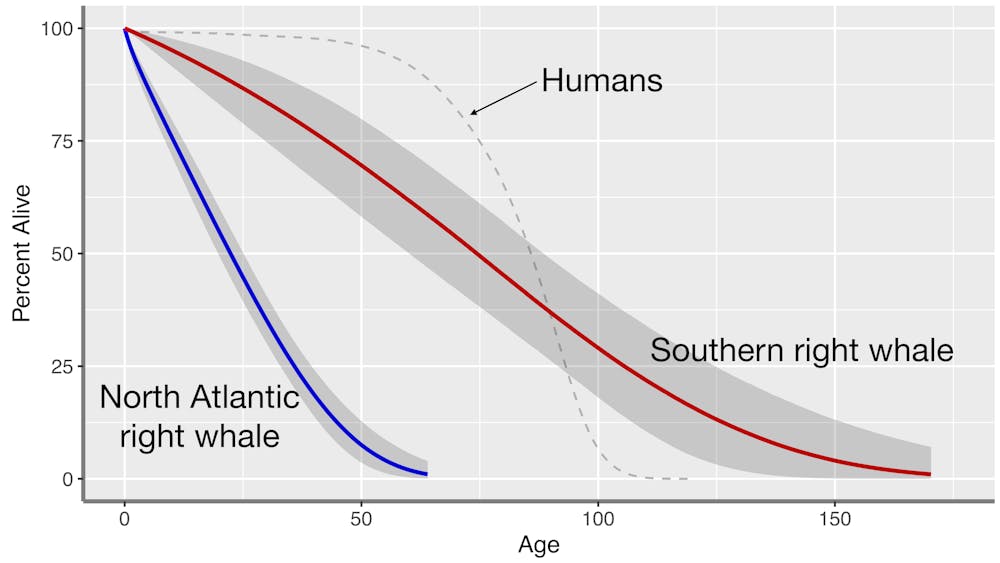
chart illustrating proportion of individuals in two whale species are alive at various ages, with comparison line for people

Survivorship curves show female right whales can live to very old ages, but humans are causing North Atlantic right whales to die well short of their potential. Plotted for comparison is the U.S. survivorship curve for women as estimated by the Social Security Adminstration. Greg Breed

We made these new age estimates using photo identification of individual female whales over several decades. Individual whales can be recognized year after year from photographs. When they die, they stop being photographically “resighted” and disappear. Using these photos, we developed what scientists call “survivorship curves” by estimating the probability whales would disappear from the photographic record as they aged. From these survivorship curves, we could estimate maximum potential lifespans.

Twenty-five years ago, scientists working with Indigenous whale hunters in the Arctic showed that bowhead whales could live up to and even over 200 years. Their evidence included finding stone harpoon points that hadn’t been used since the mid-1800s embedded in the blubber of whales recently killed by traditional whalers. Analysis of proteins from the eyes of hunted whales provided further evidence of their long lifespan. Like right whales, before that analysis, researchers thought bowhead whales lived to about 80 years, and that humans were the mammals that lived the longest.

In the years following that report, scientists tried to figure out what was unique about bowhead whales that allowed them to live so long. But our new analysis of the longevity of two close relatives of bowheads shows that other whale species also have potentially extremely long lives.

Why it matters

Understanding how long wild animals live has major implications for how to best protect them. Animals that have very long lifespans usually reproduce extremely slowly and can go many years between births. Baleen whales’ life history – particularly the age when females start breeding and the interval between calves – is strongly influenced by their potential lifespan. Conservation and management strategies that do not plan accordingly will have a higher chance of failure. This is especially important given the expected impacts of climate disruption.

What still isn’t known

There are many other large whales, including blue, fin, sei, humpback, gray and sperm whales. Like bowhead and right whales, these were also almost wiped out by whaling. Scientists currently assume they live about 80 or 90 years, but that’s what we believed about bowhead and right whales until data proved they can live much longer.

How long can these other whale species live? Industrial whaling, which ended only in the 1960s, removed old whales from the world’s whale populations. Though many whale populations are recovering in number, there hasn’t been enough time for whales born after the end of industrial whaling to become old.

It’s possible, even likely, that many other whale species will also prove to have long lifespans.

What other research is being done

Other research finds the loss of older individuals from populations is a phenomenon occurring

across most large animal species. It diminishes the reproductive potential of many species. Researchers also argue this represents a real loss of culture and wisdom in animals that degrades their potential for survival in the face of changing conditions.

What’s next

We want to better understand how whaling affected the number of old individuals in current whale populations and predict when the number of old individuals will recover to prewhaling levels. Preliminary results suggest it may be another 100 years before whale populations truly recover, even for species whose populations now number as many as there were before whaling.

For North Atlantic right whales, our research shows that even when the population was increasing, the management actions taken were insufficient to prevent these whales from dying far too young.

The Research Brief is a short take on interesting academic work.The Conversation

Greg Breed, Associate Professor of Quantitative Ecology, University of Alaska Fairbanks and Peter Corkeron, Adjunct Senior Research Fellow, Centre for Planetary Health and Food Security, Griffith University

This article is republished from The Conversation under a Creative Commons license. Read the original article.

“Free of corruption”: How a Maine ballot initiative could help get dark money out of politics

The ultra-rich poured more money into the last presidential election than ever before. Tesla founder, X owner and President-elect Donald Trump's right-hand man, Elon Musk, gave $239 million alone to his own Trump-supporting America PAC and in total spent over $250 million to help Trump win. Billionaire Michael Bloomberg donated $50 million to Future Forward PAC, a group supporting the Democratic ticket. Howard Lutnick, a cryptocurrency billionaire whom Trump recently tapped to be Commerce secretary, donated $5 million to MAGA Inc., according to FEC filings

An analysis from the Brennan Center for Justice found that wealthy donors who gave more than $5 million to super PACs supporting Trump and Vice President Kamala Harris donated a combined $864 million in 2024, more than double the amount they gave in 2020. Billionaires across the country opened their wallets to support the candidate of their choosing, a stark reminder of the power special interests hold in American elections.

But in the small state of Maine, home to just over a million people, voters sought to curb that power. On Nov. 5, Maine residents passed Question 1, a ballot initiative that limits the amount an individual or business can donate to a Political Action Committee to $5,000. The law went into effect on Dec. 1, establishing the first-ever limit on the amount an individual or group can donate to a super PAC.

The law was almost immediately the subject of legal challenges that could see the issue end up before the Supreme Court, which will be in a position to either restore governments' ability to curtail the flow of money into politics or cement the power of dark money and the ultra-rich.

“We are entitled to a system that's not only free of corruption, but also a system that is free of the appearance of corruption,” Cara McCormick, leader of the group Citizens to End Super PACs in Maine that led the campaign, told Salon.

The initiative passed with 74% of the vote and the state has been lauded for rejecting dark money’s incredibly vast influence in American politics.

“In a year when special interests flooded our elections with more cash than ever before, Maine voters just delivered a stunning rejection of the big money status quo,” Joshua Lynn, CEO of the non-profit group RepresentUs, said in a statement. “This victory is a testament to the hard work of Maine Citizens to End Super PACs and the other grassroots organizers who worked to make it possible. Taking on big money is no easy task, but the people of Maine made their voices loud and clear.”

Despite nearly three-quarters of voters approving Question 1, the initiative has been criticized by those who argue that political donations are a form of expression, including the Institute for Free Speech, an organization dedicated to protecting First Amendment rights through litigation and advocacy.

In an op-ed for the Portland Herald Press, David Keating, president of the Institute for Free Speech, argued that Question 1 is "unconstitutional" and “counterproductive.”

“By attempting to limit contributions to independent expenditure-only organizations, the proposed Maine measure directly and clearly contradicts our rights as Americans under the First Amendment,” he wrote. “It infringes on our rights to organize into groups and express our opinions on a matter of the utmost public concern – the question of who will run the government.” Keating added that the measure would “obviously lead to less speech and less information for voters” and give “an advantage to incumbent politicians.” 

On Dec. 13, Question 1 was officially challenged by two conservative groups, Dinner Table Action and For Our Future. They argue that super PAC donations are “a vital feature of our democracy.”

“All Americans, not just those running for office, have a fundamental First Amendment right to talk about political campaigns,” the federal lawsuit reads “Their ‘independent expenditures,’ payments that fund political expression by those who are not running for office but nonetheless have something to say about a campaign, are a vital feature of our democracy.”

We need your help to stay independent

The lawsuit names as defendants Maine's attorney general and the Maine Commission on Governmental Ethics and Election Practices, which is reviewing the complaint, the Associated Press reported

Though super PACs have come to define American politics in the last decade, they didn’t exist before 2010. The rules around contributions to political action committees were much stricter: individuals could give no more than $2,500 and corporations and unions were prevented from donating. 

Two court cases in 2010 led to the creation of super PACs and laid the foundation for an electoral system that privileges the rich. First was Citizens United v. FEC, in which a conservative non-profit group, Citizens United, challenged campaign finance rules after the Federal Election Commission prevented it from airing a critical film about Hilary Clinton right before the presidential primaries.

The Supreme Court ruled for Citizens United, establishing that any limit on “independent political spending” from corporations and other groups violates the right to free speech. In other words, groups could now spend as much as they wanted on elections because they were entitled to do so under the First Amendment. 

In a separate case just two months later, Speechnow v. FEC, the U.S. Court of Appeals for the D.C. Circuit decided that if PAC spending could not be limited because of the right to free speech, neither could individual contributions to a PAC. Elites and special interests could donate without limit, blurring the already murky lines between a political campaign and those who finance it.

Campaign spending soon skyrocketed. In 2010, there were 81 super PACs that raised a combined $89 million. Just two years later, 1,261 super PACs raised over $828 million during the 2012 election, an 89% increase. By 2016, super PAC donations topped $1 billion — and this year, super PACs raised a record $5 billion, according to Open Secrets

While super PACs are legally required to disclose their donors, politically active nonprofits that donate to super PACs are not. These groups are often referred to as “dark money” groups, because wealthy special interests can spend as much as they please to exercise political influence while remaining hidden from the public. Many super PACs work closely with dark money groups to conceal the true source of their funding. 

For example, the Future Forward PAC raised nearly $400 million to support the Harris campaign. The PAC received half of that from its “dark money” non-profit arm, Future Forward USA Action. It was later revealed that billionaire Bill Gates quietly made a $50 million donation to the group, though they were not required to disclose this information publicly. 

In an interview with Salon, Harvard University law professor Lawrence Lessig said super PAC funding has fundamentally altered the way political candidates can run their campaigns. If a candidate is funded predominantly by super PAC money, they will inherently be cautious about what they say so as not to upset their funders, Lessig said. 

Harris, Lessig argued, “was very cautious about talking about issues that might upset super PACs that were funding her.”

“She wasn't able to talk about issues in a way that would inspire the working class, because, surprise, surprise, the issues that inspire the working class are not the issues the super PACs are keen to support,” he added.

Super PACs have allowed just a handful of elites to sway American politics, which has led to a trail of corruption and conflicting interests, Lessig argued.

“This incredibly small number of people have an extraordinary veto power over the ability of politicians or legislators to do what they want to do. And that dynamic — this concentrated veto power — is the thing that I think is the corrupting influence here,” he said.


Want a daily wrap-up of all the news and commentary Salon has to offer? Subscribe to our morning newsletter, Crash Course.


Lessig has spent much of the last 10 years fighting the corrupt nature of super PACs, which he says were formed only because of a “legal error” made in the 2010 ruling of Speechnow v. FEC. When the D.C. Circuit ruled that contributions to independent spending committees could not be regulated, they did so on the grounds that PAC contributions “cannot corrupt or create the appearance of corruption.” In other words, it was not possible for donors to bribed by politicians in exchange for contributions.

But in 2015, former U.S. Sen. Robert Menendez, D-NJ., was criminally charged for offering official favors to a Florida doctor in exchange for contributing to Menendez’s PAC, showing that PAC contributions could in fact be corrupt. Lessig believes this case invalidates the Supreme Court’s reasoning. He has long argued that if SCOTUS ever reviews the case, it will correct this ruling, restoring both states and the federal government the power to limit contributions.

“That question has not been presented, and I've been working in a lot of contexts to try to tee it up, to get it presented, and we've not been able to get it to the court. The Maine initiative is an enormous opportunity,” Lessig said.

For McCormick, the legal challenges facing Question 1 are daunting, but she knows the outcome could be worth it.

“If you get challenged and then you win, that is the Holy Grail, right?” McCormick said.

Though the initiative faces a long road to the nation’s top court and may not be upheld when it gets there, both McCormick and Lessig said Question 1's overwhelming support shows that voters care about dark money in politics and, when given the chance, they want change. 

“The strength of our citizen democracy is real, right? We believe that we have the agency to fix something that's broken,” McCormick said.  

Morning briefing

Donald Trump, your bold recent comments about Canada becoming the 51st State, American acquisition of Greenland, and the reacquisition of the Panama Canal Zone have received a lot of attention and applause from your supporters, although Senators and Members of Congress have not yet gotten in step. We’ve had the usual pushback from outside the country that we thought you would want to be aware of as you and your close advisors frame a strategy to bring your plans to fruition. Here’s a summary of the diplomatic notes and intelligence reports that have come in:

The Danish Foreign Minister had already commented on your plan for Greenland, but his latest communiqué for some reason refers to the Virgin Islands (St. Thomas, St. John, and St. Croix). As you may recall, we bought them from Denmark in 1917 for $25 million. The Foreign Minister says they would like the islands back, and offered to refund our money.

Panama was very upset by your demand for return of the Canal Zone, but now we’ve heard from Colombia. You may not have taken the history fully into account, but we basically severed what is now Panama from Colombia in order to dig the Canal. Colombia wants Panama back, Canal and all.

We’ve also heard from the Spanish government. In light of your plans for Canada, the Canal Zone, and Greenland, they were thinking it would be a friendly gesture if we were to turn Guam and Puerto Rico back over to Spain, since, as you no doubt recall, we acquired them under the 1898 Treaty of Paris that ended the Spanish-American War. “Forget the Maine.”

President Emmanuel Macron has sent a communiqué concerning the Louisiana Purchase. He proposes to send us back the $3 million Thomas Jefferson paid for it in 1803. This could be sensitive politically since there is a great deal of support for you in the States that were carved out of French Louisiana.

We need your help to stay independent

Speaking of purchases, our embassy in Mexico City reports that the government of President Claudia Sheinbaum is quietly preparing a demand for rescission of the 1853-54 Gadsden Purchase (with a refund of our $10 million). If we accede to such an outrageous demand, you’ll lose some supporters in Arizona and New Mexico. Worse yet, they’ll also certainly demand abrogation of the Treaty of Guadalupe Hidalgo (1848). It’ll be well worth the $15 million refund we’d have to give to be finished with Gavin Newsom and all those Democrats in California. On the other hand, we’ll also have to give up Texas and all or part of several other red states.

Word of these shocking demands seems to be spreading. We can probably ignore a threatened Dutch demand for what is now New York; after all, they got it by treaty from Great Britain, so let them talk to London. Somewhat more troublesome may be the message that just came in from Moscow. Something about Alaska and a $7.2 million refund.

We’ll prepare appropriate instructions for the State Department. What should we say?


Want a daily wrap-up of all the news and commentary Salon has to offer? Subscribe to our morning newsletter, Crash Course.


Tradwives, incels and cat ladies: The year MAGA broke heterosexuality

Fellas, is it gay to give your wife an orgasm? More than five decades after the publication of "The Joy of Sex," one would think this was a settled question, but alongside the measles and poop-laced milk, the MAGA movement is bringing back sexual dysfunction as part of their dubious vision of a "great" America. In what may be the most "2024" clip of the year, MAGA-capped influencer Josiah Moody called it "gay" to have sex with a woman for pleasure, arguing the "best part about having sex is reproduction" and sneering at people who "just have an orgasm." 

"No gay sex with women, guys," the progressive host, Luke Beasley, responded. Missing Beasley's sarcasm, Moody replied, "Very true. I agree."

Moody's earnestness is funny, but it's not like his attitude is all that different from that of his hero, Donald Trump. The president-elect is infamously a cad, but as the court testimony of Stormy Daniels made clear, he has no concern about the experience of any woman unfortunate enough to be alone with him. As both E. Jean  Carroll's testimony and Trump's deposition in his civil rape trial show, Trump sees sex as a zero-sum encounter where a man's pleasure comes at the expense of a woman's trauma. Whether the point is joyless impregnation or a woman's humiliation, the common theme is that hetero-sex isn't about mutual satisfaction, but conquest. 

Despite these ugly attitudes from Trump and his supporters, in the past few months, there's been a deluge of pundits expressing confusion and outrage at straight women who conclude that it's better to be single than waste your one precious life dating — much less marrying — conservative men. Trump's running mate, Sen. JD Vance of Ohio, famously and repeatedly insisted that such women are "miserable cat ladies," even though it's self-evident that cats make better company than MAGA men. Even the Washington Post editorial board got involved, calling on women to "compromise" by marrying Trump voters. 


Want more Amanda Marcotte on politics? Subscribe to her newsletter Standing Room Only.


In 2024, women increasingly responded to these pressures with a "no thank you," though often phrased less politely. After Trump won the election, there was even a spike in interest in the South Korean "4b" movement, where women quit dating, marrying, or having children with men. In truth, this idea was more aspirational than realistic, but the discourse mattered nonetheless. It created space for women to ask the question: Why should they sacrifice their happiness to save the institution of heterosexuality? 

Despite being led by a thrice-divorced chronic adulterer, the MAGA movement is downright obsessed with heterosexual marriage. The relentless drumbeat of Vance's quotes attacking single women existed because he spends so much time in right-wing media spaces, where getting everyone married off — ideally to an opposite-sex partner — is a singular obsession. And yet the model of heterosexuality promoted in the MAGA world is demoralizing. It seems joyless and sad, especially for women. The right's sales pitch for straightness is so gross that it backfires. 

The model of heterosexuality pushed from every corner by conservative media looks oppressive for women and frankly kind of sad for men.

Social media right now is an ocean of would-be propaganda for traditional heterosexual marriage. There are "tradwives," who cosplay submissive housewives on platforms like TikTok and Instagram. They overlap with "family vloggers," typically conservative Christians with large families who chronicle their daily lives online. The world of Christian right content online is far more interested in the maintenance and promotion of the patriarchal nuclear family than, say, the life of Jesus Christ, who died as one of those "childless cat ladies" Vance hates so much. Billionaire Peter Thiel has even funded a woman's magazine, meant to compete with Vogue or Cosmopolitan, that positions extremely conservative marriage as the only true path for women's lives. 

Despite the glossy and often expensive aesthetics of this content, however, the model of marriage on display is alienating, especially to women. Take a recent video by Paul and Morgan Olliges, who describe themselves as "Christian YouTubers" who are "Getting Real & Having Fun" to their 160,000 YouTube subscribers. In it, the couple showcases the events of a week where Morgan confesses she barely sleeps, having been relegated to the baby's room so Paul can be fully rested for his pickleball tournament. We see that she is run ragged and emotionally raw from endless domestic labor, while he films himself hitting the gym and bragging about how many smoothies he can drink. They claim the goal of showing this disparity is to "get real," i.e. be relatable for the audience. The actual effect can be seen in comments, where people said things like, "This is a reminder that someone can be an absent father even if they're technically 'there.'"

Last week, Fortesa Latifi at Rolling Stone reported on how much, if not the majority, of viewership for family vloggers is now the hate watchers. They watch these videos and then complain about them together in other social media spaces like Reddit. That could sound petty, but as I reported earlier this year, many content creators and online forums are doing something more interesting: using "trad" content to promote progressive, feminist values. By mocking "tradwives" or vloggers like the Olliges, these creators are using humor and online conflict as bait to promote their ideals of equality and argue that traditional gender roles create resentment that is the antithesis of love. 

On some level, it appears that MAGA leaders and messengers understand that their vision of heterosexual life is not persuasive to women, which is why they often start entertaining the use of force. Abortion bans are the most overt example of how Republicans are fighting to deny women the ability to walk away from relationships that aren't serving them. In Texas, the abortion ban allows people to sue anyone who helped a woman abort a pregnancy. The law is being used almost exclusively by men who are trying to punish ex-girlfriends or ex-wives for leaving them. Some in the MAGA movement don't think that goes far enough and are floating the idea of ending laws that allow women to divorce without having to prove to a judge her reasons for leaving are "good" enough. Unsurprisingly, Vance has been at the forefront of this, arguing that women should even stay in "even violent" marriages

But MAGA leaders aren't just interested in legal force to trap women in marriage. Social shaming is a major tool, as well. That's what Vance is doing with his endless "cat lady" quotes, trying to insult women into settling for unhappy marriages. The whole "incel" phenomenon is part of this, as well, as it rests on the assumption that women have a duty to soothe and placate men with sex, and men are deprived of their rights if this isn't happening. Shamefully, many centrist publications have glomed on to the idea that women are obliged to be in relationships with men for the betterment of society. "Women also must take this opportunity to bring men along with us," scolded Kami Rieck at the New York Times, in a column castigating women who are feeling demoralized about dating men. Elizabeth Bruenig claimed it's "a gift to the right" and "self-defeating"  for liberal women to be hesitant to date men when so many of them are Trump voters.

We need your help to stay independent

This fantasy that women can liberalize men through the power of sex is belied, however, by what MAGA creators themselves are showing the world about marriage, which they portray as an institution where the woman submits herself to a man — which includes letting him be the boss on political ideology. We can see women's skepticism in the population data. Nearly half American women are unmarried. Among single people, 61% of men are actively trying to date, but only 38% of women say the same. "Heteropessimism" has arisen as a term to describe the widespread fear that straight people, especially women, have that it may be impossible to be happy in a straight relationship.

I don't personally feel that way, to be clear. My straight male partner is a feminist and no, I didn't convert him by manipulating him sexually. (I wish I were so alluring!) Feminist men may not be the majority, but they are more numerous than one would think, after reading articles instructing women to suck it up and marry a Trumper. But with the flood of "manfluencers" and "tradwives" and family vloggers out there, I get why women would feel down on straight marriages. The model of heterosexuality pushed from every corner by conservative media looks oppressive for women and frankly kind of sad for men. They may get free housework out of it, but at the cost of something way better: to be in love with someone you actually like and respect. And not having to worry if your wife's orgasm makes you gay.


Were you bad with money this year? You’re not alone

Nadia Vanderhall made some money missteps in her early adulthood that compounded and reverberated for years. Young and out of college, she accepted a low-paying customer service job without negotiating her salary. She didn’t understand how her 401(k) worked or how much she could contribute.

The final blow came when she got laid off with only two weeks’ pay, then suffered through a three-month backlog of unemployment claims as her bank account dwindled. Finally, Vanderhall raided her retirement funds — less than $10,000 — adding tax penalties to her already dire situation. But really, none of it was her fault. You don’t know what you don’t know, and her parents were unable to teach her because they didn’t have that knowledge, either.

“I learned from it, and honestly, that was the time where I took the notion to understand money, figure out how money works, understand what I did and how to course correct,” she said. “And then, when I did get my job at a major corporation, I went from making $10.71 on the hour to six figures.”

That was several years ago, and now Vanderhall coaches people on how to live within their means, save, invest and give. She won’t have to look far for clients: A new Harris Poll for Credit Karma reveals that 70% of Americans have financial regrets this year, largely because they didn’t save money. When you single out the Gen Z respondents, the number shoots up to 86%. More than half of all the respondents will carry debt into 2025.

Purchasing pitfalls

Housing, food, transportation, childcare and other necessities take up a chunk of most people’s budgets. Stir some social media into the pot, and folks spend even more as they strive to participate in lifestyle theater. The study also found that nearly half of Gen Z and 40% of millennials were prompted to needlessly buy items after following trends on social media. The top look this year, ironically, is “Old Money,” a fashion trend that emphasizes expensive, quality pieces and classic styles — not so much head-to-toe logos, but more tailored blazers, preppy vibes and subdued hues.

We need your help to stay independent

Among social media users, a whopping 79% of Gen Z and 70% of millennials have made impulse “hype purchases” of skincare and makeup, wellness products, electronics, alcohol, tickets, home décor, clothing and travel solely because a celebrity or influencer — usually compensated for leveraging their platform — encouraged them to. After the thrill of purchasing, most of those folks (81% and 80%, respectively) regretted spending the money.

Vanderhall’s weakness, she said, was the “it’s on sale and I deserve to treat myself” combo that drained funds she could have used during her unemployment.

From regret to reform

Nearly three-quarters of survey respondents were hopeful they can commit to better financial habits once the calendar flips to 2025. They want to save more, stop impulse buying, improve their credit and shore up an emergency fund.

"Even if you do not have three to six months of savings, having some is better than having none"

The best way to make a change, though, is to understand what went wrong in the first place and the steps to take toward success. Do you need to get a roommate? A side hustle? Cut back unnecessary spending or up your rates? It’s easy to find advice about money, but harder to follow it, especially if you’re working with little or none. Vanderhall used her down time to research how to be better with money. A recruiter taught her how to negotiate her starting salary and what to ask for. She then had the fortune to work with a manager at her new job who taught her even more.

Vanderhall’s company, the Brands and Bands Strategy Group, is born from her experience and tailored for people who don’t have the funds to hire a high-cost advisor. One of the first things she teaches her clients is to plan for the worst-case scenario: “Even if you do not have three to six months of savings, having some is better than having none.”

She also teaches folks about negotiating severance, what to do if unemployment runs out and how to think about plans B, C and D when plan A doesn’t materialize.  

Being nonjudgmental is important in the process, she said, as is understanding the root cause of money trouble. “Behavior finance has helped me determine why I did what I did, giving myself grace, but also understanding how to go about in a different way.”

“Squid Game 2” fittingly plays a different and still very relevant game for its return

Before Elon Musk effectively bought an American presidency, he mounted a hostile takeover of the attention economy. His initial bulk acquisitions were achieved by spreading misinformation, anger and fear to millions on his social media platform in exchange for their loyalty.

He simultaneously conned those he could reach using the Internet into believing his brain functions on a higher level than most people, persuading media entities with massive platforms to promote his illusion of genius. If it worked for a former NBC game show host, why not a guy who was invited to host “Saturday Night Live”?

“Squid Game” is a giant metaphor portraying the way late-stage capitalism siphons the labor, life force and health of the masses into the coffers of the rich.

All this preceded the individual investments made in the days leading up to Nov.  5, when Musk dangled $1 million giveaways to MAGA voters in swing states who signed a petition he claims was dedicated to protecting freedom of speech and the right to bear arms. That yielded dividends in the form of awestruck, worshipful fan posts on X and fawning coverage by right-wing news outlets.

If you’re wondering how this is relevant to “Squid Game,” you either haven’t watched Season 1 or, equally as likely, missed the point director Hwang Dong-hyuk was trying to make.

Considering the violent deadly spectacle of the playground games with lethal consequences for losers and the twisted playhouse sets joined by a layered puzzle of staircases, that’s not hard to do.

The dominance of pink jumpsuits with black fencing helmets that following Halloween, along with green tracksuits and bedazzled animal heads, was a clue that many of us took away the wrong message. (Further proving this was the excitement that met the news of Netflix’s reality competition spinoff “Squid Game: The Challenge.”)

Some might even view Seong Gi-hun’s (Emmy winner Lee Jung-jae) transformation from a bowing and scraping, deeply indebted failure into a hardened champion, Player 456, as a Darwinian success story. Those are very popular these days. Extreme partisanship encourages that mode of thinking.

“Squid Game” is a giant metaphor portraying the way late-stage capitalism siphons the labor, life force and health of the masses into the coffers of the rich — and worse, how we’re willing to play the games the wealthy rig in their favor, even if it disadvantages other people like us.

To Gi-hun, so much winning is nothing to be celebrated. Some might spin his victory as evidence he’s better than people he outlived, including his childhood friend Sang-woo (Park Hae-soo). Gi-hun views it as the warped outcome of a system designed to relegate increasing numbers of people to a permanent state of indebtedness and poverty.

That moral is glaringly apparent in the second season, coming to us at a time when autocracies propped up by the obscenely rich are rising to power in multiple countries. The name of the world’s richest man isn’t uttered in this show, but the opening episode’s title, “Bread and Lottery,” is a synchronous acknowledgment that our present climate makes its fictional horrors possible.

“Squid Game” was a massive global success for Netflix, and there’s no reason to doubt “Squid Game 2” won’t command similar levels of worldwide attention. (Netflix is placing its bets on that, announcing this week a raft of branded partnerships with fast food chains and gaming platforms that’ll surround us with circles, triangles and squares long after the last Christmas lights are unplugged.)

Squid GameSquid Game (Netflix)This time Hwang needn’t linger too much on the games themselves, instead cutting more deeply into the psychology driving desperate people to wager their lives on a chance for easy money. This describes the players and the faceless underlings coldly murdering strangers and begging for their lives. They have their stories too.

Some of those foot soldiers were once on the other side of the barrel, and for reasons that at least one explains, decided it’s more lucrative to serve these masters than cash out their 456 billion won (around $314.3 million) and jet off to a new life.

The oligarchs behind the curtain expect Gi-hun to do exactly that. Instead, he returns to Seoul and embarks on a mission to stop the game – if not by exposing it, then by force. Where the first season thrilled by setting personal drama within a meat grinder, “Squid Game 2” follows the structure of an action movie. Not just any action movie either — the sinister leader of the cabal Gi-hun sets himself against likens his vengeance quest to the central choice in “The Matrix.”  They could have taken the blue pill and lived in peace but instead they still chose the red pill, he says of Neo and rest, to play the heroes.

“Do you think you’re a hero who can change the world?” he asks tauntingly.

Gi-hun has dropped off the grid and is gathering the strength to take on the game’s makers, primarily the mysterious black-masked Front Man (Lee Byung-hun ) speaking for all the overlords. If he can’t take them down from the outside, he vows to chew apart their kingdom from within.

We need your help to stay independent

But the first season finale also reveals the Front Man is the lost brother sought by a secondary hero, police officer Hwang Jun-ho (Wi Ha-joon). This twist held a deeper meaning for some viewers than others. People familiar with Korean culture and history may have viewed the cliffside confrontation between Jun-ho and Lee’s In-ho as symbolic of the reality lived by families split by the border between North and South Korea, as author Marie Myung-Ok Lee explains in her 2021 story.

Squid GameSquid Game (Netflix)For others, the scene is a culmination of a subplot built around a character that boils down to a fly in the lair’s vents letting us tag along as he infiltrates control rooms, hallways and spaces that reveal the hive of worker drones running the place, including the ones siphoning organs off the fallen to sell on the black market.

Whatever contributed to the shallowness with which Wi’s character and others were written before is somewhat ameliorated in the second season. Less burdened with nurturing the tension of the functional premise of the game, Hwang puts aside writing a cluster of dramatic types to surround Lee and Wi to build memorable portraits.

One that garnered plenty of coverage is the choice to cast Park Sung-hoon, a cis male actor, to pla a trans woman named Hyun-ju who joins the game for the chance to fund her “gender-affirming surgery,” as Netflix’s notes describe the role. Hwang writes Hyun-ju as much more than this reductive explanation, and Park’s performance is thoughtful and affecting.

Even so, aside from the potentially harmful messaging communicated by this casting at a time when trans people and drag performers are under assault, Hwang also tumbles into the trope of making the most marginalized person in the story super-duper extraordinary.

More endearing are the connections she and others make as a matter of survival, but also because they aren’t entirely heartless. Kang Ae-sim and Yang Dong-geun portray an elderly woman and her failson who enter the tourney to erase his mountainous debt.  The pairing could have been written as another cliché but Kang’s Jang Geum-ja is the kind of survivor that, in the real world, would have helped thwart a president’s attempted coup.

Squid GameSquid Game (Netflix)Wi gets to exercise a bit more command in his role similar to Gi-hun’s graduation to brooding savior – not that we’re complaining, Lee makes it look good on him. It’s an essential note in a chapter that both preaches mass resistance and cautions us that the obstacles to successfully upending an unjust system that preys on the poor and middle class are . . . us. As in, fellow members of the 99% who buy into the fantasy that the hyper-wealthy people are somehow more deserving of a good life than the rest of us.

“Squid Game 2” becomes a life-sized dollhouse collection of the modern era’s destructive vanities.

This season’s miserably indebted is a gallery of overconfident consumers, ranging from a hip-hop artist with an overinflated sense of his fame (played with sinister verve by Korean rap star Choi Seung-hyun, aka BigBang’s T.O.P.) to a cryptocurrency huckster, from a businessman who borrows against his overconfidence to a young man eager to play soldier. Each episode allows us to get to know more about them beyond a few quirks or twirls of the figurative mustache. But they and others are developed amply enough to give their performers something to sink their teeth into. Even Gong Yoo makes the most of his limited screen time as The Recruiter by playing him as shockingly demonic.

Through their stories, “Squid Game 2” becomes a life-sized dollhouse collection of the modern era’s destructive vanities. Contestants primp and pose for what they think will be selfies, never suspecting that to those running the game, they’re just a face and a number.

Their greed leads them to accept the Masked Officer’s cajoling by referring to the death matches as “keep[ing] the door open” for them “to pursue new opportunities,” as if he’s an HR manager as opposed to a guy with a gun.

One figure wins over followers by placing the fear of god into them, a reliable instrument in the autocrat’s toolbox.

And despite all the ways Gi-hun tries to warn and rally them, as well as the evidence gained by experience, a sizable number of contestants refuse to believe anything terrible can happen to them.

As before, the contestants can vote on whether to keep playing or leave. The twist this season is that they have the chance to vote after each round of play, creating more tension as factions rise and alliances switch. But even after other people have been blown apart in front of them, there remain those who counter the reasonable suggestion to go home to a bowl of beef noodles with the insistence that they’d rather risk their lives for a shot at affording a herd of cattle.

Hwang writes other critiques into these seven episodes, some of which try to have it both ways. There comes a point at which Gi-hun needs Jun-ho, who shares his aim to take down the game, but one of the main characters often points out how the cops aren’t to be trusted. (It’s no accident that In-ho, the Front Man, once worked in law enforcement.) Military experience is an asset in this doomed class of players, and the same is true of the killers wearing those pink jumpsuits.

It’s also integral to the season’s climax, although Hwang writes his way to and through it in a way that drops us – instead of Jun-ho – off a cliff.

Maybe that’s only confusing if you don’t know that “Squid Game” is already set for a third season. When those episodes arrive is as much of an unknown as the shape we’ll be in by then. Bleak as that thought is, it might also be reassuring if you love this show. As one character puts it, “The game will not end unless the world changes.” It doesn’t look like that’s happening any time soon.

“Squid Game 2” streams Thursday, Dec. 26 on Netflix.

The year’s most disturbing nudity in film

Celebrity skin on screen was more uncomfortable than titillating this year – as if actors displaying their bodies did not want to be in those bodies. Yet that was exactly why they held such power and fascination. It was not ogling nudity that excited audiences, it was seeing someone put on a mask or take one off and be (or become) their true selves — a rebirth as it were, literally, and in many films, figuratively.

The year in nudity was all about shedding skin and physical transformation. There were fetishes and fluids. There were masks and masochism. Things were more icky than erotic. 

And while cinema and actors have become more comfortable with showing full nudity, many of the frontal shots this year — along with one particular rear view — were disturbing. These vivid, visceral images conveyed so much meaning about how we see our bodies and how we think others see our bodies. It is self-examination coupled with voyeurism, that affected the viewer more than any mere turn-on.

The nudity in this year’s crop of films is mostly unglamorous, which may be why viewers can relate to them. We see ourselves in their skin. These characters are damaged, and in pain — sometimes physically, always emotionally. As they open up, and bare themselves, they reveal their imperfections. It was impossible to look away.

01
"A Different Man"
A Different ManA Different Man (A24)
Sebastian Stan goes full-frontal (again) for “A Different Man” in a scene that sends layered messages and elicits mixed emotions. Edward (Stan) has neurofibromatosis, but he takes a secret drug that removes his disfigurement. After he figuratively kills off Edward's identity and reinvents himself as Guy, he reconnects with his former neighbor, Ingrid (Renate Reinsve) when he is cast in her play about her friendship with Edward. As they become intimate, she asks him to wear Edward’s face mask during sex. The shot of Guy with Edward’s visage while fully naked speaks volumes about how each character is attracted/repulsed by disfigurement. It’s a potent image, neither seductive nor sensationalized, though perhaps it is actually both; Ingrid’s attraction is Guy’s shame. “A Different Man” is asking viewers to look, think and feel differently about ourselves. The film warns us that changing how we look does not change who we are.
02
"Firebrand"
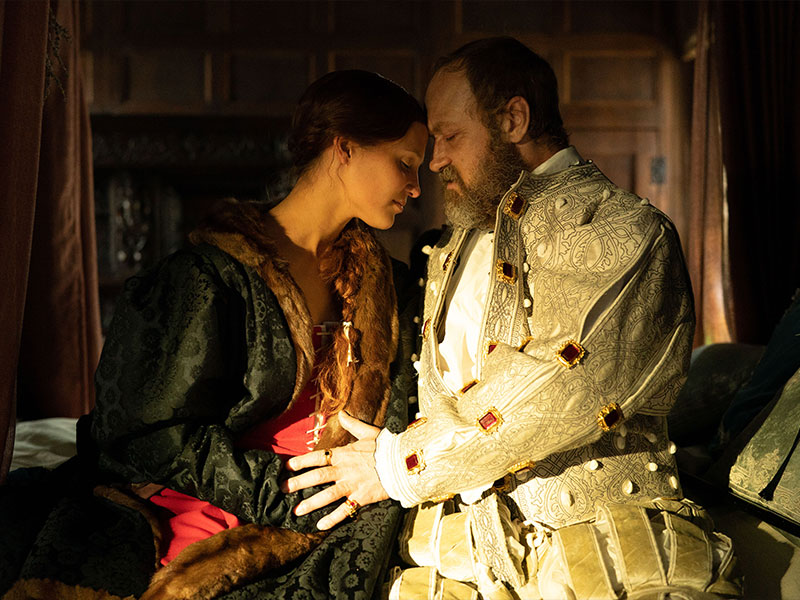
FirebrandJude Law and Alicia Vikander in "Firebrand" (Larry Horricks/MetFilm Distribution)

In “Firebrand,” Jude Law plays Henry VIII in the last years of his life as an outsized monster who bulldozes his way through the film, rotting, smelling and generally misbehaving. He’s abusive towards his wife Katherine Parr (Alicia Vikander), both physically and mentally. But perhaps the most egregious and discussed (or disgust-ing) offense is Law’s nude scene. This is a brief, but can’t-unsee-it image of his bare buttocks as he thrusts himself upon Katherine in a sex scene that many wags on Letterboxd described as a jump scare. Law’s butt double was eventually exposed as being Dale Farrow (a non-actor), but it is still one of the more visceral shots in this forceful drama about the epitome of toxic masculinity.
03
"High Tide"
High TideHigh Tide (LD Entertainment)
Lourenço (Marco Pigossi), the protagonist of this tender character study, is first seen stripping off his clothes on a beach in Provincetown and floating in the water. Director Marco Calvani (Pigossi’s real-life husband) shoots this from a God’s eye point of view, emphasizing not only how small Lourenço is in the world, but also to suggest that he is being baptized and cleansed — experiencing a kind of rebirth after a series of difficult and demoralizing episodes. “High Tide” shows what prompted Lourenço to spiral downward at this moment. It includes the heartbreak of a failed relationship and bad sex with strangers. Lourenço bares his body if not his soul as he tries to find his self-worth. The handsome Pigossi's frequent nudity is his attempt to find comfort in his own skin. When he reluctantly strips down to go skinny-dipping with some friends he meets, he plucks up the courage to embrace his flaws and find comfort in his discomfort. It may be his best way to heal.
Love Lies BleedingLove Lies Bleeding (A24)
This romantic thriller also deals in female bodily transformation as Jackie (Katy O’Brian) enters the gym where Lou (Kristen Stewart) works, to prepare for a bodybuilding competition. Lou finds Jackie alluring and offers her drugs to enhance her efforts, indicating, “Your body, your choice,” before she injects Jackie in her bottom. Jackie and Lou become romantically and sexually intimate, leading to some sweaty naked sex and even some shrimping (toe sucking). But as Jackie’s body get bigger — one montage features her biceps literally bulging — director Rose Glass showcases it with a kind of strange fascination. Jackie becomes superhuman, even oversized in one fantastic (as in great, as in wild) episode. But the most remarkable scene has Jackie competing on stage performing her routine only to be arrested by a bloody, hallucinatory vision in which she vomits — and out pops Lou. The surreal horror of this moment, which calls back to an earlier crime Jackie committed, leaves her feeling very exposed in ways that even her skimpy bikini outfit cannot hide.

We need your help to stay independent

NosferatuLily-Rose Depp stars as Ellen Hutter in "Nosferatu" (Focus Features)

Robert Eggers’ stylized take on Count Orlok includes naked virgins and a nude man on a septagram. Yet this is not a sensuous version of Bram Stoker’s most famous work, unlike, say, “Andy Warhol’s Dracula.” Eggers is using sex and death as a metaphor for our fears, and the scenes of a naked Count Orlok terrorizing the living and the undead emphasize the film’s body horror. There are some particularly gruesome moments when the Count is disturbed in his coffin. He rises fully nude and attacks — sucking the blood from one victim in a scene that is quite disturbing. Eggers shoots it all with atmospheric lighting and music to create true Gothic terror. He makes the experience cinematic, not sexual. A later sequence features Count Orlok having sex with Ellen Hutter (Lily-Rose Depp), and Eggers emphasizes his grotesque, deformed body penetrating her, with blood being spilled all over their naked bodies. It is creepy and squirm-inducing as it depicts a power struggle between good and evil. The white purity and the darkness are heightened by the luminous cinematography. The nudity in “Nosferatu” results from those who are spellbound, and Eggers makes it spellbinding with his rich and provocative visuals.  
06
QueerQueer (A24)
"Queer" may feature alluring naked men as sexual partners, but there also some disturbing visuals, such as one vivid shot of a nude woman, cut off at the legs with a needle in her arm during one of Lee’s (Daniel Craig) fever dreams. The woman asks, “Aren’t you queer?” suggesting that Lee should not be imagining her. The film includes other trippy sequences — also far more sensuous — of Lee and Allerton (Drew Starkey) hallucinating with their naked bodies pressing against and away from each other in a kind of pas de deux that suggest both their attraction and repulsion. Director Luca Guadagnino emphasizes both the complicated desire between these men, and the messiness of their sex. The film’s nudity is candid — when Allerton answers the door naked, it is as much a tease as it is an invitation. But it is the longing Lee has throughout the film that reflects the emptiness of his sex and drug addiction. Naked and face down on a bed, spent after sex, he feels nothing. And Craig’s astonishing performance allows viewers to feel everything.
07
"Rebel Moon"
Rebel MoonEd Skrein in “Rebel Moon” (Netflix)
It is curious why the women being branded in Zack Synder’s space opera “Rebel Moonhave to be completely naked and disfigured, but this two-part sci-fi epic raises more questions when it comes to Admiral Atticus Noble (Ed Skrein) and his nude scenes. Skrein is seen naked with snakes clinging to his arms and portals on his chest that allow for cables (and snakes) to attach to his body. He even swallows one snake, which is bizarrely homoerotic. Noble is unselfconsciously naked, proudly displaying himself to his underling, Cassius (Alfonso Herrera). Noble wants to be looked at because he commands power. But he is mostly powerless; his nudity here is a façade. When Noble needs to be resurrected after possible death, a series of illuminated cables and portals connect him to a neurolink, and he is submerged naked into water where astral energy is used to revive him. Emerging from a chrysalis, he is reborn, but he has not changed. Skrein’s nudity is mostly discreet — seen from the side, with rear views visible in the director’s cut, but never any full frontals. Snyder films these episodes clinically, showing how Noble’s character is vulnerable and powerless. The tubes, water and electrical charges can transform him only so much, and like Cassius, we watch in disgust, knowing the emperor has no clothes.
08
"Sasquatch Sunset"
Sasquatch SunsetSasquatch Sunset (Bleecker Street)
Bigfoot may not exist, but “Sasquatch Sunset” makes the case that if these cryptids were real, they would be horny AF. David and Nathan Zellner’s film, which is shot in a deliberately observational, nature documentary style, opens with a scene of Sasquatch sex (the male even cleans himself off with leaves after mating), and features several episodes involving arousal — one involving a predator, which practically defines the term “unsafe sex.” But there are also deliberate shots of a Sasquatch’s genitalia (seen while the character is vomiting, no less), moments where the characters are marking their territory with urine, and a scene of childbirth that is infinitely better than Florence Pugh’s character having a baby in “We Live in Time.” “Sasquatch Sunset” displays nudity as natural, but it is rarely comforting. Perhaps that is the point. We are all sexy beasts.
The SubstanceThe Substance (Mubi)
Demi Moore gives a bravura performance (arguably the year’s finest) as Elisabeth Sparkle in this stunning film about a woman of a certain age craving youth and beauty. But her extended unclothed scene in a bathroom, where she “births” a “younger, better self,” Sue (Margaret Qualley), after injecting the titular substance is one of the year’s best and most memorable nude scenes. It is not just that the 62-year-old Moore displays full-frontal nudity (as does her younger costar, Qualley) but that the film shows the flaws and features of their bodies. These women are idealized and objectified by the camera, while also being highly self-critical of their appearances. The actresses admire their looks — it defines who they are — as much as they like being looked at. (Note the framed photo of Elisabeth hanging on a wall of her apartment opposite a window where Sue is seen on a billboard.) Director Coralie Fargeat photographs these women in ways that flatter and fetishize them. (A man could never have made this film). But her camera is a mirror reflecting their false perfection back at us, showing viewers how superficial we really are. The nudity here is a symbol of power and vulnerability, especially in the final reel. And it is both shocking and breathtaking.
10
"That Feeling That the Time for Doing Something Has Passed"
That Feeling That The Time For Doing Something Has PassedThat Feeling That The Time For Doing Something Has Passed (Magnolia Pictures)

It is always interesting when a filmmaker appears naked, repeatedly, throughout their own film. In her feature debut, “The Feeling That the Time for Doing Something Has Passed,writer/director and editor Joanna Arrow stars as Ann, a submissive whose master is Allen (Scott Cohen). She's first seen lying fully nude in bed with him and soon humps his sleeping body. “I love how you don’t do anything for me,” she intones, indicating the nature of their relationship, and providing a sense of the film’s dry, deadpan humor. She begs him to tell her what to do, and in various sessions, he instructs her to run to the wall naked or “bend over and spread her cheeks.” He even gags her in one scene. These moments showcase Ann’s submission, but in Arrow’s idiosyncratic drama, this is a sign of her strength and control. Arrow’s poker-faced performance and her extensive full nudity is an expression of her confidence. The perceived abuse here is desired and consensual, which is what makes it compelling. Moreover, the shots in “The Feeling That the Time for Doing Something Has Passed,” while artfully composed, are as flat and unaffected as the dialogue. Unlike the glossy “Babygirl,” this year’s other BDSM drama, Arrow’s film has a detached tone that will get on viewers’ nerves, if not under their skin.

“Wicked” has a sing-along version you can now annoy your family with at home

The wait is over. "Wicked" is coming to homes with a bonus sing-along version.

Before the year's end, the Golden Globe-nominated movie musical adaptation directed by Jon M. Chu will find there's no place like home. Families can now endlessly rewatch the triumphs and tribulations of two unlikely friends: social outcast Elphaba (Cynthia Erivo) and popular Glinda (Ariana Grande) at Shiz University in the whimsical world of Oz. 

Universal Pictures announced Thursday that the movie will be available on digital platforms on New Year's Eve, Dec. 31. The Blu-ray and DVD versions of the movie will also be available to purchase on Feb. 4.

Among the bonus features are a sing-along version, a 40-minute behind-the-scenes featurette on the onscreen magic to create Oz, and deleted and extended scenes.

Many have sung along to "Wicked" in theaters at specific sing-along screenings across the country. However, some have also begun breaking out in song during regular screenings of the movie, leading to some pushback from annoyed audience members.

Last month, AMC Theaters issued a new advisory to prohibit singing during the musical. The warning stated, "No talking. No texting. No singing. No wailing. No flirting. And absolutely no name-calling. Enjoy the magic of movies." 

“Dire shortage”: Elon Musk sparks MAGA backlash after calling for more immigrant workers

Billionaire Tesla and X owner Elon Musk, President-elect Donald Trump's chief financier, on Wednesday sparked MAGA backlash after defending visas for foreign tech workers.

South African-born Elon Musk was once an immigrant to the U.S., illegally overstaying his visa to build a future here. He employs hundreds of foreign-born engineers at his Tesla and SpaceX companies and says they fill a shortage of American-born workers. 

Musk called a shortage of “excellent engineering talent” a “fundamental limiting factor in Silicon Valley” in a Wednesday tweet, arguing that immigrant labor is an essential ingredient in American innovation and warning of a "dire shortage of extremely talented and motivated engineers in America."

“If you force the world’s best talent to play for the other side, America will LOSE. End of story,” Musk replied to critics.

But his plea for more immigrant talent has triggered some of Trump's right-wing supporters.

“There are over 330 million people in America. Surely, there must be enough among them to build your ultimate team?” an X user wrote in a top reply to Musk. “Why would you deny real Americans that opportunity by bringing foreigners here?”

Laura Loomer, a close ally of Trump’s with a history of racist comments, denied the suggestion that the U.S. needed skilled immigrant laborers.

“Our country was built by white Europeans, actually. Not third world invaders from India,” Loomer tweeted on Tuesday. “We didn’t create it so that it could be exploited by pro open border techies.”

Musk’s companies rely on immigration policies that vastly differ from those pushed by MAGA. Per a Forbes review of Tesla filings, the automaker sponsored 742 workers for H1-B visas, a class of visa for specialized workers with a 2.5% rejection rate in 2024, down from Trump administration rates of 24% in 2018 and 21% in 2019.

Musk is among a small cohort of voices inside Trump’s inner circle combatting the MAGA nativist narrative. Sriram Krishnan, Trump’s incoming policy advisor on artificial intelligence, previously called for an end to caps on green cards.

Still, Musk’s rhetoric against undocumented immigrants, asylum-seekers, and other immigrants has been particularly virulent, racking up hundreds of millions of views on X.

Giddyup! Did Beyoncé just hint at a “Cowboy Carter” tour?

Get your cowboy boots and hats ready — Beyoncé is teasing her fans with a surprise in the new year.

The 32-time Grammy winner has left her Beyhive in anticipation after she treated her fans and football watchers everywhere to Netflix's NFL Christmas Gameday performance. The Houston-born singer performed her Grammy-nominated country album "Cowboy Carter" for the first time ever in what Netflix has dubbed "Beyoncé Bowl." She ended the performance with a literal bang (with a banner reading "Bang!") and dropped a breadcrumb for her fans hinting that there's more to come.

Beyoncé posted a teaser video on her social media accounts shortly after the halftime show. In the video, Beyoncé's firmly sits on a white horse, waving a large American flag in her hands. Then the singer looks straight into the camera and the date "1.14.25" flashes on the screen in red.

Many have speculated that the date could mean the third installment of her album series which began with "Renaissance" continued with "Cowboy Carter" and will conclude with a mysterious Act III project. But others have also pointed out that it could be a potential tour announcement for her album "Cowboy Carter." More than a year after her incredibly successful international Renaissance Tour, it's possible the prolific artist could hit the road again to tour the album she has only performed live once. 

It's also important to note that Live Nation, the entertainment company that runs Ticketmaster, reposted Beyoncé's teaser trailer, leading fans to assume that an unannounced tour is coming soon. This isn't the first time the pop diva has left a trail of crumbs for her fans. Prior to the release of "Cowboy Carter," Beyoncé appeared in a costly Verizon commercial during the Super Bowl in which the singer announced at the end, "OK, they ready — drop the new music. I told y’all the ‘Renaissance’ is not over."

Immediately after the commercial aired across the country, a new teaser trailer dropped on her Instagram, in which she is riding in a Texas taxi with a license plate that reads "Texas Hold ‘Em," revealing an upcoming album, "Renaissance Act II" and a late March release. 

Since "Cowboy Carter's" release earlier this year, the singer has mostly avoided public performances except for the Baltimore Ravens and Houston Texans game. While the singer has performed at other Super Bowl halftime shows the singer's first Christmas Day game was an equally elaborate production with countless HBCU marching band members and dancers. The nearly 15-minute long performance included parts of "Cowboy Carter's" lore, Southern Black history and special cameos from Post Malone, Shaboozey, Reyna Roberts, Tanner Adell, Brittney Spencer, Tiera Kennedy and daughter Blue Ivy Carter.

We need your help to stay independent

Draped in all white and a giant cowboy hat, Beyoncé sang some of "Cowboy Carter's" most infectious songs beginning with "16 Carriages" and transitioning to "Blackbiird," the Beatles cover.

She brought the house down with the dance tune “Ya Ya” and rapped with the country hitmaker Shaboozey in “Spaghettii." The sultry “Levii's Jeans" also got its moment with a smiling and giddy Post Malone. The singer closed her ambitious performance with the Billboard No. 1 hit, "Texas Hold 'Em" while rising into the sky above thousands of people, belting her heart out. 

"Cowboy Carter" is Beyoncé's eighth album and her first project to enter and dominate the country music charts. In April this year, the Texas pop star became the first-ever Black woman to top the Billboard's country album charts. "Cowboy Carter" features country icons like Dolly Parton, Willie Nelson and Linda Martell and has now become the most Grammy-nominated country album ever. Beyoncé has become the most nominated Grammy artist of all time with 99 nominations. Her album is also up for the coveted album of the year award.

The "Beyoncé Bowl" performance of "Cowboy Carter" will be available to stream as a standalone special later this week, Netflix announced.


“Please take care of us”: Low-income Trump voters worry he’ll cut benefits they rely on

From low-income voters who supported Donald Trump last month, a plea to the president-elect: don’t cut our benefits.

Trump has frequently made grand promises to protect Social Security, Medicare and other benefits. But with a growing list of billionaires on his cabinet, a vow to quell spending and a slim Republican coalition in Congress consisting of some anti-spending hawks, his voters aren’t so sure.

Pennsylvania Trump voter Lori Mosura described the billionaire as “more attuned to the needs of everyone instead of just the rich” in an interview with the Washington Post. She lives below the poverty line, receiving $1,200 a month in food stamps and Social Security benefits.

But she has a message for Trump.

“We helped get you in office; please take care of us,” Mosura said, shifting the conversation as though she were speaking to Trump. “Please don’t cut the things that help the most vulnerable.”

Trump has enlisted billionaires Elon Musk and Vivek Ramaswamy to plot massive government spending cuts, a feat which almost certainly requires cuts to Social Security and Medicare, experts say. Trump allies have signaled support for gutting the safety nets, which account for nearly half of the federal budget.

Some Trump voters who rely on benefits, like Steve Tillia, who receives $1900 in social security and food stamp payments, are more optimistic about cuts to the departments that help them make ends meet.

“It’s not cutting government programs, it’s cutting the amount of people needed to run a program,” Tillia told the Post. “They are cutting staff, which could actually increase the amount of the programs that we get.”

Meanwhile, local Republican officials are begging the incoming Trump administration to leave benefits alone. New Castle City Administrator Chris Frye told the Post he expected some benefits tweaks at a federal level, but hoped they wouldn’t be catastrophic.

“I think it would be stupid to just take something away… we would have mass chaos. Mass homelessness,” Frye told the Post. “Nationally, I don’t think it is going to be a situation where they are taking away from people.”

Recurring jobless claims rise to three-year high

The volume of recurring applications for unemployment benefits rose to its highest volume in more than three years, signaling that it’s taking longer than usual for people out of a job to find work. 

The number of Americans receiving continued unemployment benefits rose to 1.91 million for the week of Dec. 14, according to Labor Department data. That’s a week-to-week increase of 46,000 claims, and represents the highest number of Americans collecting recurring unemployment benefits since November 2021, according to the Associated Press

Last month, more than 40% of those receiving unemployment benefits had been looking for work for more than 15 weeks, per the Labor Department

Companies are hiring workers at a sluggish pace not seen since after the Great Recession, CNBC reported earlier this month. 

That doesn’t bode well for millions of employed workers seeking new jobs, either. More than 50% of U.S. workers are either actively or casually searching for a different job, a Gallup poll found in December. Just 18% of workers are “extremely satisfied” with their job, the poll found. 

There are signs that businesses are still looking for workers even though hiring has cooled. The government reported that job openings rebounded to 7.7 million in October from a 3 1/2 year low of 7.4 million in September, per The Associated Press.

Employers added 227,000 jobs in November compared to 36,000 jobs in October — signaling modest improvement in the labor market following a setback from strikes and hurricanes. 

The December jobs report comes out on Jan. 10.

We spent more on restaurants and clothing over the holidays, Mastercard says

Retail sales over the holiday season increased 3.8% over last year as people visited restaurants and purchased clothes and jewelry, according to Mastercard SpendingPulse, which tracks payments.

The data looked at sales from Nov. 1 to Christmas Eve. In-store sales rose 2.9% over 2023, and online sales increased 6.7%. The last five days of the season accounted for 10% of the spending, per The Associated Press. The data does not include the automotive industry. 

Restaurants saw a 6.3% bump, while sales grew 3.6% for apparel, 4% for jewelry and 3.7% for electronics.

Retailers are now watching to see if those numbers are affected by returns. The National Retail Federation anticipates almost 17% of purchases made in this calendar year to be returned.

Most of the growth in clothing sales came from online purchases. In-store sales only grew 0.2%. 

The NRF will release a broader picture next month of how Americans are spending, with two months of statistics from the Commerce Department that show sales in November and December. 

It's been a bleak season for some brick-and-mortar retailers. The Container Store filed for bankruptcy protection last week, and Party City and Big Lots announced plans to shut down. 

Holiday shoppers planned to spend an average of $1,778 this season — an 8% increase over last year’s intentions, according to a survey from consulting firm Deloitte. Most of it was expected to occur on major shopping days like Black Friday and Cyber Monday, when retailers typically offer their deepest discounts of the year. 

Big companies that denounced Jan. 6 are now showering millions on Trump inauguration

Gone are the days of corporate tut-tutting at President-elect Donald Trump’s support for white supremacists, Muslim bans or insurrection attempts. Big business is down to deal this time.

America’s richest businesses, big banks, Silicon Valley, and car manufacturers are hoping to buy goodwill with an incoming administration through massive donations to Trump’s inauguration fund.

When Trump takes the podium in front of the Capitol – the very building his supporters’ desecration of drew C-suite scorn – he will be standing on a stage funded by America’s wealthiest corporations.

At least 11 companies are reversing course, donating to the inaugural fund despite pledges to rethink donations to PACs in the wake of the January 6 attack, according to the Wall Street Journal.

Per the WSJ report, Ford, Intuit, Toyota, and the Pharmaceutical Research and Manufacturers of America have all pledged $1 million, reversing previous vows. AT&T, General Motors, Bank of America and Goldman Sachs have similarly given support despite condemnation.

Amazon, Meta, and OpenAI CEO Sam Altman have also chipped in at $1 million each, along with cryptocurrency group Coinbase. Ripple, another crypto company, reportedly gave $5 million to the inauguration fund in its own coin. 

The famously transactional Trump has already made it clear that, despite a pro-business and anti-consumer agenda, he can make it difficult for companies he dislikes.

On the campaign trail, Trump warned Google it could be “shut down” following his allegation that the company was manipulating its algorithmic search results to hurt him. Google, which donated to Trump’s first inauguration and President Joe Biden’s inaugural fund, has yet to pledge support for Trump’s second swearing-in. 

Trump has also either threatened or launched lawsuits against CBS News, the Des Moines Register, the New York Times, and Simon & Schuester, each for publishing stories or accounts the president-elect disagreed with. 

During his first term, Wall Street sometimes took a stand against Trump’s most divisive or damaging actions. A white supremacist march in Charlottesville, Virginia was an early litmus test: CEOs quit advisory boards and companies condemned the president after he defended demonstrators. 

We need your help to stay independent

Throughout his tenure, businesses reveled in tax cuts and deregulation while occasionally issuing statements condemning his actions or promoting internal DEI policies.

But many execs see cooperation with Trump as the easiest path forward this time. 

“People just really want to move forward and move on. The election results were very clear,” a representative for one company donating to the inauguration fund told WSJ.

Trump’s previous inauguration raised $107 million, a figure his upcoming appointment ceremony could blow past. Major donors then included Louis DeJoy, later appointed Postmaster General by Trump, Dow Chemical, which pressured Trump to toss damning environmental studies, and Kelcy Warren, a chief investor in the Dakota Access Pipeline, which Trump greenlit as president.

Beyond inauguration financing, some companies are clearing up any legal issues they have with Trump in anticipation of his presidency. Disney-owned ABC News settled earlier this month with Trump in a defamation suit he launched against them, coughing up $15 million and apologizing for George Stephanopoulos' claim that a New York jury found Trump liable for rape.

Trump targets Panama, Greenland and Canada in 40-post Christmas Truth Social tear

President-elect Donald Trump had a far-reaching Christmas wish this year: sovereignty over Canada, Greenland and parts of Panama.

Across more than 40 posts to his Truth Social platform on Christmas Day – most of which came over the span of an hour – the president-elect mused about American control of three different allies. He wrapped the sentiments up in one post:

“Merry Christmas to all, including to the wonderful soldiers of China, who are lovingly, but illegally, operating the Panama Canal,” Trump wrote in one post, falsely claiming the canal’s construction took 38,000 American lives. A 2023 BBC fact check pegged the true toll at hundreds.

The president-elect added holiday salutations for “Governor Justin Trudeau of Canada,” vowing lower taxes and a business boom “if Canada was to become our 51st State.” 

Capping off the post, Trump wished a Merry Christmas to “the people of Greenland, which is needed by the United States for National Security purposes.” Greenland, a Danish territory, has long been the subject of Trump’s Manifest Destiny redux fantasies.

The post marks an escalation of Trump’s rhetoric about the regions, weaving together Trump’s recent grievances over canal fees, frequent promises to take the Danish territory, and jabs at Canadian Prime Minister Justin Trudeau into a single desire.

Last weekend, Trump shared plans on Truth Social to take over the shipping lane, adding that Panama would be forced to “return” the canal if it didn’t meet his demands.

In a statement later on Christmas naming Kevin Marino Cabrera as the ambassador to Panama, Trump accused the nation of “ripping us off on the Panama Canal.” He also shared articles endorsing his Panama plan from the New York Post and conservative blogger Nick Adams.

We need your help to stay independent

Greenland got the Christmas treatment too, after Trump’s Sunday claim that American sovereignty over the island was an “absolute necessity.”

Trump has discussed taking the island since at least 2019, but ramped up discussions in previous days, ruffling feathers in Europe. Greenland’s prime minister condemned Trump’s suggestion on Monday.

“Greenland is ours. We are not for sale and will never be for sale. We must not lose our long struggle for freedom,” Prime Minister Mute Egede said in a statement, per Reuters.

In addition to floating Canada’s annexation, Trump dipped his toe into the country’s political realm, claiming to have pushed hockey player Wayne Gretsky to challenge Prime Minister Trudeau while again dreaming of Canadian statehood. 

Beyond territorial expansion, Trump had one other Christmas wish: congressional obedience.

After a bruising budget battle last week tested the limits of Trump’s influence in the GOP’s congressional delegation, Trump shared an article from Axios alleging House Minority Leader Hakeem Jeffries, D-N.Y., was on board with raising the debt ceiling, a Trump-pushed budget inclusion which fell apart. 


Want a daily wrap-up of all the news and commentary Salon has to offer? Subscribe to our morning newsletter, Crash Course.


Trump had a message for the upper chamber, too.

Apparently frustrated by the lack of progress toward confirming some of his most controversial cabinet picks, Trump attempted to shore up FBI director nominee Kash Patel and Secretary of Defense nominee Pete Hegseth’s chances, broadcasting op-eds cheering on the picks to his page.

It wasn’t all well wishes this Christmas from Trump. The president-elect expressed fury at President Joe Biden’s lame-duck decision to commute the sentences of all but three federal death row inmates in another post. 

“I refuse to wish a Merry Christmas to those lucky “souls” but, instead, will say, GO TO HELL!,” Trump wrote, incorrectly claiming Biden gave the 37 inmates a “pardon.”

Attack Panama, take over Greenland: Trump’s Christmas wish list

Merry Christmas! I’m not sure what Santa Claus brought everyone, but it sure is obvious what some of us want.

President-elect Donald Trump wants Mexico, Canada, the Panama Canal and Greenland in his stocking this Christmas season. There’s no truth to the rumor, however, that he wants Mexico to return the $10 million we paid for the Gadsden purchase. Though he’d take that money and use it to buy another golden toilet at Mar-a-Lago.

Perhaps taking over Canada and Mexico is just Trump’s way of solving the so-called immigration crisis. Taking back the Panama Canal would enable him to charge exorbitant fees for retail traffic through the canal zone (so he could pay his personal legal bills) – and taking over Greenland will give him plenty of room for his new gulags he wishes to build to house Liz Cheney, Adam Kinzinger, Dr. Anthony Fauci, and scores of others on his enemies list. Maybe he can even let the largest private prison companies run the new gulags at a well-negotiated price and for massive profits (of which he’ll take a personal cut).

Santa Claus is shaking his head at Trump — who is acting like Father Christmas to everyone who supported him. Mark Burnett, the television producer suspected of hiding damning outtakes of Trump from “The Apprentice,” was named special envoy to the UK. Herschel Walker was named ambassador to the Bahamas and Kimberly Guilfoyle was named envoy to Greece. Trump’s personal lawyers, his friends at Fox News and all of those who’ve sufficiently bowed before him are enjoying a wonderful holiday season before Trump marches back into Washington D.C. to claim his throne – I mean bully pulpit.

Santa Claus probably didn’t put a lump of coal in Trump’s stocking; Trump would try to stamp it with a Trump logo and sell it along with his coffee mugs, MAGA hats and the golden sneakers that don’t exist. 

Incoming Vice President JD Vance wants to be taken seriously this Christmas season, but I doubt Santa Claus has Vance’s manhood in his bag of goodies. Vance emerged from obscurity this week after being overwhelmed by the presence of Trump’s favorite puppeteer, Elon Musk. Vance was seen on Capitol Hill helping to negotiate a budget deal that would keep the government running until March. After the deal was done, Vance disappeared back into the night ether from which he came. Rumor is he’ll stay in his coffin until he’s needed. 

Santa Claus is rumored to have given him a year’s worth of eyeliner for Christmas.


Want a daily wrap-up of all the news and commentary Salon has to offer? Subscribe to our morning newsletter, Crash Course.


It's obvious that Elon Musk wants the world for Christmas — and wants it shrouded in a white supremacist cloak that will make the Nazi regime look like a PTA meeting circle jerk. His international reach continues to grow as this week he (surprisingly?) endorsed a German conservative party that looks like MAGA on steroids. How is it that an immigrant from South Africa who is afforded all the freedoms of the world’s greatest nation would try to undermine the nation that allowed him to succeed beyond his wildest dreams? He doesn’t care. He wants it all and he wants it now. The man who bought and sold the world looks to be on Santa’s naughty list — so I doubt things in the new year will play out the way Husky Musky dreams. After all, his dream is a nightmare to millions of people worldwide. I certainly find it funny that man who could easily dip into his pocket and donate $100 billion to ease student loan debt and help solve homelessness in this country — and still be worth hundreds of billions of dollars — is trying so hard to fit into a high school cheerleading outfit (complete with pom poms) for Donald Trump.

It would be justice if Musk got a sequin-lined cheerleading outfit for Christmas — complete with autographed copies of Vance’s “Hillbilly Elegy”. 

Meanwhile, it’s apparent President Joe Biden just wants to be left alone for Christmas. He has so thoroughly disappeared from the world stage that sightings of him have made him the political equivalent of BigFoot. Biden entered centerstage with a bang; taking over the presidency during the height of the COVID pandemic. He moved quickly to help quell it, and he moved nearly as fast to pass a $1 trillion infrastructure bill that guaranteed the country would not slip into a recession. He leaves center stage with a whimper. Millions think the infrastructure bill amounted to just six EV platforms in California. He was kicked to the curb by his own party after he slipped badly on stage during a debate with Donald Trump. His hubris, which extends to everyone in his administration, guaranteed his downfall and slip into obsequiousness.

He emerged from his self-imposed exile this week to commute the sentences of 37 federal prisoners sentenced to death. He did it, we were told on “moral” and “Christian” grounds. He said he doesn’t approve of the death penalty, but he didn’t commute the sentences of all 40 prisoners on federal death row. Robert Gregory Bowers, who killed 11 at Pittsburgh Synagogue in 2018, Dzhokhar Anzorovich Tsarnaev, one of the two brothers behind the Boston Marathon bombing, and white supremacist Dylann Roof, who was behind the Charleston church shooting in 2015, were not spared from execution. 

Otherwise, Biden has apparently dropped the mic and was content to let Congress fight it out with Trump during the recent budget crisis. It is rumored he might re-emerge before the inauguration to dump another load of pre-emptive commutations and pardons. But otherwise, he appears done.

We need your help to stay independent

Santa Claus would probably drop a lump of coal in Biden’s stocking, but it is questionable as to whether or not he could find it. There is no doubt, though, that Kris Kringle gave him a dose of relative obscurity for Christmas.

Vice President Kamala Harris wants to re-emerge as a player in Democratic Party politics this Christmas and Santa Claus is going to have a hard time filling that order. Hey, if you can’t beat a convicted felon who’s been impeached twice and declared bankruptcy six times, who can you beat?

Then there’s Matt Gaetz. The former Congressman wants a girlfriend this Christmas that he doesn’t have to pay for (though he denies it is an underage female elf), but Santa Claus delivered a damning congressional ethics report instead. Of course, Matt tried to sue to prevent the report from being publicly released, but since he was the most disliked member of Congress after felon George Santos was expelled, even the Republican Party cheered when Gaetz’s peccadillos were exposed (along with several body parts). If Matt reads this, I must remind him to look in the dictionary (that’s the book with a list and definition of words) to understand what a peccadillo is. 

Of course, Marjorie Taylor Greene would love Santa Claus to deliver her a brain this Christmas. But Santa isn’t the Wizard of Oz and he also can’t fulfill Greene’s wish to be Trump’s concubine — another gift she appears to desperately desire. Rumor has it Santa Claus will give her a drone this Christmas season — and a Webster Dictionary to look up what the word “drone” means.  (Words are those portions of speech, dear Marjorie, constructed with letters of the alphabet that represent persons, places and things and are used to communicate thoughts and ideas to those who are literate.)

Of course, the Republican Party would love Santa Claus to deliver a larger majority in Congress this Christmas season – but that isn’t going to happen. The Republicans who tell you privately they dislike Trump, want to cut defense spending and believe the only way Matt Gaetz could ever have sex is to pay for it, don’t seem to understand Santa Claus and the American people don’t work well with “off the record”. They want open communication and honesty. The Republicans are dishonest and can’t legislate. They may have a slim majority over the Democrats in the House and Senate, but the recent budget battle shows they can’t do anything without the Democrats whom they continually mock and deride.

Speaking of dishonesty, the Democratic Party wants legitimacy this Christmas but even Santa Claus can’t deliver that to a political party that thinks it is morally superior to the other major political party and most people, while also wanting to represent the people with whom they refuse to engage.

If Jolly Old Saint Nick or Kanakaloka is singing Mele Kalikimaka with the Andrew Sisters and Bing Crosby this wonderful Christmas season, perhaps some humility will be in both the Republican and Democratic Party stockings this year. It sure would be nice if commonsense and communication were in the offing.

Finally, there’s speaker Mike Johnson. He just wants to keep his House speakership this Christmas, but there are those like Rand Paul who would rather see a billionaire manipulative cheerleader like Elon Musk doing the job.

Does anyone just want peace on earth and goodwill to all mankind this Christmas?

Check the malls for the day after Christmas sales, ask people that very question as they are returning those cheese balls, cheap robot vacuums, and fruitcakes they didn’t want and get back to us.

Santa’s already made his run.

LGBTQ+ people relive old traumas as they age on their own

Bill Hall, 71, has been fighting for his life for 38 years. These days, he’s feeling worn out.

Hall contracted HIV, the virus that can cause AIDS, in 1986. Since then, he’s battled depression, heart disease, diabetes, non-Hodgkin lymphoma, kidney cancer, and prostate cancer. This past year, Hall has been hospitalized five times with dangerous infections and life-threatening internal bleeding.

But that’s only part of what Hall, a gay man, has dealt with. Hall was born into the Tlingit tribe in a small fishing village in Alaska. He was separated from his family at age 9 and sent to a government boarding school. There, he told me, he endured years of bullying and sexual abuse that “killed my spirit.”

Because of the trauma, Hall said, he’s never been able to form an intimate relationship. He contracted HIV from anonymous sex at bath houses he used to visit. He lives alone in Seattle and has been on his own throughout his adult life.

“It’s really difficult to maintain a positive attitude when you’re going through so much,” said Hall, who works with Native American community organizations. “You become mentally exhausted.”

It’s a sentiment shared by many older LGBTQ+ adults — most of whom, like Hall, are trying to manage on their own.

Of the 3 million Americans over age 50 who identify as gay, bisexual, or transgender, about twice as many are single and living alone when compared with their heterosexual counterparts, according to the National Resource Center on LGBTQ+ Aging.

This slice of the older population is expanding rapidly. By 2030, the number of LGBTQ+ seniors is expected to double. Many won’t have partners and most won’t have children or grandchildren to help care for them, AARP research indicates.

They face a daunting array of problems, including higher-than-usual rates of anxiety and depression, chronic stress, disability, and chronic illnesses such as heart disease, according to numerous research studies. High rates of smoking, alcohol use, and drug use — all ways people try to cope with stress — contribute to poor health.

"It’s really difficult to maintain a positive attitude when you’re going through so much."

Keep in mind, this generation grew up at a time when every state outlawed same-sex relations and when the American Psychiatric Association identified homosexuality as a psychiatric disorder. Many were rejected by their families and their churches when they came out. Then, they endured the horrifying impact of the AIDS crisis.

“Dozens of people were dying every day,” Hall said. “Your life becomes going to support groups, going to visit friends in the hospital, going to funerals.”

It’s no wonder that LGBTQ+ seniors often withdraw socially and experience isolation more commonly than other older adults. “There was too much grief, too much anger, too much trauma — too many people were dying,” said Vincent Crisostomo, director of aging services for the San Francisco AIDS Foundation. “It was just too much to bear.”

In an AARP survey of 2,200 LGBTQ+ adults 45 or older this year, 48% said they felt isolated from others and 45% reported lacking companionship. Almost 80% reported being concerned about having adequate social support as they grow older.

Embracing aging isn’t easy for anyone, but it can be especially difficult for LGBTQ+ seniors who are long-term HIV survivors like Hall.

Related Links

Of 1.2 million people living with HIV in the United States, about half are over age 50. By 2030, that’s estimated to rise to 70%.

Christopher Christensen, 72, of Palm Springs, California, has been HIV-positive since May 1981 and is deeply involved with local organizations serving HIV survivors. “A lot of people living with HIV never thought they’d grow old — or planned for it — because they thought they would die quickly,” Christensen said.

Jeff Berry is executive director of the Reunion Project, an alliance of long-term HIV survivors. “Here people are who survived the AIDS epidemic, and all these years later their health issues are getting worse and they’re losing their peers again,” Berry said. “And it’s triggering this post-traumatic stress that’s been underlying for many, many years. Yes, it’s part of getting older. But it’s very, very hard.”

Being on their own, without people who understand how the past is informing current challenges, can magnify those difficulties.

“Not having access to supports and services that are both LGBTQ-friendly and age-friendly is a real hardship for many,” said Christina DaCosta, chief experience officer at SAGE, the nation’s largest and oldest organization for older LGBTQ+ adults.

Diedra Nottingham, a 74-year-old gay woman, lives alone in a one-bedroom apartment in Stonewall House, an LGBTQ+-friendly elder housing complex in New York City. “I just don’t trust people,“ she said. “And I don’t want to get hurt, either, by the way people attack gay people.”

When I first spoke to Nottingham in 2022, she described a post-traumatic-stress-type reaction to so many people dying of covid-19 and the fear of becoming infected. This was a common reaction among older people who are gay, bisexual, or transgender and who bear psychological scars from the AIDS epidemic.

Nottingham was kicked out of her house by her mother at age 14 and spent the next four years on the streets. The only sibling she talks with regularly lives across the country in Seattle. Four partners whom she’d remained close with died in short order in 1999 and 2000, and her last partner passed away in 2003.

When I talked to her in September, Nottingham said she was benefiting from weekly therapy sessions and time spent with a volunteer “friendly visitor” arranged by SAGE. Yet she acknowledged: “I don’t like being by myself all the time the way I am. I’m lonely.”

Donald Bell, a 74-year-old gay Black man who is co-chair of the Illinois Commission on LGBTQ Aging, lives alone in a studio apartment in subsidized LGBTQ+-friendly senior housing in Chicago. He spent 30 years caring for two elderly parents who had serious health issues, while he was also a single father, raising two sons he adopted from a niece.

Bell has very little money, he said, because he left work as a higher-education administrator to care for his parents. “The cost of health care bankrupted us,” he said. (According to SAGE, one-third of older LGBTQ+ adults live at or below 200% of the federal poverty level.) He has hypertension, diabetes, heart disease, and nerve damage in his feet. These days, he walks with a cane.

To his great regret, Bell told me, he’s never had a long-term relationship. But he has several good friends in his building and in the city.

“Of course I experience loneliness,” Bell said when we spoke in June. “But the fact that I am a Black man who has lived to 74, that I have not been destroyed, that I have the sanctity of my own life and my own person is a victory and something for which I am grateful.”

Now he wants to be a model to younger gay men and accept aging rather than feeling stuck in the past. “My past is over,” Bell said, “and I must move on.”

KFF Health News is a national newsroom that produces in-depth journalism about health issues and is one of the core operating programs at KFF—an independent source of health policy research, polling, and journalism. Learn more about KFF.

Subscribe to KFF Health News' free Morning Briefing.

This article first appeared on KFF Health News and is republished here under a Creative Commons license.

Conspiracy theory is the new normal: 2024 was the year QAnon went mainstream

In the face of Vice President Kamala Harris losing the presidential election to Donald Trump, the punditry's focus has been almost exclusively on asking how the Democrats couldn't beat a relentless liar with 34 felony convictions and a previous attempted coup under his belt. Everyone has a different theory about Harris' "messaging," with every critic inevitably arguing that if she had just talked more about their pet issue, she would have won.

Another option, however, is to listen to what swing voters who backed Trump said about their decision. That would seem the wisest choice, but to be fair to people who don't want to go there, hearing these people out is a truly miserable experience. What quickly becomes evident about the median voters in an American focus group is how profoundly opposed they are to even the most basic factual information. On the contrary, it's a community with a pathological aversion to reality, where people compulsively react to anything truth-shaped with hostility, running as hard as they can toward disinformation. They are addicted to BS. Of course they voted for Trump, the country's most reliable dealer of their favorite drug. 

This may sound ungenerous to these voters, but only if you've been sparing yourself the torture of engaging their actual opinions. If you hold your nose and dive in, it's startling how much the typical swing voter is allergic to facts. It's not just ignorance, but overt hostility to anything that smacks of veracity. Such as the Trump voter who insisted to the New York Times that Democrats are "lying about pregnancies," by conveying factual information about abortion bans. Or the one who falsely believed "so many people just walk right across the border and get free housing, free food." Or the one who was excited that "Trump brings a Robert Kennedy Jr. or a Tulsi Gabbard and Elon Musk." Or the one who said the  "Democratic Party [is] going after average people who disagreed on Covid, who disagreed on school boards, who disagreed on boys playing in women’s sports," which is just a way to complain about liberals who criticize him on social media for saying things that aren't true. 


Want more Amanda Marcotte on politics? Subscribe to her newsletter Standing Room Only.


Sarah Longwell's "Focus Group" podcast ended the year by interviewing Joe Rogan fans who voted for Trump for the first time this election. It was a smart choice, and not just because Rogan's endorsement likely pushed Trump over the top in a shockingly close election. Rogan's audience perfectly illustrates the way the firehose of disinformation online — his conspiracy theory-hyping podcast has over 16 million followers — has pickled the brains of so many otherwise normal people. Most of the people Longwell interviewed couldn't go two minutes without coughing up a conspiracy theory. Everything is a shadowy plot, from the COVID-19 pandemic to the guy who shot Trump in Butler, Pennsylvania. The straightforward details of the shooting of UnitedHealth CEO Brian Thompson came out after the arrest of Luigi Mangione, and yet these voters refused to believe the banal facts. Some are wallowing in theories that Mangione is a patsy, or that the shooting is a psyop. The truer any information was, the more they rejected it. 

Feeling like you know better, while not having to learn anything, is intoxicating.

After the insurrection of Jan. 6, a lot of attention was paid to the rise of QAnon, because so many rioters were adherents to this online cult that preached that Trump is a savior prophesized to stop a worldwide Satanic conspiracy. Alarming reports showed millions of Americans believed QAnon myths, such as the divinity of Trump or that Democrats drink children's blood. QAnon is still around, but it gets much less media coverage these days. One likely reason is what we see in these focus groups: bonkerballs levels of conspiracy belief is no longer a fringe phenomenon. QAnon-style beliefs are simply the norm in American society. 

I wrote about this right after the election, but it bears repeating: One of the best predictors, if not the best predictor, of a Trump vote is how poor a person's information ecosystem is. People who read or watch real news outlets voted overwhelmingly for Harris. People who get their political information from social media voted for Trump. Subsequently, polls showed that Trump voters couldn't answer basic factual questions about what the candidates believed. Harris voters were far more accurate. 

It's not like Americans got hit with a stupid bomb, sending millions of us away from the real news and toward nonsense peddlers like Rogan. On "Focus Group," they briefly discussed how people's boredom during the pandemic caused them to spend more time on social media and listening to podcasts. Many got deeply addicted to disinformation during that period. (Interest in QAnon certainly spiked.) COVID-19 isn't the threat it was, but millions of those people still have the conspiracy theory monkey on their backs, as evidenced by Rogan's enormous audience. 

Why are conspiracy theories so addictive? Having researched the issue for an investigative report last year, I think there are two main reasons. First, like actual drugs, conspiracy theories relieve boredom. As Jamelle Bouie of the New York Times argued during the height of the drone mania earlier this month, the "drones" were mostly planes, hobbyist drones, and stars, but "life does seem more exciting if you think the Iranians are specifically interested in the everyday activities of New Jerseyans." Boredom was especially high during the pandemic, which is why so many otherwise stable people went straight down the conspiracy rabbit hole. 

But while boredom is the gateway, ego flattery is why people keep coming back. The allure of the conspiracy theory is that you, Joe Nobody, understand a topic far more than the experts who spent their lives working on this issue. You understand viral transmission more than medical scientists. You see the hidden secrets of the "deep state" the journalists on Capitol Hill are missing. You, with your enormous brain, understand every field from nutrition science to American history far more than those people who study and research. This is why people who get into one conspiracy theory start digging into others. Feeling like you know better, while not having to learn anything, is intoxicating. It combines laziness with the will to feel superior. That most conspiracy theories affirm pre-existing beliefs is a bonus. 

We need your help to stay independent

Nicole Karlis at Salon recently wrote an excellent article detailing the mania for raw milk in the MAGA movement. I'd label the discourse around raw milk a conspiracy theory. It's presented as this near-magical health product supposedly suppressed by shadowy conspirators for nefarious reasons. That idea is certainly more exciting than the banal truth: pasteurization was developed to prevent foodborne illness. But it also flatters the ego of the raw milk enthusiast, who is convinced he's part of an elite group with special access to knowledge that ordinary people can't or won't access. As a cherry on top, raw milk also feeds the fascist fantasy that life was better in the early 19th century when slavery was legal and women couldn't vote.  

By now, no doubt, a certain number of readers are raging at me because I haven't offered a solution to get people to go cold turkey on the disinformation and return to the less exciting but healthier real world. In the interest of remaining reality-based, I have to confess I don't have such a solution — and would advise personal resistance to anyone offering One Simple Solution to complex problems. (Although I hope the TikTok ban goes through, as that will help.) But the good news is that conspiracy theories have a way of petering out. They often rise as a response to widespread social stress. The upheavals of the 60s and 70s resulted in conspiracy theories about the JFK assassination and the moon landing, for instance. The rise in divorce and women working in the 80s led to hysteria about "Satanic cults" at daycares. Eventually, most people stopped believing in, or at least caring about, those theories. It may take a long time, but eventually, even this mania will likely pass. The fight is in trying to reduce the damage they cause in the meantime.