Spring Sale: Get 1 Year, Save 58%

Decline in COVID-19 cases may be short-lived, thanks to highly infectious mutant strains

The much-celebrated decline in COVID-19 cases may be short-lived. And a mutant is to blame. 

Indeed, President Joe Biden’s newly-appointed director for the Centers for Disease Control and Prevention (CDC) says that mutant strains of the coronavirus may be stalling the recovery in coronavirus case count that we’ve been seeing since January.

“Over the last few weeks, cases and hospital admissions in the United States have been coming down since early January, and deaths have been declining in the past week,” Dr. Rochelle Walensky told reporters during a press briefing. “But the latest data suggest that these declines may be stalling, potentially leveling off at still a very high number.”

Like most viruses, SARS-CoV-2 (the virus responsible for COVID-19) often mutates as it reproduces, raising concerns that new strains of the virus could cause more infections, make the disease more dangerous or help the virus evade vaccines. And this is precisely what its more successful mutant strains have been doing.

On its website, the CDC identified three mutant strains that its researchers find particularly alarming. The first is B.1.1.7, which originated in the United Kingdom and is considered much more transmissible than other coronavirus variants. B.1.1.7 was first reported in the United States at the end of December 2020.

Early reports indicate that B.1.1.7 may be associated with higher rates of death than other strains of the novel coronavirus, although this has not been confirmed. The B.1.1.7 strain was also reported in California to have merged with another variant of the virus to create a hybrid called B.1.429.

Another mutant strain, which originated in South Africa, was first reported in the United States at the end of January 2021. Known as either B.1.351 lineage or 20C/501Y.V2, this variant is particularly alarming because it may affect vaccine efficacy. The South African government revealed earlier this month that the SARS-CoV-2 vaccine developed by AstraZeneca and the University of Oxford had failed to protect clinical trial volunteers from this variant. 

Like B.1.1.7, B.1.351 has a mutation at the protein known as Spike. The Spike protein gives the coronavirus those little nubs that poke out of it like the spines on a sea urchin. mRNA vaccines like those manufactured by Pfizer and Moderna work by helping the immune system recognize and target those spines, although there is no definitive evidence that it will be able to evade those vaccines. As Dr. Eric Feigl-Ding, senior fellow at the Federation of American Scientists, told Salon earlier this month, “other vaccines do work for the B.1.351 variant even if AstraZeneca doesn’t.”

Another variant, which originated in Brazil, is called P.1. It includes a number of mutations, including three in the receptor binding domain of the spike protein. That one was also first detected in the United States at the end of January 2021.

At the time of this writing, roughly 28.5 million cases of COVID-19 have been detected in the United States leading to more than 500,000 deaths. Public health officials and scientists urge Americans to practice basic hygiene measures including regular hand washing, wearing masks in public that cover your nose and mouth, social distancing in public and getting vaccinated as soon as possible.

US says Saudi prince approved killing of journalist Jamal Khashoggi, mum on Jared Kushner role

On Friday, a U.S. intelligence report made public that Saudi Arabia’s Crown Prince Mohammed bin Salman was likely responsible for the murder of Virginia-based journalist Jamal Khashoggi.

According to the Associated Pressthe report puts to rest suspicions that arose several years ago about the prince’s involvement in the killing. The federal government officially fingering the Crown Prince is a key step by the Biden administration to shine a spotlight on the brutal killing. But the intel report made no mention of the role played by Jared Kushner, Donald Trump’s son-in-law, who spoke privately and informally with the crown prince while serving in the White House.

“We base this assessment on the Crown Prince’s control of decision-making in the Kingdom, the direct involvement of a key adviser and members of Mohammed bin Salman’s protective detail in the operation, and the Crown Prince’s support for using violent measures to silence dissidents abroad, including [journalist Jamal] Khashoggi,” the reported stated. 

https://twitter.com/HudsonRiverCroc/status/1365369276060827650

Much of the evidence detailed in the report remains classified, although the report does make explicit mention of bin Salman’s role in the murder. The conclusion was based on what intelligence officials knew about political activity within the Saudi Kingdom, including the involvement of one of the Crown Prince’s key advisers, Saud al-Qahtani, as well as members of his security detail. 

In advance of the report’s release, President Biden reportedly spoke with Saudi King Salman, though the White House claimed no mention was made of the report; instead, two mainly discussed issues of regional politics in the Middle East. 

On Friday, Press Secretary Jen Psaki told reporters that Biden hopes to “recalibrate our relationship” with Saudi Arabia, despite the President promising in his campaign that he’d make the country “a pariah” as a result of the killing. 

Many Democrats, however, not expressed the same level of interest in tempering relations. Rep. Adam Schiff, D-Calif., argued that the report demands “serious repercussions against all of the responsible parties it has identified, and also reassess our relationship with Saudi Arabia.” Sen. Ron Wyden, D-Ore., a member of the Intelligence Committee, also called for holding the Saudi prince accountable.

According to the report, Prince Mohammed “fostered an environment” of fear and hostility where any defiance of his orders might lead to persecution. “This suggests that the aides were unlikely to question Mohammed bin Salman’s orders or undertake sensitive actions without his consent.” 

The report also implicates twenty-one other individuals in the killing. The hit team, it stated, “included seven members of Mohammed bin Salman’s elite personal protective detail, known as the Rapid Intervention Force,” which “exists to defend the crown prince, answers only to him, and had directly participated in earlier dissident suppression operations in the Kingdom and abroad at the crown prince’s direction. We judge that members of the RIF would not have participated in the operation against Khashoggi without Mohammed bin Salman’s approval.”

In 2019, the prince claimed to take “full responsibility” for the killing given that it occurred under his watch. At the time, however, he denied any involvement of any kind.

Hulu’s irksome “United States vs. Billie Holiday” is a stunning, soul-wrenching debut for Andra Day

To full comprehend the hard road Billie Holiday traveled in her final years, see if you can get your hands on “Lady in Autumn: The Best of The Verve Years.” More than merely a compilation, these songs gleaned from sets recorded between 1946 and 1959, the year she died at age 44, create an unsparing biography of decline told through Holiday’s voice. You can hear the ways that substance abuse and despair ravaged her voice, and you can also sense the spirit beneath it remained unbowed through those final sessions.

Whether Andra Day listened to this collection to inform her performance in “The United States vs. Billie Holiday” isn’t stated in the press notes, but I hope she did because the story that collection tells is the one she’s channeling onscreen. Like the life chapters each of those songs represents, the energy she delivers is extraordinary, soul-wrecking and undeniably true.

Day’s performance is truly its own narrative. The movie surrounding it, directed by Lee Daniels, never quite meets the high bar she’s setting, which is aggravating. While “The United States vs. Billie Holiday” covers nearly the same period as “Lady in Autumn.” Pulitzer Prize-winning playwright Suzan-Lori Parks’ script is less about Holiday’s last decade than the government’s scheme to destroy her, a striking passage of which few people are aware.

In drawing inspiration from Johann Hari’s 2015 bestseller “​Chasing The Scream: The First and Last Days of the War on Drugs,” Daniels’ latest tries to explore the reasons that Federal Bureau of Narcotics Commissioner Harry J. Anslinger (Garrett Hedlund) hunted the singer.

The surface-level why of Anslinger’s determination is easy to comprehend: His post-prohibition war on drugs needed a celebrity of whom he could make an example that wouldn’t turn the public against him. White Hollywood stars and musicians who used illicit substances got a pass from the Bureau. Holiday, one of the most famous Black women in Jim Crow-era America and jazz luminary, made for a much easier target.

After launching from this berth, though, the plot never finds a melodic refrain or emotional anchor, indecisively flitting between some version of a thin historical re-enactment and flirtation with romantic tragedy.

But in her feature debut Day effortlessly cultivates the hunger that drove Holiday, and that passion holds together a period piece that otherwise leaves us wanting. That, and her plausible recreation of Holiday’s signature rasp and swirling lilt in her singing style, make “The United States vs. Billie Holiday” worth sitting through.

Day’s nearly dead-on impersonation of Holiday’s voice is not entirely unanticipated; critics have previously likened her vocal style to that of Eartha Kitt. One might say Holiday’s manner of speaking contains a little more nicotine than Kitt’s and, given this account’s circumstances, a heavy anger.

Daniels gives us a stunning flash of this early on when Leslie Jordan’s blithely clueless (and ludicrously be-wigged) journalist Reginald Lord Devine merrily opens his 1957 interview by asking Holiday what it’s like to be a colored woman. Day’s songstress cuts her eyes at Devine and replies in Holiday’s simmering and tired-of-it voice, “Would you ask Doris Day that question?”

Despite these telling moments you may still yearn for a look at Holiday that isn’t frontloaded by tragedy.

“The United States vs. Billie Holiday” could have been built upon a catalog on the jazz legend’s life that is in some ways defined by 1972’s “Lady Sings the Blues,” which casts Diana Ross as Holiday. Instead it continues a tradition of defining the artist through her pain instead of being curious about the light that shines through her earlier work.

There’s no question that Holiday’s substance abuse was a coping mechanism to numb the painful memories of childhood sexual abuse and trafficking, or that her addiction accelerated her demise. However, “The United States vs. Billie Holiday” leans hard into the notion that whatever joy she exuded was mainly an effect of the heroin, booze and little else, which isn’t an especially original view of Holiday’s life.

But therein lies its most vexing flaw: the movie and Day give us an expansive view at the singer’s soul without confidently claiming a point of view or exploring the interiority of the people who knew her best. The cast doesn’t lack for such ways into her personality, but it sidelines personas such as Holiday’s longtime friend and musical partner Lester “Prez” Young (Tyler James Williams) and other loyal confidantes, including Roslyn (Da’Vine Joy Randolph) and Miss Freddy (Miss Lawrence). All of them love the singer through her career stumbles and her fair-weather tendencies as a friend. 

Daniels and Parks establish from the start that Anslinger’s real reason for going after Holiday was her refusal to stop singing the anti-lynching lament “Strange Fruit,” which became as much a part of her signature as the gardenias she wore in her hair.

The United States vs. Billie Holiday
Andra Day in “United States vs. Billie Holiday” (Hulu)

To ensnare Holiday, Anslinger assigns up-and-coming Black agent Jimmy Fletcher (Trevante Rhodes, “Moonlight”) to infiltrate her inner circle, find out her supplier and set both up in a drug sting that sets in motion a cascade of career difficulties for Holiday. Anslinger pulls strings to ensure Holiday serves prison time, and blocks her ability to secure a cabaret license when she is released, preventing her from performing in jazz clubs.

This also makes her susceptible to exploitation by a number of men, lovers and ex-husbands alike, a tale many of us know. Daniels insinuates that Fletcher also fell in love with the singer, which isn’t entirely myth; the real Fletcher expressed regret for his part in Anslinger’s conspiracy to destroy Holiday, and it haunted him until the end of his life.

How fascinating it would have been to follow Rhodes through this chronicle, much in the way “Judas and the Black Messiah” makes Lakeith Stanfield’s FBI informant William O’Neal our way in to connecting with assassinated Black Panther leader Fred Hampton (Daniel Kaluuya).

You may read a number of reviews mentioning that film alongside this as an example of an effectively civil rights period examination; it also shows, by example, what’s missing here. By neglecting to stay with a single point of view, or even two, we never deeply empathize with anything or anyone beyond Holiday, and even that relies on the viewer clinging to some aspect of her legend and not her individual humanity.

Thus we’re relegated to glimpses of thoughtful portrayals that defy profound feeling. Rhodes bounds through the gamut of emotion but Daniels’ scattershot direction doesn’t pull us along in his wake. And he receives the most consideration in that regard. Hedlund’s character is flat (and, for whatever reason, almost entirely sanitized of the real Anslinger’s extreme racist views); Williams’ Prez barely registers as a key figure in Holiday’s life. Natasha Lyonne’s appearance as Tallulah Bankhead may as well be an afterthought.

Instead of expanding their perspective Daniels freights his work with cinematic flounces. Time-jumps, a fantasy sequence that bleeds into reality  – and feels almost like a direct lift of a shorter scene from 2007’s “La Vie en Rose” – fades between black and white and color, they all get screen time while adding little to whatever dialogue Daniels may have sought to have with his audience.

Extraordinary performances in mediocre movies about famous and infamous people aren’t unusual; the aforementioned “La Vie en Rose” proves this. The film itself is only serviceable, but Marion Cotillard’s Édith Piaf was a knockout. Day’s Billie Holiday achieves a higher level of brilliance than that by becoming the woman she plays and living her songs. She creates a compelling epic within a passable attempt at one. Fortunately for the audience, her essence defies being muted.

“The United States vs. Billie Holiday” is now streaming on Hulu.

Vaccine “scavengers” are waiting outside clinics for leftover doses — and their strategy often works

Last week, Amanda Kloots, a co-host on CBS’ “The Talk,” posted an Instagram photo of herself getting the COVID-19 vaccine. The post sparked a minor social media furor, as many wondered how a 38-year-old woman in California, who by state standards isn’t yet eligible for the vaccine, qualified for inoculation. Kloots revealed that she waited at a vaccine site until the end of the day when all other appointments were over — her hope being that she could get a vaccine from an open batch that would otherwise have to be thrown out.

“I went to a site and waited in my car until all appointments were over in hopes that they had any extra vaccine,” Kloots explained in an Instagram post. “I was fully prepared to be turned away, but they said they had enough tonight for everyone waiting.”

If Kloots’ tale of waiting outside a clinic for an extra vaccine to fall off the truck gives you ideas, you’re not alone. Many have wondered if waiting outside clinics at the end of the day can yield a free vaccine, one that might otherwise be chucked, or if Kloots’ experience was exceptional.

As NPR reported previously, many COVID-19 vaccines at vaccination sites are getting thrown away. That’s partly due to the logistics of properly storing the vaccines. The Pfizer vaccine needs to be kept in a freezer at -70° Celsius. Once it is transferred to a refrigerator, it has a short shelf life of just five days because of the fragile mRNA (synthetic messenger RNA) within. The Moderna vaccine is more hardy; it can be kept at a still-frosty -20°C, and can remain stable for up to one month at consumer refrigerator temperatures. But in the case of both vaccines, once the vials have been opened and the content has been thawed, they must be used or thrown out within five to six hours.

Many local news channels in various states are reporting that thousands of vaccines are being discarded for refrigeration reasons, besides people not showing up for their appointments. In North Carolina, an estimated 2,300 were thrown out due to shipping issues, lack of patients, and refrigeration problems. A similar investigation in Massachusetts found that no-shows were primarily responsible for nearly 1,204 doses of the vaccine that had gone to waste. In states where millions are now being vaccinated a day, just a small percentage of vaccines are going to waste — but that’s still thousands of people who could have been vaccinated.

Dr. Amesh Adalja, senior scholar at the Johns Hopkins Center for Health Security, told Salon “vaccine scavengers,” which is the term he uses to describe the people who wait to get extra doses after hours at vaccination sites, are “serving an important role.”

“Their role is to put their arm in the way of the trash can, so if someone’s jumping in front of a needle so it doesn’t end up in the trash can, I think that’s a good thing,” Adalja said. “It’s unfortunate that it has come to this, but we’ve got so many problems with the roll-out that these vaccine scavengers are playing a vital role in the ecosystem to prevent us from wasting vaccines.”

Other people refer to them as “vaccine hunters,” and there’s even a website, VaccineHunter.org, designed to help everyday people find leftover doses. According to the website, vaccine hunters should look for standby lists, call their local providers, or visit their local vaccination sites around closing time. The website links to several Facebook groups where people can swap information about extra doses in their communities. Another similar website, HiDrB, was created to match vaccine hunters with vaccine providers in the case that they have to throw out a dose or find an arm.

But not everyone agrees that these strategies are the best approach. As reported by Boise State Public Radio, public health officials in Idaho don’t want people lining up after the vaccination site closes to get an extra vaccine before it goes to waste. It’s the same in Los Angeles: according to the LA Times, the Los Angeles County Department of Public Health officials say that the county “does not advise residents to show up at vaccination sites in the hopes of receiving a leftover vaccine at the end of day.” As an alternative, some healthcare providers are trying to utilize internal lists of employees and family members; or, in other cases, asking those with appointments to come in earlier. 

Meanwhile, some doctors have actually been punished for trying to efficiently use their limited supply of vaccine. As reported by The New York Times, a doctor in Texas was fired and then charged with stealing 10 vaccine doses; he had six hours to give out the extra doses before they ended up in the trash. A judge ended up dismissing the charge.

Still, many doctors are supportive of the vaccine-hunter movement.

“These are people who are being aggressive about getting vaccinated, and I’d rather have people being aggressive about getting vaccinated than not wanting to get vaccinated at all,” said Dr. George Rutherford, a professor of epidemiology at the University of California–San Francisco. “It doesn’t exactly stick with the tier system, but I think it’s better than actually throwing it away at the end of the day.”

As Rutherford alluded to, there are concerns around ethics and equity when it comes to the vaccine hunter approach. Countless Americans that are qualified to get a vaccine still cannot get a timely appointment. But bioethicists agree that if a dose is truly in danger of going to waste, it’s fair to put that shot in someone’s arm even if they are technically unqualified.

“I think that this kind of dogmatism over the priority groups — when the choice is to put the vaccine in someone’s arm or put it in the trash can, when you’ve got politicians that would rather have trash cans — it’s really, really mind boggling to me,” Adalja said.

As for the individual hunt to get vaccinated, the efficacy of vaccine-hunting often depends on where you are located. After spending hours sifting through Reddit threads and Facebook groups, some hunters manage to find a vaccine, while others haven’t been as lucky. 

A “Twitter troll come to life”: Meghan McCain slaps down Marjorie Taylor Greene for anti-trans diss

On Thursday, the House of Representatives passed the Equality Act, prohibiting discrimination against LGBTQ Americans by a 224-206 vote. Only three Republicans voted with all Democrats for the measure. On Friday, the co-hosts of ABC’s “The View” voiced their disapproval at Republican House member Marjorie Taylor Greene of Georgia for hanging up an anti-transgender sign in front of her office on the eve of the vote.

She’s like a “Twitter troll come to life,” co-host Meghan McCain said of Greene, whose office is next to that of a Democratic colleague, Rep. Marie Newman, who has a trans daughter. McCain suggested that Republicans and Democrats meet in the middle and have conversations for the good of the American public instead of bickering with one another. 

“We are sitting in a place where people like Marjorie Taylor Greene are just doing it for the clicks. They are not doing it for any other reason,” she said. “She has ostensibly no power in Congress anymore and she is a first term rank and file member. The only thing she can do is these sort of theatrical clips that get her on the first hot topic on the View on Friday morning and there is no real change made.” 

Fellow co-host Ana Navarro echoed McCain, calling the GOP “neanderthals.” 

“Frankly maybe someone should tell them that LGBTQ stands for LGBTQANON rights and maybe then they will vote for it and they will be all  behind it,” she said. 

She added, “It’s been a bang-up week for the Republican party on this issue… you have Marjorie Taylor Greene behaving Marjorie Loca Green, as I like to call her, behaving like a mean girl in high school and trying to offend a congresswoman whose daughter is transgender.” 

Meanwhile, the Human Rights Campaign, the nation’s largest LGBT rights organization, celebrated the bill’s passage in the House.

How McDonald’s recouped its image with a catchy jingle that sparked a sonic branding revolution

There are certain sounds that immediately conjure specific places or services. There’s the Netflix “ta-dum,” NBC’s three-tone chime and, as the latest episode of the podcast “Twenty Thousand Hertz” explores, McDonald’s “ba da ba BA ba— ‘I’m lovin’ it'” jingle. 

Those five notes made famous by McDonald’s may seem simple, but “Twenty Thousand Hertz” podcast host Dallas Taylor exposes the tumultuous process involved in bringing them to consumers. It involved 3,700 different audio mixes, celebrity controversy and a mysterious “leaked” Justin Timberlake single. 

But, as Taylor told Salon in an interview, the advent of the McDonald’s “I’m Lovin’ It” melody isn’t just a good story. It’s an example of strategic sonic logos and branding, a concept that — in a world that is increasingly saturated with competing rich audio projects and podcasts — is gaining some serious traction. 

“I think what they were trying to do is make the sound of McDonald’s just as recognizable globally as their arches,” Taylor said. 

The entertaining and illuminating episode —which you can listen to below — reveals how in the early 2000s, McDonald’s public image was faltering. People were starting to view Ronald McDonald as an emblem of childhood obesity instead of just a, uh . . . friendly neighborhood clown? The company’ stock price was at a seven-year low and company executives knew they needed to shake things up. 

A global call went out to advertising agencies asking them to pitch the next McDonald’s catchphrase and jingle. Heye & Partner, a German company, won with the proposed phrase “ich liebe es,” which roughly translates to “I’m lovin’ it.” Then German music house Mona Davis, led by president Tom Batoy and his business partner Franco Tortora, stepped in to set it to music. 

According to the episode, the duo scrapped numerous ideas until they came up with those ear-catching five notes after a long night “and lots of wine.” The impromptu melody stuck, and then the hard work began of attempting to tune it to fit what would become McDonald’s first global ad campaign. The song, and the phrase “I’m lovin’ it” had to work in every country with McDonald’s restaurants. 

And it did. 

“I’m Lovin’ It” has endured for nearly two decades, including renditions featuring Pusha T, Destiny’s Child and the “Despicable Me” minions. Now, all across the world, people can hear “ba da ba ba ba,” even without the “I’m lovin’ it” tag, and envision a Big Mac. 

“Jingles usually have words attached to them, whereas sonic brands are usually very short and may not have any words, like the Netflix ‘ta-dum,'” Taylor said. “Whereas ‘I’m Lovin’ It’ is something that crosses both of these. It’s just brilliant when you put a lot of time, effort, money and thought into this, you start to get something that crosses these boundaries.” 

The genre-bending nature of the “I’m Lovin’ It” sonic logo is, per Taylor, a seminal example of how sound can become intrinsically tied to a brand, but not without a tremendous amount of strategy. 

“Behind every successful jingle, every successful sonic brand, they all have one thing in common: seriousness in topic and strategy,” Taylor said. “As somebody who works in sonic branding, too, with my side company, we find things don’t work when someone comes in and is like, ‘Oh, we just need a sound that’s kind of like Netflix.’ That doesn’t do justice to the brand. You want to put as much thought into it as you would a visual logo.” 

According to Taylor, interest in sonic logos skyrocketed after “I’m Lovin It'” and then again after the release of the Netflix “ta-dum.” Brand managers think a lot about how their company’s commercials or logos make people feel, but not necessarily how sounds associated with a brand consumers respond.

However, some people have visceral reactions to the sonic cues that are all around us. Taylor points to that horrendous “buzz-buzz-buzz” emitted by many card chip readers. It’s enough to make many customers recoil (but it’s also harsh enough that customers won’t forget their cards). There’s also the warm little jingles that many modern washers and dryers play after finishing a cycle, which, according to this ad industry piece on sonic branding, is intended to help owners associate a happier brand emotion with the onerous task of doing laundry by offering a “victory” song when the washing and drying is complete. 

“Another thing that we never even talked about in the story that I find fascinating is while McDonald’s was crystallizing their company’s sound, they were wrapping that around a culture and wrapping that around the current moment in time,” Taylor said. 

When many companies start thinking about associating sound with their brand, Taylor said, they veer futuristic, choosing something “space-y” or robotic. “And I think that that’s a worry for being dated — it’s like going to Disneyland and going into Tomorrowland, right?” Taylor said. “It almost has the opposite effect.” 

McDonald’s, however, purposely tied “I’m Lovin’ It” to what was hot in the early 2000s. They collaborated with one of the biggest musicians of the day, Justin Timberlake, paying him $6 million to sing the full-length song  “I’m Lovin’ It” — which had nothing to do with McDonald’s and which was mysteriously “leaked” months before the company’s global “I’m Lovin’ It” campaign released.

As a result, that sound became immediately tied to pop culture (something McDonald’s is really good at, as Salon covered in the “Saucy” column about its infamous Szechuan Sauce) and could be continuously rebooted as cultural tastes shifted. The fact that it’s been around for almost two decades is a huge success in and of itself, Taylor said. 

“I think that their original goal of crystallizing the sound of McDonald’s, like their arches was well achieved through that,” he said. 

Listen to the “Twenty Thousand Hertz” episode “I’m Lovin’ It” below or wherever you get your podcasts:

“I Care A Lot” is a stinging indictment of neoliberal “girlboss” feminism

In an early scene in Netflix’s “I Care A Lot,” Marla Grayson (Rosamund Pike), a professional legal guardian, sits behind her desk while mafia lawyer Dean Ericson (Chris Messina) not-so-subtly threatens her. Messina’s character wears three-piece suits and looks culled from the pages of GQ, albeit with a couple day’s too much stubble for a male model. He oozes masculinity. 

Marla does not want him there. By conniving with a doctor, Marla has just been handed the guardianship of a woman named Jennifer, whom she sent to a retirement home (without her consent) when she took control of all of Jennifer’s assets. Dean presents himself to Marla as Jennifer’s lawyer, and insists that there has been a mistake regarding Jennifer’s debilitated status. 

Marla lies to Dean, and tells him that Jennifer’s condition suddenly deteriorated two weeks ago. “That’s simply not true, Ms. Grayson,” Dean exhorts. “You know it, I know it. If the doctor wrote a note, he knows it too.” 

“She,” Marla quickly corrects. “The doctor. She’s a she.” 

This bitter riposte is at the heart of Marla’s worldview: men, as she says, are out to defeat her. Fittingly, her coworkers — or henchwomen — are almost entirely women, as is the doctor that she works with to subjugate unwitting seniors.

The asterisk to Marla’s feminist ethos is that this large cabal of girl power is doing tremendously evil things. The doctor helps Marla find innocent seniors and legally kidnap them through the courts, stripping them of control of their assets so that Marla can profit as their guardian. Indeed, those who try to get in her way often are men — frequently lawyers and family members of the conned seniors. But her men-versus-women worldview is a severe misapprehension. 

And this is where the movie’s politics get interesting. 

Marla epitomizes the modern ideal of a “girlboss”: the lady entrepreneur whose success is defined in opposition to the masculine business world in which she swims upstream. The term, often written with a hashtag, became popular around 2014 with the publication of the eponymous book by Sophia Amoruso, the founder of retailer Nasty Gal. In a retrospective on the neologism published in The Atlantic, Amanda Mull described the philosophy of #girlboss-ism as a kind of “convenient incrementalism.” Writes Mull: “Instead of dismantling the power men had long wielded in America, career women could simply take it for themselves at the office.”  She continues: “Like Sheryl Sandberg’s self-help hit ‘Lean In’ before it, ‘#Girlboss’ argued that the professional success of ambitious young women was a two-birds-one-stone type of activism: Their pursuit of power could be rebranded as a righteous quest for equality, and the success of female executives and entrepreneurs would lift up the women below them.” 

That describes Marla to a T: convinced that her relentless conning of seniors is some type of righteous quest for equality. Yet unlike the platonic ideal of a girlboss, Marla’s business is deeply immoral. And her “clients,” the people whose lives she destroys, are both old men and women. It seems some women can have it all — but only if other women have nothing. 

An entire wall of Marla’s office displays pictures of all her “wards,” whom she marks with flair to indicate particularly lucrative marks. And while she’s an equal opportunity exploiter of seniors, it’s a bit of clever screenwriting that the senior who upsets her entire scheme is a woman, too (played with aplomb by Dianne Wiest).

Marla’s evil countenance — and ultimately, her comeuppance — is a stinging indictment of the girlboss breed of feminism, and surprising politics for a Netflix movie, too. “I Care A Lot” complicates the neoliberal feminist message in a surprising way that I’ve never seen before on film. Specifically, it points out the immorality of capitalist feminism, the way that it relies on exploitation. 

Strip away Marla’s borderline-legal industry, the guardianship world, and her message and politics are indistinguishable from so many other feminist capitalist CEOs in the world. Facebook’s COO Sheryl Sandberg became a household name when she published “Lean In,” a hybrid business book and feminist manifesto. The 2013 book was a best seller, lauded for its message of empowerment and Sandberg’s egalitarian vision for a post-gender world. “A truly equal world would be one where women ran half our countries and companies and men ran half our homes,” Sandberg writes. 

A laudable vision, certainly. Then, years later, the reality of Sandberg’s day-to-day work at Facebook was revealed: routinely letting partners violate its users’ privacy, covering up Facebook’s role in sowing election propaganda, and hiring opposition research firms to shore up dirt on the company’s detractors. That included using a PR firm to attack George Soros using anti-Semitic dogwhistles.

Sheryl Sandberg and the fictional Marla Grayson’s compartmentalized ethics are so similar that it seems impossible that Marla isn’t at least partially based on Sandberg or perhaps Amoruso, too — who famously sported an eerily similar haircut to Rosamund Pike in the film, and whose company went bankrupt a few years after the celebrated publication of “#GirlBoss” that lauded her business acumen.

The brilliance of “I Care A Lot” is that it illustrates how exploitation of other humans (regardless of gender) is key to so much of capitalism. Sure, Marla’s guardianship business is an extreme case, but it serves as a metaphor for capitalism at large, as it’s a means to an end for Marla — who desires power and money more than anything. Never is she happier in the film then when she is reveling in her wealth or success — “success,” in this case, meaning stripping another unwitting senior of their freedom and ripping their assets for Marla’s extraction. 

It’s a fascinating counterpoint to another recent film, “Promising Young Woman,” which had a clearer feminist message in that it excavated how men — even so-called “good” men — can be complicit in cultivating atmospheres that enable sexual assault and rape. The men in that film were occasionally apologetic, but never redeemable.

But in “I Care A Lot,” Marla is irredeemable. As if stripping her charge’s assets and consigning them to a prison-like existence weren’t horrific enough, she treats Jennifer even worse when she finds out she has a lawyer on her side: taking away Jennifer’s phone and instructing the nursing home staff to drug her in ways that will torture her mentally. You go, girlboss.

I see “I Care a Lot” as a warning against this kind of “defanged feminism,” as Dawn Foster calls the Sheryl Sandberg ethos. Stripped of any larger structural understanding of one’s role in a larger universe of exploitaiton and labor, the barbarity of Marla’s “business” is horrible to behold. Thus, Girlboss Marla is a profoundly execrable character — a warning for what happens when one’s feminism is insular and detached from any larger moral universe.

Why are conservatives losing their minds over the Mr. Potato Head rebrand?

Toy giant Hasbro caused quite a tizzy on Thursday when it announced that it would drop the title “Mr.” from its iconic Potato Head product line, first launched in 1952, in a bid to make the brand more inclusive. The news unleashed a torrent of online outrage from conservatives.

“Hasbro is making sure all feel welcome in the Potato Head world by officially dropping the Mr. from the Mr. Potato Head brand name and logo to promote gender equality and inclusion,” the company stated on Thursday. Hasbro also announced it would be releasing the “Potato Family Pack” –– which includes two adult-sized potatoes, along with one younger spud –– to encourage children to “create your Potato Head family.”

“Culture has evolved,” said Kimberly Boyd, a senior vice president and general manager at Hasbro,  according to the Associated Press. “Kids want to be able to represent their own experiences. The way the brand currently exists — with the ‘Mr.’ and ‘Mrs.’ — is limiting when it comes to both gender identity and family structure.”

The announcement initially left many confused as to whether the company would be scrapping its Mr. and Mrs. Potato Head characters altogether, so Hasbro was quick to issue a second staement.

“Hold that Tot — your main spud, MR. POTATO HEAD isn’t going anywhere!” the company wrote on Twitter. “While it was announced today that the POTATO HEAD brand name & logo are dropping the ‘MR.’ I yam proud to confirm that MR. & MRS. POTATO HEAD aren’t going anywhere and will remain MR. & MRS. POTATO HEAD.”

Although toy companies such as Mattel have pushed the boundaries of representation with respect to ethnicity, size-inclusivity, and disability, Hasbro leads the vanguard in gender identity and expression. Hasbro’s move will allow kids to project their own unique conception of gender norms onto their toys, doing away with the heteronormative image presented by the initial product line. 

Predictably, Hasbro’s announcement set off alarms amongst right-wing pundits, who cited the move as just another indulgence of social justice activists attempting to subvert unbreakable social structures. 

“Mr. Potato Head has now been renamed to be gender inclusive,” tweeted Rep. Lauren Boebert, R-Colo., “He’s now just going to be called Potato Head. When will the activists demand Joe Biden stops use of the “Come On, Man” catchphrase? For inclusivity’s sake, it should be “Come On, Person!”

Conservative radio host and longtime purveyor of “facts over feelings” Ben Shapiro joined in: “Happy Purim, everyone! Apparently according to Jewish law, you must drink enough so that you don’t know the difference between Mr. and Mrs. Potato Head.”

“MR POTATO HEAD CANCELED: Hasbro to Drop ‘Gendered Toy’, Will Release ‘Potato Head’ This Year,” Fox News anchor Sean Hannity posted on his website. 

Boebert, Shapiro, and Hannity’s outcry comes as a brigade of Republican-led bigotry mounts on Capitol Hill.

On Thursday, Sen. Rand Paul, R-Ky., delivered a transphobic polemic to Dr. Rachel Levine, the first transgender woman to be nominated for a Senate-confirmed position as assistant secretary of health. Rand likened sex reassignment surgeries to “genital mutilation,” and argued that American culture is not only “normalizing the idea that minors can be given hormones,” but also increasing the rate of trans-identifying youth because of “the social pressure to conform and do what others do.”

Paul’s rant was preceded by another transphobic incident earlier this week in which Rep. Marjorie Taylor Greene, R-Ga., placed a transphobic sign –– which read “There are TWO genders MALE & FEMALE. Trust the science!” –– just outside of the office of Rep. Marie Newman, D-Ill, who has a transgender daughter. Green’s acerbic gesture came in response to Newman’s promotion of the Equality Act, which prohibits discrimination based on gender identity and sexual orientation.

How the abuse of Britney Spears led to the GOP’s war on women

At first blush, it’s a little strange that the New York Times documentary “Framing Britney Spears,” which first aired on FX and streams on Hulu, did so much to capture the national imagination. The show does a good job of presenting the case, advocated by the #FreeBritney movement, that Jamie Spears, Britney’s father, exploited the misogynistic and overblown coverage of the star’s otherwise treatable mental health issues to falsely portray her as permanently unfit, thereby gaining legal control over her life and money. But it is also true that this is a unique situation that affects one person in the whole world, and not, at least on its surface, a widespread social problem affecting people not named “Spears.” So why has it inspired so much fascination and so many think pieces and social media conversations? 

The easy answer is that we live in a celebrity culture where ordinary people overly relate to famous people, a phenomenon so common psychologists created a term for it: “parasocial relationships.” 

I think it runs much deeper than that, however. People relate to Spears, not because they are also under conservatorships run by controlling and greedy fathers, but because her story is such a profound symbol of what was done, in general, to her generation — especially the women and queer people who make up the #FreeBritney movement. The voyeuristic, sexist, controlling, judgemental abuse that was heaped onto Spears by the press for the first decade-plus of the 21st century was clearly the first shot in what was an all-out sexist assault on millennials. It started with “abstinence-only” and played out all the way through the election of a creepy old boomer who bragged about how he grabbed the women of Spears age “by the pussy.”  

I was 21 when Spears’s first record, “….Baby One More Time” came out, and my memory of the whole Britney phenomenon was primarily that it was weird. The 90s had hardly been perfect, but it was a time of great progress for women in music. Tori Amos, TLC, P.J. Harvey, Bjork, Missy Elliott, Hole, Salt-N-Pepa, Liz Phair and Lauryn Hill all made a huge impact, often with songs that told women’s stories from their own, sex-positive perspective. 

Then, at the end of the decade, there’s a sudden interest in the virginity of this sexy young starlet. The Britney Virginity Watch — which was soon accompanied by the Jessica Simpson Virginity Watch and the Olsen Twins 18th Birthday Countdown — became a national obsession. This wasn’t just some weird pop culture thing. The hymen statuses of the up-and-coming millennial generation soon became a political fixation. 

After the election of George W. Bush in 2000, the newly empowered religious right went to war on young people. Abstinence-only education, which preached against the use of contraception and told kids to “wait” until marriage, was foisted on public schools. Purity rings and virginity pledges became trends, especially in red America. Sex-shaming myths — that sexually active women can’t fall in love, that women are “naturally” modest, that female-controlled contraception is “abortion” — spread wildly. Hysterical and often false stories about youth sexuality caused a national panic about “hook-up culture.” The Bush administration kept blocking the legalization of emergency contraception.

It may have started with the religious right, but the sex panic swept the country in the early 21st century. 


Want more Amanda Marcotte on politics? Subscribe to her newsletter Standing Room Only.


In retrospect, it makes a lot of sense, because it was all happening as the millennials were coming of age. Unlike the relatively small generation X, millennials had the numbers — there’s more of them than there are of boomers! — and therefore were expected to have real social power. Moreover, the girls had been raised in an era of “girl power” and there was real reason to believe that this generation could grow up to be more egalitarian and feminist than any before. Recall, the average age of marriage and first childbirth was rising rapidly in the 21st century. Women were outnumbering men on college campuses

Unfortunately, such social progress often leads to an ugly backlash — and the abuse of Spears in the public eye foreshadowed what was coming for millennial women writ large.

The virginity fixation and shaming of premarital sex was a huge part of this. It was quite clearly about trapping millennial women with unplanned pregnancies and early marriage, as well as discouraging the use of birth control, a major tool young women need to finish college and get a good start in their careers. The perfect encapsulation of this, at least until Trump ran on his woman-hating platform, was the way that Rush Limbaugh — the embodiment of the worst kind of right-wing boomer — waged war on Sandra Fluke, a millennial law student who spoke out for insurance coverage of birth control. Even by his usual standards, Limbaugh’s leering sexism was off-the-charts, unleashing 46 separate personal attacks on the young activist, calling her a “slut” and a “prostitute” and demanding that she make sex tapes for his personal enjoyment. All because she spoke out for birth control, a service 99% of women who have sex with men will use at some point

But while sex was a centerpiece in this war on millennials, it was hardly the only front it was being fought on.

The first couple of decades witnessed the rise of an entire anti-feminist industrial complex that was geared largely around preventing millennial women from accessing the gains that were promised in their “girl power” youths. Anti-feminists — who were often older women exploiting sexist fears — like Christina Hoff Somners and Caitlin Flanagan penned well-publicized tomes declaring that it was boys who were the “real” victims of sexist oppression, how “girl power” was ruining young women, and how women are secretly happier being housewives. This era also saw the rise of the “men’s rights” movement, which has rapidly expanded into all manners of sexist hate communities, from the incels to the Jordan Peterson fans to the Proud Boys

To a large extent, this backlash worked, at least on a lot of millennial men. Polling shows millennials, especially white men, are more likely than gen-Xers to agree that husbands should be the primary authority in the family. Millennial men tend to reflexively view women as less intelligent than men and they still expect their wives to do most of the housework. And while millennial men and women both less conservative than the older generations, there is a persistent gender gap, with 44% of millennial men voting Republican compared to only 31% of millennial women. No wonder, when the coronavirus hit, it was working mothers and not fathers who took most of the economic blow from scrambling for childcare. 

Unsurprisingly, then, the press treatment of Spears set a template that is used to abuse women who are far less famous than she, especially in the age of social media. Gamergate, in which an angry and mostly male group of social media users unleashed relentless abuse on anyone perceived as “feminist” in gaming circles, is the most prominent example, but the problem goes well beyond that. Women, for instance, are twice as likely to have experienced harassment on a dating app than men


Want more Amanda Marcotte on politics? Subscribe to her newsletter Standing Room Only.


The good news is, just as Spears is resisting her father’s conservatorship over her, millennial women didn’t cave to two decades of pressure to abandon feminism. A strong majority of millennial women say they are feminists, and it was millennial women who spearheaded the anti-rape movement and now the #MeToo movement that defined much of feminism in the first two decades of the 21st century. And it was millennial women who were instrumental in pushing the pussy-grabber out of office, with 65% of them supporting Joe Biden in 2020 pre-election polls versus only 45% of millennial men. 

So ultimately, it makes a lot of sense that Britney’s story resonates. Hers is an extreme situation, but one that reflects a lot of pressures on millennial women. Like her, they grew up to be hard-working and ambitious, only to find that society was far more interested in policing their sexualities and putting them down than celebrating their talents. Yes, the #FreeBritney movement is about helping this one woman whose music clearly means a lot to people. But it’s also a symbol for those in her generation who are fed up and ready to start claiming the equality and independence that was promised to them as their birthright. 

House Democrats call for Senate parliamentarian to be ignored after ruling against minimum wage hike

After the Senate parliamentarian ruled against the Democratic-backed minimum wage hike provision in President Biden’s COVID-19 relief bill, Rep. Ilhan Omar, D-Minn., called her ouster.

“Abolish the filibuster. Replace the parliamentarian,” Rep. Ilhan Omar (D-Minn.) tweeted on Thursday, urging her colleagues in the Senate to defy the parliamentarian’s objection. “What’s a Democratic majority if we can’t pass our priority bills? This is unacceptable.”

Senate Parliamentarian Elizabeth MacDonough specifically ruled on Thursday that the wage hike does not comply with the rules surrounding budget reconciliation since all reconciliation provisions are required to address matters of federal spending. The hike, she said, would be “merely incidental.” 

The decision proves a fatal blow for progressives, such as Vermont Sen. Bernie Sanders, who have been backing a months-long effort to raise the minimum wage for Americans economically burdened under the weight of the pandemic.  

“President Biden is disappointed in this outcome,” said White House press secretary Jen Psaki, “as he proposed having the $15 minimum wage as part of the American Rescue Plan. He respects the parliamentarian’s decision and the Senate’s process.”

“He urges Congress to move quickly to pass the American Rescue Plan,” Psaki continued, “which includes $1400 rescue checks for most Americans, funding to get this virus under control, aid to get our schools reopened and desperately needed help for the people who have been hardest hit by this crisis.”

Over Twitter, Rep. Omar also harkened back to when Republicans fired the presiding parliamentarian for attempting to nix former President Bush’s tax cuts in 2001. “Republicans go for their agenda and don’t let anyone stand in their way as they fight for corporations over people,” she said. “We have to fight hard for the American people and not hide behind a ruling from an unelected parliamentarian.”

Although Omar has not been joined by many in her call for MacDonough’s termination, several progressives have called upon Vice President Kamala Harris to overturn the Senate parliamentarian’s ruling, pointing to the political absurdity of one unelected official being able to block a bill that has strong populist support

“I’m sorry—an unelected parliamentarian does not get to deprive 32 million Americans the raise they deserve,” Rep. Ro Khanna, D-Calif., tweeted on Thursday. “This is an advisory, not a ruling. VP Harris needs to disregard and rule a $15 minimum wage in order.”  

Rep. Pramila Jayapal, D-Wash., echoed Khanna: The Senate parliamentarian issues an advisory opinion. The VP can overrule them—as has been done before.”

However, White House chief of staff Ron Klain said Wednesday night that the vice president intends to let the provision fail if the Senate parliamentarian ruled against it, enraging progressives. There are just two Democratic Senators –– Joe Manchin of West Virginia and Kyrsten Sinema of Arizona –– who have expressed disapproval with the minimum wage increase.  

So Senate Democrats are now proposing new amendments that aim to incentivize corporations into paying their employees at $15/hr and punish those that do not. 

https://twitter.com/sahilkapur/status/1365312004286803970

Senate Democrats’ unwillingness to eliminate the 60-vote filibuster is, in large part, what forced them into budget reconciliation –– a process that allows them to push bills through despite an obstructionist GOP, however, under very strict conditions. The filibuster could be scrapped with just a simple majority vote in the Senate, finally disallowing the GOP from vetoing populist policies that demand swift ratification. 

“It is long past time that Senate Democrats eliminate the filibuster and do what they were elected to—deliver bold solutions to address this nation’s problems,” said Rahna Epting, executive director of MoveOn. “The American public can not afford more obstruction or half measures.”

Kamala Harris, Jen Psaki Syria tweets resurface after Biden launches deadly airstrike

President Joe Biden’s first military action quickly came under scrutiny on Thursday after critics cited Trump-era tweets from Vice President Kamala Harris and White House press secretary Jen Psaki questioning the legality of airstrikes in Syria.

Pentagon spokesman John Kirby announced on Thursday that the administration had launched airstrikes destroying facilities used by Iranian-backed militant groups in Syria near the Iraqi border.

“At President Biden’s direction, U.S. military forces earlier this evening conducted airstrikes against infrastructure utilized by Iranian-backed militant groups in eastern Syria,” Kirby said in a statement. “These strikes were authorized in response to recent attacks against American and Coalition personnel in Iraq, and to ongoing threats to those personnel.”

Defense Secretary Lloyd Austin told CBS News he recommended the strike in response to several rocket attacks against U.S. targets in Iraq, including one in Erbil this month that killed a non-American civilian contractor and injured a U.S. service member and several U.S. contractors. An administration official also told the network the strikes were intended to send a message to Iran to stop putting U.S. troops at risk while avoiding provoking the Iranian regime directly, or Iraqi officials who want to maintain good relations with Iran.

The Pentagon has not mentioned any casualties but the Syrian Observatory for Human Rights, a U.K.-based monitor group, reported that the strikes killed 22 militants and destroyed a weapons shipment crossing from Iraq to Syria.

“This proportionate military response was conducted together with diplomatic measures, including consultation with Coalition partners,” Kirby said. “The operation sends an unambiguous message: President Biden will act to protect American and Coalition personnel. At the same time, we have acted in a deliberate manner that aims to de-escalate the overall situation in both eastern Syria and Iraq.”

The Iraqi government previously protested a U.S. strike against one of the Iranian-backed militias inside its borders in December, accusing the Trump administration of violating its sovereignty.

Psaki said earlier this week that the U.S. holds Iran responsible for the actions of its allied militias in Iraq after Tehran had denied any involvement. She said that the administration would “reserve the right to respond in a manner and at a time of our choosing.”

But progressive lawmakers and peace advocates had not forgotten Psaki’s 2017 tweet questioning the legality of the Trump administration’s strikes in Syria in response to the government’s use of chemical weapons on its citizens.

“What is the legal authority for strikes?” Psaki asked. “Assad is a brutal dictator. But Syria is a sovereign country.”

Rep. Ilhan Omar, D-Minn., who sits on the House Foreign Affairs Committee, resurfaced the tweet in response to the strike.

“Great question,” Omar wrote.

Harris, who was then in the Senate, also questioned the legality of U.S. military action in Syria in 2018 following an earlier strike in response to chemical weapon use.

“I strongly support our men and women in uniform and believe we must hold Assad accountable for his unconscionable use of chemical weapons,” she wrote at the time. “But I am deeply concerned about the legal rationale for last night’s strikes.”

Unlike the previous strikes, Thursday’s airstrike came in response to an attack by an Iraqi militia rather than against the Syrian government. The sweeping authorization of military force approved by Congress in 2002 following the 9/11 attacks gives the president broad power to strike against terror groups that attack the U.S. or states that harbor them. The Obama administration cited that authorization to justify its 2014 strikes against ISIS in Syria.

Som foreign policy experts agreed, however, that the legality of these strikes is questionable.

Ian Bremmer, a geopolitics expert and president of the Eurasia Group, said that the question “needs to be addressed by Congress” and has “for decades now.”

“The United Nations Charter makes absolutely clear that the use of military force on the territory of a foreign sovereign state is lawful only in response to an armed attack on the defending state for which the target state is responsible,” Mary Ellen O’Connell, an international conflict expert at the Notre Dame University Law School, told the Associated Press. “None of those elements is met in the Syria strike.”

Republican congressional leaders, on the other hand, welcomed the strike.

“It is imperative that our enemies know that attacking Americans comes at a cost,” tweeted Sen. Lindsey Graham, R-S.C. “Very supportive of this strike and hope it will create necessary deterrence in the future.”

Sen. Marco Rubio, R-Fla., the vice chair of the Senate Intelligence Committee, called the strikes “targeted, proportional and necessary.” Rep. Michael McCaul, R-Texas, the top Republican on the House Foreign Affairs Committee, agreed that “responses like this are a necessary deterrent.”

House Democratic leaders also backed the strike.

“Today’s airstrike demonstrates @POTUS’ resolve to prevent Iran from targeting America’s personnel and allies with impunity,” tweeted House Majority Leader Steny Hoyer, D-Md. “It was a strong act that will surely send a message to Tehran that our country will not abide destabilizing actions from its forces or its proxies.”

But progressives criticized the strike as a continuation of decades of U.S. military aggression in the Middle East. Rep. Ro Khanna, D-Calif., said the president should not order strikes without explicit authorization from Congress, and was currently relying based on an “outdated” authorization of military force.

“This makes President Biden the fifth consecutive US president to order strikes in the Middle East,” Khanna, a member of the House Foreign Affairs Committee, told CNN. “There is absolutely no justification for a president to authorize a military strike that is not in self-defense against an imminent threat without congressional authorization. We need to extricate from the Middle East, not escalate.

“I spoke against endless war with Trump,” he added, “and I will speak out against it when we have a Democratic president.”

Debunked: Republicans are not beholden to GOP voters

I can’t remember the last time a major piece of legislation was embraced by three-quarters of the American people but we have one now. According to a new Politico/Morning Consult poll, 76% of Americans including 60% of Republicans are in favor of the Biden administration’s Covid relief package. “Hurrah,” you might say, “the logjam has finally broken and a large majority of the country has come together to support vital legislation!” It’s a nice thought but the sad fact is that while 60% of Republicans out in the country support the bill, 100% of Republicans in Washington oppose it. Yes, even our allegedly moderate hero Mitt Romney, who called the plan “a clunker.”

We hear ad nauseum that the Republicans in Washington are supposedly so beholden to their base that they have absolutely no agency. It’s just the way it is, nothing they can do. Yet here we see them openly defying 60% of them. Apparently, they are only in thrall to their voters when it comes to fealty to Donald Trump. Otherwise, they are free to “vote their conscience.” And, as always, their conscience is telling them to dismiss the misery of average Americans, even their own constituents, and pretend to be serving some abstract antipathy to budget deficits and big government.

The pattern of Republican governance has been predictable for the past 40 years. A GOP president comes in, spend massively on the military, cuts vital programs that benefit people, enacts tax cuts for the wealthy, drives the economy into recession and then leaves the mess for the Democrats to clean up while they criticize from the sidelines and try to obstruct everything they do. This is, of course, stunningly hypocritical but, as we know, hypocrisy is no longer operative among Republicans. They are shameless.

But the good news is that the deficit argument doesn’t seem to be in play in this round.

Perhaps it is because this state of emergency is felt by every American and the urgency is so real that the public isn’t interested in abstractions? Or maybe it’s the result of the GOP and Trump willingly spending the money in round one and so people have turned a deaf ear to complaints about it? And it’s more than possible that since the incessant whining about deficits for the past 40 years has never once proven to result in the catastrophe they are always predicting, most recently during the last time Democrats had to do the heavy lifting to fix the financial crisis, the public finally sees through it. At some point, people stop believing the boy who cried wolf. Moreover, as the economist and New York Times columnist Paul Krugman has pointed out repeatedly, there has actually never been a better time for the government to borrow money than there is now.

That hasn’t stopped Republicans from trotting out various other stale reasons for opposing the bill that 75% of the country supports. Republican Marsha Blackburn of Tennessee, for instance, dutifully followed the GOP talking points and tweeted out a few cherry-picked items in the bill to imply that they are liberal pork:

I’m going to guess that all those college-educated suburbanites who fled the GOP in the past four years understand that money for such lineitems represents aid to businesses, institutions and workers and don’t find it wasteful at all. Perhaps Republicans don’t care about that anymore but it’s hard to see how it convinces the 60% of their voters who back Covid relief that the bill should fail on this basis.

One of the arguments that did get traction, however, is opposition to a raise in the minimum wage to $15 per hour. They managed to persuade a couple of Democrats, Joe Manchin of West Virginia and Kyrsten Sinema of Arizona, to threaten to vote against the package if it contained that provision. The Democrats had intended to include it in the bill anyway, and work on the two spoilers to change their minds, but on Thursday night the Senate parliamentarian ruled that it was not admissible in a reconciliation process which is what they are using to avoid a Republican filibuster. (Republicans used the same process to pass their gargantuan tax cuts for the rich in 2017 and their failed attempt to repeal Obamacare.)

The Republicans no doubt cheered at the news the Democrats would not use other methods at their disposal to include the provision, such as having the president of the Senate, Vice President Kamala Harris overrule the decision and then let the Republicans try to find 60 votes to sustain a filibuster. The White House and the Senate leadership ruled that out. Neither does it appear they are going to do what former Majority Leader Trent Lott, R-Ms, did in the early days of the George W. Bush administration with a 50-50 Senate, which is fire the parliamentarian when he failed to deliver the decision they needed to —you guessed it — pass yet another massive package of tax cuts.

Perhaps they believe that Manchin and Sinema really are prepared to sink the entire relief bill and destroy the Biden presidency before it gets started over the $15 minimum wage, but in any case, there is little reason to think the White House or the Senate leadership will change their minds. Budget Chairman Bernie Sanders, I-Vt, put out a statement saying they will try to adjust the tax code and provide incentives in the bill to make $15 a de facto minimum wage. It’s a very clumsy way to get this done but they seem convinced that a more dramatic show of strength would endanger the passage of the bill.

Regardless of what the Democrats do, the Republicans in Washington are clearly going to complain that unless Biden is passing their agenda, he is failing to unify the country.

Nobody is fooled. The Republicans have no intention of “working with” Biden on a relief bill. As Salon’s Jon Skolnik reported, they’ve even brought in former Vice President Mike Pence this week to instruct them on how they successfully obstructed President Obama’s agenda. They plan to win in 2022 by making the country fail. It’s their go-to strategy.

But as much as they would like to party like it’s 2009, it’s 2021.

Republicans still have Donald Trump out there who is going to do his own thing, always reminding those suburban voters how much better it is that Joe Biden is in the White House instead of him. And this pandemic is of a very different character than the financial crisis of 2009. There is the matter of half a million dead and the atrocious government performance under Trump and the Republicans in dealing with it. After what they did, caterwauling about “the swamp” and whining about bipartisanship just makes them look worse.

More importantly, if the Democrats can get this needed relief out to the people and the institutions they depend on so they can just hold on a little longer, within months most people are going to be vaccinated, the economy is going to recover, kids will be back in school and the Republicans’ hope for 2022 is going to be a long shot. I don’t think the public is going to be yearning for a return to the Trump years any time soon. And that’s all the GOP has to offer. 

The power of self-publishing in food media

At the beginning of 2020, Alicia Kennedy saw her freelance income evaporate almost overnight: An anchoring contributing editor job was discontinued, and her wages at a contributing writer position were reduced. She had been toying with the idea of starting a newsletter—one that might offer readers something more substantial than an abandoned TinyLetter newsletter she enjoyed years back. So she began writing From the Desk of Alicia Kennedy, her weekly dispatch on food, politics, media, and other musings, and less than one year later, the newsletter is second-most popular in the food category on the publishing platform Substack. With around 1,700 paid subscribers (and another 13,000 who opt for the free version), it has become Kennedy’s main source of income.

As more food writers and recipe developers become fed up with traditional outlets, both food media “celebrities” (those with highly bankable followings in the hundreds of thousands) and freelancers like Kennedy, who felt there were too few opportunities for her work, are finding success in publishing content in newsletters and through other independent channels. Kennedy, whose newsletter often covers climate change and labor practices, was finding many outlets felt this work “complicated” or politicized the conversation around food: “I felt like I couldn’t say anything of any significance in them,” she said in a phone interview recently.

The boom in newsletters as an alternative to established media has been well documented, with Substack emerging as a key player. A couple decades ago, a similar disregard for legacy publications propelled a burst of creative energy resulting in the “blogosphere” of the 2000s. In fact, in 2010 I sat on a panel alongside then-year-old blog Food52’s founders, Amanda Hesser and Merrill Stubbs; Ed Levine, of Serious Eats (also then a relatively young blog); and Julie Powell (of “Julie & Julia” fame) that explored how self-publishing platforms freed writers from the demands of industry gatekeepers, and how it was seen as disrupting the system. While some media veterans found blogs a meaningful avenue for expression and income, they were more associated with making the careers of food personalities who rose from obscurity, like Ree Drummond of The Pioneer Woman, Molly Yeh of My Name is Yeh, and Deb Perelman of Smitten Kitchen, who parlayed their writing and recipes into lucrative careers within those original mainstream media channels, like cookbooks, columns, and TV shows. Personal blogs not only challenged a sleepy traditional media that felt behind the times, but they democratized it — after all, anyone could start a blog.

By contrast, today’s self-publishing trend is filled with writers who’ve left or were let go from high-profile positions — like former New York Times columnist and cookbook author Alison Roman, whose newsletter (which has a free and paid subscription option, with all profits donated) currently holds the number one spot among food and drink newsletters on Substack. Molly Baz and Carla Lalli Music, both of whom recently left staff jobs and lucrative video contracts at Bon Appétit and Condé Nast Entertainment, offer a paid content subscription through another platform, Patreon, that includes a newsletter plus recipes and videos. (Baz also sells merch via her website.) In other words, self-publishing has become a haven for escapees of traditional media.

At least, that’s how it looks for now.

“It just feels pure. I don’t feel like there’s an algorithm that’s skewing [newsletters] yet, like with social media,” says Nichelle Stephens, a social media consultant who co-founded the food blogging conference TECHmunch. Stephens says that platforms like Instagram now occupy a similar hyper-polished, often sponsor-driven space as many food blogs, effectively leaving a vacuum for more unfiltered content in its wake.

Lukas Volger, a cookbook author and co-founder of the biannual independent food magazine Jarry, agrees that newsletters feel more “pure” compared to social media. “Instagram is a visual medium, and then they have this algorithm that dictates who gets to see your work,” he says. “The newsletter eliminates that uncertainty.” He has written a free newsletter for two years — well before the current craze — in addition to his other freelance work. Subscription is free; he uses it as a way to keep in touch with readers.

Having an authentic interaction with readers is also partly what drew cookbook author Cathy Barrow to start her newsletter, Cook Garden Knit Repeat, this January after a decade of writing a food column for The Washington Post. The newsletter allows her to broaden her scope from just churning out recipes for The Post, incorporating her interests in gardening and knitting — as she puts it, “all of her” — and it’s a familiar style of writing; like Drummond, Yeh, and Perelman, Barrow credits her (now-defunct) blog, Mrs. Wheelbarrow’s Kitchen, with helping launch her cookbook career. “I keep saying to people, isn’t it a blog?” Barrow says, of the newsletter trend.

* * *

In spite of varying reasons for launching newsletters and other direct-to-consumer food content, the fact that today’s zeitgeist is flush with veteran creators on their umpteenth medium (video! podcasts!) may belie their significance. A newsletter or YouTube channel are not typically the only platform used — Kennedy is working on her first book, as are Baz and Illyanna Maisonet, another exciting name in the newsletter space (she used to write a cooking column for The San Francisco Chronicle). Claire Saffitz (also of Bon Appétit fame) published her first book just before launching her YouTube channel. Roman (who also just relaunched a YouTube channel), Lalli Music, Volger, and Barrow are all working on books as well. Any following garnered from these independent projects will surely benefit their book sales, or so the traditional logic goes.

Other veteran food writers are creating spaces for the kind of content they want to work on by launching independent print magazines. Cookbook author Klancy Miller just published the first issue of For the Culture, a quarterly focused on Black women in food, funded through an Indiegogo campaign. Whetstone Magazine, co-founded in 2017 by food writer Stephen Satterfield and former chef Melissa Shi, has expanded into a multimedia company that produces an online journal and podcast in addition to a print magazine; Peddler Journal, a print biannual magazine with an accompanying podcast, launched the same year, the brainchild of cookbook author Hetty McKinnon. What unites these projects — as well as Jarry, which has explored the intersections of food and queer culture since 2015 — is their dedication to seeing food through more diverse perspectives. “When the gatekeepers are diverse, so too are the stories,” reads Whetstone’s website.

These print projects, paid newsletters, and platforms like Patreon return to subscriptions-based revenue rather than advertising. Sponsored content has also become a major monetization method in social media and independent food blogs, as well as at legacy food publications, which are producing more and more sponsored content to stay afloat. In favoring a more transparent transaction between creator and consumer via subscription, many creators of print magazines and direct-to-consumer digital food media continue to challenge the status quo.

* * *

Hoping to take advantage of the trend, legacy media publications are looking to increase their presence in newsletters and the like.

Daniela Galarza, a food editor and writer, was hired by The Washington Post last year to create a food newsletter, which launched this month. She says it’s part of a big push for newsletters throughout the paper’s sections.

“I think the main difference is that it’ll be more edited, maybe not as off the cuff as some newsletters,” says Galarza of the upcoming newsletter, which will go out to subscribers four times a week — significantly more often than independent ventures — and include a recipe. While Galarza says she is free to choose the food topics it will cover, she learned early on that any mention of political preference is taboo. This is standard ethics for newspapers, but the revelation was somewhat jarring to her all the same: What she loves about newsletters is that they feel like a genuine personal letter.

“I remember spending a lot of time crafting emails to my really good friends and people who lived far away,” says Galarza. “I think it’s a craft that I want to see come back, and this is a form of it coming back.”

Still, the “off the cuff” feel of many newsletters belies the amount of work that actually goes into them. While Kennedy never imagined a weekly newsletter would become her main source of income while she worked on her book, now that it has, she dedicates two full days a week to the project. It’s still better, she says, than the freelancer-publisher dance of pitching, writing, editing, and, of course, waiting for payment.

“I’m working less and working harder in a way that’s more enjoyable, writing about whatever it is I want,” says Kennedy.

Whether it’s here to stay — and stay “pure” — or not, today’s zeal for independent food content, especially newsletters, proves that heartfelt writing, from unfiltered voices working outside of a highly manipulated media system, are perhaps more necessary to keeping food media alive than ever before.

And, maybe, they’re just fun. Max Falkowitz, another veteran food writer and food editor, now freelance, recently began a Substack newsletter to share his adventures in tending to his bonsai tree garden. He says it’s helped him write regularly through the pandemic.

Explaining the new project to his followers on Twitter recently, he wrote: “I want to drum up 2007 blog energy for it.”

Clear containers are in every pantry — are they really so great?

Welcome to Storage Wars, a new series about the best ways to store, well, everything. From how to keep produce orderly in the fridge (or not), to ways to get your oddball nooks and crannies shipshape; and yes, how to organize all those unwieldy containers once and for all — we’ve got you covered.

* * *

While organization is certainly not a new topic (the label maker was invented in 1935, after all), we’ve seen an enormous interest in reaching Pinterest-level pantry perfection in recent years. This is partly thanks to wildly popular shows like “Tidying Up with Marie Kondo,” in which Kondo gently prods us into parting with things we no longer need, and “Get Organized with The Home Edit,” where Joanna and Clea bubble and bounce through the homes of celebrities, satisfyingly purging some things while stacking others onto lazy Susans. It’s also likely a result of the affront that is social media, namely Pinterest and Instagram, where we are inundated with photos of closets, drawers, pantries, and cabinets with laboriously-labeled items.

The two overriding themes that run through all these? A complete lack of clutter (seriously, where does all their stuff go?), and So. Many. Matching. Clear. Containers. Everything seems to get a transparent new home: rice, buttons, cereal, pens and pencils, pasta, flour, magazines, winter gear — you name it. Lots of organizers we talk to employ this principle in the homes of clients, and we often include this tip in stories about sorting through your stuff . . . but is it actually helpful? Or necessary?

Let’s start with the virtues of this method: Organizers everywhere espouse the benefits of seeing what you have at all times, which both clues you in to when you need more, as well as prevents you from over-buying and cluttering your space. Rìa Saffordpantry organizer to Chrissy Teigen, also points out that clear bins make a space feel open and airy. Simply put, clear containers are pleasing to the eye, and if you’re at all an aesthetically-inclined person, you might want your pantry to be just as pretty as the rest of your house. Plus, of course, airtight containers keep bugs out of grains and flours, as well as keep ingredients as fresh as possible.

That said, another of our favorite organizing experts, Rachel Rosenthal, points out that storage methods are only as good as their ease of use for you. She stresses that organization is by no means a one-size-fits-all situation, and everyone’s needs and storage space vary greatly. Bottom line: If you tried the clear container thing, and it didn’t work, don’t force it.

So why is it that clear containers don’t work for everyone? Well, we get a lot of comments on organizing pieces, and our community has given us a ton of great ideas, as a result. The fact is, we’ve all got stuff, and we’ve all got our own ways of categorizing it, so the more ideas the merrier.

Says Patricia D., “I don’t understand decanting. What about FIFO-first in, first out? What happens to the bottom of the barrel? And unless I know my water-to-rice proportion by heart, I need the box recipe and the expiration date of the product. Who’s with me?” We are, Patricia! I also find it frustrating to lose 10 extra noodles while trying to force-fit them into a container.

“Wouldn’t opening all your pantry items and putting them into different containers make them go stale sooner?” asks Shipreich, “Also, sounds like a lot of investment of time to not have to root around in your pantry for a few minutes. I’d much rather have a bag or two of extra rice.” Well yes, this too. I have a bag of jasmine rice in my pantry right now that has a very clever velcro-sealable top, and I simply don’t want to part with it in favor of a generic container.

“The best storage,” M points out, “is the specific storage that fits the dimensions of your pantry space and style. Unless you have a minimal pantry, the best organization is what uses every bit of space you have to the fullest.”

In my own pantry, I’ve found that decanting into clear containers only works when I’ve already opened and used something, and I have a container the right size. For example, if I have half-empty bags of pistachios or walnuts, I’ll plop them into leftover quart or pint containers and tape on a label with the name and date. I’ve found this to be extremely helpful not only in prolonging the life of my dry goods, but in keeping my pantry from falling into disarray.

Senior editor, Jess Kapadia, stocks up on sturdy cardboard boxes to keep her pantry shipshape. “I don’t think I have any official organizing gear in my pantry, just stuff I was going to recycle,” she says. Same for Susan P., for that matter. “Cardboard boxes can be painted or covered with contact paper or washable wallpaper to suit your decor,” she notes, “or can be color-coded for the super-organized.”

Lucy H. keeps Bonne Maman jam jars “for making and storing salad dressing,” as well as “storing pantry items like nuts, seeds, or chocolate chips.” Genius, and adorable. I happen to agree with Sally C., as well, who cuts the instruction panel out of ingredients like rice or pasta, and stores it in the container with the product. “That way,” she says, “I can take advantage of space saving and/or pretty containers but always have the recipe.”

While I really do wish there were organizing principles that fit every kitchen, closet, and dresser, it’s simply not possible, made clear by the very varied ways in which our community organizes their things. The big question now, though, is what do you think about putting all your things into matching clear containers? Do their benefits outweigh their drawbacks? Tell us below, we’re dying to chat about it.

This is the most revealing thing Joe Manchin has said about his pivotal vote in the Senate

A lot of people aren’t happy with Sen. Joe Manchin.

This shouldn’t come as a surprise. As soon as it became clear that President Joe Biden’s party would have the slimmest of majorities in a 50-50 Senate, the West Virginian Democrat was transformed into the most influential member of Congress. As the furthest right senator in the caucus from the reddest state of any Democrat, he is the most likely candidate to defect from any of the party’s priorities.

Now, he’s making trouble for all sides. His decision to come out against Neera Tanden, Biden’s Office of Management and Budget nominee, over past mean tweets has threatened to sink her, and many argue it displayed a sexist and perhaps racist double standard on his part. Tanden doesn’t have many friends on the left wing of the party, but Manchin has wasted no time in alienating that faction, too, by opposing raising the minimum wage to $15 an hour. Depending on how negotiations with the Senate parliamentarian fall out, that position could put him on a collision course with Democratic Rep. Alexandria Ocasio-Cortez of New York in a stand-off over the COVID relief bill.

Manchin even seemed hesitant to support Deb Haaland as Biden’s Interior secretary nominee, a favorite among progressives and a historic choice as the first Native American Cabinet pick, though he has since come around and offered his endorsement.

With all this drama over a single senator, some Democratic critics wonder whether Manchin is even any better for their party than a Republican like Maine Sen. Susan Collins.

But a revealing quote from Huffpost article a few weeks back, when it was less clear whether Manchin would be willing to support Biden’s $1.9 trillion COVID relief bill, should provide an answer to any Democratic allies.

While he wouldn’t say whether he supported using budget reconciliation to pass the bill, he repeatedly told reporters: “We’re going to make Joe Biden successful.”

It’s likely the most important and informative thing he’s said since Biden’s election.

Because it’s not always obvious what Manchin’s motivation is. He has cast himself as a fierce defender of the filibuster, which usually requires 60 votes to pass legislation in the Senate, but his comments fail to make clear how much he really understands about its history or its effects. And while he’s cast as a staunch partisan West Virginia, it’s an open question how much these considerations drive his day-to-day choices. Do his home state voters really care about Neera Tanden’s mean tweets? Why pick that hill to make a stand on over a Biden nominee?

It’s not even clear if Manchin, at 73, will run for re-election 2024, when he’ll be 77.

Some argue that Manchin just likes being the center of attention, and being the pivotal senator in the Democratic caucus certainly accomplishes that aim. Or maybe he’s just genuinely trying to do what he thinks is right from his perspective.

But we should probably take him at his word when he says that he wants to make Biden a successful president. That doesn’t mean he won’t give his party a lot of heartburn, and that doesn’t mean he won’t stand in the way of valuable goals Democrats would like to accomplish. He almost certainly will. But if he wanted to undermine Biden, the easiest way for him to do that would be to switch parties and make Mitch McConnell the Senate majority leader again. There’s no sign that’s happening, though. Love him or hate him, he’s a Democrat, and that does mean something to him.

It should mean something to his critics, too. Manchin’s most important vote for the Democrats is making Chuck Schumer majority leader, giving the party unified control of Congress. When Democrats are tempted to think Manchin isn’t worth it, and he might as well join the GOP, they should imagine what it would be like if McConnell controlled which nominations and which bills got a vote on the Senate floor.

And they should also remember that when it comes to West Virginia, Democrats don’t have a prayer for any senator better than Joe Manchin. The state voted for Trump over Biden by nearly 40 points in 2020. Manchin has only survived as a Democrat in the state at a time of increasing polarization because he’s a skilled politician who knows his electorate and has built a durable and independent brand. It’s quite likely that there’s not a single Democrat alive other than Manchin himself who could win his seat.

And without that seat, Democrats would be in the minority. If they’re frustrated that Manchin is the pivotal vote in the Senate, there’s not really much use in getting mad at him. That would be like getting angry at the sea. Manchin doesn’t care, and it won’t change the way he votes. He’s a West Virginian force of nature. The only hope Democrats have of ending their reliance on Manchin’s approval is to elect more Democrats to the Senate in seats currently held by Republicans.

If Manchin makes them mad, that’s where they should put their energy.

Fox News is stoking anti-immigration hysteria again. Are we ready to defeat it this time?

In the vacuum left behind by Donald Trump, the ringleaders of the right-wing media ecosystem are finding new and old ways to keep stoking white hysteria.

They’ve already found one winner: reprising the toxic, racist, anti-immigrant rhetoric that brought Trump to power in the first place, but which had ebbed as Trump turned to other grievances instead. 

Cue Tucker Carlson, stoking racialized fear the other night on Fox News, charging that under Joe Biden’s immigration policies “an MS-13 member arrested for drug dealing with previous convictions for say, theft, extortion, grand larceny” could be released “maybe into your neighborhood.” 

Cue Fox News’ Laura Ingraham, darkly warning that immigrants will “swamp the voting power of all of you Americans out there who still know the country’s traditions, constitution and history,” and “overthrow everything we love about America.”

Cue the former Trump ICE appointee prophesying to a receptive “Fox & Friends” host that “people will die, people will be raped, people will be victimized by criminals that shouldn’t even be here.”

Cue Stephen Miller, the architect of Trump’s most heartless anti-immigrant policies, telling Fox News’ Maria Bartiromo that “the legislation put forward by Biden and congressional Democrats would fundamentally erase the very essence of America’s nationhood”; and bemoaning “the cruelty and inhumanity of Joe Biden’s immigration policies” with Ingraham.

It’s filthy stuff — visceral appeals to the very worst elements of American pathology. It reduces immigration to one issue: race. It feeds fear and hatred. It incites violence.

We’ve seen it before. Throughout the 2016 election campaign, the mainstream media gave Trump seemingly unlimited, unrebutted airtime and bandwidth, even though — or perhaps because — he used the kind of language that had been considered outside the bounds of political discourse. 

And two years later, the media dutifully succumbed to hysteria about “caravans” of migrants that Trump insisted were an existential threat to the country — until of course they were not, as soon as the midterm elections were over. 

So the big question now is: Will the mainstream media will once again allow right-wing demagogues to establish the framing for immigration coverage? Or, after all that has transpired, have newsroom leaders finally realized that their obligation is to be on the lookout for the next big lie and, rather than enable it, figure out how to counter it and then do so insistently and enthusiastically?

With Biden slowing deportations and pushing for the biggest overhaul in immigration reform since the 1980s, reporters have countless opportunities to engage in thoughtful, nuanced coverage of a tremendously complex issue that has profound moral and practical implications for every community in the country. It’s a huge and important story. And it’s a government story, not a politics story

Rather than get distracted by the ginned-up panic of racists and the click-baity conflicts at the border, journalists need to tell the real, complex stories of immigrants and immigration. They need to encourage honest, fact-based debate. And they need to remind people that immigration strengthens the nation and defines us as a people. Newsrooms need to embrace the narrative of inclusion, rather than the narrative of invasion.

And although it’s tempting to simply ignore what’s going on at Fox News and other toxic propaganda outlets, the rest of the media needs to call out their vile attempts to spread hate and dissension through lies. 

Incoming

On one recent night in particular, inspired by a hyperbolic misreading of new interim instructions for ICE personnel, Carlson and Ingraham telegraphed their grotesque game plan.

The plan is to make their viewers think about immigration as an invasion of Black and brown criminals. It’s to make them fear for their safety, their children’s safety, their homes, their neighborhoods, their quality of life and even their form of government. It’s to make them feel personally victimized. It’s to get them to blame Democrats for their problems. And right now, for good measure, it’s about turning around the charge of insurrection and projecting it on their enemies.

On that one night, Feb. 8, Carlson started off by stating inaccurately that the “Biden administration is releasing thousands of foreign nationals living here illegally into American neighborhoods without bothering to test them for the coronavirus.” 

Carlson also complained that “taxpayers are paying for foreign nationals who should be deported to live in hotel rooms.” 

Ironically, it’s actually the Jewish Family Service charity that is arranging for hotel rooms — so that asylum-seekers can observe San Diego’s 10-day virus quarantine order. But whatever.

Carlson continued:

Well, it means, for example, that an MS-13 member arrested for drug dealing with previous convictions for say, theft, extortion, grand larceny, would have to be released back into the United States, maybe into your neighborhood, even if he had been deported many times before. That’s not some crazy hypothetical, by the way. Things like that will happen. 

The new instructions to ICE agents actually called for a greater focus on deporting people who had “proven themselves to be public safety threats,” including gang members. 

In Carlson’s telling, the administration’s intent is “to hurt the United States as profoundly as possible”:

How does all of that conceivably help you as an American, as someone who pays for all of this stuff? Well, of course, it doesn’t help you. But helping you is not the point. No one is even pretending the point of this was to help you. It’s the opposite. The point is to punish you.

When we release people who break our laws without even bothering to test them for the virus, the same virus we’ve used as a pretext for wrecking your life, what we’re really saying in the clearest possible terms is: We don’t like you. 

This isn’t a policy. It’s an act of aggression. It’s designed to humiliate you and demoralize you.

And his jaw-dropping conclusion: 

Reckless and destructive immigration policy is the penalty you are paying for your white supremacy. 

Your “white supremacy,” he told his audience, is making you a victim. It’s putting you in danger.

Ingraham, if you can believe it, was even more unhinged. It’s part of a plot to take over the government, she warned:

Folks, this is one big bienvenidos MS-13, a billboard flashing — might as well be — across Central America and beyond. Biden’s open-borders zealots have what they want. Big business, they get their slave labor. And the social justice warriors, the far-left squad types, they have their new population that can be molded and formed into Socialist Party faithful.

Eventually, they hope to swamp the voting power of all of you Americans out there who still know the country’s traditions, constitution and history.

We aren’t insurrectionists, she argued: They are!

Democrats are arguing that Trump welcomed and incited a violent incursion into the Capitol. When it is they who are enticing illegals to bust through our borders, exploit our resources and commit crimes. And we’re not talking about a few hundred, we’re talking hundreds of thousands, eventually millions, if the Democrats have their way.

There is an insurrection taking place against America all right. It’s been going on for years in the deepest depth of the D.C. swamp. And now its figurehead resides at 1600 Pennsylvania Avenue. This insurrection seeks to overthrow everything we love about America by defaming it, silencing it and even prosecuting it. This is an organized mob funded by billionaires. It’s supported by celebrities, and it’s aided and abetted by propagandistic news organizations every single step of the way.

These insurrectionists have stormed our schools with BLM indoctrinators. They shuttered our classrooms by empowering union heavies. They’ve overwhelmed small businesses with idiotic, stupid lockdowns. They’ve robbed Americans of good paying oil and gas jobs with obscene climate change dictates. They’ve ripped down historical markers from Washington to Lincoln. They’ve terrorized patriotic Americans who are now afraid to just speak their minds. 

I admit I don’t listen to the Fox News night crew very often, but my sense is that the prospect of nonwhite people being allowed into this country again sets them off, binds their grievances and inspires them to spew evil lunacy like nothing else.

And it’s not just the night crew. Earlier that same day, Steve Doocy on “Fox & Friends” interviewed Chuck Jenkins — a sheriff from Frederick County, Maryland, just north of Washington — who warned that “Americans will not be safe,” and said, “This is going to be disastrous, dangerous. It’s going to impact every county, every city, every community in this country. This is total lawlessness.”

Two days later, Harris Faulkner interviewed Rep. Chip Roy, Republican of Texas, who said Biden’s immigration policies are “endangering American citizens” — as well as “creating distractions and other channels to move vast qualities of fentanyl and dangerous narcotics into the United States.”

Doocy also had on Tom Homan, the former acting director of ICE in the Trump administration. “Be clear what’s happening here,” Homan said. “President Biden has declared the entire country a sanctuary jurisdiction” — “Yeah,” Doocy interjected — “which means more tragedy is going to come. mark my words. people will die. People will be raped. People will be victimized by criminals that shouldn’t even be here.”

And it continues. On Monday, Sen. Lindsey Graham told Sean Hannity that Biden’s policies “will lead to caravan after caravan. By June of this year, if the Biden administration continues to dismantle the wall and change the Trump policies of asylum, we will have one million people hit the border.”

“This is madness!” Stephen Miller told Bartiromo on Feb. 21. “These illegal immigrants are being put in harm’s way all because of a policy choice Joe Biden made to restore ‘catch and release.’ That is cruel, that is inhumane, and we are seeing the results of that right now,” he told Ingraham on Tuesday.

And Trump himself is expected to engage in anti-immigration rhetoric when he speaks on Sunday at the Conservative Political Action Committee meeting in Orlando.

Dump the political reporters

Immigration is the perfect fit for Fox News and the right-wing propaganda media ecosystem. It’s a complex, multi-faceted issue that Fox and the others can “reduce to code language for race,” then make visceral by calling up “the longstanding fear of the other, as defined by race,” Thomas Saenz, president of the Mexican American Legal Defense and Education Fund (MALDEF), told me.

“The rest of the media needs to contextualize much more,” he said.

When it comes to meeting that challenge, the good news is that many newsrooms around the country have immigration beats staffed with talented reporters who understand the issue in all its complexities, and reject the dehumanization implicit in anti-immigrant hysteria.

The bad news is that newsroom leaders still let their political staffs cover the issue, often much more prominently. 

When what really matters is finding solutions, not gamesmanship, it’s past time to get the political reporters off the story, and let the beat reporters do their jobs. 

As part of an international study of how the media covers migration, Bill Orme wrote for the Ethical Journalism Network about the tension between the different reporting staffs in the U.S.:

Many [immigration] beat reporters have distinguished themselves with insightful, empathetic coverage of issues ranging from assimilation challenges to the legal netherworld of U.S. immigration courts to the systematic deportation of long-term residents for minor criminal offenses. Yet when immigration becomes a headline issue in a presidential campaign, the topic is often assigned to political reporters, rather than beat specialists, reflecting in some ways the accurate news judgment that this political story has little to do with demographic realities. The focus of that coverage is on the potential electoral consequences of the immigration debate, and on the political personalities who are most prominently focused on the issue, rather than on the substance of the issue itself.

Brendan Fitzgerald surveyed the field in early 2020 and wrote for the Columbia Journalism Review about the great work immigration beat reporters were doing:

In 2019, news outlets detailed the origins of America’s “zero-tolerance” immigration policy and the ways in which it fractured families. They revealed the sprawl of private detention facilities, the prevalence of ICE’s use of isolation cells, and the mechanisms by which domestic law enforcement agencies monitor immigrants, as well as the journalists who cover them. And they showed the unique vulnerabilities sewn into the fabric of everyday life for immigrants in the U.S. 

Among the standout reporting during the Trump years that people have called to my attention: 

  • ProPublica correspondent Ginger Thompson‘s heartbreaking report on children being separated from their parents at the border, which featured audio of a 6-year-old inside a Texas detention center crying and pleading for help.
  • This American Life‘s Pulitzer-Prize winning episode from the front lines of the Trump administration’s “Remain in Mexico” asylum policy including a makeshift refugee camp, and first-person accounts from the officers who sent them there to wait in the first place.
  • The work of NBC correspondent Jacob Soboroff, whose June 2018 visit to a former Walmart in Texas used to warehouse migrant boys led to two years of reporting on child separation, and a book.
  • Migratory Notes, a weekly newsletter that launched just days after Trump took office and issued the first travel ban, and that has provided an invaluable roundup of immigration-related stories ever since.

By contrast, political reporters focused endlessly on Trump’s words. And it wasn’t until August 2019, when a Trump-inspired white nationalist opened fire on Latino families at an El Paso Walmart, that political reporters explicitly linked Trump’s rhetoric to reality. Reporters who had previously offered up unrebutted stenography suddenly noticed that in the prior two years, when discussing immigration at political rallies, Trump had said “invasion” at least 19 times, “animal” 34 times and “killer” nearly three dozen times.

Going forward, political reporters’ obsessions with minor incremental developments, two sides to every issue and clearly identified winners and losers are particularly ill-suited to the coverage of immigration.

Consider, for instance, that the dominant Republican position has changed dramatically over the years — not because the underlying realities have changed but because the rhetoric of the party’s leaders has become so hysterical.

“If you look back to 1986, the last time there was real immigration reform, you saw so much of it being pushed by Republicans,” said Daniela Gerson, a journalism professor at California State University, Northridge, and a co-founder of Migratory Notes. “The shift has just been incredible under Trump, over the last four years.”

As the party of big business, Republicans used to see immigrant labor as a key to economic growth. Ronald Reagan’s rhetoric about immigration was inclusive — in fact he saw immigration as central to the nation’s exceptionalism. His idealized “city on the hill” was “teeming with people of all kinds living in harmony and peace — a city with free ports that hummed with commerce and creativity, and if there had to be city walls, the walls had doors, and the doors were open to anyone with the will and the heart to get here.”

So what exactly do Republican leaders believe now, and why? What do their funders think? Political reporters don’t really ask those interesting questions, they just assume there is a conflict and cover that. 

Political reporters also often frame the immigration issue as a “winner” for Republicans, despite much evidence to the contrary. 

Politico recently reported about Democratic “anxiety” surrounding Biden’s immigration actions, noting that “in a recent Morning Consult poll of the popularity of Biden’s executive actions, the immigration-oriented actions tended to be the least popular.” But that was only in contrast to the other, even more popular executive actions. The poll actually showed support margins of 55 to 31 percent for re-evaluating Trump’s immigration policies; 51-38 for ending border wall construction; and 48-39 for ending the Muslim ban. Expanding the refugee cap from 15,000 to 125,000 was the only order in negative polling terrain, 48-39. 

A recent Quinnipiac poll found that 74 percent of Americans say undocumented immigrants who are currently living in the United States should be allowed to stay.

In 2020 electoral contests in the South where immigration was a major issue, for instance, Republicans lost sheriff’s elections to candidates who vowed not to collude with ICE.

But the biggest problem with reporters who focus on the politics rather than the policy is that they look at the growing number of migrants headed for the border, and the need to shelter migrant children, and their big conclusion is: “The risks of an early political backlash for Biden are growing.”

Embracing complexity

While Fox News and political reporters see a one-dimensional story with winner and loser, in real life immigration is a complex issue to cover because, as Saenz told me, it’s all about the “balancing of different interests.”

“It should be like 50 different debates,” Saenz said. He helped me think through some of them:

For instance, one debate should be about undocumented immigrants who have lived in this country for decades. That’s a very different debate from what you do with someone who has just arrived. Similarly, the right approach for people seeking political asylum is not necessarily the same as for economic refugees.

One familiar debate is about how to treat the Dreamers, undocumented immigrants who were brought to the United States as children and went to school here. But what about people who entered with temporary protected status?

There are also a whole set of issues around due process and the workings of the immigration court system — all of which vary enormously based on whether someone is claiming asylum, and why, and from where, and whether they’re newly arrived or have been here a long time, and so on.

What about immigrants who have criminal convictions? For some people that’s the easiest call: You send them back. But what if they arrived here as children? And what if they became criminalized here? Is it fair to send them back to terrorize the countries of their birth? Arguably, sending hardened criminals of Central American origin back to Central America has destabilized the entire region.

Consider detention. When is it appropriate, for whom, under what circumstances and for how long? What is the role of private detention facilities?

How should the future flow of immigration be controlled? Should the priority be to provide needed labor? To unite families? A hybrid? How do we evaluate per-country quotas?

And the reality is that there has be some enforcement going forward. So what needs to be done to reform ICE and the Border Patrol? Can they be reformed? What sort of independent oversight is reasonable?

How should we manage the border? Is surveillance a better solution than a wall? What should interior enforcement be like? What happens when arrests disrupt families, communities and workplaces?

When the Columbia Journalism Review asked immigration beat reporters what issues deserved more coverage, they suggested the undocumented population from Asia, the immigration courts, and the massive immigration processing backlog and its effects on people’s lives.

Gerson, the founder of Migratory Notes, said that it’s “important to give voice to people’s concerns about immigrants” and hear them out. She’s right about that.

But Saenz noted: “The media doesn’t help itself when it goes to right-wing extremists and portrays them as if they are reasonable policy thinkers who have a reasonable point of view, when they are objectively right-wing freaks.” He’s right about that, too.

Holding Biden to account

Counterprogramming Fox News and writing about immigration with sensitivity and nuance is not, by any stretch, the same thing as becoming a Biden booster. The goal should be fact-based reporting and accountability.

The mainstream media went way too easy on Barack Obama, allowing the focus on politics — and his big promises about immigration reform — to obscure his real legacy, which was deporting more undocumented immigrants than Bush or Trump ever did.

The Biden administration is already disappointing some pro-immigration activists. The ACLU’s Naureen Shah recently wrote that “for now it has chosen to continue giving ICE officers significant discretion to conduct operations that harm our communities and tear families apart.”

The situation Trump left behind — with refugees in camps in Mexico, children still separated from parents, radicalized ICE agents and an enormous backup in every category — is not something that can be cleaned up easily or quickly. 

But to his credit, Biden isn’t oversimplifying the issue. In fact, at a CNN town hall on Feb. 17, he discussed its complexity:

There’s a whole range of things that relate to immigration, including the whole idea how you deal with — you know, what confuses people, is you talk about refugees, you talk about undocumented, you talk about people who are seeking asylum, and you talk about people who are coming … from camps or being held around the world. 

And there are four different criteria for being able to come to the United States.  The vast majority of the people, those 11 million undocumented, they’re not Hispanics; they’re people who came on a visa — who was able to buy a ticket to get in a plane, and didn’t go home. They didn’t come across the Rio Grande swimming.

He summed up his overarching immigration philosophy by saying that “everyone is entitled to be treated with decency, with dignity.  Everyone is entitled to that. And we don’t do that enough.”

For instance, he said: 

For the first time in American history, if you’re seeking asylum — meaning you’re being persecuted, you’re seeking asylum — you can’t do it from the United States. …

Come with me into Sierra Leone. Come with me into parts of Lebanon. Come with me around the world and see people piled up in camps, kids dying, no way out, refugees fleeing from persecution. We, the United States, used to do our part.

The onus on journalists going forward is to avoid the simple take — especially as refugees start to make their way to the border in higher numbers, which is widely expected.

“That conflict works really well for the media,” Gerson said. “But reporters should try and tell a more complete immigration story.”

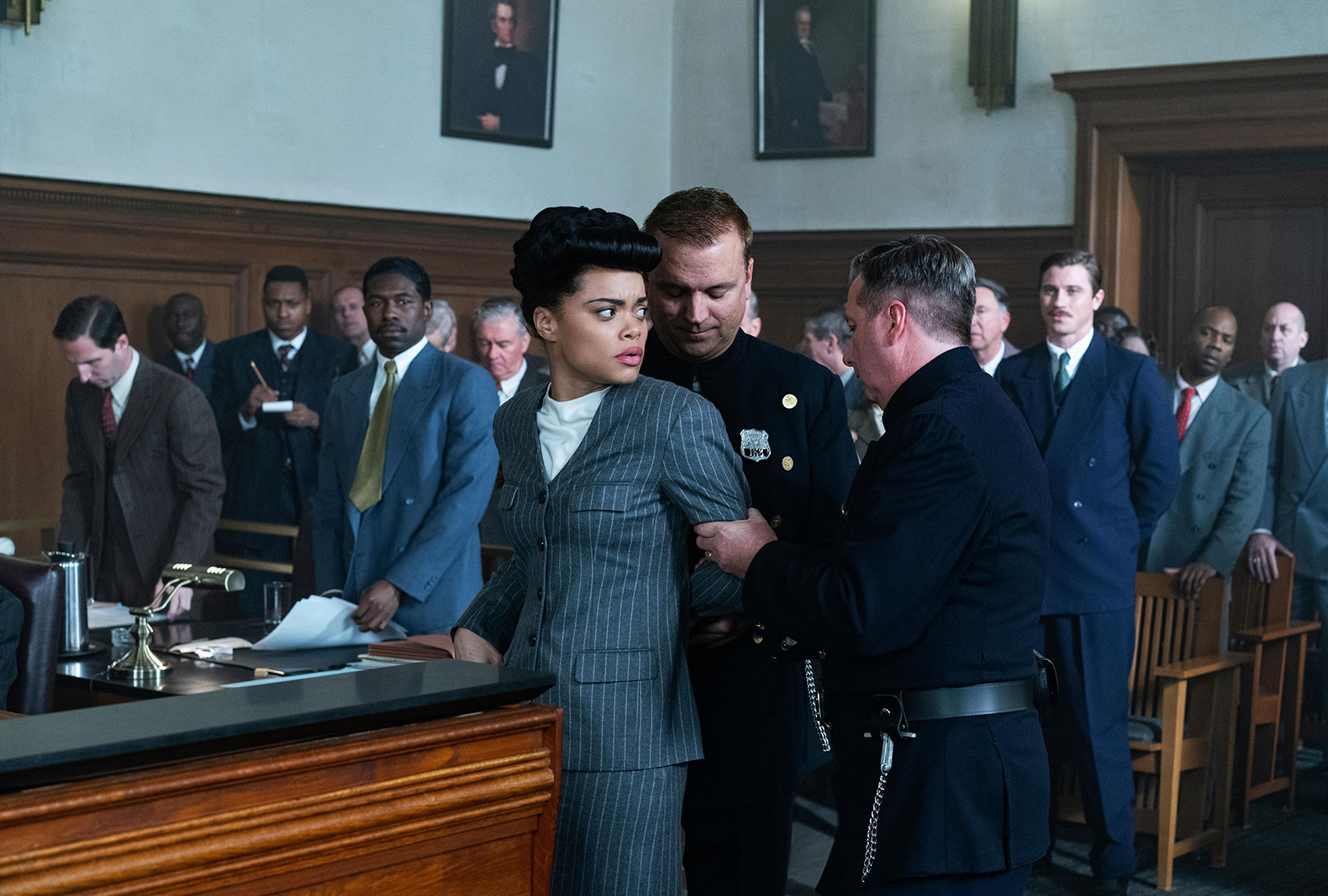
Republican hypocrisy is not a good reason to support Neera Tanden

Most corporate media outlets have depicted President Biden’s effort to win Senate confirmation of Neera Tanden as a battle to overcome Republican hypocrisy about her “mean tweets,” name-calling and nasty partisanship. But there are very important reasons to prevent Tanden from becoming the Office of Management and Budget director. They have nothing to do with her nasty tweets and everything to do with her political orientation.

Tanden has a record as one of the most anti-progressive operators among Democratic Party movers and shakers. Long enmeshed with corporate elites, she has been vehemently hostile to the Bernie Sanders wing of the party. Progressive activists have ample cause to be alarmed at the prospect of her becoming OMB director — one of the most powerful and consequential positions in the entire executive branch. 

Yet some leaders of left-leaning groups have bought into spin that carefully ignores Tanden’s fervent embrace of corporate power and touts her as eminently suitable for the OMB job. Media coverage has been a key factor. The newspaper owned by the richest person on the planet, Jeff Bezos, is a good example.

With the Tanden battle intensifying last weekend, the Washington Post launched an opinion spree to defend her while repeatedly expressing alarm and indignation that she might not be confirmed. The day after news broke that Tanden’s nomination was in serious trouble, the newspaper’s barrage started with a piece by right-wing pundit Hugh Hewitt, who urged Senate Republicans “to forgive the small stuff and encourage the recruitment of talent.” That was on Saturday.

On Monday, the Post’s editorial board weighed in, proclaiming the newspaper’s official position: “Yes, Ms. Tanden has been undiplomatic,” but hypocritical GOP senators had approved Donald Trump’s nominees who were even nastier, and the Senate should confirm her.

By then, the national media mold was set, and countless words quickly poured into it — including six more pro-Tanden pieces that the Post published in the next two days. On Tuesday, the Tanden defenders were staff columnists Greg Sargent and Karen Tumulty as well as the paper’s chief political correspondent Dan Balz. On Wednesday, staff columnists Dana Milbank and Jennifer Rubin shared the polemical duties with feminist author Jill Filipovic.

The Post’s writers denounced conservative objections to confirming Tanden as director of OMB, which the newspaper has aptly described as “the nerve center of the federal government.” Meanwhile, there was no space for substantive criticism of Tanden; the paper’s opinion section didn’t offer a pixel with a contrary outlook, let alone a progressive critique.

Much of the left has a strong aversion to Tanden. Days ago, Common Dreams reported on “her history of pushing cuts to Social Security, disparaging Medicare for All and other popular ideas, and raising money from massive corporations.” As president of the Center for American Progress, she sought and received between $1.5 million and $3 million in donations from the United Arab Emirates monarchy; later, CAP remained silent about a bipartisan congressional resolution to end the U.S. government’s assistance to the continual Saudi-UAE warfare killing huge numbers of Yemeni civilians.

But some progressive organizations have voiced support for Tanden’s nomination, turning a blind eye to such matters as her close fundraising ties with corporate elites, Big Tech, Wall Street, Walmart, health insurers and military contractor Northrop Grumman. Yet ties like that would create foreseeable conflicts of interest in the top OMB job, which oversees regulatory processes across the federal government.

Such concerns went unmentioned Thursday afternoon when the liberal group MoveOn emailed an action alert to its big list, promoting a petition to senators that urges them to “stop holding up the nomination of Neera Tanden.” The organization’s email offered nothing but the official line coming from the White House, reflecting an eagerness to serve the Democratic administration more than progressive principles.

It was not a good sign when a usually-laudable progressive organizer told CNN viewers that Tanden should be confirmed. And given Tanden’s record of opposing Medicare for All, opposing a $15 federal minimum wage and advocating for collaboration with Republican leaders in potential cuts to Social Security, Medicare and Medicaid, something is seriously amiss when a leading advocate for women’s health rights urges confirmation. 

In a tweet last week, NARAL president Ilyse Hogue called Tanden “a committed progressive” and added: “How about assessing her work, competence and vision instead of the tone of her tweets? Stop sinking good women because they are outspoken.”

Oddly, the director of the excellent Revolving Door Project, Jeff Hauser, publicly defended Tanden days ago, telling the New York Times: “The last decade has seen mediocre or worse cabinet appointments rubber-stamped by the Senate with regularity. It is unconscionable that the rare exception to that norm might be based on feelings hurt by imprudent tweets and suggests that senators vote more on egos than substance.”

I contacted Hauser for clarification, since it seemed that he was using the hypocrisy of Senate Republicans to justify support for Tanden’s nomination. In effect, he appeared to be adding some drops of WD-40 to hinges on the particular revolving door that Tanden is trying to move through. 

When I asked Hauser if he supported confirmation of Tanden and whether he considered her to be part of the revolving-door phenomenon, he replied: “We oppose the arguments actually endangering her confirmation, which are from [Sen. Joe] Manchin and [Sen. Susan] Collins and the like, and hold that it makes no sense to confirm the likes of Richard Grenell and Brett Kavanaugh but not Neera Tanden. But we do not lobby, so we do not formally urge votes one way or another once a person is actually nominated for a job.” 

Hauser added: “I don’t think Tanden is ‘revolving door,’ but I stand by the concerns I raised about CAP fundraising in the Washington Post.” Ironically, the Post news article that Hauser was citing, published in December 2020, scrutinized Tanden’s longtime corporate entanglements via her Center for American Progress and reported: “Founded in 2003 by allies of Bill and Hillary Clinton, CAP is widely viewed as a Democratic administration-in-waiting, with a revolving door between the think tank and the White House.” 

At RootsAction, which has been working to defeat Neera Tanden’s nomination, my colleague Jeff Cohen has a very different perspective than what can be heard from Tanden’s enablers: “We’ve opposed Tanden not because of her ‘mean tweets’ but because of her close funding relationships with corporate titans and foreign governments. What’s stunning is the silence from Senate Democrats about the potential conflicts of interest raised by her decade of aggressive fundraising from powerful interests.”

That kind of silence, whether from the U.S. Senate or from big-budget progressive groups, could help the Biden administration to do its worst instead of its potential best.

Conservatives are the new “good Germans,” enabling and defending Trump’s crimes

Let me pose a riddle of sorts.

Donald Trump is a force of political, human, moral and economic destruction. He is the leader of an American neofascist and white supremacist movement. Today’s Republican Party has fully become an extension of his political cult and crime family.

Trump incited a lethal attack on the Capitol as part of a larger plot to overthrow American democracy. Although Trump was defeated by Joe Biden at the polls, he actually received 10 million more votes than he did in 2016. This is a historic level of support, only surpassed by the 81 million votes Biden received in the same election. Biden may be president of the United States now, but Donald Trump is now positioning himself as a shadow president.

Moreover, public opinion polls show that Trump himself is more popular than the Republican Party as a whole. White right-wing evangelicals worship Trump like he is a god. Sen. Mitt Romney has warned that Trump will likely win the 2024 Republican nomination if he chooses to run a second time.

Contrary to the media narrative that there is a “civil war” within the Republican Party, a new public opinion poll from Gallup shows that 40 percent of Republicans want the post-Trump Republican Party to become “more conservative,” while 34 percent want it to “stay the same” and only 24 percent want the GOP to become “more moderate.”

TrumpWorld endures. It has shown itself, at least for now, to be indomitable.

Hence, the riddle: What then does “conservative” really mean for today’s Republicans?

The most benign and generous understanding of “conservative,” in the traditional context of American politics, is drawn (however loosely) from the 18th-century Anglo-Irish philosopher and statesman Edmund Burke. It signifies an aversion to change, or perhaps even a belief that change, when necessary, should be gradual. “Conservative,” at least in that conventional context, denotes a respect for stability, tradition and existing societal norms and institutions.

Donald Trump, his movement and its allies have almost no relationship to that tradition, and overwhelmingly reject such values. In the Age of Trump, American democracy is under assault by neofascism, white supremacy, authoritarianism, gangster capitalism and other antisocial values and beliefs.

Trump and his Republican Party and their followers have no respect for the rule of law, and have consistently sought to undermine it.

Basic and common understandings of truth and consensus reality have been discarded or ignored by Trump and his movement in favor of the Big Lie — and the innumerable small lies that sustain it. Contrary to widely-held folk theories of democracy, which presume a shared commitment to consensus politics, Trump and his movement have now normalized right-wing terrorism and political violence directed against liberals, progressives, nonwhites, Jews, Muslims and others deemed to be “the enemy.”

Public opinion polls and other research show that Republican and Trump voters embrace such values and beliefs, and now believe that political violence (on the order of the Jan. 6 Capitol attack) may be necessary as a way of protecting their power and privilege in American society.

At Vox, Zack Beauchamp echoes these concerns:

From top to bottom, the [Republican] party has stoked the embers of extremism. They have worked to convince their supporters that Democrats are monsters, they have to delegitimize the mainstream press and replace it with fact-free alternatives, and they have embraced extremist politicians and commentators who have condoned violence in the name of putting down the Democratic “threat.”

This is not just a question of “that’s how we got Trump” (though this is in fact how we got Trump). It’s that the party leadership has knowingly and willfully created an entire segment of the electorate that is prone to violent and dangerous conspiratorial thinking.

The version of conservatism that Trump and his voters and followers have embraced is “conservative” politics as destruction. Its goal is to return the United States to a mythic (and largely imaginary) past of complete white — and male and “Christian” — dominance over every area of American life.

Such a plan is made possible through a radical, extremist right-wing politics in which “conservatism” and an appeal to “traditional values” are used to mask or camouflage an assault on multiracial democracy and a more cosmopolitan, inclusive, democratic and humane American society.

There are many examples of this rhetorical strategy and its relationship to right-wing power.

For several decades, the Republican Party has targeted the Democrats as being “radical” and “too liberal,” as veering into “socialism” and being “out of touch” with “everyday Americans.” In reality, the Republican Party has deployed a strategy of asymmetrical polarization, in which it has consistently dragged the Democrats farther and farther to the right.

The mainstream news media has largely been cowed into enabling the Republicans’ turn to extremism, for fear of being slurred as “too liberal” and “biased” — thus the defensive compulsion towards “both-sides-ism” and a bogus “neutrality,” rather than objective truth-telling and a spirited and resolute defense of American democracy.

The outcome of asymmetrical politics and other forms of right-wing polarization is a Republican Party that looks more like a European neofascist political party than a traditional center-right party that supports democracy. The resulting “middle ground” thus artificially created exists between the two parties in a space far to the right of most Americans’ policy preferences.

The recent weather disaster in Texas is another example of how the Republican Party’s turn to right-wing extremism and its anti-human and anti-life policies have been normalized under the cover of “freedom” and “conservative” economic policies. In practice, these allow the “free market” to decide what is supposedly best for American society, on the pretext of maximizing individual freedom and “liberty.”

Naomi Klein recently explored this at the New York Times:

Blame right-wing panic. For decades, the Republicans have met every disaster with a credo I have described as “the shock doctrine.” When disaster strikes, people are frightened and dislocated. They focus on handling the emergencies of daily life, like boiling snow for drinking water. They have less time to engage in politics and a reduced capacity to protect their rights. They often regress, deferring to strong and decisive leaders — think of New York’s ill-fated love affairs with then-Mayor Rudy Giuliani after the 9/11 attacks and Gov. Andrew Cuomo in the early months of the Covid-19 pandemic.

Large-scale shocks — natural disasters, economic collapse, terrorist attacks — become ideal moments to smuggle in unpopular free-market policies that tend to enrich elites at everyone else’s expense. Crucially, the shock doctrine is not about solving underlying drivers of crises: It’s about exploiting those crises to ram through your wish list even if it exacerbates the crisis.

Ultimately, when today’s Republicans and their voters and other followers say that they want the party to become “more conservative,” what is really being communicated is a desire for “friendly fascism.” This is in no way a rejection of Trumpism — indeed, most Republican elected officials, as well as “traditional” Republican voters, supported (and continue to support) almost all of Trump’s policies. Rather, this desire to become “more conservative” represents a yearning for a more polite, less crude leader to complete Trump’s resurrection of a new American apartheid where “those people” know their proper place and stay in it.

Today’s Republicans love Donald Trump and his policies. Most of them, however, do not want the shame, stink, blood and filth of his neofascist project on their hands. Like the “good Germans” of the Nazi era, Republicans want to believe that they are good and decent people who can hide behind fictions of plausible deniability for the evils committed by their leader. Calling themselves “conservatives” is an effort to shield themselves from responsibility and complicity. Will this subterfuge succeed? The American people and the world will find out soon.

Donald Trump is an attention addict — his appearance at CPAC will offer the latest proof

There is no rational or reasonable explanation why Donald Trump is even considering another presidential run in 2024. He has no agenda. He has no real ideology other than his self-aggrandizement and greed. He had a dreadfully inept, contentious and fractious term as president from 2017 to 2021. He is probably facing imminent civil and criminal legal charges. He is in financial dire straits. He lost his last election by 7 million votes.

Trump’s upcoming appearance at CPAC this weekend, however, clearly signals that another presidential campaign may be in his sights. A return to private life may not be enough for him. There is a longstanding tradition that ex-presidents retreat into the background so the new president can shine. But that does not fit Donald Trump’s psyche. Just the opposite is true: He wants to spoil Joe Biden’s time in the sun by stealing as much attention away from him as possible. 

The real explanation is that Donald Trump is an attention addict. He is addicted to the attention that national political life brings him. He is addicted to running for president and to being president. It is all about satiating his needs and wants — and cravings. Attention is his psychic oxygen. He feels like he is dying mentally when attention is not forthcoming. He does not differentiate between positive attention and negative attention — either will do in his jonesing mind. As with an oppositional child, even negative attention makes him feel energized and powerful.

Trump’s attention addiction was in full force during his presidential term. He held more than 80 pep rallies so that he could bask in the glow of the attention from the masses. And his almost nonstop tweeting — late into the night and distressingly early in the morning — showed that he was addicted to instant attention. 

The fact that Trump is an attention addict is hardly a reason for us to allow him to run for president again. We would not let a known heroin addict be mayor. We would not let an opioid addict become governor. We would not let a benzodiazepine addict be a senator. So we should not let an attention addict be our president.

Why? Because all elected officials take a sworn oath to protect the public’s safety and well-being. An attention addict, by definition, cannot possibly meet that obligation. The public good is of no concern to an addict whose sole mission in life is to consume more and more of the sought-after prize.

Trump has already proven that his addiction interferes with his capacity to be a public servant. His addiction kept him from solving the existential crises that our country faced: a deadly pandemic, a crashed economy, racial and economic inequality, domestic violence, immigration and many others. 

He could not even facilitate the orderly and peaceful transfer of power to Joe Biden once he lost the election. He had to incite an insurrection of our government in an attempt to hold onto power — and attention. This just shows you the lengths an addict will go to maintain his addiction. 

Trump needs intervention for his addiction. He needs a treatment plan that includes abstinence from attention, expression of remorse to those he has aggrieved, a concrete plan for his future without attention and ongoing, uninterrupted individual and group therapy. 

The public should not exacerbate his attention addiction. It is not what he needs. Let us not make his attention addiction worse by electing him again. He would fail miserably. After all, the best predictor of future behavior is past behavior.

It is not what we need as a country either. We are a huge, diverse republic that has many challenges ahead. We do not need an addict running our country. We need leadership that is wise, seasoned and serious. Joe Biden seems to fit the bill for the moment — he does not have an attention addiction. We go days without seeing him and hearing him. He is doing his job without fanfare. He is solving problems without the constant need to take credit. He has brilliant people around him and allows them to garner their own attention. He never brags, exaggerates, fabricates or spreads conspiracy theories. 

We need to leave the attention addicts to the entertainment business. Attention addiction there is much more adaptive and rewarding since attention is the “real” currency in that business.

We are exhausted from having an attention addict run our country. He ran us into the ground, all the while just wanting our attention. Why didn’t he just ask for it? Why did he have to put us through so much upheaval and tumult? That was his addiction talking. 

Perhaps Trump can reprise “The Apprentice” on a major television network. That would be squarely in his wheelhouse. Had he stayed on that show to begin with, hundreds of thousands of Americans who have died might still be alive.

That is proof enough that we should not have an attention addict in our national leadership. Trump must be disqualified from elected office. We must not subject ourselves to his dangerous and self-destructive addiction again.

Let us hope Trump gets the help he needs. Even more important, let’s hope we are smart enough to discourage him from running for another term. We have already fed his addiction for far too long.

Donald Trump Jr. is still complaining to Sean Hannity that Republicans didn’t overturn the election

The namesake son of former President Donald Trump complained that Republicans did not do enough to overturn the 2020 presidential campaign.

The remarks were a continuation of the “Big Lie” that Trump won the election that resulted the Jan. 6 insurrection and Trump’s second impeachment.

“The Republicans aren’t willing to do it,” Trump, Jr. argued. “They’ve shown that over the decades, they’d just rather lose gracefully, I guess.”

“Not really a plan that I would go with, but it’s what they’ve done,” he said.

He then praised his father for refusing to concede the fact he lost.

“Donald Trump has shown that you don’t have to do that — you can actually push back,” he said of his father’s action that resulted in a fatal insurrection.

You can watch the video below via Fox News

Trump ally Stephen Miller is operating a “shadow war” against the Biden agenda: report

Although former President Donald Trump is no longer in the White House, his allies are trying to undermine President Joe Biden’s agenda. One such ally, according to liberal Washington Post opinion columnist Greg Sargent, is 35-year-old Stephen Miller — who, Sargent writes, is operating a “shadow war” against Biden’s administration and trying to turn public opinion against the new president’s immigration policy.

“When the administration reopened a warehouse-like facility for migrant children in Texas this week,” Sargent explains, “it caused a huge controversy on all sides. It inspired claims, mostly from the right, that President Biden is reverting to former president Donald Trump’s policies, proving Trump right all along. But those claims are wrong.”

Miller, Sargent notes, is “publicly encouraging enforcement agents to defy Biden’s new policies” and “is running a propaganda war to manufacture the impression that Biden’s agenda is already a catastrophe.”

“When the new Texas facility opened, conservatives, Miller included, scoffed that Biden is being forced to resume Trump policies, because efforts to reverse them have collided with reality, vindicating Trump,” Sargent writes. “All this is nonsense. On migrant children, Biden has not restarted Trump’s policies. What Biden is doing has nothing in common with ‘kids in cages.’ And none of this proves Trump was right in any way.”

Sargent goes on to explain why Biden’s immigration policy is not a carbon copy or vindication of Trump’s.

“It’s important to note that the Texas facility is run not by Border Patrol, but by the Office of Refugee Resettlement,” Sargent writes. “Federal laws and legal settlements require Border Patrol to take in children and hold them for no more than 72 hours, then transfer them to ORR, which then tries to place them with relatives or guardians.”

Sargent continues, “Thus, the reopening of the Texas facility does not constitute holding children at the border. It constitutes using a warehouse-like facility to deal with overflow at ORR, the waystation before kids hopefully get moved to a better life. This isn’t ‘kids in cages’ redux.”

Another anti-Biden talking point on immigration, Sargent adds, is the claim that his “permissiveness” is “drawing more migrants” to the U.S.-Mexico border. But Sargent counters that Biden is simply “allowing migrants to have due process” and that many migrant children are fleeing violence in Central America.

Wendy Young, president of Kids in Need of Defense, told Sargent, “There continues to be a tremendous amount of violence, corruption and deprivation. Children leave because they’re forced out of their home countries . . . We will be watching this closely to ensure that these children receive the services they need and are moved quickly to a place of stability.”

Mitch McConnell will “absolutely” support Trump if he gets the GOP presidential nomination in 2024

On Thursday, in an interview with Fox News’ Bret Baier, Senate Minority Leader Mitch McConnell (R-KY) said that he would stand with former President Donald Trump if he were to receive the nomination to run for president a third time in 2024.

“The nominee of the party?” said McConnell. “Absolutely.” He added that he believes Trump would have to compete against “at least” four GOP senators “plus some governors and others” if he ran again.

The commitment to back Trump if he wins the nomination stands in stark contrast to McConnell’s condemnation of the former president’s incitement of the Capitol riot in the wake of the impeachment vote, in which he suggested the charges should be litigated in a court of law. It also contrasts with the tension between the two men, with McConnell reportedly never wanting to speak to Trump again, and Trump issuing a statement calling him a “dour, sullen and unsmiling political hack.”

Trump has teased at the possibility of running again, but has not made a firm decision either way.

You can watch the video below via Twitter

“Pathogen porn”: Two papers about a New York coronavirus strain spark a scientific war of words

One of the greatest ongoing pandemic concerns is how the SARS-CoV-2 coronavirus, which causes the disease, frequently mutates. Some of these mutations have become household names: there’s B.1.1.7, which originated in the United Kingdom and is more transmissible than usual strains of the novel coronavirus. The 501Y.V2 strain, which originated in South Africa, raised alarm last month after a paper revealed that many people who contracted other coronavirus strains did not have antibodies which protected them from the new one. Then there was a hybrid coronavirus that scientists announced earlier this month had been discovered in California; this one combined B.1.1.7 with a different coronavirus strain.

Now there is a mutant version of the novel coronavirus in New York City called B.1.526, according to a pair of studies produced by Caltech and Columbia University. Neither of them has been published in a scientific journal or been vetted through the peer review process, which means scientists do not have definitive information about if and/or how the new strain will pose a greater risk to human health. What we know for sure is that B.1.526 is a hybrid of two mutations: One mutation, E484K, is believed to help the viruses beat the vaccines; another mutation, S477N, scientists theorize has an effect on how tightly the virus binds itself to cells.

The Caltech study says that B.1.526 accounts for more than one out of four of the New York City viral sequences in their database, while Columbia found that 12 percent of the coronavirus patients at their medical center had a strain with the E484K mutation. Those patients were more likely to have been hospitalized and were on average six years older.

“Given the involvement of E484K or S477N, combined with the fact that the New York region has a lot of standing immunity from the spring wave, this is definitely one to watch,” said Kristian Andersen, a virologist at the Scripps Research Institute in San Diego who was not involved in either the Caltech or Columbia papers, told the Times. Andersen’s views were echoed by Rockefeller University immunologist Michel Nussenzweig, who told the publication that this is “not particularly happy news” but added “knowing about it is good because then we can perhaps do something about it.”

Yet there is some controversy over the allegation that the Columbia paper was brought to the public’s attention by The New York Times before being shared with public health authorities. 

Dr. Jay Varma, Senior Advisor for Public Health at the New York City mayor’s office, tweeted dismay at academics who allegedly release high impact studies with public health implications to the media without first reviewing them with government health departments, adding that “pathogen porn isn’t helping public health.” (Salon reached out to Varma for further comment; he has not responded as of the time of this writing. Neither have representatives from Columbia nor Caltech.)

“The Caltech paper by [computational biologist Anthony] West is better,” Dr. William Haseltine, the chair and president of the global health think tank Access Health International and a biologist famous for his work in confronting the HIV/AIDS epidemic, wrote to Salon.

Haseltine says that the CalTech group reported on two variants in New York City and the Columbia group only reported on one. Still, Haseltine calls the discovery  a “big deal,” and said that observations suggest the new variants are more transmissible, more likely to infect young children, more virulent and can avoid antibodies both produced by the body and induced by vaccines.

“We know the virus mutates frequently,” Dr. Georges Benjamin, Executive Director of the American Public Health Association, told Salon by email. “While transparency is important we need to be careful that we don’t release material until it has been reasonably vetted and the material ready for preprint. The issue is not that there are variants; we know that now that we are looking we will find a lot of them. The issue is what do these variants mean clinically and, what is their potential for vaccine escape.”

He added, “My suggestion is people doing these kinds of studies be prepared to answer these two questions as a component of releasing their important work. People responding to this should fully assess the potential impact before changing public health recommendations.”

Dr. Russell Medford, Chairman of the Center for Global Health Innovation and Global Health Crisis Coordination Center, expressed similar views to Salon by email, writing that scientists already expected to discover more strains of the novel coronavirus as genomic sequencing accelerates in the United States, that there is much additional information required before determining whether a given variant’s mutations should cause major alarm and “public health officials need timely access to the highest quality data in order to make informed decisions.”

“The data on the New York strains, while potentially concerning, is still early and would benefit from a rapid peer review,” Medford explained. “Most importantly, the study only serves to emphasize our current public health efforts: enhanced genomic sequencing, rapid mass vaccination, mask-wearing, social distancing and handwashing.”

An Atlantic current system that controls sea levels and heat waves is on the brink of collapse

A massive current system that runs deep throughout the vast Atlantic Ocean has an effect on temperatures, climate, sea levels and weather systems around the world. Any disruption to its flow could have rapid and catastrophic effects on the global climate. And a new study has some dreary predictions about the future of the Atlantic Meridional Overturning Circulation, as it is known, and whether it might cease completely in the coming decades.

This comes from a new study published Thursday in the journal Nature Geoscience, which reconstructs the history of the circulating current since about 400 AD. Researchers say that the circulation is now at the weakest that it has ever been in that span. 

But understanding what that means — and whether the circulation will stop — requires a bit of background on how this all works. 

The Atlantic meridional overturning circulation — or “AMOC” for short — can be likened to a series of conveyor belts. The directions of the belts and their “contents” vary: One belt, containing warm water, flows north, cools and evaporates, increasing the salt content in that region of the ocean. As that water becomes colder and heavier it sinks and flows south, creating a second south-moving belt. These belts are connected by regions in the Labrador Sea, the Nordic Sea and the Southern Ocean. They are responsible for bringing mild, warm weather to Europe and keeping sea levels down on the United States’ eastern seaboard.

According to the authors of the Nature Geoscience study, AMOC is weakening. The culprit is likely the global climate crisis. As Arctic ice and the Greenland Ice Sheet melt, while rain and snow levels increase, the water that flows north becomes less salty and dense. This, in turn, slows down the extent to which it flows back south and weakens AMOC overall.

The authors of the paper estimate that AMOC could be weakened by about 34% to 45% by the end of this century. If that happened, one could expect massive winter storms, heatwaves and droughts in Europe. In the United States, sea levels could rise to dangerous levels, threatening large coastal cities like New York City, Boston and Miami and creating millions of climate refugees in the process.

Stefan Rahmstorf of the Potsdam Institute for Climate Impact Research, who co-authored the study, told The Guardian that “we risk triggering [a tipping point] in this century, and the circulation would spin down within the next century. It is extremely unlikely that we have already triggered it, but if we do not stop global warming, it is increasingly likely that we will trigger it.”

These are not the only significant and apocalyptic consequences that will ensue if climate change goes unchecked. There will be more wildfires in the West Coast states and more extreme weather events like massive hurricanes, thunder storms and winter storms. Large sections of the planet will be too hot and dry to inhabit, and it will be more difficult to produce enough food to sustain the human population. As people are forced to live in closer proximity to each other, it is likely that there will be increased conflict, particularly as resource scarcities increase.