Spring Sale: Get 1 Year, Save 58%

What would life on Mars be like? Looking for answers in my family’s immigrant past

After a nine-year hiatus, our race to space has been reinvigorated. SpaceX has successfully sent NASA astronauts to the International Space Station. And for the first time, the United States officially has a Space Force. Will the next stop be Mars?

Colonizing the red planet has always been a staple in science fiction. Many sci-fi writers have featured futuristic technology and aliens. (Not that there’s anything wrong with aliens. I’ve always had a soft spot for ALF.) But when I imagined what life on Mars might be like for my novel “The Lion of Mars,” I looked to the past — specifically, the experiences of my Finnish ancestors. Those Finns were some tough cookies. They had sisu. That’s a Finnish idea that doesn’t have a perfect English translation — loosely, it means persevering in the face of adversity. In short, it means having guts. To be certain, there are stark differences between settling an unoccupied planet as opposed to settling in a land with an indigenous population. But I like to imagine that my Finnish forefathers and mothers learned things that future Martians would need to know, too. 

It’s a One Way Trip

My father’s family emigrated from Finland to southwest Washington State in the 1870s. It was a one-way trip for most of them. They left behind fathers and mothers and sisters and brothers. They never saw their home again. They may as well have traveled to Mars.

This may hold true for future Martians as well. It isn’t known what effects Mars’s lower gravity will have on human bones and tissue. Astronauts have experienced weakened bones and muscle loss after long trips in space. Going to Mars might mean never seeing the “old country” — Earth — again.

Learn to Farm

Farm-to-table and artisanal vegetables are all the rage now, but farming for my great-grandparents wasn’t a fun hobby — it was survival. There was no Trader Joe’s in 1875. They had to raise their own vegetables and hay for their cows and horses.

While some food and supplies could be delivered to Mars, farming will become a necessity. While you can live on MREs for a long time, eating is one of life’s greatest pleasures. As every ship captain knows, good food equals good morale.

Danger Is Everywhere

Everyday life was incredibly dangerous for my Finnish family. One of my father’s cousins was killed while trying to clear a stump for farming. My grandfather was knocked off a boat and cracked his skull. (How he survived is anyone’s guess.) Back then, a bad tooth could be the end of you.

Mars will be even more deadly. It’s a planet inhospitable to life itself: it’s freezing cold, there’s no breathable atmosphere, and there’s radiation. A single mistake or accident could have deadly consequences. I don’t see too many life insurance companies rushing to cover future settlers on Mars.

The Homesickness Is Real

My Finnish family missed the country they’d left behind. So they tried to re-create a semblance of it by bringing things with them — their traditions and recipes, and even their ghosts. That’s how homesick they were.

So pack your bags wisely. Low-tech is best because it will be hard to stream Netflix on Mars. Bring Blu-rays, comforting books, family pictures, and a ukulele. It’s a long trip, so you’ll have plenty of time to learn a song that reminds you of home. I’m thinking John Denver’s “Take Me Home, Country Roads.”

You Are the Handyman

They didn’t have Amazon back in the 1800s, so they had to make almost everything they needed. It required sweat and ingenuity. If you wanted a nice bed, you had to cut down a tree, pluck the chicken feathers for a pillow, and sew some sheets from a feed sack. Aren’t you exhausted now?

Likewise, Mars is not going to be luxurious. People are going to need to know how to fix things. Shop class is going to be cool again — they won’t be able to call the plumber to unclog the toilet.

It Will Be OK?

In spite of all the obstacles and hard-won lessons, my family (mostly) survived and thrived. Which gives me faith in future Martians. Settling Mars is going to be difficult, dangerous, thrilling, and lonely. Surely, some won’t survive or thrive in the face of such incredible odds and circumstances. Still, I remain hopeful for the future Mars settlers.

They’ll just need to channel a little sisu.

Republicans are now begging Biden, “in the spirit of healing,” to stop Pelosi from impeaching Trump

Republicans are arguing against holding Donald Trump account for the fatal insurrection he incited at the U.S. Capitol.

The request came in a letter signed by Representatives Ken Buck (R-CO), Thomas Massie (R-KY), Tom McClinton (R-CA), Nancy Mace (R-SC), Chip Roy (R-TX), Kelly Armstrong (R-ND), and Mike Gallagher (R-W).

The letter was addressed to President-elect Joe Biden.

“In the spirit of healing and fidelity to our Constitution, we ask that you formally request that Speaker Nancy Pelosi discontinue her efforts to impeach President Donald J. Trump a second time. A second impeachment, only days before President Trump will leave office, is as unnecessary as it is inflammatory,” the Republicans argued.

Despite arguing against accountability for Trump’s failed coup, the group went on to say they “celebrate the peaceful transfer of power, a bedrock of our system of self-government.”


Which U.S. cities get failing grades on parks

Being ranked among the most park-poor cities in America is a fitness test no city wants to flunk. But in 2020 amid the pandemic, the national “ParkScore” ratings issued by The Trust for Public Land (TPL) took on greater meaning as overcrowding at home and lack of school recess put families in a bind.

The nonprofit group, which works with cities, schools and conservation agencies to preserve open space and create parks, in the past year invested $45.7 million to build new playgrounds in city parks.

But TPL is also a judge. Its influential annual ParkScore ranking showed that in 2020 cities like Scottsdale, Los Angeles and Houston were park-poor, ranking 44th, 49th and 78th among the 100 largest cities. Yet Rust Belt cities like Cincinnati, Pittsburgh and St. Louis are in the top 15 — thanks to extensive park systems. The three top-ranking cities in 2020 were Minneapolis, Washington, D.C. and St. Paul.   

[Where does your city fall on the ParkScore list? Access your city’s score at this link by scrolling halfway down the page to “See All ParkScore Rankings,” then type in your city’s name.] 

One ParkScore measure is whether parks are well-equipped with amenities such as playground equipment, benches, athletic fields and recreation programs. Another is how many residents live within a 10-minute walk of a city park. “One hundred million people don’t have a 10-minute walk to a park, and of that number 28 million are kids,” says Linda Hwang, director of research and innovation at TPL.

A diverse mix of cities fall at or near the bottom of the list and vividly illustrate a nationwide struggle to improve parks. The low rankings of some cities, including Lubbock, Texas, Oklahoma City, and Fresno, Stockton and Santa Ana, California, are echoes of racist municipal history, city leaders disconnected from residents, or fiscal and natural disasters.

Fresno, ranked 92nd by ParkScore, is in political turmoil over parksFrom its earliest days in the 1870s, the city was highly segregated and “it is almost ingrained to have the haves and the have-nots still today,” said Sandra Celedon, president and CEO of the non-profit Fresno Building Healthy Communities

Grecia Elenes, a senior policy advocate for the non-profit Leadership Counsel in Fresno County, recalls playing at Fresno’s Hyde Park as a child: “Right next to it, you can see from the hills a meat-rendering facility with trucks with animal carcasses going in and out.”

In 2018, these and other grassroots groups passed by 52% a sales tax increase to fund parks. The City of Fresno sued, saying the tax hike needed a two-thirds vote. In mid-December, an appeals court ruled for the groups.  Outgoing Fresno Mayor Lee Brand explained, “We have so many needs. One-third of Fresno is poor. I wanted a balanced measure, with public safety included,” he told FairWarning. But in a nod to the winners, Brand says he sees the good in their battle. “We’ll be able to address major restoration of our parks and create new ones. We need them.”

In Lubbock, racial disparities fueled its park-poor ranking of 93rd. Joshua Shankles, a produce farmer and board member of the Lubbock Compact, a local  group working on such issues as homelessness and expanding parks, says heavy industry, waste treatment plants and “city dumping grounds” are concentrated in working-class Latino and Black Lubbock.

“We see parks as a way to attack and counterbalance this.”

Dense, land-poor Santa Ana, torn between parks and development, is in 85th place.  But that rating by ParkScore may not be forever. The November 2020 election altered local politics, which could lead to unconventional parks in the nation’s fourth most-dense city, according to Santa Ana School District Board President Rigo Rodriguez.

With 12,471 people per square mile, officials say Santa Ana and its residents, 41% of whom are Latino, are paying the price of long-ago planners who gave parks short shrift. School board members and city officials are discussing using green fields on school land as semi-permanent public parks after school hours.

A tougher fight in Santa Ana is focused on the Willowick Golf Course, 102 acres of tree-studded land that has been declared surplus by its owner, the neighboring city of Garden Grove. Advocates hope to save it from development, said Cynthia Guerra, an organizer with one of the local groups trying to preserve it for a city park. “Low-income residents live next to it, and get the golf balls hit into their yards,” Guerra said, “but have never been inside because they couldn’t pay the fee.” 

In Oklahoma City, ranked 97th by ParkScore, officials came out swinging—with upbeat hopes. This city made up of more than 600 neighborhoods, many highly active, is still picking up from a monster ice storm on October 27 that wiped out grand historic trees.

Brian Dougherty, director of parks for the Oklahoma City Community Foundation, a non-profit, says that because Oklahoma lets cities keep only sales tax, not property taxes, developers must build their own greenbelts. The Trust for Public Land, he said, counts scores of parks concentrated in older working-class areas, but not greenbelts in newer, outer areas.

“When the ratings come out, you’re kind of like, oh boy,” says Dougherty. “There’s always room for improvement. But if you are looking for parks within a 10-minute walk, having less density is a detriment.”

Georgie Rasco, executive director of the Neighborhood Alliance of Central Oklahoma, describes a city with deeply involved voters who approved an upgrade of existing parks, and backed the $132 million Scissortail Park that opened in 2019 downtown.

“I think I know why we can’t walk to a park in 10 minutes,” Rasco said. “For the longest time we were the most spread-out city, and we’re still very spread out.  It’s not that we have less parks, but they’re spread out, too. … But so much good is happening despite that.”

Rising from bankruptcy by cutting deep, Stockton is on the mend. But it’s ranked 87th for parks. In 2020 the city won $8.5 million from the state to remake vandal-ravaged McKinley Park in South Stockton with basketball courts and a renovated pool.

But Erin Reynolds, associate program manager with the non-profit Public Health Advocates, says the city has limited park access in areas that suffered discrimination in investment and mortgage lending. “The same communities redlined years ago are the most severely disadvantaged now,” she says, primarily downtown and in South Stockton.

Stockton Public Works Director Jodi Almassy says the city is considering a plan to expand an existing park onto land that is now a defunct golf course  “with beautiful oak trees close to the water,” in an underserved area of South Stockton. If Stockton pulls that off, they won’t be stuck at 87th for long.

Linda Hwang, TPL’s director of research, sees hope in such efforts, particularly in the movement to convert school grounds to parks. New York City leads with 220 schoolyards converted through joint-use agreements, often with help from TPL“We work to convert from mostly asphalt into green — especially in these pandemic times, to have a green space, a place outdoors,” Hwang says.

TPL is working with Dallas, Oakland, Tacoma, Los Angeles, Philadelphia, Newark, Camden, Atlanta and other cities to convert school yards and other land to parks. “Once we did New York,” she says, “we realized this is a really important thing.”

Pet rescue groups say that more pets are being abandoned due to the pandemic

Alice Mayn runs Lily’s Legacy Senior Dog Sanctuary, a sanctuary in the small California city of Petaluma for large breed dogs over the age of seven. Recently, she encountered a COVID-19 situation that directly involved her organization’s mission. She was contacted by a 58-year-old former construction worker, John Crowe, who had three large dogs that he could no longer take care of because he was suffering from financial troubles due to the pandemic.

“He had a hunting lodge up in the mountains in California and he’d go off to his business because of it,” Mayn recalled. “And it had to move down to the Bay Area, and he had three dogs that he’d had their whole lives since they were puppies.” They included two Labrador retrievers and one hound mix, between the ages of seven, nine and 11. He surrendered them to Mayn’s sanctuary. 

“We were able to find a wonderful home for them together, which was our goal because they were very bonded,” Mayn says. “And since they have gone to their new home, they’re doing very, very well.” Mayn said the new owner is still in contact with the former owner, who is happy that they’re all still together.

Mayn’s story is not unusual. Stories of animals being rescued during the pandemic have made headlines from California to Florida. Reports of drastic increases in animals being abandoned have been reported in states like Alabama, Ohio and Nevada. In the United Kingdom, hundreds of puppies that were purchased during the lockdown are now being disowned and sold.

“Since the month of March, our animal cruelty investigations team, which is 10 full-time animal cruelty investigators, has seen about a 20% increase in abandonment cases,” Julie Kuenstle, vice president of communications and marketing at the Houston SPCA, told Salon, saying that “they’ve just noticed an increase during the pandemic.” (The pandemic began in the United States in March 2020.)

Kuenstle recalled one case in July when, with the Houston Police Department, they resuced “a puppy, four dogs, a Chinchilla, a cat, and a mouse after they were left behind in the sweltering heat in deplorable living conditions.” On another occasion, “there was a dog that was tethered on a very short lease and couldn’t sit down that was abandoned in a field,” which was rescued along with a cat. Still another time Kuenstle recalled an abandoned puppy suffering from hair loss that could not even stand up on its own.

Teresa Chagrin, animal care and control issues manager at Peta Prime, told Salon that this is part of a larger problem.

“We get new [reports] every single day about animals being abandoned, especially intentionally, and often after they are turned away from animal shelters,” Chagrin explained. “This being turned away from animal shelters had started long before COVID-19 and a lot of shelters are just using the pandemic as an excuse to further restrict their intake in order to increase ‘live release rates.'”

Her observation was echoed by Daphna Nachminovitch, senior vice president of the Cruelty Investigations Department at People for the Ethical Treatment of Animals (PETA). 

“On our end, where we do field and shelter work in Virginia and North Carolina, we are seeing higher demand for free services, i.e., help with food, end-of-life, spay/neuter assistance, and more,” Nachminovitch told Salon by email. “For some weeks earlier this year, we were hearing regularly from citizens who had been turned away from our municipal shelter here in Norfolk, VA, because that shelter was ‘closed’ – and some of those citizens had animals in urgent need of help, including euthanasia.” Nachminovitch said she has been seeing more incidences of shelters limiting services. That “makes it more difficult for people to surrender animals (limited hours, fees, requiring appointments, altogether not accepting cats), which ultimately means animals are abandoned to fend for themselves on the streets, and others are given away,” Nachminovitch said. “Many shelters have essentially stopped sheltering – a very real concern.”

Nachminovitch also denounced the “hideous consequence” of halting spay/neuter services by many clinics and shelters which decided they were not “essential.” “PETA runs three mobile veterinary spay/neuter clinics and we never stopped running,” she noted. “We just adapted and followed new safety procedures.”

So what can people who love our animal friends do to protect them during these trying times?

“It’s really important before even getting into taking on that responsibility to consider, ‘What will happen if I lose my job? What will happen if I have to move? What will happen?'” Chagrin told Salon. “Make sure that you have arrangements set up or don’t get an animal.”

Chagrin also advocated that “shelters have to keep their doors open and always accept all animals. And don’t charge fees and don’t set up restrictions.” She argued that it is wrong for animal shelters to be pressured “to improve their live release rates and adoption rates,” saying that we should improve spaying and neutering practices and arguing that “closing the shelter doors and saying, ‘No, we’re not gonna take your animal because we’re worried about our statistics’ is an irresponsible and cruel response, but that’s the response that we’re seeing today.”

As for Mayn, she asked people who are too sick to care for their dogs to see “if they had a family member that can help them research rescues. They can help the dogs, particularly if they’re seniors.” She urged people to remember that “the shelters have been overwhelmed with dogs and it’s harder to get, particularly a senior, adopted out of a shelter than it is to get them adopted out of a rescue.” She also said that “for people that have a place to live and can actually keep their dogs, there are resources of nonprofits, for instance, that help individuals cover medical bills for their dogs. So if their vet bills that are too expensive and that sort of thing, there are resources for that.”

QAnon and the riot at the U.S. Capitol: The offline effect of online conspiracy theories

What is the cost of propaganda, misinformation and conspiracy theories? Democracy and public safety, to name just two things. The United States has received a stark lesson on how online propaganda and misinformation have an offline impact.

For months, Donald Trump has falsely claimed the November presidential election was rigged and that’s why he wasn’t re-elected. The president’s words have mirrored and fed conspriacy theories spread by followers of the QAnon movement.

While conspiracy theorists are often dismissed as “crazy people on social media,” QAnon adherents were among the individuals at the front line of the storming of Capitol Hill.

QAnon is a decentralized, ideologically motivated and violent extemist movement rooted in an unfounded conspiracy theory that a global “Deep State” cabal of satanic pedophile elites is responsible for all the evil in the world. Adherents of QAnon also believe that this same cabal is seeking to bring down Trump, whom they see as the world’s only hope in defeating it.

The evolution of QAnon

Though it started as a series of conspiracy theories and false predictions, over the past three years QAnon has evolved into an extremist religio-political ideology.

I’ve been studying the movement for more than two years. QAnon is what I call a hyper-real religion. QAnon takes popular cultural artifacts and integrates them into an ideological framework.

QAnon has been a security threat in the making for the past three years.

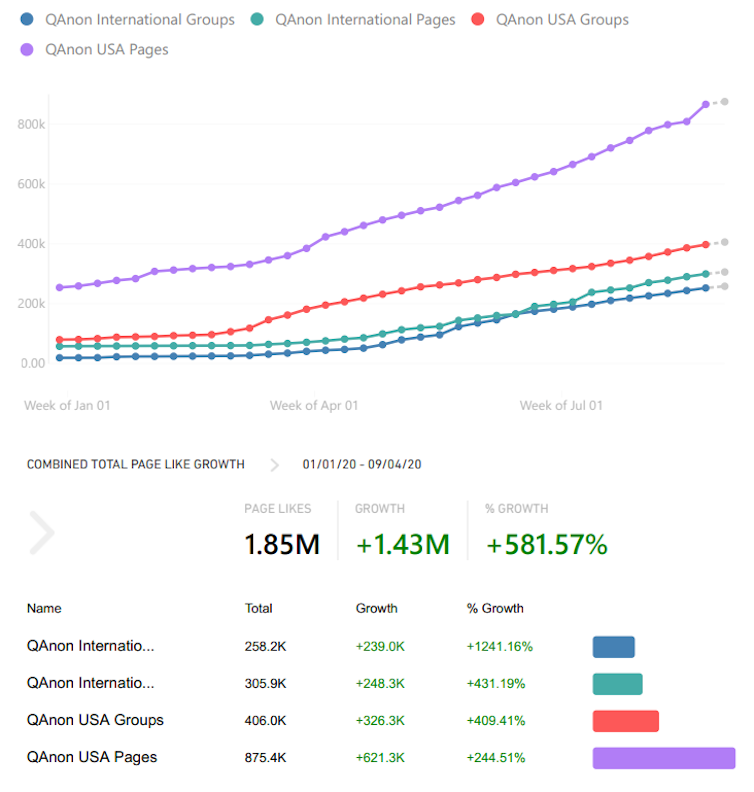
The COVID-19 pandemic has played a signficant role in popularizing the QAnon movement. Facebook data since the start of 2020 shows QAnon membership grew by 581 per cent — most of which occurred after the United States closed its borders last March as part of its coronavirus containment strategy.

Aggregate growth of QAnon membership in Facebook groups and pages between January and September 2020. Data collected and visualized September 4, 2020 courtsey of CrowdTangle.

As social media researcher Alex Kaplan noted, 2020 was the year “QAnon became all of our problem” as the movement initially gained traction by spreading COVID-related conspiracy theories and disinformation and was then further mainstreamed by 97 U.S. congressional candidates who publicly showed support for QAnon.

Crowdsourced answers

The essence of QAnon lies in its attempts to delineate and explain evil. It’s about theodicy, not secular evidence. QAnon offers its adherents comfort in an uncertain — and unprecedented — age as the movement crowdsources answers to the inexplicable.

QAnon becomes the master narrative capable of simply explaining various complex events. The result is a worldview characterized by a sharp distinction between the realms of good and evil that is non-falsifiable.

No matter how much evidence journalists, academics and civil society offer as a counter to the claims promoted by the movement, belief in QAnon as the source of truth is a matter of faith — specifically in their faith in Trump and “Q,” the anonymous person who began the movement in 2017 by posting a series of wild theories about the Deep State.

Trump validated theories

The year 2020 was also Trump finally gave QAnon what it always wanted: respect. As Travis View, a conspiracy theory researcher and host of the QAnon Anonymous podcast recently wrote: “Over the past few months …Trump has recognized the QAnon community in a way its followers could have only fantasized about when I began tracking the movement’s growth over two years ago.”

Trump, lawyers Sidney Powell and Lin Wood, and QAnon “rising star” Ron Watkins have all been actively inflaming QAnon apocalyptic and anti-establishment desires by promoting voter fraud conspiracy theories.

Doubts about the validity of the election have been circulating in far-right as well as QAnon circles. Last October, I wrote that if there were delays or other complications in the final result of the presidential contest, it would likely feed into a pre-existing belief in the invalidity of the election — and foster a chaotic environment that could lead to violence.

Hope for miracles

The storming of U.S. Capitol saw the culmination of what has been building up for weeks: the “hopeium” in QAnon circles that some miracle via Vice-President Mike Pence and other constitutional witchcraft would overturn the election results.

Instead, QAnon followers are now faced with the end of a Trump presidency — where they had free rein — and the fear of what a Biden presidency will bring.

We have now long passed the point of simply asking: how can people believe in QAnon when so many of its claims fly in the face of facts? The attack on the Capitol showed the real dangers of QAnon adherents.

Their militant and anti-establishment ideology — rooted in a quasi-apocalyptic desire to destroy the existing, corrupt world and usher in a promised golden age — was on full display for the whole world to see. Who could miss the shirtless man wearing a fur hat, known as the QAnon Shaman, leading the charge into the Capitol rotunda?

What will happen now? QAnon, along with other far-right actors, will likely continue to come together to achieve their insurrection goals. This could lead to a continuation of QAnon-inspired violence as the movement’s ideology continues to grow in American culture.

Marc-André Argentino, PhD candidate Individualized Program, 2020-2021 Public Scholar, Concordia University

This article is republished from The Conversation under a Creative Commons license.

America’s long road to a fascist assault on the Capitol

Americans were shocked to watch as American stormtroopers assaulted the U. S. capitol building, smashing windows, roaming through the building and the floors of both Senate and House, including sitting in the seat of the Senate’s presiding officer, leaving incendiary devices nearby, etc.).

This was more than a whiff of fascism. This is what fascism looks like.

So, we have to ask: beyond the lying, insurrection-instigating, so-called President, how did we get here?

The story actually goes a long way back.

First, the more obvious Republican side of the story:

Although his administration did eventually oversee some environmental protections, President Richard Nixon gained the White House via a law and order campaign in 1968, appealing to the so-called “silent majority” who were frightened, if not alienated, by the images of antiwar protesters, inner-city “rioters,” and counterculture “freaks” during the 1960s.

The mass media, of course, fed this dynamic by refusing to take seriously the actual claims of Black, antiwar, and feminist activists; instead, making sure the public saw the most inflammatory examples of their behaviors and appearances. That’s a story I have documented elsewhere.

Nixon’s election and his “Southern Strategy” set in stone the future of the Republican party, although it remained for Ronald Reagan to seal the deal. Reagan’s rhetoric about basic “decency” and “family values,” fed the grievances of those who felt left out of, or alienated by, the ’60s. But crucially, Reagan’s actual policies focused on eliminating ways the government addresses public needs, instead cutting taxes on the wealthy, rebuilding a huge military complex and aggressive foreign policy, and deregulating the economy.

However, the people drawn to so-called conservative rhetoric — whether religious traditionalists, rural folks or members of the white working class — were not the actual winners under Reagan. Instead, they lost more and more ground economically. They basically got symbolic gratification. Their attention was instead diverted to the Democrats, liberals and “Eastern elites” who “caused” their problems.

That’s the path that leads directly to Trump and his True Believers.

What, then, of the Democratic Party?

That, too, is a long story. In the midst of the Reagan years, smarting from Nixon’s humiliating victory in 1972 and Reagan’s in 1984, Democratic centrists — names like Dick Gephardt, Sam Nunn, Bill Clinton — took steps to move the party away from its more liberal wing and into the corporate-dependent center. In its more liberal moments the Democratic Party typically expressed hopeful rhetoric about defending the rights of minorities, women and LGBTQ people, defending the environment, etc. The reality consistently fell far short of the rhetoric.

So, in our two-party system, Republicans have been all about give-aways to the rich while manipulating the emotions of less well-off white Americans. Democrats have essentially ignored the latter populations, becoming increasingly dependent on corporate money while also manipulating the aspirations of marginalized communities.

Neither party speaks a word against a capitalist system that feeds inequality, threatens the planet’s ability to sustain life, and generates a foreign policy marked by militarism and war. The “problem” is always the “other party.”

In their more liberal moments, Democrats embrace what is often called “identity politics” — race, gender, and sexuality in particular. This rhetorical embrace is used by Republicans to feed the emotional attachment of their rank and file supporters. Democrats gain support when Republican rhetoric becomes outrageous. Clearly, the political center, with all its sanctimonious rhetoric, is reinforced when something like the Capitol assault occurs.

Yet the country remains stuck in this see-saw battle that goes nowhere. Beholden to corporate wealth, neither party dares to confront class inequality. Yet, unlike identity concerns about discrimination, hate speech, and oppression — all serious problems — class analysis reveals the systemic forces that lie behind these and keep both parties’ rank-and-file in their place at the margins of American politics.

Ultimately, the only way out of this will occur when enough people become aware, not only of the seriousness of the hazards facing us, but of the need to come together in a well-mobilized mass movement addressing systemic concerns.  We already see where we’re heading if we don’t do this.

Trump tapped into white victimhood — leaving fertile ground for white supremacists

Despite failed lawsuits, recounts and formal confirmation that President-elect Joe Biden won the 2020 presidential election, President Donald Trump and his supporters continue to maintain that the election was rigged and that he and the American people are victims of massive voter fraud.

This politicization of victimhood is nothing new to the Trump presidency.

It was there from the beginning. When Trump descended the escalator in Trump Tower to announce his presidential campaign in 2015, he stoked fears of Mexican rapists and drug traffickers attacking U.S. citizens.

The claims of victimhood ran throughout his presidency. He played on U.S. fears of being attacked by foreign terrorists to enact the travel ban targeting several Muslim-majority countries.

When protesters called for the removal of Confederate monuments, Trump claimed that they wanted to make people ashamed of American history. As COVID-19 spread across the U.S., Trump dubbed it the “China virus” and contended that China would pay for what it had done.

Journalists and commentators also turned to a sense of aggrievement to explain the popular support Trump received. A narrative emerged: White, working-class voters from rural and Rust Belt communities felt abandoned by the political establishment. Decades of free trade, automation and cuts to the social safety net turned these voters against the mainstreams of both political parties.

But this narrative fails to answer two critical questions: Why did upper-middle-class and wealthy white voters — who aren’t economic victims — vociferously support Trump in 2016? And why do communities of color — who’ve experienced centuries of economic and racial victimization — largely oppose him?

I teach about whiteness in the U.S. and am writing a book on the rhetoric of white entrenchment. I believe Trump and Trumpism tapped into a long-standing sense of aggrievement that often — but not exclusively — manifests as white victimhood.

White victimhood

The politics of white victimhood is nothing new. For example, before the Civil War, pro-slavery advocates blamed abolitionists for causing slave revolts and endangering the lives of white Southerners.

A sense — or fear — of victimhood pervades contemporary white supremacy, from the extreme to the mainstream.

Since the 1980s, figures like Lou Dobbs and Pat Buchanan have alluded to plots involving Mexican immigrants and the Mexican government to retake the U.S. Southwest.

This paranoid victimhood ultimately led to a ban on ethnic studies in some Arizona schools after politicians claimed that the classes encouraged hatred toward white people and activists contended that Mexican American studies would bring about a reconquest of the U.S. Southwest.

And there is the perennial War on Christmas wherein some Christians feel they are persecuted by people who say “Happy Holidays” to recognize that their fellow citizens may celebrate other faith traditions. Notably, the idea of a “War on Christmas” was coined by Peter Brimelow, founder of the VDARE white supremacist website.

Even avowed white supremacists fear their victimhood and use fear of becoming the victim as a recruiting tool.

Consider this motto widely used across various neo-Nazi groups: “We must secure the existence of our people and a future for white children.” These adherents wouldn’t need to secure a future for white children if they didn’t see that future as imperiled.

Similarly, at the 2017 Unite the Right rally in Charlottesville, Virginia, white supremacists chanted, “Jews will not replace us.”

Trump’s stoking of victimhood is neither novel nor something that merely taps into economic anxiety.

“Wages of whiteness”

To understand this identity invested in victimhood, we must explore whiteness.

Historian David Roediger demonstrated how in the 19th and early 20th centuries, adopting whiteness gave working-class European Americans certain psychological and social advantages as well as economic ones. American intellectual W.E.B. DuBois called these advantages the “wages of whiteness.”

These “wages of whiteness” gave white Americans the social advantages afforded by higher-paying jobs as well as residential and school segregation. The psychological payout came in knowing that even if they were being economically exploited by elites, at least they held social standing above their Black working-class counterparts.

Although the U.S. is far from achieving racial equality, many of the formal mechanisms for these wages have disappeared. We live in hypersegregated neighborhoods, but racist housing covenants are now illegal. Public education is tremendously inequitable and often de facto segregated, but Black or Mexican schools are no longer explicitly written into the law.

But because whiteness is an identity built upon securing advantages over others, the historical shift toward greater equality — even if it’s often more formal than substantive — is perceived by many whites as a loss. American sociologist Michael Kimmel has described this as a form of “aggrieved entitlement.”

For example, programs designed to address centuries of inequality and admit more students of color to universities are viewed by some white people as victimizing whites.

Purely economic explanations of Trumpism ignore this aggrieved entitlement. When commentators contend that free trade and technological advances have left behind blue-collar Americans — whom they often assume to be white — they fail to note how the perceived loss of the “wages of whiteness” has fostered a political identity based on aggrievement.

The danger isn’t simply a victimhood identity — it’s how victimhood can be deployed and weaponized. White power groups use this sense of victimhood to recruit and radicalize.

On numerous college campuses, white supremacist groups have posted flyers asserting “It’s OK to be white” and “Diversity is code for white genocide.” These slogans tap into a preexisting sense of white victimhood in much the same way that Trump has done at his rallies — stating the purportedly politically incorrect to elicit a sense of besieged belonging.

In its most dangerous manifestations, the rhetoric of victimhood is used to excuse violence or rationalize murder. That’s evident in the cases of mass killers Elliot Rodger, Dylann Roof, Patrick Crusius or even Timothy McVeigh and the Oklahoma City bombing. Church shooter Dylann Roof invoked this victmhood when he claimed that “What I did is so minuscule to what they’re doing to white people every day all the time.”

Trump may recede from the limelight in coming months. But this politicized victimhood that existed long before him — a victimhood he powerfully tapped into and mobilized — will be fertile soil for white supremacy and political violence for generations to come.

Lee Bebout, Professor of English, Arizona State University

This article is republished from The Conversation under a Creative Commons license. Read the original article.

Trump’s racism kills 1 in 1,000 Americans

COVID-19 has now killed 1 in 1,000 Americans in less than a year.

How is it that in Australia, it’s 3 out of every 100,000 people, and in New Zealand it’s 1 out of every 200,000 people, but here in America we’re dropping like flies?

Chalk it up to Republican racism and a libertarian indifference to the notion of society.

Trump’s official national emergency declaration came on March 13, and most of the country shut down or at least went partway toward that outcome. The Dow collapsed and millions of Americans were laid off, but saving lives was, after all, the number one consideration.

Trump put medical doctors on TV daily, the media was freaking out about refrigerated trucks carrying bodies away from New York hospitals, and doctors and nurses were our new national heroes.

And then came April 7.

I remember that week vividly; it was as if a light switch had been flipped, and I commented on it on my radio show at the time (and many times since).

April 7 was the day that America learned that the majority of the people who were dying from COVID-19 were Black or Hispanic.

Exactly one month earlier, on March 7, Trump had played golf at his club in West Palm Beach, met with Brazilian strongman Jair Bolsonaro at Mar-a-Lago, and visited the CDC headquarters in Atlanta. Over the previous week, U.S. deaths had risen from single digits to more than 20.

In March, Jared Kushner even put together an all-volunteer task force of mostly preppie 20-something white men to coordinate getting PPE to hospitals.

Then came April 7, when the New York Times ran a front-page story with the headline: “Black Americans Face Alarming Rates of Coronavirus Infection in Some States.” Across the American media landscape, similar headlines appeared at other outlets, and the story was heavily reported on cable news and the network news that night.

As the New York Times noted that day: “In Illinois, 43 percent of people who have died from the disease and 28 percent of those who have tested positive are African-Americans, a group that makes up just 15 percent of the state’s population. African-Americans, who account for a third of positive tests in Michigan, represent 40 percent of deaths in that state even though they make up 14 percent of the population. In Louisiana, about 70 percent of the people who have died are black, though only a third of that state’s population is.

American conservatives responded with a collective, “What the hell?!?”

Rush Limbaugh declared that afternoon that “with the coronavirus, I have been waiting for the racial component.” And here it was. “The coronavirus now hits African Americans harder—harder than illegal aliens, harder than women. It hits African Americans harder than anybody, disproportionate representation.”

Claiming that he knew this was coming as if he were some sort of a medical savant, Limbaugh said, “But now these—here’s Fauxcahontas, Cory Booker, Kamala Harris demanding the federal government release daily race and ethnicity data on coronavirus testing, patients, and their health outcomes. So they want a database to prove we are not caring enough about African Americans…”

It didn’t take a medical savant, of course. African Americans die disproportionately from everything, from heart disease to strokes to cancer to childbirth. It’s a symptom of a racially rigged economy and a health care system that only responds to money, which America has conspired to keep from African Americans for more than 400 years. Of course they’re going to die more frequently from coronavirus.

But the New York Times and the Washington Post simultaneously publishing front-page articles about that disparity with regard to COVID-19, both on April 7, echoed across the right-wing media landscape like a Fourth of July fireworks display.

Tucker Carlson, the only primetime Fox News host who’d previously expressed serious concerns about the death toll, changed his tune the same day, as documented by Media Matters for America.

Now, he said, “we can begin to consider how to improve the lives of the rest, the countless Americans who have been grievously hurt by this, by our response to this. How do we get 17 million of our most vulnerable citizens back to work? That’s our task.”

White people were out of work, and Black people were most of the casualties, outside of the extremely elderly. And those white people need their jobs back!

Brit Hume joined Tucker’s show and, using his gravitas as a “real news guy,” intoned, “The disease turned out not to be quite as dangerous as we thought.”

Left unsaid was the issue of to whom it was not “quite as dangerous,” but Limbaugh listeners and Fox viewers are anything but unsophisticated when it comes to hearing dog-whistles on behalf of white supremacy.

More than 12,000 Americans had died from coronavirus by April 7, but once we knew that most of the non-elderly victims were Black, things were suddenly very, very different. Now it was time to quit talking about people dying and start talking about getting people back to work!

It took less than a week for Trump to get the memo, presumably through Fox and Stephen Miller. On April 12, he retweeted a call to fire Dr. Anthony Fauci and declared, in another tweet, that he had the sole authority to open the United States back up, and that he’d be announcing a specific plan to do just that “shortly.”

On April 13, the ultra-right-wing, nearly-entirely-white-managed U.S. Chamber of Commerce published a policy paper titled “Implementing a National Return to Work Plan.”

Unspoken but big on the agenda of corporate America was the desire to get the states to rescind their stay-home-from-work orders so that companies could cut their unemployment tax costs.

When people file unemployment claims, those claims are ultimately paid for by the companies themselves, and with a high number of claims, a company will see a substantial future increase in their unemployment insurance premiums/taxes. If the “stay home” orders were repealed, workers could no longer, in most states, file for or keep receiving unemployment compensation.

On April 14, Freedomworks, the billionaire-founded and -funded group that animated the Tea Party against Obamacare a decade earlier, published an op-ed on their website calling for an “economic recovery” program including an end to the capital gains tax and a new law to “shield” businesses from lawsuits.

Three days after that, Freedomworks and the House Freedom Caucus issued a joint statement declaring that “it’s time to re-open the economy.”

Freedomworks published their “#ReopenAmerica Rally Planning Guide” encouraging conservatives to show up “[i]n-person” at their state capitols and governors’ mansions, and, for signage, to “Keep it short: ‘I’m essential,’ ‘Let me work,’ ‘Let Me Feed My Family'” and to “Keep [the signs looking] homemade.”

One of the first #ReopenAmerica rallies to get widespread national attention was April 18 in New Hampshire. Over the next several weeks, rallies had metastasized across the nation, from Oregon to ArizonaDelawareNorth CarolinaVirginiaIllinois and elsewhere.

One that drew particularly high levels of media attention, complete with swastikas, Confederate flags and assault rifles, was directed against the governor of Michigan, rising Democratic star Gretchen Whitmer.

When Rachel Maddow reported on meatpacking plants that were epicenters of mass infection, the conservative Chief Justice of the Wisconsin Supreme Court pointed out that the virus flare wasn’t coming from the “regular folks” of the surrounding community; they were mostly Hispanic and Black.

The conservative meme was now well established.

About a third of the people the virus killed were old folks in nursing homes. Which, right-wing commentators said, could be a good thing for the economy because they’re just “useless eaters” who spend our Medicaid and Social Security money but are on death’s door anyway.

For example, Texas’s Republican Lt. Governor Dan Patrick told Fox News, “Let’s get back to living… And those of us who are 70-plus, we’ll take care of ourselves.”

A conservative town commissioner in Antioch, California, noted that losing “many elderly [people]… would reduce burdens in our defunct Social Security System” and “free up housing.” He added, “We would lose a large portion of the people with immune and other health complications. I know it would be loved ones as well. But that would once again reduce our impact on medical, jobs and housing.”

It came to Trump’s attention that the biggest outbreaks were happening in prisons and meatpacking plants, places with few white people (and the few whites in them were largely poor and thus seen as disposable). Trump’s response to this was to issue an executive order using the Defense Production Act (which he had hesitated to use to order the production of testing or PPE equipment) on April 28 to order the largely Hispanic and Black workforce back into the slaughterhouses and meat processing plants.

African Americans were dying in our cities, Hispanics were dying in meatpacking plants, the elderly were dying in nursing homes.

But the death toll among white people—particularly affluent white people in corporate management who were less likely to be obese, have hypertension or struggle with diabetes, and who were more likely to work from home—was relatively low. And those who came through the infection were presumed to be immune to subsequent bouts, so we could issue them “COVID Passports” and give them hiring priority.

As a “public health expert in frequent contact with the White House’s official coronavirus task force”—Jared Kushner’s team of young, unqualified volunteers supervising the administration’s PPE response to the virus—noted to Vanity Fair’s Katherine Eban, “The political folks believed that because it was going to be relegated to Democratic states, that they could blame those governors, and that would be an effective political strategy.”

It was, after all, exclusively blue states that were then hit hard by the virus: Washington, New York, New Jersey and Connecticut.

Robert F. Kennedy’s grandson Max Kennedy Jr., 26, was one of the volunteers on Kushner’s task force, and he blew the whistle to Congress on Kushner and Trump. As Jane Mayer wrote for the New Yorker, “Kennedy was disgusted to see that the political appointees who supervised him were hailing Trump as ‘a marketing genius,’ because, Kennedy said they’d told him, ‘he personally came up with the strategy of blaming the states.'”

So the answer to the question of why, at year’s end, the United States has about 20 percent of the world’s COVID-19 deaths, but only 4.5 percent of the world’s population, is pretty straightforward: Republicans were just fine with Black people dying back in April, particularly since they could blame it on Democratic blue-state governors.

And once they put that strategy into place in April, it became politically impossible to back away from it, even as more and more red-state white people became infected.

Everything since then—right down to Trump’s December 26 tweet (“The lockdowns in Democrat run states are absolutely ruining the lives of so many people – Far more than the damage that would be caused by the China Virus”)—has been a double-down on death and destruction, now regardless of race.

This article was produced by Economy for All, a project of the Independent Media Institute.

Biden’s first order of business may be to undo Trump’s policies, but it won’t be easy

The party split in Congress is so slim that, even with Democrats technically in the majority, passing major health care legislation will be extremely difficult. So speculation about President-elect Joe Biden’s health agenda has focused on the things he can accomplish using executive authority. Although there is a long list of things he could do, even longer is the list of things he is being urged to undo — actions taken by President Donald Trump.

While Trump was not able to make good on his highest-profile health-related promises from his 2016 campaign — including repealing the Affordable Care Act and broadly lowering prescription drug prices — his administration did make substantial changes to the nation’s health care system using executive branch authority. And many of those changes are anathema to Democrats, particularly those aimed at hobbling the ACA.

For example, the Trump administration made it easier for those who buy their own insurance to purchase cheaper plans that don’t cover all the ACA benefits and may not cover preexisting conditions. It also eliminated protections from discrimination in health care to people who are transgender.

Trump’s use of tools like regulations, guidance and executive orders to modify health programs “was like an attack by a thousand paper cuts,” said Maura Calsyn, managing director of health policy at the Center for American Progress, a Democratic think tank. Approaching the November election, she said, “the administration was in the process of doing irreparable harm to the nation’s health care system.”

Reversing many of those changes will be a big part of Biden’s health agenda, in many cases coming even before trying to act on his own campaign pledges, such as creating a government-sponsored health plan for the ACA.

Chris Jennings, a health adviser to Presidents Barack Obama and Bill Clinton, said he refers to those Trump health policies as “bird droppings. As in you have to clean up the bird droppings before you have a clean slate.”

Republicans, when they take over from a Democratic administration, think of their predecessor’s policies the same way.

Though changing policies made by the executive branch seems easy, that’s not always the case.

“These are issue-by-issue determinations that must be made, and they require process evaluation, legal evaluation, resource consideration and timeliness,” said Jennings. In other words, some policies will take more time and personnel resources than others. And health policies will have to compete for White House attention with policies the new administration will want to change on anything from the environment to immigration to education.

Even within health care, issues as diverse as the operations of the ACA marketplaces, women’s reproductive health and stem cell research will vie to be high on the list.

A guide to executive actions

Some types of actions are easier to reverse than others.

Executive orders issued by the president, for example, can be summarily overturned by a new executive order. Agency “guidance” can similarly be written over, although the Trump administration has worked to make that more onerous.

Since the 1980s, for example, every time the presidency has changed parties, one of the incoming president’s first actions has been to issue an executive order to either reimpose or eliminate the “Mexico City Policy” that governs funding for international family planning organizations that “perform or promote” abortion. Why do new administrations address abortion so quickly? Because the anniversary of the landmark Supreme Court abortion decision Roe v. Wade is two days after Inauguration Day, so the action is always politically timely.

Harder to change are formal regulations, such as one effectively banning Planned Parenthood from the federal family planning program, Title X. They are governed by a law, the Administrative Procedure Act, that lays out a very specific — and often time-consuming — process. “You have to cross your t’s and dot your legal i’s,” said Nicholas Bagley, who teaches administrative law at the University of Michigan Law School.

And if you don’t? Then regulations can be challenged in court — as those of the Trump administration were dozens of times. That’s something Biden officials will take pains to avoid, said Calsyn. “I would expect to see very deliberate notice and comment rule-making, considering the reshaped judiciary” with so many Trump-appointed judges, she said.

What comes first?

Undoing a previous administration’s actions is an exercise in trying to push many things through a very narrow tube in a short time. Department regulations have to go not just through the leadership in each department, but also through the Office of Management and Budget “for a technical review, cost-benefit analysis and legal authority,” said Bagley. “That can take time.”

Complicating matters, many health regulations emanate not just from the Department of Health and Human Services, but jointly from HHS and other departments, including Labor and Treasury, which likely means more time to negotiate decisions among multiple departments.

Finally, said Bagley, “for really high-profile things, you’ve got to get the president’s attention, and he’s got limited time, too.” Anything pandemic-related is likely to come first, he said.

Some items get pushed to the front of the line because of calendar considerations, as with the abortion executive orders. Others need more immediate attention because they are part of active court cases.

“You have all these court schedules and briefing schedules that will dictate the timeline where they make all these decisions,” said Katie Keith, a health policy researcher and law professor at Georgetown University.

The Trump administration’s efforts to allow states to set work requirements for many low-income adults who gained Medicaid coverage under the Affordable Care Act’s expansion of the program is the highest-profile Trump action that falls into that latter category. The Supreme Court has agreed to hear a case challenging HHS approval of work requirements for Arkansas and New Hampshire in the next few months. Some Democrats are concerned about how the high court, with its new conservative majority, might rule, and the Biden administration will have to move fast if officials decide they want to head off that case.

But court actions also might help the Biden administration short-circuit the onerous regulatory process. If a regulation the new administration wants to rewrite or repeal has already been blocked by a court, Biden officials can simply choose not to appeal that ruling. That’s what Trump did in ending insurance company subsidies for enrollees with low incomes in 2017.

Allowing a lower-court ruling to stand, however, is not a foolproof strategy. “That raises the possibility of having someone [else] intervene,” said Keith. For example, Democratic attorneys general stepped in to defend the ACA in a case now pending at the Supreme Court when the Trump administration chose not to. “So, you have to be pretty strategic about not appealing,” she said.

Adding on?

One other big decision for the incoming administration is whether it wants to use the opportunity to tweak or add to Trump policies rather than eliminate them. “Is it undoing and full stop?” asked Keith. “Or undoing and adding on?”

She said there is “a full slate of ideologically neutral” policies Trump put out, including ones on price transparency and prescription drugs. If Biden officials don’t want to keep those as they are, they can rewrite them and advance other policies at the same time, saving a round of regulatory effort.

But none of it is easy — or fast.

One big problem is just having enough bodies available to do the work. “There was so much that undermined and hollowed out the federal workforce; there’s a lot of rebuilding that needs to done,” said Calsyn of the Center for American Progress. And Trump officials ran so roughshod over the regulatory process in many cases, she said, “even putting those processes back in place is going to be hard.”

Incoming officials will also have other time-sensitive work to do. Writing regulations for the newly passed ban on “surprise” medical bills will almost certainly be a giant political fight between insurers and health care providers, who will try to re-litigate the legislation as it is implemented. Rules for insurers who sell policies under the ACA will need to be written almost immediately after Biden takes office.

Anyone waiting for a particular Trump policy to be wiped from the books will likely have to pack their patience. But law professor Bagley said he’s optimistic it will all get done.

“One of the things we’ve grown unaccustomed to is a competent administration,” he said. “When people are competent, they can do a lot of things pretty quickly.”

How Ted Cruz and Josh Hawley have set themselves up to be expelled from the Senate: Historian

Presidential historian Michael Beschloss on Saturday explained that the U.S. Constitution has a provision to prevent people like Sen. Ted Cruz (R-TX) and Sen. Josh Hawley (R-MO) from serving in office.

“First of all, has this ever happened before in the United States?” MSNBC’s Alex Witt asked. “Has a sitting president been delighted by scenes of chaos and carnage?”

“Never,” Beschloss replied. “Ever.”

“We never had a rebellion like this, an insurrection that was encouraged and maybe planned and executed by the president of the United States. We don’t know that yet,” he explained. “This is a president that you and I saw that speech he gave. He told the crowd to march up to the Capitol, stop the counting of the ballots and the stolen election — which was not stolen — and later on from the White House told them, ‘We love you, you’re special.’ No one will say that Trump did not authorize and possibly plan this.”

“The other questions linger. Was this an assassination attempt against the vice president, against the speaker of the House, others in the line of succession to Donald Trump? Were these people trying to steal those mahogany boxes? Was this a coup attempt? Why did law enforcement allow this terrorist mob to get into the capitol and were there ties between this effort and a foreign government? All those are big questions, we now have to refer them to the courts, to Congress and to the next president of the United States, maybe a commission.”

“And one more thing, if I might add to this, 14th Amendment of the Constitution says if you’re a member of Congress — senator or representative — and you have aided an insurrection, you can’t sit in Congress. As far as I’m concerned that may well define Josh Hawley, Ted Cruz, others involved with this,” he explained. “Congress is going to look very hard at these people and say, ‘Are they allowed to continue in Congress under our Constitution?'”

Beschloss was referencing Section 3 of the 14th Amendment.

“No person shall be a Senator or Representative in Congress, or elector of President and Vice President, or hold any office, civil or military, under the United States, or under any state, who, having previously taken an oath, as a member of Congress, or as an officer of the United States, or as a member of any state legislature, or as an executive or judicial officer of any state, to support the Constitution of the United States, shall have engaged in insurrection or rebellion against the same, or given aid or comfort to the enemies thereof,” the Constitution says. “But Congress may by a vote of two-thirds of each House, remove such disability.”

Watch:

My college’s response to a Nazi march taught me about the “true America”

Right after the presidential election, many of us were told that we needed to show empathy to the MAGA crowd and try to come together with the over 70 million Americans who voted for Donald Trump. Which is to say, voted to uphold white supremacy by supporting a maniac who has spewed hate everyday for the last four years. Most recently he incited the violent, racist mob that law enforcement just allowed to walk through the door of the Capitol to threaten our democracy for hours, in stark contrast to the brutal treatment Black Lives Matter protestors have been subject to by police. 

These contradictions aren’t new to me, though. I didn’t just start protesting when it became popular last summer. I’ve been in the streets rallying and fighting since college — from my first Black consciousness class through my master’s degree at Howard University, to the streets of Baltimore during the uprising for Freddie Gray, and most recently in the aftermath of the numerous killings of Black people by police.

In college, I joined the Black Student Union because I wanted to be more than just a social security number at the predominantly white institution I attended at the time. In my freshman year, Nazis planned to march on our campus, claiming it was within their First Amendment rights and threatening the administration if they did not allow the march to go on as planned. I looked for ways the BSU could try to shut them down. But some members of our organization wanted to strategize on how we could try to work with them to convince them not to march, and maybe — just maybe — even convince them of our humanity. They tried repeatedly to set up a meeting with the organizers of the Nazi march, but none responded. But some institutional leaders and faculty members praised their attempts anyway, saying the act of reaching out was a noble attempt.

As expected, Nazis marched as planned, doing what Nazis do. They showed up with their shaved heads, tattered boots, shouting slogans about white power and superiority. Watching the mob that stormed the Capitol, I was reminded of how those Nazis moved through my school, threatening Black students and bullying their way through campus as if they owned it. Some of the marchers carried Confederate flags or wore them. Many students of color were frightened and headed for safety. A few gathered in friends’ dorms or apartments. I remember watching my peers crying. Some even called home so their loved ones would know what was happening in case something violent happened. 

As Black Student Union members, we were furious, and we decided to stage a sit-in on campus in protest. We gathered other students with us, proud to stand up to hatred in ways within our power. After days of planning, it was finally time. I remember feeling a little scared, a little anxious, and very angry that we even needed to do this. But I grabbed my hoodie from my dorm and went to the student union, prepared to sit in protest for however long we needed to get our message across. We had been sitting in for just about an hour before members of the schools administration showed up and threatened to expel us if we didn’t disperse. The same school leaders who praised my peers’ attempts to reach out to the Nazis were prepared to take away our chance at higher education if we didn’t silence ourselves. 

Black people were being punished for using our First Amendment rights to speak up for justice while Nazis were allowed to roam freely about campus screaming hate. Once again, we were reminded that those in power expect us to work, always, with the other side. If my college had listened to its Black students and tried to understand what it felt like for us to live in fear the day the Nazis marched on our campus, maybe they would have kicked them out instead of threatening to snatch our futures away from us if we didn’t obey. The Black students at my school who thought for even a second that they could convince the Nazis to leave campus simply by having a decent conversation with people “on the other side” learned a valuable lesson about who cares to see our humanity and who has the power to ignore it. That day, I saw the system working exactly as designed — to marginalize us and uplift white supremacy.

This is a lesson Black people learn early, which is why so many of us are not shocked by recent events. People “on the other side” of racial justice don’t care about our humanity or dignity. At best, they don’t care about racism, but many also react as if threatened by our very existence. And you don’t have to be an extreme example — a Nazi, or even Donald Trump — to be part of the problem of white supremacy in our country. Staying silent and protecting your ignorance is enough. 

In the aftermath of the pro-Trump riot at the Capitol, the world watched while President-elect Joe Biden urged the nation to unify in this moment, drawing on his now-familiar refrain: “There has never been anything we can’t do, when we do it together.” But how can we do this together if we are the only ones ever expected to extend respect and dignity to “the other side”? 

President-elect Biden also said, “the scenes of chaos at the Capitol do not reflect a true America.” But they do. After all that chaos, I hope people remember the images of Black people cleaning up. Racism won’t simply go away with Trump out of office. We don’t need empty New Years’ resolutions from white people that they will do better. A step toward progress would be white people actually confronting their own biases and racism, working to dismantle those beliefs and to understand why whiteness is a weapon that needs to be banned. 

But America is still a nation of performative kumbaya. People I’m supposed to show empathy to rallied in D.C. a few weeks earlier with signs that read “Coming for Blacks and Indians, welcome to the New World Order.” That’s a threat to our lives, and political leaders from both parties expect us to work with that? I’m not interested in building a bridge to nowhere. 

176 House members now support impeaching Trump for “incitement to insurrection”

Rep. David Cicilline said Saturday that 176 House members have now backed his impeachment resolution that accuses President Donald Trump of “incitement to insurrection.”

The article of impeachment Cicilline (D-R.I.) drafted with Reps. Ted Lieu (D-Calif.) and Jamie Raskin (D-Md.) centers on Trump’s Wednesday comments to the extremist mob in in Washington, D.C. “that encouraged—and foreseeably resulted in—imminent lawless action at the Capitol” and that interfered with the congressional certification of the presidential election results.

Trump’s remarks that day were “consistent with his prior efforts to subvert and obstruct the certification of the results of the 2020 presidential election,” and “he will remain a threat to national security, democracy, and the Constitution if allowed to remain in office,” a draft of document states.

Rep. Ilhan Omar (D-Minn.) also released articles of impeachment this week, and new polling out Friday shows 57% of Americans in favor of Trump’s removal.

“It is the hope of members that the president will immediately resign,” House Speaker Nancy Pelosi (D-Calif.) said in a statement Friday. “But if he does not, I have instructed the Rules Committee to be prepared to move forward with Congressman Jamie Raskin’s 25th Amendment legislation and a motion for impeachment.”

“Accordingly,” Pelosi said, “the House will preserve every option—including the 25th Amendment, a motion to impeach, or a privileged resolution for impeachment.”

A group of progressive House Democrats had on Thursday urged the chamber—which adjourned that day—to move with greater urgency and swiftly reconvene, especially given Vice President Mike Pence’s apparent opposition to invoking the 25th Amendment and a number of resignations from Trump’s Cabinet. 

In a letter led by Rep. Rashida Tlaib (D-Mich.) to congressional leadership, the lawmakers said that even the small window of time before President-elect Joe Biden takes office “may prove to be detrimental to our nation—every day that [Trump] remains in office is a serious threat to our democracy and our national security.”

The lawmakers also warned of “a dangerous precedent if there are no consequences for a sitting U.S. president inciting violence as a last-ditch effort to remain in power against the will of the American people who voted him out of office.”

Other observers said that Pelosi’s Friday conversation with Chairman of the Joint Chiefs of Staff Mark Milley to ensure precautions are in place to prevent Trump from “accessing the launch codes and ordering a nuclear strike” was clear evidence of the need to act with the utmost urgency.

“If the threat is so serious that you have to ask one of Trump’s own appointees to keep him from firing nuclear missiles, the threat is serious enough to impeach him today and not wait until next week,” said Walter Shaub, former director of the Office of Government Ethics.

If the House approves of impeachment—which would make Trump the only president to ever be impeached twice—his removal would still require 2/3 of the GOP-controlled Senate to vote in favor of conviction.

According to CNN, at least some Republicans are on board:

Two Republican members of Congress who are former Trump allies told CNN they would support impeachment against the president over his role in Wednesday’s deadly attack on the U.S. Capitol if the articles are reasonable. One member said, “I think you will have GOP members vote for impeachment.”

While the window is narrowing for an impeachment vote and trial before Trump’s term ends, one of the GOP lawmakers said the proceedings could be done quickly.

“We experienced the attack,” the member said. “We don’t need long hearings on what happened.”

In a Friday interview with the Anchorage Daily News, Sen. Lisa Murkowski (R-Alaska) said: “I want [Trump] to resign. I want him out. He has caused enough damage.”

Echoing the Thursday message from progressive lawmakers, government watchdog group CREW tweeted Saturday, “If Trump isn’t removed by the 25th Amendment or impeachment, and his enablers aren’t expelled from Congress, it signals to future leaders that they can get away with the same behavior.”

“The future of American democracy is on the line,” the group said.

Marzipan in my veins: A history of the almond candy

One of my favorite moments from my ICE culinary education came from a cake decorating class with Chef Toba Garrett. Along with the layering of various types of cakes, experimentation with different icings, and practice of intricate piping skills, one day we molded marzipan to look like tiny, elegant fruits and vegetables.

An aromatic putty made from almond paste, confectioners’ sugar and corn syrup was divided and dyed into different colors. By combining the colorful pastes, shaping them with carving tools, and adding details like cloves for stems, lifelike fruits took shape. Lemons had textured dimples. Peaches showed a realistic ombre of orange, yellow and red. More than just the skill development, it was the single lesson during my culinary education that most made me feel connected to my childhood and my mother’s family heritage.

Even from an early age, I was suspicious of brightly colored, fruit-flavored candies, greatly preferring the earth tones of chocolate, nuts, caramel and butterscotch. There was a notable exception to this, however: fruit-shaped candies that weren’t trying to taste like fruit. The term for these kinds of tricksters is trompe l’oiel, meaning “deceive the eye.” Marzipan candy was extremely common in our household at Christmas time. My mother recalls the brand as being New Jersey-based Bergen Marzipan, whose samplers featured tidy rows of pears, peaches, lemons, limes, oranges and strawberries. My German-born great grandmother was nearly deaf and blind by the time I came around but could clear a whole sampler box in one sitting if left unattended. (This happened more than once.) I was still more attracted to the Whitman’s chocolate sampler at that age, but now I say to my Great Grandmother Louise: I get it.

Whether or not you know marzipan in its molded, fruit-shaped form, you probably know it in some variation. Marzipan gives essence to almond croissants, king cakes, stollen and some holiday cookies. It is pliable enough to behave like fondant for covering layer cakes, as in the Swedish princess cake. It may be woven into your DNA as it is mine through any number of lineages.

Marzipan is common all over Europe, the Middle East and Latin America primarily, and to a lesser extent, parts of Southern and Southeast Asia with European influence such as Goa and the Philippines. Its wide reach and simple construction makes its origin difficult to trace: The earliest written references of “marzipan” come from Italy and Spain in the 16th century, but it is believed to have been around for much longer. There is a reference to an almond paste used as an aphrodisiac in Arabian Nights, a collection of Middle Eastern folk stories whose origins range from the 8th to the 14th centuries.

The term marzipan — from “march pane” — is widely in use now in a number of languages, but an almond and sugar variant known as postre regio in Spain has been traced to at least as early as 1150. Certain cities and regions throughout Europe claim marzipan as a specialty: Spain’s Toledo (where it has protected designation of origin status), Portugal’s Algarve, Italy’s Palermo and Germany’s Lübeck. While my sense of self and Christmas nostalgia really want Germany to wear the marzipan heritage crown, I am bound to point out that the very name marzipan has a romance language origin, not a Germanic one: pan, or pane, meaning “bread” in Spanish and Italian. (I would also point out that it is the Germans who also have a tradition for shaping marzipan like an actual loaf of bread, a Christmas confection known as marzipanbrot.)

Formulas and ratios vary worldwide, but the basic building blocks for marzipan are blanched almonds and sugar, which are ground into an emulsion and may include additional components such as honey, almond oil and almond extract. Unless it’s giving flavor to another kind of pastry or hiding under a layer of chocolate, marzipan is typically molded into some kind of shape.

Many specialty candy stores in the United States carry marzipan candies, and you might even find Ritter Sport marzipan chocolate bars at conventional grocery stores and markets. Pastry chefs make marzipan fruit and marzipan cake. A recent article by Hilary Reid in New York Magazine suggests that marzipan may be finally hitting its stride in the U.S., with local confectioners stating that sales of marzipan candies have been on the rise in recent years. One thesis has to do with the intersection of Instagram and food culture; marzipan’s sculpted character making it especially photogenic.

Marzipan has been in my life for several decades. I’d taken it for granted until Chef Toba’s class when I started noticing just how often I gravitate to almond-flavored anything, given my early exposure to it. Now I can especially relate to how Hilary Reid sums up her fascination with it, and its ongoing appeal: “Nothing else I’ve ever encountered manages to combine kitsch (delightful), miniatures (also delightful) and candy (delicious).”

By Pamela Vachon, Institute of Culinary Education alum and writer

11 Instant Pot recipes ready for the Super Bowl

Despite how strange the last year was, some things never change — and the Super Bowl is one constant. It may look a little different in 2021, but if you’re anything like me, you were mostly in it for the food anyways (and you don’t need a crowd to make a giant batch of mac and cheese). It’s also the perfect time to break out some of the cooking gadgets you were gifted over the holidays: Fill those air fryers with chicken wings, break in your Dutch ovens with a huge pot of chili, and of course, plug in the real star of Super Bowl Sunday when it comes to kitchen tools, the Instant Pot.

This game day, use your Instant Pot to cook everything from classic chili and wings to dessert(!). Whether you’re cooking for the whole house or throwing a party for one, here are 11 Super Bowl Instant Pot recipes that’ll take your taste buds to the end zone.

Melissa Clark’s Instant Pot Chili

You simply can’t have a Super Bowl without chili. It’s the golden standard for wintry game day grub. Melissa Clark’s Instant Pot chili is a simple but classic take, plus it’s done cooking in under ten minutes. You can’t argue with that. I like to top my chili with sharp cheddar, sour cream, chopped pickled jalapeños, and the Elote Corn Dippers from Trader Joe’s.

Chili Con Carne

For a more complex chili, try this chili con carne from columnist and certified Instant Pot-whiz Ella Quittner. With the addition of a smart pantry pull in the form of achiote rojo paste, this chili is beefy, deeply-spiced, Tex-Mex perfection. Side note: if “The Parent Trap” taught us anything, it’s that we all wish we had a Jessie, and that you can’t have chili without cornbread. While you can make cornbread in an Instant Pot, that doesn’t mean you should: the device essentially steams the cornbread, giving it more of a pudding-like texture than the crumbly and cakey bread we love. For me, nothing beats a classic skillet cornbread, so I’ll stick to baking my cornbread in cast iron for now.

Instant Pot Kimchi Jjigae

If you’re looking to branch out from chili but are still craving something warm and slurpable, kimchi jjiggae is a perfect place to start. The spicy kimchi and gochujang-flavored Korean beef stew is typically boiled on the stove, but translates to the Instant Pot nearly seamlessly. This deeply comforting dish ticks all the boxes to warm you up on a chilly winter night (regardless of whether or not the game is on).

Instant Pot Baked Potatoes

Baked potatoes are a building block for the ideal Super Bowl spread. Whether for potato skins, housing chili, the foundation of a loaded baked potato bar, or just as a side, baked potatoes are super-versatile, no matter what else is on the menu. How to bake potatoes when the oven is packed with other food, you ask? Luckily, columnist Eric Kim came up with a way to free up oven space and make perfectly baked potatoes every time with (what else!) an Instant Pot.

Instant Pot Beans

Whether you’re a regular Rancho Gordo subscriber or made a few impulse-buys during the Great Bean Renaissance last March, we all still have that bag of dried beans in our pantry. Instant Pots are my ideal bean-cooking method, since they cut the time way down and require zero soaking. For game day I like to cook a batch of black beans for a bean salsa or “cowboy caviar” dip.

Instant Pot Black Bean Soup

Speaking of beans, for an easy vegetarian option, this black bean soup brings all the smoky familiarity of chili with none of the meat. It’s another a great way to use up all those dried beans you invested in at the beginning of quarantine — no pre-soak required.

Instant Pot Mac and Cheese

The only warning that comes with this mac and cheese recipe is that if you serve it during the Super Bowl, you will find yourself distracted from what’s happening on the field. Ella Quittner pulls through yet again with this creamy, rich, über-cheesy recipe that comes together in a fraction of the usual cook time with no stovetop-babysitting, roux-stirring, or 30-minute bake time. Don’t skimp on the panko topping (in fact I usually double it.)

Hoisin-Glazed Chicken Wings

For many, it’s not the Super Bowl without chicken wings. If you fall in this camp, try out the tangy sauce on these wings. The recipe can easily be adapted for an Instant Pot’s slow cooker setting (I refer to this guide for settings), but the sauce would also be killer on this Instant Pot cauliflower cauliflower if you don’t eat chicken.

Instant Pot Carnitas

If you’re the type of person that feels Taco Tuesday is superior to Super Bowl Sunday, 1.) Let’s be friends and 2.) This recipe is for you. While these melt-in-your-mouth tender Instant Pot carnitas make perfectly delicious tacos, they actually make even better nachos—swap the carnitas for the chicken in this recipe.

Instant Pot Tres Leches Bread Pudding

Yup, you can “bake” desserts in an Instant Pot. Since it relies on steam and pressure to cook, the Instant Pot is an ideal vessel for moist desserts puddings, cheesecakes, and custards. If you’ve never attempted a dessert in your multi-cooker, look no further than this bread pudding. A cross between croissant bread pudding and tres leches cake, it is a guaranteed game day winner.

Instant Pot Peanut Butter Cheesecake

This chocolate-peanut butter cheesecake is pretty close to heaven on Earth, both in flavor and technique. Master baker and recipe developer Jessie Sheehan wrote the recipe to require zero(!) oven time, even for the crust. In an even more brilliant move, she recommends you dust the top of the cake with cocoa powder. This not only hides myriad sins that finicky cheesecake tops can hold, like cracks, bubbles, or uneven browning, but it also adds a slight bitterness to cut through the luscious peanut buttery filling.

Five tips from an expert on how to read food labels

Food labels can be very confusing. Eggs labeled “natural” may sound good — we want our food to come from natural sources, right? — but the label is actually just a marketing term with no true meaning. Some, like “Pasture-Raised,” suggest the animals were raised outside on grass, but do not guarantee it. Even foods that are marked with a label that guarantees certain requirements are met, such as “USDA Organic Certification”, may have been produced in a wide range of circumstances: on a small family farm using sustainable methods, or on a large, industrial-scale farm, implementing the most basic of organic standards.

That’s why a comprehensive food label guide can be so useful. FoodPrint has gathered information on labels used on produce, beef, poultry, pork, dairy, eggs and seafood, offering the best verifiable options for each category. But sometimes you want an explanation, not to read a guidebook, and we get that. That’s why we sat down with Dr. Urvashi Rangan, FoodPrint’s Chief Science Advisor, in a Facebook Live discussion to talk all about how to read food labels. Urvashi is an environmental health scientist, toxicologist and investigator with more than 25 years of experience deciphering food systems. Throughout our conversation she helped us break down food labels, explained the often tricky or misleading words and symbols found on food packaging, and offered suggestions for the most sustainable options out there.

We’ve gathered some of the tips from our discussion with Urvashi below. You can also watch a recording of the conversation over on Facebook.

Why think about food labels 

You might be wondering why you need to pay attention to labels at all. If you care at all about how your food got to your plate, or the impact it might have on your health or the health of others, then labels can be a good guide. What food issues are important to you? Do you want your food to be pesticide free? Do you care about how animals were treated? Or maybe the way the workers were treated is what’s important to you. Are you most concerned about the environment and food production’s impact on climate change? Maybe you are concerned about all of these things, or just one or two. Regardless, there are labels that certify food is produced without antibiotics or pesticides; labels that guarantee certain standards were met for animals or workers; and even labels that guarantee that bird, salmon or bee habitats were not disrupted.

So yep, food labels are important. But they can also be confusing. “After 25 years of looking at labels, even I get stumped every once in a while,” Urvashi told us. “It really takes a little bit of homework.” First step, she said, is to understand what issues are most important to you. Then research which labels guarantee your food is produced in a way that values those issues. If you want to dig deeper beyond these tips and our Facebook discussion, FoodPrint’s Food Label Guide is set up to help shoppers see these different criteria really clearly and includes a wide range of food labels.

What to look for on egg cartons

Free range. Pasture-raised. Natural. Healthy. “Eggs in particular have always been a product that seems to have as many claims as possible and a lot of them don’t have standard meaning behind them,” Urvashi said. “They don’t have standards or very good standards, and they aren’t verified.”

While the egg aisle might feel confusing — “If all the eggs say pasture-raised, what is the difference?” — Urvashi suggested first consider the hen. A hen should live out of a cage, have access to pasture (her natural environment) and be able to eat insects and other foods that are important for shell development and general hen health.

Unfortunately, a carton marked “pasture-raised” without any other food labels or certification, doesn’t guarantee these conditions, because pasture-raised is not a standardized term. Instead, Urvashi said to look for eggs marked “USDA Organic Certified” and “Certified Humane.” “Then you can be guaranteed that the free-range claim is verified,” she told us. Faced with a limited selection, Urvashi said that choosing eggs marked “no antibiotics” should be the minimum decision, but that adding the “USDA Certified Organic” label will get you more value.

Read more about eggs in our label guide.

How to read milk carton labels 

When you look into the milk case, there is a lot more going on than the whole, 2 percent and skim milk choices of yesteryear. But when it comes to looking for the most sustainable option, Urvashi narrowed it down to three choices for us.

She starts with USDA Certified Organic as her baseline. These cows will be fed non GMO quality feed that has been grown without synthetic fertilizers, and will not be given hormones. But can you do more, she asked? The next step is choosing grassfed, looking for a label like “Certified Grassfed by AGW” or “PCO Certified Grassfed.” “The nutrient density and fatty acid profile of [milk and beef] is much better when you finish cows on grass, rather than corn [which is typical in industrialized animal production],” Urvashi explained. “Corn feeding creates very acid conditions in the gut of the animal that E.coli love. Animals who are fed corn tend to shed more E.coli than animals that are just grass fed.”

Finally, choosing an organic, grassfed milk that also has an animal welfare label is the most ideal, sustainable option. Look for labels like “Animal Welfare Approved” or “Certified Humane” which guarantee certain standards for the animals. “Does it cost more to do organic grassfed than organic? It sure does,” she said. “But it’s better for the animal, better for us and better for the planet.”

Read more about milk and dairy in our label guide.

How to shop for shrimp 

Americans love shrimp: we eat an average of 4.4 pounds per person a year. But if you care out the environment, food labor issues, antibiotics in your food and more, shrimp can be murky waters to navigate.

Some of the big problems with both wild and farmed shrimp include the overfishing of wild shrimp; shrimp that are farmed using drugs and antibiotics; and an international indentured labor force harvesting and producing shrimp. The US imports the majority of its shrimp, which makes it very hard to enforce regulations or production methods. “Unlike other products in the store, where we have a lot more reliable certifications, we just don’t really have a lot of labels that do everything they need to in fish,” Urvashi said. There are food labels out there, including the industry label “Best Aquaculture Practices” (for farmed fish) and the “Marine Stewardship” label (for wild fish), but because of the complications of international fishing, Urvashi said  “they all fall short a little of what they are trying to accomplish.”

So, when it comes to shrimp, what can you do to get what you want? Urvashi suggested looking for shrimp from recirculating farms. “These farms are attempting to try to produce shrimp in an enclosed environment, where they can control inputs and outputs,” she said “and produce shrimp that is a higher quality than say a farmed product from across the world where we don’t really know what’s happening.”

You can also look at wild shrimp, provided it’s from the US. And while wild shrimp makes up just a tiny fraction of the US market, Urvashi stressed that wild fish and shellfish don’t eat any antibiotics. “As long as it is fished sustainably and they are taking care of harvesting methods and the way in which they are fished,” she said, “you can in fact get very good wild fish.” She also noted the fact that shrimp in the US is seasonal, and that by paying attention to the seasonality of shrimp, you can be rewarded with a much more flavorful product.

Read more about seafood in our label guide.

What’s the deal with natural? 

When you purchase a commercially-made ingredient, whether it’s Greek yogurt, spice mix or cereal, make sure to look at the ingredient list. Less is better. “If you see the term ‘natural flavorings’ on a package, it doesn’t always mean it came from the natural source,” Urvashi said. If you want to purchase something strawberry-flavored, the ingredient list needs to say strawberries, otherwise there is nothing natural about that flavor. “Natural flavors are a bit of a cheat by the flavoring industry: you can literally produce a flavor from a bacteria and call it a natural flavor.” She advised consumers to beware of the “natural flavors” terminology if you want to avoid artificial flavors and colorings.

Ready, set, bake! Apple’s vibrantly witty “Dickinson” layers in the sweetness and spice of fame

“Fame is a bee.” When Emily Dickinson wrote this she could not have imagined Instagram and Tik Tok, let alone television. All these mediums have broken down the gates that once excluded ordinary rabble from the realm of celebrity. Some would say it makes the notion of stardom less special. But each of these social media platforms is defined by the temporary appeal of a performance. Works that take flight are short, viral hits that achieve buzz vanish soon after into obscurity.

Even back in the 19th century, when newspapers were the primary arbiters of who or what was worth knowing, Dickinson understood fame’s impermanence and the risks and wages involved in pursuing it.

Fame is a bee.

It has a song —

It has a sting —

Ah, too, it has a wing.

“Dickinson” is rising to its own song’s crescendo in a confident second season, continuing the anachronistic charms established in its first and buzzing even more vibrantly with bright wit. Hailee Steinfeld’s poet may have emerged from mourning a love that was not to be but is still death-obsessed as ever; she thinks of the end as friend and counsel.

Series creator Alena Smith digs into that aspect of Dickinson’s reputation by making Death a recurring a character (played by an elegantly dressed Wiz Khalifa), and now that they’re well familiar with one another, he enigmatically encourages her to figure out the difference between fame and immortality, and decide which she truly desires.

Aside from her poetry the real Emily Dickinson’s defining quirk was her introversion; she rarely left her room in the final years of her life, preferring to evaluate the human condition through verse. She would be a role model for self-imposed isolation and a handy figure for these times if a person never experiences Steinfeld’s Emily, a vivacious if aggressively private young woman whose ambition slams against the oppressive patriarchal norms of her era.

This Emily’s first brush with fame happens not by way of a poem’s publication, but through a cake baking contest at the annual cattle show. And her approach to the challenge is devoid of the gentle etherealness of her writing.

“I am going to give this town a moist, sticky, generously spiced ass-kicking!” she yells after her black cake passes her family’s a taste test . . . and true to her word, she does. This victory is part of Dickinson’s history; otherwise, there’s no sense in including it in the plot. At any rate, writer Rachel Axler bakes up her own generously spiced version of the circumstances surrounding her win in the episode “Fame Is a Fickle Food” by showing how Emily handles overnight celebrity on a limited level.

Suddenly the town’s catty gossips are eager to claim her, all because her recipe is going to be published in the local newspaper. Last year’s winner is trash! Best cake ever! But none of that matters to Emily because cakes, like fame, are temporary delights soon devoured, digested and forgotten. Great ideas can live in the world forever . . . but is she willing to relinquish the paper that holds them?

Much about this new season of “Dickinson” feels more alive and humorous than its excellent first while maintaining the tension that makes its heroine real to us. With Emily and her father Edward (Toby Huss) having reached some version of detente with regard to her avocation Huss seems more relaxed in his role, emphasizing the affection father and daughter famously share instead of the ways they may have clashed.

Together with Jane Krakowski’s comedically graceful performance as the poet’s mother Emily Norcross Dickinson, the pair adds a wonderful layer of down-to-Earth realism to the fantasy of a 19th century America punched up by slang and an abundance of needle-drops. (LunchMoney Lewis’ “Make that Cake” is a memorable choice to highlight Emily’s best-in-show triumph, for example.)

“Dickinson” modern stitching throughout its scripts is one of its great strengths, and as the poet feels her way through the minefield that is fame and figures out what it means to be famous the show nods to the more frivolous debates fluttering through our day to illustrate her conflict. When someone in her social orbit suggests they start a book club and floats Ralph Waldo Emerson as a possibility, another scoffs, “Emerson is canceled.” That’s good for a laugh, and it also alerts Emily to how quickly fans turn to haters.

Lingering romantic feelings for her best friend Sue (Ella Hunt) deepen this season despite Sue’s marriage to Emily’s brother Austin (Adrian Enscoe), and their extravagant spending to show off their wedded bliss takes their subplot and Emily’s career in a new direction: the newlyweds transform their house into a social hub, hosting salons and performances.

One of these is the entry point for taste-making publisher Sam Bowles, who Finn Jones (“Game of Thrones“) realizes with an appropriate blend of allure and smarm. Mr. Bowles finds Emily’s poetry fascinating, and Emily herself even more so, and it goes without saying that he’s probably a bad idea to fall for. But then, heartbreak is fodder for the best poetry. (On that note, one of the literary figures that shows up this season is Edgar Allen Poe, played by Nick Kroll, who has quite an act to follow after John Mulaney’s portrayal of Henry David Thoreau as a spoiled man-child.)

Where the actual Emily Dickinson’s work achieved literary eternity by evoking vast and powerful imagery through an economy of words, “Dickinson” flourishes with its sumptuous scenery, costumes and set pieces. There are aspects of this new arc that probably only work because Steinfeld is skilled enough to sell them, such as a recurring manifestation of a haunting figure only she can see (Will Pullen), a ghostly representation of her poem “I’m Nobody! Who are you?”

This is a visual representation of the choice she faces in coming out of her shelter and putting her word in front of the world, subjecting it to consumption, praise and judgment, but there are times when this spirit’s appearance borders on overuse.

“Dickinson” also strains in its effort to acknowledge the burgeoning abolitionist movement happening in the family’s midst, in part because of the series’ blurring of racial boundaries among its elites. Giving comedian Ayo Edebiri ample screen time in the balance helps to mitigate some of the subplot’s situational ungainliness; besides, this subplot adds some perspective to Emily’s personal conundrum. Fame is a privilege Black writers forced to work anonymously would love to enjoy but are denied in the era, otherwise their lives would be at risk.

That’s the sting of it, and “Dickinson” doesn’t pretend that isn’t part of the story. But the rest is a sweet wonder emphasizing sincerity along with the droll, inviting us to tie ourselves delicately and reverently to a self-described Nobody, and love the way this heightened version of her story makes solitude and anonymity look fabulous.

The first three episodes of “Dickinson” Season 2 are currently streaming on Apple TV+, with new episodes debuting Fridays.

Hit the road, Jack: 5 epic literary road trips that are not by Kerouac

Summer is the time for holidays and travel. But as we weakly wave goodbye (we hope) to the horrors of 2020, international travel is off the table and even domestic travel is still restricted.

A book is still your most faithful companion on summer journeys, even if that trip is limited to the journey between the kitchen and a sun lounge in the backyard.

Curated here is a mix tape of great literary road trips. There is one oldie but goodie, some 21st-century hits and shout-outs to the authors who mapped the way. Buckle up — or curl up — and enjoy.

1. Geoffrey Chaucer’s “The Canterbury Tales” (c. 1400)

Our journey begins with “The Canterbury Tales,” one of literature’s earliest road trip narratives, although Chaucer’s work takes its lead from Giovanni Bocaccio’s Decameron (c. 1353).

A series of stories told by a group of travellers, in Chaucer’s Middle English, takes readers on a pilgrimage to the shrine of Saint Thomas à Becket in Canterbury. Indeed, the pilgrimage can be seen as the earliest form of today’s holiday (a “holy day“), in which the faithful would journey for days or even weeks to visit a holy site. The physical demands of the travel itself contributed to the pilgrim’s spiritual growth.

Each pilgrim of “The Canterbury Tales” represents a different class or social position — the knight, the priest, the merchant, and so on. Additionally, each story not only represents a particular and symbolic genre — the low humour of the miller’s fabliaux, or the knight’s idealisation of the courtly love poem — but when taken together signify the interactions between people and experiences of the period.

If you enjoy “The Canterbury Tales,” you might also like Homer’s epic poem “The Odyssey” (8th C BCE) — a heroic adventure on the high seas. Likewise: Jules Verne’s “Twenty Thousand Leagues Under the Sea” and “Around the World in Eighty Days” (both first published in English in 1872), or Jonathan Swift’s satirical masterpiece, “Gulliver’s Travels“(1726).

2. Cheryl Strayed, “Wild” (2012)

Perhaps best known for the image of Reese Witherspoon tossing her hiking boots into a canyon in the 2014 film adaptation, Cheryl Strayed’s memoir of her solo hike along the Pacific Crest Trail is an epic pilgrimage in its own right.

Just as the archetypes of “The Canterbury Tales” undertake both a physical and a spiritual journey, so too Strayed commits to the trail as a trip of transformation and discovery: “a world I thought would both make me into the woman I knew I could become and turn me back into the girl I’d once been. A world that measured two feet wide and 2,663 miles long.”

Wild constitutes a modern, even feminist, reimagining of the American frontier narrative — a lone journey into the “wild west,” stripped of the markers of civilisation to truly find a self-made paradise. The book echoes and subverts the classic road trip novel, Jack Kerouac’s “On the Road” (1957) — a compulsory addition to any literary road trip list. It also hearkens back to Mark Twain’s boyhood novel, “The Adventures of Huckleberry Finn” (1885), or even Vladimir Nabokov’s twisted trip in “Lolita” (1955).

3. John Green’s “Paper Towns” (2008)

That the road trip is frequently used as a symbolic journey of understanding the self makes it ripe for the contemporary bildungsroman form — a novel of development — in the Young Adult genre. Author John Green has plumbed this trope a number of times, perhaps most successfully in “Paper Towns.” The acclaimed “Amy & Roger’s Epic Detour” by Morgan Matson (2010), or the more recent “I Wanna Be Where You Are” by Kristina Forest (2019) both also fall within this category.

Poised on the precarious cusp of adulthood and searching for their adventurous friend Margot, the teenaged protagonists of Paper Towns set off on a road trip through the night, determined to “right a lot of wrongs . . .  wrong some rights . . . (and) radically reshape the world.” It is thus a moral journey, an effort to imprint the emerging self on a world not yet acknowledging its presence. The travellers want to make decisions about their lives, rather than be swept down a predetermined road.

4. Tara June Winch’s “Swallow the Ai”r (2006)

Australian road trip narratives are more often described by fear than frontierism, as in Kenneth Cook’s “Wake in Fright” (1961) or cinema’s “Wolf Creek” (2005). Similarly, Ari’s drug-fuelled trip around inner Melbourne in Christos Tsiolkas’s “Loaded” (1995) tracks the urban intersections of individual, national and multicultural identity.

2020 has been a triumphant year for Tara June Winch. Her earlier short story cycle, “Swallow the Air” won the David Unaipon Award.

With a nod to the structure of “The Canterbury Tales,” Winch’s stories follow the cross country journey of a young Indigenous girl, May. She is determined to escape and change the cycles of violence and misery to which her family has been subjected. Like Tony Birch’s “Blood “(2012), it adopts the road trip as a means of going back to Country, providing not only a specifically cultural innovation in the genre, but a different understanding of self-discovery.

5. Joe Hill’s “N0S4A2” (2013)

Not all road trips constitute journeys into the self. Instead, a psychological voyage might constitute a plunge into the depths of the nightmarish unconscious.

Joe Hill, son of that most famous horror writer Stephen King, offers up a road trip we might prefer not to take, although it does have a festive theme. In “N0S4A2,” Christmasland is the horrific and fantastic destination for the child victims of a phantom vehicle and its deranged driver.

Hill offers the chilling prophesy that “sooner or later a black car came for everyone”, pointing out the horrific inevitability of one final road trip. It’s a journey in the tradition of the monstrous vehicle, as in King’s “Christine” (1983), as well as the apocalyptic father-son walk in Cormac McCarthy’s “The Road” (2006), Josh Malerman’s “Bird Box” (2014), King’s “The Stand” (1978) and (as Richard Bachman) “The Long Walk” (1979).

After the year we’ve all had, I hope your road trip is less nightmarish.

Jessica Gildersleeve, Associate Professor of English Literature, University of Southern Queensland

This article is republished from The Conversation under a Creative Commons license.

The Black community is right to be suspicious of the medical establishment right now

I’m in group chats on group chats. Like, I’m in a family group chat where we discuss family business, and then a smaller family group chat where some of my family members discuss the family members from the larger group chat when they’re not properly taking care of family business. And then there’s the homeboys-I-used-to-hoop-with group chat, the group chat for my aspiring writer friends, another for my award-winning writer friends, and the group chat with my friends in jail­­–– (yeah some of them got cells in cells but be quiet) –– the group chat for my artist friends, my homeboys that can’t hoop have a chat, and my New York artist friends. And then another for my business friends who hate artists.

I can’t even begin to list the topics that I come across in a day — everything from the newest Nikes, to who is the best NBA player of all time, to why Black men over 30 shouldn’t wear open-toe sandals, to recipes for dishes I’d never cook or eat. Yet lately, everybody has been talking about the same thing: the coronavirus vaccine. What’s up with it, what’s good or bad about it, why we should or should not take it. 

The first round of the Pfizer vaccine dropped a few weeks ago and is currently being distributed to health care workers and first responders. But most of the people in my chats are 8th responders like me, so we won’t get the vaccine until the spring, maybe if we are lucky. But still, everybody is on edge. 

One friend said, “It’s going to kill all Black people.” Another said, “While killing Black people, it will also make white people taller and give them fresher breath.” I said, “I hope it makes us glow in the dark and have night vision because I hate driving after the sun goes down!” and another said, “they want to make us sterile, they don’t want the Black man to have any more children.”

Some of my friends are ready to take the shots. But collectively, most of those in my groupt chats are sold on not taking the vaccine. That’s because as Black people, we just don’t trust medical institutions

The concern stretches far beyond my own personal sphere: a recent Kasier study found that that nearly a third of Black Americans are skeptical about the coronavirus vaccine. The distrust stems from the fact that Black people have been used as medical guinea pigs throughout history. That includes such infamous incidents as the so-called “Tuskegee Study of Untreated Syphilis in the Negro Male,” in which white scientists lied to Black men saying that they were treating them for “bad blood” when they were actually watching them suffer and die; or Dr. James Marion Sims’ brutal treatment of enslaved babies during neonatal tetanus experiments, where he beat holes into their heads with a shoemaker’s awl. Sometimes, the medical establishment doesn’t experiment on us but rips us off, like with Henrietta Lacks, a Black woman whose mutated cancer cells were cultivated and experimented on to this day, without her consent

Tye is a former Johns Hopkins employee from my neighborhood who works in patient escort, and who is in one or two of my group chats. He once told me that a kooky, pale-faced, Doc Brown–looking-physican tipped him $100 bucks to take a dead body down to a lower level of the hospital using a special elevator that required a special key.

“$50 to take it down,” and “$50 when you get back,” the weirdo doctor said, passing Tye the first $50 bill. “Oh yeah, and keep this between us.” 

Tye was used to transporting patients that were alive, but an extra $100 looked real good, especially since he only made $10 an hour. Tye rolled the expired patient down the long sterile hallway, unlocked and entered the elevator, and then took it down to the place where the doctor instructed. He exited the elevator, patient first and heard a strange “ki-ki-ki-ki-ki!” sound ranging from around the corner. Tye parked the body, hunched his wide shoulders, and slowly tiptoed to the end of the hall, toward the sound, “ki-ki-ki-ki-ki!” He reached the corner, peeked around, and a huge research monkey jumped out and punched him in the face. Tye tried to punch back, but it was too much — the monkey was apparently trained and ready to go. He fled, making it back to the elevator, never turning around to see if the monkey was trailing. When Tye got back up stairs, the doctor was gone, and he was sent home with a busted face, and eventually fired for a reason he never shared with us. 

Now, I’m not saying his story is 100% true, but I must tell you two things­ about Tye. The first is that he can really fight — he could’ve been a pro boxer. I have been watching him manhandle kids double his size and age since we were children. The second is that the marks on his head didn’t look like they came from anything but a punch from a large gorilla. Was he lying? I don’t know, because Hopkins does have a zoology department, and history has taught us to not trust hospitals — so we expect crazy things like being attacked by golden-gloved monkeys to happen.

For that reason alone, I’d never down a person who was scared to take a vaccine or applaud a bully who calls people stupid for not taking it. What I will do is consider the feelings of the people who are excited about the vaccine as much as I consider the feelings of the people who aren’t, because all we have is our own stories. Some of the people in my chats have lost more than one loved one to COVID-19, and want the vaccine to be safe, because they know they had to sit around in pain while a family member died alone due to visiting restrictions. Others in my chats lost relatives due to careless mistakes made by people who work in healthcare — they are forever sacred and refuse to trust anything that Western medicine has to offer. Both groups are right. 

2020 has been a tough year.  Please, let’s not start 2021 by belittling those who are doing what you don’t think they should do. Like millions of other American’s who want to see this end, I’ve been social distancing, wearing my mask at all times. And, I should note, I’m getting the vaccine, as that is the only way to take step towards herd immunity. 

According to the Johns Hopkins Bloomberg School of Public Health: 

Herd Immunity is  most of a population is immune to an infectious disease, this provides indirect protection—or herd immunity (also called herd protection)—to those who are not immune to the disease.

For example, if 80% of a population is immune to a virus, four out of every five people who encounter someone with the disease won’t get sick (and won’t spread the disease any further). In this way, the spread of infectious diseases is kept under control. Depending how contagious an infection is, usually 50% to 90% of a population needs immunity to achieve herd immunity.

Yes taking a new vaccine is scary, but I want this disease under control. Again, that’s my choice — that is what I’m willing to do for my family, myself, my friends and you. 

Five foolproof tricks for cooking even better pasta

Pasta Social Club is a column by Meryl Feinstein, Food52’s Resident Pasta Maker, community builder, and pastaia extraordinaire. Meryl will teach us about everything from semolina to spaghetti to sauce (and all the tools you’ll need for each) — and will show us how pasta is a great way to make great friends and have lots of fun.

***

A box of pasta is a beautiful thing. It has your back when there’s nothing left in the kitchen but an old tube of tomato paste and a few cloves of garlic. It’s perfect for when you’re short on time, but it’s also best friends with the Sunday sauce that’s been simmering on the stove for hours. And nothing beats that al dente bite.

If you’ve come across any of my recipes, you probably know about my deep love of fresh pasta. So I wouldn’t blame you for thinking I don’t have any interest in the dried stuff. But that couldn’t be further from the truth. I love fresh pasta because the process of making it is therapeutic and brings people together. And I love dried pasta because it’s quick, versatile, and best suited to some of my favorite classic dishes (looking at you, cacio e pepe). Both are spectacularly delicious. They’re just very different.

I could talk endlessly about the dried pasta shapes I love most (bucatini, paccheri), or the boxed brands that fill my cupboards (mostly De Cecco, some Pastificio G. Di Martino and Rustichella D’Abruzzo for special occasions). But I’ll spare you that spiel. Instead I want to share the tips I live by for cooking a perfect pot of pasta.

Let’s talk about salt

You’ve no doubt heard the phrase “salt your pasta water like the sea.” Here’s the truth: sea water is gross. I’ve salted my pasta water like the sea plenty of times, and even I (with a high salt tolerance) couldn’t get past the second bite. So, like Chef Evan Funke, I’ll revise that mantra to “season your pasta water like a soup.”

Adding salt to your cooking water is the only time you’re seasoning the pasta itself, so this step is especially important for a well-rounded dish. There are plenty of resources that tell you exactly how much salt to add to various amounts of water. I can never be bothered to measure my water (who has the time?), so I eyeball it. It’s something like a palmful — those little salt grinders aren’t going to cut it. Just know that different types of salt have different levels of saltiness; for example, your two tablespoons of Morton’s will be far saltier than my two tablespoons of Diamond Crystal.

The best test? When you taste your pasta during the cooking process to see if it’s done, it should taste pleasantly salty. It’s sort of like the Goldilocks approach: if the pasta tastes bland, add some more salt; if it actually tastes like the ocean, dilute it with a bit of water and hold back some salt from your sauce. If it tastes like a piece of pasta with a little salt sprinkled on top, then you’ve nailed it. It takes some trial and error, but it makes all the difference.

Oh, and one more thing: Add your salt right before you drop the pasta into the water. If you add it earlier than this, it’ll concentrate as water evaporates, leaving you with a result far saltier than anticipated.

Skip the olive oil

I know I’m not the only one who grew up adding a splash of olive oil to their pasta water. I was told this prevented the noodles from sticking together, and also gave them a little extra flavor. But drizzling oil into the cooking water actually works against you when you’re finishing your dish.

As pasta cooks, it releases starch. The starchy water you’re left with is a perfect thickener for sauces, and it’s also a sort of glue that helps the sauce and pasta stick together (more on that below). If there’s olive oil in the mix, you’ll be left with a slick coating on the surface of the pasta. And your delicious sauce won’t hug each noodle like it should — instead, it’ll slide right off.

To keep things from clumping together, simply stir the pasta for a few seconds once you’ve added it to the pot, and again every so often throughout the cooking process.

Finding al dente

To determine its proper seasoning (see above) and doneness, always taste your pasta as it cooks. For dried pastas, the goal is generally “al dente,” which means “to the tooth.” Simply put, al dente pasta bites back. It has a satisfying texture and resistance; it’s not mushy or gummy.

The number of minutes it takes to get to al dente varies. For small and thin pastas, that time will be shorter than large and dense shapes. Plus, not all brands of pasta are processed the same way, and those production methods also impact the pasta’s cook time. I’ve had Trader Joe’s penne that cooks in half the time it takes for a box of Rustichella D’Abruzzo.

The recommended cooking time on the box can also be unreliable. So here’s what I do: A few minutes into the cooking process, pull out a piece of pasta and bite into it to see how far along it is. Repeat this with a new piece every minute or so. You’ll see a white line on the inside where the pasta is still raw. Al dente pasta will still have a little bit of that line when it’s done. (It’s often several minutes before the package says it will be.) Personally, I prefer my pasta verging on undercooked — even before al dente — because it means I can finish cooking it for a minute or two in the sauce to bring everything together.

Save the water

We all know that pasta water isn’t just for boiling noodles. It’s also an ingredient unto itself, and it’s essential when making some of Italy’s best-loved dishes. Cacio e pepe, easily my favorite classic pasta dish (did I mention that already?), relies on that starchy water to transform a pile of cheese and pepper into the world’s most luxurious sauce. What’s more, a few spoonfuls of pasta water will help emulsify any sauce, from brown butter to bolognese, into glossy perfection. You’ll never find me without it.

I used to reserve the amount of pasta water a recipe would suggest, and then drain my pasta. But I kept finding myself running out of that precious liquid far too soon. Now I skip the colander altogether and use either tongs or a large slotted spoon to transfer my pasta directly from water to sauce. (You can also grab an Italian pasta pot with the colander built right in!) I’ve never had a shortage since.

The same advice goes for rinsing: Don’t do it! Splashing cold water on your cooked pasta will wash away that beautiful starch, which won’t do your sauce any favors.

The marriage of pasta and sauce

One of the chefs I worked for in New York waxed poetic about the marriage of pasta and sauce. It’s easy to see why. When the two work together, this simple combination assumes its highest form.

First, a little recap: Season and save your water, skip the olive oil (and the rinsing!), and aim for al dente. Then it’s time to make that marriage happen. Shortly before the pasta’s ready, vigorously stir a few spoonfuls of starchy pasta water into your sauce until it becomes glossy and slightly thickened. When the pasta is just shy of al dente, add it directly to the sauce and finish cooking it for a minute or two so it can soak up all those delicious flavors.

You’ll wonder how you cooked pasta any other way.

***

Related recipes:

Rooting out racism in children’s books

Ten years ago, I sat down with my then 8-year-old daughter to read a book before bedtime. The book was sort of a modern-day “boy who cried wolf” story, only it was about a little girl named Lucy who had a bad habit of telling lies.

In the story, Lucy borrowed her friend Paul’s bike and crashed it. Lucy lied to Paul, telling him “a bandit” jumped in her path and caused the crash. I saw the image and stopped reading. I was stunned. The image on the page was the racist stereotype of the “Mexican bandit” wearing a serape, sombrero and sandals.

By training, I am a critical race theorist in education who understands that racism is ingrained into the fabric of our society in general, and in educational institutions in particular. One area of my research is about how people of color experience racial microaggressions, which are often subtle but significant attacks – verbal or nonverbal. They can take on many forms, such as remarks about one’s identity, and occur because of institutionalized racism.

Although I am an academic who studies racism, in that moment, as a parent, I felt unsure about how to help my daughter understand what we were seeing in that book. Around the same time, I read an opinion piece by children’s book author Christopher Meyers in The New York Times titled “The Apartheid of Children’s Literature.” It outlined the problem of racial representation in children’s literature.

The problem of scarcity

These personal encounters prompted me to investigate the portrayals of people of color in children’s books. I learned that the Cooperative Children’s Book Center (CCBC), a research library based at the University of Wisconsin, has been collecting data on the number of children’s books published in the U.S. authored by and about people of color.

The data is disturbing.

In 2015 – when I began this research – there were 85 books published in the U.S. that included Latinx characters from the 3,200 children’s books the center received that year. That’s about 2.5% of the total, whereas Latinx kids represent about 1 in 4 school children in the U.S.

Since then, there has been an upward trend for all ethnic or racial groups. However, books written by and about people of color remain a very small proportion of books published each year. The most recent CCBC data reports books with Latinx characters were about 6% of the more than 4,000 children’s books the center received in 2019.

The lack of representation of communities of color in children’s books is another longstanding problem – one that has persisted since at least the 1920s when renowned sociologist W.E.B. Du Bois first expressed his concerns about anti-Black racism in children’s books. Books can serve as important tools for children to develop their own sense of self and identity. When children of color do not see themselves in the books they read, this sends the message that they and their communities are not important.

In a study published in 2020, my colleagues and I used critical race theory to develop a rubric to critically analyze racial representations in children’s books. Drawing from this research, here are five questions to consider when choosing books about people of color:

1. What roles do the characters of color play?

It is important to see people of color represented in a wide array of characters to avoid falling into racist tropes and stereotypes. When characters of color are present, it is important to recognize the position they play in the story line. Children should have the opportunity to see characters of color as main characters, central to the stories they read.

For example, in Pam Muñoz Ryan’s “Esperanza Rising,” the story follows Esperanza, a young Latina girl whose affluent Mexican family loses everything in a series of tragic events that force her and her mother to migrate North to California, where they become farmworkers.

For younger readers, Matthew A. Cherry’s “Hair Love” tells the story of a young African American girl named Zuri, who wants to celebrate a special day with a special hairstyle, which she gets with the help of her father.

2. Does the book contain racial stereotypes?

Research has found that dominant perspectives of communities of color are often guided by views that they are culturally deficient. These deficit views often blame people of color for the social inequities they face, such as low educational attainment or poverty.

In my view, it is important to identify whether stories about people of color perpetuate or challenge these views.

One example of deficit views would be the book with a character that perpetuates the racist stereotype of the Mexican bandit, which I mentioned earlier. Images like those have historically targeted Latinas and Latinos in the U.S.

3. Are characters represented in culturally authentic ways?

Culturally authentic stories are accurate portrayals of a particular culture. For example, the book “I’m New Here” by Anne Sibley O’Brien is a story about three young students from Somalia, Guatemala and Korea who immigrate to the U.S. and come to school for the first time, but does not recognize how these students can have different immigration experiences from one another.

Language used by and between characters is an important signal for cultural authenticity. Education scholar Carmen Martínez Roldán has found that mock Spanish is used frequently in the best-selling children’s book series “Skippyjon Jones” by Judy Schachner. Mock Spanish, according to Roldán, is the borrowing of selective aspects of Spanish that serve to mock those who speak it, such as phrases like “no problem-o” and “no way Jose.”

4. Do the books include the bigger picture?

Effective storytelling about people of color should provide a broader historical, social, political and other context. This gives children the ability to understand how everyday experiences exist within the larger society.

For early readers, these contexts are usually subtle clues that can help children better understand a broader issue. For example, in “We Are Water Protectors,” author Carole Lindstrom warns of the effects of environmental pollution through Indigenous perspectives of water as a precious resource to be protected.

Context becomes more explicit for older readers in chapter books and books aimed at middle or high school students, like George Takei’s graphic novel “They Called Us Enemy,” which is about his personal experience growing up in a Japanese internment camp during World War II.

5. Who has power and agency in the story?

There are many vantage points from which a story can be told. When a book tells a story through the eyes of a character of color, there is a power assigned to the character in the telling of their own story. This strategy gives the character agency to construct the narrative, and to resolve the ending. Juana Martinez-Neal’s “Alma and How She Got Her Name” is a moving story of a little girl who learns the power of her name is connected to the history of her family.

One problematic strategy I have seen in books with characters of color is the use of nameless characters. Using general references like “the girl” or “the boy” shifts power and agency away from the character and creates a social distance between the story and the reader, rather than make a humanistic connection.

For example, Jairo Buitrago’sTwo White Rabbits” tells an important story of a young girl’s migration north from Mexico with her father. However, there is a missed opportunity for readers to connect with the main character, who is not given a name, and thus to her migration story.

One of the most important things parents can do is to engage with their child readers about what they are reading and seeing in books. Helping children to make sense of what they see, challenge ideas and recognize problematic storytelling are critical tools they can use to read the world around them.

Lindsay Pérez Huber, Associate Professor, College of Education , California State University, Long Beach

This article is republished from The Conversation under a Creative Commons license. Read the original article.

Can we save democracy from the two-party system?

A nurse came to see me to do wound care on the day Congress was scheduled to make Joe Biden’s election victory official. Seeing that I was watching the news — this was before rioting broke out at the Capitol — she asked if I thought Biden’s victory meant socialism. Her political ignorance shocked me but should not have, so much has gone into its care and feeding. I am surrounded by it among staff and fellow residents (most of them very nice people, Trump notwithstanding) in my assisted living facility. 

People advise the left, sensibly, that it must pursue changing the public mindset with the same patience and cunning the right has used. But the task will be much harder for the left because the right, as much as it flatters itself as radical, was much closer to the mainstream from the start. That is why, compared to the left, the right has been treated with kid gloves. Among the givens it has always shared with the powers-that-be are an aversion to majority rule, a self-serving definition of liberty, a commitment to property rights and capitalism as a means of maintaining minority rule and amassing private fortunes, the use of racial discrimination as a divide-and-rule strategy, and patriotic appeals to get as many (white) people as possible to identify themselves uncritically with the nation.

The left has to counter all of these venerable anti-democratic practices. The feat of education this will require boggles my elderly, non-scholarly mind. (We might start with those Fox viewers and Trump voters, several million in number, who were receptive to Bernie Sanders’ message.) We’ll be much too busy to storm the Bastille or the Winter Palace. Yet liberals persist in calling left and right equal dangers and topping it off by treating the left as the only real threat — and all because they can ingratiate themselves with the powers-that-be by doing so, and because the left exposes their pretensions and thus threatens their standing and earning power.

A related point: The nurse’s question about the “creeping socialist menace” that seemed finally to have pounced assumed that I shared her viewpoint, which right-wingers tend to do, as my wife has pointed out to me. If you let them know you don’t, they are naturally at a loss. Who could think differently? Certainly not enough people to elect a president. This may explain why so many find it as inconceivable as Trump himself does that he could have lost a fair election. 

I’ve been hearing about that “creeping socialist menace,” as well as the “creeping communist menace,” as long as I can remember (much much longer, as a point of reference, than Iran’s phantom nuclear weapons program), and so has everyone else. Only very recently, even on the left, have people begun to take seriously the possibility of creeping fascism.

The U.S. is said to have a two-party system, but many have observed that the parties are suspiciously similar, and refer to the system as a duopoly. They are closer to the truth, which is that we have a single right-wing party that rules, that sets the agenda and the limits of debate, whether officially in power or not, and a second, phantom party that goes through the motions of wielding power or of being in opposition. Unlike Margery Williams’ velveteen rabbit, this phantom party resists becoming real.

Almost from the moment of Justice Ruth Bader Ginsburg’s death, the phantom party began insisting it could do nothing to prevent President Trump from having his nominee replace her, and a judicial Operation Warp Speed rolled right over it.  Now the party can raise the alarm — only verbally, of course — about having six “conservative” justices on the Supreme Court, helping it sustain the illusion of being a real opposition party. And all it took was total passivity. 

The reason the U.S. is effectively a one-party state, and only nominally a two-party one, is obvious and known to all:  Democrats and Republicans serve the same masters. Whether the president is an African-American Democrat or a white nationalist Republican, he staffs his administration with representatives of the highest stratum. Power remains in essentially the same hands — CEOs from the biggest firms, bankers from the biggest banks, executives from the biggest names on Wall Street, orthodox economists, corporate lawyers, corporate lobbyists, ex-generals, etc. — people who can be trusted to serve the system that has served them. A large contingent simply moves back and forth between government and the corporate world.  

Rest assured that no advocates for peace, the environment, consumers, universal health care, racial justice, unions, Social Security, reproductive rights, economics outside “free market” prison bars, radical reform in criminal justice and immigration policies, antitrust enforcement, etc. will be considered. Such people are automatically disqualified because they represent “special interests,” whereas a CEO, for example, is easily credited with the ability to see the big picture and rise above self-interest. A CEO is an embodiment of our national greatness.

But if we actually look — and Donald Trump’s appointees made it so obvious — we see that those with the most at stake, the most “skin in the game,” are the very people least capable of rising above self-interest, the ones with the most blinkered view and the stickiest fingers. That is how they demonstrate their reliability as protectors of privilege. The unofficial wealth requirement for Congress serves the same purpose.    

Another way politicians of both parties avoid addressing tangible public needs that run counter to their patrons’ interests is by pandering to nationalist vanity, a classic strategy especially effective in a country that has chosen to remain at war for the past 75 years. (Some even say we chose this path from our founding.) Turning the public’s head with flattery makes it a snap for legislators to authorize unlimited sums on demand for “national security,” keeping government’s clients in that most favored business well fed and happy. 

Barack Obama’s presidency unleashed a racist backlash to which he did his best to turn a blind eye, intent as he was on selling the story that we had put our racist past behind us and entered a post-racial age. Not only were we the greatest military power on earth, we were the most socially advanced! Now, in his memoirs, 12 years too late, Obama has changed his story to preserve his credibility after a white nationalist presidency and an epidemic of police and vigilante killings of African-Americans.  

Obama specialized in over-the-top flattery of the national ego that presented itself as hard truth. He used the occasion of the Nobel Peace Prize award in 2009 to boast about our many wars and violent interventions since 1941, saying they all promoted peace and security, as we had in saving Europe (single-handed) from the Nazis and Soviets. Clearly, America has been singled out to fight evil. On other occasions, Obama would talk about the kind of people we Americans are, and the kind we are not, using flattery to reassure us that whatever punitive action he had taken or was proposing was simply what our collective conscience demanded. The last thing he wanted was to be seen as a Black man with a grievance against America — not that he could ever have avoided that, given our nation’s guilty conscience.    

The fantasy of American greatness was there for Donald Trump to exploit. With his MAGA and KAG (Keep America Great) rallies, Trump took pandering to near-fascist heights while leaving his campaign promises unfulfilled or taking actions directly contrary to them, and suffering no consequences at the ballot box. Commentators marveled at the size and blind loyalty of the base Trump was credited with creating — they even called it “the Trump base” — but that base was there waiting for him, the fruit of decades of bipartisan nationalist pandering and white racial grievance.  

As the election showed, that base grew during Trump’s presidency — surprise! surprise! — and will continue to grow and fester in his absence unless the Democrats mend their miserable hawkish and neoliberal ways. Naturally, “Trumpism” will survive Trump because it was never his to begin with. The only way to improve this situation remains to improve the quality of life for the lower half or more of the population — not an impossible task, except politically.  

Unfortunately, government social programs do not get the same welcome in Congress as requests for “national security” funding. Those programs unavoidably limit the amount of money private companies can extract from the public and that politicians can extract from the companies for their services. In other words, they “squander precious taxpayer dollars” on not-so-precious taxpayers. The media also do their part to put social programs in a bad light. Look how they seized the opportunity Trump provided to misrepresent and denigrate populism, as Thomas Frank has noted.

If we simply revert to our pre-Trump course, however, as the phantom party seems bent on doing, we should be very concerned about what rough beast awaits us on the other side of Joe “soul of America” Biden. 

The media are anxious for us to believe that Trump was an aberration. Fareed Zakaria on CNN has even accorded him the honor of a comparison to Hitler, a distinction previously reserved for foreign enemies. The comparison is ludicrous, like comparing the ghostwritten “The Art of the Deal” to “Mein Kampf.” The media always made Trump out to be more formidable than he was in their anxiety to preserve a flattering, non-racist image of America. (I bought into the buildup myself, to the extent of worrying that Trump would crush Biden in their debates.)  

Sorcerer Trump supposedly mesmerized his audiences a la Hitler, but Trump is a moron, as Cenk Uygur of The Young Turks and former Secretary of State Rex Tillerson tried to tell us. If ever an emperor needed courtiers to feign blindness to his nakedness, it was Donald Trump. His supporters disagree but respond to the basic fact that he speaks his (infantile) mind and does not patronize them, unlike other politicians and the liberal media.

Trump and his cronies were only the most brazen elite self-servers yet. They dared to parade before our eyes what our government is all about, giving us a lesson in practical civics. Selflessness did not get Barack Obama his estate on Martha’s Vineyard, his Mar-a-Lago, or make the Clintons obscenely rich. Later presidents’ homes certainly put FDR’s Hyde Park in the shade and put one in mind of Saddam Hussein and his palaces. 

Long before the Supreme Court made it official, “Money talks” began to emerge as our dominant political ideology. Such a system does not require the players to be conscious of it. On the contrary, their amour propre requires them not to be. No conspiracy is called for. Politicians only have to know which side their bread is buttered on and that they and their families can get very rich through holding office. They are genuinely convinced — indeed, have persuaded themselves — that the policies that benefit them most are good for everyone. How else could they live with themselves? In this way we have devolved from a business culture into a pure money culture of quick payoffs.

Franklin D. Roosevelt and his predecessors, however grievous their faults may have been, were not all under the singular, sovereign, insidious sway of money. Roosevelt had a disdain for people who seemed in thrall to it. Snobbish? Yes, but how welcome it would be today when the power at the top is fully left-proof, more diverse in every other way but more uniform politically. FDR’s noblesse oblige was open to progressives and leftists. Roger Daniels’ biography quotes him as hoping the U.S. would become a better educated and (through the added blessing of economic security) more tolerant country. Amen to that.  

One of the reasons FDR’s administration was able to accomplish so much was that it was full of leftists, who seized the opportunity to shape government policy. Leftists today understandably like to credit pressure from the streets for those achievements, but like-minded people who worked from the inside deserve credit, too. 

Trump-haters and Trump-lovers alike are well aware of the baleful influence of money in our politics, but the most vocal and visible of this large mixed company, thanks in part to the media, are the “deplorables,” the neofascist conspiracy mongers and pied pipers who see it as the work of veritable devils — including, of course, that mother of all devils, the world Jewish conspiracy.     

Presto, guilt by association discredits a valid, widely shared perception. It helps that right and left are considered, for practical purposes, indistinguishable. A Bernie Sanders is as dangerous to the Republic, if not more so, than QAnon, and that is literally true. Moderate as he is in his proposals, Sanders is a greater threat to our untenable status quo than any right-wing conspiracy theorist. A politician who says some of the things we’ve been longing to hear out of Washington for years is anathema.

Regular Democrats recognize that Sanders and company are their true opposition and will go to extraordinary lengths to defeat them while forever seeking bipartisan consensus with Republicans. Between regular Democrats and the “NeverTrumpers,” better understood as Republicans who deserted Trump but remain committed to Republican policies, true love has blossomed.  

Progressive Democrats won most of their races in the 2020 down-ballot elections. Regular Democrats lost most of theirs, and the embarrassed and aggrieved phantom party blamed the progressives for those losses, whining that, because of progressives, the Republicans were able to smear all Democrats as leftists and socialists, even communists. Never mind that Democrats want to retain the potency of those old scare words themselves because they share with Republicans an interest in keeping the public from pressing its claim to a better life. Decisions over what the public is permitted to have can only come from the top! Failing that, “America is not ready for [fill in the blank].”

Never mind that the policies progressives advocate seem popular with the public, to judge not only by surveys but ballot initiatives. A measure for a $15 minimum wage won in Republican Florida, the state where Cuban-Americans think about nothing but Fidel Castro from morning till night, day in and day out, year after year. (How do I know?  The media tell me so.) The same electorate approved, by almost a two-thirds majority, an earlier measure to restore voting rights to former felons (only to have a federal appeals court, at Republican instigation, make it conditional on their paying all court costs and fees).   

America is still not ready for Medicare for All? An entire generation, the “greatest generation,” has come and gone since the idea was first proposed. Still, the public does not seem to have gotten the message of its unreadiness, despite the best efforts of both parties and their media allies, who depend on advertising from the same pharmaceutical companies and health insurers who bankroll the parties.  

As they did during the Democratic primary debates, politicians and the media continue to mislead us about our private health insurance and how we just love it, as Sanders puts it — even in the midst of a pandemic that has deprived millions of theirs. The champions of private health insurance mean employer-provided health insurance, over which the employer and the insurance company have control, not the insured. In other words, that is the way they think things ought to be, ordinary “folks” (as Obama used to refer to us children) owing such a blessing to their betters rather than having it be theirs by right — we know where that leads! — as they would under Medicare for All, in addition to the plan’s other advantages.  

Regular Democrats and people in the mainstream media (aptly called “the lamestream media” by Trump or a ghostwriter) criticize Trump supporters for taking leave of reality. But how can people who devote so much time, effort and money to misrepresenting reality justly criticize those who have given up on it altogether? “A pox of your ‘reality!'” is what they are saying. We have evolved a whole political vocabulary — call it AmericaSpeak — to distort reality and mislead and disarm the public. Key terms include “defense,” “national security,” “warrior,” “big government,” “government bureaucrats” (aka “Washington bureaucrats” or “faceless bureaucrats”), “the debt” (The Bailiffs Are Coming! The Bailiffs Are Coming! doubters call it “the debt hysteria”), “the free market,” “free trade,” “entitlements,” “reform,” “modernization,” “right to work,” “job creators,” etc.    

If an American wants to reach reality, she has to hack her way through an overgrown forest like Prince Florimund in “Sleeping Beauty.” It is no walk in the park. Reading the letters columns of “serious” publications reveals how brainwashed even some better educated Americans are. The brainwashers themselves have college degrees. Noam Chomsky has always said we Americans are the most highly indoctrinated people in the world. Why is it shocking that Trump supporters are fellow believers in American greatness, as they understand it, and fellow abhorrers of socialism?                 

The pundits of print and the airwaves insist, with barely concealed glee, that the public is so well trained it recoils in horror from the mere word “socialism.” (Talk about dog whistles!) Granted, the MAGA people do, without, of course, having a clue what the word means (Trump bless their uneducated hearts!), but should we take direction from them? Democrats and Republicans respond in unison: Yes! For years our course has been set by the religious right, the right-to-lifers, the Cuban exiles, the gun lobby and the Israel lobby. Under Trump, white nationalists have joined them. The right is just too damn useful. No bloc on the left commands similar deference because the powers that be would never grant such power to one on the left, which to a man or woman they loathe. The left is just a damn nuisance. 

Refugees from left-wing Latin-American regimes the U.S. is keen to overthrow get a royal welcome because they enlarge the permanent right-wing constituency beloved of both parties. Refugees from right-wing Latin-American regimes get the same brutal treatment here as at home. Leaving Republicans and the phantom opposition to their own devices risks an ever-growing right-wing constituency and perhaps a unified right-wing paramilitary, brought into being by the ruling elite’s desire for a secure bulwark against the left. Sound familiar? 

Bernie Sanders confessed publicly to being a socialist, breaking an ancient taboo and getting roundly criticized for it, even by some on the left, who called it “gratuitous.” In our politics, the space for honesty is tightly circumscribed and policed. Biden had no trouble denying some uncomfortable facts about his record during the primary debates. Amy Coney Barrett took the Fifth Amendment, in effect, numerous times during her non-testimony before the Senate. (“Senator, I can’t answer that question without revealing what really determines my judicial decisions.”) Both have been handsomely rewarded, not for lying or withholding the truth, but for doing what they were supposed to do, protecting the public’s right not to know. Barrett’s performance followed well established precedent  for Supreme Court nominees. The public is treated like Southern white womanhood in the bad old days — reality must not sully our innocent ears!  

The crimes of Hitler and Stalin stand ever ready to point toward the moral that such are the wages of extremism of either kind, though we continue to push the envelope with regard to right-wing extremism. The extremes are connected only abstractly, by their rejection of the status quo. You can hear right-wing voices anytime on liberal mainstream as well as right-wing media, but you can hear left-wing voices almost exclusively on left-wing media. The point to remember is that the left is far more worrisome to the center than the right, but it is the right that is armed and dangerous.  

A related point, obvious but overlooked, is that only the left has the ability to shame our vaunted democracy — to injure its self-love, as it were — by calling out its failings, its pious falsehoods, its contradictions. The custodians of our democracy respond in kind, with attempts to discredit the left. The right is no threat at all in this respect, because the right simply does not believe in democracy. That’s another reason “the lamestream media” has until now been happy to humor Donald Trump, to push him in our faces all the time. 

Take the cautionary figure of John Brown, the violent abolitionist and that most unusual and unwelcome of figures in our history, a left-wing vigilante. Our problem with him has always been less his violence, I would argue — when did we become so scrupulous about violence? — than the fact that he showed up the system, an offense hard to forgive. Brown believed that all people are created equal, as the Declaration of Independence says. The right, on the other hand, like slavery’s proponents, believes whites are superior and sides with police and right-wing vigilantes in the lawless killings of African-Americans.  

Yet we can accommodate the right more easily than a John Brown. One is reminded that when, during the Black Lives Matter protests following the police murder of George Floyd, a protester or protest sympathizer killed a counter-protester, law enforcement hunted him down and executed him, extra-judicially. Shortly before that, a right-wing gunman, supposedly protecting private property from vandals, killed two people and wounded another. The police received him like a comrade-in-arms and made no arrest. Few eyebrows were raised. 

By the time John Brown embarked on his crusade, decades of political bargaining and abolitionist agitation had failed to halt the advance of slavery, let alone abolish that oh-so-lucrative institution. It took a civil war, which Brown sought to forestall, to do that. In the short course of his crusade, Brown took relatively few lives, but because he was a failure as well as a “zealot,” as H.W. Brands calls him in a new book (Brown used to be called far worse names, so there’s been some progress there; otherwise, he’d be called a terrorist today), those killings continue to weigh heavily against him. They never lose their power to shock. A liberal historian who believes in the system (Sean Wilentz) can still recoil from Brown’s partisan canonization. His crimes still serve to overshadow the nameless killings on behalf of spreading slavery that sent him into Kansas in the first place.

The stigma attached to the left also reflects the fact that many Americans have always viewed communism as a greater threat than Nazism because it was anti-individualist, anti-religious and anti-capitalist — in other words, thoroughly un-American. Therefore communism has been more deeply and lastingly hated and feared, whereas we have an affinity with Nazism through racism and an admiration for Nazi military prowess. Nazi emblems remain almost as potent as the Confederate flag.

Race is not the only criterion of worth used by the right. It also believes in a natural aristocracy and that superior individuals deserve better treatment than run-of-the-mill humans. This is very flattering to those who imagine themselves superior — and who doesn’t? Who wants to be merely equal? Money and position only worsen the tendency. Many shudder at the idea of being just one of “the people,” which they associate with the left. Another term for communism or socialism, equally pejorative, is “collectivism.” Much of the popularity of thinkers such as Nietzsche and Ayn Rand rests on their intoxicating implicit flattery of readers as fellow members of a natural elite. And people are competitive, sometimes even constructively. 

The left concedes this advantage to the right. It refuses on principle to rank people and insists on equal opportunity and equality before the law. It does not say, as might help its cause, “equal in the sight of God,” but that is where the idea originates. Nietzsche was right about that: Socialism derives from Judeo-Christian morality. Its basic position is that of John Donne’s devotion, “No man is an island.” The difference between that and Margaret Thatcher’s “There is no such thing [as society]” is the difference between left and right.   

Though the center has shifted well to the right, liberal counsel is still not to stray far from conventional wisdom and the status quo to avoid any possibility of doing or abetting Monstrous Evil. That is how liberals let themselves off the hook for the suffering and destruction they have presided over these past many years. As just one example, take U.S.-imposed sanctions. We have grown inured to them since the George H.W. Bush administration, yet they rival chemical and biological weapons in the way their effects spread and wreak havoc throughout a population. The colossal (dare I say Nazi-like?) bullying they exemplify fails to move us, either. “Soul,” Joe?

To say that we have become hardened to sanctions may well be unfair, however, because how the public feels about any policy our leaders are committed to is of little account. The considerable public opposition to going to war with Iraq in 2003 was not reflected at all in Congress, which gave virtually unanimous support. Our whole Middle East policy, including our policy toward Israel and the Palestinians, which appeals mainly to evangelical Christians and other hard-line Zionists, exemplifies the disconnect. The point can’t be stressed enough: To an infuriating degree, our leaders don’t listen to us. They do treat us like children. When our wishes conflict with their pecuniary interests, they are simply an obstacle to be gotten around.     

The labels “liberal,” “centrist” and “moderate” are meant to serve as talismans against Evil. They have nothing to do with moderation in policy; their only object is to reassure and to reinforce complacency. Here is a capsule description of the policies hiding behind those reassuring labels: helping the few profit off the many in every possible way while providing, as compensation for super-patriots, the vicarious pleasure of lording it over the rest of the world.  

This is what is touted as “small” or “limited” government, with “small” referring to the size of government’s actual constituency, not to the size of government, which has to be large to keep everyone else in line. The Department of Homeland Security, the third largest government agency (after the Pentagon and Veterans’ Affairs), is a Republican gift to “small government,” as is the Drug Enforcement Administration. The term “big government,” on the other hand, is meant to trigger the same response as “socialism,” thus duping much of the public into support for government shedding its “wasteful,” non-coercive public responsibilities.  

The pandemic has revealed how much at a loss our government is — not just the Trump administration — when faced with a public emergency. Finding ways to disregard the public is what government knows best. For years politicians have been directing public anger at career public servants like Dr. Anthony Fauci, so why is it shocking that some people take them seriously? The politicians who play this game are the real culprits. Were it not for “unelected,” “faceless” “Washington bureaucrats” — had it all been left to our elected legislators and their appointees — we would have been even worse off in this pandemic. Rule of thumb: When the head of government declares government to be the problem, the problem is about to get much worse. A Cole Porter lyric has the perfect advice for us: “Use your mentality/ Wake up to reality.” We’ve got government under our skin like a deadly parasite.   

Equating left and right as supreme dangers — sticking with the exploitative devil we know — has other problems as well. It rules out any change that does not come from on high and leaves the public no role but voting. It also ignores crucial distinctions, such as that the left does not view its enemies as inhuman or subhuman any more than it caters to personal or national vanity. Karl Marx famously praised the achievements of capitalists. The evil of capitalism lies not in a class or group (ethnic, religious or racial) of evil people, but in the power of money to subvert or displace any other values people hold. It is the most potent drug of all. No one is immune. Look at what the need to protect slavery did to the framers and the Constitution. That is what makes the power of money even worse than the poison of American exceptionalism that has been poured into our ears since childhood. Our country is in a bad way, quite apart from the pandemic, and the reasons are screamingly obvious.  

Many health plans now must cover full cost of expensive HIV prevention drugs

Ted Howard started taking Truvada a few years ago because he wanted to protect himself against HIV, the virus that causes AIDS. But the daily pill was so pricey he was seriously thinking about giving it up.

Under his insurance plan, the former flight attendant and customer service instructor owed $500 in copayments every month for the drug and an additional $250 every three months for lab work and clinic visits.

Luckily for Howard, his doctor at Las Vegas’ Huntridge Family Clinic, which specializes in LGBTQ care, enrolled him in a clinical trial that covered his medication and other costs in full.

“If I hadn’t been able to get into the trial, I wouldn’t have kept taking PrEP,” said Howard, 68, using the shorthand term for “preexposure prophylaxis.” Taken daily, these drugs — like Truvada — are more than 90% effective at preventing infection with HIV.

Starting this month, most people with private insurance will no longer have to decide whether they can afford to protect themselves against HIV. Most health plans must begin to cover the drugs then without charging consumers anything out-of-pocket (some plans already began doing so last year).

Drugs in this category — Truvada, Descovy and, newly available, a generic version of Truvada — received an “A” recommendation by the U.S. Preventive Services Task Force. Under the Affordable Care Act, preventive services that receive an “A” or “B” rating by the task force, a group of medical experts in prevention and primary care, must be covered by most private health plans without making members share the cost, usually through copayments or deductibles. Only plans that are grandfathered under the health law are exempt.

The task force recommended PrEP for people at high risk of HIV infection, including men who have sex with men and injection drug users.

In the United States, more than 1 million people live with HIV, and nearly 40,000 new HIV cases are diagnosed every year. Yet fewer than 10% of people who could benefit from PrEP are taking it. One key reason is that out-of-pocket costs can exceed $1,000 annually, according to a study published in the American Journal of Public Health last year. Required periodic blood tests and doctor visits can add hundreds of dollars to the cost of the drug, and it’s not clear if insurers are required to pick up all those costs.

“Cost sharing has been a problem,” said Michael Crews, policy director at One Colorado, an advocacy group for the LGBTQ community. “It’s not just getting on PrEP and taking a pill. It’s the lab and clinical services. That’s a huge barrier for folks.”

Whether you’re shopping for a new plan during open enrollment or want to check out what your current plan covers, here are answers to questions you may have about the new preventive coverage requirement.

Q: How can people find out whether their health plan covers PrEP medications without charge?

The plan’s list of covered drugs, called a formulary, should spell out which drugs are covered, along with details about which drug tier they fall into. Drugs placed in higher tiers generally have higher cost sharing. That list should be online with the plan documents that give coverage details.

Sorting out coverage and cost sharing can be tricky. Both Truvada and Descovy can also be used to treat HIV, and if they are taken for that purpose, a plan may require members to pay some of the cost. But if the drugs are taken to prevent HIV infection, patients shouldn’t owe anything out-of-pocket, no matter which tier they are on.

In a recent analysis of online formularies for plans sold on the ACA marketplaces, Carl Schmid, executive director of the HIV + Hepatitis Policy Institute, found that many plans seemed out of compliance with the requirement to cover PrEP without cost sharing this year.

But representatives for Oscar and Kaiser Permanente, two insurers that were called out in the analysis for lack of compliance, said the drugs are covered without cost sharing in plans nationwide if they are taken to prevent HIV. Schmid later revised his analysis to reflect Oscar’s coverage.

Coverage and cost-sharing information needs to be transparent and easy to find, Schmid said.

“I acted like a shopper of insurance, just like any person would do,” he said. “Even when the information is correct, [it’s so] difficult to find [and there’s] no uniformity.”

It may be necessary to call the insurer directly to confirm coverage details if information on the website is unclear.

Q: Are all three drugs covered without cost sharing?

Health plans have to cover at least one of the drugs in this category — Descovy and the brand and generic versions of Truvada — without cost sharing. People may have to jump through some hoops to get approval for a specific drug, however. For example, Oscar plans sold in 18 states cover the three PrEP options without cost sharing. The generic version of Truvada doesn’t require prior authorization by the insurer. But if someone wants to take the name-brand drug, they have to go through an approval process. Descovy, a newer drug, is available without cost sharing only if people are unable to use Truvada or its generic version because of clinical intolerance or other issues.

Q: What about the lab work and clinical visits that are necessary while taking PrEP? Are those services also covered without cost sharing?

That is the thousand-dollar question. People who are taking drugs to prevent HIV infection need to meet with a clinician and have bloodwork every three months to test for HIV, hepatitis B and sexually transmitted infections, and to check their kidney function.

The task force recommendation doesn’t specify whether these services must also be covered without cost sharing, and advocates say federal guidance is necessary to ensure they are free.

“If you’ve got a high-deductible plan and you’ve got to meet it before those services are covered, that’s going to add up,” said Amy Killelea, senior director of health systems and policy at the National Alliance of State & Territorial AIDS Directors. “We’re trying to emphasize that it’s integral to the intervention itself.”

A handful of states have programs that help people cover their out-of-pocket costs for lab and clinical visits, generally based on income.

There is precedent for including free ancillary care as part of a recommended preventive service. After consumers and advocates complained, the Centers for Medicare & Medicaid Services (CMS) clarified that under the ACA removing a polyp during a screening colonoscopy is considered an integral part of the procedure and patients shouldn’t be charged for it.

CMS officials declined to clarify whether PrEP services such as lab work and clinical visits are to be covered without cost sharing as part of the preventive service and noted that states generally enforce such insurance requirements. “CMS intends to contact state regulators, as appropriate, to discuss issuer’s compliance with the federal requirements and whether issuers need further guidance on which services associated with PrEP must be covered without cost sharing,” the agency said in a statement.

Q: What if someone runs into roadblocks getting a plan to cover PrEP or related services without cost sharing?

If an insurer charges for the medication or a follow-up visit, people may have to go through an appeals process to fight it.

“They’d have to appeal to the insurance company and then to the state if they don’t succeed,” said Nadeen Israel, vice president of policy and advocacy at the AIDS Foundation of Chicago. “Most people don’t know to do that.”

Q: Are uninsured people also protected by this new cost-sharing change for PrEP?

Unfortunately, no. The ACA requirement to cover recommended preventive services without charging patients applies only to private insurance plans. People without insurance don’t benefit. Gilead, which makes both Truvada and Descovy, has a patient assistance program for the uninsured.

Kaiser Health News (KHN) is a national health policy news service. It is an editorially independent program of the Henry J. Kaiser Family Foundation which is not affiliated with Kaiser Permanente.

“Melania is no better than Donald”: Former adviser pens blistering takedown of “hateful” FLOTUS

In a scorching piece for the Daily Beast, a former senior aide to first lady Melania Trump said the wife of Donald Trump wasted her four years in the White House by failing to use her bully pulpit to do anything other than to try and build up her image.

According to Stephanie Winston Wolkoff, the first lady stood by while the Trump administration ripped children from the arms of their immigrant parents, botched the COVID-19 crisis and remained silent while her husband encouraged a violent assault on the halls of Congress.

Apologizing for her time serving Melania Trump, and reflecting on Wednesday’s shocking attack on Congress, Winston Wolkoff wrote, “Every single MAGA mob rioter who stormed the U.S. Capitol did so ‘at the direction of, and in coordination with’ President Trump, and it was an assault on human life and our great democracy. Unfortunately, our president and first lady have little, if any, regard for either.”

With CNN reporting that Melania was busy on Wednesday doing a photoshoot as the battle raged at the U.S. Capitol, the former aide said her indifference to the violence was similar to her husband’s.

According to the former aide, “I wish I could say I was shocked by President Trump’s actions, but sadly I can not, or say I don’t comprehend Melania’s silence and inactions, but pathetically, they are both expected. Melania knows how to ‘Be Best’ at standing up and reading from a teleprompter and not from the heart,” before adding, “I’m disheartened and ashamed to have worked with Melania.”

“By sharing my history with her, I unmasked her true identity and revealed an unvarnished portrait of a woman whose veneer I’ve stripped off, leaving nothing but an ‘unapologetically, skin-deep’ woman. Only they could flick aside having their lives ripped open and all their regretful, hateful, humiliating moments splayed out for the world to see and judge. Melania and Donald are a perfect match,” she continued. “Melania is no better than Donald is in terms of needing attention. She wasted a once-in-a-lifetime opportunity to create a platform to make a difference in the lives of so many children and didn’t provide any of that. She was just there as an extension of Donald, used to ‘soften’ his image, highlight his showmanship, and smile for the cameras.”

Pointing out that the first lady sporting a jacket that read “I DON’T CARE,” Winston Wolkoff suggested that was “wasn’t just by design, it’s her mantra.”

“Melania represents what is wrong in America,” she wrote before concluding, “As people are dying in America from COVID because of his ineptness, if Melania had an ounce of Eleanor Roosevelt in her, she would be out there getting the vaccine to people, supporting our nurses and doctors, and helping at food banks. They will depart the White House, with no regrets, leaving dead bodies behind, and driving off to Mar-a-Lago without looking back.”

You can read more here.

The 9 best free streaming services worthy of downloading

With the glimmer of the New Year quickly fading due to recent, troubling events, you may once again be feeling a need deep within your bones to escape. And while many of us are limited in the routes we can take to achieve this, TV has become a tried, trusted, and fairly accessible — soon to be extremely accessible — method to achieving that occasional, sweet release from the grasp of an unsavory reality.

Streaming has become a popular way to access TV shows and movies over the years, but sometimes the subscription fees can be a bit much when added all together. If only we could watch tons of content but for way less . . .

Oh wait! We can! In fact, we can stream for free!

That’s right. Free. Zero dollars. Nothing.

You could watch TV all day long and all it would cost was maybe some ridicule from the people closest to you who just don’t get it. But that’s it!

. . . Ok and you’ll probably have to pay for the device you’re streaming it on and the WiFi required to stream it and all that. But that’s really it.

There are plenty of free streaming platforms that are easy to find, come at an unmatched price, and could be combined to rival some other paid streaming options. So without further ado, here’s a list of some of the most interesting free streaming services around that you may not have known about.

Kanopy
Cost
: Free with a public library card or University ID
Devices: Amazon Fire TV and Fire Tablet, AndroidTV and other Android devices, AppleTV and other Apple devices, Chromecast, Roku, Samsung TV

What it is/What titles it offers: Kanopy promises to both “enrich” and “entertain” its viewers through its selection of thoughtful films and documentaries, geared towards the intellectually curious. The service offers recent critically acclaimed films like “The Farewell” which won Awkwafina a Golden Globe for her dramatic performance as well as a Spirit Award for Best Film, award-winning foreign films like “Bicycle Thieves,” “Seven Samurai,” and powerful documentaries such as Frontline’s “Battle for Hong Kong,” and the James Baldwin documentary “I Am Not Your Negro.” It also has a decent selection of anime (and previously had Studio Ghibli titles before HBO Max snapped them up).

While the service is a good incentive to join your local library if you haven’t already, it’s not just a ploy to get you back into a place full of books and more traditional forms of learning. Kanopy is itself an educational resource, beyond just the cultural or cinematic. While it lists its major browsing categories as “Movies” and “Documentaries,” it also breaks up categories across academic disciplines, listing others like “Global Studies & Languages,” “Sciences,” “Business,” and “Instructional Films and Lessons.” Of course, all of this varies depending on what your library offers, but you can always request titles to your library if they’re not readily available.

Pros: Kanopy offers a unique selection of films and lots of helpful educational resources that can’t be found on other streaming platforms. The partnership with local libraries and the ability to request different titles provides some flexibility in the service.

Cons: Probably not for you if you’re looking for only light entertainment. Not all public libraries and universities participate in Kanopy, and some may have limited selections.

Crackle
Cost
: Free, ad-supported. No account or subscription needed.
Devices: Amazon Fire TV and Fire TV stick, AndroidTV and other Android devices, AppleTV and other Apple devices, Chromecast, LG TV, Roku, Playstation 4, Samsung TV, Vizio TV, Xbox One

What it is/What titles it offers: On nearly the opposite end of the spectrum, Crackle is a streaming service that is all about action, adventure, and comedy. Originally launching on Sony devices like the Playstation 3 in 2011, the service started working with a large audience inclined towards the aesthetics of a “Call of Duty” or “Assassin’s Creed” and knew just how to match their pace. Some of their current featured titles are “Total Recall,” Vin Diesel’s “The Last Witch Hunter,” and Don Cheadle’s “Traitor.”

Crackle makes sure to include an explanation as to why each of its films or shows is on the service by telling us “Why it Crackles.” For example, “The Big Short” may seem like an outlier when compared to those other films, but it “Crackles” because it “makes the 2008 financial crash feel like a riveting corporate thriller.”

Crackle also offers its own original content as well, featuring some familiar faces, like Martin Freeman who plays a shady FBI agent bent on stopping an equally shady tech company in “StartUp,” and “Harry Potter’s” Rupert Grint in “Snatch,” a show (based on Guy Ritchie’s film of the same name) about young hustlers navigating the world of organized crime in London.

Pros: A good number of campy action or comedy films available to watch whenever, as well as their own exclusive content.

Cons: Not the newest selection around. There’s kind of a busy user interface where previews play in the background while you’re trying to make a selection (at least on the Roku, the computer seemed ok).

PlutoTV
Cost
: Free, ad-supported, no account or subscription needed
Devices: AppleTV and other Apple devices, Amazon firetv and firestick, Android devices, Chromecast, HiSense, Playstation 4, Roku, Samsung TV, Vizio TV

What it is/What it offers: PlutoTV’s major selling point — if you can still call it that when it sells for nothing — is that it offers a huge selection of live channels, ranging from major news outlets like CNN to entertaining channels like Comedy Central, sports commentary on Fox Sports, and channels that play shows on repeat, like “Star Trek,” Netflix’s “Narcos,” or “Family Ties.”

And if you’re really missing out on live concerts and music, they’ve even got a “Live Music Replay” channel, which streams concerts from years past. Everyone looks so happy . . . ah pre-COVID memories.

They also offer a few regionally specific channels that focus on news. Channels are kind of a fun feature to be reminded of if you’ve only been binging on-demand shows for the past few years.

That said, PlutoTV does also offer its own on-demand streaming services as well, touting 2016’s “Arrival” starring Amy Adams, “Clueless,” and “Shaft” (2000) as some of their most popular films. And while they’re not particularly new, they can’t be found anywhere else for the same price. The only difficulty is that the service doesn’t offer the best search system, making it hard to know if they have a certain title beyond what is on their featured page.

Pros: The channels! So many channels!

Cons: Pluto’s on-demand feature isn’t as good as its live TV. While there are some good offerings, they aren’t particularly recent, and it’s a little hard to search for titles.

Tubi
Cost
: Free, ad-supported. Just download the app onto your device or watch from your laptop. No need to set up an account.
Devices: AppleTV and other Apple devices, Amazon firetv, Android TV and other devices, Chromecast, Cox Contour, Playstation 3 & 4, Roku, Samsung TV, TiVo, Vizio TV, Xfinity x1

What it is/What it offers: So here’s the thing about Tubi: it’s a lot of things. With somewhere around 20,000 movies and TV shows available on-demand, it claims to be the largest ad-supported streaming service out there. Because of its relationship with the Fox Corporation, Tubi gets some stuff that airs on Fox channels pretty early like “Cosmos: Possible Worlds with Neil Degrass Tyson,” or “The Masked Singer.”

Some of the notable titles in movies include “Fight Club,” “Gravity,” and “Lion.”

Tubi also dips its toe in live news, offering a few national channels like NBC Now, NewsNow from Fox, Bloomberg, Fox Soul, Fubo Sports, financial network Cheddar, and more.

Another interesting feature of Tubi is its British content. And while some of the British streaming services like Britbox or Acorn require a subscription, Tubi lets you watch old seasons of British shows in its “British Invasion” section for free like “Whose Line Is It Anyway?” “QI,” and “The Goes Wrong Show,” to name a few.

Finally, Tubi also has a “channels” section, which lists programs from networks like Fox, A&E, and Lifetime. This is still an on-demand section, so, with the exception of the live news options, Tubi doesn’t have live programming the same way PlutoTV does.

Pros: Lots of interesting content available, including some recently aired shows from Fox-affiliated networks and a fairly impressive British section.

Cons: Sometimes it can feel like maybe there’s just a bit too much going on in the app. 

The CW App
Cost
: Free to use. No account needed.
Devices: AppleTV and other Apple devices, Amazon Fire TV and other Amazon Fire devices, Android TV and other devices, Chromecast, Cox Contour, Playstation 3 & 4, Roku, Samsung TV, TiVo, Vizio TV, Xfinity x1

What it is/What it offers: The CW has developed its own signature flair for TV over the years, maybe most famously through soapy series like “Riverdale” and their own collection of DC superhero shows, like “The Flash.” With the release of their own app, you can watch many of the shows that air on their channel on-demand. It includes complete seasons of their original shows and DC content, including “Batwoman,” “Stargirl,” “Swamp Thing” (previously released on DC Universe) and “Tell Me a Story” (brought over from CBS All Access), and also features a selection of episodes of other recently aired content.

The CW also has an interesting section dedicated to magic, with shows like “Masters of Illusion” and “Penn and Teller: Fool Us.” That’s a pretty niche draw, but definitely one worth mentioning.

Finally, if you’re a fan of Netflix’s improv specials of “Middleditch and Schwartz,” or just have trouble understanding British accents, it may also be worth mentioning The CW app features their own new episodes of the American version of the improvisational “Whose Line Is It Anyway?”

Pros: Plenty of dramatic, imaginative TV shows available to binge. Also magic and improv, who knew? It’s a really simple app that makes its complete library very clear.

Cons: Obviously limited to just some content produced by The CW and Warner Bros., so there are relatively fewer titles to pick from compared to some of the other services. I tested the app on a Roku, and it was sometimes a little weird to navigate, jumping past some boxes for no clear reason.

CW Seed
Cost
: Free to watch on a laptop or download the free app for the following devices. No account or subscription required. There will be ads.
Devices: AppleTV and other Apple devices, Amazon Fire TV and other Amazon Fire devices, Android TV and other devices, Chromecast, Roku, Xbox One

What it is/ What it offers: The CW has another streaming service apart from their own eponymous — dare I say, boringly named — app. CW Seed is different not only because it has a cool code name like other streaming services that just rolls off the tongue, but because it offers free, streamable TV shows that are not solely produced by CW. There’s a good selection of shows, too, with whole series available to binge. For example, all of the hilarious, Emmy award-winning “Schitt’s Creek” is available, as is “Pushing Daisies,” “90210,” and “Limitless” (yes, a TV series spun off from the Bradley Cooper flick).

Like some of the other services on the list, CW Seed does have a live option, but only if you’re on your computer. It’s simple enough to understand because, unlike some of the other services that feature many different live TV channels, there’s only one way to watch CW Seed live. Click on the “Watch Live” option and it’ll bring you to the only CW Seed channel. It looks just like how a normal TV channel would. You can see the titles for whatever programming they’ve plotted out for the day

Pros: Full seasons of popular shows, easy to use.

Cons: You can only watch live on your computer. The good news is that most of the stuff they air can be watched on-demand anyway.

NewsON
Cost
: Free, ad-supported, download the app, no account or subscription needed
Devices: Can be watched on Roku and is available to download from the Amazon or Apple app stores and Google Play

What it is/What it offers: Alright, so this one isn’t the best for escapism, per se, but it is a great free resource regardless. NewsON is a useful service for streaming free, live local news channels. It partners with station groups Berkshire Hathaway, Cox Media Group, Dispatch Broadcast Group, Fort Myers Broadcasting Company, Forum Communications, Graham Media Group, Gray Television, Hearst Television, Heritage Broadcasting Company, Hubbard Broadcasting, McKinnon Broadcasting, Meredith Corporation, Sinclair Broadcast Group, and TEGNA.

In other words, you’ll be able to have access to NBC, CBS, and ABC affiliates, to name a few.

The service works nationwide. You can filter through the available channels based on your location, or, if the news isn’t on in your area, what’s currently airing live elsewhere. NewsON has a cool feature that will show you the range of the closest channels, so if the news isn’t live in your city, it may be live just miles away in another. You can also add favorite channels to a list on the home page.

But in a world of on-demand, it’d be silly not to offer such an option on a streaming service. So, NewsON also has pre-recorded airings of local news channels, sometimes just in clips, other times in entire time slots. The on-demand feature also spaces out ads fairly well, letting you know where they’ll pop up on the progress bar, and making sure they don’t cut in at random points in the recorded broadcast.

Pros: Easy to use, intuitive, fairly comprehensive source for trusted local news stations. If you’re still holding onto cable for the local news, you may want to check this one out and reassess cutting the cord.

Cons: It’s not available on quite as many devices as some of the other services, but other than that, you pretty much know what you’re getting into with this one. You do also have to watch an ad before every stream, which could make tuning into breaking news a little awkward for the first few seconds while you learn about some random dietary supplement.

Xumo
Cost
: Free, ad-supported, no account needed
Devices: Available on a slew of smart TVs, including Hisense, Magnavox, Panasonic, Philips, Sanyo, Sharp, Sony and VIZIO. Also on Roku, Amazon Fire TV, and available for download on iOS and Android.

What it is/What it offers: Xumo is a live TV service that’s extremely similar to PlutoTV. It also has lots of the same national news broadcasts that can be found on Tubi. But while the concepts are similar, Xumo does have its own unique channels, curated channels, and on-demand content. While PlutoTV does have a “history” channel, Xumo has the more familiar and iconic “History” channel. There’s also comedy channels like “Funny or Die” – with its originals like “Between Two Ferns” and so-called political content like “Jared and Ivanka” and “Best Presidency Ever” – and a few cooking channels like “Tastemade” and “Bon Appétit.” And keeping up with the latest in pop music, Xumo has a channel dedicated strictly to covering those defenders of democracy, K-Pop called “NEW K.ID.”

Pros: Another service offering cool live channels, particularly cooking ones, and some niche ones like K-Pop.

Cons: It may have the most confusing interface out of all of these. I had trouble using it on both the Roku and my computer. It can be hard to tell where you are in space if you click too far.

PBS
Cost
: Free
Devices: The app is available to download on Amazon Fire TV, Android TV and other Android devices, and Apple TV and other Apple devices, as well as Roku, Chromecast, and Samsung Smart TV

What it is/ What it offers: Finally, rounding out the list, we have a service that needs no introduction: PBS. We all know PBS for its educational content, and now we can access plenty of it for free through the PBS Video app. It includes content like “PBS NewsHour,” “Frontline,” and episodes from the science-focused documentary series “Nova,” as well as episodes from “Masterpiece” including the recent, poignant and powerful “Elizabeth is Missing” to name just a few. Ken Burns’ miniseries, “Jazz,” which tracks the growth and evolution of the musical genre, is also a notable feature.

Pros: Free PBS content including episodes from their most iconic series.

Cons: Some of the content on the app requires getting the “PBS Nine Passport,” which does cost some money. All of the services on this list are completely free.

Streaming apps with free options

All that said, there are also three services that have a free tier with paid upgrades similar to the PBS app’s “Nine Passport”: NBC’s Peacock, Vudu, and Sling. These services are obviously limited in what they can offer for free, but do each have interesting free features. Peacock’s free tier actually lets you watch a lot of classic NBC series like “Parks and Recreation” and “30 Rock.” Vudu offers a solid selection of free movies through their “Vudu Movies on Us” program, and, if you do consider spending some money on their vast library of content, it’s also a good alternative to buying or renting movies from Amazon Prime. Finally, Sling offers their own baseline free service, aptly named Sling Free, which is similar to the other free streaming platforms, but more limited in the number of titles offered when compared to their paid service.